Article

Infiltration Behavior of the Molten Ca33Mg9Al13Si45 Layer on SiCf/SiC Under Air and Water-Vapor Conditions at 1300 °C

1
State Key Laboratory of Silicate Materials for Architectures, Wuhan University of Technology, Wuhan 430070, China
2
AECC Shenyang Liming Aero-Engine Co., Ltd., Shenyang 110043, China
*
Authors to whom correspondence should be addressed.
Coatings 2026, 16(6), 670; https://doi.org/10.3390/coatings16060670
Submission received: 11 May 2026 / Revised: 27 May 2026 / Accepted: 31 May 2026 / Published: 2 June 2026
(This article belongs to the Special Issue Plasma Deposition Coatings and Surface Treatment)

Abstract

In this study, the Ca33Mg9Al13Si45 layer was fabricated on the SiCf/SiC surface by APS to simulate the coexistence of high-velocity impact and molten-state deposition. Subsequently, the corrosion and infiltration behaviors of the molten Ca33Mg9Al13Si45 in air and water-vapor environments (H2O:O2 = 90:10 vol%) at 1300 °C for 300 h were investigated. The results indicated that, during corrosion, the molten Ca33Mg9Al13Si45 infiltrated into the interior of the SiCf/SiC through interconnected pores. Under high-temperature air corrosion, Ca and Mg remained restricted to the upper-part pore-filling region. Compared with high-temperature air corrosion, Ca and Mg infiltrated deeper along the pores into the interior of the SiCf/SiC under high-temperature water-vapor corrosion. Once the molten Ca33Mg9Al13Si45 filled these pores, no obvious elemental diffusion or further infiltration was detected at the interface between the molten Ca33Mg9Al13Si45 and SiCf/SiC, suggesting good interfacial chemical stability. The flexural strength of the original SiCf/SiC was 445 ± 43 MPa, while the SiCf/SiC with the molten Ca33Mg9Al13Si45 after high-temperature air corrosion and water-vapor corrosion exhibited flexural strengths of 409 ± 30 MPa and 440 ± 33 MPa. These results demonstrated that the infiltration behavior of the molten Ca33Mg9Al13Si45 had a relatively minor impact on the mechanical behavior of SiCf/SiC, enabling the materials to retain mechanical performance close to the original level after high-temperature exposure.

1. Introduction

In the aerospace field, achieving extremely high fuel efficiency and thrust-to-weight ratio is essential for the development of the next-generation turbines [1,2]. In recent years, silicon carbide fiber-reinforced silicon carbide ceramic matrix composites (SiCf/SiCs) have attracted considerable attention as potential high-temperature structural materials because of their excellent high-temperature resistance and low density [3,4].
However, in practical applications, SiCf/SiC is exposed not only to water vapor and air corrosion but also to environmental molten particulates and other contaminants [5,6], which accelerate material degradation and significantly limit their engineering applications [7,8,9]. One representative of environmental molten particulates is silicate melt from sand or volcanic ash encountered in service environments. These silicate melts are commonly described by the CaO-MgO-Al2O3-SiO2 system and are referred to as Calcium–Magnesium–Alumina–Silicate (CMAS) [10,11,12,13]. Under high-temperature operating conditions, CMAS originating from volcanic ash, sand, or runway debris is rapidly incorporated into aircraft engines and subsequently melts. Then, the molten CMAS impacts the surface of thermal structural materials at high velocity (the coexistence of high-velocity impact and molten-state deposition).
Currently, CMAS has been mainly deposited on SiCf/SiC surfaces by slurry brush coating to explore the corrosive effects on SiCf/SiC [14]. However, the slurry brush coating cannot adequately reproduce the CMAS impact on SiCf/SiC in a molten state at high velocity under high temperature [14]. Secondly, most existing studies have primarily focused on microscopic morphology and phase evolution after the oxidation behavior or surface degradation [15,16,17,18], while the infiltration evolution under different environmental conditions has not been systematically clarified. Compared with slurry brush coating, atmospheric plasma spraying (APS) can melt the powder and speed up the molten droplets on the SiCf/SiC surface, which can better simulate the actual service conditions. Based on the average composition of deposits observed on turbine shrouds operating in desert environments, this study selected a widely studied CMAS composition with a molar ratio of CaO:MgO:AlO1.5:SiO2 = 33:9:13:45 (Ca33Mg9Al13Si45) [19].
A Ca33Mg9Al13Si45 layer was fabricated on the SiCf/SiC surface via APS. To evaluate the influence of the molten Ca33Mg9Al13Si45 infiltration on the internal matrix, fibers, and interfaces of SiCf/SiC under different environmental conditions, two corrosion (air corrosion and water-vapor corrosion) tests were conducted at 1300 °C. Thermal stability, phase composition, microstructural features, and element distribution were systematically characterized to clarify the structural evolution and infiltration mechanism of the molten Ca33Mg9Al13Si45. Following corrosion exposure, the bending tests were used to evaluate the flexural strength and calculate the strength retention of the SiCf/SiC, thereby assessing the effects of the molten Ca33Mg9Al13Si45 infiltration on the mechanical properties. This study found that the infiltration difference in the molten Ca33Mg9Al13Si45 component was controlled by the chemical potential difference and the diffusion coefficient, and both the chemical potential difference and the diffusion coefficient were influenced by the environment.

2. Materials and Methods

2.1. Preparation of the Ca33Mg9Al13Si45 Powders

CaO (AR 99%, Sinopharm Chemical Reagent Co., Ltd., Shanghai, China), MgO (AR 99%, Sinopharm Chemical Reagent Co., Ltd., Shanghai, China), AlO1.5 (AR 99%, Sinopharm Chemical Reagent Co., Ltd., Shanghai, China), and SiO2 (AR 99%, Sinopharm Chemical Reagent Co., Ltd., Shanghai, China) powders were placed in alumina crucibles and heated in a muffle furnace at 1000 °C for 1 h to remove the adsorbed moisture separately. The heat-treated CaO, MgO, AlO1.5, and SiO2 powders were weighed according to a molar ratio of 33:9:13:45 to obtain mixed oxide powders (Ca33Mg9Al13Si45). The Ca33Mg9Al13Si45 powders were then blended with deionized water, gum arabic binder, ammonium citrate (AR 99%, Sinopharm Chemical Reagent Co., Ltd., Shanghai, China), and zirconium balls, followed by milling in a nylon jar for 72 h. Finally, the Ca33Mg9Al13Si45 powders were prepared by spray drying and then sieved to a particle size range of 32–125 μm before APS.

2.2. Preparation of the Ca33Mg9Al13Si45 Layer

In this study, the SiCf/SiC was used as the substrate fabricated by chemical vapor infiltration (CVI). The SiCf/SiC substrates were cut into rectangular specimens (60 mm × 5 mm × 4 mm) by diamond wire cutting. Then, the specimen edges were chamfered (R = 0.5–1 mm) to minimize stress concentration affecting the subsequent experiments. The SiCf/SiC substrates were heated at 550 °C for 1 h in a muffle furnace to remove residual organics generated during the fabrication process.
Under a high-temperature service environment, CMAS particles originating from sand and volcanic ash are rapidly ingested into aircraft engines and then adhere to the surface of the substrate in a molten state. To simulate this situation, Ca33Mg9Al13Si45 powder was deposited onto SiCf/SiC surface using a Sulzer-Metco APS system equipped with an ABB robotic arm and an F4 spray gun to form the layer (the Ca33Mg9Al13Si45 layer).
Before APS preparation, all SiCf/SiC surfaces were sandblasted using 150-mesh SiC particles at a pressure of 0.1 MPa to increase the surface roughness. The rectangular SiCf/SiC was fully wrapped with the Ca33Mg9Al13Si45 layer (the Ca33Mg9Al13Si45 layer was prepared on all six surfaces of the rectangular SiCf/SiC using APS, wrapped SiCf/SiC). The detailed plasma spraying parameters are listed in Table 1.

2.3. Infiltration Experiment of the Molten Ca33Mg9Al13Si45

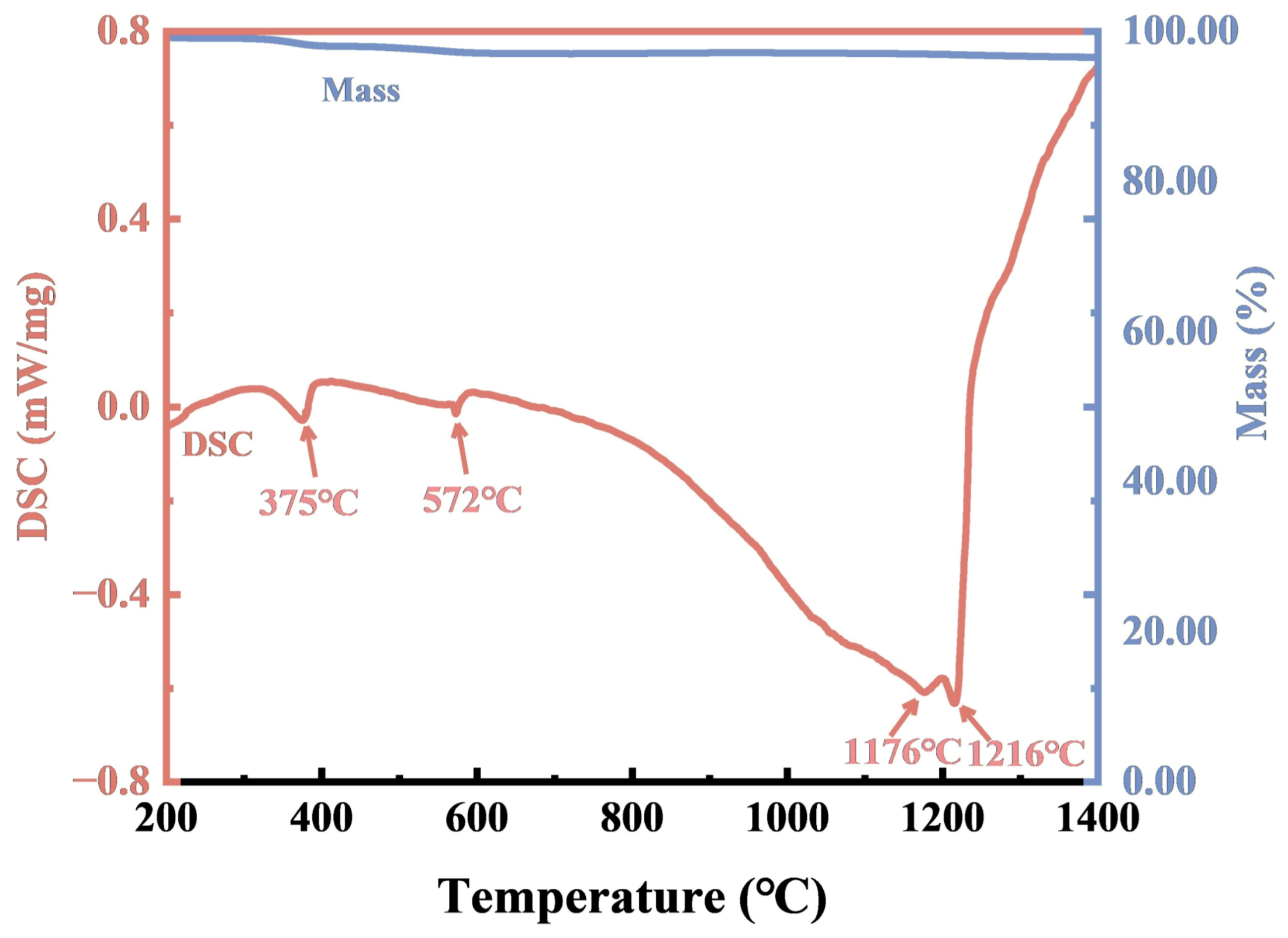
As shown in Figure 1, an endothermic peak at 375 °C was observed between 200 °C and 450 °C, accompanied by mass loss. This behavior could be attributed to the removal and thermal decomposition of organic additives introduced during wet ball milling, including the gum arabic binder and ammonium citrate. During the heating process, the organic components underwent dehydration, thermal decomposition, and decomposition of ammonium-containing species. Because the analysis was conducted in air, partial oxidation of the organics might also have occurred. However, the overall thermal response within this temperature range remained endothermic, indicating that dehydration and thermal decomposition dominated the overall heat-transfer effect.
At approximately 572 °C, the second endothermic peak and the corresponding mass loss were attributed to the decomposition of Ca(OH)2, according to the reaction Ca(OH)2 → CaO + H2O.
The exothermic peaks observed between approximately 1176 °C and 1217 °C indicated crystallization within the CaO-MgO-Al2O3-SiO2 system, which increased melt viscosity and reduced melt fluidity [20]. Previous studies have also shown that the CaO-MgO-Al2O3-SiO2 system undergoes renewed melting and exhibits enhanced spreading tendency at 1300 °C [21]. Therefore, to study the infiltration behavior of the molten Ca33Mg9Al13Si45 on SiCf/SiC under conditions favoring a higher melt fraction and a more continuous liquid phase, the corrosion temperature was set at 1300 °C, which was above the crystallization temperature range.

2.4. Corrosion Environments of the Molten Ca33Mg9Al13Si45

Two corrosion environment conditions were employed in this study. We acknowledge that there was a certain temperature gradient in the muffle furnaces and tube furnaces in different areas. Thus, before the 300 h corrosion tests, we calibrated the temperatures at 1300 °C in the location of the specimen area.
(1)
High-temperature air corrosion
For the high-temperature air corrosion test, the wrapped SiCf/SiC were placed in alumina crucibles and then put into a muffle furnace. The wrapped SiCf/SiC was heated from room temperature to 1300 °C at a rate of 5 °C/min, maintained at 1300 °C for 300 h, and subsequently cooled to room temperature at the same rate.
(2)
High-temperature water-vapor corrosion
To simulate the combustion environment of an aero engine, a high-temperature water-vapor corrosion test was performed. A sealed alumina tube furnace containing an H2O:O2 gas mixture with a volume ratio of 90:10 under normal pressure was used. The corrosion was performed at a total pressure of 1 atm. The corresponding partial pressure of water vapor was 0.9 atm. The wrapped SiCf/SiC were placed in an alumina crucible and then put into a tube furnace. The temperature increased from room temperature to 1300 °C at a heating rate of 5 °C/min. After the temperature reached 1300 °C, a micro liquid vaporizer was activated to convert deionized water into water vapor and introduced vapor at a rate of 1800 mL/min during the 300 h corrosion test, while pure oxygen was simultaneously supplied at a flow rate of 200 mL/min. After the 300 h corrosion, the micro vaporizer was turned off, and the tube furnace was cooled to room temperature at the same rate. Subsequently, the oxygen supply was terminated, and the wrapped SiCf/SiC was removed from the furnace.
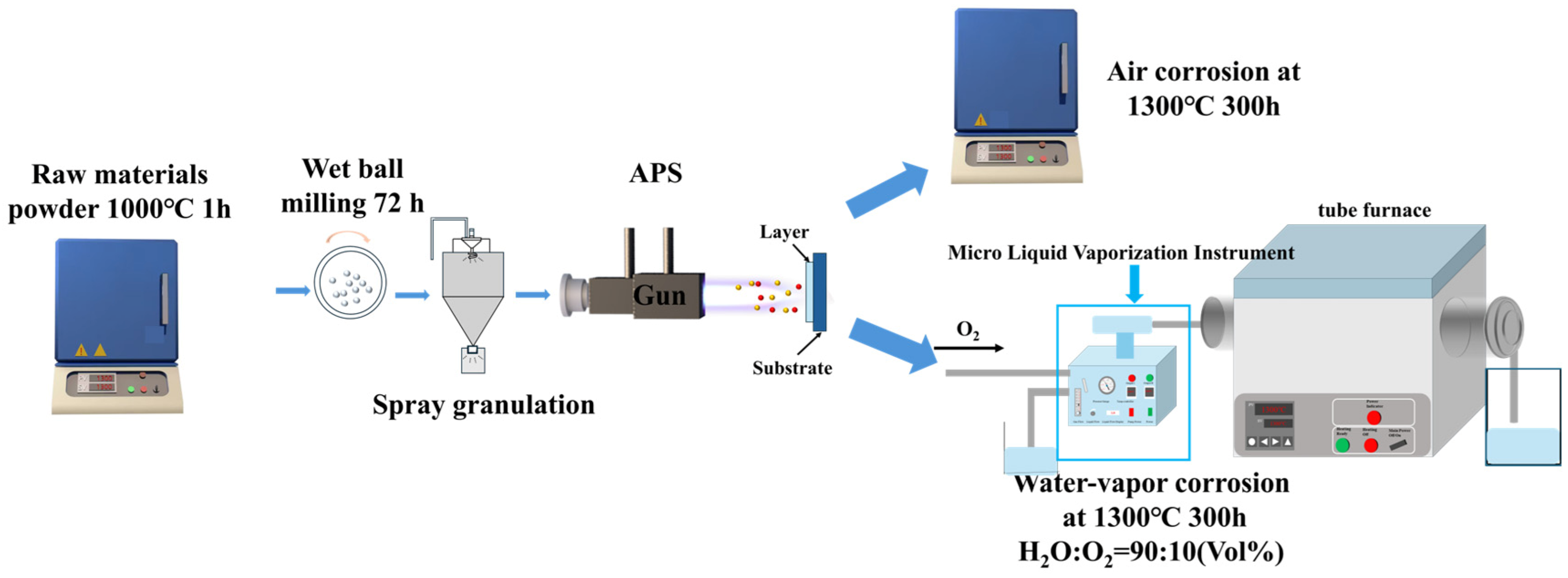
The overall experimental procedures for the high-temperature air corrosion and water-vapor corrosion are shown in Figure 2.

2.5. Flexural Strength Test

The wrapped SiCf/SiC after exposure to two corrosion environments, and the original SiCf/SiC (only heat treatment without the Ca33Mg9Al13Si45 layer), were subjected to bending tests to evaluate the evolution of mechanical properties. For each state (including the original state, high-temperature air corrosion state, and water-vapor corrosion state), three samples were tested, respectively, and the average value was taken as the bending strength of the corresponding condition. The room-temperature flexural strength of all samples was measured using a universal testing machine (SANS Company, CMT5105) at a loading rate of 0.5 mm/min with a span length of 40 mm. The flexural strength (σ, MPa) is calculated by the following formula:
σ = 3 F L 2 b h 2
where F is the maximum load (N), L is the span (mm), b is the width of the sample (mm), and h is the thickness of the sample (mm).

2.6. Characterization

The thermal stability of Ca33Mg9Al13Si45 was investigated in air from room temperature to 1400 °C using TG-DSC. The phase evolution of the Ca33Mg9Al13Si45 layer on the SiCf/SiC surface before and after corrosion was characterized by X-ray diffraction (XRD, Smart Lab, Rigaku, Tokyo, Japan) using a Cu-Kα radiation source (40 kV, 50 mA), scanning from 5° to 85°, with a speed of 2 °/min and a scanning step size of 0.01°.
The SiCf/SiC with the Ca33Mg9Al13Si45 layer samples were embedded in epoxy resin and polished to a scratch-free state using sandpaper and polishing solution. The microstructures were observed using a scanning electron microscope (SEM, EVO 10, ZEISS, Oberkochen, Germany). Semi-quantitative analysis of the elemental composition and distribution of the sample was performed using an X-ray energy spectrometer (EDS, Xplore 30, Oxford, UK). More accurate characterization of the elemental distribution was conducted using an electron probe microanalysis (EPMA, JXA-8230, Tokyo, Japan) equipped with a wavelength-dispersive spectrometer (WDS, INCAX, Tokyo, Japan).

3. Results

3.1. The Phase of the Ca33Mg9Al13Si45 Layer

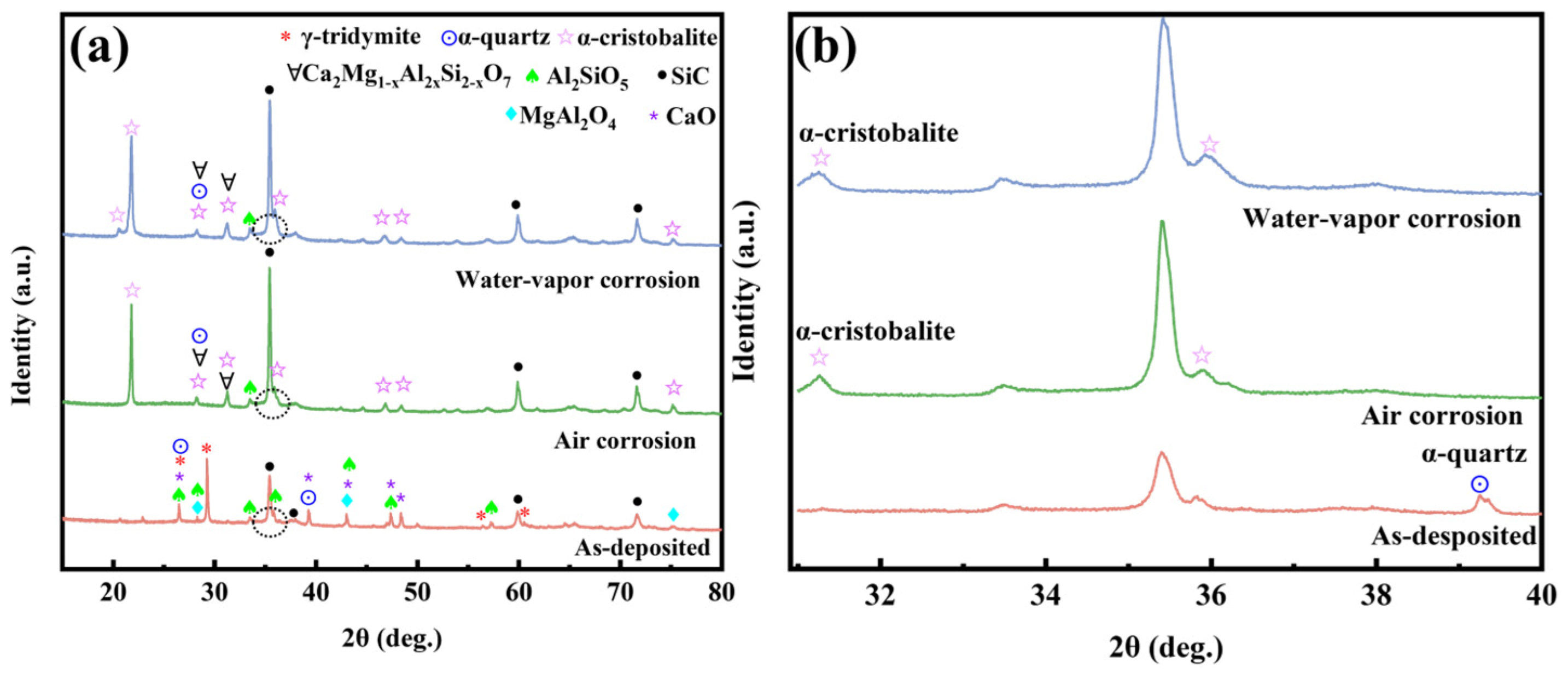
Figure 3 presents the XRD patterns of the as-deposited (without corrosion) SiCf/SiC with the Ca33Mg9Al13Si45 layer after high-temperature air corrosion and water-vapor corrosion. In the as-deposited sample, γ-tridymite, α-quartz, Al2SiO5, MgAl2O4, and CaO were identified as the major phases in the Ca33Mg9Al13Si45 layer on the SiCf/SiC surface. After air corrosion and water-vapor corrosion, the Ca33Mg9Al13Si45 layer primarily consisted of α-quartz, α-cristobalite, Al2SiO5, and Ca2Mg1-xAl2xSi2-xO7 (x = 0~1). The standard material cards corresponding to the phases are presented in Table 2. The XRD results indicated that SiO2 was mainly as α-quartz and γ-tridymite in the as-deposited state, whereas after high-temperature air corrosion and water-vapor corrosion, the dominant SiO2 phases transformed into α-quartz and α-cristobalite [22]. Meanwhile, after eliminating the background noise, we found that within the 30–40° range, there were certain amorphous signal components in the XRD characteristic signals. In the as-deposited state, although there were SiC and Al2SiO5 characteristic peaks at 34–36°, a wide base was observed, which was evidence of the presence of a typical amorphous phase. After air corrosion, the characteristic signals of the amorphous phase were at 33–36°; after water-vapor corrosion, the characteristic signals of the amorphous phase were at 32–36°.

3.2. Morphology Analysis

To evaluate the infiltration behavior of molten Ca33Mg9Al13Si45 into SiCf/SiC under high-temperature air corrosion and water-vapor corrosion conditions, the cross-sectional morphologies of as-deposited SiCf/SiC and wrapped SiCf/SiC exposed to the two corrosion environments for 300 h were characterized by SEM.
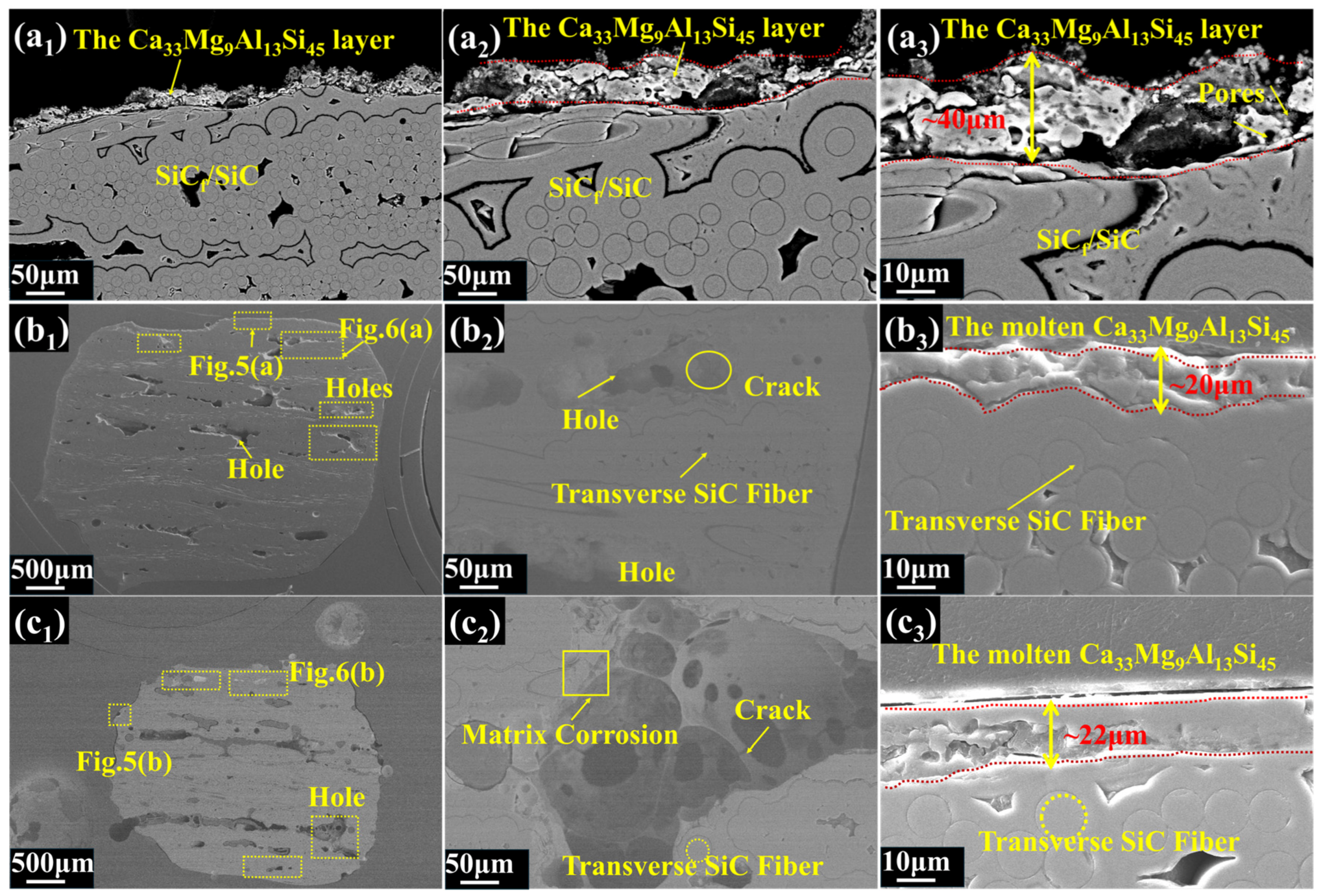
Figure 4 shows the cross-sectional SEM images of all samples. The SEM images of the as-deposited sample in Figure 4(a1–a3) revealed a dense SiC matrix with uniformly distributed vertical and horizontal fibers. The fiber–matrix interfaces remained well bonded, and no obvious interfacial debonding was observed. A limited number of pores were observed within the Ca33Mg9Al13Si45 layer fabricated by APS, which could be attributed to partially unmelted particles and the agglomeration of molten splats during APS deposition. Furthermore, as shown in Figure 4(a2,a3), several pores were observed at the interface between the molten and the SiCf/SiC substrate, indicating relatively weak interfacial bonding.
Compared with the as-deposited sample, noticeable microstructural changes in the wrapped SiCf/SiC after exposure to the two corrosion conditions were observed. As shown in Figure 4(b1,c1), some pores within the SiCf/SiC were filled with materials exhibiting distinct contrast after high-temperature air and water-vapor corrosion. Figure 4(b2,c2) shows the local morphologies of the filled regions after two corrosion conditions, revealing the presence of cracks and pores within these areas, which could be associated with incomplete infiltration and thermal shrinkage-induced stresses during cooling. Compared with the as-deposited sample, the Ca33Mg9Al13Si45 layer exhibited fewer pores after both high-temperature air corrosion in Figure 4(b3) and water-vapor corrosion in Figure 4(c3). In addition, the interface gap between the molten layer and the substrate was significantly reduced. This structural evolution could be associated with the softening, viscous flow of the molten under prolonged high-temperature exposure, as well as crystalline phase transformation upon cooling [23]. Under prolonged exposure to high temperatures, the layer softened and covered the surface of the substrate. According to the XRD results shown in Figure 3, the corrosion process involved phase transformation and crystallization during cooling, which promoted layer densification and enhanced the interfacial bonding between the molten layer and the substrate.
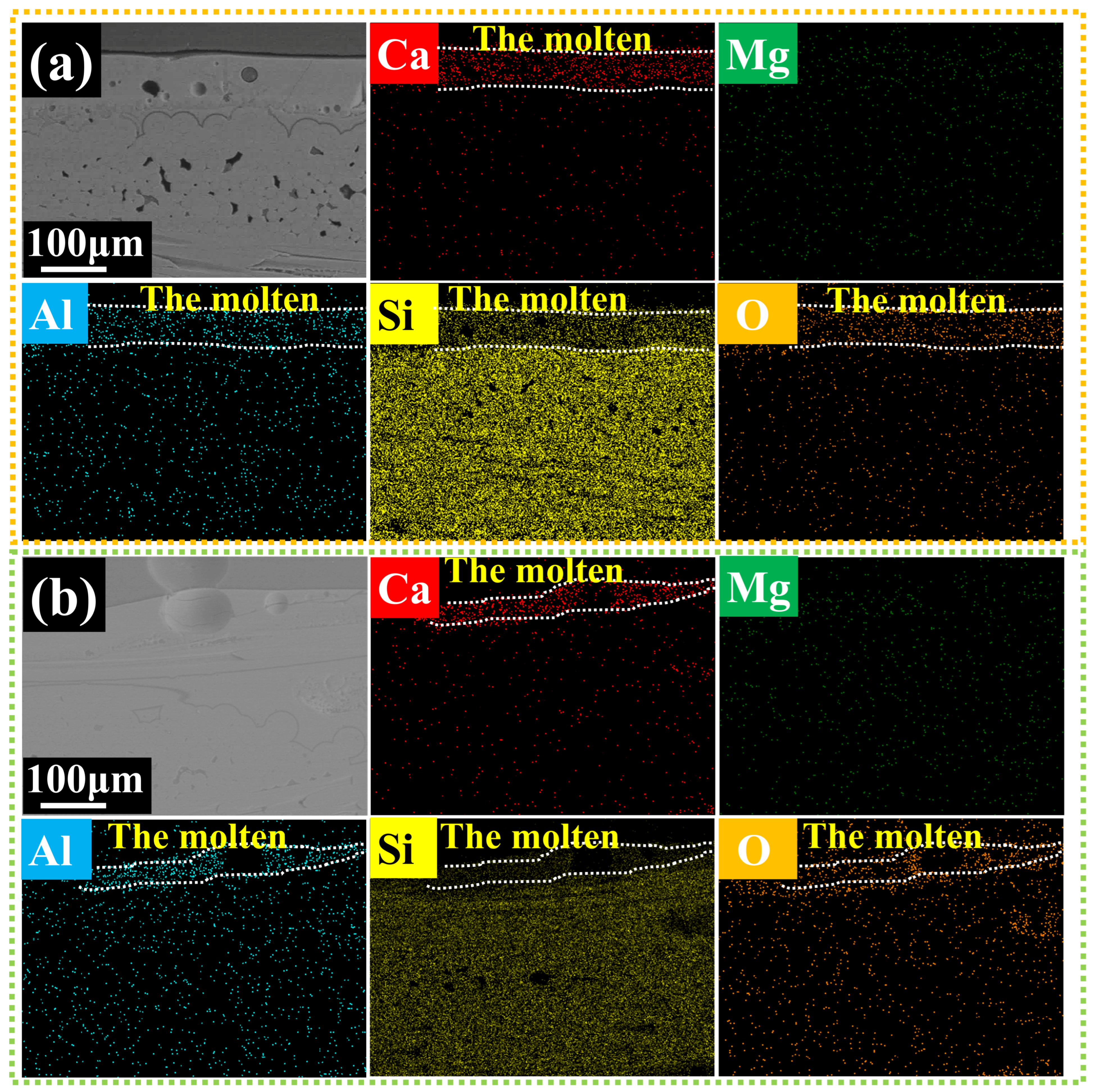
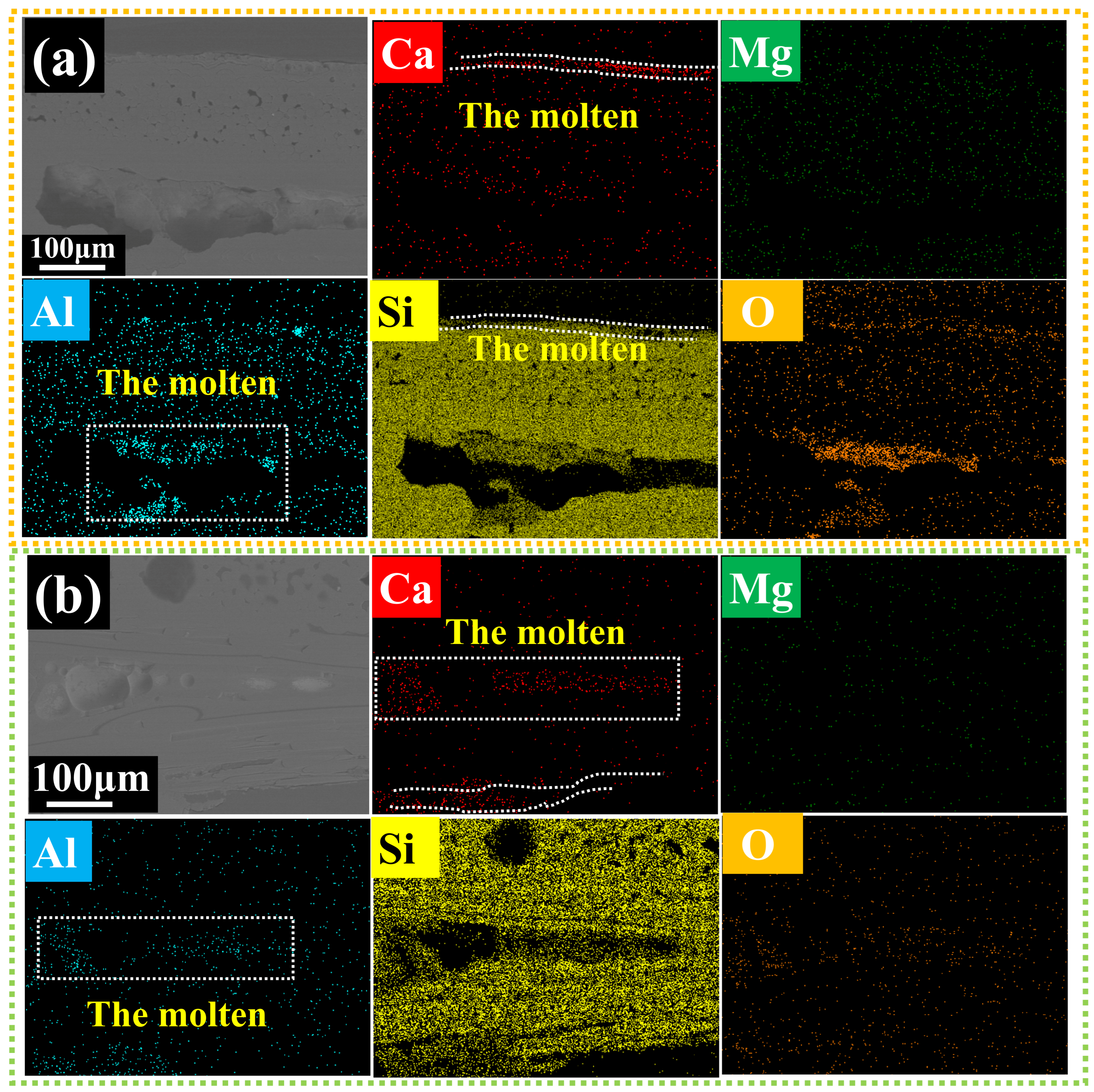
The materials exhibiting distinct contrast filled some pores within the SiCf/SiC in Figure 4(b1,c1). To identify the origin of these filling materials, semi-quantitative EDS elemental mapping was performed on the cross-sections of the corroded sample. Considering that the SiCf/SiC contained residual porosity with a heterogeneous distribution [24,25], the obvious pore-filling areas were expected to be localized rather than uniformly distributed throughout the cross-section. Therefore, two representative regions were selected. Figure 5 shows the dense region, whereas Figure 6 presents the regions containing pre-existing pores.
In the dense SiC matrix shown in Figure 5a,b, the EDS mapping results indicated that Ca and Al remained concentrated within the molten after corrosion, whereas no obvious enrichment of these elements was detected in the dense SiCf/SiC regions within the mapped area. In contrast, the elements originating from the molten were detected within the pre-existing pores of SiCf/SiC in Figure 6. An Al-enriched region was observed in Figure 6a, whereas the enrichment of Al and Ca was detected in Figure 6b.
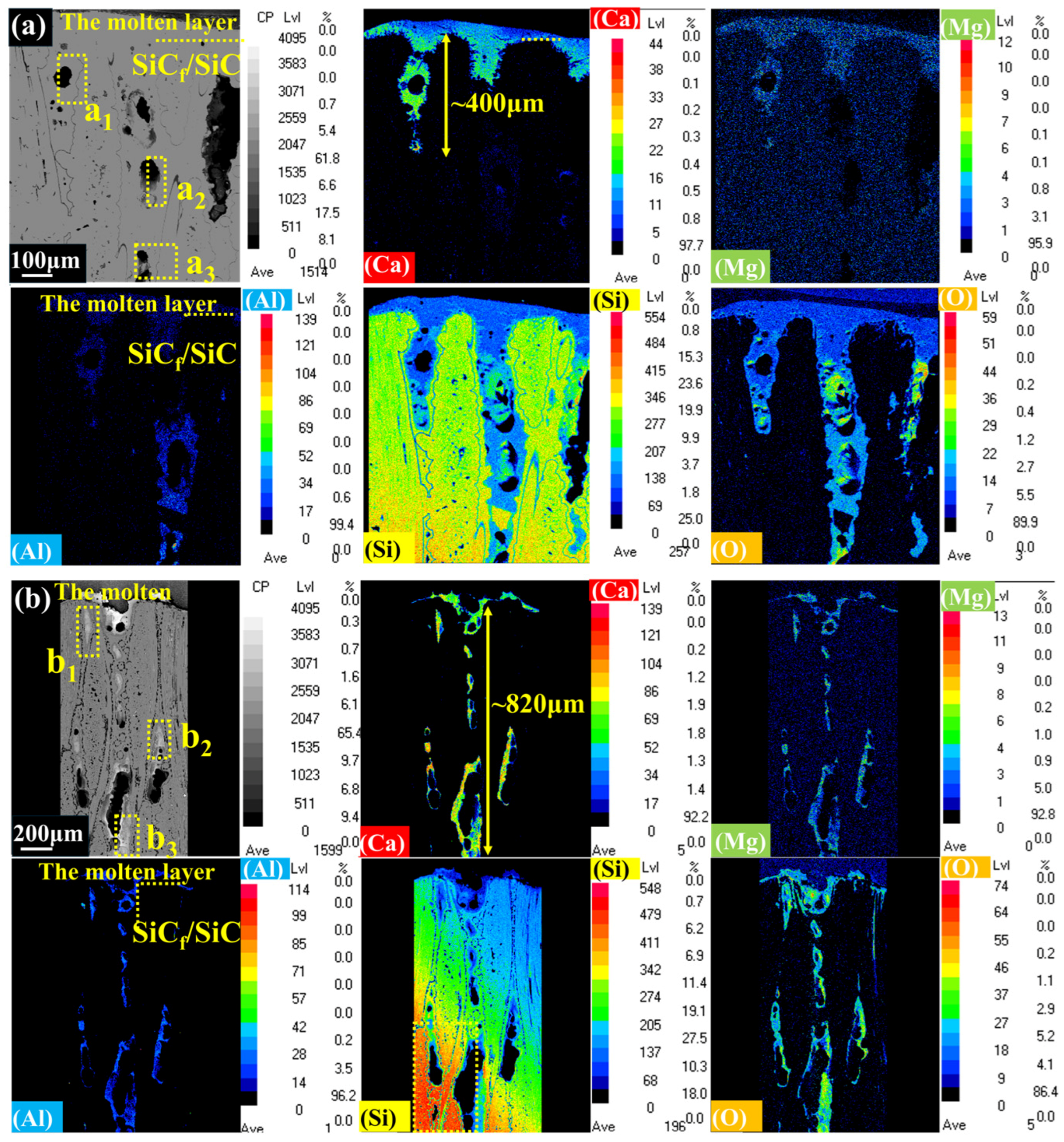
To further analyze the compositional distribution within the pore-filling regions at higher spatial resolution, EPMA with WDS mapping was performed. Figure 7 presents the WDS elemental distribution maps of the cross-sections after high-temperature air corrosion and water-vapor corrosion. It should be noted that the diagonal Si signal observed in the WDS cross-sectional image of the water-vapor corrosion in Figure 7b resulted from slight sample tilt or misalignment during the mapping measurement. Because Si exhibited a high signal intensity and wide distribution within the SiCf/SiC, minor geometric variations were amplified by the color scale.
In this study, particular attention was given to the distribution of Ca, Mg, and Al elements. As shown in Figure 7, Ca, Al, and Mg originating from the molten Ca33Mg9Al13Si45 were detected within the pores, supporting that infiltration and pore filling of the molten Ca33Mg9Al13Si45 after air corrosion and water-vapor corrosion at 1300 °C. Moreover, distinct differences were observed in the elemental distribution behavior of the molten Ca33Mg9Al13Si45 under the two corrosion conditions. After high-temperature air corrosion, Ca and Mg were mainly concentrated in the upper part of the pore-filling region (~400 μm) in Figure 7. In contrast, the Al infiltrated deeper into the pores of SiCf/SiC. After high-temperature water-vapor corrosion, Ca and Mg not only accumulated in the upper part but also penetrated deeper into the pores of SiCf/SiC in Figure 7, whose infiltration depth was greater than 820 µm (observation was limited by the size of the photo’s field of view). Under both corrosion conditions, differences were observed not only in infiltration depth but also in the degree of elemental enrichment, which also varied, with Al consistently exhibiting stronger enrichment signals than Ca and Mg.
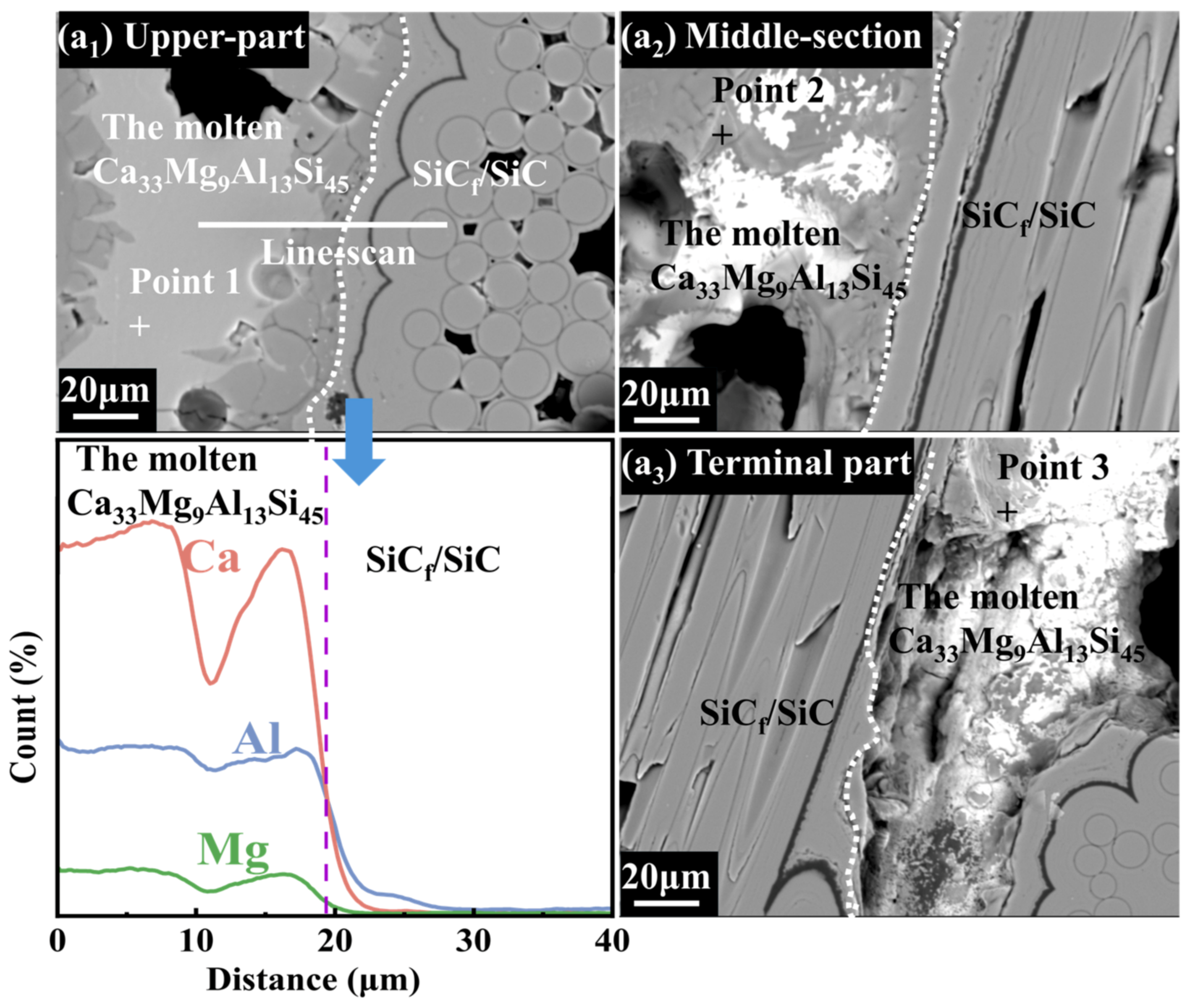
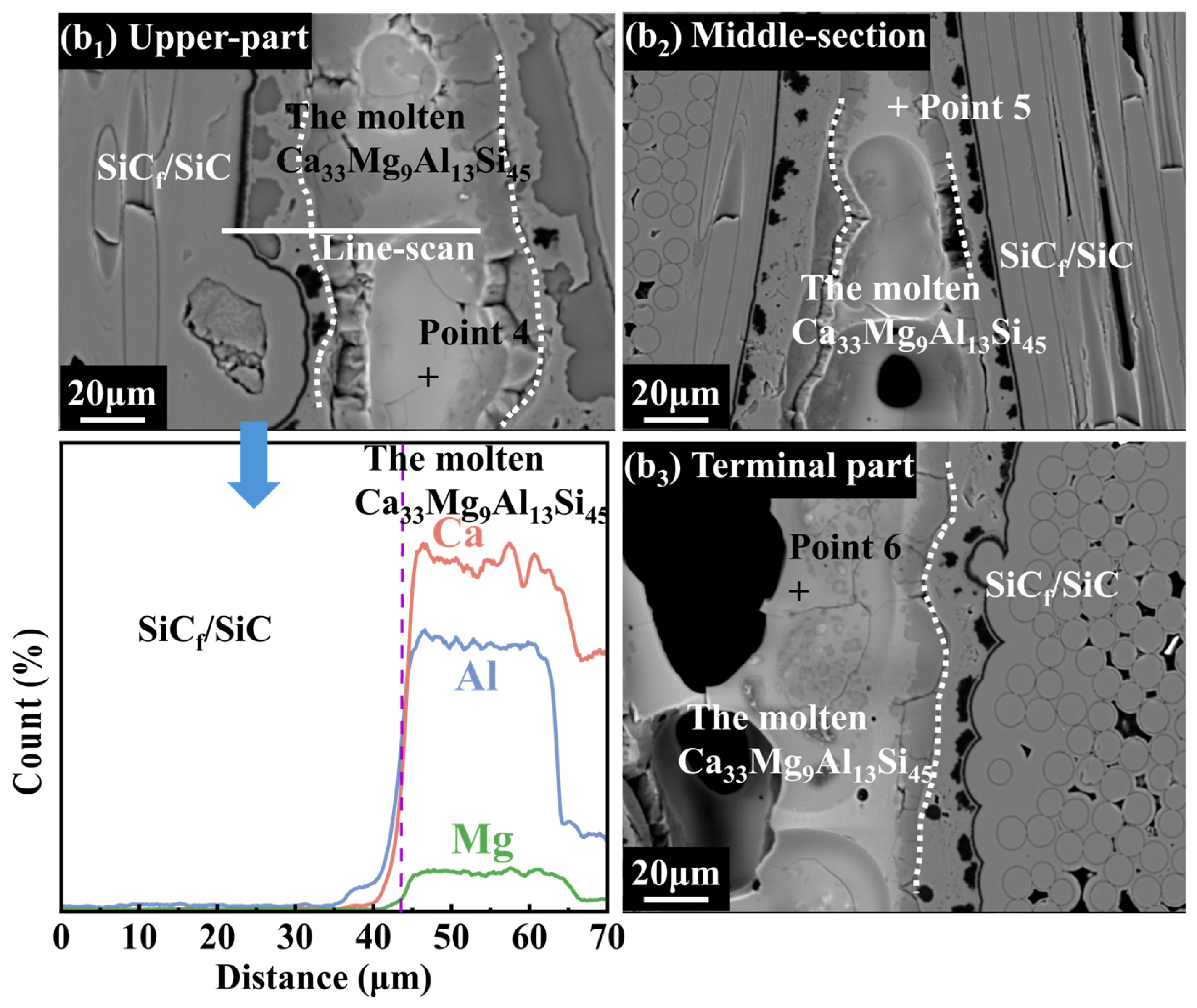
After determining the elemental distributions within the pores, line-scan analyses were conducted to further evaluate the infiltration behavior of the molten Ca33Mg9Al13Si45 in the pore regions. The line-scan results for the filled areas after high-temperature air corrosion and water-vapor corrosion are presented in Figure 8 and Figure 9. The curves indicated that the molten Ca33Mg9Al13Si45 was significantly enriched within the pores, exhibiting high signal intensities of the characteristic elements. However, at the interface between the molten and the SiCf/SiC matrix, the signal intensities of these characteristic elements decreased sharply to nearly zero.

3.3. Bending Resistance Performance

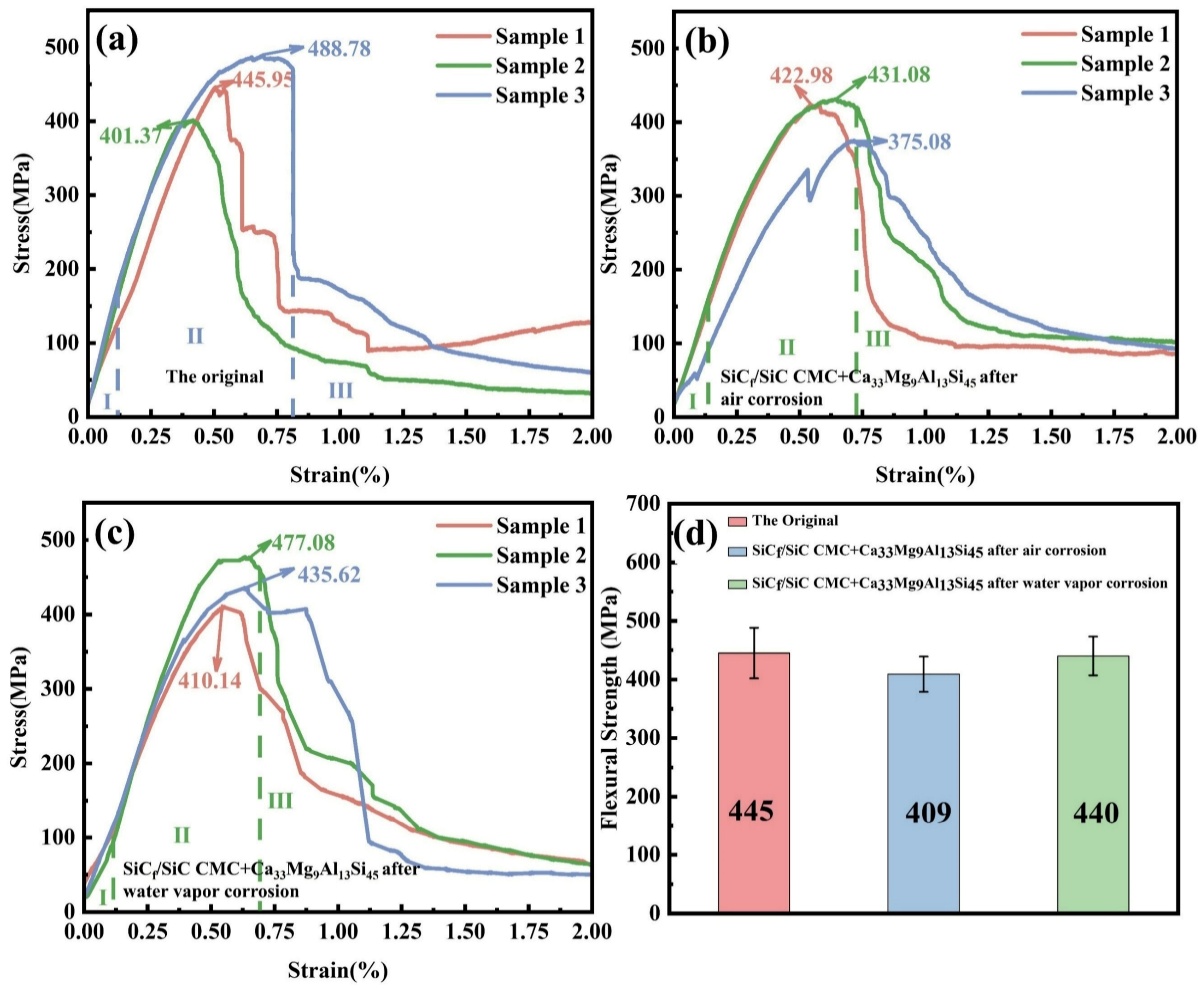
To further evaluate the influence of the molten Ca33Mg9Al13Si45 infiltration on the mechanical performance of SiCf/SiC, the room-temperature flexural strengths of the wrapped SiCf/SiC after corrosion and the original SiCf/SiC were measured. Figure 10 presents the stress–strain curves of SiCf/SiC under different conditions, while the corresponding flexural strengths are summarized in Figure 10d.
As shown in Figure 10d, the flexural strengths of the wrapped SiCf/SiC after high-temperature air corrosion, water-vapor corrosion, and the original SiCf/SiC were 409 ± 30 MPa, 440 ± 33 MPa, and 445 ± 43 MPa, as calculated using Equation (1). The corresponding strength retention rates after air corrosion and water-vapor corrosion were 92% and 99%, relative to the original state.

4. Discussion

4.1. Phase Evolution of the Ca33Mg9Al13Si45 Layer

The phase transformation behavior of the Ca33Mg9Al13Si45 layer was strongly influenced by the corrosion atmosphere. In the as-deposited sample, the main phases of SiO2 were α-quartz and γ-tridymite, while after high-temperature air corrosion and water-vapor corrosion, α-quartz and α-cristobalite became dominant. The results indicated that the distribution of SiO2 polymorph depended on the thermal history associated with long-term exposure at 1300 °C and subsequent cooling. In addition, the relative stability of the crystalline phases was influenced by the thermal history and corrosion atmosphere in Figure 3b. To explain the observed quartz-to-cristobalite transformation after exposure at 1300 °C, the Gibbs free energy relationship G = H − TS evaluated at 1573 K was used to analyze the thermodynamic driving force for SiO2 transformations and to compare the relative stability of different polymorphs [26]. Based on the Shomate equation coefficients provided by the NIST Chemistry Webbook [27], the relative enthalpy values (H°(T) − H° 298.15 K) and standard molar entropy values (S°) of quartz and cristobalite were calculated according to Equation (2):
H ° T H ° 298.15 = A t + B t 2 2 + C t 3 3 + D t 4 4 E t + F H S ° T = A l n t + B t + C t 2 2 + D t 3 3 E 2 t 2 + G t = T 1000
where H° represents the standard enthalpy value (kJ/mol), S° is the standard entropy value (J·mol−1·K−1), and T is the temperature (K). A-H are constants provided by the NIST Chemistry Webbook. According to the NIST Chemistry Webbook, the H°298.15 K for quartz and cristobalite were −910.36 and −908.346 kJ/mol. Using these values together with the calculated H°(T) − H°298.15 K and S° listed in Table 3, the Gibbs free energies of quartz and cristobalite at 1573 K were determined. The driving force for the phase transformation was subsequently calculated as ΔG = G(cristobalite) − G(quartz). The ΔG from quartz to cristobalite transformation was −4.62 kJ/mol at 1300 °C (1573 K), indicating that cristobalite was thermodynamically more stable than quartz under these conditions. This thermodynamic preference suggested a driving force for the phase transformation. However, the occurrence of the transformation also depended on kinetic accessibility. The transformation of SiO2 from quartz to cristobalite was regarded as a reconstructive phase transformation involving atomic diffusion and lattice rearrangement [28,29,30]. Therefore, sufficiently high-temperature exposure time was required for the transformation to proceed. During the corrosion process, exposure at 1300 °C for 300 h provided sufficient time for diffusion and lattice rearrangement, thereby enabling the transformation and promoting the formation of high-temperature cristobalite. The β-cristobalite formed at high temperature subsequently transformed into low-temperature α-cristobalite through a displacive transformation during cooling and was, therefore, retained at room temperature [22]. In contrast, the intermediate transitional phase γ-tridymite was not detected.
In addition, weak diffraction peaks corresponding to Al2SiO5 and MgAl2O4 were still detected. These phases were attributed to elemental segregation and mutual reactions occurring after rapid melting of the mixed powders during the APS process. The growth time available for Al2SiO5 and MgAl2O4 nuclei was limited because the molten powders rapidly cooled and solidified within a very short period after deposition onto the SiCf/SiC surface [31]. As a result, rapid cooling suppressed nucleation and crystal growth, ultimately resulting in the low diffraction intensities observed in the XRD patterns.
Beyond the evolution of SiO2 polymorph, the XRD patterns of the Ca33Mg9Al13Si45 layer after high-temperature air corrosion and water-vapor corrosion both revealed the presence of the melilite phase Ca2Mg1−xAl2xSi2−xO7 (x = 0~1) in Figure 3a. The formation of Ca2Mg1−xAl2xSi2−xO7 was closely related to the melt chemical composition at high temperature and the crystallization behavior of the Ca33Mg9Al13Si45 layer during cooling. At 1300 °C, Si was the dominant element in the molten Ca33Mg9Al13Si45, resulting in a SiO2-rich melt. Under these conditions, silicate crystals mainly composed of SiO2 were expected to precipitate during the cooling process, while remaining Ca, Mg, and Al in the residual melt participated in subsequent silicate crystallization. Because the O/Si ratio in SiO2 was 2:1, its structural units consisted of corner-sharing Si-O tetrahedra, forming a typical network structure [32]. Owing to the similar covalent radii of Al(0.126 nm) and Si(0.117 nm) [33], Al3+ entered the Si-O tetrahedral framework and substituted for Si4+, without fundamentally altering the tetrahedral structure. Meanwhile, Mg2+ and Ca2+ mainly occupied the corresponding coordination sites to balance the local charge and stabilize the crystal structure, thereby facilitating the formation of the melilite phase Ca2Mg1−xAl2xSi2−xO7 (x = 0~1).

4.2. Infiltration Behavior of the Molten Ca33Mg9Al13Si45

No evidence of infiltration of the molten Ca33Mg9Al13Si45 into the dense matrix regions was observed in Figure 5. In contrast, infiltration of the molten Ca33Mg9Al13Si45 was clearly detected in regions containing pre-existing pores, as shown in Figure 6. These observations suggested that within the detection limit of EDS, bulk diffusion of the molten Ca33Mg9Al13Si45 into the dense matrix was not the dominant infiltration pathway under either corrosion conditions. Instead, the molten Ca33Mg9Al13Si45 preferentially infiltrated along pre-existing pores within the SiCf/SiC and subsequently filled these pores.
After identifying the dominant infiltration pathway, differences in the infiltration behavior of individual components were further observed under different corrosion environments, as reflected by variations in infiltration depth and elemental enrichment. As shown in Figure 7, the different components of the molten Ca33Mg9Al13Si45 exhibited distinct infiltration depths and enrichment characteristics under different corrosion conditions. These differences were interpreted on the basis of variations in chemical potential differences and diffusion coefficients.
In a molten deposit, mass transport required a thermodynamic driving force [34]. Therefore, the observed differences in elemental distribution suggested that the thermodynamic driving forces governing Ca, Mg, and Al transport differed under the two corrosion environments. In the molten Ca33Mg9Al13Si45-SiCf/SiC system, the chemical potential difference could be regarded as the thermodynamic driving force for infiltration. The chemical potential is expressed as follows [35]:
μ i = μ i 0 + R T l n a i a i = γ x i
where μi0 represents the standard chemical potential, ai is the activity of the component, γ is the activity coefficient, and xi is the mole fraction. In this study, the chemical potential difference between the upper-part filling region and the interior of the designed molten Ca33Mg9Al13Si45 was compared for each component. These two positions were selected because, if the chemical potential difference were insufficient to drive infiltration into the upper-part pore filling region, the species would be even less likely to penetrate into deeper pore regions. μi0 could be regarded as constant because the same component and reference state were considered. Within the same molten deposit system, γ can be assumed to be approximately constant and close to unity, so ai ≈ xi [35]. This approximation was adopted to enable relative comparison of compositional trends under different corrosion environments within the same system. Accordingly, the chemical potential difference can be expressed as follows [35]:
μ = μ x μ 0 = R T l n x x 0
where R represents the gas constant (J·mol−1·K−1), T represents temperature (K), x denotes the mole fraction of the components in the upper-part filling region, and x0 denotes the mole fraction of the corresponding components within the designed molten Ca33Mg9Al13Si45. x0(CaO) = 0.33, x0(MgO) = 0.09, and x0(AlO1.5) = 0.13; Δμ represents the chemical potential difference between the upper-part filling region and the interior of the designed molten Ca33Mg9Al13Si45. Its sign indicated the direction of infiltration, whereas its absolute value reflected the magnitude of the driving force.
Based on the EDS point analysis results obtained from the upper part, middle section, and terminal part of the pore-filling molten in Table 4, the corresponding chemical compositions under the two corrosion conditions were calculated in Table 5. It should be noted that, during EDS compositional analysis, 10 locations were measured in the upper part, middle section, and terminal part, respectively, and the average value was used as the representative component of the corresponding region. Subsequently, the Δμ values for Ca, Mg, and Al were calculated according to Equation (4) using the upper-part compositions listed in Table 5 and the designed layer composition. Table 6 presents the calculated results. The Δμ values listed in Table 6 were negative under both high-temperature air corrosion and water-vapor corrosion, indicating that the chemical potential within the designed layer was higher than that in the upper-part pore filling region of the SiCf/SiC. Therefore, the molten Ca33Mg9Al13Si45 components were thermodynamically favored to infiltrate along the pores into the SiCf/SiC. Under the high-temperature air corrosion, the absolute value of Δμ for Al was significantly greater than that for Ca and Mg, indicating a stronger chemical potential driving force tendency. Consequently, Al exhibited a more pronounced downward infiltration tendency than Ca and Mg under high-temperature air corrosion. In contrast, the absolute value of Δμ for Ca and Mg increased under high-temperature water-vapor corrosion relative to air corrosion, suggesting an enhanced thermodynamic driving tendency for Ca/Mg infiltration in this environment. Therefore, Ca and Mg were more likely to infiltrate deeper into the SiCf/SiC through the pores.
In the molten Ca33Mg9Al13Si45-SiCf/SiC system, the final infiltration depth was not solely determined by the chemical potential difference but was also governed by diffusion kinetics. In this study, the infiltration behavior of the molten Ca33Mg9Al13Si45-SiCf/SiC system was analyzed using a semi-infinite diffusion model, and the concentration distribution can be expressed as follows [36]:
C x , t = C 1 + C 0 C 1 e r f x 2 Dt
The initial and boundary conditions were set as follows:
Initial   conditions : t = 0 ,   C x , 0 = C 1 Far   field   boundary :   C x , t = C 1 Surface   boundary : x = 0 ,   C 0 , t = C 0
C1 is set to zero, whereas C0 represents the mole fraction in the designed Ca33Mg9Al13Si45, with C0(CaO) = 0.33, C0(MgO) = 0.09, and C0(AlO1.5) = 0.13 during high-temperature air corrosion and water-vapor corrosion infiltration process. Here, D represents the diffusion coefficient, x represents infiltration depth, t represents the corrosion time, and C(x, t) represents the mole fraction of molten Ca33Mg9Al13Si45 elements in different filling regions. The diffusion equation can be expressed as follows:
C x , t = C 0 e r f x 2 Dt erfc 1 C x , t C 0 = x 2 Dt
The diffusion coefficients of Ca, Mg, and Al under different corrosion conditions were calculated using the compositional data listed in Table 5 in combination with the inverse complementary error function in Equation (7). The calculated results are presented in Table 7. Under high-temperature air corrosion, the diffusion coefficients of Ca and Mg were approximately one order of magnitude lower than that of Al, resulting in a lower infiltration rate along the pore-filling pathways. In contrast, under high-temperature water-vapor corrosion, the diffusion coefficients of the three elements were comparable and generally higher than those under high-temperature air corrosion. This behavior was consistent with the ① hydrolysis process and ② hydroxyl-assisted structural, ③ viscosity reduction, and ④ volatilization phenomena [37,38,39]. The hydrolysis process disrupted Si-O-Si linkages, thereby reducing the diffusion barrier and increasing the elemental diffusion rates. At 1300 °C, water molecules disrupted the bridging oxygen structure within the silicate network, leading to the formation of hydroxyl species (Si-OH) and subsequent depolymerization of the silicate network. Hydroxyl-assisted structural modification reduced the barrier for ionic transport, thereby significantly enhancing elemental diffusion and ionic mobility. Additionally, the incorporation of hydroxyl groups further depolymerized the silicate network, thereby reducing the melt viscosity and enhancing the melt fluidity, which facilitated penetration into the SiCf/SiC pores. Moreover, high-temperature water vapor promoted the formation of the volatile gaseous species Si(OH)4. The decrease in silicon content led to a reduction in viscosity, making the melt flow more easily and facilitating the penetration into the interior of SiCf/SiC.
Therefore, compared with the corrosion by dry air, the elemental infiltration was enhanced under water-vapor corrosion conditions.
It should be acknowledged that, in practical systems, factors such as porosity, phase evolution, multiphase silicates, viscous flow, and heterogeneous pathways could influence infiltration behavior. Therefore, the situation was not ideal. Accordingly, the present model had inherent limitations when applied to complex corrosion systems. Nevertheless, when the model was used to evaluate the infiltration corrosion behavior of the molten Ca33Mg9Al13Si45 in SiCf/SiC under different corrosion environments, the calculated values were not intended to provide absolute quantitative predictions. Instead, they served as a comparative indicator for assessing the relative infiltration tendencies of different components.
Therefore, under the combined influence of chemical potential differences and diffusion coefficients, the components of the molten Ca33Mg9Al13Si45 showed distinct differences in both infiltration depth and enrichment behavior after penetrating and filling the pores within the SiCf/SiC. As indicated by the EPMA results in Figure 7, continuous enrichment of Al was observed within the pores under both corrosion conditions. The enrichment of Al could be attributed to the incorporation of Al into the silicate network as tetrahedrally coordinated [AlO4] units, which partially substituted for [SiO4] tetrahedra with charge compensation provided by modifier cations such as Mg2+ and Ca2+, thereby forming Al–O–Si linkages. Such network incorporation and charge-compensated substitution stabilized Al within the molten phase [40], thereby promoting Al accumulation inside the pores. Meanwhile, the line-scan results in Figure 8 and Figure 9 indicated that no measurable interdiffusion was detected after corrosion at 1300 °C and subsequent pore filling. The constituent elements of the molten Ca33Mg9Al13Si45 did not further diffuse into the SiCf/SiC matrix. These results suggested that the molten Ca33Mg9Al13Si45 and the SiCf/SiC remained chemically stable under the present conditions, and pore filling mainly occurred through physical infiltration and subsequent solidification rather than chemical reactions [41,42].

4.3. Bending Performance

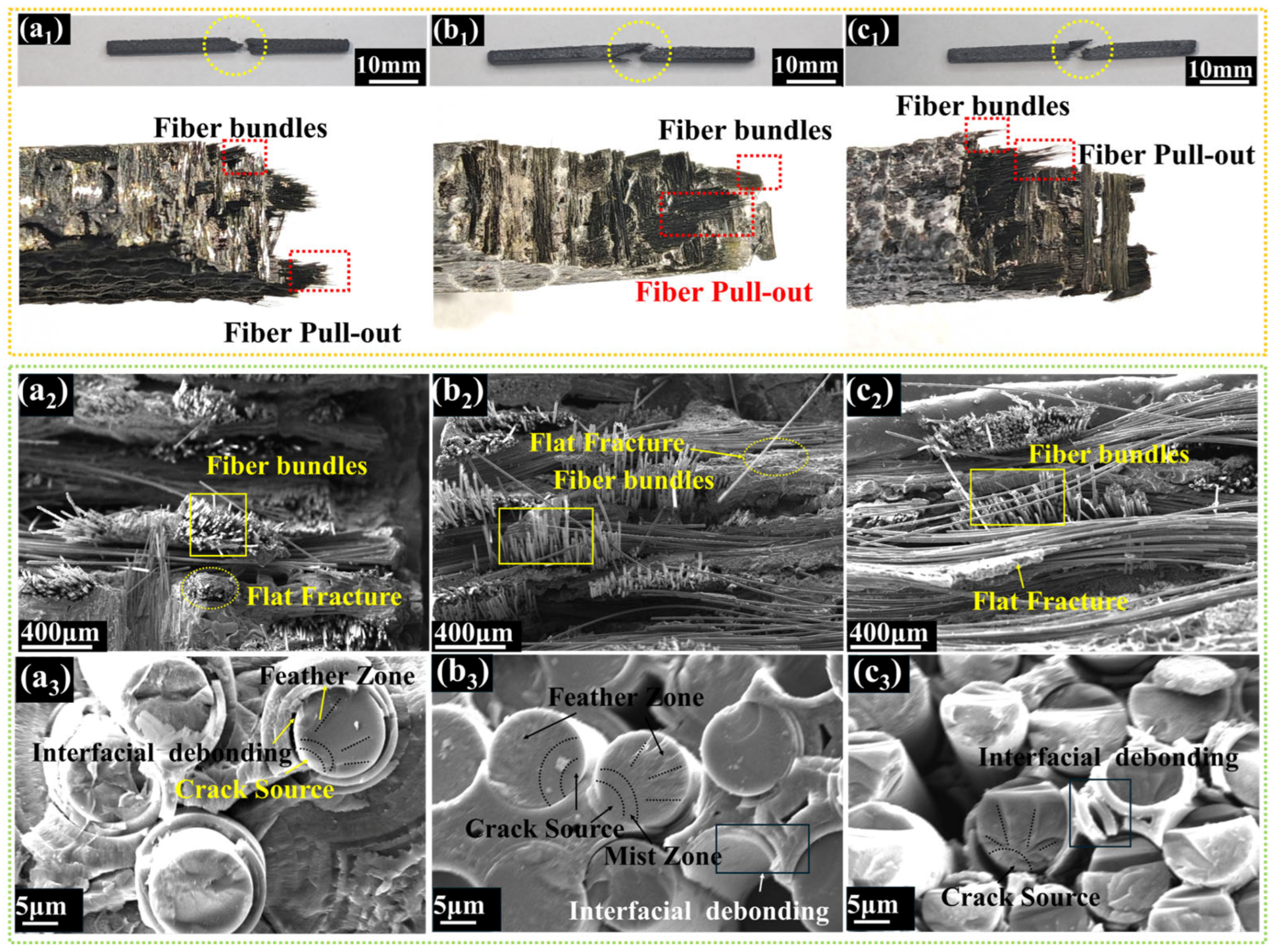
To elucidate the fracture mechanisms associated with the measured flexural strengths, the fracture morphologies of the samples were examined. Figure 11(a1–c1) presents photographs of the samples, whereas Figure 11(a2–c2,a3–c3) shows the SEM images. The molten Ca33Mg9Al13Si45 was not observed on the fracture surfaces because it fragmented and was ejected during the three-point bending test.
As shown in Figure 10, all samples exhibited pseudo-ductile behavior, and the stress–strain curves could be divided into three stages [8,43]:
(1)
In stage I, the stress–strain curve remained nearly linear, with only slight changes in slope corresponding to the elastic modulus of SiCf/SiC. During this stage, fibers deformed elastically without damage, and the fiber–matrix interface remained stable. Deformation occurred primarily within the SiC matrix during this stage.
(2)
Subsequently, the stress–strain curve exhibited a parabolic shape with a gradually decreasing slope in stage II. The stress increased with strain until reaching the peak value, after which the curve entered a plateau region. During this stage, the applied load was borne by the fibers, while microcracks progressively developed within the matrix. Different degrees of interfacial debonding were observed under different corrosion conditions. The fracture photograph in Figure 11 further confirmed that the occurrence of interfacial debonding and fiber pull-out in all samples, although the degree of damage was different. In the original state in Figure 11(a1), the pull-out of fiber bundles was clearly observed. The SEM image in Figure 11(a3) further showed that only slight splitting and debris on the surface after pull-out occurred, indicating minimal interfacial damage. Following air corrosion, the fracture surface shown in Figure 11(b1) appeared relatively smooth, with only a slight fiber pull-out. As shown in Figure 11(b3), the debonding intensified, and the interface characteristics were still relatively obvious after fibers were pulled out. In contrast, clear fiber pull-out was observed on the fracture surface of the SiCf/SiC in Figure 11(c1). Consistent with the SEM image in Figure 11(c3), the interface was nearly fully deboned, accompanied by more pronounced surface undulations and longer fiber pull-out lengths. Moreover, the fiber pull-out length increased from air corrosion to water-vapor corrosion.
(3)
After the stress reached its peak, the curve dropped rapidly and exhibited a stepped shape in stage III, indicating that the fibers were gradually pulled out under interfacial frictional force. Once most fibers were fractured or pulled out (Figure 11(a1–c1)), the remaining fibers could no longer sustain the applied load, leading to overall failure. Pronounced fiber pull-out and flat regions parallel to the matrix fracture surface were observed in all three states in Figure 11(a2–c2). Figure 11(a3–c3) further shows the fracture characteristics of the fibers themselves. Clear mist regions, feather areas, and crack sources were observed on the fiber fracture surfaces, exhibiting typical brittle fracture behavior [44].
The matrix, fibers, and interfaces in the SiCf/SiC exhibited varying degrees of damage after the high-temperature air corrosion and water-vapor corrosion, as shown in Figure 11. The flexural strength of SiCf/SiC was influenced by multiple factors, including phase composition and interfacial bonding strength [45]. The extent of matrix damage and the porosity of SiCf/SiC [46] also affected the flexural strength. Firstly, as shown in the TG-DSC results in Figure 1, at 1300 °C, Ca33Mg9Al13Si45 existed in a molten state and spread over the surface of SiCf/SiC, forming an encapsulation layer on SiCf/SiC that hindered the ingress of corrosive media such as water vapor into the SiCf/SiC, thereby reducing the damage caused by external corrosive media. Secondly, under high-temperature corrosion conditions, the molten Ca33Mg9Al13Si45 components infiltrated along the pores into the interior of SiCf/SiC and filled the existing pores, thereby reducing the effective porosity and keeping the strength. Furthermore, no evidence of interfacial chemical reaction was detected between the molten Ca33Mg9Al13Si45 and SiCf/SiC, indicating good interfacial chemical stability and contributing to the retention of mechanical performance of SiCf/SiC.
Therefore, taking all of the above factors into consideration, the flexural strength of the samples remained at a relatively high level after high-temperature corrosion. This indicated that the infiltration of the molten Ca33Mg9Al13Si45 had a relatively limited impact on the room-temperature mechanical properties of SiCf/SiC after high-temperature exposure.

5. Conclusions

A Ca33Mg9Al13Si45 layer was fabricated using APS to simulate the rapid collision in the molten state onto the surface of SiCf/SiC. Air corrosion and water-vapor corrosion were carried out at 1300 °C for 300 h. The following conclusions are obtained:
(1)
Based on the Gibbs free energy change, reconstructive and displacive transformation, the transition from α-quartz to α-cristobalite was thermodynamically favored during long-term exposure at 1300 °C, and γ-tridymite was not detected after corrosion. The substitution of Al3+ and the incorporation of Mg2+/Ca2+ stabilized the Si-O tetrahedral framework and facilitated the formation of melilite (Ca2Mg1−xAl2xSi2−xO7). As a result, the Ca33Mg9Al13Si45 layer after corrosion on the surface of SiCf/SiC consisted mainly of α-quartz, α-cristobalite, and melilite.
(2)
The molten Ca33Mg9Al13Si45 melted at 1300 °C and infiltrated through the interconnected pores into the SiCf/SiC. The elemental infiltration depth was controlled by the chemical potential differences and diffusion coefficients. The elements Ca and Mg were mainly concentrated in the upper part of the pores during air corrosion, but they infiltrated into the bottom of the pores during water-vapor corrosion. The element Al stably substituted in the Si-O-Al framework and infiltrated to full depth under both corrosion conditions.
(3)
The molten Ca33Mg9Al13Si45 infiltrated into the pores of SiCf/SiC predominantly through physical infiltration at high temperature. No significant interdiffusion was detected at the interface between the molten Ca33Mg9Al13Si45 and SiCf/SiC, indicating that the molten Ca33Mg9Al13Si45 did not undergo a chemical reaction with SiCf/SiC and the interface remained chemically stable.
(4)
The flexural strength of the SiCf/SiC showed only a slight decrease, with strength retention rates of 92% and 99% after air and water-vapor corrosion relative to the original state. This result could be attributed to interfacial chemical stability and the reduction in the effective porosity in SiCf/SiC by the molten Ca33Mg9Al13Si45 infiltration.

Author Contributions

Conceptualization, Methodology, Data curation, Writing—Original Draft, Writing—Reviewing and editing, M.Z.; Methodology, Formal analysis, X.L.; Methodology, Supervision, Formal analysis, G.L. and Y.X.; Visualization and Investigation, Y.Z. and B.W.; Investigation, L.L.; Resource and Software, L.D., J.J. and S.D.; Methodology, Supervision, Funding acquisition, Project administration, W.C.; Project administration, Methodology, Validation, Funding acquisition, X.C. All authors have read and agreed to the published version of the manuscript.

Funding

This work was supported by the National Natural Science Foundation of China (92360304, U2241238, 52302109), the Young Elite Scientists Sponsorship Program by CAST (2022QNRC001), Natural Science Foundation of Hubei Province, China (2023AFB075), and the Major Science and Technology Program of Hubei Province (2023BAB107, 2023BAA003).

Institutional Review Board Statement

Not applicable.

Informed Consent Statement

Not applicable.

Data Availability Statement

Data will be made available on request.

Conflicts of Interest

The authors declare that they have no known competing financial interests or personal relationships that could have appeared to influence the work reported in this paper.

References

  1. Deijkers, J.A.; Begley, M.R.; Wadley, H.N.G. Failure mechanisms in model thermal and environmental barrier coating systems. J. Eur. Ceram. Soc. 2022, 42, 5129–5144. [Google Scholar] [CrossRef]
  2. Vasechko, V.; Flucht, F.; Rahner, N. Mechanical investigation of weak regions in a wound oxide-oxide ceramic matrix composite. J. Eur. Ceram. Soc. 2018, 38, 5192–5199. [Google Scholar] [CrossRef]
  3. Chen, B.; Sun, H.; Ye, Y.; Ji, C.; Pan, S.; Wang, B. Research Status and Development Trends of Joining Technologies for Ceramic Matrix Composites. Materials 2025, 18, 871. [Google Scholar] [CrossRef]
  4. Ohnabe, H.; Masaki, S.; Onozuka, M.; Miyahara, K.; Sasa, T. Potential application of ceramic matrix composites to aero-engine components. Compos. Part A-Appl. Sci. Manuf. 1999, 30, 489–496. [Google Scholar] [CrossRef]
  5. Cao, G.; Wang, S.; Ding, Z.; Wang, Y.; Liu, Z.; Ouyang, J.; Wang, Y.; Wang, Y. High temperature corrosion behavior and the inhibition of apatite formation evolving from corrosion of (Y1−xYbx)2SiO5 in water vapor environment. Appl. Surf. Sci. 2022, 601, 154284. [Google Scholar] [CrossRef]
  6. Opila, E.J. Oxidation and Volatilization of Silica Formers in Water Vapor. J. Am. Ceram. Soc. 2003, 86, 1238–1248. [Google Scholar] [CrossRef]
  7. Li, G.; Qin, L.; Cao, X.; Lu, X.; Tu, Y.; Zhang, H.; Jiang, J.; Deng, L.; Dong, S.; Liu, L.; et al. Water vapor corrosion resistance and failure mechanism of SiCf/SiC composites completely coated with plasma sprayed tri-layer EBCs. Ceram. Int. 2022, 48, 7082–7092. [Google Scholar] [CrossRef]
  8. Hu, Q.; Zhou, X.; Tu, Y.; Lu, X.; Huang, J.; Jiang, J.; Deng, L.; Dong, S.; Cao, X. High-temperature mechanical properties and oxidation resistance of SiCf/SiC ceramic matrix composites with multi-layer environmental barrier coatings for turbine applications. Ceram. Int. 2021, 47, 30012–30019. [Google Scholar] [CrossRef]
  9. Nasiri, N.A.; Patra, N.; Ni, N.; Jayaseelan, D.D.; Lee, W.E. Oxidation behaviour of SiC/SiC ceramic matrix composites in air. J. Eur. Ceram. Soc. 2016, 36, 3293–3302. [Google Scholar] [CrossRef]
  10. Krause, A.R.; Garces, H.F.; Dwivedi, G.; Ortiz, A.L.; Sampath, S.; Padture, N.P. Calcia-magnesia-alumino-silicate (CMAS)-induced degradation and failure of air plasma sprayed yttria-stabilized zirconia thermal barrier coatings. Acta Mater. 2016, 105, 355–366. [Google Scholar] [CrossRef]
  11. Jamali, H.; Mozafarinia, R.; Shoja-Razavi, R.; Ahmadi-Pidani, R. Comparison of hot corrosion behaviors of plasma-sprayed nanostructured and conventional YSZ thermal barrier coatings exposure to molten vanadium pentoxide and sodium sulfate. J. Eur. Ceram. Soc. 2014, 34, 485–492. [Google Scholar] [CrossRef]
  12. Levi, C.G.; Hutchinson, J.W.; Vidal-Sétif, M.; Johnson, C.A. Environmental degradation of thermal-barrier coatings by molten deposits. MRS Bull. 2012, 37, 932–941. [Google Scholar] [CrossRef]
  13. Aygun, A.; Vasiliev, A.L.; Padture, N.P.; Ma, X. Novel thermal barrier coatings that are resistant to high-temperature attack by glassy deposits. Acta Mater. 2007, 55, 6734–6745. [Google Scholar] [CrossRef]
  14. Guo, F.; Chen, X.; Yang, J.; Zhang, X.; Hu, J.; Kan, Y.; Zhou, H.; Xue, Y.; Qin, H.; You, X.; et al. Stress-corrosion behavior of SiCf/SiC under CMAS-wet-oxygen environments. Corros. Sci. 2024, 228, 111844. [Google Scholar] [CrossRef]
  15. Zhang, J.; Liu, R.; Jian, Y.; Wan, F.; Wang, Y. Degradation mechanism of SiCf/SiC composites after long-time water vapor and oxygen corrosion at 1300 °C. Corros. Sci. 2022, 197, 110099. [Google Scholar] [CrossRef]
  16. Zok, F.W.; Maxwell, P.T.; Kawanishi, K.; Callaway, E.B. Degradation of a SiC-SiC composite in water vapor environments. J. Am. Ceram. Soc. 2020, 103, 1927–1941. [Google Scholar] [CrossRef]
  17. Mohan, A.; Udayakumar, A.; Gandhi, A.S. High temperature oxidation behaviour of CVD β-SiC seal coated SiCf/SiC composites in static dry air and combustion environment. Ceram. Int. 2017, 43, 9472–9480. [Google Scholar] [CrossRef]
  18. Wu, S.; Cheng, L.; Zhang, L. Oxidation behavior of 3D Hi-Nicalon/SiC composite exposed in wet and simulated air environments. Corros. Sci. 2013, 66, 111–117. [Google Scholar] [CrossRef]
  19. Krämer, S.; Yang, J.; Levi, C.G.; Johnson, C.A. Thermochemical Interaction of Thermal Barrier Coatings with Molten CaO–MgO–Al2O3–SiO2 (CMAS) Deposits. J. Am. Ceram. Soc. 2006, 89, 3167–3175. [Google Scholar] [CrossRef]
  20. Ji, S. A generalized mixture rule for estimating the viscosity of solid-liquid suspensions and mechanical properties of polyphase rocks and composite materials. J. Geophys. Res. Solid Earth 2004, 109, 2004JB003124. [Google Scholar] [CrossRef]
  21. Nair, R.B.; Brabazon, D. Calcia magnesia alumino silicate (CMAS) corrosion attack on thermally sprayed thermal barrier coatings: A comprehensive review. npj Mater. Degrad. 2024, 8, 44. [Google Scholar] [CrossRef]
  22. Pagliari, L.; Dapiaggi, M.; Pavese, A.; Francescon, F. A kinetic study of the quartz–cristobalite phase transition. J. Eur. Ceram. Soc. 2013, 33, 3403–3410. [Google Scholar] [CrossRef]
  23. Ramasamy, S.; Tewari, S.N.; Lee, K.N.; Bhatt, R.T.; Fox, D.S. Slurry based multilayer environmental barrier coatings for silicon carbide and silicon nitride ceramics—I. Processing. Surf. Coat. Technol. 2010, 205, 258–265. [Google Scholar] [CrossRef]
  24. Bhatt, R.T.; Jaskowiak, M.H. Creep and cyclic durability of CVI SiC/SiC composites. J. Eur. Ceram. Soc. 2024, 44, 4437–4451. [Google Scholar] [CrossRef]
  25. Morscher, G.N. Modeling the elastic modulus of 2D woven CVI SiC composites. Compos. Sci. Technol. 2006, 66, 2804–2814. [Google Scholar] [CrossRef]
  26. Richet, P.; Bottinga, Y. Thermochemical properties of silicate glasses and liquids: A review. Rev. Geophys. 1986, 24, 1–25. [Google Scholar] [CrossRef]
  27. Linstrom, P.J.; Mallard, W.G. The NIST Chemistry WebBook:  A Chemical Data Resource on the Internet. J. Chem. Eng. Data 2001, 46, 1059–1063. [Google Scholar] [CrossRef]
  28. Trachenko, K. Fundamental physical constants, operation of physical phenomena and entropy increase. J. Phys.-Condes. Matter 2025, 37, 151501. [Google Scholar] [CrossRef]
  29. Zeng, Q.; Du, Z.; Han, X.; Wang, B.; Wu, G.; Liu, E. Observation of atomically displacive transformation out of the boundary-reconstructive phase competition. Acta Mater. 2024, 262, 119429. [Google Scholar] [CrossRef]
  30. Damby, D.E.; Llewellin, E.W.; Horwell, C.J.; Williamson, B.J.; Najorka, J.; Cressey, G.; Carpenter, M. The α–β phase transition in volcanic cristobalite. J. Appl. Crystallogr. 2014, 47, 1205–1215. [Google Scholar] [CrossRef] [PubMed]
  31. Uhlmann, D.R. A kinetic treatment of glass formation. J. Non-Cryst. Solids 1972, 7, 337–348. [Google Scholar] [CrossRef]
  32. Greaves, G.N.; Fontaine, A.; Lagarde, P.; Raoux, D.; Gurman, S.J. Local structure of silicate glasses. Nature 1981, 293, 611–616. [Google Scholar] [CrossRef]
  33. Zhou, Y.; Hirao, K.; Yamauchi, Y.; Kanzaki, S. Effects of rare-earth oxide and alumina additives on thermal conductivity of liquid-phase-sintered silicon carbide. J. Mater. Res. 2003, 18, 1854–1862. [Google Scholar] [CrossRef]
  34. Kulkarni, K.N. Derivation of expressions for interdiffusion and intrinsic diffusion flux in presence of chemical potential gradient in a multicomponent system with composition dependent molar volume. Oxf. Open Mater. Sci. 2023, 3, itad018. [Google Scholar] [CrossRef]
  35. Porter, D.A.; Easterling, K.E.; Sherif, M.Y. Phase Transformations in Metals and Alloys, 4th ed.; CRC Press: Boca Raton, FL, USA, 2022. [Google Scholar]
  36. Bai, T.B.; van Groos, A.F.K. Diffusion of chlorine in granitic melts. Geochim. Cosmochim. Acta 1994, 58, 113–123. [Google Scholar] [CrossRef]
  37. Gin, S.; Delaye, J.; Angeli, F.; Schuller, S. Aqueous alteration of silicate glass: State of knowledge and perspectives. npj Mater. Degrad. 2021, 5, 42. [Google Scholar] [CrossRef]
  38. Watson, E.B. Diffusion in magmas at depth in the Earth: The effects of pressure and dissolved H2O, Earth Planet. Sci. Lett. 1981, 52, 291–301. [Google Scholar] [CrossRef]
  39. Stolper, The speciation of water in silicate melts. Geochim. Cosmochim. Acta 1982, 46, 2609–2620. [CrossRef]
  40. Huang, S.; Wang, W.; Jiang, H.; Zhao, H.; Ma, Y. Network Structure and Properties of Lithium Aluminosilicate Glass. Materials 2022, 15, 4555. [Google Scholar] [CrossRef] [PubMed]
  41. Ahlborg, N.L.; Zhu, D. Calcium–magnesium aluminosilicate (CMAS) reactions and degradation mechanisms of advanced environmental barrier coatings. Surf. Coat. Technol. 2013, 237, 79–87. [Google Scholar] [CrossRef]
  42. Wolf, M.; Mack, D.E.; Guillon, O.; Vaßen, R. Resistance of pure and mixed rare earth silicates against calcium-magnesium-aluminosilicate (CMAS): A comparative study. J. Am. Ceram. Soc. 2020, 103, 7056–7071. [Google Scholar] [CrossRef]
  43. Li, G.; Deng, L.; Jiang, J.; Xiong, Y.; Chen, W.; Cao, X. Water vapor corrosion and cyclic oxidation behavior of SiCf/SiC coated with Si/YbDS-YbMS/YbMS/LMA coating. Mater. Charact. 2025, 222, 114821. [Google Scholar] [CrossRef]
  44. Sawyer, L.C.; Jamieson, M.; Brikoeski, D.; Haider, M.I.; Chen, R.T. Strength, Structure, and Fracture Properties of Ceramic Fibers Produced from Polymeric Precursors: I, Base-Line Studies. J. Am. Ceram. Soc. 1987, 70, 798–810. [Google Scholar] [CrossRef]
  45. Rebillat, F.; Lamon, J.; Guette, A. The concept of a strong interface applied to SiC/SiC composites with a BN interphase. Acta Mater. 2000, 48, 4609–4618. [Google Scholar] [CrossRef]
  46. Hu, J.; Liu, C.; Ye, F.; Cheng, L.; Wei, Y. A review on high-performance SiCf/SiC composites prepared by PIP process. J. Mater. Res. Technol. 2024, 33, 7216–7235. [Google Scholar] [CrossRef]
Figure 1. The TG-DSC curve of Ca33Mg9Al13Si45 powder.
Coatings 16 00670 g001
Figure 2. Overall experimental processes.
Coatings 16 00670 g002
Figure 3. (a,b) XRD patterns of the Ca33Mg9Al13Si45 layer on the surface of SiCf/SiC.
Coatings 16 00670 g003
Figure 4. SEM images of the cross-section of SiCf/SiC samples: (a1a3) as-deposited, (b1b3) air corrosion at 1300 °C for 300 h, and (c1c3) water-vapor corrosion at 1300 °C for 300 h.
Coatings 16 00670 g004
Figure 5. EDS cross-sectional scan results of the dense region in SiCf/SiC with the molten Ca33Mg9Al13Si45 layer: (a) air corrosion at 1300 °C for 300 h; (b) water-vapor corrosion at 1300 °C for 300 h.
Coatings 16 00670 g005
Figure 6. EDS cross-sectional scan results of the pre-existing pores in SiCf/SiC with the molten Ca33Mg9Al13Si45 layer: (a) air corrosion at 1300 °C for 300 h; (b) water-vapor corrosion at 1300 °C for 300 h.
Coatings 16 00670 g006
Figure 7. WDS cross-sectional mapping results of SiCf/SiC with the molten Ca33Mg9Al13Si45 layer: (a) air corrosion at 1300 °C for 300 h, (a1–a3) different penetration positions for spot scanning and line scanning after air corrosion; (b) water-vapor corrosion at 1300 °C for 300 h, (b1–b3) different penetration positions for spot scanning and line scanning after water-vapor corrosion.
Coatings 16 00670 g007
Figure 8. EPMA cross-sectional and line scan results of SiCf/SiC with the molten Ca33Mg9Al13Si45 layer after air corrosion at 1300 °C for 300 h: (a1) upper part, (a2) middle section, (a3) terminal part, and the line scanning results of (a1).
Coatings 16 00670 g008
Figure 9. EPMA cross-sectional and line scan results of SiCf/SiC with the molten Ca33Mg9Al13Si45 layer after water-vapor corrosion at 1300 °C for 300 h: (b1) upper part, (b2) middle section, (b3) terminal part, and the line scanning results of (b1).
Coatings 16 00670 g009
Figure 10. SiCf/SiC stress–strain curve: (a) the original, (b) air corrosion at 1300 °C for 300 h, (c) water-vapor corrosion at 1300 °C for 300 h, and (d) average bending strength.
Coatings 16 00670 g010
Figure 11. Photographs and SEM fracture images of the SiCf/SiC with the molten Ca33Mg9Al13Si45 layer: (a1a3) the original, (b1b3) after air corrosion at 1300 °C for 300 h, and (c1c3) after water-vapor corrosion at 1300 °C for 300 h.
Coatings 16 00670 g011
Table 1. Spraying parameters of APS for the Ca33Mg9Al13Si45 layer.
LayerPower
(kW)
Spraying Distance
(mm)
Powder Feeding (g/min)Thickness
(μm)
Ca33Mg9Al13Si45361001350 ± 10
Table 2. JCPDS card for the corresponding phase in XRD.
PhaseJCPDS NO.
γ-tridymite83-1831
α-quartz85-0865
Al2SiO572-1441
MgAl2O433-0853
CaO28-0775
α-quartz79-1914
α-cristobalite89-3434
Ca2Mg1−xAl2xSi2−xO779-2424
Table 3. Thermodynamic data of cristobalite and quartz.
1573 K − H°298.15 K (kJ/mol)1573 K (J·mol−1·K−1)G = H1573 K − TS1573 K (kJ/mol)ΔG from Quartz to Cristobalite (kJ/mol)
cristobalite83.06150.27−1061.66−4.62
quartz86.52148.46−1057.04
Table 4. The point scanning results of EDS in Figure 8 and Figure 9.
PointCa (at.%)Mg (at.%)Al (at.%)Si (at.%)O (at.%)
16.51.93.325.063.3
20.10.003.630.366.0
30.30.21.232.066.3
45.71.65.424.063.3
55.61.85.224.163.3
65.91.85.123.963.3
Table 5. The chemical composition (mol %) of different positions in Figure 8 and Figure 9.
Upper PartMiddle SectionTerminal Part
air corrosionCa18.7Mg5.4Al4.8Si71.1Ca0.4Al5.5Si94.1Ca0.8Mg0.3Al3.1Si95.8
water-vapor corrosionCa16.7Mg4.9Al8.0Si70.4Ca16.6Mg5.5Al7.4Si70.5Ca17.2Mg5.5Al7.4Si69.9
Table 6. Chemical potential difference under different corrosion conditions.
Corrosion ConditionsAlCaMg
air corrosion−12,975−7449−6632
water-vapor corrosion−6349−8907−7951
Table 7. Diffusion coefficients (μm2/s) in different corrosive environments.
Corrosion ConditionsAlCaMg
air corrosion1.169 × 10−13.144 × 10−26.408 × 10−2
water-vapor corrosion9.101 × 10−17.015 × 10−11.156
Disclaimer/Publisher’s Note: The statements, opinions and data contained in all publications are solely those of the individual author(s) and contributor(s) and not of MDPI and/or the editor(s). MDPI and/or the editor(s) disclaim responsibility for any injury to people or property resulting from any ideas, methods, instructions or products referred to in the content.