Article

Tribological and Wear Properties of DLC Composite Coatings with Different Ratios of CrN/Cr2N

1
School of Mechatronic Engineering, North Minzu University, Yinchuan 750021, China
2
School of Mechanical Engineering, Qingdao University of Technology, Qingdao 266520, China
*
Author to whom correspondence should be addressed.
Coatings 2026, 16(6), 630; https://doi.org/10.3390/coatings16060630
Submission received: 7 April 2026 / Revised: 20 May 2026 / Accepted: 20 May 2026 / Published: 22 May 2026

Abstract

CrN/DLC composited coatings were deposited on 431 stainless steel, and their structure was analyzed, with particular emphasis on the influence of CrN content on the coating properties. X-ray photoelectron spectroscopy (XPS), nanoindentation testing, scratch testing, and reciprocating tribometry were employed to characterize the chemical composition, mechanical properties, adhesion strength, and tribological performance of the coatings, respectively. Structural analysis indicates that when the ratio of CrN/Cr2N is relatively low (<1), a high content of chromium dinitride (Cr2N) is formed in the interlayers, resulting in a porous and loose coating structure. When the ratio achieves 1:1, an optimal balance, with the CrN content reaching a maximum of 21.04% and the Cr2N content decreasing to a minimum of 20.68%, the densification degree of the coatings is increased, the coating adhesion strength is improved to 11.87 N. Meanwhile, the enhanced formation of the CrN phase improves the hardness to 12.27 GPa. Tribological test results demonstrate that when the ratio is approximately 1:1, the coating exhibits the lowest friction coefficients under dry sliding, deionized water, and artificial seawater conditions (0.0932, 0.1409, and 0.1021, respectively), as well as the minimum wear rates. With the decrease in CrN content of the coatings, the interfacial mismatch degree of the coatings is aggravated, which leads to not only more interfacial defects but also a relatively loose structure, as well as a decrease in the bonding strength (6.81 N), hardness (5.22 GPa), and deformation resistance. Therefore, an excessive Cr2N phase may degrade the hardness-to-elastic modulus ratio (H/E) of the coatings by increasing interfacial mismatch and reducing structural compactness.

1. Introduction

431 stainless steel is one of the commonly used materials applied in the manufacturing of components such as gears and shafts [1]. However, under harsh service conditions characterized by high humidity and high salinity, 431 stainless steel components are prone to wear, cracking, and failure damage due to the combined effects of friction and corrosion. In current industrial applications, metal nitride coatings are frequently used [2]. But it has been demonstrated that although metal nitride films can provide good wear resistance at relatively low cost, their relatively high friction coefficients can cause damage to the counterface [3].
Diamond-like carbon (DLC) films, which have been developed in recent years, are amorphous carbon coatings composed of both sp2- and sp3-bonded carbon. Owing to their excellent wear resistance, self-lubricating behavior, and high hardness, DLC films are considered promising anti-wear and self-lubricating protective materials [4]. However, DLC films suffer from inherent limitations such as a large hardness gradient between the film and substrate and high internal residual stress, which result in insufficient adhesion strength and restrict the achievable film thickness [5]. Introducing a metal nitride transition layer between the stainless steel substrate and the DLC layer can significantly reduce interfacial stress concentration, enhance the interfacial adhesion strength [6]. Moreover, the presence of the metal nitride layer promotes carbon diffusion, leading to the formation of a metal carbide transition interface, which helps to relieve internal stress and improve the wear and abrasion resistance of the coating system [7].
It has been reported that the structure of the metal nitrides significantly affects the deformation behavior and wear resistance of composite coatings [8]. Duminica et al. [9] prepared CrN/CrNC/DLC composite coatings and found that the introduction of a CrN layer led to an interfacial effect involving elemental interdiffusion and interlocking, resulting in good interlayer bonding and shear stress resistance and load-bearing capacity of the coatings under extreme conditions. Sui et al. [10] reported that CrN/DLC/Cr-DLC composite coatings prepared by alternating multilayer deposition formed a CrC phase at the interlayer interfaces. And the generation of carbide transition interfaces contributes to smooth and continuous structural evolution, strengthened interfacial bonding, and effectively suppressed crack propagation. Onur Çomakli [11], by comparing TiAlN/CrN multilayer coatings with their corresponding single-layer films, found that the multilayer coatings exhibited finer grain sizes and tighter interfacial bonding in the intermediate layers due to the formation of coherent structural transitions, which improved the adhesion strength and enhanced wear resistance to a certain extent.
Though, systematic experimental investigations have verified that Cr/CrN multilayer coatings with distinct interfacial structures can form effective structural transitions at the interface, which can mitigate interfacial asperities, relieve internal stresses generated during coating preparation, and achieve robust bonding [12]. It is worth noting that the Cr2N phase, inevitably formed during coating preparation, exerts a certain influence on the composite coatings’ structural stability and oxidation resistance—specifically, excessive Cr2N content may increase coating brittleness and impair the bonding strength between layers. It is demonstrated that the oxidation rate of the Cr2N coating is considerably higher than that of the CrN coating, with a more porous oxide layer. Furthermore, the oxidation process releases N2 and tends to form voids and defects beneath the oxide layer and at the interface, which exerts a significant influence on the tribological wear and corrosion behavior of these coatings [13]. CrN and CrAlN coatings structure analysis proves that aluminum atoms can partially replace chromium atoms in the Cr-N bonds, which helps form the AlN phase in the coating and the mutual constraint between the CrN and AlN phases also restricts the growth of the Cr2N phase and columnar crystals, which substantially enhances the corrosion resistance and wear resistance of the as-deposited coating [14].
Wang et al. [15] prepared Cr/CrN/DLC composite coatings with different number of cycles; their results showed that the Cr/CrN multi-layered structure not only reduced internal dislocation slip and strengthened interlayer bonding to suppress friction-induced cracks but also cooperated with the outer DLC layer to endow the coatings with excellent lubricity. Wang et al. [16] further explored Cr/CrN/Cr/CrAlN composite coatings with different deposition cycles and the formation of the Cr2N transition phase was also observed in these gradient multilayer coatings. It should be emphasized that the Cr2N phase is inevitably present in the microstructure of the composite coatings, as it is an inherent byproduct of the coating preparation process [7]. However, the influence of the content of the Cr2N transition phase on the coating properties has not received sufficient attention.
The composition of CrxN, specifically the mass ratio of Cr2N to CrN phases, exerts a significant impact on the microstructure of the intermediate layer as well as the overall architecture of the CrN/DLC composite coatings [17,18,19]. As a result, regulating the CrxN composition has become a crucial measure to enhance the performance of the composite coatings. The adjustment of CrxN composition not only modifies the microstructure and bonding state of the CrN/DLC composite coatings but also optimizes the coatings architecture and thereby strengthens the interfacial interaction between the CrxN phase and the DLC layer. In this study, Cr/CrN/CrCN/DLC composite films with gradually changing CrxN composition (varying mass ratios of Cr2N to CrN phases) were prepared via magnetron sputtering. The microstructural features of the films were systematically characterized, with a focus on exploring the effects of CrxN composition on the tribological properties of the composite films.

2. Experimental Procedures and Characterization Techniques

2.1. Preparation and Experimental Parameters of Composite Coatings

Cr/CrN/CrCN/DLC composite films were deposited via magnetron sputtering physical vapor deposition (PVD, Model: DG-4-BY, Shenyang Scientific Instrument Co., Ltd., Chinese Academy of Sciences, Shenyang, China). Two types of substrates were employed: 431 stainless steel plates with dimensions of 30 × 30 × 3 mm3 and single-crystal silicon (100) wafers with dimensions of 10 × 10 × 1 mm3. High-purity Cr and C targets (purity: 99.99%) served as sputtering sources, with argon (Ar, 99.99%) as the working gas and nitrogen (N2, 99.99%) as the reactive gas.
Prior to deposition, the 431 stainless steel substrates were sequentially ground and polished using metallographic sandpapers with grit sizes ranging from 400 to 2000. Subsequently, all substrates were ultrasonically cleaned in petroleum ether, absolute ethanol, and deionized water in sequence to ensure contamination-free surfaces, which effectively enhanced the interfacial adhesion strength between the films and substrates.
The DLC composite films were fabricated under a working pressure of 0.5 Pa via magnetron sputtering PVD. During the deposition process, the substrate temperature was maintained at approximately 373 K, with a bias voltage of 200 V applied. The flow rates of N2 and Ar were fixed at 10 sccm and 70 sccm, respectively; the sputtering currents for the Cr and C targets were set to 3 A and 4 A, respectively, and the total deposition time was kept constant at 280 min for all samples. Different cycle numbers were achieved by adjusting the deposition time of each transition layer while retaining the consistent overall deposition sequence.
In the present work, the deposition sequence and reference time for each individual layer were fixed as follows: a Cr layer (20 min), a CrN layer (40 min), a CrCN layer (40 min), and a top DLC layer (180 min). For the film with the cycle number of 1, the entire deposition sequence was performed once. For the film with the cycle number of 2, the deposition sequence remained unchanged, while the deposition time of each layer was halved and the sequence was repeated twice. The same procedure was adopted for coatings with higher cycle numbers. Detailed deposition parameters are summarized in Table 1.

2.2. Coating Characterization and Testing

The chemical composition and microstructure of the films were characterized using an X-ray photoelectron spectrometer (XPS, ESCALAB 250, Thermo Scientific, Waltham, MA, USA). During the XPS testing, the incident photon energy was set to 1486.74 eV, and the standard C 1s peak of diamond-like carbon was calibrated at 284.8 eV as the reference benchmark. An optical microscope was utilized to observe and analyze the surface morphology of the wear tracks on the films after tribological tests. The 3D confocal microscope was used to photograph the wear scar of the film, and the subsequent processing software was used to calculate the loss volume at the wear scar.
The tribological properties of the DLC composite films were evaluated via a reciprocating tribometer (UMT-3, Bruker, Billerica, MA, USA), with GCr15 steel balls employed as the counterface material. The tribological tests were conducted under the following parameters: sliding stroke length of 6 mm, reciprocating frequency of 1 Hz, applied normal load of 5 N, and total test duration of 30 min. All friction and wear tests were performed at room temperature under three distinct environmental conditions: dry sliding in air, deionized water, and artificial seawater. To quantitatively assess the wear behavior of the films, the wear rate was calculated in accordance with the Archard wear equation [20].
Q = V F · L
Here, Q represents the wear rate (mm3/(N·m)), V is the wear volume of the film, mm3, F denotes the applied normal load (N), and L is the total sliding distance (m).
Electrochemical measurements of the coatings were carried out using an electrochemical workstation (CHI760E, CH Instruments, Shanghai, SH, China). The electrochemical data were used to calculate the porosity of the films. The relevant parameters were determined according to the following equations [21].
R p = β a × β c 2.303 i c o r r ( β a + β c )
P = R p ( Substrate ) R p ( Coating ) × 10 Δ E corr / β a ( Substrate )
Here, Rp is the polarization resistance of the film, P denotes the porosity of the film, βa and βc are the anodic and cathodic Tafel slopes, respectively, and ∆Ecorr represents the potential difference between the substrate and the coatings.
The adhesion and hardness of the coatings were measured using a micro-scratch tester (CSM, CSM Instruments, Peseux, Switzerland) and a nano-indentation tester (Bruker Hysitron TI980, Bruker, Karlsruhe, Germany) at room temperature. During the tests, the loading rate was set to 5 N/min with a scratch length of 5 mm. The indentation depth was controlled at 100–200 nm, not exceeding 10% of the total film thickness to ensure data accuracy. The hardness and elastic modulus of the films were calculated using the Oliver–Pharr method.

3. Results and Discussion

3.1. Morphology and Structure of Coatings

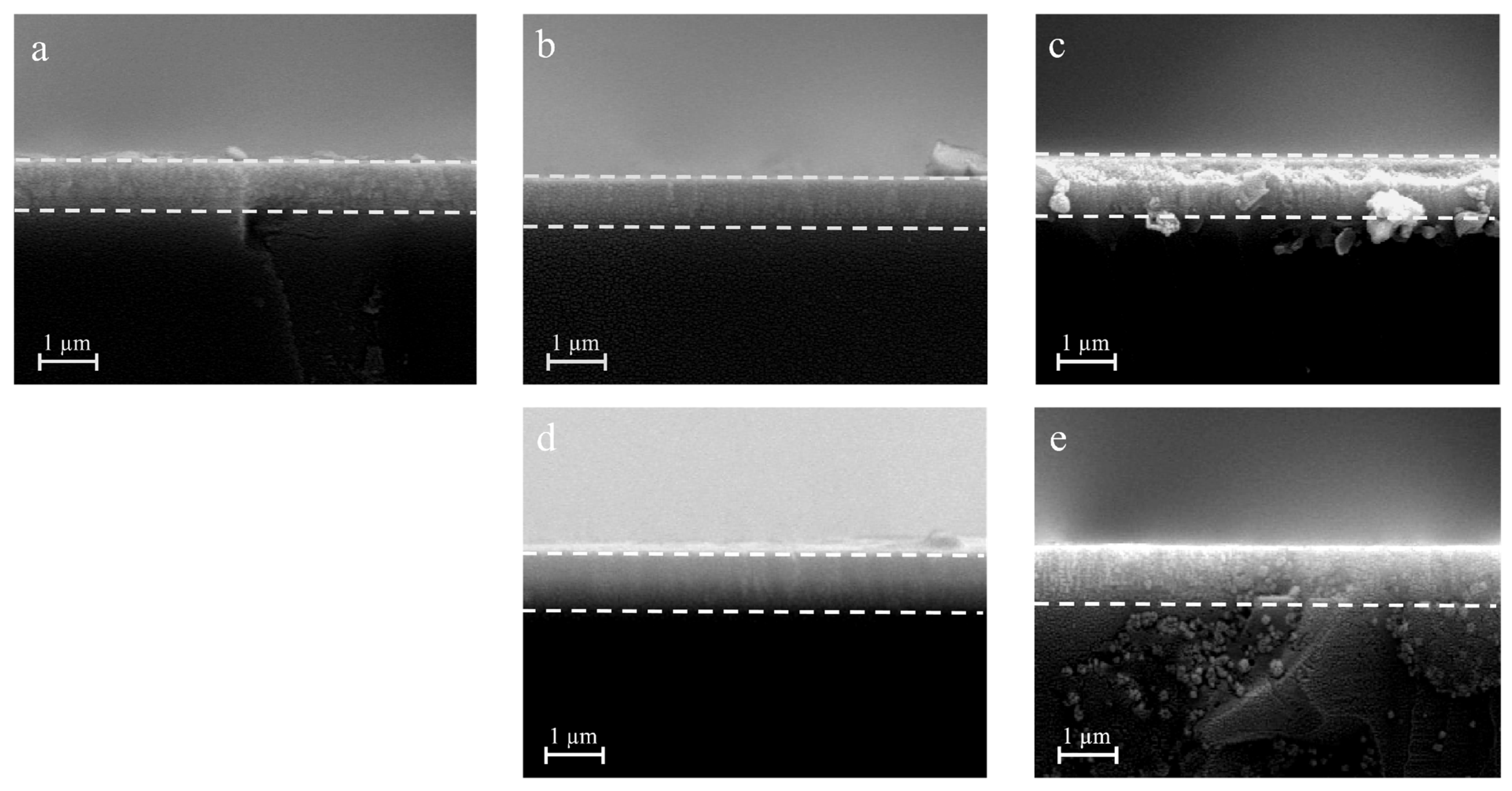
The cross-sectional morphology of different coatings was observed by scanning electron microscopy (ZEISS Sigma 500, ZEISS, Oberkochen, Germany), as shown in Figure 1. The thickness of these five coatings is about 1.3 μm. Meanwhile, columnar crystalline characteristics can be identified in the coatings, while the interlayer interfaces cannot be clearly distinguished. Transmission electron microscopy (Talos F200 G, Thermo Fisher Scientific, Eindhoven, The Netherlands) analysis of the coating cross-sections remains to be carried out to determine the interfacial microstructure and structural relationships. This paper mainly focuses on and discusses the tribological properties of coatings with different CrN/Cr2N ratios.
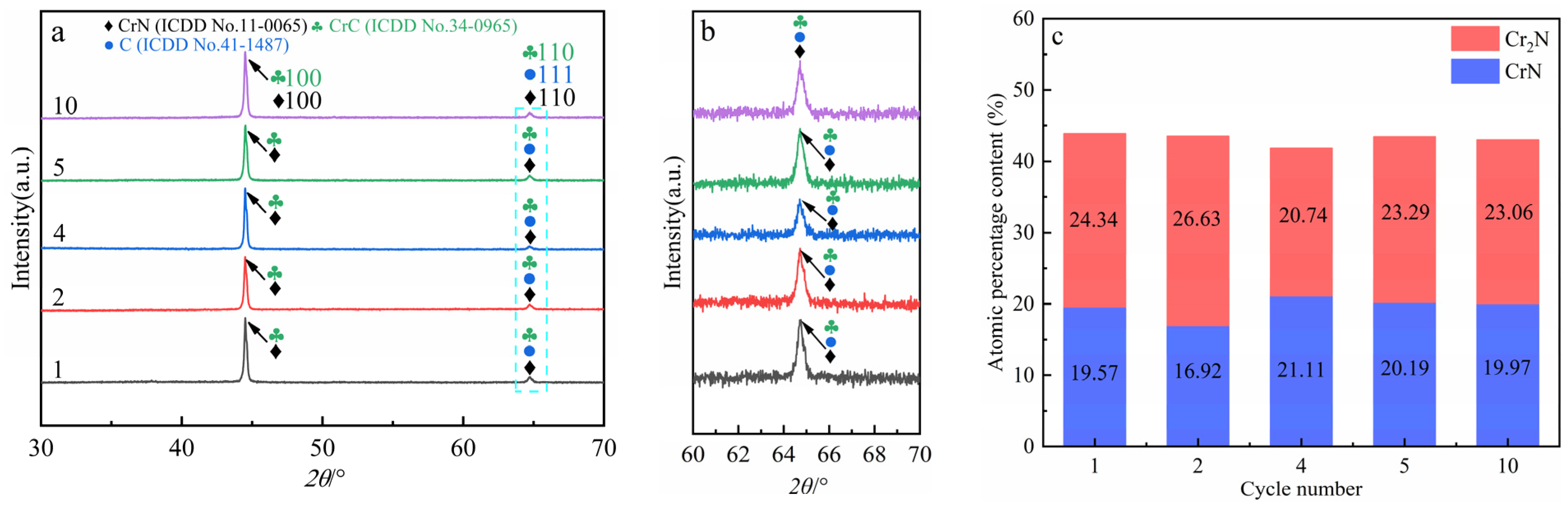
In order to detect the phase structure of coatings, XRD test was performed at room temperature, and the results are shown in Figure 2. The diffraction peaks of CrN (100,) and CrN (110) appeared at 2θ = 44.5° and 2θ = 64.7°. Meanwhile, the diffraction peak intensity of CrN (100) at 2θ = 44.5° was the highest, indicating that the coatings were grown with CrN (100) as the preferred orientation and had a high degree of crystallization. The phase content was quantitatively calculated by the reference intensity ratio (RIR) method using XRD data, shown in Figure 2c. When the number of cycles is 4, the contents of CrN and Cr2N are comparable, with a ratio of nearly 1:1. The corresponding numbers of CrN, Cr2N, C and CrC are ICDD PDF # 11-0065, ICDD PDF # 35-0803, ICDD PDF # 41-1487 and ICDD PDF # 34-0965, respectively.
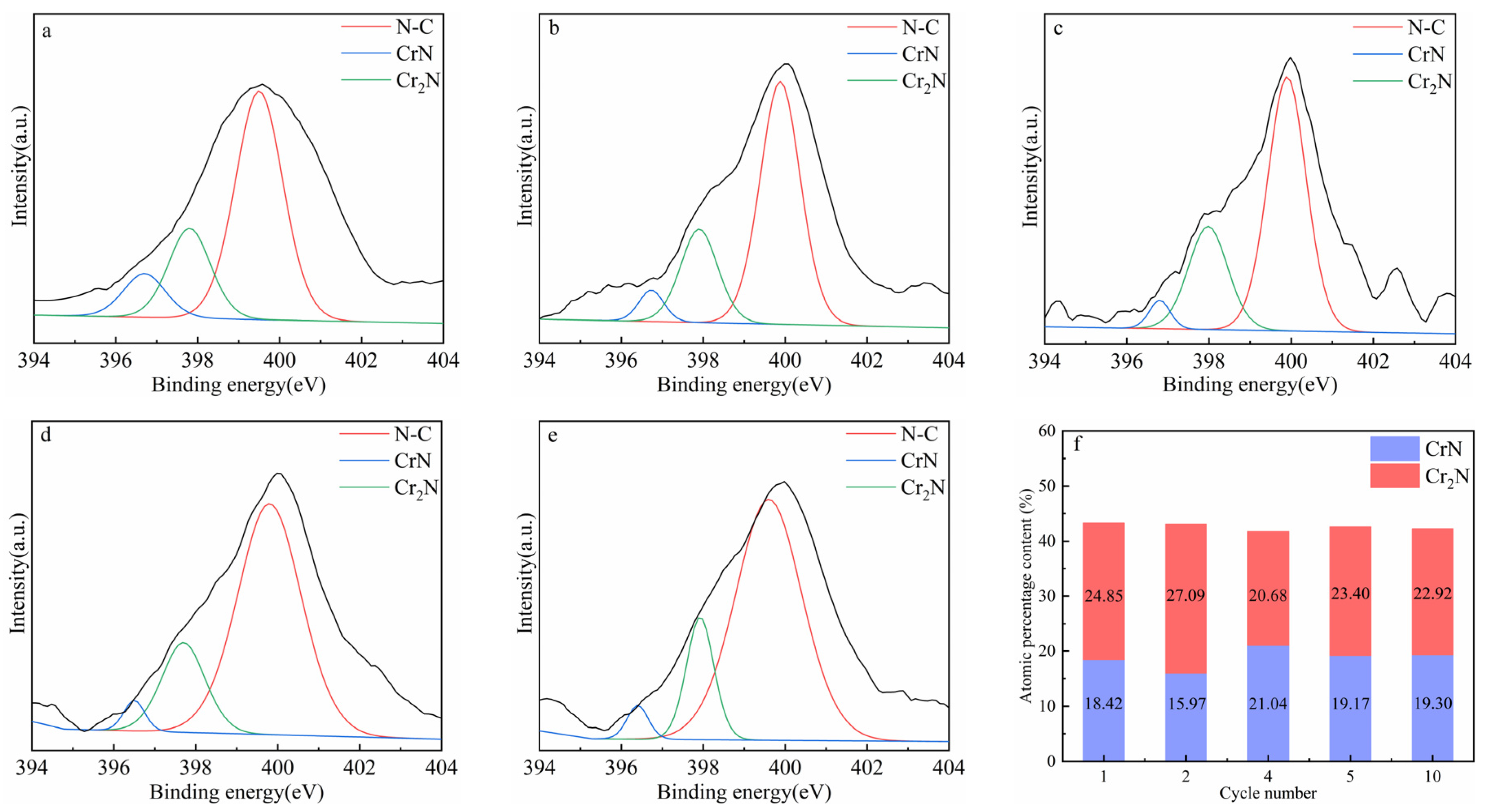
The chemical bonding composition of the coatings with different cycle numbers was investigated via X-ray photoelectron spectroscopy (XPS). The high-resolution N 1s XPS spectra are presented in Figure 3, which clearly reveal the presence of CrN and Cr2N bonds, with their characteristic binding energies at approximately 396.8 eV and 397.9 eV, respectively.
As the cycle number increases, the individual modulation layers of the coatings become progressively thinner, leading to a gradual increase in CrN content and a relative reduction in the Cr2N phase. At low cycle numbers, an excessive Cr2N phase is present, coupled with the continuous columnar growth of CrN, which results in a loose internal structure of the coatings and a tendency to form coarse columnar grains [22]. When the cycle number reaches 4, the mass percentages of CrN and Cr2N in the coatings are 21.04% and 20.68%, respectively, showing an approximate balance. With a further increase in the cycle number, the CrN content slightly decreases while the Cr2N phase reaccumulates, and the rapid alternating deposition of intermediate layers gives rise to more interfacial boundaries within the coatings, which in turn affects the structural compactness of the coatings. These results demonstrate that rational regulation of the CrN/Cr2N content ratio can maximize the interfacial effects of the intermediate layers, effectively eliminating voids between adjacent layers, facilitating tight interlayer bonding, and alleviating internal stress within the coatings [23].
Previous studies have demonstrated that the cycle number of composite coatings exerts a significant influence on the interfacial structure by tailoring the architecture of intermediate layers [24]. When the cycle number is below (i.e., 1 and 2), the thickness of individual intermediate layers can reach up to 250 nm. Although elemental diffusion still takes place at the interlayer interfaces, the corresponding diffusion distance is considerably smaller than the layer thickness.
At low cycle numbers, sufficient Cr ions have adequate time to react with N ions for the longer-time continuous deposition of Cr-containing layers, leading to the formation of a certain amount of CrN phase, initially. Meanwhile, the intermediate layers tend to develop coarse columnar grains [25], which increases the population of voids and defects within the coatings, providing interlocking mechanical sites formed by carbon film deposition. Simultaneously, restricted by the relatively insufficient supply of N ions, the formation of CrN is limited, giving rise to an elevated atomic percentage of Cr2N in the coatings. As a consequence, the coatings exhibit a loose microstructure with reduced density, thereby deteriorating their load-bearing capacity [26].
With a further increase in the cycle number, the deposition time of each layer is shortened, and the thickness of the carbonitride layers is reduced to approximately 20 nm, as confirmed by cross-sectional SEM observations of the coatings. The increased input frequency of high-energy N ions maintains a highly energetic nitrogen environment within the deposition chamber, which favors the preferential reaction between energetic Cr ions and N ions to form Cr2N. As a result, the atomic percentage of Cr2N exhibits a slight upward trend with increasing cycle numbers. Given the high lattice compatibility between CrN and Cr2N, these phases tend to form a solid-solution-like structure that contributes to improve the densification of the coatings [27]. Notably, the coatings achieve the highest density of 2.20 g/cm3 at the cycle number of 4 as observed by Roman data [20].
Nevertheless, at excessively high cycle numbers (5 or 10), the frequent alternation of intermediate layers gives rise to relatively loose microstructures, lacking sustained bombardment and compaction by the same kind of high-energy ions. This hinders uniform deposition, increases interlayer voids and defects, and consequently degrades the load-bearing capacity of the coatings [28].
Based on electrochemical measurements, the porosity of DLC coatings with different cycle numbers was calculated [22], with values of 0.034, 0.065, 0.003, 0.053, and 0.053, respectively. Combined with the XPS results, it is evident that a relatively high Cr2N content gives rise to a loose internal microstructure and increased porosity. In contrast, the coatings at the cycle number of 4 exhibit the lowest porosity of 0.003, implying the fewest internal voids and defects as well as the densest microstructure. With the further increase in cycle number, the elevated Cr2N content leads to higher porosity and a more defective, loosely packed structure.

3.2. Analysis of Friction and Wear Properties of Coatings

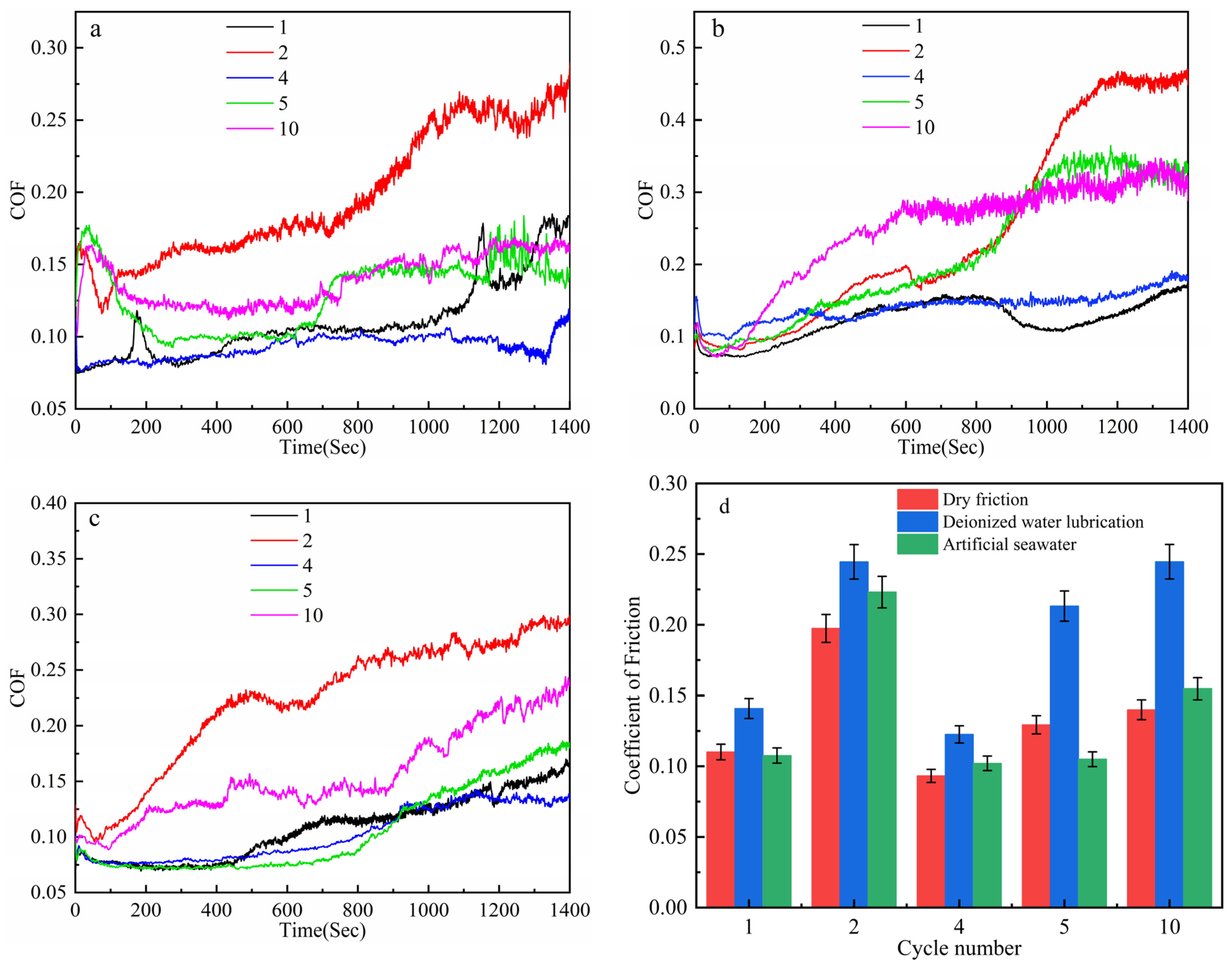
Figure 4 depicts the evolution of the coefficient of friction (COF) with sliding time for the DLC composite coatings under various environmental conditions. All coatings exhibit an unstable COF at the initial running-in stage, followed by a steady-state wear period after a short transition interval.
Figure 4a displays the COF curves of the coatings tested in a dry environment. For the coating with the cycle number of 2, the COF remains at approximately 0.15 during the first 700 s, followed by a continuous increase, indicative of potential coating failure. In contrast, the coating with the cycle number of 4 maintains a stable COF of around 0.09 throughout the entire test duration. For the coating with the cycle number of 5, the COF stays stable at roughly 0.10 from 200 s to 700 s, then abruptly increases and stabilizes at 0.32, implying the occurrence of coating failure. When the cycle number is raised to10, the COF is maintained at approximately 0.12, yet distinct fluctuations appear in the curve at around 700 s, suggesting the occurrence of coating delamination and spallation.
Figure 4b,c illustrates the time-dependent COF evolution of the coatings in deionized water and artificial seawater, respectively. It can be seen that the coating with the cycle number of 4 maintains a stable COF of approximately 0.11 under both testing conditions.
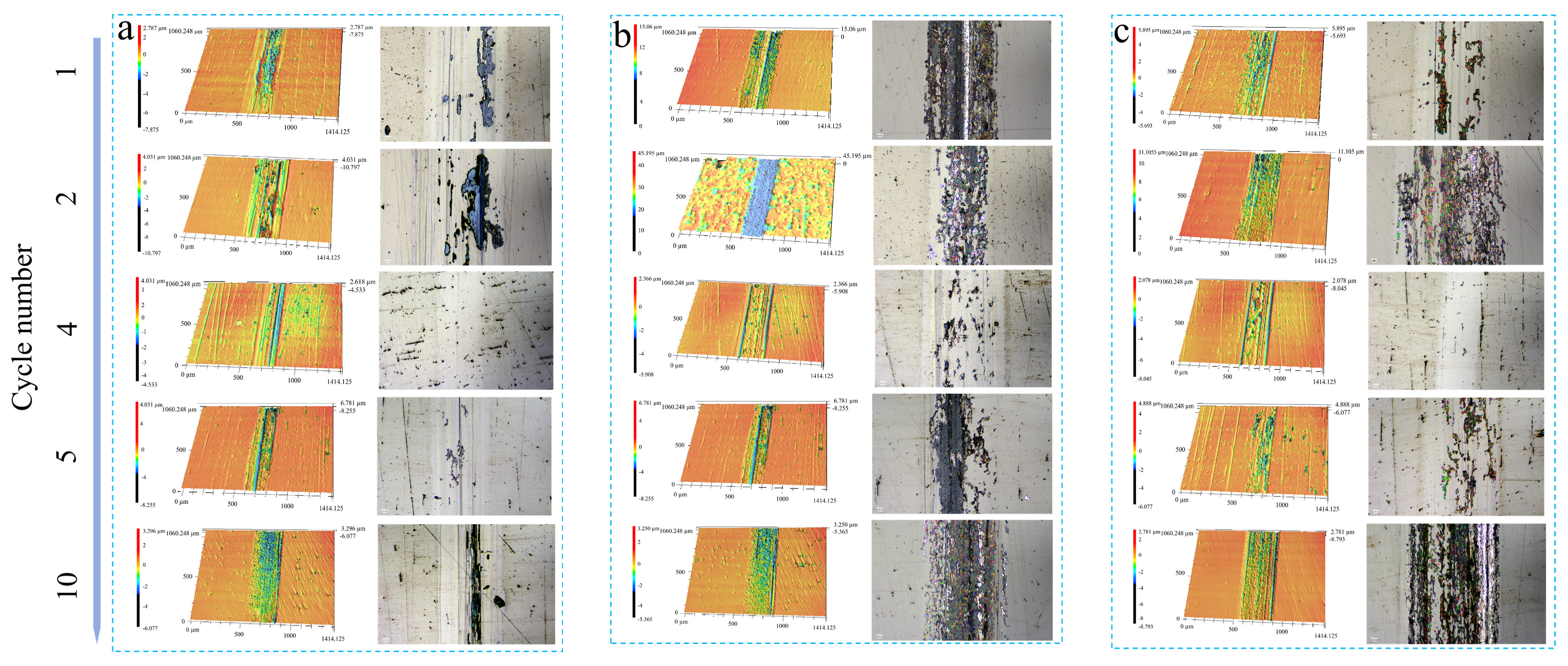
The wear track morphologies of the coatings under different environments were characterized using 3D confocal microscopy, with the corresponding optical micrographs displayed in Figure 5. Under dry sliding conditions (Figure 5a), severe delamination occurs over large areas for coatings at low cycle numbers. The edges of the wear tracks are slightly uplifted as a result of plastic extrusion, accompanied by distinct scratches and deep grooves within the worn region. The wide and deep wear tracks correspond to high wear rates, indicating that the dominant wear mechanisms are adhesive wear and abrasive wear [29]. Specifically, the wear rates reach 16.05 × 10⁻⁶ mm3/(N·m) and 67.92 × 10⁻⁶ mm3/(N·m) for coatings with the cycle number of 1 and 2, respectively. In contrast, the coating with the cycle number of 4 shows a narrow and shallow wear track free of deep grooves, with the coating surface remaining largely intact, corresponding to the minimum wear rate of 4.86 × 10⁻⁶ mm3/(N·m). As the cycle number increases further, groove-like wear features reemerge, and the wear rate shows a slight increase.
It is noteworthy that in deionized water, both the friction coefficient and wear track depth of the coating increase. The presence of deionized water likely promotes frictional oxidation; the detached oxidized particles accelerate the wear process and further deepen the surface wear track [30], as shown in Figure 5b. During sliding, the outermost DLC layer provides enhanced solid lubrication under humid conditions [31,32], which significantly reduces the COF. The wear track morphology, wear rate, and secondary surface features of the coatings in artificial seawater are displayed in Figure 5c.
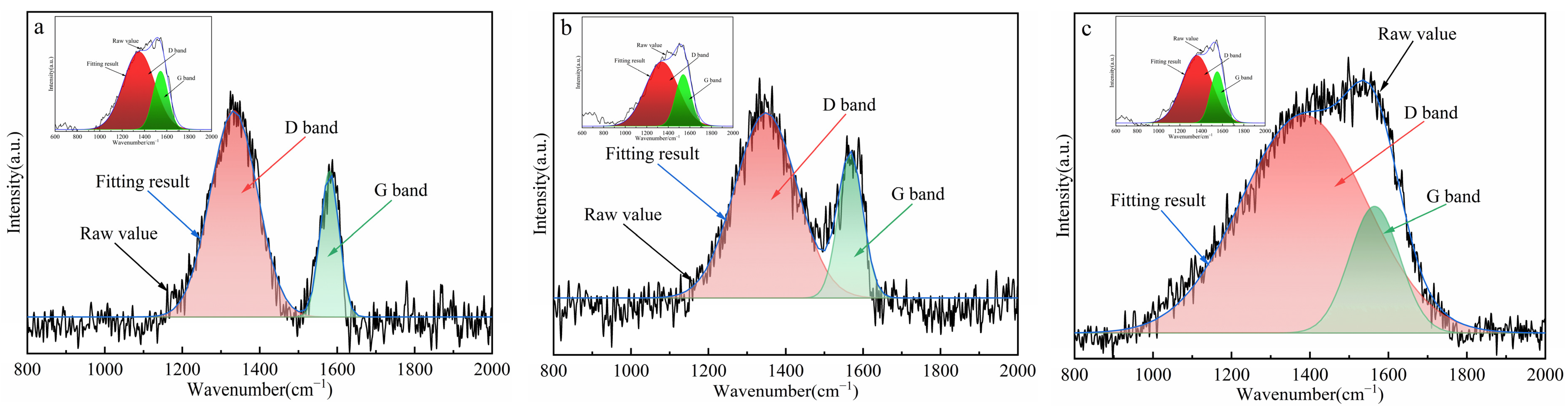
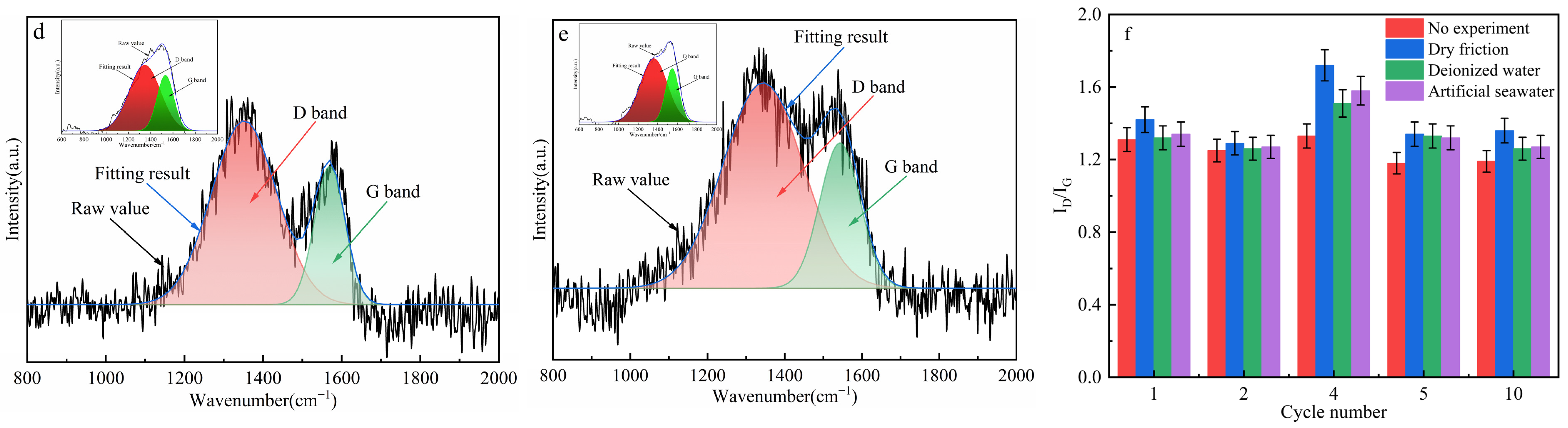
Raman spectroscopy was conducted on the wear tracks, and the corresponding ID/IG ratios of the worn surfaces were quantitatively analyzed, as presented in Figure 6. The inset curves display the Raman spectra of the coatings in the as-deposited state (before wear testing). After friction sliding, the ID/IG ratios of all coatings exhibit a marked increase, confirming the abundant generation of sp2-hybridized carbon bonds. The sample with 4 deposition cycles shows the greatest elevation in ID/IG, uncovering the most prominent sp3-to-sp2 structural transformation. Such evolution corresponds to elevated graphitization on the worn surface [33]. This favorable structural change effectively enhances the self-lubricating performance, optimizes the friction-reduction ability, and consequently yields a lower steady-state friction coefficient.

3.3. Mechanical Properties of Coatings

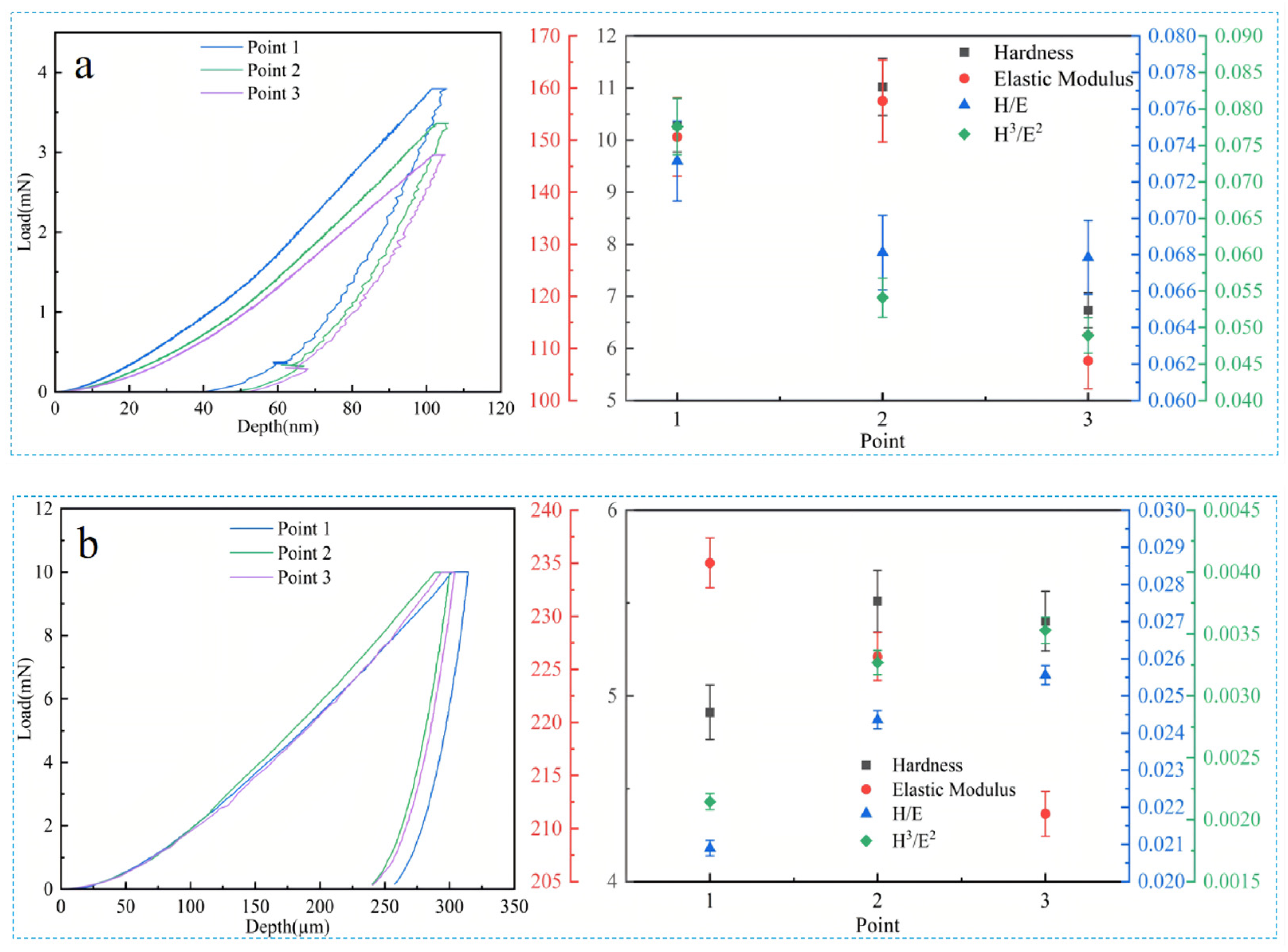
The friction and wear test results demonstrate that the coating with CrN and Cr2N contents of 21.04% and 20.68%, respectively, exhibits the optimal wear resistance and the lowest COF. To further elucidate the underlying mechanisms governing this superior performance, the hardness and interfacial adhesion strength of the coatings were systematically analyzed, with the corresponding results presented in Figure 7.
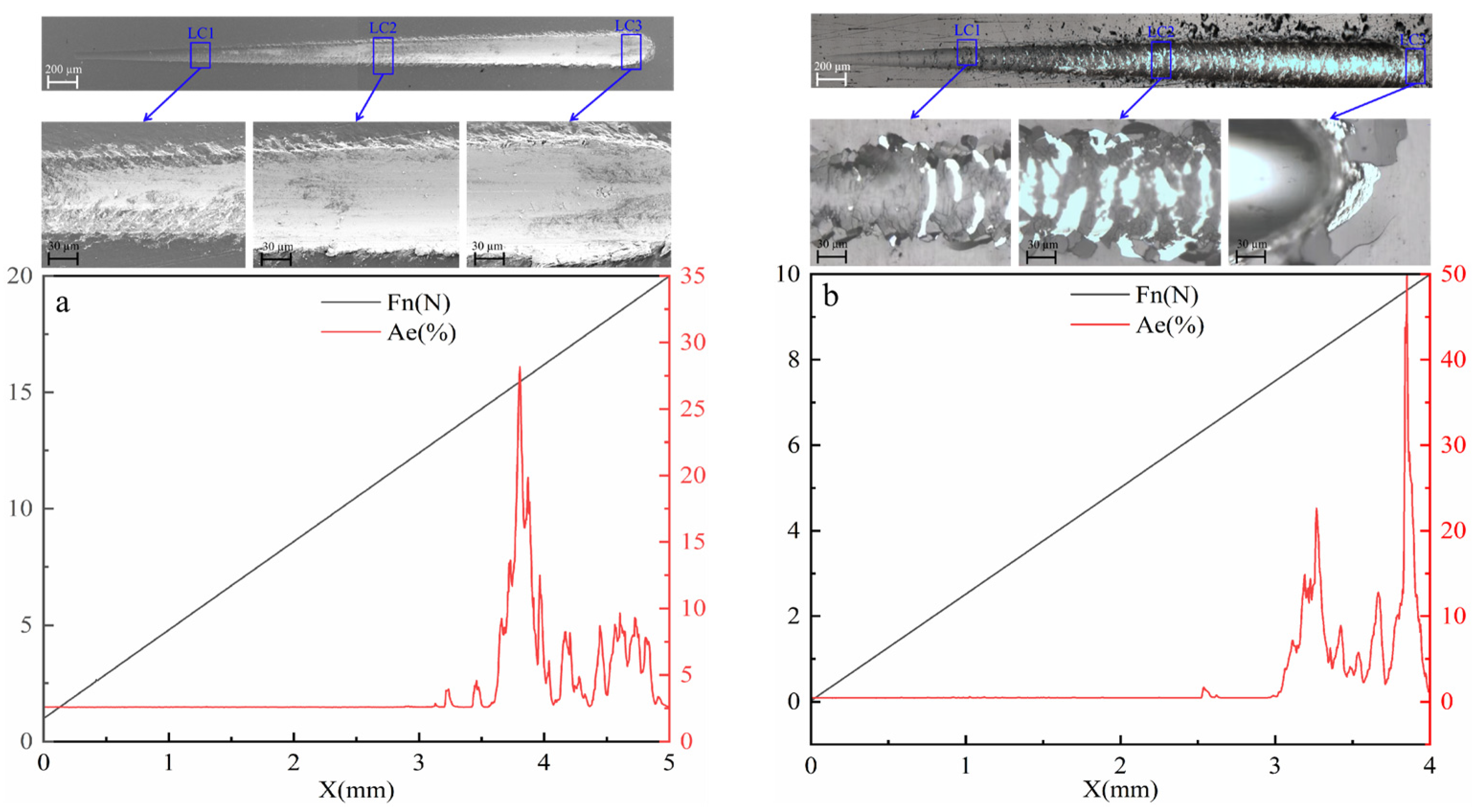
Figure 7 illustrates the adhesion strength of the coating with different CrN content. There are a variety of damage modes on the scratch trajectory, including V-shaped cracks and semi-circular cracks. As shown in Figure 7, the Ae signal varies with normal load Fn, the sudden change in the signal intensity under some normal loads, indicating the crack propagation behavior on the surface [34]. The coating with a CrN/Cr2N ratio of 1:1 shows the critical load Lc1 of 11.4 N corresponding to the minimum load for the initiation of periodic V-cracks. The scratch test data for the coating with a Cr2N content of 22.76% exhibit a relatively low Lc1 of 6.81 N, and this coating exhibits obvious spalling and chipping, showing typical brittle failure. Then, the hardness of DLC composite coatings with different chromium nitride contents was measured by a nanoindentation tester, with the results shown in Figure 8. The coating with a CrN/Cr2N ratio of 1:1 exhibits the highest hardness of 12.27 GPa, an 11.65% increase compared to the coating without a designed cycle [35]. This coating also exhibits high H/E and H3/E2 ratios, indicating superior resistance to both elastic and plastic deformation. Consequently, during friction and wear, it can accommodate greater deformation without cracking under external stress, effectively suppressing crack initiation and propagation and further improving overall wear resistance [36].
However, the coating containing excessive Cr2N presents a porous microstructure, which correspondingly reduces its hardness to only 5.22 GPa. Such a low hardness suggests inferior resistance to plastic deformation. Moreover, the excessive Cr2N phase deteriorates the structural compactness of the coating, reducing its ability to resist crack propagation. During frictional sliding, the coating undergoes severe graphitization, which weakens the internal bonding strength [37,38], lowers the elastic modulus, and further compromises its deformation resistance. These factors collectively lead to a reduced H3/E2 ratio.
For coatings with insufficient CrN content results in low hardness and inferior load-bearing capacity, causing easy coating collapse and delamination under dry sliding. Adhesive interactions between the coating and oxidized counterparts induce severe abrasive wear. Inferior hardness and insufficient load-bearing capacity trigger localized structural collapse and delamination during frictional contact; meanwhile, strong adhesion to the counterpart oxides promotes the generation of abrasive wear debris, further resulting in serious material abrasion. The elevated Cr2N content weakens interlayer bonding. Under dry sliding, frictional oxidation generates hard oxide debris that raises the COF, while the reduced coating density and increased interfacial defects—combined with anisotropic layer arrangement—facilitate irregular crack initiation and propagation, lowering deformation resistance and load-bearing capacity [12]. The diminished formation of sp2 bonds further compromises lubrication and increases friction. In seawater, the abundant defects associated with excess Cr2N accelerate pitting corrosion and coating failure. Delamination and oxidative adhesion produce abrasive particles, whereas Cl ions penetrate through voids and are driven inward by friction, reacting to form metal salt precipitates that act as additional abrasives and further intensify wear.
Among all samples, when the ratios of CrN/Cr2N in the coating reaches 1:1, the coatings display the most stable COF curves and the minimum wear rate under all testing environments. Under dry sliding, frictional heating promotes the transformation of sp3 to sp2 bonds, forming a continuous carbon-rich transfer coatings that delivers persistent solid lubrication [39]. At this optimized phase content ratio, the interlayer thickness is approximately 60 nm, avoiding the formation of coarse columnar CrN grains and thus lowering surface roughness. The suitably high CrN content provides high hardness and load-bearing capacity, reducing plastic deformation during sliding and minimizing wear [40].
During deposition, the moderate energy of C ions limits excessive penetration into the interlayers, favoring the formation of CrC bonds that strengthen interlayer adhesion and suppress delamination. The multilayer structure also promotes stress relaxation, inhibits crack nucleation, and refines CrN nanocrystals, all of which increase hardness and improve wear resistance [41]. It is demonstrated that Cr/CrN interlayer thickness ratio near 0.5 further accommodates plastic deformation and impedes crack propagation [42], proving that layer thickness has a remarkable effect on coating performance when kept at an appropriate range. The above friction experimental analysis reveals that the rational multilayer structural design of CrN and DLC not only modifies the interfacial microstructure of the coating but also affects the ratio of CrN to Cr2N phases, and further regulates coating properties such as hardness, compactness and adhesion strength.
In artificial seawater, the removal of the transfer films similarly leads to a slightly higher COF than in dry conditions. However, the dense, low-porosity microstructure effectively blocks the penetration of corrosive species. The Cr/CrN layers restrain crack propagation via interfacial microstructure of the alternating layers. Furthermore, the compact Cr-rich eutectic interface effectively prevents the infiltration of corrosive solution. Furthermore, a passive film forms tribologically, providing additional lubrication and reducing friction. Any hard oxide particles that form is gradually flushed away by seawater, limiting three-body abrasive wear. The compact structure thus delays pitting corrosion and enhances resistance to the combined effects of corrosion and wear.
Accordingly, rationally optimizing the multilayer architecture by tuning the structure to achieve an appropriate ratio of CrN/Cr2N constitutes an effective strategy for boosting the tribological and corrosion–wear resistance of DLC-based coatings.

4. Conclusions

Cr/CrN/CrCN/DLC coatings with various CrN contents were fabricated by magnetron sputtering PVD. The microstructural evolution and tribological performance of different coatings under multiple service environments were systematically examined. Results represent the CrN/Cr2N phase ratio serves as a key factor dominating the coating performance. When the contents of CrN and Cr2N reach 21.04% and 20.68%, respectively, the phase ratio is close to 1:1. This condition produces a more uniform, compact and low-defect microstructure, which endows the coating with excellent tribological properties, including the lowest friction coefficient and wear rate. By contrast, excessive aggregation of Cr2N induces a loose, porous microstructure with deteriorated deformability and crack resistance. Further high-resolution transmission electron microscopy, HRTEM characterization of the interfacial bonding and microstructure of these coatings is expected to elucidate the intrinsic mechanism governing the structural evolution and tribological performance.

Author Contributions

G.L. performed the methodology; S.F. conducted the validation; X.Y. and L.B. completed the formal analysis, and X.Y. also carried out the investigation; S.Z. was responsible for resources, funding acquisition, and original draft writing; X.M. undertook data curation. All authors have read and agreed to the published version of the manuscript.

Funding

This research was funded by the Natural Science Foundation of Ningxia (2026AAC030378) and Fundamental Research Funds for the Central Universities, North Minzu University (2025QNPY47) And The APC was funded by Fundamental Research Funds for the Central Universities, North Minzu University (2025QNPY47).

Data Availability Statement

All data generated or analyzed during this study are included in this published article.

Acknowledgments

And the authors would like to express their sincere gratitude to the Analytical and Testing Center of North Minzu University for their valuable support and technical assistance during the scratch and indentation measurement.

Conflicts of Interest

The authors declare no conflicts of interest.

References

  1. Dalmau, A.; Richard, C.; Igual–Muñoz, A. Degradation mechanisms in martensitic stainless steels: Wear, corrosion and tribocorrosion appraisal. Tribol. Int. 2018, 121, 167–179. [Google Scholar] [CrossRef]
  2. Li, B.N.; Shi, J.L.; Li, X.; Ding, J.L.; Wang, J.J.; Wu, D.X.; He, X.L.; Zhang, Y. Recovery of Fe2+ from stainless steel scrap cathodes in the Fenton reaction. J. Environ. Manag. 2026, 398, 128508. [Google Scholar] [CrossRef]
  3. Kumar, D.D.; Kumar, N.; Kalaiselvam, S.; Dash, S.; Jayavel, R. Wear resistant super-hard multilayer transition metal-nitride coatings. Surf. Interfaces 2017, 7, 74–82. [Google Scholar] [CrossRef]
  4. Li, R.; Liang, H.; Yang, X.; Yue, C.Y.; Wang, Y.F.; Zhang, J.Y. Effect of γ-irradiation on the tribological and wear properties of DLC and MoS2/DLC. Tribol. Int. 2026, 213, 111064. [Google Scholar] [CrossRef]
  5. Xiao, L.; Xu, Y.; Chen, Z. Fretting tribological performance of DLC, TiAlN and DLC/TiAlN coatings deposited on carburized 18CrNi4A steel. Surf. Topogr. Metrol. Prop. 2022, 10, 015009. [Google Scholar] [CrossRef]
  6. Yu, Q.; Chen, X.; Zhang, C.H.; Luo, J.B. Influence Factors on Mechanisms of Superlubricity in DLC Films: A Review. Front. Mech. Eng. 2020, 6, 65. [Google Scholar] [CrossRef]
  7. Kusaka, K.; Shirasaka, K.; Yonekura, D.; Tanka, Y. Residual stress measurement of {112}-oriented CrN layers in CrN/Cr multilayer films. J. Vac. Sci. Technol. B 2019, 37, 062919. [Google Scholar] [CrossRef]
  8. Zhao, Y.; Xu, F.; Zhang, D.; Xu, J.; Shi, X.Q.; Sun, S.; Zhao, W.X.; Gao, C.Z.; Zuo, D.W. Enhanced tribological and corrosion properties of DLC/CrN multilayer films deposited by HPPMS. Ceram. Int. 2022, 48, 25569–25577. [Google Scholar] [CrossRef]
  9. Duminica, F.D.; Belchi, R.; Libralesso, L.; Mercier, D. Investigation of Cr(N)/DLC multilayer coatings elaborated by PVD for high wear resistance and low friction applications. Surf. Coat. Technol. 2018, 337, 396–403. [Google Scholar] [CrossRef]
  10. Sui, X.D.; Liu, J.Y.; Zhang, S.T.; Yang, J.; Hao, J.Y. Microstructure, mechanical and tribological characterization of CrN/DLC/Cr-DLC multilayer coating with improved adhesive wear resistance. Appl. Surf. Sci. 2018, 439, 24–32. [Google Scholar] [CrossRef]
  11. Çomakli, O. Influence of CrN, TiAlN monolayers and TiAlN/CrN multilayer ceramic films on structural, mechanical and tribological behavior of β-type Ti45Nb alloys. Ceram. Int. 2020, 46, 8185–8191. [Google Scholar] [CrossRef]
  12. Polcar, T.; Martinez, R.; Vítů, T.; Kopecky, L.; Rodriguez, R.; Cavaleiro, A. High temperature tribology of CrN and multilayered Cr/CrN coatings. Surf. Coat. Technol. 2009, 203, 3254–3259. [Google Scholar] [CrossRef]
  13. Wu, J.; Shen, M.; Wang, W.; Wang, Y.F.; Cheng, Y.X.; Zhu, S.L. Insight into oxidation difference between Cr2N and CrN coatings. Surf. Interfaces 2024, 51, 104626. [Google Scholar] [CrossRef]
  14. Bai, X.; Li, Y.; Guo, C.T.; Man, J.; Zhang, D.J.; Wan, Y.; Sun, H.L. Electrochemical corrosion and tribocorrosion behavior of CrN and CrAlN coatings in artificial seawater. Int. J. Appl. Ceram. Technol. 2024, 21, 3569–3582. [Google Scholar] [CrossRef]
  15. Wang, L.J.; Chen, H.; Liu, Y.; Zhu, R.W. Interface-dominated deformation mechanisms in Cr/CrN/Cr-DLC multilayer triggered by nanoindentation. Mater. Sci. Eng. A 2023, 887, 145745. [Google Scholar] [CrossRef]
  16. Wang, D.; Tian, T.; Lin, S.-S.; Zhao, N.; Liu, H.; Liu, J.H.; Wang, Y.; Li, L.; Li, H.Y.; Shi, Q.; et al. Tensile mechanism of wear-resistant Cr/CrN/Cr/CrAlN multilayer film. Vacuum 2023, 207, 111405. [Google Scholar] [CrossRef]
  17. Yu, X.; Yu, S.; Li, D.; Qin, Q.H.; Ye, Y.; Huang, Q. Microstructure, tribological and corrosion-resistance properties of WC-DLC/DLC multilayer coatings with varying modulation periods on Cu–Sn alloy substrates. Int. J. Mech. Mater. Des. 2025, 22, 13. [Google Scholar] [CrossRef]
  18. Zhang, J.; Yu, X.; Zhao, X.-A.; Zhang, L. Influences of Interfacial Carbonization on the Structure and Mechanical Properties of Multilayered Cr-Containing Diamond-Like Carbon Films. J. Phys. Chem. C 2017, 121, 6781–6787. [Google Scholar] [CrossRef]
  19. Cao, H.; Qi, F.; Ouyang, X.P.; Zhao, N.; Zhou, Y.; Li, B.B.; Luo, W.Z.; Liao, B.; Luo, J. Effect of Ti Transition Layer Thickness on the Structure, Mechanical and Adhesion Properties of Ti-DLC Coatings on Aluminum Alloys. Materials 2018, 11, 1742. [Google Scholar] [CrossRef]
  20. Archard, J.F. Contact and Rubbing of Flat Surfaces. J. Appl. Phys. 1953, 24, 981–988. [Google Scholar] [CrossRef]
  21. Stern, M. A Method for Determining Corrosion Rates from Linear Polarization Data. Corrosion 1958, 14, 60–64. [Google Scholar] [CrossRef]
  22. Yang, X.D.; Zhang, S.L.; Jiang, D.; Ma, X.H.; Liu, Y.; Cao, G.S.; Guo, F. Effect of Modulation Ratio on Structure and Corrosion Resistance of DLC Composite Films. Surf. Technol. 2025, 54, 31–43. [Google Scholar]
  23. Decho, H.; Mehner, A.; Zoch, H.W.; Stock, H.R. Optimization of chromium nitride (CrNx) interlayers for hydrogenated amorphous carbon (a-C:H) film systems with respect to the corrosion protection properties by high power impulse magnetron sputtering (HiPIMS). Surf. Coat. Technol. 2016, 293, 35–41. [Google Scholar] [CrossRef]
  24. Guo, C.; Pei, Z.; Gong, J.; Sun, C.; Lin, S.S.; Shi, Q. Effects of bilayer number and thickness ratio on structure and properties of (Cr, N)-DLC/DLC multilayer films. Diam. Relat. Mater. 2019, 92, 187–197. [Google Scholar] [CrossRef]
  25. Bonu, V.; Srinivas, G.; Praveen Kumar, V.; Joseph, A.; Narayana, C.; Barshilis, H.C. Temperature dependent erosion and Raman analyses of arc-deposited H free thick DLC coating on Cr/CrN coated plasma nitrided steel. Surf. Coat. Technol. 2022, 436, 128308. [Google Scholar] [CrossRef]
  26. Zhao, S.; Wang, S.; Liu, B.; Gutsev, D.M.; Wu, J.B.; Levchenko, V.; Wang, H.B.; Ma, A.Y. Tribological properties of corrosion-resistant GLC/CrCN multilayer coatings. Surf. Coat. Technol. 2025, 501, 131946. [Google Scholar] [CrossRef]
  27. Zhang, Y.; Nouveau, C.; Besnard, A.; Outeiro, J.; Montagne, A.; Lagadrilere, D.; Kusiak, A.; Imhoff, L. A comprehensive study of CrN/AlCrN-based monolayers and architected multilayers. Thin Solid Film. 2025, 829, 140804. [Google Scholar] [CrossRef]
  28. Xu, S.; Zhao, Z.; Zhou, Y.; Chen, D.X.; Zhang, K.; Li, T.; Zhou, Y.T.; Wang, A.H. Interface feature via key factor on adhesion of CrN multilayer and alloy substrate. Appl. Surf. Sci. 2023, 630, 157492. [Google Scholar] [CrossRef]
  29. Yamauchi, N.; Demizu, K.; Ueda, N.; Cuong, N.K.; Sone, T.; Hirose, Y. Friction and wear of DLC films on magnesium alloy. Surf. Coat. Technol. 2005, 193, 277–282. [Google Scholar] [CrossRef]
  30. Guo, F.; Tian, Y.; Liu, Y.; Wang, Y.M. Unexpected friction behaviours due to capillary and adhesion effects. Sci. Rep. 2017, 7, 148. [Google Scholar] [CrossRef]
  31. Kim, J.E.; Choi, J.I.J.; Kim, J.; Mun, B.S.; Kim, K.J.; Park, J.Y. In-Situ Nanotribological Properties of Ultrananocrystalline Diamond Films Investigated with Ambient Pressure Atomic Force Microscopy. J. Phys. Chem. C 2021, 125, 6909–6915. [Google Scholar] [CrossRef]
  32. Ye, Y.W.; Wang, Y.X.; Ma, X.L.; Zhang, D.W.; Wang, L.P.; Li, X.G. Tribocorrosion behaviors of multilayer PVD DLC coated 304L stainless steel in seawater. Diam. Relat. Mater. 2017, 79, 70–78. [Google Scholar] [CrossRef]
  33. Paik, N. Raman and XPS studies of DLC films prepared by a magnetron sputter-type negative ion source. Surf. Coat. Technol. 2005, 200, 2170–2174. [Google Scholar] [CrossRef]
  34. Liu, M.; Xu, Z.; Yuktanan, N.; Gu, T.; Zhang, G.G.; Jiang, J.Y.; Yang, F.J.; Liang, R. Scratch-induced damage of doped DLC and MoS2 coatings—Deep symbolic analysis. Friction 2026, 14, 9441166. [Google Scholar] [CrossRef]
  35. Zhang, S.; Huang, T.; Sun, S.; Wu, S.R.; Yang, X.D.; Guo, F.; Zhang, B.; Dai, L.J. Effects of Bias Voltages on the Tribological Behaviors of DLC Coatings. Coatings 2024, 14, 176. [Google Scholar] [CrossRef]
  36. Wang, L.; Wu, Y.; Chen, H.; Liu, Y.; Meng, Y.J.; Zhang, Z.L. Modulation-ratio-dependent deformation mechanisms in Cr/CrN/Cr-DLC multilayer triggered by nanoindentation. J. Alloys Compd. 2024, 1004, 175922. [Google Scholar] [CrossRef]
  37. Shahsavari, F.; Ehteshamzadeh, M.; Naimi-Jamal, M.R.; Irannejad, A. Nanoindentation and nanoscratch behaviors of DLC films growth on different thickness of Cr nanolayers. Diam. Relat. Mater. 2016, 70, 76–82. [Google Scholar] [CrossRef]
  38. Ouchabane, M.; Dublanche-Tixier, C.; Dergham, D. Nanoindentation data analysis of loading curve performed on DLC thin films: Effect of residual stress on the elasto-plastic properties. J. Appl. Phys. 2017, 122, 175103. [Google Scholar] [CrossRef]
  39. Rivera-Tello, C.D.; Flores-Ruiz, F.J.; Flores, M.; Jimenez, O.; Farias, I.; Pena, J.O. Study of the methane flow influence in the micro-tribology behavior of DLC coatings deposited by PECVD: A Raman analysis. Carbon Lett. 2021, 31, 47–56. [Google Scholar] [CrossRef]
  40. Zhang, S.L.; Yang, X.D.; Huang, T.L.; Guo, F.; Dai, L.J.; Liu, Y.; Zhang, B. Tribological Properties of CrN/DLC and CrN Coatings under Different Testing Conditions. Coatings 2024, 14, 1002. [Google Scholar] [CrossRef]
  41. Lin, K.; Chang, Y.-C.; Chang, S.-H.; Ma, J.-L.; Lin, H.-C. Improving the corrosion and wear resistance of CoCrNiSi0.3 Medium-Entropy Alloy by magnetron sputtered (CrN/Cr)x multilayer films. Surf. Coat. Technol. 2024, 478, 130407. [Google Scholar] [CrossRef]
  42. Yonekura, D.; Fujita, J.; Miki, K. Fatigue and wear properties of Ti–6Al–4V alloy with Cr/CrN multilayer coating. Surf. Coat. Technol. 2015, 275, 232–238. [Google Scholar] [CrossRef]
Figure 1. Cross-section of coatings with different cycle numbers: (a) 1; (b) 2; (c) 4; (d) 5; (e) 10.
Coatings 16 00630 g001
Figure 2. XRD of coatings with different cycle numbers: (a) Full Spectrum; (b) Local Magnification [22]; (c) the percentage content of nitrides varying with the cycle numbers.
Coatings 16 00630 g002
Figure 3. N 1s spectra of DLC composite coatings with different cycle numbers: (a) 1; (b) 2; (c) 4; (d) 5; (e) 10; (f) the content of nitrides varying with the cycle numbers.
Coatings 16 00630 g003
Figure 4. Friction coefficients of Cr/CrN/CrCN/DLC coatings: (a) Dry friction; (b) Deionized water lubrication; (c) Artificial seawater; (d) Average friction coefficients.
Coatings 16 00630 g004
Figure 5. Wear scar morphology of Cr/CrN/CrCN/DLC coatings with different cycle numbers (1, 2, 4, 5, 10): (a) Wear scar morphology under dry friction conditions; (b) Wear scar morphology in deionized water environment; (c) Wear scar morphology in artificial seawater environment. Scale bar: 100 μm.
Coatings 16 00630 g005
Figure 6. ID/IG values at coatings wear marks with different cycle numbers: (a) 1; (b) 2; (c) 4; (d) 5; (e) 10; (f) The variation curve of ID/IG values at the coatings wear scar.
Coatings 16 00630 g006aCoatings 16 00630 g006b
Figure 7. Scratch data of Cr/CrN/CrCN/DLC composite coatings: (a) cycle number of 4; (b) cycle number of 10.
Coatings 16 00630 g007
Figure 8. Indentation load–displacement curves and variation in H, E, H/E and H3/E2 of different coatings: (a) cycle number of 4; (b) cycle number of 10.
Coatings 16 00630 g008
Table 1. Deposition parameters of the Coating.
Cycle NumbersCr Deposition TimeCrN Deposition TimeCrCN Deposition TimeDLC Deposition Time
120 min40 min40 min180 min
210 min20 min20 min90 min
45 min10 min10 min45 min
54 min8 min8 min36 min
102 min4 min4 min18 min
Disclaimer/Publisher’s Note: The statements, opinions and data contained in all publications are solely those of the individual author(s) and contributor(s) and not of MDPI and/or the editor(s). MDPI and/or the editor(s) disclaim responsibility for any injury to people or property resulting from any ideas, methods, instructions or products referred to in the content.