Review

Fabrication of Protective Surface Layers on Tungsten for Plasma-Facing Material Application in Fusion Reactors: Research Progress from a Process Technology View

1
National Engineering Research Center for Nuclear Power Plant Safety & Reliability, Suzhou Nuclear Power Research Institute Co., Ltd., Suzhou 215004, China
2
Nuclear and Radiation Safety Center, Ministry of Environmental Protection, Beijing 100082, China
3
College of Materials Science and Engineering, Taiyuan University of Technology, Taiyuan 030024, China
4
Department of Chemical and Materials Engineering, University of Alberta, Edmonton, AB T6G 2H5, Canada
5
Hefei Institutes of Physical Science, Chinese Academy of Sciences, Hefei 230031, China
*
Authors to whom correspondence should be addressed.
Coatings 2026, 16(5), 575; https://doi.org/10.3390/coatings16050575 (registering DOI)
Submission received: 15 March 2026 / Revised: 6 April 2026 / Accepted: 6 May 2026 / Published: 9 May 2026

Abstract

The development of fusion technology requires materials that can withstand heat, erosion, and activation at the edge of fusion plasma. Thanks to its high melting point, superior thermal conductivity, and excellent resistance to sputtering and retention, tungsten (W) has been regarded as the leading candidate for the plasma-facing materials (PFMs) of the main chambers and divertors in controlled thermonuclear fusion reactors. Nevertheless, W-PFMs are prone to complex severe surface deterioration under extreme service conditions during operation in fusion reactors. This includes physical/chemical sputtering, which results in material loss and plasma contamination; He-induced blistering and fuzz formation, which reduce thermal conductivity by several orders of magnitude; thermal fatigue cracking caused by transient loads; and neutron irradiation embrittlement, which leads to hardening, swelling, and loss of ductility. To overcome these issues while maintaining core thermophysical properties, protective surface layers have been fabricated primarily via chemical vapor deposition (CVD), physical vapor deposition (PVD), and spray and plasma-based surface modification technologies. This review assesses the recent progress in the fabrication of protective surface layers on W for PFM application in fusion reactors from a technical perspective, thereby offering new insights that advance the feasibility of fusion reactors and accelerating the practical realization of sustainable fusion energy systems.

1. Introduction

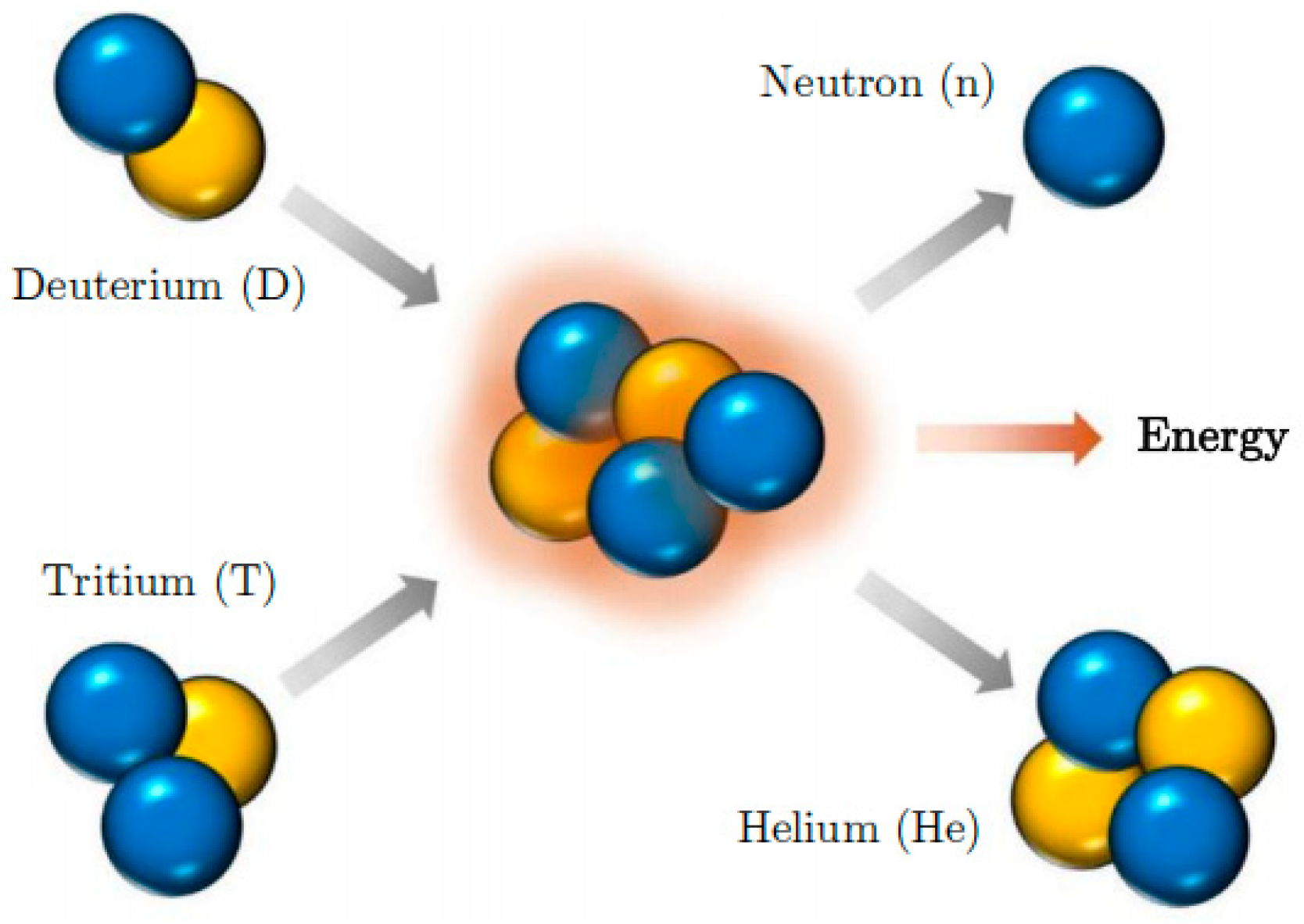
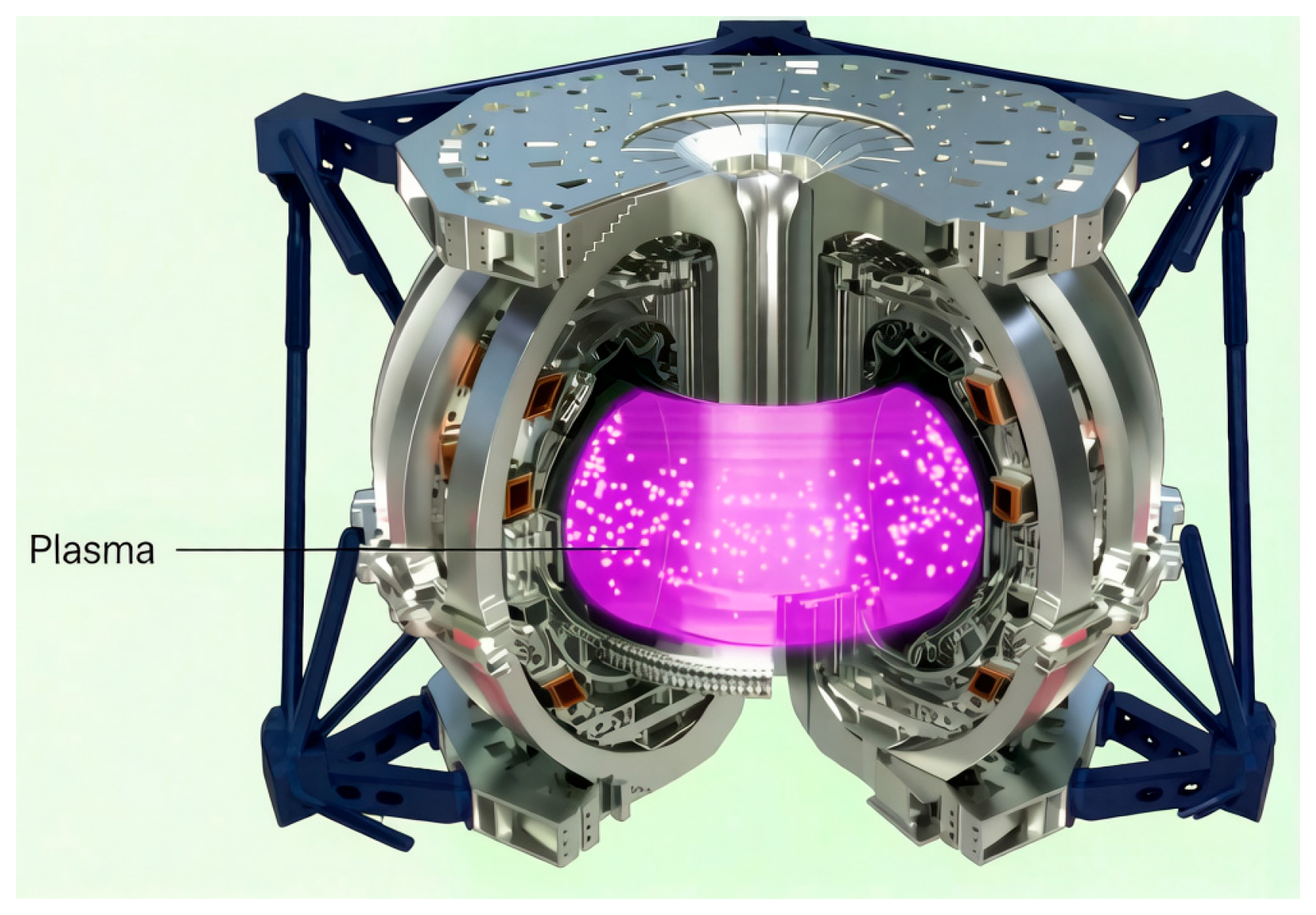
The urgent global challenges posed by climate change, the accelerated depletion of finite fossil fuel reserves, and the pressing need to achieve “dual-carbon” goals of specifically achieving carbon peaking followed by carbon neutrality mandate a transformative paradigm shift toward sustainable, low-carbon energy infrastructures [1,2,3]. Among promising alternatives, controlled thermonuclear fusion, particularly the deuterium-tritium (D-T) reaction (Figure 1) that powers the Sun, stands out due to its unique attributes: it is inherently safe, produces negligible long-lived radioactive waste, and relies on fuel resources that are virtually inexhaustible on human timescales [4,5,6]. The successful realization of fusion energy promises to revolutionize the global energy landscape by enabling vast-scale, carbon-free electricity generation with a near-limitless fuel supply, fundamentally enhancing energy security and substantially mitigating adverse environmental impacts associated with current energy technologies [4,5,6,7,8]. Within the suite of magnetic confinement fusion (MCF) devices, the tokamak configuration, which utilizes a toroidal magnetic field topology to stably confine high-temperature plasma, represents one of the most advanced and viable pathways toward developing practical fusion reactors capable of harnessing nuclear fusion for electrical power generation (Figure 2) [7,8,9,10,11,12]. Despite significant progress, substantial scientific and engineering challenges remain, particularly in plasma–material interactions, confinement optimization, and material resilience under extreme fusion environments.
Harnessing controlled thermonuclear fusion power imposes extraordinarily stringent requirements on plasma-facing components (PFCs)—primarily the first wall (the inner lining facing the plasma) and divertor (the component that manages heat and particle exhaust)—which endure an exceptionally hostile operational environment [13]. These components must withstand extreme steady-state heat fluxes (rate of heat energy transfer per unit area) ranging from 10 to 20 MW/m2, with even higher local values in advanced concepts. In addition, PFCs are subjected to intermittent transient thermal shocks (sudden bursts of heat) approaching GW/m2 during edge-localized modes (ELMs, which are instabilities at the plasma edge) or plasma disruptions, intense 14.06 MeV neutron irradiation that produces displacement damage exceeding 100 dpa (displacements per atom, indicating atomic-level damage), and helium (He) transmutation rates surpassing 1000 appm (atomic parts per million). Additionally, they are subjected to continuous bombardment by high-flux (>1022–1024 m−2·s−1), low-energy (<100 eV) hydrogen and He plasmas [11,12,13,14]. Collectively, these extreme, coupled thermal, particle, and irradiation environments place unparalleled demands on plasma-facing materials (PFMs), necessitating exceptional thermomechanical stability at elevated temperatures, outstanding resistance to thermal shock and cyclic fatigue, high intrinsic thermal conductivity for efficient heat dissipation, minimized physical and chemical sputtering erosion, negligible fuel retention to avoid tritium inventory build-up, and robust microstructural resilience against irradiation-induced degradation. Meeting these multifaceted challenges through innovative material design and advanced surface engineering strategies is essential for the reliable operation and longevity of fusion reactors, and remains a pivotal frontier in fusion materials science [15,16,17].
Among the array of candidate PFMs for magnetic confinement fusion applications, tungsten (W), a refractory body-centered cubic (bcc) metal, is firmly established as the unequivocal primary high-Z PFM for first-wall and divertor applications in magnetic confinement fusion devices, particularly for the International Thermonuclear Experimental Reactor (ITER), and its use is projected for DEMO [12,13,14]. This preferential selection is driven by an outstanding combination of exceptional intrinsic physicochemical and mechanical properties that effectively meet the extreme multi-physical demands of the fusion environment: an extraordinarily high melting point (~3420 °C), superior high-temperature strength, and excellent thermal conductivity (~170 W·m−1·K−1 at 1200 K), which are essential for efficient heat dissipation and structural integrity maintenance under continuous operation at elevated temperatures, and can provide critical resilience against high steady-state (10–20 MW·m−2) and transient heat loads [15,16,17,18,19,20,21]. Beyond its thermomechanical merits, high atomic density, and low physical sputtering yield, W also demonstrates substantially lower tritium retention compared to carbon-based materials—a strategic attribute pivotal to minimizing fuel inventory accumulation within the device and thus enhancing operational safety and tritium inventory management protocols. Finally, W’s intrinsic favorable nuclear activation and transmutation characteristics contribute decisively to reducing long-term radioactive waste burden, thereby supporting sustainable decommissioning and waste management pathways [21,22,23]. Taken together, these multifaceted properties position W not merely as a passive structural element but as a dynamic engineering solution that fundamentally underpins the feasibility and reliability of next-generation fusion reactors.
Despite exceptional intrinsic properties of W that render it a leading PFM candidate for fusion reactors, it nevertheless encounters significant and multifaceted challenges when deployed within the extreme operational environment of magnetic confinement fusion devices (Figure 3) [24,25,26,27,28,29]. The primary obstacles are rooted in tungsten’s inherent metallurgical and irradiation-induced vulnerabilities, which collectively limit its mechanical resilience and long-term structural integrity under harsh fusion conditions. Notably, tungsten exhibits pronounced intrinsic brittleness coupled with a relatively high ductile-to-brittle transition temperature (DBTT), phenomena that critically constrain its deformation capabilities at the low to intermediate temperatures typically encountered during reactor operation [23]. As a body-centered cubic (bcc) metal, W deforms mainly through the 1/2<111>{110} slip system. This slip system provides a sparse set of slip planes and directions in stark contrast to the multiple, densely packed slip systems available in face-centered cubic (fcc) metals, inherently restricting dislocation mobility and leading to limited ductility and heightened fracture susceptibility under mechanical stress [30]. The brittleness of W is further intensified by the segregation of impurity elements, such as oxygen, nitrogen, phosphorus, and sulfur, at grain boundaries. This segregation diminishes interfacial cohesion and reduces the ductility of W [30]. Moreover, the relatively low recrystallization temperature of pure W, approximately 1200 °C, raises concerns about high-temperature embrittlement under operational thermal loads. During prolonged exposure to high steady-state or transient thermal loads, tungsten microstructures may undergo partial or full recrystallization, often accompanied by grain growth and degradation of mechanical properties. This thermal embrittlement effect not only compromises structural integrity but also diminishes the component’s ability to withstand cyclic thermal and mechanical stresses inherent in fusion environments [29,30,31,32,33].
To address these significant challenges, mitigate inherent limitations, and improve the suitability of W as a PFM in fusion devices, characterized by increasingly harsh operational conditions of higher duty cycles, longer pulse durations, and elevated neutron wall loads, extensive and multidisciplinary research efforts have been devoted to pioneering advances. Central to these endeavors is the imperative to substantially enhance W’s mechanical toughness and irradiation tolerance while preserving superior thermal stability and low sputtering yield. The primary methods for enhancing the toughness of bulk W include alloying with elements such as rhenium (Re), tantalum (Ta), or vanadium (V) to refine grain structures, reduce the DBTT, and stabilize microstructural features against irradiation-induced embrittlement and thermal degradation. These alloying additions fundamentally modify dislocation dynamics and grain boundary chemistry, thereby tailoring deformation pathways to achieve ductility increments without compromising tungsten’s intrinsic high-temperature strength. [34,35,36,37,38]. Complementing alloy development, the incorporation of fine, stable second-phase dispersoids (e.g., Y2O3, La2O3, or carbides like TiC/ZrC) facilitates oxide dispersion strengthening (ODS), which pins grain boundaries and restricts dislocation motion, and has given rise to oxide dispersion strengthening (ODS) architectures. These dispersoids act to effectively pin grain boundaries, impede dislocation mobility, and stabilize nanometric microstructures even under severe irradiation and thermal loads, thus dramatically enhancing strength and creep resistance [39,40,41]. Parallel to intrinsic microstructural modifications, extrinsic toughening methods utilizing W fibers (Wf/W composites) enable crack bridging, deflection, and energy dissipation mechanisms that significantly elevate fracture toughness and mitigate catastrophic failure modes, representing a promising route to extend tungsten component lifetimes [42,43,44]. Advances in processing technologies further catalyze enhancements in tungsten’s performance envelope. Severe plastic deformation (SPD) techniques such as high-pressure torsion (HPT) and equal-channel angular pressing (ECAP), as well as modern powder metallurgy routes, are employed to fabricate ultrafine-grained (UFG) or nanostructured tungsten with refined grain size distributions and optimized texture evolution. These microstructural architectures simultaneously elevate ductility and retain high-temperature mechanical robustness, offering a critical balance essential for cyclic thermal loads and irradiation environments encountered in fusion devices [45,46]. Meanwhile, emerging additive manufacturing (AM) of W-based alloys has also attracted intense research interest owing to their unparalleled potential for producing complex geometries with graded microstructures and tailored compositions optimized for fusion PFM applications [22,27,47,48]. W-containing refractory high-entropy alloys (RHEAs) or W-containing refractory multi-principal element alloys (RMPEAs) open novel compositional spaces, wherein synergistic entropic and lattice distortion effects enable a unique combination of high strength, enhanced ductility, and exceptional irradiation tolerance [23,28,49,50]. These cutting-edge material platforms are poised to revolutionize plasma-facing component design by providing unprecedented performance envelopes under the extreme conditions of future fusion reactors, heralding a transformative path forward in fusion materials science.
Following the pivotal decision by ITER to deploy W as the primary PFMs for the main chamber PFCs, there has been a marked surge in research interest concerning the multifaceted implications of tungsten utilization under fusion-relevant conditions [16,17,18]. This strategic choice underscores the critical necessity to address tungsten’s inherent challenges—such as surface erosion, radiation-induced damage, and thermal fatigue—which pose significant threats to the longevity and reliability of fusion reactor components. Consequently, surface modification and the fabrication of protective surface layers have emerged as essential complementary strategies to enhance the near-surface performance of W while preserving its core thermophysical advantages for PFM application in fusion reactors [51,52,53,54,55,56,57,58,59,60,61,62,63,64,65,66,67]. This review critically synthesizes recent advancements in the fabrication of protective surface layers on W for PFM application in fusion reactors. By delineating key mechanisms, performance metrics, and engineering challenges, this structured assessment not only synthesizes recent experimental and theoretical advances (creating a database and providing reference information) but also identifies promising pathways and key research gaps, thereby providing a practical framework to guide the development of next-generation W-based PFCs with improved durability and plasma compatibility.

2. Preparation and Characteristics of Protective Layers

It has been confirmed that W is subjected to a multifaceted array of surface degradation mechanisms that critically impair its performance as a PFM in MCF devices [12,16,17,18,66]. These damages arise from synergistic interactions with high-flux, low-energy hydrogen/He plasmas, intense neutron irradiation, extreme heat fluxes, and impurity influxes, leading to erosion (material loss) and plasma contamination, helium-induced blistering and fuzz formation, which drastically reduce thermal conductivity, thermal fatigue cracking from cyclic transients, and neutron-driven embrittlement accompanied by hardening, swelling, and loss of ductility [13]. To mitigate these deleterious effects, the fabrication of protective surface layers on W-PFMs in fusion reactors has emerged as a pivotal strategy, leveraging materials like graphene, carbides, or mixed-metal layers to shield the substrate from plasma-induced erosion and irradiation damage [52,53]. Over the past decades, a variety of advanced fabrication techniques have been systematically explored and optimized to deposit these protective layers with precise compositional and microstructural control. Chemical vapor deposition (CVD) [54,55,56,57,58], physical vapor deposition (PVD) [59,60,61,62,63,64] and spray [65,66,67] are the three main adopted technological processes that have been used to prepare metallic and/or non-metallic protective layers on different PFMs of graphite, carbon fiber composite (CFC), beryllium (Be), superalloy, copper (Cu), vanadium (V), steel and W in the past decades [7,15,18,20]. This convergence of materials science innovation and surface engineering technology lays a strong foundation for the next generation of W-PFMs with enhanced durability and plasma compatibility, substantially advancing the goal of sustainable, long-term operation of fusion devices under extreme service conditions.

2.1. CVD Technology

CVD remains a foundational and highly versatile technique for depositing conformal, high-purity metallic and non-metallic protective layers on W substrates. As an situ gas-phase deposition, CVD involves the well-controlled chemical reactions of volatile gaseous precursors that decompose or react on the substrate surface, facilitating the formation of continuous solid films with exceptional uniformity and adherence. These surface reactions are typically thermally activated, though enhancements employing plasma assistance, photon sources, or other advanced energy inputs can be employed in reaction pathways, to reduce processing temperatures, and to modify film characteristics [68]. One of the most compelling advantages of CVD lies in its ability to deposit a vast array of materials—from refractory carbides and nitrides to ultra-thin barrier layers and composite coatings—at substrate temperatures significantly lower than the melting points of the target phases, often in the range of one-half to one-tenth the absolute melting temperature of the deposited coating material [54,56]. This temperature flexibility not only minimizes thermal-induced stress and substrate degradation but also expands the compatibility with complex and temperature-sensitive W components. Moreover, CVD is uniquely suited for coating substrates with intricate geometries, including three-dimensional (3D) topologies, internal cavities, and structures exhibiting high aspect ratios—conditions commonly encountered in next-generation fusion reactors. The inherently conformal nature of CVD films ensures uniform thickness over challenging surface morphologies, which is essential for maintaining consistent plasma-facing properties and mitigating localized failure risks. Coupled with the precise tunability of deposition parameters such as temperature, pressure, precursor flow rates, and reaction kinetics, CVD enables meticulous control over layers’ microstructural evolution, phase composition, stoichiometry, and functional properties such as hardness, thermal conductivity, and radiation resilience [68]. These attributes make CVD particularly attractive for fusion components where uniform coverage and minimal residual stress are essential [68]. This capability to engineer coatings at the atomic and nanometric scales imparts exceptional performance advantages, including enhanced erosion resistance, reduced plasma impurity generation, and improved mechanical integrity under cyclic thermal and irradiation loading.
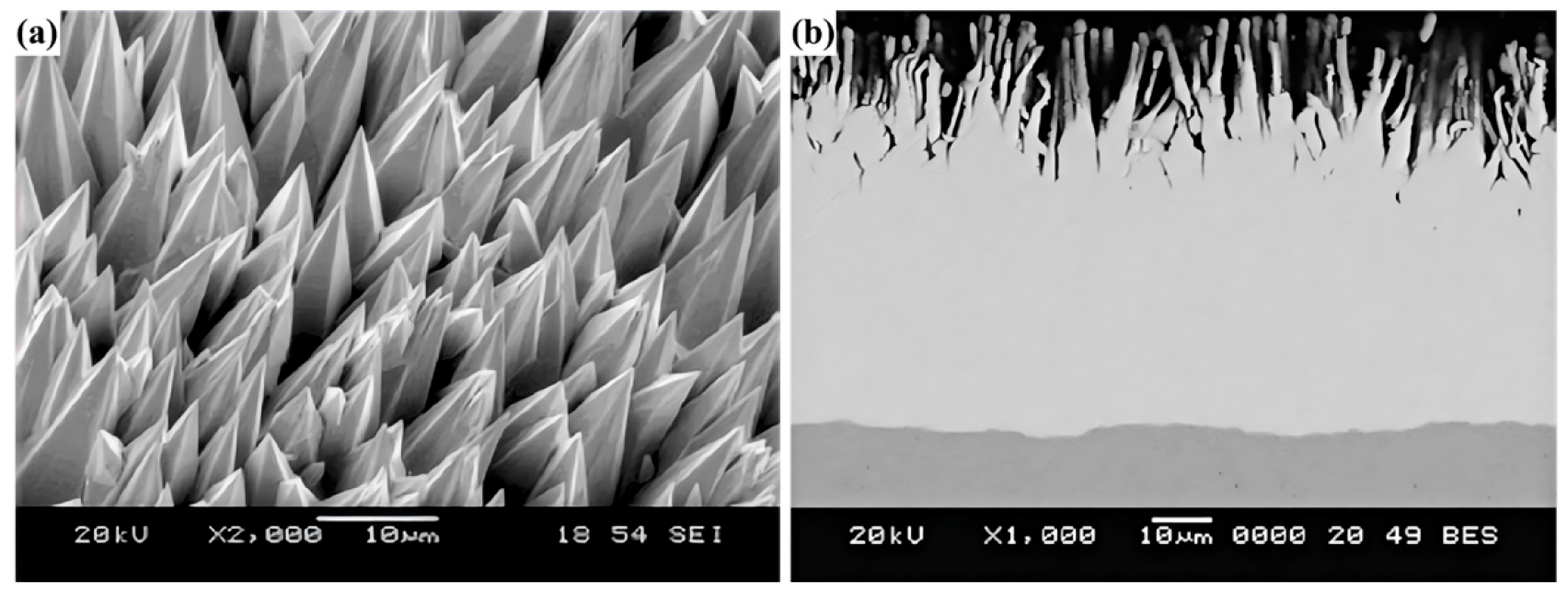
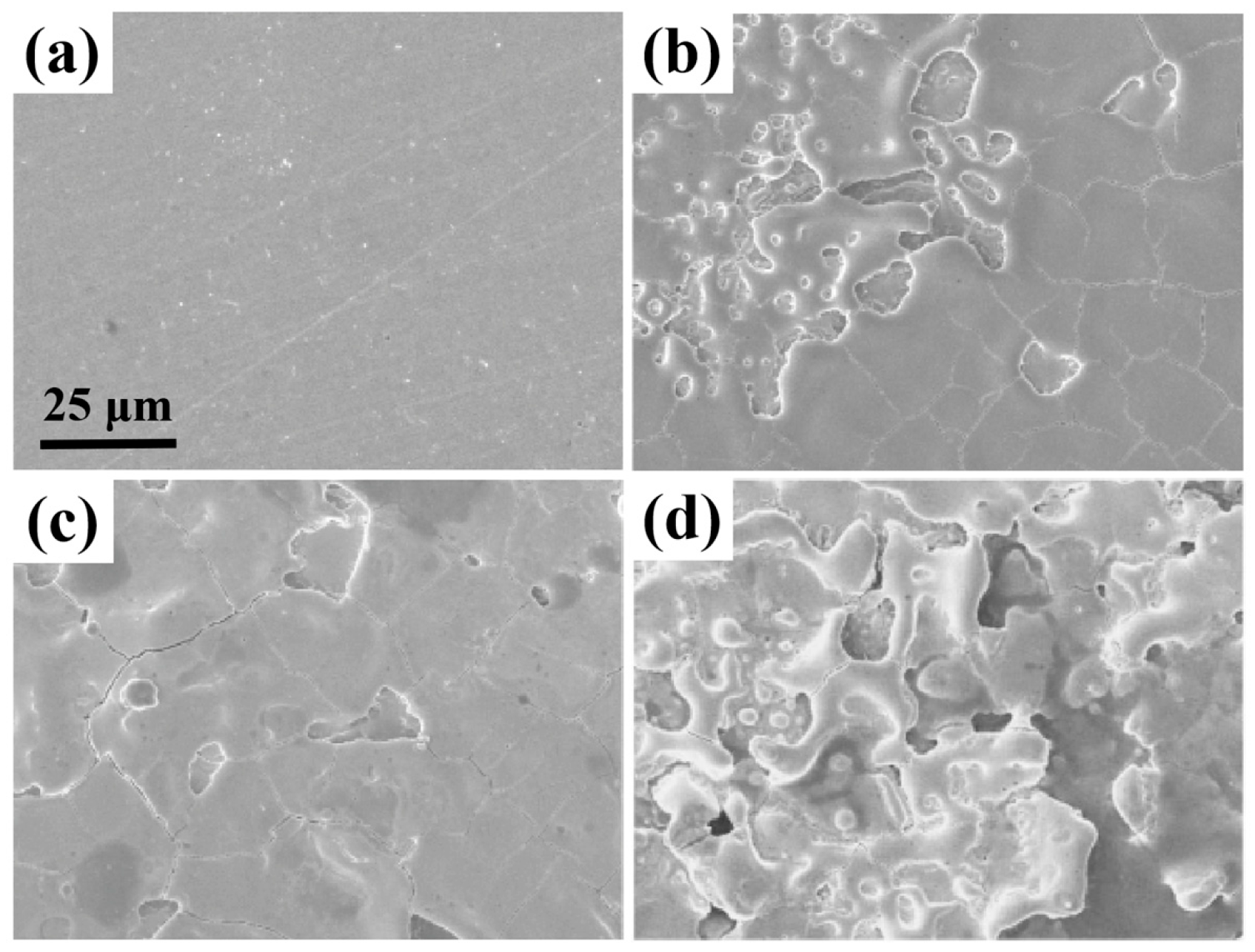
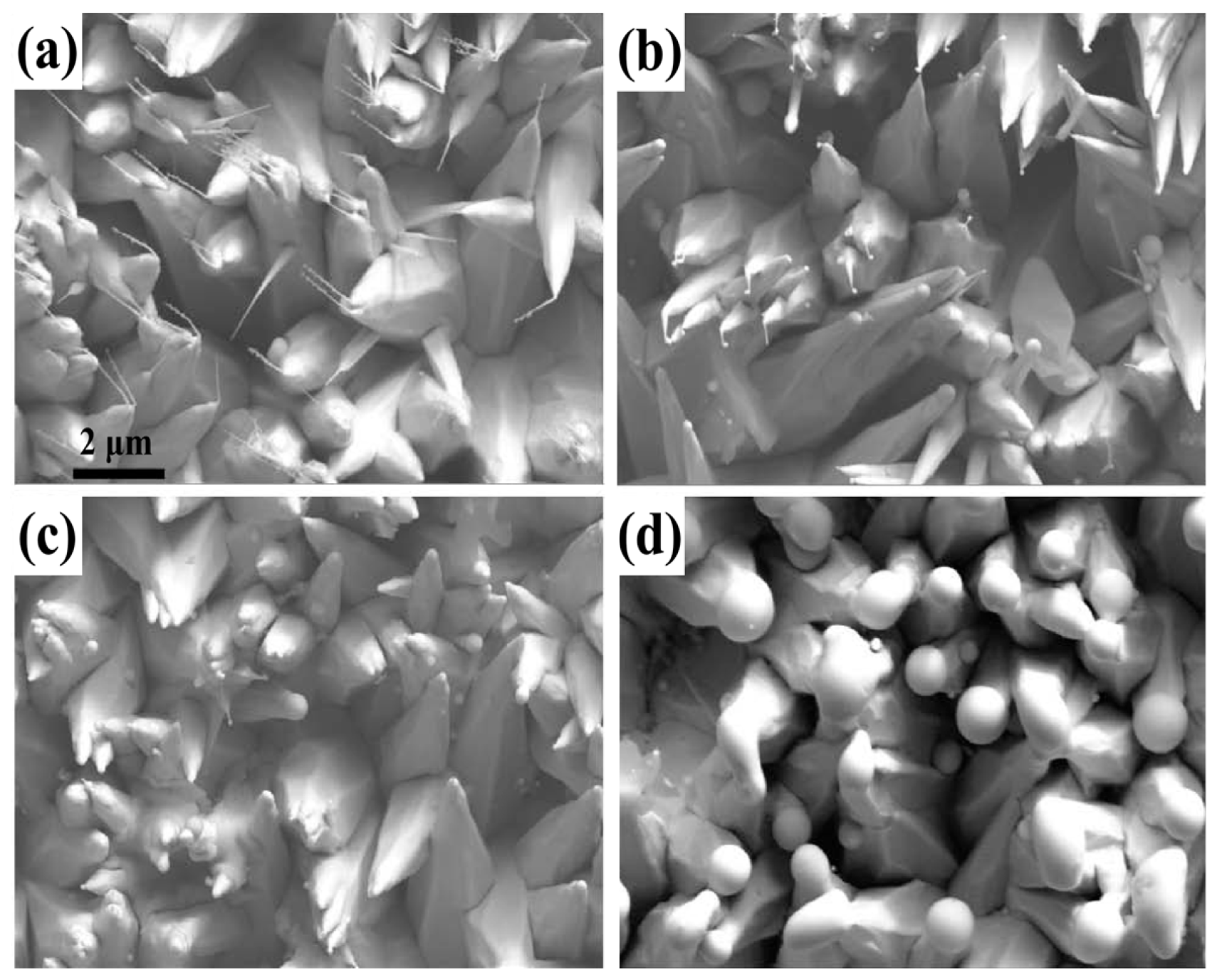
To enhance the survivability of W under intense energetic ion bombardment, Renk et al. [54] fabricated continuous and dense three-dimensional (3D) Re dendritic coating (Figure 4) as a first-wall material for inertial fusion energy (IFE) reactors by employing CVD technology. It was demonstrated that conventional flat powder metallurgy (PM) W suffers from unacceptable surface roughening (Figure 5) and mass loss under pulsed He ion exposure at the Repetitive High Energy Pulsed Power-1 (RHEPP-1) facility at Sandia National Laboratories. In contrast, the Re dendritic coating, characterized by complex hierarchical 3D architectures, demonstrated substantially enhanced thermal stability and dimensional robustness. This improvement is primarily attributed to the coating’s ability to spatially redistribute incident ion flux across a dramatically enlarged effective surface area, thereby attenuating localized heat flux densities and constraining helium implantation depths within the material (Figure 6). The enhanced performance was attributed to the increased effective surface area, which reduced the influence on most of the wall material surface, and improved the microstructural properties. The resulting suppression of surface nanostructuring stems from both geometric flux dilution and improved microstructural resilience, demonstrating the capacity of CVD to engineer hierarchical morphologies that mitigate plasma-induced damage.
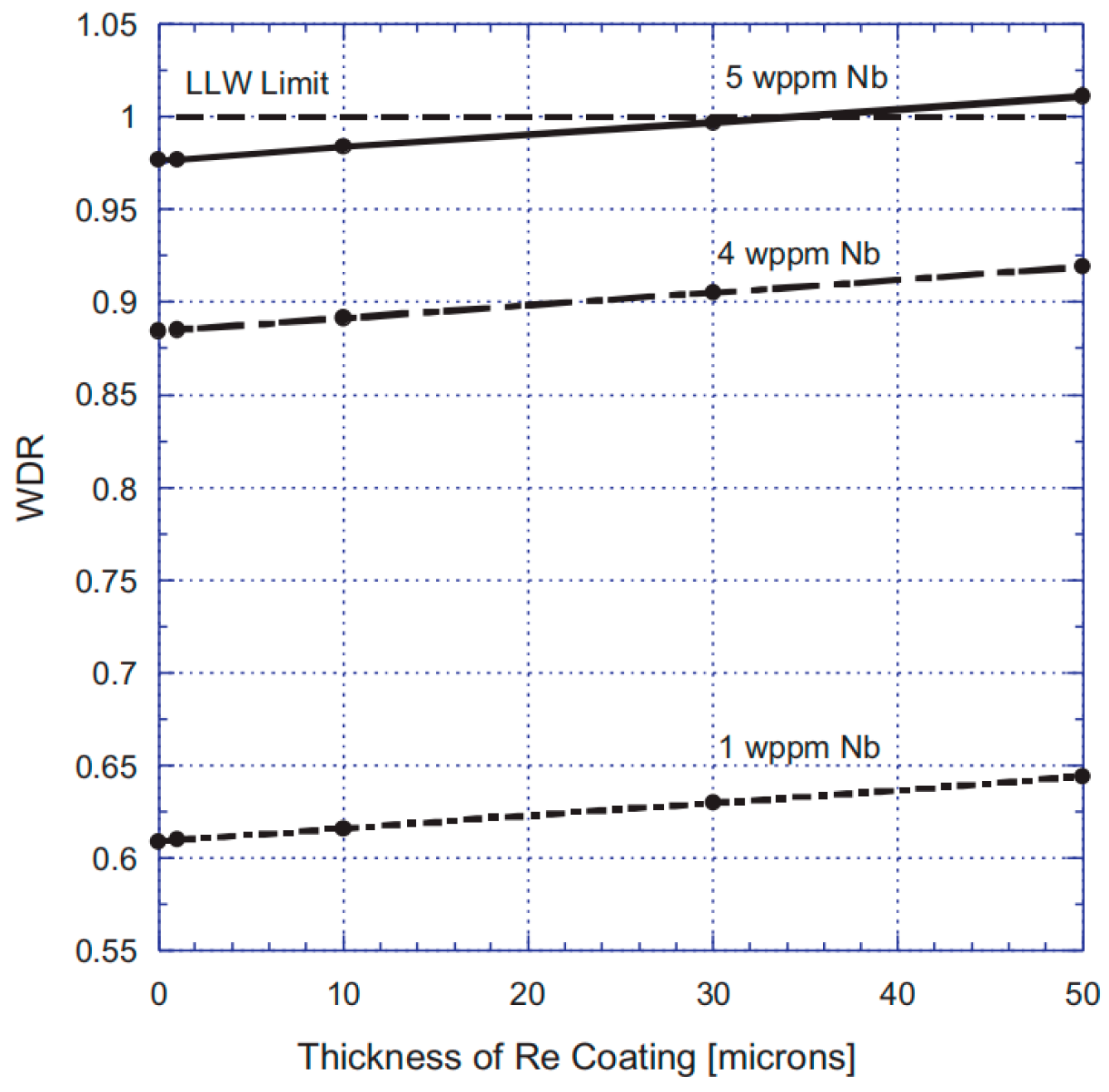
Building upon this foundation, Jaber et al. [69] performed a detailed activation analysis to quantify the waste disposal rating (WDR) associated with the activation of 3D dendritic Re coating on W-based divertors for fusion applications on the basis above. Their calculations established that Re coatings must be limited to less than 30 μm to low-level waste (LLW) classification, with WDR increasing sharply beyond this threshold (Figure 7). This regulatory constraint underscores an important trade-off in CVD-derived Re coatings: while dendritic morphologies provide superior erosion resistance, excessive thickness compromises long-term waste management feasibility, highlighting the need for thickness-optimized designs that balance performance and environmental considerations.
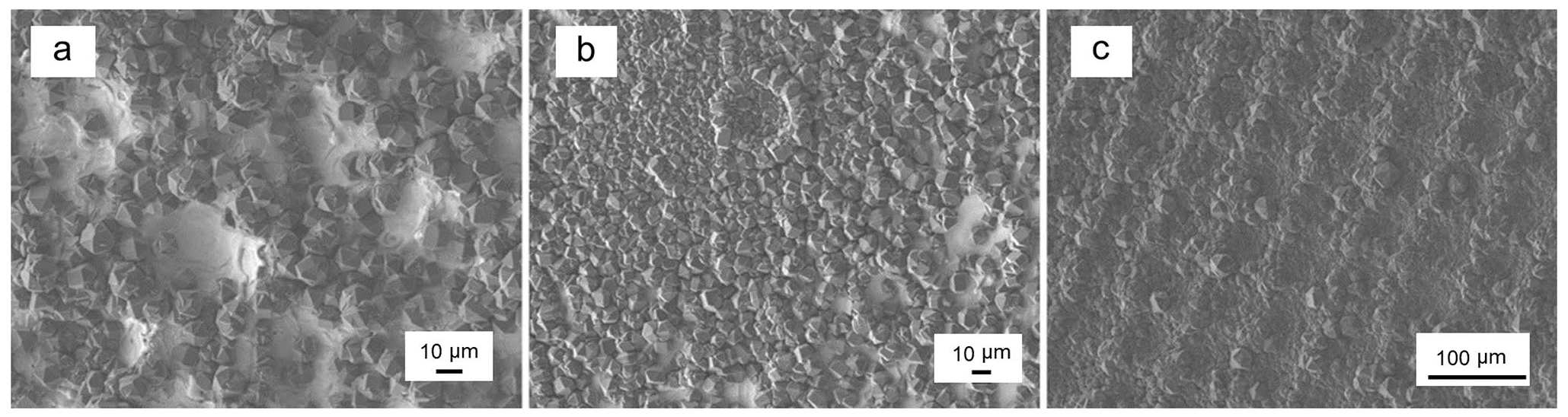
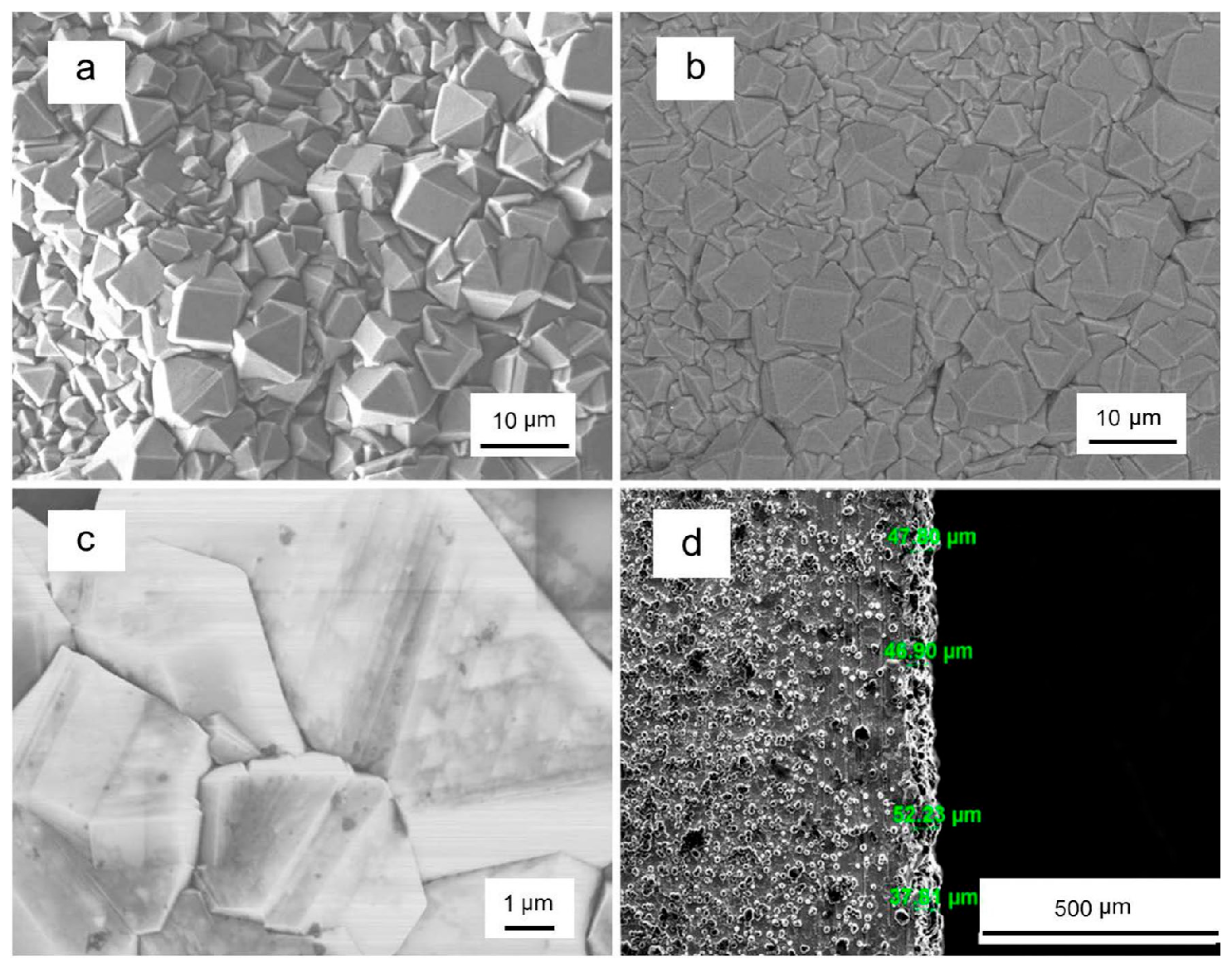
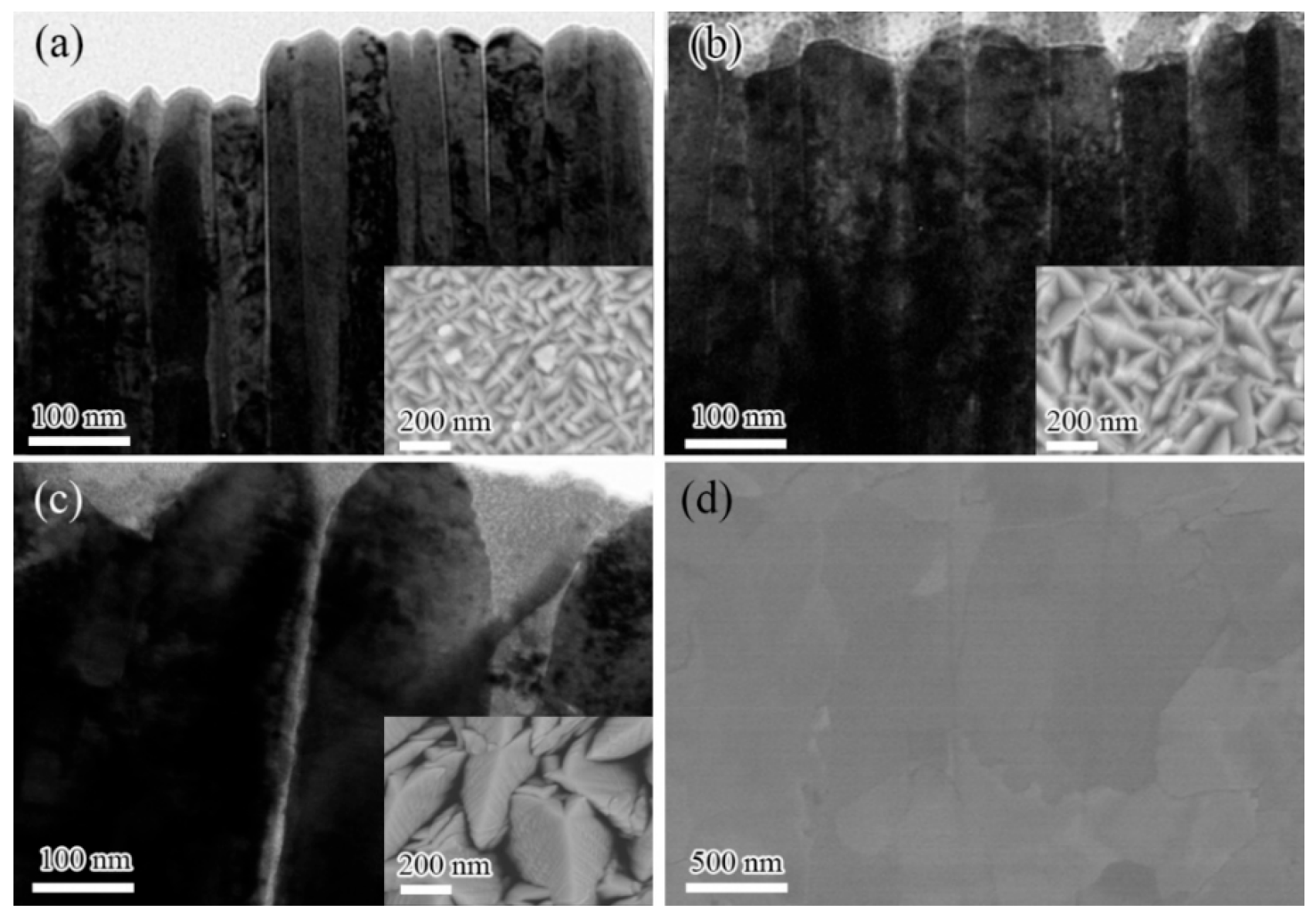
To address the surface damage issues of W-PFMs, such as sputtering, melting, and nanostructure formation under extreme fusion conditions, Wang et al. [55] explored the feasibility of using CVD diamond coatings as a protective layer. Direct current plasma jet CVD was employed to deposit diamond coatings on three types of tungsten substrates: pure W, W-1.0 wt.% La2O3, and W-0.5 wt.% TiC. Prior to deposition, laser surface texturing was applied to create uniform micro-pits to enhance coating adhesion and nucleation. However, coatings on W-1.0 wt.% La2O3 (Figure 8a) and W-0.5 wt.% TiC (Figure 8b) substrates exhibited incomplete surface coverage incomplete surface coverage, attributed to the presence of second-phase particles that disrupt thermal gradients and charge distributions during deposition, thereby inhibiting diamond nucleation and growth. In contrast, pure W substrates achieved near-complete, uniform coating coverage under identical CVD conditions (Figure 8c), underscoring the direct influence of substrate chemistry on coating integrity under identical CVD parameters.
Microstructural characterization revealed the diamond films on pure W possessed well-defined columnar crystals averaging ~10 μm in grain size (Figure 9a), with backscattered electron imaging confirming a dense, homogenous coating free of secondary phases (Figure 9b). This demonstrates that only one color is observed in the backscattering mode, indicating the diamond coating on pure W is integrated and dense. Figure 9c demonstrates smooth and angular crystal faces of the coating, and no amorphous phase could be observed. Continuous diamond coating on pure W substrate reached a thickness of about 45 μm (Figure 9d). When pure W and the as-deposited diamond coating were subject to D plasma blast with an ion flux of 1.4 × 10²¹ ions m−2 s−1 for 30 min, there was no obvious delamination failure, significant structural damage or graphitization on the surface of the coating, and the whole diamond coating sustained intact (Figure 10). It was demonstrated that a CVD-grown diamond coating can serve as an effective erosion-resistant barrier for W, mitigating plasma-induced surface damage and reducing W sputtering into the fusion plasma under fusion-relevant extreme conditions.
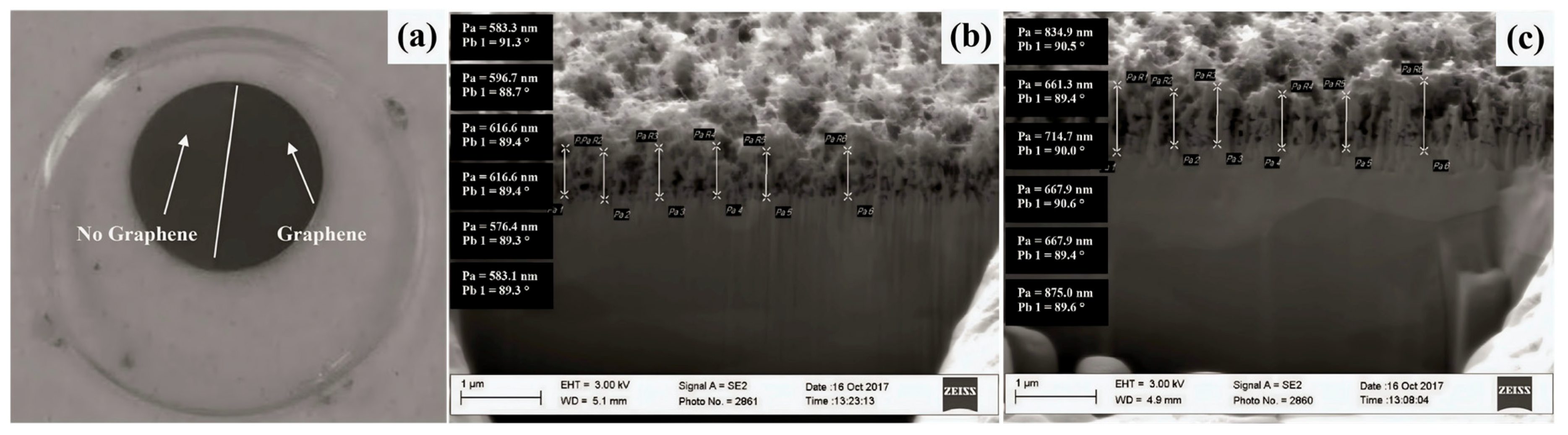
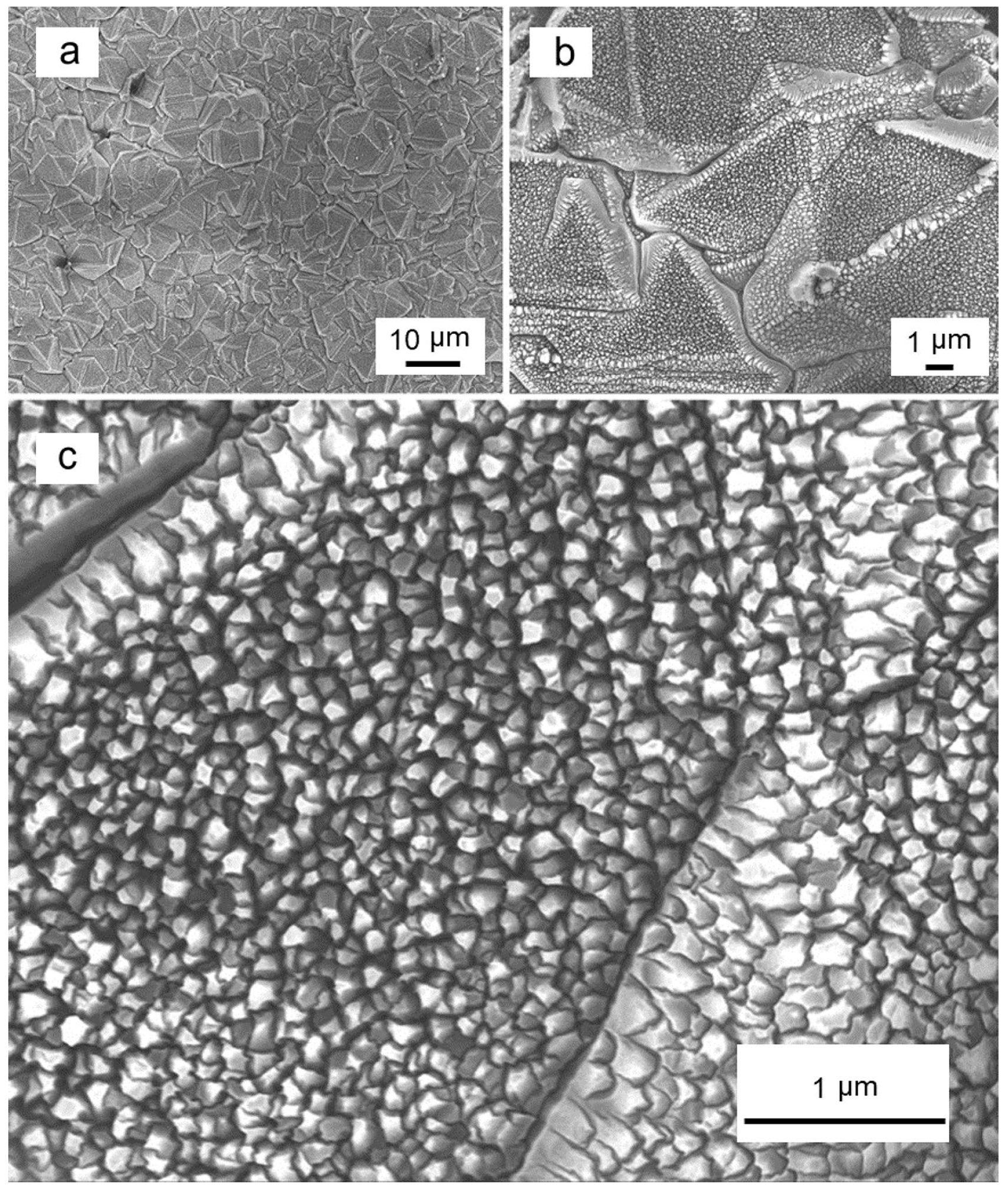
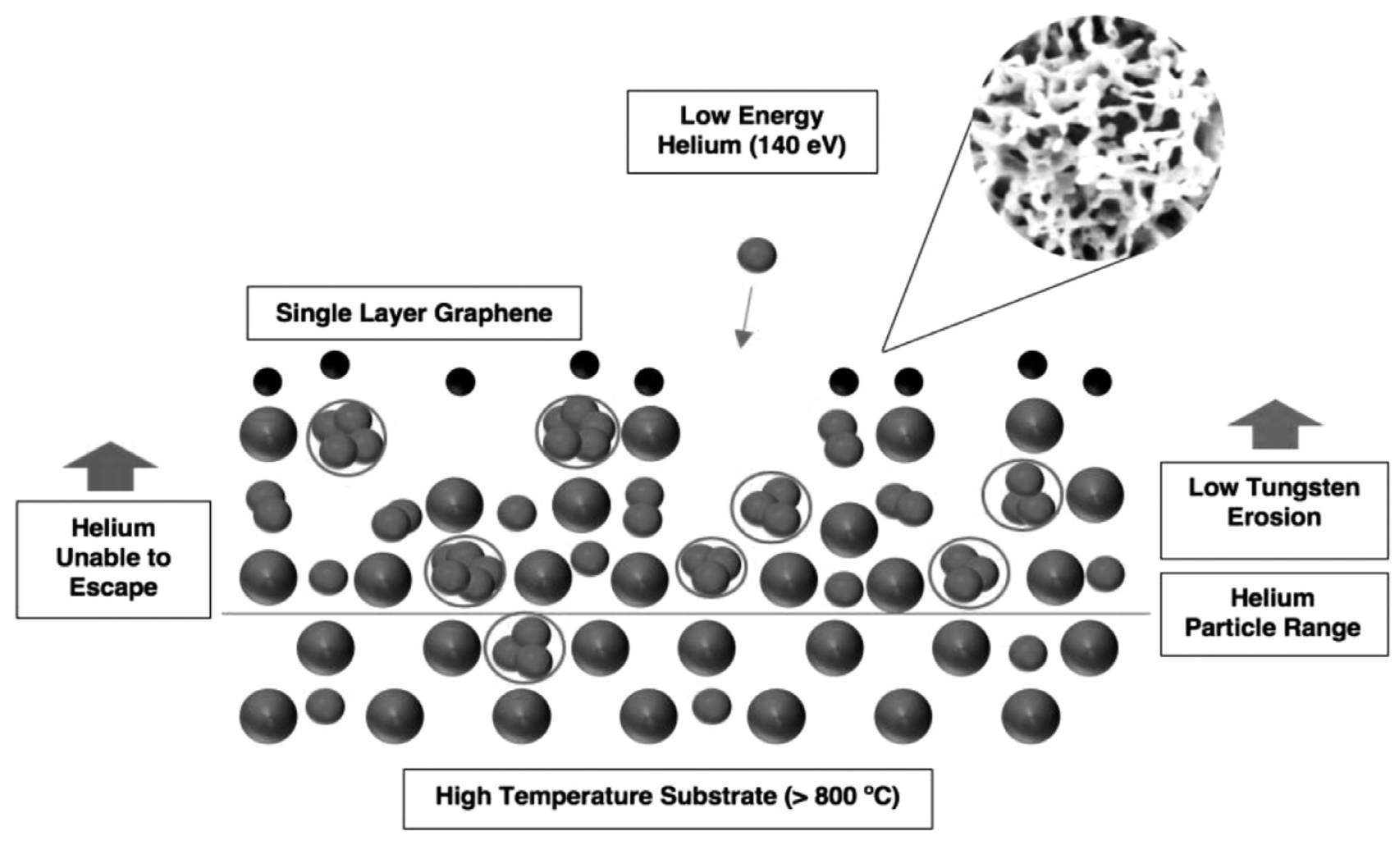
In Navarro et al.’s work [58], the efficacy of graphene as a protective layer for polycrystalline W in low-energy He and D plasma exposures was explored, addressing a critical challenge in mitigating plasma-induced surface degradation. Firstly, CVD was used to prepare single-layer graphene on a 30 μm thick Cu foil; then a wet transfer technique was employed to transfer the graphene onto one half of an electropolished W substrate (Figure 11a) This innovative design, with one-half of the same sample coated, enabled direct, side-by-side comparison of coated versus uncoated regions under identical plasma conditions, thereby eliminating the influence of experimental parameter variations, ensuring intuitive and reliable results. The W disk sample was subjected to simultaneous high-flux He/D irradiation in the Linear Divertor Experiment PISCES-A device. The findings revealed that 140 eV He ions caused less damage to the graphene compared to 40 eV ions. This counterintuitive behavior is explained by the deeper penetration of higher-energy ions into the W substrate, which reduces surface reflection and consequential secondary damage to the graphene coating. The introduction of the graphene coating significantly suppressed the formation of nanostructures on the W surface under low-energy He plasma irradiation (Figure 11b,c), while under the highest fluence condition (3.6 × 1025 He+/m2) the graphene underwent complete amorphization, indicating a threshold beyond which coating integrity fails, which demonstrates that cumulative fluence is the decisive factor leading to graphene degradation. The study revealed that graphene coating effectively attenuated morphological evolution and reduced W “fuzz” growth by approximately 30% at high ion fluences. Mechanistically, graphene functions both as a robust physical barrier, diminishing the nucleation and growth driving force for nanostructures, and as an energy absorber, dissipating incident ion energy to mitigate damage transfer the tungsten substrate beneath.
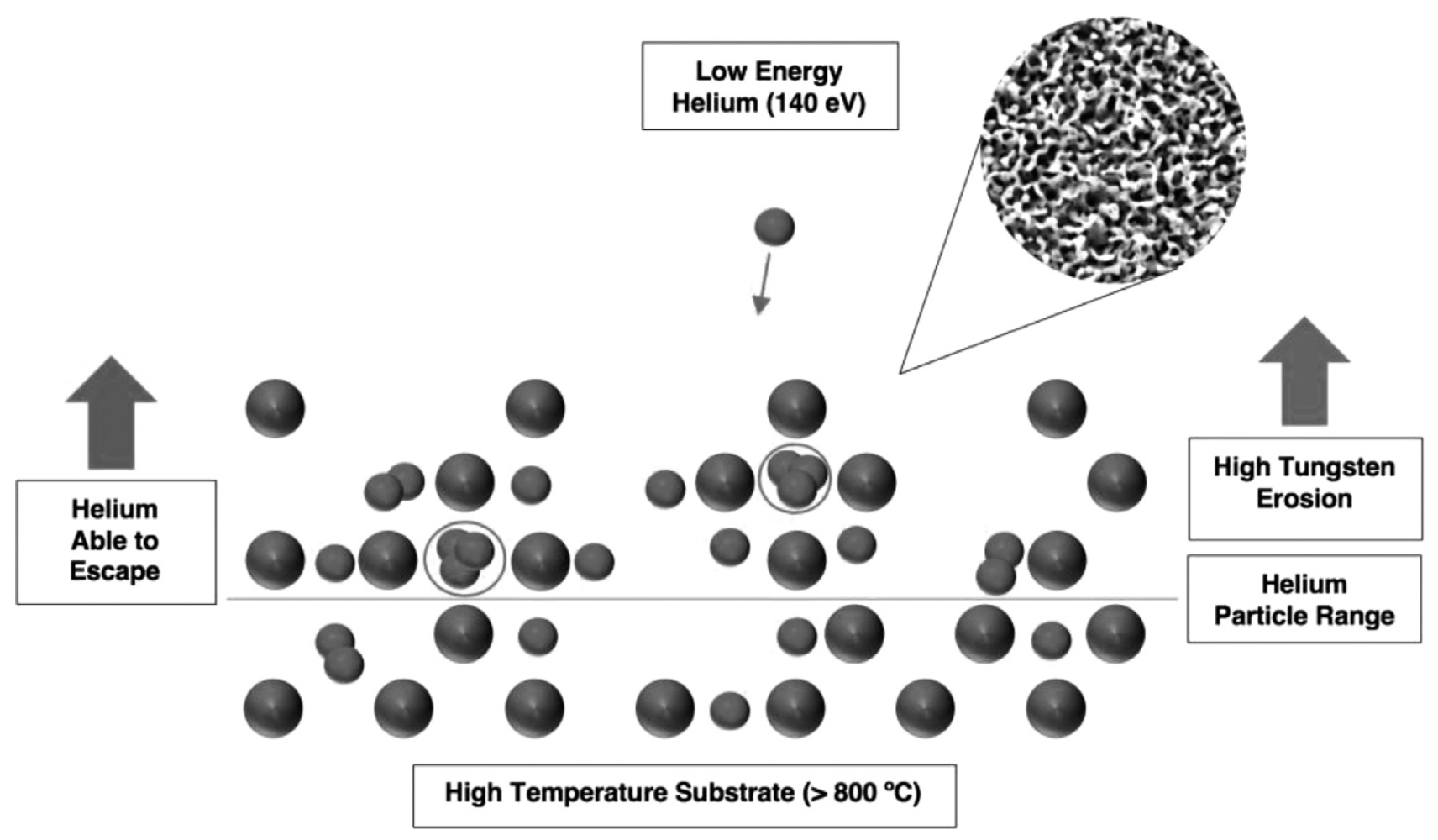
Figure 12 and Figure 13 schematically illustrate the interaction mechanisms of low-energy helium ion bombardment on polycrystalline W and graphene-coated polycrystalline W, respectively, revealing distinct damage evolutions driven by atomic-scale interactions. Low-energy He ions exhibit a substantial Coulomb cross-section for scattering with W atoms, where energy transfer is dominated by Coulombic interactions rather than nuclear elastic collisions, owing to the strong repulsive forces that inhibit close-range nuclear scattering. In bare polycrystalline W, He accumulates in the subsurface layer, aided by high substrate temperatures (>800 °C), enhancing mobility, coalescing into characteristic bubbles that diffuse to the surface, and forming thin fuzz tendrils and a thick fuzz layer upon sufficient implantation (e.g., ~1 × 1024 He+/m2). With respect to graphene-coated W, He ions interact with carbon atoms in the membrane, generating single-vacancy defects while accumulating subsurface He bubbles. These bubbles subsequently migrate to the surface but are trapped by the graphene layer, inducing surface roughness. Increasing defect density leads to thick fuzz tendrils and a thin fuzz layer. At very high fluences, graphene failure allows fuzz growth equivalent to that of bare W, with reduced W erosion, and substantially decreases He penetration depth, demonstrating its efficacy in enhancing surface resilience against plasma-induced morphological degradation. This mechanistic insight underlines the transformative role of graphene as a functional nanoscale membrane that modulates helium ion-induced damage pathways, offering a promising strategy to extend the operational lifetime and performance of W-PFMs in fusion reactors.
Collectively, CVD enables the deposition of complex, conformal protective layers with tunable microstructures. Its primary strengths—geometric versatility and precise stoichiometry control—make it suitable for divertor monoblocks, yet challenges remain in scaling to large-area components and managing residual stresses at thick coatings. Future CVD research should focus on hybrid processes (e.g., plasma-enhanced CVD) and in situ repair protocols to meet demanding requirements for uniform coverage and long-term stability under combined heat, particle, and neutron loads in fusion reactors.

2.2. PVD Technology

PVD, particularly magnetron sputtering variants, offers atomic-level control over film composition, microstructure, and residual stress, making it indispensable for fabricating advanced protective layers on tungsten. Unlike CVD, PVD operates at lower substrate temperatures and is well-suited for depositing dense, adherent films [70]. At present, PVD is an integral surface engineering technology that delivers high hardness, wear, corrosion resistance, and thermal stability for aerospace, automotive, electronic, and biomedical components [70]. In the context of PVD applications for PFMs, Tiron et al. [71] prepared a series of tungsten nitride (WNx) coating tailored compositions on polished graphite and silicon substrates by reactive multi-pulse high power impulse magnetron sputtering (HiPIMS). Thermal desorption spectrometry (TDS) results revealed that nitrogen acts as a D diffusion barrier, diminishing the amount of D trapped inside the coatings and increasing the desorption temperature up to 750 K. These findings have established PVD’s utility for creating diffusion-resistant barriers that mitigate fuel retention—a critical concern for tritium inventory control in fusion reactors, addressing a pivotal challenge in T inventory management for fusion reactor safety and sustainability.
Complementing this approach, Chen et al. [62] employed radio frequency (RF) magnetron sputtering to deposit (NbMoTaW)V50 films on silicon (100) and W wafers, yielding unique nanochannel architectures that act as efficient sinks for helium bubbles. Under He+ irradiation, these nanochannels facilitate preferential absorption of He at free surfaces, enabling bubble alignment along grain boundaries. This microstructural arrangement, coupled with stress-driven diffusion of intragranular He atoms to free surfaces, suppresses the nucleation and growth of large He bubbles, thereby enhancing the films’ creep resistance and irradiation tolerance. These findings introduce a novel microscale design paradigm whereby tailored nanostructures within PVD coatings provide active mitigation pathways for helium-induced damage, opening avenues for the development of next-generation PFMs with superior longevity under fusion-relevant plasma environments.
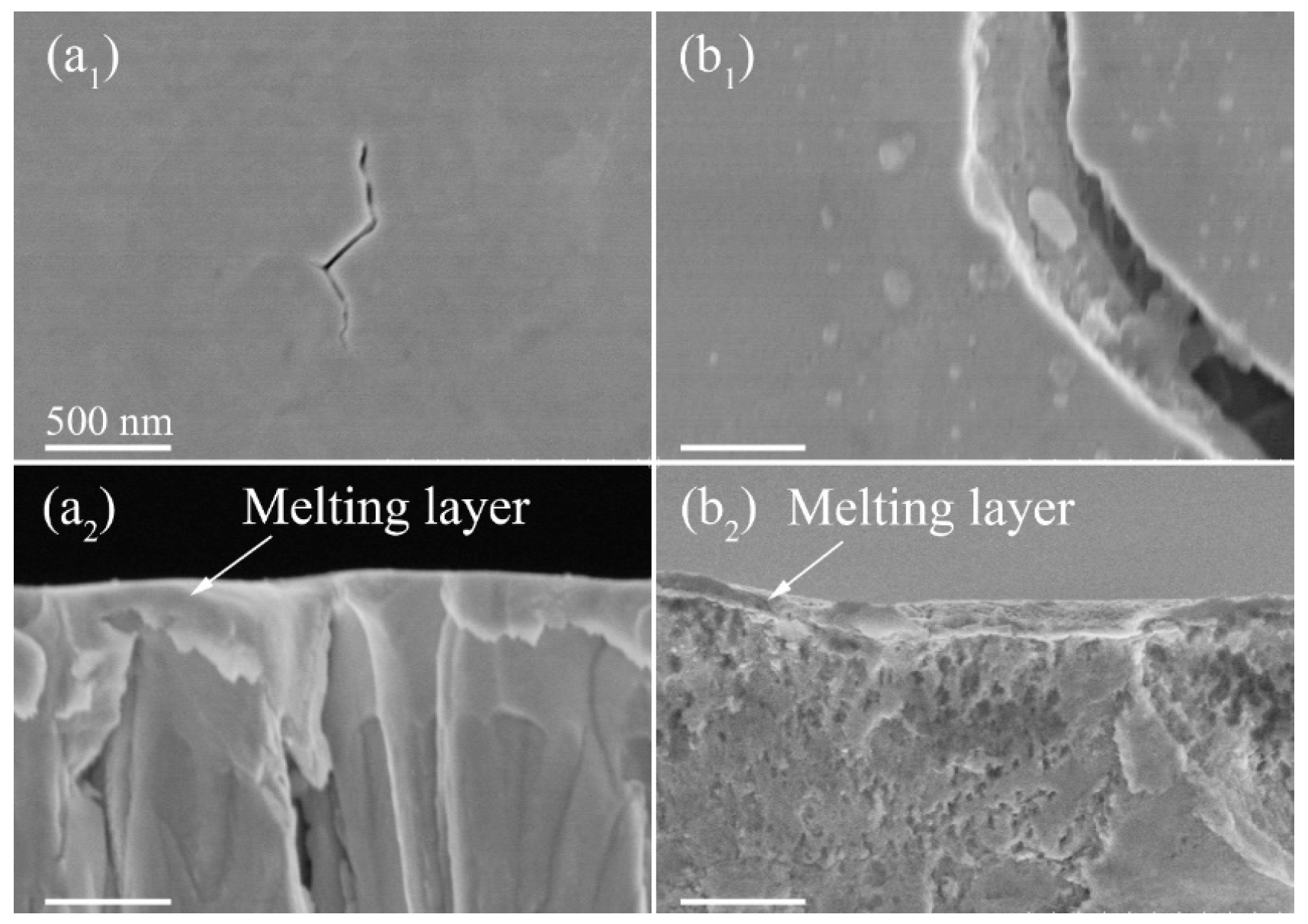
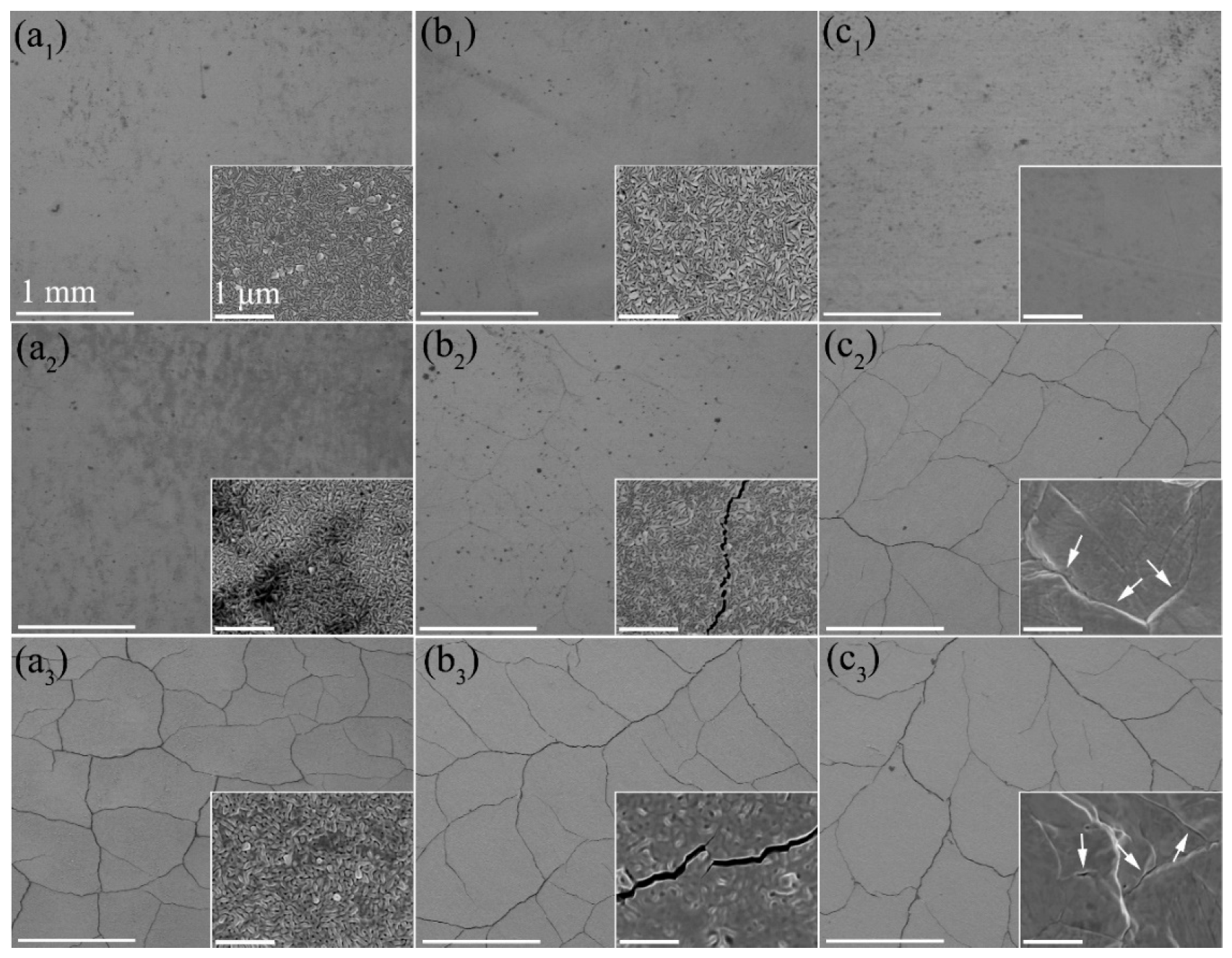
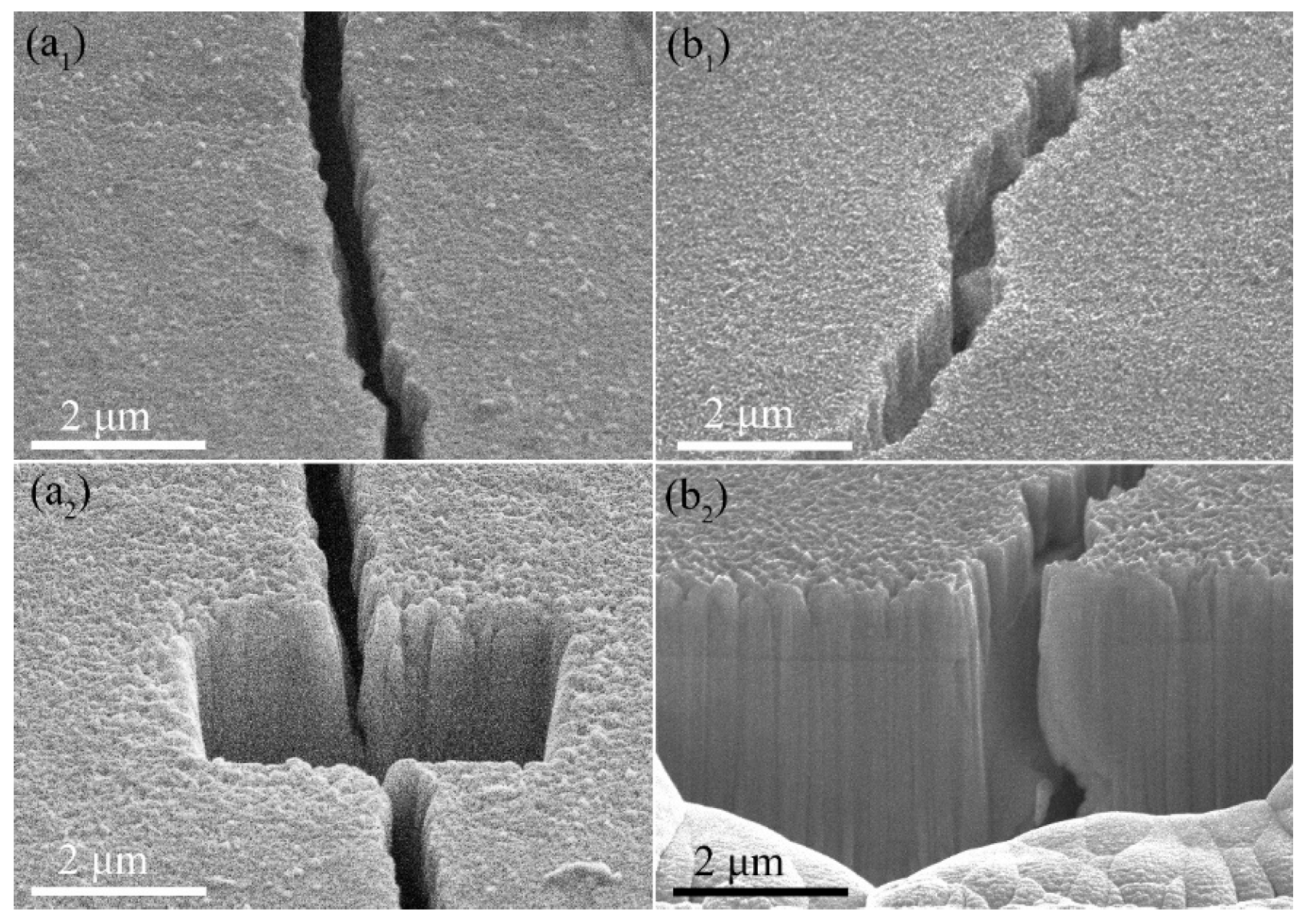
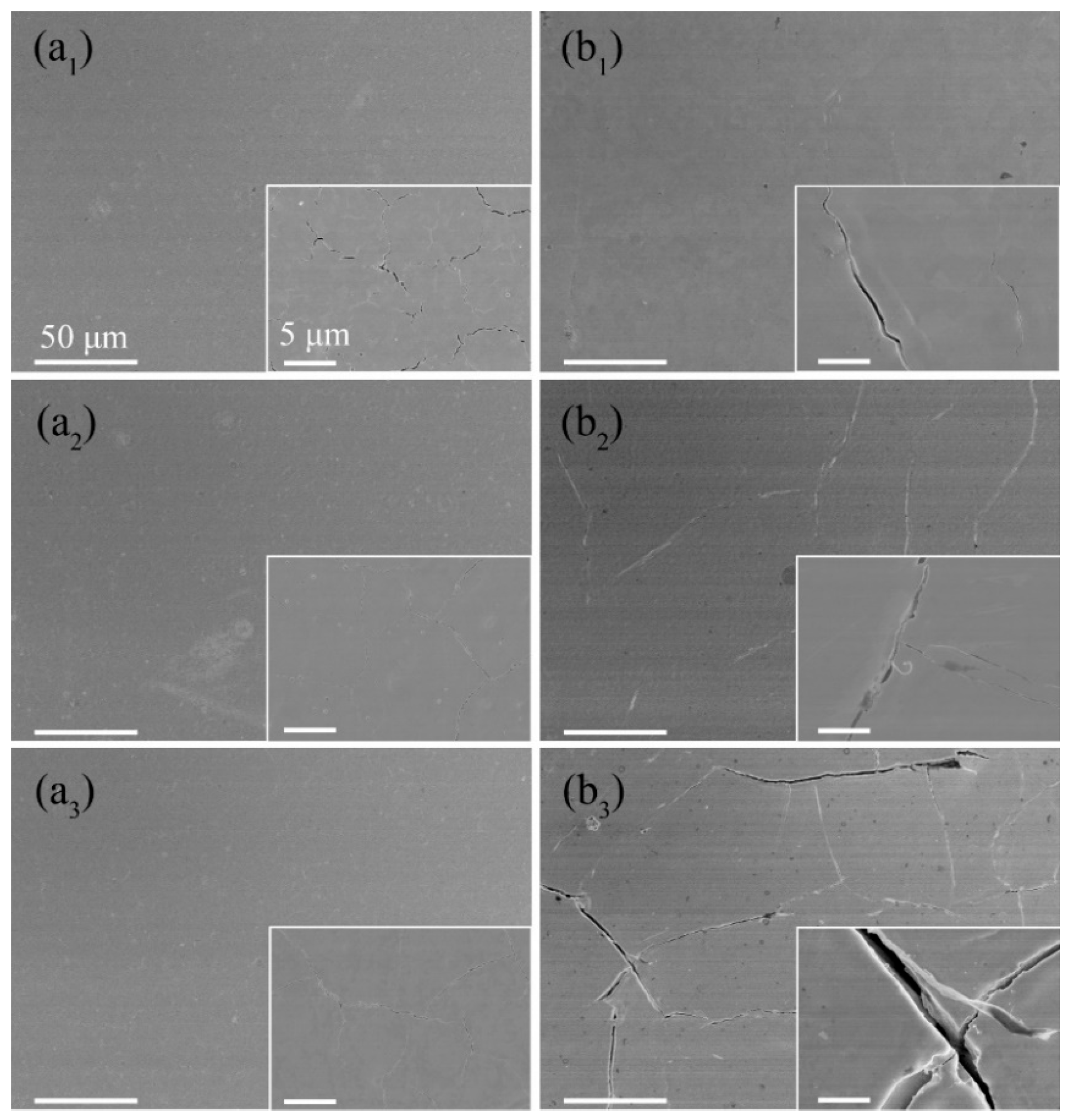
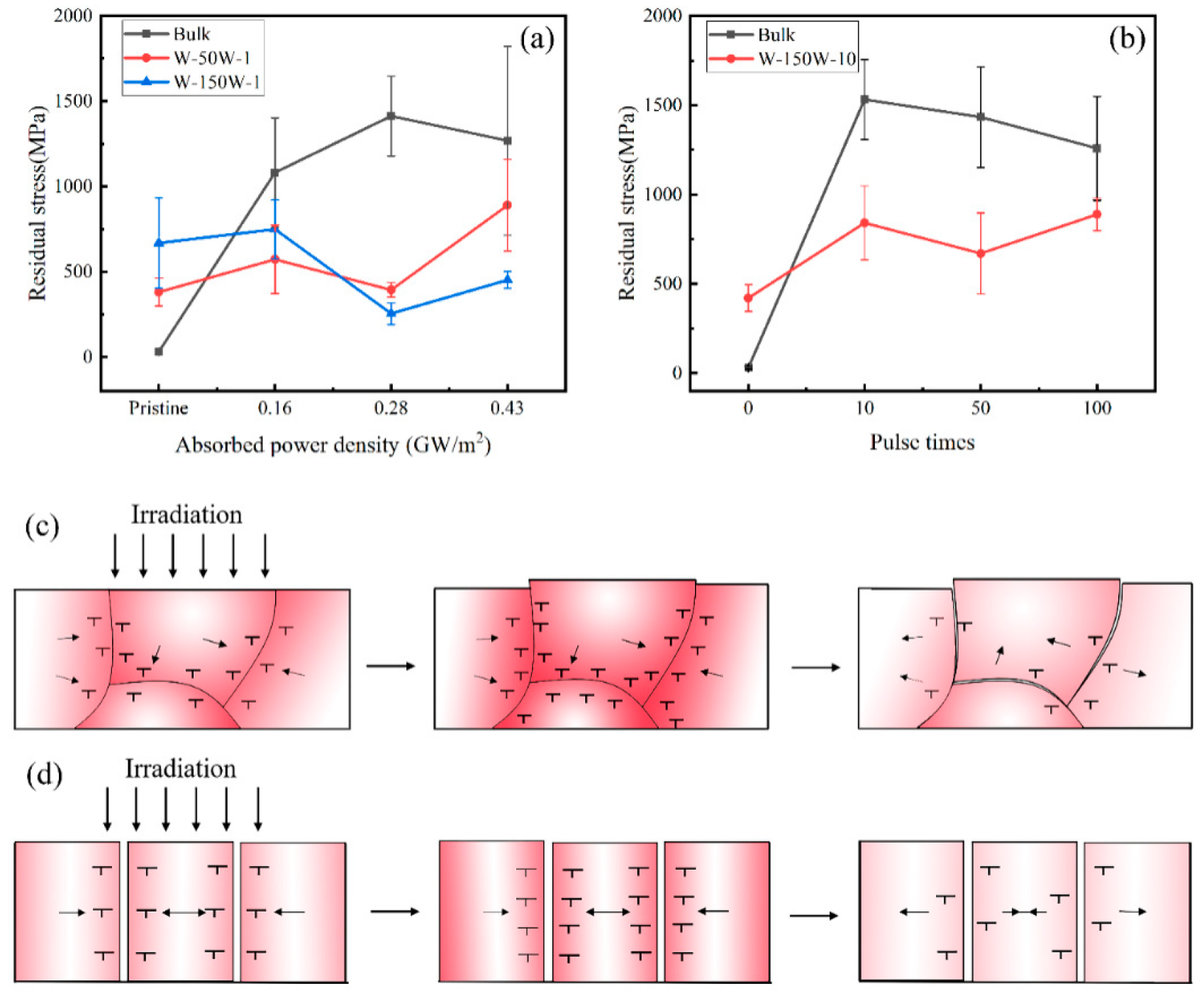
Following the decision by the ITER organization to commence operations with W as the principal PFM for the primary chamber components, research interest has sharply intensified on both the fundamental behavior of W under fusion-relevant conditions and advanced surface modification strategies via PVD technologies [16]. To address the critical challenge of mitigating edge-localized mode (ELM)-like transient thermal shocks in fusion reactors, Cheng et al. [72] fabricated nanochannel W films on commercial W substrates at 600 °C using ultrahigh vacuum DC magnetron sputtering deposition. Aiming to obtain different nanochannel densities, the sputtering powers were set to 150 and 50 W, respectively, while the received films with thicknesses of ~1 µm and 10 µm deposited at different sputtering powers were named W-150W-1, W-50W-1, and W-150W-10 for the sake of simplicity (Figure 14). These architected nanochannel structures introduce a high density of free surfaces, effectively enhancing defect recombination and stress relaxation—mechanisms that overcome intrinsic limitations of bulk W, such as reduced thermal conductivity in nanocrystalline forms and detrimental stress concentration at grain boundaries. Under intense plasma-relevant irradiation conditions, nanochannel W films were subjected to a 60 kW pulsed electron beam (EMS-60) at absorbed power densities of 0.16–0.43 GW/m2 (100 cycles, 1 ms pulses, RT) and a high-intensity pulsed ion beam (HIPIB) at 1 J/cm2 (80 ns, 10–100 pulses). Microstructure characterizations revealed superior crack resistance, as shown in Figure 15 and Figure 16. It was found that denser nanochannel films deposited at higher sputtering power (150 W) exhibited interconnected microcrack networks on the order of tens of nanometers without catastrophic fracture up to 0.28 GW/m2, significantly exceeding bulk W’s cracking threshold (0.16–0.28 GW/m2), where extensive grain boundary cracking arises from steep plastic deformation gradients. Under HIPIB exposure, nanochannel films manifested superficial melting (~200 nm layer) and sputtering-induced thinning while preserving columnar grain integrity, in stark contrast to bulk W which developed micron-scale cracks with increasing pulse numbers (Figure 17 and Figure 18). Grazing-incidence X-ray diffraction (GIXRD) measurements quantified residual stresses post-irradiation, revealing markedly reduced tensile stresses in channel films (452 MPa at 0.43 GW/m2) compared to bulk W (1268 MPa), with stress fluctuations under HIPIB below 1000a (Figure 19). These observations confirm that nanochannel architectures significantly enhance location mobility toward free surfaces, thereby alleviating stress accumulation associated with irradiation-induced damage. Collectively, this innovative nanochannel design synergistically improves both tolerance and thermomechanical stability, outperforming conventional tungsten and presenting a scalable, promising surface engineering pathway for PFCs in DEMO-relevant fusion environments.
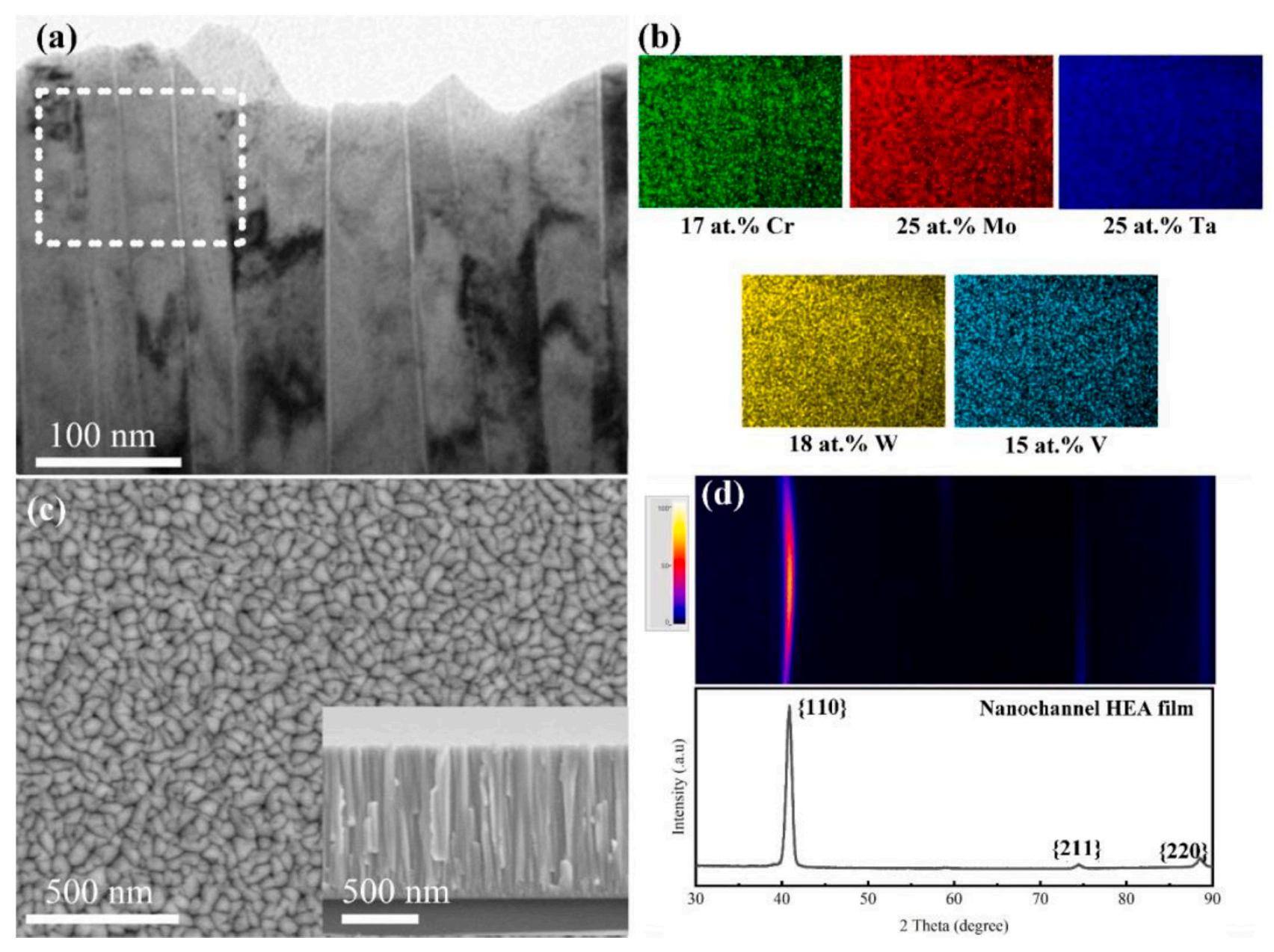
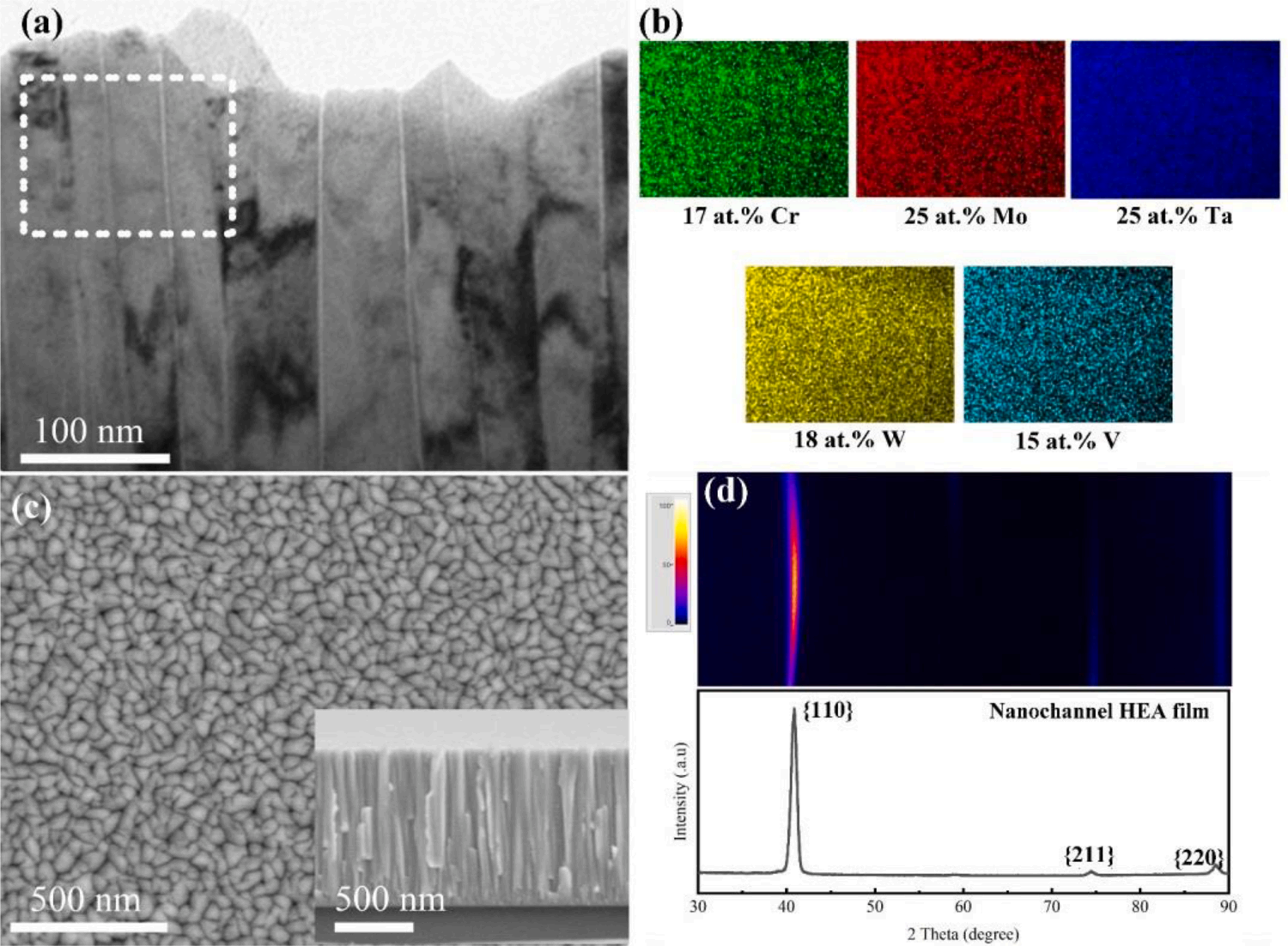
Building upon this innovative nano-architecture, Cheng et al. [60] deposited a CrMoTaWV high-entropy alloy (HEA) film featuring a nanochannel structure onto W substrates at 873 K by ultrahigh vacuum DC magnetron sputtering, aiming to significantly enhance the irradiation resistance of W-PFMs for fusion reactor applications. As shown in Figure 20a, well-defined nanochannels can be observed between the HEA nano-columnar crystals, and the columns are almost perpendicular to the horizontal direction in the cross-sectional transmission electron microscopy (TEM) image. The energy-dispersive X-ray spectroscopy (EDS) mapping results (Figure 20b) of the selected zone, as indicated by the white box Figure 20a, have demonstrated a homogeneous distribution of constituent elements—Cr, Mo, Ta, W, and V—with atomic ratios of approximately 17%, 25%, 25%, 18%, and 15%, respectively. It is confirmed that the received nanochannel HEA film was continuous and uniform; it was built up by a single-phase body-centered cubic (bcc) structure with the preferred growth in the [110] direction (Figure 20c,d). This nanochannel HEA film synergistically combines compositional complexity with tailored nano-architecture, offering enhanced defect sink capabilities and superior irradiation resistance, thereby representing a transformative strategy for the development of resilient PFMs in fusion devices.
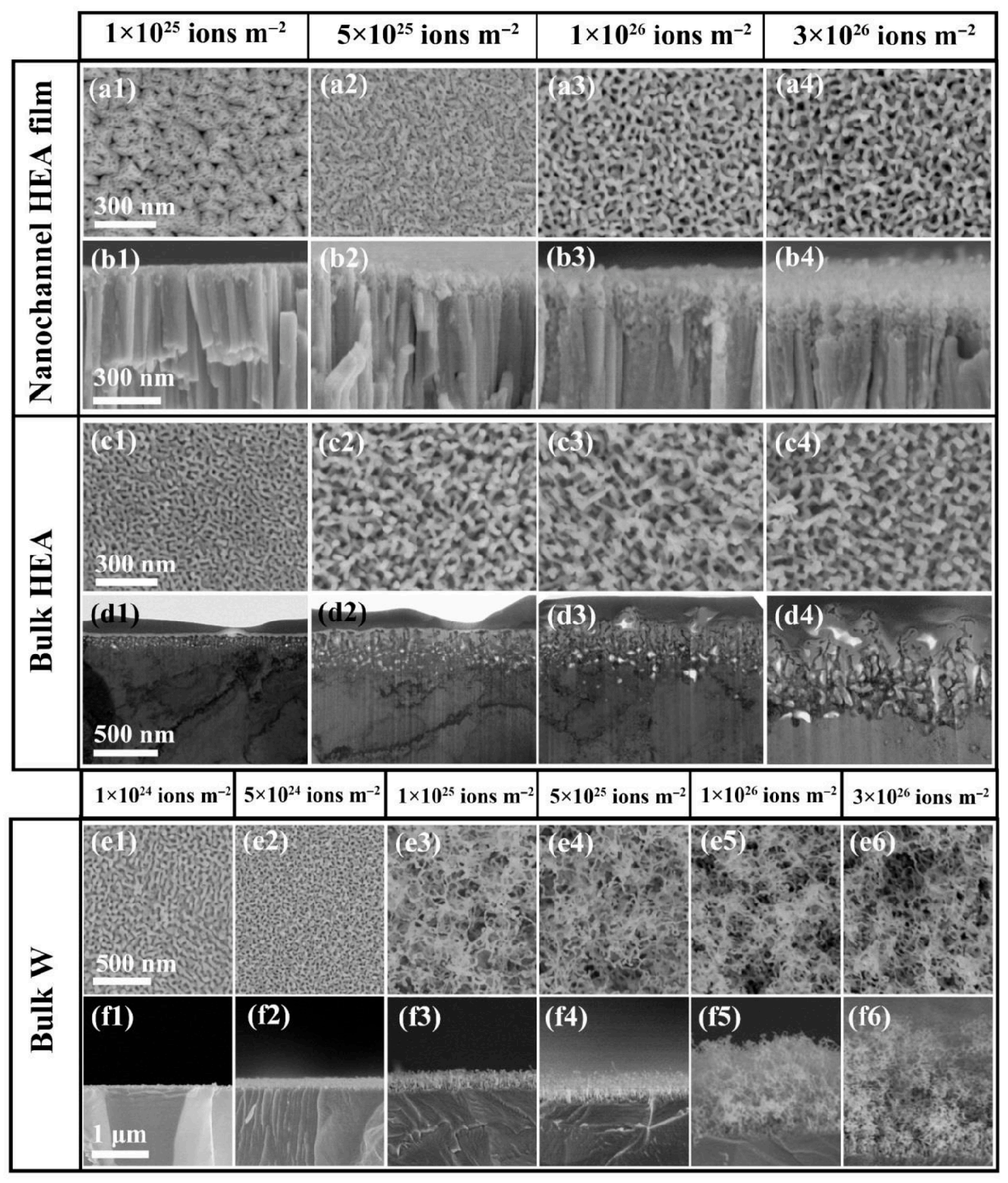
Figure 21 compares the surface morphology and structural evolution of nanochannel HEA film, bulk HEA, and bulk tungsten after exposure to He plasma irradiation across fluences ranging from 1 × 1024 to 3 × 1026 ions m−2. Initial SEM observations (Figure 21(a1,b1)) reveal that no discernible structural damage can be observed on the top surface of the columns after 1 × 1025 ions m−2 He plasma irradiation. Upon increasing the fluence to 5 × 1025 ions m−2, the top layer of the nanocrystalline column exhibited noticeable damage and evolved into the nanoporous structure (Figure 21(a2)). When the fluence was continuously increased to 1 × 1026 ions m−2, characteristic fuzz morphology emerged on the nanochannel HEA film surface (Figure 21(a3)), and the highest fluence of 3 × 1026 ions m−2 resulted in the extensive surface destruction of the nanochannel HEA film, as shown in Figure 21(a4). The corresponding cross-sectional SEM image in Figure 21(b3) reveals a 120 nm thick fuzz layer, while the thickness of the fuzz layer was increased by more than two-fold at the highest fluence of 3 × 1026 ions m−2 (Figure 21(b4)). However, it can be seen in Figure 22(c1) that a nanoporous structure appeared on the bulk HEA surface and began to evolve toward fuzz after He plasma radiation at the fluence of 1 × 1025 ions m−2. When the fluence was increased to 5 × 1025 ions m−2, a fuzz layer formed on the surface of the bulk HEA (Figure 21(d2)), and the fuzz continuously increased to 400 and 600 nm following an increase in the fluences to 1 × 1026 and 3 × 1026 ions m−2, respectively. As indicated in Figure 21(e1), a nanoporous structure can be seen on the W surface at the lowest fluence of 1 × 1024 ions m−2, and Figure 21(f2) presents a fuzz layer with a thickness of 160 nm that has appeared after being irradiated to 5 × 1024 ions m−2. Further increasing the fluence to 3 × 1026 ions m−2, the thickness of the fuzz layer rapidly thickened up to 2.5 μm (Figure 21(f6)), which is approximately 10 times thicker than that formed on the nanochannel HEA film under identical conditions. Obviously, it can be concluded that the irradiation resistance to low-energy He plasma exposure of the tested samples can be arranged as follows: nanochannel HEA film > bulk HEA > bulk W. The integration of HEA with nanochannel architecture represents a promising paradigm to enhance PFMs’ durability in fusion environments, effectively mitigating microstructural degradation induced by He+ irradiation.
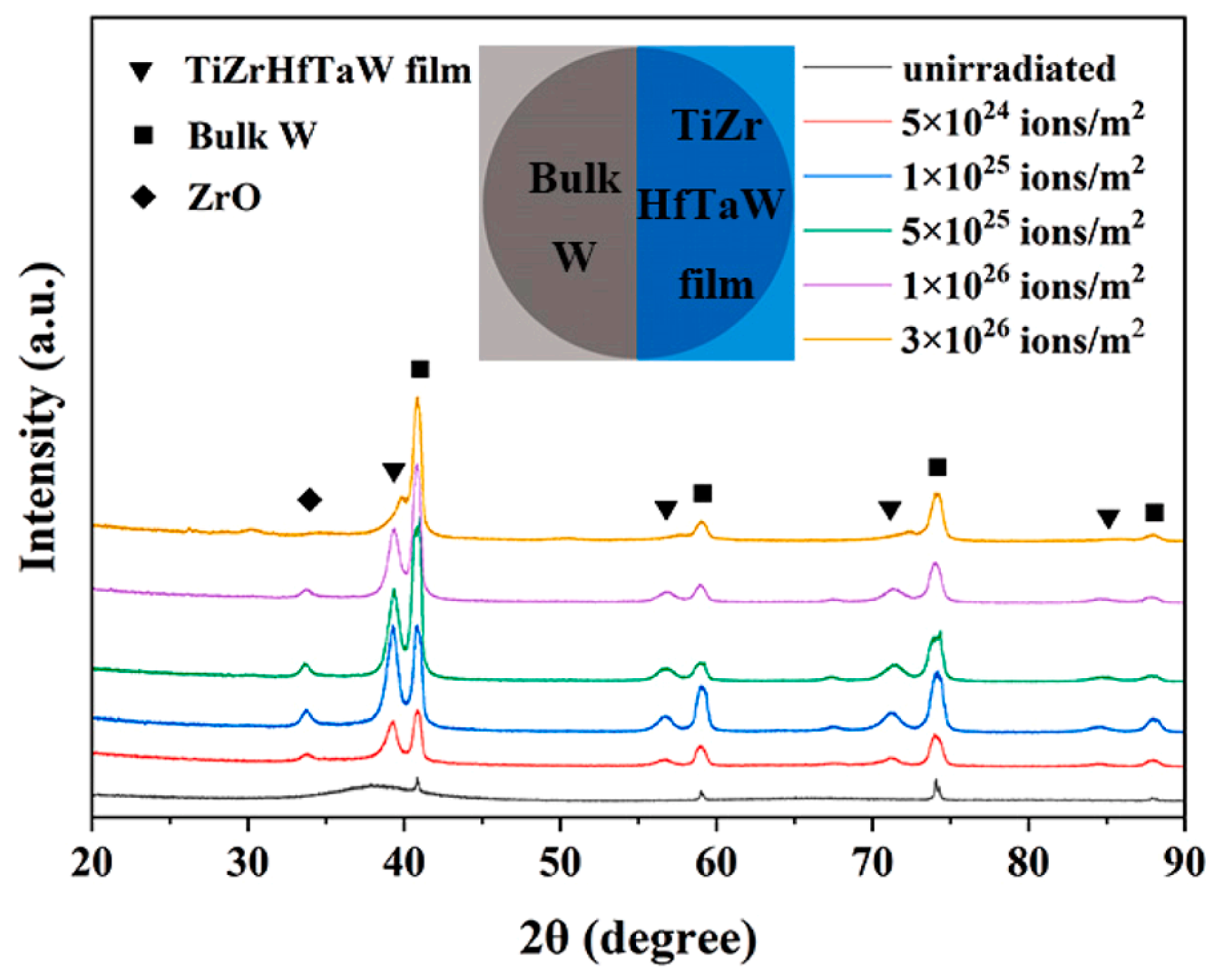
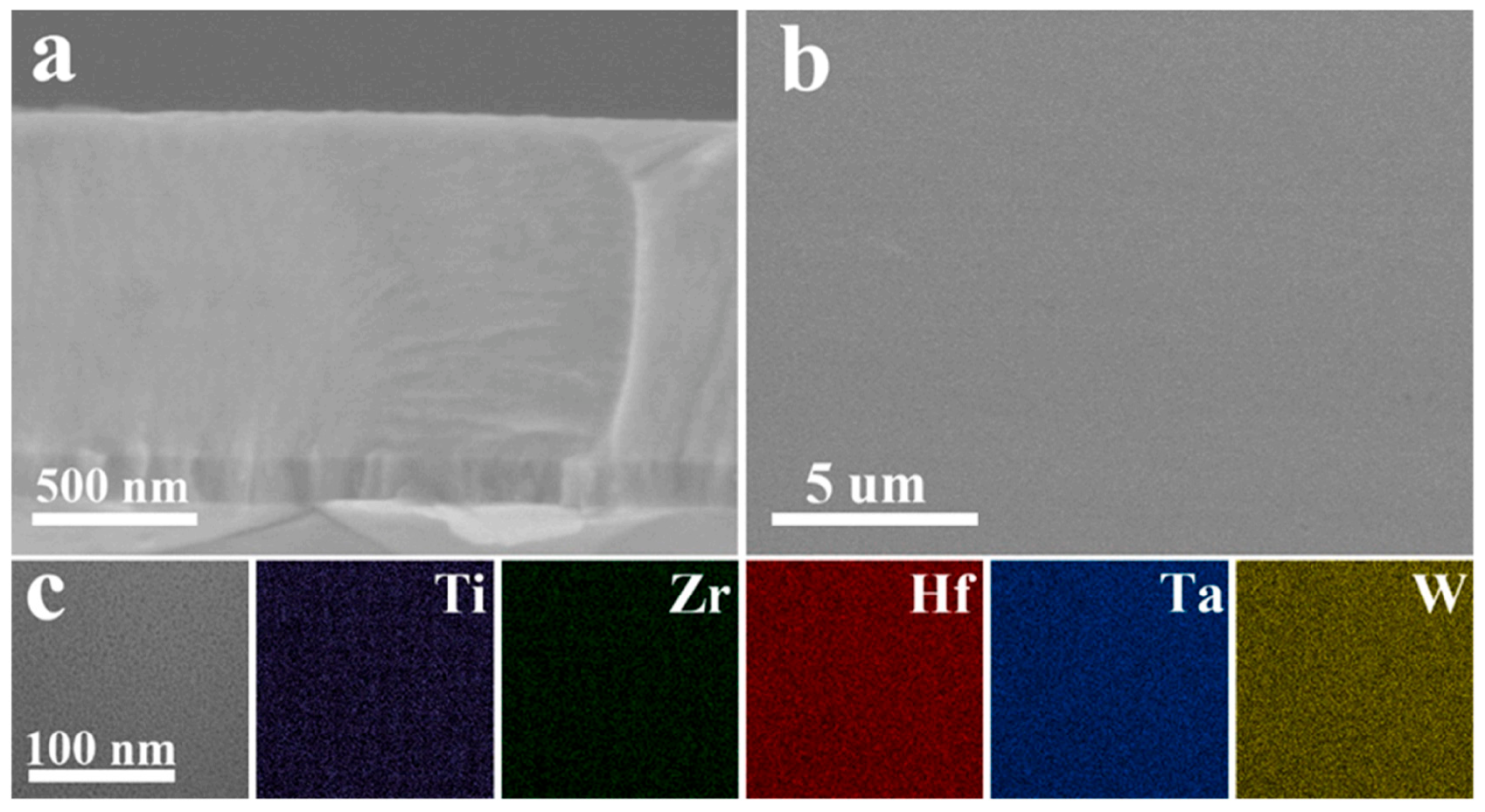
Further advancing amorphous structures on the basis of the findings above, Ge et al. [61] successfully prepared W-containing refractory multi-component alloy (TiZrHfTaW) film on W discs by ultrahigh vacuum DC magnetron sputtering. It can be clearly found from Figure 22 that an amorphous structure was characterized from the as-deposited TiZrHfTaW film, while crystallization occurred in the amorphous structure after He plasma irradiation, confirmed by grazing incidence X-ray diffraction (GIXRD). As shown in Figure 23a,b, the pristine amorphous TiZrHfTaW film was relatively compact and smooth, reaching a uniform thickness of approximately 1.2 μm. Elemental mapping (Figure 23c) confirms a homogenous distribution of constituent elements Ti, Zr, Hf, Ta, and W on the film surface. Quantitative EDS analysis yields an atomic ratio of Ti:Zr:Hf:Ta:W ≈ 12:16:18:25:28, enabling calculation of empirical parameters indicative of solid solution formation (atomic size mismatch δ = 5.2%, thermodynamic parameter Ω = 8.3). While thermodynamic criteria suggest the stability of a single-phase solid solution, the rapid quenching effect inherent to the sputtering process facilitates the retention of an amorphous phase.
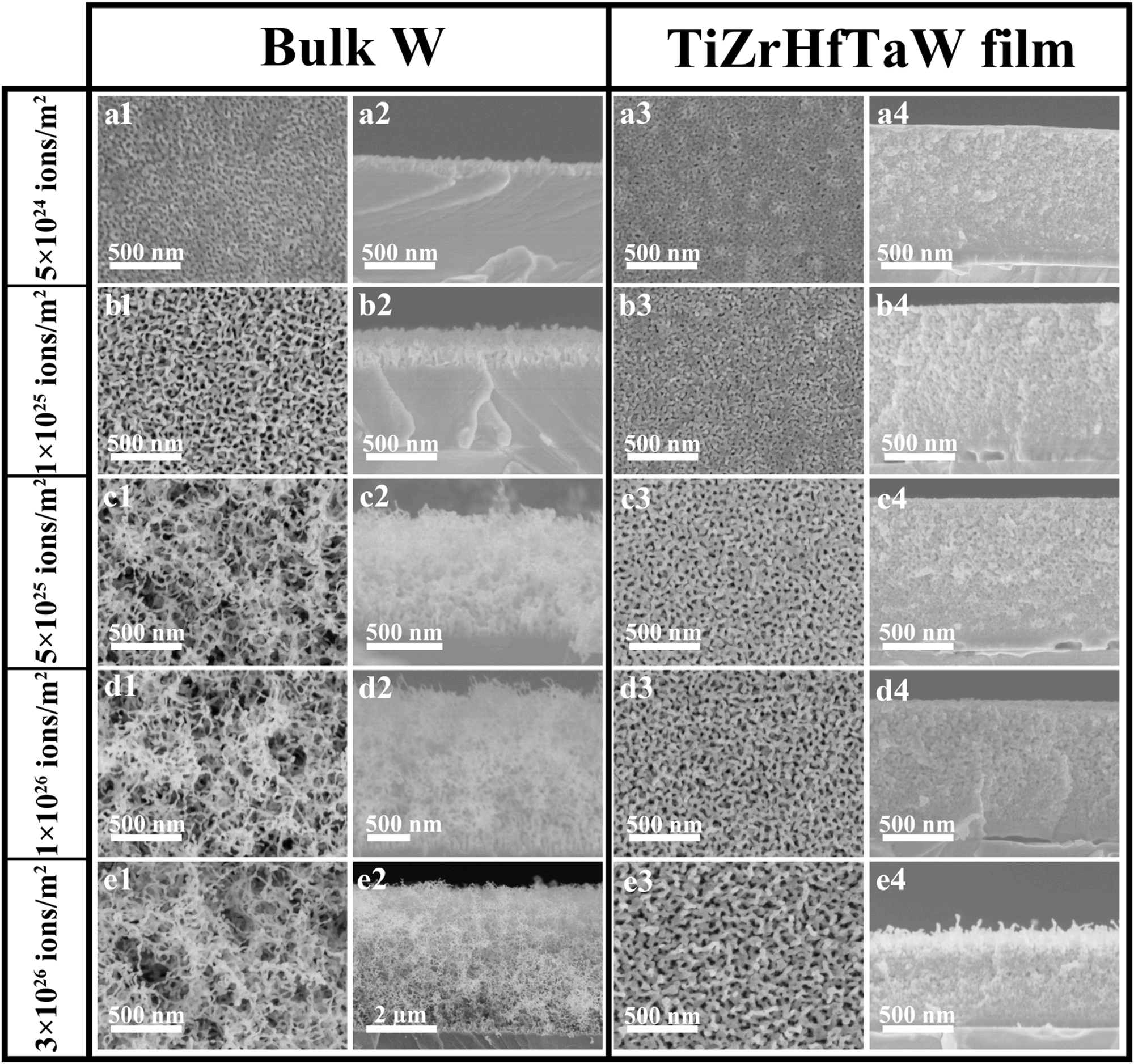
As illustrated in Figure 24(a1,a2), a fuzz structure with a thickness of ~100 nm was formed on the surface of bulk W after He plasma irradiation under the low fluence of 5 × 1024 ions/m2 at 1275 K. In stark contrast, no obvious fuzz structure was observed on irradiated TiZrHfTaW films with fluences ranging from 5 × 1024 to 1 × 1026 ions/m2; only varying degrees of swelling and microstructure evolution were revealed (Figure 24(a3–d3,a4–d4)). As seen from Figure 24(a1–d1), fuzz structure on bulk W initiated at ~5 × 1024 ions/m2 and grew up to ~4.2 μm at 3 × 1026 ions/m2. Strikingly, Figure 24(d3,d4) demonstrates that the TiZrHfTaW film limited fuzz onset to ≥1 × 1026 ions/m2, representing a 20-fold enhancement in the fuzz threshold. Furthermore, even at the maximum tested fluence of 3 × 1026 ions/m2, the resulting fuzz layer on TiZrHfTaW remains ultrathin (150 nm), nearly 28 times thinner than that formed on bulk tungsten under identical conditions, and the length of fuzz received at 3 × 1026 ions/m2 was only ~150 nm, which was 28 times shorter than in bulk W (see Figure 24(e2,e4)). This pronounced suppression of fuzz growth highlights the synergistic effect of multi-element refractory composition and amorphous-like microstructure in mitigating He+ irradiation-induced nanostructural evolution.
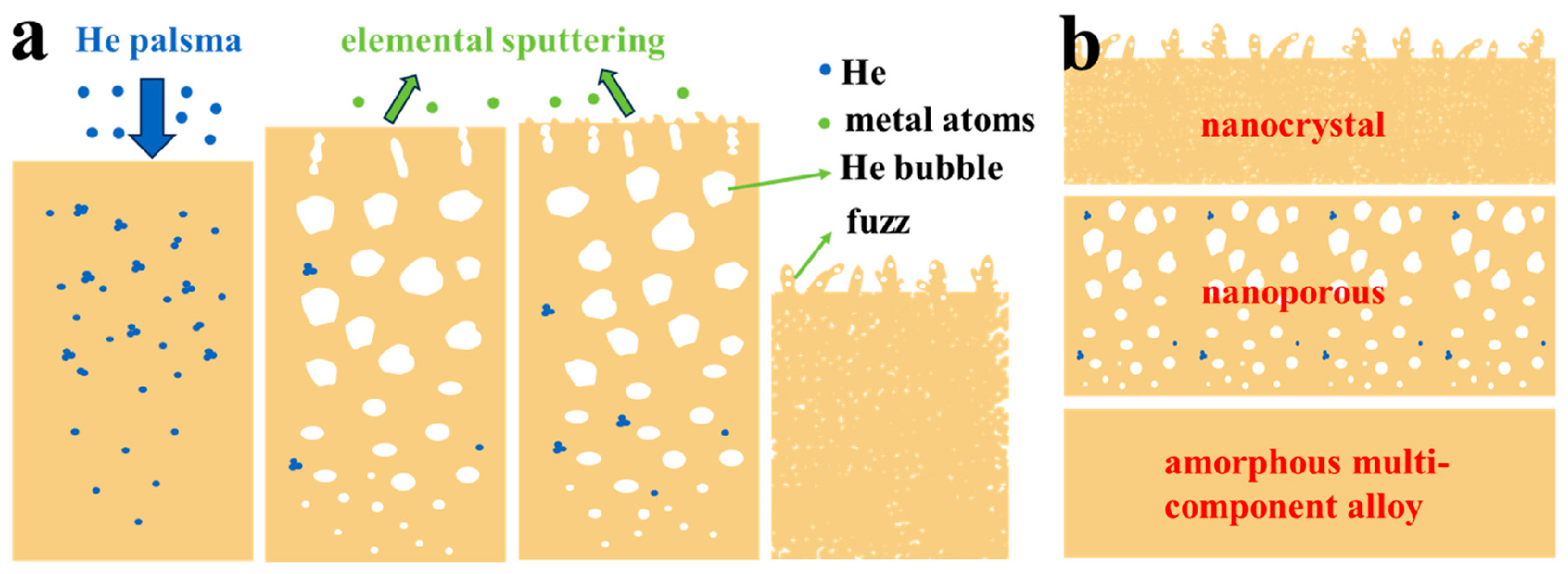
Figure 25 illustrates the progressive internal microstructural evolution of the TiZrHfTaW film subject to He plasma irradiation, demonstrating the formation and growth process of the fuzz structure. The process consisted of two stages and was termed a “migration-blocking” mechanism that underpins the excellent irradiation resistance of amorphous TiZrHfTaW film. Upon helium implantation, invading helium atoms rapidly diffuse into the film, effectively delaying the nucleation of large subsurface He bubbles and preventing subsequent surface rupture into fuzz structures. The abundant free volume in the amorphous matrix serves as an effective sink, trapping and accommodating helium to form uniformly distributed nanoscale bubbles throughout the film. With increasing irradiation fluence, these bubbles gradually coalesce and expand into nanoporous architectures, which further impede inward helium diffusion, thereby suppressing fuzz propagation. At extended high-fluence exposure, excessive helium bubble pressure combined with enhanced elemental mobility destabilizes the nanoporous framework, triggering a phase transformation from nanoporous amorphous to nanocrystalline HEA. This sequential phase transition process of amorphous–nanoporous–nanocrystalline could significantly retard fuzz evolution on the film surface, and also confirms the potential application for protecting W-PFMs in fusion reactors.
Although the protection mechanisms are different—interface-dominated annihilation in nanochannel tungsten, entropy stabilization in HEAs, and disorder-mediated defect insensitivity in amorphous films—they converge on the synergistic management of helium kinetics and defect populations. Composition (multi-element mixing for entropy effects) and structure (nanochannels for permeability) are equally indispensable, as evidenced by comparative fluence thresholds and fuzz-thickness reductions. These PVD advances highlight the power of hierarchical design in extending tungsten service life under fusion-relevant fluxes [29,63,64,73,74].

2.3. Spray Technology

Spray processes, including thermal spray (TS) and cold spray (CS), are widely recognized as a broad family of coating technologies. These methods involve depositing semi-molten or solid particles onto a substrate surface at high velocities and have found extensive applications in aerospace, industrial gas turbines, automotive manufacturing, metallurgy, and biomedical engineering [75,76]. Spray technology is gaining increasing interest for the deposition of W coatings intended for fusion reactor applications due to its relatively low cost, high deposition rates, and capability to deposit complex-shaped surfaces and repair damaged coatings in situ [65,77]. For example, in Wang et al.’s [78] and Chong et al.’s [79] work, plasma spray (PS) technology was employed to fabricate the W coatings on copper (Cu) substrate as a PFM several years ago. Grammes et al. [80] and Mishra et al. [81] prepared functionally graded W/EUROFER steel coatings on steel substrates by PS. In addition, Dezaki et al. [82] conducted the fabrication and microstructural evolution of W-Cu functionally graded material (FGM) coatings on 304 stainless steel (SS), produced using a shrouded axial-injection atmospheric plasma spray (APS) process. By using CS technology, Neu et al. [83] has produced W/Ta coatings on P92 steel for plasma facing applications.
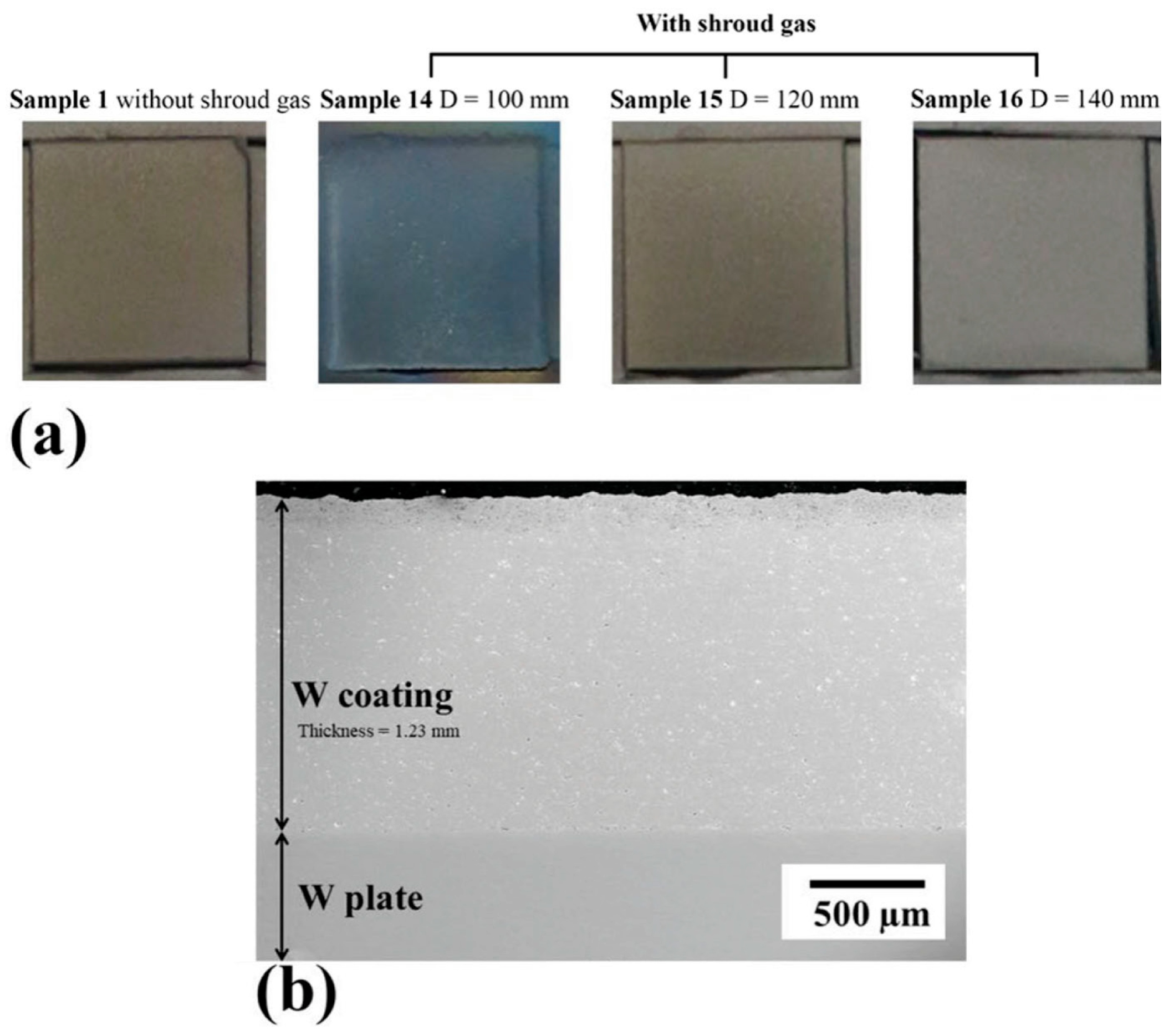
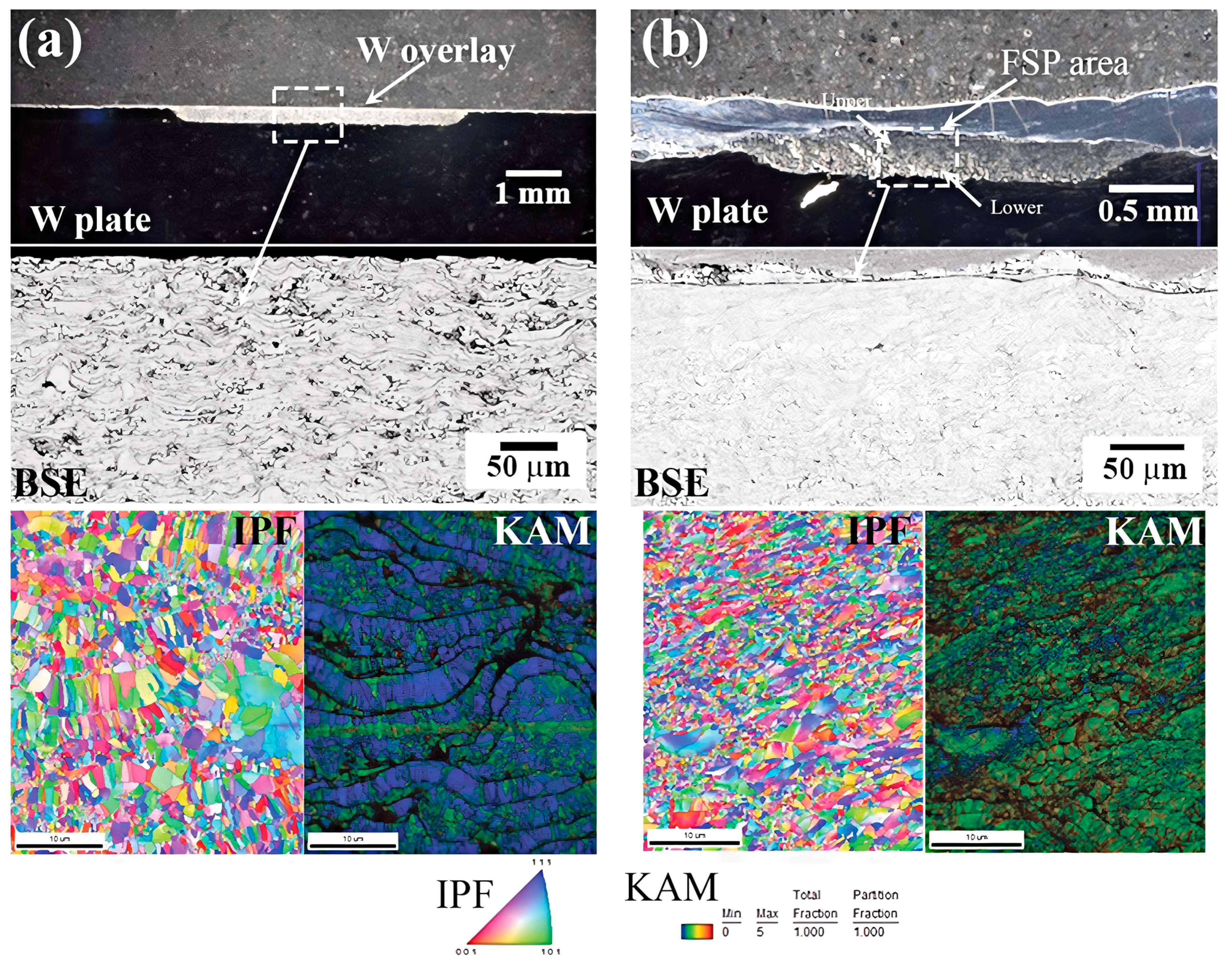
The fabrication of protective surface layers on W substrates has emerged as a pivotal strategy to enhance material longevity under the extreme operational conditions of fusion reactors. Daram et al. [66] investigated a novel repair approach for components, integrating atmospheric plasma spraying (APS) with friction stir processing (FSP) as a synergistic post-deposition. The study highlights the necessity of cost-effective and efficient repair techniques for W, which is the primary material for divertors due to its high melting point, excellent thermal conductivity, and irradiation resistance. This method allows for the deposition of thick W coatings (>1 mm) on W substrates, ensuring dimensional recovery and high-strength bonding (Figure 26). The research demonstrates that APS, enhanced by a gas shroud, effectively suppresses in-flight oxidation, achieving a 25% reduction in oxygen content within the coatings (Figure 27). As illustrated in Figure 28, FSP further refines the microstructure of the APS-deposited W overlay by promoting dynamic recrystallization, which substantially decreases grain size and porosity. This microstructural enhancement culminates in a marked improvement in microhardness with values approximately 37.5% higher than those of the substrate and 203.5% higher than the as-sprayed material, while also maintaining excellent dimensional recovery and strong interfacial bonding. These findings substantiate the combined APS-FSP approach as a highly promising, cost-efficient strategy for in situ repair and reinforcement of W divertor components. This integrated technique not only restores geometric fidelity and mechanical robustness but also fortifies the coatings against the severe thermal loads and intense radiation fields, thereby bolstering their resilience and performance under the severe thermal, radiative, and erosive conditions anticipated in fusion reactors.
To withstand the harsh conditions inside fusion reactors, such as high heat fluxes and neutron bombardment, Schmidtmann et al. [67] conducted a comprehensive optimization of low-pressure plasma spraying (LPPS) process parameters for W coatings on pure W substrate, employing a design of experiments (DoE) approach to minimize porosity, maximize deposition efficiency (DE), and manage residual stresses. LPPS is characterized by fast coating formation for hard-melting materials, and this investigation varied plasma gas ratio (influencing enthalpy), powder feed rate, and scanning speed while maintaining constant factors like chamber pressure (60 mbar), torch power (50 kW), and spray distance (275 mm). It was found that bottom regions near the substrate exhibited ultra-low porosities (~0.3%–0.4%) attributed to repeated particle impacts, fostering densification, whereas the topmost layers exhibited elevated porosity (3.8%–4.9%) due to partially unmelted particles. The received W coatings with a thickness of ~500 µm required spray pass over to be repeated 20 times, and exhibited remarkably uniform columnar grains throughout the depth, with maximum Feret diameters of ~1–1.25 µm and aspect ratios of ~0.4–0.5, indicating no directional dependence or enthalpy-induced variations (Figure 29). The results demonstrated the potential of LPPS for cost-effective, high-quality, in situ repair of W for application in fusion environments, achieving near-bulk densities amenable to high-heat-flux scenarios while minimizing oxidation susceptibility for fusion reactors. The coatings’ dense structure and minimized oxidation propensity provide a promising pathway to withstand the synergistic challenges of high-heat-flux loads and neutron-induced damage, highlighting LPPS’s potential to enhance the longevity and reliability of plasma-facing components in next-generation fusion devices.
Further, Schmidtmann et al. [84] successfully produced a dense 300 µm thick W coating on W substrates through optimized LPPS parameters under a protective argon atmosphere to minimize oxidation and porosity. The resulting coatings were subsequently subjected to neon (Ne) and D (D) plasmas in the linear plasma device PSI-2 to evaluate sputtering resistance and D retention, benchmarked against bulk W samples. For sputtering resistance assessment, samples were subjected to Ne plasma at 100 eV ion energy, a flux of 5.2 × 10²⁰ ions/m2s, and a total fluence of 2 × 1024 ions/m2s at 65 °C. Post-exposure analysis via focused ion beam (FIB) markers revealed surface recession depths of 1.95–2.21 µm in the LPPS W coating, corresponding to mass losses of 3.73–4.23 mg (assuming 99.7% relative density), These values represent a modest increase of up to 13% relative to bulk W samples, exhibiting a recession of 1.95 µm and 3.73 mg mass loss under identical conditions. The sputtering yield in LPPS coatings was thus determined to be 14%–25% higher, likely attributable to the coatings’ refined grain structure, residual porosity (~0.3%), and possible variations in ion incidence angles, though still within acceptable ranges for fusion applications.
D retention experiments involved D plasma exposure at 73 eV, a flux of 3.8 × 10²¹ ions·m−2·s−1, a fluence of 3 × 1025 ions·m−2, and sample temperature of 250 °C. Nuclear reaction analysis (NRA) probing up to 4 µm depth combined with thermal desorption spectroscopy (TDS) revealed substantially reduced D retention in the LPPS W coatings compared to bulk W. Notably, the W coatings exhibited lower D retention than bulk W, with desorption peaks at 240–280 °C versus 420 °C for the reference, suggesting enhanced outgassing due to process-induced microstructural features such as enhanced grain boundary density and controlled porosity, which serve as preferential pathways for hydrogen isotope release. Correspondingly, TDS spectra exhibited diminished D2 desorption peaks in the coatings, signaling improved resistance to fuel accumulation in W coating, and implying superior performance against fuel accumulation, which could mitigate embrittlement and tritium inventory issues in fusion reactors. These findings underscore LPPS’s versatility in producing tailored W coatings with sputtering resistance and fuel retention properties comparable or superior to bulk W, while also enabling cost-effective, in situ repair capabilities. Such ability highlights LPPS coatings as promising candidates for robust PFMs in next-generation fusion reactors.
Across CVD, PVD, and spray technologies, a unifying design principle emerges: the synergistic interplay between hierarchical structural features and multicomponent compositional engineering dictates the balance between defect tolerance, thermal conductivity retention, sputtering resistance, and long-term stability. Table 1 summarizes key characteristics, advantages, limitations, and fusion-relevant performance metrics for representative protective layers on tungsten substrates. Table 1 underscores that no single technology is universally superior; PVD nanochannel and amorphous films excel in high-fluence helium environments through defect management, while CVD and spray methods are better suited for thermal load management and thick-layer repair. Future research must prioritize hybrid strategies that combine the strengths of multiple techniques, supported by multiscale modeling and reactor-qualification testing, to deliver robust, multifunctional protective layers capable of meeting stringent lifetime and safety requirements.

2.4. Plasma-Based Surface Modification Technologies

Plasma immersion ion implantation (PIII) can introduce energetic ions into the near-surface region without line-of-sight limitations, creating compressive stresses and defect sinks that enhance the radiation tolerance of PFMs in fusion reactors [85]. Yousaf et al. [86] conducted systematic plasma ion implantation experiments on pure W and a W-heavy alloy (W-HA, NAECOMET 1000, 90W–6Ni–4Cu) in an inductively coupled plasma (ICP) chamber under fusion-relevant helium bombardment conditions. Using 3 keV He+ ions at fluences spanning 1.15 × 10²¹ to 2.21 × 10²² m−2, the study revealed markedly divergent surface evolution behaviors between the two materials. Pure W exhibited classic fuzz development progressively intensifying with fluence, accompanied by the formation of nanoscale helium bubbles, blisters, cracking, localized melting, and subsequent resolidification at the highest implantation dose. In contrast, W-HA demonstrated a distinct response where the Ni/Cu binder phase consistently underwent melting and cracking across all implantation conditions. Notably, this ductile binder phase effectively postponed fuzz initiation and reduced fuzz density relative to pure W. Atomic force microscopy (AFM) corroborated these findings, showing a substantially mitigated increase in surface roughness (Rq) in W-HA compared to the dramatic roughening observed in pure tungsten. X-ray diffraction (XRD) analyses revealed lattice expansion in pure W and compressive strain in W-HA, alongside a grain growth trend in both, indicating significant helium-induced lattice distortion. Furthermore, X-ray photoelectron spectroscopy (XPS) detected extensive near-surface oxidation (>97% WO3) on both materials post-implantation, attributable to the increased effective surface area from plasma-induced roughening. Collectively, these findings underscore that while the Ni/Cu binder in W-HA imparts partial suppression of fuzz growth via mechanical accommodation and strain modulation, its intrinsically low melting point presents a critical vulnerability under sustained helium plasma exposure.
Guenette et al. [87] advanced the synthesis of microcrystalline diamond films (~3–5 μm thickness) via microwave plasma-enhanced chemical vapor deposition (MW-PECVD), a seeding procedure using 1 μm diamond powder and maintaining a substrate temperature of 800 °C to achieve grain sizes on the order of ~1 μm. Prior to deposition, substrates underwent a brief (1 min) H2 plasma cleaning step to optimize surface conditions. The deposition atmosphere comprised 99.3% H2 and 0.7% CH4 at a total flow rate of 500 sccm, with 1.5 kW microwave power applied under 53 mbar chamber pressure over a 24 h growth period. The received diamond films were exposed to fusion-relevant hydrogen plasma in the linear magnetized device MAGnetized Plasma Interaction Experiment (MAGPIE). Near-edge X-ray absorption fine structure (NEXAFS) spectroscopy was performed in both surface-sensitive Auger electron yield (AEY, probing depth ~5 nm) and bulk-sensitive total fluorescence yield (TFY, attenuation length ~40 nm) modes. The hallmark diamond electronic features—a pronounced σ* core exciton peak at 289.2 eV and the second absolute band gap dip at 302.5 eV—were substantially attenuated or entirely suppressed in AEY spectra post plasma exposure, with damage severity correlating positively with applied bias voltage. In stark contrast, TFY spectra remained virtually unchanged relative to unexposed references, indicating that structural disorder is confined strictly to the near-surface region. Complementary Stopping and Range of Ions in Matter (SRIM) simulations quantified the maximum ion penetration depth of 125–500 eV H ions and related carbon recoils at 10–15, demonstrating excellent agreement with AEY probing depths. Intriguingly, plasma exposure induced preferential etching of non-diamond (sp2 and C–H) phases, yielding characteristic stepped diamond facets while preserving the integrity of the crystalline sp3 bulk network. Collectively, these findings establish that chemical vapor deposited diamond exhibits outstanding erosion resistance compared to graphite under fusion-relevant hydrogen plasma, with damage confined to ion implantation depths and no detectable bulk degradation. Consequently, diamond overlayers—or analogous PECVD-derived carbonaceous coatings—emerge as a transformative protective strategy for W-PFMs, simultaneously mitigating surface fuzz growth and physical sputtering while maintaining the underlying tungsten’s thermophysical performance.
In the study by Lei [88], HfNbTaTiZr high-entropy alloy coatings were successfully fabricated onto W substrates by double glow plasma surface alloying (DGPSA) to enhance radiation tolerance for PFMs in fusion environments. Employing an optimized process of 950 °C, 300 V cathode-source bias difference, 35 Pa working pressure, and 3 h dwell time, a dense, uniform coating consisting of a deposition layer and a diffusion layer was produced. Under low-energy, high-flux He+ irradiation (30 eV, 2.75 × 10²¹ ions m−2 s−1, cumulative fluence 7.425 × 1024 ions m−2), bare W developed a uniform fuzz nanostructure. By stark contrast, the HEA-coated samples exhibited only early-stage wave/terrace morphology or highly localized fuzz, demonstrating markedly suppressed surface damage. Post-irradiation characterization showed negligible elemental segregation within the optimized coating, with surface topography restricted to subtle terraces and waves, while elemental compositions remained effectively invariant from the as-deposited state. These outcomes convincingly demonstrate that the multi-principal-element complexity and elevated configurational entropy inherent to the HfNbTaTiZr HEA coating effectively impede helium bubble nucleation, diffusion, and agglomeration processes—thereby mitigating fuzz growth kinetics. This work not only establishes double glow plasma surface alloying as a viable and scalable technique for engineering robust, helium-tolerant surface layers on tungsten but also highlights its potential to preserve the intrinsic thermophysical properties of W substrates. Collectively, these findings underscore a promising pathway toward next-generation protective coatings designed to extend the operational longevity and performance stability of PFMs in future fusion reactors.

3. Summary and Outlook

The selection of optimal PFMs remains a cornerstone challenge in the engineering design of next-generation nuclear fusion reactors. For decades, materials scientists have endeavored to develop advanced PFMs that can withstand the multifaceted and synergistic extremes inherent to fusion environments—ranging from intense heat fluxes and relentless plasma-induced erosion to the pervasive damage induced by high-energy neutron irradiation. In this context, surface engineering through fabrication of protective layers has emerged as a transformative strategy to enhance material longevity, thermal management, and irradiation tolerance, thereby addressing the stringent operational demands of long-pulse, high-duty-cycle fusion devices. This review has synthesized the remarkable progress in W surface modification for fusion reactor applications, with particular emphasis on the protective surface layers produced via CVD, PVD, spray and plasma-based surface modification technologies. These methodologies facilitate the engineering of sophisticated surface architectures that mitigate degradation processes while preserving the inherent thermophysical advantages of the W substrate.
Across these diverse approaches, a unifying design paradigm emerges: the deliberate synergistic integration of hierarchical structural complexity and multicomponent chemical composition governs the delicate balance between defect accommodation, thermal conductivity retention, and sustained stability under the coupled thermal, mechanical, and irradiation stresses characteristic of fusion plasmas. Looking forward, the field must embrace an integrated composition–structure–processing design framework empowered by emerging computational materials science, high-throughput synthesis, and advanced in situ and ex situ characterization techniques to efficiently explore the vast compositional and microstructural design space. Key future research directions include: (1) multiscale computational modeling to elucidate defect evolution dynamics and coating–substrate interactions under realistic fusion conditions; (2) establishment of robust processing–structure–property relationships for next-generation, metastable, and multifunctional material systems; (3) design and optimization of multifunctional coating architectures that concurrently enable effective heat flux dissipation, sputtering resistance, and tritium permeation barrier performance; and (4) comprehensive long-term performance validation aligned with standardized fusion reactor qualification protocols.
Collectively, these multifaceted endeavors will accelerate the rational development of resilient, multifunctional protective layers that will be foundational to the reliable operation of plasma-facing components in future fusion power plants.

Author Contributions

Conceptualization, K.L., B.H., S.W., W.Z., N.L. and M.L.; formal analysis, S.W., W.Z., Y.F., C.L., Z.S. and L.X.; writing—original draft preparation, K.L., B.H. and D.L.; writing—review and editing, S.W., W.Z., N.L. and R.W.; project administration, K.L. and N.L.; funding acquisition N.L. All authors have read and agreed to the published version of the manuscript.

Funding

This work was supported by National Engineering Research Center for Nuclear Power Plant Safety & Reliability (Open Fund Project No. NERC-OFP-2025-08).

Institutional Review Board Statement

Not applicable.

Informed Consent Statement

Not applicable.

Data Availability Statement

No new data were created or analyzed in this study. Data sharing is not applicable to this article.

Conflicts of Interest

Authors Kunjie Luo, Shuiyong Wang, Wanxiang Zhao and Luwei Xue were employed by the company Suzhou Nuclear Power Research Institute Co., Ltd. The remaining authors declare that the research was conducted in the absence of any commercial or financial relationships that could be construed as a potential conflict of interest.

References

  1. Mathew, M.D. Nuclear energy: A pathway towards mitigation of global warming. Prog. Nucl. Energy 2022, 143, 104080. [Google Scholar] [CrossRef]
  2. Atzeni, S. Fusion energy: From basic research to commercialization. Rend. Lincei-Sci. Fis. 2025, 36, 407–416. [Google Scholar] [CrossRef]
  3. Zheng, L.; Zhang, W.; Sun, Y.; Zhang, Y.; Ji, A.; Qin, G.; Pan, H.; Yan, J.; Wang, T. Design and development of divertor pipe welding tool for fusion reactors. Fusion Eng. Des. 2025, 219, 115273. [Google Scholar] [CrossRef]
  4. Kikuchi, M. A review of fusion and Tokamak research towards steady-state operation: A JAEA contribution. Energies 2010, 11, 1741–1789. [Google Scholar] [CrossRef]
  5. Taylor, C.N. Hydrogen and its detection in fusion and fission nuclear materials—A review. J. Nucl. Mater. 2022, 558, 153396. [Google Scholar] [CrossRef]
  6. Dubus, G.D. From Plain Visualisation to Vibration Sensing: Using a Camera to Control the Flexibilities in the ITER Remote Handling Equipment. Ph.D. Thesis, Tampere University of Technology, Tampere, Finland, 2014. [Google Scholar]
  7. Reinders, L.J. The Fairy Tale of Nuclear Fusion; Springer Nature, Switzerland AG: Cham, Switzerland, 2021. [Google Scholar]
  8. Ongena, J.; Koch, R.; Wolf, R.; Zohm, H. Magnetic-confinement fusion. Nat. Phys. 2016, 12, 398–410, Erratum in Nat. Phys. 2016, 12, 717. https://doi.org/10.1038/nphys3818. [Google Scholar] [CrossRef]
  9. Ding, S.; Garofalo, A.M.; Wang, H.Q.; Weisberg, D.B.; Li, Z.Y.; Jian, X.; Eldon, D.; Victor, B.S.; Marinoni, A.; Hu, Q.M.; et al. A high-density and high-confinement tokamak plasma regime for fusion energy. Nature 2024, 629, 555–560. [Google Scholar] [CrossRef]
  10. Degrave, J.; Felici, F.; Buchli, J.; Neunert, M.; Tracey, B.; Carpanese, F.; Ewalds, T.; Hafner, R.; Abdolmaleki, A.; de las Casas, D.; et al. Magnetic control of tokamak plasmas through deep reinforcement learning. Nature 2022, 602, 414–419. [Google Scholar] [CrossRef] [PubMed]
  11. Zheng, J.; Qin, J.; Lu, K.; Xu, M.; Duan, X.; Xu, G.; Hu, J.; Gong, X.; Zang, Q.; Liu, Z.; et al. Recent progress in Chinese fusion research based on superconducting tokamak configuration. Innovation 2022, 3, 100269. [Google Scholar] [CrossRef]
  12. Taller, S.; Chen, Y.; Song, R.; Chen, W.-Y.; Jokisaari, A. An approach to combine neutron and ion irradiation data to accelerate material qualification for nuclear reactors. J. Nucl. Mater. 2025, 603, 155385. [Google Scholar] [CrossRef]
  13. Wirth, B.D.; Nordlund, K.; Whyte, D.G.; Xu, D. Fusion materials modeling: Challenges and opportunities. MRS Bull. 2011, 36, 216–222. [Google Scholar] [CrossRef]
  14. Linke, J.; Du, J.; Loewenhoff, T.; Pintsuk, G.; Spilker, B.; Steudel, I.; Wirtz, M. Challenges for plasma-facing components in nuclear fusion. Matter Radiat. Extrem. 2019, 4, 056201. [Google Scholar] [CrossRef]
  15. Coenen, J.W.; Antusch, S.; Aumann, M.; Biel, W.; Du, J.; Engels, J.; Heuer, S.; Houben, A.; Hoeschen, T.; Jasper, B.; et al. Materials for DEMO and reactor applications-boundary conditions and new concepts. Phys. Scr. 2016, 167, 014002. [Google Scholar] [CrossRef]
  16. Neu, R.; Angioni, C.; Bobkov, V.; Dux, R.; Hobirk, J.; Kallenbach, A.; Krieger, K.; Pütterich, T.; Rohde, V.; Schmid, K. Review on ASDEX Upgrade operation with tungsten plasma facing components. Nucl. Mater. Energy 2026, 46, 102063. [Google Scholar] [CrossRef]
  17. Liang, M.; Xie, F.; Song, J. Advances in research on helium ion irradiation in tungsten-based plasma-facing materials. Mater. Today Commun. 2025, 44, 112002. [Google Scholar] [CrossRef]
  18. Coburn, J.; Effenberg, F.; Cusentino, M.A.; Hargrove, C.; Ialovega, M.; Morbey, M.; Nuckols, L.; Popović, Ž.; Bergstrom, Z.; Zamperini, S.; et al. Overview of advanced plasma-facing materials testing for Fusion Pilot Plants at DIII-D. Nucl. Mater. Energy 2026, 46, 102064. [Google Scholar] [CrossRef]
  19. Wright, J.A.R. A review of late-stage tungsten fuzz growth. Tungsten 2022, 4, 184–193. [Google Scholar] [CrossRef]
  20. Linke, J. Plasma facing materials and components for future fusion devices-development, characterization and performance under fusion specific loading conditions. Phys. Scr. 2006, T123, 45–53. [Google Scholar] [CrossRef]
  21. Pitts, R.A.; Loarte, A.; Wauters, T.; Dubrov, M.; Gribov, Y.; Köchl, F.; Pshenov, A.; Zhang, Y.; Artola, J.; Bonnin, X.; et al. Plasma-wall interaction impact of the ITER re-baseline. Nucl. Mater. Energy 2025, 42, 101854. [Google Scholar] [CrossRef]
  22. Ma, J.; Liu, Z.; Ma, C.; Wen, W.; Wu, H.; Ji, H.; Wang, R.; Kuang, Y.; Shi, W.; Xu, H.; et al. Research progress on residual stress and microcrack control of tungsten fabricated via additive manufacturing. J. Nucl. Mater. 2026, 622, 156421. [Google Scholar] [CrossRef]
  23. Pu, G.; Wang, Y.; Huang, X.; Yuan, C.; Wang, S.; Chen, S.; Gan, L.; Zhong, R.; Ye, Z.; Wang, Z.; et al. Helium plasma irradiation induced morphology evolution and sputtering behavior in WTaTiVCr refractory high entropy alloy and tungsten. J. Nucl. Mater. 2025, 607, 155656. [Google Scholar] [CrossRef]
  24. King, D.J.M.; Knowles, A.J.; Bowden, D.; Wenman, M.R.; Capp, S.; Gorley, M.; Shimwell, J.; Packer, L.; Gilbert, M.R.; Harte, A. High temperature zirconium alloys for fusion energy. J. Nucl. Mater. 2022, 559, 153431. [Google Scholar] [CrossRef]
  25. Rieth, M.; Dudarev, S.L.; de Vicente, S.M.G.; Aktaa, J.; Ahlgren, T.; Antusch, S.; Armstrong, D.E.J.; Balden, M.; Baluc, N.; Barthe, M.-F.; et al. Recent progress in research on tungsten materials for nuclear fusion applications in Europe. J. Nucl. Mater. 2013, 432, 482–500. [Google Scholar] [CrossRef]
  26. Luo, C.; Xu, L.; Zong, L.; Shen, H.; Wei, S. Research status of tungsten-based plasma-facing materials: A review. Fusion Eng. Des. 2023, 190, 113487. [Google Scholar] [CrossRef]
  27. Hu, Z.; Liu, Y.; Chen, S.; Liu, S.; Yu, L.; Liu, Y.; Ma, Z. Achieving high-performance pure tungsten by additive manufacturing: Processing, microstructural evolution and mechanical properties. Int. J. Refract. Met. Hard Mater. 2023, 113, 106211. [Google Scholar] [CrossRef]
  28. Hatler, C.; Robin, I.; Kim, H.; Curtis, N.; Sun, B.; Aydogan, E.; Fensin, S.; Couet, A.; Martinez, E.; Thoma, D.J.; et al. The path towards plasma facing components: A review of state-of-the-art in W-based refractory high-entropy alloys. Curr. Opin. Solid State Mater. Sci. 2025, 34, 101201. [Google Scholar] [CrossRef]
  29. Qin, W.; Guo, W.; Cheng, T.; Tang, J.; Jiang, C.; Ren, F. Review on helium behaviors in nanochannel tungsten film. Tungsten 2021, 3, 369–381. [Google Scholar] [CrossRef]
  30. Boztemur, B.; Xu, Y.; Luo, L.; Öveçoğlu, M.L.; Ağaoğulları, D. Development of Tungsten Composites as Plasma-Facing Materials by Doping Rare-Earth Boride Particulates. In TMS 2025 154th Annual Meeting & Exhibition Supplemental Proceedings. TMS 2025; The Minerals, Metals & Materials Series; Springer: Cham, Switzerland, 2025. [Google Scholar] [CrossRef]
  31. Neu, R.; Dux, R.; Geier, A.; Gruber, O.; Kallenbach, A.; Krieger, K.; Maier, H.; Pugno, R.; Rohde, V.; Schweizer, S.; et al. Tungsten as plasma-facing material in ASDEX Upgrade. Fusion Eng. Des. 2003, 65, 367–374. [Google Scholar] [CrossRef]
  32. Bolt, H.; Barabash, V.; Krauss, W.; Linke, J.; Neu, R.; Suzuki, S.; Yoshida, N.; ASDEX Upgrade Team. Materials for the plasma-facing components of fusion reactors. J. Nucl. Mater. 2004, 329–333, 66–73. [Google Scholar] [CrossRef]
  33. Marchhart, T.; Hargrove, C.; Marin, A.; Schamis, H.; Saefan, A.; Lang, E.; Wang, X.; Allain, J.P. Discovering tungsten-based composites as plasma facing materials for future high-duty cycle nuclear fusion reactors. Sci. Rep. 2024, 14, 13864. [Google Scholar] [CrossRef]
  34. Luo, L.; Zhao, Z.; Yao, G.; Wu, Y. Recent progress on preparation routes and performance evaluation of ODS/CDS-W alloys for plasma facing materials in fusion devices. J. Nucl. Mater. 2021, 548, 152857. [Google Scholar] [CrossRef]
  35. Ogorodnikova, O.V.; Klimov, K.S.; Poskakalov, A.G.; Kaziev, A.V.; Kharkov, M.M.; Efimov, V.S.; Gasparyan, Y.M.; Volkov, N.V.; Alimov, V.K.; Tokitani, M. Deuterium and helium retention in W with and without He-induced W ‘fuzz’ exposed to pulsed high-temperature deuterium plasma. J. Nucl. Mater. 2019, 515, 150–159. [Google Scholar] [CrossRef]
  36. Osetsky, Y. Strengthening of tungsten by coherent rhenium precipitates formed during low fluence irradiation. Tungsten 2022, 4, 20–27. [Google Scholar] [CrossRef]
  37. Nogami, S.; Ozawa, I.; Asami, D.; Matsuta, N.; Nakabayashi, S.; Baumgärtner, S.; Lied, P.; Yabuuchi, K.; Miyazawa, T.; Kikuchi, Y.; et al. Tungsten-tantalum alloys for fusion reactors applications. J. Nucl. Mater. 2022, 566, 153740. [Google Scholar] [CrossRef]
  38. Gonderman, S.; Tripathi, J.K.; Sizyuk, T.; Hassanein, A. Suppression of surface microstructure evolution in W and W-Ta alloys during simultaneous and sequential He and D ion irradiation in fusion relevant conditions. Nucl. Fusion 2017, 57, 086001. [Google Scholar] [CrossRef]
  39. Huang, J.; Zuo, T.; Wu, Y. Evolution of irradiation damage in tungsten matrix and Y2O3 phase after low energy helium plasma exposure. J. Nucl. Mater. 2024, 589, 154826. [Google Scholar] [CrossRef]
  40. Li, X.; Liu, H.; Hu, P.; Wang, J.; Yang, Y.; Li, H.; Zhou, W. Nanostructured TiC dispersion-strengthened tungsten composite with remarkably improved He ion irradiation resistance. Int. J. Refract. Met. Hard Mater. 2022, 107, 105900. [Google Scholar] [CrossRef]
  41. Cheng, X.; Jing, K.; Xie, Z.M.; Liu, R.; Wu, X.B.; Wang, X.P.; Fang, Q.F.; Liu, C.S. Microstructure and mechanical properties of in-situ formed ZrC nanoparticles dispersion-strengthened tungsten alloy. Int. J. Refract. Met. Hard Mater. 2022, 107, 105912. [Google Scholar] [CrossRef]
  42. Gietl, H.; Riesch, J.; Coenen, J.W.; Höschen, T.; Linsmeier, C.; Neu, R. Tensile deformation behavior of tungsten fibre-reinforced tungsten composite specimens in as-fabricated state. Fusion Eng. Des. 2017, 124, 396–400. [Google Scholar] [CrossRef]
  43. de Lama, M.A.; Balden, M.; Greuner, H.; Höschen, T.; Matejicek, J.; You, J.H. Microstructural stability of spark-plasma-sintered Wf/W composite with zirconia interface coating under high-heat-flux hydrogen beam irradiation. Nucl. Mater. Energy 2017, 13, 74–80. [Google Scholar] [CrossRef]
  44. Mao, Y. Development and Characterization of Powder Metallurgically Produced Multi-Tungsten Fiber Reinforced Tungsten Composites. Ph.D. Thesis, RWTH Aachen University, Aachen, Germany, 2019. [Google Scholar]
  45. El-Atwani, O.; Gonderman, S.; Efe, M.; De Temmerman, G.; Morgan, T.; Bystrov, K.; Klenosky, D.; Qiu, T.; Allain, J.P. Ultrafine tungsten as a plasma-facing component in fusion devices: Effect of high flux, high fluence low energy helium irradiation. Nucl. Fusion 2014, 54, 083013. [Google Scholar] [CrossRef]
  46. Liu, F.; Xu, Y.; Zhou, H.; Zhao, S.; Li, B.; Lyu, G.; Yuan, Y.; Hao, T.; Luo, G. Exposure of equal-channel angular extruded tungsten to deuterium plasma. Plasma Sci. Technol. 2015, 17, 595600. [Google Scholar] [CrossRef]
  47. Howard, L.; Parker, G.D.; Yu, X. Progress and challenges of additive manufacturing of tungsten and alloys as plasma-facing materials. Materials 2024, 17, 2104. [Google Scholar] [CrossRef]
  48. Omole, S.; Lunt, A.; Kirk, S.; Shokrani, A. Advanced processing and machining of tungsten and its alloys. J. Manuf. Mater. Proc. 2022, 6, 15. [Google Scholar] [CrossRef]
  49. Zhao, S.; Xiong, Y.; Ma, S.; Zhang, J.; Xu, B.; Kai, J.-J. Defect accumulation and evolution in refractory multi-principal element alloys. Acta Mater. 2021, 219, 117233. [Google Scholar] [CrossRef]
  50. Kalita, D.; Esfandiarpour, A.; Jóźwik, I.; Zhang, Y.; Byggmästar, J.; Alava, M.J.; Kurpaska, Ł.; Weber, W.J.; Rack, P.D.; Jagielski, J. High temperature He bubble evolution and thermal stability of the WTaCrV refractory concentrated solid solution alloy. Mater. Des. 2025, 252, 113751. [Google Scholar] [CrossRef]
  51. Buzhinskij, O.I.; Semenets, Y.M. Thick boron carbide coatings for protection of tokamak first wall and divertor. Fusion Eng. Des. 1999, 45, 343–360. [Google Scholar] [CrossRef]
  52. Luo, G.N.; Li, Q.; Liu, M.; Zheng, X.B.; Chen, J.L.; Guo, Q.G.; Liu, X. Coating materials for fusion application in China. J. Nucl. Mater. 2011, 417, 1257–1261. [Google Scholar] [CrossRef]
  53. Doerner, R.P.; Grossman, A.A.; Luckhardt, S.; Seraydarian, R.; Sze, F.C.; Whyte, D.G. Mixed-material coating formation on plasma-facing components. J. Nucl. Mater. 1999, 266–269, 392–398. [Google Scholar] [CrossRef]
  54. Renk, T.J.; Williams, B.; El-Guebaly, L.; Jaber, A. Three-dimensional ‘textured’ coatings as first-wall materials: Exposure to energetic ions on RHEPP-1. Fusion Sci. Technol. 2011, 60, 570–578. [Google Scholar] [CrossRef]
  55. Wang, Y.; Yan, Q. Preparation of a diamond coating by the CVD method on the tungsten substrate and its resistance to D plasma irradiation. Tungsten 2019, 1, 178–184. [Google Scholar] [CrossRef]
  56. Chen, Z.; Lian, Y.; Liu, X.; Feng, F.; Yan, B.; Wang, J.; Lv, Y.; Song, J.; Liu, C.; Cai, L. Recent research and development of thick CVD tungsten coatings for fusion application. Tungsten 2020, 2, 83–93. [Google Scholar] [CrossRef]
  57. Chen, Z.; Li, Y.; Cheng, L.; Wang, Z.; Lian, Y.; Liu, X.; Feng, F.; Wang, J.; Tan, Y.; Morgan, T.W.; et al. Recent progress of thick tungsten coating prepared by chemical vapor deposition as the plasma-facing material. Nucl. Fusion 2021, 61, 126024. [Google Scholar] [CrossRef]
  58. Navarro, M.; Zamiri, M.; Jacobson, R.B.; Doerner, R.; Santarius, J.; Schmitz, O.; Lagally, M.; Kulcinski, G. High-quality graphene as a coating for polycrystalline tungsten in low-energy helium and deuterium plasma exposures. J. Nucl. Mater. 2021, 552, 152979. [Google Scholar] [CrossRef]
  59. Gao, L.; Jacob, W.; Schwarz-Selinger, T.; Manhard, A. Deuterium implantation into tungsten nitride: Negligible diffusion at 300 K. J. Nucl. Mater. 2014, 451, 352–355. [Google Scholar] [CrossRef]
  60. Cheng, T.; Wei, G.; Jiang, S.; Zhang, J.; Wang, Y.; Liu, P.; Hong, M.; Guo, E.; Zhong, F.; Cai, G.; et al. Enhanced resistance to helium irradiations through unusual interaction between high-entropy-alloy and helium. Acta Mater. 2023, 248, 118765. [Google Scholar] [CrossRef]
  61. Ge, W.; Cai, G.; Qu, C.; Wei, G.; Ni, W.; Zhong, F.; Guo, E.; Fu, B.; Hong, M.; Wang, Y.; et al. A new type of plasma irradiation-resistant amorphous TiZrHfTaW refractory multi-component alloy. Acta Mater. 2025, 288, 120822. [Google Scholar] [CrossRef]
  62. Chen, Q.; Li, A.; Zhang, Q.; He, L.; Li, F.; Qiu, N.; Ye, Z.; Wang, Y. Microstructure evolution of helium irradiated (NbMoTaW)V50 films with nanochannel structure under nanoindentation. Appl. Surf. Sci. 2024, 657, 159809. [Google Scholar] [CrossRef]
  63. Qin, W.; Wang, Y.; Tang, M.; Ren, F.; Fu, Q.; Cai, G.; Dong, L.; Hu, L.; Wei, G.; Jiang, C. Microstructure and hardness evolution of nanochannel W films irradiated by helium at high temperature. J. Nucl. Mater. 2018, 502, 132–140. [Google Scholar] [CrossRef]
  64. Qin, W.; Ren, F.; Doerner, R.P.; Wei, G.; Lv, Y.; Chang, S.; Tang, M.; Deng, H.; Jiang, C.; Wang, Y. Nanochannel structures in W enhance radiation tolerance. Acta Mater. 2018, 153, 147–155. [Google Scholar] [CrossRef]
  65. Pakhomova, E.; Palombi, A.; Varone, A. Plasma spraying of W coatings for nuclear fusion applications: Advancements and challenges. Crystals 2025, 15, 408. [Google Scholar] [CrossRef]
  66. Daram, P.; Morisada, Y.; Ogura, T.; Kusano, M.; Yu, J.; Fukuda, M.; Fujii, H.; Kuroda, S.; Watanabe, M. Development of Tungsten repair technology by atmospheric plasma spraying of tungsten and friction stir processing. J. Therm. Spray Technol. 2024, 33, 1840–1850. [Google Scholar] [CrossRef]
  67. Schmidtmann, G.; Sohn, Y.J.; Litnovsky, A.; Rasinski, M.; Va, R.; Coenen, J.W.; Brezinsek, S.; Linsmeier, C.; Guillon, O.; Mauer, G. Optimizing plasma spraying process parameters for tungsten coatings used in fusion reactors. J. Therm. Spray Technol. 2025, 34, 2129–2144. [Google Scholar] [CrossRef]
  68. Luo, L.-M.; Liu, Y.-L.; Liu, D.-G.; Zheng, L.; Wu, Y.-C. Preparation technologies and performance studies of tritium permeation barriers for future nuclear fusion reactors. Surf. Coat. Technol. 2020, 403, 126301. [Google Scholar] [CrossRef]
  69. Jaber, A.; El-Guebaly, L.; Robinson, A.; Henderson, D.; Renk, T. Rhenium and molybdenum coatings for dendritic tungsten armors of plasma facing components: Concept, problems, and solutions. Fusion Eng. Des. 2012, 87, 641–645. [Google Scholar] [CrossRef]
  70. Jan, S.G.; Arif, A.F.M.; He, Q.; Ahmed, Y.S.; Abubakar, A.; Ankah, N.; Akhtar, S.S. Adhesion mechanisms, evaluation techniques and modeling strategies in PVD coatings: From fundamentals to data-driven design. J. Mater. Res. Technol. 2026, 41, 3618–3649. [Google Scholar] [CrossRef]
  71. Tiron, V.; Velicu, L.; Porosnicu, C.; Burducea, I.; Dinca, P.; Malinsk, P. Tungsten nitride coatings obtained by HiPIMS as plasma facing materials for fusion applications. Appl. Surf. Sci. 2017, 416, 878–884. [Google Scholar] [CrossRef]
  72. Cheng, T.; Qin, W.; Lian, Y.; Liu, X.; Tang, J.; Cai, G.; Zhang, S.; Le, X.; Jiang, C.; Ren, F. High transient-thermal-shock resistant nanochannel tungsten films. Nanomaterials 2021, 11, 2663. [Google Scholar] [CrossRef]
  73. Wei, G.; Ren, F.; Fang, J.; Hu, W.; Gao, F.; Qin, W.; Cheng, T.; Wang, Y.; Jiang, C.; Deng, H. Understanding the release of helium atoms from nanochannel tungsten: A molecular dynamics simulation. Nucl. Fusion 2019, 59, 076020. [Google Scholar] [CrossRef]
  74. Wei, G.; Li, J.; Li, Y.; Deng, H.; Jiang, C.; Ren, F. A better nanochannel tungsten film in releasing helium atoms. J. Nucl. Mater. 2020, 532, 152044. [Google Scholar] [CrossRef]
  75. Liu, K.; Guo, M.; Ye, G.; Wang, Y.; Fan, W.; Du, J.; Cao, Y.; Zhang, L. Advances in plasma spraying technology for coatings: From particle flight to splat formation. Appl. Mater. Today 2026, 48, 103061. [Google Scholar] [CrossRef]
  76. Li, W.; Wu, H.; Chu, X.; Xie, Y.; Deng, S.; Bagherifard, S. Outlook of industry 4.0 integrated technologies in thermal spray processes and applications. J. Therm. Spray Technol. 2025, 34, 3022–3051. [Google Scholar] [CrossRef]
  77. Matějíček, J.; Koza, Y.; Weinzettl, V. Plasma sprayed tungsten-based coatings and their performance under fusion relevant conditions. Fusion Eng. Des. 2005, 75–79, 395–399. [Google Scholar] [CrossRef]
  78. Wang, F.; Luo, G.-N.; Huang, J.; Liu, Y. Properties improvement of atmospheric plasma sprayed tungsten coating by annealing. Surf. Coat. Technol. 2019, 358, 276–281. [Google Scholar] [CrossRef]
  79. Chong, F.; Chen, J. Property comparison of vacuum and air plasma sprayed tungsten coatings. J. Alloys Compd. 2021, 861, 158422. [Google Scholar] [CrossRef]
  80. Grammes, T.; Mishra, A.K.; Battalov, K.; Purwitasari, A.; Emmerich, T.; Aktaa, J. Mechanical properties and quality of plasma sprayed, functionally graded tungsten/steel coatings after process upscaling. Mater. Chem. Phys. 2024, 311, 128530. [Google Scholar] [CrossRef]
  81. Mishra, A.K.; Grammes, T.; Aktaa, J. Development of novel castellated functionally graded W/EUROFER coatings for fusion application. Mater. Des. 2025, 260, 115212. [Google Scholar] [CrossRef]
  82. Dezaki, M.L.; Leng, K.; Hastak, V.; Curry, N.; Villanueva, N.C.; Evans, B.; Hussain, T. Functionally graded tungsten–copper coatings produced by axial injection shrouded atmospheric plasma spray. Surf. Coat. Technol. 2026, 521, 133109. [Google Scholar] [CrossRef]
  83. Neu, R.; Maier, H.; Böswirth, B.; Elgeti, S.; Greuner, H.; Hunger, K.; Kondas, J.; von Müller, A. Investigations on cold spray tungsten/tantalum coatings for plasma facing applications. Nucl. Mater. Energy 2023, 34, 101343. [Google Scholar] [CrossRef]
  84. Schmidtmann, G.; Litnovsky, A.; Kreter, A.; Rasinski, M.; Möller, S.; Houben, A.; Coenen, J.W.; Vaßen, R.; Brezinsek, S.; Linsmeier, C.; et al. Deuterium retention and erosion resistance of low-pressure plasma sprayed tungsten coatings. J. Nucl. Mater. 2026, 619, 156267. [Google Scholar] [CrossRef]
  85. Yousaf, T.; Bradley, M.P. Helium plasma immersion ion implantation studies of tungsten and tungsten heavy alloys for fusion plasma facing components. Radiat. Eff. Defects Solids 2023, 178, 143–159. [Google Scholar] [CrossRef]
  86. Yousaf, T.; Bradley, M.P. Ion Implantation Study of Tungsten Alloys as Plasma Facing Components. In Proceedings of the 2020 IEEE International Conference on Plasma Science (ICOPS), Singapore, 6–10 December 2020; p. 537. [Google Scholar] [CrossRef]
  87. Guenette, M.C.; Deslandes, A.; Samuell, C.M.; Tadich, A.; Thomsen, L.; Cowie, B.C.C.; Corr, C.S.; Riley, D.P. NEXAFS spectroscopy of CVD diamond films exposed to fusion relevant hydrogen plasma. Diam. Relat. Mater. 2013, 34, 45–49. [Google Scholar] [CrossRef]
  88. Lei, C.Q. Construction and Irradiation Resistance of HfNbTaTiZr High Entropy Alloy Coating Systems on Tungsten for Plasma Facing Materials Application. Master’s Thesis, Taiyuan University of Technology, Taiyuan, China, 2022. [Google Scholar]
Figure 1. Schematic diagram of the D-T fusion reaction via a compound nucleus. Convergence of D and T produces a 4He compound nucleus and emits a 3.52 MeV 4He and a 14.06 MeV neutron [4,5,6].
Coatings 16 00575 g001
Figure 2. Schematic diagram of the tokamak device [7].
Coatings 16 00575 g002
Figure 3. Schematic damage mechanisms of tungsten as a PFM in a nuclear fusion reactor [29].
Coatings 16 00575 g003
Figure 4. Surface (a) and polished cross-section (b) morphologies of a CVD rhenium dendritic coating [54].
Coatings 16 00575 g004
Figure 5. Flat PM W after 400 He pulses at per-pulse fluence: (a) 0.8 J/cm2, (b) 1.4 J/cm2, (c) 0.6 J/cm2, (d) 0.85 J/cm2 [54].
Coatings 16 00575 g005
Figure 6. Fine-structure Re dendritic coating: (a) untreated, and after 400 He pulses at per-pulse fluence: (b) 0.55 J/cm2, (c) 0.9 J/cm2, (d) 1.55 J/cm2 [54].
Coatings 16 00575 g006
Figure 7. WDR as a function of thickness for Re coating given tungsten Nb impurity content of 1, 4, and 5 wppm [69].
Coatings 16 00575 g007
Figure 8. FE-SEM images of coatings on (a) W-1 wt.% La2O3, (b) W-0.5 wt.% TiC and (c) pure W [55].
Coatings 16 00575 g008
Figure 9. FE-SEM image of the coating on pure W—(a); the back scattering photo of the coating on pure W—(b); higher magnification picture of the coating on pure W—(c); side view of the coating on pure W—(d) [55].
Coatings 16 00575 g009
Figure 10. FE-SEM images of the diamond coating on pure W after D plasma irradiation: (a) low magnified; (b) middle magnified; (c) high magnified [55].
Coatings 16 00575 g010
Figure 11. W disk samples for PISCES-A exposure (a), cross-sectional morphology and surface nanostructure thickness measurements of the samples: W sample covered with graphene (b); bare W sample (c) [58].
Coatings 16 00575 g011
Figure 12. Schematic diagram of He ion bombardment of polycrystalline W [58].
Coatings 16 00575 g012
Figure 13. Schematic diagram of He ion bombardment of graphene-coated polycrystalline W [58].
Coatings 16 00575 g013
Figure 14. The XTEM image of the W-150W-1 film (a), the W-50W-1 film (b), the W-150W-10 film (c), and the surface SEM image of the commercial bulk W (d); insets show the corresponding surface SEM images [72].
Coatings 16 00575 g014
Figure 15. The SEM images of nanochannel W films W-150W-1 (a1a3), W-50W-1 (b1b3), and bulk W (c1c3) exposed to ELM-like transient thermal shock loads with 100 pulses at RT. The absorbed power density was 0.16 GW/m2 (a1,b1,c1), 0.28 GW/m2 (a2,b2,c2), and 0.43 GW/m2 (a3,b3,c3), respectively. Insets show the corresponding magnified images. The white arrows in (c2,c3) indicate the microstructure and microcracks at grain boundaries. The corresponding scale is uniform [72].
Coatings 16 00575 g015
Figure 16. SEM images of the W-150W-1 film (a1,a2) at the absorbed power density of 0.43 GW/m2, and the W-50W-1 film (b1,b2) at 0.28 GW/m2 [72].
Coatings 16 00575 g016
Figure 17. SEM images of the W-150W-10 film (a1a3), and bulk W (b1b3), irradiated by HIPIB at RT; the energy density was ~1 J/cm2, with pulses of 10 (a1,b1), 50 (a2,b2), and 100 (a3,b3), respectively. Insets show the corresponding magnified images. The corresponding scale is uniform [72].
Coatings 16 00575 g017
Figure 18. The SEM surface and cross-sectional images of the W-150W-10 film (a1,a2) and bulk W (b1,b2) irradiated by HIPIB with an energy density of 1 J/cm2 and pulses of 10. The corresponding scale is uniform [72].
Coatings 16 00575 g018
Figure 19. Residual stress of the samples irradiated using a pulsed electron beam (a) and HIPIB (b). Schematic diagram of the stress evolution of the bulk W (c) and the W film (d) under irradiation. The sign ┬ represents dislocation; the shades of red represent the stress [72].
Coatings 16 00575 g019
Figure 20. Microstructure of the nanochannel HEA film. (a) Cross-sectional TEM image; (b) EDS element mapping images from the white-box area in (a); (c) surface SEM image and the cross-sectional SEM image; (d) 2D grazing-incidence XRD patterns [60].
Coatings 16 00575 g020
Figure 21. Surface morphology SEM images and corresponding cross-sectional SEM and TEM images of the samples irradiated by He plasma to fluences from 1 × 1024 to 3 × 1026 ions m−2. (a1a4,b1b4) the nanochannel HEA films, (c1c4,d1d4) bulk HEA, (e1e6,f1f6) bulk W. The scale bars in (a1a4,b1b4,c1c4,d1d4,e1e6,f1f6) are the same, respectively [60].
Coatings 16 00575 g021
Figure 22. XRD of the He plasma irradiated TiZrHfTaW films to different fluences [61].
Coatings 16 00575 g022
Figure 23. Cross-sectional (a) and planar morphology (b) SEM images and EDS elemental mapping images (c) of the pristine TiZrHfTaW film [61].
Coatings 16 00575 g023
Figure 24. Surface morphology and corresponding cross-sectional SEM images of the samples irradiated by He plasma to fluences from 5 × 1024 to 3 × 1026 ions/m2: (a1e1,a2e2) bulk W; (a3e3,a4e4) TiZrHfTaW film [61].
Coatings 16 00575 g024
Figure 25. Mechanism diagram of TiZrHfTaW film morphology changes with increasing irradiation fluence (a); schematic representation of the prediction of bulk metallic glass under He plasma irradiation (b) [61].
Coatings 16 00575 g025
Figure 26. Photographs of the W coating produced using different process parameters of the APS process without the shroud gas [66].
Coatings 16 00575 g026
Figure 27. Photographs of the W coating produced using different spraying distances of the APS process with the shroud gas (a) and BSE micrograph of a W coating (sample 16) prepared by the APS process with the shroud gas (b) [66].
Coatings 16 00575 g027
Figure 28. BSE micrographs, inverse pole figures (IPF), and kernel average misorientations (KAM) of the cross-sectional W overlays before (a) and after (b) the FSP process [66].
Coatings 16 00575 g028
Figure 29. SEM images of porous coating with SE mode (a,c), dense coating with SE mode (b,d), porous coating and dense coating with BSE mode (e,f) with different magnifications [67].
Coatings 16 00575 g029
Table 1. Comparative summary of protective surface layers on W.
TechnologyRepresentative LayerStructural FeatureThickness (μm)Max He Fluence ToleranceThermal Shock Resistance (GW m−2)Primary Trade-OffRef.
CVDRe dendritic3D dendritic<30>400 pulses (RHEPP-1)Enhanced effective areaThickness-limited WDR[54,69]
CVDDiamondColumnar crystals~451.4 × 10²¹ ions m−2 s−1High coverage on pure WSubstrate-dependent coverage[55]
CVDGrapheneSingle-layer barrier~0.34 nm3.6 × 1025 ions m−2Suppressed fuzzAmorphization at extreme fluence[58]
PVDNanochannel WNanochannels1–100.43 GW m−2 (100 pulses)>0.28 (no major cracks)Residual stress relief[72]
PVDCrMoTaWV HEANanochannels~13 × 1026 ions m−2/Entropy stabilization[60]
PVDTiZrHfTaW amorphousAmorphous1.23 × 1026 ions m−2/Migration-blocking[61]
SprayAPS(W) + FSPRefined grains>1000/High microhardnessPorosity control[66]
SprayLPPS(W)Columnar grains~500Comparable to bulk W/Oxidation minimization[67]
Disclaimer/Publisher’s Note: The statements, opinions and data contained in all publications are solely those of the individual author(s) and contributor(s) and not of MDPI and/or the editor(s). MDPI and/or the editor(s) disclaim responsibility for any injury to people or property resulting from any ideas, methods, instructions or products referred to in the content.