Article

Analysis of the Whole Process Evolution of Deformation in Q420 Thin Plate Welding and the Influence of Welding Speed Based on 3D DIC


1
School of Mechatronics Engineering, Henan University of Science and Technology, Luoyang 471000, China
2
Longmen Laboratory, Luoyang 471000, China
3
Henan Key Laboratory for Machinery Design and Transmission System, Henan University of Science and Technology, Luoyang 471003, China
*
Author to whom correspondence should be addressed.
Coatings 2026, 16(5), 573; https://doi.org/10.3390/coatings16050573 (registering DOI)
Submission received: 1 April 2026 / Revised: 6 May 2026 / Accepted: 7 May 2026 / Published: 9 May 2026
(This article belongs to the Special Issue Laser Welding and Cladding for Enhanced Mechanical Performance)

Highlights

What are the main findings?
  • Welding deformation follows a complete process: thermal expansion, sudden buckling, elastic springback, gradual decrease, and finally stabilization. The peak deformation during welding is much larger than the final residual deformation.
  • Welding speed has a clear negative correlation with out-of-plane deformation. Lower speed (higher heat input) causes larger deformation; higher speed reduces deformation. The relationship follows a power function.
  • Welding speed affects both the accumulation and release of plastic strain. Low-speed welding gives a high peak strain but most of it releases during cooling; high-speed welding gives a lower peak strain but retains more residual strain.
What are the implications of the main findings?
  • The results provide a clear basis for optimizing welding parameters. Controlling welding speed is an effective way to control deformation in thin high-strength steel plates.
  • The large difference between peak in-process deformation and final residual deformation shows that post-weld inspection alone is insufficient. Full-field real-time monitoring is necessary to accurately evaluate residual deformation.
  • The complex behavior of plastic strain accumulation and release suggests that optimizing welding speed is not simply about minimizing peak strain. Cooling stage behavior must also be considered to achieve better predictions and control of residual stress and deformation.

Abstract

To investigate the effect of welding speed on the out-of-plane deformation of Q420 low-alloy high-strength steel thin plates, this study employed a three-dimensional digital image correlation system to monitor the deformation dynamically during TIG welding and cooling. Unlike existing studies that mostly focus on post-weld residual deformation or a single welding stage, this study, under a fixed current of 36 A and arc voltage of 14 V, sets welding speeds ranging from 4.5 to 11.8 mm/s, and for the first time systematically reveals the complete evolution path of Q420 thin plate (2 mm) welding deformation, which includes “thermal expansion—instability mutation—elastic rebound—residual stabilization”. The results show that the welding speed is significantly negatively correlated with the out-of-plane deformation. Although low-speed welding has a high peak plastic strain, the final residual strain is almost completely released; while high-speed welding has a low peak strain but retains a relatively high residual strain. This abnormal phenomenon reveals the deep mechanism that the accumulation and release of plastic strain are asymmetrically regulated by the welding speed. These findings support process optimization for high-strength steel thin plates.

1. Introduction

Low-alloy high-strength steel is widely used in engineering fields such as ships, bridges, automobiles and pressure vessels due to its excellent strength-to-weight ratio and good comprehensive mechanical properties [1]. Apart from welding deformation, the safety of the structure under extreme conditions cannot be ignored either. Christke et al. developed a multi-layer polymer metal laminated board fire protection system, which can provide equivalent or even better heat insulation protection for lightweight structures compared to traditional fireproof materials [2]. Q420 steel, as a typical high-strength structural steel, is increasingly widely used in thin plate structural components. However, thin plate structures are prone to out-of-plane bending, warping and even instability deformation during the welding process due to the concentration of local heat input and complex material constraint conditions, which seriously affects the dimensional accuracy, assembly quality and service performance of the structure [3,4,5]. Therefore, an in-depth understanding of the dynamic evolution mechanism of welding deformation and a systematic exploration of the influence that laws of process parameters have on deformation behavior are of great theoretical and engineering significance for optimizing the welding process and controlling deformation.
In the field of welding deformation research, scholars at home and abroad have carried out a large number of fruitful works. Early studies mainly relied on numerical simulation methods to predict the welding temperature field, stress field and deformation distribution through finite element analysis. Deng et al. used the finite element method to predict the buckling deformation of thin plate structures [6]; Murakawa et al. developed an iterative substructure method for large-scale welding problems based on the concept of intrinsic strain [7]. However, the accuracy of the numerical simulation results is highly dependent on the reliability of the material’s high-temperature thermophysical parameters and the applicability of the heat source model, and the computational efficiency often fails to meet the actual engineering requirements [8]. At the same time, traditional experimental measurement methods such as displacement meters and strain gauges, which are contact methods, can only obtain discrete point deformation information and make it difficult to achieve full-field and dynamic deformation monitoring [9]. Therefore, the development of non-contact optical measurement methods that can comprehensively obtain welding deformation information has become an important direction in welding deformation research.
In recent years, the rapid development of digital image correlation (DIC) technology has provided a powerful tool for non-contact full-field deformation measurement [10]. The three-dimensional DIC system can obtain the three-dimensional displacement field and strain field in the entire welding and cooling process in real time by tracking the gray-scale changes in the speckle pattern on the surface of the specimen, and its measurement accuracy can reach the micron level. Compared with traditional contact measurement methods, DIC has the advantages of non-contact, full-field measurement, and strong adaptability to complex geometric shapes [11]. According to the implementation stage of DIC in welding deformation measurement, it can be roughly divided into two types: static deformation measurement after welding and dynamic deformation measurement during welding.
In terms of static deformation measurement after welding, DIC can accurately capture the full field of residual deformation and perform non-destructive testing of internal defects. Among the first group of people who adopted DIC technology to measure welding deformation, De Strycker et al. compared their results with those from finite element simulations and verified that this method could accurately capture the residual deformation after cooling to room temperature [12]. Eshtayeh et al. used digital image correlation technology as a non-destructive testing tool for welded joints and successfully and easily detected internal defects in the joints that could not be detected by visual inspection [13]. Saranath et al. identified and analyzed the characteristics of different heat-affected zones in the welding deposit. They used the strain data obtained by DIC and the boundary positions obtained by microscopic examination to identify different regions and thereby extract the complete stress–strain curves of each region [14].
In terms of dynamic measurement of deformation during the welding process, in recent years, DIC technology has been gradually applied to real-time monitoring of deformation throughout the welding process, that is, to obtain the deformation evolution information frame by frame during the welding process. Corigliano et al. used DIC to evaluate the low-cycle fatigue life of S235 welded joints [15]. Ma et al. studied the in-plane and out-of-plane deformation evolution laws during the thin curved plate surfacing welding process based on the three-dimensional thermal DIC method, and found that the out-of-plane deformation shows a transformation feature from dish-shaped to saddle-shaped [3]. Huang et al. utilized DIC technology to monitor the deformation history of aluminum alloy thin plates during laser welding in real time, reconstructed the three-dimensional displacement and deflection cloud maps, and identified four characteristic stages of deformation [16]. Costa et al. analyzed the deformation behavior of thin plates during friction stir welding by coupling numerical simulation with DIC experiments, and pointed out that ultra-high welding speed can effectively suppress thin plate deformation [17].
In addition to experimental studies, numerical simulation methods are also widely used to reproduce the transient evolution process of welding deformation. Huang et al. [18] combined digital image correlation measurement with the thermal–elastic–plastic finite element method to numerically predict the out-of-plane deformation of the thin plate TIG welding process. The results were in good agreement with the experimental data in terms of the deformation patterns and amplitudes at different welding stages. Yuan et al. [19] used a thermal–structural coupled finite element model to simulate the thermal cycle of copper alloy thin plate welding, clearly revealing the evolution path of out-of-plane deformation from rapid increase, with a slow relaxation to final stability. Wang et al. [20] used a method combining transient nonlinear thermal–elastic–plastic finite element analysis with elastic finite element analysis to conduct a benchmark study on the occurrence mechanism of welding-induced buckling in thin plate butt welding. The numerical prediction results were in good agreement with the measured data, and the criteria and critical conditions for the occurrence of welding-induced buckling were proposed. These numerical studies all confirmed that welding deformation undergoes a complex process of growth, relaxation, and stabilization, which is consistent with the experimental findings in this paper.
Welding speed, as one of the key process parameters, has a decisive influence on heat input, thermal cycle characteristics, and the final distribution of plastic strain [21]. Regarding the research on the mechanism of the influence of welding speed, some scholars have proposed different views. Yuan et al. indicated that welding speed affects the high-temperature dwell time and temperature gradient by changing the rate of heat source movement, thereby regulating the development and release process of plastic strain [19]. The orthogonal analysis results of Huang et al. showed that welding speed has the most significant impact on the lateral deformation of thin plates [16]. The numerical simulation results of Costa et al. further confirmed that ultra-high-speed welding can achieve deformation-free thin plate connections [17]. Lebbal et al. used experimental design methods to systematically quantify the effects of current, welding time, and plate thickness on the strength of resistance spot welds and revealed the interaction between parameters, providing a new idea for the multi-objective optimization of welding process parameters [22]. In terms of heat input and thermal cycle, a lower welding speed leads to an increase in heat input, an extension of the high-temperature dwell time, an increase in the width of the heat-affected zone, and an intensification of material softening; conversely, a higher welding speed can effectively reduce heat input and narrow the range of the heat-affected zone, but may increase the cooling rate and affect the transformation behavior of the microstructure [23]. Yaghi et al.’s research on the welding of thick plates of high-strength steel indicated that welding speed influences the accumulation and release process of plastic strain by altering the characteristics of the thermal cycle [24]. Regarding the influence of welding speed on deformation behavior, existing studies mainly focus on the macroscopic characterization and mechanism analysis of residual deformation. Mochizuki et al. studied the effect of welding speed on the angular deformation of joints and found that the angular deformation decreases nonlinearly with an increase in welding speed [25]. Long et al.’s research on stainless steel thin plates revealed that an increase in welding speed can significantly reduce the peak out-of-plane deformation, but the deformation mode may change [26]. Murakawa et al., based on the theory of intrinsic strain, pointed out that welding speed controls residual deformation by influencing the amplitude and distribution range of plastic strain [27].
Despite abundant achievements in the field of welding deformation, there are still the following deficiencies: First, most existing studies focus on materials such as aluminum alloys and low-carbon steel, and systematic research on the welding deformation of Q420 low-alloy high-strength steel thin plates is relatively scarce. Second, most studies only focus on the residual deformation state after welding and lack in-depth analysis of the dynamic evolution behavior throughout the welding and cooling process [28]. Third, the dual regulation mechanism of welding speed on the accumulation and release process of plastic strain is not yet clear; the evolution law of the spatial distribution pattern of deformation with welding speed especially needs further exploration [29].
This paper takes Q420 low-alloy high-strength steel thin plates as the research object and uses a three-dimensional digital image correlation system to dynamically monitor the out-of-plane deformation during the entire welding and cooling process of TIG welding. By setting different welding speed test groups, the dynamic evolution characteristics of the entire welding process are systematically analyzed, and a power function relationship between the welding speed and the deformation amplitude is quantitatively established. The dual regulation mechanism of welding speed on the accumulation and release of plastic strain is revealed. The influence laws of welding speed on the amplitude of out-of-plane deformation, the evolution of plastic strain, and the spatial distribution pattern of deformation are studied, aiming to reveal the deformation mechanism of Q420 thin plates during welding and provide experimental basis for the optimization of the welding process parameters of thin plate high-strength steel.

2. Materials and Methods

2.1. Experimental Materials

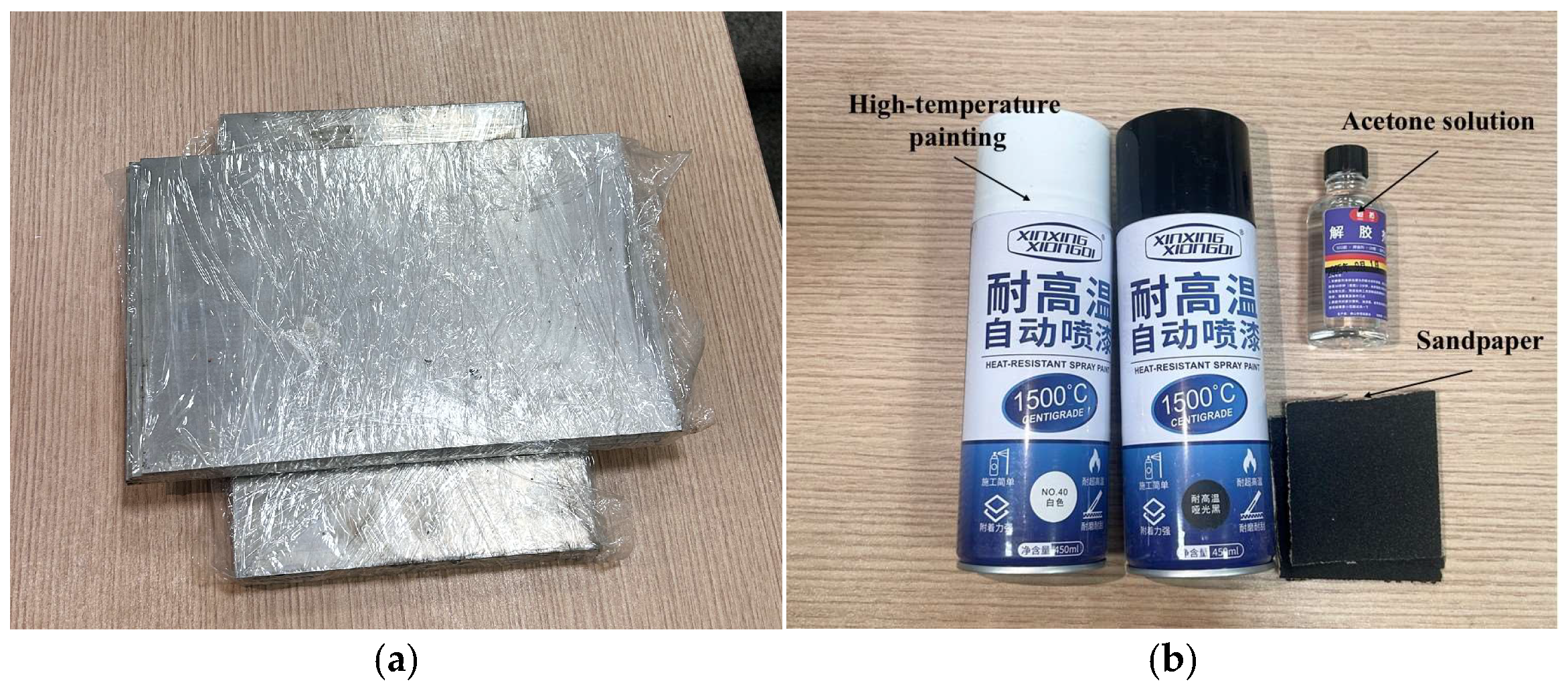
Figure 1 shows the experimental base material and pre-treated material. The experimental base material, as shown in Figure 1a, is a single complete Q420 low-alloy high-strength steel plate, with a size of 300 mm × 200 mm × 2 mm. Before the experiment, the surface of the plate was ground to remove the oxide scale and then cleaned with acetone solution. To meet the DIC measurement requirements, random speckles are prepared on the surface of the test plate: firstly, a white high-temperature resistant primer is sprayed, and after it dries, a black high-temperature resistant paint is sprayed to form a randomly distributed speckle pattern.

2.2. Welding Process

The welding test used a CG1-30 (improved type) flame cutting machine for TIG welding. A tungsten electrode with a diameter of 3.0 mm was used in the TIG torch. The shielding gas was argon (Ar) with a flow rate of 15 L/min. To study the influence of process parameters, a group of tests was set up to investigate the effect of welding speed. The welding process parameters are shown in Table 1.
Each group of tests had a welding length of 300 mm. After welding, the samples were naturally cooled for 30 min, and deformation data were collected throughout the process.

2.3. Three-Dimensional DIC Measurement System

A three-dimensional digital image correlation measurement system was used to monitor the deformation field during the welding and cooling processes in real time. The system utilized XT DIC software (provided by Xintuo 3D Technology (Shenzhen) Co., Ltd., Shenzhen, China, version: XTDIC_Ver9.7.2_x64_pro_202407), which was used for system calibration, the calculation of speckle image correlation, the reconstruction of three-dimensional displacement and strain fields, region of interest (ROI) analysis, and data export. The ROI calculation used sub-regions of 20 × 20 pixels with a step size of 40 × 40 pixels. The system used two high-precision cameras of model XTDIC-CONST-5M (Basler, Arnsberg, Germany), with a resolution of 2448 × 2048 and a lens focal length of 25 mm. The sampling frequency during the welding process was 1 frame per second, and during the cooling process, it was 1 frame per 30 s, ensuring the dynamic deformation during the welding and cooling processes was fully captured.
The displacement measurement accuracy of the DIC system is affected by factors such as calibration error, speckle quality, thermal airflow disturbance, and camera noise. In this experiment, a standard checkerboard pattern was used for calibration, with a calibration accuracy of SIGMA < 0.05. During the welding process, thermal radiation may cause a decrease in speckle contrast. Therefore, 1500 °C high-temperature resistant paint speckles were used as shown in Figure 1b. In the cooling stage (<200 °C), thermal disturbance significantly decreased, and the error was within 0.01 mm.
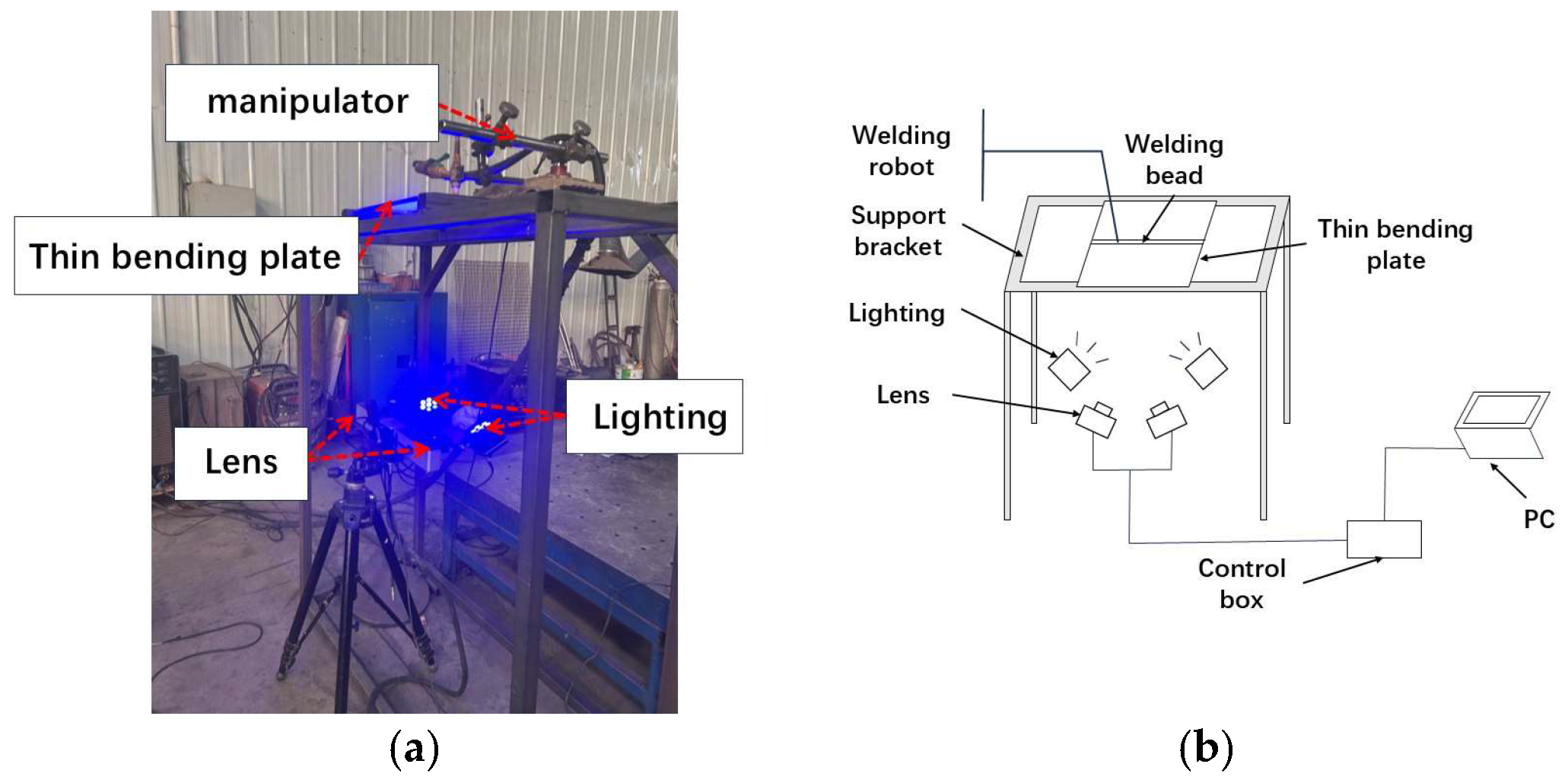
Data analysis was performed using the XTDIC software, calculating the full-field three-dimensional displacement and strain in the representative analysis area (region of interest, ROI). Figure 2 shows a schematic diagram of the three-dimensional digital image correlation measurement system’s welding test bench.

2.4. Verification of the Accuracy of DIC Measurement

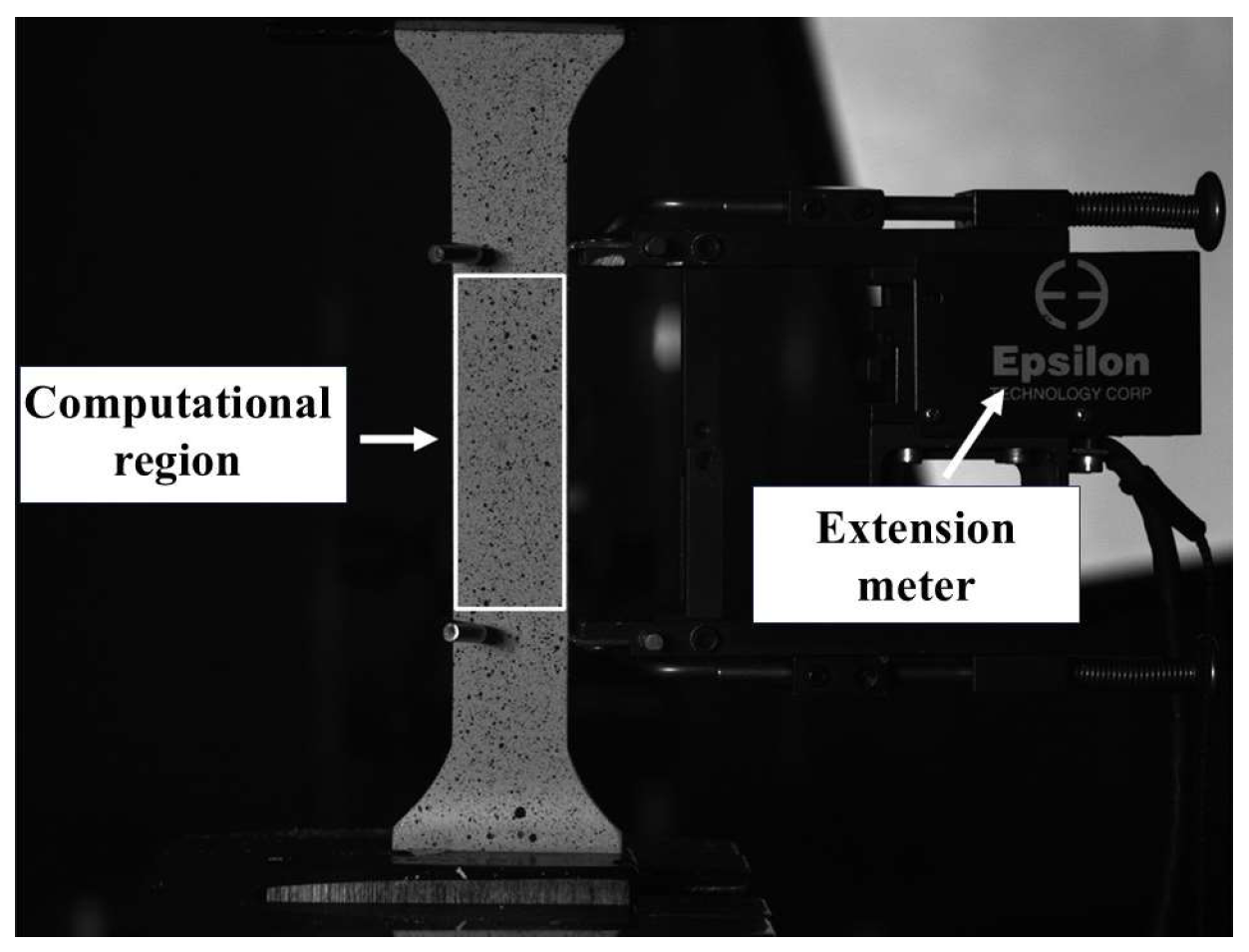
To evaluate the accuracy of the three-dimensional DIC system in strain measurement related to welding, this study conducted an independent verification using a tensile test with a mechanical extensometer and DIC simultaneously (Figure 3). The test material was Q420 steel plates from the same batch, processed into dumbbell-shaped plate tensile specimens (parallel section width 20 mm, thickness 2 mm, parallel section length 105 mm). Uniaxial tensile tests were conducted at room temperature at a loading rate of 2 mm/min, simultaneously using:
A mechanical extensometer (Epsilon, gauge length 25 mm, upper limit of axial strain measurement 10%, maximum torsion angle 5°, accuracy 0.001 mm) to collect the strain within the gauge length section of the specimen;
A three-dimensional DIC system (with the same configuration as the welding test, calculation area set to 20 mm × 70 mm).
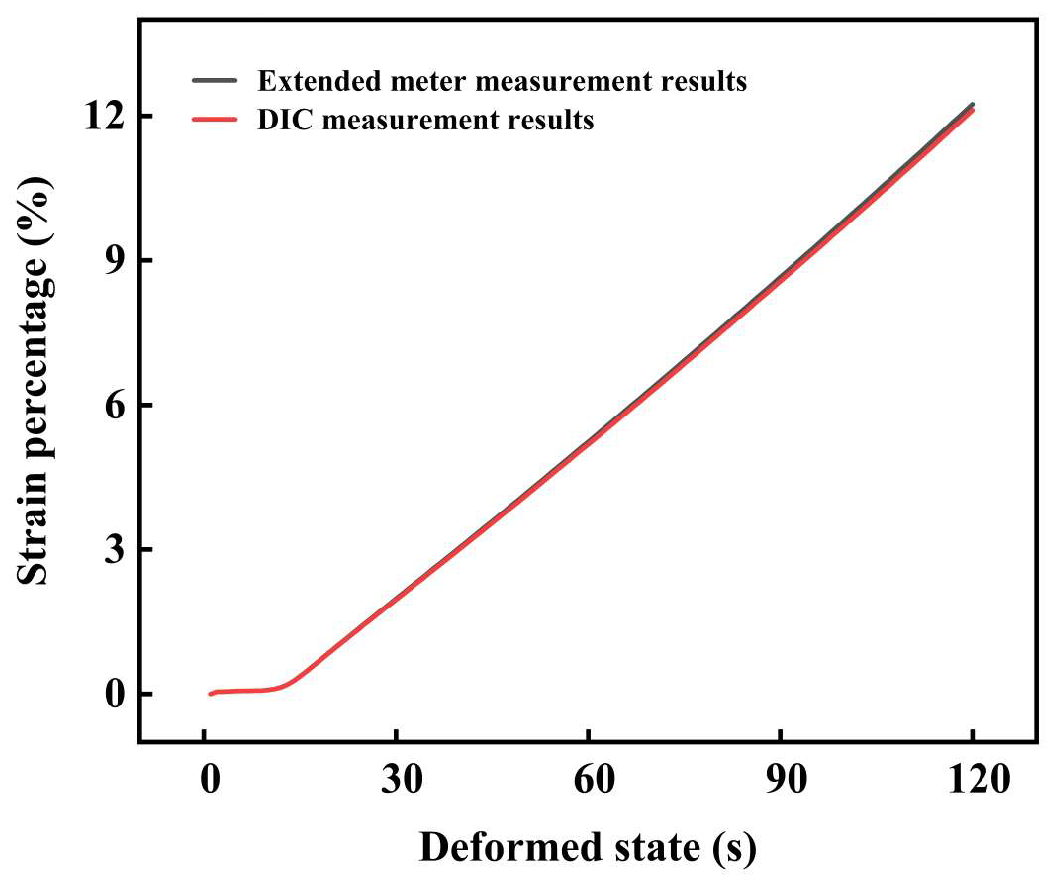
Figure 4 shows the comparison chart of the experimental results of the extensometer and DIC. As a mature contact strain measurement method, the accuracy of the extensometer has been widely recognized. In this study, DIC and the extensometer were used to synchronously measure the tensile strain of the same dumbbell specimen. The results show that for the strain variation trend and peak moment, DIC and the extensometer give completely consistent judgments. The measurement results of DIC and the extensometer show a high linear correlation, indicating that DIC can accurately capture the relative change in strain, the change rate and the change trend. This method meets the research requirements for the dynamic analysis of the entire process of welding deformation.

3. Results

3.1. Deformation Evolution Characteristics Throughout the Welding Process

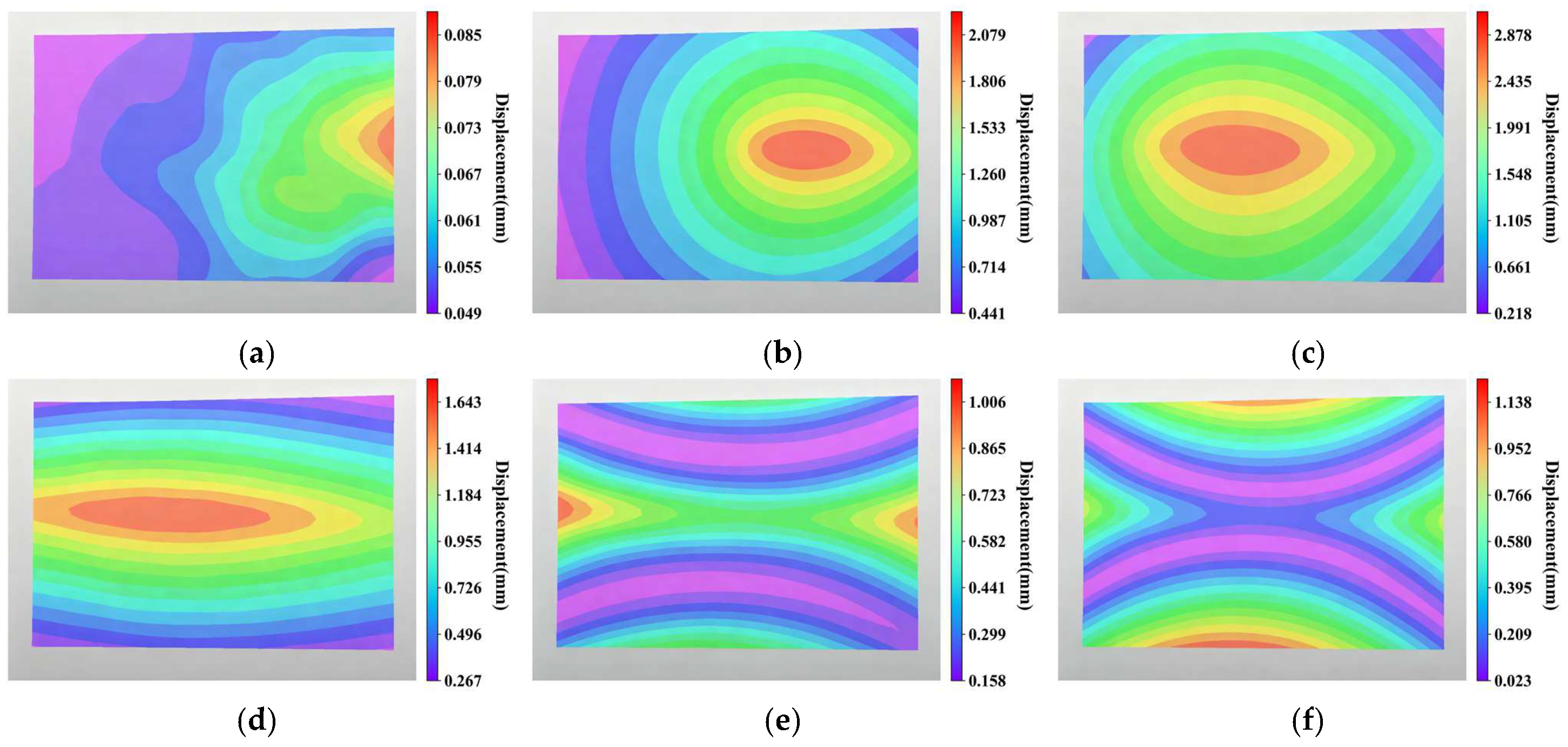
Figure 5 shows the cloud map of the deformation evolution characteristics throughout the welding process. It presents the out-of-plane deformation evolution of a typical test plate under the conditions of welding current 36 A, arc voltage 14 V, and welding speed 6 mm/s during the welding process and after cooling for 30 min (a total of six characteristic moments).

3.1.1. Initial Stage of Welding (Figure 5a)

Approximately 10 s after the start of welding, the heat source is located at the beginning of the weld seam. At this point, the heat input is still relatively small, and the out-of-plane deformation of the test plate is mainly concentrated near the heat source of the weld seam. The maximum out-of-plane displacement is about 0.088 mm. The test plate remains flat overall and no obvious bending occurs.

3.1.2. Middle Stage of Welding (Figure 5b)

The heat source moves to the middle section of the weld seam (about 30 s), and the heat-affected zone significantly expands. The test plate begins to show an overall bending trend. The maximum out-of-plane displacement increases to approximately 2.215 mm, and the deformation is distributed in a “mountain peak” shape, with the weld seam area protruding and the free edge starting to slightly lift.

3.1.3. Just After Welding Is Completed (Figure 5c)

The heat source moves to the end of the weld seam, and the welding process ends (about 50 s). At this point, the test plate has undergone a complete thermal cycle, the heat input reaches its peak, and the out-of-plane deformation increases sharply. The maximum out-of-plane displacement reaches about 2.8 mm. The deformation cloud map shows that the middle part of the free edge of the test plate has a significant upward curl, indicating that instability buckling has occurred. This moment marks the end of the welding thermal cycle and the beginning of the cooling deformation.

3.1.4. Initial Stage of Cooling (Figure 5d)

Approximately 2 min after the end of welding, the test plate enters the cooling stage. As the temperature begins to drop, the material undergoes elastic recovery, and the maximum out-of-plane displacement reduces to 1.757 mm. The deformation pattern gradually changes from the concentrated curl at the end of welding to a more uniform distribution. The deformation recovery in the early cooling stage is mainly due to the elastic recovery mechanism. Immediately after welding, there is a large thermal gradient and elastic strain energy within the test plate. As the heat source is removed, the temperature of the test plate gradually becomes uniform, the elastic modulus of the material recovers, and the elastic strain is released.

3.1.5. Middle Stage of Cooling (Figure 5e)

Twenty minutes after the welding is completed, the temperature of the test plate further decreases, the residual deformation continues to adjust, and the thermal stress is further released. The maximum out-of-plane displacement decreases to 1.076 mm. At this point, the overall deformation of the test plate tends to converge, and the saddle-shaped distribution feature begins to emerge.

3.1.6. 30 Min After Cooling (Figure 5f)

The temperature of the test plate drops to room temperature, and the residual deformation stabilizes. The maximum out-of-plane displacement is 1.212 mm, located in the middle of the free edge of the test plate. Compared with the cooling mid-term, the deformation slightly rebounds, which is speculated to be due to the redistribution of residual stress in the cooling late stage; the contraction of the weld zone is restricted by the surrounding base material, leading to the accumulation of local compressive stress and causing a slight recovery of warpage. This phenomenon indicates that the final state of welding residual deformation is not only determined by the elastic recovery in the early cooling stage but also significantly influenced by the stress redistribution in the late cooling stage.
From the above evolution process, it can be seen that the welding deformation has undergone a complete evolution path including thermal expansion growth, instability and sudden change (during the welding process), elastic rebound in the early stage of cooling, and continuous reduction in deformation in the middle stage of cooling until the final residual deformation stabilizes. The instantaneous deformation immediately after welding (2.800 mm) is much larger than the final residual deformation (1.212 mm), indicating that there is a significant elastic recovery and thermal stress release process during the cooling stage. The deformation recovery during the cooling stage is essentially the result of the combined effect of elastic recovery and thermal stress release. After welding, there is significant elastic strain and thermal gradient inside the test plate. As the temperature drops, the material’s elastic modulus recovers, and the thermal stress gradually releases, resulting in a significant reduction in out-of-plane deformation. This evolution law reveals the complex coupling mechanism between elastic deformation and plastic deformation in the welding deformation process, and also indicates that using the maximum deformation during the welding process as the basis for evaluating residual deformation will significantly overestimate the actual deformation.

3.2. The Influence of Welding Speed on Out-of-Plane Deformation

3.2.1. Analysis of Weld Displacement After 30 Min of Cooling

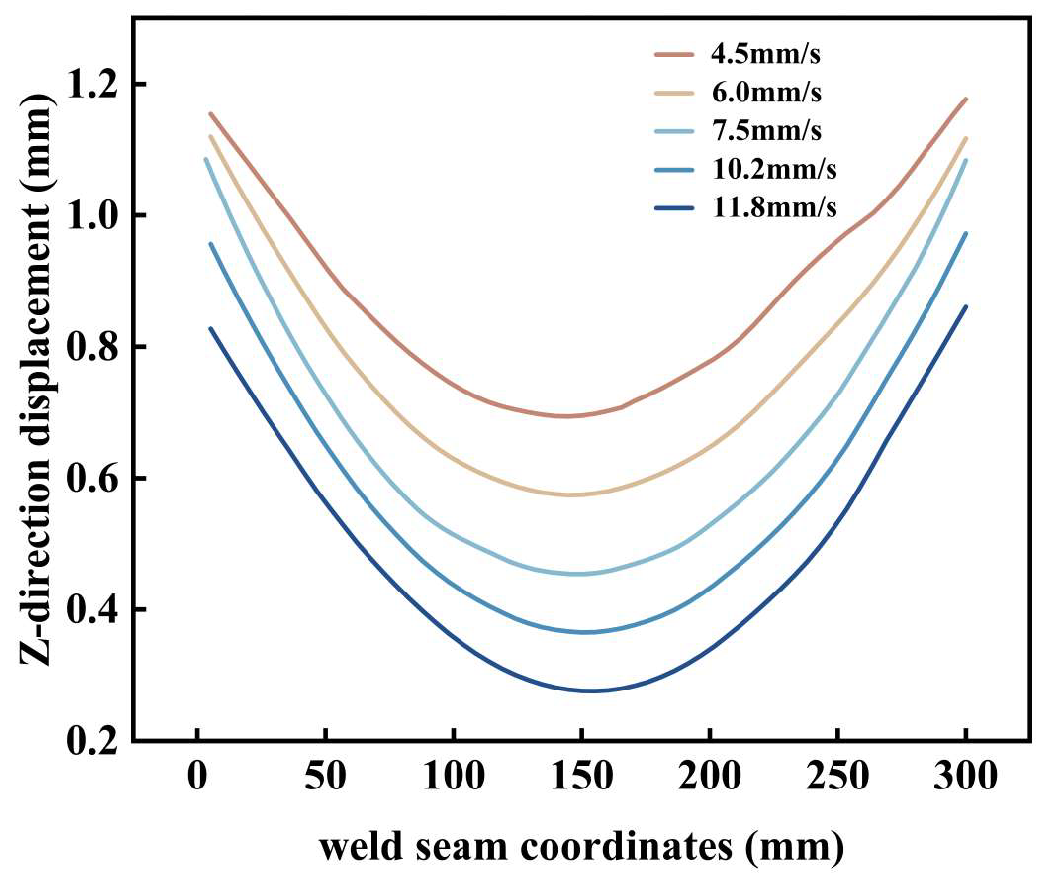
Figure 6 shows the Z-direction displacement curves of the welds at different welding speeds. As shown in Figure 6, the weld displacement curves at all welding speeds exhibit a basic shape of “high at both ends and low in the middle”, that is, the displacements at the start (X = 0 mm) and end (X = 300 mm) of the weld are larger, while the displacements in the middle section of the weld (X = 100~200 mm) are smaller. This common feature reflects the general rule of weak constraint at the ends and strong constraint in the middle section. This common characteristic is due to the non-uniformity of the welding thermal cycle: the ends of the weld are located at the edges of the specimen, with better heat dissipation conditions and limited cooling contraction, resulting in larger out-of-plane displacements; meanwhile the middle section of the weld is constrained by the base materials on both sides, with significant thermal accumulation effects and relatively smaller deformation.
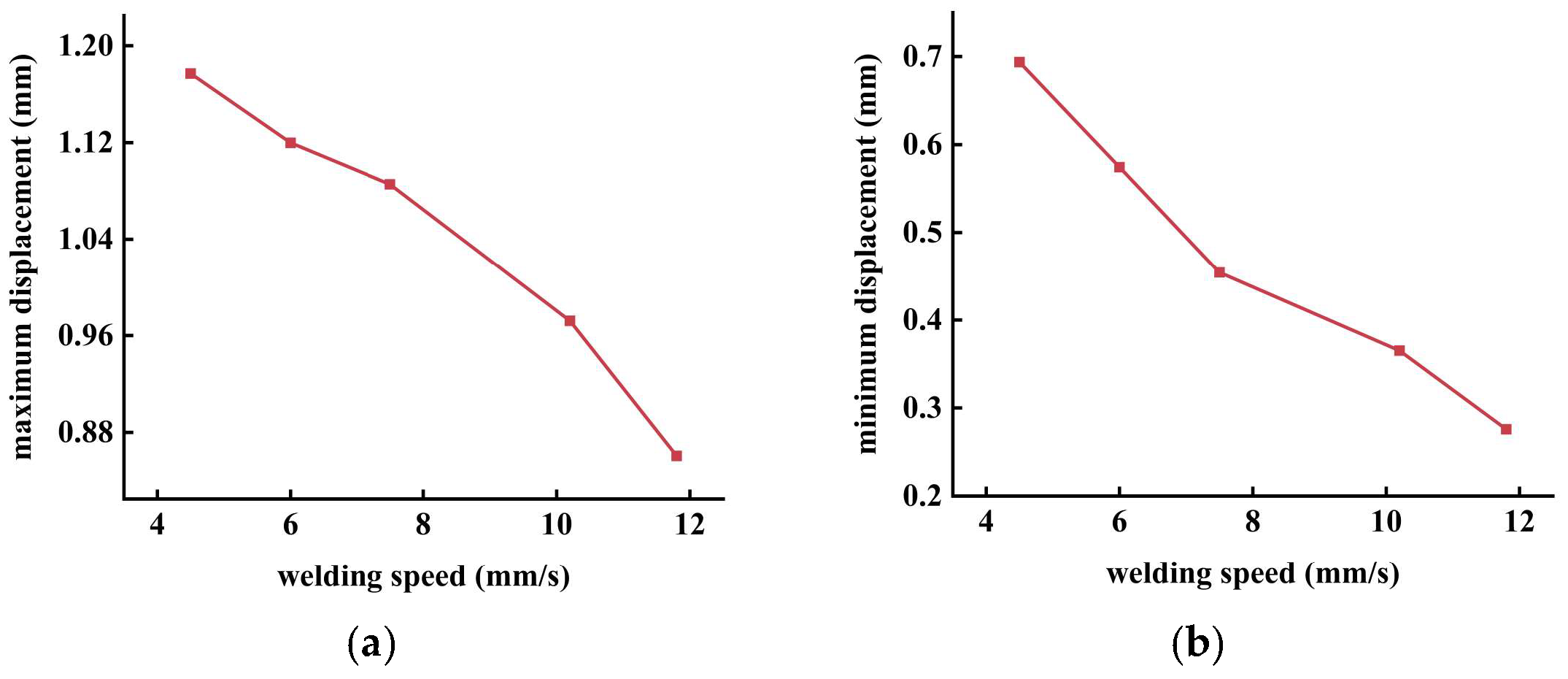
Figure 7 plots the curves of the maximum and minimum displacements of the weld seam varying with the welding speed. A power function was used for fitting, and the following relationships were obtained:
Maximum displacement: δ m a x = 1.519 × v 0.152 ( R 2 = 0.981);
Minimum displacement: δ m i n = 1.286 × v 0.553 ( R 2 = 0.996).
δmax and δmin represent the maximum and minimum out-of-plane displacements of the weld seam (mm), and v is the welding speed (mm/s).
The influence of the welding speed on the out-of-plane deformation can be explained by the heat input (line energy) formula. For the TIG welding process, the line energy E is expressed as:
E = η U I V
Here, U represents the arc voltage (in volts), I represents the welding current (in amperes), V represents the welding speed (in millimeters per second), and η represents the thermal efficiency.
This experiment fixed U at 14 V, I at 36 A, and η at 0.8., so the line energy is inversely proportional to the welding speed: the lower the welding speed, the higher the line energy; the higher the welding speed, the lower the line energy.
It should be emphasized that the welding speed itself is not the direct driving force for deformation. The negative correlation between the welding speed and deformation essentially stems from the control of the heat input (line energy) over the accumulation and distribution of plastic strain. When the welding current and welding voltage are the same, during low-speed welding, the heat input is high, and the materials in the weld seam and the heat-affected zone undergo longer periods of high-temperature thermal cycling. As a result, the mechanical properties of the materials undergo significant changes, leading to an increase in plastic strain accumulation and significant contraction deformation after cooling, resulting in a larger overall out-of-plane deformation. High-speed welding leads to low heat input, a reduced heat-affected zone, and a decrease in plastic strain accumulation, resulting in less deformation after cooling.

3.2.2. Displacement Analysis of Weld Seam Section Line After 30 Min of Cooling

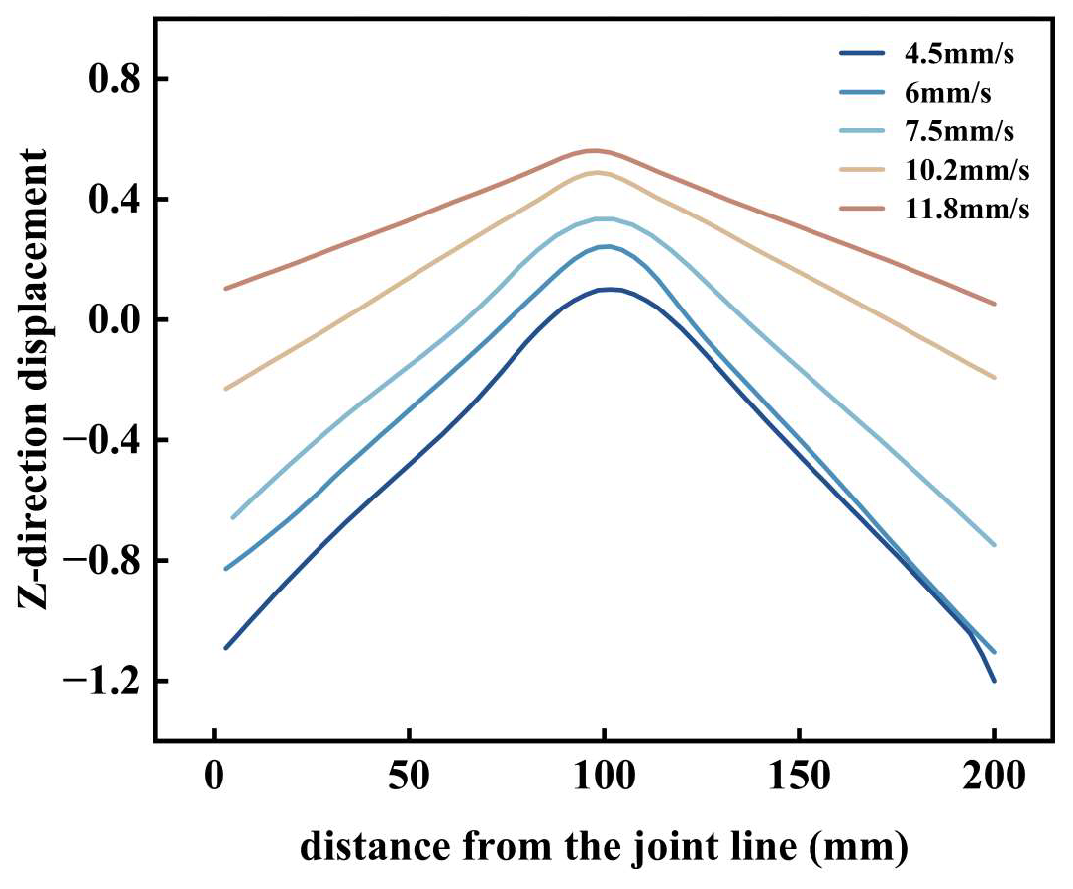
Figure 8 shows the Z-direction displacement curves of the weld seam cross-sections at different welding speeds. As shown in Figure 8, the displacement curves of the section line at all welding speeds exhibit a certain undulating pattern, but the curve shapes change regularly with the variation in welding speed. At low speeds, it shows a saddle-shaped distribution of “central bulge and side depression”; at high speeds, it transforms into a single-peak distribution of “overall upward arch”.

3.2.3. Curve of Out-of-Plane Displacement Variation at the Center Point of the Test Plate

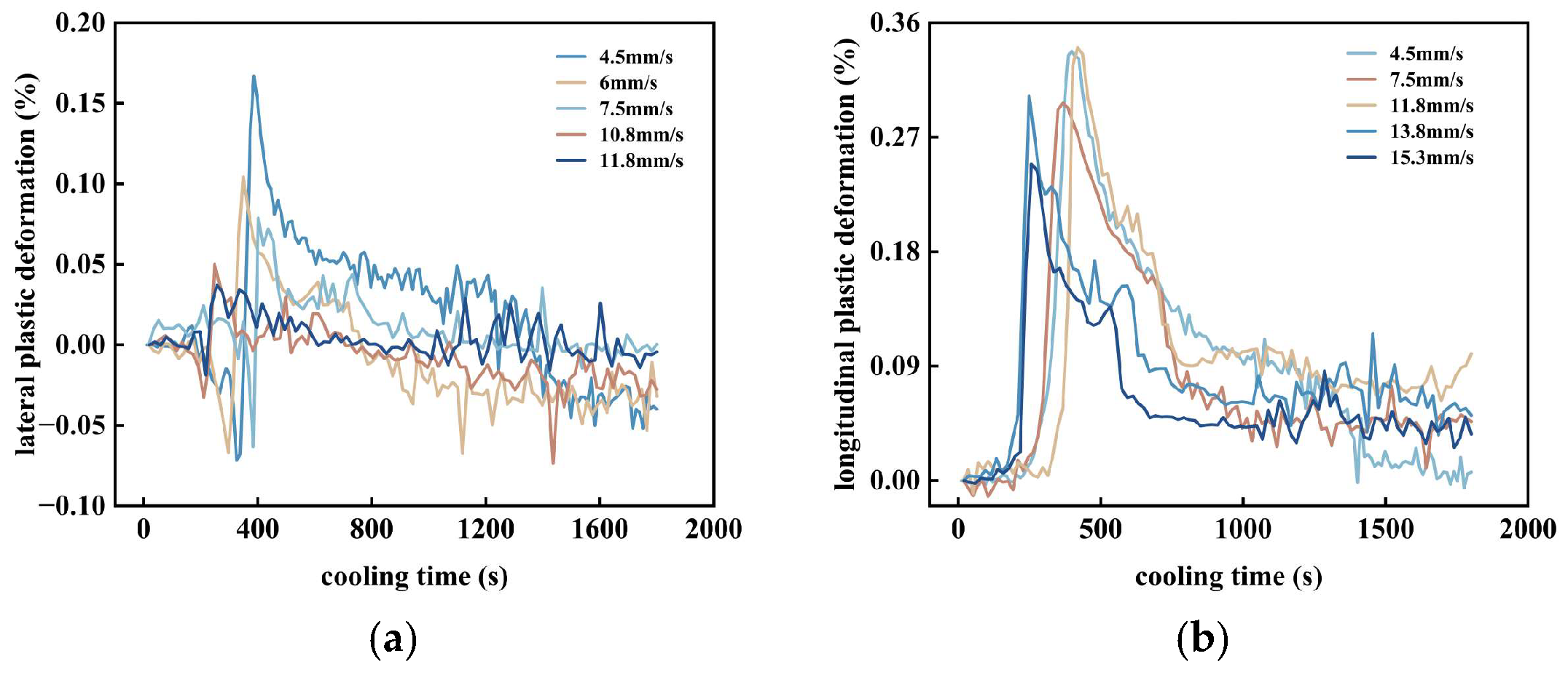
Welding deformation is essentially the cumulative result of thermally induced plastic strain. To further reveal the influence mechanism of welding speed on out-of-plane deformation, the curves of the transverse and longitudinal plastic strains at the center point of the test plate (X = 150 mm, Y = 100 mm) during the cooling process were extracted. Figure 9 shows the evolution law of the plastic strain at the center point with cooling time (0–1800 s, approximately 32 min) at different welding speeds.
The transverse plastic strain evolution is complex: it rapidly rises to a positive peak at the initial stage, then decreases and may turn negative, eventually stabilizing. As the welding speed increases, the positive peak significantly decreases (from 0.1668% to 0.0372%), indicating that high-speed welding reduces the amplitude of transverse tensile strain.
The longitudinal plastic strain rapidly increases at the initial cooling stage, reaches a peak, and then slowly decreases and stabilizes. The peak strain is approximately 0.25% to 0.34%, and the peak time advances with the increase in speed (from 600 s to 200 s). The peak is highest at the low speed (4.5 mm/s) (0.3379%), but the decrease is also the greatest, and the final residual strain is only 0.0068%, almost completely released. At the high speed (11.8 mm/s), the peak is lower (0.2490%), and the final residual strain is 0.0365%.
It is worth noting that all longitudinal plastic strain curves show a distinct strain peak around 400 s after the start of cooling, followed by a significant decrease in strain. The underlying physical mechanism can be attributed to the competition and transformation between elastic and plastic strains during the cooling process. Immediately after welding (about 50 s), there is a large temperature gradient and thermal elastic strain inside the test plate. As the temperature drops during the cooling stage, the elastic modulus of the material gradually recovers, and the thermal contraction is constrained by the surrounding cold base material, causing a brief increase in strain (the transformation of elastic strain to plastic strain or constrained thermal contraction). When the temperature continues to drop to a certain critical value, the yield strength of the material significantly increases, enhancing its resistance to deformation, and the thermal stress is gradually released, causing the strain to start decreasing and stabilizing. The appearance of this peak marks the turning point of the competition between “strain accumulation” and “strain release” during the cooling process. With the increase in welding speed, the peak time slightly advances from about 400 s, which is related to the faster cooling rate and earlier temperature drop in high-speed welding.

4. Discussion

This study achieved dynamic monitoring of the entire welding process deformation of Q420 thin plates using a three-dimensional DIC system, revealing the complete evolution path of welding deformation from thermal expansion and instability buckling to cooling elastic recovery and stable residual deformation. Compared with the traditional static analysis method that only focuses on the post-weld residual deformation, this method can capture the sudden changes in deformation during the welding process and the elastic recovery behavior during the cooling stage, providing data support for understanding the coupling mechanism between elastic and plastic deformation in welding. Particularly, the instantaneous deformation immediately after welding (2.800 mm) is much greater than the final residual deformation (1.212 mm), indicating that the elastic recovery and thermal stress release during the cooling stage have a significant corrective effect on the residual deformation. If the maximum deformation during the welding process is used as the basis for evaluating the residual deformation, it will lead to a significant overestimation. This conclusion has important guiding significance for the prediction and control of welding deformation in engineering practice.
The finite element simulation work by Huang et al. [18] demonstrated that the thermal–elastic–plastic finite element method can accurately predict the transient out-of-plane deformation of thin plate TIG welding at different stages. The numerical results were highly consistent with the DIC measurements in terms of deformation patterns and amplitudes. This study also revealed the relationship between heat input and welding deformation through numerical analysis, providing a numerical basis for controlling deformation by optimizing heat input. This is consistent with the experimental findings in this paper regarding the influence of welding speed on deformation amplitude through heat input. Wang et al.’s [20] study on the buckling benchmark of thin plate butt welding further confirmed that the transient nonlinear thermal–elastic–plastic finite element analysis can effectively predict the buckling behavior during the welding process, and the calculation results were consistent with the experimental data. Costa et al. [17] pointed out that ultra-high-speed welding can effectively suppress thin plate deformation. The results of this study support this conclusion under TIG welding conditions. Regarding the influence of welding speed on deformation, the experimental results are consistent with the heat input theory: the lower the welding speed, the higher the line energy, the longer the high-temperature dwell time, the greater the material softening, and the more significant the accumulation of plastic strain, resulting in a larger final residual deformation. Conversely, high-speed welding can effectively reduce heat input and suppress the development of plastic strain, and reduce residual deformation. There is a good power function relationship between the maximum and minimum displacements of the weld and the welding speed (R2 are 0.981 and 0.996, respectively), and this quantitative relationship can provide a rapid prediction tool for the selection of TIG welding process parameters for Q420 thin plates. The findings of this study are consistent with the nonlinear decrease in angular deformation with increasing welding speed observed by Mochizuki et al. [25] in high-strength steel, and further extend this rule to out-of-plane bending deformation, providing a specific power function expression.
Notably, the evolution of plastic strain does not simply monotonically change with welding speed. Although the longitudinal plastic strain peak is highest at the low speed (4.5 mm/s), the strain is almost completely released after cooling (residual only 0.0068%), while at the high speed (11.8 mm/s), a relatively high residual strain (0.0365%) is retained. This phenomenon indicates that welding speed has a dual regulatory effect on plastic strain: low-speed welding has a high heat input, allowing for sufficient accumulation of plastic strain, but the longer high-temperature dwell time also provides a more ample window for strain release; high-speed welding has a low heat input, limiting the accumulation of plastic strain, but the faster cooling rate leads to a significant strain freezing effect, resulting in more retained residual strain. Therefore, in the design of thin plate welding processes, the peak deformation or peak plastic strain should not be used as the sole criterion for residual deformation. Instead, the stress evolution characteristics and strain release kinetics during the cooling stage should be comprehensively considered. This finding is in line with Wang et al.’s [29] discussion on the “accumulation and release competition” during the evolution of plastic strain in thin plate stainless steel welding.
In addition, the weld displacement curve shows a “high at both ends, low in the middle” distribution pattern, reflecting the boundary effect of weak constraint at the ends and strong constraint in the middle of the test plate. The displacement profile along the cut line changes from a “saddle shape” to a “single peak shape” as the welding speed increases from low to high, indicating that the welding speed not only affects the deformation amplitude but also alters the spatial distribution pattern of deformation. This provides a reference for subsequent welding deformation control and correction process design. This pattern change may be related to the variation in the width of the heat-affected zone and the range of plastic strain distribution: at low welding speeds, the heat-affected zone is wide, and the temperature rise in the base metal on both sides is significant, resulting in a “saddle shape” with both sides sinking and the center bulging after cooling; at high welding speeds, the heat input is concentrated, the heat-affected zone is narrow, and the deformation is mainly concentrated in the weld area, presenting a single peak distribution. This understanding provides a reference for the targeted formulation of subsequent welding deformation control and correction processes.
The limitations of this study are as follows: Firstly, the experiments were only conducted on 2 mm thick Q420 thin plates, and the applicability to other plate thicknesses or different high-strength steel materials needs further verification; secondly, the experiments used TIG welding with pure argon as the shielding gas, and the heat source model is different from that of laser welding, submerged arc welding, etc., so the conclusions should be applied to other processes with caution; thirdly, the DIC measurement is affected by hot gas flow disturbance during the high-temperature stage. Although high-temperature resistant speckles were used, there may still be some errors in the absolute value of strain. In the future, numerical simulation methods can be combined to further reveal the spatiotemporal coupling mechanism of the temperature field, stress field, and deformation field under different welding speeds, and to establish a more universal deformation prediction model.

5. Conclusions

In this study, a three-dimensional digital image correlation (DIC) system was employed to conduct a full-process dynamic monitoring of the out-of-plane deformation of Q420 low-alloy high-strength steel sheets during TIG welding and the cooling stage. The influence of welding speed (4.5–11.8 mm/s) on the deformation evolution law, plastic strain characteristics, and deformation spatial distribution pattern was systematically analyzed. Through experimental research, the following main conclusions were drawn:
(1)
Unlike most existing studies that only focus on post-weld residual deformation or deformation at a certain stage during the welding process, this study systematically reveals the complete (heating + cooling) deformation evolution path of 2 mm thick Q420 low-alloy high-strength steel thin plates under TIG welding conditions, especially the complete stages of “thermal expansion—instability mutation—elastic rebound—residual stabilization”. The deformation recovery during the cooling stage is mainly dominated by elastic recovery and thermal stress release, and the final residual deformation is significantly affected by the stress redistribution in the later stage of cooling.
(2)
Under fixed current and voltage conditions, the lower the welding speed, the higher the heat input and the greater the out-of-plane deformation; the higher the welding speed, the smaller the deformation. The power function relationship between the welding speed and the maximum and minimum displacements of the weld seam was quantitatively established as δ m a x = 1.519 × v 0.152 ( R 2 = 0.981) and δ m i n = 1.286 × v 0.553 ( R 2 = 0.996), with a good fit.
(3)
The welding speed simultaneously affects the accumulation and release process of plastic strain. The peak value of transverse plastic strain decreases from 0.1668% to 0.0372% as the welding speed increases; the peak value of longitudinal plastic strain is shortened from 600 s to 200 s. It is noteworthy that at low welding speeds (4.5 mm/s), the peak strain is high but almost completely released after cooling, while at high welding speeds (11.8 mm/s), the peak strain is low but the residual strain is retained to a greater extent, indicating that deformation control cannot solely rely on the peak strain as a single evaluation criterion.
(4)
Under different welding speeds, the weld displacement always shows the common characteristic of “higher at both ends and lower in the middle”. However, as the welding speed increases from low to high, the shape of the cross-sectional displacement changes from “saddle-shaped” distribution to “unimodal” distribution, indicating that the welding speed not only affects the deformation amplitude but also alters the spatial distribution pattern of the deformation, providing a reference for the subsequent deformation control and corrective processing.
(5)
To further expand the scope of application of the research, in the future, the base material can be replaced with Q550 steel with a higher strength grade, and the influence law of the change in welding current on the out-of-plane deformation can be systematically explored. Thus, the control theory of welding deformation of high-strength steel thin plates in terms of material and process parameters can be improved. Combined with finite element numerical simulation, the temperature field, phase transformation behavior, and the spatiotemporal distribution of the stress field under different welding speeds can be inverted, revealing the deep thermal–metallurgical–mechanical coupling mechanism of the “accumulation-release” dual regulation mechanism.
In conclusion, choosing an appropriate welding speed can not only ensure the welding efficiency but also effectively control the welding deformation of Q420 thin plates. The research results provide experimental basis and theoretical reference for optimizing the welding process parameters of high-strength steel thin plates.

Author Contributions

Conceptualization, Y.L. (Yangyang Li) and Y.L. (Yaoyao Li); methodology, X.M. and Y.L. (Yangyang Li); software, Y.L. (Yaoyao Li) and X.M.; validation, Y.L. (Yaoyao Li) and X.M.; investigation, N.G.; resources, X.M.; data curation, Y.L. (Yaoyao Li); writing—original draft preparation, Y.L. (Yaoyao Li); writing—review and editing, Y.L. (Yaoyao Li); supervision, N.G.; project administration, X.M.; funding acquisition, N.G. All authors have read and agreed to the published version of the manuscript.

Funding

This research was funded by the “National Natural Science Foundation of China”, grant number No. 52401045; the Key Research and Development Program of Longmen Laboratory, research and industrialization of an efficient and low-loss harvesting machine for oil sunflower beans, grant numbers LMZDYF-202401; the Key Research and Development Program of Longmen Laboratory, research and industrialization of self-propelled potato bagging harvesting machine, grant numbers LMZDYF-202403. The APC was funded by National Natural Science Foundation of China.

Institutional Review Board Statement

Not applicable.

Informed Consent Statement

Not applicable.

Data Availability Statement

The research data are all included in the article.

Conflicts of Interest

The authors declare no conflicts of interest.

References

  1. Cao, J.; Ren, W.; Zhang, G.; Yin, S.; Liu, Z.; Sun, X. Effect of Weld Surface Quality on the Fatigue Performance of Q420 Steel Used in Offshore Wind Tower Tube. Metals 2026, 16, 148. [Google Scholar] [CrossRef]
  2. Christke, S.; Gibson, A.G.; Grigoriou, K.; Mouritz, A. Multi-layer polymer metal laminates for the fire protection of lightweight structures. Mater. Des. 2016, 97, 349–356. [Google Scholar] [CrossRef]
  3. Ma, X.; Guo, N.; Yang, F.; Liu, C.; Guan, Z. Deformation Evolution Law of Surfacing Welding on Thin Bending Plates Based on the Three-Dimensional Thermal Digital Image Correlation Method. Coatings 2022, 12, 1084. [Google Scholar] [CrossRef]
  4. Ma, N.; Huang, H.; Murakawa, H. Effect of Jig Constraint Position and Pitch on Welding Deformation. J. Mater. Process. Technol. 2015, 221, 154–162. [Google Scholar] [CrossRef]
  5. Ghafouri, M.; Ahola, A.; Ahn, J.; Björk, T. Welding-Induced Stresses and Distortion in High-Strength Steel T-Joints: Numerical and Experimental Study. J. Constr. Steel Res. 2022, 189, 107088. [Google Scholar] [CrossRef]
  6. Deng, D.; Murakawa, H. FEM Prediction of Buckling Distortion Induced by Welding in Thin Plate Panel Structures. Comput. Mater. Sci. 2008, 43, 591–607. [Google Scholar] [CrossRef]
  7. Murakawa, H.; Ma, N.; Huang, H. Iterative Substructure Method Employing Concept of Inherent Strain for Large-Scale Welding Problems. Weld. World 2015, 59, 53–63. [Google Scholar] [CrossRef]
  8. Sivakumar, J.; Korra, N.N.; Vasantharaja, P. Computation of Residual Stresses, Distortion, and Thermogravimetric Analysis of Inconel 625 Weld Joints. Proc. Inst. Mech. Eng. Part C J. Mech. Eng. Sci. 2021, 235, 4109–4118. [Google Scholar] [CrossRef]
  9. Granell, I.; Ramos, A.; Carnicero, A. A Geometry-Based Welding Distortion Prediction Tool. Materials 2021, 14, 4789. [Google Scholar] [CrossRef]
  10. Pan, B.; Wu, D.; Wang, Z.; Xia, Y. High-Temperature Digital Image Correlation Method for Full-Field Deformation Measurement at 1200 °C. Meas. Sci. Technol. 2011, 22, 015701. [Google Scholar] [CrossRef]
  11. Pan, B.; Qian, K.; Xie, H.; Asundi, A. Two-dimensional digital image correlation for in-plane displacement and strain measurement: A review. Meas. Sci. Technol. 2009, 20, 062001. [Google Scholar] [CrossRef]
  12. De Strycker, M.; Lava, P.; Van Paepegem, W.; Schueremans, L.; Debruyne, D. Measuring Welding Deformations with the Digital Image Correlation Technique. Weld. J. 2011, 90, 107S–112S. [Google Scholar]
  13. Eshtayeh, M.; Hijazi, A.; Hrairi, M. Nondestructive evaluation of welded joints using digital image correlation. J. Nondestruct. Eval. 2015, 34, 37. [Google Scholar] [CrossRef]
  14. Saranath, K.M.; Sharma, A.; Ramji, M. Zone wise local characterization of welds using digital image correlation technique. Opt. Lasers Eng. 2014, 63, 30–42. [Google Scholar] [CrossRef]
  15. Corigliano, P.; Dong, P. Digital image correlation structural strain analysis of S235 fillet-welded joints under low-cycle fatigue loadings. J. Mar. Sci. Eng. 2024, 12, 531. [Google Scholar] [CrossRef]
  16. Huang, Z.Y.; Luo, Z.; Liu, Z.M.; Li, Y.; Cai, Y.C.; Zhang, Y. Deformation Behaviour of Thin Aluminium Alloy Plates During Laser Welding. Lasers Eng. 2017, 37, 291. [Google Scholar]
  17. Costa, M.I.; Leitão, C.; Rodrigues, D.M. Parametric Study of Friction Stir Welding Induced Distortion in Thin Aluminium Alloy Plates: A Coupled Numerical and Experimental Analysis. Thin-Walled Struct. 2019, 134, 268–276. [Google Scholar] [CrossRef]
  18. Huang, H.; Yin, X.; Feng, Z.; Ma, N. Finite element analysis and in-situ measurement of out-of-plane distortion in thin plate TIG welding. Materials 2019, 12, 141. [Google Scholar] [CrossRef]
  19. Yuan, M.; Liu, S.; Sun, H.; Gao, Y.; Dai, X.; Chen, W. FEM research on welding thermal deformation of copper alloy sheet and optimization of welding sequence. Coatings 2021, 11, 1287. [Google Scholar] [CrossRef]
  20. Wang, J.; Yi, B. Benchmark investigation of welding-induced buckling and its critical condition during thin plate butt welding. J. Manuf. Sci. Eng. 2019, 141, 071010. [Google Scholar] [CrossRef]
  21. Kim, Y.C.; Park, J.U.; Horikawa, K. Effects of Welding Conditions on Out-of-Plane Deformation and Residual Stress Produced by Welding. Steel Constr. Eng. 1998, 5, 85–91. [Google Scholar]
  22. Lebbal, H.; Chaib, M.; Slimane, A.; Kaci, D.A.; Boualem, N. Experimental Investigation with Optimization of Spot Welding Parameters on Stainless Steel AISI 304: Lebbal, Chaib, Slimane, Ait Kaci, and Boualem. JOM 2023, 75, 4993–5002. [Google Scholar] [CrossRef]
  23. Dhas, J.E.R.; Dhas, S.J.H. A Review on Optimization of Welding Process. Procedia Eng. 2012, 38, 544–554. [Google Scholar] [CrossRef]
  24. Yaghi, A.H.; Hyde, T.H.; Becker, A.A.; Williams, J.; Sun, W. Residual Stress Simulation in Welded Sections of P91 Pipes. J. Mater. Process. Technol. 2005, 167, 480–487. [Google Scholar] [CrossRef]
  25. Mochizuki, M.; Hayashi, M.; Hattori, T. Numerical Analysis of Welding Residual Stress and Its Verification Using Neutron Diffraction Measurement. J. Eng. Mater. Technol. 2000, 122, 98–103. [Google Scholar] [CrossRef]
  26. Long, H.; Gery, D.; Carlier, A.; Maropoulos, P. Prediction of Welding Distortion in Butt Joint of Thin Plates. Mater. Des. 2009, 30, 4126–4135. [Google Scholar] [CrossRef]
  27. Murakawa, H.; Deng, D.; Ma, N.; Wang, J. Applications of Inherent Strain and Interface Element to Simulation of Welding Deformation in Thin Plate Structures. Comput. Mater. Sci. 2012, 51, 43–52. [Google Scholar] [CrossRef]
  28. Ma, C.; Zeng, Z.; Rui, X. Research on Disturbance Characteristics in High Temperature DIC Measurement Due to Heat Flow and Its Correction Method. In Proceedings of the 2019 International Conference on Optical Instruments and Technology: Optoelectronic Imaging/Spectroscopy and Signal Processing Technology; SPIE: Bellingham, WA, USA, 2020; Volume 11438, pp. 85–92. [Google Scholar]
  29. Wang, P.; Xie, P.; Zhao, H.; Guan, Q. Fundamental Research of Welded Plastic Strain Evolution Process II: Evolution Process of Welded Plastic Strain in Thin Stainless Steel Plate. Trans. China Weld. Inst. 2014, 35, 72–74, 78. [Google Scholar]
Figure 1. Experimental base material and materials used for pre-treatment: (a) Experimental base material; (b) materials used for surface pre-treatment.
Coatings 16 00573 g001
Figure 2. Schematic diagram of the welding test bench: (a) real photo; (b) illustration.
Coatings 16 00573 g002
Figure 3. Schematic diagram of the DIC calculation area of the dumbbell specimen.
Coatings 16 00573 g003
Figure 4. Comparison of strain gauge and DIC experimental measurement results.
Coatings 16 00573 g004
Figure 5. A cloud chart depicting the evolution characteristics of out-of-plane deformation throughout the welding process: (a) in the early stage of welding; (b) mid-term welding; (c) welding is completed; (d) initial cooling; (e) mid-cooling period; (f) after cooling for 30 min.
Coatings 16 00573 g005
Figure 6. The Z-direction displacement curves of the weld seam at different welding speeds.
Coatings 16 00573 g006
Figure 7. The curves of the maximum and minimum displacements of the weld seam varying with the welding speed: (a) maximum displacement; (b) minimum displacement.
Coatings 16 00573 g007
Figure 8. Z-direction displacement curves of the weld cross-section at different welding speeds.
Coatings 16 00573 g008
Figure 9. Shows the plastic strain evolution at different welding speeds: (a) lateral plastic deformation; (b) longitudinal plastic deformation.
Coatings 16 00573 g009
Table 1. Welding process parameter settings.
CategoryWelding Speed/(mm/s)Welding Current/AArc Voltage/VThermal Efficiency/ηHeat Input/(J/mm)
14.536140.8112
2636140.884
37.536140.867.2
410.236140.849.4
511.836140.842.7
Disclaimer/Publisher’s Note: The statements, opinions and data contained in all publications are solely those of the individual author(s) and contributor(s) and not of MDPI and/or the editor(s). MDPI and/or the editor(s) disclaim responsibility for any injury to people or property resulting from any ideas, methods, instructions or products referred to in the content.