1. Introduction
Transparent optical systems that simultaneously transmit background scenes and present controllable optical information represent a central challenge in modern display and architectural technologies. Applications ranging from automotive head-up displays and transparent organic light-emitting diode (OLED) screens to smart privacy windows and augmented-reality interfaces require external optical layers capable of independently tuning transmittance, diffuse scattering, and specular reflectance depending on the illumination direction and viewing geometry [
1,
2,
3,
4,
5]. Achieving such directional optical control through passive thin-film architectures—without active switching elements—offers advantages in fabrication simplicity, large-area scalability, and energy efficiency. Recent advances in transparent display technologies have further highlighted the need for external scattering layers that can be independently engineered without modifying the emissive architecture itself [
1,
2,
3].
Among the optical systems that could benefit from such coatings, transparent emissive displays are especially demanding because they must balance see-through transparency, image readability, privacy, and glare control within the same device area. In this context, a passive post-fabricated scattering layer positioned outside the electrically active stack is attractive: it can modulate the emitted and transmitted light after it exits the transparent electrodes, while leaving the electrode/transport/emissive architecture unchanged. This decoupled strategy is particularly relevant to transparent OLED-type platforms, where optical visibility management and electrical optimization are often best handled separately [
6].
Nanoparticle-dispersed polymer matrices have emerged as a practical material platform for engineering scattering-based optical functions. The scattering strength and angular distribution can be tuned through refractive-index contrast between particle and matrix, nanoparticle concentration, size, and dispersion state [
7,
8]. Single scattering layers face an inherent transmittance–haze trade-off: increasing nanoparticle loading enhances the diffuse component while degrading transparency [
9,
10]. A comprehensive review of optical diffuser technologies has shown that overcoming this trade-off typically requires either structured surfaces or multilayer designs [
11]. Multilayer architectures that stack scattering layers with different concentrations circumvent this limitation by distributing scattering contributions across depth, enabling independent adjustment of the parallel-to-diffuse partitioning and the angular output distribution. Nanoparticle-doped poly(methyl methacrylate) (PMMA) plates have been shown to achieve controlled optical diffusion through concentration tuning [
12], while polymer-blend-based light-scattering materials can produce high haze at high transparency [
13]. However, these single-layer approaches lack the additional degree of freedom provided by through-thickness composition ordering.
A key but underexplored aspect of multilayer scattering films is that—even with identical constituent concentrations—the stacking order determines which concentration profile the incident light first encounters, thereby altering the early-stage scattering statistics (single-scattering probability, mean free path, and onset of multiple scattering). Related light-management studies in OLED scattering layers and cellulose-based scattering-enhancer systems have shown that scattering behavior can depend strongly on near-surface structure, particle morphology, and angular redistribution of light [
14,
15]. However, a systematic experimental quantification of bilayer-order effects on haze-component decomposition, bidirectional reflectance, and morphology-correlated optical response remains lacking. Recent work on metal oxide nanoparticle/polymer nanocomposites has demonstrated that the type and concentration of embedded nanoparticles can regulate the optical properties of composite films across the UV–VIS–IR range [
16], but the influence of layer ordering in multilayer configurations has not been addressed. Studies on Al
2O
3/PMMA composites have confirmed that Al
2O
3 nanoparticles significantly alter optical absorption and scattering in PMMA matrices, with effects that depend strongly on the loading level [
17]. At elevated loadings, nanoparticle agglomeration can become an additional factor that further modifies the scattering behavior [
16,
17].
In this work, we present a systematic investigation of Al2O3 nanoparticle-dispersed PMMA bilayer scattering films fabricated by sequential spin-coating. By fabricating four representative concentration-pair bilayers (5/15, 15/5, 5/30, and 9/30 wt%) and characterizing their optical responses under both glass-incident and scattering-layer-incident illumination geometries, we derive experimentally supported guidelines relating stacking sequence, concentration loading, and incidence direction to parallel transmittance (PT), diffuse transmittance (DT), haze, and reflectance. Structural characterization via optical interferometry provides morphological observations that are consistent with the measured optical trends.
2. Materials and Methods
Al
2O
3 nanoparticle-dispersed PMMA solutions were prepared in toluene by first dissolving PMMA to form a transparent polymer matrix and then dispersing Al
2O
3 nanoparticles at designated weight loadings. The size of Al
2O
3 nanoparticles purchased from Sigma-Aldrich was about 50 nm (nominal diameter as specified by the supplier). Each solution was stirred at 450 rpm for 24 h to promote nanoparticle dispersion. In this manuscript, bilayer configurations are denoted as (bottom layer wt%/top layer wt%), where the wt% values indicate the nominal nanoparticle loading of each coating solution. Bilayer scattering films were prepared in four representative configurations—5/15, 15/5, 5/30, and 9/30 wt%—deposited sequentially on clean glass substrates. The four bilayer configurations were chosen to systematically address two independent design parameters. First, the maximum concentration within the bilayer (15 wt% vs. 30 wt%) was varied to span two distinct scattering regimes: a moderate-haze mixed regime and a diffusion-dominant regime. For 50 nm Al
2O
3 nanoparticles (refractive index ~1.76) embedded in a PMMA matrix (
n ≈ 1.49), these concentrations correspond to transitions from intermediate to strong scattering in the visible wavelength range, as expected from Mie theory for particles near the Rayleigh–Mie boundary [
18]. Second, the reciprocal 5/15 vs. 15/5 wt% pair was designed to isolate the effect of stacking order at an identical total composition. The 5/30 and 9/30 wt% configurations extend the investigation to the high-loading regime and test whether small changes in the complementary layer (5 → 9 wt%) influence the overall optical response when paired with a strongly scattering 30 wt% layer.
Each layer was deposited by spin-coating at 4000 rpm for 30 s, followed by thermal annealing at 105 °C for 10 min to remove residual toluene and stabilize the coated layer [
19,
20]. After forming the bottom layer, the sample was equilibrated at room temperature for 10 min before top-layer deposition to reduce redissolution of the first layer and to minimize intermixing during the second coating step. The thermal annealing step promotes solvent removal and partial stabilization of the PMMA chains, which substantially reduces redissolution of the first layer by the toluene solvent carried by the second-layer solution. This sequential deposition strategy is commonly employed to promote layer integrity in polymer bilayer systems prepared by spin-coating [
21], although the degree of structural preservation depends on specific processing conditions and solvent interactions. The thickness of each layer was measured to be 2.0 ± 0.1 μm using a surface profiler (ET 200, Kosaka Laboratory Ltd., Tokyo, Japan), where the uncertainty reflects the variation observed across multiple measurement positions on the sample area. This thickness provides a sufficient optical path length for nanoparticle scattering in the visible range (400–700 nm) while maintaining overall film transparency. All bilayer samples were fabricated using the same coating and thermal-treatment protocol so that the optical discussion could focus on relative differences arising from concentration sequence and incidence direction.
Wavelength-dependent transmittance and reflectance spectra were acquired using a UV-Vis spectrophotometer (UV-1650PC, Shimadzu Corporation, Kyoto, Japan) over 190–1100 nm. Spectra are presented in the 400–700 nm visible range, where the scattering-relevant spectral features are most pronounced and where the target applications (transparent displays, privacy films, architectural glazing) operate. As shown in
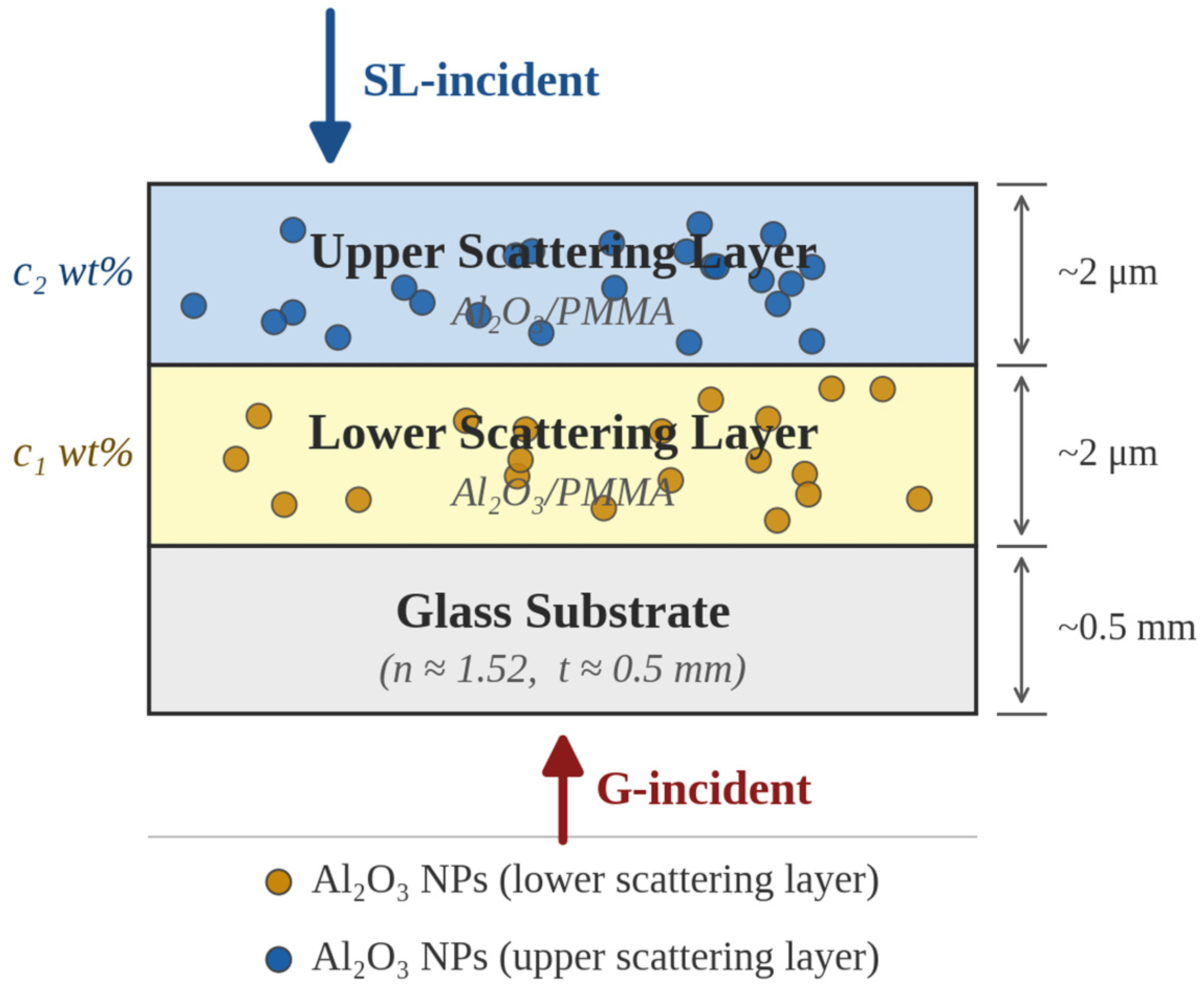
Figure 1, two illumination geometries were defined: (i) glass-incident (G-incident), in which light enters from the glass substrate side, and (ii) scattering-layer-incident (SL-incident), in which light enters from the nanoparticle-dispersed PMMA film side. Diffuse optical behavior was quantified using an integrating-sphere-based haze measurement system (NDH-5000, Nippon Denshoku Industries Co., Ltd., Tokyo, Japan), decomposing transmitted light into PT and DT, where total transmittance (TT) = PT + DT and haze (%) = DT/TT × 100 [
22,
23]. Because integrating-sphere measurements near TT ≈ 100% can include small calibration-related offsets, the analysis in this work emphasizes comparative trends among bilayer configurations in PT, DT, haze, and reflectance rather than absolute TT values alone.
Areal surface topography and roughness parameters were measured by optical interferometry (Zygo Corporation, Middlefield, CT, USA) over a scan area of 1.146 × 1.146 mm
2, and the following surface texture parameters were extracted: arithmetic mean height (Sa), root mean square height (Sq), skewness (Ssk), kurtosis (Sku), maximum pit depth (Sv), and maximum height (Sz), as defined by ISO 25178 [
24,
25,
26,
27,
28].
3. Results and Discussion
Figure 1 shows a schematic cross-section of the bilayer nanoparticle-dispersed scattering film on a glass substrate, illustrating the two illumination geometries used throughout this study. The G-incident geometry probes the optical response when light enters from the glass side (as in rear-projection transparent displays or backlit smart windows), while the SL-incident geometry corresponds to ambient light impinging directly on the nanoparticle-laden film surface (as in front-lit or see-through applications).
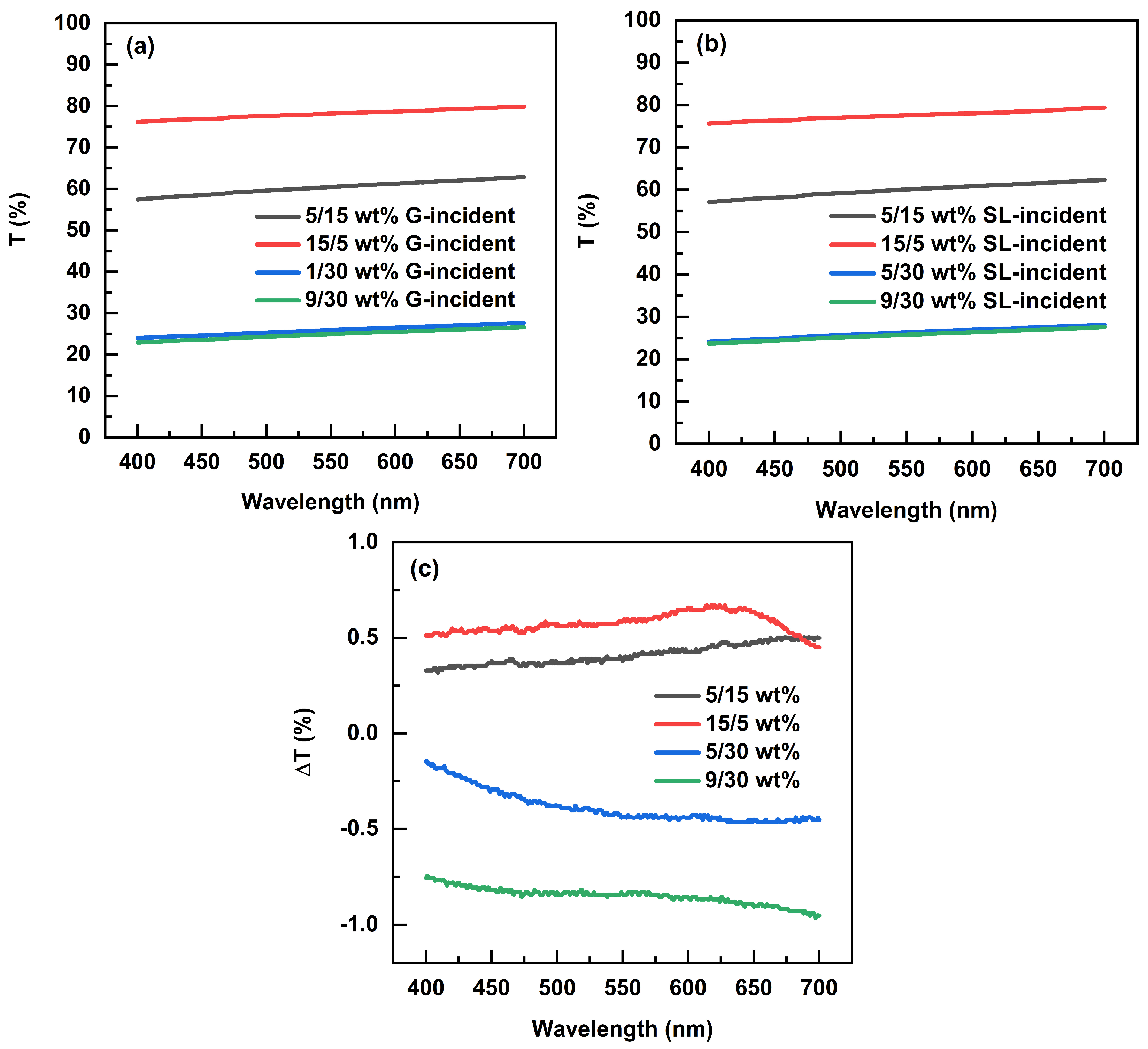
Figure 2 shows the wavelength-dependent transmittance spectra measured under G-incident (a) and SL-incident (b) illumination for all four bilayer configurations, together with the transmittance difference, ΔT = T(G) − T(SL), plotted in
Figure 2c. For the reciprocal 5/15 wt% and 15/5 wt% bilayers, which contain the same total nanoparticle loading, the 15/5 wt% configuration maintained substantially higher transmittance across the visible range under both incidence directions. This indicates that the optical response cannot be described by the average loading alone; rather, the through-thickness concentration profile is an important design variable in determining the overall transmission level.
At the same time, for a given bilayer configuration, the absolute transmittance spectra under G-incident and SL-incident illumination are broadly similar in both spectral trend and magnitude (see
Figure 2a,b). This indicates that the total transmitted intensity is governed primarily by the overall scattering strength of the bilayer, whereas the directional effect appears more clearly in the differential response shown in
Figure 2c. In particular, the 15/5 wt% bilayer exhibits a larger positive ΔT than the 5/15 wt% bilayer, indicating that the effect of stacking order is expressed more clearly in the directional imbalance between the two incidence configurations than in the absolute transmittance itself. By contrast, the 5/30 wt% and 9/30 wt% bilayers show negative ΔT values throughout the visible range, meaning that their transmittance is slightly lower under G-incident illumination than under SL-incident illumination. The more negative ΔT observed for the 9/30 wt% bilayer compared with the 5/30 wt% bilayer further suggests that increasing the combined scattering strength enhances this reversed asymmetry. Taken together, these results show that the directional optical response cannot be explained solely by a simple first-encountered-layer effect but instead arises from the combined influence of stacking order, sequential scattering within the bilayer, and asymmetric boundary conditions associated with the glass side and the scattering-layer side.
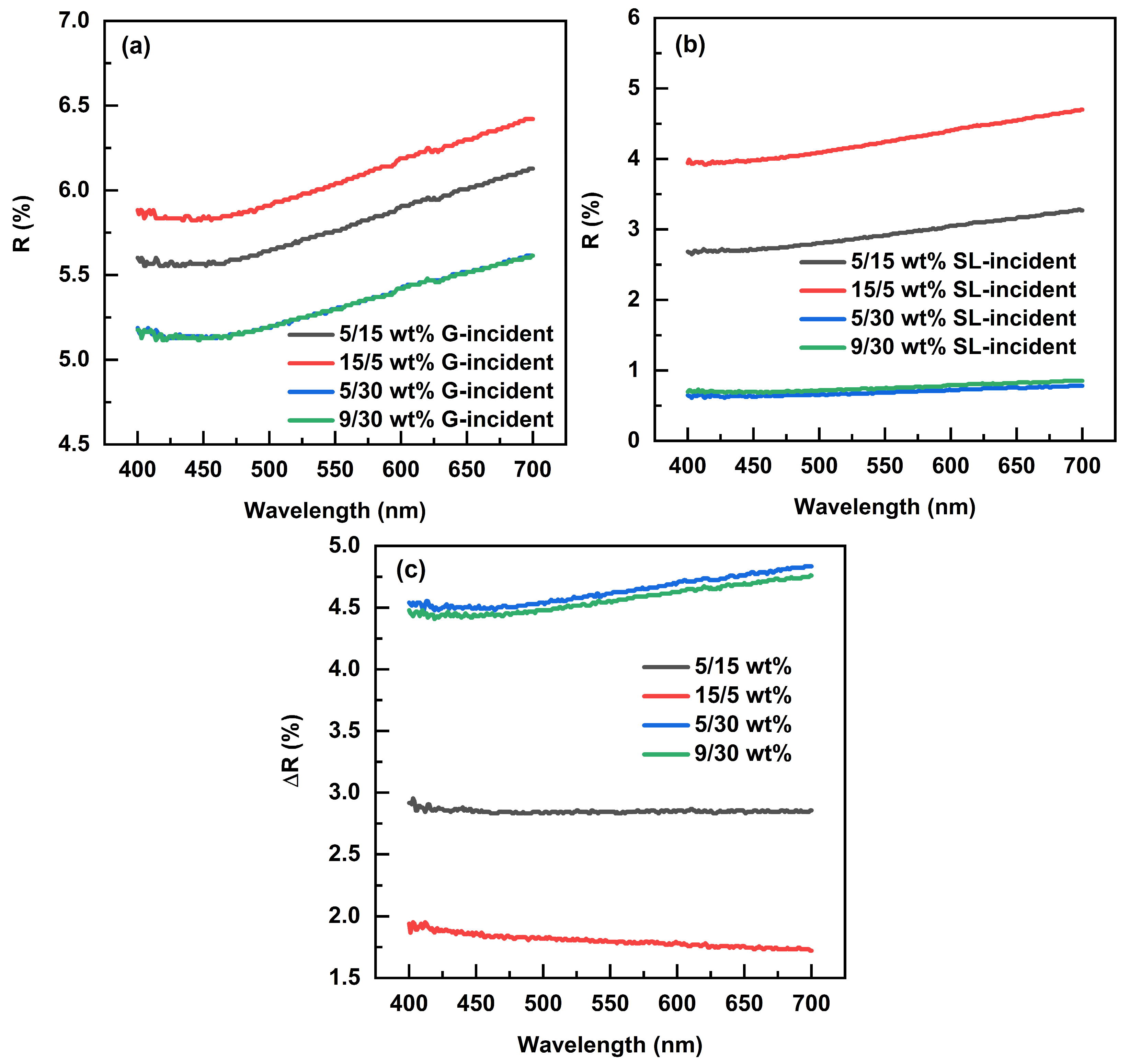
Figure 3 shows the wavelength-dependent reflectance spectra measured under G-incident (a) and SL-incident (b) illumination for the four bilayer configurations, together with the reflectance difference, ΔR = R(G) − R(SL), plotted in
Figure 3c. Under G-incident illumination, the reflectance remained relatively stable at approximately 5%–6% across the visible range for all bilayer films, indicating that the glass-side optical boundary largely governs the specular return under this illumination condition. In contrast, under SL-incident illumination, the bilayers containing a 30 wt% layer at the incident side exhibited markedly suppressed reflectance, remaining below 1% over most of the visible range. This corresponds to a greater-than-fivefold reduction compared with the G-incident case for the same samples and demonstrates that the incident-side layer composition can strongly influence the reflected component when light first encounters the scattering-layer surface.
The directional difference becomes more evident in
Figure 3c, where ΔR clearly increases for the bilayers incorporating the 30 wt% layer. In other words, the reflectance asymmetry between G-incident and SL-incident illumination is much more pronounced for the 5/30 wt% and 9/30 wt% configurations than for the reciprocal 5/15 wt% and 15/5 wt% bilayers. This result indicates that the directional reflectance response is amplified when a strongly scattering layer is positioned near the incident side, whereas lower-loading bilayers show only limited directional separation. The large positive ΔR for the 30 wt%-containing bilayers is consistent with strong near-surface forward scattering, which reduces the coherent specular return at the first interface under SL-incident illumination. These results are broadly consistent with previous OLED light-extraction studies employing high-refractive-index nanoparticle scattering layers [
29], although the present bilayer films reveal an additional layer-order-dependent reflectance asymmetry that was not the focus of those earlier single-layer-oriented systems. The strong reflectance suppression observed here extends this principle to bilayer configurations, demonstrating that incident-facing nanoparticle loading can be used as a passive anti-reflection design parameter. An additional contribution may arise from a more gradual effective refractive-index transition near the film surface in the high-loading region, which could further weaken Fresnel-type reflection. Taken together, these results show that incident-facing nanoparticle loading influences not only the absolute reflectance under SL illumination but also the magnitude of directional reflectance asymmetry, highlighting layer order as a useful passive design parameter for anti-glare and low-reflectance transparent optical films.
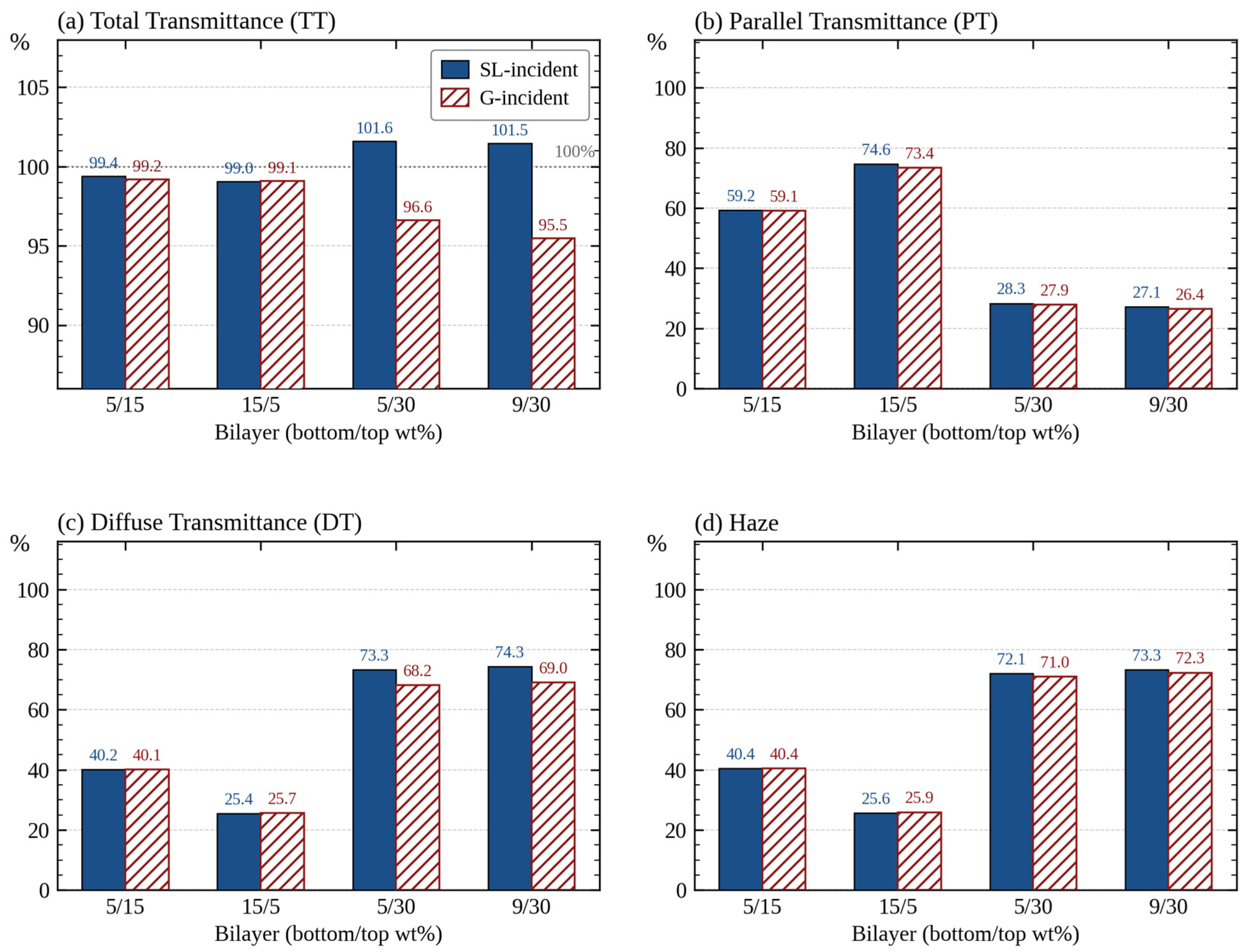
Figure 4 summarizes TT, PT, DT, and haze values measured under both SL-incident and G-incident illumination for the four bilayer configurations. Because the apparent TT of the highly scattering samples slightly exceeds 100% under some conditions, which is most likely attributable to the small calibration uncertainty inherent to integrating-sphere measurements near unity transmittance, the discussion below focuses primarily on relative differences in PT, DT, haze, and directional trends between the two incidence geometries. Overall, the data define three optical transport regimes governed by the concentration pair and stacking sequence.
The 5/15 wt% bilayer represents a mixed transmission regime in which the transmitted light is distributed more evenly between parallel and diffuse components. Under both incidence directions, TT remains close to 99%, while PT is approximately 59% and DT is approximately 40%, yielding a haze of about 40%. This indicates that absorption losses are negligible and that scattering is sufficient to redistribute a substantial fraction of the transmitted beam into diffuse channels without eliminating the near-parallel component. In contrast, the reciprocal 15/5 wt% bilayer exhibits a forward-transmission-dominant regime. Although the total nanoparticle loading is identical to that of the 5/15 wt% film, reversing the stacking order increases PT to about 73%–75% and reduces DT and haze to about 25%–26% under both incidence directions. This approximately 15 percentage-point shift clearly shows that the through-thickness arrangement of scattering centers is an independent design variable that strongly redistributes transmitted power between near-parallel and wide-angle channels even at fixed composition. This systematic stacking-order dependence indicates that the optical response retains a clear memory of the deposition sequence. Although the different responses of the reciprocal 5/15 and 15/5 wt% bilayers are consistent with limited intermixing during sequential coating, these data do not by themselves constitute direct structural proof of a sharply preserved internal bilayer interface. The 5/30 wt% and 9/30 wt% bilayers fall into a diffusion-dominant regime. In both cases, PT drops below 30%, whereas DT rises to 68%–74%, producing haze values of 71%–73%. This indicates that once a 30 wt% layer is incorporated, optical transport becomes dominated by strong multiple scattering, and the transmitted beam becomes overwhelmingly diffuse. At the same time, these samples also show an apparent reduction in TT under G-incident illumination, with values decreasing to about 95.5%–96.6%, whereas TT under SL incidence remains near 100%. Because Al2O3/PMMA bilayers are not expected to introduce significant visible absorption, and because the TT decrease is accompanied by a strong increase in DT rather than an overall suppression of transmitted light under both directions, this TT difference is more reasonably interpreted as a directional transport effect rather than as intrinsic loss. In particular, under G-incident illumination, the highly scattering 30 wt% layer is encountered closer to the exit side, where strong late-stage scattering can redirect part of the transmitted light into backward or high-angle channels, thereby reducing the measured forward hemispherical transmittance. A further contribution from Fresnel loss at the glass-side entrance may also accumulate under this geometry. Thus, the lower TT observed for the 30 wt%-containing bilayers under G incidence is best understood as a consequence of scattering-mediated extraction inefficiency rather than true absorption.
These results can be compared with single-layer nanoparticle-doped PMMA systems. Colombo et al. [
12] reported haze values of 5%–90% in SiO
2/PMMA plates by varying nanoparticle concentration, but such single-layer systems cannot independently control the PT/DT balance at a given total loading—a capability that the bilayer stacking-order approach provides. Liu et al. [
13] achieved high haze (≥90%) in PMMA films doped with an immiscible polymer, but at the cost of reduced total transmittance. In contrast, the bilayer configurations studied here maintain TT ≈ 99% even at haze levels of ~40%, demonstrating that the multilayer approach can partially decouple the transmittance–haze trade-off inherent to single-layer designs. Molnár et al. [
30] modeled the relationship between internal structure and haze in semicrystalline polymers, supporting the broader view that internal structural organization can strongly influence light-scattering behavior. Although their study did not address bilayer concentration ordering directly, it is consistent with our observation that through-thickness structural arrangement affects the partitioning of transmitted light.
Comparison of the two incidence directions provides additional insight into how this directional effect develops. For the 5/15 wt% and 15/5 wt% bilayers, the differences between SL-incident and G-incident illumination are minimal in PT, DT, and haze, indicating that when scattering remains in the low-to-moderate range, the angular partitioning of transmitted light is only weakly dependent on the illumination side. By contrast, the 5/30 wt% and 9/30 wt% bilayers show a systematic asymmetry: DT under SL-incident illumination exceeds that under G-incident illumination by approximately 4–5 percentage points, while PT differs only slightly and haze remains nearly unchanged. This means that the incidence direction does not fundamentally alter the scattering regime itself, which remains diffusion-dominant in both cases, but instead changes the fraction of light that successfully exits through diffuse transmission channels. The relatively small difference between the 5/30 wt% and 9/30 wt% films further suggests that the inclusion of the 30 wt% layer is the primary factor driving the transition into the diffuse regime, whereas increasing the lower-loading layer from 5 wt% to 9 wt% mainly fine-tunes the strength of the directional asymmetry. Taken together,
Figure 4 shows that bilayer design provides two distinct handles for optical control: stacking order tunes the PT/DT balance at fixed overall loading, whereas incorporation of a highly loaded layer drives the system into a diffusion-dominant regime in which directional extraction effects become measurable in TT and DT.
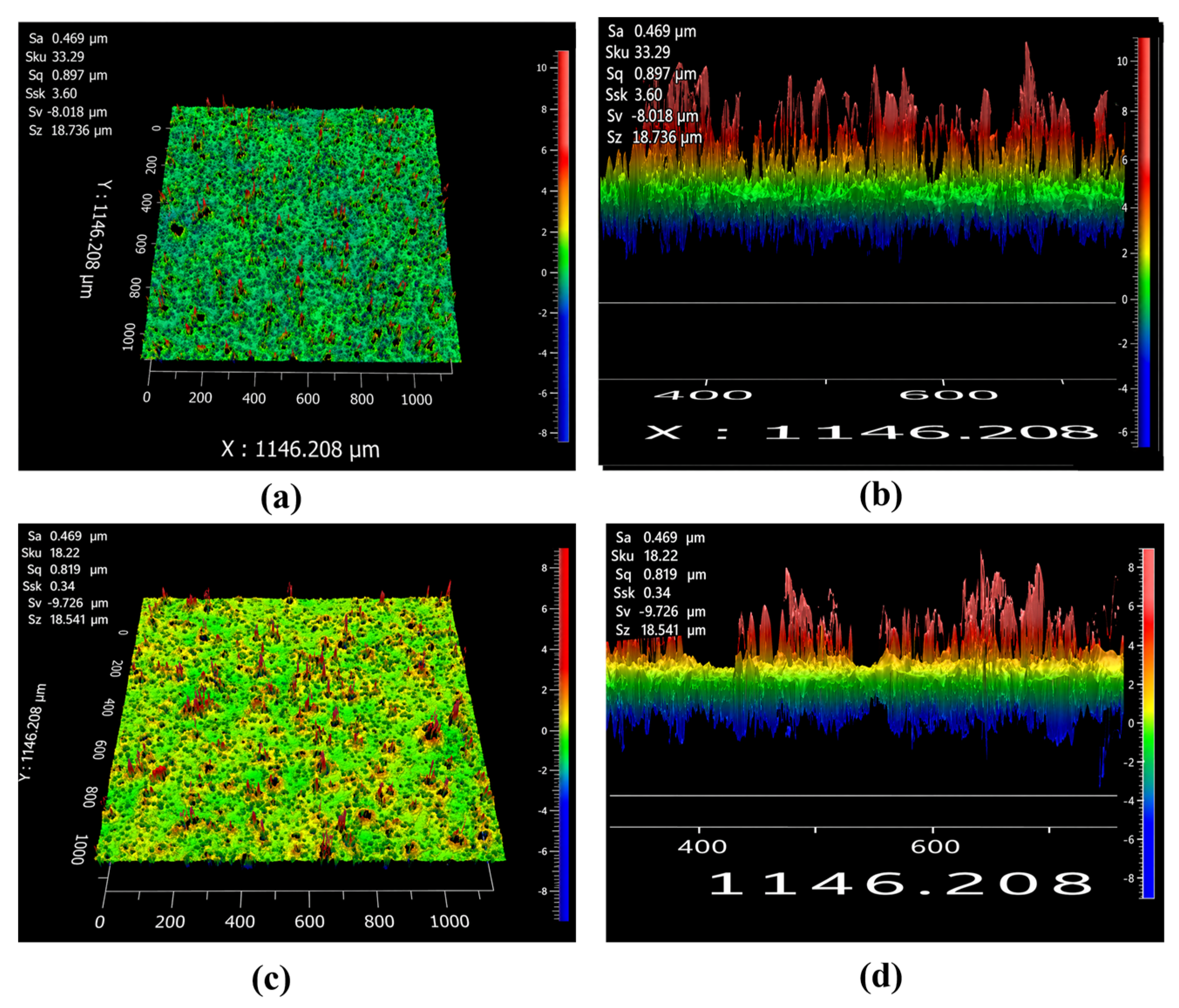
Figure 5 presents optical interferometry (Zygo) surface topography maps of the reciprocal 5/15 wt% and 15/5 wt% bilayer films in side-view and top-view representations, and the corresponding areal roughness parameters are summarized in
Table 1. These two samples are particularly useful for comparison because they have the same total nanoparticle loading and differ only in stacking order. Although both films show nearly identical arithmetic mean roughness values (Sa ≈ 0.469 μm), their surface-height distributions differ substantially. The 5/15 wt% bilayer exhibits much larger skewness (Ssk = 3.60 vs. 0.34) and kurtosis (Sku = 33.29 vs. 18.22) than the 15/5 wt% bilayer. These surface-topography differences between the reciprocal bilayers show that stacking order influences the outer-surface morphology after sequential deposition. However, because optical interferometry probes only the external surface and not the through-thickness internal structure, these observations should be interpreted as indirect, surface-sensitive evidence and not as conclusive proof of internal bilayer separation. Here, a higher positive skewness indicates that the surface is more strongly biased toward protruding features, while a higher kurtosis indicates that these protrusions are sharper and more statistically extreme. Thus, despite their similar average roughness amplitudes, the 5/15 wt% film possesses a more peak-dominated and spatially heterogeneous outermost surface. This distinction is optically relevant because average roughness alone does not fully describe how the outer surface perturbs incident light at the film–air interface. A surface with higher skewness and kurtosis is expected to contain more localized high-aspect-ratio features, which can enhance local redirection of light at the first interface and thereby contribute to differences in the partitioning between parallel and diffuse transmission. In this sense, the interferometry results suggest that stacking order affects the statistical character of the outermost surface topography and is consistent with a layer-order-dependent optical response, although it does not directly resolve the internal concentration profile through the film thickness. These outer-surface morphological differences may therefore contribute, together with internal scattering effects inferred from the optical data, to the observed optical differences between the reciprocal 5/15 wt% and 15/5 wt% bilayers.
Based on the optical and surface-topography results, several practical empirical guidelines can be drawn for Al2O3/PMMA bilayer scattering films within the concentration range examined here. First, the overall scattering regime is governed primarily by the maximum concentration present in the bilayer. Films with a maximum loading of 15 wt% remain in a mixed transmission regime, maintaining high TT (≈99%) with moderate haze (≈25%–40%), whereas incorporation of a 30 wt% layer shifts the system into a diffusion-dominant regime characterized by PT below 30%, DT above 68%–74%, and haze exceeding 70%. Second, within the lower-to-moderate scattering regime, stacking order provides an independent means of tuning the PT/DT balance without changing the material composition. The reciprocal 5/15 wt% and 15/5 wt% bilayers, despite having identical total loading, exhibit markedly different haze and PT/DT partitioning, demonstrating that the through-thickness arrangement of scattering centers is itself an effective optical design parameter. Third, directional reflectance can be controlled through the combination of loading level and incidence-side configuration. In particular, when a 30 wt% layer faces the incident light under SL illumination, reflectance is strongly suppressed to below 1% across the visible range, indicating a practical passive route toward low-reflectance or anti-glare functionality without dedicated anti-reflection coatings.
These results are relevant not only for stand-alone scattering films but also for external optical functional coatings that may be integrated with transparent photonic or emissive platforms. In this context, the 15/5 wt% bilayer is better suited to applications requiring relatively high forward visibility and lower haze, whereas the 5/15 wt% bilayer provides a more balanced partial-diffusion state. By contrast, bilayers containing a 30 wt% layer are more appropriate for applications prioritizing strong diffusion and reduced glare, such as privacy layers or scattering covers. The present results provide a practical coating-side design map showing how concentration selection and stacking sequence can be used to control scattering strength, PT/DT balance, haze, and directional reflectance asymmetry without changing the material chemistry or requiring more complex fabrication processes.
3.1. Thin-Film Interference Considerations
Given the measured layer thickness of 2 μm ± 0.1 μm, it is important to consider whether thin-film interference contributes to the observed spectral dependences. For a PMMA layer of thickness t ≈ 2 μm and refractive index
n ≈ 1.49, the free spectral range of Fabry–Pérot interference fringes is FSR = λ
2/(2nt) ≈ 25–80 nm across the 400–700 nm visible band. Such closely spaced fringes could, in principle, appear in the transmittance and reflectance spectra. However, the measured spectra (
Figure 2 and
Figure 3) show no periodic oscillatory modulation, indicating that thin-film interference does not contribute significantly to the observed spectral dependences. The embedded Al
2O
3 nanoparticles act as volume scattering centers that destroy the spatial coherence of the transmitted wavefront, suppressing constructive and destructive interference. Additionally, any residual thickness non-uniformity inherent to the spin-coating process further reduces fringe visibility across the measurement beam area. This confirms that the dominant optical mechanism in the present films is nanoparticle scattering rather than thin-film interference.
3.2. Nanoparticle Dispersion and Agglomeration Considerations
In nanoparticle/polymer composite films, the dispersion state of the nanoparticles is known to significantly influence optical properties. Agglomeration can increase effective scattering cross-sections and opacity, while individually dispersed particles favor optical transparency. For Al
2O
3 nanoparticles in PMMA, higher particle loadings are generally more susceptible to partial agglomeration than dilute systems [
16,
17]. The 50 nm nominal particle size places the Al
2O
3 nanoparticles near the Rayleigh–Mie transition for visible-light scattering, meaning that even modest agglomeration can shift the effective scattering from the Rayleigh into the Mie regime, producing stronger forward-scattering lobes and enhanced haze.
While direct imaging of the nanoparticle distribution was not performed in this study, several aspects of the optical data are consistent with concentration-dependent dispersion quality. The sharp increase in haze from ~25% (15/5 wt%) to ~40% (5/15 wt%) and then to >70% (5/30 and 9/30 wt%) suggests a nonlinear enhancement of scattering strength with loading, which is characteristic of systems where agglomeration augments the volume-scattering contribution at higher concentrations [
16,
17]. Importantly, the key finding of this work—that stacking order modulates the PT/DT balance at identical total compositions—remains valid regardless of the specific dispersion state, because both reciprocal bilayer configurations were fabricated under identical processing conditions and therefore share the same nanoparticle dispersion characteristics within each layer.
3.3. Limitations and Future Work
Several limitations of the present study should be noted. First, direct structural imaging was not performed, which precludes definitive confirmation of the bilayer interface sharpness, nanoparticle distribution, and degree of agglomeration within each layer. The optical and surface-topography results presented here support a reproducible layer-order-dependent optical response, but they do not directly verify the internal through-thickness bilayer morphology. Second, the four concentration pairs studied represent a limited subset of the available composition space, and the conclusions drawn here may not extend to very low (<5 wt%) or very high (>30 wt%) loading regimes or to different nanoparticle sizes and chemistries.
Future work should include direct cross-sectional characterization to verify the internal interface morphology and nanoparticle distribution, together with a broader parametric study and theoretical modeling to extend the present optical design map beyond the concentration range examined here.
4. Conclusions
This study systematically investigated how the through-thickness composition profile and stacking order govern the directional optical properties of Al2O3/PMMA bilayer scattering films. Four bilayer configurations spanning two scattering regimes were fabricated by sequential spin-coating and characterized under bidirectional illumination. The results establish three principal findings.
First, the maximum nanoparticle concentration within the bilayer defines the overall scattering regime. Bilayers with a maximum loading of 15 wt% maintained TT ≈ 99% with moderate haze (25%–40%), while incorporation of a 30 wt% layer shifted the system to a diffusion-dominant regime (DT > 68%, haze > 70%).
Second, stacking order provides an independent and practically useful optical design degree of freedom. The reciprocal 5/15 and 15/5 wt% bilayers, despite identical total composition, exhibited a ~15 percentage-point difference in PT. This demonstrates that the deposition sequence and resulting layer ordering can substantially redistribute transmitted power between near-parallel and wide-angle channels within the concentration range studied. This capability is not available in conventional single-layer scattering films.
Third, directional reflectance can be passively controlled through layer ordering: positioning a 30 wt% layer at the incident side under SL illumination suppressed visible reflectance below 1%, suggesting a route toward passive anti-glare and low-reflectance functionality without dedicated anti-reflection coatings.
These findings provide a practical empirical design map for bilayer scattering films in transparent optical systems, including transparent displays, privacy panels, and architectural glazing. The results are valid within the concentration range (5–30 wt% Al2O3, ~50 nm particle size) studied here. More general structural interpretation and extension to other material systems will require direct cross-sectional characterization and broader modeling in future work.