Article

Study on Annealed Microstructure and Mechanical Properties of Cold-Rolled FeCoCrNiMn High-Entropy Alloy

1
Faculty of Light Industry, Qilu University of Technology, Jinan 250353, China
2
Shandong Jiaotong University, Changqing University Science and Technology Park, No. 5001, Haitang Road, Jinan 250357, China
*
Author to whom correspondence should be addressed.
Coatings 2026, 16(5), 513; https://doi.org/10.3390/coatings16050513
Submission received: 26 March 2026 / Revised: 16 April 2026 / Accepted: 18 April 2026 / Published: 23 April 2026
(This article belongs to the Special Issue Surface Engineering of Alloys: Durability and Performance)

Abstract

An equiatomic FeCoCrNiMn high-entropy alloy was processed by cold rolling followed by isothermal annealing at 900 °C for various durations. The microstructural evolution and mechanical properties of the alloy were systematically investigated as a function of annealing time. The results indicate that the alloy maintained a single-phase face-centered cubic (FCC) structure throughout the entire annealing process, with no secondary phases or precipitates detected. After annealing at 900 °C for 2 min, the recrystallized volume fraction reached approximately 80%, resulting in the formation of an ultrafine-grained microstructure. The corresponding Vickers hardness, yield strength, and total elongation were measured to be 249 HV, 616 MPa, and 32%, respectively, demonstrating a desirable combination of strength and ductility. The recrystallization process was essentially complete after 5 min of annealing. With further increases in annealing time, the grain size continued to coarsen, accompanied by a gradual decrease in hardness and strength and a progressive improvement in ductility, reflecting a typical strength–ductility trade-off.

1. Introduction

FeCoCrNiMn is a well-known multi-component equiatomic high-entropy alloy (HEA), first reported by Cantor et al. [1], which crystallizes in a single-phase face-centered cubic (FCC) structure. Compared with conventional alloys, HEAs are characterized by several unique features, including the high-entropy effect, severe lattice distortion, sluggish diffusion, and the “cocktail” effect, which collectively contribute to their exceptional mechanical properties, wear resistance, and corrosion resistance [2,3,4,5,6,7]. This combination of properties makes the FeCoCrNiMn alloy particularly attractive for applications in the printing industry, where metallic substrates are required to meet demanding criteria such as high friction resistance, corrosion stability, and strong interfacial adhesion. The FeCoCrNiMn alloy, in particular, exhibits good plasticity and fracture toughness; however, its yield strength (~300 MPa) remains relatively low, limiting its suitability for many engineering applications. In response, extensive efforts have been devoted to enhancing the mechanical strength of the FeCoCrNiMn alloy while maintaining a favorable strength–ductility synergy. The primary strengthening strategies explored to date include precipitation strengthening, grain refinement, solid solution strengthening, and phase transformation strengthening [8,9,10,11,12,13]. Deng et al. [14] demonstrated that an ultrafine-grained FeCoCrNiMn high-entropy alloy with an average grain size of approximately 0.75 μm can be obtained by tailoring the annealing process. This alloy achieved an excellent strength–ductility combination, with a yield strength of about 620 MPa, an ultimate tensile strength of about 778 MPa, and an elongation exceeding 30%, showing a significant grain boundary strengthening effect. Moreover, the wear performance was notably improved by grain refinement, with the wear mechanisms mainly characterized as abrasive wear and oxidative wear. A study by Mohamad et al. [15] investigated the effect of room-temperature rolling on an FeCoCrNiMn high-entropy alloy. The alloy, synthesized by vacuum induction melting and homogenized at 1100 °C for 6 h, was subjected to cold rolling with a thickness reduction of up to 85%. This severe deformation led to a substantial increase in dislocation density, grain elongation along the rolling direction, formation of shear bands, and deformation twinning. As a result, the mechanical properties were significantly enhanced: hardness, yield strength, and ultimate tensile strength increased with deformation, while elongation decreased. Notably, at 85% thickness reduction, the tensile strength reached 1268 MPa, approximately 2.7 times that of the as-cast alloy. Fracture surface analysis revealed a transition from ductile to brittle fracture with increasing rolling reduction.
Li et al. [16] reported that heavily cold-rolled FeCoCrNiMn HEA developed a fully recrystallized ultrafine-grained microstructure after annealing at 650 °C, achieving an excellent synergy of high strength and ductility, with yield strength, ultimate tensile strength, and elongation of 930 MPa, 1021 MPa, and 19.0%, respectively. Li et al. [9] investigated the effects of severe cold rolling (SCR) and subsequent annealing on a face-centered cubic (FCC) Al0.3FeCoCrNiMn high-entropy alloy. The addition of Al reduced the thermal stability of the alloy and promoted the precipitation of σ and B2 phases within the FCC matrix. As the annealing temperature increased, strength gradually decreased due to matrix grain growth and precipitate dissolution, though the precipitates effectively suppressed grain growth. A fully recrystallized ultrafine-grained microstructure with a multiphase structure was obtained after annealing at 800 °C, achieving a yield strength of 970 MPa, an ultimate tensile strength of 1080 MPa, and an elongation of 8%.
Recent advances have revealed that even in single-phase solid solutions such as the FeCoCrNiMn alloy, the atomic configuration is not perfectly random but rather exhibits local chemical order (LCO) or short-range order (SRO) due to enthalpic interactions among constituent elements [17,18]. These chemically ordered domains, though nanometer-sized, can significantly influence dislocation activities, grain boundary migration, and recrystallization kinetics [17,18,19]. Therefore, a complete understanding of the annealing behavior of this alloy system requires consideration of not only the high-entropy effect but also the presence and evolution of LCO/SRO during thermomechanical processing. And LCO or SRO may exist due to enthalpic interactions among constituent elements. Such chemically ordered regions may influence defect behavior and mechanical response, indicating that the annealing behavior of this alloy system should not be interpreted solely from the conventional high-entropy perspective. Therefore, in addition to the effects of deformation and annealing parameters, the possible role of LCO/SRO should also be acknowledged when discussing the microstructural evolution of FeCoCrNiMn alloy during thermomechanical processing.
In addition to conventional unidirectional rolling, strain-path-controlled routes such as cross-rolling have also been explored in Cantor-type alloys. Previous studies showed that cross-rolling can alter the deformation substructure, shear-band density, and crystallographic texture compared with unidirectional rolling, thereby affecting the subsequent recrystallization behavior and mechanical properties after annealing. Therefore, the present work is specifically focused on the microstructural evolution and mechanical response of a unidirectionally cold-rolled FeCoCrNiMn alloy during short-time annealing. Table 1 compares representative related studies in terms of annealing condition, grain size, yield strength, and elongation.
Cold rolling followed by annealing constitutes a fundamental thermomechanical processing route for tailoring the microstructure of metallic materials to achieve enhanced mechanical performance. To date, extensive investigations have been conducted on the cold rolling and annealing behavior of the FeCoCrNiMn high-entropy alloy. However, the annealing durations employed in the majority of these studies have been relatively prolonged, typically exceeding 1 h. In the present work, the FeCoCrNiMn high-entropy alloy was subjected to cold rolling deformation, with particular emphasis on elucidating the effects of high-temperature short-time annealing on its microstructural evolution and mechanical properties. The influence of annealing time was systematically investigated using a combination of characterization techniques, including metallographic microscopy, X-ray diffraction (XRD), electron backscatter diffraction (EBSD), microhardness testing, and fractographic analysis.
Short-time annealing at elevated temperatures offers considerable industrial advantages over conventional long-duration heat treatments. In continuous annealing lines, reducing the holding time from hours to minutes (or even seconds) dramatically increases production throughput, lowers energy consumption, and minimizes furnace occupancy. Moreover, rapid processing reduces the risk of surface oxidation and grain coarsening, which is particularly beneficial for maintaining ultrafine-grained microstructures. Thus, the present demonstration that a desirable strength–ductility combination can be achieved in the FeCoCrNiMn HEA after only 2 min of annealing at 900 °C holds promise for cost-effective, high-throughput manufacturing of high-entropy alloy components.

2. Experimental Materials and Methods

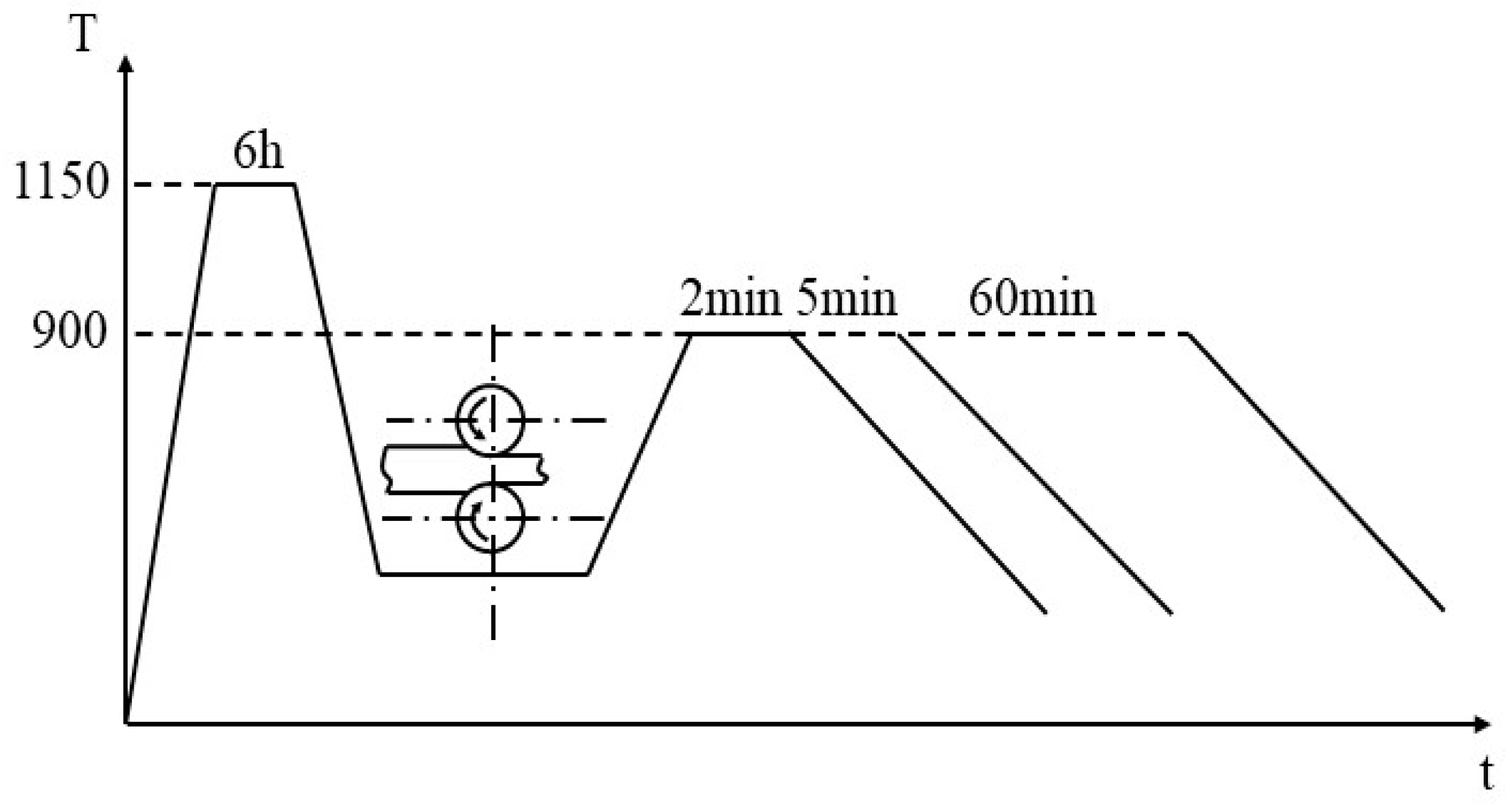
FeCoCrNiMn high-entropy alloy with equal atomic ratios was synthesized from high-purity raw materials (Fe, Co, Ni, Cr, Mn; ≥99.9 wt.%). The constituent elements were re-melted four times in a vacuum induction melting furnace to ensure compositional homogeneity, resulting in cast ingots. Specimens with dimensions of 60 × 30 × 10 mm3 were extracted from the as-cast ingots using wire electrical discharge machining (EDM) and subsequently homogenized at 1150 °C for 6 h. The homogenized samples were then subjected to cold rolling on a two-roll laboratory rolling mill to achieve an 80% thickness reduction. Following deformation, the cold-rolled sheets were annealed in a muffle furnace (KSL-1200X, Hefei Kejing Materials Technology Co., Ltd., Hefei, Anhui, China). preheated to 900 °C for 2, 5, and 60 min, respectively, as shown in Figure 1. After the furnace temperature stabilized, the samples were rapidly inserted into the hot zone, and the holding time was counted from the moment of insertion. After annealing for the designated time, the samples were removed from the furnace and immediately water-quenched.
The microstructural characteristics of both as-cast and cold-rolled annealed samples were examined using metallographic microscopy, X-ray diffraction (XRD, Rigaku SmartLab, Tokyo, Japan), and electron backscatter diffraction (EBSD, Oxford Symmetry 2, Oxford Instruments plc, High Wycombe, UK). XRD analysis was conducted with Cu-Kα radiation, operating at an accelerating voltage of 40 kV and a current of 30 mA, with a scanning rate of 5°/min. EBSD measurements were carried out on a TESCAN MIRA3 field-emission scanning electron microscope (SEM, MIRA3, TESCAN, Brno, Czech Republic). Subsequent data analysis was performed using dedicated software to evaluate grain size, grain orientation, recrystallization fraction, and related microstructural features. EBSD scans were performed at an accelerating voltage of 20 kV with a scan step size ranging from 0.1 to 0.5 μm. Typically, the scan step size for EBSD is chosen to be 1/3 of the minimum grain size. The acquired EBSD data were analyzed using Channel 5 software. Microhardness variations were measured with a TWVS-1 microhardness tester (Beijing Wowei Technology Co., Ltd., Beijing, China) under a load of 50 g applied for 10 s. Tensile tests were conducted on a Shimadzu AGX universal testing machine at a constant strain rate of 1 × 10⁻³ s−1, using specimens with a gauge section of 10 mm × 3 mm × 2 mm. The post-deformation fracture morphologies were observed via SEM to examine the fracture mechanisms.
Figure 1. Thermomechanical treatment process of FeCoCrNiMn alloy.
Coatings 16 00513 g001

3. Experimental Results and Discussion

3.1. Microstructure

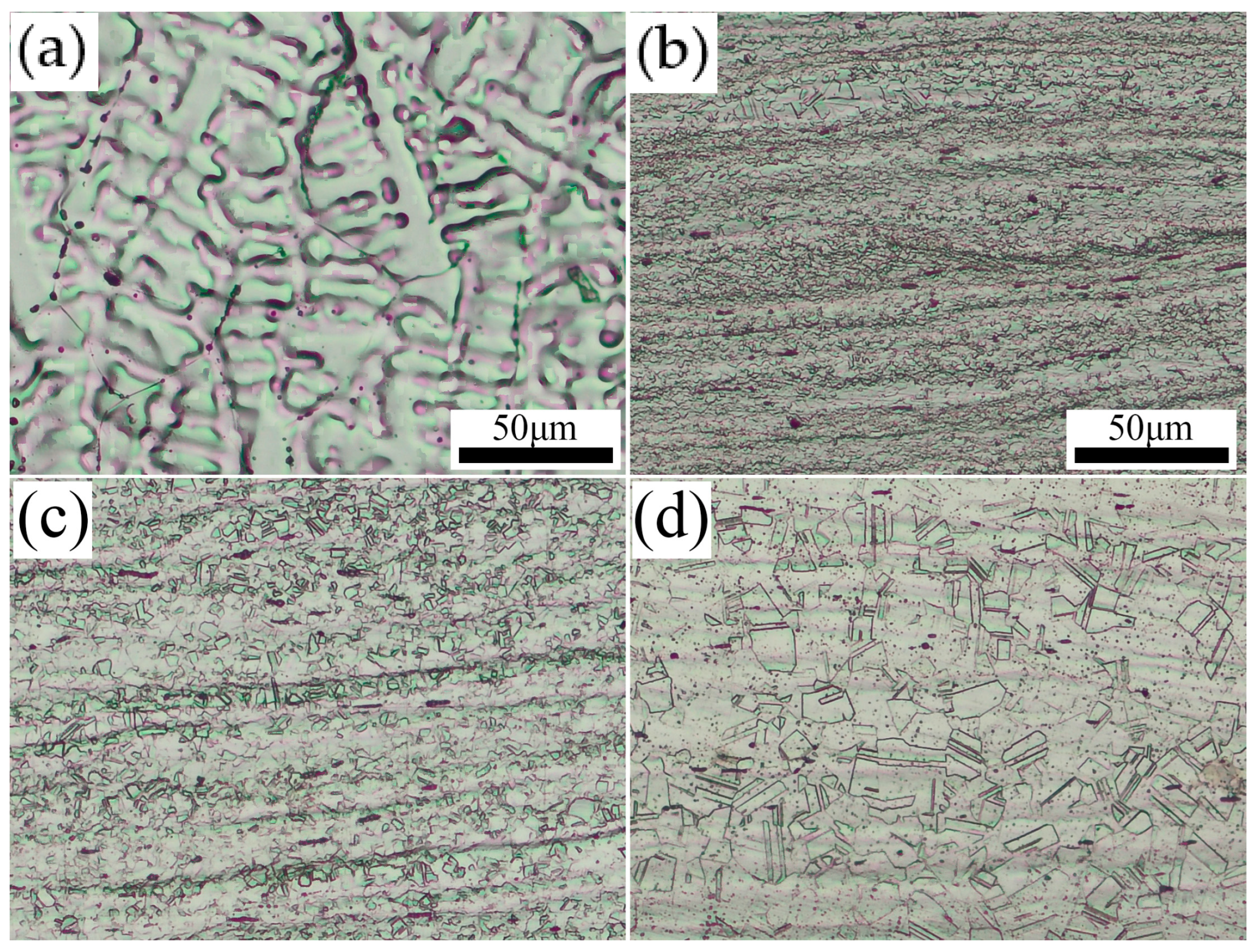
Figure 2 shows the metallographic structures of the as-cast sample and the cold-rolled samples annealed at 900 °C for different durations. It should be noted that the cold-rolled condition itself is not included in Figure 2, because it was not directly characterized by metallographic microscopy in the present study. Therefore, Figure 2 compares the as-cast state with the annealed states after cold rolling. It should be noted that the cold-rolled microstructure was not characterized in detail in the present study. However, the deformed microstructure of 80% cold-rolled FeCoCrNiMn HEA has been extensively documented in the literature [9,16], consistently showing elongated grains, strong deformation textures, abundant dislocation substructures, and the retention of a single-phase FCC structure. The rapid recrystallization observed in this study at 900 °C—yielding ultrafine recrystallized grains within 2 min is fully consistent with the expected behavior of a heavily deformed precursor with high stored energy. The reason why 900 °C is chosen is that it is much higher than the recrystallization completion temperature of the alloy (~750 °C), while still within the single-phase FCC region. This temperature allows rapid recrystallization within several minutes, so that the short-term annealing effect can be investigated. At 900 °C, the expected microstructure is a fully recrystallized FCC structure with possible annealing twins, and the grain size increases with prolonged annealing time. As shown in Figure 2a, the as-cast sample exhibits a typical coarse dendrite structure. The dendrites were eliminated after homogenization, cold rolling and subsequent annealing treatment. Figure 2b presents the microstructure of the cold-rolled FeCoCrNiMn alloy annealed at 900 °C for 2 min. It can be seen that a small amount of rolling deformation band structure is still retained in the annealed sample, the recrystallized grains are extremely fine but inhomogeneous in size, and a large number of annealing twins appear. When the annealing time reaches 5 min, the deformed structure undergoes sufficient recovery and recrystallization, the grains grow obviously with clear grain boundaries, and the annealing twin structure is clearly visible (Figure 2c). In the sample annealed for 60 min (Figure 2d), the recrystallized grains are further coarsened with a great number of annealing twins generated, and the twin boundaries span the entire grains.
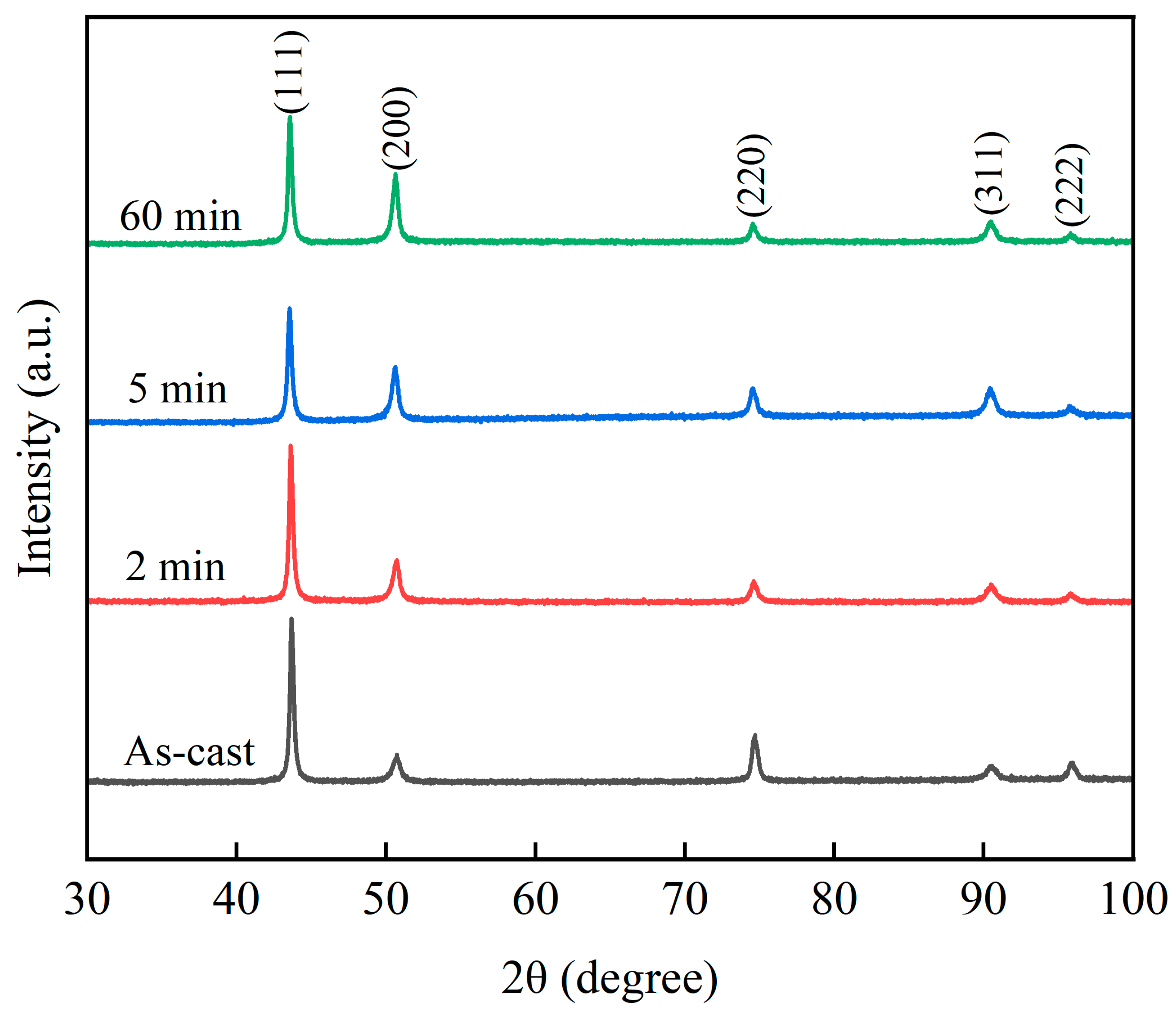
The XRD patterns of the samples under different processing conditions are presented in Figure 3. The as-cast FeCoCrNiMn alloy exhibits a single-phase face-centered cubic (FCC) structure, with five distinct diffraction peaks corresponding to the (111), (200), (220), (311), and (222) crystal planes, respectively. No additional diffraction peaks were detected following cold rolling and subsequent annealing for various durations, indicating the absence of phase transformation during isothermal annealing. This structural stability is primarily attributed to the high mixing entropy characteristic of the FeCoCrNiMn high-entropy alloy, which confers enhanced thermodynamic stability [20]. Furthermore, as the annealing time increases, the intensities of the (111) and (200) diffraction peaks progressively rise, suggesting that annealing exerts a notable influence on the grain orientation of the cold-rolled alloy. Such evolution of texture and preferred orientation is generally associated with the recovery and recrystallization processes occurring in the deformed microstructure.
The retention of the single-phase FCC structure during annealing is not solely due to high configurational entropy. As demonstrated by Yang et al. [21], the formation enthalpy and non-configurational entropy (e.g., vibrational, electronic, magnetic) play equally important roles. In particular, Ma et al. [22] showed that vibrational entropy dominates the stabilization of the FCC phase in the Cantor alloy, and that configurational entropy alone is insufficient to explain phase stability.
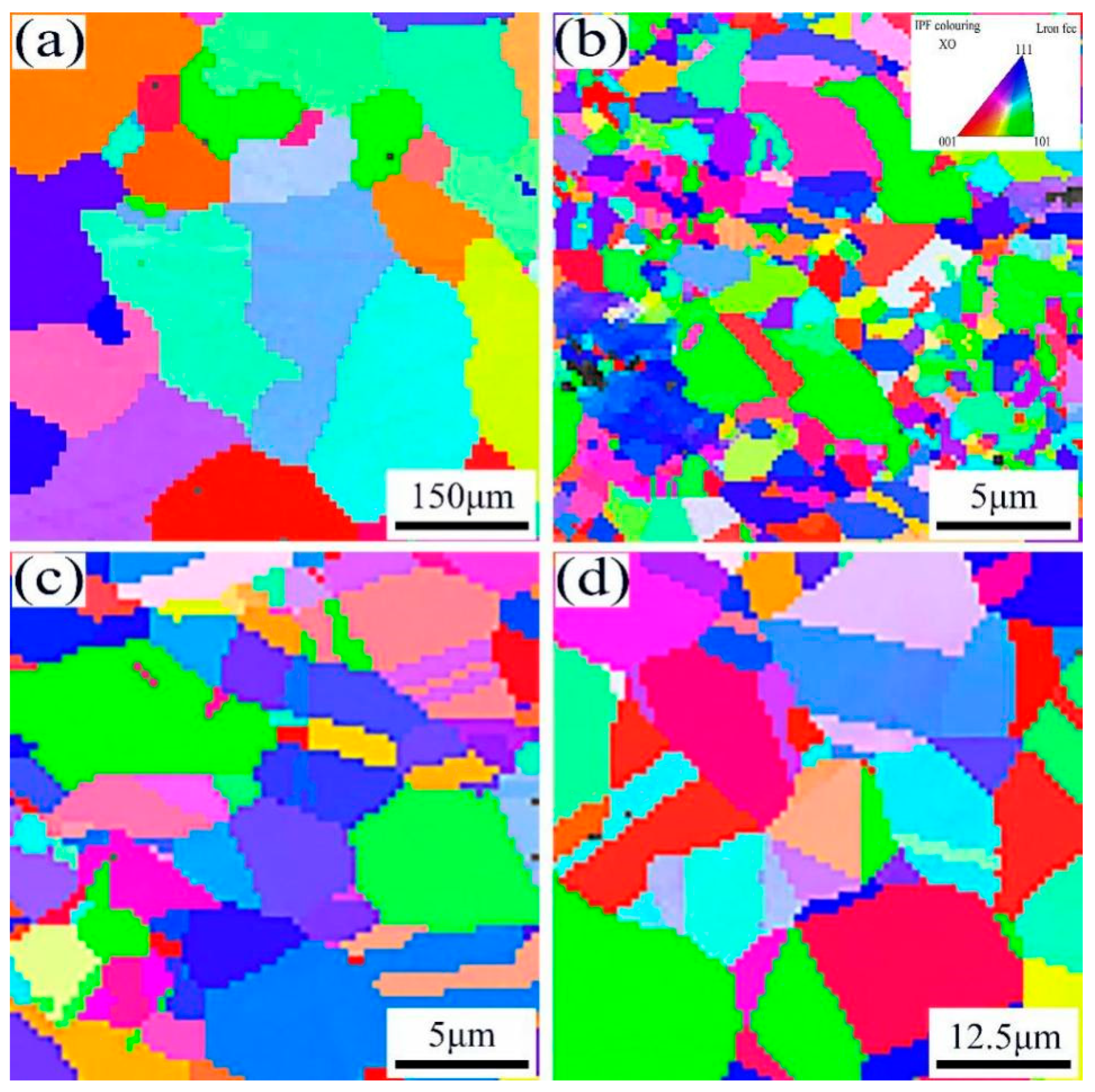
The microstructural evolution of the FeCoCrNiMn alloy under various annealing conditions is illustrated in the EBSD inverse pole figures shown in Figure 4. Figure 4a presents the microstructure of the as-cast alloy, revealing coarse grains prior to cold rolling. Quantitative analysis yields an average grain size of approximately 100 μm. Following cold rolling and annealing at 900 °C for 2 min (Figure 4b), the sample exhibits pronounced recrystallization, characterized by a microstructure predominantly composed of ultrafine grains with dimensions below 1 μm; the statistically determined average grain size is 0.75 μm. After annealing for 5 min (Figure 4c), the microstructure becomes fully recrystallized, accompanied by a marked increase in grain size to an average of 1.7 μm. Notably, a substantial population of annealing twins is observed within these recrystallized grains. Upon further annealing to 60 min (Figure 4d), continued grain growth occurs, resulting in an average grain size of 5.7 μm.
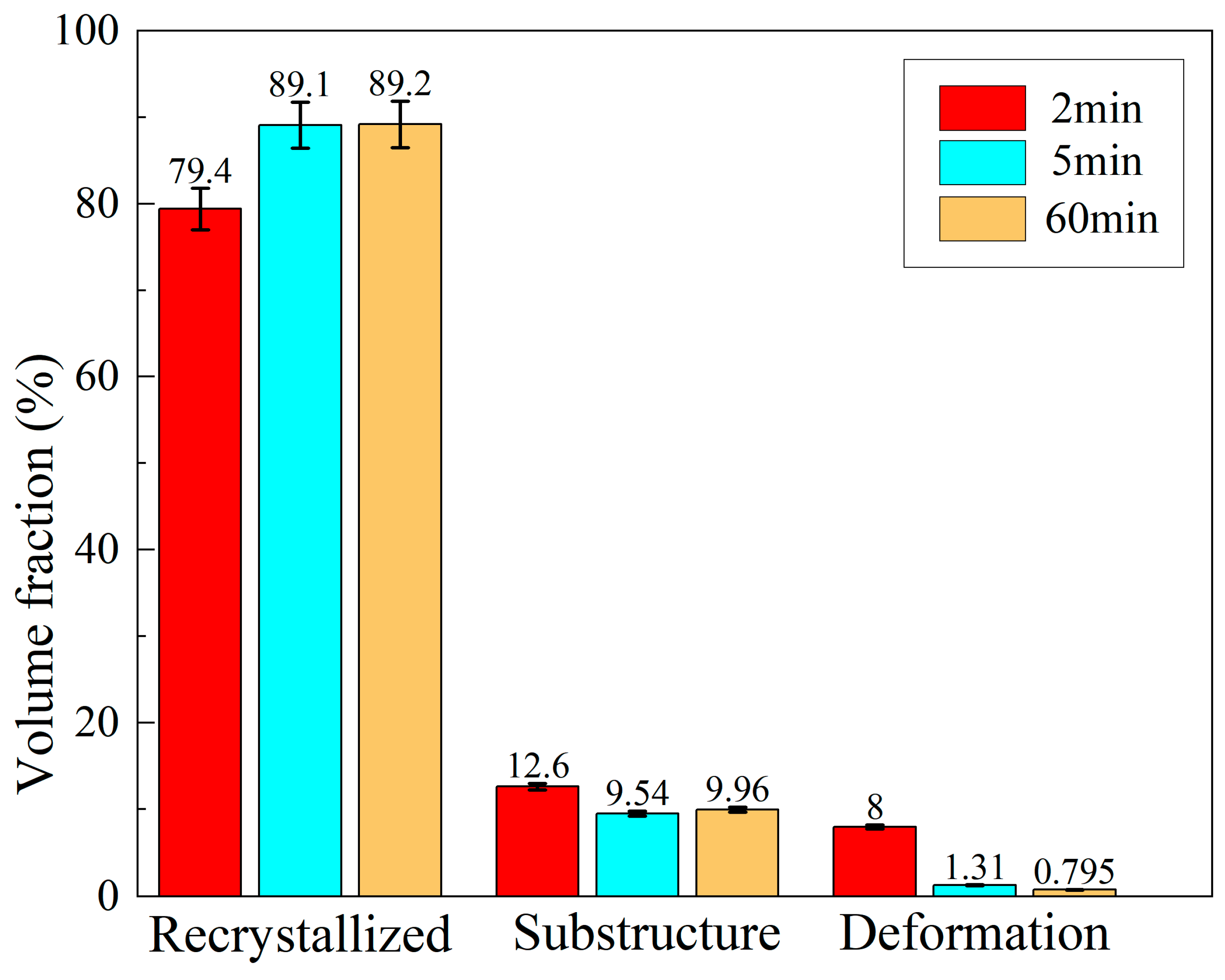
The very rapid microstructural evolution observed within 2–5 min at 900 °C should be understood as static recrystallization of the heavily cold-rolled structure rather than as a phase transformation. After 80% cold rolling, the alloy stores a large amount of deformation energy in the form of dislocations, deformation bands, and deformation twins, which provide both the driving force for recrystallization and abundant preferential nucleation sites. At 900 °C, grain-boundary mobility and atomic mobility are sufficiently high to enable rapid nucleation and growth of recrystallized grains into the deformed matrix. As a result, the recrystallized fraction reaches approximately 80% after 2 min and becomes nearly complete after 5 min, consistent with the EBSD observations shown in Figure 4 and Figure 5.
The evolution of recrystallized, substructured, and deformed microstructural fractions in the cold-rolled alloy annealed at 900 °C for varying durations is quantified in Figure 5. Following plastic deformation, metallic materials accumulate a high density of crystalline defects, such as vacancies and dislocations, resulting in an increase in stored deformation energy. Upon subsequent annealing, this elevated distortion energy serves as the driving force for restoration processes, including recovery, recrystallization, and grain growth. As the annealing time prolongs, recrystallization progresses continuously: the volume fraction of recrystallized grains increases progressively, while that of the deformed structure correspondingly diminishes. Meanwhile, substructures are observed in microstructures that have undergone partial recrystallization. According to the classical theory of recrystallization kinetics, the evolution of the recrystallized volume fraction as a function of annealing time under isothermal conditions can be described by the Avrami equation [23]:
φ R = 1 e x p B t K
where φR represents the recrystallized volume fraction and t is the annealing time. The parameters B and K are characteristic constants that govern the recrystallization kinetics; their values provide insights into the underlying nucleation and growth mechanisms and enable the prediction or simulation of the recrystallization behavior of the FeCoCrNiMn alloy under various annealing conditions. Based on the experimental data presented in Figure 5, the constants K and B are determined to be approximately 0.08 and 1.67, respectively. Accordingly, the Avrami equation describing the isothermal recrystallization kinetics at 900 °C is expressed as: φ R =   1     exp 1.67 t 0.08 .
The Avrami exponent K obtained in this study (≈0.08) is significantly lower than typical values for recrystallization in conventional metals (K ≈ 1–2), but falls within the range reported for other high-entropy alloys (K ≈ 0.1–0.8). Such low K values indicate site saturation—i.e., nucleation occurs almost instantaneously at pre-existing deformation heterogeneities, and subsequent recrystallization is dominated by growth of these nuclei. In the FeCoCrNiMn HEA, the high density of nucleation sites generated by 80% cold rolling, combined with the sluggish diffusion and lattice distortion characteristic of HEAs, suppresses continuous nucleation and reduces grain boundary mobility. As a result, the recrystallization kinetics are governed by early site saturation followed by slow growth, yielding a very low Avrami exponent.
It should be noted that the recrystallization kinetics and grain growth behavior observed in this study may also be influenced by the presence of local chemical order in the FeCoCrNiMn alloy. Recent studies have shown that LCO/SRO can affect boundary mobilities and the stored energy of deformation, thereby modifying recrystallization kinetics [17,18]. While a detailed investigation of LCO/SRO evolution during short-time annealing is beyond the scope of the present work, we acknowledge that the simplified interpretation based solely on the high-entropy effect does not capture the full complexity of the microstructural evolution. Future work combining advanced characterization techniques such as atom probe tomography and scanning tunneling microscopy with quantitative kinetic analysis is needed to elucidate the interplay between LCO/SRO and recrystallization in this alloy system.
The Avrami parameters (K ≈ 0.08, B ≈ 1.67) quantitatively capture the recrystallization kinetics at 900 °C. It should be noted that the observed kinetics may not be driven solely by deformation-stored energy. Recent evidence indicates that local chemical order (LCO) or short-range order (SRO) can exist in the Cantor alloy system, potentially influencing recrystallization by modulating dislocation mobility and boundary migration [24]. Thus, the extracted parameters may reflect the combined effects of high stored energy and the subtle influence of LCO/SRO. However, in the absence of quantitative models linking LCO/SRO characteristics to recrystallization kinetics in this system, deconvoluting these contributions remains beyond the scope of this study. Future work combining local chemical characterization with in situ annealing is warranted to clarify this interaction.

3.2. Mechanical Properties

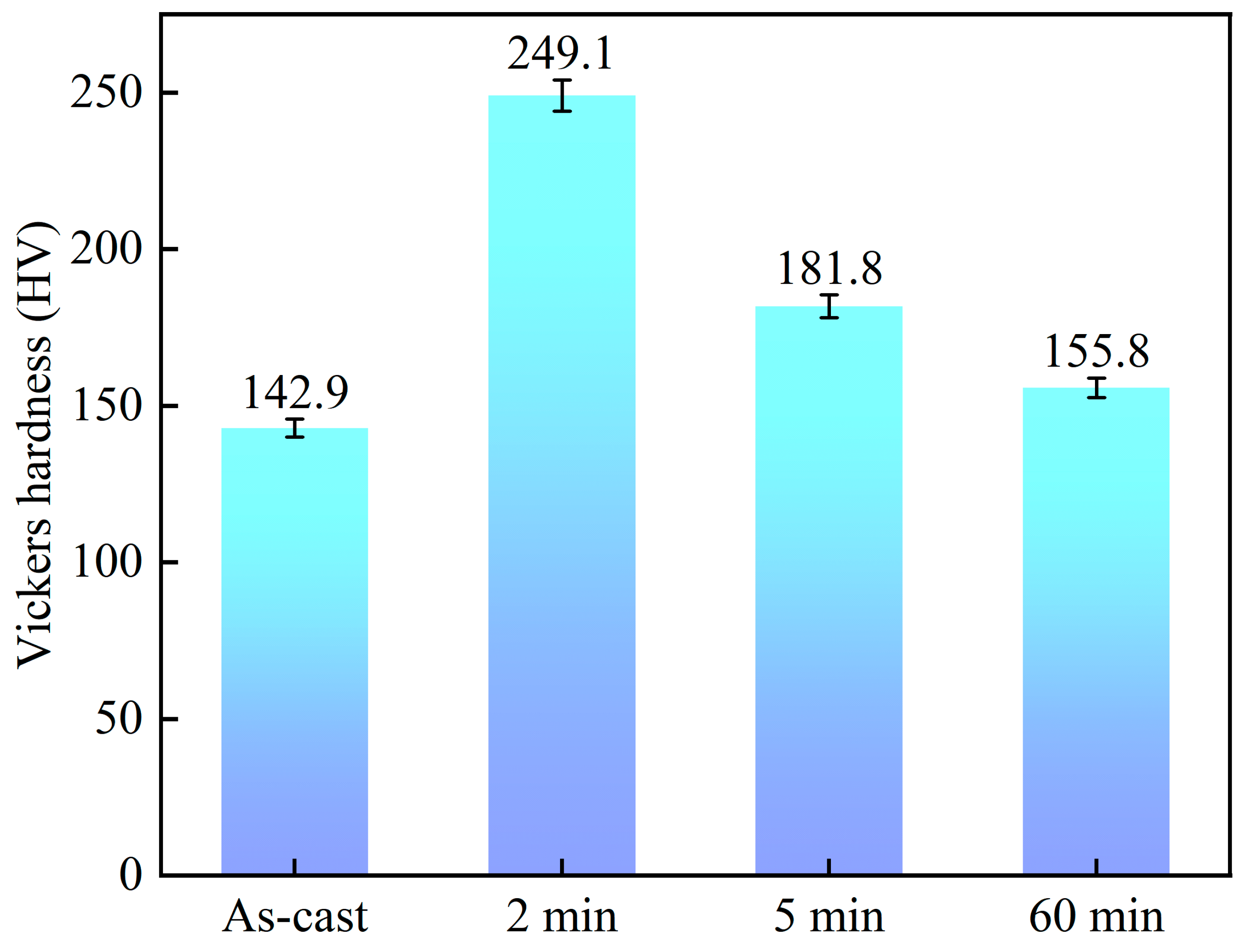
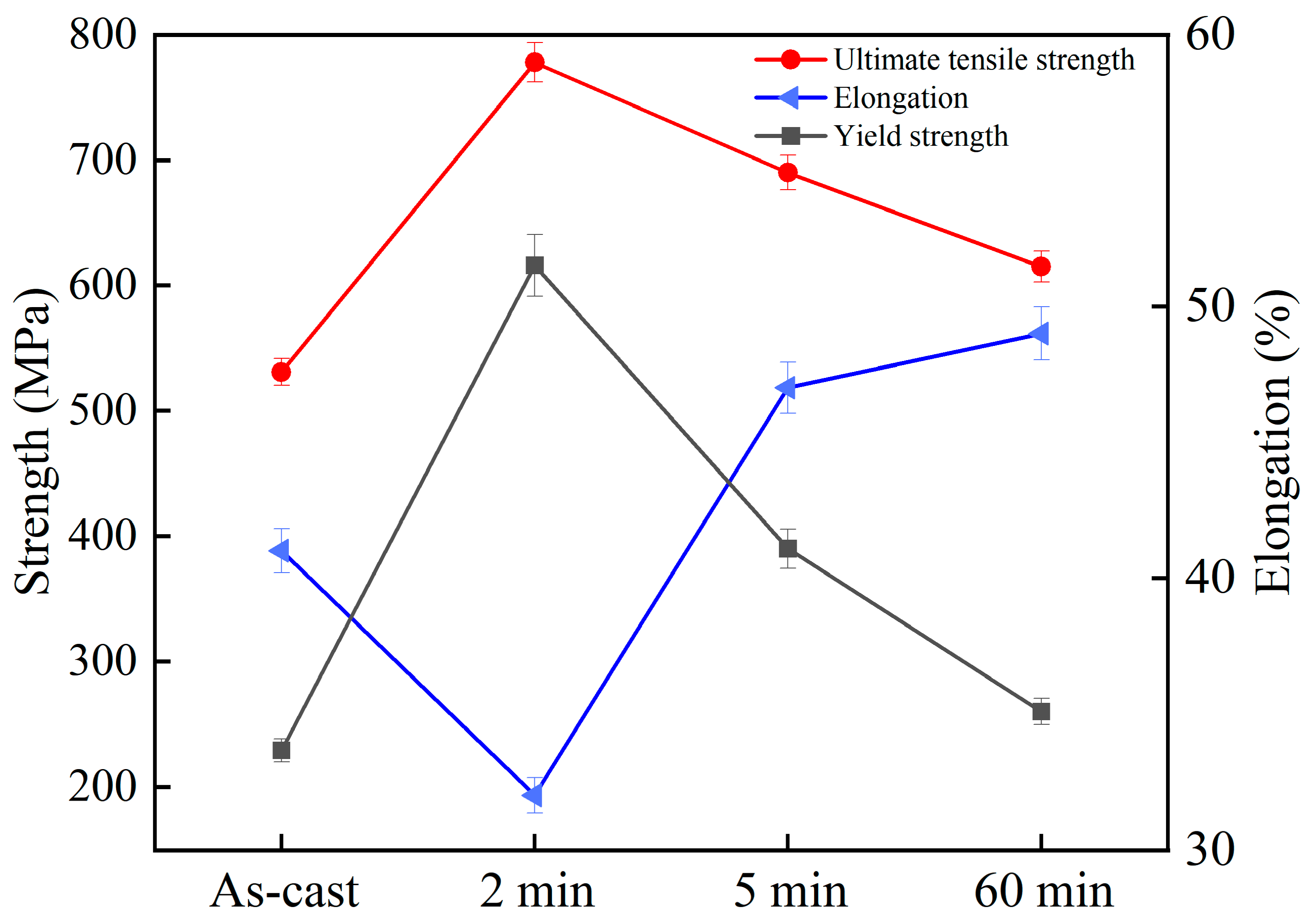
The microhardness evolution of the as-cast alloy and the cold-rolled specimens annealed at 900 °C for various durations is illustrated in Figure 6. The as-cast sample exhibits a relatively low hardness of only 142.9 HV. Following cold rolling and subsequent annealing, the hardness increases substantially. After annealing for 2 min, the alloy displays a markedly refined grain structure alongside a fraction of un-recrystallized regions, yielding a hardness of 249.1 HV—a substantial increase of 74.3% compared to the as-cast condition. However, as the annealing time is extended to 5 min and 60 min, the hardness decreases significantly to 181.8 HV and 155.8 HV, respectively. As revealed by microstructural characterization, prolonged annealing promotes more complete recovery and recrystallization, accompanied by continuous grain growth. This progression leads to a reduction in grain boundary density, thereby weakening the grain boundary strengthening effect and resulting in a progressive decline in hardness [25]. The tensile properties of the samples under different processing conditions are summarized in Figure 7. The as-cast alloy exhibits relatively low strength combined with high ductility, characterized by a yield strength of 229 MPa, an ultimate tensile strength of 531 MPa, and an elongation to failure exceeding 40%. Upon cold rolling and subsequent annealing, the strength is substantially enhanced. For the specimen annealed at 900 °C for 2 min, the yield strength, ultimate tensile strength, and elongation reach 616 MPa, 778 MPa, and 32%, respectively, demonstrating a favorable combination of strength and ductility and thus superior overall mechanical performance. As the annealing time further increases, the strength progressively decreases while the elongation correspondingly increases, reflecting a typical strength–ductility trade-off relationship.
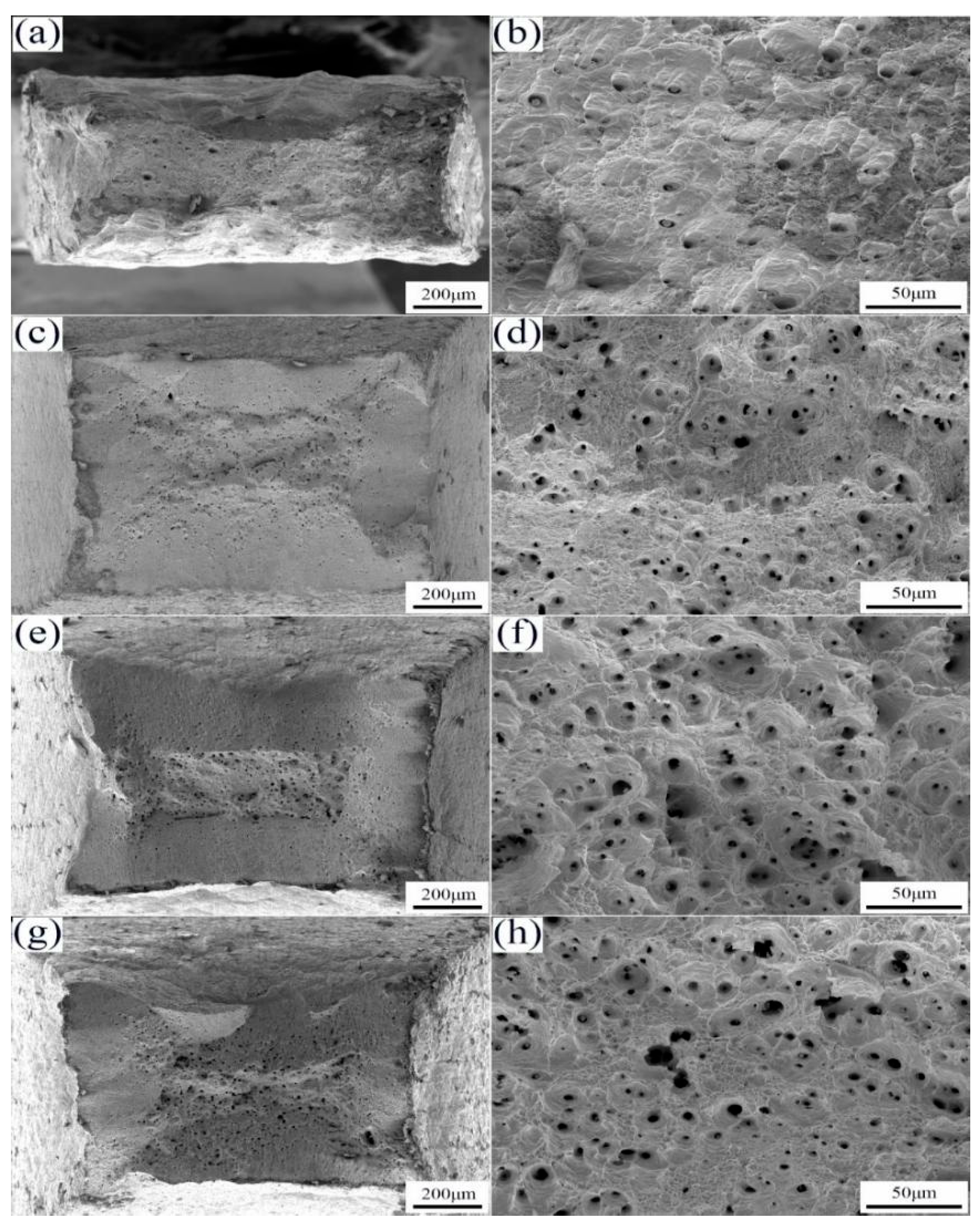
The tensile fracture morphologies of the FeCoCrNiMn high-entropy alloy under various processing conditions are presented in Figure 8. The macroscopic fracture features shown on the left reveal that all samples exhibit a typical cup-and-cone fracture morphology, characterized by a distinct fibrous region and a shear lip region. The absence of an observable radial zone or macroscopic cracks indicates favorable toughness of the material. The corresponding magnified images on the right provide further insight into the detailed fracture characteristics. For the as-cast sample, the fracture surface is decorated with small, shallow dimples alongside river-like tearing patterns, indicative of a mixed fracture mode involving both cleavage and ductile dimple mechanisms. Following cold rolling and subsequent annealing at 900 °C for 2 min, the fibrous region of the fracture surface is covered with a high density of fine dimples and micro-voids, suggesting a transition to a predominantly ductile dimple fracture mechanism. As the annealing time increases, larger and deeper dimples and voids become evident on the fracture surface. Concurrently, the fibrous region exhibits increased roughness and undulation, reflecting enhanced plastic deformation capability. These observations corroborate that the ductility of the alloy progressively improves with prolonged annealing time.

4. Conclusions

This study systematically investigated the evolution of microstructure and mechanical properties in a cold-rolled FeCoCrNiMn high-entropy alloy as a function of annealing time. The main conclusions drawn are as follows:
(i)
After annealing at 900 °C for 2 min, the cold-rolled FeCoCrNiMn high-entropy alloy exhibited a significantly refined microstructure, with a recrystallized grain size of approximately 0.75 μm, concurrent with the formation of numerous annealing twins. As the annealing time increased, the grain size gradually coarsened, and the recrystallized volume fraction correspondingly increased.
(ii)
The specimen annealed at 900 °C for 2 min demonstrated an excellent strength–ductility synergy, achieving a yield strength of 616 MPa and an elongation of 32%. As the annealing time prolonged, ductility was progressively enhanced while strength decreased, reflecting a typical inverse relationship between strength and ductility.
(iii)
Fractographic analysis revealed that the dominant fracture mechanism of the FeCoCrNiMn high-entropy alloy was ductile dimple fracture, characterized by a fracture surface comprising a fibrous region and a shear lip region. With increasing grain size, the fibrous region exhibited increased roughness and undulation, accompanied by the formation of larger and deeper dimples and micro-voids, signifying an improvement in the plastic deformation capability of the alloy—consistent with the tensile test results.
(iv)
We also acknowledge that the interpretation presented in this work, which focuses primarily on the high-entropy effect, does not fully account for the potential influence of local chemical order on recrystallization behavior. This represents a limitation of the current study and a direction for future investigation.

Author Contributions

Conceptualization, W.Z. and S.X.; Methodology, W.Z. and S.X.; Software, W.Z., X.L. and Z.L.; Data Curation, W.Z., X.L., Z.L. and S.X.; Writing—Original Draft, W.Z., X.L. and Z.L.; Writing—Review and Editing, S.X.; Supervision, S.X. All authors have read and agreed to the published version of the manuscript.

Funding

This work was supported by the QUTJBZ Program (No. 2025ZDZX17).

Institutional Review Board Statement

Not applicable.

Informed Consent Statement

Not applicable.

Data Availability Statement

Data are contained within the article.

Conflicts of Interest

The authors declare no conflict of interest.

References

  1. Cantor, B.; Chang, I.T.H.; Knight, P.; Vincent, A.J.B. Microstructural development in equiatomic multicomponent alloys. Mater. Sci. Eng. A 2004, 375–377, 213–218. [Google Scholar] [CrossRef]
  2. Zhao, Y.Y.; Chen, H.W.; Lu, Z.P.; Nieh, T. Thermal stability and coarsening of coherent particles in a precipitation-hardened (NiCoFeCr)94Ti2Al4 high-entropy alloy. Acta Mater. 2018, 147, 184–194. [Google Scholar]
  3. Praveen, S.; Kim, H.S. High-Entropy Alloys: Potential Candidates for High-Temperature Applications—An Overview. Adv. Eng. Mater. 2017, 20, 1700645. [Google Scholar]
  4. Tsao, T.-K.; Yeh, A.-C.; Kuo, C.-M.; Murakami, H. On The Superior High Temperature Hardness of Precipitation Strengthened High Entropy Ni-Based Alloys. Adv. Eng. Mater. 2016, 19, 1600475. [Google Scholar]
  5. Zhang, S.; Wang, Z.; Lin, W.; Guo, H. Research Progress on Tribological Properties of High-Entropy Alloys. Lubricants 2025, 13, 342. [Google Scholar] [CrossRef]
  6. Wang, L.; Zhang, L.; Lu, X.; Wu, F.; Sun, X.; Zhao, H.; Li, Q. Surprising cocktail effect in high entropy alloys on catalyzing magnesium hydride for solid-state hydrogen storage Cocktail effect of High entropy alloys and Marking of Linear scaling Relationship Breaking effect on electrocatalytic volcano curves. Chem. Eng. J. 2023, 465, 1873–3212. [Google Scholar]
  7. Pickering, E.J.; Jones, N.G. High-entropy alloys: A critical assessment of their founding principles and future prospects. Int. Mater. Rev. 2016, 61, 183–202. [Google Scholar] [CrossRef]
  8. Abbasi, E.; Dehghani, K. Microstructure and mechanical properties of Co19Cr20Fe20Mn21Ni19 and Co19Cr20Fe20Mn21Ni19Nb0.06C0.8 high-entropy/compositionally-complexalloys after annealing. Mater. Sci. Eng. A 2020, 772, 138812. [Google Scholar]
  9. Li, Z.; Fu, L.; Peng, J.; Zheng, H.; Shan, A. Effect of annealing on microstructure and mechanical properties of an ultrafine-structured Al-containing FeCoCrNiMn high-entropy alloy produced by severe cold rolling. Mater. Sci. Eng. A 2020, 786, 139446. [Google Scholar] [CrossRef]
  10. Wang, X.; Li, X.; Xie, H.; Fan, T.; Zhang, L.; Li, K.; Cao, Y.; Yang, X.; Liu, B.; Bai, P. Effects of Al and La elements on mechanical properties of CoNiFe0.6Cr0.6 high-entropy alloys: A first-principles study. J. Mater. Res. Technol. 2023, 23, 1130–1140. [Google Scholar]
  11. Nagarjuna, C.; Dewangan, S.K.; Rao, K.R.; Lee, H.; Song, E.; Ahn, B. Effect of Processing and Heat Treatment on the Phase Kinetics, Microstructure, and Hardness Behavior of CoCrFeMnNi High Entropy Alloy. Metall. Mater. Trans. A 2025, 56, 1339–1352. [Google Scholar] [CrossRef]
  12. Zhang, T.; Xin, L.; Wu, F.; Zhao, R.; Xiang, J.; Chen, M.; Jiang, S.; Huang, Y.; Chen, S. Microstructure and mechanical properties of FexCoCrNiMn high-entropy alloys. J. Mater. Sci. Technol. 2019, 35, 2331–2335. [Google Scholar] [CrossRef]
  13. Guo, L.; Ou, X.; Ni, S.; Liu, Y.; Song, M. Effects of carbon on the microstructures and mechanical properties of FeCoCrNiMn high entropy alloys. Mater. Sci. Eng. A 2019, 746, 356–362. [Google Scholar] [CrossRef]
  14. Deng, W.; Xing, S.; Chen, M. Effect of annealing treatments on microstructure, tensile and wear properties of cold-rolled FeCoCrNiMn high entropy alloy. J. Mater. Res. Technol. 2023, 27, 3849–3859. [Google Scholar] [CrossRef]
  15. Sarmadi, M.A.; Atapour, M.; Alizadeh, M. Influence of Cold Rolling on the Microstructure and Mechanical Properties of FeCoCrNiMn High-Entropy Alloy. Metallogr. Microstruct. Anal. 2024, 13, 220–230. [Google Scholar] [CrossRef]
  16. Li, Z.; Fu, L.; Zheng, H.; Yu, R.; Lv, L.; Sun, Y.; Dong, X.; Shan, A. Effect of Annealing Temperature on Microstructure and Mechanical Properties of a Severe Cold-Rolled FeCoCrNiMn High-Entropy Alloy. Metall. Mater. Trans. A 2019, 50, 3223–3237. [Google Scholar] [CrossRef]
  17. Kim, L.; Sharma, P.; Tsai, C.-W.; Huang, E.-W.; Liaw, P.K.; Yeh, J.-W.; Balasubramanian, G.; Chien, T. Direct visualization of the existence of surface local chemical order in a high-entropy CoCrFeMnNi alloy. Nat. Commun. 2026. [Google Scholar] [CrossRef]
  18. Zhang, R.; Zhao, S.; Ding, J.; Chong, Y.; Jia, T.; Ophus, C.; Asta, M.; Ritchie, R.O.; Minor, A.M. Short-range order and its impact on the CrCoNi medium-entropy alloy. Nature 2020, 581, 283–287. [Google Scholar] [CrossRef]
  19. Chen, S.; Aitken, Z.H.; Pattamatta, S.; Wu, Z.; Yu, Z.G.; Srolovitz, D.J.; Liaw, P.K.; Zhang, Y.-W. Simultaneously enhancing the ultimate strength and ductility of high-entropy alloys via short-range ordering. Nat. Commun. 2021, 12, 4953. [Google Scholar] [CrossRef]
  20. Yeh, J.W.; Chen, S.K.; Lin, S.J.; Gan, J.Y.; Chin, T.S.; Shun, T.T.; Tsau, C.H.; Chang, S.Y. Nanostructured high-entropy alloys with multiple principal elements: Novel alloy design concepts and outcomes. Adv. Eng. Mater. 2004, 6, 299–303. [Google Scholar] [CrossRef]
  21. Otto, F.; Yang, Y.; Bei, H.; George, E.P. Relative effects of enthalpy and entropy on the phase stability of equiatomic high-entropy alloys. Acta Mater. 2013, 61, 2628–2638. [Google Scholar] [CrossRef]
  22. Ma, D.; Grabowski, B.; Körmann, F.; Neugebauer, J.; Raabe, D. Ab initio thermodynamics of the CoCrFeMnNi high entropy alloy: Importance of entropy contributions beyond the configurational one. Acta Mater. 2015, 100, 90–97. [Google Scholar]
  23. Wiktor, T.; Burbelko, A.; Zaczyński, A. Application of the Avrami Equation to the Dilatometric Analysis of ADI Austempering Kinetics. Materials 2025, 18, 5039. [Google Scholar] [CrossRef]
  24. Adaan-Nyiak, M.A.; Cleveland, M.; Hewitt, B.; Jossou, E.; Topsakal, M.; Gill, S.K.; Hwang, S.; Kisslinger, K.; Tiamiyu, A.A. Grain Boundary Segregation Suppresses Local Short-Range Ordering in Nanocrystalline High-Entropy Alloys. Adv. Sci. 2026, 13, e15510. [Google Scholar]
  25. Le, M.D.; Nguyen, T.-D.; Nguyen, T.H.; Nguyen, V.T.; Nguyen, D.C.; Tran, V.N.; Nguyen, H.H.; Lee, S.Y.; Pham, M.K. Effect of Annealing Temperature on Microstructure and Mechanical Properties of FeCoNiAl0.25Mn0.75Ti0.25 High Entropy Alloy. Met. Mater. Int. 2026, 32, 723–733. [Google Scholar] [CrossRef]
Figure 2. Metallographic microstructure of as-cast and cold-rolled samples annealed at 900 °C for different times: (a) as-cast; (b) 2 min; (c) 5 min; (d) 60 min.
Coatings 16 00513 g002
Figure 3. XRD patterns of different samples.
Coatings 16 00513 g003
Figure 4. EBSD inverse pole figure of as-cast and cold-rolled samples annealed at 900 °C for different times. (a) as-cast; (b) 2 min; (c) 5 min; (d) 60 min.
Coatings 16 00513 g004
Figure 5. Volume fractions of recrystallized, substructured and deformed microstructure of cold-rolled alloy annealed at 900 °C for different times.
Coatings 16 00513 g005
Figure 6. Microhardness of as-cast and cold-rolled samples annealed at 900 °C for various times.
Coatings 16 00513 g006
Figure 7. Tensile properties of different samples.
Coatings 16 00513 g007
Figure 8. Fracture surface morphology of FeCoCrNiMn alloy (a,b) as-cast; (c,d) 2 min; (e,f) 5 min; (g,h) 60 min.
Coatings 16 00513 g008
Table 1. Comparison of representative related studies.
ReferenceProcessing RouteAnnealing ConditionGrain SizeElongation (%)Yield Strength (MPa)
[16]Severe cold-rolled FeCoCrNiMn650 °C, 60 min<0.5 μm19.0930
[14]Heavy cold-rolled FeCoCrNiMn900 °C, 2 min~0.75 μm>30~620
[15]Cold-rolled CoCrFeNiMn700 °C, 60 min~1.5/~6 μm (bimodal)30590
Disclaimer/Publisher’s Note: The statements, opinions and data contained in all publications are solely those of the individual author(s) and contributor(s) and not of MDPI and/or the editor(s). MDPI and/or the editor(s) disclaim responsibility for any injury to people or property resulting from any ideas, methods, instructions or products referred to in the content.