Article

Low-Frictional Properties of Si-DLC Coatings Sliding Against Aluminum Alloy Under Humid Conditions


1
Department of Mechanical Engineering, Faculty of Engineering, Gifu University, Gifu 501-1193, Japan
2
Center for Applied Research of Plasma, Faculty of Engineering, Gifu University, Gifu 501-1193, Japan
3
Department of Mechanical Engineering, Tokyo City University, Tokyo 158-8557, Japan
4
Department of Mechanical Engineering, Yonsei University, Seoul 03722, Republic of Korea
*
Author to whom correspondence should be addressed.
Coatings 2026, 16(5), 510; https://doi.org/10.3390/coatings16050510
Submission received: 23 March 2026 / Revised: 19 April 2026 / Accepted: 20 April 2026 / Published: 22 April 2026
(This article belongs to the Special Issue Advanced Tribological Coatings: Fabrication and Application)

Abstract

Silicon-doped diamond-like carbon (Si-DLC) coatings against aluminum alloy (A5052) were investigated for reducing friction under humid conditions. The coatings were deposited on high-speed steel (SKH51) substrates using a bipolar-type plasma-based ion implantation and deposition (PBII&D) technique, with Si content controlled by varying the tetramethylsilane (TMS)-to-toluene precursor ratio. Structural characterization by Raman spectroscopy and X-ray photoelectron spectroscopy (XPS) confirmed the progressive evolution of Si–C bonding with increasing TMS ratio. The Si-DLC coating with Si 5.0 at.% exhibited the lowest coefficient of friction (COF) of 0.033 and reduced wear volume under a high normal load of 150 N in humid conditions (relative humidity > 90%). However, Si-DLC coatings with higher Si contents (Si 7.7 and 14.3 at.%) led to deteriorated tribological performance, including coating delamination and severe wear. Surface analyses of the coatings revealed that the low-friction behavior was associated with the presence of oxidized Si species at the outermost surface, which undergo hydroxylation in humid environments to form Si–OH groups. These hydroxylated surfaces promote the formation of a hydrated boundary layer that provides a low-shear sliding interface.

1. Introduction

Across a wide range of industrial sectors, increasingly stringent environmental regulations and growing demands for sustainability have accelerated efforts to minimize or replace the use of lubricating oils [1]. In particular, manufacturing processes involving ductile metals such as aluminum have long relied on petroleum-based lubrication to ensure stable frictional behavior and process reliability [2]. However, the intrinsic drawbacks associated with conventional lubricants, including rising costs for waste oil treatment, the burden of post-process cleaning, and concerns over environmental contamination, have made the limitations of existing lubrication systems evident [1,3]. As a result, there is a rapidly growing demand for green-tribological technologies that can achieve stable low-friction performance while reducing dependence on petroleum-based lubricants [4].
Aluminum is among the representative ductile metals characterized by low hardness and high adhesive affinity. During sliding contact with counter materials, aluminum readily forms transfer films through the adhesion and subsequent material transfer of surface layers to the opposing surface [5]. This phenomenon is particularly pronounced under high-load conditions and often leads to a significant increase in the coefficient of friction (COF) [6,7], which can reach values as high as ~0.6 [8]. Such frictional instability is problematic in industrial processes; a notable example is the aluminum sheet rolling process, where aluminum pickup occurs on the roll surface [6]. The adhered aluminum layer can be subsequently re-transferred to the aluminum sheet, resulting in surface defects and non-uniform surface quality that degrade the final product quality. Consequently, most aluminum processing operations still rely heavily on petroleum-based lubrication [9], despite the fact that such approaches do not fundamentally resolve the associated environmental and operational challenges.
To reduce lubricant consumption, low-friction surface engineering strategies have been actively explored as potential alternatives. Among these, diamond-like carbon (DLC) coatings have demonstrated promising performance due to their high hardness, chemical inertness, and intrinsically low friction characteristics [10]. Previous studies have reported that DLC coatings can not only reduce friction but also suppress excessive transfer film formation and improve the chemical stability of the sliding interface when in contact with aluminum [11,12]. These attributes are particularly attractive for aluminum processing, as DLC coatings can potentially mitigate adhesive wear and material transfer. Nevertheless, most reported DLC-tribopaired systems still exhibit COFs in the range of ~0.2 against aluminum [11]. Although this represents a significant improvement over uncoated contacts, it is still insufficient to meet industrial requirements for stable ultra-low friction, typically defined as a COF below 0.1.
To overcome these limitations, various dopants have been introduced into DLC to enhance their tribological performance against aluminum under challenging conditions. For instance, fluorinated DLC (a-C:H:F [13] or ta-C:F [14]) coatings have been investigated for their ability to reduce the surface energy and mitigate aluminum adhesion; the studies showed that low fluorine content can effectively decrease the COF. Similarly, tungsten-doped DLC (W-DLC) has been explored at both room and elevated temperatures, though its performance often deteriorates above 100 °C due to increased material transfer [15]. While these specialized coatings offer specific advantages, achieving stable ultra-low friction remains a primary objective for practical manufacturing.
As an alternative strategy, friction reduction under water-based lubrication has recently attracted considerable attention. Carbon-based materials such as graphite are known to exhibit remarkably low friction in humid environments, where surface dangling bonds are passivated by adsorbed water molecules, leading to reduced interfacial shear strength [16]. Similarly, water molecules also contribute to friction reduction in DLC-based coatings; silicon-doped DLC (Si-DLC) has emerged as a representative low-friction coating under water lubrication, frequently exhibiting COF below 0.05 [17,18]. This exceptional performance has been attributed to the formation of hydrophilic surface states and tribochemical reactions involving water molecules, which promote the formation of lubricious boundary layers. From an industrial perspective, these findings suggest that Si-DLC coating has strong potential as an environmentally friendly alternative to petroleum-based lubrication.
Despite these promising results, the direct application of liquid water lubrication is often impractical in real manufacturing environments. Many industrial processes require dry or near-dry operation due to equipment constraints, corrosion risks, or contamination concerns [19]. In such cases, controlling friction under dry or semi-dry conditions becomes a critical challenge. Vapor-phase lubrication using water vapor offers a realistic compromise, as it can provide a humid environment without introducing bulk liquids into the process. In fact, ambient humidity can become a relevant process variable, and in some cases, the tribological interface may be exposed to elevated humidity as a consequence of the process environment [20].
The objective of this study is to achieve low-friction and environmentally sustainable performance in lubricant-excluded aluminum processing applications. While previous studies have explored various doped DLC coatings to mitigate aluminum adhesion in dry processing, their practical feasibility remains limited due to relatively high COFs (>0.15) [13,14,15]. In addition, existing studies on Si-DLC coatings have primarily focused on fully submerged water lubrication or on sliding against Si3N4 [17,18] or steel counterparts [21,22], rather than aluminum. Therefore, studies addressing the tribological behavior of Si-DLC coatings against aluminum under controlled humid conditions are limited, particularly under high-load conditions relevant to industrial applications.
In this work, Si-DLC coatings are employed under humid conditions to achieve stable ultra-low friction against aluminum under high normal loads. Unlike conventional dry [13,14,15] or fully lubricated systems [9], this study demonstrates that humidity can effectively act as a lubrication source, enabling stable ultra-low friction (COF < 0.05) in a lubricant-excluded environment at loads up to 150 N. Furthermore, by utilizing the low-friction characteristics of Si-DLC observed in water lubrication, the present work extends this behavior to high-humidity sliding against aluminum, which has not been systematically explored under such conditions. The main contribution of this study lies in (i) demonstrating ultra-low friction (<0.05) under high-load, lubricant-free conditions, and (ii) elucidating the underlying tribochemical mechanisms responsible for this behavior. These findings provide new insights into humidity-assisted friction control and suggest a practical pathway for reducing or eliminating petroleum-based lubricants in aluminum processing.

2. Experiments

2.1. Deposition Techniques

A bipolar-type plasma-based ion implantation and deposition (PBII&D) method was used to fabricate DLC and Si-DLC coatings. Refer to a schematic of the PBII&D configuration in [23]. The coatings were deposited onto high-speed steel (SKH51) substrates. Prior to deposition, the substrates were cleaned in an ultrasonic bath with acetone for 20 min to remove surface contaminants and machining oils. To enhance adhesion between the substrate and the coating, the surface oxide layer was removed by pre-sputtering with Ar+ ion bombardment for 1.5 h at pulsed voltages of +1.5/−5.0 kV. Next, a SiC adhesion layer was deposited for 10 min at the same pulsed voltages, using tetramethylsilane (TMS; Si(CH3)4) as the precursor. Finally, DLC coatings were deposited using toluene (C6H5CH3) as a precursor gas with a constant flow rate of 10 sccm, also at pulsed voltages of +1.5/−5.0 kV. For Si-DLC deposition, the gas mixture ratio of toluene and TMS varied to adjust the Si content. The gas mixture ratio of TMS and toluene was set to 2:8, 5:5, 8:2, which are hereafter referred to as TMS20, TMS50 and TMS80, respectively. The substrate temperature during deposition remained lower than 300 °C and thus thermal graphitization of the coatings is not expected [24,25,26]. The duration was controlled to achieve a film thickness of approximately 1 μm, as estimated based on previously validated deposition conditions [27]. The detailed deposition conditions are summarized in Table S1.

2.2. Analysis

The microstructure of Si-DLC coatings was examined using Raman spectroscopy (inVia, Renishaw Inc., Gloucestershire, UK). To generate Raman scattering spectra, a monochromatic laser beam (10 mW) with a wavelength of 514 nm was directed onto the samples through a 50× objective lens. The Raman spectrometer was equipped with an 1800 L/mm diffraction grating to differentiate the constituent wavelengths of the Raman signal. The laser exposure time was set to 10 s, and each spectrum was accumulated three times to improve the signal-to-noise (S/N) ratio. Before the measurements, spectral calibration was conducted at 521 cm−1, the characteristic peak of a standard Si (100) wafer.
X-ray photoelectron spectroscopy (XPS; PHI Genesis, ULVAC-PHI Inc., Kanagawa, Japan) was employed to analyze the chemical structure of Si-DLC coatings. The XPS spectra were acquired using a monochromatic Al Kα X-ray source (1486.6 eV) with an electron take-off angle of 90°. The X-ray power was set at 25 W with a spot size of 100 μm. For the survey scan, the pass energy and an energy step were set to 140 eV and 0.125 eV, respectively, whereas the narrow scan was performed with a pass energy of 55 eV and an energy step of 0.1 eV. The chamber pressure during the measurements was maintained at ~1 × 10⁻⁶ Pa. Surface charging was compensated using a charge neutralization system. The number of repetitions of scanning was 5 and 30 times for survey and narrow scan, respectively.
The adhesion strength of the coatings to the substrates was evaluated using a Rockwell hardness tester (MR-100, Mitutoyo Corp., Kanagawa, Japan). The Rockwell indentation was performed with a C scale diamond indenter (cone angle of 120° and 1471 N), with each indentation having a dwelling time of 10 s. To relatively compare the adhesion strength between each coating, the indentation results were captured using a digital microscope (VHX-7000, Keyence Co., Osaka, Japan) and analyzed according to the VDI-3198 standard.
To evaluate the surface roughness of the coatings, a 2D surface profiler (SE500A, Kosaka Laboratory, Tokyo, Japan) was employed. The measured roughness values are listed in Table S2.

2.3. Friction Tests

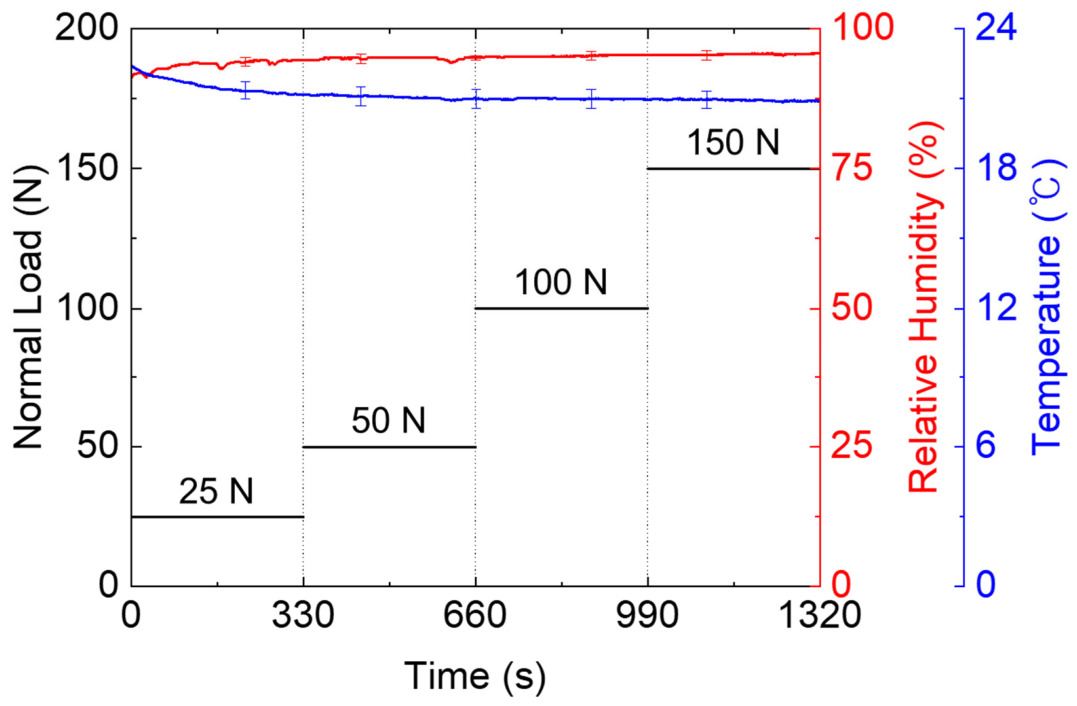
Friction tests were conducted using a reciprocating-type tribometer (MFT-5000, Rtec Instruments Inc., San Jose, CA, USA). The experimental conditions were a sliding frequency of 1 Hz and a stroke of 6 mm (average sliding speed of 12 mm/s). Aluminum alloy (A5052) balls with a diameter of 10 mm were used as counterfaces. The main chemical composition of A5052 balls was Al 76.2, O 20.9, Mg 2.4 at.%, with Si, Cr, Mn, Fe, and Cu making up the remainder. The normal load was applied in incremental steps of 25, 50, 100, and 150 N, with each load maintained for 330 s. The corresponding maximum contact pressures for each load, based on Hertzian theory, were 894.4, 1126.9, 1419.8, and 1625.3 MPa. These contact pressures cover and extend beyond the typical range encountered in industrial aluminum processing, such as sheet rolling (100–1000 MPa) [6]. Since aluminum is prone to severe adhesion under high contact pressures, leading to increased friction [6,7], the upper load condition was intentionally extended to 1625.3 MPa to provide a conservative evaluation of tribological performance. To ensure reliability, friction tests were repeated at least three times. The preliminary experiments were conducted under dry conditions (relative humidity < 40%), whereas the main experiments were performed under humid conditions (relative humidity > 90%). To control the humidity, a humidifier was used and the humidity level was monitored in real time using a hygrometer (EX-502, EMPEX Instruments, Inc., Tokyo, Japan). Figure 1 shows the experimental conditions for the humid conditions.
After the sliding tests, the wear scars were characterized by using both a digital microscope (VHX-7000, Keyence Co., Japan) and the SEM (TM3030, Hitachi Ltd., Tokyo, Japan). The elemental species of the tribofilm were determined by both XPS and energy-dispersive X-ray spectroscopy (EDS; SwiftED3000, Oxford Instruments Inc., Buckinghamshire, UK).

3. Results

3.1. Structural Characterization

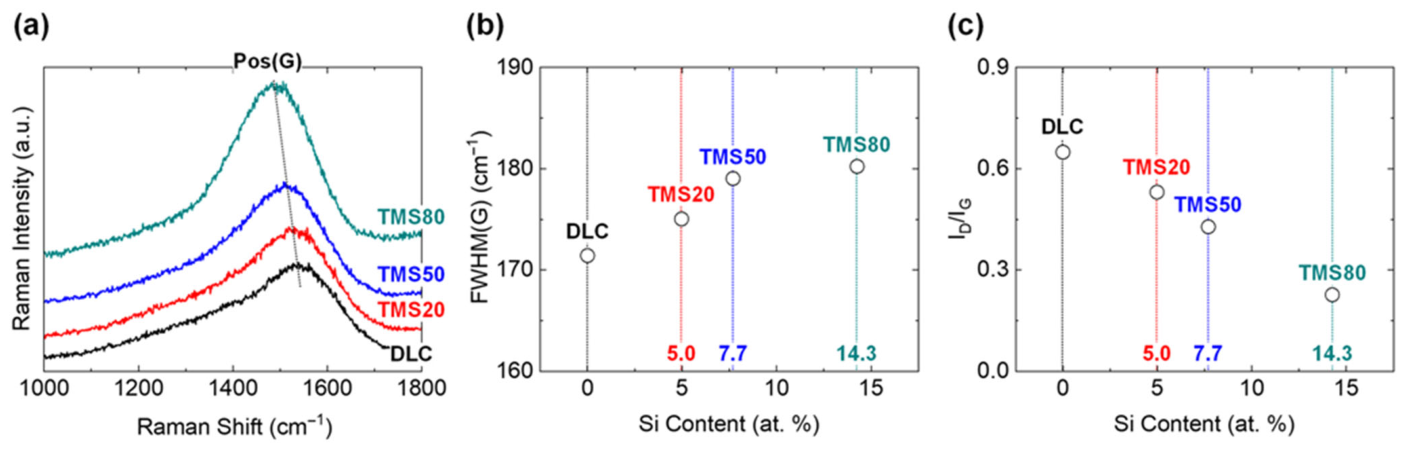
Figure 2 presents the Raman analysis of the DLC and Si-DLC coatings. With increasing Si content, the G-peak position (Pos(G)) progressively shifted toward lower wavenumbers (Figure 2a). The G peak corresponds to the bond-stretching vibration of sp2 carbon pairs in both aromatic ring and olefinic chain [28], and its frequency is explained by Equation (1) [29]:
ω k / m
where ω is the vibrational phonon frequency, k is the force constant reflecting the bond stiffness, and m is the reduced mass of the vibrating atomic pair. A decrease in the force constant therefore leads to a lower vibrational frequency.
The incorporation of Si modifies the carbon network through the formation of Si–C bonds. Because the Si–C bond length (~0.189 nm) is longer than that of C–C bonds (~0.154 nm) [30], the bond stiffness is accordingly lower. Consequently, the average force constant of the carbon network decreases with increasing Si incorporation. This reduction in bond stiffness lowers the phonon frequency of the sp2 bond-stretching mode, resulting in the observed downshift of the G-peak position.
The full width at half maximum of the G peak (FWHM(G)) broadened with increasing Si content (Figure 2b). This broadening suggests enhanced structural disorder within the amorphous carbon network [28]. The atomic radius mismatch between Si (0.111 nm) and C (0.077 nm) introduces local strain and distorts the carbon network, thereby increasing bond-angle and bond-length distributions [31].
The ID/IG value decreased as the Si content increased (Figure 2c). The D band originates from the breathing mode of aromatic sp2 carbon rings [28]. Therefore, the intensity of the D band is strongly associated with the presence of aromatic ring structures. According to the Ferrari–Robertson model, the ratio between the D and G band intensities is related to the size of sp2 clusters, as described by Equation (2) [32]:
I D / I G L a 2
where La represents the characteristic size of the sp2 clusters. The incorporation of Si disrupts the continuity of the carbon network through the formation of Si–C bonds and introduces local structural distortion due to the larger atomic radius of Si. These suppress the development of extended aromatic sp2 clusters, leading to a reduction in La and consequently in the ID/IG.
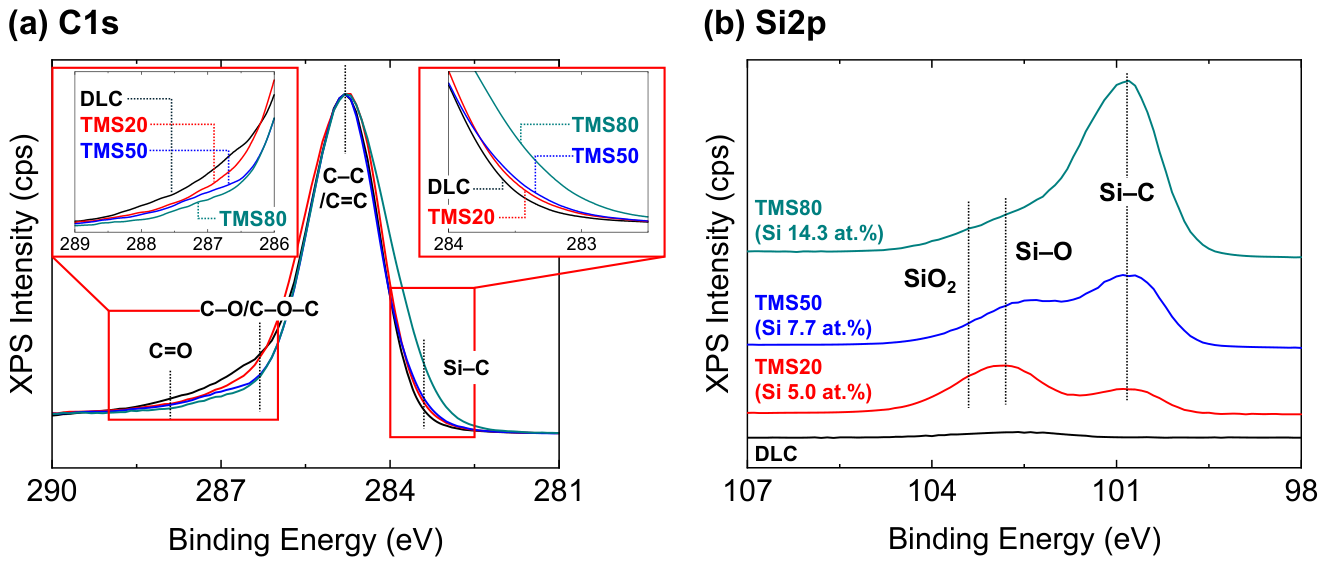
The Si contents of TMS20, TMS50, and TMS80 determined by XPS were 5.0, 7.7, and 14.3 at.%, respectively (Figure S1). The XPS spectra revealed a clear compositional evolution. The C1s spectra contain Si–C (283.4 eV) [33], C–C/C=C (284.8 eV, C1s core level) [34], C–O/C–O–C (286.3 eV) [35,36], and C=O (287.9 eV) [35,36] peaks. As the Si content increased, the oxygen-related carbon peaks (C–O/C–O–C and C=O) gradually faded, accompanied by an increasing contribution of Si–C peak (Figure 3a). The Si2p spectra showed a corresponding evolution, related to SiO2 (103.4 eV) [37], Si–O (102.8 eV) [33], and Si–C (100.8 eV) [37,38] peaks. For TMS20, oxidized Si peaks (SiO2 and Si–O) were detected together with a shoulder associated with Si–C peak (Figure 3b). With further Si incorporation, the oxidized Si peaks became less pronounced, while the Si–C peak progressively intensified. This behavior mirrors the evolution of the Si–C peak observed in the C1s spectra.

3.2. Tribological Properties

3.2.1. Friction Behavior of DLC Against Aluminum Alloy Under Dry Conditions (Relative Humidity < 40%)

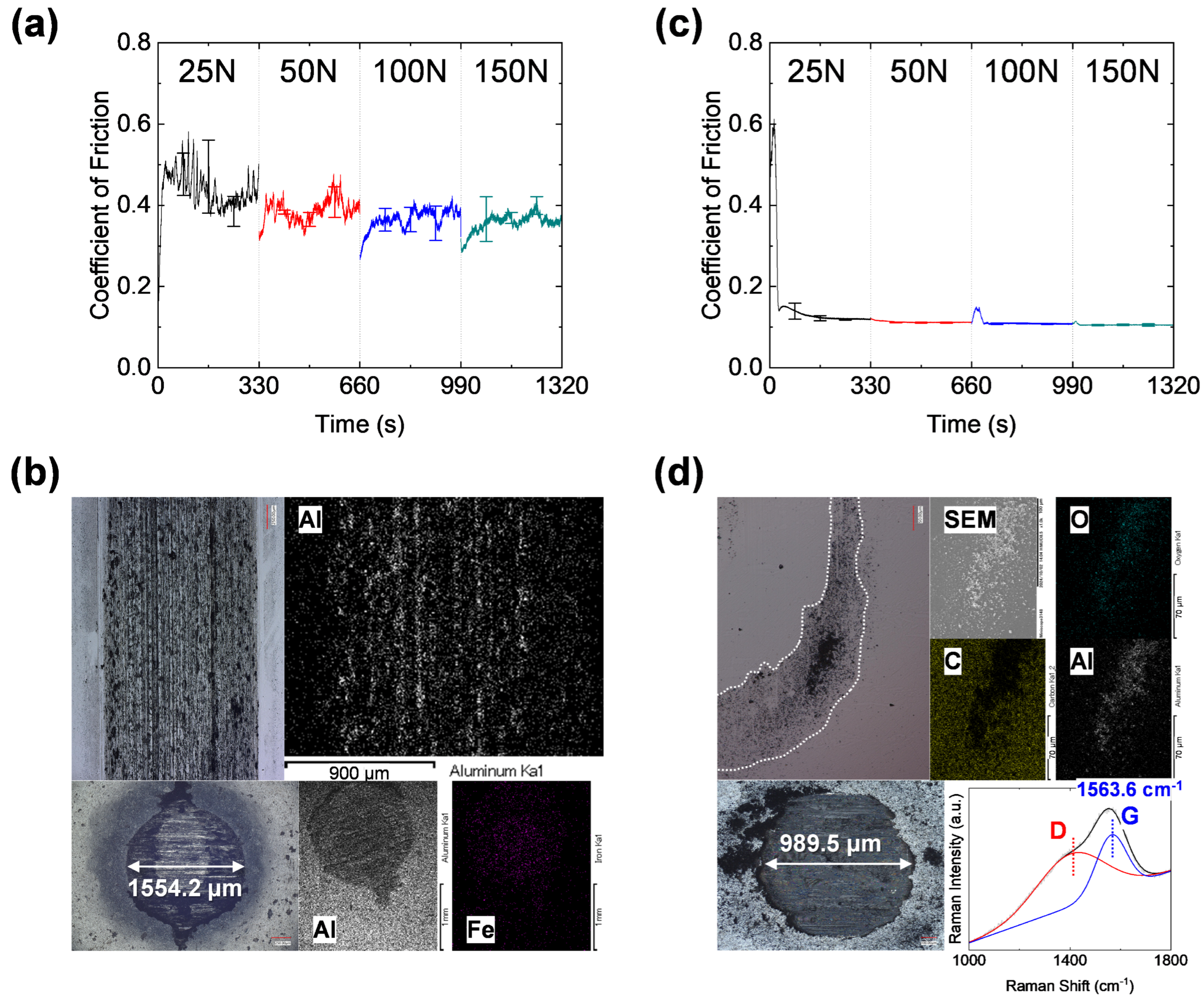
Friction tests were first conducted under dry conditions (relative humidity < 40%) as preliminary experiments using an A5052 ball–SKH51 substrate tribopair. The measured COF exhibited large fluctuations within the range of 0.3–0.6 and remained unstable throughout the test (Figure 4a). Such behavior can be interpreted as a typical adhesive wear mechanism dominated by the strong adhesion of aluminum. Indeed, EDS mapping of the wear track on the SKH51 substrate revealed that Al signals were distributed over the entire wear track (Figure 4b), indicating substantial material transfer from the A5052 ball.
During repeated sliding contact, the native oxide film on the aluminum surface is likely to be disrupted. Once the oxide layer is damaged, nascent aluminum with high chemical reactivity comes into direct contact with the SKH51 surface, leading to the formation of metallic junctions and micro-welding at the interface [39,40]. In this condition, the friction force (F) is governed by the interfacial shear strength (τ) and the real contact area (Areal), as described by Equation (3) [41,42]:
F τ × A r e a l
Adhesive junctions increase the interfacial shear strength compared with oxide-mediated contacts, while the high ductility of aluminum promotes plastic deformation and smearing, thereby enlarging the real contact area [39]. Moreover, the repeated formation and rupture of adhesive junctions enhance stick–slip behavior, leading to large fluctuations in the COF. The transfer film formed by aluminum on the counter surface may also undergo repeated formation, detachment, and reformation, causing transient changes in the contact conditions and resulting in additional fluctuations in the COF [6,8]. Furthermore, wear debris generated during adhesive fracture and tearing events increases surface roughness and mechanical interlocking at the interface, thereby raising the instantaneous shear resistance and further contributing to sudden increases and instability in the COF [43].
In dry sliding against aluminum, DLC coatings can effectively reduce friction. When a DLC coating was deposited on the SKH51 substrate, the COF reached a stable value of approximately 0.1 (Figure 4c). Wear particles were not observed as adhesive transfer on the wear track; instead, they were mainly found as wear debris accumulated along the sides of the wear track; the presence of these aluminum particles was confirmed by EDS mapping (Figure 4d).
The low-friction behavior can be attributed to the chemical characteristics of the DLC surface. In DLC coatings, dangling bonds of carbon are terminated by hydrogen atoms, resulting in low chemical reactivity at the surface. This hydrogen termination limits the chemical interaction between the DLC surface and aluminum, thereby suppressing the formation of strong adhesive junctions at the sliding interface [11]. Consequently, the transfer of aluminum onto the DLC surface is significantly reduced, and severe adhesive wear associated with aluminum–aluminum contact is less likely to occur. Furthermore, during sliding, carbonaceous wear debris or transfer films derived from the DLC coating may form on the ball surface, as evidenced by the presence of D and G peaks in the Raman spectrum of the transfer film (Figure 4d). Such carbonaceous tribofilms promote shear between carbon-rich layers instead of metal–metal contact at the interface, thereby lowering the interfacial shear strength and contributing to a further reduction in the COF [44].

3.2.2. Humidity-Induced Low-Friction Behavior of Si-DLC Against Aluminum Alloy

The results above demonstrate that the deposition of DLC provides a certain degree of friction reduction in sliding against the A5052 ball. However, when compared with the COF values typically achieved under petroleum-based lubrication [34,45], the values remain relatively high and are insufficient for practical industrial requirements. To further reduce friction without introducing environmentally harmful lubricants, the present study employed Si-DLC coatings under humid conditions. Figure S2 shows the variation in the COF of the coatings under applied loads of 25, 50, 100, and 150 N above a relative humidity of 90%.
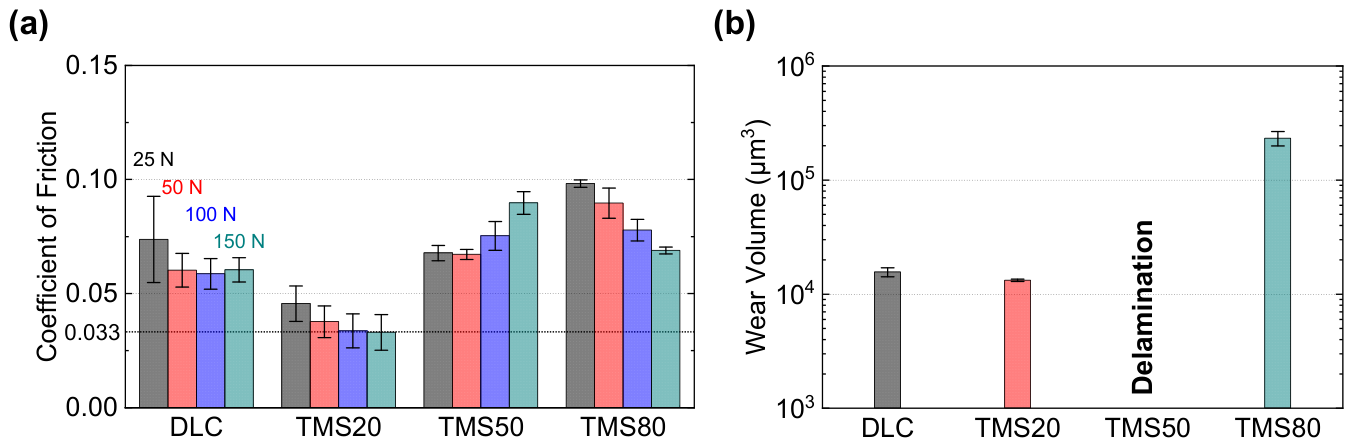
Figure 5a presents the average COF obtained for each coating. The TMS20 achieved a significantly lower COF of 0.033, which is 1.8 times lower than that of DLC, even under a high normal load of 150 N. Such ultra-low friction is significantly lower than the friction coefficients (0.1–0.39) reported in previous studies for various doped DLC coatings (e.g., a-C [11], a-C:H:F [13], ta-C:F [14], and W-DLC [15]) sliding against aluminum. Increasing the TMS ratio, however, resulted in deteriorating frictional performance; the COF was measured to 0.089 for the TMS50, and 0.069 for the TMS80.
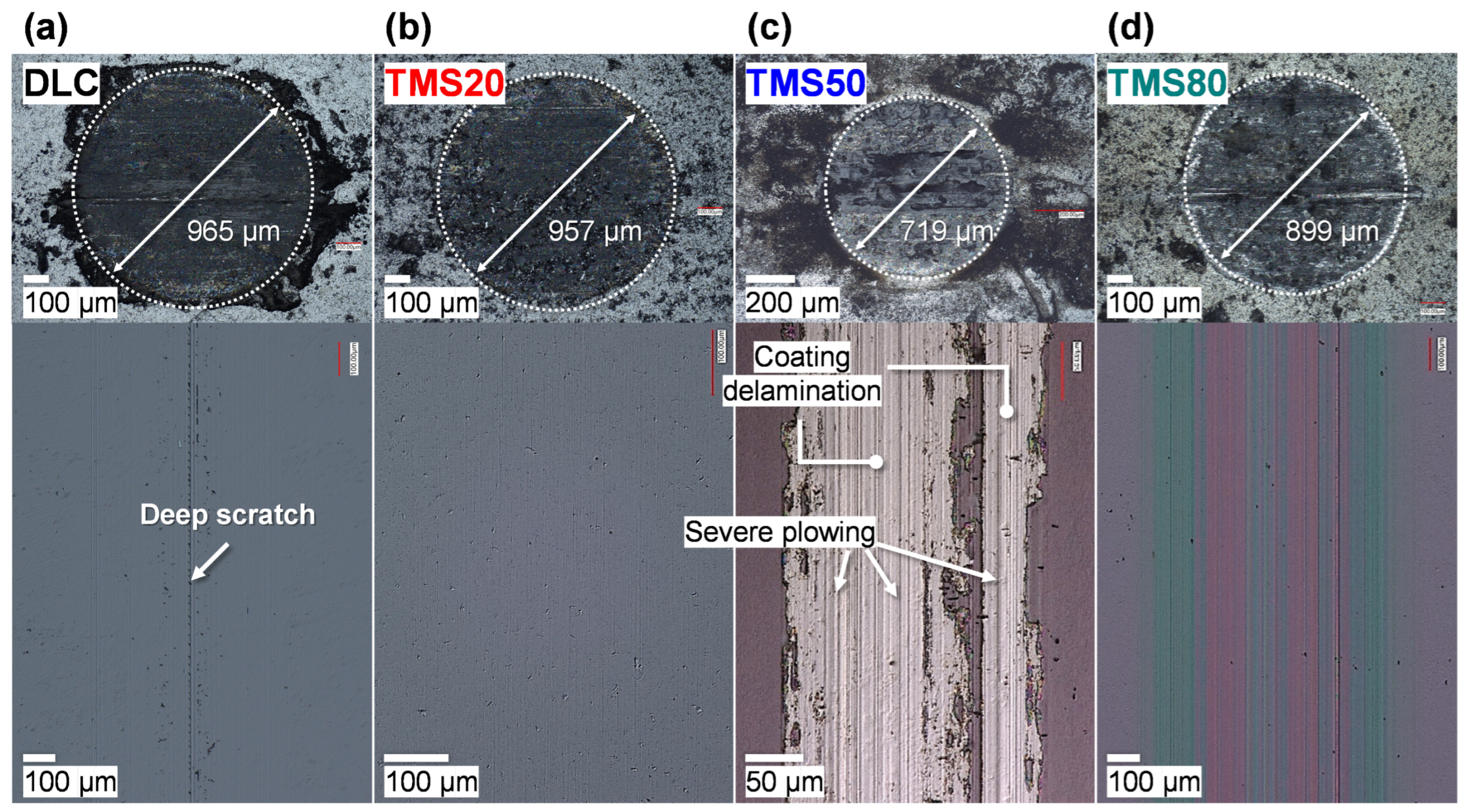
A similar trend was observed in the wear volume (Figure 5b). The wear volume of DLC and TMS20 was measured as 15,639 and 13,235 μm3, respectively. Surface observations revealed a deep scratch on the DLC, whereas only minor grooves were observed on the TMS20 (Figure 6a,b). For the TMS50, coating delamination occurred during sliding (Figure 6c), which is possibly attributed to its relatively insufficient adhesion strength (Figure S3). The TMS80 suffered from severe wear, reaching 232,662 μm3, indicating limited load-bearing capacity. Numerous scratch traces were observed on the substrate surface (Figure 6d).
The adhesion behavior was evaluated using the Rockwell indentation test according to the VDI 3198 standard (Figure S3). Based on the extent of coating delamination and crack formation around the indentation, the adhesion quality can be classified into HF1–6 [46]. The DLC coating exhibited moderate adhesion strength corresponding to HF3, characterized by limited radial cracking and minor delamination. The TMS20 coating was classified as HF4, showing slightly reduced adhesion strength with delaminated edges. In contrast, the TMS50 coating exhibited severe coating spallation and large-area delamination around the indentation (HF6), which is consistent with the coating delamination observed during sliding. The TMS80 coating revealed relatively limited delamination, corresponding to HF2–HF3.
In terms of ball wear, all coatings except TMS50 exhibited comparable levels, with wear scar diameters of 965 μm for the DLC, 975 μm for TMS20, and 899 μm for TMS80, which are significantly larger than the contact diameter estimated from the Hertzian elastic model (418 μm at 150 N). Considering that the yield strength (70 MPa [45]) of A5052 is much lower than that (280 MPa [47]) of the SKH51 substrate, plastic deformation is likely to occur predominantly on the aluminum side. Furthermore, surface observations of the wear tracks (Figure S4), showing limited generation of wear debris, suggest that the increased wear scar diameters are influenced not only by mechanical wear but also by plastic deformation.
The TMS50 exhibited relatively stable COFs at lower normal loads (25 N and 50 N), whereas they were unstable and increasing at higher loads (100 N and 150 N) (Figure S2).
This transition is attributed to coating delamination occurring under elevated loading conditions. As the coating progressively delaminates, the underlying substrate becomes exposed, thereby increasing the contribution of the SKH51–A5052 contact interface, which is expected to result in higher friction. Furthermore, as shown in Figure 6c, the exposed SKH51 surface exhibits severe plowing following coating delamination. These features indicate that the delaminated coating fragments are entrapped within the contact interface and act as hard third-body particles, promoting three-body abrasive wear. This process further accelerates material removal from both the coating and the exposed substrate.
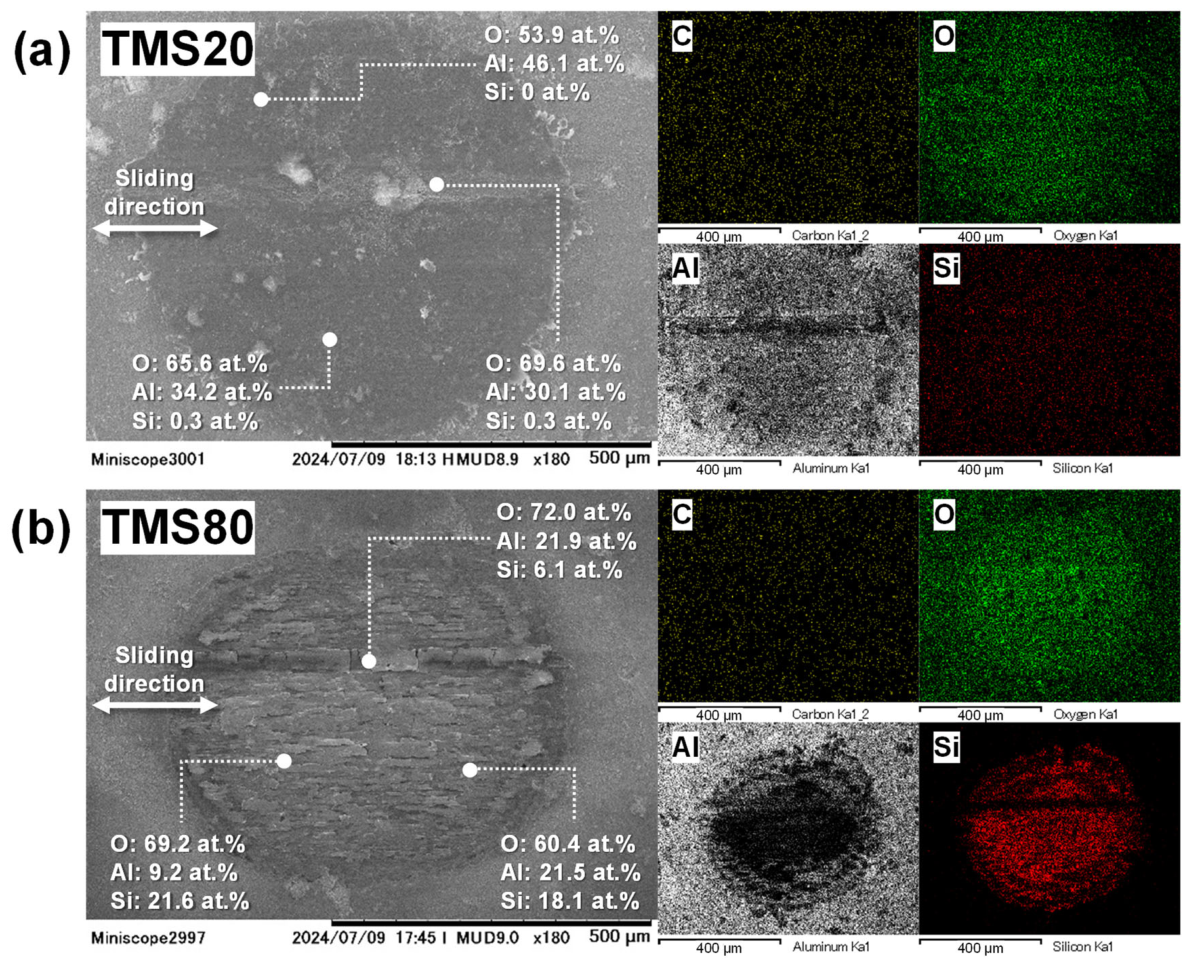
The superior tribological performance of the TMS20 is likely attributable to the role of Si. However, despite containing a higher content of Si, TMS80 did not exhibit comparable friction or wear performance, indicating that tribological behavior is governed not by the bulk Si concentration, but by the tribochemically formed surface composition. These results suggest that simply increasing the Si content in Si-DLC does not necessarily enhance tribological performance; rather, an appropriate Si content is required in Si-DLC to promote beneficial tribochemistry under the present conditions. XPS analysis of the tribofilm formed on the A5052 ball revealed that the Si concentration was approximately 3–4 at.% for TMS20, compared with 1.3–1.7 at.% for TMS80 (Figure S5). EDS analysis of the same tribofilms revealed a different compositional distribution (Figure 7). Only a small amount of Si (0.3 at.%) was detected in the tribofilm for TMS20 (Figure 7a). In the case of TMS80, however, considerably higher Si concentrations ranging from 6.1 to 21.6 at.% were measured (Figure 7b). This is attributed to the difference in information depth between the two analytical techniques. The electron beam used in EDS penetrates to a depth of approximately 1–2 μm [48], providing an averaged compositional signal within the region. By contrast, XPS reflects the chemical composition of only the outermost surface, typically within a depth of ~10 nm [49]. Considering the distinct probing ranges, the tribofilm for TMS80 can be interpreted as being composed of an Al-O-Si-based structure, with a minor Si contribution remaining on the outermost surface of the tribofilm. Conversely, the tribofilm for TMS20 exhibits a relatively higher Si concentration at the outermost surface. These findings suggest that the presence of Si 3–4 at.% at the outermost surface may play a critical role in determining the interfacial tribochemistry that controls the COF.
The low-friction mechanism of Si–O/SiO2-based surfaces is commonly explained by a sequence of processes involving surface hydroxylation, hydration layer formation, and the development of a low-shear interfacial layer [17]. Initially, Si–O–Si bonds react with water molecules to generate silanol (Si–OH) groups according to the reaction Si–O–Si + H2O → 2Si–OH. The resulting hydroxylated surface becomes highly hydrophilic, allowing water molecules to remain stably adsorbed on the surface [50]. Indeed, TMS20 exhibited a lower contact angle compared to the other coatings (Figure S6), which is attributed to the presence of Si–O/SiO2-rich surface species that promote interaction with water molecules. Consequently, a hydration layer consisting of hydrogen-bonded water molecules (Si–OH…H2O) is formed at the interface [51,52]. Within this hydration layer, water molecules are connected by relatively weak hydrogen bonds, enabling facile molecular rearrangement and thereby providing a low-shear interface during sliding.
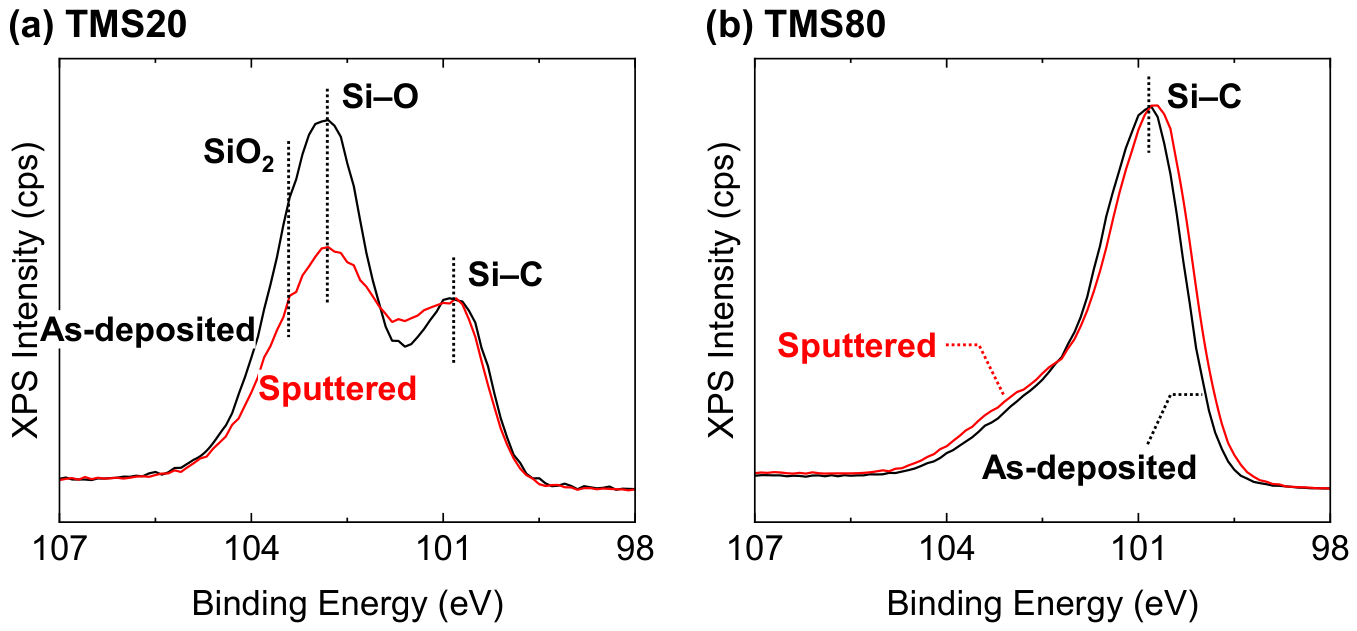
XPS analysis of the as-deposited coatings further supports that the TMS20 surface is enriched with oxidized Si species. After sputtering the as-deposited TMS20 surface for 6 s, the relative intensities of the oxidized Si (Si–O and SiO2) peaks decreased, while the Si–C peak remained unchanged (Figure 8a). This behavior indicates that oxidized Si species are mainly present at the outermost surface of the TMS20. Such a surface is favorable for the formation of a hydration layer under humid conditions, which likely contributes to the observed low-friction behavior. In contrast, the TMS80 coating exhibited little change in the Si2p spectrum after sputtering, suggesting that the bonding configuration remains relatively uniform and is dominated by Si–C bonding (Figure 8b).
The higher friction of TMS80 is unlikely to be directly related to its bulk Si content, but rather to the nature and stability of the tribofilm formed at the sliding interface. The tribofilm is characterized by Al-O-Si species over a deeper region (Figure 7b). High-magnification SEM observations reveal that the tribofilm appears as discontinuous patches with pronounced cracking (Figure S7). This morphology is indicative of limited interfacial stability; patchy and cracked tribofilms are associated with local removal, delamination, and repeated reformation during sliding [53]. Furthermore, as the Si content at the outermost surface of the tribofilm remains relatively low (Figure S5), lubricious Si–OH-rich surface layer was not sufficient, which inhibits the formation of a stable hydration layer.

4. Conclusions

The tribological behavior of Si-DLC coatings against aluminum alloy (A5052) was systematically investigated under high normal loads up to 150 N in humid conditions (relative humidity > 90%). Among the coatings examined, TMS20 (Si 5.0 at.%) exhibited the lowest coefficient of friction (COF) of 0.033, which is approximately 1.8 times lower than that of DLC. The wear volume of the coatings was minimized for TMS20: TMS20 (13,235 µm3) < DLC (15,639 µm3) < TMS80 (232,662 µm3) < TMS50 (delamination). However, coatings with higher Si contents (TMS50 (Si 7.7 at.%) and TMS80 (Si 14.3 at%)) revealed deteriorated tribological performance, which indicates that increasing the Si content does not necessarily improve friction or wear resistance.
Surface analysis of the tribofilms revealed a clear difference in chemical composition. The tribofilm for TMS20 contained Si 3–4 at.% at the outermost surface. In the case of TMS80, the tribofilm exhibited a lower surface Si concentration despite having a higher Si content in the bulk region. These observations suggest that the surface composition of the tribofilm plays a more important role than the bulk composition in determining the interfacial tribochemistry.
The low-friction behavior observed for TMS20 is related to the presence of Si–O/SiO2-rich surface species that undergo hydroxylation under humid conditions. Analysis of the as-deposited TMS20 revealed that the coating surface is enriched with oxidized Si species. After sputtering the TMS20 surface, the relative intensities of the Si–O and SiO2 peaks decreased while the Si–C peak remained unchanged, indicating that oxidized Si species are mainly present at the outermost surface. Such surface chemistry facilitates the formation of a hydration layer under humid conditions, which likely contributes to the observed low-friction behavior.
These findings indicate that Si-DLC coatings can provide a viable approach for achieving low-friction performance in aluminum processing under lubricant-excluded conditions, offering potential for environmentally friendly alternatives to conventional oil-based lubrication systems. Notably, the ability to achieve stable low-friction behavior under high normal loads highlights the practical applicability of these coatings in severe contact conditions relevant to industrial aluminum processes, e.g., sheet rolling. However, the present study is limited to room-temperature conditions, and does not account for elevated-temperature environments commonly encountered in practical aluminum processes such as hot forging, casting, and hot extrusion. These temperature effects may significantly influence tribochemical reactions and coating durability, and thus should be carefully considered when extending the present findings to real applications. Future work will focus on a more detailed understanding of the relationship between Si content, mechanical properties, and adhesion behavior, as well as the evaluation of tribological performance under more practical conditions, including elevated temperatures and the effect of lubricant additives.

Supplementary Materials

The following supporting information can be downloaded at: https://www.mdpi.com/article/10.3390/coatings16050510/s1, Figure S1: XPS survey spectra of the Si-DLC coatings; Figure S2: Variation of the coefficient of friction (COF) of the DLC and Si-DLC coatings; Figure S3: Rockwell indentation test results of the DLC and Si-DLC coatings evaluated according to the VDI 3198 standard; Figure S4: Wear tracks formed on the (a) DLC-, (b) TMS20-, and (c) TMS80-deposited substrates after friction tests; Figure S5: XPS analysis of the tribofilms formed on the aluminum alloy (A5052) balls after sliding under humid conditions (relative humidity > 90%); Figure S6: Contact angle measurements of (a) DLC-, (b) TMS20-, and (c) TMS80 coatings; Figure S7: High-magnification SEM images of the tribofilm formed on the aluminum alloy (A5052) ball after sliding under humid conditions (relative humidity > 90%) for TMS80; Table S1: Detailed deposition conditions of DLC and Si-DLC coatings; Table S2: Roughness values of DLC and Si-DLC coatings.

Author Contributions

Conceptualization, S.-M.B.; methodology, S.-M.B., S.L. and M.U.; validation, Y.L. and H.K.; writing—original draft preparation, S.-M.B., S.L. and J.C.; writing—review and editing, S.-M.B., H.K. and J.C.; visualization, S.-M.B.; supervision, J.C.; project administration, S.-M.B. and J.C.; funding acquisition, J.C. All authors have read and agreed to the published version of the manuscript.

Funding

This work was partially supported by JSPS KAKENHI Grant Number 24K00793.

Institutional Review Board Statement

Not applicable.

Informed Consent Statement

Not applicable.

Data Availability Statement

Data is contained within the article and Supplementary Materials.

Conflicts of Interest

The authors declare no conflicts of interest.

References

  1. Shah, R.; Woydt, M.; Zhang, S. The economic and environmental significance of sustainable lubricants. Lubricants 2021, 9, 21. [Google Scholar] [CrossRef]
  2. Joun, M.S.; Park, M.C.; Heo, Y.; Kim, D.H. A Review of Friction and Lubricant in Metal Forming. Lubricants 2025, 13, 512. [Google Scholar] [CrossRef]
  3. Elsheikh, A.; Ali, A.B.M.; Saba, A.; Faqeha, H.; Alsaati, A.A.; Maghfuri, A.M.; Abd-Elaziem, W.; Ashmawy, A.A.E.; Ma, N. A review on sustainable machining: Technological advancements, health and safety considerations, and related environmental impacts. Results Eng. 2024, 24, 103042. [Google Scholar] [CrossRef]
  4. Khadem, M.; Kang, W.B.; Kim, D.E. Green tribology: A review of biodegradable lubricants—Properties, current status, and future improvement trends. Int. J. Precis. Eng. Manuf.-Green Technol. 2024, 11, 565–583. [Google Scholar] [CrossRef]
  5. Domitner, J.; Silvayeh, Z.; Sabet, A.S.; Öksüz, K.I.; Pelcastre, L.; Hardell, J. Characterization of wear and friction between tool steel and aluminum alloys in sheet forming at room temperature. J. Manuf. Process. 2021, 64, 774–784. [Google Scholar] [CrossRef]
  6. Dohda, K.; Yamamoto, M.; Hu, C.; Dubar, L.; Ehmann, K.F. Galling phenomena in metal forming. Friction 2021, 9, 665–685. [Google Scholar] [CrossRef]
  7. Dubois, A.; Filali, O.; Dubar, L. Effect of roughness, contact pressure and lubrication on the onset of galling of the 6082 aluminium alloy in cold forming, a numerical approach. Wear 2024, 536, 205179. [Google Scholar] [CrossRef]
  8. Murakami, T.; Kajino, S.; Nakano, S. High-temperature friction and wear properties of various sliding materials against aluminum alloy 5052. Tribol. Int. 2013, 60, 45–52. [Google Scholar] [CrossRef]
  9. Chavoshbashi, J.; Keshtiban, P.M.; Oskui, A.E.H. Effect of lubricants during the rolling process on the mixed mode fracture behavior of the as-rolled material. Eng. Fract. Mech. 2024, 308, 110356. [Google Scholar] [CrossRef]
  10. Erdemir, A.; Donnet, C. Tribology of diamond-like carbon films: Recent progress and future prospects. J. Phys. Appl. Phys. 2006, 39, R311–R327. [Google Scholar] [CrossRef]
  11. Ni, W.; Cheng, Y.T.; Weiner, A.M.; Perry, T.A. Tribological behavior of diamond-like-carbon (DLC) coatings against aluminum alloys at elevated temperatures. Surf. Coat. Technol. 2006, 201, 3229–3234. [Google Scholar]
  12. Bhowmick, S.; Banerji, A.; Lukitsch, M.J.; Alpas, A.T. The high temperature tribological behavior of Si, O containing hydrogenated diamond-like carbon (a-C:H/a-Si:O) coating against an aluminum alloy. Wear 2015, 330, 261–271. [Google Scholar] [CrossRef]
  13. Wang, F.; Lu, Z.; Wang, L.; Zhang, G.; Xue, Q. Effect of tribochemistry on friction behavior of fluorinated amorphous carbon films against aluminum. Surf. Coat. Technol. 2016, 304, 150–159. [Google Scholar] [CrossRef]
  14. Bhowmick, S.; Banerji, A.; Khan, M.Z.U.; Lukitsch, M.J.; Alpas, A.T. High temperature tribological behavior of tetrahedral amorphous carbon (ta-C) and fluorinated ta-C coatings against aluminum alloys. Surf. Coat. Technol. 2015, 284, 14–25. [Google Scholar] [CrossRef]
  15. Abou Gharam, A.; Lukitsch, M.J.; Balogh, M.P.; Irish, N.; Alpas, A.T. High temperature tribological behavior of W-DLC against aluminum. Surf. Coat. Technol. 2011, 206, 1905–1912. [Google Scholar] [CrossRef]
  16. Morstein, C.E.; Klemenz, A.; Dienwiebel, M.; Moseler, M. Humidity-dependent lubrication of highly loaded contacts by graphite and a structural transition to turbostratic carbon. Nat. Commun. 2022, 13, 5958. [Google Scholar] [CrossRef]
  17. Kim, J.I.; Jang, J.W.; Kim, M.H.; Kwon, S.H.; Jang, Y.J. Wear Transition of Silicon-Doped Tetrahedral Amorphous Carbon (ta-C:Si) Under Water Lubrication. Coatings 2025, 15, 640. [Google Scholar] [CrossRef]
  18. Zhao, F.; Li, H.X.; Ji, L.; Mo, Y.F.; Quan, W.L.; Du, W.; Zhou, H.D.; Chen, J.M. Superlow friction behavior of Si-doped hydrogenated amorphous carbon film in water environment. Surf. Coat. Technol. 2009, 203, 981–985. [Google Scholar] [CrossRef]
  19. Goindi, G.S.; Sarkar, P. Dry machining: A step towards sustainable machining–challenges and future directions. J. Clean. Prod. 2017, 165, 1557–1571. [Google Scholar] [CrossRef]
  20. Garza-Montes-de-Oca, N.F.; Rainforth, W.M. Wear mechanisms experienced by a work roll grade high speed steel under different environmental conditions. Wear 2009, 267, 441–448. [Google Scholar] [CrossRef]
  21. Wu, X.; Suzuki, M.; Ohana, T.; Tanaka, A. Characteristics and tribological properties in water of Si-DLC coatings. Diam. Relat. Mater. 2008, 17, 7–12. [Google Scholar] [CrossRef]
  22. Ohana, T.; Suzuki, M.; Nakamura, T.; Tanaka, A.; Koga, Y. Low-friction behaviour of diamond-like carbon films in a water environment. Diam. Relat. Mater. 2006, 15, 962–966. [Google Scholar] [CrossRef]
  23. Choi, J.; Bae, S.M.; Asakawa, T.; Shimozawa, Y.; Morinaga, S.; Sato, Y.; Shigeta, K. Scalable Fabrication of Super-Liquid-Repellent Surfaces Enabled by Overhanging PTFE Nanospikes on Needle-Like Microstructures. ACS Appl. Mater. Interfaces 2025, 18, 2967–2977. [Google Scholar] [CrossRef] [PubMed]
  24. Tallant, D.R.; Parmeter, J.E.; Siegal, M.P.; Simpson, R.L. The thermal stability of diamond-like carbon. Diam. Relat. Mater. 1995, 4, 191–199. [Google Scholar] [CrossRef]
  25. Wu, W.J.; Hon, M.H. Thermal stability of diamond-like carbon films with added silicon. Surf. Coat. Technol. 1999, 111, 134–140. [Google Scholar] [CrossRef]
  26. Masami, I.; Haruho, M.; Tatsuya, M.; Junho, C. Low temperature Si-DLC coatings on fluoro rubber by a bipolar pulse type PBII system. Surf. Coat. Technol. 2011, 206, 999–1002. [Google Scholar] [CrossRef]
  27. Gao, M.; Kim, S.B.; Li, Y.; Ramaswamy, S.H.; Choi, J. Triboelectric nanogenerator with enhanced output and durability based on Si-DLC films. Nano Energy 2023, 105, 107997. [Google Scholar]
  28. Robertson, J. Diamond-like amorphous carbon. Mater. Sci. Eng. R Rep. 2002, 37, 129–281. [Google Scholar]
  29. Wu, Z.; Dai, S.; Overbury, S.H. Multiwavelength Raman spectroscopic study of silica-supported vanadium oxide catalysts. J. Phys. Chem. C 2010, 114, 412–422. [Google Scholar] [CrossRef]
  30. Liu, G.; Wen, Z.; Chen, K.; Dong, L.; Wang, Z.; Zhang, B.; Qiang, L. Optimizing the microstructure, mechanical, and tribological properties of Si-DLC coatings on NBR rubber for its potential applications. Coatings 2020, 10, 671. [Google Scholar] [CrossRef]
  31. Li, X.W.; Joe, M.W.; Wang, A.Y.; Lee, K.R. Stress reduction of diamond-like carbon by Si incorporation: A molecular dynamics study. Surf. Coat. Technol. 2013, 228, S190–S193. [Google Scholar] [CrossRef]
  32. Ferrari, A.C.; Robertson, J. Interpretation of Raman spectra of disordered and amorphous carbon. Phys. Rev. B 2000, 61, 14095. [Google Scholar] [CrossRef]
  33. Xu, Y.; Xiang, Y.; Bao, L.; Zhang, G.; Peng, Z.; Tian, C.; Yu, B.; Liu, Y.; Zhou, F. The synergistic effect of body modification and surface coating for the moisture barrier of hydrophilic PU film. J. Mater. Res. Technol. 2024, 30, 3755–3765. [Google Scholar] [CrossRef]
  34. Bae, S.M.; Horibata, S.; Miyauchi, Y.; Choi, J. Tribochemical investigation of Cr-doped diamond-like carbon with a MoDTC-containing engine oil under boundary lubricated condition. Tribol. Int. 2023, 188, 108849. [Google Scholar] [CrossRef]
  35. Chunjaemsri, T.; Chongsereecharoen, E.; Chanlek, N.; Kidkhunthod, P.; Nakajima, H.; Tunmee, S.; Yimnirun, R.; Rujirawat, S. Influence of RF power and CH4 flow rate on properties of diamond-like carbon films deposited by PECVD technique. Radiat. Phys. Chem. 2020, 176, 109073. [Google Scholar] [CrossRef]
  36. Thakur, B.; Reddy, S.S.; Deshpande, U.P.; Amarendra, G.; Chakravarty, S. Evidence of magnetism in RF magnetron sputtered deposited carbon films and investigation of its origin. Carbon 2019, 154, 485–496. [Google Scholar] [CrossRef]
  37. Yi, J.W.; Moon, M.W.; Ahmed, S.F.; Kim, H.; Cha, T.G.; Kim, H.Y.; Kim, S.S.; Lee, K.R. Long-lasting hydrophilicity on nanostructured Si-incorporated diamond-like carbon films. Langmuir 2010, 26, 17203–17209. [Google Scholar] [CrossRef]
  38. Yin, P.; Dai, R.; Yang, L.; Liu, Z.; Wei, X.; Xu, Y.; Cheng, W.; Sun, Y.; Zhang, G. Exploring the friction mechanism of a-C:H:Si:O film under water-lubricated condition. Diam. Relat. Mater. 2025, 154, 112162. [Google Scholar] [CrossRef]
  39. Hager, C.H., Jr.; Sanders, J.; Sharma, S.; Voevodin, A.; Segall, A. The effect of temperature on gross slip fretting wear of cold-sprayed nickel coatings on Ti6Al4V interfaces. Tribol. Int. 2009, 42, 491–502. [Google Scholar] [CrossRef]
  40. Hu, X.; Wang, Y.; Tang, H.; Xia, Y.; Huang, S.; Xu, X.; Zhang, R. Lubrication performance and mechanism of electrostatically charged alcohol aqueous solvents with aluminum–steel contact. Lubricants 2022, 10, 322. [Google Scholar] [CrossRef]
  41. Liang, X.M.; Xing, Y.Z.; Li, L.T.; Yuan, W.K.; Wang, G.F. An experimental study on the relation between friction force and real contact area. Sci. Rep. 2021, 11, 20366. [Google Scholar] [CrossRef]
  42. He, X.; Liu, Z.; Ripley, L.B.; Swensen, V.L.; Griffin-Wiesner, I.J.; Gulner, B.R.; McAndrews, G.R.; Wieser, R.J.; Borovsky, B.P.; Wang, Q.J.; et al. Empirical relationship between interfacial shear stress and contact pressure in micro-and macro-scale friction. Tribol. Int. 2021, 155, 106780. [Google Scholar] [CrossRef]
  43. Konca, E.; Cheng, Y.T.; Weiner, A.M.; Dasch, J.M.; Alpas, A.T. Effect of test atmosphere on the tribological behaviour of the non-hydrogenated diamond-like carbon coatings against 319 aluminum alloy and tungsten carbide. Surf. Coat. Technol. 2005, 200, 1783–1791. [Google Scholar] [CrossRef]
  44. Kim, D.W.; Kim, K.W. Effects of sliding velocity and ambient temperature on the friction and wear of a boundary-lubricated, multi-layered DLC coating. Wear 2014, 315, 95–102. [Google Scholar] [CrossRef]
  45. Dou, S.; Xia, J. Analysis of sheet metal forming (stamping process): A study of the variable friction coefficient on 5052 aluminum alloy. Metals 2019, 9, 853. [Google Scholar] [CrossRef]
  46. Zamharir, M.J.; Aghajani, H.; Tabrizi, A.T. Evaluation of adhesion strength of TiN layer applied on 316L substrate by electrophoretic deposition. J. Aust. Ceram. Soc. 2021, 57, 1219–1230. [Google Scholar] [CrossRef]
  47. Kang, S.K.; Kim, Y.C.; Kim, K.H.; Kwon, D.; Kim, J.Y. Constitutive equations optimized for determining strengths of metallic alloys. Mech. Mater. 2014, 73, 51–57. [Google Scholar] [CrossRef]
  48. Echlin, M.P.; Burnett, T.L.; Polonsky, A.T.; Pollock, T.M.; Withers, P.J. Serial sectioning in the SEM for three dimensional materials science. Curr. Opin. Solid State Mater. Sci. 2020, 24, 100817. [Google Scholar] [CrossRef]
  49. Lin, W.C.; Lo, W.C.; Li, J.X.; Wang, Y.K.; Tang, J.F.; Fong, Z.Y. In situ XPS investigation of the X-ray-triggered decomposition of perovskites in ultrahigh vacuum condition. npj Mater. Degrad. 2021, 5, 13. [Google Scholar] [CrossRef]
  50. Wu, X.; Ohana, T.; Tanaka, A.; Kubo, T.; Nanao, H.; Minami, I.; Mori, S. Tribochemical reaction of Si-DLC coating in water studied by stable isotopic tracer. Diam. Relat. Mater. 2008, 17, 147–153. [Google Scholar] [CrossRef]
  51. Liu, Y.; Liu, L.; Zhu, X.; Zhang, H.; Luo, Y.; Wang, X.; Xu, P.; Li, B. What determines the low-friction mechanism of the silicon-doped diamond-like carbon film in a water environment: An atomic-level understanding. Langmuir 2024, 40, 10449–10459. [Google Scholar] [CrossRef]
  52. Delfin, F.A.; Brühl, S.P.; Dommarco, R.C.; Forsich, C.; Heim, D. Impact of relative humidity and deposition parameters on the tribological behavior of soft DLC coatings. Surf. Coat. Technol. 2023, 474, 130100. [Google Scholar] [CrossRef]
  53. Shimizu, Y.; Spikes, H.A. The influence of aluminium–silicon alloy on ZDDP tribofilm formation on the counter-surface. Tribol. Lett. 2017, 65, 137. [Google Scholar] [CrossRef]
Figure 1. Experimental conditions for the friction tests under humid conditions. The normal load was applied incrementally at 25, 50, 100, and 150 N, with each load held for 330 s. The relative humidity was maintained above 90%, and the temperature was at room temperature.
Coatings 16 00510 g001
Figure 2. Raman analysis of the DLC and Si-DLC coatings with different Si content. (a) Raman spectra, (b) full width at half maximum of the G band (FWHM(G)), and (c) ID/IG ratio with increasing Si content.
Coatings 16 00510 g002
Figure 3. XPS spectra of the as-deposited DLC and Si-DLC coatings with increasing Si content. (a) C1s spectra show the gradual decrease in the oxygen-related carbon peaks (C–O/C–O–C (286.3 eV) and C=O (287.9 eV)) and the increase in Si-C peak contribution. (b) Si2p spectra indicate the relative contribution of oxidized Si peaks (SiO2 (103.4 eV) and Si–O (102.8 eV)) and Si–C (100.8 eV) peak. Peak positions may vary within ±~0.2 eV depending on fitting and calibration.
Coatings 16 00510 g003
Figure 4. Tribological behavior of aluminum alloy (A5052) against SKH51 and DLC under dry conditions (relative humidity < 40%). (a) Coefficient of friction (COF) for the A5052 ball against SKH51 substrate. (b) Optical images and corresponding EDS mapping of the wear track on SKH51 and the wear scar of the A5052 ball (Al: white, Fe: Magenta). (c) COF for the A5052 ball against DLC-deposited SKH51. (d) Optical images and corresponding EDS mapping of the wear track on the DLC surface and the wear scar of the A5052 ball (O: turquoise, C: yellow).
Coatings 16 00510 g004
Figure 5. Tribological performance of DLC and Si-DLC coatings (TMS20 (Si 5.0 at.%), TMS50 (Si 7.7 at.%), and TMS80 (Si 14.3 at.%)) sliding against aluminum alloy (A5052) balls under humid conditions (relative humidity > 90%). (a) Average coefficient of friction (COF) of each coating measured under normal loads of 25, 50, 100, and 150 N. (b) Wear volume of the coatings after sliding tests.
Coatings 16 00510 g005
Figure 6. Surface observations of wear tracks on the coatings (a) DLC, (b) TMS20 (Si 5.0 at.%), (c) TMS50 (Si 7.7 at.%), and (d) TMS80 (Si 14.3 at.%), and the corresponding wear scars on aluminum alloy (A5052) balls after sliding under humid conditions (relative humidity > 90%).
Coatings 16 00510 g006
Figure 7. EDS analysis of the tribofilms formed on the A5052 ball after sliding against (a) TMS20 (Si 5.0 at.%) and (b) TMS80 (Si 14.3 at.%) under humid conditions (relative humidity > 90%). For TMS20, the tribofilm shows a small amount of Si (~0.3 at.%). The tribofilm of TMS80 exhibits significantly higher Si concentrations ranging from 6.1 to 21.6 at.%. In the EDS mapping, the elemental colors correspond to C (yellow), O (green), Al (white), and Si (red).
Coatings 16 00510 g007
Figure 8. Si2p XPS spectra of the Si-DLC coatings before and after sputtering. (a) For the TMS20 (Si 5.0 at.%), sputtering for 6 s resulted in a decrease in the Si–O and SiO2 peaks, with the Si–C peak nearly unchanged. (b) The TMS80 (Si 14.3 at.%) showed little spectral change after sputtering, suggesting a relatively uniform bonding configuration dominated by Si–C bonding.
Coatings 16 00510 g008
Disclaimer/Publisher’s Note: The statements, opinions and data contained in all publications are solely those of the individual author(s) and contributor(s) and not of MDPI and/or the editor(s). MDPI and/or the editor(s) disclaim responsibility for any injury to people or property resulting from any ideas, methods, instructions or products referred to in the content.