Article

Distribution of Silicone Oils in PDMS and Epoxy–PDMS-Based Antifouling Coatings
1
Department of Materials and Nanotechnology, SINTEF Industry, 0373 Oslo, Norway
2
LabResearch group of Electrochemical and Surface Engineering, Department of Materials and Chemistry, Vrije Universiteit Brussel, Pleinlaan 2, 1050 Brussels, Belgium
*
Author to whom correspondence should be addressed.
Coatings 2026, 16(4), 461; https://doi.org/10.3390/coatings16040461 (registering DOI)
Submission received: 21 February 2026 / Revised: 1 April 2026 / Accepted: 8 April 2026 / Published: 12 April 2026
(This article belongs to the Special Issue Coatings with Various Functionalities in Marine Environments)

Abstract

Biofouling is an issue of global significance that impairs marine infrastructure, causes increased fuel consumption and greenhouse gas emissions, and threatens biodiversity. Since the year 2000, self-polishing copolymer (SPC) coatings and fouling release coatings (FRCs) dominate the fouling protection coatings market. SPC technology is based on the controlled release of biocides using a mixture of acrylic and natural binders as a delivery system. FRC technology is based on PDMS providing surface properties that resist attachment of fouling organisms. FRCs often contain surface modifying agents, such as free silicone oils, to tune the physicochemical properties of the surface. However, the long-term efficacy of these agents and their migration and distribution in PDMS-based coatings have not been well studied. In this study, we employed time-of-flight secondary ion mass spectrometry (ToF-SIMS) combined with multivariate analysis to examine the distribution of silicone oils as a function of exposure to artificial seawater (ASW). The results show that pure PDMS-based coatings allow uniform distribution of silicone oils with robust behavior upon ASW exposure. In contrast, epoxy–PDMS-based coatings displayed phase separation of the oils, which strongly altered their surface chemistry. Our findings suggest that the modification of mobile oils is critical to the performance of marine antifouling coatings. Furthermore, the presence of other ingredients of commercial coating formulations strongly affected the distribution of mobile oils. This study lays the foundation for future systematic research aimed at developing predictive models to optimize fouling protection coatings for the marine industry.

1. Introduction

Marine biofouling, which is the growth of marine organisms on surfaces, affects many industries by contributing to increased greenhouse gas emissions and threatening marine ecosystems [1]. The shipping industry is particularly vulnerable due to global trade routes traversing different climate zones that impact the performance of their antifouling management solutions and facilitate the spread of invasive aquatic species [2,3,4,5]. Although various strategies exist to prevent fouling on hulls and niche areas, no perfect solution has so far been found. The most commonly used measures remain the application of antifouling coatings and underwater hull cleaning [6]. However, regional regulations regarding the use of biocides in antifouling coatings are not harmonized and tighten to preserve the biodiversity of local ecosystems [7]. Consequently, there is a strong demand for coatings that provide long-lasting prevention of organism growth and attachment.
Since the ban of applying tributyltin (TBT)-based antifouling coatings in 2003, copper-based coatings became the gold standard to prevent the growth of marine organisms on hull surfaces [8]. These antifouling coatings are typically based on self-polishing copolymers (SPC) and contain cuprous oxide and various co-biocides [9].
Because co-biocides can be highly toxic to both target and off-target species [10], it is desirable to create biocide free coatings and solutions with little impact on the environment. As one such alternative, polydimethylsiloxane (PDMS)-based fouling release coatings (FRC) have been commercially available since the 1990s [11]. FRCs typically feature low surface energy, which reduces permanent adhesion of fouling organisms through release of attached organisms by hydrodynamic shear during voyage [12,13]. Additionally, with the recent advancements of in-water hull cleaning solutions [14], durable hybrid coatings (HCs) have experienced a renaissance. Their aim is to combine the anti-fouling properties of poly-siloxanes with the adhesive and mechanical properties of epoxy or polyurethane coatings through self-stratification.
However, siloxane-based fouling release coatings have limitations. Their efficacy is poor during long idle periods or when preventive cleaning cannot be maintained. This causes a built-up of soft fouling organisms, such as bacteria, diatoms, and microalgae, that adhere strongly to hydrophobic surfaces [15]. To address this issue, recent FRC developments incorporate amphiphilic silicone oils that migrate to the surface on exposure to water and form a hydration layer [12]. Additionally, mobile oils significantly alter the wettability of silicone surfaces, which allows tuning the fouling behavior [16]. In parallel, hybrid biocidal FRCs that combine SPC and FRC concepts have emerged over the past decade [13,17,18]. Nevertheless, optimal biocide release rates remain poorly understood, and non-leaching alternatives that tether biocides to the coating matrix warrant further study in light of increasingly strict regulations [19].
With this study we aim to provide deeper knowledge about the distribution and migration of amphiphilic silicone oils that may impact the biocide release and performance of future hybrid biocidal FRCs. In particular, the effect of chemical structure on the compatibility of oils and the coating matrix leading to phase separation requires more investigation. To address this gap, we examined the interactions of various silicone oils with PDMS and epoxy–PDMS hybrid coatings. Beginning with observations from commercial systems, we simplified formulations to create model systems that allowed detailed studies of matrix–additive interactions. The obtained results thus provide guidance for the future development of advanced silicone-based antifouling solutions with surface properties designed to reduce adhesion of soft fouling organisms.

2. Materials and Methods

2.1. Coating Preparation

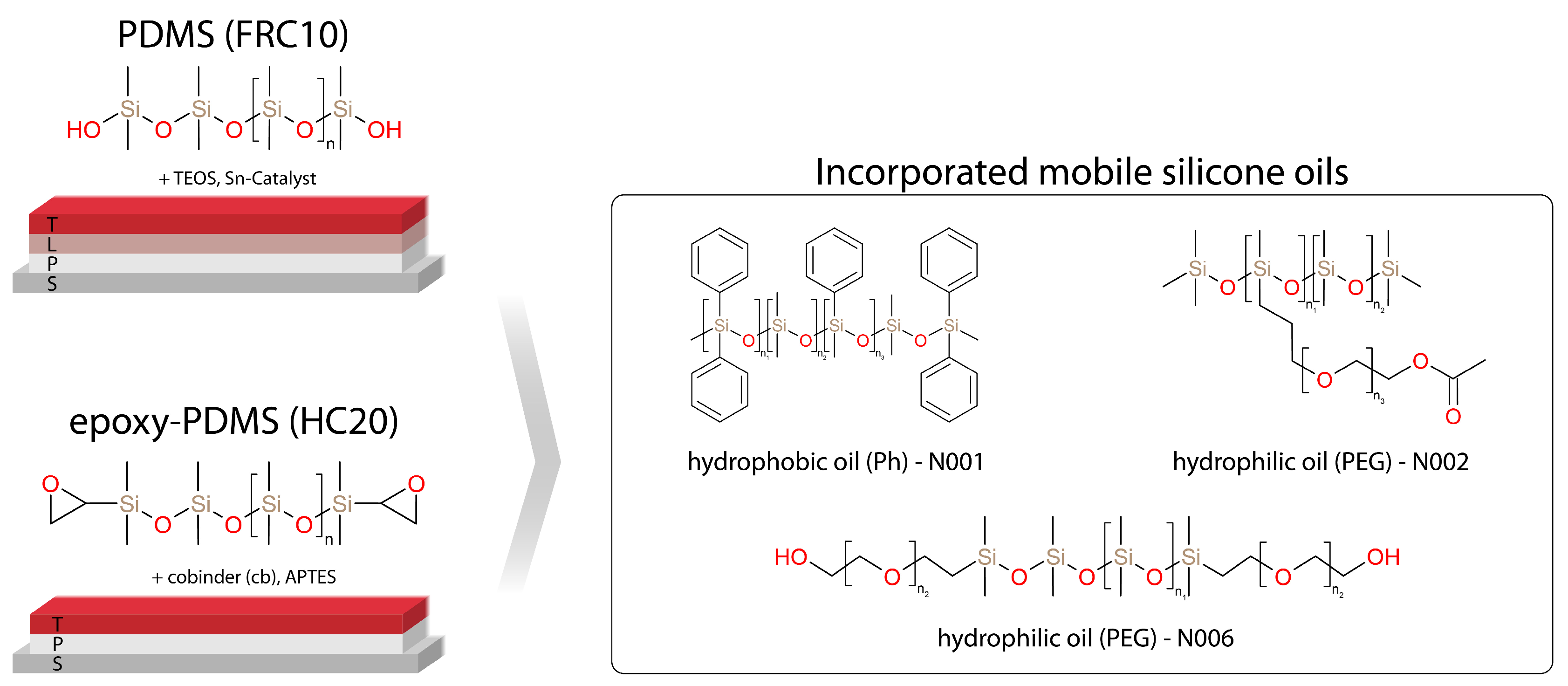
A commercial three-component fouling release coating (FRC10) and a two-component hybrid coating (HC20) were prepared according to the manufacturer’s guidelines. FRC10 coatings are based solely on silanol chemistry, whereas HC20 coatings are based on a hybrid epoxy–silicone matrix containing a PEG-modified co-binder (cb) (Figure 1). Additionally, simplified model systems were prepared representing the bare matrix of FRC10 and HC20 formulations without any pigments and extenders. For each of the model systems, coatings with hydrophobic and amphiphilic oils were prepared according to the formulations given in Table 1. Note, the commercial formulation of FRC10 coatings contains both N001 and N002, whereas HC20 contains N006 only. N001 is a phenylated silicone oil with hydrophobic character, whereas N002 and N006 are branched and linear PEG-modified silicone oils (Figure 1).
All coatings were applied on 0.075 mm thick Mylar sheets (RS components AS, Oslo, Norway) via drawdown at a nominal wet-film thickness of 300 µm. PDMS-based coatings were bonded to the support material with a tiecoat (Safeguard FRC-PE, Jotun AS, Sandefjord, Norway) over an epoxy-based primer (Jotacote Universal N10, Jotun AS, Norway). Epoxy–PDMS-based coatings were applied directly on Jotacote Universal N10. All coatings were cured at 23 °C and 50% relative humidity for 24 h before further analysis.

2.2. Artificial Seawater Exposure

Artificial seawater (ASW) with a pH of 8.5 was prepared by dissolving 33 g/L sea salt (Instant Ocean, Aquarium systems, Sarrebourg, France) in MilliQ water (>12 MΩ). Coating samples were cut into 2 × 9 cm pieces and placed in tubes with 50 mL ASW at 40 °C in the dark. Tubes were shaken periodically to remove air bubbles from the surfaces.

2.3. Analysis of Coating Topography and Wettability

Coating surfaces were characterized in terms of homogeneity, roughness, and morphology using a white light interferometer (WYKO NT-2000, Bruker Instruments, Ettlingen, Germany) equipped with a 10× objective in PSI or VSI mode depending on the feature scale. A geometric filter was applied to remove cylinder forms caused by warping of the Mylar substrate.
Surface free energy (SFE) was determined by drop shape analysis (DSA100, Krüss, Hamburg, Germany) using MilliQ water (>12 MΩ) and di-iodomethane (ReagentPlus®, 99%, Merck, Darmstadt, Germany). The average contact angle of at least five 2 μL drops was used to calculate the SFE using the OWRK model and Ström’s solvent parameters provided in the instrument software (Krüss DSA for Windows version 1.90.0.14). All drops were measured after 10 s equilibration unless otherwise stated. All samples exposed to ASW were rinsed with MilliQ water and dried prior to analysis to remove remaining salt on the surface. To prevent evaporation of drops during continuous monitoring of contact angles, a cuvette with solvent-wetted cotton was placed over the drop.

2.4. Investigation of Coating Structure

Surface and cross-sections of coatings were examined by SEM (Phenom Pro Desktop SEM, ThermoFisher Scientific, Waltham, MA, USA). Backscattered electron images were obtained at an acceleration voltage of 15 keV. The internal vacuum was reduced to 60 psi to counteract charge up effects.
Cross-sections were prepared using a cryo-ultramicrotome (Reichert UltraCut S, Reichert FCS, Depew, NY, USA). PDMS-based coatings (Tg = −120 °C) were cut at −130 °C, whereas epoxy–PDMS-based samples (Tg = 50 °C) were cut at −50 °C using a glass knife.
Further analysis of the distribution of coating contents was obtained by time-of-flight secondary ion mass spectroscopy (ToF-SIMS). Characteristic molecular fragments of the raw materials were collected prior to the analysis of coatings. Depth profiling was carried out on a TOF.SIMS 5 instrument (IONTOF GmbH, Münster, Germany). A 30 keV Bi3+ primary ion beam was used in high current bunched mode to achieve high mass resolution (approximately 8000 at 29 u (29Si+). The pulsed ion beam target current was approximately 0.30 pA and the analysis area was 200 µm × 200 µm. Depth profiles were obtained in dual beam configuration using a 10 keV or a 20 keV Ar1200 cluster ion beam for sputtering. The sputter raster was 350 µm × 350 µm. Sputter rates were adjusted to obtain equal depth profiles of approximately 2 μm for PDMS and epoxy–PDMS-based systems.
A peak list containing characteristic peaks for (epoxy-)PDMS coatings and all silicone oils was first created using SurfaceLab 7 software (IONTOF GmbH). Data cuboids containing the image distribution information of all selected peaks were then exported as binary BIF6 files for each area analyzed. The .BIF6 files were loaded into the simsMVA MATLAB app (http://mvatools.com) using the stitch function to perform matrix augmentation and create a single matrix containing all image distribution info from multiple samples, enabling processing of the entire dataset as a one matrix [20].
Prior to multivariate analysis (MVA), two pre-processing steps were performed: normalization of all map intensities by total counts per pixel, and Poisson scaling of the peak intensities according to a method proposed by Keenan et al. [21]. Non-negative matrix factorization (NMF) was then applied to the resulting dataset. NMF is a non-supervised machine learning method that reduces the dimensionality of a dataset down to a small number of components that approximate pure compounds [22,23]. This approach facilitates interpretation and visualization of the surface chemistry by producing fingerprint mass-spectra and corresponding distribution maps [22]. The algorithm used for non-negative factorization follows the multiplicative update rules developed by Lee and Seung [24] and applied by Trindade et al. [22].

3. Results

3.1. Commercial Coating System

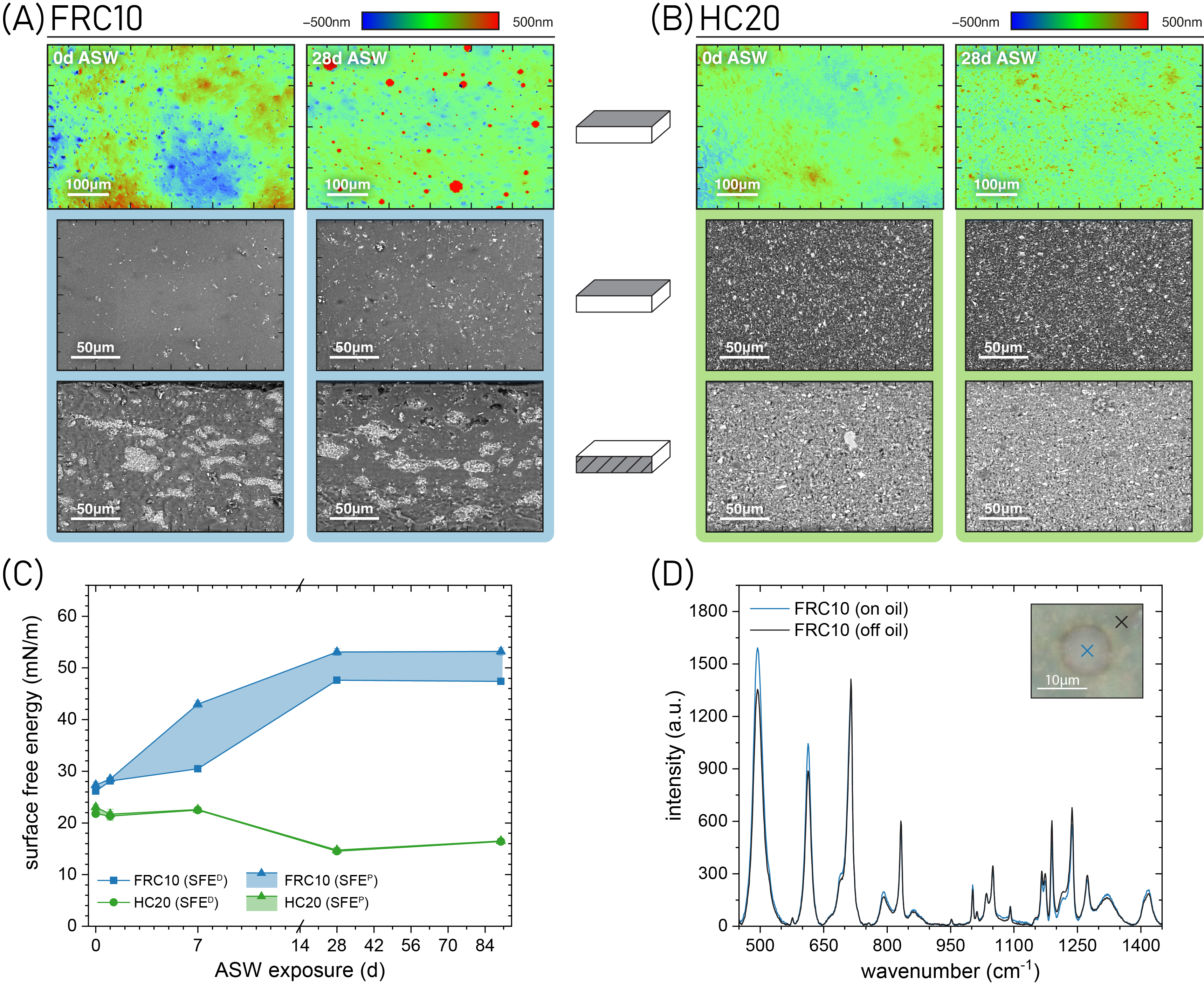
After 24 h of curing, FRC10 and HC20 coatings both exhibited smooth surfaces with an average roughness of Sq = 100 ± 10 nm and 87 ± 9 nm respectively. The dominant surface structures stem from added pigments, extenders, and biocide particles (Figure 2A,B). During exposure to artificial seawater (ASW), changes in the surface structure became evident. After one month, phase separation and oil droplet formation were observed on the surface of FRC10 coatings. This behavior became even more pronounced after 90 d for FRC10. In contrast, no oil separation on the surface of HC20 coatings was noted during the entire exposure period (Figure S1).
SEM images of FRC10 surfaces further revealed a migration of solid particles to the surface during the ASW exposure indicating a degree of plasticity of the PDMS matrix. In contrast, the highly filled HC20 coating maintained a homogenous particle distribution with no apparent changes upon ASW exposure.
Since any migration of the filler particles and active ingredients, such as the mobile oils, can alter chemical surface properties, changes in surface free energy (SFE) were investigated. As shown in Figure 2C, FRC10 initially presented a significantly higher SFE compared to HC20 despite FRC10’s content of hydrophobic silicone oils. During the exposure to ASW, the SFE of the FRC10 coatings gradually increased, with the polar part of the SFE becoming more pronounced from day 7 onward. From this observation, it can be inferred that the phase-separated oil observed in Figure 2A is likely N002 owing to its hydrophilic character. This was supported by the lack of a stronger Raman signal at 1000 cm−1 which is attributed to the phenyl group of the hydrophobic oil (Figure 2D and Figure S2B). In contrast, ASW exposure had marginal impact on the change in SFE of the HC20 coatings (Figure 2C), suggesting silicone oil migration is less pronounced in this system.

3.2. Model Coating Systems

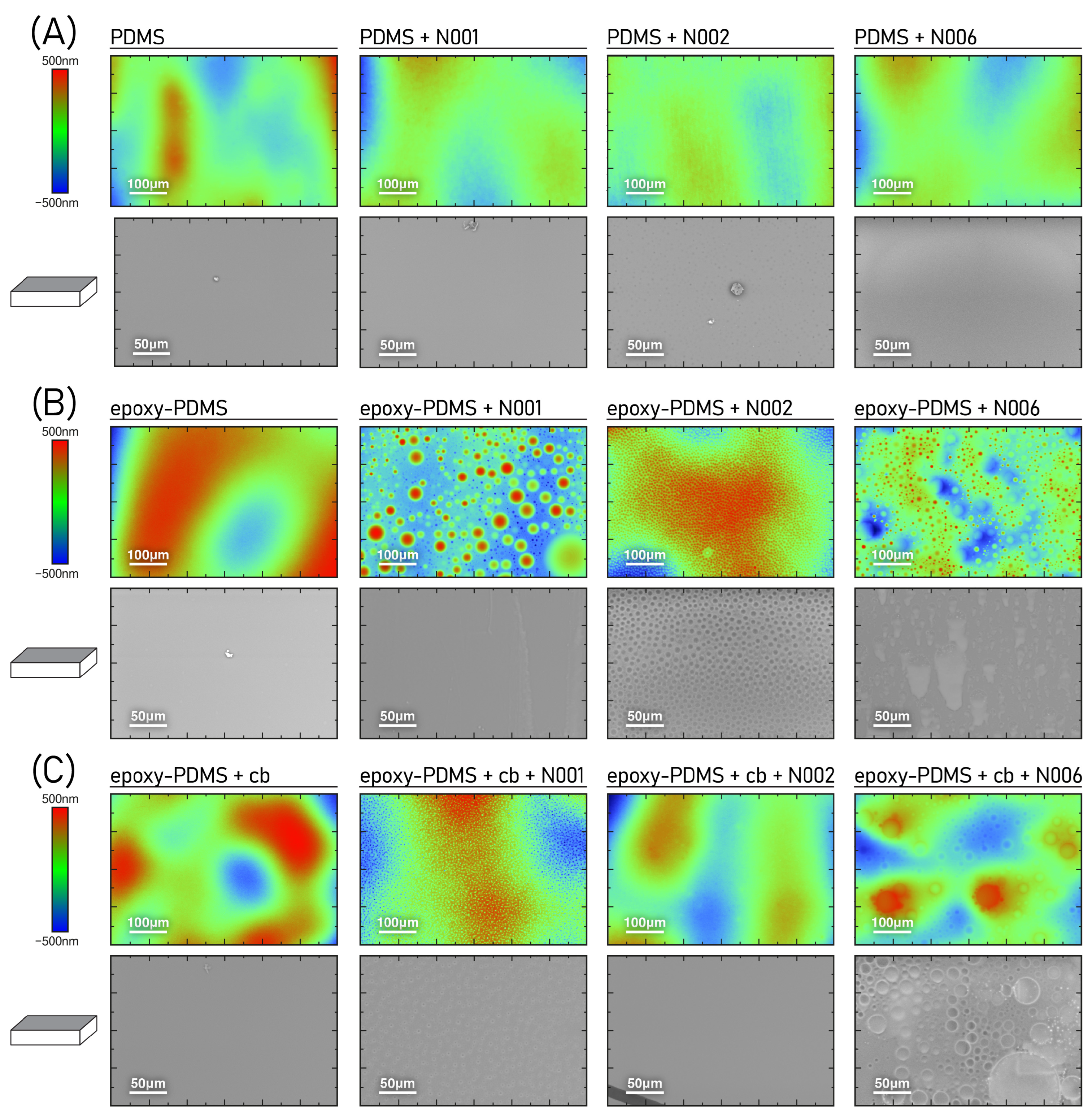
PDMS model coatings presented a uniform surface distribution of N001, N002, and N006 (Figure 3A). In contrast, the epoxy–PDMS matrix showed reduced compatibility with all three silicone oils, resulting in pronounced phase separation (Figure 3B). Incorporation of a co-binder (cb) into the epoxy–PDMS mitigated the phase separation of N002 due to the hydrophilic PEG modifications of the co-binder (Figure 3C). However, the less hydrophilic oils N006 and N001 still separated from the matrix during the curing process.
After 28 d exposure to ASW, PDMS coatings containing N001 and N006 showed no visible changes, indicating excellent compatibility between the predominantly hydrophobic oil and the matrix as well as little interaction with water (Figure S4). The high PEG content of N002, however, led to its migration to the surface forming oil domains on the coating. In the epoxy–PDMS samples, ASW exposure promoted coalescence of phase-separated oil domains into larger surface droplets (Figure S4). Notably, epoxy–PDMS coatings containing both co-binder and N002 exhibited no visible phase separation, even after ASW exposure, underscoring the improved compatibility imparted by the co-binder.
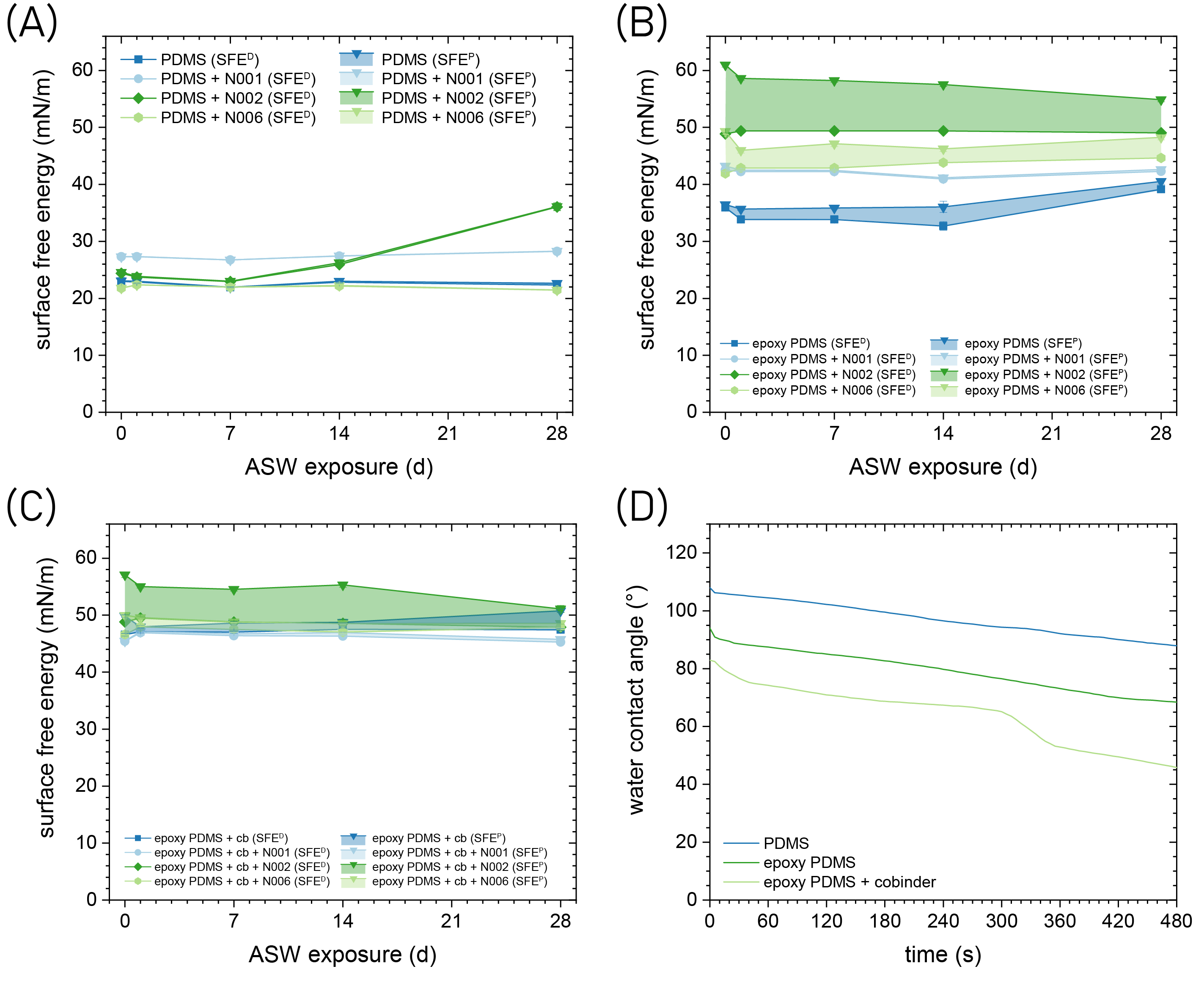
Using these model systems further allowed us to exclude contributions of filler materials in both commercial paint formulations on the surface free energy (SFE). As reference, pure PDMS coatings presented stable SFE values throughout 28 d of ASW exposure (Figure 4A). The addition of PEG- and phenyl-modified oils increased the SFE slightly, but no significant increase in the polar part was detected for N002 and N006 directly after curing. During ASW exposure, coatings containing N002 showed a pronounced increase in SFE. Moreover, oil-dependent changes in contact angle stability (Figure 4D and Figure S5) provided insight into interactions with water. While the addition of N001 displayed the most stable contact angle with time, surfaces including the PEG-modified oils exhibited a strong spreading behavior of the water droplet and a distinct contact angle hysteresis (Figure S5).
Analysis of epoxy–PDMS coatings revealed that the model system behaved opposite to that of the commercial formulation. While HC20 coatings presented SFE values below 22 mN/m compared to FRC10 (>26 mN/m), the epoxy–PDMS coatings showed SFE values beyond 35 mN/m with a substantial polar part (Figure 4B). Incorporation of N002 and N006 increased the SFE proportional to their PEG content. In contrast, hydrophobic N001 caused only a slight increase in overall SFE accompanied by a complete reduction in the polar part. The addition of co-binder to epoxy–PDMS significantly increased the SFE for all coatings, which was stable during 28 d ASW exposure (Figure 4C). Trends in contact angle stability on the surface of the epoxy–PDMS were similar to those observed in PDMS. However, epoxy–PDMS coatings containing co-binder exhibited a reproducible drop in water contact angle after 5 min, indicating interaction of the co-binder with water (Figure 4D and Figure S5).
The observed phase separation and potential migration of oils towards the surface during ASW exposure promoted efforts to quantify the oil content at the surface. FTIR, Raman, and ToF-SIMS were therefore employed. Quantitative determination of silicone oil distributions within silicone matrices proved challenging using FTIR and confocal Raman microscopy. Several factors inhibited comprehensive analysis. For instance, raw material spectra shown in Figure S2 revealed low PEG signal intensity in both FTIR and Raman. Furthermore, in FTIR imaging, the contact with the μATR germanium crystal disturbed the oil film on PDMS coatings. However, epoxy–PDMS coatings were successfully mapped, confirming the phase separation of N006 at the surface (Figure S6). Confocal Raman microscopy, conducted as a non-contact method, also suffered from the strong fluorescence of the epoxy–PDMS matrix, resulting in low signal to noise ratios. Consequently, Raman analysis was primarily useful for verifying the homogeneous distribution of N001 in the PDMS coatings due to the strong signal of the phenyl group (Figure S7).
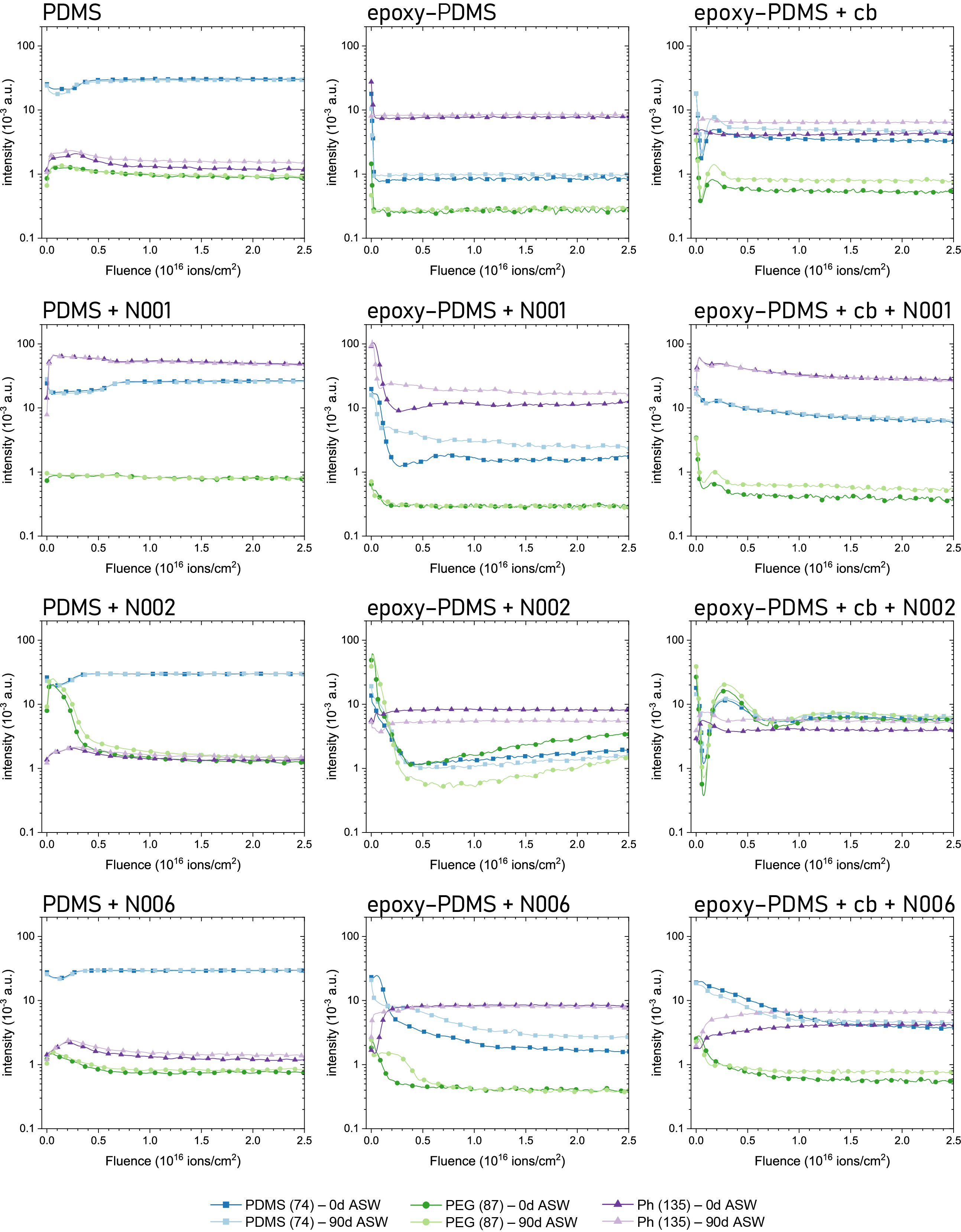
For a comprehensive analysis of the individual silicone oils, ToF-SIMS was employed. Spectra of raw materials were first collected to identify characteristic fragments (Figure S3), followed by depth profiling across the upper 2 µm of the coatings (Figure 5).
These results confirmed that N001 was homogenously distributed in PDMS with no significant changes occurring during 28 d ASW exposure corroborating our previous observations. PDMS coatings containing N002 showed high concentrations of PEG fragments (C4H7O2+) at the interface with a rapid decline towards the bulk of the coating. After exposure to ASW, the concentration of PEG was slightly elevated—caused by either oil migration or sample to sample variation. In contrast to N002 samples, coatings containing N006 displayed only low levels of PEG fragments at the surface before the signal decreases to a level comparable to the PEG-free reference coating.
Epoxy–PDMS coating presented greater variability compared to the PDMS coatings particularly for samples including oils due to phase separation. Notably, epoxy–PDMS without added oils showed significant phenyl fragments (SiC7H7O+) in the coating (Figure 5). This is corroborated by FTIR and Raman (Figure S2) results and suggests that the epoxy–PDMS contains phenyl groups coupled to the silicone backbone. Addition of N001 increased the signal at the surface, whereas deeper regions resembled the oil free epoxy–PDMS reference coating. N002 addition led to elevated surface PEG content with rapid decay and partial recovery in deeper layers, whereas N006 exhibited generally lower PEG signals due to the lower degree of substitution.
Incorporating co-binder to epoxy–PDMS coatings increased both the silicone related signal (SiC2H6O+) as well as the PEG related fragment in the reference coating compared to the equivalent sample without co-binder. Improved compatibility of the oils in epoxy–PDMS coatings with co-binder observed in WLI (Figure 3) was confirmed in ToF-SIMS. Sputter profiles were more homogenous, although a distinct surface organization was evident, particularly for N002, manifesting as wave-like intensity profiles.
While initial conclusions can be drawn from individual fragment analysis, overlapping fragment contributions complicate interpretation in multi-component systems. Therefore, multivariate analysis (MVA) using non-negative matrix factorization (NMF) was applied to combined datasets from model and commercial coatings. NMF enabled the extraction of fingerprint mass spectra for each component and consequently visualize their spatial distributions.

3.3. NMF Analysis of TOF-SIMS Maps

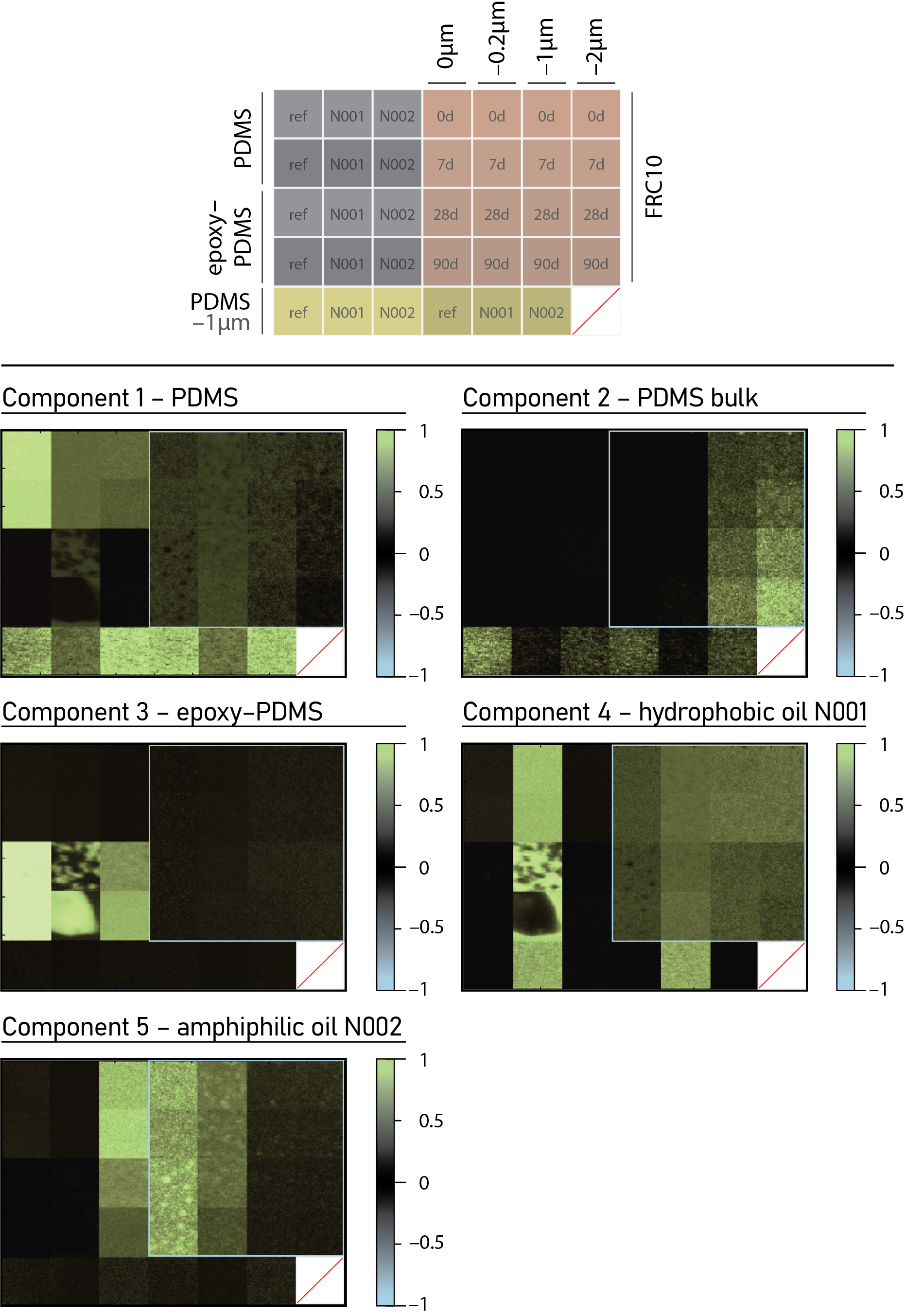
Based on model system findings, NMF was applied to commercial coatings to resolve their component distributions. For the analysis of FRC10, the NMF dataset contained surface maps of model system coatings with N001 and N002 as well as a map from a deeper layer of the PDMS coating (bulk PDMS). NMF yielded five components corresponding to the chemistry of the PDMS matrix, epoxy–PDMS matrix, N001, N002, and bulk PDMS. Comparison of spatial maps and component spectra (Figure 6 and Figure S8) revealed that the change from surface to bulk is primarily governed by a change in the relative intensities of the fragments towards lower molecular weight. This can be explained by the influence of sputtering. Overall, the NMF analysis of FRC10 demonstrated that N001 is homogenously distributed at the surface as well as in the bulk of the coating, whereas N002 is primarily located at the surface and decreased in the bulk during 90 d ASW exposure.
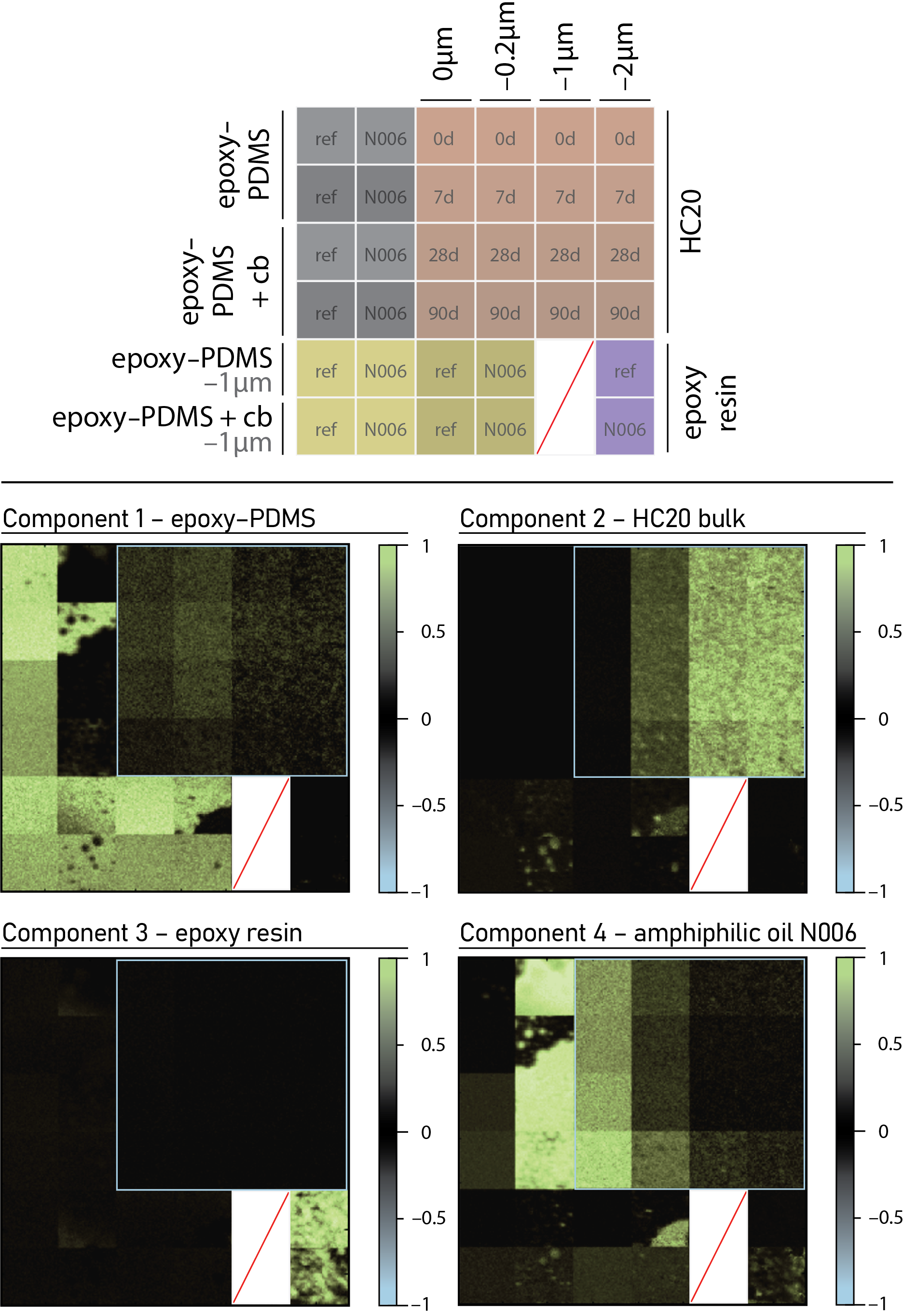
For HC20 analysis, we included a pure epoxy resin coating to the dataset to differentiate the hybrid nature of the epoxy–PDMS polymer (Figure 7). The result of the NMF process was four components representing the epoxy–PDMS matrix, a bulk related component, N006, as well as the extra epoxy resin. It can be noticed that the epoxy resin coating did not correlate to a high degree with any of the other coatings suggesting that the NMF can effectively separate components of different origin. However, the co-binder could not be separated as individual component by the NMF analysis.
The NMF spatial map of the HC20 coating appeared to be very homogenous with signals positively correlating with epoxy–PDMS and N006. The oil was primarily surface-localized and did not exhibit phase separation. Prolonged ASW exposure up to 90 days resulted in an apparent increase in N006 signal intensity at the surface. The bulk component was dominated by small molecular weight SiOx+ fragments (Figure S8) that stem from coating extenders in the commercial formulation.

4. Discussion

A variety of factors dictate the performance of fouling release coatings and studies of different coating additives highlight that dynamic surface properties are crucial to prevent the permanent attachment of fouling species [12,13]. In addition to surface topography, surface free energy is a key parameter determining the fouling characteristic of any surface. Based on extensive studies by Baier et al., which demonstrated minimal biomolecule adsorption on surfaces with a surface free energy (γc) around 22 mN/m [25,26], many fouling release coatings are based on low energy polymers, such as polysiloxane or fluorinated polymers.
However, observations of vessels, equipped with these coatings, showed that they struggle to combat microfouling effectively [27,28,29,30,31,32,33]. Therefore, alternatives to purely hydrophobic surfaces are actively being explored [34]. Many of the approaches rely on hydrophilic modifications that create a hydration layer with low fouling potential [35,36]. In these hydration layers, interfacial water adopts different structures and changes can be quantified through the water adhesion tension (τ0) [35]. Typically, minimum biological responses are observed at τ0 = 36 mN/m. One of the most studied antifouling surface modifying agents is PEG, which binds water in a structured way [37], contributing to its effective resistance to biofouling. Therefore, it was chosen as one of the modification for the investigated silicone oils to impart hydrophilic characteristics to fouling release coatings.
Among the commercial coatings investigated in this work, only FRC10 reaches positive values close to the reported value for minimum adhesion after ASW exposure (Table S1). Notably, all PDMS model systems present negative τ0 values due to the intrinsically hydrophobic nature of PDMS and the homogenous integration of the silicone oils. However, it has to be considered that the WCA was taken after 10s for consistency and coatings containing PEG-modified silicone oils showed a continuous decrease in WCA (Figure S4). This behavior arises from reversible surface reorganization of PEG moieties [38]. Consequently, we expect that during exposure to water PEG chains orient themselves towards the water phase, which would thereby increase τ0. Whether the resulting high CA hysteresis is beneficial to reduce biofouling remains a topic of scientific debate, with only a few studies published reporting conflicting results [39,40,41]. However, there is supporting evidence from studies by Soriano-Jerez et al., who have shown that a quick change in water contact angle is highly predictive of good antifouling performance [42,43]. In contrast to PDMS coatings, the epoxy–PDMS coatings containing N002 and N006 showed positive τ0 values due to the direct exposure of the oil to the surface after phase separation. Furthermore, the introduction of co-binder increased the water adhesion tension for coatings without oil, which is a promising indication for durable antifouling properties. In contrast, the phenyl-modified oil N001 created surfaces without any polar characteristics, which is in line with previous studies [44]. While Gomez et al. reported on the increased antifouling properties of phenyl-modified silicone oil infused PDMS over regular PDMS, it has also been shown that the adhesion forces scale with the elastic properties of the surface [45].
Regarding the long-term performance of the coatings, the persistence of the beneficial effects of free silicone oils is a key factor. It has been found that phenylated oils exhibit a loss of less than 1% during 12 months ASW exposure [46]. This supports our findings of little change in the signal of N001 at the surface of FRC10 samples after ASW exposure (Figure 5 and Figure 6). In contrast, degradation or leaching of amphiphilic silicone oils has been reported [47,48,49]. While the PDMS model systems showed little change in PEG signal intensity in the model coatings during ASW exposure (Figure 5), the commercial FRC10 formulation exhibited a more pronounced migration of PEG towards the surface (Figure 6). This observation is supported by the SFE and profilometer result suggesting that amphiphilic oils migrate towards the interface (Figure 2). Similarly, we see migration of amphiphilic oil N006 to the surface of HC20 coatings upon prolonged ASW exposure (Figure 7). However, in the absence of ASW phase analysis, it cannot be conclusively determined whether this behavior arises from oil degradation or desorption.
Since loss of amphiphilic oils cannot be excluded, a modification of the matrix through crosslinking with PEG-containing co-binder opens the opportunity to create a more permanent PEG modification of the coatings. As evidenced by the depth profiles of epoxy–PDMS coatings containing co-binder, this approach effectively allows creating coatings with a homogeneous distribution of PEG (Figure 5). In such systems, antifouling performance is likely governed by formulation parameters and PEG/PDMS ratio, as the PEG content remains stable over time.
Another strategy to maintain optimal antifouling performance is regeneration of hydrophilic moieties at the surface through diffusion. It has been reported that silicone oils that are not compatible with the matrix, form phase-separated fluid inclusions, which act as reservoirs for prolonged availability of mobile oils [50,51]. Given the phase separation observed in the epoxy–PDMS system (Figure 3) a similar operative may be hypothesized. However, the efficiency of oil migration from these reservoirs remains uncertain, as diffusion strongly depends on polymer properties. Previous studies have shown that the type of chemical modification is the dominant factor controlling migration of modified silicone oils in PDMS matrices [42,52,53]. In practice, a complex interplay between various parameters complicates the correlation between molecular weight, type of modification, and the corresponding antifouling activity. Particularly, since little insight is available on the physical conformation of modified oils compared to the well-studied critical entanglement point of 17 kDa for PDMS [54].
In this context it is also important to consider that once one-third of the siloxane backbone is grafted with PEG, the oil becomes water soluble [55]. Linear block-copolymers may also become water soluble but with a sufficiently long polysiloxane backbone the oils remain effectively anchored on the surface [56]. This highlights the need to identify optimal molecular architectures for amphiphilic polymers that balance effective antifouling performance with long-term durability.
When comparing our findings with other epoxy–PDMS hybrid coating, polymer chemistry must be carefully considered. Most epoxy–silicone coating polymers are inversely structured and based on epoxy chemistry bearing siloxane modifications that alter the surface properties [57]. These types of coatings are commonly employed in anticorrosive and anti-icing applications [58,59]. However, the phase separation and self-stratification behavior of modified silicone oils has been extensively studied in polyurethane-polysiloxane systems [60]. This study, as well as other work investigating oil infused systems, generally shows a concentration-dependent performance [51,61]. Accordingly, our observations are only valid for a narrow concentration range and may require further experiments to explore optimal oil concentrations. In addition, our system is constrained to a single molecular weight and crosslinking density of the matrix, which are both known parameters affecting the diffusivity of PDMS networks [62,63].
The pronounced phase separation observed in the epoxy–PDMS system indicates a chemical mismatch between the oils and the epoxy segments of the polymer backbone. Future studies could address this mismatch by employing silicone oils with alternative functional groups, varying PEG substitution levels, or adjusting PEG chain lengths. Analysis of such structure–property relationships can further support or be backed up with theoretical data on the compatibility of silicone oils as has been described by Karuth et al. [64]. Moreover, the model systems should be expanded to include additional coating components, such as pigments, fillers, and solvents, to capture all relevant interactions.
As commercial coating formulations increase in complexity, disentangling the contribution of individual components and monitoring their evolution presents a significant analytical challenge However, modern data-analysis tools offer promising solutions. MVA approaches have proven effective in resolving material contrast in ToF-SIMS datasets that feature chemically similar components, as shown by Trindade et al. [22]. Our results further support the utility of these methods for distinguishing silicone compounds with subtle variations along the PDMS backbone (Figure 6 and Figure 7).
Finally, since antifouling performance is highly dependent on the environmental conditions, performance ought to be evaluated in field tests. Such studies provide more representative insights into whether surface properties and biocide release rates are adequate across different geographic locations. Additional investigations are also necessary to assess how free PDMS oils influence the release behavior of incorporated biocides designed to address specific fouling regimes.

5. Conclusions

This study compared the interaction of free silicone oils with two different silicone-based matrices. While pure PDMS coatings showed robust and homogenous integration of silicone oils, a pronounced modification-dependent phase separation in the epoxy–PDMS-based system was observed. This phase separation and subsequent oil migration strongly influenced surface free energy, which is closely related to the antifouling performance of marine coatings. Although we were able to quantify both the concentration and depth profiles of individual coating components, further studies are required to determine the long-term effects of prolonged exposure to large amounts of water.
A comparison of simplified model systems with commercial coating formulations further revealed that other coating components, such as fillers and pigments, strongly affect the distribution and migration of active ingredients. In particular, the HC20 formulation demonstrated a homogenous distribution of silicone oils, whereas the epoxy–PDMS exhibited incompatibility with most silicone oils. This effect has to be considered in the future development of a predictive model for tunable biocide release from silicone-based coatings.
Since commercial coating formulations are complex, we have explored the applicability MVA data analysis of ToF-SIMS dataset. Using NMF, we successfully extracted component-specific information from complex coating systems. This analytical approach represents a valuable tool for future investigations into the behavior of closely related PDMS oils embedded in silicone-based coatings.

Supplementary Materials

The following supporting information can be downloaded at: https://www.mdpi.com/article/10.3390/coatings16040461/s1, Supplementary methods; Figure S1. Extended WLI/SEM analysis of commercial coatings; Figure S2. FTIR and Raman spectra of raw materials; Figure S3. ToF-SIMS raw material spectra; Figure S4. WLI/SEM analysis of model coatings after ASW exposure; Figure S5. Contact angle hysteresis; Figure S6. FTIR mapping of coatings; Figure S7. Raman spectra of raw materials and coatings; Figure S8. NMF component spectra; Table S1. Water adhesion tension values. Refs. [36,65,66,67,68,69,70] are cited in the supplementary materials.

Author Contributions

Conceptualization, F.W. and K.M.; methodology, F.W., K.M. and S.K.; formal analysis, F.W. and K.M.; investigation, F.W., K.M. and S.K.; writing—original draft preparation, F.W.; writing—review and editing, F.W. and K.M.; visualization, F.W.; funding acquisition, T.H. All authors have read and agreed to the published version of the manuscript.

Funding

The research project was funded by The Research Council of Norway (grant number 327720).

Institutional Review Board Statement

Not applicable.

Informed Consent Statement

Not applicable.

Data Availability Statement

The data presented in this study is available on request from the corresponding author.

Acknowledgments

F.W. acknowledges all members of the TailAd and NaviCoat project for their contribution to scientific discussions.

Conflicts of Interest

The authors declare no conflicts of interest.

References

  1. Weber, F.; Esmaeili, N. Marine Biofouling and the Role of Biocidal Coatings in Balancing Environmental Impacts. Biofouling 2023, 39, 661–681. [Google Scholar] [CrossRef] [PubMed]
  2. Sylvester, F.; Kalaci, O.; Leung, B.; Lacoursière-Roussel, A.; Murray, C.C.; Choi, F.M.; Bravo, M.A.; Therriault, T.W.; MacIsaac, H.J. Hull Fouling as an Invasion Vector: Can Simple Models Explain a Complex Problem? J. Appl. Ecol. 2011, 48, 415–423. [Google Scholar] [CrossRef]
  3. Salta, M.; Wharton, J.A.; Blache, Y.; Stokes, K.R.; Briand, J.F. Marine Biofilms on Artificial Surfaces: Structure and Dynamics. Environ. Microbiol. 2013, 15, 2879–2893. [Google Scholar] [CrossRef]
  4. de Carvalho, C.C.C.R. Marine Biofilms: A Successful Microbial Strategy with Economic Implications. Front. Mar. Sci. 2018, 5, 126. [Google Scholar] [CrossRef]
  5. GEF-UNDP-IMO GloFouling Partnerships Project; GIA for Marine Biosafety. Analysing the Impact of Marine Biofouling on the Energy Efficiency of Ships and the GHG Abatement Potential of Biofouling Management Measures; International Maritime Organization: London, UK, 2022. [Google Scholar]
  6. Arndt, E.; Robinson, A.; Hester, S.; Woodham, B.; Wilkinson, P.; Gorgula, S. Factors That Influence Vessel Biofouling and Its Prevention and Management; Final report for CEBRA Project 190803; Centre of Excellence for Biosecurity Risk Analysis (CEBRA): Melbourne, Australia, 2021. [Google Scholar]
  7. Thomas, K. The Use of Broad-Spectrum Organic Biocides in Marine Antifouling Paints. In Advances in Marine Antifouling Coatings and Technologies; Woodhead Publishing: Cambridge, UK, 2009; pp. 522–553. [Google Scholar]
  8. Kim, H.-J. Strategic Actions for Sustainable Vessel Hull Coatings in Line with the UN SDGs. J. Adv. Mar. Eng. Technol. (JAMET) 2021, 45, 231–242. [Google Scholar] [CrossRef]
  9. Yebra, D.M.; Kiil, S.; Dam-Johansen, K. Antifouling Technology—Past, Present and Future Steps towards Efficient and Environmentally Friendly Antifouling Coatings. Prog. Org. Coat. 2004, 50, 75–104. [Google Scholar] [CrossRef]
  10. de Campos, B.G.; Figueiredo, J.; Perina, F.; Abessa, D.M.d.S.; Loureiro, S.; Martins, R. Occurrence, Effects and Environmental Risk of Antifouling Biocides (EU PT21): Are Marine Ecosystems Threatened? Crit. Rev. Environ. Sci. Technol. 2022, 52, 3179–3210. [Google Scholar] [CrossRef]
  11. Townsin, R.L.; Anderson, C.D. Fouling Control Coatings Using Low Surface Energy, Foul Release Technology. In Advances in Marine Antifouling Coatings and Technologies; Woodhead Publishing: Cambridge, UK, 2009; pp. 693–708. [Google Scholar]
  12. Hu, P.; Xie, Q.; Ma, C.; Zhang, G. Silicone-Based Fouling-Release Coatings for Marine Antifouling. Langmuir 2020, 36, 2170–2183. [Google Scholar] [CrossRef]
  13. Lejars, M.; Margaillan, A.; Bressy, C. Fouling Release Coatings: A Nontoxic Alternative to Biocidal Antifouling Coatings. Chem. Rev. 2012, 112, 4347–4390. [Google Scholar] [CrossRef]
  14. Song, C.; Cui, W. Review of Underwater Ship Hull Cleaning Technologies. J. Mar. Sci. Appl. 2020, 19, 415–429. [Google Scholar] [CrossRef]
  15. Candries, M.; Atlar, M.; Anderson, C.D. Estimating the Impact of New-Generation Antifoulings on Ship Performance: The Presence of Slime. J. Mar. Eng. Technol. 2003, 2, 13–22. [Google Scholar] [CrossRef]
  16. Hauer, L.; Naga, A.; Badr, R.G.M.; Pham, J.T.; Wong, W.S.Y.; Vollmer, D. Wetting on Silicone Surfaces. Soft Matter 2024, 20, 5273–5295. [Google Scholar] [CrossRef] [PubMed]
  17. Almeida, J.R.; Vasconcelos, V. Natural Antifouling Compounds: Effectiveness in Preventing Invertebrate Settlement and Adhesion. Biotechnol. Adv. 2015, 33, 343–357. [Google Scholar] [CrossRef]
  18. Kyei, S.K.; Darko, G.; Akaranta, O. Chemistry and Application of Emerging Ecofriendly Antifouling Paints: A Review. J. Coat. Technol. Res. 2020, 17, 315–332. [Google Scholar] [CrossRef]
  19. Paz-Villarraga, C.A.; Castro, B.Í.; Fillmann, G. Biocides in Antifouling Paint Formulations Currently Registered for Use. Environ. Sci. Pollut. Res. 2022, 29, 30090–30101. [Google Scholar] [CrossRef]
  20. Trindade, G.F.; Abel, M.-L.; Watts, J.F. simsMVA: A Tool for Multivariate Analysis of ToF-SIMS Datasets. Chemom. Intell. Lab. Syst. 2018, 182, 180–187. [Google Scholar] [CrossRef]
  21. Keenan, M.R.; Kotula, P.G. Accounting for Poisson Noise in the Multivariate Analysis of ToF-SIMS Spectrum Images. Surf. Interface Anal. 2004, 36, 203–212. [Google Scholar] [CrossRef]
  22. Trindade, G.F.; Abel, M.-L.; Lowe, C.; Tshulu, R.; Watts, J.F. A Time-of-Flight Secondary Ion Mass Spectrometry/Multivariate Analysis (ToF-SIMS/MVA) Approach To Identify Phase Segregation in Blends of Incompatible but Extremely Similar Resins. Anal. Chem. 2018, 90, 3936–3941. [Google Scholar] [CrossRef]
  23. Trindade, G.F.; Abel, M.-L.; Watts, J.F. Non-Negative Matrix Factorisation of Large Mass Spectrometry Datasets. Chemom. Intell. Lab. Syst. 2017, 163, 76–85. [Google Scholar] [CrossRef]
  24. Lee, D.D.; Seung, H.S. Learning the Parts of Objects by Non-Negative Matrix Factorization. Nature 1999, 401, 788–791. [Google Scholar] [CrossRef]
  25. Schrader, M.E. On Adhesion of Biological Substances to Low Energy Solid Surfaces. J. Colloid Interface Sci. 1982, 88, 296–297. [Google Scholar] [CrossRef]
  26. Baier, R.E. Surface Behaviour of Biomaterials: The Theta Surface for Biocompatibility. J. Mater. Sci. Mater. Med. 2006, 17, 1057–1062. [Google Scholar] [CrossRef] [PubMed]
  27. Cerca, N.; Pier, G.B.; Vilanova, M.; Oliveira, R.; Azeredo, J. Quantitative Analysis of Adhesion and Biofilm Formation on Hydrophilic and Hydrophobic Surfaces of Clinical Isolates of Staphylococcus Epidermidis. Res. Microbiol. 2005, 156, 506–514. [Google Scholar] [CrossRef]
  28. Casse, F.; Swain, G.W. The Development of Microfouling on Four Commercial Antifouling Coatings under Static and Dynamic Immersion. Int. Biodeterior. Biodegrad. 2006, 57, 179–185. [Google Scholar] [CrossRef]
  29. Molino, P.J.; Wetherbee, R. The Biology of Biofouling Diatoms and Their Role in the Development of Microbial Slimes. Biofouling 2008, 24, 365–379. [Google Scholar] [CrossRef]
  30. Molino, P.J.; Childs, S.; Eason Hubbard, M.R.; Carey, J.M.; Burgman, M.A.; Wetherbee, R. Development of the Primary Bacterial Microfouling Layer on Antifouling and Fouling Release Coatings in Temperate and Tropical Environments in Eastern Australia. Biofouling 2009, 25, 149–162. [Google Scholar] [CrossRef] [PubMed]
  31. Hung, O.S.; Thiyagarajan, V.; Qian, P.Y. Preferential Attachment of Barnacle Larvae to Natural Multi-Species Biofilms: Does Surface Wettability Matter? J. Exp. Mar. Biol. Ecol. 2008, 361, 36–41. [Google Scholar] [CrossRef]
  32. Finlay, J.A.; Callow, M.E.; Ista, L.K.; Lopez, G.P.; Callow, J.A. The Influence of Surface Wettability on the Adhesion Strength of Settled Spores of the Green Alga Enteromorpha and the Diatom Amphora1. Integr. Comp. Biol. 2002, 42, 1116–1122. [Google Scholar] [CrossRef] [PubMed]
  33. Holland, R.; Dugdale, T.M.; Wetherbee, R.; Brennan, A.B.; Finlay, J.A.; Callow, J.A.; Callow, M.E. Adhesion and Motility of Fouling Diatoms on a Silicone Elastomer. Biofouling 2004, 20, 323–329. [Google Scholar] [CrossRef]
  34. Leonardi, A.K.; Ober, C.K. Polymer-Based Marine Antifouling and Fouling Release Surfaces: Strategies for Synthesis and Modification. Annu. Rev. Chem. Biomol. Eng. 2019, 10, 241–264. [Google Scholar] [CrossRef]
  35. Zeriouh, O.; Marco-Rocamora, A.; Reinoso-Moreno, J.V.; López-Rosales, L.; García-Camacho, F.; Molina-Grima, E. New Insights into Developing Antibiofouling Surfaces for Industrial Photobioreactors. Biotechnol. Bioeng. 2019, 116, 2212–2222. [Google Scholar] [CrossRef] [PubMed]
  36. Vogler, E.A. Structure and Reactivity of Water at Biomaterial Surfaces. Adv. Colloid Interface Sci. 1998, 74, 69–117. [Google Scholar] [CrossRef]
  37. Chen, S.; Li, L.; Zhao, C.; Zheng, J. Surface Hydration: Principles and Applications toward Low-Fouling/Nonfouling Biomaterials. Polymer 2010, 51, 5283–5293. [Google Scholar] [CrossRef]
  38. Inutsuka, M.; Yamada, N.L.; Ito, K.; Yokoyama, H. High Density Polymer Brush Spontaneously Formed by the Segregation of Amphiphilic Diblock Copolymers to the Polymer/Water Interface. ACS Macro Lett. 2013, 2, 265–268. [Google Scholar] [CrossRef]
  39. Erbil, H.Y. Bioadhesion to Solids: Contact Angle Hysteresis Effect. Colloid Polym. Sci. 2013, 291, 355–360. [Google Scholar] [CrossRef]
  40. Schmidt, D.L.; Brady, R.F.; Lam, K.; Schmidt, D.C.; Chaudhury, M.K. Contact Angle Hysteresis, Adhesion, and Marine Biofouling. Langmuir 2004, 20, 2830–2836. [Google Scholar] [CrossRef]
  41. Ucar, I.O.; Cansoy, C.E.; Erbil, H.Y.; Pettitt, M.E.; Callow, M.E.; Callow, J.A. Effect of Contact Angle Hysteresis on the Removal of the Sporelings of the Green Alga Ulva from the Fouling-Release Coatings Synthesized from Polyolefin Polymers. Biointerphases 2010, 5, 75–84. [Google Scholar] [CrossRef]
  42. Soriano-Jerez, Y.; Gourlaouen, E.; Zeriouh, O.; Cerón-García, M.d.C.; Arrabal-Campos, F.M.; Ruiz-Martínez, C.; Fernández, I.; Gallardo-Rodríguez, J.J.; García-Camacho, F.; Molina-Grima, E.; et al. Role of Dynamic Surface Tension of Silicone Polyether Surfactant-Based Silicone Coatings on Protein Adsorption: An Insight on the ‘Ambiguous’ Interfacial Properties of Fouling Release Coatings. Prog. Org. Coat. 2024, 186, 108079. [Google Scholar] [CrossRef]
  43. Soriano-Jerez, Y.; García-Abad, L.; del Carmen Cerón-García, M.; Gallardo-Rodríguez, J.J.; Bressy, C.; García-Camacho, F.; Molina-Grima, E. Long-Lasting Biofouling Formation on Transparent Fouling-Release Coatings for the Construction of Efficient Closed Photobioreactors. Biofouling 2023, 39, 483–501. [Google Scholar] [CrossRef]
  44. Gomez, F.; Roter, S.F.; Rossi, D.; Wu, G.; Safaripour, M.; Webster, D.; Chen, Z. Molecular Structures of Surfaces and Interfaces of Poly(Dimethylsiloxane) Incorporated with Silicone Oils Containing Phenyl Functionality. Langmuir 2025, 41, 1985–1996. [Google Scholar] [CrossRef]
  45. VanDonselaar, K.R.; Safaripour, M.; Boucher, D.G.T.; Webster, D.C.; Croll, A.B. Role of Free Polymer Chains in the Adhesion of Polydimethylsiloxane Elastomers to Solids. Macromolecules 2025, 58, 10600–10610. [Google Scholar] [CrossRef]
  46. Truby, K.; Wood, C.; Stein, J.; Cella, J.; Carpenter, J.; Kavanagh, C.; Swain, G.; Wiebe, D.; Lapota, D.; Meyer, A.; et al. Evaluation of the Performance Enhancement of Silicone Biofouling-release Coatings by Oil Incorporation. Biofouling 2009, 15, 141–150. [Google Scholar] [CrossRef]
  47. Noguer, A.C.; Olsen, S.M.; Hvilsted, S.; Kiil, S. Long-Term Stability of PEG-Based Antifouling Surfaces in Seawater. J. Coat. Technol. Res. 2016, 13, 567–575. [Google Scholar] [CrossRef]
  48. Ngo, B.K.D.; Lim, K.K.; Stafslien, S.J.; Grunlan, M.A. Stability of Silicones Modified with PEO-Silane Amphiphiles: Impact of Structure and Concentration. Polym. Degrad. Stab. 2019, 163, 136–142. [Google Scholar] [CrossRef]
  49. Gillet, G.; Azemar, F.; Faÿ, F.; Réhel, K.; Linossier, I. Non-Leachable Hydrophilic Additives for Amphiphilic Coatings. Polymers 2018, 10, 445. [Google Scholar] [CrossRef]
  50. Noguer, A.C.; Latipov, R.; Madsen, F.B.; Daugaard, A.E.; Hvilsted, S.; Olsen, S.M.; Kiil, S. Visualization of the Distribution of Surface-Active Block Copolymers in PDMS-Based Coatings. Prog. Org. Coat. 2018, 120, 179–189. [Google Scholar] [CrossRef]
  51. Cui, J.; Daniel, D.; Grinthal, A.; Lin, K.; Aizenberg, J. Dynamic Polymer Systems with Self-Regulated Secretion for the Control of Surface Properties and Material Healing. Nat. Mater. 2015, 14, 790–795. [Google Scholar] [CrossRef]
  52. Noguer, A.C.; Olsen, S.M.; Hvilsted, S.; Kiil, S. Diffusion of Surface-Active Amphiphiles in Silicone-Based Fouling-Release Coatings. Prog. Org. Coat. 2017, 106, 77–86. [Google Scholar] [CrossRef]
  53. Noguer, A.C.; Olsen, S.M.; Hvilsted, S.; Kiil, S. Field Study of the Long-Term Release of Block Copolymers from Fouling-Release Coatings. Prog. Org. Coat. 2017, 112, 101–108. [Google Scholar] [CrossRef]
  54. Orrah, D.J.; Semlyen, J.A.; Ross-Murphy, S.B. Studies of Cyclic and Linear Poly(Dimethylsiloxanes): 27. Bulk Viscosities above the Critical Molar Mass for Entanglement. Polymer 1988, 29, 1452–1454. [Google Scholar] [CrossRef]
  55. Srividhya, M.; Chandrasekar, K.; Baskar, G.; Reddy, B.S.R. Physico-Chemical Properties of Siloxane Surfactants in Water and Their Surface Energy Characteristics. Polymer 2007, 48, 1261–1268. [Google Scholar] [CrossRef]
  56. Hawkins, M.L.; Faÿ, F.; Réhel, K.; Linossier, I.; Grunlan, M.A. Bacteria and Diatom Resistance of Silicones Modified with PEO-Silane Amphiphiles. Biofouling 2014, 30, 247–258. [Google Scholar] [CrossRef]
  57. Vijayan, P.P.; Formela, K.; Saeb, M.R.; Chithra, P.G.; Thomas, S. Integration of Antifouling Properties into Epoxy Coatings: A Review. J. Coat. Technol. Res. 2022, 19, 269–284. [Google Scholar] [CrossRef]
  58. Adja, A.A.S.; Sobhani, S.; Momen, G.; Fofana, I.; Carrière, J. Step by Step Progress to Achieve an Icephobic Silicone-Epoxy Hybrid Coating: Tailoring Matrix Composition and Additives. J. Appl. Polym. Sci. 2023, 140, e54262. [Google Scholar] [CrossRef]
  59. Yuan, X.; Du, Y.; Lin, Z.; Liu, Z.; Gu, L. Effect of Water Uptake, Adhesion and Anti-Corrosion Performance for Silicone-Epoxy Coatings Treated with GLYMO on 2024 Al-Alloy. Polymers 2022, 14, 3076. [Google Scholar] [CrossRef] [PubMed]
  60. Rahimi, A.; Murphy, M.; Faiyaz, K.; Stafslien, S.J.; Vanderwal, L.; Pade, M.; Finlay, J.A.; Clare, A.S.; Webster, D.C. Amphiphilic Marine Coating Systems of Self-Stratified PDMS-PEG Surfaces with an Epoxy-Polyurethane Matrix. J. Coat. Technol. Res. 2022, 19, 795–812. [Google Scholar] [CrossRef]
  61. O’Brien, D.J.; Paranjape, M. Modeling Dynamic Surface Tension on Surfactant-Enhanced Polydimethylsiloxane. Langmuir 2021, 37, 13610–13616. [Google Scholar] [CrossRef] [PubMed]
  62. Mazan, J.; Leclerc, B.; Galandrin, N.; Couarraze, G. Diffusion of Free Polydimethylsiloxane Chains in Polydimethylsiloxane Elastomer Networks. Eur. Polym. J. 1995, 31, 803–807. [Google Scholar] [CrossRef]
  63. Gedde, U.W.; Hellebuych, A.; Hedenqvist, M. Sorption of Low Molar Mass Silicones in Silicone Elastomers. Polym. Eng. Sci. 1996, 36, 2077–2082. [Google Scholar] [CrossRef]
  64. Karuth, A.; Szwiec, S.; Casanola-Martin, G.M.; Khanam, A.; Safaripour, M.; Boucher, D.; Xia, W.; Webster, D.C.; Rasulev, B. Integrated Machine Learning, Computational, and Experimental Investigation of Compatibility in Oil-Modified Silicone Elastomer Coatings. Prog. Org. Coat. 2024, 193, 108526. [Google Scholar] [CrossRef]
  65. Ahmed, L.; Atif, R.; Eldeen, T.S.; Yahya, I.; Omara, A.; Eltayeb, M. Study the Using of Nanoparticles as Drug Delivery System Based on Mathematical Models for Controlled Release. Ijltemas 2019, 8, 52–56. [Google Scholar]
  66. Dong, X.; Gusev, A.; Hercules, D.M. Characterization of Polysiloxanes with Different Functional Groups by Time-of-Flight Secondary Ion Mass Spectrometry. J. Am. Soc. Mass Spectrom. 1998, 9, 292–298. [Google Scholar] [CrossRef] [PubMed]
  67. Xia, N.; Hu, Y.; Grainger, D.W.; Castner, D.G. Functionalized Poly(Ethylene Glycol)-Grafted Polysiloxane Monolayers for Control of Protein Binding. Langmuir 2002, 18, 3255–3262. [Google Scholar] [CrossRef]
  68. Nie, H.-Y.; Jahangiri-Famenini, H.-R. Time-of-Flight Secondary Ion Mass Spectrometry Analyses of Self-Assembled Monolayers of Octadecyltrimethoxysilane on SiO2 Substrate. Appl. Sci. 2022, 12, 4932. [Google Scholar] [CrossRef]
  69. Socrates, G. Infrared and Raman Characteristic Group Frequencies: Tables and Charts; John Wiley & Sons: Hoboken, NJ, USA, 2004. [Google Scholar]
  70. Cai, D.; Neyer, A.; Kuckuk, R.; Heise, H.M. Raman, Mid-Infrared, near-Infrared and Ultraviolet-Visible Spectroscopy of PDMS Silicone Rubber for Characterization of Polymer Optical Waveguide Materials. J. Mol. Struct. 2010, 976, 274–281. [Google Scholar] [CrossRef]
Figure 1. Structure of PDMS and epoxy modified PDMS used in model systems. Coatings (T) were prepared by drawdown with a wet film thickness of 300 µm on Mylar sheets (S). PDMS coatings were bonded to the primer layer (P) through a tiecoat (L), whereas epoxy–PDMS coatings were directly applied on the primer. The compatibility of phenyl-modified silicone oil as well as linear and pendant PEG-modified silicone oils with PDMS and epoxy–PDMS was investigated in this study.
Coatings 16 00461 g001
Figure 2. Physico-chemical evaluation of changes in coating structure during artificial seawater (ASW) immersion. For FRC10 coatings (A) WLI revealed the migration of oils toward the surface whereas HC20 (B) coatings remained homogenous during ASW exposure. The migration of oils caused a significant increase in surface free energy (SFE) in FRC10 (C). Mapping characteristic chemical groups using Raman spectroscopy (D) indicated that the oil drop was not N001 due to the absence of a stronger phenyl signal.
Coatings 16 00461 g002
Figure 3. Optical investigation of model system coatings assessing phase separation of amphiphilic silicone oils after curing for 24 h by WLI and SEM. PDMS coatings (A) showed homogenously integrated oil whereas the chemical incompatibility between the oils and the epoxy–PDMS (B) led to phase separation. Additional inclusion of a co-binder to the epoxy–PDMS (C) could mitigate the separation of N002, the oil with the highest degree of hydrophilic substitution.
Coatings 16 00461 g003
Figure 4. Change in surface free energy (SFE) of PDMS (A), epoxy–PDMS (B), and epoxy–PDMS + co-binder-based model system coatings (C) during artificial seawater (ASW) exposure. The total SFE (top line) is displayed as dispersive part (bottom line) and polar part (area). Panel (D) shows the stability of a sessile water drop on the surface of the coatings.
Coatings 16 00461 g004
Figure 5. Depth profiles for characteristic fragments obtained through sputtering with Ar1200 clusters in ToF-SIMS. The hydrophobic oil N001 showed characteristic phenyl fragments (SiC7H7O+) at m/z = 135, whereas the amphiphilic oils N002 and N006 showed characteristic PEG fragments (C4H7O2+) at m/z = 89. For reference, the silicone fragment (SiC2H6O+, m/z = 74) representing the PDMS matrix is plotted.
Coatings 16 00461 g005
Figure 6. NMF analysis of FRC10. The dataset contains data from PDMS and epoxy–PDMS model coatings to investigate the capability of correct assignment of the model. Light shaded colors of the model systems in the overview panel represent coatings which were not exposed to ASW (0 d), whereas darker shaded colors are 28 d ASW exposed coatings.
Coatings 16 00461 g006
Figure 7. NMF analysis of HC20. The dataset contains data from epoxy–PDMS model coatings and a pure epoxy resin coating to investigate the capability of correct assignment of the model. Light shaded colors of model systems in the overview panel represent coatings which were not exposed to ASW (0 d), whereas darker shaded colors are 28 d ASW exposed coatings.
Coatings 16 00461 g007
Table 1. Overview of investigated model systems. The amount of incorporated silicone oil is stated in weight percent.
MatrixCo-Binder (%)N001 (%)N002 (%)N006 (%)
PDMS0800
0080
0008
epoxy–PDMS0600
0060
0006
10600
10060
10006
Disclaimer/Publisher’s Note: The statements, opinions and data contained in all publications are solely those of the individual author(s) and contributor(s) and not of MDPI and/or the editor(s). MDPI and/or the editor(s) disclaim responsibility for any injury to people or property resulting from any ideas, methods, instructions or products referred to in the content.