Article

Sequential Aging Tests of Cyclic Bending for the Reliability Assessment of Laminated Oxide/Silver/Oxide Flexible Transparent Conductors


Department of Materials Science and Engineering, Feng Chia University, Taichung 40724, Taiwan
*
Author to whom correspondence should be addressed.
Coatings 2026, 16(4), 439; https://doi.org/10.3390/coatings16040439
Submission received: 26 February 2026 / Revised: 31 March 2026 / Accepted: 3 April 2026 / Published: 5 April 2026

Abstract

Flexible transparent conductors (FTCs) are key materials that determine the scalability and performance of flexible optoelectronic devices. This study explores the reliability of FTCs with laminated multilayer structures, specifically oxide/metal/oxide (OMO) films, through sequential testing composed of accelerated weathering and cyclic bending. Commercially available ZTO/Ag/ZTO-based FTCs were selected as a model system to study, and Weibull analysis was employed to assess their failure behaviors. Results illustrate that weathered aged samples exhibit significantly impaired bending lifespan compared to unaged samples due to substrate embrittlement. Hence, the surface cracking mechanism alters as the weathering time is prolonged. Not only the weathering time, but also the thickness of the conductive metal layer plays an important role in influencing the bending reliability behaviors of the OMO FTCs. A sequential aging test that combines two-step UV weathering and an interim manual bending demonstrates that surface cracks can induce the degradation of both optical and electrical properties. Intricately complex bending modes would accelerate the deterioration. This study highlights the critical and synergistic roles of weathering aging and cyclic bending on the reliability of OMO FTCs, offering insights for future design and durability assessments of flexible optoelectronic devices. Research results also provide fundamental information for establishing application-specific reliability testing protocols for FTCs.

1. Introduction

The light-weight and compact-size traits of flexible electronics have promoted emerging technologies such as electrochromic, organic photovoltaic, light-emitting, wearable sensors, sensory, and energy harvesting devices to a new era in terms of portability and mobility. Flexible transparent conductors (FTCs) are essential materials in the applications of flexible electronics [1,2,3,4]. However, stability and reliability issues of FTC materials remain a huge obstacle to the broadened deployment and applications of flexible optoelectronic devices. Typical FTC materials are nanostructured metals and conductive polymers. These materials are intrinsically vulnerable to environmental stressors such as ultraviolet (UV) irradiation, high heat, humidity, and bending. Laminated multilayer structures through depositing conductive and protective coatings of noble metals and oxide-based ceramics are commonly adopted to enhance the stability and durability of FTC materials [1,2,3,4,5,6,7]. Typical material processes include ultrathin-metal-film by conventional physical vapor deposition, metal nanowires by solution processes, and carbon-based nanomaterials by chemical vapor deposition for conductive functionality, and conductive metal oxide ultrathin-film by sputtering and evaporation for protective coatings [8].
To address reliability issues, bending tests of laminated FTCs have been widely studied in the literature [1,7,8,9,10]. It is known that the deformation mode of mechanical loading has a significant effect on the failure behaviors of FTCs [11,12]. Moreover, cyclic bending test of FTCs can be combined with aging tests to investigate not only mechanical integrity but also the mechano-chemo-coupled effects on chemical stability [13,14]. However, the combined aging tests with cyclic bending usually involve high complexity and high cost for the testing apparatus. On the other side, sequential aging tests that sequentially expose testing samples to key stressors for emulating in-operation conditions in the fields are facile and cost-friendly for reliability assessment [15,16,17].
Traditional weathering and aging tests adopt a one-step test of single or multiple environmental stressors to assess the reliability of materials, components, and devices. However, one-step tests result in discrepancies in failure behaviors when encountering complex outdoor environmental stressors. Sequential testing can therefore effectively identify degradation pathways that cannot be easily produced by traditional aging methods. On the other hand, testing results of cyclic bending tests require a statistical perspective for a comprehensive understanding of testing parameters and results [18]. The Weibull distribution is a typical method that represents the weakest-type-link nature of the bending-caused cracking behaviors of materials. However, there is only a limited study showing statistical analysis of cyclic bending testing results for FTCs [19], let alone sequential testing consisting of aging and bending. Novel test methodologies beyond test-to-failure protocols have to be investigated for unambiguously revealing the reliability behaviors of FTC materials and components.
In this study, a commercially available oxide/metal/oxide (OMO) free-standing FTC was selected as a model sample due to its low cost for large-scale fabrication compared to other FTCs. The laminated structure of OMO samples, with the protection of oxide layers to prevent corrosion and degradation for the conductive metal layer (silver in this study) during the weathering test, is very stable against environmental factors. Previous studies have demonstrated that the optoelectrical properties of OMO coatings remain unchanged after traditional one-step weathering tests [20]. However, the polymeric substrate experienced significant degradation after UVA irradiation [21,22]. The degraded polymeric substrates can alter stress statuses in the multilayered system of OMO samples during bending deformation. To the best of our knowledge, only a few papers have performed sequential aging tests and statistical analysis for assessing the cyclic bending reliability of OMO FTCs after weathering. Moreover, although multi-step UV exposure has been suggested in some general testing standards, such as ASTM D7869, for protective coatings in outdoor applications [23], the combination of mechanical bending and UV exposure at elevated temperature for sequential testing has not been thoroughly studied for FTCs.
This study demonstrates the reliability evolution behaviors of Ag-based OMO FTCs through cyclic bending tests before and after aging, illustrating a fundamental sequential test consisting of a one-step UVA weathering followed by a cyclic bending test. Reliability assessment is realized by the Weibull model through analyzing the results of in situ resistance measurement under cyclic bending for OMO FTCs that have experienced various accelerated weathering times and have different thicknesses of Ag layers. Furthermore, a sequential aging protocol composed of two-step UVA weathering and an interim manual bending step for provoking surface cracks has been conducted to illustrate the propensity of progressive degradation due to bending-caused cracks. The effect of the bending deformation modes on the reliability and cracking behaviors of OMO FTCs has also been investigated. Materials characterization of failure analysis has been performed on the failed samples to compare the degradation of material properties with the unaged samples.

2. Materials and Methods

2.1. OMO Samples and Weathering Tests

Commercial OMO samples with two different sheet resistance values, 2.5 Ω/sq and 16.0 Ω/sq, were obtained from ConvergEver Inc., Ltd. (New Taipei City, Taiwan). The OMO samples were composed of nano-laminated zinc tin oxide (ZTO)/Ag/ZTO coatings on polyethylene terephthalate (PET) substrates having a thickness of 125 μm.
Rectangular strips with a size of 10.0 cm × 1.0 cm were cut out from the OMO sheets as received. All sample-cutting procedures adopted a rotary trimmer (KW-trio 13060, Changhua County, Taiwan) to avoid edge defects on the test samples [20,24]. Pre-aging at 150 °C for 30 min, which does not significantly affect the material properties, was carried out to stabilize the initial geometric dimensions of the OMO samples before proceeding with the subsequent testing steps.
During the aging test of accelerated weathering, the substrate side (i.e., PET side) of the OMO samples was facing towards the UVA light source (UD-403S, JobHo Technology Co. Ltd., Taichung, Taiwan). For a generalized purpose of outdoor uses, referring to ASTM D7869 Standard Document for coatings, UVA irradiance ranging in 0.4~0.8 W/m2·nm (at 340 nm wavelength) and temperature ranging in 40~75 °C have been taken into consideration [23]. The parameter of the aging test was UVA irradiance 0.5 W/m2·nm at 75 °C for 6 to 18 days (d) for the studies of weathering time, metal layer thickness, and bending mode effects. For the two-step weathering sequential aging test, the 18 d aged samples (i.e., samples after 1st aging step) were manually bent and then subsequently exposed to UV light for a 2nd aging step. The weathering conditions of the 2nd aging were UVA irradiance 0.77 W/m2·nm at 40 °C. The reduced temperature is intended to provoke the photo-induced corrosion and degradation of silver, as illustrated in our previous work [25]. Material characterization was conducted with failed samples when necessary.

2.2. Cyclic and Manual Bending

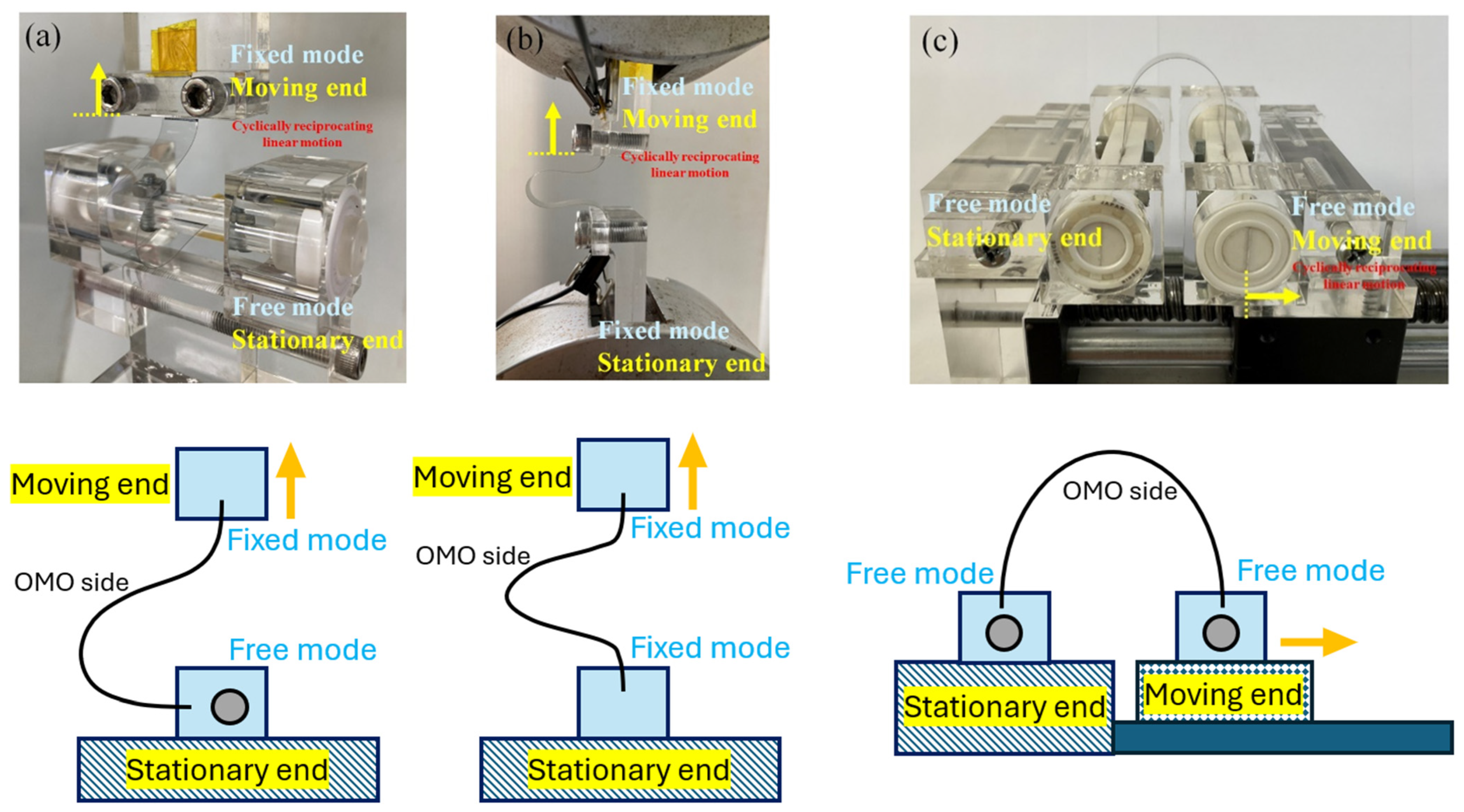
Real-time resistance measurements during the cyclic bending tests were achieved by employing a digital multimeter (LRS4-TG1, KeithLink Technology Co., Ltd., New Taipei City, Taiwan) in conjunction with a servo-controlled universal testing machine (Chun Yen Testing Machines Co., Ltd., CY-6102, Taichung, Taiwan). This integrated setup, along with custom software (KeithLink Technology Co., Ltd., New Taipei City, Taiwan) for logging data, facilitated continuous monitoring for resistance changes between the two terminal ends of OMO samples throughout the cyclic bending process. Custom-made acrylic fixtures were employed to realize three types of bending deformation modes, as shown in Figure 1 [26]. All the cyclic bending tests were performed through displacement control methods.
By one end of the fixture being reciprocating movement and another end being stationary, the OMO sample was subjected to bending, and the minimum radius of curvature of the bent OMO samples was kept not smaller than 1.0 cm. The traveling speed of the cyclically reciprocating movement of the moving fixture was 300 mm/min, which in turn was 40 s per cycle because of pauses at both ends. To make a criterion of electrical failure, the OMO samples were deemed to fail as the real-time resistance value (R) reached 2.5 times the original resistance value (R0). To investigate the failure behaviors of the OMO samples under different bending deformation modes, the sample was subjected to cyclic bending in the following configurations: one end with a fixed fixture while the other end with a free fixture (Figure 1a); both ends with fixed fixtures (Figure 1b); and both ends with free fixtures (Figure 1c). The free-free mode was realized through a servo-motor-controlled uniaxial translation platform.
For the reliability study of aging time effect, OMO samples aged for 0, 6, 9, and 15 d were tested by cyclic bending in fixed-free mode, with each testing population having 10 samples for Weibull analysis. For the studies of Ag layer thickness and bending mode effects, 6 d aged specimens were tested in fixed-free mode. For the sequential aging tests, the 18-day-aged OMO samples were manually bent using an auxiliary mold with a diameter of 2.4 mm, prior to the 2nd aging step. The manual bending procedure was to generate immediate surface cracks, and hence, the influence of the surface cracks on the weatherability of OMO samples will be investigated.

2.3. Materials Characterization

For optical properties, we used a Hitachi UV–visible (UV–Vis) spectrophotometer (U-5100, Hitachi, Tokyo, Japan) to measure the transmittance of the OMO samples in a wavelength range of 350 nm to 800 nm. We adopted a four-point probe along with the LRS4-TG1 KeithLink multimeter to measure the sheet resistance (Rsq) of the OMO samples. For mechanical properties, the universal testing machine was utilized to conduct tensile testing with a gauge length of 8 cm for the OMO samples. The crosshead speed of the universal testing machine was 5 mm/min during the tensile testing.
We used a scanning electron microscope (SEM, S-4800, Hitachi, Tokyo, Japan) to observe the morphological and cross-sectional images of the OMO samples. Cross-sections of the OMO structure on the PET substrate were obtained through cutting the samples using a razor blade after soaking the OMO samples in liquid nitrogen for 10 min. Backscattered electron (BSE) images were analyzed to investigate the aging effects of the 2nd aging step after the two-step sequential aging test. The SEM operated at voltages ranging from 4 to 10 kV. Qualitative chemical composition analysis of the OMO surface was conducted on the unaged and the two-step sequentially aged samples using X-ray photoelectron spectroscopy (XPS, ULVAC-PHI, PHI 5000 VersaProbe, Kanagawa, Japan). The XPS utilized the Kα line at 1486.6 eV emitted from an aluminum target, with a working voltage of 15 kV.

3. Results and Discussion

3.1. Baseline Information of the Unaged OMO Samples

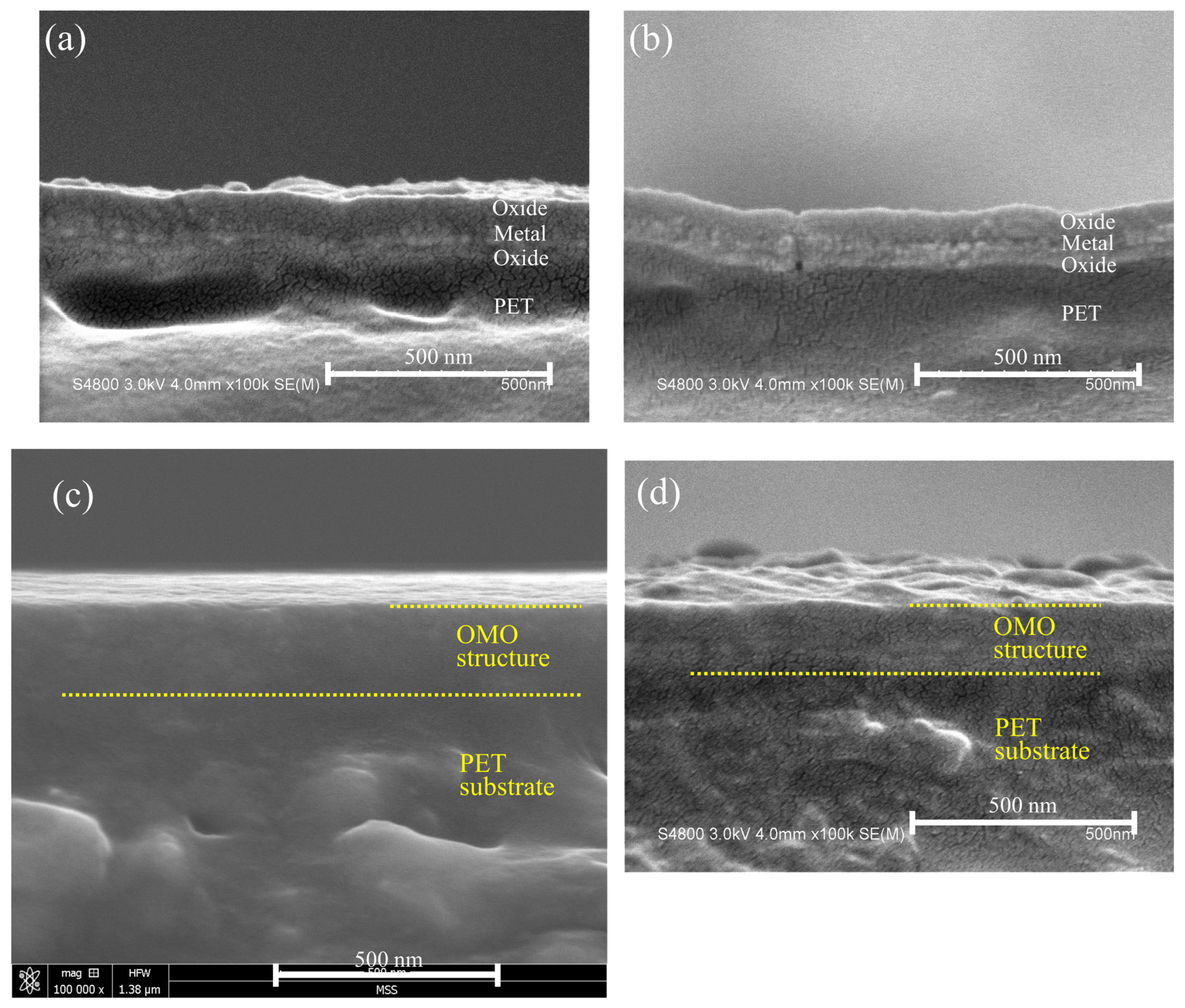
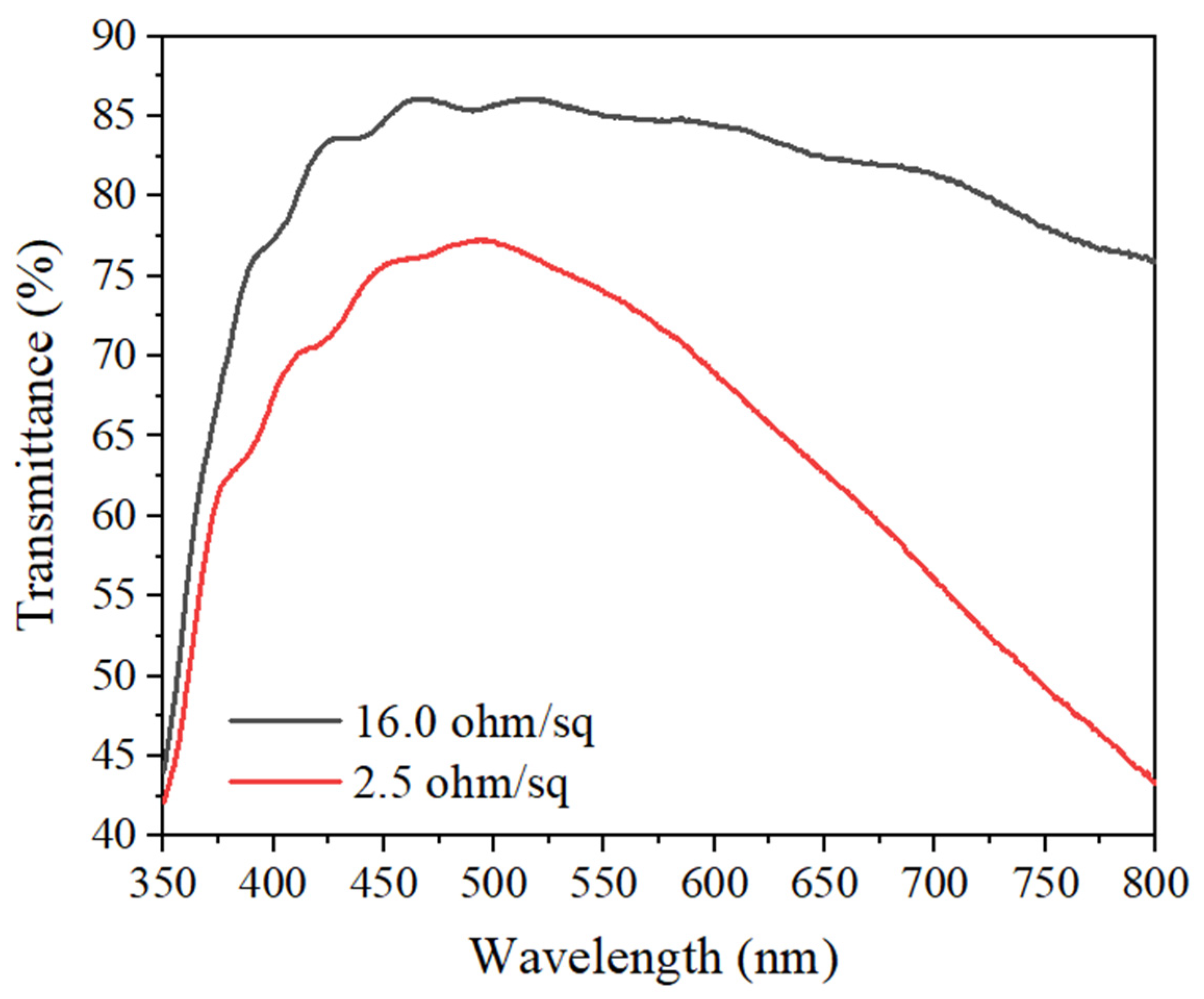
As revealed by SEM cross-sectional images, the OMO coating has a nano-laminated structure (Figure 2a,b). As the nano-laminated structure is thinner, the sheet resistance value increases, resulting in higher optical transmittance (Figure 2c,d and Figure 3). The nano-laminated structure of the 16.0 Ω/sq samples is thinner, resulting in a higher transmittance of 85% at a wavelength of 550 nm in the UV-Vis spectrum. It is worth noting that the commercially available OMO samples possess proprietary interlayers through interfacial engineering, such as atomic layer deposition (ALD) and silane self-assembled monolayers [27,28]. In the present study, the two clearly distinguishable transmittance spectra in Figure 3, along with the corresponding sheet resistance values, support the proof for the thickness difference of Ag layers. Based on the characterization results, the OMO samples exhibit excellent initial optoelectrical properties, including the electrical conductivity and the optical transmittance, along with a dense and robust nano-laminated oxide/Ag/oxide structure.
Figure 3 also depicts the evolution of plasmon resonance modes due to OMO Ag nano-layer thicknesses. The Ag nano-layer is in the format of a mesh having nano-troughs instead of a continuous film. When the thickness of the Ag mesh layer exceeds a critical thickness, the sheet resistance value decreases, but the optical transmittance in the visible range reaches a plateau due to the photon resonance confinement effect generated by the nanostructures of the silver mesh and metal oxide layers [29]. Additionally, due to the confinement effect of cohesive forces in the nano-laminates, the residual compressive stress increases as the nano-layer thickness decreases, thereby affecting the lattice constant and the valence band energy levels [6]. The degradation of the PET substrate alters the surface/interface plasmon resonance modes induced by the silver mesh nanostructure [20]. The transmittance at different wavelengths exhibits distinct characteristic charge distributions [29]. The conductive performance of the OMO multilayer relies on the structural integrity, while the optical transmittance largely depends on the microstructure and morphology.

3.2. Weathering Effect on the Cyclic Bending Reliability of OMO Samples

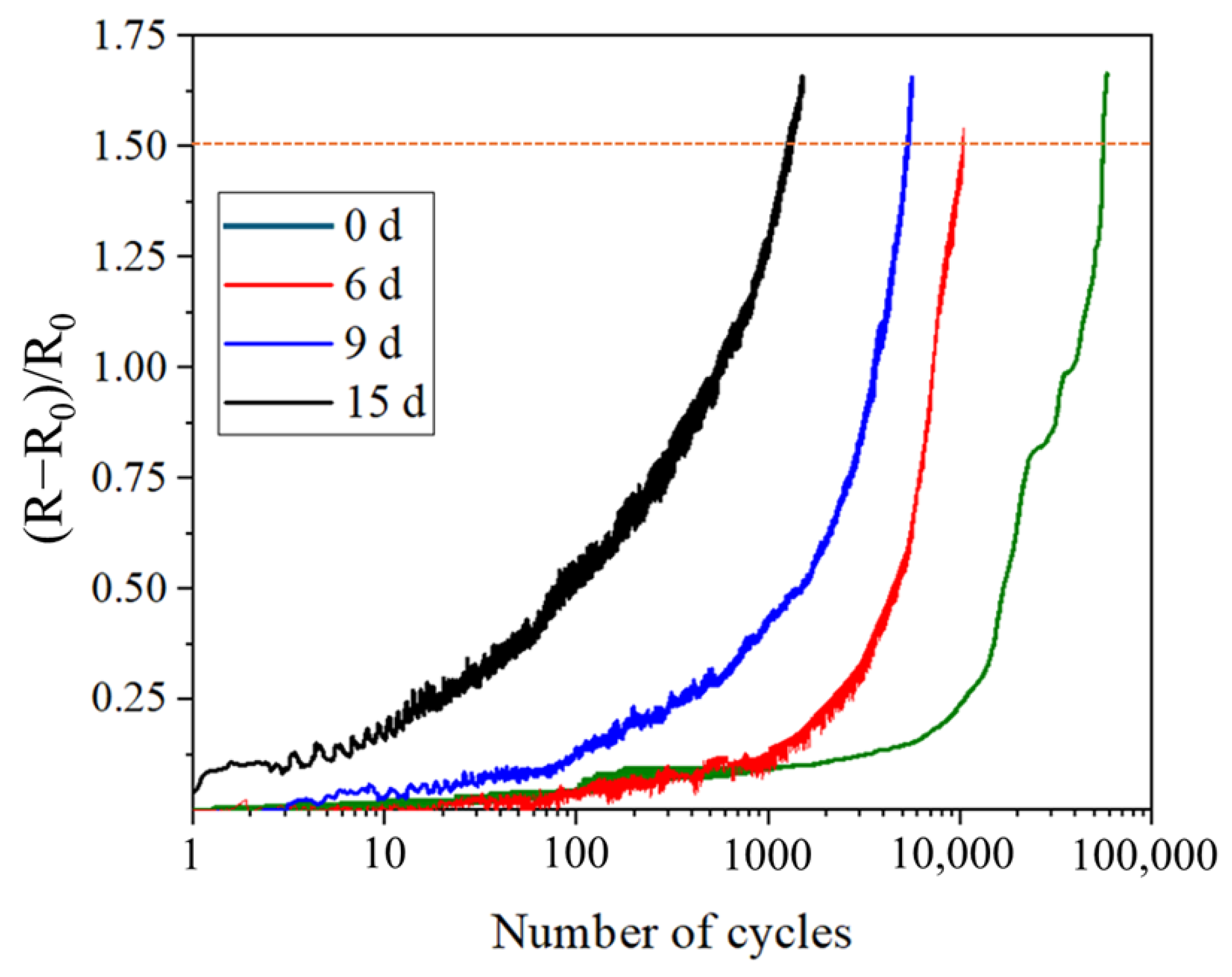
Figure 4 shows the normalized resistance change (i.e., (R − R0)/R0) plotted against the number of bending cycles. With increasing bending cycles, the resistance values of both unaged and aged OMO samples exhibit exponential soaring. It is evident that the failure rate of aged OMO samples is higher than that of unaged samples. This can be explained by the embrittlement of PET substrates after aging, as shown later in this paper. Moreover, the failure rate increases monotonically while prolonging the aging time.
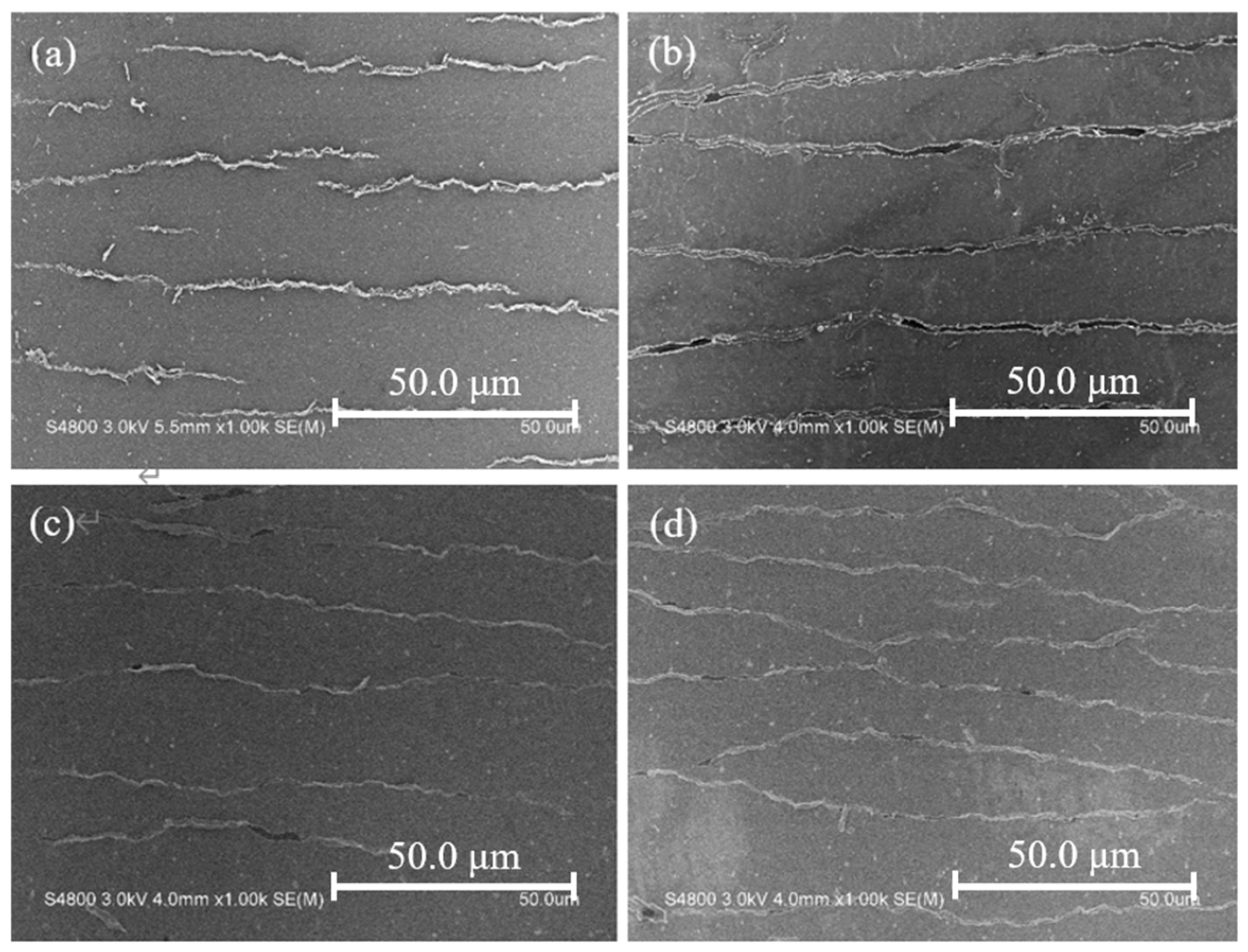
Figure 5 reveals the presence of quasi-periodic channel cracks on the OMO coatings of the failed samples. Note that the crack direction is perpendicular to the length direction of the rectangular strip samples. The inspection area is the location where the minimum radius of curvature occurs during bending. The crack density increases with the extension of the weathering time. The rise in resistance during cyclic bending is primarily caused by such fatigue stress-induced cracking on the conductive OMO coating [1]. Note that the bending cycles experienced for the samples in Figure 5 are different due to different weathering times exposed, while the same real-time resistance has been achieved. Abundant literature has performed focused ion beam (FIB) cross-sectional analysis, demonstrating the microscopic insights of the existence of bridges and necking at the crack damage centers for discovering the relationship between conductive pathways and mechanical damage evolution [30,31,32,33,34]. In the present study, the data from cyclic bending tests were statistically analyzed using the Weibull distribution to acquire the characteristic lifespan of the OMO sample under cyclic bending and to investigate the evolution in failure behaviors caused by various aging times.
The Weibull distribution is a continuous distribution function used to analyze material lifespan data, extract failure times, and conduct reliability analysis. It is particularly suitable for cracking issues because such scenarios possess the nature that localized damage to materials results in the overall failure of the component, device, or system. The probability density function (PDF), f(t), in the Weibull distribution is defined as follows:
f ( t ) =   β η ( t η ) β 1 e ( t η ) β ,
where β is the shape parameter, and η is the scale parameter representing the failure time (t) at which 63.2% of the tested samples have failed. The cumulative distribution function (CDF), F(t), is derived by integrating Equation (1), so that
F ( t ) = 1 e ( t η ) β .
By analyzing the parameters of the Weibull distribution, the impact of accelerated weathering on the bending-damaged OMO samples can be studied.
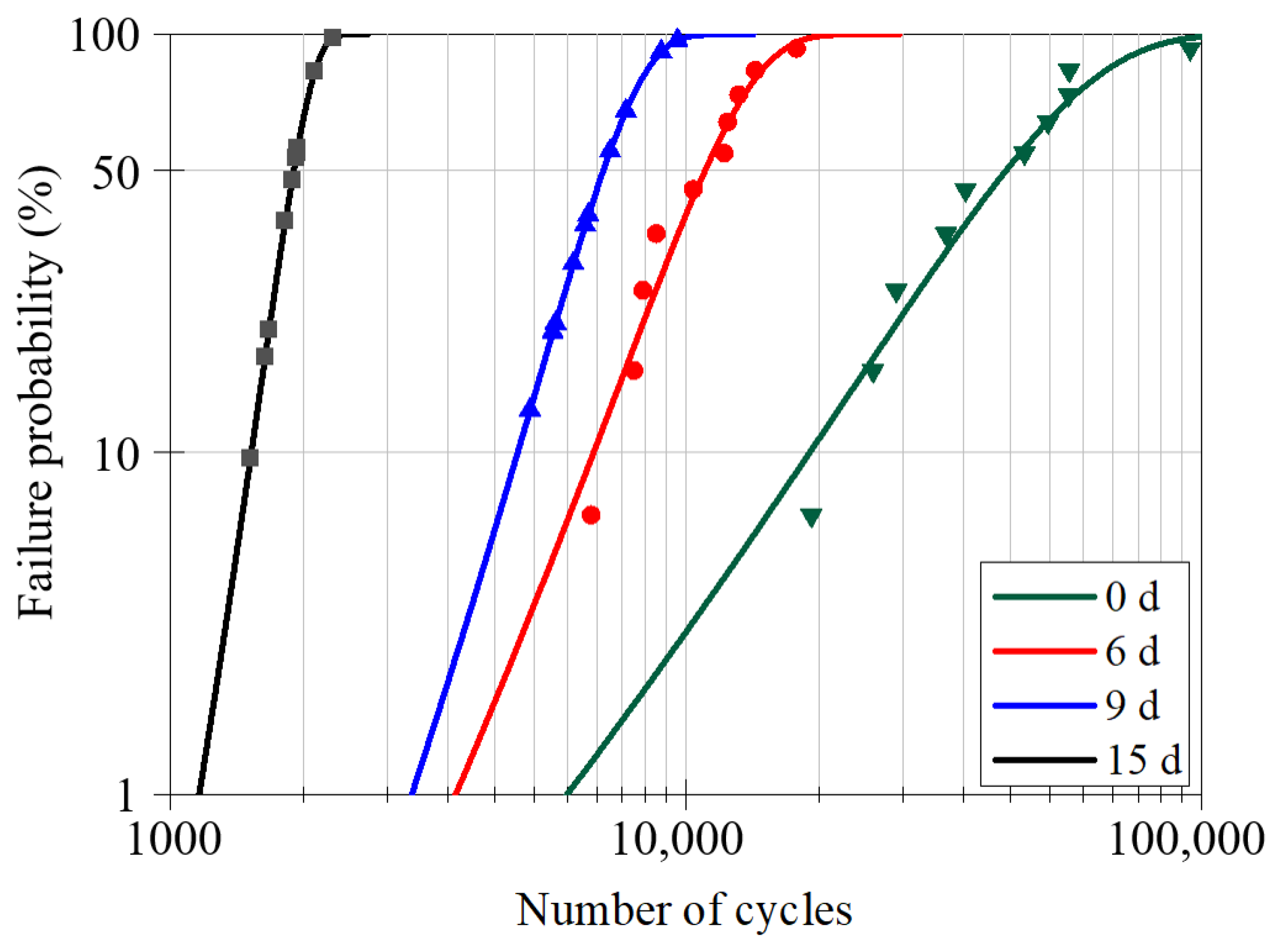
The Weibull distribution diagram of the cyclic bending test results before and after one-step environmental testing is displayed in Figure 6, and the summary of Weibull parameters is presented in Table 1. Both β and η values show significant evolution with increasing weathering time. For unaged (0 d) samples, the β = 2.2 indicates a right-skewed distribution. After 6 d to 15 d weathering times, the β value increases from 3.8 to 10.0, illustrating that the distribution becomes more left-skewed after a longer weathering time. On the other hand, as the weathering time increases from 0 d to 15 d, the scale parameter, which represents the characteristic lifespan of the OMO sample under cyclic bending, drops sharply from 49,522 cycles to 1804 cycles. This suggests that longer UV exposure leads to a reduction in the bending lifespan in terms of electrical failure. The UVA exposure at elevated temperature leads to chain scission and oxidation of the PET substrate, and alters its mechanical behaviors [20]. Therefore, the apparent monotonic evolution of the β and η values reveals a gradual change in the failure mechanism.
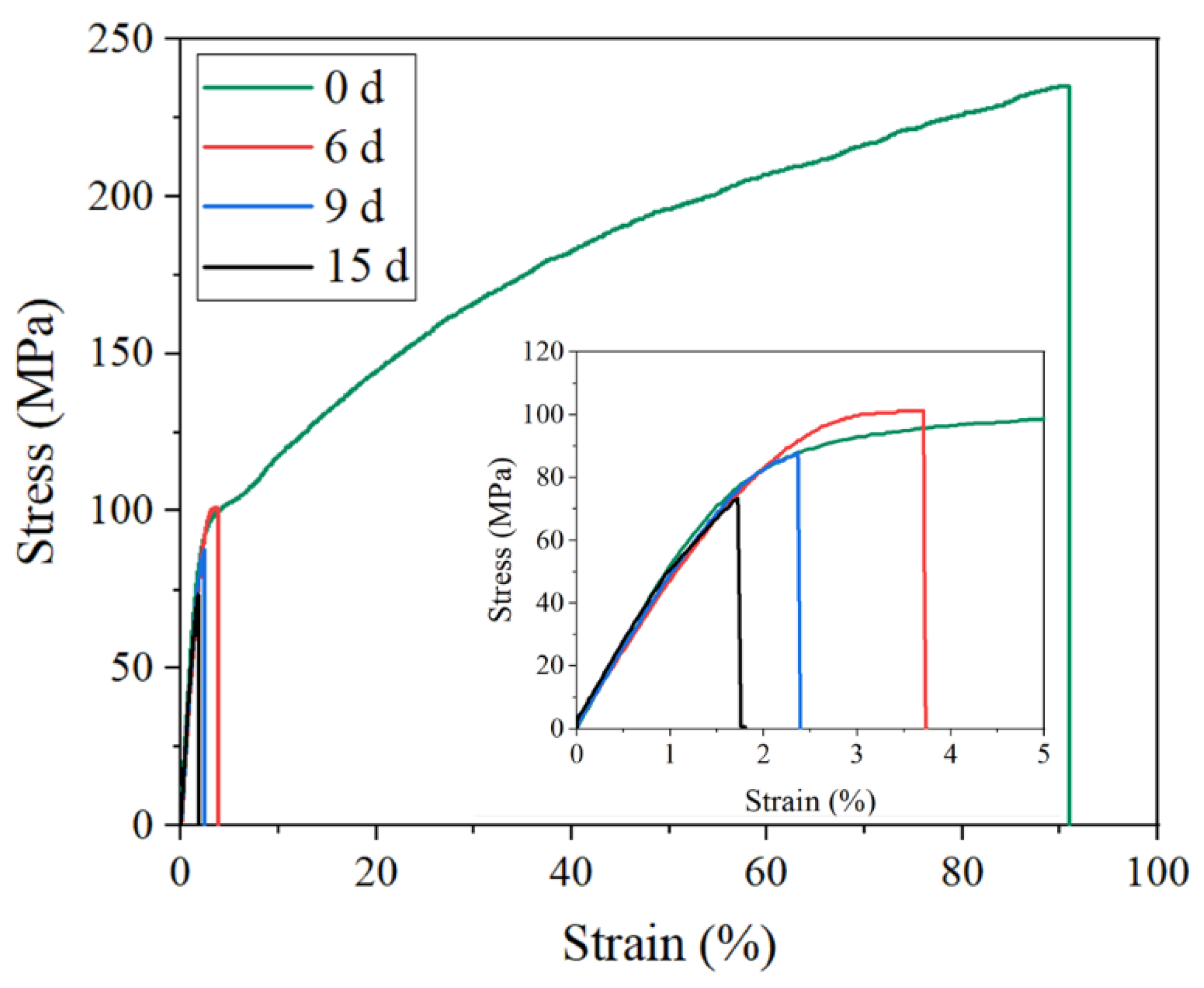
The tensile test results shown in Figure 7 demonstrate the progressive change of the mechanical behaviors of OMO samples before and after weathering. The area under the stress–strain curves, measured in Joules per unit volume, implicates the tendency towards ductility or brittleness during mechanical deformation. Unaged samples exhibit high ductility, characterized by a very high ultimate strength and a significantly large strain at break. Upon UV exposure, the chemical bonds within PET, particularly the ester bonds, are disrupted, leading to the breakage of molecular chains and a subsequent reduction in molecular weight [21,22]. These structural changes directly affect the mechanical properties of PET, significantly impairing its strength and toughness, and hence making the OMO multilayer prone to cracking upon bending [35]. As aging time increases, the β gradually shifts to a higher value, indicating more damage to the internal integrity of the materials, and meanwhile, η decreases to 1804 cycles. The embrittlement increases the stress that is experienced by the OMO nano-layers during cyclic bending, which in turn accelerates defect formation and accumulation [13], leading to more pronounced channel cracks on the OMO multilayers as observed in Figure 5. It is known that stiffness and toughness of substrates are critical to the strain constraint/transfer effect on the deformation-induced cracking of flexible conductors [33,34,36]. Therefore, the electromechanical performance of OMO FCTs heavily relies on the weatherability of substrate materials. Additionally, as the bending cycle number increases, delamination and peeling may occur at the interfaces, which further deteriorate the electrical properties and speed up the overall failure process [37].

3.3. Effect of Ag Layer Thickness on the Bending Reliability Behavior

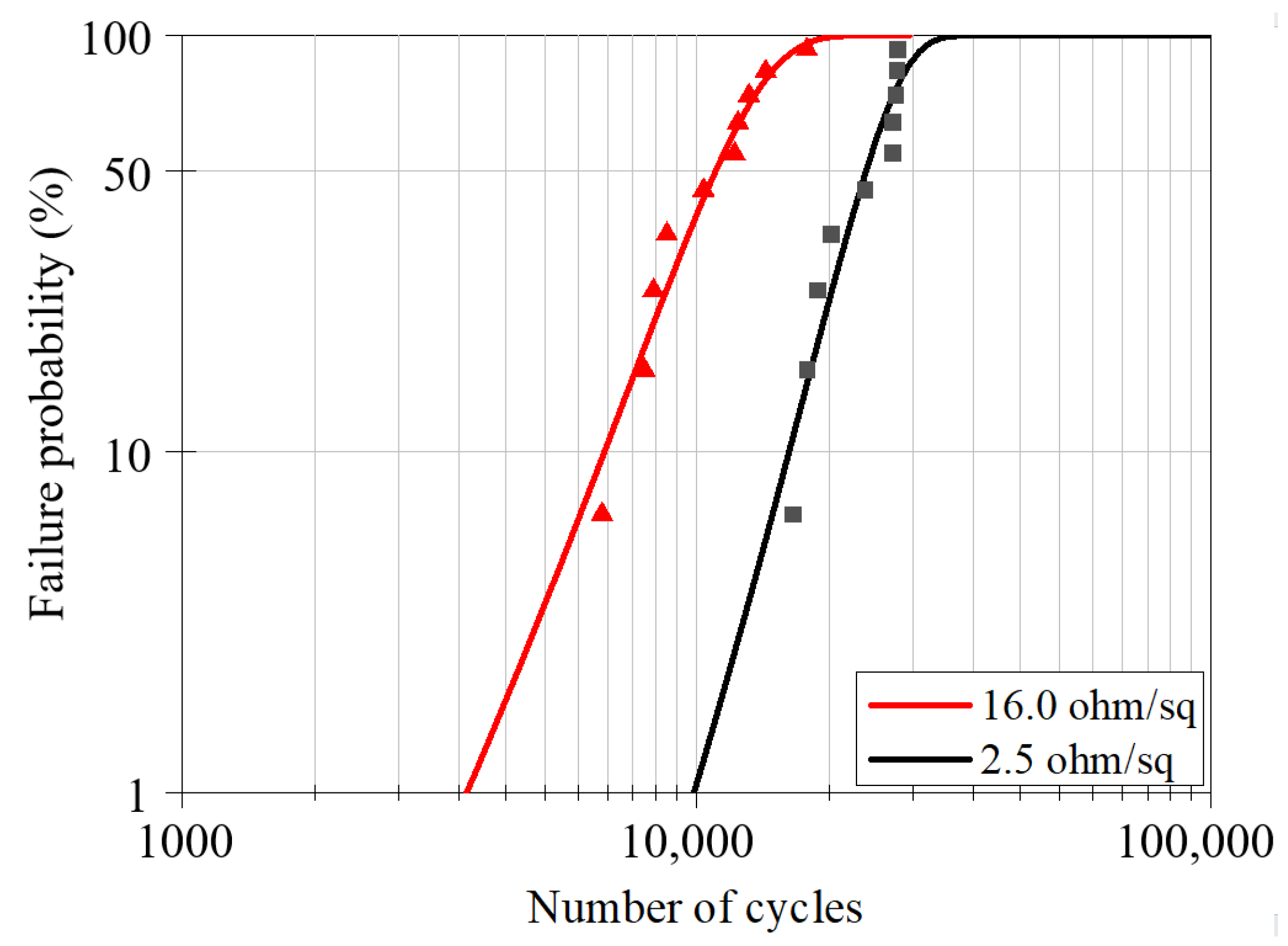
The performance under cyclical bending varies with different Ag layer thicknesses. Here, the aging time has been fixed at 6 d, and the cyclic bending caused electrical failure was recorded for Weibull analysis. The Weibull distribution of the testing results is presented in Figure 8. As the thickness of the Ag mesh increases, the bending lifespan increases from 12,012 to 22,851, and the β value rises from 3.8 to 5.5, indicating a shift toward a more left-skewed distribution along with a slower failure rate. This suggests that although weathering-caused damage exists, the stress to propagate microcracks within the materials has been delayed due to the increased Ag layer thickness. Thicker Ag layers redistribute mechanical stress more evenly, reducing localized stress concentrations that would accelerate crack initiation, formation, and growth, which is critical for improving durability under repeated mechanical loading [28,38,39]. The enhanced resistance to cracking allows the OMO multilayer to withstand a greater number of cyclic bending, effectively delaying electrical failure and improving fatigue life.

3.4. Sequential Aging Test by Two-Step UVA Weathering

Although the OMO FTC film retains good electrical properties after being weathered, it is very likely that the sequentially subsequent bending caused surface cracks will influence its opto-electrical properties and chemical stability. Therefore, a two-step sequential aging test is necessary to investigate the degradation behaviors of cracked OMO FTCs.
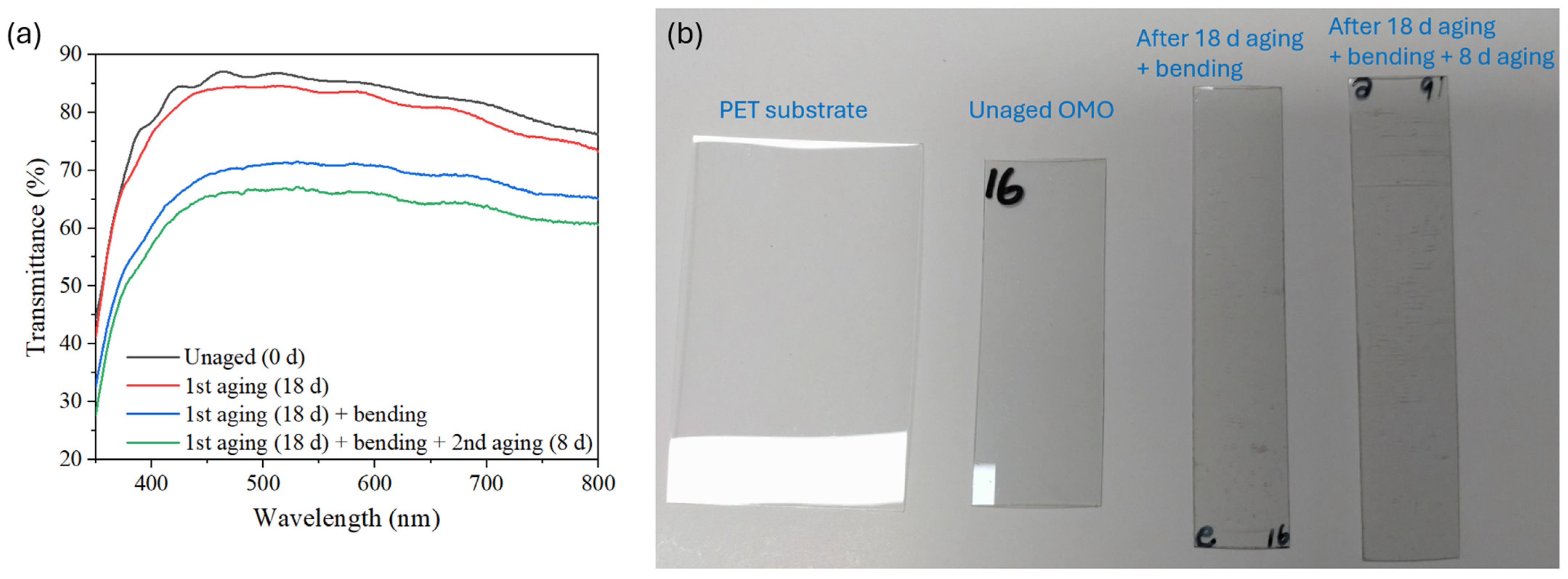
The first step of aging majorly degraded the PET substrate, provoking PET substrate embrittlement. The bending step would proliferate surface cracks because of the increased brittleness of the PET substrate. Figure 9 shows the progressive degradation of optical properties as sequential aging tests proceeded. Bending generated surface cracking and UVA exposure at 40 °C (i.e., the second aging) causes a significant drop in transmittance and evolution of the surface plasmon resonance modes in the nanostructured OMO multilayers. The optical transmittance has been significantly impaired after the second aging step. The transmittance at different wavelengths exhibits distinct characteristic charge distributions [25,29]. Because the degraded PET substrate alters the surface/interface morphologies, subsequent bending can hence modify the plasmon resonance modes induced by the Ag mesh nanostructures. Furthermore, the second aging step results in photo-assisted corrosion and interfacial aging degradation on Ag around the crack areas, affecting the ZTO/Ag/ZTO nano-laminate’s photoelectrical and optical properties. Figure 9b illustrates the visible evolution of the OMO samples after different stages of tests, highlighting the cracking, haze formation, localized defects, and surface nonuniformity of the two-step aged sample.
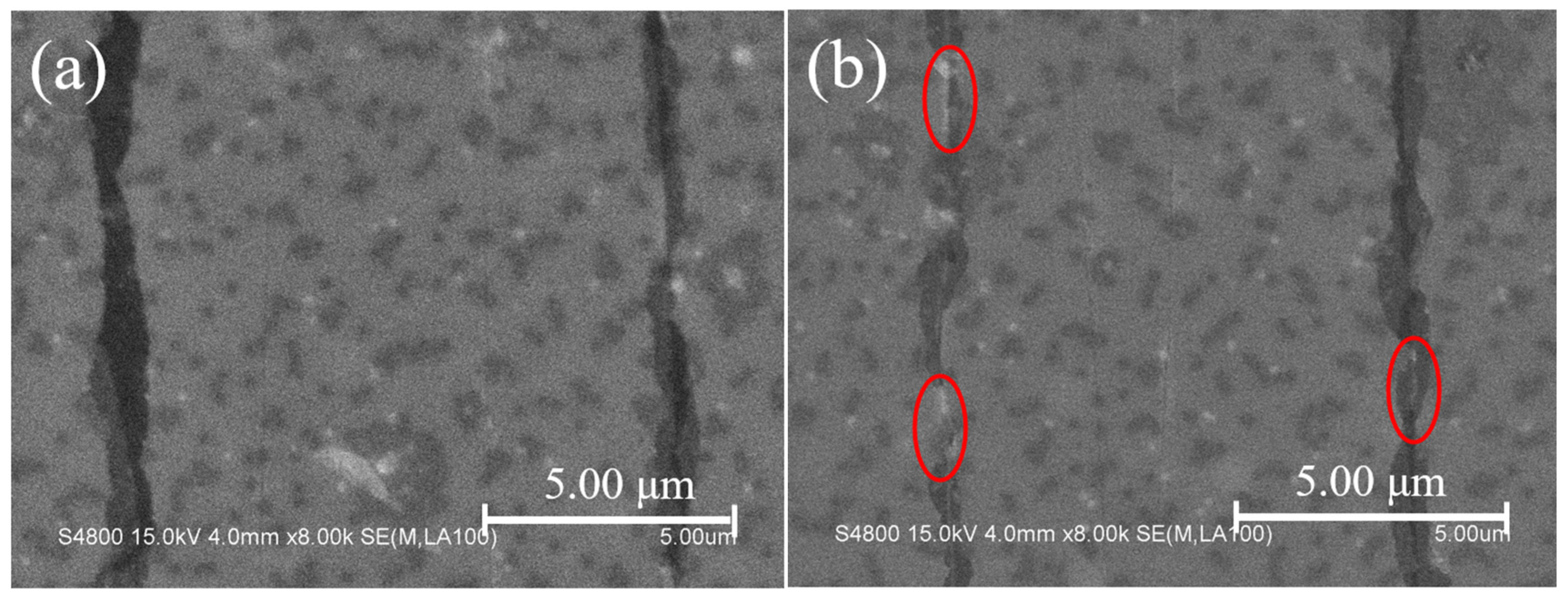
SEM BSE images show that the bending caused surface cracks, facilitating the direct exposure of Ag, and hence corrosion products of silver could be observed in the vicinity of the cracks as the crack areas become lighter after second aging (Figure 10). In the second aging step, the occurrence of photo-assisted corrosion and interfacial aging degradation near cracks can be attributed to the direct exposure of silver to the environmental factors. Silver is particularly sensitive to photo-assisted oxidation when exposed to light in the presence of moisture and oxygen. This leads to the formation of reactive species such as hydroxyl radicals, which accelerate corrosion around the cracks [40,41,42].
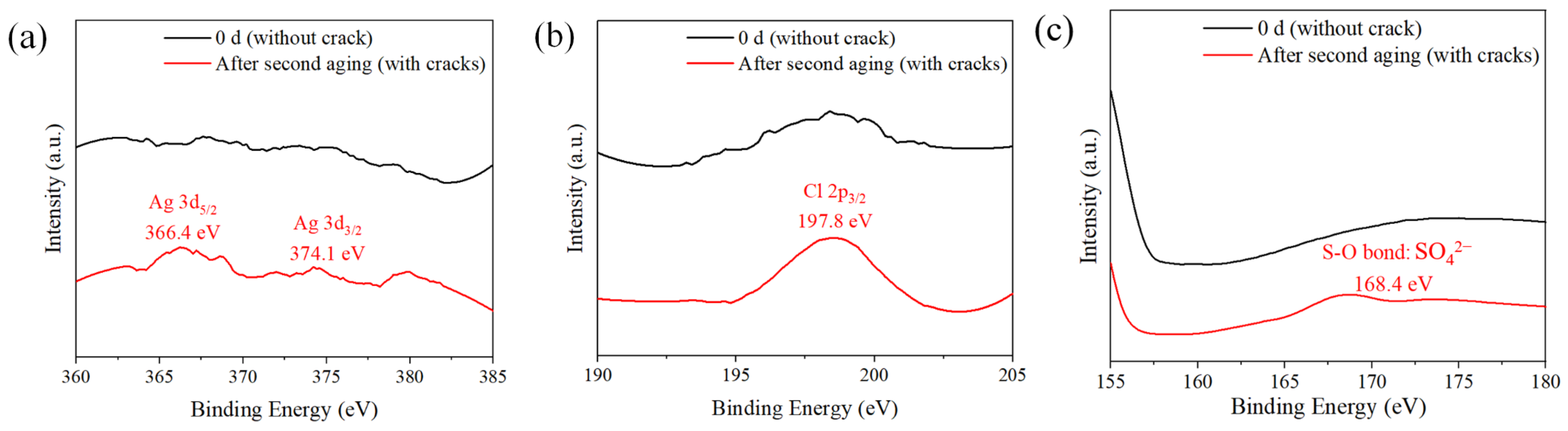
Furthermore, the OMO cracks provide pathways for these reactive species to infiltrate, exacerbating the degradation process at the interfaces of the multilayer. After the second aging, because the Ag layer is exposed directly due to cracking, the relative amount of Ag becomes traceable (Figure 11a). Silver will undergo a photodegradation reaction, forming AgCl after the second aging (Figure 11b). UVA irradiation activates the deterioration of silver, enhancing its chemical reactivity with sulfur-containing compounds. This activation process promotes the interaction between silver and sulfides, resulting in increased sulfur deposition on the exposed silver surface (Figure 11c) [43]. Such chemical degradation findings also explain the evolution of optical behaviors shown in the UV-vis spectra in Figure 9.

3.5. Study of the Bending Modes

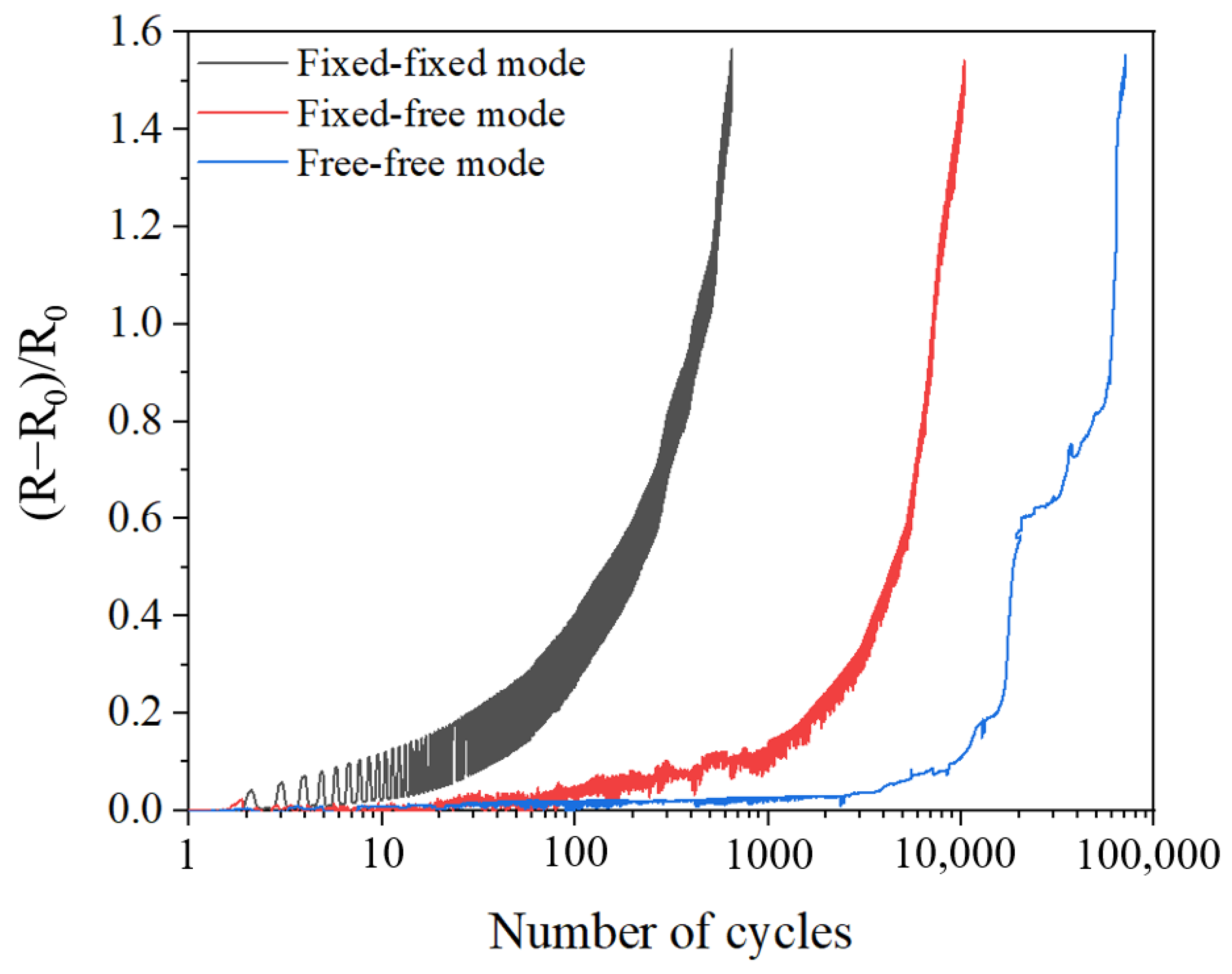
Cyclic bending tests were conducted under three different modes, demonstrating the diversity of electrical failure behaviors for OMO samples by various bending modes [12]. The detailed explanation of the three bending modes can be seen in Section 2.2 (Figure 1). Figure 12 shows the relationship between the normalized resistance change, (R − R0)/R0, and the number of bending cycles from the three bending modes studied. All three bending modes exhibit an exponential increase in resistance at different rates of failure. In the fixed-fixed mode, the samples present a monotonic rising trend with a clear sawtooth trait of resistance jumping during each bending, and eventually reach electrical failure after only 633 cycles. This is because the samples under fixed-fixed mode are subject to multiple compressive stress files, which accelerate defect formation and accumulation for fatigue and cracking [19]. The resistance in this mode has illustrated the most pronounced cycle-dependent change.
In contrast, samples in the free-free mode fail after 69,720 cycles. With compressive stress being relatively less influential, slower cracking behavior and therefore a more gradual but discontinuous increase in resistance throughout the cyclic bending procedure can be observed. On the other hand, it is known that the bending frequency has very little influence on the cyclic bending failure behaviors of FTCs [19]. The primary factor affecting electrical failure under cyclic bending is the formation and propagation of cracks under compressive stress [13]. The free-free mode renders the least defect formation and accumulation rate towards OMO samples, leading to a prolonged bending lifespan.

4. Conclusions

This study systematically investigates the reliability behaviors of Ag-based oxide/metal/oxide (OMO) flexible transparent conductors (FTCs) through sequentially conducting accelerated weathering and cyclic bending tests. The results demonstrate that the deterioration of PET substrates significantly influences the mechano-electrical properties of the OMO multilayered nanostructures. Weibull analysis reveals a notable reduction in the bending lifespan of the OMO FTCs as the aging time increases. The evolution of the shape parameter, from β = 2.2 to β = 10.0, indicates accumulating microstructure damage of OMO samples upon weathering. Stiffness and toughness evolution due to substrate degradation by weathering must be taken into consideration for the reliability performance of FTCs. On the other hand, thicker Ag layers improve fatigue resistance by redistributing mechanical stress when bent, resulting in prolonged bending lifespan. Furthermore, bending deformation modes play a key role in the bending failure behaviors of OMO samples.
The two-step sequential aging test illustrates that surface cracks promote the ingress of reactive species, and hence provoke the degradation of OMO nano-Ag-layers. Therefore, impaired FTCs will be detrimental to optical performance due to the bending-caused cracks. This has been verified through the observed photo-assisted corrosion near the cracks after the second aging of UVA exposure. This study provides insights into the complex interplay between weathering, mechanical deformation, and material degradation in OMO FTCs. Traditional one-step testing may be limited for assessing the reliability of FTCs. The multi-step sequential aging as well as bending deformation modes play critical roles in establishing the application-specific testing protocols for FTCs in outdoor applications. The findings in the present study are fundamental for the future development of standardized reliability testing, which is key to advancing durable FTCs for flexible optoelectronics applications.

Author Contributions

Conceptualization, C.-C.L. and J.-Y.C.; methodology, J.-Y.C. and H.-S.C.; software, Y.-H.K. and H.-S.C.; validation, J.-Y.C. and Y.-H.K.; formal analysis, J.-Y.C. and Y.-H.K.; investigation, J.-Y.C., Y.-H.K. and H.-S.C.; resources, C.-C.L.; data curation, J.-Y.C. and Y.-H.K.; writing—original draft preparation, C.-C.L. and J.-Y.C.; writing—review and editing, C.-C.L.; visualization, C.-C.L. and J.-Y.C.; supervision, C.-C.L.; project administration, C.-C.L.; funding acquisition, C.-C.L. All authors have read and agreed to the published version of the manuscript.

Funding

This research was funded by the National Science and Technology Council (NSTC), Taiwan, grant numbers MOST 109-2221-E-035-039 and NSTC 114-2221-E-035-055.

Institutional Review Board Statement

Not applicable.

Informed Consent Statement

Not applicable.

Data Availability Statement

The original contributions presented in this study are included in the article. Further inquiries can be directed to the corresponding author.

Acknowledgments

The authors thank the Precision Instrument Support Center at Feng Chia University for the SEM imaging (grant number NSTC 113-2740-M-035-001). The authors also acknowledge the Msscorps Co., Ltd. for the prompt service of high-resolution SEM and the MSDL 2026 staff at Feng Chia University for the preparation of cross-section samples.

Conflicts of Interest

The authors declare no conflicts of interest.

References

  1. Cordill, M.J.; Kreiml, P.; Köstenbauer, H.; Mitterer, C. A comparison of 90° bending for foldable electronics. Coatings 2024, 14, 98. [Google Scholar] [CrossRef]
  2. Yaseen, M.; Khattak, M.A.K.; Khan, A.; Bibi, S.; Bououdina, M.; Usman, M.; Khan, N.A.; Pirzado, A.A.A.; Abumousa, R.A.; Humayun, M. State-of-the-art electrochromic thin films devices, fabrication techniques and applications: A review. Nanocomposites 2024, 10, 1–40. [Google Scholar] [CrossRef]
  3. Kim, T.H.; Park, S.H.; Kim, D.H.; Nah, Y.C.; Kim, H.K. Roll-to-roll sputtered ITO/Ag/ITO multilayers for highly transparent and flexible electrochromic applications. Sol. Energy Mater. Sol. Cells 2017, 160, 203–210. [Google Scholar] [CrossRef]
  4. Maji, A.; Kuila, C.; Murmu, N.C.; Kuila, T. Interface-engineered hybrid networks to resolve the trade-off between sensitivity and detection range in flexible strain sensors. IEEE Sens. Lett. 2026, 10, 2500204. [Google Scholar] [CrossRef]
  5. Wang, H.; Tang, C.; Shi, Q.; Wei, M.; Su, Y.; Lin, S.; Dai, M. Influence of Ag incorporation on the structural, optical and electrical properties of ITO/Ag/ITO multilayers for inorganic all-solid-state electrochromic devices. Ceram. Int. 2021, 47, 7666–7673. [Google Scholar] [CrossRef]
  6. Sarma, B.; Sarma, B.K. Role of residual stress and texture of ZnO nanocrystals on electro-optical properties of ZnO/Ag/ZnO multilayer transparent conductors. J. Alloys Compd. 2018, 734, 210–219. [Google Scholar] [CrossRef]
  7. Omiyale, B.O.; Ogbeyemi, A.; Ashraf, M.A.; Song, K.-Y.; Zhang, W.C. Towards robust flexible electronics: Fabrication approaches and ongoing research challenges. Sens. Actuators A Phys. 2025, 395, 117053. [Google Scholar] [CrossRef]
  8. Won, D.; Bang, J.; Choi, S.H.; Pyun, K.R.; Jeong, S.; Lee, Y.; Ko, S.H. Transparent electronics for wearable electronics application. Chem. Rev. 2023, 123, 9982–10078. [Google Scholar] [CrossRef]
  9. Ohsawa, M.; Hashimoto, N.; Takeda, N.; Tsuneyasu, S.; Satoh, T. Bending reliability of transparent electrode of printed invisible silver-grid/PEDOT: PSS on flexible epoxy film substrate for powder electroluminescent device. Microelectron. Reliab. 2020, 109, 113673. [Google Scholar] [CrossRef]
  10. Maeda, K.; Kashiwagi, Y.; Uno, M. Electrical and cyclic bending properties of screen-printed conductive patterns containing different ratios of silver microparticles and silver microflakes. Microelectron. Reliab. 2021, 123, 114243. [Google Scholar] [CrossRef]
  11. Glushko, O.; Cordill, M.J.; Klug, A.; List-Kratochvil, E.J. The effect of bending loading conditions on the reliability of inkjet printed and evaporated silver metallization on polymer substrates. Microelectron. Reliab. 2016, 56, 109–113. [Google Scholar] [CrossRef]
  12. Mohammed, D.W.; Ameen, R.B.; Sierros, K.A.; Bowen, J.; Kukureka, S.N. Twisting fatigue in multilayer films of Ag-alloy with indium tin oxide on polyethylene terephthalate for flexible electronics devices. Thin Solid Films 2018, 645, 241–252. [Google Scholar] [CrossRef]
  13. Seo, Y.; Ha, H.; Matteini, P.; Hwang, B. A review on the deformation behavior of silver nanowire networks under many bending cycles. Appl. Sci. 2021, 11, 4515. [Google Scholar] [CrossRef]
  14. Mohammed, D.; Ameen, R.; Street, S.; Sierros, K.; Bowen, J.; Kukureka, S. The effects of corrosion, fatigue, and corrosion-fatigue of multilayer coated polyesters for flexible electronics applications. e-J. Surf. Sci. Nanotechnol. 2021, 19, 61–68. [Google Scholar] [CrossRef]
  15. Chapel, A.; Fortineau, J.; Porcher, N.; Malandain, S.; Boucaud-Gauchet, S. Effect of thermo-mechanical ageing on materials and interface properties in flexible microelectronic devices. Microelectron. Reliab. 2021, 122, 114162. [Google Scholar] [CrossRef]
  16. Aghaei, M.; Fairbrother, A.; Gok, A.; Ahmad, S.; Kazim, S.; Lobato, K.; Oreski, G.; Reinders, A.; Schmitz, J.; Theelen, M.; et al. Review of degradation and failure phenomena in photovoltaic modules. Renew. Sust. Energy Rev. 2022, 159, 112160. [Google Scholar] [CrossRef]
  17. Lyu, Y.; Kim, J.H.; Fairbrother, A.; Gu, X. Degradation and cracking behavior of polyamide-based backsheet subjected to sequential fragmentation test. IEEE J. Photovolt. 2018, 8, 1748–1753. [Google Scholar] [CrossRef]
  18. Saarinen, K.; Frisk, L. Reliability analysis of UHF RFID tags under a combination of environmental stresses. IEEE Trans. Device Mater. Reliab. 2013, 13, 119–125. [Google Scholar] [CrossRef]
  19. Hamasha, M.M.; Alzoubi, K.; Obeidat, M.S.; HMasha, E.; Alkhazali, A. Effects of cyclic bending parameters on aluminum-doped zinc oxide thin films for flexible device applications. IEEE Trans. Compon. Packag. Manuf. Technol. 2023, 13, 1750–1756. [Google Scholar] [CrossRef]
  20. Kao, Y.-H.; Chang, H.-S.; Wang, C.-C.; Lin, C.-C. Weathering and material characterization of ZTO/Ag/ZTO coatings on polyethylene terephthalate substrates for the application of flexible transparent conductors. Coatings 2022, 12, 1249. [Google Scholar] [CrossRef]
  21. Horne, F.J.; Liggat, J.J.; MacDonald, W.A.; Sankey, S.W. Photo-oxidation of poly(ethylene terephthalate) films intended for photovoltaic backsheet. J. Appl. Polym. Sci. 2020, 137, 48623. [Google Scholar] [CrossRef]
  22. Gok, A.; Gordon, D.A.; Burns, D.M.; Fowler, S.P.; French, R.H.; Bruckman, L.S. Reciprocity and spectral effects of the degradation of poly(ethylene terephthalate) under accelerated weathering exposures. J. Appl. Polym. Sci. 2019, 136, 47589. [Google Scholar] [CrossRef]
  23. ASTM D7869-17; Standard Practice for Xenon Arc Exposure Test with Enhanced Light and Water Exposure for Transportation Coatings. ASTM: West Conshohocken, PA, USA, 2017.
  24. Xia, J.; Liu, Y.; Hu, H.; Zhu, X.; Lv, H.; Phillips, N.H.; Choudhury, K.R.; Gambogi, W.J.; Rodriguez, M.; Simon, E.S.; et al. Impact of specimen preparation method on photovoltaic backsheet degradation during accelerated aging test. Energy Sci. Eng. 2022, 10, 1961–1971. [Google Scholar] [CrossRef]
  25. Chang, H.-S.; Feng, P.; Lyu, Y.; Lin, C.-C. Accelerated and outdoor weathering of silver nanowire transparent conductors under electrical stress in pseudo-modules. Nanotechnology 2022, 33, 15LT01. [Google Scholar] [CrossRef]
  26. Kim, C.; Kim, C.H. Universal testing apparatus implementing various repetitive mechanical deformations to evaluate the reliability of flexible electronic devices. Micromachines 2018, 9, 492. [Google Scholar] [CrossRef]
  27. Bylöff, J.; Devulapalli, V.; Casari, D.; Edwards, T.E.J.; Trost, C.O.W.; Cordill, M.J.; Husain, S.A.; Renault, P.O.; Faurie, D.; Putz, B. From mechanics to electronics: Influence of ALD interlayers on the multiaxial electro-mechanical behavior of metal–oxide bilayers. Adv. Funct. Mater. 2025, 35, e26343. [Google Scholar] [CrossRef]
  28. Chen, H.J.; Luo, X.M.; Wang, D.; Schaaf, P.; Zhu, X.F.; Zhang, G.P. Fatigue damage behavior of Au films under very high cycle fatigue loading: Effects of film thickness and interlayer. J. Mater. Sci. Technol. 2026, 242, 115–127. [Google Scholar] [CrossRef]
  29. Bauch, M.; Dimopoulos, T.; Trassl, S. Nanostructured, ultrathin silver-based transparent electrode with broadband near-infrared plasmonic resonance. Nanotechnology 2019, 30, 265201. [Google Scholar] [CrossRef]
  30. Kreiml, P.; Rausch, M.; Terziyska, V.L.; Köstenbauer, H.; Winkler, J.; Mitterer, C.; Cordill, M.J. Correlation of mechanical damage and electrical behavior of Al/Mo bilayers subjected to bending. Thin Solid Films 2019, 687, 137480. [Google Scholar] [CrossRef]
  31. Gebhart, D.D.; Krapf, A.; Gammer, C.; Merle, B.; Cordill, M.J. Linking through-thickness cracks in metallic thin films to in-situ electrical resistance peak broadening. Scr. Mater. 2022, 212, 114550. [Google Scholar] [CrossRef]
  32. Gebhart, D.D.; Krapf, A.; Merle, B.; Gammer, C.; Cordill, M.J. Describing mechanical damage evolution through in situ electrical resistance measurements. J. Vac. Sci. Technol. A 2023, 41, 023408. [Google Scholar] [CrossRef]
  33. Li, Q.; Antoniou, A.; Pierron, O.N. In situ scanning electron microscopy crack characterization and resistance evolution in cyclically-strained Ag nanoflake-based inks. ACS Appl. Nano Mater. 2024, 7, 27173–27184. [Google Scholar] [CrossRef]
  34. Liemann, S.; Boda, U.; Mohammadi, M.; Zhou, T.; Petsagkourakis, I.; Kim, N.; Tybrandt, K. Exploring the elastomer influence on the electromechanical performance of stretchable conductors. ACS Appl. Mater. Interfaces 2024, 16, 38365–38376. [Google Scholar] [CrossRef] [PubMed]
  35. Zakaria, Z.; Osman, H.; Rahim, N.A.A.; Munusamy, Y.; Ismail, H. Recycled polyethylene terephthalate blends and composites: Impact of PET waste, engineering design, and their applications. In Recycled Polymer Blends and Composites; Jawaid, M., Sapuan, S.M., Eds.; Springer Science and Business Media LLC: Cham, Switzerland, 2023; pp. 417–435. [Google Scholar]
  36. Ryan, E.A.; Raia, N.E.; Reynolds, J.R.; Shofner, M.L. Origins of electromechanical behavior in surface-localized nanocomposites: Insights into crack network dynamics and particle network rearrangements. ACS Appl. Polym. Mater. 2025, 7, 9211–9223. [Google Scholar] [CrossRef] [PubMed]
  37. Ni, J.L.; Zhu, X.F.; Pei, Z.L.; Gong, J.; Sun, C.; Zhang, G.P. Comparative investigation of fracture behaviour of aluminium-doped ZnO films on a flexible substrate. J. Phys. D Appl. Phys. 2009, 42, 175404. [Google Scholar] [CrossRef]
  38. Barraza-Contreras, J.M.; Piña-Monarrez, M.R.; Molina, A. Fatigue-life prediction of mechanical element by using the Weibull distribution. Appl. Sci. 2020, 10, 6384. [Google Scholar] [CrossRef]
  39. Li, Q.; Antoniou, A.; Pierron, O. Understanding resistance increase in composite inks under monotonic and cyclic stretching. Flex. Print. Electron. 2022, 7, 045010. [Google Scholar] [CrossRef]
  40. Tian, Y.; Jian, X.; Zhao, M.; Liu, J.; Dai, X.; Zhou, B.; Yang, X. Effect of thermal aging on the reliability of interconnected nano-silver solder joints. Crystals 2023, 13, 1630. [Google Scholar] [CrossRef]
  41. Liang, D.; Allen, H.C.; Frankel, G.S.; Chen, Z.Y.; Kelly, R.G.; Wu, Y.; Wyslouzil, B.E. Effects of sodium chloride particles, ozone, UV, and relative humidity on atmospheric corrosion of silver. J. Electrochem. Soc. 2010, 157, C146. [Google Scholar] [CrossRef]
  42. Yoon, Y.; Angel, J.D.; Hansen, D.C. Atmospheric corrosion of silver in outdoor environments and modified accelerated corrosion chambers. Corrosion 2016, 72, 1424–1432. [Google Scholar] [CrossRef]
  43. Folgner, K.A.; Chu, C.T.; Sitzman, S.D.; Stuart, S.C.; Lingley, Z.R.; Barrie, J.D. Development and growth of corrosion features on protected silver mirrors during accelerated environmental exposure. Appl. Opt. 2020, 59, A187. [Google Scholar] [CrossRef]
Figure 1. Setups of the three bending deformation modes: (a) moving end with fixed fixture while stationary end with free fixture (fixed-free mode); (b) both moving and stationary ends with fixed fixtures (fixed-fixed mode); (c) both moving and stationary ends with free fixtures (free-free mode). The yellow dashed lines and arrows in (ac) indicate the closest position of the moving fixture to the stationary fixture and the direction of reciprocating movement. The schematic diagrams (side-view) below illustrate the three different bending deformation modes.
Coatings 16 00439 g001
Figure 2. SEM cross-sectional images of ZTO/Ag/ZTO free-standing films: (a) 2.5 Ω/sq sample, (b) 16.0 Ω/sq sample. Tilting view (30°) SEM images showing the OMO structure and PET substrate of (c) 2.5 Ω/sq sample and (d) 16.0 Ω/sq sample. Note that in (c,d), the short yellow dashed lines indicate the top surface edge of the OMO structure, while the long yellow dashed lines indicate the interfaces between the OMO and the PET.
Coatings 16 00439 g002
Figure 3. UV-Vis spectra of the OMO samples (as received) having sheet resistance values of 16.0 Ω/sq and 2.5 Ω/sq.
Coatings 16 00439 g003
Figure 4. Normalized resistance changes as a function of cyclic bending cycles under fixed-free mode for 16.0 Ω/sq samples before and after various aging times of accelerated weathering. The electrical failure is defined as (R − R0)/R0 = 1.5 (threshold indicated by the dashed line), where R0 is the original resistance value before bending, and R is the real-time resistance value during bending.
Coatings 16 00439 g004
Figure 5. SEM images showing surface morphologies of the crack regions of electrically failed OMO samples (16.0 Ω/sq) before (a), and after accelerated weathering for (b) 6 d, (c) 9 d, and (d) 15 d.
Coatings 16 00439 g005
Figure 6. The Weibull plot displaying the results obtained from cyclic bending tests under fixed-free mode. Experimental data points are represented by symbols, while solid lines depict the CDF curves.
Coatings 16 00439 g006
Figure 7. Stress–strain curves of 16.0 Ω/sq OMO samples before and after accelerated weathering tests. The inset shows the details in a low scale of strain.
Coatings 16 00439 g007
Figure 8. The Weibull plot displaying the results obtained from cyclic bending tests with different Ag layer thickness (i.e., different initial sheet resistance values) after accelerated weathering for 6 d.
Coatings 16 00439 g008
Figure 9. (a) UV-vis spectra showing the evolution behaviors of optical transmittance (16.0 Ω/sq samples) throughout the two-step sequential aging test. (b) Photograph showing the samples after the different stages of the sequential aging tests.
Coatings 16 00439 g009
Figure 10. SEM BSE images showing the details around the bending caused surface cracks before (a) and after (b) the second aging step. Corrosion products can be observed in the vicinity of the cracks as lighter spots appeared (red circles in (b)) after the second aging step.
Coatings 16 00439 g010
Figure 11. XPS compositional analysis of 16.0 Ω/sq samples before and after the two-step sequential aging tests: (a) Ag 3d5/2 and 3d3/2, (b) Cl 2p3/2, and (c) S-O bond.
Coatings 16 00439 g011
Figure 12. Normalized resistance changes as a function of cyclic bending cycles by three different bending deformation modes. The tested samples are 16.0 Ω/sq after 6 d of one-step accelerated weathering aging.
Coatings 16 00439 g012
Table 1. The shape and scale parameters from the Weibull analysis of 16.0 Ω/sq samples before aging and after various aging times.
Aging Time
(Days)
Weibull Parameters
Shape Parameter, βShape Parameter, η (Cycles)
02.249,522
63.812,012
94.97460
1510.01804
Disclaimer/Publisher’s Note: The statements, opinions and data contained in all publications are solely those of the individual author(s) and contributor(s) and not of MDPI and/or the editor(s). MDPI and/or the editor(s) disclaim responsibility for any injury to people or property resulting from any ideas, methods, instructions or products referred to in the content.