Article

Tailoring Lithium-Ion Battery Separator Performance Through Cellulose Selection: A Comparative Analysis of Microcrystalline, Nanofibrillated, and Bacterial Cellulose Coatings

1
Key Laboratory of New Processing Technology for Nonferrous Metal & Materials, Ministry of Education, Guangxi Key Laboratory of Optical and Electronic Materials and Devices, College of Material Science and Engineering, Guilin University of Technology, Guilin 541004, China
2
Guilin Qihong Technology Co., Ltd., Guilin 541004, China
3
GMP New Material Science and Technology (GuiLin) Co., Ltd., Guilin 541800, China
*
Author to whom correspondence should be addressed.
Coatings 2026, 16(3), 391; https://doi.org/10.3390/coatings16030391
Submission received: 24 February 2026 / Revised: 14 March 2026 / Accepted: 21 March 2026 / Published: 23 March 2026
(This article belongs to the Section Thin Films)

Abstract

The inherent hydrophobicity of polyolefin separators significantly impedes rapid electrolyte wetting, thereby limiting the electrochemical performance of lithium-ion batteries. Cellulose, as a hydroxyl-rich natural polymer, serves as an ideal material for enhancing the interface properties of separators. However, there is still a lack of systematic understanding regarding how the morphological structures of cellulose (such as granular, fibrous, or network-like forms) influence the coating structure and ion transport mechanisms. Here, three representative cellulose derivatives—microcrystalline cellulose (MCC), cellulose nanofibers (CNF), and bacterial cellulose (BC)—were selected to construct functionalized polypropylene (PP) composite separators through vacuum filtration. Experimental results demonstrate that all three cellulose coatings reduced contact angles from 50.8° to below 10°, significantly enhancing interfacial affinity. Systematic comparison reveals that cellulose configuration decisively influences separator performance: unlike the dense fiber entanglement networks formed by CNF and BC, the unique rigid granular packing structure of MCC maintains hydrophilicity while establishing more permeable ion transport pathways. Among these, MCC@PP exhibited optimal electrochemical performance, with the lithium-ion migration number increasing to 0.41 and a capacity retention rate of 88.04% after 100 cycles at 0.5 A/g. This study elucidates the relationship between cellulose configuration and the modification of separator performance, demonstrating that MCC represents a more efficient, robust, and cost-effective option for separator modification compared to complex fiber networks.

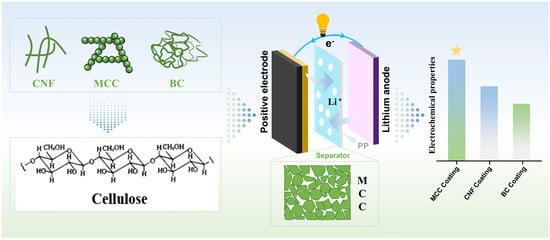
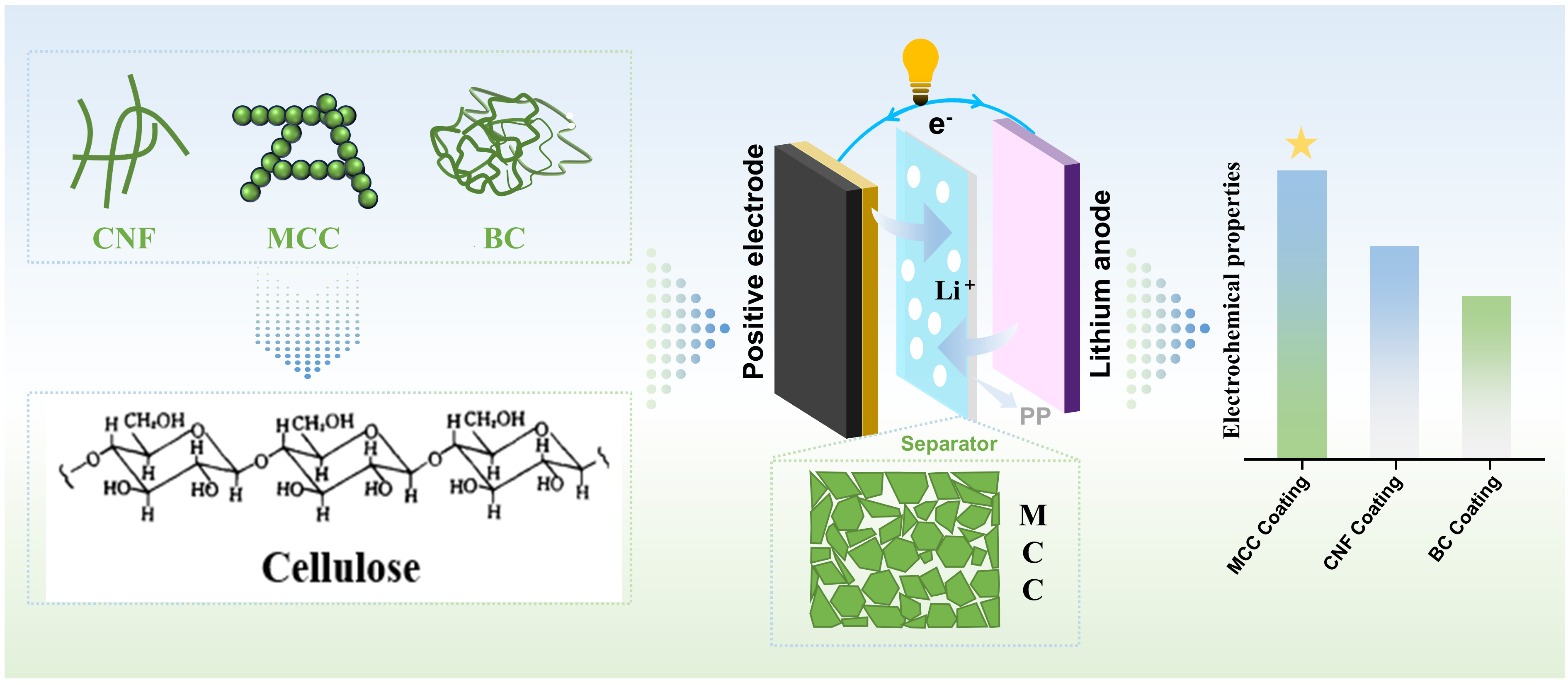
Graphical Abstract

1. Introduction

Lithium-ion batteries (LiBs) exhibit high energy density and extended cycle life, making them ubiquitous in modern energy systems. They power portable electronic devices, drive electric vehicles, and provide efficient grid-scale energy storage solutions essential for the decarbonization of contemporary infrastructure [1,2]. The separator, a fundamental component of the battery, serves as an electrical barrier between the positive and negative electrodes, preventing internal short circuits while permitting the migration of lithium ions through the liquid electrolyte within its porous structure [3].
Although commercial polypropylene (PP) membranes exhibit excellent chemical stability and mechanical strength [4,5], certain unavoidable drawbacks persist. These include poor wetting capability for commercially available polar electrolytes and inadequate electrolyte adsorption and retention capacity, which result in poor cycling stability of lithium-ion batteries [6,7]. Furthermore, polyolefin separators demonstrate insufficient heat resistance, leading to deteriorating battery safety as ambient temperatures rise. Under abusive conditions, high temperatures may cause the separator to shrink, resulting in direct contact between the positive and negative electrodes, thereby triggering safety issues [8,9]. Therefore, novel separators with high thermal stability and excellent wetting capability are essential for the further advancement of lithium-ion batteries.
Currently, PP membranes with functional materials are the most direct and effective method for enhancing their overall performance. Krasilina et al. [10] applied synthesized magnesium chlorophyll silicate onto the separator using blade coating technology, resulting in an increase in the tensile strength of the composite separator by 30.9 MPa and an elongation at break of 17.1%. This composite separator provided a more uniform distribution of Li+ ions and improved resistance to lithium dendrite formation. Li et al. [9] coated fluorinated UIO-66 onto the PP separator, which resulted in an ordered porous structure and the presence of negatively charged functional groups (-F) that facilitated Li+ transport and regulated ion transfer, thus achieving higher ionic conductivity and lithium-ion transference. Yuan et al. [11] employed a hybrid coating method using titanium nitride and boron nitride particles to coat one side of a polypropylene separator, allowing the battery to maintain cycling stability under high discharge and high-rate conditions. Shekarian et al. [12] applied a 4A zeolite coating on commercial polypropylene separators using polyvinylidene fluoride as a binder. Compared to pristine commercial separators, the coated separators exhibited lower contact angles, higher electrolyte uptake, and reduced thermal shrinkage, thereby enhancing ionic conductivity and cycling stability.
Although the aforementioned inorganic or synthetic framework materials demonstrate significant modification effects, they often encounter challenges such as complex preparation processes, relatively high costs, and the brittleness of flexible polymer matrix materials due to excessive rigidity. In contrast, cellulose materials, characterized by their renewable, environmentally friendly, and low-cost properties, exhibit tremendous application potential in green energy storage devices [13,14]. More importantly, the abundant polar hydroxyl groups (-OH) present on the cellulose chains effectively address the poor hydrophilicity of PP membranes without necessitating complex chemical modifications.
However, the cellulose family is extensive, and cellulose derivatives from various sources and prepared through different methods exhibit distinctly different structural characteristics at the microscopic level. For instance, microcrystalline cellulose (MCC) typically manifests in rod-like or granular forms, displaying high crystallinity and excellent dispersibility [15,16]; cellulose nanofibers (CNF) exhibit a high aspect ratio in their nanofibrous form, characterized by an exceptionally high specific surface area [17,18]; and bacterial cellulose (BC) features a unique in situ three-dimensional nanoscale network structure and demonstrates outstanding mechanical toughness [19,20]. Currently, the majority of research is concentrated on a single type of cellulose modification. However, few studies have systematically compared the differences in the formation of coating layers on membrane surfaces among these three typical dimensions of cellulose materials. Additionally, the distinct mechanisms by which these modifications influence pore structure sealing, ion transport pathways, and interfacial stability have not been thoroughly examined.
The present study selected three representative cellulose materials—MCC, CNF, and BC—to perform surface coating modifications on PP membranes. The objective is to investigate the distinct mechanisms that enhance wettability, suppress high-temperature shrinkage, and regulate lithium-ion (Li+) transport by comparing the structure-function relationships between different microstructures (microparticles, nanofibers, and three-dimensional networks) and coating structures. Screening suitable biomass-derived separator modification materials provides a theoretical basis for designing high-performance lithium-ion battery separators. Our research reveals that all cellulose coatings enhance the separator’s electrolyte absorption capacity and thermal stability. Among these, MCC—the most cost-effective and commercially available option—demonstrates the most balanced electrochemical performance due to its favorable morphological characteristics.

2. Experimental Section

2.1. Materials

MCC was procured from Sandong Keyuan Biochemical Co., Ltd. (Yantai, China) CNF and BC were obtained from Guilin Qihong Co., Ltd. (Guilin, China). Polyvinylidene fluoride (PVDF) was sourced from Shenzhen Pengxiang Co., Ltd. (Shenzhen, China), while N-methyl-2-pyrrolidone (NMP) was acquired from Xilong Scientific Co., Ltd. (Shantou, China), and n-Butanol (AR) was purchased from Tianjin Dean Chemical Reagent Co., Ltd. (Tianjin, China). Additionally, LiFePO4, Super-P, and an EC/DMC/DEC-based electrolyte (1 M LiPF6, 1:1:1 wt%) were supplied by Kant New Energy Technology Co., Ltd. (Fushun, China). Lastly, Celgard-2500PP was obtained from Jinghong New Energy Co., Ltd. (Shanghai, China) and utilized in this study as the original PP with a thickness of 25 μm, CR2025-type button half-cells were obtained from Shenzhen Neware Technology Co., Ltd. (Shenzhen, China) and used for assembling the coin cells.

2.2. Experimental Procedure

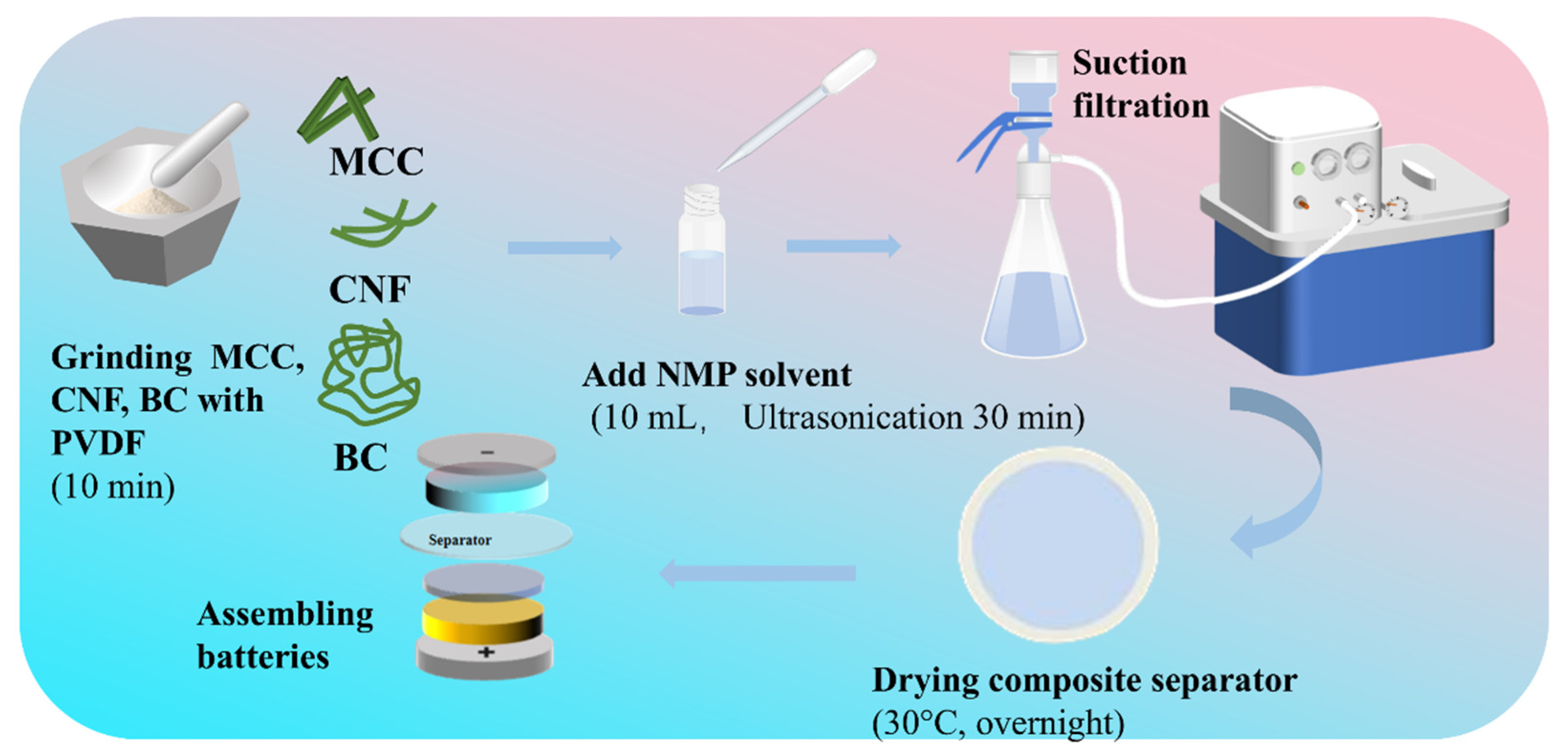
The preparation process of the PP composite separator is shown in Figure 1. MCC, CNF, and BC were individually weighed with polyvinylidene fluoride (PVDF) at mass ratios of 1:1, 2:1, and 4:1. For each ratio, the total mass of the mixture was kept at 60 mg. Grind the weighed powder with a mortar and pestle for 10 min until uniformly mixed (for MCC, this helps break up aggregates; for CNF and BC, it aids mixing while largely preserving their fibrous structure). Then transfer the mixture into a bottle and add 10 mL of NMP solvent, and treat with ultrasound for 30 min. Subsequently, perform vacuum filtration to filter the mixture onto one side of a PP membrane. Finally, dry the composite membrane overnight in a vacuum oven at 30 °C, and after cooling, cut it into circular pieces with a diameter of 19 mm. The PP coated with different mass ratios of (1:1, 2:1, and 4:1) MCC, CNF, and BC were named MCC1@PP, MCC2@PP, MCC4@PP, CNF1@PP, CNF2@PP, CNF4@PP, BC1@PP, BC2@PP, and BC4@PP, respectively (see Table 1 for a summary of sample designations). All the resulting films exhibit a uniform thickness of approximately 55 μm, as evidenced by cross-sectional SEM observations and thickness measurements (see Figure S1 and Table S1 in Supplementary Materials).

2.3. Battery Assembly

To prepare the cathode material, LiFePO4, Super-P, and PVDF were combined in a mass ratio of 8:1:1, followed by gradual addition of NMP during grinding. Subsequently, the slurry was coated onto aluminum foil using a 7 μm doctor blade, dried in a vacuum oven at 110 °C for 10 h, and then cut into discs with a diameter of 16 mm. The button cell was assembled within an argon-filled glove box, where oxygen and water content in the argon gas were below 0.01 ppm. The separator membrane, cathode material, and lithium foil were assembled together, with electrolyte added dropwise to form a CR2025-type button half-cell.

2.4. Characterization and Testing

A series of experiments were conducted on the composite separator to characterize its structure and chemical composition, thereby gaining a better understanding of its function in lithium-ion batteries.
The surface microstructure of the composite separator was characterized using an S-4800 field emission scanning electron microscope (FE-SEM, Hitachi High-Technologies Corporation, Tokyo, Japan). The infrared spectra of the composite separator and cellulose were measured using a Nicolet 6700-NXR Fourier transform infrared spectrometer (Thermo Fisher Scientific, Waltham, MA, USA) over the range of 4000–400 cm−1 with a resolution of 4 cm−1 and 32 scans. The cellulose and composite membranes were characterized using a Panalytical X’Pert PRO XRD X-ray powder diffractometer (Malvern Panalytical Ltd., Almelo, The Netherlands), with a scanning range (2θ) of 5–80° and a scanning speed of 15°/min. The thermal properties of the membranes were evaluated by thermogravimetric analysis (TGA) using an STA-449 instrument (manufactured by Netzsch, Selb, Germany). Test conditions were as follows: at ambient temperature, nitrogen was introduced as the protective gas, and the sample was heated at a rate of 10 °C/min to 800 °C. Thermal stability was analyzed by quantitatively determining the onset temperature of decomposition. Thermal dimensional stability was assessed by measuring the change in area of a standard 19 mm membrane. The experimental conditions were as follows: the membrane was placed in a forced-air drying oven at temperatures of 100 °C, 120 °C, 140 °C, 160 °C, 180 °C, and 200 °C for one hour, after which the dimensional changes in the membrane were observed. Tensile testing was conducted using a UTM5017 universal testing machine (Shenzhen Sansi Zongheng Technology Co., Ltd., Shenzhen, China), with specimens cut to dimensions of 1 cm × 5 cm and a tensile speed of 10 mm/min. Contact angle measurements were performed on the separator using a DSA optical contact angle apparatus (Kruss GmbH, Hamburg, Germany), employing LiPF6 electrolyte as the test reagent. Place the 19 mm diaphragm in n-butanol solution for immersion for 1 h, then wipe off any excess liquid from the surface using filter paper. Simultaneously, measure the mass of the sample before and after immersion using an analytical balance. Subsequently, calculate the porosity of the diaphragm, P (%), according to Formula (1) [21]:
P   =   W 1     W 0 ρ b   ×   V 0   ×   100 %
W1 denotes the mass of the membrane after immersion for one hour; W0 denotes the mass of the membrane prior to immersion; ρb denotes the density of n-butanol; V0 denotes the volume of the membrane prior to immersion.
The membrane was immersed in the electrolyte solution. The electrolyte wetting condition of the membrane was estimated using the classical weighing method: the membrane was weighed initially, then immersed in the electrolyte for one hour, and weighed again. The liquid absorption efficiency ∆W was calculated according to Formula (2) [22]:
W   ( % ) = W 2     W 1 W 1   ×   100 %
where W1 denotes the weight prior to immersion in the electrolyte and W2 denotes the weight after immersion.
LiFePO4 was used as the cathode material, lithium metal as the anode, and standard CR2025 coin cells were assembled to evaluate the separator performance. Galvanostatic charge-discharge cycling and rate capability tests were conducted in the voltage range of 2.5–4.0 V using a Neware battery testing system (Shenzhen Neware Technology Co., Ltd., Shenzhen, China). The cycling performance was evaluated by performing 100 charge-discharge cycles at a current density of 0.5 C (1 C = 1 A/g). The rate capability was assessed by cycling the cells at different current densities of 0.1 C, 0.2 C, 0.5 C, 1 C, 2 C, and back to 0.1 C.
Assembled LiFePO4||separator||Li button cells were tested via electrochemical impedance spectroscopy (EIS) after electrolyte wetting to investigate the interfacial resistance between the separator and lithium metal. The experiment employed the CHI760E electrochemical workstation (Shanghai Chenhua Instrument Co., Ltd., Shanghai, China), operating within a frequency range of 0.01–105 Hz with an amplitude set at 5 mV. The membrane and electrolyte were sandwiched between stainless steel (SS) and lithium metal plates. The electrochemical window value was measured from 3 V to 6 V using linear sweep voltammetry (LSV) at a scan rate of 10 mV/s in an electrochemical workstation. The ion conductivity of the diaphragm was determined by the Electrolyte Impedance Spectroscopy (EIS) method as follows: the diaphragm sample under test was fully immersed in the electrolyte solution and positioned between two symmetrical stainless steel (SS) washers. This assembly formed an SS||diaphragm||SS button cell. The test range is 0.01–105 Hz, with the amplitude set to 5 mV. The ionic conductivity σ was calculated according to Formula (3) [23]:
σ   =   d R b   ×   S
In the equation, d denotes the thickness of the membrane, Rb represents the volume resistivity of the membrane and electrolyte system, and S signifies the surface area of the membrane and electrolyte system.
Immerse the separator in the electrolyte and sandwich it between two pieces of lithium metal to assemble the Li||battery||Li button cell. Following electrolyte wetting, conduct EIS testing within the 0.01–105 Hz frequency range to investigate the interfacial resistance between the separator and lithium metal. Moreover, the lithium mobility (tLi+) was evaluated via the chronoamperometric test method. All the above procedures were conducted on the Shanghai Chenhua CHI760E electrochemical workstation, with the calculated values determined using Equation (4) [23]:
t Li + = I s I o   ×   Δ V     I o IR o Δ V     I s R s
where Io denotes the initial current, Is denotes the steady-state current, Ro denotes the interfacial resistance prior to polarization, and Rs denotes the interfacial resistance after polarization.

3. Results and Discussion

3.1. Microscopic Morphologies and Structures of Separators

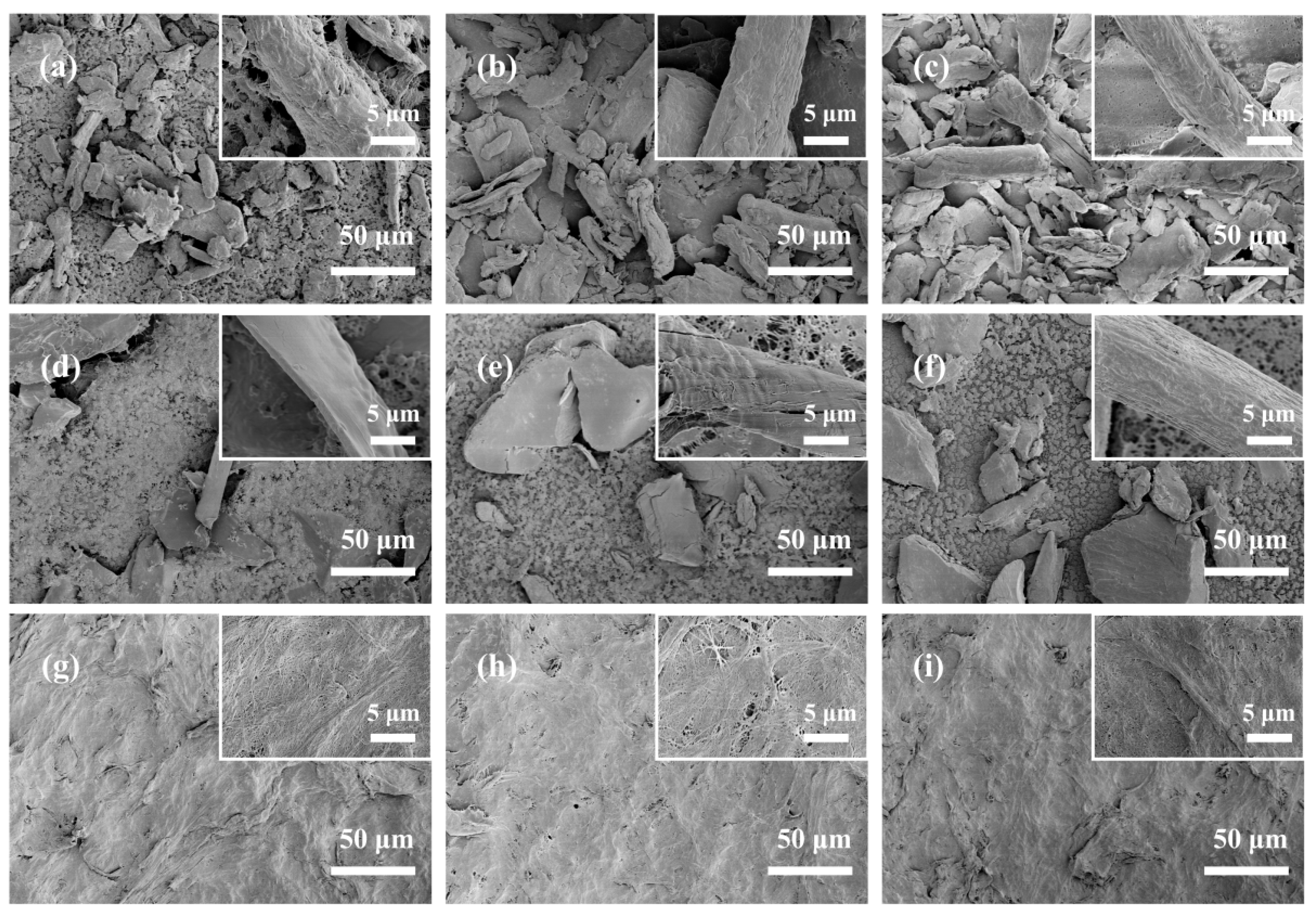
Figures S2 and S3 illustrate the microstructural morphology of PP and three types of cellulose powders: Figure S2 shows the morphology of PP, illustrating its porous structure. Figure S3a shows rod-like MCC, Figure S3b depicts agglomerated CNF, and Figure S3c illustrates elongated fibrous BC. Figure 2 shows the morphology of composite membranes formed by combining MCC, CNF, and BC in varying proportions with PVDF-coated PP, respectively. Figure 2a–c shows the morphology of PP coated with MCC at different ratios. It is found that micron-sized rod-shaped MCC particles are uniformly bonded to the PP substrate via the PVDF binder, forming abundant interstitial pores between the cellulose crystals. This relatively loose and porous structure greatly facilitates electrolyte wetting, providing rapid migration pathways for lithium ions. As the MCC proportion increases, more MCC particles accumulate while PVDF becomes relatively less abundant. The enlarged view reveals the pore structure of the substrate PP membrane beneath the PVDF coating in both crystalline and three-dimensional configurations. In the CNF@PP composite membrane (Figure 2d–f), it can be observed that unevenness and locally aggregated CNF agglomerates are adhered to the PP substrate via PVDF. This is because nanofibers possess extremely high surface energy and undergo secondary aggregation during the drying process into powder form, resulting in the observation of large CNF agglomerates on the membrane surface. This uneven interface leads to poor contact between the membrane and the electrode, increasing the interfacial impedance compared to MCC. As the proportion increases, the fine PVDF surrounding the fiber edges gradually diminishes, while the number of fibrous clumps also rises. The surface of the BC@PP composite membrane (Figure 2g–i) is covered by a highly dense and continuous membrane layer. During vacuum filtration, ultrafine BC fibers undergo self-stacking and interweaving driven by strong intermolecular hydrogen bonds, forming a three-dimensional network structure. As the proportion of BC increases, so does the density of this network. While this dense three-dimensional network enhances the membrane’s thermal stability, it simultaneously increases the tortuosity of the ion transport pathways. The microstructural changes depicted in Figure 2 indicate an optimal range for PVDF content: excessive amounts (1:1) may lead to pore blockage, while insufficient amounts (4:1) cause bonding failure. The 2:1 ratio achieves the optimum balance between pore openness and interfacial bonding strength, representing a key structural feature for attaining superior electrochemical performance within this system.

3.2. FTIR and XRD Analysis

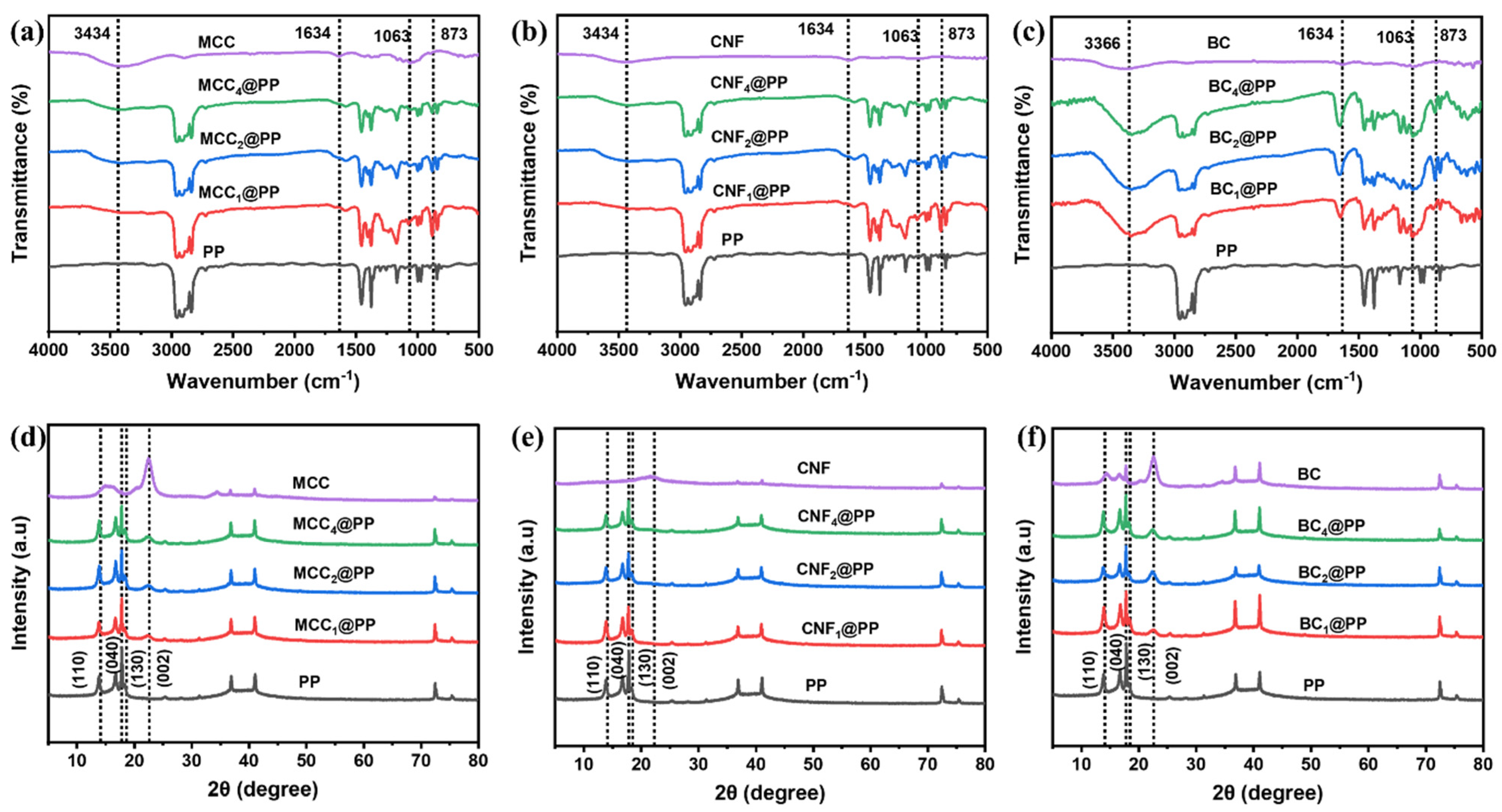
Figure 3 displays the FTIR and XRD patterns of PP and composite membranes. In the infrared spectra of Figure 3a–c, the pure PP membrane exhibits characteristic absorption peaks typical of polyolefins. The C-H stretching vibration peaks at 2953 cm−1 and 2917 cm−1 correspond to -CH3 and -CH2, respectively. The bending vibration peak at 1459 cm−1 corresponds to -CH2 [12], while the symmetric bending vibration peak at 1375 cm−1 corresponds to -CH3 [24]. The characteristic peaks of PP membranes coated with MCC, CNF, and BC are clearly present without significant peak position shifts. Consistently, the peak area ratios (e.g., A2950/A1450 and A1375/A1450) showed no significant variation between the coated and uncoated samples (Table S2), confirming that the coating process did not disrupt the chemical structure of the PP substrate, thereby fully preserving the physicochemical properties of the matrix. Additionally, the infrared spectra of composite separators coated with varying proportions of MCC, CNF, and BC in Figure 3a–c all exhibit characteristic absorption peaks of cellulose functional groups. A broad and intense hydroxyl (-OH) stretching vibration peak appears around 3400 cm−1, which can be attributed to the abundant hydroxyl groups on the cellulose surface; this feature indicates that the cellulose coating possesses excellent hydrophilicity [25,26]. At 1634 cm−1, there is also an H-O-H bending vibration peak from adsorbed water and a C-O stretching vibration peak near 1063 cm−1, indicating that all three cellulose types successfully formed stable coatings on the PP membrane surface [27]. Furthermore, the infrared spectra of all composite membranes distinctly reveal characteristic absorption peaks of PVDF, along with the combined vibrational peak at 873 cm−1 for each crystalline phase. This confirms the stable presence of PVDF as the polymeric binder within the composite coating. No new characteristic peaks or significant peak position shifts were detected in the spectra, indicating physical blending between cellulose and PVDF without any chemical reactions.
The XRD patterns shown in Figure 3d–f reveal sharp characteristic diffraction peaks at 2θ = 14.1°, 17.8°, and 18.5° for the pure PP membrane. These correspond to the (110), (040), and (130) crystal planes of isotropic polypropylene [28]. In Figure 3d–f, the XRD patterns of PP membranes coated with MCC, CNF, and BC at three different ratios, respectively, show that the characteristic diffraction peaks of PP are clearly retained. The peak intensity is only slightly reduced, indicating that the cellulose coating does not alter the crystalline structure of the PP matrix but merely causes a slight masking effect on the diffraction signal.
Additionally, all coated samples exhibited characteristic cellulose diffraction peaks at 2θ ≈ 22.6°, corresponding to the (002) crystal plane of cellulose, further confirming the successful loading of the cellulose coating [29]. The fundamental differences in the crystalline properties of coatings stem from variations in their intrinsic microstructures. The characteristic peak of MCC exhibits a sharp profile with the highest diffraction intensity and a narrower full width at half maximum (FWHM), indicating the highest crystallinity of MCC and a regular, dense arrangement of molecular chains. In contrast, the characteristic peak of CNF shows reduced peak intensity and a broadened peak shape. The reason lies in the fact that the fiber-breaking process partially disrupts the crystalline regions of cellulose, increasing the proportion of amorphous zones and resulting in the lowest degree of crystallinity. Meanwhile, the characteristic peak FWHM of BC is the second smallest, and the diffraction intensity lies between that of MCC and CNF. This is attributable to the nanoscale reticular fiber structure of BC, wherein the molecular chains exist in an amorphous state, resulting in a reduced proportion of crystalline regions. Moreover, as the proportion of the three cellulose types increases within the composite membrane, the intensity of the cellulose diffraction peaks also rises, indicating a synchronous and consistent increase in the relative cellulose content throughout the composite coating [30]. This correlation between diffraction peak intensity and material content is well established in X-ray diffraction analysis.

3.3. Thermal Properties of Composite Diaphragms

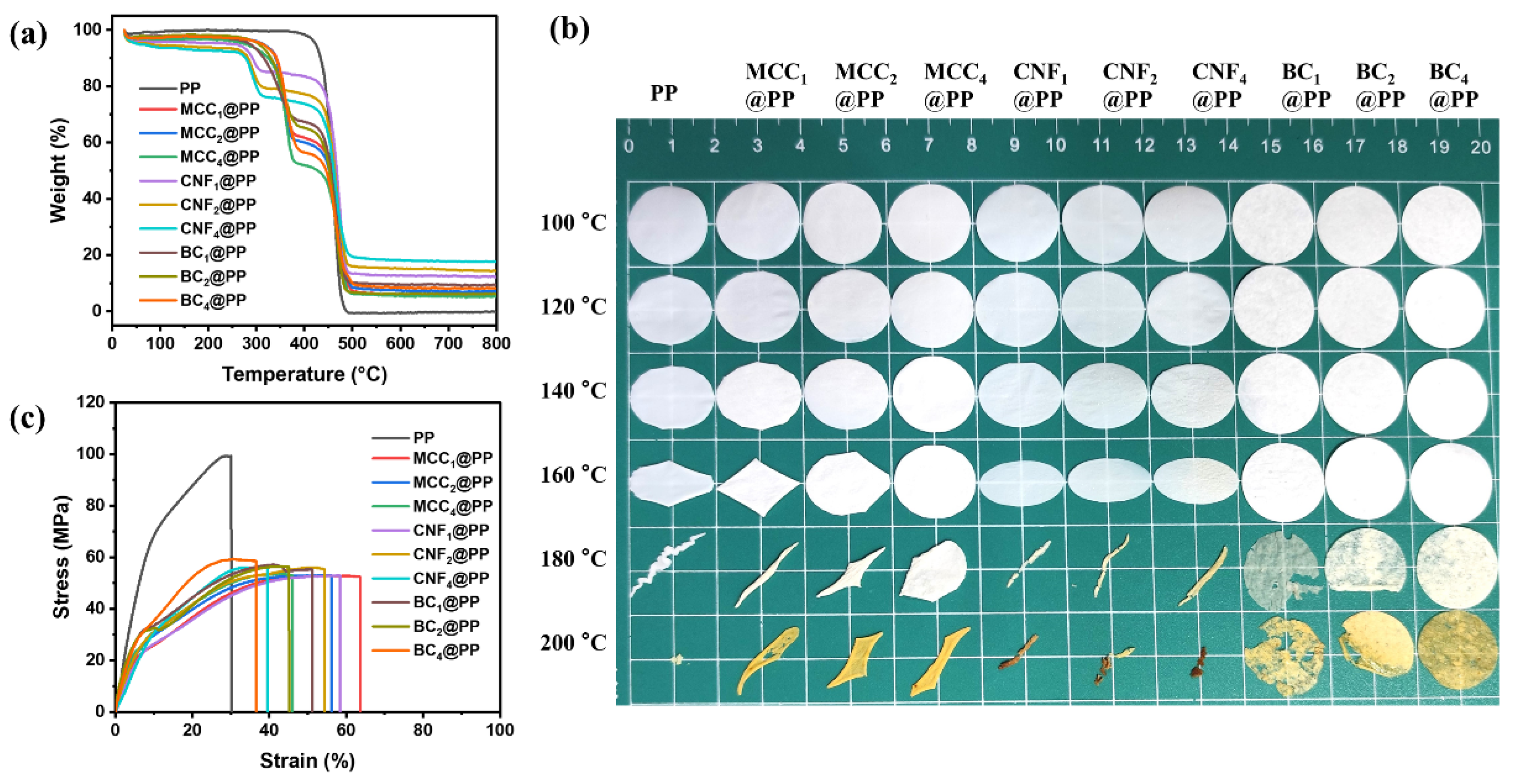
The high thermal stability of the separator prevents internal short circuits in lithium-ion batteries. Hence, thermogravimetric analysis was conducted from room temperature to 800 °C to evaluate the thermal decomposition behavior of various separators, providing insight into their intrinsic thermal stability and safety margins. Although batteries are typically operated below 85 °C, high-temperature TGA is a standard method for assessing separator thermal stability [31]. Figure 4a shows that PP exhibits a single-step weight loss process, commencing at approximately 400 °C and concluding at 480 °C. This corresponds to the thermal oxidative degradation of polypropylene molecular chains, ultimately resulting in a residual mass approaching zero. In contrast, cellulose-coated membranes all display a two-stage degradation profile. The first weight loss stage occurs between 250 °C and 380 °C, primarily attributable to thermal decomposition of the cellulose component, encompassing dehydration, decarboxylation, and carbonization processes. The carbonization process of the three types of cellulose powder can be observed in Figure S4. However, compared to PP, the composite membranes exhibit a second degradation stage, corresponding to a delayed or slower weight loss rate of the PP substrate. This enhanced stability within the medium-to-high temperature range stems from the physical barrier effect provided by the cellulose-derived carbon layer. The carbonaceous residue formed during the first stage acts as a protective barrier, not only impeding the diffusion of volatile decomposition products from the PP matrix but also slowing heat transfer to the underlying polymer. Moreover, as the cellulose coating quantity increases, this stabilizing effect becomes more pronounced, as shown in Figure 4a. This enhanced thermal resistance, coupled with the presence of a thermally stable cellulose framework, is crucial for suppressing the thermal shrinkage of the PP substrate, thereby significantly improving the membrane’s safety under elevated temperatures.
The thermal shrinkage rate serves as a core metric for evaluating the dimensional stability of separators at elevated temperatures, directly impacting battery operational safety [32]. To further validate the thermal stability of the separators, PP and composite separators coated with MCC, CNF, and BC were respectively subjected to heat treatment at different temperatures of 100 °C, 120 °C, 140 °C, 160 °C, 180 °C, and 200 °C for 1 h. As depicted in the thermal shrinkage diagram of Figure 4b, the PP separator exhibits negligible changes below 100 and 120 °C. At 140 °C, PP demonstrated pronounced shrinkage, with further dimensional contraction occurring at 160 °C. Between 180 and 200 °C, it melted into translucent aggregates. This failure is attributed to the release of internal stresses and the melting of polypropylene molecular chains near their melting point (165 °C) [33]. Following modification with MCC and BC cellulose coatings, the membranes exhibited reduced thermal shrinkage at elevated temperatures. However, the CNF-coated separator showed thermal shrinkage comparable to that of bare PP due to agglomeration. As the coating amount of MCC increases, the composite separator exhibits lower thermal shrinkage compared to the PP separator. This is because the rod-like MCC coating provides fundamental structural support, preventing the separator from shrinking at elevated temperatures. At 160 °C, the MCC4@PP composite still maintains its circular shape. The BC-coated membrane demonstrates the most outstanding dimensional stability, retaining its original disc shape even at 160 °C with no visible shrinkage. At the extreme temperature of 200 °C, although the PP substrate within the composite had transformed into a molten state, the bacterial cellulose coating—particularly that of BC4@PP—remained intact and effectively maintained the membrane’s macroscopic framework. Overall, the thermal shrinkage rate of composite membranes gradually decreases with increasing cellulose content, with the cellulose coating effectively suppressing the thermal shrinkage of PP membranes at elevated temperatures to a certain extent.

3.4. Mechanical Properties of Composite Diaphragms

The mechanical strength of lithium-ion battery separators is a core performance indicator ensuring their structural integrity during battery assembly and cycling, preventing damage [34]. To investigate the effects of different cellulose coatings on the mechanical properties of PP separators, a series of experiments were conducted using an electronic universal tensile testing machine. The stress-strain curves for PP and composite separators are shown in Figure 4c. The PP separator exhibits typical mechanical characteristics of polyolefin materials, possessing a certain tensile strength but poor toughness. Its longitudinal tensile strength is 99.25 MPa, with an elongation at break of only 30.25%. This relatively high tensile strength may be associated with the presence of a crystalline phase in the PP substrate, as suggested by the sharp diffraction peaks in the XRD patterns (Figure 3d–f). The ordered crystalline regions could contribute to resistance against chain sliding under stress, potentially influencing the overall mechanical strength. This is attributed to the linear structure of PP molecular chains, which predisposes it to brittle fracture under tensile stress. As can be seen in Figure 4c, the tensile strength of all composite membranes coated with MCC, CNF, and BC decreased to approximately 55 MPa. First, as indicated by XRD analysis, the cellulose coatings exhibit different crystalline characteristics: MCC shows relatively sharp diffraction peaks suggesting higher crystallinity, CNF displays broader peaks possibly indicating lower crystallinity due to fiber breakage, and BC shows intermediate features. However, despite these differences, all coatings form discontinuous layers, their primary stability likely relying on weak hydrogen bonding interactions, whereas the pristine PP membrane may provide its primary load-bearing capacity through its continuous structure. Additionally, the increased thickness of the composite membranes provides a larger cross-sectional area to bear mechanical loads. According to the fundamental stress formula σ = F/A, the increased cross-sectional area reduces the nominal stress under the same external force and helps alleviate stress concentration [35]. Nevertheless, these membranes still satisfy the mechanical requirements for lithium polymer separators. The presence of highly flexible polyvinylidene fluoride within the coating may have retarded crack initiation and propagation within the polypropylene matrix, thereby enhancing elongation at break of the composite membrane. A higher PVDF content correlates with greater fracture elongation, with the highest value observed in the MCC1@PP composite membrane at 63.67%. These results demonstrate that the modified composite separators possess good toughness and mechanical flexibility, sufficient to withstand the winding process during battery manufacturing.

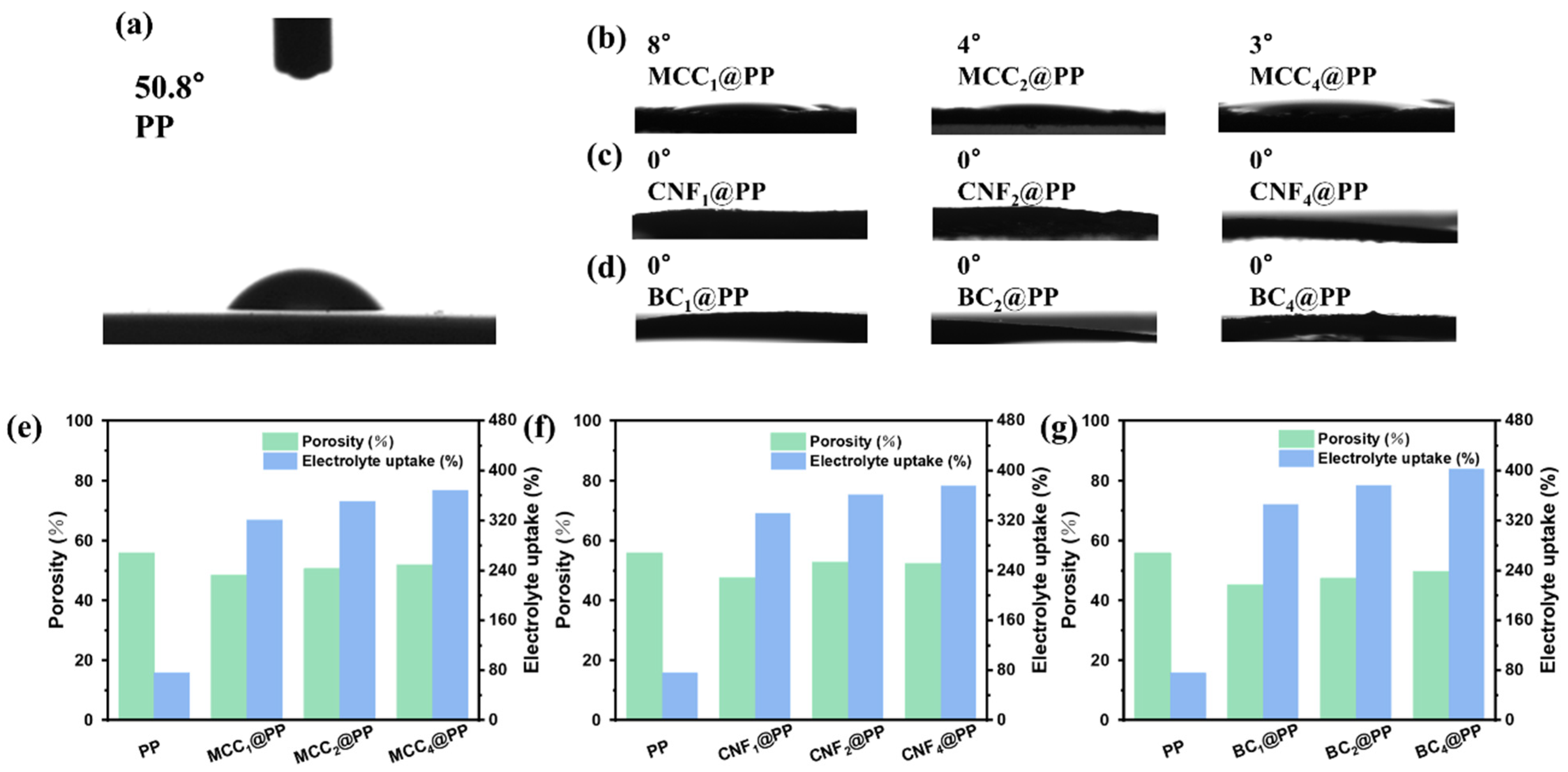
3.5. Contact Angle, Electrolyte Wettability, and Porosity of Composite Membranes

Good electrolyte wettability enables the electrolyte to thoroughly permeate the electrode and saturate the pores of both the electrode and separator, thereby enhancing ion transport efficiency and interfacial stability, which in turn improves battery performance [36]. The wettability of the electrolyte relative to the separator can be assessed by measuring the contact angle between the electrolyte and the separator. Figure 5a–d show the contact angles of the PP membrane and PP composite membranes coated with different ratios of MCC, CNF, and BC, respectively. The pure PP separator exhibits a contact angle of 50.8°, indicating its hydrophobicity and poor affinity for polar liquid electrolytes. This wetting behavior appears to be related to the chemical groups identified in the FTIR analysis (Figure 3a–c), which show that the PP surface is dominated by non-polar C-H, -CH2, and -CH3 groups. The lack of polar functional groups may limit its interaction with the polar electrolyte, potentially prolonging electrolyte filling time and contributing to uneven ionic flux during battery operation, which could influence lithium dendrite growth. For MCC-coated modified composite separators, MCC1@PP exhibited 8°, MCC2@PP 4°, and MCC4@PP 3° contact angles. This significant improvement is primarily attributed to the abundant polar hydroxyl groups on microcrystalline cellulose surfaces, as confirmed by the broad O-H stretching vibration around 3400 cm−1 in the FTIR spectra (Figure 3a), which promote strong dipole-dipole interactions with carbonate electrolyte molecules. Both CNF- and BC-modified composite separators achieved a super-wetting state at 0°. This is attributable to the CNF and BC nanofiber networks and surfaces, with their abundant hydroxyl groups as evidenced by the broad O-H stretching vibration around 3400 cm−1 in the FTIR spectra (Figure 3b,c), triggering a potent siphon effect that enables the electrolyte to permeate the separator instantaneously. Although MCC particles exhibited a slightly higher contact angle than nanofibers, their state also approached complete wetting. This ensures the formation of a continuous and uniform electrolyte reservoir at the electrode-separator interface, effectively reducing internal resistance and enhancing the battery’s rate performance [37].
Figure 5e–g illustrates the porosity and electrolyte wetting efficiency of PP, MCC, CNF, and BC-modified composite separators. The electrolyte uptake of the pure PP membrane was merely 75.86%, primarily attributable to the inherent hydrophobicity and low surface energy characteristics of the polyolefin matrix, which hindered effective permeation of the polar liquid electrolyte. Following coating modification, the electrolyte affinity of the composite membranes was significantly enhanced. In MCC-modified composite membranes, the wicking capacity exhibited a progressive increase with rising MCC content, reaching 320.90%, 350.68%, and 368.52%, respectively. CNF and BC exhibit higher electrolyte wetting rates in composite membranes due to their greater surface exposure of polar hydroxyl groups, while CNF demonstrates slightly lower agglomeration than BC. CNF and BC-modified membranes demonstrated similar growth trends, with the BC4@PP sample achieving the highest wicking capacity of approximately 402.7% at a 4:1 ratio. Compared to pure PP separators, this 4–5-fold enhancement stems from the synergistic effect of strong capillary action (siphon effect) generated by the abundant polar hydroxyl groups on the cellulose surface and the multi-level porous coating. This structure effectively retains the electrolyte, enabling rapid and uniform filling of all pores within the separator to form continuous lithium-ion transport pathways. Furthermore, the excellent wettability ensures tight and thorough contact between the separator and electrodes. The porosities of MCC1@PP, MCC2@PP, MCC4@PP, CNF1@PP, CNF2@PP, CNF4@PP, BC1@PP, BC2@PP, and BC4@PP are 48.38%, 50.54%, 51.82%, 47.47%, 52.58%, 52.25%, 45.07%, 47.29%, and 49.54%, respectively, showing a decrease compared to that of bare PP (55.73%). This occurs because the PVDF binder partially obstructs the micropores of the PP substrate, reducing porosity. However, porosity recovers as the cellulose proportion increases. This is due to the fibers themselves constructing a secondary hierarchical pore network within the coating. Among the three cellulose types, the BC-modified composite separator exhibits the lowest porosity owing to its three-dimensional dense network structure, while the CNF and MCC-modified composite separators show similar porosity levels due to the loose accumulation of CNF agglomerates and MCC particles, respectively. Although the total porosity of the modified membranes is slightly lower than that of pure PP, their significantly superior electrolyte retention capacity ensures more robust and sustained ion transport pathways. This is crucial for minimizing interfacial resistance and enhancing high-rate performance [38].

3.6. Electrochemical Properties

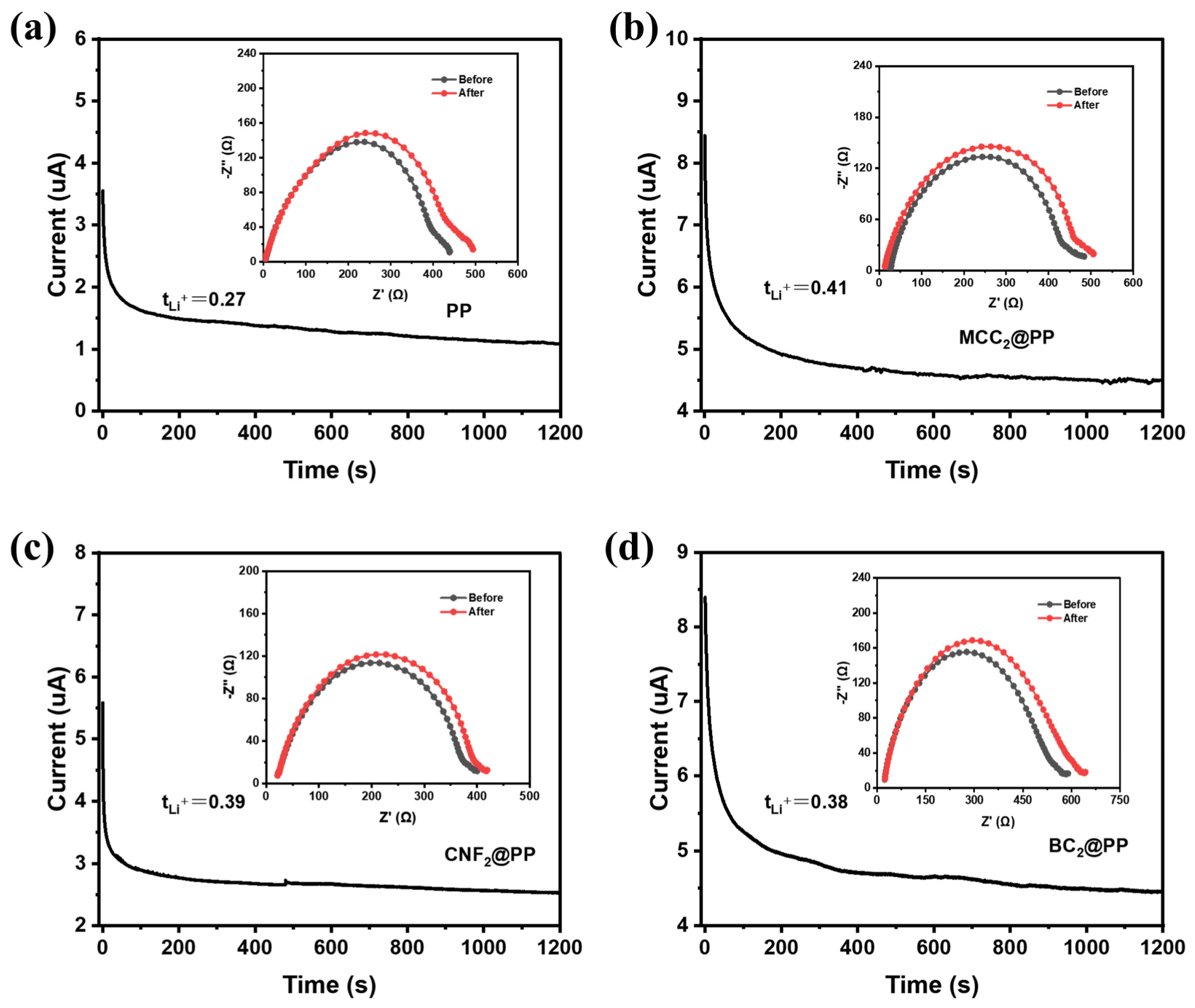
To determine the optimal cellulose/PVDF ratio for MCC, CNF, and BC, this study prepared composite separators with ratios of 1:1, 2:1, and 4:1 via vacuum filtration. Systematic electrochemical characterization was conducted on their ionic conductivity, linear sweep voltammetry profiles, interfacial impedance, and charge-discharge and rate performance (see Supplementary Figure S5). Results indicate that the 2:1 ratio exhibits the most favorable comprehensive electrochemical performance across all three cellulose systems. Consequently, subsequent electrochemical analyses focus exclusively on the MCC2@PP, CNF2@PP, and BC2@PP membranes prepared at this optimized ratio. Lithium-ion transport capability is a core electrochemical property of separators, directly determined by the connectivity of the pore structure, the degree of electrolyte wetting, and interfacial compatibility [39]. To evaluate lithium-ion migration, Li||separator||Li cells were assembled. Impedance was measured prior to polarization, followed by 1200 s polarization at a fixed voltage of 10 mV. Impedance was then measured again, with lithium-ion migration calculated using Equation (4). As shown in Figure 6a–d, the lithium-ion migration number was MCC2@PP (0.41) > CNF2@PP (0.39) > BC2@PP (0.38) > PP (0.27). Compared to the unmodified PP membrane, all three cellulose variants significantly enhanced cation transport selectivity. This arises because within the electrolyte, LiPF6 dissociates into Li+ and PF6 ions, both of which migrate under the influence of an electric field. PF6 migration induces concentration polarization and additional resistance, whereas Li+ contributes positively to ionic conduction [40]. Pure PP separators exhibit insufficient electrolyte wetting due to their hydrophobic properties, coupled with poor pore connectivity, resulting in significant transmission resistance during lithium-ion migration. The abundant hydroxyl groups on cellulose surfaces enhance electrolyte wetting, improving liquid absorption and retention capacity. This provides a continuous medium for Li+ transport while reducing interfacial impedance. Concurrently, hydroxyl groups exert an adsorption effect on PF6 via dipole-ion interactions, inhibiting its enrichment and co-intercalation at electrode-separator interfaces. This reduces anion entrainment, thereby indirectly enhancing lithium-ion migration. Among these three cellulose types, MCC demonstrated the most pronounced enhancement effect, which correlates with the previously mentioned morphology and the unique synergistic interaction in regulating the bulk pore structure and interfacial electrochemical environment of the separator. Unlike the agglomerated CNF and cohesive BC nanofiber matrices, MCC forms a robust, interconnected microporous structure with low tortuosity. This architecture provides continuous, low-resistance pathways for lithium-ion diffusion, thereby effectively reducing ionic transport impedance [41]. More importantly, well-dispersed MCC particles form a uniform composite with PVDF, minimizing the formation of isolated ion-blocked regions. In contrast, the pronounced localized agglomeration of CNF fibers creates regions of uneven density, impeding uniform ionic flux. The inherently ultra-fine, entangled nanofiber network of BC, however, forms a tightly interconnected structure that consequently slows the rate of ionic migration.
In summary, the fundamental reason for the enhancement in lithium-ion mobility lies not only in the introduction of hydrophilic cellulose but more critically in the hierarchical morphology of the cellulose additive. Among these, MCC, with its micron-scale particle morphology, achieves the optimal balance between constructing a hydrophilic interface and forming low-fractal-index ionic channels. Conversely, CNF and BC may slightly impede rapid ion migration due to excessive nanoconfinement or agglomeration effects arising from their nanofibrous structures. Consequently, among the three cellulose types examined in this study, MCC has been demonstrated to be the optimal choice for enhancing the ionic transport performance of polypropylene separators, possibly due to its unique microstructural features.
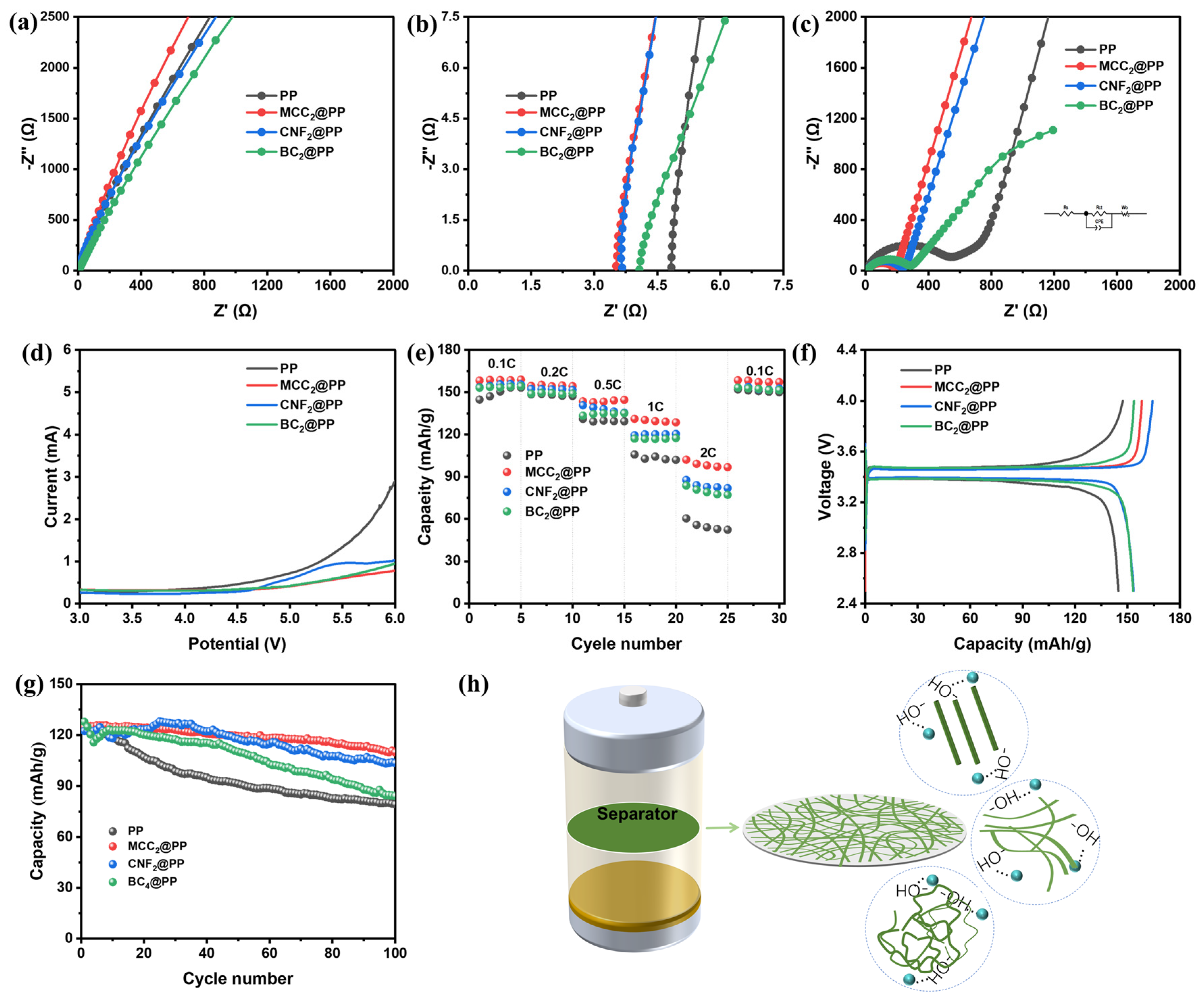
The ionic conductivity of different separators was calculated via EIS for SS||Separator||SS configurations, using Equation (3), as illustrated in Figure 7a,b. The bulk impedance corresponds to the intersection point of the EIS curve with the X-axis. The bulk impedances of the pure PP separator was 4.835 Ω, equivalent to 0.26 mS/cm, and the impedance of MCC2@PP, CNF2@PP, and BC2@PP were 3.522 Ω, 3.677 Ω, and 4.076 Ω, respectively, with the corresponding ionic conductivities of 0.80 mS/cm, 0.74 mS/cm, and 0.73 mS/cm. The composite membranes exhibit a faster ion migration rate than the PP membrane. This is because the composite separators coated with MCC, CNF, and BC exhibit high liquid absorption rates and electrolyte affinity. The high liquid absorption could be related to the porous structure observed in the coatings, which might facilitate electrolyte uptake through capillary effects. The enhanced electrolyte affinity, in turn, may arise from the abundant polar hydroxyl groups (-OH) on the cellulose surfaces, as suggested by the broad O-H stretching vibration around 3400 cm−1 in the FTIR spectra (Figure 3a–c). These polar groups could promote favorable interactions with the carbonate electrolyte molecules, potentially contributing to improved wettability and electrolyte retention [42]. Among the three coating cellulose types, MCC demonstrates higher migration than BC, while CNF exhibits the lowest rate. Among the three cellulose types, MCC demonstrates higher agglomeration and uneven dispersion inherent in CNF, whereas BC exhibits a compact structure. Figure 7c presents the EIS Nyquist plot for the Li||LiFePO4||separator battery. The diameter of the semicircle in the high-frequency region corresponds to the magnitude of the charge transfer resistance (Rct), which directly reflects the charge transport kinetics and interface compatibility at the separator/electrode interface. This serves as a key parameter influencing the battery’s cycling stability [43]. The Rct of the battery Li||PP||LiFePO4, Li||MCC2@PP||LiFePO4, Li||CNF2@PP||LiFePO4, and Li||BC2@PP||LiFePO4 are 472.6 Ω, 185.9 Ω, 205.6 Ω, and 269 Ω, respectively. Cellulose-coated PP improves the poor contact at the electrode/electrolyte/separator three-phase interface caused by polypropylene’s hydrophobicity. Surface hydroxyl groups enhance interfacial affinity, thereby substantially reducing interfacial impedance [44]. MCC exhibits uniform distribution and superior interfacial adhesion compared to CNF—whose agglomerates vary in size—and BC—which forms compact clusters. Consequently, the MCC-coated composite separator demonstrates relatively lower interfacial resistance than those coated with CNF or BC, and consequently exhibits a lower Rct. The electrochemical stability window of the separator directly impacts the operational safety of the battery. In this study LSV was employed to test batteries assembled as Li||separator||SS configurations, thereby evaluating the width of this window. The test results are shown in Figure 7d, where the electrochemical stability window of the pure PP separator is 4.5 V. Electrolyte decomposition tends to occur above this voltage. The introduction of a cellulose coating did not reduce the separator’s stability window but instead slightly enhanced it. Separators coated with MCC, CNF, and BC all achieved a stability window of 4.6 V. This is because the polar hydroxyl groups on the cellulose surface may help capture trace acidic impurities or decomposition products in the electrolyte, thereby stabilizing the electrochemical interface. Simultaneously, the coating prevents direct contact between the electrode and electrolyte, further broadening the stability window and enhancing the battery’s safe operating range [45]. Figure 7e shows the charge-discharge curves of Li||Separator||LiFePO4 batteries with different separator assemblies at 0.1 C. The discharge specific capacity of the battery with PP separator is 144.72 mAh/g; that of MCC2@PP, CNF2@PP, and BC2@PP is 158.31 mAh/g, 153.58 mAh/g, and 153.15 mAh/g, respectively. The discharge capacity of cellulose-coated modified PP separators all improved, with MCC2@PP exhibiting the highest value. This may correlate with the previously mentioned morphology: the more uniform rod-like packing of MCC better traps electrolyte compared to overly loose and non-uniform CNF and overly dense BC, creating more efficient pathways and optimal interfaces. Rate performance tests were conducted on Li||Separator||LiFePO4 batteries assembled with different separators to characterize their charge/discharge behavior at high power (0.1 C → 0.2 C → 0.5 C → 1 C → 2 C → 0.5 C). Figure 7f shows that the pure PP separator exhibits severe capacity decay with an increasing rate. This is attributed to severe concentration polarization within the hydrophobic polyolefin matrix and sluggish ion transport kinetics. In contrast, cellulose-modified membranes consistently demonstrated significantly enhanced rate performance. Notably, the MCC2@PP separator exhibited the strongest capacity retention, maintaining a discharge capacity of 102.08 mAh/g even at a high of 2 C rate [46]. This aligns closely with the previously discussed lower charge transfer resistance and higher lithium-ion migration number. CNF2@PP and BC2@PP membranes showed relatively weaker performance. This is attributed to the uniform structural dispersion and improved interfacial contact of the MCC coating, which allows for sustained and rapid Li+ passage compared to the loosely coated CNF and densely coated BC membranes, thereby effectively reducing interfacial polarization during high-current operation [47]. Furthermore, when the current density was restored to 0.1 C, the modified battery’s capacity recovered to its initial level, demonstrating the composite coating’s excellent electrochemical reversibility and structural integrity. Long-term cycling stability and rate capability are pivotal metrics for evaluating the practical application value of separators, directly determined by ion transport efficiency, interfacial compatibility, and structural stability. Their variation patterns align closely with the electrochemical performance characterization results presented earlier. Upon assembling Li||separator||LiFePO4 batteries, they underwent 100 charge-discharge cycles at 0.5 A/g. As illustrated in Figure 7g, after 100 charge-discharge cycles, the battery employing a pure PP separator exhibited persistent and significant capacity decay [48]. The discharge capacity dropped substantially from its initial value to 79.38 mAh/g after 100 cycles. This degradation stems from the inherent hydrophobicity of PP, which leads to electrolyte wetting failure, a continuous increase in interfacial resistance, and intensified internal side reactions within the battery. Batteries employing MCC, CNF, and BC-modified separators demonstrated markedly enhanced cycling stability. The MCC2@PP separator exhibited optimal stability, maintaining 88.04% of its capacity after 100 cycles. This correlates with the previously discussed combined factors of physical and electrochemical performance optimization. The CNF2@PP and BC2@PP variants showed comparatively lower stability, again consistent with the aforementioned factors. Figure 7h schematically illustrates the working mechanism of cellulose-modified separators and the distinct roles of MCC, CNF, and BC in enhancing electrochemical performance. As depicted, the abundant hydroxyl groups on the surfaces of all three cellulose derivatives significantly improve electrolyte wettability, facilitating rapid Li+ transport at the separator interface. However, the efficiency of this enhancement depends on the unique morphological characteristics of each cellulose type. MCC, with its relatively uniform rod-like structure and organized packing, appears to provide more direct pathways for ion transport, which may contribute to its lower interfacial resistance and higher ionic conductivity. CNF, despite its similar surface chemistry, tends to form agglomerated structures that may disrupt the continuity of ion pathways. BC, while benefiting from its dense entangled network for thermal stability, may create more tortuous pathways for ion movement—consistent with its higher interfacial resistance shown in Figure 7c. These morphological distinctions correlate directly with the electrochemical trends observed in Figure 7, confirming that the MCC-based separator at a 2:1 ratio achieves the optimal balance between structural uniformity and ionic accessibility. It is also worth noting that the long-term interface stability between PVDF and cellulose remains a consideration in practical applications, and further optimization of the bonding system may enhance the durability of cellulose-based separators. In summary, although CNF and BC coatings exhibit superior wettability, their structural defects—agglomeration in CNF and close packing in BC—limit their overall electrochemical performance. Notably, BC exhibits excellent thermal stability (remaining intact at 200 °C), which is advantageous for safety. However, its compact structure appears to restrict ion transport, resulting in relatively lower ionic conductivity and higher interfacial resistance compared to MCC. In contrast, the relatively more uniform dispersion and favorable interfacial contact of the MCC coating enabled it to achieve the highest ionic conductivity, lowest interfacial resistance, and optimal battery performance among the three cellulose additives. These findings indicate that MCC strikes the best balance between wettability, electrochemical performance, and thermal stability, while its cost-effectiveness further supports this choice.

4. Conclusions

In this study, we successfully prepared a series of cellulose-modified composite membranes based on different fiber structures via vacuum filtration and systematically compared the effects of three cellulose additives on the physicochemical properties and electrochemical performance of PP-based membranes. The findings reveal that the incorporation of cellulose significantly improves the poor electrolyte wetting characteristic of conventional PP separators, reducing the contact angle from 50.8° to below 10°. Concurrently, it substantially enhances both the electrolyte wetting velocity and lithium-ion transport efficiency. Among these, MCC2@PP exhibited optimal electrochemical performance, featuring a lithium-ion mobility of 0.41, an ionic conductivity of 0.80 mS/cm, and an interfacial resistance of 185.9 Ω. Furthermore, the battery assembled with the MCC2@PP composite separator demonstrated the highest initial discharge capacity (158.31 mAh/g at 0.1 C) and maximum capacity retention (88.04%). These results indicate that the MCC-modified separator achieves an optimal balance between thermal safety, wettability, and cost-effectiveness, presenting broad application prospects in next-generation high-safety lithium-ion batteries and energy storage systems.

Supplementary Materials

The following supporting information can be downloaded at: https://www.mdpi.com/article/10.3390/coatings16030391/s1, Figure S1. Cross-sectional SEM images of cellulose-coated PP separators: (a) MCC1@PP, (b) MCC2@PP, (c) MCC4@PP, (d) CNF1@PP, (e) CNF2@PP, (f) CNF4@PP, (g) BC1@PP, (h) BC2@PP, (i) BC4@PP. Table S1. Thickness measurements of cellulose-coated PP separators. Figure S2. Shows the SEM image of a commercial PP membrane. Figure S3. (a) Shows the SEM image of MCC powder, (b) Shows the SEM image of CNF powder, and (c) Shows the SEM image of bacterial cellulose powder. Table S2. FTIR peak areas and ratios of uncoated and coated PP separators. Figure S4. Shows the thermogravimetric curves of MCC, CNF, and BC powders. Figure S5. (a,b) Show the Nyquist plots of SS||Separator||SS batteries assembled with different separators; (c) Presents the EIS plots of Li||Separator||LiFePO4 batteries with different separators; (d) Depicts the LSV curves of Li||Separator||SS batteries assembled with different separators at 10 mV/s; (e,f) Show the rate performance of Li||Separator||LiFePO4 batteries with different separator configurations; (g) Displays the charge-discharge curves of Li||Separator||LiFePO4 batteries at 0.1 C and (h) Presents the charge-discharge cycles of Li||Separator||LiFePO4 batteries at 0.5 C.

Author Contributions

X.S.: Conceptualization; Methodology; Validation; Formal Analysis; Investigation; Data Curation; Writing—Original Draft; Writing—Review and Editing; Visualization. H.M.: Investigation; Methodology. A.Z.: Methodology; Data Curation; Formal Analysis. B.L.: Data Curation; Formal Analysis. Z.W.: Validation; Investigation; Resources; Writing—Review and Editing. Y.J.: Data Curation; Visualization. Resources. A.Q.: Conceptualization; Resources; Data Curation; Writing—Original Draft; Writing—Review and Editing; Validation; Supervision; Project Administration; Funding Acquisition. S.W.: Conceptualization; Resources; Y.W.: Conceptualization; Resources; H.X.: Conceptualization; Resources. All authors have read and agreed to the published version of the manuscript.

Funding

This work was supported by the Guangxi Key Technologies R&D Program (No. GuikeAB24010213), the Guangxi Natural Science Foundation (No. 2024GXNSFDA010015), the Guilin Key Technologies R&D Program (No. 20230107-3), the National Natural Science Foundation of China (51564009), and the Innovation Project of Guangxi Graduate Education (YCBZ2024177).

Institutional Review Board Statement

Not applicable.

Informed Consent Statement

Not applicable.

Data Availability Statement

No data were used for the research described in the article.

Conflicts of Interest

Authors Aimiao Qin, Shiqi Wang and Huihong Xie were employed by the company Guilin Qihong Technology Co., Ltd. Authors Aimiao Qin and Yinmu Wang were employed by the company GMP New Material Science and Technology (GuiLin) Co., Ltd. The remaining authors declare that the research was conducted in the absence of any commercial or financial relationships that could be construed as a potential conflict of interest.

References

  1. Jia, K.; Yang, G.; He, Y.; Cao, Z.; Gao, J.; Zhao, H.; Piao, Z.; Wang, J.; Abdelkader, A.M.; Liang, Z.; et al. Degradation Mechanisms of Electrodes Promotes Direct Regeneration of Spent Li-Ion Batteries: A Review. Adv. Mater. 2024, 36, 2313273. [Google Scholar] [CrossRef]
  2. Li, X.; Li, X.; Zhang, L.; Niu, Z.; Wen, G. Research Progress of Alumina Ultrafine Powder Modified Lithium-Ion Battery Separators. Chem. Eng. J. 2025, 523, 168561. [Google Scholar] [CrossRef]
  3. Deng, Y.; Hussain, A.; Raza, W.; Cai, X.; Liu, D.; Shen, J. Review on Current Development of Polybenzimidazole Membrane for Lithium Battery. J. Energy Chem. 2024, 91, 579–608. [Google Scholar] [CrossRef]
  4. Heidari, A.A.; Mahdavi, H. Recent Development of Polyolefin-Based Microporous Separators for Li-Ion Batteries: A Review. Chem. Rec. 2020, 20, 571–595. [Google Scholar] [CrossRef]
  5. Zhang, X.; Sun, Q.; Zhen, C.; Niu, Y.; Han, Y.; Zeng, G.; Chen, D.; Feng, C.; Chen, N.; Lv, W.; et al. Recent Progress in Flame-Retardant Separators for Safe Lithium-Ion Batteries. Energy Storage Mater. 2021, 37, 628–647. [Google Scholar] [CrossRef]
  6. Xing, J.; Li, J.; Fan, W.; Zhao, T.; Chen, X.; Li, H.; Cui, Y.; Wei, Z.; Zhao, Y. A Review on Nanofibrous Separators towards Enhanced Mechanical Properties for Lithium-Ion Batteries. Compos. Part B 2022, 243, 110105. [Google Scholar] [CrossRef]
  7. He, D.; Wang, J.; Peng, Y.; Li, B.; Feng, C.; Shen, L.; Ma, S. Research Advances on Thermal Runaway Mechanism of Lithium-Ion Batteries and Safety Improvement. Sustain. Mater. Technol. 2024, 41, e01017. [Google Scholar] [CrossRef]
  8. Liu, F.; Zhang, P.; Yang, Y.; Zhang, M.; Jiang, J.; Niu, J.; Feng, P. Superior Thermally Stable Attapulgite/Polyimide Composite Separator with a Nano-Anchoring Effect for High-Safety Lithium-Ion Batteries. Mater. Today Energy 2025, 54, 102139. [Google Scholar] [CrossRef]
  9. Li, J.; Yin, G.; Wang, Y.; Xiang, Y.; Yu, N.; Li, X.; Jiang, Y.; Xu, M.; Zhang, X. Enhancing the Electrochemical Performance and Safety of Lithium-Ion Battery via Fluorinated MOF-Based Multifunctional Separator. Chem. Eng. J. 2025, 507, 160148. [Google Scholar] [CrossRef]
  10. Krasilina, D.A.; Khrapova, E.K.; Donda, E.A.; Grushina, A.A.; Rumyantsev, A.M.; Kirilenko, D.A.; Bert, N.A.; Kraft, V.E.; Vaganov, G.V.; Ivan’kova, E.M.; et al. Coating of Polypropylene Separator by Synthetic Mg-Phyllosilicate for Stable Cycling of Li-Ion Batteries. J. Power Sources 2026, 661, 238677. [Google Scholar] [CrossRef]
  11. Yuan, Y.; Zhang, W.; Wang, L.; Zhao, Z.; Yao, Y.; Li, Y.; Dong, Z.; Yuan, L. Dual-Functional TiN/BN@separator for Enhanced Electrochemical Performance and Safety of Lithium-Ion Batteries. J. Energy Storage 2025, 131, 117608. [Google Scholar] [CrossRef]
  12. Shekarian, E.; Jafari Nasr, M.R.; Mohammadi, T.; Bakhtiari, O.; Javanbakht, M. Preparation of 4A Zeolite Coated Polypropylene Membrane for Lithium-Ion Batteries Separator. J. Appl. Polym. Sci. 2019, 136, 47841. [Google Scholar] [CrossRef]
  13. Yekta, R.; Abedi-Firoozjah, R.; Azimi Salim, S.; Khezerlou, A.; Abdolmaleki, K. Application of Cellulose and Cellulose Derivatives in Smart/Intelligent Bio-Based Food Packaging. Cellulose 2023, 30, 9925–9953. [Google Scholar] [CrossRef]
  14. Chen, H.; Wang, Z.; Feng, Y.; Cai, S.; Gao, H.; Wei, Z.; Zhao, Y. Cellulose-Based Separators for Lithium Batteries: Source, Preparation and Performance. Chem. Eng. J. 2023, 471, 144593. [Google Scholar] [CrossRef]
  15. Almafie, M.R.; Royani, I.; Sriyanti, I. Synthesis of Microcrystalline Cellulose from Oil Palm Empty Fruit Bunches through Sequential Chemical Processing. Results Eng. 2026, 29, 109091. [Google Scholar] [CrossRef]
  16. Bai, G.; Zhang, Y.; Yuan, Y.; Zhang, K.; Liu, Y.; Zhang, Y.; Ma, Y.; Du, H. Tunable Alkaline-Modified Microcrystalline Cellulose for Deacidification of Corn Oil. Int. J. Biol. Macromol. 2026, 337, 149546. [Google Scholar] [CrossRef] [PubMed]
  17. Govindarasu, M.; Palanisamy, S.; George Joy, J.; Sharma, G.; You, S.; Kim, J.-C. Advances of Nanocellulose and Cellulose-Based Derivatives for Biomedical Applications. Cellulose 2025, 32, 5735–5762. [Google Scholar] [CrossRef]
  18. Zhang, X.; Yang, S.; Wang, Z. Cationic, Electrostatic Shielding, Ion-Sieving Nanocellulose Separators Stabilize Zinc Metal Anodes. Chem. Eng. J. 2023, 466, 143312. [Google Scholar] [CrossRef]
  19. Yavuzturk Gul, B.; Pekgenc, E.; Vatanpour, V.; Koyuncu, I. A Review of Cellulose-Based Derivatives Polymers in Fabrication of Gas Separation Membranes: Recent Developments and Challenges. Carbohydr. Polym. 2023, 321, 121296. [Google Scholar] [CrossRef] [PubMed]
  20. Cheng, L.; Zhang, Y.; Li, D.; Li, R.; Ouyang, H.; He, H.; Chen, S.; Zheng, S.; Li, H. Cu-MOF Functionalized Hydroxyapatite/Bacterial Cellulose Composite Separator Enabling Dendrite-Free Fast Charging and Enhanced Thermal Safety for High-Loading Graphite Anode. Adv. Funct. Mater. 2026, 36, e15523. [Google Scholar] [CrossRef]
  21. Guo, M.; Zhu, H.; Wan, P.; Xu, F.; Wang, C.; Lu, S.; Zhang, Y.; Fan, H.; Xu, J. Freestanding and Ultra-Flexible PAN/ZIF-67 Hybrid Membrane with Controlled Porosity for High-Performance and High-Safety Lithium Batteries Separator. Adv. Fiber Mater. 2022, 4, 1511–1524. [Google Scholar] [CrossRef]
  22. Arifeen, W.U.; Choi, J.; Yoo, K.; Shim, J.; Ko, T.J. A Nano-Silica/Polyacrylonitrile/Polyimide Composite Separator for Advanced Fast Charging Lithium-Ion Batteries. Chem. Eng. J. 2021, 417, 128075. [Google Scholar] [CrossRef]
  23. Huang, G.; Huang, Z.; OuYang, H.; Xu, R.; Feng, Y.; Yin, X.; Zhang, G. An Ultra-Thin and High-Strength Composite Separator by High-Temperature Annealing for Lithium-Ion Batteries. Mater. Today Energy 2025, 48, 101798. [Google Scholar] [CrossRef]
  24. Tran, D.H.; Ulbricht, M. Cellulose-Cellulose Composite Membranes for Ultrafiltration. J. Membr. Sci. 2023, 672, 121426. [Google Scholar] [CrossRef]
  25. Oh, S.Y.; Yoo, D.I.; Shin, Y.; Seo, G. FTIR Analysis of Cellulose Treated with Sodium Hydroxide and Carbon Dioxide. Carbohydr. Res. 2005, 340, 417–428. [Google Scholar] [CrossRef] [PubMed]
  26. Suppanucroa, N.; Yoopensuk, W.; Thanapong-a-morn, W.; Rukkachat, K.; Pakawanit, P.; Wu, H.-L.; Mahlendorf, F.; Balz, L.; Kheawhom, S.; Somwangthanaroj, A. Quaternized PVA-MoS2 Composite Separator: Enhancing Long-Term Stability and Ion Transport in Secondary Zinc-Air Batteries. J. Energy Storage 2025, 121, 116497. [Google Scholar] [CrossRef]
  27. Deng, Q.; Chuan, X.; Zhao, Y.; Liu, F.; Huang, S.; Wu, J. Development of Composite Separators by Coating Hydrochloric Acid-Treated Halloysite Nanotubes on Polypropylene Separators for Lithium-Ion Batteries. RSC Adv. 2024, 14, 16912–16920. [Google Scholar] [CrossRef] [PubMed]
  28. Chen, J.; Zhao, J.; Lin, L.; Sun, X. Quasi-Spherical PVDF Ultrasonic Transducer with Double-Cylindrical PVDF Structure. IEEE Sens. J. 2020, 20, 113–120. [Google Scholar] [CrossRef]
  29. Tokarzewski, V.L.; Szymik, Z.; Bednarski, W. Über Die Polykondensationsprodukte Des Phosphoroxychlorids Und Des Äthylenglykols. Makromol. Chem. 1964, 75, 131–133. [Google Scholar] [CrossRef]
  30. Holder, C.F.; Schaak, R.E. Tutorial on Powder X-Ray Diffraction for Characterizing Nanoscale Materials. ACS Nano 2019, 13, 7359–7365. [Google Scholar] [CrossRef]
  31. Leng, X.; Yang, M.; Li, C.; Arifeen, W.U.; Ko, T.J. High-Performance Separator for Lithium-Ion Battery Based on Dual-Hybridizing of Materials and Processes. Chem. Eng. J. 2022, 433, 133773. [Google Scholar] [CrossRef]
  32. Yang, Y.; Huang, C.; Gao, G.; Hu, C.; Luo, L.; Xu, J. Aramid Nanofiber/Bacterial Cellulose Composite Separators for Lithium-Ion Batteries. Carbohydr. Polym. 2020, 247, 116702. [Google Scholar] [CrossRef] [PubMed]
  33. Yu, J.; Dong, N.; Liu, B.; Tian, G.; Qi, S.; Wu, D. A Newly-Developed Heat-Resistance Polyimide Microsphere Coating to Enhance the Thermal Stability of Commercial Polyolefin Separators for Advanced Lithium-Ion Battery. Chem. Eng. J. 2022, 442, 136314. [Google Scholar] [CrossRef]
  34. Dong, T.; Arifeen, W.U.; Choi, J.; Yoo, K.; Ko, T. Surface-Modified Electrospun Polyacrylonitrile Nano-Membrane for a Lithium-Ion Battery Separator Based on Phase Separation Mechanism. Chem. Eng. J. 2020, 398, 125646. [Google Scholar] [CrossRef]
  35. Lee, M.J.; Kwon, Y.J.; Park, J.W.; Yun, J.; Lee, J.; Panda, J.; Zhang, K.; Jung, H.J.; Kim, N.; Chae, S.; et al. A Surface Engineered Interlayer of Reinforced PP Separators for Balanced Electrochemical and Self-Extinguishable Performance in Li-Ion Batteries: Morphology and Thickness Control Effects. Chem. Eng. J. 2025, 520, 165758. [Google Scholar] [CrossRef]
  36. Cao, D.; Liu, J.; Zhang, Q.; Tang, J.; Yao, H.; Liu, D.; Liu, J.; He, D. A Hierarchical Channel Structured Separator with Regulated Ion Transport and High Thermal Stability for Lithium-Ion Batteries. J. Power Sources 2025, 660, 238528. [Google Scholar] [CrossRef]
  37. Peng, X.; Wan, P.; Yuan, L.; Li, S.; Jing, S.; Xiao, F.; Zeng, L.; Tian, Y.; Luo, Z.; Fan, H. Duplex Core-Shell Co@Co9S8@NSC Nanocrystals for High-Performance Lithium-Sulfur Battery through Synergistic Capture-Catalysis-Conversion of Polysulfide. J. Power Sources 2025, 631, 236310. [Google Scholar] [CrossRef]
  38. Sun, W.; Li, Q.M.; Xiao, P.; Carbone, P. Determination of the Tortuosity of a Li-Ion Battery Separator. J. Energy Storage 2024, 97, 112940. [Google Scholar] [CrossRef]
  39. Wang, Y.; Wang, Q.; Wei, X.; Song, Z.; Lan, Y.; Luo, W.; Yin, C.; Yue, Z.; Zhou, L.; Li, X. A Novel Three-Dimensional Boehmite Nanowhiskers Network-Coated Polyethylene Separator for Lithium-Ion Batteries. Ceram. Int. 2021, 47, 10153–10162. [Google Scholar] [CrossRef]
  40. Zhou, A.; Guo, K.; Li, X.; Song, X.; Liu, X.; Ding, W.; Guo, B.; Guo, D.; Liu, G.; Wu, N.; et al. A CNC-Modified PAN Separator Improving the Cycle Stability of Lithium-Ion Batteries. Coatings 2025, 15, 351. [Google Scholar] [CrossRef]
  41. Woo, S.; Lee, J.; Choi, W.; Kwak, S.; Kim, M.; Lee, S.; Lee, Y.; Park, S.; Lee, D.; Choi, J.; et al. Abuse-Tolerant Separator Enabled by Surface Charge Modulation and Structural Reinforcement for High-Safety Lithium-Ion Batteries. Adv. Funct. Mater. 2026, e29000. [Google Scholar] [CrossRef]
  42. Liao, C.; Mu, X.; Han, L.; Li, Z.; Zhu, Y.; Lu, J.; Wang, H.; Song, L.; Kan, Y.; Hu, Y. A Flame-Retardant, High Ionic-Conductivity and Eco-Friendly Separator Prepared by Papermaking Method for High-Performance and Superior Safety Lithium-Ion Batteries. Energy Storage Mater. 2022, 48, 123–132. [Google Scholar] [CrossRef]
  43. Zhang, J.; Zou, S.; Ma, Z.; Na, B.; Lin, S.; Zeng, R. A Skin-Core Hybrid Nanocellulose Separator for High-Energy and High-Safety Lithium Metal Batteries. J. Power Sources 2025, 643, 237062. [Google Scholar] [CrossRef]
  44. Huang, B.; Lai, P.; Hua, H.; Ma, H.; Li, R.; Shen, X.; Zhang, P.; Zhang, Y.; Zhao, J. Application for the Porous Structure of Cellulose Separators: Ionic Conduction Path in Lithium-Ion Battery. J. Electroanal. Chem. 2022, 926, 116937. [Google Scholar] [CrossRef]
  45. Pai, J.-Y.; Hsieh, C.-T.; Lee, C.-H.; Wang, J.-A.; Ku, H.-Y.; Huang, C.-L.; Hardwick, L.J.; Hu, C.-C. Engineering of Electrospun Polyimide Separators for Electrical Double-Layer Capacitors and Lithium-Ion Cells. J. Power Sources 2021, 482, 229054. [Google Scholar] [CrossRef]
  46. Tang, J.; Wang, Z.; Zhang, Y.; Bin, D.; Lu, H. Intelligent Sensing and Responsive Separators for Lithium Batteries Using Functional Materials and Coatings for Safety Enhancement. Coatings 2025, 15, 1325. [Google Scholar] [CrossRef]
  47. Li, J.; Lu, L.; Liang, H.; Sun, Y.; Guo, X.; Wei, Z.; Zhao, Y. Silkworm Cocoon-Inspired and Robust Nanofibrous Composite Separator with Gradient Structure for Lithium Ion Batteries. Compos. Struct. 2024, 339, 118161. [Google Scholar] [CrossRef]
  48. Gao, L.; Ding, W.; Xu, L. Batch Fabrication and Characterization of Aligned PAN-Based Nanofiber Membranes for Lithium-Ion Battery Separators. J. Energy Storage 2024, 79, 110230. [Google Scholar] [CrossRef]
Figure 1. Schematic diagram of the vacuum filtration process for preparing MCC-, CNF-, and BC-coated PP separators. Key parameters: grinding (10 min), dispersion in NMP (10 mL, ultrasonication 30 min), and drying (30 °C, overnight).
Coatings 16 00391 g001
Figure 2. Surface topography images of the coated separators after complete preparation (including grinding, mixing with PVDF, vacuum filtration, and drying): (a) MCC1@PP, (b) MCC2@PP, (c) MCC4@PP, (d) CNF1@PP, (e) CNF2@PP, (f) CNF4@PP, (g) BC1@PP, (h) BC2@PP, and (i) BC4@PP.
Coatings 16 00391 g002
Figure 3. (a) Infrared spectra and (d) XRD patterns of PP, MCC1@PP, MCC2@PP, MCC4@PP, and MCC; (b) infrared spectra and (e) XRD patterns of PP, CNF1@PP, CNF2@PP, CNF4@PP, and CNF; (c) infrared spectra and (f) XRD patterns of PP, BC1@PP, BC2@PP, BC4@PP, and BC.
Coatings 16 00391 g003
Figure 4. (a) Thermogravimetric analysis of PP, MCC1@PP, MCC2@PP, MCC4@PP, CNF1@PP, CNF2@PP, CNF4@PP, BC1@PP, BC2@PP, and BC4@PP. (b) Thermal shrinkage of PP, MCC1@PP, MCC2@PP, MCC4@PP, CNF1@PP, CNF2@PP, CNF4@PP, BC1@PP, BC2@PP, and BC4@PP; (c) mechanical strength of PP, MCC1@PP, MCC2@PP, MCC4@PP, CNF1@PP, CNF2@PP, CNF4@PP, BC1@PP, BC2@PP, and BC4@PP.
Coatings 16 00391 g004
Figure 5. (ad) Electrolyte contact angles of PP, MCC1@PP, MCC2@PP, MCC4@PP, CNF1@PP, CNF2@PP, CNF4@PP, BC1@PP, BC2@PP, and BC4@PP membranes; (eg) electrolyte wetting behavior and porosity of PP, MCC1@PP, MCC2@PP, MCC4@PP, CNF1@PP, CNF2@PP, CNF4@PP, BC1@PP, BC2@PP, and BC4@PP membranes.
Coatings 16 00391 g005
Figure 6. (a) Current versus time during step-down polarization at 10 mV constant potential for Li||PP separator||Li cell at room temperature; (b) current versus time during step-down polarization at 10 mV constant potential for Li||MCC2@PP membrane||Li battery at 10 mV under constant potential during step-down polarization; (c) current versus time during step-down polarization of Li||CNF2@PP membrane||Li battery at 10 mV under constant potential at room temperature; (d) current versus time during step-down polarization of Li||BC2@PP membrane||Li battery at 10 mV under constant potential at room temperature.
Coatings 16 00391 g006
Figure 7. (a,b) shows the Nyquist plots of SS||Separator||SS cells with different separator assemblies; (c) the EIS plots of Li||Separator||LiFePO4 cells with different separators; (d) LSV curves of Li||Separator||LiFePO4 cells with different separator configurations at 10 mV/s; (e) charge-discharge profiles of Li||Separator||LiFePO4 cells with different separator configurations at 0.1 C; (f) rate performance of Li||Separator||LiFePO4 cells with different separator configurations; (g) discharge profiles of Li||Separator||LiFePO4 cells with different separator configurations at 0.5 C, reverse discharge cycles of Li||separator||LiFePO4 cells with different separator assemblies at 0.5 C; (h) Schematic illustrating the mechanism for enhanced electrochemical performance in composite separators.
Coatings 16 00391 g007
Table 1. Sample designations and corresponding cellulose/PVDF mass ratios.
SampleCellulose TypeMass Ratio (Cellulose:PVDF)
MCC1@PPMCC1:1
MCC2@PPMCC2:1
MCC4@PPMCC4:1
CNF1@PPCNF1:1
CNF2@PPCNF2:1
CNF4@PPCNF4:1
BC1@PPBC1:1
BC2@PPBC2:1
BC4@PPBC4:1
Disclaimer/Publisher’s Note: The statements, opinions and data contained in all publications are solely those of the individual author(s) and contributor(s) and not of MDPI and/or the editor(s). MDPI and/or the editor(s) disclaim responsibility for any injury to people or property resulting from any ideas, methods, instructions or products referred to in the content.