Article

Influence of Oxygen Flow and Stoichiometry on Optical Properties and Damage Resistance of Hafnium Oxide Thin Films †

Lawrence Livermore National Laboratory, 7000 East Ave., Livermore, CA 94550, USA
*
Author to whom correspondence should be addressed.
This article is a revised and expanded version of a paper [Influence of Oxygen Flow and Sub-Stoichiometry on the Optical and Damage Resistance Properties of Hafnium Oxide Thin Films], which was present at [Optical Interference Coatings Conference 2025, Tucson, AZ, USA, 18–23 May 2025].
Coatings 2026, 16(3), 376; https://doi.org/10.3390/coatings16030376
Submission received: 12 February 2026 / Revised: 7 March 2026 / Accepted: 10 March 2026 / Published: 17 March 2026

Abstract

Hafnium oxide (HfO2) is predominantly used as a high-index material in multi-layer dielectric coatings for high-peak- and high-average-power lasers, but laser damage often initiates within the HfO2 layers despite their wide bandgap. Oxygen deficiency during deposition can introduce vacancy-related sub-bandgap states and absorptive defects, lowering damage resistance. This study investigates how oxygen flow during HfO2 deposition with ion beam sputtering (IBS) affects its stoichiometry, defect formation, and nanosecond laser-induced damage threshold (LIDT) and whether single-layer trends predict multilayer performance. Single layers were deposited at varying oxygen flows, characterized for optical and structural properties, and tested for the LIDT at 1064 nm and 355 nm. Increasing oxygen flow drove the layer toward near-stoichiometric HfO2, reduced the refractive index, and altered the density of surface pinhole-like features. The single-layer LIDT at 355 nm increased with oxygen, whereas the 1064 nm LIDT was comparatively less sensitive to oxygen flow, consistent with the wavelength-dependent roles of absorptive precursors and microstructural defects. In contrast, a HfO2-based high-reflector (HR) showed a higher LIDT at lower oxygen flow, indicating that the family of damage precursors changes between single layers and multilayers; in stacks, structural properties such as stress, gas entrapment and thermal dissipation may outweigh the isolated absorptive defects found in single layers. These results demonstrate that the optimal oxygen flow condition depends on both LIDT wavelength and film architecture. We identified, for single layers, a 15–35 sccm window for maximizing the 1064 nm LIDT and a high-flow optimum (45 sccm) for the 355 nm LIDT and, for 355 nm HR stacks, a distinct lower-flow regime (~10 sccm).

1. Introduction

Hafnium oxide (HfO2 or hafnia) is a commonly used high-refractive-index material for multi-layer dielectric (MLD) optical components in demanding high-peak- and high-average-power applications. Notably, this material is employed for large-aperture beam transport mirrors and polarizers, as well as numerous smaller optics utilized in the National Ignition Facility (NIF) [1]. However, the improvement of its laser damage performance is still an ongoing area of research and progress, even though it has a comparatively large optical bandgap (~5.5–5.8 eV range for thin films, depending on process conditions) [2,3]. Although its performance depends on the deposition method [4], coatings of hafnia deposited via ion beam sputtering (IBS) show excellent film properties and have demonstrated elevated laser-induced damage thresholds (LIDTs) when combined in stacks of high-index HfO2 and low-index fused silica (SiO2) over a wide range of wavelengths in both nanosecond (ns) and ultra-short-pulse regimes [5,6].
The stoichiometry of HfO2 is a critical area for improvement, as it may lead to an enhanced LIDT [7]. A sub-stoichiometry cluster (e.g., oxygen-deficient area, hafnium (Hf) clusters) can arise during MLD deposition [7,8]. In particular, location-dependent stoichiometry has been observed across a single IBS deposition, and sub-stoichiometric hafnia exhibited a reduced UV ns damage onset [7]. An excess of oxygen (O) can also be problematic, as it can lead to hafnia films with interstitial oxygen defects corresponding to oxygen-rich regions in HfO2 [8]. Other structural precursors can also degrade performance like entrapped gas in IBS hafnia films [7,9].
A key motivation for focusing on stoichiometry-inducing defects is that deviations from the ideal O:Hf ratio of 2 can introduce electronic defect states inside the bandgap [8]. Oxygen vacancies, in particular, can introduce sub-bandgap states [7,10,11,12] that may act as significant precursors to damage [10,11], as well as interstitial oxygen. Both can introduce defect levels in the bandgap that act as electron/hole traps, enabling absorption pathways that are not present in ideal stoichiometric materials [8,13,14]. Sub-stoichiometry can also introduce Hf clusters that can drive laser coating damage [15].
A recurring theme across deposition techniques is that oxygen availability (flow, partial pressure, and chemical reactivity) affects both stoichiometry and the resulting optical constants. Oxygen flow conditions during HfO2 deposition can shift the refractive index and extinction coefficient while also changing roughness, stress, and crystallinity [3,8,16], impacting micro-defects and laser damage resistance. Oxygen vacancies and oxygen-deficient clusters can also be created by spatially non-uniform energetic particle bombardment or by transient oxygen flow fluctuations during multilayer growth, and once present, they enable sub-bandgap absorption pathways that couple efficiently to UV/IR irradiation [7,8,14].
This ongoing study therefore examines how oxygen flow in the vacuum deposition chamber affects hafnia stoichiometry as observed by its damage performance. A thorough analysis of the optical and structural properties of hafnia single layers deposited at different oxygen flows was carried out, along with an evaluation of the LIDT at the 1064 nm and 355 nm wavelengths in the nanosecond (ns) regime. For the selected oxygen flow, high-reflector (HR) HfO2/SiO2 mirrors were deposited and laser damage tested at 355 nm as well, showing a different trend in the LIDT than what was observed for single layers tested at 355 nm. This behavior indicates a difference in the precursor population between single-layer hafnia and when incorporated into an MLD stack. While this is of direct interest for the understanding of the fundamental physics of laser-induced damage, it is also applicable to high-power laser mirrors using hafnia, especially the final beam transport mirrors at the National Ignition Facility (NIF) [12,13].

2. Materials and Methods

Hafnia single-layer films were deposited on 7980 0A-grade fused silica substrates (CVI Laser Optics, Albuquerque, NM, USA) using a Veeco Spector DIBS deposition system (Veeco Instruments Inc., Plainview, NY, USA). The substrates underwent a cleaning process tailored for the large fused silica optics used in the National Ignition Facility (NIF) [17]. Subsequently, the substrates were placed in a vacuum chamber, where the pressure was reduced to below 5 × 10⁻⁷ Torr. The chamber was then heated to 90 °C for 1 h to achieve uniform substrate heating. A high-purity (99.95%) polycrystalline hafnium (Hf) target was employed for film deposition. Prior to deposition, the Hf target was pre-cleaned for 5 min to remove the native oxide from its surface. HfO2 film depositions were conducted under controlled argon flow conditions, with the 16 cm RF ion source set at a rate of 18 standard cubic centimeters per minute (sccm) and operated at an extraction voltage of 1000 V and a current of 600 mA. Various hafnia layers were deposited using oxygen gas backfill flow rates of 10, 15, 25, 35, and 45 sccm. Below 10 sccm, the hafnia films produced were not optically transparent, showing a clear drop in their transmittance over the 200 nm–1200 nm spectral range. No additional oxygen was introduced during deposition, ensuring that the oxygen flow rate was controlled exclusively by the mass flow controller (MFC) through the oxygen gas backfill. The MFC was integrated in the DIBS deposition system. The growth time for each film ranged from 12 up to 22 min, ensuring similar Quarter-Wavelength Optical Thicknesses (QWOTs) at 1064 nm were maintained for all samples. Table 1 summarizes the targeted film thicknesses and the chamber pressure relative to the oxygen flow used for each stoichiometry recipe.
High-reflectors centered at 355 nm made of HfO2/SiO2 layers were designed and deposited with the DIBS system for three O2 flow-based hafnia layers: 10 sccm, 35 sccm, and 45 sccm. For the SiO2 layer, a high-purity silicon dioxide target was employed for film deposition. Prior to deposition, the SiO2 target was also pre-cleaned for 5 min to remove the native oxide from its surface.
The optical properties of the deposited single hafnia films were characterized using a Cary 7000 spectrophotometer (Agilent Technologies, Inc., Santa Clara, CA, USA). The refractive index of the single hafnia films was determined through ellipsometry measurements conducted on a commercial Wollam M-2000 ellipsometer (SE) (Agilent Technologies, Inc., Santa Clara, CA, USA).
The crystallinity of the single hafnia films was determined by glancing incidence X-ray diffraction (GI-XRD) on a Rigaku SmartLab diffractometer (Rigaku Corporation, Akishima-shi, Tokyo, Japan) equipped with a copper X-ray tube, parallel beam optics, a 0.5° parallel slit analyzer, and a scintillation detector. The incident grazing angle was fixed at 0.4°. All GI-XRD and AFM data were collected by the Eurofins EAG Materials Science LLC team in Sunnyvale, CA, USA.
Atomic Force Microscopy (AFM) images were obtained using a Dimension Icon AFM instrument (Bruker, Santa Barbara, CA, USA), with one 10 µm × 10 µm image collected for each film.
The elemental composition of the films was measured by RBS with 2 MeV He+ ions incident between 0 and 10° to the sample surface normal (to minimize potential ion channeling in textured films) and backscattered into a detector located at 165° from the incident beam direction. The analysis of RBS spectra was performed with the RUMP code [18]. For this characterization, the single layers were deposited on carbon substrates to minimize the substrate contribution, enabling a cleaner isolation of the HfO2 signal in the RBS spectra.
Laser damage tests were conducted at near-normal incidence, using a Nd:YAG laser system generating a single longitudinal mode centered at 1064 nm and 355 nm via harmonic conversion. Near-Gaussian temporal profiles were also measured and indicated pulse durations (full width at half maximum intensity or FWHM) of 9 ns and 7 ns for 1064 nm and 355 nm, respectively. The resulting beam diameters on the target were 820 µm and 500 µm at 1/e2, respectively. According to ISO 21254-1:2011 [19], the LIDT is determined by the 1-on-1 procedure. For each stoichiometry recipe, at least three samples were tested, and the results represent the average LIDT from individual tests. For each sample, four matrices of 95 test locations (totaling 380 sites) were specified with a 1 mm spacing. Damage detection was performed by examining the sample surface pre- and post-mortem under a Nikon VMZ-S 3020 T3 microscope (Nikon Metrology, LLC, Brighton, MI, USA).
The surface morphology of the single hafnia films following laser exposure were analyzed using Scanning Electron Microscopy (SEM) (Thermo Fisher Scientific Inc., Waltham, MA, USA). A thin conductive layer of gold–palladium was deposited to enhance image quality.

3. Results and Discussion

3.1. HfO2 Single Layers

3.1.1. Structure and Topography

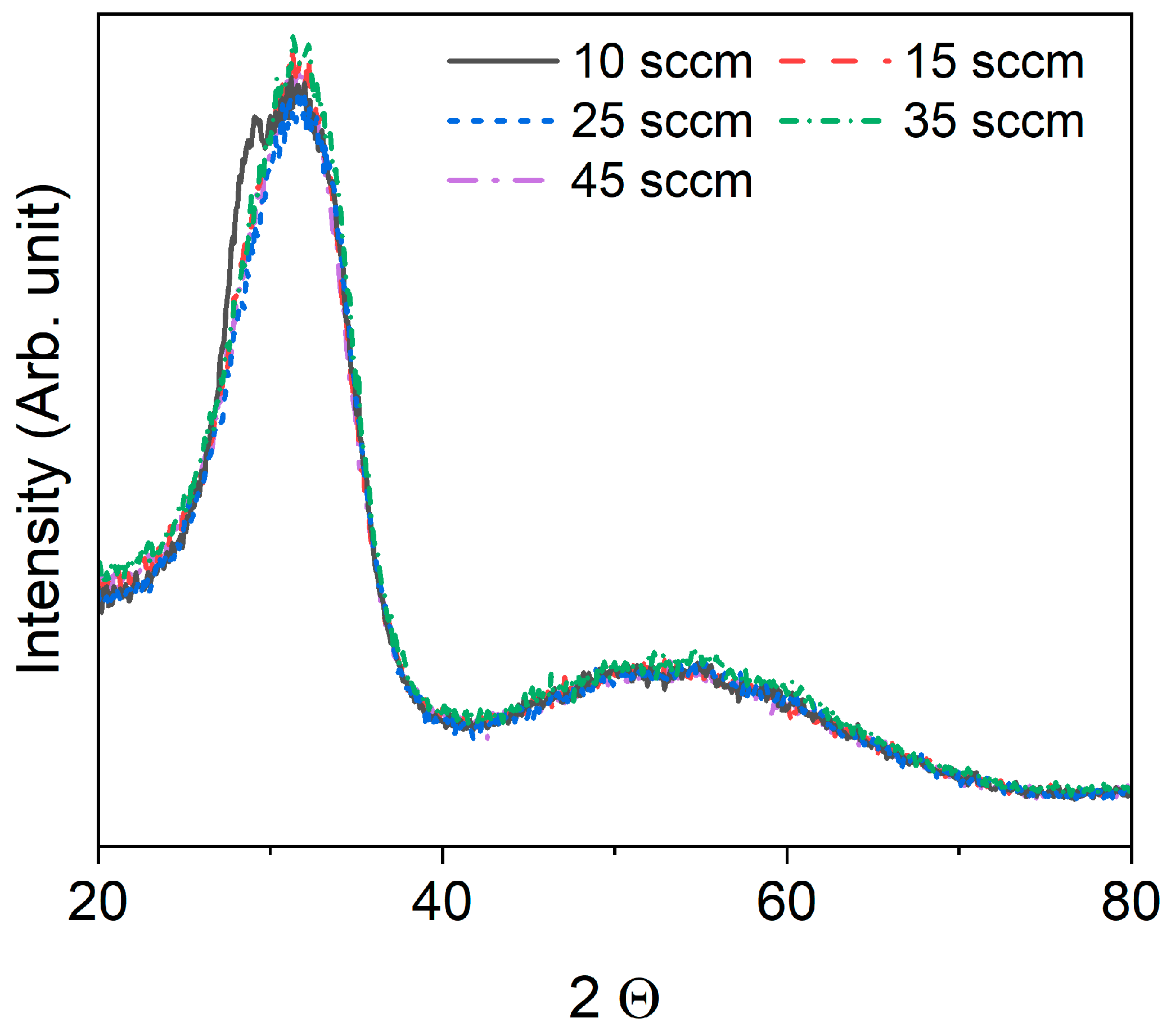
The structure for the different oxygen flow-based hafnia single layers was investigated via XRD, with the results reported in Figure 1. All the coatings investigated were amorphous in nature, with a slight peak at 29 degrees observable for the 10 sccm flow rate sample. This peak is associated with the monoclinic (−111) phase [20]. The presence of this minor monoclinic phase in the 10 sccm flow rate film could have some implications for its structural and thermal properties. Crystallinity, even in small amounts, can influence the mechanical strength, thermal conductivity, and optical properties of the material [21,22,23,24].
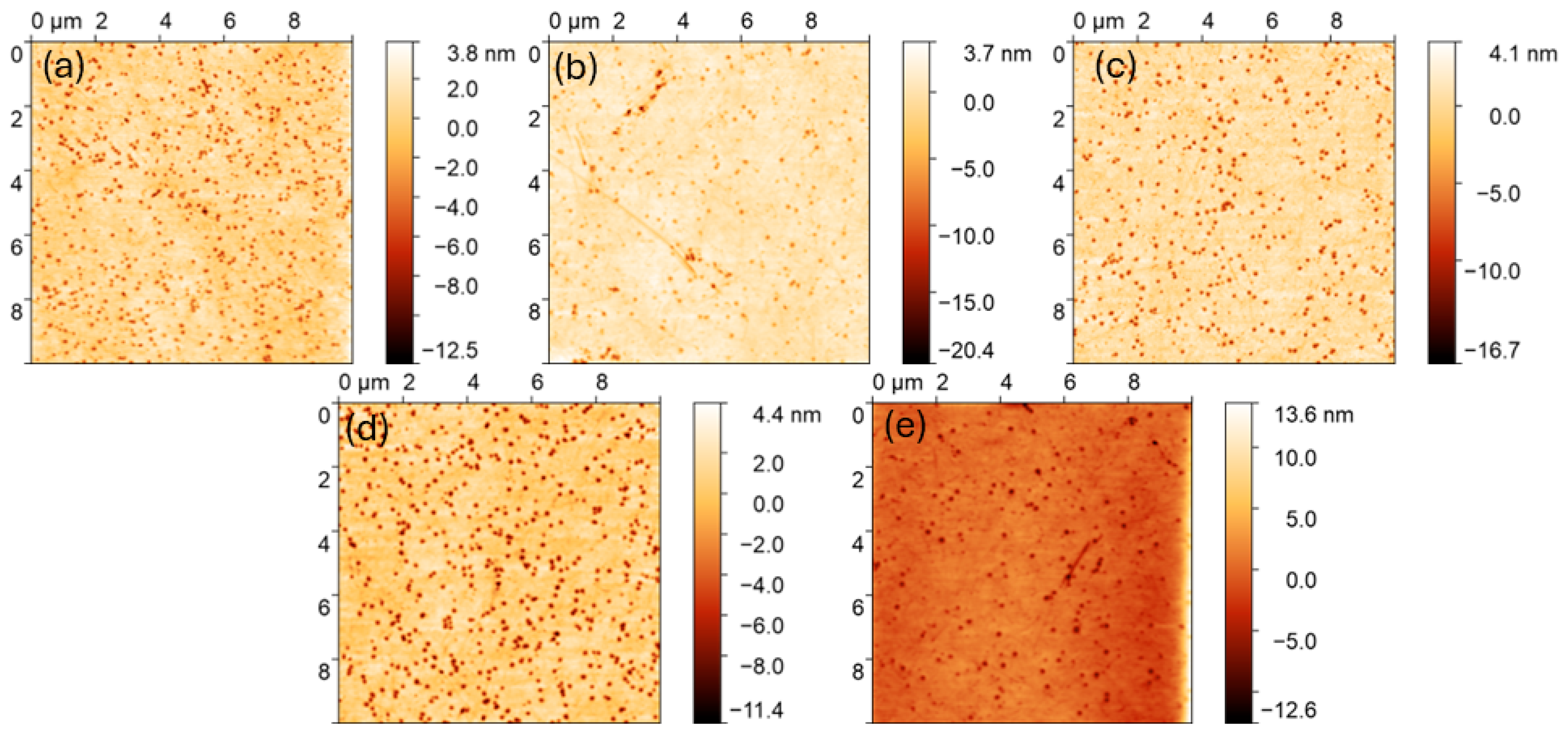
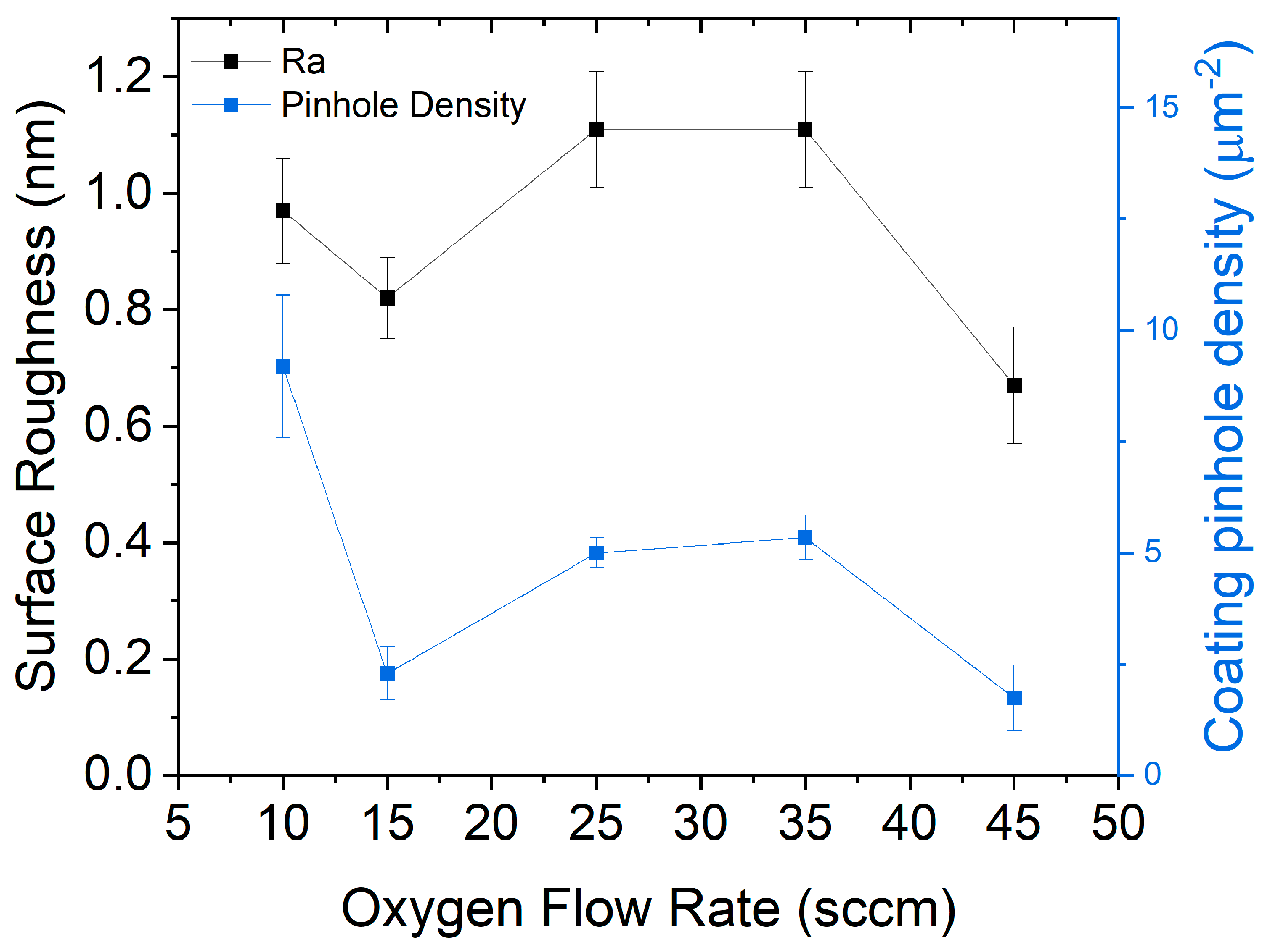
Surface topography was investigated via AFM, and the associated micrographs can be found in Figure 2. Figure 2a through Figure 2e correspond to 10, 15, 25, 35, and 45 sccm oxygen flow rate deposition conditions, respectively. Subtle finishing marks from the substrate and pinhole-like features are observed in all samples. Although not linear with the oxygen flow rate for a given hafnia film, pinhole density appears to be linked to the oxygen flow rate (Figure 3).
As observed in another study [16], in ion beam-sputtered HfO2, the apparent pinhole density seems to be governed less by geometric voids than by stoichiometry-driven point defects. Under low O2 flow, incomplete oxidation produces oxygen vacancies (HfO2−x) and occasional Hf-rich inclusions [8,16,25]. Excess O2, by contrast, can favor interstitial -O/O, oxygen-rich regions and elevated stress that can subtly roughen the surface and open diffusion paths, again increasing effective pinhole sites. Figure 3 shows that the pinholes drive the surface roughness for these IBS coatings and that the 15 and 45 sccm coatings exhibited the best surface roughness and pinhole density. Pinhole density was determined by using the threshold feature in ImageJ [26] and error estimated by utilizing different sub-apertures in the AFM micrograph. A previous dual-ion beam sputtering study also reported that oxygen delivery conditions can shift roughness and structural evolution [16], which is consistent with our findings.

3.1.2. Optical Properties

Optical properties were investigated via ellipsometry and spectrophotometry, and the results can be found in Figure 4 and Figure 5. A Cauchy model was used to fit the ellipsometric data to retrieve the refractive index (Equation (1)), where A, B, and C are the fitting parameters of the Cauchy dispersion relation, defined as follows:
n λ = A + B / λ 2 + C / λ 4
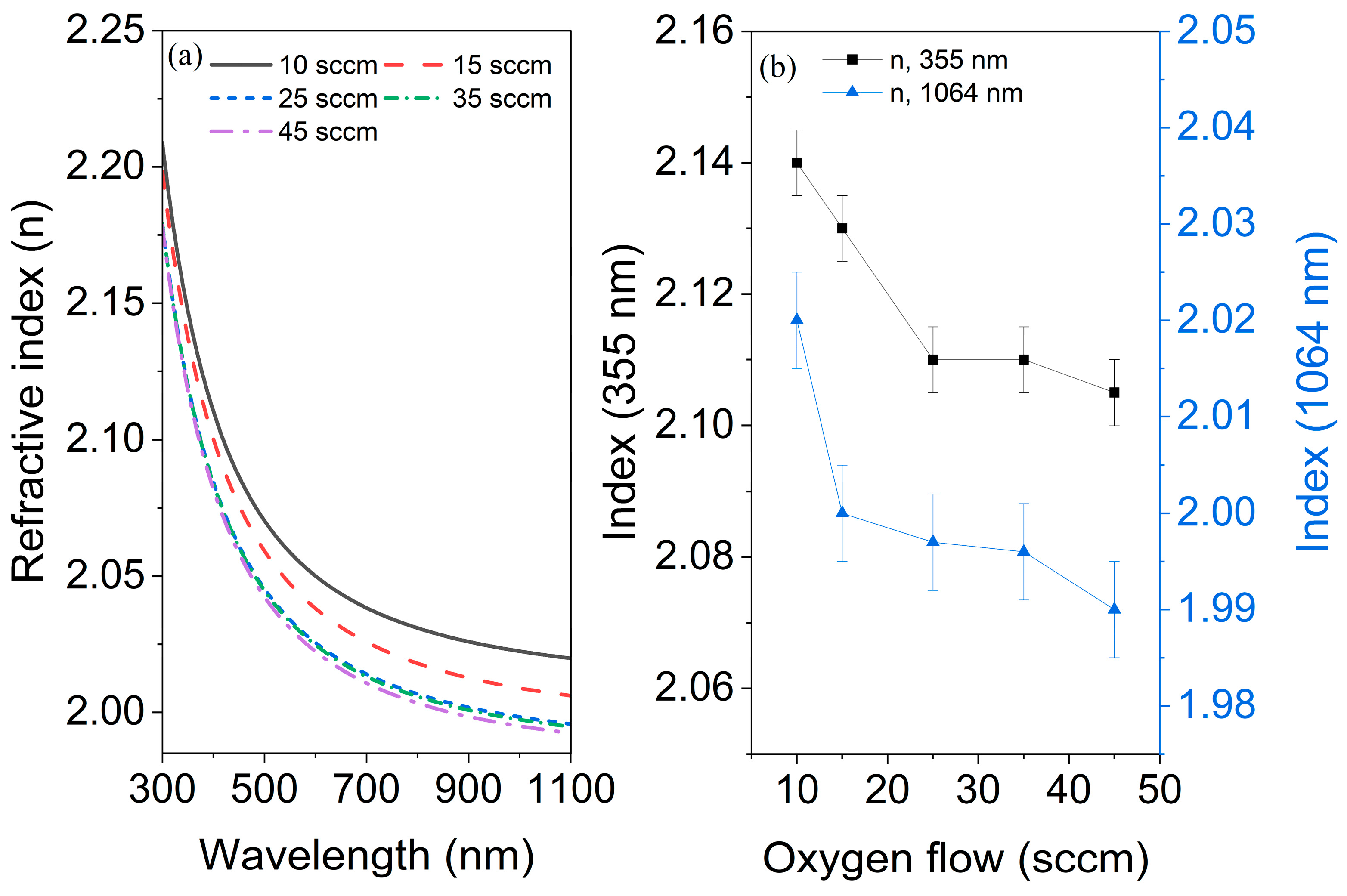
Figure 4a shows the dispersion from the ellipsometry analysis showing the profound impact that oxygen flow has on the refractive index, consistent with previous findings [16]. These results are further summarized in Figure 4b where the trends in the refractive index for 1064 and 355 nm are shown with respect to oxygen flow. The optical indices for both 1064 and 355 nm decrease sharply after 10–15 sccms, reach a plateau for 25 and 35 sccms and then trend down again for the highest flow studied, 45 sccm. The data suggests that higher flow rates may further decrease the optical index.
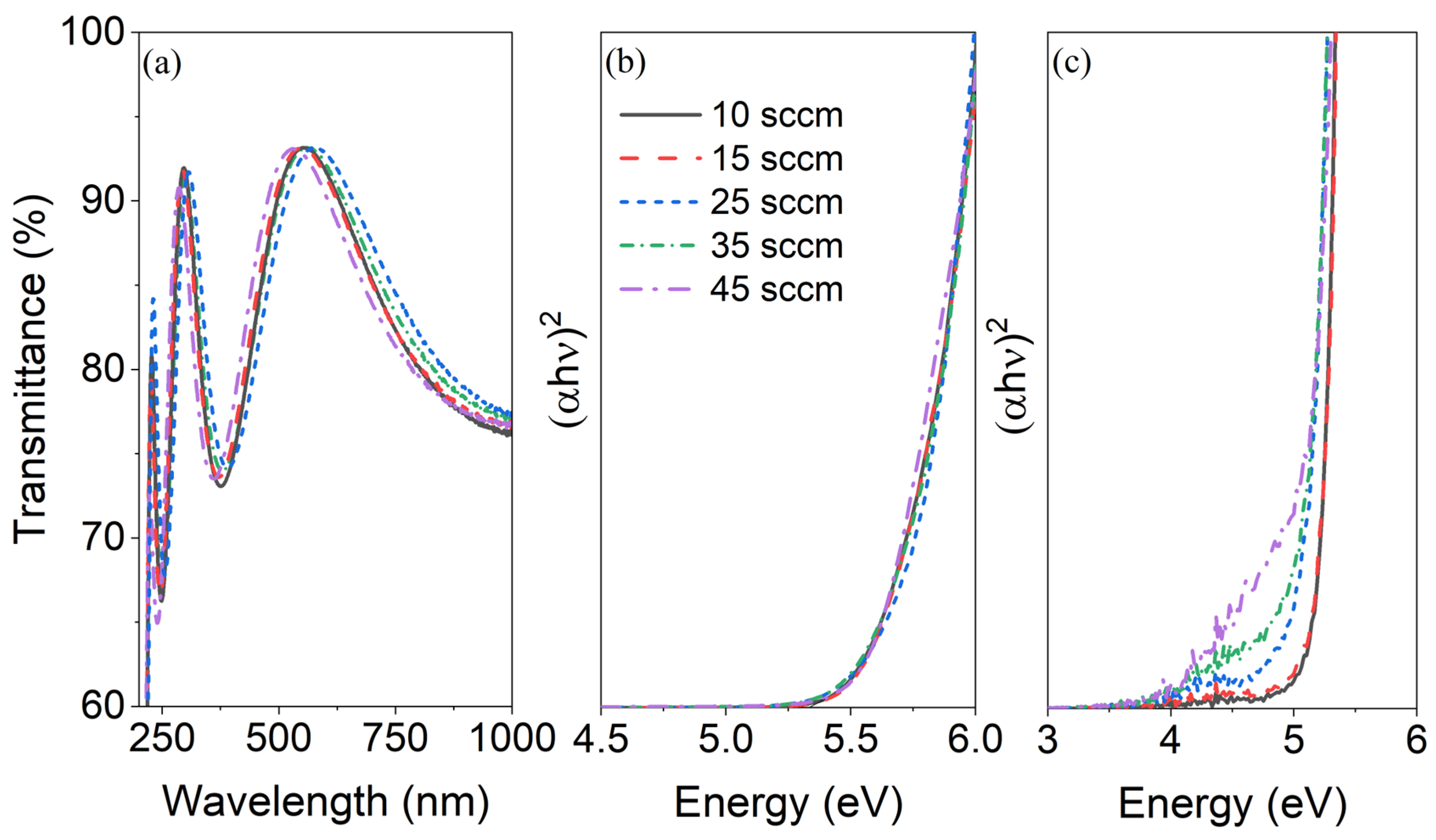
Figure 5a shows the transmission spectroscopy results for all oxygen flow-based hafnia layers collected using UV-Vis spectrophotometry. The coatings are very similar in optical thickness. Figure 5b shows the Tauc plots derived from the transmittance and reflectance spectrophotometer measurements. The Tauc method gives a value for the optical bandgap (Eg) of HfO2 films [27]. All films show an optical bandgap of ~5.6 eV, a typical value for ion beam-sputtered hafnia [9]. When the Tauc plot is zoomed in near the band edge (Figure 5c) called the Urbach tail, the coatings start to differentiate. A higher slope, as observed for the 45 sccm-based hafnia film, indicates a higher microstructure disorder and thus defect states [28]. The increasing Urbach tail slope with oxygen flow implies that as the oxygen content of the chamber is increased, there are more sub-oxide defect states in the hafnia coatings. This trend has also been observed in another work and is explained by an increase in interstitial oxygen population [8].

3.1.3. Film Chemistry and Laser Damage Results

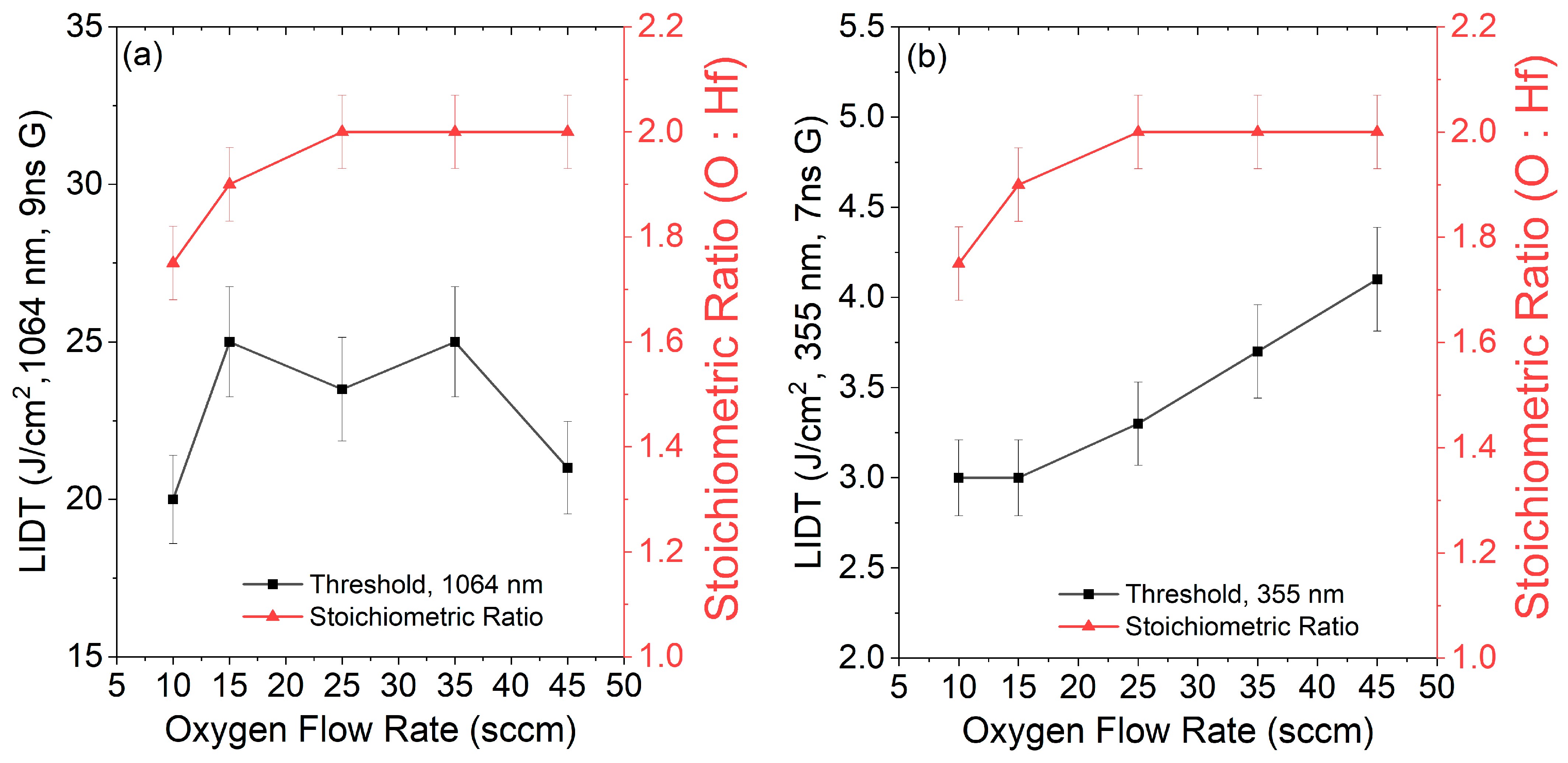
The chemical composition of the hafnia films was characterized using Rutherford Backscattering Spectrometry (RBS) to determine the ratio of O to Hf. This ratio was then correlated with laser damage performance at 1064 nm and 355 nm (Figure 6a and Figure 6b respectively). As is intuitive, the bulk stoichiometric ratio is highly correlated to the oxygen flow rate, up to a point where there is an apparent saturation. This apparent saturation point occurs at approximately 25 sccm, within the measurement uncertainty of the RBS analysis, which is in rough agreement with the index changes seen in Figure 4a. It is commonly observed that the refractive index and stoichiometric ratio are closely linked, and this is again observed in this work [8,16].
In Figure 6, it is also apparent that the LIDTs, given at 50% damage probability, of the hafnia single layers are significantly influenced by the oxygen flow used during deposition. While an average stoichiometry may be considered the ideal 2:1 oxygen-to-hafnium ratio, the presence of local defects in the structure can adversely affect performance [7,9]. The results indicate that for the fundamental wavelength (1064 nm), there is a broad range of acceptable oxygen flow rates, meaning that this wavelength is more agnostic to these defects. However, for the third harmonic (355 nm), there is a strong positive correlation of the LIDT with oxygen flow. The RBS measurements plotted in the same graph indicate an increase in the UV LIDT with stoichiometric hafnia. Although pinhole density varies with oxygen flow (Figure 3), the monotonic increase in the 355 nm LIDT (Figure 6) suggests that bulk stoichiometry-related defects play a more dominant role in the UV damage resistance of single-layer films than surface pinhole morphology. A body of work links oxygen deficiency in hafnia to reduced UV damage resistance through vacancy- and interstitial-mediated sub-bandgap absorption [7,8]. Spectroscopic studies show that oxygen vacancies introduce mid-gap states that increase absorption in the near-UV/visible range and that strongly oxygen-reduced IBS hafnia exhibits a significantly lower ns-UV LIDT [7,14]. Our current data does not yet indicate a diminishing return for the UV LIDT with oxygen flow rates. This, however, may not be true for IR applications.
Some studies report a stronger correlation between defect-mediated absorption and the nanosecond LIDT in the UV regime [29,30,31], consistent with sub-bandgap absorbers (e.g., oxygen vacancies or Hf-rich clusters) acting as dominant damage precursors at 355 nm. In contrast, at 1064 nm, the LIDT is often found to be less sensitive to nano-absorbers alone and more strongly influenced by microstructural and thermomechanical pathways, including defect-seeded localized heating followed by thermal diffusion, stress accumulation, and melt-driven failure [32,33,34,35]. However, this separation is not absolute. Other studies indicate that the dominant mechanism depends on coating composition, density, and defect population and that both absorptive and thermomechanical processes can contribute even within the UV regime [36]. Therefore, the relative impact of each precursor family remains system-dependent. In the present study, the contrasting LIDT trends observed at 1064 nm and 355 nm are consistent with a wavelength-dependent crossover in the limiting precursor population, involving Hf clusters, oxygen deficiency, and interstitial oxygen-related defects and material properties, although it is still unclear how each type of precursor impacts precisely the observed trends at both LIDT wavelengths.

3.1.4. Damage Morphology

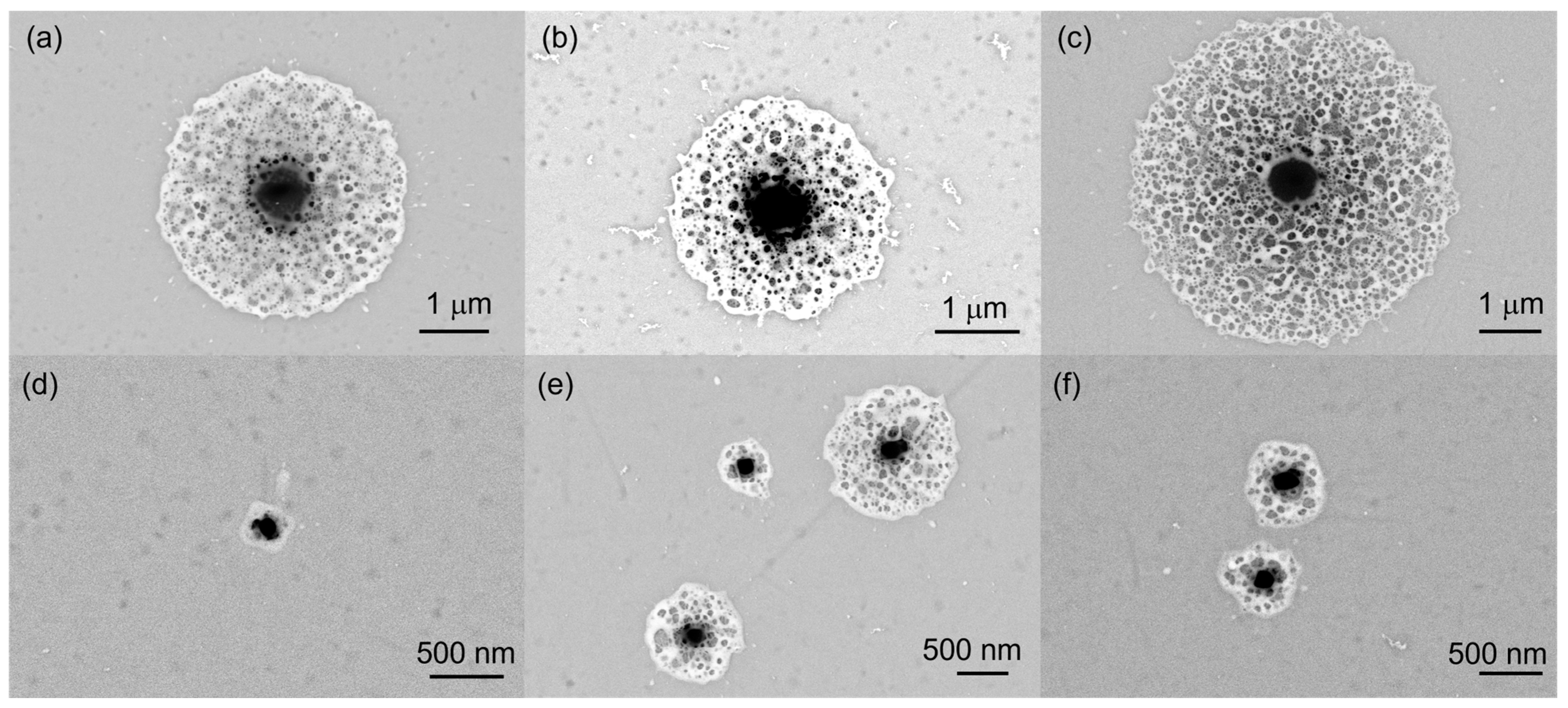
Figure 7 shows the SEM images of the damage morphology observed for the different oxygen flow-based hafnia layers in our study. No difference in terms of damage morphology was observed. For the two laser wavelengths, the only difference is the size of the damage spots, which is consistent with previous work, showing a bigger damage spot at 1064 nm and smaller disperse spots at 355 nm [9].

3.2. Hafnia-Based Multilayer Dielectric High-Reflector

An HR stack of HfO2/SiO2 centered at 355 nm was made for three O2 flow-based hafnia layers: 10 sccm, 35 sccm, and 45 sccm. Table 2 summarizes the HR design specification and the refractive index with A, B and C, the three parameters of the Cauchy fit (Equation (1)) used to fit the ellipsometry data obtained from the single-layer study. H denotes the high-refractive-index material, here hafnia, and L the low-refractive-index one, here silica.
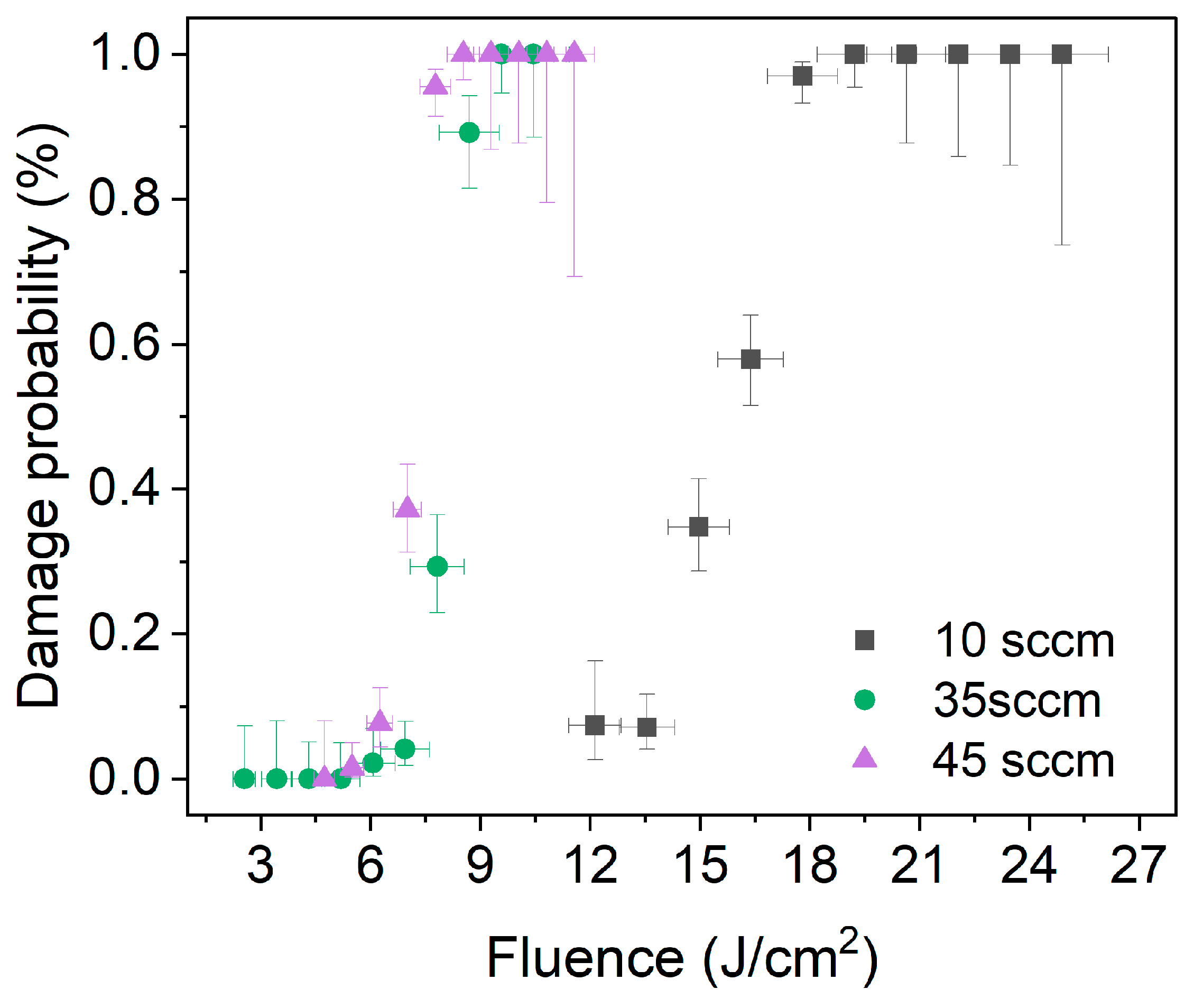
In the 355 nm HR stacks, we observe a non-monotonic dependence on the hafnia oxygen flow: the HRs produced with 10 sccm exhibit a higher one-on-one LIDT than the HRs produced with 35 and 45 sccm (Figure 8). This trend tells us that a stoichiometry-only narrative extrapolated from single layers cannot be directly applied to explain the LIDT on HRs at 355 nm. In our single-layer RBS data, 10–15 sccm produces sub-stoichiometric HfO2−x, while flow rates greater than 25 sccm yield near-stoichiometric hafnia; additionally, the refractive index decreases with increasing O2 flow. Taken together, these results imply that oxygen flow is simultaneously modifying composition and film density/structure from the refractive index data, and in multilayer HR stacks, additional precursor families can dominate and outweigh the benefits of improved stoichiometry at higher O2 flow. Differences between single-layer and multilayer UV LIDT behavior have been previously observed [37], although the role of oxygen flow or stoichiometry was not explicitly examined in that study.
In multilayer HRs, the influence of precursors is amplified because increasing the number of HfO2 layers increases the total HfO2 volume, the number of interfaces, roughness contributions, and the probability that a high-field region overlaps a nanoscale defect.
A primary candidate is represented by nanoscale gas entrainment defects (nanobubbles or void-like features) in IBS/DIBS hafnia. Oxygen-assisted IBS studies have directly observed such nanobubbles and linked 355 nm ns damage onset to entrapped gas and excess oxygen associated with these features [9]. As a result, an oxygen flow increase that improves average stoichiometry can still reduce the HR LIDT if it increases the density, size, internal gas content, or breakdown susceptibility of nanobubbles or void-like defects. In support of this precursor family, the suppression of nanoscale gas-related defects by changing the IBS working gas from argon to Xenon has been shown to reduce trapped noble gas and increase UV ns damage onset in hafnia [2].
Another nonexclusive contribution is the mechanical/structural penalty associated with high oxygen flow, which can be negligible in single layers compared to the presence of sub-bandgap defects but decisive in thick HR stacks. Residual stress in HfO2 is known to depend strongly on oxidizing conditions in sputter-based processes, with an optimum oxygen fraction required to balance optical constants and mechanical stress [38]. In our case, in the single-layer study, we measured a decrease in the refractive index and increase in the thickness with increasing O2 flow for a fixed optical thickness per HfO2 layer and a longer growth time for hafnia single-layer deposition, which can exacerbate stress accumulation and increase defect statistics across the HR.
The higher refractive index for lower oxygen flow also indicated a denser layer for lower oxygen flow. Denser films are known to show higher thermal conductivity due to the insulation effect of gas pockets within the coating [39,40,41]. In the nanosecond regime, the damage of optical films is commonly described as involving thermal melting damage and stress damage driven by localized absorption at defects (often alongside plasma-related processes) [34], which underlines the impact of thermal conductivity in the LIDT of hafnia layers.
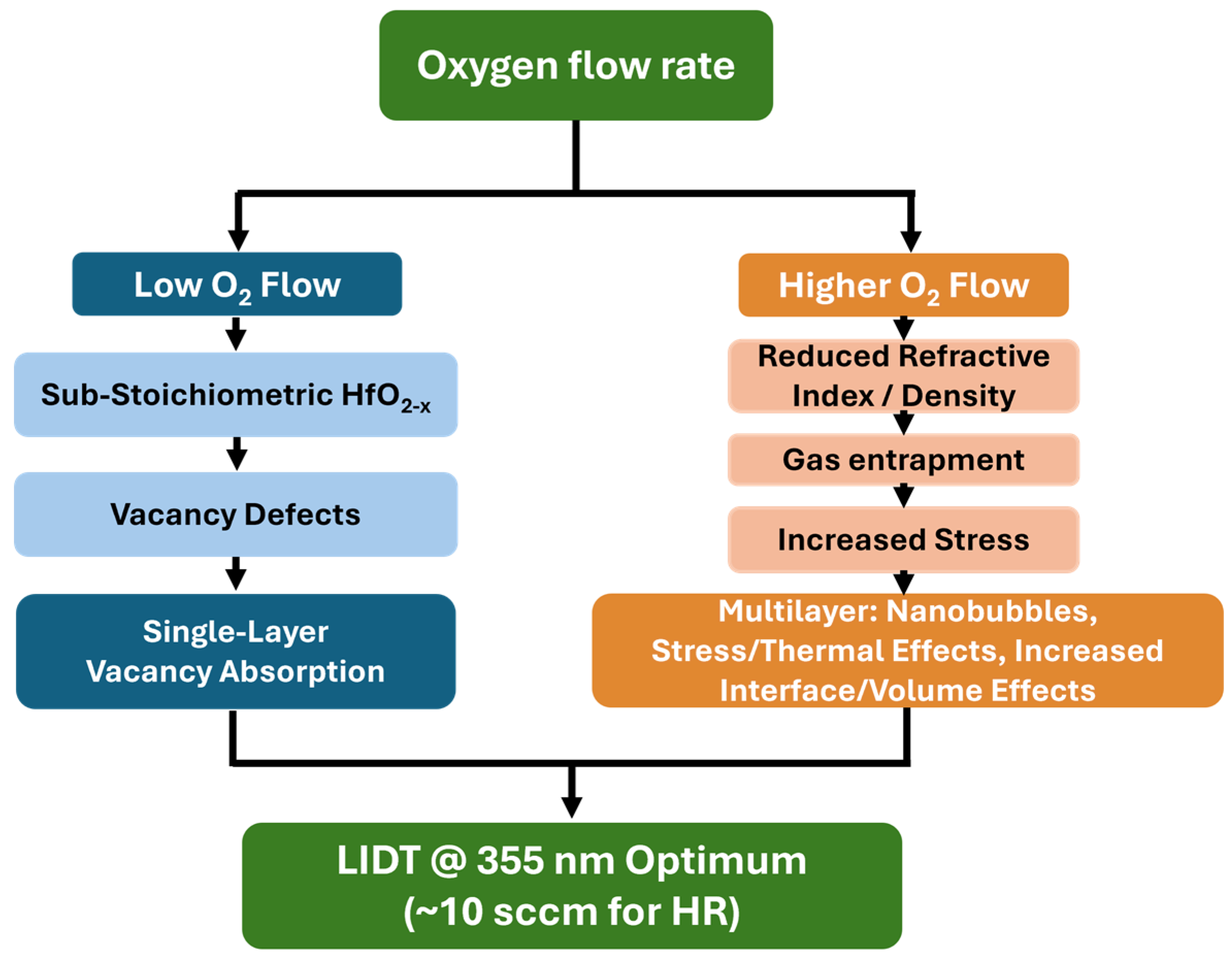
A schematic representation of the proposed O2 flow-dependent damage pathways is shown in Figure 9. This conceptual diagram summarizes how variations in stoichiometry, inducing variations in density, stress, gas entrapment, and thermal conductivity, may shift the dominant damage precursors between single-layer and multilayer configurations for the 355 nm LIDT, consistent with the present observations and prior studies.
Thus, the most consistent interpretation of our HR trend for the 355 nm LIDT is a crossover in the limiting precursor population: at low oxygen flow rates, vacancy-related absorbers associated with sub-stoichiometry can dominate; in contrast, for higher oxygen flow rates, the stack becomes increasingly limited by oxygen- and gas entrapment-related nanoscale precursors (nanobubbles/voids) and/or stress accumulation pathways, and thus thermal conductivity changes. This competition shifts the optimum toward lower oxygen flow (here, ~10 sccm), maximizing the 355 nm HR damage resistance.

4. Conclusions

We systematically investigated how oxygen flow during ion beam sputtering controls the stoichiometry, microstructure, optical properties, and nanosecond laser damage resistance of HfO2 thin films at 1064 nm and 355 nm and HfO2/SiO2 high-reflector (HR) stacks at 355 nm. For single hafnia layers, increasing oxygen flow drives the films from sub-stoichiometric HfO2−x toward near-stoichiometric HfO2, as confirmed by RBS and the accompanying reduction in the refractive index with flow. AFM measurements show that pinhole-like features dominate surface roughness and that their apparent density is non-linearly linked to oxygen flow.
Optically, ellipsometry and UV-Vis measurements reveal that oxygen flow significantly affects dispersion and sub-bandgap absorption. Tauc analysis indicates an increase in sub-bandgap defect states with higher oxygen flow, suggesting that excess oxygen can promote defect populations and microstructure disorder. The laser damage testing of single layers shows that the LIDT at 1064 nm is relatively insensitive to oxygen flow over a broad range, implying that near-IR damage is less affected by these stoichiometry-related defects and may be more impacted by structural and thermal properties. In contrast, the 355 nm LIDT increases strongly with oxygen flow up to the highest value studied (45 sccm), indicating that UV damage is highly sensitive to sub-bandgap absorbers and that more oxidizing growth conditions benefit single-layer UV performance.
However, when hafnia is incorporated into 355 nm HR stacks, the trend reverses. HRs fabricated with hafnia deposited at 10 sccm oxygen flow exhibit a higher ns-LIDT at 355 nm than those using 35–45 sccm hafnia, demonstrating that single-layer trends at 355 nm cannot be directly extrapolated to multilayer systems. We propose that the observed behavior reflects a wavelength- and material structure-dependent crossover in the dominant damage-initiating precursor population. At low oxygen flow, oxygen vacancy-related absorbers limit performance, whereas at higher oxygen flow, nanobubble or void-like defects associated with gas and oxygen entrapment, along with increased residual stress and reduced thermal conductivity, become increasingly important in thick stacks. The cumulative volume of HfO2 in HRs amplifies the impact of such nanoscale precursors and stress-driven defects, shifting the optimum process window toward moderate oxygen flow.
Overall, these results identify oxygen flow during IBS as a coupled control parameter for stoichiometry, defect formation, optical constants, and damage resistance. For UV single layers, higher oxygen flow improves the LIDT by suppressing vacancy-driven absorption, but for practical multilayer HRs, an intermediate oxygen flow (approximately 10 sccm in this study) yields the best 355 nm ns-LIDT by balancing vacancy suppression against gas- and stress-related precursors and preserving favorable thermal properties. This narrow processing window has direct implications for the optimization of advanced multilayer dielectric coatings in high-peak- and high-average-power laser systems, including late-line optics at the National Ignition Facility that may experience occasional UV exposure. Further work combining in-depth defect spectroscopy, stress and thermal transport measurements, and alternative working gases or oxidation schemes will be valuable to decouple these competing degradation pathways and extend the damage resistance of hafnia-based coatings.

Author Contributions

Conceptualization, A.G. and C.H.; methodology, A.G., S.D., R.A.N. and C.H.; IBS coating fabrication, A.G.; laser damage testing, S.D.; spectrophotometric measurements, A.G.; RBS measurements, L.B.B.A.; investigation and data interpretation, A.G., S.D., R.A.N. and C.H.; writing—original draft preparation, A.G. and C.H.; writing—review and editing, A.G., S.D., R.A.N. and C.H.; visualization, A.G. and C.H.; supervision, C.H. and R.A.N.; funding acquisition, C.H. All authors have read and agreed to the published version of the manuscript.

Funding

This work was performed under the auspices of the U.S. Department of Energy by Lawrence Livermore National Laboratory under Contract DE-AC52-07NA27344 and was supported by the LLNL-LDRD Program under Project No. 23-ERD-006.

Institutional Review Board Statement

Not applicable.

Informed Consent Statement

Not applicable.

Data Availability Statement

Dataset available on request from the authors.

Acknowledgments

This article is a revised and expanded version of a paper [42], which was present at [Optical Interference Coatings Conference 2025, Tucson, AZ, USA, 18–23 May 2025].

Conflicts of Interest

The authors declare no conflicts of interest.

References

  1. Baisden, P.A.; Atherton, L.J.; Hawley, R.A.; Land, T.A.; Menapace, J.A.; Miller, P.E.; Runkel, M.J.; Spaeth, M.L.; Stolz, C.J.; Suratwala, T.I.; et al. Large optics for the national ignition facility. Fusion Sci. Technol. 2016, 69, 295–351. [Google Scholar] [CrossRef]
  2. Mirkarimi, P.B.; Harthcock, C.; Qiu, S.R.; Negres, R.; Guss, G.; Voisin, T.; Hammons, J.A.; Colla, C.A.; Mason, H.; Than, A.; et al. Improving the laser performance of ion beam sputtered dielectric thin films through the suppression of nanoscale defects by employing a xenon sputtering gas. Opt. Mater. Express 2022, 12, 3365–3378. [Google Scholar] [CrossRef]
  3. Venkataiah, S.; Chandra, S.J.; Chalapathi, U.; Ramana, C.V.; Uthanna, S. Oxygen partial pressure influenced stoichiometry, structural, electrical, and optical properties of DC reactive sputtered hafnium oxide films. Surf. Interface Anal. 2021, 53, 206–214. [Google Scholar] [CrossRef]
  4. Gallais, L.; Capoulade, J.; Natoli, J.-Y.; Commandré, M.; Cathelinaud, M.; Koc, C.; Lequime, M. Laser damage resistance of hafnia thin films deposited by electron beam deposition, reactive low voltage ion plating, and dual ion beam sputtering. Appl. Opt. 2008, 47, C107–C113. [Google Scholar] [CrossRef] [PubMed]
  5. Negres, R.A.; Stolz, C.J.; Thomas, M.D.; Caputo, M. 1064-nm, nanosecond laser mirror thin film damage competition. In Laser-Induced Damage in Optical Materials 2018: 50th Anniversary Conference; SPIE: Bellingham, WA, USA, 2018. [Google Scholar]
  6. Negres, R.A.; Stolz, C.J.; Thomas, M.D.; Caputo, M. 355-nm, nanosecond laser mirror thin film damage competition. In Laser-Induced Damage in Optical Materials 2017; SPIE: Bellingham, WA, USA, 2017. [Google Scholar]
  7. Harthcock, C.; Qiu, S.R.; Mirkarimi, P.B.; Negres, R.A.; Guss, G.; Menor, M.G.; Bhowmik, G.; Huang, M. Origin and effect of film sub-stoichiometry on ultraviolet, ns-laser damage resistance of hafnia single layers. Opt. Mater. Express 2020, 10, 937–951. [Google Scholar] [CrossRef]
  8. Hu, G.; Kong, M.; Wei, M.; Gao, W.; Wang, B.; Li, M.; He, W. Effect of oxygen flow on micro-defects and laser damage resistance of ion-beam sputtered hafnium dioxide films. Vacuum 2025, 239, 114443. [Google Scholar] [CrossRef]
  9. Harthcock, C.; Qiu, S.R.; Negres, R.A.; Hammons, J.A.; Voisin, T.; Guss, G.; Martin, A.A.; Stolz, C.J.; Menor, M.G.; Bhowmik, G.; et al. The impact of nano-bubbles on the laser performance of hafnia films deposited by oxygen assisted ion beam sputtering method. Appl. Phys. Lett. 2019, 115, 251902. [Google Scholar] [CrossRef]
  10. Gritsenko, V.A.; Perevalov, T.V.; Islamov, D.R. Electronic properties of hafnium oxide: A contribution from defects and traps. Phys. Rep. 2016, 613, 1–20. [Google Scholar] [CrossRef]
  11. Perevalov, T.; Aliev, V.S.; Gritsenko, V.; Saraev, A.; Kaichev, V. Electronic structure of oxygen vacancies in hafnium oxide. Microelectron. Eng. 2013, 109, 21–23. [Google Scholar] [CrossRef]
  12. McCauley, J.; Kruse, T.; Balendat, S.; Wienke, A.; Ristau, D.; Jupé, M. Investigating the impact of intermediate states in hafnia on nonlinear absorption. Appl. Opt. 2025, 65, A130–A138. [Google Scholar] [CrossRef]
  13. Foster, A.S.; Gejo, F.L.; Shluger, A.; Nieminen, R.M. Vacancy and interstitial defects in hafnia. Phys. Rev. B 2002, 65, 174117. [Google Scholar] [CrossRef]
  14. Papernov, S.; Brunsman, M.D.; Oliver, J.B.; Hoffman, B.N.; Kozlov, A.A.; Demos, S.G.; Shvydky, A.; Cavalcante, F.H.M.; Yang, L.; Menoni, C.S.; et al. Optical properties of oxygen vacancies in HfO2 thin films studied by absorption and luminescence spectroscopy. Opt. Express 2018, 26, 17608–17623. [Google Scholar] [CrossRef]
  15. Papernov, S.; Shin, E.; Murray, T.; Schmid, A.; Oliver, J. 355nm absorption in HfO2 and SiO2 monolayers with embedded Hf nanoclusters studied using photothermal heterodyne imaging. In Laser-Induced Damage in Optical Materials: 2012; SPIE: Bellingham, WA, USA, 2012. [Google Scholar]
  16. Fang, S.; Ma, C.; Liu, W.; He, J.; Wang, C.; Chen, G.; Liu, D.; Zhang, R. Effect of oxygen flow on the optical properties of hafnium oxide thin films by dual-ion beam sputtering deposition. Appl. Phys. A 2022, 128, 1097. [Google Scholar] [CrossRef]
  17. VanBlarcom, D.; Drachenberg, D.R.; Monticelli, M.V.; Davalos, G.E.; Davis, S.R.; Schenkel, N.; Cook, M.J.; Crist, R.P.; Messerly, M.J.; Dawson, J.W. Novel AMP surface treatment for improving optical fiber strength and laser gain (Conference Presentation). In Laser-Induced Damage in Optical Materials 2018: 50th Anniversary Conference; International Society for Optics and Photonics: Bellingham, WA, USA, 2018. [Google Scholar]
  18. Doolittle, L.R. Algorithms for the rapid simulation of Rutherford backscattering spectra. Nucl. Instrum. Methods Phys. Res. Sect. B Beam Interact. Mater. At. 1985, 9, 344–351. [Google Scholar] [CrossRef]
  19. ISO 21254-1:2025; Lasers and Laser-Related Equipment—Test Methods for Laser-Induced Damage Threshold—Part 1: Definitions and General Principles. ISO: Geneva, Switzerland, 2025.
  20. Luo, X.; Demkov, A.A.; Triyoso, D.; Fejes, P.; Gregory, R.; Zollner, S. Combined experimental and theoretical study of thin hafnia films. Phys. Rev. B 2008, 78, 245314. [Google Scholar] [CrossRef]
  21. Cardinal, S.; Pelletier, J.-M.; Eisenbart, M.; Klotz, U. Influence of crystallinity on thermo-process ability and mechanical properties in a Au-based bulk metallic glass. Mater. Sci. Eng. A 2016, 660, 158–165. [Google Scholar] [CrossRef]
  22. Salman, S.; Salama, S.; Mahdy, E.A. Contribution of some transition metal oxides to crystallization and electro-thermal properties of glass-ceramics. Ceram. Int. 2020, 46, 13724–13731. [Google Scholar] [CrossRef]
  23. Jia, Y.; Mao, Z.; Huang, W.; Zhang, J. Effect of temperature and crystallinity on the thermal conductivity of semi-crystalline polymers: A case study of polyethylene. Mater. Chem. Phys. 2022, 287, 126325. [Google Scholar] [CrossRef]
  24. Dusunceli, N.; Colak, O.U. Modelling effects of degree of crystallinity on mechanical behavior of semicrystalline polymers. Int. J. Plast. 2008, 24, 1224–1242. [Google Scholar] [CrossRef]
  25. Cheng, X.; Wang, Z. Defect-related properties of optical coatings. Adv. Opt. Technol. 2014, 3, 65–90. [Google Scholar] [CrossRef]
  26. Schneider, C.; Rasband, W.; Eliceiri, K. NIH Image to ImageJ: 25 years of image analysis. Nat. Methods 2012, 9, 671–675. [Google Scholar] [CrossRef]
  27. Kaiser, N.; Vogel, T.; Zintler, A.; Petzold, S.; Arzumanov, A.; Piros, E.; Eilhardt, R.; Molina-Luna, L.; Alff, L. Defect-stabilized substoichiometric polymorphs of hafnium oxide with semiconducting properties. ACS Appl. Mater. Interfaces 2021, 14, 1290–1303. [Google Scholar] [CrossRef] [PubMed]
  28. Harthcock, C.; Nguyen, H.T.; Vipin, D.; Huang, M. Impact of high-temperature annealing on hafnia-silica composite coatings deposited via ion beam sputtering for high-peak power 1064 nm lasers. Opt. Mater. Express 2025, 15, 2592–2606. [Google Scholar] [CrossRef]
  29. Papernov, S.; Tait, A.; Bittle, W.; Schmid, A.; Oliver, J.; Kupinski, P. Near-ultraviolet absorption and nanosecond-pulse-laser damage in HfO2 monolayers studied by submicrometer-resolution photothermal heterodyne imaging and atomic force microscopy. J. Appl. Phys. 2011, 109, 113106. [Google Scholar] [CrossRef]
  30. Yu, Z.; He, H.; Qi, H.; Chen, S.; Xiao, Q. Mechanism for 355 nm nanosecond-pulse-driven damage in HfO2/SiO2 high reflectivity coating. In Pacific Rim Laser Damage 2013: Optical Materials for High Power Lasers; SPIE: Bellingham, WA, USA, 2013. [Google Scholar]
  31. Ma, P.; Zheng, Y.; Zhang, M.; Liu, H.; Liu, Z.; Pu, Y.; Qiao, Z. Correlation between defect absorption and nano-second laser-induced damage of HfO2/SiO2 based high reflective coatings at 1064 nm. Thin Solid Films 2019, 669, 404–409. [Google Scholar] [CrossRef]
  32. Bodemann, A.; Kaiser, N.; Kozlowski, M.R.; Pierce, E.L.; Stolz, C.J. Comparison between 355 and 1064-nm damage of high-grade dielectric mirror coatings. In 27th Annual Boulder Damage Symposium: Laser-Induced Damage in Optical Materials: 1995; SPIE: Bellingham, WA, USA, 1996. [Google Scholar]
  33. Gallais, L.; Mangote, B.; Zerrad, M.; Commandré, M.; Melninkaitis, A.; Mirauskas, J.; Jeskevic, M.; Sirutkaitis, V. Laser-induced damage of hafnia coatings as a function of pulse duration in the femtosecond to nanosecond range. Appl. Opt. 2010, 50, C178–C187. [Google Scholar] [CrossRef] [PubMed]
  34. Wu, Y.; Xiang, X.; Yu, J.; Yuan, X.; Shen, H.; Zheng, W.; Zu, X. Research progress on nanosecond laser irradiation damage of optical films. Nucl. Anal. 2022, 1, 100045. [Google Scholar] [CrossRef]
  35. Bassiri, R.; Clark, C.; Martin, I.W.; Markosyan, A.; Murray, P.G.; Tessmer, J.; Rowan, S.; Fejer, M.M. Investigating the relationship between material properties and laser-induced damage threshold of dielectric optical coatings at 1064 nm. In Laser-Induced Damage in Optical Materials: 2015; SPIE: Bellingham, WA, USA, 2015. [Google Scholar]
  36. Zhou, Q.; Ma, P.; Qiu, F.; Pu, Y.; Qiao, Z.; Lv, L.; Zhang, M.; Kong, P.; Qiu, R.; Jiang, Y. Role of nano-precursors in ultraviolet-laser damage of HfO2/SiO2 mixture coatings. Thin Solid Films 2021, 739, 138963. [Google Scholar] [CrossRef]
  37. Papernov, S.; Kozlov, A.A.; Oliver, J.B.; Smith, C.; Jensen, L.; Günster, S.; Mädebach, H.; Ristau, D. Role of HfO2/SiO2 thin-film interfaces in near-ultraviolet absorption and pulsed laser damage. Opt. Eng. 2017, 56, 011004. [Google Scholar] [CrossRef]
  38. Jena, S.; Tokas, R.; Misal, J.; Rao, K.; Udupa, D.; Thakur, S.; Sahoo, N. Effect of O2/Ar gas flow ratio on the optical properties and mechanical stress of sputtered HfO2 thin films. Thin Solid Films 2015, 592, 135–142. [Google Scholar] [CrossRef]
  39. Zhao, L.; Hsu, P.-F. An Analytical Model of the Thermal Conductivity of Thin Porous Ceramic Coatings. J. Therm. Spray Technol. 2025, 34, 1147–1159. [Google Scholar] [CrossRef]
  40. Kaviany, M. Principles of Heat Transfer in Porous Media; Springer Science & Business Media: New York, NY, USA, 2012. [Google Scholar]
  41. Ghai, R.S.; Chen, K.; Baddour, N. Modelling thermal conductivity of porous thermal barrier coatings. Coatings 2019, 9, 101. [Google Scholar] [CrossRef]
  42. Guediche, A.; Diop, S.; Negres, R.; Aji, L.B.; Harthcock, C. Influence of Oxygen Flow and Sub-Stoichiometry on the Optical and Damage Resistance Properties of Hafnium Oxide Thin Films. In Optical Interference Coatings; Optica Publishing Group: Washington, DC, USA, 2025; p. WC-3. [Google Scholar]
Figure 1. The X-ray diffraction spectra from hafnia single layers deposited with different oxygen flow rates (from 10 sccm up to 45 sccm).
Coatings 16 00376 g001
Figure 2. Atomic force micrographs for hafnia films coated using 10 sccm (a), 15 sccm (b), 25 sccm (c), 35 sccm (d) and 45 sccm (e) of oxygen flow.
Coatings 16 00376 g002
Figure 3. Surface roughness (black, square data points) and pinhole density (blue, triangle data points) obtained from AFM analysis.
Coatings 16 00376 g003
Figure 4. (a) The optical dispersion of all oxygen flow-based hafnia layers via ellipsometry analysis. (b) A summary of the optical indices with oxygen flow for 355 (black, square data) and 1064 nm (blue, triangular data points).
Coatings 16 00376 g004
Figure 5. (a) Near-normal transmission for all optically transmissive coatings. (b) The Tauc plot for all coatings and (c) a zoomed-in view of the Tauc plot on the Urbach tail to show the near-band edge defect states associated with each film.
Coatings 16 00376 g005
Figure 6. Oxygen flow rate dependence of (left axis) Laser-induced damage threshold (defined as the laser fluence corresponding to 50% damage probability) upon irradiation with (a) 1064 nm and (b) 355 nm, respectively. (right axis) Stoichiometric ratio of the bulk films is also shown as a function of oxygen flow rate.
Coatings 16 00376 g006
Figure 7. SEM micrographs of the damage morphology at 1064 nm with (a) 10 sccm, (b) 15 sccm, and (c) 45 sccm and at 355 nm with (d) 10 sccm, (e) 15 sccm and (f) 25 sccm.
Coatings 16 00376 g007
Figure 8. Oxygen flow dependence in 355 nm HR stacks and its impact on the damage probability curve.
Coatings 16 00376 g008
Figure 9. Conceptual flowchart of hypothesized oxygen flow-dependent damage pathways/mechanisms.
Coatings 16 00376 g009
Table 1. Deposition parameters of five recipes targeting hafnia films with different stoichiometries: chamber pressure and target thicknesses (planned QWOT designs at 1064 nm).
Oxygen Flow (sccm)Pressure ×10−5 (Torr)Thickness (nm)
105.74134
158.44132
2513.5139
3518.4137
4523.0130
Table 2. HR design specification and the refractive index with A, B and C, the three parameters of the Cauchy law used to fit the ellipsometry data obtained from the single-layer study.
StoichiometryDesignRefractive Index (Cauchy Fit)
ABC
10 sccm(HL)10 H LL1.9829670.018403−0.00028
35 sccm(HL)10 H LL1.96860.0186−0.0004
45 sccm(HL)10 H LL1.95690.0171−0.0001
Disclaimer/Publisher’s Note: The statements, opinions and data contained in all publications are solely those of the individual author(s) and contributor(s) and not of MDPI and/or the editor(s). MDPI and/or the editor(s) disclaim responsibility for any injury to people or property resulting from any ideas, methods, instructions or products referred to in the content.