Article

Development of Polymeric Hole Transporting Materials for Stable and Efficient Perovskite Solar Cells

School of Materials Science and Engineering, Nanjing University of Posts and Telecommunications, Nanjing 210023, China
*
Author to whom correspondence should be addressed.
Coatings 2026, 16(3), 351; https://doi.org/10.3390/coatings16030351
Submission received: 7 February 2026 / Revised: 4 March 2026 / Accepted: 6 March 2026 / Published: 11 March 2026
(This article belongs to the Special Issue Perovskite-Oxide-Based Thin Films for Battery Applications)

Abstract

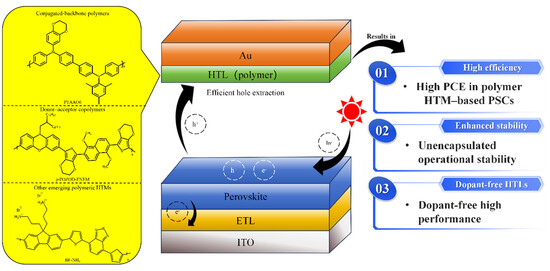
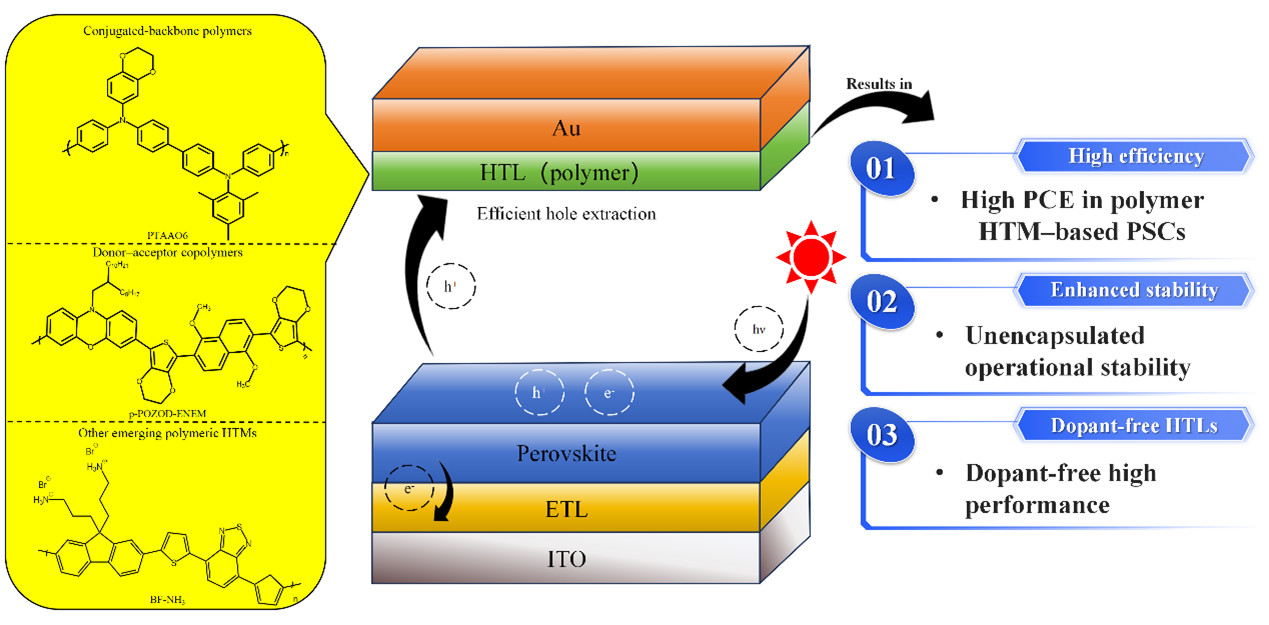
Polymeric hole-transport materials (HTMs) play a pivotal role in improving the efficiency, stability, and scalability of perovskite solar cells (PSCs). Owing to their structural tunability, polymeric HTMs enable effective control over energy-level alignment, charge transport, interfacial interactions, and film formation. This review summarizes recent advances in polymeric HTMs, including conjugated-backbone polymers, donor–acceptor (D–A) copolymers, and emerging architectures such as hyperbranched, ionic, chelating, and anchorable polymer systems. Particular emphasis is placed on structure–property–performance relationships and interfacial engineering strategies that govern device efficiency and long-term operational stability in PSCs. Finally, the key challenges and future directions for developing scalable and robust polymeric HTMs are discussed.

Graphical Abstract

1. Introduction

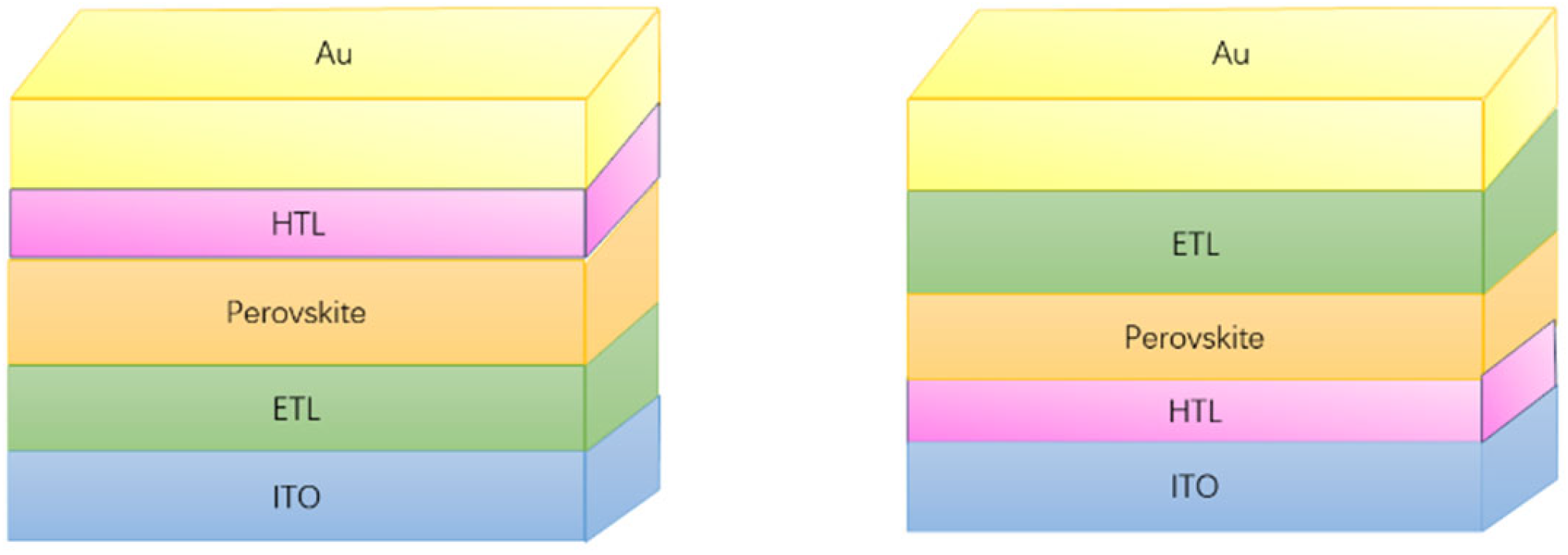
Since the first report of organic–inorganic hybrid perovskite materials applied in photovoltaics in 2009, perovskite solar cells (PSCs) have witnessed an extraordinary rise in power-conversion efficiency (PCE). Within just over a decade, the certified efficiency of single-junction PSCs has surged from 3.8% [1] to over 26% [2], while all-perovskite tandem devices have surpassed 35%. This unprecedented progress has positioned PSCs as one of the most promising next-generation photovoltaic technologies. In addition to their high efficiency, perovskite absorbers offer several intrinsic advantages—including solution processability, low-temperature fabrication, tunable bandgaps, high absorption coefficients, long carrier diffusion lengths, and balanced ambipolar transport—which make them attractive for emerging applications such as flexible electronics, wearable electronic devices, and building-integrated photovoltaics [3,4,5,6,7]. The conventional n-i-p PSC adopts a bottom-up stack of a glass/transparent conductive oxide (TCO) substrate, titanium dioxide (TiO2) electron transport layer (ETL), perovskite light-harvesting layer, Spiro-OMeTAD hole transport layer (HTL), and gold (Au) electrode, where photoexcited electrons transfer through the ETL to the TCO while holes migrate via the HTL to the metal electrode, with the ETL and HTL blocking cross-carrier recombination. In contrast, the inverted p-i-n PSC reverses the charge transport layer order, featuring a glass/TCO substrate, PEDOT:PSS HTL, perovskite layer, PC61BM ETL, and silver (Ag) electrode, where holes are first extracted to the TCO through the HTL and electrons are collected by the Ag electrode via the ETL, with the HTL prioritizing efficient hole extraction and electron blocking. The n-i-p architecture has demonstrated record PCEs exceeding 25% but faces UV-induced degradation risks from TiO2, whereas the p-i-n structure offers enhanced thermal and environmental stability, making it compatible with flexible substrates and building-integrated photovoltaics (BIPV). A side-by-side schematic of these two configurations (as shown in Figure 1) contrasts their layer sequences, aiding readers in visualizing charge pathways and functional layer roles, which is critical for optimizing PSC performance and guiding scenario-specific architecture selection.
Despite these rapid advancements, the commercialization of PSCs remains hindered by a set of fundamental challenges. These include insufficient long-term operational stability, pronounced sensitivity to moisture, oxygen, heat, and illumination, ion migration-induced degradation, interfacial chemical reactions, and difficulties in maintaining high device reproducibility during scale-up to large-area modules [8,9,10]. From a device-architecture perspective, a typical PSC consists of a perovskite light-absorbing layer sandwiched between electron- and hole-transport layers. Although perovskite materials exhibit ambipolar charge-transport characteristics, dedicated carrier transport layers are indispensable for enabling selective charge extraction, suppressing interfacial charge recombination, and establishing favorable energy-level alignment between the perovskite absorber and the electrodes. In this context, the performance and stability of PSCs are strongly governed by interfacial processes. Non-ideal interfaces—characterized by energy-level mismatches, surface defects, chemical incompatibilities, or poor film coverage—could significantly accelerate non-radiative recombination, leading to open-circuit voltage (Voc) losses, reduced fill factor (FF), and shortened device lifetimes. Consequently, the development of efficient and stable hole-transport layers has become a central theme in advancing PSC technologies toward practical deployment. Among all interfacial layers, the hole transport layer (HTL) plays a particularly pivotal role. The HTL governs selective hole extraction from the perovskite absorber, suppresses undesired electron back-flow, and regulates interfacial recombination dynamics [11,12,13]. The energy-level alignment, carrier mobility, film morphology, and interfacial chemistry of the HTL directly impact Voc, FF, and overall PCE. High-quality HTLs further contribute to defect passivation, mitigate ion migration, enhance environmental and thermal stability, and improve the mechanical processability of flexible PSC architectures. For scalable fabrication routes—such as blade coating, slot-die coating, or roll-to-roll processing—the film-forming properties, solubility, and processing compatibility of the HTL are additional factors that strongly determine device reproducibility and manufacturability [14,15,16].
A variety of HTL materials have been explored, including inorganic transition-metal oxides, small-molecule organic materials, and polymeric semiconductors. Inorganic HTLs such as NiOx offer high intrinsic stability but often require high-temperature annealing and exhibit limited wetting and film uniformity on perovskite layers [17,18,19,20]. Small-molecule HTLs represented by 2,2′,7,7′-Tetrakis[N,N-di(4-methoxyphenyl)amino]-9,9′-spirobifluorene (Spiro-OMeTAD) are capable of achieving high efficiencies, yet they heavily rely on hygroscopic dopants (e.g., Lithium bis(trifluoromethanesulphonyl)imide (LiTFSI)) to attain adequate conductivity—leading to poor environmental stability and accelerated interfacial degradation [21,22,23,24]. In contrast, polymeric hole transport materials have attracted increasing attention owing to their excellent film uniformity, tunable molecular energy levels, low dopant dependence, mechanical flexibility, and superior compatibility with solution-processed and large-area device fabrication. Particularly under dopant-free conditions or in flexible and printed photovoltaics, polymeric HTLs offer structural design versatility that enables properties beyond the reach of conventional small-molecule or inorganic HTLs [25,26,27].
Motivated by these advantages, this review provides a comprehensive overview of recent progress in polymeric hole transport materials for PSCs. This review summarizes the molecular design strategies, energy-level engineering principles, interfacial modulation mechanisms, and performance optimization routes achieved through different classes of polymeric HTLs. By elucidating structure–property correlations and highlighting emerging trends, this review aims to provide insight into the rational design of next-generation polymeric HTMs that can enable high efficiency, long-term stability, and scalable manufacturing of perovskite photovoltaic devices.

2. Polymeric Hole Transport Materials

With the growing recognition of the pivotal role of the hole transport layer in governing both efficiency and operational stability, polymeric hole-transport materials (HTMs) have emerged as an increasingly important material class in PSCs. Compared with inorganic and small-molecule HTMs, polymeric counterparts offer unique advantages in molecular design flexibility, film-forming capability, mechanical compliance, and compatibility with solution-based and scalable fabrication processes. These features render polymeric HTMs particularly attractive for dopant-free device architectures, flexible perovskite photovoltaics, and large-area manufacturing.
Benefiting from advances in polymer chemistry and molecular engineering, polymeric HTMs have evolved into a structurally diverse family encompassing multiple subclasses with distinct electronic structures, charge-transport mechanisms, and interfacial functionalities. Representative categories include conjugated-backbone polymers featuring extended π-systems for efficient hole transport [28,29,30], donor–acceptor (D–A) copolymers that enable fine tuning of frontier energy levels [31,32,33] a and enhanced intramolecular charge transfer, as well as emerging polymer architectures such as hyperbranched networks, ionic or chelating macromolecules [34,35], and anchorable polymer systems designed for defect passivation and interfacial stabilization. Each of these subclasses addresses specific limitations of conventional HTL materials and offers complementary pathways toward improved device performance and stability.
In the following sections, this review systematically summarizes recent progress in polymeric HTMs by categorizing them according to their molecular architecture and design strategy. We begin with conjugated-backbone polymers, one of the earliest and most extensively studied classes, followed by donor–acceptor copolymers and other emerging polymeric HTM systems. Through this classification framework, we aim to elucidate structure–property–performance relationships that underpin high-performance polymeric HTLs and to highlight promising directions for future material development.

2.1. Conjugated Polymeric Hole Transport Materials

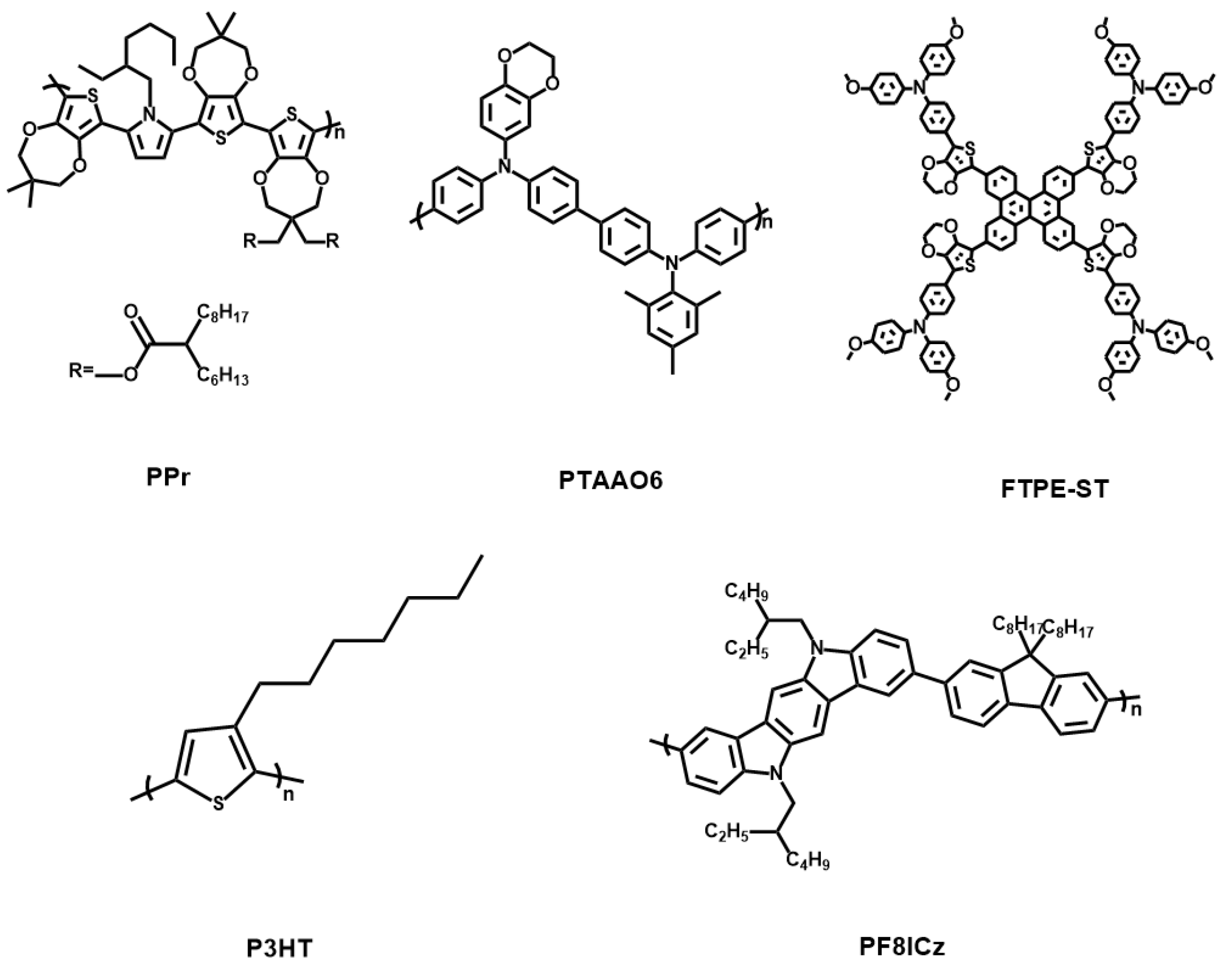
Conjugated-backbone polymers represent the earliest and most extensively explored class of polymeric HTMs for PSCs. The chemical structures of conjugated polymeric hole transport materials are shown in Figure 2. The performance comparison values of typical PSCs with conjugated polymeric hole transport materials are summarized in Table 1. Unlike donor–acceptor (D–A) copolymers, these materials rely on continuous π-conjugated main chains constructed from repetitive aromatic or heteroaromatic units—such as thiophenes, carbazoles, or fused-ring systems—to achieve efficient hole transport. Early studies employing classical polymers such as poly(3-hexylthiophene) (P3HT) or poly(p-phenylene vinylene) derivatives demonstrated that uninterrupted π-electron delocalization could deliver intrinsic hole mobilities above 10−3 cm2 V−1 s−1 and form electronically homogeneous interfaces with perovskite film [36,37,38]. However, these early systems also exposed fundamental limitations of rigid linear conjugated frameworks, including poor solubility, suboptimal film coverage on rough polycrystalline perovskites, and a relatively narrow tunable range of frontier orbital energies [28].
To overcome these constraints, subsequent developments introduced molecular design strategies targeting improved backbone planarity, enhanced π–π stacking, and surface-energy modulation through controlled side-chain engineering. The approaches such as dipole-moment tuning or the incorporation of heteroatom-containing π-bridges demonstrated that modifying the conjugation extent and backbone rigidity could reduce energetic disorder and strengthen interfacial coupling with perovskite absorbers [39]. These insights clarified key backbone-engineering principles—such as enhancing backbone planarity, strengthening π–π stacking, and reducing energetic disorder—that have since guided the rational design of high-performance conjugated polymeric HTMs.
Recent years have witnessed the emergence of more structurally refined conjugated-backbone polymeric HTMs, highlighting the versatility and performance potential of this category through rational backbone engineering. A representative example is the pyrrole-modified 3,4-propylenedioxythiophene-based conjugated polymer (denoted as PPr), in which electron-rich pyrrole units are incorporated into the ProDOT backbone to extend π-conjugation and modulate the polymer electronic structure. The introduction of pyrrole effectively deepens the HOMO energy level, reduces energetic disorder, and enhances intermolecular ordering, while maintaining good solubility and uniform film formation on perovskite absorbers. As a result, PPr functions as an efficient dopant-free hole transport layer in conventional n–i–p PSCs, delivering power conversion efficiencies exceeding 21% and markedly suppressed non-radiative recombination. Notably, PPr-based devices exhibit outstanding operational stability, retaining approximately 94% of their initial efficiency after more than 4000 h of storage under ambient conditions without encapsulation [40]. Building on backbone-planarity control, conjugation-optimized polymeric HTMs based on cyclic alkoxylation of poly(triarylamine) (PTAA) derivatives have demonstrated a powerful strategy for enhancing charge transport and interfacial stability. By introducing cyclic alkoxylated side groups with well-defined bond angles, the conjugation extension within the polymer is precisely regulated, leading to reduced energetic disorder and enhanced intermolecular interactions. In particular, the six-membered dioxine-modified derivative PTAAO6 exhibits denser molecular packing, increased hydrophobicity, and significantly suppressed trap density compared to pristine PTAA and its five-membered-ring analog PTAAO5. These effects effectively reduce non-radiative recombination and promote efficient hole extraction. As a result, inverted PSCs employing PTAAO6 as the hole transport layer achieve a high power conversion efficiency of 25.19% together with excellent operational stability, retaining over 90% of the initial efficiency after 1000 h of continuous illumination [41].
Recent advances have further expanded the design space of conjugated-backbone polymer HTMs through backbone dimensionality engineering. A representative example is the three-dimensionally conjugated polymer FTPE-ST, featuring a dibenzo (g,p)chrysene core with extended 3,4-ethylenedioxythiophene (EDOT) arms. The enlarged π-conjugated framework and three-dimensional molecular configuration promote strong intermolecular π–π interactions while maintaining good solubility and film-forming ability. As a result, FTPE-ST exhibits a high intrinsic hole mobility of 7.2 × 10⁻⁴ cm2 V−1 s−1 and efficient hole extraction at the perovskite interface. The PSCs employing FTPE-ST as the hole transport layer achieve a champion PCE of 25.21% and retain over 80% of their initial efficiency after 1000 h of operation, demonstrating the effectiveness of conjugation expansion and backbone dimensionality control in high-performance conjugated polymer HTMs [42].
Table 1. The performance comparison of typical PSCs with conjugated polymeric hole transport materials.
NameDevice ConfigurationHOMO/LUMOμh
(cm2·V−1·s−1)
PCE
[%]
Voc
[V]
Jsc [mA cm−2]FF
[%]
Ref
PPrITO/SnO2/Perovskite/PPr/Au−5.21/−2.85 1.37 × 10−421.41.1224.777.6[40]
PTAAO6ITO/PTAAO6/Perovskite/C60/BCP/Ag−5.12/NR6.42 × 10−525.11.1925.184.2[41]
FTPE-STFTO/SnO2/Perovskite/FTPE-ST/Au−5.09/−2.757.2 × 10−425.21.1326.284.6[42]
Asy-PSeDTSFTO/TiO2/Perovskite/Asy-PSeDTS/MoO3/Ag−5.29/−3.419.17 × 10−415.21.1815.284.0[43]
Spiro-TFSI doped P3HTFTO/SnO2/Perovskite/P3HT:Spiro-TFSI/Au−4.90/NR2.26 × 10−325.11.1526.382.2[44]
PF8ICzITO/PF8ICz/Perovskite/BCP/C60/Ag−5.48/NRNR25.41.1925.384.3[39]
Further progress has been achieved through the development of crystalline conjugated polymer hole transport materials, exemplified by poly (3-hexylthiophene-2,5-diyl) (P3HT). Owing to its highly planar conjugated backbone, crystalline P3HT can form pronounced face-on π–π stacking, which is favorable for efficient vertical hole transport in PSCs. Recent studies have demonstrated that appropriate p-type charge-transfer doping not only enhances the electrical conductivity of P3HT but also regulates its crystallization orientation, suppressing unfavorable edge-on packing and promoting a face-on molecular arrangement at the perovskite/HTL interface. As a result, PSCs employing Spiro-TFSI doped crystalline P3HT as the hole transport layer have achieved a power conversion efficiency as high as 25.16%, together with outstanding operational stability, retaining 96.5% of their initial efficiency after 2028 h of continuous illumination. The corresponding T90 lifetime exceeds 600 h, highlighting doped crystalline conjugated polymers as a viable class of high-performance and stability-oriented HTMs for PSCs [44].
Most recently, a π-expanded indeno [3,2-b]carbazole-based conjugated polymer, PF8ICz, has been developed as a low-energetic-disorder polymeric hole transport material for inverted PSCs. By incorporating a centrosymmetric indeno [3,2-b]carbazole unit into the conjugated backbone, PF8ICz exhibits enhanced backbone planarity, suppressed torsional disorder, and reduced energy-level fluctuations. These structural features collectively facilitate efficient hole transport, effective defect passivation at the perovskite/HTL interface, and improved perovskite crystallization. As a result, PF8ICz-based p–i–n devices deliver a high power conversion efficiency exceeding 25.4%, while retaining approximately 96% of their initial efficiency after 1000 h of operation under standard ISOS stability protocols, demonstrating the effectiveness of low-energetic-disorder backbone engineering in achieving simultaneously high efficiency and long-term operational stability [39].
Together, these advances delineate a clear evolutionary trajectory of conjugated-backbone polymer hole transport materials, from early linear thiophene-based systems toward more sophisticated architectures featuring extended conjugation, enhanced backbone planarity, controlled dimensionality, and suppressed energetic disorder. Through rational backbone engineering—such as conjugation expansion, rigid-segment incorporation, crystallinity regulation, and packing-orientation control—modern conjugated polymer HTMs have achieved high intrinsic hole mobility, favorable vertical charge-transport pathways, and markedly improved operational stability in PSCs. Despite these successes, the performance envelope of conjugated-backbone polymer HTMs remains constrained by inherent structural limitations. Their relatively narrow energy-level tunability, arising from single-component backbone architectures, restricts precise band alignment with diverse perovskite compositions, while the absence of strongly interactive functional motifs limits their defect-passivation capability at perovskite interfaces. These intrinsic trade-offs, rooted in the simplicity of conjugated backbone design, have prompted growing interest in donor–acceptor (D–A) copolymer systems, which offer expanded chemical design space for simultaneous modulation of electronic structure, interfacial interactions, and charge-transport behavior. Accordingly, the following section (Section 2.2) focuses on D–A polymer HTMs, highlighting how their modular architectures address the tunability challenges encountered in conjugated-backbone systems.

2.2. Donor–Acceptor (D–A) Copolymer Hole-Transport Materials

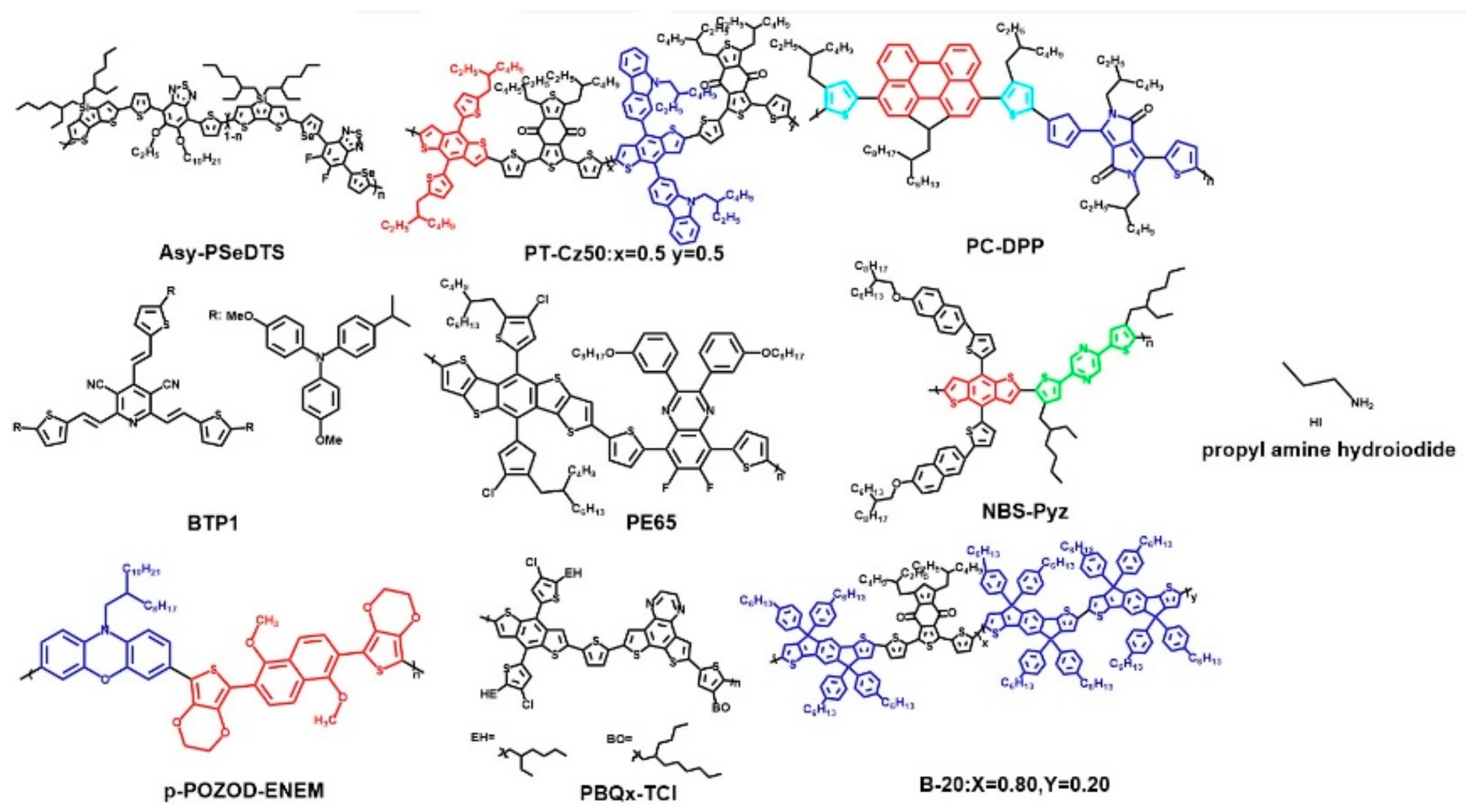
Among polymeric HTMs, donor–acceptor (D–A) copolymers—comprising alternating electron-donating (D) and electron-accepting (A) units along the conjugated backbone—have emerged as one of the most effective design strategies for achieving high-performance PSCs. The chemical structures of conjugated donor–acceptor copolymer hole-transport materials are shown in Figure 3. The performance comparison of typical PSCs with donor–acceptor copolymer hole-transport materials are summarized in Table 2. Compared with simple conjugated polymers, D–A copolymers offer a well-defined platform for tuning molecular energy levels, enhancing intramolecular charge transfer (ICT), improving charge mobility, and promoting favorable molecular packing. The alternating D/A architecture creates an internal charge-transfer channel within the polymer backbone, narrowing the bandgap and aligning the HOMO with the perovskite valence band maximum. This optimized alignment lowers the energy barrier for hole extraction, increases the Voc, and enhances device stability. Moreover, the intrinsic dipole contrast between donor and acceptor segments strengthens π–π interactions, improving film uniformity and orientation for more continuous charge-transport pathways.
Over the past several years, substantial advances have been made in D–A copolymer HTMs, enabled by innovations in donor/acceptor unit selection, backbone coplanarity, energy-level engineering, and defect-suppression mechanisms. These developments together highlight the adaptability and performance potential of D–A frameworks across a broad range of perovskite absorber compositions and device architectures. In 2023, Fu et al. reported a donor–acceptor (D–A) conjugated polymer, PC-DPP, composed of a thiophene-substituted phenanthrocarbazole (PC-T) donor and a diketopyrrolopyrrole (DPP) acceptor. By shifting the conjugated side chain into the polymer backbone and employing a large π-extended donor unit, the D–A polymer exhibits optimized molecular packing and a dominant face-on orientation. This packing modulation strengthens intramolecular charge transfer and enhances interfacial contact with the perovskite absorber. As a result, when applied as a dopant-free hole transport layer in FA0.95Cs0.05Pb(I0.9Br0.1)3-based PSCs, PC-DPP significantly improves hole mobility and charge extraction, boosting the power conversion efficiency from 17.27% (control polymer) to 22.67% [45].
Similarly, rigid-segment-engineered polymeric hole transport materials, incorporating fluorinated benzothiadiazole or other fused-ring units, have been developed to enhance backbone coplanarity and suppress energetic disorder. By introducing rigid acceptor segments and noncovalent conformational locking, these conjugated polymer HTMs exhibit strengthened π–π stacking, more efficient hole extraction, and improved thermal and operational stability, thereby outperforming more flexible D–A polymer frameworks in dopant-free PSCs [43].
Expanding the structural diversity of donor–acceptor (D–A) polymeric hole transport materials, Wang et al. proposed a ternary D1–A–D2–A copolymerization strategy by integrating thiophene- and carbazole-functionalized benzodithiophene (BDT) donor units into a benzodithiophene-4,8-dione (BDD) acceptor framework. The resulting terpolymer, PT-Cz50, maintains the alternating D–A conjugated backbone while enabling fine modulation of donor characteristics through an approximately 1:1 incorporation of two electron-rich side-chain-engineered BDT units [46]. Such synergistic donor–donor interactions enhance backbone planarity, deepen the HOMO energy level, and promote favorable molecular packing with a dominant face-on orientation. When applied as a dopant-free HTL in inverted MAPbI3-based PSCs, PT-Cz50 delivers a high power conversion efficiency of 22.53%, demonstrating the effectiveness of ternary D–A copolymerization in balancing charge transport, interfacial energetics, and film morphology.
Attention has also been directed toward sustainable fabrication routes for D–A polymeric HTMs. Yu et al. reported star-shaped D–A–D copolymers (BTP1–2) featuring an electron-deficient dicyanopyridine acceptor core and three peripheral triphenylamine-based donor arms, enabling efficient intramolecular charge transfer while retaining high solubility in green solvents. Processed entirely from 2-methylanisole, the three-arm topology promotes charge delocalization, suppresses excessive aggregation, and provides intrinsic defect passivation via photo-induced TICT states [47]. As a result, inverted PSCs based on FA/Cs mixed-cation perovskites achieved a champion PCE of 24.34%, representing the highest efficiency reported to date for green-solvent-processable dopant-free polymer HTMs.
Beyond iodide-rich absorbers, D–A copolymer hole transport materials have also been explored for wide-bandgap perovskite systems. Duan et al. designed two D–π–A type polymers, PE64 and PE65, employing a pentacyclic dithienobenzo [1,2-b;4,5-b′]dithiophene (DTBDT) unit as the donor and quinoxaline as the acceptor [48]. When integrated into CsPbI2Br-based PSCs, the chlorinated-thiophene-substituted PE65 exhibited tighter molecular ordering, improved energy-level alignment, and enhanced interfacial passivation, leading to suppressed radiative and non-radiative recombination losses. As a result, devices using PE65 as the hole transport layer achieved a power conversion efficiency of 17.6% with a high open-circuit voltage of 1.44 V, highlighting the effectiveness of donor–acceptor backbone engineering for wide-bandgap perovskite photovoltaics.
Parallel progress has been achieved through donor–acceptor (D–A) copolymer engineering. Lakshman et al. reported two dopant-free D–A polymeric hole transport materials, NBD-Pyz and NDT-Pyz, constructed by coupling benzodithiophene (BDT) or dithienobenzodithiophene (DTBDT) donor units with a strongly electron-deficient pyrazine acceptor [49]. Incorporation of the pyrazine moiety effectively downshifted the HOMO energy levels and enhanced backbone coplanarity, leading to improved hole mobility and efficient interfacial defect passivation. When employed as the HTL in n–i–p FA0.9Cs0.1Pb(I0.9Br0.1)3-based PSCs, the NBD-Pyz-based devices achieved a champion PCE of 22.9%, while retaining approximately 90% of the initial efficiency after 1000 h under unencapsulated conditions, demonstrating excellent intrinsic and thermal stability.
Additional design flexibility in donor–acceptor polymeric HTMs has been demonstrated through the construction of rigid alternating copolymer backbones. Zhang et al. reported a phenoxazine-based alternating D–A copolymer, p-POZOD-ENEM, featuring an electron-rich phenoxazine donor, ethylenedioxythiophene π-bridges, and a rigid dimethoxynaphthalene acceptor unit. The rational D–A alternation along the conjugated backbone enhances backbone coplanarity, increases glass-transition temperature, and effectively suppresses energetic disorder. As a result, p-POZOD-ENEM exhibits improved film morphology and enhanced hole transport capability under dopant-free conditions. When employed as the hole transport layer in n–i–p PSCs, the polymer delivers a power conversion efficiency of approximately 25.0% and maintains over 90% of its initial efficiency after prolonged thermal aging, highlighting the effectiveness of rigid alternating D–A backbone engineering in achieving both high efficiency and long-term device stability [50].
Drawing inspiration from wide-bandgap donor polymers originally developed for organic photovoltaics, Lai et al. systematically explored a series of commercially relevant D–A copolymers, including D18, D18-Cl, and PBQx-TCl, as dopant-free hole transport materials for PSCs. These polymers consist of benzodithiophene-based donor units coupled with electron-deficient acceptor moieties such as thiadiazole or pyrazine, enabling precise tuning of energy levels, backbone planarity, and molecular packing [51]. Among them, PBQx-TCl exhibited a moderate aggregation behavior with a preferred face-on orientation, which facilitated efficient hole extraction, reduced interfacial recombination, and effective defect passivation without additional passivation layers. As a result, inverted PSCs employing dopant-free PBQx-TCl achieved a champion power conversion efficiency of 24.12% with a high open-circuit voltage of 1.20 V, along with excellent operational stability (T90 > 600 h under continuous illumination). This work highlights the potential of wide-bandgap D–A copolymers as high-performance, commercially viable polymeric HTMs for PSCs.
Beyond serving as bulk hole-transport layers, donor–acceptor copolymers have also demonstrated unique advantages when employed as ultrathin interfacial and hole transport membranes. Shen et al. reported an ultrathin (~7 nm) p-type D–A conjugated polymer D18 with dual functions of interface modification and hole transport. D18 inserted between the perovskite absorber and Spiro-OMeTAD in n–i–p PSCs. D18 features a donor–acceptor backbone incorporating a fused-ring benzothiadiazole-derived acceptor unit (DTBT), which promotes strong π–π stacking and dense molecular packing [52]. Owing to its compact morphology and well-aligned energy levels, the D18 membrane simultaneously facilitated efficient hole extraction and effectively suppressed layer-to-layer ion diffusion, including Li+, FA+, MA+, and I species. As a result, the perovskite/D18/Spiro-OMeTAD interface exhibited significantly reduced energetic mismatch and non-radiative recombination losses. Devices incorporating the D18 interlayer achieved a champion power conversion efficiency of 26.39% (certified 26.17%) for a 0.12 cm2 aperture area, along with a fill factor exceeding 83%. More importantly, the devices retained 95.4% of their initial efficiency after 1100 h of maximum power point tracking at 50 °C without encapsulation, representing one of the most stable high-efficiency n–i–p PSCs reported to date. This work highlights that rationally designed D–A copolymers can transcend the traditional role of bulk HTMs and function as multifunctional ultrathin membranes, offering a powerful strategy to simultaneously optimize charge extraction and operational stability in PSCs.
In 2025, Wang et al. proposed a non-equivalent donor–acceptor (D–A) copolymer design strategy to suppress non-radiative voltage loss in PSCs. By systematically tuning the D:A ratio in indacenodithiophene–benzodithiophene-4,8-dione (IDT–BDD) copolymers, a series of polymers (B-00, B-15, B-20, and B-25) with distinct backbone conformations were developed. Among them, the optimized B-20 polymer (D:A = 3:2) exhibits enhanced backbone planarity, tighter π–π stacking (4.24 Å), and increased hole mobility (8.31 × 10⁻⁴ cm2 V−1 s−1) [53]. These structural advantages facilitate efficient hole extraction and effective defect passivation via Lewis base interactions between the carbonyl groups and undercoordinated Pb2+ ions. As a result, inverted n–i–p PSCs employing B-20 as a dopant-free HTM deliver a champion PCE of 22.35% with a high Voc of 1.19 V, corresponding to a remarkably low non-radiative voltage loss (ΔVnr) of 0.127 V. This work highlights molecular conformation control in D–A copolymers as an effective strategy for simultaneously improving voltage output and operational stability.
Taken together, these representative studies highlight the exceptional versatility of donor–acceptor (D–A) copolymer design strategies, encompassing backbone planarization, terpolymerization, topological engineering, halogen substitution, and rigid acceptor incorporation. Through rational selection and spatial arrangement of donor and acceptor units, D–A copolymer HTMs enable precise modulation of frontier orbital energies, intramolecular charge-transfer strength, molecular packing, and interfacial chemistry—capabilities that are difficult to achieve simultaneously in single-component conjugated-backbone polymers. Benefiting from this expanded molecular design space, state-of-the-art D–A polymer HTMs have delivered power conversion efficiencies exceeding 22%–25% in both n–i–p and p–i–n PSCs, often in dopant-free configurations, while exhibiting remarkable operational stability with efficiency retention above 90% after 1000 h of continuous operation. In addition, advances in molecular topology and side-chain engineering have enabled environmentally benign processing routes, further enhancing the technological appeal of D–A copolymers for scalable device fabrication. Despite these advantages, the increased structural complexity of D–A copolymers introduces new challenges, including synthetic cost, batch-to-batch reproducibility, and the delicate balance between backbone rigidity and film-forming ability. Excessive intramolecular charge transfer or over-rigidification may also lead to increased energetic disorder or morphological instability if not carefully controlled. These trade-offs underscore the importance of rational molecular design and structure–property correlation studies in advancing D–A polymer HTMs. Overall, D–A copolymers have established themselves as a pivotal and rapidly advancing class of hole transport materials that effectively address the tunability limitations of conjugated homopolymer HTMs. Their ability to simultaneously optimize efficiency, stability, processability, and environmental compatibility positions D–A polymer HTMs as leading candidates for next-generation perovskite photovoltaic technologies.
Table 2. The performance comparison of typical PSCs with donor–acceptor copolymer hole-transport materials.
NameDevice ConfigurationHOMO/LUMOμh (cm2·V−1·s−1)PCE
[%]
Voc
[V]
Jsc [mA cm−2]FF
[%]
Ref
PT-Cz50ITO/SnO2/MAPbI3/PT-Cz50/MoO3/Ag−5.40/−3.549.19 × 10−422.51.1425.577.1[46]
PC-DPPITO/SnO2/FA0.95Cs0.05Pb(I0.9Br0.1)3/PC-DPP/MoO3/Ag−5.35/−3.731.7 × 10−422.61.1524.779.2[45]
BTP1ITO/BTP1/Perovskite/C60/BCP/Ag−5.10/−3.141.66 × 10−424.31.1724.982.8[47]
PE65ITO/SnO2/CsPbI2Br/PE65/MoO3/Ag−5.29/−3.504.56 × 10−417.61.4414.584.0[48]
NBD-PyzFTO/c-TiO2/m-TiO2/Perovskite/NBD-Pyz/Au−5.59/−3.632.4 × 10−322.91.1025.581.7[49]
p-POZOD-ENEMITO/SnO2/FAPbI3/HTL/Au−5.12/−2.763.43 × 10−525.01.1826.081.1[50]
PBQx-TClITO/SnO2/Perovskite/PBQx-TCl/MoO3/Ag−5.48/NRNR24.11.1924.781.5[51]
D18FTO/SnO2/Perovskite/D18/Spiro-OMeTAD/Au−5.56/−2.781.59 × 10−326.31.1826.583.9[52]
B-20ITO/SnO2/Perovskite/B-20/MoO3/Ag−5.32/−3.408.31 × 10−422.31.1924.476.6[53]

2.3. Hyperbranched Polymeric Hole-Transport Materials

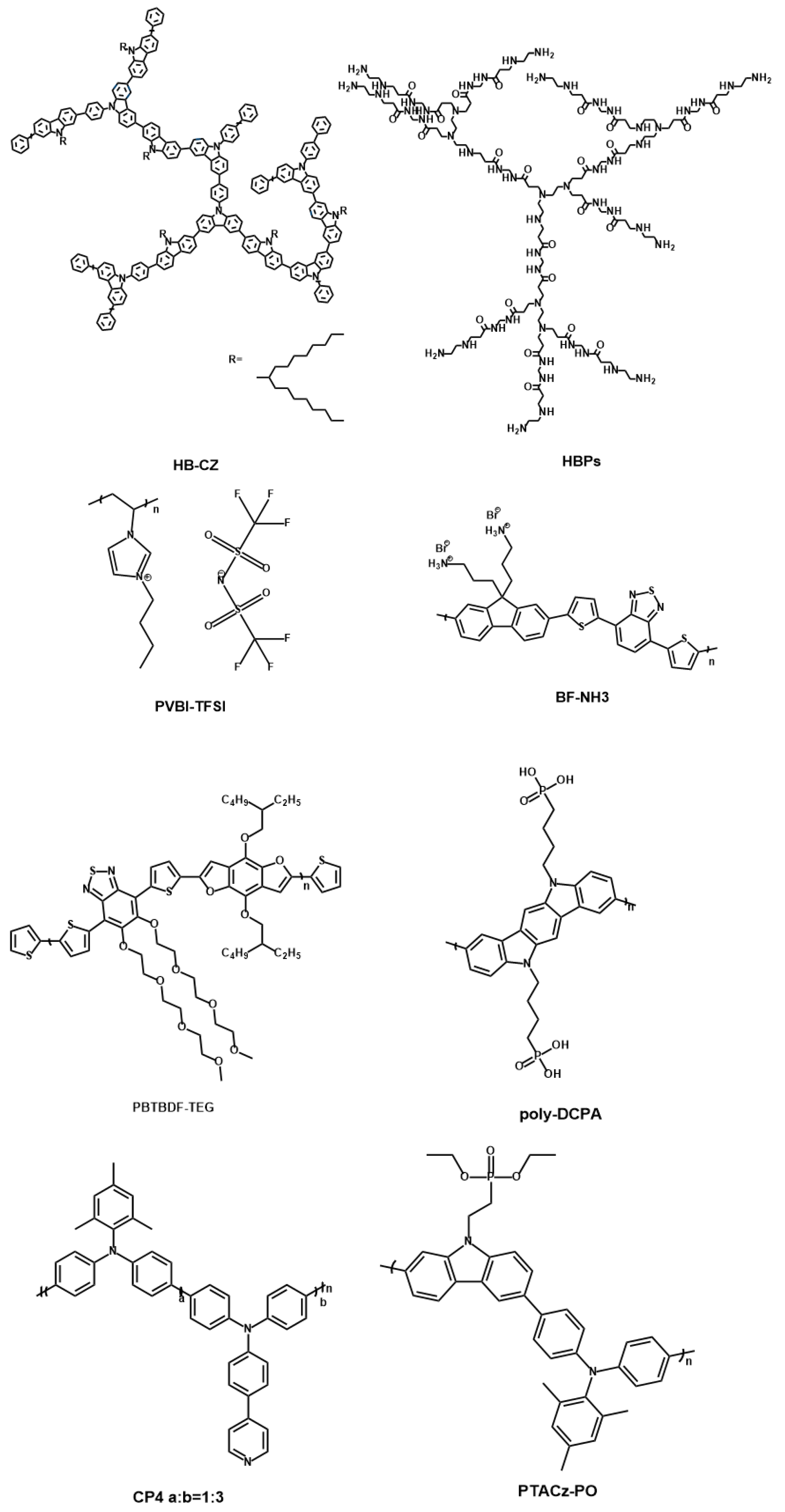
Beyond conjugated-backbone and donor–acceptor (D–A) copolymer HTMs, a growing class of structurally distinctive polymeric hole-transport materials—including hyperbranched networks, ionically conductive macromolecules, and anchorable or interfacially functionalized architectures—has emerged to address limitations associated with traditional linear π-conjugated frameworks. The chemical structures of conjugated other emerging polymeric hole-transport materials are shown in Figure 4. The performance comparison of typical PSCs with other emerging polymeric hole-transport materials are summarized in Table 3. Early studies on hyperbranched polymer HTMs, such as the carbazole-based system reported by Zhou et al. in 2017 [54], demonstrated that three-dimensional A3–B2 architectures offer exceptional solubility, dense interfacial coverage, and abundant terminal functional groups capable of passivating defects on rough perovskite surfaces. Owing to their globular topology, these hyperbranched macromolecules form smooth and pinhole-free hole-transport layers more readily than linear conjugated polymers, highlighting an intrinsic tolerance to morphological irregularities [54]. Subsequent developments extended this concept toward mechanically robust and flexible PSCs. For example, a hyperbranched polymer system reported in 2023 introduced adhesive and dynamic hydrogen-bonding functionalities that reinforced interfacial contact while maintaining efficient charge extraction. The branched topology effectively distributed mechanical stress, suppressed crack formation, and enabled stable photovoltaic performance under repeated bending cycles, underscoring the versatility of hyperbranched polymer architectures as emerging HTMs beyond conventional linear designs [55].

2.4. Ionic Functionalized Polymeric Hole Transport Materials

In parallel, polymer systems incorporating ionic or ion-related functionalities have emerged as effective alternatives to conventional dopant-assisted HTMs, offering new pathways to enhance hole transport while mitigating instability issues associated with hygroscopic small-molecule additives such as LiTFSI. A representative strategy involves the use of polymeric ionic dopants, exemplified by the poly(ionic liquid)–based p-doping system reported by Geffroy et al., in which a non-diffusible polymeric counterion replaces LiTFSI in spiro-OMeTAD, leading to improved conductivity, suppressed hysteresis, and enhanced device reproducibility [56]. Beyond polymeric dopants, conjugated polyelectrolytes (CPEs) have been directly employed as hole-transport layers. By incorporating built-in ionic side groups, these polymers generate interfacial dipole layers that improve energy-level alignment and suppress interfacial recombination, as demonstrated by Liu et al. through systematic ionic group engineering of CPE-based HTMs [57]. More recently, ion-chelating polymeric HTMs have been developed to stabilize the doping state and suppress dopant migration. For example, a dopant-chelating conjugated polymer reported in 2025 integrates Lewis-base side chains capable of coordinating lithium dopants, thereby enhancing humidity tolerance and long-term operational stability in quantum-dot photovoltaics [58]. An alternative dopant-free approach was introduced by Fu et al., who demonstrated that blending two structurally similar conjugated polymers into a single-phase polymer alloy can effectively regulate molecular packing, enhance hole transport, and stabilize the perovskite/HTL interface without relying on ionic dopants, yielding power conversion efficiencies exceeding 24% [59]. Together, these studies illustrate that ionic-functionalized, ion-chelating, and polymer-alloy-based strategies represent distinct yet complementary design paradigms for emerging polymeric hole-transport materials, enabling efficient and stable charge extraction through mechanisms beyond traditional molecular doping.

2.5. Polymer Hole Transport Materials Functionalized with Anchoring Groups

Complementary advancements have arisen from the development of anchorable and interfacially functionalized polymer hole-transport materials, in which specific binding moieties are incorporated into otherwise linearly conjugated polymer backbones to strengthen polymer–perovskite interactions. For example, adhesion-enhanced polymer HTMs reported in 2025 introduce phosphonic-acid-based anchoring groups that simultaneously bind to oxide electrodes and perovskite surfaces, thereby improving interfacial adhesion, suppressing non-radiative recombination, and enhancing mechanical robustness under ambient processing conditions [60]. Beyond adhesion enhancement, anchoring functionalities have enabled the construction of ultra-thin and uniform HTLs. A particularly notable example is a pyridyl-anchored poly(triarylamine)-based polymer system introduced in 2025, in which coordinative pyridyl groups allow the formation of continuous sub-10 nm HTLs from extremely low-concentration solutions. These ultra-thin polymer layers support power conversion efficiencies exceeding 26% while maintaining excellent thermal and operational stability [26]. Anchorable polymer HTMs have also demonstrated strong compatibility with environmentally benign processing routes. In this context, a green-solvent-processable polymer HTM functionalized with phosphonate side chains was shown to form compact and uniform HTLs from 2-methylanisole, illustrating how strong polymer–perovskite binding can compensate for limited wetting in low-polarity solvents while delivering record efficiencies in inverted PSCs [25]. Thus, these studies highlight anchoring-driven interfacial functionalization as an effective design paradigm for polymer HTMs, enabling robust adhesion, ultra-thin layer formation, and green-solvent processability beyond conventional conjugated or donor–acceptor polymer frameworks.
Together, these developments demonstrate that non-traditional polymer HTMs—spanning hyperbranched architectures, ionic and chelating systems, and anchorable or interfacially functionalized macromolecules—offer unique advantages not attainable with linear conjugated or D–A copolymer frameworks. Their structural diversity enables multifunctionality, including intrinsic defect passivation, robust interface adhesion, reduced reliance on hygroscopic dopants, compatibility with green-solvent and scalable processing routes, and enhanced mechanical durability for flexible photovoltaics. As the field progresses toward large-area manufacturing and long-term device stability, these emerging polymer classes are expected to play an increasingly important role in expanding the design space of polymeric HTMs for next-generation PSCs.

3. Conclusions and Outlook

Polymeric HTMs have evolved into a structurally diverse and functionally powerful component in PSCs. Through three major design paradigms—conjugated-backbone polymers, donor–acceptor (D–A) copolymers, and emerging hyperbranched, ionic, and anchorable macromolecules—the field has progressively addressed limitations associated with charge extraction, energetic alignment, film formation, and long-term operational stability. Conjugated-backbone polymers have advanced from simple thiophene-based chains to complex π-extended architectures featuring enhanced planarity, dimensionality, and reduced energetic disorder. D–A copolymers have introduced greater tunability of frontier orbital energies and interchain interactions, enabling high open-circuit voltages, suppressed non-radiative recombination, and robust stability. Meanwhile, non-traditional polymer designs—such as hyperbranched frameworks, ionically conductive systems, chelating polymers, and anchorable macromolecules—have expanded the functionality of polymer HTLs, offering intrinsic defect passivation, improved interfacial adhesion, enhanced environmental tolerance, and compatibility with scalable processing.
As shown in Table 4, while D-A copolymers offer the highest performance, their high synthetic complexity and cost present the greatest barrier to scalability. Conjugated-backbone polymers offer a better balance, especially as their design matures. Hyperbranched and functionalized polymers provide unique processing and stability advantages that could lower overall manufacturing costs. The ideal path forward lies in innovating synthetic routes to reduce the cost of high-performance polymers while leveraging their inherent advantages in solution processability and stability for scalable PSC production.
Across these categories, several research commonalities have emerged. First, precise energy-level alignment between the polymer HOMO and the perovskite valence band is essential to maximize hole extraction while minimizing energetic losses. Second, backbone planarity, intermolecular ordering, and intrachain charge delocalization strongly dictate hole mobility and the extent of non-radiative recombination. Third, functional side chains and ionic or Lewis-basic moieties provide an increasingly important route to chemical passivation and interface stabilization. Finally, polymer architecture plays a critical role in determining film uniformity, mechanical flexibility, and the ability to integrate into scalable manufacturing techniques.
Despite rapid progress, key challenges remain. Lead-free perovskite systems—particularly Sn-based and wide-bandgap absorbers—exhibit distinct defect chemistries and require HTMs with stronger ionic buffering and more adaptable energy levels. Large-area and roll-to-roll fabrication impose stringent requirements on polymer solubility, rheology, and wetting behavior, while maintaining uniformity over meter-scale substrates. Performance–cost trade-offs also hinder industrial adoption: high-performing D–A copolymers often rely on complex backbones and expensive monomers, limiting their scalability. Moreover, long-term stability under operational stressors—including thermal cycling, humidity, ion migration, and mechanical deformation—remains insufficient for commercial deployment.
Looking ahead, several strategic directions are anticipated to guide the next generation of polymeric HTMs. Low-cost, high-throughput polymerization strategies—such as one-step polycondensation or the use of commodity monomers—will be crucial for translating laboratory-scale materials into industrially relevant solutions. Multifunctional HTMs capable of simultaneously transporting holes, passivating surface defects, and enhancing environmental stability are expected to reduce interfacial engineering complexity and improve reproducibility. The development of green-solvent-processable polymers, particularly those compatible with 2-methylanisole, alcohols, or other benign solvents, will accelerate the adoption of scalable coating techniques such as blade coating, slot-die coating, and roll-to-roll printing. Additionally, AI-assisted molecular design and high-throughput computation offer powerful emerging tools for predicting structure–function relationships, screening large chemical libraries, and rationally designing tailor-made polymer HTMs. Finally, flexible and tandem photovoltaics present unique opportunities for polymer-based HTMs, leveraging their inherent mechanical compliance, low-temperature processability, and chemical modularity.
In summary, the landscape of polymeric HTMs is rapidly expanding beyond traditional conjugated frameworks toward multifunctional, structurally adaptive, and manufacturable materials. Continued integration of molecular design, interface chemistry, scalable processing, and computational insight is expected to further unlock the potential of polymer HTMs in high-efficiency, durable, and commercially viable perovskite photovoltaics.

Author Contributions

Conceptualization, H.W.; Methodology, H.W.; Software, H.W.; Validation, H.W.; Formal analysis, H.W.; Investigation, H.W.; Data curation, H.W.; Writing—original draft, H.W.; Writing—review & editing, H.W. and Y.S.; Supervision, Y.S. All authors have read and agreed to the published version of the manuscript.

Funding

This research received no external funding.

Data Availability Statement

The data that support the findings of this study are available from the corresponding author upon reasonable request.

Conflicts of Interest

The authors declare no conflict of interest.

References

  1. Kojima, A.; Teshima, K.; Shirai, Y.; Miyasaka, T. Organometal Halide Perovskites as Visible-Light Sensitizers for Photovoltaic Cells. J. Am. Chem. Soc. 2009, 131, 6050–6051. [Google Scholar] [CrossRef]
  2. Zhou, J.; Tan, L.; Liu, Y.; Li, H.; Liu, X.; Li, M.; Wang, S.; Zhang, Y.; Jiang, C.; Hua, R.; et al. Highly efficient and stable perovskite solar cells via a multifunctional hole transporting material. Joule 2024, 8, 1691–1706. [Google Scholar] [CrossRef]
  3. Dong, Q.; Fang, Y.; Shao, Y.; Mulligan, P.; Qiu, J.; Cao, L.; Huang, J. Electron-hole diffusion lengths >175 µm in solution-grown CH3NH3PbI3 single crystals. Science 2015, 347, 967–970. [Google Scholar] [CrossRef] [PubMed]
  4. Shi, D.; Adinolfi, V.; Comin, R.; Yuan, M.; Alarousu, E.; Buin, A.; Chen, Y.; Hoogland, S.; Rothenberger, A.; Katsiev, K.; et al. Low trap-state density and long carrier diffusion in organolead trihalide perovskite single crystals. Science 2015, 347, 519–522. [Google Scholar] [CrossRef] [PubMed]
  5. Lu, H.; Krishna, A.; Zakeeruddin, S.M.; Grätzel, M.; Hagfeldt, A. Compositional and Interface Engineering of Organic-Inorganic Lead Halide Perovskite Solar Cells. iScience 2020, 23, 101359. [Google Scholar] [CrossRef]
  6. Burschka, J.; Pellet, N.; Moon, S.-J.; Humphry-Baker, R.; Gao, P.; Nazeeruddin, M.K.; Grätzel, M. Sequential deposition as a route to high-performance perovskite-sensitized solar cells. Nature 2013, 499, 316–319. [Google Scholar] [CrossRef]
  7. Jeon, N.J.; Noh, J.H.; Kim, Y.C.; Yang, W.S.; Ryu, S.; Seok, S.I. Solvent engineering for high-performance inorganic–organic hybrid perovskite solar cells. Nat. Mater. 2014, 13, 897–903. [Google Scholar] [CrossRef]
  8. Baikie, T.; Fang, Y.; Kadro, J.M.; Schreyer, M.; Wei, F.; Mhaisalkar, S.G.; Graetzel, M.; White, T.J. Synthesis and crystal chemistry of the hybrid perovskite (CH3NH3)PbI3 for solid-state sensitised solar cell applications. J. Mater. Chem. A 2013, 1, 5628–5641. [Google Scholar] [CrossRef]
  9. Rong, Y.; Liu, L.; Mei, A.; Li, X.; Han, H. Beyond Efficiency: The Challenge of Stability in Mesoscopic Perovskite Solar Cells. Adv. Energy Mater. 2015, 5, 1501066. [Google Scholar] [CrossRef]
  10. Rombach, F.M.; Haque, S.A.; Macdonald, T.J. Lessons learned from spiro-OMeTAD and PTAA in perovskite solar cells. Energy Environ. Sci. 2021, 14, 5161–5190. [Google Scholar] [CrossRef]
  11. Yu, J.C.; Sun, J.; Chandrasekaran, N.; Dunn, C.J.; Chesman, A.S.R.; Jasieniak, J.J. Semi-transparent perovskite solar cells with a cross-linked hole transport layer. Nano Energy 2020, 71, 104635. [Google Scholar] [CrossRef]
  12. Kitamura, T.; Wang, L.; Zhang, Z.; Baranwal, A.K.; Kapil, G.; Sahamir, S.R.; Sanehira, Y.; Bi, H.; Ma, T.; Shen, Q.; et al. Sn Perovskite Solar Cells with Tin Oxide Nanoparticle Layer as Hole Transport Layer. ACS Energy Lett. 2023, 8, 3565–3568. [Google Scholar] [CrossRef]
  13. Cheng, F.; He, R.; Nie, S.; Zhang, C.; Yin, J.; Li, J.; Zheng, N.; Wu, B. Perovskite Quantum Dots as Multifunctional Interlayers in Perovskite Solar Cells with Dopant-Free Organic Hole Transporting Layers. J. Am. Chem. Soc. 2021, 143, 5855–5866. [Google Scholar] [CrossRef]
  14. Koo, B.; Kim, W.; Kim, Y.; Cao, X.; Jang, J.; Ko, M.J. Stoichiometry-Controlled Cobalt Sulfide-Based Hole Transport Layers for Perovskite Solar Cells. Small 2025, 21, e05726. [Google Scholar] [CrossRef]
  15. Rabehi, I.N.; Mariotti, S.; Fukuda, K.; Lee, S.Y.; Zhao, D.; Ji, P.; Yuan, S.; Zhang, J.; Ding, C.; Mitrofanov, K.; et al. Dual hole transport layer for ultra-flexible perovskite solar cells with unprecedented stability. Joule 2025, 9, 102209. [Google Scholar] [CrossRef]
  16. Zhumagali, S.; Li, C.; Marcinskas, M.; Dally, P.; Liu, Y.; Ugur, E.; Petoukhoff, C.E.; Ghadiyali, M.; Prasetio, A.; Marengo, M.; et al. Efficient Narrow Bandgap Pb-Sn Perovskite Solar Cells Through Self-Assembled Hole Transport Layer with Ionic Head. Adv. Energy Mater. 2025, 15, 2404617. [Google Scholar] [CrossRef]
  17. Xu, L.; Chen, X.; Jin, J.; Liu, W.; Dong, B.; Bai, X.; Song, H.; Reiss, P. Inverted perovskite solar cells employing doped NiO hole transport layers: A review. Nano Energy 2019, 63, 103860. [Google Scholar] [CrossRef]
  18. Chen, T.; Duan, L.; Luo, J. Increasing VOC of Inverted Inorganic Perovskite Solar Cells Through Nickel Oxide Modification. Adv. Funct. Mater. 2025, 35, 2502033. [Google Scholar] [CrossRef]
  19. Tang, L.; Yan, H.; Zeng, L.; Xue, Z.; Luo, Z.; Luo, J.; Wang, W.; Wang, S.; Gong, J.; Li, J.; et al. Record-Efficient Flexible Monolithic Perovskite–CIGS Tandem Solar Cell with VOC Exceeding 1.8 V on Polymer Substrate. Adv. Energy Mater. 2025, 15, 2403682. [Google Scholar] [CrossRef]
  20. Luo, Y.; Li, S.; Xia, R.; Wang, X.; Shi, B.; Han, W.; Liu, P.; Xu, Y.; Zhang, X.; Chen, Y.; et al. DC Reactive-Sputtered NiOX Hole Transport Layers with Tailored Nickel Vacancies for Perovskite Single-Junction and Textured Perovskite/Silicon Tandem Solar Cells. Small 2025, 21, e06247. [Google Scholar] [CrossRef]
  21. Dong, Y.; Rombach, F.M.; Min, G.; Snaith, H.J.; Lin, C.-T.; Haque, S.A.; Macdonald, T.J. Dopant-induced interactions in spiro-OMeTAD: Advancing hole transport for perovskite solar cells. Mater. Sci. Eng. R Rep. 2025, 162, 100875. [Google Scholar] [CrossRef]
  22. Luo, Y.; Li, T.; He, L.; Dong, L.; Xie, T.; Ren, Y.; Zhang, Z.; Yang, G.; Jia, Y.; Zhou, J.; et al. Heterogeneous Amine with Polycyclic-Aromatics-Modified Hole Transport Material for Efficient and Operationally Durable Perovskite Solar Cells. Adv. Funct. Mater. 2025, 35, 2419849. [Google Scholar] [CrossRef]
  23. Liu, X.; Zhang, X.; Zhou, Y.; Dai, W.; Chen, J.; Syzgantseva, O.A.; Syzgantseva, M.A.; Li, B.; Ghadari, R.; Han, M.; et al. Efficient and Stable Perovskite Solar Cells with a Multifunctional Spiro-Based Hole Transport Material. Adv. Funct. Mater. 2025, 35, 2415179. [Google Scholar] [CrossRef]
  24. Zhai, M.; Du, K.; Liu, C.; Chen, C.; Li, G.; Wang, H.; Xia, Z.; Yang, J.; Xu, H.; Wang, A.; et al. Fluorene-Terminated π-Conjugated Spiro-Type Hole Transport Materials for Perovskite Solar Cells. ACS Energy Lett. 2025, 10, 915–924. [Google Scholar] [CrossRef]
  25. Yin, S.; Luo, X.; Tang, F.; Xiong, Z.; Lin, Y.; Yang, W.; Shu, Y.; Wang, Y.; Ying, L. A green-solvent-processable polymer hole transport material for achieving 26.31% efficiency in inverted perovskite solar cells. Energy Environ. Sci. 2025, 18, 4153–4161. [Google Scholar] [CrossRef]
  26. Zhan, L.; Zhang, S.; Li, Z.; Li, W.; Zhang, H.; He, J.; Ji, X.; Liu, S.; Yu, F.; Wang, S.; et al. Anchorable Polymers Enabling Ultra-Thin and Robust Hole-Transporting Layers for High-Efficiency Inverted Perovskite Solar Cells. Angew. Chem. Int. Ed. 2025, 64, e202422571. [Google Scholar] [CrossRef]
  27. Liu, Z.; Zhao, Q.; Song, Y.; Sasaki, S.-i.; Ishii, A.; Shibayama, N.; Wang, X.; Ikegami, M.; Saito, N.; Duan, S.; et al. Achieving high-performance bio-inspired perovskite solar cells via molecular-level dual-function interface engineering. Mater. Sci. Eng. R Rep. 2026, 167, 101129. [Google Scholar] [CrossRef]
  28. Luo, X.; Yin, S.; Xiong, Z.; Tang, F.; Lin, Y.; Li, N.; Ying, L. Tuning Polymer Dipole Moment of Hole Transport Materials with a Glycol Ethyl Substituted Strategy for Inverted Perovskite Solar Cells. Adv. Funct. Mater. 2025, 35, 2426037. [Google Scholar] [CrossRef]
  29. Wang, Q.; Li, B.; Yang, H.; Na, Z.; Wei, Y.; Liu, X.; Han, M.; Zhang, X.; Du, W.; Rahim, G.; et al. A Novel Self-Assembled Hole-Transporting Monolayer with Extending Conjugation for Inverted Perovskite Solar Cells. Small 2025, 21, 2500296. [Google Scholar] [CrossRef]
  30. Kuan, C.-H.; Jiang, X.; Zhou, Q.; Wen, X.; Hung, S.-F.; Chen, H.-L.; Shih, Y.-S.; Narra, S.; Ma, M.; Chiou, J.-W.; et al. Overcoming the Stability Issue for Hydrophobic Hole Transporting Layers Utilized in Tin-Lead Perovskite and Tandem Solar Cells. Adv. Funct. Mater. 2026, 36, e22134. [Google Scholar] [CrossRef]
  31. Kim, G.-W.; Lee, J.; Kang, G.; Kim, T.; Park, T. Donor–Acceptor Type Dopant-Free, Polymeric Hole Transport Material for Planar Perovskite Solar Cells (19.8%). Adv. Energy Mater. 2018, 8, 1701935. [Google Scholar] [CrossRef]
  32. You, G.; Zhuang, Q.; Wang, L.; Lin, X.; Zou, D.; Lin, Z.; Zhen, H.; Zhuang, W.; Ling, Q. Dopant-Free, Donor–Acceptor-Type Polymeric Hole-Transporting Materials for the Perovskite Solar Cells with Power Conversion Efficiencies over 20%. Adv. Energy Mater. 2020, 10, 1903146. [Google Scholar] [CrossRef]
  33. He, L.; Zhang, Y.; Zhang, B.; Mu, Y.; Xu, N.; Cai, Y.; Yuan, Y.; Zhang, J.; Zhang, M.; Wang, P. Triphenylamine–ethylenedioxythiophene copolymers for perovskite solar cells: Impact of substituent type and alternation. Energy Environ. Sci. 2025, 18, 702–712. [Google Scholar] [CrossRef]
  34. Kim, H.; Hashimoto, M.; Ohkura, Y.; Ito, T.; Takahashi, H.; Sato, H.; Kim, J.; Shibayama, N.; Miyasaka, T.; Kim, G.M. Dopant-free dipole-type hole transport materials with alkali cation for enhanced stability in perovskite solar cells. Chem. Eng. J. 2025, 505, 159571. [Google Scholar] [CrossRef]
  35. Xing, Y.; Li, Z.; Li, Y.; Wu, M.; Jia, Y.; Guo, K.; Zhang, Z.; Zhou, J.; Luo, Y.; Qiu, J.; et al. Simultaneous Interfacial Defect Passivation and Free-Volume Reduction by Fluorinated Hole Transport Materials for High-Performance Perovskite Solar Cells. Adv. Mater. 2026, 38, e13884. [Google Scholar] [CrossRef]
  36. Li, M.-H.; Shao, J.-Y.; Jiang, Y.; Qiu, F.-Z.; Wang, S.; Zhang, J.; Han, G.; Tang, J.; Wang, F.; Wei, Z.; et al. Electrical Loss Management by Molecularly Manipulating Dopant-free Poly(3-hexylthiophene) towards 16.93 % CsPbI2Br Solar Cells. Angew. Chem. Int. Ed. 2021, 60, 16388–16393. [Google Scholar] [CrossRef]
  37. Li, N.; Feng, A.; Guo, X.; Wu, J.; Xie, S.; Lin, Q.; Jiang, X.; Liu, Y.; Chen, Z.; Tao, X. Engineering the Hole Extraction Interface Enables Single-Crystal MAPbI3 Perovskite Solar Cells with Efficiency Exceeding 22% and Superior Indoor Response. Adv. Energy Mater. 2022, 12, 2103241. [Google Scholar] [CrossRef]
  38. Song, D.; Ramakrishnan, S.; Xu, Y.; Yu, Q. Designing Effective Hole Transport Layers in Tin Perovskite Solar Cells. ACS Energy Lett. 2023, 8, 4162–4172. [Google Scholar] [CrossRef]
  39. Luo, X.; Yin, S.; Xiong, Z.; Qian, G.; Lin, Y.; Li, N.; Ying, L. Improving Performance of Perovskite Solar Cells by Reducing Energetic Disorder of Hole Transport Polymer. Small 2025, 21, 2409284. [Google Scholar] [CrossRef]
  40. Tang, Y.; Ma, K.; Shao, W.; Lee, Y.H.; Abtahi, A.; Sun, J.; Yang, H.; Coffey, A.H.; Atapattu, H.; Ahmed, M.; et al. A Pyrrole Modified 3,4-Propylenedioxythiophene Conjugated Polymer as Hole Transport Layer for Efficient and Stable Perovskite Solar Cells. Small 2025, 21, 2408440. [Google Scholar] [CrossRef]
  41. Yin, S.; Luo, X.; Tang, F.; Zhong, W.; Yang, W.; Xiong, Z.; Lin, Y.; Peng, F.; Ying, L. Optimizing Conjugation of Polymer Hole Transport Materials via Cyclic Alkoxylation for Highly Efficient and Stable Perovskite Solar Cells. Adv. Energy Mater. 2025, 15, 2404575. [Google Scholar] [CrossRef]
  42. Zhang, X.; Liu, X.; Ding, Y.; Ding, B.; Shi, P.; Syzgantseva, O.A.; Syzgantseva, M.A.; Fei, Z.; Chen, J.; Rahim, G.; et al. 3D Conjugated Hole Transporting Materials for Efficient and Stable Perovskite Solar Cells and Modules. Adv. Mater. 2024, 36, 2310619. [Google Scholar] [CrossRef] [PubMed]
  43. Lee, D.H.; Lim, S.; Kim, C.; Lee, H.U.; Chung, D.; Choi, Y.; Choi, J.; Kim, Y.; Cho, S.B.; Kim, H.I.; et al. Tailoring Rigid Segments in Dopant-Free Polymeric Hole Transport Materials for Perovskite Quantum Dot Solar Cells. ACS Energy Lett. 2023, 8, 1839–1847. [Google Scholar] [CrossRef]
  44. Liu, H.; Zhang, Y.; Huang, Z.; Wu, Y.; Wang, L.; Liu, G.; Chen, Y.; Li, K.; Zhang, W.; Zhou, H. Improved Charge-Transfer Doping in Crystalline Polymer for Efficient and Stable Perovskite Solar Cells. Adv. Energy Mater. 2024, 14, 2403737. [Google Scholar] [CrossRef]
  45. Fu, Q.; Liu, H.; Gao, Y.; Cao, X.; Li, Y.; Yang, Y.; Wang, J.; Chen, Y.; Yao, Z.; Liu, Y. Tunable Molecular Packing of Dopant-Free Hole-Transport Polymers for Perovskite Solar Cells. ACS Energy Lett. 2023, 8, 2878–2885. [Google Scholar] [CrossRef]
  46. Wang, X.; He, Z.; Chen, H.; Yao, L.; Li, C.; Lin, X.; Zhou, Z.; Li, K.; Wang, W.; Cai, W.; et al. Hole-Transporting Polymers Bearing Fine-Tuning Side Chains via Ternary Copolymerization Strategy for High-Performance Perovskite Solar Cells. Adv. Funct. Mater. 2023, 33, 2308435. [Google Scholar] [CrossRef]
  47. Yu, X.; Gao, D.; Li, Z.; Sun, X.; Li, B.; Zhu, Z.; Li, Z.A. Green-solvent Processable Dopant-free Hole Transporting Materials for Inverted Perovskite Solar Cells. Angew. Chem. Int. Ed. 2023, 62, e202218752. [Google Scholar] [CrossRef]
  48. Duan, C.; Tang, A.; Guo, Q.; Zhang, W.; Yang, L.; Ding, Y.; Dai, Z.; Zhou, E. DTBDT-Based Polymer Hole Transport Materials for Low Voltage Loss CsPbI2Br Perovskite Solar Cells. Adv. Funct. Mater. 2024, 34, 2313462. [Google Scholar] [CrossRef]
  49. Lakshman, C.; Kim, H.; Cho, B.H.; Song, D.; Park, J.; Kim, Y.Y.; Yoon, J.; Jin, S.-H. High-Efficiency and Stable Perovskite Solar Cells Enabled by Halogen-Free Cosolvent-Processed Pyrazine-Based Dopant-Free Hole Transport Material. EcoMat 2025, 7, e12507. [Google Scholar] [CrossRef]
  50. Zhang, B.; He, L.; Fang, L.; Cai, Y.; Zhang, Y.; Zhang, J.; Wang, P. A Phenoxazine-Based Alternating Copolymer for Efficient and Durable Perovskite Solar Cells. ACS Energy Lett. 2024, 9, 4572–4580. [Google Scholar] [CrossRef]
  51. Lai, H.; Yang, X.; Zhang, L.; Bi, L.; Tian, B.; Wang, H.; Gao, X.; Lu, L.; Kan, B.; Ji, X.; et al. Wide-bandgap donor polymers from organic photovoltaics as dopant-free hole transport layers for perovskite solar cells. Chem. Eng. J. 2024, 489, 151383. [Google Scholar] [CrossRef]
  52. Shen, L.; Song, P.; Jiang, K.; Zheng, L.; Qiu, J.; Li, F.; Huang, Y.; Yang, J.; Tian, C.; Jen, A.K.Y.; et al. Ultrathin polymer membrane for improved hole extraction and ion blocking in perovskite solar cells. Nat. Commun. 2024, 15, 10908. [Google Scholar] [CrossRef] [PubMed]
  53. Wang, X.; Yao, L.; Chen, H.; Zhang, S.; Huang, L.; Ma, Z.; Ling, Q.; Zhen, H. Tailoring donor-acceptor copolymer conformations to minimize non-radiative voltage loss in perovskite solar cells. Chem. Eng. J. 2025, 518, 164430. [Google Scholar] [CrossRef]
  54. Zhou, Z.; Zhao, Y.; Zhang, C.; Zou, D.; Chen, Y.; Lin, Z.; Zhen, H.; Ling, Q. A facile one-pot synthesis of hyper-branched carbazole-based polymer as a hole-transporting material for perovskite solar cells. J. Mater. Chem. A 2017, 5, 6613–6621. [Google Scholar] [CrossRef]
  55. Li, Z.; Jia, C.; Wan, Z.; Xue, J.; Cao, J.; Zhang, M.; Li, C.; Shen, J.; Zhang, C.; Li, Z. Hyperbranched polymer functionalized flexible perovskite solar cells with mechanical robustness and reduced lead leakage. Nat. Commun. 2023, 14, 6451. [Google Scholar] [CrossRef] [PubMed]
  56. Geffroy, C.; Grana, E.; Bessho, T.; Almosni, S.; Tang, Z.; Sharma, A.; Kinoshita, T.; Awai, F.; Cloutet, E.; Toupance, T.; et al. p-Doping of a Hole Transport Material via a Poly(ionic liquid) for over 20% Efficiency and Hysteresis-Free Perovskite Solar Cells. ACS Appl. Energy Mater. 2020, 3, 1393–1401. [Google Scholar] [CrossRef]
  57. Liu, P.-H.; Chuang, C.-H.; Zhou, Y.-L.; Wang, S.-H.; Jeng, R.-J.; Rwei, S.-P.; Liau, W.-B.; Wang, L. Conjugated polyelectrolytes as promising hole transport materials for inverted perovskite solar cells: Effect of ionic groups. J. Mater. Chem. A 2020, 8, 25173–25177. [Google Scholar] [CrossRef]
  58. You, H.R.; Lee, D.H.; Kim, S.-K.; Park, J.Y.; Lee, E.J.; Kim, H.J.; Ma, H.S.; Ka, S.; Yong, T.; Lee, Y.M.; et al. Dopant-Chelating Polymeric Hole Transporting Material for Efficient and Humidity-Stable Quantum Dot Photovoltaics. Adv. Funct. Mater. 2026, 36, e14808. [Google Scholar] [CrossRef]
  59. Fu, Q.; Tang, X.; Liu, H.; Wang, R.; Liu, T.; Wu, Z.; Woo, H.Y.; Zhou, T.; Wan, X.; Chen, Y.; et al. Ionic Dopant-Free Polymer Alloy Hole Transport Materials for High-Performance Perovskite Solar Cells. J. Am. Chem. Soc. 2022, 144, 9500–9509. [Google Scholar] [CrossRef]
  60. Zhao, Y.; Liu, Y.; Ren, Z.; Li, Y.; Zhang, Y.; Kong, F.-C.; Liu, T.; Shi, X.; Dou, Y.; Wang, L.; et al. Enhanced interface adhesion with a polymeric hole transporter enabling high-performance air-processed perovskite solar cells. Energy Environ. Sci. 2025, 18, 1366–1374. [Google Scholar] [CrossRef]
Figure 1. The conventional (n–i–p) structure and inverted (p–i–n) structure of perovskite solar cells.
Coatings 16 00351 g001
Figure 2. The chemical structures of conjugated polymeric hole transport materials reported in this review article.
Coatings 16 00351 g002
Figure 3. The chemical structures of conjugated donor–acceptor copolymer hole-transport materials reported in this review article.
Coatings 16 00351 g003
Figure 4. The chemical structures of conjugated other emerging polymeric hole-transport materials reported in this review article.
Coatings 16 00351 g004
Table 3. The performance comparison of typical PSCs with other emerging polymeric hole-transport materials.
Name Device Configuration HOMO/LUMO μh (cm2·V−1·s−1) PCE
[%]
Voc
[V]
Jsc [mA cm−2] FF
[%]
Ref
HB-CzITO/TiO2/MAPbI3/HB-Cz/Ag−5.32/−2.428.2 × 10−414.00.9720.869.9[54]
HB-PTAAITO/SnO2/FA-based perovskite/HB-PTAA/MoOₓ/AgNRNR22.31.1224.182.6[55]
PVBI-TFSI doped spiro-OMeTADFTO/c-TiO2/mp-TiO2/K0.05(MA0.15FA0.85)0.95PbI2.55Br0.45/spiro-OMeTAD:PVBI-TFSI/Au−5.35/NRNR20.31.1622.976.0[56]
BF-NH3 (CPE HTM)ITO/BF-NH3/MAPbI3/PC61BM/PEI/Ag−5.39/NRNR17.71.0520.184.0[57]
PBTBDF-TEG (LiTFSI-doped)ITO/ZnO/PbS-I CQD/PBTBDF-TEG:LiTFSI/AuNR1.4 × 10−313.70.6531.267.1[58]
PM6/PMSe polymer alloy (9:1)ITO/SnO2/Perovskite/HTM/MoO3/Ag−5.55/−3.742.20 × 10−424.51.1925.082.1[59]
poly-DCPAITO/poly-DCPA/MA0.7FA0.3PbI3/C60/BCP/Cu−5.11/NRNR24.91.1725.483.6[60]
CP4ITO/CP4/Cs0.05(FA0.98MA0.02)0.95Pb(I0.98Br0.02)3/C60/BCP/Ag−5.42/−2.451.34 × 10−526.21.2025.585.5[26]
PTACz-POITO/PTACz-PO/Perovskite/C60/BCP/Ag−5.27/NR7.46 × 10−626.31.2125.285.9[25]
Table 4. A comparative description of synthetic complexity, scalability, and cost considerations of polymeric hole-transport materials.
Polymer ClassSynthetic ComplexityScalability PotentialMajor Cost DriversKey Advantages for Manufacturing
Conjugated-Backbone PolymersModerate to High (for advanced designs)High (good processability)Cost of novel π-extended monomers; synthesis controlEstablished chemistry; good film formation; some are commercially available.
Donor-Acceptor CopolymersHigh (complex monomers & precise polymerization)Moderate (limited by monomer cost & synthesis)Very High (expensive D/A units, catalysts, multi-step synthesis)Exceptional performance tunability; high efficiency/stability; potential for green-solvent processing.
Hyperbranched PolymersLow to Moderate (often one-pot synthesis)High (simple synthesis, good film coverage)Cost of monomers; functionalization if needed.Excellent film-forming on rough surfaces; potentially simpler synthesis.
Ionic/Anchorable PolymersModerate to High (backbone + functionalization)Moderate to High (depends on specific system)Cost of functionalized monomers or post-polymerization modification.Enhanced interfacial stability; enables ultra-thin layers; some allow green processing.
Disclaimer/Publisher’s Note: The statements, opinions and data contained in all publications are solely those of the individual author(s) and contributor(s) and not of MDPI and/or the editor(s). MDPI and/or the editor(s) disclaim responsibility for any injury to people or property resulting from any ideas, methods, instructions or products referred to in the content.