


Abstract
The gears of helicopter transmission system have strict requirements on machining accuracy, and the accurate prediction of tooth surface grinding force is the key to its manufacturing. The existing model simplifies the micro-contact behavior of the abrasive-workpiece, which limits the accuracy of the grinding load solution. In this paper, the stress state of single abrasive grain at different stages is refined from the micro level, and the grinding force mechanism model of contact area superposition is established. A mechanism-constrained data-driven grinding force prediction algorithm (MCDDP) is proposed. The algorithm integrates the microscopic force mechanism as a physical constraint into the neural network. The experimental results show that the R2 of the model for predicting the normal and tangential grinding forces under multiple working conditions is higher than 0.98, and the average error is reduced by about 17% compared with the traditional model. This study reveals the non-uniform force mechanism of abrasive-workpiece, realizes the integration of mechanism model and data-driven method, and provides engineering theoretical and technical support for grinding force prediction and process parameter optimization of aviation precision gears.
1. Introduction
In recent years, as aerospace equipment advances toward higher performance, enhanced reliability, and extended service life, the machining quality of precision gears—core transmission components—has a direct bearing on the operational efficiency and safety of the entire system. As the final process to achieve high-precision tooth surface finish, gear grinding involves grinding loads (primarily normal grinding force and tangential grinding force) that not only determine the material removal mechanism and tooth surface formation quality but also impact factors such as grinding wheel wear, machining stability, and machine tool structural vibration. Consequently, the accurate prediction of gear grinding loads is of great significance for improving machining precision, optimizing process parameters, and safeguarding the performance of transmission systems.
To reveal the formation mechanism of gear grinding force, scholars at home and abroad have first conducted research from physical perspectives, including the geometric meshing relationship between gears and grinding wheels, the motion law of abrasive grains, and the material removal mechanism, and established a series of mechanism-based theoretical models of grinding force. These models mainly focus on contact area analysis, cutting thickness distribution, and the material behavior of tooth surfaces. Among them, Yang Shuying [1] developed a theoretical grinding force model by systematically analyzing the full meshing relationship between the tooth profile and the grinding wheel contact region, and investigated the influence of grinding depth, feed rate, and other process parameters. Cai S [2] proposed a face gear grinding force modeling and tooth surface topography prediction model based on the abrasive grain discrete element method, which accurately describes the contact relationship between abrasive grains and tooth surfaces; Ma et al. [3] established a high-precision dynamic grinding force prediction model by combining the motion trajectory of abrasive grains and the distribution of contact force.
On the basis of physical mechanism models, numerous studies have focused on the influence of the microscopic structure of the grinding wheel surface and the random characteristics of abrasive grains on the distribution of grinding force, forming a multi-scale and statistical feature-oriented modeling direction. Durgumahanti et al. [4] established a grinding force prediction model based on the mechanical properties of the grinding process and the material removal mechanism, which was verified by experiments to provide theoretical support for process optimization; Li et al. [5] improved the prediction accuracy by describing the random grinding wheel topology considering different stages of the microscopic interaction between abrasive grains and the workpiece; Xiao et al. [6] explored the material removal mechanism and surface topography changes in tooth profile grinding through numerical modeling, and proposed an integrated model that can predict the removal rate and roughness; Huang X [7] pointed out the influence of the dynamic changes in cutting force and heat distribution under constant normal force on removal efficiency and surface quality, and clarified the optimization effect of high-speed cutting and adaptive feed rate; Hecker R L [8] investigated the effects of cutting thickness on grinding force and power, and developed a predictive model based on the distribution of cutting thickness. Xiao Y L [9] and Zhang Y [10] proposed improved grinding force prediction models from the perspectives of material removal mechanism and plastic accumulation effect, respectively; Meng Q [11] and Ding W [12] carried out research on dynamic force modeling of micro-structured grinding wheels and surface topography reconstruction of CBN grinding wheels, revealing the influence of grinding wheel microstructure, grinding parameters and wear on grinding force and undeformed chip thickness distribution; Huang et al. [13] and Zhang W J et al. [14] systematically explored the formation mechanism of abrasive belt grinding force and the influence law of grinding parameters on tangential force, clarifying the improvement effect of force optimization on surface quality; Li B [15] and Qu et al. [16] conducted experimental and theoretical analyses on the grinding characteristics of FGH96 alloy and C-SiCs composites, respectively, revealing the influence of material properties and fiber orientation on grinding force; Shrot and Bäker [17] determined the parameters of the Johnson-Cook model through finite element simulation, providing a reference for material behavior modeling in the cutting process; Li H N [5] emphasized that grinding force is a key factor affecting processing efficiency and quality, and pointed out that parameter optimization is the focus of current research.
With the application of difficult-to-machine materials and the complexity of grinding conditions, research has gradually expanded to the field of special material and composite material processing, and intelligent algorithms have been introduced to realize multi-source information fusion and nonlinear prediction. Jamshidi and Budak [18], Azizi and Mohamadiyari [19] focused on the mechanical behavior of single abrasive grains, established microscopic mechanism models that decompose cutting force, sliding force and ploughing force, laying the foundation for single abrasive grain modeling. Liu M et al. [20] and Xin Li [21] combined statistical probability and finite element simulation, considered the random characteristics such as abrasive grain size, distribution, and shape, and improved the grinding force model to enhance prediction accuracy. Li L [22] established a material removal rate model based on the force analysis of single abrasive grains for robotic abrasive belt grinding, providing theoretical and practical guidance for the process. Setti et al. [23] predicted the number of active abrasive grains based on a probability model, realizing effective evaluation of abrasive grains participating in cutting. Zhang et al. [24] and Wang D [25] established dynamic mechanical models and grinding force-energy distribution models for C/SiC composites and general grinding processes, respectively, revealing the influence of abrasive grain geometric shape and motion trajectory on force distribution.; Chang and Wang [26], Wang et al. [27] integrated the random distribution characteristics of abrasive grains into the grinding force prediction model, which more realistically reflects the actual processing conditions. Ni et al. [28] established a cutting-grinding force model of a disc grinding wheel based on piezoelectric sensors, considering multi-factor component force modeling such as single abrasive grain topography and average grinding depth. Gu P [29] established a grinding force prediction model for SiCp/Al composites based on single abrasive grain experiments, achieving precise prediction through PSO-SVM algorithm optimization. Adibi et al. [30] established a material model of the abrasive grain-workpiece contact surface by combining surface measurement, statistical analysis and finite element method, and analyzed the cutting force performance of single abrasive grains. Amamou et al. [31] established a grinding force prediction model using a multi-layer perceptron (MLP) neural network optimized by a genetic algorithm, which effectively handles the nonlinear relationship between variables. Yin GQ [32] proposed a grinding wheel wear state recognition model based on multi-information fusion, realizing real-time monitoring and prediction with the help of deep learning.
Although hybrid physics–machine learning approaches have been increasingly applied in grinding force prediction, most existing studies either introduce analytical outputs as additional input features or employ neural networks to compensate for residual errors of empirical force models. In these frameworks, physical relationships are not explicitly enforced during optimization, and the learning process remains fundamentally data-driven.
Moreover, physics-informed neural networks (PINNs) typically embed partial differential equation residuals derived from continuum mechanics into the loss function. However, grinding force generation is governed by discrete abrasive grain interactions and stage-dependent force partition mechanisms rather than continuous field equations.
To address these limitations, this study proposes a Mechanism-Constrained Data-Driven Prediction framework (MCDDP), in which analytically derived grinding force decomposition relationships are incorporated into the training objective as structural consistency constraints. Unlike conventional hybrid regression models, the proposed framework enforces force superposition consistency during model optimization, thereby improving interpretability and extrapolation robustness.
It should be noted that the present study focuses on a specific gear grinding configuration involving a single material system and grinding wheel specification within a controlled parameter range. Therefore, the objective of this work is not to claim universal engineering applicability, but to establish and validate a mechanism-constrained modeling framework capable of preserving physical interpretability while enhancing prediction stability under coupled parameter variations.
The main contributions of this study are summarized as follows:
- A micro-mechanism-based grinding force decomposition model is established to describe stage-dependent force evolution;
- A mechanism-regularized neural network framework is constructed to ensure structural consistency between predicted forces and analytical superposition laws;
- The proposed approach is validated under gear dislocation grinding conditions, demonstrating improved prediction stability and generalization capability.
2. Grinding Mechanism Analysis and Grinding Force Model Establishment
During the grinding process, a single abrasive grain undergoes three states—sliding, ploughing, and cutting—depending on the grinding depth . Meanwhile, these abrasive grains are subjected to the effects of elastic deformation, plastic deformation, and shear force during grinding. However, when distinguishing among these three states, the specific force conditions borne by the abrasive grains are often unclear, and it is difficult to accurately identify the force characteristics of elastic and plastic deformation through experiments. Therefore, in this study, abrasive grains are further classified into sliding grains, ploughing grains, and cutting grains to explore the mechanical properties of different stages more clearly.
In the modeling phase, the following steps are required: first, investigate the interaction mechanism of a single abrasive grain and establish stress state models for sliding grains, ploughing grains, and cutting grains. Based on the stress analysis of single grains, further derive the calculation methods for cutting force and friction force. Then, explore the relationship between grinding depth and abrasive grain incident angle , which is used as the basis for distinguishing sliding grains, ploughing grains, and cutting grains, thereby clarifying the critical transition conditions from ploughing to cutting. Finally, formulate corresponding mechanical models and calculation schemes for each type of grain respectively.
The shape of abrasive grains is a crucial factor in modeling and exerts a significant influence on the results. Lee [33] classified abrasive grain shapes into four categories: cone, sphere, truncated cone, and rectangular pyramid. However, actual grinding wheels exhibit substantial morphological irregularity, including grain flattening, fracture, pull-out, and nonuniform rake angles. For analytical tractability, the present study adopts an equivalent conical representation characterized by an effective half-apex angle. This representation does not imply strict geometric regularity of individual grains; rather, it serves as a first-order approximation of the average cutting geometry of active abrasive grains under stable grinding conditions. Particularly at moderate to large cutting depths, the dominant cutting action is governed by the effective penetration geometry, for which the equivalent conical approximation has been widely used in micro-mechanical modeling. Therefore, the conical geometry in this study should be interpreted as an averaged contact representation rather than an exact physical morphology.
Section 2.1 introduces the contact modes between a single abrasive grain and the workpiece material; Section 2.2 conducts an in-depth study on the modeling method of abrasive grain forces in the ploughing stage; Section 2.3 analyzes the modeling process of abrasive grain forces in the cutting stage; Section 2.4 discussed the sensitivity of grain aggregate deviation, Section 2.5 discusses the modeling process of friction forces on the worn surface of abrasive grains. Section 2.6 presents a detailed analysis of the number of active abrasive grains. Finally, Section 2.7 summarizes the overall grinding force model.
2.1. Interaction Effect of a Single Abrasive Grain
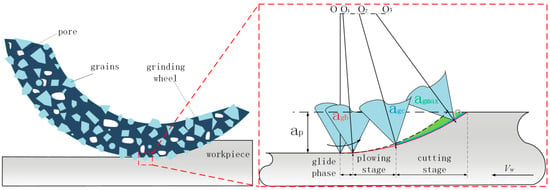
As illustrated in Figure 1, the cutting depth of abrasive grain increases progressively from zero and eventually reaches its maximum value, corresponding to the maximum undeformed chip thickness . In the initial stage of cutting, due to the shallow cutting depth, the material only undergoes elastic deformation; as the depth increases, plastic deformation begins to occur in the material. However, in the top region of the grain, because the contact area between the grain and the material is small, this region still mainly exhibits elastic deformation. With a further increase in cutting depth , when a specific depth is reached, chips start to form on the material surface. Nevertheless, in the front-end region of the grain, the material still presents a mixed state of both elastic deformation and plastic deformation.
Figure 1.
Schematic diagram of single-grain cutting depth.
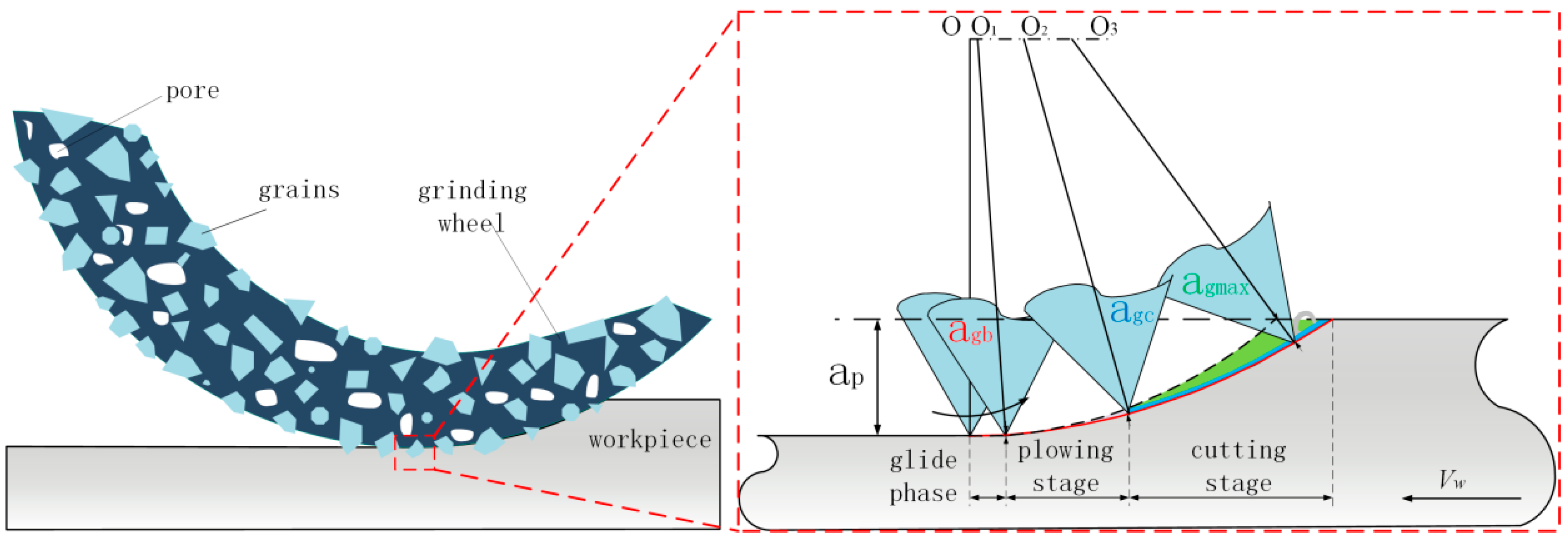
When , the state of grains during the sliding-scratching stage is illustrated in Figure 2 At this time, the cutting depth of grains is relatively shallow, and the surface deformation of the material is dominated by elastic deformation, which only generates a reaction force corresponding to the elastic deformation. Therefore, only slight scratches appear on the material surface. In addition, since the primary driving force of the sliding-scratching stage is elastic force, whose effect is far weaker than that of plastic deformation and cutting force, this paper will not conduct an in-depth discussion on this part.
Figure 2.
Monocrystalline cutting at each stage.
When , the grains enter the ploughing stage, as illustrated in Figure 2 In this stage, the upper surface layer of the material undergoes plastic deformation, while the top of the grains is mainly subjected to elastic deformation. Due to the different stress states in different regions, the grains are subjected to corresponding reaction forces, which leads to the accumulation of material along the moving direction of the grains. This accumulation phenomenon mainly occurs at the interface between the grains and the workpiece.
When , the grains enter the cutting stage, as illustrated in Figure 2 In this process, elastic deformation is mainly concentrated in the area where the material comes into contact with the grain tip, while plastic deformation occurs predominantly in the middle region of the grain-material contact interface. Due to the accumulation of plastic deformation, the material at the grain root eventually undergoes fracture. After fracture occurs, grooves form on both sides of the workpiece material, with material gradually piling up upwards. Localized plastic deformation also occurs at the boundaries between the grooves, the fractured zone and the unprocessed material.
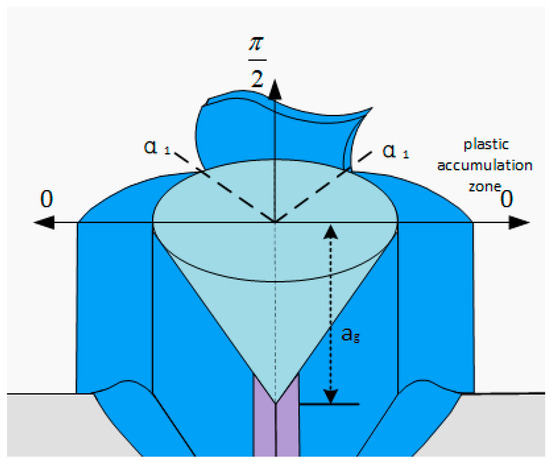
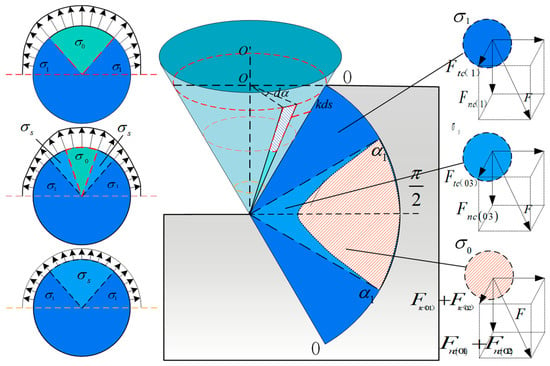
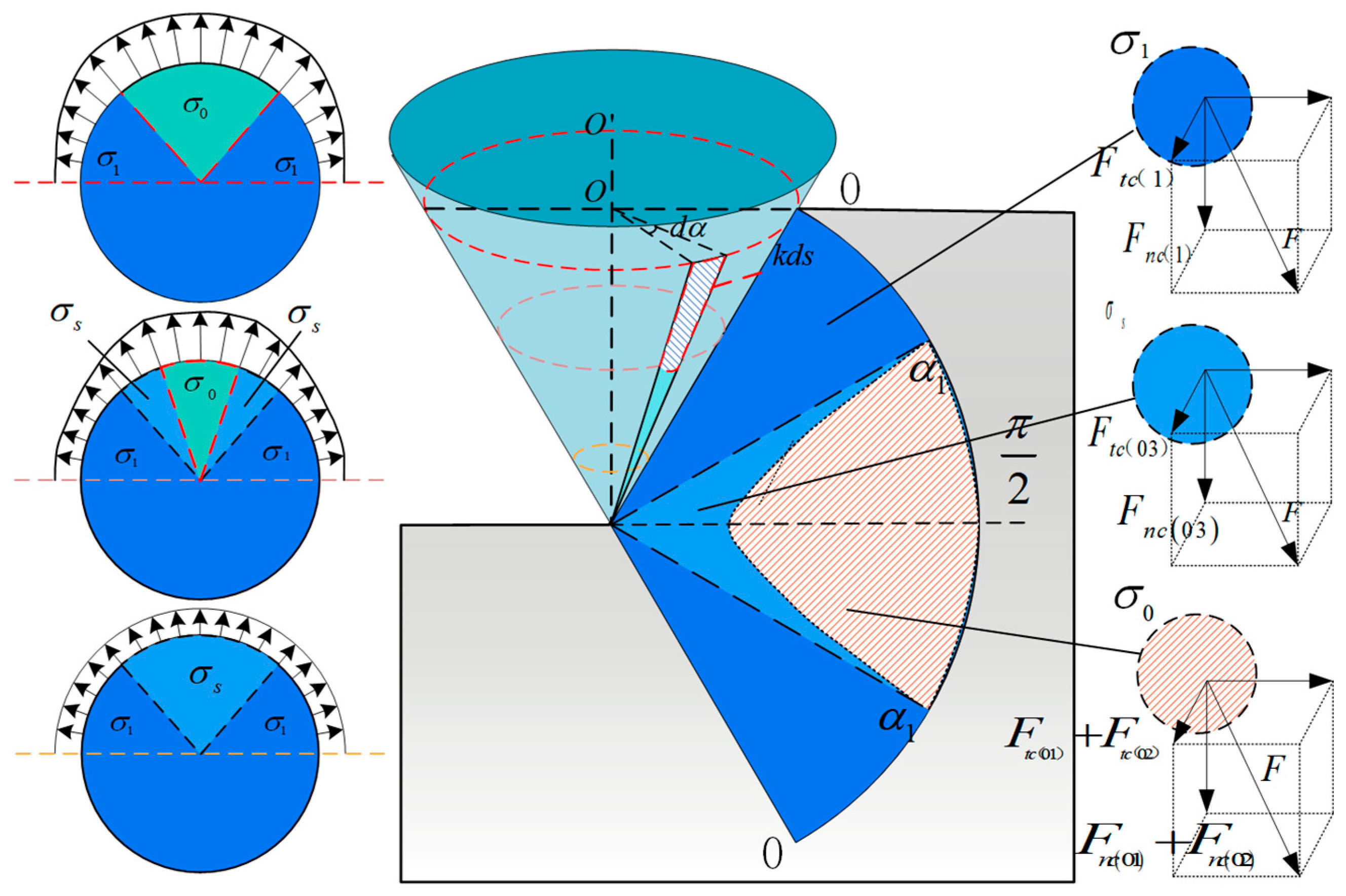
In this study, the grain contact surface during cutting is divided into the chip formation zone and the elastoplastic deformation zone. Meanwhile, the critical plastic accumulation angle () associated with material properties is illustrated in Figure 3, and this parameter can characterize the change rate of the two zones. The research results for brittle materials show that although plastic flow occurs during plastic grinding, the critical cutting depth remains relatively limited. To quantify the extent of material plastic accumulation during the grain cutting stage, Du et al. [34] introduced the concept of “cutting efficiency” as an evaluation index, which is calculated as the ratio of the volume of undeformed material removed after cutting to the total volume of the grain cutting zone. Compared with Figure 3 parameter can be derived from the independent variable as follows:
Figure 3.
Schematic diagram of plastic accumulation.
It should be emphasized that the research on ploughing grains and cutting grains is both based on the plastic accumulation theory. In the ploughing stage, the value of the relevant parameter is close to 0, while in the cutting stage, the value of parameter approaches 1. Therefore, through the analysis of the material removal process and its plastic accumulation mechanism, the interaction mechanism between grains in the ploughing and cutting stages can be revealed, as illustrated in Figure 2 and Figure 3.
The results of the scratch test conducted by Li [35] show that there is a specific correlation between and .
It should be clarified that the relationship adopted in this study is derived from micro-scale scratch deformation analysis reported in the literature. In the present framework, is interpreted as an effective plastic accumulation angle representing the average deformation tendency of the material under abrasive indentation, rather than a strictly material-invariant constant.
Although 17Cr2Ni2H steel may exhibit strain-rate and temperature sensitivity under high-speed gear grinding conditions, the deformation regime investigated in this study is dominated by elastoplastic behavior within moderate cutting depths. Therefore, the adopted relationship is treated as a first-order approximation applicable within the investigated parameter window. The coefficient introduced in the model is directly adopted from the referenced literature and serves as an effective deformation coefficient. It is not treated as a fundamental material constant but as a modeling parameter reflecting averaged plastic response characteristics.
To evaluate the sensitivity of force prediction to uncertainty in the parameter, a perturbation analysis was performed. When varies within ±10%, the predicted grinding force changes within approximately 6–9%, indicating moderate sensitivity. This suggests that small deviations in the adopted relation due to strain-rate or thermal effects do not significantly compromise the structural validity of the model within the investigated operating range.
The establishment of the mechanical model relies on the in-depth analysis of the stress state. Based on the mechanisms of material removal and plastic accumulation, the corresponding stress state can be derived with reference to Figure 3. In fact, the grain refinement phenomenon is a plastic deformation process of the material under external loads. Due to the isothermal behavior of the material, a uniform stress distribution () is formed within the workpiece, while a stress field is generated on the grain surface with a direction normal to the surface. During the grain cutting process, the stress distributions in the chip formation zone () and the elastoplastic deformation zone () remain continuous, and their orientations are perpendicular to the contact interface. The resulting stress field exhibits the following characteristics.
First, influenced by the isothermal nature of the workpiece material, the stress near the contact interface varies in a gradual manner.
In the chip formation zone , the normal stress () distributed along the contact interface is assumed to be uniform. Meanwhile, the abrasive grains provide the driving stress required for material fracture, and this stress must exceed the material fracture strength (). According to the Coulomb criterion, additional stress is exerted by the grains during the plastic flow of the chips.
Second, in the elastoplastic deformation zone , the material undergoes elastoplastic deformation as the angle increases. When the critical angle is reached, the material fractures, and the stress () exhibits a linear rising characteristic. During the high-speed cutting of grains, the material undergoes elastic deformation at the position and then rebounds at a relatively slow rate, resulting in a stress value close to zero.
2.2. Modeling Process of the Ploughing Stage
2.2.1. Modeling Process of the Elastoplastic Flow Zone in the Ploughing Stage
The ploughing stage is fundamentally characterized by the plastic flow of the material, with the material’s plastic flow limit denoted as . Considering the isothermal properties of the material, both the magnitude and direction of the ploughing force are normal to the contact surface (Figure 4). Accordingly, the governing equation for the ploughing grains can be formulated as:
Figure 4.
Force Analysis of a Single Grain in the Ploughing Stage.
The cutting force equation is expressed as a function of , from which the corresponding numerical values can be obtained.
2.2.2. Algorithm for Friction Force in the Ploughing Stage
Previous studies [36,37] have indicated that the wear zone of the grinding wheel is the primary source of friction force. During the material removal process, the abrasive grains not only exert a cutting effect on the workpiece surface but also induce a significant extrusion effect; these interactions are also important contributors to friction force.
In the grinding debris effect, the grinding wheel attracts debris to its vicinity. In contrast, the plastic flow effect involves grains being driven into the material flow, while the material is also drawn toward the grinding wheel. The friction force generated by these two mechanisms acts along the tangential direction of the grain rake face and is consistently directed toward the workpiece. The magnitude of the friction force depends on the stress level and the lubrication state of the contact surface between the grains and the workpiece.
The friction force in the ploughing stage can be expressed as follows:
where denotes the friction coefficient between the workpiece and the ploughing grain. The force described by this equation can be further resolved into tangential and normal components.
From a physical perspective, the sliding force component is primarily governed by frictional resistance at shallow penetration depths. Its magnitude scales proportionally with the contact area and friction coefficient, indicating that its contribution becomes dominant under small cutting depth conditions.
2.3. Modeling Process of Cutting Grain Force
2.3.1. Modeling Process of Overcoming Material Fracture Force in the Cutting Stage
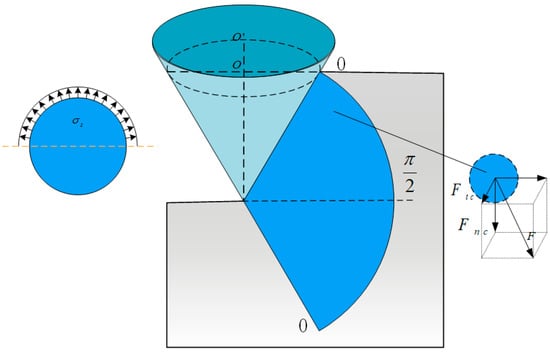
In the chip formation zone, the stress applied by the abrasive grains to the workpiece is denoted as . According to the law of energy conservation, a portion of the stress contributes to the plastic flow of the workpiece material along the contact surface (), while the remaining part is associated with chip formation through material fracture (). Considering the isotropic nature of the workpiece material, the plastic flow limit is defined as , and the corresponding plastic flow stress can be expressed as . As shown in Figure 5 the integral unit can be formulated as follows:
where the tangential and normal plastic flow forces for overcoming material fracture in the chip formation zone can be expressed as:
where is the grain vertex angle, is the critical plastic accumulation angle, and is the proportion of the chip formation zone in the integral area, which can be calculated by the corresponding formula. They are expressed as Equations (9) and (10), respectively. and are the tangential and normal plastic flow forces for overcoming material fracture in the chip formation zone, respectively.
Figure 5.
Force Analysis of a Single Grain at Different Positions in the Cutting Phase.
As illustrated in Figure 5, the area of the chip formation zone is denoted as . To initiate material fracture and accomplish the cutting process, the fracture stress of the workpiece must be exceeded. Consequently, the relationship between and the material removal force in the chip formation zone can be derived as follows:
can be solved according to Equation (11), as follows:
The steady-state material removal force in the chip formation zone can be determined based on Equation (12).
In summary, can be expressed as follows:
2.3.2. Force Modeling Process of the Elasto-Plastic Flow Zone During the Cutting Stage
As increases to , the stress in the elastoplastic flow zone exhibits a linear increase. Accordingly, the stress function can be expressed as follows:
where the tangential and normal plastic flow forces in the elastoplastic flow zone of the chip formation region are given by:
where is the proportion of the elastoplastic flow zone in the integral area, and and are the tangential and normal plastic flow forces of the elastoplastic flow zone in the chip formation zone, respectively.
2.3.3. Modeling Process of the Elastoplastic Flow Zone During the Cutting Stage
As increases to , the tangential and normal plastic flow forces of the elastoplastic flow zone can be expressed as follows:
2.3.4. Force Equation of Cutting Grains During the Cutting Stage
By integrating the force expressions of the chip formation zone and the elastoplastic flow zone, the cutting force acting on the abrasive grains can be expressed as follows:
The cutting force equation is formulated as a function of , from which the corresponding numerical values can be obtained.
2.3.5. Algorithm for Friction Force During the Cutting Stage
Similarly to the ploughing stage, the friction force on the front surface of the cutting grain can be expressed as follows:
This equation can be further resolved into tangential and normal components, as follows:
The ploughing component represents material plastic flow without chip separation. Its magnitude increases rapidly with penetration depth, reflecting the growing plastic deformation zone beneath the abrasive grain.
2.4. Sensitivity to Grain Geometry Deviation
To evaluate the influence of deviations from the equivalent conical assumption, a theoretical sensitivity analysis was conducted by perturbing the effective half-apex angle and contact area coefficient.
Considering that the normal grinding force in the cutting stage can be expressed as:
where is the contact area and is the averaged stress, the variation in predicted force due to geometric perturbation can be approximated as:
When the effective half-apex angle varies within ±15%, the resulting change in contact area leads to a force deviation within approximately 8–12%, indicating that the model is moderately sensitive to geometric irregularity but remains structurally stable under realistic morphology variation.
Therefore, although real abrasive grains exhibit irregular geometry, the equivalent conical representation provides a reasonable first-order approximation for force prediction within the investigated operating regime.
2.5. Frictional Force on the Grain Wear Surface
In previous studies, the frictional force on the grain wear surface has been expressed as follows:
where is the tip area of the abrasive grain, and is the average contact pressure between the grain and the workpiece.
By representing the cutting path with a parabolic function, the deviation between the grinding wheel radius and the curvature radius of the cutting path can be expressed as:
where represents the equivalent grinding wheel diameter (for surface grinding: ).
With the increase in the curvature radius deviation, the average contact pressure between the abrasive grain wear surface and the workpiece exhibits an approximately linear upward trend. This regular phenomenon was first verified by Malkin [38] through experimental research. The variation in contact pressure mainly depends on the degree of curvature radius deviation (), and its growth trend shows a distinct linear characteristic.
The average contact pressure depends on the grinding process parameters, which may result in elastic, elastoplastic, or plastic contact. is a constant obtained experimentally. By substituting Equations (28) and (29) into Equations (25) and (26), the total tangential and normal components of the friction force can be expressed as:
where represents the grinding wheel feed rate, is the grinding wheel linear velocity, and denotes a physical quantity associated with the wear state of the grinding wheel grains, which can be determined inversely through grinding experiments.
The cutting component becomes dominant when chip formation initiates. In this regime, force magnitude is strongly influenced by the plastic accumulation angle, which controls the effective shear deformation region.
Although Section 2.2, Section 2.3, Section 2.4 and Section 2.5 derive the sliding, ploughing, and cutting components separately, the analytical results reveal a unified structural dependence of grinding force on cutting depth. All three components exhibit a quadratic scaling tendency with respect to , while their relative contributions are modulated by deformation geometry () and frictional characteristics (). This indicates that the complexity of the stage-wise derivation ultimately converges into a structurally consistent force framework governed primarily by penetration depth and material hardness.
2.6. Modeling Process of Conventional Grinding Wheels
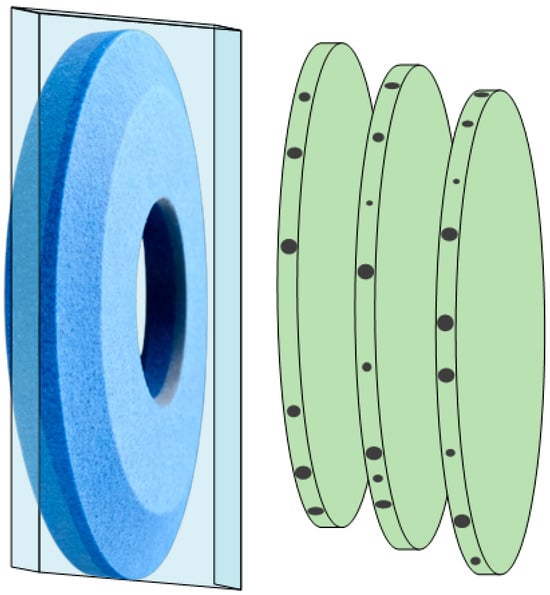
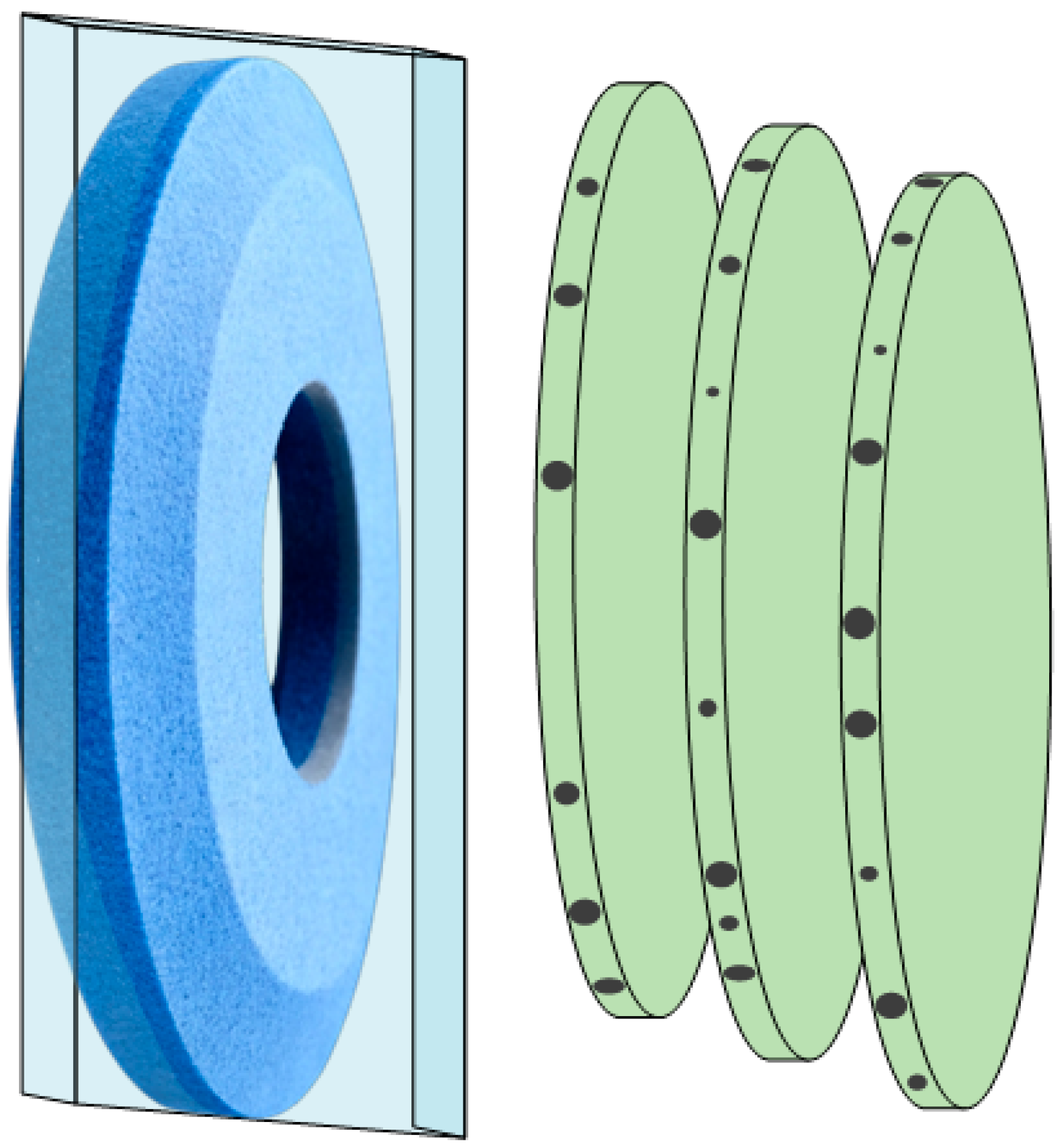
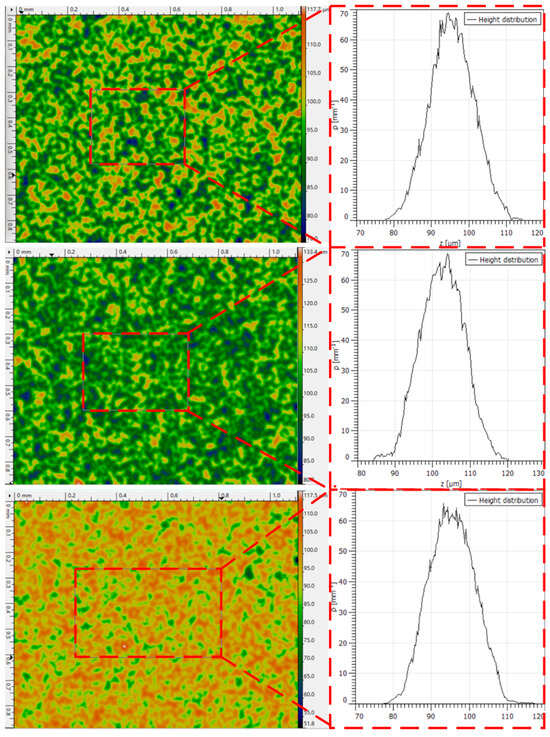
To simplify the modeling process, it is assumed that the abrasive grains on the wheel surface are relatively uniformly distributed, and thus the distance between adjacent abrasive grains can be regarded as equal (Figure 6 and Figure 7). Considering that small changes in the spacing between adjacent abrasive grains have negligible effect on model accuracy, the total number of abrasive grains on the grinding wheel can be expressed as:
where is the nominal diameter of the wheel, is the average grain width, and is the number of static cutting points, i.e., the total number of grains per square millimeter.
Figure 6.
Schematic Diagram of Grains on the Grinding Wheel Cross Section.
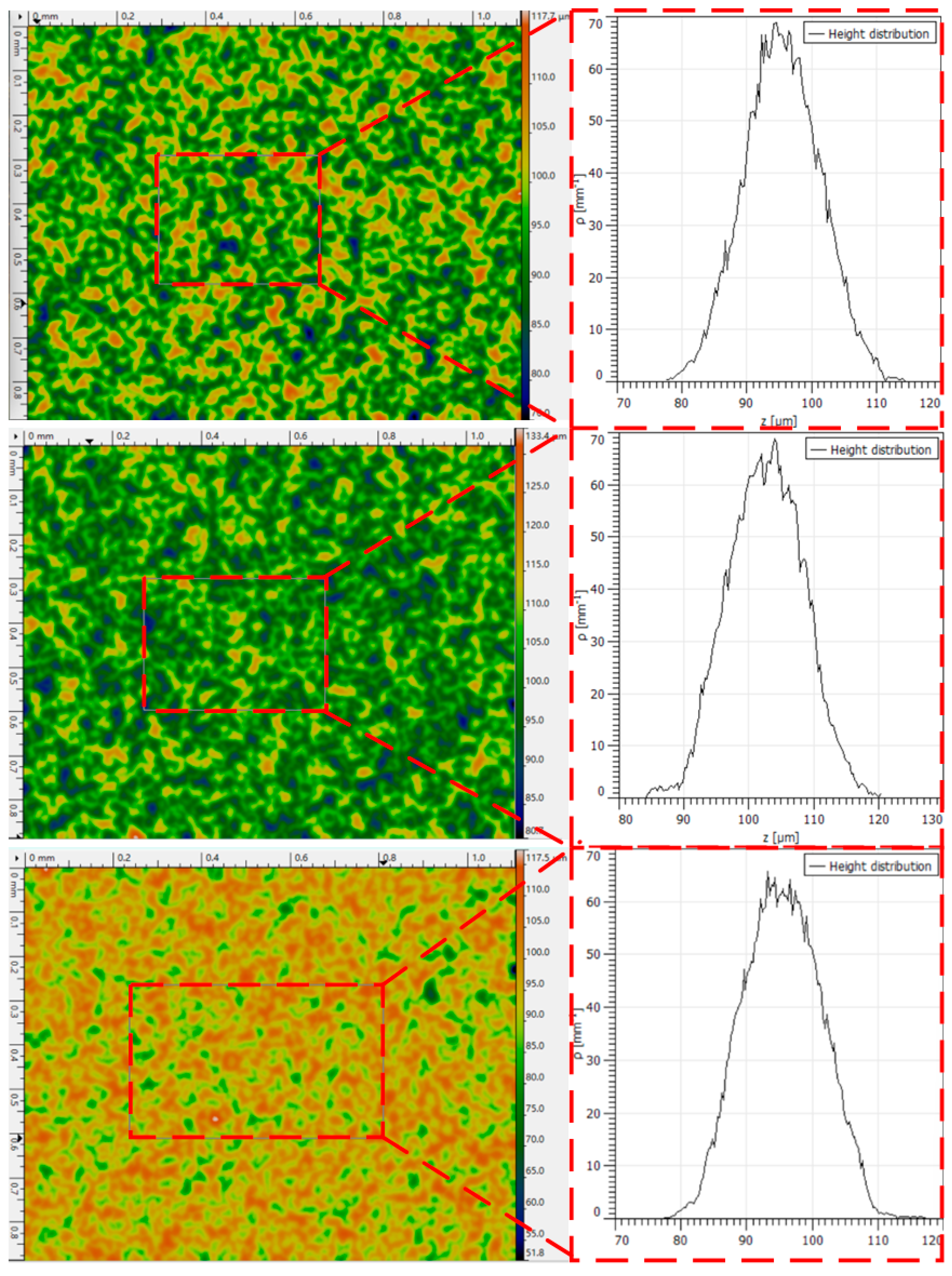
Figure 7.
Grain Height Distribution on the Grinding Wheel Surface.
The number of active grains involved in grinding varies across different grinding stages, which can be expressed as follows:
where represents the ratio of the number of active grains in different stages, and ( = 1, 2) denotes the ploughing stage and the grinding stage, respectively.
2.7. Grinding Force Model
The specific calculation formula of grinding force can be obtained by following the steps below: First, calculate the number of grains involved in the ploughing stage and grinding stage during the grinding process using Equations (35) and (36). Second, calculate the tangential and normal forces of a single grain in the ploughing stage with Equations (3) and (4), and compute the tangential and normal friction forces of a single grain in the ploughing stage by means of Equations (6) and (7). Then, use Equations (20) and (21) to determine the tangential and normal forces of a single grain in the grinding stage, and calculate the tangential and normal friction forces of a single grain in the cutting stage through Equations (23) and (24). Next, perform the cumulative summation of the forces acting on each individual grain. Finally, calculate the friction force between the wear surface of the grinding wheel and the workpiece using Equations (27) and (28), thereby deriving the total tangential and normal forces exerted on the grinding wheel during operation.
3. Mechanism-Constrained Data-Driven Grinding Force Prediction Algorithm (MCDDP)
Existing hybrid grinding force prediction models generally fall into three categories: (1) analytical-model-assisted neural networks, where analytical results are used as additional input features; (2) residual-learning models, where neural networks compensate for analytical model errors; and (3) physics-informed neural networks (PINNs), where governing equations are embedded into the loss function through PDE residual penalties.
In contrast, the proposed MCDDP framework does not merely use analytical outputs as auxiliary inputs nor perform residual correction. Instead, the analytically derived grinding force decomposition structure is incorporated as a mechanism-consistency constraint during model training. This structural enforcement ensures that predicted forces remain consistent with physically derived superposition laws, distinguishing the present approach from conventional hybrid regression models.
3.1. Research Background and Overall Framework of the Algorithm
Grinding force is a crucial physical quantity that reflects energy consumption, material removal status, and process stability in the grinding process. Its magnitude is influenced by multiple factors, including grinding wheel characteristics, process parameters, and the microscopic force-bearing state of abrasive grains. Traditional grinding force models are mostly based on analytical methods, which achieve macroscopic prediction through the statistical superposition of single-abrasive-grain cutting forces. However, due to the significant randomness and non-uniformity of abrasive grain distribution on the grinding wheel surface, some key parameters (such as the proportion of abrasive grains under different force-bearing states, microscopic contact area, and effective cutting number of abrasive grains) are difficult to directly measure through experiments. This leads to a large deviation between theoretical model results and actual measurement data.
To address the above problems, based on theoretical analysis, this study proposes a Mechanism-Constrained Data-Driven Grinding Force Prediction Algorithm (MCDDP). Taking the microscopic force-bearing mechanism of abrasive grains as the physical constraint framework, the algorithm introduces the nonlinear modeling capability of machine learning. It realizes high-precision prediction of grinding force by training and learning the mapping relationship between grinding condition parameters and macroscopic grinding force.
The core idea of the MCDDP algorithm is as follows: based on the mechanical properties of microscopic abrasive grains, the abrasive grains in the grinding wheel are classified into different force-bearing types, and corresponding single-abrasive-grain force models are established. Then, the neural network model is trained using experimental or simulation data, enabling it to automatically learn the complex mapping between abrasive grain force distribution and overall grinding force under different working conditions. This method not only inherits the physical interpretability of mechanism-based models but also possesses the generalization and prediction capabilities of data-driven models.
3.2. Mathematical Formulation of Mechanism Constraint
To clarify how physical mechanisms are incorporated into the proposed mechanism-constrained data-driven prediction algorithm (MCDDP), the constraint is explicitly formulated at the model architecture level rather than introduced as an external empirical correction.
Unlike conventional neural networks that directly predict the total grinding force, the proposed framework decomposes the prediction target according to the physically derived grinding mechanism described in Section 2. The grinding force is expressed as the superposition of three stage-dependent components:
where , , and denote the sliding, ploughing, and cutting force components, respectively. Instead of learning the total force directly, the neural network independently predicts these physically interpretable components:
The final grinding force is obtained through explicit physical superposition, ensuring consistency with the analytical force decomposition model. In this manner, the mechanism constraint is embedded into the prediction structure itself, forcing the learning process to follow the physically established relationship among different grinding stages.
The training objective is defined as
where represents experimentally measured grinding force and is obtained from the constrained superposition above. Because the total force must be reconstructed from stage-wise components, the optimization process implicitly regulates each predicted component, preventing physically inconsistent solutions that may arise in unconstrained regression models.
In this study, the mechanism constraint is implemented as an architecture-level soft constraint rather than a hard equality constraint enforced through additional penalty terms. The physical mechanism therefore guides the hypothesis space of the neural network by structural design, instead of imposing explicit numerical penalties during optimization.
It should be emphasized that this approach differs fundamentally from physics-inspired feature engineering. Conventional data-driven models incorporate physical quantities merely as input variables, whereas the proposed MCDDP framework embeds the force decomposition mechanism directly into the prediction pathway. As a result, each network output maintains explicit physical meaning, improving interpretability while enhancing prediction stability under coupled variations in grinding parameters.
If the mechanism constraint is removed, the model degenerates into a conventional black-box neural network predicting total grinding force directly. Although such models may achieve acceptable fitting accuracy within limited datasets, they generally lack structural consistency with grinding mechanics and exhibit reduced robustness when extrapolated beyond calibrated conditions. The proposed formulation therefore balances physical interpretability and nonlinear learning capability within a unified framework.
3.3. Data Construction and Validation Strategy
To avoid potential confirmation bias arising from model-driven data generation, the roles of experimental data and synthetic data are explicitly separated in the present study.
Two types of datasets are employed during model development:
- (1)
- Experimental dataset, obtained from grinding experiments, which serves as the only source of supervision for performance evaluation and accuracy assessment;
- (2)
- Synthetic dataset, generated from the analytical grinding force model, which is used solely to enhance parameter-space coverage and stabilize the learning process during early-stage training.
The synthetic samples are not used as validation or testing data. Instead, they function as mechanism-consistent auxiliary samples that guide the neural network toward physically reasonable solution regions before refinement using experimental observations.
Model accuracy is evaluated exclusively using experimentally measured grinding force data. Therefore, the reported prediction performance reflects agreement with real measurements rather than consistency with the analytical model used for virtual sample generation.
This separation ensures that the data-driven component learns nonlinear corrections beyond analytical assumptions while avoiding circular validation between analytical modeling and machine learning prediction.
3.4. Basic Principle of the Algorithm
The MCDDP algorithm is built on a two-layer structure of microscopic mechanism modeling + data-driven learning. Its basic principle can be divided into three main stages:
The first stage is analysis of the microscopic force-bearing mechanism of abrasive grains. During the grinding process, active abrasive grains on the grinding wheel surface make intermittent contact with the workpiece surface. According to the actual force-bearing state of abrasive grains, they can be divided into two categories:
Ploughing-stage abrasive grains: only plastic deformation of the material occurs, and the normal force is mainly generated by the cutting effect. Cutting-stage abrasive grains: both plastic deformation and material accumulation and friction occur, resulting in a composite force effect. The normal force and tangential force of the two types of abrasive grains can be expressed as follows:
Wherein, denotes the material accumulation effect factor, represents the friction coefficient, and stands for the helix angle or abrasive grain inclination angle.
Given the difficulty in directly measuring the quantity, proportion, and contact area distribution of various types of abrasive grains in the grinding wheel, this study entrusts this part to the data-driven model for prediction.
The second stage is statistical feature and macroscopic force modeling. Assume that there are a total of active abrasive grains on the grinding wheel surface, among which the proportion of the first type of abrasive grains is , and that of the second type is . Then, the macroscopic grinding force can be obtained by the statistical superposition of microscopic single-abrasive-grain forces:
However, as parameters such as , , , , , and vary complexly with grinding conditions and cannot be determined via analytical formulas, a neural network model is introduced to learn their nonlinear relationships and realize implicit mapping solving.
The third stage focuses on the principle and implementation of data-driven modeling. A sufficient number of experimental datasets for grinding processes are collected, where the input vector consists of process parameters, workpiece geometric characteristics, etc., and the output vector is composed of measured grinding force and other target parameters. A high-precision grinding force prediction model is established by leveraging the nonlinear mapping capability of the Multi-Layer Perceptron (MLP).
where denotes the set of network parameters of the neural network. To achieve an accurate prediction of grinding force, the model completes parameter optimization by minimizing the following loss function:
so as to achieve the optimal learning of network parameters.
During the model training process, the physical constraints derived from grinding force mechanism are introduced to constrain and adjust the network output, thereby ensuring that the established prediction model has physical consistency and avoiding prediction results that are inconsistent with the basic laws of grinding processes.
3.5. Algorithm Structure Design
3.5.1. Definition of Model Input and Output
The definitions of input and output parameters of the MCDDP model are given as follow in Table 1.
Table 1.
Definition of Input and Output Parameters.
The output parameters are as follows:
i.e., two indicators: normal grinding force and tangential grinding force.
3.5.2. Network Structure and Activation Function
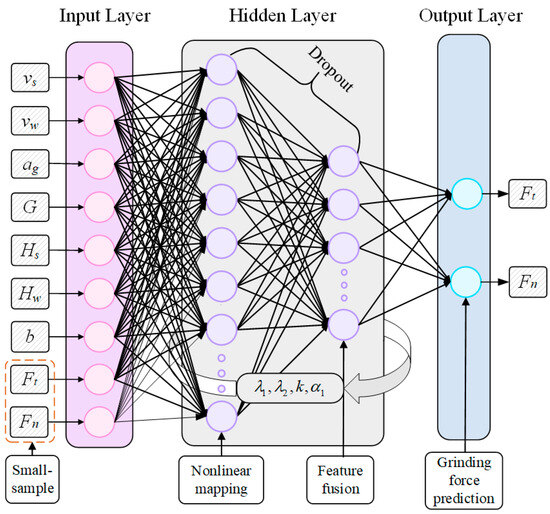
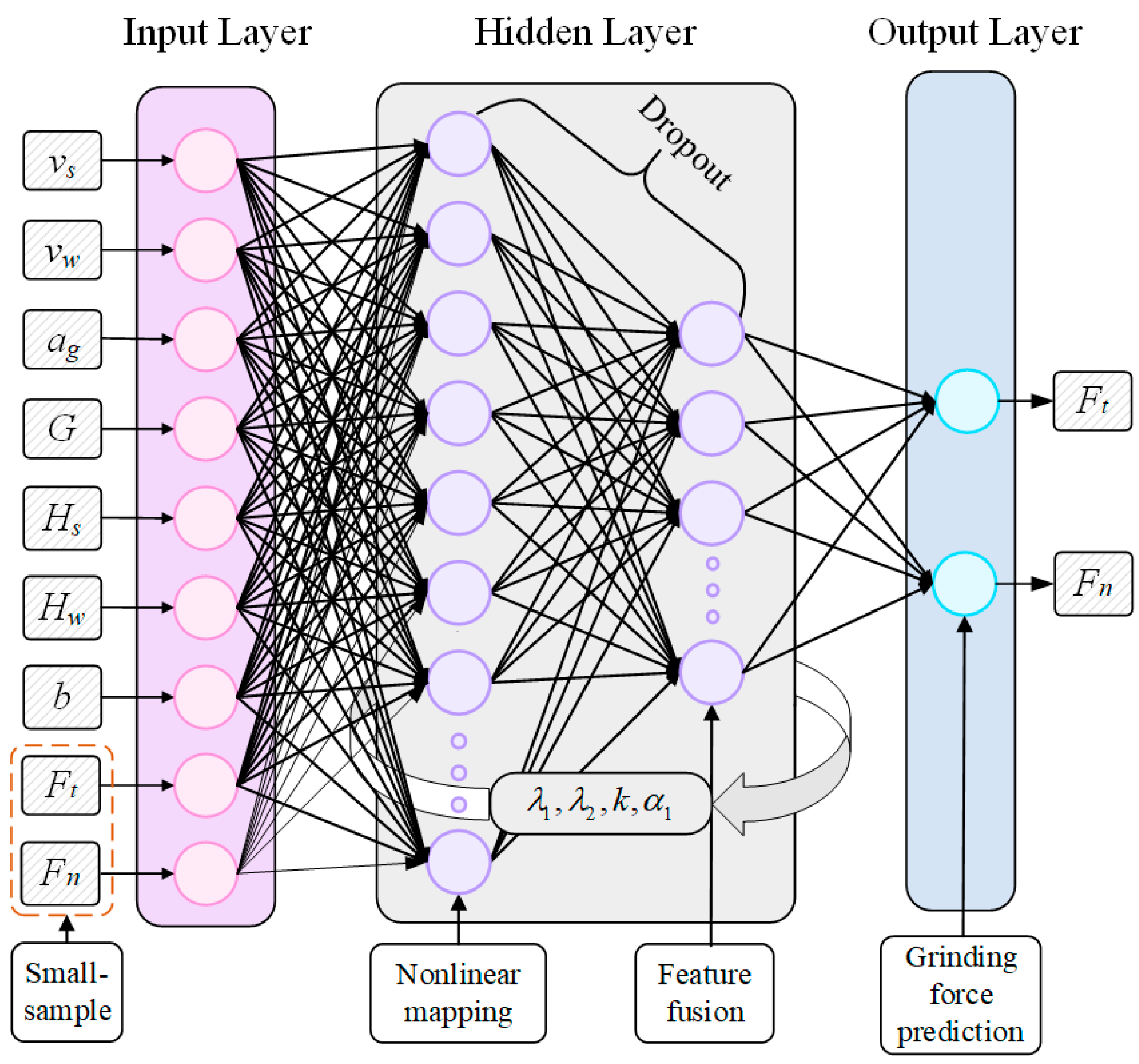
The MCDDP algorithm adopts a multi-layer feedforward neural network structure in Figure 8, which consists of an input layer, two hidden layers, and an output layer.
Figure 8.
Structure Block Diagram of the MCDDP Algorithm.
The hidden layers employ the ReLU (Rectified Linear Unit) activation function to enhance the nonlinear expression capability, while the output layer uses linear activation to ensure the continuity of prediction results.
To avoid overfitting, the L2 regularization term and Dropout mechanism are introduced into the network, and the Adam adaptive optimization algorithm is adopted to achieve efficient training.
To acquire the key unknown parameters of the model, this study first conducted a small number of trial grinding experiments to obtain initial training samples. However, due to the limited scale of the original experimental data, direct application to parameter solving often leads to unstable model training, large parameter fluctuations, and even solutions that lack physical meaning. To improve the reliability of subsequent parameter calibration and the generalization ability of the model, a physics-constrained data augmentation strategy was introduced based on the small sample set. Specifically, the trial grinding experimental samples were extended and supplemented within physically reasonable ranges, enabling the augmented dataset to cover the parameter space of actual grinding conditions more comprehensively and provide sufficient and robust support for subsequent model training. Therefore, this study first performed physics-constrained data augmentation on a small number of experimental samples, including the following two approaches:
Input perturbation-based augmentation (micro-noise injection). Controllable parameters such as the depth of cut , feed rate , and grinding wheel linear velocity were perturbed within a physically reasonable range of ±1%~5% to generate a series of “neighboring samples”. This method can be regarded as a simulation of parameter fluctuations in actual machining processes, allowing the model to learn a smoother and more stable input-output mapping relationship and thus reduce the risk of overfitting. The augmented results still conform to the original physical laws without altering the essential characteristics of the working conditions to which the samples belong.
Model-driven virtual sample supplementation. Based on the established microscopic single-abrasive-grain cutting model mentioned earlier, theoretical grinding forces corresponding to spatially sampled input parameters were calculated to form a set of virtual samples with a consistent mechanism. Such samples can effectively fill the blank areas of experimental data, enabling the model to more fully characterize the variation trend of grinding force with working conditions.
The two types of augmented data together form a small-sample extended dataset, providing a sufficient and stable training basis for model parameter pre-training.
3.6. Summary
This chapter proposes and systematically constructs a mechanism-constrained data-driven grinding force prediction algorithm (MCDDP) (Table 2). By taking the force-bearing mechanism of microscopic abrasive grains as physical constraints, the algorithm establishes a nonlinear mapping relationship between input process parameters and macroscopic grinding force through a multi-layer neural network. The innovative points of the algorithm are mainly reflected as follows:
Table 2.
Comparison of grinding force prediction approaches and the proposed MCDDP framework.
- •
- Establishing a dual-layer mapping framework of microscopic force mechanism-macroscopic grinding response;
- •
- Implicitly embedding the difficult-to-measure abrasive grain distribution and contact parameters into the neural network model;
- •
- Ensuring the physical rationality and generalization ability of prediction results by introducing mechanism constraints;
- •
- Forming a set of methods applicable to grinding force prediction and optimization under complex grinding conditions.
The MCDDP algorithm lays a solid theoretical and methodological foundation for the verification of grinding force prediction results in subsequent chapters.
3.7. Theoretical Advantage over Analytical–Regression Calibration
A calibrated analytical model combined with regression techniques can reduce prediction error within a limited parameter range. However, such approaches mainly compensate for global output deviation and do not modify the internal force decomposition structure.
In analytical regression frameworks, correction coefficients are purely empirical and do not correspond to physically meaningful intermediate variables. As a result, although fitting accuracy may improve locally, the stage-dependent redistribution among sliding, ploughing, and cutting forces remains unchanged.
In contrast, the proposed MCDDP framework introduces a nonlinear mapping while preserving the physically derived force superposition structure. Therefore, the improvement is not merely numerical correction but structural consistency enhancement.
This distinction is particularly important under parameter coupling conditions, where grinding depth, feed speed, and wheel velocity interact nonlinearly. Regression-based calibration typically assumes separable correction forms, whereas the proposed framework allows multidimensional nonlinear interaction while maintaining mechanism consistency.
4. Experiments
Experiments and Prediction
During the experiment, the machine tool model NILES ZE630 (Niles Werkzeugmaschinen GmbH, Koblenz/Eisenach, Germany) was adopted and placed in a constant temperature chamber. An SG ceramic alumina mixed abrasive grinding wheel (3SG PSX) (Norton Abrasives, Worcester, MA, USA) was used, with the following specifications: diameter 350 mm, width 32 mm, bore diameter 127 mm, abrasive type 3SG mixed abrasive, shape double-beveled, grit size 80 mesh, hardness medium-soft, maximum peripheral velocity 45 m/s, and maximum allowable rotational speed 245 r/min. The test piece material was 17Cr2Ni2H. All quantitative evaluation metrics reported in this study are computed using experimentally measured data only, while synthetic samples are excluded from validation and testing procedures. The detailed parameters of the gear and grinding wheel are shown in Table 3 and Table 4 below:
Table 3.
Geometric Parameters of Machined Gears.
Table 4.
Grinding Wheel and Gear Parameters.
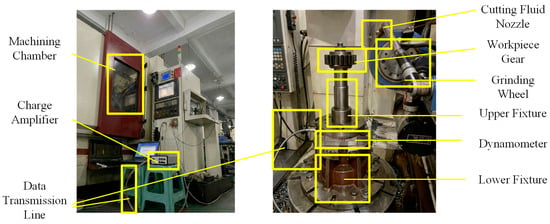
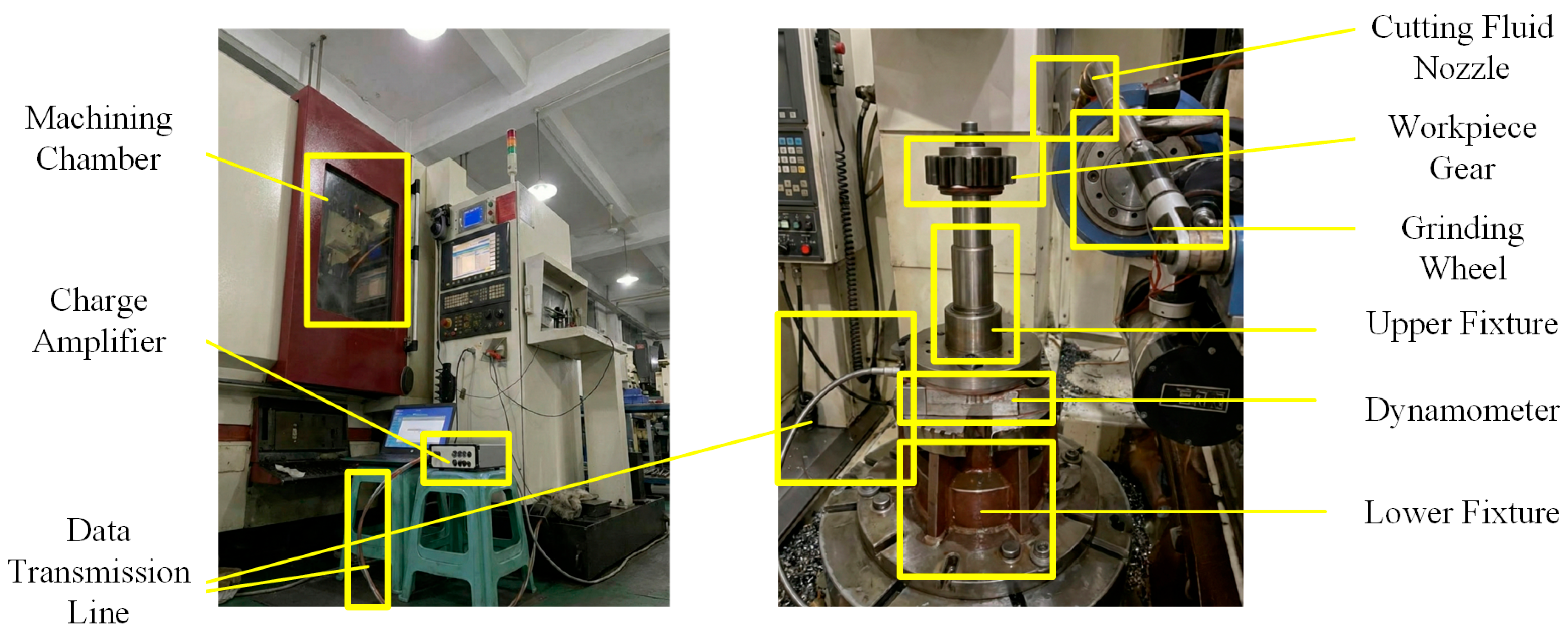
The dynamometer model was Kistler 9139AA (Kistler, Winterthur, Switzerland), and the charge amplifier model was Kistler 5167A, with the dynamometer sampling frequency set at 25 kHz. After mounting the dynamometer on the machine tool table, the data transmission cable was connected, routed out through the slit of the machining chamber door, and then linked to the charge amplifier placed outside the machining chamber. The overall layout of the test site and the machining chamber is shown in Figure 9.
Figure 9.
Diagram of Experimental Equipment.
A series of experiments was conducted under the assumption of a constant wear state, and the grinding process parameters are listed in Table 5 as follows:
Table 5.
Gear Grinding Process Parameters.
Herringbone gears require a heat treatment process before grinding to meet the target surface technical requirements. During the heat treatment process, the release of residual stress will cause the gear profile to deform, which in turn leads to uncertain variations in grinding depth. Therefore, a pre-machining process needs to be performed on the herringbone gears in the early stage of the experiment to ensure that their surface conditions comply with the experimental specifications. In the grinding tests, considering the short duration of the tests, the issue of abrasive grain detachment is not taken into account for the time being. Before each grinding operation, the grinding wheel must be dressed and cleaned to restore its original condition, so as to prevent grinding chips from clogging the pores on the wheel surface and causing overheating. As indicated earlier, the modeling process is divided into multiple stages. Therefore, the total tangential grinding force and total normal grinding force are formed by the superposition of the forces generated in the sliding stage, ploughing stage, and cutting stage.
Thus, the following formulas are obtained:
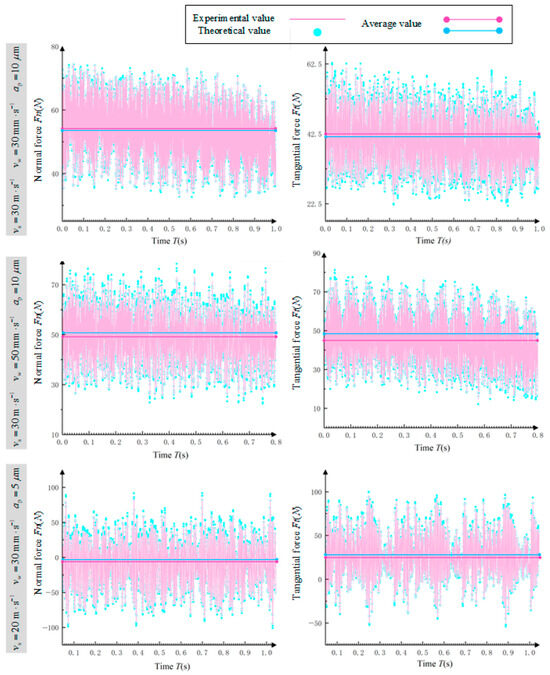
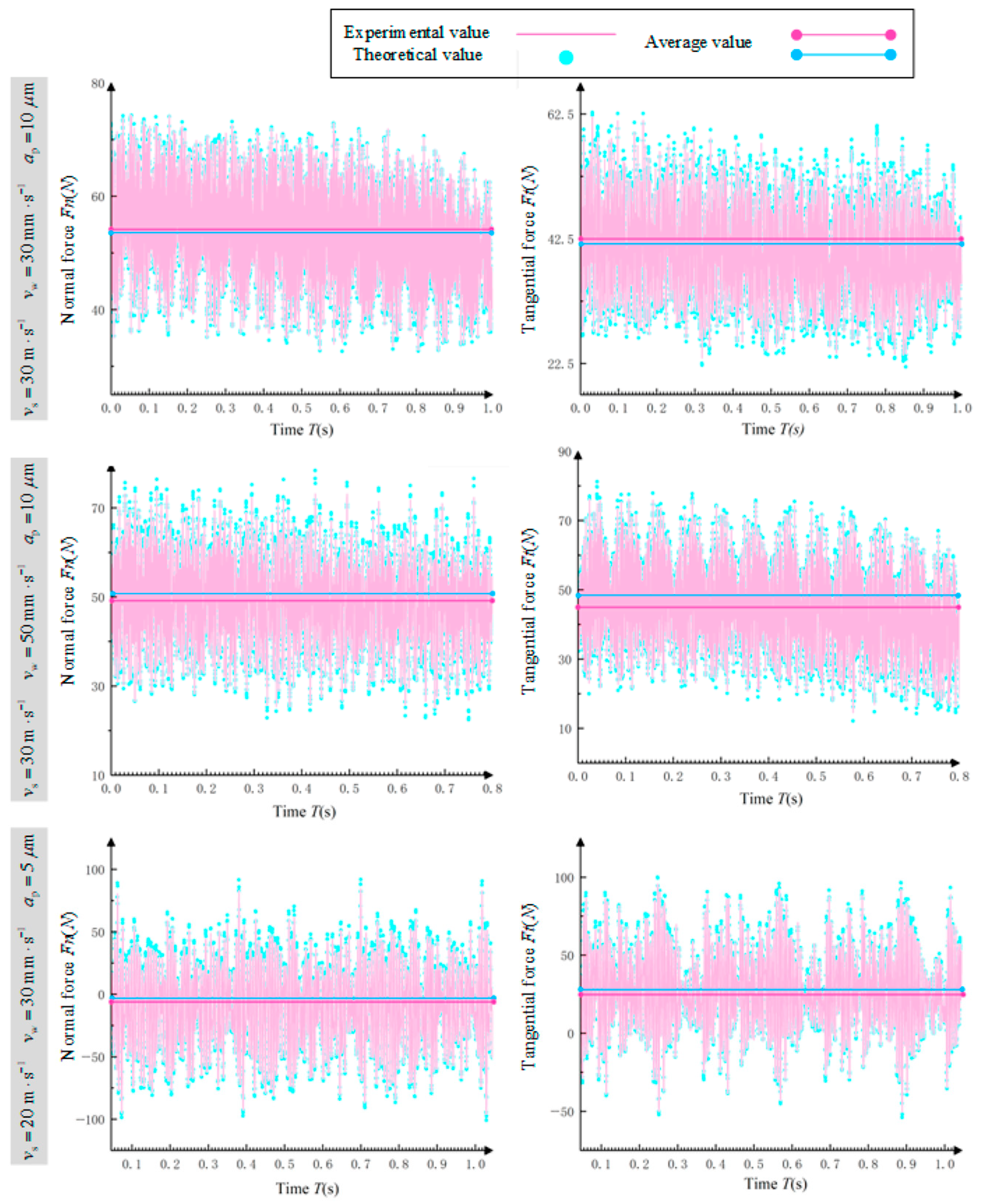
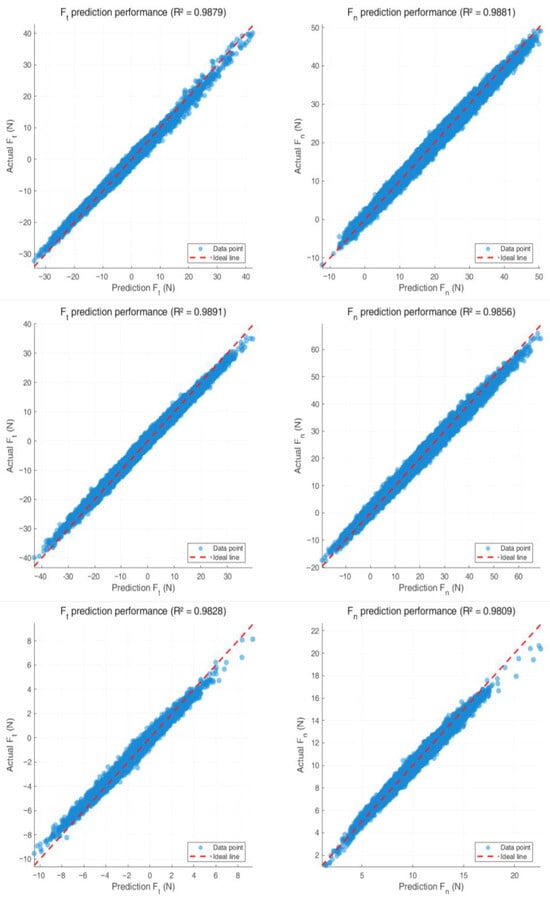
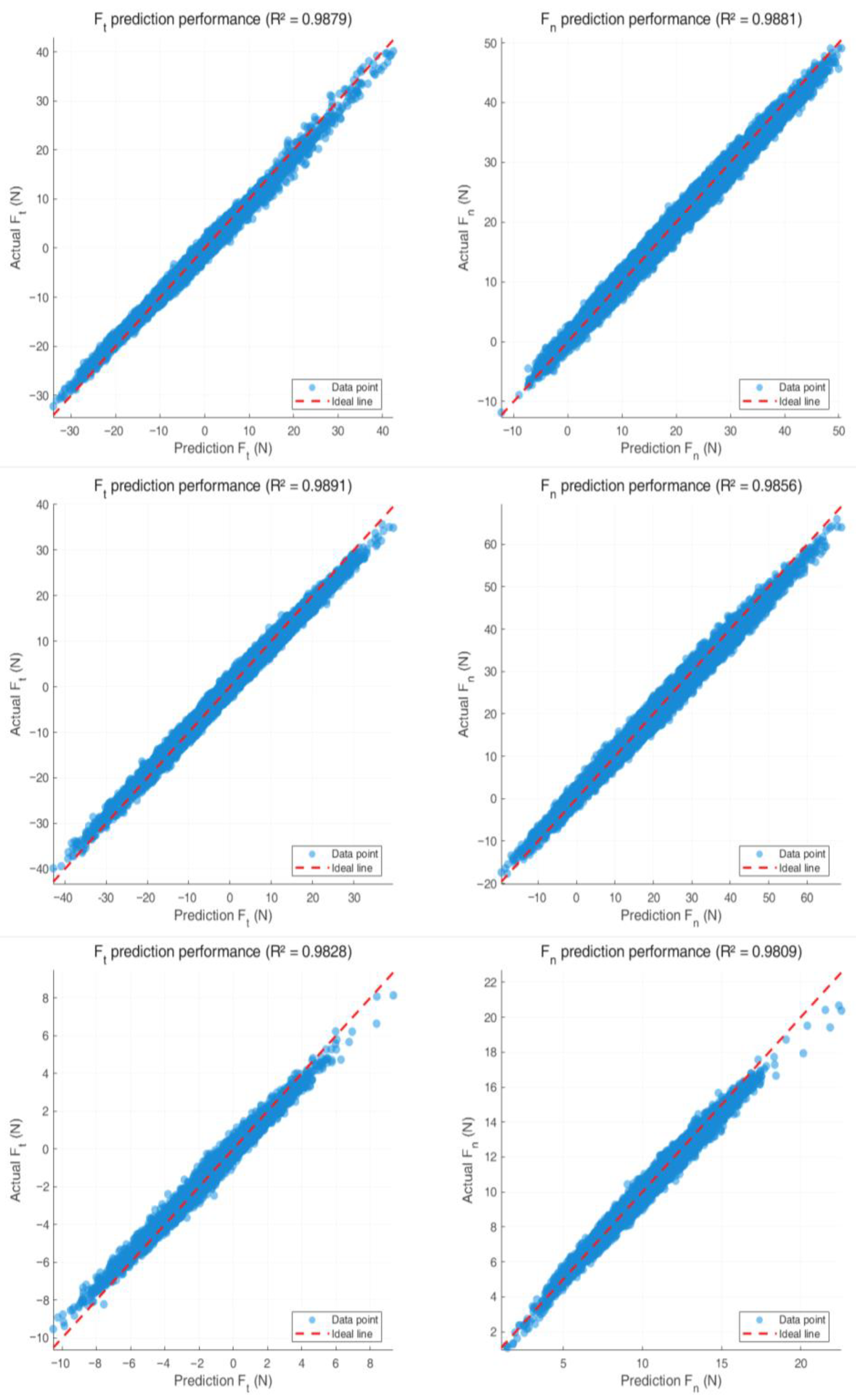
Grinding experiments were carried out according to the aforementioned experimental parameters, and the experimental data were input into the model. The prediction results are shown in the following Figure 10 and Figure 11:
Figure 10.
Force Prediction and Experimental Results.
Figure 11.
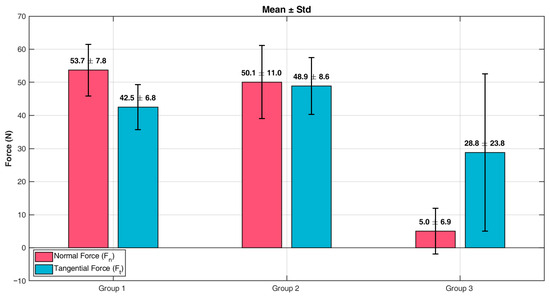
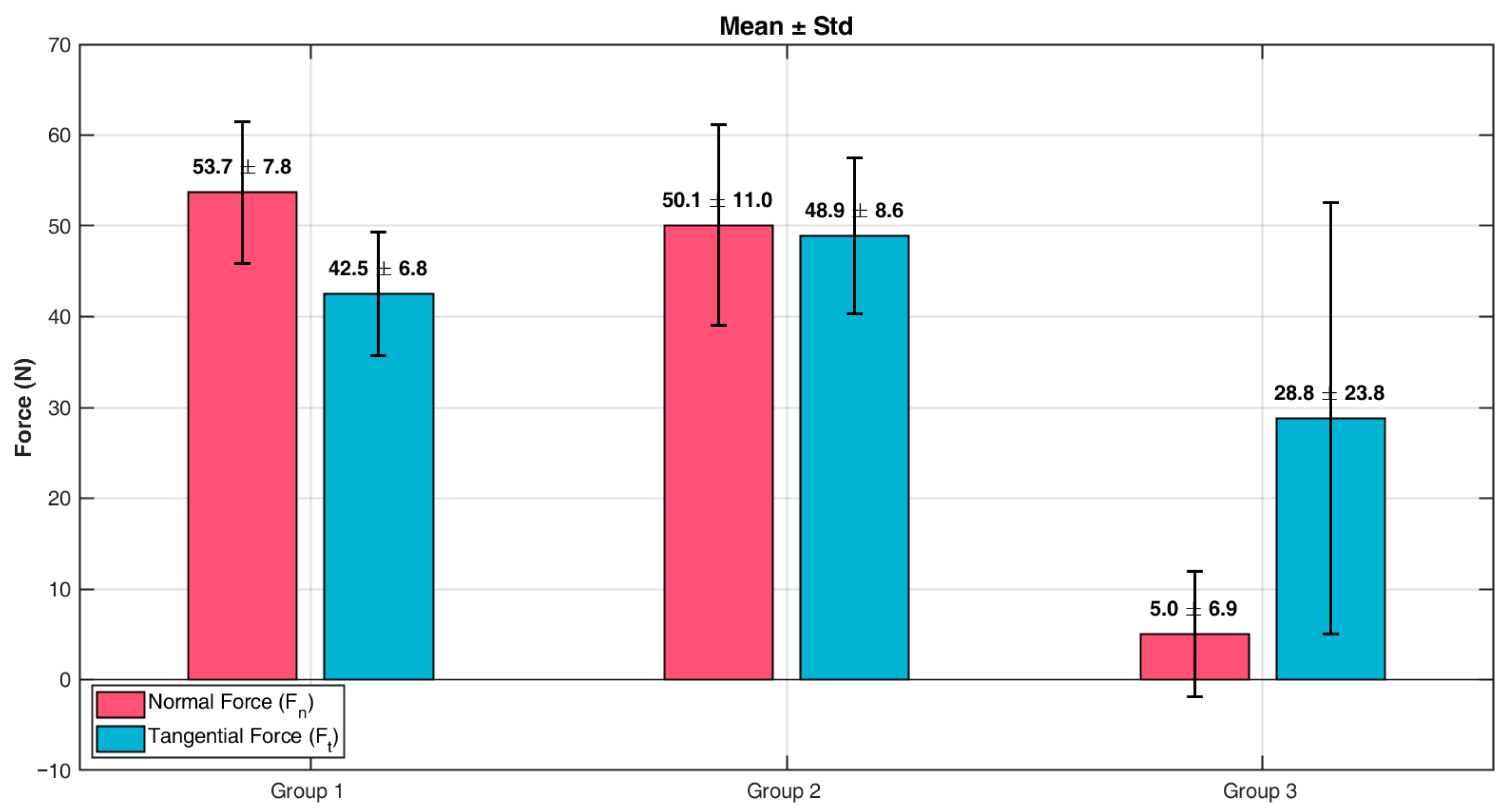
Mean and Standard Deviation.
To further evaluate experimental repeatability and force stability, statistical analysis of repeated grinding tests was conducted, as shown in Figure 12. The mean values and corresponding standard deviations of both normal and tangential grinding forces are presented for different grinding conditions.
Figure 12.
Error Analysis of Force Prediction.
The results indicate that the predicted forces fall within the experimental variation range, demonstrating that the proposed model captures the dominant physical trends despite inherent stochastic variations caused by abrasive grain interaction and material removal randomness.
Notably, larger deviations observed under Group 3 conditions suggest increased process instability, which is consistent with intensified grain-workpiece interaction and validates the necessity of statistical evaluation rather than single-value comparison.
Based on the experimental results, it can be concluded that both the normal grinding force and the tangential grinding force increase with the increase in depth of cut. A similar variation relationship exists between feed rate and grinding force, whereas an increase in grinding wheel linear velocity leads to a reduction in grinding force. Within the investigated range of machining parameters, the depth of cut has the most pronounced effect on both normal and tangential grinding forces, followed by the feed rate, whereas the grinding wheel linear speed exhibits a relatively minor influence. The algorithm calculation results show the proportion of abrasive grain grinding force in each stage to the total tangential grinding force, and its variation law with machining parameters is similar to that of the normal grinding force. Among these, the proportion ranges of abrasive grain grinding force in the scratching stage, ploughing stage, and cutting stage to the total grinding force are 0.33–0.53, 0.13–0.25, and 0.26–0.57, respectively.
To further examine prediction robustness, model performance was evaluated under partially unseen parameter combinations within the experimental dataset, where specific operating conditions were excluded from training and used only for testing. This strategy approximates a leave-one-condition-out validation scheme and evaluates the extrapolation capability of the proposed framework within the investigated parameter domain.
As can be seen from the figure, the calculation results of the profile grinding force model proposed in this paper are consistent with the actual experimental measurement results under different feed rates. The values between the predicted and measured results under different feed rates are (0.9879, 0.9881), (0.9891, 0.9856) and (0.9828, 0.9809), respectively. Therefore, compared with the existing grinding force models, the average percentage error of the established profile grinding force model is reduced by 17.2%, which verifies the superiority of the proposed model.
It should be noted that regression-calibrated analytical models may achieve satisfactory fitting accuracy within specific experimental ranges. However, such approaches typically rely on empirical correction coefficients without explicitly preserving the internal force decomposition structure. In contrast, the present framework maintains consistency between micro-scale mechanism modeling and macroscopic force prediction, emphasizing structural validity rather than purely numerical correction. This structural preservation contributes to prediction stability under coupled parameter variations.
It should also be emphasized that the present modeling framework is primarily valid under stable grinding conditions with moderately worn abrasive grains. The equivalent conical representation and piecewise averaged stress assumption are first-order approximations of the effective cutting geometry.
The model may lose accuracy under the following conditions:
- (1)
- Severe grinding wheel wear leading to significant grain flattening;
- (2)
- Dominant grain fracture or pull-out mechanisms;
- (3)
- Ultra-high wheel speeds inducing thermal softening or dynamic instability;
- (4)
- Abrasive–workpiece combinations with substantially different mechanical properties (e.g., CBN versus Al2O3 abrasives).
Under such scenarios, higher-order geometric modeling or dynamic wear evolution modeling may be required to further improve prediction fidelity
It should be further noted that the present study investigates a single gear material and grinding wheel specification within a limited parameter range. Therefore, the reported results primarily demonstrate the validity of the proposed mechanism-constrained modeling framework rather than universal engineering applicability. While the structural formulation is transferable in principle, extension to different abrasive grain sizes, wheel materials, or broader operating regimes requires additional calibration and experimental validation. The present work should thus be interpreted as establishing a physically grounded prediction methodology within the investigated grinding domain.
5. Conclusions
This study conducts systematic research on the abrasive grain force-bearing mechanism and grinding force prediction in the grinding process of aviation precision gears. Through theoretical modeling, algorithm development, and experimental validation, a grinding force analysis framework with both physical interpretability and predictive stability has been established. The main conclusions are summarized as follows:
The proposed model reveals the intrinsic non-uniformity of stress distribution within the abrasive grain–workpiece contact region. By dividing the grinding process into three stages—sliding, ploughing, and cutting—the force states of an abrasive grain under different grinding depths are refined, and the distinct mechanical responses associated with elastic deformation, plastic flow, and fracture-based material removal are clarified. Based on this stage-dependent partitioning, a force superposition model incorporating contact-region subdivision is constructed, providing a structurally consistent interpretation of micro-scale grinding force generation.
Under the assumption of conical abrasive grains, mechanical models for each stage were established to characterize the contribution of chip formation, elastoplastic deformation, and frictional interaction. Although simplified geometric assumptions were adopted, the model systematically links contact stress distribution and macroscopic force response, forming a physically interpretable analytical framework for grinding force decomposition.
It should be emphasized that this equivalent conical representation and piecewise averaged stress assumption are primarily valid under stable grinding conditions with moderately worn abrasive grains. Under severe wheel wear, dominant grain fracture or pull-out mechanisms, ultra-high wheel speeds, or substantially different abrasive–workpiece material combinations (e.g., CBN versus Al2O3), additional geometric refinement or dynamic wear modeling may be required.
Furthermore, it should be noted that the present model does not explicitly incorporate strain-rate-dependent constitutive behavior or thermal softening effects. Under extreme high-speed grinding or significantly different heat treatment conditions of 17Cr2Ni2H steel, the plastic accumulation behavior may deviate from the adopted approximation. In such cases, material-specific calibration or thermo-mechanical coupling analysis would be required.
On this basis, a mechanism-constrained data-driven prediction algorithm (MCDDP) was developed. The algorithm integrates the micro-scale force decomposition structure into the learning process, enabling nonlinear mapping between process parameters and grinding force while preserving the physically derived superposition relationships. Rather than serving as a purely empirical correction, the proposed framework maintains structural consistency between analytical mechanisms and predicted results, thereby enhancing interpretability and prediction robustness under coupled parameter variations.
Grinding experiments were conducted on 17Cr2Ni2H gear material using an SG ceramic–alumina mixed abrasive grinding wheel on a NILES ZE630 machine tool to validate the proposed model. The results show that the coefficient of determination between predicted and measured values exceeds 0.98, demonstrating stable agreement within the investigated parameter range. It is further observed that the depth of cut has the most significant influence on grinding force, followed by feed rate, while the grinding wheel linear velocity exhibits relatively smaller impact. In addition, the stage-wise force proportion varies systematically with process parameters, supporting the validity of the force partition framework.
The grinding force modeling and prediction framework established in this study provides a physically interpretable and structurally robust strategy for gear grinding analysis. Future work can extend the present model to scenarios involving complex abrasive grain geometries and dynamic wheel wear evolution, as well as broader material systems, to further enhance multi-condition adaptability and modeling completeness.
It should be emphasized that the present study investigates a single material system and grinding wheel specification within a limited parameter domain. Therefore, the reported results primarily demonstrate the validity of the proposed mechanism-constrained modeling framework rather than universal engineering applicability. Extension of the model to different abrasive types, grain size distributions, or broader operating regimes requires additional calibration and experimental verification. The current work should therefore be interpreted as establishing a physically grounded prediction methodology that provides a foundation for future generalization studies.
Author Contributions
Methodology, X.L.; Validation, Z.L.; Formal analysis, R.L.; Data curation, Y.W., X.T. and Y.T.; Writing-original draft, X.L.; Writing-review & editing, S.T. and Z.Z.; Supervision, R.L.; Project administration, Z.Z. All authors have read and agreed to the published version of the manuscript.
Funding
This research was funded by Heilongjiang Natural Science Foundation Outstanding youth project YQ2024E041, National Natural Science Foundation of China 52575487, ”Chunyan” Team Support Plan Project of Heilongjiang (CYCX24001), the Opening Project of the Key Laboratory of Advanced Processing Technology and Intelligent Manufacturing (Heilongjiang Province), Harbin University of Science and Technology (KFKT202201).
Institutional Review Board Statement
Not applicable.
Informed Consent Statement
Not applicable.
Data Availability Statement
Data are contained within the article.
Conflicts of Interest
Author Zemin Zhao was employed by the company AECC Harbin Dongan Engine Co., Ltd. The remaining authors declare that the research was conducted in the absence of any commercial or financial relationships that could be construed as a potential conflict of interest.
References
- Yang, S.; Liang, R.; Chen, W.F.; Xu, P. Modelling and experiment for grinding forces of gear form grinding considering complete tooth depth engagement. Int. J. Adv. Manuf. Technol. 2022, 236, 1738–1750. [Google Scholar] [CrossRef] [Scilit]
- Cai, S.; Cai, Z.; Lin, C. Modeling of the generating face gear grinding force and the prediction of the tooth surface topography based on the abrasive differential element method. CIRP J. Manuf. Sci. Technol. 2023, 41, 80–93. [Google Scholar] [CrossRef] [Scilit]
- Ma, X.; Cai, Z.; Yao, B.; Chen, G.; Liu, W.; Qiu, K. Dynamic grinding force model for face gear based on the wheel-gear contact geometry. J. Mater. Process. Technol. 2022, 306, 117633. [Google Scholar] [CrossRef] [Scilit]
- Durgumahanti, U.S.P.; Singh, V.; Rao, P.V. A new model for grinding force prediction and analysis. Int. J. Mach. Tools Manuf. 2010, 50, 231–240. [Google Scholar] [CrossRef] [Scilit]
- Li, H.; Yu, T.B.; Wang, X.Z.; Zhu, L.D.; Wang, W.S. Detailed modeling of cutting forces in grinding process considering variable stages of grain-workpiece micro interactions. Int. J. Mech. Sci. 2017, 126, 319–338. [Google Scholar] [CrossRef] [Scilit]
- Xiao, Y.; Wang, S.; Ma, C.; Wang, S.; Yang, W.; Xia, C.; Wang, J. Numerical modeling of material removal mechanism and surface topography for gear profile grinding. J. Manuf. Process. 2022, 76, 719–739. [Google Scholar] [CrossRef] [Scilit]
- Huang, X.; Guo, Y.; Guo, W.; Qi, B.; Ren, X.; Chai, Z.; Chen, X. Comprehensive investigations into the force and thermal characteristics of belt grinding Inconel 718 under constant normal forces. J. Manuf. Process. 2023, 99, 78–95. [Google Scholar] [CrossRef] [Scilit]
- Hecker, R.L.; Liang, S.Y.; Wu, X.; Wang, B. Grinding force and power modeling based on chip thickness analysis. Int. J. Adv. Manuf. Technol. 2007, 33, 449–458. [Google Scholar] [CrossRef] [Scilit]
- Xiao, Y.L.; Wang, S.L.; Ma, C.; Wang, S.B.; Yang, W.H.; Xia, C.J. A grinding force model for gear profile grinding based on material removal mechanism. Int. J. Mach. Tools Manuf. 2023, 172, 103940. [Google Scholar] [CrossRef] [Scilit]
- Zhang, Y.; Li, C.; Ji, H.; Yang, X.; Yang, J.; Zhang, Z.; Li, R.; Wang, J. Analysis of grinding mechanics and improved predictive force model based on material-removal and plastic-stacking mechanisms. Int. J. Mach. Tools Manuf. 2017, 122, 81–96. [Google Scholar] [CrossRef] [Scilit]
- Meng, Q.; Guo, B.; Wu, G.; Liu, Z.; Wang, Y. Dynamic force modeling and mechanics analysis of precision grinding with microstructured wheels. J. Mater. Process. Technol. 2023, 314, 117900. [Google Scholar] [CrossRef] [Scilit]
- Ding, W.F.; Dai, C.W.; Yu, Y.T.; Xu, J.; Fu, Y. Grinding performance of textured monolayer CBN wheels: Undeformed chip thickness nonuniformity modeling and ground surface topography prediction. Int. J. Mach. Tools Manuf. 2017, 122, 66–80. [Google Scholar] [CrossRef] [Scilit]
- Huang, Y.; Liu, G.; Xiao, G.; Xu, J. Abrasive belt grinding force and its influence on surface integrity. Mater. Manuf. Process. 2022, 37, 108–114. [Google Scholar] [CrossRef] [Scilit]
- Zhang, W.; Li, J.; Wang, H.; Chen, Y. Modeling and analysis of tangential force in robot abrasive belt grinding of nickel-based superalloy. Arch. Civ. Mech. Eng. 2023, 23, 123–134. [Google Scholar] [CrossRef] [Scilit]
- Li, B.K.; Dai, C.W.; Wang, D.; Fu, Y.; Xu, J. Prediction on grinding force during grinding powder metallurgy nickel-based superalloy FGH96 with electroplated CBN abrasive wheel. Chin. J. Aeronaut. 2021, 34, 65–73. [Google Scholar] [CrossRef] [Scilit]
- Qu, S.; Yao, P.; Gong, Y.; Zhang, H.; Liu, Y. Modelling and grinding characteristics of unidirectional C–SiCs. Ceram. Int. 2022, 48, 8314–8323. [Google Scholar] [CrossRef] [Scilit]
- Shrot, A.; Bäker, M. Material parameter identification from machining simulations using inverse techniques. Key Eng. Mater. 2012, 504–506, 1281–1286. [Google Scholar] [CrossRef] [Scilit]
- Jamshidi, H.; Budak, E. An analytical grinding force model based on individual grit interaction. Int. J. Mach. Tools Manuf. 2020, 156, 103593. [Google Scholar] [CrossRef] [Scilit]
- Azizi, A.; Mohamadiyari, M. Modeling and analysis of grinding forces based on the single grit scratch. Int. J. Adv. Manuf. Technol. 2015, 78, 1223–1231. [Google Scholar] [CrossRef] [Scilit]
- Liu, M.; Li, C. Analysis of grinding mechanics and improved grinding force model based on randomized grain geometric characteristics. Chin. J. Aeronaut. 2023, 36, 160–192. [Google Scholar] [CrossRef] [Scilit]
- Li, X.; Zhang, X.; Yao, Z. Surface generation and material removal mechanism incorporated with the randomness of grain size and distribution in grinding. Int. J. Mech. Sci. 2023, 217, 106455. [Google Scholar] [CrossRef] [Scilit]
- Li, L.; Ren, X.; Feng, H.; Chen, H.; Chen, M. A novel material removal rate model based on single grain force for robotic belt grinding. J. Manuf. Process. 2021, 68, 1–12. [Google Scholar] [CrossRef] [Scilit]
- Setti, D.; Ghosh, S.; Rao, P.V. A method for prediction of active grits count in surface grinding. Wear 2017, 382–383, 71–77. [Google Scholar] [CrossRef] [Scilit]
- Zhang, M.; Shan, C.; Xia, Z.; Jia, F.; Luo, M. Dynamic mechanical model in grinding C/SiC composites. Int. J. Adv. Manuf. Technol. 2024, 268, 109042. [Google Scholar] [CrossRef] [Scilit]
- Wang, D.; Ge, P.Q.; Bi, W.B.; Jiang, J.L. Grain trajectory and grain workpiece contact analyses for modeling of grinding force and energy partition. Int. J. Adv. Manuf. Technol. 2013, 70, 2111–2122. [Google Scholar] [CrossRef] [Scilit]
- Chang, H.C.; Wang, J.J.W. A stochastic grinding force model considering random grit distribution. Int. J. Mach. Tools Manuf. 2008, 48, 1335–1343. [Google Scholar] [CrossRef] [Scilit]
- Wang, X.; Liu, Q.; Zheng, Y.; Xing, W.; Wang, M. A grinding force prediction model with random distribution of abrasive grains: Considering material removal and undeformed chips. Int. J. Adv. Mech. Technol. 2022, 120, 7219–7233. [Google Scholar] [CrossRef] [Scilit]
- Ni, J.; Feng, K.; Al-Furjan, M.S.H.; Xu, X.; Xu, J. Establishment and verification of the cutting grinding force model for the disc wheel based on piezoelectric sensors. Sensors 2019, 19, 725. [Google Scholar] [CrossRef] [Scilit]
- Gu, P.; Zhu, C.M.; Tao, Z.; Wang, Y. A grinding force prediction model for SiCp/Al composite based on single-abrasive-grain grinding. Int. J. Adv. Manuf. Technol. 2020, 109, 1563–1581. [Google Scholar] [CrossRef] [Scilit]
- Adibi, H.; Jamaati, F.; Rahimi, A. Analytical simulation of grinding forces based on the micro-mechanisms of cutting between grain-workpiece. Int. J. Adv. Mech. Technol. 2022, 119, 4781–4801. [Google Scholar] [CrossRef] [Scilit]
- Amamou, R.; Ben Fredj, N.; Fakhfakh, A. Improved method for grinding force prediction based on neural network. Int. J. Adv. Manuf. Technol. 2008, 36, 366–373. [Google Scholar] [CrossRef] [Scilit]
- Yin, G.Q.; Guan, Y.Y.; Wang, J.H.; Zhang, X. Multi-information fusion recognition model and experimental study of grinding wheel wear status. Int. J. Adv. Manuf. Technol. 2022, 121, 3477–3484. [Google Scholar] [CrossRef] [Scilit]
- Lee, P.H.; Nam, J.S.; Li, C.; Liang, S.Y. An experimental study on micro-grinding process with nanofluid minimum quantity lubrication. Int. J. Precis. Eng. Manuf. 2012, 13, 331–338. [Google Scholar] [CrossRef] [Scilit]
- Piispanen, V. Theory of formation of metal chips. J. Appl. Phys. 1984, 19, 876–881. [Google Scholar] [CrossRef] [Scilit]
- Li, F.H.; Zhang, B.B.; Meng, L.F.; Liu, X.S.; Rao, X.S. Material removal mechanism and grinding force modelling of ultrasonic vibration assisted grinding for SiC ceramics. Ceram. Int. 2017, 43, 2981–2993. [Google Scholar] [CrossRef] [Scilit]
- Cao, J.G.; Wu, Y.B.; Li, J.Y.; Zhang, Q.J. A grinding force model for ultrasonic assisted internal grinding of SiC ceramics. Int. J. Adv. Manuf. Technol. 2015, 81, 875–885. [Google Scholar] [CrossRef] [Scilit]
- Williams, J.A.; Xie, Y. The generation of wear surfaces by the interaction of parallel grooves. Wear 1992, 155, 363–379. [Google Scholar] [CrossRef] [Scilit]
- Malkin, S. Theory and Application of Machining with Abrasives; Ellis Horwood Limited: Chichester, UK, 1989. [Google Scholar]

Disclaimer/Publisher’s Note: The statements, opinions and data contained in all publications are solely those of the individual author(s) and contributor(s) and not of MDPI and/or the editor(s). MDPI and/or the editor(s) disclaim responsibility for any injury to people or property resulting from any ideas, methods, instructions or products referred to in the content. |
© 2026 by the authors. Licensee MDPI, Basel, Switzerland. This article is an open access article distributed under the terms and conditions of the Creative Commons Attribution (CC BY) license.