
Review

Wire-Arc Coatings: A Bibliometric Journey Through Factors Influencing Bonding Performance

1
Department of Civil, Construction, and Environmental Engineering, North Dakota State University, Fargo, ND 58102, USA
2
Department of Physics, North Dakota State University, Fargo, ND 58102, USA
*
Authors to whom correspondence should be addressed.
Coatings 2026, 16(3), 286; https://doi.org/10.3390/coatings16030286
Submission received: 30 January 2026 / Revised: 10 February 2026 / Accepted: 25 February 2026 / Published: 27 February 2026
(This article belongs to the Special Issue Characterization and Industrial Applications of PVD Coatings)

Highlights

What are the main findings?
Bonding performance of wire-arc coatings remains underexplored vs. thermal spray in the literature.
Only eight studies link roughness–thickness–material to bond strength.
Microstructure, protection, and corrosion dominate in wire-arc keywords.
What are the implications of the main findings?
Systematic multi-factor adhesion studies are urgently needed.
Optimizing roughness, thickness, and Zn–Al is necessary to reduce delamination risk.
The results guide the design of durable wire-arc coatings for critical steel infrastructure.
The review provides a roadmap for future experimental and modeling work on bonding.

Abstract

Wire-arc coatings have received substantial attention for corrosion protection; however, poor bonding often leads to delamination, corrosion initiation, and costly re-coating of structural components. This review combines bibliometric mapping with a focused technical synthesis to clarify how bonding performance has been studied in wire-arc coatings. Specifically, publication trends, keyword co-occurrence networks, and country-level co-authorship maps are used to map the evolution of the field and position adhesion-related studies within the broader literature. The analysis of 762 wire-arc coating publications from Web of Science (among 13,314 thermal spray coating records) reveals that research is centered on microstructure, mechanical properties, and corrosion resistance, with growing links to wire-based additive manufacturing. Keyword co-occurrence networks demonstrate clear process–structure–property relationships, while country-level collaboration maps highlight the leadership of China, the USA, and Germany. Critical to note, only eight publications systematically investigate the combined effects of substrate roughness, coating thickness, and Zn-Al coating composition on bond strength—representing less than 0.01% of the thermal spray literature. This pronounced research gap underscores the novelty of the present review, which synthesizes existing knowledge on adhesion mechanisms, identifies key process parameters, and establishes a research agenda to optimize wire-arc coatings for infrastructure corrosion protection. The technical synthesis highlights that adhesion is governed by the coupled effects of surface preparation (roughness and topography), coating build-up (thickness), and spray conditions (e.g., standoff distance and substrate preheating), which together influence coating microstructure and failure modes. These findings provide a structured framework to guide parameter selection for durable coatings.

1. Introduction

Background and Motivation

Owing to the outstanding properties in ductility, strength-to-weight ratio, and machineability, steel continues to be one of the most extensively utilized materials in construction applications [1]. Over 60% of the crude steel produced globally (1885 million tons) each year is utilized by transportation sectors, buildings, infrastructure, and oil and gas pipelines [2]. All of this steel is subjected to harsh environments during service, leading to fatigue, fracture, creep, stress corrosion cracking, hot and cold temperatures, and corrosion. Within these mechanisms, corrosion-induced damage and degradation are a major global concern [3]. Corrosion poses a significant challenge for steel structures and steel rebars used in concrete structures [4]. Steel degradation due to corrosion is a growing global issue, particularly in the United States [5]. Moreover, corrosion costs over 3.5% of the global GDP, totaling about US $2.5 trillion [6].
The energy transportation sector is particularly vulnerable because pipelines form a major component of the United States’ energy infrastructure, spanning approximately 3.0 million miles [7,8]. Most hazardous liquid and transmission pipelines are constructed from steel, whereas gas distribution pipelines are predominantly made from plastic materials [9]. These steel pipelines are continuously susceptible to corrosion during service [10]. Following a federal mandate in 1971, steel pipelines were required to be coated with protective coatings to prevent corrosion and extend their service life [11]. Accordingly, most steel pipelines are equipped with protective metallic coatings, commonly based on zinc and aluminum, which provide barrier and cathodic protection [12].
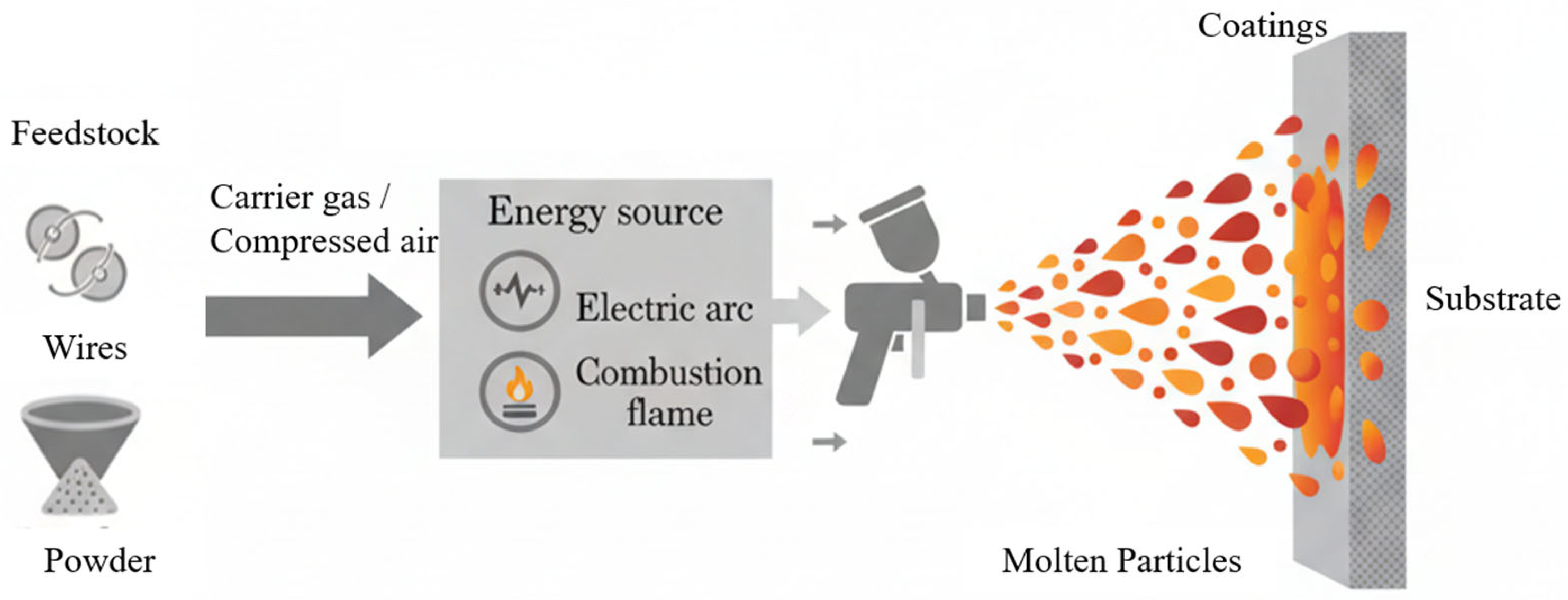
Many protective coating systems are applied to address the corrosion-induced economic, environmental, and human losses. Traditionally, hot-dip galvanizing (HDG) and heavy-duty paints containing Al, Zn, and Zn-rich primers with epoxide and fluoride resins were applied [13,14,15], wherein structural steel members were dipped in molten metal, which requires the careful disposal of material. Also, dipping bigger structural steel members is often a problem because of the existing size of the galvanizing kettle [16]. Beyond HDG, widely used protection strategies for steel also include zinc-rich primer paints and duplex systems that combine thermally sprayed Zn/Al layers with sealers and organic topcoats. Inorganic zinc-rich ethyl-silicate primers are widely specified in practice (e.g., products reporting ~85 wt.% Zn by weight in the dry film) [17]. In duplex systems, a thin, low-viscosity sealer is typically applied to impregnate coating porosity; common sealer chemistries include vinyl, phenolic, and polyurethane formulations, and over-application of epoxy sealers should be avoided because it can create a smooth, glass-like surface and reduce the adhesion of subsequent paint coats [18]. In addition to Zn and Al, Mg is often used as an alloying addition in related Zn–Al–Mg protective systems (e.g., the literature reports ~4 wt.% Al and ~0.4 wt.% Mg) to enhance corrosion resistance, while Zr is more commonly applied as a zirconium-based conversion pretreatment before painting rather than as a primary addition to Zn/Al metallizing feedstock [19,20]. Among these alternatives, thermal spraying technology has emerged as a promising and practical option for over a century, either as a standalone metallic coating or as the metallic layer in duplex systems, to improve the functional performance of metal substrates by providing wear resistance, thermal insulation, and corrosion protection [21]. In thermal spraying, the feedstock material, in the form of a rod, wire, or powder, is melted by chemical or electrical energy. The molten particles are then propelled toward the substrate, where they solidify and form a coating layer [3], as illustrated in Figure 1.
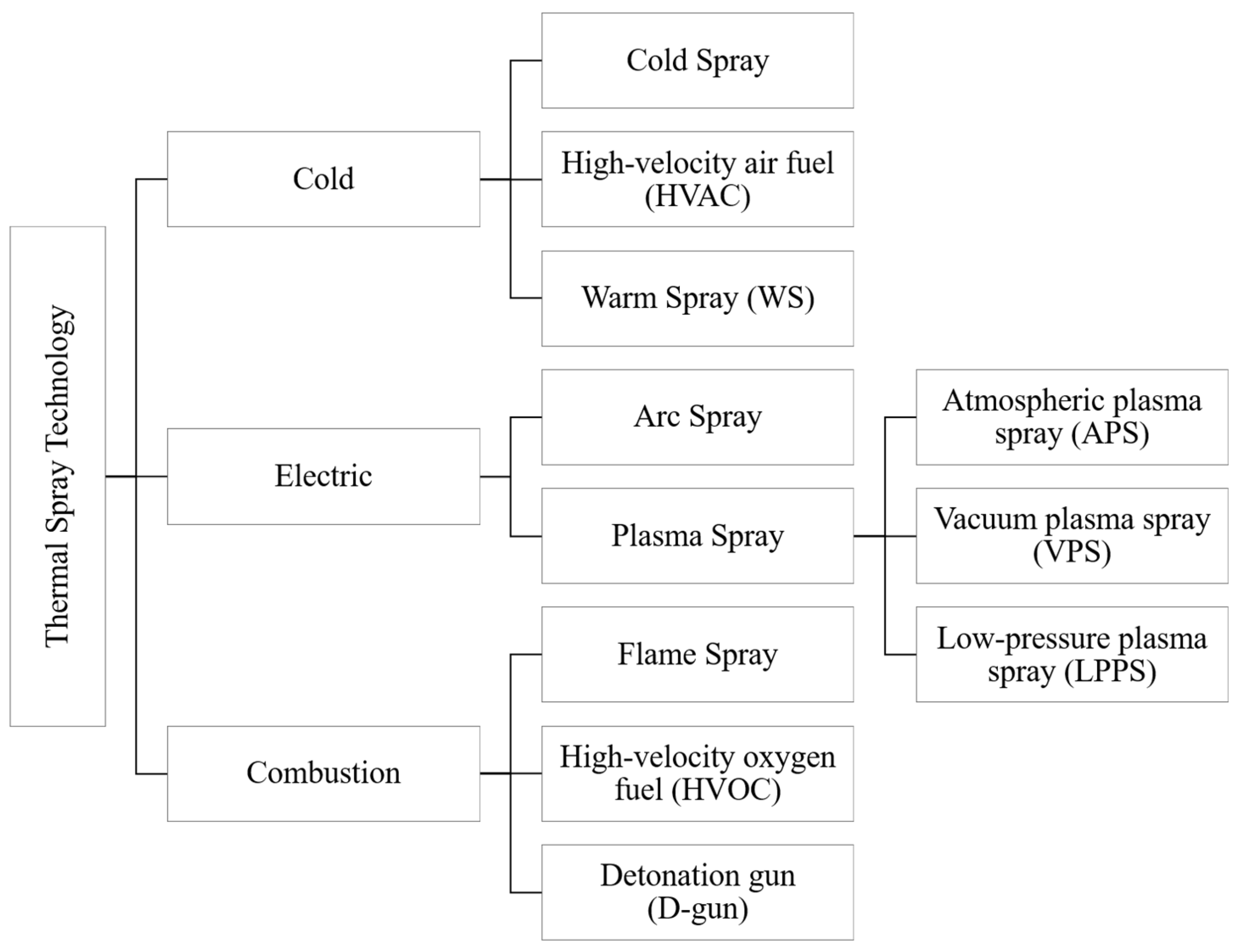
Thermal spray coatings safeguard steel structures from corrosion, maintain their mechanical properties, and minimize wear and material loss rates [22,23]. Thermal spray coatings are also recognized as a strengthening and protection technology for mechanical part surfaces [24], owing to their long service life, stable friction coefficient, lack of using toxic organic solvents, better wear-resistance, and high-temperature oxidation resistance [25,26]. One of its key advantages lies in the capability to deposit a wide range of materials on various substrates [27]. Metals, such as zinc (Zn) and aluminum (Al), are extensively used as thermal spraying coating materials [28,29], as they can provide sacrificial protection by acting as galvanic barriers and forming stable oxide layers for corrosion mitigation and inhibition [30,31,32]. Figure 2 illustrates the three main categories of thermal spray technologies along with the specific processes included in each category.
This review aims (i) to map the evolution of wire-arc coatings research using Web of Science-based bibliometric indicators and network analyses and (ii) to synthesize evidence on the factors governing bonding performance, with an emphasis on substrate roughness, coating thickness, and Zn/Al-based coating composition. The scope includes publication trends, keyword and collaboration networks, and a focused discussion of adhesion mechanisms and parameter interactions that influence bond strength and failure modes. The remainder of the paper is organized as follows: Section 2 presents the bibliometric methodology and results; Section 3 summarizes wire-arc spraying fundamentals and the mechanisms and parameters affecting adhesion; and Section 4 concludes with research gaps and future research directions.

2. Bibliometric Analysis

Bibliometric analysis, or bibliometry, is the evaluation of scientific outputs with the help of statistical and mathematical methods [34]. Bibliometric analysis enables assessment of research impact and productivity, detection of research trends and patterns, and identification of knowledge gaps for future investigation. Such analysis also provides strategic information to funding agencies, academic institutions, collaborative researchers, and those directing future research priorities [35]. In this study, the evolution and conceptual structure of wire-arc coatings are mapped and plotted using bibliometric/visualization tools (OriginPro 2024 and VOSviewer 1.6.20). The Web of Science database was used to obtain the published data for the analysis. The methodology adopted in searching the database was to use the query string TOPIC: “Thermal Spray Coatings”. The data collection was done in January 2026, and the search encompassed the past three decades. The search “Thermal Spray Coatings” returned 13,314 results/documents. Searching with TOPIC includes results from title, abstract, Keywords Plus, and author keywords. Some researchers in their literature reviews seem to have searched with TITLE, which results in a more conservative criterion [35]. Searching with TITLE includes search results from journal articles, proceedings papers, books, or book chapters. For instance, the query string TITLE: “Thermal Spray Coatings” returned only 2333 results instead of 13,314 from the last three decades.
The analysis of the Web of Science database, as shown in Figure 3, reveals critical insights into the publication landscape of thermal spray coatings and wire-arc coating systems, particularly regarding their bonding and adhesion properties. As indicated in the trend graph, research publications in the field of “thermal spray coatings” demonstrate exponential growth, increasing from approximately 100 publications in the mid-1990s to nearly 1000 by 2023, reflecting substantial academic and industrial interest in this domain. This upward trajectory underscores the widespread recognition of thermal spray technology’s significance in protective coating applications across multiple industries. However, the scope narrows dramatically when focusing on more specific subsets within this field. Publications specifically addressing “wire arc thermal spray coatings” or “wire-arc coatings” increased steadily from roughly 1–2 publications in the mid-1990s to approximately 70 publications by 2024, demonstrating that while there is growing attention to this technology, it represents only a fraction of the broader thermal spray literature. This suggests that despite the industrial importance of wire-arc coating technology, research interest remains substantially lower than the general thermal spray field.
When further narrowing the focus to “Aluminum wire arc coatings,” publications remain modest, peaking at around 20–25 publications per year in recent years, indicating limited but consistent research attention to aluminum-based wire-arc systems. Research on “zinc thermal spray coatings” or “zinc wire arc coatings” is even more constrained, showing a dramatic increase from 1–3 papers per year before 2018 to 7–10 publications annually in recent years. This suggests that zinc-based wire-arc systems receive comparatively little scholarly focus despite their industrial applications. Most critically, the combined investigation of “wire arc coatings AND coating thickness AND substrate roughness AND bond strength” reveals an acute research scarcity.
As shown in the bar chart in Figure 4, the Web of Science search returns 13,314 publications related to thermal spray coatings in general, whereas only 762 publications are specifically associated with wire-arc coatings. Most importantly, only eight publications specifically address the integrated topic, representing less than 0.01% of the thermal spray coating literature. This striking deficit directly validates the research gap identified and being studied in this review and demonstrates the persistent need for comprehensive investigations into the simultaneous effects of these interdependent parameters on bonding performance. The data further emphasizes that while aluminum wire-arc coatings have gathered 288 publications and zinc-related studies account for 84 publications in the Web of Science database, research explicitly combining all three critical parameters—coating thickness, substrate roughness, and bond strength—remains virtually non-existent in the literature. Similarly, Zn-Al alloy coatings returned only 13 results. This striking deficit directly validates the research gap addressed in this review and demonstrates the persistent need for comprehensive investigations into the simultaneous effects of these interdependent parameters on bonding performance. The scarcity of such integrative studies underscores the novelty and significance of the present review and positions it as a timely contribution intended to bridge this substantial knowledge gap and stimulate further research activity in this domain.
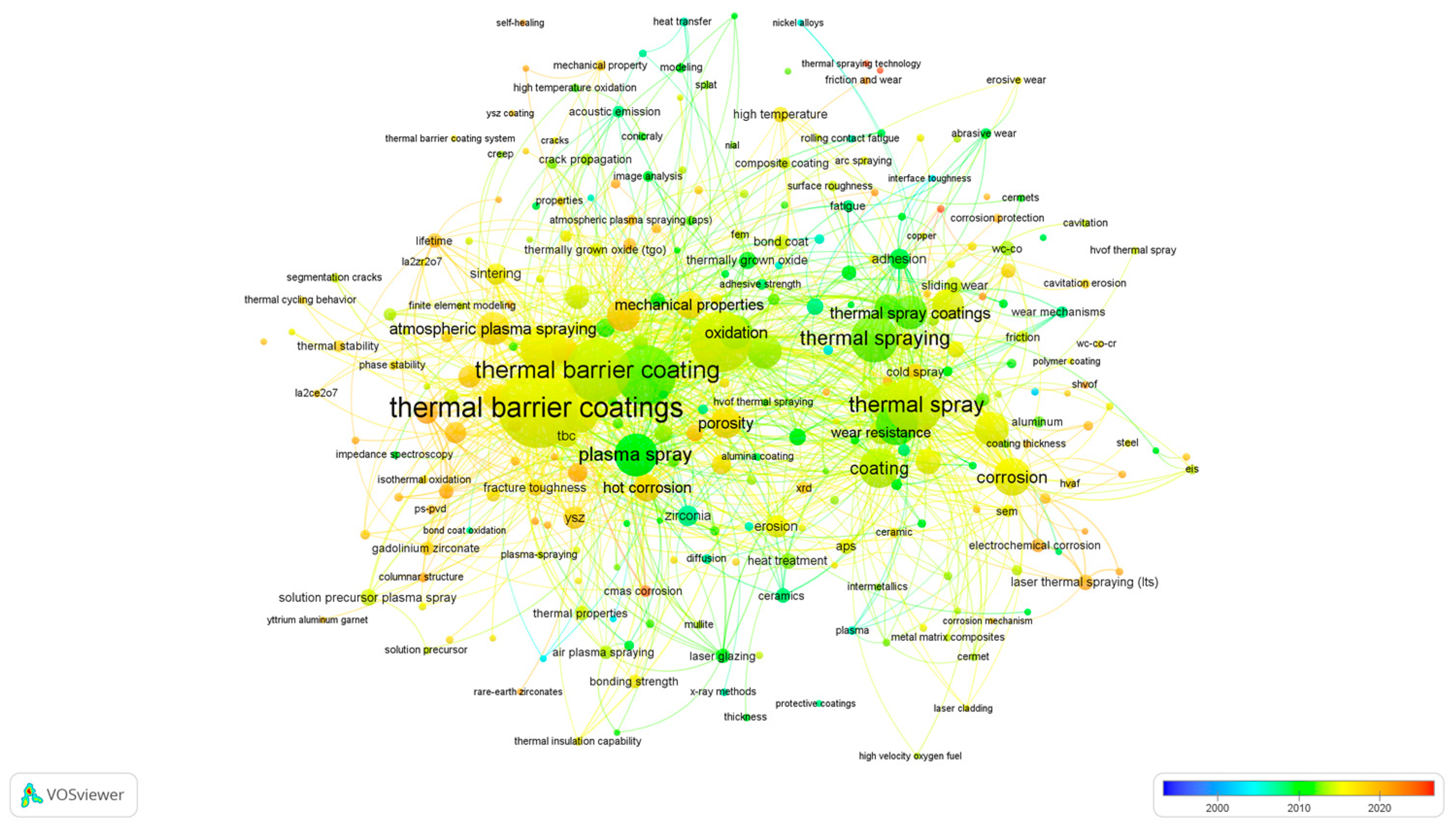
To gain a deeper understanding of the research themes and interconnections within the wire-arc coating literature, a network analysis of keywords was conducted using VOSviewer in overlay visualization mode. The co-occurrence network illustrated in Figure 5 illustrates the relationships and frequency of different keywords within publications focused on thermal spray coatings. The node size reflects the frequency of keyword occurrence, highlighting “thermal barrier coatings,” “thermal barrier coating,” “thermal spray,” “thermal spraying,” “plasma spray,” and “mechanical properties” as the dominant themes in this research domain. Closely connected nodes form dense clusters that reveal strong associations between thermal barrier coating systems, atmospheric plasma spraying, plasma-sprayed zirconia-based materials, porosity, oxidation, hot corrosion, fracture toughness, and other performance-related properties. Additional clusters correspond to corrosion- and wear-related topics, including “corrosion,” “wear resistance,” “bond strength,” “coating thickness,” “electrochemical corrosion,” and “laser thermal spraying,” which link functional performance to processing conditions and microstructural features. The color scale from blue to yellow indicates the average publication year of each keyword, showing that earlier work concentrated on generic plasma-sprayed thermal barrier coatings and corrosion protection, whereas more recent publications increasingly focus on detailed mechanical properties, oxidation behavior, advanced plasma-spraying variants, and lifetime or damage mechanisms, thereby illustrating the temporal evolution of research priorities in thermal spray coatings.
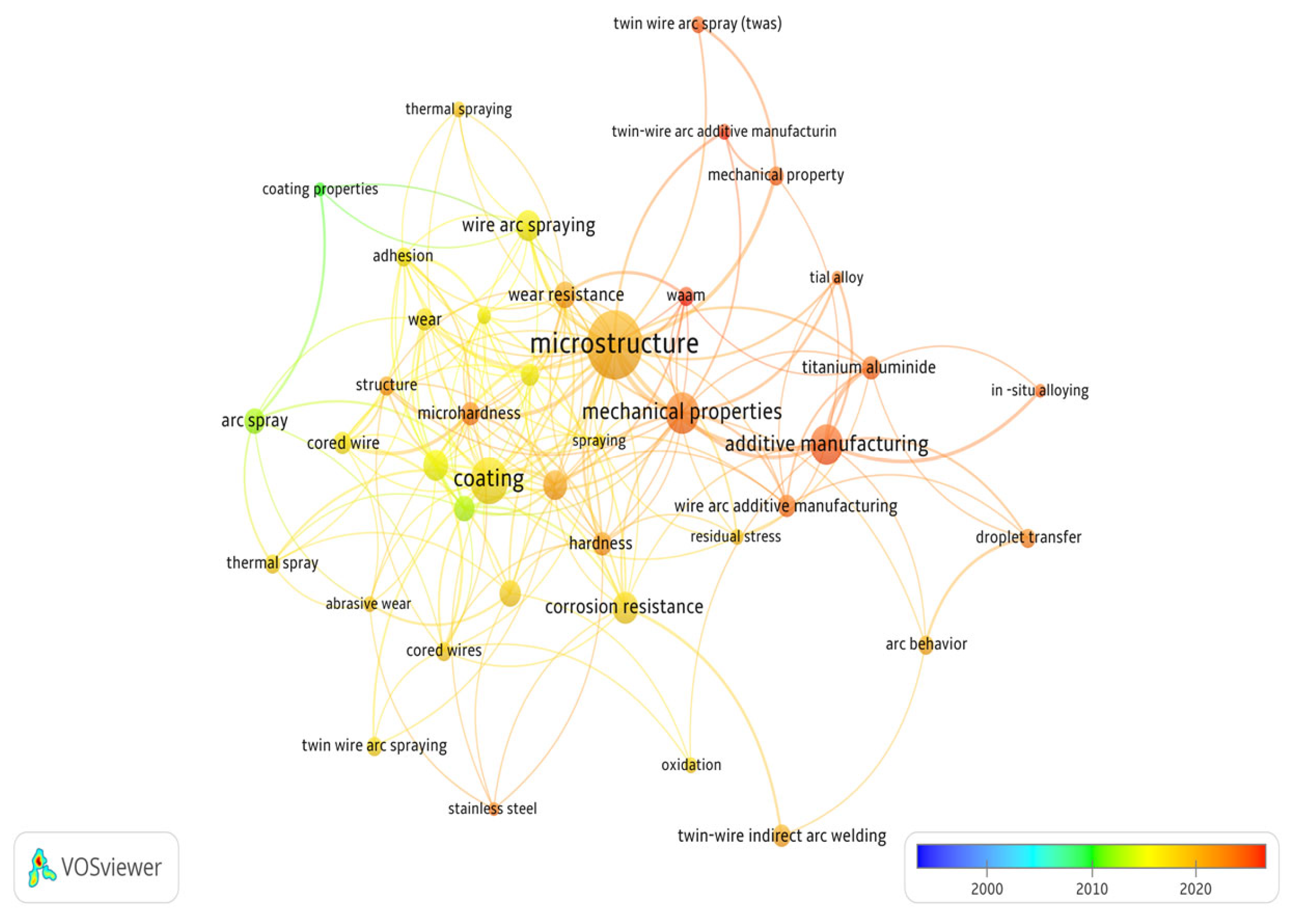
Figure 6 presents the keyword co-occurrence network for research on wire-arc coatings. The most dominant keywords—‘microstructure’, ‘coating’, ‘mechanical properties’, ‘wire arc spraying’, and ‘corrosion resistance’—appear as central hubs in the network, highlighting their importance in defining the research domain and its core process–structure–property relationships. Performance-related terms such as ‘wear’, ‘wear resistance’, ‘hardness’, ‘microhardness’, and ‘corrosion resistance’ are strongly represented, emphasizing the focus on the durability and mechanical integrity of wire-arc coatings. The network further shows processing- and material-related keywords, including ‘arc spray’, ‘thermal spray’, ‘twin wire arc spraying’, ‘cored wire(s)’, ‘stainless steel’, and ‘twin-wire indirect arc welding’, illustrating how different spraying variants and substrate systems are linked to coating quality. A distinct cluster around ‘additive manufacturing’, ‘wire arc additive manufacturing’, ‘WAAM’, ‘titanium aluminide’, and ‘droplet transfer’ reveals an emerging research stream that repurposes wire-based arc processes from conventional coating applications toward structural and additive manufacturing uses. The color scale from blue to yellow indicates the average publication year of each keyword, showing a temporal evolution from earlier work on general arc spraying and coating processes toward more recent studies centered on microstructure, mechanical properties, and additive manufacturing-related topics.
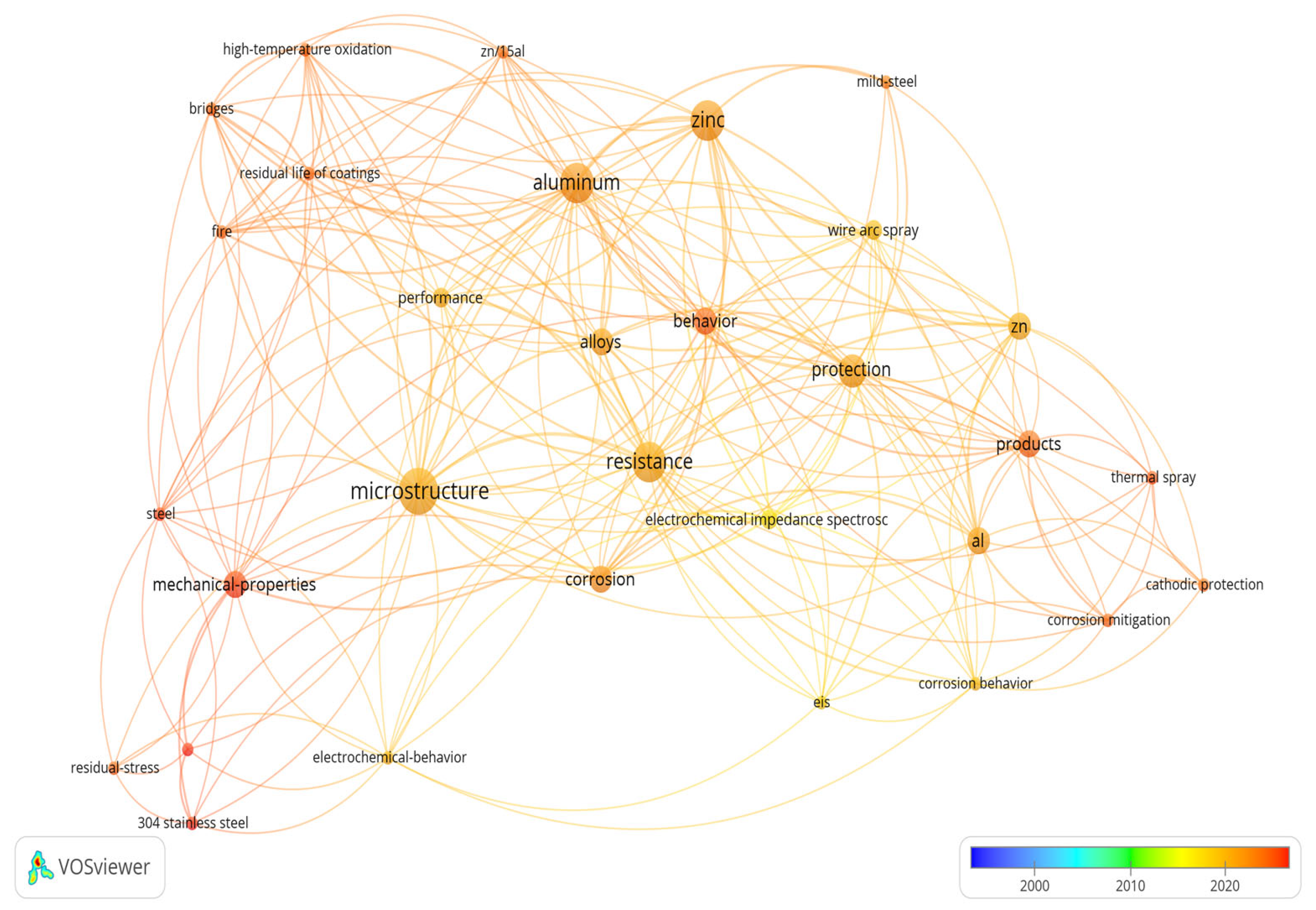
Similarly, the keyword co-occurrence network for publications addressing zinc, aluminum, and Zn-Al alloy wire-arc coatings in relation to coating thickness, substrate roughness, and bond strength in Figure 7 shows three main research clusters. Material keywords (zinc, aluminum, alloy, Zn/15Al, and steel) cluster with environmental performance keywords (high-temperature oxidation, corrosion, and corrosion mitigation), indicating materials are evaluated for protective properties. Characterization keywords (microstructure, mechanical properties, resistance, and electrochemical impedance spectroscopy) form an interconnected group, reflecting common evaluation methodologies. Process keywords (wire arc spray, thermal spray, cathodic protection) reflect the application focus. Notably, recent publications (orange/yellow nodes) emphasize zinc, aluminum, microstructure, and corrosion, while keywords explicitly linking coating thickness, substrate roughness, and bond strength remain underrepresented, confirming the critical research gap.
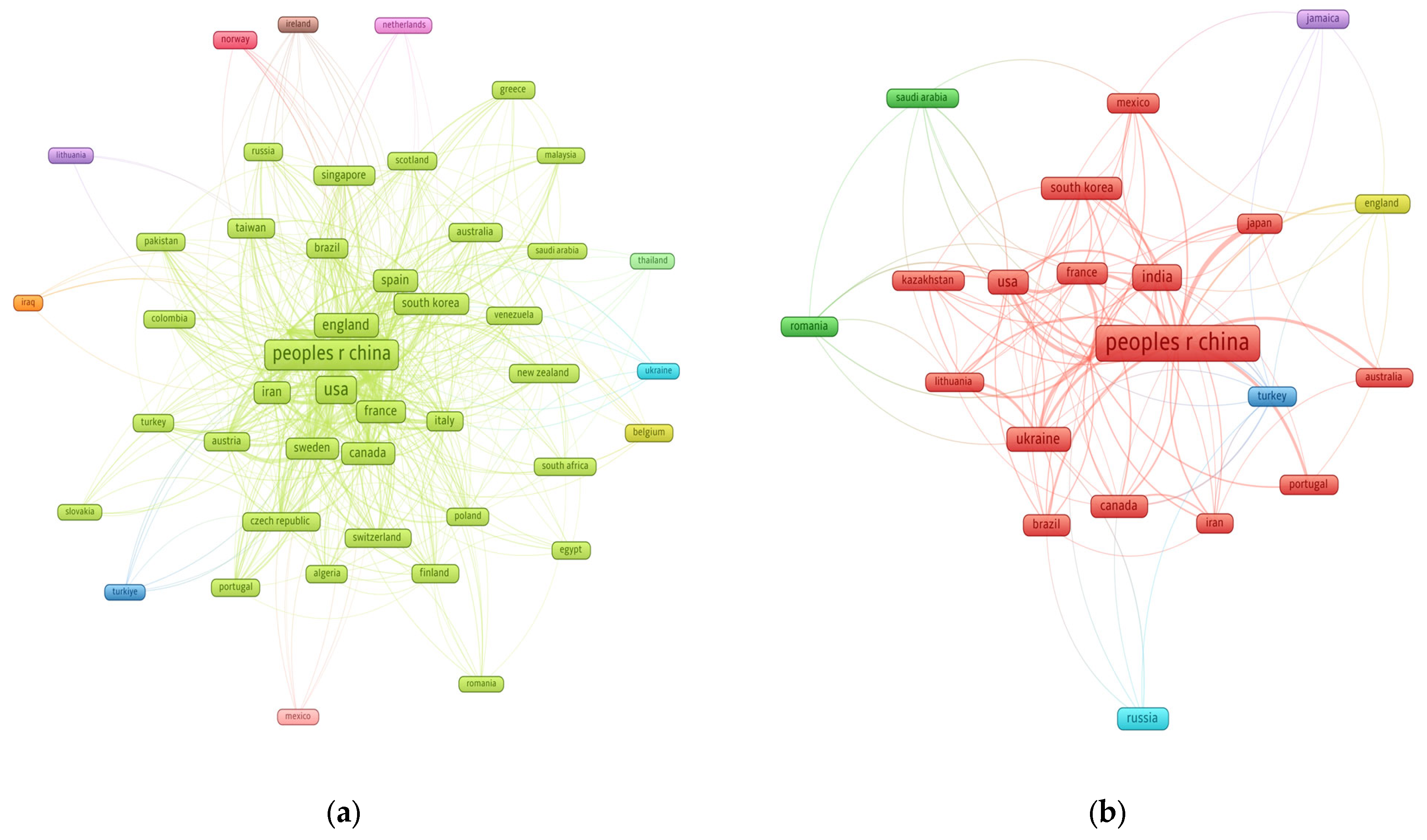
In the thermal spray coating literature (Figure 8a), research output and impact are clearly dominated by a small group of countries. The People’s Republic of China leads by a wide margin, with 680 publications and 16,096 citations, reflecting both high productivity and strong global visibility. The USA follows with 279 publications and 12,808 citations, while Germany contributes 167 publications with 7362 citations, establishing these three as the main hubs of the field. Among other major players, England (146 publications, 5036 citations), Japan (169 publications, 4399 citations), France (122 publications, 3688 citations), and Canada (111 publications, 3599 citations) show substantial citation impact and active international collaboration. A second tier of influential countries includes Spain (3437 citations), Iran (2983 citations), India (2923 citations), Sweden (2333 citations), and South Korea (1908 citations), all of which contribute significantly to the development and dissemination of thermal spray coating research.
In the wire-arc coatings literature (Figure 8b), the People’s Republic of China is again the most influential country, contributing 144 publications and 2124 citations, with the highest total link strength (236), indicating strong international collaboration. Germany follows with 37 publications and 595 citations, while the USA has 29 publications and 366 citations, forming, together with China, the core of the global collaboration network. A second tier of active countries includes India (32 publications, 471 citations), France (10 publications, 387 citations), Ukraine (28 publications, 223 citations), Japan (7 publications, 132 citations), South Korea (16 publications, 109 citations), and Canada (12 publications, 443 citations), all of which show substantial citation impact and dense co-authorship links around the central hubs. Other nations, such as Brazil, Iran, Mexico, Portugal, Kazakhstan, Turkey, Australia, England, Saudi Arabia, Romania, and Russia, contribute a smaller but visible share of publications and citations, typically connecting to the network through collaborations with these leading countries.
Overall, the bibliometric results directly support the objective of this review by showing strong growth and broad interest in thermal spray coatings, but a comparatively smaller and more specialized body of work on wire-arc coatings. The keyword networks indicate that wire-arc research is largely organized around process–structure–property relationships (e.g., microstructure, mechanical properties, and corrosion resistance), while the targeted search results reveal a pronounced shortage of studies that simultaneously evaluate substrate roughness, coating thickness, and coating composition in relation to bond strength. This combination of dominant themes and the clear scarcity of integrated adhesion-focused studies motivates the structure of the remainder of this review, which synthesizes adhesion mechanisms and critically discusses how these interdependent parameters govern bonding performance and failure modes in wire-arc coatings.
Limitations note: Bibliometric analysis tools can efficiently organize large corpora and reveal trends (e.g., growth patterns, keyword clusters, and collaboration networks), but they do not, by themselves, establish mechanistic conclusions or guarantee originality in scientific interpretation. Recent work on automated review generation highlights that, while such pipelines can produce promising drafts, they may still fall short in critical analysis and originality without careful expert oversight [36]. Therefore, in this study, the bibliometric analysis is used strictly to map the literature and motivate the review structure, whereas the subsequent sections provide the domain-driven synthesis of bonding/adhesion mechanisms and a critical discussion of parameter–structure–property relationships in wire-arc coatings.

3. Wire Arc Spraying Process

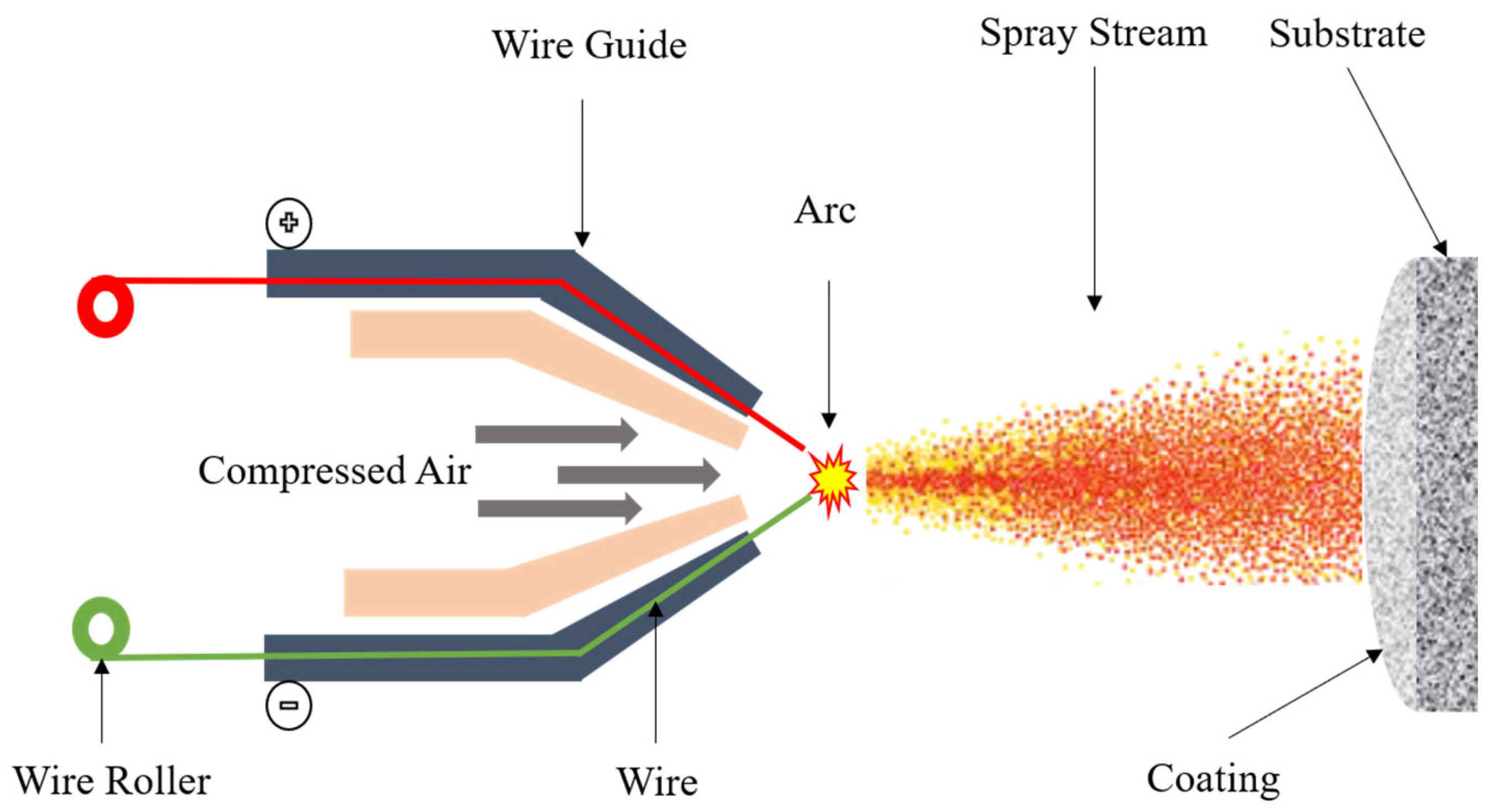
Among the large family of thermal spray techniques, wire arc spraying offers high deposition rate, high stability, low operating costs, and ease of on-site operation, making it increasingly favorable for industrial applications [37,38,39,40]. It was commercially introduced to industry in the 1960s and is also known by other names, including arc spray, electric arc spraying, and twin-wire arc [41,42]. In wire-arc spraying, two consumable metal wires are melted by an electric arc formed between them and then atomized by compressed air and sprayed onto the substrate [43]. Due to its high deposition rate, wire-arc spraying has enabled on-site coating of large infrastructure and promoted the commercialization of thermal-sprayed coatings [38]. The process can achieve temperatures of up to 4000–6000 °C and particle velocities ranging from 100 to 300 m/s. Compared to other techniques, such as flame spraying, these conditions contribute to coatings with superior adhesion strength and reduced porosity [37]. The high mechanical and physicochemical adhesion forces make wire-arc coatings suitable for applications requiring corrosion resistance, wear resistance, and improved thermal properties [44]. Typical process parameters of wire-arc coatings employed are provided in Table 1, while the wire-arc coating spray process is presented in Figure 9 [41,45,46].
Although Table 1 summarizes typical wire-arc spray parameter ranges, these settings directly influence coating quality by controlling the in-flight particle state and subsequent splat formation. Arc voltage and current establish the arc that melts the wire tips and therefore govern the thermal and kinetic conditions of particles, which ultimately dictate lamellar structure development upon impact. Atomizing gas pressure strongly affects atomization and acceleration; in general, higher gas pressure produces finer droplets with increased impact velocity, which can reduce porosity through improved splat flattening, but may also increase oxide formation because smaller droplets oxidize more readily in flight. Spray distance (stand-off distance) influences the degree of particle cooling and deceleration before impact; increasing spray distance reduces particle temperature and velocity and has been reported to increase oxide content [47], potentially altering porosity distribution and degrading adhesion if excessive. Finally, the choice of atomizing gas (air versus nitrogen) affects oxidation behavior; air atomization is commonly associated with higher oxide content, whereas inert gas atomization can suppress oxidation and modify the porosity–hardness–adhesion tradeoff [44,47]. Because these parameters primarily control particle temperature, velocity, and oxide/porosity formation, they directly shape coating–substrate interfacial contact and defect populations that underpin the adhesion and bonding mechanisms discussed in the following sections.

3.1. Adhesion in Wire-Arc Coatings

Adhesion properties are critical when evaluating coating performance and durability in engineering applications [48]. Insufficient adhesion may easily lead to coating delamination or peeling off, which directly exposes the underlying substrate to corrosive environments and significantly compromises corrosion protection, regardless of the coatings’ inherent corrosion resistance [49]. From a corrosion-performance standpoint, metallized (thermal-sprayed) Zn, Al, and Zn–Al coatings protect steel through a combination of galvanic (sacrificial) action and barrier effects, which can maintain protection even in the presence of localized coating discontinuities or mechanical damage [50]. Because thermally sprayed metallic coatings have an inherently lamellar microstructure, with porosity that can provide pathways for moisture and ionic transport, many guidelines recommend sealing and/or applying compatible organic topcoats (duplex systems) to reduce porosity effects and significantly extend corrosion protection [51]. Consistent with this framework, arc-sprayed Al–Zn/Zn–Al coatings have been reported to provide long-term cathodic protection to steel in saline environments, while comparative studies also highlight that coating chemistry and exposure mode (e.g., immersion vs. salt spray) influence degradation features such as interlayer decohesion and protective corrosion product formation [38,52]. In thermal spray coatings, adhesion generally derives from three primary mechanisms: chemical bonding, physical adhesion, and mechanical interlocking. Chemical bonding is typically associated with metallurgical bonding between coating and substrate materials [53]. Physical adhesion arises from intermolecular forces at the coating–substrate interface, while mechanical interlocking depends on the surface roughness or surface treatment of the substrate [54]. The relative contribution of these mechanisms is highly related to both the coating materials and substrate preparation. Many coatings may exhibit advanced corrosion protection but still suffer from insufficient adhesive strength, preventing their long-term serviceability for specific applications [55].
Unlike high-velocity oxygen fuel (HVOF) and other thermal spray processes, where higher particle temperatures and smaller droplet sizes allow semi-molten particles to aggressively embed into the substrate, wire-arc particles solidify almost immediately upon impact, eliminating the ability to develop a chemical metallurgical bond. Therefore, the adhesion of wire-arc coatings relies on mechanical and physical bonds, conventionally resulting in comparatively lower adhesion strength [56]. This inherent limitation has long restricted the use of wire-arc coatings in demanding applications, such as nuclear power, where strong metallurgical bonding is essential [53].
Mechanical anchoring occurs when the coating materials penetrate and fill the irregularities of the substrate, enlarging the contact area and enhancing the interfacial bonding between coating materials and substrates [57]. Studies have indicated that the surface roughness of the substrate is essential for mechanical anchoring. A highly roughened surface exhibits complex topographical features with more randomly distributed peaks, valleys, and pores, allowing more opportunities for the coating materials to physically interlock [58]. While the high pressures generated when the droplets impact the substrate surface facilitate the formation of mechanical bonding [59], applying proper surface treatment on the substrate before spraying is a practical approach to increase surface roughness and further ensure firm bonding [55,60].

3.2. Enhancement of Wire-Arc Coating Adhesion

While traditional wire-arc spraying lacks metallurgical bonding due to rapid particle solidification, recent advances in material selection and process optimization have enabled limited metallurgical bonding under specific conditions. The following strategies demonstrate how material-based approaches can enhance adhesion beyond conventional mechanical interlocking. In general, the adhesive strength of thermal-sprayed metallic coatings is greater than that of thermal-sprayed ceramic coatings [45,61]. The literature has shown that the adhesive strength of thermal-sprayed ceramic coatings, such as ZrO2 and Al2O3, is between 10 MPa and 20 MPa when applied directly to metallic substrates. In contrast, metallic thermal spray coatings typically exhibit a higher adhesive strength, ranging from 23 MPa to 50 MPa, depending on substrate and coating parameters [45,62].
With the growing demand for reliable protective systems on steel structures, numerous studies have attempted to enhance the adhesion properties of wire-arc coatings. One approach to optimizing adhesion is to analyze properties of single-component materials, select a subset of materials that have ideal combined properties, and generate a wire arc consisting of more than one material. This approach led to adhesion strengths exceeding 60 MPa under ideal conditions [61,63]. Different metals or alloys have different melting temperatures, oxidation tendencies, and surface energies, which affect the melting and wetting behaviors at the coating–substrate interface. In proper combination, wire-arc coating materials with superior contact and interaction on the substrate can promote stronger physical adhesion, and in some cases may even facilitate certain metallurgical bonding.
For instance, Song and Li reported successful metallurgical bonding between wire-fed plasma-sprayed NiAl coatings and substrates of 304 stainless steel and 7075 aluminum alloy, with measured adhesion strengths of 82.67 ± 3.96 MPa and 64.45 ± 2.84 MPa, respectively [64]. Notably, this bonding occurred without surface roughening pretreatment, facilitated by interfacial reactions that generated Al-Al3Ni eutectic phases. The authors also reported that incorporating deoxidizer elements into alloy spray powders enabled the creation of oxide-free molten droplets during spraying, which promoted metallurgical bonding at the coating–substrate interface. This resulted in a dense coating structure with significantly enhanced interlamellar bonding [64].
The choice of feedstock material is critical in determining the degree of metallurgical bonding. When coating materials with high melting points are used, forming strong metallurgical bonds becomes difficult [8,64]. Materials with lower melting temperatures, such as zinc (Zn) and aluminum (Al), are more likely to form effective metallurgical bonds during wire arc spraying [41,65]. These materials also form passive films that provide additional corrosion protection. Alloys of Zn and Al can contribute to metallurgical bonding through oxidation–reduction reactions during spraying [66,67]. The combination of Zn with alloying elements such as Al or magnesium (Mg) has proven particularly effective, with studies showing enhanced uniform and pitting corrosion resistance after a 2-year exposure to seawater environments [68,69,70]. While material selection is crucial for enhancing adhesion, substrate preparation also plays a significant role in determining coating performance.

3.2.1. Effect of Substrate Roughness on Adhesion

The role of substrate surface condition and topography in governing the adhesion properties of thermal spray coatings remains unclear. It has been extensively reported in the literature that higher substrate roughness or angular surface topography can enhance the adhesion strength of thermal spray coatings by building up more significant mechanical interlocking and physical adhesion. However, other studies have observed a decrease in adhesion strength with increasing substrate roughness [61]. Khan et al. reported that the adhesion strength of thermal barrier coatings initially increased with higher surface roughness, but further roughening resulted in a reduction in adhesion strength [71]. Therefore, the relationship between surface roughness and adhesion strength is not always linear, and mixed failure modes on the fracture surface have been observed in certain cases. A systematic investigation of the surface roughness of the substrate is essential to clarify its complex effects.
To enhance substrate roughness and improve adhesion, grit blasting has been utilized as an effective surface pretreatment method for decades [72,73]. Research has shown that the adhesion of coatings to substrates depends on proper substrate preparation before spraying, with grit blasting serving to improve mechanical bonding between the coating and substrate [55,60]. Previous studies have investigated the effect of various grit blasting parameters, confirming the critical role of surface morphology and surface roughness on the bonding strength of hydroxyapatite coating [74,75]. For instance, Mohammadi et al. investigated the effect of various grit-blasting parameters on hydroxyapatite coating bond strength. After grit blasting, they found that surface morphology significantly affected bond strength, with a maximum of 24.1 MPa obtained after Al2O3 grit blasting [75]. Surface roughening through such methods helps enhance the mechanical anchoring of the coating particles as they accumulate on the substrate [57]. In addition to substrate preparation, the thickness of the applied coating significantly influences both adhesion strength and long-term durability.

3.2.2. Effect of Coating Thickness on Adhesion

The adhesion performance of thermal spray coatings is strongly influenced by coating thickness, which governs coating quality, mechanical interlocking, and residual stress development. Coatings with insufficient thickness may not fully anchor into substrate surface irregularities, resulting in reduced adhesion strength and limited corrosion protection. Syrek and Paul reported that very thin thermally sprayed coatings provide inadequate resistance to corrosion and environmental exposure, compromising long-term performance [76]. Conversely, residual stresses generated at the coating–substrate interface increase with coating thickness during splat solidification and subsequent cooling, which can introduce defects and elevate the risk of cracking or delamination [77,78]. In wire-arc sprayed metallic systems, these stresses arise not only from rapid splat quenching but also from thermal-mismatch strains caused by differences in coefficients of thermal expansion (CTE) between the coating (e.g., Al, Zn, and Zn–Al alloys) and carbon steel substrates. Because the coating is mechanically constrained by the substrate during cooling from deposition temperatures, CTE mismatch induces in-plane stresses within the coating and interfacial shear and peel stresses that intensify with increasing thickness, thereby weakening adhesion and promoting interfacial separation [77]. As a result, excessively thick coatings may not fully benefit from mechanical and metallurgical bonding mechanisms and can exhibit degraded adhesion if cohesive strength is insufficient. Optimizing coating thickness is therefore critical to balancing interfacial bonding, residual stress levels, and long-term mechanical and corrosion performance of wire-arc sprayed coatings.

3.2.3. Wire-Arc Coatings: Studies Addressing Multiple Adhesion Parameters

The bibliographic analysis yielded only eight publications that investigated the combined effects of parameters influencing the bonding of wire-arc coating systems. While these studies provide valuable insights into various aspects of coating performance, their focus areas differ significantly from the specific investigation of zinc–aluminum (Zn-Al) alloy wire-arc coatings on steel substrates with systematic variation in parameters influencing bonding. Table 2 summarizes these studies and their scope.

4. Conclusions

Wire-arc coating adhesion is governed by interdependent variables—including coating material system, coating thickness, and substrate surface condition—yet the literature still lacks a well-defined “sweet spot” that jointly optimizes these factors for bond strength. Accordingly, this review focused on studies that explicitly report bonding performance and assessed how these parameters influence adhesion mechanisms and measured strength. Across the reviewed literature, substrate surface topography (including engineered textures) consistently affects bond strength by modifying mechanical interlocking and interfacial contact, while coating thickness and the resulting lamellar microstructure also emerge as critical contributors to adhesion and failure behavior. Reported optimization routes further indicate that selected process-related variables (e.g., stand-off distance and substrate pre-heat) can alter porosity and oxide content, thereby influencing coating integrity and adhesion.
A persistent gap remains in the lack of systematic investigations of industrially relevant Al, Zn, and Zn-Al alloy wire-arc systems on carbon and A36 steels that simultaneously vary substrate roughness, coating thickness, and coating composition while quantifying bond strength and failure mode. Most existing studies isolate individual factors or rely on non-carbon-steel substrates, limiting the generalization of how these coupled variables govern interfacial bonding mechanisms. Future work should therefore adopt coordinated experimental designs that vary roughness, thickness, and composition together, report key process parameters, and combine standardized adhesion testing with detailed interface and fractographic analyses to resolve dominant bonding and failure mechanisms. Data-driven approaches, such as machine learning applied to consistently reported datasets, may then be leveraged to identify robust parameter windows that maximize adhesion while maintaining coating quality and long-term protection.
From a practical standpoint, the findings summarized in this review reinforce that in-service coating performance is governed not by a single variable, but by the combined control of surface preparation (roughness/topography), coating thickness, coating composition (Al, Zn, and Zn–Al), and application parameters that influence oxidation and porosity. These insights can assist owners, applicators, and engineers in translating design intent into more defensible procurement and quality-control practices by (i) specifying surface preparation targets that promote effective mechanical interlocking, (ii) selecting coating thickness ranges that balance durability with residual-stress and cohesion risks, and (iii) adopting standardized qualification and acceptance methods for adhesion (e.g., ASTM C633) during procedure qualification and field QC (quality control). This synthesis is directly relevant to corrosion-protection specifications for thermally sprayed Zn/Al systems on steel (e.g., ISO 2063 and related AWS/SSPC/NACE guidance) and highlights opportunities to better align parameter windows with adhesion and defect tolerance.

Author Contributions

G.B.: Writing—review and editing, Writing—original draft, Methodology, Validation, Investigation, Formal analysis, Data curation, Conceptualization, Software. M.I.K.: Writing—review and editing, Validation, Methodology, Investigation, Formal analysis. L.X.: Writing—review and editing, Investigation, Formal analysis, Methodology. Y.H.: Writing—review and editing, Validation, Supervision, Resources, Project administration, Methodology, Funding acquisition, Conceptualization. All authors have read and agreed to the published version of the manuscript.

Funding

This work was supported by the US Army Corps of Engineers ERDC’s Construction Engineering Research Laboratory (CERL) [grant number W9132T23C0010] and the United States National Science Foundation (NSF) [grant number OIA-2119691].

Institutional Review Board Statement

Not applicable.

Informed Consent Statement

Not applicable.

Data Availability Statement

The original contributions presented in this study are included in the article. Further inquiries can be directed to the corresponding author.

Conflicts of Interest

The authors declare that they have no known competing financial interests or personal relationships that could have appeared to influence the work reported in this paper.

References

  1. Chandler, K.A. Marine and Offshore Corrosion; Elsevier: Amsterdam, The Netherlands, 1985; Volume 222. [Google Scholar]
  2. Association, W. World Steel in Figures 2025. @worldsteel. 2025. Available online: https://worldsteel.org/data/world-steel-in-figures/world-steel-in-figures-2025/ (accessed on 5 November 2025).
  3. Yasoda, R.D. Integrity of Wire-Arc Sprayed Zinc-Aluminum Coatings on Steel Under Aggressive Chemical and Thermal Environments. Doctoral Dissertation, North Dakota State University, Fargo, ND, USA, 2023. [Google Scholar]
  4. Angst, U.M. Challenges and opportunities in corrosion of steel in concrete. Mater. Struct. 2018, 51, 4. [Google Scholar] [CrossRef]
  5. Koch, G.H.; Brongers, M.P.; Thompson, N.G.; Virmani, Y.P.; Payer, J.H. Cost of corrosion in the United States. In Handbook of Environmental Degradation of Materials; Elsevier: Amsterdam, The Netherlands, 2005; pp. 3–24. [Google Scholar]
  6. Koch, J.V.G.; Thompson, N.; Moghissi, O.; Gould, M.; Payer, J. International Measures of Prevention, Application, and Economics of Corrosion Technologies Study. Available online: http://impact.nace.org/documents/Nace-International-Report.pdf (accessed on 5 November 2025).
  7. Green, K.P.; Jackson, T. Safety in the Transportation of Oil and Gas: Pipelines or Rail? JSTOR: New York, NY, USA, 2015. [Google Scholar]
  8. Divya Yasoda, R.; Huang, Y. Post-Fire Mechanical Properties of Thermally Sprayed Anti-Corrosive Coatings in Oil and Gas Pipelines. In Proceedings of the Pipelines 2022, Indianapolis, Indiana, July 31–3 August 2022; pp. 203–210. [Google Scholar]
  9. Sharma, S.; Maheshwari, S. A review on welding of high strength oil and gas pipeline steels. J. Nat. Gas Sci. Eng. 2017, 38, 203–217. [Google Scholar] [CrossRef]
  10. Afgan, S.; Kiran, R. Erythritol for Internal Corrosion Inhibition in Crude Oil Pipelines. In Proceedings of the Pipelines 2024, Calgary, AB, Canada, 27–31 July 2024; pp. 134–142. [Google Scholar]
  11. Fessler, R.R. Pipeline Corrosion; Report; US Department of Transportation Pipeline and Hazardous Materials Safety Administration: Evanston, IL, USA, 2008.
  12. Deng, F.; Huang, Y.; Azarmi, F.; Wang, Y. Pitted Corrosion Detection of Thermal Sprayed Metallic Coatings Using Fiber Bragg Grating Sensors. Coatings 2017, 7, 35. [Google Scholar] [CrossRef]
  13. Martinez, S.; Zulj, L.; Kapor, F. Disbonding of underwater-cured epoxy coating caused by cathodic protection current. Corros. Sci. 2009, 51, 2253–2258. [Google Scholar] [CrossRef]
  14. Nishimura, T.; Raman, V. Corrosion Prevention of Aluminum Nanoparticles by a Polyurethane Coating. Materials 2014, 7, 4710–4722. [Google Scholar] [CrossRef] [PubMed]
  15. Di Cocco, V.; Iacoviello, F.; Natali, S. Damaging micromechanisms in hot-dip galvanizing Zn based coatings. Theor. Appl. Fract. Mech. 2014, 70, 91–98. [Google Scholar] [CrossRef]
  16. Kong, G.; White, R. Toward cleaner production of hot dip galvanizing industry in China. J. Clean. Prod. 2010, 18, 1092–1099. [Google Scholar] [CrossRef]
  17. AkzoNobel International Protective Coatings. “Interzinc® 22: Inorganic Zinc-Rich Silicate”. AkzoNobel International Protective Coatings, Technical Data Sheet 2016/11/23. 2016. Available online: https://international.brand.akzonobel.com/m/7c1221380680aedf/original/Interzinc_22_eng_usa_LTR_20161123.pdf (accessed on 10 February 2026).
  18. Li, Z.; Bi, H.; Gunnarsson, S.; Weinell, C.E.; Dam-Johansen, K. Delamination of thermally sprayed ZnAl15/organic duplex coating systems on structural steel for offshore wind applications. Surf. Coat. Technol. 2024, 485, 130796. [Google Scholar] [CrossRef]
  19. Thermally Sprayed Metal Coatings. 2009. Available online: https://steelconstruction.info/images/archive/d/d7/20151125111758!GN_8-04.pdf (accessed on 10 February 2026).
  20. Ellor, J.A.; Young, W.T.; Repp, J. Thermally Sprayed Metal Coatings to Protect Steel Pilings: Final Report and Guide; Transportation Research Board: Washington, DC, USA, 2004; Volume 528. [Google Scholar]
  21. Gain, S.; Veeman, D. A review on advances and challenges in wire arc additive manufacturing: Process parameters, microstructural evolution and material performance across alloys. J. Alloys Compd. 2025, 1029, 180735. [Google Scholar] [CrossRef]
  22. Rodriguez, R.; Paredes, R.S.C.; Wido, S.H.; Calixto, A. Comparison of aluminum coatings deposited by flame spray and by electric arc spray. Surf. Coat. Technol. 2007, 202, 172–179. [Google Scholar] [CrossRef]
  23. Abd Malek, M.H.; Saad, N.H.; Abas, S.K.; Roselina, N.N.; Shah, N.M. Performance and microstructure analysis of 99.5% aluminium coating by thermal arc spray technique. Procedia Eng. 2013, 68, 558–565. [Google Scholar] [CrossRef]
  24. Chen, W.G.; Wang, Z.X.; Xu, G.L.; Song, W.T.; Xie, Y.; Zhao, L.; Xia, M.H.; Li, W. Friction and anti-corrosion characteristics of arc sprayed Al thorn Zn coatings on steel structures prepared in atmospheric environment. J. Mater. Res. Technol.-JmrT 2021, 15, 6562–6573. [Google Scholar] [CrossRef]
  25. Ding, P.; Liu, X.J.; Liu, J.J.; Li, J.B.; Li, H.Q.; Zhao, H.Y.; Duan, J.Y.; Jiao, Y.Z. Study on the properties of FeCrNi/CBN composite coating with high velocity arc spraying. Arab. J. Chem. 2018, 11, 935–941. [Google Scholar] [CrossRef]
  26. Tian, H.L.; Wang, C.L.; Guo, M.Q.; Tang, Z.H.; Wei, S.C.; Xu, B.S. Frictional wear performance under oil-lubricated conditions and wear resistance mechanism of high-velocity arc-sprayed FeNiCrAl coating. Surf. Coat. Technol. 2018, 353, 237–246. [Google Scholar] [CrossRef]
  27. Mehta, A.; Vasudev, H. Advancements in ceramic-coated metals: Enhancing thermal spray coatings for improved performance in aerospace applications using surface treatments. Results Surf. Interfaces 2025, 18, 100387. [Google Scholar] [CrossRef]
  28. Yasoda, R.; Huang, Y.; Qi, X. The Effect of Exposure Conditions on the Long-Term Performance Evaluation of Undamaged and Damaged Wire-Arc-Sprayed Zinc-Aluminum Alloy Coatings. J. Therm. Spray Technol. 2024, 33, 398–422. [Google Scholar] [CrossRef]
  29. Xu, L.; Wang, X.; Badin, G.; Azarmi, F.; Huang, Y.; Daiber, E.; Wilson, R. Optimizing material selection for wire arc thermal spraying of Al and Zn alloy metallized polymeric coating systems: Microstructural analysis and mechanical property evaluation. Mater. Chem. Phys. 2025, 333, 130423. [Google Scholar] [CrossRef]
  30. Abou-Krisha, M.; Alshammari, A.; Assaf, F.; El-Sheref, F. Electrochemical behavior of Zn-Co-Fe alloy electrodeposited from a sulfate bath on various substrate materials. Arab. J. Chem. 2019, 12, 3526–3533. [Google Scholar] [CrossRef]
  31. Abou-Krisha, M.; Assaf, F.; El-Naby, S. The influence of Fe2+ concentration and deposition time on the corrosion resistance of the electrodeposited zinc-nickel-iron alloys. Arab. J. Chem. 2016, 9, S1349–S1356. [Google Scholar] [CrossRef]
  32. Ciubotariu, A.; Benea, L.; Ponthiaux, P. Corrosion resistance of zinc-resin hybrid coatings obtained by electro-codeposition. Arab. J. Chem. 2019, 12, 4427–4437. [Google Scholar] [CrossRef]
  33. Espallargas, N.; Espallargas, N. 1—Introduction to thermal spray coatings. In Future Development of Thermal Spray Coatings; Woodhead Publishing: Sawston, UK, 2015; pp. 1–13. [Google Scholar] [CrossRef]
  34. Glanzel, W.; Moed, H. Journal impact measures in bibliometric research. Scientometrics 2002, 53, 171–193. (In English) [Google Scholar] [CrossRef]
  35. Babar, H.; Wu, H.; Zhang, W.; Shah, T.; Mccluskey, D.; Zhou, C. The promise of nanofluids: A bibliometric journey through advanced heat transfer fluids in heat exchanger tubes. Adv. Colloid Interface Sci. 2024, 325, 103112. (In English) [Google Scholar] [CrossRef]
  36. Silva, J.C.M.C.; Gouveia, R.P.; Zielinski, K.M.C.; Oliveira, M.C.F.; Amancio, D.R.; Bruno, O.M.; Oliveira, O.N., Jr. AI-Assisted Tools for Scientific Review Writing: Opportunities and Cautions. ACS Appl. Mater. Interfaces 2025, 17, 47795–47805. [Google Scholar] [CrossRef]
  37. Ndumia, J.; Kang, M.; Gbenontin, B.; Lin, J.; Nyambura, S. A Review on the Wear, Corrosion and High-Temperature Resistant Properties of Wire Arc-Sprayed Fe-Based Coatings. Nanomaterials 2021, 11, 2527. [Google Scholar] [CrossRef]
  38. Lee, H.; Singh, J.; Ismail, M.; Bhattacharya, C.; Seikh, A.; Alharthi, N.; Hussain, R. Corrosion mechanism and kinetics of Al-Zn coating deposited by arc thermal spraying process in saline solution at prolong exposure periods. Sci. Rep. 2019, 9, 3399. [Google Scholar] [CrossRef] [PubMed]
  39. Kumar, S.; Kumar, M.; Handa, A. Comparative study of high temperature oxidation behavior and mechanical properties of wire arc sprayed Ni-Cr and Ni-Al coatings. Eng. Fail. Anal. 2019, 106, 104173. (In English) [Google Scholar] [CrossRef]
  40. Li, Y.; Su, C.; Zhu, J. Comprehensive review of wire arc additive manufacturing: Hardware system, physical process, monitoring, property characterization, application and future prospects. Results Eng. 2022, 13, 100330. (In English) [Google Scholar] [CrossRef]
  41. Davis, J.R. Handbook of Thermal Spray Technology; ASM International: Mumbai, India, 2004. [Google Scholar]
  42. Pardo, A.; Casajus, P.; Mohedano, M.; Coy, A.; Viejo, F.; Torres, B.; Matykina, E. Corrosion protection of Mg/Al alloys by thermal sprayed aluminium coatings. Appl. Surf. Sci. 2009, 255, 6968–6977. [Google Scholar] [CrossRef]
  43. Galedari, S.; Mahdavi, A.; Azarmi, F.; Huang, Y.; McDonald, A. A Comprehensive Review of Corrosion Resistance of Thermally-Sprayed and Thermally-Diffused Protective Coatings on Steel Structures. J. Therm. Spray Technol. 2019, 28, 645–677. [Google Scholar] [CrossRef]
  44. DePalma, K.; Walluk, M.; Martin, L.; Sisak, K. Investigation of Mechanical Properties of Twin Wire Arc Repair of Cast Iron Components. J. Therm. Spray Technol. 2022, 31, 315–328. [Google Scholar] [CrossRef]
  45. Pawlowski, L. The Science and Engineering of Thermal Spray Coatings; John Wiley & Sons: Hoboken, NJ, USA, 2008. [Google Scholar]
  46. Fauchais, P.L.; Heberlein, J.V.; Boulos, M.I. Thermal Spray Fundamentals: From Powder to Part; Springer Science & Business Media: Berlin/Heidelberg, Germany, 2014. [Google Scholar]
  47. Gedzevicius, I.; Valiulis, A. Analysis of wire arc spraying process variables on coatings properties. J. Mater. Process. Technol. 2006, 175, 206–211. [Google Scholar] [CrossRef]
  48. Sobolev, V.V.; Guilemany, J.M.; Nutting, J.; Miquel, J.R. Development of substrate-coating adhesion in thermal spraying. Int. Mater. Rev. 1997, 42, 117–136. [Google Scholar] [CrossRef]
  49. Knudsen, O.O.; Hagen, C.H.M.; Skilbred, A.W.B.; Bruaas, T.K.; Nærland, J. Root causes for corrosion on painted steel structures in marine environments. Mater. Corros.-Werkst. Und Korros. 2023, 76, 802–811. [Google Scholar] [CrossRef]
  50. FHWA. Bridge Coatings Technical Note: Metallized Steel Bridge Coatings. Available online: https://www.fhwa.dot.gov/publications/research/infrastructure/structures/bridge/metal.cfm (accessed on 10 February 2026).
  51. ISO 2063-1:2019; Aluminium and Their Alloys—Part 1: Design Considerations and Quality Requirements for Corrosion Protection Systems. ISO: Geneva, Switzerland, 2017. Available online: https://standards.iteh.ai/catalog/standards/sist/78603482-8496-4fd3-bcb420ab93033fe0/iso-2063-1-2019 (accessed on 10 February 2026).
  52. Chen, T.; Yung, T.; Chou, C.; Wang, Y. Investigating the corrosion resistance of Zn and Al coating deposited by arc thermal spraying process. Surf. Coat. Technol. 2024, 484, 130684. [Google Scholar] [CrossRef]
  53. Li, C.; Song, J.; Luo, X.; Dong, X.; Zhang, L.; Wang, Q.; Ma, N. High tensile adhesive strength NiCrMo coating enabled by plasma-spraying a Mo-clad NiCr powder for reliable bond coat application. Surf. Coat. Technol. 2025, 505, 132072. [Google Scholar] [CrossRef]
  54. MacDonald, D.; Nastic, A.; Jodoin, B. Understanding adhesion. In Cold-Spray Coatings: Recent Trends and Future Perspectives; Springer: Berlin/Heidelberg, Germany, 2018; pp. 421–450. [Google Scholar]
  55. Hadad, M.; Marot, G.; Démarécaux, P.; Chicot, D.; Lesage, J.; Rohr, L.; Siegmann, S. Adhesion tests for thermal spray coatings: Correlation of bond strength and interfacial toughness. Surf. Eng. 2007, 23, 279–283. [Google Scholar] [CrossRef]
  56. Watanabe, M.; Owada, A.; Kuroda, S.; Gotoh, Y. Effect of WC size on interface fracture toughness of WC-CoHVOF sprayed coatings. Surf. Coat. Technol. 2006, 201, 619–627. [Google Scholar] [CrossRef]
  57. Garcia-Alonso, D.; Serres, N.; Demian, C.; Costil, S.; Langlade, C.; Coddet, C. Pre-/During-/Post-Laser Processes to Enhance the Adhesion and Mechanical Properties of Thermal-Sprayed Coatings with a Reduced Environmental Impact. J. Therm. Spray Technol. 2011, 20, 719–735. [Google Scholar] [CrossRef]
  58. Zhou, X.; Kang, M.; Liu, J.; Lin, J.; Ndumia, J.; Yang, J. Effect of Grit-Blasting Pretreatment on the Bond Strength of Arc-Sprayed Fe-Based Coating. JOM 2023, 75, 3268–3276. [Google Scholar] [CrossRef]
  59. Sobolev, V.V.; Guilemany, J.M. Droplet-substrate impact interaction in thermal spraying. Mater. Lett. 1996, 28, 331–335. [Google Scholar] [CrossRef]
  60. Sagel, A.; Wanke, C. Dynamic mechanical analysis of the mechanical properties of Al-and Fe-based thermal spray coatings. Strain 2001, 1, 2. [Google Scholar]
  61. Shinde, S.; Sampath, S. A Critical Analysis of the Tensile Adhesion Test for Thermally Sprayed Coatings. J. Therm. Spray Technol. 2022, 31, 2247–2279. [Google Scholar] [CrossRef]
  62. Matejka, D.; Benko, B. Plasma Spraying of Metallic and Ceramic Materials; John Wiley & Sons Ltd.: Chichester, UK, 1989. [Google Scholar]
  63. Li, C.; Luo, X.; Yao, S.; Li, G.; Li, C.; Yang, G. The Bonding Formation during Thermal Spraying of Ceramic Coatings: A Review. J. Therm. Spray Technol. 2022, 31, 780–817. [Google Scholar] [CrossRef]
  64. Song, Z.; Li, H. Plasma Spraying with Wire Feeding: A Facile Route to Enhance the Coating/Substrate Interfacial Metallurgical Bonding. Coatings 2022, 12, 615. [Google Scholar] [CrossRef]
  65. Moodispaw, M.; Chen, B.; Luo, A.; Wang, Q. Achieving Metallurgical Bonding in Aluminum/Steel Bimetallic Castings. Int. J. Met. 2024, 18, 2832–2840. [Google Scholar] [CrossRef]
  66. Lim, J.; Jeong, G.; Seo, K.; Lim, J.; Park, S.; Ju, W.; Janani, G.; Lee, D.; Kim, J.; Han, M.; et al. Controlled optimization of Mg and Zn in Al alloys for improved corrosion resistance via uniform corrosion. Mater. Adv. 2022, 3, 4813–4823. [Google Scholar] [CrossRef]
  67. Chen, J.; Yuan, X.; Gong, Z.; Zuo, J.; Sun, J.; Lin, B.; Zhang, H.; Chen, Y. Optimizing corrosion behaviours of an Al-Zn-Mg-Cu alloy through cold rolling and artificial ageing. J. Mater. Sci. 2024, 59, 17202–17218. [Google Scholar] [CrossRef]
  68. Chen, T.; Chou, C.; Yung, T.; Tsai, K.; Huang, J. Wear behavior of thermally sprayed Zn/15Al, Al and Inconel 625 coatings on carbon steel. Surf. Coat. Technol. 2016, 303, 78–85. [Google Scholar] [CrossRef]
  69. Gulec, A.; Cevher, O.; Turk, A.; Ustel, F.; Yilmaz, F. Accelerated corrosion behaviors of Zn, Al and Zn/15Al coatings on a steel surface. Mater. Tehnol. 2011, 45, 477–482. [Google Scholar]
  70. Salas, O.; Troconis de Rincón, O.; Rojas, D.; Tosaya, A.; Romero, N.; Sánchez, M.; Campos, W. Six-Year Evaluation of Thermal-Sprayed Coating of Zn/Al in Tropical Marine Environments. Int. J. Corros. 2012, 2012, 318279. [Google Scholar] [CrossRef]
  71. Khan, A.; Lu, J.; Liao, H. Effect of residual stresses on air plasma sprayed thermal barrier coatings. Surf. Coat. Technol. 2003, 168, 291–299. [Google Scholar] [CrossRef]
  72. Lyphout, C.; Nylen, P.; Ostergren, L.G. Adhesion Strength of HVOF Sprayed IN718 Coatings. J. Therm. Spray Technol. 2012, 21, 86–95. [Google Scholar] [CrossRef]
  73. Wei, S.P.; Wang, G.; Deng, D.W.; Rong, Y.M. Microstructure characterization and thermal behavior around crack tip under electropulsing. Appl. Phys. A-Mater. Sci. Process. 2015, 121, 69–76. [Google Scholar] [CrossRef]
  74. Tan, N.; Xing, Z.G.; Wang, X.L.; Wang, H.D.; Jin, G.; Xu, B.S. Effects of texturing patterns on the adhesion strength of atmosphere plasma sprayed coatings. J. Mater. Res. 2017, 32, 1682–1692. [Google Scholar] [CrossRef]
  75. Mohammadi, Z.; Ziaei-Moayyed, A.; Mesgar, A. Grit blasting of Ti-6A1-4V alloy: Optimization and its effect on adhesion strength of plasma-sprayed hydroxyapatite coatings. J. Mater. Process. Technol. 2007, 194, 15–23. [Google Scholar] [CrossRef]
  76. Syrek-Gerstenkorn, B.; Paul, S.; Davenport, A. Sacrificial Thermally Sprayed Aluminium Coatings for Marine Environments: A Review. Coatings 2020, 10, 267. [Google Scholar] [CrossRef]
  77. Luo, X.; Smith, G.; Sampath, S. On the Interplay Between Adhesion Strength and Tensile Properties of Thermal Spray Coated Laminates-Part I: High Velocity Thermal Spray Coatings. J. Therm. Spray Technol. 2018, 27, 296–307. [Google Scholar] [CrossRef]
  78. Yilbas, B.; Bhushan, B.; Ali, H.; Al Askandarani, A. Coatings of nanocrystalline metallic wires on steel substrate: Mechanical characteristics of coating layer. Can. Metall. Q. 2016, 55, 295–302. [Google Scholar] [CrossRef]
  79. Zajchowski, P.; Crapo, H. Evaluation of three dual-wire electric arc-sprayed coatings: Industrial note. J. Therm. Spray Technol. 1996, 5, 457–462. (In English) [Google Scholar] [CrossRef]
  80. Kromer, R.; Costil, S.; Verdy, C.; Gojon, S.; Liao, H. Laser surface texturing to enhance adhesion bond strength of spray coatings—Cold spraying, wire-arc spraying, and atmospheric plasma spraying. Surf. Coat. Technol. 2018, 352, 642–653. (In English) [Google Scholar] [CrossRef]
  81. Zhang, J.; Saha, D.; Jahed, H. Microstructure and mechanical properties of plasma transferred wire arc spray coating on aluminum cylinder bores. Surf. Coat. Technol. 2021, 426, 127757. (In English) [Google Scholar] [CrossRef]
  82. Bassam, S.; Salimijazi, H.; Labbaf, S.; Amya, M.; Ehsani, P.; Mehrbod, P. Antibacterial and Virucidal Evaluation of Ultrafine Wire Arc Sprayed German Silver Coatings. J. Therm. Spray Technol. 2023, 32, 959–969. (In English) [Google Scholar] [CrossRef] [PubMed]
  83. Chen, J.; Wang, L.; Zhou, H. Novel bamboo-based metal composites prepared with a high-efficiency thermal spraying method: A preliminary study. Wood Sci. Technol. 2024, 58, 487–502. (In English) [Google Scholar] [CrossRef]
  84. Irawan, A.; Fitriyana, D.; Siregar, J.; Cionita, T.; Anggarina, P.; Bin Jaafar, J.; Taqriban, R.; Jehadus, E.; Manalu, J. Influence of Post-Heat Treatment on the Characteristics of FeCrBMnSi Coating on Stainless Steel 304 Substrate Prepared by Twin Wire Arc Spray (TWAS) Method at Various Stand-off Distance. Jordan J. Mech. Ind. Eng. 2024, 18, 327–337. (In English) [Google Scholar] [CrossRef]
  85. Fitriyana, D.; Puspitasari, W.; Palanisamy, S.; Muhadzdzib, M.; Anis, S.; Siregar, J.; Cionita, T.; Alagarsamy, A.; Sarath, K.; Al-Farraj, S.; et al. Impact of surface roughness and preheat temperature on fecrbmnsi coating properties prepared by the twin wire Arc spray method. Sci. Rep. 2025, 15, 24610. (In English) [Google Scholar] [CrossRef]
  86. Badin, G.; Imran Khan, M.; Huang, Y. Optimizing Thermal Spray Coating Thicknesses on Varied Substrate Roughness Based on Pull-Off Tensile and Portable Adhesion Tests. In Proceedings of the Pipelines 2025, Tampa, FL, USA, 9–13 August 2025; pp. 355–364. [Google Scholar]
  87. Badin, G.; Zhang, D.; Khan, M.I.; Huang, Y. Understanding the Mechanisms Behind the Bonding Performance of Wire Arc Coatings. Surf. Interfaces 2025, 75, 107768. [Google Scholar] [CrossRef]
Figure 1. Schematics of thermal spraying.
Coatings 16 00286 g001
Figure 2. Family tree of thermal spray technology adopted from [33].
Coatings 16 00286 g002
Figure 3. Web of Science publication trends (1995–2025) for thermal spray coatings and wire-arc coating systems.
Coatings 16 00286 g003
Figure 4. Total number of publications (1995–2025) for thermal spray coatings and wire-arc coating systems.
Coatings 16 00286 g004
Figure 5. Co-occurrence network of keywords in the thermal spray coating literature.
Coatings 16 00286 g005
Figure 6. Co-occurrence network of keywords in the wire-arc coating literature.
Coatings 16 00286 g006
Figure 7. Co-occurrence network of keywords in the wire-arc coating literature focused on material composition and adhesion parameters.
Coatings 16 00286 g007
Figure 8. Country-level co-authorship network for (a) thermal spray coating and (b) wire-arc coating research, highlighting the main contributing countries and their international collaborative links.
Coatings 16 00286 g008
Figure 9. Schematics of the wire-arc spray process.
Coatings 16 00286 g009
Table 1. Typical wire-arc spray process parameters.
Spray ParametersValue Range
Voltage20 to 40 Volts
Gas pressure0.2 to 0.7 MPa
Spray distance50 to 180 mm
Wire diameter1.6 to 5.0 mm
Wire feed rate50 to 1000 g/min
Atomizing gasAir (or) Nitrogen
Electric power2 to 10 kW
Maximum arc current200 to 1500 A
Atomizing gas flow rate0.8 to 1.8 m3/min
Table 2. Overview of studies focusing purely on bond strength with multiple parameters being investigated.
Author & YearCoating MaterialParameters InvestigatedKey Findings
Zajchowski and Crapo, 1996 [79]Ni-18.5Cr-6Al, molybdenum, Al-12Si
Substrate: Steel
Bond strength,
Microstructure,
Surface roughness,
Hardness
The microstructures and overall coating integrity/quality were comparable to equivalent plasma spray coatings.
Arc jet produced refined microstructures with fewer voids and thinner oxides, leading to smoother surfaces.
Both standard gun and arc jet configurations produced comparable bond strengths for Ni-Cr-Al and molybdenum.
Dual-wire-arc coatings can be sprayed to thicknesses exceeding the plasma minimum average bond strength.
Kromer et al., 2018 [80]Wire-arc spray:
Cu-05T wires
Cold spray: Aluminum alloys, magnesium alloy (RZ5), Al-SiC composite
Plasma spray: ZrO2-7Y2O3-1.7HfO2 powder (YSZ)
Substrate: Steel
(simplified)
Laser surface texturing parameters
Adhesion bond strength
In-contact area ratio (R)
Fracture mechanisms
Laser surface texturing significantly improves ultimate adhesion strength for all three spray processes.
Texturing increases the in-contact area and promotes mechanical anchoring.
Pattern morphology impacts crack propagation, leading to mixed-mode failure where cracks propagate into the coating instead of along the interface.
Optimized patterns can double or triple adhesion strengths.
Deposition efficiency is enhanced, especially for initial particle adhesion.
Zhang et al., 2021 [81]Plasma transferred wire-arc (PTWA) coating of alloyed steel
Substrate: Die-cast aluminum alloy
Microstructure
Residual stress (through-thickness, thermal mismatch)
Surface roughness
Hardness (micro- and nanoscale)
Failure mechanisms (delamination, breakage)
Post-processing (machining/grinding, honing) induces significant (100 MPa) compressive residual stress.
As-deposited coatings had higher surface roughness (Ra = 18.5 µm) compared to machined (0.14 µm) surfaces.
Oxides contributed to high hardness (400–500 HV), while splats had lower hardness (200–300 HV).
Multiple failure modes observed: Coating delamination and breakage, related to deposition process and coating features.
Bassam et al., 2023 [82]German silver (copper–nickel alloy) coatings
Substrate: Mild steel and stainless steel substrates
Microstructure
Surface morphology
Mechanical properties (microhardness, bonding adhesion)
Antibacterial activity
Coating thickness around 130 µm, with 15% pores and oxides.
Pull-off adhesion ~15 MPa.
Average surface roughness ~10 µm.
Rougher surfaces provide more contact area and release more metallic ions.
German silver coatings exhibit significant antibacterial activity (over 90% reduction for S. aureus and E. coli).
Copper concentration of 65% is sufficient for effective antimicrobial property.
Chen et al., 2024 [83]Aluminum
Substrate: Bamboo
Coating thickness
Surface roughness
Bonding strength
Microstructure (cracks, adhesion areas, and porosity)
Thermal integrity of bamboo substrate
Novel bamboo-based metal composites (BMC) successfully fabricated using arc thermal spraying.
Aluminum coating is flat, continuous, and compact.
Average coating thickness exceeds 400 µm at 40 V.
Coating surface roughness (Ra) is around 3.0 µm.
The highest bonding strength observed was over 1.0 MPa.
Crack and adhesion areas found between bamboo and metal coatings, forming an interpenetrating structure (mechanical bonding).
Arc spraying is feasible for BMC, despite bamboo’s low thermal conductivity.
Irawan et al., 2024 [84]FeCrBMnSi as the top coat
NiAl as the bond coat
Substrate: Stainless steel 304
Stand-off distance (100 mm, 200 mm, 300 mm)
Post-heat treatment temperature (500 °C, 700 °C)
Coating thickness, hardness, adhesive strength, wear resistance
Specimens with a stand-off distance of 100 mm & post-heat treatment at 700 °C exhibited the best coating qualities.
Resulted in 7.1% porosity and unmelted material, 0.553 mm thickness, 1460 HV hardness, 24.86 MPa adhesive strength, and a total wear rate of 3.8 × 10⁻⁴ mm3/s.
Fitriyana et al. 2025 [85]FeCrBMnSi as the top coat
NiAl as the bond coat
Substrate: Stainless steel 304
Substrate surface roughness (35 µm and 40 µm)
Pre-heat temperatures (50 °C, 100 °C, and 150 °C)
Coating thickness, hardness, and adhesion strength
Maximum adhesion (20.29 MPa), hardness (1114.6 HV), and lowest porosity (7.233%) observed at the highest pre-heat temperature, 150 °C, and surface roughness of 40 µm.
Coating thickness reduced with increased pre-heat temperature and surface roughness. Thinnest (0.150 mm) at 40 µm roughness and 150 °C pre-heat.
Badin et al. 2025 [86,87]Al, Zn, Zn-15Al
Substrate: A36 steel
Bond strength for varying substrate surface roughness (fine, medium, and coarse) and coating thickness (0.2, 0.3, and 0.4 mm)
Failure mode identification (Cohesive, Adhesive, and Mixed)
Thicker coatings (0.4 mm) formed stronger bonds on coarse surfaces, while thinner coatings (0.2 mm) performed better on fine surfaces.
Pure Al coatings were 25%–30% stronger in shear and exhibited greater fracture elongation than pure Zn coatings.
Zn-15Al coatings outperformed pure Al in shear stress by 15%, but showed the least resistance to fracture elongation.
Optimal pairing of substrate roughness and coating thickness is crucial for maximizing bonding strength.
The primary failure mode was cohesive, meaning failure occurred within the thermal spray coating layer itself.
Disclaimer/Publisher’s Note: The statements, opinions and data contained in all publications are solely those of the individual author(s) and contributor(s) and not of MDPI and/or the editor(s). MDPI and/or the editor(s) disclaim responsibility for any injury to people or property resulting from any ideas, methods, instructions or products referred to in the content.