Review

Some Basic Considerations on the Reflectance of Smooth Metal Surfaces: Fresnel’s Formula and More


1
Fraunhofer Institute for Applied Optics and Precision Engineering, Albert-Einstein-Str. 7, 07745 Jena, Germany
2
Institute of Applied Physics, Friedrich-Schiller-University, Max-Wien-Platz 1, 07743 Jena, Germany
*
Author to whom correspondence should be addressed.
Coatings 2026, 16(2), 236; https://doi.org/10.3390/coatings16020236
Submission received: 28 November 2025 / Revised: 29 January 2026 / Accepted: 9 February 2026 / Published: 12 February 2026
(This article belongs to the Collection Advanced Optical Films and Coatings)

Highlights

  • Reviews basic theoretical and experimental aspects of surface reflection
  • Explains basic features of metal and dielectric surface reflection within a classical oscillator approach
  • Discusses specific oblique incidence reflection phenomena of thin metal films

Abstract
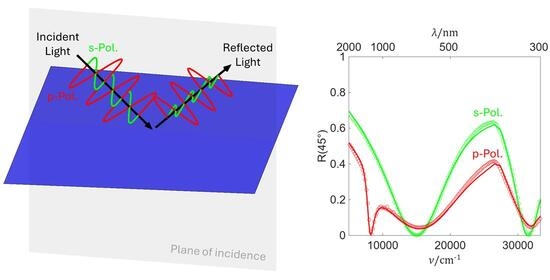
We review the general properties of optical reflection spectra recorded from smooth solid surfaces from the infrared up to the X-ray spectral regions. Emphasis is placed on metal surfaces. By introducing a parallelism between a simple classical oscillator model treatment and surface reflection of light, general features of normal incidence reflection spectra are derived in a qualitative manner. This rather tutorial approach as relevant for an ideal metal surface is complemented by a broad elaboration of analytical features of realistic reflection spectra. The discussed topics include manageable dispersion formulas, the Kramers–Kronig method, oblique light incidence effects with an emphasis on Azzam’s analytical relations between the Fresnel’s coefficients, as well as special spectroscopic configurations involving reflection measurements at grazing light incidence. Further emphasis is placed on Infrared Reflection Absorption Spectroscopy IRAS, the Berreman effect, as well as X-ray reflectometry XRR. This way, we provide a synthesis of basic textbook material with advanced experimental and theoretical skills useful in the analytical work of an optical coating practitioner.

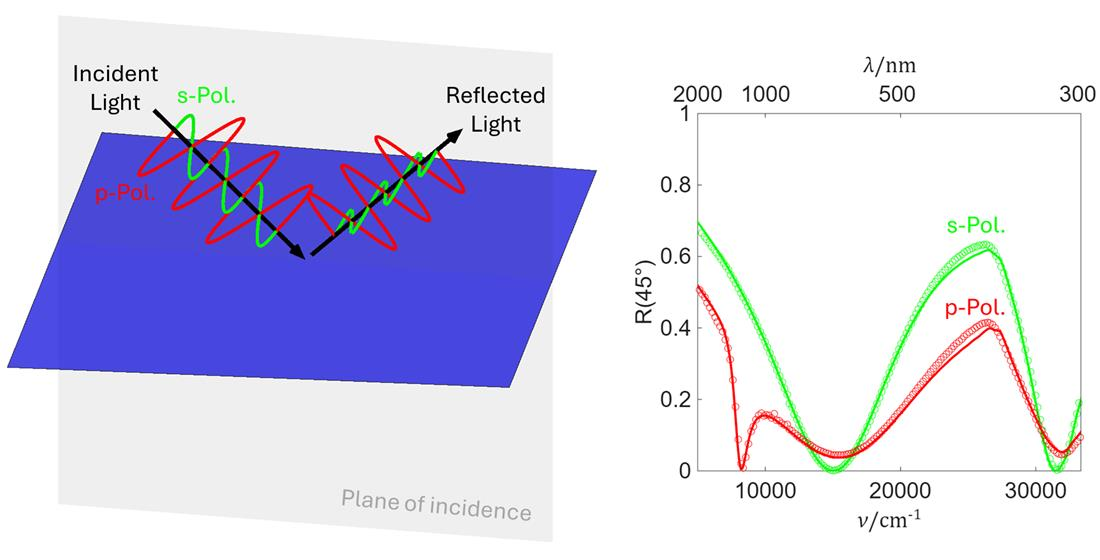
Graphical Abstract

1. Introduction

Many metals belong to the class of optical materials. Owing to the presence of free (i.e., conduction) electrons, metals have specific optical properties in a wavelength range from the ultraviolet (UV) up to practically infinitely large wavelength values [1,2,3]. These specific optical properties make them indispensable candidates for use in various kinds of optical coatings [4]. With respect to optical applications, we find metals like aluminum, gold, silver, and chromium among the most frequently used metals in coatings.
Metals are of primary importance for the design of reflectors, optical transmission filters, neutral density filters, asymmetric beam splitters, decorative coatings [4,5,6], solar absorbers [7], or so-called black reflectors [8]. Often, their unique reflective properties are the feature that is primarily exploited in metal-containing optical coatings [9].
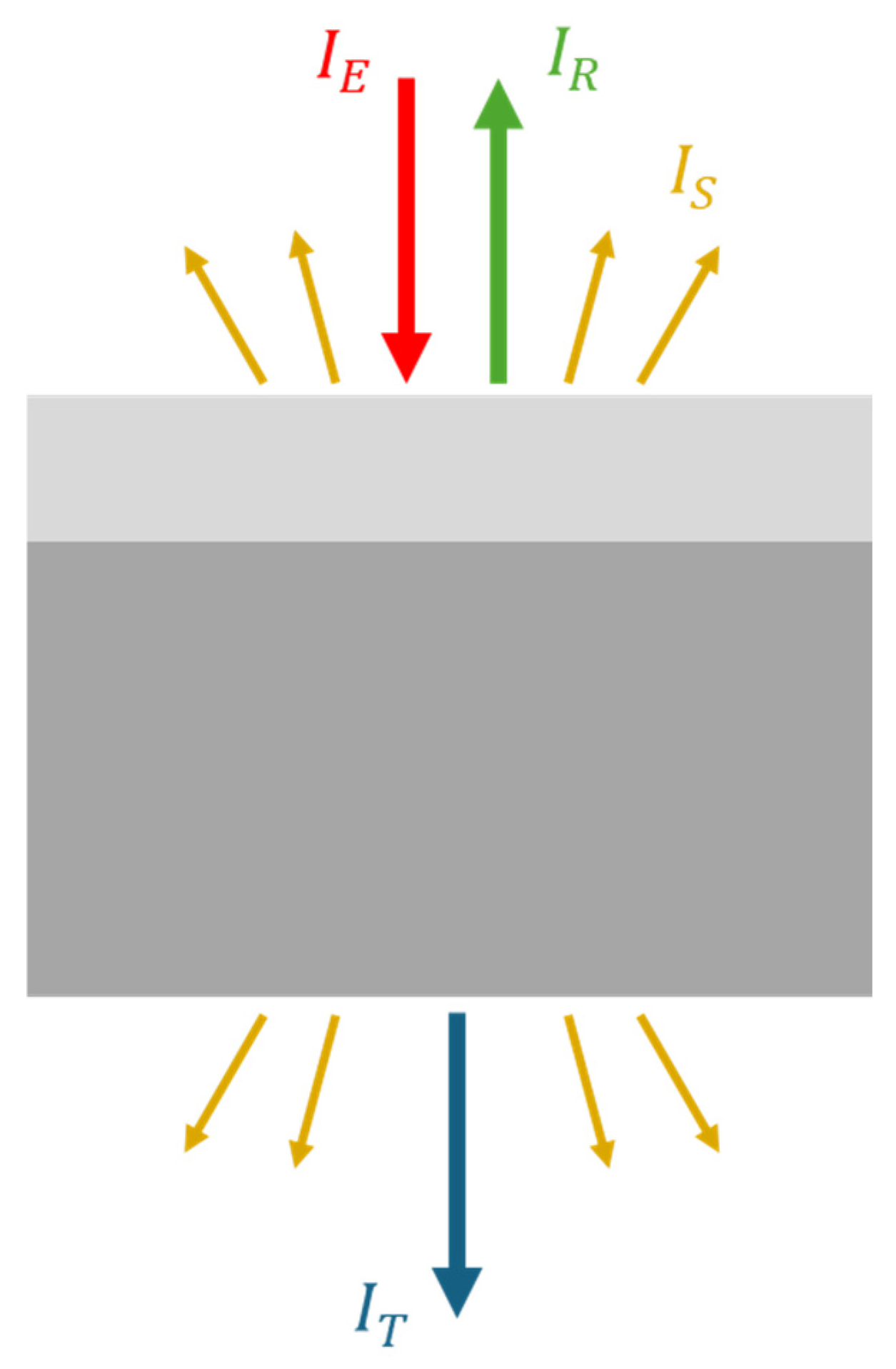
In general, any coating composed of passive materials illuminated by light may primarily transmit, reflect, scatter, or absorb the incident electromagnetic radiation [10]. Here, the absorptance A of a sample is defined in physics as the ratio of the absorbed and incident radiation fluxes [3,11]. When considering the typical model assumptions valid in thin film optics [1,12,13] (particularly the assumption of plane monochromatic waves), we can write this as the ratio of absorbed and incident light intensities I [5,6,12,13], i.e.,
A I A I E
with I A   being the absorbed amount of the light intensity, and I E being the incident light intensity. Correspondingly, we define transmittance as T , reflectance as R , and scatter as S , according to the following:
T I T I E ; R I R I E ; S I S I E
(Compare Figure 1). Here, the intensity has to be understood as the average energy penetrating a unit area in a relevant time interval.
The focus of the present paper is on the reflectance, and, particularly, on the reflectance arising at any single plane interface in a system as shown in Figure 1.
In consistency with energy conservation, we may write the following [10]:
1 = T + R + A + S
When restricting to the simple model case when scatter is negligible, from S = 0 we find the sample absorptance as follows:
A = 1 T R
If the sample absorptance cannot be measured directly (compare [14,15]), determination of the absorptance requires—as a minimum—knowledge of T and R .
Before turning to some necessary theoretical material, we would like to emphasize that this paper is dedicated to the memory of Ronald Willey, who passed away on 21 January 2025. To honor Ron’s work in a dignified manner, we decided to write the present paper with emphasis on the description of the optical properties of smooth metal surfaces, in a style that combines features of a tutorial with those of a review paper.
As the focus of the paper is on light reflectance at smooth surfaces, we would like to emphasize a specific feature of our approach. Clearly, any interface reflection may be quantified in terms of Fresnel’s formula, which are derived and discussed in any modern textbook on optics, solid state, or optical surface spectroscopy. Basically, the derivation makes explicit use of Maxwell’s boundary conditions for the electric and magnetic fields at an interface. Nevertheless, in history, Augustin Fresnel (1788–1827) could not make use of Maxwell’s theory [16], because he died before James Clerk Maxwell (1831–1879) was even born. Therefore, basic features of optical reflection spectra should be physically accessible even without making use of Maxwell’s boundary conditions explicitly. Consequently, as a complement to the standard approach, we provide a discussion of reflection spectra making use of parallelism to the properties of a driven harmonic mechanical oscillator. Our intention is to provide enhanced modern tutorial to graduate students and newcomers to optical coatings and surface spectroscopy with the purpose of facilitating qualitative physical understanding of the topic and providing an overview of modern measurement principles. Also, the university teaching staff might benefit from the treatment. We understand that one can collect the corresponding knowledge from dozens or perhaps hundreds of relevant textbooks, but according to our university teaching experience, a beginner in the field tends to get lost in the vast amount of available literature. With respect to our topic, we recommend focusing on the basic textbooks [17,18,19,20]. Thereby, Refs. [18,19] naturally tend to provide an excellent view on the topic from the semiconductor side, while [17] provides a balanced treatment of all kinds of optical properties of solids. Closest to our intention is the treatment in [20] with direct relation to thin film optical reflection spectroscopy, which is to our knowledge not available in English. The intention of our paper is to condense relevant aspects from these sources and simple classical mechanics into a tutorial on the optical properties of surfaces and interfaces, the latter being crucial elements for the functionality of any optical coating. This treatment forms the content of Section 2.1, Section 2.2, Section 2.3, Section 2.4 and Section 2.5, as well as parts of Section 3.2. In Section 2.6 and Section 3.1, the focus is on the review of basic spectrophotometric measurement techniques, the latter belonging to fundamental analytical equipment available in any optical coating facility.

2. Theoretical Aspects

2.1. First Considerations

To comply with the topic of optical coatings in the simplest manner, this study will deal with flat samples only, built from a stratified isotropic medium with a symmetry axis perpendicular to any of the surfaces and interfaces [13]. As an example, this could be an optical coating deposited on a flat isotropic substrate (Figure 1).
The most pragmatic choice for the optical characterization of such a sample in daily characterization or quality control practice [21] could be to perform a transmission measurement, resulting in a transmission spectrum T ω . Here, ω is the angular frequency of the incident light. However, the information obtained from this transmission measurement is incomplete, because it is not clear what happened to the amount of light that is missing in transmission. Indeed, from (3) it is immediately clear that reliable information on the sample absorptance cannot be obtained from transmission measurements only; instead, the sample reflectance as well as the scatter must be measured. Even when restricting on the model case of sharp and smooth interfaces between stratified media (as we do), according to (4), a conclusion on the sample absorptance requires knowledge of transmittance and reflectance. Already, from here, it turns out that reflection measurements are at least equally important in solid state spectroscopy as transmission measurements. We mention in this context the value of reflectance measurements in surface analytics [22] and thin film optics [23,24] alike. Because of the large amount of information that may be drawn from reflection spectra, early studies on the use of neural networks in thin film optical recognition tasks make primary use of reflection spectra [25,26,27].
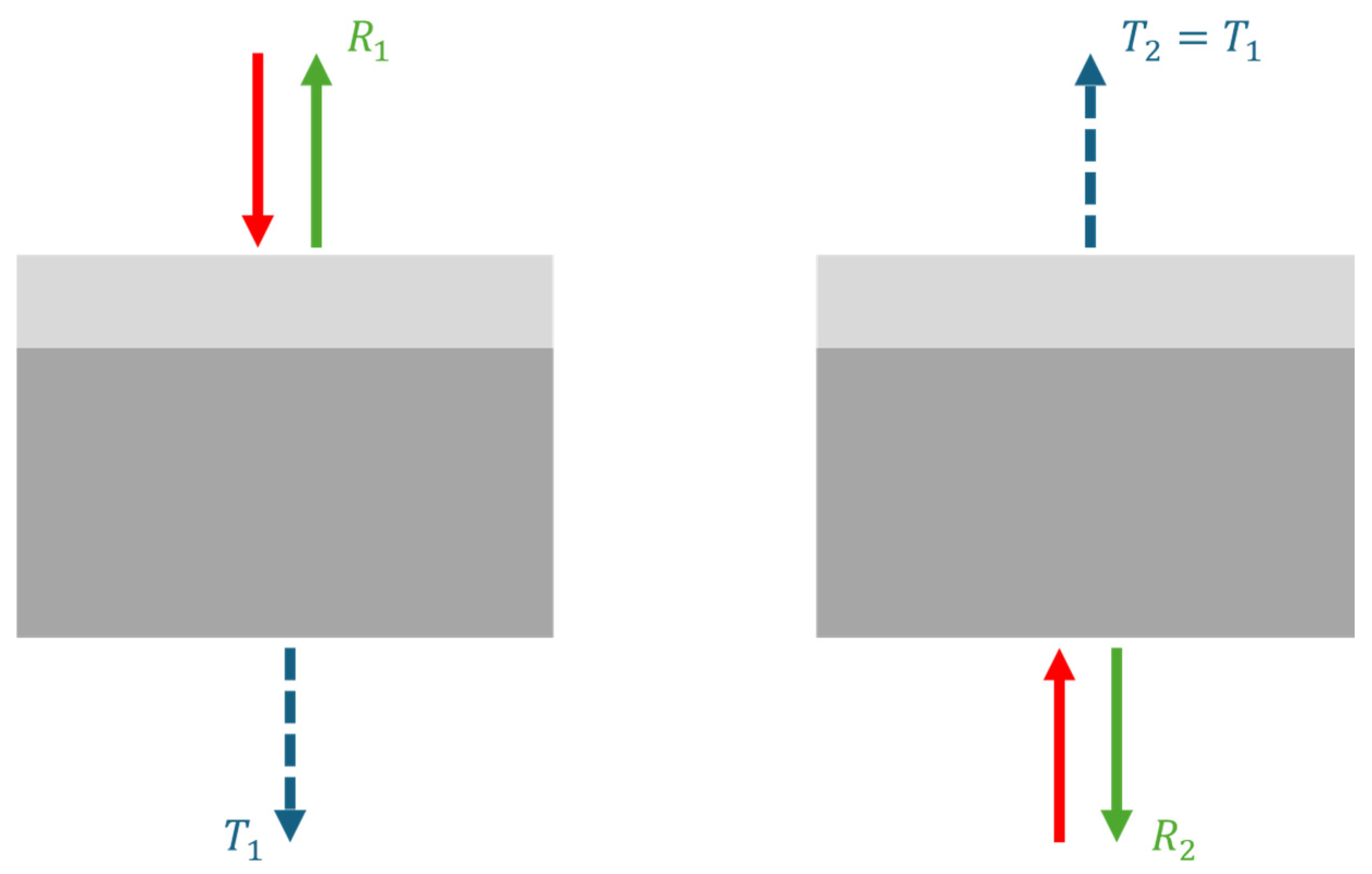
We would like to emphasize two further arguments that magnify the value of reflection measurements. Imagine the situation sketched in Figure 2. On left, light is incident from the top of the sample, giving rise to a certain transmission ( T 1 ) and reflection ( R 1 ) signal. On the right, the light path is reversed, the light is incident from the bottom, formally giving rise to a transmission signal T 2 and a reflection signal R 2 . However, as every experienced spectroscopist knows, the transmittance is insensitive to a light path reversal [5,6]. For the transmission measurement of a single-side coated substrate, it does not matter whether the sample is illuminated from the coated side (here from top), or from the substrate side (here from bottom). Hence, T 1 = T 2 . Thus, reversing the light path in a transmission measurement does not provide any new information.
The situation is different for reflection measurement. From (4) and T 1 = T 2 we immediately obtain the following:
A 1 + R 1 = A 2 + R 2
In any absorbing sample, this allows for different reflectances measured from the top and bottom sides. Hence, in a reflection measurement, light path reversal (a sample turn in practice) may provide new information. This is a principal advantage of reflection measurements compared to transmission measurements.
This leads us to an interesting conclusion. Let us measure a sample transmittance of 0.2 (i.e., 20%). From this measurement alone, we cannot conclude on the presence of absorption in the sample, because the remaining 80% may have been reflected. Of course, the situation is the same for a single reflection measurement.
However, if two reflection spectra recorded from top ( R 1 ) and bottom ( R 2 ) are available, further conclusions may be drawn. Provided that the R 1 R 2 , from (5a) we immediately find the following:
R 1 R 2 A 1 A 2
Therefore, at least one of the absorptances A 1 and A 2 must be different from zero. Hence, a sample that shows different reflection from top or bottom must necessarily contain absorbing fractions. Or, even without a spectrometer, when the color appearance from both sample sides is different, the sample must absorb in the visible spectral range (VIS).
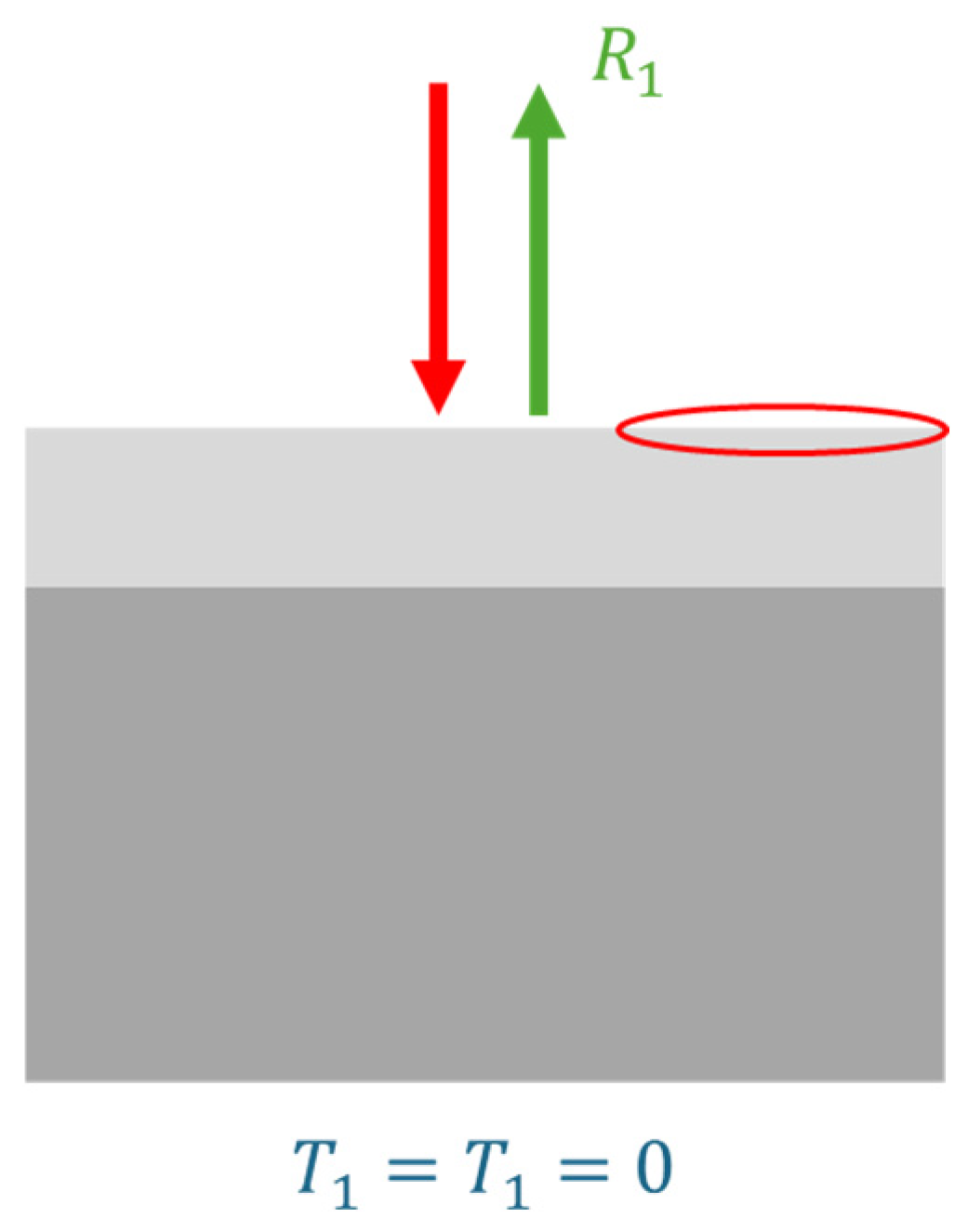
We would like to provide a second argument for the use of reflection measurements. Imagine the situation of a completely intransparent sample. This could be a coating on a silicon wafer in the VIS. The VIS transmittance is clearly zero; hence, a transmission measurement makes no sense at all (Figure 3).
Nevertheless, a reflection signal will be available anyway (the only exclusion would be a perfect absorber); it is at least the sample surface (highlighted by the red ellipse) that usually provides a reflection signal, which still carries information about the properties of the sample material. Hence, reflection measurements are indispensable in the analytics of intransparent samples. In special cases, the sample reflectance of a strongly absorbing sample may coincide with the reflection spectrum of the single sample surface.
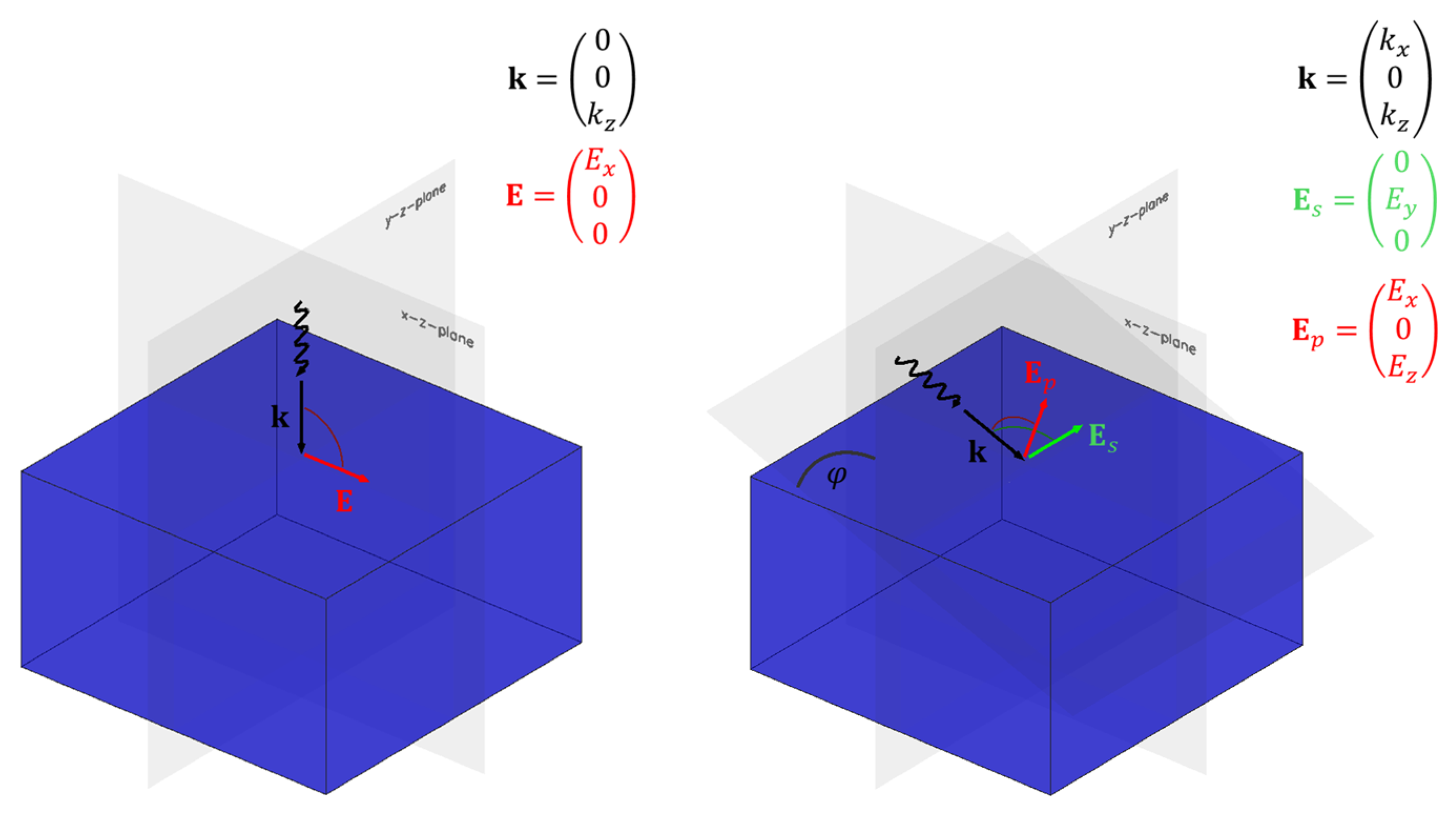
From here we postulate the composition of the simple model system that will accompany us through Section 2 and parts of Section 3 of this study. In the forthcoming, we will restrict on certain features of a reflection spectrum obtained from the surface between vacuum (or air) and an optically homogeneous and isotropic non-magnetic material, recorded at normal incidence (Figure 4, on the left).

2.2. The Reflection of a Single Interface at Normal Incidence

Let us assume a smooth plane interface between a damping-free incidence medium (medium 1) and a second (exit) medium (medium 2), that may show some damping (Figure 4).
Provided that both media are optically isotropic, we write their complex indices of refraction n ^ as follows:
First   medium :   n ^ 1 = n 1
Second   medium :   n ^ 2 = n + i K
Here, n 1 , n , and K are real numbers. The n -values correspond to the usual real refractive indices, while K is the extinction coefficient, here of the second (exit) medium. Furthermore, if both incidence and exit media are non-magnetic (i.e., μ = 1 with μ being the relative permeability), the complex index of refraction is related to the complex dielectric function ε via the following [1,2,21]:
n ^ = ε
Table 1 provides an overview of optical material parameters of homogeneous, isotropic and non-magnetic materials, as used in this study.
In terms of our model assumptions, the reflection at the interface between media 1 and 2 may be calculated by direct application of the Fresnel’s formula (see, for example, [1,18,19]). We will return to these formula later in Section 2.5. Now let us note that at normal incidence (Figure 4 on left), a simplified equation for the interface reflectance holds, according to the following:
R = n 1 n 2 + K 2 n 1 + n 2 + K 2 = 1 4 n 1 n n 1 + n 2 + K 2
Note that the reflectance is one (or 100%) whenever n = 0 holds. This extreme model situation describes what may be called an ideal metal, such that (9) predicts a large reflectance of light at metal surfaces. If the light is incident from vacuum (or with good accuracy from air, assuming ε = μ = 1 ), from (9) we quickly obtain the simpler relation [17,19]:
R = 1 n 2 + K 2 1 + n 2 + K 2 = 1 4 n 1 + n 2 + K 2
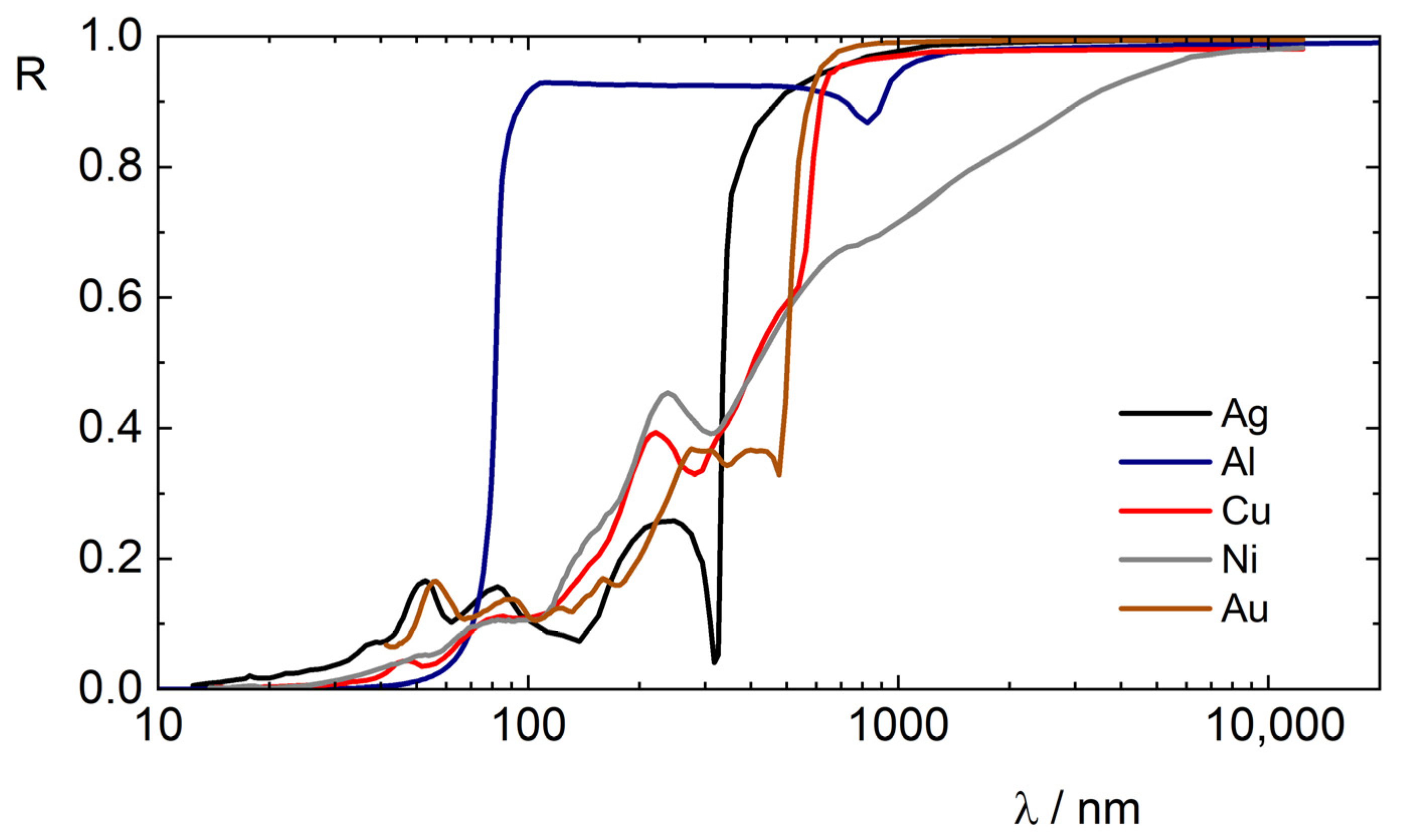
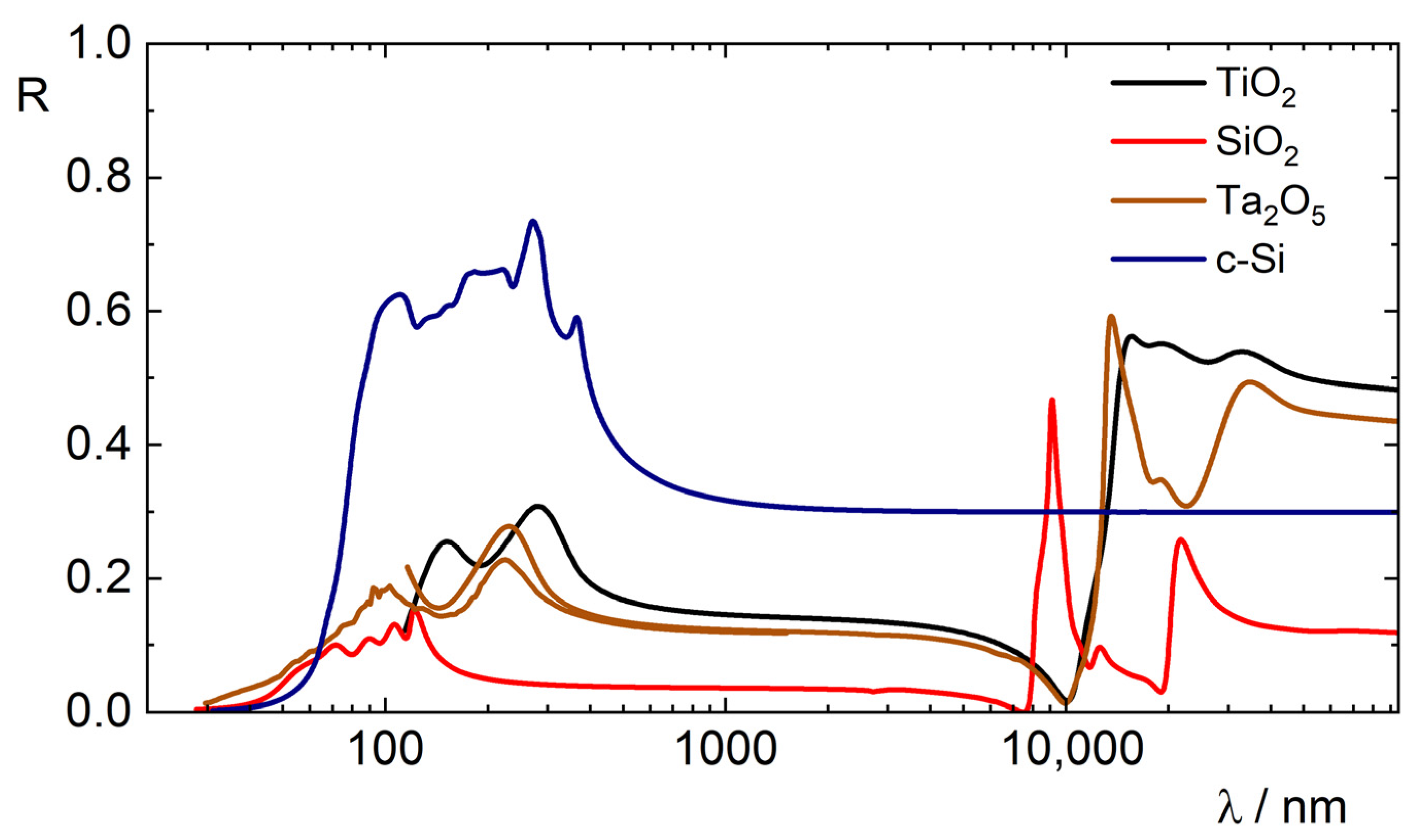
Figure 5 and Figure 6 show examples of different normal incidence reflection spectra at air–metal interfaces (Figure 5) and air–dielectric (or semiconductor) interfaces (Figure 6). The reflectances have been calculated by means of (10), making use of optical constants of metals as implemented in the UNIGIT database [31]. For the other materials, data available at [32] based on data from [33,34,35] have been used.
Let us mention three important empirical findings:
(a)
For λ 0 , the reflectance approaches zero. This is observed in metals and dielectrics (or semiconductors) alike.
(b)
For λ , the reflectance of all metals approaches one. This is different to the behavior of dielectrics.
(c)
In the UV/VIS/IR spectral regions, the reflectance of several materials shows specific spectral features as characteristic to resonances.

2.3. A Simple Oscillator Model Approach

This section forms the basic tutorial part of this study. We will present a simple model that qualitatively explains the phenomenological characteristics found in the reflection spectra from Figure 5 and Figure 6. The basic idea is that the electric field in the electromagnetic wave results in the formation of induced microscopic dipoles, which oscillate with the frequency of the wave. To relate those dipole moments to our reflection spectra, we will simply assume that a vanishing amplitude of the oscillating dipole moment p corresponds to a vanishing interaction of light with matter. In this case, the wave propagates through the medium similarly as through a vacuum. Correspondingly, T 1 and therefore, according to (3) or (4), R 0 . On the contrary, when the oscillation amplitude of the induced dipole becomes very large, the light–matter interaction is strong, such that we expect relevant features in the reflection spectrum, and particularly a large reflectance.
In the electromagnetic theory, (9) or (10) may be derived from the requirement of continuity of tangential to the surface components of the electric and magnetic field strength vectors [21]. Therefore, the normal incidence reflectance according to (9) appears to increase when the contrast in optical constants of media 1 and 2 increases. This provides the link to our further qualitative discussion of normal incidence reflectance in termini of oscillating dipoles: once there are no dipoles in the incidence medium (vacuum), the appearance of strong dipoles in the exit medium results in a large contrast in the optical constants, and therefore in a large reflectance.

Oscillator Model

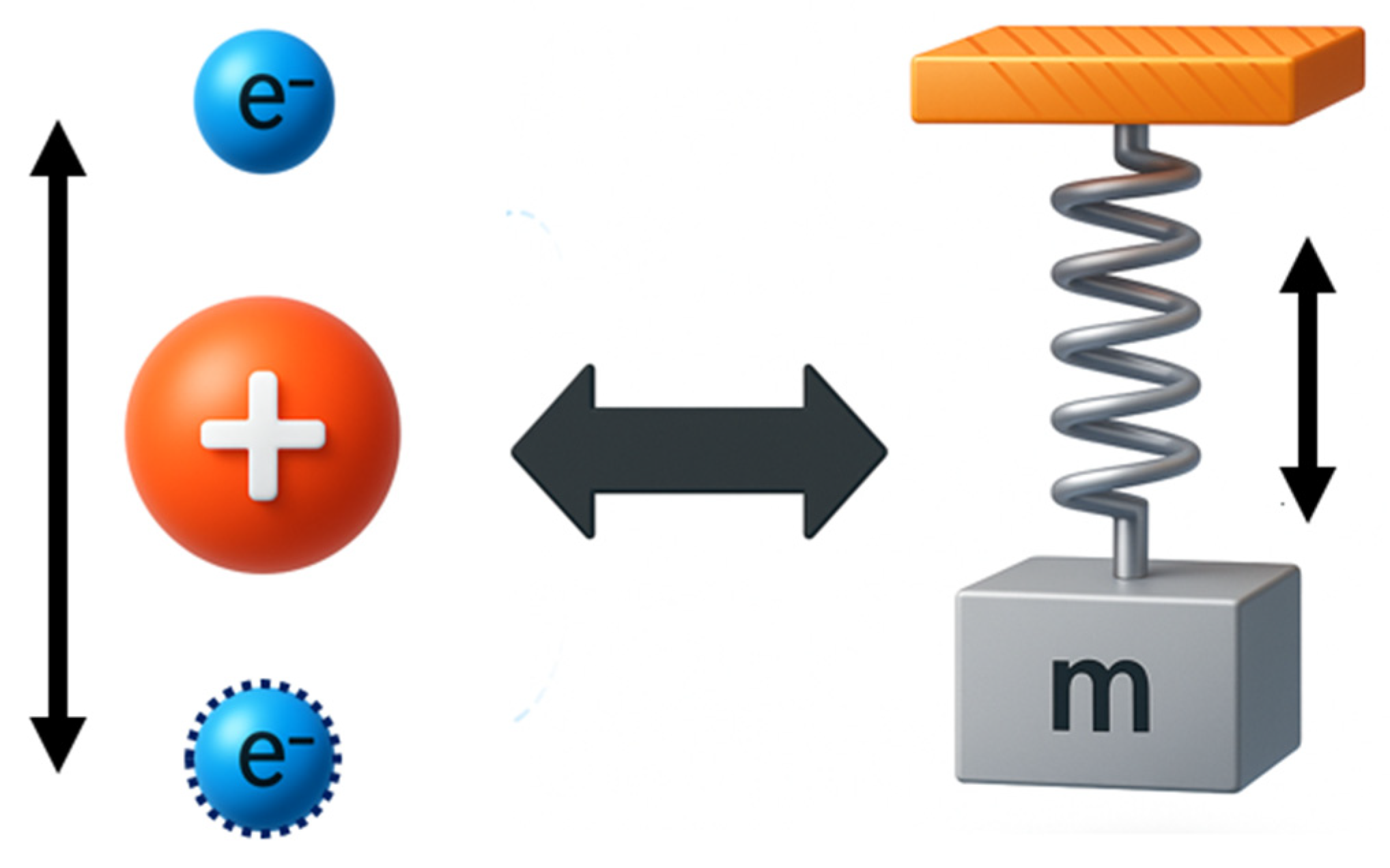
Assume now an oscillation of a dipole formed from a positive (+) and a negative (−) charge q separated from each other by a distance x . Then, the dipole moment is p = q x . In our model, and according to Figure 7, the dipole shall now be modeled by a mass-on-a-spring system [36]:
To avoid complex calculus at this stage, in this model we will further neglect any damping, such that from Newtons law we find the following:
F = F Coulomb + F restoring = m a
where F denotes forces, m the reduced mass of the considered two-bodies system, and a the acceleration.
When setting F restoring = κ x , (κ is the spring constant), we obtain the equation of motion:
q E κ x = m x ¨
Here, E is the electric field strength in the incident light wave. Assuming a monochromatic incident wave, the monochromatic ansatz E = E 0 cos ω t ; x = x 0 cos ω t quickly results in the steady-state solution:
x = q m 1 κ m ω 2 E
Therefore, we obtain the oscillating dipole moment according to the following:
p = q x = q 2 m 1 κ m ω 2 E
IR/VIS/UV response
We are seeking conditions when this dipole moment may become very large. Once q and m are given, the only possibilities for a diverging (or very large) dipole moment are as follows:
(a)
A practically infinitively large electric field  E ;
(b)
A vanishing denominator in (11) and (12).
Hence,
p E κ m ω 2 0
Condition (a) seems exotic, but in fact there are spectroscopic (interface-sensitive) techniques that gain their sensitivity from sufficiently large by amplitude oscillating electric fields near the interface [29,30]. This is rather obvious at structured metal surfaces, but even in the vicinity of a plane metal surface, E may become rather large at oblique incidence. Since in this paragraph we are discussing normal incidence, we will not go into details here but will return to them later in Section 3.2. Moreover, in any microscopic theory, the field E in (12) must be associated with the local electric field in the spatial vicinity of the considered dipole, which is not necessarily identical to the field in the incident wave [21,37,38].
Our focus shall now be on condition (b).
In the simplest classical non-relativistic picture, when regarding an electron oscillating around a heavy (positively charged) nucleus, the value q coincides with the negative elementary charge e , while the reduced mass of the electron–nucleus system given by m = m e m n u c l e u s m e + m n u c l e u s is practically identical to the electron rest mass m e because of m e m n u c l e u s and m n u c l e u s being the mass of the nucleus. Hence, we set
q = e ; m = m e ; p = e 2 m e 1 κ m e ω 2 E
The specific situation in real metals is characterized by the coexistence of both bound and free electrons. In our classical model, κ = 0 corresponds to a free electron, while κ > 0 corresponds to bound electrons. When further discriminating between these situations, we observe the following:
κ m e ω 2 0 κ = 0 ω 0 κ > 0 ω ω res κ m e
Therefore, for free electrons, according to (12) we find the dipole moment according to the following:
p free = e 2 m e ω 2 E ω 0
This expression is obviously independent from the concrete metal. When accepting the rule—large dipole moment strong reflectance—it explains the converging behavior of the normal incidence reflectance of different metals at the smallest frequencies (compare Figure 5 and Equation (16)). For bound electrons, instead, we obtain resonant behavior at ω ω res . Once the resonance frequencies depend on the assumed spring constant and are therefore material dependent, spectral features in the reflection spectrum caused by the optical response of bound electrons appear to be material- and frequency-dependent. For reasonable spring constants and the rather small electron mass, those features usually fall into the VIS/UV spectral regions (compare Figure 5) [1]. In particular, the response of bound electrons is responsible for the specific color appearance of several metals.
In the energy band model resulting from a quantum mechanical treatment, optical excitations of free electrons are associated with intraband transitions, while those of bound electrons with interband transitions [17,39].
Let us shortly discuss the reflection spectrum of dielectrics in terms of this model. Once in ideal dielectrics, there are no free charge carriers, and we only must consider the situation of κ > 0 . For ω 0 from (12) we find the following:
ω 0 : p bound q 2 κ E
This results in finite values of the dipole moments, which depend on the assumed spring constants and are therefore specific for a given material. In terms of our assumed relation between dipole moment and reflectance, we must expect different values of the reflectance of different materials. This is exactly what we have observed in Figure 6.
Prominent structures in the reflectance of dielectrics therefore occur only at resonance, i.e., at κ m ω 2 0 . Electronic resonances are again observed in the UV/VIS spectral ranges (compare Figure 6), while the vibrations of the much heavier atomic cores (a larger m in (12)) in ionic crystals are excited in the middle infrared MIR and give rise to what is called a reststrahlen band in the reflection spectrum [38]. Note that reststrahlen band optical absorption may be excited in elemental crystals as well, but only if more than 2 atoms are incorporated into the primitive cell of the crystal structure [40]. The primitive cell of the silicon lattice contains only two atoms, and therefore, in Figure 6, no reststrahlen absorption is observed.
The behavior at  ω :
At largest frequencies, from (12) we find the same asymptotic behavior for both free and bound charge carriers alike according to [2], as follows:
ω : p q 2 m ω 2 E 0
This is a physically transparent result because at largest frequencies, no charge carrier with a finite rest mass can follow the fast oscillations of the field. Hence, the electromagnetic wave propagates through the medium without remarkable interaction, which explains the relative transparency of matter for X-ray and γ-radiation. Correspondingly, the reflectance is expected to approach zero, no matter whether we deal with free or bound electrons. In terms of our model, this explains the identical behavior of the reflectance of metals and dielectrics (Figure 5 and Figure 6) for ω .
Relation to Surface Reflection: It is possible to link our simple microscopic oscillator model directly to reflectance spectra described by the Formula (6)–(10) in Section 2.2. Neglecting the simplicity differences between the local and average electric fields (for more sophisticated treatments compare [37,38]), we can write the following:
First   medium   ε 1 = 1
Sec ond   medium   ε 2 = 1 + N p ε 0 E 1 + N q 2 ε 0 m 1 κ m ω 2 = 1 + ω p 2 κ m ω 2
Here, N is the concentration of induced dipoles in the second medium, and ω p 2 is the square of the plasma angular frequency according to the usual definition [21,29]:
ω p 2 = N q 2 ε 0 m
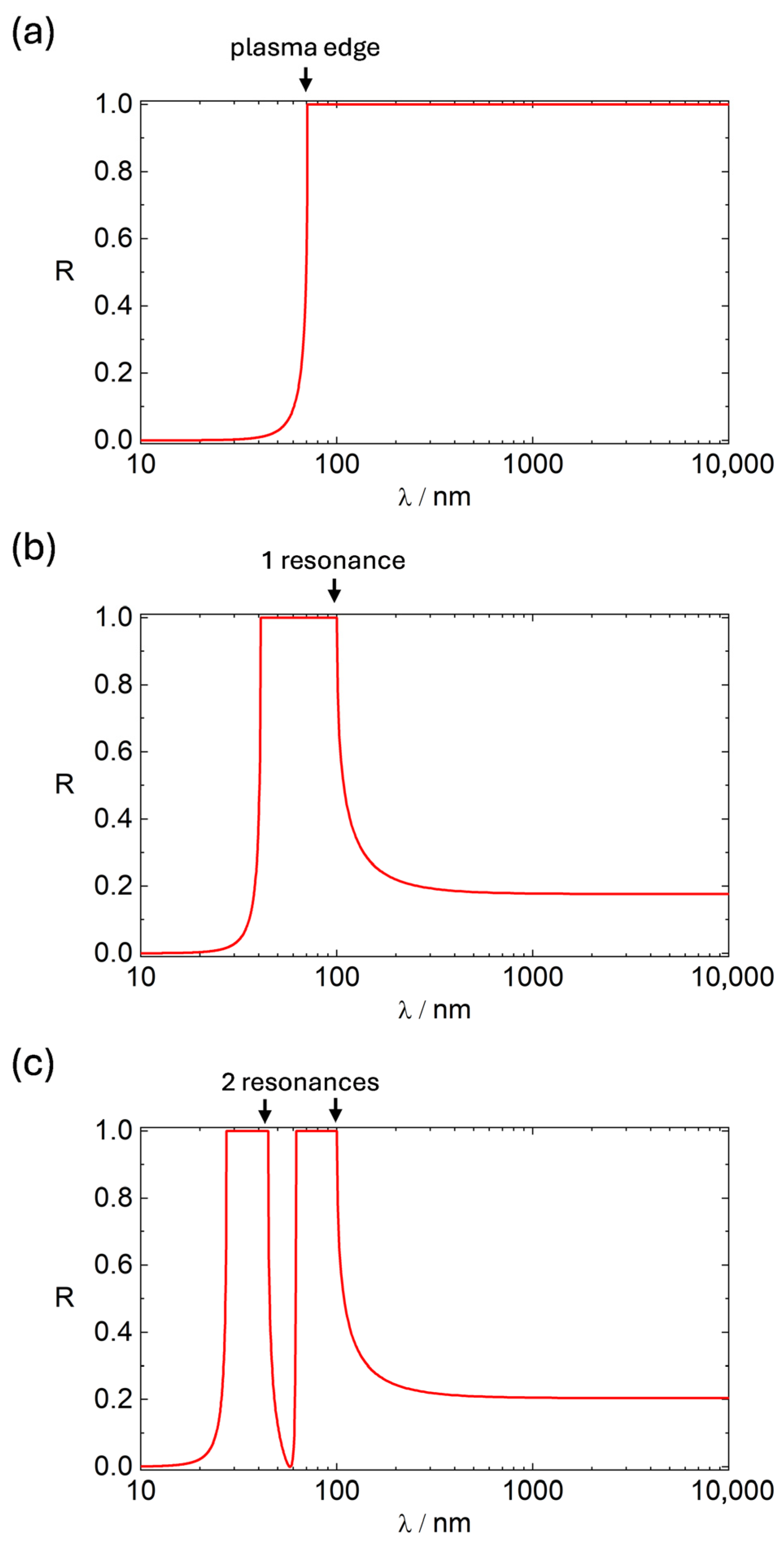
Figure 8 presents model calculations of normal incidence reflectance spectra obtained from these simple relations. The spectrum shown on top of the figure corresponds to the case of only free charge carriers (Drude metal), i.e., κ = 0 . It may serve as a model for the reflectance of metal surfaces at small frequencies (Figure 5). It naturally demonstrates the well-known fact that plasma reflects light of all frequencies smaller than the plasma frequency. On the contrary, the image in the center of the figure corresponds to κ > 0 . It gives rise to a single resonance frequency (single oscillator model) and provides an idealized reproduction of local reflectance maxima of bound electrons at resonance. On bottom, (20) has been generalized to the case of two resonance frequencies, corresponding to the existence of groups of bound charge carriers differing in their bonding strength, i.e., in the assumed κ (multi-oscillator model). Because of the assumed absence of damping, all the spectra appear idealized compared to the spectra shown in Figure 5 and Figure 6; nevertheless, they reproduce the basic empirical findings as summarized at the end of Section 2.2.
According to (20), n 2 < 1 may be observed. Indeed, for sufficiently large angular frequencies, we obtain the following:
ε 2 1 + N q 2 ε 0 m 1 κ m ω 2 = 1 + ω p 2 κ m ω 2 ω 1 ω p 2 ω 2 < 1 n 2 < 1
The phase velocity v p h [41] of the propagating wave is therefore as follows:
v p h = c n 2 > c
with c representing the velocity of light in vacuum. This might seem to contradict relativity. However, signals are transferred with so-called group velocity v g r rather than with the phase velocity. A short calculation shows that for the dispersion behavior used in (20), v gr becomes
ε 2 ω 1 ω p 2 ω 2 v gr c n 2 < c
This relation provides no superluminal signal transfer, and therefore, no conflict with relativity occurs at this point.

2.4. More General Dispersion Formulas

In (20) we recognize at least two shortcomings:
  • Relation (20) does not suffice thermodynamics, because relaxation is excluded;
  • At resonance, ε 2 shows a singularity that is not observed in reality.
Therefore, in practice, our oscillator as introduced in Section 2.3 must be replaced by a damped oscillator modifying the equation of motion according to the following:
q E 2 γ m x ˙ κ x = m x ¨
Then, instead of (20), we obtain a complex dielectric function of an assembly of oscillators according to [1].
ε 2 = 1 + ω p 2 κ m ω 2 2 i ω γ 1 + ω p 2 ω 0 2 ω 2 2 i ω γ
with 2 γ being the damping constant. A finite value of γ results in the emergence of a positive imaginary part of the dielectric function. Thereby, the imaginary part of the dielectric function is responsible for energy dissipation caused by light absorption in the medium. No dissipation occurs when the damping constant is equal to zero. For the response of free electrons ( κ = 0 ), we have the Drude function, as follows [1]:
ε 2 = 1 ω p 2 ω 2 + 2 i ω γ
An early implementation of the classical relations (23) and (24) into thin film calculation routines has been reported by Dobrowolski et al. [42]. Also, Equations (23) and (24) may be written in different conventions. We make use of the convention when the damping constant is 2 γ [3,21]. In other sources the damping constant may be given by γ ; in this case the factor 2 in the denominators of (23) and (24) disappears [19,20].
At ω γ , (24) gives rise to a normal incidence reflectance of a metal surface according to the Hagen–Rubens formula (for a derivation see [21]):
R 1 n 1 8 ε 0 ω σ stat
where σ stat is the static electric conductivity of the medium.
Obviously, according to (25), R approaches a reflectance of one regardless of the chosen material when the frequency approaches zero, which is, again, consist with the behavior illustrated in Figure 5.
In a quantum mechanical treatment, (23) has to be replaced by a quantum mechanical dispersion formula (compare, for example, [43]). The classical Formulas (23) and (24) as well as the Lindhard formula, more specific for metals, are obtained as particular cases from that more general treatment [39,43,44]. Although a quantum mechanical treatment is usually not so illustrative, some analogy to our classical picture may be formulated. Thus, in our classical picture, prominent spectral features in reflectance are expected when the induced dipole moments become extraordinarily large. In the quantum mechanics of crystals, instead, it is the appearance of critical points (Van Hove singularities) in the joint density of electronic states that gives rise to characteristic spectral features [18,19,38]. A corresponding elaboration of the reflection spectra of metals like Ag, Cu, or Al can be found in the studies of Ehrenreich [22,45,46]. An elaboration of metal spectra in terms of the classical relations (23) and (24) is reported in [47].

2.5. Oblique Incidence

The reflectance according to (2) is defined as the ratio between two light intensities and may therefore be called the intensity reflectance. Note that R is a real quantity. It is the quantity that may be measured by means of a spectrophotometer (we will return to this question later in Section 2.6 and Section 3.1), and it provides access to the electric field real amplitude relations in the reflected and incident electromagnetic waves. However, it does not contain any information about the phase relations between the fields in the corresponding waves.
  • Fresnel’s equations
To quantify both the amplitude and phase information, one may introduce (complex) electric field reflection coefficient r (Fresnel coefficients) using the corresponding electric field strength’s according to the following:
r E r E e
Clearly,
R r r * = r 2
Hence, according to (27), knowledge of r provides access to R , but not vice versa. Therefore, in the basic theory, one first must calculate r , before attaining access to R . For the two basic assumed linear light polarizations (s- and p-polarization [21]), the corresponding electric field reflection coefficients are given by the Fresnel formula (here written in the Mueller convention [48]) according to [3,19], as follows:
r s = n ^ 1 cos φ n ^ 2 cos ψ n ^ 1 cos φ + n ^ 2 cos ψ r p = n ^ 2 cos φ n ^ 1 cos ψ n ^ 2 cos φ + n ^ 1 cos ψ
where φ is the angle of incidence, and ψ is the angle of refraction.
  • Azzam’s Relations
As it has been pointed out by Azzam, there exist general relationships between the field reflection coefficients at a single interface at s- and p-polarization [49]:
r s 2 r p r s r s r p = cos 2 φ r p = r s r s cos 2 φ 1 r s cos 2 φ ; r s 1
r s r p 1 r s r p = cos 2 φ ^ B r p = r s cos 2 φ ^ B 1 r s cos 2 φ ^ B
where φ ^ B is defined through the following:
tan φ ^ B = n ^ 2 n ^ 1
Obviously, regardless of the assumed refractive indices, from (28) we find the following:
φ = 0 r p = r s R p = R s φ = 45 ° r p = r s 2 R p = R s 2
The latter result is known as the Abeles condition [49] and represents an important direct conclusion from the Azzam relations. From (29) and (30) we learn the following:
r s = 1 r p = 1 r s = 1 r p = 1
For real refractive indices, (31) coincides with the so-called Brewsters angle. In this case, (29) and (30) together yield the following:
φ = φ B r p = 0 r s = cos 2 φ B
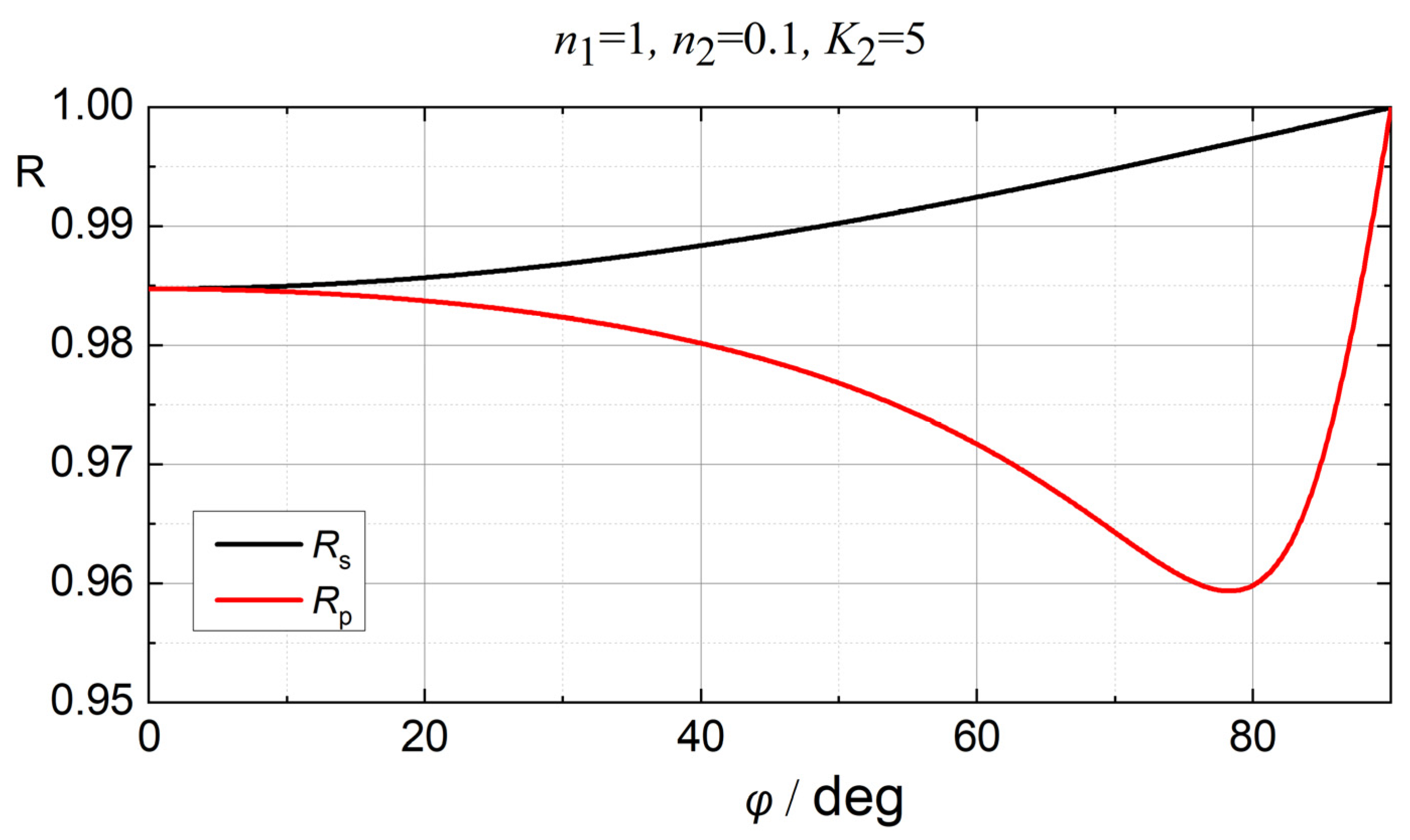
In other words, at the Brewsters angle, no p-polarized light will be reflected if the imaginary part of any of the refractive indices is negligible (Brewster effect) [21]. Because of the complex nature of the refractive indices of metals, the Brewster effect is relevant for dielectrics with negligible losses only. A model calculation of the angular dependence of the reflectance of an air–metal surface is presented in Figure 9. Instead of the Brewster effect, we merely observe a local minimum in the reflectance of p-polarized light.

2.6. Short Survey of Derived Experimental Techniques

2.6.1. Phase Reconstruction by Means of the Kramers–Kronig Formula

Generally, according to (27), knowledge of the reflectance R at a certain light frequency does not provide direct access to the phase δ ω of the complex field reflection coefficient, but only to its absolute value r ω . On the other hand, we have
r ω = r ω e i δ ω ln r ω = ln r ω + i δ ω
This makes it possible to calculate δ ω through a Kramers–Kronig transformation, provided that ln r ω is known at any frequency. We then have the following [50]:
δ ω = 2 ω π V P 0 ln r ω 1 ω 2 ω 1 2 d ω 1
Here, VP denotes Cauchy’s principal value of the improper integral.
In practice, of course, ln r ω is known only in a limited spectral region, which limits the accuracy of applying (35) in practical applications. Another problem may occur when an oblique incidence reflectance at p-polarization is investigated. Then, because of the dispersion of the refractive index, ϕ B = ϕ B ω , additional poles in (35) because of the Brewsters effect may result. In this case, additional terms (so-called Blaschke products) must be included in (35); such a procedure is described in [51].

2.6.2. Cavity Ringdown Decay

Cavity ringdown decay (CRD) was developed as a highly sensitive method for measuring absorption with pulsed laser sources. The technique is based on measuring the absorption rate of a laser pulse enclosed in an optical resonator. The light intensity within the resonator decreases exponentially with time because of multiple internal loops in the cavity. This is caused by various loss contributions due to absorption and scattering at the mirrors of the resonator, and the medium between them [52]. The precursor to this method can be found in [53,54,55]. In these cases, the decay time in a cavity has been already used for reflectivity measurements. The method represents a sophisticated development of the phase shift method for measuring photon lifetime and reflection in an optical resonator [56]. In the originally published version, it allows very simple loss measurement on the enclosed medium and on the mirrors used. Nowadays, a folded beam path [57] with a simple flip mechanism allows absolute measurement at oblique light incidence. The measurement method is now widely used, and a standardized procedure in accordance with ISO 13142 [58] is available for the precise determination of high transmission and high reflection values.
For very highly reflective mirrors (R > 99.999%), random optical loss fluctuation caused by particle intervention in the beam path inside the cavity limits the precision and needs to be filtered out. In [59], a combination of fixed- and variable-length cavities has been used to precisely measure a reflectance of 99.99956% with a remaining uncertainty of only 0.2 ppm.
Other modifications to the beam path also allow measurements on fibers [60,61], polarimetric measurements [62], or spatially resolved measurements [63]. The method can also be extended to CW lasers [64]. A brief overview of additional applications and methods can be found in [65]. Combining Cavity–Ring–Down with conventional methods improves the accuracy of reflection measurement, even when the reflectance values are significantly below the specified threshold of 99% in ISO 13142 [58] and the time constant of the exponential decay is therefore too low for the conventional approach [66].
Further information on this method and other developments can be found, for example, in the frequently cited review article [67].

2.6.3. Imaging Spectroscopic Reflectometry ISR

So far it has implicitly been assumed that the surface investigated shows lateral optical isotropic and homogeneous properties. In the case of real samples, this is not necessarily fulfilled; in the past, correspondingly modified characterization techniques were developed to pursue this circle of problems. This and the next subsections will shortly address this topic.
Let us start with in-plane inhomogeneous samples. Instead of a single reflection measurement, a lateral reflection mapping of the surface has to be performed. This forms the essence of imaging spectroscopic reflectometry ISR (for technical details, see [68]). This technique is applicable to laterally inhomogeneous surfaces and laterally inhomogeneous dielectric films. The large amount of input data requires sophisticated data processing techniques to guarantee an efficient surface characterization [69]. Specific applications include—despite the inhomogeneous films and artificially patterned surfaces—the surfaces of biological or medical objects. Recently, ISR has been reviewed with respect to applications to painted surfaces (artwork) [70]. Closer to the topic of this study, we also mention successful applications of ISR to the characterization of discontinuous gold films [71]. Further ISR applications will be exemplified in Section 3.2.1.

2.6.4. Reflectance Anisotropy Spectroscopy RAS

Finally, because of surface reconstruction phenomena, the isotropy of optically isotropic crystals may be violated at their surface. This may be investigated by means of Reflectance Anisotropy Spectroscopy (RAS) [72]. The method is also known as Reflectance Difference Spectroscopy (RDS).
Basically, the idea of the method is in the measurement of two (nearly) normal incidence reflection spectra with different linear polarization directions. It may thus be understood as some kind of normal incidence polarimetry. Because of surface reconstruction phenomena, RAS signals may be detected even from cubic (i.e., bulk optically isotropic) crystals.
Modern applications concern the in situ control of epitaxial growth [73]. As this topic is not in the primary focus of our study, we will not go into deeper detail here but refer to the treatment provided in [18].

3. Selected Applications

3.1. Measurement Aspects of R

Spectrophotometric measurement of specular transmission and reflection is a very common method for characterizing solid surfaces and thin films [74]. This section focuses on general aspects of spectrophotometric measurements and most common experimental techniques for measurements of specular reflectance.

3.1.1. General Aspects of Spectrophotometric Measurements

The performance of the spectrometers strongly depends on the technical parameters of the light source(s) and detector(s) [75]. Ideally, the light spot on the sample and the detector response should be spatially homogeneous. This can be achieved when using an integrating sphere [76], but it leads to a significant reduction in light throughput [77,78] and thus to a poorer signal-to-noise ratio [79].
The specific selection of suitable components depends on the required spectral range and optical resolution [75], the dynamic [80] and linearity range, the signal-to-noise ratio [79] and budget [81], the target instrument size [82] and measurement speed, and many other aspects [83,84,85] not addressed here. As a rule, a compromise must be found, as the various requirements have conflicting effects on the resulting random and systematic measurement errors. Systematic errors caused by the nonlinearity of the detector are critical [86,87]. They are common for CCD arrays [88] and photodiodes [89,90,91], while photomultiplier tubes typically show a quite good linearity [92]. Deviations from linearity can be detected by variable aperture measurements [93].
The reflectance accessories for spectrometers are commonly designed for flat samples. For other sample geometries, specific solutions are required but will not be discussed here. Even in the case of flat samples, deviations from the assumed sample position could alter the illumination conditions. Thereby, the resulting measurement errors are usually larger in reflection than in transmission. In transmission, typically only a small distortion of the spatial light distribution occurs and therefore it is commonly realized as an absolute measurement without using a suitable reference sample. Instead, for reflectance measurements, both relative (using a reference sample) and absolute measurement strategies are widely used. It is obvious that in the first case uncertainties in the reflectance of the reference mirror could be an additional error source, which can be eliminated when an absolute measurement is used. This is possible by performing the “100%” measurement in transmission mode without a sample and applying it to the reflection measurement. However, this requires that the transfer function of the optical components in the sample beam path is identical in both cases. Accordingly, adjustment errors and inhomogeneities of the optical components (contamination, defects, etc.) are potential sources of measurement error for reflectance. Spatial inhomogeneities in the intensity distribution in the measuring beam are particularly critical, as they may appear mirror inverted on the detector surface. This is relevant if the measurement involves an odd number of reflections. A general solution is to ensure that the homogeneously illuminated area on the sample and the sensitive area of the detector differ in size [94].
In the case of a single bounce of the measuring beam on the sample, the reflection is measured directly, making it suitable for measuring high and low reflection values. Otherwise, if the measurement strategy involves multiple bounces, it is the corresponding power of reflectance that is measured. This is advantageous for high reflectance values (e.g., mirrors), but less suitable for small reflectance values (e.g., antireflective coatings). According to (4), a good absorber must have a low reflectance and should therefore be measured with a single bounce technique, too.
Clearly, the intensity ratio of the reflected and incidence light (refer to Figure 1 and Equations (1) and (2)) defines the reflectance. During measurement, the intensity signal is commonly converted into an electrical signal by the detectors (photodiodes, avalanche photodiodes, multi-pixel photon counters, photomultiplier tubes, image sensors, etc.). Potential contributions from extraneous light and electronic offsets can be considered by an additional measurement of the dark signal I Dark (signal with forced I E 0 ). Instead of (2), the following generalized equation must be used in this case [36]:
R = I R I Dark I E I Dark
  • Dispersive and Fourier transform spectrometers
For the measurement of photometric quantities, either dispersive or Fourier transform spectrometers are used. In the former, a spatial distribution of the light is achieved by the monochromator using a dispersive element (grating, prism, etc.) and the spectral dependence is recorded individually for the wavelengths. In scanning spectrometers, this is done sequentially, but simultaneous detection is also possible using detector arrays. In Fourier transform spectrometers, on the other hand, the spectral dependence is calculated from the interferogram recorded from the polychromatic photometric signal. Here, all wavelengths are measured simultaneously, resulting in a high measurement speed. Due to the underlying principle, the abscissa accuracy is very high, but good ordinate accuracy is difficult to achieve [95]. An overview of potential sources of error in the implementation of the Fourier transform principle can be found, for example, in [96]. The application of Fourier transform spectrometers is mainly in the infrared spectral range (FTIR), where they have largely replaced dispersive spectrometers due to their significantly more compact design and reduced measurement time. Recent implementations can be found, e.g., in [97,98] and in datasheets from numerous manufacturers. In [99], corresponding spectrophotometer specifications with a focus on near-infrared spectroscopy are reviewed. The general principles of reflection measurement described below are almost independent of the specific operating principle of the spectrometer.
In dispersive spectrometers the monochromator is often part of the basic device (lower cost) and is located in front of the sample. This is referred to as monochromatic measurement [100]. If the monochromator is positioned behind the sample, this is referred to as a polychromatic measurement [100]. This has the advantage that the monochromator can reduce extraneous light before reaching the usually broadband sensitive detector.
  • Single- and dual-beam spectrometers
Fluctuations in the intensity of the light source in dispersive spectrometers are a source of random errors and can be compensated using an additional reference beam with identical intensity fluctuations. Single-beam spectrometers are less expensive due to the reduced number of components, but typically they are also less accurate, because intensity fluctuations cannot be eliminated this way. For demanding measurements, dual-beam spectrometers with an additional reference beam are preferred. Here, the measuring beam is split either by a beam splitter or a chopper wheel. If a beam splitter is used, a second, ideally identical detector is required, and the light intensity is divided between the two detectors. This results in a poorer signal-to-noise ratio and can be avoided when a chopper wheel is used instead. Here, the rotation speed of the chopper wheel must be sufficiently high to rule out any relevant drift of the light source. However, the measurement must now be synchronized with the chopper wheel movement, and the beam guidance is also somewhat more complex. On the other hand, the full intensity of the light source is available for the respective measurements, and the same detector can be used for both measurements. For this reason, this variant is often preferred.
When implementing the dual-beam principle, it is also common to assume that dark signals remain constant over time. Based on this assumption, the following sequence of measurements steps has become established (Table 2) [100]. First, during the so-called “auto zero” phase, the “100%” and (optionally) “0%” intensity measurements according to Table 2 are performed for both beams. In the case of a skipped “0%” measurement (neglectable offset), the corresponding intensities are set to zero and an additional source for noise (random error) is eliminated. The intensities from the “auto-zero” measurement are considered fixed for a device-specific duration and applicable for multiple samples.
Next, the intensities for both beams are measured for each sample, and the reflectance is calculated by the following:
R = I R I Dark I R Ref I Dark Ref I E I Dark I E Ref I Dark Ref
Clearly, without considering any drift and noise, the measured intensities from the reference beam would be identical, and (37) could be simplified to (36).

3.1.2. Relative Measurement of R

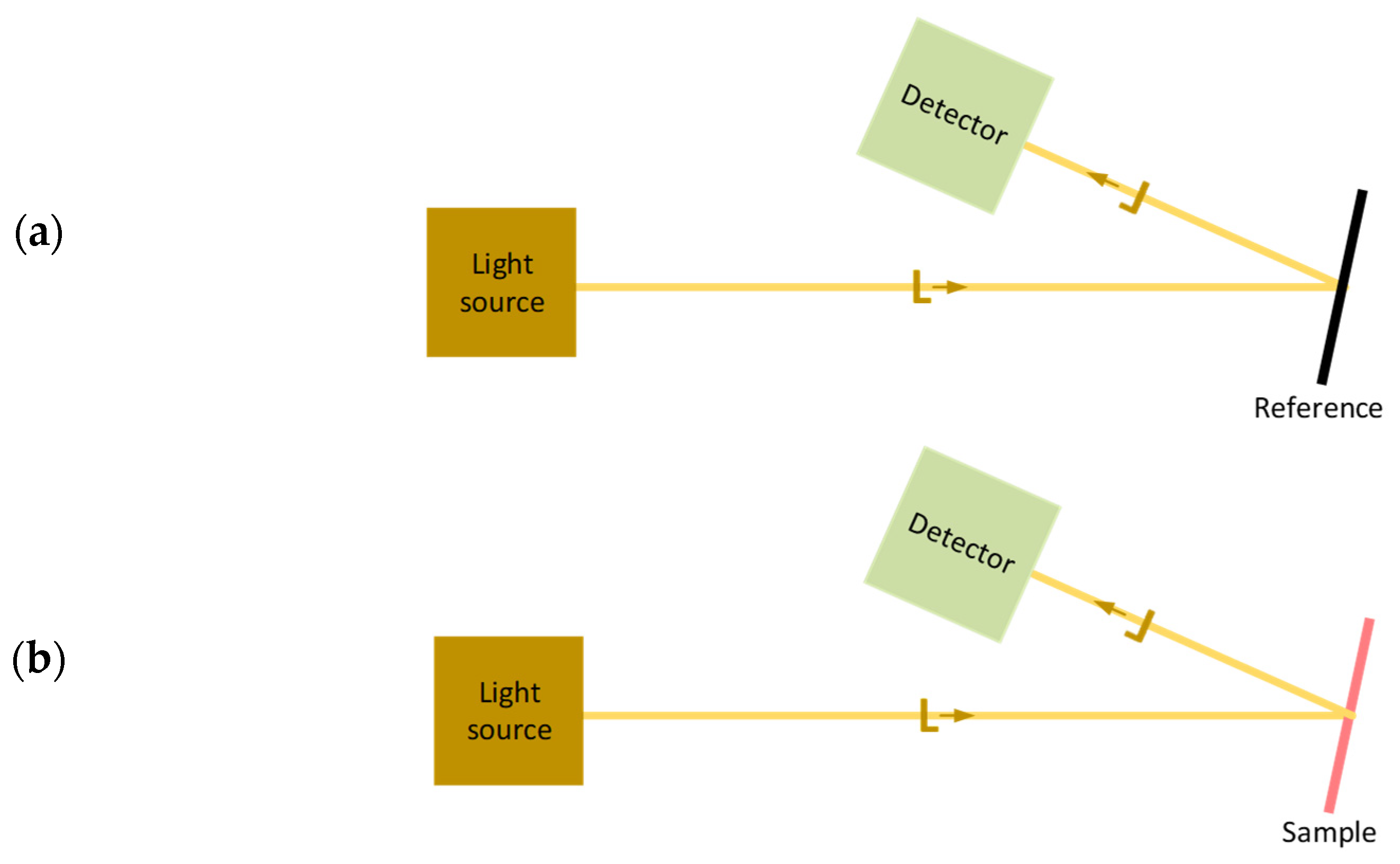
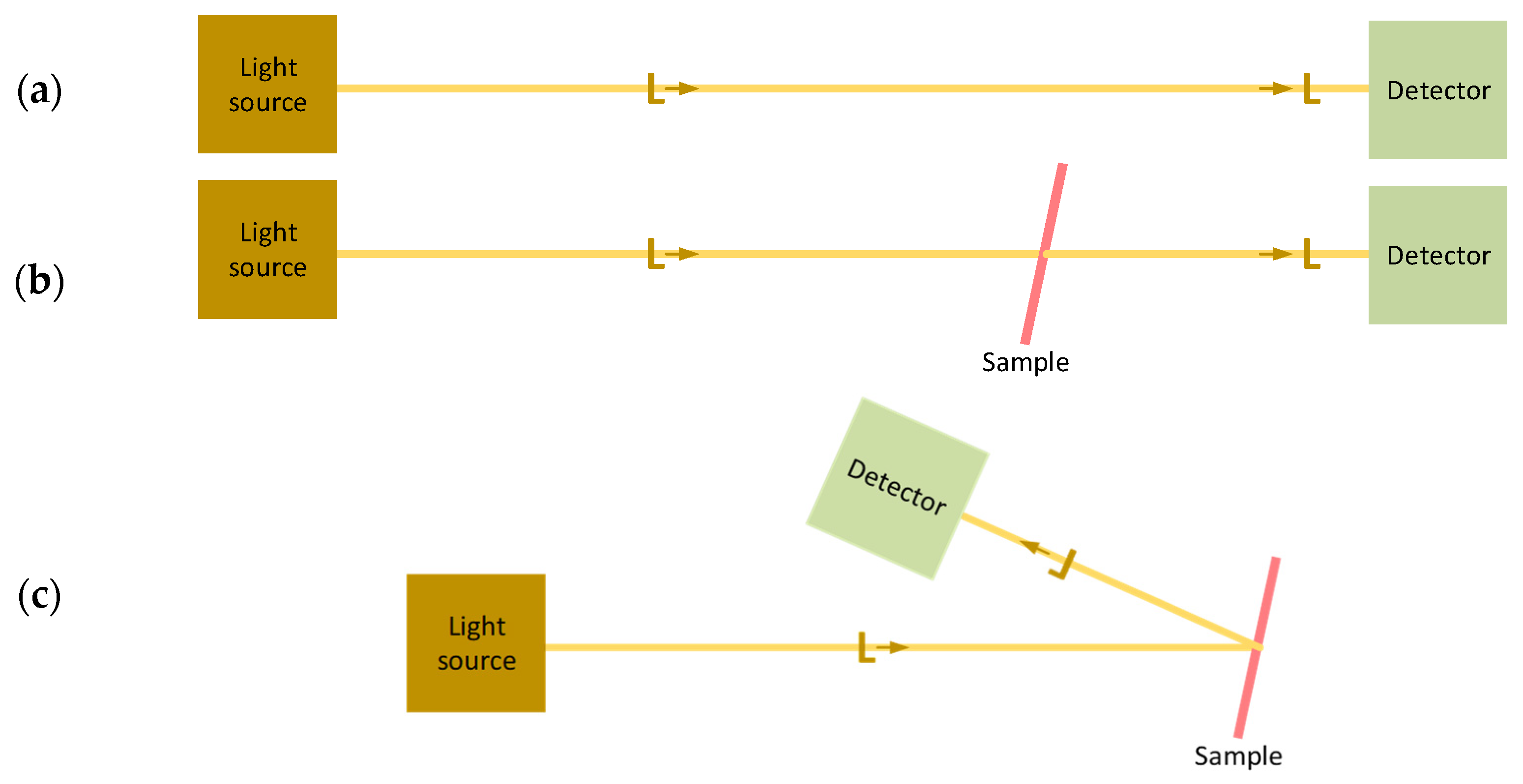
The simplest approach to measuring reflectance is a relative measurement against a reference mirror (Figure 10). It is obvious that in reflection the spatial intensity distribution of the light source (symbolized by “L” on the light path, light direction is indicated by arrows) is mirror inverted in both cases. Here, this does not lead to an additional error, as the spatial intensity distribution remains similar.
For the “auto zero” measurement (Figure 10a), a reference mirror with known reflectance R Ref is placed at the sample position. This means that for the “100%” measurement the intensity R Ref I E is now recorded instead of the intensity I E . Similarly, for the “0%” measurement, the intensity R Ref I Dark is recorded. For this reason, the value R displayed by the spectrometer must be multiplied by the known reflectance of the reference mirror to get the reflectance R of the sample, as follows:
R = I R I Dark I R Ref I Dark Ref R Ref I E R Ref I Dark I E Ref I Dark Ref R = I R I Dark I R Ref I Dark Ref I E I Dark I E Ref I Dark Ref = R Ref R
For this reason, deviations in the reflectivity of the reference mirror and different contributions from the front and back side during both measurements are sources for systematic errors [76]. Commonly, metallic front surface mirrors with a protective layer on top are used as reference mirrors [101,102].
Another source of systematic error arises from the assumption that the intensity R Ref I Dark is recorded in the “0%” measurement. This is only true for some contributions from extraneous light, but not for the electronic offset from the detector. It can be eliminated when a second reference mirror with a different reflectance is used. Relative measurements at variable angles of incidence can be realized using a retro mirror pair [100].

3.1.3. Absolute Measurement of R with the Goniometer Principle

The goniometer principle offers an elegant solution for measuring reflection at different angles of incidence [103]. In [104], a reference design is presented, and different commercial solutions are available as well. The angle of incidence can be adjusted by rotating the sample, and the transmitted or reflected intensity is recorded by a detector that is movable on a circular path [94]. During the “auto zero” measurement, the detector is illuminated directly without a sample (Figure 11a). Here, the (polarization-dependent) “auto zero” signal can be used for all angles of incidence. In the case of the transmittance measurement (Figure 11b), the detector position is the same as for the “auto zero” measurement. For the reflection measurement, the detector is moved to the position of the reflected light spot (Figure 11c). It should be noted that the illuminated sample area changes with the angle of incidence for a collimated sample beam, and the active detector area must therefore be sufficiently large to completely capture the signal. A beam focused on the sample can resolve this issue, but it results in the measurement being performed with an angular distribution of the incidence, and the polarizer no longer achieves the theoretically possible extinction ratio due to polarization leakage [105].
Furthermore, possible contributions from extraneous light may be position dependent and cannot be properly compensated when using the outlined procedure.
The goniometer principle can also be simplified for a fixed angle. In [106], a rotating light pipe is used in front of the sample to periodically measure the intensity of the light source and the intensity reflected by the sample.

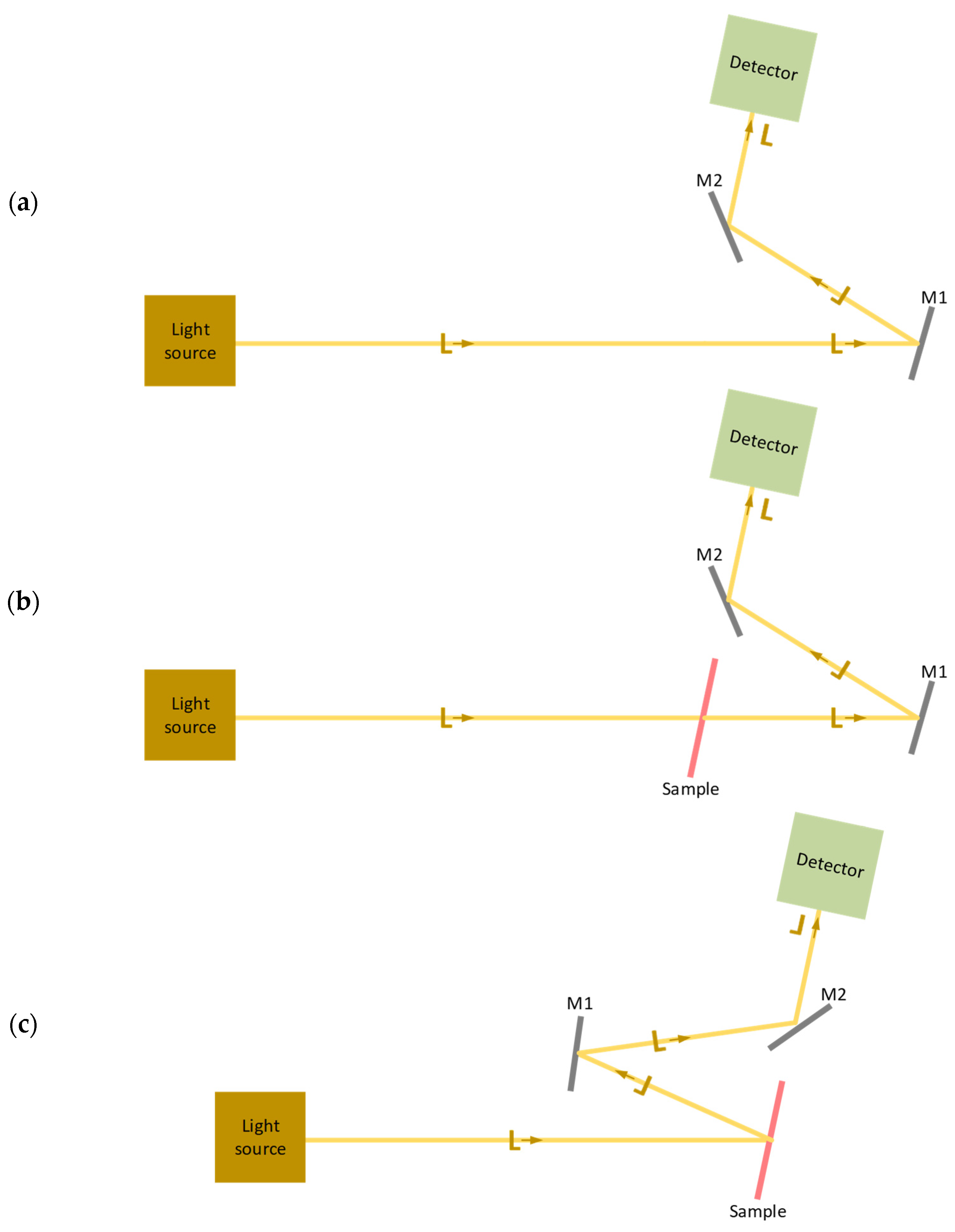
3.1.4. Absolute Measurement of R with the VN Principle

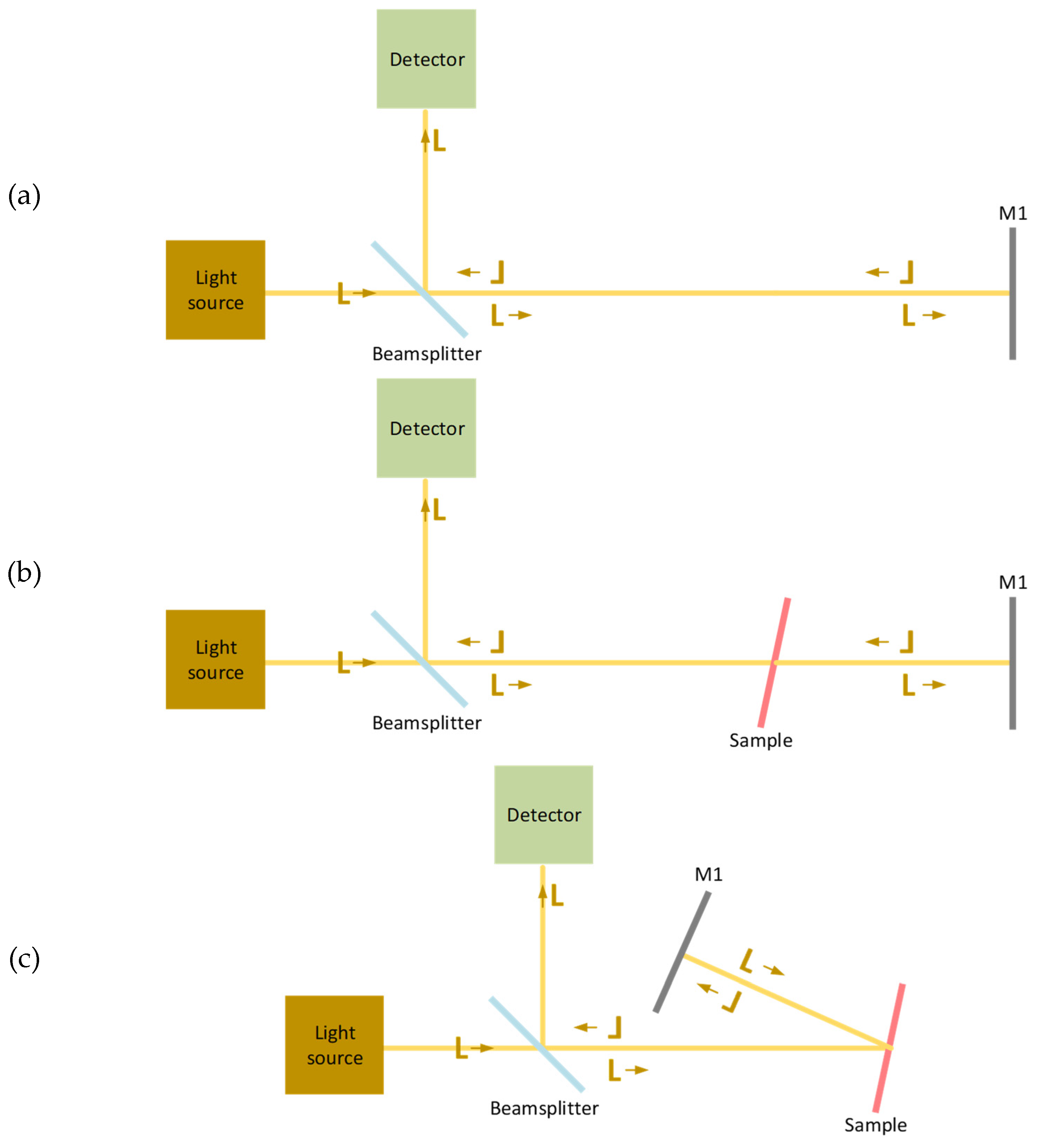
The VN principle [100] has proven effective for the absolute measurement of reflectivity at a fixed angle of incidence. Here, a stationary detector is used, so that the positional dependence of extraneous light is irrelevant. The implementation developed at Fraunhofer IOF for the PerkinElmer General Purpose Optical Bench (GPOB) uses two mirrors, M1 and M2, which are integrated into a flip mechanism (Figure 12) to transfer the transmitted and reflected beam to the sample plane [94]. Next, it enters the integrating sphere mounted in front of the detector either directly or after reflection from another mirror. The beam path for the “auto zero” is shown in Figure 12a. This measurement principle automatically ensures an identical measuring position on the sample for the transmittance (Figure 12b) and reflectance measurements (Figure 12c).
The VN principle can also be extended to measurements at different angles of incidence. This requires several movable optical components and a movable detector. For this reason, the technical implementation is significantly more complex. The PerkinElmer URA [107] offers a commercial solution for this purpose, but it only allows reflection measurements and no transmission measurements.

3.1.5. Absolute Measurement of R 2 with the VW and IV Principle

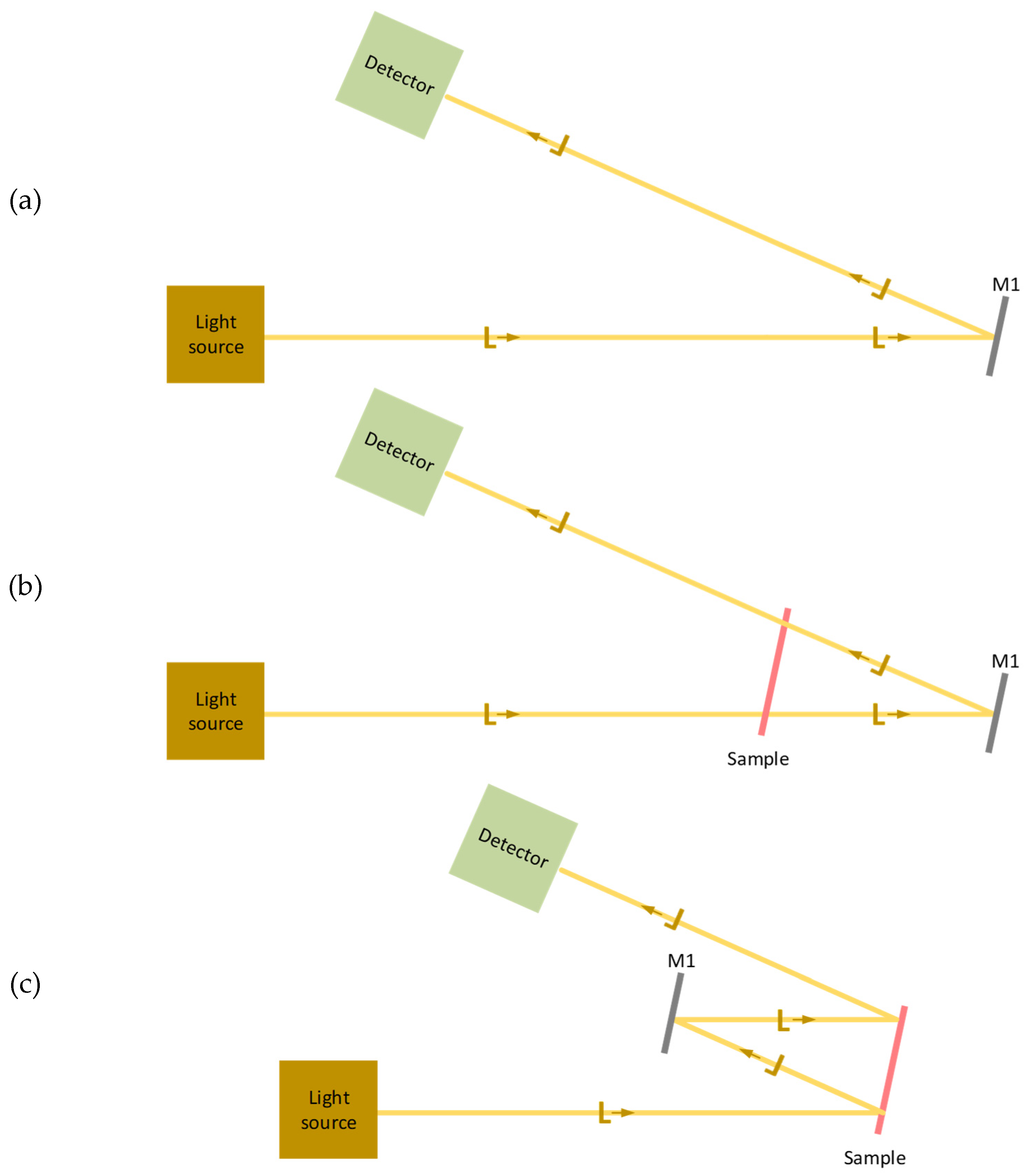
Another option for absolute measurement of reflection is the VW principle. The general approach was already outlined many decades ago [108]. Nowadays, it is widely used and described in different books [94,100]. Here, the measuring beam interacts twice with the sample at different positions (Figure 13), and the squares of transmittance and reflectance are recorded accordingly. This avoids a mirrored intensity distribution between “auto zero” (Figure 13a), transmittance (Figure 13b) and reflectance measurement (Figure 13c), but makes the method less suitable for measuring low reflection values. Furthermore, the distance between the two measuring positions requires an increased sample size and identical sample reflectance on both positions.
The angle of incidence can be adjusted by rotating the sample. In the simplest design, different angles of incidence occur at both measuring positions [107]. However, this can be avoided when the mirror M1 is additionally rotated in a synchronous manner.
Obviously, the size of the mirror M1 limits the distance between the two measuring positions. With a modified beam path and by using a beam splitter, this restriction can be eliminated. Thereby, the beam still interacts twice with the sample. According to the pattern of the beam path during the transmittance (Figure 14b) and reflectance measurement (Figure 14c), this configuration is named the IV principle [94,103]. However, the advantage of identical measurement positions on the sample is achieved at the expense of light throughput. In the best-case scenario of a 50:50 beam splitter without any losses, the two light passes (one in transmission and one in reflection) result in a maximum throughput of 25%. A major advantage of the IV principle is that it can be easily extended for measurement at different angles of incidence [103,109].

3.1.6. Other Methods and Further Readings

Relative reflectance can also be measured using an integrating sphere configured for hemispherical reflectance R h [110]. For non-scattering samples (diffuse reflectance R d 0 ), the specular reflection R and the hemispherical reflection R h are identical:
R = R h R d
This approach can be extended to absolute measurements if three interchangeable spheres are used [111] or if the sphere can be rotated into different positions [112].
In a fiber optic arrangement for normal incidence, high accuracy and repeatability can be achieved with a spot size of only 100 µm, which enables mappings on flat and curved samples [113].
An alternative method for the absolute measurement of reflectance at normal incidence is described in [114]. A similar approach is also proposed in [115]. Here, the measurement is performed using an additional pair of beam splitters. However, this arrangement does not allow transmission measurements. In [116], an extension of the underlying concept for collimated light is proposed.
In addition, for more complex beam paths, multiple interactions of the beam with the sample can also be implemented for relative or absolute measurements [117,118]. The resulting longer optical path makes adjustment considerably more difficult. Since these methods are likely to offer advantages only for highly reflective samples, even the measurement of R 4 is not frequently used. For such samples, the cavity ring-down method described in Section 2.6.2 is the best choice anyway, as it can be understood as a measurement involving an infinite number of reflections.
Many additional aspects not covered here can be found in [93,119,120,121,122] and the references therein. Some recent adaptations to different environmental conditions can be found in [119,123].

3.2. Specific Oblique and Grazing Incidence Applications

3.2.1. Total Internal Reflection

Basic Observation
A specific phenomenon is observed in the interface reflectance when the first (incidence) medium has a higher refractive index than the second one. In this case, according to Snell’s law,
n 1 sin φ = n 2 sin ψ
The refractive angle exceeds the incidence angle at oblique incidence. Therefore, when the incidence angle exceeds a threshold value called the critical angle φ crit ,
sin φ crit = n 2 n 1 ,
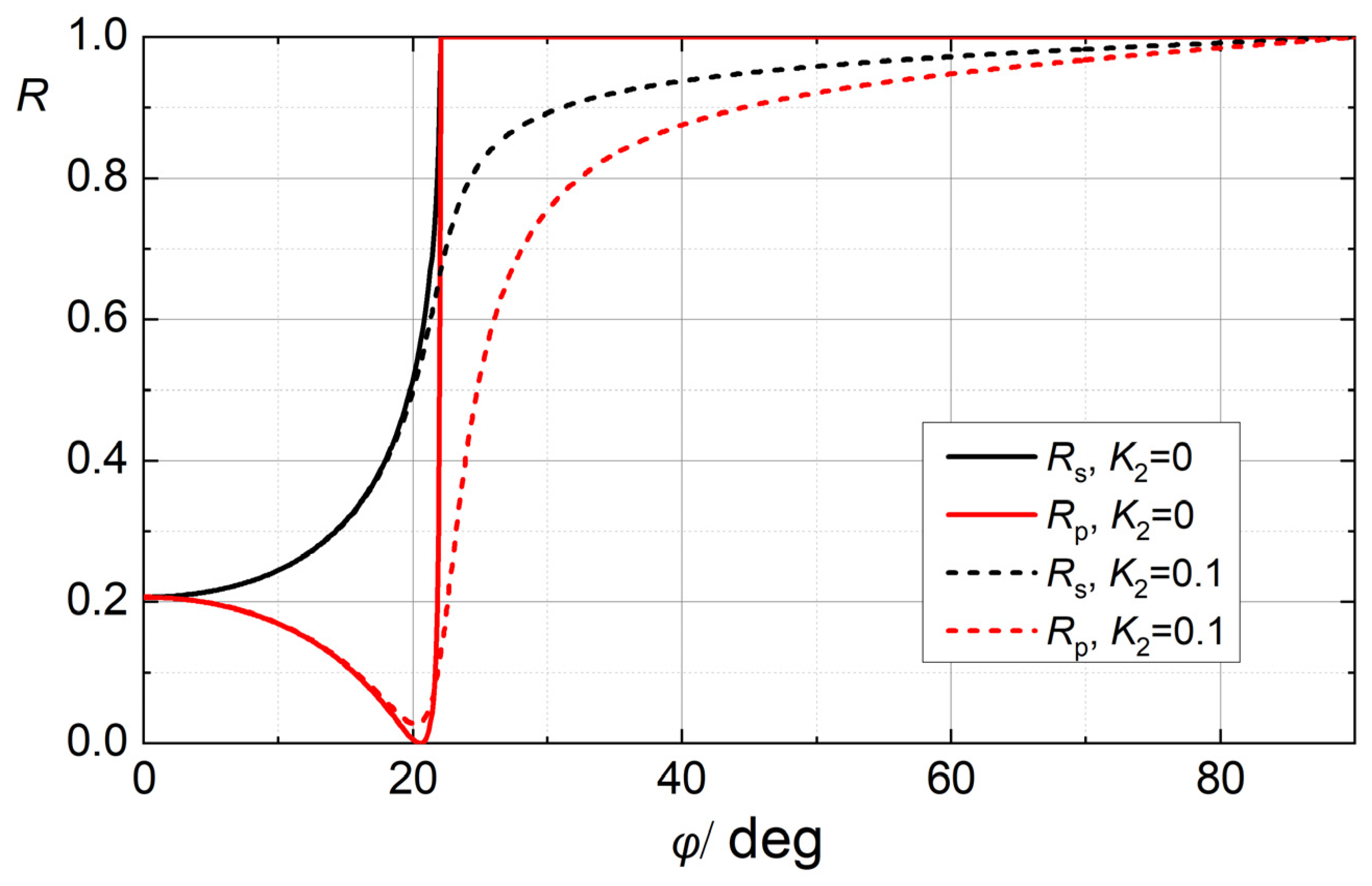
no refraction in the usual sense is possible anymore, and all the light is totally reflected at the interface [1]. At the same time, the (former) transmitted wave degenerates to an evanescent wave, which propagates along the interface with an electric field that is exponentially damped in amplitude into the depths of the media. However, this is exactly true for the case of real refractive indices only. As soon as K 2 0 , (41) no longer defines a real incidence angle. Then, a part of the incident light appears to be absorbed, and, according to (28), the reflectance becomes smaller than one, giving rise to the phenomenon of attenuated total reflection ATR. At the same time, the definition of the critical angle (41) loses its strong physical sense.
This is visualized in Figure 15, where the interface reflectances in both total and attenuated total reflection conditions are presented as calculated in terms of (27) and (28).
Once ATR is restricted to the analysis of low-index materials, biological objects as well as biopharmaceuticals belong to the target class of this method. Recently, success has been reported in imaging the ATR of suchlike objects [110,124], thus making use of a merger of ATR and ISR (compare Section 2.6.3).
Mass Density Estimation by X-Ray Reflectometry (XRR)
Let us return to the high-frequency asymptote of our model calculation according to (22):
ε 2 ω 1 ω p 2 ω 2 < 1 n 2 ω 1 ω p 2 2 ω 2 < 1
with
ω p 2 = N q 2 ε 0 m
From here, the refractive index n 2 at a given (sufficiently large) frequency appears to be almost real and directly related to the concentration of oscillators (here, electrons oscillate with respect to very heavy nuclei). In other words, the determination of the refractive index provides direct access to the total concentration of electrons (no matter whether they are free or bound), and consequently to the concentration of protons and neutrons in the medium (provided that the stoichiometry of the material is known). This provides an often used and convenient method for mass density estimation: once the refractive index of air is practically equal to one and therefore larger than n 2 in the X-ray spectral region, at sufficiently large angles of incidence (usually marginally smaller than 90°), one observes total reflection at the air–material interface. Measuring the critical angle of total reflection provides access to n 2 via (41), and therefore to N , and finally to the mass density. This method defines a standard application field of XRR of high practical relevance (for more details see [125]); examples on the relation between critical angles and mass densities may be found in [126]. Note that the observation of a well-defined critical angle presumes negligible absorption losses as well as sharp and smooth interfaces; otherwise, fits of the angular scans in terms of more involved topological models are the method of choice.
Considerations on Metal Films
Clearly, the optical constants used for the calculations from Figure 15 may be relevant for typical transparent materials but are not so typical for metals in the IR/VIS/UV spectral regions. Therefore, in its classical version, ATR (and particularly multiple ATR) provides a spectroscopy tool for the analysis of rather weakly absorbing dielectric materials, preferably in the infrared spectral region.
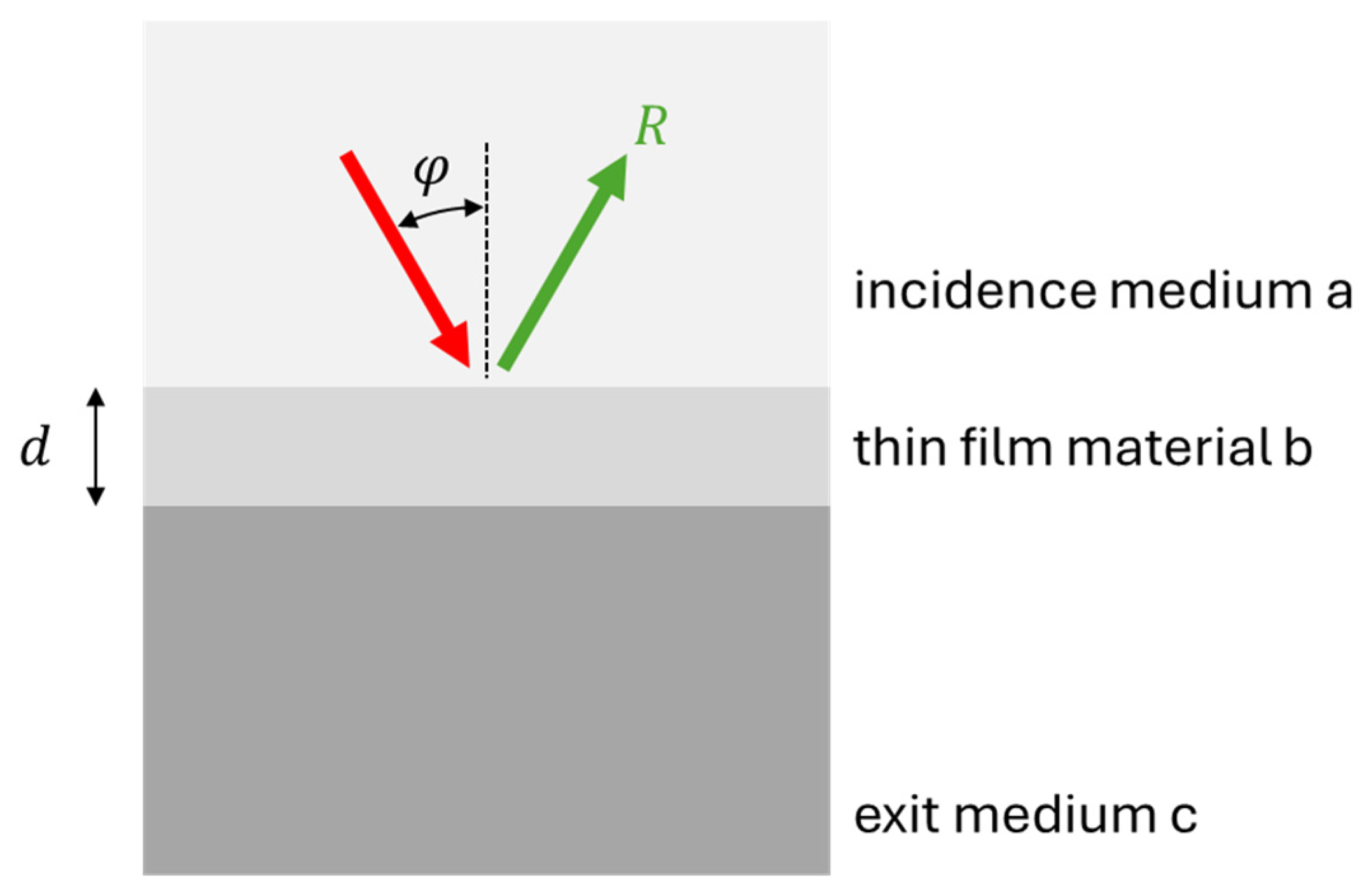
However, there is a specific geometrical arrangement where attenuated total reflection in the IR/VIS/UV spectral region plays an important role in the spectroscopy of systems that contain thin metal films. Consider the system presented in Figure 16. It consists of a thin film of material (b) with thickness d, embedded between an incidence medium (a) with a real refractive index and an exit medium (c).
The calculation of the reflectance of such a film system requires the application of more complicated formula than those used for the single interface. In the general case of a multilayer system deposited on the substrate, the calculation of the sample reflectance needs to include the contributions of multiple internal reflections between all internal interfaces. Historical approaches make use of recursive algorithms (compare [127]) or the admittance approach [5,127], while today the use of the matrix formalism [1] or transfer matrices [6], are common. In the special case of a single film on a substrate, as shown in Figure 16, we must consider the interplay of the optical constants of three materials, and, obviously, the film thickness d should be of relevance, too. The reflectance of that system may be calculated by the following formula [1,21]:
R = r a b + r b c e i 4 π λ d n ^ b 2 n a 2 sin 2 φ 1 + r a b r b c e i 4 π λ d n ^ b 2 n a 2 sin 2 φ 2
Symbols like r a b indicate field reflection coefficicents according to (28) for the interface between media a and b and so on. Formula like (43) are widely used in any branch of thin film optics. We now consider the special configuration, where material (b) is a metal, while (a) and (c) are dielectrics with n a > n c . Then, at oblique incidence from medium (a), total reflection at the interface between media (b) and (c) may be observed. Already, from here, it turns out that the reflectance of such a system strongly depends on the incidence angle. This dependence may be visualized in terms of angular reflectance scans.
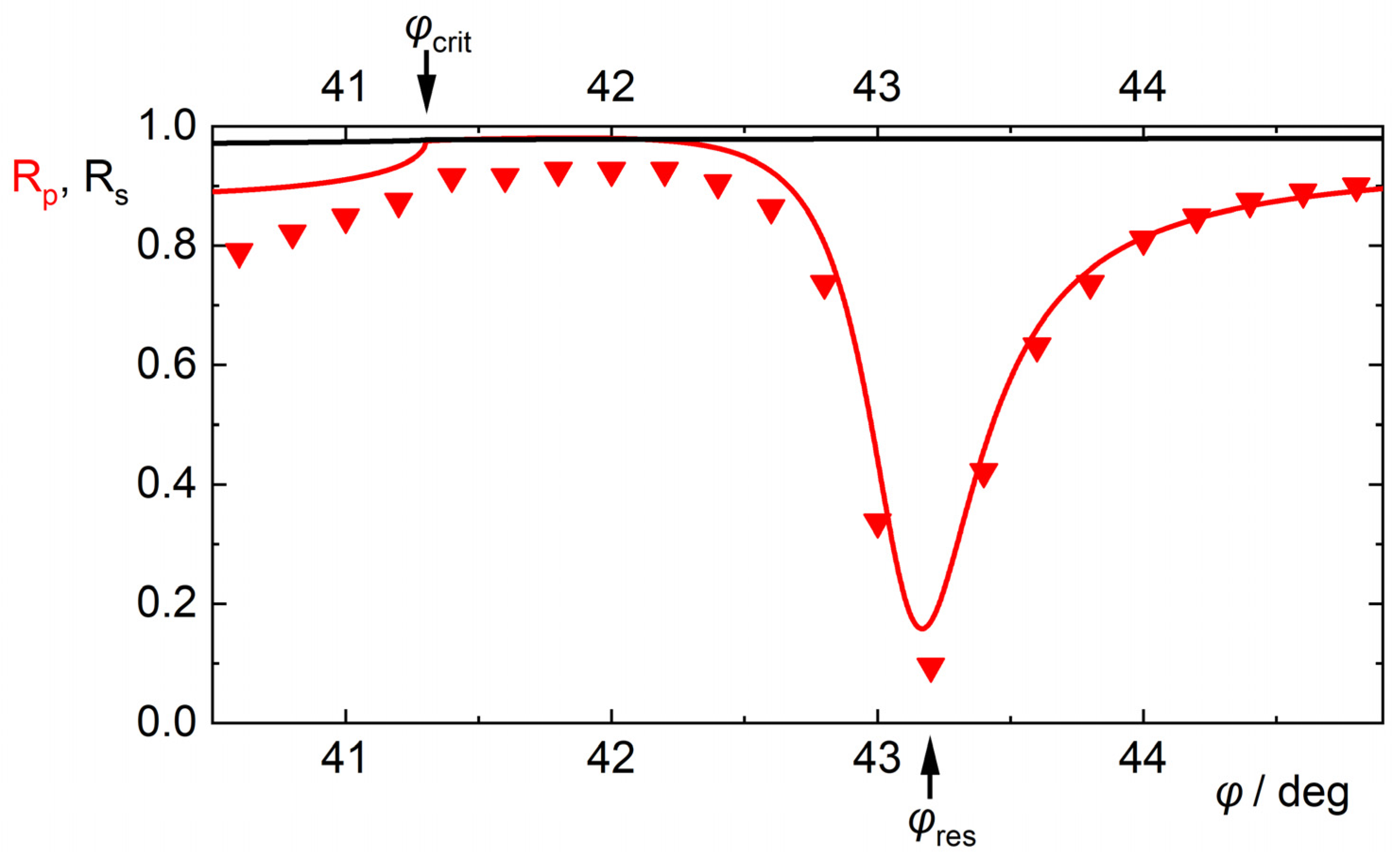
Figure 17 shows calculated and measured angular scans of a thin film system, where glass is used as incidence medium (a), silver as the film material (b), while air acts as the exit medium (c). The measured data corresponds to p-polarization. Surprisingly, at a certain (so-called resonance) angle, the reflectance drops down to a rather small value, indicating the activation of a strong absorption mechanism in the system. Note that this kind of absorption line is not observed in s-polarization. For the calculation, optical constants have been taken from [128].
Without going into details here, we mention that the absorption line corresponds to the excitation of a propagating surface plasmon polariton [129] at the silver–air interface. This excitation is possible because at the resonance angle, the wavevector of the surface plasmon polariton coincides with that of the evanescent wave observed in total reflection at the air side of the system [21]. As shown in [129], in these resonance conditions, a rather large electric field E is formed at the air–metal interface. This large electric field results in strong absorption, even when the imaginary part of the dielectric function of the metal is small, in full consistency with (13). Therefore, plasmon excitation is an important tool in interface and surface spectroscopy [129,130]. In practice, the excitation of the surface plasmon polariton may be accomplished by means of so-called prism couplers, and the electric field at the interface may exceed the incident field by a factor of 105 [129].

3.2.2. Infrared Reflection Absorption Spectroscopy (IRAS)

We now turn to a further spectroscopic method that is relevant for the spectroscopy of thin dielectric films (or even adsorbates) on a metal surface. In Figure 16 we now assign medium (a) to air, medium (b) (the film) to a dielectric with dielectric function ε b and thickness d , and medium (c) to a substrate. For the special case that the substrate is a metal in the infrared, we have ε c 1 , and, in this case, the following approximation for the reflectance of the system holds provided that n b d λ is fulfilled: [29,30]
R s 1 R p 1 4 ω c d Im 1 ε b s i n 2 φ cos φ
The experimental observation is that in s-polarization, the reflectance R s practically coincides with that of the bare metal surface, while in p-polarization, absorption peaks may occur in the reflection spectrum R p that are centered at local maxima of Im 1 ε b . Such p reflection spectra are also called infrared reflection absorption spectra (IRAS).
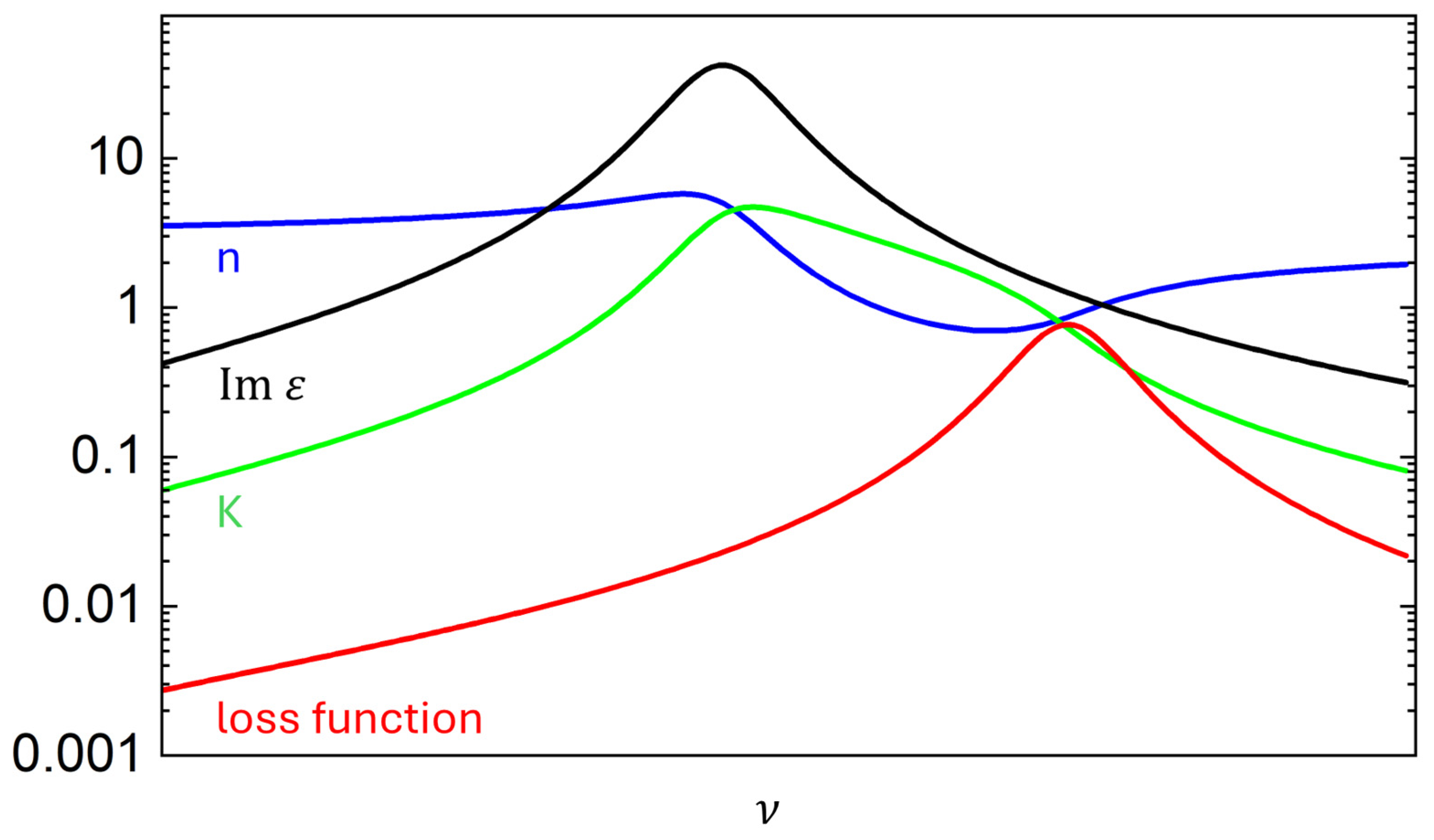
Im 1 ε defines the so-called loss function of the corresponding material. The typically observed relation between the dielectric function, optical constants and the loss function in the vicinity of a resonance in Im ε is illustrated in Figure 18. Obviously, peaks in the IRAS are blue-shifted with respect to the peaks in a normal incidence transmission spectrum, which are defined by maxima of Im ε [29].
Note that the loss function shows a maximum close to the frequency where n = K < 1 is fulfilled. The maximum of the loss function does not coincide with the maximum of the imaginary part of the dielectric function Im ε , but appears to be blue-shifted with respect to Im ε . According to (44) and Figure 18, in IRAS one will detect spectral structures at the maxima of the loss function and not at Im ε .
We will now provide a qualitative explanation of the IRAS effect based on the boundary conditions for the electric field strength at an interface.
As seen from Figure 4 (grazing incidence, right), in the case of s-polarization, the electric field strength vector E oscillates parallel (tangential, further marked with the subscript II) to the surface, regardless of the incidence angle. Because of the continuity of the tangential components of the electric field [1], the total field E b above the interface (including the reflected and incident contributions corresponding to E b = E e + E r ) and the field E c below the interface (composed from the transmitted contribution only, i.e., E c = E t ) are related via the following:
s-polarization :   E b , II = E c , II
In other words, they must be identical. Obviously, in s-polarization, there is no possibility to manipulate the field strength at a plane interface by a suitable material combination.
In our IRAS system, this explains the insensitivity to s-polarized radiation. Once in a real metal, the electric field strength is rather small, and we must expect a small total field E b directly above the interface, too. According to (12), a small field cannot induce strong dipole moments in the adsorbate, and, therefore, no particular interface sensitivity is expected in this case. This results in the specific approximation for R s in (45).
The situation is quite different in p-polarization. In this case, the electric field strength vectors are directed rather being perpendicular (normal, indicated by the subscript ⊥) to the interface. Then, the electric field is discontinuous at the interface, while it is the electric displacement vector that should be continuous [30]. Consequently, we obtain the following:
p-polarization :   ε b E b , = ε c E c ,
Because the ratio of the dielectric functions of the participating materials is now crucial for the difference in field strength above and below the interface, we have the possibility to manipulate the field strength by making a clever choice of the two materials. From here, interface-sensitive spectroscopy starts. In terms of our classical model developed in Section 2.3, it is now the field E in (12) that is to be magnified near the interface and will therefore result in the large oscillation amplitude of the induced dipoles.
Generally, when the task is to achieve a relative enhancement of E b , at the interface between media (b) and (c), we have two entirely different possibilities, as follows:
(a)
A very large (by modulus) ε c . This is exactly what we use in IRAS, where a metal is used as the (c) medium (Figure 18).
(b)
A vanishingly small (by modulus) ε b . This constellation is relevant in the Berreman effect [29,30], which will be discussed later.
Of course, the combination of these effects is possible (and useful), too.
IRAS
Once, according to (24), ε c becomes large in a metal at small frequencies, the product of a small and a large contribution on the right side of (46) may be of a relevant order of magnitude. Consequently, E b , E c , . The strong field E b gives rise to certain interface sensitivity of the reflection in p-polarization. Also, once it is only the normal component of the electric field that is strong at the interface, only dipole moments perpendicular to the interface may be excited in the adsorbate or adsorbate film.
This picture provides at least a qualitative explanation of the observed effects. Note that the connection to (30) is established when rewriting (46) according to the following:
E b , = tan 2 φ ^ B E c ,
Provided that E c , II is small, we must expect that E r , s and E e , s have similar amplitudes but oscillate in antiphase. Consequently, r s 1 combined with r s < 1 . Moreover, in the MIR, we have n ^ c 1 , such that tan φ ^ B accepts a large by modulus value (compare (31)), and, consequently, cos 2 φ ^ B = 1 tan 2 φ ^ B 1 + tan 2 φ ^ B 1 . Then, from (30) we immediately obtain r p + 1 , combined with r p < + 1 .
This is consistent with the typical geometrical illustration that in p-polarization, E r and E e are oscillating in phase and overlap constructively, which leads to an enhancement of the normal component of the total electric field E b close to the interface to medium (c) [30].
Berreman Effect
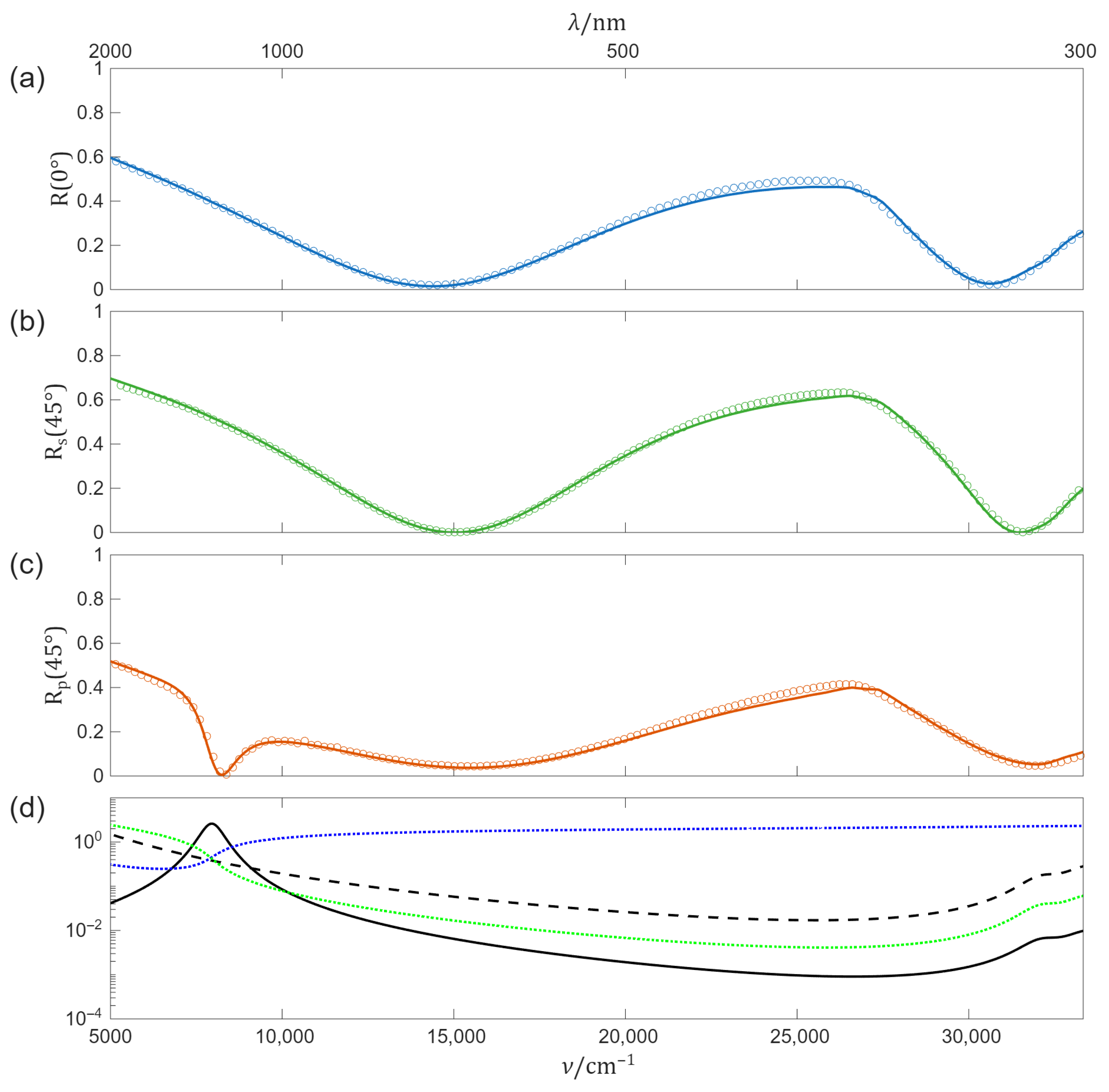
Concerning scenario (b), the difference in strength between E b , and E c , is achieved when ε b becomes rather small by its absolute value. This is practically observed in spectral regions where n b K b > 0 is fulfilled, combined with a small n b < 1 . The corresponding spectral features in reflectance may be observed in p-polarization at oblique incidence and result in a narrow absorption line in the reflection spectrum of the system, even if no absorption line may be identified in the extinction coefficients of the participating materials [29,131]. This is exactly what we observe in the so-called Berreman effect [29,30]. An example is provided in Figure 19.
The absorption line in the R p spectrum may be reproduced by usual thin film optical formula like (43). Once there is no absorption line obvious from the dispersion of the optical constants, from (12) it seems likely that the absorption feature is caused by a strong frequency dependence of the electric field E .
As it has been pointed out by Berreman in his original article [30], the essence of the effect is in the appearance of a strong absorption band (usually observed in the IR) at the frequency of polar longitudinal (often vibronic) optic modes, at oblique incidence and p-polarization of the incident radiation. According to [38,39,132], this frequency corresponds to the frequency where ε 0 . In the complex notation, instead we would have to require ε 0 , which results in the already mentioned conditions n K and n K 0 . As argued in [133], the same may be observed near the bulk plasmon frequency, and the example shown in Figure 19 in fact exemplifies such a situation.
This way we follow the original argumentation by Berreman [30], further developed by Grosse in [29]. In particular, Grosse points out that the Berreman effect is definitely a macroscopic phenomenon of electrodynamics, and by no means a microscopic problem of molecular dynamics [29]. In our explanation, we have therefore made use of macroscopic material parameters like dielectric functions only.
Note that in a metal, ε c 1 is valid in rather broad spectral regions such that pure IRAS may be demonstrated in the whole MIR. A vanishingly small (by modulus) dielectric function (here, ε b ) is usually possible only in restricted spectral regions in the vicinity of strong absorption features. Therefore, the Berreman effect usually results in a rather narrow absorption feature at that frequency where n K holds. In this constellation, the dielectric loss function will have a local maximum.
Thus, according to (12), the strong electric field inside the film with n K combined with 1 > n K > 0 must provide a significant enhancement of the light–matter interaction, giving rise to the observed narrow absorption feature. This impact of the field enhancement, as first discussed in [29,30], is complemented with interference effects arising from multiple reflection between the air–film interface (where E a , = ε b E b , holds) and the film–substrate interface (compare also [131]).

4. Summary and Outlook

In this study, we reviewed basic theoretical and experimental aspects of reflection spectra with some focus on the reflective properties of metals. Thereby, we tried to discuss the topic in direct relation to the predictions of a simple classical oscillator model that was introduced in the first (and rather tutorial) part of the study.
As a basic result of that model treatment, we could point out that prominent features in reflection spectra may arise from resonances (coincidence of the light frequency with an intrinsic eigenfrequency of the medium), as well as properly enhanced electric fields through a clever choice of the experimental geometry, thus making explicit use of the specific boundary conditions for the electric field strength. In particular, the latter form the basis of IRAS and the Berreman effect. Resonance effects, on the other hand, may provide similar information as it would be available from transmission spectra. In practice, however, peaks in reflection spectra are often shifted in frequency with respect to corresponding peaks in transmittance. Therefore, a careful elaboration of measured reflection spectra in terms of the Fresnel’s equations for interface reflection is necessary in order to avoid misinterpretations in practical applications.
Concerning available measurement setups, we concentrated on ordinary spectrophotometry, covering aspects of both relative and absolute measurement strategies. A short summary of the spectrophotometric techniques described is provided in Table 3.
The study did explicitly not deal with ellipsometry; we refer to the corresponding available literature in this context [131,134,135].
What comes next? We have provided a treatment for optical reflection from smooth surfaces, making use of a simple parallelism to a mechanical oscillator approach. The system and the treatment are idealized, representing perhaps the simplest possible model. To closer approach reality as well as modern developments, in the next step the model assumption of smooth surfaces should be relaxed. That leads us to rough and/or patterned surfaces, clearly outside of our simple approach, which work with one type of oscillator (a bulk oscillator) only. Indeed, the inclusion of rough or patterned metal surfaces need the introduction of further physical concepts and phenomena into the discussion, listed below:
  • Periodic vs. non-periodic vs. stochastic surface structures;
  • Extrinsic size effects [1,136]: small- and large-scale roughness [137], subwavelength and diffractive surface structures;
  • Resulting phenomena: effective media [138], light scattering [136,137,139,140,141], diffraction [1], and guided modes [142];
  • Intrinsic size effects and quantum confinement [17,136];
  • Coupled oscillators, non-local optical response, and spatial dispersion [2,19,136,143];
  • Local electric field enhancement (“hot spots”) and nonlinear optical phenomena—for an overview see [144];
  • Magnetic response and metamaterials [145];
  • Propagating plasmon polaritons vs. localized plasmon excitation [146], plasmonic systems, and meta surfaces [147,148,149,150,151,152,153].
Particularly, the field of plasmonic represents a novel and still rapidly developing branch of modern optics, and it is up to the future to reveal its true scientific and technological potential.

Author Contributions

Conceptualization, O.S.; methodology, O.S. and S.W.; software, S.W. and O.S.; validation, O.S. and S.W.; formal analysis, O.S. and S.W.; investigation, O.S. and S.W.; resources, O.S. and S.W.; data curation, O.S. and S.W.; writing—original draft preparation, O.S. and S.W.; writing—review and editing, O.S. and S.W.; visualization, O.S. and S.W.; supervision, O.S.; project administration, O.S.; and funding acquisition, O.S. All authors have read and agreed to the published version of the manuscript.

Funding

This research was funded by Fraunhofer Society, grant number 510076.

Data Availability Statement

No data available.

Acknowledgments

The authors are grateful to Linqing Li (Friedrich Schiller University Jena for visualization of the mass-on-spring system.

Conflicts of Interest

The authors declare no conflicts of interest.

References

  1. Born, M.; Wolf, E. Principles of Optics; Pergamon Press: Oxford, UK; London, UK; Edinburgh, UK; New York, NY, USA; Paris, France; Frankfurt, Germany, 1968. [Google Scholar]
  2. Landau, D.; Lifshitz, E.M. Electrodynamics of Continuous Media; Volume 8 of A Course of Theoretical Physics; Pergamon Press: Oxford, UK, 1960. [Google Scholar]
  3. Сивухин, Д.В. Общий Курс Физики; Оптика, Наука: Moscow, Soviet Union, 1980. [Google Scholar]
  4. Willey, R.R. Practical Design of Optical Thin Films; Lulu.com: Morrisville, NC, USA, 2021; p. 566. [Google Scholar]
  5. Macleod, H.A. Thin-Film Optical Filters, 5th ed.; CRC Press; Taylor & Francis Group: Boca Raton, FL, USA, 2018. [Google Scholar]
  6. Thelen, A. Design of optical Interference Coatings; McGraw-Hill: Columbus, OH, USA, 1989. [Google Scholar]
  7. Willey, R.R. Designing solar control coatings. Appl. Opt. 2024, 63, 4891–4895. [Google Scholar] [CrossRef]
  8. Willey, R.R. Designing black mirrors. Appl. Opt. 2024, 63, 4020–4023. [Google Scholar] [CrossRef] [PubMed]
  9. Willey, R.R.; Stenzel, O. Designing Optical Coatings with Incorporated Thin Metal Films. Coatings 2023, 13, 369. [Google Scholar] [CrossRef]
  10. Pulker, H.K. Characterization of optical thin films. Appl. Opt. 1979, 18, 1969–1977. [Google Scholar] [CrossRef] [PubMed]
  11. Landau, D.; Lifshitz, E.M. Statistical Physics, Part 1; Volume 5 of A Course of Theoretical Physics; Pergamon Press: Oxford, UK, 1980. [Google Scholar]
  12. Stenzel, O.; Wilbrandt, S. Theoretical Aspects of Thin Film Optical Spectra: Underlying Models, Model Restrictions and Inadequacies, Algorithms, and Challenges. Appl. Sci. 2025, 15, 2187. [Google Scholar] [CrossRef]
  13. Furman, S.A.; Tikhonravov, A.V. Basics of Optics of Multilayer Systems; Edition Frontieres: Gif-sur-Yvette, France, 1992. [Google Scholar]
  14. Letochow, W.S. Laserspektroskopie, Wissenschaftliche Taschenbücher, Band 165; Akademie Verlag: Berlin, Germany, 1977. [Google Scholar]
  15. Mühlig, C. Absorption and Fluorescence Measurements in Optical Coatings. In Optical Characterization of Thin Solid Films; Stenzel, O., Ohlídal, M., Eds.; Springer Series in Surface Sciences; Springer: Cham, Switzerland, 2018; Volume 64, pp. 407–461. [Google Scholar] [CrossRef]
  16. Starke, R.; Schober, G. Why history matters: Ab initio rederivation of Fresnel equations confirms microscopic theory of refractive index. Optik 2018, 157, 275–286. [Google Scholar] [CrossRef]
  17. Fox, M. Optical Properties of Solids, 2nd ed.; Reprinted (with Corrections); Oxford University Press: Oxford, UK, 2011. [Google Scholar]
  18. Yu, P.Y.; Cardona, M. Fundamentals of Semiconductors: Physics and Material Properties, 4th ed.; Springer: Berlin/Heidelberg, Germany, 2010. [Google Scholar]
  19. Klingshirn, C.F. Semiconductor Optics; Springer: Berlin/Heidelberg, Germany, 1997. [Google Scholar]
  20. Grosse, P. Freie Elektronen in Festkörpern; Springer: Berlin/Heidelberg, Germany; New York, NY, USA, 1979. [Google Scholar]
  21. Stenzel, O. The Physics of Thin Film Optical Spectra: An Introduction; Springer International Publishing: Cham, Switzerland, 2024. [Google Scholar]
  22. Ehrenreich, H.; Philipp, H.R. Optical Properties of Ag and Cu. Phys. Rev. 1962, 128, 1622–1629. [Google Scholar] [CrossRef]
  23. Ohlídal, I.; Navrátil, K. Optical analysis of inhomogeneous weakly absorbing thin films by spectroscopic reflectometry: Application to carbon films. Thin Solid Films 1988, 162, 101–109. [Google Scholar] [CrossRef]
  24. Ohlídal, I.; Navrátil, K. Simple method of spectroscopic reflectometry for the complete optical analysis of weakly absorbing thin films: Application to silicon films. Thin Solid Films 1988, 156, 181–190. [Google Scholar] [CrossRef]
  25. Tabet, M.F.; McGahan, W.A. Use of artificial neural networks to predict thickness and optical constants of thin films from reflectance data. Thin Solid Films 2000, 370, 122–127. [Google Scholar] [CrossRef]
  26. Morinishi, Y.; Maeda, Y. Development of the Model for Estimating Thickness and Optical Constants of Metallic Thin Films using Only Reflection Spectrum. IEEJ Trans. Sens. Micromach. 2025, 145, 220–225. [Google Scholar] [CrossRef]
  27. Wilbrandt, S.; Petrich, R.; Stenzel, O. Optical Interference Coating Characterization Using Neural Networks; SPIE International Society for Optics and Photonics: Bellingham, WA, USA, 1999; pp. 517–528. [Google Scholar]
  28. Gross, R.; Marx, A. Festkörperphysik, 2nd ed.; de Gruyter: Berlin, Germany, 2014. [Google Scholar]
  29. Grosse, P.; Offermann, V. Quantitative infrared spectroscopy of thin solid and liquid films under attenuated total reflection conditions. Vib. Spectrosc. 1995, 8, 121–133. [Google Scholar] [CrossRef]
  30. Berreman, D.W. Infrared Absorption at Longitudinal Optic Frequency in Cubic Crystal Films. Phys. Rev. 1963, 130, 2193–2198. [Google Scholar] [CrossRef]
  31. UNIGIT. Grating Solver Software. Available online: https://unigit.net (accessed on 23 November 2025).
  32. Polyanskiy, M.N. Refractive Index Database. Available online: https://refractiveindex.info (accessed on 23 November 2025).
  33. Franta, D.; Nečas, D.; Ohlídal, I.; Giglia, A. Dispersion Model for Optical Thin Films Applicable in Wide Spectral Range; SPIE International Society for Optics and Photonics: Bellingham, WA, USA, 2015; p. 96281U. [Google Scholar]
  34. Franta, D.; Nečas, D.; Ohlídal, I.; Giglia, A. Optical Characterization of SiO2 Thin Films Using Universal Dispersion Model over Wide Spectral Range; SPIE International Society for Optics and Photonics: Bellingham, WA, USA, 2016; p. 989014. [Google Scholar]
  35. Franta, D.; Dubroka, A.; Wang, C.; Giglia, A.; Vohánka, J.; Franta, P.; Ohlídal, I. Temperature-dependent dispersion model of float zone crystalline silicon. Appl. Surf. Sci. 2017, 421, 405–419. [Google Scholar] [CrossRef]
  36. Stenzel, O. Optical Coatings: Material Aspects in Theory and Practice, 1st ed.; Springer: Berlin/Heidelberg, Germany, 2014. [Google Scholar]
  37. Feynman, R.P. The Feynman Lectures on Physics, Vol. II; The New Millennium Edition: Mainly Electromagnetism and Matter; Basic Books: New York, NY, USA, 2011. [Google Scholar]
  38. Kittel, C. Introduction to Solid State Physics; John Wiley and Sons, Inc.: New York, NY, USA; London, UK; Sydney, Australia; Toronto, ON, Canada, 1971. [Google Scholar]
  39. Stenzel, O. Light–Matter Interaction: A Crash Course for Students of Optics; Photonics and Materials Science; Springer International Publishing: Cham, Switzerland, 2022. [Google Scholar]
  40. Zallen, R. Symmetry and Reststrahlen in Elemental Crystals. Phys. Rev. 1968, 173, 824–832. [Google Scholar] [CrossRef]
  41. Bartelmann, M.; Feuerbacher, B.; Krüger, T.; Lüst, D.; Rebhan, A.; Wipf, A. Theoretische Physik; Springer: Berlin/Heidelberg, Germany, 2014. [Google Scholar]
  42. Dobrowolski, J.A.; Ho, F.C.; Waldorf, A. Determination of optical constants of thin film coating materials based on inverse synthesis. Appl. Opt. 1983, 22, 3191. [Google Scholar] [CrossRef]
  43. Ziman, J.M. Principles of the Theory of Solids, 2nd ed.; Cambridge University Press: Cambridge, UK, 1999. [Google Scholar]
  44. Kuzmany, H. Festkörperspektroskopie: Eine Einführung; Springer: Berlin/Heidelberg, Germany, 1989. [Google Scholar]
  45. Cooper, B.R.; Ehrenreich, H.; Philipp, H.R. Optical Properties of Noble Metals. II. Phys. Rev. 1965, 138, A494–A507. [Google Scholar] [CrossRef]
  46. Ehrenreich, H. The optical properties of metals. IEEE Spectr. 1965, 2, 162–170. [Google Scholar] [CrossRef]
  47. Ordal, M.A.; Bell, R.J.; Alexander, R.W.; Long, L.L.; Querry, M.R. Optical properties of fourteen metals in the infrared and far infrared: Al, Co, Cu, Au, Fe, Pb, Mo, Ni, Pd, Pt, Ag, Ti, V, and W. Appl. Opt. 1985, 24, 4493–4499. [Google Scholar] [CrossRef]
  48. Macleod, A. Phase Matters. SPIE’s OE Magazine, June/July 2005, 31 May 2005. pp. 29–31.
  49. Azzam, R.M.A.; Bashara, N.M. Ellipsometry and Polarized Light; Elsevier: Amsterdam, The Netherlands, 1987. [Google Scholar]
  50. Lucarini, V. Kramers-Kronig Relations in Optical Materials Research; Springer: Berlin/Heidelberg, Germany, 2005. [Google Scholar]
  51. Grosse, P.; Offermann, V. Analysis of reflectance data using the Kramers-Kronig Relations. Appl. Phys. A Solids Surf. 1991, 52, 138–144. [Google Scholar] [CrossRef]
  52. O’Keefe, A.; Deacon, D.A.G. Cavity ring-down optical spectrometer for absorption measurements using pulsed laser sources. Rev. Sci. Instrum. 1988, 59, 2544–2551. [Google Scholar] [CrossRef]
  53. Kelsall, D. Absolute Specular Reflectance Measurements of Highly Reflecting Optical Coatings at 10.6 micro. Appl. Opt. 1970, 9, 85–90. [Google Scholar] [CrossRef] [PubMed]
  54. Sanders, V. High-precision reflectivity measurement technique for low-loss laser mirrors. Appl. Opt. 1977, 16, 19–20. [Google Scholar] [CrossRef] [PubMed]
  55. Anderson, D.Z.; Frisch, J.C.; Masser, C.S. Mirror reflectometer based on optical cavity decay time. Appl. Opt. 1984, 23, 1238–1245. [Google Scholar] [CrossRef]
  56. Herbelin, J.M.; McKay, J.A.; Kwok, M.A.; Ueunten, R.H.; Urevig, D.S.; Spencer, D.J.; Benard, D.J. Sensitive measurement of photon lifetime and true reflectances in an optical cavity by a phase-shift method. Appl. Opt. 1980, 19, 144–147. [Google Scholar] [CrossRef]
  57. Karras, C. Cavity Ring-Down Technique for Optical Coating Characterization. In Optical Characterization of Thin Solid Films; Stenzel, O., Ohlídal, M., Eds.; Springer Series in Surface Sciences; Springer: Cham, Switzerland, 2018; Volume 64, pp. 433–456. [Google Scholar] [CrossRef]
  58. ISO 13142:2021; Optics and Photonics—Lasers and Laser-Related Equipment—Cavity Ring-Down Method for High-Reflectance and High-Transmittance Measurements. International Organization for Standardization: Geneva, Switzerland, 2021.
  59. Xiao, S.; Li, B.; Wang, J. Precise measurements of super-high reflectance with cavity ring-down technique. Metrologia 2020, 57, 055002. [Google Scholar] [CrossRef]
  60. von Lerber, T.; Sigrist, M.W. Cavity-ring-down principle for fiber-optic resonators: Experimental realization of bending loss and evanescent-field sensing. Appl. Opt. 2002, 41, 3567–3575. [Google Scholar] [CrossRef]
  61. Gupta, M.; Jiao, H.; O’Keefe, A. Cavity-enhanced spectroscopy in optical fibers. Opt. Lett. 2002, 27, 1878–1880. [Google Scholar] [CrossRef]
  62. Müller, T.; Wiberg, K.B.; Vaccaro, P.H.; Cheeseman, J.R.; Frisch, M.J. Cavity ring-down polarimetry (CRDP): Theoretical and experimental characterization. J. Opt. Soc. Am. B 2002, 19, 125–141. [Google Scholar] [CrossRef]
  63. Cui, H.; Li, B.; Xiao, S.; Han, Y.; Wang, J.; Gao, C.; Wang, Y. Simultaneous mapping of reflectance, transmittance and optical loss of highly reflective and anti-reflective coatings with two-channel cavity ring-down technique. Opt. Express 2017, 25, 5807–5820. [Google Scholar] [CrossRef]
  64. Romanini, D.; Kachanov, A.; Sadeghi, N.; Stoeckel, F. CW cavity ring down spectroscopy. Chem. Phys. Lett. 1997, 264, 316–322. [Google Scholar] [CrossRef]
  65. Wheeler, M.D.; Newman, S.M.; Orr-Ewing, A.J.; Ashfold, M.N.R. Cavity ring-down spectroscopy. J. Chem. Soc. Faraday Trans. 1998, 94, 337–351. [Google Scholar] [CrossRef]
  66. Zu, H.; Li, B.; Han, Y.; Gao, L. Combined cavity ring-down and spectrophotometry for measuring reflectance of optical laser components. Opt. Express 2013, 21, 26735–26741. [Google Scholar] [CrossRef] [PubMed]
  67. Berden, G.; Peeters, R.; Meijer, G. Cavity ring-down spectroscopy: Experimental schemes and applications. Int. Rev. Phys. Chem. 2000, 19, 565–607. [Google Scholar] [CrossRef]
  68. Ohlídal, M.; Vodák, J.; Nečas, D. Optical Characterization of Thin Films by Means of Imaging Spectroscopic Reflectometry. In Optical Characterization of Thin Solid Films; Stenzel, O., Ohlídal, M., Eds.; Springer Series in Surface Sciences; Springer: Cham, Switzerland, 2018; Volume 64, pp. 107–141. [Google Scholar] [CrossRef]
  69. Nečas, D. Data Processing Methods for Imaging Spectrophotometry. In Optical Characterization of Thin Solid Films; Stenzel, O., Ohlídal, M., Eds.; Springer Series in Surface Sciences; Springer: Cham, Switzerland, 2018; Volume 64, pp. 143–175. [Google Scholar] [CrossRef]
  70. Striova, J.; Dal Fovo, A.; Fontana, R. Reflectance imaging spectroscopy in heritage science. La Riv. Del Nuovo C. 2020, 43, 515–566. [Google Scholar] [CrossRef]
  71. Vodák, J.; Nečas, D.; Pavliňák, D.; Macak, J.M.; Řičica, T.; Jambor, R.; Ohlídal, M. Application of imaging spectroscopic reflectometry for characterization of gold reduction from organometallic compound by means of plasma jet technology. Appl. Surf. Sci. 2017, 396, 284–290. [Google Scholar] [CrossRef]
  72. Weightman, P.; Martin, D.S.; Cole, R.J.; Farrell, T. Reflection anisotropy spectroscopy. Rep. Prog. Phys. 2005, 68, 1251–1341. [Google Scholar] [CrossRef]
  73. Richter, W.; Zettler, J.-T. Real-time analysis of III–V-semiconductor epitaxial growth. Appl. Surf. Sci. 1996, 100–101, 465–477. [Google Scholar] [CrossRef]
  74. Germer, T.A.; Zwinkels, J.C.; Tsai, B.K. Spectrophotometry: Accurate Measurement of Optical Properties of Materials; Elsevier: Amsterdam, The Netherlands, 2014. [Google Scholar]
  75. Passos, M.L.C.; Saraiva, M.L.M.F.S. Detection in UV-visible spectrophotometry: Detectors, detection systems, and detection strategies. Measurement 2019, 135, 896–904. [Google Scholar] [CrossRef]
  76. Polato, P.; Masetti, E. Reflectance measurements on second-surface solar mirrors using commercial spectrophotometer accessories. Solar Energy 1988, 41, 443–452. [Google Scholar] [CrossRef]
  77. Goebel, D.G. Generalized Integrating-Sphere Theory. Appl. Opt. 1967, 6, 125–128. [Google Scholar] [CrossRef] [PubMed]
  78. Jacquez, J.A.; Kuppenheim, H.F. Theory of the Integrating Sphere. J. Opt. Soc. Am. 1955, 45, 460–470. [Google Scholar] [CrossRef]
  79. Vallbona, B.F.; Kajtazi, A.; Shahtahmassebi, G.; Hanley, Q.S. Raw data and noise in spectrophotometry. Analytica Chimica Acta 2025, 1333, 343393. [Google Scholar] [CrossRef] [PubMed]
  80. Jiang, Y.; Zhao, S.; Jalali, B. Invited Article: Optical dynamic range compression. APL Photonics 2018, 3, 110806. [Google Scholar] [CrossRef]
  81. Li, A.; Yao, C.; Xia, J.; Wang, H.; Cheng, Q.; Penty, R.; Fainman, Y.; Pan, S. Advances in cost-effective integrated spectrometers. Light: Sci. Appl. 2022, 11, 174. [Google Scholar] [CrossRef]
  82. Yang, Z.; Albrow-Owen, T.; Cai, W.; Hasan, T. Miniaturization of optical spectrometers. Science 2021, 371, eabe0722. [Google Scholar] [CrossRef]
  83. Clarke, F.J.J. High Accuracy Spectrophotometry at the National Physical Laboratory. J. Res. Natl. Bur. Standards Sect. A Phys. Chem. 1972, 76A, 375–403. [Google Scholar] [CrossRef]
  84. Zwinkels, J.C.; Noël, M.; Dodd, C.X. Procedures and standards for accurate spectrophotometric measurements of specular reflectance. Appl. Opt. 1994, 33, 7933–7944. [Google Scholar] [CrossRef]
  85. Bennett, H.E.; Koehler, W.F. Precision Measurement of Absolute Specular Reflectance with Minimized Systematic Errors. J. Opt. Soc. Am. 1960, 50, 1–6. [Google Scholar] [CrossRef]
  86. Bennett, H.E. Accurate Method for Determining Photometric Linearity. Appl. Opt. 1966, 5, 1265–1270. [Google Scholar] [CrossRef]
  87. Ferrero, A.; Campos, J.; Pons, A. Correction of photoresponse nonuniformity for matrix detectors based on prior compensation for their nonlinear behavior. Appl. Opt. 2006, 45, 2422–2427. [Google Scholar] [CrossRef] [PubMed]
  88. Smith, R.M. How Linear Are Typical CCDs? Exp. Astron. 1998, 8, 59–72. [Google Scholar] [CrossRef]
  89. Theocharous, E.; Ishii, J.; Fox, N.P. Absolute linearity measurements on HgCdTe detectors in the infrared region. Appl. Opt. 2004, 43, 4182–4188. [Google Scholar] [CrossRef] [PubMed]
  90. Jung, H.J. Spectral Nonlinearity Characteristics of Low Noise Silicon Detectors and their Application to Accurate Measurements of Radiant Flux Ratios. Metrologia 1979, 15, 173. [Google Scholar] [CrossRef]
  91. Chandran, H.T.; Mahadevan, S.; Ma, R.; Tang, Y.; Zhu, T.; Zhu, F.; Tsang, S.-W.; Li, G. Deriving the linear dynamic range of next-generation thin-film photodiodes: Pitfalls and guidelines. Appl. Phys. Lett. 2024, 124, 101113. [Google Scholar] [CrossRef]
  92. Photomultiplier Tubes: Basics and Applications. Available online: https://www.hamamatsu.com/content/dam/hamamatsu-photonics/sites/documents/99_SALES_LIBRARY/etd/PMT_handbook_v4E.pdf (accessed on 25 November 2025).
  93. Zwinkels, J.C.; Gignac, D.S. Automated high precision variable aperture for spectrophotometer linearity testing. Appl. Opt. 1991, 30, 1678–1687. [Google Scholar] [CrossRef]
  94. Wilbrandt, S.; Stenzel, O. In Situ and Ex Situ Spectrophotometric Characterization of Single- and Multilayer-Coatings II: Experimental Technique and Application Examples. In Optical Characterization of Thin Solid Films; Stenzel, O., Ohlídal, M., Eds.; Springer Series in Surface Sciences; Springer: Cham, Switzerland, 2018; Volume 64, pp. 203–232. [Google Scholar] [CrossRef]
  95. Edmunds, W.; Altarouti, A. High-accuracy mid-infrared spectroscopy through innovative spectrometer design. Appl. Opt. Metrol. VI. SPIE 2025, 13603, 279–283. [Google Scholar] [CrossRef]
  96. Birch, J.R.; Clarke, F.J.J. Fifty categories of ordinate error in Fourier transform spectroscopy. Spectrosc. Eur. 1995, 7, 18. [Google Scholar]
  97. Zhu, C.; Fu, X.; Zhang, J.; Qin, K.; Wu, C. Review of portable near infrared spectrometers: Current status and new techniques. J. Near Infrared Spectrosc. 2022, 30, 51–66. [Google Scholar] [CrossRef]
  98. Crocombe, R.A. Portable Spectroscopy. Appl. Spectrosc. 2018, 72, 1701–1751. [Google Scholar] [CrossRef]
  99. Pasquini, C. Near infrared spectroscopy: A mature analytical technique with new perspectives—A review. Anal. Chim. Acta 2018, 1026, 8–36. [Google Scholar] [CrossRef] [PubMed]
  100. van Nijnatten, P.A. Chapter 5—Regular Reflectance and Transmittance. Exp. Methods Phys. Sci. 2014, 46, 143–178. [Google Scholar] [CrossRef]
  101. Hass, G. Reflectance and preparation of front-surface mirrors for use at various angles of incidence from the ultraviolet to the far infrared. J. Opt. Soc. Am. 1982, 72, 27–39. [Google Scholar] [CrossRef]
  102. Guenther, K.H.; Penny, I.; Willey, R.R. Corrosion-resistant front surface aluminum mirror coatings. Opt. Eng. 1993, 32, 547–552. [Google Scholar] [CrossRef]
  103. van Nijnatten, P. An automated directional reflectance/transmittance analyser for coating analysis. Thin Solid Films 2003, 442, 74–79. [Google Scholar] [CrossRef]
  104. Patrick, H.; Zarobila, C. Ultraviolet to Short-Wave Infrared Spectral Reflectance; Special Publication (NIST SP); National Institute of Standards and Technology: Gaithersburg, MD, USA, 2024. [Google Scholar]
  105. Macleod, A. Thin Film Polarizers and Polarizing Beam Splitters. JVC Summer Bull. 2009, 24–29. [Google Scholar]
  106. Gerhardt, U.; Rubloff, G.W. A Normal Incidence Scanning Reflectometer of High Precision. Appl. Opt. 1969, 8, 305–308. [Google Scholar] [CrossRef]
  107. Stemmler, I. Angular Dependent Specular Reflectance in UV/Vis/NIR; SPIE International Society for Optics and Photonics: Bellingham, WA, USA, 2005; p. 59651G. [Google Scholar]
  108. Strong, J.; Neher, H. Procedures in Experimental Physics; Prentice-Hall, Incorporated: Hoboken, NJ, USA, 1938. [Google Scholar]
  109. Castellini, C.; Emiliani, G.; Masetti, E.; Poggi, P.; Polato, P.P. Characterization and calibration of a variable-angle absolute reflectometer. Appl. Opt. 1990, 29, 538–543. [Google Scholar] [CrossRef]
  110. Tiernan, H.; Byrne, B.; Kazarian, S.G. ATR-FTIR spectroscopy and spectroscopic imaging for the analysis of biopharmaceuticals. Spectrochim. Acta Part A Mol. Biomol. Spectrosc. 2020, 241, 118636. [Google Scholar] [CrossRef]
  111. Zerlaut, G.A.; Anderson, T.E. Multiple-integrating sphere spectrophotometer for measuring absolute spectral reflectance and transmittance. Appl. Opt. 1981, 20, 3797–3804. [Google Scholar] [CrossRef]
  112. Hanssen, L. Integrating-sphere system and method for absolute measurement of transmittance, reflectance, and absorptance of specular samples. Appl. Opt. 2001, 40, 3196–3204. [Google Scholar] [CrossRef] [PubMed]
  113. Voarino, P.; Piombini, H.; Sabary, F.; Marteau, D.; Dubard, J.; Hameury, J.; Filtz, J.R. High-accuracy measurements of the normal specular reflectance. Appl. Opt. 2008, 47, C303–C309. [Google Scholar] [CrossRef]
  114. Shaw, J.E.; Blevin, W.R. Instrument for the Absolute Measurement of Direct Spectral Reflectances at Normal Incidence. J. Opt. Soc. Am. 1964, 54, 334–336. [Google Scholar] [CrossRef]
  115. Ram, R.; Prakash, O.; Singh, J.; Varma, S. Absolute reflectance measurement at normal incidence. Opt. Laser Technol. 1990, 22, 51–55. [Google Scholar] [CrossRef]
  116. Bittar, A.; Hamlin, J.D. High-accuracy true normal-incidence absolute reflectometer. Appl. Opt. 1984, 23, 4054–4057. [Google Scholar] [CrossRef]
  117. Francois, J.C.; Chassaing, G.; Pierrisnard, R. Measurement of absolute reflectance at nearly normal incidence. J. Opt. 1982, 13, 207–208. [Google Scholar] [CrossRef]
  118. Pointeau, F. Mesure absolue des coefficients de réflexion. Nouv. Rev. D’optique Appliquée 1972, 3, 103. [Google Scholar] [CrossRef]
  119. Gene, J.; Jeon, M.Y.; Lim, S.D. Reflectometers for Absolute and Relative Reflectance Measurements in the Mid-IR Region at Vacuum. Sensors 2021, 21, 1169. [Google Scholar] [CrossRef]
  120. Hong, F.W.; Chia, K.S. A review on recent near infrared spectroscopic measurement setups and their challenges. Measurement 2021, 171, 108732. [Google Scholar] [CrossRef]
  121. Li, Y.; Liu, Z.; Yuan, Y.; Zhai, W.; Zou, P.; Zheng, X. Nonlinearity Measurement of Si Transferring Photodetector in the Low Radiation Flux Range. Photonics 2023, 10, 1015. [Google Scholar] [CrossRef]
  122. Gastasini, E.; Capecci, N.; Lupi, F.; Gagliardi, A.; Saponara, S.; Lanzetta, M. An Instrument for the Characterization and Calibration of Optical Sensors. Sensors 2021, 21, 5141. [Google Scholar] [CrossRef] [PubMed]
  123. Neves, F.; Lindote, A.; Morozov, A.; Solovov, V.; Silva, C.; Bras, P.; Rodrigues, J.; Lopes, M. Measurement of the absolute reflectance of polytetrafluoroethylene (PTFE) immersed in liquid xenon. J. Instrum. 2017, 12, P01017. [Google Scholar] [CrossRef]
  124. Andrew Chan, K.L.; Kazarian, S.G. Attenuated total reflection Fourier-transform infrared (ATR-FTIR) imaging of tissues and live cells. Chem. Soc. Rev. 2016, 45, 1850–1864. [Google Scholar] [CrossRef] [PubMed]
  125. Meng, Y.; Lu, M. Evaluate thin film surface roughness accurately by a simple x-ray reflectivity distribution method and first-order perturbation theory. In SPIE Reflection, Scattering, and Diffraction from Surfaces VI; SPIE: Bellingham, WA, USA, 4 September 2018; Volume 10750, p. 107500L. [Google Scholar] [CrossRef]
  126. Rieser, L.M., Jr. Reflection of X-rays from condensed metal films. J. Opt. Soc. Am. 1957, 47, 987–994. [Google Scholar] [CrossRef]
  127. Knittl, Z.; Houserková, H. Equivalent layers in oblique incidence: The problem of unsplit admittances and depolarization of partial reflectors. Appl. Opt. 1982, 21, 2055–2068. [Google Scholar] [CrossRef]
  128. Jiang, Y.; Pillai, S.; Green, M.A. Realistic Silver Optical Constants for Plasmonics. Sci. Rep. 2016, 6, 30605. [Google Scholar] [CrossRef]
  129. Raether, H. Surface Plasmons on Smooth And Rough Surfaces and on Gratings; Springer: Berlin/Heidelberg, Germany, 1988. [Google Scholar] [CrossRef]
  130. Zayats, A.V.; Smolyaninov, I.I.; Maradudin, A.A. Nano-optics of surface plasmon polaritons. Phys. Rep. 2005, 408, 131–314. [Google Scholar] [CrossRef]
  131. Röseler, A. Spektroskopische Infrarotellipsometrie. In Analytiker-Taschenbuch; Springer: Berlin/Heidelberg, Germany, 1996; pp. 89–130. [Google Scholar] [CrossRef]
  132. Lyddane, R.H.; Sachs, R.G.; Teller, E. On the Polar Vibrations of Alkali Halides. Phys. Rev. 1941, 59, 673–676. [Google Scholar] [CrossRef]
  133. Harbecke, B.; Heinz, B.; Grosse, P. Optical properties of thin films and the Berreman effect. Appl. Phys. A Solids Surf. 1985, 38, 263–267. [Google Scholar] [CrossRef]
  134. Schubert, M. Infrared Ellipsometry on Semiconductor Layer Structures Phonons, Plasmons, and Polaritons; Springer: Berlin/Heidelberg, Germany, 2005. [Google Scholar]
  135. Ohlídal, I.; Vohánka, J.; Čermák, M.; Franta, D. Ellipsometry of Layered Systems. In Optical Characterization of Thin Solid Films; Stenzel, O., Ohlídal, M., Eds.; Springer Series in Surface Sciences; Springer: Cham, Switzerland, 2018; Volume 64, pp. 233–267. [Google Scholar] [CrossRef]
  136. Kreibig, U.; Vollmer, M. Optical Properties of Metal Clusters; Springer Series in Material Science; Springer: Berlin/Heidelberg, Germany, 1995. [Google Scholar] [CrossRef]
  137. Tikhonravov, A.V.; Trubetskov, M.K.; Tikhonravov, A.A.; Duparré, A. Effects of interface roughness on the spectral properties of thin films and multilayers. Appl. Opt. 2003, 42, 5140–5148. [Google Scholar] [CrossRef]
  138. Aspnes, D.E.; Theeten, J.B.; Hottier, F. Investigation of effective-medium models of microscopic surface roughness by spectroscopic ellipsometry. Phys. Rev. B 1979, 20, 3292–3302. [Google Scholar] [CrossRef]
  139. Quinten, M. Optical Properties of Nanoparticle Systems; Wiley-VCH: Berlin, Germany, 2011. [Google Scholar]
  140. Gerardy, J.M.; Ausloos, M. Infrared Absorption Spectrum of Ionic Powders. In Recent Developments in Condensed Matter Physics; Devreese, J.T., Lemmens, L.F., van Doren, V.E., van Royen, J., Eds.; Springer: Boston, MA, USA, 1981. [Google Scholar] [CrossRef]
  141. Lebedev, A.; Stenzel, O.; Quinten, M.; Stendal, A.; Röder, M.; Schreiber, M.; Zahn, D.R.T. A statistical approach for interpreting the optical spectra of metal island films: Effects of multiple scattering in a statistical assembly of spheres. J. Opt. A Pure Appl. Opt. 1999, 1, 573–580. [Google Scholar] [CrossRef]
  142. Wang, S.S.; Magnusson, R. Theory and applications of guided-mode resonance filters. Appl. Opt. 1993, 32, 2606–2613. [Google Scholar] [CrossRef] [PubMed]
  143. Rockstuhl, C.; Menzel, C.; Paul, T.; Pshenay-Severin, E.; Falkner, M.; Helgert, C.; Chipouline, A.; Pertsch, T.; Śmigaj, W.; Yang, J.; et al. Effective properties of metamaterials. In Proceedings of the Volume 8104, Nanostructured Thin Films IV, San Diego, CA, USA, 26 September 2011; Volume 8104, p. 81040E. [Google Scholar] [CrossRef]
  144. Shalaev, V.M. Optical Properties of Nanostructured Random Media; Springer: Berlin/Heidelberg, Germany, 2002. [Google Scholar]
  145. Veselago, V.G. The electrodynamics of substances with simultaneously negative values of ε and μ. Sov. Phys. Uspekhi 1968, 10, 509–514. [Google Scholar] [CrossRef]
  146. Krenn, J.R.; Ditlbacher, H.; Schider, G.; Hohenau, A.; Leitner, A.; Aussenegg, F.R. Surface plasmon micro- and nano- optics. J. Microsc. 2003, 209, 167–172. [Google Scholar] [CrossRef]
  147. Wang, D.; Liu, Z.; Wang, H.; Li, M.; Guo, L.J.; Zhang, C. Structural color generation: From layered thin films to optical metasurfaces. Nanophotonics 2023, 12, 1019–1081. [Google Scholar] [CrossRef]
  148. Flory, F.; Escoubas, L.; Berginc, G. Optical properties of nanostructured materials: A review. J. Nanophotonics 2011, 5, 052502. [Google Scholar] [CrossRef]
  149. Schuller, J.A.; Barnard, E.S.; Cai, W.; Jun, Y.C.; White, J.S.; Brongersma, M.L. Plasmonics for extreme light concentration and manipulation. Nat. Mater. 2010, 9, 193–204. [Google Scholar] [CrossRef]
  150. Pala, R.A.; White, J.; Barnard, E.; Liu, J.; Brongersma, M.L. Design of Plasmonic Thin-Film Solar Cells with Broadband Absorption Enhancements. Adv. Mater. 2009, 21, 3504–3509. [Google Scholar] [CrossRef]
  151. Simovski, C.; Tretyakov, S. An Introduction to Metamaterials and Nanophotonics; Cambridge University Press: Cambridge, UK, 2020; pp. 63–92. [Google Scholar]
  152. Meinzer, N.; Barnes, W.L.; Hooper, I.R. Plasmonic meta-atoms and metasurfaces. Nat. Photonics 2014, 8, 889–898. [Google Scholar] [CrossRef]
  153. Ding, F.; Yang, Y.; Deshpande, R.A.; Bozhevolnyi, S.I. A review of gap-surface plasmon metasurfaces: Fundamentals and applications. Nanophotonics 2018, 7, 1129–1156. [Google Scholar] [CrossRef]
Figure 1. The definition of transmittance, reflectance, and scatter, in application to the model system of a thin film (bright gray) on a thick substrate (dark gray). This scheme is out of scale for better visibility; in practice the film thickness is usually orders of magnitude smaller than the substrate thickness.
Coatings 16 00236 g001
Figure 2. Front (left) and backside (right) illumination of a thin film on a substrate.
Coatings 16 00236 g002
Figure 3. Strongly absorbing sample.
Coatings 16 00236 g003
Figure 4. Light transmission and reflection at an interface between an incidence medium (top) and an exit medium (bottom). (Left): normal incidence; (right): grazing incidence. φ is the angle of incidence. Arrows indicate the direction of the electric field strength vector.
Coatings 16 00236 g004
Figure 5. Absolute normal incidence reflectance according to (2) and (10) of various smooth metal surfaces on air using optical constants from [31]. λ is the light wavelength in vacuum. Note the converging behavior of the reflectance at large and small wavelengths.
Coatings 16 00236 g005
Figure 6. Absolute normal incidence reflectance according to (2) and (10) of various smooth dielectric or semiconductor surfaces on air using optical constants from [33,34,35]. Note the diverging behavior of the reflectance at large wavelength and the converging behavior at small wavelengths.
Coatings 16 00236 g006
Figure 7. Oscillating atomic dipole (left) modeled by a mass on a spring (right). The postulated parallelism between a classical mechanical oscillator and oscillating microscopic dipoles forms the essence of the oscillator model in optics.
Coatings 16 00236 g007
Figure 8. Idealized normal incidence reflection spectra according to (20). Top: Drude metal; center: single oscillator model; and bottom: two-oscillator model. While (a) reproduces the reflectance of metals at large wavelength, (b,c) provide a coarse reproduction of resonances caused by the optical response of bound charge carriers.
Coatings 16 00236 g008
Figure 9. Angular dependence on the reflectance of a metal surface.
Coatings 16 00236 g009
Figure 10. Relative reflectance measurement with beam path for “auto zero” (a) and reflectance measurement (b). Intermediate spatial intensity distributions in the beam path are indicated by “L”.
Coatings 16 00236 g010
Figure 11. Goniometer principle for absolute measurement with beam path for “auto zero” (a), transmittance (b), and reflectance measurement (c). Intermediate spatial intensity distributions in the beam path are indicated by “L”.
Coatings 16 00236 g011
Figure 12. VN principle (named accordingly to the beam propagation shape “V” in transmittance and “N” in reflectance) for absolute measurement with beam path for “auto zero” (a), transmittance (b), and reflectance measurement (c). Intermediate spatial intensity distributions in the beam path are indicated by “L”.
Coatings 16 00236 g012
Figure 13. VW principle (named accordingly to the beam propagation shape “V” in transmittance and “W” in reflectance) for absolute measurement with beam path for “auto zero” (a), transmittance (b), and reflectance measurement (c). Intermediate spatial intensity distributions in the beam path are indicated by “L”.
Coatings 16 00236 g013
Figure 14. IV principle (named accordingly to the beam propagation shape “I” in transmittance and “V” in reflectance) for absolute measurement with beam path for “auto zero” (a), transmittance (b), and reflectance measurement (c). Intermediate spatial intensity distributions in the beam path are indicated by “L”.
Coatings 16 00236 g014
Figure 15. Total reflection (solid lines) and attenuated total reflection (dashed lines) at the interface between two media with n 1 = 4 , K 1 = 0 , and n 2 = 1.5 .
Coatings 16 00236 g015
Figure 16. Film system (film thickness d ; film material b) and reflectance R at oblique incidence (incidence angle φ ) with different media at frontside (medium a) and backside (medium c).
Coatings 16 00236 g016
Figure 17. Angular reflectance scan of a 43.8 nm thick silver film on glass, λ = 632.8 nm, with illumination from glass side. Triangles denote experimental data, solid lines calculations according to (43) with optical constants from [128].
Coatings 16 00236 g017
Figure 18. Loss function (red), refractive index (blue), extinction coefficient (green) and imaginary part of the dielectric function (black).
Coatings 16 00236 g018
Figure 19. Measured (circle) and modeled reflectance (solid line) of a ~105 nm thick ITO layer on a silicon substrate at near normal incidence (a), and at 45° for s-polarization (b) and p-polarization (c); (d) shows the loss function (black solid line), the imaginary part of dielectric function (dashed black line), the refractive index (dotted blue line) and the extinction coefficient (dotted green line).
Coatings 16 00236 g019
Table 1. Overview of optical material parameters of homogeneous, isotropic and non-magnetic materials, as used in this study.
QuantityDefinitionRelevant Phenomena
Vacuum
permittivity  ε 0
ε 0 = 8.86 · 1 0 12 A s V m Constant, specific to the SI system of units.
Dielectric
function  ε
Proportionality factor between electric displacement  D  and electric field  E  in a monochromatic wave, according to
D = ε 0 ε E .
Refractive
index n
n = Re ε Phase velocity of a propagating monochromatic wave and refraction phenomena [18,21].
Extinction
coefficient  K
K = Im ε Amplitude damping of a propagating monochromatic wave [18,21].
Complex
index of
refraction  n ^
n ^ = ε = n + i K
Imaginary part of the dielectric
function
Im ε = 2 n K Energy dissipation [28].
Loss function Im 1 ε IRAS and Berreman effect [29,30].
Table 2. Common sequence of measurements and corresponding quantities.
Step Quantity
Sample BeamReference Beam
1“Auto zero”“100%” I E I E Ref
“0%” I Dark I Dark Ref
2MeasurementSample I R I R Ref
Table 3. Summary of discussed spectrophotometric measurement techniques.
MethodEssenceOutputBasic Limitations/StrengthReferences
VNSingle bounce absolute reflection measurement R ,   n ,   K Restricted by spectrophotometer accuracy.[100]
VWdouble bounce absolute reflection measurement R 2 ,   n ,   K Restricted by spectrophotometer accuracy; not good for small R.[94,100,108]
IV[94,103,109]
Relative R measurementSingle bounce reflection measurement with respect to calibrated standard R ,   n ,   K Restricted by spectrophotometer accuracy; knowledge of the reflectance of the standard is required[100]
CRDIntracavity measurement in time domain R ,   n ,   K Highly accurate in case of very large or very small reflectance[57,58,67]
ISRLateral reflectance mappinglateral inhomogeneity of RTime consuming; large amount of data.[68,69]
RASNormal incidence polarimetry in reflectionLateral surface anisotropyRestricted to anisotropic surfaces on isotropic materials.[18]
ATR and
multiple ATR
Oblique incidence at φ > φcritAbsorption lossesRestricted to samples with low refractive index; interface- and polarization sensitive.
IRASOblique incidence, p-polarisationLoss functionAdsorbate spectroscopy on metal films or surfaces; interface- and polarization sensitive.
Disclaimer/Publisher’s Note: The statements, opinions and data contained in all publications are solely those of the individual author(s) and contributor(s) and not of MDPI and/or the editor(s). MDPI and/or the editor(s) disclaim responsibility for any injury to people or property resulting from any ideas, methods, instructions or products referred to in the content.