Review

Drilling Defects and Process Optimization in Carbon Fiber-Reinforced Polymer Composites: A Review

School of Mechanical and Automotive Engineering, Shanghai University of Engineering Science, Shanghai 201620, China
*
Author to whom correspondence should be addressed.
Coatings 2026, 16(2), 204; https://doi.org/10.3390/coatings16020204

Submission received: 30 December 2025 / Revised: 16 January 2026 / Accepted: 29 January 2026 / Published: 5 February 2026

Abstract

Carbon fiber-reinforced polymer (CFRP) is favored as the primary material for thin-walled components in fields such as aerospace due to its excellent properties, including light weight, high specific strength, high specific stiffness, and ease of integrated manufacturing. These thin-walled parts require assembly and connection with other components using rivets or bolts, necessitating the drilling of a large number of holes in CFRP. However, owing to its macroscopic heterogeneity, anisotropy, and low interlaminar bonding strength, CFRP is prone to defects during drilling, such as delamination, burrs, tearing, fiber pull-out, and surface voids. These defects can significantly compromise the connection quality and fatigue life of the components and may even lead to part rejection. To avoid drilling defects and achieve high-quality machining of CFRP, it is essential to fundamentally understand the intrinsic relationship between its material characteristics, such as anisotropy and interlaminar properties, and machining-induced damage. This paper systematically reviews the primary defects in CFRP drilling and their formation mechanisms, identifying drilling forces, drilling heat, and tool wear as the core contributing factors. Based on this analysis, various process optimization methods from different perspectives are proposed to mitigate these drilling defects and improve surface quality, including the optimization of cutting parameters, tool improvement, enhancement of the drilling environment, optimization of drilling process strategies, and the application of advanced drilling technologies. Finally, the paper summarizes the research on CFRP drilling and provides an outlook on future developments.

1. Introduction

Fiber-reinforced polymer (FRP) composites consist of high-strength fibers (e.g., carbon, glass, aramid, basalt) embedded in a polymer matrix. They are manufactured via processes such as pultrusion, compression molding, or filament winding. Based on the primary fiber type, fiber-reinforced composites are broadly categorized as carbon fiber-reinforced polymer (CFRP), glass fiber reinforced polymer (GFRP), aramid fiber reinforced polymer (AFRP), or basalt fiber reinforced polymer (BFRP) [1,2,3,4,5]. Among these composites, CFRP possesses exceptional properties including a high strength-to-weight ratio, high stiffness-to-weight ratio, high fatigue strength, high damping, and light weight, making it particularly significant in aerospace, automotive, sports equipment, marine industries, wind turbines, and civil engineering structures. It has now replaced many traditional materials [6,7,8,9].
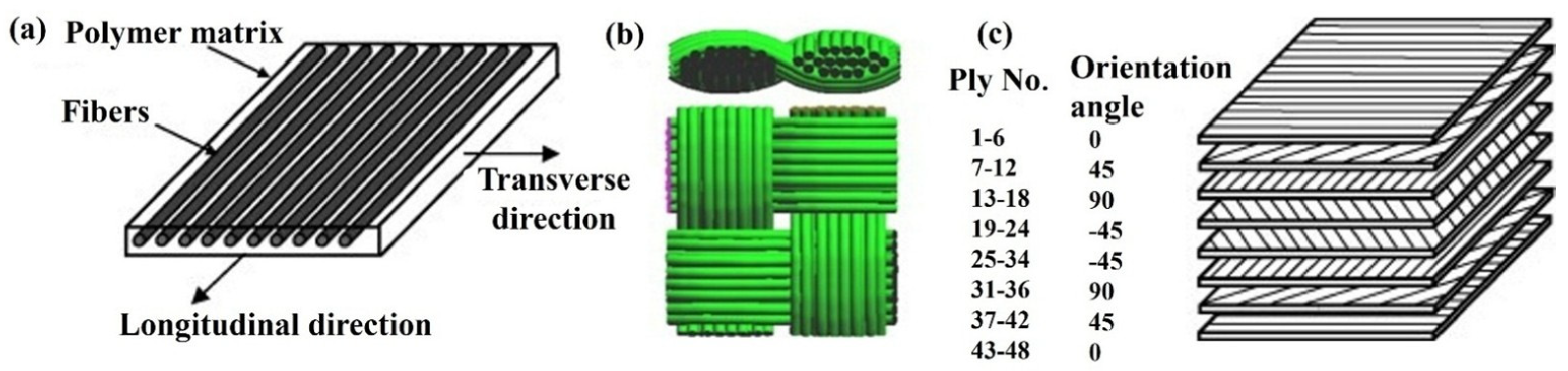
CFRP comprises a polymer matrix and carbon fibers, which constitute the primary reinforcement phase and principal load-bearing constituent of the composite. They possess higher strength and stiffness than steel, have a low density, and exhibit excellent tensile, flexural, and impact resistance. These fibers are intensively distributed within the phase of the composite material embedded in the matrix. The polymer matrix, on the other hand, acts to fill and bond the carbon fibers together, enabling them to form an integrated structure and enhancing the overall performance of the material. The matrix does not bear significant loads itself; instead, it transfers loads uniformly to the reinforcing fibers and protects them from surface damage and harsh environmental influences such as high temperatures and moisture [10,11]. Furthermore, the matrix imparts ductility to the composite and impedes crack propagation between adjacent fibers [12]. Thermosets and thermoplastics or elastomers are the most commonly used polymer matrix materials [13]. The reinforcement in these composites is predominantly provided by continuous fibers, configured in either unidirectional (UD) or bidirectional (woven) arrangements. The structural build-up involves consolidating these fibers into thin, pre-impregnated sheets termed prepreg plies. As illustrated in Figure 1a, UD plies demonstrate pronounced anisotropy, offering optimal stiffness and tensile strength parallel to the fiber axis, while properties are substantially diminished in the transverse direction. Conversely, woven ply architectures (Figure 1b) yield more balanced in-plane mechanical characteristics, attaining near-maximum stiffness and strength along both primary directions. To fabricate CFRP laminates with enhanced macroscopic properties, multiple prepreg plies are stacked and cured. A common strategy to mitigate anisotropy involves laminating UD plies in a cross-ply sequence with varied fiber orientations, thereby creating a quasi-isotropic laminate. A representative stacking sequence for such a quasi-isotropic CFRP laminate, comprising multiple UD plies, is depicted in Figure 1c.
Despite the prevalence of near-net-shape manufacturing (e.g., layup and curing) for CFRP components, secondary machining operations—notably drilling, milling, and turning—are invariably required to attain final design specifications. These processes are essential for ensuring the prescribed surface finish, dimensional accuracy, tolerances, and assembly compatibility of finished parts [15,16,17]. Given the substantial dimensions and material volumes involved, mechanical material removal remains indispensable, with drilling [18,19], milling [20,21], turning [22,23], and grinding [24,25] being the principal techniques. Drilling, in particular, is critical for enabling riveted and bolted connections, which are common assembly methods whose efficacy and reliability are fundamentally contingent upon the quality of the machined holes. The integrity of these holes directly governs the component’s mechanical strength, stiffness, and in-service reliability. Nevertheless, CFRP is a notoriously difficult-to-machine material due to its inherent structural characteristics, including anisotropy, heterogeneity, low interlaminar bonding strength, and poor thermal conductivity. During drilling, the cutting edges alternately engage with the reinforcing fibers and the matrix, generating thermomechanical effects. Even under the action of the same cutting edge, the removal mechanisms for fibers and the matrix differ and continuously vary with changes in fiber ply orientation [26]. Therefore, severe defects such as delamination, burrs, tearing, and surface voids are prone to occur on or beneath the hole periphery or the hole wall surface during the machining of CFRP composite parts, indicating considerably poor machinability that severely compromises the final machining quality of the composite components. Among these defects, delamination is the most critical form of damage, primarily influenced by thrust force and torque [27]. It reduces the structural integrity of the material, diminishes the load-bearing capacity of the component, and simultaneously shortens its service life [28]. It is estimated that in the aircraft industry, drilling-related delamination accounts for up to 60% of all part rejections during the final assembly stage of an aircraft [11,29,30]. Thus, suppressing drilling-induced delamination is key to ensuring flight safety and controlling costs. Additionally, defects such as burrs, tearing, fiber pull-out, and surface voids also frequently occur. These defects not only seriously impair product assembly quality and joint reliability but can also lead to high scrap rates, thereby hindering the broader application of CFRP. Hence, avoiding other drilling-induced defects is also a major focus of current research.
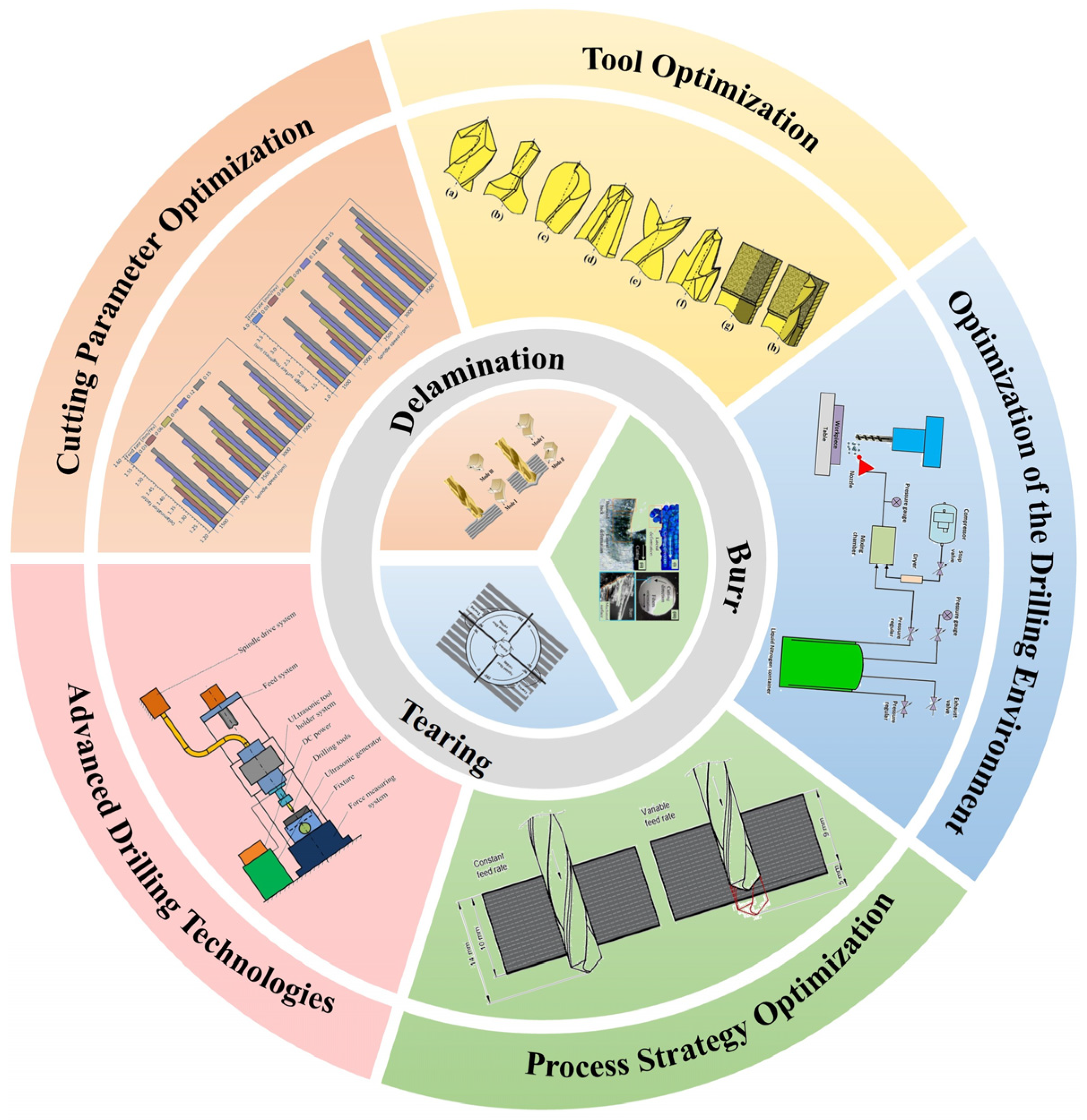
Therefore, understanding and mitigating these defects is a major research focus. While existing reviews often categorize drilling research in isolation, this work distinguishes itself by adopting a holistic, systems-level perspective. It explicitly integrates the thermomechanical coupling inherent to CFRP machining as a central theme, linking material behavior to defect genesis. Furthermore, it systematically examines the interactions between defects, tool state, and processing environment, moving beyond singular factor analysis. Finally, it highlights the evolving trend from empirical correction towards predictive modeling and intelligent process control. Through this synthesized framework, the review not only consolidates current knowledge but also provides a structured roadmap for developing fundamental theories and adaptive solutions for high-quality CFRP drilling. The holistic framework of this review is illustrated in Figure 2. It begins with an analysis of the formation mechanisms of critical drilling defects, including delamination, burrs, and tearing. Based on this analysis, comprehensive process optimization strategies are summarized, covering cutting parameters, tool design, drilling environment, process strategies, and advanced machining technologies. Finally, the review concludes with a summary and future perspectives on high-quality CFRP drilling, providing theoretical insights and practical guidance for researchers.

2. Drilling Defect Types and Formation Mechanism

The mechanical properties of CFRP are distinctive, and its internal structure is diverse. Its machining mechanism differs fundamentally from that of traditional metallic materials. The removal of metals primarily relies on plastic deformation to form chips. In contrast, CFRP, as a two-phase composite material composed of high-strength brittle fibers and a relatively ductile resin matrix, involves a more complex material removal process encompassing brittle fracture of fibers, plastic flow of the resin, and debonding at the fiber-matrix interface. Precisely because of this complexity, coupled with CFRP’s low interlaminar bonding strength and high sensitivity to temperature, various defects such as delamination, burrs, tearing, fiber pull-out, and surface voids are prone to occur during drilling. These defects not only reduce the fatigue strength of the final product but are also a major cause of rejection for most CFRP components in service. Table 1 summarizes typical surface defects in CFRP laminates during drilling. It is evident from the table that most drilling damage occurs at the hole entry and exit, although some minor damage also exists within the hole wall. The prevalence and severity of these defects have become a key bottleneck constraining CFRP machining quality and application reliability, drawing significant attention from researchers. Therefore, systematically investigating and elucidating the formation mechanisms of these drilling defects is an indispensable theoretical prerequisite for formulating effective process optimization strategies and achieving high-quality machining.

2.1. Delamination

Delamination refers to the phenomenon in which CFRP laminates separate between layers during drilling due to the thrust force of the drill bit exceeding the interlaminar bonding strength [34,35]. Specifically, during CFRP drilling, the cutting edges of the drill bit exert compressive and shear forces on the uncut material, generating localized stress in the CFRP. When this stress surpasses the critical load of the CFRP, initial cracks form in the inner layers of the hole, propagating towards the outer layers. Under sustained loading, these cracks gradually expand, ultimately leading to the occurrence of delamination defects [36]. The onset of delamination is influenced by numerous factors, which may act individually or in combination, including material properties, drill bit geometry, and the selection of cutting parameters. Delamination compromises the dimensional accuracy, surface finish, structural integrity, and long-term durability of composite components.
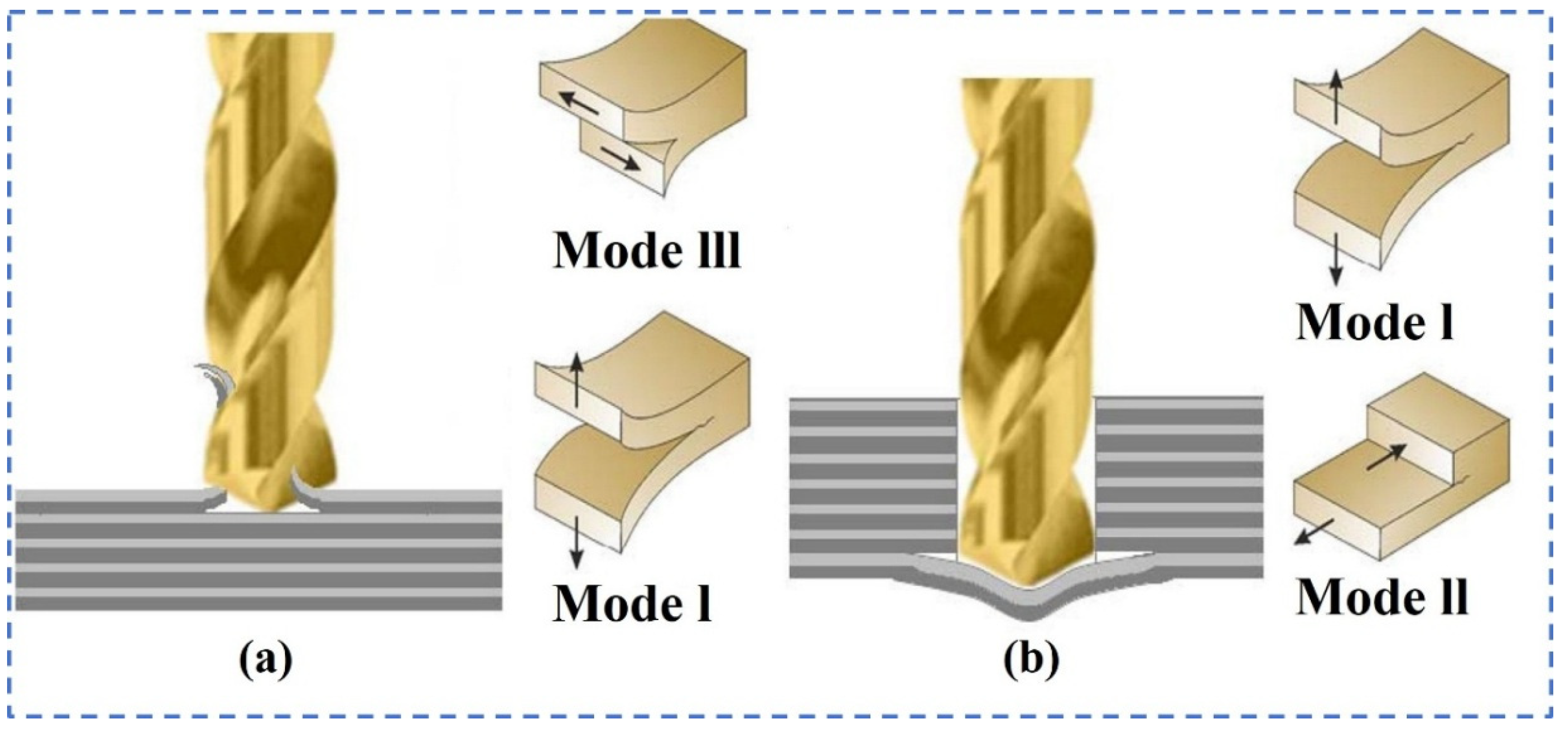
The periphery of drilled holes, especially the entry and exit zones, is the primary site for delamination. This damage corresponds to two distinctive modes dictated by their formation mechanisms: peel-up delamination at the entry and push-out delamination at the exit [37,38]. Entry peel-up delamination primarily results from insufficient cutting action of the drill bit’s cutting edges, leading to incomplete fracture of surface fibers. These fibers are then peeled upward from the CFRP surface by the drill flutes [39]. Figure 3a illustrates the mechanism of peel-up delamination, which is influenced by factors such as drill flute geometry, helix angle, and drilling torque. When the drill’s cutting edges engage with the composite laminate, the inclined surface of the flute generates a peeling force. This force causes the separation of the topmost plies, creating tearing shear cracks characteristic of Mode III fracture. Furthermore, unfavorable cutting conditions, such as drill bit vibration, can result in incomplete cutting of the top-layer fibers. The edges of these fibers are subsequently lifted, forming Mode I cracks, which further contribute to delamination. Therefore, the propagation of peel-up delamination can involve a combination of both Mode I and Mode III fracture. Figure 3b reveals the mechanism of push-out delamination, which is associated with thrust force, laminate interface quality, and process conditions. As the drill bit nears breakthrough, the diminishing uncut laminate exhibits increased compliance and is prone to bending deformation. Push-out delamination initiates when the induced interlaminar stress surpasses the inherent bonding strength of the material. Due to the combined action of axial force and bending, fracture in the bottom plies can occur in both Mode I and Mode II. Compared to peel-up delamination, push-out delamination is generally more severe because the unsupported material near the exit lacks sufficient backing to counteract the thrust force. While thrust force is widely regarded as the dominant mechanical factor inducing delamination, the role of drilling torque cannot be overlooked. The influence of torque manifests primarily through two indirect yet critical mechanisms: First, intense friction between the drill bit and the material generates substantial heat, leading to a sharp rise in localized temperature. The polymer matrix in CFRP is temperature-sensitive; elevated temperatures can cause its softening or even thermal degradation, thereby significantly compromising the interlaminar bonding strength. This degradation means that the critical condition for delamination may be reached even under relatively lower thrust forces. Second, torque inherently induces interlaminar shear stresses within the material. These shear stresses couple with the normal peeling stresses generated by the thrust force, creating a complex combined stress state. This coupling not only can lower the overall delamination threshold but may also alter the crack propagation path and mode (e.g., promoting Mode II or Mode III fracture). Consequently, the initiation and evolution of delamination are fundamentally a thermo-mechanically coupled outcome resulting from the combined action of thrust force and torque.
To quantitatively assess the extent of delamination damage during CFRP drilling, researchers have successively proposed one-dimensional length-based [40], two-dimensional area-based [41], and three-dimensional volume-based delamination evaluation factors [42]. Consequently, the field has seen advancements in metrics with the introduction of factors like the adjusted, refined, equivalent, and minimum delamination factor, each aiming for improved precision. Their definitions and characteristics are summarized in Table 2. Among these, one-dimensional and two-dimensional delamination factors are the most widely used for evaluating machining-induced delamination in various composite materials due to their simple definitions, intuitive results, and ease of measurement. The three-dimensional delamination factor further considers the through-thickness propagation and interlayer effects of drilling damage, providing a more comprehensive description of the delamination’s spatial morphology. However, existing metrics primarily focus on the static description of the final delamination state and suffer from several critical shortcomings that limit their reliability and practical relevance. First, prevalent metrics such as Fd and Fa exhibit a pronounced sensitivity to image acquisition and processing parameters, particularly the choice of thresholding algorithms when converting images to binary formats for damage area calculation. This subjective or algorithm-dependent step can lead to significant variability in the measured delamination extent, undermining the reproducibility and objective comparison of results across different studies. Second, and more fundamentally, there is a weak correlation between these geometrically based metrics (Fd, Fa, Fda, Fv) and the residual mechanical performance (e.g., bearing strength, fatigue life) of the drilled components. A larger measured delamination area does not necessarily translate linearly into a proportional reduction in structural integrity, as the impact depends on crack location, orientation, and the local stress state. This disconnect limits the ability of current metrics to serve as reliable predictors for in-service component performance. Third, the field lacks standardization in measurement protocols. Variations in inspection techniques (e.g., optical microscopy vs. ultrasonic C-scan), definitions of the “damaged area,” and the calculation methods for the different factors (Fd, Fa, etc.) make it difficult to directly compare or synthesize findings from independent research efforts. This absence of consensus hampers the establishment of universally accepted quality thresholds. Consequently, there is still a lack of a comprehensive evaluation framework capable of effectively characterizing the dynamic initiation and evolution mechanisms of delamination and linking them quantifiably to the impact on in-service performance. Therefore, constructing a multi-dimensional, standardized, and performance-relevant evaluation index system remains an important topic for further research in this field.
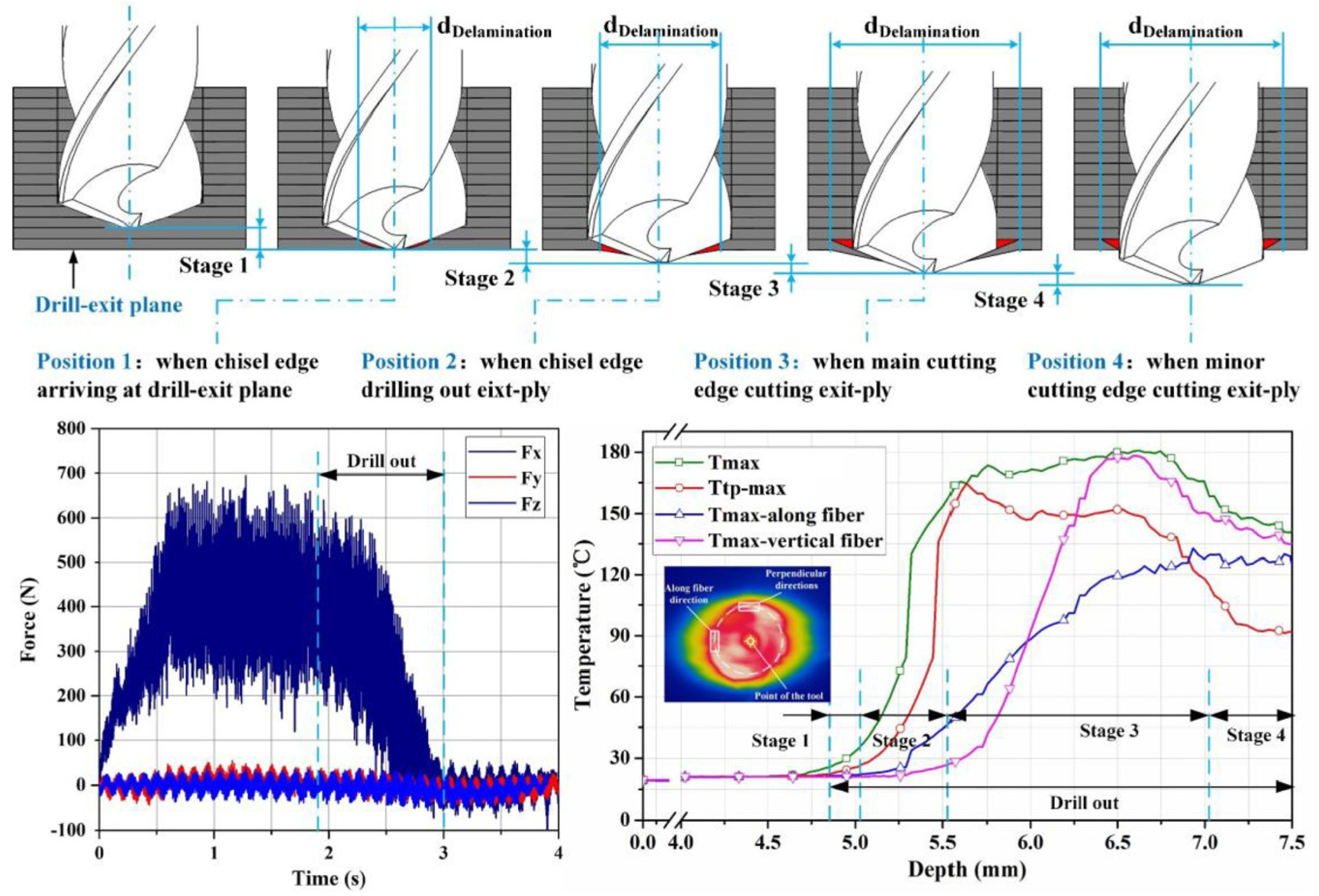
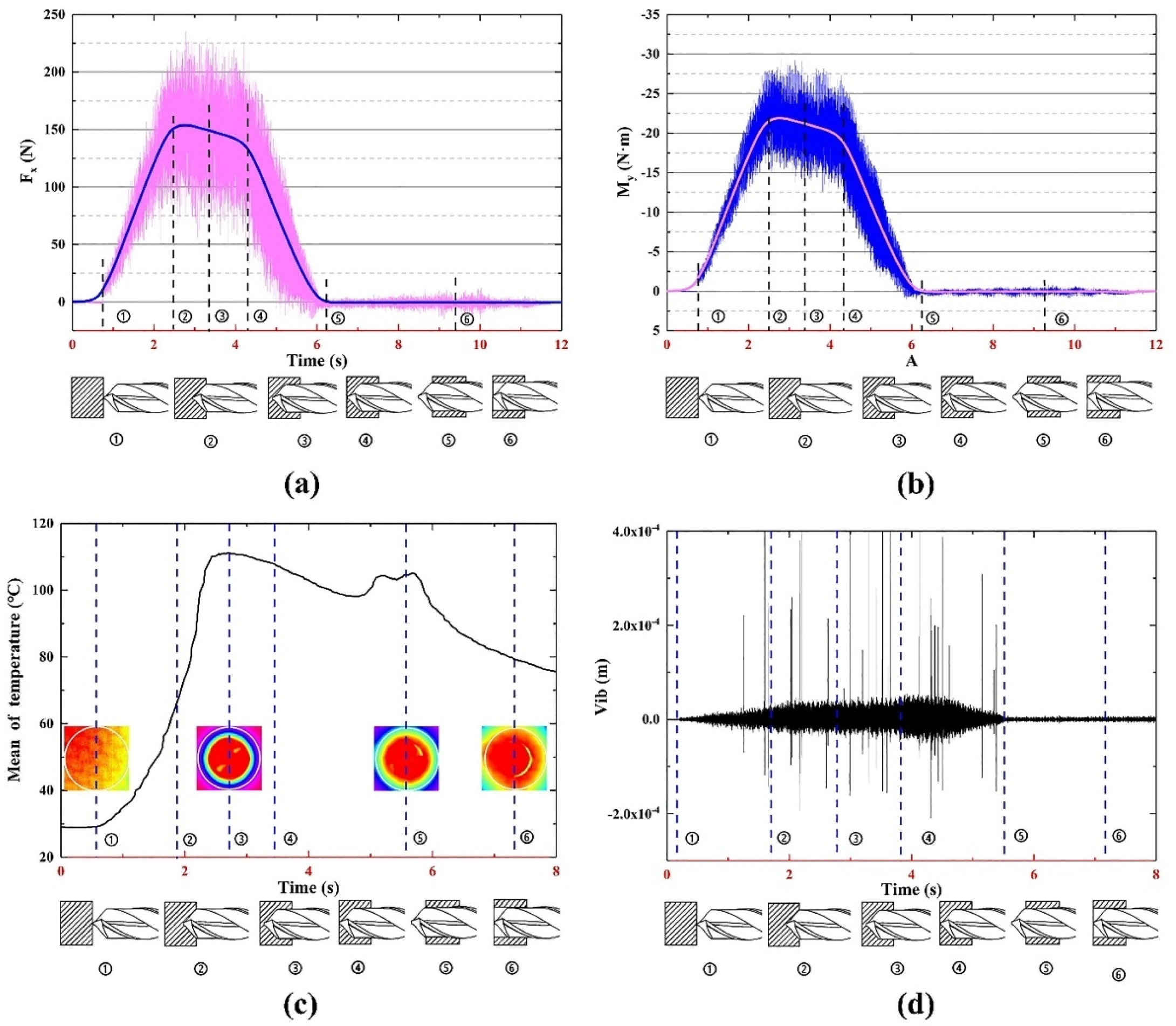
Through an analysis dividing the exit cutting process into four stages and five representative positions (Figure 4), Hou et al. [49] studied the thermal effects and exit damage mechanisms in CFRP drilling. The study revealed that drill-workpiece interaction is governed by exit temperature, with the peak temperature itself being dictated by the position of the uncut material relative to the cutting edge at breakthrough. Under elevated temperatures, the delamination factor plateaus despite increases in cutting speed and feed rate. This phenomenon is attributed to material softening and easier removal during cutting, which results in the pushing out of thinner material, forming fine cracks and fractures. he progression from Position 1 to Position 4 represents the drill breakthrough phase, a critical and highly transient process defined as the brief period from the instant the drill bit initially contacts the final few plies of the workpiece laminate to the moment its cutting edges (typically the chisel edge and main lips) completely exit the workpiece. This phase is the decisive period for the concentrated initiation and rapid evolution of exit-side defects such as push-out delamination, burrs, and tearing. During this stage, the workpiece condition is characterized by a drastically reduced and compliant uncut ligament at the exit side, typically comprising only the last few plies. Consequently, its bending stiffness decreases precipitously. The dynamic evolution involves a transient transition of the material’s response from stable cutting to global buckling and fracture, accompanied by significant thermo-mechanical coupling effects. To fundamentally deconstruct this process, it is imperative to establish an integrated research framework. This framework should combine experimental observation (e.g., high-speed imaging, acoustic emission), high-fidelity multi-scale finite element simulation (capable of capturing fiber-matrix damage and interlaminar crack propagation), and data-driven methodologies (fusing multi-sensor time-series signals). Such an integrated approach enables the systematic revelation of the dynamic origin, propagation, and arrest mechanisms of damage, thereby providing a theoretical foundation for real-time prediction and adaptive process control.
Li et al. [50] performed comparative drilling experiments on both monolithic CFRP and CFRP/Ti6Al4V stacks, analyzing the causes and variations in entry delamination by examining drilling forces, temperature, and the characteristics of titanium alloy chips. Their results indicate that when drilling monolithic CFRP, minor Mode I and III delamination occurs near the hole entry at a fiber cutting angle of 135°, a consequence of tool geometry and material anisotropy. In contrast, during the drilling of CFRP/Ti6Al4V stacks, the thermo-mechanical interaction with high-temperature titanium chips induces more severe elliptical Mode I delamination at the CFRP entry point. n a complementary numerical study, Tang et al. [51] developed a 3D finite element model to probe the micromechanisms of entry delamination, chip formation, and associated peeling forces at the microscopic scale, specifically at fiber cutting angles of 0°, 45°, 90°, and 135°. The simulations confirm a strong dependence of both delamination initiation and chip morphology on the fiber cutting angle. The extent (length) of entry delamination was found to increase with this angle. Notably, delamination is negligible at 0° due to compressive stress from the tool flank. At 45° and 90°, delamination is primarily driven by Mode III (tearing) fracture, while at 135°, a combination of Mode I (opening) and Mode III fracture leads to severe damage, coinciding with a peak in peeling force. This model provides significant insight into the underlying mechanisms of entry delamination and offers theoretical guidance for achieving damage-free drilling of CFRP. The fiber cutting angle is a common and critical parameter that simultaneously governs the formation tendencies of all three defects. In the vicinity of 135°, where material removal is dominated by brittle fracture, the unique cutting forces generated not only induce delamination but also promote the formation of specific burr patterns and result in the most severe tearing defects.
Among the three primary drilling defects, delamination is widely recognized as the most severe and costly for industry. Its criticality stems from two main factors: first, its concealed nature, as internal interlaminar cracks are difficult to detect visually, requiring methods such as ultrasonic inspection, which increases quality control costs; and second, its detrimental impact on structural integrity.
Reducing delamination in CFRP drilling can be effectively approached through prediction. Jia et al. [52] proposed a thermal effect analysis model to predict the critical delamination condition for CFRP composites, considering the material’s anisotropy, thermomechanical deformation, and tool loading. The model’s validity was verified through numerical simulations and precise punching experiments on uncut laminates. The model yielded the value of critical thrust force and its dependence on drilling temperature. Furthermore, a thrust force model based on tool geometry was proposed. Using this model, the critical feed per tooth for delamination-free drilling under different uncut layer thicknesses and drill diameters can be determined. Wang et al. [53] proposed two analytical critical thrust force (CTF) models for different cutting states to predict the critical delamination condition during the drilling of CFRP laminates. Ismail et al. [54] established an analytical thermomechanical model grounded in linear elastic fracture mechanics, classical plate theory, cutting mechanics, and energy conservation, aimed at predicting the critical feed rate and thrust force at delamination onset in CFRP laminates. Massoom and Kishawy [55] developed an analytical model to predict the critical thrust force for the initiation of delamination. This model accounts for thermomechanical loading and the mixed fracture modes occurring in the delamination zone. The model delineates a delamination growth process: initiating as a circular zone in the entry ply, which then propagates and evolves into an elliptical region aligned with the fiber direction in the exit ply. The associated load distribution is characterized by a central point load from the chisel edge and a linearly distributed load exerted by the cutting lips. Chen et al. [56] established both macroscopic and microscopic finite element models (FEMs) for drilling CFRP with pre-existing delamination defects. The formation and evolution of material damage during drilling were investigated experimentally and through simulation, using circular polytetrafluoroethylene (PTFE) films to simulate delamination defects in the CFRP. Cui et al. [57] proposed a comprehensive delamination prediction method based on multi-sensor data. During drilling, data on force, torque, temperature, vibration, and exit hole images were collected (as shown in Figure 5). A proposed statistical delamination factor (Fs) was used to quantify delamination. By combining multi-sensor data with precise assessment of delamination damage, a learning model for predicting delamination damage was established. Feito et al. [58] developed a simplified model for delamination damage prediction, thereby reducing computational time. Choi et al. [59] proposed a multimodal 1D CNN that leverages time-series multi-sensor data (encompassing force, torque, acceleration, voltage, current, sound) and exit hole images from a robotic drilling system to predict the delamination factors Fd and Fa—key metrics for quantifying hole quality derived from image analysis. Fard et al. [60] developed a regression-based model using partial least squares (PLS) to predict delamination defects during the drilling of CFRP plates. The results indicated that tool geometry and cooling conditions, particularly friction, have a greater influence on drilling outcomes compared to spindle speed and feed rate. These methods for effective delamination prediction can collectively assist in better suppressing delamination.

2.2. Burrs

The formation mechanisms of burrs in quasi-homogeneous materials, such as aluminum alloys and titanium alloys, are well-understood and extensively studied. However, research on burr formation mechanisms in CFRP started relatively late. Burrs are one of the primary types of macroscopic geometric damage associated with CFRP machining features. Although they do not directly weaken the strength of the composite, significant burrs can hinder the assembly process and lead to a substantial increase in operation time and cost. Therefore, removing burrs is crucial for improving hole quality and avoiding secondary damage, such as delamination and tearing [61,62]. During CFRP drilling, burrs are typically distributed along the fiber direction on both the entry and exit sides of the hole, especially at the exit. Sometimes, they also appear on the inner wall surface of the hole. They consist of incompletely severed carbon fibers, accompanied by plastic deformation, existing in strip-like forms [63,64,65]. Given their severe impact on process quality, an in-depth investigation of the burr formation mechanism is a prerequisite for their effective suppression. Burrs form because, as drilling progresses, the laminate thickness continuously decreases, and the interlaminar strength gradually weakens. When the drill bit approaches the final few fiber layers, the main and auxiliary cutting edges exert strong compressive forces on the fibers and matrix at the hole exit. While most carbon fibers are gradually severed by the cutting edges at the hole periphery, a few fibers deform under the pushing action of the drill bit. This deformation hinders fiber removal. As drilling continues, the fibers gradually elongate, and fibers in the cutting angle region rapidly bend radially outward. Ultimately, the incomplete material removal by the main cutting edge leaves residual fibers aligned with the fiber ply orientation, forming burrs. In CFRP, burr formation is complex and differs from that in other homogeneous materials because it is influenced by numerous factors. These include complex tool conditions [66,67], fiber cutting angle [68], and the form of machining motion among others [69]. The composition of drilling burrs in CFRP may include protruding fibers, displaced matrix, or their combination. The most frequently observed mechanism is matrix stripping from the fibers, a phenomenon primarily attributed to elevated interfacial temperatures or weak fiber-matrix bonding during the cutting process. Consequently, the burrs consist solely of uncut reinforcing fibers. Additionally, burr defects can also form at interlaminar gaps due to several scenarios. For example, cavity formation caused by improper manufacturing processes or interlaminar gaps influenced by reinforcement geometry can lead to burr formation.
The formation of burrs in CFRP drilling is a dynamic evolution process, which can be broadly divided into four stages: First, during the initial deformation stage, the drill bit contacts the workpiece. Material in the central zone is compressed, leading to resin softening and fiber slippage, which initiates plastic flow. Next, in the material accumulation stage, as the drill penetrates deeper, the fiber-resin mixture, hindered by poor chip evacuation, continuously accumulates at the hole bottom. Concurrently, the support force on the exit side weakens. When the drill bit approaches breakthrough, the process enters the deformation zone expansion stage. The support force from the remaining workpiece layers drops sharply, and the plastic deformation zone spreads from the center towards the edges. Finally, in the burr formation stage, the thin layer of material at the exit, which is difficult to cut effectively, is forcibly extruded and fractured under the thrust of the drill bit, ultimately forming sharp-edged burrs. The core mechanism throughout this entire process lies in the reduced interlaminar strength at the exit, where the compressive action of the drill bit causes fibers to undergo bending deformation rather than being cleanly sheared off. Compared to delamination, burrs primarily manifest as surface geometric protrusions, directly impairing assembly functionality and efficiency. Following delamination at the hole exit, the effective interlaminar support for the remaining uncut plies is compromised, leading to a marked reduction in their bending stiffness. Consequently, during the cutting of the final layers, the material becomes significantly more susceptible to global bending deformation. This condition substantially exacerbates fiber bending and pull-out, directly aggravating burr formation. Therefore, suppressing delamination constitutes an effective strategy for mitigating exit burrs at their source.
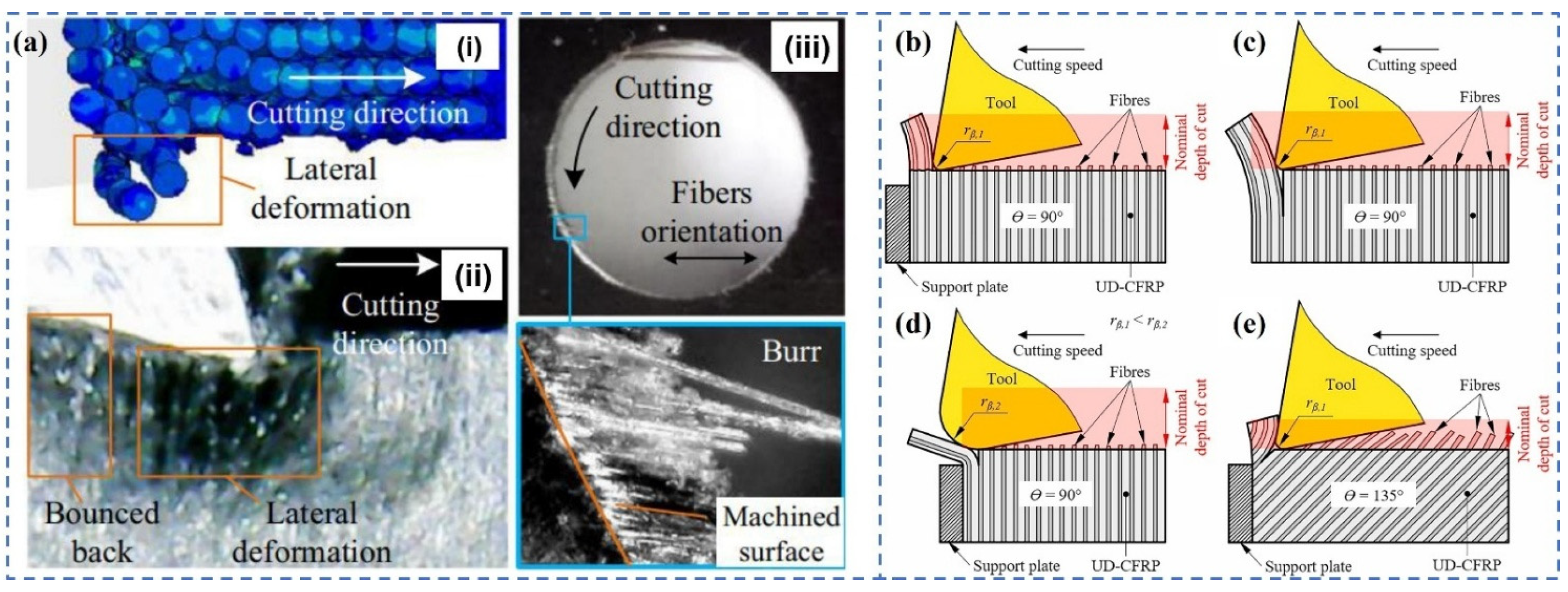
Poór and Pereszlai et al. [69] indicated that burrs form in CFRP if the tool fails to achieve the theoretically intended depth of cut, as illustrated in Figure 6a. Three primary scenarios exist: (1) In the absence of adequate support (e.g., backing plates or inter-layer constraint, Figure 6b,c), the cutting forces induce an opening effect that promotes inter-ply delamination. The resulting bending of the unsupported final layers allows them to deflect around the tool, leading to burr formation at the exit. (2) Even with workpiece support, an excessively large cutting edge radius (Figure 6d) compresses and bends the fibers rather than shearing them, generating pronounced burrs and impairing chip evacuation. (3) When the fiber cutting angle is non-preferential despite support, the tool tends to plow through and deform the composite without effective material removal, again resulting in significant burr formation [70]. When the fiber cutting angle is θ = 135° ± δ (where δ represents an error margin), the chip removal mechanism is dominated by macro-fracture: in this case, the cutting tool pushes and bends the fibers, causing them to undergo elastic buckling. This leads to significant crack propagation, out-of-plane displacement, uncut fibers, and undesirable surface roughness, as shown in Figure 6e. In numerous studies, the fiber cutting angle is widely recognized as the most significant factor affecting burrs. However, the specific nature of its influence—such as whether acute or obtuse angles are more prone to burr formation—varies across different studies, leaving room for further investigation. To address these challenges, Wang et al. [71] proposed a multi-scale modeling-based three-dimensional finite element model. Using this model, they analyzed the formation mechanism of burrs generated during the drilling of carbon fiber composites. Their conclusion was that a substantial amount of burrs are generated at the hole exit, while the hole wall exhibits almost no burrs. Regarding the hole exit, burrs readily form when the cutting angle is acute, whereas they are minimal when the cutting angle is obtuse. Xu et al. [72], through experimental observation, found that the burr defects generated at the hole exit primarily occur around holes where the fiber cutting angle is obtuse. They concluded that the fiber cutting angle has the most significant influence on CFRP burrs, followed by cutting edge radius, rake angle, and depth of cut.

2.3. Tearing

During CFRP drilling, alongside delamination and burrs, tearing stands as another critical defect impacting machining quality, primarily occurring on the exit side of the hole. It is typically characterized by the separation of fibers from the matrix or the cracking of the matrix itself within the outermost material on the exit side, induced by the coupled thermomechanical action of drilling. This tearing damage readily facilitates the propagation and extension of surface micro-cracks in the composite material. Consequently, under load, structural components may experience cracking failure, thereby compromising the surface integrity of CFRP parts.
The formation of tearing involves two distinct stages: the tear initiation stage dominated by the chisel edge, and the tear propagation stage completed by the main cutting edges. The chisel edge stage plays the predominant role. This stage commences with the chisel edge exerting a pushing force on the surface layer material at the exit side and concludes when the chisel edge cuts through this layer. As the drill’s chisel edge cuts outward from within the material, it applies a strong compressive force on the surface layer. Initially, the surface fiber layer bulges slightly around the drill axis. With the continued advance of the drill, this bulging area gradually enlarges and extends along the direction of the outer fiber ply. Upon reaching a critical extent, interfacial bonding fails, leading to cracking, and the chisel edge breaks through. The subsequent main cutting edge stage begins at this breakthrough and ends when the main cutting edges completely exit the surface material. The tear formed by the chisel edge is preliminary. After the chisel edge exits the workpiece, the main cutting edges continue to influence the final tear morphology through two mechanisms: firstly, they sustain the outward pushing action initiated by the chisel edge, and secondly, their high-speed rotation introduces an additional twisting effect. The coupling of these effects further expands and defines the initial crack, ultimately forming a macroscopic tearing defect. It is noteworthy that the formation and propagation of tearing defects are not isolated processes; they are highly susceptible to significant influence from other defects. The most typical interaction is with delamination: when delamination has already occurred at the hole exit region, the remaining isolated surface layer loses effective interlaminar support, and its bending stiffness decreases drastically. Consequently, if the main cutting edge finally acts on this weakened layer, the material becomes more prone to unstable global buckling or tearing rather than stable shear removal. Therefore, in areas where delamination is already present, the severity and extent of tearing are typically significantly exacerbated. This reveals that suppressing delamination is also crucial for controlling tearing at its source.
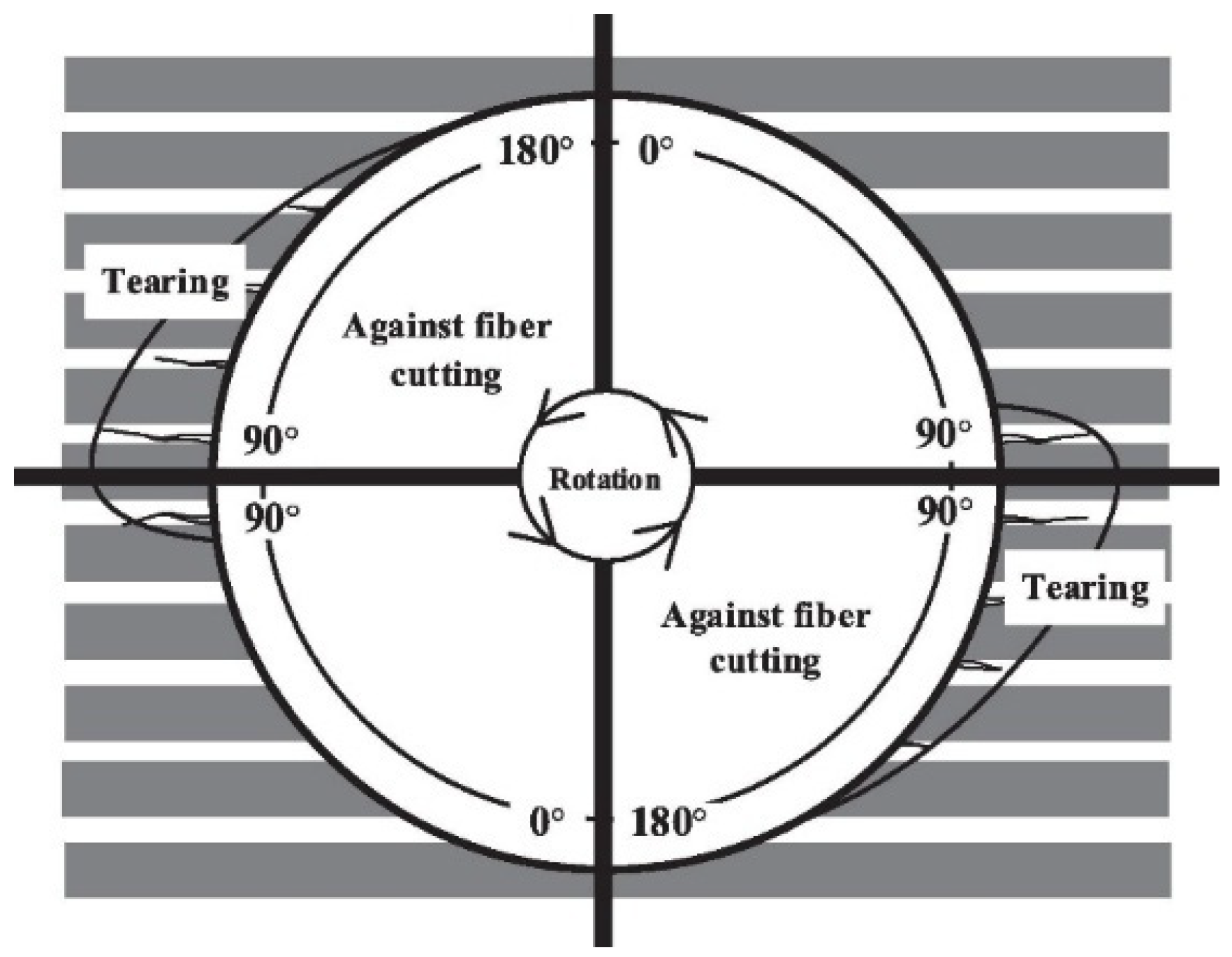
Tearing damage is not uniformly distributed around the hole circumference; its severity and location exhibit pronounced directionality. It is predominantly concentrated in two key regions: one near a fiber orientation angle of 90° and the other within the counter-fiber cutting region. Near the 90° fiber orientation, the circumferential cutting force generated during drilling acts perpendicularly to the fiber axis. This subjects the fiber-matrix interface to maximum peeling stress, making it most susceptible to interfacial separation and resulting in the most severe tearing. Similarly, significant interaction forces in the counter-fiber cutting region also lead to severe tearing defects. In this region, particularly for unsupported unidirectional CFRP, the matrix is prone to tearing along the fiber direction, especially when the fiber orientation is 90°. Given that the fiber orientation in the outermost ply remains fixed throughout the drilling process, the anti-fiber cutting zone is invariably localized to specific, unchanging sectors around the hole circumference (Figure 7). Consequently, the formation of tearing defects exhibits a distinct directional preference, being predominantly concentrated in quadrants 2 and 4.

2.4. Summary

Delamination, burrs, and tearing are three critical types of defects generated during CFRP drilling, with complex and interrelated formation mechanisms. Delamination is the most severe defect, occurring at the hole entry (peel-up delamination, influenced by torque and drill geometry) and exit (push-out delamination, primarily controlled by axial thrust). Current assessments predominantly focus on the static effects of thrust force, while insufficient consideration is given to its dynamic evolution and the combined influence of torque. Burrs mainly refer to incompletely severed fibers at the hole exit. Although they do not directly weaken structural strength, they increase subsequent processing costs. Their formation core lies in the bending deformation rather than shearing of fibers when the exit support weakens. The fiber cutting angle is the most significant factor influencing burrs, yet research conclusions regarding its specific impact (acute or obtuse angle) remain divergent. Tearing primarily occurs on the hole exit side, and its formation process consists of two stages: initiation by chisel edge pushing and propagation/shaping by the main cutting edges. This damage exhibits distinct directionality, most prone to occur near the 90° fiber orientation and in the against-fiber cutting region.
In summary, these defects are all rooted in the complex interaction between the drill bit and the material under thermomechanical coupling, jointly influenced by material properties, tool parameters, and process conditions. Current research still has room for deeper exploration regarding the dynamic formation mechanisms of defects, the coupling effects of multiple factors, and comprehensive strategies for process-based suppression.

3. Process Optimization Methods for Drilling Defect

3.1. Cutting Parameter Optimization

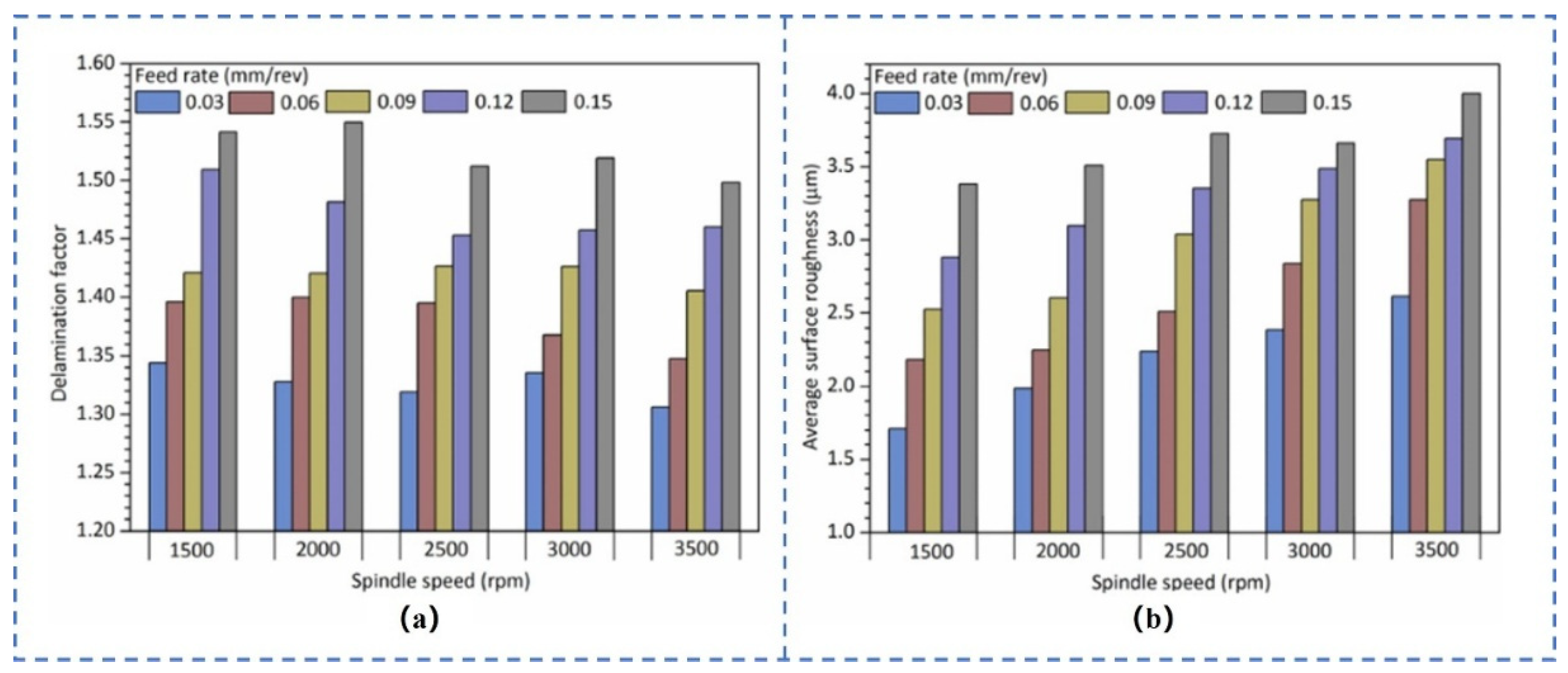
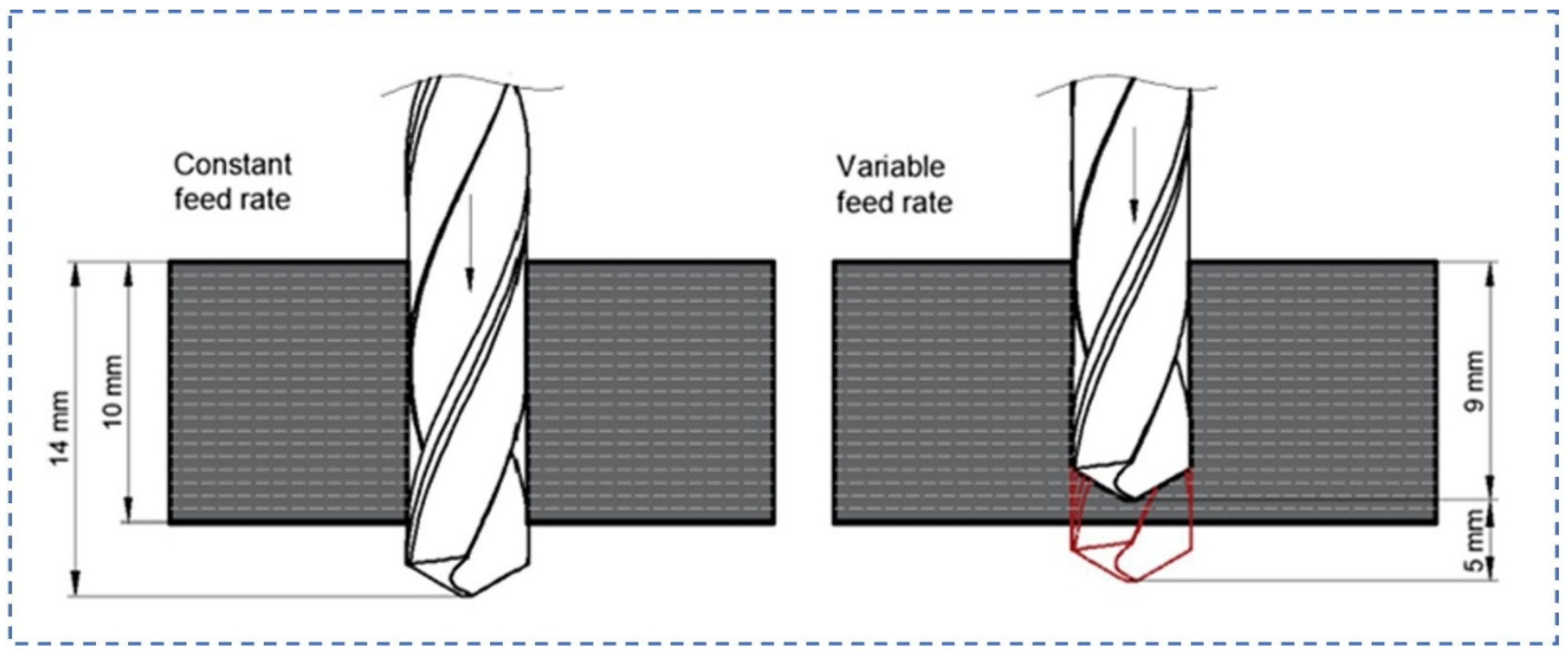
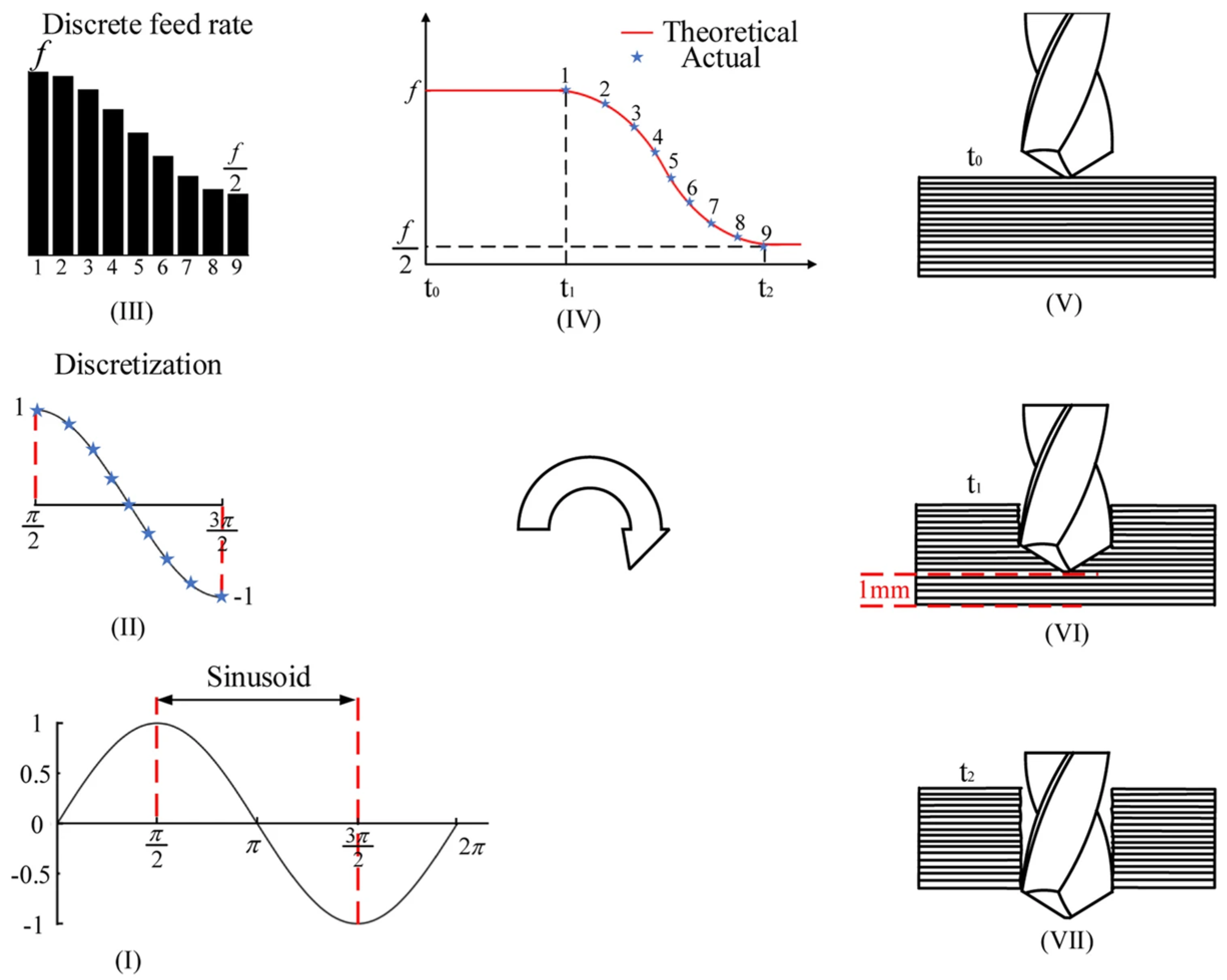
Cutting speed (Vc) and feed rate (Vf) are the primary process parameters responsible for drilling damage in CFRP. Under specific tool and working condition constraints, the rational selection of these parameters enables effective control over drilling forces, drilling heat, and tool wear, thereby reducing defects during CFRP drilling. The core objective of cutting parameter optimization is to find the optimal parameter combination that strikes a balance between machining efficiency and hole quality. Numerous studies indicate [74,75] that drilling damage generally increases with an increase in feed rate. This is because drilling forces escalate with higher feed rates. Force concentration leads to more pronounced bending phenomena, which in turn makes the material more susceptible to interlaminar crack propagation. The influence of cutting speed on drilling damage remains somewhat contentious. Wang and Jia et al. [76] experimentally compared the values of the delamination factor and surface roughness under different combinations of cutting parameters, as shown in Figure 8. Subsequently, they performed an analysis of variance (ANOVA) on the experimental data. The study found that the feed rate has the most significant impact on delamination, while the influence of spindle speed on delamination is not significant. Both feed rate and spindle speed have a significant effect on the surface roughness (Ra) of the workpiece. The contribution rate of the feed rate is 70.39%, and that of the spindle speed is 26.27%. Melentiev et al. [8] found that the feed rate has the greatest influence on delamination. The cutting speed also exerts various effects on delamination, depending on the specific range considered and the tool geometry used. When drilling CFRP with a standard twist drill, a low feed rate and a high cutting speed can reduce the risk of delamination. Shetty et al. [77] found that the parameters with the greatest influence on delamination are the feed rate and spindle speed. To reduce delamination during drilling, different methods such as applying active supporting force, introducing a pilot hole, and using specialized core drills were found to be very effective. Sorrentino et al. [78] analyzed research data showing that the thrust force in CFRP drilling increases with both increasing cutting speed and feed rate. At low feed rates below 0.1 mm/rev, the delamination factor is almost independent of cutting speed but increases significantly with increasing feed rate. Conversely, at high feed rates, the delamination factor increases with both cutting speed and feed rate. The push-out delamination factor is consistently higher than the peel-up factor. By employing a variable feed rate strategy, the push-out delamination factor can be reduced. Specifically, reducing the feed rate in the final stage of drilling decreases the thrust force, thereby minimizing push-out delamination.
Bhushi et al. [79] optimized the drilling parameters for CFRP using a genetic algorithm combined with response surface methodology (RSM). They identified feed rate and helix angle as the two most significant factors affecting the surface integrity of CFRP. The results indicate that a spindle speed of 800 rpm and a feed rate of 0.12 mm/rev are the two optimized parameters for achieving the best outcomes. Sardiñas et al. [80] proposed a multi-objective optimization method for the drilling process of laminated composites and obtained the optimal solution for cutting parameters using a posteriori method. Sorrentino et al. [78] found that employing a variable feed rate strategy can effectively reduce the push-out delamination factor. Particularly in the final stage of drilling, lowering the feed rate not only decreases the thrust force but also further suppresses the occurrence of push-out delamination. By implementing this process optimization strategy, the delamination factor for CFRP can be reduced by up to 37%. Krishnaraj et al. [81] conducted a full factorial experimental study on the high-speed drilling of thin CFRP laminates using K20 carbide drills. By varying drilling parameters such as spindle speed and feed rate to analyze hole quality, they determined the optimal spindle speed to be 12,000 rpm and the optimal feed rate to be 0.137 mm/rev. Mkaddem et al. [82] recommend using relatively high cutting speeds (150–200 m/min) and low feed rates (0.01–0.05 mm/rev) when drilling FRP to suppress delamination damage while maintaining appropriate drilling efficiency. Devitte et al. [83] employed the Box–Behnken design method to study the optimization of CFRP drilling. Their research found that the combined effect of cutting speed and feed rate on the delamination factor is far greater than their individual effects. The optimal process parameters determined were: a cutting speed of 20 m/min and a feed rate of 0.05 mm/rev. Abhishek et al. [84] utilized the harmony search (HS) algorithm for multi-objective optimization of CFRP drilling. This algorithm was compared with the genetic algorithm (GA) and the Taguchi robust optimization method. The study demonstrated that the harmony search algorithm is more efficient and requires less computational effort when seeking optimal process parameters. The best machining parameters found were a spindle speed of 1000 rpm and a feed rate of 350 mm/min.

3.2. Tool Optimization

3.2.1. Tool Geometry

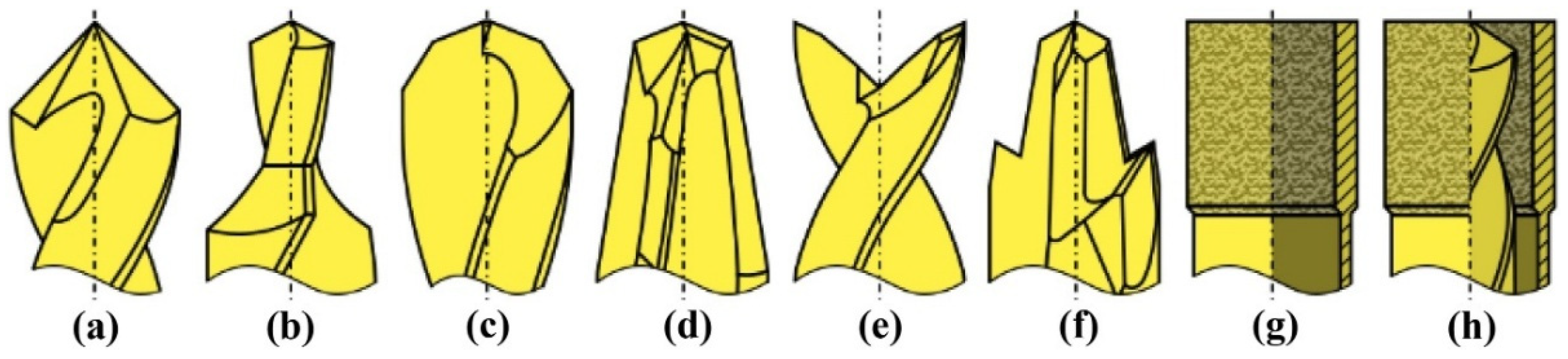
Drilling quality is fundamentally governed by tool geometry, as it directly determines the material removal behavior and associated damage modes of each cutting edge (chisel edge, main cutting edges, and margin). Therefore, optimizing tool geometry is a core approach to suppressing CFRP drilling defects. By precisely designing key parameters such as point angle, chisel edge geometry, and rake angle, the cutting behavior can be actively controlled from a mechanical perspective, which constitutes a fundamental measure for achieving high-quality machining. An optimized geometry can not only effectively reduce axial thrust force to prevent exit delamination and burr formation but also minimize secondary damage to the hole wall and heat accumulation by ensuring smooth chip evacuation. Ultimately, this effective management of cutting forces and heat at the source safeguards drilling quality while simultaneously reducing the load on the tool, thereby contributing to reduced wear and extended service life. The conventional twist drill, as shown in Figure 9a, is no longer the optimal choice for machining CFRP. In recent years, numerous researchers have designed various tool structures with different geometries, as illustrated in Figure 9b–h.
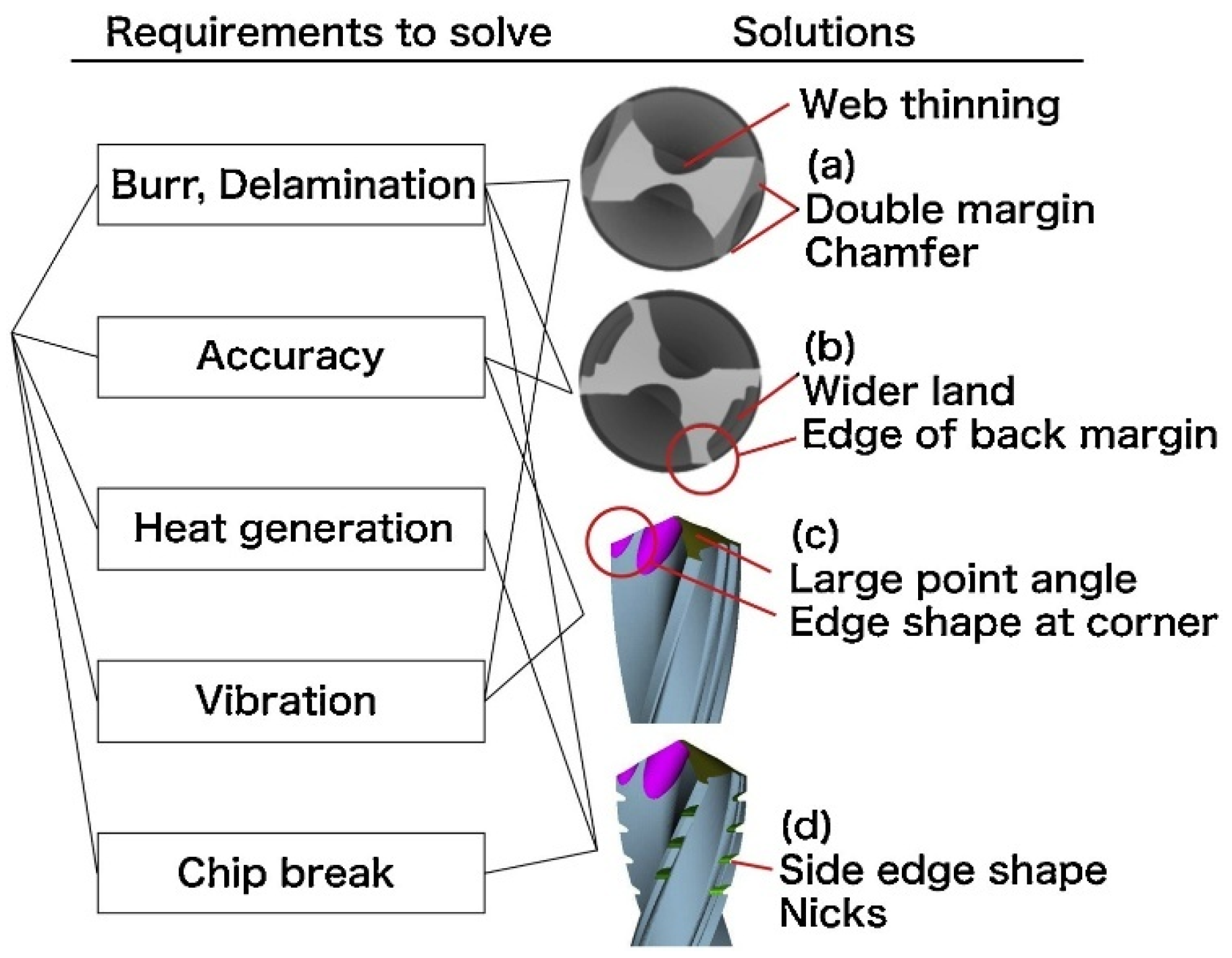
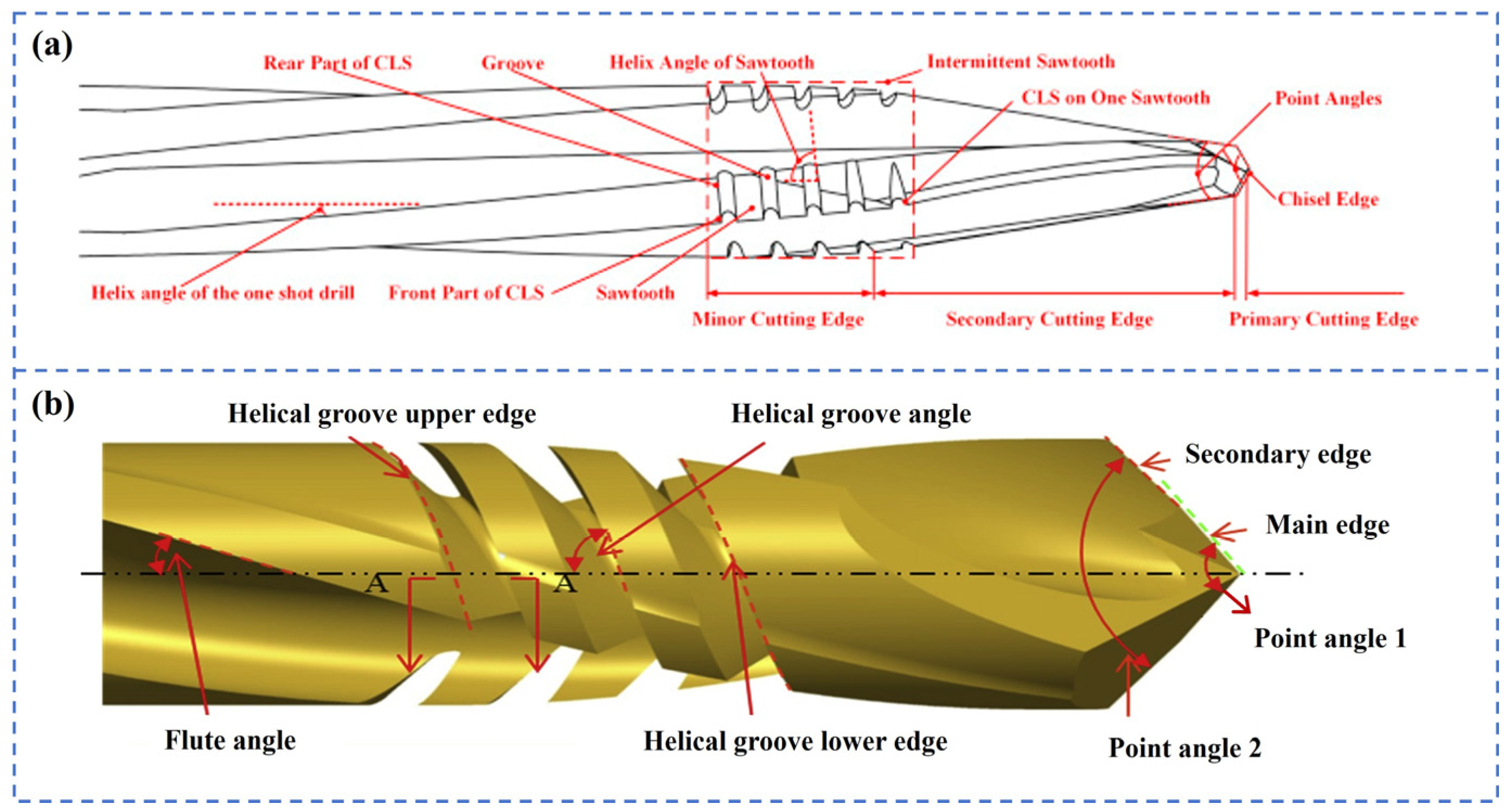
Xu et al. [72] conducted a comparative evaluation of the drilling performance of a high-strength CFRP (T800S/250F) using PCD standard twist drills and PCD special-geometry dagger drills. The experimental results indicated that compared to PCD standard twist drills, the PCD dagger drills exhibited superior tool-workpiece compatibility when machining high-strength CFRP. This was specifically reflected in better hole quality, reduced tool wear, and longer tool life. Sugita et al. [85] systematically designed the drill’s profile. A double-edge cutting lip enhanced guidance, while a chamfer at the corner suppressed vibration (Figure 10a). Increasing the lip width improved stability, and an added cutting edge on the secondary lip enhanced machinability (Figure 10b). A larger point angle, despite increasing thrust, proved effective. An arc-shaped cutting edge improved sharpness, and an optimized side-edge geometry reduced uncut material (Figure 10c). Small notches on the lip promoted chip fragmentation, effectively suppressing heat generation (Figure 10d). Experiments confirmed this structure effectively suppressed burrs and delamination, improved hole accuracy, and reduced heat. Feito et al. [86] compared a step drill with a traditional twist drill, noting it reduced axial force and torque, but delamination was only mitigated at low feed rates. Raj and Karunamoorthy [87] comprehensively analyzed three drill geometries, concluding that the brad-spur drill achieved low thrust and high dimensional accuracy, while the double-point-angle drill performed better in controlling wear and improving hole surface finish and circularity. Based on the tensile-shear effect and push-shear effect, Su et al. [88] designed a novel drill with V-shaped cutting edges. By altering the rake and inclination angles, it changed the force direction on the workpiece, thereby reducing thrust force and damage. Jia et al. [89] proposed a novel intermittent serrated drill structure (Figure 11a). Theoretical and geometric analysis indicated its cutting edges could change the cutting direction from downward to upward, significantly reducing exit damage, which was experimentally validated. Yu et al. [90] designed a drill with novel spiral groove edges based on a standard drill for CFRP (Figure 11b). This modification effectively reduced burr formation, delamination, and tearing. Kwon et al. [91] developed a step drill consisting of a core and a step part. The core minimized initial thrust from the chisel edge by controlling its diameter. The step part, via an adjusted step angle, enabled smooth removal of pre-cut material, avoiding stress concentration to suppress delamination and prevent secondary damage. On the secondary cutting edges of a step drill, Jia et al. [92] proposed a multi-edge structure to implement a depth-of-cut control strategy. Geometric analysis showed it effectively reduced the depth of cut during CFRP drilling. Comparative experiments verified its significant effects in reducing exit damage and controlling hole diameter deviation within tolerance limits. Xu and El Mansori [93] studied the drilling mechanism of CFRP/Ti stacks, pointing out that the point angle directly influences chip thickness, which significantly affects chip separation. They therefore recommended drills with smaller point angles to reduce axial thrust and delamination. Heisel and Pfeifroth [94] concluded that a larger point angle increases axial thrust but reduces delamination at the hole entry. They suggested using a larger point angle at the entry and a smaller one at the exit, justifying the rationale for advanced geometries like double-point-angle twist drills or dagger drills.
Nevertheless, advanced geometries like complex multi-edge drills face significant practical challenges. These include high manufacturing costs and extended lead times for precision shapes, delicate edges prone to chipping, difficulties in wear assessment and costly reconditioning—all undermining lifecycle cost-effectiveness. Moreover, designs optimized for specific lab conditions often lack adaptability to material variations and diverse real-world production scenarios. Therefore, transitioning these technologies from lab to factory requires a comprehensive evaluation of economics, reliability, and adaptability. Future work should assess their long-term benefits in near-industrial settings and develop balanced designs that harmonize performance with manufacturability.

3.2.2. Tool Coating

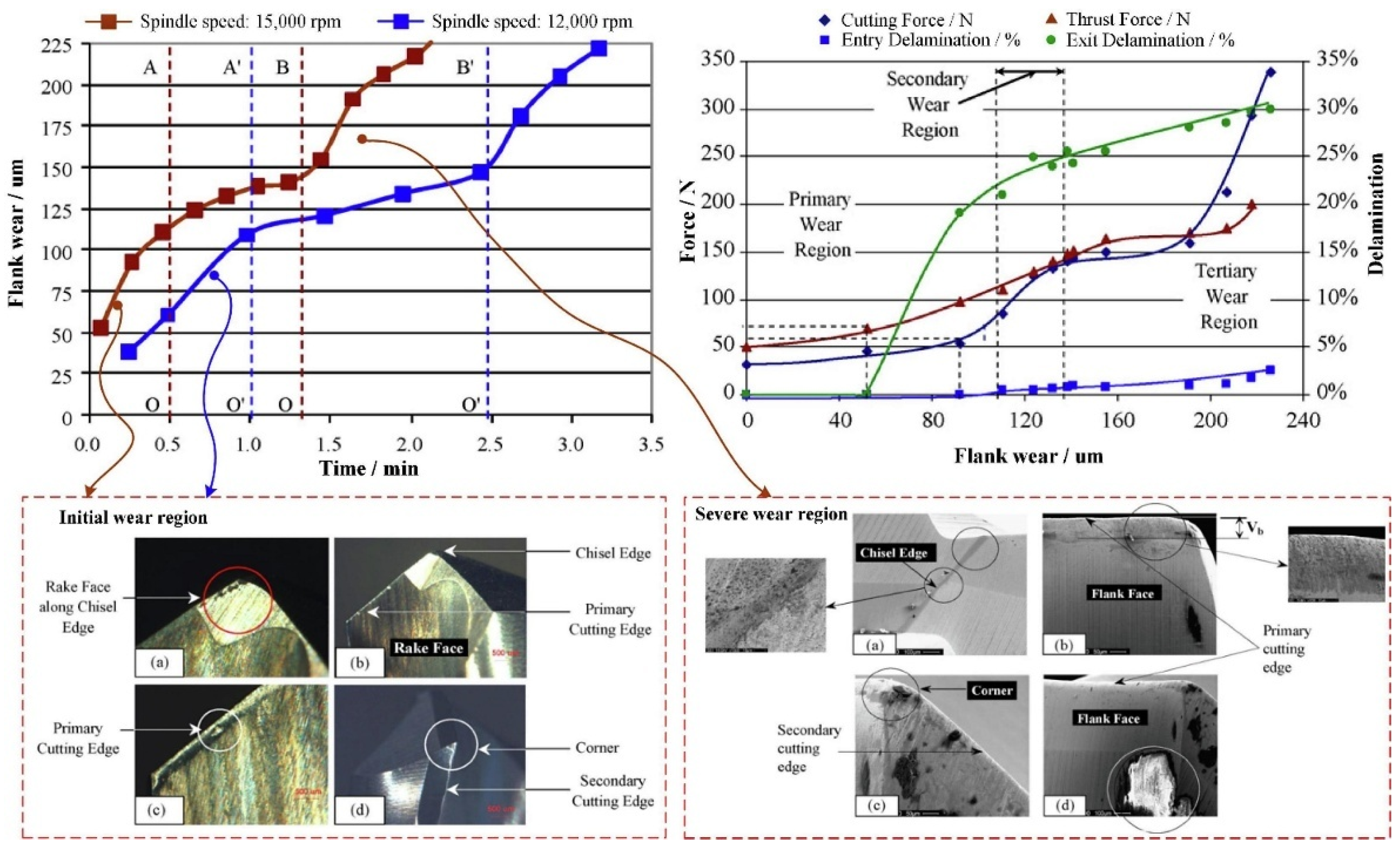
In CFRP drilling, rapid tool wear represents a core bottleneck limiting both machining quality and efficiency. Rawat and Attia [95] identified that flank wear progression is non-uniform and can be categorized into three stages: initial, steady-state, and severe wear, as shown in Figure 12. Initial wear is primarily induced by chips or micro-cracks. A fresh cutting edge with a small radius concentrates force within a narrow contact zone. As wear initiates or the edge dulls, the contact area expands, reducing contact stress. In the severe stage, thermal softening within the tool-workpiece system combined with rising contact pressure causes the friction system to behave like a high-load system, leading to a sharp increase in wear rate. Even with well-designed geometry, the extreme abrasiveness of carbon fibers, particularly under high cutting parameters, rapidly blunts HSS and conventional carbide tools. This shortens tool life, sharply increases cutting forces and heat, and exacerbates defects such as delamination, burrs, and tearing. To break this cycle, tool coating technology has emerged as a key solution for enhancing overall performance and enabling stable, efficient machining. By depositing a micrometer-scale thin film of specialized materials onto the tool substrate, coatings fundamentally alter the tool-workpiece interface characteristics. Acting as a chemical and thermal barrier, they effectively suppress interdiffusion and chemical reactions, thereby minimizing wear. Coated tools exhibit high surface hardness, excellent wear resistance, stable chemical properties, thermal and oxidation resistance, a low friction coefficient, and low thermal conductivity.
However, despite high hardness being a common feature, the performance and failure modes of different coatings in CFRP drilling vary significantly due to their distinct physicochemical properties. Diamond and diamond-like carbon (DLC) coatings, with their exceptional hardness and extremely low friction coefficient, most effectively resist the abrasive wear from carbon fibers. Moreover, their carbon-based nature ensures excellent chemical compatibility with the workpiece, preventing detrimental chemical reactions at elevated temperatures, making them the preferred choice for CFRP drilling. It should be noted, however, that DLC coatings exhibit relatively poor thermal stability, and their performance may degrade under sustained high temperatures. Titanium aluminum nitride (TiAlN) coatings, while possessing high hardness and oxidation resistance, face challenges in CFRP machining due to their chemical characteristics. The titanium content in the coating tends to interdiffuse with carbon fibers at high drilling temperatures, leading to rapid coating failure through chemical wear. This explains why their high hardness advantage is not always realized in practical drilling. Multilayer/nanocomposite coatings (e.g., TiAlN/AlCrN) optimize performance through structural design. Their alternating multilayer or nanocomposite architecture not only maintains high hardness but also inhibits crack propagation, enhances adhesion, and impedes heat transfer. This enables them to simultaneously address multiple potential failure pathways, including abrasive wear, thermomechanical fatigue, and oxidation, offering a more robust solution.
The differences in these coating characteristics and failure modes are corroborated by multiple studies. Wang et al. [96] investigated the tool wear and drilling force performance of uncoated, diamond-coated, and titanium aluminum nitride (TiAlN) coated carbide drills when drilling CFRP. The results indicated that the primary wear form for all drill types was edge rounding wear. The diamond coating significantly reduced edge rounding wear, whereas the AlTiN coating failed to effectively protect the drill bit due to oxidation occurring during the machining process. Zhong et al. [97] compared the differences in hole quality and accuracy between TiAlN-coated and uncoated drills when drilling CFRP/Al/CFRP co-cured materials. The final results showed that the TiAlN coating helped reduce the maximum axial thrust force during drilling and significantly improved hole edge quality, surface morphology, and roughness. Iliescu et al. [98] established a phenomenological model concerning the relationship between thrust force, drilling parameters, and the wear of diamond-coated drills in CFRP drilling. The study demonstrated that the diamond coating had a significant positive effect on carbide drills, extending tool life to 10–12 times that of uncoated carbide drills. Swan et al. [99] conducted drilling experiments on CFRP using diamond-like carbon (DLC) coated, AlMgB14 (BAM) coated, AlCrSi/TiN coated, and uncoated carbide drills, performing qualitative and quantitative evaluations for each coating. The results showed that the AlCrSi/TiN coated drill exhibited the best performance, despite not having the highest coating hardness. The reason is the good stiffness match between this coating and the carbide substrate, and the nanolayered alternating structure within the coating enhanced coating adhesion. These characteristics collectively enabled effective cutting of carbon fibers. Zitoune et al. [100] conducted drilling experiments on CFRP/Al using two types of carbide drills: nanocrystalline coated drills and uncoated drills. The results indicated that when drilling the composite plate, the axial thrust force generated by the coated drill was 10%–15% lower than that of the uncoated drill. When drilling the aluminum alloy, the thrust force generated by the coated drill was 50% lower than that of the uncoated drill. Therefore, compared to uncoated tools, the use of nanocrystalline coated drills significantly reduced surface roughness and axial thrust force. D’Orazio et al. [101] compared the hole quality and tool life of DLC-coated drills and nano-composite TiAlN-coated drills for the drilling process of CFRP/Al stacks. The study showed that DLC-coated drills primarily exhibited wear forms such as chipping, wear, and edge rounding, whereas only simple wear was observed on the nano-composite TiAlN-coated drills. Overall, the DLC-coated drills performed significantly better than the nano-composite TiAlN-coated tools in terms of both hole quality and tool life. Hwang and Ahn [102] prepared two types of coated drills, microcrystalline diamond (MCD) and graded nanocrystalline diamond (NCD) coatings, using hot filament chemical vapor deposition (HF-CVD) (surface morphology shown in Figure 13), and conducted comparative drilling performance tests on CFRP. The results showed that the diamond coating increased the drill life to four times that of uncoated drills. Among them, the MCD-coated drill demonstrated superior wear resistance; whereas the NCD-coated drill performed better in suppressing material delamination, reducing hole wall roughness, and improving dimensional accuracy, enabling the production of higher-quality machined holes.
However, for industrial production pursuing high volume and reliability, the long-term durability of coatings faces more severe challenges. Under cyclic thermomechanical loading, coating failure primarily manifests as interfacial spalling and adhesive failure, which is the core issue restricting its application in mass drilling operations. The mechanism mainly stems from the coupling of three factors: alternating thermal stress induced by thermal expansion coefficient mismatch leads to fatigue cracking; high-frequency cutting impacts cause mechanical fatigue in the coating subsurface; and interdiffusion and chemical reactions of interfacial elements under cyclic high temperatures form brittle phases and weaken bonding strength. These dynamic failure modes often trigger sudden spalling, severely affecting production stability and tool life. Therefore, future efforts should focus on developing a service-condition-based durability evaluation system for coatings and enhancing their resistance to cyclic loading through interface engineering and structural design, thereby advancing coating technology from laboratory optimization to large-scale industrial application.

3.2.3. Summary

In the realm of CFRP drilling, a typical difficult-to-machine application, the core strategy for enhancing machining quality and efficiency can be attributed to the synergistic optimization of both the source and the interface of the cutting process. The optimization of tool geometry focuses on proactively controlling the cutting behavior from its mechanical origin. Through specialized designs, such as dagger drills, step drills, and variable-point-angle structures, it effectively reduces axial forces and improves chip evacuation, thereby systematically suppressing defects like delamination and burrs. Concurrently, tool coating technology fundamentally transforms the tool-workpiece contact interface to break the vicious cycle of rapid wear. Advanced coatings, represented by diamond, DLC, and multilayer composite coatings, not only increase tool life by several to over tenfold but also further improve hole quality by reducing friction and enhancing thermal management. Current research and application frontiers indicate that future high-performance cutting tools will involve the deep integration of precise geometric design with multilayer composite coating systems. Their development is shifting from pursuing singular performance parameters towards creating intelligent tool systems with adaptive characteristics tailored for specific materials and working conditions. This aims to achieve stable, efficient, and high-quality hole-making processes.

3.3. Optimization of the Drilling Environment

3.3.1. Cryogenic Cooling Technology

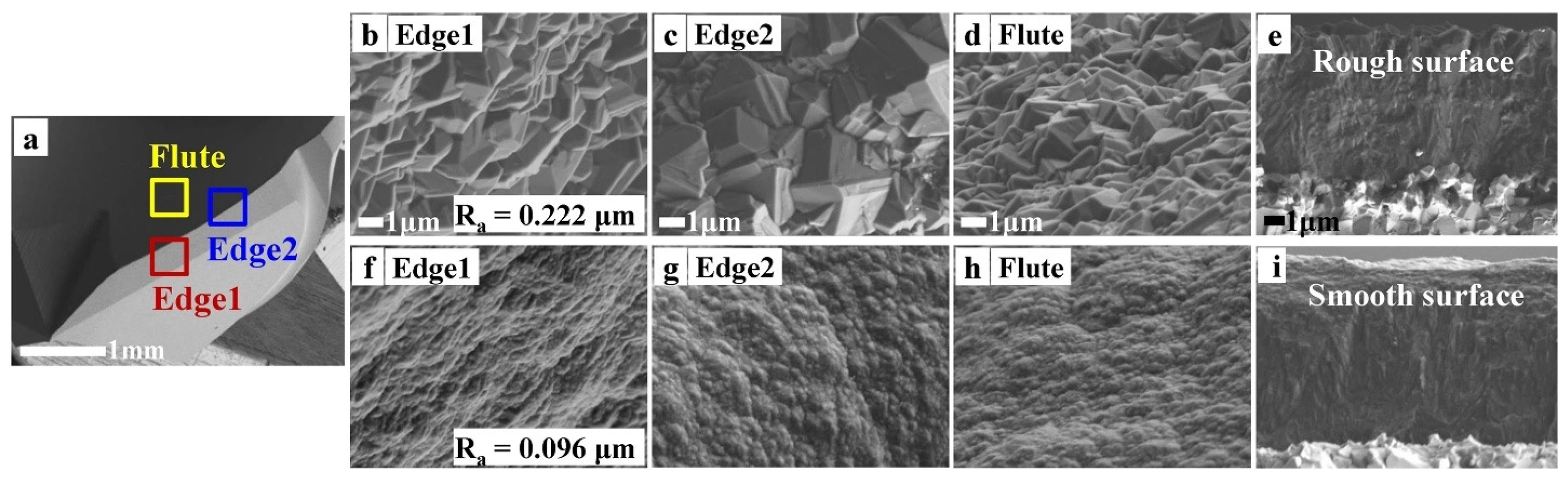
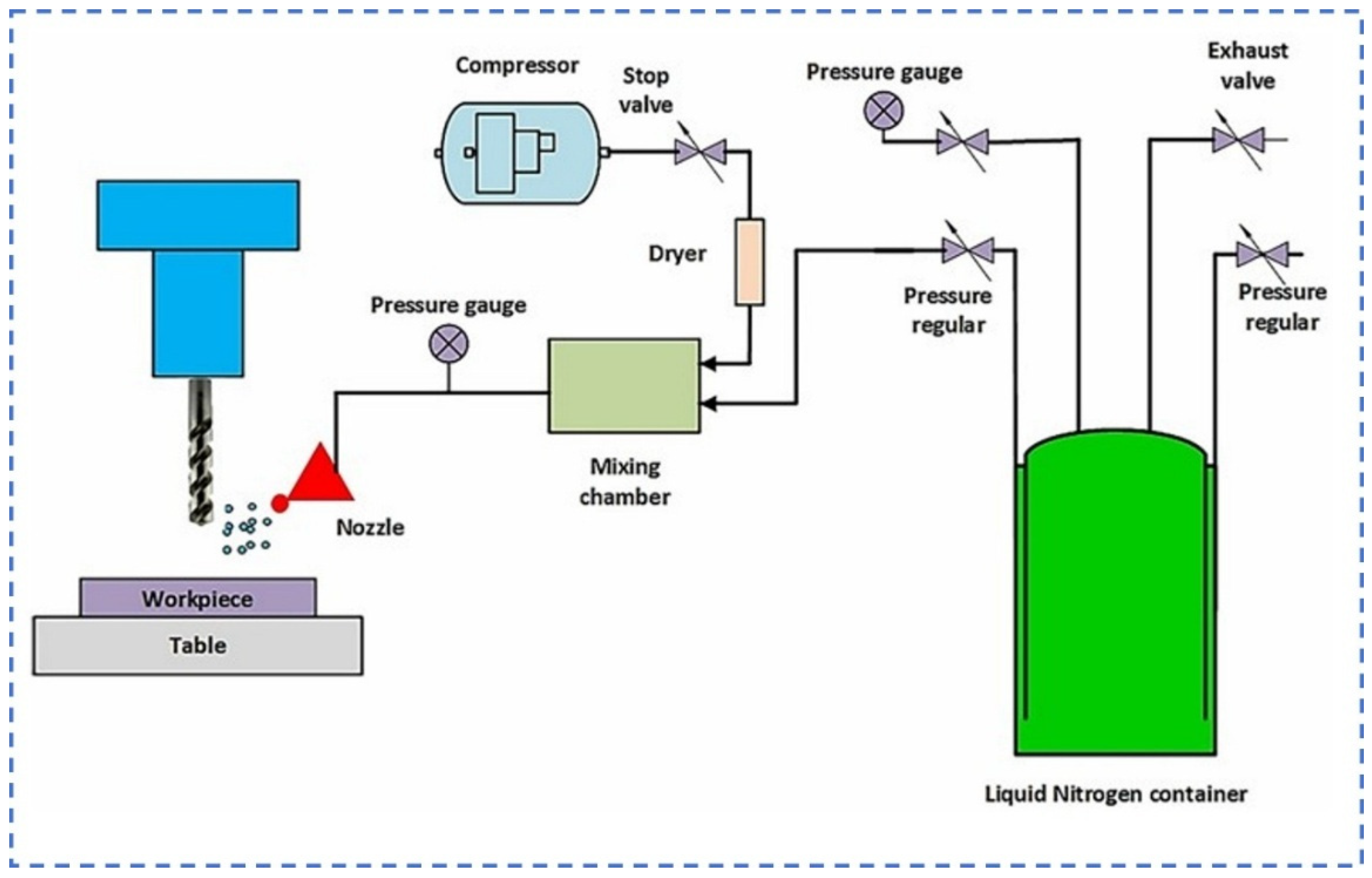
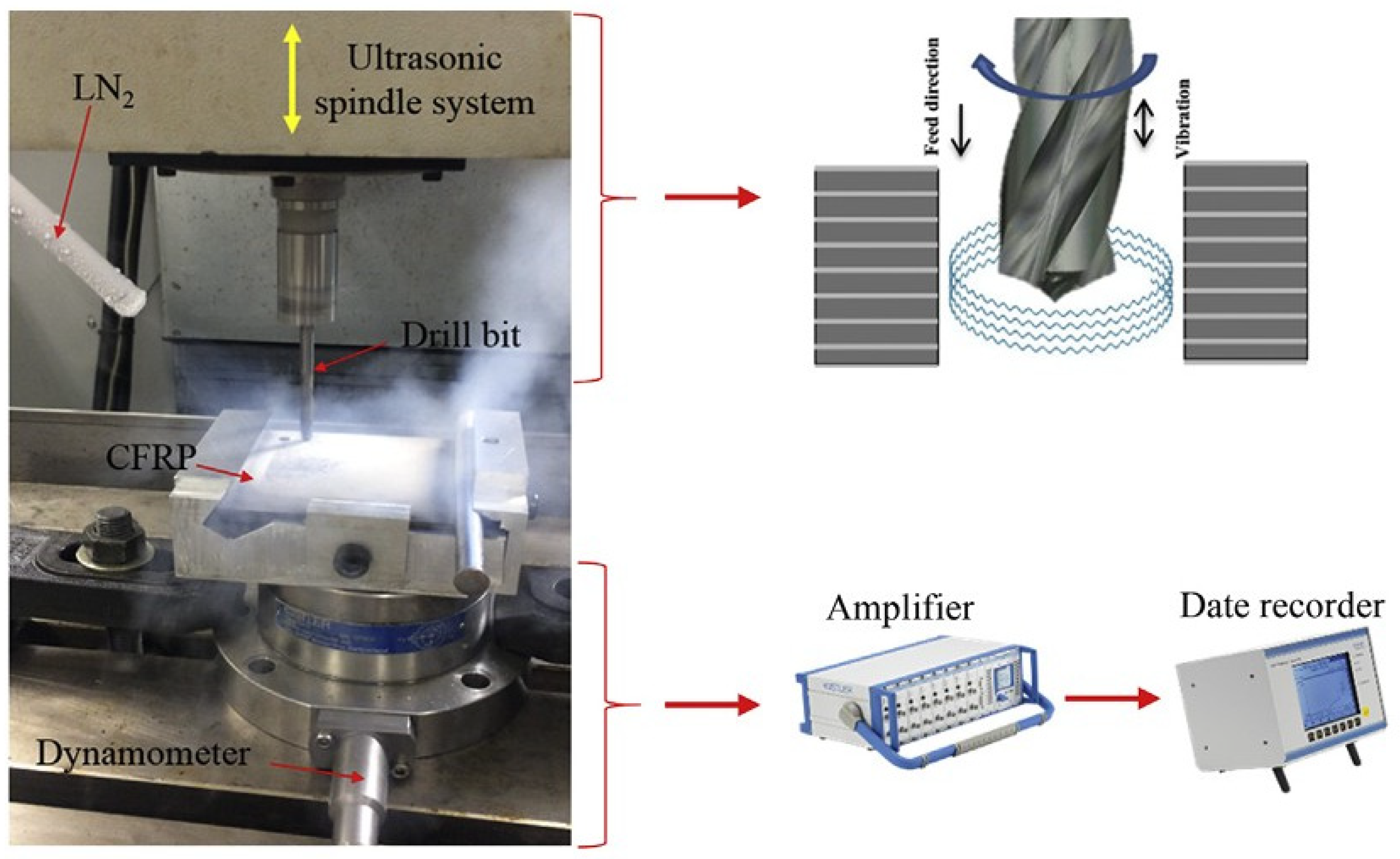
Cryogenic cooling technology typically refers to the process of directing cryogenic media, such as liquid nitrogen (LN2) or liquid carbon dioxide (LCO2), into the cutting zone via a dedicated cryogenic cooling system [103,104] (the principle is illustrated in Figure 14). This instantaneously lowers the temperature in the cutting region, thereby effectively suppressing machining damage caused by the accumulation of cutting heat [105]. This technology has successfully replaced cutting methods such as dry cutting and flood cutting, emerging as a cutting-edge approach to addressing heat-related defects in the CFRP hole-making process [106]. However, its environmental performance is highly dependent on the choice of coolant: the carbon footprint of liquid nitrogen (LN2) is linked to the cleanliness of the electricity mix used in its production, whereas liquid carbon dioxide (LCO2), although capable of utilizing industrial by-product gases, carries the risk of leakage that may exacerbate the greenhouse effect. Both require dedicated systems—LN2 demands efficient thermal insulation to prevent evaporation, while LCO2 requires pressure-resistant design to avoid clogging—which increase energy consumption and cost. Therefore, a scenario-specific life cycle assessment is essential, and the development of localized carbon accounting models along with highly sealed and efficient delivery systems is crucial to advance this technology toward a truly sustainable manufacturing solution.
Cryogenic cooling is not merely a process of temperature reduction. Its essence lies in actively altering the physical state of the cutting zone to enhance machining quality, with its effectiveness stemming from the synergistic action of multiple pathways. This technology achieves this by precisely lowering the cutting zone temperature into the brittle transition zone of the resin matrix. This places the material into a mechanics-dominated brittle state. While avoiding the generation of internal stresses from excessive cooling, it facilitates the transition of the resin matrix from a viscoplastic to a brittle-elastic state and enhances the brittleness of the fibers. Consequently, it guides the material towards a more orderly microscopic brittle fracture. Furthermore, the cryogenic environment also modifies the tribological characteristics of the cutting zone. It effectively reduces adhesion between the chips and the tool’s rake face, mitigating the material sticking phenomenon caused by resin softening, thereby rendering the entire cutting process more stable and controllable.
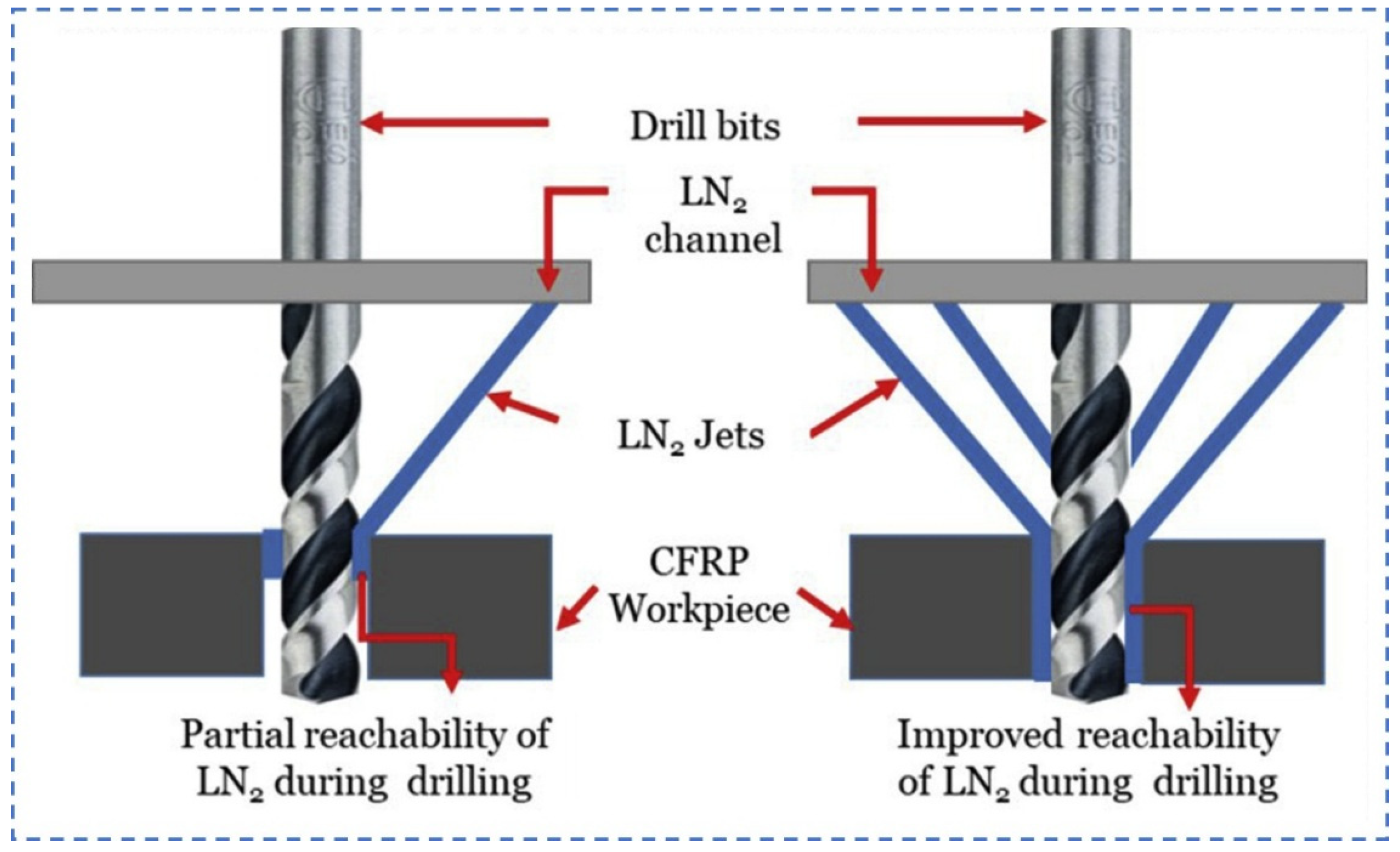
Xia et al. [107] compared and analyzed experimental data from dry drilling and cryogenic cooling conditions for CFRP composites, including drill edge rounding radius, drill corner wear, axial force, torque, delamination factor, and surface integrity characteristics (including sub-surface damage within the hole and drilling diameter error). The results indicated that cryogenic cooling could significantly reduce the drill edge rounding radius and corner wear while also helping to improve the surface integrity of the drilled holes. However, cryogenic cooling also led to greater axial force and torque, resulting in a larger delamination factor. Agrawal et al. [108] analyzed the drilling performance of CFRP under different process parameters and cutting conditions. The experiments employed a self-developed multi-nozzle LN2 delivery device, as shown in Figure 15. The results demonstrated that compared to dry drilling, cryogenic drilling could reduce torque by up to 24.46%, cutting energy by up to 35%, and the entry delamination factor by up to 21.55%. Under conditions of higher spindle speed and lower feed rate, cryogenic drilling could reduce the exit delamination factor by up to 9% compared to dry drilling. In terms of hole quality, cryogenic drilling reduced cylindricity error by up to 42.69%, decreased the average hole diameter deviation, and lowered the average surface roughness by up to 20%. A study conducted by Basmaci et al. [109] showed that using liquid nitrogen to control the cutting temperature could prevent crystal transformation in the CFRP matrix, thereby yielding higher-quality machined surfaces compared to dry machining. Giasin et al. [110] also confirmed this phenomenon, demonstrating that in the machining of S2-Glass fiber-Al2024T3 stacks, liquid nitrogen cooling could improve surface roughness by up to 44% compared to dry machining. Rodríguez et al. [111] used liquid carbon dioxide as a cutting fluid for drilling CFRP-Ti6Al4V stacks, replacing dry drilling, and compared it with dry drilling. The test results showed that when using CO2 drilling, the hole diameter deviation was below 0.5%, the tool tip temperature was significantly reduced, and the surface integrity of the CFRP layer was effectively maintained. Simultaneously, wear on the drill cutting edges was noticeably alleviated, thereby extending tool life. Impero et al. [112] compared the differences between conventional cooling and cryogenic cooling during the deep-hole drilling of CFRP/Ti stacks. The experiments continuously collected axial thrust force and torque data and performed a comparative analysis from the perspectives of average values and distribution. The results indicated that using liquid nitrogen cryogenic coolant significantly reduced axial thrust force and torque without introducing any significant negative effects. Khanna et al. [113] conducted drilling experiments on CFRP under cryogenic cooling and dry machining conditions, comparing the delamination phenomena under these two environments. The results indicated that under higher cutting parameters, cryogenic machining effectively reduced delamination, thereby extending the product’s service life and enhancing its performance. Shokrania et al. [114] found that cryogenic cooling combined with a straight-flute drill bit could significantly reduce delamination at the hole exit, improve surface roughness by 25%, and further enhance the surface integrity of CFRP drilling. The experimental results of Nagaraj et al. [115] demonstrated that cryogenic drilling outperformed dry drilling in terms of both hole diameter and roundness. Joshi et al. [116] used liquid nitrogen as a coolant to comparatively analyze the damage caused by drilling under dry and cryogenic conditions. The study found that although the axial thrust force generated under cryogenic conditions was greater, the delamination factor was lower than that in dry drilling.
Although cryogenic cooling effectively mitigates thermal damage in CFRP machining, its industrial implementation faces significant challenges: high coolant and system costs, complex production-line integration requirements, and process parameters optimized for specific conditions often failing to accommodate material variability and diverse needs in real production. Scaling up this technology necessitates breakthroughs in cost-effectiveness, operational reliability, and process adaptability.

3.3.2. Minimum Quantity Lubrication

In wet machining, water ingress into CFRP significantly degrades its mechanical properties. Driven by capillary action and concentration gradients, moisture penetrates the matrix, generating osmotic pressure that disrupts stress equilibrium and initiates microcracks. Concurrently, moisture induces matrix swelling, plasticization, and potential resin hydrolysis, weakening the matrix. It also migrates to the fiber–matrix interface, reducing interfacial bond strength. When the transferred shear stress exceeds this diminished strength, interfacial debonding occurs, severely impairing load transfer and leading to a marked decline in macroscopic properties such as interlaminar shear strength, flexural stiffness, and fatigue life. Consequently, traditional water-based flood lubrication is generally unsuitable for high-performance machining of CFRP. However, completely dry machining also poses serious challenges. Without any cooling or lubricating medium, heat accumulates rapidly in the cutting zone, making CFRP highly susceptible to thermal damage. To address these drawbacks, Minimum Quantity Lubrication (MQL) has been introduced. MQL employs a dedicated system to atomize a minute quantity of lubricating oil (typically tens to hundreds of milliliters per hour) with compressed air, forming micron-sized oil-mist droplets that are precisely delivered to the tool–workpiece cutting zone [117,118]. Due to its volatility, MQL leaves no residue on the hole wall, eliminating the need for post-machining cleaning often required for aerospace components. At the contact interface, the MQL film provides lubrication, while the high-pressure air stream aids cooling and chip evacuation [119].
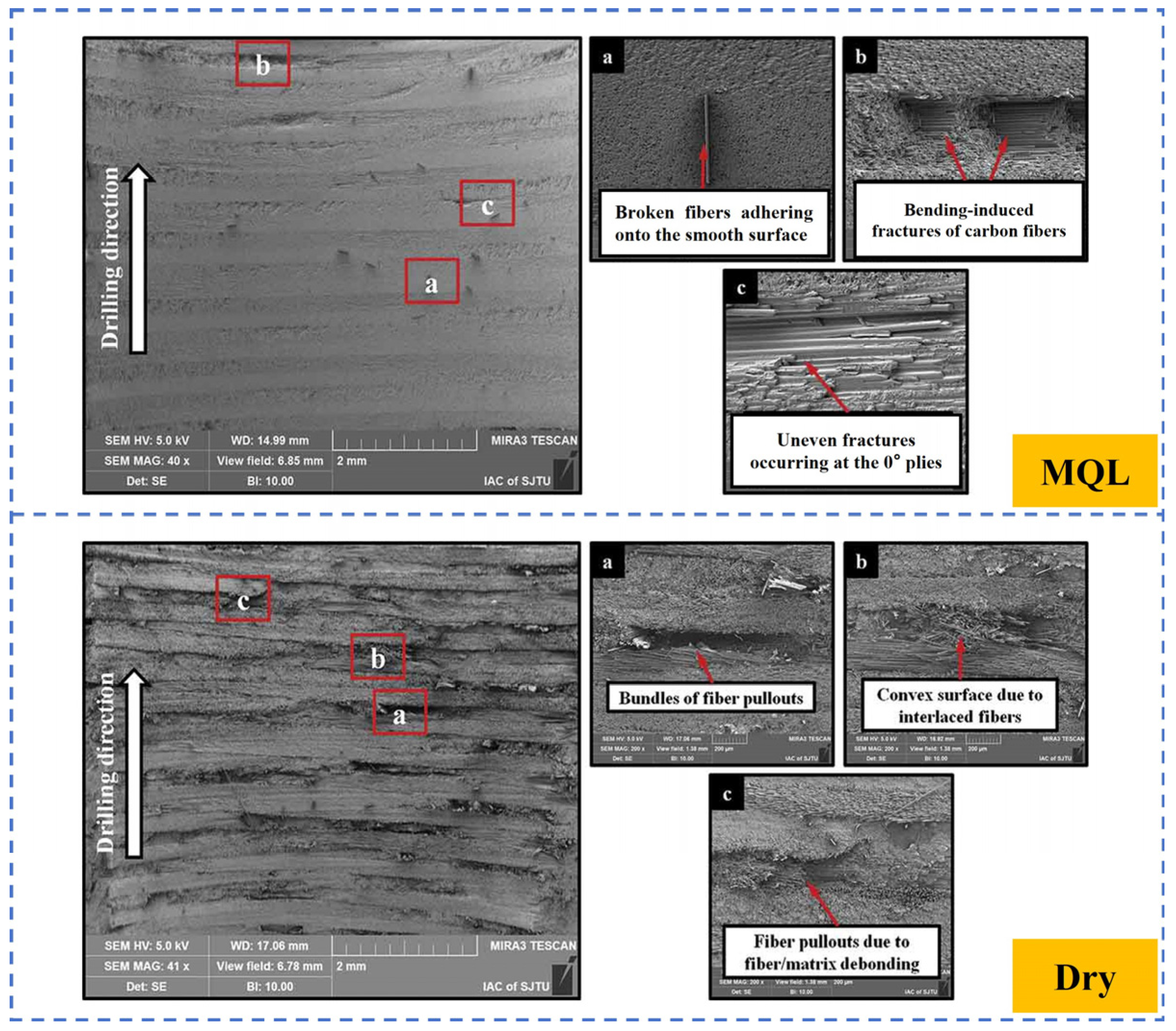
Experimental studies consistently demonstrate the advantages of MQL. Iqbal et al. [120] compared dry drilling, throttled cryogenic CO2, vaporized cryogenic LN2, and MQL in CFRP drilling. MQL outperformed all other conditions in hole quality (roughness, cylindricity, roundness), production economics (tool wear, process cost), structural integrity (delamination, uncut fibers), energy consumption, and cutting forces. Meshreki et al. [121] reported that both drilling temperature and its fluctuation were lowest under MQL, with hole quality comparable to flood cooling—especially under high-pressure, low-flow MQL. In CFRP/Ti6Al4V stack drilling, Xu et al. [122] found that MQL significantly reduced torque and cutting energy while improving machining quality and surface morphology. A follow-up study by Xu et al. [123] further confirmed that MQL-drilled surfaces were smoother, with fewer burrs and minimal defects (Figure 16), indicating effective penetration of the lubricant into the tool–workpiece interface. Kim et al. [124] examined the role of nano-solid lubricants in CFRP micro-drilling and observed superior hole quality compared to dry or cryogenic methods, with lower delamination factors and smaller areas of uncut fibers. Kandar et al. [125] highlighted that within an MQL system, a combination of high air-flow velocity and low lubricant flow rate optimizes spray characteristics by enhancing droplet breakup, yielding a finer, more uniform oil-mist jet. This optimized delivery significantly reduces tool wear, extends tool life, and effectively controls machining errors, underscoring the critical influence of process parameters on MQL performance.

3.3.3. Summary

In CFRP drilling, advanced cooling technologies represented by cryogenic cooling and MQL have evolved from passive temperature reduction to the active regulation and synergistic optimization of the physicochemical state in the cutting zone. Cryogenic cooling induces a brittle state in the material through instantaneous deep cooling, effectively suppressing thermal damage while improving tool life and surface integrity, with liquid CO2 showing advantages in cost and convenience. Meanwhile, MQL achieves an optimal balance between lubrication and cooling via ultra-fine oil mist. Extensive research indicates that MQL often delivers the best performance in reducing cutting forces, improving hole quality (e.g., roughness, roundness), and minimizing delamination. Optimized air–fluid parameters in MQL can even surpass the effectiveness of some cryogenic cooling methods. Currently, cooling strategies incorporating new media such as nano-lubricants are driving the field toward intelligent cooling solutions characterized by lower damage and higher comprehensive performance.

3.4. Process Strategy Optimization

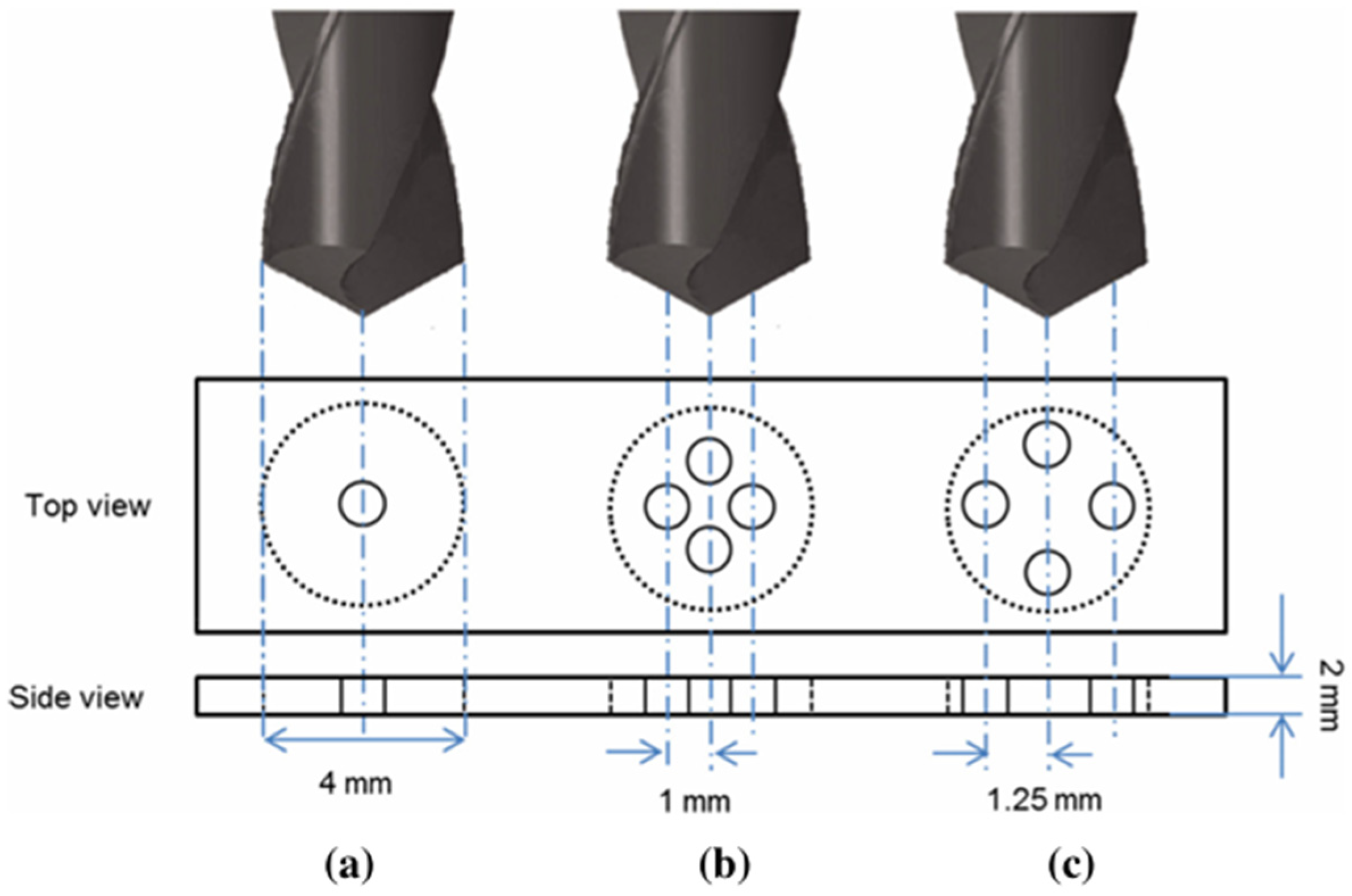
3.4.1. Pilot Hole

In CFRP drilling, the core function of a pilot hole is to pre-remove material, thereby eliminating the key peeling force generated by the chisel edge of the main drill during the breakthrough stage by depriving it of a point of application. Since the thrust from the chisel edge constitutes a significant portion of the total axial thrust, and axial thrust is directly correlated with exit delamination [126], delamination occurs when the drilling thrust exceeds the critical threshold. A pilot hole effectively negates the influence of the chisel edge in CFRP drilling, reducing thrust and consequently lowering the risk of delamination [127]. Therefore, the use of a pilot hole is a key method that systematically improves hole-making quality and cost-effectiveness, albeit at the expense of adding an extra process step [128]. Won et al. [129] investigated the effect of pre-drilled pilot holes on drilling axial thrust through comparative experiments. They found that the thrust generated by the drill’s cutting lips contributes significantly to the total thrust, and using a pilot hole effectively reduces this component, thereby decreasing the risk of delamination in composite laminates. Furthermore, they developed a process model to predict the critical thrust for drilling with a pilot hole. This model indicates that while a pilot hole only marginally increases the critical thrust for delamination, it significantly reduces the actual thrust during drilling. This allows for the use of higher feed rates while ensuring delamination-free machining. Tsao [130] demonstrated experimentally that pre-drilling a pilot hole significantly lowers the critical thrust. Simultaneously, by eliminating the extrusion effect of the chisel edge, the drilling thrust can also be substantially reduced. By properly controlling the ratio of pilot hole diameter to drill diameter, medium-to-large diameter holes can be drilled in composite laminates at higher feed rates without delamination damage. Subsequently, experimental results from Tsao and Hocheng [131] showed that while the critical axial thrust causing delamination is slightly reduced when using a pilot hole, the actual axial thrust during drilling is significantly decreased due to the elimination of the chisel edge’s extrusion effect. By reasonably controlling the proportion of the cutting edge engagement length, medium and large holes can be drilled in CFRP at higher feed speeds without inducing delamination damage. Additionally, chip evacuation is a critical issue affecting machining quality during the process. Chips can move toward the drill’s flute and potentially cause clogging. A pilot hole can effectively mitigate additional axial forces arising from poor chip evacuation, thereby further suppressing delamination risk. It is important to note that the pilot hole size must be precisely controlled. A hole that is too small fails to allow sufficient chip evacuation, while one that is too large may directly cause delamination during the pilot drilling stage itself. Therefore, rationally designing the pilot hole diameter is an important process condition for achieving efficient and high-quality drilling. Wang et al. [132] proposed an improved machining method for 2 mm thick CFRP plates, employing three novel pilot hole layout schemes during high-speed drilling, as shown in Figure 17. Among these, the previously widely used layout scheme (a) significantly reduced thrust but markedly increased dynamic load and drilling torque, leading to excessive wear on the drill margin. In contrast, layout schemes (b) and (c) both significantly reduced thrust and drilling torque, effectively prevented delamination, and extended tool life.

3.4.2. Support Plate

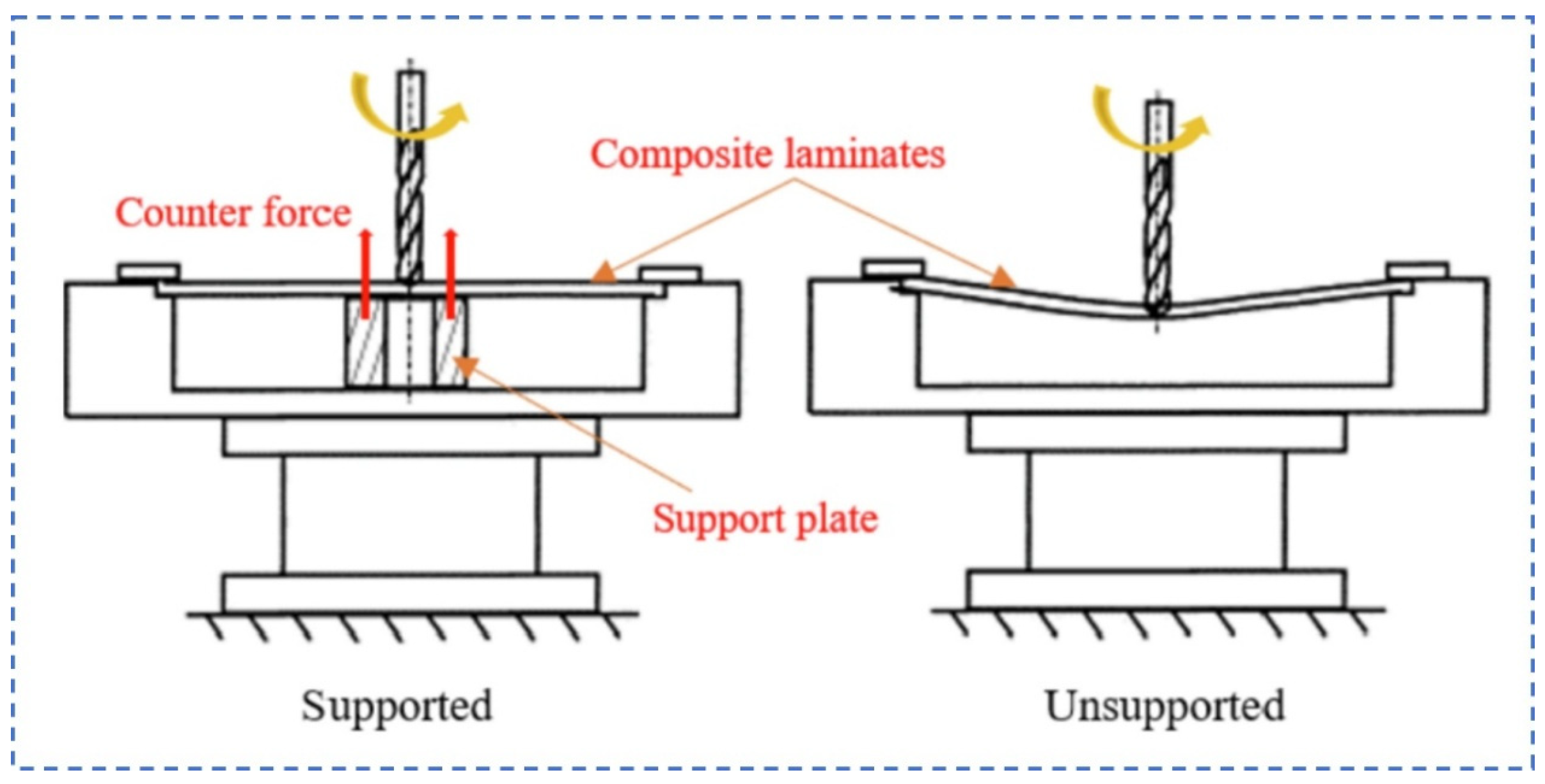
Although using a backing plate beneath CFRP laminates increases production costs and preparation time, it remains a common industrial method to reduce drilling damage. This auxiliary process provides direct physical constraint on the exit surface, thereby enhancing the bending stiffness of the final plies as the drill bit approaches breakthrough and suppressing interlaminar separation caused by axial thrust.
Dogrusadik and Kentli [133] investigated delamination factors in CFRP micro-drilling using different backing materials (aluminum/phenolic and brass/wood combinations). They found that exit-side plates (phenolic and wood) initially increased delamination but slightly reduced it for later holes under specific parameter sets: optimal parameters varied with backing material. Kang et al. [134] comprehensively analyzed materials including foam, rubber, cork, and aluminum, assessing thrust force, tool wear, damping, delamination, and energy consumption. Their analysis showed that rigid materials (e.g., aluminum) generated greater reaction forces, while compliant, porous materials (e.g., foam, cork, rubber) reduced thrust force due to damping. After drilling 200 holes, cork and rubber backing plates reduced the delamination factor by 11.07% and 12.45%, respectively, whereas aluminum increased it by 17.59% compared to unsupported drilling. Dogrusadik and Kentli [135] further explored the influence of backing plates on tool wear under variable cutting conditions. Their results indicated that, with suitable parameters, a backing plate helped reduce flank wear, and the aluminum-phenolic combination outperformed brass-wood in this regard. Capello et al. [136] established an analytical model for the critical thrust force at the onset of delamination when drilling CFRP laminates with a backing plate, as shown in Figure 18. The model demonstrates that compared to the unsupported case, the backing plate suppresses delamination by providing a reaction force in the opposite direction, thereby increasing the critical thrust force. Based on the analytical model, Tsao and Hocheng [137] concluded that a backing plate allows for a larger critical thrust force for the drill bit, enabling drilling at higher feed rates without causing delamination damage. Shyha et al. [138] noted that a backing plate forms a barrier at the hole entry and exit, effectively preventing spalling and delamination and significantly reducing burrs and edge chipping. However, the backing plate did not have a significant impact on the internal hole surface roughness or dimensional accuracy.

3.4.3. Variable Feed Rate

In CFRP drilling, the variable feed strategy involves dynamically modulating the feed rate—typically reducing it—at critical axial positions, particularly near the hole exit, to actively manage axial thrust and thereby mitigate defects such as delamination and burrs, as illustrated in Figure 19. While this approach has been demonstrated to effectively reduce thrust forces and improve hole quality, its integration with advanced drill geometries requires further investigation. Although synergistic potential exists, functional conflicts may arise due to overlapping mechanisms, and a lack of mechanistic understanding and quantitative analysis of their interactions remains. For industrial implementation, the strategy must balance scalability, cost, and reliability. Control based on simple positional or force thresholds is easier to integrate, yet complex adaptive systems increase cost and complexity, and the accumulated slowdown duration may reduce throughput in mass production. From a tool economy perspective, while the strategy can extend the service life of costly tools by reducing mechanical impact, improper design may lead to increased frictional heating and accelerated thermal wear. Moreover, the effectiveness of the strategy highly depends on accurate real-time recognition of varying process conditions, such as material inconsistencies and tool wear. Developing intelligent methods that integrate in-process monitoring with adaptive control is essential to ensure robust and reliable process performance. Thus, the practical value of this strategy can only be realized through co-designed systems that harmonize specific drill geometries with tailored feed profiles, followed by holistic optimization under multiple operational constraints.
Dharan and Won [139] incorporated variable feed rate technology into a control system to monitor the drilling process and instantly adjust drilling parameters based on feedback. This strategy can reduce drilling time while ensuring hole quality. Li et al. [140] implemented a variable feed rate strategy in CFRP drilling, reducing the feed rate from 0.30 mm/rev to 0.01 mm/rev near the hole exit to suppress exit delamination and burrs. Yaşar and Günay [141] demonstrated that compared to traditional drilling, using a variable feed rate resulted in lower values for axial force, delamination factor, and average surface roughness, with average reductions of 14%, 3%, and 18%, respectively. Additionally, the hole diameter at the exit was larger with variable feed rate drilling than with constant feed rate. However, the accuracy of the hole diameter slightly decreased with variable feed rate due to the thermal expansion effect of the material at low feed rates. Shuaipu and Jie [142] proposed a variable feed rate drilling method based on a sinusoidal curve, as shown in Figure 20. When the drill bit is 1 mm away from the hole exit, the feed rate gradually decreases according to a sinusoidal pattern. Experiments compared this method with traditional constant feed rate drilling, analyzing its effects on axial force, delamination factor, hole wall surface quality, and morphology at the hole exit. The results showed that compared to constant feed rate drilling, sinusoidal variable feed rate drilling significantly reduced axial force near the hole exit and greatly improved the delamination factor, hole wall surface quality, and morphology at the exit. However, the impact on hole wall roughness was not very pronounced. Tamura and Matsumura [143] proposed a novel drilling method based on variable feed rate, enabling delamination-free hole-making at high machining rates. This method uses a standard feed rate during the drill entry phase and switches to a higher feed rate during the exit phase, generating negative thrust force to finish the hole. Experiments showed that compared to constant feed rate, the variable feed strategy significantly suppressed delamination by the 100th drilled hole. Furthermore, analysis based on the minimum cutting energy model confirmed that increasing the feed rate causes the friction angle to become smaller than the effective rake angle, thereby inducing negative thrust force, which is the key mechanism for suppressing delamination.

3.4.4. Summary

In CFRP drilling, to suppress exit delamination—a core defect—three primary active process strategies have been developed: pilot holes, backing plates, and variable feed rates. All three methods focus on controlling axial thrust force as the central objective, although their mechanisms of action differ. The pilot hole strategy works by pre-removing material, directly eliminating the point of application for the main drill’s chisel edge, thereby reducing thrust force at the source. However, the hole diameter requires precise control to avoid introducing new defects. The backing plate provides external rigid or damping support on the exit surface, increasing the critical thrust for delamination by enhancing bending stiffness. Its effectiveness highly depends on the appropriate selection of the backing plate material—rigid materials offer strong reaction forces, while compliant materials provide good damping. Variable feed rate is a dynamic parameter strategy. It intelligently controls delamination risk by either increasing the feed rate during the exit phase to induce negative thrust force or decreasing it to reduce peak thrust, representing the development direction of process adaptivity. Overall, current research and practice indicate that combining the static structural optimization of pilot holes or backing plates with the dynamic process control of variable feed rates is the most effective approach to systematically enhance the quality and efficiency of CFRP hole-making.

3.5. Advanced Drilling Technologies

3.5.1. Ultrasonic Vibration-Assisted Drilling

Ultrasonic Vibration-Assisted Drilling (UVAD) applies high-frequency, low-amplitude vibrations to the cutting tool [144], inducing periodic high-frequency separation between the tool and the workpiece. This transforms the cutting process from traditional continuous cutting into intermittent cutting, fundamentally improving the cutting mechanism and machining quality of CFRP. A schematic diagram of Ultrasonic Vibration-Assisted Drilling is shown in Figure 21. Ultrasonic vibration can significantly reduce thrust force during the drilling of CFRP [145,146], minimize drilling defects, substantially reduce tool wear, and extend tool life.
Huang et al. [148] investigated the tool wear behavior of high-speed steel (HSS) twist drills during Ultrasonic Vibration-Assisted Drilling (UVAD) of CFRP, conducting a comparative analysis with Conventional Drilling (CD). This study compared the differences in wear mechanisms between the two machining methods. Observed wear types mainly included abrasive wear, adhesive wear, oxidation wear, and their composite forms. The research demonstrated that, compared to CD, introducing ultrasonic vibration assistance could effectively reduce the average flank wear width of the tool, with a maximum reduction of up to 13.0%. Furthermore, the study found that under certain conditions, increasing the feed rate or lowering the spindle speed helped mitigate tool wear. Sun et al. [149] applied ultrasonic vibration to dagger drills to further enhance drilling performance. Experimental results indicated that ultrasonic vibration significantly reduced axial thrust force and surface roughness, with maximum reductions of 14.1% and 62.2%, respectively. Moreover, the hole diameter error decreased substantially from 30 μm in the traditional drilling process to 6 μm in the ultrasonic-assisted drilling process. Geng et al. [150] conducted a comparative study on the wear mechanisms of diamond drills in Rotary Ultrasonic Elliptical Machining (RUEM) versus Conventional Drilling (CD) of CFRP. A series of drilling experiments were performed, including measurements of drilling force, observation of drill surface topography, and analysis of machined hole surfaces. The results showed that, compared to the CD process, the RUEM process significantly enhanced the drilling performance of the drill. Specifically, the length of the stable working zone for the drill in the RUEM process increased by 39%, and tool life was extended by 28%. Microscopic observation of the drill surface revealed that chip adhesion was significantly reduced in the RUEM process, while more grain micro-cracks appeared. These microstructural changes positively contributed to improved drilling performance, manifesting as lower drilling forces and smoother hole surfaces. Hussein et al. [151] experimentally investigated the influence of UVAD process parameters on burr formation, residual stress, and delamination in CFRP. The results showed that, compared to the conventional process, UVAD could reduce axial thrust force by approximately 26%, cutting temperature by about 37%, and exit burr height by roughly 86%. Geng et al. [152] observed and analyzed delamination phenomena in both CD and RUEM processes, obtaining trends of the delamination factor with variations in feed rate and cutting speed. The experimental results indicated that, compared to the CD process, the RUEM process could effectively reduce the degree of delamination at the hole exit at feed rates ranging from 50 to 100 μm/rev: by 5.4% to 19.3% under the 1/2 ply condition and by 0.7% to 8.4% under the 2/3 ply condition. Shao et al. [153] analyzed the separation-cutting mode of UVAD and found that UVAD theoretically enables chip breaking, as illustrated in Figure 22. Experimental results demonstrated that, compared to CD, the average thrust force and torque in UVAD of CFRP were reduced by 41.2%–46.8% and 36.2%–48.9%, respectively. Furthermore, both hole diameter accuracy and hole surface quality were significantly improved in UVAD. Shan et al. [154] compared the effects of drilling parameters on the tearing factor for three drilling methods (CD, HSD, and UVAD). The results indicated that the UVAD process exhibited the smallest fluctuation in the tearing factor. Therefore, employing higher drilling speeds in UVAD could significantly reduce drilling damage before severe tool wear occurs. According to Ma et al. [155], compared to the CD process, using longitudinal-torsional UVAD significantly reduced axial thrust force (with a maximum reduction of up to 39%). The coupled longitudinal-torsional ultrasonic vibration at the tool edge facilitates the removal of carbon fibers via a shear fracture mode, thereby transforming the contact state between the tool edge and the workpiece from continuous to intermittent. However, a key limitation of conventional UVAD lies in its fixed vibration mode, which struggles to adapt to the differing requirements. Consequently, Zhang and Lu [156] proposed a novel variable-dimension vibration drilling system and its control strategy based on this premise. The tool tip of this system can achieve one-dimensional longitudinal vibration, two-dimensional elliptical vibration, and three-dimensional composite vibration to adapt to CFRP drilling.

3.5.2. Orbital Drilling

Orbital Drilling (OD), also known as Circular Helical Milling (CHM), is an advanced machining technology for hole-making. It utilizes the compound motion of a tool that simultaneously rotates on its own axis, revolves along a circular path, and feeds axially, essentially achieving hole creation through a milling process [157,158]. Figure 23 illustrates the principle of OD. This technology revolutionizes the hole-making method for CFRP from a kinematic perspective, serving as an alternative to traditional drilling. During OD, the tool simultaneously rotates around its own axis and feeds along a helical trajectory [159]. Due to its flexible kinematic characteristics, OD enables lower cutting forces, reduced tool wear, and improved hole quality [160,161]. Compared to conventional drilling, the deflection of the residual material layer is smaller in the OD process. Since the load on the tool in orbital drilling is distributed rather than concentrated at a single point as in traditional drilling, the residual material layer can withstand greater axial thrust force before failure. Consequently, OD demonstrates superior performance in suppressing machining damage such as exit delamination, making it one of the effective means for achieving low-damage, high-precision machining of CFRP. OD offers various machining strategies, enabling the production of holes with different diameters, tapered holes, and even complex countersunk holes. Furthermore, by adjusting the offset distance between the tool center and the hole center, OD can also perform finishing operations without the need for tool changes [162].
The Orbital Drilling (OD) process has been widely applied to hole-making in CFRP [160,163,164,165]. Throughout the OD machining process, hole dimensional accuracy, geometry, and surface quality can all reach satisfactory levels. Therefore, OD is widely regarded as a sustainable hole-making process. Experimental results from Voss et al. [166] show that the axial thrust force in conventional drilling is approximately three times that in orbital drilling. Furthermore, the axial thrust force in orbital drilling stabilizes after the initial wear phase. Compared to conventional drilling, orbital drilling significantly reduces hole exit damage (including delamination or uncut fibers) and hole wall damage (such as fiber cracking, fiber pull-out, and hole wall bending). Sadek et al. [167] conducted orbital drilling experiments on CFRP. The results indicated that compared to conventional drilling, the OD process reduced axial force by 45%, lowered cutting temperature by 60%, and achieved significantly better hole quality. These improvements stem primarily from the redistribution of the load on the cutting edges and the cooling effect provided by the unstable swirling airflow in the annular gap between the tool and the workpiece. Brinksmeier et al. [168] observed similar results when drilling Al/CFRP/Ti stack materials. Compared to conventional drilling, orbital drilling generated significantly lower thrust force and cutting temperature in the CFRP phase while yielding superior surface integrity. Kong et al. [169] employed the OD process for drilling CFRP material to minimize issues related to temperature rise and delamination. The study revealed that during OD, due to reduced thrust force, the processing temperature is lower and delamination is almost negligible. Even at higher rotational speed ranges, the OD process maintains good repeatability of quality parameters. Geier and Szalay [170] noted that compared to conventional drilling, using the orbital helical milling process yields higher-quality holes, specifically characterized by less delamination at the hole exit and better surface quality. Due to its excellent mechanical and physical properties, CFRP is widely used in various mechanical structures. The industrial application of CFRP demands high drilling quality and high efficiency in hole-making. However, traditional drilling methods, such as conventional drilling and helical milling, struggle to meet the industry’s high standards for hole processing. Therefore, Wang et al. [171] proposed a novel hole-making method for CFRP. This method is achieved by replacing the rotational motion of the tool in conventional helical milling (CHM) with a conical pendulum motion.
In this approach, the tool axis is inclined at a certain angle to the hole axis, hence it is termed tilting helical milling (THM), as shown in Figure 24. As a preliminary exploration to establish this new method, the study theoretically compared the differences between THM and CHM in aspects such as the hole formation process, the cross-sectional area of workpiece material removed per tool revolution, and the issue of the zero-cutting-speed point. Subsequently, the correctness of the theoretical analysis was verified through experiments, focusing on the variation in hole diameter profile, drilling forces, machining quality at the hole entry and exit, and chip evacuation. The experimental results indicated that during the THM process, an annular V-shaped groove forms between the tool end face and the hole bottom, a phenomenon not observed in CHM. This characteristic facilitates timely chip evacuation, reduces drilling forces, and effectively addresses the zero-cutting-speed point issue. Furthermore, to further develop the THM process, Wang et al. [172] analyzed the surface finish of holes machined by THM and compared it with that of holes machined by CHM. Theoretical analysis results showed that when the tool advances and the instantaneous fiber cutting angle falls within the range of 90° to 180°, CHM machining induces significant fiber bending and fiber-matrix debonding on the hole surface. In THM machining, due to the presence of a downward cutting force component along the hole axis, this phenomenon can be significantly mitigated, promoting easier fiber fracture. The theoretical findings were validated by CT scans and scanning electron microscope (SEM) observations of the hole surface morphology, confirming the advantage of the THM process in achieving high-quality hole surface finish. Additionally, compared to CHM, the THM process can effectively suppress the generation of damage such as entry cracking and exit delamination. Pereszlai et al. [173] conducted a series of tilting helical milling experiments on CFRP using uncoated carbide end mills. By combining experimental results with theoretical models, they systematically analyzed the influence of tilt angle and helical tool path pitch on axial cutting forces. Optical digital microscopy and scanning electron microscopy were employed to observe the morphology of machining-induced burrs and the microstructure of the machined surface. The study revealed that both cutting forces and burr formation are significantly governed by pitch and tilt angle. Within the parameter range investigated, increasing the tilt angle was proven beneficial for improving machining outcomes. Therefore, it is recommended to use the largest possible tilt angle in practical applications.

3.5.3. Other Technologies

In addition to the two advanced machining technologies mentioned above, which are widely applied to CFRP drilling, a range of alternative or complementary advanced processing techniques are also employed. Dhakal et al. [174] investigated surface damage variation when drilling fiber composites using Abrasive Waterjet Drilling (AWJD). The authors conducted a comparative analysis on three composite material samples fabricated using the vacuum bag molding process. The study found that the feed rate of the waterjet is a major factor influencing the delamination and surface roughness of the composite laminate. Compared to the other materials, more severe pit damage was observed on the CFRP surface, which may be related to the increase in waterjet feed rate. Furthermore, the authors noted that the AWJD process results in zero tool wear compared to conventional drilling processes. Montesano et al. [175] studied the effects of Conventional Drilling (CD) and AWJD on the fatigue performance of CFRP. Observations of the machined hole areas indicated that CD holes exhibited more severe surface damage, with larger and deeper damage zones. For the two material systems studied, the surface roughness of AWJ-drilled holes was actually higher than that of CD holes. However, neither the static properties, short-term fatigue performance, nor the material’s endurance limit were affected by the machining process. In short-duration cyclic tests, no significant differences in fatigue response were observed between CD and AWJ specimens in terms of observed damage, stiffness changes, or temperature variations, suggesting surface roughness is not a reliable indicator of hole quality. Nonetheless, in long-duration cyclic tests, CD specimens showed more pronounced stiffness degradation and further damage progression after reaching a certain cycle threshold, where drilling-induced delamination cracks began to propagate. This phenomenon was not observed in AWJD specimens, where delamination cracks initiated and propagated much later during cyclic loading. Ahmad Sobri et al. [176] employed Laser-Assisted Drilling (LAD) to machine holes in CFRP. The authors compared the LAD process with conventional mechanical drilling from the perspective of surface damage. The study found that the LAD process is only suitable for CFRP with lower thickness. For thicker CFRP, the LAD process creates a larger Heat-Affected Zone (HAZ) due to the entrapment of vaporized material. Li et al. [177] utilized Ultraviolet (UV) laser technology for drilling CFRP, improving surface integrity by reducing the laser-induced HAZ. Additionally, the authors pointed out that only by rationally distributing heat within the hole region can heat accumulation be effectively avoided. Kumaran et al. [178] combined ultrasonic vibration with cryogenic cooling (Figure 25) for drilling CFRP, achieving lower exit burr area and surface roughness (Ra) values. Analysis of Variance (ANOVA) results indicated that ultrasonic power contributed significantly more (52.45%) to reducing the exit burr area. The increase in CFRP’s shear modulus and transverse strength at cryogenic temperatures helps reduce peel-up delamination. The brittle fracture occurring during ultrasonic drilling of CFRP at a spindle speed of 3000 rpm led to lower Ra values. Park et al. [179] proposed a hybrid cryogenic cooling process for removing burrs at the CFRP hole exit. The process combines water, ultrasonic vibration, cryogenic cooling, and a layer of backup ice. The deburring efficiency using this method can reach 100%.

3.5.4. Summary

In the field of CFRP drilling, advanced machining technologies represented by Ultrasonic Vibration-Assisted Drilling (UVAD) and Orbital Drilling (OD) provide fundamental solutions to the damage problems associated with conventional drilling by altering the kinematics of the cutting process. UVAD transforms continuous cutting into intermittent cutting through high-frequency vibration, significantly reducing axial thrust force (by up to approximately 40%) and cutting temperature, effectively suppressing delamination, reducing tool wear, and improving hole wall quality. OD (also known as helical milling) replaces drilling with milling through the compound motion of tool revolution and rotation. By distributing the cutting load, its axial force can be reduced to one-third of that in conventional drilling, demonstrating outstanding performance in controlling exit delamination and achieving high-precision holes. Its evolving techniques, such as Tilting Helical Milling (THM), further enhance chip evacuation and surface finish by optimizing the tool posture. Additionally, non-traditional methods like Abrasive Waterjet Drilling (AWJD), Laser-Assisted Drilling (LAD), and ultrasonic-cryogenic hybrid processes offer innovative solutions for specific scenarios (e.g., zero tool wear, micro-hole machining, deburring). Together, these technologies represent the forefront of high-quality, low-damage hole-making in CFRP.

4. Conclusions and Future Perspectives

This paper provides a significant review of the latest research progress on drilling-induced damage in CFRP composites. It discusses in detail the types of damage formed during CFRP drilling and their formation mechanisms, and summarizes comprehensive process optimization methods from various perspectives to mitigate this damage. Based on this review, the following conclusions can be drawn.
  • Based on current research, future efforts should focus on establishing an intelligent system for high-quality CFRP drilling. This entails developing real-time, in situ intelligent monitoring to dynamically quantify defect formation, alongside creating physics-informed, data-driven models for high-fidelity process simulation and optimization to reveal underlying material removal mechanisms. Furthermore, establishing standardized, quantitative correlations between defect characteristics and component service performance is crucial for informing industrial quality standards. Ultimately, advancing eco-friendly drilling technologies through novel green cooling/lubrication media and energy-efficient processes, supported by systematic life-cycle assessment, will be key to achieving sustainable manufacturing.
  • The anisotropy, heterogeneity, low interlaminar strength, and poor thermal conductivity of CFRP collectively lead to its complex cutting mechanism, poor surface quality, and high susceptibility to drilling damage. The fiber cutting angle, as a key geometric parameter, significantly influences chip separation and the formation of defects such as delamination, burrs, and tearing.
  • While widely used due to their simplicity and ease of measurement, current one- and two-dimensional delamination factors only provide static, two-dimensional characterization of damage. Existing systems struggle to describe the dynamic initiation and evolution of damage—particularly complex forms like tearing—and lack the ability to quantitatively correlate defect morphology with component service performance (e.g., fatigue strength, joint reliability). Therefore, developing an intelligent evaluation framework that integrates dynamic monitoring, multi-dimensional characterization, and performance prediction remains a critical and urgent challenge.
  • The general principle of high rotational speed and low feed rate helps reduce cutting forces and thermal load. Variable feed strategies, specially designed tool geometries (e.g., step drills, dagger drills), and high-performance coatings such as diamond/DLC effectively suppress delamination and burrs by optimizing force distribution, improving chip evacuation, and reducing wear. Future optimization must shift from single-parameter adjustment toward multi-objective optimization based on digital twins of the machining process.
  • Cryogenic cooling (LN2/LCO2) significantly lowers the cutting zone temperature, mitigating damage caused by resin thermal softening. Minimum Quantity Lubrication (MQL) provides effective lubrication and cooling while avoiding moisture ingress. As passive suppression strategies, pilot holes and backing plates eliminate the extrusion effect of the chisel edge and enhance exit support stiffness, respectively. Exploring eco-friendly coolants and developing adaptive, intelligent auxiliary systems present key opportunities for enhancing process sustainability and stability.
  • Ultrasonic Vibration-Assisted Drilling (UVAD) reduces average thrust force by 30%–50% through intermittent cutting, significantly improving hole wall quality. Orbital Drilling (OD) transforms concentrated loads into distributed loads, fundamentally suppressing exit delamination. Technologies such as Tilting Helical Milling (THM), Abrasive Waterjet Drilling (AWJD), and Laser-Assisted Drilling (LAD) offer low-damage solutions for specific scenarios. These technologies are advancing the drilling paradigm from material removal toward controlled manufacturing.
  • To date, most research on CFRP drilling damage formation still relies on traditional experimental and simulation methods. A systematic explanation of the damage formation mechanism has yet to be established. Developing accurate and reliable thermomechanical constitutive models for fiber-reinforced composites could serve as an alternative pathway to reveal the complex micro-scale drilling mechanisms in CFRP. This is poised to become a frontier direction for future research on CFRP cutting mechanisms.

Author Contributions

Writing—original draft, K.W.; Investigation, S.W.; Supervision, J.W.; Writing—review and editing, L.H. All authors have read and agreed to the published version of the manuscript.

Funding

This work was supported by the National Natural Science Foundation of China (Grant No. 52175421) and the Shanghai Natural Science Foundation of China (Grant No. 24ZR1427200).

Institutional Review Board Statement

Not applicable.

Informed Consent Statement

Not applicable.

Data Availability Statement

Data are contained within the article.

Conflicts of Interest

The authors declare no conflicts of interest.

References

  1. Ahmed, A.; Zillur Rahman, M.; Ou, Y.; Liu, S.; Mobasher, B.; Guo, S.; Zhu, D. A Review on the Tensile Behavior of Fiber-Reinforced Polymer Composites under Varying Strain Rates and Temperatures. Constr. Build. Mater. 2021, 294, 123565. [Google Scholar] [CrossRef]
  2. Zadafiya, K.; Bandhu, D.; Kumari, S.; Chatterjee, S.; Abhishek, K. Recent Trends in Drilling of Carbon Fiber Reinforced Polymers (CFRPs): A State-of-the-Art Review. J. Manuf. Process. 2021, 69, 47–68. [Google Scholar] [CrossRef]
  3. Abrão, A.M.; Faria, P.E.; Rubio, J.C.C.; Reis, P.; Davim, J.P. Drilling of Fiber Reinforced Plastics: A Review. J. Mater. Process. Technol. 2007, 186, 1–7. [Google Scholar] [CrossRef]
  4. Soutis, C. Carbon Fiber Reinforced Plastics in Aircraft Construction. Mater. Sci. Eng. A 2005, 412, 171–176. [Google Scholar] [CrossRef]
  5. Wang, X.; Wang, L.J.; Tao, J.P. Investigation on Thrust in Vibration Drilling of Fiber-Reinforced Plastics. J. Mater. Process. Technol. 2004, 148, 239–244. [Google Scholar] [CrossRef]
  6. Geier, N.; Davim, J.P.; Szalay, T. Advanced Cutting Tools and Technologies for Drilling Carbon Fibre Reinforced Polymer (CFRP) Composites: A Review. Compos. Part A Appl. Sci. Manuf. 2019, 125, 105552. [Google Scholar] [CrossRef]
  7. Zhu, W.; Fu, H.; Li, F.; Ji, X.; Li, Y.; Bai, F. Optimization of CFRP Drilling Process: A Review. Int. J. Adv. Manuf. Technol. 2022, 123, 1403–1432. [Google Scholar] [CrossRef]
  8. Melentiev, R.; Priarone, P.C.; Robiglio, M.; Settineri, L. Effects of Tool Geometry and Process Parameters on Delamination in CFRP Drilling: An Overview. Procedia CIRP 2016, 45, 31–34. [Google Scholar] [CrossRef]
  9. Kumar, D.; Singh, K.K. An Approach towards Damage Free Machining of CFRP and GFRP Composite Material: A Review. Adv. Compos. Mater. 2015, 24, 49–63. [Google Scholar] [CrossRef]
  10. Hegde, S.; Satish Shenoy, B.; Chethan, K.N. Review on Carbon Fiber Reinforced Polymer (CFRP) and Their Mechanical Performance. Mater. Today Proc. 2019, 19, 658–662. [Google Scholar] [CrossRef]
  11. Altin Karataş, M.; Gökkaya, H. A Review on Machinability of Carbon Fiber Reinforced Polymer (CFRP) and Glass Fiber Reinforced Polymer (GFRP) Composite Materials. Def. Technol. 2018, 14, 318–326. [Google Scholar] [CrossRef]
  12. Aamir, M.; Tolouei-Rad, M.; Giasin, K.; Nosrati, A. Recent Advances in Drilling of Carbon Fiber–Reinforced Polymers for Aerospace Applications: A Review. Int. J. Adv. Manuf. Technol. 2019, 105, 2289–2308. [Google Scholar] [CrossRef]
  13. Ferreira Batista, M.; Basso, I.; De Assis Toti, F.; Roger Rodrigues, A.; Ricardo Tarpani, J. Cryogenic Drilling of Carbon Fibre Reinforced Thermoplastic and Thermoset Polymers. Compos. Struct. 2020, 251, 112625. [Google Scholar] [CrossRef]
  14. Liu, D.; Tang, Y.; Cong, W.L. A Review of Mechanical Drilling for Composite Laminates. Compos. Struct. 2012, 94, 1265–1279. [Google Scholar] [CrossRef]
  15. Xu, J.; Geier, N.; Shen, J.; Krishnaraj, V.; Samsudeensadham, S. A Review on CFRP Drilling: Fundamental Mechanisms, Damage Issues, and Approaches toward High-Quality Drilling. J. Mater. Res. Technol. 2023, 24, 9677–9707. [Google Scholar] [CrossRef]
  16. Geier, N.; Xu, J.; Pereszlai, C.; Poór, D.I.; Davim, J.P. Drilling of Carbon Fibre Reinforced Polymer (CFRP) Composites: Difficulties, Challenges and Expectations. Procedia Manuf. 2021, 54, 284–289. [Google Scholar] [CrossRef]
  17. Singh, A.P.; Sharma, M.; Singh, I. A Review of Modeling and Control during Drilling of Fiber Reinforced Plastic Composites. Compos. Part B Eng. 2013, 47, 118–125. [Google Scholar] [CrossRef]
  18. Anand, R.S.; Patra, K. Mechanistic Cutting Force Modelling for Micro-Drilling of CFRP Composite Laminates. CIRP J. Manuf. Sci. Technol. 2017, 16, 55–63. [Google Scholar] [CrossRef]
  19. Geier, N.; Patra, K.; Anand, R.S.; Ashworth, S.; Balázs, B.Z.; Lukács, T.; Magyar, G.; Tamás-Bényei, P.; Xu, J.; Davim, J.P. A Critical Review on Mechanical Micro-Drilling of Glass and Carbon Fibre Reinforced Polymer (GFRP and CFRP) Composites. Compos. Part B Eng. 2023, 254, 110589. [Google Scholar] [CrossRef]
  20. Pecat, O.; Rentsch, R.; Brinksmeier, E. Influence of Milling Process Parameters on the Surface Integrity of CFRP. Procedia CIRP 2012, 1, 466–470. [Google Scholar] [CrossRef]
  21. Ozkan, D.; Sabri Gok, M.; Oge, M.; Cahit Karaoglanli, A. Milling Behavior Analysis of Carbon Fiber-Reinforced Polymer (CFRP) Composites. Mater. Today Proc. 2019, 11, 526–533. [Google Scholar] [CrossRef]
  22. Application of Fuzzy Logic for Modeling Surface Roughness in Turning CFRP Composites Using CBN Tool|Production Engineering. Available online: https://link.springer.com/article/10.1007/s11740-011-0297-y (accessed on 14 December 2024).
  23. Rajasekaran, T.; Palanikumar, K.; Vinayagam, B.K. Turning CFRP Composites with Ceramic Tool for Surface Roughness Analysis. Procedia Eng. 2012, 38, 2922–2929. [Google Scholar] [CrossRef]
  24. Gao, T.; Li, C.; Wang, Y.; Liu, X.; An, Q.; Li, H.N.; Zhang, Y.; Cao, H.; Liu, B.; Wang, D.; et al. Carbon Fiber Reinforced Polymer in Drilling: From Damage Mechanisms to Suppression. Compos. Struct. 2022, 286, 115232. [Google Scholar] [CrossRef]
  25. Kodama, H.; Okazaki, S.; Jiang, Y.; Yoden, H.; Ohashi, K. Thermal Influence on Surface Layer of Carbon Fiber Reinforced Plastic (CFRP) in Grinding. Precis. Eng. 2020, 65, 53–63. [Google Scholar] [CrossRef]
  26. Xu, J.; Yin, Y.; Paulo Davim, J.; Li, L.; Ji, M.; Geier, N.; Chen, M. A Critical Review Addressing Drilling-Induced Damage of CFRP Composites. Compos. Struct. 2022, 294, 115594. [Google Scholar] [CrossRef]
  27. Vigneshwaran, S.; Uthayakumar, M.; Arumugaprabu, V. Review on Machinability of Fiber Reinforced Polymers: A Drilling Approach. Silicon 2018, 10, 2295–2305. [Google Scholar] [CrossRef]
  28. Khashaba, U. Drilling of Polymer Matrix Composites: A Review. J. Compos. Mater. 2013, 47, 1817–1832. [Google Scholar] [CrossRef]
  29. Alberdi, A.; Artaza, T.; Suárez, A.; Rivero, A.; Girot, F. An Experimental Study on Abrasive Waterjet Cutting of CFRP/Ti6Al4V Stacks for Drilling Operations. Int. J. Adv. Manuf. Technol. 2016, 86, 691–704. [Google Scholar] [CrossRef]
  30. Karnik, S.R.; Gaitonde, V.N.; Rubio, J.C.; Correia, A.E.; Abrão, A.M.; Davim, J.P. Delamination Analysis in High Speed Drilling of Carbon Fiber Reinforced Plastics (CFRP) Using Artificial Neural Network Model. Mater. Des. 2008, 29, 1768–1776. [Google Scholar] [CrossRef]
  31. Su, F.; Wang, Z.; Yuan, J.; Cheng, Y. Study of Thrust Forces and Delamination in Drilling Carbon-Reinforced Plastics (CFRPs) Using a Tapered Drill-Reamer. Int. J. Adv. Manuf. Technol. 2015, 80, 1457–1469. [Google Scholar] [CrossRef]
  32. Geier, N.; Póka, G.; Jacsó, Á.; Pereszlai, C. A Method to Predict Drilling-Induced Burr Occurrence in Chopped Carbon Fibre Reinforced Polymer (CFRP) Composites Based on Digital Image Processing. Compos. Part B Eng. 2022, 242, 110054. [Google Scholar] [CrossRef]
  33. Li, S.; Li, Q.; Dai, L.; Liang, W.; Li, C.; Li, P.; Qiu, X.; Ko, T.J. Formation Mechanism of Outlet Damage in Interlaminar Drilling of CFRP. Int. J. Adv. Manuf. Technol. 2023, 129, 5117–5133. [Google Scholar] [CrossRef]
  34. Jin, Z.J.; Bao, Y.J.; Gao, H. Disfigurement Formation and Control in Drilling Carbon Fibre Reinforced Composites. Int. J. Mater. Prod. Technol. 2008, 31, 46. [Google Scholar] [CrossRef]
  35. Xu, J. Research Advances in Drilling-Induced Defects of Carbon Fiber Reinforced Polymer. Aeronaut. Manuf. Technol. 2022, 65, 24–33. [Google Scholar]
  36. Xu, J.; Lin, T.; Chen, M.; Davim, J.P. Machining Responses of High-Strength Carbon/Epoxy Composites Using Diamond-Coated Brad Spur Drills. Mater. Manuf. Process. 2020, 36, 722–729. [Google Scholar] [CrossRef]
  37. Rahme, P.; Landon, Y.; Lachaud, F.; Piquet, R.; Lagarrigue, P. Delamination-Free Drilling of Thick Composite Materials. Compos. Part A Appl. Sci. Manuf. 2015, 72, 148–159. [Google Scholar] [CrossRef]
  38. Lai, W.L.; Saeedipour, H.; Goh, K.L. Mechanical Properties of Low-Velocity Impact Damaged Carbon Fibre Reinforced Polymer Laminates: Effects of Drilling Holes for Resin-Injection Repair. Compos. Struct. 2020, 235, 111806. [Google Scholar] [CrossRef]
  39. Girot, F.; Dau, F.; Gutiérrez-Orrantia, M.E. New Analytical Model for Delamination of CFRP during Drilling. J. Mater. Process. Technol. 2017, 240, 332–343. [Google Scholar] [CrossRef]
  40. Chen, W.-C. Some Experimental Investigations in the Drilling of Carbon Fiber-Reinforced Plastic (CFRP) Composite Laminates. Int. J. Mach. Tools Manuf. 1997, 37, 1097–1108. [Google Scholar] [CrossRef]
  41. Davim, J.P.; Rubio, J.C.; Abrao, A.M. A Novel Approach Based on Digital Image Analysis to Evaluate the Delamination Factor after Drilling Composite Laminates. Compos. Sci. Technol. 2007, 67, 1939–1945. [Google Scholar] [CrossRef]
  42. Xu, J.; Li, C.; Mi, S.; An, Q.; Chen, M. Study of Drilling-Induced Defects for CFRP Composites Using New Criteria. Compos. Struct. 2018, 201, 1076–1087. [Google Scholar] [CrossRef]
  43. Faraz, A.; Biermann, D.; Weinert, K. Cutting Edge Rounding: An Innovative Tool Wear Criterion in Drilling CFRP Composite Laminates. Int. J. Mach. Tools Manuf. 2009, 49, 1185–1196. [Google Scholar] [CrossRef]
  44. Tsao, C.C.; Kuo, K.L.; Hsu, I.C. Evaluation of a Novel Approach to a Delamination Factor after Drilling Composite Laminates Using a Core–Saw Drill. Int. J. Adv. Manuf. Technol. 2012, 59, 617–622. [Google Scholar] [CrossRef]
  45. Nagarajan, V.A.; Selwin Rajadurai, J.; Annil Kumar, T. A Digital Image Analysis to Evaluate Delamination Factor for Wind Turbine Composite Laminate Blade. Compos. Part B Eng. 2012, 43, 3153–3159. [Google Scholar] [CrossRef]
  46. Babu, J.; Alex, N.P.; Mohan, K.P.; Philip, J.; Davim, J.P. Examination and Modification of Equivalent Delamination Factor for Assessment of High Speed Drilling. J. Mech. Sci. Technol. 2016, 30, 5159–5165. [Google Scholar] [CrossRef]
  47. Al-wandi, S. An Approach to Evaluate Delamination Factor When Drilling Carbon Fiber-Reinforced Plastics Using Different Drill Geometries: Experiment and Finite Element Study. Int. J. Adv. Manuf. Technol. 2017, 93, 4043–4061. [Google Scholar] [CrossRef]
  48. Teixeira, J.J.P. Image Processing Methodology for Assessment of Drilling Induced Damage in CFRP. Master’s Thesis, NOVA University Lisbon, Lisbon, Portugal, 2013. [Google Scholar]
  49. Hou, G.; Zhang, K.; Fan, X.; Luo, B.; Cheng, H.; Yan, X.; Li, Y. Analysis of Exit-Ply Temperature Characteristics and Their Effects on Occurrence of Exit-Ply Damages during UD CFRP Drilling. Compos. Struct. 2020, 231, 111456. [Google Scholar] [CrossRef]
  50. Li, Y.; Jiao, F.; Zhang, Z.; Feng, Z.; Niu, Y. Research on Entrance Delamination Characteristics and Damage Suppression Strategy in Drilling CFRP/Ti6Al4V Stacks. J. Manuf. Process. 2022, 76, 518–531. [Google Scholar] [CrossRef]
  51. Tang, W.; Chen, Y.; Yang, H.; Wang, H.; Yao, Q. Numerical Investigation of Delamination in Drilling of Carbon Fiber Reinforced Polymer Composites. Appl. Compos. Mater. 2018, 25, 1419–1439. [Google Scholar] [CrossRef]
  52. Jia, Z.; Chen, C.; Wang, F.; Zhang, C. Analytical Study of Delamination Damage and Delamination-Free Drilling Method of CFRP Composite. J. Mater. Process. Technol. 2020, 282, 116665. [Google Scholar] [CrossRef]
  53. Wang, Q.; Jia, X. Analytical Study and Experimental Investigation on Delamination in Drilling of CFRP Laminates Using Twist Drills. Thin-Walled Struct. 2021, 165, 107983. [Google Scholar] [CrossRef]
  54. Ismail, S.O.; Ojo, S.O.; Dhakal, H.N. Thermo-Mechanical Modelling of FRP Cross-Ply Composite Laminates Drilling: Delamination Damage Analysis. Compos. Part B Eng. 2017, 108, 45–52. [Google Scholar] [CrossRef]
  55. Massoom, Z.F.; Kishawy, H.A. Prediction of Critical Thrust Force Generated at the Onset of Delamination in Machining Carbon Reinforced Composites. Int. J. Adv. Manuf. Technol. 2019, 103, 2751–2759. [Google Scholar] [CrossRef]
  56. Chen, R.; Li, S.; Zhou, Y.; Qiu, X.; Li, P.; Zhang, H.; Wang, Z. Damage Formation and Evolution Mechanisms in Drilling CFRP with Prefabricated Delamination Defects: Simulation and Experimentation. J. Mater. Res. Technol. 2023, 26, 6994–7011. [Google Scholar] [CrossRef]
  57. Cui, J.; Liu, W.; Zhang, Y.; Gao, C.; Lu, Z.; Li, M.; Wang, F. A Novel Method for Predicting Delamination of Carbon Fiber Reinforced Plastic (CFRP) Based on Multi-Sensor Data. Mech. Syst. Signal Process. 2021, 157, 107708. [Google Scholar] [CrossRef]
  58. Feito, N.; López-Puente, J.; Santiuste, C.; Miguélez, M.H. Numerical Prediction of Delamination in CFRP Drilling. Compos. Struct. 2014, 108, 677–683. [Google Scholar] [CrossRef]
  59. Choi, J.G.; Kim, D.C.; Chung, M.; Lim, S.; Park, H.W. Multimodal 1D CNN for Delamination Prediction in CFRP Drilling Process with Industrial Robots. Comput. Ind. Eng. 2024, 190, 110074. [Google Scholar] [CrossRef]
  60. Fard, M.G.; Baseri, H.; Azami, A.; Zolfaghari, A. Prediction of Delamination Defects in Drilling of Carbon Fiber Reinforced Polymers Using a Regression-Based Approach. Machines 2024, 12, 783. [Google Scholar] [CrossRef]
  61. Aurich, J.C.; Dornfeld, D.; Arrazola, P.J.; Franke, V.; Leitz, L.; Min, S. Burrs—Analysis, Control and Removal. CIRP Ann. 2009, 58, 519–542. [Google Scholar] [CrossRef]
  62. Geng, D.; Liu, Y.; Shao, Z.; Lu, Z.; Cai, J.; Li, X.; Jiang, X.; Zhang, D. Delamination Formation, Evaluation and Suppression during Drilling of Composite Laminates: A Review. Compos. Struct. 2019, 216, 168–186. [Google Scholar] [CrossRef]
  63. Voß, R.; Henerichs, M.; Rupp, S.; Kuster, F.; Wegener, K. Evaluation of Bore Exit Quality for Fibre Reinforced Plastics Including Delamination and Uncut Fibres. CIRP J. Manuf. Sci. Technol. 2016, 12, 56–66. [Google Scholar] [CrossRef]
  64. Lee, J.H.; Ge, J.C.; Song, J.H. Study on Burr Formation and Tool Wear in Drilling CFRP and Its Hybrid Composites. Appl. Sci. 2021, 11, 384. [Google Scholar] [CrossRef]
  65. Geier, N.; Szalay, T.; Takács, M. Analysis of Thrust Force and Characteristics of Uncut Fibres at Non-Conventional Oriented Drilling of Unidirectional Carbon Fibre-Reinforced Plastic (UD-CFRP) Composite Laminates. Int. J. Adv. Manuf. Technol. 2019, 100, 3139–3154. [Google Scholar] [CrossRef]
  66. Pereszlai, C.; Geier, N. Comparative Analysis of Wobble Milling, Helical Milling and Conventional Drilling of CFRPs. Int. J. Adv. Manuf. Technol. 2020, 106, 3913–3930. [Google Scholar] [CrossRef]
  67. Chen, T.; Wang, C.; Xiang, J.; Wang, Y. Study on Tool Wear Mechanism and Cutting Performance in Helical Milling of CFRP with Stepped Bi-Directional Milling Cutters. Int. J. Adv. Manuf. Technol. 2020, 111, 2441–2448. [Google Scholar] [CrossRef]
  68. Wang, S.; Price, M.; Lim, M.K.; Jin, Y.; Luo, Y.; Chen, R. (Eds.) Recent Advances in Intelligent Manufacturing: First International Conference on Intelligent Manufacturing and Internet of Things and 5th International Conference on Computing for Sustainable Energy and Environment, IMIOT and ICSEE 2018, Chongqing, China, September 21–23, 2018, Proceedings, Part I; Communications in Computer and Information Science; Springer: Singapore, 2018; Volume 923. [Google Scholar]
  69. Poór, D.I.; Geier, N.; Pereszlai, C.; Xu, J. A Critical Review of the Drilling of CFRP Composites: Burr Formation, Characterisation and Challenges. Compos. Part B Eng. 2021, 223, 109155. [Google Scholar] [CrossRef]
  70. Cococcetta, N.M.; Pearl, D.; Jahan, M.P.; Ma, J. Investigating Surface Finish, Burr Formation, and Tool Wear during Machining of 3D Printed Carbon Fiber Reinforced Polymer Composite. J. Manuf. Process. 2020, 56, 1304–1316. [Google Scholar] [CrossRef]
  71. Wang, F.; Wang, X.; Zhao, X.; Bi, G.; Fu, R. A Numerical Approach to Analyze the Burrs Generated in the Drilling of Carbon Fiber Reinforced Polymers (CFRPs). Int. J. Adv. Manuf. Technol. 2020, 106, 3533–3546. [Google Scholar] [CrossRef]
  72. Xu, J.; An, Q.; Chen, M. A Comparative Evaluation of Polycrystalline Diamond Drills in Drilling High-Strength T800S/250F CFRP. Compos. Struct. 2014, 117, 71–82. [Google Scholar] [CrossRef]
  73. Meng, Q.; Cai, J.; Cheng, H.; Zhang, K. Investigation of CFRP Cutting Mechanism Variation and the Induced Effects on Cutting Response and Damage Distribution. Int. J. Adv. Manuf. Technol. 2020, 106, 2893–2907. [Google Scholar] [CrossRef]
  74. Gaitonde, V.N.; Karnik, S.R.; Rubio, J.C.; Correia, A.E.; Abrão, A.M.; Davim, J.P. Analysis of Parametric Influence on Delamination in High-Speed Drilling of Carbon Fiber Reinforced Plastic Composites. J. Mater. Process. Technol. 2008, 203, 431–438. [Google Scholar] [CrossRef]
  75. Campos Rubio, J.; Abrao, A.M.; Faria, P.E.; Correia, A.E.; Davim, J.P. Effects of High Speed in the Drilling of Glass Fibre Reinforced Plastic: Evaluation of the Delamination Factor. Int. J. Mach. Tools Manuf. 2008, 48, 715–720. [Google Scholar] [CrossRef]
  76. Wang, Q.; Jia, X. Optimization of Cutting Parameters for Improving Exit Delamination, Surface Roughness, and Production Rate in Drilling of CFRP Composites. Int. J. Adv. Manuf. Technol. 2021, 117, 3487–3502. [Google Scholar] [CrossRef]
  77. Shetty, N.; Shahabaz, S.M.; Sharma, S.S.; Divakara Shetty, S. A Review on Finite Element Method for Machining of Composite Materials. Compos. Struct. 2017, 176, 790–802. [Google Scholar] [CrossRef]
  78. Sorrentino, L.; Turchetta, S.; Bellini, C. A New Method to Reduce Delaminations during Drilling of FRP Laminates by Feed Rate Control. Compos. Struct. 2018, 186, 154–164. [Google Scholar] [CrossRef]
  79. Bhushi, U.; Suthar, J.; Teli, S.N. Performance Analysis of Metaheuristics Optimization Techniques for Drilling Process on CFRP Composites. Mater. Today Proc. 2020, 28, 1106–1114. [Google Scholar] [CrossRef]
  80. Sardiñas, R.Q.; Reis, P.; Davim, J.P. Multi-Objective Optimization of Cutting Parameters for Drilling Laminate Composite Materials by Using Genetic Algorithms. Compos. Sci. Technol. 2006, 66, 3083–3088. [Google Scholar] [CrossRef]
  81. Krishnaraj, V.; Prabukarthi, A.; Ramanathan, A.; Elanghovan, N.; Senthil Kumar, M.; Zitoune, R.; Davim, J.P. Optimization of Machining Parameters at High Speed Drilling of Carbon Fiber Reinforced Plastic (CFRP) Laminates. Compos. Part B Eng. 2012, 43, 1791–1799. [Google Scholar] [CrossRef]
  82. Mkaddem, A.; Ben Soussia, A.; El Mansori, M. Wear Resistance of CVD and PVD Multilayer Coatings When Dry Cutting Fiber Reinforced Polymers (FRP). Wear 2013, 302, 946–954. [Google Scholar] [CrossRef]
  83. Devitte, C.; Souza, G.S.C.; Souza, A.J.; Tita, V. Optimization for Drilling Process of Metal-Composite Aeronautical Structures. Sci. Eng. Compos. Mater. 2021, 28, 264–275. [Google Scholar] [CrossRef]
  84. Abhishek, K.; Datta, S.; Mahapatra, S.S. Multi-Objective Optimization in Drilling of CFRP (Polyester) Composites: Application of a Fuzzy Embedded Harmony Search (HS) Algorithm. Measurement 2016, 77, 222–239. [Google Scholar] [CrossRef]
  85. Sugita, N.; Shu, L.; Kimura, K.; Arai, G.; Arai, K. Dedicated Drill Design for Reduction in Burr and Delamination during the Drilling of Composite Materials. CIRP Ann. 2019, 68, 89–92. [Google Scholar] [CrossRef]
  86. Feito, N.; Díaz-Álvarez, J.; López-Puente, J.; Miguelez, M.H. Experimental and Numerical Analysis of Step Drill Bit Performance When Drilling Woven CFRPs. Compos. Struct. 2018, 184, 1147–1155. [Google Scholar] [CrossRef]
  87. Raj, D.S.; Karunamoorthy, L. Study of the Effect of Tool Wear on Hole Quality in Drilling CFRP to Select a Suitable Drill for Multi-Criteria Hole Quality. Mater. Manuf. Process. 2016, 31, 587–592. [Google Scholar] [CrossRef]
  88. Su, F.; Zheng, L.; Sun, F.; Wang, Z.; Deng, Z.; Qiu, X. Novel Drill Bit Based on the Step-Control Scheme for Reducing the CFRP Delamination. J. Mater. Process. Technol. 2018, 262, 157–167. [Google Scholar] [CrossRef]
  89. Jia, Z.; Fu, R.; Niu, B.; Qian, B.; Bai, Y.; Wang, F. Novel Drill Structure for Damage Reduction in Drilling CFRP Composites. Int. J. Mach. Tools Manuf. 2016, 110, 55–65. [Google Scholar] [CrossRef]
  90. Yu, Z.; Li, C.; Kurniawan, R.; Park, K.M.; Ko, T.J. Drill Bit with a Helical Groove Edge for Clean Drilling of Carbon Fiber-Reinforced Plastic. J. Mater. Process. Technol. 2019, 274, 116291. [Google Scholar] [CrossRef]
  91. Kwon, B.; Mai, N.D.D.; Cheon, E.S.; Ko, S.L. Development of a Step Drill for Minimization of Delamination and Uncut in Drilling Carbon Fiber Reinforced Plastics (CFRP). Int. J. Adv. Manuf. Technol. 2020, 106, 1291–1301. [Google Scholar] [CrossRef]
  92. Jia, Z.; Zhang, C.; Wang, F.; Fu, R.; Chen, C. Multi-Margin Drill Structure for Improving Hole Quality and Dimensional Consistency in Drilling Ti/CFRP Stacks. J. Mater. Process. Technol. 2020, 276, 116405. [Google Scholar] [CrossRef]
  93. Xu, J.; El Mansori, M. Experimental Study on Drilling Mechanisms and Strategies of Hybrid CFRP/Ti Stacks. Compos. Struct. 2016, 157, 461–482. [Google Scholar] [CrossRef]
  94. Heisel, U.; Pfeifroth, T. Influence of Point Angle on Drill Hole Quality and Machining Forces When Drilling CFRP. Procedia CIRP 2012, 1, 471–476. [Google Scholar] [CrossRef]
  95. Rawat, S.; Attia, H. Wear Mechanisms and Tool Life Management of WC–Co Drills during Dry High Speed Drilling of Woven Carbon Fibre Composites. Wear 2009, 267, 1022–1030. [Google Scholar] [CrossRef]
  96. Wang, X.; Kwon, P.Y.; Sturtevant, C.; Lantrip, J. Tool Wear of Coated Drills in Drilling CFRP. J. Manuf. Process. 2013, 15, 127–135. [Google Scholar] [CrossRef]
  97. Zhong, B.; Zou, F.; An, Q.; Chen, M.; Zhang, H.; Xie, C. Experimental Study on Drilling Process of a Newly Developed CFRP/Al/CFRP Co-Cured Material. J. Manuf. Process. 2022, 75, 476–484. [Google Scholar] [CrossRef]
  98. Iliescu, D.; Gehin, D.; Gutierrez, M.E.; Girot, F. Modeling and Tool Wear in Drilling of CFRP. Int. J. Mach. Tools Manuf. 2010, 50, 204–213. [Google Scholar] [CrossRef]
  99. Swan, S.; Bin Abdullah, M.S.; Kim, D.; Nguyen, D.; Kwon, P. Tool Wear of Advanced Coated Tools in Drilling of CFRP. J. Manuf. Sci. Eng. 2018, 140, 111018. [Google Scholar] [CrossRef]
  100. Zitoune, R.; Krishnaraj, V.; Sofiane Almabouacif, B.; Collombet, F.; Sima, M.; Jolin, A. Influence of Machining Parameters and New Nano-Coated Tool on Drilling Performance of CFRP/Aluminium Sandwich. Compos. Part B Eng. 2012, 43, 1480–1488. [Google Scholar] [CrossRef]
  101. D’Orazio, A.; El Mehtedi, M.; Forcellese, A.; Nardinocchi, A.; Simoncini, M. Tool Wear and Hole Quality in Drilling of CFRP/AA7075 Stacks with DLC and Nanocomposite TiAlN Coated Tools. J. Manuf. Process. 2017, 30, 582–592. [Google Scholar] [CrossRef]
  102. Hwang, J.-Y.; Ahn, D.-G. Effects of Carbide Substrate Properties and Diamond Coating Morphology on Drilling Performance of CFRP Composite. J. Manuf. Process. 2020, 58, 1274–1284. [Google Scholar] [CrossRef]
  103. Dilip Jerold, B.; Pradeep Kumar, M. Experimental Comparison of Carbon-Dioxide and Liquid Nitrogen Cryogenic Coolants in Turning of AISI 1045 Steel. Cryogenics 2012, 52, 569–574. [Google Scholar] [CrossRef]
  104. Biermann, D.; Hartmann, H. Reduction of Burr Formation in Drilling Using Cryogenic Process Cooling. Procedia CIRP 2012, 3, 85–90. [Google Scholar] [CrossRef]
  105. Morkavuk, S.; Köklü, U.; Bağcı, M.; Gemi, L. Cryogenic Machining of Carbon Fiber Reinforced Plastic (CFRP) Composites and the Effects of Cryogenic Treatment on Tensile Properties: A Comparative Study. Compos. Part B Eng. 2018, 147, 1–11. [Google Scholar] [CrossRef]
  106. Pereira, O.; Rodríguez, A.; Barreiro, J.; Fernández-Abia, A.I.; de Lacalle, L.N.L. Nozzle Design for Combined Use of MQL and Cryogenic Gas in Machining. Int. J. Precis. Eng. Manuf. Green Technol. 2017, 4, 87–95. [Google Scholar] [CrossRef]
  107. Xia, T.; Kaynak, Y.; Arvin, C.; Jawahir, I.S. Cryogenic Cooling-Induced Process Performance and Surface Integrity in Drilling CFRP Composite Material. Int. J. Adv. Manuf. Technol. 2016, 82, 605–616. [Google Scholar] [CrossRef]
  108. Agrawal, C.; Khanna, N.; Pimenov, D.Y.; Wojciechowski, S.; Giasin, K.; Sarıkaya, M.; Yıldırım, Ç.V.; Jamil, M. Experimental Investigation on the Effect of Dry and Multi-Jet Cryogenic Cooling on the Machinability and Hole Accuracy of CFRP Composites. J. Mater. Res. Technol. 2022, 18, 1772–1783. [Google Scholar] [CrossRef]
  109. Basmaci, G.; Yoruk, A.; Koklu, U.; Morkavuk, S. Impact of Cryogenic Condition and Drill Diameter on Drilling Performance of CFRP. Appl. Sci. 2017, 7, 667. [Google Scholar] [CrossRef]
  110. Giasin, K.; Ayvar-Soberanis, S.; Hodzic, A. Evaluation of Cryogenic Cooling and Minimum Quantity Lubrication Effects on Machining GLARE Laminates Using Design of Experiments. J. Clean. Prod. 2016, 135, 533–548. [Google Scholar] [CrossRef]
  111. Rodríguez, A.; Calleja, A.; de Lacalle, L.N.L.; Pereira, O.; Rubio-Mateos, A.; Rodríguez, G. Drilling of CFRP-Ti6Al4V Stacks Using CO2-Cryogenic Cooling. J. Manuf. Process. 2021, 64, 58–66. [Google Scholar] [CrossRef]
  112. Impero, F.; Dix, M.; Squillace, A.; Prisco, U.; Palumbo, B.; Tagliaferri, F. A Comparison between Wet and Cryogenic Drilling of CFRP/Ti Stacks. Mater. Manuf. Process. 2018, 33, 1354–1360. [Google Scholar] [CrossRef]
  113. Khanna, N.; Desai, K.; Sheth, A.; Øllgaard Larsen, J. CFRP Machining on Indigenously Developing Cryogenic Machining Facility: An Initial Study. Mater. Today Proc. 2019, 18, 4598–4604. [Google Scholar] [CrossRef]
  114. Shokrani, A.; Leafe, H.; Newman, S.T. Cryogenic Drilling of Carbon Fibre Reinforced Plastic with Tool Consideration. Procedia CIRP 2019, 85, 55–60. [Google Scholar] [CrossRef]
  115. Nagaraj, A.; Uysal, A.; Jawahir, I.S. An Investigation of Process Performance When Drilling Carbon Fiber Reinforced Polymer (CFRP) Composite under Dry, Cryogenic and MQL Environments. Procedia Manuf. 2020, 43, 551–558. [Google Scholar] [CrossRef]
  116. Joshi, S.; Rawat, K.; A.S.S, B. A Novel Approach to Predict the Delamination Factor for Dry and Cryogenic Drilling of CFRP. J. Mater. Process. Technol. 2018, 262, 521–531. [Google Scholar] [CrossRef]
  117. Sharma, A.K.; Tiwari, A.K.; Dixit, A.R. Effects of Minimum Quantity Lubrication (MQL) in Machining Processes Using Conventional and Nanofluid Based Cutting Fluids: A Comprehensive Review. J. Clean. Prod. 2016, 127, 1–18. [Google Scholar] [CrossRef]
  118. Said, Z.; Gupta, M.; Hegab, H.; Arora, N.; Khan, A.M.; Jamil, M.; Bellos, E. A Comprehensive Review on Minimum Quantity Lubrication (MQL) in Machining Processes Using Nano-Cutting Fluids. Int. J. Adv. Manuf. Technol. 2019, 105, 2057–2086. [Google Scholar] [CrossRef]
  119. Jia, D.; Li, C.; Zhang, Y.; Zhang, D.; Zhang, X. Experimental Research on the Influence of the Jet Parameters of Minimum Quantity Lubrication on the Lubricating Property of Ni-Based Alloy Grinding. Int. J. Adv. Manuf. Technol. 2016, 82, 617–630. [Google Scholar] [CrossRef]
  120. Iqbal, A.; Zhao, G.; Zaini, J.; Jamil, M.; Nauman, M.M.; Khan, A.M.; Zhao, W.; He, N.; Suhaimi, H. CFRP Drilling under Throttle and Evaporative Cryogenic Cooling and Micro-Lubrication. Compos. Struct. 2021, 267, 113916. [Google Scholar] [CrossRef]
  121. Meshreki, M.; Damir, A.; Sadek, A.; Attia, M.H. Investigation of Drilling of CFRP-Aluminum Stacks Under Different Cooling Modes. In Proceedings of the ASME’s International Mechanical Engineering Congress & Exposition (IMECE), Phoenix, AZ, USA, 11–17 November 2016. [Google Scholar]
  122. Xu, J.; Ji, M.; Chen, M.; El Mansori, M. Experimental Investigation on Drilling Machinability and Hole Quality of CFRP/Ti6Al4V Stacks under Different Cooling Conditions. Int. J. Adv. Manuf. Technol. 2020, 109, 1527–1539. [Google Scholar] [CrossRef]
  123. Xu, J.; Ji, M.; Chen, M.; Ren, F. Investigation of Minimum Quantity Lubrication Effects in Drilling CFRP/Ti6Al4V Stacks. Mater. Manuf. Process. 2019, 34, 1401–1410. [Google Scholar] [CrossRef]
  124. Kim, J.W.; Nam, J.; Lee, S.W. Experimental Study on Micro-Drilling of Unidirectional Carbon Fiber Reinforced Plastic (UD-CFRP) Composite Using Nano-Solid Lubrication. J. Manuf. Process. 2019, 43, 46–53. [Google Scholar] [CrossRef]
  125. Iskandar, Y.; Tendolkar, A.; Attia, M.H.; Hendrick, P.; Damir, A.; Diakodimitris, C. Flow Visualization and Characterization for Optimized MQL Machining of Composites. CIRP Ann. 2014, 63, 77–80. [Google Scholar] [CrossRef]
  126. Wang, D.; Jiao, F.; Mao, X. Mechanics of Thrust Force on Chisel Edge in Carbon Fiber Reinforced Polymer (CFRP) Drilling Based on Bending Failure Theory. Int. J. Mech. Sci. 2020, 169, 105336. [Google Scholar] [CrossRef]
  127. Shyha, I.S.; Aspinwall, D.K.; Soo, S.L.; Bradley, S. Drill Geometry and Operating Effects When Cutting Small Diameter Holes in CFRP. Int. J. Mach. Tools Manuf. 2009, 49, 1008–1014. [Google Scholar] [CrossRef]
  128. Basso, I.; Batista, M.F.; Jasinevicius, R.G.; Rubio, J.C.C.; Rodrigues, A.R. Micro Drilling of Carbon Fiber Reinforced Polymer. Compos. Struct. 2019, 228, 111312. [Google Scholar] [CrossRef]
  129. Won, M.S.; Dharan, C.K.H. Chisel Edge and Pilot Hole Effects in Drilling Composite Laminates. J. Manuf. Sci. Eng. 2002, 124, 242–247. [Google Scholar] [CrossRef]
  130. Tsao, C.C. The Effect of Pilot Hole on Delamination When Core Drill Drilling Composite Materials. Int. J. Mach. Tools Manuf. 2006, 46, 1653–1661. [Google Scholar] [CrossRef]
  131. Tsao, C.C.; Hocheng, H. The Effect of Chisel Length and Associated Pilot Hole on Delamination When Drilling Composite Materials. Int. J. Mach. Tools Manuf. 2003, 43, 1087–1092. [Google Scholar] [CrossRef]
  132. Wang, C.; Cheng, K.; Rakowski, R.; Greenwood, D.; Wale, J. Comparative Studies on the Effect of Pilot Drillings with Application to High-Speed Drilling of Carbon Fibre Reinforced Plastic (CFRP) Composites. Int. J. Adv. Manuf. Technol. 2017, 89, 3243–3255. [Google Scholar] [CrossRef]
  133. Dogrusadik, A.; Kentli, A. Comparative Assessment of Support Plates’ Influences on Delamination Damage in Micro-Drilling of CFRP Laminates. Compos. Struct. 2017, 173, 156–167. [Google Scholar] [CrossRef]
  134. Kang, Y.S.; Kim, D.E.; Park, H.W.; Seo, J. Sustainable CFRP Drilling Using Support Plates: A Comprehensive Analysis of Delamination Suppression and Cost-Effectiveness. Mater. Today Sustain. 2025, 30, 101085. [Google Scholar] [CrossRef]
  135. Dogrusadik, A.; Kentli, A. Experimental Investigation of Support Plates’ Influences on Tool Wear in Micro-Drilling of CFRP Laminates. J. Manuf. Process. 2019, 38, 214–222. [Google Scholar] [CrossRef]
  136. Capello, E. Workpiece Damping and Its Effect on Delamination Damage in Drilling Thin Composite Laminates. J. Mater. Process. Technol. 2004, 148, 186–195. [Google Scholar] [CrossRef]
  137. Tsao, C.C.; Hocheng, H. Effects of Exit Back-up on Delamination in Drilling Composite Materials Using a Saw Drill and a Core Drill. Int. J. Mach. Tools Manuf. 2005, 45, 1261–1270. [Google Scholar] [CrossRef]
  138. Shyha, I.S.; Soo, S.L.; Aspinwall, D.K.; Bradley, S. The Effect of Peel Ply Layer on Hole Integrity When Drilling Carbon Fibre-Reinforced Plastic. Proc. Inst. Mech. Eng. Part B J. Eng. Manuf. 2011, 225, 1217–1223. [Google Scholar] [CrossRef]
  139. Dharan, C.K.H.; Won, M.S. Machining Parameters for an Intelligent Machining System for Composite Laminates. Int. J. Mach. Tools Manuf. 2000, 40, 415–426. [Google Scholar] [CrossRef]
  140. Li, M.; Soo, S.L.; Aspinwall, D.K.; Pearson, D.; Leahy, W. Study on Tool Wear and Workpiece Surface Integrity Following Drilling of CFRP Laminates with Variable Feed Rate Strategy. Procedia CIRP 2018, 71, 407–412. [Google Scholar] [CrossRef]
  141. Yaşar, N.; Günay, M. Experimental Investigation on Novel Drilling Strategy of CFRP Laminates Using Variable Feed Rate. J. Braz. Soc. Mech. Sci. Eng. 2019, 41, 150. [Google Scholar] [CrossRef]
  142. Shuaipu, W.; Jie, L. The Study of CFRP Variable Feed Drilling Method Based on Sinusoidal Curve. Int. J. Adv. Manuf. Technol. 2022, 120, 6029–6039. [Google Scholar] [CrossRef]
  143. Tamura, S.; Matsumura, T. Delamination-Free Drilling of Carbon Fiber Reinforced Plastic with Variable Feed Rate. Precis. Eng. 2021, 70, 70–76. [Google Scholar] [CrossRef]
  144. Arul, S.; Vijayaraghavan, L.; Malhotra, S.K.; Krishnamurthy, R. The Effect of Vibratory Drilling on Hole Quality in Polymeric Composites. Int. J. Mach. Tools Manuf. 2006, 46, 252–259. [Google Scholar] [CrossRef]
  145. Zheng, K.; Dong, S.; Liao, W. Investigation on Thrust Force in Rotary Ultrasonic Drilling of CFRP Using Brad Drill. Mach. Sci. Technol. 2019, 23, 971–984. [Google Scholar] [CrossRef]
  146. Gao, Y.; Liu, K.; Xiao, J.; Zhou, Y.; Xing, Y.; Zhang, H. Experimental Research on Ultrasonic Vibration Countersinking Process of CFRP Composite Laminates. Int. J. Adv. Manuf. Technol. 2021, 112, 2249–2258. [Google Scholar] [CrossRef]
  147. Peng, X.; Li, L.; Yang, Y.; Zhao, G.; Zeng, T. Experimental Study on Rotary Ultrasonic Vibration Assisted Drilling Rock. Adv. Space Res. 2021, 67, 546–556. [Google Scholar] [CrossRef]
  148. Huang, W.; Cao, S.; Li, H.N.; Zhou, Q.; Wu, C.; Zhu, D.; Zhuang, K. Tool Wear in Ultrasonic Vibration–Assisted Drilling of CFRP: A Comparison with Conventional Drilling. Int. J. Adv. Manuf. Technol. 2021, 115, 1809–1820. [Google Scholar] [CrossRef]
  149. Sun, Z.; Geng, D.; Meng, F.; Zhou, L.; Jiang, X.; Zhang, D. High Performance Drilling of T800 CFRP Composites by Combining Ultrasonic Vibration and Optimized Drill Structure. Ultrasonics 2023, 134, 107097. [Google Scholar] [CrossRef]
  150. Geng, D.; Zhang, D.; Xu, Y.; He, F.; Liu, F. Comparison of Drill Wear Mechanism between Rotary Ultrasonic Elliptical Machining and Conventional Drilling of CFRP. J. Reinf. Plast. Compos. 2014, 33, 797–809. [Google Scholar] [CrossRef]
  151. Hussein, R.; Sadek, A.; Elbestawi, M.A.; Attia, M.H. Elimination of Delamination and Burr Formation Using High-Frequency Vibration-Assisted Drilling of Hybrid CFRP/Ti6Al4V Stacked Material. Int. J. Adv. Manuf. Technol. 2019, 105, 859–873. [Google Scholar] [CrossRef]
  152. Geng, D.; Liu, Y.; Shao, Z.; Zhang, M.; Jiang, X.; Zhang, D. Delamination Formation and Suppression during Rotary Ultrasonic Elliptical Machining of CFRP. Compos. Part B Eng. 2020, 183, 107698. [Google Scholar] [CrossRef]
  153. Shao, Z.; Jiang, X.; Li, Z.; Geng, D.; Li, S.; Zhang, D. Feasibility Study on Ultrasonic-Assisted Drilling of CFRP/Ti Stacks by Single-Shot under Dry Condition. Int. J. Adv. Manuf. Technol. 2019, 105, 1259–1273. [Google Scholar] [CrossRef]
  154. Shan, C.; Zhang, X.; Dang, J.; Yang, Y. Rotary Ultrasonic Drilling of Needle-Punched Carbon/Carbon Composites: Comparisons with Conventional Twist Drilling and High-Speed Drilling. Int. J. Adv. Manuf. Technol. 2018, 98, 189–200. [Google Scholar] [CrossRef]
  155. Ma, G.; Kang, R.; Dong, Z.; Yin, S.; Bao, Y.; Guo, D. Hole Quality in Longitudinal–Torsional Coupled Ultrasonic Vibration Assisted Drilling of Carbon Fiber Reinforced Plastics. Front. Mech. Eng. 2020, 15, 538–546. [Google Scholar] [CrossRef]
  156. Zhang, C.; Lu, M. Investigation on a Novel Variant-Dimension Vibration-Assisted Drilling System for CFRP: Locus Model, Control Strategy, and Machining Experiments. Int. J. Adv. Manuf. Technol. 2021, 113, 2629–2650. [Google Scholar] [CrossRef]
  157. Haiyan, W.; Xuda, Q.; Hao, L.; Chengzu, R. Analysis of Cutting Forces in Helical Milling of Carbon Fiber–Reinforced Plastics. Proc. Inst. Mech. Eng. Part B J. Eng. Manuf. 2013, 227, 62–74. [Google Scholar] [CrossRef]
  158. Ozturk, O.M.; Kilic, Z.M.; Altintas, Y. Mechanics and Dynamics of Orbital Drilling Operations. Int. J. Mach. Tools Manuf. 2018, 129, 37–47. [Google Scholar] [CrossRef]
  159. Pereira, R.B.D.; Brandão, L.C.; De Paiva, A.P.; Ferreira, J.R.; Davim, J.P. A Review of Helical Milling Process. Int. J. Mach. Tools Manuf. 2017, 120, 27–48. [Google Scholar] [CrossRef]
  160. Liu, J.; Chen, G.; Ji, C.; Qin, X.; Li, H.; Ren, C. An Investigation of Workpiece Temperature Variation of Helical Milling for Carbon Fiber Reinforced Plastics (CFRP). Int. J. Mach. Tools Manuf. 2014, 86, 89–103. [Google Scholar] [CrossRef]
  161. Iyer, R.; Koshy, P.; Ng, E. Helical Milling: An Enabling Technology for Hard Machining Precision Holes in AISI D2 Tool Steel. Int. J. Mach. Tools Manuf. 2007, 47, 205–210. [Google Scholar] [CrossRef]
  162. Brinksmeier, E.; Fangmann, S.; Meyer, I. Orbital Drilling Kinematics. Prod. Eng. Res. Devel. 2008, 2, 277–283. [Google Scholar] [CrossRef]
  163. Wang, H.; Qin, X.; Li, H.; Tan, Y. A Comparative Study on Helical Milling of CFRP/Ti Stacks and Its Individual Layers. Int. J. Adv. Manuf. Technol. 2016, 86, 1973–1983. [Google Scholar] [CrossRef]
  164. Qin, X.; Wang, B.; Wang, G.; Li, H.; Jiang, Y.; Zhang, X. Delamination Analysis of the Helical Milling of Carbon Fiber-Reinforced Plastics by Using the Artificial Neural Network Model. J. Mech. Sci. Technol. 2014, 28, 713–719. [Google Scholar] [CrossRef]
  165. Ahmad, N.; Khan, S.A.; Raza, S.F. Influence of Hole Diameter, Workpiece Thickness, and Tool Surface Condition on Machinability of CFRP Composites in Orbital Drilling: A Case of Workpiece Rotation. Int. J. Adv. Manuf. Technol. 2019, 103, 2007–2015. [Google Scholar] [CrossRef]
  166. Voss, R.; Henerichs, M.; Kuster, F. Comparison of Conventional Drilling and Orbital Drilling in Machining Carbon Fibre Reinforced Plastics (CFRP). CIRP Ann. 2016, 65, 137–140. [Google Scholar] [CrossRef]
  167. Sadek, A.; Meshreki, M.; Attia, M.H. Characterization and Optimization of Orbital Drilling of Woven Carbon Fiber Reinforced Epoxy Laminates. CIRP Ann. 2012, 61, 123–126. [Google Scholar] [CrossRef]
  168. Brinksmeier, E.; Fangmann, S.; Rentsch, R. Drilling of Composites and Resulting Surface Integrity. CIRP Ann. 2011, 60, 57–60. [Google Scholar] [CrossRef]
  169. Kong, L.; Gao, D.; Lu, Y.; Jiang, Z. Novel Orbital Drilling and Reaming Tool for Machining Holes in Carbon Fiber–Reinforced Plastic (CFRP) Composite Laminates. Int. J. Adv. Manuf. Technol. 2020, 110, 977–988. [Google Scholar] [CrossRef]
  170. Geier, N.; Szalay, T. Optimisation of Process Parameters for the Orbital and Conventional Drilling of Uni-Directional Carbon Fibre-Reinforced Polymers (UD-CFRP). Measurement 2017, 110, 319–334. [Google Scholar] [CrossRef]
  171. Wang, Q.; Wu, Y.; Bitou, T.; Nomura, M.; Fujii, T. Proposal of a Tilted Helical Milling Technique for High Quality Hole Drilling of CFRP: Kinetic Analysis of Hole Formation and Material Removal. Int. J. Adv. Manuf. Technol. 2018, 94, 4221–4235. [Google Scholar] [CrossRef]
  172. Wang, Q.; Wu, Y.; Li, Y.; Lu, D.; Bitoh, T. Proposal of a Tilted Helical Milling Technique for High-Quality Hole Drilling of CFRP: Analysis of Hole Surface Finish. Int. J. Adv. Manuf. Technol. 2019, 101, 1041–1049. [Google Scholar] [CrossRef]
  173. Pereszlai, C.; Geier, N.; Poór, D.I.; Balázs, B.Z.; Póka, G. Drilling Fibre Reinforced Polymer Composites (CFRP and GFRP): An Analysis of the Cutting Force of the Tilted Helical Milling Process. Compos. Struct. 2021, 262, 113646. [Google Scholar] [CrossRef]
  174. Dhakal, H.N.; Ismail, S.O.; Ojo, S.O.; Paggi, M.; Smith, J.R. Abrasive Water Jet Drilling of Advanced Sustainable Bio-Fibre-Reinforced Polymer/Hybrid Composites: A Comprehensive Analysis of Machining-Induced Damage Responses. Int. J. Adv. Manuf. Technol. 2018, 99, 2833–2847. [Google Scholar] [CrossRef]
  175. Montesano, J.; Bougherara, H.; Fawaz, Z. Influence of Drilling and Abrasive Water Jet Induced Damage on the Performance of Carbon Fabric/Epoxy Plates with Holes. Compos. Struct. 2017, 163, 257–266. [Google Scholar] [CrossRef]
  176. Ahmad Sobri, S.; Heinemann, R.; Whitehead, D.; Shuaib, N.A. Drilling Strategy for Thick Carbon Fiber Reinforced Polymer Composites (CFRP): A Preliminary Assessment. J. Eng. Technol. Sci. 2018, 50, 21–39. [Google Scholar] [CrossRef]
  177. Li, Z.L.; Zheng, H.Y.; Lim, G.C.; Chu, P.L.; Li, L. Study on UV Laser Machining Quality of Carbon Fibre Reinforced Composites. Compos. Part A Appl. Sci. Manuf. 2010, 41, 1403–1408. [Google Scholar] [CrossRef]
  178. Thirumalai Kumaran, S.; Ko, T.J.; Li, C.; Yu, Z.; Uthayakumar, M. Rotary Ultrasonic Machining of Woven CFRP Composite in a Cryogenic Environment. J. Alloys Compd. 2017, 698, 984–993. [Google Scholar] [CrossRef]
  179. Park, K.M.; Kurniawan, R.; Yu, Z.; Ko, T.J. Evaluation of a Hybrid Cryogenic Deburring Method to Remove Uncut Fibers on Carbon Fiber-Reinforced Plastic Composites. Int. J. Adv. Manuf. Technol. 2019, 101, 1509–1523. [Google Scholar] [CrossRef]
Figure 1. (a) Unidirectional fiber orientation ply, (b) Bidirectional fiber orientations ply (woven-ply), (c) A typical quasi-isotropic laying-up sequence of a unidirectional-plies CFRP composite laminate [14].
Coatings 16 00204 g001
Figure 2. Structure of the article.
Coatings 16 00204 g002
Figure 3. Schematic illustration of delamination mechanisms: (a) Peel-up at the hole entry; (b) Push-out at the hole exit [39].
Coatings 16 00204 g003
Figure 4. Variation in thrust force and maximum exit-ply temperature as a function of cutting depth across various drilling stages [49].
Coatings 16 00204 g004
Figure 5. Variations in the monitored signals: (a) Thrust force; (b) Torque; (c) Temperature; (d) Vibration [57].
Coatings 16 00204 g005
Figure 6. (a) Geometrical representation of burr formation during CFRP cutting: (i) top view; (ii) side view; (iii) exit burr formation in drilling [73]. (be) Governing factors for burr formation in UD-CFRP composites: (b) Buckling prevented by laminate constraints and a supporting fixture; (c) Buckling occurring due to lack of support; (d) Burr formation attributed to fiber bending from a large cutting edge radius, even with fixture support; (e) Substantial burr formation resulting from an unfavorable fiber cutting angle. (θ = 135° ± δ) [69].
Coatings 16 00204 g006
Figure 7. Mechanism of tearing defect formation during the drilling of CFRP composites. [26].
Coatings 16 00204 g007
Figure 8. (a) Experimental results of delamination factor under different cutting conditions; (b) Average surface roughness under different cutting conditions. Experimental results of delamination factor and average surface roughness under different cutting conditions [76].
Coatings 16 00204 g008
Figure 9. Advanced drilling tools for CFRPs [15]: (a) twist drill with a small point angle; (b) step drill; (c) double point angle twist drill; (d) dagger drill; (e) fishtail drill; (f) brad and spur drill with a dagger type center; (g) core drill; (h) core drill with an inner drill.
Coatings 16 00204 g009
Figure 10. A novel drill bit structure capable of effectively suppressing delamination and burrs [85].
Coatings 16 00204 g010
Figure 11. Novel drill structure: (a) one-shot drill with the intermittent-sawtooth structure. (b) Double-point drill bit with helical grooves [89,90].
Coatings 16 00204 g011
Figure 12. Wear progression of the flank face, and the effect of the flank wear on the thrust force, cutting force, entry and exit delamination [95]. All microscopy images (a–d) were taken at a magnification of ×500.
Coatings 16 00204 g012
Figure 13. (a) Observation regions of coating surface, and SEM images on surface and cross-sectional morphologies of (be) MCD- and (fi) gradient NCD-coated drills [102].
Coatings 16 00204 g013
Figure 14. Line diagram of cryogenic system for drilling operation.
Coatings 16 00204 g014
Figure 15. Schematic of an improved multi-jet LN2 delivery system [108].
Coatings 16 00204 g015
Figure 16. SEM morphologies of the cut composite hole walls under the MQL and dry conditions [123].
Coatings 16 00204 g016
Figure 17. Three pilot hole patterns (2 mm thick CFRP plate) [132]: (a) Central single hole (Pattern a); (b) Four holes equally distributed on a circle (radius 1 mm, Pattern b); (c) Four holes equally distributed on a circle (radius 1.25 mm, Pattern c).
Coatings 16 00204 g017
Figure 18. Schematic illustration of the supported and unsupported drilling [136].
Coatings 16 00204 g018
Figure 19. Image of constant and variable feed rate.
Coatings 16 00204 g019
Figure 20. Variable feed drilling method association process.
Coatings 16 00204 g020
Figure 21. The schematic diagram of Ultrasonic vibration-assisted drilling [147].
Coatings 16 00204 g021
Figure 22. Ultrasonic vibration modes and their motion trajectories and hole surface morphologies of UVAD and CD [153,155].
Coatings 16 00204 g022
Figure 23. Schematic illustration of hole drilling in CHM [162].
Coatings 16 00204 g023
Figure 24. Schematic illustration of hole drilling in THM [172].
Coatings 16 00204 g024
Figure 25. Ultrasonic vibration combined with cryogenic cooling technolog [178].
Coatings 16 00204 g025
Table 1. The main defects caused by drilling in CFRP.
Defect TypePreeminent Physical MechanismKey Process ParametersKey
References
DelaminationInterlaminar fracture caused by out-of-plane stresses (dominantly from thrust force) exceeding the interlaminar bonding strength, leading to ply separation.Thrust force, Feed rate, Tool geometry, Tool wear, Fiber cutting angle, Back-up support.Su et al. [31]
BurrsDull cutting edges or poor cutting conditions prevent clean shear fracture of fibers. Instead, fibers bend, are pulled out, and form ragged edges at the exit/entry.Fiber cutting angle, Tool wear, Tool geometry, Cutting speed, Feed rate, Back-up support.Geier et al. [32]
TearingOccurs mainly at the hole wall or entry. An unfavorable combination of cutting forces and fiber orientation causes fibers to undergo large-scale stretching and tearing before fracture, resulting in a rough, uneven damaged surface.Fiber Cutting angle, Feed rate, Tool wear.Li et al.
[33]
Table 2. The criteria commonly employed in the literature for delamination assessment.
Delamination QuantificationCalculation FormulaReference
Conventional one-dimension delamination factor (Fd) F d = D m a x D n o m Chen [40]
Two-dimension delamination factor (Fa) F a = ( A d A n o m % ) Faraz et al. [43]
Adjusted delamination factor (Fda) F d a = F d + A d ( F a 2 F d ) A m a x A n o m Davim et al. [41]
Equivalent delamination factor (Fed) F e d = 4 A d + A 0 π D 0 Tsao et al. [44]
Refined delamination factor (FDR) F D R = D m a x D 0 + 1.783 A H A o + 0.756 A M A o 2 + 0.03692 A L A o 3 Nagarajan et
al. [45]
Refined equivalent delamination ratio (Fred). F r e d = 4 A e π / D o Babu et al. [46]
Equivalent adjusted delamination coefficient (Feda) F e d a = F e d + A m a x A n o m A d A m a x ( F e d 2 F e d ) Al-Wandi et al. [47]
Minimum delamination factor (Fdmin) F d m i n = D m i n D n o m Da Silva. [48]
Three-dimensional delamination factor (Fv) F v = 1 p k = 1 p A d k A n o m
Dmax—maximum diameter of the delaminated zone
Do—nominal diameter of the drilled hole
Xu et al. [42]
Coatings 16 00204 i001Dmin—diameter of the minimum enclosing delamination area
Dnom—nominal hole diameter
Ad—total area of the drilled hole
Adel—cumulative peripheral delamination area
Anom—nominal drilled hole area
Amax—area belonging to Dmax
AO—area corresponding to DO
AH—heavy damage area
AM—medium damage area
AL—low damage area
Ae—damaged area
Disclaimer/Publisher’s Note: The statements, opinions and data contained in all publications are solely those of the individual author(s) and contributor(s) and not of MDPI and/or the editor(s). MDPI and/or the editor(s) disclaim responsibility for any injury to people or property resulting from any ideas, methods, instructions or products referred to in the content.