Article

Unveiling the Diverse Effects of Water Cuts in a Supercritical CO2 Environment on the Corrosion Behavior of P110 Steel

1
R&D Center for Ultra Deep Complex Reservior Exploration and Development, CNPC, Korla 841000, China
2
Engineering Research Center for Ultra-Deep Complex Reservoir Exploration and Development, Korla 841000, China
3
Xinjiang Key Laboratory of Ultra-Deep Oil and Gas, Korla 841000, China
4
Oil and Gas Technology Research Institute of Petrochina Tarim Oilfield Branch, Korla 841000, China
5
State Key Laboratory of Oil and Gas Equipment, CNPC Tubular Goods Research Institute, Xi’an 710077, China
*
Author to whom correspondence should be addressed.
Coatings 2026, 16(2), 184; https://doi.org/10.3390/coatings16020184
Submission received: 4 January 2026 / Revised: 28 January 2026 / Accepted: 29 January 2026 / Published: 2 February 2026
(This article belongs to the Special Issue Advanced Functional Coatings for Corrosion Protection)

Abstract

The corrosion behavior of P110 tubing in a supercritical CO2/oil/water environment (20 MPa, 90 °C) was investigated over a test duration of 168 h by means of weight loss testing and corrosion scale analysis. The results reveal a significant transition at 50% water cut, where the uniform corrosion rate surged by approximately two orders of magnitude, while the localized corrosion rate exhibited a distinct convex trend, peaking at this threshold due to inhomogeneous wetting dynamics. The corrosion scales were identified as Calcium-substituted Iron Carbonate solid solutions (FexCa1−xCO3). Based on the competitive crystallization between corrosion-derived Fe2+ and bulk Ca2+, a mechanism for scale morphological evolution is proposed. This model explains the structural transition of the scale from a heterogeneous multi-layered film at a low water cut (30%) to a kinetic-controlled single layer at the critical water cut (50%), and finally, to a diffusion-controlled tri-layer gradient structure under fully water-wetted conditions (100%).

1. Introduction

In the context of global initiatives towards carbon neutrality, Carbon Capture, Utilization, and Storage (CCUS) has been identified as a pivotal strategy for industrial decarbonization [1,2]. Specifically, CO2-Enhanced Oil Recovery (CO2-EOR) offers a dual benefit of emission reduction and resource maximization within the petrochemical sector [3,4,5]. Mechanistically, the injection of supercritical CO2 induces oil swelling and viscosity reduction, thereby facilitating the mobility of crude oil in reservoirs [6]. While this technique effectively revitalizes low-yield wells, it simultaneously introduces severe challenges to the operational integrity of wellbore tubulars. The aggressive environment created by CO2 dissolution leads to rapid material degradation, which has become a primary bottleneck restricting the widespread engineering application of CO2-EOR technology [7,8].
Fundamental mechanisms of aqueous CO2 corrosion have been well established, where the precipitation of a dense, crystalline iron carbonate (FeCO3) scale is considered the primary factor in kinetically limiting the corrosion rate [9,10,11,12]. However, the unique physical properties of supercritical CO2 (SC-CO2), specifically high density and enhanced solvent capacity, alter these kinetics, often facilitating rapid ion transport and leading to the formation of amorphous (inner) and less protective (outer) production layers [13,14]. The corrosion process in CO2-EOR production wells is further complicated by the multiphase flow of oil and water. Generally, uniform corrosion mitigation in such an environment was attributed to the formation of stable water-in-oil (W/O) emulsions, which physically isolates the metal surface from the corrosive brine. Craig [15] proposed that the corrosion rate exhibits an S-shaped curve as a function of the water cut, and its mechanism is primarily attributed to the oil film coverage effect and the penetration film effect. And the corrosion rates rise sharply once the water cut exceeds a critical threshold (typically >50%) [15,16,17,18,19,20,21,22,23,24,25,26,27,28,29]. Nevertheless, recent micro-scale investigations suggest that protection failure is governed by dynamic surface wettability rather than bulk emulsion stability. Wang et al. [20] revealed that corrosion initiation is driven by the dynamic rupture of the attached oil film, where dispersed water micro-droplets penetrate the oil barrier and pin themselves to the steel surface. This mechanism elucidates the findings of Ma et al. [21] and Sun et al. [22], who observed a transition from negligible uniform corrosion to severe localized attack as the water cut increased from 30% to 50%, a phenomenon directly linked to the stochastic breakdown of the oil film under flow turbulence.
Beyond hydrodynamic factors, the hydrochemistry of formation fluids—particularly the abundance of divalent cations (Ca2+, Mg2+)—constitutes a critical variable governing corrosion kinetics. Ingham et al. [23] claimed that the corrosion products layer becomes denser with the addition of a small concentration of magnesium (Mg2+). However, the role of calcium is far more complex and exhibits a non-monotonic dependence on the concentration. Thermodynamically, the crystallographic isomorphism between calcite (CaCO3) and siderite (FeCO3) facilitates the ionic substitution of Fe2+ by Ca2+, leading to the precipitation of mixed metal carbonates (Fe, Ca)CO3 [24,25,26,27]. In addition, the structural integrity of this mixed scale is highly sensitive to the Ca2+ content, while moderate Ca2+ levels (e.g., <1000 ppm) may enhance film compactness. Ren et al. [28] indicate that excessive calcium (>2000 mg/L) induces severe lattice distortion, resulting in amorphous, porous structures with diminished protectiveness. Furthermore, in ultra-high salinity environments characteristic of western China oilfields, the “salting-out effect” reduces CO2 solubility [29], yet the coupling of high Ca2+ (>10,000 ppm) and Cl can aggressively promote localized corrosion by inducing the rapid deposition of non-protective CaCO3, as demonstrated by Yang et al. [30].
Despite the existing body of knowledge regarding water cut and divalent cations (Ca2+/Mg2+), the synergistic evolution of corrosion products under CO2 conditions coupled with dynamic oil–water wetting remains ambiguous. Specifically, the mechanism governing how varying water cuts influence the competitive crystallization of Fe2+ and Ca2+ in high-pressure (20 MPa)/high-temperature (90 °C) environments requires further elucidation. Therefore, this study aims to unveil the corrosion mechanism of P110 tubing steel in a simulated SC-CO2/oil/water environment characteristic of high-salinity reservoirs.

2. Materials and Methods

The material used in this study is commercial P110 casing steel. The chemical composition was analyzed using an Optical Emission Spectrometer (OES), and the results are listed in Table 1. The specimens were wire cut from the tubing (manufactured by China Baowu, Shanghai, China) into coupons measuring 50 × 10 × 3 mm3. A suspension hole with a diameter of 5 mm was drilled at one end of each sample. Prior to immersion, the working surfaces underwent sequential abrasion using silicon carbide (SiC) papers up to 1200 grit, followed by thorough rinsing with deionized water and degreasing with acetone. The immersion corrosion test solution was prepared using analytical-grade reagents and deionized water to simulate the formation of water extracted from this oil field. The chemical composition of the solution is presented in Table 2. Notably, the solution represents a high-salinity environment, with Ca2+ and Mg2+ concentrations reaching 8310 mg/L and 561 mg/L, respectively. To isolate the physical wetting effects of the oil phase from the chemical interference of surface-active components found in crude oil, a mineral oil was selected as the oil phase: a mineral oil with a viscosity of 14.71 mPa∙s at 25 °C, which is comparable to that of light-to-medium crude oils [21]. To ensure statistical reliability, three parallel specimens were employed for each experimental condition.
Immersion tests were performed in a 10 L Cortest-C276 autoclave to evaluate the corrosion rate and corrosion morphology of P110 steel in a supercritical CO2/oil/water environment. To ensure the formation of a uniform and stable oil/liquid emulsion across varying water cuts (30%, 50%, 80%, and 100%), the rotational speed was set at 1m/s during the experiment. This specific velocity was selected based on the hydrodynamic characterization by Sun et al. [22], who established that a linear flow rate of at least 1 m/s is a critical threshold for achieving a uniform oil–water emulsion. The results demonstrated that 1 m/s velocity, when generated by a dual-paddle configuration with opposing blades, effectively overcomes phase stratification and ensures homogenous mixing across varying water cuts. Meanwhile, the flow velocity was controlled by a variable-speed magnetically driven impeller. The rotational speed was calibrated to generate a linear flow velocity of 1 m/s at the position of the suspended specimens to simulate dynamic flow conditions. Then, the solution was deoxygenated using the bubble method with high-purity CO2 for over 10 h and heated to the 90 °C. After that, the autoclave was pressurized to 20 MPa CO2 and maintained for 168 h. After the experiments, all specimens were cleaned with deionized water and acetone, then pickled in 10% HCl containing 10 g/L hexamethylenetetramine for removing CO2 corrosion product. It is worth noting that four samples were placed in each group of tests, with one used for the analysis of corrosion products and the other three for the measurement of uniform corrosion rate and maximum pitting depth. Then, the samples were rinsed with deionized water and acetone, dried, and weighed to measure weight loss to calculate the corrosion rate using Equation (1):
V C R = 8.76 × 10 4 W S ρ t
where VCR is the corrosion rate, mm/year; ∆W is the weight loss, g; S is the exposed surface area of specimen, cm2; ρ is the density specimen, g/cm3; t is the immersion time, h; and 8.76 × 10⁴ is the unit conversion constant.
Meanwhile, the pitting depth on the specimen was measured with the 3D Surface Metrology System (ZEISS Smartzoom 5). To capture the true maximum pitting depth, the entire surface area of the specimen (50 mm × 10 mm) was scanned with a vertical resolution of 0.1 μm. During the analysis, pits located within 1 mm of the specimen edges were excluded to eliminate edge effects. The deepest pit identified across the full scanned surface was recorded to calculate the pitting corrosion rate according to Equation (2):
V P C R = 365 D m a x t
where VPCR is the maximum pitting corrosion rate, mm/year; Dmax is the maximum pitting depth, mm; and t is the immersion time, day.
The corrosion scales formed on P110 steel surface morphologies and elemental compositions were analyzed using SEM and EDS with a scanning voltage of 15 kV (Carl Zeiss EVO MA15). In addition, the phase compositions of corrosion scale were identified by means of XRD, with a Cu Ka X-ray source operated at 40 kV and 150 mA. The thickness of the corrosion scales was determined from the cross-sectional SEM images using ImageJ 1.8.0 software. To ensure statistical reliability, measurements were taken at five randomly selected locations along the scale for each specimen.

3. Results

3.1. Corrosion Rate and Corrosion Morphology

Figure 1 shows the effect of the water cut on the corrosion rate of P110 steel in a supercritical CO2/oil/water system. It can be observed that there is a distinct non-linear dependence of the corrosion rate on the water cut. At a water cut of 30%, the value of the corrosion rate is merely 0.038 ± 0.018 mm/year. However, a significant transition was observed as the water cut increased to 50%, where the corrosion rate surged to 4.44 ± 0.12 mm/year, representing an increase of approximately two orders of magnitude. Beyond this threshold, the corrosion rate continued to rise but at a moderate pace. Specifically, at 80% water cut, the rate stabilized at 4.50 ± 0.10 mm/year and finally reached a peak value of 5.13 ± 0.01 mm/year under fully water-saturated conditions (100% water cut).
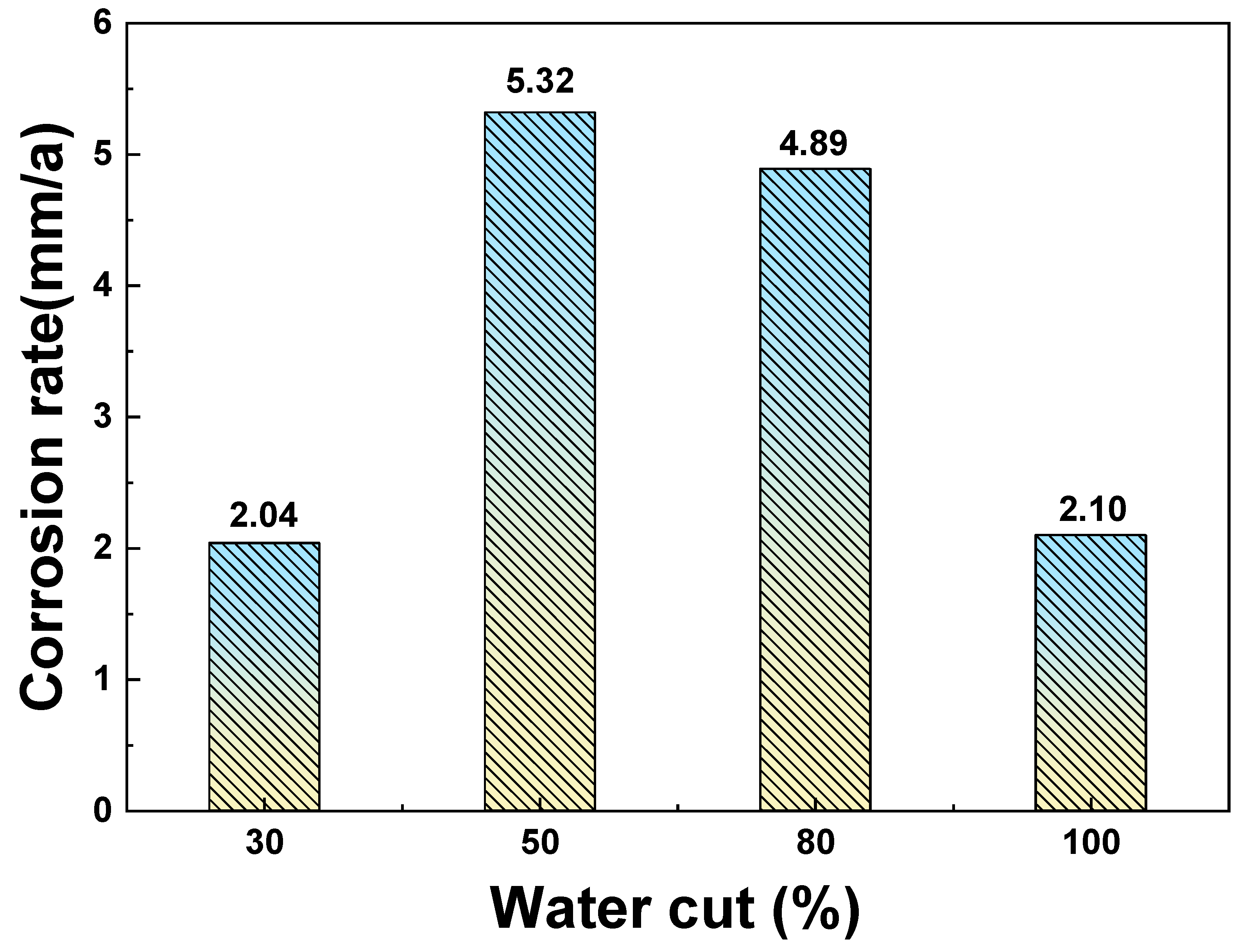
Figure 2 summarizes the results of the localized corrosion rate under different water cuts, derived from the absolute maximum pitting depth. In contrast with the monotonic increase observed in uniform corrosion, the localized attack exhibited a distinct convex trend with the increasing water cut. At 30% water cut, the VPCR was recorded at 2.04 mm/year. A sharp inflection occurred at 50% water cut, where the rate culminated at a peak value of 5.32 mm/year. Subsequently, the severity of vertical penetration diminished at higher water fractions. Notably, the rate at 100% water cut dropped to 2.10 mm/year, reverting to a magnitude comparable to that observed at the 30% condition.
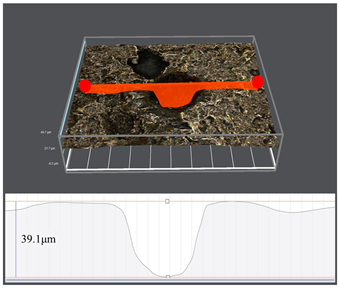
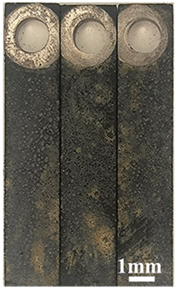
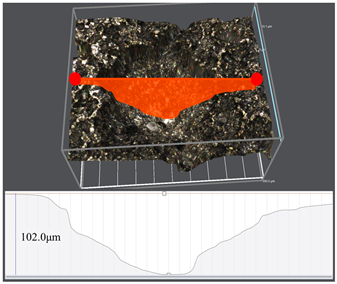
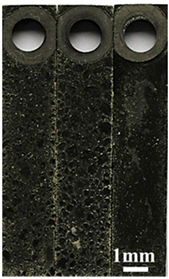
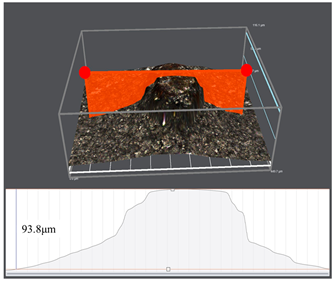
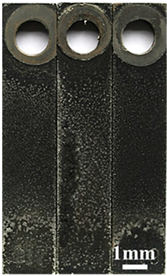
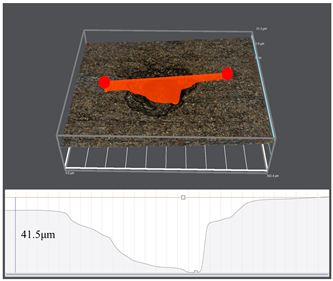
Table 3 presents the macroscopic surface morphologies of P110 steel alongside the corresponding quantitative pitting depth measurements. At 30% water cut, the surface exhibited a heterogeneous deposition of black corrosion scales, correlating with a minimal pitting depth of 39.1 μm. A distinct morphological transition occurred at 50% water cut, characterized by the emergence of discrete, deep pits on the substrate. This morphological change corresponded to a peak maximum pitting depth. With a further increase in the water cut to 80% and 100%, the corrosion features evolved from isolated pitting to broad, mesa-type scale accumulations. Although the macroscopic observation suggested extensive surface degradation, quantitative analysis revealed a reduction in vertical penetration severity. Specifically, the maximum pitting depth decreased to 93.8 μm at 80% water cut and further declined to 41.5 μm at 100%. This trend indicates that at higher water fractions, the corrosion mechanism shifts towards lateral propagation (general corrosion) rather than vertical pitting.

3.2. SEM Observation and EDS Analysis of Corrosion Scales

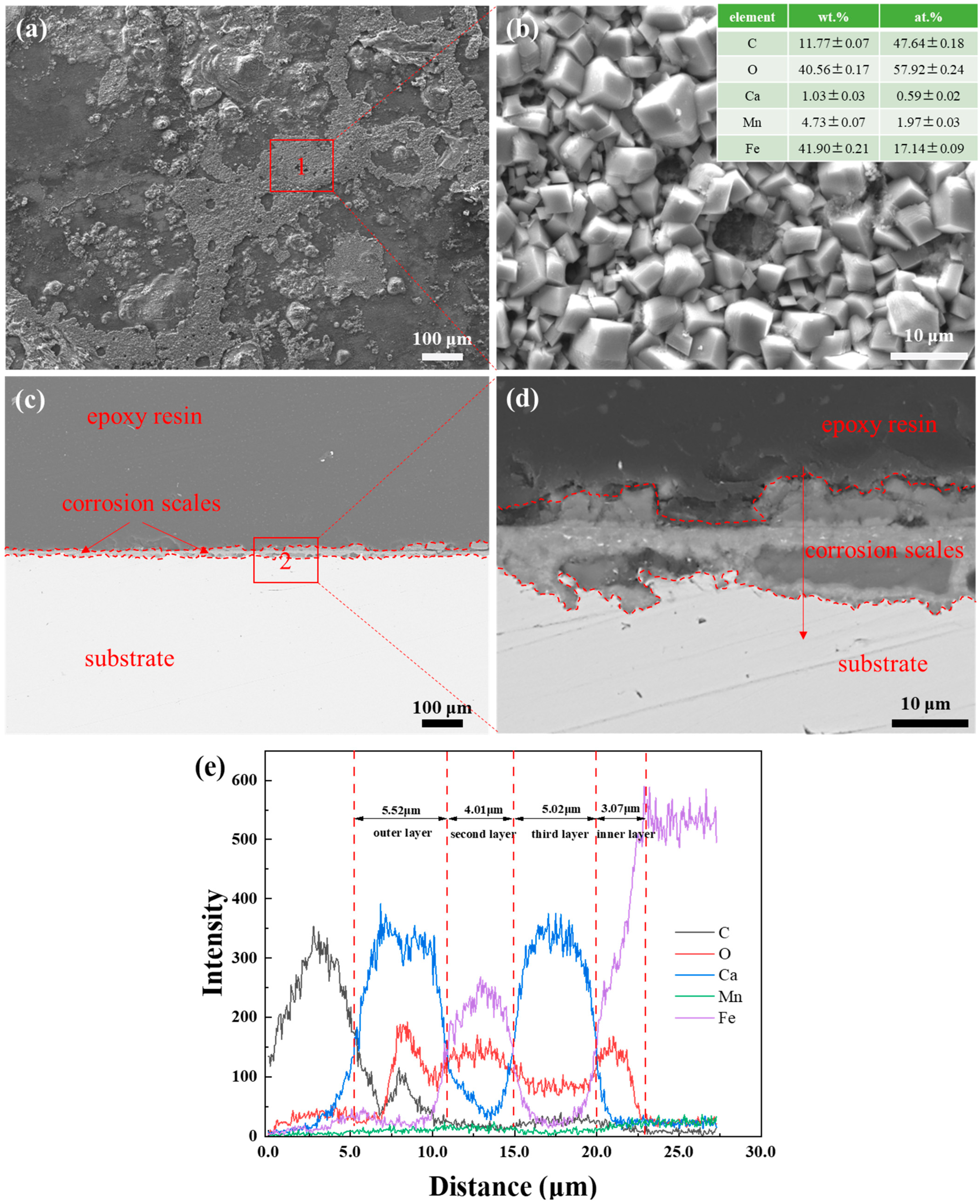
Figure 3 presents the SEM morphologies and elemental analysis of the corrosion scales formed after 168 h of exposure to the 30% water cut environment. The low-magnification surface image (Figure 3a) reveals an uneven corrosion layer developed on the surface of P110 steel. The high-magnification observation in Figure 3b indicated that the scale consists of loosely packed rhombic crystals with visible porosity. The corresponding EDS point analysis confirms the presence of Fe, C, O, and Ca as the primary constituents. Cross-section analysis in Figure 3c further highlights the discontinuous nature of the scale, with thickness variations ranging from approximately 5 μm to 18 μm. In the magnified cross-sectional view (Figure 3d), a distinct multi-layered stratification is evident. This structural segregation is corroborated by the EDS line scan profiles (Figure 3e), which display alternating peak intensities for Ca and Fe across the scale depth. The specific thicknesses of the four identifiable sub-layers, measured from the solution interface inward to the substrate, are 5.52 μm, 4.01 μm, 5.02 μm, and 3.07 μm, respectively.
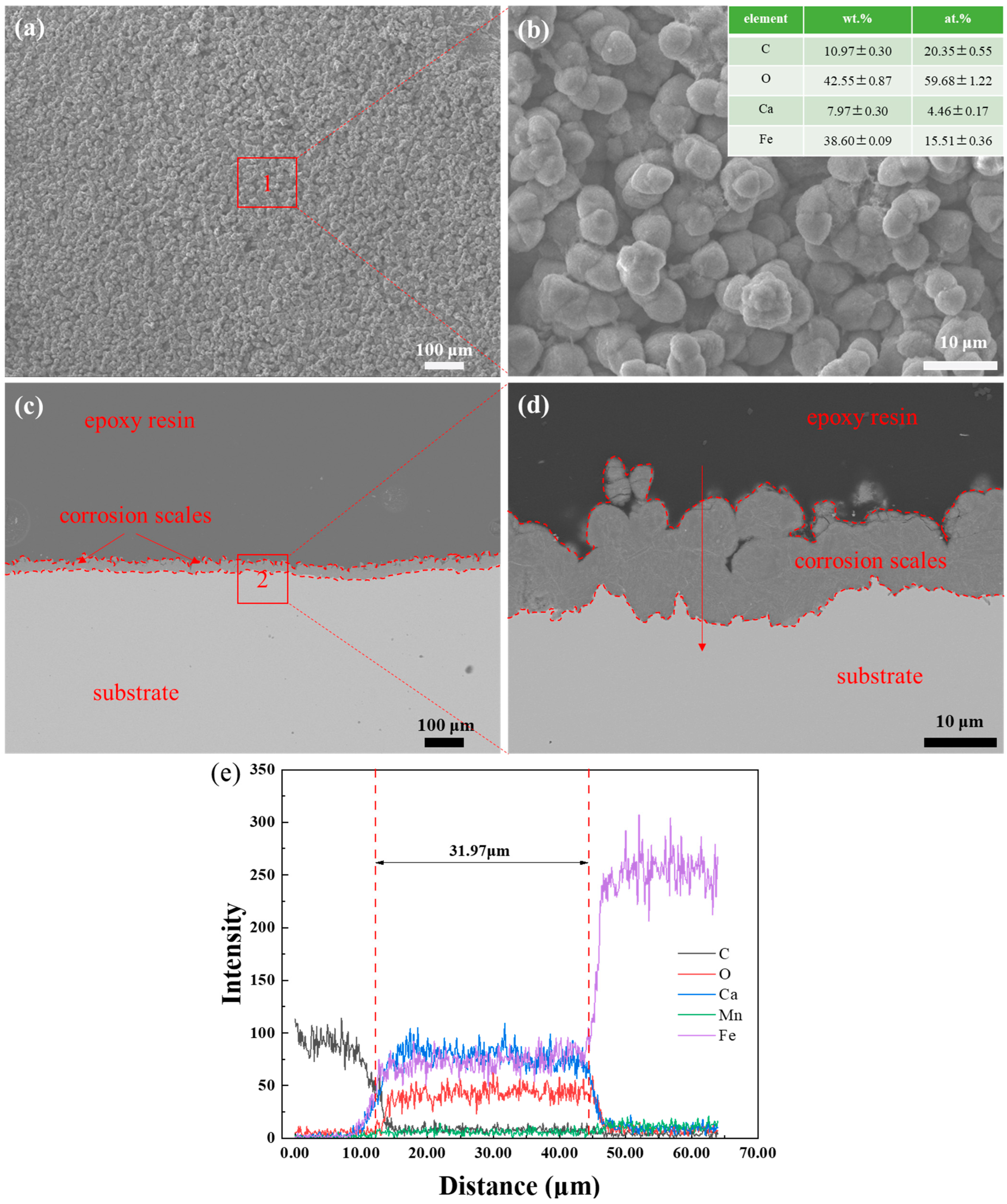
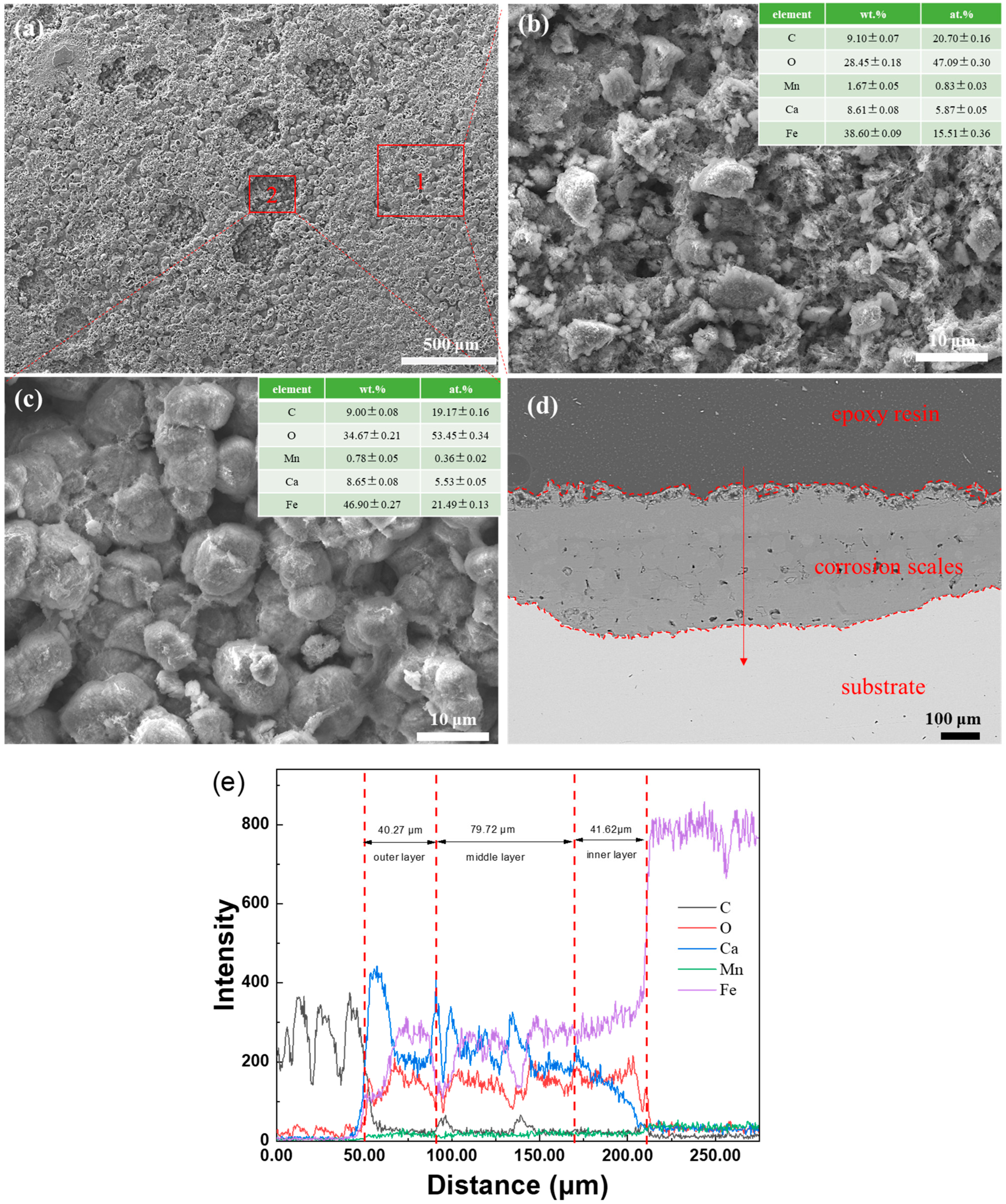
Figure 4 illustrates the morphology and elemental characteristics of the corrosion scale formed at a 50% water cut. In contrast to the discontinuous coverage observed at 30% water cuts, the surface exhibits a dense, continuous product layer (Figure 4a). High-magnification imaging (Figure 4b) reveals a distinct microstructural feature: the crystalline morphology predominantly consists of fine-grained, spherical agglomerates rather than the rhombic geometries observed previously. EDS analysis indicates a substantial enrichment in calcium content. While the elemental constitution (Fe, C, O, and Ca) remains qualitatively similar to the 30% condition, the calcium concentration increased notably from 1.03 wt.% to 7.97 wt.%. Cross-section imaging (Figure 4c) demonstrates significant thickening of the corrosion scales, with the average scale thickness reaching 32 ± 1.3 μm. Detailed inspection of the cross-section (Figure 4d) reveals that the scale exhibits a consolidated single-layer structure, devoid of the significant layer seen at the 30% water cut. This structural homogeneity is further substantiated by the EDS line scan profiles (Figure 4e), which display a uniform distribution of Ca, Fe, C, and O across the entire scale thickness. When the water cut reaches 80%, the surface morphology of the corrosion scales undergoes significant changes, as shown in Figure 5. The surface morphology (Figure 5a) reveals a bilayered appearance caused by localized spalling of the outer scale. The remnant outer layer (Figure 5b) exhibits a dense, compact texture, whereas the exposed inner region (Figure 5c) is composed of spherical granular accumulations. EDS point analysis confirms that both regions primarily contain C, O, Fe, and Ca, though the inner particulate layer shows a relative enrichment in Fe and Ca concentrations compared to the dense outer shell. The cross-section displayed in Figure 5d unveils a more complex tri-layered structure. The total scale thickness significantly expanded to 158 ± 44.6 μm, representing a four-fold increase compared to the 50% water cut condition. The specific dimensions and elemental profiles (Figure 5e) demarcate three distinct zones: a dense outer layer (40.27 μm), characterized by a high Ca concentration; a porous middle layer (79.72 μm) containing visible voids, where Ca and Fe intensities exhibit an approximate 1:1 ratio; and an inner layer (41.62 μm) adjacent to the substrate, where the Ca signal attenuates significantly, leaving an Fe-dominant zone.
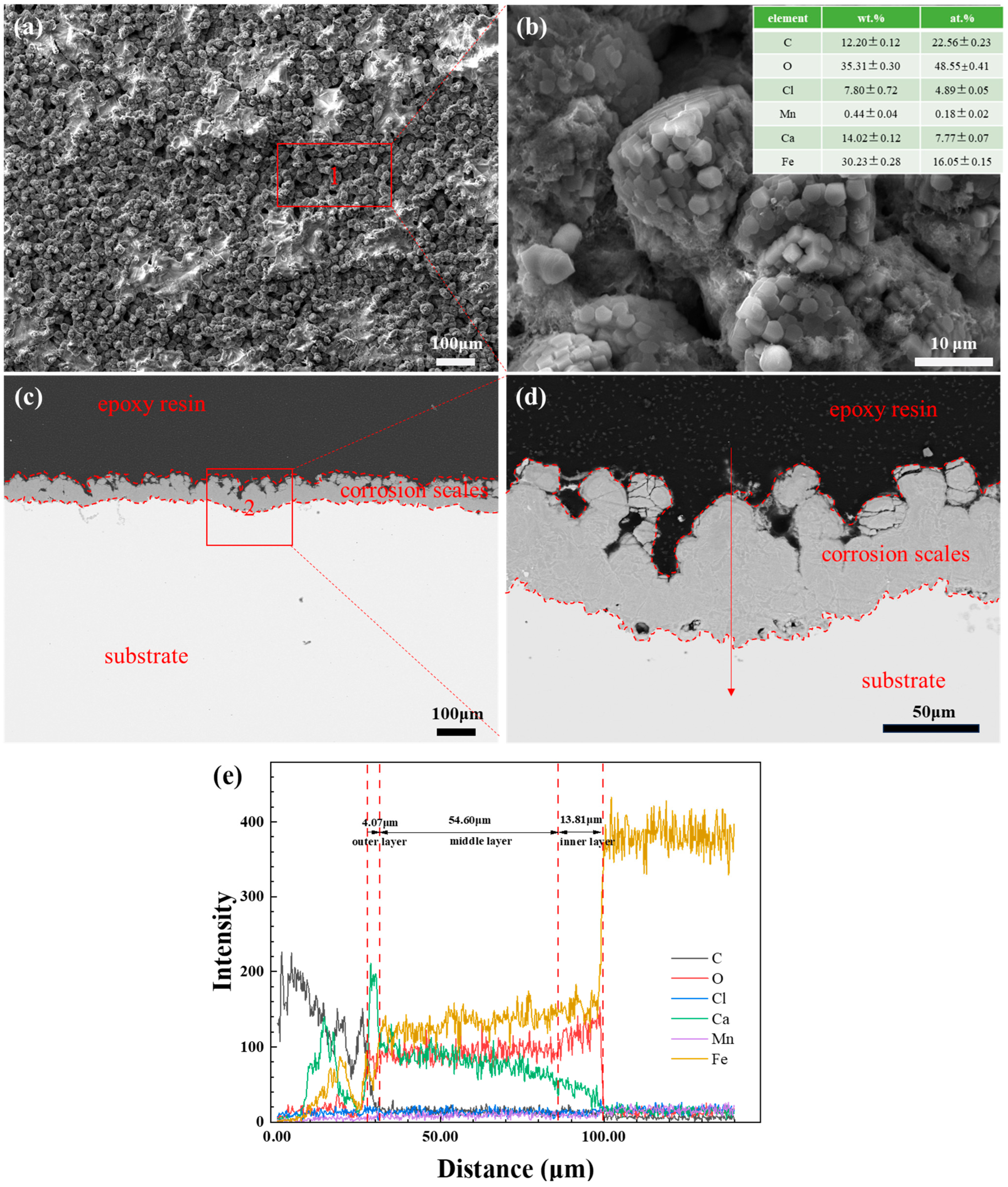
Figure 6 presents the morphological and elemental analysis of the corrosion scale formed in the fully water-saturated environment (100% water cut). The surface morphology (Figure 6a) is characterized by a loose accumulation of granular deposits. High-magnification observation (Figure 6b) reveals that these deposits are predominantly composed of fine rhombic crystallites with an approximate dimension of 1 μm. The cross-section in Figure 6c indicates a reduction in the average scale thickness to 78.5 ± 6.4 μm, compared to the peak thickness observed at the 80% water cut. The outer region of the scale exhibits a high density of non-penetrating voids. The elemental distribution, as delineated by the EDS line scan profiles (Figure 6e), reveals a compositionally graded tri-layer structure. The calcium concentration is maximal at the solution interface, forming a distinct Ca-enriched outer band with a thickness of approximately 4.07 μm. Moving inward, the calcium signal attenuates gradually across the intermediate zone before diminishing near the substrate interface, indicating a transition from a Ca-rich carbonate to an Fe-dominant scale.

3.3. XRD Results

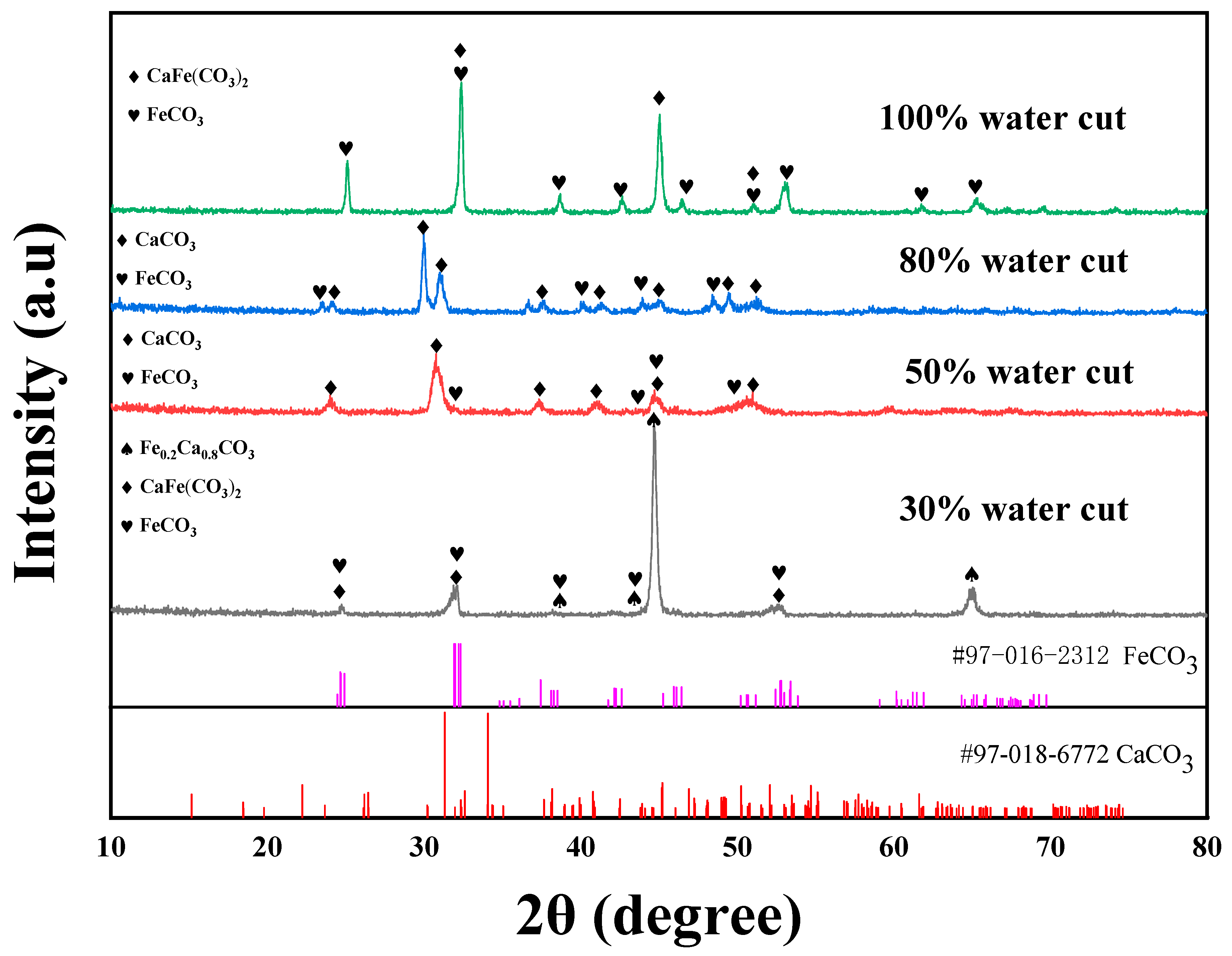
To further elucidate the phase composition of the corrosion scales, XRD analysis was performed on samples under varying water cut conditions; the results are presented in Figure 7. As shown in the figure, the diffraction patterns display characteristic peaks approximately located at two theta angles of 24.8° (012), 32.1° (104), 38.3° (110), 42.2° (113), 50.8° (116), and 52.9° (024), corresponding to the carbonate lattice. Consistent with the results of Ren et al. [28], these diffraction lines confirm that the corrosion scales are FexCa1−xCO3, as both FeCO3 and CaCO3 share the same rhombohedral crystal structure.

4. Discussion

4.1. The Effect of Water Cut on Uniform and Localized Corrosion

The corrosion rate testing results revealed a distinct non-linear dependence of the corrosion rate on the water cut, characterized by a sudden surge in the corrosion rate as the water fraction increased from 30% to 50%. This behavior is fundamentally governed by the hydrodynamic interaction between the multiphase fluids and the steel surface. In the low-water-cut regime (30%), the uniform corrosion rate was negligible. Consistent with the Ostwald phase volume theory [31], the oil phase acts as the continuous medium, entrapping water droplets and providing hydrodynamic shielding that isolates the steel substrate from the corrosive brine. However, this physical barrier is not absolute. As noted by Sun et al., the shear stress generated by the flowing fluid can induce intermittent wetting, where dispersed water droplets momentarily impact the surface. Wang et al. [20] further elucidated this characteristic via the wetting hysteresis phenomenon, suggesting that, while transient water contact initiates anodic dissolution, rapid re-wetting by the oil phase stifles pit propagation. Consequently, the thin, discontinuous scales formed, resulting in minimal metal loss.
A critical transition in wetting dynamics was observed at 50% water cut. Contrary to a gradual linear increase, the uniform corrosion rate escalated by approximately two orders of magnitude (from 0.038 to 4.44 mm/year), while the localized corrosion rate reached its peak. This trend aligns with the findings of Sun et al. [22], who reported a similar sharp transition from uniform to localized corrosion in supercritical CO2 environments once the water cut exceeded a specific threshold. At this stage, the stability of the oil film decreases, and the probability of the water phase wetting the steel surface increases significantly. This breakdown of the protective oil barrier leads to inhomogeneous wetting, establishing persistent galvanic cells where water-wetted areas act as active anodes surrounded by oil-covered cathodes. This mechanism drives the severe pitting corrosion observed in the 50% water cut samples. Meanwhile, Foss et al. [32] performed contact angle measurements to simulate a scenario where the surface was already water-wet prior to exposure to the oil phase. They observed that the contact angle of crude oil on the steel surface covered with FeCO3 was less than 20 degrees, indicating that water has a higher propensity to wet the FeCO3 layer compared to crude oil. Consequently, under the test conditions, the water phase is more likely to preferentially wet the localized corrosion layer, enabling the corrosive ions in the water phase (e.g., H+, Cl) to penetrate the corrosion layer and further propagate the underlying corrosion pits. However, when a uniform FeCO3 layer forms across the entire steel surface, under CO2/oil/system flow conditions, it becomes challenging for the film surface to be fully water-wetted. In this context, water and crude oil can still intermittently wet the film surface, thereby promoting the development of pits beneath the corrosion layer that remain in prolonged contact with the water phase.
As the water cut approaches 100%, the system transitions to a fully water-wet regime. Under these conditions, the aggressive supercritical CO2-saturated brine contacts the entire surface, facilitating the rapid mass transport of corrosive species (H+, H2CO3). This explains the maximization of the uniform corrosion rate (5.13 mm/year). However, the apparent decrease in the localized corrosion rate at high water cuts (Figure 2) is attributed to the lateral coalescence of pits (mesa-type attack), as the distinct local anodes merge into a general corrosion front, reducing the vertical penetration depth relative to the surface recession rate.

4.2. The Effect of Water Cuts and Ca2+ Concentration on Corrosion Scale Formation

While the hydrodynamic wetting regime governs the initiation of corrosion, the subsequent propagation of corrosion is fundamentally governed by the physicochemical properties of the deposited product layer. The XRD results confirm that the primary corrosion product is a FexCa1−xCO3. A distinct crystallographic feature observed is the systematic shift in the main (104) peak toward the two lower theta angles relative to the pure siderite reference in XRD results [27]. As established in the literature, the (104) peak of pure FeCO3 is located at a higher angle (32.1°) compared to that of pure CaCO3 (29.4°). The observed “left-shift” in the experimental samples quantitatively indicates the substitution of smaller Fe2+ ions (0.78 Å) by larger Ca2+ ions (1.00 Å) within the lattice [28]. This substitution leads to lattice expansion and the formation of Ca-rich solid solutions. Furthermore, a variation in peak intensity was observed; a decrease in the intensity of the (104) and (012) reflections at higher water cuts suggests a reduction in crystallinity and grain integrity of the FexCa1−xCO3 scale, attributed to the lattice distortion caused by excessive calcium incorporation. Contrary to the initial hypothesis regarding mixed Ca/Mg carbonates, thermodynamic analysis explains the absence of magnesium-based phases (e.g., magnesite or dolomite) in the scale. According to the report by Mansoori et al. [33], the solubility product (Ksp) of MgCO3 is several orders of magnitude higher than that of CaCO3 and FeCO3. Therefore, despite the presence of Mg2+ in the brine, the solution remains undersaturated with respect to magnesium carbonates under the test conditions. This competitive crystallization between corrosion-derived Fe2+ and bulk Ca2+ directly dictates the morphological evolution of the scale. Variations in the local supersaturation ratio (Fe2+/Ca2+) at different water cuts drive a distinct structural transition from a heterogeneous multi-layer film at low water cuts to a kinetic-controlled single layer at the critical transition (50%) and finally evolving into a diffusion-controlled tri-layer structure at high water cuts. This changing balance plays a crucial role in shaping the corrosion product layer, which is closely associated with the solubility characteristics of FeCO3 and CaCO3.
Wang et al. [34] reported that the Ksp of FeCO3 and CaCO3 are 3.13 × 10⁻¹¹ and 4.8 × 10⁻⁹, respectively, noting that the presence of Ca2+ reduces the solubility of FeCO3. Consequently, the critical deposition concentration of Fe2+ is much lower than that of Ca2+ in the solution at the same CO32− and pH condition. Furthermore, Ding et al. [35] also observed the formation of a double-layered corrosion film at a Ca2+ concentration of 512 ppm. This structure was attributed to variations in the Ca/Fe ratio, with the outer layer exhibiting a higher calcium enrichment compared to the inner layer. Similarly, Ren et al. [28] reported that a disordered and heterogeneous structure of FexCa1−xCO3 was formed as the concentration of Ca2+ increased.
In the supercritical CO2 environment, once CO2 dissolves in water, it undergoes dissolution and ionization processes to generate H2CO3, HCO3, CO32−, and H+. These ions further influence the anode and cathode reactions and the formation of the corrosion scales [36,37,38]. The formation of FeCO3 can be described through the anode and deposition reactions as follows [36]:
F e + H 2 C O 3 F e C O 3 + 2 H +
F e + H C O 3 F e C O 3 + H +
F e + C O 3 2 F e C O 3 + 2 H +
F e 2 + + C O 3 2 F e C O 3
Generally, the kinetics of electrochemical reactions significantly outpace those of deposition processes. Consequently, in a supercritical CO2 environment, Fe2+ ions generated during corrosion accumulate at the metal–solution interface, leading to the rapid formation of a dense FeCO3. This phenomenon is consistent with the findings reported by Wei et al. [13], Guo et al. [39], Hua et al. [40], and Sun et al. [41], that amorphous FeCO3 exists on the surface at the initial stage in the supercritical CO2 environment. On the other hand, FeCO3 can be dissolved in the H2CO3 environment though the following reaction [28]:
F e C O 3 + H 2 C O 3 F e ( H C O 3 ) 2
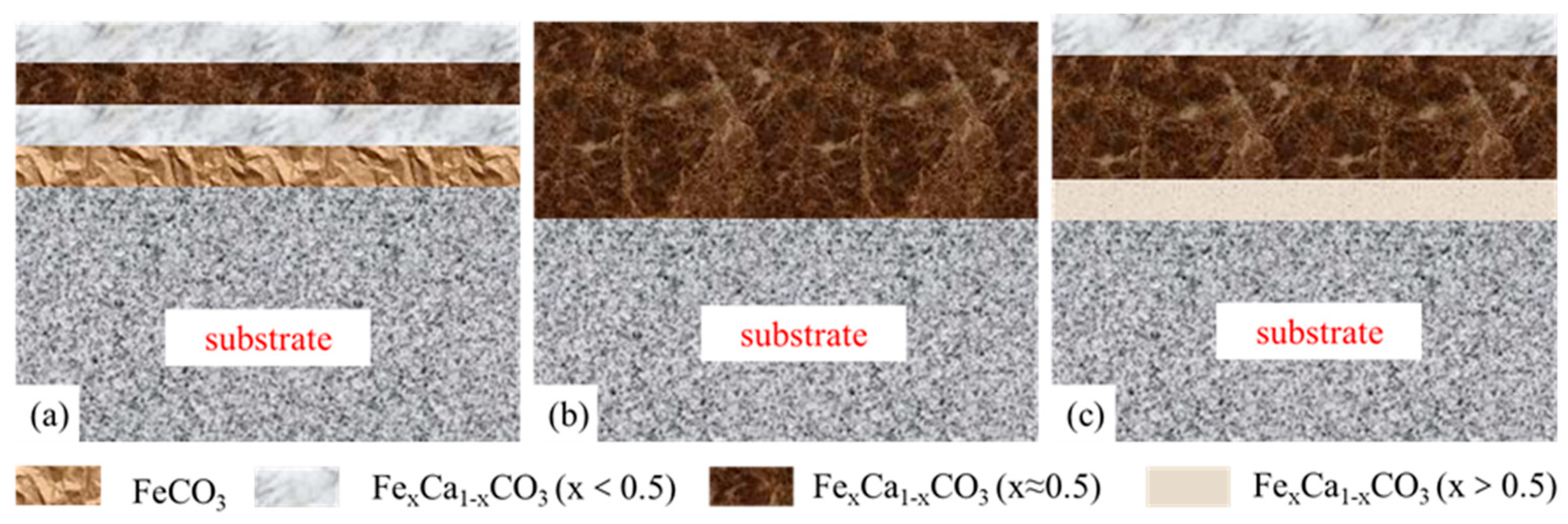
Based on the crystallographic and microstructural evidence, a phenomenological model illustrating the competitive growth of the scale is proposed, as depicted in Figure 8. The structural evolution is fundamentally driven by the local balance between the anodic generation rate of Fe2+ and the mass transport of bulk Ca2+. At 30% water cut, due to the shielding effect of the oil phase and local wetting, the corrosion rate is minimal, resulting in a limited flux of Fe2+ at the surface. The local solution chemistry is dominated by the high concentration of bulk Ca2+. With prolonged immersion, competitive adsorption between Ca2+ and Fe2+ leads to FexCa1−xCO3 (x ≈ 0.5) formation. As Fe2+ is consumed, the outermost layer becomes predominantly CaCO3. As the water cut increases to 50%, the corresponding corrosion rate accelerates sharply, which not only leads to the rapid thickening of the corrosion products but also intensifies the competition between Fe2+ and Ca2+. This kinetic dominance drives the rapid nucleation and coalescence of the uniform layer FexCa1−xCO3 (x ≈ 0.5). When the water cut exceeds 80%, a distinct concentration gradient develops across the film thickness. Adjacent to the substrate, the continuous generation of Fe2+ maintains a localized iron-rich environment, promoting the formation of FexCa1−xCO3 (x > 0.5) close to the substrate, with x approaching 1 closer to the interface. Moving outward, the depletion of Fe2+ and inward diffusion of Ca2+ progressively shift the equilibrium, resulting in an intermediate transition zone FexCa1−xCO3 (x ≈ 0.5) and, finally, a Ca enriched outer layer (x ≈ 0.5) at the solution interface.

5. Conclusions

(1)
As the water cut increases from 30% to 100%, the corresponding uniform corrosion gradually rises. Notably, the uniform corrosion rate surged by approximately two orders of magnitude as the water cut increased from 30% to 50%, followed by a moderate increase up to a 100% water cut. In contrast, the localized corrosion rate displayed a distinct convex trend, culminating in a peak value at a 50% water cut. This critical transition at 50% is attributed to the hydrodynamic breakdown of the protective oil film and the formation of galvanic cells induced by inhomogeneous wetting.
(2)
The corrosion scales on the surface of P110 underwent significant morphological transitions driven by the thermodynamics of competitive ionic substitution between Ca2+ and Fe2+. The scale evolved from a heterogeneous multi-layered film at a 30% water cut to the uniform, kinetic-controlled single layer at 50% and, finally, to a diffusion-controlled tri-layer gradient structure at 100%. These structural transformations are fundamentally governed by the formation of calcium-substituted scales FexCa1−xCO3 with varying stoichiometry, dictated by the local balance between anodic iron dissolution and bulk calcium diffusion.

Author Contributions

Conceptualization, J.X. and M.Z.; methodology, M.Z., W.S. and X.L.; formal analysis, J.X.; investigation, X.L., H.C., J.Y., Y.L. and A.F.; resources, T.L.; data curation, J.Z.; writing—original draft preparation, J.X.; writing—review and editing, M.Z., W.S., X.L., J.Y. and H.C.; visualization, A.F.; supervision, T.L., J.Z. and Z.Y.; project administration, J.X.; funding acquisition, X.L. All authors have read and agreed to the published version of the manuscript.

Funding

This research was funded by Natural Science Foundation of China, grant number U25B6007, and Key Science and Technology Projects for Basic and Prospective Research of CNPC, grant number 2023ZZ11.

Institutional Review Board Statement

Not applicable.

Informed Consent Statement

Consent was obtained from all subjects involved in the study.

Data Availability Statement

The original contributions presented in this study are included in the article. Further inquiries can be directed to the corresponding author.

Conflicts of Interest

The authors declare no conflicts of interest.

References

  1. Bhattacharyya, S.S.; Leite, F.F.G.D.; Adeyemi, M.A.; Sarker, A.J.; Cambareri, G.S.; Faverin, C.; Tieri, M.P.; Castillo-Zacarías, C.; Melchor-Martínez, E.M.; Iqbal, H.M.N.; et al. A paradigm shift to CO2 sequestration to manage global warming—With the emphasis on developing countries. Sci. Total Environ. 2021, 790, 148169. [Google Scholar] [CrossRef]
  2. Qin, M.; Liao, K.; He, G.; Zou, Q.; Zhao, S.; Zhang, S. Corrosion mechanism of X65 steel exposed to H2S/CO2 brine and H2S/CO2 vapor corrosion environments. J. Nat. Gas Sci. Eng. 2022, 106, 104774. [Google Scholar] [CrossRef]
  3. Wang, Y.; Shang, Q.; Zhou, L.; Jiao, Z. Utilizing macroscopic areal permeability heterogeneity to enhance the effect of CO2 flooding in tight sandstone reservoirs in the Ordos Basin. J. Pet. Sci. Eng. 2021, 196, 107633. [Google Scholar] [CrossRef]
  4. Wilson, M.; Monea, M. IEA GHG Weyburn CO2 Monitoring & Storage Project Summary Report 2000–2004; Petroleum Technology Research Centre: Regina, SK, Canada, 2004. [Google Scholar]
  5. Lu, H.F.; Ma, X.; Huang, K.; Fu, L.D.; Azimi, M. Carbon dioxide transport via pipelines: A systematic review. J. Clean. Prod. 2020, 266, 121994. [Google Scholar] [CrossRef]
  6. Davoodi, S.; Al-Shargabi, M.; Wood, D.A.; Mehrad, M.; Rukavishnikov, V.S. Carbon dioxide sequestration through enhanced oil recovery: A review of storage mechanisms and technological applications. Fuel 2024, 366, 131313. [Google Scholar] [CrossRef]
  7. Sun, H.F.; Wang, H.X.; Zeng, Y.M.; Liu, J. Corrosion challenges in supercritical CO2 transportation, storage, and utilization—A review. Renew. Sustain. Energy Rev. 2023, 179, 113292. [Google Scholar] [CrossRef]
  8. Zhao, Y.L.; Ding, T.C.; Yang, S.; Li, J.W.; Zhao, X.F.; Lin, X.Q.; Sun, C.; Sun, J.B. Comparison of corrosion behavior of X52 steel in liquid and supercritical CO2 transport environments with multiple impurities. Corros. Commun. 2025, 18, 44–53. [Google Scholar] [CrossRef]
  9. Dugstad, A. Mechanism of protective film formation during CO2 corrosion of carbon steel. In NACE CORROSION 1998; NACE International: Houston, TX, USA, 1998; p. 98031. [Google Scholar]
  10. Nesic, S.; Lee, K.L.J. A mechanistic model for carbon dioxide corrosion of mild steel in the presence of protective iron carbonate films—Part III: Film growth model. Corrosion 2003, 6, 616–628. [Google Scholar] [CrossRef]
  11. Barker, R.; Burkle, D.; Charpentier, T.; Thompson, H.; Neville, A. A review of iron carbonate (FeCO3) formation in the oil and gas industry. Corros. Sci. 2018, 142, 312–341. [Google Scholar] [CrossRef]
  12. Nesic, S. Key issues related to modelling of internal corrosion of oil and gas pipelines—A review. Corros. Sci. 2007, 49, 4308–4338. [Google Scholar] [CrossRef]
  13. Wei, L.; Pang, X.L.; Liu, C.; Gao, K.W. Formation mechanism and protective property of corrosion product scale on X70 steel under supercritical CO2 environment. Corros. Sci. 2015, 100, 404–420. [Google Scholar] [CrossRef]
  14. Zhang, Y.; Pang, X.; Qu, S.; Li, X.; Gao, K. Discussion of the CO2 corrosion mechanism between low partial pressure and supercritical condition. Corros. Sci. 2012, 59, 186–197. [Google Scholar] [CrossRef]
  15. Craig, B.D. Predicting the conductivity of water-in-oil solutions as a means to estimate corrosiveness. Corrosion 1998, 54, 657–662. [Google Scholar] [CrossRef]
  16. Choi, H.J.; Cepulis, R.L.; Lee, J.B. Carbon dioxide corrosion of L-80 grade tubular in flowing oil-brine two-phase environments. Corrosion 1989, 45, 943–950. [Google Scholar] [CrossRef]
  17. Kee, K.E.; Richter, S.; Babic, M.; Nešić, S. Experimental study of oil-water flow patterns in a large diameter flow loop—The effect on water wetting and corrosion. Corrosion 2016, 72, 569–582. [Google Scholar] [CrossRef] [PubMed]
  18. Li, C.; Tang, X.P.; Ayello, F.; Cai, J.Y.; Nesic, S.; Cruz, C.I.T.; Al-Khamis, J.N. Experimental study on water wetting and CO2 corrosion in oil-water two-phase flow. In NACE CORROSION 2006; NACE International: Houston, TX, USA, 2006; p. 06595. [Google Scholar]
  19. Wang, M.Z.; Zi, M.; An, Q.L.; Han, X.; Zhang, X.; Zhao, L.; Zhang, J.; Song, G.L. Fluid structure governing the corrosion behavior of mild steel in Oil-water mixtures. Corros. Eng. Sci. Technol. 2020, 55, 241–252. [Google Scholar] [CrossRef]
  20. Wang, X.; Ouyang, J.; Wang, Z.M. Exploring the dynamic mechanism of water wetting induced corrosion on differently pre-wetted surfaces in oil–water flows. J. Colloid Interface Sci. 2024, 664, 284–298. [Google Scholar] [CrossRef]
  21. Ma, W.; Wang, H.; Guo, H.; Cai, L.; Li, X.; Hua, Y. A synergistic experimental and computational study on CO2 corrosion of X65 carbon steel under dispersed droplets within oil/water mixtures. Corros. Commun. 2023, 12, 64–75. [Google Scholar] [CrossRef]
  22. Sun, J.; Sun, C.; Zhang, G.; Zhao, W.; Wang, Y. Effect of water cut on the localized corrosion behavior of P110 tube steel in supercritical CO2/oil/water environment. Corrosion 2016, 72, 1470–1482. [Google Scholar] [CrossRef]
  23. Ingham, B.; Ko, M.; Laycock, N.; Burnell, J.; Kappen, P.; Kimpton, J.A.; Williams, D.E. In situ synchrotron X-ray diffraction study of scale formation during CO2 corrosion of carbon steel in sodium and magnesium chloride solutions. Corros. Sci. 2012, 56, 96–104. [Google Scholar] [CrossRef]
  24. Rizzo, R.; Ambat, R. Effect of initial CaCO3 saturation levels on the CO2 corrosion of 1Cr carbon steel. Mater. Corros. 2021, 72, 1076–1090. [Google Scholar] [CrossRef]
  25. Yuan, H.; Zeng, D.; Li, J.; Liu, Z.; Wang, X.; Yu, C.; Yi, Y.; Dong, B. The effects of Cl and Ca2+ on corrosion and scale formation of 3Cr steel in CO2 flooding produced fluid. Chin. J. Chem. Eng. 2025, 85, 355–366. [Google Scholar] [CrossRef]
  26. Esmaeely, S.N.; Choi, Y.-S.; Young, D.; Nešić, S. Effect of Calcium on the Formation and Protectiveness of Iron Carbonate Layer in CO2 Corrosion. Corrosion 2013, 69, 912–920. [Google Scholar] [CrossRef]
  27. Hua, Y.; Shamsa, A.; Barker, R.; Neville, A. Protectiveness, morphology and composition of corrosion products formed on carbon steel in the presence of Cl, Ca2+ and Mg2+ in high pressure CO2 environments. Appl. Surf. Sci. 2018, 455, 667–682. [Google Scholar] [CrossRef]
  28. Ren, X.; Lu, Y.; Wei, Q.; Yu, L.; Zhai, K.; Tang, J.; Wang, H.; Xie, J. The influence of Ca2+ on the growth mechanism of corrosion product film on N80 steel in CO2 corrosion environments. Corros. Sci. 2023, 218, 111168. [Google Scholar] [CrossRef]
  29. Liu, Y.; Hou, M.; Yang, G.; Han, B. Solubility of CO2 in aqueous solutions of NaCl, KCl, CaCl2 and their mixed salts at different temperatures and pressures. J. Supercrit. Fluids 2011, 56, 125–129. [Google Scholar] [CrossRef]
  30. Yang, L.; Zhang, D.; Liu, C.; Yang, Z.; Fan, H.; Wei, Z.; Wu, H.; He, C. Corrosion behavior of N80 steel in CO2-saturated brine coupled with ultra-high Cl and Ca2+ concentrations under static and flowing states. Gas Sci. Eng. 2025, 135, 205547. [Google Scholar] [CrossRef]
  31. Zhao, G.X. Physical Chemistry of Surfactant; Peking University Press: Beijing, China, 1991; p. 387. [Google Scholar]
  32. Foss, M.; Gulbrandsen, E.; Sjöblom, J. CO2 corrosion inhibition and oil wetting of carbon steel with ferric corrosion products. In NACE CORROSION 2009; NACE International: Houston, TX, USA, 2009; pp. 1–17. [Google Scholar]
  33. Mansoori, H.; Young, D.; Brown, B.; Singer, M. Influence of calcium and magnesium ions on CO2 corrosion of carbon steel in oil and gas production systems—A review. J. Nat. Gas Sci. Eng. 2018, 59, 287–296. [Google Scholar] [CrossRef]
  34. Wang, B.; Xu, L.N.; Liu, G.Z.; Lu, M.X. Corrosion behavior and mechanism of 3Cr steel in CO2 environment with various Ca2+ concentration. Corros. Sci. 2018, 136, 210–220. [Google Scholar] [CrossRef]
  35. Ding, C.; Gao, K.W.; Chen, C.F. Effect of Ca2+ on CO2 corrosion properties of X65 pipeline steel. Int. J. Miner. Metall. Mater. 2009, 16, 661–666. [Google Scholar]
  36. Li, X.P.; Zhao, Y.; Qi, W.L.; Xie, J.F.; Wang, J.D.; Liu, B.; Zeng, G.X.; Zhang, T.; Wang, F.H. Effect of extremely aggressive environment on the nature of corrosion scales of HP-13Cr stainless steel. Appl. Surf. Sci. 2019, 469, 146–161. [Google Scholar] [CrossRef]
  37. Zhang, G.A.; Cheng, Y.F. On the fundamentals of electrochemical corrosion of X65 steel in CO2-containing formation water in the presence of acetic acid in petroleum production. Corros. Sci. 2009, 51, 87–94. [Google Scholar] [CrossRef]
  38. Nordsveen, M.; Nešić, S.; Nyborg, R.; Stangeland, A. A mechanistic model for carbon dioxide corrosion of mild steel in the presence of protective iron carbonates films—Part 1: Theory and verification. Corrosion 2003, 59, 443–456. [Google Scholar] [CrossRef]
  39. Guo, S.Q.; Xu, L.N.; Zhang, L.; Chang, W.; Lu, M.X. Corrosion of alloy steels containing 2% chromium in CO2 environments. Corros. Sci. 2012, 63, 246–258. [Google Scholar] [CrossRef]
  40. Hua, Y.; Barker, R.; Neville, A. Comparison of corrosion behaviour for X-65 carbon steel in supercritical CO2-saturated water and water-saturated/unsaturated supercritical CO2. J. Supercrit. Fluids 2015, 97, 224–237. [Google Scholar] [CrossRef]
  41. Sun, J.B.; Liu, W.; Chang, W.; Zhang, Z.H.; Li, Z.T.; Yu, T.; Lu, M.X. Characteristics and formation mechanism of corrosion scales on low-chromium X65 steels in CO2 environment. Acta Metall. Sin. 2009, 45, 84–90. [Google Scholar]
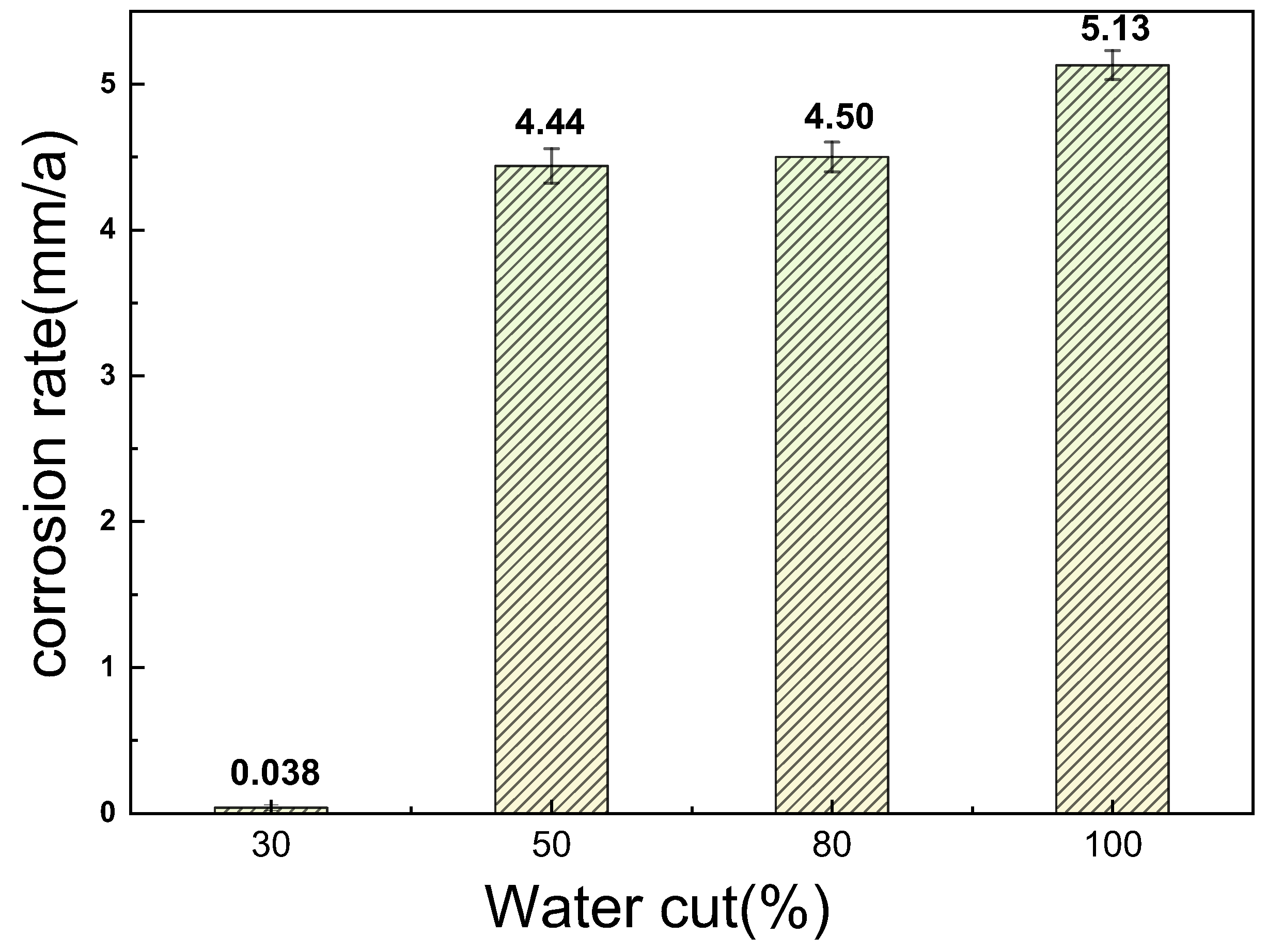
Figure 1. Effect of water cut on the average corrosion rate of P110 steel in supercritical CO2/oil/water system (20 MPa CO2, 90 °C, 1 m/s, and 168 h).
Coatings 16 00184 g001
Figure 2. Localized corrosion rate of P110 steel after immersion 168 h under different water cuts (20 MPa CO2, 90 °C, and 1 m/s).
Coatings 16 00184 g002
Figure 3. SEM morphologies of P110 steel after corrosion for 168 h at 30% water cut: (a) SEM surface morphology, (b) local magnified SEM surface morphology, (c) cross-section of backscattered electron image, (d) local magnified cross-section image, and (e) element distribution of cross-section.
Coatings 16 00184 g003
Figure 4. SEM morphologies of P110 steel after corrosion for 168 h at 50% water cut: (a) SEM surface morphology, (b) local magnified SEM surface morphology, (c) cross-section of backscattered electron image, (d) local magnified cross-section image, and (e) element distribution of cross-section.
Coatings 16 00184 g004
Figure 5. SEM morphologies of P110 steel after corrosion for 168 h at 80% water cut: (a) SEM surface morphology, (b) local magnified SEM surface morphology of region 1, (c) local magnified SEM surface morphology of region 2, (d) cross-section of backscattered electron image, and (e) element distribution of cross-section.
Coatings 16 00184 g005
Figure 6. SEM morphologies of P110 steel after corrosion for 168 h at 100% water cut: (a) SEM surface morphology, (b) local magnified SEM surface morphology, (c) cross-section of backscattered electron image, (d) local magnified cross-section image, and (e) element distribution of cross-section.
Coatings 16 00184 g006
Figure 7. XRD results for different water cuts.
Coatings 16 00184 g007
Figure 8. Corrosion scale deposition schematic diagrams at different cuts: (a) 30% water cut, (b) 50% water cut, and (c) 80%–100% water cut.
Coatings 16 00184 g008
Table 1. Chemical composition of P110 steel (wt.%).
ElementCMnCrSiNiCuVPSFe
Content
(wt.%)
0.261.300.0900.230.0710.0260.0040.00680.0045Balance
Table 2. Ion compositions of simulated water.
CompositionHCO3ClSO42−Ca2+Mg2+K+Na+
Content
(mg L−1)
189128,0004308310561662076,500
Table 3. Macroscopic morphologies of P110 steel before and after removal of corrosion scales and maximum pitting depth under different water cuts.
Water CutsMacroscopic Surface
Morphologies
Maximum Pitting Depth
30%Coatings 16 00184 i001Coatings 16 00184 i002
50%Coatings 16 00184 i003Coatings 16 00184 i004
80%Coatings 16 00184 i005Coatings 16 00184 i006
100%Coatings 16 00184 i007Coatings 16 00184 i008
Disclaimer/Publisher’s Note: The statements, opinions and data contained in all publications are solely those of the individual author(s) and contributor(s) and not of MDPI and/or the editor(s). MDPI and/or the editor(s) disclaim responsibility for any injury to people or property resulting from any ideas, methods, instructions or products referred to in the content.