Article

Surface Property Evolution of Pigmented Chinese Lacquer Coatings During Mercury Lamp-Induced Photoaging


1
Co-Innovation Center of Efficient Processing and Utilization of Forest Resources, Nanjing Forestry University, Nanjing 210037, China
2
College of Furnishing and Industrial Design, Nanjing Forestry University, Nanjing 210037, China
*
Author to whom correspondence should be addressed.
Coatings 2026, 16(1), 31; https://doi.org/10.3390/coatings16010031 (registering DOI)
Submission received: 23 November 2025 / Revised: 22 December 2025 / Accepted: 25 December 2025 / Published: 27 December 2025
(This article belongs to the Section Surface Characterization, Deposition and Modification)

Abstract

This study examines the pigment-dependent photoaging behavior of laboratory-prepared mock-up Chinese lacquer coatings colored with cinnabar, orpiment, and lapis lazuli under high-pressure mercury-lamp irradiation. Colorimetric results showed rapid changes within the first three days, with maximum ΔE values of 14.05 (red), 16.74 (yellow), and 17.97 (blue) after 30 days. Cinnabar-based films exhibited the highest color stability, whereas orpiment and lapis-lazuli coatings underwent pronounced hue shifts and chroma increases. Gloss loss and surface roughness evolution displayed a strong negative correlation: orpiment coatings experienced the most severe degradation, with gloss decreasing by over 60% and surface roughness increasing by approximately 70%, while cinnabar coatings showed the least decline (≈55% gloss loss; ≈27% roughness increase). SEM analysis further revealed extensive cracking and particle fragmentation in orpiment films, moderate surface disruption in lapis-lazuli films, and minimal microstructural damage in cinnabar films. Non-invasive reflection-mode FTIR spectroscopy confirmed these trends, showing minimal chemical change in cinnabar coatings but significant carbonyl growth, C–O–C band broadening, and aliphatic chain cleavage in orpiment and lapis-lazuli coatings. These results highlight the critical role of pigment chemistry in modulating UV-induced degradation pathways. Integrating optical, morphological, and chemical evidence, this study establishes a clear pigment-dependent degradation mechanism and provides valuable guidance for evaluating the long-term stability of lacquered cultural heritage and optimizing modern lacquer formulations.

1. Introduction

Chinese lacquer has long been valued for its remarkable corrosion resistance, durability, thermal insulation, waterproofing, and preservative properties. It has been widely applied as a decorative coating on wooden furniture, pottery, sculpture, and other works of art, and is also employed as a protective layer in industrial applications, earning its reputation as the “mystery of the Oriental world” [1,2]. The primary component of Chinese lacquer is urushiol, a catechol derivative characterized by a C15–C18 unsaturated hydrocarbon side chain [3]. Under the catalytic activity of laccase, urushiol molecules are oxidized into phenoxy radicals, which further polymerize into a dense crosslinked network that provides the coating with excellent mechanical strength, gloss, and environmental stability [2].
Despite its intrinsic durability, lacquer coatings remain susceptible to environmental stresses such as light exposure and fluctuations in temperature and humidity. Prolonged ultraviolet (UV) irradiation can induce rapid oxidation and cleavage of side chains, generate volatile degradation products, reduce coating mass, and promote photo-induced crosslinking, ultimately increasing brittleness and accelerating aging [4,5]. Traditional lacquer formulations often incorporate mineral pigments—including cinnabar (HgS), carbon black, iron oxides, orpiment (As2S3), and lapis lazuli—to achieve desired colors. In addition to these minerals, traditional coatings may also contain organic dyes such as Prussian blue and decorative inclusions like mother-of-pearl, which contribute to visual richness and historical authenticity. These pigments also modify the UV absorption characteristics and influence the degradation pathways of lacquer films, thereby affecting their photostability [6]. Owing to the distinct chemical compositions of these pigments, their responses to UV irradiation differ significantly, leading to varied effects on color stability during photoaging. Previous studies indicate that lacquer photoaging mainly involves changes in functional groups such as C=O, C=C, and O–H [7]. However, existing research primarily focuses on clear or single-pigment lacquers, while the role of different mineral pigment formulations in modulating degradation pathways and aging products remains insufficiently explored.
Recent studies have largely emphasized chemical changes induced by UV or artificial light aging, whereas comprehensive investigations into surface properties—such as colorimetric parameters, gloss, and surface roughness—are comparatively limited [8,9]. Nevertheless, these surface characteristics are critical for both the aesthetic performance of lacquerware and the practical field of cultural heritage conservation. Current restoration practices rely heavily on empirically guided methods or the use of modern synthetic coatings, whose long-term compatibility and stability are still debated [10,11]. This underscores the need for an integrated understanding of lacquer surface evolution under light-induced aging.
To address this gap, the present study examines the surface property evolution of Chinese lacquer coatings pigmented with cinnabar, orpiment, and lapis lazuli under high-pressure mercury lamp irradiation. This study integrates visual inspection, colorimetric evaluation (ΔL*, ΔC*, ΔE), gloss and surface roughness measurements, Fourier-transform infrared spectroscopy (FTIR), and scanning electron microscopy (SEM) to systematically elucidate the optical, morphological, and chemical evolution of lacquer during photoaging. These three pigments were selected due to their mineral nature, chemical diversity, and frequent historical use, allowing clearer exploration of structure–stability relationships. Furthermore, the study clarifies the pigment-dependent mechanisms governing photo-oxidative degradation. The findings provide a scientific basis for evaluating lacquer stability and offer practical insights for the conservation and display of lacquerware in indoor artificial lighting environments.

2. Materials and Methods

2.1. Materials

Rubberwood (Hevea brasiliensis), provided by the Chinese Academy of Tropical Agricultural Sciences, served as the coating substrate. The material was radially sawn into uniform specimens with dimensions of 7 cm × 7 cm × 0.5 cm, ensuring consistent cutting orientation across all samples to reduce variability arising from fiber direction differences [12]. Before coating, the specimens were kiln-dried to a moisture content of about 10% and then conditioned for 14 days under controlled laboratory conditions (20 ± 1 °C, 55 ± 2% RH) to achieve substrate uniformity and dimensional stability.
To examine the effect of pigment type on photoaging performance, three traditional Chinese lacquer formulations were prepared, each containing a distinct mineral pigment. The red lacquer utilized cinnabar (HgS, ≥99% purity; Sinopharm Chemical Reagent Co., Shanghai, China), a mercury sulfide mineral celebrated for its vivid red hue and symbolic cultural significance, which has been used in lacquer art since the Neolithic era [13]. The yellow lacquer incorporated orpiment (As2S3, ≥98% purity; Aladdin Reagent Co., Shanghai, China), an arsenic sulfide mineral characterized by its bright yellow color but known for its tendency to undergo photo-oxidative discoloration upon light exposure [14]. The blue lacquer was colored with lapis lazuli, composed primarily of the natural aluminosilicate mineral lazurite, with the chemical formula (Na,Ca)8(AlSiO4)6(S,SO4,Cl)2. The pigment used was an artist-grade product from Kremer Pigmente GmbH (Aichstetten, Germany), and is confirmed to be natural lapis lazuli (lazurite), not synthetic ultramarine.
All lacquer formulations were prepared using urushiol-based raw lacquer provided by the Xi’an Research Institute of Chinese Lacquer. Each pigment was incorporated into the lacquer at a concentration of 10 wt%, which was determined to provide adequate coloration while maintaining proper film formation. Through the use of pigments differing in both chemical composition and cultural symbolism, this study seeks to systematically explore how various mineral pigments influence the photodegradation behavior and chemical stability of Chinese lacquer when subjected to artificial light aging.

2.2. Preparation of Coating Films

Lacquer coatings were applied with a wire-bar coater to achieve a wet film thickness of about 20 μm per layer, and each specimen received three successive coatings. The pigment–lacquer blends were mechanically stirred at 25 °C for 30 min to ensure uniform dispersion, with wet thickness confirmed using a film comb gauge. After each coating step, samples were cured in a controlled chamber at 30 ± 1 °C and 80 ± 2% relative humidity for 7 days. Between successive layers, the cured surfaces were gently abraded with 360- and 600-grit waterproof sandpaper to enhance interlayer adhesion and surface uniformity. The topmost layer remained unsanded after final curing, resulting in a dry film thickness of approximately 50 μm.

2.3. Artificial Light Aging Test

Artificial light aging tests were carried out at the Chinese Academy of Tropical Agricultural Sciences. For each type of coating, five replicate specimens were prepared, yielding a total of fifteen samples used in the experiment. All specimens were placed in a light-shielded artificial aging chamber. A super high-pressure mercury lamp (500 W–35 kW, Ushio Inc., Tokyo, Japan) was used as the UV irradiation source, providing strong emissions in the UVB (280–315 nm) and UVA (315–400 nm) regions to simulate the long-term ultraviolet exposure experienced under natural sunlight.
During the experiment, samples were positioned horizontally at a distance of 30 cm from the light source to ensure uniform irradiation. The environmental conditions were maintained at 25 ± 2 °C and 55 ± 2% relative humidity. To avoid thermal aging caused by lamp-generated heat, a forced-air cooling system was employed to stabilize the chamber temperature [15]. Surface properties were evaluated every three days to systematically examine the photoaging behavior of lacquer coatings containing different mineral pigments.

2.4. Evaluation of Coating Aging Performance

2.4.1. Appearance and Color Measurement

The macroscopic surface characteristics were recorded throughout the aging process using a high-resolution flatbed scanner. Color measurements were performed with a portable spectrophotometer (CM-700d, Konica Minolta, Tokyo, Japan) under CIE standard illuminant D65 and a 10° viewing angle. The parameters L*, a*, and b* were measured at three-day intervals, and the chroma (C*) was computed according to the corresponding formula [16]:
C * = a * 2 + b * 2
The total color difference (ΔE), used to quantify perceptible color variation, was computed as follows:
Δ E = ( Δ L * ) 2 + ( Δ a * ) 2 + ( Δ b * ) 2
where ΔL*, Δa*, and Δb* represent the differences between aged and control specimens [17].

2.4.2. Surface Roughness and Gloss Measurement

Surface roughness (Ra) was determined using a surface roughness tester (SJ-410, Mitutoyo, Kawasaki, Japan). Three positions were measured on each specimen, and the average values were reported as mean ± standard deviation (SD). Gloss evaluation was carried out with a gloss meter (Novo-Gloss 60°, Rhopoint, East Sussex, UK) at a 60° incidence angle to track variations in surface reflectivity throughout the aging process.

2.4.3. Surface Chemical Analysis

Fourier-transform infrared spectroscopy (FTIR) analysis was carried out using a Nicolet iS10 spectrometer (Thermo Fisher Scientific, Waltham, MA, USA). Spectra were collected in the 4000–400 cm−1 range with a resolution of 4 cm−1 and 32 scans per specimen. All measurements were conducted in ATR-reflection mode to ensure fully non-invasive surface analysis, which is essential for assessing the chemical evolution of lacquered cultural heritage materials. Although reflection-mode FTIR was used, the spectra were presented using normalized intensity plotted on a transmittance-style Y-axis to facilitate visual comparison with transmission-style data commonly reported in lacquer studies. This approach, while not derived from classical transmission measurements, provides a clear representation of functional group variations such as carbonyl formation and C–O–C broadening during UV-induced aging. The spectral representation and terminology have been clarified in the corresponding figure captions and methods section for transparency and reproducibility [18].

2.4.4. Microscopic Morphology Observation

The surface microstructure of the coatings was analyzed using a scanning electron microscope (SEM, SU8010, Hitachi, Tokyo, Japan). Before observation, all samples were sputter-coated with a thin layer of gold to enhance electrical conductivity. SEM images were captured at an accelerating voltage of 15 kV to assess irradiation-induced surface defects such as crack propagation, pigment redistribution, and microstructural degradation.

2.4.5. Statistical Analysis

All experimental results were reported as mean ± standard deviation (SD), based on five replicate samples for each coating type. The influence of aging duration on colorimetric indices (ΔL*, ΔC*, ΔE), gloss, and surface roughness was evaluated using one-way analysis of variance (ANOVA). Tukey’s HSD test was employed for post hoc multiple comparisons, with statistical significance defined at p < 0.05. Data processing and statistical analyses were conducted using SPSS Statistics 26.0 (IBM Corp., Armonk, NY, USA).

3. Results

3.1. Color Changes of Chinese Lacquer Coatings During Mercury Lamp-Induced Photoaging

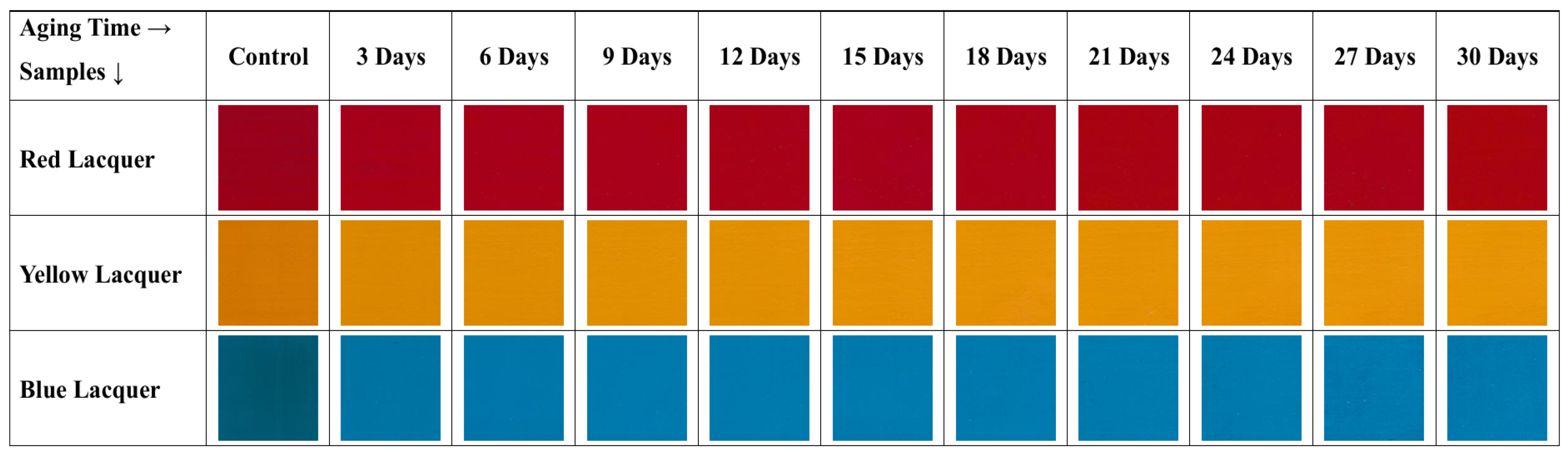
Visual inspection of the high-resolution scanned images showed that all mineral-pigmented lacquer coatings gradually became brighter and more saturated in color during artificial light aging (Figure 1). These observed visual trends aligned well with the quantitative colorimetric results, thereby validating the reliability of the visual evaluation [19].
Detailed analysis of the colorimetric data (Table 1, Table 2 and Table 3) showed that both lightness (L*) and chroma (C*) increased significantly for all coating types, while the hue coordinates (a* and b*) exhibited pigment-dependent variation patterns [20]. This indicates that the chemical composition of each pigment governs its characteristic photo-responsive behavior.
For the cinnabar-pigmented red lacquer, L* increased from 36.28 to 39.63 over 30 days, and C* rose from 37.25 to 50.05, demonstrating a substantial enhancement in brightness and chroma. The simultaneous increase in a* and b* suggests a shift toward a more saturated and slightly yellowish red tone [21].
The orpiment-pigmented yellow lacquer showed even more pronounced changes. L* increased from 58.72 to 67.38, C* from 49.59 to 63.53, and b* exhibited an increase of nearly 14 units, indicating a transition toward a brighter and purer yellow. The irregular fluctuations observed on days 12 and 27 may be attributed to the photochemical instability of orpiment or measurement uncertainty [22].
For the lapis-lazuli blue lacquer, L* increased sharply during the initial phase (39.28 to 45.37) and then stabilized. C* increased from 16.02 to 30.89, while b* shifted from −14.96 to −30.71, indicating a gradual transition toward a deeper and more saturated blue tone.
Comparison across the three coatings reveals pigment-specific hue-evolution pathways: cinnabar lacquer shifts toward a saturated yellow-red, orpiment lacquer shows enhanced yellowness with diminished redness, and lapis-lazuli lacquer exhibits a marked deepening of the blue hue.
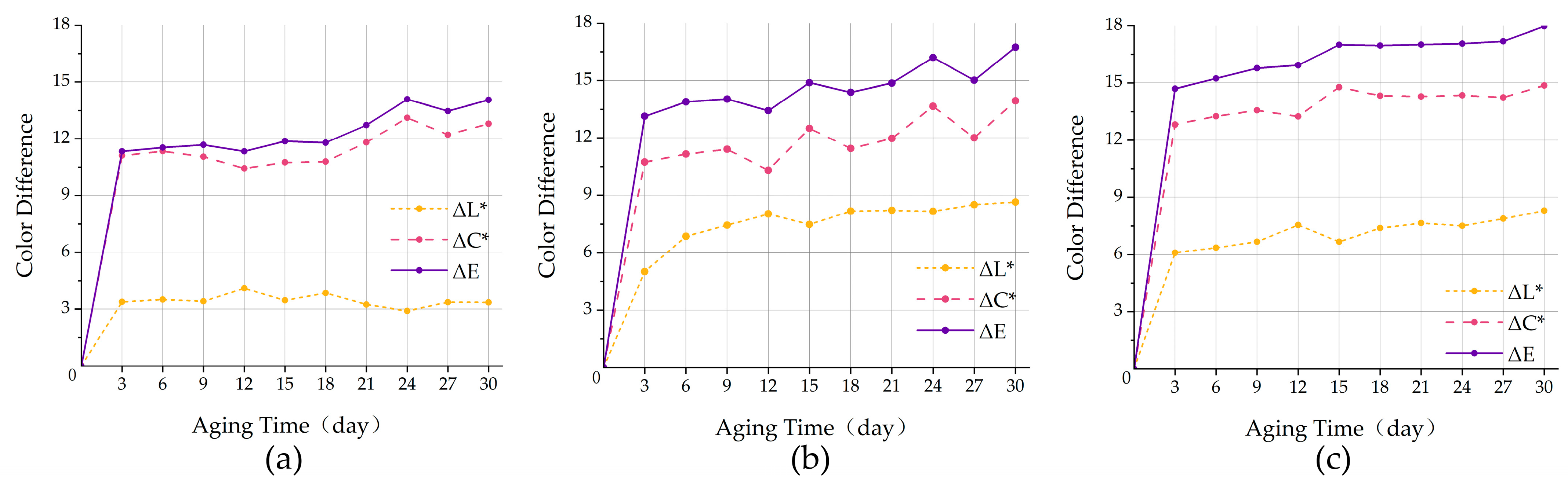
As shown in Figure 2, the variations in ΔL*, ΔC*, and ΔE indicate that all coatings experienced their most intense color changes within the first three days of photoaging, followed by a slower yet continuous increase. For the red lacquer, ΔE reached 14.05 at day 30, with a rapid rise (11.33) on day 3. The yellow lacquer was more sensitive to light, with maximum ΔL* = 8.66, ΔC* = 13.94, and final ΔE = 16.74, accompanied by slight fluctuations on days 12 and 27. The blue lacquer showed the greatest photosensitivity, with steep initial increases (ΔL* = 6.09, ΔC* = 12.81, ΔE = 14.70) and maximum values of 8.30, 14.87, and 17.97 at day 30.
Overall, the findings demonstrate that the type of mineral pigment exerts a critical influence on the photo-induced color evolution of lacquer films, with lapis-lazuli coatings showing the greatest sensitivity and cinnabar coatings maintaining the highest color stability.

3.2. Variations in Gloss and Surface Roughness

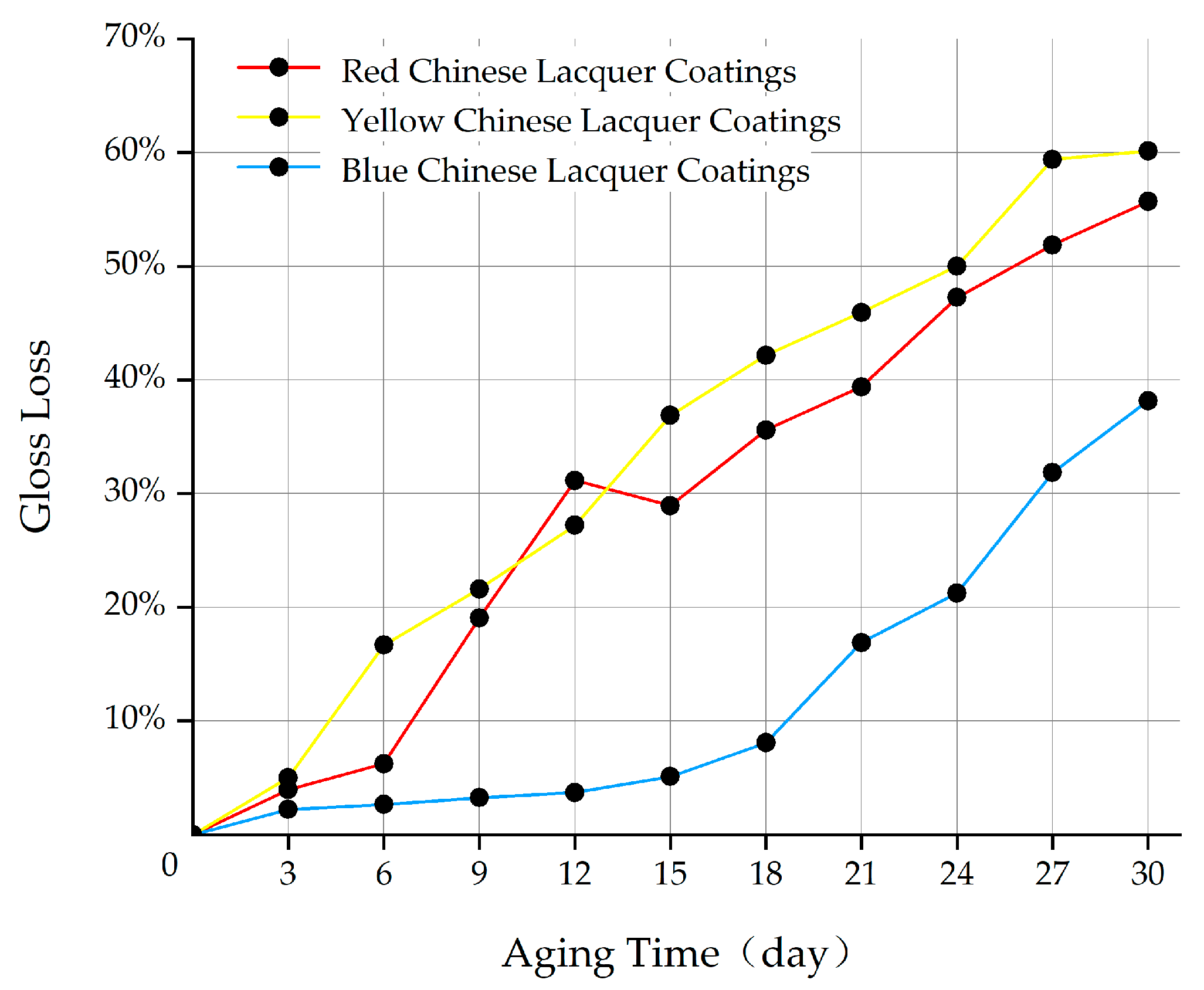
As illustrated in Figure 3, all three types of mineral-pigmented lacquer coatings showed a gradual decrease in gloss throughout artificial photoaging, though the degree and rate of decline differed significantly among samples. The cinnabar (red) lacquer began with an initial gloss value of 44.67, which dropped by about 55% after 30 days, suggesting rapid surface oxidation and reduced specular reflection under UV exposure. The orpiment (yellow) lacquer exhibited the most pronounced gloss deterioration, losing over 60% of its original value (45.65), indicating its high sensitivity to light-induced degradation. In contrast, the lapis-lazuli (blue) lacquer, which started with the highest gloss value (73.79), retained gloss best—showing less than 10% reduction during the first 18 days and a total loss below 40%. These results demonstrate that gloss decay is strongly dependent on pigment type, with orpiment lacquers being the least stable and lapis-lazuli lacquers showing the highest resistance to gloss loss.
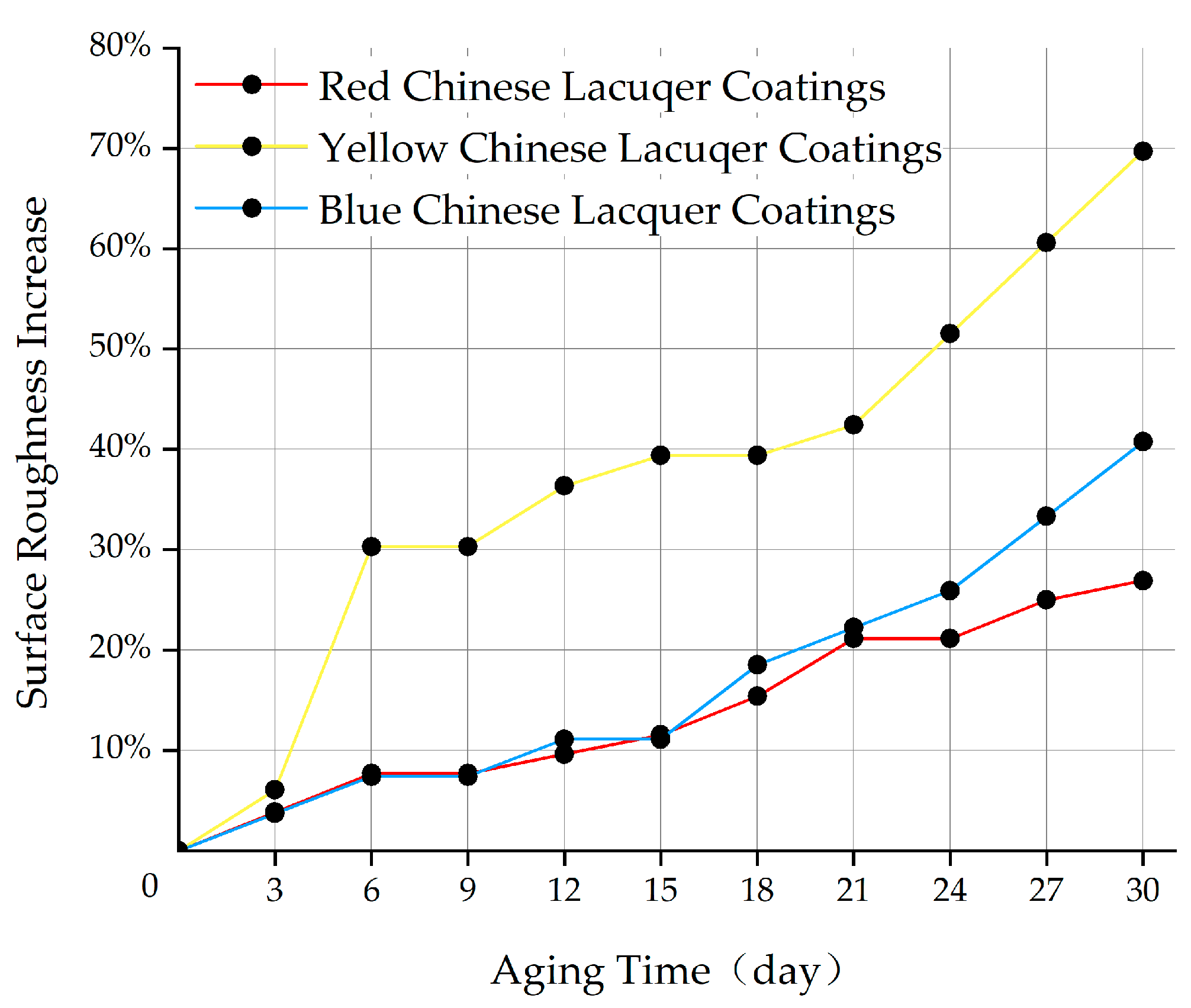
As shown in Figure 4, the surface roughness (Ra) of all samples increased throughout the photoaging process, indicating progressive morphological degradation and verifying that surface deterioration is an inherent outcome of photoaging in traditional lacquer materials [23]. Among them, the yellow orpiment lacquer exhibited the greatest change, with Ra increasing by about 70% from its initial value of 0.33 μm. Although the red cinnabar lacquer had the highest initial roughness (0.52 μm), it showed the smallest relative increase (approximately 27%). The blue lapis-lazuli lacquer, with the smoothest initial surface (0.27 μm), still experienced a noticeable 40% roughness increase during aging. These results demonstrate that UV exposure induces surface structural deterioration in all coatings, with orpiment-containing lacquers being the most susceptible to microcracking and particle disintegration, while cinnabar-containing lacquers maintain the most stable surface integrity [7].
A pronounced negative correlation was found between gloss reduction and surface roughness increase. Throughout the photoaging process, the lacquer surfaces evolved from smooth and compact morphologies to granular or flake-like textures, accompanied by microcrack formation and pigment particle precipitation, which together contributed to decreased specular reflection [24]. This relationship was most evident in the yellow orpiment lacquer, where a 70% rise in Ra corresponded with a 60% reduction in gloss, highlighting the close linkage between surface morphological degradation and optical deterioration. Although the red and blue coatings exhibited smaller overall variations, they followed the same pattern—gloss decreased as surface roughness increased. These findings indicate that microstructural deterioration of the surface is a major factor driving gloss loss during photoaging, offering valuable insights into the photodegradation mechanisms of traditional lacquer materials.

3.3. Assessment of Surface Chemical Alterations via FTIR

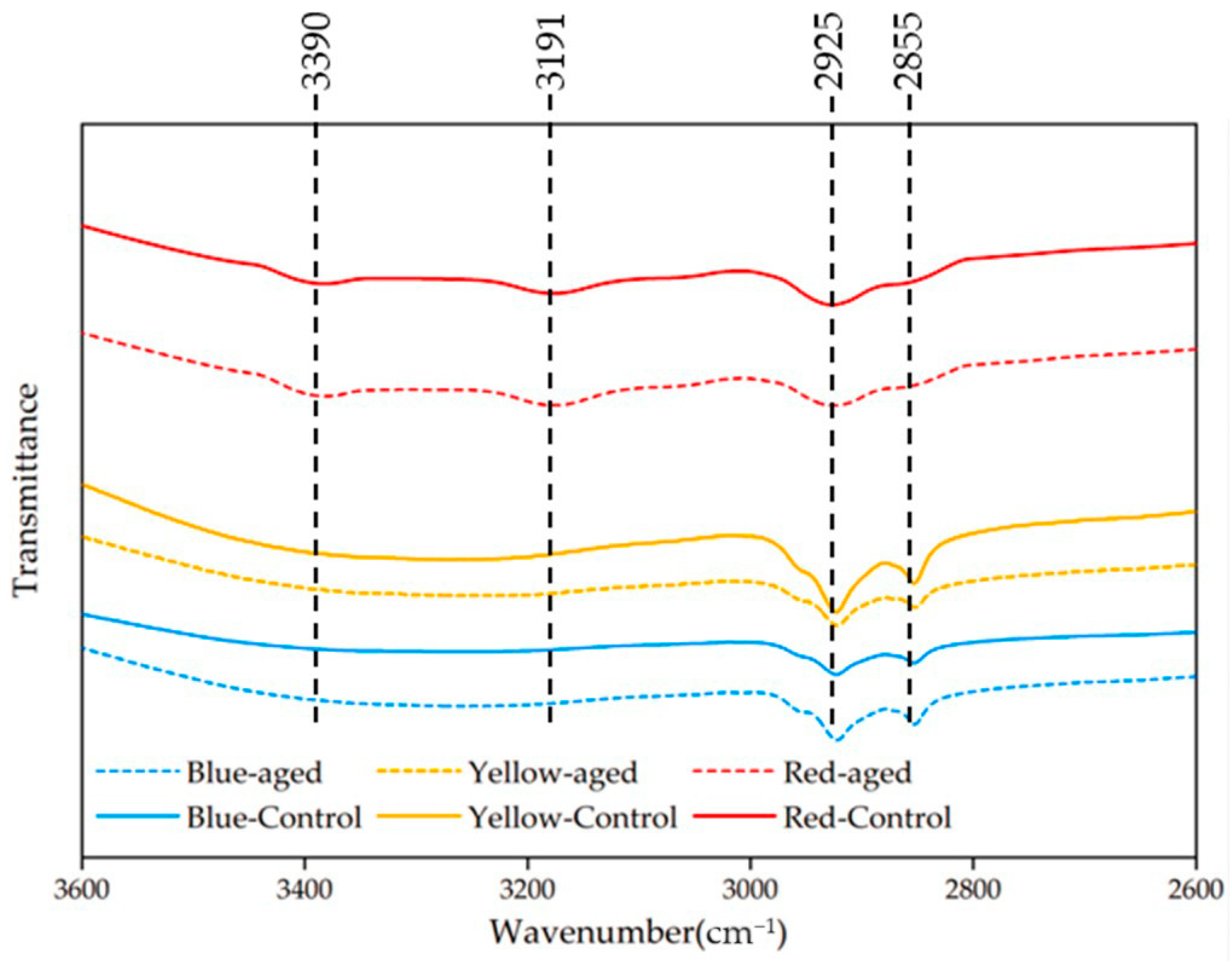
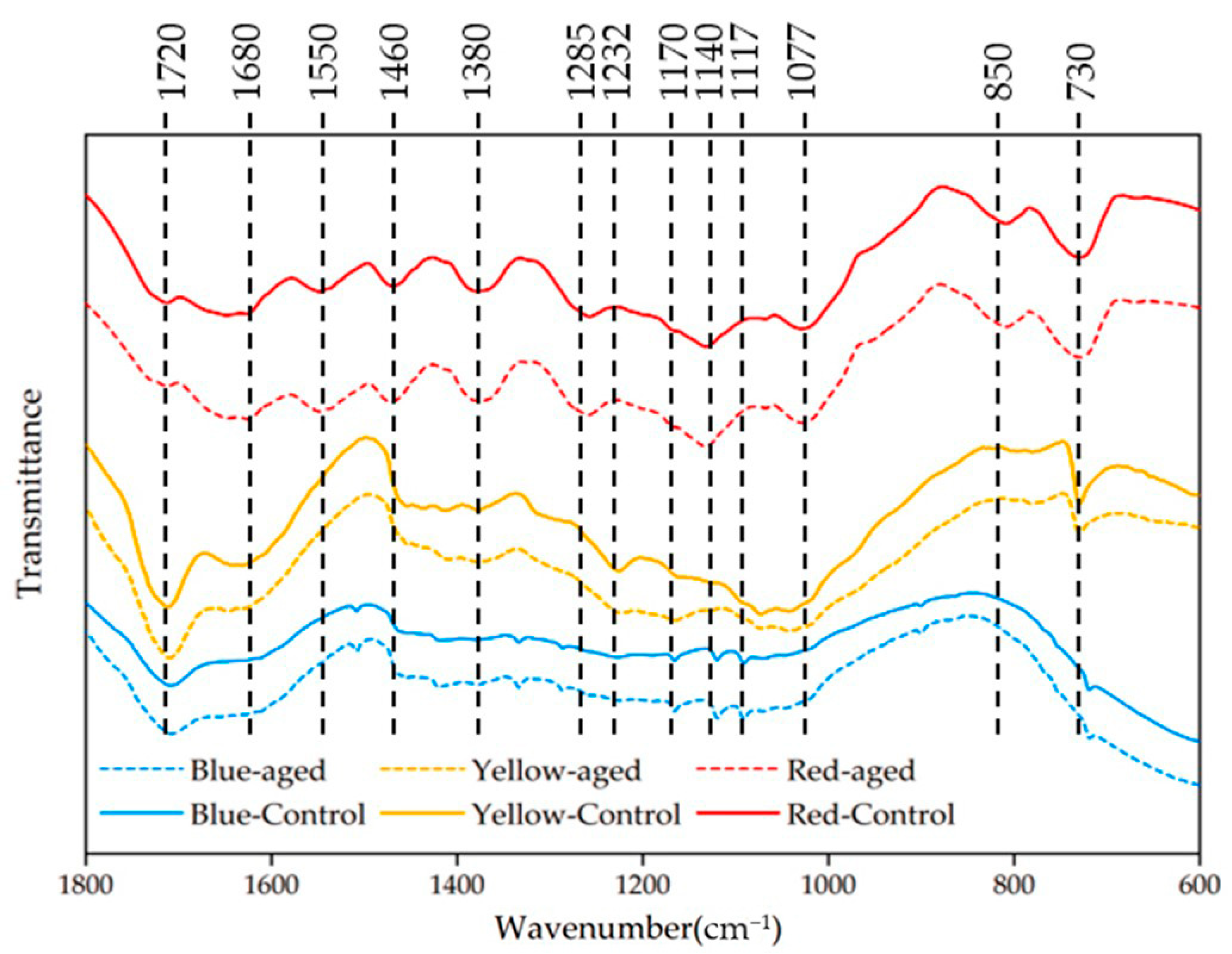
Table 4 summarizes the FTIR absorption bands and corresponding functional groups for red, yellow, and blue Chinese lacquer coatings, based on characteristic assignments reported in prior studies [25,26,27]. All three samples exhibited common spectral features typical of urushiol-based lacquer, with strong absorptions at approximately 3390, 2925, 2855, 1720, 1680, 1460, 1380, 1077, and 730 cm−1, corresponding to O–H/N–H stretching, aliphatic –CH2/–CH3 stretching, oxidized carbonyl groups, conjugated C=O or C=C structures, and aromatic ring deformations [2,7,27]. Additional shared peaks at 1117 and 1077 cm−1 suggest the presence of ether bonds or polysaccharide residues, while the 730 cm−1 band reflects out-of-plane aromatic ring deformation. The red lacquer further exhibited characteristic peaks at 3191, 1285, 1140, and 850 cm−1, corresponding to aromatic O–H, phenolic C–O, ester-related C–O–C, and substituted aromatic ring vibrations, respectively. These features indicate a relatively intact aromatic backbone and minimal oxidation before photoaging.
Figure 5 and Figure 6 present the reflection-mode FTIR spectra of the red, yellow, and blue lacquer coatings before and after 30 days of mercury-lamp-induced photoaging, displayed using normalized intensity to facilitate direct comparison of band-intensity evolution. After UV exposure, all coatings exhibited evident spectral changes to different extents, reflecting pigment-dependent degradation behavior and aligning well with the previously observed variations in color, gloss, and surface roughness. Among these changes, the carbonyl absorption band near 1720 cm−1, which is widely recognized as a sensitive marker of oxidative degradation in lacquer films [32,33], showed distinct intensity increases across all samples. This band arises from C=O stretching and reflects oxidation-induced cleavage and rearrangement of urushiol side chains. In our results, the magnitude of the carbonyl increase varied significantly among the three lacquer types: the yellow (orpiment-containing) lacquer showed the most pronounced growth at 1720 cm−1, indicating extensive photo-oxidative damage. In contrast, the red (cinnabar-based) lacquer exhibited only a moderate increase, consistent with its superior photostability. The blue (lapis lazuli-based) lacquer demonstrated intermediate behavior, suggesting a moderate level of oxidative transformation under UV exposure.
As reported in previous studies, the evolution of the C=O band around 1720 cm−1 can be regarded as a sensitive indicator of lacquer degradation, as it reflects oxidation-induced cleavage and rearrangement of the urushiol network [30,33]. In addition, the broad O–H/N–H absorption band at ~3390 cm−1 was observed in all three reflection-mode FTIR spectra and showed moderate enhancement after aging, suggesting the occurrence of hydrolysis and/or the formation of alcohol-like oxidation products [33,34]. By contrast, the aliphatic C–H stretching bands at 2925 and 2855 cm−1 showed only minor changes in intensity, indicating that the alkyl side chains were comparatively less affected during the early stages of photoaging. This further supports the interpretation that oxidation dominates the degradation process, particularly in the yellow lacquer. Overall, the differences in band-intensity evolution, especially for the carbonyl region, highlight the critical role of pigment type in modulating the photochemical degradation pathways of Chinese lacquer coatings.
Among the three samples, the red lacquer (cinnabar-based) showed the least change, with most key peaks—including 2925, 2855, 1460, 1380, 1285, 1140, 1117, and 1077 cm−1—remaining stable, suggesting strong chemical resistance and the protective effect of HgS. In contrast, the yellow lacquer (orpiment-based) exhibited more substantial changes: the 1720 cm−1 C=O peak intensified significantly, and signals at 1232 and 1170 cm−1 (C–O–C stretching) became more prominent, indicating enhanced oxidation and network breakdown. The 1380 cm−1 band also weakened, reflecting disruption of methyl-bearing structures. The blue lacquer (lapis lazuli-based) underwent moderate changes, with an increase in 1720 cm−1 absorption and slight variations in 1140, 1117, and 1077 cm−1 peaks. These suggest limited oxidation and interaction between the lacquer matrix and the lazurite phase. Notably, mineral-related bands at 1077 and 730 cm−1 remained visible after aging, indicating partial structural stability. Taken together, these findings confirm that the relative intensities of the carbonyl band—clearly resolved in the revised Figure 5 and Figure 6—serve as a direct indicator of photo-oxidative degradation, as also demonstrated in prior lacquer aging studies [33].

3.4. Evaluation of Microstructural Changes Using SEM

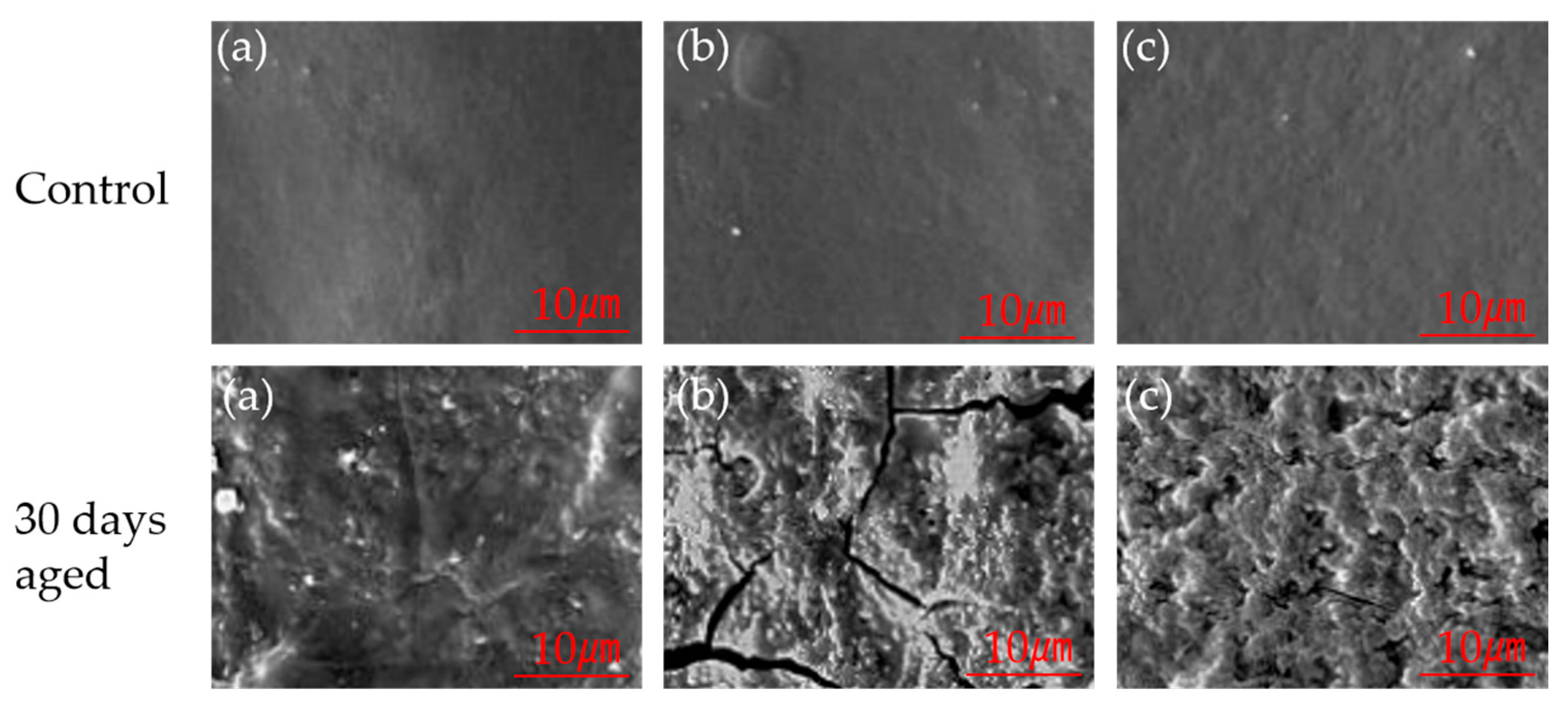
After 30 days of mercury-lamp photoaging, the surface microstructures of the three mineral-pigmented lacquer coatings exhibited substantial degradation, as revealed by SEM imaging (Figure 7). Before aging, all coatings displayed relatively smooth and compact surfaces, with the blue lacquer showing the most uniform morphology, consistent with its lowest initial roughness (Ra = 0.27 μm). In contrast, the red lacquer exhibited a slightly higher inherent roughness (Ra = 0.52 μm), although its surface remained continuous and free of major defects. After photoaging, however, the three coatings showed distinctly different degradation patterns closely aligned with their gloss loss and roughness evolution. The yellow (orpiment-pigmented) lacquer coating experienced the most severe microstructural deterioration. Its surface became extensively cracked and granular, with large fracture networks and pigment particle disruption clearly visible. These microstructural defects correspond directly to its dramatic increase in surface roughness (≈70%) and the highest gloss loss (>60%), confirming its strong susceptibility to UV-induced structural breakdown.
The blue (lapis-lazuli-pigmented) lacquer exhibited moderate degradation. Although the surface remained more compact than the yellow lacquer, SEM images revealed localized cracking, pore formation, and surface coarsening. This behavior aligns with its intermediate roughness increase (≈40%) and moderate gloss reduction (<40%), indicating that despite its initially smoother morphology, prolonged irradiation still caused significant microstructural instability.
In contrast, the red (cinnabar-pigmented) lacquer demonstrated the greatest resistance to microstructural damage. Only slight surface undulations and scattered micro-pits appeared after aging, with no major crack propagation. This mild surface deterioration is consistent with its lowest roughness increase (≈27%) and comparatively low gloss loss (~55%), supporting the conclusion that cinnabar pigmentation enhances the structural robustness of lacquer films under UV exposure.
Across all samples, the formation of microcracks and granular debris is attributed to photo-oxidation of the urushiol-based polymer network, which disrupts cross-linking, cleaves side chains, and generates localized stress concentrations. The consistent correspondence between increased roughness, decreased gloss, and deteriorated microstructure confirms that optical degradation originates from UV-induced morphological destruction. The yellow lacquer, with its most pronounced microstructural damage, therefore exhibited the most severe macroscopic performance decline, whereas the red lacquer maintained the highest degree of structural and optical stability during photoaging.

4. Discussion

The results of this study clearly demonstrate that the photoaging behavior of Chinese lacquer coatings is strongly governed by the type of mineral pigment incorporated into the urushiol matrix. Although all coatings showed measurable color changes during mercury-lamp irradiation, their chromatic evolution followed pigment-specific pathways. Cinnabar-pigmented coatings exhibited the highest chromatic stability, consistent with the well-documented UV resistance of HgS-based pigments and their relatively inert photochemical behavior [35]. In contrast, the orpiment-pigmented lacquer underwent a pronounced shift toward a brighter and purer yellow, reflecting the inherent photolability of As2S3, which oxidizes readily to As2O3 and AsO2 under UV exposure and leads to observable discoloration [14,33]. The lapis-lazuli coatings displayed the strongest hue shifts, with b* migrating toward increasingly negative values, indicative of photoreduction processes and structural modification within the aluminosilicate lattice of lazurite [36]. This behavior may be attributed to the photoactivation of sulfur-based chromophores—such as S2 and S3 anionic species—present in the lazurite structure, which can absorb UV light and generate reactive radicals. These radicals are likely to interact with the urushiol matrix, promoting chain scission, oxidation, and partial rearrangement, thereby accelerating photodegradation. These trends confirm that mineral pigments not only determine initial chromatic attributes but also modulate photochemical reactivity and degradation mechanisms.
The statistical analysis reinforced these observations: ΔL*, ΔC*, ΔE*, gloss loss, and roughness increase all differed significantly among the three pigment systems (p < 0.05). The cinnabar lacquer experienced modest but significant changes in ΔC*, whereas the orpiment lacquer displayed highly significant alterations in ΔL* and ΔC* (p < 0.01), reflecting its greater photoreactivity. The lapis-lazuli lacquer exhibited the most dramatic increase in ΔE (p < 0.001), signifying the strongest hue drift and highest photosensitivity. Taken together, these results confirm that orpiment- and lapis-lazuli–based coatings are more vulnerable to light-induced chromatic deterioration, while cinnabar-based coatings maintain comparatively superior photostability.
A strong negative correlation between gloss loss and surface roughness increase was observed across all samples, indicating that optical degradation is closely associated with microstructural deterioration, in line with optical scattering theory [37]. SEM imaging showed that photoaging promoted a transformation from smooth, compact surfaces to granular, cracked, or flake-like morphologies [30,31,32,33,34,35,36,37,38,39,40]. The orpiment lacquer developed the most extensive microcracking and pigment fragmentation, corresponding directly to its highest gloss loss (>60%) and most substantial roughness increase (≈70%). Lapis-lazuli coatings showed moderate cracking and surface coarsening, while cinnabar coatings exhibited only slight surface undulation and minimal micro-pitting, consistent with their lower roughness increase (≈27%) and smaller loss of gloss. These findings suggest that pigment stability critically influences the UV resilience of the lacquer matrix and governs resistance to surface morphological degradation.
FTIR analysis provided additional mechanistic insight into the chemical transformations occurring during photoaging. The cinnabar-based lacquer exhibited only slight increases in the intensities of carbonyl (1720 cm−1) and hydroxyl (3390 cm−1) bands, confirming its relatively stable chemical structure under UV exposure. In contrast, the orpiment-pigmented lacquer showed substantial carbonyl growth and enhanced absorption in the C–O–C region (1232 and 1170 cm−1), indicating extensive oxidative cleavage of side chains and degradation of ether linkages [15]. The lapis-lazuli-based lacquer demonstrated moderate increases in carbonyl signals, along with minor alterations in the C–O and C–O–C bands (1140, 1117, and 1077 cm−1). These results support the hypothesis that UV-induced activation of sulfur-bearing chromophores in lazurite contributes to controlled oxidation and matrix rearrangement, though to a lesser extent than orpiment. These chemical changes were clearly captured via non-invasive reflection-mode FTIR, which provided improved spectral resolution of the lacquer surface and enabled accurate differentiation of pigment-induced transformations. Collectively, the spectral trends align with pigment-dependent microstructural degradation observed in SEM and the surface-level changes reflected in colorimetric and gloss measurements. These findings confirm that mineral pigments modulate UV interaction, free-radical propagation, and the structural stability of the urushiol network, ultimately shaping distinct photodegradation pathways in the lacquer films.
Taken together, the multi-scale evidence—spanning colorimetric evolution, gloss–roughness coupling, reflection-mode FTIR data, and SEM microstructural analysis—reveals a coherent, pigment-dependent photoaging mechanism. Cinnabar imparts the highest resistance to both photochemical and structural degradation, maintaining network integrity and surface stability. In contrast, orpiment and lapis lazuli increase the lacquer’s susceptibility to oxidation, chain scission, and chromatic alteration. These outcomes have direct implications for both heritage conservation and the design of durable modern lacquer coatings. Future work may extend these findings by examining long-term aging under varying spectral conditions (e.g., LED museum lighting), investigating pigment–binder interfacial chemistry using advanced synchrotron-based spectroscopies, and evaluating protective strategies such as UV-absorbing additives or nanostructured overcoats to prolong the durability of pigment-rich lacquer surfaces [41,42].

5. Conclusions

In this study, the photoaging behavior of cinnabar-, orpiment-, and lapis-lazuli–pigmented Chinese lacquer coatings was comprehensively evaluated under high-pressure mercury-lamp irradiation. The results demonstrate that mineral pigment composition is a decisive factor controlling the optical, morphological, and chemical stability of lacquer films. All coatings exhibited rapid chromatic changes at the early aging stage, followed by a slower evolutionary phase; among them, cinnabar-based films maintained the highest color stability, whereas orpiment- and lapis-lazuli–based coatings showed pronounced hue shifts and chroma enhancement driven by pigment-specific photochemical reactions. The synergistic trends of gloss loss and surface roughness increase revealed that UV-induced microstructural degradation—manifested as cracking, granular fragmentation, and surface exfoliation—is the principal cause of diminished optical performance. These morphological alterations were most severe in orpiment coatings and least pronounced in cinnabar coatings, consistent with their respective roughness and gloss evolution. Reflection-mode FTIR analysis further confirmed the pigment-dependent chemical stability: cinnabar lacquers exhibited minimal photochemical changes, while orpiment and lapis-lazuli coatings displayed significant oxidation, side-chain cleavage, and network rearrangement. This non-invasive spectroscopic approach provided enhanced clarity in detecting surface-level chemical transformations. By integrating colorimetric, gloss, roughness, reflection FTIR, and SEM evidence, this work establishes a clear pigment-dependent photoaging mechanism for urushiol-based coatings. The findings provide a scientific foundation for assessing the long-term stability of lacquered cultural heritage and offer valuable guidance for the formulation, preservation, and performance optimization of modern lacquer materials in illuminated display environments.

Author Contributions

Conceptualization, Y.N. and Y.C.; methodology, Y.N. and X.L.; validation, Y.N. and Y.C.; formal analysis, Y.N. and X.L.; investigation, Y.N.; resources, Y.C.; data curation, Y.N.; writing—original draft preparation, Y.N.; writing—review and editing, Y.C. and X.L.; visualization, Y.N.; supervision, Y.C.; project administration, Y.C.; funding acquisition, Y.C. All authors have read and agreed to the published version of the manuscript.

Funding

This research received no external funding.

Institutional Review Board Statement

Not applicable.

Informed Consent Statement

Not applicable.

Data Availability Statement

Data are contained within the article.

Conflicts of Interest

The authors declare no conflicts of interest.

References

  1. Lin, Y.; Liu, H. Innovative application of the research on material properties of Chinese lacquer in the design of pile lacquer implement. In Cross-Cultural Design: User Experience of Products, Services, and Intelligent Environments; Rau, P.L., Ed.; Lecture Notes in Computer Science; Springer: Cham, Switzerland, 2020; Volume 12192. [Google Scholar]
  2. Lu, R.; Yoshida, T.; Miyakoshi, T. Oriental lacquer: A natural polymer. Polym. Rev. 2013, 53, 153–191. [Google Scholar] [CrossRef]
  3. Watanabe, H.; Fujimoto, A.; Takahara, A. Surface texturing of natural “urushi” thermosetting polymer thin films. Polym. J. 2014, 46, 216–219. [Google Scholar] [CrossRef]
  4. Zou, W.; Yeo, S.Y. Non-destructive prediction of the mixed mineral pigment content of ancient Chinese wall paintings based on multiple spectroscopic techniques. Appl. Spectrosc. 2024, 78, 702–713. [Google Scholar] [CrossRef]
  5. Vogl, O. My life with polymer science. J. Polym. Sci. Part A Polym. Chem. 2004, 42, 804. [Google Scholar] [CrossRef]
  6. Bagherzadeh Kasiri, M.; Nemati Babaylou, A.; Karimi, H. Photo-oxidative stability of a series of red acrylic paints. Prog. Color Color. Coat. 2013, 7, 177–185. [Google Scholar]
  7. Han, J.; Webb, M.; Hao, X.; Khanjian, H.; Schilling, M.R. Surface appearance and morphology changes of Asian lacquer due to artificial aging: Impacts of traditional additives. J. Cult. Herit. 2023, 63, 249–262. [Google Scholar] [CrossRef]
  8. Xia, J.; Lin, J.; Xu, Y.; Chen, Q. On the UV-induced polymeric behavior of Chinese lacquer. ACS Appl. Mater. Interfaces 2011, 3, 482–489. [Google Scholar] [CrossRef]
  9. Han, J.; Schilling, M.R.; Mazurek, J.; Webb, M.; Hao, X.; Khanjian, H. Composition changes of water extracts from Asian lacquer surfaces during artificial aging and the influence of formulations. J. Cult. Herit. 2024, 66, 602–612. [Google Scholar] [CrossRef]
  10. Song, X.; Yang, Y.; Yang, R.; Shafi, M. Keeping watch on intangible cultural heritage: Live transmission and sustainable development of Chinese lacquer art. Sustainability 2019, 11, 3868. [Google Scholar] [CrossRef]
  11. Wu, Q.; Zhang, B.; Hu, Y. Comparison and research progress of protein detection technology for cultural relic materials. Coatings 2023, 13, 1319. [Google Scholar] [CrossRef]
  12. Liu, W.; Liu, X.; Lv, J. Comparative study on UV degradation of black Chinese lacquers with different additives. Materials 2023, 16, 5607. [Google Scholar] [CrossRef]
  13. Wu, X.; Zhang, Y.; Tao, L.; Ji, X.; Chen, M.; Wang, N.; Gan, H.; Zhong, Z.; Zhao, Y.; Yang, F.; et al. The origin and circulation of cinnabar in Neolithic Age of China: Evidence from sulfur and mercury isotope analysis. Archaeometry 2025, 1–13. [Google Scholar] [CrossRef]
  14. Sun, J.; Zhang, Z.; Chen, X.; Huang, Q.; Bian, Z.; Zhang, W.; Su, B.; Zhang, H. Mechanistic study on orpiment pigment discoloration induced by reactive oxygen species. Molecules 2025, 30, 3318. [Google Scholar] [CrossRef]
  15. Yamada, K.; Narita, C. Rapid and sustainable urushi coatings: Thermal curing kinetics and predictive modeling. Prog. Org. Coat. 2025, 208, 109498. [Google Scholar] [CrossRef]
  16. Lannuzzi, G.; Mattsson, B.; Rigdahl, M. Color changes due to thermal ageing and artificial weathering of pigmented and textured ABS. Polym. Eng. Sci. 2013, 53, 1687–1695. [Google Scholar] [CrossRef]
  17. Luo, M.R. Applying colour science in colour design. Opt. Laser Technol. 2006, 38, 392–398. [Google Scholar] [CrossRef]
  18. Liu, X.; Lv, M.; Liu, M.; Wu, Z.; Lv, J. Characterization and identification of lacquer films from the Qin and Han dynasties. BioResources 2019, 14, 9509–9517. [Google Scholar] [CrossRef]
  19. Maldonado, F.; Ciurlizza, A.; Radillo, R.; de León, E.P. Optimisation of the Colour Sequence in the Dyeing Process: Industrial Applications. Color. Technol. 2000, 116, 359–362. [Google Scholar] [CrossRef]
  20. Schanda, J. Colorimetry: Understanding the CIE System; John Wiley & Sons: Hoboken, NJ, USA, 2007. [Google Scholar]
  21. Spring, M.; Grout, R. The Blackening of Vermilion: An Analytical Study of the Process in Paintings. Natl. Gallery Tech. Bull. 2002, 23, 50–61. [Google Scholar]
  22. Eastaugh, N.; Walsh, V.; Chaplin, T.; Siddall, R. Pigment Compendium: A Dictionary of Historical Pigments; Routledge: Oxford, UK, 2007. [Google Scholar]
  23. Yang, X.F.; Li, J.; Croll, S.G.; Tallman, D.E.; Bierwagen, G.P. Degradation of Low Gloss Polyurethane Aircraft Coatings under UV and Prohesion Alternating Exposures. Polym. Degrad. Stab. 2003, 80, 51–58. [Google Scholar] [CrossRef]
  24. Wang, L.B.; Liu, H. Light stability of silk fabrics coated with Chinese lacquer. In Proceedings of the International Conference on Advanced Textile Materials & Manufacturing Technology, Hangzhou, China, 15–19 October 2008; pp. 63–66. [Google Scholar]
  25. Lambert, J.B.; Frye, J.S.; Carriveau, G.W. The Structure of Oriental Lacquer by Solid State Nuclear Magnetic Resonance Spectroscopy. Archaeometry 1991, 33, 87–93. [Google Scholar] [CrossRef]
  26. Chen, Y.; Bai, W.; Chen, J.; Chen, X.; Zhao, J.; Wei, F.; Jian, R.; Zheng, X.; Xu, Y. In-Situ Intercalation of Montmorillonite/Urushiol Titanium Polymer Nanocomposite for Anti-Corrosion and Anti-Aging of Epoxy Coatings. Prog. Org. Coat. 2022, 165, 106738. [Google Scholar] [CrossRef]
  27. Niimura, N.; Miyakoshi, T. Structural Study of Oriental Lacquer Films during the Hardening Process. Talanta 2006, 70, 146–152. [Google Scholar] [CrossRef]
  28. Le Hô, A.; Duhamel, C.; Daher, C.; Bellot-Gurlet, L.; Paris, C.; Regert, M.; Sablier, M.; André, G.; Desroches, J.; Dumas, P. Alteration of Asian lacquer: In-depth insight using a physico-chemical multiscale approach. Analyst 2013, 138, 5685–5696. [Google Scholar] [CrossRef] [PubMed]
  29. Pintus, V.; Baragona, A.J.; Wieland, K.; Schilling, M.; Miklin-Kniefacz, S.; Haisch, C.; Schreiner, M. Comprehensive Multi-Analytical Investigations on the Vietnamese lacquered Wall-Panel “The Return of the Hunters” by Jean Dunand. Sci. Rep. 2019, 9, 18837. [Google Scholar] [CrossRef] [PubMed]
  30. Dai, Z.Q.; Chen, H.; Wen, Z.Y. Integrated Multi-Scale Synchrotron Radiation-Technology Studies on Alpo4-Coating Modification Mechanismin Lithium-Rich Manganese-Based Cathode. Nucl. Sci. Tech. 2025, 36, 79. [Google Scholar] [CrossRef]
  31. Sitzia, F.; Moita, P.; Bottura-Scardina, S.; Lisci, C. Colour stability of light-sensitive minerals under UVA340 nm irradiation: Implications for the conservation of cultural heritage and museum display conditions. Minerals 2025, 15, 999. [Google Scholar] [CrossRef]
  32. Colomban, P.; Mancini, D. Lacquerware Pigment Identification with Fixed and Mobile Raman Microspectrometers: A Potential Technique to Differentiate Original/Fake Artworks. Arts 2013, 2, 111–123. [Google Scholar] [CrossRef]
  33. Pagnin, L.; Calvini, R.; Wiesinger, R.; Weber, J.; Schreiner, M. Photodegradation Kinetics of Alkyd Paints: The Influence of Varying Amounts of Inorganic Pigments on the Stability of the Synthetic Binder. Front. Mater. 2020, 7, 600887. [Google Scholar] [CrossRef]
  34. Lattimer, R.P.; Vergne, M.J.; Hercules, D.M. A Developmental History of Polymer Mass Spectrometry. J. Chem. Educ. 2007, 84, 81. [Google Scholar] [CrossRef]
  35. Simoen, J.; De Meyer, S.; Vanmeert, F.; de Keyser, N.; Avranovich, E.; Van der Snickt, G.; Van Loon, A.; Keune, K.; Janssens, K. Combined micro- and macro-scale X-ray powder diffraction mapping of degraded orpiment paint in a 17th century still life painting by Martinus Nellius. Herit. Sci. 2019, 7, 83. [Google Scholar] [CrossRef]
  36. Tauson, V.L.; Sapozhnikov, A.N.; Lipko, S.V.; Mikhlin, Y.L.; Danilov, B.S.; Shendrik, R.Y.; Sofich, D.O.; Arsentev, K.Y.; Belozerova, O.Y. Spectroscopic and physicochemical study of the color grain-size effect in lazurite-type minerals. Am. Mineral. 2025. [Google Scholar] [CrossRef]
  37. Larena, A.; De Ochoa, S.J. Use of Different Surface Analysis Techniques for the Study of the Photo-Degradation of a Polymeric Matrix Composite. Appl. Surf. Sci. 2004, 238, 530–537. [Google Scholar] [CrossRef]
  38. Järnström, J.; Ihalainen, P.; Backfolk, K.; Peltonen, J. Roughness of Pigment Coatings and Its Influence on Gloss. Appl. Surf. Sci. 2008, 254, 5741–5749. [Google Scholar] [CrossRef]
  39. Yang, J.; Deng, J.; Zhu, J.; Liu, W.; Zhou, M.; Li, D. Thermal Polymerization of Lacquer Sap and Its Effects on the Properties of Lacquer Film. Prog. Org. Coat. 2016, 94, 41–48. [Google Scholar] [CrossRef]
  40. Lee, H.; Han, H.; Kim, D.; Lee, B.; Cho, J.H.; Lee, Y.; Lim, J.A. Mixed Urushiol and Laccol Compositions in Natural Lacquers: Convenient Evaluation Method and Its Effect on the Physicochemical Properties of Lacquer Coatings. Prog. Org. Coat. 2021, 154, 106195. [Google Scholar] [CrossRef]
  41. Yao, Q.X.; Du, M.L.; Sun, M. Improving Anti-aging Coatings by Coupling of Organic and Inorganic Ultraviolet Absorbers. In Proceedings of the 3rd International Conference on Advances in Materials Manufacturing (ICAMMP 2012), Beihai, China, 22–23 December 2012. [Google Scholar]
  42. Lu, R.; Kamiya, Y.; Kumamoto, T.; Honda, T.; Miyakoshi, T. Deterioration of Surface Structure of Lacquer Films Due to Ultraviolet Irradiation. Surf. Interface Anal. 2006, 38, 1311–1315. [Google Scholar] [CrossRef]
Figure 1. Visual evolution of red, yellow, and blue Chinese lacquer coatings under mercury lamp–induced photoaging.
Coatings 16 00031 g001
Figure 2. Variations in ΔL*, ΔC*, and ΔE of Chinese lacquer coatings during mercury lamp photoaging: (a) red lacquer, (b) yellow lacquer, and (c) blue lacquer.
Coatings 16 00031 g002
Figure 3. Percentage reduction in gloss of red, yellow, and blue Chinese lacquer coatings under mercury lamp–induced photoaging.
Coatings 16 00031 g003
Figure 4. Percentage increase in surface roughness (Ra) of red, yellow, and blue Chinese lacquer coatings under mercury lamp–induced photoaging.
Coatings 16 00031 g004
Figure 5. FTIR spectra of red, yellow, and blue Chinese lacquer coatings before and after 30 days of UV-induced aging, in the range of 2600–3600 cm−1.
Coatings 16 00031 g005
Figure 6. FTIR spectra of red, yellow, and blue Chinese lacquer coatings before and after 30 days of UV-induced aging, in the range of 600–1800 cm−1.
Coatings 16 00031 g006
Figure 7. SEM micrographs showing the surface microstructure of Chinese lacquer coatings before and after 30 days of mercury lamp–induced aging: (a) red lacquer, (b) yellow lacquer, and (c) blue lacquer.
Coatings 16 00031 g007
Table 1. Color variation in red Chinese lacquer coatings under mercury lamp–induced photoaging.
Aging TimeL*a*b*C*
Control36.28 ± 0.8036.37 ± 1.828.03 ± 0.5337.25 ± 1.87
3 days39.66 ± 0.3546.40 ± 3.1412.09 ± 0.4948.36 ± 3.00
6 days39.78 ± 0.1546.68 ± 0.3311.86 ± 0.2148.60 ± 0.32
9 days39.69 ± 0.1946.79 ± 0.6812.06 ± 0.2148.30 ± 0.67
12 days40.38 ± 0.1646.12 ± 0.7012.13 ± 0.2647.69 ± 0.67
15 days39.74 ± 0.3846.02 ± 0.7014.04 ± 0.3448.00 ± 0.65
18 days40.13 ± 0.2546.13 ± 0.6213.43 ± 0.3648.04 ± 0.60
21 days39.52 ± 0.2846.91 ± 0.7014.36 ± 0.4149.06 ± 0.72
24 days39.18 ± 0.3247.86 ± 0.7315.65 ± 0.7050.36 ± 0.75
27 days39.65 ± 0.4046.88 ± 1.0315.75 ± 0.7349.46 ± 1.03
30 days39.63 ± 0.2747.39 ± 1.0916.09 ± 0.7550.05 ± 1.15
Table 2. Color variation in yellow Chinese lacquer coatings under mercury lamp–induced photoaging.
Aging TimeL*a*b*C*
Control58.72 ± 1.5710.46 ± 0.4548.48 ± 2.4849.59 ± 2.51
3 days63.73 ± 0.2510.81 ± 0.1860.61 ± 1.2560.33 ± 1.23
6 days65.58 ± 0.149.37 ± 0.0960.50 ± 0.5360.74 ± 0.51
9 days66.16 ± 0.139.21 ± 0.1360.30 ± 0.6261.00 ± 0.62
12 days66.75 ± 0.139.30 ± 0.1359.18 ± 0.4859.91 ± 0.47
15 days66.20 ± 0.159.71 ± 0.1561.33 ± 0.4762.09 ± 0.46
18 days66.89 ± 0.199.61 ± 0.2260.29 ± 0.6661.05 ± 0.66
21 days66.93 ± 0.139.46 ± 0.1460.83 ± 0.5961.56 ± 0.58
24 days66.88 ± 0.109.88 ± 0.2262.46 ± 0.8363.24 ± 0.81
27 days67.23 ± 0.189.72 ± 0.1360.83 ± 0.7461.60 ± 0.73
30 days67.38 ± 0.179.68 ± 0.1562.79 ± 0.8063.53 ± 0.80
Table 3. Color variation in blue Chinese lacquer coatings under mercury lamp–induced photoaging.
Aging TimeL*a*b*C*
Control39.28 ± 0.37−5.73 ± 0.20−14.96 ± 0.2316.02 ± 0.27
3 days45.37 ± 0.35−6.94 ± 0.32−28.29 ± 0.4028.83 ± 0.43
6 days45.63 ± 0.28−4.76 ± 0.23−28.77 ± 0.3929.27 ± 0.38
9 days45.95 ± 0.33−4.64 ± 0.31−29.22 ± 0.4029.58 ± 0.40
12 days46.82 ± 0.33−4.40 ± 0.28−28.93 ± 0.4029.26 ± 0.41
15 days45.95 ± 0.34−4.15 ± 0.25−30.52 ± 3.0329.80 ± 0.38
18 days46.66 ± 0.23−3.80 ± 0.29−30.10 ± 0.4130.34 ± 0.42
21 days46.93 ± 0.32−3.92 ± 0.30−30.05 ± 0.3430.31 ± 0.36
24 days46.78 ± 0.34−3.66 ± 0.24−30.14 ± 0.4030.37 ± 0.38
27 days47.16 ± 0.28−3.45 ± 0.15−30.06 ± 0.3330.25 ± 0.33
30 days47.58 ± 0.31−3.34 ± 0.14−30.71 ± 0.3230.89 ± 0.32
Table 4. FTIR absorption bands and corresponding functional groups for colored Chinese lacquer.
Wavenumber (cm−1)Red Chinese LacquerYellow Chinese LacquerBlue Chinese LacquerCorresponding Functional GroupReferences
3390O–H/N–H stretching–phenolic OH, moisture, or protein-related[2,7,27,28]
3191 Aromatic O–H stretching (phenol ring) or secondary N–H
2925Asymmetric C–H stretching (CH2/CH3)—aliphatic side chains[2,27,29]
2855Symmetric C–H stretching (CH2)—alkyl chains
1720C=O stretching—oxidation products (ketones/esters/acids)[2,7,27,29,30]
1680Conjugated C=O or C=C—aging or crosslinking effects
1550 Amide II or aromatic nitro compounds (possible protein residual)[7]
1460CH2/CH3 bending—confirms aliphatic chain presence
1380Symmetric CH3 bending—methyl groups[2,27]
1285 C–O stretching—phenolic or ether-type bonds
1232 C–O–C or C–N stretching—possible ester or polysaccharide
1170 C–O or C–C stretching—aromatic alcohol or glycosidic linkage[2,7,27,30]
1140 C–O–C stretching—esterification, oxidation product[2,7,27,28]
1117 C–O–C stretching—polysaccharides or crosslinked ether bonds
1077 C–O/Si–O stretching—lacquer or mineral component[2,4,27,31]
850 Aromatic C–H out-of-plane bending—suggests ring substitution pattern[2,27]
730Aromatic ring deformation or substituted ring bending
The symbol “√” in the table indicates that an absorption band is present at the corresponding wavenumber for that colored lacquer coating.
Disclaimer/Publisher’s Note: The statements, opinions and data contained in all publications are solely those of the individual author(s) and contributor(s) and not of MDPI and/or the editor(s). MDPI and/or the editor(s) disclaim responsibility for any injury to people or property resulting from any ideas, methods, instructions or products referred to in the content.