Article

Aluminium-Doped Zinc Oxide Thin Films Fabricated by the Aqueous Spray Method and Their Photocatalytic Activities


1
Department of Physics, Chemistry & Material Science, School of Science, Faculty of Agriculture, Engineering and Natural Sciences, University of Namibia, Windhoek 10026, Namibia
2
Namibia Green Hydrogen Research Institute, University of Namibia, Windhoek 10026, Namibia
*
Author to whom correspondence should be addressed.
Coatings 2026, 16(1), 20; https://doi.org/10.3390/coatings16010020
Submission received: 10 August 2025 / Revised: 30 September 2025 / Accepted: 6 October 2025 / Published: 24 December 2025
(This article belongs to the Special Issue Recent Advances in Functional Metal Oxide Thin Films)

Abstract

The fabrication of undoped and aluminium-doped zinc oxide thin films on quartz glass substrates through the aqueous spray method is reported. The prepared aqueous precursor solutions containing Zn2+ and varying mole percentages (0, 2, 4, and 8%) of Al3+ complexes were spray-coated onto quartz glass substrates preheated at 180 °C. The as-sprayed films obtained were then heat-treated at 450 °C for 30 min in a furnace to produce the various thin films. The structural and optical properties of the resultant thin films were analysed using the X-ray diffractometer (XRD) and ultraviolet–visible (UV-Vis) spectrophotometer. The XRD results revealed that the fabricated thin films have a prominent peak correlating to the (002) Miller index, which is the preferred orientation of the zinc oxide hexagonal wurtzite phase. The fabricated thin films with a film thickness of approximately 189 nm absorb light in the visible region and have a transmittance of over 80% even after being doped with aluminium. The photocatalytic activities of the thin films were evaluated via visible light irradiation of an aqueous methyl orange solution, and the Al-doped ZnO thin films exhibited good photocatalytic activities, which resulted in an increase in the doping mole percentages of aluminium.

1. Introduction

It has been well-documented that industrialisation has resulted in environmental crises, including the release of greenhouse gases and the contamination of surface and groundwater [1]. Harnessing sunlight for the production of clean fuels like hydrogen (H2) and for environmental remediation by breaking down toxic compounds is a desirable and sustainable approach toward achieving sustainable development goals [2]. Zinc oxide (ZnO) as a semiconductor material finds utilisation in the production of green fuel and wastewater treatment for environmental rehabilitation, where it is used as a photocatalyst [3]. This is due to its low cost arising from the abundance of zinc, high electron mobility, chemical stability, ability to absorb light, and non-toxicity [3,4]. In photocatalytic activities, ZnO primarily functions as a photoactive material that absorbs light to generate pairs of electrons and holes, which participate in reduction and oxidation reactions to degrade pollutants or drive hydrogen production via water splitting [1]. ZnO can be used in the form of nanoparticles or thin films for photocatalytic applications; however, thin films are preferred over nanoparticles because they can be recovered effortlessly from solutions, hence accelerating the process [5]. The various photocatalytic-based applications of ZnO include its use as a photocatalyst in water splitting [2], solar cells [6], and wastewater treatment [7].
The main drawback of using a ZnO-based photocatalyst is that it is only active in the ultraviolet (UV) area of the electromagnetic spectrum because of its broad band gap in the range of 375–385 nm [8]. The UV light accounts for only five percent of the sunlight reaching the earth, while visible and infrared light regions account for forty-two and forty-nine percent, respectively [9]. As a result, thin films of ZnO are being doped with different metal elements to narrow down their wide band gap and broaden their utilisation range [10]. Metal dopants like iron (Fe), nickel (Ni), aluminium (Al), gallium (Ga), and copper (Cu) have been reported to enhance the optical, electrical, and structural qualities of ZnO once doped [11,12,13,14,15]. In this research, aluminium was used as a dopant because aluminium is a metal dopant that is said to behave as a trap for the photogenerated charges and enhance the photocatalytic effectiveness by obstructing the rate of electron–hole pair recombination [1]. The abundance, affordability, low mass, and the Al3+ (0.54 Å) ionic radius being close to the ionic radius of Zn2+ (0.74 Å) make it a good dopant for ZnO [16]. According to the literature, doping Al into the ZnO crystal structure creates a charge trap centre that minimises charge carrier recombination, thereby enhancing photocatalytic activities [17].
The process of photocatalysis utilises photocatalysts (e.g., photoanodes and photocathodes) to absorb light and allow redox reactions to take place. The existing photocatalysts are either ineffective or fabricated through unsustainable methods. Although several approaches have been attempted to fabricate photocatalysts capable of direct solar-driven reactions, the fabrication process is often complex and resource-intensive. Well-established techniques such as spin coating [18,19], magnetron sputtering [20], spray pyrolysis [21], pulsed laser deposition [22], and the sol–gel method [23] have successfully produced Al-doped ZnO thin films. However, these methods are commonly carried out in controlled environments, require complicated instrumentation, and often involve toxic chemical precursors [24]. These limitations make such methods unsustainable for large-scale applications, highlighting the gap in the field for a simple, cost-effective, and environmentally friendly fabrication technique [25].
In this study, we address this gap by employing the aqueous spray-coating approach to fabricate Al-doped ZnO thin films. This technique offers various benefits, which include affordability, simple instrumentation, reduced material losses, high yield, and adaptability for large-area deposition. Additionally, it allows film thickness control through solution volume adjustments and supports the use of aqueous precursors, making it a scalable and sustainable technique [24]. The goal of this work is to demonstrate that spray-coating can serve as a practical, environmentally friendly, and scalable alternative for producing Al-doped ZnO thin films with promising photocatalytic applications, thereby advancing both the scientific understanding and practical feasibility of sustainable photocatalyst fabrication.

2. Materials and Methods

2.1. Materials

Aluminium hydroxide hydrate (H3AlO3∙2H2O) was purchased from Merck (formerly Sigma-Aldrich, Darmstadt, Germany). Zinc acetate dihydrate (Zn (CH3COO)2∙2H2O) and oxalic acid dihydrate ((COOH)2∙2H2O) were purchased from C.C. Imelmann Laboratory Supplies (Pty) Ltd. (Johannesburg, South Africa). 2-propanol was purchased from Associated Chemical Enterprises (Pty) Ltd. (Johannesburg, South Africa). Ammonium hydroxide solution (NH4OH, 25% NH3) was purchased from Minema Chemicals (Pty) Ltd. (Johannesburg, South Africa). Distilled water was purchased from SWACHEM Namibia (Pty) Ltd. The quartz glass substrates measuring 100 × 100 × 1.6 mm3 were purchased from Akishima Glass Co., Ltd. (Tokyo, Japan), cut into 20 × 20 mm2 pieces, and washed in an ultrasonicator with a water and detergent mixture prepared by mixing sunlight dishwashing liquid with water in the 1:2 ratio for 0.5 h, then repeatedly washed with distilled water before using 2-propanol as a final rinse. Every reagent utilised was of analytical reagent grade and did not require any additional purification. Ammonium aluminium oxalate ((NH4)3Al(C2O4)3) was synthesised in this study for use as a source of Al3+ complexes in precursor solutions for fabricating ZnO thin films doped with aluminium. The procedures described in the literature [26] were followed.

2.2. The Synthesis of Ammonium Aluminium Oxalate Complex

Since the aqueous spray method requires solutions involving metal complexes of the appropriate metals, this step was necessary for preparing an aqueous solution containing aluminium complexes. Aluminium hydroxide (2.0356 g, 0.0261 mol) and oxalic acid (6.0164 g, 0.668 mol) were dissolved with 50.7216 mL of distilled water using a stirring rod to yield volume A. Volume A mixture was subsequently refluxed at 90 °C for 1 h, and the residues were removed by gravity filtration. The filtrate was left to cool, and its volume was measured and recorded as volume B (70 mL). In a 2:1 ratio of ethanol to volume B, 140 mL of ethanol was added to the filtrate while stirring. Finally, 20 mL of ammonium hydroxide solution was added dropwise until the solution was basic and a white precipitate formed. The product was then recovered via Buchner filtration and dried in a desiccator.

2.3. Preparation of the Precursor Solutions

Two different coating solutions were prepared, one for fabricating undoped and the other Al-doped ZnO thin films, as described below:
The coating solution involving only Zn2+ complexes was prepared by dissolving zinc acetate dihydrate (0.4975 g, 2.267 mmol) in 20.00 g of distilled water, followed by the addition of 25% ammonium hydroxide solution (2.1766 g, 32 mmol NH3). The mixture was stirred on a magnetic stirrer using a magnetic stirring bar for one hour at room temperature. The concentration of Zn2+ ions in the precursor solution was 0.10 mmol g−1.
The coating solutions involving Zn2+ and Al3+ complexes were prepared by mixing different quantities (2%, 4%, and 8%) of ammonium aluminium oxalate with zinc acetate dihydrate in 20.00 g of distilled water, followed by adding 25% ammonium hydroxide solution. The masses of zinc acetate dihydrate, ammonium hydroxide solution, and ammonium aluminium oxalate used varied with each doping mole percentage of aluminium. The mixtures were stirred on a magnetic stirrer using a magnetic stirring bar for one hour at ambient temperature. The total concentration of Zn2+ and Al3+ ions in each coating solution prepared was 0.10 mmol g−1.

2.4. Fabrication of Thin Films by Spray-Coating and Heat Treating

Spray-coating was performed individually onto pre-heated quartz-glass substrates of size 20 × 20 mm2 using the coating solution involving only Zn2+ complexes and/or the coating solutions involving Zn2+ and Al3+ complexes as outlined in the previous subsection. The spray-coating parameters were identical to those used in our previous work [27]. For each coating solution, 3.0 g was used to spray-coat separately onto pre-heated quartz-glass substrates from the airbrush using compressed air (0.2 MPa) as a carrier gas, spraying for 5 s (s) at 20 s intervals, until the whole 3.0 g was used up. The vertical distance between the tip of the airbrush and the substrate was 30 cm. The resultant as-sprayed films were heat-treated at 450 °C for 0.5 h in the air in a furnace, and undoped and Al-doped ZnO thin films were obtained, depending on the precursor solutions used.

2.5. Measurements

2.5.1. FTIR Analysis of Ammonium Aluminium Oxalate Complex

The Fourier transform infrared (FTIR) instrument (Bruker Optik GmbH, Ettlingen, Germany) equipped with an attenuated total reflection (ATR) accessory was employed to distinguish the functional groups in the reagents (ammonium oxalate and oxalic acid) and the attained product. Using the potassium bromide (KBr) pellet method, the measurements were drawn in the IR region from 4000 cm−1 to 400 cm−1. Before FTIR analysis, the samples were mixed with 200 mg of dry KBr powder in a 1:2 ratio of the sample to KBr and finely ground using a mortar and pestle.

2.5.2. Structural Properties of the Fabricated Thin Films

The structural properties of the fabricated thin films were characterised using the X-ray diffractometer (XRD) instrument (Rigaku Miniflex 600, Tokyo, Japan) with Cu K-alpha radiation at a scanning step of 0.01 degrees. The crystallite sizes of the most prominent peak in the XRD patterns of the fabricated undoped and Al-doped ZnO thin films were calculated using the Debye-Scherrer formula given in Equation (1).
D = K λ/β cos θ
where D is the crystallite size, K is the shape factor (0.9), λ is the X-ray wavelength (0.15406 nm, θ is the Bragg angle, and β is the peak FWHM of the sample after instrumental correction.

2.5.3. Surface Morphologies of the Fabricated Thin Films

To observe the surface morphologies of the fabricated thin films, field-emission scanning electron microscopy (FE-SEM) using a JSM-IT300 (JEOL, Tokyo, Japan) at an accelerating voltage of 20 kV was utilised, after a thin layer of carbon was sputtered onto the samples. To determine the thickness of the coatings, duplicate samples were fabricated by spray-coating the coating solutions onto the FTO substrates, and the thickness was calculated as the average of 3 different points, approximated from each of the cross-sectional images of the undoped and 8% Al-doped samples.

2.5.4. Optical Properties of the Fabricated Thin Films

To analyse the optical properties of the fabricated thin films as they interact with light in the UV-Vis region of the electromagnetic spectrum, the Red Tide USB650 Fiber Optic Spectrometer by Ocean Optics (Orlando, FL, USA) was utilised. The main optical properties of interest were the absorbance and transmittance of light, which were taken in the wavelength range 200–800 nm.

2.5.5. Photocatalytic Activity Evaluations

The degradation of the aqueous methyl orange (MO) solution under visible light irradiation at room temperature was performed to assess the photocatalytic activities of the undoped and Al-doped ZnO thin films fabricated. The setup consisted of nine light-emitting diodes (LEDs) with visible lights (10 W) in a parallel arrangement at a distance of 7.5 cm above the nine photocatalyst compartments, and all of these were covered in a wooden box to keep out any external light [28]. The initial concentration of 2.5 mg/L of the methyl orange solution was prepared in a 120 mL volume, and 4 mL of this solution was individually placed in nine photocatalyst compartments. The various thin films were then immersed in the methyl orange solution in the nine photocatalyst compartments [7]. Before irradiation with visible light, the solution was left in the dark for 30 min to establish the adsorption–desorption equilibrium state [7]. The irradiated solutions were collected after 4 h, and the absorbance was measured using a UV–Vis spectrophotometer. The utilised photocatalytic procedures with modification were established with reference to the literature [7,28,29].
The percentage degradation (% D) efficiency was determined using Equation (3) below, and before that, the concentration of the MO dye was first calculated using Equation (2) derived from the Beer–Lambert Law:
c = A/εl
where c is the concentration of the dye solution in mol L−1, A is the absorbance of light, l is the length of the solution the light passes through in cm, and ε is the molar extinction coefficient having the unit L mol−1 cm−1. The absorbance measurements were all taken at a wavelength of 464 nm, which corresponds to the absorbance peak of methyl orange in UV-Vis spectroscopy.
The percentage degradation efficiency was then calculated using Equation (2), which can be expressed as follows:
% D = ((C0 − Ct)/C0) × 100
where C0 denotes the initial dye concentration, and Ct represents the dye concentration after a certain irradiation time (hours).

3. Results

3.1. FTIR Results for Ammonium Aluminium Oxalate Complex

The FTIR spectrum of the synthesised ammonium aluminium oxalate complex is presented in Figure 1 together with those of ammonium oxalate and oxalic acid.
In the oxalic acid spectrum, the C=O, the symmetrical and asymmetrical O-H bonds, and the C-O bonds were identified with reference to literature [30,31] at wavenumbers 1687 cm−1, 3417 cm−1, 725 cm−1, and 1249 cm−1, respectively. The ammonium oxalate spectrum gives peaks at 2987 cm−1, 1593 cm−1, 1429 cm−1 and 1311 cm−1, which are allocated to the N-H stretch, C=O, NH4+, and C-O bonds, respectively. These values are comparable with the previously reported values of 2859 cm−1, 1642 cm−1, 1402 cm−1, and 1320 cm−1 in the literature [32], corresponding to the N-H stretch, C=O, NH4+, and C-O bonds individually. In the product spectrum, the O-H, C=O, NH4+, and C-O bonds were identified at wavenumbers 3182 cm−1, 1593 cm−1, 1400 cm−1 and 1292 cm−1 respectively. A new peak in the product spectrum at wavenumber 772 cm−1 is confirmed to be an Al-O bond, with reference to the values of 550 cm−1 and 1050 cm−1 found in the literature [33,34]. These findings indicate that the synthesised product is ammonium aluminium oxalate.

3.2. Structural Properties of the Fabricated Thin Films

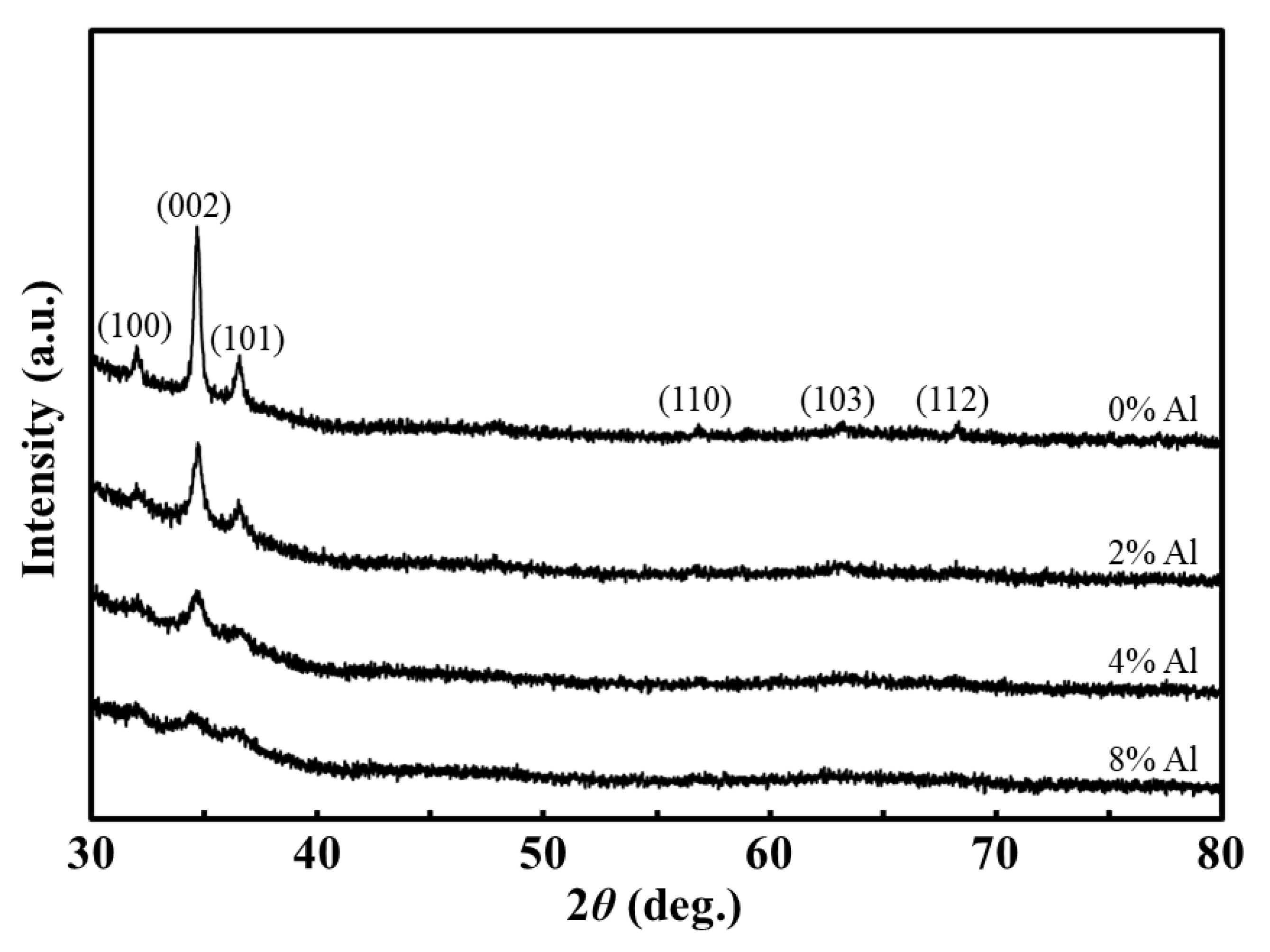
The X-ray diffraction patterns of the fabricated thin films are given in Figure 2. The several diffraction peaks detected at 2θ = 31.78°, 34.43°, 36.27°, 62.88°, and 68.52° in the 0% Al-doped ZnO thin film correspond to the (100), (002), (101), (103), and (112) phases, respectively, as confirmed by the ICDD card of ZnO (ICDD card number 01-079-5604).
Similarly, diffraction peaks assignable to the (100), (002), and (101) phases of ZnO are observable at 2θ = 31.68°, 34.57°, and 36.57°, respectively, in the patterns of the 2, 4, and 8% Al-doped thin films, although with decreasing intensities with increasing Al doping percentage. The presence of sharper peaks with high intensity in the 0% Al-doped ZnO thin film was reported to be a sign of high crystallinity, and with these results, this means that the 0% Al-doped ZnO thin film is more crystalline than the 2, 4, or 8% Al-doped ZnO thin films [19]. The XRD peaks’ disappearance towards the higher angles with the doping of Al may be due to the lower ionic radius of Al3+ (0.53 Å) in comparison to that of Zn2+ (0.74 Å); as it substitutes the Zn2+ in the crystal lattice, it leads to strain and distortions of the ZnO crystal lattice [35]. Additionally, the broadening of peaks signifies that the size of the particles of the Al-doped ZnO thin films was reduced compared to those of the 0% Al-doped ZnO thin films, which agrees with the literature [36].
The calculated crystallite sizes of the fabricated thin films are presented in Table 1. The calculations were based on the prominent (002) phase at around 34.5° for all thin films, and the undoped ZnO sample obtained the largest crystallite size of 26 nm, while the 8% Al-doped sample’s crystallite size could not be determined due to the extensive broadening and disappearance of the peak, which makes it difficult to estimate its FWHM.

3.3. Surface Morphologies of the Fabricated Thin Films

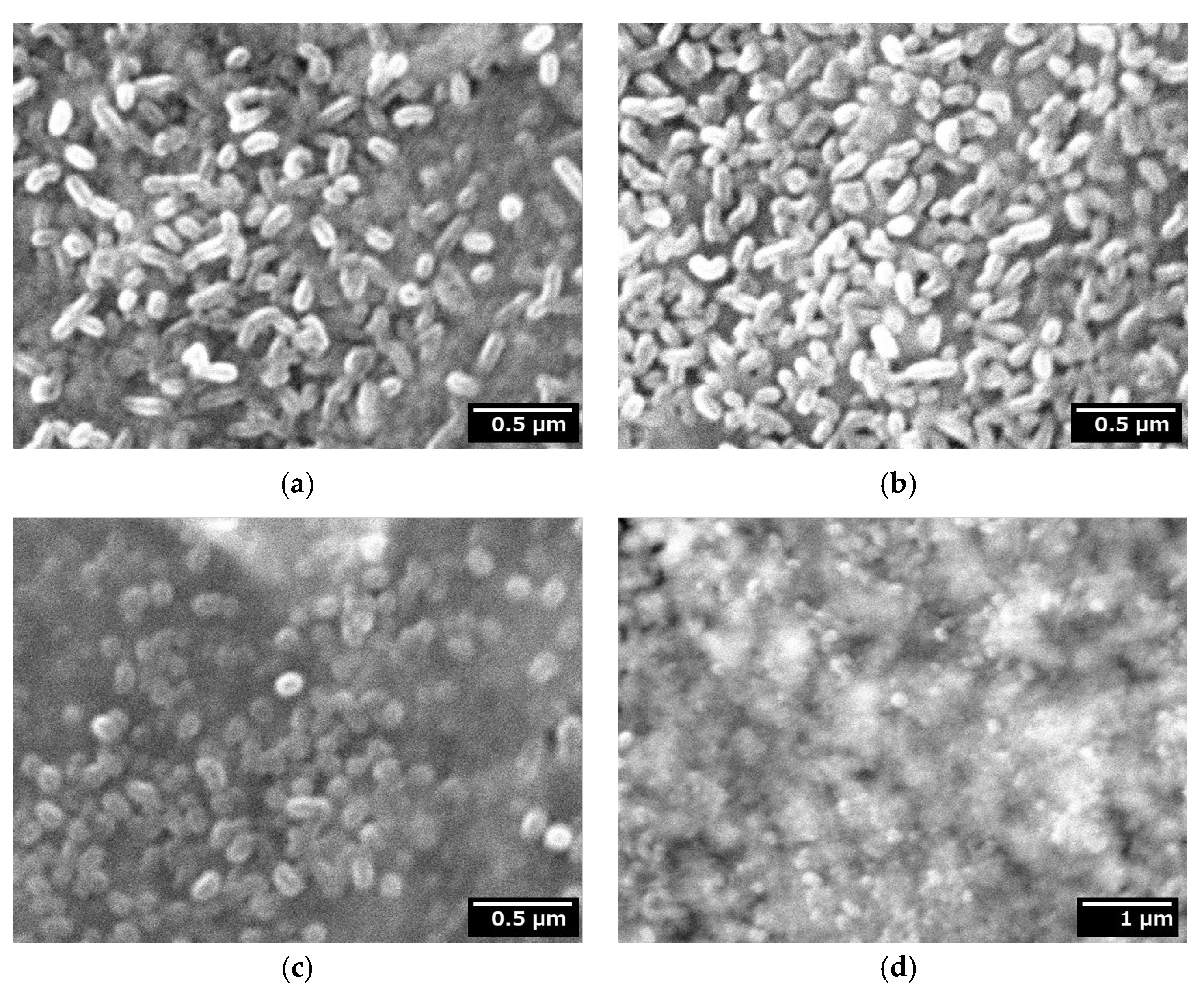
Figure 3a–d show the surface morphologies of the obtained thin films. The undoped and 2% Al-doped thin film SEM images were comparatively similar, and both exhibited well-developed, elongated grains of ZnO. However, as the percentage of Al doping increased, this feature disappeared. While the grains were still observable in the 4% and 8% Al-doped samples, it is clear from Figure 3c,d that there was significant and progressive disruption to the grain structure of the ZnO as the Al content was increased. The cross-sectional images of the undoped and 8% Al-doped samples yielded approximate thickness averages of 184 and 189 nm, respectively. However, we would like to highlight that the image resolutions were extremely poor due to the insulating nature of the ZnO layer, leading to the charge-up of the sample.

3.4. Optical Properties of the Fabricated Thin Films

3.4.1. Absorbance

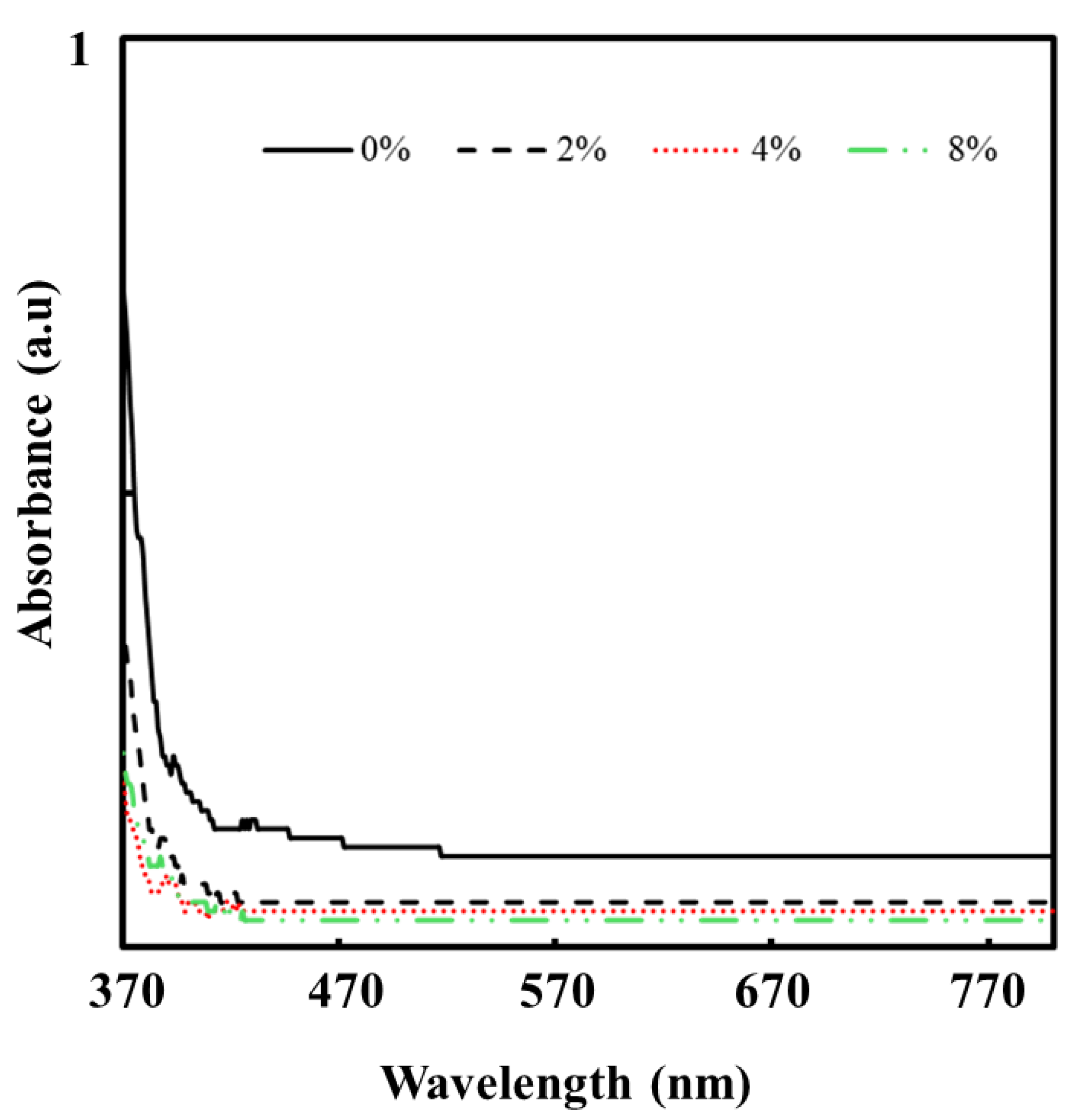
The absorbance spectra in Figure 4 display the light-absorption characteristics of the thin films that were evaluated by the UV-Vis spectrophotometer. The Al-doped ZnO thin films are shown to absorb light in the wavelength range of 400 nm–800 nm of the visible region. The absorbance was observed to decrease for all Al-doped ZnO thin films as the doping amount of Al was increased; the same phenomenon was documented in the literature [16].
The Al-doped ZnO thin films are observed to have a much lower absorption intensity in contrast to the 0% Al-doped ZnO thin film. The inclusion of Al in the thin films and their uneven thickness could be the cause of this. The Al-doped ZnO thin films have a pronounced absorption edge at 370 nm, and they show a shift to the lower wavelength, which is the blue shift. The shift in absorption spectra to shorter wavelengths with higher Al doping mole % indicates that the band gap levels of the Al-doped ZnO thin films fabricated by spray deposition have widened [23]. According to literature, the band-gap increase can be a result of the Moss-Burstein effect, which states that impurities in the conduction band have an effect on the blue shift in semiconductors’ optical bandgap. The Fermi level of Al-doped ZnO thin films is in the conduction band; this implies that Al-doping introduces electrons that settle at the bottom levels of the conduction band, and since these levels are already occupied, the excited electrons have to go to higher energy levels, making the band gap larger [23].

3.4.2. Transmittance

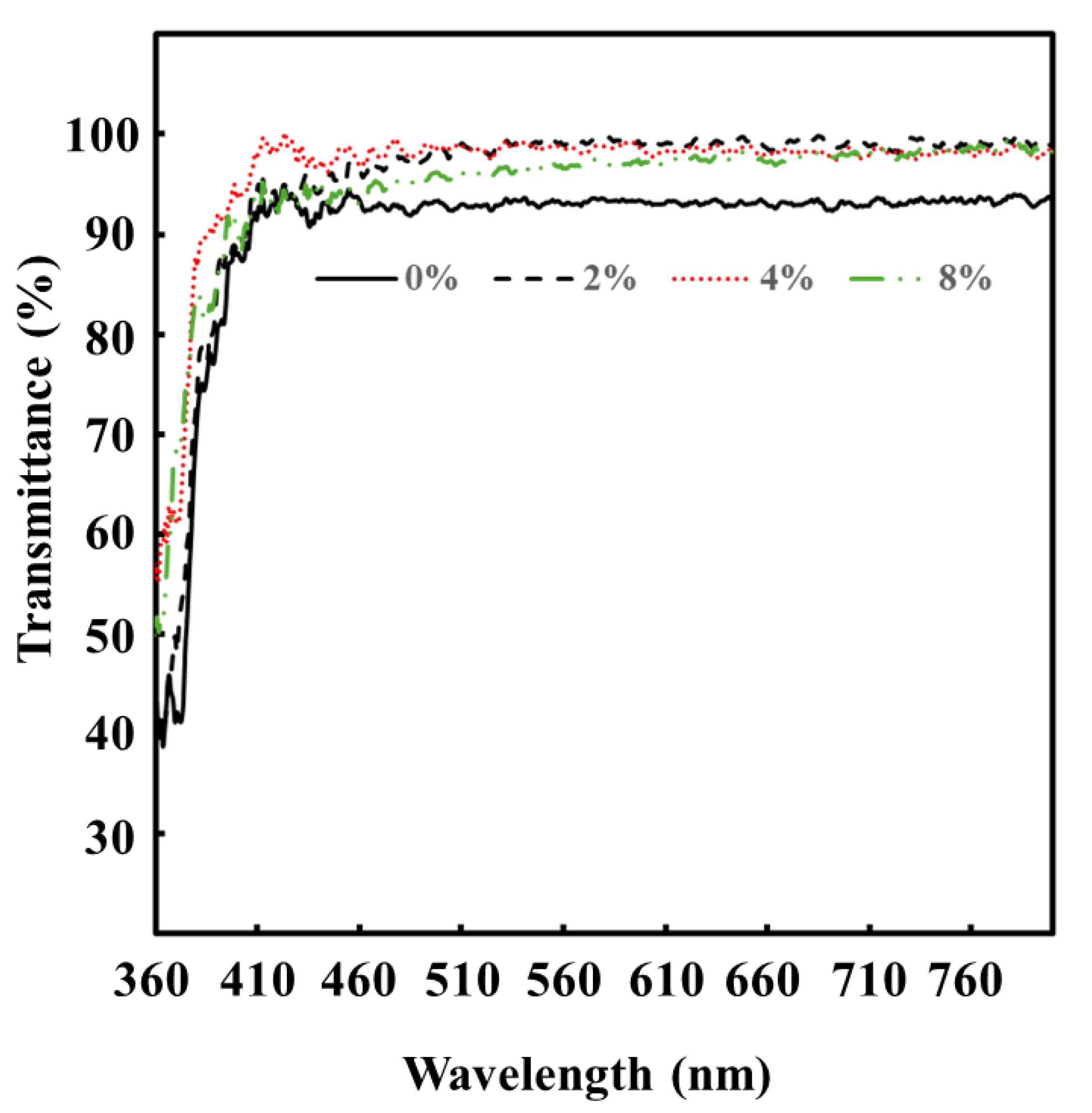
Figure 5 shows the transmittance of the Al-doped ZnO thin films, which is the opposite nature of absorbance, as anticipated. The transmittance was observed to be low at short wavelengths, and it increased with the wavelength values and became steady from 510 nm and beyond. This is because at lower wavelengths corresponding to high photon energies, the transmittance is zero since most of the light is absorbed; as the wavelength increases, absorption drops, allowing more light to be transmitted, and beyond a certain wavelength where absorption becomes insignificant, the transmittance remains constant [37].
All the thin films demonstrate a great transmittance of visible light, which is above eighty percent. The structural properties revealed that all the Al-doped ZnO thin films are crystalline, which may be a reason for less light scattering and the high transmittance of Al-doped ZnO thin films [17]. The high transmittance of the samples at visible wavelengths makes them suitable for use in photovoltaic devices. For instance, ZnO thin films doped with aluminium are utilised above and/or below as transparent conducting window layers in thin film solar cells of copper indium gallium selenide for dirt and corrosion protection [6].

3.5. Photocatalytic Activities Evaluation

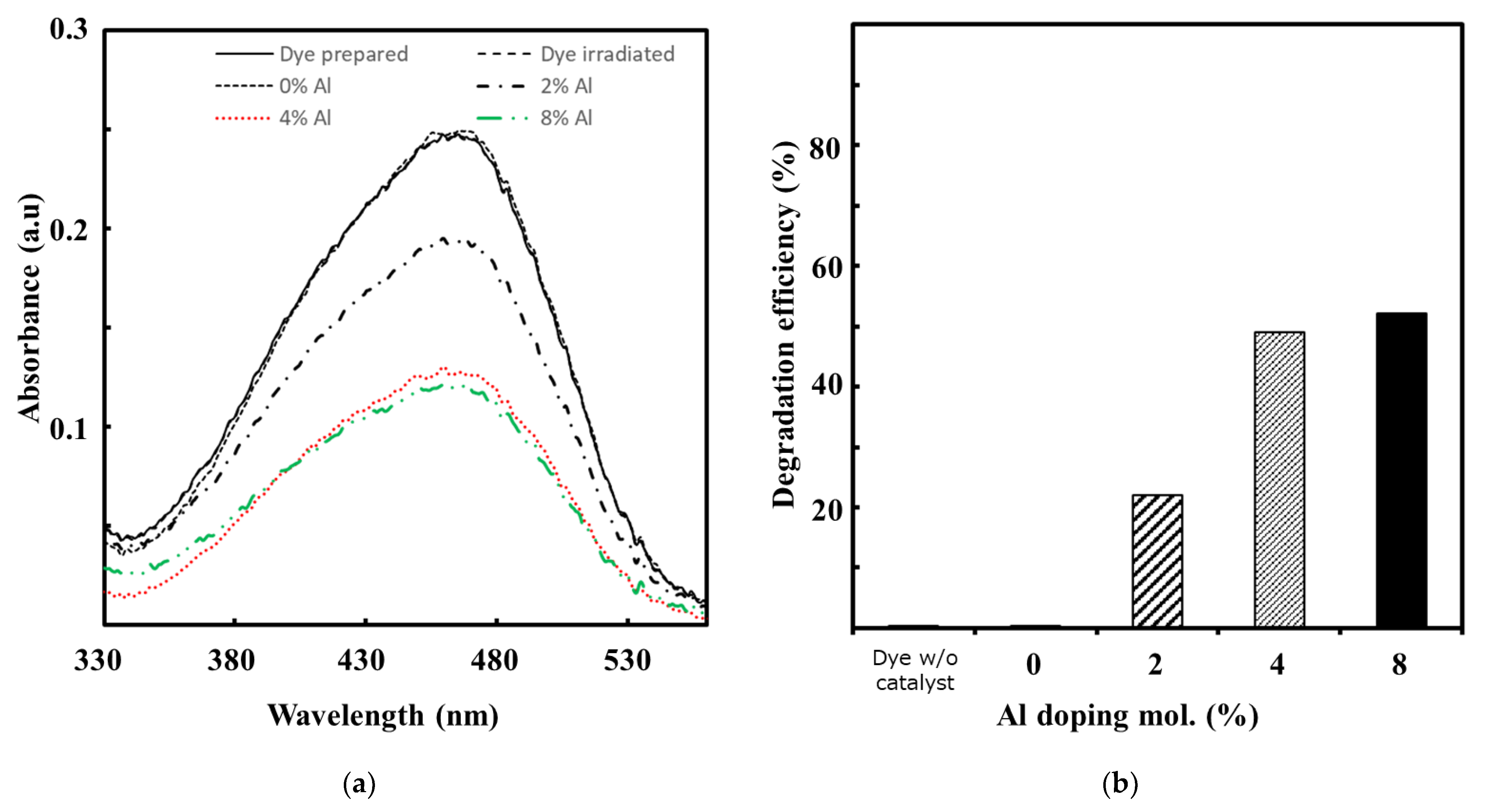
Figure 6a,b display the absorption spectra and the degradation efficiencies of MO dye, respectively, using the fabricated thin film photocatalysts under visible light irradiation.
From Figure 4, the decrease in the absorbance intensity and the shift in the absorbance peak position with an increase in the doping mole percentages of the 2, 4, and 8% Al-doped ZnO thin films utilised were regarded as the degradation of the methyl orange dye, and this agrees with reported literature [38]. The degradation increased with an increase in the doping mole % of the 2, 4, and 8% Al-doped ZnO thin films used, and the highest degradation efficiency of 52% was achieved for the 8% Al-doped ZnO thin film, as indicated in Figure 6b. The photocatalytic degradation efficiency follows the order AZO + MO > undoped ZnO + MO > MO. It is anticipated that with an increase in aluminium doping content, the degradation efficiency may continue to increase. The enhancement of the photocatalytic degradation of Al-doped ZnO thin films can also be linked to the many electron traps introduced by Al3+ ions, as doping with Al3+ ions creates electron-trapping centres in the thin films, where electrons can be trapped and are prevented from recombining with the holes in the valence band [17,39]. This leads to the longer lifetime of electrons, which enhances the production of hydroxyl and superoxide radicals and enhances the photocatalytic reaction [17,39]. Table 2 below shows a comparison of photocatalytic degradation efficiency between the current work and another work, which utilised the successive ionic layer adsorption and reaction (SILAR) to fabricate Al-doped ZnO thin films. Although the thin films’ fabrication methods and the experimental conditions differ, the results are comparable.

4. Discussion

4.1. Stable and Clear Aqueous Solutions Containing Zinc and Aluminium Complexes

During this study, it has been well noted that the majority of reports on the fabrication of Al-doped via wet chemical processes are restricted to the sol–gel method. However, in previous publications by our research group [24], we outlined how the aqueous spray method is becoming an ideal wet chemical technique for the fabrication of thin films for numerous materials, with several benefits over other techniques, such as the sol–gel method. A major prerequisite for such fabrication is the formation of precursor solutions containing metal complexes that allow for the formation of precursor films (the as-sprayed films) just after the spray-coating step, per the main principle of the molecular precursor method (MPM) [40]. Generally, preparing an aqueous precursor solution involving only a single type of metal complex is easy. However, the challenge comes in when we have to prepare an aqueous precursor solution involving metal complexes of at least two different metals, which might not be miscible. While a clear aqueous precursor solution containing tetraaminezincate ions [Zn(NH3)4]2+ can be easily prepared by reacting zinc acetate with ammonium hydroxide in water [41], the situation is different with most of the aluminium salts, and efforts to prepare clear coating solutions from those salts were futile. In order to overcome this challenge, a water-soluble complex of ammonium aluminium oxalate was successfully synthesised. Subsequently, clear and stable aqueous precursor solutions could be prepared, whereby the two complexes were miscible with up to 8 mole percentage of ammonium aluminium oxalate in the mixture.
The prepared aqueous precursor solutions were suitable for spray-coating onto the pre-heated quartz glass substrates, under ambient conditions, to yield the as-sprayed films, which are transformed into ZnO and Al-doped ZnO thin films upon annealing at 450 °C in air.

4.2. Fabrication of ZnO and Al-Doped ZnO via the Simple Aqueous Spray Method

The thin films fabricated in this study showed structural, optical, and photocatalytic qualities that were similar to those described in the literature. The XRD results revealed that the thin films are of ZnO having a hexagonal structure, with all diffraction peaks corresponding to that of the ZnO crystal structure. The change in the crystal structure with aluminium doping was observed in the peaks’ reduced intensity, broadening, and disappearance. Additionally, the FE-SEM results of the resultant thin films were consistent with published reports that emphasise the deterioration of the doped ZnO thin films’ crystalline quality. These results are also in agreement with the calculated crystallite sizes of all thin films fabricated in this study. In the article by Trinh et al. [42], the crystal structures and surface morphologies of tin-doped ZnO thin films fabricated by the sol–gel process were found to deteriorate with increased Sn amount. This is well in agreement with our results. The fabricated Al-doped ZnO thin films exhibited optical properties that are comparable to the literature. The transmittance increased with an increase in the doping mole percentages of aluminium. Inversely, the absorbance decreased with an increase in aluminium content. Similar findings were published in [16], wherein the absorbance of ZnO thin films decreased as the concentration of Al-doping increased. The degradation of methyl orange solution in the presence of Al-doped ZnO thin films under visible light irradiation was used to assess the photocatalytic activities of the fabricated thin films. It was concluded that Al is a good dopant to enhance the photocatalytic activities of ZnO. The degradation efficiency of Al-doped ZnO thin films improved when Al-doped ZnO thin films with high mole percentages of Al were utilised. Doping with Al was reported to reduce the electron–hole recombination that resulted in increased photocatalytic activities by forming an Al3+ charge trap within the 2, 4, and 8% Al-doped ZnO thin films. The enhanced photocatalytic activity of the Al-doped ZnO thin films fabricated in this study may also be attributed to their lower crystallinity, as indicated by the XRD results, compared to the undoped ZnO thin films.
The application of the aqueous spray method in the fabrication of Al-doped ZnO thin films has revealed the benefits of high yield, fewer precursor materials used, affordability, simple instrumentation setup and environmental friendliness.

5. Conclusions

To recapitulate, Al-doped ZnO thin films with an approximate thickness of no more than 189 nm were successfully fabricated through the aqueous spray-coating method; this, alongside the degradation of methyl orange dye under visible light, allowed their photocatalytic properties to be evaluated. Aluminium doping resulted in altered optical and structural features of ZnO. The photocatalytic activities were observed to improve with an increase in the aluminium doping content. The improvement is attributed to the role of Al3+ ions as charge traps, which reduce electron–hole recombination and thereby increase photocatalytic activity. Ultimately, this study contributes to the development of a facile yet effective approach for the fabrication of Al-doped ZnO thin films, which is the aqueous spray-coating method. Further studies can investigate stability in the long-term and durability of the thin films under prolonged visible light irradiation and in aqueous environments to ensure their feasibility for various photocatalytic applications.

Author Contributions

Conceptualization, W.N.T. and P.N.H.; methodology, W.N.T. and P.N.H.; investigation, W.N.T.; writing—original draft preparation, W.N.T.; writing—review and editing, W.N.T., A.U. and P.N.H.; supervision, P.N.H. All authors have read and agreed to the published version of the manuscript.

Funding

This research received no external funding.

Institutional Review Board Statement

Not applicable.

Informed Consent Statement

Not applicable.

Data Availability Statement

The datasets presented in this article are not readily available because the data are part of an ongoing study. Requests to access the datasets should be directed to the corresponding author.

Conflicts of Interest

The authors declare no conflicts of interest.

References

  1. Luo, H.; Zeng, Z.; Zeng, G.; Zhang, C.; Xiao, R.; Zhou, C.; Wang, H.; Zhou, Y.; Tian, S. Recent Progress on Metal-Organic Frameworks Based- and Derived-Photocatalysts for Water Splitting. Chem. Eng. J. 2020, 383, 123196. [Google Scholar] [CrossRef]
  2. Park, J.H.; Kim, H. Zinc Oxide Nanostructured Thin Film as an Efficient Photoanode for Photoelectrochemical Water Oxidation. Korean J. Mater. Res. 2020, 30, 441–446. [Google Scholar] [CrossRef]
  3. Gartner, M.; Stroescu, H.; Mitrea, D.; Nicolescu, M. Various Applications of ZnO Thin Films Obtained by Chemical Routes in the Last Decade. Molecules 2023, 28, 4674. [Google Scholar] [CrossRef] [PubMed]
  4. Johari, S.; Muhammad, N.Y.; Zakaria, M.R. Study of Zinc Oxide Thin Film Characteristics. EPJ Web Conf. 2017, 162, 01057. [Google Scholar] [CrossRef]
  5. Kulis-Kapuscinska, A.; Kwoka, M.; Borysiewicz, M.A.; Wojciechowski, T.; Licciardello, N.; Sgarzi, M.; Cuniberti, G. Photocatalytic Degradation of Methylene Blue at Nanostructured ZnO Thin Films. Nanotechnology 2023, 34, 155702. [Google Scholar] [CrossRef] [PubMed]
  6. Hur, J.S.; Song, J.B.; Kim, J.; Byun, D.; Son, C.S.; Yun, J.H.; Yoon, K.H. Efficiencies of CIGS Solar Cells Using Transparent Conducting Al-Doped ZnO Window Layers as a Function of Thickness. J. Korean Phys. Soc. 2008, 53, 437–441. [Google Scholar] [CrossRef]
  7. Sellam, M.; Azizi, S.; Bouras, D.; Fellah, M.; Obrosov, A. Degradation of Rhodamine B Dye under Visible and Solar Light on Zinc Oxide and Nickel-Doped Zinc Oxide Thin Films. Opt. Mater. 2024, 151, 115316. [Google Scholar] [CrossRef]
  8. Ramírez, A.E.; Montero-Muñoz, M.; López, L.L.; Ramos-Ibarra, J.E.; Coaquira, J.A.H.; Heinrichs, B.; Páez, C.A. Significantly Enhancement of Sunlight Photocatalytic Performance of ZnO by Doping with Transition Metal Oxides. Sci. Rep. 2021, 11, 2804. [Google Scholar] [CrossRef]
  9. Boskabadi, M.R.; Rogé, V.; Bazargan, A.; Sargazi, H.; Barborini, E. An Introduction to Photocatalysis. In Photocatalytic Water and Wastewater Treatment; Bazargan, A., Ed.; IWA Publishing: London, UK, 2022; pp. 2–3. [Google Scholar]
  10. Sukee, A.; Kantarak, E.; Singjai, P. Preparation of Aluminum Doped Zinc Oxide Thin Films on Glass Substrate by Sparking Process and Their Optical and Electrical Properties. J. Phys. Conf. Ser. 2017, 901, 012153. [Google Scholar] [CrossRef]
  11. Adeoye, A.E.; Obibuzor, C.V.; Owoeye, V.A.; Ogunmola, E.D. Structural, Optical and Rectifying Properties of Spray Deposited Ni Doped and Undoped ZnO Thin Films. IOSR J. Humanit. Soc. Sci. (IOSR-JHSS) 2021, 13, 74–79. [Google Scholar] [CrossRef]
  12. Wang, J.; Shen, W.; Zhang, X.; Li, J.; Ma, J. Preparation and Characterization of (Al, Fe) Codoped Zno Films Prepared by Sol–Gel. Coatings 2021, 11, 946. [Google Scholar] [CrossRef]
  13. Kumar, N.; Srivastava, A. Enhancement in NBE Emission and Optical Band Gap by Al Doping in Nanocrystalline ZnO Thin Films. Opto-Electron. Rev. 2018, 26, 1–10. [Google Scholar] [CrossRef]
  14. Chakrabortty, T.; Mina, S.; Habib, A.; Hussain, K.M.A.; Faruque, T.; Nahid, F. Fabrication and Characterization of Al Doped ZnO Thin Film Using Spin Coating Deposition System. IOSR J. Appl. Phys. (IOSR-JAP) 2018, 10, 70–76. [Google Scholar] [CrossRef]
  15. Bouacheria, M.A.; Djelloul, A.; Adnane, M.; Larbah, Y.; Benharrat, L. Characterization of Pure and Al Doped ZnO Thin Films Prepared by Sol Gel Method for Solar Cell Applications. J. Inorg. Organomet. Polym. Mater. 2022, 32, 2737–2747. [Google Scholar] [CrossRef]
  16. Musaab Khudhr, M.; Abass, K.H. Effect of Al-Doping on the Optical Properties of ZnO Thin Film Prepared by Thermal Evaporation Technique. Int. J. Eng. Technol. 2016, 7, 25–31. [Google Scholar] [CrossRef]
  17. Islam, M.R.; Rahman, M.; Farhad, S.F.U.; Podder, J. Structural, Optical and Photocatalysis Properties of Sol–Gel Deposited Al-Doped ZnO Thin Films. Surf. Interfaces 2019, 16, 120–126. [Google Scholar] [CrossRef]
  18. Sanjeev, S.; Kekuda, D. Effect of Annealing Temperature on the Structural and Optical Properties of Zinc Oxide (ZnO) Thin Films Prepared by Spin Coating Process. IOP Conf. Ser. Mater. Sci. Eng. 2015, 73, 012149. [Google Scholar] [CrossRef]
  19. Ghazai, A.J.; Salman, E.A.; Jabbar, Z.A. Effect of Aluminum Doping on Zinc Oxide Thin Film Properties Synthesis by Spin Coating Method. Am. Sci. Res. J. Eng. Technol. Sci. 2016, 26, 202–211. [Google Scholar]
  20. Chaves, M.; Ramos, R.; Martins, E.; Rangel, E.C.; Da Cruz, N.C.; Durrant, S.F.; Bortoleto, J.R.R. Al-Doping and Properties of AZO Thin Films Grown at Room Temperature: Sputtering Pressure Effect. Mater. Res. 2019, 22, e20180665. [Google Scholar] [CrossRef]
  21. Mereu, R.A.; Mesaros, A.; Vasilescu, M.; Popa, M.; Gabor, M.S.; Ciontea, L.; Petrisor, T. Synthesis and Characterization of Undoped, Al and/or Ho Doped ZnO Thin Films. Ceram. Int. 2013, 39, 5535–5543. [Google Scholar] [CrossRef]
  22. Shukla, R.K.; Srivastava, A.; Srivastava, A.; Dubey, K.C. Growth of Transparent Conducting Nanocrystalline Al Doped ZnO Thin Films by Pulsed Laser Deposition. J. Cryst. Growth 2006, 294, 427–431. [Google Scholar] [CrossRef]
  23. Sutanto, H.; Durri, S.; Wibowo, S.; Hadiyanto, H.; Hidayanto, E. Rootlike Morphology of ZnO:Al Thin Film Deposited on Amorphous Glass Substrate by Sol-Gel Method. Phys. Res. Int. 2016, 2016, 4749587. [Google Scholar] [CrossRef]
  24. Hishimone, P.N.; Nagai, H.; Sato, M. Methods of Fabricating Thin Films for Energy Materials and Devices. In Lithium-Ion Batteries-Thin Film for Energy Materials and Devices; IntechOpen Limited: London, UK, 2020; pp. 1–21. [Google Scholar] [CrossRef]
  25. Parihar, N.S.; Saraswat, S.K. Photoelectrochemical Water Splitting: An Ideal Technique for Pure Hydrogen Production. J. Indian Chem. Soc. 2020, 97, 1099–1103. [Google Scholar]
  26. Lee, H.Y. Synthesis of Ammonium Aluminum Oxalate from Bayer Aluminum Hydroxide. Mater. Lett. 2011, 65, 2621–2623. [Google Scholar] [CrossRef]
  27. Hishimone, P.; Nagai, H.; Morita, M.; Sakamoto, T.; Sato, M. Highly-Conductive and Well-Adhered Cu Thin Film Fabricated on Quartz Glass by Heat Treatment of a Precursor Film Obtained Via Spray-Coating of an Aqueous Solution Involving Cu(II) Complexes. Coatings 2018, 8, 352. [Google Scholar] [CrossRef]
  28. Al-mamun, R.; Iqbal, Z.; Rahim, A. Enhanced Photocatalytic Activity of Cu and Ni-Doped ZnO Nanostructures: A Comparative Study of Methyl Orange Dye Degradation in Aqueous Solution. Heliyon 2023, 9, e16506. [Google Scholar] [CrossRef]
  29. Azfar, A.K.; Kasim, M.F.; Lokman, I.M.; Rafaie, H.A.; Mastuli, M.S. Comparative Study on Photocatalytic Activity of Transition Metals (Ag and Ni)Doped ZnO Nanomaterials Synthesized via Sol–Gel Method. R. Soc. Open Sci. 2020, 7, 191590. [Google Scholar] [CrossRef]
  30. Muthuselvi, C.; Arunkumar, A.; Rajaperumal, G. Growth and Characterization of Oxalic Acid Doped with Tryptophan Crystal for Antimicrobial Activity. Chem. Sin. 2016, 7, 55–62. [Google Scholar]
  31. Meshram, S.B.; Kushwaha, O.S.; Reddy, P.R.; Bhattacharjee, G.; Kumar, R. Investigation on the Effect of Oxalic Acid, Succinic Acid and Aspartic Acid on the Gas Hydrate Formation Kinetics. Chin. J. Chem. Eng. 2019, 27, 2148–2156. [Google Scholar] [CrossRef]
  32. Mary, S.S.; Kirupavathy, S.S. An Insight on Spectral, Microstructural, Electrical and Mechanical Characterization of Ammonium Oxalate Monohydrate Crystals. Mater. Sci. 2019. [Google Scholar] [CrossRef]
  33. Antonio, M.; Belderbos, S.; Yañez-vilar, S.; Gsell, W.; Himmelreich, U.; Rivas, J. Development of Superparamagnetic Nanoparticles Coated with Polyacrylic Acid and Aluminum Hydroxide as an E Ffi Cient Contrast Agent for Multimodal Imaging. Nanomaterials 2019, 9, 1626. [Google Scholar]
  34. Pouran, H.M.; Banwart, S.A.; Romero-gonzalez, M. Applied Geochemistry Coating a Polystyrene Well-Plate Surface with Synthetic Hematite, Goethite and Aluminium Hydroxide for Cell Mineral Adhesion Studies in a Controlled Environment. Appl. Geochem. 2014, 42, 60–68. [Google Scholar] [CrossRef]
  35. Sandeep, K.M.; Bhat, S.; Dharmaprakash, S.M. Nonlinear Absorption Properties of ZnO and Al Doped ZnO Thin Films under Continuous and Pulsed Modes of Operations. Opt. Laser Technol. 2018, 102, 147–152. [Google Scholar] [CrossRef]
  36. Das, N.; Majumdar, R.; Sen, A.; Maiti, H.S. Nanosized Bismuth Ferrite Powder Prepared through Sonochemical and Microemulsion Techniques. Mater. Lett. 2007, 61, 2100–2104. [Google Scholar] [CrossRef]
  37. Mulama, A.A.; Mwabora, J.M.; Oduor, A.O.; Muiva, C.C. Optical Properties and Raman Studies of Amorphous Se-Bi Thin Films. African Rev. Phys. 2014, 9, 33–38. [Google Scholar]
  38. Shankar, S.; Saroja, M.; Venkatachalam, M.; Parthasarathy, G. Photocatalytic Degradation of Methylene Blue Dye Using ZnO Thin Films. Int. J. Chem. Concepts 2017, 03, 180–188. [Google Scholar]
  39. Jellal, I.; Daoudi, O.; Nouneh, K.; Boutamart, M. Comparative Study on the Properties of Al- and Ni-Doped ZnO Nanostructured Thin Films Grown by SILAR Technique: Application to Solar Photocatalysis. Opt. Quantum Electron. 2023, 55, 620. [Google Scholar] [CrossRef]
  40. Nagai, H.; Sato, M. Heat Treatment in Molecular Precursor Method for Fabricating Metal Oxide Thin Films. In Heat Treatment—Conventional and Novel Applications; InTechOpen Limited: London, UK, 2012; Volume 100C, pp. 147–167. ISBN 9789583213208. [Google Scholar]
  41. Thein, M.T.; Pung, S.Y.; Aziz, A.; Itoh, M. The Role of Ammonia Hydroxide in the Formation of ZnO Hexagonal Nanodisks Using Sol–Gel Technique and Their Photocatalytic Study. J. Exp. Nanosci. 2015, 10, 1068–1081. [Google Scholar] [CrossRef]
  42. Trinh, T.T.; Tu, N.H.; Le, H.H.; Ryu, K.Y.; Le, K.B.; Pillai, K.; Yi, J. Improving the Ethanol Sensing of ZnO Nano-Particle Thin Films—The Correlation between the Grain Size and the Sensing Mechanism. Sens. Actuators B Chem. 2011, 152, 73–81. [Google Scholar] [CrossRef]
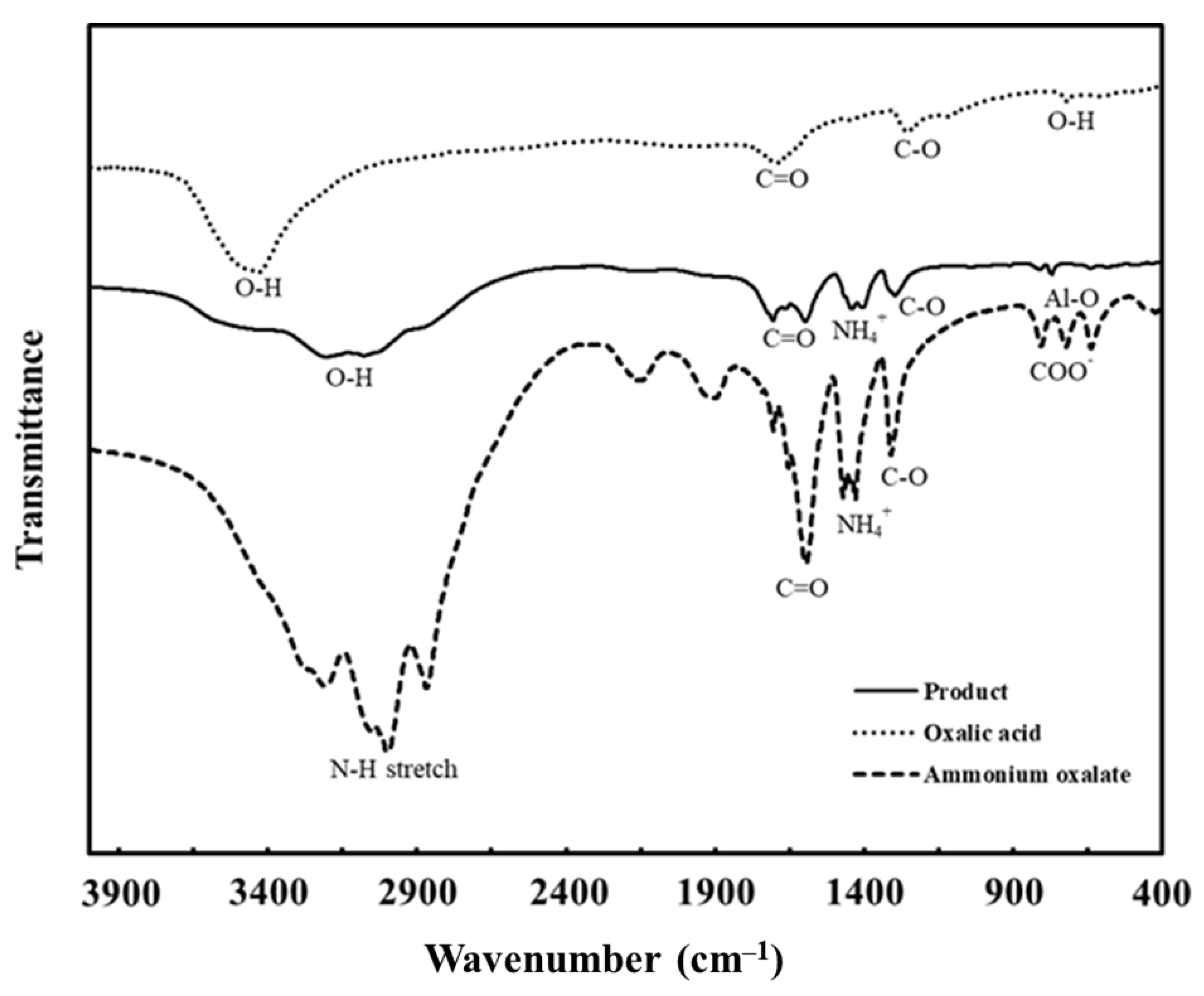
Figure 1. FT-IR transmittance spectra of oxalic acid, ammonium oxalate, and the synthesised ammonium aluminium oxalate.
Coatings 16 00020 g001
Figure 2. X-ray diffraction patterns of the undoped and Al-doped ZnO thin films.
Coatings 16 00020 g002
Figure 3. FE-SEM images of thin films with varying aluminium doping percentages (a) 0% Al, (b) 2% Al, (c) 4% Al, and (d) 8% Al.
Coatings 16 00020 g003
Figure 4. Absorption spectra of the fabricated ZnO and Al-doped ZnO thin films.
Coatings 16 00020 g004
Figure 5. Transmittance spectra of the fabricated ZnO and Al-doped ZnO thin films.
Coatings 16 00020 g005
Figure 6. (a) Absorption spectra and (b) degradation efficiency of methyl orange solution in the presence of fabricated ZnO and Al-doped ZnO thin films after 4 h of visible light irradiation.
Coatings 16 00020 g006
Table 1. The calculated crystallite size of the undoped and Al-doped ZnO thin films.
SamplesFWHMD (nm)
ZnO0.330026
2% Al-ZnO0.428420
4% Al-ZnO0.95958
8% Al-ZnO--
Table 2. Photocatalytic degradation efficiency comparison between the current work and another work.
PhotocatalystMethod of FabricationDyeExperimental Conditions (Light, Time, Dye Conc.)%DRef
ZnOSILAROrange GVisible light, 3 h, 10–5 M14.4[38]
2% Al-ZnO44.6
4% Al-ZnO44.1
8% Al-ZnO46.1
ZnOSpray-coatingMethyl
Orange
Visible light, 4 h, 0.76 × 10⁻⁶ M0.26Current work
2% Al-ZnO22
4% Al-ZnO49
8% Al-ZnO52
Disclaimer/Publisher’s Note: The statements, opinions and data contained in all publications are solely those of the individual author(s) and contributor(s) and not of MDPI and/or the editor(s). MDPI and/or the editor(s) disclaim responsibility for any injury to people or property resulting from any ideas, methods, instructions or products referred to in the content.