Article

Influence of Nano-Sized Ceramic Reinforcement Content on the Powder Characteristics and the Mechanical, Tribological, and Corrosion Properties of Al-Based Alloy Nanocomposites


1
Department of Metallurgical and Materials Engineering, Faculty of Engineering, Karadeniz Technical University, 61080 Trabzon, Turkey
2
Department of Marine Engineering, Faculty of Turgut Kiran Maritime, Recep Tayyip Erdogan University, 53900 Rize, Turkey
*
Author to whom correspondence should be addressed.
Coatings 2026, 16(1), 143; https://doi.org/10.3390/coatings16010143 (registering DOI)
Submission received: 12 December 2025 / Revised: 6 January 2026 / Accepted: 19 January 2026 / Published: 22 January 2026

Abstract

In this study, B4C nanoparticles were incorporated into AA2024, one of the aluminum alloys with superior mechanical and wear properties, with the aim of further enhancing its mechanical, tribological, and corrosion performance. The nanocomposites were produced using mechanical milling followed by powder metallurgy techniques. The effects of nano-sized B4C additions on powder characteristics, microstructure, and physical, mechanical, tribological, and corrosion properties were systematically investigated through microhardness, density, SEM, XRD, bulk hardness, wear, and corrosion tests. B4C was added at weight fractions of 0–2 wt.%, and all samples were mechanically milled for 8 h. The results revealed a gradual reduction in powder particle size and a corresponding increase in particle microhardness with increasing B4C content. The sample reinforced with 2 wt.% nano-B4C exhibited an approximately 80% increase in hardness and around a 55% improvement in tensile strength compared to the unreinforced alloy. Wear resistance was significantly enhanced, showing up to an 8-fold improvement under a 5 N load and a 6-fold improvement under a 25 N load. Furthermore, corrosion resistance nearly doubled with the addition of B4C nanoparticles.

1. Introduction

Aluminum and its alloys are widely utilized in various engineering applications due to their excellent strength-to-weight ratio, good thermal and electrical conductivity, and superior corrosion resistance [1,2]. Among these, the AA2024 alloy stands out particularly in aerospace, automotive, and structural applications owing to its high strength, fatigue resistance, and machinability. However, despite these favorable properties, AA2024 has some inherent limitations in terms of wear resistance and localized corrosion behavior, especially in aggressive environments [3,4,5]. These deficiencies can restrict its performance in demanding service conditions. To overcome these drawbacks and further enhance the material’s functional properties, the incorporation of ceramic reinforcements into the aluminum matrix has been explored extensively in recent years [6,7,8].
One of the most promising approaches for enhancing the mechanical and functional properties of aluminum alloys is the development of metal matrix nanocomposites (MMNCs) through the incorporation of ceramic reinforcements [9,10]. Among the various ceramic materials explored, boron carbide (B4C) stands out as an ideal candidate due to its exceptionally high hardness (~30 GPa), low density (~2.52 g/cm3), high elastic modulus, thermal stability, and chemical inertness. These features make B4C particularly suitable for reinforcing lightweight metallic matrices like aluminum, offering the potential for significant improvement in mechanical strength, wear resistance, and thermal performance without compromising the low weight advantage of the base material. In recent years, the focus has shifted towards the use of nano-sized B4C particles, rather than their micron-sized counterparts, for several compelling reasons [11,12,13]. First, nanoparticles possess a significantly higher surface area-to-volume ratio, which enhances their interaction with the metal matrix and enables stronger interfacial bonding. This contributes to better load transfer during mechanical deformation and more effective grain refinement [14,15,16]. Second, the smaller particle size enables more uniform distribution of the reinforcement throughout the matrix, reducing the likelihood of agglomeration and interfacial debonding, which are common issues in microcomposites [17,18,19]. Furthermore, nano-B4C is particularly effective in obstructing dislocation motion, leading to pronounced strengthening via Orowan looping and grain boundary pinning mechanisms [20,21]. These strengthening effects are especially beneficial when combined with high-strength aluminum alloys like AA2024, where additional mechanical enhancement must be achieved without compromising ductility or processability.
In order to fully realize the potential of nano-reinforcements in metal matrix systems, the choice of fabrication method is equally critical [22,23]. Conventional casting methods are often unsuitable for uniformly dispersing nanoparticles due to problems such as density differences, poor wettability, and clustering. In this context, powder metallurgy (PM) emerges as a highly effective alternative, especially when combined with mechanical milling techniques [24]. High-energy ball milling not only ensures uniform mixing and refinement of powders, but also facilitates the embedding of nano-reinforcements into the matrix particles via repeated cold welding and fracturing. This intense mechanical interaction at the nanoscale enables the formation of a clean and well-bonded interface between the matrix and the reinforcement, which is crucial for achieving improved mechanical integrity and enhanced functional performance [25,26]. Powder metallurgy, particularly when combined with high-energy ball milling, provides a distinct advantage over conventional casting methods for nanocomposite synthesis. It allows for better control over particle distribution, avoids severe reactions between the matrix and the reinforcement, and minimizes grain coarsening, thereby retaining the refined microstructure induced by milling [27,28]. Furthermore, PM facilitates the tuning of processing parameters such as compaction pressure and sintering temperature, which are critical for achieving high density and minimal porosity in the final product [27,29].
Numerous studies in the literature have investigated the development of Al matrix composites reinforced with ceramic particles. Xu et al. [30] conducted a comparative study using nano- and micro-sized B4C particles (4 wt.%) in an Al matrix to examine their effects on microstructure and mechanical properties. Their findings revealed that nano-sized B4C resulted in a more homogeneous particle distribution and a finer-grained microstructure compared to the micro-sized variant. Consequently, the nano-B4C reinforced composite exhibited a 57% increase in tensile strength (from 237 MPa to 372 MPa) and a 53% enhancement in hardness (from 105 HB to 161 HB). Additionally, an approximately 93% improvement in wear resistance was achieved. Although the micro-sized B4C reinforcement also improved mechanical properties, the gains were less significant than those observed with the nano-sized particles. In a related study, Alizadeh and Beni [31] utilized accumulative roll bonding (ARB) to fabricate Al/Al2O3/B4C nanocomposites and applied the Orowan model to predict yield strength, reporting an increase from 129 MPa (pure Al) to 241 MPa with 4 vol% reinforcement. However, they employed a dual-phase reinforcement system and did not assess either wear or corrosion behavior. Chao et al. [32] produced 45 vol% B4C/AA2024 composites via pressure infiltration, targeting ballistic applications. Their composites achieved a tensile strength of 668 MPa and a fracture toughness of 21.8 MPa·m1/2. However, they used micron-sized B4C (4.5 µm), and the study lacked powder characterization and corrosion analysis. Gaylan et al. [33] incorporated 5–50 wt.% micro-sized B4C into an aluminum matrix via powder metallurgy and investigated microstructural, hardness, and corrosion characteristics. Although mechanical properties improved with increasing reinforcement content, corrosion resistance decreased at higher B4C loadings. Notably, they did not assess powder characteristics or wear behavior. Barik et al. [34] produced Al-based composites containing nano-B4C and carbon nanofibers (CNFs) through powder metallurgy, achieving a 62.18% increase in hardness over pure aluminum at 4 wt.% nano-B4C content. Despite significant enhancements in wear resistance, corrosion and powder behavior were not detailed. Reyaz et al. [35] developed hybrid composites by incorporating nano-sized B4C along with Al2O3 into AA2024 alloy. They reported notable improvements in composite performance due to B4C addition. However, their investigation focused on hybrid systems, lacked one-to-one comparisons of single-reinforcement systems, and did not present detailed powder analysis.
A critical evaluation of the existing literature reveals that investigations on nano-sized B4C-reinforced aluminum alloys are largely centered on hybrid reinforcement systems, micron-scale particles, or property-specific analyses that consider mechanical, tribological, or corrosion behavior independently. Studies that simultaneously address powder characteristics, reinforcement–matrix interaction, and multifunctional performance within a single and consistent material system remain limited. In this context, the present study adopts a holistic approach by examining AA2024 alloy reinforced exclusively with nano-sized B4C particles processed via powder metallurgy combined with high-energy ball milling. The distinct contribution of this work lies in the integrated analysis of powder morphology evolution, nano-B4C embedding behavior, and the resulting microstructural modifications, and in demonstrating how these features collectively govern mechanical strengthening, wear resistance, and corrosion performance.

2. Materials and Methods

2.1. Materials

In this study, an AA2024 alloy produced by nitrogen gas atomization was selected as the matrix material. The chemical composition of the alloy is presented in Table 1, and the powders have an average particle size of approximately 75 µm. The B4C nanoparticles used as the reinforcement material were supplied by Grafen Chemical Industries and exhibit a particle size in the nanometric range, approximately between 10 and 400 nm. SEM images of the starting powders are shown in Figure 1. The AA2024 alloy powders exhibit an irregular and rod-like morphology, while the nano-sized B4C powders display a sharp-edged and irregular form.

2.2. Fabrication Process

Initially, a Resch PM200 high-energy ball mill was used to obtain a homogeneous powder mixture. The milling parameters and reinforcement contents are summarized in Table 2. During the mixing process, two tungsten carbide vials with a volume of 125 mL and tungsten carbide balls with a diameter of 10 mm were employed. To prevent cold welding of the powders and their adhesion to the vial walls during milling, 0.25 wt.% methanol was added as a process control agent.
Following mechanical alloying, the nanocomposite powders were first cold-compacted at room temperature under a pressure of 300 MPa for 5 m. Subsequently, hot pressing was carried out at 500 °C under a pressure of 600 MPa for 3 h to produce bulk samples.

2.3. Particle Microhardness and Particle Size

The microhardness of the powders was measured using a Vickers hardness tester (Innovatest 400TM, INNOVATEST, Maastricht, The Netherlands) under an indentation load of 10 kgf and a dwell time of 10 s. The sample preparation procedures for the hardness measurements were conducted as previously described in detail in an earlier study [38,39]. Particle size and distribution were measured using a Malvern Mastersizer Hydro 2000e (Malvern Panalytical, Malvern, UK). Prior to analysis, powders were dispersed in deionized water and ultrasonicated for at least 5 min to minimize agglomeration. Measurements were carried out using the system’s software for accurate results.

2.4. X-Ray Diffraction

Phase identification of the nanocomposites was carried out using X-ray diffraction (XRD) analysis on a PANalytical X’Pert3 Pro instrument (Bruker, Westbrough, MA, USA). The measurements were conducted with Cu Kα radiation (λ = 1.5418 Å) under an operating voltage of 45 kV and a current of 40 mA. Data was collected over a 2θ range of 20° to 90°, using a continuous scan mode at a rate of 0.01° per second.

2.5. Morphological Characterization

Morphological analysis of the synthesized nanocomposite powders, as well as the examination of fracture surfaces of bulk samples after the tensile tests and worn surfaces and debris morphologies after wear tests, was performed using a Zeiss Evo LS10 scanning electron microscope (SEM, Zeiss, Germany). To further investigate the elemental distribution and composition, energy-dispersive X-ray spectroscopy (EDS) was conducted using an Edax Apex™ Octane Elite system (EDAX, USA).

2.6. Hardness and Tensile Test

Bulk sample hardness was evaluated using the Brinell method on a digital hardness testing system (Innovatest Nemesis 9000, Maastricht, The Netherlands). A 2.5 mm steel ball was employed as the indenter under a load of 31.25 kgf, maintained for 10 s. To enhance data reliability, six individual measurements were taken per sample, and the average was calculated after discarding the highest and lowest values. Tensile properties were assessed according to ASTM E8 standards using an MTS Criterion Universal testing machine (MTS Systems Corporation, Minnesota, USA) operating at a constant crosshead speed of 1 mm/min. Three specimens were tested under identical conditions, and the mean tensile strength was used to represent the mechanical performance of the material.

2.7. Wear Test

To investigate the wear behavior of the fabricated samples under dry conditions, a ball-on-disk wear test was conducted using a UTS Tribolog device (UTS design, Trabzon, Türkiye). Cylindrical specimens with a diameter of 30 mm were used in the tests. The experiments were performed at room temperature (20 °C) under applied loads of 5 N and 25 N, with a sliding speed of 300 rpm and a total sliding distance of 500 m. A 6 mm diameter 100Cr6 steel ball served as the counter-body, making contact with the sample surface at a radial distance of 20 mm from the disk center. Prior to testing, the sample surfaces were ground using #2000 SiC abrasive paper to ensure surface uniformity, followed by thorough cleaning with acetone to remove any contaminants. All tests were repeated at least three times to ensure reproducibility. Mass loss measurements were adjusted by considering the densities of the samples to determine the corresponding volume loss. The specific wear rate of each sample was then calculated using Equation (1), as shown below:
W e a r   r a t e m m 3 / N m = W e i g h t   l o s s g d e n s i t y g / m m 3 × s l i d i n g   d i s t a n c e m m × L o a d N

2.8. Corrosion Test

The corrosion behavior of the samples was evaluated through potentiodynamic polarization tests using a Gamry Reference 3000 corrosion testing system (Gamry Instruments, Pennsylvania, USA), in accordance with ASTM G59-97 standard. A three-electrode electrochemical cell was employed under static conditions in an open-to-air environment, using an aqueous solution of 3.5 wt.% NaCl as the electrolyte. The samples (with dimensions of 6 mm × 6 mm × 10 mm) were mounted in resin as the working electrode and electrically connected via copper wires. A graphite rod served as the counter electrode, while an Ag/AgCl (SCE) electrode was used as the reference. Prior to each measurement, a stabilization period of 45 min was applied to allow the open circuit potential (OCP) between the electrodes to reach equilibrium. Following this, the Tafel polarization method was employed to determine the corrosion current density (Icorr) and corrosion potential (Ecorr) from the polarization curves. The scans were conducted at a rate of 1 mV/s within a ±500 mV range relative to the OCP. To ensure reproducibility, all corrosion tests were performed at least three times.

3. Results and Discussion

3.1. Powder Characterization

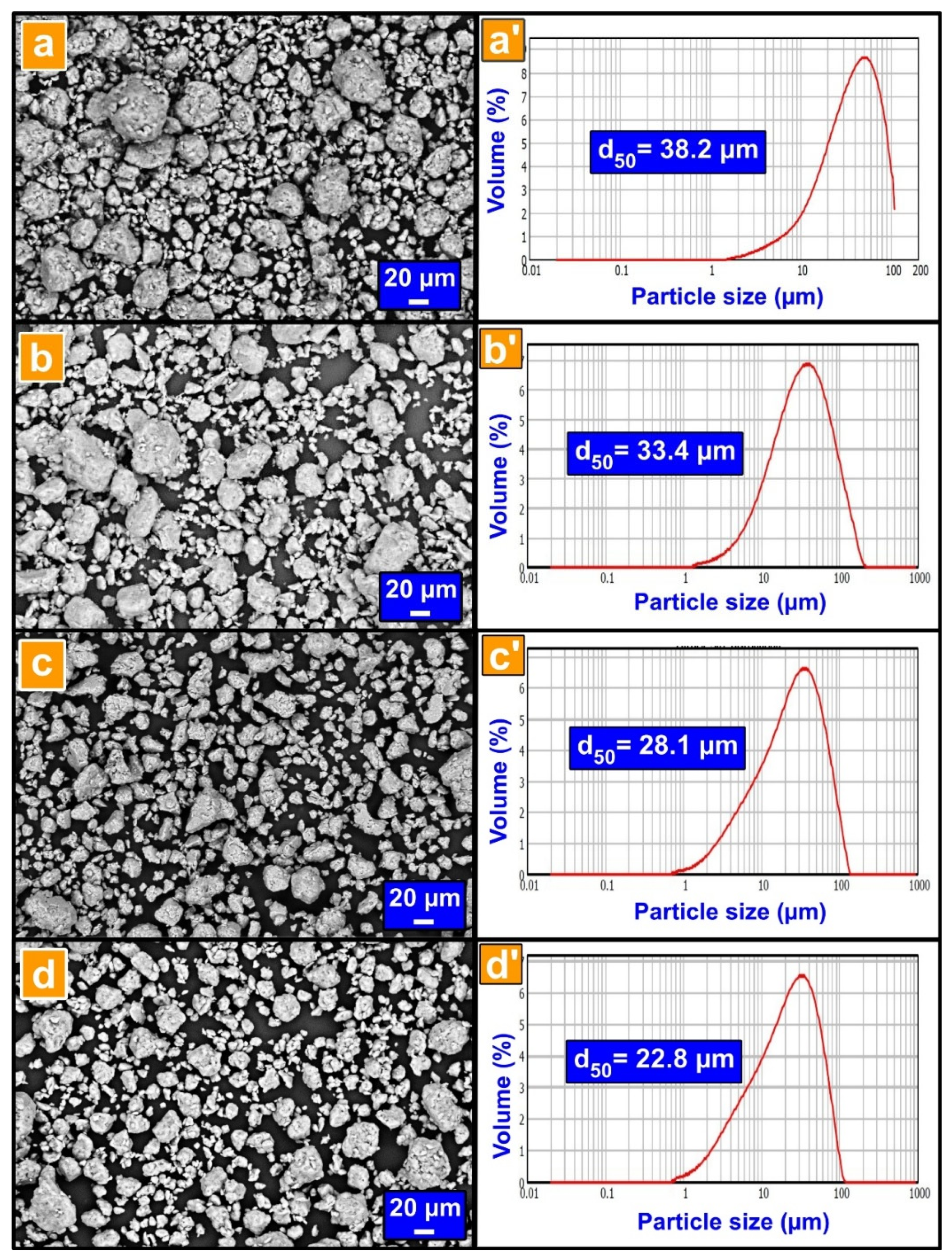
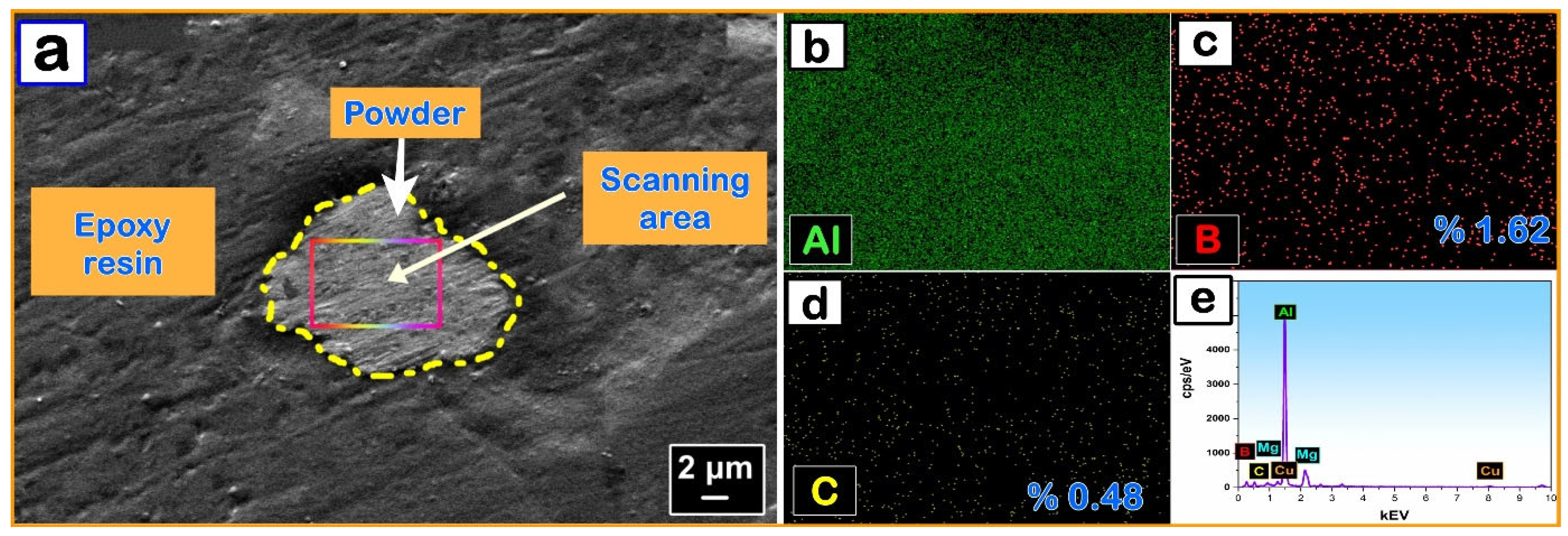
In the development of metal matrix composites, the particle size and morphology of the powders used play a critical role in determining the final product’s mechanical, physical, wear, and corrosion properties [38]. In this context, understanding the effects of nano-sized B4C reinforcement on the particle size and morphology of the AA2024 alloy is of great importance for optimizing composite properties. Figure 2 illustrates the powder morphology and particle size distribution of AA2024/B4C nanocomposites as a function of reinforcement content. As shown in Figure 2a, even at low B4C reinforcement levels, significant changes in powder morphology and particle size distribution are observed compared to the initial AA2024 powders (Figure 1a). While the starting powder morphology is rod-like and ligament-shaped, the addition of 0.5 wt.% nano-B4C and subsequent mechanical ball milling result in the fracture of rod-like particles and the formation of a morphology dominated by relatively spherical particles. Compared to the AA2024 alloy powders (Figure 1c), the B0.5 sample exhibits a broader particle size distribution. This is primarily attributed to the dual effect of the milling process in the presence of B4C: some particles are fractured and reduced to smaller sizes, while others grow due to cold welding. With increasing reinforcement content, the powder morphology maintains a trend toward spherical structures, whereas the particle size distribution becomes narrower. Particularly in the B1.5 sample (Figure 2(c,c’)), the formation of submicron-sized particles is observed, and all large particles are fractured such that the maximum particle size no longer exceeds 100 µm. Due to its extremely hard nature, B4C acts as an additional milling media during mechanical milling, accelerating the fracture and refinement of the Al matrix [3,39]. Moreover, the sharp-edged morphology of B4C allows it to embed more effectively and to a greater extent into the Al matrix powders during milling, compared to other reinforcements. This phenomenon is clearly evidenced in the powder cross-sectional images shown in Figure 3. SEM-EDS analysis of the B2 powder after 8 h of milling reveals that the embedded B4C content in the Al matrix reaches 2.07 wt.%, indicating that B4C is almost completely embedded into the matrix after prolonged milling. The increased embedding of B4C into the matrix induces cutting and abrasive effects due to high-energy collisions during milling, resulting in elevated internal stress concentrations and increased microcrack formation within the matrix powder [37,40]. These microcracks and excessive stresses promote fragmentation and rapid size reduction in the powder particles. As seen in Figure 2, increasing B4C content significantly reduces the powder size, while the powder morphology retains a spherical shape across all reinforcement ratios. However, the most ideal equiaxed and homogeneous spherical morphology is observed in the B2 sample (Figure 2(d,d’)). This can be attributed to the higher amount of B4C embedded within the matrix, which enhances the resistance of the matrix particles to plastic deformation, thereby helping to preserve their spherical morphology without shape distortion during milling.
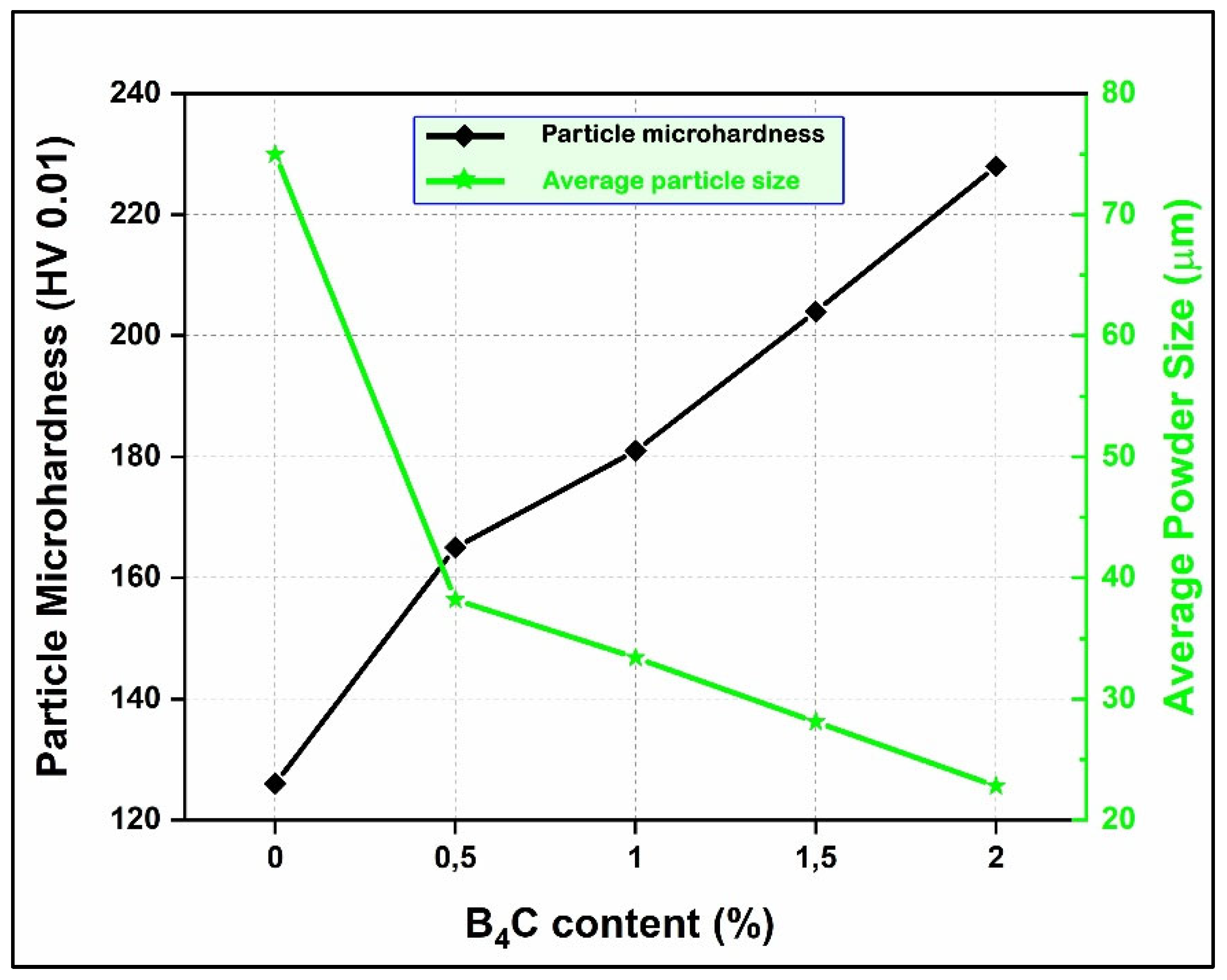
Figure 4 presents the graphs demonstrating the effect of nano-sized B4C reinforcement on particle microhardness and average powder size. As observed, with increasing reinforcement content, the powder size decreases, while the microhardness values of the powders progressively increase. This result is directly related to the mechanical properties of B4C and its contribution to the milling process. Due to its high hardness and abrasive nature, B4C functions not only as a reinforcement material but also as an additional grinding medium during mechanical milling. This allows B4C particles to effectively participate in both fracture and cold welding mechanisms by positioning themselves between the matrix powders. The strong interfacial interaction and high embedding capability of B4C within the matrix (as shown in Figure 3) restrict dislocation movement, leading to enhanced plastic deformation and consequently, strain hardening of the powders. The integration of B4C into the matrix during mechanical milling increases the contact area between particles and absorbs a significant portion of the deformation energy, thereby promoting fracture as the dominant mechanism [22,36]. Higher B4C content further intensifies both fracture and plastic deformation throughout the milling process. This, in turn, results in a reduction in particle size and an increase in hardness. The dominance of the fracture mechanism facilitates the breakdown of larger particles, leading to a more homogeneous particle size distribution, while also enhancing the effectiveness of cold welding and strain-hardening mechanisms [40,41,42]. As a result, the incorporation of B4C leads to the formation of smaller and harder particles. For example, in the B0.5 sample, which contains the lowest B4C content, the average particle size was measured to be 38 μm, with a corresponding microhardness of 165 HV. In contrast, for the B2 sample with the highest B4C content, these values improved significantly to 23 μm and 228 HV, respectively. This difference can be attributed to the superior hardness, low brittleness, and strong interaction capacity of B4C with the matrix alloy.

3.2. XRD Analysis

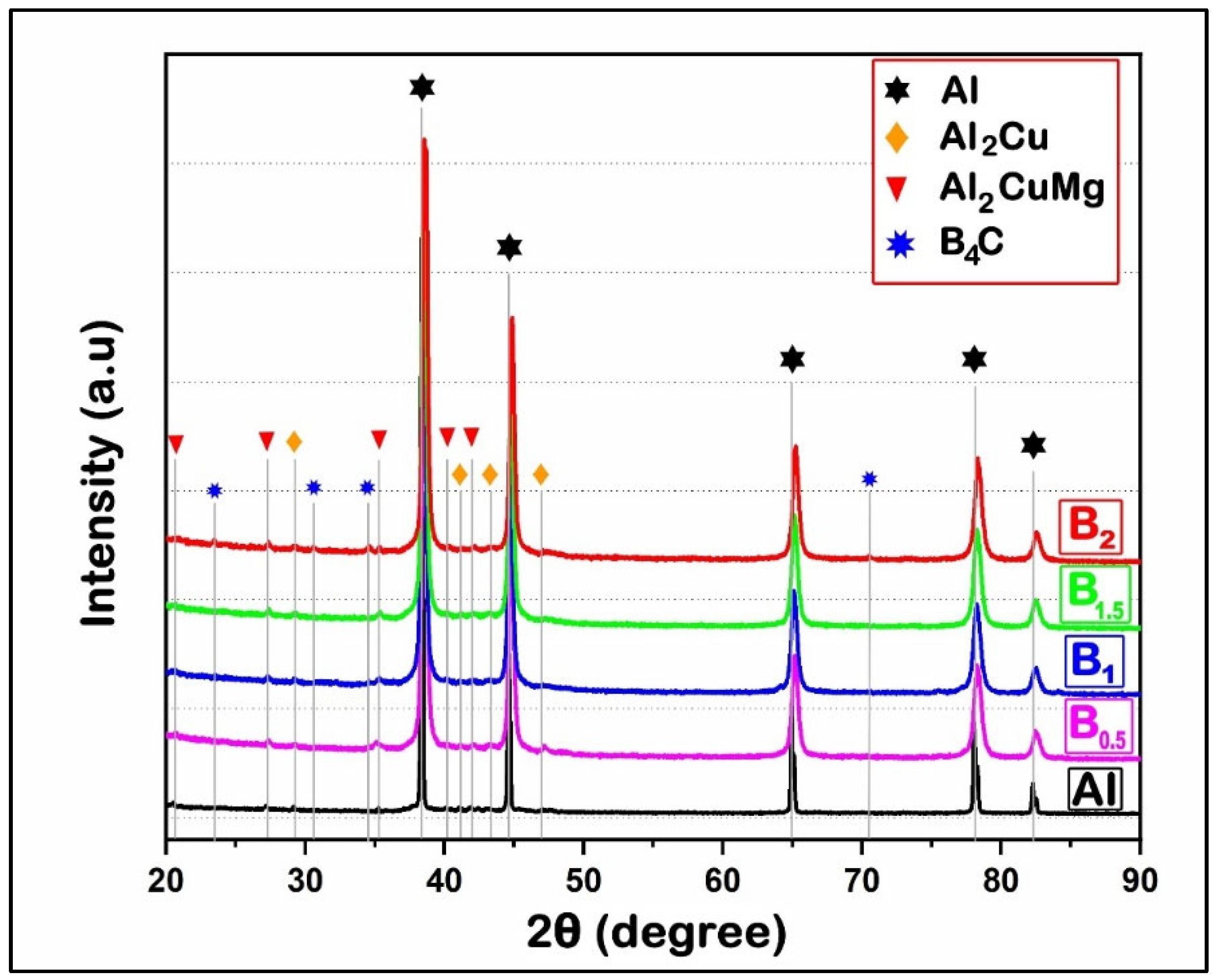
The XRD patterns of the AA2024 alloy and the corresponding nanocomposites are presented in Figure 5. In all reinforcement compositions, five main peaks corresponding to elemental Al were observed at 38.4°, 44.7°, 65.1°, 78.2°, and 82.4°. Additionally, five weak peaks corresponding to the Al2CuMg intermetallic phase were detected at 20.05°, 27.40°, 34.8°, 40.99°, and 42.50°, along with four weak peaks associated with the Al2Cu intermetallic phase at 29.38°, 41.5°, 43.8°, and 47.2°. Peaks corresponding to the B4C reinforcement were not detected in samples with low B4C content, whereas in samples with higher B4C content, weak B4C peaks were identified in the XRD patterns. Specifically, in the B2 sample, characteristic diffraction peaks of B4C were observed at 23.50° (012), 31.90° (110), 35.10° (104), and 71.70° (312). These peaks were not detected in nanocomposites with lower reinforcement ratios due to the limited amount of B4C present.

3.3. Microstructural Characterization

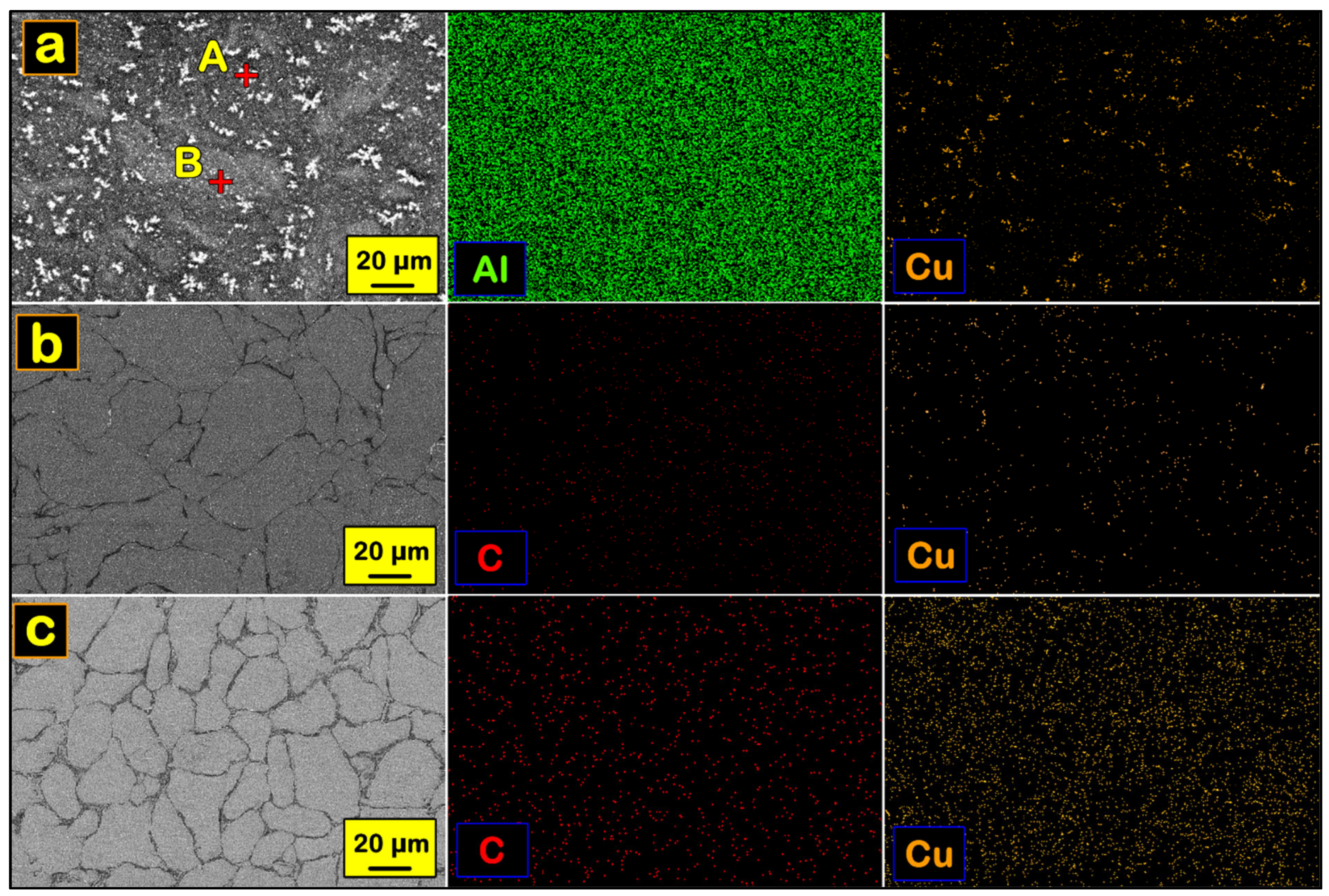
Figure 6 presents the SEM images and EDS mapping results of the AA2024 alloy and the nano-B4C-reinforced nanocomposite samples. Additionally, Table 3 provides the EDS point analysis results taken from points A and B in Figure 6. In the EDS mapping analysis, green regions represent Al, orange regions represent Cu, and red regions correspond to C. The presence of C reflects the distribution of B4C reinforcement within the microstructure, while the Cu distribution corresponds to the intermetallic phase Al2Cu. As shown in Figure 6a, in the unreinforced alloy sample (labeled as Al), star-shaped bright regions are observed at the grain boundaries. According to the point analysis results from point A in Table 3, these regions are identified as belonging to the Al2Cu intermetallic phase. At point B, a reduced Cu content within the α-Al matrix is observed, which can be attributed to the fact that most of the Cu has formed the Al2Cu intermetallic compound with Al. Given that copper is the primary alloying element in AA2024 (approximately 5 wt.%), the formation of Al2Cu phases within the aluminum solid solution during sintering is inevitable. The EDS mapping in Figure 6a supports this interpretation, as the orange regions are concentrated in the same areas as the bright zones in the SEM image, further confirming the presence of Al2Cu.
In Figure 6b, corresponding to the B0.5 sample, grain boundaries become more pronounced, and the Al2Cu phase appears to be more uniformly distributed, as seen from both SEM imaging and EDS mapping. The Al2Cu phase plays a crucial role in determining the mechanical properties of the composites [26,43]. A fine and homogeneously dispersed Al2Cu phase can significantly enhance mechanical performance, primarily because it more effectively hinders dislocation motion [43,44]. Furthermore, the EDS mapping of the B0.5 sample reveals that the carbon signal is homogeneously distributed, indicating a uniform dispersion of B4C particles within the microstructure. As the B4C reinforcement content increases, the microstructure becomes finer grained, as evident in Figure 6c. In the B2 sample, which contains the highest reinforcement content, the Al2Cu phase is observed to be more refined and homogeneously distributed compared to other samples. Despite the increased amount of nano-B4C, the reinforcement maintains a uniform distribution. Numerous studies have shown that in Al-based composite systems, ceramic reinforcement not only affects the mechanical behavior but also alters the size and distribution of the Al2Cu intermetallic phase. Ceramic particles inhibit the coarsening of Al2Cu at grain boundaries and promote a more uniform distribution throughout the matrix [45,46,47].
Additionally, since ceramic reinforcements such as B4C possess lower thermal conductivity than the Al matrix, they locally reduce the cooling rate during sintering. This slows down the diffusion kinetics of Cu, thereby preventing excessive aggregation and localized precipitation of Al2Cu. Consequently, the resulting microstructure exhibits finer and more homogeneously distributed Al2Cu precipitates [43,47]. In the B2 sample, the simultaneous presence of a refined grain structure and finely dispersed intermetallic phases is expected to contribute significantly to the enhancement of mechanical properties. This is consistent with the literature [3,47], where uniform and fine intermetallic dispersion, along with grain refinement, is frequently correlated with improved strength and hardness in Al-based composites reinforced with ceramic particles such as B4C.

3.4. Relative Density

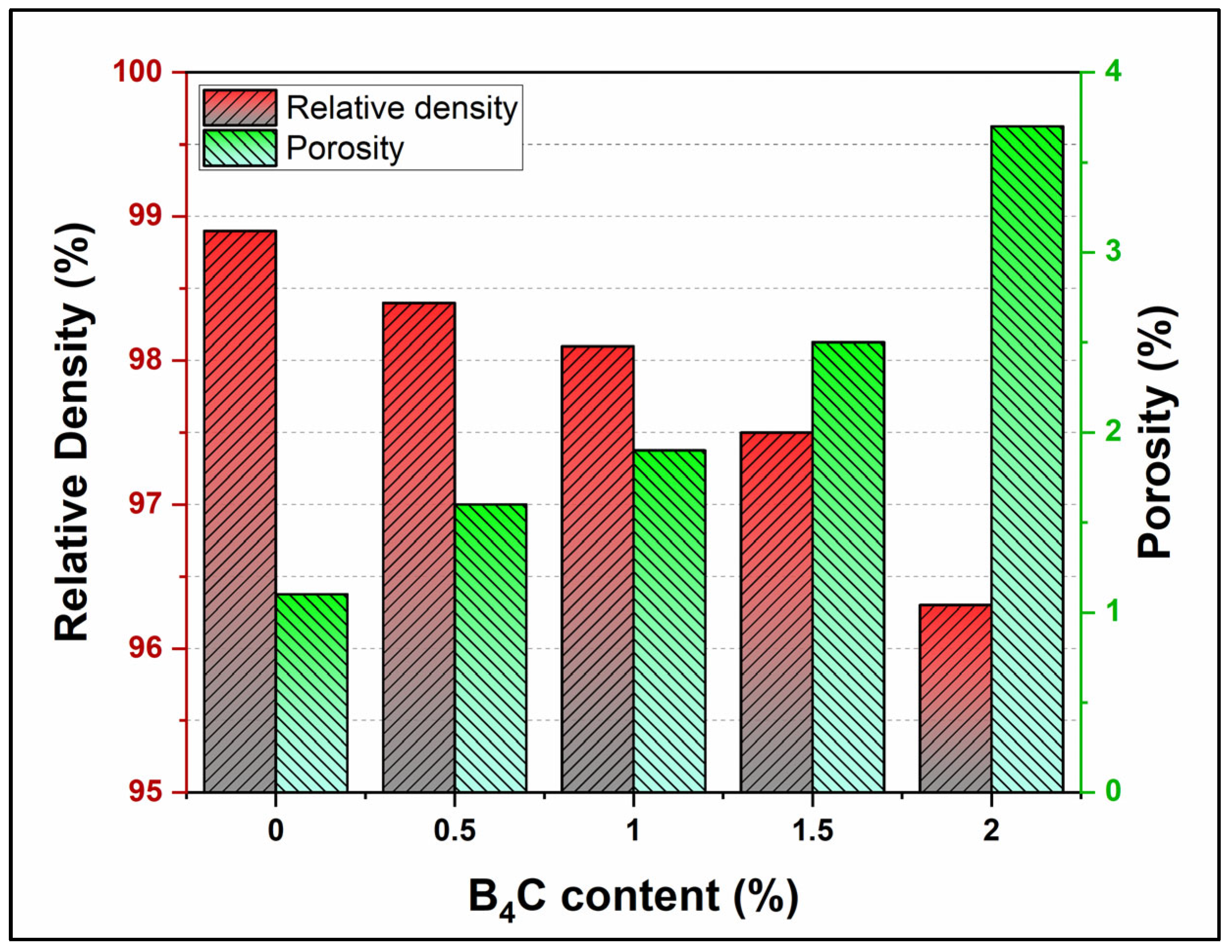
Figure 7 illustrates the variation in relative density and porosity of AA2024 and its nanocomposites as a function of B4C reinforcement content. The highest relative density was obtained for the unreinforced AA2024 alloy, with a value of 98.9%, indicating the alloy’s excellent densification capability during the powder metallurgy process. Upon the addition of B4C reinforcement, a slight decrease in relative density was observed, which gradually became more pronounced with increasing reinforcement content. For instance, the B0.5 sample exhibited a relative density of 98.4% and a porosity of 1.6%, whereas in the B2 sample, the relative density dropped to 96.3%, accompanied by an increase in porosity to 3.7%. This decrease in relative density with increasing B4C content can be attributed to several factors. Firstly, the intrinsic density of B4C (2.52 g/cm3) is lower than that of the AA2024 matrix alloy (2.78 g/cm3), which may contribute to a reduction in the overall composite density. Secondly, with higher B4C content, the microhardness of the composite powders increases significantly due to the presence of hard ceramic particles. This enhanced hardness reduces the compressibility of the powder mixture, making it more difficult to achieve full densification during compaction and sintering, which in turn leads to a gradual reduction in relative density. Despite this, it is noteworthy that even at the highest B4C content (2 wt.%), the relative density remains above 96%. This indicates that the aluminum matrix effectively accommodates B4C particles without causing excessive porosity. Such efficient integration is largely attributed to the mechanical milling process, during which B4C nanoparticles are embedded into the matrix powder to a significant extent, as supported by the cross-sectional SEM-EDS analyses shown in Figure 3. The strong mechanical interlocking and interfacial contact between the matrix and reinforcement particles enhance the structural integrity of the composite, thereby maintaining relatively high densification levels even at elevated reinforcement contents.

3.5. Mechanical Behavior

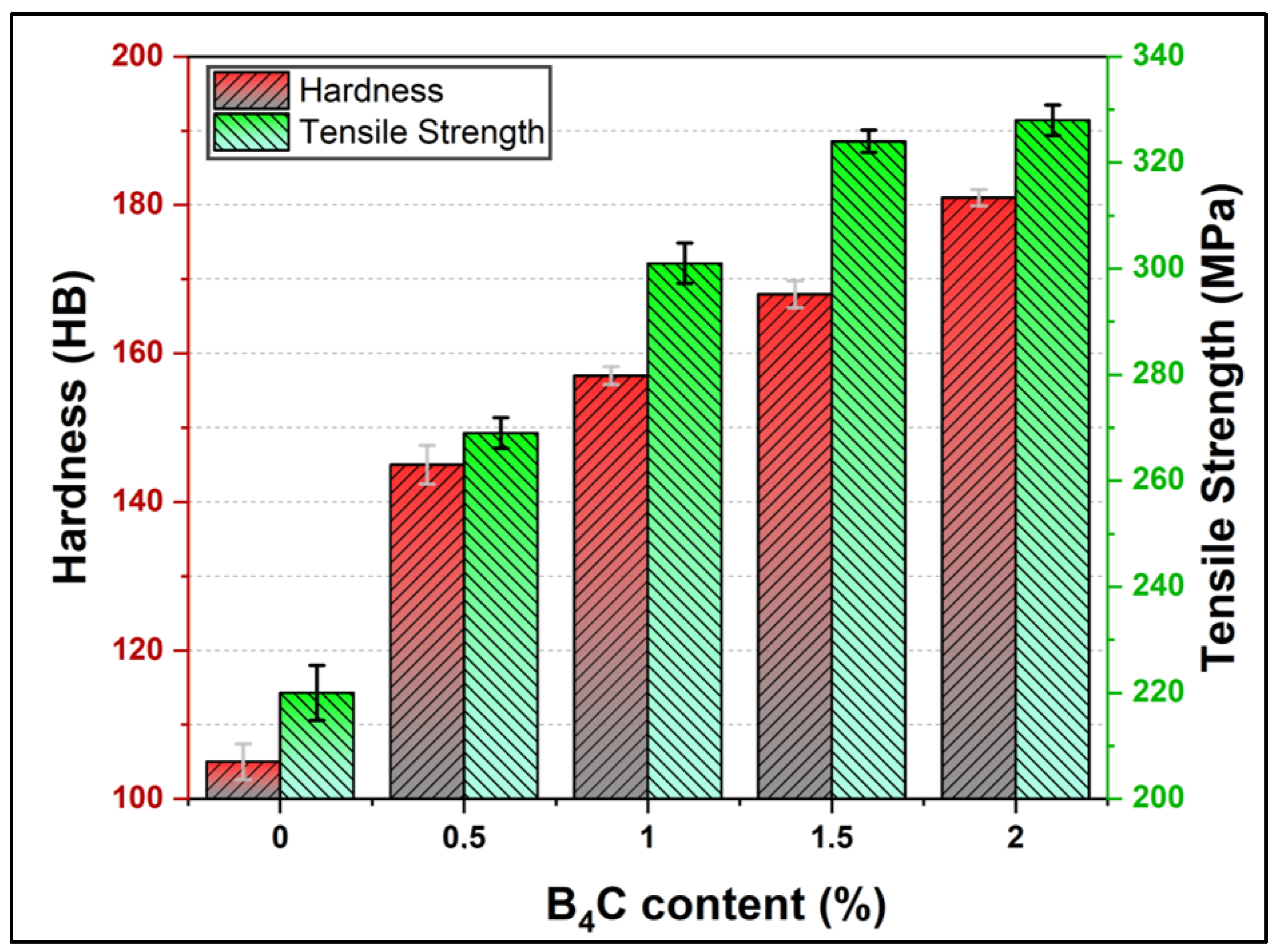
Figure 8 illustrates the variation in both hardness and tensile strength values of the AA2024 alloy and its nanocomposites as a function of nano-sized B4C reinforcement content. The unreinforced AA2024 alloy, being relatively soft and ductile, exhibits a hardness of 105 HB and a tensile strength of 220 MPa. With increasing B4C content, both properties show a consistent and significant enhancement. For instance, at 0.5 wt.% B4C, the hardness and tensile strength increase to 145 HB and 269 MPa, respectively. At the highest reinforcement level of 2 wt.%, these values reach 181 HB and 328 MPa—corresponding to approximately 80% and 49% improvement in hardness and tensile strength, respectively, compared to the unreinforced alloy. This simultaneous enhancement in mechanical performance is attributed to a combination of synergistic strengthening mechanisms that operate at both the microstructural and interfacial levels, and which are critically influenced by the nanoscale nature of the B4C particles. First, B4C is an ultra-hard ceramic with a high elastic modulus, which significantly improves the composite’s resistance to plastic deformation and tensile loading [48,49]. The nano-sized particles, due to their high surface area-to-volume ratio and angular morphology, act as effective obstacles to dislocation motion, contributing to Orowan strengthening [19,50]. Furthermore, their presence refines the grain structure of the matrix (Hall–Petch effect), which simultaneously enhances hardness and tensile strength by increasing the number of grain boundaries acting as barriers to dislocation propagation [51]. In addition, prolonged mechanical ball milling facilitates the partial embedding of B4C particles into the Al matrix (Figure 3), which promotes strong interfacial bonding [40]. This bonding improves load transfer efficiency during tensile loading and increases the structural integrity of the composite, thereby contributing to both improved strength and hardness. Another key factor is the role of B4C in modifying the formation and distribution of Al2Cu intermetallic phases. SEM and EDS analyses (Figure 6) demonstrate that increasing B4C content results in finer and more homogeneously distributed Al2Cu precipitates. These intermetallics act as secondary strengthening phases by further hindering dislocation motion and enhancing both dispersion and precipitation hardening.
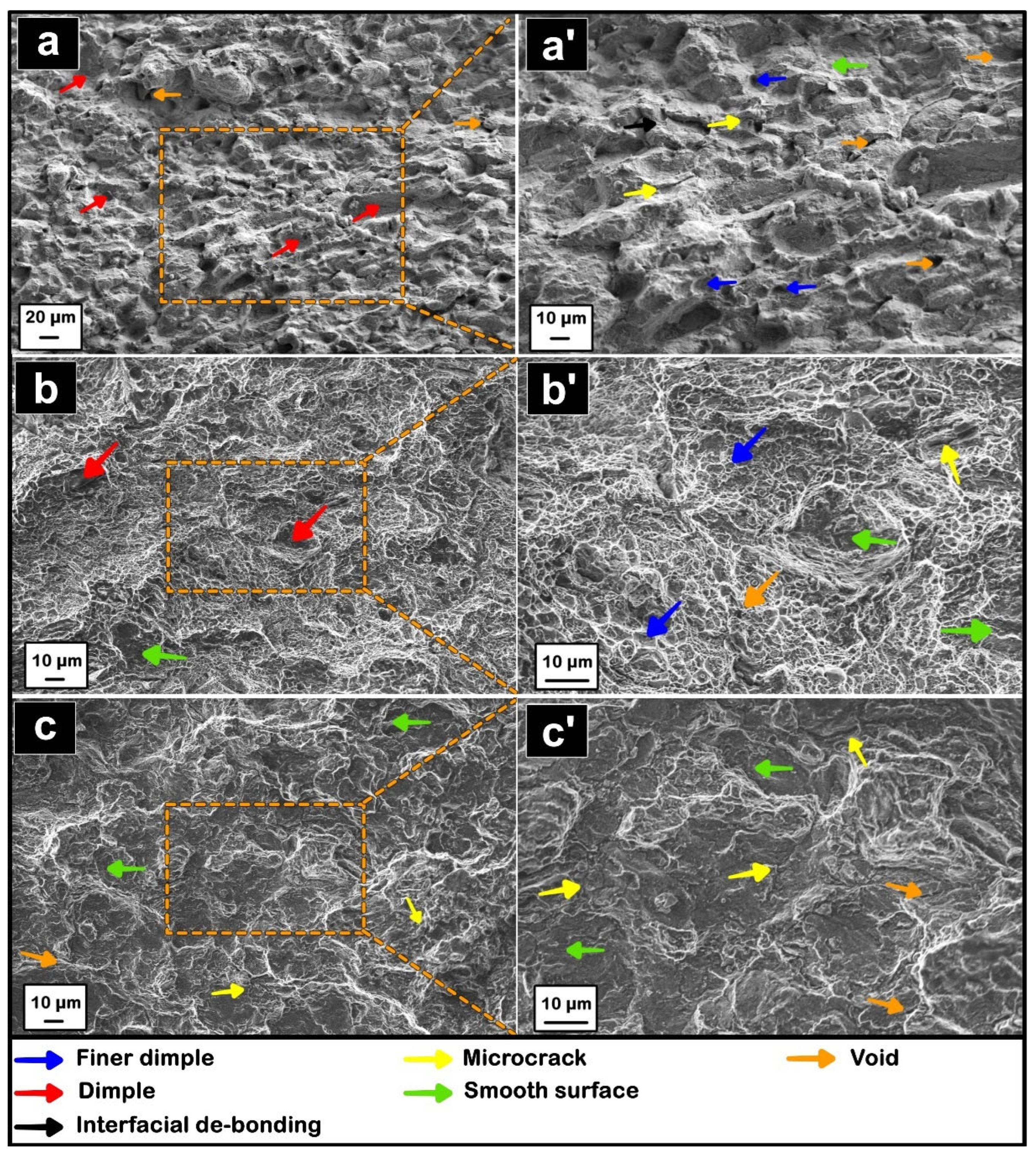
The fracture surface morphologies of the AA2024 alloy, along with those of the lowest (B0.5) and highest (B2) B4C-reinforced nanocomposites after tensile testing, are presented in Figure 9. The examination of these fracture surfaces reveals a clear transition in fracture mechanisms with increasing nano-sized B4C reinforcement content in the AA2024 matrix (Figure 9(a,a’)). The unreinforced AA2024 alloy exhibits a predominantly ductile fracture surface, characterized by large and deep dimples formed through microvoid coalescence. These dimples are indicative of extensive plastic deformation and energy absorption prior to final fracture, which is typical of ductile fracture behavior in Al alloys [52,53]. Upon the addition of 0.5 wt.% nano-B4C, the fracture surface undergoes a noticeable morphological change. The large dimples observed in the base alloy are replaced by finer and more uniformly distributed dimples, suggesting a reduction in plastic deformability due to the presence of hard ceramic particles (Figure 9(b,b’)). Additionally, the fracture surface displays tear ridges—features formed by localized shear deformation—which indicate the coexistence of ductile and quasi-brittle fracture modes. The presence of occasional smooth facets on the fracture surface may correspond to regions of particle–matrix decohesion or localized brittle cracking around the ceramic reinforcements. At a higher reinforcement level of 2 wt.% B4C, the fracture surface exhibits a more brittle-like morphology, dominated by smooth and flat regions with limited evidence of plastic deformation (Figure 9(c,c’)). The prevalence of smooth facets suggests that crack propagation occurred along weakened interfaces or through brittle cleavage mechanisms. However, the presence of some tear ridges indicates that localized plastic deformation still occurs, likely in areas where reinforcement is less concentrated or better bonded with the matrix. The progressive transition from ductile to quasi-brittle and eventually to predominantly brittle fracture behavior can be attributed to the increasing volume fraction of nano-B4C particles, which act as strong barriers to dislocation motion, reduce the plasticity of the matrix, and introduce stress concentration sites. Moreover, the nano-B4C particles may promote microcrack initiation at the particle–matrix interface or within agglomerates, thereby facilitating premature fracture with limited plastic deformation. These observations are consistent with known fracture behavior in metal matrix composites, where increasing ceramic reinforcement content typically enhances strength but reduces ductility, leading to a more brittle fracture profile [54,55,56].

3.6. Wear Behavior

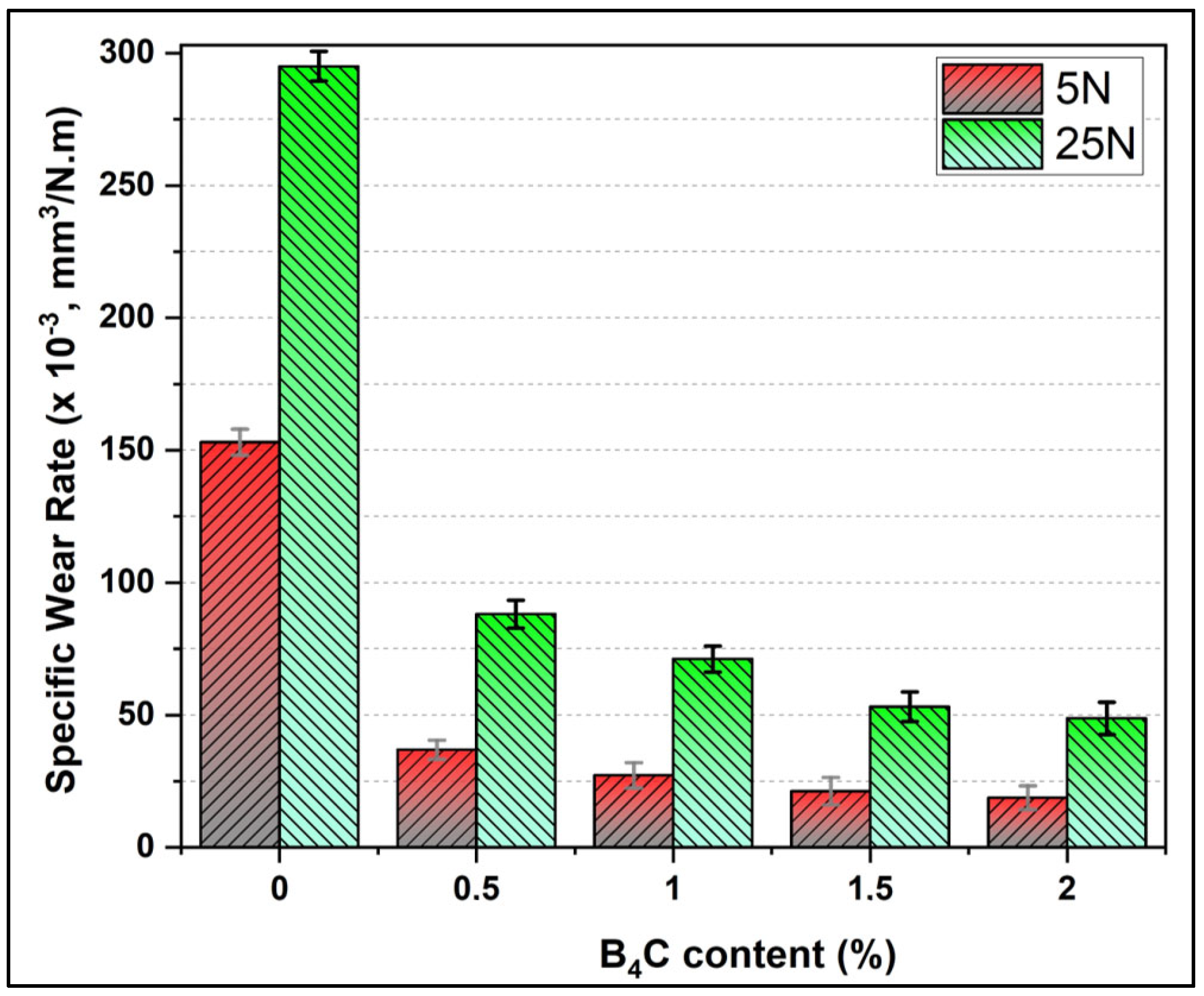
Figure 10 presents the wear rate data for the unreinforced AA2024 alloy and B4C-reinforced nanocomposite specimens under applied normal loads of 5 N and 25 N. The AA2024 alloy, characterized by its relatively low intrinsic hardness and absence of any secondary hard phases, exhibits the highest wear rates under both loading conditions. This pronounced wear behavior is primarily attributed to the alloy’s limited ability to resist plastic deformation and surface damage during sliding, which facilitates accelerated material removal upon repeated contact with the counter surface [44,57]. Quantitatively, the unreinforced AA2024 demonstrates wear rates of 153 × 10−3 mm3/N·m under a 5 N load and 295 × 10−3 mm3/N·m under a 25 N load, indicating its susceptibility to tribological degradation in both mild and severe loading regimes. The incorporation of nano-B4C particles into the AA2024 matrix leads to a significant suppression of wear, as evidenced by a marked reduction in volumetric wear rates across all reinforcement levels. For instance, the specimen designated as B0.5, containing 0.5 wt.% B4C, exhibits a wear rate of 36.8 × 10⁻³ mm3/N·m under a 5 N load, corresponding to a notable ~75% decrease in wear compared to the base alloy. This trend continues with increasing B4C content; the B2 specimen (2 wt.% B4C) demonstrates superior wear performance, with wear rates of 18.7 × 10⁻³ mm3/N·m and 48.7 × 10⁻³ mm3/N·m under 5 N and 25 N loads, respectively—reflecting approximate reductions of 88% and 84% relative to the unreinforced counterpart. This enhancement in wear resistance can be primarily ascribed to the mechanical reinforcement effect introduced by the hard ceramic B4C particles. These particles significantly increase the composite’s bulk hardness and contribute to improved load-bearing capacity at the sliding interface, thereby mitigating plastic deformation and reducing the extent of material removal during sliding contact [58,59]. Moreover, B4C particles act as effective barriers against micro-cutting and ploughing actions by restricting direct contact between the softer matrix and the abrasive counterface [60]. At the microscale, these reinforcements contribute to a shift in the dominant wear mechanisms—from adhesive and abrasive wear typically observed in ductile alloys to more controlled micro-abrasive and oxidative wear modes in the nanocomposites.
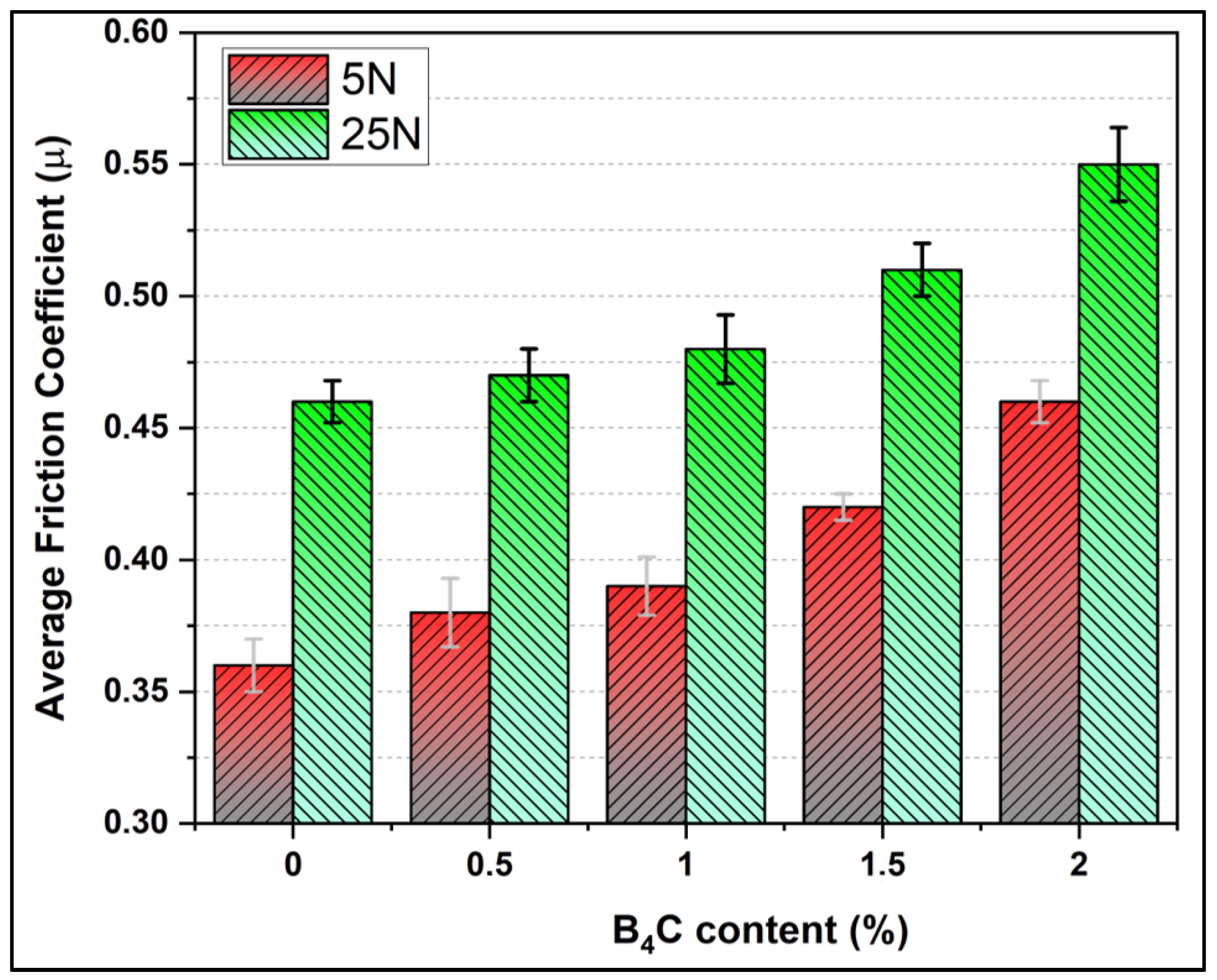
Figure 11 presents the average friction coefficient (AFC) values obtained from dry sliding wear tests performed at a sliding speed of 300 rpm over a distance of 500 m, under applied loads of 5 N and 25 N. For all specimens tested, the AFC values exhibited an increasing trend with increasing load. Notably, nanocomposites consistently exhibited higher AFC values than the unreinforced AA2024 alloy under both loading conditions. This observation is particularly noteworthy, as the wear rate decreases with increasing B4C content, yet the friction coefficient increases. It is important to emphasize that wear resistance and friction coefficient do not always show parallel behavior. The friction coefficient is an indicator of the resistance to sliding between two surfaces, and the addition of hard particles increases the contact pressure at the interface, thereby enhancing sliding resistance. In the present study, the AA2024 alloy demonstrated an average friction coefficient of 0.36 under a 5 N load, whereas B2 sample exhibited a value of 0.46 under identical conditions. Under a 25 N load, these values increased to 0.46 and 0.55, respectively. This increase in AFC is primarily attributed to the microstructural changes and surface interactions induced by the hard B4C nanoparticles. These particles restrict matrix deformation during sliding and create sharper and harder asperities at the contact interface, increasing surface roughness at the microscale. This effect is more pronounced under lower loads due to the relatively smaller contact area, resulting in higher localized friction [61,62]. As the load increases, the contact area expands and the particle–matrix interfacial bonds are more heavily stressed, contributing to the continued increase in friction coefficient—albeit still higher than that of the unreinforced alloy. Furthermore, B4C particles have been reported to cause localized stress accumulation and third-body interactions at the contact surface, further complicating the tribological behavior [60,61]. In summary, the addition of nano-sized B4C particles to the AA2024 matrix not only enhances the wear resistance but also significantly influences the frictional behavior of the composite material.
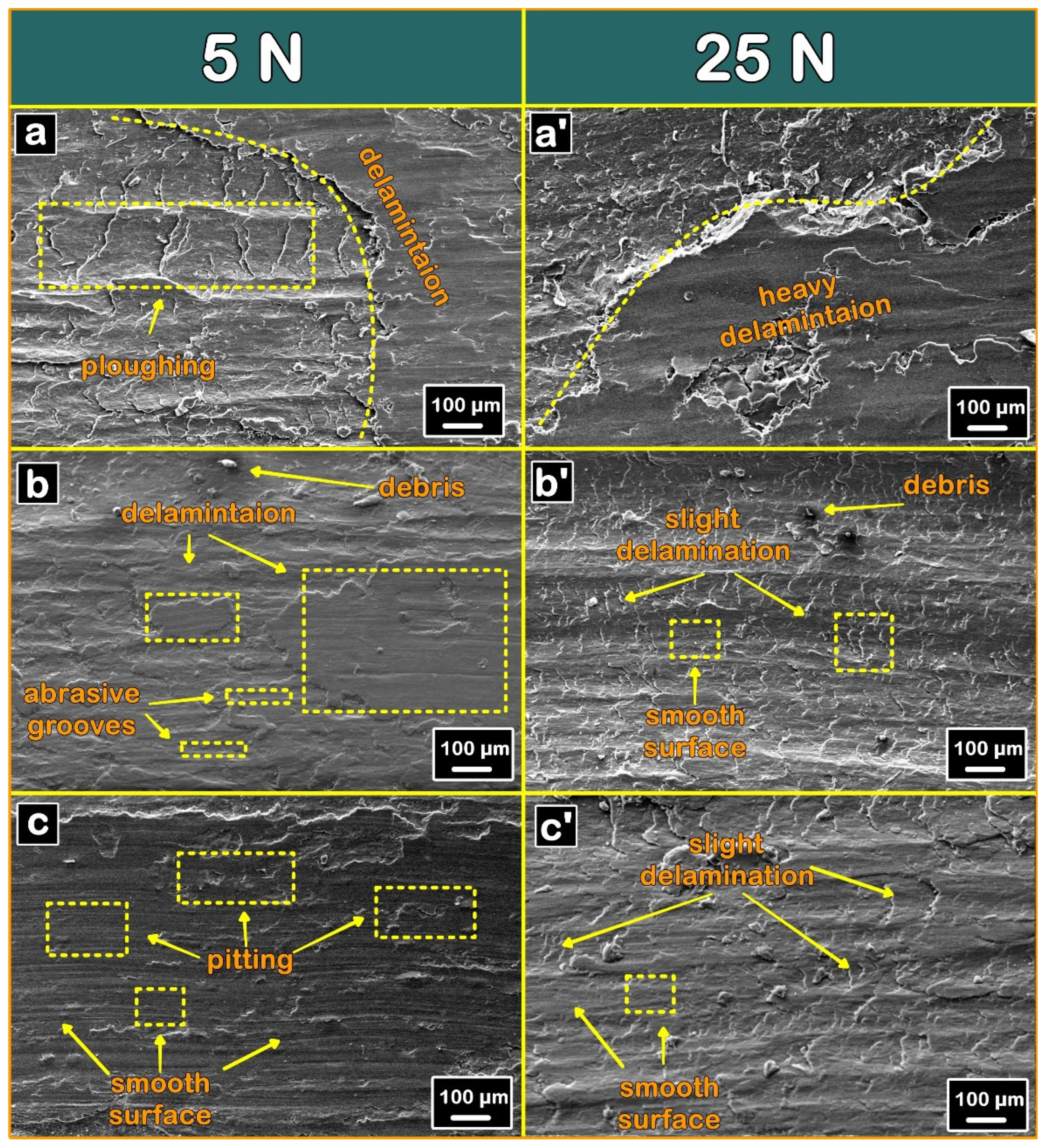
Figure 12 presents the worn surface morphologies of AA2024 and nanocomposite specimens following dry sliding wear tests conducted at a sliding speed of 300 rpm over a distance of 500 m, under applied normal loads of 5 N and 25 N. As shown in Figure 12a, the surface morphology of the unreinforced AA2024 alloy under a 5 N load reveals the presence of abrasive ploughing, grooving, and mild delamination, indicative of a relatively moderate material removal process. The coexistence of grooves and ploughing suggests that hard asperities or debris particles slid along the surface, inducing plastic deformation without substantial material loss. Simultaneously, the presence of localized delamination zones points to the initiation of subsurface cracks driven by repeated shear stresses during sliding. Furthermore, due to the temperature sensitivity of the mechanical properties of the AA2024 alloy, localized softening or detachment of surface regions occurs during wear, leading to the smearing of material onto the surface in the form of bands and patches as a result of frictional heating. This observation confirms that the alloy undergoes plastic flow under frictional forces, contributing to material transfer onto the worn surface. However, upon increasing the applied load to 25 N (Figure 12a’), the worn surface is dominated by severe delamination, characterized by large-scale material detachment and lamellar flake formation. This transition is attributed to the intensified contact stress and elevated frictional temperature generated under higher loading, which promote rapid propagation of subsurface cracks and weaken the interfacial cohesion within the alloy structure [63,64]. Overall, the dominant wear mechanism for the unreinforced AA2024 alloy under both loading conditions is identified as adhesive wear, accompanied by delamination.
When 0.5 wt.% nano-B4C particles were introduced into the AA2024 matrix, a significant alteration in surface morphology was observed under both 5 N and 25 N loads, as illustrated in Figure 12b. At the load of 5 N, the worn surface exhibited a noticeable reduction in the extent and severity of delamination layers compared to the unreinforced alloy. Instead, well-defined abrasive grooves and relatively smoother regions began to emerge, indicating a transition in the dominant wear mechanism. The presence of B4C particles enhanced surface hardness and improved load distribution across the contact interface, thereby suppressing subsurface crack growth that typically leads to delamination. Acting as hard ceramic reinforcements, the B4C particles served as barriers to plastic deformation and contributed to preserving surface structural integrity during sliding [60,64]. Under the load of 25 N (Figure 12b’), although delamination was still present, it appeared as frequent but shallow zones, rather than as severe lamellar peeling. Moreover, the worn surface was characterized by smoother regions and the presence of fine debris particles, suggesting that the material underwent a more stable and controlled wear process. Collectively, the addition of 0.5 wt.% B4C shifted the wear mechanism from being predominantly delamination-driven to a combination of mild abrasive wear and limited fatigue-induced delamination.
When the B4C content was increased to 2 wt.%, a further improvement in surface integrity was observed under both loading conditions, as depicted in Figure 12c. At 5 N, delamination zones—commonly associated with severe subsurface cracking and interfacial separation—were almost entirely eliminated. This result suggests that the reinforced composite structure can more effectively resist localized stresses, thereby suppressing delamination as the dominant wear mechanism. At 25 N (Figure 12c’), although mild and localized delamination features remained, their frequency and severity were significantly reduced compared to both the unreinforced alloy and lower-reinforced composites. Additionally, under the 5 N load, isolated pitting regions—small-scale surface voids typically resulting from localized plastic deformation and/or particle pull-out—were occasionally observed. However, the limited number of such features indicates that surface damage was minor and non-propagative. More importantly, under both loading conditions, the worn surfaces predominantly exhibited smooth and continuous morphologies. This smoothness suggests the dominance of mild abrasive or oxidative wear mechanisms rather than severe adhesive or delamination wear, representing a transition toward a more stable wear regime.

3.7. Electrochemical Corrosion Behavior

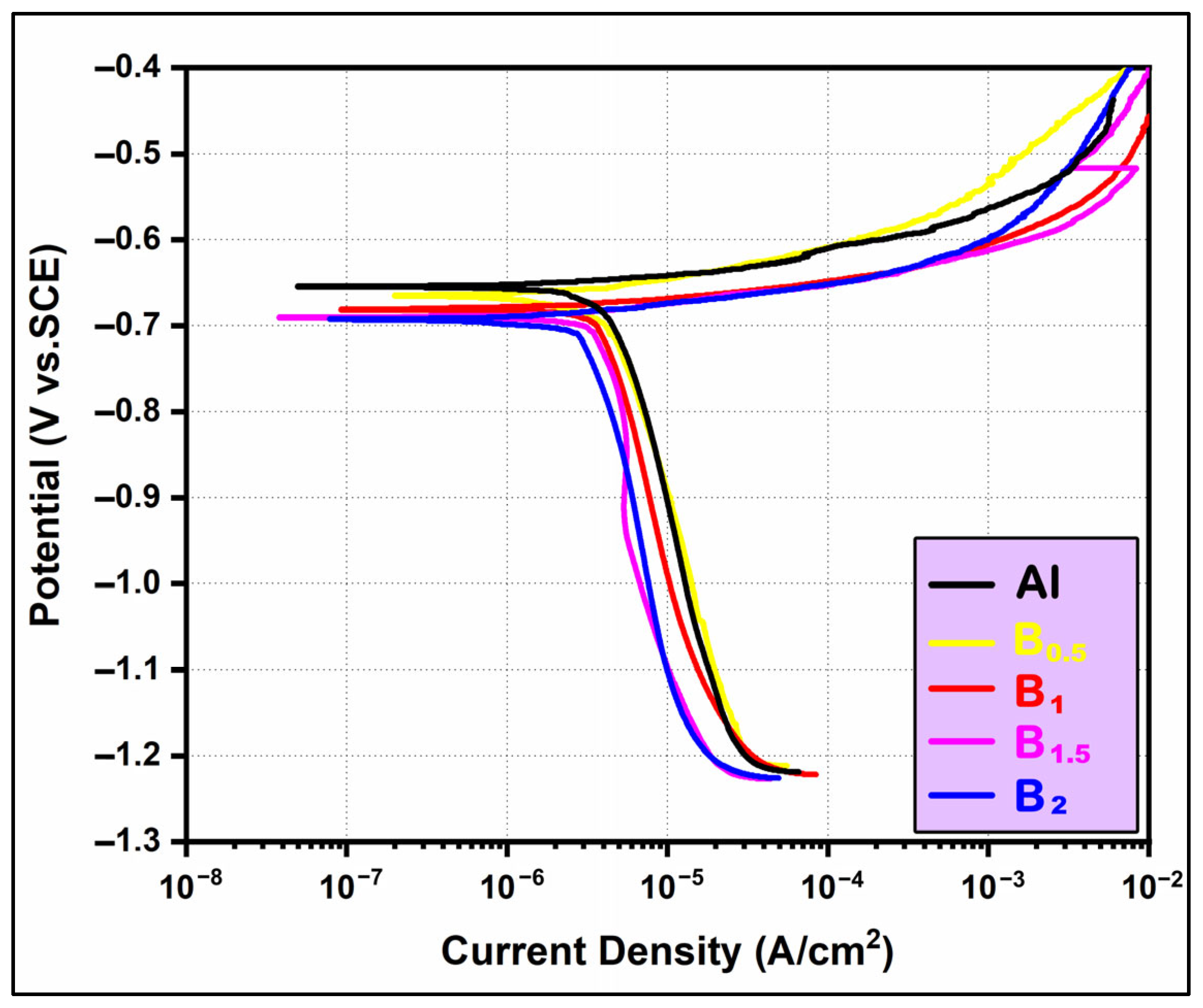
The electrochemical corrosion performance of unreinforced AA2024 alloy and its nanocomposites reinforced with varying amounts of nano-B4C particles was evaluated using potentiodynamic polarization tests conducted in an aqueous solution of 3.5 wt.% NaCl. The results, depicted in Figure 13 and summarized in Table 4, provide significant insights into the effect of B4C reinforcement on corrosion behavior. The polarization curves clearly demonstrate a shift in both corrosion current density (Icorr) and corrosion potential (Ecorr) values with increasing B4C content, which strongly influences the corresponding corrosion rate. The unreinforced AA2024 alloy exhibited the highest corrosion current density (5.68 µA) and the most positive corrosion potential (−654 mV). These values correspond to the highest corrosion rate among the samples tested, calculated as 8.014 mpy. This behavior is consistent with the well-known susceptibility of AA2024 to localized corrosion, which arises from its microstructural heterogeneity and the presence of intermetallic phases such as Al2Cu and Al2CuMg [65,66]. These phases often act as preferential sites for anodic or cathodic reactions, promoting micro-galvanic corrosion and accelerating material degradation in chloride-containing environments [66,67]. Upon the introduction of 0.5 wt.% B4C particles (sample B0.5), a moderate improvement in corrosion resistance was observed. The Icorr value decreased to 4.97 µA and Ecorr shifted to a slightly more negative value of −665 mV. Correspondingly, the corrosion rate was reduced to 7.127 mpy, indicating that even at low reinforcement levels, the presence of B4C particles exerts a protective effect on the matrix alloy. This effect becomes more pronounced as the B4C content increases. The B1 sample showed further improvements with a reduced Icorr of 4.45 µA and a more noble Ecorr value of −681 mV, leading to a corrosion rate of 6.573 mpy. For B1.5 sample, the Icorr dropped to 4.24 µA and Ecorr reached −690 mV, resulting in a corrosion rate of 5.925 mpy.
The most significant enhancement in corrosion resistance was observed for the B2 sample which exhibited the lowest Icorr value (3.47 µA) and a corrosion potential of −689 mV. The corrosion rate of this sample was calculated to be 4.897 mpy, representing a substantial 39% reduction compared to the unreinforced alloy. The decreasing trend in Icorr values with increasing B4C content indicates a consistent improvement in corrosion resistance, which can be attributed to multiple synergistic mechanisms induced by the presence of nano-ceramic reinforcement. Firstly, the nano-B4C particles, due to their high chemical stability and inert nature, do not actively participate in the corrosion process [68]. Instead, they act as passive physical barriers within the metal matrix, interrupting the continuity of the conductive metallic phase and thereby limiting the percolation paths for corrosive species. Their uniform dispersion throughout the matrix hinders the diffusion of aggressive ions, such as Cl, and impedes the electrochemical interactions responsible for pitting and crevice corrosion [69,70]. Secondly, the B4C reinforcements contribute to a significant refinement of the microstructure. This grain refinement results in more homogeneous electrochemical behavior, reducing the severity of localized corrosion cells. Additionally, the particle–matrix interfaces may act as barriers that absorb or deflect propagating corrosion fronts, further delaying the onset of severe degradation [68,71].
The improvement in corrosion resistance is primarily reflected by the reduction in corrosion current density, despite minor shifts in Ecorr. The decrease in Icorr is a more dominant indicator of the overall corrosion resistance. In this context, the increasingly negative Ecorr values may reflect a reduction in galvanic coupling between the matrix and intermetallic phases, as B4C particles help reduce the electrochemical heterogeneity of the surface. Another important factor is the potential role of B4C in stabilizing or promoting passive film formation on the Al matrix. Although AA2024 does not naturally form a highly protective oxide layer due to the disruption caused by intermetallic constituents, the presence of B4C may reduce the density or connectivity of cathodic sites, which suppresses the breakdown of passive films and prolongs the stable passive state [72].
It is also worth noting that the effectiveness of B4C in enhancing corrosion resistance is not linear indefinitely. While an increase from 0.5 wt.% to 2 wt.% leads to steady improvements, higher concentrations beyond this threshold may result in particle agglomeration, increased porosity, or interfacial defects, which could act as localized corrosion initiation sites. Therefore, the 2 wt.% B4C reinforcement appears to be close to the optimum in the studied range, balancing mechanical enhancement with electrochemical stability.
Although the Ecorr shifts slightly toward more negative values with increasing B4C content, the corrosion resistance of the nanocomposites improves markedly, as evidenced by the reduced corrosion current density. This behavior indicates that the presence of nano-sized B4C primarily affects corrosion kinetics rather than corrosion thermodynamics. As an electrochemically inert reinforcement, B4C does not participate directly in anodic or cathodic reactions; instead, it contributes to a more compact microstructure, interrupts continuous corrosion paths, and limits localized dissolution of the aluminum matrix.
The findings of this study have shown that the B4C additive derived from boron mineral, which has abundant reserves in the world [73,74], can be brought into the economy and that the technical properties of the AA2024 alloy used in the automotive, aerospace, and marine sectors can be improved by adding the B4C.

4. Conclusions

This study demonstrated that the incorporation of nano-sized B4C particles into an AA2024 matrix via powder metallurgy significantly alters powder characteristics, microstructural features, and functional performance. The presence of hard nano-B4C particles promoted powder refinement during mechanical milling through enhanced fracture and embedding mechanisms, leading to improved particle hardness and a more homogeneous powder morphology. The effective embedding of nano-B4C within the aluminum matrix resulted in strong interfacial bonding and contributed to mechanical strengthening through a combination of grain refinement, dislocation hindrance, and improved load transfer. These microstructural modifications were directly reflected in the enhanced mechanical performance of the nanocomposites. From a tribological perspective, the improved wear resistance of the nanocomposites was primarily associated with increased surface hardness and the load-bearing capability introduced by the ceramic reinforcement. Although the presence of hard B4C particles slightly increased the friction coefficient, the dominant wear mechanisms shifted toward more stable and less severe regimes, resulting in a substantial suppression of material loss.
In addition, the incorporation of nano-B4C improved the corrosion resistance of AA2024 by reducing corrosion kinetics, which is attributed to the inert nature of the ceramic particles and their role in interrupting active corrosion paths within the matrix. As a result, the findings highlight that nano-sized B4C can be effectively utilized as a single ceramic reinforcement to achieve a balanced improvement in mechanical, tribological, and corrosion properties of AA2024-based nanocomposites, providing useful insight for the design of multifunctional aluminum-based materials produced by powder metallurgy.

Author Contributions

Conceptualization, Methodology, Validation, Formal analysis, Writing—original draft, Writing—review and editing, Visualization, Investigation Resources, Data curation: M.Ç.; Conceptualization, Methodology, Validation, Formal analysis, Investigation, Resources, Data curation, Writing—original draft, Supervision, Project administration, Funding acquisition: A.Ç.; Writing—original draft, Writing—review and editing, Funding acquisition: S.K. All authors have read and agreed to the published version of the manuscript.

Funding

This research was funded by Karadeniz Technical University, grant number FBA-2019-8188 and the 10% of APC was funded by Recep Tayyip Erdoğan University.

Institutional Review Board Statement

Not applicable.

Informed Consent Statement

Not applicable.

Data Availability Statement

Data is contained within the article.

Conflicts of Interest

The authors declare that they have no known competing financial interests or personal relationships that could have appeared to influence the work reported in this paper.

References

  1. Kumar, A.; Singh, V.P.; Singh, R.C.; Chaudhary, R.; Kumar, D.; Mourad, A.-H.I. A Review of Aluminum Metal Matrix Composites: Fabrication Route, Reinforcements, Microstructural, Mechanical, and Corrosion Properties. J. Mater. Sci. 2024, 59, 2644–2711. [Google Scholar] [CrossRef]
  2. Czerwinski, F. Aluminum Alloys for Electrical Engineering: A Review. J. Mater. Sci. 2024, 59, 14847–14892. [Google Scholar] [CrossRef]
  3. Çevik, Z.A.; Karabacak, A.H.; Kök, M.; Canakçı, A.; Kumar, S.S.; Varol, T. The Effect of Machining Processes on the Physical and Surface Characteristics of AA2024-B4C-SiC Hybrid Nanocomposites Fabricated by Hot Pressing Method. J. Compos. Mater. 2021, 55, 2657–2671. [Google Scholar] [CrossRef]
  4. Karabacak, A.H.; Canakci, A.; Özkaya, S.; Tunç, S.A.; Çevik, Z.A.; Yalçın, E.D. The Effects of Different Types and Ratios of Reinforcement, and Machining Processes on the Machinability of Al2024 Alloy Nanocomposites. J. Compos. Mater. 2023, 57, 2811–2827. [Google Scholar] [CrossRef]
  5. Çalıgülü, U.; Kaçmış, M.V.; Karabacak, A.H.; Çanakçı, A.; Özkaya, S. Investigation of Corrosion Resistance and Impact Performance Properties of Al2O3/SiC-Doped Aluminium-Based Composites. Bull. Mater. Sci. 2023, 46, 156. [Google Scholar] [CrossRef]
  6. Alwin, A.H.; Ksibi, H. Enhancing High-Temperature Fatigue Performance of AA2024-T4 Alloy Through Shot Peening: A Comprehensive Numerical Simulation. Strength Mater. 2024, 56, 597–609. [Google Scholar] [CrossRef]
  7. Gebreamlak, G.; Palani, S.; Sirahbizu, B. Mechanical Characteristics of Dissimilar Friction Stir Welding Processes of Aluminium Alloy [AA 2024-T351 and AA 7075-T651]. Manuf. Rev. 2024, 11, 19. [Google Scholar] [CrossRef]
  8. Navya, C.; Chandra Sekhara Reddy, M. Contemporary Machining of a Stir Cast Aluminum Alloy Hybrid Metal Matrix Composite: A Study. Mater. Manuf. Process. 2025, 40, 1437–1447. [Google Scholar] [CrossRef]
  9. Adi, S.S.; Malik, V.R. Friction Stir Processing of Aluminum Machining Waste: Carbon Nanostructure Reinforcements for Enhanced Composite Performance—A Comprehensive Review. Mater. Manuf. Process. 2025, 40, 285–334. [Google Scholar] [CrossRef]
  10. Bhardwaj, A.R.; Meshram, P.D.; Chakule, R.R.; Gupta, P. Processing of Aluminum Metal Matrix Composite with Titanium Carbide Reinforcement. Mater. Manuf. Process. 2025, 40, 1157–1171. [Google Scholar] [CrossRef]
  11. Subbaratnam, B.; Kmar, S.N.; Seshappa, A.; Raj, K.P.; Jayahari, L.; Prasad, B.A. Improving the Technological Characteristics of an Al-7175/SiC/B4C Composite. In Proceedings of the International Conference on Advanced Materials, Manufacturing and Sustainable Development (ICAMMSD 2024), Kurnool, India, 22–23 November 2024; pp. 490–507. [Google Scholar]
  12. Zong, Y.; Zhang, Q.; Liu, B.; Liu, Q.; Cheng, X.; Li, Q.; Chang, R.; Wang, Z.; Li, A.; Mu, Y.; et al. Conductive In-Situ B4C/Graphite Composites Prepared by Spark Plasma Sintering Using Nanodiamond as an Additive. SSRN 2025. [Google Scholar] [CrossRef]
  13. Dixit, A.C.; Harshavardhan, B.; Ashok, B.C. Aluminum Boron Carbide Metal Matrix Composites for Fatigue-Based Applications: A Comprehensive Review. World J. Adv. Res. Rev. 2024, 24, 658–666. [Google Scholar] [CrossRef]
  14. Jiang, L.; Xue, W.; Kang, P.; Chao, Z.; Han, H.; Zhang, R.; Du, S.; Han, B.; Zhao, Q.; Wu, G. Enhanced Ductility of B4C/Al Composites by Controlling Thickness of Interfacial Oxide Layer through High Temperature Oxidation of B4C Particles. J. Alloys Compd. 2023, 937, 168486. [Google Scholar] [CrossRef]
  15. Yalçın, E.D.; Çanakçı, A.; Çuvalcı, H.; Varol, T.V.; Karabacak, A.H. The Effect of Boron Nitride (h-BN) and Silicon Carbide (SiC) on the Microstructure and Wear Behavior of ZA40/SiC/h-BN Hybrid Composites Processed by Hot Pressing. Kov. Mater.-Met. Mater. 2023, 61, 257–266. [Google Scholar] [CrossRef]
  16. Zhou, J.; Zhu, Y.; Lu, M.; Shen, M.; Wei, W. Experimental Investigations on Ultrasonic Elliptical Vibration Turning of SiCp/Al Composites. Mater. Manuf. Process. 2025, 40, 415–423. [Google Scholar] [CrossRef]
  17. Tahamtan, S.; Emamy, M.; Halvaee, A. Effects of Reinforcing Particle Size and Interface Bonding Strength on Tensile Properties and Fracture Behavior of Al-A206/Alumina Micro/Nanocomposites. J. Compos. Mater. 2014, 48, 3331–3346. [Google Scholar] [CrossRef]
  18. De Cicco, D.; Asaee, Z.; Taheri, F. Use of Nanoparticles for Enhancing the Interlaminar Properties of Fiber-Reinforced Composites and Adhesively Bonded Joints—A Review. Nanomaterials 2017, 7, 360. [Google Scholar] [CrossRef] [PubMed]
  19. Baig, Z.; Mamat, O.; Mustapha, M. Recent Progress on the Dispersion and the Strengthening Effect of Carbon Nanotubes and Graphene-Reinforced Metal Nanocomposites: A Review. Crit. Rev. Solid State Mater. Sci. 2018, 43, 1–46. [Google Scholar] [CrossRef]
  20. Fang, J.; Tan, Y.C.; Tai, V.C.; Janasekaran, S.; Kee, C.C.; Wang, D.; Yang, Y. Selective Laser Melting of Titanium Matrix Composites: An in-Depth Analysis of Materials, Microstructures, Defects, and Mechanical Properties. Heliyon 2024, 10, e40200. [Google Scholar] [CrossRef]
  21. Gao, M.; Chen, Z.; Li, L.; Guo, E.; Kang, H.; Xu, Y.; Wang, T. Microstructure and Enhanced Mechanical Properties of Hybrid-Sized B4C Particle-Reinforced 6061Al Matrix Composites. Mater. Sci. Eng. A 2021, 802, 140453. [Google Scholar] [CrossRef]
  22. Bommana, D.; Sahoo, N.; Dwivedy, S.K.; Senapati, N.P.; Dora, S.P.; Chintada, S.; Vennela, V.K.L. Investigating the Effect of Single-Walled Carbon Nanotubes and Relative Density on the Compressive Properties and Deformation Behaviors of Closed-Cell AA 6061-B4C-SiC-SWCNTs Hybrid Composite Foams. J. Alloys Compd. 2025, 1034, 181446. [Google Scholar] [CrossRef]
  23. Varol, T.; Canakci, A.; Ozkaya, S.; Erdemir, F. Determining the Effect of Flake Matrix Size and Al2O3 Content on Microstructure and Mechanical Properties of Al2O3 Nanoparticle Reinforced Al Matrix Composites. Part. Sci. Technol. 2018, 36, 312–323. [Google Scholar] [CrossRef]
  24. Sharath, B.N.; Rao, R. Comparative Study of Mechanical Alloying and Other Conventional Powder Metallurgical Methods. In Mechanical Alloying of Ferrous and Non-Ferrous Alloys; Elsevier: Amsterdam, The Netherlands, 2024; pp. 83–118. [Google Scholar]
  25. Révész, Á.; Gajdics, M. Improved H-Storage Performance of Novel Mg-Based Nanocomposites Prepared by High-Energy Ball Milling: A Review. Energies 2021, 14, 6400. [Google Scholar] [CrossRef]
  26. Kumar, D.; Seetharam, R.; Ponappa, K. Effects of Graphene Nano Particles on Interfacial Microstructure and Mechanical Properties of Al7150/B4C Hybrid Nanocomposite Fabricated by Novel Double Ultrasonic Two Stage Stir Casting Technique. J. Alloys Compd. 2024, 1008, 176686. [Google Scholar] [CrossRef]
  27. Dudina, D.V.; Bokhonov, B.B. Materials Development Using High-Energy Ball Milling: A Review Dedicated to the Memory of M.A. Korchagin. J. Compos. Sci. 2022, 6, 188. [Google Scholar] [CrossRef]
  28. Alem, S.A.A.; Sabzvand, M.H.; Govahi, P.; Poormehrabi, P.; Hasanzadeh Azar, M.; Salehi Siouki, S.; Rashidi, R.; Angizi, S.; Bagherifard, S. Advancing the next Generation of High-Performance Metal Matrix Composites through Metal Particle Reinforcement. Adv. Compos. Hybrid. Mater. 2025, 8, 3. [Google Scholar] [CrossRef]
  29. Munir, K.S.; Zheng, Y.; Zhang, D.; Lin, J.; Li, Y.; Wen, C. Microstructure and Mechanical Properties of Carbon Nanotubes Reinforced Titanium Matrix Composites Fabricated via Spark Plasma Sintering. Mater. Sci. Eng. A 2017, 688, 505–523. [Google Scholar] [CrossRef]
  30. Xu, T.; Mei, Q.S.; Liao, L.Y.; Ma, Y.; Chen, Z.H.; Wang, Y.C.; Li, J.Y. A Comparative Study on the Microstructure and Strengthening Behaviors of Al Matrix Composites Containing Micro- and Nano-Sized B4C Particles. Mater. Sci. Eng. A 2023, 874, 145066. [Google Scholar] [CrossRef]
  31. Alizadeh, M.; Beni, H.A. Strength Prediction of the ARBed Al/Al2O3/B4C Nano-Composites Using Orowan Model. Mater. Res. Bull. 2014, 59, 290–294. [Google Scholar] [CrossRef]
  32. Chao, Z.L.; Sun, T.T.; Jiang, L.T.; Zhou, Z.S.; Chen, G.Q.; Wu, G.H. Ballistic Behavior and Microstructure Evolution of B4C/AA2024 Composites. Ceram. Int. 2019, 45, 20539–20544. [Google Scholar] [CrossRef]
  33. Gaylan, Y.; Avar, B.; Panigrahi, M.; Aygün, B.; Karabulut, A. Effect of the B4C Content on Microstructure, Microhardness, Corrosion, and Neutron Shielding Properties of Al–B4C Composites. Ceram. Int. 2023, 49, 5479–5488. [Google Scholar] [CrossRef]
  34. Barik, S.; Bhandari, R.; Paul, T.; Samanta, S.K.; Mondal, M.K. Development of Novel Nano-B4C and CNF Reinforced Aluminium Matrix Hybrid Nanocomposite. Mater. Sci. Technol. 2025, 41, 1442–1459. [Google Scholar] [CrossRef]
  35. Reyaz, M.S.B.; Singh, J.; Bhati, S.S.; Mehdi, H.; Mishra, S. Evolution of Microstructure, Mechanical Properties, and Tribological Behavior of AA2024/B4C/Al2O3 Nanocomposites Fabricated by Multi-Pass FSP. J. Mater. Eng. Perform. 2025, 34, 25831–25849. [Google Scholar] [CrossRef]
  36. Çelebi, M.; Çanakçı, A.; Özkaya, S. Effect of Mechanical Milling Time on Powder Characteristic, Microstructure, and Mechanical Properties of AA2024/B4C/GNPs Hybrid Nanocomposites. Powder Technol. 2025, 449, 120439. [Google Scholar] [CrossRef]
  37. Çelebi, M.; Çanakçı, A.; Özkaya, S. Comparative Study of Powder Characteristics and Mechanical Properties of Al2024 Nanocomposites Reinforced with Carbon-Based Additives. Adv. Powder Technol. 2025, 36, 104835. [Google Scholar] [CrossRef]
  38. Bhoi, N.K.; Singh, H.; Pratap, S. Developments in the Aluminum Metal Matrix Composites Reinforced by Micro/Nano Particles—A Review. J. Compos. Mater. 2020, 54, 813–833. [Google Scholar] [CrossRef]
  39. Oke, S.R.; Maledi, N.; Okanlawon, I.A.; Bishi, T.R.; Falodun, O.E. Tensile and Corrosion Properties of Copper and Alumina Hybrid Reinforcement on Aluminum Matrix Composite. J. Compos. Mater. 2025, 59, 1595–1607. [Google Scholar] [CrossRef]
  40. Tunç, S.A.; Çanakçı, A.; Karabacak, A.H.; Çelebi, M.; Türkmen, M. Effect of Different PCA Types on Morphology, Physical, Thermal and Mechanical Properties of AA2024-B4C Composites. Powder Technol. 2024, 434, 119373. [Google Scholar] [CrossRef]
  41. Alihosseini, H.; Dehghani, K.; Kamali, J. Microstructure Characterization, Mechanical Properties, Compressibility and Sintering Behavior of Al-B4C Nanocomposite Powders. Adv. Powder Technol. 2017, 28, 2126–2134. [Google Scholar] [CrossRef]
  42. Varol, T.; Canakci, A. Effect of Particle Size and Ratio of B4C Reinforcement on Properties and Morphology of Nanocrystalline Al2024-B4C Composite Powders. Powder Technol. 2013, 246, 462–472. [Google Scholar] [CrossRef]
  43. Medjkoune, M.; Bottin-Rousseau, S.; Carroz, L.; Soucek, R.; Prévot, G.; Croset, B.; Micha, J.-S.; Akamatsu, S. Eutectic Grains and Orientation Relationships in Thin Directionally Solidified Al-Al2Cu Samples: A Laue Micro-Diffraction Study. J. Alloys Compd. 2025, 1036, 181841. [Google Scholar] [CrossRef]
  44. Çanakçı, A.; Çelebi̇, M. Determination of Nano-Graphene Content for Improved Mechanical and Tribological Performance of Zn-Based Alloy Matrix Hybrid Nanocomposites. J. Alloys Compd. 2024, 1001, 175152. [Google Scholar] [CrossRef]
  45. Lin, Y.; Wu, M.; Xiao, D.; Ma, Y.; Liu, W. Effect of Minor La Addition on the Microstructure and Mechanical Properties of Cast Al-Cu-Mn Alloys. J. Alloys Compd. 2025, 1021, 179747. [Google Scholar] [CrossRef]
  46. Oke, S.R.; Maledi, N.; Salaudeen, I.; Falodun, O.E. Exploring the Synergistic Effects of Cu and Al2O3 Reinforcements on Nanoindentation and Wear Properties of Aluminum Based Composite. Mater. Today Commun. 2025, 42, 111448. [Google Scholar] [CrossRef]
  47. Wąsik, A.; Leszczyńska-Madej, B.; Madej, M.; Goły, M. Effect of Heat Treatment on Microstructure of Al4Cu-SiC Composites Consolidated by Powder Metallurgy Technique. J. Mater. Eng. Perform. 2020, 29, 1841–1848. [Google Scholar] [CrossRef]
  48. Guo, H.; Zhang, Z.; Zhang, Y.; Cui, Y.; Sun, L.; Chen, D. Improving the Mechanical Properties of B4C/Al Composites by Solid-State Interfacial Reaction. J. Alloys Compd. 2020, 829, 154521. [Google Scholar] [CrossRef]
  49. Kosedag, E.; Ekici, R. Low-Velocity Impact Behaviors of B4C/SiC Hybrid Ceramic Reinforced Al6061 Based Composites: An Experimental and Numerical Study. J. Alloys Compd. 2025, 1010, 177525. [Google Scholar] [CrossRef]
  50. Wang, Y.; Monetta, T. Systematic Study of Preparation Technology, Microstructure Characteristics and Mechanical Behaviors for SiC Particle-Reinforced Metal Matrix Composites. J. Mater. Res. Technol. 2023, 25, 7470–7497. [Google Scholar] [CrossRef]
  51. Balog, M.; Krížik, P.; Školáková, A.; Švec, P.; Kubásek, J.; Pinc, J.; de Castro, M.M.; Figueiredo, R. Hall-Petch Strengthening in Ultrafine-Grained Zn with Stabilized Boundaries. J. Mater. Res. Technol. 2024, 33, 7458–7468. [Google Scholar] [CrossRef]
  52. Sasani, F.; Taheri, A.K.; Bahrami, H.; Pouranvari, M. Plastic Deformation and Fracture of AlMg6/CNT Composite: A Damage Evolution Model Coupled with a Dislocation-Based Deformation Model. J. Mater. Res. Technol. 2024, 31, 187–204. [Google Scholar] [CrossRef]
  53. Pouraliakbar, H.; Jandaghi, M.R. Mechanistic Insight into the Role of Severe Plastic Deformation and Post-Deformation Annealing in Fracture Behavior of Al-Mn-Si Alloy. Mech. Mater. 2018, 122, 145–158. [Google Scholar] [CrossRef]
  54. Magalhães, D.C.C.; Klıauga, A.M.; Sordı, V.L. Flow Behavior and Fracture of Al−Mg−Si Alloy at Cryogenic Temperatures. Trans. Nonferrous Met. Soc. China 2021, 31, 595–608. [Google Scholar] [CrossRef]
  55. Abdollahi, A.; Alizadeh, A.; Baharvandi, H.R. Dry Sliding Tribological Behavior and Mechanical Properties of Al2024–5 wt.%B4C Nanocomposite Produced by Mechanical Milling and Hot Extrusion. Mater. Des. 2014, 55, 471–481. [Google Scholar] [CrossRef]
  56. Nagaral, M.; Deshapande, R.G.; Auradi, V.; Boppana, S.B.; Dayanand, S.; Anilkumar, M.R. Mechanical and Wear Characterization of Ceramic Boron Carbide-Reinforced Al2024 Alloy Metal Composites. J. Bio-Tribo-Corros 2021, 7, 19. [Google Scholar] [CrossRef]
  57. Wu, J.; Li, Z.; Luo, Y.; Gao, Z.; Li, Y.; Zhao, Y.; Liao, Y.; Wu, C.; Jin, M. Influence of Synergistic Strengthening Effect of B4C and TiC on Tribological Behavior of Copper-Based Powder Metallurgy. Ceram. Int. 2023, 49, 2978–2990. [Google Scholar] [CrossRef]
  58. Gajević, S.; Miladinović, S.; Güler, O.; Özkaya, S.; Stojanović, B. Optimization of Dry Sliding Wear in Hot-Pressed Al/B4C Metal Matrix Composites Using Taguchi Method and ANN. Materials 2024, 17, 4056. [Google Scholar] [CrossRef] [PubMed]
  59. Singhal, V.; Shelly, D.; Babbar, A.; Lee, S.-Y.; Park, S.-J. Review of Wear and Mechanical Characteristics of Al-Si Alloy Matrix Composites Reinforced with Natural Minerals. Lubricants 2024, 12, 350. [Google Scholar] [CrossRef]
  60. Ren, S.; Gao, Z.; Fan, X.; Wang, H.; Wang, L. Exceptional Mechanical Performance and Macroscale Superlubricity Enabled by Core-Shell-like MoS2/B4C Film. Sci. China Technol. Sci. 2024, 67, 2018–2030. [Google Scholar] [CrossRef]
  61. Palanikumar, K.; Eaben Rajkumar, S.; Pitchandi, K. Influence of Primary B4C Particles and Secondary Mica Particles on the Wear Performance of Al6061/B4C/Mica Hybrid Composites. J. Bio-Tribo-Corros 2019, 5, 77. [Google Scholar] [CrossRef]
  62. Özler, L.; Tosun, G.; Özcan, M.E. Influence of B4C Powder Reinforcement on Coating Structure, Microhardness and Wear in Friction Surfacing. Mater. Manuf. Process. 2020, 35, 1135–1145. [Google Scholar] [CrossRef]
  63. Meghwal, A.; Anupam, A.; Schulz, C.; Hall, C.; Murty, B.S.; Kottada, R.S.; Vijay, R.; Munroe, P.; Berndt, C.C.; Ang, A.S.M. Tribological and Corrosion Performance of an Atmospheric Plasma Sprayed AlCoCr0.5Ni High-Entropy Alloy Coating. Wear 2022, 506–507, 204443. [Google Scholar] [CrossRef]
  64. Di Egidio, G.; Martini, C.; Börjesson, J.; Ghassemali, E.; Ceschini, L.; Morri, A. Dry Sliding Behavior of AlSi10Mg Alloy Produced by Laser-Based Powder Bed Fusion: Influence of Heat Treatment and Microstructure. Wear 2023, 516–517, 204602. [Google Scholar] [CrossRef]
  65. Sun, Z.; Ma, Y.; Ma, S.; Xiong, H.; Chen, B. Mechanical Properties and Corrosion Resistance Enhancement of 2024 Aluminum Alloy for Drill Pipe after Heat Treatment and Sr Modification. Mater. Today Commun. 2023, 36, 106805. [Google Scholar] [CrossRef]
  66. Zhang, Y.; Zhang, L.; Gao, X.; An, X.; Zong, L.; Jia, Z.; Zhou, H.; Sui, Y.; Sun, W. Tailoring Precipitate Distribution in 2024 Aluminum Alloy for Improving Strength and Corrosion Resistance. J. Mater. Sci. Technol. 2024, 194, 16–27. [Google Scholar] [CrossRef]
  67. Gharbi, O.; Jiang, D.; Feenstra, D.R.; Kairy, S.K.; Wu, Y.; Hutchinson, C.R.; Birbilis, N. On the Corrosion of Additively Manufactured Aluminium Alloy AA2024 Prepared by Selective Laser Melting. Corros. Sci. 2018, 143, 93–106. [Google Scholar] [CrossRef]
  68. Han, H.; Jiang, L.; Chao, Z.; Xue, W.; Zhu, M.; Han, B.; Zhang, R.; Du, S.; Luo, T.; Mei, Y. Revealing Corrosion Behavior of B4C/Pure Al Composite at Different Interfaces between B4C Particles and Al Matrix in NaCl Electrolyte. J. Mater. Res. Technol. 2023, 27, 7213–7227. [Google Scholar] [CrossRef]
  69. Dhawan, S.K.; Bhandari, H.; Ruhi, G.; Bisht, B.M.S.; Sambyal, P. Corrosion Preventive Materials and Corrosion Testing; CRC Press: Boca Raton, FL, USA, 2020; ISBN 9781315101217. [Google Scholar]
  70. Erdemir, F.; Canakci, A.; Varol, T.; Ozkaya, S. Corrosion and Wear Behavior of Functionally Graded Al2024/SiC Composites Produced by Hot Pressing and Consolidation. J. Alloys Compd. 2015, 644, 589–596. [Google Scholar] [CrossRef]
  71. Liu, T.; Lyu, W.; Li, Z.; Wang, S.; Wang, X.; Jiang, J.; Jiang, X. Recent Progress on Corrosion Mechanisms of Graphene-Reinforced Metal Matrix Composites. Nanotechnol. Rev. 2023, 12, 20220566. [Google Scholar] [CrossRef]
  72. Xue, W.; Jiang, L.; Kang, P.; Yang, W.; Zhao, Q.; Xu, Z.; Zhang, N.; Liu, H.; Wu, G. Design and Fabrication of a Nanoamorphous Interface Layer in B4C/Al Composites to Improve Hot Deformability and Corrosion Resistance. ACS Appl. Nano Mater. 2020, 3, 5752–5761. [Google Scholar] [CrossRef]
  73. Kutuk, S. Morphology, Crystal Structure and Thermal Properties of Nano-sized Amorphous Colemanite Synthesis. Arab. J. Sci. Eng. 2024, 49, 11699–11716. [Google Scholar] [CrossRef]
  74. Guner, N.U.; Kutuk, S.; Kutuk-Sert, T. Role of Calcination Process of Natural Colemanite Powder on Compressive Strength Property of Concrete. Heliyon 2025, 11, e41264. [Google Scholar] [CrossRef] [PubMed]
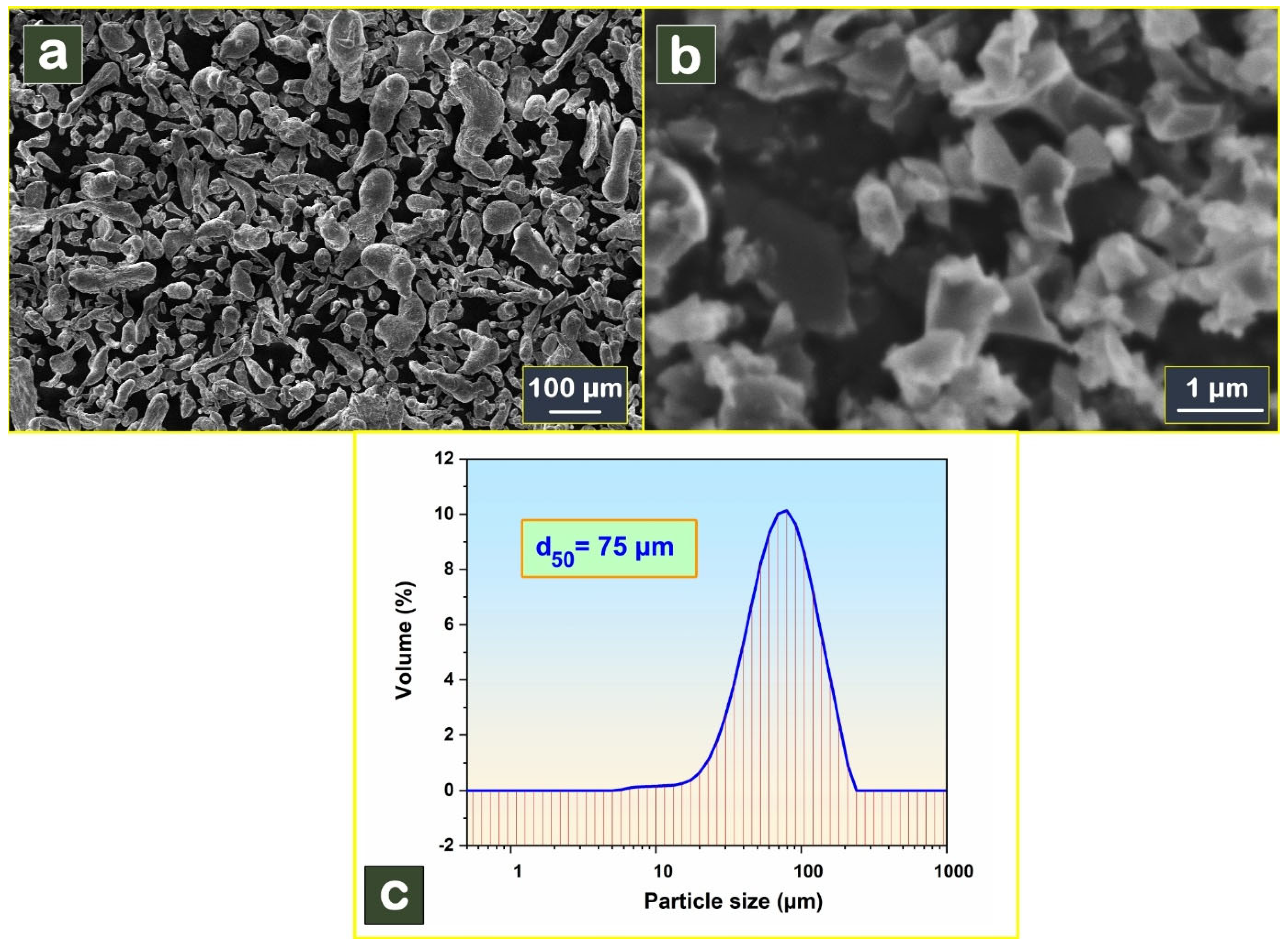
Figure 1. Initial powder morphologies of (a) AA2024 alloy and (b) B4C nanoparticles, and (c) particle size distribution of AA2024 alloy powder.
Coatings 16 00143 g001
Figure 2. The powder morphology and particle size distribution of AA2024/B4C nanocomposites: (a,a’) B0.5, (b,b’) B1, (c,c’) B1.5, and (d,d’) B2.
Coatings 16 00143 g002
Figure 3. SEM cross-sectional images of B2 nanocomposite powder and EDS mapping analyses: (a) SEM image, (bd) EDS mapping analysis and (e) EDS spectra.
Coatings 16 00143 g003
Figure 4. The influence of B4C content on the average particle size and particle microhardness.
Coatings 16 00143 g004
Figure 5. XRD curves of the AA2024 and AA2024/B4C nanocomposite powders.
Coatings 16 00143 g005
Figure 6. SEM microstructure images and EDS mapping analysis of (a) Al, (b) B0.5 and (c) B2 samples.
Coatings 16 00143 g006
Figure 7. The variation of relative density depending on the B4C content.
Coatings 16 00143 g007
Figure 8. The variation of hardness and tensile strength values depending on the B4C content.
Coatings 16 00143 g008
Figure 9. The fracture surfaces of (a,a’) Al, (b,b’) B0.5 and (c,c’) B2.
Coatings 16 00143 g009
Figure 10. The specific wear rates values of all samples under the wear load of 5 N and 25 N.
Coatings 16 00143 g010
Figure 11. The variation of AFC values of fabricated samples under the wear load of 5 N and 25 N.
Coatings 16 00143 g011
Figure 12. Worn surface of samples after the wear test under the load of 5 N and 25 N: (a,a’) Al, (b,b’) B0.5 and (c,c’) B2.
Coatings 16 00143 g012
Figure 13. Potential polarization curves of AA2024 alloy and nanocomposite samples.
Coatings 16 00143 g013
Table 1. Chemical composition of AA2024 alloy (wt.%) [36,37].
CuMgMnFeSiZnCrTiAl
4.851.780.3120.3740.3850.1380.0420.005Balance
Table 2. The milling conditions and identification codes for the nanocomposite samples.
Sample CodeReinforcement ContentMilling Time (h)Milling Speed (rpm)BPR
Al----
B0.50.583005:1
B1183005:1
B1.51.583005:1
B2283005:1
Table 3. EDS point analysis (in weight %).
PointAlCuMg
A46.2152.890.9
B95.272.032.7
Table 4. Corrosion parameters of AA2024 and nanocomposites.
SymbolIcorr (µA)Ecorr (mV)Corrosion Rate (mpy)
Al5.68−6548.014
B0.54.97−6657.127
B14.45−6816.573
B1.54.24−6905.925
B23.47−6894.897
Disclaimer/Publisher’s Note: The statements, opinions and data contained in all publications are solely those of the individual author(s) and contributor(s) and not of MDPI and/or the editor(s). MDPI and/or the editor(s) disclaim responsibility for any injury to people or property resulting from any ideas, methods, instructions or products referred to in the content.