Article

Influencing Factors of the Bending Properties of Resin-Treated Flattened Bamboo and Its Decorative Characteristics

1
College of Furnishings and Industrial Design, Nanjing Forestry University, Nanjing 210037, China
2
Co-Innovation Center of Efficient Processing and Utilization of Forest Resources, Nanjing 210037, China
*
Author to whom correspondence should be addressed.
Coatings 2026, 16(1), 139; https://doi.org/10.3390/coatings16010139
Submission received: 4 December 2025 / Revised: 13 January 2026 / Accepted: 19 January 2026 / Published: 21 January 2026
(This article belongs to the Section Environmental Aspects in Colloid and Interface Science)

Abstract

Cracking frequently occurs during the pressing process of flattened bamboo, significantly reducing yield rates. To address the lack of effective strategies for the mechanical reutilisation of cracked flattened bamboo, an epoxy resin-based treatment approach was proposed to improve both mechanical and decorative performance, inspired by resin-based decorative composites. Crack filling and full-cell impregnation methods were then systematically evaluated. This work is the first to systematically compare crack filling and full-cell impregnation strategies across different bamboo radial positions, with a simultaneous evaluation of mechanical performance and decorative properties. The results show that bamboo radial position has a pronounced influence on bending performance. The outer layer exhibits markedly higher bending strength and Young’s modulus than the inner layer, with mean differences of approximately 134 MPa and 13.3 GPa, respectively. Crack filling results in a measurable improvement in the bending performance of cracked flattened bamboo, whereas full-cell impregnation leads to a reduction in the bending properties of the outer layer. These results suggest that crack filling represents a more mechanically efficient and cost-effective treatment strategy. Resin treatment increases surface colour variation but minimally impacts yellowing resistance performance. These findings demonstrate that resin-treated flattened bamboo with cracks supports the resource utilisation of waste bamboo and shows potential for decorative and interior material applications.

1. Introduction

Bamboo has been widely used as an engineering and decorative material in construction and home furnishing applications due to its favourable mechanical properties [1,2,3]. As a natural biomass composite material with a unique gradient fibre structure, bamboo exhibits a gradual decrease in vascular bundle density and fibre volume fraction and an increase in parenchyma cell proportion from the outer layer to the inner layer [4,5]. Such radial gradients concurrently govern moisture transport and drying behaviour, which couple with anisotropic shrinkage to shape flexural response and defect formation [6,7]. This microstructural gradient distribution is the primary reason for the graded variation in bamboo’s bending properties [8,9]. Recent in situ observations at the single-cell scale further reveal the differential shrinkage of fibres versus parenchyma during drying, highlighting the mechanistic origin of warpage and crack initiation [10]. Therefore, a key challenge in bamboo processing technology research has been how to produce large panel-sized materials from moso bamboo.
This process involves the softening, flattening, drying, and shaping of bamboo culms or curved strips to obtain straightened bamboo sheets. Bamboo flattening technology has been widely developed to improve material utilisation and surface quality [11,12,13]. Wang et al. proposed a gradient thermo-compression softening process for producing flattened bamboo and reported that bamboo flattened at 180 °C exhibited the highest bending strength and bending modulus of elasticity (MOE) [14]. In addition, the elevated processing temperature resulted in a lower equilibrium moisture content, eliminating the need for secondary drying, which facilitates the engineering-scale production and application of flattened bamboo panels [15]. However, the release of residual growth stress and non-uniform shrinkage during the flattening and drying processes frequently induce cracking, which still remains a major challenge limiting the effective utilisation of flattened bamboo panels in furniture and decorative applications [11,16]. This behaviour is closely related to the pronounced radial density gradient of the bamboo wall, where the dense fibrous outer layer and the porous inner parenchyma respond differently to drying, thereby promoting shrinkage mismatch and crack initiation [17,18]. Although subsequent improvements, such as roller-pressing and stretching processes, have been introduced to enhance flattening uniformity and dimensional stability, cracking and splitting still persist. Lou et al. systematically reviewed existing strategies to mitigate cracking in flattened bamboo, covering pre-flattening softening treatments, flattening processes and technologies, and post-flattening drying methods [19]. They reported that continuous flattening combined with the selective removal of the inner and outer layers of bamboo culms prior to flattening could significantly reduce cracking and enable the production of crack-free bamboo boards. In addition, Li et al. demonstrated that furfuryl alcohol impregnation significantly improved the fracture strength and dimensional stability of bamboo strips, providing a theoretical basis for enhancing the utilisation of cracked flattened bamboo [20].
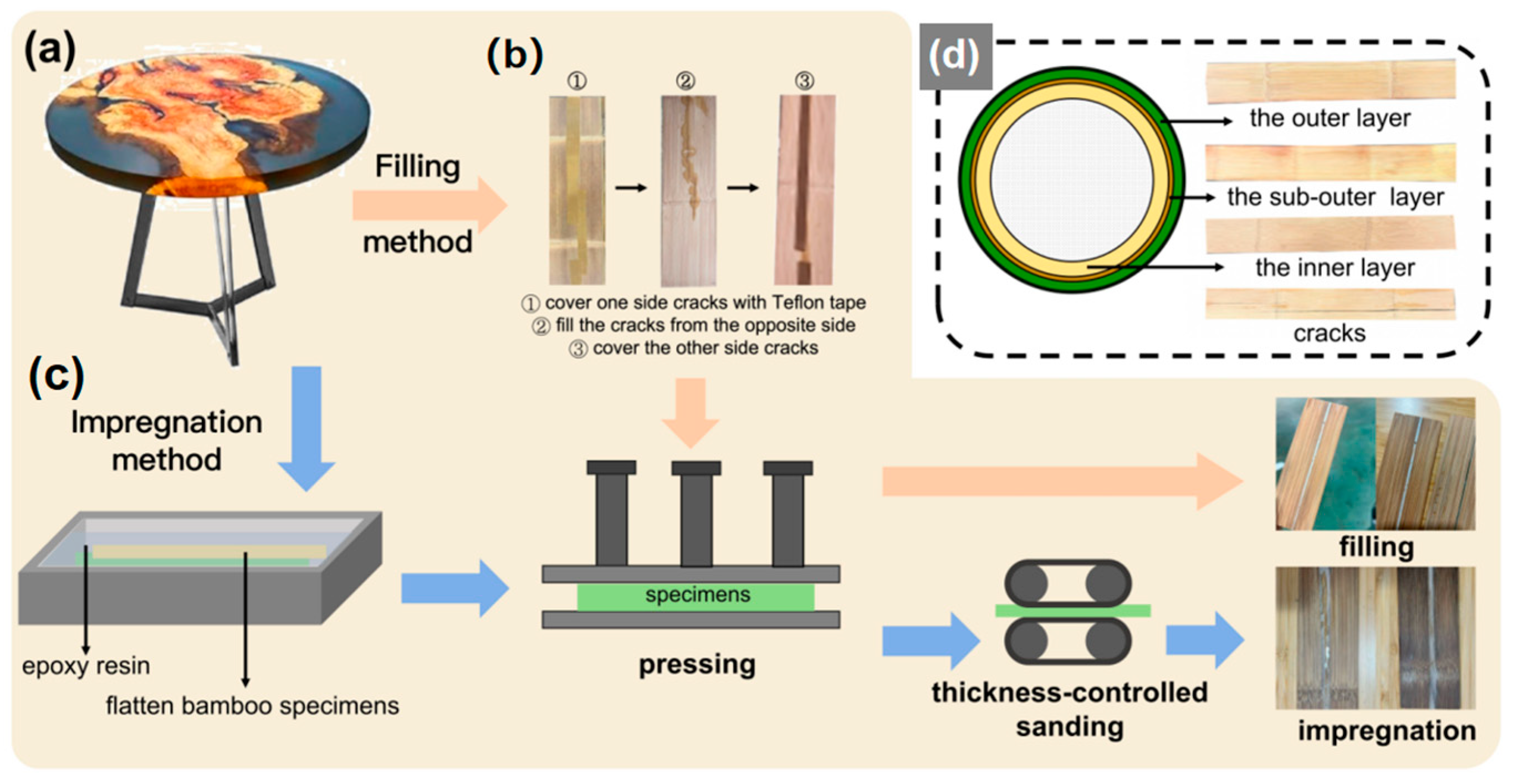
To promote the environmentally friendly and sustainable reuse of cracked flattened bamboo, particularly for long and wide cracks, a resin treatment method was proposed, inspired by modern resin table designs (Figure 1a). This approach aims to improve the material’s bending properties, achieve waste utilisation, and increase bamboo utilisation rates. Epoxy resin was selected because it provides strong adhesion to lignocellulosic substrates and can infiltrate cracks and porous tissues to form a consolidated, continuous resin–bamboo phase after curing. Such penetration–bonding characteristics make epoxy suitable for both crack filling and full-cell impregnation, while its transparency also supports decorative applications [21,22,23].
This study systematically evaluates the effects of bamboo anatomical variation (the outer layer, the sub-outer layer, and the inner layer) and treatment methods (filling cracks only and full-cell impregnation) on the bending properties of flattened bamboo and aesthetic performance of epoxy resin-treated cracked bamboo. Environmental scanning electron microscopy (SEM) is also used to observe the surface and lateral morphology of the resin–bamboo interface. Therefore, this work aims to optimise treatment strategies for sustainable and visually appealing bamboo-based materials suitable for green interior decoration applications.

2. Materials and Methods

2.1. Specimen Preparation

The cracked flattened bamboo was provided by Long Bamboo Technology Group Co., Ltd. (Fuzhou, China). To ensure sample consistency, all cracked specimens were taken from the same batch of radial-cut boards and radially sectioned into the outer layer, sub-outer layer and inner layer boards, each measuring 150 mm × 50 mm × 1.65 mm. All flattened bamboo underwent temperature and humidity conditioning to stabilise at a moisture content of (7 ± 1)%, which eliminated internal stresses prior to processing and prevented new cracks or warps due to environmental changes. In addition, since the mechanical properties of bamboo are significantly influenced by moisture content [24], and to simulate actual service conditions, all flattened bamboo specimens were equilibrated at (25 ± 1) °C and (60 ± 5)% relative humidity for 7 days until mass stabilisation was achieved. A commercially available two-component epoxy resin system, purchased from Xinai Co., Ltd. (Beijing, China), was used for crack filling and impregnation. The system consisted of an epoxy resin (Component A) and an amine-based curing agent (Component B). The resin and hardener were mixed at a fixed mass ratio of 3:1, used immediately after mixing, and cured at room temperature (25 ± 1) °C. The general impregnation and curing strategy was adapted from epoxy-based impregnation processes previously reported for native bamboo materials [25]. Considering that the flattened bamboo used in this study developed additional cracks during the thermo-mechanical pressing process, certain processing parameters, including impregnation duration and impregnation mode, were accordingly modified. The specific procedures are described as follows.
Filling-cracks-only method (filling): First, one side of the cracked bamboo was covered with Teflon tape. Then, the epoxy resin solution was applied to fill the cracks from the opposite side (Figure 1b). After filling, Teflon tape was applied to cover the resin-filled side, and the material was placed in a pneumatic pressing apparatus (Fujian Long Bamboo Technology Co., Ltd., Nanping, China) for curing at 0.06 MPa for 20 h.
Full-cell impregnation method (impregnation): All the cracked bamboo specimens were placed into a silicone container and fully immersed in the two-component epoxy resin solution. After 1 h, excess resin was removed prior to placement in a pneumatic pressing apparatus for curing at 0.06 MPa for 20 h. After resin curing, residual resin was removed using a thickness-controlled sanding machine (QSG650R-R-RA, Qingdao, China) (Figure 1c).

2.2. Experimental Design

A full-factorial experimental design was employed, with the radial position of the flattened bamboo (Figure 1d) and the treatment method as independent variables, resulting in six experimental groups, with six specimens prepared for each group. Uncracked flattened bamboo specimens were used as the control group. All control specimens underwent the same temperature–humidity conditioning and equilibration procedures as the resin-treated samples prior to mechanical testing, ensuring direct comparability between groups. The detailed experimental plan is shown in Table 1.

2.3. Performance Testing and Characterisation

Bending properties: Following the national standard GB/T 17657-2022, the unconfined three-point bending method was employed to determine the tangential bending strength and Young’s modulus of flattened bamboo. Specimens were fabricated into bamboo strips measuring 150 mm × 50 mm × 1.65 mm, with a span of 100 mm. All specimens were compressed from the side near the outer layer (Figure 1d) using a universal testing machine (AGS-X-20kND, Tsushima, Japan) to determine bending strength and Young’s modulus. Each group underwent six repeated tests. According to GB/T 17657-2022 [26], bending strength and Young’s modulus were calculated using Equations (1) and (2), respectively:
σ b = 3 × F max × l 1 2 × b × t 2
where σb is the bending strength of the specimen, MPa; Fmax is the maximum load at specimen failure, N; l1 is the distance between the two supports, mm; b is the specimen width, mm; and t is the specimen thickness, mm.
E b = l 1 3 4 × b × t 3 × F 2 F 1 a 2 a 1
where Eb is the Young modulus of the specimen, MPa; l1 is the distance between the two supports, mm; b is the width of the specimen, mm; t is the thickness of the specimen, mm; F1 is 10% of the maximum load, N; F2 is 40% of the maximum load, N; a1 is the displacement corresponding to F1, mm; and a2 is the displacement corresponding to F2, mm.
Microstructure: Each specimen was cut into small blocks measuring 5 mm × 5 mm × 1.65 mm. Cross-sections of specimens from each group were polished using a biological sectioning machine (KEDEE, Jinhua, China). The bamboo–resin interface was observed using an environmental scanning electron microscope (Quanta 200, FEI, Hillsboro, OR, USA), operated at an accelerating voltage of 15 kV, with representative micrographs acquired primarily at a magnification of 200×, while additional magnifications were used when necessary for detailed observation.
Decorative properties: To evaluate the decorative properties of flattened bamboo, a colourimeter (HP-2136, Hangzhou, China) was used to measure colour changes in samples before and after resin treatment, with six repeated tests. Lightness (L*), redness (a*), and yellowness (b*) were measured with a d/8° measurement geometry, a 10° standard observer, and an 8 mm aperture, and C illuminant [27]. Colour difference was calculated using Equation (3) [28].
Δ E * = [ ( L 2 * L 1 * ) 2 + ( a 2 * a 1 * ) 2 + ( b 2 * b 1 * ) 2 ]
where ΔE* represents the colour difference between samples before and after resin treatment; L1*, a1*, and b1* denote the lightness, magenta–green axis, and yellow–blue axis of untreated flattened bamboo, respectively; and L2*, a2*, and b2* denote the lightness, magenta–green axis, and yellow–blue axis of resin-treated flattened bamboo, respectively.
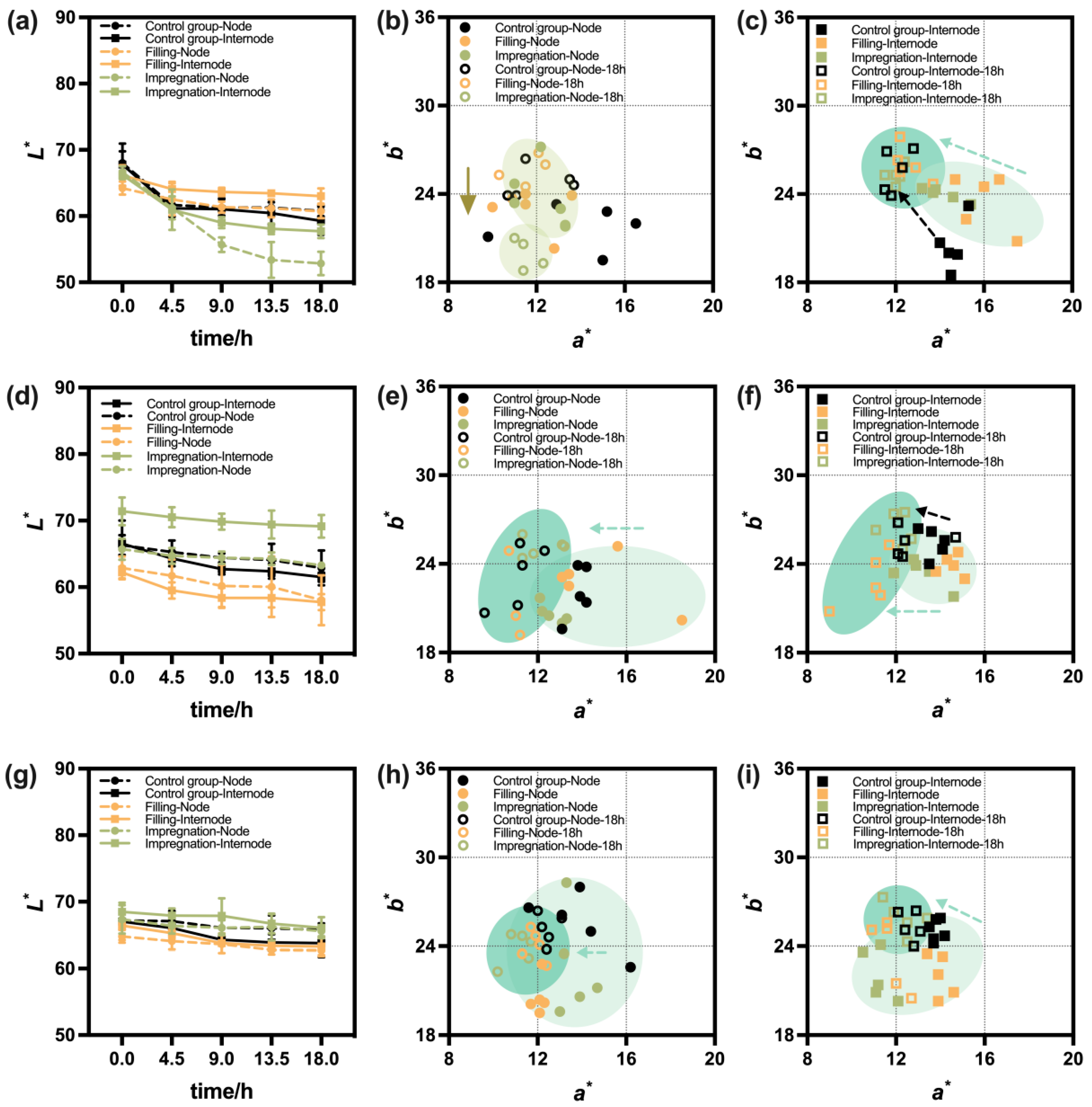
In addition, all specimens were placed in a yellow resistance tester (Aisry, Dongguan, China) and treated at 70 °C for 18 h, equivalent to 12 months under natural environmental conditions. L*, a*, and b* values were recorded using a colourimeter every 4.5 h.

2.4. Statistical Analysis

To analyse the effects of the bamboo radial position and resin treatment method on the bending properties of bamboo decorative laminates and their interactions, a two-factor general linear model (GLM) analysis of variance (ANOVA) was employed for statistical testing after verifying normality and the homogeneity of variance. Post hoc comparisons between groups were performed using the protected least significant difference (LSD) test. All statistical analyses were conducted at a 95% confidence level (α = 0.05), with data processing performed using SPSS 29.0.1.0 software.

3. Results and Discussion

3.1. Bending Properties

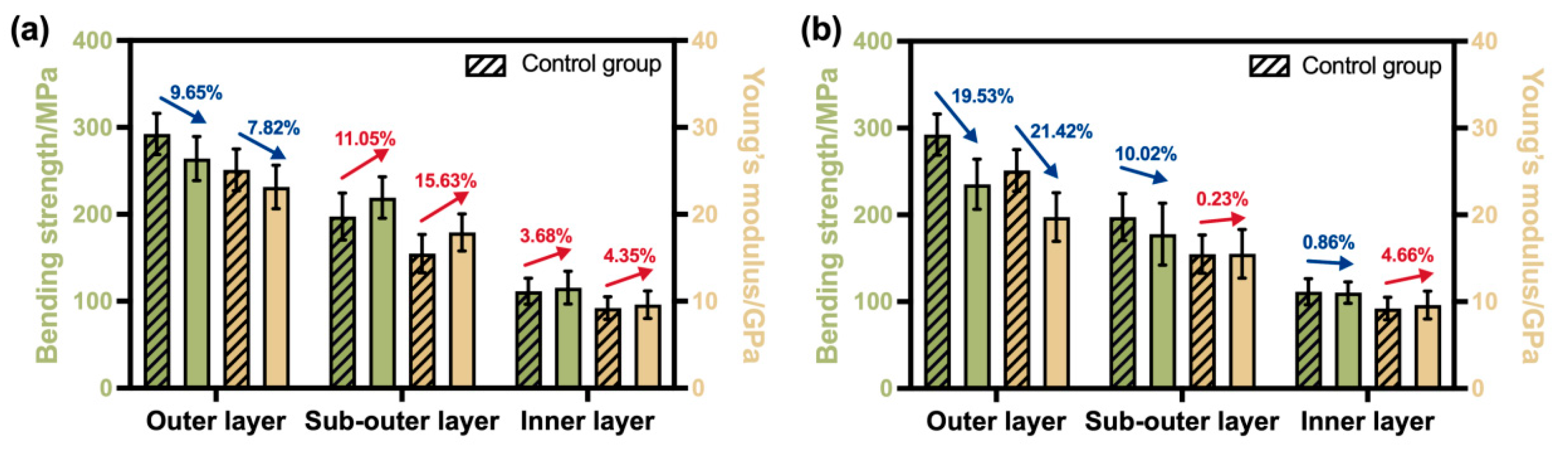
Figure 2a illustrates the bending strength and Young modulus of flattened bamboo prepared using the filling method. Except for the outer layer, crack filling improved the bending performance of the sub-outer and inner layers compared with the uncracked samples. In contrast, the outer layer exhibited a slight reduction in bending properties after filling, but its performance remained higher than that of the sub-outer and inner layers.
Figure 2b shows the bending strength and Young modulus of resin-impregnated flattened bamboo. After impregnation, the bending properties of the outer layer decreased markedly and were inferior to those of samples prepared by the filling method. This reduction is likely associated with excessive resin penetration into the dense outer layer structure, which may partially disrupt the native fibre continuity and induce local stiffness mismatch, thereby adversely affecting effective stress transfer under bending [29], as also suggested by the resin-rich regions observed in Figure 3b. From a mechanistic perspective, the observed performance loss after full-cell impregnation may be attributed to the combined influence of the relatively brittle mechanical response of cured epoxy compared with native bamboo fibres, the resulting stiffness mismatch between resin-rich regions and fibre bundles, and the associated local stress concentration at the fibre–resin interface under bending [30]. Because the outer layer has a high fibre volume fraction and the fibre sheaths dominate load bearing, such a mismatch can intensify interfacial stress and promote premature microcrack initiation, thereby reducing the effective load-bearing capacity despite the intended reinforcing effect of the resin. Similar resin-rich-induced performance deterioration has been reported in resin-impregnated bamboo composites, where excessive resin content may introduce brittleness and stiffness mismatch, thereby weakening load transfer efficiency in fibre-dense structures [31]. Aside from a notable reduction in bending strength of the sub-outer layer, the bending properties of the other cracked layers exhibited relatively minor changes after resin impregnation.
Table 2 indicates that both the main effects of the radial position and treatment method are highly significant (p < 0.001) on the bending strength of flattened bamboo. Notably, radial position accounted for the majority of variance in bending strength (Fradial position > Ftreatment method), while their interaction is not significant (p = 0.138). This suggests that the bending strength differs fundamentally across treatment methods and radial positions, with the effect of the treatment method remaining relatively consistent across different positions.
For Young’s modulus, both the main effects of the treatment method and radial position are significant, with the radial position effect being highly significant. Importantly, the interaction between the treatment method and radial position also reached statistical significance. This interaction effect can be attributed to the anatomical heterogeneity of bamboo along the radial direction and the corresponding differences in resin penetration behaviour. Combined with the F-value results, the effect of treatment methods on Young’s modulus was dependent on the radial position, with a more pronounced response in the inner layer and little or no effect in the outer layer.
Post hoc multiple comparisons using the LSD method revealed that the radial position exerted a dominant influence on mechanical performance (p < 0.001). The outer layer exhibited significantly higher bending strength than the inner layer (mean difference, MD = 134.39 MPa), with the sub-outer layer showing intermediate values, indicating a clear increasing trend from the inner to outer regions. A similar pattern was observed for Young’s modulus, where the outer layer significantly exceeded the inner layer (MD = 13,267.32 MPa). These results emphasise that radial structural variation plays a primary role in governing the bending behaviour of flattened bamboo.
In summary, bamboo radial position directly influences its bending properties, whereas the resin filling method has a specific but comparatively limited effect.

3.2. Microscopic Morphology

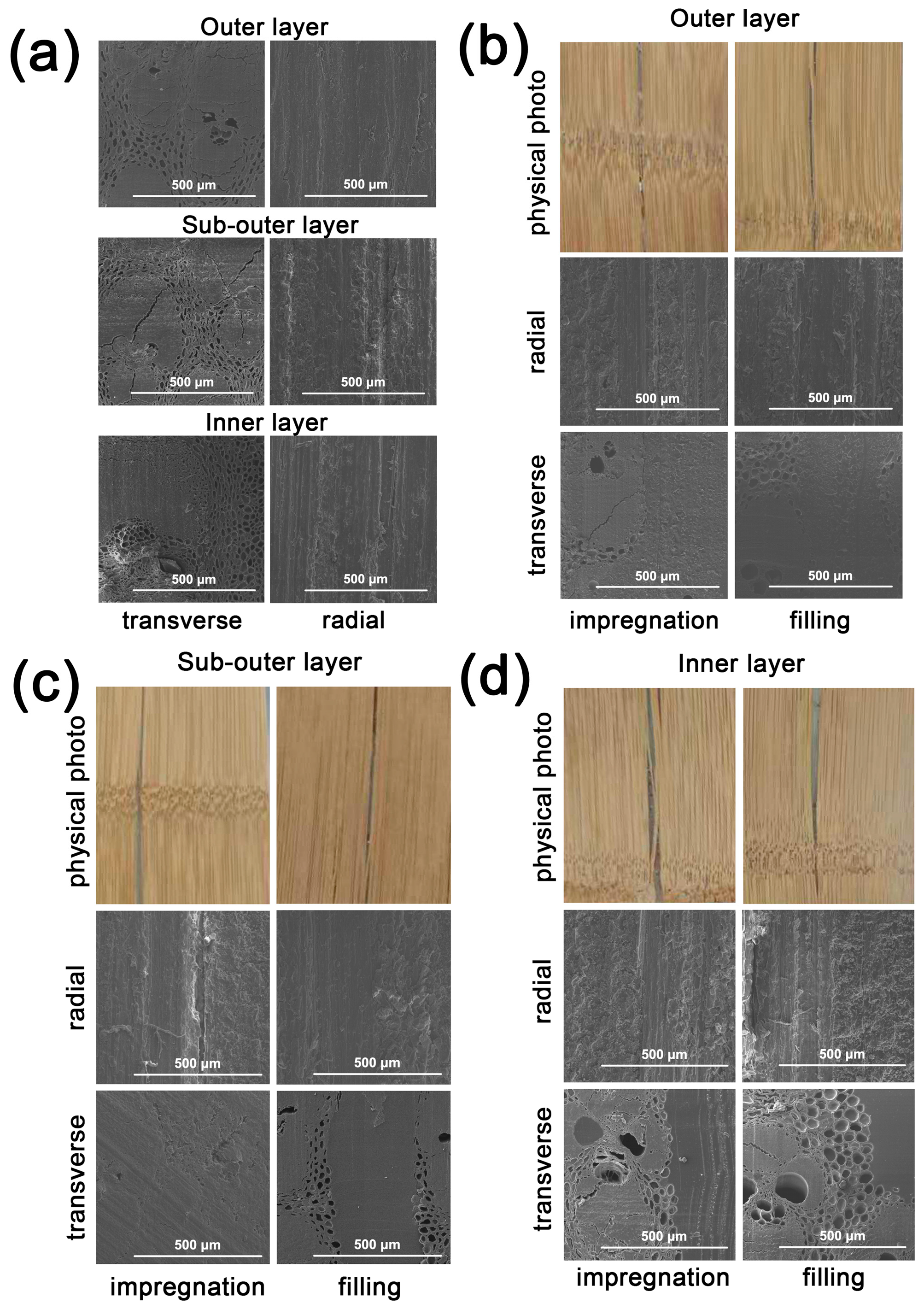
Figure 3 shows the microscopic morphology of the resin–bamboo interface in flattened bamboo. Untreated specimens (Figure 3a) exhibit a clear radial structural gradient, with the outer layer characterised by dense fibre sheaths and compact cell walls, while the inner layer is dominated by parenchyma tissues with larger lumens and higher pore connectivity. The sub-outer layer represents a transitional zone in which fibre sheaths and parenchyma cells coexist, reflecting a gradual structural change along the radial direction. This progressive loosening of tissue structure from the outer to inner regions facilitates resin penetration but simultaneously reduces load-bearing efficiency, providing a direct microstructural explanation for the observed radial differences in bending strength and Young’s modulus.
After resin treatment (Figure 3b), a continuous resin–bamboo interface was observed in both radial and transverse sections, indicating adequate wetting and bonding between the resin and the fibre sheath or parenchyma tissue. Due to the extreme density of the fibre sheath, resin penetration is limited into the outer layer, forming only a thin coating on the cell wall surface. The interfacial morphology of impregnated and filled specimens was essentially identical, with no observable interfacial delamination or pores. In the sub-outer layer, there is abundant pith tissue between fibre sheaths, allowing limited resin penetration along intercellular spaces and pits. A relatively uniform coating layer can be observed in the resin-impregnated specimens, whereas localised resin accumulation occurs near some vessels in the resin-filled ones. Nevertheless, the overall interface remains continuous. The vessel lumens of the inner layer were filled with resin. Resin-impregnated specimens exhibited a uniform, film-like distribution, while resin-filled ones showed resin accumulation and complete filling around vessels and large pores, demonstrating enhanced resin penetration in parenchyma-rich zones. Such interfacial continuity suggests that the bending performance of crack-filled and fully impregnated specimens is governed primarily by the integrity of the resin–bamboo interface, rather than by differences in resin distribution at the microscale.
However, no significant difference was observed in the bonding surface around the periphery of the fibre sheath between the two treatment methods, with both interfaces exhibiting continuous and dense bonding. Based on the structural characteristics of bamboo, the outer fibre sheath primarily bears bending loads, while the inner parenchyma cells primarily serve buffering and energy dissipation. Although minor variations in resin distribution were observed between fully impregnated and crack-filled specimens in the inner regions, these differences were confined to parenchyma cells and vessel lumens, which are not the primary load-bearing components. This microstructural observation is consistent with the ANOVA results showing a dominant effect of the radial position on bending properties compared with the resin treatment method.
Based on a comprehensive assessment of bending properties and microscopic morphology, when the filling method ensures the continuity of the fibre sheath interface, it can achieve the required bonding quality for practical applications with a lower resin consumption, offering improved economic benefits (Table 3).

3.3. Decorative Properties

Colour plays a decisive role in the aesthetic appeal of flattened bamboo applied in interior design. Evaluating colour differences before and after resin treatment, as well as yellowing resistance, can provide a theoretical basis for their application.
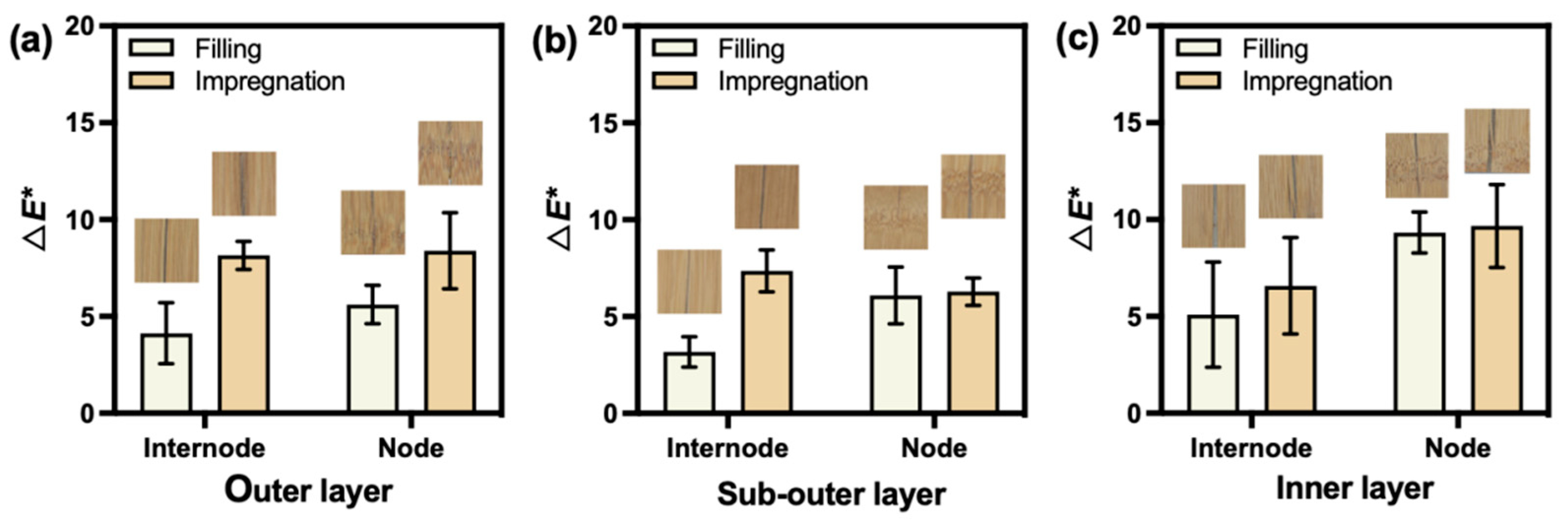
Figure 4 illustrates the colour changes in different positions of flattened bamboo after two treatment methods, with samples taken from both the internode and node areas. All colour differences (ΔE*) reported in Figure 4 were calculated relative to the corresponding untreated flattened bamboo at the same radial position and structural region. For the internode in all positions of bamboo, the filling method could produce a minor colour difference compared to the impregnation method. Except for the outer layer, colour differences at the node were almost similar between the two resin treatments. Overall, after resin treatment, the visible colour difference on the surface of the flattened bamboo is inevitable, regardless of which method is used; however, colour tone uniformity may be achieved through epoxy resin pigmentation.
Figure 5 demonstrates the yellowing resistance of resin-treated flattened bamboo. Except for the outer layer–filling–node sample, all other flattened bamboo samples—whether from internodes or nodes regions, and whether filled or impregnated—showed a slight decrease in brightness over time, which closely resembled that of the control group (Figure 5a,d,g). This indicates that resin-treated flattened bamboo can maintain stable colour brightness during daily use.
The outer layer–filling–node sample exhibited the same trend as the control group, with a positive b* value offset after ageing testing, indicating yellowing of the node area. In contrast, the outer layer–impregnation–node sample showed a decrease in b* value (Figure 5b), suggesting a temporary suppression of yellowing under the applied ageing conditions tested in this study. This behaviour may be associated with the formation of a resin-derived surface layer, which can partially shield the bamboo surface from photo-induced discolouration during short-term exposure. There were minor surface colour changes on the internode after ageing with both treatment methods compared to the control group (Figure 5c).
For the sub-outer layer, the chroma of both node and internode shifted toward −a* after treatment, resulting in a greener surface tone after light exposure (Figure 5e,f). In contrast, the resin-treated inner layer exhibited a yellowish-green colour compared to the control group (Figure 5h,i); however, this colour difference diminished after ageing, indicating that the observed colour modulation is sensitive to exposure duration and does not necessarily reflect long-term ageing behaviour.
Overall, resin treatment did not significantly affect the yellowing resistance of flattened bamboo samples and did not limit their decorative applications in interior design.

4. Conclusions

This study explored the potential of simple resin-based treatments for the resource utilisation of cracked flattened bamboo, with particular relevance to industrial bamboo processing and value-added decorative applications. The findings provide a feasible technical reference for improving bamboo utilisation efficiency and developing cost-effective, high-value bamboo products. The main conclusions are as follows:
Both resin treatment methods (crack filling and full-cell impregnation) affected the bending behaviour of flattened bamboo; however, radial position played a more dominant role. This indicates that anatomical heterogeneity along the radial direction should be considered a primary factor when designing reinforcement or repair strategies for cracked bamboo panels in practical processing.
Under the premise of ensuring stable and continuous resin–bamboo interfacial bonding, the crack filling method achieved comparable mechanical reinforcement with substantially lower resin consumption. From an industrial perspective, this approach offers a more economical and easily implementable solution for repairing cracked flattened bamboo, particularly for decorative applications where bending loads are moderate. Future work may further optimise this strategy by establishing crack-grading criteria to guide resin application in industrial production.
Although resin-filled areas exhibited noticeable colour differences relative to the bamboo substrate, such visual discrepancies can be effectively mitigated through pigment adjustment of the epoxy resin in practical applications. Moreover, under the ageing conditions applied in this study, resin treatment did not adversely affect the yellowing resistance of flattened bamboo, supporting its suitability for indoor decorative use within typical service environments.

Author Contributions

P.C.: Conceptualisation, Methodology, Investigation, Visualisation, Writing—Original Draft Preparation; J.W.: Formal analysis, Writing—Review and Editing; Y.Y.: Formal Analysis, Writing—Review and Editing; H.C.: Validation, Supervision, Writing—Review and Editing; W.X.: Supervision, Writing—Review and Editing, Project Administration, Funding Acquisition. All authors have read and agreed to the published version of the manuscript.

Funding

This work was supported by the National Natural Science Foundation of China (Grant No. 32571962).

Institutional Review Board Statement

Not applicable.

Informed Consent Statement

Not applicable.

Data Availability Statement

The data presented in this study are available on request from the corresponding author. The data are not publicly available due to institutional restrictions.

Acknowledgments

We thank the staff of Long Bamboo Technology Group Co., Ltd., and the Advanced Analysis and Testing Center of Nanjing Forestry University for their assistance with specimen preparation and testing.

Conflicts of Interest

The authors declare no competing interests.

References

  1. Zhang, K.; Yu, L.; Dai, F.; Chen, Y.; Jiang, Z.; Wang, Y.; Tian, G. Bamboo Structure and Its Impact on Mechanical Properties: A Case Study of Bambusa Arundinaceae. Forests 2024, 15, 762. [Google Scholar] [CrossRef]
  2. Li, Z.; Chen, C.; Mi, R.; Gan, W.; Dai, J.; Jiao, M.; Xie, H.; Yao, Y.; Xiao, S.; Hu, L. A Strong, Tough, and Scalable Structural Material from Fast-Growing Bamboo. Adv. Mater. 2020, 32, 1906308. [Google Scholar] [CrossRef]
  3. Adier, M.F.V.; Sevilla, M.E.P.; Valerio, D.N.R.; Ongpeng, J.M.C. Bamboo as Sustainable Building Materials: A Systematic Review of Properties, Treatment Methods, and Standards. Buildings 2023, 13, 2449. [Google Scholar] [CrossRef]
  4. Tsuyama, T.; Hamai, K.; Kijidani, Y.; Sugiyama, J. Quantitative Morphological Transformation of Vascular Bundles in the Culm of Moso Bamboo (Phyllostachys pubescens). PLoS ONE 2023, 18, e0290732. [Google Scholar] [CrossRef]
  5. Li, H.; Zhu, Q.; Lu, P.; Chen, X.; Xian, Y. The Gradient Variation of Location Distribution, Cross-Section Area, and Mechanical Properties of Moso Bamboo Vascular Bundles along the Radial Direction. Forests 2024, 15, 1023. [Google Scholar] [CrossRef]
  6. Zhan, T.; Sun, F.; Lyu, C.; He, Q.; Xu, K.; Zhang, Y.; Cai, L.; Huang, Z.; Lyu, J. Moisture Diffusion Properties of Graded Hierarchical Structure of Bamboo: Longitudinal and Radial Variations. Constr. Build. Mater. 2020, 259, 119641. [Google Scholar] [CrossRef]
  7. Do Amaral, L.M.; Molari, L.; Savastano, H. Swelling and Shrinking Behaviour of Bamboo and Its Application on a Hygro-Mechanical Model. Wood Sci. Technol. 2025, 59, 36. [Google Scholar] [CrossRef]
  8. Ochi, S. Mechanical Properties of Bamboo Fiber Bundle-Reinforced Bamboo Powder Composite Materials. Eur. J. Wood Prod. 2022, 80, 263–275. [Google Scholar] [CrossRef]
  9. Wei, X.; Wang, G.; Smith, L.M.; Chen, X.; Jiang, H. Effects of Gradient Distribution and Aggregate Structure of Fibers on the Flexibility and Flexural Toughness of Natural Moso Bamboo (Phyllostachys edulis). J. Mater. Res. Technol. 2022, 16, 853–863. [Google Scholar] [CrossRef]
  10. Liu, L.; Fang, Z.; Zhang, Y.; Wang, S.; Zhang, L.; Yuan, J.; Chen, Q. Decoding Dynamic Bamboo Cell Shrinkage with Time-Lapse Microscopy and Machine-Learning. Ind. Crops Prod. 2024, 218, 118965. [Google Scholar] [CrossRef]
  11. Yuan, T.; Zhang, T.; Huang, Y.; Wu, Y.; Wang, X.; Li, Y. Study on Bamboo Longitudinal Flattening Technology. Polymers 2022, 14, 816. [Google Scholar] [CrossRef] [PubMed]
  12. Chen, Y.; Liang, Q.; Wang, J.; Ma, X. Subjective and Objective Evaluation of Surface Properties of Flattened Bamboo and Polyurethane Self-Foaming Plastic. Polymers 2025, 17, 894. [Google Scholar] [CrossRef]
  13. Yuan, T.; Han, X.; Wu, Y.; Hu, S.; Wang, X.; Li, Y. A New Approach for Fabricating Crack-Free, Flattened Bamboo Board and the Study of Its Macro-/Micro-Properties. Eur. J. Wood Prod. 2021, 79, 1531–1540. [Google Scholar] [CrossRef]
  14. Wang, X.; Su, N.; Chen, X.; Fei, B.; Ma, X.; Liu, H.; Miao, H.; Fang, C. Impact of Temperature on Mechanical Properties and Dimensional Stability in a Novel Gradient Pressure Bamboo Flattening Technique. Constr. Build. Mater. 2024, 427, 136258. [Google Scholar] [CrossRef]
  15. Yuan, T.; Wang, X.; Liu, X.; Lou, Z.; Mao, S.; Li, Y. Bamboo Flattening Technology Ebables Efficient and Value-Added Utilization of Bamboo in the Manufacture of Furniture and Engineered Composites. Compos. Part B Eng. 2022, 242, 110097. [Google Scholar] [CrossRef]
  16. Zhao, Y.; Ma, Y.; Lou, Z.; Li, Y. Study on the Effect of Flattening Modification on Bamboo Cutting Board and Corresponding Carbon Footprint Evaluation. Forests 2023, 14, 809. [Google Scholar] [CrossRef]
  17. Chen, L.; Lian, C.; Chen, M.; Wu, Z. Effects of Microstructure and Chemical Composition on the Visual Characteristics of Flattened Bamboo Board. Forests 2023, 14, 2220. [Google Scholar] [CrossRef]
  18. Kadivar, M.; Gauss, C.; Ghavami, K.; Savastano, H. Densification of Bamboo: State of the Art. Materials 2020, 13, 4346. [Google Scholar] [CrossRef]
  19. Lou, Z.; Wang, Q.; Sun, W.; Zhao, Y.; Wang, X.; Liu, X.; Li, Y. Bamboo Flattening Technique: A Literature and Patent Review. Eur. J. Wood Prod. 2021, 79, 1035–1048. [Google Scholar] [CrossRef]
  20. Li, W.; Bai, Q.; Xie, G.; Cao, Y.; Gao, J. The Influence of Impregnation Methods and Curing Conditions on the Physical and Multiscale Mechanical Properties of Furfurylated Bamboo. Forests 2023, 14, 970. [Google Scholar] [CrossRef]
  21. Zhou, J.; Xu, W. Phase-Change Thermal Storage Transparent Wood Based on Optical Reversibility. Ind. Crops Prod. 2025, 223, 120275. [Google Scholar] [CrossRef]
  22. Cheng, T.; Zhang, H.; Cao, K.; Jing, Y.; Wu, Y. First Development of Transparent Wood-Based Triboelectric Nanogenerator (TW-TENG): Cooperative Incorporation of Transparency, Aesthetic of Wood, and Superior Triboelectric Properties. Nano Energy 2024, 128, 109888. [Google Scholar] [CrossRef]
  23. Liu, Z.; Yang, S.; Wang, Z.; Ji, N.; Li, D.; Wu, Y. Preparation of Bamboo-Epoxy Resin Materials with Microwave Assistance. J. Mater. Res. Technol. 2022, 18, 3266–3272. [Google Scholar] [CrossRef]
  24. Wang, C.; Wang, H.; Guo, Y.; Mohotti, D.; Hazell, P.J. Correlations between Moisture Expansion and Flexural Properties of Bamboo Strips in Response to Different Loading Rates. Eur. J. Wood Prod. 2024, 82, 1333–1344. [Google Scholar] [CrossRef]
  25. Dong, W.; Wang, J.; Huang, L.; Tao, X.; Zhang, J.; Wu, Y. Simple and Easy-to-Operate Processing of Bamboo Residue into Transparent Fibre-Reinforced Bamboo via Light-Assisted Delignification. Wood Mater. Sci. Eng. 2025. [Google Scholar] [CrossRef]
  26. GB/T 17657-2022; Test Methods of Evaluating the Properties of Wood-Based Panels and Surface Decorated Wood-Based Panels. Standardization Administration of China: Beijing, China, 2022.
  27. Dilger, A.C.; Harsh, B.; McKenna, D.; Boler, D.; Rode, H.; Barkley, K.E. Evaluation of the Variability of Instruments Used in Meat Color Assessments. Meat Muscle Biol. 2021, 5, 27. [Google Scholar] [CrossRef]
  28. Wu, S.; Na, R.; Avramidis, S.; Xu, W. Effect of pH Regulation on the Properties of Furfuryl Alcohol-Modified Decorative Veneer. Eur. J. Wood Prod. 2024, 82, 2085–2098. [Google Scholar] [CrossRef]
  29. Wang, Y.; Lin, Z.; Hao, X.; Chen, L.; Fan, Q.; Zhou, H.; Li, L.; Ou, R.; Wang, Q. Mechanical Behavior and Damage Mechanisms of Woven Bamboo Strip Reinforced Epoxy Resin Composites. Constr. Build. Mater. 2025, 489, 142303. [Google Scholar] [CrossRef]
  30. Li, Y.; Li, C.; Ren, X.; Chen, F.; Chen, L. Optimizing the Preparation Process of Bamboo Scrimber with Bamboo Waste Bio-Oil Phenolic Resin Using Response Surface Methodology. Forests 2024, 15, 1173. [Google Scholar] [CrossRef]
  31. Yang, Z.; Meng, X.; Zeng, G.; Wei, J.; Wang, C.; Yu, W. Effect of Resin Content on the Structure, Water Resistance and Mechanical Properties of High-Density Bamboo Scrimbers. Polymers 2024, 16, 797. [Google Scholar] [CrossRef]
Figure 1. Research approach. (a) Research implication, (b) samples prepared by filling method, (c) samples prepared by impregnation method, (d) radial structure and cracks of bamboo.
Coatings 16 00139 g001
Figure 2. Bending properties of bamboo flatten specimens: (a) filling-cracks-only method; (b) full-cell impregnation method.
Coatings 16 00139 g002
Figure 3. SEM images of flattened bamboo sheets. (a) Control groups, (b) treated groups (outer layer), (c) treated groups (sub-outer layer), (d) treated groups (inner layer).
Coatings 16 00139 g003
Figure 4. Colour differences in bamboo veneer sheets before and after resin treatment. (a) Outer layer, (b) sub-outer layer, (c) inner layer.
Coatings 16 00139 g004
Figure 5. Yellowing resistance performance. (a,d,g) Lightness of outer layer, sub-outer layer, and inner layer, respectively; (b,e,h) a* and b* value of the node on outer layer, sub-outer layer, and inner layer, respectively; (c,f,i) a* and b* value of the internode on outer layer, sub-outer layer, and inner layer, respectively.
Coatings 16 00139 g005
Table 1. Experimental groups and treatment methods.
NumberRadial Position of Flattened BambooTreatment Method
Control groupOuter layer/
Sub-outer layer/
Inner layer/
1Outer layerFilling
2Outer layerImpregnation
3Sub-outer layerFilling
4Sub-outer layerImpregnation
5Inner layerFilling
6Inner layerImpregnation
Table 2. Results of the main effect analysis.
Dependent variable: bending strength
SourceSum of SquaresdfMean SquareF-valuep-value
Treatment Method6028.02116028.02114.785<0.001
Radial Position112,250.610256,125.305137.663<0.001
Treatment Method × Radial Position1724.4972862.2492.1150.138
Error12,231.02430407.701
Dependent variable: Young’s modulus
SourceSum of SquaresdfMean SquareF-valuep-value
Treatment Method40,017,495.797140,017,495.79711.7880.002
Radial Position1,067,250,483.4812533,625,241.741157.189<0.001
Treatment Method × Radial Position53,485,224.559226,742,612.2797.8780.002
Error101,843,854.033303,394,795.134
p ≤ 0.001 (extremely significant), 0.001 < p ≤ 0.01 (highly significant), 0.01 < p ≤ 0.05 (significant), p > 0.05 (not significant).
Table 3. Comparison of resin usage between two treatment methods.
MethodsEpoxy Resin (g)Curing Agent (g)Number (Piece)Average Resin Consumption Normalised by Specimen Volume (g/cm3)
Filling7502503500.23
Impregnation900.92
The average resin consumption was calculated by dividing the total resin mass by the total volume of the treated specimens.
Disclaimer/Publisher’s Note: The statements, opinions and data contained in all publications are solely those of the individual author(s) and contributor(s) and not of MDPI and/or the editor(s). MDPI and/or the editor(s) disclaim responsibility for any injury to people or property resulting from any ideas, methods, instructions or products referred to in the content.