Skip to Content
CoatingsCoatings
  • Review
  • Open Access

19 January 2026

A Review on the Synthesis Methods, Properties, and Applications of Polyaniline-Based Electrochromic Materials

,
,
,
,
,
and
1
School of Textiles, Guangdong Polytechnic, Foshan 528041, China
2
Institute of Corrosion Science and Technology, Guangzhou 510530, China
3
State Environmental Protection Key Laboratory of Environmental Pollution Health Risk Assessment, South China Institute of Environmental Sciences, Ministry of Ecology and Environment (MEE), Guangzhou 510655, China
4
Department of Mechanical Engineering, The University of Hong Kong, Hong Kong 999077, China

Abstract

Polyaniline (PANI), characterized by its proton-coupled redox mechanism and multicolor reversibility, is widely investigated for adaptive optical interfaces. Compared to inorganic oxides, PANI offers advantages in cost-effectiveness, mechanical flexibility, and molecular tunability; however, its practical implementation faces challenges related to kinetic limitations and environmental instability. This review presents a comprehensive analysis of PANI-based electrochromic materials, examining the intrinsic correlations among synthesis methodologies, microstructural characteristics, and optoelectronic performance. Synthesis strategies, including chemical oxidative polymerization, electrochemical deposition, and template-assisted techniques, are evaluated. Emphasis is placed on resolving the trade-off between optical contrast and switching kinetics by constructing high-surface-area porous nanostructures and inducing chain ordering via functional dopants to shorten ion diffusion paths and reduce charge transfer resistance. Fundamental electrochromic properties are subsequently discussed, with specific attention to degradation mechanisms triggered by environmental factors, such as pH drift, and stabilization strategies involving electrolyte engineering and composite design. Furthermore, the review addresses the evolution of applications from single-band monochromatic displays to dual-band smart windows for decoupled visible/near-infrared regulation and multifunctional integrated systems, including electrochromic supercapacitors and adaptive thermal management textiles. Finally, technical challenges regarding long-term durability, neutral color development, and large-area manufacturing are summarized to outline future research directions for PANI-based optical systems.

1. Introduction

Electrochromic materials are a class of functional materials whose optical properties, such as color or transmittance, can undergo reversible and stable changes under an applied electrical potential [1,2,3]. This phenomenon, known as electrochromism, originates from electrochemically induced redox reactions that alter the electronic structure of the material, leading to variations in light absorption in the visible or near-infrared regions [4,5,6]. A typical electrochromic process involves electron transfer accompanied by ion insertion and extraction, enabling controllable and energy-efficient modulation between different optical states, which is aligned with global efforts to mitigate industrial CO2 emissions [7] and adapt to long-term climate dynamics [8]. According to their composition, electrochromic materials are generally classified into inorganic and organic systems. Inorganic electrochromic materials, represented by tungsten oxide (WO3), nickel oxide (NiO), and molybdenum oxide (MoO3), typically exhibit excellent cycling stability and high optical contrast, but suffer from limited color diversity, intrinsic brittleness, and relatively high fabrication costs [9,10,11,12]. In contrast, organic electrochromic materials, including conjugated polymers and small organic molecules, offer advantages such as structural tunability, low density, mechanical flexibility, and solution processability, although their long-term stability and environmental tolerance remain challenging [13,14,15,16]. The complementary characteristics of inorganic and organic electrochromic materials have stimulated extensive interest in polymer-based electrochromic systems as promising candidates for next-generation electrochromic devices. Despite the dominance of inorganic electrochromic materials—most notably tungsten oxide (WO3)—which serve as the industry benchmark due to their exceptional cyclic stability and high optical contrast, they are often limited by intrinsic brittleness, high vacuum-processing costs, and a restricted color palette (typically transitioning only between transparent and blue). In contrast, PANI offers distinct competitive advantages: (1) Rich Multicolor Reversibility (yellow-green-blue-purple) enabling aesthetic versatility; (2) Mechanical Flexibility compatible with roll-to-roll processing for wearable electronics; and (3) Low-Cost Solution Processability. However, acknowledging that PANI still faces challenges regarding environmental stability compared to the robust lattice of inorganic oxides is crucial for targeting appropriate applications.
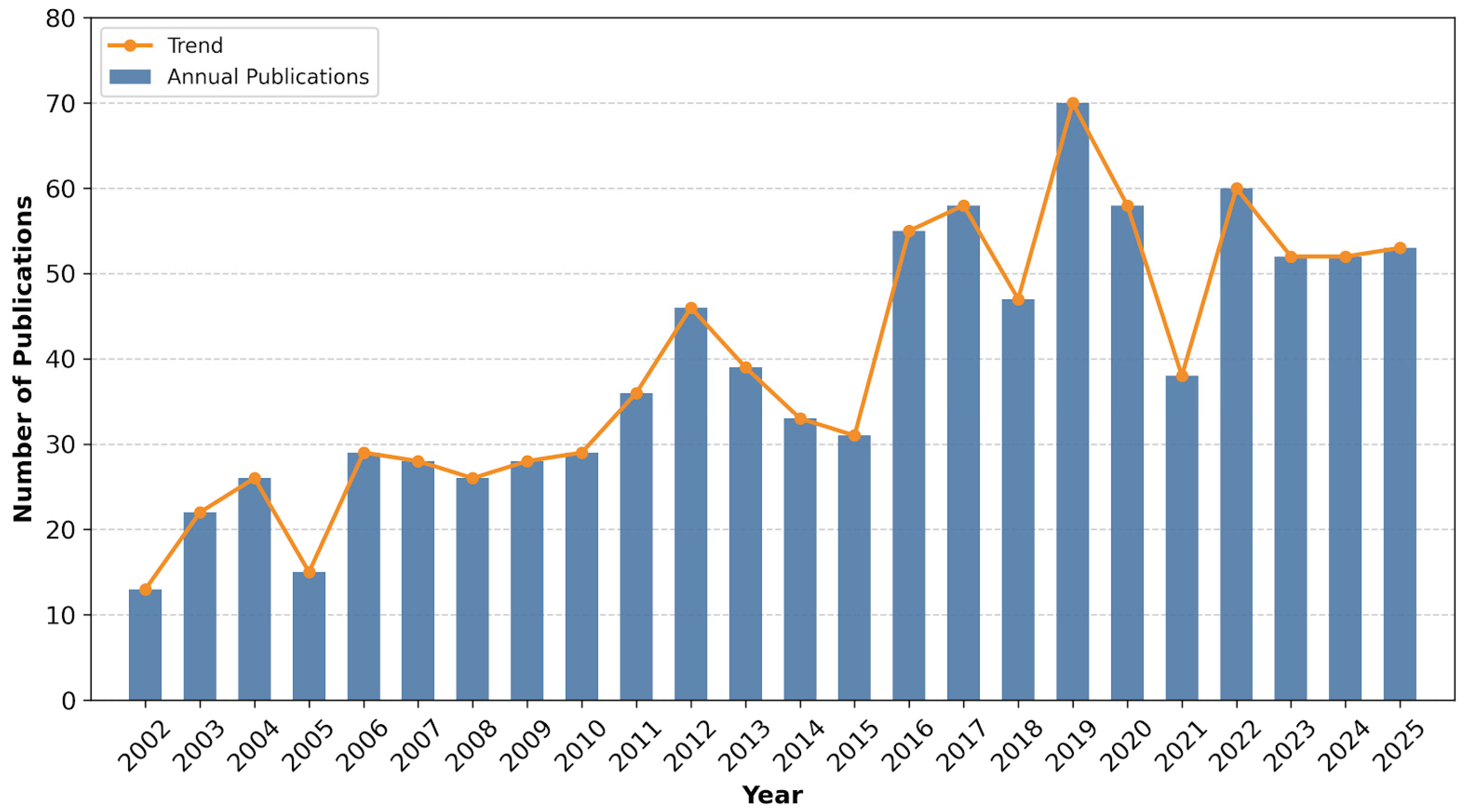
Polyaniline (PANI) is one of the earliest intrinsically conducting polymers to be systematically studied, and its electrochromic behavior was first reported in the late 1970s and early 1980s during investigations of conductive polymers [17,18,19]. Owing to its unique redox chemistry, polyaniline can reversibly interconvert among the leucoemeraldine, emeraldine, and pernigraniline oxidation states, each corresponding to distinct optical colors. Unlike many other conducting polymers, polyaniline can be proton-doped without altering its backbone structure, allowing its electrical conductivity and optical properties to be simultaneously regulated through simple acid–base chemistry [20,21]. This synergistic redox–proton doping mechanism endows polyaniline-based materials with rich color modulation, relatively low operating voltages, and fast electrochromic responses. In addition, polyaniline exhibits good chemical stability in acidic environments, low-cost and readily available monomer sources, and compatibility with various fabrication strategies, including chemical and electrochemical polymerization as well as composite and hybrid material design. These attributes make polyaniline an attractive platform for developing high-performance and multifunctional electrochromic materials. This growing significance is reflected in the academic literature. As illustrated in Figure 1, a bibliometric analysis based on Web of Science data reveals a substantial growth trajectory in publications related to “Polyaniline” and “Electrochromic” over the past two decades. Although the annual publication count peaked in 2019, the field has maintained a robust level of research activity in recent years (2020–2025), underscoring the enduring importance and established maturity of this field.
Figure 1. Bibliometric analysis of research trends. The annual number of publications indexed in Web of Science from 2002 to 2025 using the search terms “Polyaniline” and “Electrochromic”. The data highlights a rapid expansion phase followed by sustained high-volume research output, reflecting the continuous academic and industrial interest in PANI-based optical devices.
Against this background, this review aims to provide a comprehensive overview of recent advances in polyaniline-based electrochromic materials, with particular emphasis on the intrinsic relationships between synthesis methods, structural/morphological characteristics, key electrochromic properties, and practical applications. Common preparation strategies, including chemical oxidative polymerization, electrochemical deposition, template-assisted synthesis, and composite construction, are first summarized, with a focus on how processing parameters influence microstructure and electrochromic behavior. Subsequently, critical performance metrics such as optical contrast, coloration efficiency, switching speed, and cycling stability are systematically discussed, along with the major factors governing device durability and lifetime. Finally, representative applications in smart windows, display devices, sensors, and emerging multifunctional integrated systems are reviewed. Current challenges, including long-term stability, color neutralization, and scalable manufacturing, as well as future research directions, are also highlighted to guide the rational design and application of next-generation polyaniline-based electrochromic materials.

2. Synthesis Methods of Polyaniline-Based Electrochromic Materials

2.1. Chemical Oxidative Polymerization

Chemical oxidative polymerization is one of the most widely employed and scalable routes for the synthesis of polyaniline (PANI) electrochromic materials. In a typical procedure, aniline salts (e.g., aniline hydrochloride) are oxidized in acidic aqueous media using oxidants such as ammonium persulfate (APS), yielding the emeraldine salt (ES), which represents the most electrochemically active and electrochromically relevant oxidation state of PANI. According to the IUPAC technical report by Stejskal and Gilbert, this “standard” synthesis exhibits excellent reproducibility across laboratories, with polymer yields consistently exceeding 90% and an average room-temperature conductivity of 4.4 ± 1.7 S·cm−1 for HCl-doped PANI (based on 59 samples) [22]. The reaction mechanism is commonly described via a radical cation pathway, in which APS initiates the oxidation of aniline to form reactive intermediates that undergo head-to-tail coupling and chain growth, while protonic acids simultaneously induce doping and stabilize the conjugated backbone, thereby enabling reversible electrochromic redox transitions.
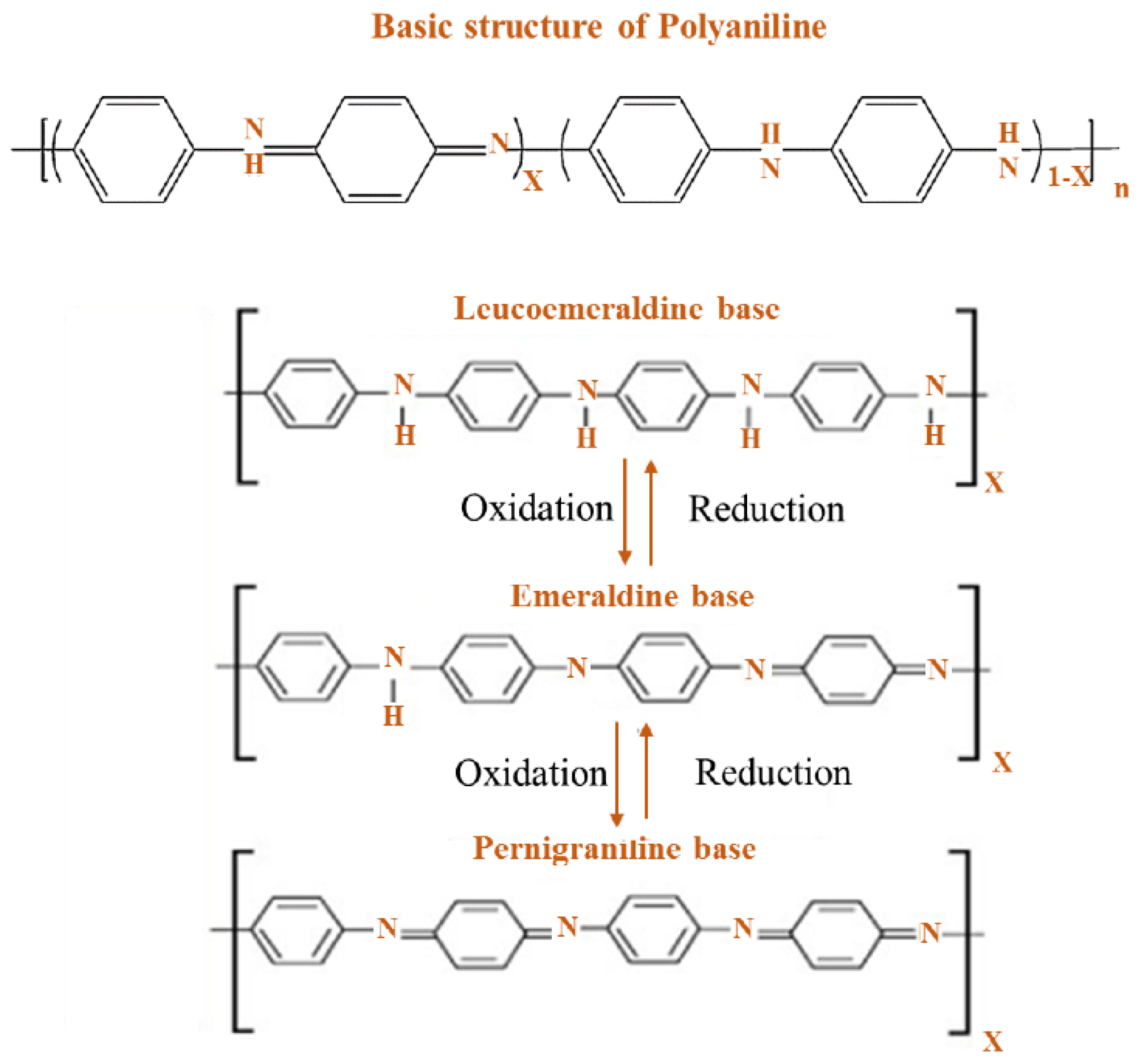
As schematically illustrated in Figure 2, the electrochromic functionality of PANI arises from the reversible interconversion between its different oxidation and protonation states, namely leucoemeraldine, emeraldine base, and emeraldine salt. The fully reduced leucoemeraldine form can be transformed into the conductive emeraldine salt through oxidative doping, which involves electron transfer accompanied by counterion incorporation. Alternatively, the insulating emeraldine base can be converted into the electroactive emeraldine salt via acidic protonation without changing the overall oxidation state of the polymer backbone. These coupled redox and protonation–deprotonation processes generate polaronic and bipolaronic charge carriers along the conjugated chain, modulating both electrical conductivity and optical absorption, and thus constitute the fundamental mechanism underlying the electrochromic behavior of PANI [23].
Figure 2. Schematic representation of the redox states and doping mechanisms of polyaniline [23].
From the perspective of electrochromic performance and durability, synthesis conditions strongly influence defect density, chain organization, and doping efficiency, which together govern charge transport and long-term cycling stability. The strength and dosage of the oxidant play a critical role: strong oxidants such as APS typically afford high conversion and conductivity but may induce over-oxidation and structural defects when used excessively, leading to degraded optical contrast and poor cycling endurance [24]. In addition, the electrochromic working potential window significantly affects stability. Wang and co-workers demonstrated that PANI films cycled within the 0.4–0.8 V (yellow ↔ green) range exhibited superior stability, with a coloration time of approximately 4.5 s and a high coloration efficiency of 159.48 cm2·C−1, whereas operation involving deeper oxidation states (e.g., 0.4–1.2 V or 0.8–1.2 V, yellow/green ↔ blue) resulted in rapid performance degradation [25]. These results clearly indicate that avoiding over-oxidation is essential for achieving long electrochromic lifetimes. At the device level, Ding et al. further showed that appropriate anion doping and microstructural optimization could dramatically enhance cycling durability, with modified PANI retaining approximately 78% optical contrast after 6500 cycles, compared to only 6.7% for pristine PANI [26].
The nature and concentration of the acid dopant fundamentally determine the protonation degree, electronic structure, and, thus, the electrochromic behavior of PANI. Stejskal and co-workers systematically investigated chemical oxidative polymerization in various inorganic and organic acids, reporting that strongly acidic media typically produce protonated PANI with conductivities in the range of 1–10 S·cm−1. In contrast, polymerization in carboxylic-acid-containing media often requires sulfuric acid generated in situ from APS decomposition to achieve effective protonation, resulting in lower conductivity. The authors also proposed partial sulfonation of the benzene rings as a possible origin of the exceptionally wide conductivity range observed for PANI bases (10−11–10−7 S·cm−1) [27]. Complementary to synthesis-stage control, Blinova et al. demonstrated that post-synthetic reprotonation of PANI bases provides a powerful and practical strategy for fine-tuning conductivity. By immersing PANI bases in aqueous solutions of different acids, the conductivity could be continuously adjusted over 10−9–100 S·cm−1, and in phosphoric acid systems, an empirical relationship was established: pH = 0.77 − 0.64 log(σ [S·cm−1]). Notably, surface wettability could be modulated simultaneously, with water contact angles decreasing from 78° (PANI base) to 44° after reprotonation in 1 mol·L−1 H3PO4, highlighting the coupling between doping level, interfacial properties, and ion transport relevant to electrochromic switching [28].
Extending this concept, Stejskal’s group conducted a comprehensive screening of 42 inorganic and organic acids for PANI reprotonation. The highest conductivity (1.22 S·cm−1) was achieved using 50% tetrafluoroboric acid, while most strong inorganic acids yielded conductivities on the order of 10−1 S·cm−1, and sulfonic acids typically produced 10−2–10−1 S·cm−1. In addition to electrical properties, reprotonation markedly influenced density (1.19–2.06 g·cm−3), water contact angle (29–102°), and volume change (−14% to +33%), underscoring the versatility of acid-controlled property modulation for electrochromic film design [29].
To further enhance conductivity while maintaining favorable electrochromic kinetics, Li and Wan introduced a “doping–dedoping–redoping” strategy to fabricate porous PANI films. Using acids such as HCl, HClO4, H2SO4, H3PO4, and p-toluenesulfonic acid (p-TSA) for redoping, they achieved exceptionally high room-temperature conductivities of 200–300 S·cm−1, comparable to PANI–CSA systems processed in m-cresol. The high conductivity was attributed to the preservation of an expanded-chain conformation, which facilitates efficient charge transport and is particularly advantageous for fast electrochromic switching [30].
Synthesis temperature is another critical parameter affecting morphology–conductivity relationships. Paschoalin et al. investigated in situ polymerization of HCl-doped PANI on PET substrates at 0, 10, and 20 °C, accompanied by parallel studies on PANI powders. UV–Vis spectra consistently showed characteristic polaron absorption bands near 420 nm and 800 nm, confirming formation of the emeraldine salt. XRD analysis revealed that the PANI powders were polycrystalline with similar degrees of crystallinity (66.3%, 62.8%, and 63.0%, respectively), indicating that crystallinity was not the dominant factor governing conductivity. Instead, AFM and FE-SEM analyses demonstrated that increasing synthesis temperature led to rougher surfaces and less compact polymeric aggregates. Consequently, the conductivity of PANI/PET films decreased dramatically from 219.00 ± 0.02 S·m−1 (0 °C) to 0.15 ± 0.01 S·m−1 (20 °C), while PANI powder conductivity dropped from 969.82 ± 1.03 S·m−1 to 253.91 ± 0.72 S·m−1 [31]. These results clearly indicate that lower synthesis temperatures favor more ordered morphologies and continuous charge-transport pathways, which are beneficial for electrochromic efficiency and stability.
Beyond temperature and acid control, morphological engineering and functional additives offer additional routes to optimize electrochromic performance. Porous and one-dimensional nanostructures effectively shorten ion-diffusion pathways and reduce charge-transfer resistance. For example, Erro et al. reported that highly porous PANI nanofiber films achieved an ultrafast switching time of T90 ≈ 20 ms at an optical contrast of ΔT ≈ 10%, directly demonstrating the kinetic advantages of porous architectures [32]. Yu and co-workers incorporated interfacially polymerized PANI nanofibers into PANI/PSS films, increasing electrochromic contrast from 0.49 to 0.67 and limiting contrast decay to <4% after 2000 cycles, accompanied by a reduction in charge-transfer resistance from 94 Ω to 76 Ω [33].
Functional dopants such as organic dyes can further modulate morphology and electrochemical behavior. Stejskal and colleagues examined the effects of 37 organic dyes during chemical oxidative polymerization, finding that PANI synthesized from aniline hydrochloride retained conductivities on the order of 1 S·cm−1 with predominantly globular morphology, whereas dye effects were more pronounced for polypyrrole systems [34]. Building on this concept, Cao et al. developed a one-step ethyl orange (EO)-assisted synthesis that induced the formation of PANI nanorods with enhanced conductivity (13.5 S·cm−1) and excellent dispersibility (ζ-potential 34 mV). When incorporated into waterborne polyurethane (WPU) coatings at 0.5 wt%, EO–PANI significantly improved electrochemical stability, exhibiting a low-frequency impedance magnitude of approximately 1010 Ω at 0.01 Hz in 3.5 wt% NaCl, nearly two orders of magnitude higher than that of conventional WPU coatings (~108 Ω) [35]. Such results highlight how morphology- and dopant-engineering strategies developed within chemical oxidative polymerization frameworks can be directly translated into robust electrochromic and multifunctional device architectures.

2.2. Electrochemical Polymerization

Electrochemical polymerization (electropolymerization/electrodeposition) has been widely applied to the construction of polyaniline (PANI) electrochromic films and devices due to its ability to achieve in situ deposition of polymer films on conductive substrates and precisely regulate the film growth process by applying potential, current, and total charge [36,37]. Depending on the control parameters, electrochemical polymerization is generally categorized into potentiostatic mode (typically corresponding to chronoamperometry, CA) and galvanostatic mode (typically corresponding to chronopotentiometry, CP, or galvanostatic electropolymerization, GS), both of which possess distinct advantages in growth kinetics, structural controllability, and device integration [38]. In potentiostatic mode, the polymerization reaction is confined within a preset potential window, which helps inhibit the over-oxidation of PANI, thereby offering better control over its oxidation state and doping level. For instance, studies employing potentiostatic electrodeposition (CA) to deposit PANI on Fluorine-doped Tin Oxide (FTO) substrates, using an electrolyte of 0.3 M aniline and 1 M H2SO4, compared the deposition effects at +0.8, +0.9, and +1.0 V (vs. SCE), revealing a close relationship between the “deposition potential window—film quality—electrochemical reversibility [39].” Similarly, in Indium Tin Oxide (ITO) substrate and acidic medium systems, the analysis of PANI nucleation and growth mechanisms through potentiostatic electrodeposition discovered that nucleation kinetics have a decisive impact on film compactness and uniformity [40]; these mechanistic findings further support the advantages of the potentiostatic method in regulating film structure. Furthermore, in situ characterization techniques provide direct evidence for observing growth dynamics during potentiostatic electrodeposition; specifically, in situ spectroscopic ellipsometry has been used to monitor the thickness evolution of PANI films in real time, revealing the direct influence of electrochemical conditions on deposition kinetics and film growth behavior [41].
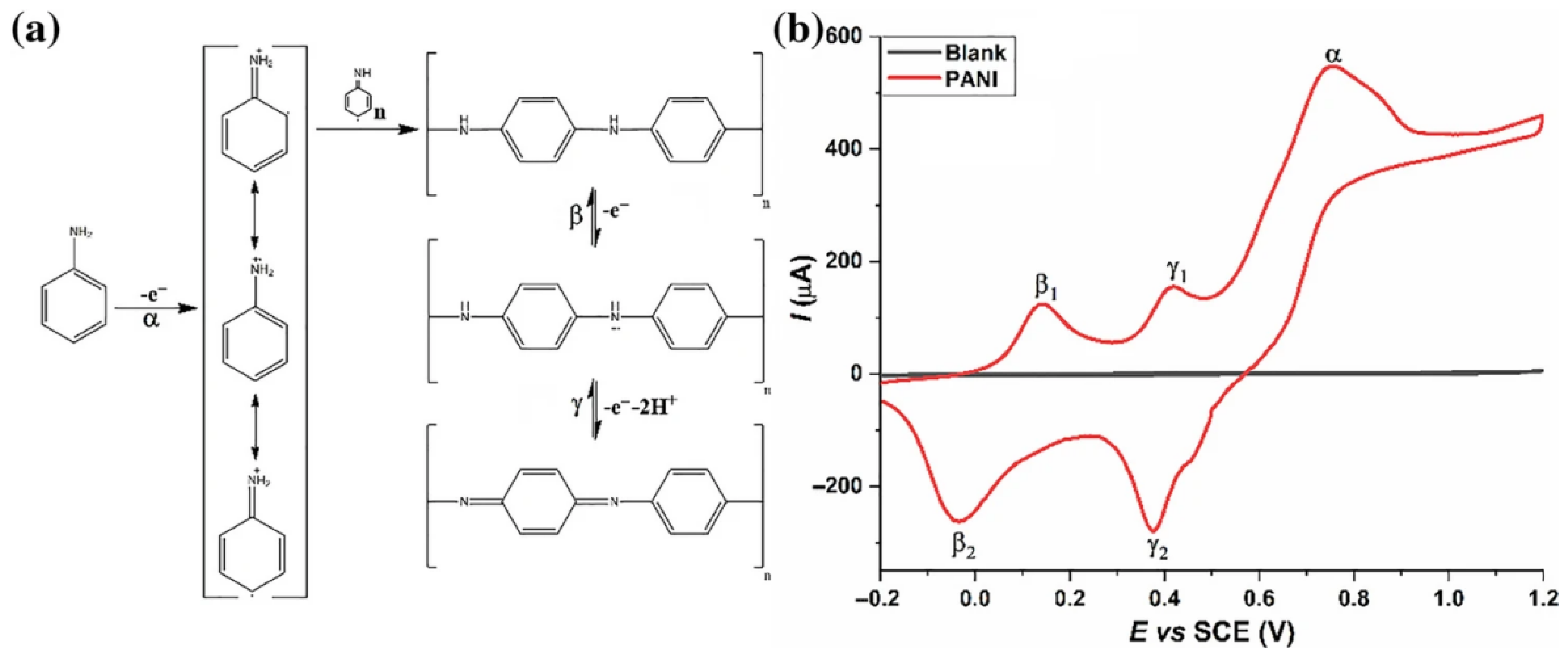
In contrast, the galvanostatic electrochemical polymerization method directly regulates deposition quality by controlling the amount of charge passed, making it particularly suitable for reproducible preparation and large-area film growth, and thus it is widely used in device research. Recent research explicitly adopted the galvanostatic method to prepare PANI electrochromic films, achieving an optical contrast of approximately 50% at 630 nm, with a response time as fast as 0.1 s. Additionally, this method demonstrated reversible switching between multiple color states such as transparent, yellow, green, blue, and purple, highlighting the potential of the galvanostatic method in optimizing electrochromic kinetics and multi-color regulation [42]. As illustrated in Figure 3a, the electrochemical process of PANI involves two coupled aspects: (i) the electrosynthesis step (alpha), where aniline is first oxidized by electron loss to reactive intermediates (radical-cation–type species) that subsequently couple to form oligomers and finally grow into the PANI backbone; and (ii) the reversible backbone redox steps (beta and gamma) after film formation, where the reduced segments are oxidized to a more conductive doped state through the beta transition (one-electron transfer), and are further driven toward a more oxidized state through the gamma transition accompanied by electron transfer and deprotonation (one electron coupled with two protons). Consistently, the cyclic voltammogram in Figure 3b shows negligible response for the blank electrode, while the PANI-coated electrode exhibits a set of characteristic redox peaks: an anodic beta1 peak at low potential (around 0.2 V vs. SCE) with its corresponding cathodic beta2 peak (near 0 V), an anodic gamma1 peak (around 0.45 V) paired with a cathodic gamma2 peak (around 0.4 V), and a pronounced high-potential alpha feature (around 0.75–0.85 V) associated with the oxidative electrosynthesis and growth process. These alpha, beta, and gamma processes collectively indicate that PANI electrochromism is fundamentally governed by proton-coupled backbone redox (beta and gamma) together with interfacial protonation and deprotonation and counter-ion charge compensation, enabling efficient ion–electron coupled transport and thus driving the macroscopic switching between bleached and colored states [42,43]. In the field of flexible electronic devices, combining galvanostatic electropolymerization with cyclic voltammetry, researchers have successfully prepared PANI films with tunable nanostructures on ITO/PET substrates, meeting multifunctional requirements for electrochromism and energy storage, further highlighting the advantages of the galvanostatic method in flexible electrode adaptability and large-scale preparation [44]. To further clarify the influence of electrochemical polymerization modes on film formation, cyclic voltammetry (CV) and chronoamperometry (CA) were applied to electropolymerize aniline on ITO-coated glass substrates. The CV-derived polyaniline (PANI) films exhibited nanofibrous morphologies with widths of 50–150 nm and a superior photoelectrochemical response, with photocurrent increasing from 0.1 to 0.4 mA·cm−2, compared with ~0.2 mA·cm−2 for CA-prepared films, highlighting their potential for optoelectronic applications [45].
Figure 3. (a) Schematic illustration of the electrochemical formation and redox transformation of polyaniline (PANI). The alpha step denotes the oxidative electrosynthesis of aniline (electron loss) to reactive intermediates, followed by coupling and chain growth to form the PANI backbone. After film formation, the beta and gamma steps represent reversible backbone redox transitions, where the beta process corresponds to a one-electron oxidation/reduction between reduced and doped PANI segments, and the gamma process involves a proton-coupled redox step with one electron transfer accompanied by the release/uptake of two protons (one electron plus two protons), driving interconversion toward a more oxidized state. (b) Cyclic voltammograms recorded versus SCE comparing a blank electrode and a PANI-coated electrode [43].
In electrochemical polymerization systems, electrolytes and substrates are not merely passive background conditions; they directly participate in the type of doping ions, nucleation behavior, interface adhesion, and synergistic ion/electron transport of PANI, thus significantly influencing electrochromic response speed and cycling stability [38,46]. Regarding electrolytes, the ion species and solvent environment can significantly alter interface wettability, charge transfer kinetics, and ion diffusion resistance, thereby regulating electrochromic kinetics [47,48]. An optimized, simple, and low-cost method has been applied to the prototype preparation of electrochromic devices (ECDs), involving the incorporation of the ionic liquid (IL) 1-(4-vinylbenzyl)-3-methylimidazolium chloride ([VBMIM]Cl) [49] into the conductive polymer PANI and depositing it on FTO substrates via electrodeposition [50]. By adjusting the IL to its optimal concentration, the EC-2 electrode demonstrated efficient bleaching time (tb) and coloration time (tc) superior to other electrodes, and exhibited multiple reversible color changes from dark green to light green. The electrode maintained almost its original electrochemical activity after multiple cycles, and portable ECDs prepared based on this show promise as ideal candidates for smart displays and smart window applications [50]. Another typical example is the Zn2+ system; compared to aqueous Zn2+ electrolytes, PANI in organic Zn2+ electrolytes exhibited significantly enhanced electrochromic performance, with coloration/bleaching times of 2.0/2.4 s, an optical contrast reaching 72.2%, and a coloration efficiency as high as 205 cm2·C−1, while maintaining 92.7% of its optical contrast after 10,000 cycles. This is attributed to the better interface wettability and faster charge transfer kinetics provided by the organic electrolyte. The choice of substrate is also crucial in PANI electrochemical polymerization [51]. Transparent conductive substrates like ITO and FTO not only provide electron transport channels but also influence nucleation density, film continuity, and adhesion through surface energy, roughness, and effective electrochemically active area. Research on FTO substrates revealed a coupling relationship between “substrate—potential—film quality,” emphasizing the need to re-optimize the deposition potential window (e.g., +0.8 to +1.0 V vs. SCE) according to different substrate conditions to avoid over-oxidation and uncontrolled roughness [39]. Similarly, nucleation mechanism studies on ITO substrates indicate that the nucleation-growth path, determined jointly by the substrate and electrolyte, ultimately affects film uniformity and long-term stability [40]. Additionally, pre-nucleation electrodeposition strategies have been proposed to prepare PANI films with better uniformity and adhesion, successfully constructing multi-patterned electrochromic devices [52].
Another core advantage of electrochemical polymerization lies in its ability to precisely regulate film thickness and morphology through parameters such as deposition time, charge amount, and current density, which are critical for balancing optical modulation amplitude, response speed, and cycle life. To improve kinetic performance while maintaining sufficient optical modulation, increasing research focuses on morphology engineering to build high-density ion channels and shorten diffusion paths. For example, Xing et al. further grew NiO nanorod arrays on electropolymerized PANI films, constructing a PANI/NiO composite electrochromic film. This one-dimensional nanostructure significantly increased the density of ion transport channels, achieving an optical modulation amplitude of approximately 72%, with fast coloration/bleaching response times of 0.61/0.73 s [53].
Beyond pure morphology control, composite structures and interfacial synergistic effects can also quantitatively enhance electrochromic performance. Addressing the limitation of PANI films in infrared (IR) electrochromic response due to their dense structure, researchers synthesized polyaniline/carbon quantum dots (PANI/CQDs) films (leveraging quantum dots’ giant performance enhancement capability [54]) using sulfuric acid and CQDs as dopants. The tetrahedral structure of sulfuric acid promoted the formation of highly ordered layered PANI, while the synergistic effect of CQDs facilitated a loose and porous surface morphology. For the PANI/CQDs porous film electropolymerized with a charge of 0.5 C (PANI/CQDs-5), it achieved 53% optical contrast at 850 nm, and emissivity changes (Δε) of 0.41, 0.46, and 0.42 in the 3–5 μm, 8–14 μm, and 2.5–25 μm ranges, respectively. The coloration and bleaching switching times were 2.5 s and 3.6 s, with a retention rate exceeding 95% after 100 cycles [55]. Furthermore, electropolymerized PANI/graphene oxide (GO) composite films achieved a coloration efficiency of 59.3 cm2·C−1, significantly higher than the 50.0 cm2·C−1 of pure PANI films, and maintained 53.1% capacitance retention after 1000 galvanostatic cycles, indicating that the interaction between GO and the PANI matrix effectively enhanced structural stability [56]. It is worth noting that morphology engineering has extended to infrared regulation and thermal management; for instance, a self-wrinkling PANI device structure achieved an emissivity modulation of 0.375 in the 8–14 μm band and a temperature regulation capability of approximately 8.9 °C [57]. To overcome the inherent instability of the PANI molecular structure, researchers also prepared triphenylamine cross-linked PANI derivative (CPANI) films via electrodeposition. This device achieved maximum emissivity modulations of 0.5 and 0.7 in the 3–5 μm and 8–14 μm bands, respectively, and maintained an average modulation capability of about 70% after 10,000 cycles [58].
In summary, electrochemical polymerization has established its core status in the preparation of high-performance polyaniline electrochromic materials due to its precise control over redox states, film thickness, and micromorphology. Whether through the potentiostatic mode to optimize nucleation kinetics and crystal structure, or utilizing the galvanostatic mode to achieve consistent large-area deposition, or further breaking through the performance bottlenecks of single materials via electrolyte engineering and nanocomposite strategies, this technology system demonstrates extremely high flexibility and adaptability. By precisely balancing the relationship between “nucleation—growth—structure” and combining novel functionalized substrates with electrolyte systems, electrochemical polymerization not only significantly enhances the optical contrast and response speed of devices but also provides solid technical support for the realization of long-life, multi-band (visible-infrared) synergistically regulated smart optoelectronic and thermal management devices.

2.3. Template-Assisted Synthesis

Based on the previously discussed chemical synthesis and electrochemical polymerization methods, template-assisted synthesis has been widely employed as an important structural regulation strategy to tailor the micro- and nanostructures of polyaniline (PANI), thereby alleviating the ion-diffusion limitations associated with the dense film structures that often form during conventional chemical or electrochemical polymerization processes [59,60]. By introducing predesigned spatial confinement or structure-directing agents during polymerization, template methods enable effective control over PANI nanostructures, producing high–specific surface area architectures such as nanofibers, nanotubes, and porous networks. These structures typically provide more electrolyte-accessible interfaces and more continuous ion-transport pathways, which is beneficial for improving doping/de-doping kinetics and cycling stability [61].
Hard-template approaches generally rely on rigid materials with regular pores or cavities. For example, anodic aluminum oxide (AAO) features tunable pore diameters, uniform channels, and excellent structural stability, enabling confinement of aniline polymerization within one-dimensional nanopores [62]. Classic studies have demonstrated highly ordered PANI nanotube arrays whose morphology and dimensions are directly constrained by the template pores, providing a clear route toward oriented one-dimensional electroactive structures with shortened diffusion paths [63]. Beyond AAO, macroporous hard templates such as inverse opals have also been used to construct hierarchically interconnected pore architectures. For instance, an inverse-opal WO3 skeleton coated with a PANI layer to form a core–shell inverse-opal composite film enables reversible multicolor switching, improves coloration/bleaching times to 3.8/6.14 s, and increases coloration efficiency to 201.1 cm2·C−1; these enhancements are attributed to rapid ion diffusion and enlarged effective reaction area enabled by the hierarchically porous core–shell inverse-opal structure [64]. In addition, using inorganic nanochannels/nanotube arrays as “hard scaffold templates” can yield quantifiable benefits: encapsulating and patterning electrodeposited PANI within TiO2 nanotube arrays produces composite electrochromic films for information display and delivers higher optical contrast and faster switching kinetics in the near-infrared region (relative to single-component films) [65].
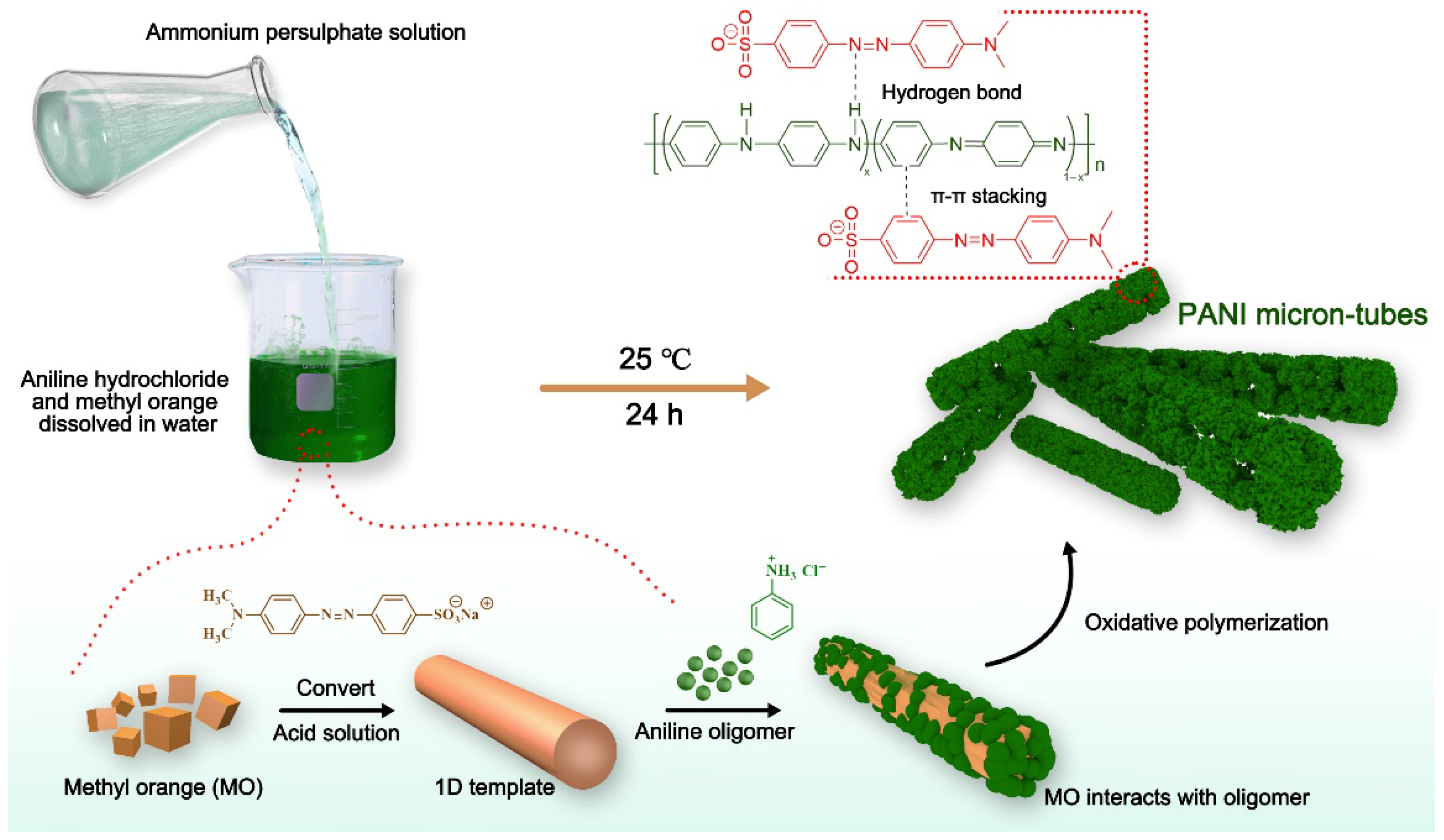
In contrast, soft-template methods mainly employ surfactants, micelles, or molecular self-assembly systems to guide PANI nanostructure formation under mild conditions. A representative recent example uses itaconic acid micelles as a soft template to produce PANI nanotubes; the mechanism has been interpreted as the cooperative directing effect of the aniline/itaconic acid micellar system and the electric double-layer structure on the polymerization process, enabling controllable formation of one-dimensional hollow nanostructures [66]. In addition, organic dyes can serve as structure-directing agents or soft templates for morphology control. As shown schematically in Figure 4, a one-step methyl orange (MO)-assisted synthesis enables the formation of PANI microtubes with aspect ratios up to ~20. MO molecules assemble into one-dimensional supramolecular templates in acidic solution and interact with aniline oligomers via hydrogen bonding and π–π stacking, thereby guiding anisotropic PANI growth during oxidative polymerization. As a result, the electrical conductivity is enhanced from 0.5 to 4.6 S·cm−1 (≈8× that of spherical PANI), while the microtubes maintain stable conductivity for over 30 days and exhibit good dispersibility in various solvents, indicating favorable processability and potential as conductive fillers in composite systems [67]. Beyond conventional surfactant systems, bio-based self-assembled templates can couple structural control with optical functionality: chiral nematic phases formed by cellulose nanocrystals (CNCs) can template optically active PANI/CNC films, providing a materials basis for introducing designable microstructural order and optical responses in flexible and sustainable systems [68]. For studies closer to scale-up and practical electrochromic applications, soft-template-controlled electrodeposition has also enabled scalable, large-area broadband modulation. For example, PVSK was used as a template to regulate PANI electrodeposition, producing PVSK–PANI films with uniform spherical morphology and enhanced electrochemical activity without compromising broadband IR performance. The resulting devices exhibited maximum emissivity changes (Δε) of 0.47/0.51/0.49 (3–5/8–14/2.5–15 μm) for 2 × 2 cm2 devices, and 0.55/0.46/0.46 for 20 × 20 cm2 devices, together with an infrared temperature modulation up to 10.4 °C at 70 °C, demonstrating the effectiveness of soft-template morphology control for large-area electrochromic thermal management [69].
Figure 4. Schematic illustration of the methyl orange (MO)–assisted soft-template synthesis of polyaniline (PANI) microtubes. The MO molecules self-assemble into one-dimensional supramolecular templates via electrostatic and π–π interactions, effectively guiding the anisotropic growth of PANI to form high-conductivity hollow microstructures [67].
Furthermore, template concepts are often combined with layer-by-layer assembly or “in situ morphology templating” to simultaneously optimize electron/ion pathway organization and interfacial stability. For instance, a layered PANI/Ag nanowire composite film used in multicolor electrochromic smart windows with dual-band modulation accelerates electron transport and shortens switching times (coloration/bleaching of 6.7/18.0 s at 525 nm) while increasing coloration efficiency to 45.5 cm2·C−1 [70]. Alternating assembly of PANI with MXenes (e.g., (Ti3C2Tx)) to form PANI/MXene films can strengthen interfacial interactions and, through the layered structure, expose more active sites for ion/electron insertion–extraction, thereby improving both electrochromic and energy-storage performance [71]. In addition, “self-wrinkling” introduces wrinkle microstructures as an in situ physical template into PANI functional layers, achieving higher infrared emissivity modulation (Δε = 0.375, 8–14 μm), faster response (1.8/2.6 s), and an ~8.9 °C temperature regulation capability, indicating that templated microstructures are also effective for broadband thermo-optical regulation device [57]. Relatedly, although pre-nucleation electrodeposition does not belong to traditional “externally added templates,” it produces loose porous structures via a “nucleation-first, growth-later” process design and shows a clear advantage in electrochemical activity (maximum active charge of 22.3 mC·cm−2). It can therefore be regarded as another form of “process templating” for structural regulation within electrodeposition systems [72].

2.4. Composite and Hybrid Material Synthesis

Despite Polyaniline (PANI) holding a prominent position in the field of electrochromism due to its rich multicolor transitions and high coloration efficiency, single-component materials remain significantly constrained by a “structure–transport–life” bottleneck. While early studies demonstrated functional switching, they exposed three intrinsic weaknesses: First, the significant volume expansion and contraction induced by repeated doping/dedoping processes lead to structural fatigue and delamination, severely limiting cycling life to typically less than a few thousand cycles. Second, the drastic drop in conductivity in the reduced state hinders charge transport, resulting in distinct kinetic hysteresis that cannot be resolved by film thickness optimization alone. Third, the dense film structure limits the effective infiltration depth of ions, making it intrinsically difficult to maintain high activity in thick films required for high optical contrast. To overcome this “structure–transport–life” bottleneck, constructing organic-inorganic hybrids or multi-component composites has become a mainstream strategy. The core lies in leveraging synergistic effects to engineer composite structures at the micro/nano-scale featuring “rigid supporting skeletons,” “continuous conductive networks,” and “efficient ion channels,” thereby synchronously enhancing optical modulation amplitude, response rate, and long-term stability [49,50,51,52].
Among the various composite strategies, the PANI–Metal Oxide composite system primarily embodies the “structural hybridization” design philosophy, where the inorganic phase typically functions as both a structural support and an ion transport carrier. This strategy aims to prevent polymer collapse via the inorganic skeleton and optimize electrolyte accessibility through pore engineering. For instance, a TiO2 porous framework constructed using Electrostatic Spray Deposition (ESD), combined with in situ electropolymerized PANI, forms a nanocomposite film with both high specific surface area and excellent interfacial bonding. This system utilizes a “donor-acceptor coupling + porous channel” mechanism to significantly enhance electrochromic kinetics, achieving a high optical modulation amplitude of 76.9% at 600 nm, a switching time shortened to less than 3.6 s, and a coloration efficiency of 78 cm2 C−1 [73]. Beyond kinetics improvement, structural hybridization also enables electrochromism–energy-storage integration by distributing charge storage and buffering the volume variation of PANI through a robust inorganic framework. For example, WO2.86/PANI hybrid films combine the multicolor electrochromism of PANI in the visible region with the near-infrared modulation of tungsten oxide, allowing synergistic or decoupled regulation of the VIS–NIR dual bands. In a typical LiClO4–PC electrolyte, selective transport of Li+ ions and electrons enables three distinct optical states (bright: VIS/NIR transparent; cool: VIS transparent while NIR blocked; dark: both VIS and NIR blocked), demonstrating multi-mode switching for advanced smart-window energy management [74]. Meanwhile, MnO2/PANI systems exploit the pseudocapacitive contribution of MnO2 to share charge storage and mitigate structural fatigue, forming electrochromic supercapacitors in which the voltage evolution during galvanostatic charge–discharge is synchronized with the optical transmittance modulation; notably, the device can retain about 73.46% of its initial capacitance with nearly 100% Coulombic efficiency after 15,000 cycles at 0.4 mA cm−2, highlighting the stabilizing role of the inorganic phase [75].
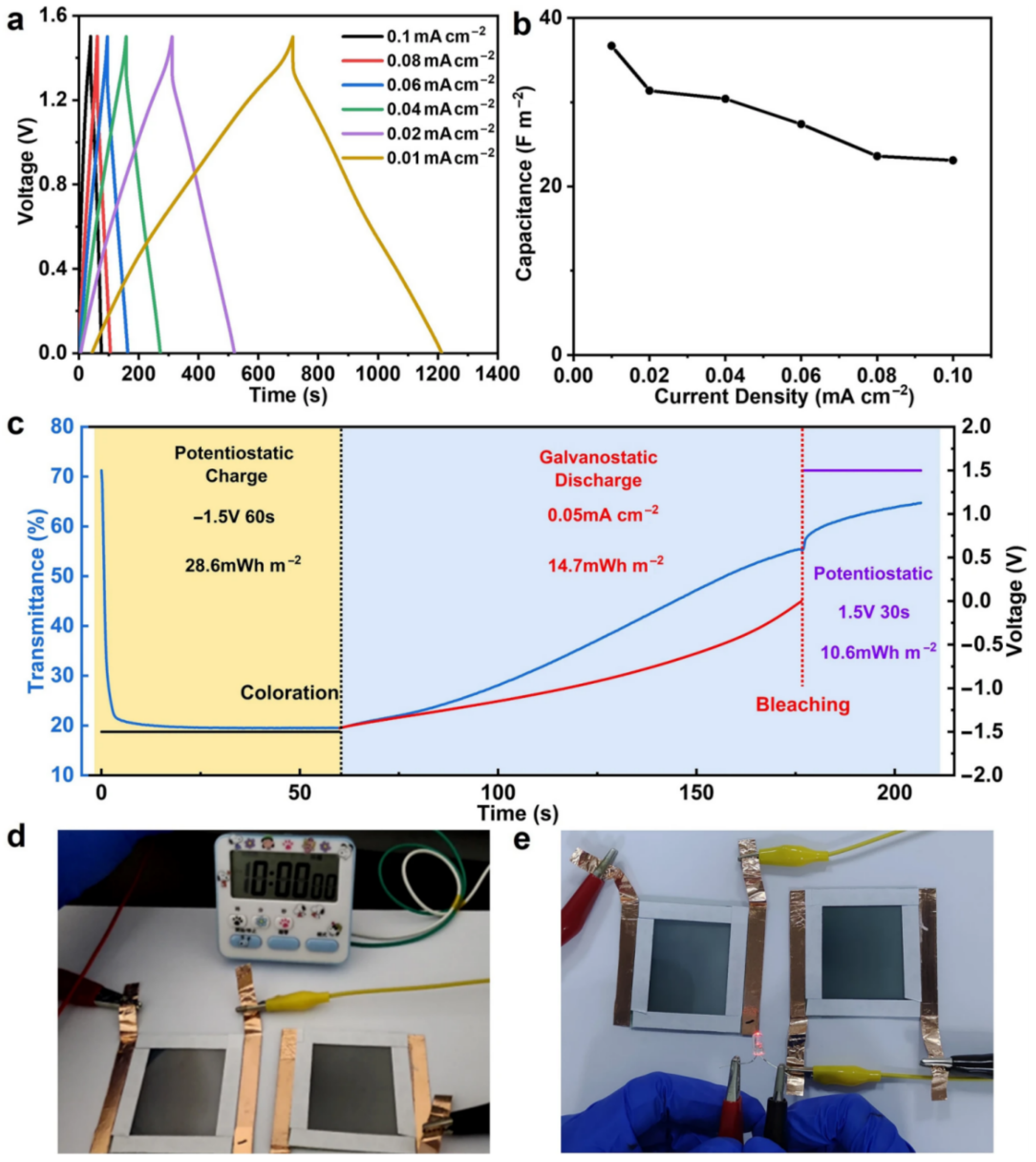
As further illustrated in Figure 5, a flexible dual-band electrochromic device integrating porous PANI with oxygen-deficient tungsten oxide nanowires (W18O49) exhibits typical galvanostatic charge–discharge behavior over a range of current densities (0.01–0.10 mA cm−2) (Figure 5a) and a corresponding current-density-dependent areal capacitance (Figure 5b). More importantly, the transmittance and voltage evolve synchronously during a full switching cycle (Figure 5c): a potentiostatic coloration step at −1.5 V for 60 s rapidly decreases the transmittance and consumes 28.6 mWh m−2, followed by a galvanostatic discharge at 0.05 mA cm−2 that releases 14.7 mWh m−2 while the transmittance recovers, and a final potentiostatic bleaching step at 1.5 V for 30 s outputs an additional 10.6 mWh m−2 to complete optical recovery. This quantified energy-flow/optical-response coupling directly visualizes real-time electrochromic–energy-storage dual-functionality and supports the energy-recycling concept reported for such bifunctional smart windows [76]. The device-level photographs (Figure 5d,e) further demonstrate practical feasibility by interconnecting prototype units to power an external LED [76].
Figure 5. Electrochromic–energy-storage coupling behavior and device demonstration of a flexible dual-band electrochromic system integrating porous PANI with oxygen-deficient tungsten oxide nanowires (W18O49). (a) Galvanostatic charge–discharge (GCD) curves recorded at different current densities from 0.01 to 0.10 mA cm−2. (b) Areal capacitance as a function of current density. (c) Real-time correlation between optical transmittance (left axis) and voltage (right axis) during a complete coloration/bleaching cycle, including potentiostatic coloration at −1.5 V for 60 s (energy input: 28.6 mWh m−2), galvanostatic discharge at 0.05 mA cm−2 (energy output: 14.7 mWh m−2), and potentiostatic bleaching at 1.5 V for 30 s (energy output: 10.6 mWh m−2), demonstrating synchronized electrochemical and electro-optical responses and quantifying energy recycling. (d,e) Photographs of prototype device units and an LED demonstration powered by interconnected devices, indicating practical feasibility. Reproduced/Adapted from Ref. [76].
In contrast, the PANI–Carbon composite system focuses more on “transport hybridization,” with the core objective of establishing interconnected electron pathways and optimizing ion transport channels. In this system, reduced graphene oxide (rGO) and carbon nanotubes (CNTs) act as “permanent current collectors”(analogous to the interface engineering seen in MOF-derived heteroatomic porous carbon [77]), effectively overcoming the kinetic hysteresis caused by the drastic drop in conductivity of polyaniline (PANI) in its low oxidation state (bleached state). Taking the ternary PB/rGO/PANIsystem as an example, electrodeposited films utilize rGO to construct a continuous conductive network, Prussian Blue (PB) to enhance spectral stability, and PANI to contribute fast chromic response. This synergistic effect of “layered structure—pore organization—interfacial charge transfer” significantly enhances the electrochromic kinetics of the device. Studies show that smart windows based on this composite electrode achieve an optical modulation amplitude (ΔT) of 41% at 625 nm, with coloring and bleaching times of 12.1 s and 12.6 s, respectively. More importantly, the device retains 92% of its initial performance (maintained at 38%) after 3000 cycles, fully demonstrating its potential in long-term electrochromic and thermal management systems [78].
Building on this, the advantages of carbon-based skeletons are particularly prominent in the field of flexible wearables. PANI@MWCNTs textile electrodes employ an integrated design of “fiber substrate + carbon nanotube conductive skeleton + PANI chromic layer.” The carbon network not only endows the device with mechanical durability under deformation but also supports rapid electrochemical response (coloring/bleaching times of ~2.15/1.89 s) and, combined with the infrared regulation capability of PANI, realizes efficient thermal management functions [79]. Similarly, the composite of 2D MXene materials (such as) with PANI leverages high conductivity and layered ion channels to further reduce interfacial impedance and improve the cycling stability of dual-function (chromic + energy storage) devices [80].
While the integration of inorganic oxides (e.g., TiO2 or WO3) with PANI prevents polymer collapse, a critical analysis reveals a recurring trade-off: simply physically mixing or electrodepositing PANI onto inorganic skeletons often introduces high interfacial resistance, which can dampen the coloration efficiency compared to pure polymer films. Consequently, recent research highlights that physical hybridization alone is insufficient, and strategies must shift towards “interfacial chemical engineering” to create strong chemical bonds. At the micro-interface level, La2O3/PANI composite films modified with silane coupling agents demonstrate the critical role of “chemical bonding”: strong interfacial interactions effectively suppress the volumetric collapse of the polymer skeleton. When the molar ratio of La2O3 to aniline is optimized to 1:3.5, the material not only significantly enhances cycling durability but also achieves a coloration efficiency of 22.81 cm2 C−1 and rapid response times (1.29 s/1.33 s) [81]. At the mesoscopic scale, constructing conjugated polymer dual networks (CPDN) offers a new pathway for flexible multifunctionalization; a PEDOT/PANI dual network integrated via a one-step electrochemical polymerization not only exhibits an extremely high coloration efficiency (322 cm2 C−1) and fast switching (~1s), but also realizes visual energy storage monitoring (yellow-purple transition) and excellent capacitance retention (86.4% after 1000 cycles) with a specific capacitance of 357 Fg−1 in flexible electrochromic-supercapacitor devices [82]. Furthermore, synergistic design has extended to the device physics level. A novel dual-band smart window utilizes the “built-in electric field” at the Au/PANI Schottky junction interface to accelerate carrier transport. This field-assisted effect significantly promotes polaron/bipolaron transitions, not only improving response speeds to τc/τb = 0.9/1.3 s (at 633 nm) but also expanding operation modes from three to four, enabling independent and flexible modulation of visible and near-infrared light in large-scale (55 cm2) devices [83].
Collectively, composite synthesis follows the principle that “the skeleton defines transport limits, while the interface determines efficiency. Metal oxide hybrids primarily target stability and diffusion constraints through rigid pore designs, whereas carbon-based composites resolve kinetic and flexibility bottlenecks via efficient conductive networks. These multi-scale synergistic designs significantly reduce ion diffusion paths and charge transfer impedance without sacrificing PANI’s optical contrast. This paves the way for broad-spectrum, fast-response, and durable electrochromic applications, establishing a solid foundation for next-generation smart windows and flexible electronics.

2.5. Additive Manufacturing and Patterning Strategies

The electrochromic phenomenon in polyaniline (PANI) is fundamentally governed by the reversible redox transitions between its oxidation states (leucoemeraldine, emeraldine, and pernigraniline), accompanied by the insertion and extraction of ions (e.g., H+, Li+) and solvent molecules. While the synthesis methods discussed in previous sections (Section 2.1, Section 2.2, Section 2.3 and Section 2.4) focus on tailoring the intrinsic molecular and microstructural properties of PANI, additive manufacturing and patterning strategies represent the critical engineering bridge that translates these “processable precursors/inks” into device-level architectures with defined spatial and thickness distributions. This “bottom-up” fabrication approach directly influences key device metrics—including optical modulation amplitude (ΔT/ΔR), coloration efficiency (CE), switching kinetics, and cycling stability—while enabling the scalable, low-temperature integration required for smart windows, flexible displays, and wearable electronics.
The core technological chain for additive manufacturing typically follows a sequence of “ink formulation → patterned deposition → electrolyte integration.” The development of stable, printable dispersions containing PANI nanostructures (such as 2D nanosheets, nanofibers, or composites) is a prerequisite. For instance, Huang et al. demonstrated that inkjet-printed 2D lamellar PANI inks could overcome the limitations of bulk agglomeration. By creating a stable ink with optimized rheology, they achieved flexible, patterned electrochromic devices exhibiting a high optical contrast of approximately 76% at 750 nm, a high coloration efficiency of 259.1 cm2·C−1, and rapid response times (1.8 s for coloration and 2.4 s for bleaching) [84]. These results align well with the “structure-property” correlations discussed earlier: the 2D porous morphology significantly shortens ion diffusion paths and maximizes the effective electrochemically active area, ensuring high performance even under printed conditions. Extending this to wearable applications, inkjet-printed layer-stacked PANI on textile substrates has achieved a reflectance modulation of 22.9%, maintaining reversible operation after 1000 bending cycles, which highlights the direct correlation between material microstructure and device-level mechanical reliability [85].
Patterning goes beyond merely printing static shapes; it involves the precise spatial control of ion migration to realize multi-zone or programmable dynamic displays. Recent work has proposed controlling the three-dimensional migration of ions within the device to achieve multi-pattern PANI electrochromism. Under galvanostatic driving, such devices can increase reflectance to ~34% within 15 s and maintain it at ~30% during continuous operation, demonstrating the feasibility of programmable pattern evolution [85]. While highly promising for anti-counterfeiting and information display, this approach imposes stringent requirements on the uniformity of the underlying PANI film. Consequently, studies focusing on the real-time regulation of electropolymerization kinetics are essential to ensure the film homogeneity and reproducibility required for high-resolution patterning.
Equally critical to the manufacturing strategy is the design of the electrolyte and encapsulation system, which dictates the scalability, stretchability, and environmental stability of the final device. Solid-state or gel electrolytes are preferred for large-area and flexible manufacturing. For example, modular devices based on electrochromic ion gels** have demonstrated a high ionic conductivity of ~3.84 × 10⁻³ S·cm−1, achieving a transmittance modulation of 81.3% with response times of ~5.3 s/5.1 s, while remaining stable under 10% mechanical strain [86].
As devices scale from laboratory prototypes to large-area applications (e.g., smart windows), engineering challenges such as the potential drop (iR drop) across electrodes and edge effects become prominent. To address this, hierarchical current collector designs are often integrated with PANI deposition. Hierarchical metal mesh electrodes (e.g., pitch ~100 μm, line width ~2 μm) have been utilized to ensure uniform driving voltages across large areas, enabling efficient broad-spectrum modulation. Additionally, manufacturing processes can induce functional microstructures; for instance, self-wrinkling PANI surfaces formed through structural self-assembly have been shown to enhance infrared emissivity modulation (Δε ≈ 0.375) and thermal regulation (~8.9 °C) without the need for complex lithography [57].
In summary, additive manufacturing and patterning serve as a vital link in the PANI research framework, connecting “synthesis methods” to “practical applications.” It transforms material design ability into spatial programmability and scalable production. Future research in this domain requires a holistic optimization of “printable PANI inks,” “high-conductivity gel electrolytes,” and “low-impedance interfaces” to realize the full potential of PANI in next-generation optical and thermal management systems.
To provide a holistic view of the preparation strategies discussed in this section, Table 1 systematically compares the four primary synthesis methodologies: chemical oxidative polymerization, electrochemical polymerization, template-assisted synthesis, and composite/hybrid construction. It highlights the distinct mechanisms, key advantages, and intrinsic limitations of each approach, along with their typical morphological outcomes and performance metrics. This comparative summary offers a clear guideline for selecting appropriate synthesis routes to balance the critical trade-offs between scalability, structural precision, and functional stability in electrochromic device fabrication.
Table 1. Comparative Overview of PANI Synthesis Methods.

3. Electrochromic Properties of Polyaniline-Based Materials

3.1. Optical Properties

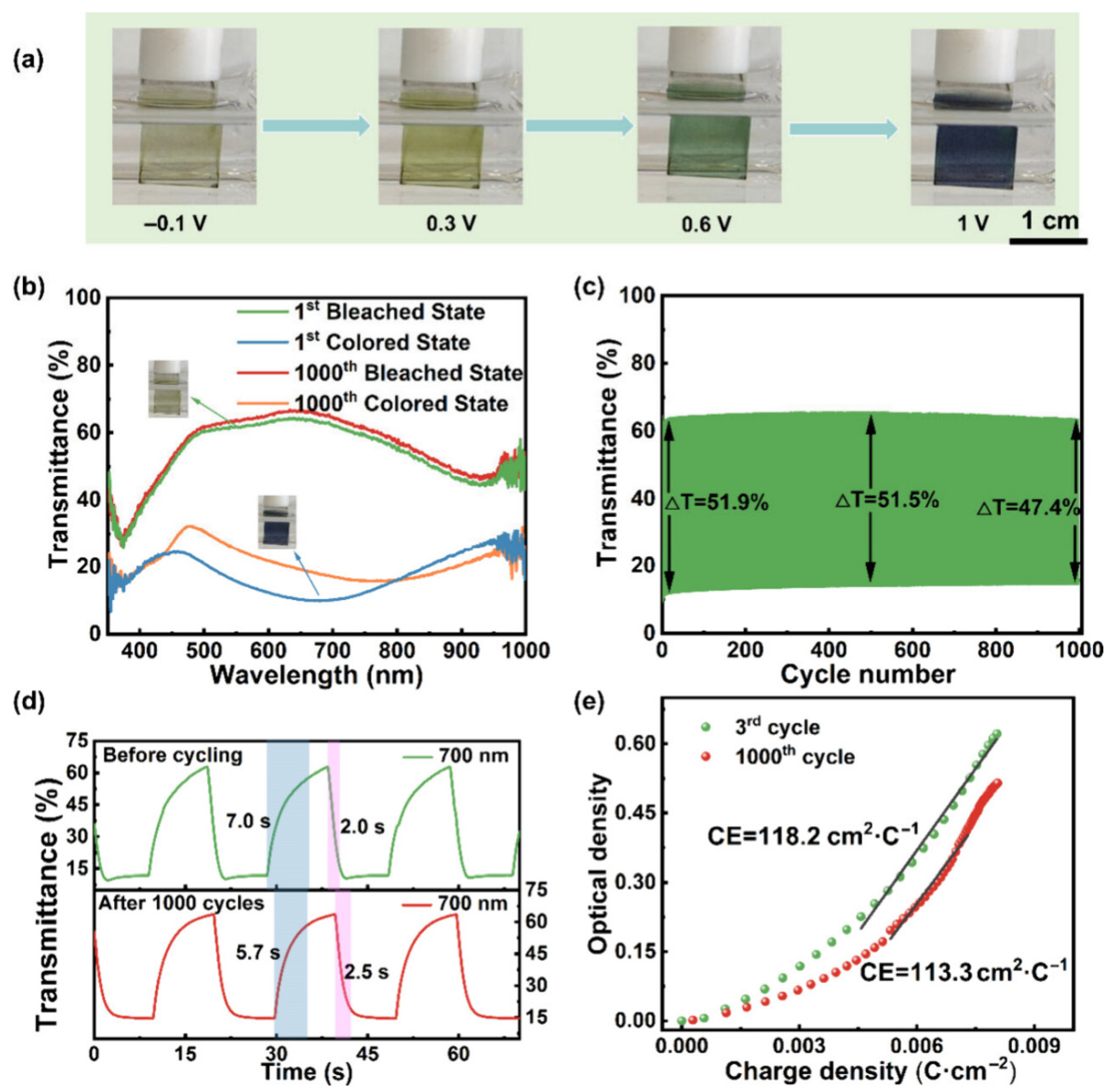
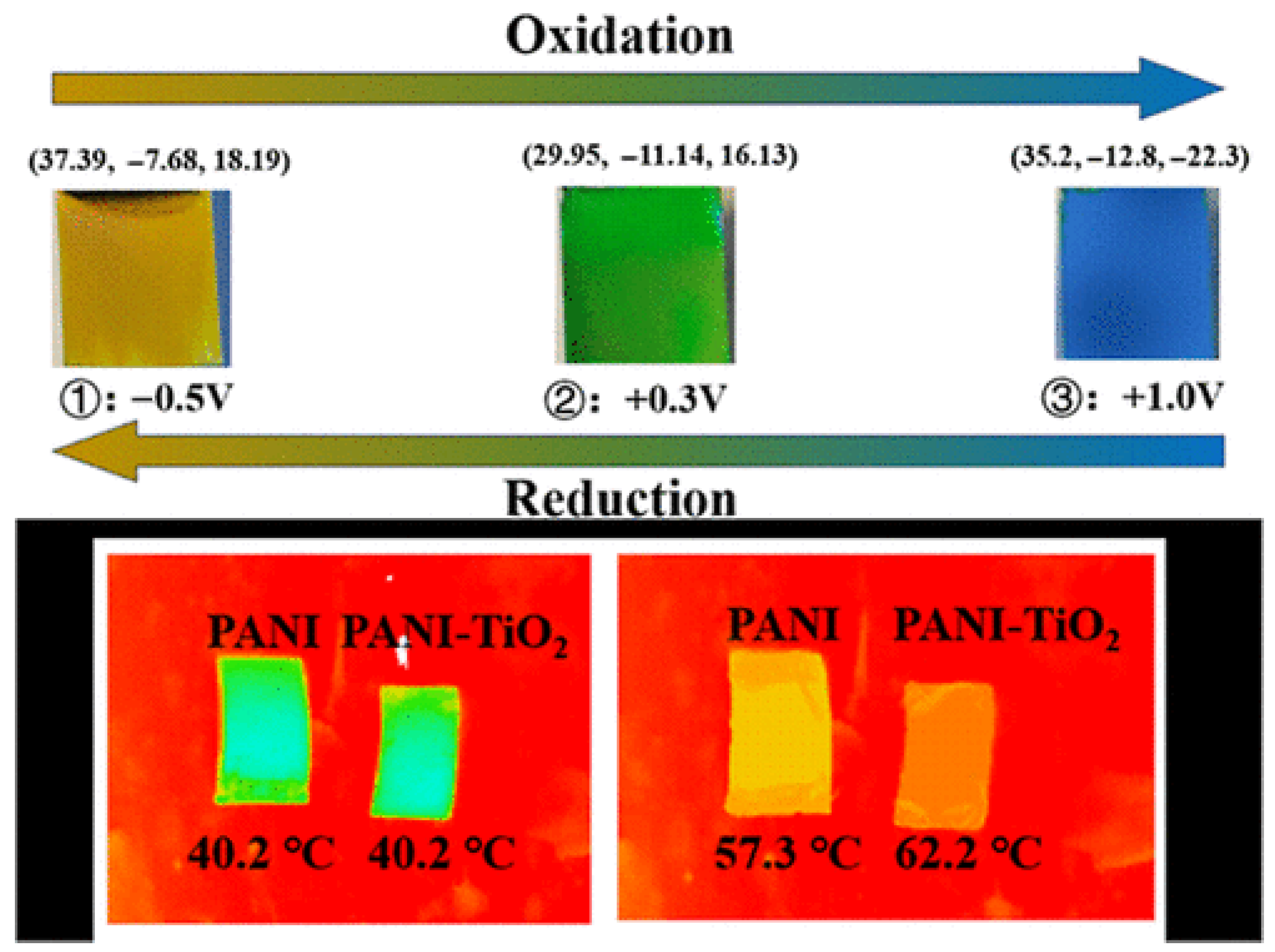
The optical behavior of PANI is governed by redox-induced band structure rearrangements, manifesting as a transition sequence from transparent leucoemeraldine to green emeraldine salt and purple pernigraniline. These state changes correspond to distinct UV-Vis absorption signatures, endowing the material with precise tunability. Consequently, Optical contrast (ΔT) and response kinetics are key indicators for measuring electrochromic performance. Electropolymerized PANI films usually show large ΔT in the visible range; for instance, electrodeposited films can reach approximately 50% optical contrast at 630 nm with a rapid response time of ~0.1 s, demonstrating effective utilization of the active area [42]. To further break through thermodynamic stability limits and enhance performance, composite structural engineering plays a significant role. Recent studies combined with Density Functional Theory (DFT) reveal that TiO2 doping can significantly elevate the Highest Occupied Molecular Orbital (HOMO) and Lowest Unoccupied Molecular Orbital (LUMO) energy levels of oxidized PANI, facilitating electron excitation and polaron formation. As visualized in Figure 6, this energy level modulation enables distinct multicolor switching, where the film transitions from neutral yellow (−0.5 V) to conducting green (+0.3 V) and finally to insulating blue (+1.0 V) during the oxidation process. Experiments confirm that PANI-TiO2 composite films not only possess expanded electrochemically active areas and optimized ion transport efficiency but also achieve an optical contrast of 73.8%, with coloration and bleaching times shortened to 0.46 s and 0.94 s, respectively, significantly outperforming pure PANI films. Moreover, this composite exhibits excellent infrared regulation capabilities under low voltage (<1 V), with an emissivity variation (Δε) as high as 0.61. This enhanced thermal regulation is corroborated by infrared thermal imaging (Figure 5, bottom), which shows that under identical stimulation, the PANI-TiO2 composite achieves a higher surface temperature (62.2 °C) compared to pure PANI (57.3 °C), directly reflecting its superior emissivity modulation capability [87]. Similar micro/nano-structural optimizations have been validated in other systems; for example, PANI doped with p-TSA and featuring a long-range ordered/short-range disordered layered structure can further increase ΔT to 70%–80%, while maintaining fast coloring/bleaching responses (~2.8 s/5.2 s) and extremely high coloration efficiency (328.5 cm2⋅C−1) [88].
Figure 6. Performance of PANI-TiO2 composite films. (Top) Reversible color transitions under applied potentials: reduced yellow (−0.5 V), semi-oxidized green (+0.3 V), and fully oxidized blue (+1.0 V). (Bottom) Infrared thermal imaging comparison showing superior emissivity regulation of the composite film, which reaches a surface temperature of 62.2 °C compared to 57.3 °C for pure PANI [87].
Coloration efficiency (CE), used to quantify the change in optical density per unit charge density, is another core parameter for evaluating energy efficiency. Highly crystalline PANI films, after chain structure optimization, can reach a CE of 150 cm2⋅C−1 [89].To further enhance energy efficiency and enrich color dimensions, complementary device designs based on PANI show immense potential. For instance, a study on a complementary system utilizing a PANI electrode and 1-methyl-4,4′-bipyridyl iodide (MBI) demonstrates that MBI, acting as a cathodic electrochromic layer with electrolyte functions, not only simplifies the device architecture but also achieves an exceptional CE of up to 140.63 cm2⋅C−1. This system covers a full color gamut of red, yellow, green, blue, and purple over a wide voltage range, with each color state possessing a high color contrast of up to 73.8 and rapid response (1 s/1.9 s). Combined with screen-printed PVA barrier layer technology, this material can realize patterned anti-counterfeiting displays, proving the feasibility of high-CE materials in applications like smart packaging [90]. Furthermore, heterostructure designs greatly enrich spectral characteristics: PANI/WO2.86 dual-band films exhibit four reversible color states (light blue, yellow-green, dark blue, and dark green), achieving independent regulation of visible and near-infrared regions [74]; while PANI-MnO2 nanocomposite films display systematically tunable UV–Vis–NIR spectra, utilizing synergistic effects to further enhance ΔT and response range [75].
Beyond inorganic oxide composites, composites of PANI with carbon quantum dots (CQDs) and graphene derivatives also exhibit excellent tunability of color states and transmission characteristics, enabling regulation of color and transmittance across a broad spectrum (including the IR region), further expanding applications in multi-spectral electrochromic and thermal control systems [91]. In all these systems, morphology, film thickness, and crystallinity largely determine the final optical performance: thin, porous, or nanostructured PANI-based films typically exhibit higher ΔT and faster response speeds, mainly benefiting from shorter ion diffusion paths and larger electrochemically active interfacial areas. In summary, through the optimization of molecular ordering, nanostructures, and heterogeneous interface designs (such as energy level matching and chemical bonding), PANI-based materials still hold huge potential for enhancing electrochromic performance in the visible and near-infrared regions, providing a solid performance foundation for applications such as smart windows, display devices, and adaptive optical surfaces.

3.2. Electrochemical Properties

Since PANI operation relies on coupled ion-electron transport to maintain charge neutrality, its electrochemical performance is fundamentally governed by mass transport kinetics. In dense films, restricted ion diffusion across the interface often limits switching efficiency. Over the past years, a consistent message has emerged: once PANI films become relatively dense or when conductivity drops in low-oxidation (bleached) states, device performance is increasingly limited by coupled electron/ion transport, making it essential to reduce charge-transfer resistance and improve the utilization of redox-active sites via composite scaffolds, interfacial bonding, and electrolyte engineering. For example, introducing anthraquinone-1-sulfonate (AQS) as a redox-active dopant and incorporating AQS into gel electrolytes can strengthen reversible faradaic contributions while providing more continuous ion pathways, leading to improved electrochemical reversibility and cycling stability that are favorable for electrochromic operation [92].
From the standpoint of charge transport, another representative direction is to integrate “dynamic” conductive pathways or inorganic frameworks to mitigate the intrinsic conductivity/structural bottlenecks of PANI. Reversible metal electrodeposition (RME), where a metal is reversibly deposited/dissolved during operation, effectively introduces an adaptive electronic percolation and interfacial charge-transfer route for PANI across different oxidation states, thereby accelerating electrochemical kinetics and enabling multi-mode regulation in functional devices [93]. In parallel, coupling PANI with inorganic phases such as layered vanadium oxides (VOx) can stabilize electrochemical interfaces and facilitate ion-insertion/extraction processes; notably, in situ Raman evidence has been used to track intermediate formation and reversible evolution during Zn2+ insertion/extraction, supporting the role of “interfacial stabilization + transport-channel construction” in enhancing reversibility and durability [94]. Collectively, these advances indicate that improvements in the electrochemical performance of PANI systems usually arise from simultaneous optimization of electronic pathways and ion-accessible interfaces, rather than merely increasing intrinsic conductivity.
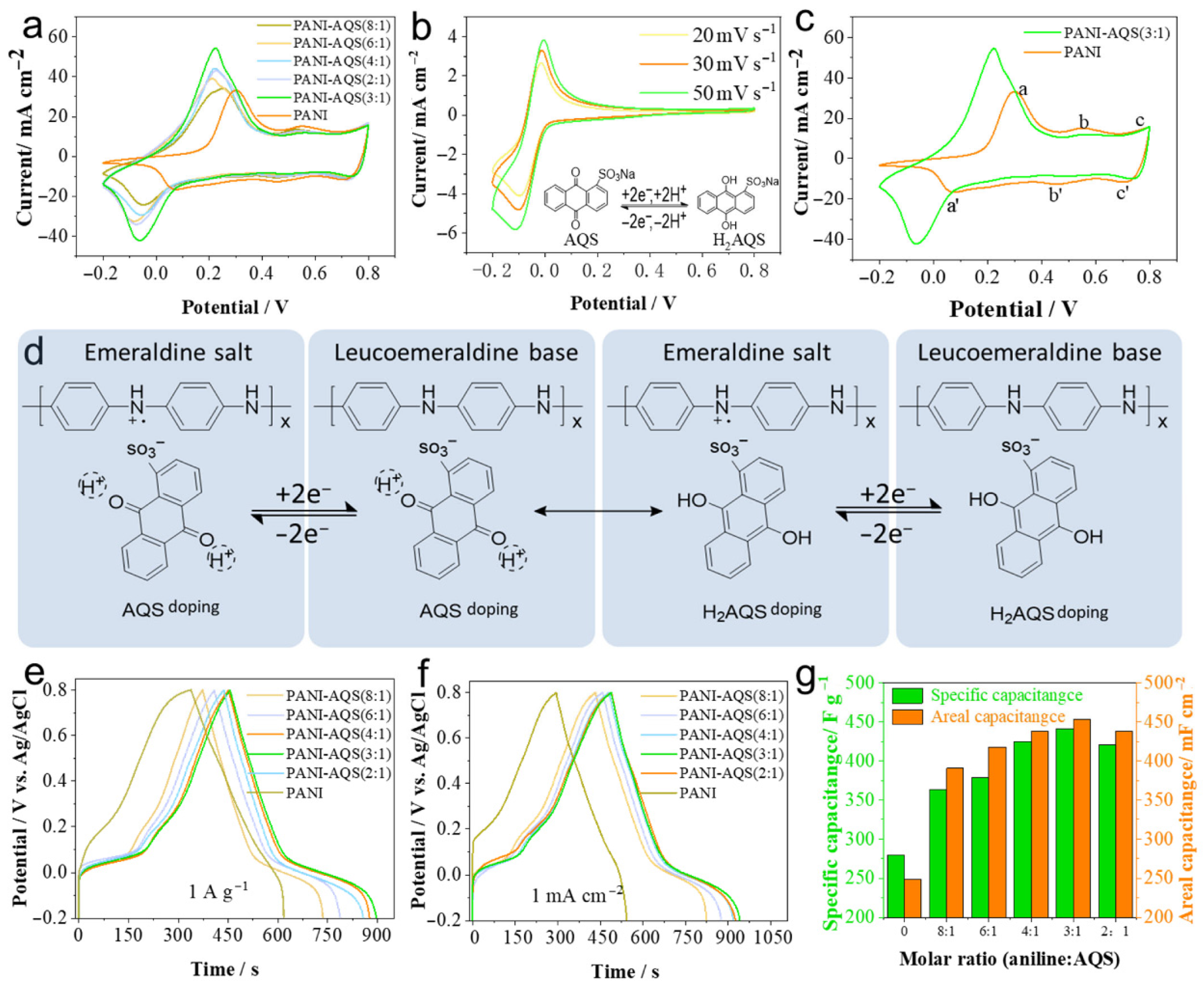
Cyclic voltammetry (CV) is the most direct tool for assessing PANI electrochemical behavior and for linking electrochemistry to electrochromic performance. In typical PANI-based electrodes, anodic/cathodic peaks (or peak sets) reflect reversible redox transitions among oxidation states accompanied by ion doping/de-doping; peak potential shifts and peak separations provide insight into polarization and charge-transfer kinetics, whereas the integrated CV area (charge) correlates with the amount of electrochemically addressable redox sites. Scan-rate dependence further helps distinguish surface-controlled pseudocapacitive responses from diffusion-limited processes; when nanostructuring, conductive hybrid frameworks, or redox-active dopants shorten diffusion paths and improve electrolyte accessibility, CV responses generally exhibit reduced polarization and more stable cycling. As a practical illustration, recent work presents CV curves together with a schematic of PANI oxidation states and corresponding doping/de-doping processes, which is particularly useful in reviews to close the “CV features → redox/ion compensation → transport kinetics” loop. Specifically, Figure 7 presents the characterization of PANI-AQS composites, rigorously following this analytical logic: The CV curves of electrodes with varying doping ratios (Figure 7a) first reveal the evolution of redox peaks. Under different scan rates (Figure 7b), the optimized electrode demonstrates stable capacitive behavior, indicating efficient kinetics. A direct comparison (Figure 7c) highlights that the PANI-AQS (3:1) electrode exhibits significantly larger integral areas and distinct redox pairs (a/a’, b/b’, c/c’) compared to pure PANI. The origin of these enhanced features is elucidated in the mechanism schematic (Figure 7d), which shows how AQS groups facilitate the protonation/deprotonation cycles between Emeraldine salt and Leucoemeraldine base states. This mechanism translates into superior energy storage metrics, as quantified by the Galvanostatic Charge–Discharge (GCD) curves at 1 A g−1 (Figure 7e) and 1 mA cm−2 (Figure 7f). Finally, the summary data (Figure 7g) confirms that the optimal aniline/AQS molar ratio of 3:1 maximizes both specific and areal capacitance (>400 F g−1), validating the efficacy of the doping strategy [92].
Figure 7. Electrochemical performance and mechanism of PANI-AQS composites. (a) CV curves of PANI electrodes with varying Aniline: AQS molar ratios. (b) CV curves at different scan rates (20–50 mV s−1) showing stable kinetics. (c) CV comparison between PANI-AQS (3:1) and pure PANI, highlighting enhanced redox pairs (ac). (d) Schematic of the reversible redox mechanism assisted by AQS doping. (e,f) GCD curves at current densities of 1 Ag−1 and 1 mA cm−2, respectively. (g) Specific and areal capacitance vs. molar ratio, indicating optimal performance at 3:1. The diagram illustrates how the sulfonate groups of AQS serve as internal proton reservoirs to facilitate the protonation/deprotonation cycle, thereby enhancing electrochemical reversibility and capacitance [92].

3.3. Switching Performance

Switching performance of electrochromic materials is commonly evaluated by the coloration time (τc) and bleaching time (τb), often reported as the time required to reach 90% of the full optical change (t90) [4]. For polyaniline (PANI)-based systems, switching is governed by coupled electron transport, ion migration, and interfacial charge-compensation processes. Because PANI exhibits pronounced conductivity differences among redox/protonation states, and because ion diffusion becomes increasingly rate-limiting in dense or thick films, switching is frequently asymmetric, with faster coloration and slower bleaching. This asymmetry becomes more prominent as film thickness increases or device dimensions scale up, where longer ionic diffusion distances and stronger interfacial polarization can dominate τb.
At the materials level, creating highly accessible ion-transport pathways is an effective route to accelerate switching. For example, highly porous PANI nanofiber films have demonstrated ultrafast t90 (~20 ms) at a modest ΔT (~10%), illustrating the direct kinetic advantage of shortened diffusion lengths and enlarged electrochemically accessible surface area [32]. In composite architectures, introducing a nanofiber network can simultaneously improve kinetics and durability: incorporating interfacially polymerized PANI nanofibers into PANI/PSS films increased the electrochromic contrast (from 0.49 to 0.67), limited contrast decay to <4% after 2000 cycles, and reduced the charge-transfer resistance (from 94 Ω to 76 Ω), consistent with improved coupled ion/electron transport [33].
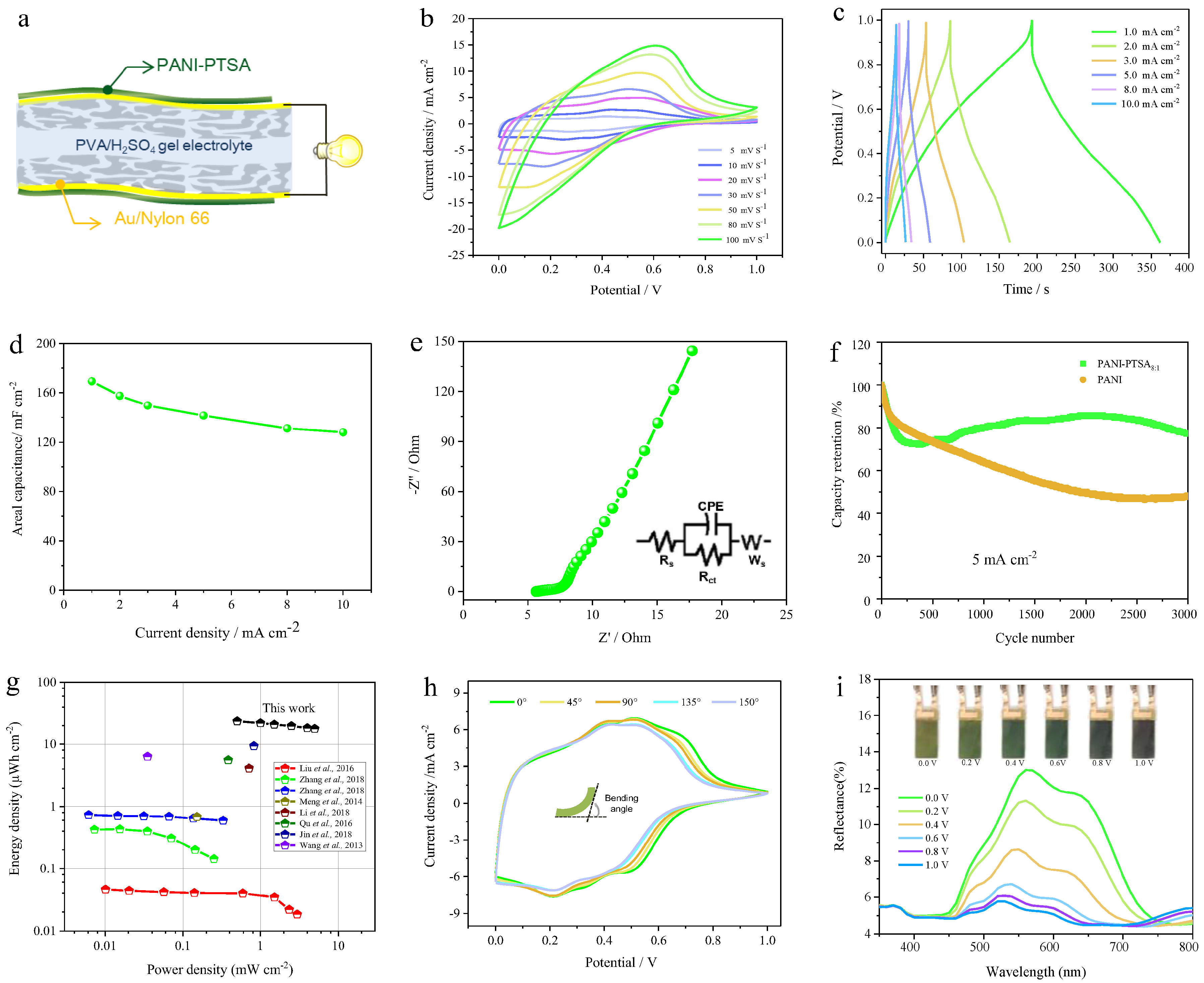
At the device level, a representative example of switching kinetics under realistic, step-potential operation is provided by the single-component PANI multicolor dual-band electrochromic smart window reported by Wang et al. The device achieved ΔT = 65% at 633 nm and ΔT = 59% at 1600 nm, and after 10,000 cycles, it exhibited only minor losses in modulation amplitude [95]. Importantly, the supporting data explicitly quantified switching times as τcb = 5.9/16.9 s at 633 nm and τcb = 11/32.5 s at 1600 nm, providing a clear, quantitative demonstration of the typical kinetic feature in dual-band PANI devices: coloration is relatively fast, whereas bleaching is more strongly constrained by ionic back-diffusion and interfacial polarization, especially at longer wavelengths and in device-scale configurations [95]. Expanding the scope from purely optical modulation to multifunctional electrochemical storage, recent work on electrochromic supercapacitors (ECSCs) provides a system-level verification of how structure regulation can overcome kinetic bottlenecks [96]. As illustrated in Figure 8, a symmetric ECSC based on PANI–p-TSA composite electrodes and a PVA–H2SO4 gel electrolyte was constructed (Figure 8a). In this system, p-toluenesulfonic acid (p-TSA) serves a dual function: acting as a dopant counter-ion for charge compensation and regulating polymer chain growth via multi-sulfonic groups to form a cross-linked morphology with continuous conductive networks and open ion channels, thereby effectively shortening the ion diffusion path. This structural optimization translates directly into superior rate capability: Cyclic voltammetry (CV) curves maintain excellent symmetry (Figure 8b), and Galvanostatic Charge–Discharge (GCD) profiles exhibit stable potential evolution across a wide current density range of 1–10 mA·cm−2 (Figure 8c). This serves as robust evidence that interfacial ion supply remains efficient even under fast driving conditions, with no significant diffusion limitations. Consequently, the device retains an areal capacitance exceeding 120 mF·cm−2 even at high current densities (Figure 8d), indicating that redox-active sites are fully utilized during rapid switching. Electrochemical Impedance Spectroscopy (EIS) further corroborates this kinetic advantage (Figure 8e), where the small charge-transfer resistance and typical low-frequency Warburg behavior quantify the contribution of “reduced interfacial impedance and diffusion resistance” to enhanced dynamic response. Regarding durability, the PANI–p-TSA system retains approximately 79% of its capacitance after 3000 cycles (Figure 8f), demonstrating that its kinetic pathways remain stable during long-term repetitive switching. Furthermore, the device delivers a competitive areal energy density of ~10 μWh·cm−2 at relatively high power densities (Figure 8g); this high-power characteristic inherently reflects the system’s capability for rapid charge injection/extraction, which is the physical basis for fast electrochromic response. Finally, the stable electrochemical response under mechanical bending (Figure 8h) and the reversible photo-electric coupling verified by reflectance spectra (Figure 8i) collectively confirm the system’s ability to maintain efficient “electron/ion transport–optical modulation” synchronization under dynamic operating conditions.
Figure 8. Electrochemical characterization and electrochromic performance of the PANI–p-TSA symmetric electrochromic supercapacitor [96]. (a) Schematic illustration of the device configuration comprising PANI–p-TSA composite electrodes and a PVA–H2SO4 gel electrolyte. (b) Cyclic voltammetry (CV) curves at various scan rates demonstrating reversible redox kinetics. (c) Galvanostatic charge–discharge (GCD) profiles at current densities ranging from 1 to 10 mA·cm−2. (d) Rate capability showing areal capacitance as a function of current density. (e) Electrochemical impedance spectroscopy (EIS) Nyquist plot. (f) Cycling stability evaluated over 3000 cycles. (g) Ragone plot comparing the areal energy and power densities with previously reported works [97,98,99,100,101,102,103]. (h) CV curves under different mechanical bending angles. (i) Reflectance spectra with inset photographs displaying the reversible color states coupled with the electrochemical process. Collectively, these results demonstrate that the PTSA-doped cross-linked network effectively minimizes interfacial impedance, enabling sustained high-rate capability and optical modulation stability under dynamic operating conditions [96].
Beyond electrode design, electrolyte engineering can critically influence switching kinetics and long-term stability by controlling ionic conductivity, interfacial impedance, and the uniformity of ion flux during repeated redox cycling. A recent Perspective summarizes design strategies for ionogels in electrochromic devices, which are directly relevant to PANI systems [104]. In brief, ionogels immobilize an ionic liquid (or ion-conducting medium) within a polymer network, thereby suppressing leakage/evaporation while maintaining continuous ion-conduction pathways. By tuning network polarity, crosslink density, and microphase morphology, ionogels can balance high ionic conductivity with mechanical integrity [105], enhance electrode/electrolyte wetting and adhesion, reduce interfacial resistance, and stabilize ion supply during cycling. Mechanistically, these effects help mitigate local ion depletion and polarization—factors that often manifest as increasing τb, switching hysteresis, and cycle-to-cycle drift in PANI-based electrochromic devices.

3.4. Environmental Stability

Environmental stability is one of the key issues that must be addressed before polyaniline (PANI) electrochromic materials can be deployed in practical engineering applications. Compared with inorganic transition-metal oxides, the electrochromism of PANI relies more strongly on the coupled processes of redox transition–protonation/deprotonation–ionic charge compensation. As a result, external pH, temperature, and humidity can alter the doping state of the polymer, ion-transport kinetics, and the interfacial chemical environment, thereby triggering reliability problems at the device level, including decreases in ΔT, increases in t90, reductions in CE, and shortened cycle life. In addition, an electrochromic device may develop “local environmental drift” during operation; for example, proton generation/consumption associated with PANI electrochemical reactions can dynamically shift the interfacial pH near the electrode, coupling electrochemical switching–local chemical environment–aging into an intrinsic feedback loop [106].
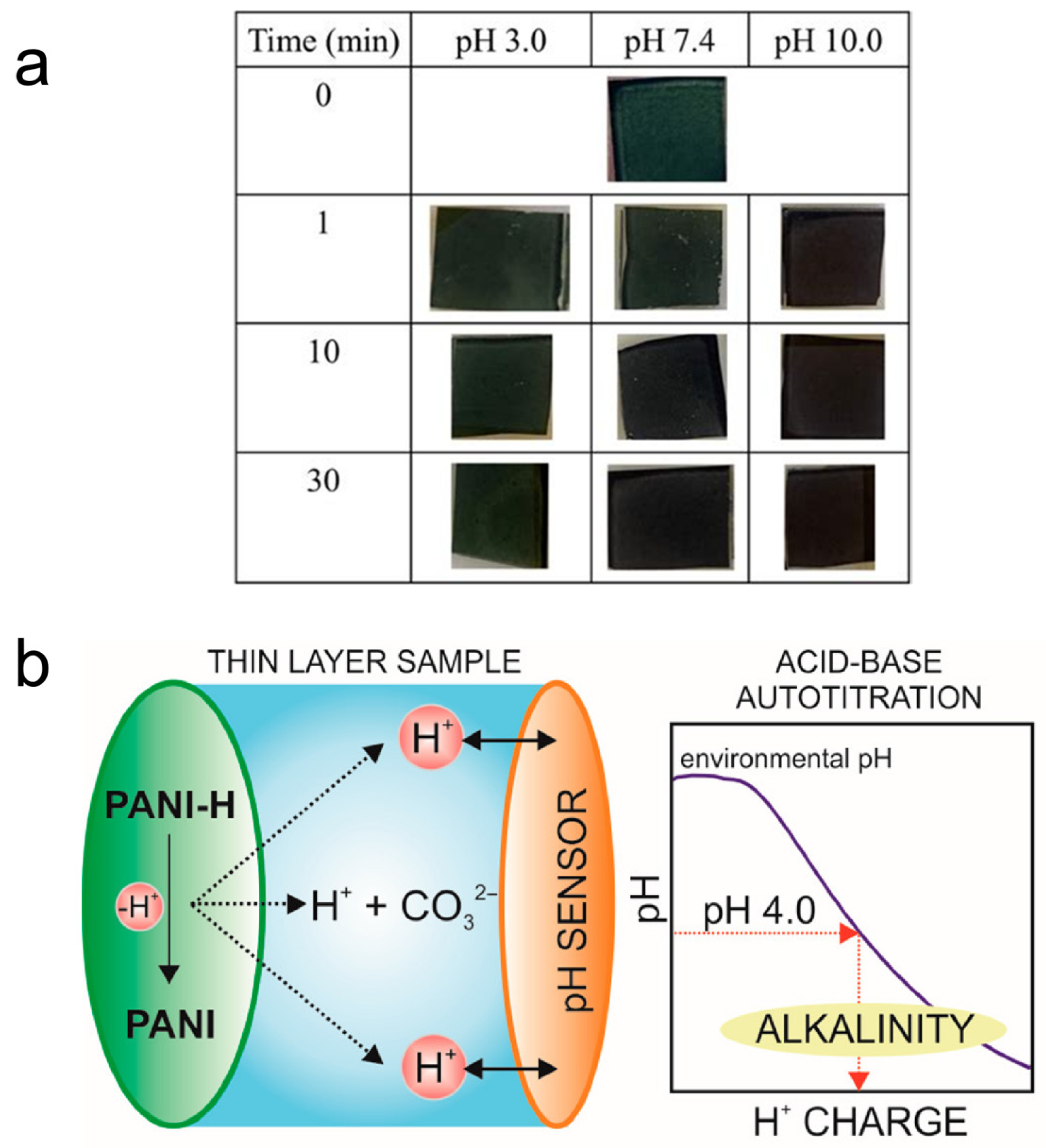
From the perspective of pH, the conductivity and optical state of PANI are closely tied to its degree of protonation. Acidic conditions favor electroactive/protonated forms (e.g., emeraldine salt), whereas neutral/alkaline environments promote deprotonation (toward emeraldine base) and weaken effective counterion doping, typically resulting in lower carrier density, degraded spectral reversibility, and poorer coupled ion/electron transport. A direct visual manifestation is provided by Figure 9a: protonated PANI-based films immersed in buffer solutions show minimal appearance change at pH 3.0 over 1–30 min, while clear time-dependent darkening (and a more pronounced shift at higher pH) is observed at pH 7.4 and especially pH 10.0, consistent with pH-triggered deprotonation/dedoping and macroscopic optical-state drift [107]. Importantly, pH is not merely an external boundary condition in EC devices. Figure 9b (from the “electrochemical proton pump” concept) illustrates that under anodic polarization, PANI can release protons (PANI–H → PANI + H+), actively acidifying a confined thin-layer region; the reverse process can also be electrochemically driven [106]. This mechanistic picture is directly relevant to EC reliability: repeated switching may induce interfacial pH excursions even under nominally constant bulk conditions, shifting the local protonation equilibrium and thereby perturbing ΔT, t90, and CE over time (e.g., by changing the fraction of electroactive/protonated segments and the efficiency of ionic compensation) [106]. However, it is important to note a significant methodological weakness in many reported stability studies. Most cycle life tests are conducted in ideal, large-volume, buffered electrolytes, which artificially mask the degradation caused by these local chemical environment changes. In contrast, practical devices operate with limited electrolyte volume where “local environmental drift” is pronounced. Therefore, previous studies that do not account for this self-induced local pH shift likely overestimate the practical lifespan of PANI-based devices, and future protocols must simulate these confined environments to provide realistic durability data.
Figure 9. Environmental pH and local pH drift effects on the state stability of PANI-based systems. (a) Visual color evolution of protonated PANI-based films after immersion in buffer solutions of pH 3.0, 7.4, and 10.0 for 1, 10, and 30 min, indicating pH-triggered deprotonation/dedoping and optical-state drift. (b) Schematic of PANI acting as an electrochemical proton pump: anodic polarization drives PANI–H → PANI + H+, inducing local acidification (local pH decrease) in a confined thin-layer region, providing a mechanistic basis for the coupling between electrochemical switching, interfacial local pH drift, and environmental aging/performance drift in PANI electrochromic systems [106].
From the perspective of temperature, the influence of temperature on environmental stability generally involves both kinetic and aging contributions. At low temperature, higher electrolyte viscosity and lower ionic conductivity slow down doping/dedoping, leading to increased t90, a longer τb, and stronger kinetic hysteresis. At high temperature, dopant/ion migration and loss can accelerate, interfacial side reactions can be promoted, and the mechanical stress associated with repeated swelling/shrinkage during cycling can be magnified, increasing the likelihood of crack formation and interfacial delamination. In wide-temperature-window device engineering, it has been demonstrated that appropriately designed transparent ion-conducting layers/electrolytes can help flexible PANI-based devices retain multicolor electrochromic responses over a broad range (e.g., −10 to 60 °C), indicating that the “electrolyte structure–ion mobility–temperature robustness” relationship can be substantially improved through materials design [108]. In parallel, mechanistic studies of thermal/oxidative aging have shown that heat and oxygen exposure can drive irreversible chemical evolution in conductive PANI films (e.g., accumulation of oxidative products and composition changes), providing a basis for understanding continuous degradation of optical and electrochemical performance at elevated temperatures [109].
From the perspective of humidity, water can be both beneficial and detrimental to PANI systems. On the one hand, water molecules can participate in proton transport and swelling, which may temporarily increase ion accessibility and modify conductivity. On the other hand, long-term humid or hygrothermal exposure can cause doping-state drift, enhanced interfacial hydration, reduced mechanical integrity, and fluctuations in electrolyte concentration due to water uptake/loss, ultimately leading to unstable responses and accelerated cycling decay. Humidity-dependent behavior in PANI-based devices has been reported to significantly affect optical modulation and CE, emphasizing that moisture management is not a secondary packaging detail but a stability-determining factor [110]. Moreover, the intrinsic sensitivity of PANI’s electrical response to relative humidity (via proton conduction and hydration effects) suggests a realistic risk of RH-driven electrical drift under service conditions. Accordingly, stability-oriented device designs typically combine packaging strategies with electrolyte engineering [111]. Ionogels, which immobilize ionic liquids within a polymer network, are widely adopted to suppress leakage/evaporation while maintaining continuous ion-transport pathways; by tuning network architecture (e.g., crosslink density and phase morphology) and improving interfacial adhesion/wetting, ionogels can reduce interfacial impedance and stabilize ion supply under temperature–humidity fluctuations, thereby mitigating kinetic drift and performance fading [104].
In terms of degradation mechanisms, environmental failure in PANI electrochromic systems is rarely triggered by a single factor; instead, it is usually the consequence of coupled chemical–electrochemical–mechanical processes, including: (i) over-oxidation or accumulation of deeply oxidized states under unfavorable conditions, causing irreversible damage to the conjugated structure and drift of the optical state; (ii) loss of protons/dopant ions or deprotonation-induced drift in conductivity and spectral characteristics; (iii) microcracking, pore collapse, and interfacial delamination driven by repeated humidity/temperature-induced swelling–shrinkage; and (iv) increasing charge-transfer resistance due to interfacial side reactions and product accumulation, which manifests as a longer τb, increased t90, and accelerated decay of ΔT and CE. Operando spectroscopic electrochemistry (e.g., Raman tracking under working potentials) has been used to capture signatures consistent with structural rearrangement and side reactions at higher anodic potentials, supporting the linkage between operating window, structural evolution, and performance deterioration [112]. Therefore, improving environmental stability requires coordinated strategies at both the material and device levels: suppressing deep oxidation and irreversible chemistry while enhancing resistance to dedoping at the material level-for instance, recent single-atom modification and synthesis strategies [113] have proven effective in stabilizing the local coordination environment of the chromophore [114]; and stabilizing the interfacial environment via structured electrolytes, buffering/water management, and robust encapsulation at the device level, together with evaluation protocols that better reflect real service conditions (combined temperature–humidity stress, pH variation, long resting self-bleaching, and alternating rest/cycling tests).
To summarize the property optimizations discussed in this section, Table 2 presents a quantitative comparison of key performance metrics—including optical contrast, switching kinetics, and coloration efficiency—across the various PANI-based systems reviewed. These data highlight how specific strategies, such as composite engineering and functional doping, directly translate into enhanced optoelectronic and electrochemical behaviors.
Table 2. Summary of Electrochromic Performance of PANI-Based Materials.

4. Applications of Polyaniline-Based Electrochromic Materials

4.1. Smart Windows

Electrochromic smart windows regulate solar radiation transmittance dynamically by driving reversible redox reactions in the electrochromic layer via an applied potential, thereby switching between different optical states. Solar radiation can be approximated into three bands: ultraviolet (UV), visible light (VIS, 400–780 nm), and near-infrared (NIR, 780–2500 nm). Since NIR energy accounts for approximately 43% of total solar irradiance, the decoupled regulation of “visible daylighting (VIS)” and “solar heat gain (dominated by NIR)” is considered a critical pathway for enhancing building energy efficiency potential and visual/thermal comfort [5,115]. As a representative conductive polymer, Polyaniline (PANI) combines the advantages of multi-color states, low cost, and solution/low-temperature processability. In the realm of smart windows, PANI occupies a unique niche distinct from traditional inorganic counterparts. Unlike WO3-based windows, which primarily modulate visible light through a single monochromatic transition (transparent to deep blue) via ion intercalation into a rigid lattice, PANI-based windows leverage the redox reconfiguration of the polymer backbone to achieve dynamic multicolor control, allowing for more versatile aesthetic integration. In smart windows, PANI typically serves as the anodic electrochromic layer or as a counter electrode/ion storage layer to participate in the device’s charge balance. Furthermore, the coupled “redox—protonation/deprotonation—ion compensation” process of PANI makes it highly sensitive to the electrolyte and device structure. Consequently, to address these sensitivities, recent research has increasingly focused on constructing PANI/WO3 hybrid architectures [116,117]. These designs effectively combine the superior structural stability of inorganic oxides with the fast switching kinetics and spectral diversity of conducting polymers, realizing the synergistic optimization of “kinetics—reliability—spectral selectivity.” [95]. Furthermore, integrating advanced load forecasting models based on multimodal large models [118] could further optimize the dynamic control strategies of these smart windows for building energy efficiency.
From the energy-saving perspective, conventional single-band smart windows mainly modulate VIS transmittance, which often struggles to reduce indoor heat load under strong sunlight without significantly sacrificing daylighting. By contrast, dual-band/multiband smart windows tend to employ multiple operating modes (e.g., bright, cool, and dark) to realize “on-demand daylighting” and “on-demand thermal shielding.” In such devices, PANI typically contributes in two ways. First, as an anodic layer, it provides charge compensation and ion storage for an inorganic cathodic layer (e.g., oxygen-deficient WO(3−x)), reducing polarization and improving reversibility. Second, the absorption differences of PANI across its oxidation/doping states offer an additional tunable degree of freedom in the visible region (color/transmittance), complementing NIR modulation from inorganic components (e.g., LSPR-related absorption or ion-insertion-induced NIR changes).
Recent representative studies have provided clear, quantifiable evidence for the logic chain of “PANI participation → dual-band modulation → energy saving verification.” Early explorations employed oxygen-deficient tungsten oxide nanowires as the cathode and porous PANI as the anode to assemble flexible dual-band devices, achieving high optical modulation (85.3% at 1200 nm) and significant indoor temperature reduction (8.8 °C) [76]. Building on this foundation, to introduce a semi-solid system and enhance visual monitoring capabilities, a novel study constructed a semi-solid, polychromatic dual-band smart window by organically assembling monoclinic tungsten oxide nanowires (WO3−x NWs), an AlCl3-polyvinyl alcohol (PVA) electrolyte, and PANI. This device not only achieved independent regulation of “bright,” “cool,” and “dark” modes but also exhibited excellent comprehensive performance, including large optical modulation (74.9% at 700 nm) and rapid switching (tc/tb of 7.6/2.7 s at 700 nm). Its NIR modulation primarily stemmed from the Localized Surface Plasmon Resonance (LSPR) absorption and phase transition of the WO3−x NWs combined with the synergistic effect of PANI polarons/bipolarons, while visible light absorption relied on the bandgap transition of the nanowires and the electronic transition of the PANI quinone unit. Uniquely, the multi-colored PANI endowed the window with the ability to visually monitor modulation modes, with transparent, green, and blue states corresponding to the three modes, respectively; simulations indicated a maximum temperature decrease of 4.3 °C [119].
Furthermore, addressing the issues of monotonous color changes and limited reaction kinetics in PANI films, layer-stacked structural designs were introduced for optimization. Researchers developed a dual-band smart window based on layer-stacked PANI/Silver Nanowires (Ag NWs) composite films. The incorporation of Ag NWs significantly enhanced electron transport, shortening the coloring/bleaching times at 525 nm to 6.7 s/18.0 s. This composite film outperformed single-layer PANI in speed and exhibited rich aesthetic color conversions (light yellow, yellow-green, blue-black) alongside excellent stability after 2500 cycles [70].
Beyond liquid-based systems, the pursuit of safety has driven the development of all-solid-state smart windows, yet sluggish ion diffusion remains a persistent kinetic bottleneck. Addressing this, a high-performance solid-state ECD was engineered using a PANI interface as a rapid H+ reservoir to drive Prussian blue electrochromism. By facilitating efficient proton insertion via an ion-exchange mechanism with a solid polymer electrolyte, this architecture overcomes the kinetic limitations typically associated with solid-state Li+ diffusion. Consequently, the optimized device delivers exceptional metrics that rival liquid counterparts—fast switching (1.2 s coloration, 3.0 s bleaching), high contrast (72.5%), and robust stability (>5000 cycles)—validated on a large-scale (20 × 30 cm2) flexible platform suitable for architectural integration [120].
Beyond optical modulation alone, PANI’s redox capacity enables “electrochromic energy storage” (EES), transforming a window into a transparent battery or supercapacitor. High-performance EES devices have been realized using an electroactive polyamide (EPA) containing pentaaniline segments; when matched with a V2O5 ion-storage component, the resulting electrochromic capacitive window (ECW) exhibits dual-band modulation (optical contrast > 53% in both VIS and NIR) together with a wide 2 V operating window and a high areal capacitance of 47.26 mF·cm−2. Energy stored in the colored state can effectively drive small electronic devices, demonstrating practical energy-recovery capability. Meanwhile, to mitigate the cost barrier associated with conventional ITO-based devices, innovative ITO-free flexible transparent electrodes have emerged as a robust alternative. For example, metal nanowire networks, such as silver nanowires (AgNWs) and alloyed copper nanowires (e.g., Ag-Au coated CuNWs or Cu-Au alloys), offer superior mechanical flexibility and high conductivity, serving as reliable current collectors for bifunctional electrochromic energy storage devices [121,122,123]. Additionally, a cost-effective scheme using poly(o-methoxyaniline) (PMOANI) and a hybrid transparent electrode (ITO 60 nm/Al mesh) was proposed. This device maintained an excellent optical contrast (ΔT = 57%) and fast switching (~5 s) while significantly reducing ITO thickness, and it retained the dual-functionality with an areal capacitance of ~8 mF·cm−2, enabling the timer display to be powered for ~20 min in the dark state [124]. Furthermore, integrating these flexible electrodes with self-regulating mechanisms has led to the development of stable, ITO-free smart windows capable of autonomous energy management [125].
To further strengthen both “high-contrast electrochromism” and “substantial energy storage/charge buffering” within a single platform, recent studies have explored hybrid electrodes that combine one-dimensional inorganic nanostructures with PANI for integrated electrochromic–energy-storage smart windows/electrodes. In a representative W18O49 nanowire/PANI hybrid film system, clear potential-dependent visible color states were observed (supporting multi-state output for smart-window/display scenarios), while cyclic voltammetry (CV) curves measured at different scan rates demonstrated stable and reversible electrochemical behavior, directly linking charge-storage characteristics with optical output within a single characterization framework [126]. The reported key quantitative metrics include an optical modulation amplitude of ΔT = 70.2% and an areal capacitance of 79.6 mF·cm−2, providing direct data support for the review discussion that “PANI–inorganic nanostructure synergy can enhance ΔT while pseudocapacitive/charge-buffering effects improve energy utilization and reduce polarization.”
Meanwhile, PANI functionality can be extended by coupling with other environmental stimuli, such as temperature. A thermo–electrochromic dual-responsive device (T-ECD) was designed by combining a thermochromic hydroxypropyl cellulose/potassium chloride (HPC/KCl) hydrogel electrolyte with optothermal PANI films. Under solar irradiation, the photothermal effect of PANI drives a rapid hydrogel phase transition (30 s), much faster than ~3 min for conventional thermochromic devices. This system achieves switchable color tones (light yellow to purple) and a high solar modulation efficiency (60.89%). A model-house field test further showed that, compared with conventional glass, the indoor temperature can be reduced by 13.3 °C, highlighting the synergistic effect between PANI electrochromism and photothermal behavior [127].
Overall, compared with typical inorganic oxide systems (e.g., WO3, NiO), PANI-based smart windows exhibit distinctive advantages: (i) strong color and spectral designability enabled by multiple oxidation/doping states; (ii) compatibility with flexible substrates and low-temperature processing, facilitating plastics, textiles, and large-area coating; and (iii) dual functionality—serving simultaneously as an optical modulator and an energy-storage unit. However, the engineering deployment of PANI smart windows depends more strongly on system-level optimization across “formulation–structure–packaging,” including porous/laminated structures (e.g., Ag-NW composites) to promote coupled electron/ion transport, composite/interfacial reinforcement to mitigate volume effects, and gel/ionogel electrolytes to suppress water-content fluctuations. The development trend of PANI smart windows is therefore shifting from “single visible tinting” toward comprehensive competition in “multi-mode spectral selectivity + reliability + low energy consumption/energy recovery,” with PANI remaining a unique and valuable platform material for visible tunability, charge balancing, and photothermal coupling [76].

4.2. Displays and Optical Devices

Electrochromic displays and optical devices are essentially electrically controlled spectral modulators [128,129]. Under an applied potential, the electrochromic layer undergoes reversible redox reactions accompanied by ion insertion/extraction to maintain charge neutrality, thereby switching between colored and bleached states. This alters absorption, reflection, or transmission in the visible region and even the near-infrared, enabling text/pattern/color-block displays as well as tunable optical filters. Unlike emissive displays, electrochromic devices often exhibit a “quasi-bistable” character—energy is mainly consumed during switching, while the optical state can often be maintained with no power or only minimal holding power. This makes electrochromics intrinsically attractive for flexible/wearable indicators, e-paper-like reflective displays, and low-power optical switches and filters. Polyaniline (PANI), governed by a coupled redox–protonation/deprotonation–ion compensation mechanism, can deliver multicolor reversible changes at relatively low driving voltages and is compatible with solution/low-temperature processing. These advantages allow PANI to function as an active display layer, and also enable performance enhancement through complementary-electrode designs and electrolyte engineering to achieve higher contrast, faster response, and more reliable flexible integration.
In the crossover space between “displays” and “optical devices,” complementary bilayer architectures based on PANI and viologen provide direct device-level evidence for multiwavelength output and low-energy operation [130]. Figure 10 summarizes a representative all-organic flexible electrochromic device in which PANI serves as the anodic electrochromic layer and viologen acts as the cathodic electrochromic layer. By using complementary redox processes, this bilayer design reduces polarization and improves reversibility, enabling multiwavelength color/spectral switching suited for both display and filtering. Specifically, Figure 10a presents transmittance spectra over 500–900 nm with clearly labeled ON/OFF/Initial states, demonstrating stable optical differentiation across a broad spectral window and supporting the concept of “visible display + NIR modulation/filtering.” Figure 10b shows stepwise absorbance switching and extended cycling behavior, indicating repeatable optical responses under repeated operation. Figure 10c further provides an expanded kinetic profile at monitored 800 nm, explicitly reporting fast response times of τc = 0.5 s and τb = 0.8 s, evidencing sub-second switching in the NIR. Figure 10d records the applied voltage waveform together with the current response, offering a direct mapping between the electrochemical driving process and the optical switching output—useful for establishing the “charge passed–switching kinetics–energy consumption” discussion. Therefore, this PANI–viologen bilayer device can serve as a representative example supporting the logic that “complementary electrode design enables multiwavelength display/filtering and low-power switching through fast τc/τb [130].”
Figure 10. Multiwavelength switching and kinetics of an all-organic flexible PANI–viologen complementary bilayer electrochromic device. (a) Transmittance spectra over 500–900 nm comparing ON/OFF/Initial states to illustrate broadband optical-state differentiation. (b) Stepwise absorbance switching and extended cycling response. (c) Enlarged kinetic profile at 800 nm, reporting τc = 0.5 s and τb = 0.8 s. (d) Applied voltage and current responses versus time, showing the correspondence between the electrochemical driving process and optical switching output [130].
For flexible and wearable electrochromic displays, manufacturable patterning and mechanical deformation stability remain key constraints for practical deployment. Inkjet printing of two-dimensional lamellar PANI provides a “printable–addressable–customizable pattern” route: printed PANI electrodes have been reported to achieve a high optical contrast of ΔT = 76% at 750 nm, a high coloration efficiency of CE = 259.1 cm2·C−1, and relatively fast switching kinetics (τc/τb = 1.8/2.4 s), together with pseudocapacitive characteristics and mechanical compliance that are beneficial for flexible patterned displays and “display + electrochemical function” integration [84]. Moving to textile platforms, lamellar-PANI textile electrochromic displays (reflective readout) have demonstrated a reflectance modulation amplitude of ΔR = 22.9% and retained electrochromic function after 1000 bending cycles, underscoring the feasibility of sustaining “deformation–ion/electron transport pathways–optical readout stability” through structural and interfacial design [85]. In addition, highly integrated all-in-one electrochromic textiles (where a PANI chromic layer and a metallic reflective layer form the optical modulation unit) have achieved an ultrathin thickness of ~80 μm while maintaining stable chromic output in textile form factors, indicating that device-level integration and thinning are also important engineering routes toward wearable displays [131].
Low power consumption is a defining advantage of electrochromic displays compared with emissive technologies. For PANI-based systems, achieving low-power operation in practice typically depends on coordinated advances along three axes: (i) reducing polarization and ohmic losses via complementary structures or conductive networks, thereby lowering the required charge per unit optical change (ΔT/ΔR/ΔOD) and shortening t90 and τc/τb; (ii) employing solid/gel electrolytes that retain sufficient ionic conductivity in thin form factors to reduce the driving voltage and switching energy; and (iii) minimizing leakage and crosstalk through device architecture and encapsulation to improve retention stability. In this context, the PANI–viologen complementary bilayer shown in Figure 10 provides direct kinetic evidence for “complementary electrodes → fast switching → low-energy operation,” particularly with the reported τc = 0.5 s and τb = 0.8 s (800 nm). Meanwhile, inkjet-printed lamellar PANI and textile reflective-display examples further demonstrate that low-power electrochromic displays can be compatible with flexible and wearable formats, allowing the intrinsic advantages of electrochromism to translate into realistic use scenarios [130].

4.3. Sensors and Indicators

Electrochromic sensors/indicators can be viewed as electrochemical–optical coupled systems that “translate chemical information into readable optical signals,” holding promise for diverse diagnostic applications such as monitoring disease-associated biomarkers [132,133]. Target molecules/ions modulate the redox equilibrium, doping/de-doping degree, and ion-compensation process of the electrochromic layer, thereby changing absorption/transmittance/reflectance and producing reversible (or quasi-reversible) color/spectral responses. Owing to its pronounced proton-coupled characteristics (strong coupling between redox transitions and protonation/deprotonation), polyaniline (PANI) is particularly sensitive to H+/pH, alkaline volatile amines, and various ionic environments. Such chemical perturbations directly map onto the doping state of PANI and the distribution of polarons/bipolarons, manifesting as changes in the intensity/position of visible absorption bands, attenuation of ΔT/ΔA, and prolonged t90 (or response time), thus providing a material basis for visual monitoring.
For gases and volatile biomarkers—especially volatile amines generated during food spoilage—PANI-based “proton-sensitive electrochromism” has been leveraged for indirect quantification. Zohrevand and co-workers constructed FTO/PANI film electrodes and systematically compared the electrochromic behavior in the presence/absence of amines, showing that amines can markedly interfere with the electrochromic process of PANI. By tracking the electrochromic response at 420, 620, and 750 nm, triethylamine could be indirectly detected with a linear range of 0.10–7.01 μmol·L−1 and a detection limit of 0.06 μmol·L−1 [134]. The strategy was further extended to gas-phase monitoring of beef and fish spoilage, demonstrating the feasibility of PANI along the pathway “gas-phase chemistry → doping-state drift → optical readout.”
For ionic and acid–base indicators, a key advantage of PANI is that it supports both electrochemical readout and optical (color/absorption) readout, and the two are often governed by the same coupled factors: protonation degree, morphology/interface characteristics, and ion accessibility. In a recent example, PANI films drop-cast on FTO were evaluated as pH sensors using both electrochemical and optical modes: the electrochemical platform delivered a maximum sensitivity of 127.3 ± 6.2 mV·pH−1, while the optical platform achieved a maximum integrated-absorbance sensitivity of 0.45 ± 0.05 (pH)−1, and the authors highlighted a morphology-dependent trade-off (rougher/thicker films favor electrochemical response, whereas smoother surfaces benefit optical readout) [135]. As shown in Figure 11, the study directly correlates the surface roughness of PANI films with the sensitivities obtained by the two readout modes: integrated absorbance is used to quantify optical pH sensitivity, while open-circuit potential/electrode potential response is used to quantify electrochemical pH sensitivity. The results indicate that roughness modulates both optical and electrochemical responses, yet their optimal ranges differ, reflecting that morphological tuning alters effective interfacial reaction area, ion accessibility, and optical scattering/baseline stability, thereby shaping the combined performance of “ion transport → signal output → readout stability.”
Figure 11. Structure–signal correlation of PANI films for pH sensing: the influence of film roughness on the optical sensitivity (left axis, (pH)−1) and the electrochemical sensitivity (right axis, mV·pH−1). The figure reveals a clear trade-off between the two readout modes: lower roughness favors higher optical sensitivity, whereas higher roughness tends to enhance electrochemical sensitivity. The reported maximum electrochemical sensitivity reaches 127.3 ± 6.2 mV·pH−1, while the maximum optical sensitivity reaches 0.45 ± 0.05 (pH)−1 [135].
Beyond pH/H+, PANI is also widely used as a functional layer for ion recognition and electrochemical signal amplification, offering a pathway toward integrated and miniaturized monitoring for environmental and health applications. For instance, an ion-imprinted PANI (IIPANI) prepared by electropolymerization and combined with a bismuth-modified carbon paste electrode enabled highly selective Ni(II) detection, with a linear range of 0.01–1 μM and a detection limit of 0.00482 μM. Notably, good selectivity was retained even in the presence of 1000-fold excess interfering ions (Cd(II), Co(II), Cu(II), Zn(II)), and the approach was successfully applied to river-water samples. These results suggest that PANI can serve not only as a visually addressable electrochromic layer but also as a structurally programmable interface for selective ion recognition and long-term monitoring [136].
From a device-level viewpoint of indicators/visual monitoring, PANI can also actively regulate the local chemical environment electrochemically, converting “chemical information” into interpretable optical/electrochemical outputs. Wiorek and co-workers demonstrated PANI films as electrochemical proton pumps: under anodic polarization, H+ can be released into thin-layer samples for rapid, controllable acidification. According to the reported description, the sample pH can be decreased from approximately pH ≈ 8 to pH ≈ 2–3 within ~2 min or less, enabling reagent-free alkalinity determination in water samples [106]. This “electrochemistry → local pH → material state” active-coupling concept is instructive for electrochromic indicators that must suppress environmental drift and improve readout consistency in complex matrices: by embedding controllable ion/proton regulation units, unstable external perturbations can be converted into calibrated and repeatable response windows.

4.4. Emerging Applications

Beyond smart windows, displays, and sensors, polyaniline (PANI)–based electrochromic materials have increasingly been explored in recent years toward multifunctional integrated devices. Representative emerging directions include (i) energy storage–electrochromic integrated devices (electrochromic energy-storage devices, EESDs/electrochromic supercapacitors/electrochromic capacitive windows), (ii) electrochromic textiles for wearable visual indicators and color-changing labels, and (iii) adaptive camouflage and infrared emissivity modulation devices for low detectability and thermal management. A common feature of these applications is that device performance is no longer evaluated solely by visible color change; instead, the reversible redox chemistry of PANI is leveraged to couple optical/spectral modulation with pseudocapacitive energy storage, often in conjunction with textile platforms, reflective architectures, or infrared regulation requirements. Consequently, system-level design of charge transport, ion compensation, and interfacial stability becomes a critical determinant of achievable performance and durability.

4.4.1. Energy Storage–Electrochromic Integrated Devices

The electrochromic response of PANI and its electrochemical energy storage behavior originate from the same fundamental process involving electron transfer accompanied by ion compensation. Accordingly, integrated devices can, in principle, simultaneously realize: (i) electrically controlled optical modulation (ΔT/ΔR), (ii) electrochemical energy output (operating voltage window, areal/gravimetric capacitance, and cycling stability), and (iii) visual indication of the state of charge through color or transmittance changes. From a device engineering perspective, high-performance integration typically relies on three synergistic strategies: (1) introducing highly conductive frameworks (e.g., two-dimensional materials or porous conductive networks) to reduce ohmic polarization and ensure electronic continuity across different oxidation states; (2) matching reversible ion-storage counter electrodes to minimize charge imbalance and parasitic reactions; and (3) employing gel or solid-state electrolytes to improve form-factor adaptability and long-term environmental robustness.
A representative example is provided by layer-by-layer assembled PANI/MXene integrated devices, whose coupled optical, kinetic, energetic, and cycling performances are summarized in Figure 12 [71]. Figure 12a shows the reversible color evolution of the device under different applied potentials, reflecting the multistate optical output associated with redox transitions of PANI during doping and dedoping. The corresponding transmittance spectra (Figure 12b) demonstrate an optical modulation amplitude of ΔT = 51.9% at approximately 700 nm in the initial cycles, which remains at ≈47.4% after 1000 cycles. Figure 12c further tracks the evolution of ΔT as a function of cycle number, where the modulation remains around 51.9% in the early stage, ≈51.5% at intermediate cycles, and ≈47.4% at 1000 cycles, indicating sustained optical functionality during long-term operation. Switching kinetics extracted at 700 nm (Figure 12d) show coloration/bleaching times of τc/τb = 7.0/2.0 s before cycling and 5.7/2.5 s after 1000 cycles, suggesting that the device retains second-scale response without orders-of-magnitude degradation. In terms of energy efficiency, the optical density–charge density relationship (Figure 12e) yields coloration efficiencies of CE = 118.2 cm2·C−1 in early cycles and 113.3 cm2·C−1 after 1000 cycles, corresponding to only a modest decline. Collectively, these results indicate that the combination of a two-dimensional conductive scaffold with PANI can simultaneously support large optical modulation, stable switching kinetics, and preserved coloration efficiency, which can be attributed to reduced charge-transfer resistance, improved utilization of electroactive sites, and relatively continuous ion-transport pathways that mitigate polarization and irreversible degradation.
Figure 12. Optical modulation, switching kinetics, and energy-efficiency characteristics of a layer-by-layer assembled PANI/MXene energy storage–electrochromic integrated device. (a) Reversible color evolution under different applied potentials. (b) Transmittance spectra of bleached and colored states before and after cycling, showing ΔT = 51.9% near 700 nm and ≈47.4% after 1000 cycles. (c) Evolution of ΔT as a function of cycle number, indicating sustained optical modulation. (d) Switching kinetics at 700 nm: τc/τb = 7.0/2.0 s before cycling and 5.7/2.5 s after 1000 cycles. (e) Optical density versus charge density plots, yielding coloration efficiencies of 118.2 cm2·C−1 (early cycles) and 113.3 cm2·C−1 (after 1000 cycles) [71].
A representative example of an electrochromic energy-storage device (ECESD) employs a sandwich-type configuration consisting of a PANI electrode/hydrogel electrolyte/Zn electrode, in which a highly transparent PAAm–7.5 M ZnCl2 gel electrolyte is introduced. Owing to the optimized polymer–salt network, the gel electrolyte exhibits an average transmittance of approximately 94.1% in the visible range (380–800 nm), providing a low optical-loss background for device operation [137]. Within the working potential window, the device displays well-defined, voltage-controlled multicolor states. Quantitative electrochromic kinetics and energy-efficiency parameters measured at 550 nm reveal coloration/bleaching response times of t90 (tc/tb) = 6.9/6.3 s, a large optical modulation amplitude of ΔT = 75.7% (Tmax = 91.4%, Tmin = 15.7%), and a coloration efficiency of CE = 112.8 cm2·C−1. During prolonged cycling, the ΔT of the PANI film decreases from 70.9% to 59.2%, corresponding to a retention of approximately 83.5%, indicating practical device-level stability under repeated operation.
Beyond battery-type configurations employing gel electrolytes, redox-active dopants combined with functionalized gel electrolytes have emerged as another effective strategy to enhance the overall performance of EESDs. A representative case involves the incorporation of anthraquinone-1-sulfonate (AQS) into both the PANI electrochromic film and a PVA-based gel electrolyte [92]. In this design, AQS introduces additional reversible faradaic sites at both the electrode–electrolyte interface and within the bulk gel phase, while simultaneously improving the continuity of ion-transport pathways. As a result, the device achieves rapid color switching within <2 s (from light green to deep black) and delivers a high areal capacitance of 194.2 mF·cm−2 at 1 mA·cm−2. Notably, after 5000 charge–discharge cycles, the device retains 72.1% of its initial capacitance, representing a substantial improvement over undoped counterparts. These results demonstrate that electrolyte redox activity and structural design, together with optimized ion transport, constitute a critical logic chain for improving cycling durability and multifunctional performance in EESDs.
Beyond inorganic conductive scaffolds, conductive polymer network engineering has also proven effective for enhancing integrated performance. For example, flexible devices based on PEDOT/PANI conjugated dual networks have been reported to achieve CE = 322 cm2·C−1 and ΔT = 41% (610 nm) under sub-second switching conditions, while simultaneously delivering a high specific capacitance of 357 F·g−1 (at 1 A·g−1). Such architectures benefit from continuous electronic pathways across oxidation states and reduced kinetic limitations associated with the low-conductivity states of PANI, thereby enabling concurrent fast electrochromic response and substantial energy storage [82].
In addition, incorporating inorganic pseudocapacitive phases provides an effective route to buffer volume changes and stabilize long-term operation. Electrochemically deposited PANI/MnO2 nanocomposite electrodes, when employed in integrated devices, exhibit ΔT = 46.12% (680 nm), a wide operating voltage window of 2.0 V, and an areal energy density of 49.99 μWh·cm−2. In this system, the pseudocapacitive contribution and structural support of MnO2 help mitigate mechanical and electrochemical degradation associated with repeated PANI doping/dedoping, thus improving compatibility between optical modulation and energy output [75].
Notably, PANI-based integrated devices are also evolving toward processable polymer architectures suitable for large-area implementations. Electroactive polyamides containing pentaaniline segments (EPA) have been employed in electrochromic capacitive windows (ECWs), achieving dual-band modulation of ΔT = 56.57% at 650 nm and 53.29% at 1250 nm, rapid optical switching (<5 s), and an areal capacitance of 47.26 mF·cm−2, while operating in non-acidic electrolytes [124]. Similarly, smart window supercapacitors based on hyperbranched electroactive polyamides have reported ΔT > 59.51%, a voltage window of 2.4 V, and an areal capacitance of 85.76 mF·cm−2, offering alternative material platforms for integrating optical bistability with energy storage in large-area devices [138].
Overall, the primary constraint in energy storage–electrochromic integrated devices arises from the intrinsic coupling between optical performance (ΔT, CE, τc/τb) and energy-storage metrics (voltage window, capacitance/energy density, cycling life). Progress toward practical applications, therefore, relies on coordinated optimization of electrode frameworks, electrolyte systems, and interfacial chemistry to balance optical output, kinetic response, and long-term reliability.

4.4.2. Electrochromic Textiles and Adaptive Camouflage/Infrared Emissivity Modulation

For wearable applications and adaptive camouflage, the key advantages of PANI lie in its compatibility with low-temperature, solution-based processing on fibrous or textile substrates, enabling reversible visible color changes while maintaining mechanical flexibility. Moreover, the evolution of carrier absorption associated with PANI doping states facilitates coupling with reflective structures and infrared-regulating mechanisms, extending functionality from the visible region to near- and mid-infrared thermal radiation control. Representative textile-based systems include PANI@MWCNTs composite coatings deposited on cotton fabrics, where the carbon nanotube network enhances electronic conductivity and mechanical compliance, allowing electrochromic operation to be retained under bending and deformation, similar to highly stretchable composite nanofiber films [139], while offering pathways toward infrared shielding and thermal management [79].
For adaptive camouflage and thermal management, more stringent requirements are imposed on devices, particularly regarding large and reversible emissivity modulation (Δε) in the mid-infrared atmospheric window and long-term cycling durability. A recent study achieved this by constructing a coordination-stabilized PANI network through co-doping with protonic acids and Zn2+ ions, reporting an emissivity modulation of Δε = 0.65 in the 8–14 μm range and retention of 98% of the modulation amplitude after 1000 electrochemical cycles. These results highlight the role of coordination stabilization and enhanced carrier delocalization in improving the reversibility and durability of infrared modulation [140]. In parallel, fully integrated electrochromic textile systems combining PANI functional layers with reflective and structural layers in thin, flexible architectures have begun to emerge, enabling simultaneous visible camouflage and infrared regulation on a single platform. Such systems provide device-level pathways toward wearable thermal management, unmanned platform concealment, and adaptive signal display [131].
To provide a comprehensive overview of the diverse applications discussed in this chapter, Table 3 summarizes the device architectures and key performance metrics across smart windows, displays, sensors, and multifunctional integrated systems. This comparison highlights how PANI-based materials are tailored to meet specific functional requirements, from broadband optical modulation to electrochemical energy storage and sensing sensitivity.
Table 3. Performance Metrics of PANI-Based Integrated Applications.

5. Challenges and Future Perspectives

Despite significant progress in nanostructural engineering, multi-band spectral regulation, and multifunctional integration of polyaniline (PANI) electrochromic materials, the transition from laboratory prototypes to large-scale engineering applications remains constrained by several critical bottlenecks. Future evolution requires addressing the following intertwined scientific and technical challenges.
First, long-term cyclic stability and environmental durability constitute the core bottlenecks limiting practical application. Unlike inorganic oxide systems, PANI faces more complex decay mechanisms. At the electrochemical level, operation at high anodic potentials induces over-oxidation, leading to the formation of pernigraniline degradation products (e.g., hydrolysis to quinone-like species) and irreversible scission of the conjugated backbone [141,142], a process involving complex simultaneous reduction and degradation pathways similar to those found in complex electrochemical catalytic systems [143,144]. At the mechanical level, the intrinsic volume expansion and contraction accompanying repeated doping/dedoping (ion insertion/extraction) generate significant stress at the electrode–substrate interface that necessitates advanced “soft/hard interface” design strategies and strain recovery models inspired by metallic glass systems to prevent film delamination [145,146] and microstructural toughening mechanisms in ultra-high strength alloys [147], contact failure, and structural pulverization over long-term cycling. At the environmental level, the “local environmental drift” effect—such as interfacial pH fluctuations induced by the proton-pump effect—establishes a feedback loop of “electrochemical operation—local chemical environment alteration—accelerated aging”, which conceptually parallels the short-term degradation and long-term recovery dynamics observed in stressed systems [148]. However, conventional testing in large-volume buffered electrolytes often masks these local pH excursions. Future protocols must therefore focus on evaluating durability under realistic “confined electrolyte” conditions and coupled thermal-humidity stress. Consequently, stabilization strategies must shift from simple physical encapsulation to intrinsic stability design, including developing self-buffering electrolytes to mitigate ionic channel clogging [149], constructing cross-linked or interpenetrating polymer networks capable of accommodating volume deformation, and implementing “protective” electrochemical protocols that strictly limit the operating potential window.
Second, the limitation of spectral modulation, particularly the absence of a high-quality “neutral state,” remains a critical barrier preventing PANI from competing with commercial inorganic electrochromics in architecture and aesthetics [150,151]. Although PANI naturally exhibits vibrant colors (yellow, green, blue, purple), it intrinsically lacks the pure black or neutral gray state urgently needed for architectural smart windows and high-fidelity displays. Currently, the bleached state typically retains a residual pale yellow hue, while the dark state biases towards deep blue rather than neutral black, making it difficult to balance high transmittance with neutral coloration. While attempts to blend PANI with complementary chromophores (e.g., WO3 or viologens) have shown promise, a critical evaluation reveals that simple physical blending often leads to complex manufacturing and compromised transparency in the bleached state due to spectral mismatch. Consequently, future research should prioritize molecular-level strategies, particularly the design of donor–acceptor (D–A) copolymers that can intrinsically broaden absorption bands to achieve high-fidelity neutral black states, or achieve spectral balance through compositing with carbon-based nanomaterials.
Third, a significant processing gap exists between laboratory preparation and large-scale manufacturing. Although chemical oxidative polymerization offers scalability potential, controlling batch-to-batch consistency in molecular weight, conductivity, and dispersion stability at an industrial scale remains challenging. In large-area device construction (e.g., >1 m2), the limited conductivity of transparent conductive electrodes leads to significant voltage drop (iR drop), triggering the “iris effect”—where edge switching is significantly faster than the center—thereby affecting visual uniformity [152]. Furthermore, the high cost proportion of high-quality flexible electrodes (e.g., high-performance ITO/PET or silver nanowire networks) and high-barrier encapsulation materials limits economic viability. Adopting unified metric architectures [153] and cost-preserving models [154] similar to those in critical infrastructure is essential to evaluate scalability. To bridge the gap between lab-scale prototypes and industrial applications, future manufacturing must move beyond simple coating. Technologies need to combine low-cost solution processing techniques (e.g., slot-die coating) with hierarchical metal-mesh current collectors and advanced surface engineering [155] to minimize ohmic losses, thereby ensuring large-area switching uniformity and reducing system costs [156].
Finally, the research paradigm in this field is evolving from single-material optimization to system-level functional integration, potentially incorporating advanced multi-objective optimization strategies tailored for complex electromagnetic devices [157,158]. (i) Multi-physics coupling, developing composite material systems capable of decoupled control over visible (color), near-infrared (heat gain), and mid-infrared (radiative cooling) bands to adapt to next-generation thermal management needs; (ii) Integrated energy systems, utilizing the pseudocapacitive properties of PANI to construct “zero-energy” smart windows or visual batteries, enabling energy harvesting, storage, and self-powered coloration, thereby supporting grid resilience and cooling efficiency in infrastructure [159,160], and (iii) Solid-state ionics, developing high-performance ionogels to replace liquid electrolytes, satisfying the rigorous mechanical flexibility requirements of wearable and textile electronics while eliminating leakage risks; and (iv) Intelligent system integration, incorporating advanced control algorithms [161] and visual processing techniques—such as motion decoupling [162], deblurring [163], and weather-degraded image restoration [164]—to enhance the environmental adaptability and display fidelity of PANI-based optical devices. Despite existing challenges, integrating polymer chemistry, interface engineering, and device physics through interdisciplinary research positions polyaniline to overcome current limitations and become a cornerstone material in future smart optical and energy systems.

6. Conclusions

This review has comprehensively surveyed the landscape of polyaniline (PANI)-based electrochromic materials, elucidating the intrinsic correlations linking synthesis methodologies, structural modulation, and optoelectronic performance. The core functionality of PANI is underpinned by its unique coupled mechanism of “redox transitions—protonation/deprotonation—ionic charge compensation.” This mechanism not only distinguishes PANI from inorganic intercalation compounds but also provides a versatile handle for tuning optical properties through both electron flux and proton activity, positioning it as an ideal platform for dual-band spectral regulation and multifunctional integration.
In terms of material preparation, significant progress in synthesis strategies—ranging from scalable chemical oxidative polymerization to precise electrochemical deposition and template-assisted nanostructuring—has enabled the tailoring of molecular ordering and micro-morphology. These structural optimizations have been pivotal in overcoming the intrinsic kinetic limitations of PANI, effectively resolving the trade-off between high optical density (requiring thick films) and rapid switching response (requiring short diffusion paths). Notably, the design of composite architectures, incorporating rigid inorganic scaffolds or highly conductive carbon networks, has proven effective in mitigating volumetric fatigue during redox cycling and enhancing electrochemical reversibility, thereby significantly extending device cycle life.
Regarding applications, the role of PANI has undergone a fundamental shift from a simple monochromatic display material to a functional core of advanced photonic and energy systems. This evolution is characterized by three distinct trends: (1) the transition from single visible-light modulation to decoupled “visible–near-infrared” dual-band regulation, meeting the demands of next-generation smart windows for precise light–heat management; (2) the convergence from passive coloration to integrated “electrochromism–energy storage” systems, leveraging the pseudocapacitive properties of PANI to construct electrochromic supercapacitors and self-powered optical systems; and (3) the expansion from laboratory prototypes to environmentally adaptive systems, including PANI-based adaptive thermal management textiles and high-sensitivity potentiometric sensors.
Looking forward, the commercial viability of PANI electrochromics relies on bridging the gap between laboratory performance and practical service reliability. Core challenges remain in overcoming the environmental sensitivity inherent to the proton-coupled mechanism (e.g., pH drift), achieving high-fidelity neutral color states, and establishing cost-effective large-area manufacturing processes. Future breakthroughs will no longer depend on single-dimensional material modification but require a holistic engineering approach that synergizes polymer chemistry (intrinsic stability design), solid-state ionics (high-performance electrolytes), and interface physics (micro-stress management). Addressing these bottlenecks will position polyaniline as a cornerstone material for the next generation of sustainable, adaptive, and intelligent optical interfaces.

Funding

This research was funded by the Fundamental Research Funds for the Central Public Welfare Research Institutes (grant number PM-zx703-202406-232), the Fujian Provincial Environmental Protection Science and Technology Program Project (grant number 2025R011), the High-level Talent Research Start-up Fund (grant number XJGCC202518), and the 2025 Foshan Self-funded Science and Technology Innovation Project (grant number 2520001003173).

Institutional Review Board Statement

Not applicable.

Data Availability Statement

No new data were created or analyzed in this study.

Acknowledgments

The authors gratefully acknowledge the support from the Collaborative Innovation Center of Modern Textile Technology, the Advanced Textile Technology Engineering Research Center of Foshan, and the Guangdong Provincial Engineering Research Center for Digitalized Textile and Apparel Technology.

Conflicts of Interest

The authors declare no competing interests.

References

  1. Wang, Y.; Sun, X.; Liu, Q.; Yu, G. Functional gel materials for next-generation electrochromic devices and applications. Chem. Soc. Rev. 2025, 54, 3475–3512. [Google Scholar] [CrossRef] [PubMed]
  2. Navya, P.V.; Sampath, S. A Review on the Progress of Electrochromic Materials and Smart Device Technology. Chem. Asian J. 2025, 20, e202401724. [Google Scholar] [CrossRef]
  3. Zhang, R.; Zhao, H.; Li, N.; Chen, Y.; Hu, Y.; Zhang, Q.; Chen, X.; Ruan, Q.; Long, Y.; Ke, Y. Mechanochromic Materials: From Principles, Multi-Mode Integration, to Emerging Applications. Adv. Funct. Mater. 2025, e21287, early view. [Google Scholar] [CrossRef]
  4. Marciel, A.; Borges, J.; Pereira, L.; Silva, R.F.; Graça, M. Advancements in Electrochromic Technology for Multifunctional Flexible Devices. Materials 2025, 18, 2964. [Google Scholar] [CrossRef] [PubMed]
  5. Fan, X.; Zhang, C.; Wang, S.; Ma, S.; Gu, Q.; Li, Y.; Tong, Z.; Xu, H.; Zhang, Q. Porous Electrochromic Structures: A Review. SmartMat 2025, 6, e70036. [Google Scholar] [CrossRef]
  6. Lu, G.; Zhang, H.; Cao, G. Design and Electrochemical Performance of One-Dimensional Polyaniline Anode Materials: A Review. Coatings 2025, 15, 1283. [Google Scholar] [CrossRef]
  7. Di, Z.; Wang, Y.; Chang, C.; Song, H.; Lu, X.; Cheng, F. Synergistic gas–slag scheme to mitigate CO2 emissions from the steel industry. Nat. Sustain. 2025, 8, 763–772. [Google Scholar] [CrossRef]
  8. He, S.; Ding, L.; Xiong, Z.; Spicer, R.A.; Farnsworth, A.; Valdes, P.J.; Wang, C.; Cai, F.; Wang, H.; Sun, Y. A distinctive Eocene Asian monsoon and modern biodiversity resulted from the rise of eastern Tibet. Sci. Bull. 2022, 67, 2245–2258. [Google Scholar] [CrossRef]
  9. Sharma, S.; Jadon, P.; Maheshwari, R.; Sonkar, V.K.; Joshi, J. Mechanisms of Color Switching in Electrochromic Materials: A Comprehensive Review of Inorganic and Organic Systems. Metall. Mater. Eng. 2025, 31, 821–832. [Google Scholar] [CrossRef]
  10. Ma, D.; Wang, J. Inorganic electrochromic materials based on tungsten oxide and nickel oxide nanostructures. Sci. China Chem. 2017, 60, 54–62. [Google Scholar] [CrossRef]
  11. Zhang, H.; Feng, J.; Sun, F.; Zhou, D.; Cao, G.; Wu, Z.; Wang, S.; Su, F.; Tian, Y.; Tian, Y. An electrochemically stable Ag@ Au–Co core–shell nanowire network-based transparent conductor for flexible self-powered Zn-based electrochromic smart devices. Mater. Adv. 2023, 4, 995–1004. [Google Scholar] [CrossRef]
  12. Zhang, H.; Feng, J.; Sun, F.; Zhou, D.; Cao, G.; Wang, S.; Hu, X.; Ma, J.; Su, F.; Tian, Y. Self-Driven Ni-Based Electrochromic Devices for Energy-Efficient Smart Windows. Adv. Mater. Technol. 2023, 8, 2201688. [Google Scholar] [CrossRef]
  13. Beaujuge, P.M.; Reynolds, J.R. Color control in π-conjugated organic polymers for use in electrochromic devices. Chem. Rev. 2010, 110, 268–320. [Google Scholar] [CrossRef]
  14. Zhang, H.; Sun, M.; Sun, F.; Sun, Q.; Cao, G.; Wu, X.; Ling, H.; Su, F.; Tian, Y.; Liu, Y.J. High-Efficiency and High-Capacity Aqueous Electrochromic Energy Storage Devices Enabled by Decoupled Titanium Oxide/Viologen Derivative Hybrid Materials. Research 2025, 8, 0909. [Google Scholar] [CrossRef]
  15. Ma, D.; Yang, B.; Wang, J. Boosting the Self-Recharging of Polypyrrole/Prussian Blue Electrochromic Device by Potential Difference-Driven Alternative Redox. ACS Appl. Mater. Interfaces 2023, 15, 56041–56048. [Google Scholar] [CrossRef]
  16. Cao, G.; Wu, A.; Zhang, C.; Zhang, S.; Wang, Z.; Han, E. Highly dispersed polypyrrole nanotubes enhance the corrosion resistance of polyurethane coatings. Colloids Surf. A Physicochem. Eng. Asp. 2025, 725, 137697. [Google Scholar] [CrossRef]
  17. Bornpilwar, S.; Uttarwar, S. A short review on conducting polymer “polyaniline”-conduction mechanism and applications. In Recent Advances in Science, Engineering & Technology; CRC Pres: Boca Raton, FL, USA, 2024; pp. 570–579. [Google Scholar] [CrossRef]
  18. Wu, A.; Sun, Y.; Wang, Z.; Cao, G.; Zhang, H. Polyaniline/cellulose nanocrystal nanorods integrated into waterborne polyurethane coatings for enhanced corrosion resistance. Colloids Surf. A Physicochem. Eng. Asp. 2025, 713, 136531. [Google Scholar] [CrossRef]
  19. Liu, Y.; Cao, G. Ethyl orange-assisted synthesis of high-performance polyaniline nanorods for electrically conductive adhesives. J. Mater. Sci. Mater. Electron. 2025, 36, 1633. [Google Scholar] [CrossRef]
  20. Chu, X.; Yang, W.; Li, H. Recent advances in polyaniline-based micro-supercapacitors. Mater. Horiz. 2023, 10, 670–697. [Google Scholar] [CrossRef] [PubMed]
  21. Canales, M.; Torras, J.; Fabregat, G.; Meneguzzi, A.; Aleman, C. Polyaniline emeraldine salt in the amorphous solid state: Polaron versus bipolaron. J. Phys. Chem. B 2014, 118, 11552–11562. [Google Scholar] [CrossRef] [PubMed]
  22. Stejskal, J.; Gilbert, R.G. Polyaniline. Preparation of a conducting polymer (IUPAC technical report). Pure Appl. Chem. 2002, 74, 857–867. [Google Scholar] [CrossRef]
  23. Beygisangchin, M.; Abdul Rashid, S.; Shafie, S.; Sadrolhosseini, A.R.; Lim, H.N. Preparations, properties, and applications of polyaniline and polyaniline thin films—A review. Polymers 2021, 13, 2003. [Google Scholar] [CrossRef] [PubMed]
  24. Bláha, M.; Trchová, M.; Bober, P.; Morávková, Z.; Prokeš, J.; Stejskal, J. Polyaniline: Aniline oxidation with strong and weak oxidants under various acidity. Mater. Chem. Phys. 2017, 194, 206–218. [Google Scholar] [CrossRef]
  25. Xu, K.; Zhou, K.-l.; Wang, H.; Liu, J.-b.; Yan, H. Electrochemical Cycling Stability of Polyaniline Films in Different Color Ranges. J. Electrochem. 2019, 25, 6. [Google Scholar]
  26. Ding, M.; Li, W.; Li, A.; Wang, Y.; Liu, J.; Zhang, Q.; Wang, H. Electrochromic fabrics with improved cycling stability via modified polyaniline towards environmentally adaptive camouflage. J. Mater. Chem. C 2025, 13, 4673–4682. [Google Scholar] [CrossRef]
  27. Prokeš, J.; Stejskal, J. Polyaniline prepared in the presence of various acids: 2. Thermal stability of conductivity. Polym. Degrad. Stab. 2004, 86, 187–195. [Google Scholar] [CrossRef]
  28. Blinova, N.V.; Stejskal, J.; Trchová, M.; Prokeš, J. Control of polyaniline conductivity and contact angles by partial protonation. Polym. Int. 2008, 57, 66–69. [Google Scholar] [CrossRef]
  29. Stejskal, J.; Prokeš, J.; Trchová, M. Reprotonation of polyaniline: A route to various conducting polymer materials. React. Funct. Polym. 2008, 68, 1355–1361. [Google Scholar] [CrossRef]
  30. Li, W.; Wan, M. Porous polyaniline films with high conductivity. Synth. Met. 1998, 92, 121–126. [Google Scholar] [CrossRef]
  31. Paschoalin, R.T.; Steffens, C.; Manzoli, A.; Paris, E.C.; Herrmann, P.S.P., Jr. PANI conductivity: A dependence of the chemical synthesis temperature. Macromol. Symp. 2012, 319, 48–53. [Google Scholar] [CrossRef]
  32. Erro, E.M.; Baruzzi, A.M.; Iglesias, R.A. Fast electrochromic response of ultraporous polyaniline nanofibers. Polymer 2014, 55, 2440–2444. [Google Scholar] [CrossRef]
  33. Xiong, S.; Wang, Y.; Lu, Y.; Li, H.; Liu, J.; Li, S.; Qiu, Z.; Gong, M.; Wu, B.; Chu, J. Enhancing the electrochromic performances of polyaniline film through incorporating polyaniline nanofibers synthesized by interfacial polymerization approach. Polym. Bull. 2018, 75, 3427–3443. [Google Scholar] [CrossRef]
  34. Stejskal, J.; Prokeš, J. Conductivity and morphology of polyaniline and polypyrrole prepared in the presence of organic dyes. Synth. Met. 2020, 264, 116373. [Google Scholar] [CrossRef]
  35. Cao, G.; Wu, A.; Wang, Z.; Zhong, S.; Cao, Z.; Zhang, H. Enhancing the conductivity and dispersion properties of polyaniline using ethyl orange. Colloids Surf. A Physicochem. Eng. Asp. 2025, 704, 135489. [Google Scholar] [CrossRef]
  36. Fenniche, F.; Khane, Y.; Aouf, D.; Albukhaty, S.; Nouasria, F.Z.; Chouireb, M.; Harfouche, N.; Henni, A.; Sulaiman, G.M.; Jabir, M.S. Electrochemical study of an enhanced platform by electrochemical synthesis of three-dimensional polyaniline nanofibers/reduced graphene oxide thin films for diverse applications. Sci. Rep. 2024, 14, 26408. [Google Scholar] [CrossRef]
  37. Bone, J.M.; Jenkins, J.L. Understanding polymer electrodeposition and conducting polymer modified electrodes using electrochemistry, spectroscopy, and scanning probe microscopy. J. Chem. Educ. 2023, 100, 4062–4071. [Google Scholar] [CrossRef]
  38. Sadki, S.; Schottland, P.; Brodie, N.; Sabouraud, G. The mechanisms of pyrrole electropolymerization. Chem. Soc. Rev. 2000, 29, 283–293. [Google Scholar] [CrossRef]
  39. Sayah, A.; Habelhames, F.; Bahloul, A.; Boudjadi, A. The effect of electrodeposition applied potential on the electrochemical performance of polyaniline films. J. Mater. Sci. Mater. Electron. 2021, 32, 10692–10701. [Google Scholar] [CrossRef]
  40. Aynaou, A.; Youbi, B.; Lghazi, Y.; Ait Himi, M.; Bahar, J.; El Haimer, C.; Sahlaoui, A.; Bimaghra, I. Nucleation, growth and electrochemical performances of polyaniline electrodeposited on ITO substrate. J. Electrochem. Soc. 2022, 169, 082509. [Google Scholar] [CrossRef]
  41. Chen, J.; He, Y.; Li, L. Real-time probing electrodeposition growth of polyaniline thin film via in-situ spectroscopic ellipsometry. Thin Solid Film. 2022, 762, 139565. [Google Scholar] [CrossRef]
  42. Wu, X.; Zhou, Y.; Zhang, F.; Zhang, Y.; Liu, C.; Liu, B. One stone, two birds: Polyaniline film with the difunctional characteristic of fast-response multi-color electrochromic and excellent super-capacitive behaviors. Appl. Surf. Sci. 2025, 707, 163642. [Google Scholar] [CrossRef]
  43. Goldoni, R.; Thomaz, D.V.; Ottolini, M.; Di Giulio, S.; Di Giulio, T. Characterization of In situ electrosynthesis of polyaniline on pencil graphite electrodes through electrochemical, spectroscopical and computational methods. J. Mater. Sci. 2024, 59, 10287–10308. [Google Scholar] [CrossRef]
  44. Zhou, K.; Wang, H.; Jiu, J.; Liu, J.; Yan, H.; Suganuma, K. Polyaniline films with modified nanostructure for bifunctional flexible multicolor electrochromic and supercapacitor applications. Chem. Eng. J. 2018, 345, 290–299. [Google Scholar] [CrossRef]
  45. Fenniche, F.; Khane, Y.; Henni, A.; Aouf, D.; Djafri, D.E. Synthesis and characterization of PANI nanofibers high-performance thin films via electrochemical methods. Results Chem. 2022, 4, 100596. [Google Scholar] [CrossRef]
  46. Inzelt, G. Conducting Polymers: A New Era in Electrochemistry; Springer: Berlin/Heidelberg, Germany, 2008. [Google Scholar]
  47. Kim, S.Y.; Jang, Y.J.; Kim, Y.M.; Lee, J.K.; Moon, H.C. Tailoring diffusion dynamics in energy storage ionic conductors for high-performance, multi-function, single-layer electrochromic supercapacitors. Adv. Funct. Mater. 2022, 32, 2200757. [Google Scholar] [CrossRef]
  48. Huang, Y.; Wang, B.; Chen, F.; Han, Y.; Zhang, W.; Wu, X.; Li, R.; Jiang, Q.; Jia, X.; Zhang, R. Electrochromic materials based on ions insertion and extraction. Adv. Opt. Mater. 2022, 10, 2101783. [Google Scholar] [CrossRef]
  49. Jiang, S.; Zhang, J.; Diao, K.; Liu, X.; Ding, Z. Research Advances in Solvent Extraction of Lithium: The Potential of Ionic Liquids. Adv. Funct. Mater. 2025, 35, 2423566. [Google Scholar] [CrossRef]
  50. Abu Bakar, S.; Ahmed, S.; Ehsan, M.A.; Ahmed, H.; Baig, R.; Abbas, S.M.; Siddique, M.; Qaisar, S. Interlinked polyaniline nanostructure for enhanced electrochromic performance. Mater. Chem. Phys. 2022, 276, 125391. [Google Scholar] [CrossRef]
  51. Liu, Y.; Cao, S.; Liang, Y.; Han, X.; Yang, T.; Zeng, R.; Zhao, J.; Zou, B. Robust and swiftly multicolor Zn2+-electrochromic devices based on polyaniline cathode. Sol. Energy Mater. Sol. Cells 2022, 238, 111616. [Google Scholar] [CrossRef]
  52. Chen, Y.; Niu, C.; Wang, L.; Wang, T.; Yang, M.; Zhang, S.; Lv, Y. Multi-pattern polyaniline electrochromic device by controllable three-dimensional movement of ions. Opt. Mater. 2024, 147, 114605. [Google Scholar] [CrossRef]
  53. Xing, K.; Peng, Y.; Sun, N.; Jiang, C.; Guo, Q.; Ji, W.; Tan, D. A high-contrast electrochromic film with fast switching speed based on large-scale grown nanorod array. J. Mater. Sci. Mater. Electron. 2023, 34, 1079. [Google Scholar] [CrossRef]
  54. Wang, J.; Lu, Q.; Sun, N.; Su, H.; Chen, P.; Wu, J.; Fu, Y.; Ma, J. Giant improvement in piezo-photocatalytic capability of colloidal g-C3N4 quantum dots. Prog. Nat. Sci. Mater. Int. 2025, 35, 737–751. [Google Scholar] [CrossRef]
  55. Qin, T.; Deng, L.; Zhang, N.; Zhang, P.; Liu, Y.; Qin, L.; Huang, S.; Qiu, L.; Peng, S. Flexible polyaniline/carbon quantum dots films for enhanced electrochromic performance. Ceram. Int. 2024, 50, 53254–53263. [Google Scholar] [CrossRef]
  56. Wei, H.; Zhu, J.; Wu, S.; Wei, S.; Guo, Z. Electrochromic polyaniline/graphite oxide nanocomposites with endured electrochemical energy storage. Polymer 2013, 54, 1820–1831. [Google Scholar] [CrossRef]
  57. Zhang, Y.; Liu, D.; Ren, Z.; Liu, W.; Wang, B.; Song, S.; Hao, T.; Xu, L.; Ji, H.; Sun, J.; et al. Rapid-response electrochromic devices with self-wrinkling polyaniline for enhanced infrared emissivity modulation. Chem. Eng. J. 2024, 499, 155960. [Google Scholar] [CrossRef]
  58. Liu, Y.; Zhang, H.; Tang, S.; Zheng, R.; Jia, C. Ultrahigh cycling stability and wide infrared modulation of electrochromic devices based on electrodeposited triphenylamine cross-linked polyaniline derivatives. J. Mater. Chem. A 2024, 12, 32104–32116. [Google Scholar] [CrossRef]
  59. Martin, C.R. Nanomaterials: A membrane-based synthetic approach. Science 1994, 266, 1961–1966. [Google Scholar] [CrossRef] [PubMed]
  60. Pan, L.; Qiu, H.; Dou, C.; Li, Y.; Pu, L.; Xu, J.; Shi, Y. Conducting polymer nanostructures: Template synthesis and applications in energy storage. Int. J. Mol. Sci. 2010, 11, 2636–2657. [Google Scholar] [CrossRef] [PubMed]
  61. Huang, X.; Mutlu, H.; Théato, P. The toolbox of porous anodic aluminum oxide–based nanocomposites: From preparation to application. Colloid. Polym. Sci. 2021, 299, 325–341. [Google Scholar] [CrossRef]
  62. Mijangos, C.; Martin, J. Polymerization within nanoporous anodized alumina oxide templates (AAO): A critical survey. Polymers 2023, 15, 525. [Google Scholar] [CrossRef]
  63. Wang, J.; Zhang, D. One-Dimensional Nanostructured Polyaniline: Syntheses, Morphology Controlling, Formation Mechanisms, New Features, and Applications. Adv. Polym. Technol. 2013, 32, E323–E368. [Google Scholar] [CrossRef]
  64. Liqi, J.; Ke, W.; Lang, W.; Houdi, X.; Jiuxiang, Y.; Zhiyi, H.; Jing, L.; Yu, L.; Mingyun, L.; Baolian, S. Electrochromic Property of the WO3/PANI Core-Shell Inverse Opal Structure Film. Chem. J. Chin. Univ.-Chin. 2021, 42, 2996–3004. [Google Scholar]
  65. Lv, H.; Wang, Y.; Pan, L.; Zhang, L.; Zhang, H.; Shang, L.; Qu, H.; Li, N.; Zhao, J.; Li, Y. Patterned polyaniline encapsulated in titania nanotubes for electrochromism. Phys. Chem. Chem. Phys. 2018, 20, 5818–5826. [Google Scholar] [CrossRef]
  66. Wu, X.; Wang, Y.; Xiao, Y.; Han, Y.; Li, T.; Ma, Y. Synthesis and formation mechanism of PANI nanotubes prepared via facile aqueous solution polymerization. Synth. Met. 2022, 291, 117212. [Google Scholar] [CrossRef]
  67. Cao, G.; Xu, J.; Cai, S.; Chen, Y.; Zhou, D.; Zhang, H.; Jiang, C.; Zhang, G.; Tian, Y. Highly conductive and dispersible polyaniline microtubes controlled by methyl orange. ACS Appl. Polym. Mater. 2022, 5, 593–601. [Google Scholar] [CrossRef]
  68. He, J.; Li, N.; Bian, K.; Piao, G. Optically active polyaniline film based on cellulose nanocrystals. Carbohydr. Polym. 2019, 208, 398–403. [Google Scholar] [CrossRef]
  69. Tang, S.; Niu, J.; Gu, C.; Liu, Y.; Zheng, R.; Weng, X.; Jia, C. Polyaniline microspheres using potassium polyvinyl sulfate as template for large-area broadband electrochromic device with large infrared emissivity variation. Electrochim. Acta 2024, 498, 144682. [Google Scholar] [CrossRef]
  70. Zhang, L.; Pan, C.; Zeng, H.; Li, Y.; Gao, Y. Layer-stacked polyaniline/silver nanowire composite film for multicolor electrochromic smart windows with dual-band optical modulation. Opt. Mater. 2024, 150, 115281. [Google Scholar] [CrossRef]
  71. Lu, D.; Li, J.; Zhang, D.; Li, L.; Tong, Z.; Ji, H.; Wang, J.; Chi, C.; Qu, H.-Y. Layer-by-Layer-Assembled Polyaniline/MXene Thin Film and Device for Improved Electrochromic and Energy Storage Capabilities. ACS Appl. Polym. Mater. 2024, 6, 12492–12502. [Google Scholar] [CrossRef] [PubMed]
  72. Wang, T.; Wang, L.; Chen, Y.; Zhu, L.; Yang, M.; Zhang, S.; Niu, C.; Lv, Y. Polyaniline Films Fabricated by Pre-Nucleation Electrodeposition Method with High Electrochemical Activity: Parameter Optimization and Analysis. Macromol. Chem. Phys. 2024, 225, 2300333. [Google Scholar] [CrossRef]
  73. Zhang, S.; Lei, P.; Fu, J.; Tong, X.; Wang, Z.; Cai, G. Solution-processable multicolor TiO2/polyaniline nanocomposite for integrated bifunctional electrochromic energy storage device. Appl. Surf. Sci. 2023, 607, 155015. [Google Scholar] [CrossRef]
  74. Zhang, L.; Zeng, H.; Wu, J.; Pan, C.; Zeng, F.; Gao, Y. Polyaniline/WO2.86 composite film for dual-band electrochromic smart windows. Sol. Energy Mater. Sol. Cells 2025, 286, 113568. [Google Scholar] [CrossRef]
  75. Gu, G.; Cao, N.; Zhou, M.; Liang, Q.; Huang, R.; Liu, J.; Liu, X.; Chao, D. Electrodeposited polyaniline/MnO2 nanocomposite film for high-performance and durable electrochromic supercapacitors. Electrochim. Acta 2025, 540, 147230. [Google Scholar] [CrossRef]
  76. Huang, Z.; Peng, Y.; Zhao, J.; Zhang, S.; Qi, P.; Qu, X.; Yan, F.; Ding, B.; Xuan, Y.; Zhang, X. An Efficient and Flexible Bifunctional Dual-Band Electrochromic Device Integrating with Energy Storage. Nano-Micro Lett. 2024, 17, 98. [Google Scholar] [CrossRef]
  77. Liu, J.; Du, S.; Huang, Z.; Liu, N.; Shao, Z.; Qin, N.; Wang, Y.; Wang, H.; Ni, Z.; Yang, L. Enhanced Reduction of Nitrate to Ammonia at the Co-N Heteroatomic Interface in MOF-Derived Porous Carbon. Materials 2025, 18, 2976. [Google Scholar] [CrossRef] [PubMed]
  78. Mohamed, H.M.; Abdel Wahab, S.M.; Abo-Aly, M.M.; Mousa, M.A.; Ali, A.A.I. Single, double, and triple layer Prussian Blue, reduced graphene oxide, and polyaniline composite films for electrochromic applications. Opt. Mater. 2024, 147, 114589. [Google Scholar] [CrossRef]
  79. Li, M.; Jiang, W.; Lin, Y.; Li, C.; Liu, X.; Liu, Q.; Wang, W.; Yang, L.; Wang, Y.; Wang, D. Preparation and infrared shielding of polyaniline@ MWCNTs flexible electrochromic device based on cotton fabric. Synth. Met. 2024, 309, 117744. [Google Scholar] [CrossRef]
  80. Zhou, D.; Deng, Q.; Yang, L. Stable and High-Performance Polyaniline/V2CTx MXene Composite Electrochromic Films Prepared by One-Pot Electrodeposition Method. Polymers 2025, 17, 3079. [Google Scholar] [CrossRef]
  81. Xu, Z.; Fan, Y.; Dai, Y.; Wang, X.; Hu, S. Electrochromic films with better stability and rapid response are based on silane coupling agent linked lanthanum oxide/polyaniline composite. Opt. Mater. 2024, 154, 115678. [Google Scholar] [CrossRef]
  82. Li, H.; Liu, F.; Zhang, G.; Wang, W.; Zhou, W.; Xu, J.; Zhang, J.; Lu, B.; Zhang, Y.; Zhang, L. Merging PEDOT and polyaniline for cost-effective yet high performance flexible electrochromic-supercapacitor dual device. J. Power Sources 2025, 633, 236435. [Google Scholar] [CrossRef]
  83. Huang, L.; Cao, S.; Liu, Y.; Chen, J.; Li, H.; Liang, Y.; Yang, T.; Zou, B. Built-In Electric Field-Assisted Polyaniline for Boosting Dual-Band Electrochromic Smart Windows with Multicolor Displays and Four-Mode Conversion. Adv. Funct. Mater. 2025, 35, 2500064. [Google Scholar] [CrossRef]
  84. Huang, X.; Chen, J.; Xie, H.; Zhao, F.; Fan, S.; Zhang, Y. Inkjet printing of 2D polyaniline for fabricating flexible and patterned electrochromic devices. Sci. China Mater. 2022, 65, 2217–2226. [Google Scholar] [CrossRef]
  85. Xie, H.; Peng, S.; Huang, X.; Fan, S.; Zhang, Y. Electrochromic Fabric Device Based on Lamellar Polyaniline through Inkjet Printing. Macromol. Rapid Commun. 2025, 46, 2400945. [Google Scholar] [CrossRef]
  86. Song, K.; Cao, Z.; Weng, S.; Chen, W.; Jiang, R.; Rogachev, A.A.; Yarmolenko, M.A.; Zhou, J.; Zhang, H. Extraordinarily fast response all-solid-state electrochromic devices. Sol. Energy Mater. Sol. Cells 2024, 278, 113193. [Google Scholar] [CrossRef]
  87. Qin, L.; Liu, L.; Wu, L.; Huang, S.; Gao, X.; Deng, L. Simultaneous Enhancement of Electrochromic Performance and Infrared Modulation in PANI-TiO2 Composites. ACS Appl. Opt. Mater. 2025, 3, 2056–2066. [Google Scholar] [CrossRef]
  88. Huang, X.; Niu, Q.; Fan, S.; Zhang, Y. Highly oriented lamellar polyaniline with short-range disorder for enhanced electrochromic performance. Chem. Eng. J. 2021, 417, 128126. [Google Scholar] [CrossRef]
  89. Gospodinova, N.; Skorokhoda, T.; Lobaz, V. Remarkable Ability To Modulate Light Transmittance and Block Heat in the Bleached State Combined in One Electrochromic Material: Highly Crystalline Polyaniline. Macromolecules 2018, 51, 2227–2231. [Google Scholar] [CrossRef]
  90. Liu, G.; Wang, Z.; Wang, J.; Liu, H.; Li, Z. Employing polyaniline/viologen complementarity to enhance coloration and charge dissipation in multicolor electrochromic display with wide modulation range. J. Colloid Interface Sci. 2024, 655, 493–507. [Google Scholar] [CrossRef]
  91. Zhao, Z.; Xie, Y. Enhanced electrochemical performance of carbon quantum dots-polyaniline hybrid. J. Power Sources 2017, 337, 54–64. [Google Scholar] [CrossRef]
  92. Wang, Y.; Lin, E.; Wang, Z.; Feng, T.; Xie, A. Redox-Active Anthraquinone-1-Sulfonic Acid Sodium Salt-Loaded Polyaniline for Dual-Functional Electrochromic Supercapacitors. Gels 2025, 11, 568. [Google Scholar] [CrossRef] [PubMed]
  93. Liu, D.; Li, N.; Fan, Q.; Liu, W.; Zhang, Y.; Xu, L.; Zhao, J.; Zhang, L.; Li, Y. Reversible metal electrodeposition assisting polyaniline for tri-mode adaptive radiative thermoregulation devices. Chem. Eng. J. 2025, 526, 170665. [Google Scholar] [CrossRef]
  94. Song, Y.-X.; Li, S.-L.; Liu, X.-H.; Zhang, J. Polyaniline-vanadium oxide composite for Zn-ion electrochromic devices and mechanistic investigation by in-situ Raman spectroscopy. Rare Met. 2025, 44, 7700–7709. [Google Scholar] [CrossRef]
  95. Wang, Q.; Cao, S.; Meng, Q.; Wang, K.; Yang, T.; Zhao, J.; Zou, B. Robust and stable dual-band electrochromic smart window with multicolor tunability. Mater. Horiz. 2023, 10, 960–966. [Google Scholar] [CrossRef] [PubMed]
  96. Wang, Y.; Wang, Z.; Zhang, Z.; Yan, Y.; Xie, A.; Feng, T.; Jia, C. Construction of Symmetric Flexible Electrochromic and Rechargeable Supercapacitors Based on a 1,3,6,8-Pyrenetetrasulfonic Acid Tetrasodium Salt-Loaded Polyaniline Nanostructured Film. Materials 2025, 18, 2836. [Google Scholar] [CrossRef] [PubMed]
  97. Liu, W.; Lu, C.; Li, H.; Tay, R.Y.; Sun, L.; Wang, X.; Chow, W.L.; Wang, X.; Tay, B.K.; Chen, Z. Paper-based all-solid-state flexible micro-supercapacitors with ultra-high rate and rapid frequency response capabilities. J. Mater. Chem. A 2016, 4, 3754–3764. [Google Scholar] [CrossRef]
  98. Zhang, C.; Kremer, M.P.; Seral-Ascaso, A.; Park, S.H.; McEvoy, N.; Anasori, B.; Gogotsi, Y.; Nicolosi, V. Stamping of flexible, coplanar micro-supercapacitors using MXene inks. Adv. Funct. Mater. 2018, 28, 1705506. [Google Scholar] [CrossRef]
  99. Meng, Q.; Wang, K.; Guo, W.; Fang, J.; Wei, Z.; She, X. Thread-like supercapacitors based on one-step spun nanocomposite yarns. Small 2014, 10, 3187–3193. [Google Scholar] [CrossRef]
  100. Li, C.; Wang, Z.; Li, S.; Cheng, J.; Zhang, Y.; Zhou, J.; Yang, D.; Tong, D.-G.; Wang, B. Interfacial engineered polyaniline/sulfur-doped TiO2 nanotube arrays for ultralong cycle lifetime fiber-shaped, solid-state supercapacitors. ACS Appl. Mater. Interfaces 2018, 10, 18390–18399. [Google Scholar] [CrossRef]
  101. Qu, G.; Cheng, J.; Li, X.; Yuan, D.; Chen, P.; Chen, X.; Wang, B.; Peng, H. A fiber supercapacitor with high energy density based on hollow graphene/conducting polymer fiber electrode. Adv. Mater. 2016, 28, 3646–3652. [Google Scholar] [CrossRef]
  102. Jin, C.; Wang, H.-T.; Liu, Y.-N.; Kang, X.-H.; Liu, P.; Zhang, J.-N.; Jin, L.-N.; Bian, S.-W.; Zhu, Q. High-performance yarn electrode materials enhanced by surface modifications of cotton fibers with graphene sheets and polyaniline nanowire arrays for all-solid-state supercapacitors. Electrochim. Acta 2018, 270, 205–214. [Google Scholar] [CrossRef]
  103. Wang, X.; Sumboja, A.; Foo, W.L.; Yan, C.Y.; Tsukagoshi, K.; Lee, P.S. Rational design of a high performance all solid state flexible micro-supercapacitor on paper. RSC Adv. 2013, 3, 15827–15833. [Google Scholar] [CrossRef]
  104. Ma, B.; Tang, L.; Zhang, Y.; Li, Z.; Zhang, J.; Zhang, S. Ionic Gel Electrolytes for Electrochromic Devices. ACS Appl. Mater. Interfaces 2024, 16, 48927–48936. [Google Scholar] [CrossRef]
  105. Zhang, H.; Jia, W.; Sun, M.; Chen, Y.; Zhang, X.; Li, H.; He, X.; Shi, P.; Xu, L. High-strength and fracture-resistant ionogels via solvent-tailored interphase cohesion in nanofibrous composite networks. Sci. Adv. 2025, 11, eaea6883. [Google Scholar] [CrossRef] [PubMed]
  106. Wiorek, A.; Cuartero, M.; De Marco, R.; Crespo, G.A. Polyaniline Films as Electrochemical-Proton Pump for Acidification of Thin Layer Samples. Anal. Chem. 2019, 91, 14951–14959. [Google Scholar] [CrossRef]
  107. Kang, Q.; Takehara, H.; Ichiki, T. Effect of pH on the properties of protonated polyaniline-based films for pH sensing applications. J. Appl. Polym. Sci. 2024, 141, e55110. [Google Scholar] [CrossRef]
  108. Gong, H.; Li, A.; Fu, G.; Zhang, M.; Zheng, Z.; Zhang, Q.; Zhou, K.; Liu, J.; Wang, H. Ultrathin flexible electrochromic devices enabled by highly transparent ion-conducting films. J. Mater. Chem. A 2023, 11, 8939–8949. [Google Scholar] [CrossRef]
  109. Yalcin, D.; Bamford, S.; Espiritu, M.; Rigopoulos, N.; Martinez-Botella, I.; Alexander, D.; Gozukara, Y.; Greaves, M.; Bruton, E.A.; Kinlen, P.J.; et al. New insight into degradation mechanisms of conductive and thermally resistant polyaniline films. Polym. Degrad. Stab. 2023, 215, 110427. [Google Scholar] [CrossRef]
  110. Chen, M.; Zhang, X.; Sun, W.; Li, W.; Zhao, Y.; Li, Z.; Xiao, Y.; Wang, J.; Li, Y.; Zhao, J. The effect of humidity control on all-thin-film electrochromic devices and their superior sustainable recoverability. Electrochim. Acta 2022, 431, 141101. [Google Scholar] [CrossRef]
  111. Tan, C.; Duan, Z.; Zhang, M.; Wu, Y.; Yuan, Z.; Jiang, Y.; Tai, H. Proton conduction of polyaniline for electrochemical humidity sensor. Sens. Actuators B Chem. 2026, 446, 138661. [Google Scholar] [CrossRef]
  112. Nunes, W.G.; Pires, B.M.; Thaines, E.H.N.S.; Pereira, G.M.A.; da Silva, L.M.; Freitas, R.G.; Zanin, H. Operando Raman spectroelectrochemical study of polyaniline degradation: A joint experimental and theoretical analysis. J. Energy Storage 2022, 55, 105770. [Google Scholar] [CrossRef]
  113. Fu, Y.; Lu, Q.; Wang, J.; Sun, N.; Gao, J.; Chen, P.; Wu, J.; Ma, J. Pulsed laser synthesis of free-standing Pt single atoms in an ice block for enhancing photocatalytic hydrogen evolution of gC3N4. Nanoscale Adv. 2025, 7, 2474–2482. [Google Scholar] [CrossRef]
  114. Zhang, H.; Tian, Y. Single-atom modification strategy for highly stable electrochromism. Matter 2023, 6, 2591–2594. [Google Scholar] [CrossRef]
  115. Sun, F.; Wu, H.; Li, M.; Xu, Y.; Yan, Y.; Chen, Y.; He, Y.; Zu, S.; Xu, X.; Hsu, H.-Y. Smart window with high solar blocking capability: Integrating electrochromic TiO2-viologen composite film and thermochromic electrolyte. Chem. Eng. J. 2025, 521, 166975. [Google Scholar] [CrossRef]
  116. Al-Sulami, A.I.; Elamin, N.Y.; Aldosari, E.; Farea, M.O.; Alzahrani, S.S.; Al-Harthi, A.M.; Alharbi, E.M.; Rajeh, A. Tunable band gap and ionic conductivity in PMMA and PANI blend with WO3 nanocomposites for optoelectronics and energy storage devices. Sci. Rep. 2025, 15, 34543. [Google Scholar] [CrossRef]
  117. Shamkhi, R.K.; Hasan, A.A. AP0988 Preparation and Characterization of PANI/GO/WO3 Nanocomposites: Structural Properties and Their Applications in Gas Sensing. Iraqi J. Appl. Phys. 2025, 21, 389–398. [Google Scholar]
  118. Gao, M.; Zhou, S.; Gu, W.; Wu, Z.; Liu, H.; Zhou, A.; Wang, X. MMGPT4LF: Leveraging an optimized pre-trained GPT-2 model with multi-modal cross-attention for load forecasting. Appl. Energy 2025, 392, 125965. [Google Scholar] [CrossRef]
  119. Wang, J.; Wang, Z.; Zhang, M.; Huo, X.; Guo, M. A semi-solid, polychromatic dual-band electrochromic smart window: Visualizing sunlight and solar heat transmission. Chem. Eng. J. 2024, 484, 149628. [Google Scholar] [CrossRef]
  120. Li, R.; Lan, F.; Xi, A.; Gao, D.; Li, Y.; Huang, Y.; Zhao, S.; Ding, Y.; Zhao, Y.; Zhang, R. High-performance all-solid-state electrochromic devices driven by ultrafast H+ transfer. Cell Rep. Phys. Sci. 2025, 6, 102715. [Google Scholar] [CrossRef]
  121. Zhang, H.; Sun, F.; Cao, G.; Zhou, D.; Zhang, G.; Feng, J.; Wang, S.; Su, F.; Tian, Y.; Liu, Y.J. Bifunctional flexible electrochromic energy storage devices based on silver nanowire flexible transparent electrodes. Int. J. Extrem. Manuf. 2022, 5, 015503. [Google Scholar] [CrossRef]
  122. Zhang, H.; Tian, Y.; Wang, S.; Huang, Y.; Wen, J.; Hang, C.; Zheng, Z.; Wang, C. Highly stable flexible transparent electrode via rapid electrodeposition coating of Ag-Au alloy on copper nanowires for bifunctional electrochromic and supercapacitor device. Chem. Eng. J. 2020, 399, 125075. [Google Scholar] [CrossRef]
  123. Zhang, H.; Tian, Y.; Wang, S.; Feng, J.; Hang, C.; Wang, C.; Ma, J.; Hu, X.; Zheng, Z.; Dong, H. Robust Cu-Au alloy nanowires flexible transparent electrode for asymmetric electrochromic energy storage device. Chem. Eng. J. 2021, 426, 131438. [Google Scholar] [CrossRef]
  124. Xie, Y.; Zhang, Y.; Li, M.; Huang, R.; Liu, X.; Chao, D. Processable oligoaniline-functionalized polyamide for electrochromic capacitive windows featuring energy recovery and reuse. Chem. Eng. J. 2023, 470, 144099. [Google Scholar] [CrossRef]
  125. Zhang, H.; Sun, F.; Feng, J.; Ling, H.; Zhou, D.; Cao, G.; Wang, S.; Su, F.; Tian, Y.; Tian, Y. A stable, self-regulating, flexible, ITO-free electrochromic smart window for energy-efficient buildings. Cell Rep. Phys. Sci. 2022, 3, 101193. [Google Scholar] [CrossRef]
  126. Chen, Y.; Lei, J.; Zhai, Y.; Zhu, Z.; Wu, W.; Lu, X. Tungsten oxide nanowires and polyaniline hybrid film-based electrochromic device with multicolor display and enhanced capacitance. Chin. Chem. Lett. 2023, 34, 108305. [Google Scholar] [CrossRef]
  127. Liu, J.; Yang, R.; Zhang, J.; Tao, Q.; Li, A.; Liu, Z.; Su, Y.; Liu, Y. Dual-function smart windows with dynamic and fast thermal response for building energy-saving/storage. Sol. Energy Mater. Sol. Cells 2023, 249, 112048. [Google Scholar] [CrossRef]
  128. Gu, C.; Jia, A.-B.; Zhang, Y.-M.; Zhang, S.X.-A. Emerging electrochromic materials and devices for future displays. Chem. Rev. 2022, 122, 14679–14721. [Google Scholar] [CrossRef]
  129. Cai, G.; Wang, J.; Lee, P.S. Next-generation multifunctional electrochromic devices. Acc. Chem. Res. 2016, 49, 1469–1476. [Google Scholar] [CrossRef] [PubMed]
  130. Ghosh, T.; Kandpal, S.; Rani, C.; Bansal, L.; Tanwar, M.; Kumar, R. Multiwavelength Color Switching from Polyaniline-Viologen Bilayer: Inching toward Versatile All-Organic Flexible Electrochromic Device. Adv. Electron. Mater. 2023, 9, 2201042. [Google Scholar] [CrossRef]
  131. Fu, G.; Gong, H.; Xu, J.; Zhuang, B.; Rong, B.; Zhang, Q.; Chen, X.; Liu, J.; Wang, H. Highly integrated all-in-one electrochromic fabrics for unmanned environmental adaptive camouflage. J. Mater. Chem. A 2024, 12, 6351–6358. [Google Scholar] [CrossRef]
  132. Ma, R.-H.; Luo, X.-B.; Liu, Y.P.; Li, Q. Clonorchis sinensis infection are associated with calcium phosphate gallbladder stones: A single-center retrospective observational study in China. Medicine 2025, 104, e45739. [Google Scholar] [CrossRef] [PubMed]
  133. Ghosh, P.; Iyer, P.K. Conjugated polyelectrolytes: Illuminating the path to neurodegenerative disorders detection and treatment. ACS Appl. Mater. Interfaces 2024, 16, 20034–20054. [Google Scholar] [CrossRef]
  134. Zohrevand, N.; Madrakian, T.; Ghoorchian, A.; Afkhami, A. Simple electrochromic sensor for the determination of amines based on the proton sensitivity of polyaniline film. Electrochim. Acta 2022, 427, 140856. [Google Scholar] [CrossRef]
  135. Mücke, B.E.D.; Rossignatti, B.C.; Abegão, L.M.G.; Barbosa, M.S.; Mello, H.J.N.P.D. Optimized Drop-Casted Polyaniline Thin Films for High-Sensitivity Electrochemical and Optical pH Sensors. Polymers 2024, 16, 2789. [Google Scholar] [CrossRef] [PubMed]
  136. Setiyanto, H.; Purwaningsih, D.R.; Saraswaty, V.; Mufti, N.; Zulfikar, M.A. Highly selective electrochemical sensing based on electropolymerized ion imprinted polyaniline (IIPANI) on a bismuth modified carbon paste electrode (CPE-Bi) for monitoring Nickel (ii) in river water. RSC Adv. 2022, 12, 29554–29561. [Google Scholar] [CrossRef]
  137. Wang, Y.; Zhong, X.; Liu, X.; Lu, Z.; Su, Y.; Wang, M.; Diao, X. A fast self-charging and temperature adaptive electrochromic energy storage device. J. Mater. Chem. A 2022, 10, 3944–3952. [Google Scholar] [CrossRef]
  138. Xie, Y.; Li, M.; Chen, J.; Cao, N.; Gu, G.; Liu, X.; Chao, D. Electrochromic smart window supercapacitor based on a hyperbranched electroactive polyamide for sustainable buildings. J. Colloid Interface Sci. 2025, 693, 137592. [Google Scholar] [CrossRef]
  139. Sun, N.; Ren, Z.; Chen, P.; Yue, M.; Wu, J.; Fu, Y.; Ma, J. Highly stretchable TPU/g-C3N4 composite nanofiber film for enhancing the piezo-photocatalytic sewage treatment by electrospinning-induced pretension. npj Clean Water 2025, 8, 19. [Google Scholar] [CrossRef]
  140. Zhang, H.; Yuan, J.; Liu, Y.; Zheng, R.; Jia, C. Zn2+ assisted co-construction of polyaniline electrochromic device with enhanced infrared modulation. Electrochim. Acta 2025, 529, 146354. [Google Scholar] [CrossRef]
  141. Tang, H.; Kitani, A.; Shiotani, M. Effects of anions on electrochemical formation and overoxidation of polyaniline. Electrochim. Acta 1996, 41, 1561–1567. [Google Scholar] [CrossRef]
  142. Zhang, P.; Zhai, X.; Huang, H.; Zhou, J.; Li, X.; He, Y.; Guo, Z. Capacitance fading mechanism and structural evolution of conductive polyaniline in electrochemical supercapacitor. J. Mater. Sci. Mater. Electron. 2020, 31, 14625–14634. [Google Scholar] [CrossRef]
  143. Yu, N.; Zeng, X.; Ma, X.; Sun, Y.; Wang, Y.; Chen, B.; Luo, Z.; Dong, C.; Shen, K.; Wu, J. Preparation of Ce-Fe2O3/Al2O3 catalyst for simultaneous degradation of benzodiacetone and reduction of Cr (VI) by electro-Fenton process: Performance, mechanism, degradation pathways. J. Alloys Compd. 2025, 1045, 184745. [Google Scholar] [CrossRef]
  144. Ahmadi, M.; Adeleye, O.; Vonalt, G.; Nazemi, M. Identifying sweet spots for redox reactions in electrochemical advanced oxidation and reduction processes for pollutant degradation and resource recovery. Environ. Sci. Technol. 2025, 59, 17952–17977. [Google Scholar] [CrossRef]
  145. Sun, Y.; Liu, J.; Chen, J.; Li, G.; Liang, M.; Zhang, M. Soft/hard interface design of bismuth nanodots embedded in Ti3C2Tx MXene for highly efficient dechlorination battery deionization. Desalination 2025, 614, 119183. [Google Scholar] [CrossRef]
  146. Zhang, L.; Wang, Y.-J.; Nabahat, M.; Pineda, E.; Yang, Y.; Pelletier, J.M.; Crespo, D.; Qiao, J.C. Creep deformation in metallic glasses: A global approach with strain as an indicator within transition state theory. Int. J. Plast. 2024, 174, 103923. [Google Scholar] [CrossRef]
  147. Song, Y.; Li, Y.; Lu, J.; Hua, L.; Gu, Y.; Yang, Y. Strengthening and toughening mechanisms of martensite-bainite microstructure in 2 GPa ultra-high strength steel during hot stamping. Sci. China Technol. Sci. 2025, 68, 1520201. [Google Scholar] [CrossRef]
  148. Zhang, E.; Meng, C.; Qu, J.; Zhu, Z.; Niu, J.; Wang, L.; Song, N.; Yin, Z. Dual effects of Caragana korshinskii introduction on herbaceous vegetation in Chinese desert areas: Short-term degradation and long-term recovery. Plant Soil 2025, 1–19. [Google Scholar] [CrossRef]
  149. Wang, L.; Zhang, J.-G.; Sha, H.-Y.; Wang, Y.-R.; Wang, H.-Y.; Zhu, G.-C.; Lu, Y.-Z. Lanthanum-quaternized chitosan-modified zeolite for long-lasting operation of constructed wetland: A bifunctional strategy for simultaneous phosphorus removal and microbial clogging mitigation. Water Res. 2025, 288, 124688. [Google Scholar] [CrossRef]
  150. Mei, Z.; Cai, Y.; Tong, Z.; Zou, D.; Li, H.; Liu, J.; Zhu, M.; Liang, Y.; Meng, H.; He, Y. All-in-One Complementary Electrochromism for Ultra-Stable Broadband Smart Windows. ACS Appl. Mater. Interfaces 2025, 17, 65768–65780. [Google Scholar] [CrossRef] [PubMed]
  151. Lee, W.-J.; Mehra, P.; Thurston, J.R.; Tian, Y.; Liu, X.; Samal, S.; You, L.; Song, I.; Ruan, X.; Toney, M.F. Robust fast-switching black electrochromic windows based on solution-processed n-doped transparent organic conductor. Nat. Commun. 2026, 17, 575. [Google Scholar] [CrossRef]
  152. Zheng, R.; Wang, Y.; Pan, J.; Malik, H.A.; Zhang, H.; Jia, C.; Weng, X.; Xie, J.; Deng, L. Toward Easy-to-Assemble, Large-Area Smart Windows: All-in-One Cross-Linked Electrochromic Material and Device. ACS Appl. Mater. Interfaces 2020, 12, 27526–27536. [Google Scholar] [CrossRef]
  153. He, Q. A Unified Metric Architecture for AI Infrastructure: A Cross-Layer Taxonomy Integrating Performance, Efficiency, and Cost. arXiv 2025, arXiv:2511.21772. [Google Scholar]
  154. He, Q. Location-Robust Cost-Preserving Blended Pricing for Multi-Campus AI Data Centers. arXiv 2025, arXiv:2512.14197. [Google Scholar]
  155. Wang, Y.; Li, F.; Li, Y.; Li, J.; Chen, H.; Bai, Y. Effects of ultrasonic surface rolling process on microstructure and mechanical properties of metastable Fe50Mn30Co10Cr10 high-entropy alloy fabricated by laser directed energy deposition. J. Mater. Res. Technol. 2025, 39, 26–46. [Google Scholar] [CrossRef]
  156. Fleury, J.; Burnier, L.; Lagier, M.; Shukla, S.; Manwani, K.; Panda, E.; Schüler, A. Electrochromic device with hierarchical metal mesh electrodes: Transmittance switching in the full spectral range of solar radiation. Sol. Energy Mater. Sol. Cells 2023, 257, 112345. [Google Scholar] [CrossRef]
  157. Fan, D.; Zhu, X.; Xiang, Z.; Lu, Y.; Quan, L. Dimension-Reduction Many-Objective Optimization Design of Multimode Double-Stator Permanent Magnet Motor. IEEE Trans. Transp. Electrif. 2024, 11, 1984–1994. [Google Scholar] [CrossRef]
  158. Fan, D.; Miao, D.; Shan, W.; Xiang, Z.; Zhu, X. Short-circuit fault demagnetization assessment and optimization of double-electrical-port vernier permanent magnet motor. IEEE Trans. Ind. Appl. 2025; early access. [Google Scholar]
  159. He, Q.; Qu, C. Modular Landfill Remediation for AI Grid Resilience. arXiv 2025, arXiv:2512.19202. [Google Scholar] [CrossRef]
  160. He, Q.; Qu, C. Waste-to-Energy-Coupled AI Data Centers: Cooling Efficiency and Grid Resilience. arXiv 2025, arXiv:2512.24683. [Google Scholar]
  161. Tan, C.; Liu, H.; Chen, L.; Wang, J.; Chen, X.; Wang, G. Characteristic analysis and model predictive-improved active disturbance rejection control of direct-drive electro-hydrostatic actuators. Expert Syst. Appl. 2026, 301, 130565. [Google Scholar] [CrossRef]
  162. Chen, N.; Li, B.; Wang, Y.; Ying, X.; Wang, L.; Zhang, C.; Guo, Y.; Li, M.; An, W. Motion and appearance decoupling representation for event cameras. IEEE Trans. Image Process. 2025, 34, 5964–5977. [Google Scholar] [CrossRef]
  163. Zhang, K.; Luo, W.; Zhong, Y.; Ma, L.; Liu, W.; Li, H. Adversarial spatio-temporal learning for video deblurring. IEEE Trans. Image Process. 2018, 28, 291–301. [Google Scholar] [CrossRef]
  164. Wen, Y.; Gao, T.; Li, Z.; Zhang, J.; Zhang, K.; Chen, T. All-in-one Weather-degraded Image Restoration via Adaptive Degradation-aware Self-prompting Model. IEEE Trans. Multimed. 2025, 27, 3343–3355. [Google Scholar] [CrossRef]
Disclaimer/Publisher’s Note: The statements, opinions and data contained in all publications are solely those of the individual author(s) and contributor(s) and not of MDPI and/or the editor(s). MDPI and/or the editor(s) disclaim responsibility for any injury to people or property resulting from any ideas, methods, instructions or products referred to in the content.

Article Metrics

Citations

Article Access Statistics

Multiple requests from the same IP address are counted as one view.