Article

Investigations on the Energy Storage Performance of Cu Modified BaTiO3 Ceramics

School of Automotive Engineering, Nantong Institute of Technology, Nantong 226002, China
*
Authors to whom correspondence should be addressed.
Coatings 2025, 15(12), 1422; https://doi.org/10.3390/coatings15121422
Submission received: 5 November 2025 / Revised: 28 November 2025 / Accepted: 2 December 2025 / Published: 4 December 2025
(This article belongs to the Section Ceramic Coatings and Engineering Technology)

Abstract

A novel strategy was adopted to enhance the energy storage properties of materials through constructing a vacancy defect. BaTi1−xCuxO3−x (abbreviated as BTCx, x = 0–0.05) ceramics were prepared. The influences of Cu doping on structure and electrical properties were systematically investigated in this study. The result reveals that the oxygen vacancies in BTCx ceramics can inhibit grain growth and improve breakdown strength. Notably, as Cu content increases, the abundance of oxygen vacancies of the BTCx ceramics intensifies the relaxor behavior and induces double hysteresis loops with high energy storage performance. The excellent energy storage density of 1.34 J/cm3 and efficiency of 90.1% were achieved for BTC3 ceramics at 180 kV/cm, which indicates that the outstanding energy storage properties of BTCx ceramics make them have broad application prospects in advanced pulse power capacitors.

1. Introduction

Compared with batteries and electrochemical super-capacitors, ceramic capacitors play a pivotal role in shipboard sewage treatment, electrical signal processing, aerospace, electric vehicles, and national defense because of their outstanding power density, long operational lifetime, excellent thermal stability, as well as ultra-fast charge–discharge rates [1,2,3]. The development of pulse power devices towards miniaturization, light-weighting, and integration has placed higher demands on the energy storage performance of ceramic capacitors [4]. Pb(Zr,Ti)O3-based antiferroelectric (AFE) ceramics have been widely employed, owing to high energy storage densities (>5.0 J/cm3) and high efficiencies (>90%) [5,6,7]. The inherent toxicity and environmental hazards associated with lead oxide have significantly propelled the development of lead-free materials. Consequently, the development of lead-free dielectric ceramics with both high recoverable energy storage density (Wrec) and high efficiency (ƞ) has emerged as a research priority.
BaTiO3 (BT)-based ceramics are one of the most promising materials for pulse power capacitors derived from excellent dielectric properties, adjustable structure, and low loss in the lead-free field, once it breaks through the bottlenecks to reduce long-range ordered ferroelectric domains and high residual polarization (Pr) [4,8,9]. The Pr and long-range ordered ferroelectric domains are reported to be effectively suppressed through the construction of microstructure, phase structure regulation, and heterovalent doping [10,11,12]. The defect engineering has been demonstrated as an effective strategy to disrupt long-range ordered ferroelectric domains of ceramics. For instance, Fang combined first-principles calculations with experimental verification, demonstrating that the AFE-like phenomenon and reduction of Pr can be obtained in BaTiO3 ceramics by B-site doping of Mg2+ ions. This is attributed to domain wall pinning by oxygen vacancies created for charge compensation of the acceptor dopant (Mg″Ti) defects [13]. After that, Luo engineered defect dipoles through substituting Li+ into the B-site of BaTiO3 ceramics, boosting the energy storage density to 1.17 J/cm3. This ascribes that the dipole can provide restoring force and promote the rapid return of polarization to the initial low state after the removal of the external electric field, thereby forming the AFE-like loop. Meanwhile, this strategy effectively reduces Pr and avoids the intense phase transition process in BaTiO3 ceramics, achieving the energy storage density of 1.17 J/cm3 [14]. Similar studies on heterovalent ion doping have also been reported involving Mn3+, Y3+, and Ca2+ ions [15,16,17]. Among various dopant ions, Cu2+ as another type of heterovalent ion can induce stronger local stress fields and form more stable defect dipoles because of the unique d9 electronic configuration. The regulation of the relaxation characteristics and energy storage performance of BaTiO3 ceramics has become more controllable [18]. Although theoretical analyses suggest that Cu2+ doping is an ideal route to achieve high energy storage density and efficiency, there is currently a lack of systematic experimental studies on its underlying mechanisms in BaTiO3. Specifically, the structural origins, microstructural evolution, and correlation mechanisms between Cu2+-induced AFE-like behavior and macroscopic energy storage performance remain unclear. Although B-site doping in BaTiO3 is considered an ideal route to achieve high energy storage density and efficiency, there is a current scarcity of research specifically focusing on Cu2+-doped BaTiO3 ceramics at the B-site. In particular, the intrinsic mechanism of its induced AFE-like behavior, the microstructural evolution, and their correlation with macroscopic energy storage performance have been scarcely reported.
In this work, the Ba(Ti1−xCux)O3−x (BTCx) ceramics were fabricated through doping of Cu2+ into the B-site of BaTiO3 using the conventional solid-state method. The influence of the B-site doping mechanism on the energy storage properties, dielectric constant, phase structure, and microstructure is systematically investigated. The results demonstrate that Cu2+ doping is an effective strategy for achieving high energy storage density and efficiency.

2. Experimental Methods

2.1. Fabrication

The Ba(Ti1−xCux)O3−x (BTCx, x = 0–0.05) ceramics were synthesized via the conventional solid-state method. Initially, high-purity raw materials, BaCO3 (99.0%), CuO (99.8%), and TiO2 (99%), were meticulously weighed according to their precise stoichiometric compositions. All the raw materials are sourced from Sinopharm Group Chemical Reagent Co., Ltd. (Shanghai, China). The obtained powders were milled in a ball mill for 10 h using anhydrous ethanol as the dispersion medium. Subsequently, the obtained slurry was dried for 12 h at 80 °C. Then, the dried powder was subjected to a second ball-milling process for 10 h to further ensure uniformity. The homogeneous powder was calcined in an air atmosphere at 1120 °C for 4 h. The calcined powder was mixed with an 8 wt% polyvinyl alcohol (PVA) aqueous solution as a temporary binder for granulation and then shaped into 12 mm diameter disks using uniaxial pressing. To eliminate the organic binder, the pellets undergo a binder burning process by heating at 550 °C for 4 h. Finally, the green disks underwent continuous sintering at a temperature range of 1200 to 1300 °C for 3 h. According to the different doping amounts of Cu, the samples were, respectively, named BTC0 (x = 0), BTC1 (x = 0.01), BTC2 (x = 0.02), BTC3 (x = 0.03), BTC4 (x = 0.04), and BTC5 (x = 0.05).

2.2. Characterization

Crystallographic analysis was performed via X-ray Diffraction (Rigaku D/max-2500/PC, Cu Kα1, λ = 1.5406 Å, Tokyo, Japan). The variation of oxygen vacancies of BTCx ceramics was investigated using Electron Paramagnetic Resonance (EPR) spectroscopy (Guoyi Quantum Technology Hefei Co., Ltd., Hefei, China). The micro-structure morphology was examined by Scanning Electron Microscopy (SEM; HITACHI S-4300, Tokyo, Japan) after the samples underwent thermal etching at 1150 °C for 2 h. The cell volumes were calculated using the Wincell software. The actual density of the samples was ascertained through the Archimedes’ method. The sintered pellets were first polished to create parallel surfaces. Subsequently, silver paste was applied to both sides and fired at 650 °C for 30 min to form the electrodes. The dielectric performance was analyzed by a precision impedance analyzer (4294 Agilent Inc., Bayan Lepas, Malaysia). The hysteresis loops of samples were investigated through a Precision Premier II ferroelectric material test system (Radiant Technologies, Inc., Albuquerque, NM, USA).

3. Results and Discussion

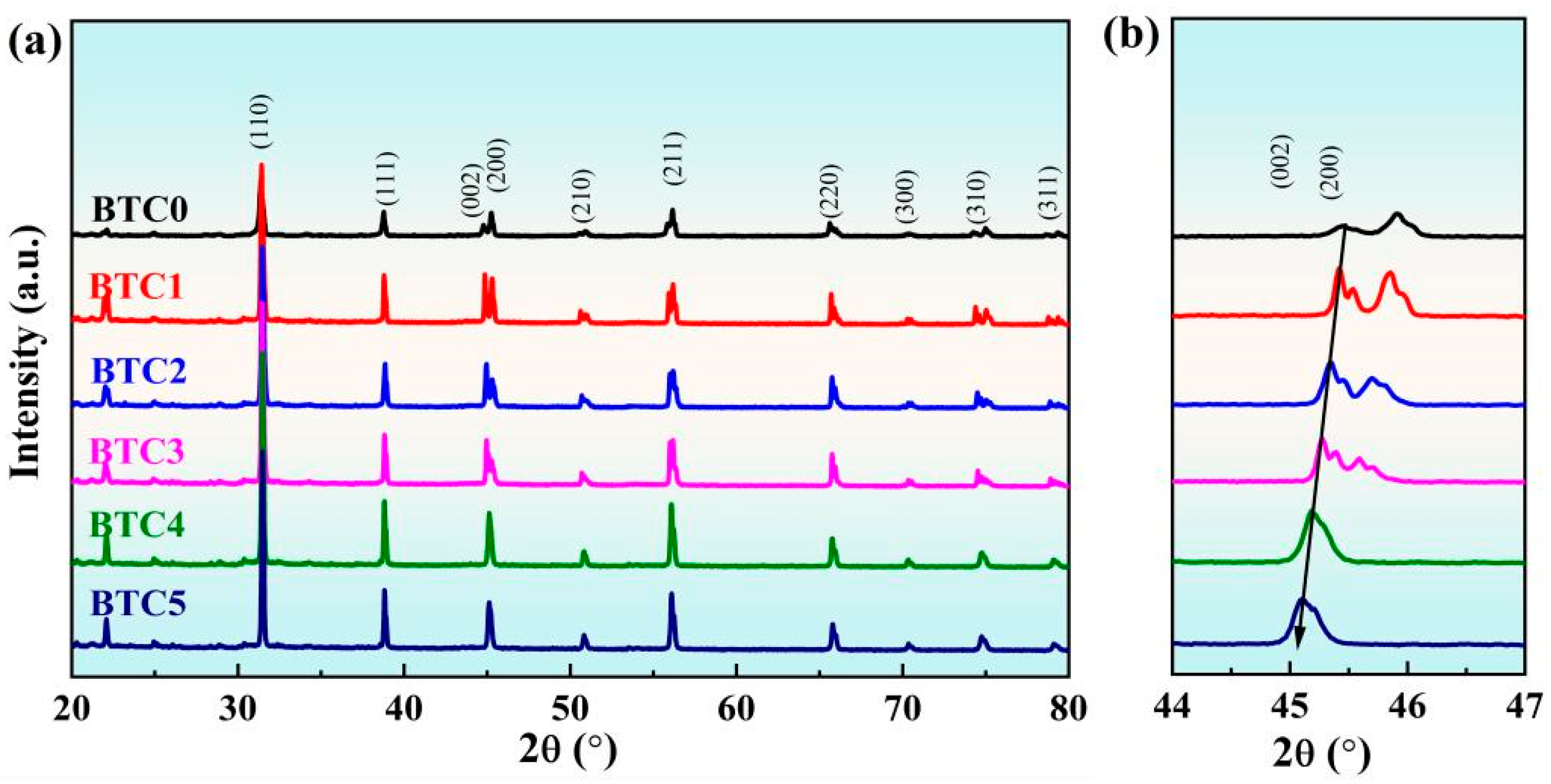
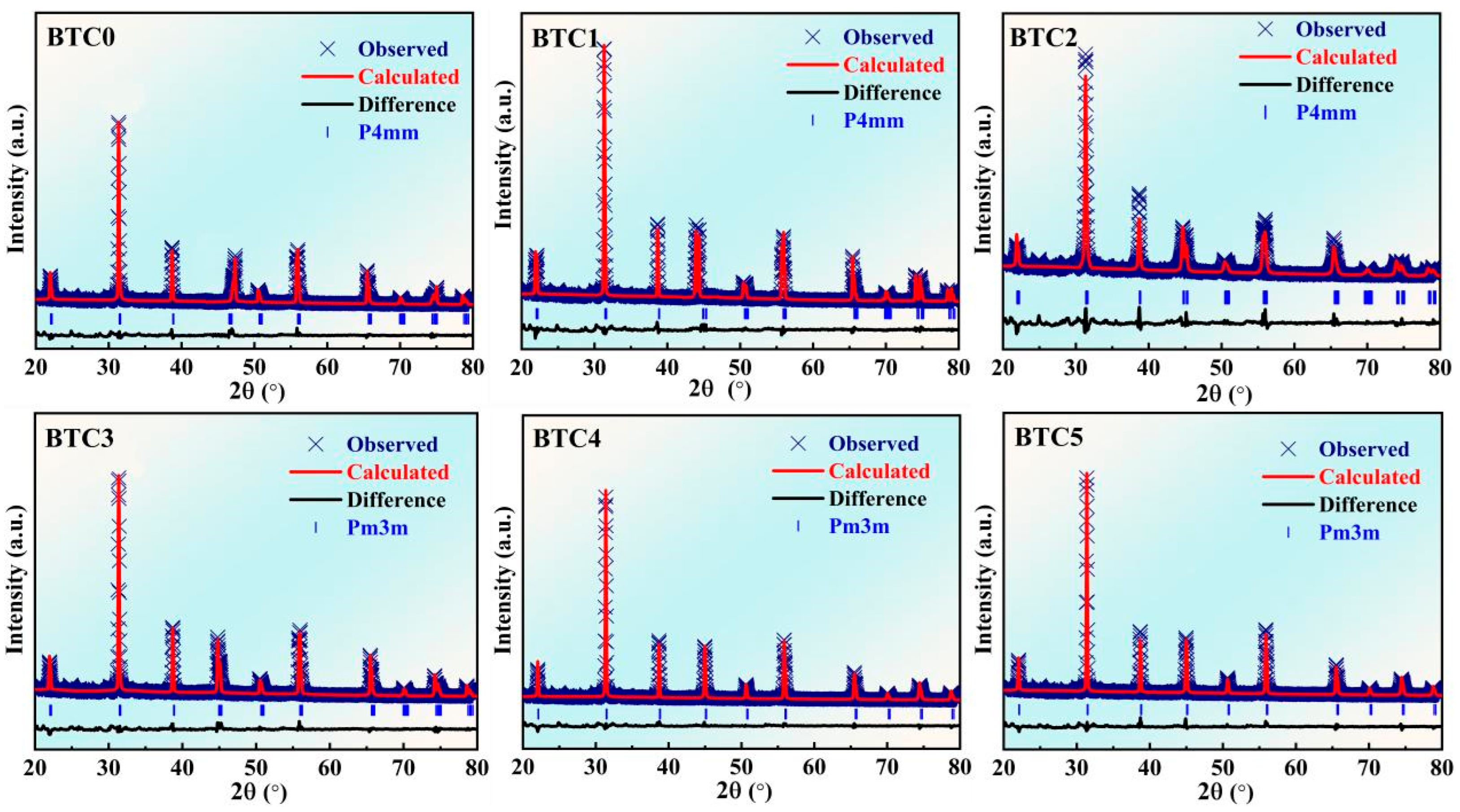
The XRD patterns of BTCx ceramics with varying Cu2+ contents are presented in Figure 1a. All compositions exhibit a singular perovskite phase, which indicates the successful diffusion of Cu2+ ions into the BaTiO3 lattice and the formation of a homogeneous solid solution [19]. As seen in the enlarged Figure 1b, the diffraction peaks shift toward lower angles with the increase in x. This shift is ascribed to the substitution of smaller Ti4+ ions (0.605 Å) by larger Cu2+ ions (0.73 Å), resulting in an expansion of the unit cell volume. Moreover, the (200)/(002) peaks gradually merge into single peaks with the doping increase, indicating that the samples transform from tetragonal (BTC1) to cubic phase (BTC5). This structural evolution is driven by the generation of oxygen vacancies through Cu ions doping the B-site of BaTiO3 ceramics. These vacancies exert a strong electrostatic pinning effect on Ti4+ in the surrounding TiO6 octahedron, suppressing the spontaneous off-center displacement of Ti4+ and favoring the higher-symmetry cubic phase [20]. To further investigate the phase structure characteristics of the materials, Rietveld refinement was performed on a series of samples using FullProf Studio software (the GSAS ∏ propram). As shown in Figure 2, the goodness-of-fit parameter (χ2) for all samples is less than eight, indicating the reliability of the refinement results. Quantitative phase analysis at different doping concentrations reveals that the sample with BTC1 is dominated by the tetragonal perovskite phase. The samples with 0 ≤ x ≤ 0.03 depict the coexistence of a tetragonal (P4mm) phase and cubic phase (Pm3m). The content of the cubic (Pm3m) and tetragonal (P4mm) phases were 63.84% and 36.16% with BTC3 ceramics, respectively. At x = 0.05, the material exhibited a cubic phase. Table 1 lists the refined lattice parameters, agreement factors, and unit cell volumes of the BTCx ceramics at various contents. With an increase in x, the difference between the lattice parameters a and c becomes more pronounced, further confirming the cubic symmetry of the samples. Meanwhile, the unit cell volume shows a gradual increasing trend.
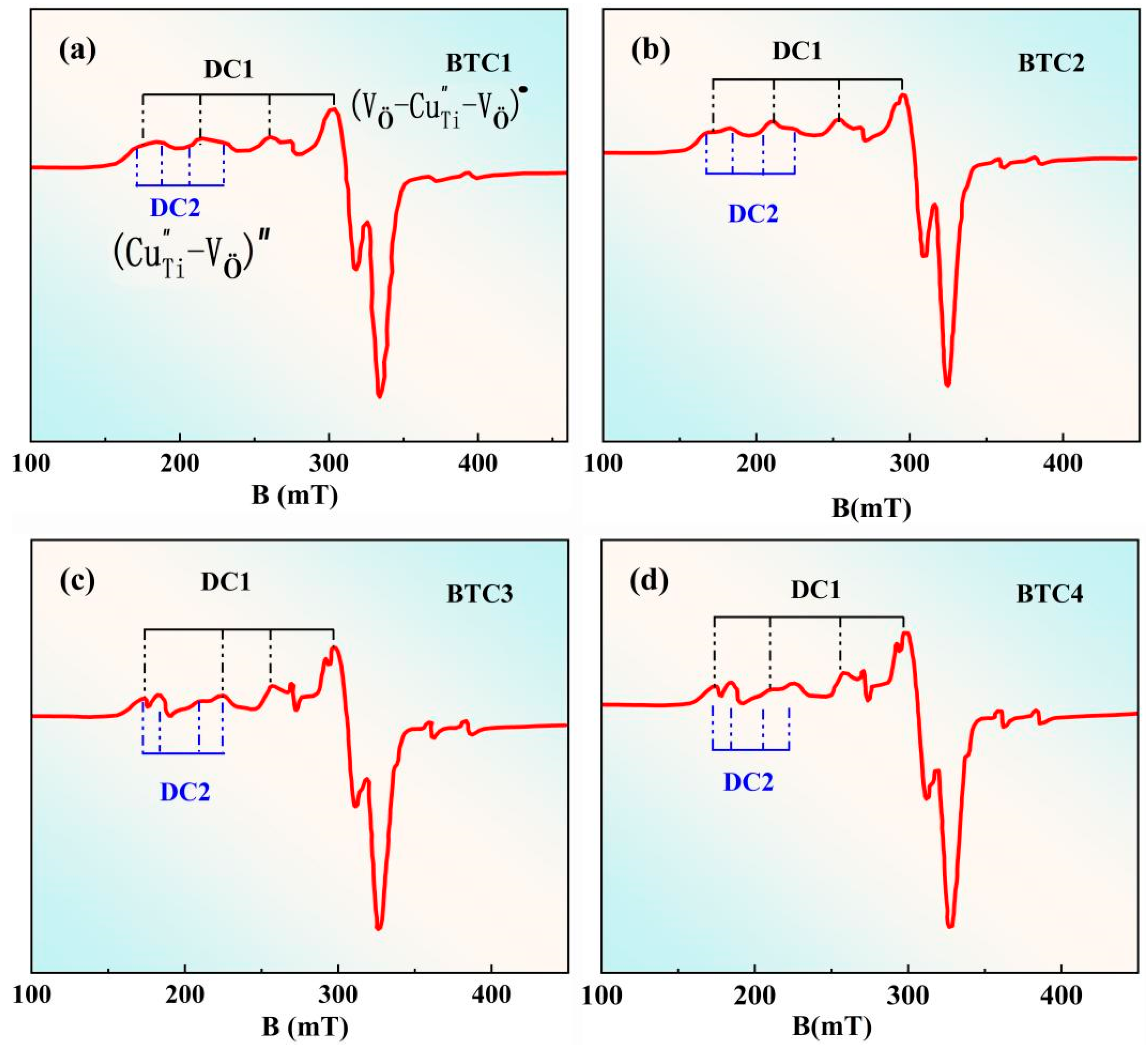
In order to explore and determine the site occupancy and local coordination environment of Cu2+ ions in the BaTiO3 lattice, Figure 3 presents the EPR spectra of BTCx (x = 0.01–0.04) ceramics. All samples show typical EPR signal, indicating that Cu ions exist in the form of unpaired electrons. As increasing x, the EPR spectra exhibit fine splitting, revealing superimposed signals of two different defect clusters (DC1 and DC2). Generally, the negative charge introduced by Cu Ti requires compensation by oxygen vacancies (Vö) to maintain charge neutrality. The two defect clusters are ( Cu Ti - V ö ) (DC1) and ( V ö - Cu Ti - V ö ) · (DC2), respectively. The similar intensities of the DC1 and DC2 signals are characteristic of defects formed by Cu2+ substitution at the B-site. This is consistent with the analysis in Figure 1. Moreover, the increasing intensity of the DC2 signal with increasing x confirms a higher concentration of defect dipoles. This defective dipole can interact with ferroelectric domains under the action of an electric field. The opposite internal electric field will be formed after removing the external electric field, resulting in an extended relaxation time. This phenomenon contributes to the enhanced relaxation characteristics and the constriction of the hysteresis loop [21].
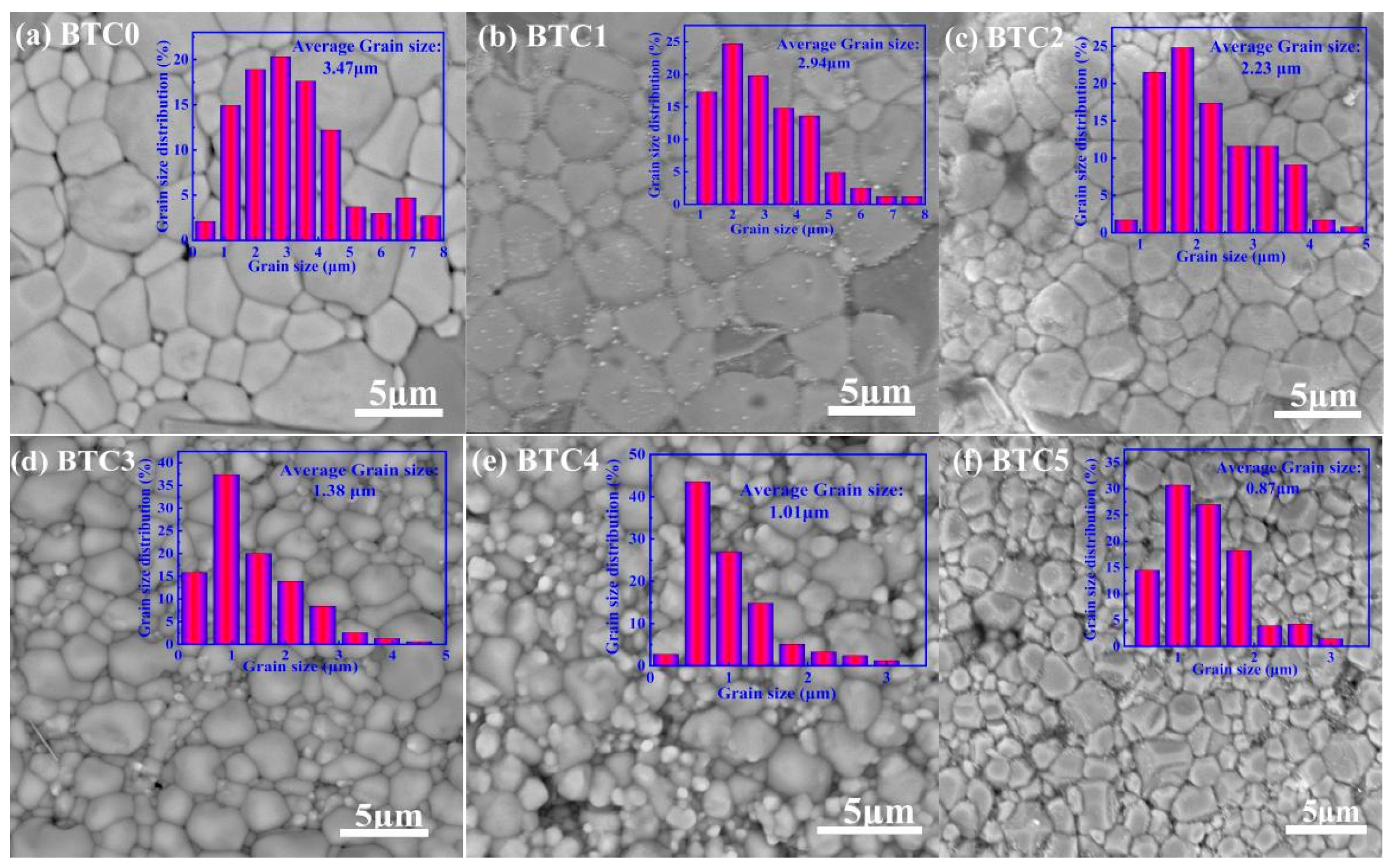
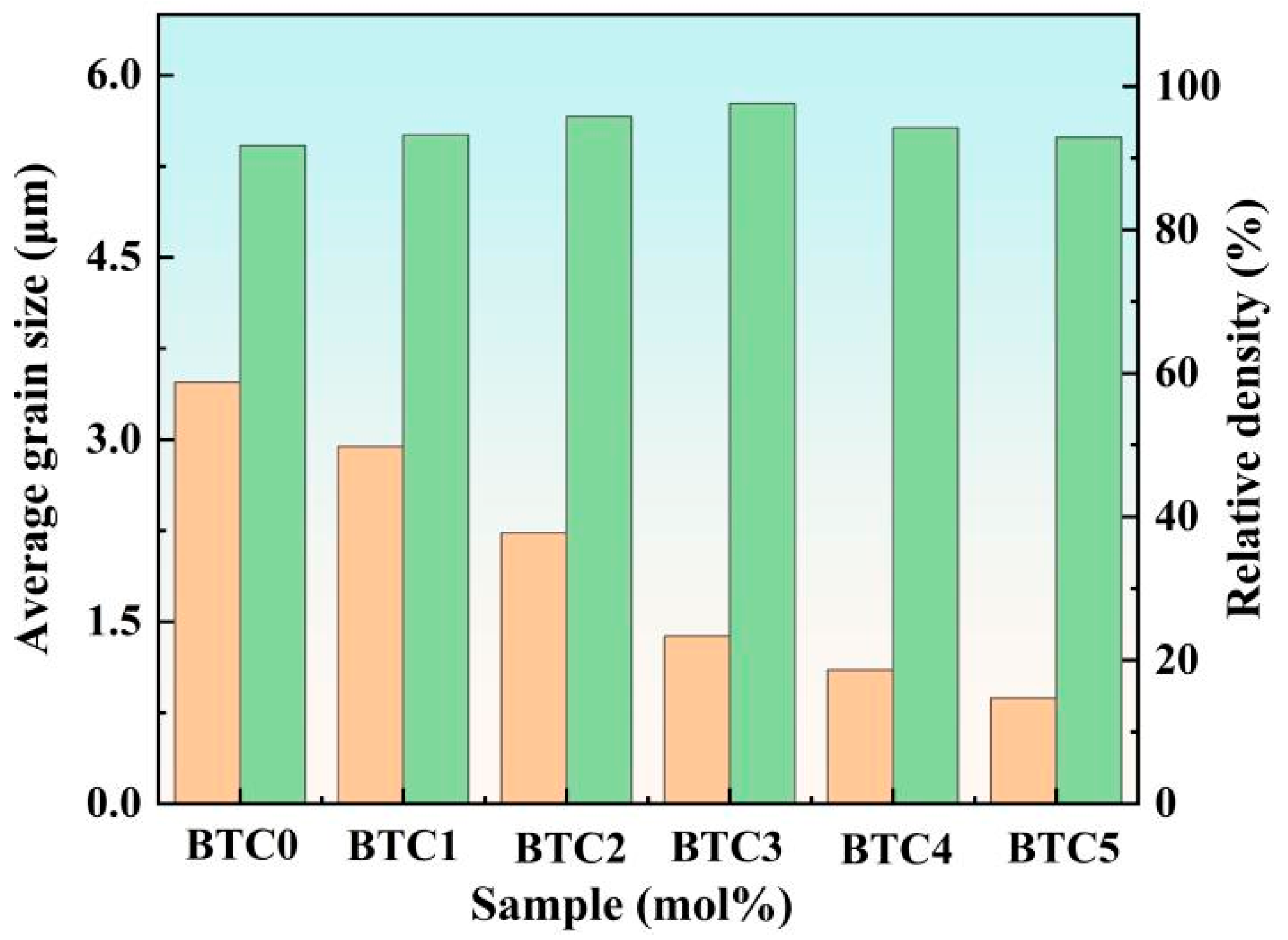
Figure 4 delineates SEM images of BTCx ceramics with different doping amounts. The average grain sizes of each component are 3.47 μm, 2.94 μm, 2.23 μm, 1.38 μm, 1.01 μm, and 0.87 μm, respectively. The average grain size of the sample gradually decreases with the increase in x, which indicates that Cu2+ ion doping has a significant inhibitory effect on the grain growth of BaTiO3 ceramics. According to the description of the lattice strain energy (ΔGstrain) of BTCx ceramics [22],
Δ G strain = 4 π MN A r 0 2 r d r 0 2 + 1 3 r d r 0 3
where r0, rd, NA, and M represent the optimal radius of the lattice site, the ionic radius of the dopant, Avogadro’s constant, and Young’s modulus, respectively. The substitution of smaller Ti4+ (0.605 Å) ions with larger Cu2+ (0.73 Å) ions increases the lattice strain energy (ΔGstrain), which impedes grain boundary migration, and thus restricts grain growth. The average grain size and relative density of BTCx ceramics are illustrated in Figure 5. The relative density of the samples increases from 91.7% (BTC0) to a maximum value of 97.6% (BTC3). High densification reduces surface defects and mitigates charge concentration, which is beneficial for achieving a higher breakdown strength. As x increases further, the relative density decreases to 92.8% (BTC5), which is associated with domain switching and domain wall motion.
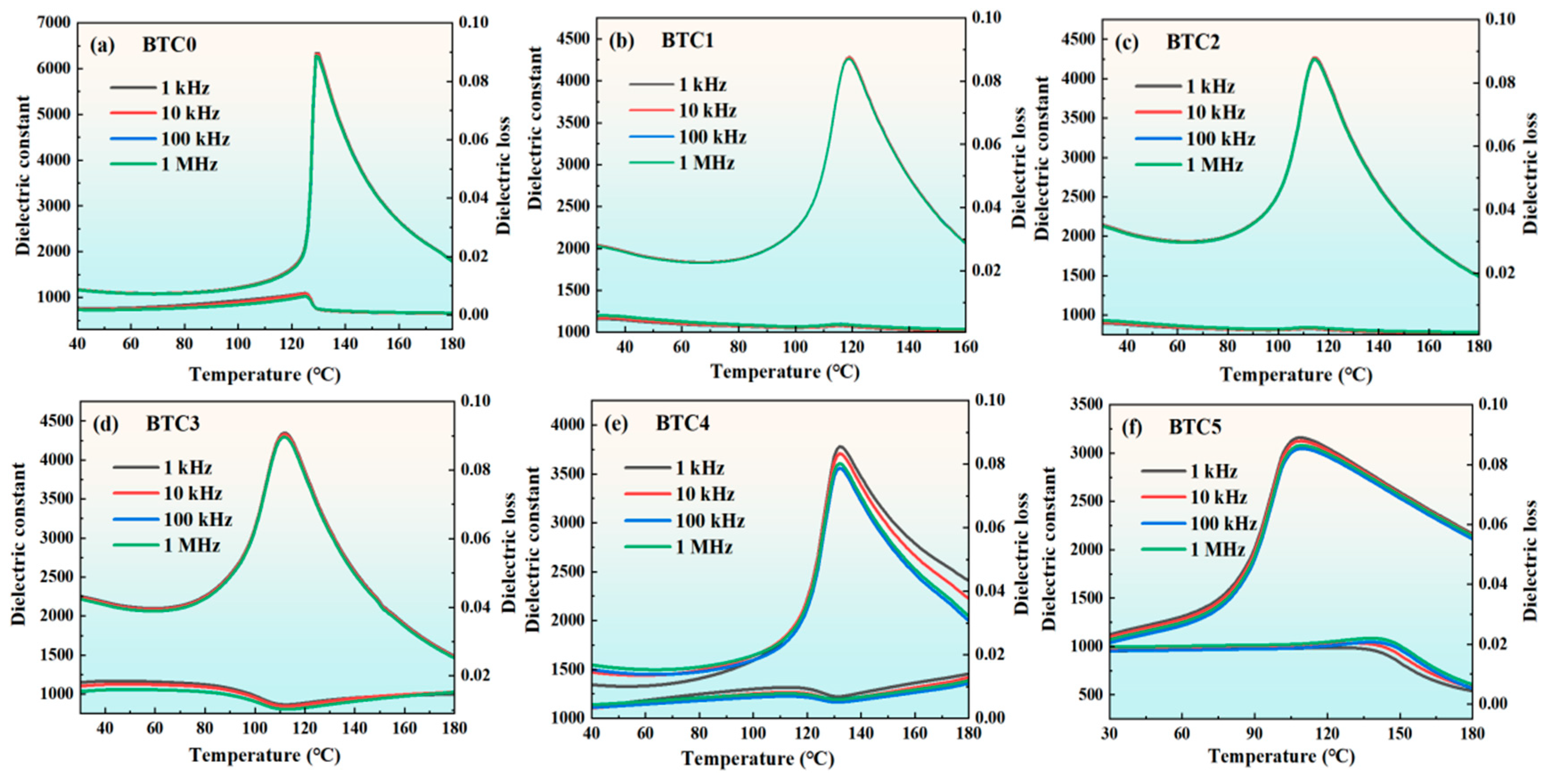
The temperature dependence of the dielectric constant for BTCx ceramics at various frequencies is presented in Figure 6. All samples show a single dielectric peak, and the peak value decreases slightly with increasing frequency. This is attributed to the fact that the rotation direction of the dipole in the matrix cannot be consistent with the direction of the electric field at high frequencies, resulting in frequency dispersion. With the increase in Cu content, the dielectric peak gradually broadens, indicating an enhanced relaxation behavior. This is attributed to the local lattice distortion caused by doping, which will form a random electric field and thereby generate polar nano-regions (PNRs) [16]. At the same frequency, the dielectric peak decreases progressively as the component addition goes up, which is associated with the change in the phase structure of ceramics. According to the Maxwell–Wagner (MW) mechanism of grain boundaries [23,24], when Cu2+ ions move from the central symmetry position of the crystal along the c-axis into the Ti site of the tesquare phase, they will generate permanent electric dipoles, thereby resulting in a higher dielectric constant. However, in the cubic phase structure, the Cu2+ ion coordinates with six oxygen atoms to form an octahedron with extremely high symmetry and reduces its dielectric constant. Furthermore, the dielectric loss of the samples is below 0.1, which indicates that higher breakdown strength can be achieved. The Curie temperature (Tc) of the samples slightly decreases with increasing x. This is attributed to oxygen vacancies created by the B-site substitution of Cu2+. These vacancies act as pinning centers for local dipoles, whose polarization fails to relax upon removal of the electric field, thereby disrupting the long-range ferroelectric order. As a result, the transition from the ferroelectric to the paraelectric state occurs at a lower thermal energy, resulting in the reduction in Tc. The dielectric relaxation behavior of BTCx ceramics above Curie temperature can be evaluated by the Curie–Weiss law [25]:
ε r = C T T 0           ( T > T 0 )
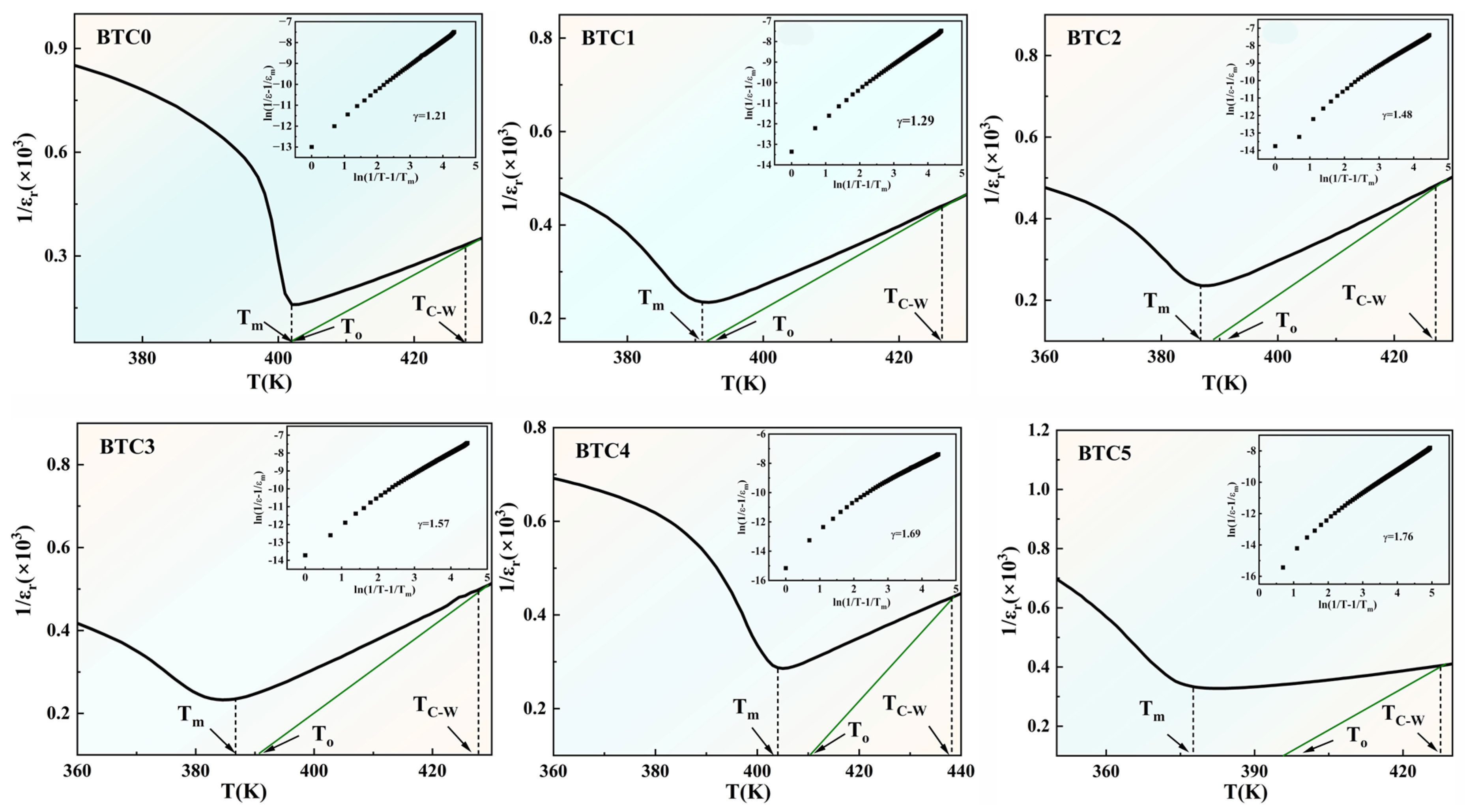
where ε r is the dielectric constant at temperature T, C is the Curie constant, and T0 is the Curie temperature. Inverse dielectric constant plots as function of temperature at 1 kHz are shown in Figure 7. ΔTm usually represents the degree of deviation from the Curie–Weiss law, which is defined as follows:
Δ T m = T C W T m
where Tm and TC−W represent the temperature corresponding to the maximum permittivity and the temperature at which the permittivity begins to deviate from the Curie–Weiss law, respectively. The deviation of Curie–Weiss behavior gradually increases with the increase in x, indicating that the ergodic-state relaxation of the sample exists in a wide temperature range, and also revealing the existence of active polar nano-regions in the sample. This can also prove that the sample has strong relaxation behavior. To further substantiate the relaxor behavior of BTCx ceramics above Tc, the relationship between the dielectric constant and temperature of BTCx ceramics at 1 MHz was fitted using the modified Curie–Weiss law: [17]:
1 ε 1 ε m = T T m γ C
where εm, Tm, and C are the maximum permittivity, the temperature corresponding to the dielectric peak, and the Curie constant, respectively. The diffusion coefficient (γ) typically ranges from 1 to 2, where a larger value signifies a stronger degree of relaxation. Figure 6 presents the γ values for the ceramics from BTC0 to BTC5, which are 1.21, 1.29, 1.48, 1.57, 1.69, and 1.76, respectively, which demonstrate that the relaxor behavior of ceramics can be significantly enhanced through the incorporation of Cu2+ ions. The mismatch in ionic valence and radii within BaTiO3 ceramics facilitates the nucleation and growth of nano-domains, creating chemical disorder and intensifying local random fields and stress within the host lattice. These effects break down the long-range ferroelectric order, leading to the formation of PNRs, which is conducive to achieving higher energy storage performance.
Breakdown strength (Eb), as a critical parameter for BTCx energy storage ceramics, is used to assess the electric field of ceramics in practical operating range and is also a prerequisite for achieving excellent energy storage performance. The Eb, which exhibits significant dispersion due to the influence of numerous factors, is analyzed by the Weibull distribution [26]:
X i = ln E i
Y i = ln ln 1 i 1 + n
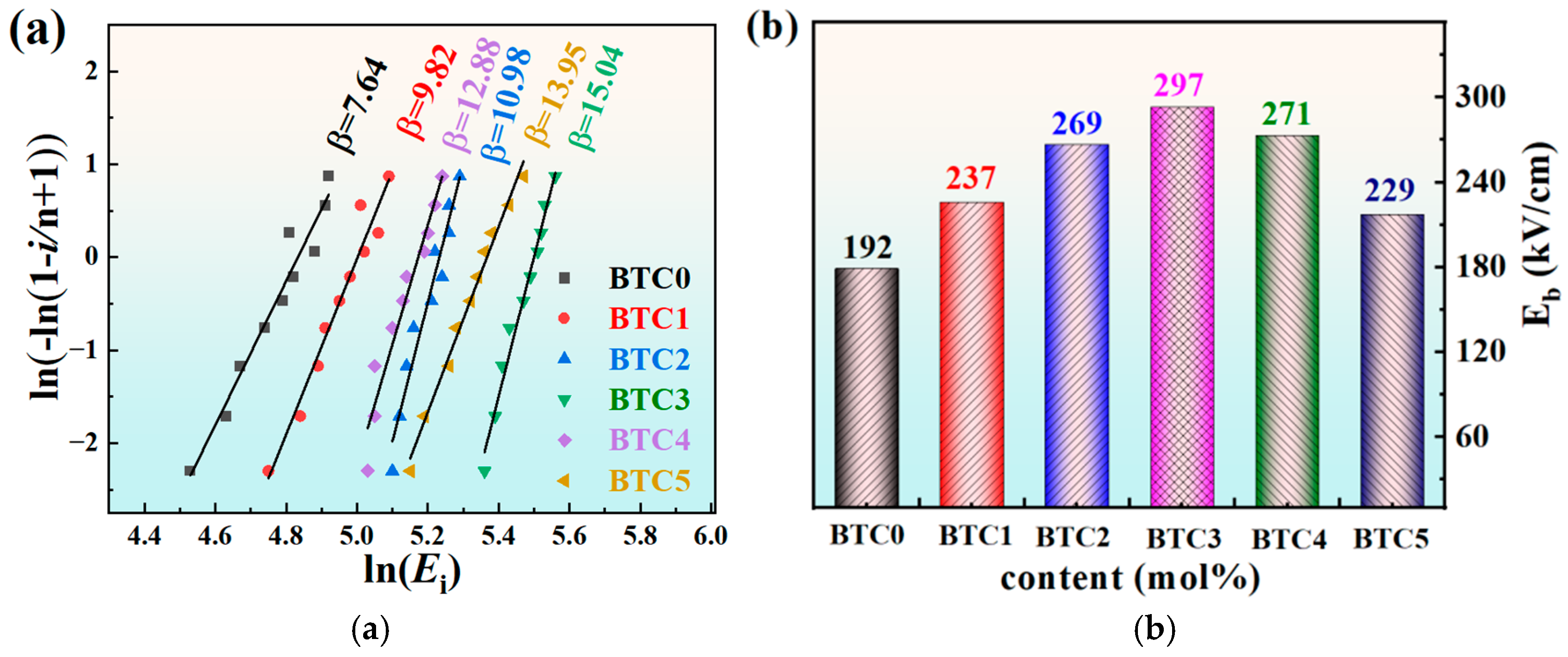
where Xi and Yi represent the transformed data points for the Weibull distribution plot. The parameter β denotes the slope of the resulting fitted straight line. The relationship between Xi and Yi can be plotted, and the slopes of each fitted straight line were obtained to determine the β. The higher β value signifies a smaller dispersion of the breakdown strength data, implying a more reliable fitting result. Figure 8a illustrates the β values for BTCx ceramics with various compositions. The β of BTCx ceramics increases with the increase in x from 10.1 to 15.6, indicating that the breakdown strength possesses high reliability. The Eb of each composition was determined by fitting the intercept of the straight line, as presented in Figure 8b. The Eb progressively increases with increasing x from 198 kV/cm to 291 kV/cm, which is related to the reduction in grain sizes and the improvement in density. The Eb is inversely correlated with grain size. The smaller grain sizes are typically associated with a greater volume of grain boundaries, whose much higher resistance compared to the grains helps to inhibit leakage current and thus improve the overall breakdown strength [27]. It is worth noting that Eb slightly decreases as x further increases, which is associated with the decrease in the density of BTCx ceramics.
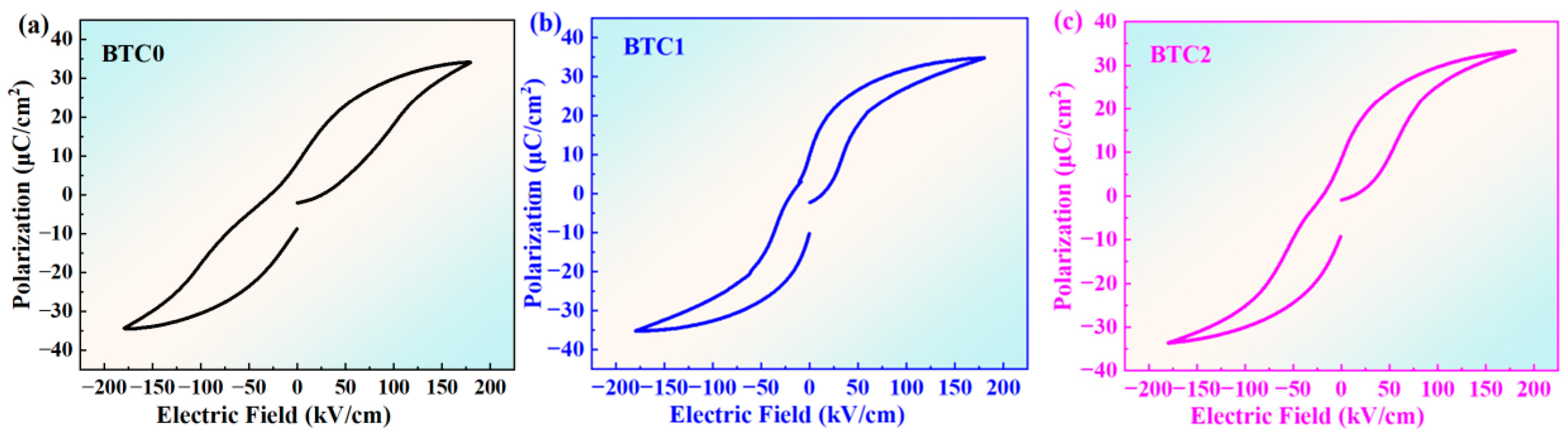
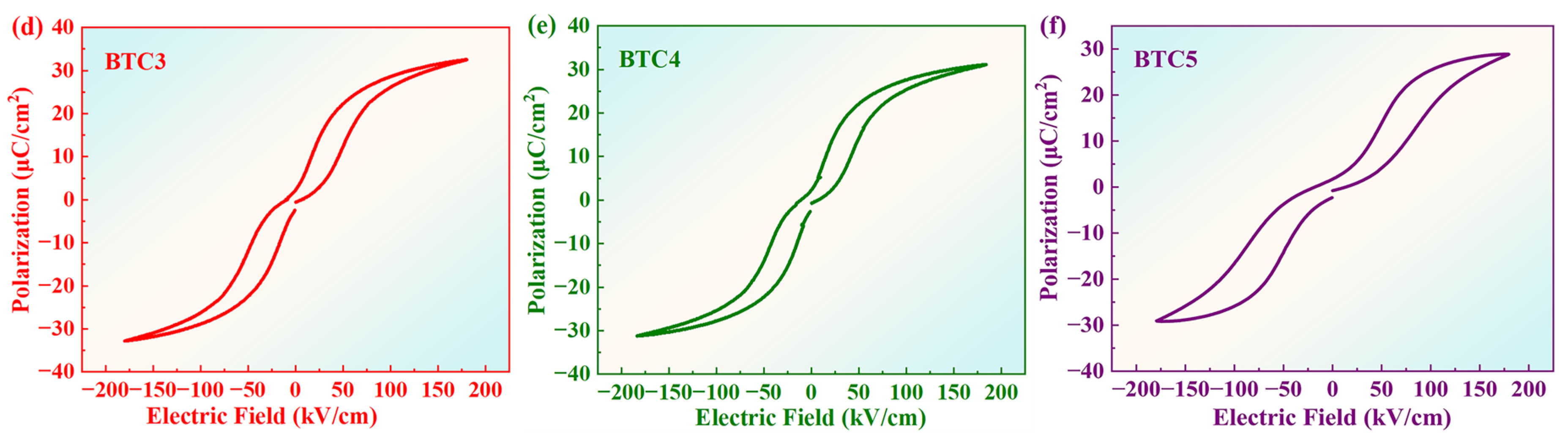
The room temperature P-E loops for BTCx ceramics at 180 kV/cm are presented in Figure 9a–f. All samples display well-saturated loops, and the P-E loop gradually becomes thinner with increasing x, signifying a transition from normal to relaxor ferroelectric. The P-E loops of BTCx progressively develop double hysteresis characteristics. This is ascribed to the aging effect induced by the substitution of acceptor Cu2+ ions onto the B-site. Based on the symmetry-conforming short-range order theory [15], the distribution of oxygen vacancies aligns with the host lattice symmetry, which results in the formation of defect dipoles. These defect dipoles generate an internal restoring force that compels the PNRs to revert to their initial state upon removal of the electric field. This mechanism leads to the formation of the double P-E loops.
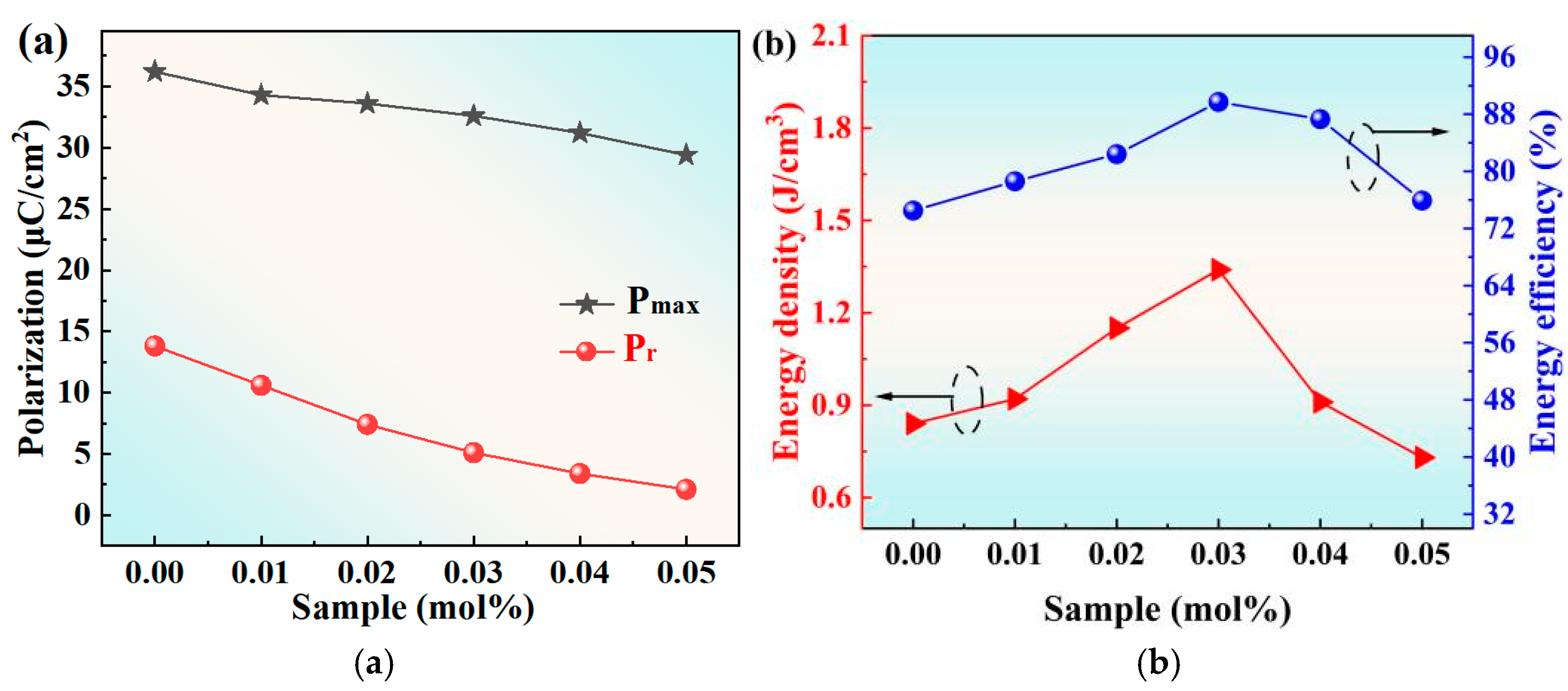
Figure 10a plots the Pr and Pmax of BTCx ceramics. Both Pr and Pmax decrease with increasing x, which is attributed to a “softening” effect in the ceramics. However, the excellent energy storage density requires large Pmax and small Pr, and acceptor doping causes Pr to decrease more rapidly than Pmax. The Wrec and η are presented in Figure 10b. The Wrec gradually increases from 0.84 J/cm3 (BTC0) to a peak value of 1.34 J/cm3 (BTC3), then decreases to 0.73 J/cm3 (BTC5). Concurrently, the η values for these compositions are 70.1%, 90.4%, and 76.9%, respectively. The enhancement of Wrec and η is associated with the increased oxygen vacancy concentration induced by Cu ion B-site doping. Based on the aging phenomenon in acceptor-doped materials [28], the formation of oxygen vacancies leads to their accumulation or redistribution as charged defects under a high electric field. The resulting synergistic effect modifies the shape of the P-E loops. As a result, for materials predominantly governed by charge compensation mechanisms and acceptor doping, the energy storage efficiency of BTCx ceramics can be improved to approximately 90%. With further increasing x, the excessive oxygen vacancies trap more electrons. After the electric field is removed, these electrons cannot migrate rapidly enough, causing a reduction in energy storage properties.

4. Conclusions

BaTi1–xCuxO3–x (x = 0–0.05) ceramics were synthesized via the conventional solid-state method. The influence of B-site acceptor doping with Cu2+ ion on the phase structure, microstructure, dielectric properties, and energy storage characteristics was systematically studied. All samples maintained a single perovskite structure and transitioned from tetragonal (BTC0) to cubic phase (BTC5). The substitution of Cu on the B-site was found to promote microstructural densification and strengthen relaxor behavior, facilitating the enhancement of breakdown strength. AFE-like double loops were obtained, which originate from the acceptor-induced hysteresis aging phenomena through acceptor doping, resulting in the improvement in the energy storage density and efficiency. As a result, a superior energy storage density of 1.34 J/cm3 coupled with high efficiency of 90.1% was obtained for the BTC3 ceramic at 180 kV/cm. These findings provide a feasible strategy for improving the energy storage performance of BaTiO3-based ceramics.

Author Contributions

Z.L.: Conceptualization, methodology, investigation, writing—original draft, writing—review and editing, funding acquisition. X.D.: Investigation, visualization, data curation. J.W.: Formal analysis, software. D.Z.: Formal analysis, software. G.J. (Guang Ji): Formal analysis, software. S.L.: Formal analysis, software, funding acquisition. G.J. (Guodong Jia): Formal analysis, software. All authors have read and agreed to the published version of the manuscript.

Funding

This work was supported by Nantong Natural Science Foundation (JCZ2024010); the Natural Science Foundation of the Jiangsu Higher Education Institutions of China (24KJB430035).

Institutional Review Board Statement

Not applicable.

Informed Consent Statement

Not applicable.

Data Availability Statement

The original contributions presented in this study are included in the article. Further inquiries can be directed to the corresponding authors.

Conflicts of Interest

The authors declare that they have no known competing financial interests or personal relationships that could have appeared to influence the work reported in this paper.

References

  1. Lin, J.; Lv, F.; Hong, Z.; Liu, B.; Wu, Y.; Huang, Y. Ultrahigh piezoelectric response obtained by artificially generating a large internal bias field in BiFeO3–BaTiO3 lead-free ceramics. Adv. Funct. Mater. 2024, 34, 2313879. [Google Scholar] [CrossRef]
  2. Yan, F.; Qian, J.; Lin, J.; Ge, G.; Shi, C.; Zhai, J. Ultrahigh energy storage density and efficiency of lead-free dielectrics with sandwich structure. Small 2024, 20, 2306803. [Google Scholar] [CrossRef]
  3. Guo, B.; Jin, F.; Li, L.; Pan, Z.Z.; Xu, X.W.; Wang, H. Design strategies of high-performance lead-free electro-ceramics for energy storage applications. Rare Met. 2024, 43, 853–878. [Google Scholar] [CrossRef]
  4. Jain, A.; Wang, Y.G.; Shi, L.N. Recent developments in BaTiO3 based lead-free materials for energy storage applications. J. Alloys Compd. 2022, 928, 167066–167099. [Google Scholar] [CrossRef]
  5. Peng, B.; Tang, S.; Lu, L.; Zhang, Q.; Huang, H.; Bai, G.; Miao, L.; Zou, B.; Liu, L.; Sun, W.; et al. Low-temperature-poling awakened high dielectric breakdown strength and outstanding improvement of discharge energy density of (Pb,La)(Zr,Sn,Ti)O3 relaxor thin film. Nano Energy 2020, 77, 105132. [Google Scholar] [CrossRef]
  6. Zhao, P.Y.; Wang, H.X.; Wu, L.W.; Chen, L.L.; Cai, Z.M.; Li, L.T.; Wang, X.H. High performance relaxor ferroelectric materials for energy storage applications. Adv. Energy Mater. 2019, 9, 1803048. [Google Scholar] [CrossRef]
  7. Li, Y.; Gao, J.; Yang, T. Excellent energy density efficiency in Ba Sr codoped, (Pb,La)(Zr,Sn)O3 antiferroelectric ceramics. J. Phys. Chem. Solid. 2023, 172, 111046. [Google Scholar] [CrossRef]
  8. Yang, S.Y.; Zeng, D.F.; Dong, Q.P.; Pan, Y.; Nong, P.; Xu, M.Z.; Chen, X.L.; Li, X.; Zhou, H.F. Enhancement of energy storage performances in BaTiO3-based ceramics via introducing, Bi(Mg2/3Sb1/3)O3. J. Energy Storage 2024, 78, 110102. [Google Scholar] [CrossRef]
  9. Qi, H.; Xie, A.; Zuo, R. Local structure engineered lead-free ferroic dielectrics for superior energy-storage capacitors: A review. Energy Storage Mater. 2022, 45, 541–567. [Google Scholar] [CrossRef]
  10. Yang, Z.Q.; Li, Y.Z.; Pan, J.C.; Xie, B.Y.; Li, K.X.; Katie, L.M.; Annette, K.K.; David, A. Hall, Effects of trace Nb dopant on core-shell microstructure and ferroelectric domain switching in BiFeO3-BaTiO3 ceramics. Acta Mater. 2025, 289, 120890. [Google Scholar] [CrossRef]
  11. Marunouchi, K.; Gong, L.Z.; Ohta, H.; Tsukasa, K. High-concentration doping effects of aliovalent Al and Ga on ferroelectric properties of BaTiO3 Films. Thin Solid Films 2024, 796, 140339. [Google Scholar] [CrossRef]
  12. Wang, H.Y.; Cao, M.H.; Tao, C.; Hao, H.; Yao, Z.H.; Liu, H.X. Tuning the microstructure of BaTiO3@FeO core-shell nanoparticles with low temperatures sintering dense nanocrystalline ceramics for high energy storage capability and stability. J Alloy Compd. 2021, 864, 158644. [Google Scholar] [CrossRef]
  13. Yan, G.W.; Liu, Q.Q.; Fang, B.J.; Chen, Z.H. Correlation between phase structure polarization of Mg doped (Ba0.98Li0.02)TiO3 energy storage ceramics. J. Mater. Sci. Mater. Electron. 2022, 33, 20981–20991. [Google Scholar] [CrossRef]
  14. Zhang, Y.; Li, A.; Zhang, G.R.; Zheng, Y.Q.; Zheng, A.J.; Luo, G.Q.; Tu, R.; Sun, Y.; Zhang, J.; Shen, Q. Optimization of energy storage properties in lead-free barium titanate-based ceramics via B-site defect dipole engineering. ACS Sustain. Chem. Eng. 2022, 10, 2930–2937. [Google Scholar] [CrossRef]
  15. Liu, W.F.; Gao, J.H.; Zhao, Y.; Li, S.T. Significant enhancement of energy storage properties of BaTiO3-based ceramics by hybrid-doping. J. Alloy Compd. 2020, 843, 155938. [Google Scholar] [CrossRef]
  16. Gao, J.H.; Liu, W.F.; Zhang, L.; Kong, F.Y.; Zhao, Y.; Li, S.T. Enhanced dielectric and ferroelectric properties of the hybrid-doped BaTiO3 ceramics by the semi-solution method. Ceram. Int. 2021, 47, 15661–15667. [Google Scholar] [CrossRef]
  17. Li, Z.W.; Chen, Z.H.; Xu, J.J. Investigations on structure energy storage properties of, Ba(Ti,Ca)O3 ceramics with Ca ion doping in Bsite. J. Electron. Mater. 2022, 11664, 09684. [Google Scholar]
  18. Jain, A.; Wang, Y.G.; Wang, N.; Wang, F.L. Critical role of CuO doping on energy storage performance and electromechanical properties of Ba0.8Sr0.1Ca0.1Ti0.9Zr0.1O3 ceramics. Ceram. Int. 2020, 46, 18800–18812. [Google Scholar] [CrossRef]
  19. Liu, J.; Dai, J.; Shang, F.R.; Bai, Y.H.; Zhao, X.; Liu, X.; Du, H.L.; Ma, C.Y. Effect of entropy on dielectric and ferroelectric properties of BaTiO3-based ceramics for energy-storage applications. Ceram. Int. 2025, 51, 28537–28545. [Google Scholar] [CrossRef]
  20. Yang, Y.; Hao, H.; Zhang, L.; Chen, C.; Luo, Z.P.; Liu, Z.; Yao, Z.H.; Cao, M.H. Structure, electrical and dielectric properties of Ca substituted BaTiO3 ceramics. Ceram. Int. 2018, 44, 11109–11115. [Google Scholar] [CrossRef]
  21. Wang, Z.; Meng, X.Y.; Guo, Q.H.; Su, C.; Deng, G.P.; Liu, H.Z.; Yao, Z.H.; Zhang, S.J.; Liu, H.X. Formation and evolution of oxygen vacancy layer in BaTiO3 dielectric ceramics under thermal and electric field stimuli. Acta Mater. 2025, 299, 121450. [Google Scholar] [CrossRef]
  22. Hu, D.; Pan, Z.; Zhang, X. Greatly enhanced discharge energy density efficiency of novel relaxation ferroelectric BNT-BKT-based ceramics. J. Mater. Chem. 2020, 8, 591–601. [Google Scholar] [CrossRef]
  23. Sohrabi, B.; Heidary, D.; Randall, C.A. Analysis of the degradation of BaTiO3 resistivity due to hydrogen ion incorporation: Impedance spectroscopy and diffusion analysis. Acta Mater. 2015, 96, 344–351. [Google Scholar] [CrossRef]
  24. Li, Z.W.; Jiang, T.Z.; Chen, Z.H.; Xu, J.J. Improved energy storage performance of Ba(Ti,Ca)O3 ceramics through tailoring phase structure ferroelectric polarization. J. Phys. D Appl. Phys. 2023, 56, 185502. [Google Scholar] [CrossRef]
  25. Raddaoui, Z.; Elkossi, S.; Dhahri, J.; Abdelmoula, N.; Taibi, K. Study of diffuse phase transition and relaxor ferroelectric behavior of Ba0.97Bi0.02Ti0.9Zr0.05Nb0.04O3 ceramic. RSC Adv. 2019, 9, 2412–2425. [Google Scholar] [CrossRef] [PubMed]
  26. Liang, C.; Wang, C.Y.; Zhao, H.Y.; Cao, W.J.; Huang, X.C.; Wang, C.C. Enhanced energy storage performance of NaNbO3-based ceramics via band and domain engineering. Ceram. Int. 2023, 49, 40326–40335. [Google Scholar] [CrossRef]
  27. Guo, S.Q.; Tian, Y.; Ma, Q.Z.; Xu, Y.H.; Yang, D.; She, L.N.; Sun, Z.X.; Wu, Y.T.; Ge, W.Y.; Jin, L.; et al. Synergistic enhancement of antiferroelectric energy storage in AgNbO3 ceramics. J. Eur. Ceram. Soc. 2025, 45, 117701. [Google Scholar] [CrossRef]
  28. Jo, H.R.; Lynch, C.S. A high energy density relaxor antiferroelectric pulsed capacitor dielectric. J. Appl. Phys. 2016, 119, 024104. [Google Scholar] [CrossRef]
Figure 1. XRD patterns of BTCx ceramics over 2θ of (a) 20–80° and (b) 44–47°.
Coatings 15 01422 g001
Figure 2. Rietveld refined XRD patterns of BTCx ceramics.
Coatings 15 01422 g002
Figure 3. The EPR spectra of BTCx cermaics: (a) x = 0.01; (b) x = 0.02; (c) x = 0.03; (d) x = 0.04.
Coatings 15 01422 g003
Figure 4. SEM images of BTCx ceramics with different doping amounts.
Coatings 15 01422 g004
Figure 5. The average grain size (Green bar chart) and relative density of BTCx ceramics (Yellow bar chart).
Coatings 15 01422 g005
Figure 6. The dielectric properties of BTCx ceramics at different frequencies; (a) x = 0; (b) x = 0.01; (c) x = 0.02; (d) x = 0.03; (e) x = 0.04; (f) x = 0.05.
Coatings 15 01422 g006
Figure 7. The dispersion coefficient of BTCx ceramics with different x contents. The insets show the corresponding ln(1/ε−1/εm) versus ln(T−Tm) plots.
Coatings 15 01422 g007
Figure 8. (a) The Weibull distribution of BTCx ceramics and (b) the corresponding of Eb.
Coatings 15 01422 g008
Figure 9. The P-E loops of BTCx ceramics at room temperature; (a) x = 0; (b) x = 0.01; (c) x = 0.02; (d) x = 0.03; (e) x = 0.04; (f) x = 0.05.
Coatings 15 01422 g009aCoatings 15 01422 g009b
Figure 10. (a) Change of Pr and Pmax of BTCx ceramics; (b) the energy storage density and efficiency of BTCx ceramics.
Coatings 15 01422 g010
Table 1. Rietveld refined structural parameters along with lattice parameter and cell volume for BTCx ceramics.
SampleLattice Parameters (Å)
Volume
3)
T
Phase
(%)
C
Phase
(%)
R Factors (%)
xabcRwpRpχ2
BTC03.99853.99854.003964.3491.628.387.675.456.53
BTC13.99913.99914.006464.4274.5425.466.366.215.16
BTC24.00144.00144.008564.5160.4839.525.735.777.12
BTC34.01014.01014.010164.5936.1663.844.936.675.23
BTC44.01244.01244.012464.6524.4575.557.216.957.12
BTC54.01364.01364.013664.6913.5786.436.177.166.21
Disclaimer/Publisher’s Note: The statements, opinions and data contained in all publications are solely those of the individual author(s) and contributor(s) and not of MDPI and/or the editor(s). MDPI and/or the editor(s) disclaim responsibility for any injury to people or property resulting from any ideas, methods, instructions or products referred to in the content.