Article

Microstructure, Elevated-Temperature Tribological Properties and Electrochemical Behavior of HVOF-Sprayed Composite Coatings with Varied NiCr/Cr3C2 Ratios and CoCrFeNiMo Additions


1
School of Materials Science and Engineering, East China Jiaotong University, Nanchang 330013, China
2
Institute of Mechanical and Electrical Engineering and Detection Technology, Jiangxi Technical College of Manufacturing, Nanchang 330012, China
3
College of Mechanical and Electrical Engineering, Guangdong University of Technology, Guangzhou 510006, China
*
Author to whom correspondence should be addressed.
Coatings 2025, 15(12), 1415; https://doi.org/10.3390/coatings15121415
Submission received: 27 October 2025 / Revised: 24 November 2025 / Accepted: 28 November 2025 / Published: 3 December 2025

Abstract

This study fabricated six types of NiCr–Cr3C2 composite coatings using high-velocity oxygen fuel (HVOF) spraying and systematically evaluated their tribological behavior at 350 °C and 500 °C, along with their electrochemical corrosion performance in 3.5 wt.% NaCl solution. The objective was to elucidate how compositional design regulates the coatings’ microstructure, mechanical properties, and service performance. Results indicate that the 75NiCr–25Cr3C2 coating (C) formed a stable oxide film under both temperatures, exhibiting oxidation-dominated wear and the lowest friction coefficient and wear rate. When the temperature increased from 350 °C to 500 °C, the wear rates of coatings C, B, E, and F decreased significantly. Notably, coatings E and F, which contained CoCrFeNiMo high-entropy alloy, showed more than a 50% reduction in wear rate, demonstrating the contribution of the high-entropy phase to high-temperature wear resistance. At 350 °C, coatings B, D, E, and F experienced primarily abrasive wear; at 500 °C, however, E and F shifted to oxidative wear as the dominant mechanism, leading to a marked improvement in wear resistance. Electrochemical measurements revealed that coating E exhibited the best corrosion resistance, while the NiCr coating (A) performed the worst. The findings highlight that optimizing Cr3C2 content and incorporating high-entropy alloy elements can synergistically enhance both high-temperature tribological properties and corrosion resistance.

1. Introduction

The rapid advancement of high-end equipment manufacturing has introduced unprecedented challenges for the service performance of critical mechanical components operating under diverse conditions involving load, temperature, and corrosion. Consequently, developing high-performance protective coatings with superior wear and corrosion resistance has become a central objective in surface engineering [1,2,3]. High-Velocity Oxygen Fuel (HVOF) technology, distinguished by its high flame velocity and moderate temperature, enables the fabrication of high-quality coatings characterized by low porosity, strong bonding strength, and minimal oxide content, making it one of the most widely adopted methods for producing wear-resistant coatings [1,4,5,6]. Among thermal spray materials, the NiCr-Cr3C2 cermet system is extensively utilized due to its excellent wear and corrosion resistance in high-temperature, oxidative, and corrosive environments [1,2,7,8]. However, as operational conditions grow increasingly complex and severe, limitations of the conventional 25NiCr-75Cr3C2 coating—such as inadequate toughness, limited high-temperature stability, and poor resistance to synergistic corrosion-wear effects—have become more evident, restricting its effectiveness in long-term applications under multifaceted service conditions [8,9,10,11]. In recent years, high-entropy alloys (HEAs) have emerged as a novel material system that challenges traditional alloy design principles [12,13,14]. Their unique characteristics—high entropy effect, lattice distortion, sluggish diffusion, and the “cocktail” effect—confer exceptional strength, hardness, corrosion resistance, and high-temperature stability [12,13,14,15]. Notably, the CoCrFeNiMo series of HEAs has demonstrated superior comprehensive performance compared to conventional stainless steels and nickel-based alloys in numerous studies, offering a promising pathway for the development of next-generation high-performance coatings [15,16,17,18,19].
It is widely recognized that the friction and wear behavior as well as corrosion resistance of thermal spray coatings are primarily governed by the relative proportions of the binder phase (e.g., NiCr, NiAl) and the ceramic phase (e.g., Cr3C2, WC), with the ceramic phase content playing a particularly critical role in enhancing wear resistance. For instance, Zhou et al. [4] investigated the high-temperature wear performance of HVOF-sprayed Cr3C2-WC-NiCoCrMo and Cr3C2-NiCr hardfacing coatings, revealing that the Cr3C2-WC-NiCoCrMo coating exhibited superior wear resistance compared to the Cr3C2-NiCr coating during testing at 650 °C. Similarly, Fan et al. [20] examined the effect of Cr3C2 content on the microstructure, mechanical properties, and tribological behavior of Ni3Al-based composite coatings, demonstrating that the coating containing 15 wt.% Cr3C2 achieved the lowest friction coefficient and wear rate across temperature ranges from 25 °C to 800 °C. Du et al. [2,14,21] developed a novel Cr3C2-NiCrCoMo (NCC) coating featuring a multi-element modified alloy as the binder phase. Compared to conventional Cr3C2-NiCr (NC) coatings, the NCC variant displayed a lower oxidation rate, enhanced oxidation resistance, and improved interfacial compatibility between the oxide layer and the underlying coating. Furthermore, studies have shown [22] that the uniform atomic-scale distribution of Cr3C2-25NiCr in a combined state reduces the loss of the corrosion-resistant element chromium, while intermetallic compounds formed in such systems generally exhibit superior corrosion resistance relative to pure metallic elements. Matikainen et al. [3] systematically evaluated four different binder compositions, their contents, and powder morphologies in Cr3C2-based coatings, concluding that the choice of binder and its chemical formulation significantly influences coating microstructure and overall properties, thereby determining the resulting wear resistance. Although these studies have advanced understanding of how the ratio of binder to ceramic phases and alloying additions affect coating performance, the adaptability of various binder/ceramic ratio designs to differing service environments, as well as the formation and evolution mechanisms of composite oxide films under varying temperatures, remain insufficiently understood. In particular, when high-entropy alloys are introduced as novel binder phase components, the regulatory principles and underlying mechanisms by which their varying addition ratios influence the wear and corrosion resistance of Cr3C2-NiCr coatings require systematic investigation.
The core innovation of this study lies in the introduction of CoCrFeNiMo high-entropy alloy into the mature NiCr-Cr3C2 system. By rationally adjusting the relative proportion between the high-entropy alloy and the NiCr binder phase, the synergistic effect between the two in terms of structure and function is promoted, thereby significantly enhancing the density and high-temperature performance of the coating.
Based on the above design concept, this study employed high-velocity oxygen fuel (HVOF) spraying technology to precisely control the proportions of NiCr, Cr3C2 and CoCrFeNiMo, successfully preparing six composite coatings with different compositions. The tribological behavior of the coating at different temperatures was systematically studied, with a focus on analyzing the evolution laws of the friction coefficient, wear rate and wear mechanism with temperature. The electrochemical corrosion performance of the material in a 3.5 wt.% NaCl solution was also evaluated, including key parameters such as the self-corrosion potential, corrosion current density, and electrochemical impedance spectroscopy. By revealing the influence mechanism of component regulation on the microstructure, tribological behavior and electrochemical performance of coatings, this study effectively fills the research gap in the current high-entropy alloy-modified thermal spray coatings in the aspect of component collaborative design and systematic evaluation of multi-environment coupling performance, providing an important theoretical basis and technical support for the development of a new generation of wear-resistant and corrosion-resistant composite coatings for harsh working conditions.

2. Material and Methods

2.1. Powder Raw Materials and Mixing Preparation

The raw materials used in this experiment mainly include: 25NiCr-75Cr3C2 (referred to as NiCr-Cr3C2) and Ni80Cr20 (referred to as NiCr) powders provided by Chongyi Zhangyuan Tungsten Industry Co., Ltd. (Ganzhou, China) and CoCrFeNiMo high-entropy alloy powders purchased from Beijing Yanbang New Materials Technology Co., Ltd. (Beijing, China). SEM analysis shows that the NiCr powder is elliptical in shape with a relatively smooth surface (Figure 1a), and its particle size distribution range is 10–100 μm, with an average particle size of 37.10 ± 15.19 μm (Figure 1b). Figure 1d shows the morphological characteristics of NiCr-Cr3C2 composite powder. As shown in the figure, the powder particles exhibit a typical agglomerated sintered structure, with an irregular spherical shape, a rough surface and a hollow structure inside. This morphological feature results from the physical bonding behavior of the Cr3C2 hard phase and the NiCr binder phase during the sintering process, which is a typical micro-morphological manifestation of this type of composite powder. The average particle size of the powder is 22.19 ± 6.06 μm, and the particle size is concentrated in the range of 10 to 45 μm (Figure 1e). The particle size distribution of the above-mentioned powder is shown in Table 1. By mixing NiCr-Cr3C2 and NiCr powders in a set proportion, two composite powders, 75NiCr-25Cr3C2 and 50NiCr-50Cr3C2, were prepared.
This study introduces CoCrFeNiMo high-entropy alloy powder prepared by Beijing Yanbang New Materials Technology Co., Ltd. through gas atomization as the key modification component. Its chemical composition (wt.%) is: Co 19.8, Cr 20.5, Fe 20.1, Ni 19.9, Mo 19.7. As shown in the scanning electron microscope image in Figure 1g, the powder particles have a regular spherical or nearly spherical morphology, which is conducive to improving their fluidity and deposition efficiency during the spraying process. As shown in Table 1, the particle size distribution of this powder is d10 = 30 μm, d50 = 50 μm, and d90 = 65 μm. Two composite powder systems, namely 10CoCrFeNiMo-18NiCr-72Cr3C2 and 20CoCrFeNiMo-16NiCr-64Cr3C2, were prepared by proportionally mixing high-entropy alloy powder with NiCr and Cr3C2. The introduction of high-entropy alloys aims to utilize their unique high-entropy effect, lattice distortion effect, and slow diffusion effect to synergistically regulate the microstructure of the coating, thereby enhancing its comprehensive performance.
To ensure the uniformity of the mixture of the sprayed powder, this study used a YXQM-2L planetary ball mill to thoroughly mix the raw powder materials. The material of the ball mill tank was zirconia, and the grinding balls were made of Al2O3 with diameters of 5 mm and 10 mm, respectively, to enhance the grinding effect and avoid contamination. The mixing process is set at a speed of 250 r/min with a total duration of 3 h. It operates in an intermittent forward and reverse mode. The specific procedure is as follows: rotate forward for 10 min, pause for 5 min, then rotate in reverse for 10 min, pause for another 5 min, and repeat this cycle 9 times. This process design effectively enhances the fluidity and compositional consistency of the powder, providing a good raw material foundation for subsequent coating preparation. It can be seen from Figure 1 that the uniformity of each mixed powder is good. The substrate used in the experiment was 20CrMo steel produced by Kunshan Zetian Metal Materials Co., Ltd. (Kunshan, China).
This study aims to explore the synergistic strengthening effect of CoCrFeNiMo high-entropy alloy on the microstructure and properties of traditional NiCr-Cr3C2 coatings. To ensure the systematicity and comparability of the experiment, we designed six coatings with different compositions, and the selection of their components was based on the following considerations: Firstly, to establish a benchmark for performance comparison, we prepared pure NiCr metallic bond phase coatings and three classic NiCr-Cr3C2 composite coatings with different mass ratios (25NiCr-75Cr3C2, 75NiCr-25Cr3C2, and 50NiCr-50Cr3C2). This design constitutes a complete gradient, aiming to reveal the influence of the relative content of metal-ceramic on the basic properties of the coatings. Based on this, to explore the modification effect of high-entropy alloys, we introduced the CoCrFeNiMo component. The addition ratio followed the principle of progressive substitution: that is, CoCrFeNiMo was used to replace 10 at.% and 20 at.% of the NiCr binder phase, respectively, thereby obtaining two high-entropy modified coatings, namely 10CoCrFeNiMo-18NiCr-72Cr3C2 and 20CoCrFeNiMo-16NiCr-64Cr3C2.
This design is based on the following two scientific hypotheses [12,23,24,25]: (1) A moderate amount of high-entropy alloy (10 at.%) is expected to enhance the strength of the bonding phase and improve the coating deposition density through its typical high-entropy effect, lattice distortion effect, and sluggish diffusion effect, without significantly altering the phase composition of the system. (2) Higher content of high-entropy alloys (20 at.%) is used to further explore the potential for performance improvement and evaluate their compatibility with the original system and possible new interfacial reactions at higher addition levels. This composition design strategy helps to clearly reveal the structure-performance relationship between the content of high-entropy alloys and the macroscopic properties of the coating.

2.2. Preparation of Coatings

In this experiment, 20CrMo steel plates with dimensions of 200 × 200 × 12 mm were selected as the base materials. Before HVOF spraying, the surface of the base material was successively ground with sandpaper, ultrasonically cleaned with acetone, and sandblasted to ensure surface cleanliness and enhance the bonding strength of the coating. The JP8000 supersonic flame spraying system was used for coating preparation. Before spraying, the raw powder was dried at 280 °C for 6 h to remove moisture and improve its fluidity and dispersibility. During the spraying process, the sandblasted base material was rapidly preheated by supersonic flame to enhance the deposition efficiency and interface bonding quality; then, a transition layer approximately 50 μm thick NiCr or NiCr-CoCrFeNiMo was deposited successively, followed by a main working layer about 150 μm thick. To effectively control the thermal accumulation of the base material and suppress thermal deformation, compressed air was used to force-cool the back of the base material throughout the process. The specific spraying process parameters for preparing coatings of different compositions are shown in Table 2.
Due to the significantly lower melting point of NiCr alloy compared to the Cr3C2 ceramic phase, in order to obtain a dense reference coating suitable for fair comparison, the spraying process parameters for the NiCr coating were optimized in this study: by reducing the air and oxygen flow rates and increasing the spray distance, excessive oxidation and burn-off of NiCr particles during the spraying process were effectively suppressed, thereby reducing defects such as porosity and oxide inclusions. The process parameters of the remaining five coatings were kept consistent to ensure that any performance differences (such as wear resistance and corrosion resistance) could be attributed solely to the changes in composition. After spraying, the coated samples were processed into 15 × 15 × 12 mm specifications using a wire cutting machine for subsequent microstructure characterization and performance testing.

2.3. Friction and Wear Test

The high-temperature friction and wear properties of six coating samples, namely A, B, C, D, E and F, were systematically tested. The experiment was conducted using the MPT-3G ball-on-disc high-temperature friction and wear testing machine produced by Jinan Hengxu Testing Machine Technology Co., Ltd. (Jinan, China). This equipment has a maximum load of 300 N and a maximum working temperature of 1000 °C. Al2O3 balls with a diameter of 6 mm were selected as the counter-bodies, and all samples were processed to a uniform size of 15 mm × 15 mm × 12 mm. The specific experimental parameters are detailed in Table 3. To ensure the reliability and statistical significance of the experimental results, each sample was subjected to five repeated friction and wear tests. The final results of the wear volume and wear rate were presented as the mean ± standard deviation. After the tests, a three-dimensional profilometer was used to precisely observe the three-dimensional morphology of the wear scars and measure their wear volume. The wear rate was calculated according to the following formula [8,26]:
W = V C L S
Here, W represents the wear rate (mm3/Nm), Vc represents the wear volume (mm3), L represents the loading force (N), and S represents the sliding displacement (m).

2.4. Electrochemical Tests

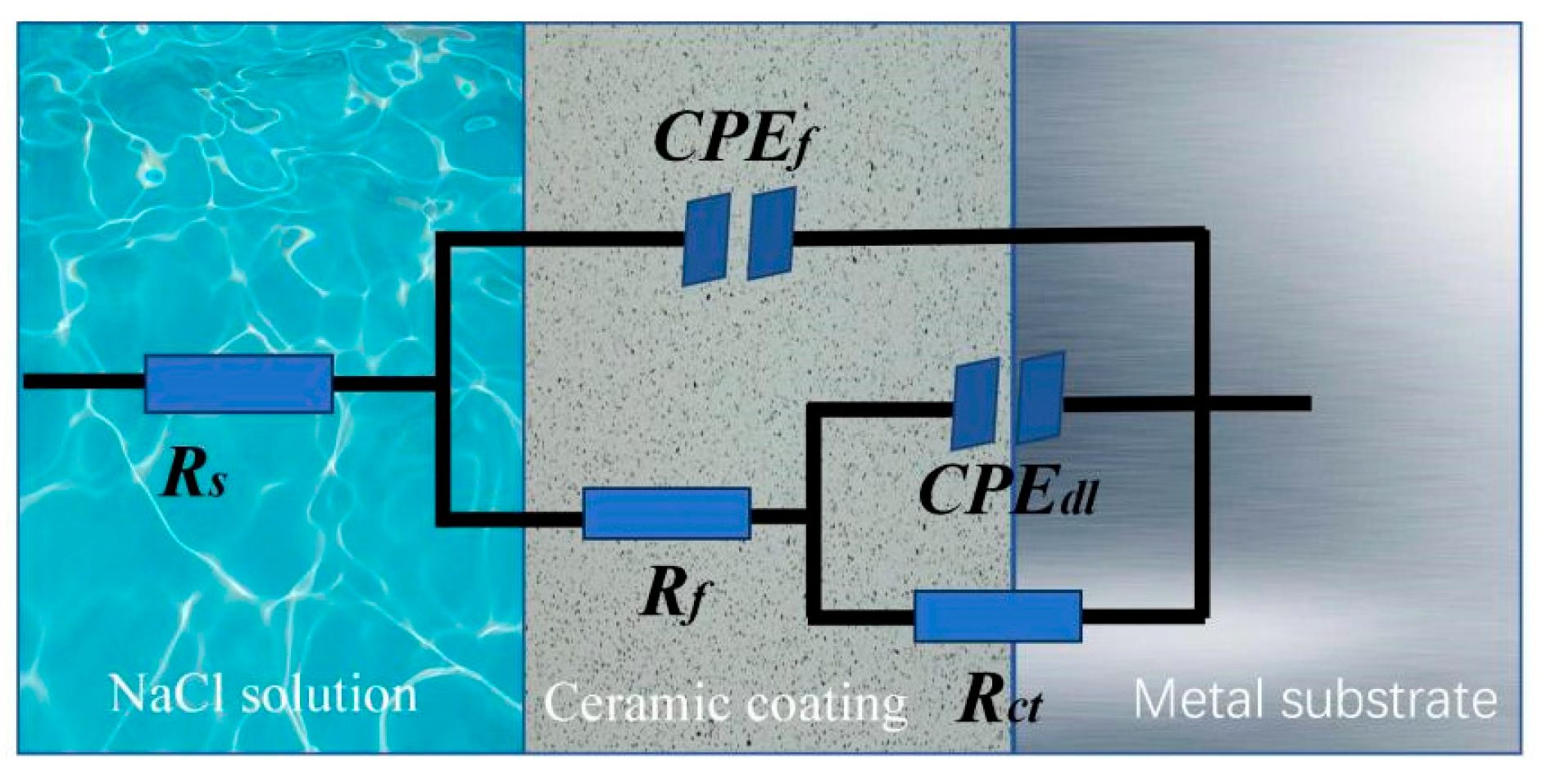
Electrochemical tests were conducted in a conventional three-electrode system using a Shanghai Chenhua CHI660E (Shanghai, China) electrochemical workstation. The working electrode (WE) was a coated sample with an exposed area of 1 cm2, the reference electrode (RE) was a saturated KCl calomel electrode, and the counter electrode (CE) was a platinum sheet. The electrolyte was a 3.5 wt.% NaCl solution. The test procedure was as follows: the sample was immersed for 30 min to stabilize the surface state, followed by 60 min of open circuit potential (OCP) monitoring; then, electrochemical impedance spectroscopy (EIS) was performed under OCP conditions, with a frequency range of 10 kHz to 0.01 Hz; finally, a potential polarization scan was carried out at a scan rate of 1 mV/s within the range of −0.4 V to 0.8 V (versus RE). The EIS data were fitted using an equivalent circuit. All electrode potentials are given relative to a saturated calomel electrode (SCE). The adopted equivalent circuit is shown in Figure 2. The potentiodynamic polarization curves and electrochemical impedance spectra of each coating were independently repeated at least three times to ensure the reproducibility of the data. The corrosion parameters (such as Ecorr, icorr, Rct) reported in the text are the average values of three valid measurements. The corrosion current density (icorr) was determined by the Tafel extrapolation method of the dynamic potential polarization curve, with the extrapolation range being ±60 mV relative to the self-corrosion potential (Ecorr).

2.5. Characterization Method

A variety of characterization methods were employed for a systematic analysis of the material: SEM morphology observation and EDS composition analysis were conducted using a JSM-7610FPlus scanning electron microscope; the microhardness of the cross-section of the coating was measured using an HXD-1000 microhardness tester equipped with a Vickers diamond square pyramid indenter under a load of 1.96 N and a dwell time of 15 s. Each measurement point was repeated 10 times to ensure statistical reliability, and the results were expressed as the mean ± standard deviation.
The porosity and powder particle size distribution of the coating were analyzed based on Image-pro plus 6.0 software. The SEM images were converted into binary images through threshold segmentation, and the porosity was calculated based on the proportion of pore pixels. The particle size distribution was determined by combining automatic and manual particle recognition, equivalent circle diameter measurement, and distribution fitting. At least five different fields of view were selected for each sample to ensure the representativeness of the results; phase analysis was performed using a D8 Advance X-ray diffractometer with Cu Kα radiation (λ = 1.54056 Å), a scanning range of 20–100°, a step size of 0.02°, a scanning rate of 2°/min, a working voltage of 40 kV, and a current of 40 mA; the wear morphology was three-dimensionally reconstructed and the wear volume was quantified using a Leica DCM8 white light interferometry microscope.

3. Analysis and Discussion

3.1. XRD Analysis of Coatings and Powders

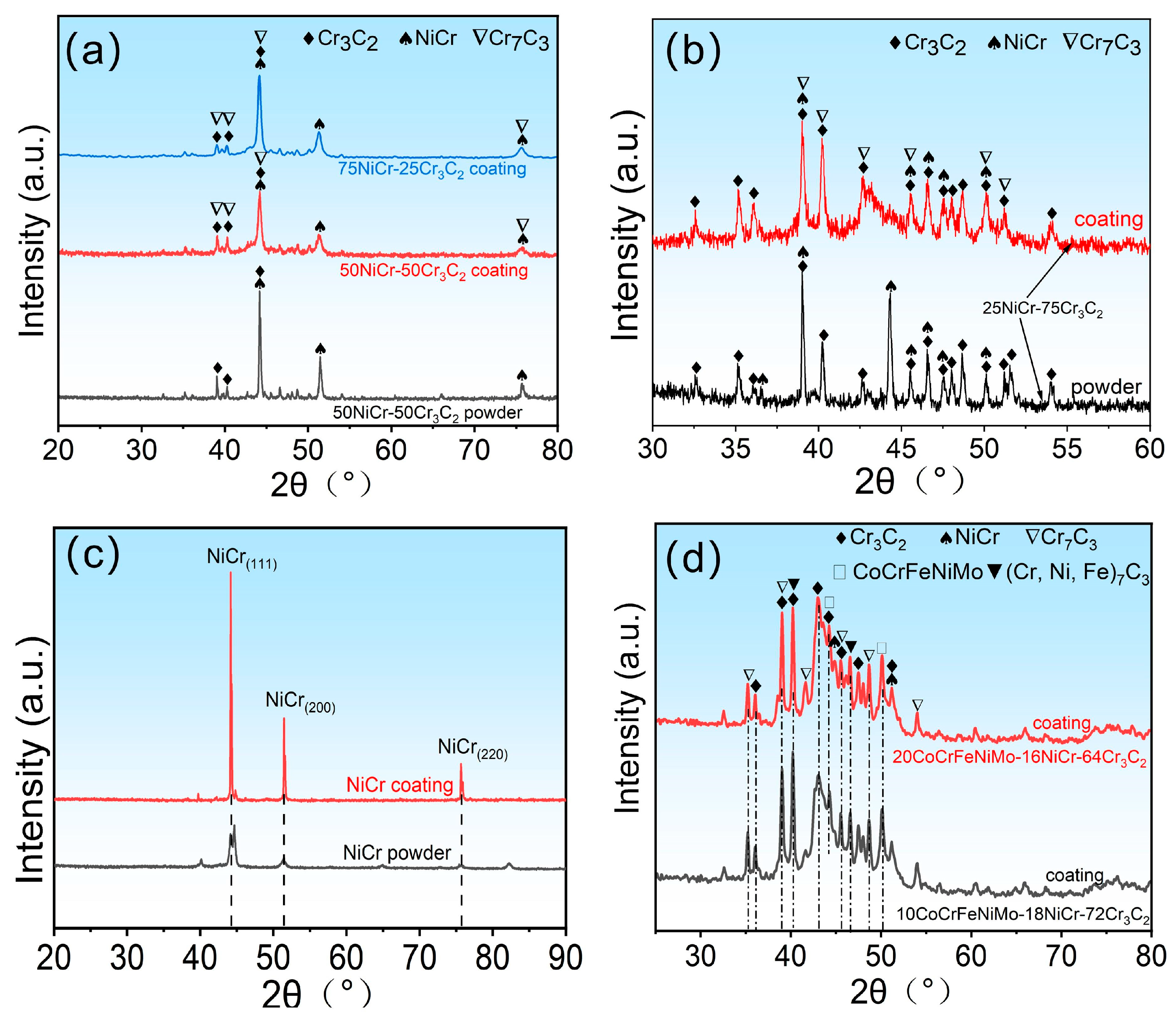
The XRD patterns of different powder components and coatings are shown in Figure 3. The 75NiCr-25Cr3C2 and 50NiCr-50Cr3C2 coatings are mainly composed of γ-Ni(Cr) solid solution, residual Cr3C2 and newly formed Cr7C3, while the corresponding powders are mainly γ-Ni(Cr) solid solution and Cr3C2 (Figure 3a). Compared with the powders, all diffraction peaks in the coatings shift to the left, which may be attributed to the residual tensile stress and lattice expansion caused by composition changes. Additionally, the intensities of all phase diffraction peaks in the coatings are significantly weakened, mainly due to the micro-strain and grain refinement caused by crystal defects such as dislocations and vacancies introduced during the high-speed impact and rapid cooling in the spraying process. Figure 3b shows the comparison of the phase composition between the 25NiCr-75Cr3C2 coating and the powder. The phases in the coating include γ-Ni(Cr) solid solution, residual Cr3C2 and newly formed Cr7C3, while the powder is mainly composed of γ-Ni(Cr) solid solution and Cr3C2. Compared with the powder, most of the diffraction peaks in the coating are weakened and broadened, with only a significant enhancement near 40.2°.
These changes are mainly attributed to [5,27,28,29,30,31]: ① the decomposition of Cr3C2 and the formation of alloyed (M)7C3 new phase during the HVOF process; ② the high-speed impact and rapid cooling cause the new phase to have a preferred orientation (enhancement of the 40.2° peak), while also leading to grain refinement and micro-strain (peak broadening and weakening). Figure 3c compares the XRD patterns of the NiCr coating and the powder. Although both are composed of the NiCr phase, the diffraction peak intensity of the coating is significantly enhanced, while the diffraction peaks of the powder are severely broadened and present a “steamed bun” shape. This indicates that the original NiCr powder may contain amorphous or nanocrystalline phases. The HVOF high-temperature process acts as a “crystallization heat treatment”, promoting the crystallization of amorphous phases and grain growth, thereby forming sharp and strong diffraction peaks [32,33,34]. Figure 3d shows the XRD comparison of coatings with different proportions of high-entropy alloys added. The phase compositions of the 10CoCrFeNiMo-18NiCr-72Cr3C2 and 20CoCrFeNiMo-16NiCr-64Cr3C2 coatings are highly consistent, both containing five phases: γ-Ni(Cr) solid solution, Cr3C2, Cr7C3, CoCrFeNiMo high-entropy alloy phase, and (Cr, Ni, Fe)7C3 carbide.

3.2. Analysis of the Cross-Sectional Microstructure of the Coating

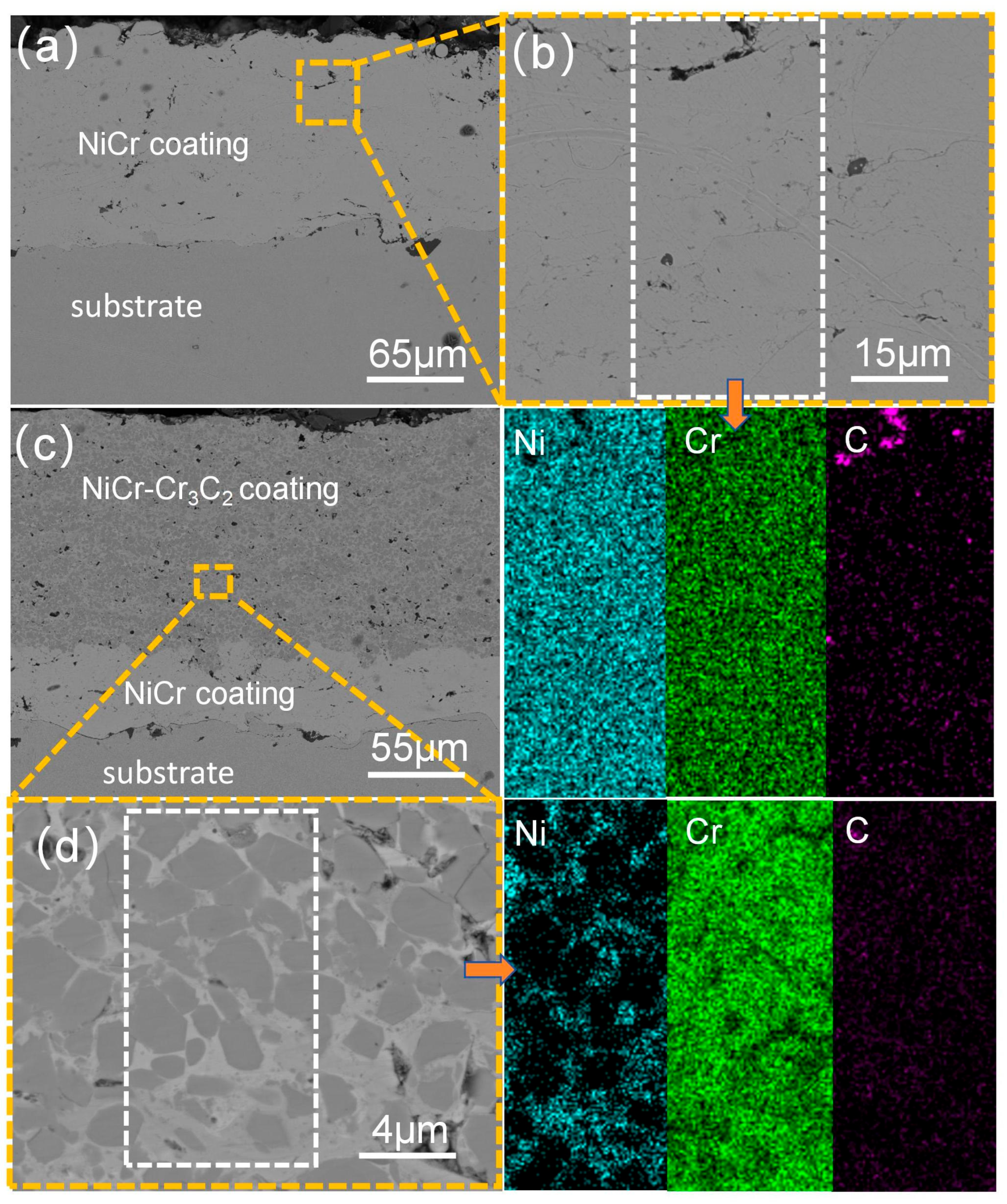
The SEM morphologies and EDS analysis results of the cross-sections of NiCr (A) coating and 25NiCr-75Cr3C2 (B) coating are shown in Figure 4. The A coating is overall white, with a uniform and dense structure, few defects, a porosity of less than 0.5%, and a thickness of approximately 160 μm (Figure 4a,b). Figure 4c,d shows the SEM-EDS images of the 25NiCr-75Cr3C2 working layer, which is about 150 μm thick and mainly composed of Cr3C2 ceramic phase and NiCr binder phase, with a uniform and intermittent distribution. However, it has many internal defects and a porosity of about 2.4%. In addition, between the B coating and the substrate, there is a NiCr transition layer about 50 μm thick.
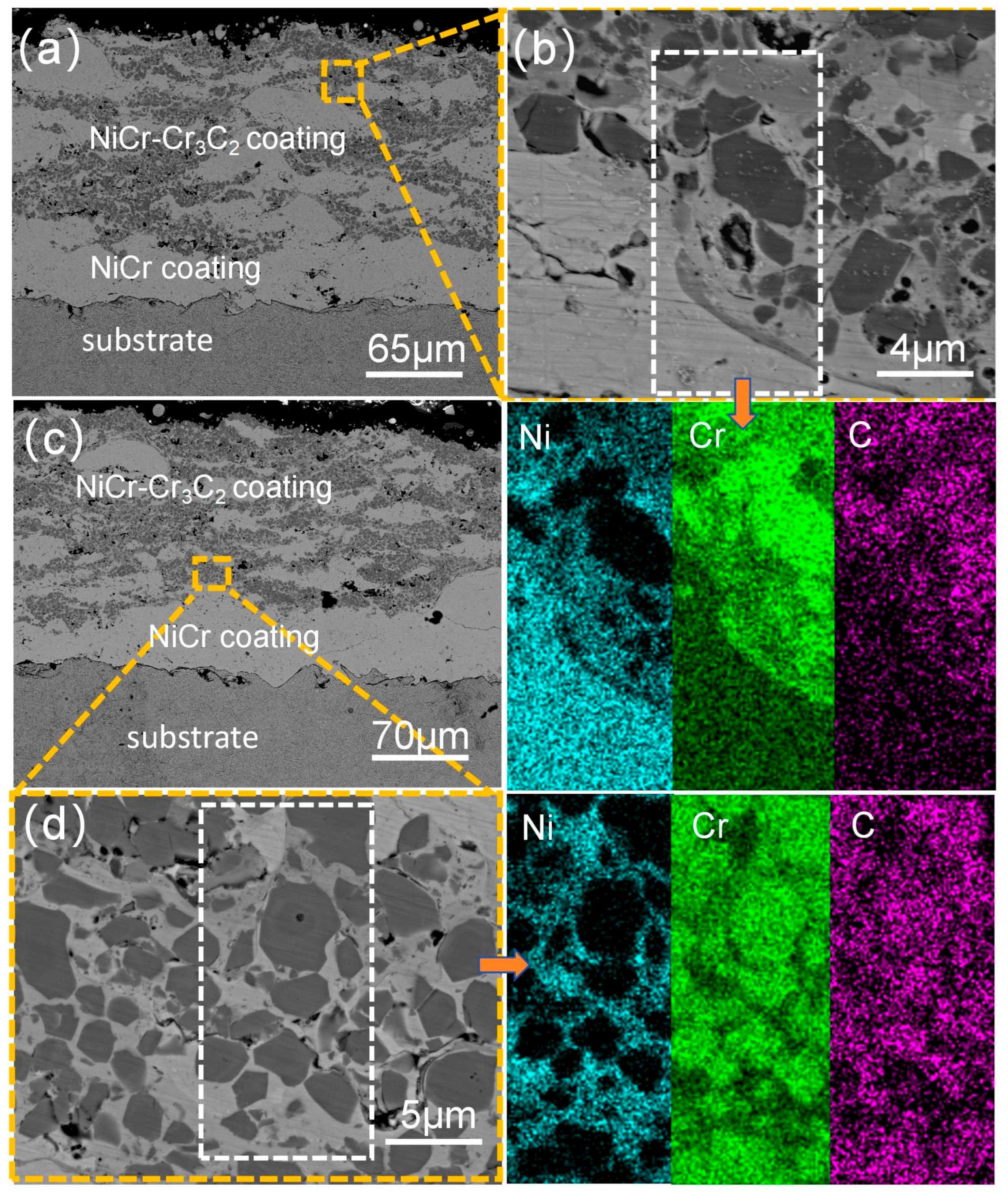
Figure 5 shows the cross-sectional morphology and the corresponding EDS elemental distribution results of the 75NiCr-25Cr3C2 (C) and 50NiCr-50Cr3C2 (D) coatings. Both coating systems have a total thickness of approximately 200 μm, with a consistent structural design. They are both composed of an outer main working layer about 150 μm thick and an inner NiCr transition layer about 50 μm thick, demonstrating excellent layer integrity and interface continuity. More importantly, the density of the C coating is very good, with a porosity of approximately 1.1%. From the perspective of phase distribution, the C coating has a relatively high content of NiCr metallic binder phase, forming a relatively continuous plastic phase network; While in the D coating, due to the increased proportion of Cr3C2 ceramic phase, the proportion of NiCr phase correspondingly decreases, and the hard phase particles are more densely distributed. The density of the D coating is between that of the C coating and the B coating, with a porosity of approximately 1.6%. It is worth noting that since both coatings were prepared by thermal spraying after mixing NiCr powder with 25NiCr-75Cr3C2 sintered powder in a certain proportion, their microstructures both exhibit the typical feature of alternating and intermittent distribution of NiCr phase and 25NiCr-75Cr3C2 composite structure. This multi-phase alternating microstructure enhances coating performance: the NiCr phase absorbs stress and blunts cracks, while the Cr3C2 phase increases hardness and load capacity.
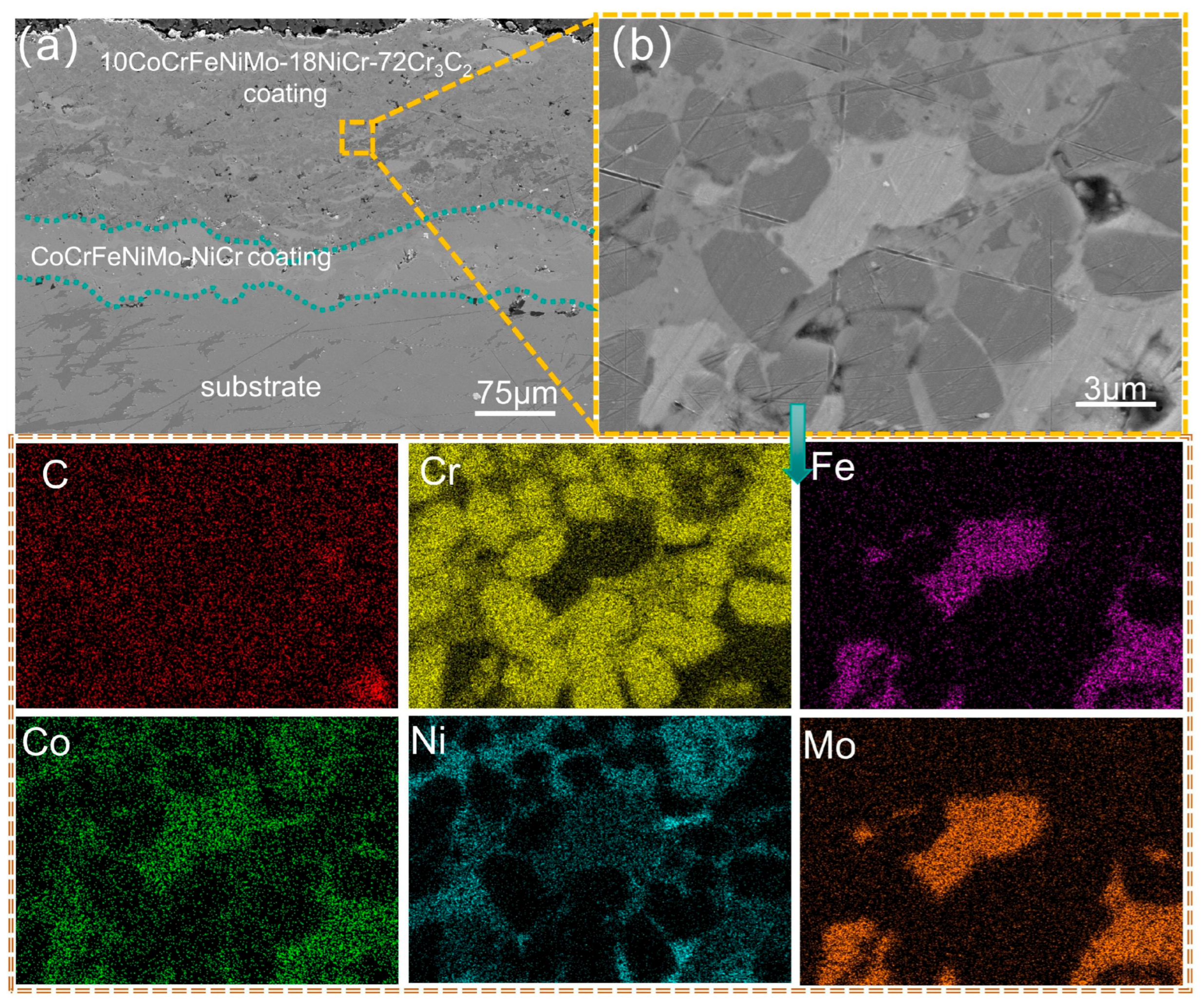
The cross-sectional morphology and EDS elemental distribution results of the 10CoCrFeNiMo-18NiCr-72Cr3C2 (E) coating are shown in Figure 6. As shown in the figure, the total thickness of the coating is approximately 220–280 μm, and its structure is clearly divided into two layers: the outer layer is the 10CoCrFeNiMo-18NiCr-72Cr3C2 working layer with a thickness of about 200 μm; the inner layer is the CoCrFeNiMo-NiCr intermediate transition layer with a thickness of about 20–80 μm. The gradient structure design of this layer helps to relieve interfacial stress and enhance the interlayer bonding. The coating was prepared by thermal spraying after mixing three types of raw materials: CoCrFeNiMo high-entropy alloy powder, 25NiCr-75Cr3C2 composite powder and NiCr binder phase powder. The overall coating has a high degree of density, with well-controlled defects and a porosity of only about 1.2%, indicating that the process parameters were properly optimized and the particles were closely bonded. The CoCrFeNiMo high-entropy alloy phase presents a typical streamline distribution morphology in both the working layer and the transition layer, demonstrating excellent high-temperature plasticity and dynamic spreading behavior during the deposition process. A small amount of CoCrFeNiMo phase is embedded in the 25NiCr-75Cr3C2 structure in the form of micron-sized blocks (as shown in Figure 6b).
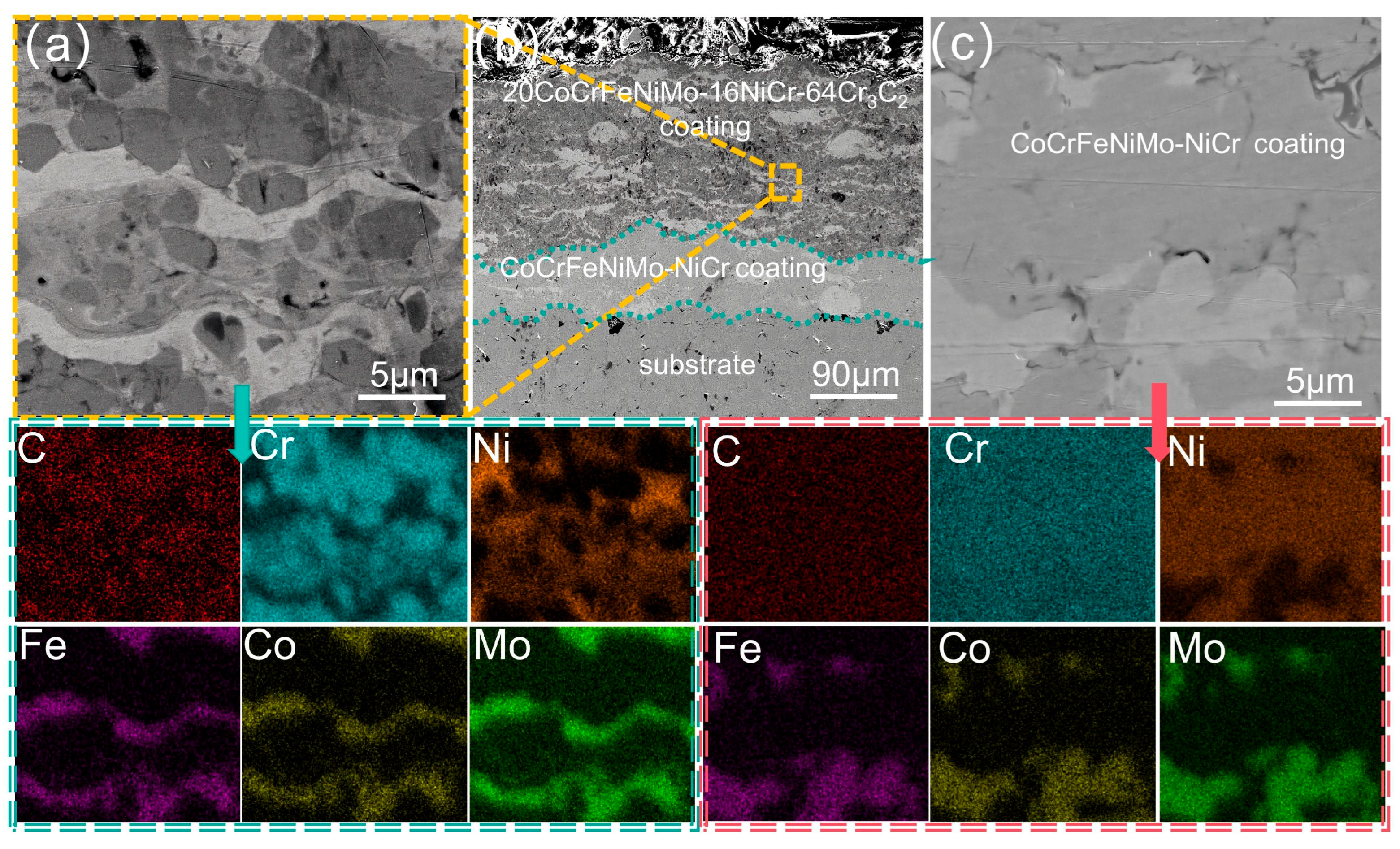
Figure 7 shows the cross-sectional morphology and EDS elemental distribution results of the 20CoCrFeNiMo-16NiCr-64Cr3C2 (F) coating. As can be clearly seen from Figure 7b the total thickness of this coating is approximately 220–250 μm, and it has a distinct two-layer structure: the outer layer is the 20CoCrFeNiMo-16NiCr-64Cr3C2 working layer with a thickness of about 180 μm; the inner layer is the CoCrFeNiMo-NiCr intermediate transition layer with a thickness of about 45–90 μm. This coating system is composed of three types of raw materials, namely CoCrFeNiMo high-entropy alloy powder, 25NiCr-75Cr3C2 composite powder and NiCr binder phase powder, which are prepared by the thermal spraying process. The microstructure of the working layer is dense, with well-controlled defects and a porosity of less than 1%, indicating that the particles were fully melted and the degree of densification during the spraying process was high. The CoCrFeNiMo high-entropy alloy phase mainly presents a streamlined distribution in the working layer and alternates with the 25NiCr-75Cr3C2 structure, forming an intermittent multi-layer composite structure (as shown in Figure 7a), with a few existing in an ellipsoidal form; in the transition layer, the phase is mainly in an ellipsoidal form, with a streamlined distribution as a secondary feature.
In the two coatings of E and F with different proportions of CoCrFeNiMo high-entropy alloy added, the backscattered electron images show that the CoCrFeNiMo phase all presents a bright white tone. Both coatings exhibit multi-morphological and multi-scale phase distribution characteristics, indicating that the CoCrFeNiMo high-entropy alloy has excellent plastic deformation ability and dynamic recrystallization behavior during the thermal spraying process [35,36]. This phase can adapt to the intense plastic flow caused by high-speed particle impact, and at the same time, it shows good interfacial compatibility and microstructure coordination with the Cr3C2 ceramic phase and NiCr metal binder phase, which is conducive to forming a uniform composite microstructure. It is worth noting that in the F coating, the high-entropy alloy phase and other phase form a multi-layer alternating distribution structure. The microstructures of the two coatings not only improve the macroscopic mechanical properties such as hardness and toughness of the coatings through interface strengthening and fine grain effect, but also can effectively deflect and impede the propagation path of microcracks, thereby significantly enhancing the damage tolerance and long-term service stability of the coatings under thermal-mechanical coupling loads.

3.3. Coating Performance Analysis

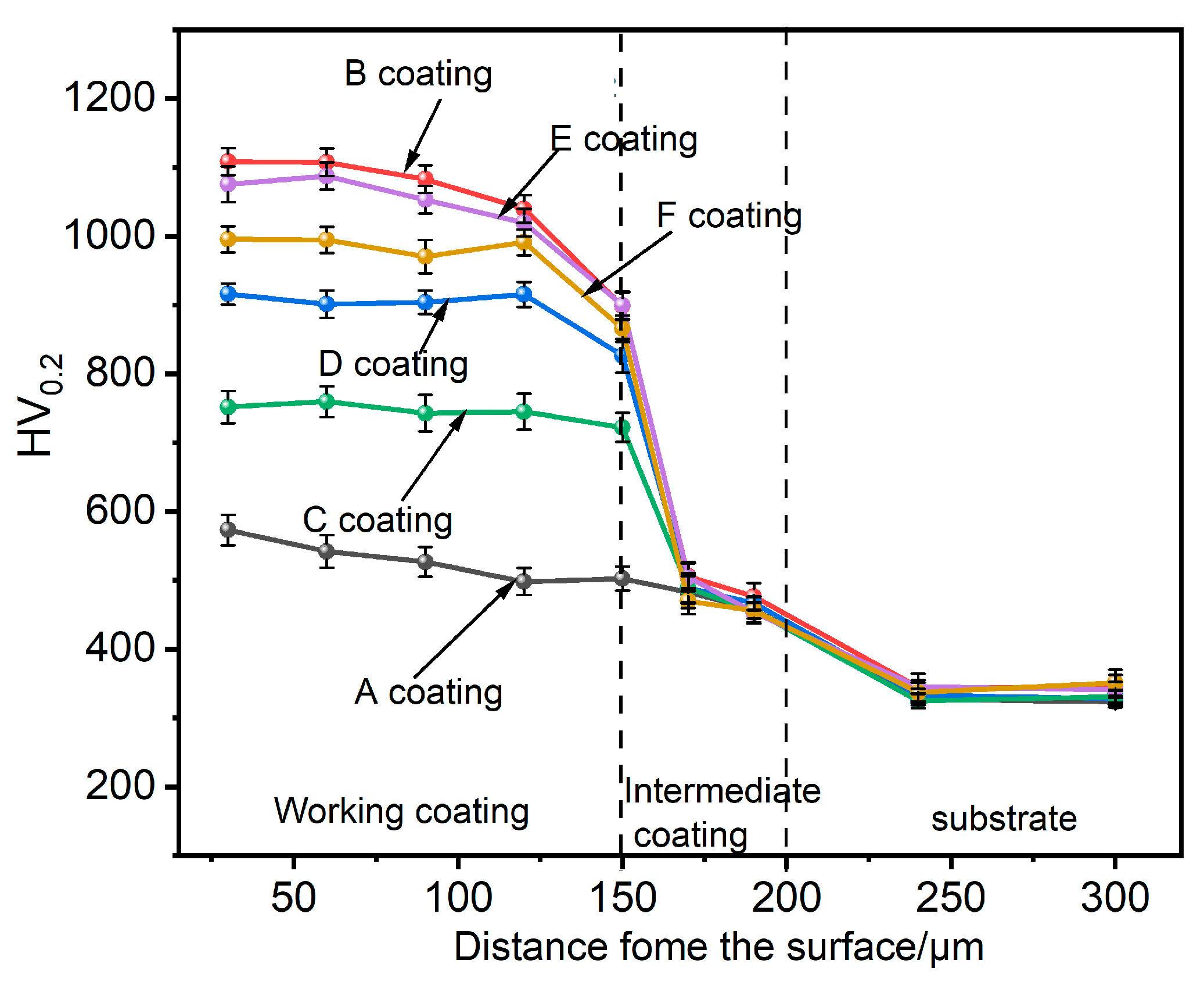
The hardness of the cross-section of the coating has an important influence on its tribological properties. Figure 8 shows the microhardness distribution curves of cross-sections of coatings with different compositions. It can be seen from the figure that the B coating has the highest hardness, with its near-surface hardness reaching approximately 1100 HV0.2. This is mainly attributed to its highest Cr3C2 ceramic phase content (75%). The high volume fraction of the hard phase effectively enhances the coating’s resistance to plastic deformation. Secondly, the E coating has a near-surface hardness of approximately 1080 HV0.2. Its hardness is slightly lower than that of the B coating, which may be related to the introduction of the CoCrFeNiMo high-entropy alloy to a certain extent, which regulates the toughness of the substrate. However, the high Cr3C2 content (72%) still enables it to maintain a relatively high hardness. With the decrease in the content of ceramic phase, the hardness of the coating shows a decreasing trend: the hardness of the F coating is approximately 1000 HV0.2, that of the D coating is about 900 HV0.2, and that of the C coating is approximately 770 HV0.2. The A coating has the lowest hardness, only 520 HV0.2. This trend clearly reflects the dominant strengthening effect of the Cr3C2 ceramic phase on the hardness of coatings.
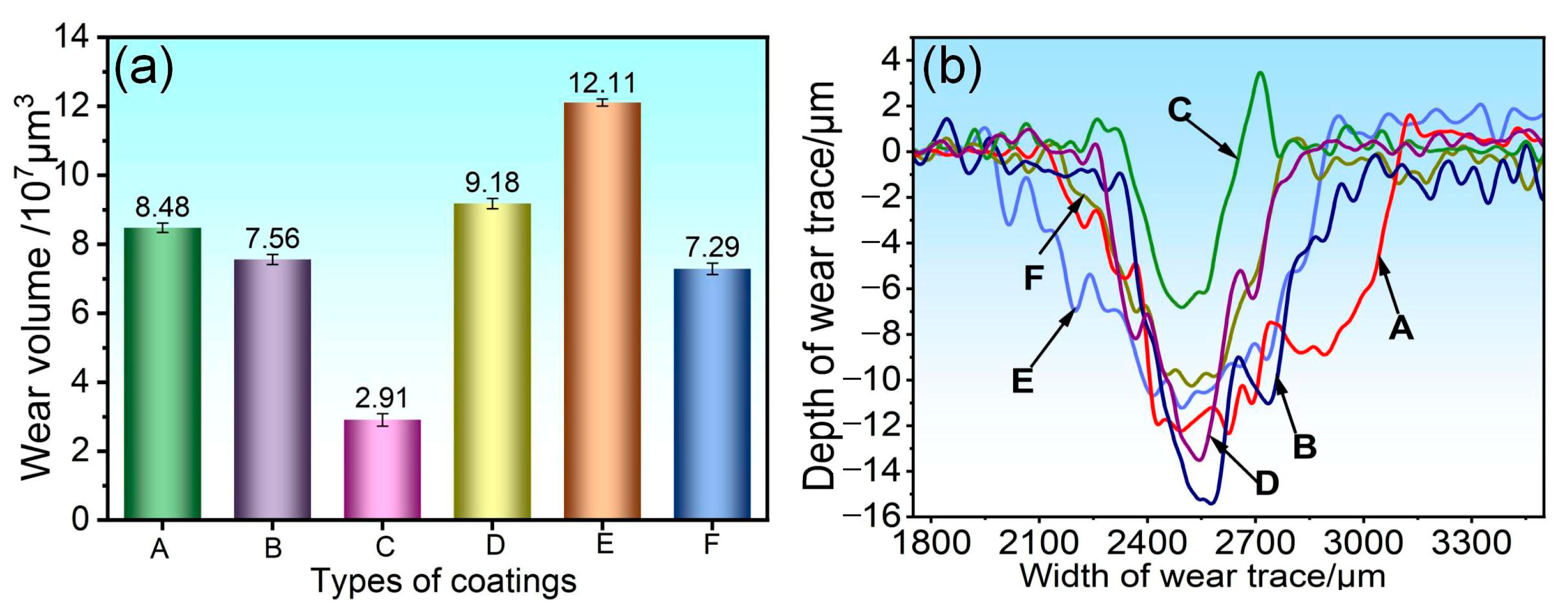
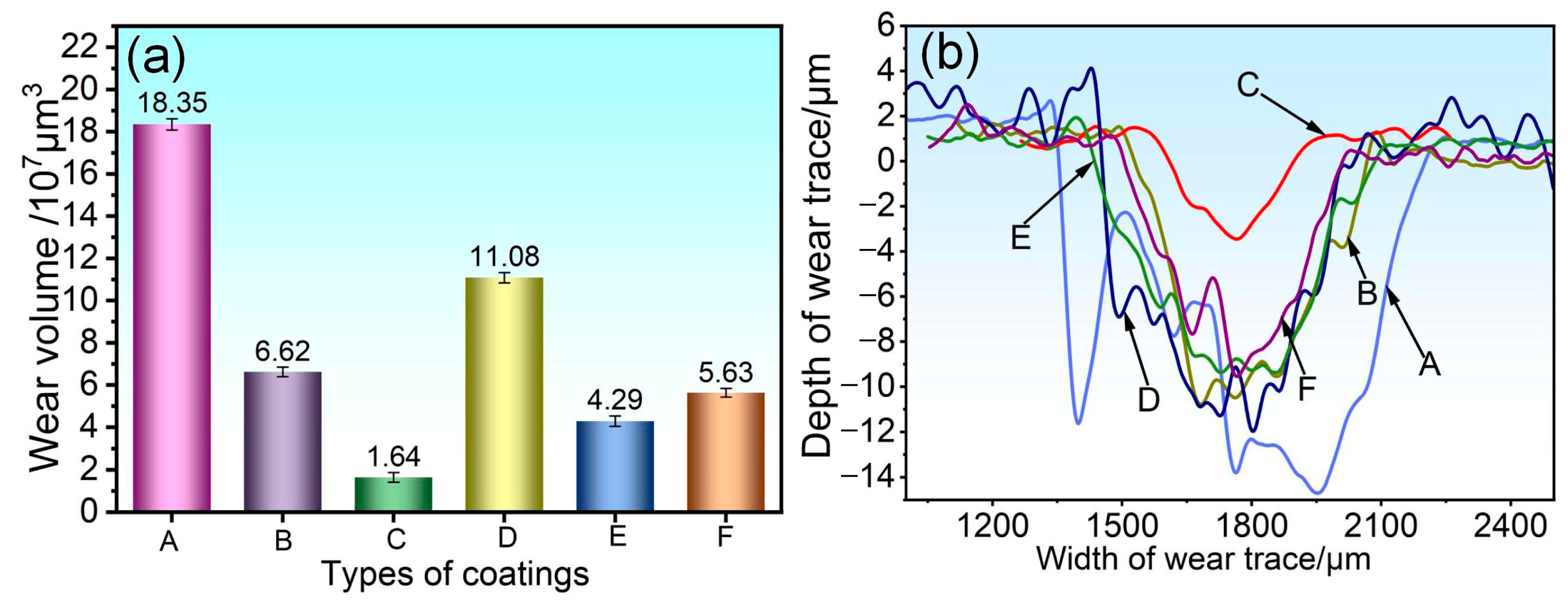
Figure 9 shows the three-dimensional contour morphology of wear scars of different coatings after friction and wear at 350 °C. It can be seen from the figure that the C coating has the shallowest wear scar depth and the smallest wear volume, demonstrating the best wear resistance. Arranged in ascending order of wear scar depth, the sequence is: C, F, E, A, D, and B coatings. Arranged in ascending order of wear volume, the sequence is: C, F, B, A, D, and E coatings. This difference in wear performance is closely related to the composition and microstructure of the coatings.
When the wear temperature rose to 500 °C, the wear morphologies of different coatings all underwent significant changes, as shown in Figure 10. It can be seen from the figure that the C coating has the shallowest wear depth and the smallest wear volume, demonstrating the best wear resistance. The depths of the coatings, in ascending order, are: C, F, E, B, D, and A; the volume of wear of the coating, in ascending order, is: C, E, F, B, D, and A. It is worth noting that compared with 350 °C, the depth of the wear scar of coating A at 500 °C increases significantly, resulting in a substantial rise in the wear volume, indicating its poor resistance to high-temperature oxidation and softening. Although the wear scar depth of coating D does not change significantly, the width increases, which also leads to an increase in the wear volume, reflecting its insufficient resistance to plastic deformation at high temperatures. In contrast, the wear scar depth and width of coatings B, C, E and F at 500 °C were significantly reduced, and the wear volume decreased. Especially for coatings E and F, there was a significant reduction in the volume of wear. This indicates that these coatings not only did not undergo severe softening at high temperatures, but also possibly enhanced the surface hardness and lubricity due to the formation of oxide films (such as dense Cr2O3, Al2O3 or composite oxides), thereby demonstrating excellent resistance to high-temperature wear and oxidation-coupled damage [12,13].
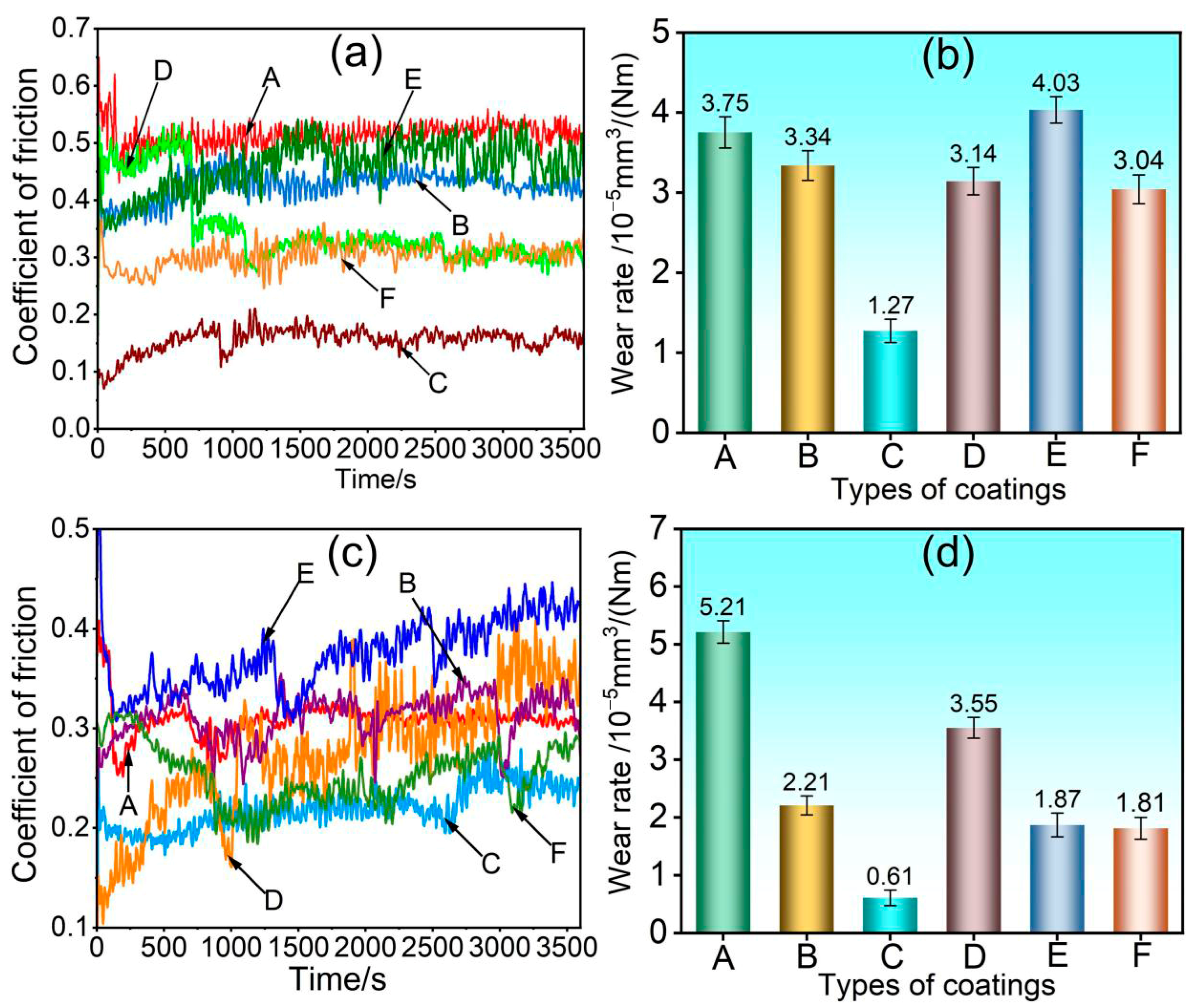
To conduct a more in-depth study on the tribological properties of different coatings, the variation patterns of the friction coefficients and wear rates of six coatings at two temperatures, 350 °C and 500 °C, were compared and analyzed. The specific results are shown in Figure 11. Under the condition of 350 °C (Figure 11a), the friction coefficient of coating C is the lowest, approximately 0.15; coatings F and D follow, both around 0.31. Among them, the friction coefficient of coating D gradually decreases as the test proceeds, which may be related to the gradual formation of an oxide film on the surface over time and the improvement of the lubrication state. Subsequently, with increasing friction coefficients, the coatings are B (0.42), E (0.45), and A (0.50) in sequence. In terms of wear rate (Figure 11b), the C coating still performed the best, at 1.27 × 10⁻⁵ mm3/(N·m), followed by F (3.04), D (3.14), B (3.34), and A (3.75), while the E coating had the highest wear rate, reaching 4.03 × 10⁻⁵ mm3/(N·m). At 500 °C (Figure 11c), the friction coefficient of the C coating remained the lowest, approximately 0.2–0.25; the F coating gradually decreased from 0.3 to 0.2, demonstrating good operational adaptability; subsequently, the friction coefficients increased in the order of D, B, A, and E. Except for the A coating, which remained stable at around 0.3, the friction coefficients of the other coatings showed some fluctuations, but all were below 0.4. This fluctuating behavior might be related to the dynamic formation, local spalling, and regeneration of the oxide film at high temperatures. More importantly, compared with 350 °C, the wear rates of coatings A and D increased at 500 °C, indicating their insufficient resistance to high-temperature softening and oxidation. In contrast, the wear rates of coatings B, C, E, and F decreased significantly (Figure 11d), suggesting that these coatings might have undergone frictional chemical responses at high temperatures, thereby significantly enhancing their performance in resisting high-temperature wear-oxidation coupling damage.

3.4. Analysis of Abrasion Morphology and Wear Mechanism of Coatings

To deeply reveal the influence laws of the wear mechanisms of coatings under different temperature conditions on the friction coefficient, wear rate and wear scar depth, and systematically compare and analyze the differences in the failure mechanisms of the coatings at 350 °C and 500 °C, this study analyzed the surface morphologies of six coatings after the friction and wear experiments at the above temperatures. Through microscopic morphology comparison, composition distribution detection and damage feature analysis, the aim is to clarify the influence of temperature on the wear form, oxidation behavior and material removal mechanism of the coating, thereby establishing the intrinsic connection between microstructure evolution and macroscopic tribological performance, and providing a theoretical basis and experimental support for optimizing the wear resistance of the coating over a wide temperature range.
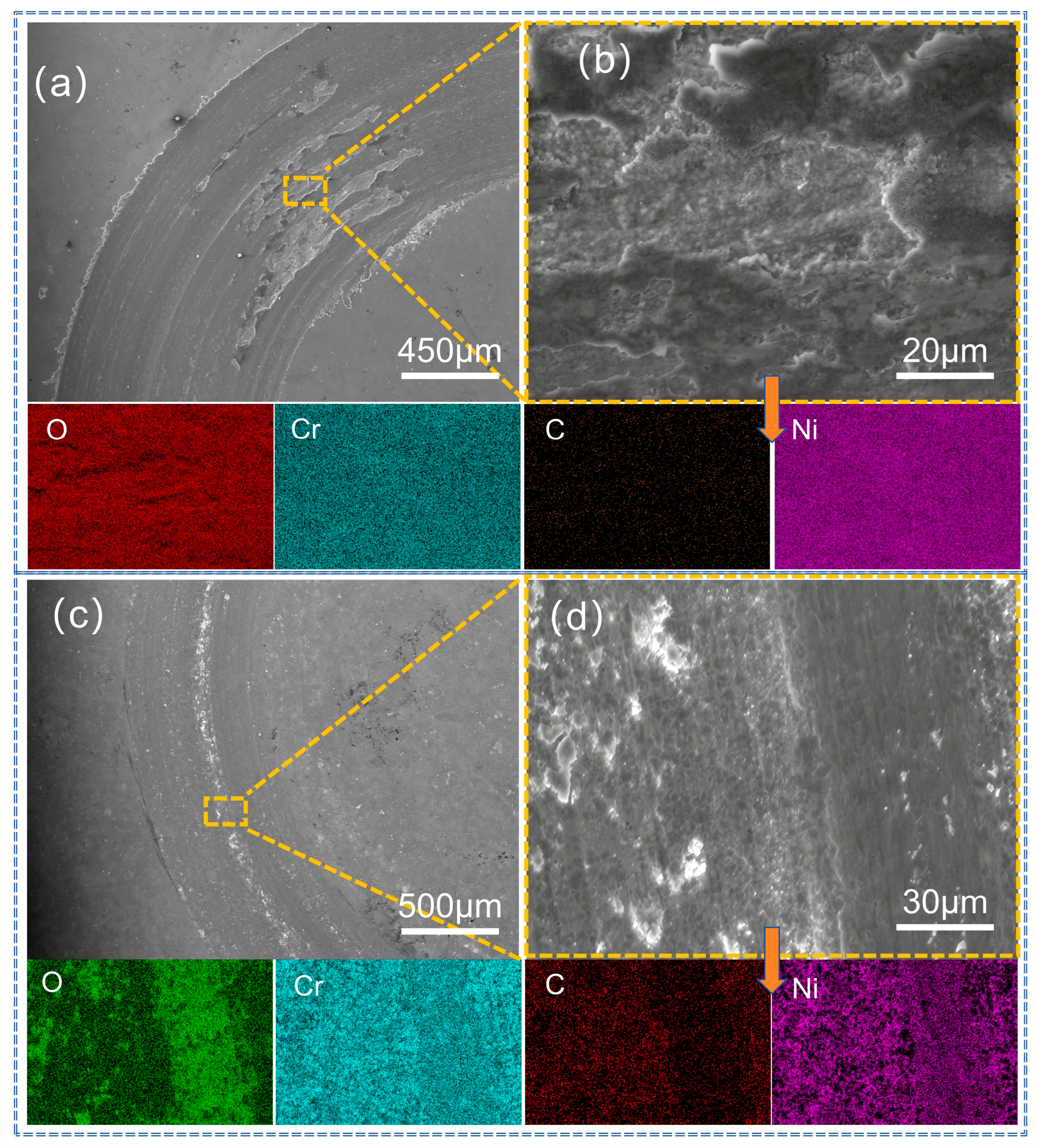
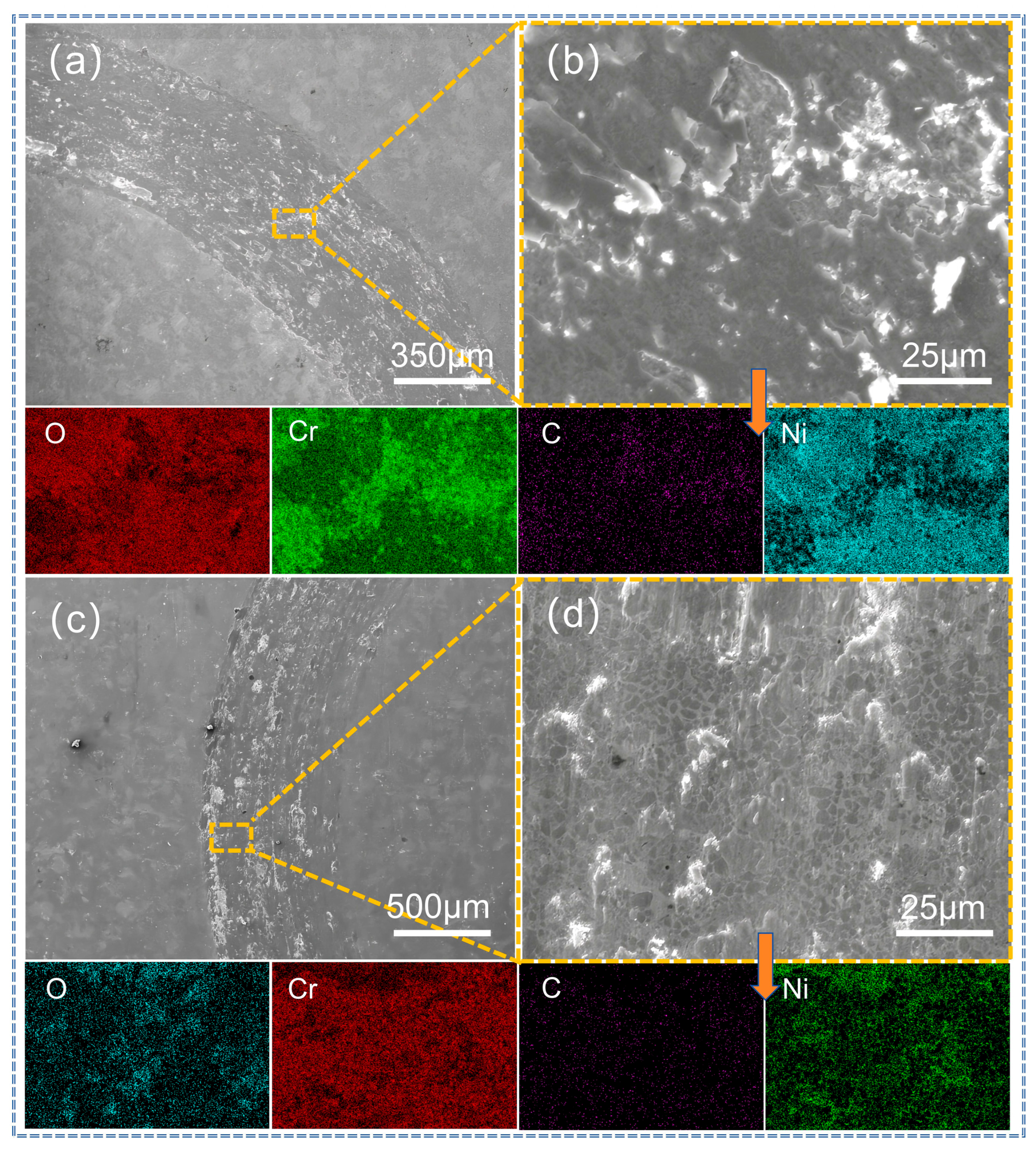
Figure 12 presents the SEM morphologies and EDS composition analysis results of the wear scar after friction and wear of the NiCr (A) coating and the 25NiCr-75Cr3C2 (B) coating at 350 °C. For coating A, the width of the wear scar is as high as 1000 μm, and the wear mechanism is mainly oxidative wear and adhesive wear. The oxygen content in the wear scar area is as high as 48 at.%, indicating that a continuous and dense oxide layer has formed on the surface, and that the metallic state is no longer present. The EDS results in Table 4 show that the contents of elements other than O are as follows: Ni is 29.9 at.%, Cr is 9.4 at.%, and C is 12.1 at.%. From this, it can be inferred that the main component of the oxide film is Ni2O3, with Cr2O3 and NiO as secondary components. The high oxygen content indicates that the oxide film is continuously generated and maintained at a certain thickness during the friction process (as shown in Figure 12b with its EDS elemental mapping). However, due to relatively low hardness of the NiCr coating itself, it is difficult to effectively support this surface oxide layer, resulting in large-scale peeling in the wear scar area, which forms an “oxidation-wear-peeling -reoxidation” cycle mechanism. This mechanism leads to both highest wear rate and friction coefficient observed for this coating. The morphology of B coating’s wear scar is shown in Figure 12c,d; its main wearing mechanism features abrasive wear combined with local oxidation damage. The surface oxygen content here measures only 20.5 at.%, indicating that its oxide film remains thin while being unevenly distributed (as shown in Figure 12d along with its EDS elemental mapping), failing to form a continuous and effective protective barrier. Moreover, from the proportions of each element in Table 3, it can be seen that the main form of Cr is the stable Cr3C2, and the oxide film is mainly composed of Ni2O3. Due to the high brittleness and poor protective performance of Ni2O3, the wear mechanism is mainly abrasive wear, which leads to a relatively high wear rate. Additionally, an excessive content of ceramic phase may increase the brittleness of the oxide film, and abrasive wear can cause the oxide film to be easily broken and difficult to repair.
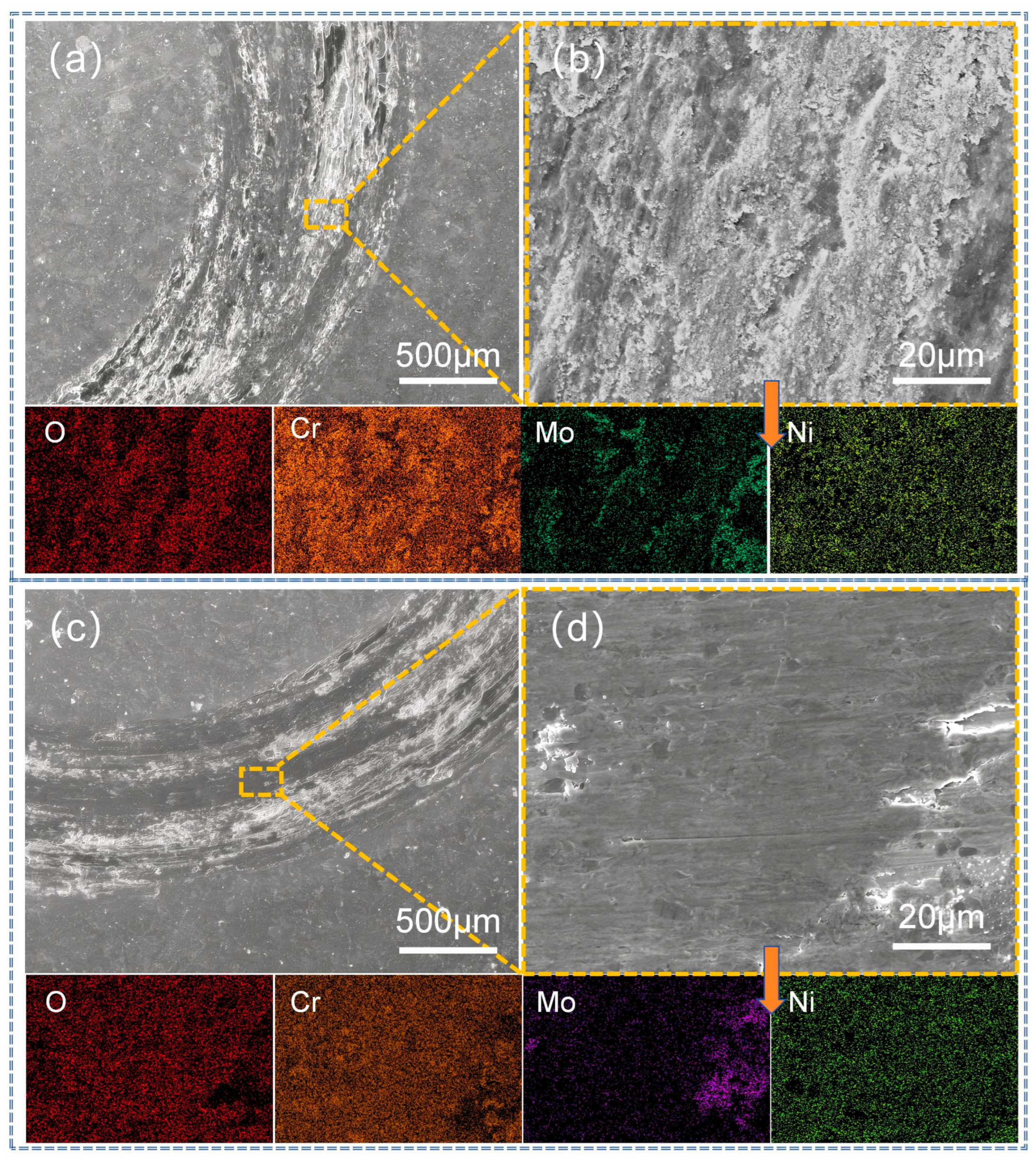
When the friction and wear temperature rose to 500 °C, the wear scar morphologies of the NiCr (A coating) and 25NiCr-75Cr3C2 (B coating) coatings changed significantly (Figure 13). For coating A, the width of the wear scar reached 960 μm, obvious deep furrows can be seen at the edge of the wear scar (Figure 13a) indicating severe plastic deformation and abrasive cutting of the material; although a uniform oxide film is formed in the middle of the wear scar (Figure 13b), there are numerous parallel furrows on its surface (Figure 13a,b), suggesting that the mechanical properties of the oxide film are insufficient, and it fails to effectively resist the abrasive action. Given its characteristics of poor high-temperature softening and oxidation resistance, coating A experienced a failure mechanism dominated by severe abrasive wear and oxidation wear at 500 °C. For coating B, the width of the wear scar is 600 μm, and the surface of the wear scar is covered with a large number of fine and parallel shallow furrows (Figure 13c,d), indicating that its wear mechanism is typical abrasive wear. Energy spectrum analysis shows that the oxygen content on the surface is relatively low (Figure 13d) and the oxide film is distributed in a scattered patchy manner, failing to form a continuous and dense protective layer. Therefore, it cannot provide effective lubrication and protection. Although coating B has a relatively high hardness due to the presence of the Cr3C2 ceramic phase, typical abrasive wear causes severe wear of the coating at 500 °C. Furthermore, from the EDS results in Table 4, it can be seen that the ratio of Ni content to O content in both the A coating and B coating is approximately 1:1, and Cr atoms mainly exist in the form of Cr3C2. Therefore, it can be inferred that the main component of the oxide film in both coatings is NiO. This is also in line with the formation conditions of NiO.
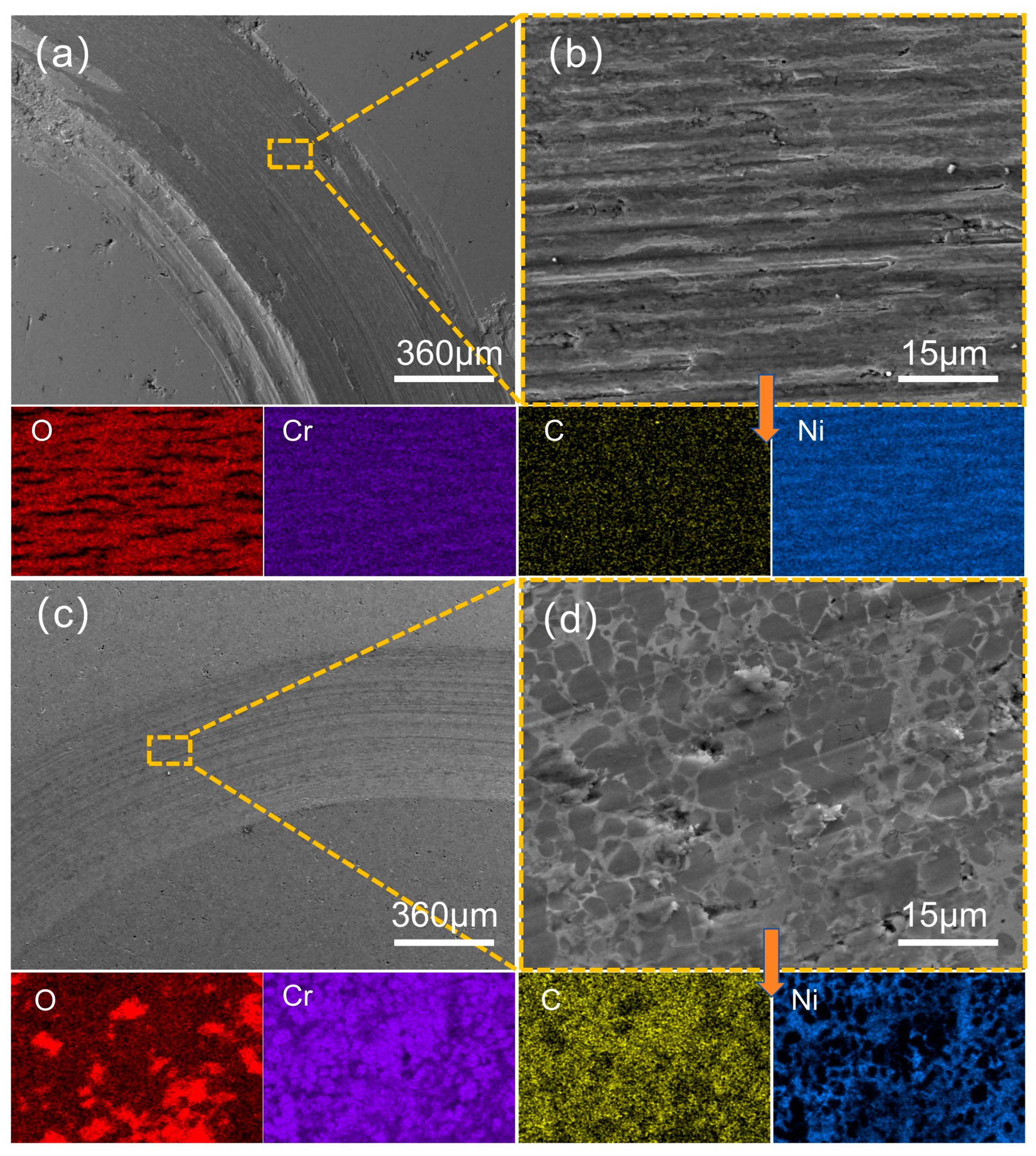
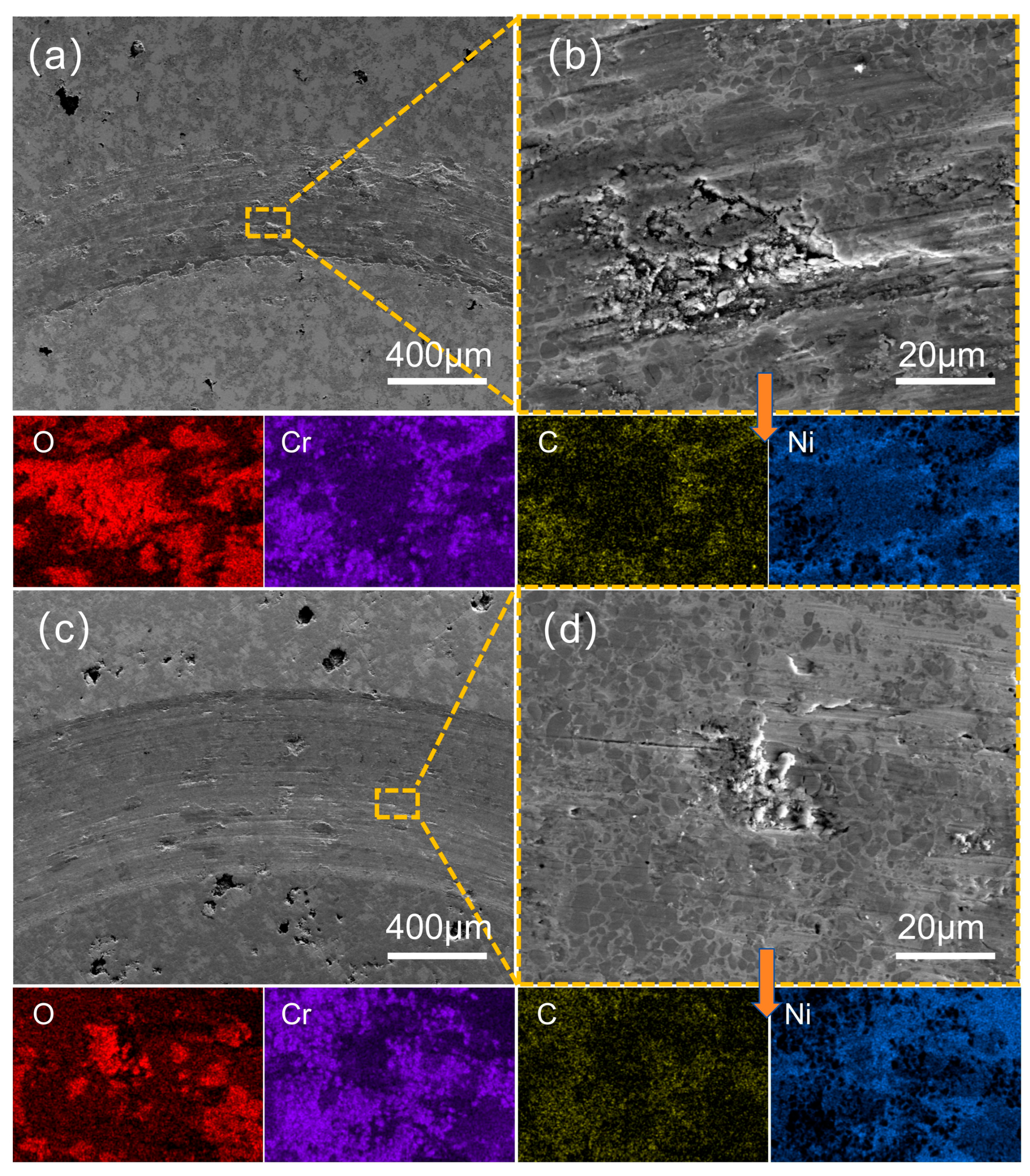
Figure 14 presents SEM morphologies and EDS analysis of wear scars after friction and wear of 75NiCr-25Cr3C2 (C) and 50NiCr-50Cr3C2 (D) coatings at 350 °C. The C coating shows a wear scar width of ~550 μm, significantly narrower than that of the A and B coatings. As shown in Table 4, the elemental composition of the wear scar surface is Ni 19.1 at.%, Cr 26.4 at.%, C 14.3 at.%, and O 40.2 at.%. The relatively high oxygen content indicates that a continuous and dense oxide layer has formed on the surface. Based on the proportion of each element, it can be inferred that the oxide layer is mainly composed of complex oxides such as Ni2O3 and Cr2O3. Such oxides possess high hardness and low shear strength characteristics, playing the role of solid lubrication during the friction process, thereby reducing the friction coefficient to 0.16 and effectively inhibiting the further diffusion of oxygen and the direct contact of abrasive particles. The 75 wt.% NiCr binder offers toughness and thermal shock resistance, maintaining oxide film integrity, while 25 wt.% Cr3C2 enhances hardness without excessive brittleness. In contrast, the D coating exhibits a wider scar (~750 μm) and low oxygen content, suggesting incomplete oxidation and the lack of a protective oxide layer. Only localized oxides form, failing to isolate friction pairs or oxygen ingress. It can be seen from Table 4 that its Ni content is 15.8 at.%, Cr content is 34.3 at.%, C content is 34.7 at.%, and O content is as low as 15.2 at.%. Moreover, the ratio of Ni to O is 1:1, and the ratio of Cr to C is 1:1. At 350 °C, Ni is oxidized preferentially, so the main component of the oxide layer should be NiO. Although the 50 wt.% NiCr binder provides some toughness, it cannot compensate for the brittleness from 50 wt.% Cr3C2. Under thermal–mechanical coupling, microcracks initiate and propagate, while detached ceramic particles cause three-body wear, plowing the surface and hindering stable oxide formation. This leads to a cyclic “oxidation–spalling–abrasive wear–re-oxidation” mechanism, accelerating material loss.
When the friction and wear temperature rose to 500 °C, the wear scar morphologies of 75NiCr-25Cr3C2 (C coating) and 50NiCr-50Cr3C2 (B coating) coatings also changed significantly (Figure 15) As can be seen from Figure 15a,b, the wear scar width of the C coating is approximately 500 μm, and the depth is relatively shallow. A relatively complete and continuous oxide film is formed on its surface, and no obvious plowing grooves or spalling traces are observed, indicating that the wear mechanism is dominated by oxidative wear. Figure 15b and its EDS elemental mapping show that even in the areas where the oxide film is locally damaged, a relatively high oxygen content is still detected, indicating that the coating has a strong dynamic regeneration and self-repairing ability of the oxide film. It can continuously form a new oxide layer during the wear process, thereby effectively suppressing abrasive wear and further material loss. It can be seen from Table 4 that the Ni content is 18.4 at.%, the Cr content is 29.3 at.%, the C content is 13.9 at.%, and the O content is as high as 38.4 at.%. The ratio of Ni to O exceeds 1:2, which indicates that the material of the oxide layer should be a composite oxide mainly composed of Cr2O3, Ni2O3 and NiO. This kind of composite oxide can effectively prevent oxygen diffusion and abrasive contact, playing a protective role [10,37,38]. In contrast, the width of the wear scar of coating D exceeded 800 μm, and the surface oxygen content was relatively low, failing to form a continuous and dense oxide protective film. From the EDS results in Table 4, it can be seen that the ratio of Ni content to O content is approximately 1:1, and the ratio of Cr content to C content is also approximately 1:1. Therefore, it can be inferred that the main component of the oxide film is NiO. This kind of oxide film is highly brittle and prone to cracking and peeling off, thus failing to provide effective protection [1,5,32,39]. Besides fine plowing grooves were observed to be distributed parallelly on the surface of the wear scar, indicating that abrasive wear was the dominant wear mechanism.
The introduction of high-entropy alloy CoCrFeNiMo is bound to have a systematic impact on the microstructure and properties of NiCr-Cr3C2 coatings. From the significant changes in parameters such as the friction coefficient, wear rate, and wear scar depth at different temperatures as mentioned in the previous text, it can be inferred that the difference in the content of high-entropy alloys will directly lead to obvious alterations in the surface wear mechanism and wear scar morphology.
Figure 16 shows the SEM surface morphology and EDS composition analysis results of 10CoCrFeNiMo-18NiCr-72Cr3C2 (E) and 20CoCrFeNiMo-16NiCr-64Cr3C2 (F) coatings after friction and wear at 350 °C. The width of the wear scar of the E coating is approximately 1000 μm, while that of the F coating is slightly narrower, about 850 μm. The oxygen content on the surfaces of the two coatings is similar (34.7% and 35%, respectively), indicating that both have formed an oxide layer mainly composed of Cr2O3 and possibly containing Co/Fe/Ni complex oxides. However, there are significant differences in their friction coefficients (0.45 versus 0.3) and wear rates (4.03 × 10⁻⁵ versus 3.04 × 10⁻⁵ mm3/(N·m)). This might be because in the wear mechanism of the E coating, abrasive wear is dominant. However, the F coating has better toughness, and both oxidative wear and abrasive wear act together.
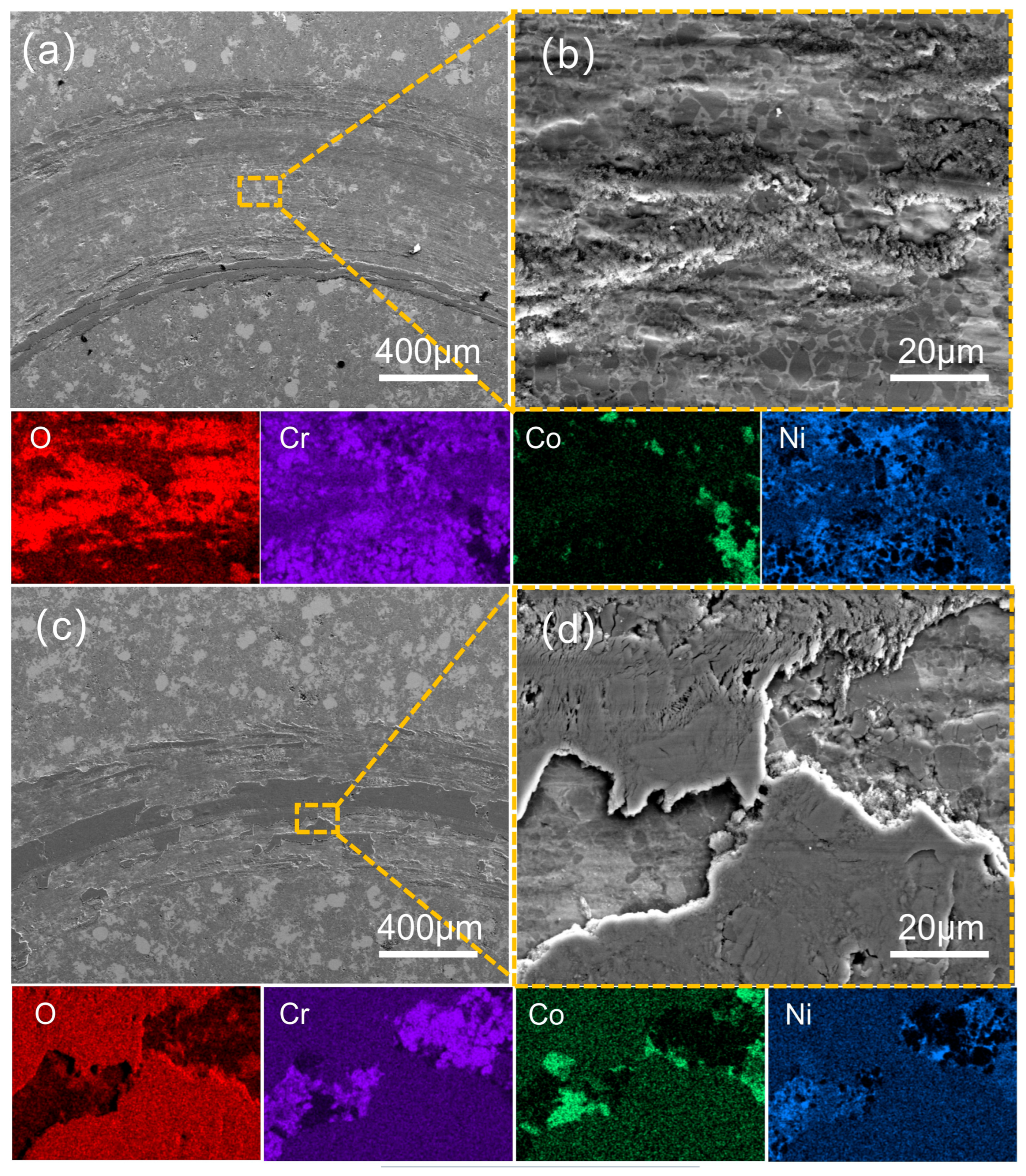
Figure 17 shows the SEM images and EDS analysis of the wear tracks on the 10CoCrFeNiMo-18NiCr-72Cr3C2 (E) and 20CoCrFeNiMo-16NiCr-64Cr3C2 (F) coatings after friction and wear testing at 500 °C. The wear scar of coating E is about 1000 μm wide, with fine parallel furrows indicating abrasive wear. EDS results reveal a relatively high oxygen content, suggesting the formation of a relatively complete oxide film at high temperature. Thus, the wear mechanism involves both oxidative and abrasive wear, where the oxide film mitigates direct abrasive cutting and reduces material loss. Coating F shows a narrower wear scar (~580 μm), likely due to a thicker and more continuous oxide film that significantly lowers the wear rate and improves high-temperature wear resistance. Compared to the results at 350 °C, both coatings exhibit notably improved wear resistance at 500 °C, with reduced wear depth and wear rate. This improvement is attributed to the formation of a denser, more stable oxide layer (e.g., Cr2O3, MoO3, or related compounds) providing high hardness and lubrication, which hinders direct contact between friction pairs. Additionally, the CoCrFeNiMo high-entropy alloy phase enhances the coating’s high-temperature strength and thermal stability, preserving its resistance to deformation and softening [12,23,40,41]. These findings demonstrate that coatings E and F possess excellent high-temperature tribological properties and are promising for high-temperature applications.
Based on the existing research [23,37,38,42,43,44] and the EDS analysis results in Table 4, it can be inferred that under the friction and wear conditions at 350 °C, the surfaces of the two coatings, 10CoCrFeNiMo-18NiCr-72Cr3C2 and 20CoCrFeNiMo-16NiC-64Cr3C2, mainly form a composite oxide composed of Cr2O3, Ni2O3, NiO and MoO. At a high temperature of 500 °C, in addition to the aforementioned oxides, the spinel phase (Ni, Co, Fe)Cr2O4 may also form. This spinel phase is usually formed at higher temperatures and features continuity, stability and good crystallization, which can effectively enhance the high-temperature wear resistance of the coating [44,45,46,47]. This mechanism is consistent with the significant improvement in the tribological properties of the two coatings at 500 °C.
Table 4. Results of EDS spectrum component analysis (at.%).
EDS AreaNiCrCOFeCoMo
Figure 12b29.99.412.148.6------
Figure 12d11.535.832.220.5------
Figure 13b36.712.311.839.2------
Figure 13d13.836.730.419.1------
Figure 14b19.126.414.340.2------
Figure 14d15.834.334.715.2------
Figure 15b18.429.313.938.4------
Figure 15d15.637.632.814.0------
Figure 16b11.730.018.835.01.51.41.6
Figure 16d9.928.321.734.71.81.81.8
Figure 17b13.031.416.233.41.62.22.2
Figure 17d10.326.914.240.52.82.62.7
In conclusion, based on the analysis of wear rate, friction coefficient curves, and the morphology and elemental distribution of wear by SEM/EDS, it can be concluded that: In the friction and wear tests at 350 °C and 500 °C, the 75NiCr-25Cr3C2 coating demonstrated the best tribological performance. This was mainly attributed to the excellent compatibility between the NiCr binder phase and the Cr3C2 ceramic phase, which facilitated the formation of a complete and dense oxide film on the surface. Meanwhile, the Cr3C2 hard phase provided effective load-bearing support. Compared with 350 °C, under the condition of 500 °C, the wear volume and wear rate of the four coatings, namely 25NiCr-75Cr3C2, 50NiCr-50Cr3C2, 10CoCrFeNiMo-18NiCr-72Cr3C2 and 20CoCrFeNiMo-16NiCr-64Cr3C2, were significantly reduced, and their wear resistance was obviously improved. Compared with 350 °C, under the condition of 500 °C, the wear volume and wear rate of the four coatings, namely 25NiCr-75Cr3C2, 50NiCr-50Cr3C2, 10CoCrFeNiMo-18NiCr-72Cr3C2 and 20CoCrFeNiMo-16NiCr-64Cr3C2, were significantly reduced, and their wear resistance was obviously improved. This is mainly attributed to the fact that high temperature promotes the formation of dense oxide films, causing oxidative wear to gradually replace abrasive wear as the dominant mechanism. It is worth noting that the performance of the 10CoCrFeNiMo-18NiCr-72Cr3C2 and 20CoCrFeNiMo-16NiCr-64Cr3C2 coatings with the addition of high-entropy alloys has been significantly enhanced, indicating that CoCrFeNiMo has a remarkable tribological strengthening effect on the traditional NiCr-Cr3C2 coatings at high temperatures. It should be noted that the analysis of the oxide film in this study is mainly based on the EDS elemental mapping results, which provides strong evidence for the oxidation wear mechanism. However, in the future, surface analysis techniques such as Raman spectroscopy and XPS can be further adopted to characterize the phase composition and chemical state of the oxide films formed over a wider temperature range, in order to deeply reveal their formation mechanism and lubrication behavior. This direction will be the focus of subsequent work.

3.5. Electrochemical Performance Analysis

Coatings containing different proportions of NiCr, Cr3C2 and CoCrFeNiMo components will inevitably show systematic differences in electrochemical corrosion behavior. These differences mainly manifest in the formation ability and stability of the passive film, the tendency of pitting initiation and propagation, and the promoting effect of internal defects in the coating (such as pores, phase boundaries, residual stress) on the corrosion process. To systematically clarify the influence mechanism of composition control on the corrosion resistance of coatings, this study next focuses on the electrochemical behavior of six different composition coatings in typical corrosive media.
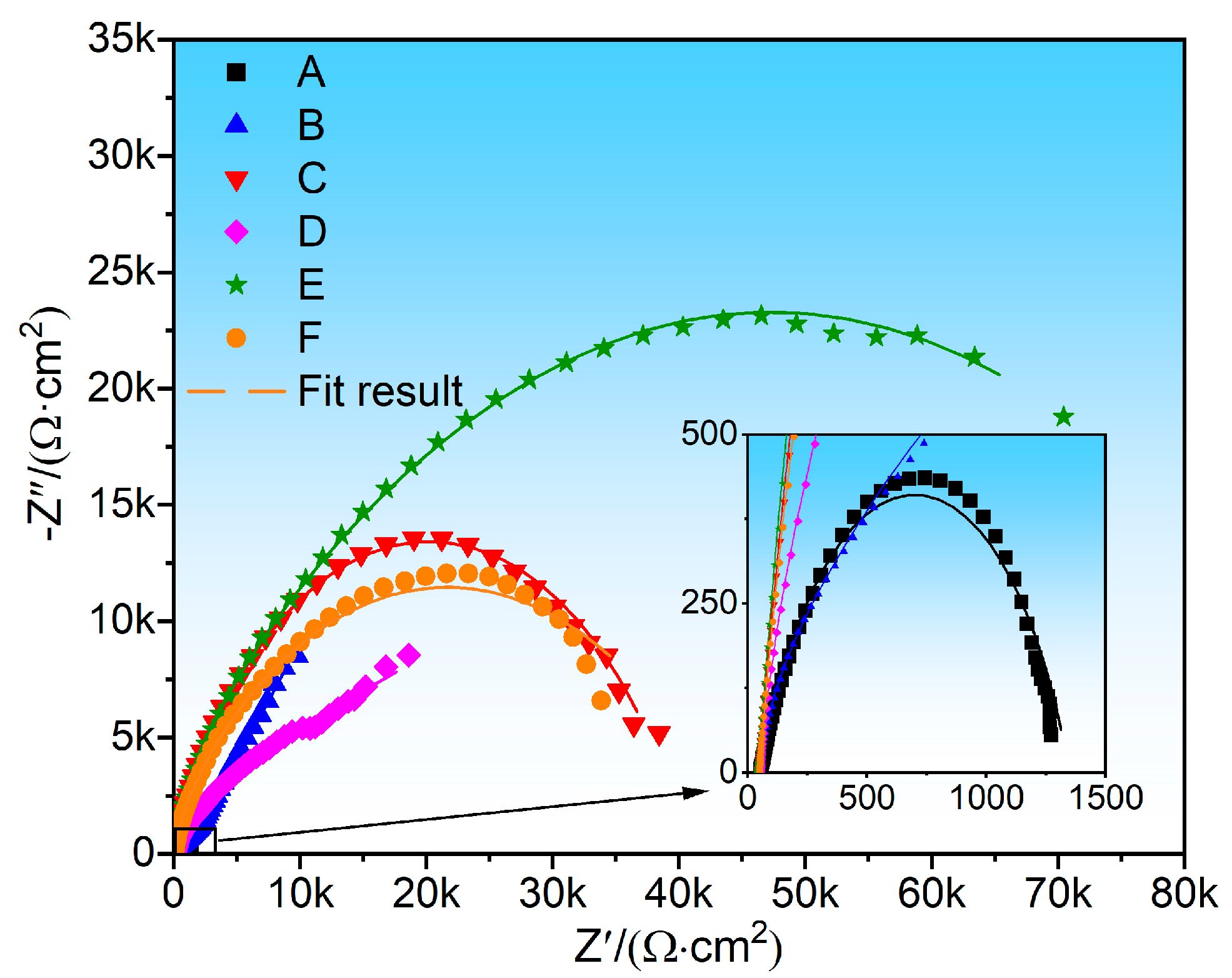
Figure 18 shows the Nyquist plots of electrochemical impedance of coatings with different compositions in 3.5 wt.% NaCl solution. The size of the capacitive arc radius directly reflects the corrosion resistance of the coating. The larger the capacitive arc radius, the better the corrosion resistance of the coating [48,49]. It can be clearly seen from the figure that coating E has the largest capacitive arc radius and shows the best corrosion resistance; followed by coating C. Next, as the capacitive arc radius decreases, the corrosion resistance decreases in the following order: F, B, D, and A; the A coating has the smallest capacitive arc radius and the poorest corrosion resistance.
To quantitatively evaluate the corrosion resistance of the six coatings, this study obtained the corresponding impedance parameters based on the fitting of electrochemical impedance spectroscopy, and the specific data are listed in Table 5. Among them, the coating resistance (Rf) and the charge transfer resistance (Rct) are key parameters for evaluating the corrosion resistance of the coating: Rf reflects the physical barrier ability of the coating against corrosive media. The larger its value, the more significant the barrier effect. The Rct characterizes the electrochemical reaction resistance at the coating/matrix interface. The higher the Rct value, the slower the kinetic process of the corrosion reaction and the better the corrosion resistance performance. As can be seen from Table 5, among the six coatings, the E coating has the largest Rf and Rct values, indicating that it possesses the best overall corrosion resistance. Further analysis shows that the Rf values, from largest to smallest, are E > C > F > A > D > B, while the Rct values are ranked as E > F > C > A > D > B. According to the ranking of the impedance arc radius in Figure 18 (E > C > F > D > B > A), it can be known that the corrosion resistance performance of the E coating is the most outstanding. It is worth noting that although the Rf of the C coating is slightly higher than that of the F coating, indicating its physical barrier performance is slightly stronger, the Rct of the F coating is higher than that of the C coating, suggesting that it has a greater advantage in inhibiting electrochemical corrosion reactions. This difference suggests that the protective mechanisms of the C coating and the F coating may have different emphases. The C coating relies more on the dense barrier effect, while the F coating performs better in terms of the kinetics control of interfacial reactions.
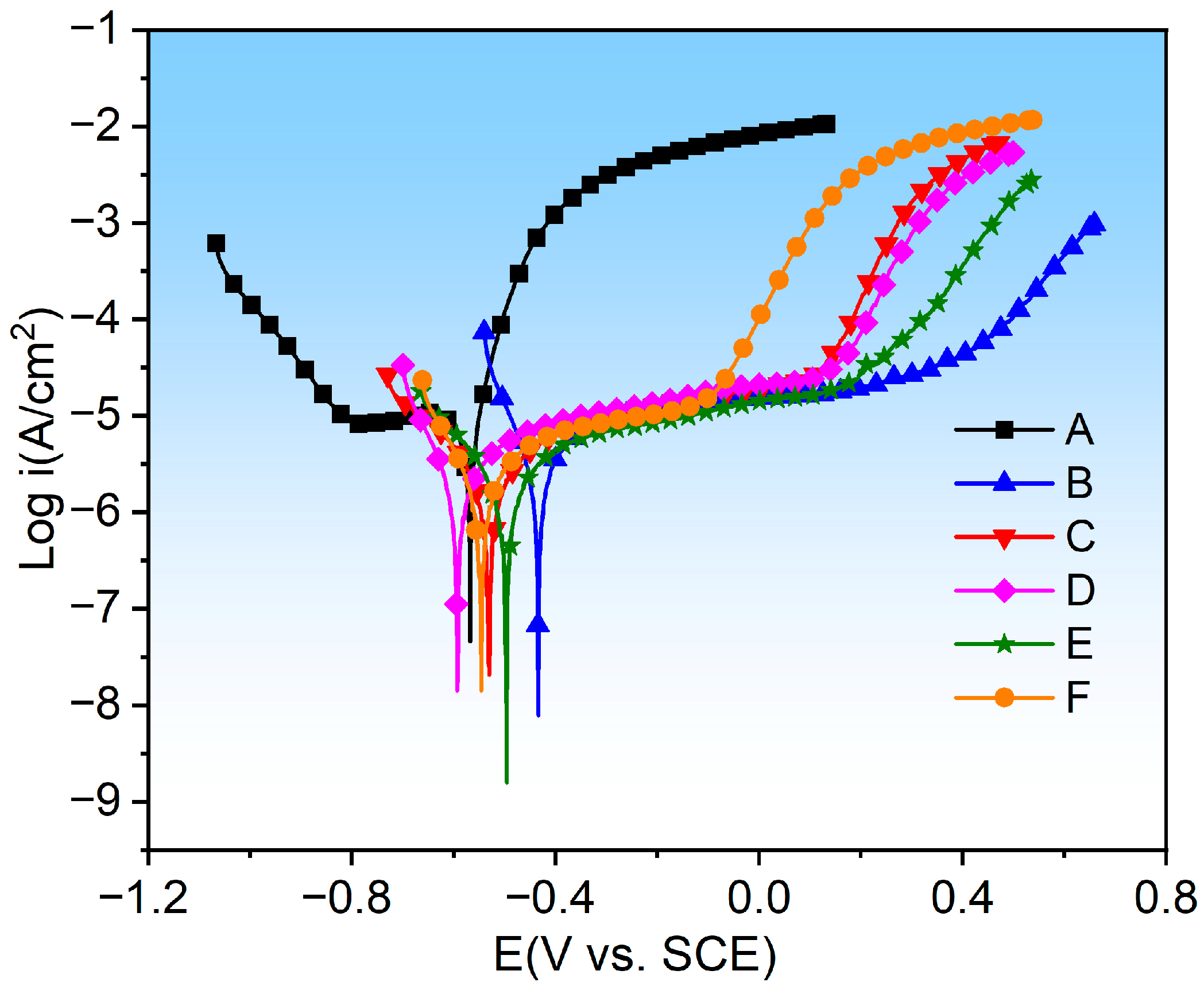
Figure 19 shows the potentiodynamic polarization curves of different composition coatings in a 3.5 wt.% NaCl solution, and Table 6 provides the corresponding electrochemical fitting parameters. The results indicate that the A coating has the highest corrosion current density (icorr) of 11.8 nA/cm2, which is much higher than that of the other coatings, suggesting the poorest corrosion resistance (as shown in Table 6). The E coating has the lowest corrosion current density of 2.08 nA/cm2, demonstrating the best corrosion resistance. The corrosion current densities of the remaining coatings are all within the range of 2–3 nA/cm2, and their corrosion resistance ranks from high to low as follows: E > C > F > B > D > A coating. This ranking is completely consistent with the order of the capacitive arc sizes in the Nyquist plots of the electrochemical impedance spectroscopy (EIS), mutually verifying the reliability of the experimental results. It is worth noting that the polarization curves of coatings B, C, D, E and F all exhibit distinct passivation characteristics: within a specific potential range, the current density remains stable, forming a plateau, indicating the formation of a protective passive film on the surface; subsequently, the current density rises rapidly, suggesting that the passive film has undergone local rupture and pitting corrosion has begun. This behavior reveals that the corrosion process of the coatings involves two key stages: passive film formation and pitting initiation [49,50].
It is worth noting that from the Tafel fitting parameters in Table 6, there is a significant difference in the anode and cathode Tafel slopes (βa, βc), which indicates that the reaction mechanisms and rate-controlling steps of the anode and cathode processes are different. For the coating system in this study, a higher βc value is usually associated with the cathodic oxygen reduction reaction being diffusion-controlled or hindered by a surface film. A lower βa value may correspond to a relatively easier dissolution process of the anode metal. The variation in the βa/βc values among different coatings reflects the differences in the protective properties of their surface oxide films or their chemical homogeneity. Based on the variations in the βa/βc values of different coatings, it can be inferred that the corrosion resistance of coatings C and E is the best, which is consistent with the previous analysis’ conclusion.
The differences in corrosion behavior among coatings with different compositions mainly result from the combined influence of coating composition and microstructure: The presence of the CoCrFeNiMo high-entropy alloy phase in coating E promotes the formation of dense passive films, effectively blocking Cl penetration and enhancing pitting resistance; in coating C, 75 wt.% of the NiCr metallic phase provides good toughness and continuity, while 25 wt.% of the Cr3C2 ceramic phase enhances hardness and chemical stability. The combination of the two forms a uniform and defect-free protective structure. The high ceramic phase content or single metal phase structure in coatings B, D and A can lead to an increase in interfaces, porosity or uneven phase distribution, providing diffusion channels for corrosive media and accelerating local corrosion. In coating F, the interface between high-entropy phases and carbides may have a micro-galvanic effect to some extent, reducing corrosion resistance, but it is still better than traditional NiCr coatings. In conclusion, the corrosion resistance of coatings is not only determined by the composition design, but is also closely related to the uniformity of microstructure, interface characteristics and the stability of passive films. This result has significant guiding significance for the design of high-performance coatings suitable for marine corrosion environments.

4. Conclusions

In this study, six coatings with different compositions were fabricated by HVOF technology. Their friction and wear behaviors at high temperatures and electrochemical corrosion properties in 3.5 wt.% NaCl solution were systematically compared to reveal the regulation mechanism of composition ratio on the microstructure and service behaviors of the coatings. The main conclusions are as follows:
  • Compared with the 25NiCr-75Cr3C2 (B) and 50NiCr-50Cr3C2 (D) coatings, the porosity of the 75NiCr-25Cr3C2 (C), 10CoCrFeNiMo-18NiCr-72Cr3C2 (E) and 20CoCrFeNiMo-16NiCr-64Cr3C2 (F) coatings was significantly reduced. It is worth noting that the introduction of CoCrFeNiMo high-entropy alloy has a significant effect on inhibiting pore formation and enhancing the coating’s density, which is conducive to improving the overall quality of the coating.
  • When subjected to friction and wear at 350 °C and 500 °C, a stable oxide film was formed on the surface of the 75NiCr-25Cr3C2 coating (C). The wear mechanism was mainly oxidative wear, and thus it exhibited the best tribological performance at both temperatures, with the lowest friction coefficient and wear rate.
  • Compared with the friction and wear at 350 °C, the wear rate and wear scar depth of the C, B, E and F coatings at 500 °C were significantly reduced, and the tribological performance was significantly improved. Among them, the wear rate of the E and F coatings was less than half of that at 350 °C, indicating that the addition of CoCrFeNiMo high-entropy alloy effectively enhanced the high-temperature wear resistance of the NiCr-Cr3C2 coating.
  • At 350 °C, coatings B, D, E, and F primarily undergo abrasive wear, with oxidative wear as a secondary mechanism. Under these conditions, the oxide film provides limited protection, resulting in relatively severe material loss. At 500 °C, coatings B and D continue to experience abrasive wear as the dominant mechanism; however, the oxide film contributes to lubrication and protection, leading to a moderate improvement in wear resistance. In contrast, coatings E and F exhibit a transition to oxidative wear as the primary mechanism, accompanied by a notable enhancement in tribological performance.
  • In terms of electrochemical corrosion performance, the E coating has the best corrosion resistance, followed by the C coating. The subsequent order of corrosion resistance is F, B, D, and A coatings, and the NiCr coating (A) has the poorest corrosion resistance.

Author Contributions

D.Z.: Methodology, Investigation, Data curation, Writing—Original Draft, Validation. L.Z.: Conceptualization, Methodology, Validation, Investigation, Supervision, Project administration. W.C.: Writing—Review and Editing, Investigation. J.L.: Software, Writing—Review and Editing, Investigation. H.Z.: Software, Writing-Review and Editing. X.W.: Writing—Review and Editing. X.Z.: Writing—Reviewing and Editing. All authors have read and agreed to the published version of the manuscript.

Funding

The authors would like to acknowledge the financial support by Key Research and Development Program Project of Jiangxi Province (20212BBE53044); Natural Science Foundation of Guangdong Province (2025A1515010944, 2022A1515010210); Science and Technology Research Project of Jiangxi Provincial Department of Education (GJJ2507504, GJJ2407707, GJJ2207510), City Key Laboratory of Die Surface Treatment & Manufacturing technology in Nanchang (2021-NCZDSY-003).

Institutional Review Board Statement

Not applicable.

Informed Consent Statement

Not applicable.

Data Availability Statement

No data were used for the research described in the article.

Acknowledgments

The authors extend their gratitude to Yang Chen from Shiyanjia Lab (www.shiyanjia.com) for providing invaluable assistance with the SEM analysis.

Conflicts of Interest

The authors declare that they have no known competing financial interests or personal relationships that could have appeared to influence the work reported in this paper.

References

  1. Ding, Y.; Hussain, T.; McCartney, D. High-temperature oxidation of HVOF thermally sprayed NiCr–Cr3C2 coatings: Microstructure and kinetics. J. Mater. Sci. 2015, 50, 6808–6821. [Google Scholar] [CrossRef]
  2. Du, J.; Li, F.; Li, Y.; Lu, H.; Qi, X.; Yang, B.; Li, C.; Yu, P.; Cao, Y. High temperature oxidation behavior and interface diffusion of Cr3C2-NiCrCoMo/nano-CeO2 composite coatings. J. Alloys Compd. 2022, 905, 164177. [Google Scholar] [CrossRef]
  3. Matikainen, V.; Bolelli, G.; Koivuluoto, H.; Honkanen, M.; Vippola, M.; Lusvarghi, L.; Vuoristo, P. A study of Cr3C2-based HVOF- and HVAF-sprayed coatings: Microstructure and carbide retention. J. Therm. Spray Technol. 2017, 26, 1239–1256. [Google Scholar] [CrossRef]
  4. Zhou, W.; Zhou, K.; Li, Y.; Deng, C.; Zeng, K. High temperature wear performance of HVOF-sprayed Cr3C2-WC-NiCoCrMo and Cr3C2-NiCr hardmetal coatings. Appl. Surf. Sci. 2017, 416, 33–44. [Google Scholar] [CrossRef]
  5. Bolelli, G.; Berger, L.M.; Börner, T.; Koivuluoto, H.; Matikainen, V.; Lusvarghi, L.; Lyphout, C.; Markocsan, N.; Nylén, P.; Sassatelli, P.; et al. Sliding and abrasive wear behaviour of HVOF- and HVAF-sprayed Cr3C2–NiCr hardmetal coatings. Wear 2016, 358–359, 32–50. [Google Scholar] [CrossRef]
  6. Bolelli, G.; Berger, L.-M.; Bonetti, M.; Lusvarghi, L. Comparative study of the dry sliding wear behaviour of HVOF-sprayed WC–(W,Cr)2C–Ni and WC–CoCr hardmetal coatings. Wear 2014, 309, 96–111. [Google Scholar] [CrossRef]
  7. Lin, L.; Li, G.-L.; Wang, H.-D.; Kang, J.-J.; Xu, Z.-L.; Wang, H.-J. Structure and wear behavior of NiCr–Cr3C2 coatings sprayed by supersonic plasma spraying and high velocity oxy-fuel technologies. Appl. Surf. Sci. 2015, 356, 383–390. [Google Scholar] [CrossRef]
  8. Ozkan, D. Structural characteristics and wear, oxidation, hot corrosion behaviors of HVOF sprayed Cr3C2-NiCr hardmetal coatings. Surf. Coat. Technol. 2023, 457, 129319. [Google Scholar] [CrossRef]
  9. Mudgal, D.; Kumar, S.; Singh, S.; Prakash, S. Corrosion behavior of bare, Cr3C2-25%(NiCr), and Cr3C2-25%(NiCr)+0.4%CeO2-coated superni 600 under molten salt at 900 °C. J. Mater. Eng. Perform. 2014, 23, 3805–3818. [Google Scholar] [CrossRef]
  10. Poirier, D.; Legoux, J.-G.; Lima, R.S. Engineering HVOF-sprayed Cr3C2-NiCr coatings: The effect of particle morphology and spraying parameters on the microstructure, properties, and high temperature wear performance. J. Therm. Spray Technol. 2013, 22, 280–289. [Google Scholar] [CrossRef]
  11. Rubino, F.; Merino, D.; Silvestri, A.T.; Munez, C.; Poza, P. Mechanical properties optimization of Cr3C2-NiCr coatings produced by compact plasma spray process. Surf. Coat. Technol. 2023, 465, 129570. [Google Scholar] [CrossRef]
  12. Ni, S.; Yan, J.; Wei, T.; Wu, J.; Yang, H. Microstructure and tribological performances of Cr3C2- and B4C-added CoCrFeNiMo HEA coatings prepared by laser cladding. Surf. Coat. Technol. 2025, 511, 132–279. [Google Scholar] [CrossRef]
  13. Eriş, R.; Meghwal, A.; Singh, S.; Berndt, C.C.; Ang, A.S.M.; Munroe, P. Exploring the impact of Mo addition in high-velocity oxygen-fuel (HVOF) sprayed CoCrFeNiMo0.5 high-entropy alloy coatings. J. Alloys Compd. 2025, 1037, 180510. [Google Scholar] [CrossRef]
  14. Du, J.; Li, F.; Li, Y.; Lu, H.; Qi, X.; Yang, B.; Li, C.; Yu, P.; Wang, J.; Gao, L. The influence of nano-CeO2 on tribological properties and microstructure evolution of Cr3C2-NiCrCoMo composite coatings at high temperature. Surf. Coat. Technol. 2021, 428, 127913. [Google Scholar] [CrossRef]
  15. Qiang, D.; Jia-jie, K.; Guo-zheng, M.; Yong-kuan, Z.; Zhi-qiang, F.; Li-na, Z.; Ding-shun, S.; Hai-dou, W. Microstructure, mechanical property and high temperature wear mechanism of AlCoCrFeNi/WC composite coatings deposited by HVOF. Ceram. Int. 2025, 51, 14118–14131. [Google Scholar] [CrossRef]
  16. Sreenivasulu, V.; Manikandan, M. High-temperature corrosion behaviour of air plasma sprayed Cr3C2-25NiCr and NiCrMoNb powder coating on alloy 80A at 900 °C. Surf. Coat. Technol. 2018, 337, 250–259. [Google Scholar] [CrossRef]
  17. Srivastava, M.; Jadhav, M.; Chakradhar, R.; Muniprakash, M.; Singh, S. Synthesis and properties of high velocity oxy-fuel sprayed FeCoCrNi2Al high entropy alloy coating. Surf. Coat. Technol. 2019, 378, 124950. [Google Scholar] [CrossRef]
  18. Tang, J.J.; Bai, Y.; Zhang, J.C.; Liu, K.; Liu, X.Y.; Zhang, P.; Wang, Y.; Zhang, L.; Liang, G.Y.; Gao, Y.; et al. Microstructural design and oxidation resistance of CoNiCrAlY alloy coatings in thermal barrier coating system. J. Alloys Compd. 2016, 688, 729–741. [Google Scholar] [CrossRef]
  19. Vallimanalan, A.; Babu, S.K.; Muthukumaran, S.; Murali, M.; Mahendran, R.; Gaurav, V.; Manivannan, S. Synthesis, characterisation and erosion behaviour of AlCoCrMoNi high entropy alloy coating. Mater. Res. Express 2019, 6, 116543. [Google Scholar] [CrossRef]
  20. Fan, X.; Li, W.; Yang, J.; Zhu, S.; Cui, S.; Li, X.; Shao, L.; Zhai, H. Effect of Cr3C2 content on microstructure, mechanical and tribological properties of Ni3Al-based coatings. Surf. Coat. Technol. 2023, 466, 129597. [Google Scholar] [CrossRef]
  21. Du, J.-y.; Li, Y.-l.; Li, F.-y.; Ran, X.-j.; Zhang, X.-y.; Qi, X.-X. Research on the high temperature oxidation mechanism of Cr3C2–NiCrCoMo coating for surface remanufacturing. J. Mater. Res. Technol. 2021, 10, 565–579. [Google Scholar] [CrossRef]
  22. Hong, S.; Wu, Y.; Wu, J.; Zheng, Y.; Zhang, Y.; Cheng, J.; Li, J.; Lin, J. Effect of flow velocity on cavitation erosion behavior of HVOF sprayed WC-10Ni and WC-20Cr3C2–7Ni coatings. Int. J. Refract. Met. Hard Mater. 2020, 92, 105330. [Google Scholar] [CrossRef]
  23. Li, K.; Liang, J.; Zhou, J. Effects of WS2 and Cr3C2 addition on microstructural evolution and tribological properties of the self-lubricating wear-resistant CoCrFeNiMo composite coatings prepared by laser cladding. Opt. Laser Technol. 2023, 163, 109442. [Google Scholar] [CrossRef]
  24. Patel, P.; Munagala, V.N.V.; Sharifi, N.; Roy, A.; Alidokht, S.A.; Harfouche, M.; Makowiec, M.; Stoyanov, P.; Chromik, R.R.; Moreau, C. Influence of HVOF spraying parameters on microstructure and mechanical properties of FeCrMnCoNi high-entropy coatings (HECs). J. Mater. Sci. 2024, 59, 4293–4323. [Google Scholar] [CrossRef]
  25. Wang, Y.; Xiao, W.; Wang, B.; Zhao, J.; Zho, Z.; Li, S.; Mao, W. Influence of HVOF spray parameters on tribological behavior in CoCrFeNiMo high-entropy alloy coatings. Surf. Coat. Technol. 2025, 518, 132856. [Google Scholar] [CrossRef]
  26. Su, H.; Hu, H.; Chen, S.; Zhang, G.; Zhang, C. Tribological properties of atmospheric plasma sprayed Cr3C2–NiCr/20% nickel-coated graphite self-lubricating coatings. Ceram. Int. 2024, 50, 38040–38050. [Google Scholar] [CrossRef]
  27. Ahuja, L.; Mudgal, D.; Singh, S.; Prakash, S. A comparative study to evaluate the corrosion performance of Zr incorporated Cr3C2-(NiCr) coating at 900 °C. Ceram. Int. 2018, 44, 6479–6492. [Google Scholar] [CrossRef]
  28. Alroy, R.J.; Kamaraj, M.; Sivakumar, G. Microstructure, property and high-temperature wear performance of Cr3C2-based coatings deposited by conventional and ID-HVAF spray torches: A comparative study. Wear 2024, 552–553, 205451. [Google Scholar] [CrossRef]
  29. Chen, H.; Ge, M.; Hu, B.; Qu, X.; Gao, Y. High-temperature wear behavior and mechanisms of self-healing NiCrAlY-Cr3C2-Ti2SnC coating prepared by atmospheric plasma spraying. J. Therm. Spray Technol. 2024, 33, 2433–2446. [Google Scholar] [CrossRef]
  30. Chhabra, P.; Kaur, M. Wear and friction characteristics of atmospheric plasma sprayed Cr3C2–NiCr coatings. Tribol. Mater. Surf. Interfaces 2020, 14, 177–192. [Google Scholar] [CrossRef]
  31. Chhabra, P.; Kaur, M.; Singh, S. High temperature tribological performance of atmospheric plasma sprayed Cr3C2-NiCr coating on H13 tool steel. Mater. Today Proc. 2020, 33, 1518–1530. [Google Scholar] [CrossRef]
  32. Chen, H.; Ge, M.; Qu, X.; Gao, Y. Improved high-temperature tribological properties of Ti3SiC2 modified NiCr-Cr3C2 coatings and their wear mechanism. Surf. Coat. Technol 2025, 501, 131943. [Google Scholar] [CrossRef]
  33. Janka, L.; Norpoth, J.; Trache, R.; Berger, L.-M. Influence of heat treatment on the abrasive wear resistance of a Cr3C2-NiCr coating deposited by an ethene-fuelled HVOF spray process. Surf. Coat. Technol. 2016, 291, 444–451. [Google Scholar] [CrossRef]
  34. Kamal, S.; Jayaganthan, R.; Prakash, S. Evaluation of cyclic hot corrosion behaviour of detonation gun sprayed Cr3C2–25% NiCr coatings on nickel-and iron-based superalloys. Surf. Coat. Technol. 2009, 203, 1004–1013. [Google Scholar] [CrossRef]
  35. Ye, W.; Wang, W.; Qi, W.; Li, W.; Xie, L. Preparation process, surface properties and mechanistic study of HVAF-sprayed CoCrFeNiMo0.2 high-entropy alloy coatings. Surf. Coat. Technol. 2024, 494, 131423. [Google Scholar] [CrossRef]
  36. Silvello, A.; Diaz, E.T.; Ramirez, E.R.; Cano, I.G. Microstructural, mechanical and wear properties of atmospheric plasma-sprayed and high-velocity oxy-fuel AlCoCrFeNi equiatomic high-entropy alloys (HEAs) coatings. J. Therm. Spray Technol. 2023, 32, 425–442. [Google Scholar] [CrossRef]
  37. Li, K.; Liang, J.; Zhou, J. Microstructure and elevated temperature tribological performance of the CoCrFeNiMo high entropy alloy coatings. Surf. Coat. Technol. 2022, 449, 128978. [Google Scholar] [CrossRef]
  38. Deng, W.; Wang, S.; Zhang, T.; Zhang, J.; Zhai, Q.; Zhai, C.; Zheng, H. Oxidation and failure mechanisms of CoCrFeNiMo HEA coatings at 1000 °C: Insights into TGO evolution and interface diffusion. Surf. Coat. Technol. 2025, 509, 132229. [Google Scholar] [CrossRef]
  39. Du, J.-Y.; Li, F.-Y.; Li, Y.-L.; Wang, L.-M.; Lu, H.-Y.; Ran, X.-J.; Zhang, X.-Y. Influences of plasma arc remelting on microstructure and service performance of Cr3C2-NiCr/NiCrAl composite coating. Surf. Coat. Technol. 2019, 369, 16–30. [Google Scholar] [CrossRef]
  40. Zhang, S.; Sun, Y.; Cheng, W.; Chen, Y.; Gu, J.; Chen, G. Microstructure and tribological behavior of CoCrFeNiMo0. 2/SiC high-entropy alloy gradient composite coating prepared by laser cladding. Surf. Coat. Technol. 2023, 467, 129681. [Google Scholar] [CrossRef]
  41. Zhou, X.; Zeng, D.; Wang, G.; Zhang, Y. High temperature oxidation and tribological behavior of Cr3C2-25CoNiCrAlY and Cr3C2-25NiCr coatings prepared by AC-HVAF. China Surf. Eng. 2017, 30, 102–109. [Google Scholar]
  42. Tang, J.; Xu, J.; Ye, Z.; Li, X.; Luo, J. Microwave sintered porous CoCrFeNiMo high entropy alloy as an efficient electrocatalyst for alkaline oxygen evolution reaction. J. Mater. Sci. Technol. 2021, 79, 171–177. [Google Scholar] [CrossRef]
  43. Qiu, X. Microstructure and mechanical properties of CoCrFeNiMo high-entropy alloy coatings. J. Mater. Sci. Technol. 2020, 9, 5127–5133. [Google Scholar] [CrossRef]
  44. Cui, Z.; Chen, S.; Dou, Y.; Han, S.; Wang, L.; Man, C.; Wang, X.; Chen, S.; Cheng, Y.F.; Li, X. Passivation behavior and surface chemistry of 2507 super duplex stainless steel in artificial seawater: Influence of dissolved oxygen and pH. Corros. Sci. 2019, 150, 218–234. [Google Scholar] [CrossRef]
  45. Medabalimi, S.; Hebbale, A.M.; Gudala, S.; Ramesh, M.; Gujar, R.; Aravindan, N.; Petru, J. Studies on high-temperature erosion behaviour of HVOF sprayed NiCr based composite coatings. Results Eng. 2025, 26, 105090. [Google Scholar] [CrossRef]
  46. Zhang, D.; Zhao, L.; Chen, W.; Luo, J.; Zhou, H.; Wu, X.; Zheng, X. High-temperature tribological behavior and microstructural evolution of HVOF-sprayed (NiCr-Cr3C2)/NiCr coatings: A study from 600 to 1000 °C. Surf. Coat. Technol. 2025, 514, 132579. [Google Scholar] [CrossRef]
  47. Askari, M.; Khorrami, M.S.; Sohi, M.H. Effect of molybdenum content on the microstructural characteristic of surface cladded CoCrFeNi high entropy on AISI420 martensitic stainless steel. Mater. Today Commun. 2025, 43, 111729. [Google Scholar] [CrossRef]
  48. Chen, Y.; Xia, G.; Yan, H.; Xin, Y.; Song, H.; Luo, C.; Guan, H.; Luc, C.; Hu, Z. Visualising the adsorption behaviour of sodium dodecyl sulfate corrosion inhibitor on the Mg alloy surface by a novel fluorescence labeling strategy. Appl. Surf. Sci. 2024, 642, 158624. [Google Scholar] [CrossRef]
  49. Babu, A.; Dzhurinskiy, D.; Dautov, S.; Shornikov, P. Structure and electrochemical behavior of atmospheric plasma sprayed Cr3C2-NiCr cermet composite coatings. Int. J. Refract. Met. Hard Mater. 2023, 111, 106105. [Google Scholar] [CrossRef]
  50. Zhou, H.; Chen, Y.; Luo, C.; Song, H.; Yan, H.; Lin, L.; Hu, Z. Experimental and theoretical study of 2-mercaptopyridine as an effective eco-friendly inhibitor for copper in aqueous NaCl. J. Mol. Liq. 2023, 382, 121924. [Google Scholar] [CrossRef]
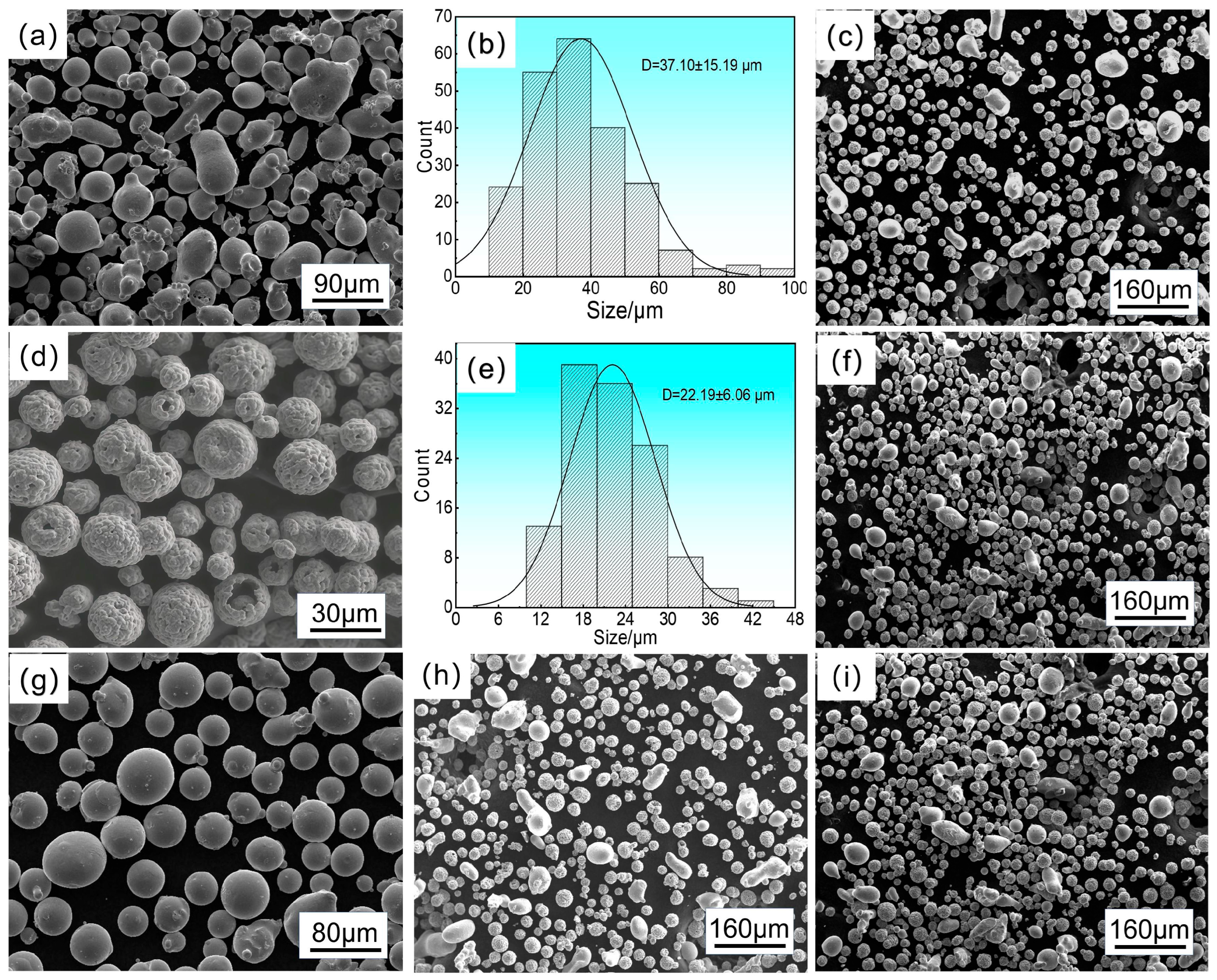
Figure 1. Morphology and particle size distribution of the raw powders. ((a,b)—NiCr; (c)—75NiCr-25Cr3C2; (d,e)—25NiCr-75Cr3C2; (f)—50NiCr-50Cr3C2; (g)—CoCrFeNiMo; (h)—10CoCrFeNiMo-18NiCr-72Cr3C2; (i)—20CoCrFeNiMo-16NiCr-64Cr3C2).
Coatings 15 01415 g001
Figure 2. Equivalent circuit diagram.
Coatings 15 01415 g002
Figure 3. XRD patterns of different types of coatings and their raw material powders. ((a) 75NiCr-25Cr3C2 and 50NiCr-50Cr3C2; (b) 25NiCr-75Cr3C2; (c) NiCr; (d) 10CoCrFeNiMo-18NiCr-72Cr3C2 and 20CoCrFeNiMo-16NiCr-64Cr3C2).
Coatings 15 01415 g003
Figure 4. SEM-EDS image of the cross-section of the coating ((a,b)—A coating; (c,d)—B coating), Notes: Yellow dotted squares—Micro-area magnification; White dotted squares—EDS mapping area.
Coatings 15 01415 g004
Figure 5. SEM-EDS image of the cross-section of the coating. ((a,b)—C coating; (c,d)—D coating), Notes: Yellow dotted squares—Micro-area magnification; White dotted squares—EDS mapping area.
Coatings 15 01415 g005
Figure 6. SEM-EDS image of the cross-section of the 10CoCrFeNiMo-18NiCr-72Cr3C2 coating ((a)—Low-magnification SEM image; (b)—High-magnification SEM image), Notes: Yellow dotted squares—Micro-area magnification.
Coatings 15 01415 g006
Figure 7. SEM-EDS image of the cross-section of the 20CoCrFeNiMo-16NiCr-64Cr3C2 coating ((a,c)—High-magnification SEM image; (b)—Low-magnification SEM image). Notes: Yellow dotted squares—Micro-area magnification.
Coatings 15 01415 g007
Figure 8. Microhardness curves of cross-sections of coatings without components.
Coatings 15 01415 g008
Figure 9. Three-dimensional contour morphology of wear scars of different coatings after friction and wear at 350 °C ((a)—Wear volume columnar comparison chart; (b)—Abrasion mark width-depth curve).
Coatings 15 01415 g009
Figure 10. Three-dimensional contour morphology of wear scars of different coatings after friction and wear at 500 °C ((a)—Wear volume columnar comparison chart; (b)—Abrasion mark width-depth curve).
Coatings 15 01415 g010
Figure 11. Wear curves and wear rate bar charts of different coatings at 350 °C and 500 °C friction and wear ((a,b)—350 °C; (c,d)—500 °C).
Coatings 15 01415 g011
Figure 12. SEM-EDS images of the wear scar after friction and wear of the coating at 350 °C. ((a,b)—A coating; (c,d)—B coating; EDS results are presented in Table 4). Notes: Yellow dotted squares—Micro-area magnification.
Coatings 15 01415 g012
Figure 13. SEM-EDS images of the wear scar after friction and wear of the coating at 500 °C. ((a,b)—A coating; (c,d)—B coating; EDS results are presented in Table 4). Notes: Yellow dotted squares—Micro-area magnification.
Coatings 15 01415 g013
Figure 14. SEM-EDS images of the wear scar after friction and wear of the coating at 350 °C ((a,b)—C coating; (c,d)—D coating; EDS results are presented in Table 4). Notes: Yellow dotted squares—Micro-area magnification.
Coatings 15 01415 g014
Figure 15. SEM-EDS images of the wear scar after friction and wear of the coating at 500 °C. ((a,b)—C coating; (c,d)—D coating; EDS results are presented in Table 4). Notes: Yellow dotted squares—Micro-area magnification.
Coatings 15 01415 g015
Figure 16. SEM-EDS images of the wear scar after friction and wear of the coating at 350 °C ((a,b)—E coating; (c,d)—F coating; EDS results are presented in Table 4). Notes: Yellow dotted squares—Micro-area magnification.
Coatings 15 01415 g016
Figure 17. SEM-EDS images of the wear scar after friction and wear of the coating at 500 °C. ((a,b)—E coating; (c,d)—F coating; EDS results are presented in Table 4). Notes: Yellow dotted squares—Micro-area magnification.
Coatings 15 01415 g017
Figure 18. Nyquist plots of electrochemical impedance of coatings with different compositions in 3.5 wt.% NaCl solution.
Coatings 15 01415 g018
Figure 19. Potentiodynamic polarization curves of coatings with different composition ratios in 3.5 wt.% NaCl solution.
Coatings 15 01415 g019
Table 1. The particle size distribution of different types of powder.
Types of Powderd10d50d90
NiC~20 μm~45 μm~70 μm
25NiCr-75Cr3C2~12 μm~25 μm~35 μm
75NiCr-25Cr3C2~18 μm~35 μm~60 μm
50NiCr-50Cr3C2~15 μm~32 μm~52 μm
10CoCrFeNiMo~30 μm~50 μm~65 μm
10CoCrFeNiMo-18NiCr-72Cr3C2~13 μm~40 μm~61 μm
20CoCrFeNiMo−16NiCr-64Cr3C2~12 μm~46 μm~63 μm
Table 2. Spray process parameters for coatings with different components.
Coating ParametersABCDEF
Working layerNiCr25NiCr
-75Cr3C2
75NiCr
-25Cr3C2
50NiCr
-50Cr3C2
10CoCrFeNiMo
-18NiCr-72Cr3C2
20CoCrFeNiMo-16NiCr-64Cr3C2
Transition layerNiCrNiCrNiCrNiCrNiCr-CoCrFeNiMoNiCr-CoCrFeNiMo
Powder feed rate (g/min)55–60
Oxygen flow rate (LPM)18501900
Propylene flow rate (LPM)6
Air flow rate
(LPM)
2126
Spray Distance (mm)360310
Traverse speed (mm/s)500
Deposition Efficiency (%)72.3–75.8
Table 3. Friction and wear test parameters.
Friction and Wear ParametersValue
Load (N)15
Radius (mm)2
Rotational speed (r/min)200
Time (min)60
Friction temperature (°C)350 °C and 500 °C
Ambient temperature (°C)25 °C
Friction pair materialsAl2O3
Table 5. Fitted electrochemical results of EIS.
SampleRs
(Ω•cm2)
CPEfRf
(Ω•cm2)
CPEdlRct
(Ω•cm2)
Y0f
−1•cm−2•sn)
nY0f
−1•cm−2•sn)
n
A52.69 ± 7.253.28 × 10−40.801293 ± 359.98 × 10−50.773580 ± 33
B47.38 ± 6.549.56 × 10−60.82418 ± 197.51 × 10−50.781502 ± 21
C43.60 ± 7.022.51 × 10−50.8610,170 ± 582.762 × 10−50.6330,560 ± 77
D52.04 ± 8.888.25 × 10−60.85989 ± 425.56 × 10−50.612105 ± 19
E43.57 ± 7.561.31 × 10−50.8712,830 ± 572.98 × 10−50.5483,240 ± 85
F49.73 ± 6.851.86 × 10−50.875786 ± 364.18 × 10−50.5339,640 ± 75
Table 6. Fitting Results of Polarization Curves for Coatings with Different Component Ratios.
Sample−Ecorr (mV vs. SCE)icorr (nA·cm2)βaβc
A568 ± 1211.8 ± 2.120.4613.59
B434 ± 112.55 ± 0.813.2114.46
C530 ± 152.19 ± 0.954.075.57
D593 ± 142.62 ± 0.783.7012.20
E496 ± 92.08 ± 0.863.795.78
F546 ± 142.42 ± 0.933.709.70
Disclaimer/Publisher’s Note: The statements, opinions and data contained in all publications are solely those of the individual author(s) and contributor(s) and not of MDPI and/or the editor(s). MDPI and/or the editor(s) disclaim responsibility for any injury to people or property resulting from any ideas, methods, instructions or products referred to in the content.