Article

Degradation Performance of Poly-Lactic Acid Membrane for WE43 Alloy Under Flow Condition

1
Jiangsu Institute of Medical Device Testing, Nanjing 210018, China
2
School of Materials Science and Engineering, Southeast University, Nanjing 211189, China
3
Jiangsu Key Laboratory for Advanced Metallic Materials, Southeast University, Nanjing 211189, China
*
Authors to whom correspondence should be addressed.
Coatings 2025, 15(11), 1290; https://doi.org/10.3390/coatings15111290
Submission received: 14 October 2025 / Revised: 31 October 2025 / Accepted: 3 November 2025 / Published: 4 November 2025
(This article belongs to the Section Corrosion, Wear and Erosion)

Abstract

The poly-lactic acid (PLA) coating was widely applied to the WE43 alloy to modulate its degradation for biomedical implants, a strategy whose long-term efficacy is critically dictated by the coating’s protective and ion-permeation properties under dynamic physiological flow. This work systematically investigates the corrosion performance under the such flow condition using a novel in situ monitoring method. This method enables a direct, in situ assessment of both the ion-permeation rate across the PLA membrane acted as the coating and the concurrent evolution of the electrochemical properties of the membrane as well as the WE43 alloy substrate. Results revealed that the applied flow accelerated the formation of micro-cracks in the PLA membrane, which facilitated the permeation of Na+ and Cl ions and thereby intensified the corrosion of the underlying substrate. During the initial 15 days, the ion permeation rates for Na+ and Cl ions under the flow condition were 0.097 and 0.042 mmol/(L·h), respectively. The degradation rate of the substrate exhibited a strong positive correlation with the concentration of permeated Cl ions. In contrast, the deposition of calcium-containing compounds was identified as a time-dependent process, governed by the permeation kinetics of Ca2+ ions through the membrane.

1. Introduction

As one of the most studied biodegradable metals, magnesium alloy shows promising applications in treating bone fractures and vascular injuries [1,2]. Specially, WE43 Mg alloy has already been used for cardiovascular stents and bone fracture implants due to their favorable mechanical and degradation properties [3,4]. However, the fast and inhomogeneous degradation has always limited its widespread applications. Owing to the multifunctional capacity to decelerate corrosion, modulate the local alkaline environment, and serve as a drug delivery platform, poly-lactic acid (PLA) coating has garnered significant interest for Mg alloy applications in recent years [5,6,7,8]. Many studies have demonstrated that PLA coatings significantly enhance the initial corrosion resistance of Mg alloys, with the effect becoming more pronounced as the coating thickness increases [9,10].
In vivo, the physiological flow field serves as a critical regulator of tissue formation and cell migration [11], while also exerts a substantial influence on the corrosion behavior of implants. It has been reported that the physiological flow environment may account for the significant discrepancies observed between in vitro and in vivo degradation outcomes for Mg-based implants [12,13,14]. For instance, under in vivo conditions, the corrosion rate can be 1–4 times lower than that in vitro, which is attributed to the homeostatic regulation of corrosion product concentrations (e.g., Mg2+ and OH) in bodily fluids [15]. This flow-induced acceleration of Mg alloy corrosion has also been corroborated by several other studies [16,17,18]. Li et al. [12] reported that the corrosion rates of as-cast pure Mg and WE43 alloy in a flow field were considerably higher than those under static conditions, with flow also promoting localized corrosion. In addition to influencing corrosion rates, the flow field can also alter the corrosion morphology. The severe localized corrosion along edges subjected to higher flow rates has been noticed in AZ31 [19] and MgZnCa alloys [17]. Very recently, a microfluidic system was employed to simulate the physiological fluid environment [20]. In this in vitro study, results demonstrated that the degradation rate was conspicuously accelerated under the effect of fluid-induced shear stress (FISS). Notably, the degradation rate observed in this dynamic system was significantly higher than that under static conditions. Among the tested materials, AZ31 exhibited the most rapid degradation, surpassing both pure magnesium and Mg-Zn-Y-Nd alloys.
A well-established understanding is that flow fields affect corrosion through their control over mass transfer, which governs the delivery of corrosive agents like Cl and the clearance of degradation products. Ion permeation has been extensively studied in ion-conducting polymer membranes [21] and ion-exchange membranes [22]. More recently, rapid ion permeation has been observed in nanofluidic channels, highlighting their potential for applications in separation technologies and osmotic energy harvesting [23,24]. In such channels, ion transport can be orders of magnitude faster than in bulk solution. Studies indicate that internal surface charge, electrolyte concentration, and the adsorption of specific species-such as hydroxide ions and protons-on the interior surfaces play critical roles in governing ion permeation. For polylactic acid (PLA) specifically, its inherent porous structure and the formation of hydrophilic groups during degradation mean that its ion permeation behavior crucially depends on the hydrodynamic environment, differing significantly between static and dynamic conditions. Despite the wealth of studies on macroscopic performance, there is a notable lack of quantitative studies on the ion permeation for individual PLA coatings. Specifically, the role of these coatings in mediating ion transport and the resulting corrosion of the substrate under flow conditions remains unquantified. In this work, an in situ self-fabricated setup was employed to simulate the flow condition, while a PLA membrane and WE43 alloy were selected as representative models of the polymer coating and Mg substrate, respectively. During the degradation process, the primary cation and anion in simulated body fluid namely sodium ions (Na+) and chloride ions (Cl) were monitored. Based on the experimental results, the ion permeation behavior through the PLA membrane and its subsequent influence on the degradation of WE43 alloy were systematically investigated. This work provides valuable insights for a more comprehensive understanding and evaluation of polymer-based coatings for protecting Mg alloys.

2. Materials and Methods

2.1. Materials Preparation

Commercial WE43 magnesium alloy sheets were used to prepare disk-shaped specimens measuring Φ50 × 2 mm. These specimens were progressively ground with silicon carbide sandpaper up to 2000 grit, ultrasonically cleaned in ethanol for 10 min, and finally dried with warm air. Polylactic acid (PLA) granules (4032D, NatureWorks LLC, Minneapolis, MN, USA) were employed in this study. The raw granules were first dried in an oven, after which 0.5 g of PLA was dissolved in 5 mL of dichloromethane (CH2Cl2). The solution was magnetically stirred for 24 h at ambient temperature, cast into a glass Petri dish, and then dry naturally in air for about 48 h at ambient temperature (approximately 25 °C and relative humidity of 40%–60%). This procedure yielded a freestanding PLA membrane with a diameter of 60 mm and a uniform thickness of 0.10 ± 0.02 mm.

2.2. In Vitro Degradation Test

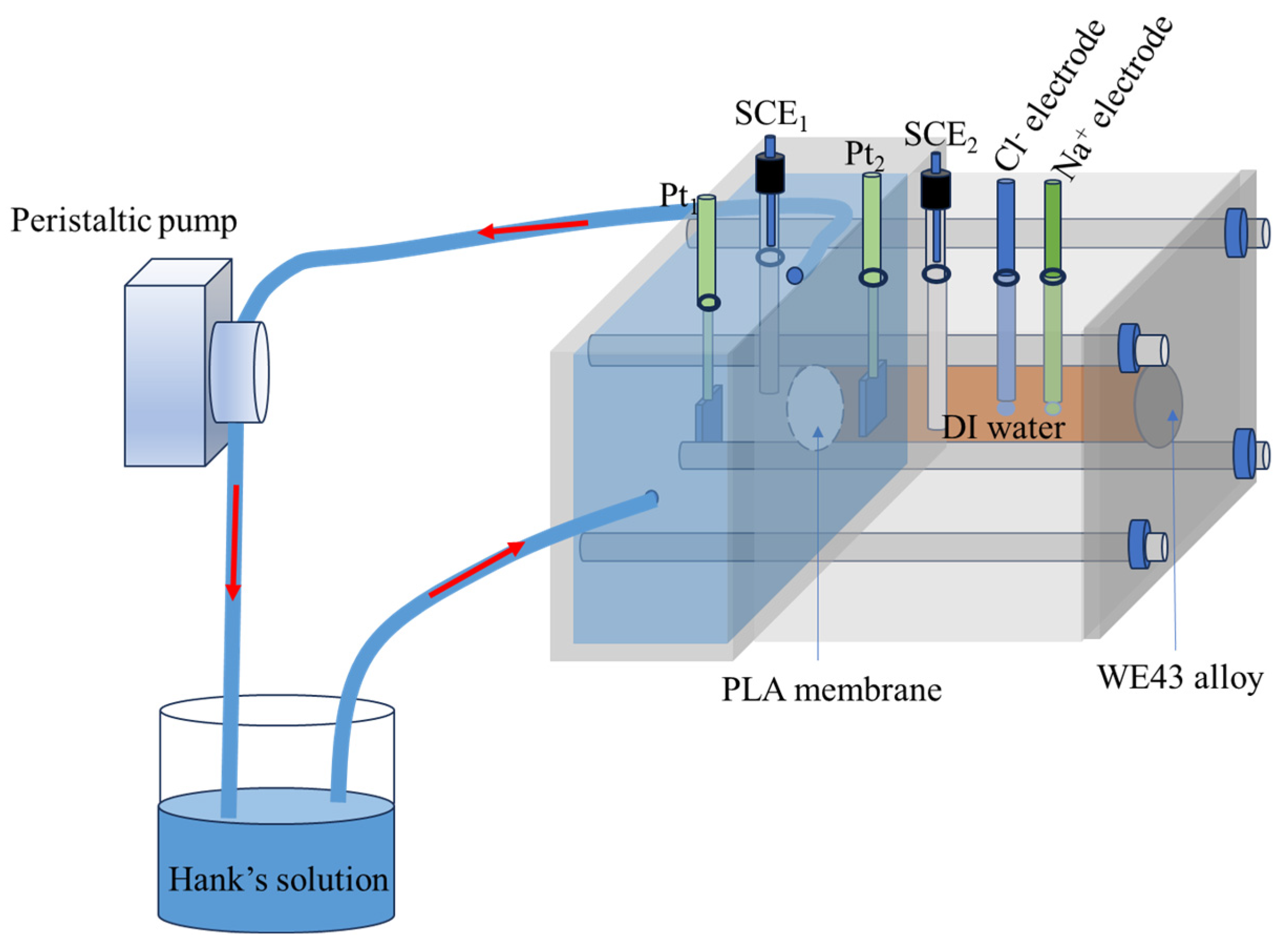
The in situ self-designed apparatus used for the in vitro degradation test is shown in Figure 1. This setup incorporates a self-developed multichannel ion monitoring system based on an STM32 microcontroller. The immersion temperature was maintained at 37.5 ± 0.5 °C throughout the experiment. During testing, the PLA membrane and WE43 alloy specimen were placed in the center and side regions of the experimental chamber, respectively. The degradation medium (Hank’s solution) and deionized water (DI water) were filled on opposite sides of the PLA membrane. Ion concentrations of Na+ and Cl were continuously recorded using the self-developed multichannel ion monitoring system. A peristaltic pump (BT100-2J, Ningmei Pump Co., Ltd., Wuhan, China) was employed in the experiment. Prior to testing, the flow rate was calibrated by measuring the volume of fluid discharged over a predetermined time interval. The flow rate was set to a value of 300 mL/min. This value falls within the typical range of 250 to 1400 mL/min for specific organs [25]. After the test, the mean ion permeation rate was determined by dividing the measured final ion concentration by the total immersion time.

2.3. Finite Element Analysis

To elucidate the flow conditions at the membrane surface, the flow streamlines and wall shear stress (WSS) distributions around the PLA membrane were simulated using COMSOL 6.1 Multiphysics (COMSOL Inc., Burlington, MA, USA). During the simulation, the PLA membrane was modeled with a density of 1.24 g/cm3, a Young’s modulus of 3500 MPa, and a Poisson’s ratio of 0.36. The fluid properties were a viscosity of 0.78 mPa·s and a density of 0.99 g/cm3.

2.4. Electrochemical Test

Electrochemical impedance spectroscopy (EIS) was performed on the standalone PLA membrane and WE43 alloy using a standard three-electrode configuration with an electrochemical workstation (PARSTAT 3000A-DX, Ametek, Berwyn, PA, USA). The specific electrode arrangements are illustrated in Figure 1. For the PLA membrane, a two-compartment cell was employed, in which two platinum flakes (1 cm2 exposed area each) served as the working (Pt2) and counter (Pt1) electrodes, respectively, with a saturated calomel electrode (SCE1) as the reference. For the WE43 alloy, the disk sample itself acted as the working electrode, paired with a platinum flake as the counter electrode (Pt2) and a saturated calomel electrode (SCE2) as the reference. All EIS measurements were conducted over a frequency range of 100 kHz to 100 mHz using a sinusoidal perturbation amplitude of 10 mV.

2.5. Characterization

Following the degradation test, the PLA membrane was rinsed with deionized water and oven-dried. The surface morphologies of the degraded PLA membrane and WE43 alloy were examined using scanning electron microscopy (SEM, FEI Sirion 200), with the elemental composition of selected areas analyzed by energy-dispersive spectroscopy (EDS, Oxford Aztec X-Max 80).
Fourier-transform infrared (FTIR) spectroscopy of the PLA membranes before and after degradation was performed on a spectrometer (Thermo Scientific, Nicolet iS10) in attenuated total reflection (ATR) mode. Spectra were collected from 4000 to 500 cm−1 with a resolution of 4 cm−1, accumulating 16 scans per measurement.
To determine molecular weight, the degraded PLA membrane fragments were dissolved in tetrahydrofuran (THF) at a concentration of 20 mg per 4 mL. The number-average (Mₙ) and weight-average (M𝓌) molecular weights were then determined by gel permeation chromatography (GPC, Agilent PL-GPC 220) using polystyrene standards and THF as the eluent.
During the test, experimental data was statistically analyzed and was presented as average of three measurements plus/minus standard deviation wherever possible.

3. Results

3.1. Permeation Profiles of Sodium and Chloride Ions

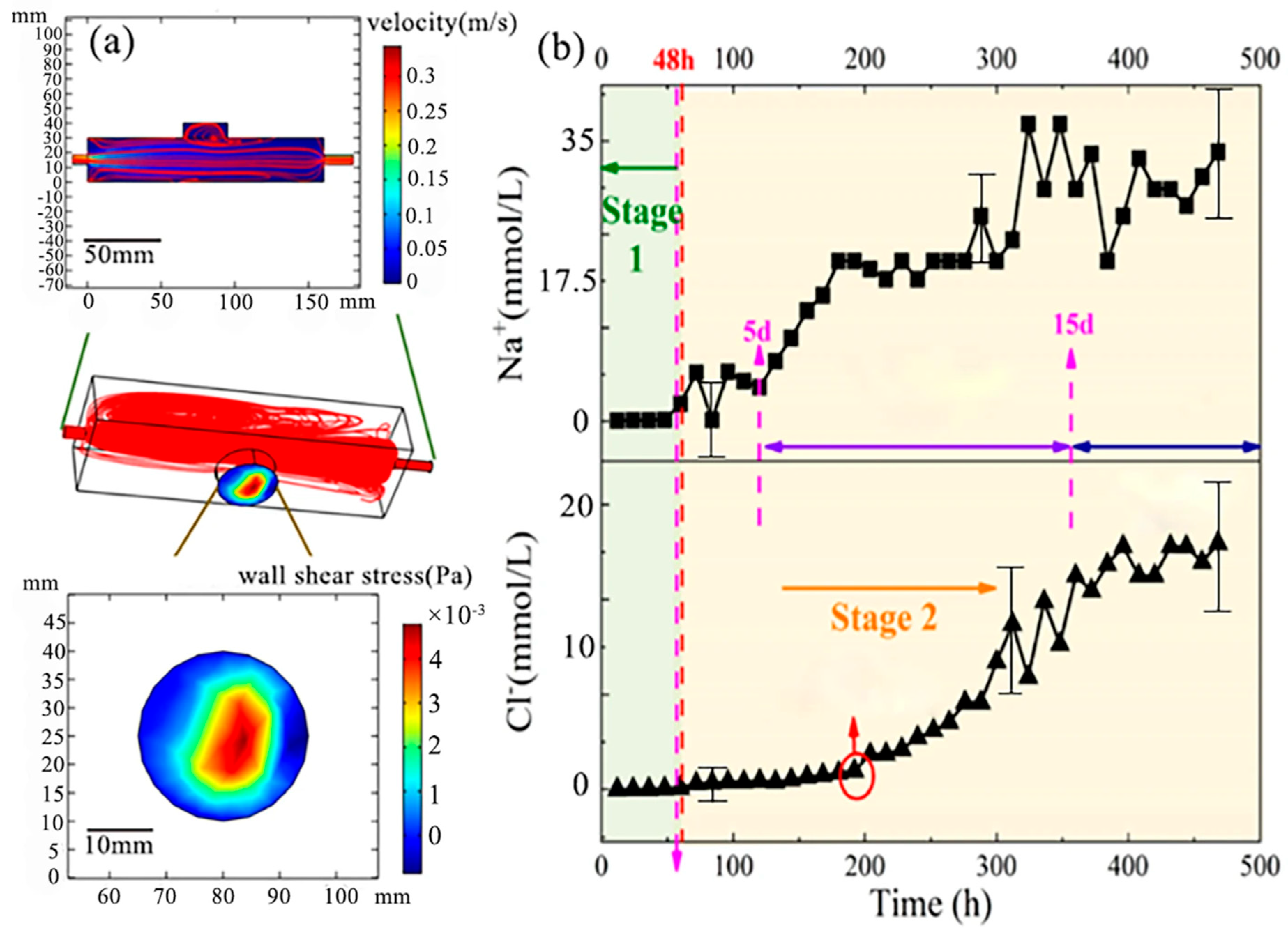
The flow velocity and wall shear stress (WSS) distribution around the PLA membrane are shown in Figure 2a. The maximum WSS, approximately 0.005 Pa, occurs near the central region of the membrane. This value is lower than the wall shear stress typically found in veins, which is generally maintained between 0.1 and 0.6 Pa [26]. Figure 2b illustrates the evolution of Na+ and Cl ion concentrations in the deionized water as a function of immersion time. Both ion concentrations remained relatively stable during the initial 48 h. Subsequently, the Na+ concentration increased markedly, whereas the Cl concentration rose sharply after approximately 200 h. The results may indicate that the protective effect of the PLA membrane began to decrease after two days of immersion. After about 15 days of immersion, the concentrations of both ions reached another stable stage, suggesting the temporary equilibrium of the ion permeation between the two sides of the PLA membrane. The measured concentrations of Na+ and Cl were approximately 35 mmol/L and 15 mmol/L, respectively, over the initial 15 day period. Based on these values, the corresponding mean ion permeation rates were calculated to be about 0.097 and 0.042 mmol/(L·h) for Na+ and Cl, respectively.

3.2. Degradation Performance of the PLA Membrane

3.2.1. Electrochemical Properties of the PLA Membrane

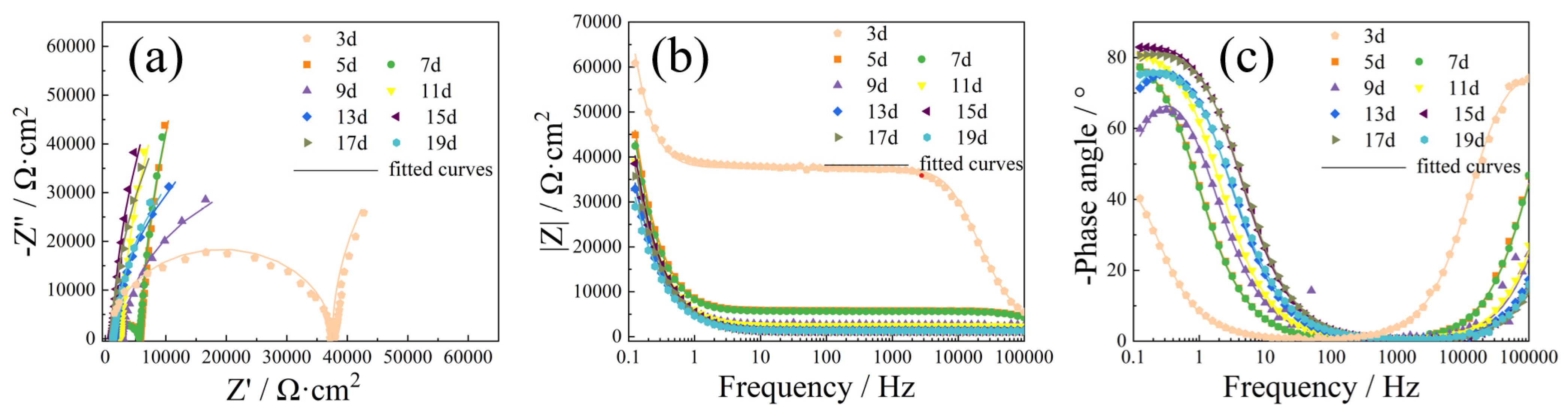
The typical EIS response of the PLA membrane is shown in Figure 3. However, no distinct EIS signal was detected within the first 48 h, which can be attributed to the membrane’s highly effective initial protection, resulting in impedance values that exceeded the measurable range or showed negligible change. However, this period is much smaller than that at the static condition (about 324 h) [27]. The period aligns with the onset of significant ion permeation. As immersion proceeded, a Warburg impedance characterized by a line with a slope of approximately 45°, emerged in the spectra. This feature indicates a diffusion-controlled process, which is governed by the transport of reactants or products between the bulk solution and the electrode surface. The slope of this line initially increased, suggesting a growing dominance of diffusion. Subsequently, the slope decreased, implying that the diffusion process was slowing down, as shown in Figure 3a. The phase shift in the PLA membrane as a function of frequency at different immersion times is shown in Figure 3c. It can be observed that with increasing immersion time, the phase angle in the low-frequency region shifts toward smaller values under both flow conditions, indicating a continuous decline in the protective performance of the PLA membrane.
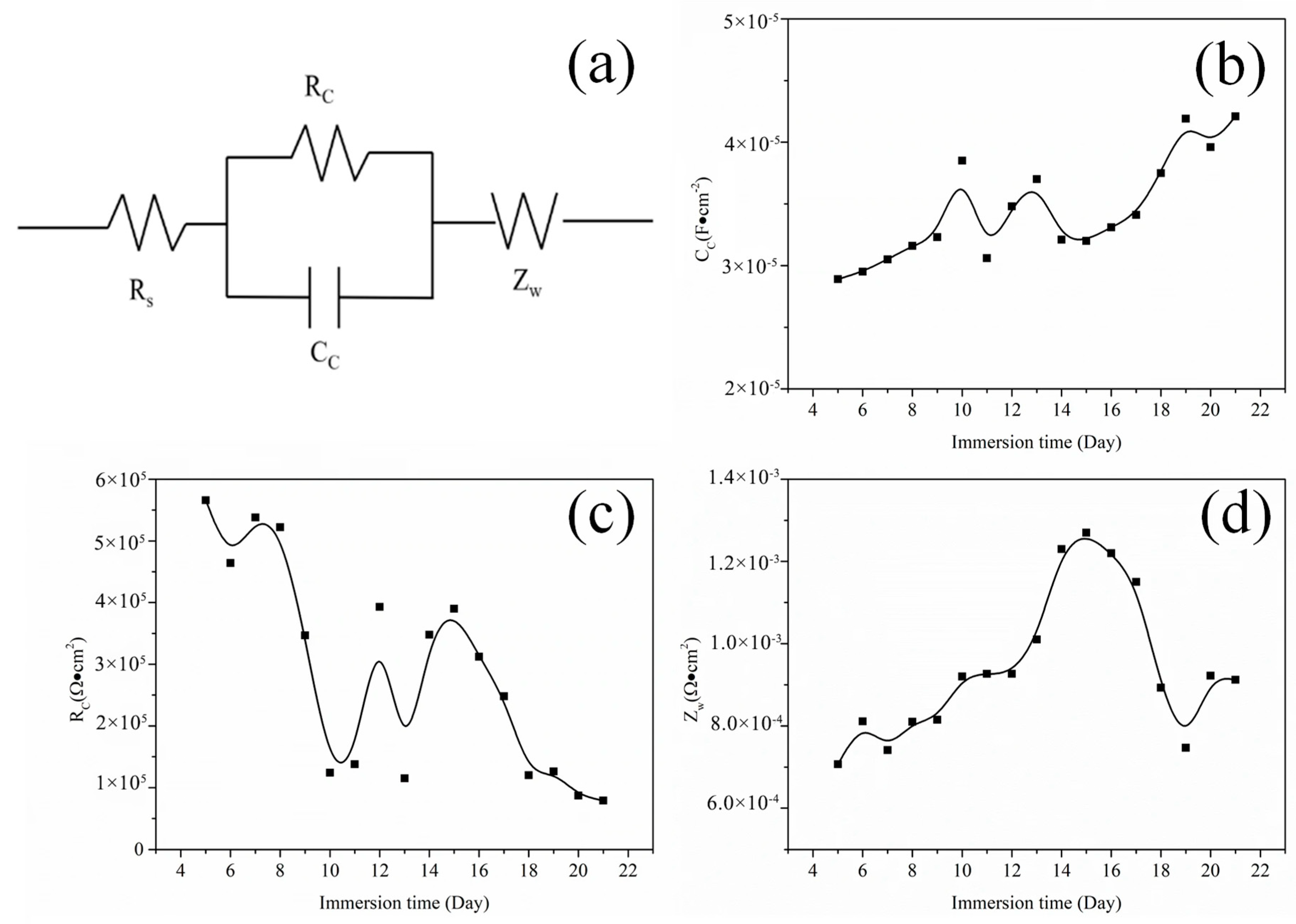
To further investigate the degradation evolution of the PLA membrane after 5 days of immersion, an equivalent circuit model was applied, as shown in Figure 4a, where Rs represented the solution resistance, Cc and Rc represented the constant phase element and resistance related to PLA membrane, Zw is Warburg impedance. A comparative analysis revealed that the Cc value rose from an initial 2.89 × 10⁻⁵ F·cm−2 (5 days) to 4.21 × 10⁻⁵ F·cm−2 following 21 days of immersion. The coating resistance (Rc) showed an initial drop, followed by a period of fluctuation and a subsequent decline during the immersion, as shown in Figure 4c. The decline in the Rc suggests the deceased protection of PLA membrane. A notable correlation was observed that the marked increase in Zw during the initial stage of immersion. The Zw increased from 7 × 10⁻⁴ Ω·cm2 after 5 days of immersion to 1.3 × 10⁻³ Ω·cm2 after 15 days, as shown in Figure 4d. This increase occurred simultaneously with the increasing concentrations of Na+ and Cl ions. The observed subsequent decrease in Zw may be attributed to the establishment of a temporary equilibrium in ion permeation, which considerably slowed the overall diffusion rate.

3.2.2. Structure and Surface Morphology of the PLA Membrane

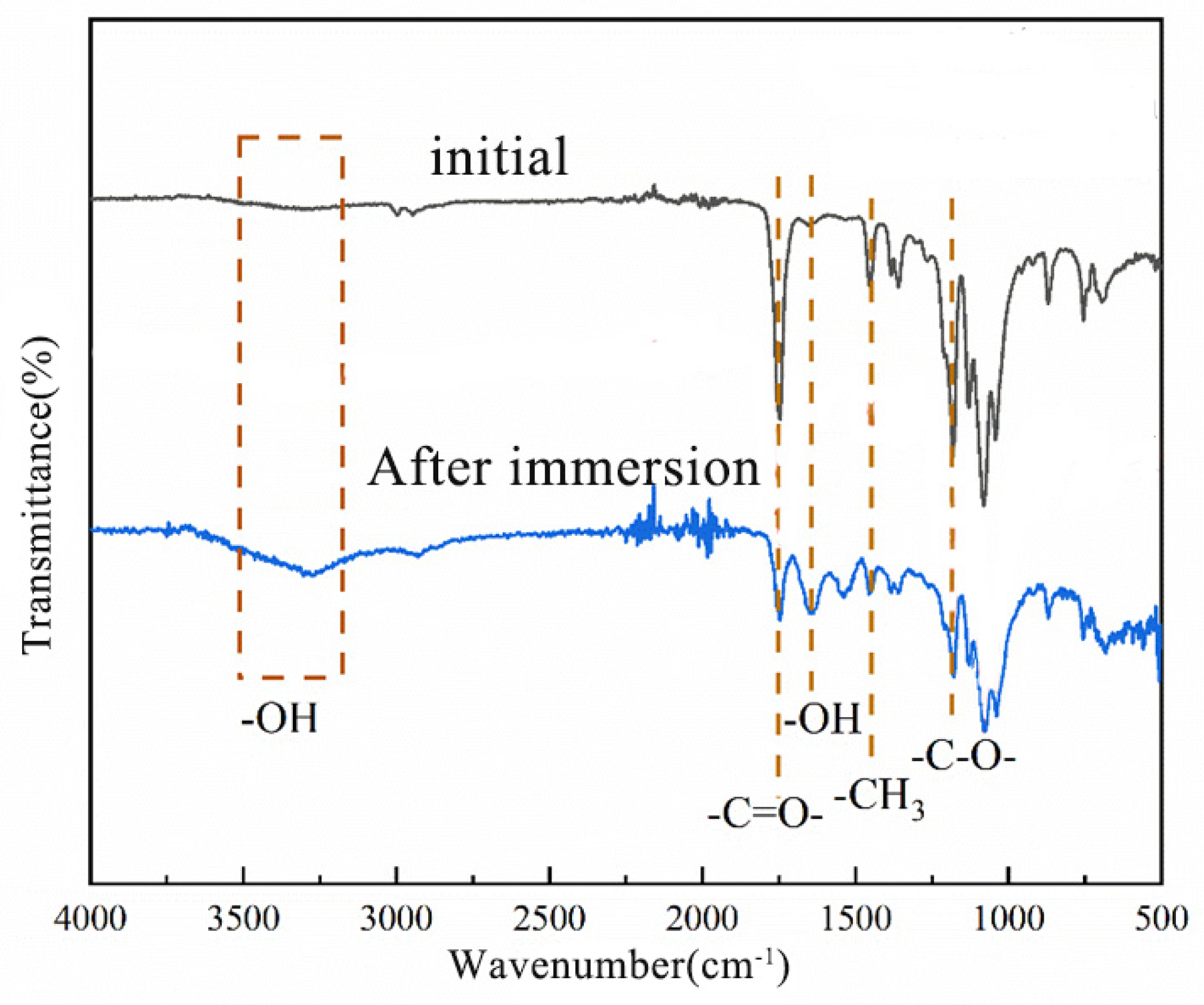
Figure 5 presents the FTIR spectra of the PLA membrane before and after degradation. The characteristic peaks near 3000 cm−1 correspond to C–H stretching vibrations of the methyl (–CH3) group, while those at 1180 and 1079 cm−1 are attributed to C–O stretching vibrations. Notably, the degraded PLA membrane exhibits a broad, intense band between 3200 and 3500 cm−1, indicative of O–H stretching vibrations. A slightly intensified absorption band observed at 1644 cm−1 further confirms the presence of –OH bending modes from intercalated water molecules. These spectral changes collectively suggest the occurrence of PLA hydrolysis. Additionally, the C=O stretching vibration peak at 1750 cm−1 showed a slight intensity variation compared to the original sample, which may be attributed to water infiltration into the amorphous regions, leading to ester bond cleavage.
The molecular weights of the PLA membrane before and after immersion, as determined by gel permeation chromatography (GPC), are summarized in Table 1. Both the number-average molecular weight (Mₙ) and weight-average molecular weight (Mw) decreased significantly after immersion. Concurrently, the polydispersity index (PDI) decreased from 2.19 to 1.90, indicating that chain scission occurred preferentially in the higher molecular weight fractions.
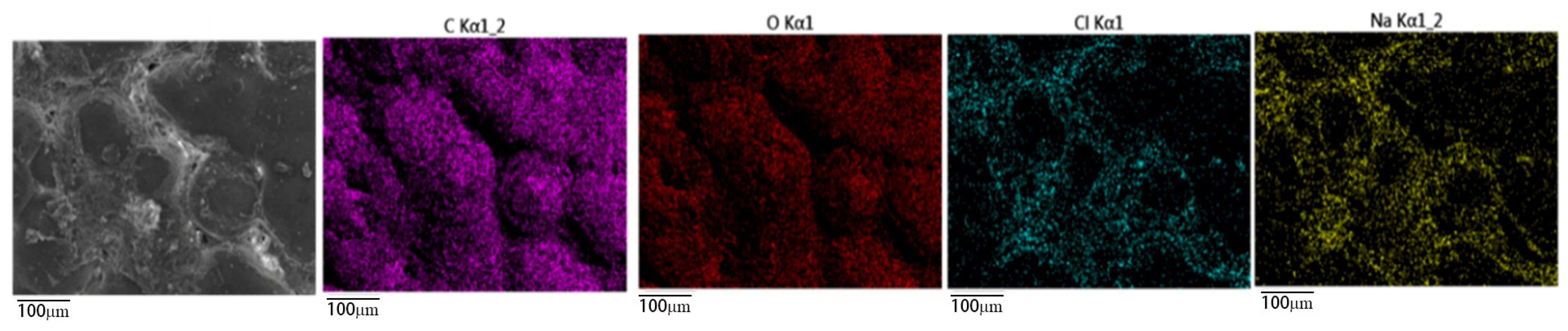
Figure 6 shows the SEM morphology and corresponding EDS elemental maps of the PLA membrane after 21 days of immersion. The microstructure exhibits clear phase segregation, with microcracks observable along the segregation boundaries. Na+ and Cl ions were found to be predominantly concentrated in these regions. This morphology differs notably from results reported under static immersion conditions [27], suggesting that external flow may promote crack formation in the PLA membrane, likely due to flow-induced shear stress. These cracks appear to serve as the primary pathways for the permeation of Na+ and Cl ions during immersion.

3.3. Degradation Performance of the WE43 Alloy

3.3.1. Electrochemical Properties of the WE43 Alloy

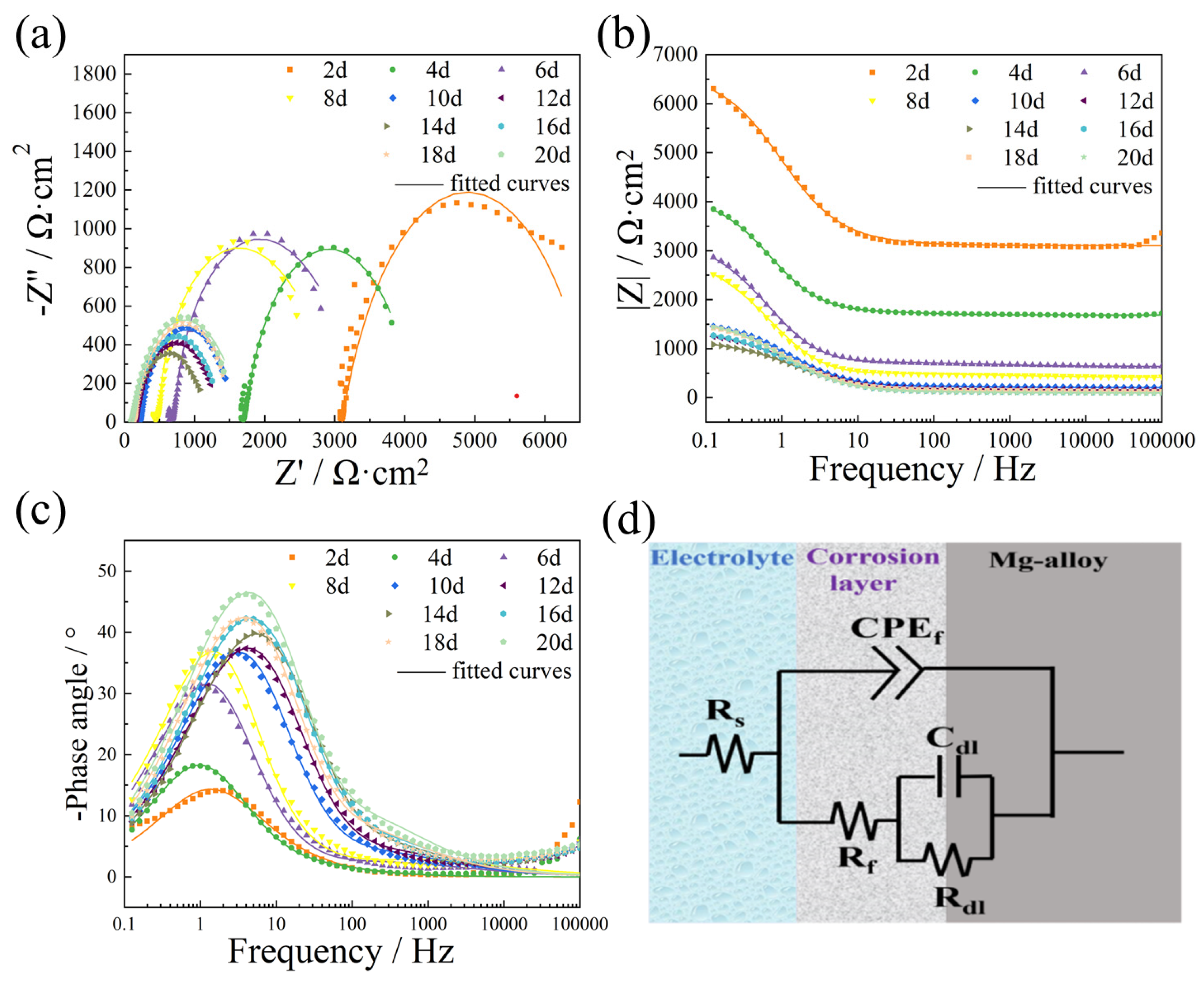
Figure 7 presents the EIS results of the bare WE43 alloy (without the PLA membrane). The significant decrease in both the solution resistance and the diameter of the capacitive arc, as shown in Figure 7a, indicates a substantial increase in the conductivity of the DI water environment. A decrease in impedance magnitude is observed with prolonged immersion, as depicted in Figure 7b. The equivalent circuit model shown in Figure 7d was employed to fit the EIS results, where Rs is the solution resistance, Rf is the resistance of the corrosion product film, CPEf is its constant phase element, Rdl is the charge transfer resistance of the Mg substrate, and Cdl is the double-layer capacitance of the Mg substrate.
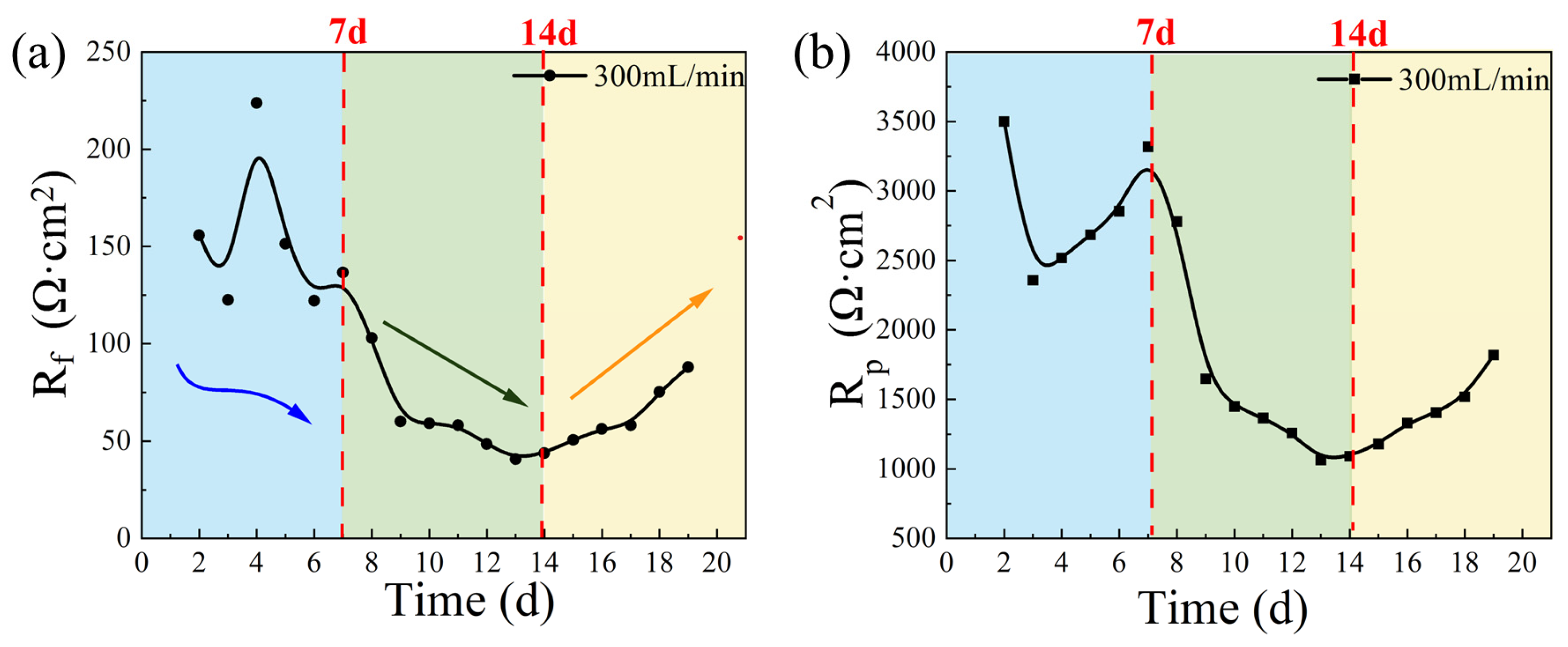
The fitted film resistance (Rf) and polarization resistance (Rp) of the WE43 alloy as a function of immersion time are shown in Figure 8. Initially, both Rf and Rp remained relatively stable, which is attributed to the low concentration of aggressive ions and the initial formation of a corrosion product layer. After 7 days of immersion, a rapid decrease in both resistance values occurred, consistent with the sharply increasing Cl concentration. Subsequently, beyond 14 days, Rf and Rp began to increase gradually due to the formation of a protective corrosion product layer, while the Cl concentration remained stable during this period.

3.3.2. Structure and Surface Morphology of the WE43 Alloy

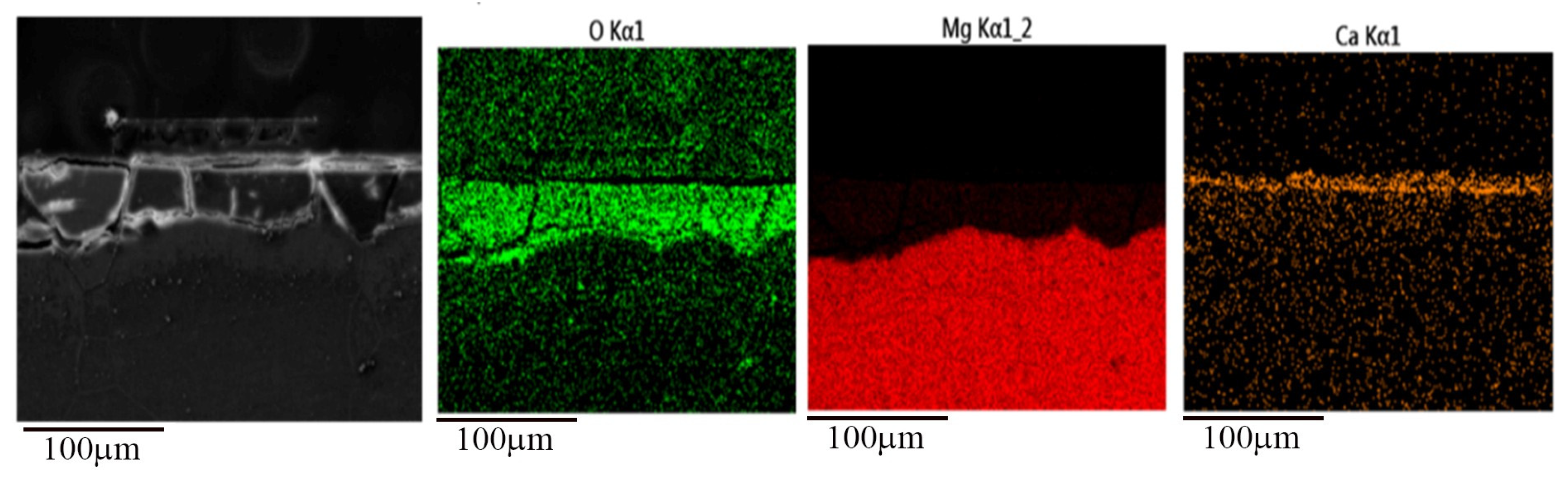
Figure 9 presents the cross-sectional morphology and corresponding EDS elemental maps of the corroded WE43 alloy after 21 days of immersion. A loose and coarse corrosion product layer, approximately 40 μm thick, is observed. This layer contains numerous cracks. EDS analysis reveals that it can be divided into an inner and an outer part: the inner layer is primarily composed of Mg and O, while the outer layer is dominated by Ca-containing compounds. These results indicate that the deposition of Ca-P compounds on the coated Mg alloy is time-dependent, as sufficient time is required for Ca2+ ions to permeate through the membrane.
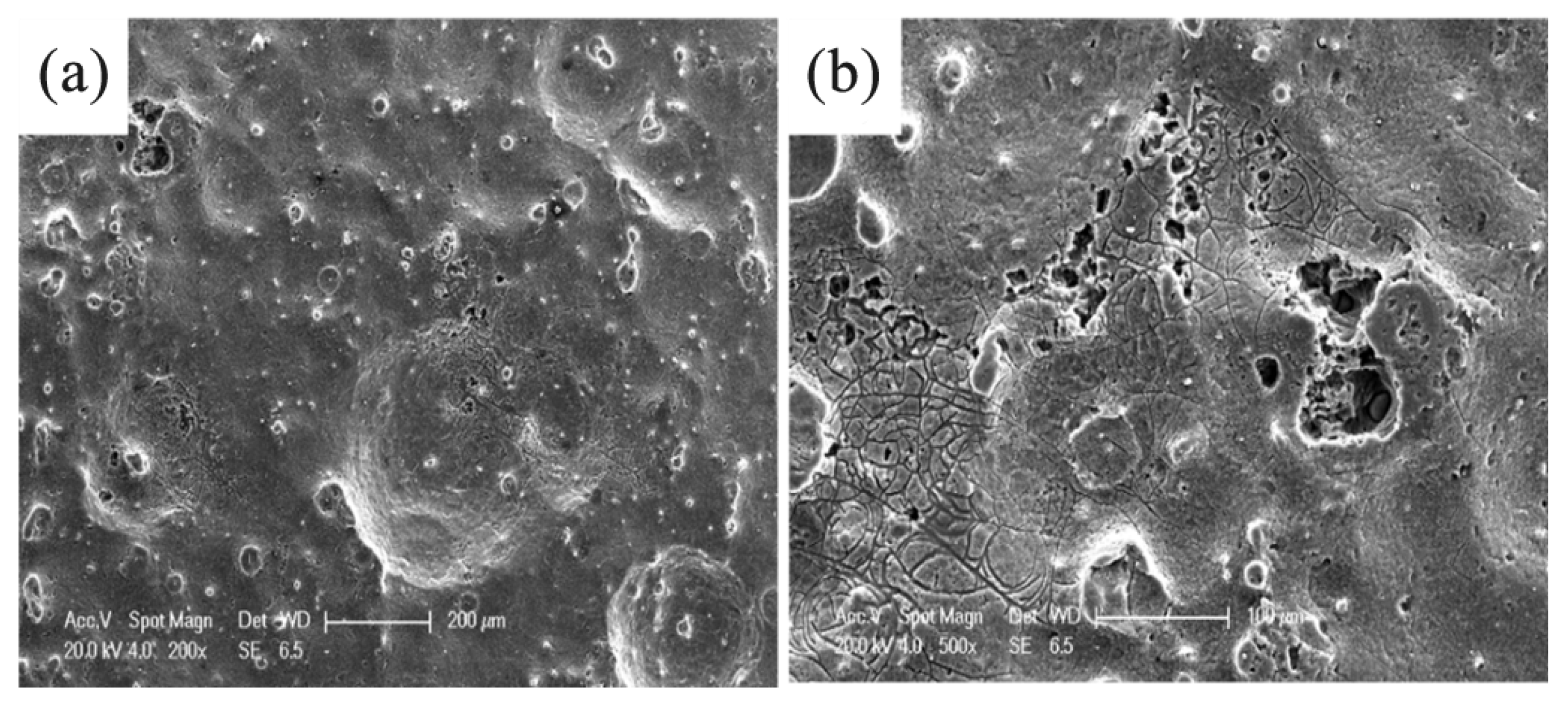
The surface morphology of the WE43 after the removal of corrosion products is shown in Figure 10, revealing numerous corrosion pits. These pits were observed to spread outward and eventually interconnect. Based on the evolving ion concentrations and EIS results, it is proposed that these pronounced pits were initiated by the permeation of Cl ions through the PLA membrane. These chloride ions likely reacted with the initially formed, loose Mg(OH)2 layer, converting it into soluble MgCl2. This process subsequently compromised and destroyed the inner corrosion product layer as the immersion progressed.

4. Discussion

Physiological flow is critical for modulating a range of key bodily functions, including brain activity, heart rate, and cortisol levels [28]. Consequently, it significantly influences the performance of biomedical implants during their service. Furthermore, hemodynamic conditions exhibit considerable variation among individuals. For instance, while blood flow in the arterial system maintains an average rate of approximately 5 L/min, the rate within specific organs can range from 250 to 1400 mL/min [25]. These variations are further influenced by the cross-sectional area of the particular blood vessel. To investigate the dynamic effects of fluid flow, various methods such as microfluidic systems [29] and parallel plate flow chambers [30] have been employed. However, most existing studies primarily focus on final outcomes rather than the transient processes. This work presents an in situ approach to monitor the real-time evolution of degradation under flow conditions. A self-developed multichannel ion monitoring system was utilized to measure ion permeation in situ, capable of tracking not only Cl and Na+ but also other ionic species. Furthermore, electrochemical impedance spectroscopy (EIS) offers a non-destructive, in situ characterization of both the PLA membrane (serving as a coating) and the WE43 alloy (serving as the substrate). This methodology could provide a comprehensive understanding of the performance evolution of PLA-coated magnesium implants. It was observed that under the flow condition, the permeation of sodium ions precedes that of chloride ions in this work. The finding of ion permeation contrasts with the previous report under static condition [27], where chloride ion permeation occurred first. The fact that Na+ (hydrated radius: 0.358 nm) permeates ahead of the smaller Cl ion (0.332 nm) [31,32] highlights a key role of the flow, suggesting that convective forces override the size-dependent diffusion limitations. This mechanistic shift is corroborated by prior findings which note that while ions with smaller hydrated shells can diffuse through the coating itself, larger cations like Na+ and Li+ primarily permeate through defects [33].
Surface morphology analysis of the PLA membrane revealed numerous micro-cracks formed during corrosion. These cracks, which exhibited high concentrations of Na+ and Cl ions, served as a major pathway for ionic permeation. This phenomenon is greatly attributed to the hydrolysis of PLA, a dominant degradation mechanism. The fact that a more substantial reduction in molecular weight was observed under the dynamic condition compared to the static condition [27] suggests an accelerated hydrolysis rate. This rapid chain scission consequently facilitates the initiation and propagation of such micro-cracks and micropores. It is well established that ion transport within such confined micro/nanochannels can be orders of magnitude faster than in bulk solution, often attributed to the effects of surface charge and the dense packing of adsorbed counter ions [23,34]. Furthermore, the hydrolysis of PLA’s ester bonds during immersion generates negatively charged carboxylate groups [35]. These groups electrostatically attract and absorb cations, which explains the preferential and accelerated permeation of Na+ observed under the flow condition. Consequently, the presence of these micro-cracks and associated surface charges effectively diminished the influence of size-dependent diffusion in this system. Nevertheless, Cl ions remained the dominant factor in the degradation of the Mg substrate, a conclusion further supported by the strong correlation between the EIS data and the Cl concentration. Since the Mg(OH)2 layer formed in the early stages of immersion provides poor corrosion protection, Cl ions can readily react with it and penetrate to the underlying substrate, accelerating the corrosion process. Consequently, external flow enhances the convective transport of Cl ions, thereby increasing the degradation rate of the magnesium substrate. Nonetheless, the deposition of calcium-containing compounds, which is critical for biocompatibility [36], lags behind the permeation of Cl ions. This indicates that calcium deposition does not occur during the initial immersion but begins only after a sufficient concentration of Ca2+ ions have permeated the coating. However, the additional permeation pathway by applying flow would accelerate this process by enhancing the transport of Ca2+ ions, thereby shortening the required time for deposition.
Since the coating plays a critical role in ion permeation and subsequent substrate degradation, simulating the coating-substrate interface microenvironment is crucial for bridging the gap between theoretical models and in situ experimental findings. In this study, the interface was conceptually divided into the PLA membrane (serving as the coating) and the WE43 alloy (as the substrate), with their physical interaction neglected. However, in actual implants, the interface plays a critical role. Although a stable interface was observed to promote a more diffuse double layer in the presence of hydrated sodium ions [37]—a phenomenon that could enhance corrosion resistance. However, this finding appears incompatible with the hypotheses of Mayne and Nguyen [38]. Their models suggest that ionic migration and the development of percolating pathways occur independently of coating adhesion. Beyond this theoretical paradox, a more direct threat to coating integrity exists: mechanical fracture induced by hydrogen bubbles generated from Mg degradation. This damage exposes the substrate and can accelerate corrosion, presenting a critical challenge for future research. Regarding the long-term degradation of PLA, this work could provide a novel perspective on how fluid flow influences coating protection performance during the initial immersion. Future efforts will focus on more accurate simulation of the interfacial microenvironment and controlled ion permeation, aiming to either mitigate corrosion or enhance biocompatibility through interface engineering, such as regulating electron migration via applied electrical currents.

5. Conclusions

In the present work, the degradation performance of poly-lactic acid membrane for WE43 alloy under flow condition was studied, and the main conclusions are obtained as follows:
(1)
The applied flow facilitates the formation of micro-cracks in the PLA membrane, which serve as additional pathways for the permeation of Na+ and Cl ions. The ion permeation rates for Na+ and Cl ions under the flow were 0.097 and 0.042 mmol/(L·h) during the initial 15 days immersion, respectively.
(2)
Consequently, the flow accelerates the ion permeation across the PLA membrane, thereby expediting the degradation of the underlying substrate.
(3)
The degradation rate of the substrate shows a strong correlation with the permeated Cl concentration. In contrast, the deposition of calcium-containing compounds is a time-dependent process, governed by the permeation kinetics of Ca2+ ions through the membrane.

Author Contributions

S.Z.: conceptualization, methodology, investigation, writing—original draft preparation; C.W.: software, investigation, visualization; J.G.: writing—review and editing, supervision, visualization; J.W.: funding acquisition, data curation, validation, formal analysis; F.Z.: investigation, data curation; J.Y.: software, investigation; C.C.: supervision, visualization, writing—review and editing. All authors have read and agreed to the published version of the manuscript.

Funding

This research was funded by Jiangsu Provincial Administration for Market Regulation Science and Technology Program, grant number KJ2025046.

Data Availability Statement

Data is contained within the article.

Conflicts of Interest

The authors declare no conflicts of interest.

References

  1. Zheng, Y.F.; Gu, X.N.; Witte, F. Biodegradable metals. Mater. Sci. Eng. R Rep. 2014, 77, 1–34. [Google Scholar] [CrossRef]
  2. Parfenova, L.V.; Galimshina, Z.R.; Parfenov, E.V. Organic-Inorganic Biocompatible Coatings for Temporary and Permanent Metal Implants. Int. J. Mol. Sci. 2024, 25, 11623. [Google Scholar] [CrossRef]
  3. Holden, H.; Le, Z.; George, B.; Brandon, M.; Kyu, C.; Yongho, S. Additive manufacturing of dense WE43 Mg alloy by laser powder bed fusion. Addit. Manuf. 2020, 33, 101123. [Google Scholar] [CrossRef]
  4. de la Pezuela, J.; Sánchez-Gil, S.; Fernández-Hernán, J.P.; Michalcova, A.; Rodrigo, P.; López, M.D.; Torres, B.; Rams, J. Evaluation of the Impact of the LPBF Manufacturing Conditions on Microstructure and Corrosion Behaviour in 3.5 wt.% NaCl of the WE43 Magnesium Alloy. Materials 2025, 18, 3613. [Google Scholar] [CrossRef]
  5. Shekhar, N.; Mondal, A. Synthesis, properties, environmental degradation, processing, and applications of Polylactic Acid (PLA): An overview. Polym. Bull. 2024, 81, 11421–11457. [Google Scholar] [CrossRef]
  6. Khouri, N.G.; Bahú, J.O.; Blanco-Llamero, C.; Severino, P.; Concha, V.O.C.; Souto, E.B. Polylactic acid (PLA): Properties, synthesis, and biomedical applications—A review of the literature. J. Mol. Struct. 2024, 1309, 138243. [Google Scholar] [CrossRef]
  7. Cai, H.; Meng, J.; Li, X.; Xue, F.; Chu, C.; Guo, C.; Bai, J. In vitro degradation behavior of Mg wire/poly(lactic acid) composite rods prepared by hot pressing and hot drawing. Acta Biomater. 2019, 98, 125–141. [Google Scholar] [CrossRef]
  8. Marukawa, E.; Tamai, M.; Takahashi, Y.; Hatakeyama, I.; Sato, M.; Higuchi, Y.; Kakidachi, H.; Taniguchi, H.; Sakamoto, T.; Honda, J.; et al. Comparison of magnesium alloys and poly-l-lactide screws as degradable implants in a canine fracture model. J. Biomed. Mater. Res. B Appl. Biomater. 2016, 104, 1282–1289. [Google Scholar] [CrossRef]
  9. Li, L.Y.; Cui, L.Y.; Zeng, R.C.; Li, S.Q.; Chen, X.B.; Zheng, Y.; Kannan, M.B. Advances in functionalized polymer coatings on biodegradable magnesium alloys—A review. Acta Biomater. 2018, 79, 23–36. [Google Scholar] [CrossRef]
  10. Zhu, Y.; Liu, W.; Ngai, T. Polymer coatings on magnesium-based implants for orthopedic applications. J. Polym. Sci. 2021, 60, 32–51. [Google Scholar] [CrossRef]
  11. Schelbert, H.R. Anatomy and physiology of coronary blood flow. J. Nucl. Cardiol. 2010, 17, 545–554. [Google Scholar] [CrossRef] [PubMed]
  12. Li, N.; Guo, C.; Wu, Y.H.; Zheng, Y.F.; Ruan, L.Q. Comparative study on corrosion behaviour of pure Mg and WE43 alloy in static, stirring and flowing Hank’s solution. Corros. Eng. Sci. Technol. 2013, 47, 346–351. [Google Scholar] [CrossRef]
  13. Ascencio, M.; Pekguleryuz, M.; Omanovic, S. An investigation of the corrosion mechanisms of WE43 Mg alloy in a modified simulated body fluid solution: The effect of electrolyte renewal. Corros. Sci. 2015, 91, 297–310. [Google Scholar] [CrossRef]
  14. Walker, J.; Shadanbaz, S.; Woodfield, T.B.F.; Staiger, M.P.; Dias, G.J. The in vitro and in vivo evaluation of the biocompatibility of Mg alloys. Biomed. Mater. 2014, 9, 015006. [Google Scholar] [CrossRef] [PubMed]
  15. Atrens, A.; Liu, M.; Zainal Abidin, N.I. Corrosion mechanism applicable to biodegradable magnesium implants. Mater. Sci. Eng. B 2011, 176, 1609–1636. [Google Scholar] [CrossRef]
  16. Tian, J.; Huang, H.L.; Pan, Z.Q.; Zhou, H. Effect of flow velocity on corrosion behavior of AZ91D magnesium alloy at elbow of loop system. Trans. Nonferrous Met. Soc. China 2016, 26, 2857–2867. [Google Scholar] [CrossRef]
  17. Wang, J.; Giridharan, V.; Shanov, V.; Xu, Z.G.; Collins, B.; White, L.; Jang, Y.; Sankar, J.; Huang, N.; Yun, Y. Flow-induced corrosion behavior of absorbable magnesium-based stents. Acta Biomater. 2014, 10, 5213–5223. [Google Scholar] [CrossRef]
  18. Wang, J.; Jang, Y.; Wan, G.J.; Giridharan, V.; Song, G.L.; Xu, Z.G.; Koo, Y.; Qi, P.K.; Sankar, J.; Huang, N.; et al. Flow-induced corrosion of absorbable magnesium alloy: In-situ and real-time electrochemical study. Corros. Sci. 2016, 104, 277–289. [Google Scholar] [CrossRef]
  19. Han, L.Y.; Li, X.; Chu, C.L.; Ba, J.; Xue, F. Corrosion Behavior of AZ31 Magnesium Alloy in Dynamic Conditions. Acta Metall. Sin. 2017, 53, 1347–1356. [Google Scholar] [CrossRef]
  20. Shang, T.D.; Wang, K.B.; Zhang, L.; Zhou, L.; Liu, L.Y.; Liu, C.Q.; Zhang, H.; Li, X.; Zhao, Y.C.; Wang, J. A microfluidic system simulating physiological fluid environment for studying the degradation behaviors of magnesium-based materials. J. Sci. Adv. Mater. Dev. 2023, 8, 100590. [Google Scholar] [CrossRef]
  21. Rahul, S.; Kevin, K.R.; Kristofer, L.G.; Benny, D.F. Hydraulic permeation-induced water concentration gradients in ion exchange membranes. J. Membr. Sci. 2024, 705, 122858. [Google Scholar] [CrossRef]
  22. Wang, A.; Breakwell, C.; Foglia, F.; Tan, R.; Lovell, L.; Wei, X.; Wong, T.; Meng, N.; Li, H.; Seel, A.; et al. Selective ion transport through hydrated micropores in polymer membranes. Nature 2024, 635, 353–358. [Google Scholar] [CrossRef] [PubMed]
  23. Jiang, Y.; Hu, R.; Yang, C.Y.; Zhou, Z.H.; Yuan, G.; Zhou, H.; Hu, S. Surface diffusion enhanced ion transport through two-dimensional nanochannels. Sci. Adv. 2023, 9, eadi8493. [Google Scholar] [CrossRef] [PubMed]
  24. Mao, K.; Liu, C.; Ni, A.; Wang, J.; Sun, J.; Wang, G.; Xiong, P.; Zhu, J. Optimization of ion transport in two-dimensional nanofluidic membranes for osmotic energy conversion. Mater. Today 2025, 82, 274–288. [Google Scholar] [CrossRef]
  25. Thomas, B.; Sumam, K.S. Blood Flow in Human Arterial System—A Review. Procedia Technol. 2016, 24, 339–346. [Google Scholar] [CrossRef]
  26. Theodore, G.P.; Emmanouil, N.K.; Manolis, V.; John, P.L.; Christodoulos, S. Assessment of vascular wall shear stress and implications for atherosclerotic disease. Int. J. Cardiol. 2006, 113, 12–18. [Google Scholar] [CrossRef]
  27. Dai, J.W.; Wu, C.Q.; Yang, J.Y.; Zhang, L.; Dong, Q.S.; Han, L.Y.; Li, X.; Bai, J.; Xue, F.; Chu, P.K.; et al. Poly-lactic acid coatings on the biomedical WE43 Mg alloy: Protection mechanism and ion permeation effects. Prog. Org. Coat. 2023, 177, 107427. [Google Scholar] [CrossRef]
  28. Travers, G.; Kippelen, P.; Trangmar, S.J.; José, G.A. Physiological function during exercise and environmental stress in humans-an integrative view of body systems and homeostasis. Cells 2022, 11, 383. [Google Scholar] [CrossRef]
  29. Wen, K.Q.; Gorbushina, A.A.; Schwibbert, K.; Bell, J. Microfluidic Platform with Precisely Controlled Hydrodynamic Parameters and Integrated Features for Generation of Microvortices to Accurately Form and Monitor Biofilms in Flow. ACS Biomater. Sci. Eng. 2024, 10, 4626–4634. [Google Scholar] [CrossRef]
  30. Shang, T.D.; Wang, K.B.; Tang, S.S.; Shen, Y.; Zhou, L.; Zhang, L.; Zhao, Y.C.; Li, X.; Cai, L.; Wang, J. The Flow-Induced Degradation and Vascular Cellular Response Study of Magnesium-Based Materials. Front. Bioeng. Biotech. 2022, 10, 940172. [Google Scholar] [CrossRef]
  31. Volkov, A.G.; Paula, S.; Deamer, D.W. Two mechanisms of permeation of small neutral molecules and hydrated ions across phospholipid bilayers. Bioelectrochem. Bioenerg. 1997, 42, 153–160. [Google Scholar] [CrossRef]
  32. Croll, S.G. Electrolyte transport in polymer barrier coatings: Perspectives from other disciplines. Prog. Org. Coat. 2018, 124, 41–48. [Google Scholar] [CrossRef]
  33. Deflorian, F.; Rossi, S. An EIS study of ion diffusion through organic coatings. Electrochim. Acta 2006, 51, 1736–1744. [Google Scholar] [CrossRef]
  34. Liao, S.; Liu, Y.; Li, L.; Li, D.; Wei, Y.Y.; Wang, H.H. Theoretical framework for confined ion transport in two-dimensional nanochannels. Nat. Commun. 2025, 16, 6675. [Google Scholar] [CrossRef] [PubMed]
  35. Zhao, X.; Zheng, Z.; Chen, J.; Sun, J.; Xiong, M.; Hou, X.; Mei, S. In-situ experimental study on the hydrolysis and pyrolysis processes of polylactic acid. Polym. Eng. Sci. 2024, 64, 1675–1685. [Google Scholar] [CrossRef]
  36. Dorozhkin, S.V. Calcium orthophosphate-containing biocomposites and hybrid biomaterials for biomedical applications. J. Funct. Biomater. 2015, 6, 708–832. [Google Scholar] [CrossRef]
  37. Sørensen, P.A.; Dam-Johansen, K.; Weinell, C.E.; Kiil, S. Cathodic delamination: Quantification of ionic transport rates along coating–steel interfaces. Prog. Org. Coat. 2010, 67, 107–115. [Google Scholar] [CrossRef]
  38. Lyon, S.B.; Bingham, R.; Mills, D.J. Advances in corrosion protection by organic coatings: What we know and what we would like to know. Prog. Org. Coat. 2017, 102, 2–7. [Google Scholar] [CrossRef]
Figure 1. The schematic diagram of the in situ self-fabricated apparatus for the test.
Coatings 15 01290 g001
Figure 2. The flow distribution around the PLA membrane (a) and the evolution of Na+ and Cl ion concentrations in the deionized water as a function of immersion time (b).
Coatings 15 01290 g002
Figure 3. EIS results of PLA membrane: (a) Nyquist plots; (b) frequency-|Z| Bode plots; (c) frequency-phase Bode plots.
Coatings 15 01290 g003
Figure 4. Fitting results of PLA membrane versus immersion time: (a) equivalent circuit model; (b) Cc; (c) Rc; (d) Zw.
Coatings 15 01290 g004
Figure 5. The FTIR spectra of PLA membrane before and after immersion.
Coatings 15 01290 g005
Figure 6. SEM morphology and corresponding EDS elemental maps of the PLA membrane after 21 days of immersion.
Coatings 15 01290 g006
Figure 7. EIS results of WE43 alloy during immersion: (a) Nyquist plots; (b) frequency-|Z| Bode plots; (c) frequency-phase Bode plots; (d) the corresponding equivalent circuit model.
Coatings 15 01290 g007
Figure 8. Fitted results of WE43 alloy during immersion: (a) Rf; (b) Rp.
Coatings 15 01290 g008
Figure 9. The cross-section morphologies and the corresponding EDS maps of WE43 alloy after immersion for 21 days.
Coatings 15 01290 g009
Figure 10. Surface morphologies of immersed WE43 after removing the products: (a) low magnification; (b) high magnification.
Coatings 15 01290 g010
Table 1. The molecular weights of the PLA membrane before and after immersion.
M (g/mol)PDI
MnMw
Before immersion125,411
(±13,453)
275,563
(±51,593)
2.19278
After immersion78,758
(±8327)
149,967
(±16,291)
1.90415
Disclaimer/Publisher’s Note: The statements, opinions and data contained in all publications are solely those of the individual author(s) and contributor(s) and not of MDPI and/or the editor(s). MDPI and/or the editor(s) disclaim responsibility for any injury to people or property resulting from any ideas, methods, instructions or products referred to in the content.