Article

Structure and Properties of Hard, Wear-Resistant Cr-Al-Si-B-(N) Coatings Obtained by Magnetron Sputtering of Ceramic Composite Targets


by
Philipp Kiryukhantsev-Korneev
*,
Alina Chertova
*,
Yury Pogozhev
and
Evgeny Levashov
Scientific-Educational Center of SHS, National University of Science and Technology “MISIS”, Leninsky Prospect 4, Moscow 119049, Russia
*
Authors to whom correspondence should be addressed.
Coatings 2025, 15(11), 1243; https://doi.org/10.3390/coatings15111243
Submission received: 30 September 2025 / Revised: 17 October 2025 / Accepted: 22 October 2025 / Published: 25 October 2025

Abstract

Hard Cr-Al-Si-B-(N) coatings were deposited in Ar and Ar–15%N2 medium by d.c. magnetron sputtering of composite targets manufactured using self-propagating high-temperature synthesis. The structure of the coatings was studied by X-ray diffraction, scanning and transmission electron microscopy, energy dispersion spectroscopy, and glow discharge optical emission spectroscopy. The coating properties were determined by nanoindentation, scratch testing, and tribological pin-on-disc testing at room and elevated temperatures. The oxidation resistance and diffusion barrier properties of the coatings were also evaluated. The results obtained showed that non-reactive coatings had a coarse crystalline structure and contained Cr5Si3, CrBx, and Cr2Al phases. The introduction of nitrogen into the coating composition promoted crystallite refinement and structural amorphization. Non-reactive CrAl4Si11B21 coatings had a maximum hardness up to 29 GPa and an elastic modulus up to 365 GPa. The introduction of nitrogen into the coating composition resulted in a 16–32% reduction in mechanical properties. The CrAl6Si12B5N25 coating, which exhibited maximal plasticity index H/E = 0.100 and resistance to plastic deformation H3/E2 = 0.247 GPa, was characterized by a minimum wear rate Vw = 5.7 × 10⁻⁶ mm3N−1m−1 and a friction coefficient of 0.47. While the CrAl18Si11B5N26 coating demonstrated a record level of oxidation resistance and successfully resisted oxidation up to a temperature of 1300 °C.

1. Introduction

Chromium nitride (CrN) are widely used as protective hard coatings for a broad range of products, including cutting tools, dies, molds, engine components, hydraulic systems, bearings, and more, due to their excellent mechanical and tribological properties as well as their high chemical and corrosion resistance [1,2,3,4]. Aluminum-alloyed CrAlN coatings are characterized by higher hardness, reaching 30–35 GPa, as well as improved wear and erosion resistance and thermal stability up to 700 °C [5,6]. However, many high-temperature tribological applications require coatings with even greater oxidation resistance and thermal stability, and in this regard, Si alloying has proven to be an effective way to achieve the desired high-temperature performance [7].
It has been shown that the addition of Si leads to densification of the coating structure, suppression of the typical columnar structure formation, a reduction in crystallite size, and prevention of recrystallization during heating [8,9,10]. CrAlSiN coatings tested at temperatures ranging from 800 to 1000 °C have demonstrated superior oxidation resistance compared to CrN and CrAlN coatings [11,12]. These studies have shown that CrAlSiN coatings successfully resist oxidation in air at 1000 °C for 100 h and at 1100 °C for 1 h. The high thermal stability of CrAlSiN coatings is associated with the formation of Cr2O3-, Al2O3-, and SiO2-based oxide films on their surface, which slow down oxygen diffusion into the coating [8,10]. In addition to enhanced high-temperature oxidation resistance, CrAlSiN coatings exhibit increased hardness, reaching 40–50 GPa [13,14]. Furthermore, it has been found that CrAlSiN coatings possess the lowest thermal conductivity among other common nitride coatings, making them promising for use as thermal barrier layers [15].
Another approach to improving the performance of CrAlN coatings is alloying with boron, which promotes the formation of nanocomposite coatings during deposition, providing a unique combination of properties [16]. For example, it has been found that nanocomposite CrAlBN coatings exhibit superior oxidation resistance compared to CrAlN [16], whereas nanoscale multilayer CrAlBN coatings oxidize faster than CrAlSiN coatings [17].
From a scientific standpoint, the development of complexly alloyed CrAlSiBN coatings is of considerable interest. Research in this direction is still limited. Notable work includes [18], which investigated coatings produced by electro-spark treatment of a nickel alloy using a CrAlSiB electrode. In [19], it was established that amorphous CrAlSiBN coatings deposited by magnetron sputtering can withstand oxidation at 1200 °C for 1 h. More detailed studies have shown that coatings with a low nitrogen content exhibit hardness level around 30 GPa, along with high friction coefficients and wear rates, but demonstrate record thermal stability at 1300 °C [20]. The introduction of nitrogen reduces the operating temperature limits but positively affects tribological characteristics (friction coefficient of 0.4, wear rate of 2 × 10⁻⁶ mm3N−1m−1). In [21], it was shown that simultaneous alloying of CrAlN coatings with silicon and boron not only increases their thermal resistance up to 1300 °C but also improves thermal stability by preventing the decomposition of CrAlN with the formation of w-AlN during heating in an inert atmosphere. Among recent studies, [22] is noteworthy for its development of multilayer CrAlSiN/CrAlBN coatings, which exhibit higher thermal resistance than their monolayer counterparts.
The objective of the present work was to investigate the structure, mechanical and tribological properties, as well as the thermal stability of CrAlSiBN coatings deposited by magnetron sputtering of composite ceramic targets in an Ar atmosphere and in an Ar + 25% N2 gas mixture. A distinctive feature of this work is the broader range of coating compositions. It examines coatings in CrAlSiBN system based on silicide, boride, and nitride of chromium, as well as amorphous coatings.

2. Materials and Methods

Two CrAlSiB composite ceramic targets (120 mm in diameter, 8 mm thick) with the following atomic compositions were prepared for magnetron sputtering: Target 1 with elemental composition—44 at.% Cr, 10 at.% Al, 14 at.% Si, 32 at.% B; Target 2 – 45 at.% Cr, 29 at.% Al, 16 at.% Si, 10 at.% B. The targets were fabricated from elemental exothermic powder mixtures by self-propagating high-temperature synthesis (SHS) using the force SHS-pressing technique [23]. The synthesis process and microstructure of CrAlSiB ceramic targets are described in detail in [24]. Phase composition includes 65 wt.% CrB, 27 wt.% Cr(Si, Al)2, 8 wt.% Cr5Si3Bx (Target 1) and 15 wt.% CrB, 24 wt.% Cr5Si3, 57 wt.% Cr4Al11, 4 wt.% Cr5Si3Bx (Target 2).
Coatings were deposited in a chamber of a UVN-2M-type vacuum system equipped with a magnetron sputtering source, ion source, and substrate holder. A schematic of the system is given in [25]. DC magnetron sputtering was performed using a Pinnacle+ (Advanced Energy, Denver,, CO, USA) power supply with a current of 2 A and voltage of 500 V. Argon (99.999%) or an Ar–25%N2 gas mixture (99.995%) was used as the working gas. The working/residual pressure during deposition was 0.2/0.001 Pa. A negative substrate bias of −250 V was applied, and the substrate temperature was maintained at 350 °C. Single-crystal Si (100) (KEF 4.5 trade mark) and polycrystalline alumina (VK-100-1 trade mark) plates, α-Fe foils, and disks from NiCr-based alloys (KhN65VMTYu, Kh65NVFT trade marks) were used as substrate materials. The distance between the target and the substrate was ~80 mm. The deposition time was 15 min in case of substrates for subsequent structural studies (Si, Fe) or 40 min in the case of substrates for tribological and high-temperatures studies (Al2O3,NiCr-alloys). Prior to deposition, substrates were ultrasonically cleaned in isopropanol for 5 min (22 kHz) and subjected to Ar+ ion cleaning (2 kV, 70 mA, 10 min).
Elemental depth profiles were recorded by glow discharge optical emission spectroscopy (GDOES) using a PROFILER 2 spectrometer (Horiba Jobin Yvon, Longjumeau, France) [26]. The detection limit in GDOES for most metals is 1 × 10⁻⁴ at.%; for non-metals—1 × 10⁻³ at.%. X-ray diffraction (XRD) in Bragg–Brentano geometry and grazing-incidence geometry was performed with a D8 Advance diffractometer (Bruker). Bruker Topas 5 software was used for Rietveld refinement and routine quantitative analysis. Coating morphology was examined by scanning electron microscopy (SEM) using a Hitachi S3400N equipped with a Noran-7 EDS detector. Transmission electron microscopy (TEM) studies were carried out on a JEM-200 microscope (Jeol, Tokyo, Japan) at 200 kV. Thin foils for TEM studies were prepared from 3 mm disks using a standard technique, involving mechanical grinding to a thickness of approximately 0.07 mm from the side of substrate, followed by mechanical dimpling and one-side ion-milling to perforation at a voltage of 3–4 kV.
Nanoindentation, scratch testing, and ball-on-disk tribological tests were carried out according to the procedures described in [27]. Hardness (H), elastic modulus (E), and elastic recovery (W) were measured on Si substrates using a Nano Hardness Tester (CSM Instruments, Peseux, Switzerland) with a Berkovich indenter under a 4 mN load. The calculation was based on at least nine measurements. The penetration depth of the indenter during nanoindentation is 100–130 nm, which is 5–7% of the coating thickness. The Oliver–Pharr method was applied to process the load–displacement curves.
Adhesion strength was evaluated using a REVETEST scratch tester (CSM Instruments, Peseux, Switzerland) with a 0.2 mm radius Rockwell C diamond indenter under a progressively increasing load at a rate of 4.83 mm/min over a scratch length of 5 mm. Critical loads for crack initiation (Lc1), spallation (Lc2), and contact with substrate (Lc3) were determined by optical microscopy and analysis of acoustic emission signals. Two experiments were conducted to determine the adhesive strength of each sample. Additional adhesion testing was performed according to DIN VDI 3198 using a Rockwell C indentation test (1471 N load) on a TP-5006-02 tester (Tochpribor, Rostov-on-Don, Russia). Three indentations were performed for each sample.
Tribological tests were conducted using a pin-on-disk tribometer (CSM Instruments, Switzerland) under a 1 N load and a sliding speed of 0.1 m/s at room temperature, with WC–Co balls (6 mm-diameter) as counterbodies. High-temperature tribological tests were also carried out during heating from room temperature up to 500 °C, using Al2O3 balls (6 mm-diameter) as counterbodies. At least two sliding friction tests were conducted at both room and elevated temperatures. Wear tracks were examined using a Veeco WYKO NT1100 optical profilometer (Plainview, NY, USA). From 4 to 6 wear track measurements were carried out. The standard deviation of measurements was within 1–3%.
Thermal stability and diffusion-barrier properties were assessed by stepwise isothermal annealing of coated samples in air using SNOL 7.2/1200 (Utena, Lithuania) and Nabertherm 1750 (Bremen, Germany) furnaces in the temperature range 800–1300 °C (step size: 100 °C, exposure time: 1 h). After annealing, the coatings were characterized again using the structural analysis techniques described above.

3. Results & Discussions

3.1. Composition

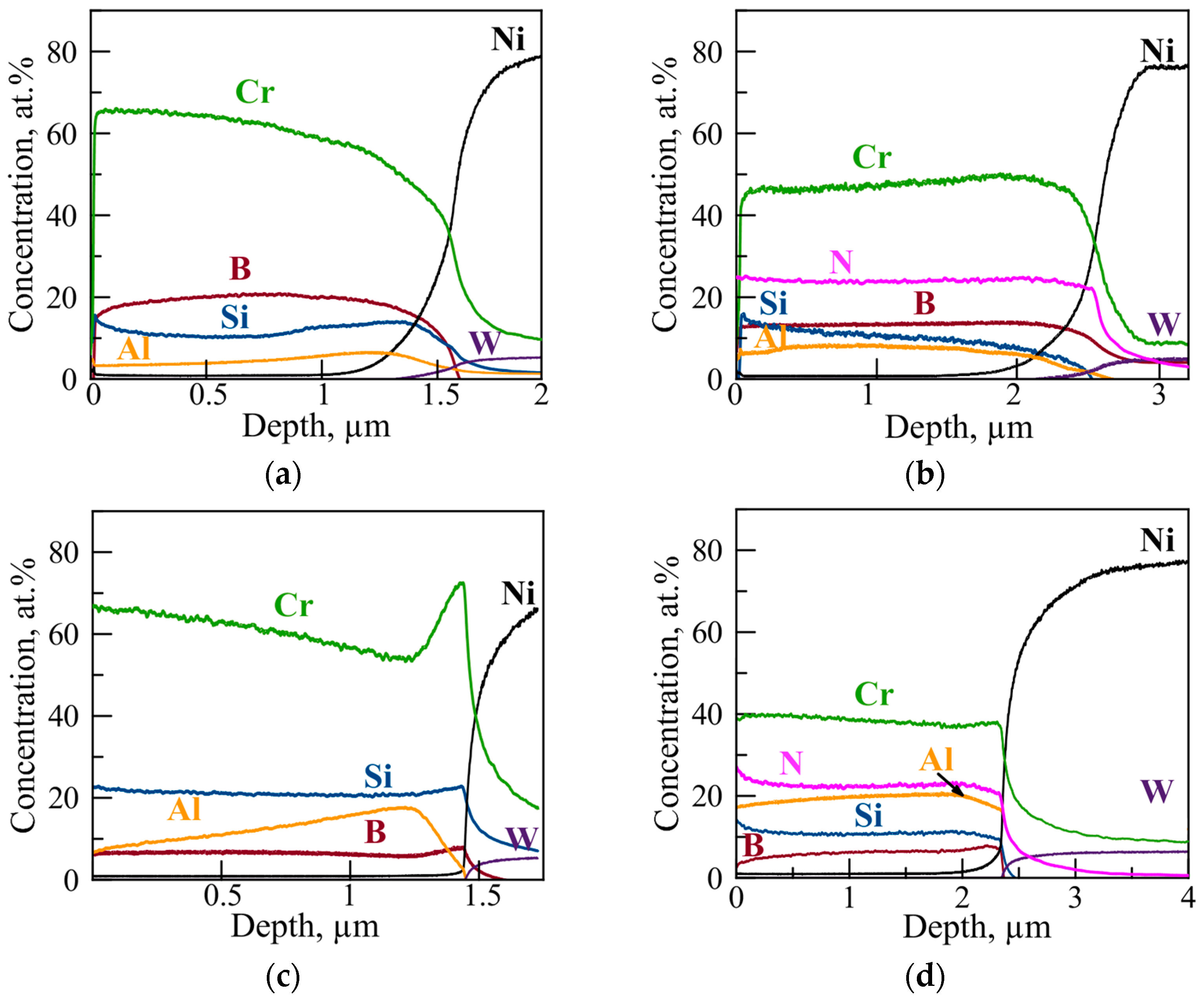
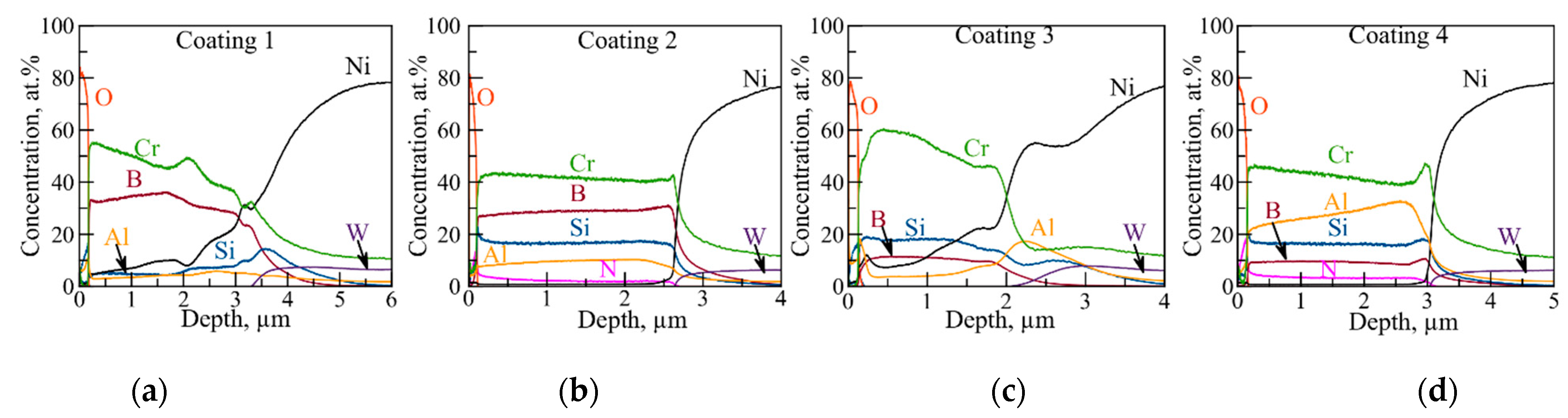
According to the obtained concentration profiles, the main elements of the targets, such as Cr, B, and Si, were uniformly distributed over the thickness of the coatings (Figure 1).
In the case of non-reactive coatings, a certain aluminum concentration gradient was observed, with a maximum value near the substrate. This effect is most pronounced for coating 3, which contains the maximum amount of metallic elements. The formation of a small aluminum concentration gradient can be influenced by bias voltage. The high substrate bias can produce in a lot of atoms on the deposited film re-sputtered [28]. A similar effect was observed for CrAlN coatings [29]. It was shown that at bias voltages from −50 to −100 V, re-sputtering had virtually no effect on film composition, while with further increases in bias voltage, the re-sputtering effect played a dominant role. The thickness-averaged elemental concentrations are presented in Table 1.
The composition of the deposited non-reactive coatings differed from that of the sputtering targets. The chromium concentration in the coatings was 1.4 times higher than in the targets, while the concentrations of Al, B, and Si decreased by approximately 2.5, 1.6, and 1.3 times, respectively. This effect can be explained by the intensive scattering of relatively light elements with small atomic radii on the atoms of the working gas (Ar) during mass transport from the target to the substrate. This is consistent with the atomic masses of 52 and 11/27/28, and the atomic radii are 140 pm and 85/125/110 pm for Cr and B/Al/Si, respectively. Furthermore, partial evaporation of aluminum atoms, in addition to the sputtering process, cannot be completely excluded.
When N2 was additionally introduced into the working gas mixture in an amount of 25%, coatings containing 25–26 at.% nitrogen were formed. The total concentration of oxygen and carbon impurities in the coatings did not exceed 5 at.%. The presence of these elements is due to the high specific surface area and natural oxide films on the elemental powders used for the production of the cathodes. Residual gases in the vacuum chamber could also be a source of impurities.
According to GDOES data, the thickness of the non-reactive coatings was about 1.5 µm, with a growth rate of 93–108 nm/min. The transition to reactive sputtering significantly increased both the coating thickness and the growth rate of the coatings (2.3–2.5 µm and 153–167 nm/min), which is probably be explained by the intensive participation of nitrogen atoms in the phase formation process.

3.2. Structure

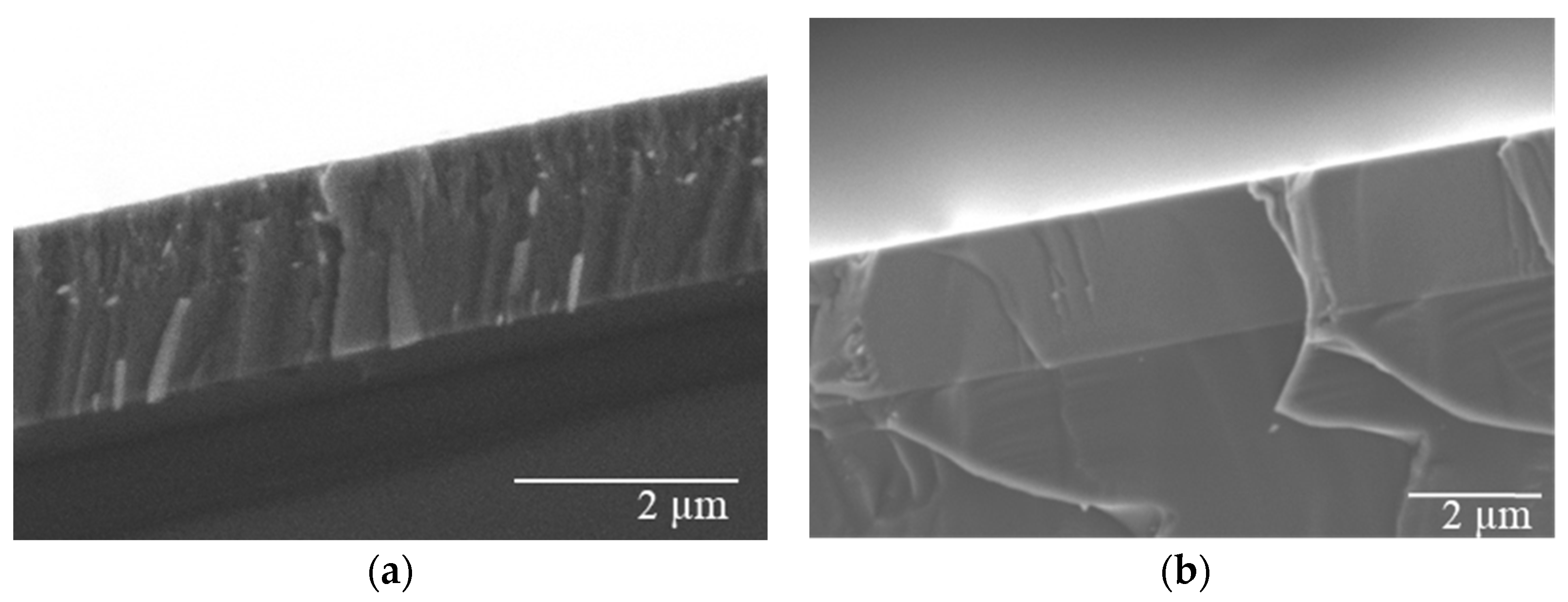
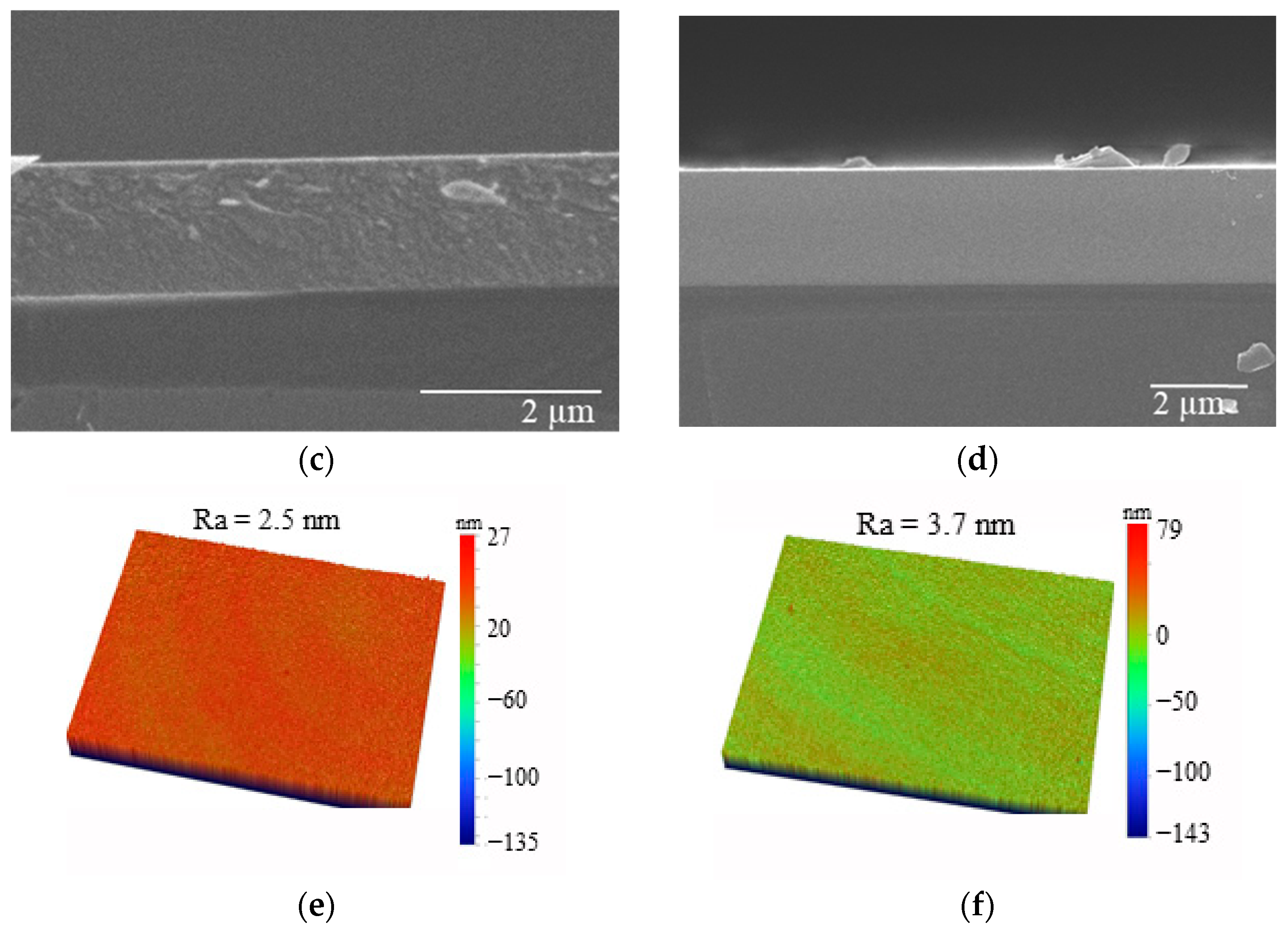
Figure 2 shows characteristic cross-sectional SEM images of the coatings deposited on silicon substrates.
Similar trends in coating thickness variation with deposition parameters are observed, consistent with the GDOES data obtained for coatings deposited on a nickel alloy. The non-reactive coatings exhibit a rather coarse crystalline structure: in the case of coating 1, columnar grains with a transverse size of 150–530 nm are formed, whereas coating 3 contains equiaxial grains with a diameter of 30–100 nm. When nitrogen is introduced into the coatings, the structure becomes refined. Coatings 2 and 4 exhibit a homogeneous, low-defect structure with no pronounced grain boundaries. It is noteworthy that the presence of a columnar structure generally has a detrimental effect on the mechanical and tribological properties of the coatings as well as on their oxidation resistance, due to the intense cracking and diffusion of oxygen from the surface into the material along the columnar grain boundaries [30,31,32]. The roughness of the coatings was 2–4 nm.
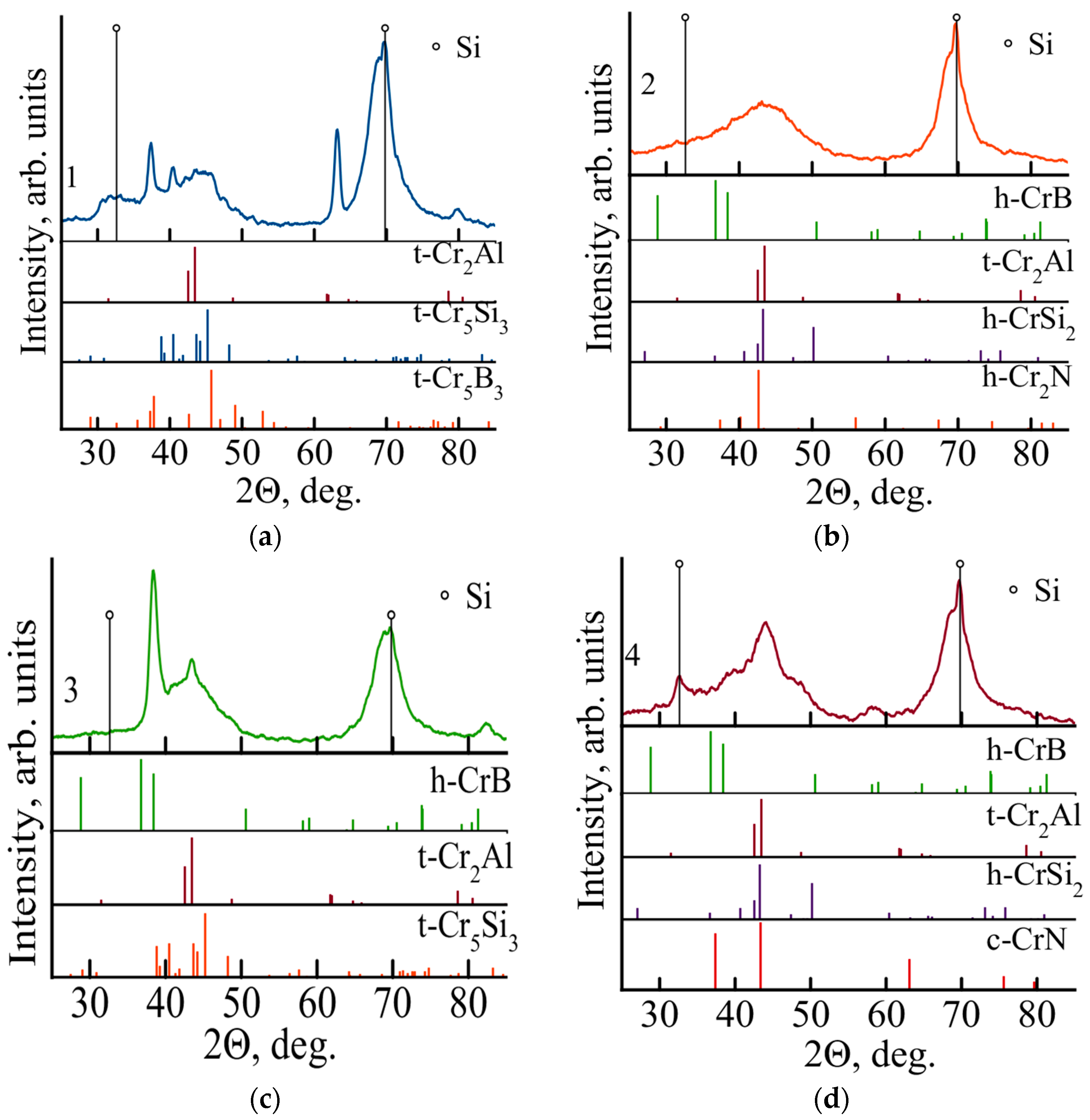
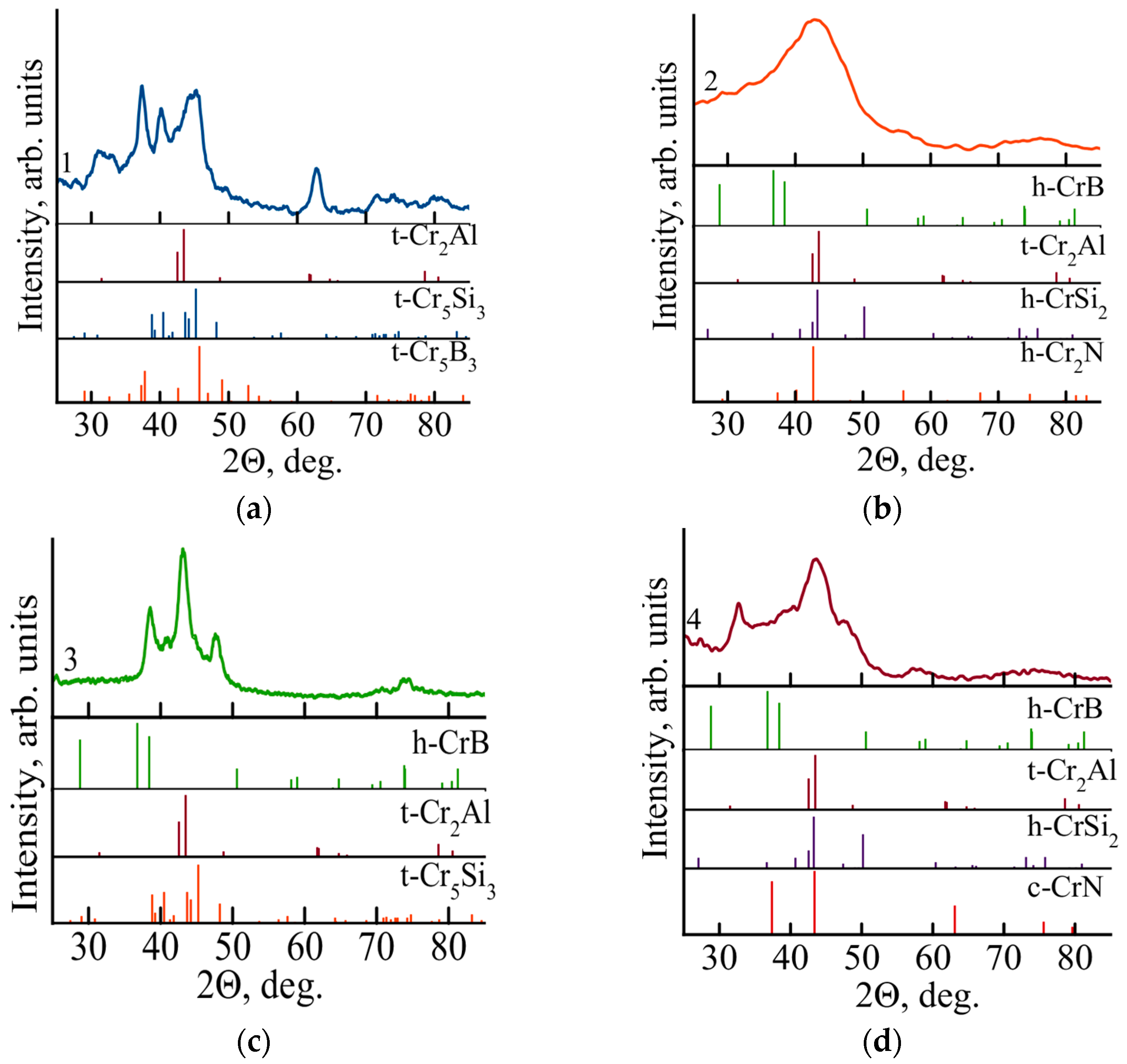
Results of XRD analysis using the Bragg–Brentano geometry showed that, in addition to reflections from the coatings, the diffractograms contain high-intensity peaks at 2θ = 32.6° and 69.8°, which correspond to the monocrystalline silicon substrate. The non-reactive coating 1 contains the phases t-Cr5B3 (ICDD 32-0278), t-Cr5Si3 (ICDD 51-1357), and t-Cr2Al (ICDD 29-0016) (Figure 3a). The most intense peaks at 2θ = 37.7° and 63.2° correspond to the t-Cr5B3 phase, which predominates in coating 1. When nitrogen was introduced into the working gas mixture, an X-ray amorphous coating 2 was formed. The position of the peak maximum observed in the 2θ range of 30–55° coincides with the lines of maximum intensity: (111) for the phases h-Cr2N (ICDD 35-0803), o-CrB (ICDD 32-0277), and h-CrSi2 (ICDD 35-0781); (103) for the t-Cr2Al phase. Coating 3 predominantly contains the t-Cr5Si3 phase, with its most intense peaks observed at 2θ = 38.8° and 68.5°. Peaks from the o-CrB and t-Cr2Al phases were also detected. Introducing nitrogen led to the formation of the phases c-Cr(Al)N (ICDD 83-5612) and h-CrSi2 in coating 4. Coating 4 also contained t-Cr2Al and o-CrB phases.
Table 2 presents the average crystallite size (d) of these phases for coatings 1, 3, and 4. For coating 1, the crystallite sizes of t-Cr5B3, t-Cr5Si3, and t-Cr2Al phases were 11, 7, and 3 nm, respectively. In the case of coating 3, d for the t-Cr5Si3, o-CrB, and t-Cr2Al phases was 3, 15, and 6 nm, respectively. Coating 4 had the finest-grained structure, with an average crystallite size of 3–5 nm for the c-Cr(Al)N, h-CrSi2, t-Cr2Al, and o-CrB phases.
For further, more detailed investigation of the phase composition of the coatings, X-ray diffraction using the grazing incidence method (GIXRD) was carried out, which allows detection of additional reflections and minimizes the substrate signal. The angle between the radiation source and the sample surface was 3°. The results are shown in Figure 4.
For coating 1, when measured using the grazing incidence method, the peaks of the main t-Cr5B3 phase in the 2θ range of 40–50° became even more pronounced, and low-intensity peaks of t-Cr5B3 (206), (411), (330), (226) were revealed in the 70–80° range. Peaks from the t-Cr5Si3 and t-Cr2Al phases were also detected. For coating 2, a strongly broadened peak was observed, confirming the X-ray amorphous state of the coating. In the case of coating 3, the peak from the t-Cr2Al phase observed at 2θ = 43.0° became more intense, while the main phase still remained t-Cr5Si3. For coating 4, the appearance of the GIXRD diffractogram is identical to that of XRD and confirms the presence of the c-Cr(Al)N, h-CrSi2, t-Cr2Al, and o-CrB phases.
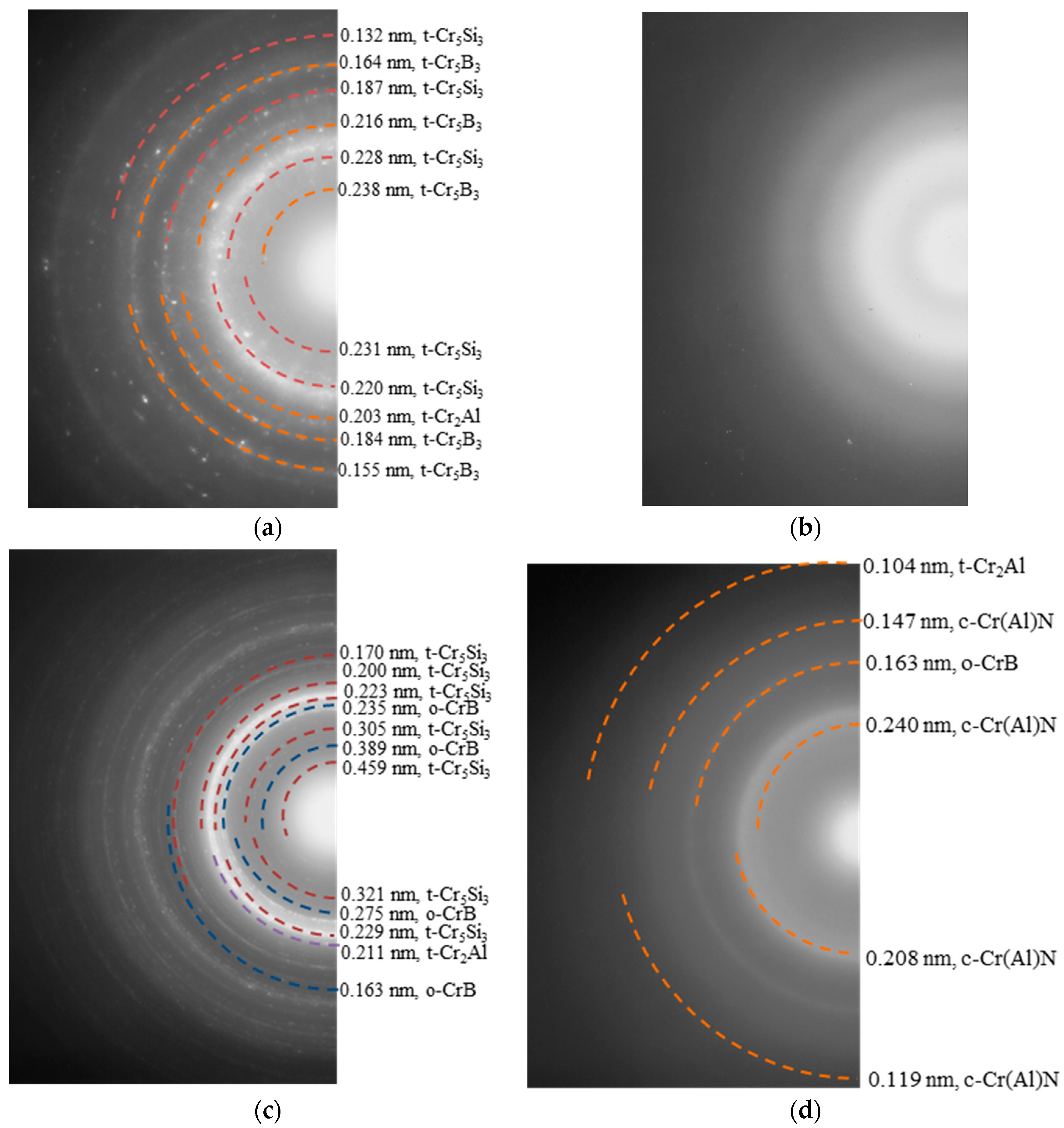
Figure 5 shows the selected area electron diffraction (SAED) patterns of coatings 1–4. On the SAED pattern of coating 1, ring and spot reflections with interplanar spacings of d/n = 0.238, 0.216, 0.203, 0.184, 0.164, and 0.155 nm were observed, close to the values for the tetragonal phase t-Cr5B3, as well as d/n = 0.231, 0.228, 0.220, 0.187, and 0.132 nm, corresponding to the tetragonal phase t-Cr5Si3. The presence of the t-Cr2Al phase cannot be excluded, with its most intense line corresponding to d/n = 0.207 nm. For coating 2, the presence of a broad ring on the SAED pattern indicates an amorphous structure.
In coating 3, spot and ring reflections corresponded to interplanar spacings of 0.459, 0.389, 0.321, 0.305, 0.275, 0.235, 0.229, 0.223, 0.211, 0.200, 0.170, and 0.163 nm, which are close to the following values: d/n = 0.458, 0.323, 0.307, 0.229, 0.222, 0.170 nm for the main phase t-Cr5Si3; d/n = 0.393, 0.277, 0.235, 0.163 nm for the o-CrB phase; d/n = 0.212 and 0.195 nm for the t-Cr2Al phase. On the SAED pattern of coating 4, reflections with d/n = 0.240, 0.208, 0.163, 0.147, 0.119, and 0.104 nm were observed, which can be attributed to the phases c-Cr(Al)N (d/n = 0.239, 0.207, 0.146, 0.119 nm), o-CrB (d/n = 0.235, 0.163 nm), and t-Cr2Al (d/n = 0.208, 0.104 nm). The presence of the h-CrSi2 phase cannot be excluded, characterized by interplanar spacings of 0.245, 0.209, 0.147, and 0.119 nm.
Thus, the TEM data are in good agreement with the XRD results: coating 1 predominantly contains the t-Cr5B3 and some amount of t-Cr5Si3 phase, as well as the t-Cr2Al phase. Coating 2 is amorphous. In coating 3, the main phase is t-Cr5Si3, with additional phases t-Cr2Al and o-CrB. Coating 4 is mainly composed of the c-Cr(Al)N phase, with the presence of o-CrB, t-Cr2Al, and h-CrSi2 phases.
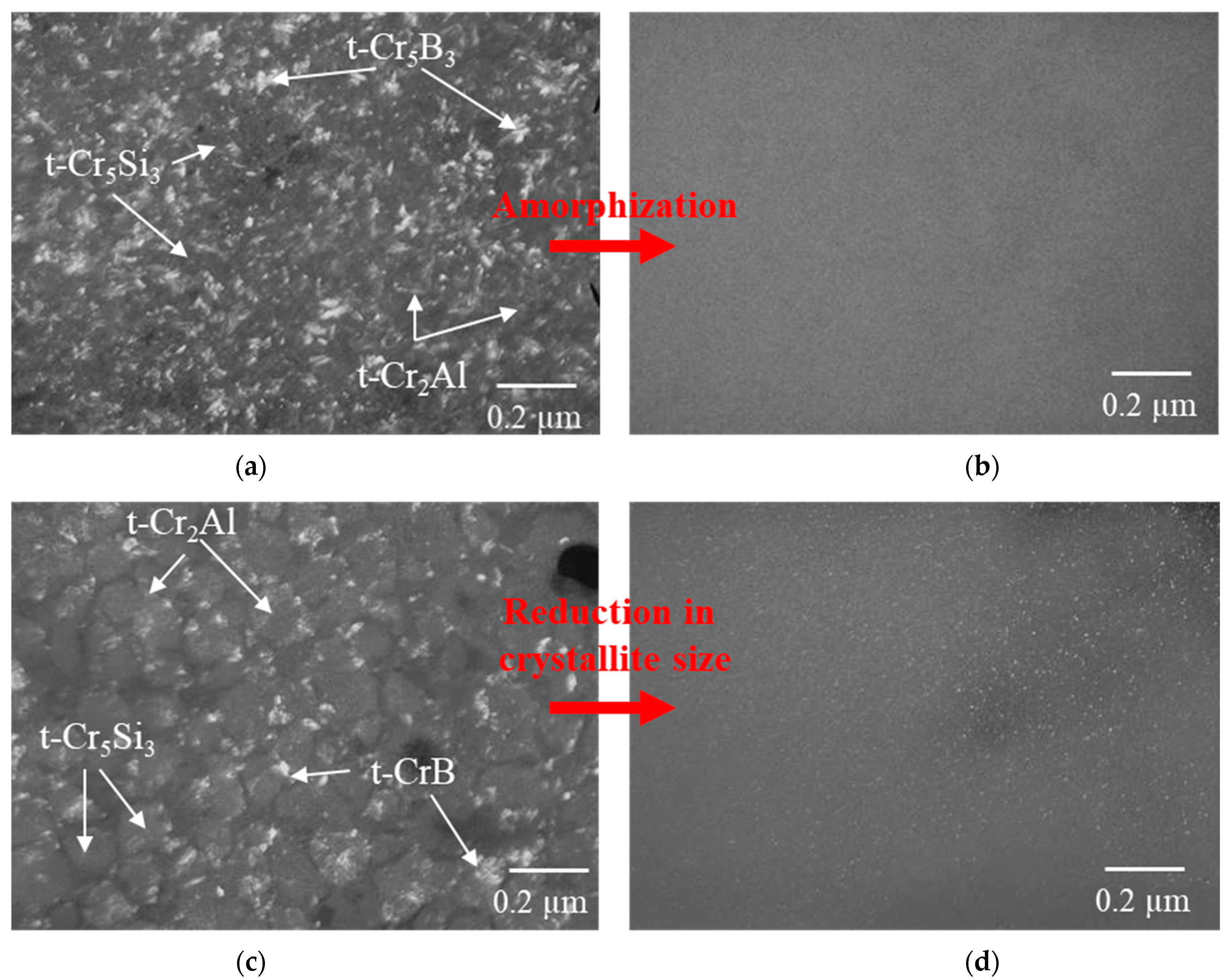
Analysis of dark field (DF) TEM images showed that coating 1 (Figure 6a) has a fine-grained structure and contains grains of chromium boride t-Cr5B3 (light areas in the TEM image), chromium silicide t-Cr5Si3 (dark gray areas), and chromium aluminate t-Cr2Al (light gray areas).
The crystallite sizes of the t-Cr5B3 and t-Cr2Al phases ranged from 7–15 nm to 3–7 nm, respectively. In the case of the t-Cr5Si3 phase, grains 50–150 nm in size contained subgrains up to 10 nm in size. In the amorphous coating 2, no crystalline structural components were identified (Figure 6b). In coating 3 (Figure 6c), the main structural component was the t-Cr5Si3 phase (dark gray grains in the TEM image). Large grains of 70–150 nm consisted of small t-Cr5Si3 subgrains measuring 3–7 nm. The coating also contained grains of t-Cr2Al (light gray areas) measuring 5–13 nm and o-CrB grains (light areas) measuring 5–25 nm. In coating 4, small crystallites of c-Cr(Al)N phase not larger than 5–7 nm were observed. It is worth noting that the TEM data correlate well with the XRD data and confirm the fact that the introduction of nitrogen into the coating composition leads to amorphization (coating 2) and refinement of the structure (coating 3).

3.3. Mechanical Properties

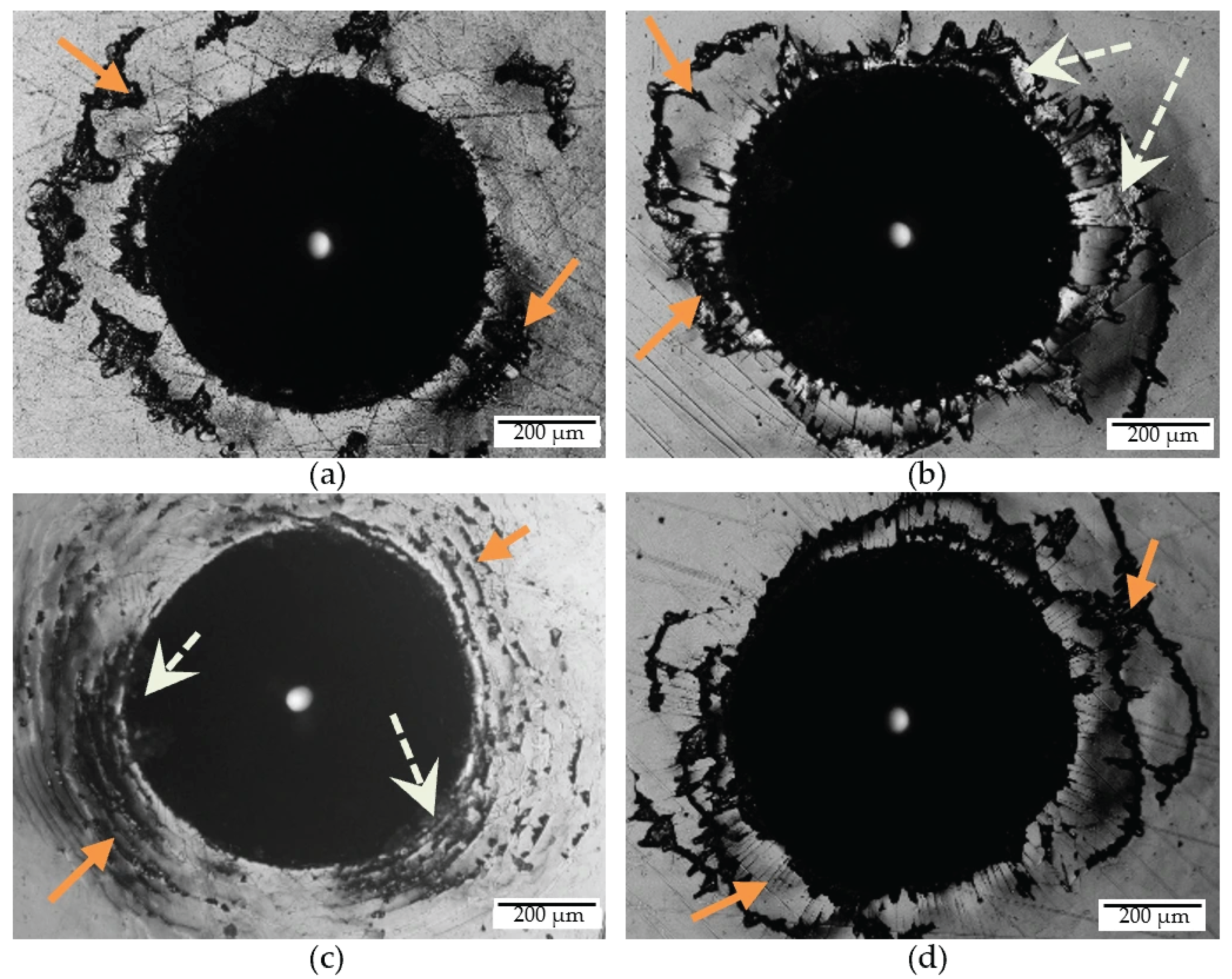
Micrographs of the coating surfaces after Rockwell C test are shown in Figure 7. For coating 1, concentric blistering regions and thin radial cracks were observed along the borders of the indentation. This type of failure corresponds to HF2 on the DIN German-VDI 3198 scale. For coating 2, blistering areas, radial cracks, and local delaminations formed at the junctions of cracks were found near the indentation, which corresponds to HF3 failure type.
Circumferential cracks and localized delaminations were observed on the surface of coating 3 along the edge of the indentation. It is worth noting that the coating delaminates predominantly within the indentation. This coating exhibits a degree of damage corresponding to level HF3. Coating 4 fails according to HF2 type, similar to coating 1: radial cracks and blistering areas were observed near the indentation. Thus, coating 3 demonstrates the lowest defect level in the indentation area and, consequently, the highest adhesion strength. The poorest results for coating 2 can be explained by high internal stress level and its increased brittleness associated with the amorphous structure [33].
Preliminary scratch testing revealed that the determination of the values of critical failure loads is influenced by intense deformation of a relatively plastic NiCr-alloy substrate during loading. Thin hard coatings on soft substrates are particularly susceptible to coating fracture due to stresses caused by substrate deformation [34]. For a hard coating on a softer substrate, spallation and buckling failure modes result from the interfacial detachment, but a range of other cracks and deformed regions may also be observed such as tensile or Hertzian cracking [35]. For example, when scratching coating 4, the critical load Lc1 is reached at 20 N, the first cracks appear, and cohesive failure begins almost immediately at a load of 22 N. With increasing load, the area of cohesive failure of the coating increases. The first signs of adhesive failure, chipping of the coating down to the substrate, were observed at a load of Lc2 = 63 N. The indenter did not fully contact the substrate until 70 N.
The nanoindentation results showed that coating 1, obtained by sputtering target 1 in an Ar atmosphere, exhibited the highest hardness of H = 29 GPa and elastic modulus E = 365 GPa, with an elastic recovery W of 42% (Table 3).
The introduction of nitrogen into the gas atmosphere led to a decrease in H by 17% and in E by 32%, while W increased by 17%. For coatings 3 and 4, obtained by sputtering target 2, a similar trend was observed: hardness and elastic modulus decreased upon nitrogen addition in the gas atmosphere from 20 to 15 GPa and from 205 to 172 GPa, respectively. At the same time, elastic recovery decreased from 54 to 44%. The reduction in mechanical properties with nitrogen incorporation into the coatings may be related to structural amorphization and a decrease in crystallite size of the main phase (Figure 6), in accordance with the inverse Hall–Petch law [30,36]. It should be noted that coatings 3 and 4, with increased aluminium content, exhibited lower hardness compared to coatings 1 and 2. A similar decrease in hardness with increasing aluminium content in coatings was observed in [37].
Elastic strain to failure (H/E) and resistance to plastic deformation (H3/E2) were also calculated, which allow predicting the behavior of coatings under tribological contact conditions [38,39]. The H/E and H3/E2 parameters increased with the introduction of nitrogen into the coatings. The maximum values of H/E = 0.100 and H3/E2 = 0.247 GPa were achieved for coating 2.

3.4. Tribological Properties

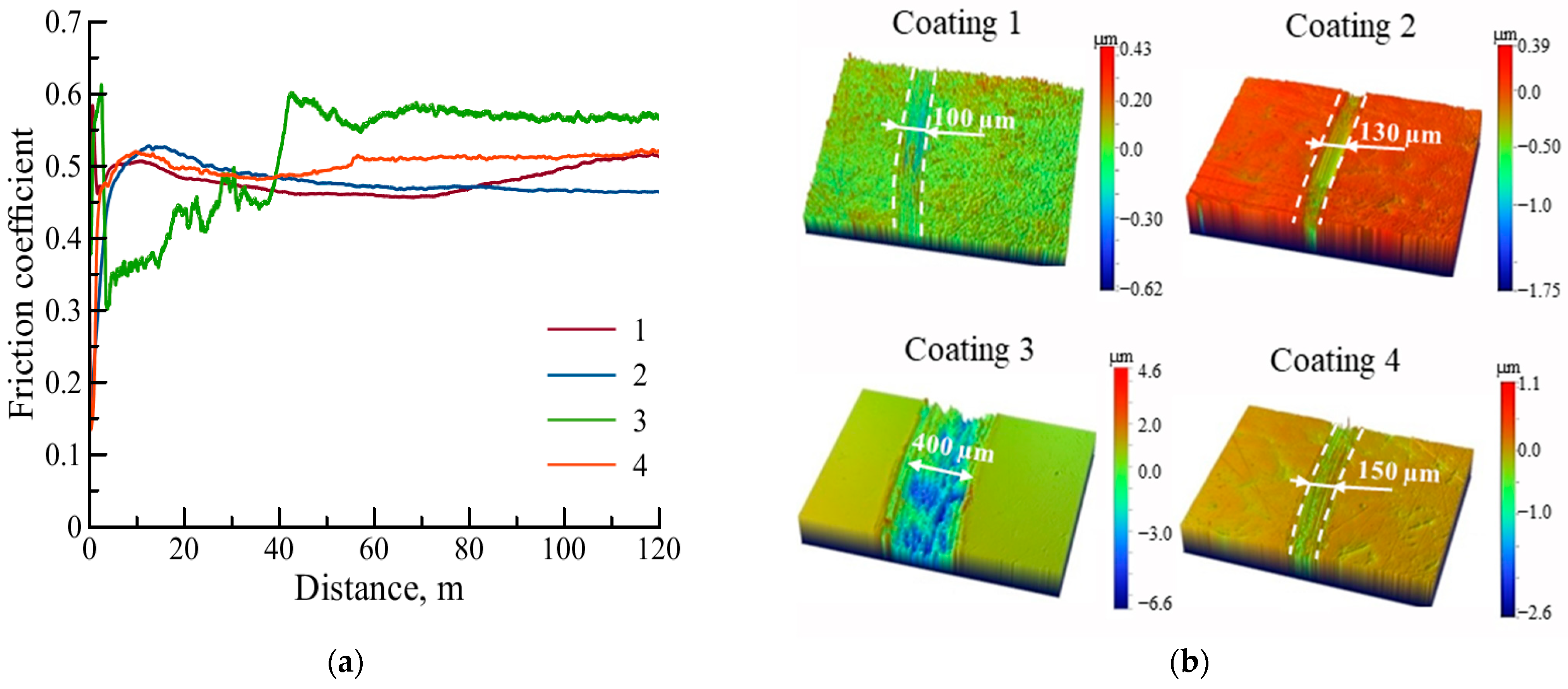
Tribological tests (Figure 8a) revealed that coatings 1, 2, and 4 were characterized by a stable friction coefficient f in the range of 0.48–0.51 (Table 3). For coating 3, f was unstable throughout the entire test distance, and its average value was maximum at 0.65. This may be due to brittle fracture of the coating during friction of the counterbody with the substrate material.
A study of the wear tracks (Figure 8b) showed that amorphous coating 2 is characterized by a minimum wear rate of Vw = 5.7 × 10⁻⁶ mm3N−1m−1 (Table 2). Influence of the structural state on tribological properties were previously discovered in work [40], where amorphous coatings demonstrated increased wear resistance compared to crystalline coatings, which is associated with their high resistance to plastic deformation. Coatings 1 and 4 demonstrated Vw = 6.3 and 7.5 × 10⁻⁶ mm3N−1m−1, respectively. It is worth noting that the friction coefficient of 0.48–0.51 and the wear rate of coatings 1, 2 and 4 are comparable with the data for the Cr-Al-Si-N [41] and Cr-Al-Si-B-N [20] coatings, characterized by f = 0.40–0.51 and Vw = 2.0–4.5·10−6 mm3/(N·m). Coating 3 demonstrated a maximum value of Vw = 2.93 × 10⁻⁴ mm3N−1m−1, which exceeds the wear rate of coatings 1, 2, and 4 by two orders of magnitude. In addition to resistance to plastic deformation, the wear resistance of coatings can be affected by the level of internal stresses. It can be assumed that the high wear rate of coating 3 is more related to residual stresses than to the level of resistance to plastic deformation. It is known that high levels of residual stress have a negative impact on the adhesive strength and wear resistance of coatings under sliding friction conditions [42,43].
It is worth noting that the introduction of nitrogen had a positive effect on the tribological properties of the coatings: the wear rate decreased with increasing nitrogen concentration in the coatings. This effect is associated with structural modification, the formation of amorphous phases, and a refinement of the crystallite size. Similar patterns were observed earlier in [44,45].
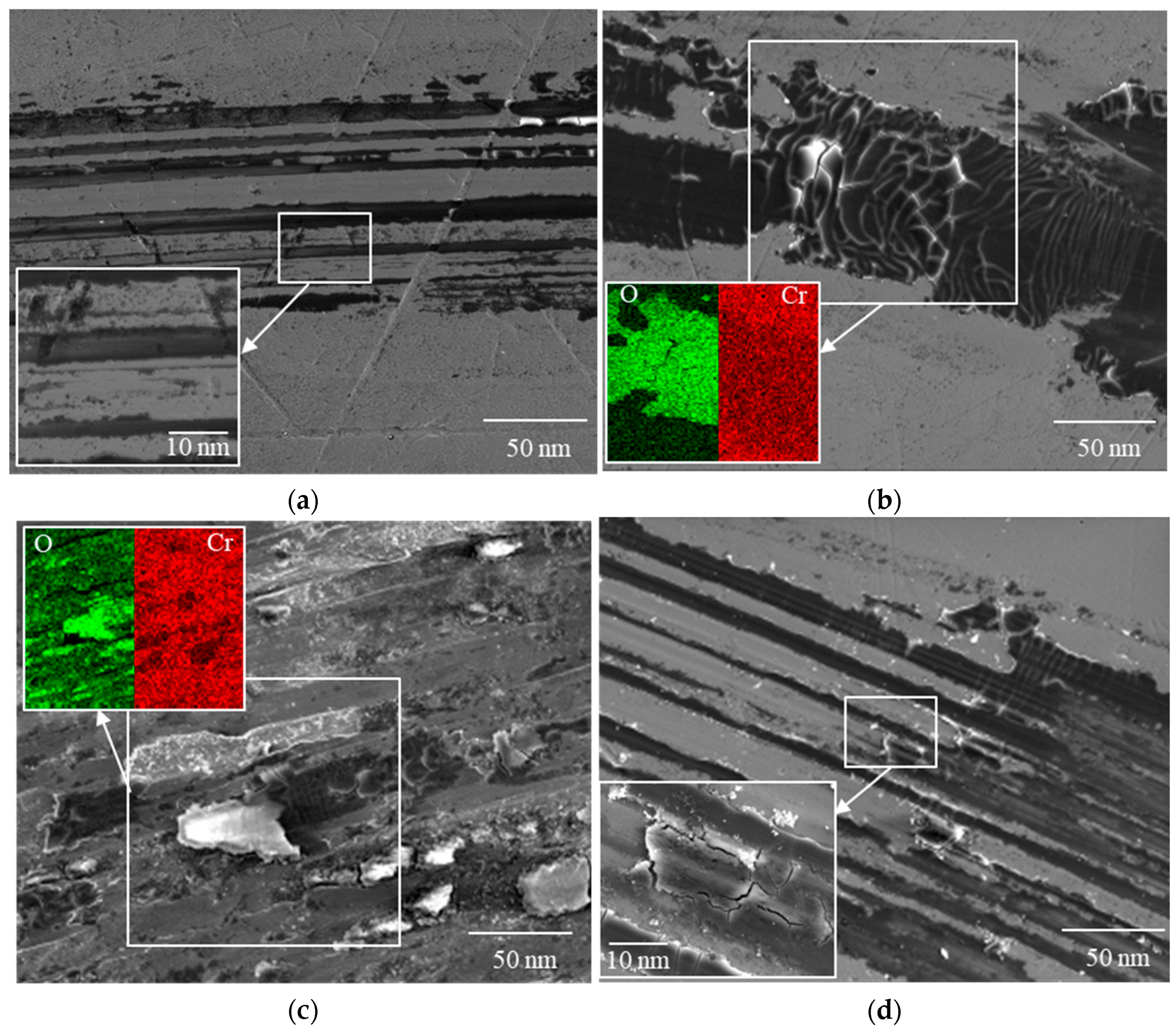
To better understand the mechanisms of coating wear during sliding friction, wear tracks were studied by SEM and EDS. The results are presented in Figure 9. Coating 1 exhibited abrasive wear: scratches formed as a result of the impact of hard coating wear products were observed in the tribocontact zone. According to EDS data, the wear products mainly consisted of chromium oxide Cr2O3. It is worth noting that the EDS data of wear products obtained from the wear track were close to the data taken from the counterbody after tribological tests. In the case of coating 2, a crack network was observed in the tribocontact zone, but no delaminations were detected. The wear products contained chromium oxide. Coating 3 cracked and underwent brittle failure during sliding friction: delaminations were observed in the track zone, resulting in wear products containing both coating components (chromium oxide) and the substrate (nickel oxide). Coating 4 wear was accompanied by the formation of a crack network and localized delaminations. Thus, coating 2 had the best wear resistance, which can be associated with the maximum values of resistance to elastic deformation of destruction H/E = 0.100 and resistance to plastic deformation of destruction H3/E2 = 0.247 GPa (Table 2).
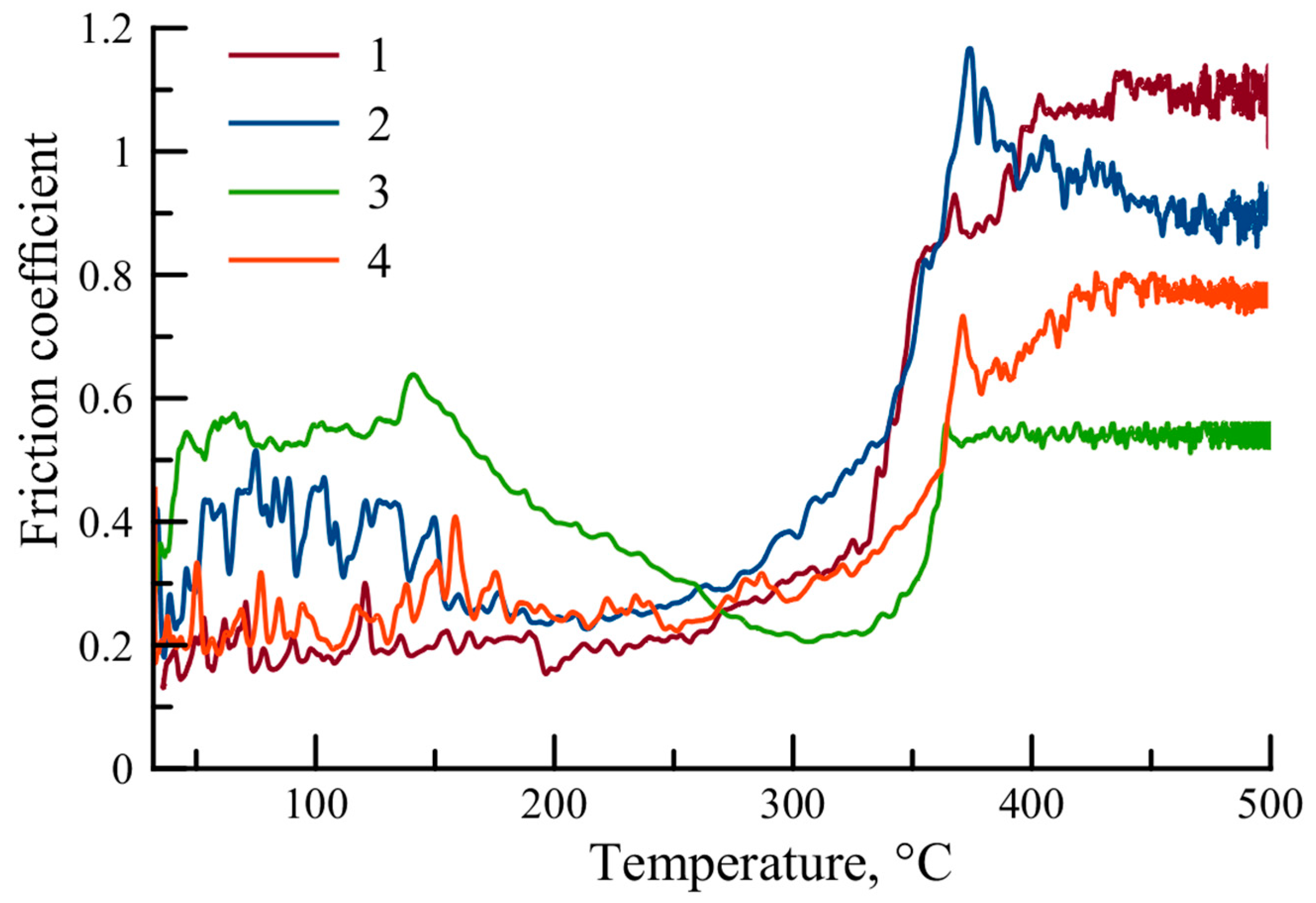
Coating 1 showed a stable friction coefficient f ~ 0.22 from room temperature to 330 °C (Figure 10).
Above this temperature, the f increased to value >1.0. For coating 2, the friction coefficient was unstable in the temperature range of 25–160 °C and was within 0.26–0.51. At temperatures of 160–260 °C, f stabilized and amounted to 0.25. Then, the friction coefficient increased to value >1.0. Coating 3 was characterized by high f ~ 0.55 in the temperature range of 25–160 °C. With an increase in temperature to 340 °C, the friction coefficient smoothly decreased and reached a value of 0.22. Then f increased to 0.58 at 350 °C. The behavior of coating 4 was similar to coating 1: at the stage of 25–330 °C, f was stable and amounted to f ~ 0.24. Above 330 °C, wear of the coating was observed; the friction coefficient at a temperature of 500 °C was 0.78.
Notably, the coating 3 demonstrated the highest friction coefficient both at room and elevated temperatures. This is likely due to its low fracture toughness and adhesive strength, leading to brittle failure and additional abrasive wear from detached coating particles (Figure 7c). A similar phenomenon, where a high friction coefficient was attributed to abrasive wear by delaminated coating debris, has been reported for CrAlN coatings [1].
It can be concluded that the friction coefficient of coatings in the temperature range of 20–330 °C depends on the intensity of their degradation during testing. The increase in the friction coefficient observed for all coatings at temperatures of 330–500 °C is due to wear of the coatings down to the substrate.
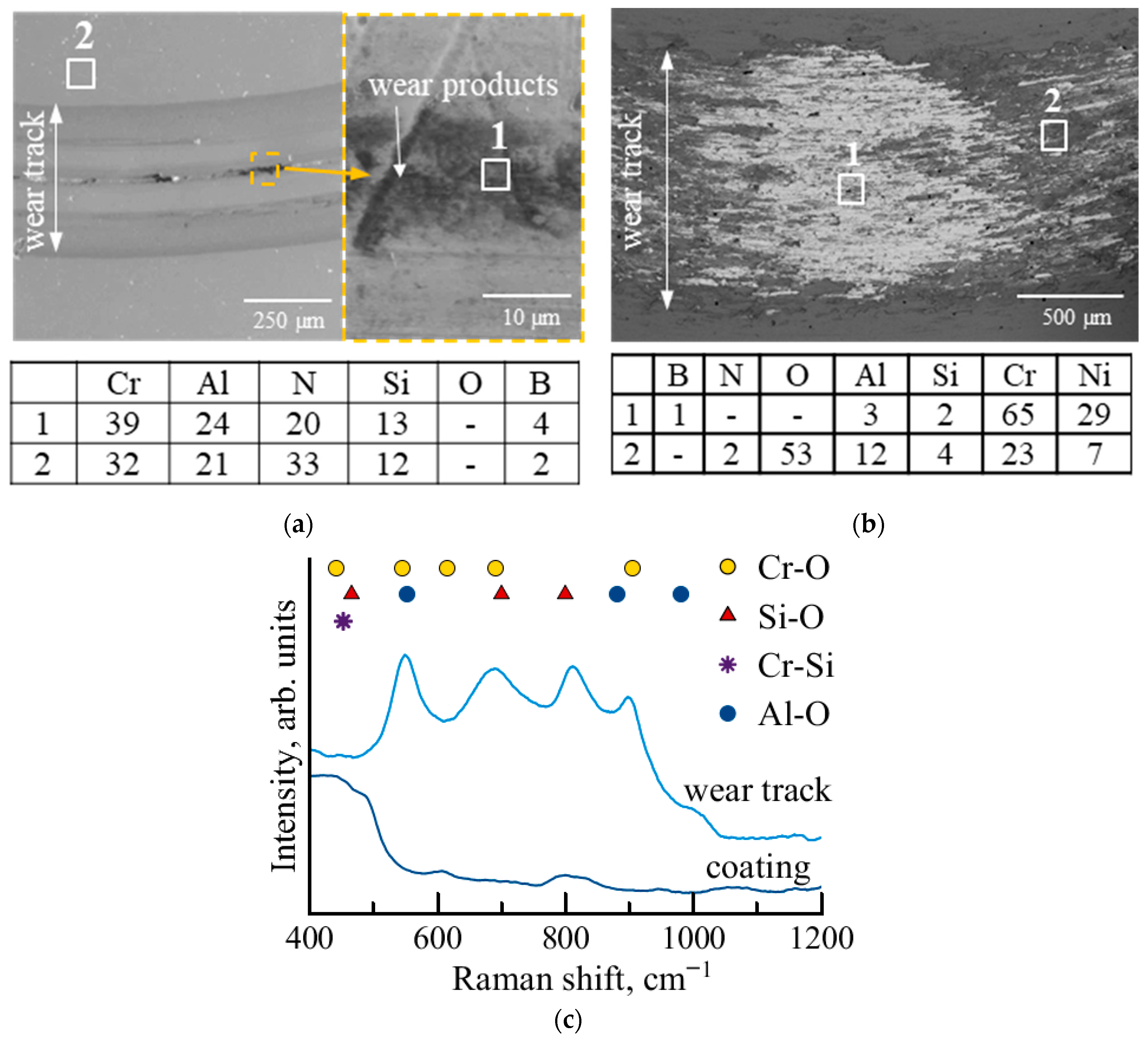
Coating 4, which exhibits the best high-temperature tribology properties, was examined using SEM, EDS, and Raman at the following test stages: (a) the temperature range of 20–330 °C, characterized by a low friction coefficient (Figure 11a,b); the temperature range of 330–500 °C, characterized by an increased friction coefficient of the coating (Figure 11b,c).
At temperatures of 20–330 °C, no cracks or chips in the coating were observed in the tribocontact zone: local non-oxidized wear products were detected (Figure 11a). In the temperature range of 330–500 °C, the increase in the friction coefficient is associated with wear of the coating to the substrate (Figure 11b). Wear products in this case predominantly contain chromium oxide. Raman spectra taken from wear marks showed the presence of Cr-O bonds with lines at 442, 545, 615 cm−1, as well as Al-O at 553, 880, 980 cm−1 and Si-O at 700 and 800 cm−1 [46,47], indicating the formation of chromium, aluminum and silicon oxides in the tribocontact zone. It is worth noting that silicon oxide can form a protective lubricating layer that reduces friction and prevents abrasive wear [48,49].

3.5. Diffusion Barrier Properties and Oxidation Resistance

For practical applications, it is important to evaluate the diffusion barrier properties of coatings at elevated temperatures. To this purpose, in this study, coatings on a NiCr alloy were annealed at temperatures corresponding to the onset of intensive diffusion of metallic components, primarily Ni, from the substrate into the coating. A study of the coating–substrate interface after annealing at 800 °C using the GDOES method showed that for coatings 1 and 3 obtained in an Ar environment, nickel diffusion occurred throughout the entire thickness (Figure 12).
While for nitrogen-containing coatings 2 and 4, Ni diffusion was not observed. At a temperature of 900 °C, for all coatings, diffusion of nickel to the coating surface was observed, reaching a concentration up to 40 at.% in the main layer. The introduction of nitrogen into the coating composition led to an increase in diffusion barrier properties, which may be associated with a decrease in grain size, amorphization of the structure and a reduction in intergranular boundaries along which diffusion occurs [47]. It can also be noted that at 800 and 900 °C the coatings were characterized by relatively small oxidation depths, not exceeding 200 and 300 nm, respectively.
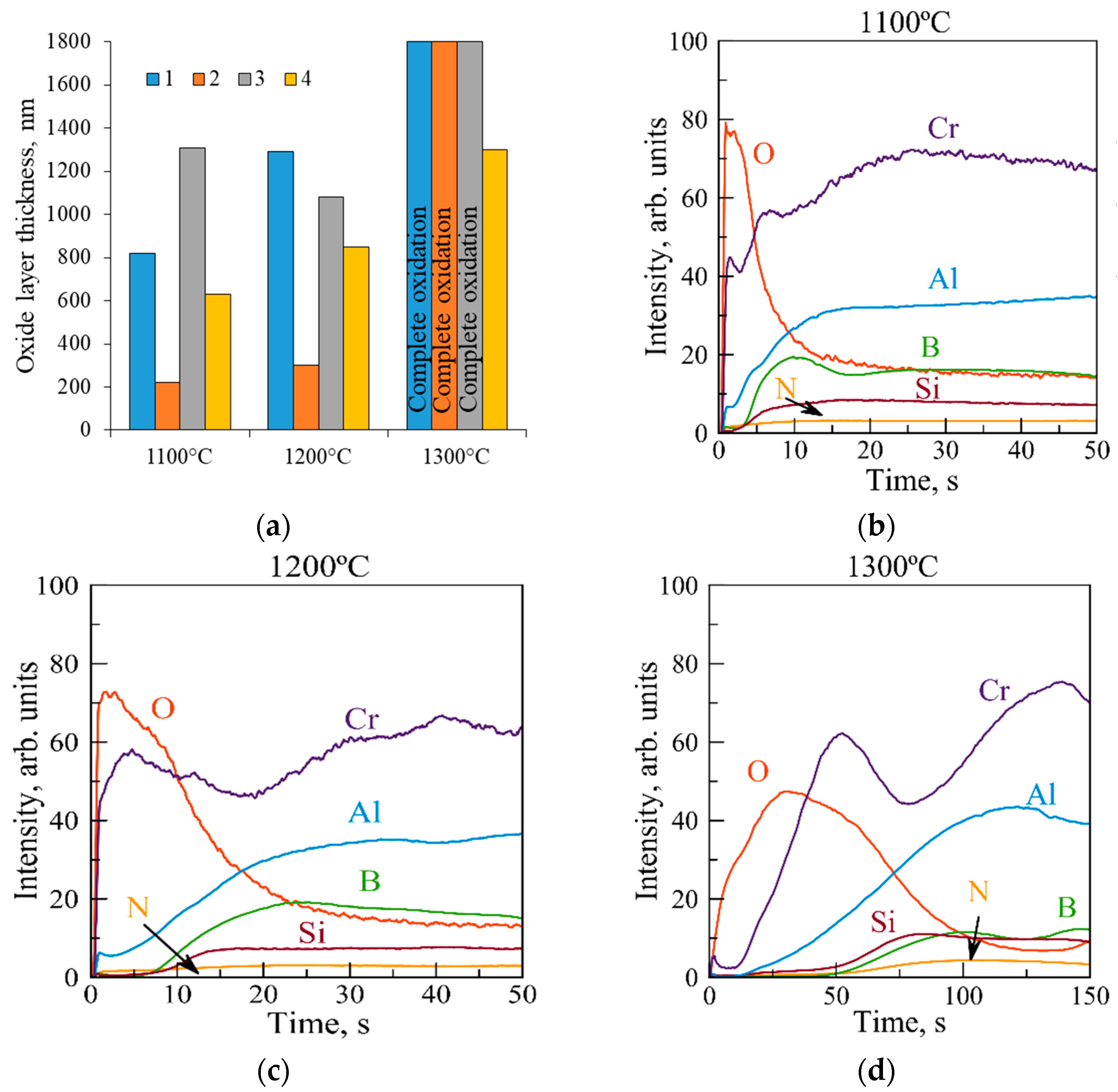
To determine the maximum service temperature, the coatings deposited on aluminum oxide substrates were subjected to stepwise annealing in air for 1 h holds at 1100, 1200, and 1300 °C. The thickness and composition of the resulting oxide layers were analyzed by GDOES. A comparison of the oxide layer thicknesses for coatings 1–4, annealed at temperatures of 1100–1300 °C, is presented as a histogram in Figure 13a. Also in the figure, using the example of coating 4, annealed at different temperatures, elemental profiles are shown (Figure 13b–d).
After annealing at 1100 °C, an aluminum oxide layer 820 nm thick formed on the surface of coating 1. At the same temperature, a two-layer film of chromium oxide (on top) and aluminum oxide (near the coating) formed on the surface of coating 2, with a total thickness of 220 nm. For coating 3, the Al2O3 oxide layer thickness was maximum at 1310 nm. In the case of coating 4, the 630 nm thick surface layer consisted predominantly of chromium oxide, similar in stoichiometry to Cr2O3. With an increase in temperature to 1200 °C, the oxide layer thickness for coatings 1, 2, and 4 increased by 57, 37, and 35%, respectively. Coating 3 exhibited a decrease in oxide layer thickness, which may be due to partial delamination and destruction of the brittle oxide. The composition of the oxide layers of the coatings remained virtually unchanged. At 1300 °C, samples 1–3 were completely oxidized. Coating 4, however, retained its protective properties; the oxide layer thickness was 1300 nm (Figure 13d).
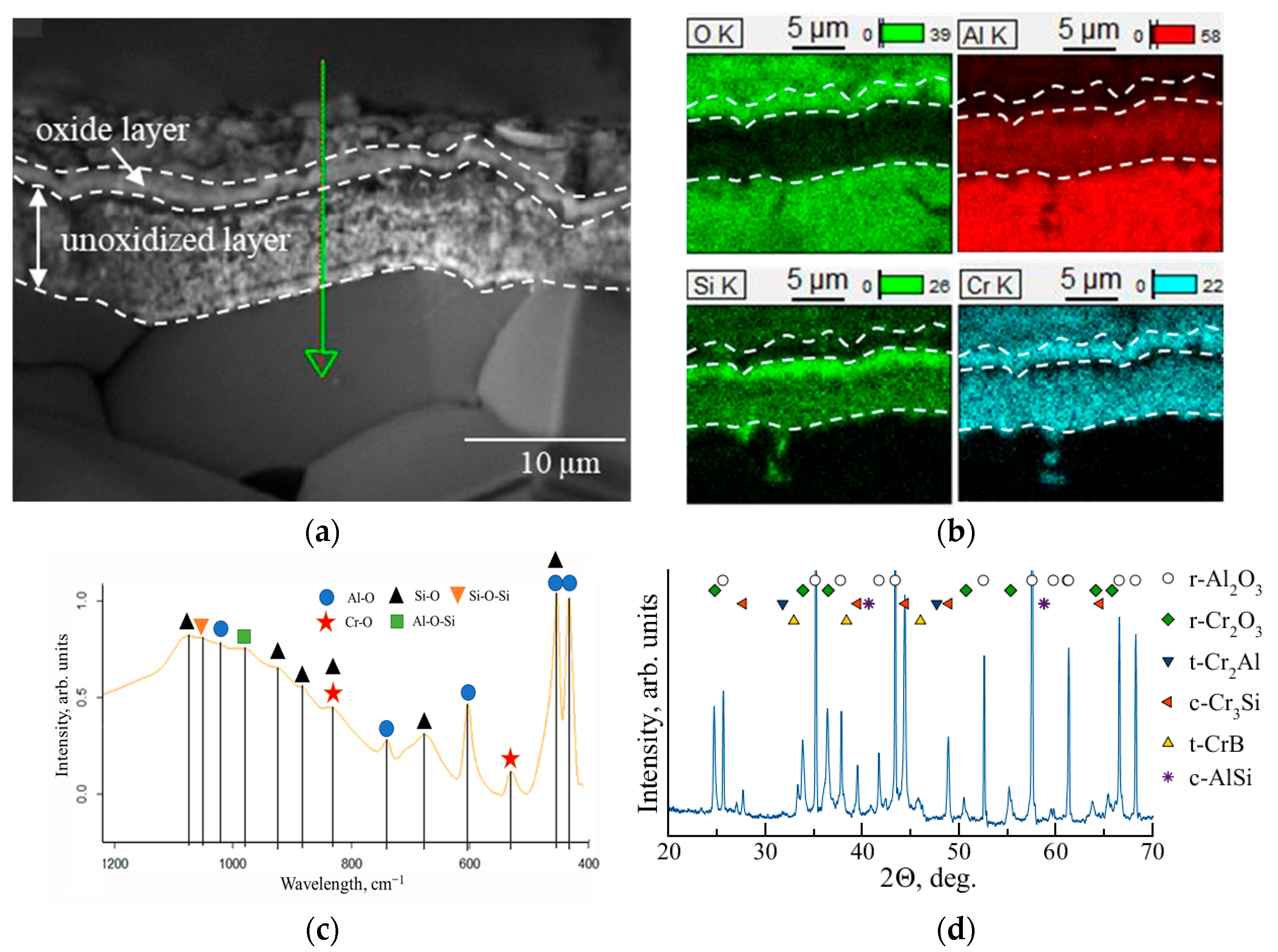
The best sample in terms of oxidation resistance, coating 4, was studied after oxidative annealing using SEM, EDS, and XRD methods (Figure 14). According to SEM data, the top oxide layer had a loose structure. Beneath it there is a dense protective layer about 1.3 µm thick, the basis of which is chromium oxide. Due to the diffusion of elements from coating to the surface, an intermediate layer with high concentration of silicon and aluminum formed between the metal oxide layer and the unoxidized coating. The unoxidized coating layer with a thickness of 6.6 μm contained all the main elements: Cr, Al, Si, B, and N. Figure 14c shows the FTIR spectrum of coating 4 annealed at 1300 °C. The FTIR spectrum reveals Al-O [50], Cr-O [51], Si-O [52], Si-O-Si and Si-O-Al [53] bonds.
XRD analysis showed that the top layer of the coating contained the r-Cr2O3 phase, with an average crystallite size of 35 nm. Other oxides are difficult to identify, since the high-intensity peaks of the r-Al2O3 phase correspond to the substrate material, while silicon oxide SiO2 is amorphous. Low-intensity peaks of the t-Cr2Al and t-CrB phases were detected on the diffractogram, which were already present in the coating before annealing. The crystallite sizes of the t-Cr2Al (101) and t-CrB (103) phases were 37 and 35 nm, respectively. High-intensity peaks at 2Θ = 27.7, 39.5, 44.4, and 48.9° correspond to the c-Cr3Si phase, the formation of which is associated with the involvement of silicon in the oxide layer formation and the depletion of the h-CrSi2 phase observed in the as-deposited state for coating 4. The crystallite size of the c-Cr3Si phase was 45 nm. The c-AlSi phase revealed in the XRD pattern confirms the formation of the intermediate layer revealed by EDS mapping (Figure 14b). The presence of the c-Cr3Si, t-CrB, and t-Cr2Al phases confirms that the coating retains its protective properties at a temperature of 1300 °C. It is noteworthy that the oxidation resistance of the most compositionally similar nitrogen-containing coatings, Cr-Al-Si-N [12] and Cr-Al-B-N [16], is limited to 900–1000 °C. Previously obtained reactive Cr–Al–Si–B–N coatings with low silicon (2 at.%) and aluminum (5 at.%) content had oxidation resistance limited by 1100 °C [20].

4. Conclusions

Cr-Al-Si-B-(N) coatings were deposited by magnetron sputtering using SHS targets of two compositions, at.% 44 Cr, 10 Al, 14 Si, 32 B (target 1) and 45 Cr, 29 Al, 16 Si, 10 B (target 2), in Ar and Ar+25%N2 environments. All coatings were characterized by a uniform distribution of elements across the thickness. Coatings 1 and 2, deposited by target 1, had the following compositions (at.%): 64 Cr, 4 Al, 11 Si, 21 B and 42 Cr, 6 Al, 12 Si, 15 B, 25 N. Coatings 3 and 4, deposited from target 2, contained (at.%): 62 Cr, 11 Al, 21 Si, 6 B and 40 Cr, 18 Al, 11 Si, 5 B, 26 N.
The coatings deposited in Ar had a coarse crystalline structure. Coating 1 predominantly contained the t-Cr5B3 phase, as well as the t-Cr5Si3 and t-Cr2Al phases. The nitrogen addition induced structural amorphization (coating 2). Coating 3 was primarily composed of the t-Cr5Si3 phase, with o-CrB and t-Cr2Al phases also present. The introduction of nitrogen into the gas medium changed the phase composition to c-Cr(Al)N, h-CrSi2, t-Cr2Al, and o-CrB, and significantly reduced the crystallite size (coating 4).
A study of the mechanical properties showed that coatings 1 and 3 had a hardness of H = 29 and 20 GPa and an elastic modulus of E = 365 and 205 GPa, respectively. The introduction of nitrogen resulted in a decrease in H for coatings 2 and 4 by 17% and 20%, and in E by 32% and 16%. Tribological tests at room temperature showed that coatings 1, 2, and 4 had similar friction coefficients, ranging from 0.48 to 0.51. Coating 2 demonstrated a minimum wear rate of 5.7 × 10⁻⁶ mm3N−1m−1 due to a maximal plasticity index H/E = 0.100 and a resistance to plastic deformation H3/E2 = 0.247 GPa. Tribological tests under heating showed that coatings 1, 2, and 4 possess a low friction coefficient of 0.22–0.26 up to a temperature of 20~330 °C. Coating 3 demonstrated poor tribological properties.
All coatings demonstrated good oxidation resistance at temperatures up to 1200 °C, which is associated with the formation of protective surface films based on chromium and aluminum oxides. Coating 4 successfully resisted oxidation at 1300 °C. The protective properties of coating 4 are due to the high concentration of aluminum (20 at.%), which participates in the formation of an intermediate AlSi layer between the top chromium oxide layer and the unoxidized coating, preventing the diffusion of oxygen into the depth of the coating.
Thus, the Cr-Al-Si-B and Cr-Al-Si-B-N coatings developed in this study are promising candidates for protecting components exposed to various types of wear and elevated temperatures. These coatings exhibit good wear resistance, comparable to known analogs, and an elevated operating temperature of 1300 °C, exceeding that of coatings with similar compositions by 100–300 °C (Table 4).

Author Contributions

Supervision, P.K.-K.; investigation, P.K.-K., A.C. and Y.P.; writing—original draft preparation, P.K.-K. and A.C.; writing—review and editing, P.K.-K. and A.C.; conceptualization, P.K.-K.; software, A.C.; validation, P.K.-K. and A.C.; resources, E.L.; project administration, E.L. All authors have read and agreed to the published version of the manuscript.

Funding

This work was financially supported by the Ministry of Science and Higher Education of the Russian Federation under State Assignment No. FSME-2025-0003.

Institutional Review Board Statement

Not applicable.

Informed Consent Statement

Not applicable.

Data Availability Statement

The original contributions presented in this study are included in the article. Further inquiries can be directed to the corresponding authors.

Acknowledgments

The authors thank M.I. Petrzhik for assistance in conducting of nanoindentation tests and T.B. Sagalova for XRD-GIXRD experiments.

Conflicts of Interest

The authors declare no conflicts of interest.

References

  1. Semih, M.A.; Yaşar, S.; Tevfik, K. Investigation of structural hardness, adhesion, and tribological properties of CrN and AlCrN coatings deposited on cylinder liner. Mater. Des. 2025, 253, 113972. [Google Scholar] [CrossRef]
  2. Liu, Y.; Yang, Y.; Liu, X.; Zheng, J.; Zhang, S. Tribocorrosion of CrN coatings on different steel substrates. Surf. Coat. Technol. 2024, 484, 130829. [Google Scholar] [CrossRef]
  3. Hidalgo-Badillo, J.A.; Hernández-Casco, I.; Herrera Hernández, H.; Soriano-Vargas, O.; Contla-Pacheco, A.D.; González, M.C.O.; Hernández, J.M.; Flores Cuautle, J.d.J.A. A Tribological Study of CrN and TiBN Hard Coatings Deposited on Cobalt Alloys Employed in the Food Industry. Coatings 2024, 14, 1278. [Google Scholar] [CrossRef]
  4. Yang, S.; Cooke, K.E.; Li, X.; McIntosh, F.; Teer, D.G. CrN-based wear resistant hard coatings for machining and forming tools. J. Phys. D Appl. Phys. 2009, 42, 104001. [Google Scholar] [CrossRef]
  5. Luo, Y.; Ning, C.; Dong, Y.; Xiao, C.; Wang, X.; Peng, H.; Cai, Z. Impact Abrasive Wear Resistance of CrN and CrAlN Coatings. Coatings 2022, 12, 427. [Google Scholar] [CrossRef]
  6. Chim, Y.C.; Ding, X.Z.; Zeng, X.T.; Zhang, S. Oxidation resistance of TiN, CrN, TiAlN and CrAlN coatings deposited by lateral rotating cathode arc. Thin Solid Film. 2009, 517, 4845–4849. [Google Scholar] [CrossRef]
  7. Zhang, X.D.; Chen, L.; Du, J.W.; Hu, C.; Wang, S.Q. Impact of Si content on the thermal stability and oxidation resistance of cubic structured CrAlSiN coatings. Mater. Charact. 2025, 222, 114848. [Google Scholar] [CrossRef]
  8. Chang, Y.-Y.; Chang, C.-P.; Wang, D.-Y.; Yang, S.-M.; Wu, W. High temperature oxidation resistance of CrAlSiN coatings synthesized by a cathodic arc deposition process. J. Alloys Compd. 2008, 461, 336–341. [Google Scholar] [CrossRef]
  9. Chen, H.-W.; Chan, Y.-C.; Lee, J.-W.; Duh, J.-G. Oxidation behavior of Si-doped nanocomposite CrAlSiN coatings. Surf. Coat. Technol. 2010, 205, 1189–1194. [Google Scholar] [CrossRef]
  10. Lee, D.B.; Nguyen, T.D.; Kim, S.K. Air-oxidation of nano-multilayered CrAlSiN thin films between 800 and 1000 °C. Surf. Coat. Technol. 2009, 203, 1199–1204. [Google Scholar] [CrossRef]
  11. Chen, H.-W.; Chan, Y.-C.; Lee, J.-W.; Duh, J.-G. Oxidation resistance of nanocomposite CrAlSiN under long-time heat treatment. Surf. Coat. Technol. 2011, 206, 1571–1576. [Google Scholar] [CrossRef]
  12. Tien, S.-K.; Lin, C.-H.; Tsai, Y.-Z.; Duh, J.G. Effect of nitrogen flow on the properties of quaternary CrAlSiN coatings at elevated temperatures. Surf. Coat. Technol. 2007, 202, 735–739. [Google Scholar] [CrossRef]
  13. Kim, S.K.; Le, V.V.; Vinh, P.V.; Lee, J.W. Effect of cathode arc current and bias voltage on the mechanical properties of CrAlSiN thin films. Surf. Coat. Technol. 2008, 202, 5400–5404. [Google Scholar] [CrossRef]
  14. Zhang, S.; Wang, L.; Wang, Q.; Li, M. A superhard CrAlSiN superlattice coating deposited by multi-arc ion plating: I. Microstructure and mechanical properties. Surf. Coat. Technol. 2013, 214, 160–167. [Google Scholar] [CrossRef]
  15. Martan, J.; Beneš, P. Thermal properties of cutting tool coatings at high temperatures. Thermochim. Acta 2012, 539, 51–55. [Google Scholar] [CrossRef]
  16. Nose, M.; Kawabata, T.; Watanuki, T.; Ueda, S.; Fujii, K.; Matsuda, K.; Ikeno, S. Mechanical properties and oxidation resistance of CrAlN/BN nanocomposite coatings prepared by reactive dc and rf co-sputtering. Surf. Coat. Technol. 2011, 205, S33–S37. [Google Scholar] [CrossRef]
  17. Nguyen, T.D.; Kim, S.K.; Lee, D.B. Oxidation of nano-multilayered CrAlBN thin films between 600 and 1000 °C in air. Surf. Coat. Technol. 2010, 205, S373–S378. [Google Scholar] [CrossRef]
  18. Kudryashov, A.E.; Potanin, A.Y.; Lebedev, D.N.; Sukhorukova, I.V.; Shtansky, D.V.; Levashov, E.A. Structure and properties of Cr–Al–Si–B coatings produced by pulsed electrospark deposition on a nickel alloy. Surf. Coat. Technol. 2016, 285, 278–288. [Google Scholar] [CrossRef]
  19. Kiryukhantsev-Korneev, P.V.; Pierson, J.F.; Bauer, J.P.; Levashov, E.A.; Shtansky, D.V. Hard Cr–Al–Si–B–(N) Coatings with Oxidation Resistance up to 1200 °C. Glass Phys. Chem. 2011, 37, 411–417. [Google Scholar] [CrossRef]
  20. Kiryukhantsev-Korneev, P.V.; Pierson, J.F.; Kuptsov, K.A.; Shtansky, D.V. Hard Cr–Al–Si–B–(N) coatings deposited by reactive and non-reactive magnetron sputtering of CrAlSiB target. Appl. Surf. Sci. 2014, 314, 104–111. [Google Scholar] [CrossRef]
  21. Li, K.Q.; Chen, L.; Hu, C.; Zhang, J.; Du, J.W. Structure, mechanical and thermal properties of CrAlBSiN coatings prepared by cathodic arc evaporation. Surf. Coat. Technol. 2023, 452, 129094. [Google Scholar] [CrossRef]
  22. Du, J.W.; Li, K.Q.; Hu, C.; Chen, L.; Wang, J.C. Study on the structure, mechanical properties and oxidation resistance of CrAlSiN/CrAlBN multilayer. Surf. Coat. Technol. 2024, 492, 131232. [Google Scholar] [CrossRef]
  23. Levashov, E.A.; Mukasyan, A.S.; Rogachev, A.S.; Shtansky, D.V. Self propagating high-temperature synthesis of advanced materials and coatings. Int. Mater. Rev. 2017, 62, 203–239. [Google Scholar] [CrossRef]
  24. Pogozhev, Y.S.; Potanin, A.Y.; Levashov, E.A.; Kovalev, D.Y. The features of combustion and structure formation of ceramic materials in the Cr–Al–Si–B system. Ceram. Int. 2014, 40, 16299–16308. [Google Scholar] [CrossRef]
  25. Kiryukhantsev-Korneev, P.V.; Sytchenko, A.D.; Sviridova, T.A.; Sidorenko, D.A.; Andreev, N.V.; Klechkovskaya, V.V.; Polčak, J.; Levashov, E.A. Effects of doping with Zr and Hf on the structure and properties of Mo-Si-B coatings obtained by magnetron sputtering of composite targets. Surf. Coat. Technol. 2022, 442, 128141. [Google Scholar] [CrossRef]
  26. Kiryukhantsev-Korneev, P.V. Possibilities of glow discharge optical emission spectroscopy in the investigation of coatings. Russ. J. Non-Ferr. Met. 2014, 55, 494–504. [Google Scholar] [CrossRef]
  27. Levashov, E.A.; Shtansky, D.V.; Kiryukhantsev-Korneev, P.V.; Petrzhik, M.I.; Tyurina, M.Y.; Sheveiko, A.N. Multifunctional nanostructured coatings: Formation, structure, and the uniformity of measuring their mechanical and tribological properties. Russ. Metall. 2010, 2010, 917–935. [Google Scholar] [CrossRef]
  28. Mirzaei, S.; Alishahi, M.; Souček, P.; Buršíková, V.; Zábranský, L.; Gröner, L.; Burmeister, F.; Blug, B.; Daum, P.; Mikšová, R.; et al. Effect of substrate bias voltage on the composition, microstructure and mechanical properties of W-B-C coatings. Appl. Surf. Sci. 2020, 528, 146966. [Google Scholar] [CrossRef]
  29. Lv, Y.; Ji, L.; Liu, X.; Li, H.; Zhou, H.; Chen, J. Influence of substrate bias voltage on structure and properties of the CrAlN films deposited by unbalanced magnetron sputtering. Appl. Surf. Sci. 2012, 258, 3864–3870. [Google Scholar] [CrossRef]
  30. Musil, J. Hard nanocomposite coatings: Thermal stability, oxidation resistance and toughness. Surf. Coat. Technol. 2012, 207, 50–65. [Google Scholar] [CrossRef]
  31. Sytchenko, A.D.; Kozlova, N.S.; Zabelina, E.V.; Loginov, P.A.; Levashov, E.A.; Kiryukhantsev-Korneev, P.V. The effect of the Ar/N2 gas ratio on the structure and properties of Ta-Si-N coatings produced by magnetron sputtering of TaSi2 target. Surf. Interfaces 2023, 37, 102654. [Google Scholar] [CrossRef]
  32. Ramesh, D.J.; Hans, M.; Salman, S.A.; Lellig, S.; Primetzhofer, D.; Michler, J.; Schneider, J.M. Comparative oxidation behavior of columnar and equiaxed Cr2AlC coatings. Corros. Sci. 2025, 253, 112992. [Google Scholar] [CrossRef]
  33. Che, F.; Xue, Y.; Du, Q.; Cheng, S.; Wei, D.; Wang, Y. Deformation behavior of hard ceramic layer coated Ti composite: In situ characterization and molecular dynamics simulation. Microstructures 2025, 5, 2025030. [Google Scholar] [CrossRef]
  34. Sander, T.; Tremmel, S.; Wartzack, S. A modified scratch test for the mechanical characterization of scratch resistance and adhesion of thin hard coatings on soft substrates. Surf. Coat. Technol. 2011, 206, 1873–1878. [Google Scholar] [CrossRef]
  35. Li, J.; Beres, W. Scratch Test for Coating/Substrate Systems—A Literature Review. Can. Metall. Q. 2007, 46, 155–173. [Google Scholar] [CrossRef]
  36. Hernández-Torres, J.; García-González, L.; Zamora-Peredo, L.; Hernández-Quiroz, T.; Sauceda-Carvajal, A.; García-Ramírez, P.J.; Flores-Ramírez, N. Analysis of hardness of nanocrystalline coatings of aluminum-rich Ti1−xAlxN. Bull. Mater. Sci. 2012, 35, 733–738. [Google Scholar] [CrossRef]
  37. Peng, L.; Zhang, J.; Wang, X. Phase Composition, Hardness, and Thermal Shock Properties of AlCrTiN Hard Films with High Aluminum Content. Coatings 2023, 13, 547. [Google Scholar] [CrossRef]
  38. Beake, B.D. The influence of the H/E ratio on wear resistance of coating systems—Insights from small-scale testing. Surf. Coat. Technol. 2022, 442, 128272. [Google Scholar] [CrossRef]
  39. Leyland, A.; Matthews, A. On the significance of the H/E ratio in wear control: A nanocomposite coating approach to optimised tribological behaviour. Wear 2000, 246, 1–11. [Google Scholar] [CrossRef]
  40. Meghwal, A.; Schulz, C.; Hall, C.; Vogli, E.; Berndt, C.C.; Siao Ming Ang, A. Microstructural, mechanical and high-temperature tribological performance of Fe-based fully amorphous and amorphous/crystalline coatings. Surf. Coat. Technol. 2023, 475, 130114. [Google Scholar] [CrossRef]
  41. Fan, Q.; Zhang, S.; Lin, J.; Cao, F.; Liu, Y.; Xue, R.; Wang, T. Microstructure, mechanical and tribological properties of gradient CrAlSiN coatings deposited by magnetron sputtering and arc ion plating technology. Thin Solid Film. 2022, 760, 139490. [Google Scholar] [CrossRef]
  42. Wu, Z.; Zheng, G.; Yan, J.; Cheng, X.; Liu, H.; Yang, X. Effect of TiAlSiN coating residual stress on its sliding wear and cutting wear performance. Int. J. Adv. Manuf. Technol. 2022, 123, 3885–3900. [Google Scholar] [CrossRef]
  43. Gonzalo, O.; Gonzalo, O.; García Navas, V.; Coto, B.; Bengoetxea, I.; Ruiz de Gopegi, U.; Etxaniz, M. Influence of the Coating Residual Stresses on the Tool Wear. Procedia Eng. 2011, 19, 106–111. [Google Scholar] [CrossRef]
  44. Kiryukhantsev-Korneev, P.V.; Sytchenko, A.D.; Kozlova, N.S.; Zabelina, E.V.; Sidorenko, D.A.; Levashov, E.A.; Feng, P. Effect of nitrogen on the structure and properties of Zr-Si-B-N coatings deposited by magnetron sputtering. Surf. Coat. Technol. 2023, 474, 130042. [Google Scholar] [CrossRef]
  45. Aissani, L.; Fellah, M.; Chadli, A.H.; Samad, M.A.; Cheriet, A.; Salhi, F.; Nouveau, C.; Weiß, S.; Obrosov, A.; Alhussein, A. Investigating the effect of nitrogen on the structural and tribo-mechanical behavior of vanadium nitride thin films deposited using R.F. magnetron sputtering. J. Mater. Sci. 2021, 56, 17319–17336. [Google Scholar] [CrossRef]
  46. Wang, Y.; Bayarjargal, L.; Bykov, M.; Bykova, E.; Spahr, D.; Glazyrin, K.; Milman, V.; Winkler, B. Cr3+-Containing Carbonates and Cr2O3-Pbcn at Extreme Conditions. Inorg. Chem. 2025, 64, 4996–5003. [Google Scholar] [CrossRef] [PubMed]
  47. Lim, H.P.; Jiang, Z.-T.; Hong Melvin, G.J.; Nayan, N.; Chee, F.P.; Soon, C.F.; Hassan, N.; Hsien Liew, W.Y. A systematic investigation of the tribological behaviour of oxides formed on AlSiTiN, CrAlTiN, and CrAlSiTiN coatings. Wear 2023, 512–513, 204552. [Google Scholar] [CrossRef]
  48. Kim, G.S.; Kim, B.S.; Lee, S.Y.; Hahn, J.H. Effect of Si content on the properties of TiAl–Si–N films deposited by closed field unbalanced magnetron sputtering with vertical magnetron sources. Thin Solid Film. 2006, 506–507, 128–132. [Google Scholar] [CrossRef]
  49. Hübner, R.; Hecker, M.; Mattern, N.; Voss, A.; Acker, J.; Hoffmann, V.; Wetzig, K.; Engelmann, H.-J.; Zschech, E.; Heuer, H.; et al. Influence of nitrogen content on the crystallization behavior of thin Ta–Si–N diffusion barriers. Thin Solid Film. 2004, 468, 183–192. [Google Scholar] [CrossRef]
  50. Djebaili, K.; Mekhalif, Z.; Boumaza, A.; Djelloul, A. XPS, FTIR, EDX, and XRD Analysis of Al2O3 Scales Grown on PM2000 Alloy. J. Spectrosc. 2015, 2015, 868109. [Google Scholar] [CrossRef]
  51. Kamari, H.M.; Al-Hada, N.M.; Baqer, A.A.; Shaari, A.H.; Saion, E. Comprehensive study on morphological, structural and optical properties of Cr2O3 nanoparticle and its antibacterial activities. J. Mater. Sci. Mater. Electron. 2019, 30, 8035–8046. [Google Scholar] [CrossRef]
  52. Abadi, S.M.H.; Delbari, A.; Fakoor, Z.; Baedi, J. Effects of Annealing Temperature on Infrared Spectra of SiO2 Extracted from Rice Husk. J. Ceram. Sci. Technol. 2015, 6, 41–45. [Google Scholar] [CrossRef]
  53. Tanykova, N.; Petrova, Y.; Kostina, J.; Kozlova, E.; Leushina, E.; Spasennykh, M. Study of Organic Matter of Unconventional Reservoirs by IR Spectroscopy and IR Microscopy. Geosciences 2021, 11, 277. [Google Scholar] [CrossRef]
Figure 1. GDOES profiles of coatings: (a) 1; (b) 2; (c) 3; and (d) 4.
Coatings 15 01243 g001
Figure 2. Cross-section SEM images of coatings: (a) 1; (b) 2; (c) 3; and (d) 4. Three-dimensional surface profiles of coatings 3 (e) and 4 (f).
Coatings 15 01243 g002aCoatings 15 01243 g002b
Figure 3. XRD-patterns of coatings: (a) 1; (b) 2; (c) 3; and (d) 4.
Coatings 15 01243 g003
Figure 4. GIXRD-patterns of coatings: (a) 1; (b) 2; (c) 3; and (d) 4.
Coatings 15 01243 g004
Figure 5. SAED-patterns of coatings: (a) 1; (b) 2; (c) 3; and (d) 4.
Coatings 15 01243 g005
Figure 6. DF TEM images of coatings: (a) 1; (b) 2; (c) 3; and (d) 4.
Coatings 15 01243 g006
Figure 7. Micrographs of indentations after Rockwell C test for coatings (a) 1, (b), 2 (c), 3 and (d) 4. The nature of the destruction corresponds to the HF2, HF3, HF3, and HF2 types. The orange arrows indicate cracks, white arrows indicate peelings of the coating.
Coatings 15 01243 g007
Figure 8. Friction coefficient vs. distance dependence at room temperature (a), and 3D images of wear tracks (b).
Coatings 15 01243 g008
Figure 9. Top-view SEM images of wear tracks on coatings 1 (a), 2 (b), 3 (c), and 4 (d). The insets (b, c) show the EDS maps in the wear track area.
Coatings 15 01243 g009
Figure 10. Friction coefficient vs. temperature dependence.
Coatings 15 01243 g010
Figure 11. Top-view SEM images and EDS data in area of wear tracks after tribological test in the temperature range of 20–330 °C (a) and 330–500 °C (b) for coating 4. Raman spectrum of coating 4 after tribological test with heating up to 500 °C (c).
Coatings 15 01243 g011
Figure 12. CDOES profiles after air annealing at 800 °C for coatings (a) 1, (b), 2 (c), 3 and (d) 4.
Coatings 15 01243 g012
Figure 13. GDOES data: oxide thickness for coatings 1–4 vs. temperatures (a) and elemental profiles for coating 4, annealed at (b) 1100 °C, (c) 1200 °C, and (d) 1300 °C.
Coatings 15 01243 g013
Figure 14. Cross-section SEM image (a), EDS maps (b), FTIR spectra (c), and XRD pattern (d) for coating 4 after oxidation tests at 1300 °C.
Coatings 15 01243 g014
Table 1. Composition of targets and coatings.
CoatingTargetTarget Composition,
at. %
N2, %Coating Composition,
at. %
h, µmDeposition Rate, nm/min
CrAlSiB CrAlSiBN
114410143206441121-1.6108
2254261215252.5167
324529161006211216-1.493
4254018115262.3153
Table 2. Grain size according to the XRD data.
Phasehkl (2Θ, °)d, nm
Coating 1Coating 2Coating 3Coating 4
t-Cr5Si3411 (45.2)7-3-
h-CrSi2111 (43.2)---4
t-Cr5B3211 (37.7)11---
o-CrB021 (38.2)--154
t-Cr2Al103 (43.5)3-65
c-Cr(Al)N200---3
Table 3. Mechanical and tribological properties of coatings.
CoatingH, GPaE, GPaW,%H/EH3/E2, GPafVw, mm3N−1m−1
129 ± 1.0365 ± 8420.0810.1910.48 ± 0.026.3·10−6
225 ± 0.7247 ± 5490.1000.2470.47 ± 0.045.7·10−6
320 ± 0.6205 ± 4540.0980.1930.65 ± 0.072.9·10−4
415 ± 0.8172 ± 4440.0880.1160.51 ± 0.047.5·10−6
Table 4. Comparative data on hardness, tribological characteristics, and maximal temperature at which the coating resists oxidation.
CoatingH, GPafVw, mm3/(N·m)T, °CRef.
Cr-Al-Si-N 300.514.5·10−6-[41]
Cr-Al-Si-N 25  1000[12]
Cr–Al–Si–N 33--1100[22]
Cr–Al–B–N 36--1100[22]
Cr–Al–B–N 46  900[16]
Cr–Al–Si–B–N 180.40 2·10−61100[19,20]
Cr–Al–Si–B–N 32--1100[21]
Cr–Al–Si–B 290.486.3·10−61200[present study]
Cr–Al–Si–B–N150.517.5·10−61300[present study]
Disclaimer/Publisher’s Note: The statements, opinions and data contained in all publications are solely those of the individual author(s) and contributor(s) and not of MDPI and/or the editor(s). MDPI and/or the editor(s) disclaim responsibility for any injury to people or property resulting from any ideas, methods, instructions or products referred to in the content.