Article

Prediction of Surface Residual Stresses after Laser Shock Processing on TC4 Titanium Alloy Using Different Neural Network Agent Models


1
Fundamentals Department, Air Force Engineering University, Xi’an 710051, China
2
School of Aircraft Engineering, Nanchang Hangkong University, Nanchang 330000, China
3
Engineering Research Center of Aero-Engine Technology for General Aviation, Ministry of Education, Jiangxi 330063, China
*
Author to whom correspondence should be addressed.
Coatings 2023, 13(11), 1889; https://doi.org/10.3390/coatings13111889

Submission received: 9 August 2023 / Revised: 18 October 2023 / Accepted: 25 October 2023 / Published: 2 November 2023
(This article belongs to the Special Issue Advanced Surface Technology and Application)

Abstract

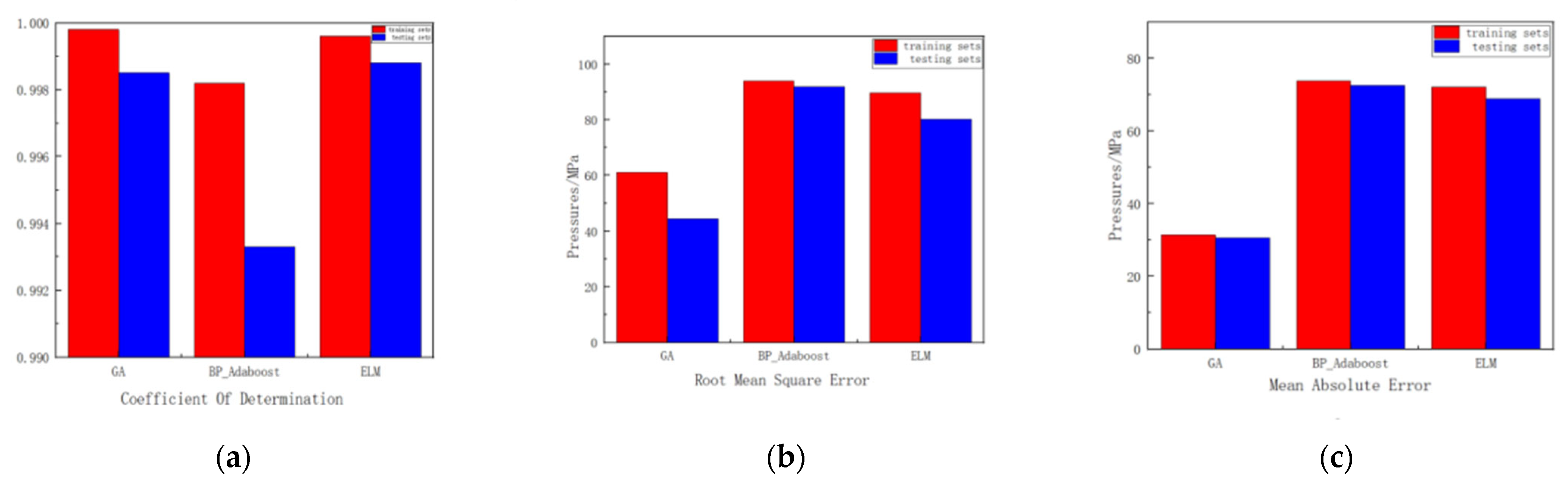
Nowadays, it has become a trend to use finite element simulation instead of experimental processes, and this is widely used in the fields of structural mechanics, fluid mechanics, fracture mechanics, and so on. By replacing the experimental process with finite element simulation, we can reduce time and costs; however, when using finite element simulation, we need to define a series of settings, such as modeling, material assignment, environment settings, and many other operations. For laser shock processing intensification, the simulation experiment process is cumbersome and time-consuming. It involves performing neural network agent modeling, replacing finite element simulation with the learning and prediction capabilities of neural networks, learning by using some of the simulation results as a training sets for the neural network, and then learning by using the remaining simulation results as testing sets to test the predictive ability of the neural network agent model. TC4 titanium alloy was selected as the experimental material. Three kinds of neural network agent models, a genetic algorithm-optimized BP network, a strong classifier design based on BP_Adaboost, and an extreme learning machine, instead of finite element simulation experiments, were used to predict the residual stresses generated on the surfaces of the material under different laser shock parameters. Comparing the prediction performances of different neural network agent models, the genetic algorithm-optimized BP network shows the best prediction performance, and its prediction value matches well with the experimental value. The R2, RMSE, and MAE of the testing sets of the BP network optimized using the genetic algorithm were 0.9985, 44.4518, and 30.6285, respectively. The BP network agent model optimized using the genetic algorithm for laser shock parameters other than the 208 sets of data also had good prediction performance, and the predicted values were similar to the actual experimental results. The prediction results show that the BP network optimized using the genetic algorithm can predict the residual stresses on the surface of TC4 titanium alloy material under strengthening via laser shock processing; the genetic algorithm-optimized BP neural network agent model is more convenient and quicker compared to the finite element simulation, and the predicted value is also similar to the actual value. It can thus be used to replace finite element simulation by establishing a more convenient and quicker neural network agent model.
Keywords: laser shock processing; genetic algorithm; optimized BP network; strong classifier design based on BP_Adaboost; extreme learning machine; residual stresses laser shock processing; genetic algorithm; optimized BP network; strong classifier design based on BP_Adaboost; extreme learning machine; residual stresses