Article

Emergence and Dissemination of NDM+OXA-48-like Co-Producing Klebsiella pneumoniae in a Regional Healthcare Network: Seven-Year Surveillance from Latium, Italy

1
Microbiology and Biobank Unit, National Institute for Infectious Diseases “Lazzaro Spallanzani”, IRCCS, 00149 Rome, Italy
2
UOS Technical Health Professions, National Institute for Infectious Diseases “Lazzaro Spallanzani”, IRCCS, 00149 Rome, Italy
3
Regional Service for Surveillance and Control of Infectious Diseases (SERESMI)—Lazio Region, National Institute for Infectious Diseases “Lazzaro Spallanzani”, IRCCS, 00149 Rome, Italy
4
Directorate for Health and Social Policy, Lazio Region, 00145 Rome, Italy
*
Author to whom correspondence should be addressed.
These authors contributed equally to this work.
Antibiotics 2026, 15(8), 766; https://doi.org/10.3390/antibiotics15080766
Submission received: 1 July 2026 / Revised: 31 July 2026 / Accepted: 5 August 2026 / Published: 10 August 2026

Abstract

Background/Objectives: The epidemiology of carbapenem-resistant Klebsiella pneumoniae (CR-Kp) in Europe is evolving towards an increasing contribution of metallo-β-lactamases (MBLs). In particular, co-production of New Delhi metallo-β-lactamase (NDM) and OXA-48-like carbapenemases represents a major concern due to limited therapeutic options and epidemic potential. We aimed to describe temporal trends and genomic characteristics of NDM and OXA-48-like co-producing K. pneumoniae within a regional surveillance programme targeting ceftazidime-avibactam (CZA)-resistant carbapenem-resistant Enterobacterales (CRE) in the Latium Region, Italy. Methods: Between January 2019 and December 2025, CZA-resistant CRE isolates were collected through a regional surveillance network. Antimicrobial susceptibility testing and carbapenemase detection were performed, and NDM-producing K. pneumoniae (NDM-Kpn) was analysed by whole-genome sequencing (WGS). Genomic analyses included multi-locus sequence typing, assessment of clonal relatedness, and resistome/virulome profiling. Results: A total of 2752 non-repetitive CZA-resistant CRE were collected. The analysis of CZA-resistant K. pneumoniae isolates submitted to the regional surveillance network showed that the proportion of NDM producers increased markedly from 2023 onwards. In particular, NDM in association with OXA-48-like reached 26.0% in 2024 and 43.6% in 2025, becoming the predominant carbapenemase profile within this selected surveillance population. WGS of 437 NDM-Kpn revealed a structured population dominated by Sequence Type (ST)147 (63.2%), widely disseminated across 24 hospitals and characterised by a predominant NDM-1 variant and OXA-48-like co-producing profile associated with KL10/wzi420 capsular type. A subset of isolates, mainly within the ST147-KL64 subgroup, showed higher virulence scores, indicating a possible convergence of resistance and virulence. Conclusions: Our findings indicate a rapid shift towards NDM-mediated resistance among CZA-resistant K. pneumoniae submitted to the regional surveillance network, with the emergence of NDM and OXA-48-like co-producing isolates associated with a dominant ST147 clone detected across multiple hospitals. These results highlight the urgent need for coordinated genomic surveillance and infection prevention strategies.

1. Introduction

Carbapenem-resistant Enterobacterales (CRE) represent a major global public health threat, being responsible for healthcare-associated outbreaks with high mortality rates [1]. Among CRE, carbapenem-resistant Klebsiella pneumoniae (CR-Kp) is one of the most clinically relevant pathogens, particularly in healthcare settings [2,3].
In Italy, the epidemiology of carbapenem resistance has long been dominated by KPC-producing K. pneumoniae isolates [4,5], for which the β-lactam/β-lactamase inhibitor combination ceftazidime–avibactam (CZA) has shown high clinical efficacy [6].
However, the extensive use of CZA has been paralleled by the emergence of resistance-associated mutations in different regions of the blaKPC gene, as well as by the increasing clinical relevance of intrinsically resistant isolates producing metallo-β-lactamases (MBLs) [7,8,9].
After the large outbreak of NDM-producing K. pneumoniae (NDM-Kpn) reported in Tuscany in 2018–2019 [10], growing attention has been directed towards MBL-producing strains. Since then, several regional outbreaks have been described, documenting the progressive spread of NDM-Kpn across Italy and underscoring the contribution of inter-facility transmission within interconnected healthcare networks [11,12,13,14,15,16,17].
Another important concern is the global dissemination of several K. pneumoniae sequence types (STs), including ST147, ST11, and ST383, associated with the emergence and dissemination of NDM-producing strains [16,18,19].
Among these, ST147 and the related clonal group (CG)147 (which includes ST147 together with related sequence types such as ST273 and ST392) are recognised as high-risk international clones that have played a major role in the rapid spread of multidrug-resistant (MDR) K. pneumoniae in Europe and Italy [20,21,22].
More recently, some of these successful clones have also been increasingly associated with co-production of OXA-48-like carbapenemases, a combination that further restricts therapeutic options and may enhance epidemic potential [23,24,25].
Despite these observations, long-term datasets integrating temporal trends, clonal structure, resistance determinants, and virulence features of NDM- and OXA-48-like co-producing K. pneumoniae at the international, national, and regional levels remain limited.
Within this evolving epidemiological scenario, in 2019 the National Institute for Infectious Diseases “Lazzaro Spallanzani” (INMI) IRCCS established a seven-year regional surveillance programme in the Latium Region, aiming to collect all CZA-resistant CRE isolates from clinical microbiology laboratories across the region. By combining microbiological characterization with whole-genome sequencing (WGS), we sought to define temporal trends, clonal expansion, and the resistance and virulence profiles of NDM- and OXA-48-like co-producing K. pneumoniae, thereby providing evidence to strengthen surveillance and support antimicrobial resistance (AMR) control strategies.

2. Results

2.1. Overview of the Collected CZA-Resistant CRE Isolates

In 2019, following the “European Centre for Disease Prevention and Control” (ECDC) alert [26], in an effort to prevent the spread of CZA-resistant CRE, and in our role as regional reference centre, we began collecting and analysing all CZA-resistant CRE isolates obtained from patients treated at our hospital, as well as strains received from other hospitals of the Latium Region. Twenty-eight clinical microbiology laboratories contributed to the regional surveillance programme, yielding 3093 isolates overall, which corresponded to 2752 non-repetitive, single-patient clinical strains of CZA-resistant CRE.
The collection comprised 18 species, most of which belonged to the Klebsiella genus (2354/2752; 85.5%), including K. pneumoniae (n = 2324, 84.45%), K. oxytoca (n = 13, 0.47%), K. variicola (n = 8, 0.29%), K. aerogenes (n = 6, 0.22%) and K. ozaenae (n = 3, 0.11%); Escherichia coli accounted for 265 isolates (9.6%). Other less frequently recovered species included Enterobacter spp. (n = 65, 2.6%; 39 E. cloacae, 23 E. hormaechei, two E. bugandensis and one E. kobei), Citrobacter spp. (n = 30, 1.09%; 27 C. freundii and three C. koseri), Proteus mirabilis (n = 25, 0.91%), Providencia spp. (n = 8, 0.29%; four P. rettgeri and four P. stuartii), Raoultella spp. (n = 4, 0.14%; three R. ornithinolytica and one R. planticola) and Morganella morganii (n = 1, 0.04%) (Table S1, Panel A).
Focusing on CR-Kpn, we analysed the distribution of specimen types within this subgroup. Rectal swabs were the most frequent (1277/2324; 55.0%), followed by urine (525/2324; 22.6%) and blood cultures (235/2324; 10.1%). Less frequent sources included bronchoalveolar lavage (58; 2.5%), wound swabs (57; 2.5%), catheter urine (48; 2.1%), catheter-drawn blood cultures (27; 1.2%), bronchial aspirates (26; 1.1%), and sputum (18; 0.8%). All remaining specimen types accounted for less than 1% of isolates.

2.2. Resistance Phenotypes

All 2752 isolates included in the surveillance were resistant to CZA. Across the overall collection, the epidemiology was largely driven by the two most-represented species, K. pneumoniae (2324/2752; 84.45%) and Escherichia coli (265/2752; 9.63%), which showed partially overlapping yet distinct carbapenemase production patterns over time (Table 1, Tables S1 and S2).
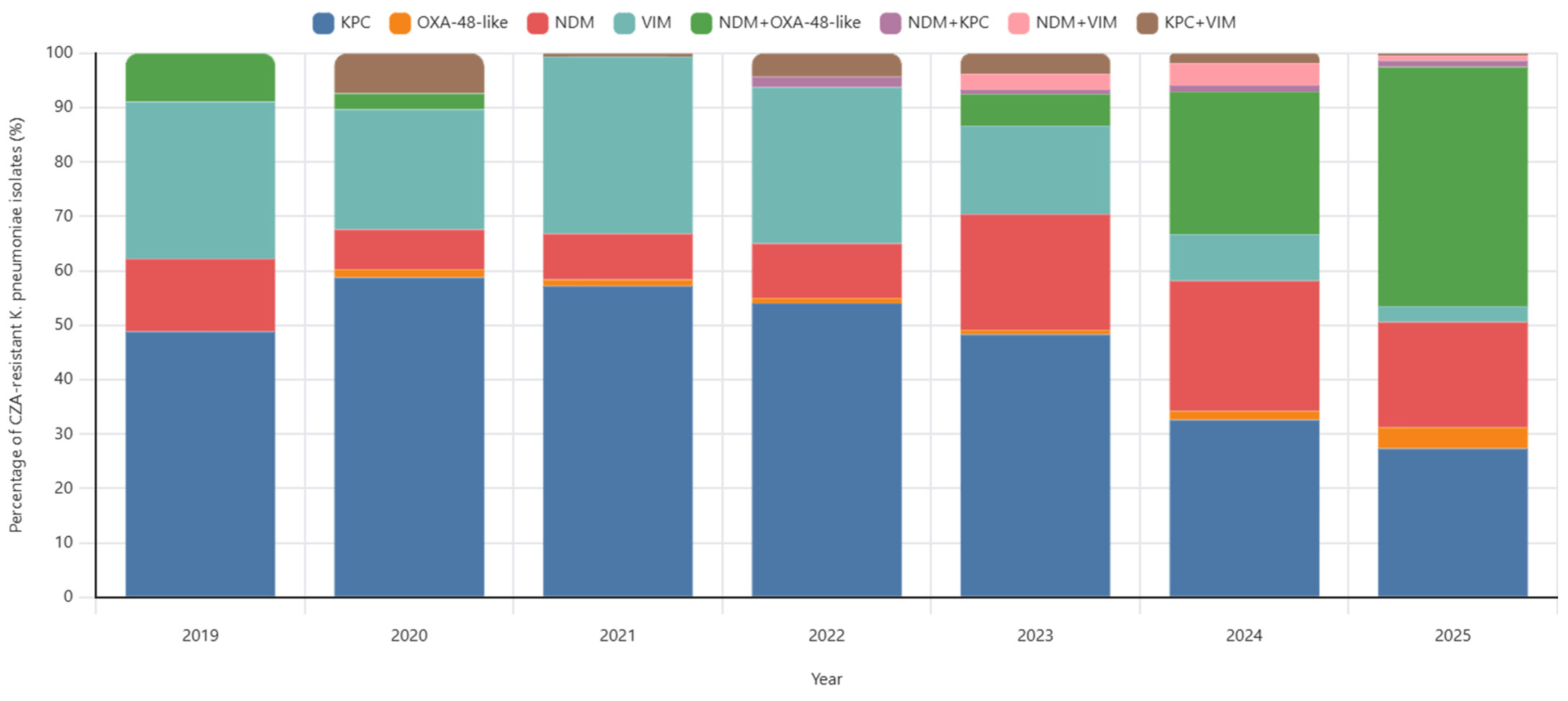
As shown in Table 1 and Table S1, KPC was the predominant carbapenemase among K. pneumoniae, accounting for 845/2324 isolates (36.4%) overall. Its proportion increased in the early phase of surveillance, reaching a peak of 58.8% in 2020, and then progressively declined to 27.1% in 2025. Among MBLs, VIM accounted for 254/2324 isolates (10.9%) and NDM for 426/2324 isolates (18.3%). VIM was the predominant MBL during the early years of surveillance, particularly from 2019 to 2022. However, from 2023 onwards, the epidemiological scenario changed markedly, with a progressive rise in NDM-producing isolates, from 10.0% in 2022 to 19.2% in 2025. An even more relevant finding was the sharp increase in K. pneumoniae isolates co-producing NDM and OXA-48-like enzymes, which accounted for 628/2324 isolates overall (27.0%). This resistance profile rose from 5.8% in 2023 to 43.6% in 2025, ultimately becoming the most prevalent carbapenemase profile by the end of the study period (Table 1 and Figure 1). Yearly proportions with Wilson 95% confidence intervals (CI) are reported in Table S1 Panel B. The temporal increase in NDM plus OXA-48-like co-producing K. pneumoniae was statistically significant by the Cochran-Armitage trend test (p < 0.0001).
A partially different pattern was observed in E. coli, in which MBLs clearly predominated throughout the study period. In this species, NDM was by far the most frequent determinant overall (205/265; 77.4%) and became the dominant carbapenemase from 2023 onwards, accounting for 82.4% of isolates in 2023 and 84.2% in 2025. VIM was the second most represented resistance mechanism (38/265; 14.3%), whereas KPC was uncommon throughout the study period (5/265; 1.9%) and never emerged as the leading carbapenemase profile in any study year. Co-production of NDM plus OXA-48-like was detected only in a limited number of E. coli isolates (9/265; 3.4%) (Table S2).
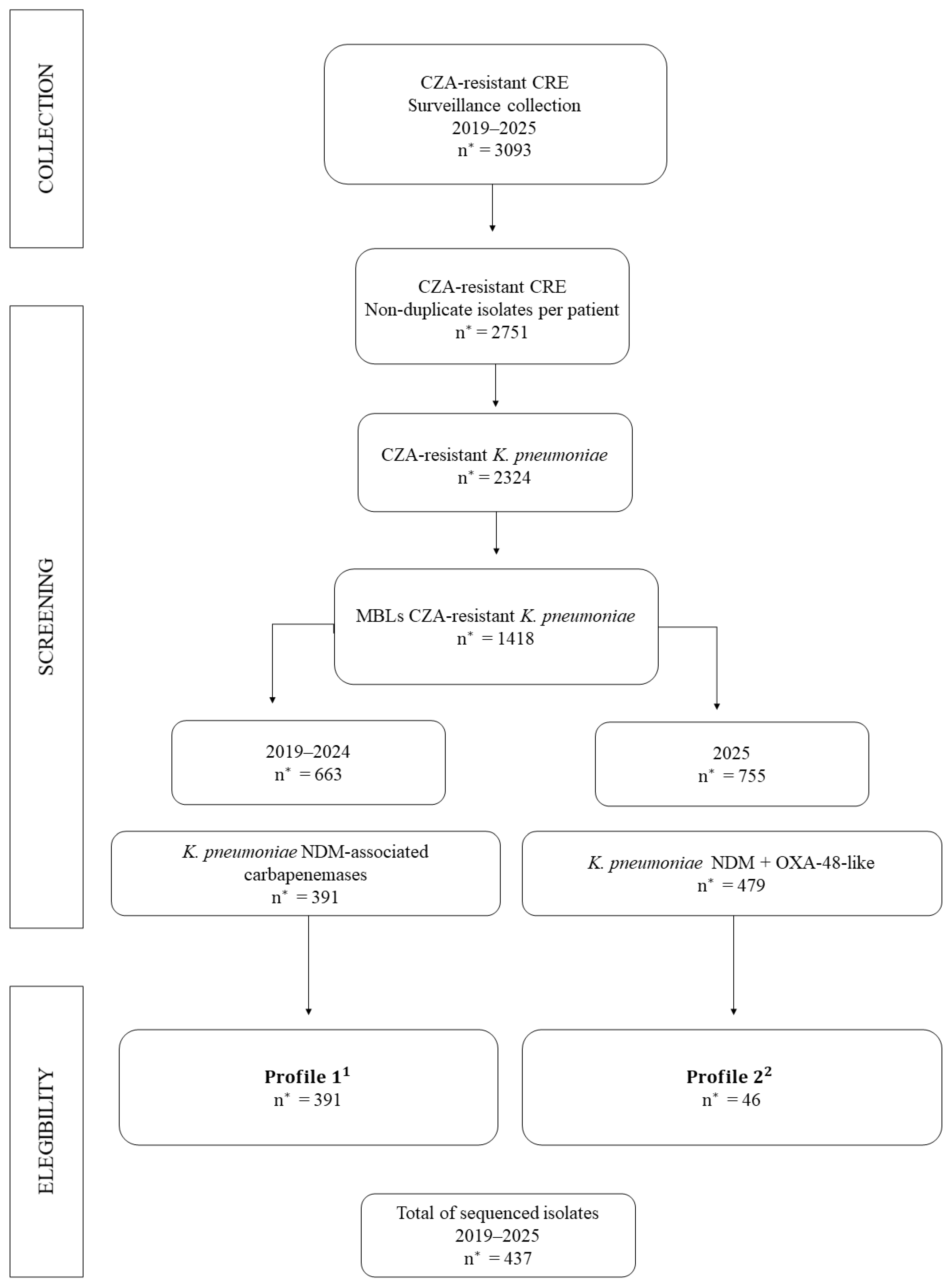
Figure 2 summarises the method used to select isolates for WGS analysis (from the overall CZA-resistant CRE surveillance collection). Among CZA-resistant K. pneumoniae collected over the study period, isolates producing NDM alone or in combination with OXA-48-like carbapenemases were considered eligible for genomic analysis. According to the patient-based and clinically oriented sampling strategy described in Section 4, 437 NDM-Kpn isolates were selected for WGS.
Given the marked predominance of NDM-Kpn isolates in 2025, including 211/1099 (19.2%) NDM producers and 479/1099 (43.6%) NDM plus OXA-48-like co-producers (Table 1), subsequent genomic analyses focused on this selected WGS dataset to characterize clonal relationships, resistance determinants, and virulence features.
All isolates displayed an extensively drug-resistant (XDR) phenotype, with resistance to carbapenems (meropenem, ertapenem and imipenem), high rates of resistance to ciprofloxacin (98.8%), piperacillin–tazobactam (99.7%) and trimethoprim–sulfamethoxazole (82.1%), and variable resistance to gentamicin and amikacin (84.2% and 90.4%, respectively).

2.3. Molecular Typing of Selected NDM-Producing K. pneumoniae Isolates

All 437 sequenced isolates carried a blaNDM gene, predominantly blaNDM-1 (390/437, 89.2%) and, less frequently, blaNDM-5 (47/437, 10.8%). Additional β-lactam resistance determinants were widely distributed, including blaCTX-M-15 (398/437, 91.1%) and blaOXA-48-like genes (197/437, 45.1%). A subset of isolates also harboured additional carbapenemases, including blaVIM-1 (5.9%) and blaKPC-3 (2.7%) (Table S3).
Beyond β-lactam resistance, WGS analysis revealed a broad repertoire of additional resistance determinants consistent with an XDR phenotype. Genes conferring resistance to aminoglycosides, quinolones, sulfonamides, trimethoprim, macrolides, tetracyclines and fosfomycin were commonly detected, with most isolates carrying multiple resistance determinants across several antimicrobial classes (Table S3).
Molecular typing of the 437 isolates revealed a highly structured population, in which 26 STs appeared distributed across 28 hospitals. ST147 was by far the predominant lineage, accounting for 276/437 isolates (63.2%), and showing the widest distribution across the surveillance network, followed by ST11 (88/437; 20.1%), ST512 (14/437; 3.2%) and ST1805 (12/437; 2.7%). Less frequent lineages included ST395 (9/437; 2.1%), ST383 (7/437; 1.6%), ST15 (5/437; 1.1%), ST6668 (4/437; 0.9%), ST307, ST14, ST20 and ST unknown (two isolates each), while several additional STs (ST16, ST17, ST23, ST25, ST29, ST39, ST200, ST234, ST1117, ST3299, ST4081, ST4853, ST6118, and ST8609) were represented by single isolates. Two isolates could not be assigned to any ST (Table 2).
In addition to defining clonal relationships and resistance determinants, WGS analysis also enabled the characterization of virulence-associated loci and virulence scores across the major circulating clones.
Virulence profiling revealed marked differences among the major epidemic clones. Most ST147 isolates exhibited a low virulence profile, with 219/276 (79.3%) showing a virulence score of 1, predominantly associated with yersiniabactin loci. This pattern was largely driven by the dominant KL10 subgroup, typically characterized by ybt1/ICEKp4 and lacking additional hypervirulence-associated determinants. In contrast, a subset of 45/276 ST147 isolates (16.3%) displayed higher virulence scores (score 4) and were mainly associated with the KL64 subgroup, in which ybt9/ICEKp3 frequently co-occurred with aerobactin (iuc1) and rmp-associated loci, indicating a convergent resistance–virulence profile.
Compared with ST147, ST11 isolates showed a more homogeneous and overall lower virulence profile, with 85/88 (96.6%) displaying a virulence score of 1, typically associated with ybt15/ICEKp11. Similarly, ST512 remained largely low-virulence, with ybt8/ICEKp9 and a virulence score of 1 predominating.
By contrast, ST1805, although less prevalent, showed a comparatively higher virulence potential, with 11/12 isolates displaying a virulence score of 3. Among minor STs, ST395 was also notable for its high virulence profile, with the majority of isolates (8/9) exhibiting a virulence score of 4, whereas ST383 combined frequent co-production of NDM and OXA-48-like carbapenemases with additional virulence-associated determinants, including iuc1 and rmp1, consistent with a convergent resistance–virulence phenotype (Table S4).
Core-genome multi-locus sequence typing (cgMLST) analysis further resolved the population into 25 CTs, highlighting a highly structured clonal architecture. ST147 showed the widest dissemination across the surveillance network, being detected in 24 hospitals and mainly distributed across nine defined CTs (CT-1 to CT-9). The population was largely dominated by a major cgMLST cluster, CT-1, comprising 166 isolates overall, including 165 ST147 isolates and one ST8609 isolate, followed by CT-2 (44 isolates), CT-3 (30 isolates) and CT-4 (12 isolates) (Table S5).
CT-1 represented the predominant cluster, comprising 166 isolates overall and spanning 17 hospitals. This cluster showed a homogeneous genomic profile, frequent co-production of NDM and OXA-48-like carbapenemases, and predominantly low virulence scores.
In contrast, other ST147 lineages displayed greater heterogeneity, including clusters associated with higher virulence scores (CT-2), additional carbapenemase determinants such as blaVIM-1 (CT-3), or alternative resistance profiles driven by blaNDM-5 (CT-4) (Tables S4 and S5).
Within ST147, co-production of NDM and OXA-48-like carbapenemases represented the main resistance mechanism, accounting for approximately two-thirds of isolates, and was mainly associated with the KL10/wzi420 capsular profile, whereas the KL64 subgroup was more frequently associated with higher virulence scores (Table S4).
This distribution is in line with the known phylogenetic structure of CG147, in which ST147 is divided into major KL64 and KL10 clades with distinct evolutionary histories and genomic features.
ST11 represented the second most prevalent clone and was identified in 12 hospitals. In contrast to the broader heterogeneity observed in ST147, ST11 displayed a more compact clonal structure, with most isolates clustering within a single major CT (CT-10, 81/88 isolates) and showing a strong association with the KL24 capsular locus (83/88; 94.3%). Although blaNDM-1 alone was the dominant resistance determinant, a limited number of isolates carried more complex carbapenemase combinations, including NDM plus OXA-48-like or NDM plus KPC-3 (Figure S1 and Table S4).
ST512 and ST1805 showed more limited dissemination. ST512 comprised 14 isolates distributed across two clusters (CT-12 and CT-13) and was consistently associated with KL107, whereas ST1805 included 12 isolates belonging to a single cluster (CT-11), all associated with KL48 and characterized by intermediate virulence scores (Figure S1 and Table S4).
Additional minor clones also suggested inter-hospital circulation. ST383 was consistently associated with KL30 and frequently displayed co-production of NDM and OXA-48-like carbapenemases, whereas ST395 was mainly linked to KL2 and characterized by a higher virulence profile (Figure S1 and Table S4).

3. Discussion

The progressive emergence of NDM-Kpn represents a major public health concern worldwide [23]. In this seven-year regional surveillance study of CZA-resistant CRE, we documented a marked shift in carbapenemase profiles, characterized by the rapid increase in NDM-Kpn and in isolates co-producing NDM and OXA-48-like carbapenemases (Table 1 and Figure 1). By 2025, this combined resistance profile had become the main carbapenemase mechanism observed in the CZA-resistant K. pneumoniae isolates included in our surveillance collection.
This transition was clearly reflected in the temporal distribution of resistance mechanisms (Table 1 and Figure 1). While KPC-producing isolates predominated during the early phase of surveillance, consistent with their long-standing endemicity in Italy [5,26], their prevalence progressively declined over time. In parallel, VIM-type MBLs played a major role in the initial years but were subsequently overtaken by NDM-producing isolates. From 2023 onwards, NDM became increasingly dominant, culminating in a sharp rise in NDM and OXA-48-like co-producing isolates, which increased from 5.8% in 2023 to 43.6% in 2025 (Table 1 and Figure 1). This trend mirrors the evolving epidemiological landscape described in Italy and other European countries, where NDM-Kpn has gained increasing prominence over the last decade [10,27,28,29,30,31,32].
Genomic analysis indicates that this epidemiological shift was largely driven by clonal expansion rather than independent horizontal acquisition of resistance determinants. ST147 was the predominant clone, accounting for over 60% of sequenced isolates, and showing extensive dissemination across the regional surveillance network, followed by ST11 and ST1805 (Table 2 and Table S4). These clones are widely recognized as international high-risk lineages shaping the epidemiology of CRE [11,13,14,22,30].
Taken together, these findings support the role of ST147 as the main epidemic lineage driving the regional spread of carbapenem-resistant K. pneumoniae within the healthcare network.
Notably, ST147 showed a structured clonal composition, with a predominant cgMLST cluster, CT-1, characterized by distinct resistance or virulence features (Table S5). The detection of CT-1 across 17 hospitals, together with its homogeneous genomic profile and frequent NDM plus OXA-48-like co-production, supports the interpretation of this cluster as an endemic high-risk ST147 clone stably circulating in the Latium regional healthcare setting. In the absence of patient-transfer data and detailed epidemiological links, these findings should not be interpreted as evidence of direct inter-hospital transmission.
In line with previous studies in Italy and Europe, ST147 has emerged as a high-risk clone responsible for global hospital outbreaks, further emphasising the role of healthcare networks in amplifying the regional spread of high-risk clones [32,33,34].
Within ST147, co-production of NDM and OXA-48-like carbapenemases was the predominant resistance mechanism and was strongly associated with specific capsular types, particularly the KL10/wzi420 lineage, followed by KL64 and, less frequently, KL51 (Table 2 and Table S4). This distribution aligns with the reported phylogenetic structure of CG147, in which ST147 is divided into two main capsular clades, KL64 and KL10; notably, the latter has been associated with NDM and OXA-48-like carbapenemases, whereas KL64 represents a globally disseminated clone with distinct genomic features [22]. Together, these observations are consistent with previous reports describing ST147 as a successful high-risk lineage able to co-harbour blaNDM-1 and blaOXA-48-like genes, further supporting its role in the international dissemination of convergent resistance profiles [35].
The expansion of the KL10/wzi420 lineage further supports the emergence of well-adapted MDR lineages within ST147.
Of note, CT-1 was largely composed of NDM and OXA-48-like co-producing isolates with highly homogeneous genomic profiles (Table S5 and Figure S1), supporting its role as the main epidemic lineage.
Additional lineages were associated with distinct resistance profiles, including blaNDM-5 and blaVIM-1 variants, or with increased virulence potential (Table S4 and Figure S1). Furthermore, blaNDM was identified across 26 distinct STs and 25 CTs (Table 2 and Table S4), suggesting that the expansion of dominant clones occurred alongside the circulation of diverse NDM-producing lineages, including novel or less common lineages such as ST6668 and ST383, the former having recently been reported as an emerging NDM-producing CC147-related clone in northern Italy [36]. However, because the present analysis was based on short-read WGS and cgMLST, the role of plasmid transmission, resistance-gene context, and horizontal gene transfer could not be assessed. Therefore, horizontal dissemination of resistance determinants can be considered a possible but unconfirmed mechanism in this setting.
Virulence profiling adds a further level of concern. While most isolates, particularly within ST147, displayed a low virulence profile, indicating that epidemic success was primarily driven by antimicrobial resistance and transmission fitness, a subset of isolates showed features of convergent evolution (Table 2 and Table S4). In particular, ST147 isolates belonging to the KL64 subgroup (16.3%) exhibited higher virulence scores and carried additional virulence determinants, including aerobactin (iuc1) and rmp-associated loci. This pattern is consistent with previous reports describing the convergence of resistance and virulence in K. pneumoniae [13,37].
Similar trends were observed in less prevalent STs, such as ST395, which showed a high virulence profile in the majority of isolates, and ST383, which combined frequent NDM and OXA-48-like co-production with additional virulence-associated determinants, including iuc1 and rmp1 (Table S4 and Figure S1). This finding of isolates with a convergent resistance-virulence phenotype raises concerns about the potential emergence of clinically impactful clones.
Some limitations of our study should be noted. First, the surveillance programme was restricted to CZA-resistant CRE, potentially introducing a selection bias favouring MBL-producing isolates. Therefore, the temporal trends reported here should be interpreted as reflecting the distribution of carbapenemase profiles among CZA-resistant CRE, and particularly CZA-resistant K. pneumoniae submitted to the regional surveillance network, not necessarily depicting the overall regional burden of CRE or CR-Kp.
Second, although the network covered a large regional healthcare system, the findings may not be fully generalisable to other settings. Third, because of the large number of strains collected, WGS was performed on a subset of isolates, possibly underrepresenting minor lineages.
Furthermore, detailed patient-level clinical information, including prior antimicrobial exposure, comorbidities, clinical outcomes, admission dates, epidemiological links, and inter-hospital patient-transfer data, was not systematically available across all participating centres. Consequently, although the distribution of closely related cgMLST clusters across multiple hospitals is consistent with inter-facility dissemination, the clinical impact of specific genomic profiles, direct transmission events, and transmission pathways could not be formally assessed.
Future studies integrating genomic surveillance with detailed epidemiological and clinical data will be important to better understand transmission dynamics and factors associated with the successful dissemination of high-risk clones. Long-read sequencing and dedicated plasmid/gene-context analyses would also be helpful in future studies to clarify the mechanisms underlying the dissemination of blaNDM and blaOXA-48-like determinants.
However, given the long surveillance period, the large number of facilities involved in the network, and the substantial number of isolates analysed, we believe that our findings provide a comprehensive picture of the evolving epidemiology of CZA-resistant CRE in our region.

4. Materials and Methods

4.1. Collection of Clinical Isolates

Between January 2019 and December 2025, we carried out a regional surveillance programme aimed at collecting all CZA-resistant CRE clinical strains, including isolates resistant to CZA due to carbapenemase mechanisms not inhibited by avibactam, such as MBL production. Twenty-eight clinical microbiology laboratories, distributed across the Latium Region and covering most Roman hospitals, participated in the survey. All isolates were re-evaluated in our laboratory for species identification and characterization of the carbapenem resistance mechanisms. WGS of a selected subset of 437 CR-Kpn isolates was performed to provide a comprehensive overview of bacterial circulation, virulence patterns, and clonal relatedness.
For WGS analysis, NDM-Kpn isolates were selected according to a patient-based sampling strategy. Specifically, the first NDM-Kpn isolate per patient was included across the surveillance period. In 2025, because of the sharp increase in NDM plus OXA-48-like co-producing K. pneumoniae, an additional subset of clinically relevant isolates was included to better capture the clonal and genomic diversity of this emerging resistance profile. These isolates were selected prioritising invasive isolates and isolates recovered from infection-associated clinical specimens, while also ensuring representation of different hospitals and collection periods.
The yearly distribution of eligible and sequenced isolates according to carbapenemase profile is shown in Figure 2.

4.2. Characterisation of Bacterial Isolates and of Resistance and Virulence Determinants

Antimicrobial susceptibility testing (AST) and bacterial identification were performed using the Phoenix system (Becton Dickinson Diagnostics, San Jose, CA, USA) and the MALDI TOF Biotyper Sirius system (Bruker Daltonics, Bremen, Germany), respectively. Minimum inhibitory concentrations (MICs) for colistin were determined by broth microdilution (Liofilchem, Roseto degli Abruzzi, Italy). All results were interpreted according to the current EUCAST guidelines [38], applying a CZA MIC breakpoint of 8 mg/L.
Following phenotypic screening, carbapenemase production was assessed with an immunochromatographic test (NG-Test CARBA5, NG Biotech, Paris, France). Only K. pneumoniae isolates confirmed to produce NDM alone, or NDM plus OXA-48-like carbapenemases, underwent additional molecular investigations, including WGS and genomic analysis, to determine clonal relationships, resistance determinants, and virulence features.
WGS was performed on the Illumina MiSeq platform (Illumina, San Diego, CA, USA), generating paired-end reads. The WGS workflow included raw-read quality control, adapter and low-quality base trimming, de novo genome assembly, assembly-quality assessment, species confirmation, and contamination checks.
Raw-read quality was assessed using FastQC (v0.11.9) [39], and trimming of adapters and low-quality bases was performed using Trimmomatic (v0.39) [40].
De novo genome assembly was performed using Unicycler (v0.5.1) [41]. Assembly quality was evaluated using QUAST (v5.3.0) [42] and BUSCO (v5.8.2) [43], based on assembly size, number of contigs, N50, genome completeness, and evidence of possible contamination or poor-quality assemblies. Only assemblies showing quality metrics consistent with K. pneumoniae genomes were retained for downstream analyses.
AMR determinants were identified using ResFinder (v4.7.2) (http://www.genomicepidemiology.org, accessed on 4 June 2026), applying a minimum identity threshold of 100% and an alignment length greater than 98%.
STs were assigned using Pathogenwatch (v88) (https://pathogen.watch/en, accessed on 4 June 2026), based on the K. pneumoniae MLST scheme. Pathogenwatch was also used as a complementary platform for species confirmation and to support the interpretation of virulence-associated loci and capsular antigen predictions.
Kleborate (v3.0) [44,45] (https://github.com/klebgenomics/Kleborate, accessed on 4 June 2026) was used to predict virulence-associated loci and assign virulence scores (0–5), K and O antigen serotypes, and the corresponding wzi allele for Klebsiella spp. Virulence scores were assigned according to the Kleborate virulence scoring framework, based on the presence or absence of yersiniabactin, colibactin, aerobactin, and rmp-associated loci. Loci reported as incomplete, fragmented, or below the tool-specific confidence thresholds were not considered positive for virulence-score assignment unless confirmed by concordant evidence from the complementary analysis.

4.3. Analysis of Clonal Relatedness

Genomic relatedness was assessed using the WGS-based cgMLST scheme (v1.0), implemented in Ridom SeqSphere+ (Ridom GmbH, Münster, Germany), with default parameters. Comparative analyses were based on the K. pneumoniae sensu lato cgMLST scheme, comprising 2358 target genes [46]. Minimum spanning trees were generated for visualisation, with allele assignments referenced to the genome NC_012731. CTs were defined as groups of isolates differing by ≤15 alleles (https://www.cgmlst.org, accessed on 5 June 2026).
All raw sequencing reads were deposited in the Sequence Read Archive (SRA) under BioProject IDs PRJNA686854, PRJNA1125835, and PRJNA1193862. Specifically, 126 genomes included in the present analysis were retrieved from the previous regional surveillance study and had already been deposited under the BioProject IDs PRJNA686854 and PRJNA1125835, while the remaining genomes were newly generated in this study and deposited under the BioProject ID PRJNA1193862.

4.4. Statistical Analysis

Yearly proportions of NDM plus OXA-48-like co-producing K. pneumoniae were calculated among CZA-resistant K. pneumoniae isolates submitted to the regional surveillance network. Wilson 95% confidence intervals were calculated for yearly proportions. Temporal trends across the study period were assessed using the Cochran-Armitage test for trend, implemented in the DescTools package (v0.99.60) (available at https://CRAN.R-project.org/package=DescTools, accessed on 23 July 2026) [47] in R software (v4.4.2) (available at https://www.r-project.org/, accessed on 23 July 2026) [48]. A two-sided p-value < 0.05 was considered statistically significant.

5. Conclusions

In conclusion, our findings document a rapid shift towards NDM-mediated resistance among CZA-resistant K. pneumoniae isolates submitted to the regional surveillance network, characterized by the expansion of NDM and OXA-48-like co-producing isolates and the predominance of a widely distributed ST147 clone.
The detection of lineages combining an XDR phenotype with increased virulence further highlights an alarming epidemiological scenario.
These results support the implementation of coordinated regional genomic surveillance, timely inter-hospital data sharing, and strengthened infection prevention and control strategies to monitor the dissemination of high-risk clones and guide public health interventions.

Supplementary Materials

The following supporting information can be downloaded at: https://www.mdpi.com/article/10.3390/antibiotics15080766/s1, Figure S1: Minor clonal clusters (CT-10 to CT-25) among NDM-Kpn isolates; Table S1: Distribution of CZA-resistant CRE according to species, beta-lactamase profile, yearly proportions of NDM plus OXA-48-like co-producing K. pneumoniae and statistical analysis; Table S2: Yearly distribution of carbapenemase profiles among CZA-resistant E. coli isolates submitted to the Latium regional surveillance network, 2019–2025. Table S3: Molecular characterization of NDM-Kpn isolates; Table S4: Molecular typing and characterization of virulence genes of NDM-Kpn isolates; and Table S5: Major clonal clusters (CT-1 to CT-9) among NDM-Kpn isolates.

Author Contributions

Conceptualization, C.V. and C.R.; methodology, C.M., C.C., O.B., M.C. and G.T.; software, M.P.; validation, C.V. and C.R.; formal analysis, C.V., C.R., C.M., C.C. and M.P.; investigation, S.D., P.S., A.S. and M.S.; resources, C.F.; data curation, C.V., C.R., C.M., C.C. and M.P.; writing—original draft preparation, C.V., C.R. and C.F.; writing—review and editing, C.N., C.M., C.C., O.B., M.C., G.T., M.P., S.D., M.S., A.S., P.S., C.V., C.R. and C.F.; visualization, C.V., C.R., C.M., C.C., O.B., M.P., C.N., S.D., M.S., M.C., G.T., P.S., A.S. and C.F.; supervision, C.V., C.R., C.N. and C.F.; project administration, C.F.; funding acquisition, C.F. All authors have read and agreed to the published version of the manuscript.

Funding

Italian Ministry of Health through Ricerca Corrente Linea 3, Project 2.

Institutional Review Board Statement

This study was conducted within the institutional surveillance and research activities of the National Institute for Infectious Diseases ‘Lazzaro Spallanzani’ IRCCS, which acts as the Regional Reference Laboratory and is institutionally mandated to perform advanced genomic investigations on clinically relevant microorganisms (Regional Decree G17673). The analysis was retrospective and observational, based exclusively on anonymized microbiological and clinical data generated during routine diagnostic and infection control procedures, with no additional sampling or patient-specific interventions. In accordance with national data protection regulations (Legislative Decree 196/2003, Article 110-bis, paragraph 4, as amended) and with the General Data Protection Regulation (EU) 2016/679, studies conducted by IRCCS institutions for scientific research and public health surveillance purposes using anonymized data do not require a formal ethics committee approval by the institutional ethics committee.

Informed Consent Statement

Specific informed consent for participation in this study was not required due to the retrospective nature of the study and the use of anonymized data. All patients had signed a written consent form at hospital admission, which is included in their clinical documentation, allowing the use of clinical data for institutional and research purposes according to hospital procedures.

Data Availability Statement

Raw sequencing reads have been deposited in the Sequence Read Archive (SRA) under BioProject IDs PRJNA686854, PRJNA1125835, and PRJNA1193862. Additional study data are available in an ad hoc Excel database archived at the authors’ institution (INMI “L. Spallanzani” IRCCS, Rome, Italy).

Acknowledgments

We thank the medical and nursing staff involved in the study for their invaluable support, dedication, and assistance in sample collection and patient management, as well as MIRRI-IT (Microbial Resource Research Infrastructure Italy) for its support in the preservation and management of microbial resources and isolates in the INMI-Biobank.

Conflicts of Interest

The authors declare no conflicts of interest.

Abbreviations

The following abbreviations are used in this manuscript:
CR-KpCarbapenem-resistant Klebsiella pneumoniae
MBLsMetallo-β-lactamases
NDMNew Delhi metallo-β-lactamase
CZACeftazidime-avibactam
CRECarbapenem-resistant Enterobacterales
EUCASTEuropean Committee on Antimicrobial Susceptibility Testing
WGSWhole-genome sequencing
INMINational Institute for Infectious Diseases “Lazzaro Spallanzani”
AMRAntimicrobial resistance
ECDCEuropean Centre for Disease Prevention and Control
MICsMinimum inhibitory concentrations
XDRExtensively drug-resistant
STSequence Type
CTCluster Type
cgMLSTCore-genome multi-locus sequence typing
KLCapsular locus
SRASequence Read Archive
CCClonal Complex
MDRMultidrug-resistant
CIConfidence Interval
ASTAntimicrobial susceptibility testing

References

  1. Patel, B.; Hopkins, K.L.; Freeman, R.; Pople, D.; Brown, C.S.; Robotham, J.V. Carbapenemase-producing Enterobacterales: A challenge for healthcare now and for the next decade. Infect. Prev. Pract. 2020, 2, 100089. [Google Scholar] [CrossRef] [PubMed]
  2. Di Pilato, V.; Pollini, S.; Miriagou, V.; Rossolini, G.M.; D’Andrea, M.M. Carbapenem-resistant Klebsiella pneumoniae: The role of plasmids in emergence, dissemination, and evolution of a major clinical challenge. Expert Rev. Anti-Infect. Ther. 2024, 22, 25–43. [Google Scholar] [CrossRef] [PubMed]
  3. Navon-Venezia, S.; Kondratyeva, K.; Carattoli, A. Klebsiella pneumoniae: A major worldwide source and shuttle for antibiotic resistance. FEMS Microbiol. Rev. 2017, 41, 252–275. [Google Scholar] [CrossRef] [PubMed]
  4. Arena, F.; Di Pilato, V.; Vannetti, F.; Fabbri, L.; Antonelli, A.; Coppi, M.; Pupillo, R.; Macchi, C.; Rossolini, G.M. Population structure of KPC carbapenemase-producing Klebsiella pneumoniae in a long-term acute-care rehabilitation facility: Identification of a new lineage of clonal group 101, associated with local hyperendemicity. Microb. Genom. 2020, 6, e000308. [Google Scholar] [CrossRef] [PubMed]
  5. Di Pilato, V.; Errico, G.; Monaco, M.; Giani, T.; Del Grosso, M.; Antonelli, A.; David, S.; Lindh, E.; Camilli, R.; Aanensen, D.M.; et al. The changing epidemiology of carbapenemase-producing Klebsiella pneumoniae in Italy: Toward polyclonal evolution with emergence of high-risk lineages. J. Antimicrob. Chemother. 2021, 76, 355–361. [Google Scholar] [CrossRef] [PubMed]
  6. Tumbarello, M.; Raffaelli, F.; Giannella, M.; Mantengoli, E.; Mularoni, A.; Venditti, M.; De Rosa, F.G.; Sarmati, L.; Bassetti, M.; Brindicci, G.; et al. Ceftazidime-avibactam use for Klebsiella pneumoniae carbapenemase-producing K. pneumoniae infections: A retrospective observational multicenter study. Clin. Infect. Dis. 2021, 73, 1664–1676. [Google Scholar] [CrossRef] [PubMed]
  7. Zakhour, J.; El Ayoubi, L.W.; Kanj, S.S. Metallo-beta-lactamases: Mechanisms, treatment challenges, and future prospects. Expert Rev. Anti-Infect. Ther. 2024, 22, 189–201. [Google Scholar] [CrossRef] [PubMed]
  8. Gaibani, P.; Campoli, C.; Lewis, R.E.; Volpe, S.L.; Scaltriti, E.; Giannella, M.; Pongolini, S.; Berlingeri, A.; Cristini, F.; Bartoletti, M.; et al. In vivo evolution of resistant subpopulations of KPC-producing Klebsiella pneumoniae during ceftazidime-avibactam treatment. J. Antimicrob. Chemother. 2018, 73, 1525–1529. [Google Scholar] [CrossRef] [PubMed]
  9. Giufrè, M.; Errico, G.; Del Grosso, M.; Pagnotta, M.; Palazzotti, B.; Ballardini, M.; Pantosti, A.; Meledandri, M.; Monaco, M. Detection of KPC-216, a Novel KPC-3 Variant, in a Clinical Isolate of Klebsiella pneumoniae ST101 Co-Resistant to Ceftazidime-Avibactam and Cefiderocol. Antibiotics 2024, 13, 507. [Google Scholar] [CrossRef] [PubMed]
  10. Tavoschi, L.; Forni, S.; Porretta, A.; Righi, L.; Pieralli, F.; Menichetti, F.; Falcone, M.; Gemignani, G.; Sani, S.; Vivani, P.; et al. Prolonged outbreak of New Delhi metallo-beta-lactamase-producing carbapenem-resistant Enterobacterales (NDM-CRE), Tuscany, Italy, 2018 to 2019. Eurosurveillance 2020, 25, 2000085. [Google Scholar] [CrossRef] [PubMed]
  11. Falcone, M.; Giordano, C.; Barnini, S.; Tiseo, G.; Leonildi, A.; Malacarne, P.; Menichetti, F.; Carattoli, A. Extremely drug-resistant NDM-9-producing ST147 Klebsiella pneumoniae causing infections in Italy, May 2020. Eurosurveillance 2020, 25, 2001779. [Google Scholar] [CrossRef] [PubMed]
  12. Martina, M.J.; Corey, B.W.; Sannio, F.; Hall, L.R.; MacDonald, U.; Jones, B.T.; Mills, E.G.; Harless, C.; Stam, J.; Maybank, R.; et al. Anatomy of an extensively drug-resistant Klebsiella pneumoniae outbreak in Tuscany, Italy. Proc. Natl. Acad. Sci. USA 2021, 118, e2110227118. [Google Scholar] [CrossRef] [PubMed]
  13. Di Pilato, V.; De Angelis, L.H.; Aiezza, N.; Baccani, I.; Niccolai, C.; Parisio, E.M.; Giordano, C.; Camarlinghi, G.; Barnini, S.; Forni, S.; et al. Resistome and virulome accretion in an NDM-1-producing ST147 sublineage of Klebsiella pneumoniae associated with an outbreak in Tuscany, Italy. Lancet Microbe 2022, 3, e224–e234. [Google Scholar] [CrossRef] [PubMed]
  14. Chironna, M.; Loconsole, D.; Centrone, F.; Sallustio, A.; Casulli, D.; Accogli, M. Emergence of NDM-1-producing ST147 Klebsiella pneumoniae strains isolated from bloodstream infections during the COVID-19 pandemic in Southern Italy. Popul. Med. 2023, 5, A141. [Google Scholar] [CrossRef]
  15. Tiseo, G.; Stefani, S.; Fasano, F.R.; Falcone, M. The burden of infections caused by metallo-β-lactamase-producing Enterobacterales in Italy: Epidemiology, outcomes and management. Infez. Med. 2025, 33, 249–260. [Google Scholar]
  16. D’Achille, G.; Cotoloni, G.; Nunzi, I.; Brescini, L.; Fioriti, S.; Armiento, M.; Pocognoli, A.; Giovanetti, E.; Paoletti, C.; Menzo, S.; et al. Diffusion of OXA-48- and NDM-5-producing Klebsiella pneumoniae ST383 clone in Central Italy. J. Antimicrob. Chemother. 2026, 81, dkaf397. [Google Scholar] [CrossRef] [PubMed]
  17. Capitani, V.; Ceparano, M.; Rosso, A.; Antonelli, G.; Augurusa, M.; Baccolini, V.; Ceccarelli, G.; De Giusti, M.; Mastroianni, C.M.; Pugliese, F.; et al. Outbreak Investigation Collaborating Group. Hospital outbreak sustained by Klebsiella pneumoniae sequence type 147 co-producing NDM-1 and OXA-48, Rome, Italy, February to March 2025: Molecular tracing and control measures. Eurosurveillance 2026, 31, 2500457. [Google Scholar] [CrossRef] [PubMed]
  18. Ripabelli, G.; Sammarco, M.L.; Salzo, A.; Scutellà, M.; Felice, V.; Tamburro, M. New Delhi metallo-β-lactamase (NDM-1)-producing Klebsiella pneumoniae of sequence type ST11: First identification in a hospital of Central Italy. Lett. Appl. Microbiol. 2020, 71, 652–659. [Google Scholar] [CrossRef] [PubMed]
  19. Protonotariou, E.; Meletis, G.; Chatzopoulou, F.; Malousi, A.; Chatzidimitriou, D.; Skoura, L. Emergence of Klebsiella pneumoniae ST11 Co-Producing NDM-1 and OXA-48 Carbapenemases in Greece. J. Glob. Antimicrob. Resist. 2019, 19, 81–82. [Google Scholar] [CrossRef] [PubMed]
  20. Mileto, I.; Petazzoni, G.; Corbella, M.; Gaiarsa, S.; Merla, C.; Kuka, A.; Ramus, M.; Terulla, C.; Brandolini, M.; Piralla, A.; et al. Rapid spread of a novel NDM-producing clone of Klebsiella pneumoniae CC147, Northern Italy, February to August 2023. Eurosurveillance 2023, 28, 2300522. [Google Scholar] [CrossRef] [PubMed]
  21. Turton, J.F.; Perry, C.; McGowan, K.; Turton, J.A.; Hope, R. Klebsiella pneumoniae sequence type 147: A high-risk clone increasingly associated with plasmids carrying both resistance and virulence elements. J. Med. Microbiol. 2024, 73, 001823. [Google Scholar] [CrossRef] [PubMed]
  22. Rodrigues, C.; Desai, S.; Passet, V.; Gajjar, D.; Brisse, S. Genomic evolution of the globally disseminated multidrug-resistant Klebsiella pneumoniae clonal group 147. Microb. Genom. 2022, 8, 000737. [Google Scholar] [CrossRef] [PubMed]
  23. Findlay, J.; Poirel, L.; Kessler, J.; Kronenberg, A.; Nordmann, P. New Delhi metallo-β-lactamase-producing Enterobacterales, Switzerland, 2019–2020. Emerg. Infect. Dis. 2021, 27, 2628–2637. [Google Scholar] [CrossRef] [PubMed]
  24. Castanheira, M.; Doyle, T.B.; Collingsworth, T.D.; Sader, H.S.; Mendes, R.E. Increasing frequency of OXA-48-producing Enterobacterales worldwide and activity of ceftazidime-avibactam, meropenem-vaborbactam, and comparators against these isolates. J. Antimicrob. Chemother. 2021, 76, 3125–3134. [Google Scholar] [CrossRef] [PubMed]
  25. Pitout, J.D.D.; Peirano, G.; Kock, M.M.; Strydom, K.A.; Matsumura, Y. The Global Ascendency of OXA-48-Type Carbapenemases. Clin. Microbiol. Rev. 2020, 33, e00102-19. [Google Scholar] [CrossRef] [PubMed]
  26. Iacchini, S.; Sabbatucci, M.; Gagliotti, C.; Rossolini, G.M.; Moro, M.L.; Iannazzo, S.; D’Ancona, F.; Pezzotti, P.; Pantosti, A. Bloodstream infections due to carbapenemase-producing Enterobacteriaceae in Italy: Results from nationwide surveillance, 2014 to 2017. Eurosurveillance 2019, 24, 1800159. [Google Scholar] [CrossRef] [PubMed]
  27. Coppi, M.; Antonelli, A.; Niccolai, C.; Bartolini, A.; Bartolini, L.; Grazzini, M.; Mantengoli, E.; Farese, A.; Pieralli, F.; Mechi, M.T.; et al. Nosocomial outbreak by NDM-1-producing Klebsiella pneumoniae highly resistant to cefiderocol, Florence, Italy, August 2021 to June 2022. Eurosurveillance 2022, 27, 2200795. [Google Scholar] [CrossRef] [PubMed]
  28. European Centre for Disease Prevention and Control (ECDC). Carbapenem-Resistant Enterobacteriaceae, Second Update—26 September 2019; ECDC: Stockholm, Sweden, 2019; Available online: https://www.ecdc.europa.eu/sites/default/files/documents/carbapenem-resistant-enterobacteriaceae-risk-assessment-rev-2.pdf (accessed on 3 April 2026).
  29. Fröding, I.; David, S.; Yeats, C.; Abu-Dahab, K.; Albiger, B.; Alikhan, N.F.; Alm, E.; Byfors, S.; Couto, N.; Caballero, J.D.; et al. Persistent spread of carbapenemase-producing Klebsiella pneumoniae in acute care hospitals in 36 European countries (the CCRE survey): A prospective, multicentre, cross-sectional, epidemiological, microbiological, and genomic surveillance study. Lancet Microbe 2026, 7, 101320. [Google Scholar] [CrossRef] [PubMed]
  30. Budia-Silva, M.; Kostyanev, T.; Ayala-Montaño, S.; Bravo-Ferrer Acosta, J.; Garcia-Castillo, M.; Cantón, R.; Goossens, H.; Rodriguez-Baño, J.; Grundmann, H.; Reuter, S. International and regional spread of carbapenem-resistant Klebsiella pneumoniae in Europe. Nat. Commun. 2024, 15, 5092. [Google Scholar] [CrossRef] [PubMed]
  31. Peirano, G.; Pitout, J.D.D. Rapidly spreading Enterobacterales with OXA-48-like carbapenemases. J. Clin. Microbiol. 2025, 63, e01515-24. [Google Scholar] [CrossRef] [PubMed]
  32. Nicitra, E.; Terrana, M.; Bongiorno, D.; Dodaro, S.; Greco, F.; Greco, S.; Marascio, N.; Mauro, M.V.; Pantanella, M.; Privitera, G.F.; et al. Circulation of a Unique Klebsiella pneumoniae Clone, ST147 NDM-1/OXA-48, in Two Diverse Hospitals in Calabria (Italy). Antibiotics 2025, 14, 128. [Google Scholar] [CrossRef] [PubMed]
  33. Grundmann, H.; Glasner, C.; Albiger, B.; Aanensen, D.M.; Tomlinson, C.T.; Tambić Andrašević, A.; Cantón, R.; Carmeli, Y.; Friedrich, A.W.; Giske, C.G.; et al. Occurrence of carbapenemase-producing Klebsiella pneumoniae and Escherichia coli in the European survey of carbapenemase-producing Enterobacteriaceae (EuSCAPE): A prospective, multinational study. Lancet Infect. Dis. 2017, 17, 153–163. [Google Scholar] [CrossRef] [PubMed]
  34. Barbadoro, P.; Dichiara, A.; Arsego, D.; Ponzio, E.; Savini, S.; Manso, E.; D’Errico, M.M. Spread of Carbapenem-Resistant Klebsiella pneumoniae in Hub and Spoke Connected Health-Care Networks: A Case Study from Italy. Microorganisms 2020, 8, 37. [Google Scholar] [CrossRef] [PubMed]
  35. Gondal, A.J.; Saleem, S.; Jahan, S.; Choudhry, N.; Yasmin, N. Novel Carbapenem-Resistant Klebsiella pneumoniae ST147 Coharboring blaNDM-1, blaOXA-48 and Extended-Spectrum β-Lactamases from Pakistan. Infect. Drug Resist. 2020, 13, 2105–2115. [Google Scholar] [CrossRef] [PubMed]
  36. Rimoldi, S.G.; Comandatore, F.; Cogliati, C.; Odelli, S.; Morelli, L.; Santus, P.; Antinori, S.; Dolci, A. New NDM-Producing and blaKPC-2-Harbouring Klebsiella pneumoniae ST6668 (CC147) Clone in Milan, Northern Italy. J. Glob. Antimicrob. Resist. 2026, 46, 126–127. [Google Scholar] [CrossRef] [PubMed]
  37. Lorenzin, G.; Gona, F.; Battaglia, S.; Spitaleri, A.; Saluzzo, F.; Trovato, A.; di Marco, F.; Cichero, P.; Biancardi, A.; Nizzero, P.; et al. Detection of NDM-1/5 and OXA-48 co-producing extensively drug-resistant hypervirulent Klebsiella pneumoniae in Northern Italy. J. Glob. Antimicrob. Resist. 2022, 28, 146–150. [Google Scholar] [CrossRef] [PubMed]
  38. The European Committee on Antimicrobial Susceptibility Testing. Breakpoint Tables for Interpretation of MICs and Zone Diameters. Version 15.0. Available online: https://www.eucast.org/ (accessed on 19 March 2026).
  39. Andrews, S. FastQC: A Quality Control Tool for High Throughput Sequence Data; ScienceOpen Inc.: Lexington, MA, USA, 2010. [Google Scholar]
  40. Bolger, A.M.; Lohse, M.; Usadel, B. Trimmomatic: A flexible trimmer for Illumina sequence data. Bioinformatics 2014, 30, 2114–2120. [Google Scholar] [CrossRef] [PubMed]
  41. Wick, R.R.; Judd, L.M.; Gorrie, C.L.; Holt, K.E. Unicycler: Resolving bacterial genome assemblies from short and long sequencing reads. PLoS Comput. Biol. 2017, 13, e1005595. [Google Scholar] [CrossRef] [PubMed]
  42. Gurevich, A.; Saveliev, V.; Vyahhi, N.; Tesler, G. QUAST: Quality assessment tool for genome assemblies. Bioinformatics 2013, 29, 1072–1075. [Google Scholar] [CrossRef] [PubMed]
  43. Manni, M.; Berkeley, M.R.; Seppey, M.; Simão, F.A.; Zdobnov, E.M. BUSCO Update: Novel and streamlined workflows along with broader and deeper phylogenetic coverage for scoring of eukaryotic, prokaryotic, and viral genomes. Mol. Biol. Evol. 2021, 38, 4647–4654. [Google Scholar] [CrossRef] [PubMed]
  44. Lam, M.M.C.; Wick, R.R.; Watts, S.C.; Cerdeira, L.T.; Wyres, K.L.; Holt, K.E. A genomic surveillance framework and genotyping tool for Klebsiella pneumoniae and its related species complex. Nat. Commun. 2021, 12, 4188. [Google Scholar] [CrossRef] [PubMed]
  45. Wyres, K.L.; Wick, R.R.; Gorrie, C.; Jenney, A.; Follador, R.; Thomson, N.R.; Holt, K.E. Identification of Klebsiella capsule synthesis loci from whole genome data. Microb. Genom. 2016, 2, e000102. [Google Scholar] [CrossRef] [PubMed]
  46. Kluytmans-van den Bergh, M.F.Q.; Rossen, J.W.A.; Bruijning-Verhagen, P.C.J.; Bonten, M.J.M.; Friedrich, A.W.; Vandenbroucke-Grauls, C.M.J.E.; Willems, R.J.L.; Kluytmans, J.A.J.W. Whole-genome multilocus sequence typing of extended-spectrum-beta-lactamase-producing Enterobacteriaceae. J. Clin. Microbiol. 2016, 54, 2919–2927. [Google Scholar] [CrossRef] [PubMed]
  47. Signorell, A. DescTools: Tools for Descriptive Statistics, Version 0.99.6. 2025. [CrossRef]
  48. R Core Team. R: A Language and Environment for Statistical Computing; R Foundation for Statistical Computing: Vienna, Austria, 2024; Available online: https://www.R-project.org/ (accessed on 23 July 2026).
Figure 1. Yearly distribution of carbapenemase profiles among CZA-resistant Klebsiella pneumoniae isolates submitted to the regional surveillance network (2019–2025). Yearly distribution of carbapenemase profiles among CZA-resistant K. pneumoniae isolates submitted to the Latium regional surveillance network, 2019–2025. Stacked bars show the annual percentage of each carbapenemase profile among non-repetitive CZA-resistant K. pneumoniae isolates. Colours indicate the different resistance profiles. A progressive increase in NDM plus OXA-48-like co-producing isolates was observed from 2023 onwards, reaching 43.6% in 2025.
Antibiotics 15 00766 g001
Figure 2. Flow chart of representative whole-genome sequencing (WGS) selection isolates. 1 Profile 1: K. pneumoniae NDM-associated carbapenemases (first isolate per patient) from 2019 to 2024. 2 Profile 2: K. pneumoniae NDM+OXA-48-like (prioritized invasive/infection-associated isolates) referred to 2025. n*: number of isolates.
Antibiotics 15 00766 g002
Table 1. Yearly distribution of carbapenemase profiles among CZA-resistant Klebsiella pneumoniae isolates submitted to the Latium regional surveillance network, 2019–2025.
YearNr.
of Isolates
Serine
β-Lactamase
Nr. (%)
Metallo
β-Lactamase
Nr. (%)
B-Lactamase Combination
Nr. (%)
KPC OXA-48-likeNDMVIMKPC +
OXA-48-like
KPC +
OXA-48-like + VIM
KPC + VIMKPC +
NDM
KPC +
NDM +
OXA-48-like
NDM +
OXA-48-like
NDM +
VIM
NDM +
OXA-48-like +
VIM
OXA-48-like +
VIM
20194522 (48.9) 6 (13.3)13
(28.9)
4
(8.9)
20206840
(58.8)
1
(1.5)
5
(7.4)
15
(22.1)
5
(7.4)
2
(2.9)
202116695
(57.2)
2
(1.2)
14
(8.4)
54
(32.5)
1
(0.6)
2022209113
(54.1)
2
(1)
21
(10)
60
(28.7)
9
(4.3)
4
(1.9)
2023240116
(48.3)
2
(0.8)
51
(21.3)
39
(16.3)
9
(3.8)
2
(0.8)
14
(5.8)
7
(2.9)
2024497161
(32.4)
8
(1.6)
118
(23.7)
42
(8.5)
9
(1.8)
6
(1.2)
2
(0.4)
129
(26)
20
(4)
2
(0.4)
20251099298
(27.1)
42
(3.8)
211
(19.2)
31
(2.8)
4
(0.36)
1
(0.09)
5
(0.46)
13
(1.18)
5
(0.46)
479
(43.6)
9
(0.8)
1
(0.09)
Nr. (%)2324845
(36.4)
57
(2.5)
426
(18.3)
254
(10.9)
4
(0.17)
1
(0.04)
38
(1.7)
25
(1.1)
7
(0.3)
628
(27)
36
(1.6)
1
(0.04)
2
(0.09)
Table 2. Overview of genomic characteristics of different Sequence Types NDM-Kpn isolates circulating in the Latium Region.
Sequence TypeTotal Nr.
(%)
MBL
Variants
β-Lactamase
Combinations
TypingVirulence
Score 4
NDM-1NDM-5NDM-1+ OXA-48-likeNDM-5+ OXA-48-likeNDM-1+ KPC-3NDM-5+ KPC-3NDM-1+ VIM-1NDM-1+ OXA-48-like+
KPC-3
CT 1KL 2H 30134
ST147276
(63.1%)
591216316 26 CT-1 (166) CT-2 (44)
CT-3 (30) CT-4 (12)
CT-5 (5) CT-6 (4)
CT-7 (3) CT-8 (2)
CT-9 (2)
KL10 (172)
KL51 (14)
KL64 (90)
2412219 45
ST1188
(20.1%)
8031 3 1CT-10 (81)
CT-19 (3)
CT-21 (2)
KL105 (3)
KL15 (1)
KL24 (83)
KL47 (1)
12285 1
ST51214
(3.2%)
71 42 CT-12 (7)
CT-13 (7)
KL107 (14)6212
ST180512
(2.7%)
12 CT-11 (12)KL48 (12)61 11
ST3959
(2.1%)
9 CT-15 (4)
CT-18 (3)
KL2 (8)
KL39 (1)
41 8
ST3837
(1.6%)
142 CT-16 (3)
CT-20 (2)
KL30 (7)43 31
ST155
(1.1%)
2 3 CT-17 (3)
CT-22 (2)
KL112 (5)2 2 3
ST66684
(0.9%)
4 CT-14 (4)KL64 (4)2 4
ST142
(0.4%)
2 CT-23 (2)KL2 (2)12
ST202
(0.4%)
2 CT-24 (2)KL28 (2)12
ST3072
(0.4%)
1 1 -KL102 (1)
KL64 (1)
211
STunknown2
(0.4%)
2 CT-25 (2)KL30 (2)1 2
ST86091
(0.2%)
1 CT-1 (1)KL10 (1)1 1
Thirteen additional STs (ST16, ST17, ST23, ST25, ST29, ST39, ST200, ST234, ST1117, ST3299, ST4081, ST4853 and ST6118) were represented by single isolates. 1 Cluster Types (CT-1 to CT-25) were identified using cgMLST method; the number in parentheses expresses the number of isolates within the cluster. 2 Capsular Types (KL); the number in parentheses expresses the number of isolates. 3 Hospital (H): Number of different hospitals where isolates were collected; 4 Virulence score range from 0 to 5. The virulence scores were defined based on the presence or absence of these loci, as follows: 0 = no yersiniabactin, colibactin or aerobactin; 1 = yersiniabactin only; 2 = yersiniabactin and colibactin (or colibactin only); 3 = aerobactin without yersiniabactin or colibactin; 4 = aerobactin with yersiniabactin (no colibactin); and 5 = yersiniabactin, colibactin, and aerobactin.
Disclaimer/Publisher’s Note: The statements, opinions and data contained in all publications are solely those of the individual author(s) and contributor(s) and not of MDPI and/or the editor(s). MDPI and/or the editor(s) disclaim responsibility for any injury to people or property resulting from any ideas, methods, instructions or products referred to in the content.