Analysis of Infectious Keratitis Isolates and Antimicrobial Resistance: An 8-Year Retrospective Study in Southern China

 and
and
Abstract
1. Introduction
2. Results
2.1. Isolated Microorganisms
2.2. Antimicrobial Resistance of Bacteria
3. Discussion
4. Materials and Methods
4.1. Data Collection
4.2. Sample Collection and Processing
4.3. Microbiological Identification and Susceptibility Testing
4.4. Statistical Analysis
5. Conclusions
Supplementary Materials
Author Contributions
Funding
Institutional Review Board Statement
Informed Consent Statement
Data Availability Statement
Conflicts of Interest
References
- Cabrera-Aguas, M.; Khoo, P.; Watson, S.L. Infectious keratitis: A review. Clin. Exp. Ophthalmol. 2022, 50, 543–562. [Google Scholar] [CrossRef] [PubMed]
- Ung, L.; Bispo, P.J.M.; Shabhag, S.S.; Gilmore, M.S.; Chodosh, J. The persistent dilemma of microbial keratitis: Global burden, diagnosis, and antimicrobial resistance. Surv. Ophthalmol. 2019, 64, 255–271. [Google Scholar] [CrossRef] [PubMed]
- Green, M.; Carnt, N.; Apel, A.; Stapleton, F. Queensland microbial keratitis database: 2005–2015. Br. J. Ophthalmol. 2019, 103, 1481–1486. [Google Scholar] [CrossRef] [PubMed]
- Hernandez-Camarena, J.C.; Graue-Hernandez, E.O.; Ortiz-Casas, M.; Ramirez-Miranda, A.; Navas, A.; Pedro-Aguilar, L.; Lopez-Espinosa, N.L.; Gaona-Juarez, C.; Bautista-Hernandez, L.A.; Bautista-de Lucio, V.M. Trends in microbiological and antibiotic sensitivity patterns in infectious keratitis: 10-year experience in Mexico City. Cornea 2015, 34, 778–785. [Google Scholar] [CrossRef] [PubMed]
- Ibrahim, Y.W.; Boase, D.L.; Cree, I.A. Epidemiological characteristics, predisposing factors and microbiological profiles of infectious corneal ulcers: The Portsmouth corneal ulcer study. Br. J. Ophthalmol. 2009, 93, 1319–1324. [Google Scholar] [CrossRef] [PubMed]
- Mabrouk, N.A.; Abdelkader, M.F.; Abdelhakeem, M.A.; Mourad, K.M.; Abdelghany, A.A. Epidemiology, clinical profile and treatment outcomes of bacterial and fungal keratitis. Int. Ophthalmol. 2021, 42, 1401–1407. [Google Scholar] [CrossRef] [PubMed]
- Cabrera-Aguas, M.; Chidi-Egboka, N.; Kandel, H.; Watson, S.L. Antimicrobial resistance in ocular infection: A review. Clin. Exp. Ophthalmol. 2024, 52, 258–275. [Google Scholar] [CrossRef] [PubMed]
- Xu, X.W.; Wu, X.X.; Jiang, X.G.; Xu, K.J.; Ying, L.J.; Ma, C.L.; Li, S.B.; Wang, H.Y.; Zhang, S.; Gao, H.N.; et al. Clinical findings in a group of patients infected with the 2019 novel coronavirus (SARS-CoV-2) outside of Wuhan, China: Retrospective case series. BMJ 2020, 19, m606. [Google Scholar] [CrossRef] [PubMed]
- Shi, Q.; Mao, D.; Zhang, Z.; Qudsi, A.I.; Wei, M.; Cheng, Z.; Zhang, Y.; Wang, Z.; Chen, K.; Xu, X.; et al. Epidemiological and antimicrobial resistance trends in bacterial keratitis: A hospital-based 10-year study (2014–2024). Microorganisms 2025, 13, 670. [Google Scholar] [CrossRef] [PubMed]
- TTseng, Y.W.; Huang, C.W.; Chen, C.C.; Er, T.K. Assessment of antibiotic resistance patterns in Central Taiwan during the COVID-19 pandemic: A retrospective study. J. Infect. Public Health 2024, 17, 229–235. [Google Scholar]
- Eurosurveillance Editorial Team. WHO member states adopt global action plan on antimicrobial resistance. Eurosurveillance 2015, 20, 21137. [Google Scholar] [PubMed]
- Lin, C.C.; Lalitha, P.; Srinivasan, M.; Prajna, N.V.; McLeod, S.D.; Acharya, N.R.; Lietman, T.M.; Porco, T.C. Seasonal trends of microbial keratitis in South India. Cornea 2012, 31, 1123–1127. [Google Scholar] [CrossRef] [PubMed]
- Ting, D.S.J.; Ho, C.S.; Cairns, J.; Elsahn, A.; Al-Aqaba, M.; Boswell, T.; Said, D.G.; Dua, H.S. 12-year analysis of incidence, microbiological profiles and in vitro antimicrobial susceptibility of infectious keratitis: The Nottingham infectious keratitis study. Br. J. Ophthalmol. 2021, 105, 328–333. [Google Scholar] [PubMed]
- Moledina, M.; Roberts, H.W.; Mukherjee, A.; Spokes, D.; Pimenides, D.; Stephenson, C.; Bassily, R.; Rajan, M.S.; Myerscough, J. Analysis of microbial keratitis incidence, isolates and in-vitro antimicrobial susceptibility in the East of England: A 6-year study. Eye 2023, 37, 2716–2722. [Google Scholar] [CrossRef] [PubMed]
- Alexandrakis, G.; Alfonso, E.C.; Miller, D. Shifting trends in bacterial keratitis in South Florida and emerging resistance to fluoroquinolones. Ophthalmology 2000, 107, 1497–1502. [Google Scholar] [CrossRef] [PubMed]
- Laspina, F.; Samudio, M.; Cibils, D.; Ta, C.N.; Fariña, N.; Sanabria, R.; Klauß, V.; de Kaspar, H.M. Epidemiological characteristics of microbiological results on patients with infectious corneal ulcers: A 13-year survey in Paraguay. Graefes Arch. Clin. Exp. Ophthalmol. 2004, 242, 204–209. [Google Scholar] [CrossRef] [PubMed]
- Bălășoiu, A.T.; Bălășoiu, M.; Zlatian, O.M.; Ghenea, A.E. Bacterial and fungal keratitis in a tertiary care hospital from Romania. Microorganisms 2024, 12, 787. [Google Scholar] [CrossRef] [PubMed]
- Xu, S.; Guo, D.; Liu, X.; Jin, X.; Shi, Y.; Wang, Y.; Zhang, N.; Zhang, H. Ocular pathogens and antibiotic resistance in microbial keratitis over three years in Harbin, Northeast China. Acta Ophthalmol. 2021, 99, 909–915. [Google Scholar] [CrossRef] [PubMed]
- Wang, L.; Sun, S.; Jing, Y.; Han, L.; Zhang, H.; Yue, J. Spectrum of fungal keratitis in Central China. Clin. Exp. Ophthalmol. 2009, 37, 763–771. [Google Scholar] [CrossRef] [PubMed]
- Srinivasan, M.; Gonzales, C.A.; George, C.; Cevallos, V.; Mascarenhas, J.M.; Asokan, B.; Wilkins, J.; Smolin, G.; Whitcher, J.P. Epidemiology and aetiological diagnosis of corneal ulceration in Madurai, South India. Br. J. Ophthalmol. 1997, 81, 965–971. [Google Scholar] [CrossRef] [PubMed]
- Ling, J.Y.M.; Yeung, S.N.; Chan, C.C.; Trinh, T.; Antaki, F.; Harissi-Dagher, M.; Sivachandran, N.; Fava, M.; Légaré, M.; Iovieno, A. Trends and clinical outcomes of fungal keratitis in Canada: A 20-year retrospective multicentre study. Am. J. Ophthalmol. 2024, 265, 147–155. [Google Scholar] [CrossRef] [PubMed]
- Lamas-Francis, D.; Navarro, D.; Mansilla, R.; de-Rojas, V.; Moreno, C.; Dios, E.; Rigueiro, J.; Álvarez, D.; Crego, P.; Rodríguez-Ares, T.; et al. Fungal keratitis in Northwestern Spain: Epidemiology, risk factors and outcomes. J. Fungi 2024, 10, 689. [Google Scholar] [CrossRef] [PubMed]
- Chang, C.W.; Ho, C.K.; Chen, Z.C.; Hwang, Y.H.; Chang, C.Y.; Liu, S.T.; Chen, M.J.; Chen, M.Y. Fungi genus and concentration in the air of onion fields and their opportunistic action related to mycotic keratitis. Arch. Environ. Health 2002, 57, 349–354. [Google Scholar] [CrossRef] [PubMed]
- Gao, W.; Xia, T.; Chen, H.B.; Pan, X.J.; Huang, Y.S.; Wang, X.; Dong, Y.-L.; Xie, L.-X. Ocular bacterial infections at a tertiary eye center in China: A 5-year review of pathogen distribution and antibiotic sensitivity. Int. J. Ophthalmol. 2020, 13, 54–60. [Google Scholar] [CrossRef] [PubMed]
- Cabrera-Aguas, M.; Khoo, P.; George, C.R.R.; Lahra, M.M.; Watson, S.L. Antimicrobial resistance trends in bacterial keratitis over 5 years in Sydney, Australia. Clin. Exp. Ophthalmol. 2020, 48, 183–191. [Google Scholar] [PubMed]
- Gupta, K.; Unhale, R.; Garner, O.B.; Deng, S.X.; MFung, S.S. Infectious keratitis isolates and susceptibility in Southern California. Cornea 2022, 41, 1094–1102. [Google Scholar] [CrossRef] [PubMed]
- Butt, G.F.; Recchioni, A.; Moussa, G.; Hodson, J.; Wallace, G.R.; Murray, P.I.; Rauz, S. The impact of the COVID-19 pandemic on microbial keratitis presentation patterns. PLoS ONE 2021, 16, e0256240. [Google Scholar] [CrossRef] [PubMed]
- Soleimani, M.; Tabatabaei, S.A.; Masoumi, A.; Mirshahi, R.; Ghahvechian, H.; Tayebi, F.; Momenaei, B.; Mahdizad, Z.; Mohammadi, S.S. Infectious keratitis: Trends in microbiological and antibiotic sensitivity patterns. Eye 2021, 35, 3110–3115. [Google Scholar] [CrossRef] [PubMed]
- Wang, J.J.; Lai, C.H.; Chen, C.Y.; Liu, C.Y.; Lin, M.H.; Yang, Y.H.; Wu, P.L. Trends in infectious keratitis in Taiwan: An update on predisposing factors, microbiological and antibiotic susceptibility patterns. Diagnostics 2022, 12, 2095. [Google Scholar] [CrossRef] [PubMed]
- Edwards, K.; Keay, L.; Naduvilath, T.; Snibson, G.; Taylor, H.; Stapleton, F. Characteristics of and risk factors for contact lens-related microbial keratitis in a tertiary referral hospital. Eye 2009, 23, 153–160. [Google Scholar] [PubMed]
- Vianya-Estopa, M.; Wolffsohn, J.S.; Beukes, E.; Trott, M.; Smith, L.; Allen, P.M. Soft contact lens wearers’ compliance during the COVID-19 pandemic. Cont. Lens Anterior Eye 2021, 44, 101359. [Google Scholar] [CrossRef] [PubMed]
- Fernandes, M.; Vira, D.; Dey, M.; Tanzin, T.; Kumar, N.; Sharma, S. Comparison between polymicrobial and fungal keratitis: Clinical features, risk factors, and outcome. Am. J. Ophthalmol. 2015, 160, 873–881.e2. [Google Scholar] [CrossRef] [PubMed]
- Ting, D.S.J.; Ho, C.S.; Deshmukh, R.; Said, D.G.; Dua, H.S. Infectious keratitis: An update on epidemiology, causative microorganisms, risk factors, and antimicrobial resistance. Eye 2021, 35, 1084–1101. [Google Scholar] [CrossRef] [PubMed]
- Roth, M.; Goerke, P.; Holtmann, C.; Frings, A.; MacKenzie, C.R.; Geerling, G. Spectrum and resistance in bacterial infections of the ocular surface in a German tertiary referral center 2009–2019. Graefes Arch. Clin. Exp. Ophthalmol. 2022, 260, 3909–3917. [Google Scholar] [CrossRef] [PubMed]
- Hooper, D.C.; Jacoby, G.A. Mechanisms of drug resistance: Quinolone resistance. Ann. N. Y. Acad. Sci. 2015, 1354, 12–31. [Google Scholar] [CrossRef] [PubMed]
- Aragona, P.; Baudouin, C.; Benitez Del Castillo, J.M.; Messmer, E.; Barabino, S.; Merayo-Lloves, J.; Brignole-Baudouin, F.; Inferrera, L.; Rolando, M.; Mencucci, R.; et al. The ocular microbiome and microbiota and their effects on ocular surface pathophysiology and disorders. Surv. Ophthalmol. 2021, 66, 907–925. [Google Scholar] [CrossRef] [PubMed]
- Tam, A.L.C.; Côté, E.; Saldanha, M.; Lichtinger, A.; Slomovic, A.R. Bacterial keratitis in Toronto: A 16-year review of the microorganisms isolated and the resistance patterns observed. Cornea 2017, 36, 1528–1534. [Google Scholar] [CrossRef] [PubMed]
- Leal, S.M., Jr.; Rodino, K.G.; Fowler, W.C.; Gilligan, P.H. Practical guidance for clinical microbiology laboratories: Diagnosis of ocular infections. Clin. Microbiol. Rev. 2021, 34, e0007019. [Google Scholar] [CrossRef] [PubMed]



| Overall (n = 2741) | 2017–2020 (n = 1169) | 2021–2024 (n = 1572) | p Value | ||
|---|---|---|---|---|---|
| Age (years) | 56 (47–64) | 54 (45–63) | 57 (48–65) | <0.001 # | |
| Sex | Male (%) | 1729 (63.1) | 732 (62.6) | 997 (63.4) | 0.666 * |
| Female (%) | 1012 (36.9) | 437 (37.4) | 575 (36.6) |
| Organisms | Total n (%), n = 1124 | 2017–2020 n (%), n = 488 | 2021–2024 n (%), n = 636 | p Value * |
|---|---|---|---|---|
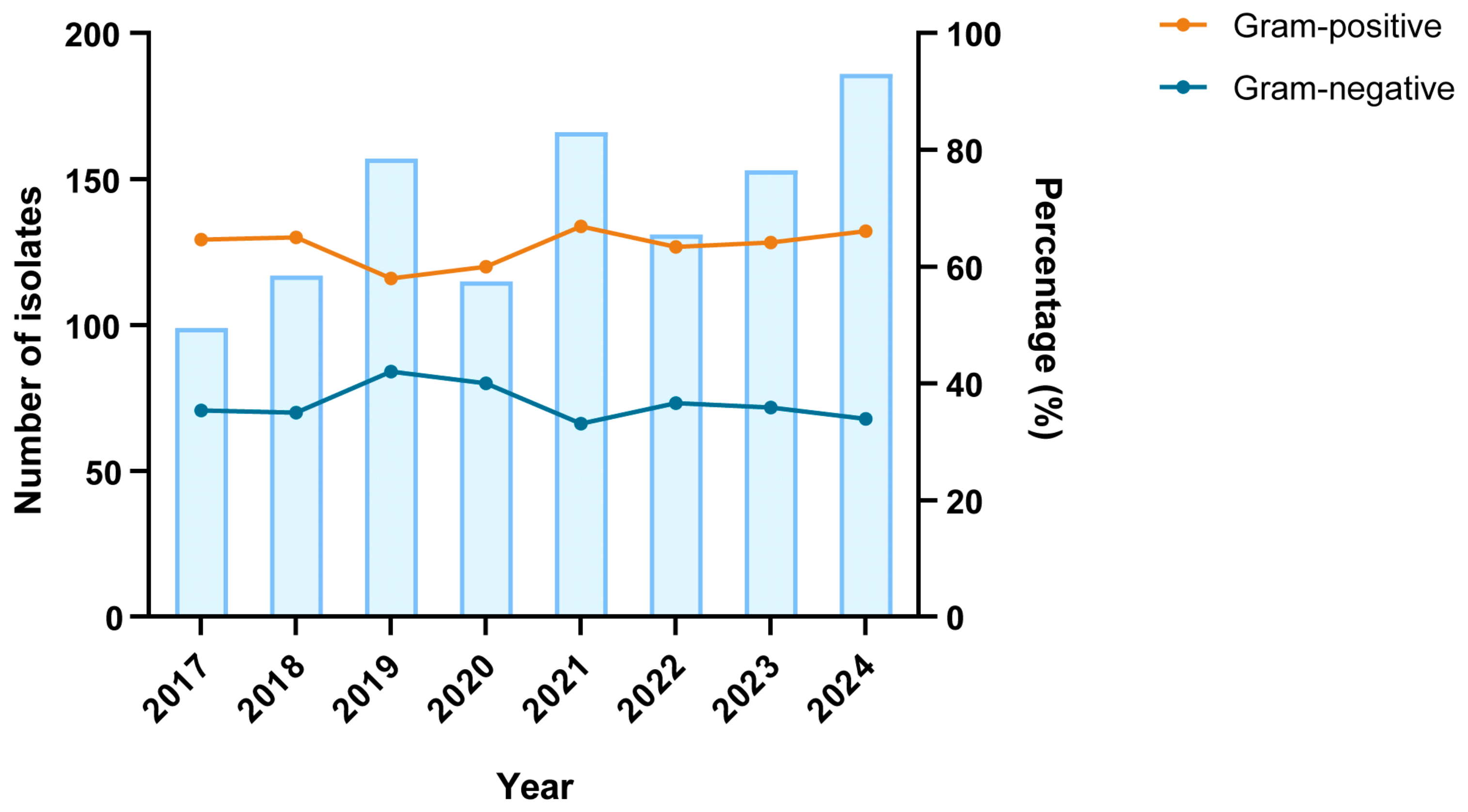
| Gram-positive | 715 (63.6) | 300 (61.5) | 415 (65.3) | 0.192 |
| Staphylococcus | 462 (41.1) | 165 (33.8) | 297 (46.7) | <0.001 |
| coagulase-negative staphylococci | 392 (34.9) | 140 (28.7) | 252 (39.6) | <0.001 |
| Staphylococcus aureus | 70 (6.2) | 25 (5.1) | 45 (7.1) | 0.179 |
| Streptococcus | 88 (7.8) | 45 (9.2) | 43 (6.8) | 0.128 |
| Corynebacterium | 34 (3.0) | 16 (3.3) | 18 (2.8) | 0.663 |
| Micrococcus | 14 (1.2) | 5 (1.0) | 9 (1.4) | 0.558 |
| Bacillus | 24 (2.1) | 11 (2.3) | 13 (2.0) | 0.809 |
| Kocuria | 10 (0.9) | 10 (2.0) | 0 (0.0) | <0.001 # |
| Propionibacterium | 23 (2.0) | 12 (2.5) | 11 (1.7) | 0.392 |
| Enterococcus | 11 (1.0) | 6 (1.2) | 5 (0.8) | 0.546 # |
| Others | 49 (4.4) | 30 (6.1) | 19 (3.0) | |
| Gram-negative | 409 (36.4) | 188 (38.5) | 221 (34.7) | 0.192 |
| Pseudomonas | 212 (18.9) | 109 (22.3) | 103 (16.2) | 0.009 |
| Acinetobacter | 23 (2.0) | 12 (2.5) | 11 (1.7) | 0.392 |
| Serratia | 28 (2.5) | 6 (1.2) | 22 (3.5) | 0.017 |
| Stenotrophomonas | 12 (1.1) | 5 (1.0) | 7 (1.1) | 0.902 |
| Achromobacter | 10 (0.9) | 5 (1.0) | 5 (0.8) | 0.754 # |
| Klebsiella | 13 (1.2) | 3 (0.6) | 10 (1.6) | 0.137 |
| Moraxella | 11 (1.0) | 3 (0.6) | 8 (1.3) | 0.366 # |
| Others | 100 (8.9) | 45 (9.2) | 55 (8.6) |
| Fungus | Count (%) |
|---|---|
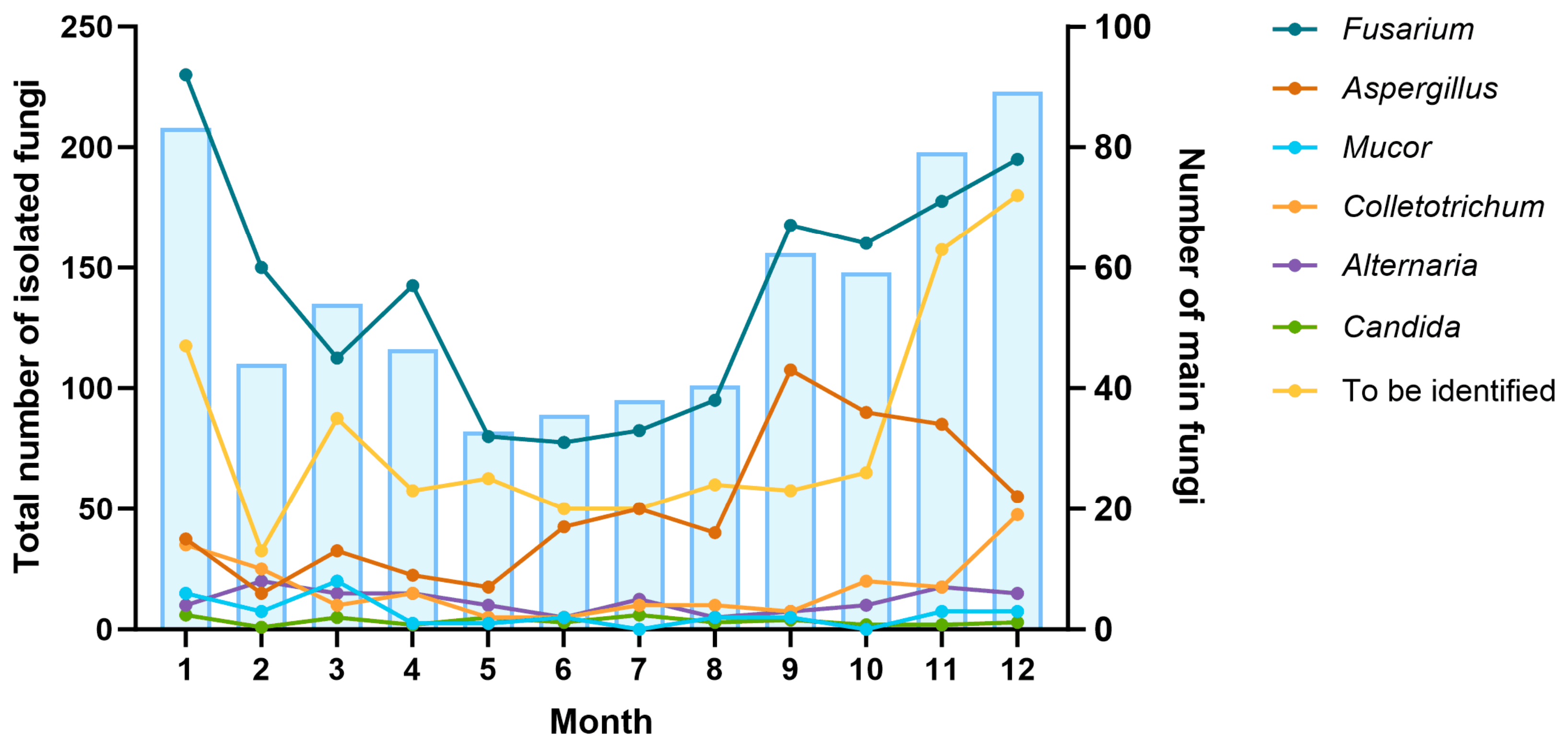
| Fusarium | 668 (40.2) |
| Aspergillus | 238 (14.3) |
| Colletotrichum | 83 (5.0) |
| Alternaria | 57 (3.4) |
| Candida | 42 (2.5) |
| Mucor | 31 (1.9) |
| Penicillium | 24 (1.4) |
| Purpureocillium | 24 (1.4) |
| Scedosporium | 18 (1.1) |
| Acremonium | 14 (0.8) |
| Curvularia | 13 (0.8) |
| Botryosphaeria | 9 (0.5) |
| Cladosporum | 8 (0.5) |
| Others | 41 (2.5) |
| To be identified | 391 (23.5) |
| Total | 1661 (100.0) |
| Organisms | 2017–2024 n/N (%) | 2017–2020 n/N (%) | 2021–2024 n/N (%) | p Value * |
|---|---|---|---|---|
| Gram-positive | ||||
| Penicillin | 428/614 (69.7) | 149/239 (62.3) | 279/375 (74.4) | 0.002 |
| Benzylpenicillin | 267/452 (59.1) | 97/157 (61.8) | 170/295 (57.6) | 0.392 |
| Cefuroxime | 13/115 (11.3) | 13/115 (11.3) | 0/0 (-) | - |
| Erythromycin | 352/552 (63.8) | 106/174 (60.9) | 246/378 (65.1) | 0.345 |
| Clindamycin | 178/456 (39.0) | 46/123 (37.4) | 132/333 (39.6) | 0.663 |
| Gentamicin | 44/483 (9.1) | 14/162 (8.6) | 30/321 (9.3) | 0.800 |
| Tobramycin | 126/194 (64.9) | 124/192 (64.6) | 2/2 (100.0) | 0.542 # |
| Amikacin | 69/118 (58.5) | 69/116 (59.5) | 0/2 (0.0) | 0.170 # |
| Ciprofloxacin | 210/509 (41.3) | 69/169 (40.8) | 141/340 (41.5) | 0.890 |
| Levofloxacin | 245/647 (37.9) | 77/289 (26.6) | 168/358 (46.9) | <0.001 |
| Moxifloxacin | 100/490 (20.4) | 30/169 (17.8) | 70/321 (21.8) | 0.290 |
| Gatifloxacin | 5/37 (13.5) | 0/1 (0.0) | 5/36 (13.9) | 1.000 # |
| Rifampicin | 40/459 (8.7) | 12/163 (7.4) | 28/296 (9.5) | 0.446 |
| Vancomycin | 2/569 (0.4) | 0/173 (0.0) | 2/396 (0.5) | 1.000 # |
| Linezolid | 4/480 (0.8) | 3/160 (1.9) | 1/320 (0.3) | 0.110 # |
| Gram-negative | ||||
| Piperacillin | 48/324 (14.8) | 29/150 (19.3) | 19/174 (10.9) | 0.034 |
| Cefuroxime | 111/162 (68.5) | 88/115 (76.5) | 23/47 (48.9) | <0.001 |
| Ceftazidime | 63/356 (17.7) | 35/151 (23.2) | 28/205 (13.7) | 0.020 |
| Imipenem | 36/335 (10.7) | 21/152 (13.8) | 15/183 (8.2) | 0.098 |
| Meropenem | 20/343 (5.8) | 11/150 (7.3) | 9/193 (4.7) | 0.295 |
| Gentamicin | 49/346 (14.2) | 23/152 (15.1) | 26/194 (13.4) | 0.647 |
| Tobramycin | 46/371 (12.4) | 28/181 (15.5) | 18/190 (9.5) | 0.080 |
| Amikacin | 41/375 (10.9) | 26/181 (14.4) | 15/194 (7.7) | 0.040 |
| Ciprofloxacin | 45/356 (12.6) | 17/153 (11.1) | 28/203 (13.8) | 0.451 |
| Levofloxacin | 31/392 (7.9) | 17/184 (9.2) | 14/208 (6.7) | 0.358 |
| Gatifloxacin | 1/60 (1.7) | 0/0 (-) | 1/60 (1.7) | - |
Disclaimer/Publisher’s Note: The statements, opinions and data contained in all publications are solely those of the individual author(s) and contributor(s) and not of MDPI and/or the editor(s). MDPI and/or the editor(s) disclaim responsibility for any injury to people or property resulting from any ideas, methods, instructions or products referred to in the content. |
© 2026 by the authors. Licensee MDPI, Basel, Switzerland. This article is an open access article distributed under the terms and conditions of the Creative Commons Attribution (CC BY) license.
Share and Cite
Zheng, J.; Liao, J.; Zhao, X.; Huang, H.; Wu, K.; Duan, F. Analysis of Infectious Keratitis Isolates and Antimicrobial Resistance: An 8-Year Retrospective Study in Southern China. Antibiotics 2026, 15, 615. https://doi.org/10.3390/antibiotics15060615
Zheng J, Liao J, Zhao X, Huang H, Wu K, Duan F. Analysis of Infectious Keratitis Isolates and Antimicrobial Resistance: An 8-Year Retrospective Study in Southern China. Antibiotics. 2026; 15(6):615. https://doi.org/10.3390/antibiotics15060615
Chicago/Turabian StyleZheng, Jiayi, Jingyu Liao, Xinlei Zhao, Huijing Huang, Kaili Wu, and Fang Duan. 2026. "Analysis of Infectious Keratitis Isolates and Antimicrobial Resistance: An 8-Year Retrospective Study in Southern China" Antibiotics 15, no. 6: 615. https://doi.org/10.3390/antibiotics15060615
APA StyleZheng, J., Liao, J., Zhao, X., Huang, H., Wu, K., & Duan, F. (2026). Analysis of Infectious Keratitis Isolates and Antimicrobial Resistance: An 8-Year Retrospective Study in Southern China. Antibiotics, 15(6), 615. https://doi.org/10.3390/antibiotics15060615