Article

Synergistic Potential of Plant Alkaloids and Intragenic Antimicrobial Peptides in Treating Multidrug-Resistant Infectious Diseases


by
Athamy Sarah de Paula Cruz
1,
Thaís Campos de Sousa
1,
Natália Elisabeth Kruklis
1,
Nilton Araripe dos Santos Neto
2,
Bianca Oliveira do Vale Lira
1,
Gabriel Rocha de Andrade
1,
Octávio Luiz Franco
1,3,
Guilherme Dotto Brand
4 and
Marcelo Henrique Soller Ramada
1,5,*
1
Programa de Pós-Graduação em Ciências Genômicas e Biotecnologia, Universidade Católica de Brasília, Brasilia 71966-700, DF, Brazil
2
Programa de Pós-Graduação em Patologia Molecular, Universidade de Brasília, Brasilia 70910-000, DF, Brazil
3
S-Inova Biotech, Programa de Pós-Graduação, Universidade Católica Dom Bosco, Campo Grande 79117-900, MS, Brazil
4
Laboratório de Síntese e Análise de Biomoléculas, Instituto de Química, Universidade de Brasília, Brasilia 70910-000, DF, Brazil
5
Programa de Pós-Graduação em Gerontologia, Universidade Católica de Brasília, Brasilia 71966-700, DF, Brazil
*
Author to whom correspondence should be addressed.
Antibiotics 2026, 15(6), 561; https://doi.org/10.3390/antibiotics15060561

Submission received: 12 April 2026 / Revised: 23 May 2026 / Accepted: 27 May 2026 / Published: 31 May 2026
(This article belongs to the Special Issue Strategies to Combat Antibiotic Resistance and Microbial Biofilms)

Abstract

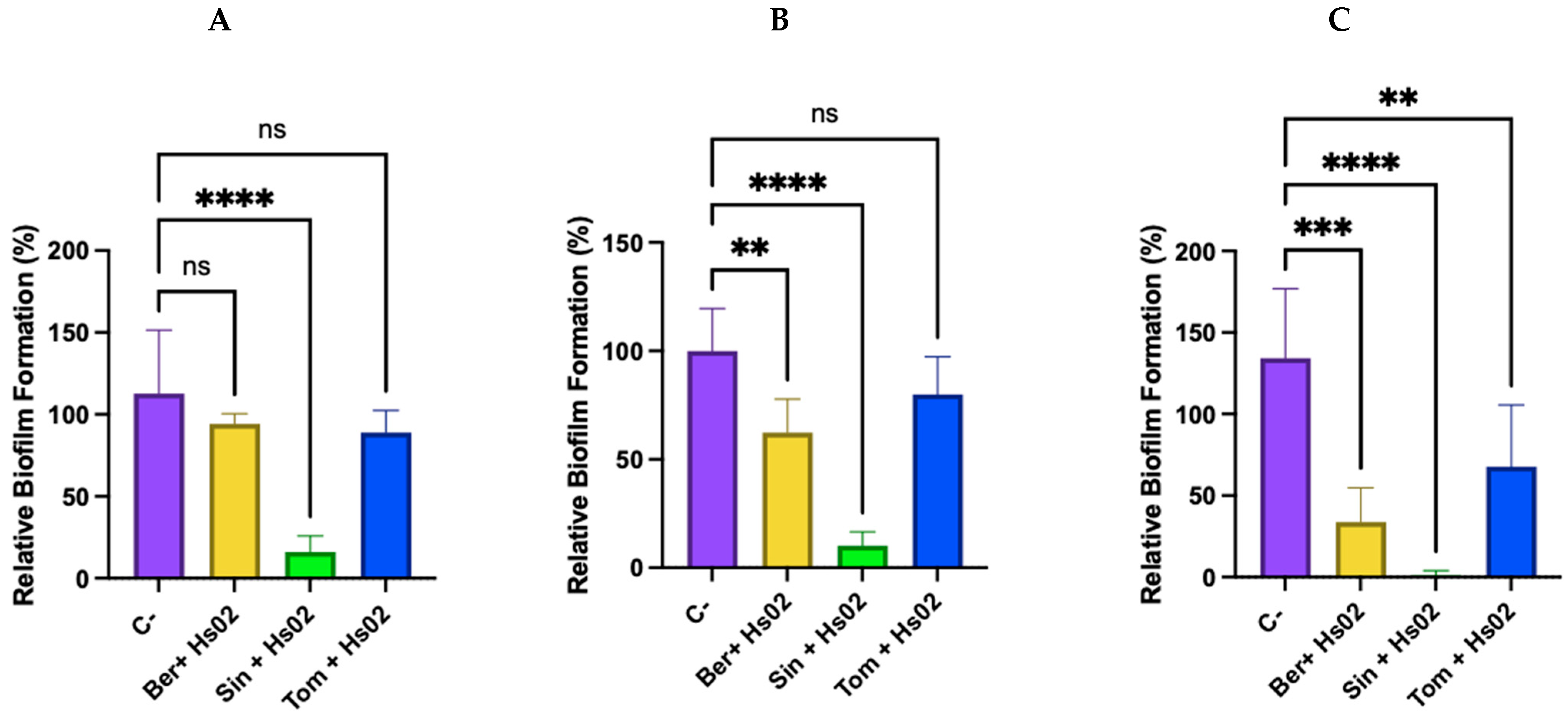
Background: Nosocomial infections caused by multidrug-resistant microorganisms are a significant public health concern. Antimicrobial resistance (AMR) is closely linked to the excessive and indiscriminate use of antibiotics, which creates selective pressure and promotes the emergence of resistant pathogens. Objectives: This study evaluates the synergistic potential of intragenic antimicrobial peptides (IAPs) combined with plant alkaloids against susceptible and multidrug-resistant human pathogenic bacteria, assessing antimicrobial activity, biofilm inhibition, and hemocompatibility. Methods: The tested molecules included berberine, tomatidine, sinomenine, and the IAPs Hs02 and Gr01. Minimum inhibitory concentration (MIC) and minimum microbicidal concentration (MMC) assays were performed against both ATCC (E. coli ATCC 25922 and S. aureus ATCC 25923) and clinical strains (E. coli KPC+ HRAN 1812446 and S. aureus MDR LACEN 3730529). Synergistic interactions were evaluated by checkerboard assay, followed by biofilm inhibition and hemolysis assays using human red blood cells. Results: Berberine exhibited a MIC of 1024 µM when tested individually, while tomatidine and sinomenine showed no significant activity. As expected, the IAPs showed strong antimicrobial properties at 8 µM (Hs02) and 4 µM (Gr01). When tested in synergy, alkaloids and IAPs reduced the MIC by up to 128-fold. The combination of IAPs and alkaloids reduced the biofilm biomass of S. aureus and E. coli by 50%, by the crystal violet assay (p < 0.05). Notably, sinomenine had not previously been reported to have antimicrobial activity. Conclusions: These results highlight the importance of further exploring combinations of natural and synthetic bioactive molecules as promising antimicrobial candidates. This approach may help to extend the useful life of conventional antibiotics. However, further studies are needed to assess safety, cytotoxicity, genotoxicity, inflammation, and in vivo effects.
Keywords: antimicrobial resistance; intragenic antimicrobial peptides; alkaloids; synergistic combinations; biofilm inhibition antimicrobial resistance; intragenic antimicrobial peptides; alkaloids; synergistic combinations; biofilm inhibition