Synergistic Potential of Plant Alkaloids and Intragenic Antimicrobial Peptides in Treating Multidrug-Resistant Infectious Diseases

 ,
,  , ,
, ,  , and
, and
Abstract
1. Introduction
2. Results
3. Discussion
4. Material and Methods
4.1. Molecules and Microorganisms
4.2. Evaluation of the Minimum Inhibitory Concentration (MIC) and Minimum Microbicidal Concentration (MMC) Against Bacteria
4.3. Fractional Inhibitory Concentration Index Evaluation
4.4. Biofilm Prevention Assessment
4.5. Evaluation of the Hemolytic Activity Towards Human Red Blood Cells
4.6. Statistical Analysis
5. Conclusions
Author Contributions
Funding
Institutional Review Board Statement
Informed Consent Statement
Data Availability Statement
Acknowledgments
Conflicts of Interest
Abbreviations
| AMR | Antimicrobial Resistance |
| ANOVA | Analysis of Variance |
| CFU | Colony Forming Units |
| CLSI | Clinical and Laboratory Standards Institute |
| DMSO | Dimethyl Sulfoxide |
| FICI | Fractional Inhibitory Concentration Index |
| LogP | Partition Coefficient (octanol/water) |
| MMC | Minimum Microbicidal Concentration |
| MIC | Minimum Inhibitory Concentration |
| OD | Optical Density |
| RBC | Red Blood Cells |
| SD | Standard Deviation |
| SwissADME | Swiss Institute of Bioinformatics ADME prediction platform |
| TPSA | Topological Polar Surface Area |
Appendix A

| ATCC Strains | Molecules | |||||||||||
| Ber + Gr01 | FICI | Tom + Gr01 | FICI | Sin + Gr01 | FICI | |||||||
| MIC (μM ± SD) | MIC (μM ± SD) | MIC (μM ± SD) | ||||||||||
| S. aureus | 256 ± 0.0 | 0.03 ± 0.0 | 0.25 | S | 8 ± 0.0 | 1 ± 0.0 | 0.13 | S | 8 ± 0.0 | 2 ± 0.0 | 0.25 | S |
| E. coli | 8 ± 0.0 | 2 ± 0.0 | 0.5 | A | 8 ± 0.0 | 2 ± 0.0 | 0.5 | A | 8 ± 0.0 | 1 ± 0.0 | 0.25 | S |
| Clinical Isolates | Molecules | |||||||||||
| Ber + Gr01 | FICI | Tom + Gr01 | FICI | Sin + Gr01 | FICI | |||||||
| MIC (μM ± SD) | MIC (μM ± SD) | MIC (μM ± SD) | ||||||||||
| S. aureus MDR | 256 ± 0.0 | 0.03 ± 0.0 | 0.25 | S | 1024 ± 0.0 | 0.03 ± 0.0 | 1.01 | I | 512 ± 0.0 | 1 ± 0.0 | 1 | A |
| E. coli KPC+ | 1024 ± 0.0 | 6 ± 0.0 | 1.06 | I | 8 ± 0.0 | 2 ± 0.0 | 0.5 | A | 8 ± 0.0 | 2 ± 0.0 | 0.5 | A |
Appendix B
| Hemolysis IAP Hs02 | |||
| Dunnett’s Test | Significant | Index | p-Value |
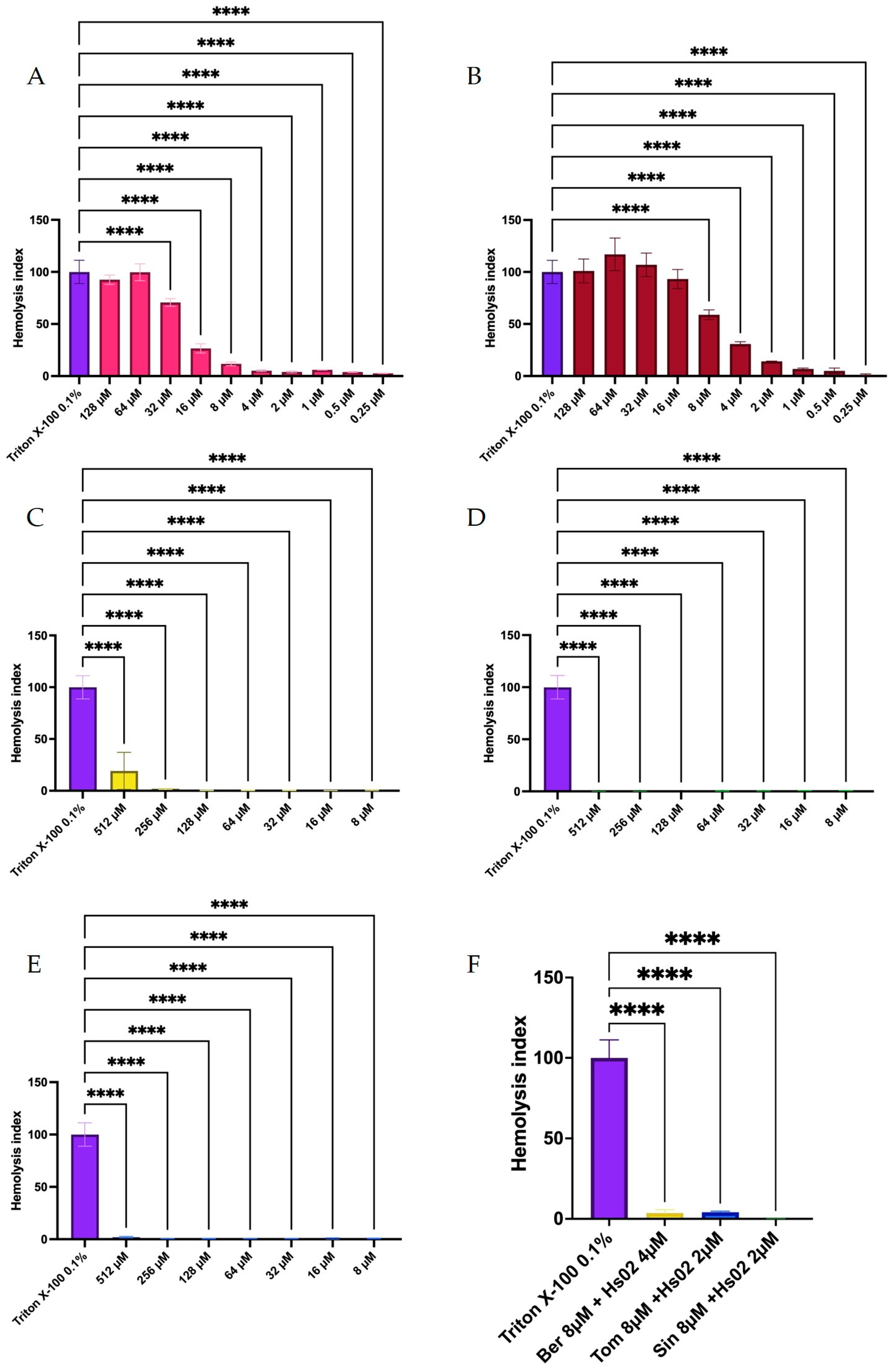
| Triton X-100 0.1% vs. 128 µM | No | ns | 0.5633 |
| Triton X-100 0.1% vs. 64 µM | No | ns | >0.9999 |
| Triton X-100 0.1% vs. 32 µM | Yes | **** | <0.0001 |
| Triton X-100 0.1% vs. 16 µM | Yes | **** | <0.0001 |
| Triton X-100 0.1% vs. 8 µM | Yes | **** | <0.0001 |
| Triton X-100 0.1% vs. 4 µM | Yes | **** | <0.0001 |
| Triton X-100 0.1% vs. 2 µM | Yes | **** | <0.0001 |
| Triton X-100 0.1% vs. 1 µM | Yes | **** | <0.0001 |
| Triton X-100 0.1% vs. 0.5 µM | Yes | **** | <0.0001 |
| Triton X-100 0.1% vs. 0.25 µM | Yes | **** | <0.0001 |
| Hemolysis IAP Gr01 | |||
| Dunnett’s Test | Significant | Index | p-Value |
| Triton X-100 0.1% vs. 128 µM | No | ns | >0.9999 |
| Triton X-100 0.1% vs. 64 µM | No | ns | 0.8967 |
| Triton X-100 0.1% vs. 32 µM | No | ns | 0.2356 |
| Triton X-100 0.1% vs. 16 µM | No | ns | 0.9745 |
| Triton X-100 0.1% vs. 8 µM | No | ns | 0.977 |
| Triton X-100 0.1% vs. 4 µM | Yes | **** | <0.0001 |
| Triton X-100 0.1% vs. 2 µM | Yes | **** | <0.0001 |
| Triton X-100 0.1% vs. 1 µM | Yes | **** | <0.0001 |
| Triton X-100 0.1% vs. 0.5 µM | Yes | **** | <0.0001 |
| Triton X-100 0.1% vs. 0.25 µM | Yes | **** | <0.0001 |
| Hemolysis Berberine | |||
| Dunnett’s Test | Significant | Index | p-Value |
| Triton X-100 0.1% vs. 512 µM | Yes | **** | <0.0001 |
| Triton X-100 0.1% vs. 256 µM | Yes | **** | <0.0001 |
| Triton X-100 0.1% vs. 128 µM | Yes | **** | <0.0001 |
| Triton X-100 0.1% vs. 64 µM | Yes | **** | <0.0001 |
| Triton X-100 0.1% vs. 32 µM | Yes | **** | <0.0001 |
| Triton X-100 0.1% vs. 16 µM | Yes | **** | <0.0001 |
| Triton X-100 0.1% vs. 8 µM | Yes | **** | <0.0001 |
| Hemolysis Sinomenine | |||
| Dunnett’s Test | Significant | Index | p-Value |
| Triton X-100 0.1% vs. 512 µM | Yes | **** | <0.0001 |
| Triton X-100 0.1% vs. 256 µM | Yes | **** | <0.0001 |
| Triton X-100 0.1% vs. 128 µM | Yes | **** | <0.0001 |
| Triton X-100 0.1% vs. 64 µM | Yes | **** | <0.0001 |
| Triton X-100 0.1% vs. 32 µM | Yes | **** | <0.0001 |
| Triton X-100 0.1% vs. 16 µM | Yes | **** | <0.0001 |
| Triton X-100 0.1% vs. 8 µM | Yes | **** | <0.0001 |
| Hemolysis Tomatidine | |||
| Dunnett’s Test | Significant | Index | p-Value |
| Triton X-100 0.1% vs. 512 µM | Yes | **** | <0.0001 |
| Triton X-100 0.1% vs. 256 µM | Yes | **** | <0.0001 |
| Triton X-100 0.1% vs. 128 µM | Yes | **** | <0.0001 |
| Triton X-100 0.1% vs. 64 µM | Yes | **** | <0.0001 |
| Triton X-100 0.1% vs. 32 µM | Yes | **** | <0.0001 |
| Triton X-100 0.1% vs. 16 µM | Yes | **** | <0.0001 |
| Triton X-100 0.1% vs. 8 µM | Yes | **** | <0.0001 |
| Hemolysis Combinations | |||
| Dunnett’s Test | Significant | Index | p-Value |
| Triton X-100 0.1% vs. Ber 8 µM + Hs02 4 µM | Yes | **** | <0.0001 |
| Triton X-100 0.1% vs. Tom 8 µM +Hs02 2 µM | Yes | **** | <0.0001 |
| Triton X-100 0.1% vs. Sin 8 µM +Hs02 2 µM | Yes | **** | <0.0001 |
Appendix C
| Biofilm Formation S. aureus ATCC 25923 | |||
| Dunnett’s Test | Significant | Index | p-Value |
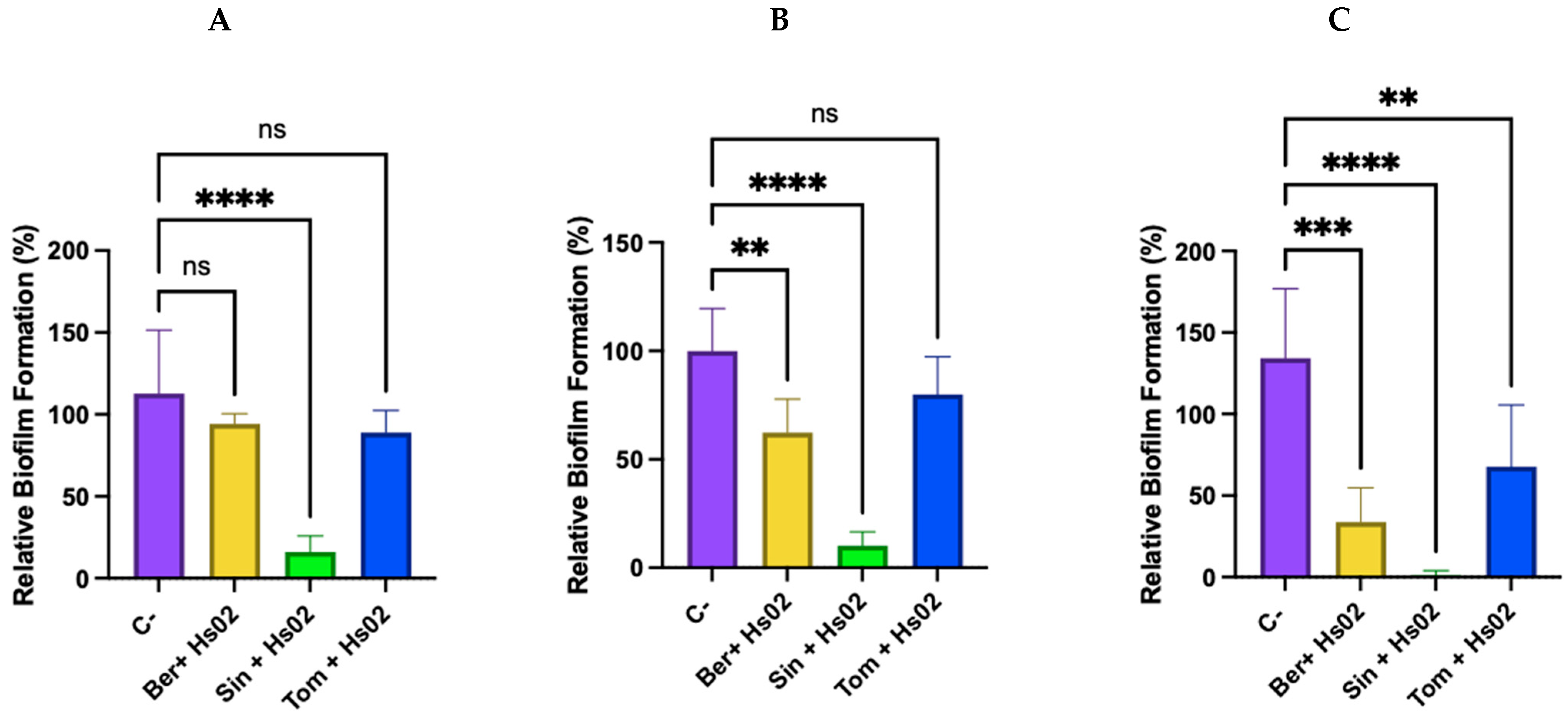
| Negative Control vs. Berberine + Hs02 | No | ns | 0.4154 |
| Negative Control vs. Sinomenine + Hs02 | Yes | **** | <0.0001 |
| Negative Control vs. Tomatidine + Hs02 | No | ns | 0.239 |
| Biofilm Formation S. aureus Multi | |||
| Dunnett’s Test | Significant | Index | p-Value |
| Negative Control vs. Berberine + Hs02 | Yes | ** | 0.0019 |
| Negative Control vs. Sinomenine + Hs02 | Yes | **** | <0.0001 |
| Negative Control vs. Tomatidine + Hs02 | No | ns | 0.1102 |
| Biofilm Formation E. coli ATCC 25922 | |||
| Dunnett’s Test | Significant | Index | p-Value |
| Negative Control vs. Berberine + Hs02 | Yes | *** | 0.0002 |
| Negative Control vs. Sinomenine + Hs02 | Yes | **** | <0.0001 |
| Negative Control vs. Tomatidine + Hs02 | Yes | ** | 0.0086 |
References
- World Health Organization. Global Antimicrobial Resistance and Use Surveillance System (GLASS) Report 2022; World Health Organization: Geneva, Switzerland, 2022. [Google Scholar]
- Terreni, M.; Taccani, M.; Pregnolato, M. New antibiotics for multidrug-resistant bacterial strains: Latest research developments and future perspectives. Molecules 2021, 26, 2671. [Google Scholar] [CrossRef] [Scilit]
- World Health Organization. WHO Bacterial Priority Pathogens List, 2024: Bacterial Pathogens of Public Health Importance to Guide Research, Development and Strategies to Prevent and Control Antimicrobial Resistance; World Health Organization: Geneva, Switzerland, 2024. [Google Scholar]
- Bhardwaj, S.; Mehra, P.; Dhanjal, D.S.; Sharma, P.; Sharma, V.; Singh, R.; Nepovimova, E.; Chopra, C.; Kua, K. Antibiotics and antibiotic resistance-flipsides of the same coin. Curr. Pharm. Des. 2022, 28, 2312–2329. [Google Scholar] [CrossRef] [Scilit] [PubMed]
- Naghavi, M.; Vollset, S.E.; Ikuta, K.S.; Swetschinski, L.R.; Gray, A.P.; Wool, E.E.; Aguilar, G.R.; Mestrovic, T.; Smith, G.; Han, C. Global burden of bacterial antimicrobial resistance 1990–2021: A systematic analysis with forecasts to 2050. Lancet 2024, 404, 1199–1226. [Google Scholar] [CrossRef] [Scilit]
- Theuretzbacher, U.; Outterson, K.; Engel, A.; Karlén, A. The global preclinical antibacterial pipeline. Nat. Rev. Microbiol. 2020, 18, 275–285. [Google Scholar] [CrossRef] [Scilit] [PubMed]
- Oliveira Júnior, N.G.; Souza, C.M.; Buccini, D.F.; Cardoso, M.H.; Franco, O.L. Antimicrobial peptides: Structure, functions and translational applications. Nat. Rev. Microbiol. 2025, 23, 687–700. [Google Scholar] [CrossRef] [Scilit]
- Zheng, S.; Tu, Y.; Li, B.; Qu, G.; Li, A.; Peng, X.; Li, S.; Shao, C. Antimicrobial peptide biological activity, delivery systems and clinical translation status and challenges. J. Transl. Med. 2025, 23, 292. [Google Scholar] [CrossRef] [Scilit]
- Brand, G.D.; Magalhaes, M.T.; Tinoco, M.L.; Aragão, F.J.; Nicoli, J.; Kelly, S.M.; Cooper, A.; Bloch, C., Jr. Probing protein sequences as sources for encrypted antimicrobial peptides. PLoS ONE 2012, 7, e45848. [Google Scholar] [CrossRef] [Scilit]
- Ramada, M.; Brand, G.; Abrão, F.; Oliveira, M.; Cardozo Filho, J.; Galbieri, R.; Gramacho, K.; Prates, M.; Bloch, C. Encrypted antimicrobial peptides from plant proteins. Sci. Rep. 2017, 7, 13263. [Google Scholar] [CrossRef] [Scilit]
- Brand, G.D.; Ramada, M.H.S.; Manickchand, J.R.; Correa, R.; Ribeiro, D.J.S.; Santos, M.A.; Vasconcelos, A.G.; Abrão, F.Y.; Prates, M.V.; Murad, A.M.; et al. Intragenic antimicrobial peptides (IAPs) from human proteins with potent antimicrobial and anti-inflammatory activity. PLoS ONE 2019, 14, e0220656. [Google Scholar] [CrossRef] [Scilit] [PubMed]
- Kang, H.-K.; Kim, C.; Seo, C.H.; Park, Y. The therapeutic applications of antimicrobial peptides (AMPs): A patent review. J. Microbiol. 2017, 55, 1–12. [Google Scholar] [CrossRef] [Scilit]
- Brand, G.D.; Ramada, M.H.S.; Genaro-Mattos, T.C.; Bloch, C. Towards an experimental classification system for membrane active peptides. Sci. Rep. 2018, 8, 1194. [Google Scholar] [CrossRef] [Scilit] [PubMed]
- Bhattacharya, S.; Chakraborty, S. Alkaloids-An Important Aspect of Medicinal Plants in Pharmaceutical World: An Overview. Int. J. Res. Appl. Sci. Eng. Technol. 2024, 12, 944–951. [Google Scholar] [CrossRef] [Scilit]
- Rajput, A.; Sharma, R.; Bharti, R. Pharmacological activities and toxicities of alkaloids on human health. Mater. Today Proc. 2022, 48, 1407–1415. [Google Scholar] [CrossRef] [Scilit]
- Hou, W.; Huang, L.; Huang, H.; Liu, S.; Dai, W.; Tang, J.; Chen, X.; Lu, X.; Zheng, Q.; Zhou, Z. Bioactivities and Mechanisms of Action of Sinomenine and Its Derivatives: A Comprehensive Review. Molecules 2024, 29, 540. [Google Scholar] [CrossRef] [Scilit]
- Zhang, X.; Sun, X.; Wu, J.; Wu, Y.; Wang, Y.; Hu, X.; Wang, X. Berberine damages the cell surface of methicillin-resistant Staphylococcus aureus. Front. Microbiol. 2020, 11, 621. [Google Scholar] [CrossRef] [Scilit]
- Aniszewski, T. Alkaloids: Chemistry, Biology, Ecology, and Applications; Elsevier: Amsterdam, The Netherlands, 2015. [Google Scholar]
- Aswathanarayan, J.B.; Vittal, R.R. Inhibition of biofilm formation and quorum sensing mediated phenotypes by berberine in Pseudomonas aeruginosa and Salmonella typhimurium. RSC Adv. 2018, 8, 36133–36141. [Google Scholar] [CrossRef] [Scilit] [PubMed]
- Sun, H.; Ansari, M.F.; Fang, B.; Zhou, C.-H. Natural berberine-hybridized benzimidazoles as novel unique bactericides against Staphylococcus aureus. J. Agric. Food Chem. 2021, 69, 7831–7840. [Google Scholar] [CrossRef] [Scilit]
- Zhou, H.; Wang, W.; Cai, L.; Yang, T. Potentiation and Mechanism of Berberine as an Antibiotic Adjuvant Against Multidrug-Resistant Bacteria. Infect. Drug Resist. 2023, 7, 7313–7326. [Google Scholar] [CrossRef] [Scilit]
- Das, A.; Pathak, M.P.; Pathak, K.; Saikia, R.; Gogoi, U. Herbal medicine for the treatment of obesity-associated asthma: A comprehensive review. Front. Pharmacol. 2023, 14, 1186060. [Google Scholar] [CrossRef] [Scilit]
- Boulet, M.L.; Isabelle, C.; Guay, I.; Brouillette, E.; Langlois, J.-P.; Jacques, P.-É.; Rodrigue, S.; Brzezinski, R.; Beauregard, P.B.; Bouarab, K. Tomatidine is a lead antibiotic molecule that targets Staphylococcus aureus ATP synthase subunit C. Antimicrob. Agents Chemother. 2018, 62, e02197-17. [Google Scholar] [CrossRef] [Scilit] [PubMed]
- Soltani, R.; Fazeli, H.; Najafi, R.B.; Jelokhanian, A. Evaluation of the synergistic effect of Tomatidine with several antibiotics against standard and clinical isolates of Staphylococcus aureus, enterococcus faecalis, Pseudomonas aeruginosa and Escherichia coli. Iran. J. Pharm. Res. 2017, 16, 290. [Google Scholar]
- Hong, H.; Lu, X.; Lu, Q.; Huang, C.; Cui, Z. Potential therapeutic effects and pharmacological evidence of sinomenine in central nervous system disorders. Front. Pharmacol. 2022, 13, 1015035. [Google Scholar] [CrossRef] [Scilit]
- Zhao, X.-X.; Peng, C.; Zhang, H.; Qin, L.-P. Sinomenium acutum: A review of chemistry, pharmacology, pharmacokinetics, and clinical use. Pharm. Biol. 2012, 50, 1053–1061. [Google Scholar] [CrossRef] [Scilit] [PubMed]
- Li, D.; Zhong, Z.; Ko, C.N.; Tian, T.; Yang, C. From mundane to classic: Sinomenine as a multi-therapeutic agent. Br. J. Pharmacol. 2025, 182, 2159–2180. [Google Scholar] [CrossRef] [Scilit]
- Casciaro, B.; Mangiardi, L.; Cappiello, F.; Romeo, I.; Loffredo, M.R.; Iazzetti, A.; Calcaterra, A.; Goggiamani, A.; Ghirga, F.; Mangoni, M.L.; et al. Naturally-Occurring Alkaloids of Plant Origin as Potential Antimicrobials against Antibiotic-Resistant Infections. Molecules 2020, 25, 3619. [Google Scholar] [CrossRef] [Scilit] [PubMed]
- Nitsch-Velásquez, L. Synergistic effects of natural products and commercial antibiotics—A mini–review 2010–2015. medRxiv 2020. [Google Scholar] [CrossRef] [Scilit]
- Yan, Y.; Li, X.; Zhang, C.; Lv, L.; Gao, B.; Li, M. Research Progress on Antibacterial Activities and Mechanisms of Natural Alkaloids: A Review. Antibiotics 2021, 10, 318. [Google Scholar] [CrossRef] [Scilit]
- Sitarek, P.; Merecz-Sadowska, A.; Kowalczyk, T.; Wieczfinska, J.; Zajdel, R.; Śliwiński, T. Potential synergistic action of bioactive compounds from plant extracts against skin infecting microorganisms. Int. J. Mol. Sci. 2020, 21, 5105. [Google Scholar] [CrossRef] [Scilit]
- Ghapanvari, P.; Taheri, M.; Jalilian, F.A.; Dehbashi, S.; Dezfuli, A.A.Z.; Arabestani, M.R. The effect of nisin on the biofilm production, antimicrobial susceptibility and biofilm formation of Staphylococcus aureus and Pseudomonas aeruginosa. Eur. J. Med. Res. 2022, 27, 173. [Google Scholar] [CrossRef] [Scilit] [PubMed]
- Duan, H.; Zhang, X.; Li, Z.; Yuan, J.; Shen, F.; Zhang, S. Synergistic effect and antibiofilm activity of an antimicrobial peptide with traditional antibiotics against multi-drug resistant bacteria. Microb. Pathog. 2021, 158, 105056. [Google Scholar] [CrossRef] [Scilit]
- Wang, G. Antimicrobial Peptides: Discovery, Design and Novel Therapeutic Strategies; CABI: Wallingford, UK, 2017. [Google Scholar]
- Rahnamaeian, M.; Cytryńska, M.; Zdybicka-Barabas, A.; Dobslaff, K.; Wiesner, J.; Twyman, R.M.; Zuchner, T.; Sadd, B.M.; Regoes, R.R.; Schmid-Hempel, P. Insect antimicrobial peptides show potentiating functional interactions against Gram-negative bacteria. Proc. R. Soc. B Biol. Sci. 2015, 282, 20150293. [Google Scholar] [CrossRef] [Scilit]
- Li, X.; Song, Y.; Wang, L.; Kang, G.; Wang, P.; Yin, H.; Huang, H. A Potential Combination Therapy of Berberine Hydrochloride With Antibiotics Against Multidrug-Resistant Acinetobacter baumannii. Front. Cell. Infect. Microbiol. 2021, 11, 660431. [Google Scholar] [CrossRef] [Scilit]
- Efremenko, E.; Aslanli, A.; Stepanov, N.; Senko, O.; Maslova, O. Various Biomimetics, Including Peptides as Antifungals. Biomimetics 2023, 8, 513. [Google Scholar] [CrossRef] [Scilit]
- Manosalva, L.; Mutis, A.; Urzúa, A.; Fajardo, V.; Quiroz, A. Antibacterial activity of alkaloid fractions from berberis microphylla G. Forst and study of synergism with ampicillin and cephalothin. Molecules 2016, 21, 76. [Google Scholar] [CrossRef] [Scilit]
- Mitchell, G.; Gattuso, M.; Grondin, G.; Marsault, É.; Bouarab, K.; Malouin, F. Tomatidine inhibits replication of Staphylococcus aureus small-colony variants in cystic fibrosis airway epithelial cells. Antimicrob. Agents Chemother. 2011, 55, 1937–1945. [Google Scholar] [CrossRef] [Scilit]
- Langlois, J.-P.; Larose, A.; Brouillette, E.; Delbrouck, J.A.; Boudreault, P.-L.; Malouin, F. Mode of Antibacterial Action of Tomatidine C3-Diastereoisomers. Molecules 2024, 29, 343. [Google Scholar] [CrossRef] [Scilit] [PubMed]
- Langlois, J.-P.; Millette, G.; Guay, I.; Dubé-Duquette, A.; Chamberland, S.; Jacques, P.-É.; Rodrigue, S.; Bouarab, K.; Marsault, É.; Malouin, F. Bactericidal Activity of the Bacterial ATP Synthase Inhibitor Tomatidine and the Combination of Tomatidine and Aminoglycoside Against Persistent and Virulent Forms of Staphylococcus aureus. Front. Microbiol. 2020, 11, 805. [Google Scholar] [CrossRef] [Scilit] [PubMed]
- Wang, Q.; Li, X.-K. Immunosuppressive and anti-inflammatory activities of sinomenine. Int. Immunopharmacol. 2011, 11, 373–376. [Google Scholar] [CrossRef] [Scilit] [PubMed]
- Alluisetti, G.; van Impe, E.; Weinmann, W.; Grafinger, K.E. Material matters: Evaluating polymer 96-well plates to reduce DAMGO loss in LC-MS/MS-based in vitro μ-opioid structure affinity assay. Talanta Open 2025, 12, 100543. [Google Scholar] [CrossRef] [Scilit]
- Xia, S.; Ma, L.; Wang, G.; Yang, J.; Zhang, M.; Wang, X.; Su, J.; Xie, M. In vitro antimicrobial activity and the mechanism of berberine against methicillin-resistant Staphylococcus aureus isolated from bloodstream infection patients. Infect. Drug Resist. 2022, 15, 1933–1944. [Google Scholar] [CrossRef] [Scilit]
- Zhou, S.; Zhuang, Y.; Zhu, X.; Yao, F.; Li, H.; Li, H.; Zou, X.; Wu, J.; Zhou, H.; Nuer, G. YhjX regulates the growth of Escherichia coli in the presence of a subinhibitory concentration of gentamicin and mediates the adaptive resistance to gentamicin. Front. Microbiol. 2019, 10, 1180. [Google Scholar] [CrossRef] [Scilit]
- Gottfredsson, M.; Erlendsdóttir, H.; Gudmundsson, A.; Gudmundsson, S. Determination of in vitro postantibiotic effects in Staphylococcus aureus and Escherichia coli by [3H] thymidine incorporation. Clin. Microbiol. Infect. 1996, 2, 99–104. [Google Scholar] [CrossRef] [Scilit]
- Sader, H.S.; Mendes, R.E.; Kimbrough, J.H.; Kantro, V.; Castanheira, M. Impact of the recent clinical and laboratory standards institute breakpoint changes on the antimicrobial spectrum of aminoglycosides and the activity of plazomicin against multidrug-resistant and carbapenem-resistant Enterobacterales from United States Medical Centers. Open Forum Infect. Dis. 2023, 10, ofad058. [Google Scholar] [PubMed]
- CLSI. Aminoglycoside Breakpoints for Enterobacterales and Pseudomonas Aeruginosa—CLSI MR16. Available online: https://clsi.org/shop/standards/mr16/ (accessed on 22 May 2026).
- Gonzales, P.R.; Pesesky, M.W.; Bouley, R.; Ballard, A.; Biddy, B.A.; Suckow, M.A.; Wolter, W.R.; Schroeder, V.A.; Burnham, C.-A.D.; Mobashery, S. Synergistic, collaterally sensitive β-lactam combinations suppress resistance in MRSA. Nat. Chem. Biol. 2015, 11, 855–861. [Google Scholar] [CrossRef] [Scilit] [PubMed]
- Lade, H.; Kim, J.-S. Molecular determinants of β-lactam resistance in methicillin-resistant Staphylococcus aureus (MRSA): An updated review. Antibiotics 2023, 12, 1362. [Google Scholar] [CrossRef] [Scilit]
- Hettiarachchi, R.; Allerton, J.; McIver, C.; Rafferty, D.; Taylor, P.; Stevens, R. A comparison of phenotypic methods to demonstrate penicillin susceptibility in Staphylococcus aureus. Pathology 2025, 57, 630–636. [Google Scholar] [CrossRef] [Scilit]
- Richter, S.; Doern, G.; Heilmann, K.; Miner, S.; Tendolkar, S.; Riahi, F.; Diekema, D. Detection and prevalence of penicillin-susceptible Staphylococcus aureus in the United States in 2013. J. Clin. Microbiol. 2016, 54, 812–814. [Google Scholar] [CrossRef] [Scilit] [PubMed]
- Herchline, T.E.; Barnishan, J.; Ayers, L.W.; Fass, R.J. Penicillinase production and in vitro susceptibilities of Staphylococcus lugdunensis. Antimicrob. Agents Chemother. 1990, 34, 2434–2435. [Google Scholar] [CrossRef] [Scilit]
- Stoesser, N.; Sheppard, A.E.; Peirano, G.; Anson, L.W.; Pankhurst, L.; Sebra, R.; Phan, H.T.; Kasarskis, A.; Mathers, A.J.; Peto, T.E. Genomic epidemiology of global Klebsiella pneumoniae carbapenemase (KPC)-producing Escherichia coli. Sci. Rep. 2017, 7, 5917. [Google Scholar] [CrossRef] [Scilit]
- Nordmann, P.; Naas, T.; Poirel, L. Global spread of carbapenemase-producing Enterobacteriaceae. Emerg. Infect. Dis. 2011, 17, 1791. [Google Scholar] [CrossRef] [Scilit]
- Miklasińska-Majdanik, M.; Kępa, M.; Wąsik, T.J.; Zapletal-Pudełko, K.; Klim, M.; Wojtyczka, R.D. The direction of the antibacterial effect of rutin hydrate and amikacin. Antibiotics 2023, 12, 1469. [Google Scholar] [CrossRef] [Scilit]
- Wultańska, D.; Piotrowski, M.; Pituch, H. The effect of berberine chloride and/or its combination with vancomycin on the growth, biofilm formation, and motility of Clostridioides difficile. Eur. J. Clin. Microbiol. Infect. Dis. 2020, 39, 1391–1399. [Google Scholar] [CrossRef] [Scilit]
- Delbrouck, J.A.; Desgagné, M.; Comeau, C.; Bouarab, K.; Malouin, F.; Boudreault, P.-L. The Therapeutic Value of Solanum Steroidal (Glyco)Alkaloids: A 10-Year Comprehensive Review. Molecules 2023, 28, 4957. [Google Scholar] [CrossRef] [Scilit]
- Yum, S.-J.; Jeong, H.G.; Kim, S.M. Anti-biofilm effects of sinomenine against Staphylococcus aureus. Food Sci. Biotechnol. 2023, 32, 83–90. [Google Scholar] [CrossRef] [Scilit] [PubMed]
- Wu, X.; Wang, H.; Xiong, J.; Yang, G.-X.; Hu, J.-F.; Zhu, Q.; Chen, Z. Staphylococcus aureus biofilm: Formulation, regulatory, and emerging natural products-derived therapeutics. Biofilm 2024, 7, 100175. [Google Scholar] [CrossRef] [Scilit] [PubMed]
- Bessa, L.J.; Manickchand, J.R.; Eaton, P.; Leite, J.R.S.A.; Brand, G.D.; Gameiro, P. Intragenic Antimicrobial Peptide Hs02 Hampers the Proliferation of Single- and Dual-Species Biofilms of P. aeruginosa and S. aureus: A Promising Agent for Mitigation of Biofilm-Associated Infections. Int. J. Mol. Sci. 2019, 20, 3604. [Google Scholar] [CrossRef] [Scilit] [PubMed]
- Daina, A.; Michielin, O.; Zoete, V. SwissADME: A free web tool to evaluate pharmacokinetics, drug-likeness and medicinal chemistry friendliness of small molecules. Sci. Rep. 2017, 7, 42717. [Google Scholar] [CrossRef] [Scilit]
- Alavala, R.R. Applications of Computational Tools in Drug Design and Development; Springer Nature: Berlin/Heidelberg, Germany, 2025. [Google Scholar]
- Frallicciardi, J.; Melcr, J.; Siginou, P.; Marrink, S.J.; Poolman, B. Membrane thickness, lipid phase and sterol type are determining factors in the permeability of membranes to small solutes. Nat. Commun. 2022, 13, 1605. [Google Scholar] [CrossRef] [Scilit]
- Efimova, S.S.; Ostroumova, O.S. Modulation of the Dipole Potential of Model Lipid Membranes with Phytochemicals: Molecular Mechanisms, Structure–Activity Relationships, and Implications in Reconstituted Ion Channels. Membranes 2023, 13, 453. [Google Scholar] [CrossRef] [Scilit]
- Dos Reis, S.V.; de Couto, N.M.G.; Brust, F.R.; Trentin, D.S.; da Silva, J.K.R.; Arruda, M.S.P.; Gnoatto, S.C.B.; Macedo, A.J. Remarkable capacity of brosimine b to disrupt methicillin-resistant Staphylococcus aureus (MRSA) preformed biofilms. Microb. Pathog. 2020, 140, 103967. [Google Scholar] [CrossRef] [Scilit]
- Tiwari, S.; Kumar, R.; Devi, S.; Sharma, P.; Chaudhary, N.R.; Negi, S.; Tandel, N.; Marepally, S.; Pied, S.; Tyagi, R.K. Biogenically synthesized green silver nanoparticles exhibit antimalarial activity. Discov. Nano 2024, 19, 136. [Google Scholar] [CrossRef] [Scilit]
- Ghazali, S.Z.; Mohamed Noor, N.R.; Mustaffa, K.M.F. Anti-plasmodial activity of aqueous neem leaf extract mediated green synthesis-based silver nitrate nanoparticles. Prep. Biochem. Biotechnol. 2022, 52, 99–107. [Google Scholar] [CrossRef] [Scilit]
- Elsayed, E.M.; Farghali, A.A.; Zanaty, M.I.; Abdel-Fattah, M.; Alkhalifah, D.H.M.; Hozzein, W.N.; Mahmoud, A.M. In vitro cytotoxicity and hemolysis effect of poly-gamma-glutamic acid nano-polymer biosynthesized using some isolates of Bacillus spp. Microbiol. Res. 2023, 14, 1720–1735. [Google Scholar] [CrossRef] [Scilit]
- Veiko, A.G.; Olchowik-Grabarek, E.; Sekowski, S.; Roszkowska, A.; Lapshina, E.A.; Dobrzynska, I.; Zamaraeva, M.; Zavodnik, I.B. Antimicrobial activity of quercetin, naringenin and catechin: Flavonoids inhibit Staphylococcus aureus-induced hemolysis and modify membranes of bacteria and erythrocytes. Molecules 2023, 28, 1252. [Google Scholar] [CrossRef] [Scilit] [PubMed]
- Rad, S.Z.K.; Rameshrad, M.; Hosseinzadeh, H. Toxicology effects of Berberis vulgaris (barberry) and its active constituent, berberine: A review. Iran. J. Basic Med. Sci. 2017, 20, 516. [Google Scholar]
- Ai, X.; Yu, P.; Peng, L.; Luo, L.; Liu, J.; Li, S.; Lai, X.; Luan, F.; Meng, X. Berberine: A review of its pharmacokinetics properties and therapeutic potentials in diverse vascular diseases. Front. Pharmacol. 2021, 12, 762654. [Google Scholar] [CrossRef] [Scilit] [PubMed]
- Zhao, D.; Tang, M.; Hu, P.; Hu, X.; Chen, W.; Ma, Z.; Chen, H.; Liu, H.; Cao, J.; Zhou, T. Antimicrobial peptide Hs02 with rapid bactericidal, anti-biofilm, and anti-inflammatory activity against carbapenem-resistant Klebsiella pneumoniae and Escherichia Coli. Microbiol. Spectr. 2025, 13, e01050-24. [Google Scholar] [CrossRef] [Scilit]
- Zhang, T.; Ouyang, X.; Gou, S.; Zhang, Y.; Yan, N.; Chang, L.; Li, B.; Zhang, F.; Liu, H.; Ni, J. Novel synovial targeting peptide-sinomenine conjugates as a potential strategy for the treatment of rheumatoid arthritis. Int. J. Pharm. 2022, 617, 121628. [Google Scholar] [CrossRef] [Scilit]
- Elizondo-Luévano, J.H.; Hernández-García, M.E.; Pérez-Narváez, O.A.; Castro-Ríos, R.; Chávez-Montes, A. Berberine, curcumin and quercetin as potential antiparasitic agents. Rev. Biol. Trop. 2020, 68, 1241–1249. [Google Scholar] [CrossRef] [Scilit]
- Chan, W.; White, P. Fmoc Solid Phase Peptide Synthesis: A Practical Approach; OUP Oxford: Oxford, UK, 1999; Volume 222. [Google Scholar]
- Clinical and Laboratory Standards Institute. Performance Standards for Antimicrobial Susceptibility Testing; Clinical and Laboratory Standards Institute: Wayne, PA, USA, 2016; Volume 16. [Google Scholar]
- Odds, F.C. Synergy, antagonism, and what the chequerboard puts between them. J. Antimicrob. Chemother. 2003, 52, 1. [Google Scholar] [CrossRef] [Scilit]
- Neto, N.A.; Oliveira, J.T.; Aguiar, T.K.; Bezerra, L.P.; Branco, L.A.; Mesquita, F.P.; Freitas, C.D.; Souza, P.F. Synergistic antibiofilm activity between synthetic peptides and ciprofloxacin against Staphylococcus aureus. Pathogens 2022, 11, 995. [Google Scholar] [CrossRef] [Scilit] [PubMed]
- Strandberg, E.; Zerweck, J.; Horn, D.; Pritz, G.; Berditsch, M.; Bürck, J.; Wadhwani, P.; Ulrich, A.S. Influence of hydrophobic residues on the activity of the antimicrobial peptide magainin 2 and its synergy with PGLa. J. Pept. Sci. 2015, 21, 436–445. [Google Scholar] [CrossRef] [Scilit] [PubMed]
- Ishiguro, A.; Nishioka, M.; Morishige, A.; Kawano, R.; Kobayashi, T.; Fujinaga, A.; Takagi, F.; Kogo, T.; Morikawa, Y.; Okayama, N. What is the best wavelength for the measurement of hemolysis index? Clin. Chim. Acta 2020, 510, 15–20. [Google Scholar] [CrossRef] [Scilit] [PubMed]
- Kiss, F.; Toth, E.; Miszti-Blasius, K.; Nemeth, N. The effect of centrifugation at various g force levels on rheological properties of rat, dog, pig and human red blood cells. Clin. Hemorheol. Microcirc. 2016, 62, 215–227. [Google Scholar] [CrossRef] [Scilit]


| Compounds | Organisms | ||||||||
|---|---|---|---|---|---|---|---|---|---|
| S. aureus ATCC | S. aureus MDR | E. coli ATCC | E. coli KPC+ | ||||||
| MIC (μM ± SD) | MMC (μM ± SD) | MIC (μM ± SD) | MMC (μM ± SD) | MIC (μM ± SD) | MMC (μM ± SD) | MIC (μM ± SD) | MMC (μM ± SD) | ||
| Peptides | Hs02 | 8 ± 0.0 | 8 ± 0.0 | 2 ± 0.0 | 2 ± 0.0 | 4 ± 0.0 | 4 ± 0.0 | 4 ± 0.0 | 4 ± 0.0 |
| Gr01 | 4 ± 0.0 | 8 ± 0.0 | 4 ± 0.0 | 8 ± 0.0 | 4 ± 0.0 | 8 ± 0.0 | 4 ± 0.0 | 8 ± 0.0 | |
| Alkaloids | Berberine | 1024 ± 0.0 | - | 512 ± 0.0 | - | - | - | - | - |
| Tomatidine | - | - | - | - | - | - | - | - | |
| Sinomenine | - | - | - | - | - | - | - | - | |
| Antibiotics | Gentamicin | 0.25 ± 0.0 | 0.5 ± 0.0 | 1 ± 0.0 | 1.33 ± 0.5 | 1 ± 0.0 | 1.55 ± 0.52 | - | - |
| Amikacin | 0.5 ± 0.0 | 3.5 ± 1.84 | 1 ± 0.0 | 3.5 ± 1.84 | 1 ± 0.0 | 1.55 ± 0.52 | 16 ± 0.0 | 32 ± 0.0 | |
| Ampicillin | 2 ± 0.0 | 3.75 ± 1.25 | - | - | - | - | - | - | |
| Organisms ATCC | Molecules | |||||||||||
| Ber + Hs02 | FICI | Tom + Hs02 | FICI | Sin + Hs02 | FICI | |||||||
| MIC (μM ± SD) | MIC (μM ± SD) | MIC (μM ± SD) | ||||||||||
| S. aureus | 64 ± 0.0 | 1 ± 0.0 | 0.18 | S | 8 ± 0.0 | 1 ± 0.0 | 0.13 | S | 8 ± 0.0 | 2 ± 0.0 | 0.25 | S |
| E. coli | 8 ± 0.0 | 2 ± 0.0 | 0.5 | S | 8 ± 0.0 | 2 ± 0.0 | 0.5 | S | 8 ± 0.0 | 1 ± 0.0 | 0.25 | S |
| Clinical Isolates | Molecules | |||||||||||
| Ber + Hs02 | FICI | Tom + Hs02 | FICI | Sin + Hs02 | FICI | |||||||
| MIC (μM ± SD) | MIC (μM ± SD) | MIC (μM ± SD) | ||||||||||
| S. aureus MDR | 512 ± 0.0 | 2 ± 0.0 | 1.5 | I | 256 ± 0.0 | 2 ± 0.0 | 1.25 | I | 8 ± 0.0 | 2 ± 0.0 | 0.5 | S |
| E. coli KPC+ | 8 ± 0.0 | 4 ± 0.0 | 1 | A | 8 ± 0.0 | 2 ± 0.0 | 0.5 | S | 8 ± 0.0 | 2 ± 0.0 | 0.5 | S |
| Organisms ATCC | Molecules | |||||
| Ber Hs02 | Tom Hs02 | Sin Hs02 | ||||
| FICI | MMC | FICI | MMC | FICI | MMC | |
| S. aureus | 0.18 | BS | 0.13 | BC | 0.25 | BS |
| E. coli | 0.5 | BC | 0.5 | BS | 0.25 | BC |
| Clinical Isolates | Molecules | |||||
| Ber Hs02 | Tom Hs02 | Sin Hs02 | ||||
| FICI | MMC | FICI | MMC | FICI | MMC | |
| S. aureus MDR | 1 | BS | 0.75 | BS | 0.5 | BC |
| E. coli KPC+ | 1 | BC | 0.5 | BC | 0.5 | BC |
Disclaimer/Publisher’s Note: The statements, opinions and data contained in all publications are solely those of the individual author(s) and contributor(s) and not of MDPI and/or the editor(s). MDPI and/or the editor(s) disclaim responsibility for any injury to people or property resulting from any ideas, methods, instructions or products referred to in the content. |
© 2026 by the authors. Licensee MDPI, Basel, Switzerland. This article is an open access article distributed under the terms and conditions of the Creative Commons Attribution (CC BY) license.
Share and Cite
Cruz, A.S.d.P.; de Sousa, T.C.; Kruklis, N.E.; Neto, N.A.d.S.; Lira, B.O.d.V.; de Andrade, G.R.; Franco, O.L.; Brand, G.D.; Ramada, M.H.S. Synergistic Potential of Plant Alkaloids and Intragenic Antimicrobial Peptides in Treating Multidrug-Resistant Infectious Diseases. Antibiotics 2026, 15, 561. https://doi.org/10.3390/antibiotics15060561
Cruz ASdP, de Sousa TC, Kruklis NE, Neto NAdS, Lira BOdV, de Andrade GR, Franco OL, Brand GD, Ramada MHS. Synergistic Potential of Plant Alkaloids and Intragenic Antimicrobial Peptides in Treating Multidrug-Resistant Infectious Diseases. Antibiotics. 2026; 15(6):561. https://doi.org/10.3390/antibiotics15060561
Chicago/Turabian StyleCruz, Athamy Sarah de Paula, Thaís Campos de Sousa, Natália Elisabeth Kruklis, Nilton Araripe dos Santos Neto, Bianca Oliveira do Vale Lira, Gabriel Rocha de Andrade, Octávio Luiz Franco, Guilherme Dotto Brand, and Marcelo Henrique Soller Ramada. 2026. "Synergistic Potential of Plant Alkaloids and Intragenic Antimicrobial Peptides in Treating Multidrug-Resistant Infectious Diseases" Antibiotics 15, no. 6: 561. https://doi.org/10.3390/antibiotics15060561
APA StyleCruz, A. S. d. P., de Sousa, T. C., Kruklis, N. E., Neto, N. A. d. S., Lira, B. O. d. V., de Andrade, G. R., Franco, O. L., Brand, G. D., & Ramada, M. H. S. (2026). Synergistic Potential of Plant Alkaloids and Intragenic Antimicrobial Peptides in Treating Multidrug-Resistant Infectious Diseases. Antibiotics, 15(6), 561. https://doi.org/10.3390/antibiotics15060561