Long-Term Trends in Antimicrobial Resistance Among Gram-Negative Clinical Isolates at Mubarak Al-Kabeer Hospital, Kuwait (2007–2022)
 , , , and
Abstract
1. Introduction
2. Results
2.1. Study Population and Isolate Distribution
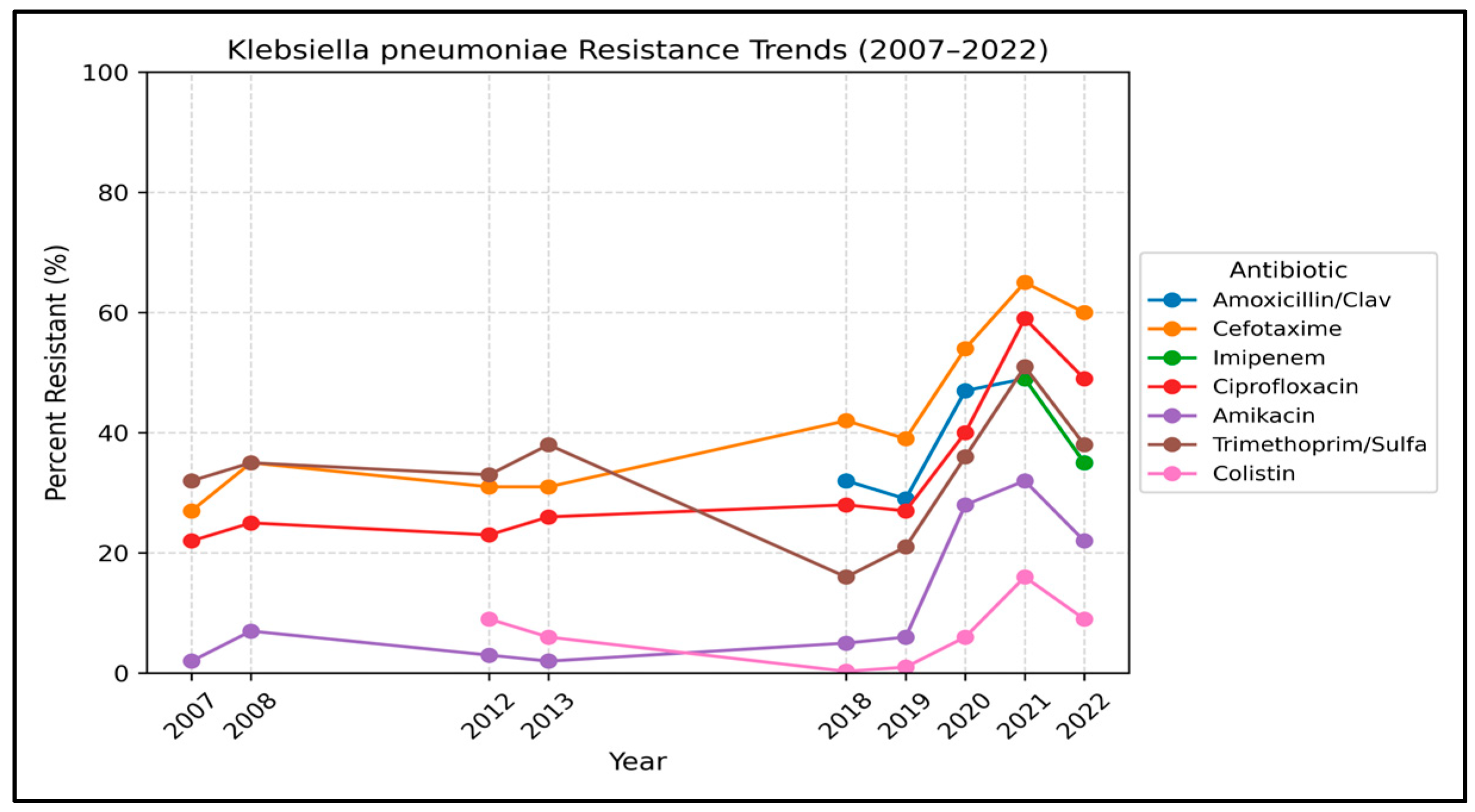
2.2. Antimicrobial Resistance Trends in Klebsiella pneumoniae
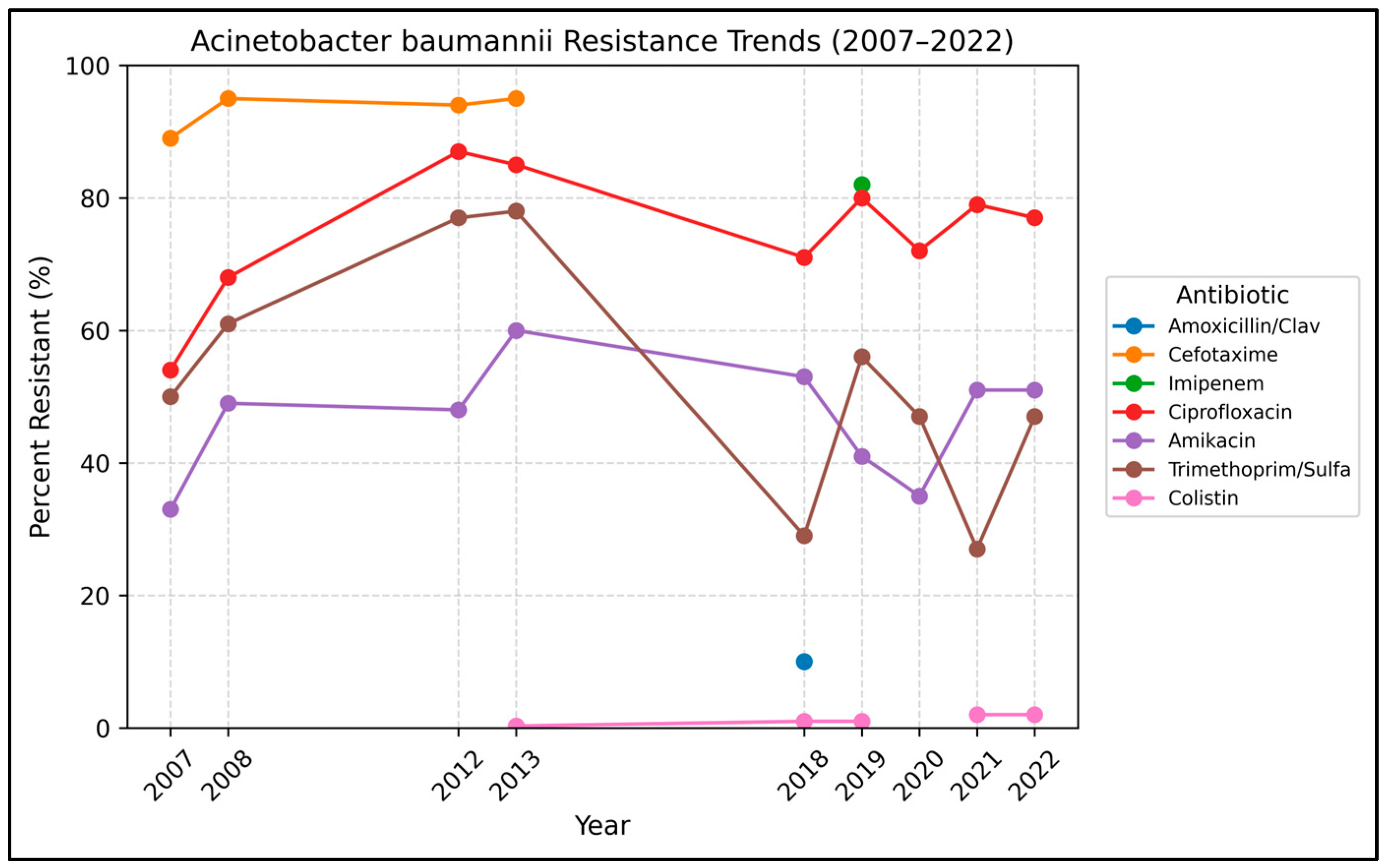
2.3. Antimicrobial Resistance Trends in Acinetobacter baumannii
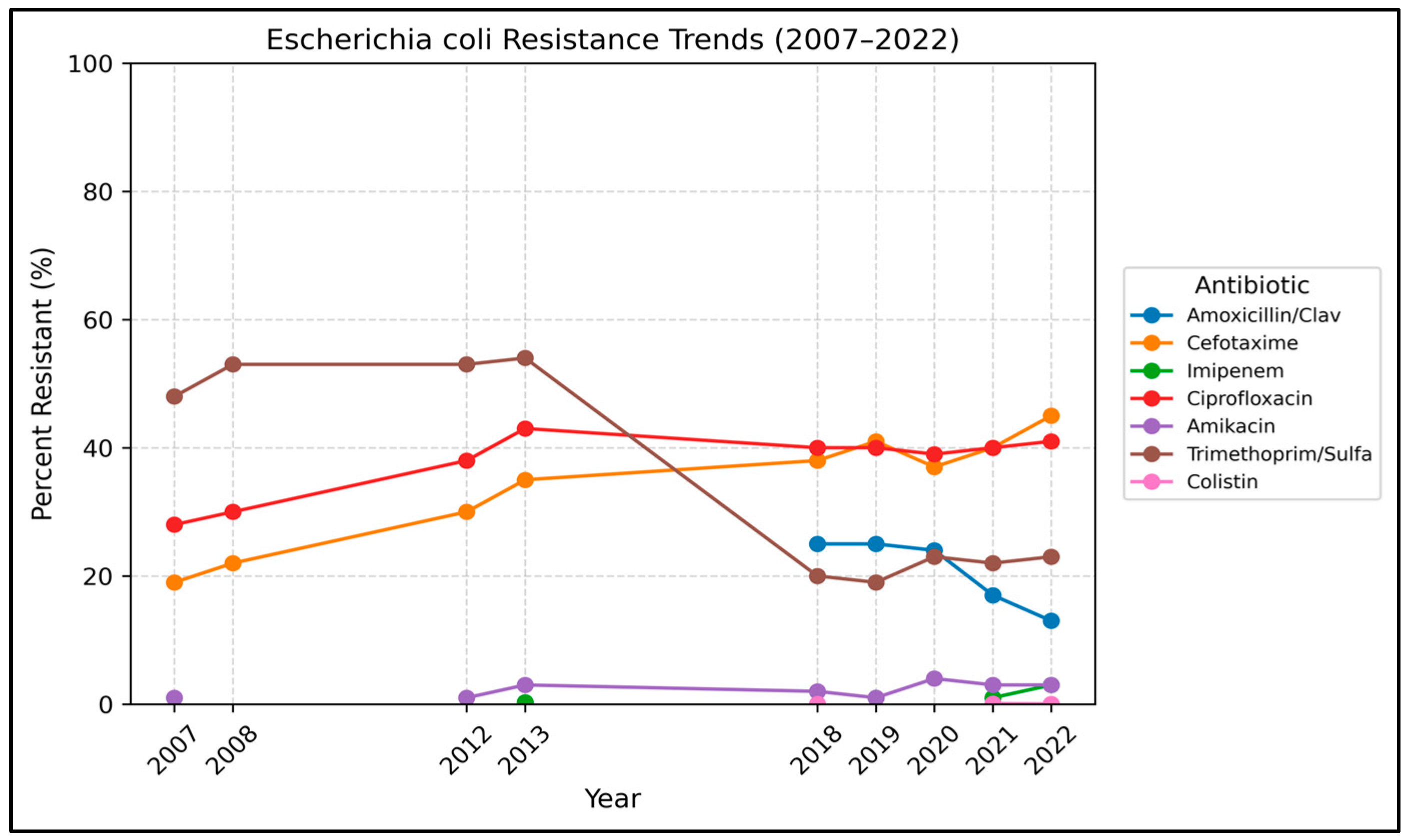
2.4. Antimicrobial Resistance Trends in Escherichia coli
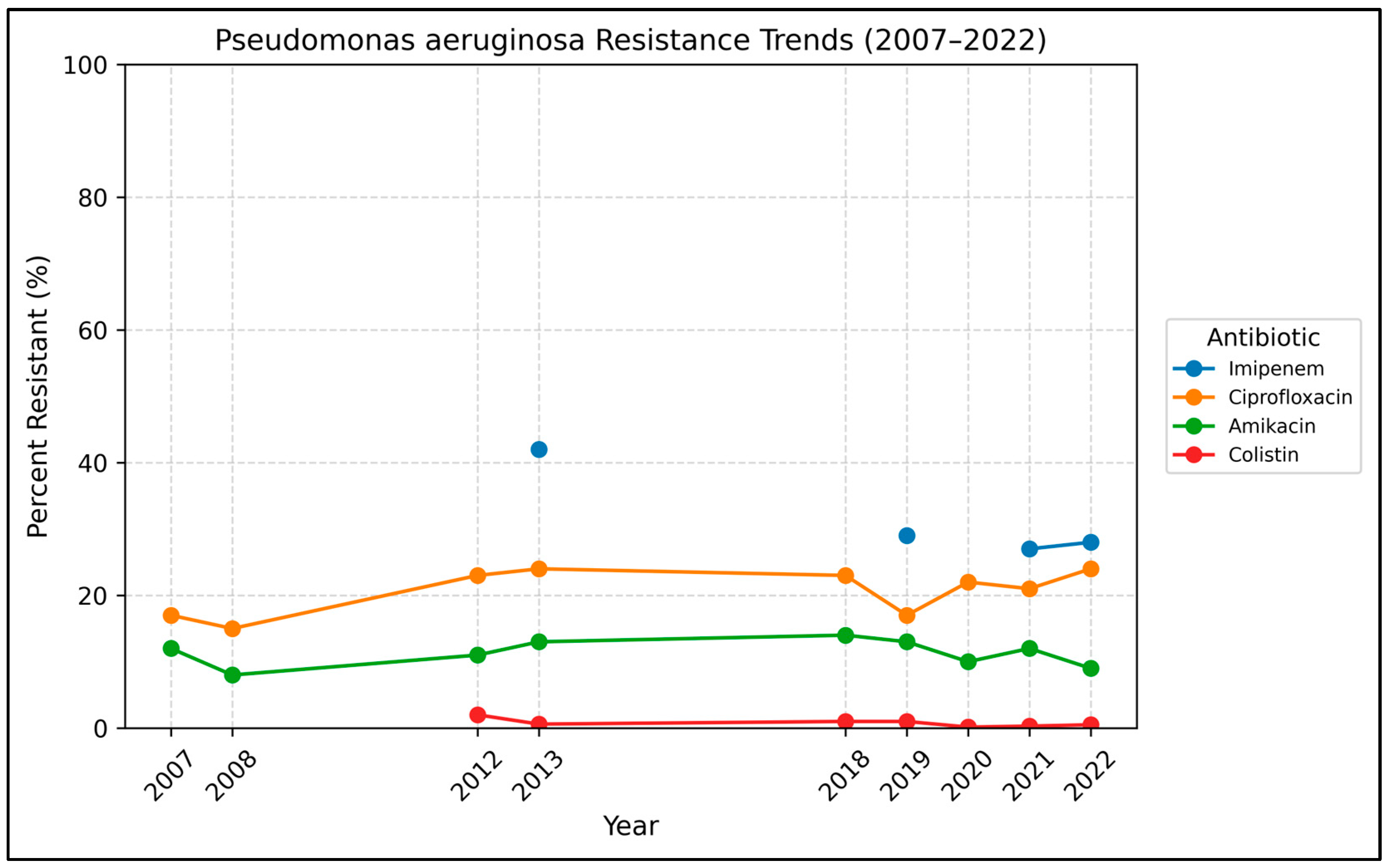
2.5. Antimicrobial Resistance Trends in Pseudomonas aeruginosa
2.6. Other Gram-Negative Organisms
- Enterobacter spp.: As shown in Table S1, there was a non-significant increase in resistance to amikacin, gentamicin, cefotaxime, and ceftazidime. However, resistance to imipenem emerged in 2018, increasing significantly from 0% to 2%.
- Citrobacter spp.: As shown in Table S2, resistance to nitrofurantoin showed a significant downward trend (p ≤ 0.001) (aligns with its activity in urinary isolates). Similarly, gentamicin showed a significant downward trend from 18 to 7% (p ≤ 0.001). In contrast, resistance to ceftazidime increased with time (13% to 23%), yet this trend did not reach statistical significance.
- Proteus spp.: Table S3 showed increased resistance to ciprofloxacin, cefotaxime, ceftazidime, and gentamicin. But these changes were not statistically significant.
- Haemophilus influenzae: The data available from 2018 onward showed increased resistance to cefuroxime and amoxicillin-clavulanate (2018 to 2022). Yet these trends did not reach statistical significance.
- Salmonella spp.: As shown in Table S4, Salmonella spp. showed low resistance to cefotaxime with no significant increase over time. However, resistance to ciprofloxacin increased from 29 to 49%, though this change was not statistically significant.
3. Discussion
4. Materials and Methods
4.1. Setting and Study Design
4.2. Bacterial Isolates and Antimicrobial Susceptibility Testing
4.3. Data Management and Definitions
4.4. Ethical Considerations
4.5. Statistical Analysis
5. Conclusions
Supplementary Materials
Author Contributions
Funding
Institutional Review Board Statement
Informed Consent Statement
Data Availability Statement
Acknowledgments
Conflicts of Interest
Abbreviations
| AMR | Antimicrobial Resistance |
| Amoxicillin–Clav | Amoxicillin–Clavulanate |
| AST | Antimicrobial Susceptibility Testing |
| CI | Confidence Interval |
| CLSI | Clinical and Laboratory Standards Institute |
| FDR | False Discovery Rate |
| GLASS | Global Antimicrobial Resistance Surveillance System |
| IRB | Institutional Review Board |
| LIS | Laboratory Information System |
| MALDI-TOF- MS | Matrix-Assisted Laser Desorption/Ionization–Time of Flight Mass Spectrometry |
| MDR | Multidrug-Resistant |
| MIC | Minimum Inhibitory Concentration |
| OR | Odds Ratio |
| Piperacillin–Tazo | Piperacillin–Tazobactam |
| TMP SMX | Trimethoprim–Sulfamethoxazole |
| Trimethoprim-Sulfa | Trimethoprim–Sulfamethoxazole |
| WHO | World Health Organization |
| XDR | Extensively Drug-Resistant |
References
- Antimicrobial Resistance Collaborators. Global burden of bacterial antimicrobial resistance in 2019: A systematic analysis. Lancet 2022, 399, 629–655. [Google Scholar] [CrossRef] [PubMed]
- World Health Organization. 10 Global Health Issues to Track in 2021; WHO: Geneva, Switzerland, 2020. Available online: https://www.who.int/news-room/spotlight/10-global-health-issues-to-track-in-2021 (accessed on 11 June 2023).
- O’Neill, J. Tackling Drug-Resistant Infections Globally: Final Report and Recommendations; Review on Antimicrobial Resistance: London, UK, 2016. [Google Scholar]
- Tornimbene, B.; Eremin, S.; Escher, M.; Griskeviciene, J.; Manglani, S.; Pessoa-Silva, C.L. WHO Global Antimicrobial Resistance Surveillance System early implementation 2016–2017. Lancet Infect. Dis. 2018, 18, 241–242. [Google Scholar] [CrossRef]
- World Health Organization. Global Antimicrobial Resistance and Use Surveillance System (GLASS) Report 2021; WHO: Geneva, Switzerland, 2021. Available online: https://www.who.int/publications/i/item/9789240027336 (accessed on 1 March 2026).
- Shahid, M.; Saeed, N.K.; Ahmad, N.; Shadab, M.; Joji, R.M.; Al-Mahmeed, A.; Bindayna, K.M.; Tabbara, K.S.; Ismaeel, A.Y.; Dar, F.K. Molecular screening of carbapenem-resistant Klebsiella pneumoniae clinical isolates for concomitant occurrence of beta-lactam genes (CTX-M, TEM, and SHV) in the Kingdom of Bahrain. J. Clin. Med. 2023, 12, 7522. [Google Scholar] [CrossRef] [PubMed]
- Tamma, P.D.; Heil, E.L.; Justo, J.A.; Mathers, A.J.; Satlin, M.J.; Bonomo, R.A. Infectious Diseases Society of America 2024 guidance on the treatment of antimicrobial-resistant Gram-negative infections. Clin. Infect. Dis. 2024, ciae403. [Google Scholar] [CrossRef]
- Macesic, N.; Uhlemann, A.-C.; Peleg, A.Y. Multidrug-resistant Gram-negative bacterial infections. Lancet 2025, 405, 257–272. [Google Scholar] [CrossRef]
- Gauba, A.; Rahman, K.M. Evaluation of antibiotic resistance mechanisms in Gram-negative bacteria. Antibiotics 2023, 12, 1590. [Google Scholar] [CrossRef]
- World Health Organization. WHO Bacterial Priority Pathogens List, 2024: Bacterial Pathogens of Public Health Importance to Guide Research, Development and Strategies to Prevent and Control Antimicrobial Resistance; WHO: Geneva, Switzerland, 2024.
- Tacconelli, E.; Carrara, E.; Savoldi, A.; Harbarth, S.; Mendelson, M.; Monnet, D.L.; Pulcini, C.; Kahlmeter, G.; Kluytmans, J.; Carmeli, Y.; et al. Discovery, research, and development of new antibiotics: The WHO priority list of antibiotic-resistant bacteria and tuberculosis. Lancet Infect. Dis. 2018, 18, 318–327. [Google Scholar] [CrossRef]
- Thomsen, J.; Abdulrazzaq, N.; AlRand, H.; UAE AMR Surveillance Consortium. Surveillance of antimicrobial resistance in the United Arab Emirates: The early implementation phase. Front. Public Health 2023, 11, 1247627. [Google Scholar] [CrossRef] [PubMed]
- Alali, W.Q.; AlFouzan, W.; Dhar, R. Prevalence of antimicrobial resistance in Gram-negative clinical isolates from a major secondary hospital in Kuwait: A retrospective descriptive study. Germs 2021, 11, 1285. [Google Scholar] [CrossRef]
- Aly, M.; Balkhy, H.H. The prevalence of antimicrobial resistance in clinical isolates from Gulf Cooperation Council countries. Antimicrob. Resist. Infect. Control 2012, 1, 26. [Google Scholar] [CrossRef]
- Shahid, M.; Ahmad, N.; Saeed, N.K.; Shadab, M.; Joji, R.M.; Al-Mahmeed, A.; Bindayna, K.M.; Tabbara, K.S.; Dar, F.K. Clinical carbapenem-resistant Klebsiella pneumoniae isolates simultaneously harboring blaNDM-1, blaOXA types and qnrS genes from the Kingdom of Bahrain: Resistance profile and genetic environment. Front. Cell. Infect. Microbiol. 2022, 12, 1033305. [Google Scholar] [CrossRef]
- Ahmad, N.; Joji, R.M.; Saeed, N.K.; Shahid, M. Genomic insights and molecular epidemiology through whole genome sequencing in clinical Serratia marcescens ST-367 isolated from the Kingdom of Bahrain. J. Infect. Public Health 2025, 19, 103087. [Google Scholar] [CrossRef]
- World Health Organization. Global Antimicrobial Resistance and Use Surveillance System (GLASS) Report 2023; WHO: Geneva, Switzerland, 2023.
- Ahmad, N.; Khalid, S.; Ali, S.M.; Khan, A.U. Occurrence of blaNDM variants among Enterobacteriaceae from a neonatal intensive care unit in a northern India hospital. Front. Microbiol. 2018, 9, 407. [Google Scholar] [CrossRef]
- Ahmad, N.; Ali, S.M.; Khan, A.U. Molecular characterization of a novel sequence type of carbapenem-resistant NDM-1-producing Klebsiella pneumoniae in the NICU of an Indian hospital. Int. J. Antimicrob. Agents 2019, 53, 525–529. [Google Scholar] [CrossRef]
- Sharahi, J.Y.; Goudarzi, H.; Ghalavand, Z.; Goudarzi, M.; Javidi, M.; Fayyazi, A.; Kamali, M.; Babaei, S.; Aghdaee, A.; Hashemi, A. Alarming colistin and carbapenem resistance in Klebsiella pneumoniae: Molecular insights from Tehran hospitals, Iran. BMC Res. Notes 2025, 19, 27. [Google Scholar] [CrossRef] [PubMed]
- Alanazi, N.M.; Alshanbari, N.H.; Roushdy, H.M.; Alnshbah, Y.I.; Barnawi, E.A.; Almatrafi, N.M.; Felemban, R.; Al Shahrani, Z.M.; Burhan, N.; El-Saed, A.; et al. Epidemiology of notifiable outbreaks in different hospital units in Saudi Arabia: A national descriptive study. J. Infect. Public Health 2025, 18, 102678. [Google Scholar] [CrossRef] [PubMed]
- World Health Organization. Antimicrobial Resistance: Hypervirulent Klebsiella Pneumoniae—Global Situation; WHO: Geneva, Switzerland, 2024. Available online: https://www.who.int/emergencies/disease-outbreak-news/item/2024-DON527 (accessed on 9 February 2026).
- WHO Regional Office for the Eastern Mediterranean. Regional Statistics: Antibiotic Use and AWaRe Targets; WHO EMRO: Cairo, Egypt, 2023. Available online: https://www.emro.who.int/world-antimicrobial-awareness-week/2025/regional-statistics.html (accessed on 11 March 2026).
- World Health Organization. WHO’s First Global Report on Antibiotic Resistance Reveals Serious, Worldwide Threat to Public Health; WHO: Geneva, Switzerland, 2014. Available online: https://www.who.int/news/item/30-04-2014-who-s-first-global-report-on-antibiotic-resistance-reveals-serious-worldwide-threat-to-public-health (accessed on 11 March 2026).
- Mills, E.G.; Martin, M.J.; Luo, T.L.; Ong, A.C.; Maybank, R.; Corey, B.W.; Harless, C.; Preston, L.N.; Rosado-Mendez, J.A.; Preston, S.B.; et al. A one-year genomic investigation of Escherichia coli epidemiology and nosocomial spread at a large US healthcare network. Genome Med. 2022, 14, 147. [Google Scholar] [CrossRef] [PubMed]
- Dubey, V.; Reza, N.; Hope, W. Drug-resistant Acinetobacter baumannii: Mortality, emerging treatments, and future pharmacological targets for a WHO priority pathogen. Clin. Microbiol. Rev. 2025, 38, e0027924. [Google Scholar] [CrossRef]
- Alharbi, O.; Al-Said, H.M.; Ashgar, S.S.; Jalal, N.A.; Faidah, H.; Momenah, A.M.; Johargy, A.K.; Bantun, F.; Qashqari, F.S.; Faidah, O.H.; et al. Prevalence and antibiogram pattern of Acinetobacter baumannii from 2013 to 2023 in a tertiary care hospital in the western region of Saudi Arabia. Antibiotics 2025, 14, 274. [Google Scholar] [CrossRef]
- Sannathimmappa, M.B.; Nambiar, V.; Aravindakshan, R. Antibiotic resistance pattern of Acinetobacter baumannii strains: A retrospective study from Oman. Saudi J. Med. Med. Sci. 2021, 9, 254–260. [Google Scholar] [CrossRef]
- Ababneh, Q.; Aldaken, N.; Jaradat, Z.; Al Sbei, S.; Alawneh, D.; Al-Zoubi, E.; Alhomsi, T.; Saadoun, I. Molecular epidemiology of carbapenem-resistant Acinetobacter baumannii isolated from three major hospitals in Jordan. Int. J. Clin. Pract. 2021, 75, e14998. [Google Scholar] [CrossRef]
- Novović, K.; Jovčić, B. Colistin resistance in Acinetobacter baumannii: Molecular mechanisms and epidemiology. Antibiotics 2023, 12, 516. [Google Scholar] [CrossRef] [PubMed]
- Singh, S.; Sahoo, R.K.; Sahu, M.C. Understanding recent developments in colistin resistance: Mechanisms, clinical implications, and future perspectives. Antibiotics 2025, 14, 958. [Google Scholar] [CrossRef]
- Al Fadhli, A.H.; Jamal, W.Y.; Rotimi, V.O. Prevalence of carbapenem-resistant Enterobacteriaceae and emergence of high rectal colonization rates of blaOXA-181-positive isolates in patients admitted to two major hospital intensive care units in Kuwait. PLoS ONE 2020, 15, e0241971. [Google Scholar] [CrossRef]
- Mousavi, P.S.; Ali, A.; Jawhar, D.S.; Bhongade, B.A.; Bandaru, S.S.; AlFaki, N.; Imam, M.; Drweesh, K.A.; Ataig, D. Impact of an integrated stewardship intervention at a secondary care hospital in Ras Al Khaimah, United Arab Emirates: Findings from September 2018–March 2019. Antimicrob. Resist. Infect. Control 2025, 14, 145. [Google Scholar] [CrossRef] [PubMed]
- World Health Organization. Guidelines for the Prevention and Control of Carbapenem-Resistant Enterobacteriaceae, Acinetobacter Baumannii and Pseudomonas Aeruginosa in Health Care Facilities; WHO: Geneva, Switzerland, 2017. Available online: https://www.who.int/publications/i/item/9789241550178 (accessed on 11 March 2026).
- Alatoom, A.; Alattas, M.; Alraddadi, B.; Moubareck, C.A.; Hassanien, A.; Jamal, W.; Kurdi, A.; Mohamed, N.; Senok, A.; Somily, A.M.; et al. Antimicrobial resistance profiles of Pseudomonas aeruginosa in the Arabian Gulf region over a 12-year period (2010–2021). J. Epidemiol. Glob. Health 2024, 14, 529–548. [Google Scholar] [CrossRef]
- European Centre for Disease Prevention and Control. Surveillance of Antimicrobial Resistance in Europe, 2022 Data; ECDC: Stockholm, Sweden, 2023. Available online: https://www.ecdc.europa.eu/en/publications-data/surveillance-antimicrobial-resistance-europe-2022-data (accessed on 1 March 2026).
- Lee, Y.-L.; Ko, W.-C.; Hsueh, P.-R. Geographic patterns of carbapenem-resistant Pseudomonas aeruginosa in the Asia-Pacific region: Results from the Antimicrobial Testing Leadership and Surveillance (ATLAS) Program, 2015–2019. Antimicrob. Agents Chemother. 2022, 66, e02000-21. [Google Scholar] [CrossRef] [PubMed]
- Mazza, L.; Bory, A.; Luscher, A.; Kloehn, J.; Wolfender, J.L.; van Delden, C.; Köhler, T. Multidrug efflux pumps of Pseudomonas aeruginosa show selectivity for their natural substrates. Front. Microbiol. 2025, 15, 1512472. [Google Scholar] [CrossRef]
- von Elm, E.; Altman, D.G.; Egger, M.; Pocock, S.J.; Gøtzsche, P.C.; Vandenbroucke, J.P. Strengthening the reporting of observational studies in epidemiology (STROBE) statement: Guidelines for reporting observational studies. Lancet 2007, 370, 1453–1457. [Google Scholar] [CrossRef]
- Clinical and Laboratory Standards Institute. Performance Standards for Antimicrobial Susceptibility Testing, 17th ed.; M100-S17; CLSI: Wayne, PA, USA, 2007. [Google Scholar]
- Clinical and Laboratory Standards Institute. Performance Standards for Antimicrobial Susceptibility Testing, 31st ed.; CLSI supplement M100; CLSI: Wayne, PA, USA, 2021. [Google Scholar]
- Clinical and Laboratory Standards Institute. Methods for Antimicrobial Dilution and Disk Susceptibility Testing of Infrequently Isolated or Fastidious Bacteria; CLSI M45; CLSI: Wayne, PA, USA, 2016. [Google Scholar]
- Hosmer, D.W.; Lemeshow, S.; Sturdivant, R.X. Applied Logistic Regression, 3rd ed.; Wiley: Hoboken, NJ, USA, 2013. [Google Scholar]
- Wald, A. Tests of statistical hypotheses concerning several parameters when the number of observations is large. Trans. Am. Math. Soc. 1943, 54, 426–482. [Google Scholar] [CrossRef]
- Benjamini, Y.; Hochberg, Y. Controlling the false discovery rate: A practical and powerful approach to multiple testing. J. R. Stat. Soc. B 1995, 57, 289–300. [Google Scholar] [CrossRef]
- R Core Team. R: A Language and Environment for Statistical Computing; R Foundation for Statistical Computing: Vienna, Austria, 2022; Available online: https://www.r-project.org/ (accessed on 11 March 2026).
- IBM Corp. IBM SPSS Statistics for Windows, version 28.0; IBM Corp.: Armonk, NY, USA, 2021.




| Antibiotic | Years | Total n | %R (First) | %R (Last) | OR/Year (95% CI) | p-Value | q-Value (FDR) |
|---|---|---|---|---|---|---|---|
| Cefotaxime | 2007–2022 | 15,057 | 27% | 60% | 1.106 (1.098–1.114) | <0.001 | <0.001 |
| Ceftazidime | 2007–2022 | 14,905 | 27% | 58% | 1.109 (1.101–1.117) | <0.001 | <0.001 |
| Cefuroxime | 2007–2022 | 14,381 | 29% | 64% | 1.110 (1.103–1.118) | <0.001 | <0.001 |
| Cefoxitin | 2018–2022 | 13,716 | 12% | 45% | 1.594 (1.512–1.679) | <0.001 | <0.001 |
| Meropenem | 2008–2022 | 23,967 | 1% | 35% | 1.622 (1.560–1.686) | <0.001 | <0.001 |
| Piperacillin | 2007–2021 | 12,484 | 52% | 42% | 0.971 (0.958–0.984) | <0.001 | <0.001 |
| Ampicillin ** | 2007–2022 | 8439 | 100% | 100% | – | – | – |
| Piperacillin–Tazobactam | 2018–2022 | 8147 | 36% | 40% | 1.034 (1.004–1.066) | 0.029 | 0.04 |
| Amoxicillin–Clavulanate | 2007–2013 | 2635 | 34% | 34% | 0.990 (0.949–1.033) | 0.378 | 0.45 |
| Amikacin | 2007–2022 | 8439 | 2% | 22% | 1.251 (1.216–1.287) | <0.001 | <0.001 |
| Gentamicin | 2007–2022 | 8439 | 7% | 16% | 1.055 (1.016–1.096) | 0.009 | 0.02 |
| Ciprofloxacin | 2007–2022 | 8439 | 22% | 49% | 1.106 (1.099–1.113) | <0.001 | <0.001 |
| Trimethoprim–Sulfamethoxazole | 2007–2022 | 8439 | 30% | 28% | 0.987 (0.974–1.001) | 0.072 | 0.09 |
| Nitrofurantoin | 2007–2022 | 3074 | 75% | 40% | 0.858 (0.842–0.874) | <0.001 | <0.001 |
| Colistin | 2012–2022 | 6278 | 0.0% | 0.3% | 1.055 (0.669–1.667) | 0.866 | 0.90 |
| Antibiotic | Years | Total n | %R (First) | %R (Last) | OR/Year (95% CI) | p-Value | q-Value (FDR) |
|---|---|---|---|---|---|---|---|
| Cefotaxime | 2007–2013 | 1133 | 89% | 95% | 1.100 (0.996–1.214) | 0.060 | 0.08 |
| Meropenem | 2007–2022 | 3557 | 33% | 77% | 1.071 (1.053–1.089) | <0.001 | <0.001 * |
| Piperacillin–Tazobactam | 2018–2022 | 2424 | 5% | 78% | 2.307 (2.128–2.501) | <0.001 | <0.001 * |
| Piperacillin | 2007–2018 | 1684 | 59% | 7% | 0.691 (0.665–0.717) | <0.001 | <0.001 * |
| Amikacin | 2007–2022 | 3557 | 33% | 51% | 0.991 (0.976–1.006) | 0.260 | 0.30 |
| Gentamicin | 2007–2022 | 3557 | 42% | 37% | 0.904 (0.890–0.918) | <0.001 | <0.001 * |
| Ciprofloxacin | 2007–2022 | 3557 | 54% | 77% | 1.008 (0.990–1.026) | 0.396 | 0.45 |
| Trimethoprim–Sulfamethoxazole | 2007–2022 | 3557 | 50% | 47% | 0.898 (0.884–0.913) | <0.001 | <0.001 * |
| Colistin | 2013–2022 | 2340 | 0.3% | 2.0% | 1.246 (1.046–1.485) | 0.014 | 0.03 * |
| Antibiotic | Years | Total n | %R (First) | %R (Last) | OR/Year (95% CI) | p-Value | q-Value (FDR) |
|---|---|---|---|---|---|---|---|
| Cefotaxime | 2007–2022 | 24,157 | 19% | 45% | 1.072 (1.063–1.081) | <0.001 | <0.001 |
| Cefuroxime | 2007–2022 | 24,787 | 25% | 51% | 1.064 (1.056–1.072) | <0.001 | <0.001 |
| Ceftazidime | 2007–2022 | 25,314 | 19% | 40% | 1.065 (1.057–1.073) | <0.001 | <0.001 |
| Cefoxitin | 2007–2022 | 2123 | 8% | 13% | 1.134 (1.075–1.195) | <0.001 | <0.001 |
| Cephalothin | 2007–2013 | 6571 | 58% | 63% | 1.035 (1.016–1.054) | <0.001 | <0.001 |
| Imipenem | 2013–2022 | 1491 | 0.3% | 3% | 1.320 (1.178–1.479) | <0.001 | <0.001 |
| Meropenem | 2007–2022 | 24,157 | 0.2% | 3% | 1.016 (0.969–1.065) | 0.398 | 0.45 |
| Ampicillin | 2007–2022 | 15,408 | 73% | 79% | 1.003 (0.976–1.006) | 0.339 | 0.40 |
| Piperacillin | 2007–2021 | 12,484 | 52% | 51% | 0.971 (0.958–0.984) | <0.001 | <0.001 |
| Piperacillin–Tazobactam | 2007–2022 | 5687 | 2–15% | 4–14% | – | – | – |
| Amoxicillin–Clavulanate | 2018–2022 | 9109 | 25% | 13% | 0.818 (0.806–0.831) | <0.001 | <0.001 |
| Amikacin | 2007–2022 | 3557 | 1% | 3% | 1.071 (1.034–1.109) | <0.001 | <0.001 |
| Gentamicin | 2007–2022 | 17,173 | 16% | 14% | 0.951 (0.938–0.964) | <0.001 | <0.001 |
| Ciprofloxacin | 2007–2022 | 17,173 | 28% | 41% | 1.031 (1.025–1.037) | <0.001 | <0.001 |
| Norfloxacin | 2007–2013 | 6089 | 27% | 34% | 1.063 (1.044–1.083) | <0.001 | <0.001 |
| Trimethoprim–Sulfamethoxazole | 2007–2022 | 17,173 | 48% | 23% | 0.893 (0.884–0.903) | <0.001 | <0.001 |
| Nitrofurantoin | 2007–2022 | 17,173 | 11% | 5% | 0.927 (0.903–0.952) | <0.001 | <0.001 |
| Tigecycline | 2010–2022 | 3542 | 0.9% | 0.05% | 0.755 (0.649–0.879) | <0.001 | <0.001 |
| Colistin | 2013–2022 | 1857 | 0.05% | 0.05% | 1.055 (0.669–1.667) | 0.866 | 0.90 |
| Antibiotic | Years | Total n | %R (First) | %R (Last) | OR/Year (95% CI) | p-Value | q-Value (FDR) |
|---|---|---|---|---|---|---|---|
| Ceftazidime | 2007–2022 | 5643 | 34% | 29% | 0.978 (0.967–0.989) | <0.001 | <0.001 * |
| Imipenem | 2013–2022 | 2713 | 42% | 28% | 0.926 (0.905–0.948) | <0.001 | <0.001 * |
| Piperacillin–Tazobactam | 2018–2022 | 3420 | 20% | 24% | 1.081 (1.020–1.145) | 0.009 | 0.02 * |
| Piperacillin | 2007–2018 | 2902 | 24% | 3% | 0.896 (0.874–0.918) | <0.001 | <0.001 * |
| Amikacin | 2007–2022 | 5643 | 12% | 9% | 1.003 (0.987–1.020) | 0.680 | 0.72 |
| Gentamicin | 2007–2022 | 5643 | 20% | 14% | 0.998 (0.984–1.012) | 0.765 | 0.80 |
| Ciprofloxacin | 2007–2022 | 5643 | 17% | 24% | 1.015 (1.002–1.028) | 0.026 | 0.05 * |
| Colistin | 2012–2022 | 4757 | 2.0% | 0.5% | 0.881 (0.809–0.958) | 0.003 | 0.01 * |
Disclaimer/Publisher’s Note: The statements, opinions and data contained in all publications are solely those of the individual author(s) and contributor(s) and not of MDPI and/or the editor(s). MDPI and/or the editor(s) disclaim responsibility for any injury to people or property resulting from any ideas, methods, instructions or products referred to in the content. |
© 2026 by the authors. Licensee MDPI, Basel, Switzerland. This article is an open access article distributed under the terms and conditions of the Creative Commons Attribution (CC BY) license.
Share and Cite
Al-Fadhli, A.H.; Al-Dhumair, A.; AlShemerri, J.; Al-Failakawy, F.; Al-Hasan, M.; Almatawah, Q.A.; Jamal, W.Y. Long-Term Trends in Antimicrobial Resistance Among Gram-Negative Clinical Isolates at Mubarak Al-Kabeer Hospital, Kuwait (2007–2022). Antibiotics 2026, 15, 501. https://doi.org/10.3390/antibiotics15050501
Al-Fadhli AH, Al-Dhumair A, AlShemerri J, Al-Failakawy F, Al-Hasan M, Almatawah QA, Jamal WY. Long-Term Trends in Antimicrobial Resistance Among Gram-Negative Clinical Isolates at Mubarak Al-Kabeer Hospital, Kuwait (2007–2022). Antibiotics. 2026; 15(5):501. https://doi.org/10.3390/antibiotics15050501
Chicago/Turabian StyleAl-Fadhli, Amani H., Ahmad Al-Dhumair, Jenan AlShemerri, Fatema Al-Failakawy, Mohammad Al-Hasan, Qadreyah Ahmad Almatawah, and Wafaa Y. Jamal. 2026. "Long-Term Trends in Antimicrobial Resistance Among Gram-Negative Clinical Isolates at Mubarak Al-Kabeer Hospital, Kuwait (2007–2022)" Antibiotics 15, no. 5: 501. https://doi.org/10.3390/antibiotics15050501
APA StyleAl-Fadhli, A. H., Al-Dhumair, A., AlShemerri, J., Al-Failakawy, F., Al-Hasan, M., Almatawah, Q. A., & Jamal, W. Y. (2026). Long-Term Trends in Antimicrobial Resistance Among Gram-Negative Clinical Isolates at Mubarak Al-Kabeer Hospital, Kuwait (2007–2022). Antibiotics, 15(5), 501. https://doi.org/10.3390/antibiotics15050501