Microbiological Patterns in Periprosthetic Knee Infections over a Decade: Analysis of Resistance Patterns, Temporal Trends, and Patient Residence
 , , , and
Abstract
1. Introduction
2. Results
2.1. Demographics and Clinical Presentation
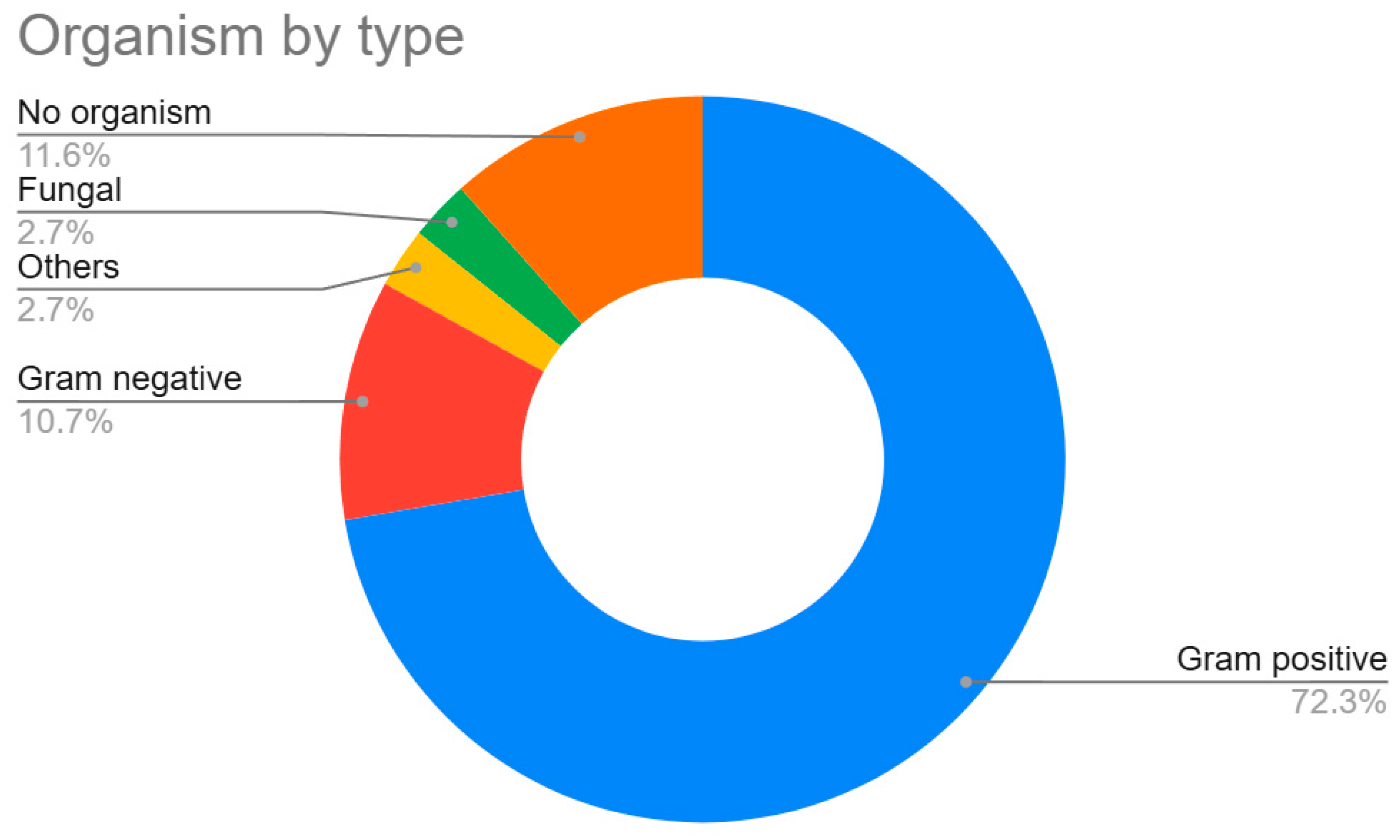
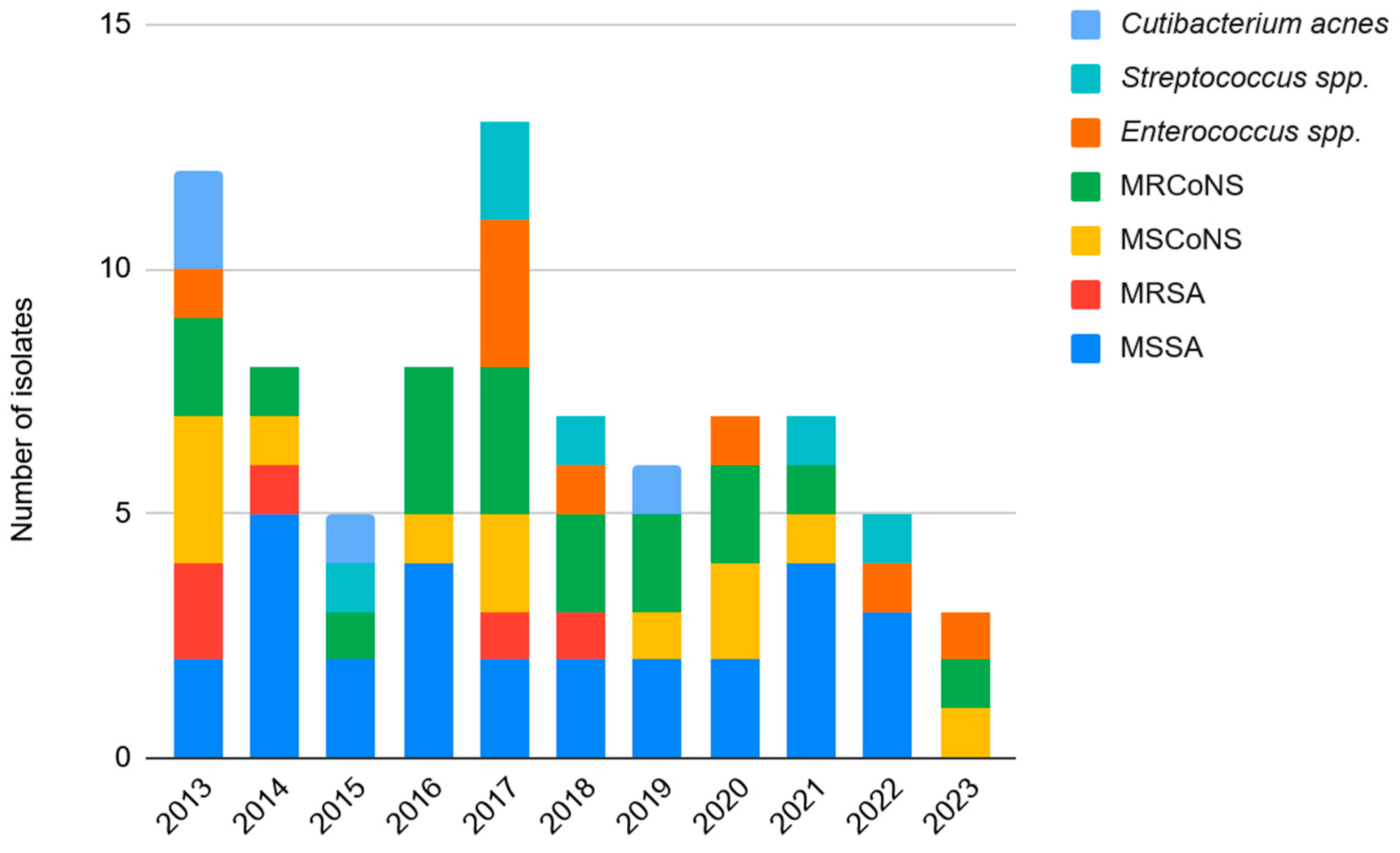
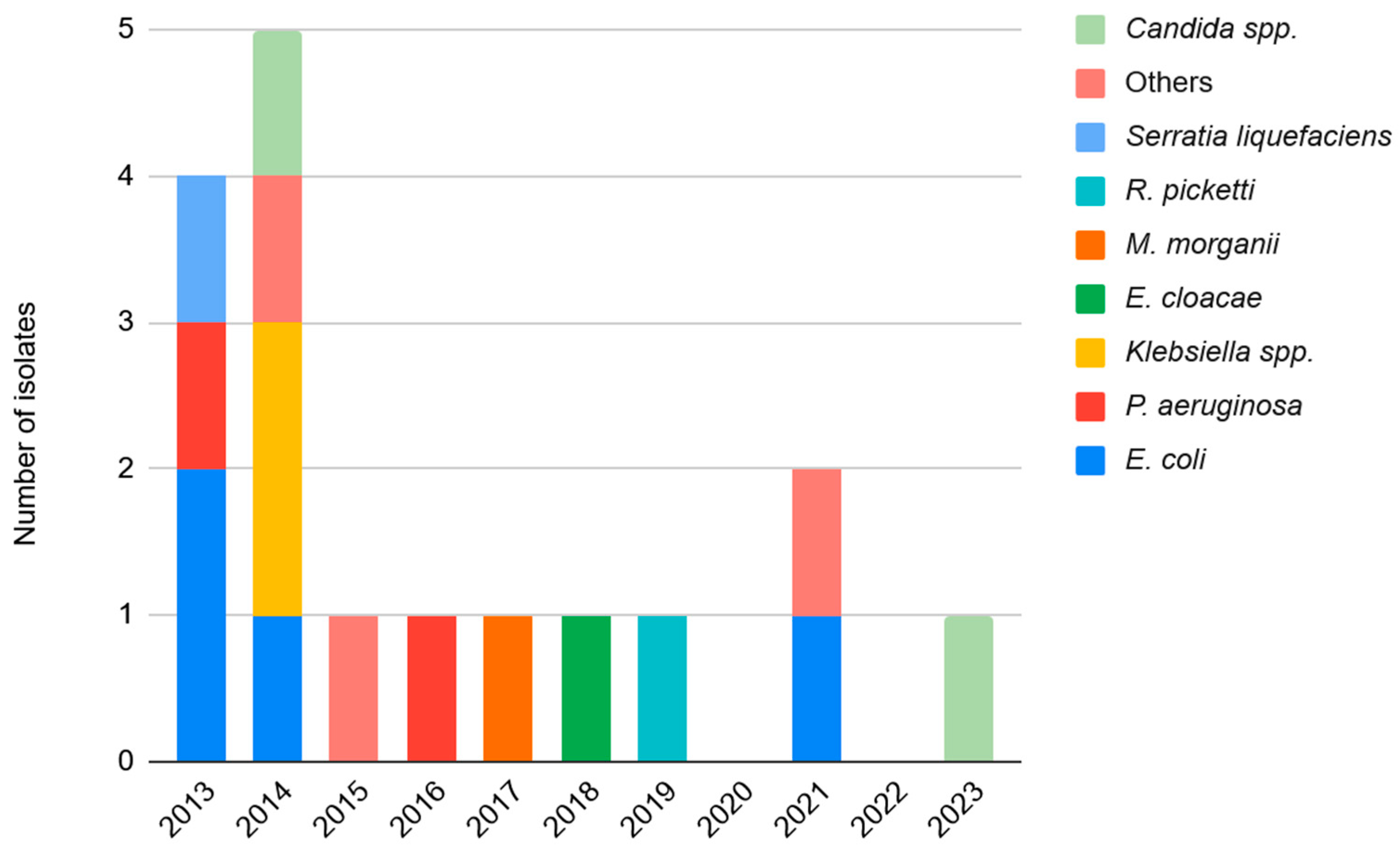
2.2. General Microbiology and Temporal Trends
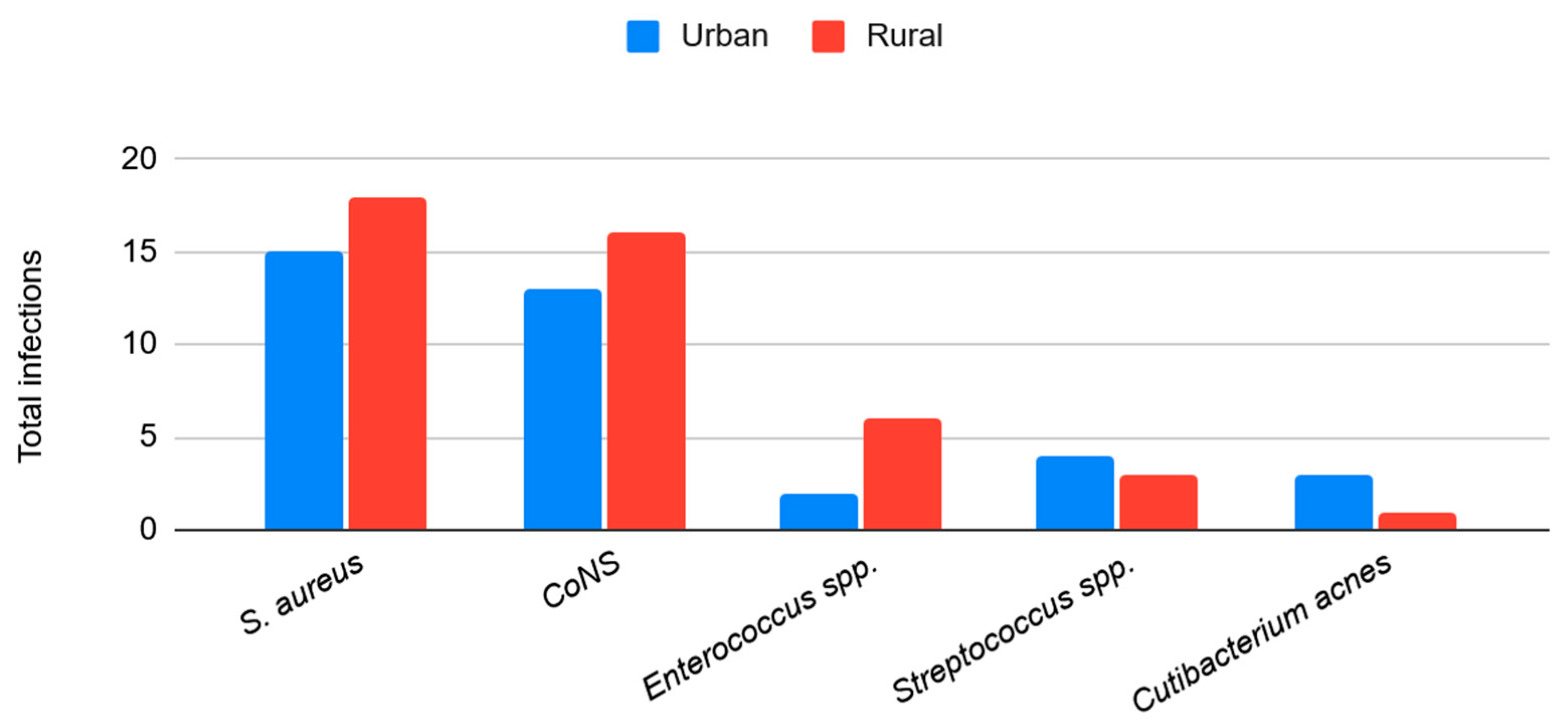
2.3. Rural vs. Urban Comparison
2.4. Antimicrobial Susceptibility
3. Discussion
4. Materials and Methods
4.1. Study Design and Participants
4.2. Definitions and Diagnosis
4.3. Data Collection and Microbiology
4.4. Statistical Analysis
5. Conclusions
Author Contributions
Funding
Institutional Review Board Statement
Informed Consent Statement
Data Availability Statement
Conflicts of Interest
References
- Bozzo, A.; Ekhtiari, S.; Madden, K.; Bhandari, M.; Ghert, M.; Khanna, V.; Pond, G.R.; Winemaker, M.J.; Wood, T.; Adili, A. Incidence and Predictors of Prosthetic Joint Infection Following Primary Total Knee Arthroplasty: A 15-Year Population-Based Cohort Study. J. Arthroplast. 2022, 37, 367–372.e1. [Google Scholar] [CrossRef] [PubMed]
- Jaén, F.; Sanz-Gallardo, M.I.; Arrazola, M.P.; García De Codes, A.; De Juanes, A.; Resines, C. Estudio multicéntrico sobre la incidencia de infección en prótesis de rodilla. Rev. Esp. Cir. Ortop. Traumatol. 2012, 56, 38–45. [Google Scholar] [CrossRef]
- Ma, T.; Jiao, J.; Guo, D.W.; Lv, S.Z.; Zhang, D.; Hou, D.C. Incidence of periprosthetic joint infection after primary total knee arthroplasty shows significant variation: A synthesis of meta-analysis and bibliometric analysis. J. Orthop. Surg. Res. 2024, 19, 649. [Google Scholar] [CrossRef]
- Garrido-Gómez, J.; Arrabal-Polo, M.A.; Girón-Prieto, M.S.; Cabello-Salas, J.; Torres-Barroso, J.; Parra-Ruiz, J. Descriptive Analysis of the Economic Costs of Periprosthetic Joint Infection of the Knee for the Public Health System of Andalusia. J. Arthroplast. 2013, 28, 1057–1060. [Google Scholar] [CrossRef] [PubMed]
- Kurtz, S.M.; Lau, E.C.; Son, M.S.; Chang, E.T.; Zimmerli, W.; Parvizi, J. Are We Winning or Losing the Battle with Periprosthetic Joint Infection: Trends in Periprosthetic Joint Infection and Mortality Risk for the Medicare Population. J. Arthroplast. 2018, 33, 3238–3245. [Google Scholar] [CrossRef] [PubMed]
- Premkumar, A.; Kolin, D.A.; Farley, K.X.; Wilson, J.M.; McLawhorn, A.S.; Cross, M.B.; Sculco, P.K. Projected Economic Burden of Periprosthetic Joint Infection of the Hip and Knee in the United States. J. Arthroplast. 2021, 36, 1484–1489.e3. [Google Scholar] [CrossRef]
- Abbas, A.; Barkhouse, A.; Hackenberger, D.; Wright, G.D. Antibiotic resistance: A key microbial survival mechanism that threatens public health. Cell Host Microbe 2024, 32, 837–851. [Google Scholar] [CrossRef]
- Achermann, Y.; Eigenmann, K.; Ledergerber, B.; Derksen, L.; Rafeiner, P.; Clauss, M.; Nüesch, R.; Zellweger, C.; Vogt, M.; Zimmerli, W. Factors associated with rifampin resistance in staphylococcal periprosthetic joint infections (PJI): A matched case-control study. Infection 2013, 41, 431–437. [Google Scholar] [CrossRef]
- Alam, F.; Balani, K. Adhesion force of Staphylococcus aureus on various biomaterial surfaces. J. Mech. Behav. Biomed. Mater. 2017, 65, 872–880. [Google Scholar] [CrossRef]
- Cangui-Panchi, S.P.; Ñacato-Toapanta, A.L.; Enríquez-Martínez, L.J.; Salinas-Delgado, G.A.; Reyes, J.; Garzon-Chavez, D.; Machado, A. Battle royale: Immune response on biofilms—Host-pathogen interactions. Curr. Res. Immunol. 2023, 4, 100057. [Google Scholar] [CrossRef]
- Beldman, M.; Löwik, C.; Soriano, A.; Albiach, L.; Zijlstra, W.P.; Knobben, B.A.S.; Jutte, P.; Sousa, R.; Carvalho, A.; Goswami, K.; et al. If, When, and How to Use Rifampin in Acute Staphylococcal Periprosthetic Joint Infections, a Multicentre Observational Study. Clin. Infect. Dis. 2021, 73, 1634–1641. [Google Scholar] [CrossRef] [PubMed]
- Bjerke-Kroll, B.T.; Christ, A.B.; McLawhorn, A.S.; Sculco, P.K.; Jules-Elysée, K.M.; Sculco, T.P. Periprosthetic Joint Infections Treated with Two-Stage Revision over 14 Years: An Evolving Microbiology Profile. J. Arthroplast. 2014, 29, 877–882. [Google Scholar] [CrossRef]
- Palan, J.; Nolan, C.; Sarantos, K.; Westerman, R.; King, R.; Foguet, P. Culture-negative periprosthetic joint infections. EFORT Open Rev. 2019, 4, 585–594. [Google Scholar] [CrossRef]
- Tai, D.B.G.; Patel, R.; Abdel, M.P.; Berbari, E.F.; Tande, A.J. Microbiology of hip and knee periprosthetic joint infections: A database study. Clin. Microbiol. Infect. 2022, 28, 255–259. [Google Scholar] [CrossRef] [PubMed]
- Tan, T.L.; Goswami, K.; Fillingham, Y.A.; Shohat, N.; Rondon, A.J.; Parvizi, J. Defining Treatment Success After 2-Stage Exchange Arthroplasty for Periprosthetic Joint Infection. J. Arthroplast. 2018, 33, 3541–3546. [Google Scholar] [CrossRef] [PubMed]
- Yoon, H.K.; Yoo, J.H.; Oh, H.C.; Ha, J.W.; Park, S.H. The Incidence Rate, Microbiological Etiology, and Results of Treatments of Prosthetic Joint Infection following Total Knee Arthroplasty. J. Clin. Med. 2023, 12, 5908. [Google Scholar] [CrossRef]
- Argenson, J.N.; Arndt, M.; Babis, G.; Battenberg, A.; Budhiparama, N.; Catani, F.; Chen, F.; De Beaubien, B.; Ebied, A.; Esposito, S.; et al. Hip and Knee Section, Treatment, Debridement and Retention of Implant: Proceedings of International Consensus on Orthopedic Infections. J. Arthroplast. 2019, 34, S399–S419. [Google Scholar] [CrossRef]
- Kalbian, I.; Park, J.W.; Goswami, K.; Lee, Y.K.; Parvizi, J.; Koo, K.H. Culture-negative periprosthetic joint infection: Prevalence, aetiology, evaluation, recommendations, and treatment. Int. Orthop. 2020, 44, 1255–1261. [Google Scholar] [CrossRef]
- Robinet, S.; Parisot, F.; Clavé, A. A nine-year retrospective study of bacterial epidemiology and culture optimization in four orthopaedic surgery departments. Orthop. Traumatol. Surg. Res. 2025, III, 104193. [Google Scholar] [CrossRef]
- Titécat, M.; Senneville, E.; Wallet, F.; Dezèque, H.; Migaud, H.; Courcol, R.J.; Loïez, C. Bacterial epidemiology of osteoarticular infections in a referent center: 10-year study. Orthop. Traumatol. Surg. Res. 2013, 99, 653–658. [Google Scholar] [CrossRef]
- Duployez, C.; Millière, L.; Senneville, E.; Piantoni, L.; Migaud, H.; Wallet, F.; Loïez, C. Evolution of antibiotic susceptibility profiles of staphylococci from osteoarticular infections: A 10-year retrospective study. Orthop. Traumatol. Surg. Res. 2023, 109, 103512. [Google Scholar] [CrossRef]
- Lemaignen, A.; Bernard, L.; Marmor, S.; Ferry, T.; Grammatico-Guillon, L.; Astagneau, P. Epidemiology of complex bone and joint infections in France using a national registry: The CRIOAc network. J. Infect. 2021, 82, 199–206. [Google Scholar] [CrossRef]
- Rottier, W.; Seidelman, J.; Wouthuyzen-Bakker, M. Antimicrobial treatment of patients with a periprosthetic joint infection: Basic principles. Arthroplasty 2023, 5, 10. [Google Scholar] [CrossRef]
- Gonzalez Alonso, M.; Guerra González, A.; Villar Suárez, V.; Lázaro, J. Efficacy of Different Irrigation Solutions on Bacterial Biofilm in Periprosthetic Joint Infections: A Systematic Review and Network Meta-Analysis. Life 2025, 15, 568. [Google Scholar] [CrossRef]
- Triffault-Fillit, C.; Mabrut, E.; Corbin, K.; Braun, E.; Becker, A.; Goutelle, S.; Chaudier, P.; Fessy, M.H.; Dupieux, C.; Laurent, F.; et al. Tolerance and microbiological efficacy of cefepime or piperacillin/tazobactam in combination with vancomycin as empirical antimicrobial therapy of prosthetic joint infection: A propensity-matched cohort study. J. Antimicrob. Chemother. 2020, 75, 2997–3005. [Google Scholar] [CrossRef] [PubMed]
- Parvizi, J.; Tan, T.L.; Goswami, K.; Higuera, C.; Della Valle, C.; Chen, A.F.; Shohat, N. The 2018 Definition of Periprosthetic Hip and Knee Infection: An Evidence-Based and Validated Criteria. J. Arthroplast. 2018, 33, 1309–1314.e2. [Google Scholar] [CrossRef] [PubMed]
- Peel, T.N.; Spelman, T.; Dylla, B.L.; Hughes, J.G.; Greenwood-Quaintance, K.E.; Cheng, A.C.; Mandrekar, J.N.; Patel, R. Optimal Periprosthetic Tissue Specimen Number for Diagnosis of Prosthetic Joint Infection. J. Clin. Microbiol. 2017, 55, 234–243. [Google Scholar] [CrossRef]
- Butler-Wu, S.M.; Burns, E.M.; Pottinger, P.S.; Magaret, A.S.; Rakeman, J.L.; Matsen, F.A.; Cookson, B.T. Optimization of Periprosthetic Culture for Diagnosis of Propionibacterium acnes Prosthetic Joint Infection. J. Clin. Microbiol. 2011, 49, 2490–2495. [Google Scholar] [CrossRef]
- Schäfer, P.; Fink, B.; Sandow, D.; Margull, A.; Berger, I.; Frommelt, L. Prolonged Bacterial Culture to Identify Late Periprosthetic Joint Infection: A Promising Strategy. Clin. Infect. Dis. 2008, 47, 1403–1409. [Google Scholar] [CrossRef]
- Ghirardelli, S.; Scaggiante, F.; Troi, C.; Valpiana, P.; Cristofolini, G.; Aloisi, G.; Violante, B.; Russo, A.; Schaller, S.; Indelli, P.F. Multiplex PCR in septic arthritis and periprosthetic joint infections microorganism identification: Results from the application of a new molecular testing diagnostic algorithm. J. Exp. Orthop. 2024, 11, e12097. [Google Scholar] [CrossRef] [PubMed]
- Olearo, F.; Zein, S.E.; Portillo, M.E.; Zapf, A.; Rohde, H.; Berbari, E.F.; Wouthuyzen-Bakker, M. Diagnostic accuracy of 16S rDNA PCR, multiplex PCR and metagenomic next-generation sequencing in periprosthetic joint infections: A systematic review and meta-analysis. Clin. Microbiol. Infect. 2025, 31, 1115–1125. [Google Scholar] [CrossRef] [PubMed]
- Weinstein, E.J.; Stephens-Shields, A.J.; Newcomb, C.W.; Silibovsky, R.; Nelson, C.L.; O’Donnell, J.A.; Glaser, L.J.; Hsieh, E.; Hanberg, J.S.; Tate, J.P.; et al. Incidence, Microbiological Studies, and Factors Associated with Prosthetic Joint Infection After Total Knee Arthroplasty. JAMA Netw. Open 2023, 6, e2340457. [Google Scholar] [CrossRef] [PubMed]
- Parvizi, J.; Zmistowski, B.; Berbari, E.F.; Bauer, T.W.; Springer, B.D.; Della Valle, C.J.; Garvin, K.L.; Mont, M.A.; Wongworawat, M.D.; Zalavras, C.G. New definition for periprosthetic joint infection: From the Workgroup of the Musculoskeletal Infection Society. Clin. Orthop. Relat. Res. 2011, 469, 2992–2994. [Google Scholar] [CrossRef]
- Zimmerli, W.; Trampuz, A.; Ochsner, P.E. Prosthetic-joint infections. N. Engl. J. Med. 2004, 351, 1645–1654. [Google Scholar] [CrossRef] [PubMed]
- Instituto Nacional de Estadística (INE). Official Population Figures Resulting from the Revision of the Municipal Register. Available online: https://www.ine.es (accessed on 29 April 2026).
- European Committee on Antimicrobial Susceptibility Testing. Breakpoint Tables for Interpretation of MICs and Zone Diameters. Available online: https://www.eucast.org (accessed on 29 April 2026).



| Urban | Rural | Statistical p-Value | |
|---|---|---|---|
| Group size (N = 98) | 49 (50.00%) | 49 (50.00%) | |
| Men | 18 (36.73%) | 19 (38.78%) | 0.834 |
| Women | 31 (63.27%) | 30 (61.22%) | |
| Mean age (SD) | 74.41 (8.12) | 72.51(10.41) | 0.316 |
| Mean length of stay- Days (SD) | 24.82 (19.75) | 32.76 (33.06) | 0.153 |
| Comorbidities: | |||
| COPD | 3 (6.12%) | 6 (12.24%) | 0.486 |
| Hepatopathy | 2 (4.08%) | 3 (6.12%) | 1.000 |
| Rheumatoid arthritis | 4 (8.16%) | 4 (8.16%) | 1.000 |
| CKD | 7 (14.29%) | 7 (14.29%) | 1.000 |
| Diabetes mellitus | 5 (10.20%) | 17 (34.69%) | 0.007 |
| Antibiotic Resistance | Total | Fisher’s Exact Test p-Value | ||
|---|---|---|---|---|
| Urban | Rural | |||
| S. aureus | ||||
| Methicillin | 2/15 (13.33%) | 3/18 (16.67%) | 5/33 (15.15%) | 1.00 |
| Rifampicin | 3/15 (20.00%) | 4/18 (22.22%) | 7/33 (21.21%) | 1.00 |
| Vancomycin | 0/15 (0.00%) | 0/18 (0.00%) | 0/33 (0.00%) | 1.00 |
| Teicoplanin | 1/15 (6.67%) | 2/18 (11.11%) | 3/33 (9.09%) | 1.00 |
| Levofloxacin | 6/15 (40.00%) | 5/18 (27.78%) | 11/33 (33.33%) | 0.51 |
| Gentamicin | 1/15 (6.67%) | 4/18 (22.22%) | 5/33 (15.15%) | 0.41 |
| Clindamycin | 4/15 (26.67%) | 3/18 (16.67%) | 7/33 (21.21%) | 0.51 |
| Daptomycin | 0/15 (0.00%) | 0/15 (0.00%) | 0/33 (0.00%) | 1.00 |
| CoNS | ||||
| Methicillin | 9/13 (69.23%) | 5/16 (31.25%) | 14/29 (48.28%) | 0.14 |
| Rifampicin | 2/13 (15.38%) | 4/16 (25.00%) | 6/29 (20.69%) | 0.71 |
| Vancomycin | 0/13 (0.00%) | 1/16 (6.25%) | 1/29 (3.45%) | 1.00 |
| Teicoplanin | 1/13 (7.69%) | 2/16 (12.50%) | 3/29 (10.34%) | 1.00 |
| Levofloxacin | 8/13 (61.54%) | 8/16 (50.00%) | 16/29 (55.17%) | 0.71 |
| Gentamicin | 7/13 (53.85%) | 5/16 (31.25%) | 12/29 (41.38%) | 0.72 |
| Clindamycin | 4/13 (30.77%) | 6/16 (37.50%) | 10/29 (34.48%) | 0.72 |
| Daptomycin | 0/13 (0.00%) | 0/16 (0.00%) | 0/29 (0.00%) | 1.00 |
| Enterococcus spp. | ||||
| Vancomycin | 0/2 (0.00%) | 1/6 (16.67%) | 1/8 (12.50%) | 1.000 |
| Gentamicin | 2/2 (100%) | 3/6 (50.00%) | 5/8 (62.50%) | 0.540 |
| Levofloxacin | 1/2 (50.00%) | 2/6 (33.33%) | 3/8 (37.50%) | 1.000 |
| Linezolid | 2/2 (100%) | 4/6 (66.67%) | 6/8 (75.00%) | 0.539 |
| Amoxicillin/clavulanate | 0/2 (0.00%) | 0/6 (0.00%) | 0/8 (0.00%) | 1.000 |
| Daptomycin | 0/2 (0.00%) | 0/6 (0.00%) | 0/8 (0.00%) | 1.000 |
| Streptococcus spp. | ||||
| Rifampicin | 0/4 (0.00%) | 0/3 (0.00%) | 0/7 (0.00%) | 1.000 |
| Clindamycin | 1/4 (25.00%) | 2/3 (66.67%) | 3/7 (42.86%) | 0.494 |
| Vancomycin | 0/4 (0.00%) | 0/3 (0.00%) | 0/7 (0.00%) | 1.000 |
| Amoxicillin/clavulanate | 0/4 (0.00%) | 0/3 (0.00%) | 0/7 (0.00%) | 1.000 |
| Cutibacterium acnes | ||||
| Clindamycin | 0/3 (0.00%) | 0/1 (0.00%) | 0/4 (0.00%) | 1.000 |
| Vancomycin | 0/3 (0.00%) | 0/1 (0.00%) | 0/4 (0.00%) | 1.000 |
| Rifampicin | 0/3 (0.00%) | 0/1 (0.00%) | 0/4 (0.00%) | 1.000 |
| Amoxicillin/clavulanate | 0/3 (0.00%) | 0/1 (0.00%) | 0/4 (0.00%) | 1.000 |
| Antibiotic Resistance | Total | Fisher’s Exact Test p-Value | ||
|---|---|---|---|---|
| Urban | Rural | |||
| Enterobacteriaceae | ||||
| Imipenem | 0/5 (0.00%) | 1/4 (25.00%) | 1/9 (11.11%) | 1.00 |
| Piperacillin/tazobactam | 0/5 (0.00%) | 0/4 (0.00%) | 0/9 (0.00%) | 1.00 |
| Cefepime | 0/5 (0.00%) | 0/4 (0.00%) | 0/9 (0.00%) | 1.00 |
| Cotrimoxazole | 0/5 (0.00%) | 0/4 (0.00%) | 0/9 (0.00%) | 1.00 |
| Ciprofloxacin | 0/5 (0.00%) | 0/4 (0.00%) | 0/9 (0.00%) | 1.00 |
| Pseudomonas | ||||
| Ciprofloxacin | 0/1 (0.00%) | 1/1 (100%) | 1/2 (50.00%) | 1.00 |
| Gentamicin | 0/1 (0.00%) | 0/1 (0.00%) | 0/2 (0.00%) | 1.00 |
| Imipenem | 0/1 (0.00%) | 0/1 (0.00%) | 0/2 (0.00%) | 1.00 |
Disclaimer/Publisher’s Note: The statements, opinions and data contained in all publications are solely those of the individual author(s) and contributor(s) and not of MDPI and/or the editor(s). MDPI and/or the editor(s) disclaim responsibility for any injury to people or property resulting from any ideas, methods, instructions or products referred to in the content. |
© 2026 by the authors. Licensee MDPI, Basel, Switzerland. This article is an open access article distributed under the terms and conditions of the Creative Commons Attribution (CC BY) license.
Share and Cite
González-Alonso, M.; Lajara-Heredia, A.; Guerra-González, A.; Villar-Suárez, V.; Sánchez-Lázaro, J.A. Microbiological Patterns in Periprosthetic Knee Infections over a Decade: Analysis of Resistance Patterns, Temporal Trends, and Patient Residence. Antibiotics 2026, 15, 481. https://doi.org/10.3390/antibiotics15050481
González-Alonso M, Lajara-Heredia A, Guerra-González A, Villar-Suárez V, Sánchez-Lázaro JA. Microbiological Patterns in Periprosthetic Knee Infections over a Decade: Analysis of Resistance Patterns, Temporal Trends, and Patient Residence. Antibiotics. 2026; 15(5):481. https://doi.org/10.3390/antibiotics15050481
Chicago/Turabian StyleGonzález-Alonso, Marcos, Alfonso Lajara-Heredia, Adrián Guerra-González, Vega Villar-Suárez, and Jaime Antonio Sánchez-Lázaro. 2026. "Microbiological Patterns in Periprosthetic Knee Infections over a Decade: Analysis of Resistance Patterns, Temporal Trends, and Patient Residence" Antibiotics 15, no. 5: 481. https://doi.org/10.3390/antibiotics15050481
APA StyleGonzález-Alonso, M., Lajara-Heredia, A., Guerra-González, A., Villar-Suárez, V., & Sánchez-Lázaro, J. A. (2026). Microbiological Patterns in Periprosthetic Knee Infections over a Decade: Analysis of Resistance Patterns, Temporal Trends, and Patient Residence. Antibiotics, 15(5), 481. https://doi.org/10.3390/antibiotics15050481