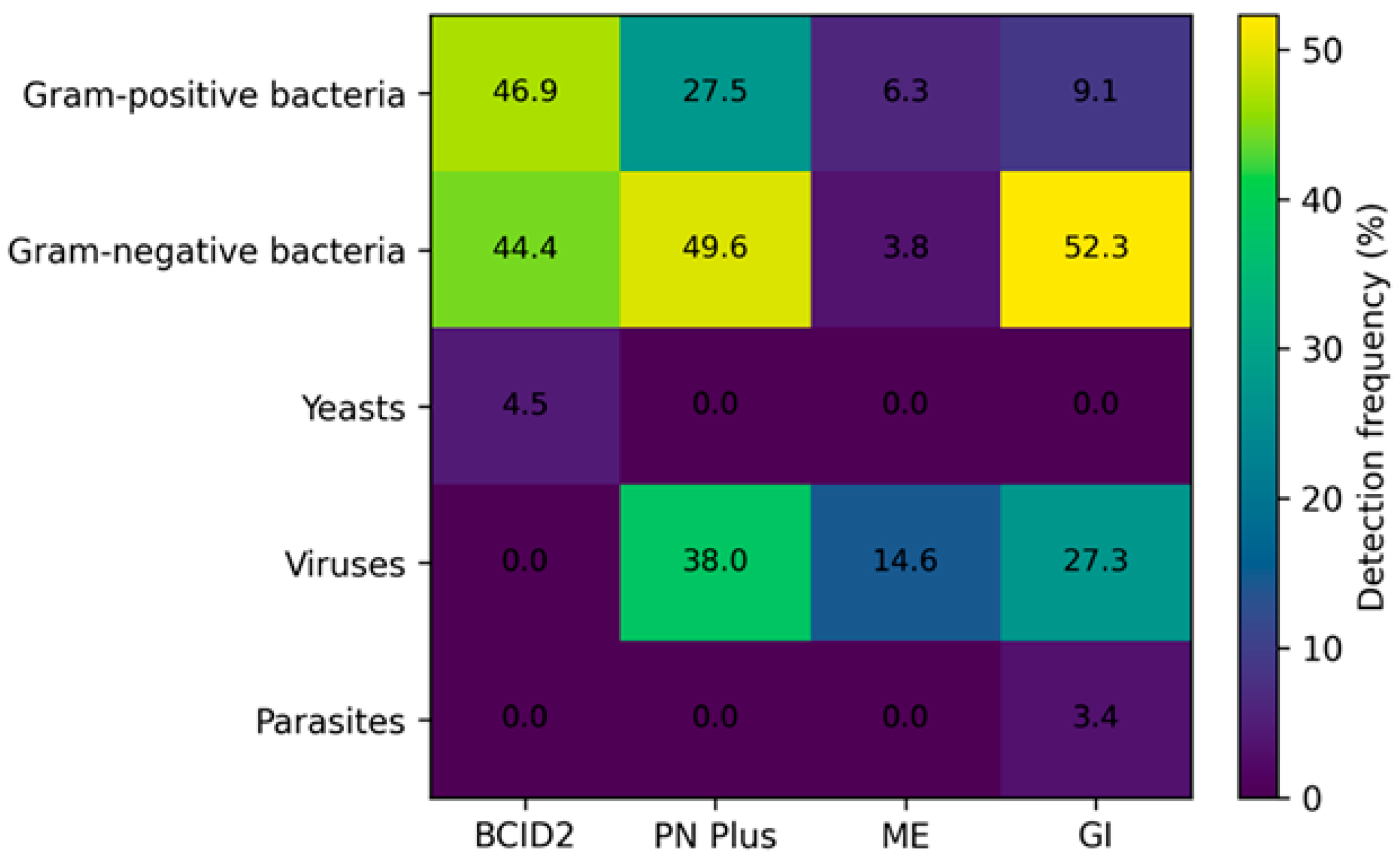

Integrating Syndromic Molecular Assays into Routine Diagnostic Microbiology: Benefits and Challenges

 ,
,  and
and
Abstract
1. Introduction
2. Results
2.1. Bloodstream Infections: BCID2 Panel
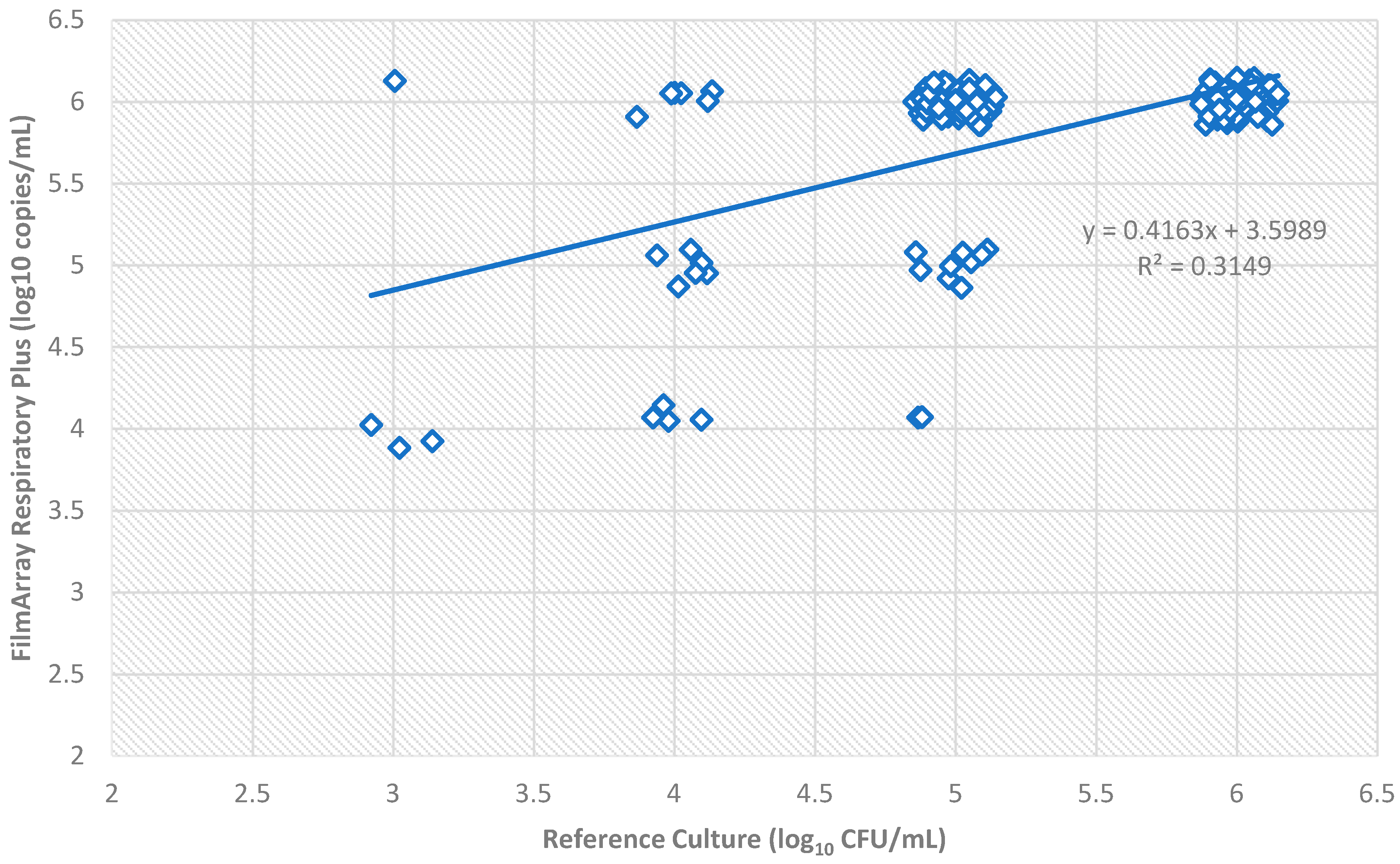
2.2. Lower Respiratory Tract Infections: Pneumonia Panel Plus
Correlation of Bacterial Loads
2.3. Central Nervous System Infections: ME Panel
2.4. Gastrointestinal Infections: GI Panel
2.5. Detection of Antimicrobial Resistance Markers by BCID2 and Pneumonia Plus Panels
3. Discussion
4. Materials and Methods
4.1. Study Design and Clinical Specimen Collection
4.2. Syndromic Molecular Testing: BioFire® FilmArray® System
4.3. Conventional Culture-Based Diagnostics and Laboratory Automation
4.4. Pathogen Identification and Antimicrobial Susceptibility Testing
4.5. Performance Analysis and Statistical Methods
5. Conclusions
Author Contributions
Funding
Institutional Review Board Statement
Informed Consent Statement
Data Availability Statement
Acknowledgments
Conflicts of Interest
References
- GBD 2019 Diseases and Injuries Collaborators. Global burden of 369 diseases and injuries in 204 countries and territories, 1990–2019: A systematic analysis for the Global Burden of Disease Study 2019. Lancet 2020, 396, 1204–1222, Erratum in Lancet 2020, 396, 1562. https://doi.org/10.1016/S0140-6736(20)32226-1. [Google Scholar] [CrossRef] [PubMed]
- Serapide, F.; Pallone, R.; Quirino, A.; Marascio, N.; Barreca, G.S.; Davoli, C.; Lionello, R.; Matera, G.; Russo, A. Impact of Multiplex PCR on Diagnosis of Bacterial and Fungal Infections and Choice of Appropriate Antimicrobial Therapy. Diagnostics 2025, 15, 1044. [Google Scholar] [CrossRef] [Scilit]
- Baselski, V.S.; Wunderink, R.G. Bronchoscopic diagnosis of pneumonia. Clin. Microbiol. Rev. 1994, 7, 533–558. [Google Scholar] [CrossRef]
- Kalil, A.C.; Metersky, M.L.; Klompas, M.; Muscedere, J.; Sweeney, D.A.; Palmer, L.B.; Napolitano, L.M.; O’Grady, N.P.; Bartlett, J.G.; Carratalà, J.; et al. Management of Adults With Hospital-acquired and Ventilator-associated Pneumonia: 2016 Clinical Practice Guidelines by the Infectious Diseases Society of America and the American Thoracic Society. Clin. Infect. Dis. 2016, 63, e61–e111, Erratum in Clin. Infect. Dis. 2017, 64, 1298. https://doi.org/10.1093/cid/ciw799. Erratum in Clin. Infect. Dis. 2017, 65, 1435. https://doi.org/10.1093/cid/cix587. Erratum in Clin. Infect. Dis. 2017, 65, 2161. https://doi.org/10.1093/cid/cix759. [Google Scholar] [CrossRef] [Scilit]
- Bush, K.; Courvalin, P.; Dantas, G.; Davies, J.; Eisenstein, B.; Huovinen, P.; Jacoby, G.A.; Kishony, R.; Kreiswirth, B.N.; Kutter, E.; et al. Tackling antibiotic resistance. Nat. Rev. Microbiol. 2011, 9, 894–896. [Google Scholar] [CrossRef] [Scilit] [PubMed]
- Martin-Loeches, I.; Torres, A.; Nagavci, B.; Aliberti, S.; Antonelli, M.; Bassetti, M.; Bos, L.; Chalmers, J.D.; Derde, L.; de Waele, J.; et al. ERS/ESICM/ESCMID/ALAT guidelines for the management of severe community-acquired pneumonia. Eur. Respir. J. 2023, 61, 2200735. [Google Scholar] [CrossRef] [Scilit] [PubMed]
- Ramanan, P.; Bryson, A.L.; Binnicker, M.J.; Pritt, B.S.; Patel, R. Syndromic Panel-Based Testing in Clinical Microbiology. Clin. Microbiol. Rev. 2017, 31, e00024-17. [Google Scholar] [CrossRef] [Scilit]
- Hansen, G.T. Point-of-Care Testing in Microbiology: A Mechanism for Improving Patient Outcomes. Clin. Chem. 2020, 66, 124–137. [Google Scholar] [CrossRef] [Scilit]
- Buss, S.N.; Leber, A.; Chapin, K.; Fey, P.D.; Bankowski, M.J.; Jones, M.K.; Rogatcheva, M.; Kanack, K.J.; Bourzac, K.M. Multicenter evaluation of the BioFire FilmArray gastrointestinal panel for etiologic diagnosis of infectious gastroenteritis. J. Clin. Microbiol. 2015, 53, 915–925. [Google Scholar] [CrossRef] [Scilit]
- Santos, Y.d.A.P.D.; Tomazini, B.M.; Dos Santos, M.H.C.; de Queiroz, E.L.; Júnior, L.P.; Costa, E.L.V.; Ramos, F.J.d.S. Impact of syndromic molecular diagnostics on antimicrobial adequacy and time to therapy in critically ill patients with pneumonia: A systematic review and meta-analysis of randomized trials. Crit. Care 2025, 29, 379. [Google Scholar] [CrossRef] [Scilit]
- Wagner, A.P.; Enne, V.; Gant, V.; Stirling, S.; Barber, J.A.; Livermore, D.M.; Turner, D.A. The INHALE WP3 study group. Cost-effectiveness of rapid, ICU-based, syndromic PCR in hospital-acquired pneumonia: Analysis of the INHALE WP3 multi-centre RCT. Crit. Care 2025, 29, 352, Erratum in Crit. Care 2025, 29, 396. https://doi.org/10.1186/s13054-025-05645-8. [Google Scholar] [CrossRef] [Scilit]
- Kumar, A.; Roberts, D.; Wood, K.E.; Light, B.; Parrillo, J.E.; Sharma, S.; Suppes, R.; Feinstein, D.; Zanotti, S.; Taiberg, L.; et al. Duration of hypotension before initiation of effective antimicrobial therapy is the critical determinant of survival in human septic shock. Crit. Care Med. 2006, 34, 1589–1596. [Google Scholar] [CrossRef] [Scilit]
- Caméléna, F.; de Ponfilly, G.P.; Pailhoriès, H.; Bonzon, L.; Alanio, A.; Poncin, T.; Lafaurie, M.; Dépret, F.; Cambau, E.; Godreuil, S.; et al. Multicenter Evaluation of the FilmArray Blood Culture Identification 2 Panel for Pathogen Detection in Bloodstream Infections. Microbiol. Spectr. 2023, 11, e0254722. [Google Scholar] [CrossRef] [Scilit]
- Timbrook, T.T.; Morton, J.B.; McConeghy, K.W.; Caffrey, A.R.; Mylonakis, E.; LaPlante, K.L. The Effect of Molecular Rapid Diagnostic Testing on Clinical Outcomes in Bloodstream Infections: A Systematic Review and Meta-analysis. Clin. Infect. Dis. 2017, 64, 15–23. [Google Scholar] [CrossRef] [Scilit] [PubMed]
- Bianco, G.; Boattini, M.; Iannaccone, M.; Sidoti, F.; Cavallo, R.; Costa, C. Detection of antibiotic resistance genes from blood cultures: Performance assessment and potential impact on antibiotic therapy management. J. Hosp. Infect. 2019, 102, 465–469. [Google Scholar] [CrossRef] [Scilit]
- Boattini, M.; Bianco, G.; Iannaccone, M.; Zanotto, E.; Sidoti, F.; Almeida, A.; De Rosa, F.G.; Cavallo, R.; Costa, C. Detection of Carbapenemase and CTX-M Encoding Genes Directly from Bronchoalveolar Lavage Using the CRE and ESBL ELITe MGB Assays: Toward Early and Optimal Antibiotic Therapy Management of Critically Ill Patients with Pneumonia. Microb. Drug Resist. 2021, 27, 241–246. [Google Scholar] [CrossRef] [Scilit]
- Murphy, C.N.; Fowler, R.; Balada-Llasat, J.M.; Carroll, A.; Stone, H.; Akerele, O.; Buchan, B.; Windham, S.; Hopp, A.; Ronen, S.; et al. Multicenter Evaluation of the BioFire FilmArray Pneumonia/Pneumonia Plus Panel for Detection and Quantification of Agents of Lower Respiratory Tract Infection. J. Clin. Microbiol. 2020, 58, e00128-20. [Google Scholar] [CrossRef] [Scilit] [PubMed]
- Kosai, K.; Akamatsu, N.; Ota, K.; Mitsumoto-Kaseida, F.; Sakamoto, K.; Hasegawa, H.; Izumikawa, K.; Mukae, H.; Yanagihara, K. BioFire FilmArray Pneumonia Panel enhances detection of pathogens and antimicrobial resistance in lower respiratory tract specimens. Ann. Clin. Microbiol. Antimicrob. 2022, 21, 24. [Google Scholar] [CrossRef] [Scilit] [PubMed]
- Clavel, M.; Barraud, O.; Moucadel, V.; Meynier, F.; Karam, E.; Ploy, M.C.; François, B.; VALIBI study group. Molecular quantification of bacteria from respiratory samples in patients with suspected ventilator-associated pneumonia. Clin. Microbiol. Infect. 2016, 22, 812.e1–812.e7. [Google Scholar] [CrossRef] [Scilit]
- Tunkel, A.R.; Hartman, B.J.; Kaplan, S.L.; Kaufman, B.A.; Roos, K.L.; Scheld, W.M.; Whitley, R.J. Practice guidelines for the management of bacterial meningitis. Clin. Infect. Dis. 2004, 39, 1267–1284. [Google Scholar] [CrossRef] [Scilit]
- Leber, A.L.; Everhart, K.; Balada-Llasat, J.M.; Cullison, J.; Daly, J.; Holt, S.; Lephart, P.; Salimnia, H.; Schreckenberger, P.C.; DesJarlais, S. Multicenter Evaluation of BioFire FilmArray Meningitis/Encephalitis Panel for Detection of Bacteria, Viruses, and Yeast in Cerebrospinal Fluid Specimens. J. Clin. Microbiol. 2016, 54, 2251–2261. [Google Scholar] [CrossRef] [Scilit]
- Buehler, S.S.; Madison, B.; Snyder, S.R.; Derzon, J.H.; Cornish, N.E.; Saubolle, M.A.; Weissfeld, A.S.; Weinstein, M.P.; Liebow, E.B.; Wolk, D.M. Effectiveness of Practices To Increase Timeliness of Providing Targeted Therapy for Inpatients with Bloodstream Infections: A Laboratory Medicine Best Practices Systematic Review and Meta-analysis. Clin. Microbiol. Rev. 2016, 29, 59–103. [Google Scholar] [CrossRef] [Scilit]
- Comini, S.; Bianco, G.; Boattini, M.; Banche, G.; Ricciardelli, G.; Allizond, V.; Cavallo, R.; Costa, C. Evaluation of a diagnostic algorithm for rapid identification of Gram-negative species and detection of extended-spectrum β-lactamase and carbapenemase directly from blood cultures. J. Antimicrob. Chemother. 2022, 77, 2632–2641. [Google Scholar] [CrossRef] [Scilit] [PubMed]
- Altun, O.; Almuhayawi, M.; Ullberg, M.; Ozenci, V. Clinical evaluation of the FilmArray blood culture identification panel in identification of bacteria and yeasts from positive blood culture bottles. J. Clin. Microbiol. 2013, 51, 4130–4136. [Google Scholar] [CrossRef] [Scilit] [PubMed]
- So, M.K.; Kim, S.K.; Chung, H.S.; Bae, J.Y.; Lee, M. Large-Scale Clinical Evaluation of Rapid Blood Culture Identification Panels for Bloodstream Infections at a Tertiary Hospital. Diagnostics 2023, 13, 1177. [Google Scholar] [CrossRef] [Scilit]
- Peleg, A.Y.; Hooper, D.C. Hospital-acquired infections due to gram-negative bacteria. N. Engl. J. Med. 2010, 362, 1804–1813. [Google Scholar] [CrossRef] [Scilit]
- Casale, R.; Bianco, G.; Bastos, P.; Comini, S.; Corcione, S.; Boattini, M.; Cavallo, R.; De Rosa, F.G.; Costa, C. Prevalence and Impact on Mortality of Colonization and Super-Infection by Carbapenem-Resistant Gram-Negative Organisms in COVID-19 Hospitalized Patients. Viruses 2023, 15, 1934. [Google Scholar] [CrossRef] [Scilit]
- Clark, A.E.; Kaleta, E.J.; Arora, A.; Wolk, D.M. Matrix-assisted laser desorption ionization–time of flight mass spectrometry: A fundamental shift in the routine practice of clinical microbiology. Clin. Microbiol. Rev. 2013, 26, 547–603. [Google Scholar] [CrossRef] [Scilit]
- Bianco, G.; Boattini, M.; Comini, S.; Iannaccone, M.; Casale, R.; Allizond, V.; Barbui, A.M.; Banche, G.; Cavallo, R.; Costa, C. Activity of ceftolozane-tazobactam, ceftazidime-avibactam, meropenem-vaborbactam, cefiderocol and comparators against Gram-negative organisms causing bloodstream infections in Northern Italy (2019–2021): Emergence of complex resistance phenotypes. J. Chemother. 2022, 34, 302–310. [Google Scholar] [CrossRef] [Scilit] [PubMed]
- Candel, F.J.; Salavert, M.; Cantón, R.; Del Pozo, J.L.; Galán-Sánchez, F.; Navarro, D.; Rodríguez, A.; Rodríguez, J.C.; Rodríguez-Aguirregabiria, M.; Suberviola, B.; et al. The role of rapid multiplex molecular syndromic panels in the clinical management of infections in critically ill patients: An experts-opinion document. Crit. Care 2024, 28, 440. [Google Scholar] [CrossRef] [Scilit]
- Boattini, M.; Guarrasi, L.; Comini, S.; Ricciardelli, G.; Casale, R.; Cavallo, R.; Costa, C.; Bianco, G. Diagnostic methods and protocols for rapid determination of methicillin resistance in Staphylococcus aureus bloodstream infections: A comparative analysis. Eur. J. Clin. Microbiol. Infect. Dis. 2025, 44, 827–837. [Google Scholar] [CrossRef] [Scilit]
- Pierantoni, L.; Dondi, A.; Gabrielli, L.; Lasala, V.; Andreozzi, L.; Bruni, L.; Guida, F.; Battelli, E.; Piccirilli, G.; Corsini, I.; et al. The Use of Point-of-Care Tests and Multiplex PCR Tests in the Pediatric Emergency Department Reduces Antibiotic Prescription in Patients with Febrile Acute Respiratory Infections. Pathogens 2025, 14, 1284. [Google Scholar] [CrossRef] [Scilit]
- Lowe, C.F.; Payne, M.; Puddicombe, D.; Mah, A.; Wong, D.; Kirkwood, A.; Hull, M.W.; Leung, V. Antimicrobial stewardship for hospitalized patients with viral respiratory tract infections. Am. J. Infect. Control. 2017, 45, 872–875. [Google Scholar] [CrossRef] [Scilit]
- Moffa, M.A.; Bremmer, D.N.; Carr, D.; Buchanan, C.; Shively, N.R.; Elrufay, R.; Walsh, T.L. Impact of a Multiplex Polymerase Chain Reaction Assay on the Clinical Management of Adults Undergoing a Lumbar Puncture for Suspected Community-Onset Central Nervous System Infections. Antibiotics 2020, 9, 282. [Google Scholar] [CrossRef] [Scilit] [PubMed]
- Buchan, B.W.; Windham, S.; Balada-Llasat, J.-M.; Leber, A.; Harrington, A.; Relich, R.; Murphy, C.; Bard, J.D.; Naccache, S.; Ronen, S.; et al. Practical Comparison of the BioFire FilmArray Pneumonia Panel to Routine Diagnostic Methods and Potential Impact on Antimicrobial Stewardship in Adult Hospitalized Patients with Lower Respiratory Tract Infections. J. Clin. Microbiol. 2020, 58, e00135-20. [Google Scholar] [CrossRef] [Scilit] [PubMed]
- Gastli, N.; Loubinoux, J.; Daragon, M.; Lavigne, J.-P.; Saint-Sardos, P.; Pailhoriès, H.; Lemarié, C.; Benmansour, H.; D’hUmières, C.; Broutin, L.; et al. Multicentric evaluation of BioFire FilmArray Pneumonia Panel for rapid bacteriological documentation of pneumonia. Clin. Microbiol. Infect. 2021, 27, 1308–1314. [Google Scholar] [CrossRef] [Scilit] [PubMed]
- Qin, J.; Zhang, H.; Zhang, X.; Wang, L.; Yu, Y.; Li, M.; Shen, Z. Optimizing blood culture diagnostics through laboratory automation: Reducing turnaround time and improving clinical outcomes. Microbiol. Spectr. 2025, 13, e0192725. [Google Scholar] [CrossRef] [Scilit]



| Pathogen Target | No. Detection (%) | 1 Target | 2 Targets | >2 Targets | Positive Agreement (%) | Negative Agreement (%) |
|---|---|---|---|---|---|---|
| Bacteria | ||||||
| E. coli | 60/400 (15) | 51 | 6 | 3 | 60/63 (95.2) | 337/337 (100) |
| E. cloacae complex | 9/400 (2.3) | 9 | 9/9 (100) | 391/391 (100) | ||
| K. oxytoca | 7/400 (1.8) | 4 | 2 | 1 | 6/7 (85.7) | 392/393 (99.7) |
| K. pneumoniae | 35/400 (8.7) | 27 | 5 | 3 | 34/34 (100) | 365/366 (99.7) |
| P. aeruginosa | 16/400 (4) | 10 | 4 | 2 | 13/14 (92.9) | 383/386 (99.2) |
| S. marcescens | 4/400 (1) | 2 | 1 | 1 | 3/3 (100) | 396/397 (99.7) |
| Proteus spp. | 11/400 (2.8) | 8 | 1 | 2 | 11/11 (100) | 389/389 (100) |
| A. baumannii cpx | 26/400 (6.5) | 10 | 9 | 7 | 23/25 (92) | 372/375 (99.2) |
| Enterobacteralesa | 4/400 (1) | 4 | 4/4 (100) | 396/396 (100) | ||
| S. maltophilia | 2/400 (0.5) | 2 | 2/2 (100) | 398/398 (100) | ||
| K. aerogenes | 1/400 (0.3) | 1 | 1/1 (100) | 399/399 (100) | ||
| Salmonella spp. | 0/400 | NA | 400/400 (100) | |||
| B. fragilis | 2/400 (0.5) | 2 | 2/2 (100) | 398/398 (100) | ||
| N. meningitidis | 0/400 | NA | 400/400 (100) | |||
| S. aureus | 67/400 (16.7) | 59 | 7 | 1 | 67/67 (100) | 347/347 (100) |
| S. epidermidis | 77/400 (19.3) | 49 | 20 | 8 | 70/70 (100) | 330/337 (97.9) |
| S. lugdunensis | 3/400 (0.8) | 1 | 2 | 2/2 (100) | 397/398 (99.7) | |
| Staphylococcus spp. b | 43/400 (10.8) | 30 | 10 | 3 | 42/43 (97.7) | 356/357 (99.7) |
| E. faecalis | 33/400 (8.2) | 15 | 11 | 7 | 31/32 (96.9) | 366/368 (99.4) |
| E. faecium | 20/400 (5) | 7 | 7 | 6 | 19/19 (100) | 382/383 (99.7) |
| S. pneumoniae | 3/400 (0.8) | 2 | 1 | 2/2 (100) | 397/398 (99.7) | |
| S. pyogenes | 1/400 (0.3) | 1 | 1/1 (100) | 399/399 (100) | ||
| Streptococcus spp. | 15/400 (3.8) | 7 | 6 | 2 | 13/13 (100) | 385/387 (99.5) |
| S. agalactiae | 1/400 (0.3) | 1 | 1/1 (100) | 399/399 (100) | ||
| L. monocytogenes | 1/400 (0.3) | 1 | 1/1 (100) | 399/399 (100) | ||
| Yeasts | ||||||
| C. albicans | 7/400 (1.7) | 4 | 1 | 2 | 5/6 (83.3) | 392/394 (99.5) |
| C. glabrata | 3/400 (0.8) | 2 | 1 | 2/2 (100) | 397/398 (99.7) | |
| Candida tropicalis | 2/400 (0.5) | 2 | 2/2 (100) | 398/398 (100) | ||
| C. parapsilosis | 4/400 (1) | 1 | 2 | 1 | 4/4 (100) | 396/396 (100) |
| C. auris | 0/400 | NA | 400/400 (100) | |||
| C. krusei | 0/400 | NA | 400/400 (100) | |||
| Cryptococcus neoformans/gattii | 0/400 | NA | 400/400 (100) | |||
| Total samples (n = 400) | 375 (93.75) | 310/400 (77.5) | 48/400 (12) | 17/400 (42.5) | 430/440 (97.7) | 11,997/12,024 (99.8) |
| Pathogen Target | Number of Detection (%) | 1 Target | 2 Targets | >2 Targets | Positive Agreement (%) | Negative Agreement (%) |
|---|---|---|---|---|---|---|
| Bacteria | ||||||
| E. coli | 23/309 (7.4) | 4 | 8 | 11 | 10/10 (100) | 286/299 (95.6) |
| S. aureus | 68/309 (22) | 19 | 22 | 27 | 25/26 (96.1) | 240/283 (84.8) |
| H. influenzae | 41/309 (13.3) | 13 | 18 | 10 | 17/17 (100) | 268/292 (91.8) |
| Proteus spp. | 12/309 (3.9) | 1 | 4 | 7 | 7/7 (100) | 297/302 (98.3) |
| M. catarrhalis | 12/309 (3.9) | 1 | 6 | 5 | 1/1 (100) | 297/308 (96.4) |
| S. pneumoniae | 15/309 (4.9) | 4 | 4 | 7 | 1/1 (100) | 294/308 (95.5) |
| A. baumannii cpx | 24/309 (7.8) | 10 | 8 | 6 | 18/19 (94.7) | 284/290 (97.9) |
| P. aeruginosa | 34/309 (11) | 10 | 12 | 12 | 24/24 (100) | 275/285 (96.5) |
| E. cloacae cpx | 9/309 (2.9) | 5 | 4 | 5/5 (100) | 300/304 (98.7) | |
| K. pneumoniae | 32/309 (10.4) | 10 | 11 | 11 | 18/20 (90) | 275/289 (95.1) |
| K. oxytoca | 5/309 (1.6) | 3 | 2 | 3/3 (100) | 304/306 (99.4) | |
| K. aerogenes | 0/309 | NA | 309/309 (100) | |||
| S. marcescens | 6/309 (1.9) | 2 | 2 | 2 | 2/2 (100) | 303/307 (98.7) |
| S. agalactiae | 0/309 | NA | 309/309 (100) | |||
| S. pyogenes | 2/309 (0.6) | 1 | 1 | 1/1 (100) | 307/308 (99.7) | |
| C. pneumoniae | 0/309 | NA | NA | |||
| L. pneumophila | 3/309 (1) | 1 | 2 | NA | NA | |
| M. pneumoniae | 4/309 (1.3) | 4 | NA | NA | ||
| Viruses | ||||||
| Adenovirus | 6/309 (1.9) | 3 | 3 | NA | NA | |
| Coronavirus | 26/309 (8.4) | 3 | 12 | 11 | NA | NA |
| Metapneumovirus | 10/309 (3.2%) | 5 | 1 | 4 | NA | NA |
| Rhinovirus/Enterovirus | 37/309 (12) | 8 | 17 | 12 | NA | NA |
| Influenza A Virus | 18/309 (5.8) | 4 | 10 | 4 | NA | NA |
| Influenza B Virus | 2/309 (0.6) | 2 | NA | NA | ||
| Parainfluenza Virus | 9/309 (2.9) | 5 | 2 | 2 | NA | NA |
| Respiratory Syncytial Virus | 10/309 (3.2) | 3 | 5 | 2 | NA | NA |
| Total samples (n = 309) | 408 | 110/309 (35.6) | 78/309 (25) | 44/309 (14.2) | 132/135 (97.8) | 4348/4499 (96.6) |
| Pathogen Target | Number of Detection (%) | 1 Target | 2 Targets | Positive Agreement (%) | Negative Agreement (%) |
|---|---|---|---|---|---|
| Bacteria | |||||
| S. agalactiae | 1/158 (0.6) | 1 | 1/1 (100) | 157/157 (100) | |
| S. pneumoniae | 5/158 (3.2) | 5 | 3/3 (100) | 153/155 (98.7) | |
| L. monocytogenes | 3/158 (1.9) | 3 | 2/2 (100) | 155/156 (99.4) | |
| H. influenzae | 2/158 (1.3) | 2 | 1/1 (100) | 156/157 (99.4) | |
| N. meningitidis | 1/158 (0.6) | 1 | 1/1 (100) | 157/157 (100) | |
| E. coli K1 | 0/158 | NA | 158/158 (100) | ||
| Viruses | |||||
| Enterovirus | 12/158 (7.6) | 12 | NA | NA | |
| Cytomegalovirus | 1/158 (0.6) | 1 | NA | NA | |
| Herpesvirus 6 | 6/158 (3.8) | 4 | 2 | NA | NA |
| Varicella zoster virus | 3/158 (1.9) | 3 | NA | NA | |
| Human parechovirus | 1/158 (0.6) | 1 | NA | NA | |
| Herpes simplex virus 1 | 0/158 | NA | NA | ||
| Herpes simplex virus 2 | 0/158 | NA | NA | ||
| Yeasts | |||||
| Cyptococcus neoformans/gatti | 0/158 | NA | 158/158 | ||
| Total samples (n = 158) | 35 | 31/158 (19.6) | 2/158 (1.3) | 8/8 (100) | 1094/1098 (99.6) |
| Pathogen Target | Number of Detection (%) | 1 Target | 2 Targets | >2 Targets | Positive Agreement (%) | Negative Agreement (%) |
|---|---|---|---|---|---|---|
| Bacteria | ||||||
| C. difficile toxin A/B a | 8/88 (9.1) | 5 | 2 | 1 | 6/6 (100) | 80/82 (97.6) |
| Campylobacter | 21/88 (23.9) | 20 | 1 | 16/16 (100) | 67/72 (93) | |
| Salmonella | 8/88 (9.1) | 3 | 5 | 7/7 (100) | 80/81 (98.8) | |
| Y. enterocolitica | 3/88 (3.4) | 1 | 1 | 1 | 1/1 (100) | 85/87 (97.7) |
| Vibrio b | 0/88 | NA | NA | |||
| P. shigelloides | 0/88 | NA | NA | |||
| EAEC | 5/88 (5.7) | 1 | 4 | NA | NA | |
| EPEC | 8/88 (9.1) | 3 | 4 | 1 | NA | NA |
| ETEC | 0/88 | NA | NA | |||
| STEC | 0/88 | NA | NA | |||
| E. coli O157 | 0/88 | NA | NA | |||
| Shigella/E. coli enteroinvasivo (EIEC) | 1/88 (1.1) | 1 | NA | NA | ||
| Viruses | ||||||
| Adenovirus F 40/41 | 3/88 (3.4) | 1 | 2 | NA | NA | |
| Astrovirus | 0/88 | NA | NA | |||
| Norovirus GI/GII | 14/88 (15.9) | 10 | 3 | 1 | NA | NA |
| Rotavirus A | 3/88 (3.4) | 1 | 1 | 1 | NA | NA |
| Parasites | ||||||
| Sapovirus (GI, II, IV, e V) | 4/88 (4.5) | 3 | 1 | NA | NA | |
| Cryptosporidium | 1/88 (1.1) | 1 | NA | NA | ||
| Cyclospora cayetanensis | 0/88 | NA | NA | |||
| Entamoeba histolytica | 0/88 | NA | NA | |||
| Giardia lamblia | 2/88 (2.3) | 1 | 1 | NA | NA | |
| Total samples (n = 88) | 81 | 44 (50) | 12 (13.6) | 4 (4.5) | 30/30 (100) | 312/322 (96.9) |
| FilmArray Results | Agreement with Phenotypic Results a | ||
|---|---|---|---|
| Resistance Marker | Bacterial Species | Expected Phenotype b | |
| CTX-M | E.coli (n = 24) K. pneumoniae (n = 8) P. mirabilis (n = 3) | Resistance to 3rd and 4th generation cephalosporins (ceftazidime, cefotaxime) or MIC > 1 mg/L. | 33/33 (100%) |
| NDM + OXA-48like + CTX-M | K. pneumoniae (n = 6) | Resistance to carbapenems (meropenem, ertapenem) or MIC > 0.12 mg/L. Resistance or elevated MICs for new BL/BLI combinations (e.g., CAZ/AVI, MEM/VAB, IMP/REL). | 6/6 (100%) |
| OXA-48like + CTX-M | K. pneumoniae (n = 2) | Resistance to carbapenems (meropenem, ertapenem) or MIC > 0.12 mg/L. | NA |
| KPC + CTX-M | E.coli (n = 1) K. pneumoniae (n = 5) | Resistance to carbapenems (meropenem, ertapenem) or MIC > 0.12 mg/L. | 4/4 (100%) |
| KPC + VIM | K. pneumoniae (n = 3) | Resistance to carbapenems (meropenem, ertapenem) or MIC > 0.12 mg/L. Resistance or elevated MICs for new BL/BLI combinations. | 3/3 (100%) |
| KPC | K. pneumoniae (n = 14) E.coli (n = 1) Proteus spp. (n = 1) | Resistance to carbapenems (meropenem, ertapenem) or MIC > 0.12 mg/L. | 10/10 (100%) |
| IMP | P. aeruginosa (n = 1) | Resistance to carbapenems (meropenem, ertapenem). Resistance or elevated MICs for new BL/BLI combinations. | 1/1 (100%) |
| VIM | P. aeruginosa (n = 5) Proteus spp. (n = 1) S. marcescens (n = 1) | Resistance to carbapenems (meropenem, ertapenem) or MIC > 0.12 mg/L (for Enterobacterales). Resistance or elevated MICs for new BL/BLI combinations. | 4/5 (80%) |
| vanA/B | Enterococcus faecium (n = 4) | Resistance to vancomycin and/or teicoplanin. | 4/4 (100%) |
| mecA/C and MREJ | S. aureus (n = 29) S. epidermidis (n = 68) | Resistance to oxacillin and/or positivity to the cefoxitin screen. | 76/87 (87.3%) |
| FILMARRAY Panel | Sample Type | Bacterial Targets | Viral Targets | Fungal/Parasitic Targets | Antimicrobial Resistance Genes |
|---|---|---|---|---|---|
| BCID2 | Positive blood cultures | 11 Gram-positive, 15 Gram-negative | – | 7 yeasts | mecA/C, MREJ, vanA/B, blaKPC, blaNDM, blaVIM, blaOXA-48-like, blaIMP, blaCTX-M |
| PN Plus a | Respiratory samples (BAL, ETA, sputum) | 15 (semi-quantitative) + 3 atypical | 9 + MERS-CoV | – | mecA/C, MREJ, blaCTX-M, blaKPC, blaNDM, blaVIM, blaOXA-48-like |
| ME | CSF | 6 | 7 | Cryptococcus neoformans/gattii | – |
| GI | Stool | 13 | 5 | 4 parasites | – |
Disclaimer/Publisher’s Note: The statements, opinions and data contained in all publications are solely those of the individual author(s) and contributor(s) and not of MDPI and/or the editor(s). MDPI and/or the editor(s) disclaim responsibility for any injury to people or property resulting from any ideas, methods, instructions or products referred to in the content. |
© 2026 by the authors. Licensee MDPI, Basel, Switzerland. This article is an open access article distributed under the terms and conditions of the Creative Commons Attribution (CC BY) license.
Share and Cite
Comini, S.; Priori, A.M.; Coppari, F.; Sabbatini, M.; Bruno, C.; Boattini, M.; Bianco, G.; Brecciaroli, F. Integrating Syndromic Molecular Assays into Routine Diagnostic Microbiology: Benefits and Challenges. Antibiotics 2026, 15, 182. https://doi.org/10.3390/antibiotics15020182
Comini S, Priori AM, Coppari F, Sabbatini M, Bruno C, Boattini M, Bianco G, Brecciaroli F. Integrating Syndromic Molecular Assays into Routine Diagnostic Microbiology: Benefits and Challenges. Antibiotics. 2026; 15(2):182. https://doi.org/10.3390/antibiotics15020182
Chicago/Turabian StyleComini, Sara, Anna Maria Priori, Francesco Coppari, Matteo Sabbatini, Concetta Bruno, Matteo Boattini, Gabriele Bianco, and Francesca Brecciaroli. 2026. "Integrating Syndromic Molecular Assays into Routine Diagnostic Microbiology: Benefits and Challenges" Antibiotics 15, no. 2: 182. https://doi.org/10.3390/antibiotics15020182
APA StyleComini, S., Priori, A. M., Coppari, F., Sabbatini, M., Bruno, C., Boattini, M., Bianco, G., & Brecciaroli, F. (2026). Integrating Syndromic Molecular Assays into Routine Diagnostic Microbiology: Benefits and Challenges. Antibiotics, 15(2), 182. https://doi.org/10.3390/antibiotics15020182