
Regulation of Antibiotic Use in Livestock: European and International Strategies to Prevent and Control Antimicrobial Resistance and Ensure Animal Welfare

 ,
,  , ,
, ,  , , and
Abstract
1. Introduction
2. AMR: Anthropogenic Effects on a Natural Phenomenon
The Blame Game About AMR: One Health, One Fight
3. The Supranational Legal Framework: Between Hard and Soft Law
The Essential Role of European Union Regulatory Activity
4. Growth Promoters, the Original Sin of Vets
4.1. Metaphylaxis and Chemoprophylaxis: The Paradox of Treating Healthy Animals
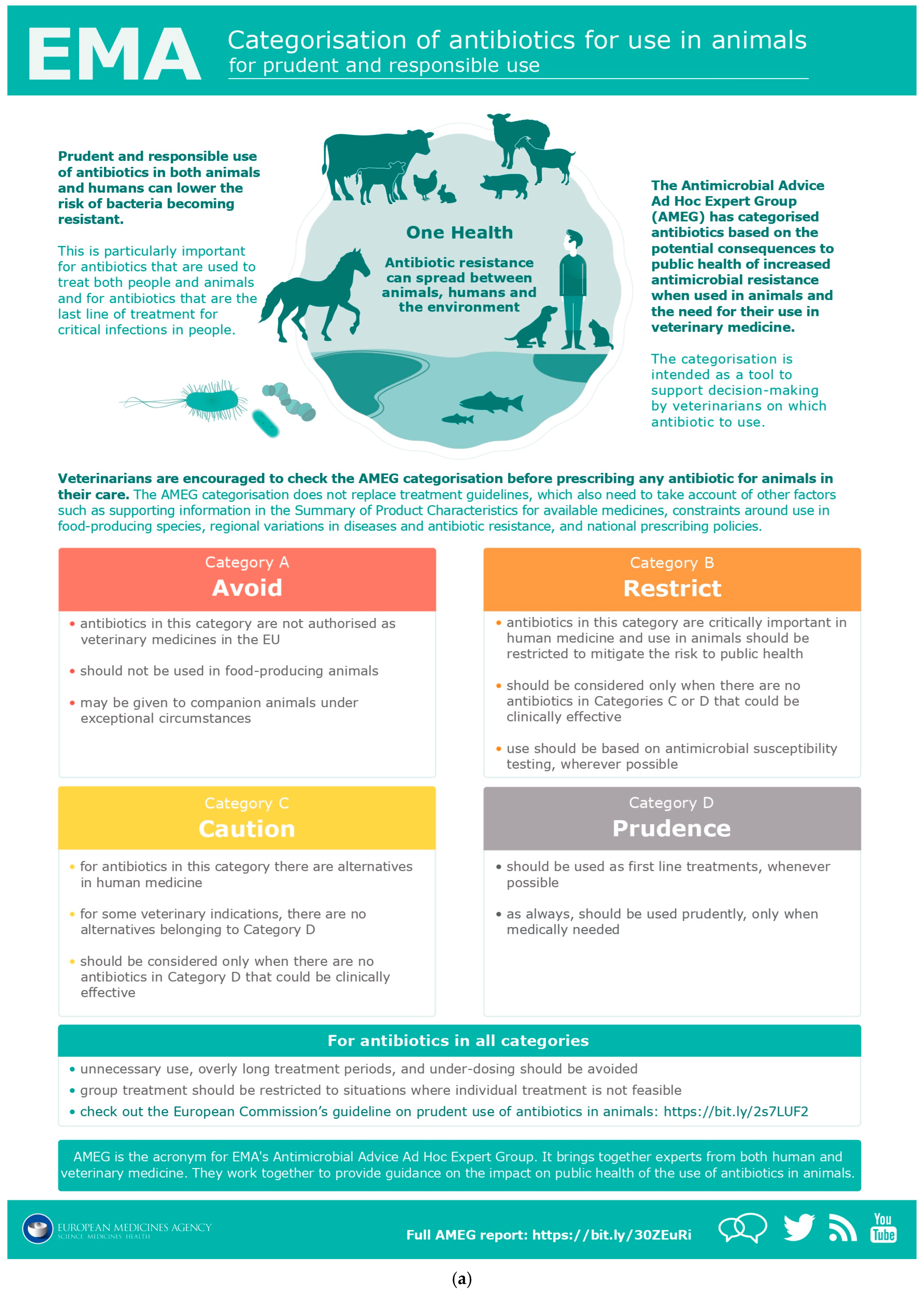
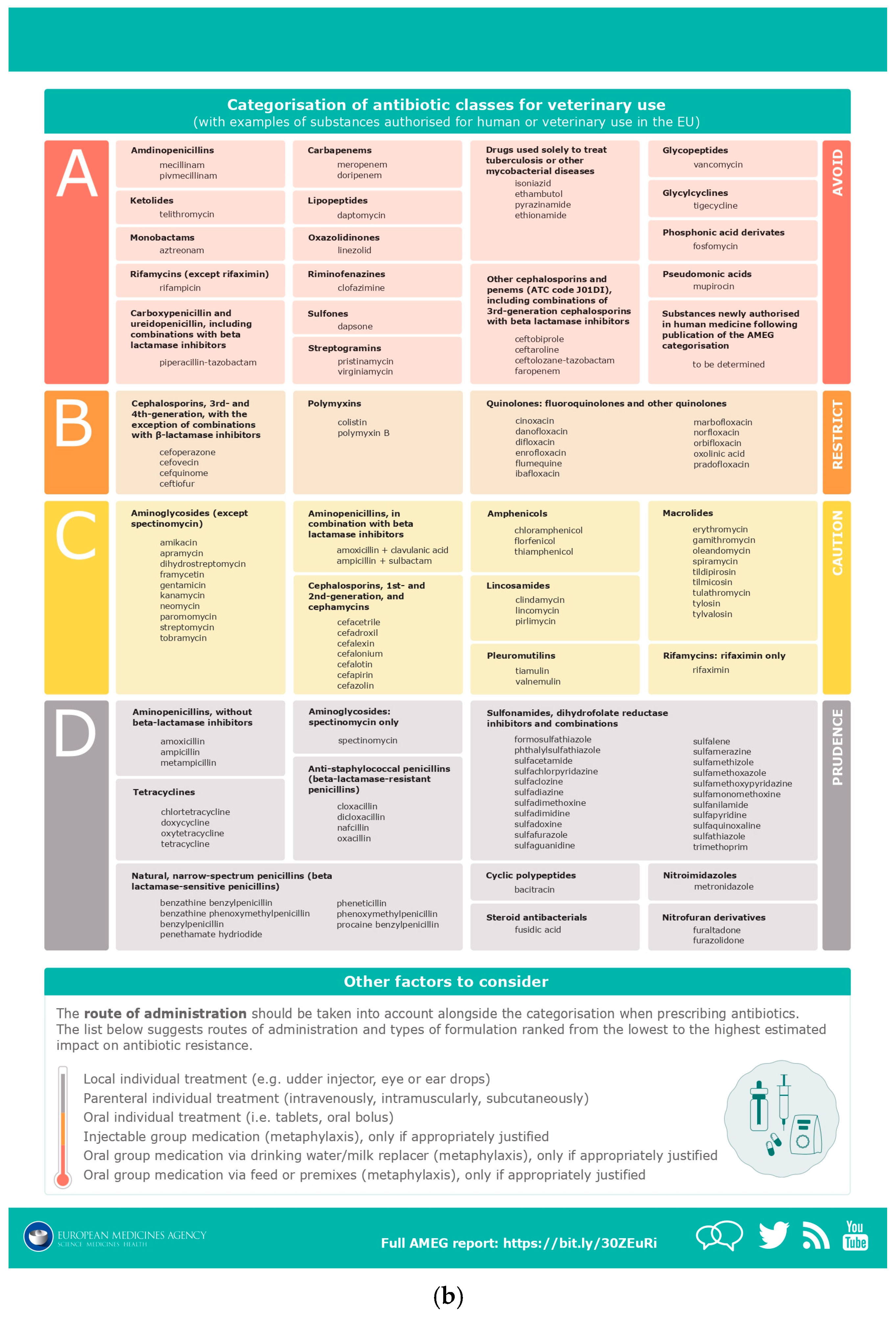
4.2. Antibiotics as Magic Bullets, Between Classifications and Bans
4.3. Rehabilitating the Figure of the Veterinarian
- (i)
- Maximum Residue Limit (MRL): This is the maximum allowed concentration of a residue in a food product obtained from an animal that has received a veterinary medicine or that has been exposed to a biocidal product for use in the animal husbandry sector. Before a veterinary medicine intended for food-producing animals is authorized in the EU, the Committee for Veterinary Medicinal Products (CVMP) evaluates the safety of the pharmacologically active substances in it and their residues and recommends MRLs accordingly. In this regard, the EMA has published scientific guidance relevant to the establishment of MRLs for veterinary medicines [40].
- (ii)
- The withdrawal period: This is the period that must elapse between the last administration of the veterinary medicinal product to animals (under normal conditions of use and in accordance with the provisions of the Directive 2001/82/EC) and the production of foodstuffs from such animals. This in order to protect public health by ensuring that such foodstuffs do not contain residues in quantities exceeding the MRLs for active substances laid down pursuant to Regulation (EEC) No 2377/901 [11,41,42]. In line with article 12.3 of Directive 2001/82/EC, marketing authorization applications for veterinary medicinal products for use in food producing species must include an indication of the so-called withdrawal period [41].
- (iii)
- Traceability centralized System of Veterinary Prescriptions. Veterinary electronic prescription (VEP) is mandatory by law since 2022 [11]. The adoption of a computer system for the traceability of veterinary medicinal products and medicated feed through the introduction of VEP is provided for pets and food producing animals. Any adverse drug reactions are also recorded in this traceability system [43,44,45].
- (iv)
- Pharmacovigilance: This refers to all the operations aimed at identifying, assessing, understanding and preventing adverse effects or any other problems related to the use of medicinal products in both human and veterinary medicine. These activities aim to (1) increase knowledge about medicines and better define their safety, (2) to improve the way these molecules are used, (3) establish a safety profile that better corresponds to actual medical practice and (4) describe the characteristics of patients undergoing treatment in a more realistic manner [45]. The EU pharmacovigilance system, fed by the programmes of the medicines agencies of the various Member States (e.g., the Italian Medicines Agency (AIFA)), provides for the ongoing safety monitoring of medicines and their use through a continuous data collection on this aspect [45]. These data can be obtained from different sources: reports of suspected adverse reactions (spontaneous and non-spontaneous), clinical studies, scientific literature, reports submitted by pharmaceutical companies, etc. Such pharmacovigilance system also monitors: (i) Ineffectiveness or adverse events when a medicine is used off-label, (ii) adequacy of withdrawal periods, (iii) suspected spread of an infectious agent facilitated by a medicine, (iv) adverse effects on the environment [46]. With regard to the possible off-label use of medicines (for indications other than those officially authorized by EMA), public service veterinarians carry out checks at farms, clinics and veterinary practices [46,47].
- (v)
- Pharmacosurveillance: It consists of monitoring activities throughout the entire drug supply chain (production, marketing, handling and administration) aimed at maintaining animal health and protecting consumers. This is a very important field of activity given its direct impact on animal welfare and safety of food of animal origin, e.g., in case of finding authorized or illegal drug residues. Pharmacosurveillance includes: (1) preventive ascertainments for granting permission for the possession of veterinary drug stocks in healthcare, detention and breeding facilities; (2) authorization procedures for the wholesale, direct sale and storage of veterinary drugs; (3) formal and substantial control of drug prescriptions; (4) sampling for the detection of illegal and/or authorized drug residues in different matrices. This kind of surveillance is carried out in various areas (on farms, in pharmacies and parapharmacies, wholesalers and direct retailers) annually and this requires planning of interventions of the competent authorities based on the risk analysis approach. The risk categorization of the facilities subject to control (primarily livestock farms) is currently carried out through information systems such as the ClassyFarm system [48,49].
- (vi)
- ClassyFarm system: This is a voluntary subscription IT platform for categorizing livestock farms according to risk, which has been developed by the Italian Ministry of Health, in collaboration with the Istituto Zooprofilattico Sperimentale of Lombardia and Emilia Romagna (IZSLER) and the University of Parma, since 2017 [50,51,52,53,54,55]. ClassyFarm is the Italian response to the European Parliament’s call on Member States for new techniques and technologies for animal welfare, as part of the European Strategy for Animal Welfare 2016–2020 [56]. It is also part of the Italian strategy to combat AMR 2017–2020 (also known as “Piano Nazionale di Contrasto all’Antibiotico-Resistenza” (PNCAR) [57].
5. From Bans to Best Practices: How to Reduce the Use of Antibiotics
- -
- Implementing external (prevention of pathogen entry into the farm) and internal (prevention of spread within the farm) biosecurity and hygiene standards, as the ClassyFarm system reiterates.
- -
- Select disease-resistant genetic lines, such as by analyzing the microbiota of animals less susceptible to infectious diseases.
- -
- Investing in vaccination programs.
- -
- Improving animal nutrition beginning with good quality colostrum (in order to strengthen animals’ natural immunity).
- -
- Providing adequate environmental conditions.
- -
- Reinforcing all these conditions at times of increased animal stress.
6. Conclusions: From Awareness to Action
- (i)
- Strengthen legal frameworks in non-EU regions through adoption of binding standards that regulate antibiotic use beyond growth promotion bans.
- (ii)
- Promote animal welfare as a pillar of AMR reduction policies, recognizing its role in lowering disease incidence and antibiotic need.
- (iii)
- Invest in farm-level data systems, such as ClassyFarm, to support risk-based decision-making, transparency, and accountability.
- (iv)
- Support the role of veterinarians as gatekeepers of responsible use, through continuous education, diagnostic tools, and stewardship support.
- (v)
- Engage consumers and policy-makers in recognizing that sustainable animal production may require trade-offs between cost, productivity and public health.
Author Contributions
Funding
Institutional Review Board Statement
Informed Consent Statement
Data Availability Statement
Acknowledgments
Conflicts of Interest
Abbreviations
| USA | United States of America |
| AMR | Antimicrobial Resistance |
| MDR | Multidrug resistant |
| ESBL | Extended Spectrum Beta-Lactamase |
| MRSA | Methicillin-resistant Staphylococcus aureus |
| EU | European Union |
| AMU | Antimicrobial Use |
| WHO | World Health Organization |
| FAO | Food and Agriculture Organization |
| WOAH | World Organization for Animal Health |
| WTO | World Trade Organization |
| G7 | Group of Seven |
| G20 | Group of Twenty |
| GPs | Growth Promoters |
| F2F | Farm to Fork Strategy |
| CAP | Common Agricultural Policy |
| EFSA | European Food Safety Authority |
| EMA | European Medicines Agency |
| ECDC | European Centre for Disease Prevention and Control |
| MERCOSUR | Mercado Común del Sur |
| VREs | Vancomycin-Resistant Enterococci |
| MIAs | Medically Important antimicrobials |
| UNEP | United Nations Environmental Programme |
| AMEG | Antimicrobial Advice Ad Hoc Expert Group |
| MRL | Maximum Residue Limit |
| CVMP | Committee for Veterinary Medicinal Products |
| VEP | Veterinary Electronic Prescription |
| AIFA | Italian Medicines Agency |
| IZSLER | Istituto Zooprofilattico Sperimentale of Lombardia and Emilia Romagna |
| PNCAR | Piano Nazionale di Contrasto all’Antibiotico-Resistenza |
| DANMAP | Danish Integrated Antimicrobial Resistance Monitoring and Research Programme |
| FINRES-Vet | Finnish Veterinary Antimicrobial Resistance Monitoring and Consumption of Antimicrobial Agents program |
| VETSTAT | Veterinary Statistics Program |
| BDN | Italian Data Bank for Livestock Registration |
| IIZZSS | Istituti Zooprofilattici Sperimentali |
| FBOs | Food Business Operators |
References
- Zipfel, P.F.; Skerka, C. From magic bullets to modern therapeutics: Paul Ehrlich, the German immunobiologist and physician coined the term ‘complement’. Mol. Immunol. 2022, 150, 90–98. [Google Scholar] [CrossRef] [PubMed]
- Armstrong, G.L.; Conn, L.A.; Pinner, R.W. Trends in infectious disease mortality in the United States during the 20th century. JAMA 1999, 281, 61–66. [Google Scholar] [CrossRef]
- Browne, K.; Chakraborty, S.; Chen, R.; Willco, M.D.; Black, D.S.; Walsh, W.R.; Kumar, N. A New Era of Antibiotics: The Clinical Potential of Antimicrobial Peptides. Int. J. Mol. Sci. 2020, 21, 7047. [Google Scholar] [CrossRef]
- Fleming, A. Nobel Lecture. Nobel Prize Outreach 2025. Available online: https://www.nobelprize.org/prizes/medicine/1945/fleming/lecture/ (accessed on 28 April 2025).
- Ballash, G.A.; Parker, E.M.; Mollenkopf, D.F.; Wittum, T.E. The One Health dissemination of antimicrobial resistance occurs in both natural and clinical environments. J. Am. Vet. Med. Assoc. 2024, 262, 451–458. [Google Scholar] [CrossRef]
- McEwen, S.A.; Collignon, P.J. Antimicrobial Resistance: A One Health Perspective. Microbiol. Spectr. 2018, 6, 1128. [Google Scholar] [CrossRef] [PubMed]
- O’Neill, J. The Review on Antimicrobial Resistance. Tackling Drug-Resistant Infections Globally: Final Report and Recommendations; Welcome Trust: London, UK, 2016; Available online: https://amr-review.org/sites/default/files/160518_Final%20paper_with%20cover.pdf (accessed on 21 April 2025).
- FAO; OIE; WHO; UNEP. Antimicrobial Resistance and the United Nations Sustainable Development Cooperation Framework: Guidance for United Nations Country Teams; FAO: Rome, Italy; OIE: Paris, France; WHO: Geneva, Switzerland, 2021; Available online: https://openknowledge.fao.org/handle/20.500.14283/cb6755en (accessed on 21 April 2025).
- FAO; WHO. Foodborne Antimicrobial Resistance—Compendium of Codex Standards; First revision; Codex Alimentarius Commission: Rome, Italy, 2023. [Google Scholar] [CrossRef]
- FAO; WHO. General Principles of Food Hygiene. Codex Alimentarius Code of Practice, No. CXC 1-1969; Codex Alimentarius Commission: Rome, Italy, 2023. [Google Scholar] [CrossRef]
- The European Parliament and The Council of the European Union. Regulation (EU) 2019/6 of the European Parliament and of the Council of 11 December 2018 on Veterinary Medicinal Products and Repealing Directive 2001/82/EC. O.J. L 4. 7 January 2019, pp. 43–167. Available online: https://eur-lex.europa.eu/eli/reg/2019/6/oj/eng (accessed on 26 April 2025).
- Martínez, J.L. Antibiotics and antibiotic resistance genes in natural environments. Science 2008, 321, 365–367. [Google Scholar] [CrossRef] [PubMed]
- Clemente, J.C.; Pehrsson, E.C.; Blaser, M.J.; Sandhu, K.; Gao, Z.; Wang, B.; Magris, M.; Hidalgo, G.; Contreras, M.; Noya-Alarcón, Ó.; et al. The microbiome of uncontacted Amerindians. Sci. Adv. 2015, 1, e1500183. [Google Scholar] [CrossRef]
- Jukes, T.H.; Williams, W.L. Nutritional effects of antibiotics. Pharmacol. Rev. 1953, 5, 381–420. [Google Scholar] [CrossRef]
- Trotta, A.; Cirilli, M.; Marinaro, M.; Bosak, S.; Diakoudi, G.; Ciccarelli, S.; Paci, S.; Buonavoglia, D.; Corrente, M. Detection of multi-drug resistance and AmpC β-lactamase/extended-spectrum β-lactamase genes in bacterial isolates of loggerhead sea turtles (Caretta caretta) from the Mediterranean Sea. Mar. Pollut. Bull. 2021, 164, 112015. [Google Scholar] [CrossRef]
- Aminov, R.I. A brief history of the antibiotic era: Lessons learned and challenges for the future. Front. Microbiol. 2010, 1, 134. [Google Scholar] [CrossRef]
- Ho, C.S.; Wong, C.T.H.; Aung, T.T.; Lakshminarayan, R.; Metha, J.S.; Rauz, S.; McNally, A.; Kintses, B.; Peacock, S.J.; de la Fuente-Nunez, C.; et al. Antimicrobial resistance: A concise update. Lancet Microbe 2024, 12, 100947. [Google Scholar] [CrossRef] [PubMed]
- Perry, J.; Waglechner, N.; Wright, G. The Prehistory of Antibiotic Resistance. Cold Spring Harb. Perspect. Med. 2016, 6, a025197. [Google Scholar] [CrossRef]
- Meagher, K.M. Why We Should Reexamine the “Golden Age” of Antibiotics in Social Context. AMA J. Ethics 2024, 26, E418–E428. [Google Scholar] [CrossRef]
- McGuinness, W.A.; Malachowa, N.; DeLeo, F.R. Vancomycin Resistance in Staphylococcus aureus. Yale J. Biol. Med. 2017, 90, 269–281. [Google Scholar] [PubMed]
- Bhatt, S.; Chatterjee, S. Fluoroquinolone antibiotics: Occurrence, mode of action, resistance, environmental detection, and remediation—A comprehensive review. Environ. Pollut. 2022, 315, 120440. [Google Scholar] [CrossRef] [PubMed]
- Swann, M.M. Report of the Joint Committee on the use of Antibiotics. In Animal Husbandry and Veterinary Medicine, 6th ed.; Her Majesty’s Stationery Office: London, UK, 1969; 42p, Available online: https://wellcomecollection.org/works/cqvewh54 (accessed on 28 April 2025).
- World Health Organization (WHO). Global Action Plan on Antimicrobial Resistance; WHO Press: Geneva, Switzerland, 2015; Available online: https://www.who.int/publications/i/item/9789241509763 (accessed on 28 April 2025).
- World Organization for Animal Health (WOAH). Terrestrial Animal Health Code. Available online: https://www.woah.org/en/what-we-do/standards/codes-and-manuals/ (accessed on 28 April 2025).
- United Nations General Assembly (UNGA). Political Declaration of the High-Level Meeting of the General Assembly on Antimicrobial Resistance. In High-Level Plenary Meeting on Antimicrobial Resistance; United Nations General Assembly: New York, NY, USA, 2016; Available online: https://digitallibrary.un.org/record/842813?v=pdf (accessed on 28 April 2025).
- The European Parliament and The Council of the European Union. Regulation (EU) 2019/4 of the European Parliament and of the Council of 11 December 2018 on the Manufacture, Placing on the Market and Use of Medicated Feed, Amending Regulation (EC) No 183/2005 of the European Parliament and of the Council and Repealing Council Directive 90/167/EEC. O.J. L 4. 7 January 2019; pp. 1–23. Available online: https://eur-lex.europa.eu/eli/reg/2019/4/oj/eng (accessed on 12 May 2025).
- European Commission. A European One Health Action Plan against Antimicrobial Resistance (AMR). 2017. Available online: https://health.ec.europa.eu/system/files/2020-01/amr_2017_action-plan_0.pdf (accessed on 22 May 2025).
- European Commission. Farm to Fork Strategy, for a Fair, Healthy and Environmentally-Friendly Food System. 2020. Available online: https://food.ec.europa.eu/document/download/472acca8-7f7b-4171-98b0-ed76720d68d3_en?filename=f2f_action-plan_2020_strategy-info_en.pdf (accessed on 10 February 2025).
- European Food Safety Authority (EFSA); European Centre for Disease Prevention and Control (ECDC). The European Union Summary Report on Antimicrobial Resistance in Zoonotic and Indicator Bacteria from Humans, Animals and Food in 2022–2023. EFSA J. 2025, 23, e9237. [Google Scholar] [CrossRef]
- Butaye, P.; Devriese, L.A.; Haesebrouck, F. Antimicrobial growth promoters used in animal feed: Effects of less well known antibiotics on gram-positive bacteria. Clin. Microbiol. Rev. 2003, 16, 175–188. [Google Scholar] [CrossRef] [PubMed]
- Kirchhelle, C. Swann Song: Antibiotic Regulation in British Livestock Production (1953–2006). Bull. Hist. Med. 2018, 92, 317–350. [Google Scholar] [CrossRef] [PubMed]
- Council of European Union. Regulation (EC) No 1831/2003 of the European Parliament and of the Council of 22 September 2003 on Additives for Use in Animal Nutrition. O.J. L 268. 18 October 2003; p. 29. Available online: https://eur-lex.europa.eu/legal-content/EN/TXT/?uri=CELEX%3A02003R1831-20210327 (accessed on 20 May 2025).
- Sneeringer, S.; Bowman, M.; Clancy, M. The U.S. and EU Animal Pharmaceutical Industries in the Age of Antibiotic Resistance. Dep. Agric. Econ. Res. Serv. 2019, 264–280. [Google Scholar] [CrossRef]
- World Organisation for Animal Health (WOAH). OIE Annual Report on Antimicrobial Agents Intended for Use in Animals. Available online: https://www.oie.int/app/uploads/2021/05/a-fifth-annual-report-amr.pdf (accessed on 21 May 2025).
- Decreto Legislativo 7 Dicembre 2023, n. 218. Adeguamento Della Normativa Nazionale Alle Disposizioni del Regolamento (UE) 2019/6 del Parlamento Europeo e del Consiglio dell’11 Dicembre 2018 Relativo ai Medicinali Veterinari e Che Abroga la Direttiva 2001/82/CE, ai Sensi Dell’articolo 17 Della Legge 4 Agosto 2022, n. 127. (23G00225). O.J. 2. 3 January 2024. Available online: https://www.gazzettaufficiale.it/eli/gu/2024/01/03/2/sg/pdf (accessed on 22 May 2025).
- World Health Organization (WHO). WHO List of Medically Important Antimicrobials: A Risk Management Tool for Mitigating Antimicrobial Resistance Due to Non-Human Use; World Health Organization: Geneva, Switzerland, 2024; Available online: https://cdn.who.int/media/docs/default-source/gcp/who-mia-list-2024-lv.pdf (accessed on 27 May 2025).
- European Medicine Agency: Infographic on Categorization of Antimicrobials. Available online: https://fve.org/ema-infographics-on-categorization-of-antimicrobials/ (accessed on 10 June 2025).
- European Commission. Commission Implementing Regulation (EU) 2022/1255 of 19 July 2022 Designating Antimicrobials or Groups of Antimicrobials Reserved for Treatment of Certain Infections in Humans, in Accordance with REGULATION (EU) 2019/6 of the European Parliament and of the Council. O.J. L 191. 20 July 2022, pp. 58–60. Available online: http://data.europa.eu/eli/reg_impl/2022/1255/oj (accessed on 10 June 2025).
- Bozzo, G.; Corrente, M.; Testa, G.; Casalino, G.; Dimuccio, M.M.; Circella, E.; Brescia, N.; Barrasso, R.; Celentano, F.E. Animal Welfare, Health and the Fight against Climate Change: One Solution for Global Objectives. Agriculture 2021, 11, 1248. [Google Scholar] [CrossRef]
- European Medicine Agency (EMA). Safety and Residues: Pharmaceuticals. Available online: https://www.ema.europa.eu/en/veterinary-regulatory-overview/research-development-veterinary-medicines/scientific-guidelines-veterinary-medicines/safety-residues-guidelines/safety-residues-pharmaceuticals (accessed on 12 June 2025).
- The European Parliament and The Council of The European Union. Directive 2001/82/EC of The European Parliament and of the Council of 6 November 2001 on the Community Code Relating to Veterinary Medicinal Products. O.J. L 311. 28 November 2001, p. 1. Available online: https://eur-lex.europa.eu/eli/dir/2001/82/oj (accessed on 17 June 2025).
- The European Union. Council Regulation (EEC) No 2377/90 of 26 June 1990 Laying Down a COMMUNITY Procedure for the Establishment of Maximum Residue Limits of Veterinary Medicinal Products in Foodstuffs of Animal Origin. O.J. L 224. 18 August 1990, p. 1. Available online: https://eur-lex.europa.eu/legal-content/EN/TXT/?uri=CELEX%3A01990R2377-20080816 (accessed on 17 June 2025).
- Ministero Della Salute—Direzione Generale Della Sanità Animale e dei Farmaci Veterinari. Sistema Informativo Nazionale Della Farmacosorveglianza. Ricetta Veterinaria Elettronica. Available online: https://www.ricettaveterinariaelettronica.it/ (accessed on 12 April 2025).
- Chirollo, C.; Nocera, F.P.; Piantedosi, D.; Fatone, G.; Della Valle, G.; De Martino, L.; Cortese, L. Data on before and after the Traceability System of Veterinary Antimicrobial Prescriptions in Small Animals at the University Veterinary Teaching Hospital of Naples. Animals 2021, 11, 913. [Google Scholar] [CrossRef] [PubMed]
- Agenzia Italiana del Farmaco. Farmacovigilanza. Available online: https://www.aifa.gov.it/farmacovigilanza1 (accessed on 8 September 2025).
- European Medicine Agency (EMA). Pharmacovigilance (Veterinary Medicines). Available online: https://www.ema.europa.eu/en/veterinary-regulatory-overview/post-authorisation-veterinary-medicines/pharmacovigilance-veterinary-medicines (accessed on 8 September 2025).
- Agenzia Italiana del Farmaco (AIFA). Accesso Precoce al Farmaco e Uso Off-Label. Available online: https://www.aifa.gov.it/accesso-precoce-uso-off-label (accessed on 8 September 2025).
- Federazione Nazionale Ordini Veterinari Italiani (FNOVI). Farmacosorveglianza: Ruolo Primario per il Medico Veterinario. Available online: https://www.fnovi.it/sites/default/files/Dossier%20farmacosorveglianza%209-7-2012er%281%29.pdf (accessed on 15 September 2025).
- Local Health Authority “City of Turin” Piedmont Region. Pharmacosurveillance and Pharmacovigilance. Available online: https://www.aslcittaditorino.it/farmacosorveglianza-e-farmacovigilanza/ (accessed on 16 September 2025).
- Ventura, G.; Lorenzi, V.; Mazza, F.; Clemente, G.A.; Iacomino, C.; Bertocchi, L.; Fusi, F. Best Farming Practices for the Welfare of Dairy Cows, Heifers and Calves. Animals 2021, 11, 2645. [Google Scholar] [CrossRef]
- The Classyfarm System. Available online: https://www.classyfarm.it/index.php/vet-aziendale-it (accessed on 18 September 2025).
- Ministero Della Salute. Decreto 7 Dicembre 2017. Sistema di Reti di Epidemio-Sorveglianza, Compiti, Responsabilità e Requisiti Professionali del Veterinario Aziendale (18A00687). O.J. 29. 5 February 2018. Available online: https://www.gazzettaufficiale.it/eli/id/2018/02/05/18A00687/sg (accessed on 30 September 2025).
- Decreto Legislativo 5 Agosto 2022, n. 136. Attuazione Dell’articolo 14, Comma 2, Lettere a), b), e), f), h), i), l), n), o) e p), Della Legge 22 Aprile 2021, n. 53 per Adeguare e Raccordare la Normativa Nazionale in Materia di Prevenzione e Controllo Delle Malattie Animali Che Sono Trasmissibili Agli Animali o All’uomo, Alle Disposizioni Del Regolamento (UE) 2016/429 Del Parlamento Europeo e Del Consiglio, Del 9 Marzo 2016. (22G00144) O.J. 213. 12 September 2022. Available online: https://www.normattiva.it/uri-res/N2Ls?urn:nir:stato:decreto.legislativo:2022-08-05;136 (accessed on 30 September 2025).
- Ministero Delle Politiche Agricole Alimentari e Forestali. Decreto 2 Agosto 2022 Disciplina Del «Sistema di qualità nazionale per il benessere animale». (22A06772). O.J. 279. 29 November 2022. Available online: https://www.gazzettaufficiale.it/eli/id/2022/11/29/22A06772/sg (accessed on 30 September 2025).
- Holighaus, L.; Zanon, T.; Kemper, N.; Gauly, M. First evaluation of the practicability of the ClassyFarm welfare assessment protocol in Italian small-scale mountain dairy farms—A case study. Ital. J. Anim. Sci. 2023, 22, 995–1007. [Google Scholar] [CrossRef]
- European Parliament. European Parliament Resolution of 26 November 2015 on a New Animal Welfare Strategy for 2016–2020. Available online: https://oeil.secure.europarl.europa.eu/oeil/en/procedure-file?reference=2015/2957(RSP) (accessed on 16 September 2025).
- Gruppo di Lavoro per il Coordinamento Della Strategia Nazionale di Contrasto Dell’antimicrobico-Resistenza (GTC-AMR). Piano Nazionale di Contrasto all’Antibiotico-Resistenza (PNCAR) 2022–2025. 2022. Available online: https://www.salute.gov.it/imgs/C_17_pubblicazioni_3294_allegato.pdf (accessed on 30 September 2025).
- The Danish Interated Antimicrobial Resistance Monitoring and Research Programme. Available online: https://www.danmap.org (accessed on 18 December 2025).
- Finnish Food Authority. Monitoring of Antibiotic Resistance. Available online: https://www.ruokavirasto.fi/en/animals/animal-medication/monitoring-of-antibiotic-resistance/ (accessed on 18 December 2025).
- Frimodt-Møller, N. Microbial Threat—The Copenhagen Recommendations initiative of the EU. J. Vet. Med. B Infect. Dis. Vet. Public Health 2004, 51, 400–402. [Google Scholar] [CrossRef]
- Glavind, A.S.; Kruse, A.B.; Nielsen, L.R.; Stege, L. Monitoring antimicrobial usage in companion animals: Exploring the use of the Danish VetStat database. Acta Vet. Scand. 2022, 64, 27. [Google Scholar] [CrossRef]
- Stege, H.; Bager, F.; Jacobsen, E.; Thougaard, A. VETSTAT-the Danish system for surveillance of the veterinary use of drugs for production animals. Prev. Vet. Med. 2003, 57, 105–115. [Google Scholar] [CrossRef]
- Ghidini, S.; De Luca, S.; Rinaldi, E.; Zanardi, E.; Ianieri, A.; Guadagno, F.; Alborali, G.L.; Meemken, D.; Conter, M.; Varrà, M.O. Comparing Visual-Only and Visual-Palpation Post-Mortem Lung Scoring Systems in Slaughtering Pigs. Animals 2023, 13, 2419. [Google Scholar] [CrossRef]
- Mariottini, F.; Giuliotti, L.; Gracci, M.; Benvenuti, M.N.; Salari, F.; Arzilli, L.; Martini, M.; Roncoroni, C.; Brajon, G. The ClassyFarm System in Tuscan Beef Cattle Farms and the Association between Animal Welfare Level and Productive Performance. Animals 2022, 12, 1924. [Google Scholar] [CrossRef]
- European Union. Regulation (EU) No 2016/429 of the European Parliament and of the Council of 9 March 2016 on Transmissible Animal Diseases and Amending and Repealing Certain Acts in the Area of Animal Health (‘Animal Health Law’) O.J. L 84. 31 March 2016. Available online: https://eur-lex.europa.eu/legal-content/EN/TXT/?uri=CELEX%3A32016R0429 (accessed on 7 October 2025).
- European Union. European Regulation (EU) 2017/625 of the European Parliament and of the Council of 15 March 2017 on Official Controls and Other Official Activities Performed to Ensure the Application of Food and Feed Law, Rules on Animal Health and Welfare, Plant Health and Plant Protection Products, Amending Regulations (EC) No 999/2001, (EC) No 396/2005, (EC) No 1069/2009, (EC) No 1107/2009, (EU) No 1151/2012, (EU) No 652/2014, (EU) 2016/429 and (EU) 2016/2031 of the European Parliament and of the Council, Council Regulations (EC) No 1/2005 and (EC) No 1099/2009 and Council Directives 98/58/EC, 1999/74/EC, 2007/43/EC, 2008/119/EC and 2008/120/EC, and repealing Regulations (EC) No 854/2004 and (EC) No 882/2004 of the European Parliament and of the Council, Council Directives 89/608/EEC, 89/662/EEC, 90/425/EEC, 91/496/EEC, 96/23/EC, 96/93/EC and 97/78/EC and Council Decision 92/438/EEC (Official Controls Regulation). O.J. L95. 7 April 2017, pp. 1–142. Available online: https://eur-lex.europa.eu/legal-content/EN/TXT/?uri=CELEX%3A02017R0625-20250105 (accessed on 7 October 2025).
- Woolhouse, M.; Ward, M.; van Bunnik, B.; Farrar, J. Antimicrobial resistance in humans, livestock and the wider environment. Philos. Trans. R. Soc. Lond. B Biol. Sci. 2015, 370, 20140083. [Google Scholar] [CrossRef]
- Singer, R.S.; Porter, L.J.; Thomson, D.U.; Gage, M.; Beaudoin, A.; Wishnie, J.K. Raising Animals Without Antibiotics: U.S. Producer and Veterinarian Experiences and Opinions. Front. Vet. Sci. 2019, 6, 452. [Google Scholar] [CrossRef]
- European Medicines Agency (EMA). Sales of Veterinary Antimicrobial Agents in 31 European Countries in 2021 Trends from 2010 to 2021 Twelfth ESVAC Report (EMA/795956/2022); Publications Office of the European Union: Luxembourg, 2022; Available online: https://www.ema.europa.eu/en/documents/report/sales-veterinary-antimicrobial-agents-31-european-countries-2021-trends-2010-2021-twelfth-esvac-report_en.pdf (accessed on 18 June 2025).
- Bozzo, G.; Barrasso, R.; Grimaldi, C.A.; Tantillo, G.; Roma, R. Consumer attitudes towards animal welfare and their willingness to pay. Vet. Ital. 2019, 55, 289–297. [Google Scholar] [CrossRef]
- Bozzo, G.; Dimuccio, M.M. Implementation of Animal Welfare: Pros and Cons. Agriculture 2023, 13, 748. [Google Scholar] [CrossRef]
- Rollin, B. Ethics, science and antimicrobial resistance. J. Agric. Environ. Ethics. 2001, 14, 29–37. [Google Scholar] [CrossRef]
- Holman, D.B.; McAllister, T.A.; Topp, E.; Wright, A.D.; Alexander, T.W. The nasopharyngeal microbiota of feedlot cattle that develop bovine respiratory disease. Vet. Microbiol. 2015, 180, 90–95. [Google Scholar] [CrossRef]
- Hollis, A.; Maybarduk, P. Antibiotic Resistance Is a Tragedy of the Commons That Necessitates Global Cooperation. J. Law Med. Ethics 2015, 43, 33–37. [Google Scholar] [CrossRef]
- Dadgostar, P. Antimicrobial Resistance: Implications and Costs. Infect. Drug Resist. 2019, 12, 3903–3910. [Google Scholar] [CrossRef]
- Jamrozik, E.; Heriot, G.S. Ethics and antibiotic resistance. Br. Med. Bull. 2022, 141, 4–14. [Google Scholar] [CrossRef]
- Waseem, H.; Williams, M.R.; Jameel, S.; Hashsham, S.A. Antimicrobial Resistance in the Environment. Water Environ. Res. 2018, 90, 865–884. [Google Scholar] [CrossRef] [PubMed]


Disclaimer/Publisher’s Note: The statements, opinions and data contained in all publications are solely those of the individual author(s) and contributor(s) and not of MDPI and/or the editor(s). MDPI and/or the editor(s) disclaim responsibility for any injury to people or property resulting from any ideas, methods, instructions or products referred to in the content. |
© 2026 by the authors. Licensee MDPI, Basel, Switzerland. This article is an open access article distributed under the terms and conditions of the Creative Commons Attribution (CC BY) license.
Share and Cite
Dimuccio, M.M.; Conforti, V.; Celentano, F.E.; Circella, E.; Salvaggiulo, A.; Bozzo, G.; Corrente, M. Regulation of Antibiotic Use in Livestock: European and International Strategies to Prevent and Control Antimicrobial Resistance and Ensure Animal Welfare. Antibiotics 2026, 15, 67. https://doi.org/10.3390/antibiotics15010067
Dimuccio MM, Conforti V, Celentano FE, Circella E, Salvaggiulo A, Bozzo G, Corrente M. Regulation of Antibiotic Use in Livestock: European and International Strategies to Prevent and Control Antimicrobial Resistance and Ensure Animal Welfare. Antibiotics. 2026; 15(1):67. https://doi.org/10.3390/antibiotics15010067
Chicago/Turabian StyleDimuccio, Michela Maria, Virginia Conforti, Francesco Emanuele Celentano, Elena Circella, Anna Salvaggiulo, Giancarlo Bozzo, and Marialaura Corrente. 2026. "Regulation of Antibiotic Use in Livestock: European and International Strategies to Prevent and Control Antimicrobial Resistance and Ensure Animal Welfare" Antibiotics 15, no. 1: 67. https://doi.org/10.3390/antibiotics15010067
APA StyleDimuccio, M. M., Conforti, V., Celentano, F. E., Circella, E., Salvaggiulo, A., Bozzo, G., & Corrente, M. (2026). Regulation of Antibiotic Use in Livestock: European and International Strategies to Prevent and Control Antimicrobial Resistance and Ensure Animal Welfare. Antibiotics, 15(1), 67. https://doi.org/10.3390/antibiotics15010067