Article

Emergence of OXA-48-like Carbapenemase-Producing Escherichia coli in Baranya County, Hungary

1
Department of Medical Microbiology, University of Pécs Medical School, 7624 Pécs, Hungary
2
Department of Microbiology and Immunology, Faculty of Pharmacy, Zagazig University, Zagazig 44519, Egypt
3
Centre for Metagenomics, Multidisciplinary Health Industry Coordination Institute, University of Debrecen, 4032 Debrecen, Hungary
4
Department of Bioinformatics, One Health Institute, Faculty of Health Sciences, University of Debrecen, 4032 Debrecen, Hungary
5
HUN-REN-UD Conservation Biology Research Group, University of Debrecen, 4032 Debrecen, Hungary
6
Hungarian Centre of Genomics and Bioinformatics, Szentágothai Research Center, University of Pécs, 7624 Pécs, Hungary
7
Department of Infection Control and Hospital Epidemiology, One Health Institute, Faculty of Health Sciences, University of Debrecen, 4032 Debrecen, Hungary
8
Department of Planetary Health, One Health Institute, Faculty of Health Sciences, University of Debrecen, 4032 Debrecen, Hungary
9
Molecular Medicine Research Group, Szentágothai Research Center, University of Pécs, 7624 Pécs, Hungary
*
Author to whom correspondence should be addressed.
Antibiotics 2026, 15(1), 44; https://doi.org/10.3390/antibiotics15010044
Submission received: 20 November 2025 / Revised: 23 December 2025 / Accepted: 29 December 2025 / Published: 2 January 2026

Abstract

Background: Carbapenem-resistant Escherichia coli (CREC) producing OXA-48-like carbapenemase was first detected in Hungary in 2022. The aim of the present study was to characterize such strains isolated in 2022–2025 in Baranya County, Hungary. Methods: Antibiotic susceptibility and the whole-genome sequence (WGS) of E. coli isolates, identified as OXA-48-like carbapenemase producers using the CARBA-5 NG test, were established. The transferability of blaOXA-48-like plasmids was tested by conjugation. Results: Of the 6722 non-repeat E. coli isolates, 6 produced an OXA-48-like carbapenemase. They exhibited variable resistance to ertapenem and were susceptible to imipenem and meropenem. WGS revealed that all OXA-48-like producer E. coli belonged to high-risk clones: two clonally related OXA-181-producer E. coli ST405 were isolated in Hospital A, three OXA-244-producing E. coli ST38 (two identical via cgMLST from Hospital B), and an OXA-48-producing E. coli ST69. The blaOXA-48 and blaOXA-244 genes were chromosomally located, while blaOXA-181 was on a non-conjugative IncFIB-IncFIC plasmid. So far, the blaOXA-181-bearing plasmid of this incompatibility type has only been described in Ghana, but all blaOXA-48-like gene-carrying transposons in this study have already been identified in Europe and other continents. The E. coli ST38 isolates, showing close association based on core genome SNP distances to European and Qatari strains, belonged to Cluster A and harbored blaCTX-M-27. All but the E. coli ST69 isolate had cephalosporinase gene(s). Conclusions: This study describes small-scale intra-hospital transfers of OXA-48-like carbapenemase-producer E. coli. Interestingly, E. coli ST405 of Hungary carried blaOXA-181 on an IncFIB-IncFIC plasmid, which has only been reported from Africa so far.

1. Introduction

The World Health Organization (WHO) and the European Center for Disease Prevention and Control (ECDC) both recognize carbapenem-resistant Enterobacteriaceae (CRE) as an urgent threat to public health [1]. The ECDC estimated that, in 2020, 30.9% of the total burden in disability-adjusted life years (DALYs) was from infections with carbapenem-resistant bacteria; among them, the highest number of deaths was attributable to carbapenem-resistant Klebsiella pneumoniae (4076 deaths) [1]. At the same time, the rate of carbapenem-resistant Escherichia coli was below 1% [1]. Carbapenem resistance is most commonly due to the production of carbapenemases belonging to classes A, B, and D of beta-lactamases. OXA-type enzymes are serine-type ß-lactamases belonging to class D of these enzymes [2]. They usually exhibit limited activity against third- and fourth-generation cephalosporins and monobactams, and their carbapenemase activity can also be weaker than that of other classes, particularly class B metallo-beta-lactamases [3]. The class D carbapenemases of Enterobacteriaceae are relatively closely related to OXA-48-like enzymes, representing three clusters (A: OXA-48, OXA-244, and OXA-162; Cluster B: OXA-181, OXA-232, and OXA-484; Cluster C: OXA-204) [4]. They often cause low-level resistance to carbapenems in vitro, thus posing a diagnostic challenge, for which their prevalence is likely underestimated [5]. Furthermore, OXA-48-like carbapenemase-producing Enterobacterales infections managed with carbapenems may fail treatment [6].
The blaOXA-48-like genes are commonly carried on plasmids or integrated within the chromosome by international high-risk clones of Klebsiella pneumoniae (e.g., ST11, ST14, ST15, ST147, ST231, ST405) and E. coli (e.g., ST38, ST69, ST131 and ST410) and less frequently by other species of the family [4]. Such clones and, consequently, these enzymes are widespread globally and hence are often the second or third most common carbapenemases encountered. They are particularly common in the Middle East, North-Africa, Sub-Saharan Africa, and the Indian subcontinent, while they are relatively rare in North and South America [4,5,7]. Nevertheless, within a larger region, e.g., a continent, considerable variations may exist between countries in the prevalence and dominant subtypes of OXA-48-like enzymes. International travel, population movement, and spreading clones could alter existing prevalences [4,5,7]. In 2021, the ECDC issued a rapid risk assessment on the spread of OXA-244 carbapenemase-producing E. coli in the European Union and the United Kingdom and emphasized the need for molecular surveillance of the spread on the continent [8]. In Hungary, OXA-162-producing K. pneumoniae ST15 [9] and OXA-48-producing K. pneumoniae ST395 [10] were already described in 2012 and 2014, respectively. But, so far, the only reports on blaOXA-48-like carrying E. coli was a poster on fifty carbapenem resistant isolates, of which three were ST38–blaOXA-244, one was ST131–blaOXA-244, one was ST448-blaOXA-244, one was ST38-blaOXA-48, one was ST410-blaOXA-181, and one was ST457-blaOXA-232 producers [8], and a Europe-wide multicenter study encountered a single OXA-244 producer E. coli ST131 in Hungary in 2023 [9]. However, neither study reported on the isolates’ respective resistome and the genetic support of the carbapenemase genes.
Our aim was to provide a detailed characterization of E. coli isolates identified as OXA-48-like producers by the CARBA-5 NG (NG Biotech SAS, Guipry, France) test in the Laboratory of Clinical Microbiology and Hospital Hygiene of the University of Pécs Clinical Center.

2. Results

2.1. Clinical Data and Antibiotic Susceptibility of the OXA-48-like Carbapenemase Producer Escherichia coli Isolates

Of the 6722 non-repeat E. coli isolated in the Laboratory of Clinical Microbiology and Hospital Hygiene of the University of Pécs Clinical Center between January 2022 and July 2025, only 6 were identified as OXA-48-like producers, i.e., the incidence of such isolates was less than 0.1% (Table 1).
All six of them were resistant to piperacillin-tazobactam, but they exhibited variable susceptibility to third-generation cephalosporins, aztreonam, ertapenem, aminoglycosides, and ciprofloxacin. All of them had an MIC below the clinical susceptibility breakpoint to imipenem and meropenem, and all were susceptible to ceftazidime-avibactam, cefiderocol, colistin, tigecycline, and fosfomycin (Table 2).

2.2. Whole-Genome Analysis

Based on whole-genome sequencing, the isolates belonged to sequence types ST38 (n = 3), ST405 (n = 2), and ST69 (n = 1), i.e., all were members of high-risk E. coli clones. The three E. coli ST38 isolates carried blaOXA-244, and the E. coli ST69 isolate carried the blaOXA-48 gene on its chromosome, whereas the two E. coli ST405 strains harbored blaOXA-181 on IncFIB-IncFIC plasmids (Table 3). The quality scores of the raw reads and assemblies, as well as the assembly statistics, are shown in Supplementary Tables S1–S6.
Beyond the blaOXA-48-like genes, WGS did not identify other known carbapenemase genes. The variations in the susceptibility profiles of the strains (Table 2) reflected the varying presence of different beta-lactamase, aminoglycoside, fluoroquinolone, and sulfonamide resistance genes identified (Table 3).
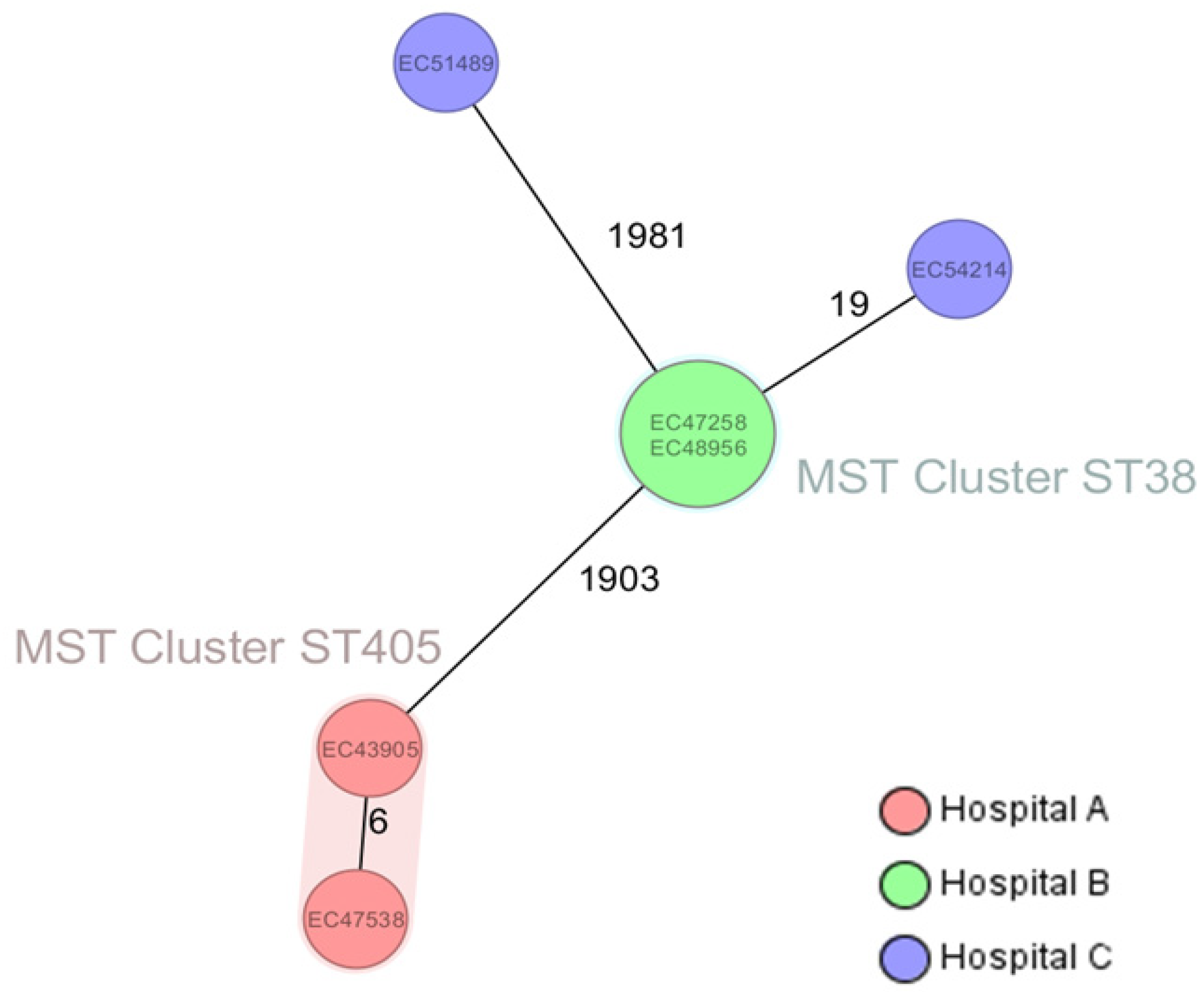
Based on their cgMLST, the two E. coli ST405 (EC43905 and EC47538), both isolated from patients treated in 2022 in the Intensive Care Unit of Hospital A, and two E. coli ST38 (EC47258 and EC48956), isolated from patients treated in 2023 in the Surgical Ward of Hospital B, were clustered together (Figure 1).
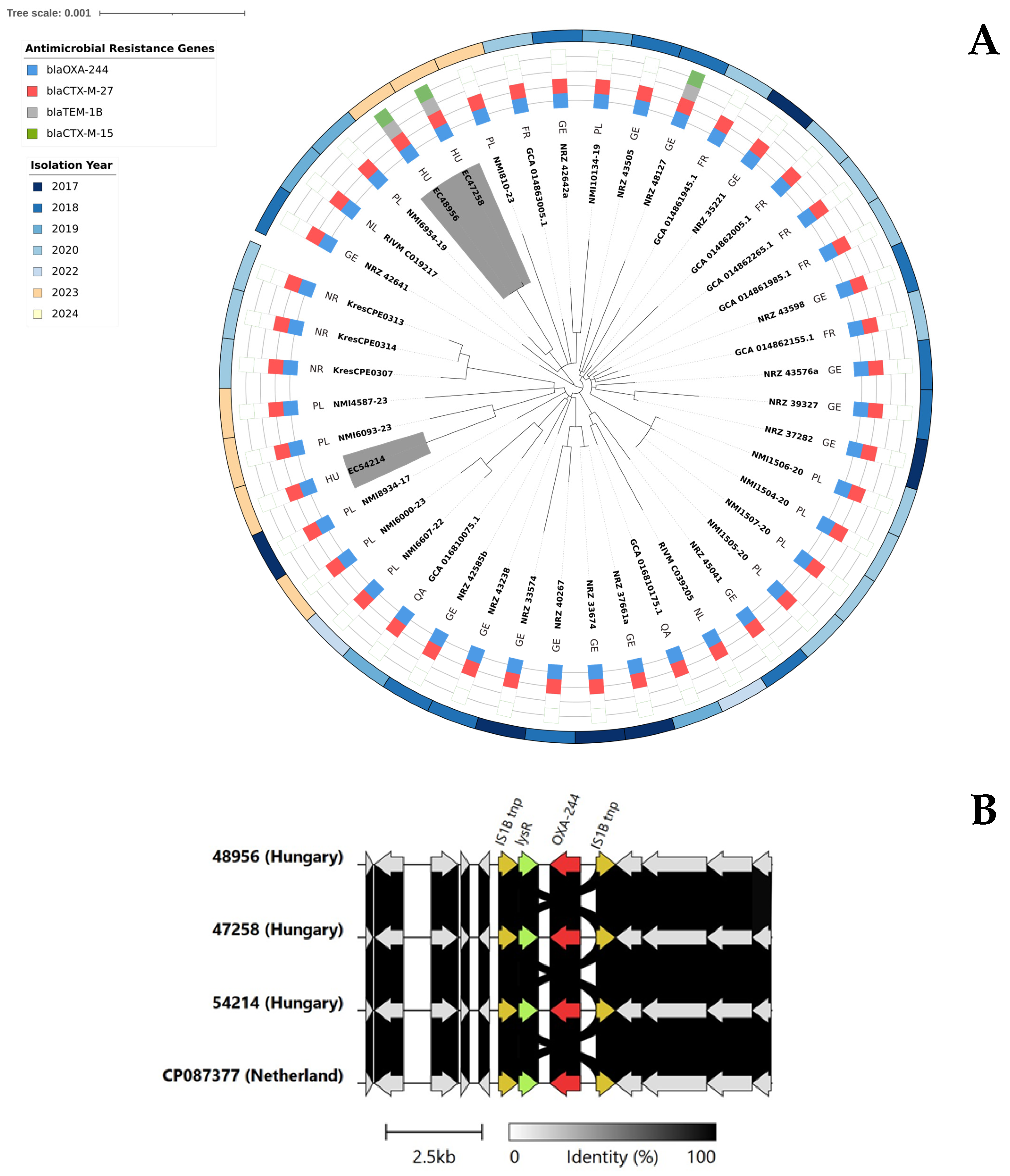
Although the third E. coli ST38 (EC54214) from Hospital C was more distant from the ST38 cluster, all three OXA-244 producer E. coli ST38 from our region belonged to cluster A by the ECDC definition [8], i.e., carried the blaOXA-244 carbapenemase gene on the chromosome and possessed blaCTX-M-27 carried by an IncFIB-IncFII plasmid. In all strains, the genetic surroundings of chromosomally inserted blaOXA-244 on an IS1 bracketed composite transposon were identical to those previously described in the Netherlands (Figure 2B). Furthermore, comparison of whole genomes available from NCBI and Enterobase of OXA-244-producing E. coli ST38 Cluster A isolates from France, Germany, Norway, the Netherlands, Poland, and Qatar using Snippy revealed a maximum core genome SNP distance of only 65 SNPs. Although the E. coli ST38 from Hospital B and C were comparatively distant, both Hospital B isolates EC47258 and EC48956, as well as the Hospital C isolate EC54214, had the closest match to strains from Poland (Figure 2A).
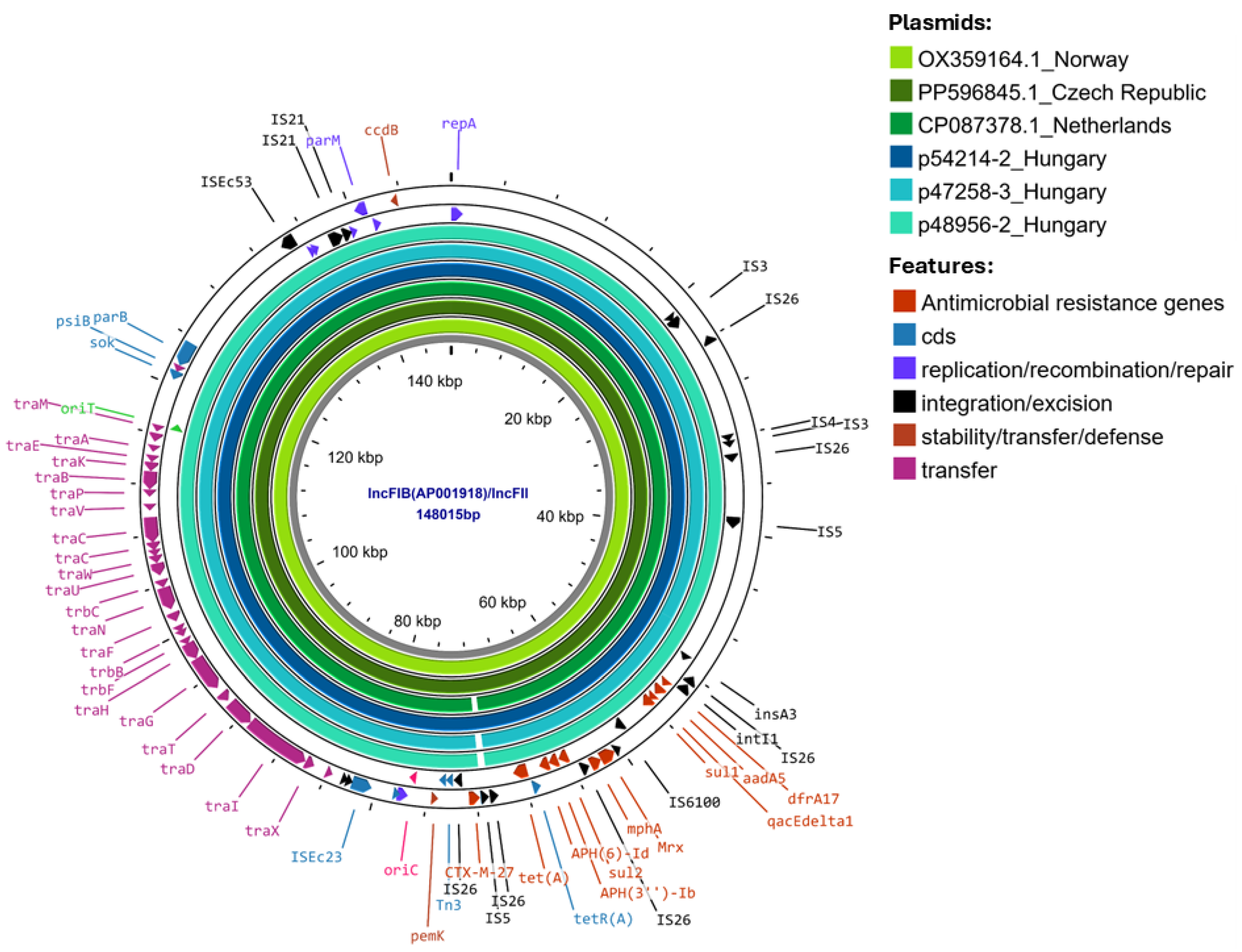
A BLAST search of the NCBI database revealed that the blaCTX-M-27 genes carrying approximately 148 kb of IncFIB-IncFII plasmids in the Hungarian isolates were similar (>99.7% nucleotide identity) to the blaCTX-M-27 genes carrying plasmids pRIVM_C019217_2 (CP087378) from the Netherlands, pKresCPE0314 (OX359164.1) from Norway, and PP596845.1 plasmid from the Czech Republic, all of which were from of OXA-244 producer E. coli ST38 strains (Figure 3).
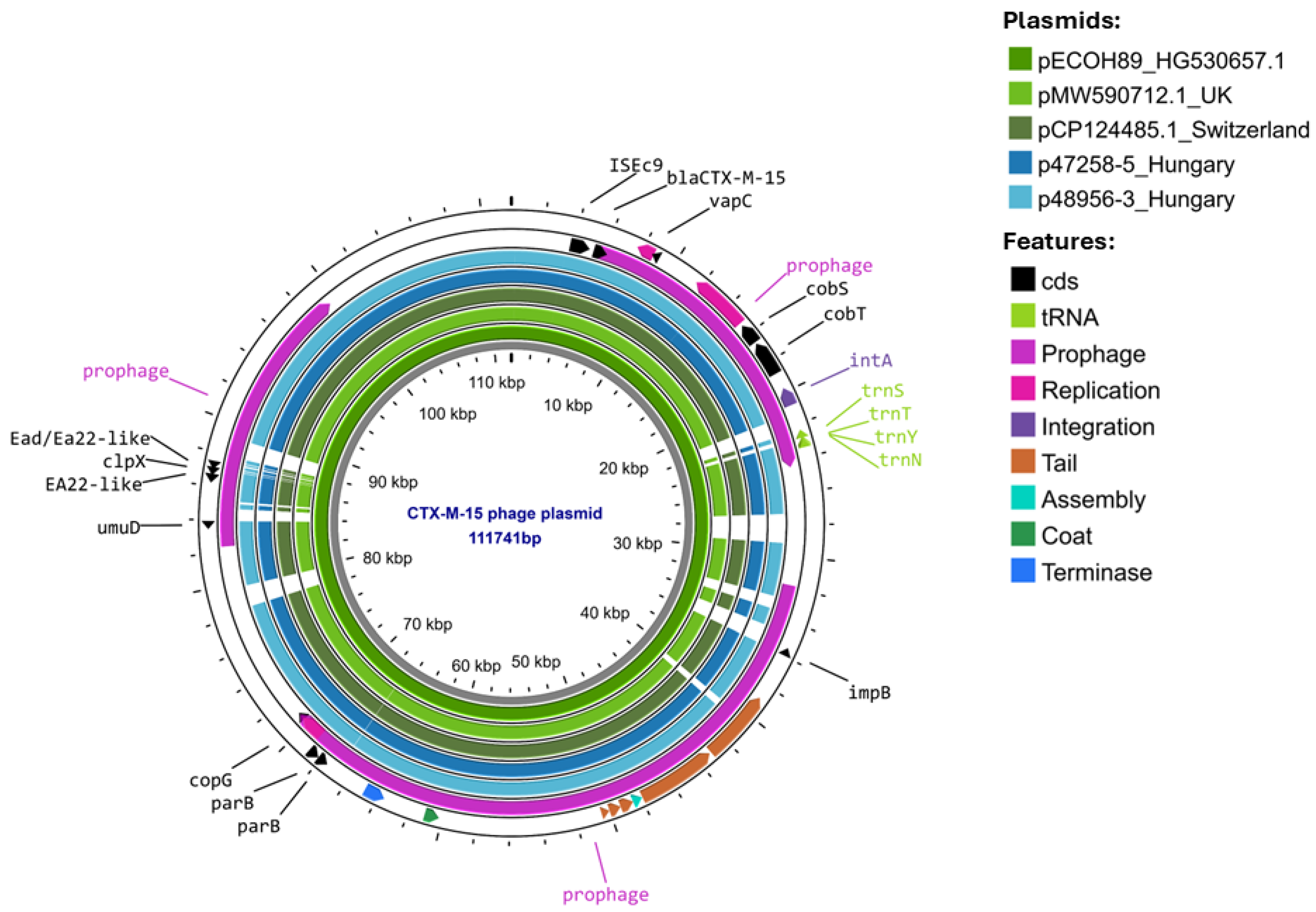
Isolates EC47258 and EC48956 from Hospital B also carried another extended spectrum beta-lactamase gene: blaCTX-M-15 on a 110 kb phage-like plasmid typed as IncFIB (H89-PhagePlasmid). These plasmids were hybrid elements containing both phage-related genes and an FIB replicon. A comparative analysis of these phage-plasmids against sequences in the NCBI database revealed that they are highly similar to plasmids harbored by a human E. coli isolate from the United Kingdom (MW590712.1) and those harbored by an environmental E. coli isolate from Switzerland (CP124485.1) and to pECOH89 (Accession number HG530657) from Germany, all of which carried an ISEcp1-blaCTX-M-15 transposition unit (Figure 4).
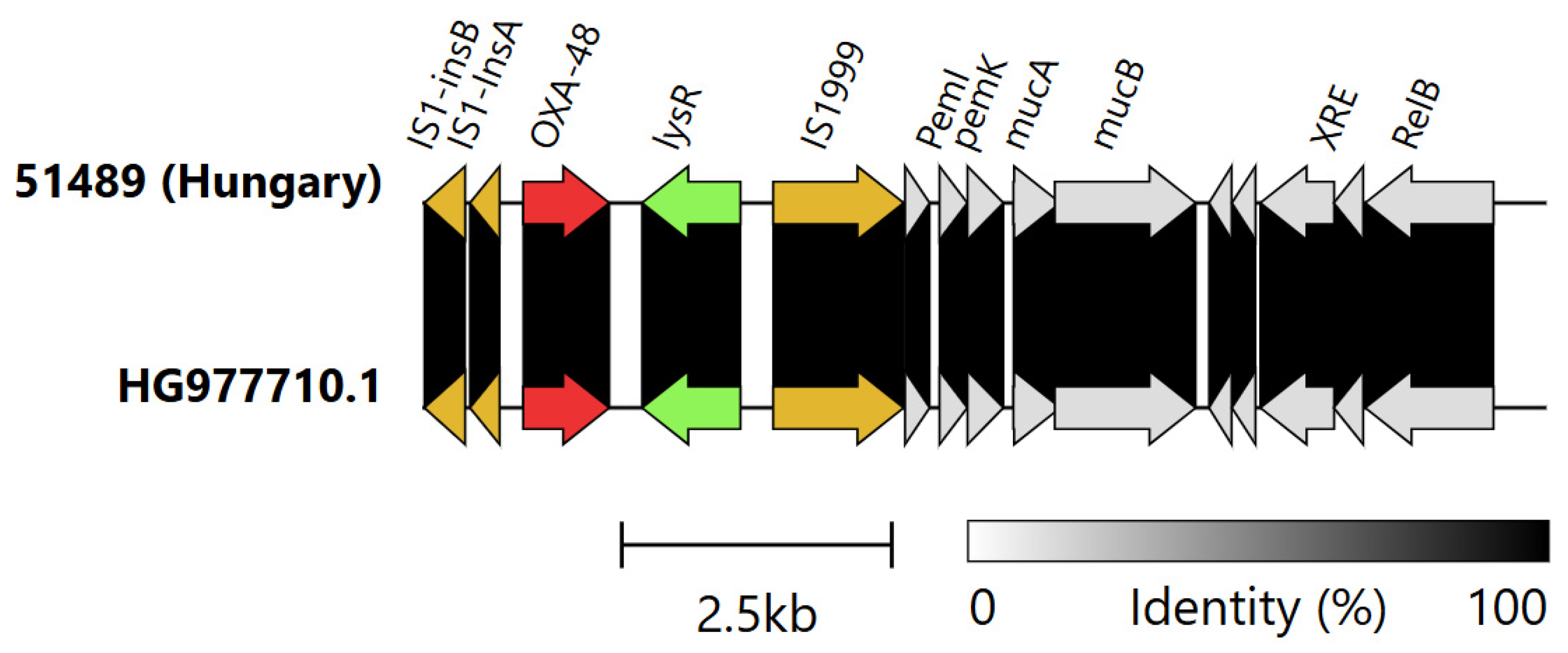
The genetic surroundings of the chromosomally located blaOXA-48 gene in EC51489 E. coli ST69 were 99.9% identical to a 10,405 bp region of Tn6237 (HG977710), comprising a ∆Tn1999.2 and plasmid-derived sequences (Figure 5).
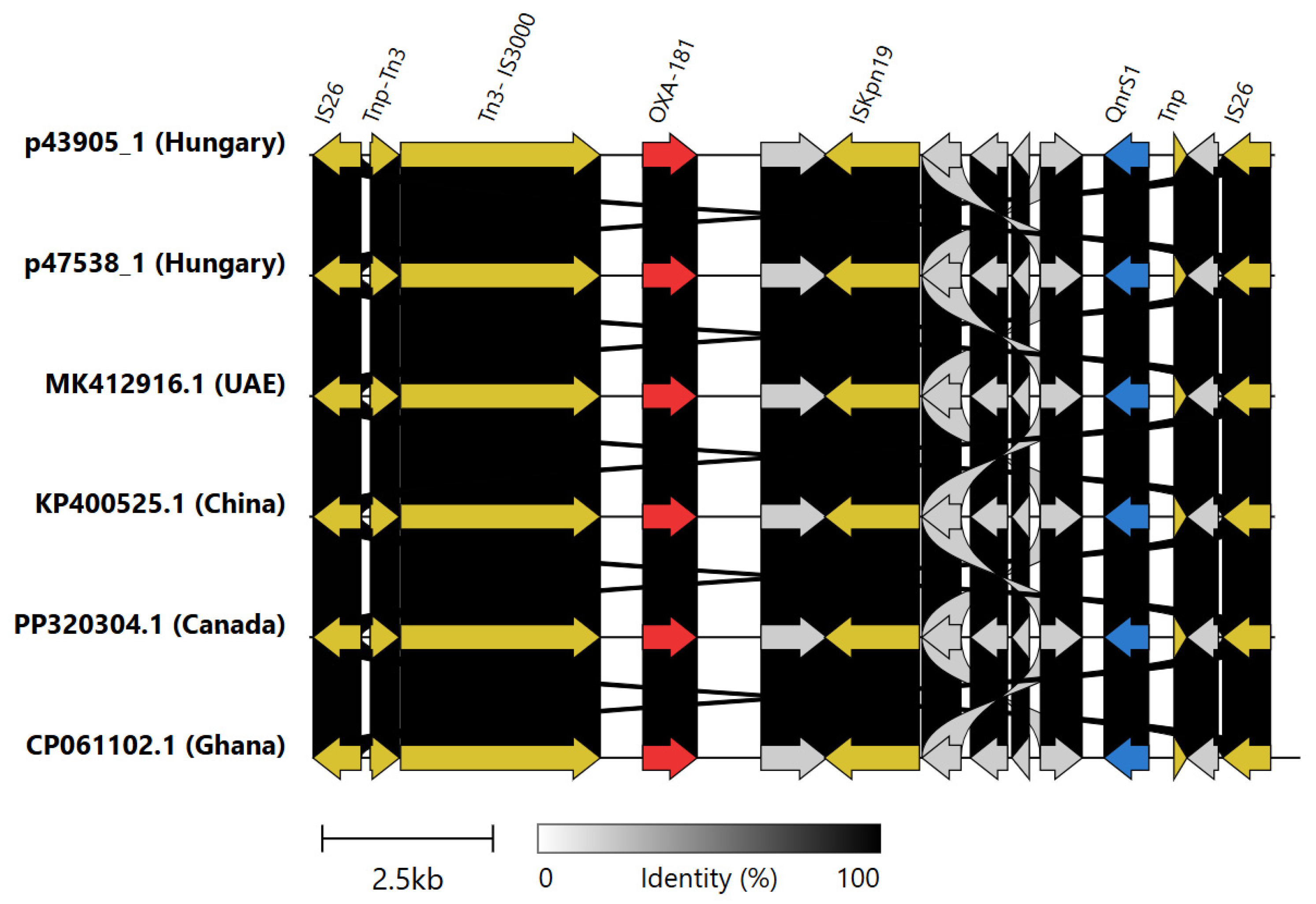
The genetically related E. coli ST405 isolates EC43905 and EC47538 from Hospital A carried a different allele of OXA carbapenemase genes: blaOXA-181. This carbapenemase gene was located on an IncFIB-IncFIC plasmid, and its genetic surrounding was identical to those of blaOXA-181 carried on IncX3 plasmids found in the United Arab Emirates, Canada, and China and to an IncFIC plasmid present in a Ghanaian E. coli ST940 isolate (Figure 6).

2.3. In Vitro Transferability of OXA-48-like Carbapenemases

While attempts were made to conjugally transfer OXA-48-like carbapenemases, they were unsuccessful, even with those isolates in which the blaOXA-48-like genes were plasmid-borne. Nevertheless, the blaOXA-181-carrying IncFIB-IncFIC plasmids were predicted to be conjugative by MOB-suite [11]; therefore, the failed conjugation could be the result of the low expression of conjugation genes or suboptimal in vitro experimental conditions.

3. Discussion

OXA-48-like carbapenemases are among the most common carbapenemases worldwide, with high prevalence in Europe [12]. In the 211 carbapenem-resistant E. coli isolates collected in Europe during the Carbapenem- and Colistin-Resistant Enterobacterales (CCRE) survey, blaOXA-48-like was one of the second most frequently detected carbapenemase genes, accounting for 32% [12]. Although mostly present in K. pneumoniae, this type of carbapenemase has also been described in E. coli and other members of the Enterobacterales order, but in much lower frequency [5].
In Hungary, the first OXA-48-like carbapenemase-producing enteric bacterium, an OXA-162-producing K. pneumoniae, was reported in 2012 [9], followed by the emergence and interhospital spread of the OXA-48-producing K. pneumoniae ST395 clone in 2014 [10]. In both instances, cross-border transfer from Romania [9] or Ukraine [10] was assumed. So far, the only reports from Hungary on blaOXA-48-like carrying E. coli were a poster on 50 carbapenem-resistant isolates [13] and a Europe-wide multicenter study encountering a single OXA-244 producer E. coli ST131 in Hungary in 2023 [14]. However, neither study provided a detailed characterization of the isolates with their respective resistome and the localization of the carbapenemase genes.
In our study, we demonstrated the transmission of OXA-244-producing E. coli ST38 and OXA-181-producing E. coli ST405 within respective hospital wards and the emergence of OXA-244-producing E. coli ST38 and OXA-48-producing ST69 in a third hospital. The occurrence of OXA-244-producing E. coli ST38 in Hospital C was supposedly an independent event, as this isolate did not cluster by cgMLST with those from Hospital B. No OXA-carbapenemase-producing E. coli was isolated after December 2023, while their rate in Hungary quadrupled (from 16.7% in 2023 to 66.7% in the first half of 2025—Dr. Ákos Tóth, Microbiological Reference Laboratory, National Center of Public Health and Pharmacy, Budapest—personal communication). It is tempting to speculate that the local disappearance of such strains could have been attributed to the increased cleaning and infection control measures introduced. However, while these could have been effective indeed in containing the spread and in the disappearance of the existing isolates, it was not accompanied by a general decrease in other CRE isolates locally. Comparing the periods of 2022–23 to 2024–July 2025, their rate actually increased from 1.1% to 2.2%. Nevertheless, during the study period, OXA-carbapenemase producer Enterobacterales remained rare in our setting, with only two OXA-48-like and NDM co-producing K. pneumoniae isolated in 2024 (unpublished observation).
The complete genomes of the isolates revealed that all three E. coli ST38 isolates carried blaOXA-244 on the chromosome and blaCTX-M-27 on an IncFIB-IncFIC plasmid. Based on this, our E. coli ST38 isolates belonged to Cluster A of this high-risk clone [8]. Comparison of the core genome SNP distances between our isolates and other European, as well as one Qatari, OXA-244-producing E. coli ST38 of Cluster A revealed high genetic similarity. Further to this, the blaCTX-M-27-carrying plasmids were also highly similar to plasmids carried by Norwegian, Czech, and Dutch E. coli ST38 Cluster A isolates [15,16]. All these suggest that a common source is still unknown. However, shedding light on this could be rather challenging, as it was shown in Qatar that none of the carriers of OXA-244 producer E. coli ST38 had any international travel history [17]. Interestingly, the OXA-244-producing E. coli ST38 of Hospital B also carried a second ESBL plasmid, a blaCTX-M-15-bearing IncFIB (H89-PhagePlasmid) phage-plasmid hybrid episome, which was highly similar to plasmids recovered in Germany from an E. coli clinical isolate [18], in Switzerland from a freshwater E. coli isolate, and from a traveler returning from South Asia to the United Kingdom [19], i.e., across a wide geographical area.
We also identified an OXA-48 producer E. coli ST69 in the present study. E. coli ST69 is a well-recognized high-risk clone, mostly producing ESBL enzymes [20]. However, isolates carrying class D carbepenemases, e.g., blaOXA-244, have also been reported from Denmark, Switzerland, France, and Poland [21,22]. Furthermore, an OXA-48 producer E. coli ST69 was described from Pakistan [23]. Of note is that the OXA-48 producer E. coli ST69 identified in our study did not possess any extended-spectrum beta-lactamase genes beyond the chromosomally located blaOXA-48, which remained susceptible to third-generation cephalosporins and carbapenems (Table 2) and was only recognized as a carbapenemase producer because its meropenem disc inhibition zone was below the screening cut-off value.
Further to the chromosomally located class D carbapenemases, a pair of OXA-181-producing E. coli ST405 was identified from Hospital A. Their cgMLST clustering suggested healthcare-associated transmission within the hospital. E. coli ST405 is typically associated with blaNDM-5 and has been identified in several European countries, including Finland, Denmark, France, the Netherlands, Ireland, and Sweden [24]. However, the ST405 strain in our study harbored blaOXA-181, a variant of OXA-48 endemic in India, where it was first discovered, and in Africa [25]. This may suggest that the strain was likely transferred through international travel; however, the index patient in Hospital A did not have any international travel history. Furthermore, the blaOXA-181 in these strains was located on an IS26 pseudo-composite transposon [26] also containing the qnrS1 gene, which is identical to that found in IncX3 plasmids and carried by an IncFIB-FIC type plasmid. This plasmid has only been identified so far to carry blaOXA-181 in an enterotoxigenic E. coli ST940 from Ghana [27]. Although the blaOXA-181 was located on the same transposon, the plasmid, despite belonging to the same incompatibility type, did not show high similarity to p43905-1 and p47538-1, i.e., to the blaOXA-181-carrying plasmids of the current study.
Although four OXA-48-like carbapenemase genes identified were chromosomally coded and the two plasmid-borne ones could not be transferred by conjugation in vitro, all blaOXA-48-like genes in this study were located on mobile genetic elements, which may facilitate their horizontal transfer. Furthermore, all OXA-48-like producer E. coli belonged to international high-risk clones, and despite the successful containment of nosocomial transmissions within two hospitals of two distinct clones (ST405 and ST38), these clones are recognized for their ability to successfully disseminate.
These observations support the view that clinical microbiology laboratories should carefully evaluate isolates showing carbapenem susceptibility below the screening cut-off to detect these difficult-to-recognize carbapenemase-producing isolates. Moreover, continuous whole-genome-based surveillance should be used to track and trace them in order to provide data to help break the transmission chain, at least within healthcare facilities.

4. Materials and Methods

Bacterial Isolates: Enterobacterial isolates exhibiting an inhibition zone of <28 mm with a 10 µg meropenem disc are routinely tested for their carbapenemase production using the mCIM test [28] in the Laboratory of Clinical Microbiology and Hospital Hygiene of the Department of Microbiology of the Clinical Center of the University of Pécs. If the mCIM test is positive, the type of carbapenemase produced is determined using NG-Test CARBA 5 (NG Biotech, Guipry, France). From 2022 until July 2025, six Escherichia coli isolates were identified by this algorithm as OXA-48-like carbapenemase producers from Hospitals A and B (secondary care hospitals with 500 and 300 beds, respectively) and Hospital C (tertiary care university hospital with 1400 beds) (listed in Table 1). The three hospitals are located in three different cities of Baranya County at least 40 kms apart.
The isolates’ species identification was performed using matrix-assisted laser desorption ionization–time-of-flight mass spectrometry (MALDI-TOF MS) (Bruker Daltonics, Bremen, Germany). Strains were stored at −80 °C in Tryptic Soy Broth (TSB, MAST, Merseyside, UK) containing 20% glycerol until further investigations.
Antibiotic Susceptibility Testing: The susceptibility to amikacin, amoxicillin/clavulanic acid, aztreonam, cefotaxime, ceftazidime/avibactam, ceftolozane/tazobactam, ciprofloxacin, colistin, ertapenem, gentamicin, imipenem, meropenem, piperacillin/tazobactam, tigecycline, tobramycin, and trimethoprim/sulfamethoxazole was established by broth microdilution using the SensiTitre DKMGN Plate (ThermoFisher Diagnostics, Landsmeer, The Netherlands), and the susceptibility to cefiderocol and fosfomycin (BioRad, Marnes-la-Coquette, France) was determined by disc diffusion, with E. coli ATCC25922 used as the control. All results were interpreted using EUCAST clinical breakpoints [29].
Whole-Genome Sequencing and Analysis: The complete genomes of strains identified as OXA-48-like producer E. coli were determined by 150 bp paired-end sequencing on the Illumina NovaSeq platform (San Diego, CA, USA) and long-read sequencing on Oxford Nanopore MinION (Oxford, UK) or on PacBio platforms (Menlo Park, CA, USA). Short- and long-read quality was assessed by FastQC and LongReadSum, respectively [30,31]. Hybrid assembly of short and long reads was performed using Unicycler v.0.5.0 [32]. The assembly quality was checked using QUAST [33], Samtools [34], Kraken2 and Braken [35], and CheckM [36].
MLST based on the Achtmann scheme [37] and core genome MLST of the six isolates were compared using the Ridom SeqSphere® software v10.5.
Plasmid replicon types and resistance and virulence genes were identified with ABRicate (https://github.com/tseemann/abricate (accessed on 19 August 2025)) using PlasmidFinder [38], CARD, and VFDB databases [39,40], with the identity threshold set as a minimum of 95%. The transferability of plasmids was in silico assessed using MOB-suite [11]. The NCBI database was searched by nucleotide BLAST (https://blast.ncbi.nlm.nih.gov/Blast.cgi?PROGRAM=blastn&BLAST_PROGRAMS=megaBlast&PAGE_TYPE=BlastSearch (accessed on 15 September 2025)) to identify plasmids that are highly similar (>98% identity and 92% query coverage) to beta-lactamase-harboring plasmids of our isolates. Subsequently, the circular comparison of the plasmids was visualized by Proksee (https://proksee.ca/ (accessed on 14 October 2025)) [41]. Annotation was performed with Bakta v1.9.1. [42]. Linear comparison was performed with Clinker [43]. Prophage identification was detected by Phigaro, an integrated tool in Proksee. MobileOG-db [44] was used for mobile genetic element prediction as an integrated tool in Proksee.
Whole genomes of OXA-244-producing E. coli ST38 isolates available in the NCBI database and in Enterobase (n = 41) were downloaded from the respective databases (accessed on 13 August 2025), and SNP determination using the core genomes was analyzed using kSNP3 (v3.1). The single-nucleotide polymorphisms (SNPs) were calculated by reference free k-mer–based SNP difference matrix. The core genomes’ SNPs were used to calculate pairwise SNP distances between isolates to build a maximum likelihood phylogenetic tree. The tree was constructed by FastTree 2 and was visualized via Interactive Tree of Life, iTOL (https://itol.embl.de/ (accessed on 19 August 2025)).
Conjugation: blaOXA-48-like-carrying plasmids’ transferability was tested in mating-out assays using a sodium-azide-resistant derivative of rifampicin-resistant E. coli J53 (J53RAZ) as recipients. Conjugation was attempted at 30 °C and at 37 °C. Selection for transconjugants was carried out on a Tryptic Soy Agar containing 0.25 mg/L−1 of ertapenem and 150 mg/L−1 of sodium-azide [45].

5. Conclusions

The present study is the first to characterize OXA-48-like carbapenemase-producing E. coli isolated in Hungary by establishing their complete genomes, which allowed demonstration of clonal relationships and the similarity of class D carbapenemase-carrying transposons to isolates from different continents, even though the patients did not have any travel history. Furthermore, small-scale intra-hospital transfers and their successful containment were also revealed. As OXA-48-like carbapenemase-producing Enterobacterales are endemic in Germany, France, and Belgium and caused hospital outbreaks in Norway, Denmark, Czechia, and Poland, heightened awareness to identify such isolates, especially the OXA-244 producers with lower carbapenem MICs, is required in our region as well.

Supplementary Materials

The following supporting information can be downloaded at https://www.mdpi.com/article/10.3390/antibiotics15010044/s1. Table S1. Short read statistics (FastQC). Table S2. Long read statistics (LongReadSum). Table S3. Assembly statistics (QUAST). Table S4. Mapping of short reads to contigs (Samtools). Table S5. Taxonomic composition and contamination of raw reads (Kraken2-Bracken). Table S6. Contamination in assembled contigs (CheckM).

Author Contributions

Conceptualization, Á.S.; methodology, F.A.M., C.F., P.U. and B.T.; software, M.A.-B., B.T., L.M. and L.L.; validation, Á.S., S.M. and T.P.; formal analysis, F.A.M., M.A.-B., S.M. and B.T.; investigation, F.A.M., P.U., C.F., R.B.-T., R.M., A.N. and E.U.; resources, A.G., G.K. and Á.S.; data curation, S.M. and Á.S.; writing—original draft preparation, F.A.M. and Á.S.; writing—review and editing, F.A.M., M.A.-B., S.M., B.T., T.P. and Á.S.; visualization, F.A.M. and M.A.-B.; supervision, Á.S.; project administration, Á.S.; funding acquisition, Á.S. All authors have read and agreed to the published version of the manuscript.

Funding

This research was funded by the University of Pécs Medical School, Hungary, under the grant “Kispál Gyula—300852” awarded to Á.S.

Institutional Review Board Statement

Not applicable. No patient sample was collected for the sake of this study; only bacterial isolates from clinically necessary diagnostic microbiology testing were studied. The Director of the Clinical Center of the University of Pécs authorized data collection (KK/1199-1/2022 and KK/723-2/2023) for ÁS to review the patients’ charts. By the time of molecular studies, all isolates were anonymised and stripped of any data that would make patients identifiable.

Informed Consent Statement

Not applicable.

Data Availability Statement

The original data presented in the study are openly available in NCBI under the following: Bioproject: PRJNA1302334; Biosamples: SAMN50488977-SAMN50488980, SAMN50468512, and SAMN50468485; GenBank accession numbers: JBTANG000000000, JBQIAW000000000, JBRYHV000000000, JBQIAX000000000, JBQIAY000000000, and JBQIAZ000000000.

Acknowledgments

We are grateful to the Stipendium Hungaricum Foundation for supporting F.A.M. and M.A.B. studies.

Conflicts of Interest

The authors declare no conflicts of interest. The funder had no role in the design of this study; in the collection, analyses, or interpretation of data; in the writing of this manuscript; or in the decision to publish the results.

References

  1. European Centre for Disease Prevention and Control; World Health Organization Regional Office for Europe. Antimicrobial Resistance Surveillance in Europe 2023–2021 Data; European Centre for Disease Prevention and Control: Stockholm, Sweden; World Health Organization Regional Office for Europe: Copenhagen, Denmark, 2023; p. 154. [Google Scholar]
  2. Bush, K.; Jacoby, G.A. Updated functional classification of beta-lactamases. Antimicrob. Agents Chemother. 2010, 54, 969–976. [Google Scholar] [CrossRef]
  3. Poirel, L.; Potron, A.; Nordmann, P. OXA-48-like carbapenemases: The phantom menace. J. Antimicrob. Chemother. 2012, 67, 1597–1606. [Google Scholar] [CrossRef] [PubMed]
  4. Peirano, G.; Pitout, J.D.D. Rapidly spreading Enterobacterales with OXA-48-like carbapenemases. J. Clin. Microbiol. 2025, 63, e0151524. [Google Scholar] [CrossRef] [PubMed]
  5. Boyd, S.E.; Holmes, A.; Peck, R.; Livermore, D.M.; Hope, W. OXA-48-Like beta-Lactamases: Global Epidemiology, Treatment Options, and Development Pipeline. Antimicrob. Agents Chemother. 2022, 66, e0021622. [Google Scholar] [CrossRef] [PubMed]
  6. Cuzon, G.; Ouanich, J.; Gondret, R.; Naas, T.; Nordmann, P. Outbreak of OXA-48-positive carbapenem-resistant Klebsiella pneumoniae isolates in France. Antimicrob. Agents Chemother. 2011, 55, 2420–2423. [Google Scholar] [CrossRef]
  7. Alvisi, G.; Curtoni, A.; Fonnesu, R.; Piazza, A.; Signoretto, C.; Piccinini, G.; Sassera, D.; Gaibani, P. Epidemiology and Genetic Traits of Carbapenemase-Producing Enterobacterales: A Global Threat to Human Health. Antibiotics 2025, 14, 141. [Google Scholar] [CrossRef]
  8. European Centre for Disease Prevention and Control. OXA-244-Producing Escherichia coli in the European Union/European Economic Area and the UK Since 2013, First Update; European Centre for Disease Prevention and Control: Stockholm, Sweden, 2021. [Google Scholar]
  9. Janvari, L.; Damjanova, I.; Lazar, A.; Racz, K.; Kocsis, B.; Urban, E.; Toth, A. Emergence of OXA-162-producing Klebsiella pneumoniae in Hungary. Scand. J. Infect. Dis. 2014, 46, 320–324. [Google Scholar] [CrossRef]
  10. Kovacs, K.; Nyul, A.; Mestyan, G.; Melegh, S.; Fenyvesi, H.; Jakab, G.; Szabo, H.; Janvari, L.; Damjanova, I.; Toth, A. Emergence and interhospital spread of OXA-48-producing Klebsiella pneumoniae ST395 clone in Western Hungary. Infect Dis 2017, 49, 231–233. [Google Scholar] [CrossRef]
  11. Robertson, J.; Nash, J.H.E. MOB-suite: Software tools for clustering, reconstruction and typing of plasmids from draft assemblies. Microb. Genom. 2018, 4, e000206. [Google Scholar] [CrossRef]
  12. European Centre for Disease Prevention and Control. Rapid Risk Assessment—Carbapenem-Resistant Enterobacterales—Third Update; European Centre for Disease Prevention and Control: Stockholm, Sweden, 2025. [Google Scholar]
  13. Adrienn Hanczvikkel, D.G.; Ungvári, E.; Derzsy, N.; Darab, A.; Jánvári, L.; Buzgó, L.; Papp, K.; Kristóf, K.; Majoros, L.; Kamotsay, K.; et al. Molecular epidemiology of carbapenemase-producing Escherichia coli in Hungary. In Proceedings of the ESCMID Global, Vienna, Austria, 11–15 April 2025. [Google Scholar]
  14. Kohlenberg, A.; Svartstrom, O.; Apfalter, P.; Hartl, R.; Bogaerts, P.; Huang, T.D.; Chudejova, K.; Malisova, L.; Eisfeld, J.; Sandfort, M.; et al. Emergence of Escherichia coli ST131 carrying carbapenemase genes, European Union/European Economic Area, August 2012 to May 2024. Eurosurveillance 2024, 29, 2400727. [Google Scholar] [CrossRef]
  15. Grevskott, D.H.; Radisic, V.; Salva-Serra, F.; Moore, E.R.B.; Akervold, K.S.; Victor, M.P.; Marathe, N.P. Emergence and dissemination of epidemic-causing OXA-244 carbapenemase-producing Escherichia coli ST38 through hospital sewage in Norway, 2020–2022. J. Hosp. Infect. 2024, 145, 165–173. [Google Scholar] [CrossRef] [PubMed]
  16. Notermans, D.W.; Schoffelen, A.F.; Landman, F.; Wielders, C.C.H.; Witteveen, S.; Ganesh, V.A.; van Santen-Verheuvel, M.; de Greeff, S.C.; Kuijper, E.J.; Hendrickx, A.P.A.; et al. A genetic cluster of OXA-244 carbapenemase-producing Escherichia coli ST38 with putative uropathogenicity factors in the Netherlands. J. Antimicrob. Chemother. 2022, 77, 3205–3208. [Google Scholar] [CrossRef] [PubMed]
  17. Perez-Lopez, A.; Sundararaju, S.; Tsui, K.M.; Al-Mana, H.; Hasan, M.R.; Suleiman, M.; Al Maslamani, E.; Imam, O.; Roscoe, D.; Tang, P. Fecal Carriage and Molecular Characterization of Carbapenemase-Producing Enterobacterales in the Pediatric Population in Qatar. Microbiol. Spectr. 2021, 9, e0112221. [Google Scholar] [CrossRef] [PubMed]
  18. Falgenhauer, L.; Yao, Y.; Fritzenwanker, M.; Schmiedel, J.; Imirzalioglu, C.; Chakraborty, T. Complete Genome Sequence of Phage-Like Plasmid pECOH89, Encoding CTX-M-15. Genome Announc. 2014, 2, e00356-14. [Google Scholar] [CrossRef] [PubMed]
  19. Bevan, E.R.; Powell, M.J.; Toleman, M.A.; Thomas, C.M.; Piddock, L.J.V.; Hawkey, P.M. Molecular characterization of plasmids encoding bla(CTX-M) from faecal Escherichia coli in travellers returning to the UK from South Asia. J. Hosp. Infect. 2021, 114, 134–143. [Google Scholar] [CrossRef] [PubMed]
  20. Cardona-Cabrera, T.; Martinez-Alvarez, S.; Gonzalez-Azcona, C.; Gijon-Garcia, C.J.; Alexandrou, O.; Catsadorakis, G.; Azmanis, P.; Torres, C.; Hofle, U. High Antimicrobial Susceptibility of Cloacal Enterococci and Escherichia coli from Free-Living Dalmatian and Great White Pelicans with Detection of Cefotaximase CTX-M-15 Producing Escherichia coli ST69. Antibiotics 2025, 14, 83. [Google Scholar] [CrossRef]
  21. Emeraud, C.; Girlich, D.; Bonnin, R.A.; Jousset, A.B.; Naas, T.; Dortet, L. Emergence and Polyclonal Dissemination of OXA-244-Producing Escherichia coli, France. Emerg. Infect. Dis. 2021, 27, 1206–1210. [Google Scholar] [CrossRef]
  22. Biedrzycka, M.; Izdebski, R.; Gniadkowski, M.; Zabicka, D. Several epidemic and multiple sporadic genotypes of OXA-244-producing Escherichia coli in Poland; predominance of the ST38 clone. Eur. J. Clin. Microbiol. Infect. Dis. 2024, 43, 2465–2472. [Google Scholar] [CrossRef]
  23. Gondal, A.J.; Choudhry, N.; Bukhari, H.; Rizvi, Z.; Jahan, S.; Yasmin, N. Estimation, Evaluation and Characterization of Carbapenem Resistance Burden from a Tertiary Care Hospital, Pakistan. Antibiotics 2023, 12, 525. [Google Scholar] [CrossRef]
  24. Linkevicius, M.; Bonnin, R.A.; Alm, E.; Svartstrom, O.; Apfalter, P.; Hartl, R.; Hasman, H.; Roer, L.; Raisanen, K.; Dortet, L.; et al. Rapid cross-border emergence of NDM-5-producing Escherichia coli in the European Union/European Economic Area, 2012 to June 2022. Euro Surveill 2023, 28, 2300209. [Google Scholar] [CrossRef]
  25. Pitout, J.D.D.; Peirano, G.; Kock, M.M.; Strydom, K.A.; Matsumura, Y. The Global Ascendency of OXA-48-Type Carbapenemases. Clin. Microbiol. Rev. 2019, 33, e00102-19. [Google Scholar] [CrossRef] [PubMed]
  26. Harmer, C.J.; Pong, C.H.; Hall, R.M. Structures bounded by directly-oriented members of the IS26 family are pseudo-compound transposons. Plasmid 2020, 111, 102530. [Google Scholar] [CrossRef] [PubMed]
  27. Prah, I.; Ayibieke, A.; Mahazu, S.; Sassa, C.T.; Hayashi, T.; Yamaoka, S.; Suzuki, T.; Iwanaga, S.; Ablordey, A.; Saito, R. Emergence of oxacillinase-181 carbapenemase-producing diarrheagenic Escherichia coli in Ghana. Emerg. Microbes Infect. 2021, 10, 865–873. [Google Scholar] [CrossRef] [PubMed]
  28. Tamma, P.D.; Simner, P.J. Phenotypic Detection of Carbapenemase-Producing Organisms from Clinical Isolates. J. Clin. Microbiol. 2018, 56, e01140-18. [Google Scholar] [CrossRef]
  29. EUCAST. The European Committeee of Antimicrobial Susceptibility Testing v_14.0_Breakpoint_Tables. Available online: https://www.eucast.org/clinical_breakpoints (accessed on 1 October 2024).
  30. Brown, J.; Pirrung, M.; McCue, L.A. FQC Dashboard: Integrates FastQC results into a web-based, interactive, and extensible FASTQ quality control tool. Bioinformatics 2017, 33, 3137–3139. [Google Scholar] [CrossRef]
  31. Perdomo, J.E.; Ahsan, M.U.; Liu, Q.; Fang, L.; Wang, K. LongReadSum: A fast and flexible quality control and signal summarization tool for long-read sequencing data. Comput. Struct. Biotechnol. J. 2025, 27, 556–563. [Google Scholar] [CrossRef]
  32. Wick, R.R.; Judd, L.M.; Gorrie, C.L.; Holt, K.E. Completing bacterial genome assemblies with multiplex MinION sequencing. Microb. Genom. 2017, 3, e000132. [Google Scholar] [CrossRef]
  33. Gurevich, A.; Saveliev, V.; Vyahhi, N.; Tesler, G. QUAST: Quality assessment tool for genome assemblies. Bioinformatics 2013, 29, 1072–1075. [Google Scholar] [CrossRef]
  34. Danecek, P.; Bonfield, J.K.; Liddle, J.; Marshall, J.; Ohan, V.; Pollard, M.O.; Whitwham, A.; Keane, T.; McCarthy, S.A.; Davies, R.M.; et al. Twelve years of SAMtools and BCFtools. Gigascience 2021, 10, giab008. [Google Scholar] [CrossRef]
  35. Lu, J.; Rincon, N.; Wood, D.E.; Breitwieser, F.P.; Pockrandt, C.; Langmead, B.; Salzberg, S.L.; Steinegger, M. Metagenome analysis using the Kraken software suite. Nat. Protoc. 2022, 17, 2815–2839. [Google Scholar] [CrossRef]
  36. Parks, D.H.; Imelfort, M.; Skennerton, C.T.; Hugenholtz, P.; Tyson, G.W. CheckM: Assessing the quality of microbial genomes recovered from isolates, single cells, and metagenomes. Genome Res. 2015, 25, 1043–1055. [Google Scholar] [CrossRef] [PubMed]
  37. Wirth, T.; Falush, D.; Lan, R.; Colles, F.; Mensa, P.; Wieler, L.H.; Karch, H.; Reeves, P.R.; Maiden, M.C.; Ochman, H.; et al. Sex and virulence in Escherichia coli: An evolutionary perspective. Mol. Microbiol. 2006, 60, 1136–1151. [Google Scholar] [CrossRef] [PubMed]
  38. Carattoli, A.; Hasman, H. PlasmidFinder and In Silico pMLST: Identification and Typing of Plasmid Replicons in Whole-Genome Sequencing (WGS). Methods Mol. Biol. 2020, 2075, 285–294. [Google Scholar] [CrossRef] [PubMed]
  39. Alcock, B.P.; Huynh, W.; Chalil, R.; Smith, K.W.; Raphenya, A.R.; Wlodarski, M.A.; Edalatmand, A.; Petkau, A.; Syed, S.A.; Tsang, K.K.; et al. CARD 2023: Expanded curation, support for machine learning, and resistome prediction at the Comprehensive Antibiotic Resistance Database. Nucleic Acids Res. 2023, 51, D690–D699. [Google Scholar] [CrossRef]
  40. Liu, B.; Zheng, D.; Zhou, S.; Chen, L.; Yang, J. VFDB 2022: A general classification scheme for bacterial virulence factors. Nucleic Acids Res. 2022, 50, D912–D917. [Google Scholar] [CrossRef]
  41. Grant, J.R.; Enns, E.; Marinier, E.; Mandal, A.; Herman, E.K.; Chen, C.Y.; Graham, M.; Van Domselaar, G.; Stothard, P. Proksee: In-depth characterization and visualization of bacterial genomes. Nucleic Acids Res. 2023, 51, W484–W492. [Google Scholar] [CrossRef]
  42. Schwengers, O.; Jelonek, L.; Dieckmann, M.A.; Beyvers, S.; Blom, J.; Goesmann, A. Bakta: Rapid and standardized annotation of bacterial genomes via alignment-free sequence identification. Microb. Genom. 2021, 7, 000685. [Google Scholar] [CrossRef]
  43. van den Belt, M.; Gilchrist, C.; Booth, T.J.; Chooi, Y.H.; Medema, M.H.; Alanjary, M. CAGECAT: The CompArative GEne Cluster Analysis Toolbox for rapid search and visualisation of homologous gene clusters. BMC Bioinform. 2023, 24, 181. [Google Scholar] [CrossRef]
  44. Brown, C.L.; Mullet, J.; Hindi, F.; Stoll, J.E.; Gupta, S.; Choi, M.; Keenum, I.; Vikesland, P.; Pruden, A.; Zhang, L. mobileOG-db: A Manually Curated Database of Protein Families Mediating the Life Cycle of Bacterial Mobile Genetic Elements. Appl. Environ. Microbiol. 2022, 88, e0099122. [Google Scholar] [CrossRef]
  45. Al-Baloushi, A.E.; Pal, T.; Ghazawi, A.; Sonnevend, A. Genetic support of carbapenemases in double carbapenemase producer Klebsiella pneumoniae isolated in the Arabian Peninsula. Acta Microbiol. Immunol. Hung. 2018, 65, 135–150. [Google Scholar] [CrossRef]
Figure 1. Ridom SeqSphere + MST of isolates of this study; logarithmic scale distance based on columns from E. coli cgMLST (2513); MST Cluster distance threshold: 10.
Antibiotics 15 00044 g001
Figure 2. (A) Global phylogenomic analysis of 41 E. coli ST38 genomes from the EnteroBase and NCBI database. Isolates are colored by antimicrobial-resistant genes present and the year of isolation. The three Hungarian isolates identified in this study are highlighted in grey. FR, France; GE, Germany; HU, Hungary; NL, the Netherlands; NR, Norway; PL, Poland; QA, Qatar. (B) Comparison of the chromosomal region containing the blaOXA-244 gene in our Hungarian isolates with an identical selected one from the Netherlands, retrieved from NCBI databases. Color code: red, OXA-carbapenemase; orange, transposases; light green, lysR; grey, other genes.
Antibiotics 15 00044 g002
Figure 3. BLASTn comparison of IncFIB/IncFII plasmids p48956_2 (147,410 bp), p47258-4 (147,397 bp), and p54214_4 (150,133 bp) containing CTX-M-27 with plasmids retrieved from NCBI: pRIVM_C019217_2 (CP087378) from the Netherlands, PP5896845.1 from the Czech Republic, and pKresCPE0314 (OX359164.1) from Norway (used as a reference).
Antibiotics 15 00044 g003
Figure 4. BLASTn comparison of phage plasmid harboring the blaCTX-M-15 gene to phage plasmids from Germany, the United Kingdom, and Switzerland; retrieved from NCBI.
Antibiotics 15 00044 g004
Figure 5. Genetic context of chromosomally located blaOXA-48 in the Hungarian E. coli ST69 compared to the Tn6237 transposon. Color code: red, OXA-carbapenemase; orange, transposases; light green, lysR; grey, other genes.
Antibiotics 15 00044 g005
Figure 6. The genetic surroundings of the blaOXA-181 gene on IncFIB-IncFIC plasmids in the Hungarian E. coli ST405 strains compared to blaOXA-181 located on IncX3 plasmids MK412916, PP320304, KP400525, and IncFIC plasmid CP061102. Color code: red, OXA-carbapenemase; orange, transposases; blue, qnrS1; grey, other genes.
Antibiotics 15 00044 g006
Table 1. Characteristics of OXA-48-like carbapenemase producer Escherichia coli isolates.
IsolateSpecimenDate of IsolationWard/HospitalPatient’s Age (Year)Patient’s GenderColonization/
Infection
EC43905Urine24 October 2022ICU-Hospital A52maleinfection
EC47538Urine17 November 2022ICU-Hospital A75femaleinfection
EC47258Wound swab26 October 2023Surgery-Hospital B79maleinfection
EC48956Wound swab7 November 2023Surgery-Hospital B50malecolonization
EC54214Urine9 December 2023Urology-Hospital C53maleinfection
EC51489Urine23 November 2023Transplant Surgery-Hospital C32femaleinfection
Table 2. Antibiotic susceptibility of the six OXA-48-like carbapenemase-producing E. coli identified in this study.
Lab CodeMIC (mg/L)Disc Diffusion
Diameter (mm)
Amoxicillin/Clavulanic AcidPiperacillin/TazobactamCefotaximeCeftazidimeCeftazidime/AvibactamCeftolozane/TazobactamMeropenemImipenemErtapenemAztreonamGentamicinAmikacinTobramycinCiprofloxacinColistinTigecyclineTrimethoprim-
Sulfamethoxazole
Fosfomycin 200 μgCefiderocol 30 μg
EC43905>64>32>8>162>3211>2>32>8≤44>21≤0.25>83223
EC47538>64>32>8>162>161≤0.5>2>32>8≤44>20.5≤0.25>83523
EC48956>64>32>8>16≤0.580.25≤0.51>32≤0.5≤4≤1≤0.060.5≤0.25>83425
EC47258>64>32>816≤0.580.5≤0.5232≤0.5≤4≤1≤0.060.5≤0.25>83325
EC54214>64>32>88≤0.540.5≤0.5>216≤0.5≤4≤1≤0.060.5≤0.25>83425
EC51489>64>321 1≤0.5≤0.5≤1≤0.1210.5≤0.5≤0.5≤4≤1≤0.060.5≤0.25≤13129
1 Values written in bold indicate susceptibility.
Table 3. Characteristics of OXA-48-like carbapenemase-producing E. coli isolates based on their whole-genome sequences.
Lab CodeMLSTPlasmid/
Chromosome
Plasmid Incompatibility TypeSize (bp)Antibiotic Resistance Genes
EC43905ST405ChromosomeNA5,101,385sul2, aph(3″)-Ib, aph(6)-Id, tet(A), floR, blaCTX-M-15
p43905-1IncFIB-IncFIC131,672blaOXA-181, qnrS1, erm(B), mph(A), blaTEM-1B, tet(B)
p43905-2IncY101,427mph(A), aac(3)-IIa, dfrA17, aadA5, sul1
p43905-3IncI(γ)38,399blaCMY-42
p43905-4ColpEC6484187None
EC47538ST405ChromosomeNA5,101,050sul2, aph(3″)-Ib, aph(6)-Id, tet(A), floR, blaCTX-M-15
p47538-1IncFIB-IncFIC131,642blaOXA-181, qnrS1, erm(B), mph(A),
blaTEM-1B, tet(B)
p47538-2IncY101,312mph(A), aac(3)-IIa, dfrA17, aadA5, sul1
p47538-3IncI(γ)38,399blaCMY-42
p47538-4ColpEC6484072None
EC48956ST38ChromosomeNA5,269,917blaOXA-244
p48956-1IncFII211,290None
p48956-2IncFIB(AP001918)-IncFII147,410blaCTX-M-27, tet(A), aph(6)-Id, aadA5, aph(3″)-Ib, mph(A), sul1, sul2, dfrA17
p48956-3IncFIB(H89-PhagePlasmid)110,850blaCTX-M-15
p48956-4IncFII(pHN7A8)64,449mph(A), blaTEM-1B
EC47258ST38ChromosomeNA5,260,016blaOXA-244
p47258-1IncFII211,283None
p47258-2IncFII(pHN7A8)64,449mph(A), blaTEM-1B
p47258-3IncFIB(AP001918)-IncFII147,397blaCTX-M-27, tet(A), aph(6)-Id, aadA5, aph(3″)-Ib, mph(A), sul1, sul2, dfrA17
p47258-4IncFIB(H89-PhagePlasmid)110,844blaCTX-M-15
EC54214ST38ChromosomeNA5,182,487blaOXA-244
p54214-1IncFII212,086None
p54214-2IncFIB(AP001918)-IncFII150,133blaCTX-M-27, tet(A), aph(6)-Id, aadA5, aph(3″)-Ib, mph(A), sul1, sul2, dfrA17
p54214-3IncFIB(pLF82-PhagePlasmid)111,076None
EC51489ST69ChromosomeNA5,194,121blaOXA-48
p51489-1IncFIC(FII)-IncFIB(AP001918)-IncFIA139,720blaTEM-1B, tet(A), aph(6)-Id, aph(3″)-Ib, sul2
p51489-2NT3779None
NA: Not applicable; NT: typable.
Disclaimer/Publisher’s Note: The statements, opinions and data contained in all publications are solely those of the individual author(s) and contributor(s) and not of MDPI and/or the editor(s). MDPI and/or the editor(s) disclaim responsibility for any injury to people or property resulting from any ideas, methods, instructions or products referred to in the content.