Article

Multidrug Resistance in Bacterial Isolates from Clinical Samples Submitted to a National Veterinary Diagnostic Facility in Uganda (2014–2020): A Retrospective Analysis

1
Department of Biomedical and Diagnostic Sciences, College of Veterinary Medicine, University of Tennessee, Knoxville, TN 37996, USA
2
Central Diagnostic Laboratory, College of Veterinary Medicine, Animal Resources and Biosecurity, Makerere University, Kampala P.O. Box 7062, Uganda
3
National Animal Disease Diagnostic Centre, Entebbe P.O. Box 513, Uganda
4
Baylor College of Medicine Children’s Foundation Uganda, Kampala P.O. Box 72052, Uganda
5
National Agricultural Research Organization, Entebbe P.O. Box 295, Uganda
6
Center for Comparative Epidemiology, Michigan State University, East Lansing, MI 48824, USA
*
Author to whom correspondence should be addressed.
Antibiotics 2025, 14(12), 1276; https://doi.org/10.3390/antibiotics14121276
Submission received: 5 October 2025 / Revised: 21 November 2025 / Accepted: 28 November 2025 / Published: 16 December 2025
(This article belongs to the Special Issue Antimicrobial Resistance and Infections in Animals)

Abstract

Background/Objectives: Antimicrobial Resistance (AMR) is a pressing global animal and public health challenge. There is limited data on AMR prevalence, trends, and drivers in bacterial pathogens from animal sources in Uganda. Thus, this study investigated the occurrence and factors associated with multidrug resistance (MDR) in bacterial isolates recovered from clinical samples of animals submitted to the national veterinary diagnostic laboratory in Uganda. Methods: A retrospective study analyzed antibiogram data of bacteria from animal samples submitted to the Central Diagnostic Laboratory, Makerere University in Uganda between 2014 and 2020. The cleaned dataset comprised 590 cases with antibiogram data. Statistical analyses were conducted using R software version 4.5.2. Results: Gram-negative bacteria were predominant (74.4%) among the samples from clinical cases. The overall MDR proportion in the general bacteria population was 41.7% over the seven-year period. Among the clinically relevant bacteria, MDR was highest in Escherichia coli (57.2%), followed by Staphylococcus aureus (35.8%) and Salmonella (15.5%). Univariable screening of predictors hypothesized that MDR was influenced by year of case submission, animal host type, and bacterial group (p < 0.05). Multivariable logistic regression showed that isolates submitted in 2019 (vs. 2015) had significantly higher odds of MDR (aOR = 4.21; 95% CI: 1.62–13.14), indicating a marked temporal increase in resistance. Gram-negative bacteria (vs. Gram-positives) were also more likely to exhibit MDR (aOR = 1.62; 95% CI: 1.07–2.48). Conclusions: The high occurrence of MDR in bacterial pathogens from animal clinical submissions revealed the need for improved antimicrobial stewardship and integrated AMR surveillance in Uganda, particularly within the central region from which most diagnostic samples originated.

1. Introduction

The global threat of antimicrobial resistance (AMR) has emerged as one of the most pressing challenges in modern public health, compromising the effectiveness of antibiotics and ultimately jeopardizing human, animal, and environmental health [1]. Primarily, AMR develops from the inappropriate use of antibiotics in the treatment of infections in both humans and animals and their use in prophylaxis or as growth promoters [2]. Such misuse fosters bacterial selection pressure, often driven by genetic mutations, facilitating the emergence of resistant strains. The consequences are severe, leading to treatment failures, higher mortality rates, prolonged hospital stays, and increased healthcare costs, henceforth threatening the advancements of modern medicine [3].
Bacterial pathogens from animals which are resistant to antimicrobials significantly contribute to the AMR emergence and dissemination, posing substantial public health risks. For instance, while certain species, such as specific strains of Escherichia coli and Salmonella enterica, are recognized zoonotic agents, others may be host-specific or have uncertain zoonotic potential. An example, Salmonella enterica serovars pullorum and gallinarum are primarily avian host-specific, yet they can spread AMR through horizontal gene transfer by sharing resistance genes with zoonotic and opportunistic bacteria via conjugation, transformation, and transduction [4]. Such gene exchanges are concerning in settings, such as agricultural, where diverse bacterial populations co-exist under antibiotic pressure, ultimately elevating the risk of resistance transmission to human pathogens.
The One Health (OH) framework, which emphasizes the interconnectedness of human, animal, and environmental health, is critical for addressing these complex AMR dynamics [5]. Understanding AMR in both zoonotic and host-specific bacteria is essential, as both can indirectly or directly impact human health and animal welfare. Zoonotic bacteria, meaning those which can be transmitted between animals and humans [6], can be acquired by humans directly through contact with animals, their environments, or consumption of animal products, ultimately causing many significant infections. Meanwhile, host-specific bacteria act as reservoirs of resistance genes, indirectly promoting AMR spread in shared environments.
The human–animal interface is a mystery—however, some reports define these interfaces as settings where humans and animals interact directly (such as livestock farming, pet ownership) or indirectly (through shared environments), influencing disease transmission dynamics [7]. Environmental, social, and economic factors shape the risk of AMR emergence in these contexts [8], yet the specific contributions of these settings in low- and middle-income countries (LMICs) remain poorly understood. Some of the implicated high-risk settings include the agricultural interface (particularly intensive livestock farms), informal markets (for animals and their products), wildlife markets, among others. Just like other developing countries, the situation in Uganda is concerning, as the country faces several challenges related to AMR. With limited access to quality healthcare and high dependence on livestock for food security, there is widespread irrational use of antibiotics in both human medicine and agriculture. Additionally, factors such as poverty, inadequate sanitation, and weak disease surveillance systems contribute to the increasing risk of AMR [9,10]. The proportion of MDR in bacteria from animals varies between clinical and commensal bacteria. In some Ugandan studies, over 50% of E. coli and Salmonella isolates from diseased poultry were found to be multi-drug resistant, whereas proportions lower than 50% were reported from commensal E. coli and Salmonella harbored by food animals [11,12]. Companion animals including dogs and cats are understudied, yet these also exist in settings characterized by direct interaction between animals, humans and the shared environment. Amongst other determinants, reports globally explain that the rise in AMR in animal-associated bacteria is multi-factorial, varying by geographical location and host species [13]. Currently, there is limited data on AMR prevalence, trends, and drivers for AMR and frequent antibiotic exposure (a primary resistance driver) in bacterial pathogens from animal sources in Uganda. Additionally, the role of specific human–animal interfaces in AMR emergence and dissemination is still underexplored.
This study addressed these critical knowledge gaps by investigating the occurrence and factors associated with multi-drug resistance in bacterial pathogens isolated from animal clinical samples submitted to a national veterinary diagnostic laboratory in Uganda.

2. Results

2.1. Descriptive Characteristics of Cases with Antibiogram Data

Over the seven-year period (2014–2020), a total of 590 animal diagnostic submissions accompanied by bacterial culture and sensitivity requests were analyzed. The number of submissions increased steadily from 7 in 2014 to 213 in 2020 as shown in Table 1. Tissue samples constituted the largest proportion (53.9%), followed by bodily fluids and excretions (23.2%) and swabs (22.0%). Most cases originated from food animals (75.4%), primarily poultry and cattle, while companion animals (24.1%) and wildlife (0.5%) were less represented. Most submissions (79.7%) came from the central region of Uganda, whereas other regions contributed few samples. Detailed sample-, species- and district-level data are available in Supplementary Materials Tables S1–S3.

2.2. Pathogenic Bacterial Species Distribution

Gram-negative bacteria predominated, detected in 439 of 590 cases (74.4%), while Gram-positive bacteria accounted for 151 cases (25.6%). Among Gram-positives, cocci (142/151; 94%) were more common than rods. Seventeen genera were identified as etiologic agents of infection (Table 2).
Escherichia coli was the leading species (49.5% of all isolates), followed by Staphylococcus aureus (10.8%) and Salmonella enterica serovar gallinarum (10.2%). Other detected taxa, such as Pseudomonas, Streptococcus, and Klebsiella species, occurred at lower frequencies (<5% each). The detailed species-level distribution, including rare isolates, is provided in Supplementary Materials Tables S4 and S5.

2.3. Antimicrobial Resistance Patterns in Key Bacterial Species

Analysis focused on three species of significant clinical and public health relevance—Escherichia, Staphylococcus, Salmonella—selected based on their predominance in this dataset, inclusion on the WHO AMR priority list, and relevance in veterinary infections.
Multidrug resistance (MDR), defined as resistance to three or more antimicrobial classes, was analyzed in Escherichia coli, Staphylococcus aureus, and Salmonella enterica—the three most frequently isolated pathogens of clinical importance. MDR was most prevalent in E. coli (57.2%, 167/292), followed by S. aureus (35.8%, 24/67), and Salmonella (15.5%, 13/84) (Table 3).
The mean multiple antibiotic resistance index (MARI), which reflects cumulative exposure to antibiotics, was also highest for E. coli (0.51), moderate for S. aureus (0.41), and lowest for Salmonella (0.31), indicating greater resistance intensity among enteric E. coli isolates (Table 3).
Resistance among E. coli isolates was notably high (>50%) for several antibiotics. The highest resistance was observed against tetracycline (80.1%), ampicillin (74.6%), and trimethoprim–sulfamethoxazole (65.8%). E. coli also showed high resistance to nalidixic acid (66.5%) and moderate resistance to ciprofloxacin (33.3%) and chloramphenicol (30.1%), while gentamicin remained more effective (17.9%).
In Salmonella isolates, resistance was highest to streptomycin (67.4%) and ampicillin (61.5%), moderate to nalidixic acid (50.0%) and ciprofloxacin (40.0%), but low to amoxicillin–clavulanic acid (8.3%) and trimethoprim–sulfamethoxazole (10.3%).
For S. aureus, high resistance was observed to penicillin (65.1%) and ampicillin (73.9%), with moderate resistance to tetracycline (60.3%) and trimethoprim–sulfamethoxazole (45.5%). Resistance to ciprofloxacin remained low (6.1%).
Overall, E. coli exhibited the greatest resistance proportions, particularly to commonly used β-lactams and tetracyclines, while S. aureus and Salmonella retained partial susceptibility to certain antimicrobial classes. Detailed drug-specific proportions are provided in Table 3.

2.4. Modeling the Occurrence and Factors Associated with MDR in Bacteria

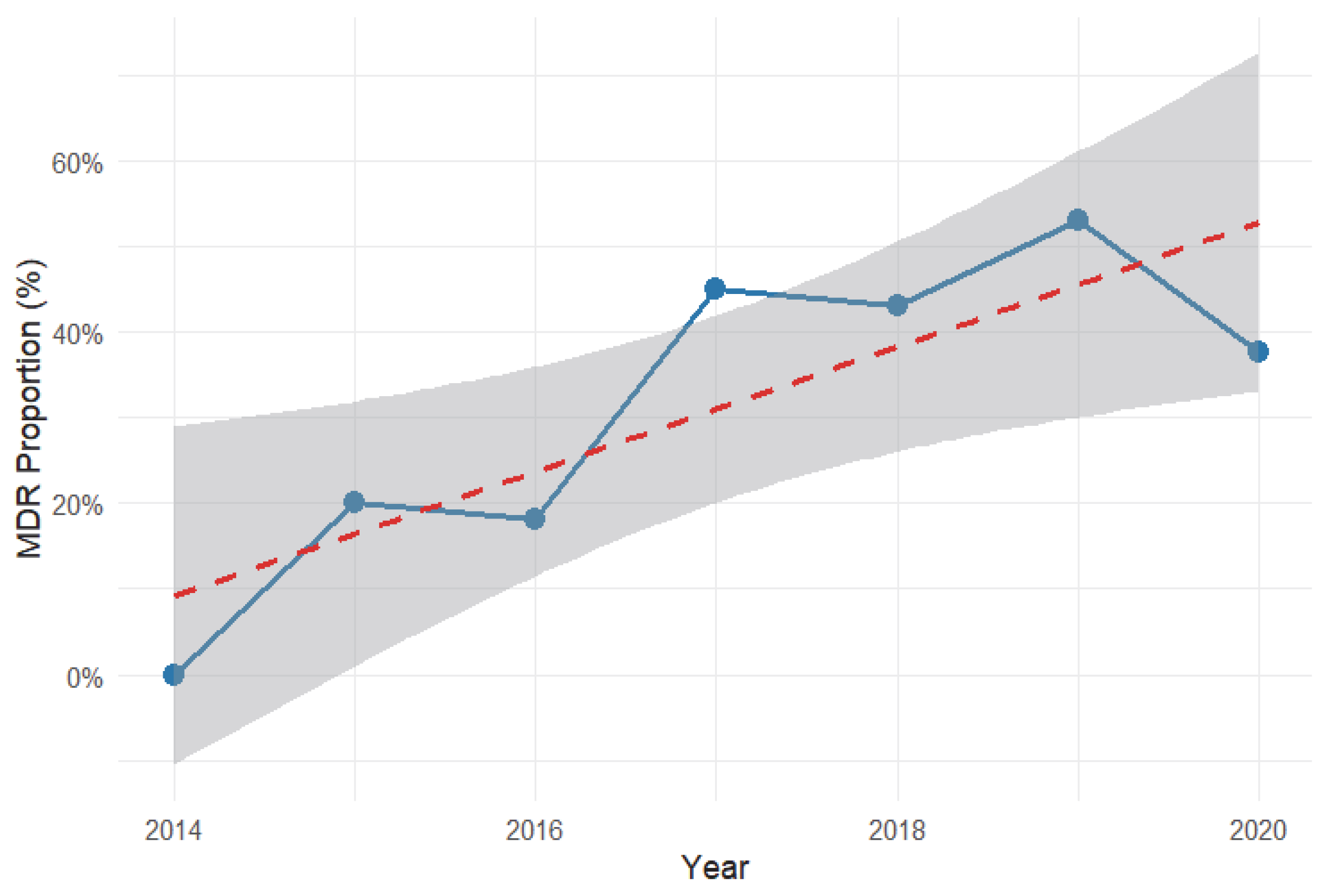
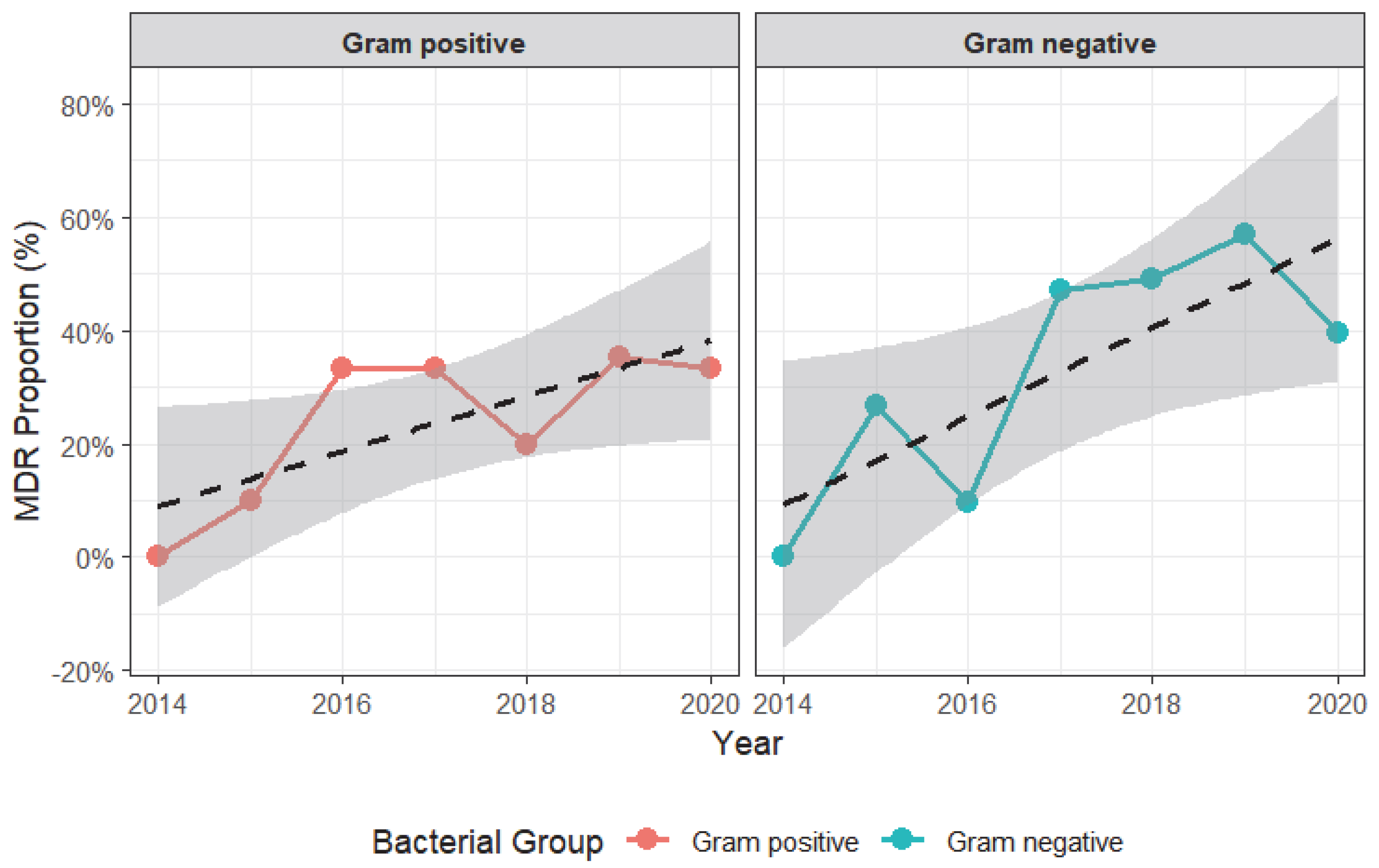
A total of 590 bacterial isolates were analyzed to assess the occurrence and predictors of multidrug resistance (MDR). Overall, 41.7% (CI: 0.377–0.458) of isolates were classified as multidrug resistant. As shown in Table 4, the proportion of MDR varied significantly by year of case submission (χ2 = 29.6, p < 0.001), increasing from 18.2% in 2016 to a peak of 53.0% in 2019 before declining slightly to 37.6% in 2020 as shown in Figure 1. In univariable analysis (Table 4), the odds of MDR were significantly higher in 2017 (OR = 3.27, 95% CI: 1.08–11.41, p = 0.036), 2018 (OR = 3.02, 95% CI: 1.09–9.89, p = 0.034), and 2019 (OR = 4.51, 95% CI: 1.75–13.98, p = 0.001) compared to 2015. After adjustment for other variables, isolates from 2019 remained significantly more likely to be multidrug resistant (aOR = 4.21, 95% CI: 1.62–13.14, p = 0.0025). A steeper fitted increasing trend was observed with Gram-negative bacteria (Figure 2).
Animal host type was associated with MDR in the univariable analysis (p = 0.043), where isolates from food animals had higher odds of MDR than those from companion animals (OR = 1.49, 95% CI: 1.01–2.23, p = 0.043), though this relationship was not significant in the multivariable model (aOR = 1.24, 95% CI: 0.80–1.95, p = 0.336). Gram-negative bacteria were consistently more likely to be multidrug resistant compared to Gram-positive isolates in both univariable (OR = 1.91, 95% CI: 1.29–2.85, p = 0.001) and multivariable analyses (aOR = 1.62, 95% CI: 1.07–2.48, p = 0.023). Region of origin was not associated with MDR (p = 0.805). Overall, the model indicated temporal variation and higher MDR prevalence among Gram-negative bacteria. The final multivariable logistic regression model demonstrated a good overall fit (Hosmer–Lemeshow χ2 = 1.51, df = 5, p = 0.91), indicating adequate calibration of predicted and observed outcomes.

3. Discussion

3.1. Diagnostics and AMR

Diagnostics are crucial in the fight against AMR as they identify the cause of infections and determine antibiotic susceptibility to guide treatment decisions, thus enabling targeted treatment and reducing empirical treatment [14]. Ultimately, this reduces unnecessary antibiotic use. Also, diagnostics support AMR surveillance programs by tracking resistance patterns and guiding public health interventions. Diagnostic tools used to detect AMR in pathogens can be grouped into phenotypic (culture-based techniques, like disk diffusion) and genotypic (utilize the pathogen’s nucleic acid—DNA, RNA tests). The choice of AMR test for a particular pathogen will depend on the pathogen, clinical setting, the availability of resources, and the investigation goal at hand [15].
This study detected a rise in the adoption of bacterial culture and sensitivity testing from 105 cases (2014–2017) to 485 requests in a year over the seven–year period (2018–2020). This trend could be attributed to increased awareness of AMR and the need for evidence-based antimicrobial use in veterinary practice, especially in cases of treatment failure. With the current demand, the expansion of veterinary diagnostic services in the country over time has been noticed [16]. A similar pattern has been observed in other settings, for example, studies from African settings have shown increased culture and sensitivity testing over time, particularly in food animals due to concerns over AMR and regulatory changes in antimicrobial use [17,18].

3.2. Samples and Case Distribution

The distribution of samples highlights the predominance of tissue samples (53.9%), followed by bodily fluids and excretions (23.2%) and swabs (22.0%). The high proportion of tissue samples could be explained by the inclusion of post-mortem cases, which are common in veterinary diagnostics especially for avian species. The similarity in having more post-mortem sampling was also noticed in another study conducted in Malaysia [19].
The central region accounted for over 70% of samples, while the other regions had limited representation. The concentration could be due to greater access to veterinary services and the proximity to diagnostic facilities (most reliable veterinary reference laboratories are in central Uganda). Also, a higher adoption of recognized animal welfare practices (health management inclusive) in both livestock and companion animals and increased disease reporting could be more skewed to the central region population. This geographic imbalance in veterinary diagnostics is a common issue in resource-limited settings; thus most disease and AMR surveillance data originate from urban and peri-urban areas, in this case the central region of Uganda [20,21].
Food animals (75.4%) were the most frequently tested, followed by companion animals (24.1%), with very few wildlife cases (0.5%). The high proportion of samples from food animals reflects their central role in Uganda’s livestock economy and the greater frequency of illness recognition and diagnostic access in these species. In contrast, companion animals comprise a smaller share of testing, while wildlife submissions remain minimal, likely due to limited surveillance infrastructure and reduced interaction with veterinary diagnostic services [22].

3.3. Pathogens and AMR

Gram-negative bacteria were more commonly isolated in this study because a high proportion of the diagnostic submission were from poultry, where E. coli and Salmonella (common gut-associated colonizers) frequently cause clinical disease. Additionally, Gram-negative bacteria possess ecological adaptation advantages conferred by their lipopolysaccharide (LPS)-containing outer membrane, which enhances environmental persistence, immune evasion, and AMR, thereby increasing their likelihood of transmission [23]. The findings align with research on bacterial infections in animals, where Gram-negative bacteria tend to be more prevalent [24]. The predominance of Gram-negative rods (74.4%) is consistent with studies indicating that E. coli, Salmonella, Pseudomonas, and Klebsiella are major bacterial pathogens affecting livestock and companion animals [21,25]. Among the Gram-positives, members from the genus Staphylococcus were commonly diagnosed in infections of animals, a finding like a Malaysian study [19]. This is because many conditions that were detected in these animals (e.g., mastitis, skin/wound, otitis) arise in tissues staphylococci normally colonize, enabling opportunistic infection when barriers are disrupted [26].
The identification of a wide range of bacterial species highlights the complexity of infectious diseases in animals and the need for comprehensive diagnostic approaches in the Ugandan setting. Conversely, a couple of the animal bacterial species, like E. coli, Klebsiella, Salmonella, Pseudomonas, Staphylococcus and Streptococcus, reported in this study have been associated with the potential for zoonotic transmission [27], which is a threat to public health. These pathogens were implicated in a variety of infections, including urinary tract, mastitis, and wound infections, making them our critical targets for our passive AMR surveillance.
The study revealed a significantly high occurrence of MDR among Escherichia (57.2%) and Staphylococcus (35.8%), highlighting their dominant role in AMR dissemination. The high MDR occurrence in E. coli (57.2%) is consistent with previous studies conducted in diseased animals [19,21]. Another study conducted in Nigeria reported more than 50% MDR infection-causing E. coli [17]. E. coli has been documented to have a flexible genome making it a well-known reservoir of AMR genes, including extended-spectrum β-lactamase (ESBL)-producing strains, carbapenem-resistant strains, and plasmid-mediated colistin-resistant isolates (mcr genes) compared to other bacteria [21]. This then culminates in a higher probability of exhibiting resistance across various antibiotic families. Other studies conducted in Spain and Brazil [28,29] reported over 50.0% proportions of infection-causing MDR staphylococci in companion animals. While Salmonella is a known foodborne pathogen with growing resistance concerns, its MDR levels in this study were lower than in E. coli and staphylococci, likely due to differences in bacterial species-specific resistance mechanisms and variations in selective antibiotic pressure across host environments. However, MDR Salmonella has been increasingly reported by some studies [21] in diseased poultry and livestock at higher proportions (>30%) compared to this study. These variations in the MDR levels in E. coli, Salmonella, and Staphylococcus could be influenced by regional and method disparities. These findings reinforce the need for enhanced AMR surveillance in veterinary settings, particularly in zoonotic bacteria like E. coli, S. aureus and Salmonella which can transfer resistance genes to human pathogens through direct contact or foodborne transmission.
Resistance in E. coli was notably high across multiple antibiotic classes, with tetracycline (80.1%), ampicillin (74.6%), and trimethoprim-sulfamethoxazole (65.8%) exhibiting the highest resistance levels. These findings are consistent with other study reports [19,30,31] on the widespread resistance of E. coli to first-line antibiotics, particularly in agricultural settings where tetracyclines and β-lactams are heavily used. This pattern likely reflects strong antimicrobial selective pressure, as tetracyclines, β-lactams, and sulfonamides are readily available, inexpensive, and widely administered in food-animal production in Uganda, often with minimal veterinary oversight [32,33]. These drugs are also commonly used for empirical treatment, promoting recurrent exposure and resistance development [34]. The high resistance to nalidixic acid (66.5%) and ciprofloxacin (33.3%) indicates significant fluoroquinolone resistance, a worrying trend given the role of fluoroquinolones as critical antibiotics for treating bacterial infections in both animals and humans. Notably, gentamicin resistance (17.9%) was lower compared to other antibiotics, suggesting that aminoglycosides still retain some effectiveness against E. coli. In Uganda, aminoglycosides are comparatively less accessible and infrequently administered in animals, limiting selective pressure and contributing to the lower resistance observed in livestock isolates [35]. This finding was consistent with a study from Australia [36] that found low proportions of gentamicin resistant clinical E. coli in animals. S. aureus isolates demonstrated high resistance to penicillins and tetracyclines, with penicillin resistance at 65.1% and ampicillin at 73.9%. The 60.3% tetracycline resistance highlights the widespread use and declining efficacy of this antibiotic class in treating S. aureus infections. This pattern of AMR in commonly used antimicrobials, such as penicillins, tetracycline, and trimethoprim sulfamethoxazole was consistent with findings from a previous Ugandan study [37]. In a study conducted in the United States, compared to E. coli and S. aureus, Salmonella isolates exhibited lower resistance proportions for most antibiotics, except for streptomycin (67.4%) and ampicillin (61.5%), which showed high resistance [38]. The 50.0% resistance to nalidixic acid and 40.0% to ciprofloxacin raises concerns about reduced fluoroquinolone efficacy in Salmonella, particularly as these drugs are considered critical for resistant Salmonellae in poultry. Together, these findings indicate that antimicrobial resistance patterns in Ugandan animals are closely shaped by antimicrobial usage frequency, accessibility, and enforcement of stewardship policies, leading to high resistance when or where drug use is intensive and lower resistance when or where use remains limited. The distribution of bacterial species across host animals (Supplementary Materials Tables S5 and S7) provides insight into ecological niches that may shape AMR patterns. For example, most Salmonella isolates were host-adapted S. gallinarum, which differs in antimicrobial exposure and disease ecology from broad-host-range serovars such as S. enteritidis. This likely contributes to the overall lower MDR levels observed in Salmonella compared to E. coli. Similarly, the high proportion of resistant E. coli among chickens reflects intensive poultry production systems, where antimicrobial use tends to be more frequent and may drive higher MDR selection. In contrast, S. aureus was more common in dogs and cattle, indicating host-associated niches with distinct selective pressures. These host–pathogen relationships reveal the role of species-specific ecology and production systems in AMR emergence.

3.4. Drivers of Multidrug Resistance in Bacteria

The overall MDR burden of 41.7% in bacterial isolates over the seven-year period highlights the growing challenge of AMR in veterinary settings. The significant associations between MDR and factors such as animal species, bacterial group, and year of submission emphasize the complex interplay of host, bacterial, and environmental factors in shaping resistance patterns. Temporal analysis showed year-to-year variation, with MDR peaking in 2019 but the fitted linear trend indicating an overall upward trajectory across the seven-year period. The decline observed in 2020 may reflect contextual factors including disruptions in veterinary services which had a downstream effect on case submissions during the COVID-19 pandemic rather than a reversal in AMR emergence. The findings were like those of a previous report [39] that also revealed an increase in AMR amongst pathogenic bacteria of animals in diverse settings.
The finding that the occurrence of MDR bacteria was significantly associated with animal species suggests that certain host environments may facilitate emergence and spread of AMR genes in bacterial populations, influencing their resistance profiles [40]. The higher odds of MDR bacteria being harbored in food animals align with previous reports that livestock, (particularly poultry, cattle, and swine) are key reservoirs for AMR bacteria due to frequent antibiotic use in growth promotion, prophylaxis, and treatment [41,42,43]. Routine antimicrobial use in food animal production imposes selective pressure that promotes bacterial survival. In this environment, horizontal transfer of resistance genes—via plasmids, transposons, and integrons—serves as an adaptive mechanism enabling bacteria to withstand antimicrobial exposure [44]. On the other hand, the higher MDR proportion observed in food animals in the univariable analysis did not persist in the multivariable model, suggesting that this association could have been confounded by bacterial groups. Food animals contributed a disproportionately high number of Gram-negative isolates, particularly E. coli and Salmonella and Gram-negative bacteria had significantly higher odds of MDR. Once Gram status and year were adjusted for, the host-type effect diminished, indicating that MDR in food animals is largely driven by the bacterial populations they harbor rather than the host category itself.
The significantly increased odds of MDR in Gram-negative bacteria reflect the intrinsic and acquired resistance mechanisms of these organisms. Unlike Gram-positive and Gram-negative bacteria possess an outer membrane that limits antibiotic permeability [45], in addition to efflux pumps and beta-lactamase enzymes that contribute to MDR. This explains the high resistance rates observed in E. coli, Salmonella, Pseudomonas, and Klebsiella isolates in this study. Furthermore, Gram-negative bacteria frequently harbor plasmid-borne resistance genes, such as extended-spectrum beta-lactamases (ESBLs) and carbapenemases [46], which facilitate the rapid spread of resistance across different species and environments. The OH implications of this trend are significant, as resistant Gram-negative pathogens from animals can contaminate food products, water sources, and farm environments, ultimately leading to human infections that are challenging to treat.
The findings of this study align with Uganda’s updated National Action Plan on Antimicrobial Resistance (NAP-AMR 2023–2028), which prioritizes strengthened AMR surveillance. An important contrast to note is that clinical diagnostic isolates, such as those included in this study, generally exhibit higher resistance levels than commensal bacteria sampled from healthy animals [47,48]. Clinical submissions typically arise from animals with active diseases, treatment failure, or recurrent infections, all of which enrich for more resistant pathogens. As a result, the MDR proportions reported here are expected to be higher than those found in commensal monitoring programs and should be interpreted within the context of this diagnostic selection. This distinction reinforces that our findings reflect resistance patterns among clinically significant pathogens rather than baseline AMR levels in the broader animal population.

3.5. Limitations and Future Directions

This study has several limitations. First, it relied solely on phenotypic antimicrobial susceptibility testing, which limits the ability to identify specific genetic determinants of resistance. Without whole-genome or targeted molecular analyses, we were unable to detect key resistance mechanisms such as ESBL-encoding genes, carbapenemases, or mcr genes; track high-risk or clonal lineages; or evaluate the potential for horizontal gene transfer—an essential consideration in One Health AMR transmission. Incorporating genomic analyses should therefore be a primary priority for future work. Second, the retrospective design introduces potential biases because samples were obtained exclusively from diseased animals, some of which may have received prior antibiotic treatment, thereby affecting their resistance profiles. Third, the dataset was overwhelmingly concentrated in the Central region, with nearly 80% of isolates originating from Kampala, Wakiso, and Mukono districts. This geographic imbalance reflects the location of one of Uganda’s major veterinary diagnostic facilities and the passive nature of submission-based surveillance. As a result, the findings primarily represent AMR dynamics in central Uganda and should not be generalized to the entire country without caution. Fourth, the host-species distribution of samples was highly skewed. Food animals constituted 75.4% of all submissions, and chickens alone accounted for more than half of the dataset. Companion animals contributed a quarter of the isolates, while wildlife was almost entirely absent. Consequently, the high MDR proportions, particularly among E. coli isolates, are strongly influenced by intensive and semi-intensive poultry systems. These systems differ substantially from pastoral cattle or small-ruminant systems common in the Northern and Eastern regions, which were grossly underrepresented. This host- and sample-type bias limits the extent to which the study can speak broadly to “animals in Uganda”. Fifth, the absence of farm-level antimicrobial usage data restricted our ability to link treatment practices with AMR outcomes. Additionally, some antibiogram results were lost during data cleaning due to non-adherence to diagnostic stewardship practices, reducing the final analytic sample size. Finally, inconsistencies in antimicrobial panels across bacterial species—largely due to reagent availability—constrained comparability of resistance patterns between isolates. Future studies should incorporate geographically representative, multi-center active surveillance systems; include genomic characterization of isolates; standardize antimicrobial testing panels; and adopt One Health-aligned approaches to better understand resistance mechanisms, zoonotic risks, and AMR dynamics across Uganda’s diverse production systems.

4. Methods and Materials

4.1. Study Design, Sampling Frame and Area

This was a retrospective study that analyzed antibiogram data of bacterial pathogens isolated from animal samples submitted for routine disease diagnosis to the Central Diagnostic Laboratory (CDL), College of Veterinary Medicine, Animal Resources and Biosecurity (COVAB), Makerere University, between 2014 and 2020 in Uganda. The CDL provides routine disease diagnostic services to livestock farmers, pet owners, and other animal health stakeholders across Uganda [20].

4.2. Data Source, Inclusion Criteria and Collection

From the laboratory dataset of bacterial diseases diagnosed by the bacteriology unit, we extracted 590 cases that included antibiograms of bacterial isolates. Data were included if they met the following criteria: (i) isolates were identified to at least genus level, (ii) complete antibiogram results were available for at least three antimicrobial classes, and (iii) relevant data were present, including year of submission, animal host species, and geographic location within Uganda. Only samples collected from animals were considered for analysis.
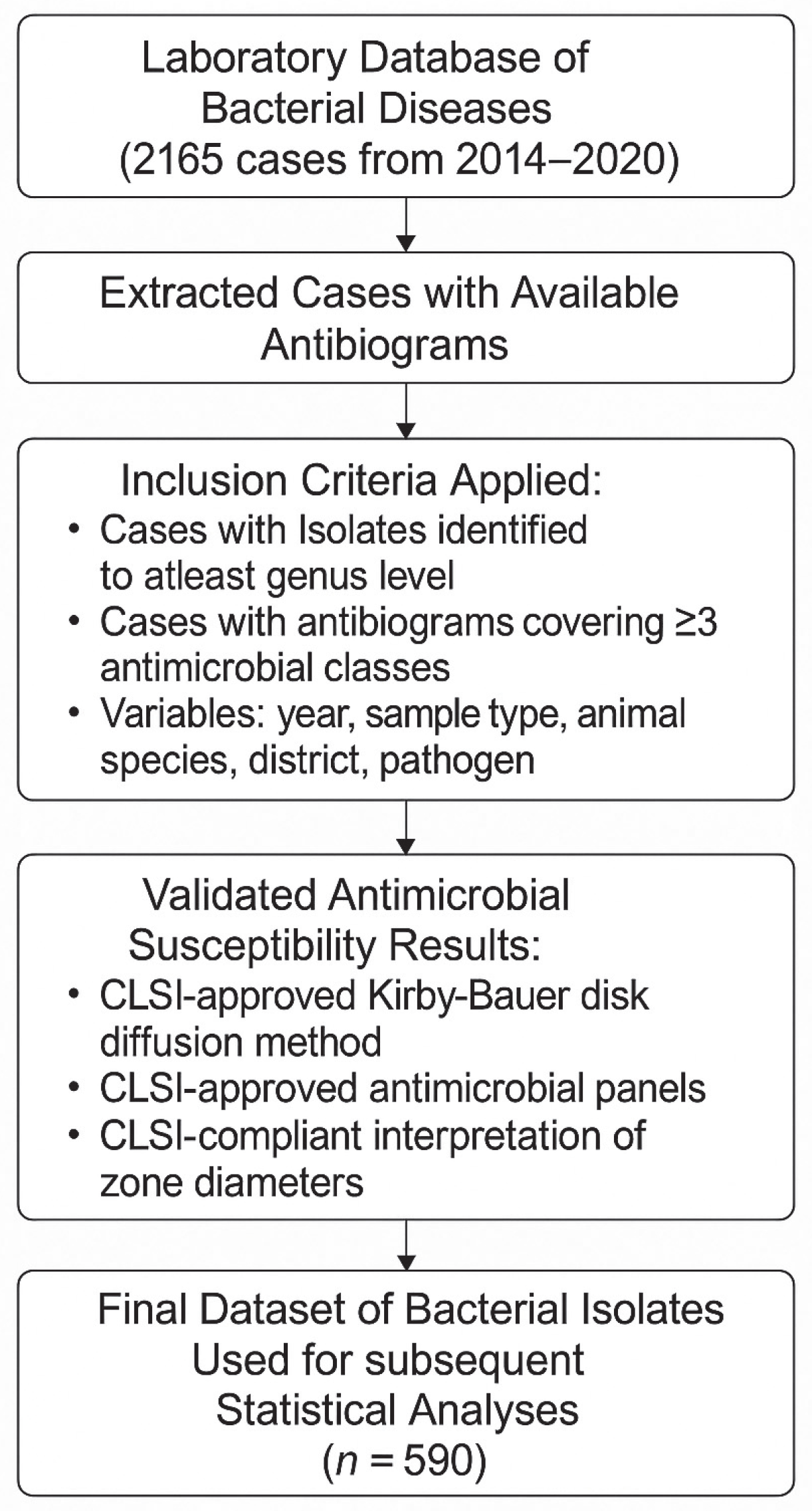
Antimicrobial susceptibility results were considered valid for inclusion if they adhered to standard diagnostic stewardship practices, specifically: (i) the use of the Kirby-Bauer disk diffusion method with ATCC control strains included in the test runs, (ii) application of Clinical and Laboratory Standards Institute (CLSI)-approved antimicrobial panels appropriate for the bacterial species tested, and (iii) standardized interpretation and reporting of inhibition zone diameters according to (CLSI) guidelines. Figure 3 summarizes the overall data processing and curation pipeline.

4.3. Bacterial Isolation and Identification

Previously described standard microbiological techniques were employed at the laboratory for isolation and identification of bacteria from collected samples [49]. These methods have also been validated in prior studies conducted in similar contexts, including analyses of milk [50] swabs, fecal matter, tissues, and organs [21,50].

4.4. Multiple Antibiotic Resistance Index (MARI)

The multiple antibiotic resistance index (MARI) for each isolate was calculated using the formula c/d, where c represents the number of antibiotics to which the isolate was resistant, and d is the total number of antibiotics tested against the isolates. Bacteria with MARI values of greater than or equal to 0.2 were taken to originate from sources where antimicrobials are overused thus characterized presumably as strains frequently exposed to antibiotics [51,52].

4.5. Antimicrobial Susceptibility Testing

Phenotypic detection of AMR exhibited by bacteria was conducted using the Kirby Bauer disk diffusion method according to the CLSI guidelines [53,54]. For quality control (QC), the facility used standard reference strains, including Escherichia coli ATCC 25922 and Staphylococcus aureus ATCC 25923 for validation of antimicrobial susceptibility testing. Each batch of tests included at least one QC strain to ensure accuracy of disk diffusion results and consistency of zone diameter measurements. Any deviations from expected inhibition ranges prompted retesting of both QC and corresponding clinical isolates. All media and antibiotic disks were verified for sterility, potency, and expiry prior to use.
Results were recorded for various antibiotics tested, as resistant, intermediate, or susceptible. Multi-drug resistance was defined as resistance to at least three different classes of antimicrobials [55].

4.6. Data Analysis

All statistical analyses were conducted using R (version 4.5.2). The final cleaned dataset included 590 bacterial isolates with antibiogram data collected from 2014 to 2020, along with associated metadata.
Descriptive analyses were performed to summarize sample types, geographical regions, and host animal categories. Categorical variables were reported as frequencies and proportions, with 95% confidence intervals (CIs). Bacterial isolates were categorized into Gram-negative and Gram-positive groups and further stratified by genus and species. The occurrence of each bacterial genus and species was calculated as a percentage of the total isolates.
Antimicrobial resistance (AMR) patterns were analyzed for three clinically relevant bacterial species (E. coli, S. aureus, and Salmonella). Resistance proportions were determined for individual antibiotics. Multidrug resistance (MDR), defined as resistance to three or more antimicrobial classes, was calculated for each genus and species. Differences in MDR proportions across bacterial groups were assessed using Chi-squared (χ2) and Fisher’s exact tests, with statistical significance set at p < 0.05. The Multiple Antibiotic Resistance Index (MARI) was computed as the ratio of the number of antibiotics to which an isolate was resistant to the total number of antibiotics tested; mean MARI values were compared among bacterial species.
Logistic regression was performed to identify factors associated with MDR. Variables with p < 0.1 in univariable screening using simple logistic models were considered for inclusion in the final multivariable model. Independent variables included year, animal host species, geographical region, and bacterial group. Since no MDR cases were detected in 2014, this category led to perfect prediction and was therefore excluded from regression models. Similarly, regions had very sparse representation (e.g., Eastern and Northern) thus were excluded from multivariable analysis due to insufficient sample size and lack of statistical contribution (tested using the likelihood ratio test) of the categorical variable to the model. The wildlife host category was also excluded from the multivariable model to improve model fit because it contained only three isolates. Odds ratios (ORs) with 95% CIs were reported to quantify associations. Multivariable logistic regression was performed to adjust for potential confounders. Model goodness-of-fit was assessed using the Hosmer–Lemeshow test, and statistical significance was interpreted at p < 0.05.

5. Conclusions

This study demonstrates a high and rising burden of multidrug resistance among animal pathogens in Uganda, thus exposing the need for strengthened surveillance and prudent antimicrobial use. Despite being limited to animal data, the findings provide essential evidence to inform Uganda’s National Action Plan on AMR (2023–2028) and guide veterinary stewardship efforts. The detection of zoonotic pathogens such as E. coli, Salmonella, and S. aureus highlights the importance of integrated AMR surveillance across human, animal, and environmental sectors to support One Health-based control strategies. Given the skewed geographic concentration of isolates from central Uganda, the findings should be interpreted as reflecting AMR patterns in this region, highlighting the need for broader nationwide surveillance to capture regional diversity.

Supplementary Materials

The following supporting information can be downloaded at: https://www.mdpi.com/article/10.3390/antibiotics14121276/s1, Table S1: Detailed distribution of sample categories and their specific types among animal diagnostic submissions with antibiogram data, Uganda (2014–2020); Table S2: Detailed distribution of diagnostic submissions with antibiogram data by district, Uganda (2014–2020); Table S3. Distribution of diagnostic submissions with antibiogram data by animal species, Uganda (2014–2020); Table S4: Bacterial genera isolated from diseased animal samples; Table S5: Bacterial strains isolated from diseased animal samples; Table S6: Frequency of bacterial genera by sample type; Table S7: Bacteria strains infecting various animal species; Table S8: Frequency of Multidrug resistant clinical bacterial species

Author Contributions

Conceptualization—S.K., M.M., D.F.N.M., P.S. and J.B.K.; methodology and data curation S.K., M.M., W.E., F.M., D.F.N.M., D.N., G.A., E.N., E.B.K., E.M.W. and J.B.K.; data analysis—S.K., M.M., H.O. and J.B.K.; original draft writing—S.K.; review and editing—all authors; and supervision—J.B.K. All authors have read and agreed to the published version of the manuscript.

Funding

This research received no external funding.

Institutional Review Board Statement

Not applicable.

Informed Consent Statement

All individuals who submit samples to the laboratory provide written consent for use of anonymized data in research and its publication. Permission to access the data was obtained from the management of CDL, COVAB, Makerere University.

Data Availability Statement

The data presented in this study are available on request from the corresponding author.

Acknowledgments

We wholeheartedly recognize the unwavering support of Nicole Keener, Michigan State University, for tirelessly reviewing this manuscript for publication.

Conflicts of Interest

The authors declare no conflicts of interest.

References

  1. Salam, M.A.; Al-Amin, M.Y.; Salam, M.T.; Pawar, J.S.; Akhter, N.; Rabaan, A.A.; Alqumber, M.A. Antimicrobial resistance: A growing serious threat for global public health. Healthcare 2023, 11, 1946. [Google Scholar] [CrossRef] [PubMed]
  2. Endale, H.; Mathewos, M.; Abdeta, D. Potential causes of spread of antimicrobial resistance and preventive measures in One Health perspective—A review. Infect. Drug Resist. 2023, 16, 7515–7545. [Google Scholar] [PubMed]
  3. Huemer, M.; Mairpady Shambat, S.; Brugger, S.D.; Zinkernagel, A.S. Antibiotic resistance and persistence—Implications for human health and treatment perspectives. EMBO Rep. 2020, 21, e51034. [Google Scholar] [CrossRef]
  4. Farhat, M.; Khayi, S.; Berrada, J.; Mouahid, M.; Ameur, N.; El-Adawy, H.; Fellahi, S. Salmonella enterica Serovar Gallinarum Biovars Pullorum and Gallinarum in poultry: Review of pathogenesis, antibiotic resistance, diagnosis and control in the genomic era. Antibiotics 2023, 13, 23. [Google Scholar] [CrossRef] [PubMed]
  5. Velazquez-Meza, M.E.; Galarde-López, M.; Carrillo-Quiróz, B.; Alpuche-Aranda, C.M. Antimicrobial resistance: One Health approach. Vet. World 2022, 15, 743–752. [Google Scholar] [PubMed]
  6. Sabour, S.; Azimi, T.; Nasser, A.; Hadi, N.; Mohsenzadeh, A.; Shariati, A. A global overview of the most important zoonotic bacterial pathogens transmitted from Rattus norvegicus to humans in urban environments. Infect. Med. 2022, 1, 192–207. [Google Scholar] [CrossRef] [PubMed]
  7. Reperant, L.A.; Cornaglia, G.; Osterhaus, A.D.M.E. The importance of understanding the human–animal interface: From early hominins to global citizens. In One Health: The Human–Animal–Environment Interfaces in Emerging Infectious Diseases; Springer: Berlin/Heidelberg, Germany, 2013; pp. 49–81. [Google Scholar]
  8. Kuthyar, S.; Reese, A.T. Variation in microbial exposure at the human–animal interface and implications for microbiome-mediated health outcome. mSystems 2021, 6, e01128-20. [Google Scholar] [CrossRef] [PubMed]
  9. Kivumbi, M.T.; Standley, C.J. Efforts to identify and combat antimicrobial resistance in Uganda: A systematic review. Trop. Med. Infect. Dis. 2021, 6, 86. [Google Scholar] [CrossRef] [PubMed]
  10. Kiggundu, R.; Lusaya, E.; Seni, J.; Waswa, J.P.; Kakooza, F.; Tjipura, D.; Kikule, K.; Muiva, C.; Joshi, M.P.; Stergachis, A.; et al. Identifying and addressing challenges to antimicrobial use surveillance in the human health sector in low- and middle-income countries: Experiences and lessons learned from Tanzania and Uganda. Antimicrob. Resist. Infect. Control 2023, 12, 9. [Google Scholar] [CrossRef] [PubMed]
  11. Kivali, V.; Roesel, K.; Dohoo, I.; Alinaitwe, L.; Bugeza, J.K.; Hoona, J.J.; Mugizi, D.R.; Kankya, C.; Dang-Xuan, S.; Szabo, I.; et al. Non-typhoidal Salmonella among slaughterhouse workers and in the pork value chain in selected districts of Uganda. Front. Vet. Sci. 2024, 11, 1427773. [Google Scholar]
  12. Samuel, M.; Wabwire, T.F.; Tumwine, G.; Waiswa, P. Antimicrobial usage by small-scale commercial poultry farmers in mid-Western district of Masindi, Uganda: Patterns, public health implications, and antimicrobial resistance of E. coli. Vet. Med. Int. 2023, 2023, 6644271. [Google Scholar] [CrossRef]
  13. Ager, E.O.; Carvalho, T.; Silva, E.M.; Ricke, S.C.; Hite, J.L. Global trends in antimicrobial resistance on organic and conventional farms. Sci. Rep. 2023, 13, 22608. [Google Scholar] [CrossRef] [PubMed]
  14. Yamin, D.; Uskoković, V.; Wakil, A.M.; Goni, M.D.; Shamsuddin, S.H.; Mustafa, F.H.; Alfouzan, W.A.; Alissa, M.; Alshengeti, A.; Almaghrabi, R.H.; et al. Current and future technologies for the detection of antibiotic-resistant bacteria. Diagnostics 2023, 13, 3246. [Google Scholar] [CrossRef]
  15. Hassall, J.; Coxon, C.; Patel, V.C.; Goldenberg, S.D.; Sergaki, C. Limitations of current techniques in clinical antimicrobial resistance diagnosis: Examples and future prospects. npj Antimicrob. Resist. 2024, 2, 16. [Google Scholar] [CrossRef] [PubMed]
  16. Ssajjakambwe, P.; Atuheire, C.; Okello, J.; Kakooza, S.; Waiswa, J.; Ayebare, D.; Roesel, K.; Moodley, A. Antimicrobial Resistance and Stewardship Among Stakeholders of the Poultry Value Chain in Wakiso and Soroti Districts, Uganda; Knowledge, attitudes and practices report; International Livestock Research Institute: Addis Ababa, Ethiopia, 2023. [Google Scholar]
  17. Oloso, N.O.; Fagbo, S.; Garbati, M.; Olonitola, S.O.; Awosanya, E.J.; Aworh, M.K.; Adamu, H.; Odetokun, I.A.; Fasina, F.O. Antimicrobial resistance in food animals and the environment in Nigeria: A review. Int. J. Environ. Res. Public Health 2018, 15, 1284. [Google Scholar] [PubMed]
  18. Kimera, Z.I.; Mshana, S.E.; Rweyemamu, M.M.; Mboera, L.E.G.; Matee, M.I.N. Antimicrobial use and resistance in food-producing animals and the environment: An African perspective. Antimicrob. Resist. Infect. Control 2020, 9, 37. [Google Scholar] [PubMed]
  19. Haulisah, N.A.; Hassan, L.; Bejo, S.K.; Jajere, S.M.; Ahmad, N.I. High levels of antibiotic resistance in isolates from diseased livestock. Front. Vet. Sci. 2021, 8, 652351. [Google Scholar] [CrossRef] [PubMed]
  20. Byaruhanga, J.; Tayebwa, D.S.; Eneku, W.; Afayoa, M.; Mutebi, F.; Ndyanabo, S.; Kakooza, S.; Okwee-Acai, J.; Tweyongyere, R.; Wampande, E.M.; et al. Retrospective study on cattle and poultry diseases in Uganda. Int. J. Vet. Sci. Med. 2017, 5, 168–174. [Google Scholar] [CrossRef] [PubMed]
  21. Kakooza, S.; Muwonge, A.; Nabatta, E.; Eneku, W.; Ndoboli, D.; Wampande, E.; Munyiirwa, D.; Kayaga, E.; Tumwebaze, M.A.; Afayoa, M.; et al. A retrospective analysis of antimicrobial resistance in pathogenic Escherichia coli and Salmonella spp. isolates from poultry in Uganda. Int. J. Vet. Sci. Med. 2021, 9, 11–21. [Google Scholar] [CrossRef]
  22. Vudriko, P.; Ekiri, A.B.; Endacott, I.; Williams, S.; Gityamwi, N.; Byaruhanga, J.; Alafiatayo, R.; Mijten, E.; Tweyongyere, R.; Varga, G.; et al. A survey of priority livestock diseases and laboratory diagnostic needs of animal health professionals and farmers in Uganda. Front. Vet. Sci. 2021, 8, 721800. [Google Scholar] [CrossRef] [PubMed]
  23. Helmy, Y.A.; Taha-Abdelaziz, K.; Hawwas, H.A.E.H.; Ghosh, S.; AlKafaas, S.S.; Moawad, M.M.M.; Saied, E.M.; Kassem, I.I.; Mawad, A.M. Antimicrobial resistance and recent alternatives to antibiotics for the control of bacterial pathogens with an emphasis on foodborne pathogens. Antibiotics 2023, 12, 274. [Google Scholar] [CrossRef] [PubMed]
  24. Scarpellini, R.; Assirelli, G.; Giunti, M.; Esposito, E.; Mondo, E.; Piva, S. Monitoring the prevalence of antimicrobial resistance in companion animals: Results from clinical isolates in an Italian University Veterinary Hospital. Transbound. Emerg. Dis. 2023, 2023, 6695493. [Google Scholar] [CrossRef] [PubMed]
  25. Kabantiyok, D.; Gyang, M.D.; Agada, G.O.; Ogundeji, A.; Nyam, D.; Uhiara, U.G.; Abiayi, E.; Dashe, Y.; Ngulukun, S.; Muhammad, M.; et al. Analysis of retrospective laboratory data on the burden of bacterial pathogens isolated at the National Veterinary Research Institute Nigeria, 2018–2021. Vet. Sci. 2023, 10, 505. [Google Scholar] [CrossRef] [PubMed]
  26. Elbehiry, A.; Marzouk, E. Staphylococci in livestock: Molecular epidemiology, antimicrobial resistance, and translational strategies for One Health protection. Vet. Sci. 2025, 12, 757. [Google Scholar] [CrossRef] [PubMed]
  27. Rahman, M.; Sobur, M.; Islam, M.; Ievy, S.; Hossain, M.; El Zowalaty, M.E.; Rahman, A.T.; Ashour, H.M. Zoonotic diseases: Etiology, impact, and control. Microorganisms 2020, 8, 1405. [Google Scholar] [CrossRef]
  28. Marco-Fuertes, A.; Marin, C.; Gimeno-Cardona, C.; Artal-Muñoz, V.; Vega, S.; Montoro-Dasi, L. Multidrug-resistant commensal and infection-causing Staphylococcus spp. isolated from companion animals in the Valencia region. Vet. Sci. 2024, 11, 54. [Google Scholar] [CrossRef] [PubMed]
  29. Viegas, F.M.; Santana, J.A.; Silva, B.A.; Xavier, R.G.C.; Bonisson, C.T.; Câmara, J.L.S.; Rennó, M.C.; Cunha, J.L.R.; Figueiredo, H.C.P.; Lobato, F.C.F.; et al. Occurrence and characterization of methicillin-resistant Staphylococcus spp. in diseased dogs in Brazil. PLoS ONE 2022, 17, e0269422. [Google Scholar] [CrossRef] [PubMed]
  30. Kakooza, S.; Tayebwa, D.S.; Njalira, K.R.; Kayaga, E.B.; Asiimwe, I.; Komugisha, M.; Wanyana, M.; Kisekka, R.; Kyabarongo, A.; Kiryabwire, D.H.; et al. Reflections on drivers for the emergence and spread of antimicrobial resistant bacteria detected from chickens reared on commercial layer farms in Mukono district, Uganda. Vet. Med. Res. Rep. 2023, 14, 209–219. [Google Scholar] [CrossRef]
  31. Kusumoto, M.; Tamamura-Andoh, Y.; Hikoda-Kogiku, Y.; Magome, A.; Okuhama, E.; Sato, K.; Mizuno, Y.; Arai, N.; Watanabe-Yanai, A.; Iwata, T.; et al. Nationwide analysis of antimicrobial resistance in pathogenic Escherichia coli strains isolated from diseased swine over 29 years in Japan. Front. Microbiol. 2023, 14, 1107566. [Google Scholar] [CrossRef] [PubMed]
  32. Nayiga, S.; Kayendeke, M.; Nabirye, C.; Willis, L.D.; Chandler, C.I.R.; Staedke, S.G. Use of antibiotics to treat humans and animals in Uganda: A cross-sectional survey of households and farmers in rural, urban, and peri-urban settings. JAC Antimicrob. Resist. 2020, 2, dlaa082. [Google Scholar] [CrossRef]
  33. Kitutu, F.E.; Namugambe, J.S.; Senkusu, J.; Nalubwama, J.; Ssenkeera, B.; Kateregga, J.; Aineplan, N.; Kesi, D.N.; Ndagije, H.B.; Kasakya, E.; et al. National consumption of antimicrobials intended for use in animal livestock health: A retrospective data analysis of antimicrobial imports to Uganda from 2018 to 2020. BMC Vet. Res. 2025, 21, 248. [Google Scholar]
  34. Basulira, Y.; Olet, S.A.; Alele, P.E. Inappropriate usage of selected antimicrobials: Comparative residue proportions in rural and urban beef in Uganda. PLoS ONE 2019, 14, e0209006. [Google Scholar] [CrossRef]
  35. Murungi, M.; Vudriko, P.; Ndagije, H.B.; Kesi, D.N.; Serwanga, A.; Rajab, K.; Manirakiza, L.; Waswa, J.P.; Kasujja, H.; Barigye, M.; et al. National-level consumption of antimicrobials in the veterinary sector in Uganda: A report on analysis of import data for 2021. Antibiotics 2025, 14, 150. [Google Scholar] [CrossRef] [PubMed]
  36. Saputra, S.; Jordan, D.; Mitchell, T.; Wong, H.S.; Abraham, R.J.; Kidsley, A.; Turnidge, J.; Trott, D.J.; Abraham, S. Antimicrobial resistance in clinical Escherichia coli isolated from companion animals in Australia. Vet. Microbiol. 2017, 211, 43–50. [Google Scholar] [CrossRef] [PubMed]
  37. Kakooza, S.; Eneku, W.; Nabatta, E.; Wampande, E.M.; Ssajjakambwe, P.; Wanyana, M.; Munyiirwa, D.F.; Ndoboli, D.; Namuyinda, D.; Athieno, G.; et al. Integrating multi-wet laboratory diagnostics to study staphylococci in animals in Uganda. BMC Microbiol. 2024, 24, 298. [Google Scholar] [CrossRef] [PubMed]
  38. Zhao, S.; McDermott, P.F.; White, D.G.; Qaiyumi, S.; Friedman, S.L.; Abbott, J.W.; Glenn, A.; Ayers, S.L.; Post, K.W.; Fales, W.H.; et al. Characterization of multidrug resistant Salmonella recovered from diseased animals. Vet. Microbiol. 2007, 123, 122–132. [Google Scholar] [CrossRef] [PubMed]
  39. Van Boeckel, T.P.; Pires, J.; Silvester, R.; Zhao, C.; Song, J.; Criscuolo, N.G.; Gilbert, M.; Bonhoeffer, S.; Laxminarayan, R. Global trends in antimicrobial resistance in animals in low- and middle-income countries. Science 2019, 365, eaaw1944. [Google Scholar] [CrossRef]
  40. Harada, K.; Asai, T. Role of antimicrobial selective pressure and secondary factors on antimicrobial resistance prevalence in Escherichia coli from food-producing animals in Japan. Biomed. Res. Int. 2010, 2010, 180682. [Google Scholar]
  41. Kakooza, S.; Munyiirwa, D.; Ssajjakambwe, P.; Kayaga, E.; Tayebwa, D.S.; Ndoboli, D.; Basemera, L.; Nabatta, E.; Tumwebaze, M.A.; Kaneene, J.B. Epidemiological dynamics of extended-spectrum β-lactamase- or AmpC β-lactamase-producing Escherichia coli screened in apparently healthy chickens in Uganda. Scientifica 2021, 2021, 3258059. [Google Scholar]
  42. Mbatidde, I.; Ndoboli, D.; Ayebare, D.; Muloi, D.; Roesel, K.; Ochieng, L.; Dione, M.; Tenhagen, B.A.; Biryomumaisho, S.; Wampande, E.; et al. Antimicrobial use and antimicrobial resistance in Escherichia coli in semi-intensive and free-range poultry farms in Uganda. One Health 2024, 18, 100762. [Google Scholar] [PubMed]
  43. Zhang, T.; Nickerson, R.; Zhang, W.; Peng, X.; Shang, Y.; Zhou, Y.; Luo, Q.; Wen, G.; Cheng, Z. The impacts of animal agriculture on One Health—Bacterial zoonosis, antimicrobial resistance, and beyond. One Health 2024, 18, 100748. [Google Scholar] [CrossRef] [PubMed]
  44. Vinayamohan, P.G.; Pellissery, A.J.; Venkitanarayanan, K. Role of horizontal gene transfer in the dissemination of antimicrobial resistance in food animal production. Curr. Opin. Food Sci. 2022, 47, 100882. [Google Scholar] [CrossRef]
  45. Maher, C.; Hassan, K.A. The Gram-negative permeability barrier: Tipping the balance of the in and the out. mBio 2023, 14, e01205-23. [Google Scholar] [CrossRef] [PubMed]
  46. Sawa, T.; Kooguchi, K.; Moriyama, K. Molecular diversity of extended-spectrum β-lactamases and carbapenemases, and antimicrobial resistance. J. Intensive Care 2020, 8, 13. [Google Scholar] [CrossRef] [PubMed]
  47. Rodríguez-Navarro, J.; Miró, E.; Brown-Jaque, M.; Hurtado, J.C.; Moreno, A.; Muniesa, M.; González-López, J.J.; Vila, J.; Espinal, P.; Navarro, F. Comparison of commensal and clinical isolates for diversity of plasmids in Escherichia coli and Klebsiella pneumoniae. Antimicrob. Agents Chemother. 2020, 64, e01128-19. [Google Scholar] [CrossRef] [PubMed]
  48. Hesp, A.; van Schaik, G.; Wiegel, J.; Heuvelink, A.; Mevius, D.; Veldman, K. Antimicrobial resistance monitoring in commensal and clinical Escherichia coli from broiler chickens: Differences and similarities. Prev. Vet. Med. 2022, 204, 105663. [Google Scholar] [CrossRef] [PubMed]
  49. Carter, G.R.; Cole, J.R., Jr. Diagnostic Procedure in Veterinary Bacteriology and Mycology; Academic Press: London, UK, 2012. [Google Scholar]
  50. Kakooza, S.; Mutebi, F.; Ssajjakambwe, P.; Wampande, E.; Nabatta, E.; Atuheire, C.; Tsuchida, S.; Okubo, T.; Ushida, K.; Kaneene, J.B. Mastitis on selected farms in Wakiso district, Uganda: Burden, pathogens, and predictors of infectivity of antimicrobial-resistant bacteria in dairy herds. Vet. Med. Sci. 2023, 9, 2376–2385. [Google Scholar] [CrossRef] [PubMed]
  51. Titilawo, Y.; Sibanda, T.; Obi, L.; Okoh, A. Multiple antibiotic resistance indexing of Escherichia coli to identify high-risk sources of faecal contamination of water. Environ. Sci. Pollut. Res. 2015, 22, 10969–10980. [Google Scholar] [CrossRef] [PubMed]
  52. Krumperman, P.H. Multiple antibiotic resistance indexing of Escherichia coli to identify high-risk sources of fecal contamination of foods. Appl. Environ. Microbiol. 1983, 46, 165–170. [Google Scholar] [CrossRef] [PubMed]
  53. CLSI Supplement M100; Performance Standards for Antimicrobial Susceptibility Testing. Clinical and Laboratory Standards Institute: Wayne, PA, USA, 2018.
  54. Approved Standard M07-A9; Methods for Dilution Antimicrobial Susceptibility Tests for Bacteria That Grow Aerobically. Clinical and Laboratory Standards Institute: Wayne, PA, USA, 2012.
  55. Magiorakos, A.; Srinivasan, A.; Carey, R.B.; Carmeli, Y.; Falagas, M.E.; Giske, C.G.; Harbarth, S.; Hindler, J.F.; Kahlmeter, G.; Olsson-Liljequist, B.J.C.M.; et al. Multidrug-resistant, extensively drug-resistant and pandrug-resistant bacteria: An international expert proposal for interim standard definitions for acquired resistance. Clin. Microbiol. Infect. 2012, 18, 268–281. [Google Scholar] [CrossRef] [PubMed]
Figure 1. Overall multidrug-resistant (MDR) proportion trend among animal bacterial isolates in Uganda, 2014–2020. The blue line shows annual MDR proportions (%) with a fitted linear trend (red dashed line) and 95% confidence interval (shaded gray), indicating a general increase in MDR over the study period.
Antibiotics 14 01276 g001
Figure 2. Temporal trends in multidrug resistance (MDR) among Gram-positive and Gram-negative bacterial isolates in Uganda, 2014–2020. Annual MDR proportions (%) are shown with fitted trend lines (black dashed) and 95% confidence intervals (shaded gray). Gram-negative bacteria exhibit a steeper upward trend over time.
Antibiotics 14 01276 g002
Figure 3. Data processing and curation pipeline. A stepwise workflow illustrating the selection of 590 bacterial disease cases with antibiograms from 2165 laboratory records (2014–2020).
Antibiotics 14 01276 g003
Table 1. Cases with antibiogram data.
VariableFrequencyProportion (%)95% CI
Years
201471.20.005–0.024
2015254.20.028–0.062
2016335.60.039–0.078
2017406.80.049–0.091
20187212.20.097–0.151
201920033.90.301–0.379
202021336.10.322–0.401
Total590100.0
Sample types a
Swabs13022.00.188–0.256
Bodily fluids and excretions13723.20.199–0.268
Tissues31853.90.498–0.580
Missing data50.80.003–0.020
Total590100.0
Region of origin a
Central47079.70.762–0.828
Western305.10.035–0.072
Eastern10.20.000–0.009
Northern50.80.003–0.020
Missing data8414.20.115–0.173
Total 590100.0
Animal host type a,b
Food44575.40.717–0.788
Companion14224.10.206–0.277
Wildlife30.50.001–0.015
Total590100.0
a—Sample-, District- and animal species-level distributions are provided in Supplementary Materials Tables S1–S3. b—Food animals: livestock kept primarily for human consumption or production purposes. Companion animals: kept mainly for companionship or security, Wildlife referred to free-living non-domesticated species.
Table 2. Summary of dominant bacterial species isolated from animal clinical cases (n = 590).
Genus/SpeciesnProportion of Isolates (%)Bacterial Group (Gram)
Escherichia coli29249.5Negative
Staphylococcus aureus6410.8Positive
Salmonella enterica (selected serovars)8414.2Negative
Pseudomonas aeruginosa172.9Negative
Streptococcus spp.244.1Positive
Klebsiella spp.172.9Negative
Coagulase-negative Staphylococci (CNS)406.8Positive
Other genera (e.g., Corynebacterium, Trueperella, Enterococcus, Acinetobacter, Actinobacillus, Pasteurella)528.8Mixed
Total590100.0
Table 3. Antimicrobial resistance (AMR) in E. coli, Salmonella, and S. aureus isolated from diseased animals (2014–2020).
Antimicrobial/ClassE. coli,
% (95%CI)
Salmonella,
% (95%CI)
S. aureus,
% (95%CI)
Modified β-lactams
Amoxicillin–clavulanic acid44.0% (62/141; 95% CI 0.36–0.53)8.3% (2/24; 0.01–0.27)3.4% (1/29; 0.00–0.18)
β-lactams
Ampicillin74.6% (47/63; 0.62–0.85)61.5% (16/26; 0.41–0.81)73.9% (17/23; 0.51–0.90)
Penicillin65.1% (28/43; 0.49–0.79)
Aminoglycosides
Gentamicin17.9% (49/274; 0.14–0.23)25.0% (20/80; 0.16–0.36)18.6% (11/59; 0.10–0.31)
Streptomycin60.2% (100/166; 0.52–0.68)67.4% (29/43; 0.51–0.81)
Neomycin43.6% (17/39; 0.28–0.60)
Fluoroquinolones
Nalidixic acid66.5% (115/173; 0.59–0.73)50.0% (19/38; 0.33–0.67)
Ciprofloxacin33.3% (51/153; 0.26–0.41)40.0% (16/40; 0.25–0.57)6.1% (2/33; 0.01–0.20)
Tetracyclines
Tetracycline80.1% (214/267; 0.75–0.85)24.3% (18/74; 0.16–0.36)60.3% (38/63; 0.47–0.72)
Phenicols
Chloramphenicol30.1% (55/183; 0.24–0.37)17.0% (9/53; 0.08–0.30)33.3% (13/39; 0.19–0.50)
Macrolides
Erythromycin52.7% (19/36; 0.35–0.70)
Potentiated Sulfonamides
Trimethoprim sulphamethoxazole65.8% (154/234; 0.59–0.72)10.3% (6/58; 0.04–0.21)45.5% (20/44; 0.30–0.61)
MDR (≥3 classes)57.2% (167/292; 0.51–0.63)15.5% (13/84; 0.09–0.25)35.8% (24/67; 0.24–0.48)
MARI (mean)0.510.310.41
“—” = Not tested or excluded (<20 isolates) or not applicable. 95% confidence intervals (CI) are shown in parentheses. Cefoxitin, cefuroxime, cephazolin, doxycycline, and imipenem were excluded from species-level comparison due to low isolate numbers (<20).
Table 4. Logistic regression analysis to identify factors associated with MDR in the general bacterial population.
VariableNumber TestedMDR, n (%)Simple Logistic RegressionMultivariable Logistic Regression
OR95% CILRT paOR95% CILRT p
Year a,b <0.001 **
201470 (0.0)
2015 (Ref)255 (20.0)1.001.00
2016336 (18.2)0.890.24–3.480.8610.850.22–3.340.808
20174018 (45.0)3.271.08–11.410.036 *2.880.94–10.120.064
20187231 (43.1)3.021.09–9.890.034 *2.750.98–9.050.055
2019200106 (53.0)4.511.75–13.980.001 **4.211.62–13.140.0025 *
202021380 (37.6)2.410.93–7.450.071.2.480.95–7.790.065
Region a,c 0.693
Central (Ref)470192 (40.9)1.00
Eastern10 (0.0)NSNSNS
Northern52 (40.0)NSNSNS
Western3014 (46.7)NSNSNS
Animal host type a,d 0.043 * 0.336
Companion (Ref)14249 (34.5)1.001.00
Food445196 (44.0)1.491.01–2.230.043 *1.240.80–1.950.336
Wildlife31 (33.3)NSNSNS
Bacterial group 0.001 ** 0.023 *
Gram-positive (Ref)15146 (30.5)1.001.00
Gram-negative439200 (45.6)1.911.29–2.850.001 **1.621.07–2.480.023 *
a Missing values excluded from univariable screening and multivariable analysis. b Due to perfect prediction (no MDR cases) in 2014, this category was omitted from regression models. c Region was excluded from multivariable analysis (p > 0.1 in univariable screening). d Wildlife category was excluded from the multivariable model due to few observations. X2 = Chi-squared test; FET = Fisher’s exact test; OR = Odds ratio; aOR = adjusted Odds ratio; CI = Confidence interval; NS = No statistic computed; LRT = Likelihood ratio test. Significant p-values are in bold (** p < 0.01; * p < 0.05; p < 0.1).
Disclaimer/Publisher’s Note: The statements, opinions and data contained in all publications are solely those of the individual author(s) and contributor(s) and not of MDPI and/or the editor(s). MDPI and/or the editor(s) disclaim responsibility for any injury to people or property resulting from any ideas, methods, instructions or products referred to in the content.