Harnessing Machine Learning Approaches for the Identification, Characterization, and Optimization of Novel Antimicrobial Peptides




Abstract
1. Introduction
2. Conceptual Taxonomy of AI Methods for AMP Discovery
3. Designing AMPs
4. Learning Paradigms
5. Task Categorization
6. Data Modalities
7. Database Sources and Representation

| Database | Key Features |
|---|---|
| a. Sequential search and AMP discovery databases | |
| ADAM 2015 (A Database of Anti-Microbial Peptides) | Focused on AMPs’ structural classification with distinctive structural fold clusters, linking sequences to structural folds [67,68,69]. |
| AMPDB V1 2023 (Anti-Microbial Peptide Database Version 1) | Integrated tools, i.e., MSA, BLAST, and AMP physicochemical feature calculators are incorporated within the databases [70]. |
| AMPsphere | Possessed pan-kingdom collections, alongside advanced search filters depending on AMP properties [71,72,73,74]. |
| APD and APD-3 2004 (first version) (Antimicrobial Peptide Database) | Possessed natural AMP features such as taxonomy, modification, and activity. APD-3 has annotated 3D structures [75]. |
| BactiBase | Emphasized on ribosome-synthesized peptides, molecular docking inputs, 3D structures, and bacteriocin-class-specific models [76]. |
| B-AMP (Biofilm-AMP) 2021 | 3D protein-peptide interactive models and preference scales predicted AMPs for in vitro, in vivo, and in silico methods [77]. |
| CAMP R3, R4, and R5 2010 (first version) (Collection of Anti-Microbial Peptides) | Predicted secondary structures and added metagenome-derived AMPs from human gut microbiomes [78,79]. |
| DBAASP v3 and v4.1 2010/2020 (Database of Antimicrobial/Cytotoxic Activity and Structure of Peptides) | Predicted 3D-based models alongside bactericidal activity and cytotoxicity [49]. |
| DRAMP 3.0 and 4.0 2022 (first version) (Data Repository of Antimicrobial Peptides) | Based on synthetic derivatives, the latest version focused on clinical translation, adding stability and cytotoxicity data [50,56,80]. |
| dbAMP and dbAMP 2.0 2019 (first version) (Database of Antimicrobial Peptides) | Incorporated proteomics and transcriptomics-derived AMPs having post-translational modification sites [81]. |
| InverPep (Invertebrate Peptides Database) | Possessed curated host defense peptides with bactericidal activity against MDR pathogens from invertebrates [82]. |
| LAMP2 (Linking Antimicrobial Peptides-2) | Used metagenomes and BLAST (https://blast.ncbi.nlm.nih.gov/Blast.cgi, accessed on 12 November 2025), alongside a Python API [83]. |
| MilkAMP | Linked to an external database (UniProt) and predicted dairy-related AMPs and bactericidal activities [84]. |
| MLAMP | Provided standardized splits for cross-validation [85]. |
| modlAMP 2020 (Molecular design laboratory’s Antimicrobial peptides) | Python-based software offered molecular descriptors and amino acid sequences by providing access to completed datasets [86,87]. |
| Peptipedia v2.0 | Comprised peptide databases, alongside built-in predictive models based on their activity [88]. |
| Pep Bank 2012 dbAMP, BIOPEP-UWM, YADAMP) | Aggregated commercial peptides and predicted MICs [89]. |
| PhytAMP | Possessed plant-derived AMPs, specialized for phytoalexins and defensins [90]. |
| PlantPepDB | PhytAMP integrated physicochemical properties to predict tertiary structures for therapeutics discovery [91]. |
| YADAMP 2012 (Yet Another Database of Antimicrobial Peptides) | This dataset is searchable by amino acid name, number, net charge, and sequence motifs [92]. |
| b. Structural and physiochemical annotation databases | |
| StAPD (Stability-Aware Peptide Database) | Predicted candidates for in vivo methods by integrating 3D structures such as AlphaFold and PDB [93]. |
| DPL (Database of Peptide Ligands) | Possessed structural and targeted binding information essential to target AMP interactions [94]. |
| modlAMP (structural module) | Provided computed physicochemical profiles [86,87]. |
| c. Stability, bioactivity, and cytotoxicity profiling databases | |
| DBAASP v3 and v4.1 v3 (2018), v4.1 (2020) | Gold standard for structural MIC and cytotoxicity annotation [49]. |
| B-AMP 2021 | Biofilm inhibitory activity profiling [77]. |
| mlAMP 2020 (toxicology module) | Safety profiling, i.e., hemolytic and cytotoxicity [86,87]. |
| DRAMP 2020 (activity section) | Safety profiling, i.e., stability, MIC, toxicity, hemolysis [50,56,80]. |
| BIOPEP-UWM 2020 (via Peptipedia/dbAMP) | Contains cytotoxic and enzymatic activity annotations [95,96]. |
8. Models for Novel AMP Mining and Discovery
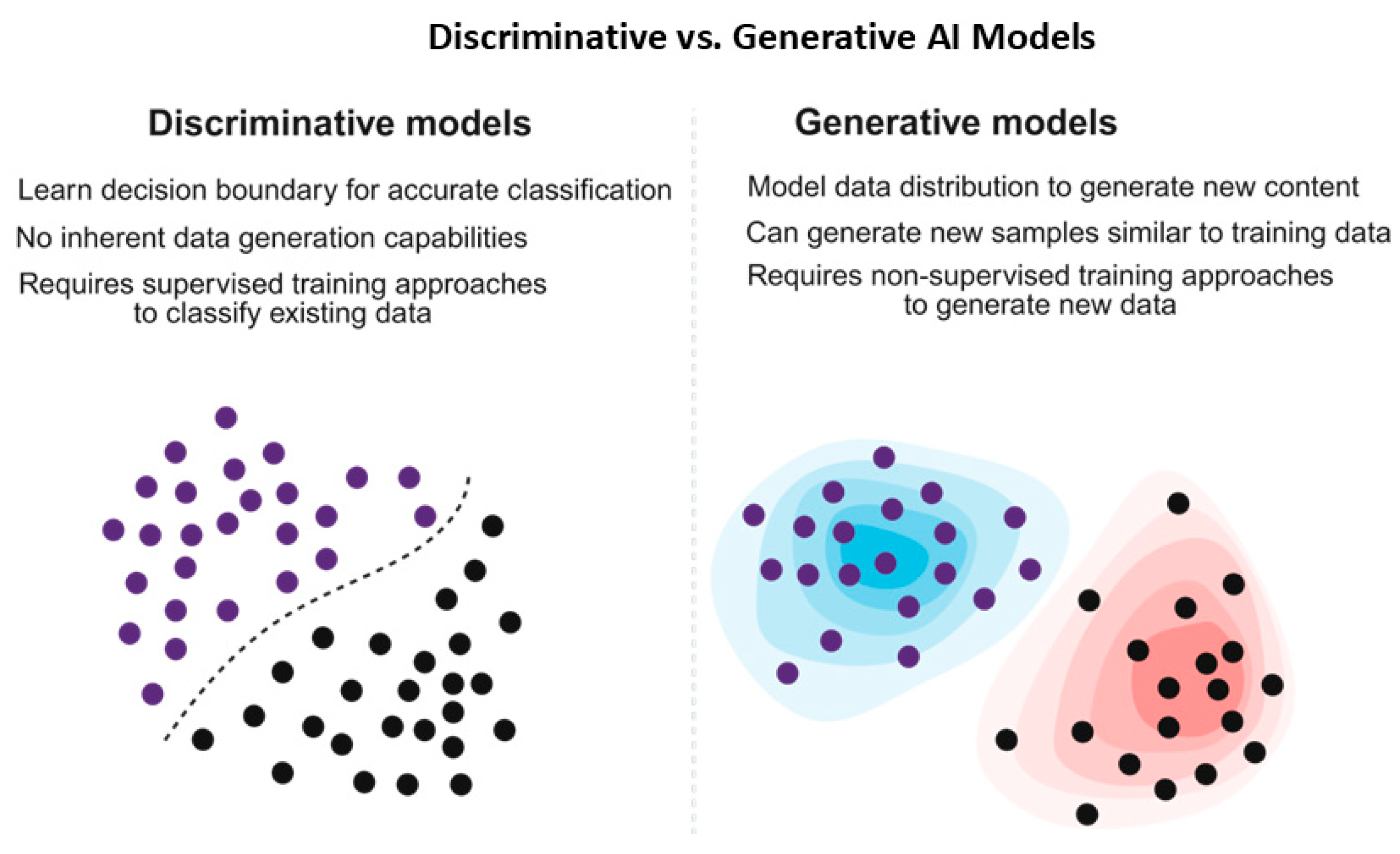
8.1. Conventional Machine Learning Using Discriminative Models
Classical Models Based on Random Forests (RFs), Support Vector Machines (SVMs), and GBM Architecture
| Models | Architectural Framework | Performance Metrics | Key Features and Predicted Properties |
|---|---|---|---|
| a. Classical ML (RF, SVM, GBMs) | |||
| AntiBP2 and AntiBP3 | SVM | AntiBP2: Accuracy (92.1%), MCC (0.84), AntiBP3: AUC (0.93–0.98), (MCC up to 0.86) | SVM-based predictors used balanced +ve and −ve training datasets using residue contact maps integrated with in silico toxicity screening. Predicted antimicrobial activity [85,112]. |
| AmpClass | Ensemble ML (XGBoost, RF, NN, DT) | Accuracy (93.2%) | Classification and regression approaches to predict novel AMPs. Predicted antimicrobial activity [108]. |
| AmpGram | N-gram encoding and stacked random forests. | AUROC (0.98) | Predicted longer peptides (>10 A.A), used for high-throughput proteomics-based AMPs. Predicted antimicrobial activity [113]. |
| AmPEP | RF classifiers | Accuracy (96%), MCC (0.90), AUC (0.99) | Provided distribution patterns of amino acid features, with higher accuracy, simplicity, and reduction capability. Predicted antimicrobial activity [114]. |
| AmPEPpy | Random Forest (RF) | Accuracy (91%) | It predicted plant peptides using amino acid composition features [115,116]. |
| CalcAMP | LightGBM, ensembleand tree algorithms | Accuracy 86–90% (best RF model 90%) | It used a curated dataset of validated short AMPs and classified them based on their spectrum. Predicted antimicrobial activity [117]. |
| CAMP-R3/R4 | ML classifiers (SVM, RF, DA, HMM) | R3: Accuracy (90.5%), R4: AUROC (0.93) | Multi-model approaches showed improvement in performance, i.e., area under the receiver operating characteristic curve. Predicted antimicrobial activity [78,79,85,118,119,120,121,122]. |
| iAMPpred (AMPredict) | SVM | Accuracy (74–88% depending on class) | It used physicochemical descriptors like hydrophobicity and charge. Predicted antimicrobial activity [123,124]. |
| iAMP-2L | Two-layered FKNN with PseAAC | Overall accuracy (87.6%) | Multi-model approach predicted five function categories. Predicted antimicrobial activity [125]. |
| MLAMP (Multi-Label AMP predictor) | Ensemble of different ML, i.e., SMOTE and PseAAC | Micro-F1 (0.78) | Multi-label peptide functional models identified AMPs and their biological roles [126]. |
| MLBP | Multi-scale ML alongside CNN, and BiGRU | Accuracy (86%) | It processed raw sequential vectors without having LLM inputs. Predicted antimicrobial activity [127,128]. |
| PEPred-Suite | Different RF models | Accuracy (89%), AUC (0.92) | Using sequence-based descriptors and adaptive learning to predict efficacy and safety profiles [129]. |
| Target-AMP | RF, SVM, KNNs | Accuracy (93.8%) | Used evolutionary data and composition features with multiple classifiers to predict AMP. Predicted antimicrobial activity [130]. |
| b. Deep learning (CNN, GNN, RNN, transformers, others) | |||
| AI4AMP | CNN, LSTM, DNNs | Accuracy (91.7%) | Used PC6 and autocovariance to predict novel AMPs. Predicted antimicrobial activity [131]. |
| AMPlify | Bi-LSTM, Multi-head attention using Word2Vec tokens | AUROC (0.984), AUPRC (0.986). F1 (0.94) | An attention-based model to validate against the WHO priority pathogens using ensemble learning to improve robustness [132,133]. |
| AMPpred-CNN | 1D CNNs | Accuracy (92%) | Peptide sequences were encoded using CTD descriptors to predict AMPs. Predicted antimicrobial activity [134]. |
| AMP Scanner AMP Scanner v2 | CNN, RNN, deep neural network | Accuracy (92%), MCC (0.85) | Predicted efficacy based on physicochemical properties. Predicted antimicrobial activity [39,135]. |
| APIN | CNN with embedded layers | Accuracy (94%) | Predicted AMPs using convolutional architectures directly from sequences. Predicted antimicrobial activity [136]. |
| deepAMPNet | Pretrained Bi-LSTM, GNNs, and structural graphs | AUROC (0.97) | Alongside structure and language-derived encodings, it predicted delivering accuracy and biological insights. Predicted antimicrobial activity [137]. |
| Deep-AmPEP30 | CNN trained on PseKRAAC for shorter peptides | Accuracy (92.6%) | Optimized and predicted shorter peptides [138,139,140]. |
| DMAMP | CNN, Residual CNN Blocks, PSSM | Accuracy (91.3%) | Multi-task predictive model used CNN–residual architecture and evolutionary features fusion for robust and accurate prediction. Predicted antimicrobial activity [141]. |
| HDM-AMP | ESM-1b, Deep Forest | Accuracy (89.5%) | It was interpreted and predicted using an ensemble of decision trees [142]. |
| iAMPCN | CNN | Accuracy (93.4%) | It used handcrafted features and classified using CNN without LLM embeddings. Predicted antimicrobial activity [143,144]. |
| iAMP-CA2L | CNN, Bi-LSTM, and SVM | Accuracy (91.2%) | It used hybrid SVM models for final classification with a dual-task focus [145,146]. |
| LMPred | ProtTrans, CNN classifiers, T5, and XLNet | Accuracy (92–93%) | Bridged protein sequence understanding and learned pattern detection. Predicted antimicrobial activity [147]. |
| MBC-attention | CNN, Attention, ML | MCC (0.81) | It focused on critical residual motifs causing membrane disruption using attention models. Predicted antimicrobial activity [148,149]. |
| sAMPpred-GAT | Graph Neural Network (GAT) and ML | AUROC (0.95) | Graph attention networks leverage sequence-to-graph conversion [150]. |
| TP-LMMSG | Deep learning GNN on proteins, LM residues | Accuracy (94%) | Protein-LM, based on each residue, provided multi-scaled structural information. Predicted antimicrobial activity [151]. |
| c. Ensemble models with hybrid frameworks | |||
| AMP-BRET | RF, ProtBERT Transformer with fine-tuning for regression | Accuracy (92.1%) | Demonstrated high precision and transfer learning from protein corpora. Predicted antimicrobial activity [152,153]. |
| AMPpred-EL | Ensemble ML (Logistic Regression and LightGBM) | Accuracy (93.8%) | It combined multiple ML components for stronger AMPs prediction. Predicted antimicrobial activity [110]. |
| AMPpredMFA | LSTM, CNN, Attention, and MLP | AUROC (0.97) | It integrated local (CNN) and long-range (LSTM) sequence features to predict features [154]. |
| AMP-META | Light GBM (LGBM) comprises different AMP tools | Accuracy (95%) | It predicted physicochemical descriptors using larger datasets. Predicted antimicrobial activity [155,156]. |
| E-CLEAP | Ensemble of four MLP classifiers | Accuracy (97.3%) (AAC features), Accuracy 84.0% (PseAAC features), F1 (0.93) | Ensemble neural classifiers performed high-accuracy AMP classification. Predicted antimicrobial activity [157]. |
| d. Transformer-based models | |||
| AMPTrans | LSTM, transformer, RF, SVM with adaptive QSAR | Accuracy (93%) | QSAR-enabled designer facilitated sequences guidance and novelty [158]. |
| AMP-ProtBERT | Fine-tuned ProtBERT | AUROC (0.98)5 (ProtBERT AMP classifier), Accuracy (94%) | iAMP-bert (ESM-2) pretrained models outperformed for AMPs prediction and antimicrobial activity [153,159,160]. |
| e. Specialized supportive models | |||
| ESKAPEE-MICpred | LSTM, CNN, and MLP | R2 = 0.82 (Species-specific MIC regression model) | It used sequence-derived descriptors to predict activity [161]. |
| EnDL-HemoLyt | LSTM, CNN, and MLP | AUROC (0.97), MCC (0.80) | It optimized the therapeutic index by predicting hemolysis [24,162]. |
| panCleave | RF, predicted protease cleavage sites | AUPRC (0.92) | panCleave to predict in vitro and in vivo efficacy and safety using the proteome of extinct species [163]. |
| StaBle-ABPpred | BiLSTM | AUROC (0.95); Accuracy (0.91), MCC (0.82), AUPRC (0.97) | It predicted peptides’ stability and activity using Word2Vec embeddings [164]. |
| SMEP/SAMP | LSTM, XGBoost | Accuracy (90%), F1 (0.89) | Used different libraries such as nonapeptide, heptapeptide, and octapeptide to predict efficacy and safety [38,165,166]. |
| f. Data-centric ML | |||
| GMSC-mapper | Modified version of Prodigal, i.e., RF | Accuracy (89%) | It identified and annotated smaller proteins using microbial (meta)genomes [167,168,169]. |
| Macrel | RF with metagenomics mining, LP models | AUROC (0.97–0.99 depending on datasets) | It predicted sequence-derived descriptors using proteome, genome, and transcriptome to show efficacy and safety [170,171]. |
| g. Emerging automated ML models | |||
| AutoPeptideML | AutoML-based peptide classifier with evolutionary features | Accuracy (90%) | It automated feature engineering from evolutionary indices to predict antimicrobial activity [172]. |
| APEX | RNN, ATT, and MLP | Accuracy (92%) | Deep learning aided by molecular de-extinction to show in vitro and in vivo properties [26]. |
| PrMFTP | Multiscale CNN, BiLSTM, multiheaded self-attention approach | Accuracy (93%), F1 (0.92) | It combined architectural models, i.e., CNN, BiLSTM, and self-attention, which were not derived from LLM [173]. |
| h. Other ML models | |||
| AMPActiPred | Multi-class ML functional | Accuracy (91%) | Three-stage framework employed peptide descriptors to capture compositional and physicochemical properties and activity [174]. |
| Ansari & Colleagues | RNN, LSTM | AUROC (0.93) | Semi-supervised method predicted peptides efficacy and safety via positive-unlabeled learning [103,175]. |
| Capecchi & Colleagues | RNN, GRU, SVM; MLP | AUC (0.95) | ML used DBAASP to predict short non-hemolytic and microbial activity of AMPs [176]. |
| Zhuang & Colleagues | QSVM | Accuracy (94%) | It predicted sequence-derived descriptors to predict safety profiles [177]. |
8.2. Deep Learning Approaches Using Discriminative Models
8.2.1. Deep Learning with Recurrent Neural Networks and Recurrent Neural Network Frameworks
8.2.2. Ensemble Models with Hybrid Frameworks
8.2.3. Transformer-Based Models
8.2.4. Specialized Supportive Deep Learning Models
8.2.5. Emerging Automated Machine Learning Models
8.2.6. Regression Models
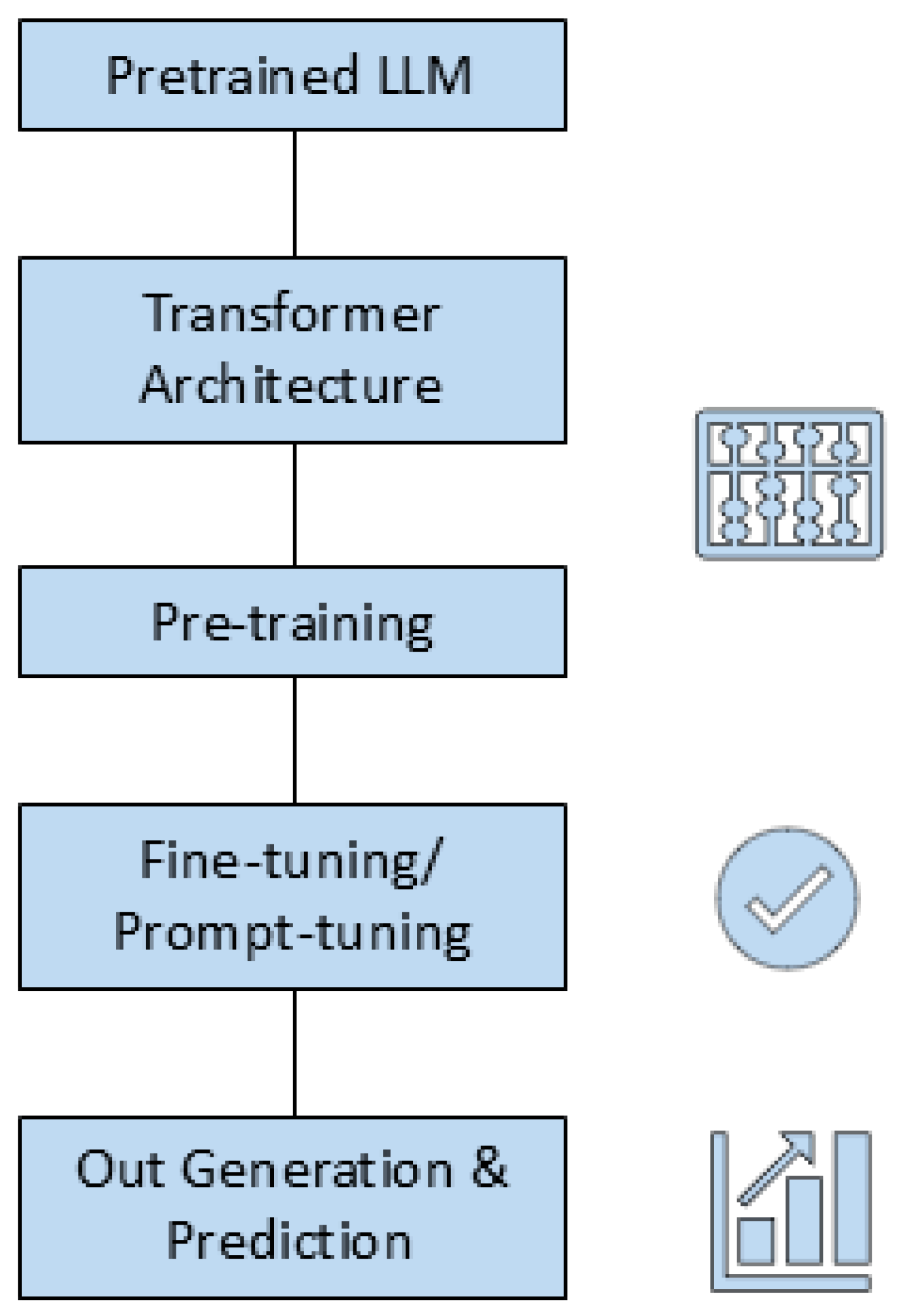
8.3. Large Language Models (LLMs)
| Models | Architectural Framework | Performance Metrics | Predicted Properties and Key Features |
|---|---|---|---|
| a. Transformer-based LLMs | |||
| PeptideBERT | BERT (ProtBert), and MLP | AUROC 0.953 (property task, not AMP vs. non-AMP) | Pretrained on UniProt with fine-tuning to predict peptides. Predicted toxicity, stability and non-fouling [186,195]. |
| PHAT | ProtTrans and MLP | Accuracy 93.2% (Q3 secondary structure) | Predicted efficacy based on physiological conditions. Predicted pH-dependent activity [196]. |
| SenseXAMP | ESM-1b, transformer-based protein model | Accuracy 91.4% (AMP vs. non-AMP, balanced dataset) | It captured evolutionary conservation using embeddings with minimal feature engineering. Predicted antimicrobial activity [197]. |
| TransImbAMP | BERT, and MLP | Balanced accuracy (96.85%), MCC (0.8) | It addressed dataset bias using sensitive learning approaches. Predicted antimicrobial activity [180,201]. |
| UniAMP | UniRep, ProtT5, and deep neural network with transformer encoders | Accuracy (96.2%), AUROC (0.987) | Integrated protein-language insights within sequences to predict based on AMPs. Predicted antimicrobial activity [58]. |
| b. Attention-enhanced architectural DL models | |||
| iAMP-Attenpred | BERT (ProtBert) and MLP | Accuracy (94%) (binary classification) | It highlighted residual embeddings and managed length sequences. Predicted antimicrobial and cytotoxicity activity [198]. |
| PepHarmony | ESM, GearNet (GNN), and MLP | High ACC/AUC/F1 across tasks; AUROC (0.972) (Peptide classification benchmark) | It integrated geometric graph features to predict 3D structures. Predicted antimicrobial, stability, and synergistic activity [204]. |
| c. DL hybrid models with engineered features | |||
| AMPFinder | ProtTrans, OntoProtein, and MLP | Accuracy (>95%) AMP Identification | It incorporated protein sequences for functional annotations. Predicted pathogen-specific antimicrobial properties [205]. |
| FSLSME | ESM-1, MLP | Accuracy 92.7% | It used different libraries, i.e., hexapeptide, heptapeptide, and octapeptide libraries, for mining AMPs. Predicted antimicrobial activity [206]. |
| d. Deep learning hybrid models with CNN architecture | |||
| AMPDeep | BERT (ProtBert) and MLP | Accuracy 91.8% (hemolytic, toxicity) | Optimized bioavailability. Predicted safety profiles [184,207]. |
| AI4AMP | Deep neural network (LSTM, CNN, Dense) | Accuracy (91.7%), AUC (>0.9). Precision (90%) | It had PC6 encoding methods to map sequences into a physicochemical vector. Predicted antimicrobial activity [131]. |
| sAMP-VGG16 | VGG-style convolutional neural network | Accuracy (94.3%) | It optimized adaptive layers by integrating LLB and using deep convolutional models for AMP classification [74,203]. |
| e. Other approaches | |||
| Ma & colleagues | BERT, ATT, LSTM, MLP | Accuracy 92.5% | It provided sequential AMP prediction. Predicted in vitro and in vivo efficacy and safety prediction [21]. |
| Orsi & colleagues and Reymond | GPT-3, MLP | Accuracy 88–90% (toxicity/activity benchmark) | It provided sequential AMP prediction alongside stability and toxicity assay [208]. |
| Zhang & colleagues | BERT, MLP | AUROC (0.965) Peptide classification across benchmark datasets | Using pLM embedding, it predicted the AMP spectrum. Predicted antimicrobial activity [209]. |
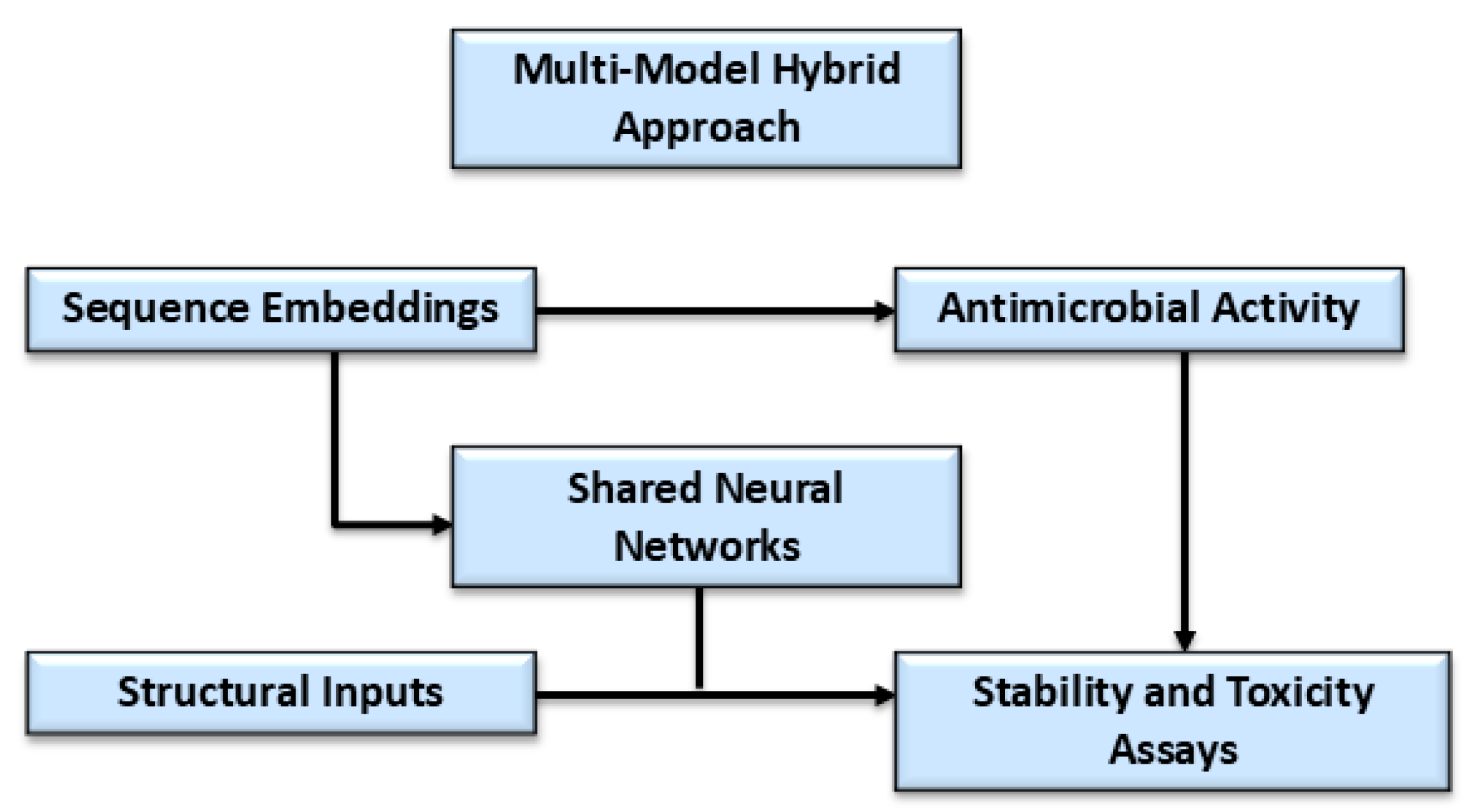
8.4. Multi-Model Hybrid Approaches for AMP Mining and Discovery
8.4.1. Hybrid Methods with Ensemble Frameworks
8.4.2. Hybrid Protein Language-Based Approaches
8.4.3. Multi-Model Hybrid Approaches Based on Fusion Features
8.4.4. Hybrid Large Language-Based Model
| Model | Architecture | Predicted Properties | Key Features |
|---|---|---|---|
| a. Multi-model hybrid methods have ensemble frameworks | |||
| AMP-EF Antimicrobial Peptide—Ensemble Framework | XGBoost, Bi-LSTM with attention | XUAMP (ACC 77.9%), CAMP (99.8%), XUAMP (AUC 0.894) | Multi-modal approaches provided strong generalization and higher performance. Predicted antimicrobial activity [228]. |
| AMPpred-DLFF | ESM-2, CNN-based feature extractors | AUC (0.97) | Multi-model approaches synergized graph attention, protein-language embedding, and convolutional features for AMP predictions. Predicted antimicrobial activity [229]. |
| AMPredictor | ESM-2, MLP, SVM | MIC regression (RMSE 0.535), PCC (0.71) | Using attention maps, it predicted key residues’ physicochemical descriptors [230,231]. |
| PepMultiFinder | ML and multi-filter approaches | No global accuracy reported | Multi-model approaches to predict AMP efficacy and safety [232,233]. |
| b. Multi-model hybrid protein language-based approaches | |||
| FusPB-ESM2 | ProBERT, ESM-2 embeddings, and Neural Network | Accuracy (0.983) (Independent test) | It fused two LLM embeddings for multi-functional representation and predicted multi-functional microbial activity [234,235]. |
| PGAT-ABPp | ProtT5 embeddings and GAT | AUROC 0.983 | Integrated geometric deep learning for 3D structural representation. Predicted efficacy and safety profile [211]. |
| c. Multi-model hybrid approaches based on fusion features and deep representation | |||
| AFP-MFL | Co-attention mechanism, MLP | ACC (96.8%), AUC (0.97) | ProtT5 and BLOSUM62 predicted physicochemical features, while co-attention and MLP explained multi-feature fusion and antimicrobial properties [214,215]. |
| Pang’s Approach | Pre-trained BERT and MLP | ACC (96.9%), F1 (0.91) (AMP vs. non-AMP) | It predicted regression-based MICs and clinically relevant safety outputs [202]. |
| UniDL4Biopep | ESM-2 embeddings and CNN | ACC (93.8%), MCC (0.875) bitter peptide datasets | Pretrained self-supervised model. CNN extracted spatial features from embeddings. Predicted antimicrobial and stability activity [216]. |
| UniproLcad | UniRep, ESM-2, ProtBERT, 1D-CNN, Bi-LSTM with attention method | AUROC 0.982 (0.982 on XUAMP) | Multi-PLM fusion model with competitive accuracy and interpretability [198]. |
| d. Large language-based model | |||
| GPT-3-AMP | GPT-3 (generative) and SVM/RF (discriminative) | Activity: AUC (0.86), ACC (0.79) Hemolysis: AUC (0.89), ACC (0.84) | Uses GPT-3 to generate candidate peptides, using SVM/RF filters for antimicrobial activity [194,208,220,221,222,223,224]. |
9. Machine Learning Approaches Using Generative Frameworks
9.1. Deep Learning Hybrid Models with GAN Architecture
9.2. Variational Autoencoders (VAEs)
9.3. Diffusion Model
9.4. Other Generative Models
| Generative Methods for AMP Discovery | |||
|---|---|---|---|
| Models | Architectural Frameworks | Control Generation | Key Features and Performance Metrics |
| a. GAN architectural frameworks | |||
| AMP-GAN | GAN (Generator and Discriminator) | Random latent vectors without explicit conditioning | Antimicrobial and cytotoxicity assays [251,252]. |
| AMPGAN v2 | BiCGAN (Bidirectional Conditional GAN) | Binary vectors for targeting microbes and mechanisms | Antimicrobial assays. Metrics: Validity (95%), Novelty (94%), Uniqueness (100%) [251]. |
| dsAMP and dsAMPGAN | CNN Attention, BiLSTM, transfer learning models | AMP’s prediction. Metrics: Accuracy (95%), F1 (0.94) [59]. | |
| FBGAN | GAN and ESM-2 | Controlled and conditioned generation | Antimicrobial, hemolytic and cytotoxicity assays. Metrics: AUROC (0.92) [104,253]. |
| WGAN-GP | WGAN-GP | AI4AMP and classifiers for in silico | Predicted novel peptides using methods like PC6, based on physicochemical properties [236]. |
| Multi-CGAN | cGAN | Conditional generation | Antimicrobial and cytotoxicity assays [254]. |
| b. VAE and latent spaces-based frameworks | |||
| CLaSS (Controlled Latent Attribute Space Sampling) | WAE | Discriminator-guiding filtering | In vivo models using Antimicrobial, hemolytic and cytotoxicity assays. Metrics: Precision (90%) for desired sampling [255]. |
| LSSAMP | Vector quantized VAE | Latent space sampling | Predict Antimicrobial, hemolytic and cytotoxicity assays. Metrics: Accuracy (91.7%) [255,256]. |
| PepVAE | VAE | Latent space sampling | Microbial activity. Metrics: Validity (>95%), Novelty (80%) [247]. |
| c. Diffusion-based framework | |||
| AMP-Diffusion | Structurally guided diffusion model | Positive learning, using discriminator-guiding filtering | Microbial and cytotoxicity assays (in vivo). Sequence validity (97%) [237,257]. |
| Diff-AMPs | Diffusion | Discriminator-guiding filtering | AMP’s prediction. Metrics: AUROC (0.94) [258]. |
| ProT-Dif | Protein language diffusion | Condition generation with discriminator-guided filtering. Positive-only learning | De novo generation of novel AMP sequences. Metrics: Validity (98.3%), Novelty (99%) [245]. |
| MMCD | Diffusion model based on discriminators | Conditional generation, contrastive learning | Predict microbial, hemolytic and cytotoxicity assays [259,260]. |
| d. Multi-objective evolutionary or genetic optimization models | |||
| AMPEMO | Genetic algorithm | Discriminator-guiding filtering | Antimicrobial activity [261,262]. |
| MODAN | GAN and RL | Bayesian optimization | Antimicrobial, hemolytic assays. Multi-objective score improvement >30% over baseline [263]. |
| MOQA Multi-CGAN QMO (Multi-Objective Quantum Annealing) | Binary VAE, Multi-generator CGAN | D-Wave quantum annealer, with conditional generation | In vivo models to predict Antimicrobial, hemolytic and cytotoxicity assays [264]. |
| M3-CAD | cVAE | Conditional generation using discriminator-guided filtering | In vivo models to predict Antimicrobial, hemolytic and cytotoxicity assays [102]. |
| QMO | WAE | Zero-order optimization with gradient descent | Optimized materials, i.e., drug-likeness and solubility [265]. |
| e. Transformers or an RNN-based hybrid framework | |||
| AMPGen | Autoregressive diffusion model, XGBoost discriminator, and STM | MSA-conditional generation | Microbial activity. Metrics: Validity (94%), Novelty (96%) [246,250]. |
| AMPTrans-LSTM | LSTM, and transformers | Learning using protein databases | Antimicrobial activity [158]. |
| HydrAMP | cVAE-GAN hybrid | Conditional generation | Antimicrobial, hemolytic assays. Metrics: AUROC (0.93) [243]. |
| f. Other generative models | |||
| Buehler & colleagues | GNN | Conditional generation | Physicochemical properties prediction [266]. |
| Cao & colleagues | GAN | Discriminator-guiding filtering | Antimicrobial activity [248]. |
| Capecchi & colleagues | RNN | Positive learning, using discriminator-guided filtering | Antimicrobial and hemolysis assays [176]. |
| Dean & colleagues | VAE | Latent space sampling | Antimicrobial activity [247]. |
| Ghorbani & colleagues | VAE | AMP prediction. Metrics: AUROC 0.90 [267]. | |
| Jain & colleagues | GFlowNets and active learning | Active learning | AMP prediction [268]. |
| Pandi & colleagues | VAE | Discriminator-guiding filtering | Antimicrobial, hemolytic and cytotoxicity assays. Metrics: Validity 96% [269]. |
| Renaud & colleagues | VAE | Latent space sampling | Physicochemical properties prediction [249]. |
| Zeng & colleagues | PLM and BERT | Discriminator-guiding filtering | Antimicrobial activity. Metrics: Accuracy 92% [270]. |
10. Evolutionary and Genetic Algorithms for AMPs Prediction
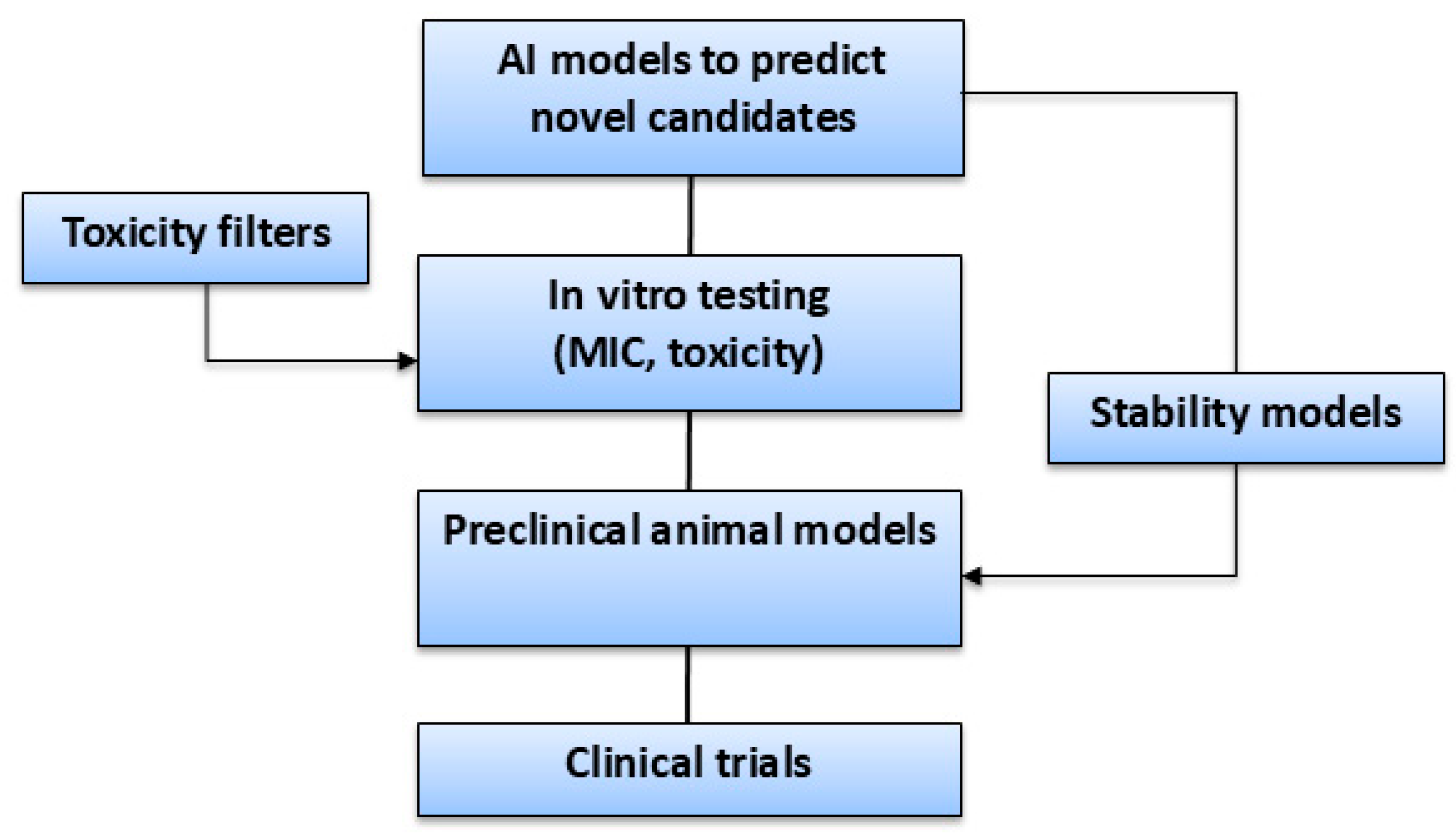
11. Perspective on Evolution of ML Approaches for AMP Discovery and Optimization
| Models | Architectural Frameworks | Experimental Evidence |
|---|---|---|
| AmPEP | RF (classical ML) | Validated on curated AMP datasets [114]. |
| AMPpred-EL | Ensemble ML | Improved AMP identification across multiple datasets [110]. |
| AMP-BERT/LMPred | Transformer | BERT embeddings improved AMP prediction accuracy [152,153]. |
| AMPlify | Attentive DL | Peptides against WHO-priority pathogens [132,133]. |
| BERT-AmPEP60 | Transformer MIC regressor | Predicted MICs were experimentally confirmed [111]. |
| Deep-AmPEP30 | DL (CNN) | Prioritized short peptides for testing [138]. |
| De-extinction/APEX | DL and evolutionary | Extinct AMPs validated in vitro/in vivo [24,26]. |
| DMAMP | Multi-task DL | Peptides with multi-functional activities [141]. |
| MBC-attention | Multi-branch CNN | MICs correlated with in vitro outcomes [148,149]. |
| Macrel-type pipelines | DL and rule-based | Predicted AMPs experimentally validated from human microbiomes [170,171]. |
| Non-hemolytic design | ML/DL optimization | Generated peptides with lower hemolysis [176,189]. |
| PGAT-ABPp/sAMP-GAT | PLM and GNN | Peptides with improved accuracy [29,150]. |
| Model | Architectural Frameworks | Experimental Evidence |
|---|---|---|
| AMPGAN v2 | GAN | GAN-generated peptides against pathogens [251]. |
| AMP-Diffusion | Diffusion and PLMs | Generated AMPs were validated [244,258]. |
| AMPGen | Evolutionary and diffusion | Peptides against Gram-negative bacteria [250]. |
| Diff-AMP/ProT-Diff | Diffusion frameworks | Peptides with micromolar MICs [245]. |
| FBGAN | Generative and feedback | Feedback loop yielded peptides with better efficacy [253]. |
| GA and ML approaches | Genetic and ML | GA-designed peptides with improved activity. |
| GPT-3-AMP/ Peptide-GPT | Foundation LLM and fine-tuning | Generated peptides showed good experimental activity. |
| Latent diffusion LMs | LLM and diffusion | Generated peptides with confirmed activity [237]. |
| LLM-AMP frameworks (EBAMP, BroadAMP-GPT) | LLM-based design | LLM-generated peptides validated against clinical strains [220,225]. |
| Multi-CGAN | Conditional GAN | Generated peptides with good efficacy and safety [254]. |
| PepVAE | VAE | VAE-generated AMPs were active in vitro [247]. |
12. Challenges and Future Directions
13. Conclusions
Author Contributions
Funding
Institutional Review Board Statement
Informed Consent Statement
Data Availability Statement
Conflicts of Interest
Abbreviations
| A. baumannii | Acinetobacter baumannii |
| ACEP | Antimicrobial Peptide Recognition |
| ADAM | A Database of Anti-Microbial Peptides |
| AI | Artificial Intelligence |
| AMPs | Antimicrobial Peptides |
| AMR | Antimicrobial Resistance |
| AMPDB V1 | Anti-Microbial Peptide Database Version 1 |
| ANNs | Artificial Neural Networks |
| APD-3 | Antimicrobial Peptide Database-3 |
| ATT | Attention Mechanism |
| AUROC | Area Under the Curve |
| B-AMP | Biofilm-AMP |
| BERT | Bidirectional Encoder Representations from Transformers |
| Bi-LSTM | Bi-directional Long Short-Term Memory |
| CAMP | Collection of Anti-Microbial Peptides |
| CNN | Convolutional Neural Network |
| DA | Discriminant Analysis |
| dbAMP | Database of Antimicrobial Peptides |
| DBAASP | Database of Antimicrobial/Cytotoxic Activity and Structure of Peptides |
| DF | Deep Forest |
| DL | Deep Learning |
| DPL | Database of Peptide Ligands |
| DRAMP | Data Repository of Antimicrobial Peptides |
| E. coli | Escherichia coli |
| ECE | Expected Calibration Error |
| ESM | Evolutionary Scale Modeling |
| FBGAN | Featurized Bidirectional Generative Adversarial Networks |
| GANs | Generative Adversarial Networks |
| GCN | Graph Convolutional Networks |
| GNN | Graph Neural Network |
| GRU | Gated Recurrent Unit |
| GRAMPA | Giant Repository of AMP Activities |
| GPT-3 | Generative Pre-trained Transformer-3 |
| IAMPE | Integrated Antimicrobial Peptide Estimator |
| InverPep | Invertebrate Peptides Database |
| KL | Kullback–Leibler |
| kNNs | k-Nearest Neighbours |
| K. pneumoniae | Klebsiella pneumoniae |
| LAMP2 | Linking Antimicrobial Peptides-2 |
| LGBM | Light Gradient-Boosting Machine |
| LLMs | Large Language Models |
| LSTM | Long Short-Term Memory |
| MCC | Matthews Correlation Coefficient |
| MIC | Minimum Inhibitory Concentration |
| MLP | Multi-Layer Perception |
| ML | Machine Learning |
| modlAMP | Molecular Design Laboratory’s Antimicrobial Peptides |
| MRSA | Methicillin-Resistant Staph. aureus |
| MSA | Multiple Sequence Alignments |
| NLP | Natural Language Processing |
| NSGA-II | Non-Dominated Sorting Genetic Algorithm-II |
| P. aeruginosa | Pseudomonas aeruginosa |
| PGAT-ABPp | Position-aware Graph Attention for Antibacterial Peptides |
| PSEAAC | Pseudo Amino Acid Composition |
| QSVM | Quantum Support Vector Machine |
| RF | Random Forest |
| RMSE | Root Mean Square Error |
| RNN | Recurrent Neural Network |
| S. aureus | Staph. aureus |
| SAR | Structure–Activity Relationships |
| SVM | Support Vector Machine |
| StAPD | Stability-Aware Peptide Database |
| VAEs | Variational Autoencoders |
| YADAMP | Yet Another Database of Antimicrobial Peptides |
References
- Okeke, I.N.; de Kraker, M.E.A.; Van Boeckel, T.P.; Kumar, C.K.; Schmitt, H.; Gales, A.C. The scope of the antimicrobial resistance challenge. Lancet 2024, 403, 2426–2438. [Google Scholar] [CrossRef]
- Ho, C.S.; Wong, C.T.H.; Aung, T.T.; Lakshminarayanan, R.; Mehta, J.S.; Rauz, S. Antimicrobial resistance: A concise update. Lancet Microbe 2025, 6, 100947. [Google Scholar] [CrossRef] [PubMed]
- Oliveira Júnior, N.G.; Souza, C.M.; Buccini, D.F.; Cardoso, M.H.; Franco, O.L. Antimicrobial peptides: Structure, functions and translational applications. Nat. Rev. Microbiol. 2025, 23, 687–700. [Google Scholar] [CrossRef]
- Marciano, C.L.; Félix de Lima, J.V.; Couto Rosa, M.S.; do Nascimento, R.A.; Ferraz, A.d.O.; Silva, I.C. A Comprehensive Overview of Antimicrobial Peptides: Broad-Spectrum Activity, Computational Approaches, and Applications. Antibiotics 2025, 14, 1115. [Google Scholar] [CrossRef]
- Wong, F.; de la Fuente-Nunez, C.; Collins, J.J. Leveraging artificial intelligence in the fight against infectious diseases. Science 2023, 381, 164–170. [Google Scholar] [CrossRef] [PubMed]
- Aguilera-Puga, M.d.C.; Cancelarich, N.L.; Marani, M.M.; de la Fuente-Nunez, C.; Plisson, F. Accelerating the discovery and design of antimicrobial peptides with artificial intelligence. In Computational Drug Discovery and Design; Springer: Berlin/Heidelberg, Germany, 2023; pp. 329–352. [Google Scholar]
- Wang, B.; Lin, P.; Zhong, Y.; Tan, X.; Shen, Y.; Huang, Y.; Jin, K.; Zhang, Y.; Zhan, Y.; Shen, D.; et al. Explainable deep learning and virtual evolution identifies antimicrobial peptides with activity against multidrug-resistant human pathogens. Nat. Microbiol. 2025, 10, 332–347. [Google Scholar] [CrossRef]
- Torres, M.D.T.; Wan, F.; de la Fuente-Nunez, C. Deep learning reveals antibiotics in the archaeal proteome. Nat. Microbiol. 2025, 10, 2153–2167. [Google Scholar] [CrossRef]
- Wan, F.; Wong, F.; Collins, J.J.; de la Fuente-Nunez, C. Machine learning for antimicrobial peptide identification and design. Nat. Rev. Bioeng. 2024, 2, 392–407. [Google Scholar] [CrossRef]
- Zhu, K.; Trizio, E.; Zhang, J.; Hu, R.; Jiang, L.; Hou, T.; Bonati, L. Enhanced Sampling in the Age of Machine Learning: Algorithms and Applications. Chem. Rev. 2025; in press. [Google Scholar] [CrossRef] [PubMed]
- Corli, S.; Moro, L.; Dragoni, D.; Dispenza, M.; Prati, E. Quantum machine learning algorithms for anomaly detection: A review. Future Gener. Comput. Syst. 2025, 166, 107632. [Google Scholar] [CrossRef]
- Miao, H.; Wang, Z.; Chen, S.; Wang, J.; Ma, H.; Liu, Y.; Yang, H.; Guo, Z.; Wang, J.; Cui, P. Application of machine learning in the discovery of antimicrobial peptides: Exploring their potential for ulcerative colitis therapy. arXiv 2025, arXiv:660148. [Google Scholar]
- Li, K.; Wu, Y.; Li, Y.; Guo, Y.; Kong, Y.; Wang, Y.; Liang, Y.; Fan, Y.; Huang, L.; Zhang, R.; et al. AMPCliff: Quantitative definition and benchmarking of activity cliffs in antimicrobial peptides. J. Adv. Res. 2025; in press. [Google Scholar] [CrossRef]
- Aguilera-Mendoza, L.; Marrero-Ponce, Y.; Beltran, J.A.; Tellez Ibarra, R.; Guillen-Ramirez, H.A.; Brizuela, C.A. Graph-based data integration from bioactive peptide databases of pharmaceutical interest. Bioinformatics 2019, 35, 4739–4747. [Google Scholar] [CrossRef]
- Tan, X.; Liu, Q.; Fang, Y.; Yang, S.; Chen, F.; Wang, J.; Ouyang, D.; Dong, J.; Zeng, W. Introducing enzymatic cleavage features and transfer learning realizes accurate peptide half-life prediction across species and organs. Brief. Bioinform. 2024, 25, bbae350. [Google Scholar] [CrossRef]
- Venkataraman, M.; Rao, G.C.; Madavareddi, J.K.; Maddi, S.R. Leveraging machine learning models in evaluating ADMET properties for drug discovery and development. ADMET DMPK 2025, 13, 2772. [Google Scholar] [CrossRef]
- Santos-Júnior, C.D.; Torres, M.D.; Duan, Y.; Del Río, Á.R.; Schmidt, T.S.; Chong, H. Discovery of antimicrobial peptides in the global microbiome with machine learning. Cell 2024, 187, 3761–3778. [Google Scholar] [CrossRef]
- Melo, M.C.; Maasch, J.R.; de la Fuente-Nunez, C. Accelerating antibiotic discovery through artificial intelligence. Commun. Biol. 2021, 4, 1050. [Google Scholar] [CrossRef] [PubMed]
- Lv, J.; Liu, G.; Ju, Y.; Huang, H.; Sun, Y. AADB: A manually collected database for combinations of antibiotics with adjuvants. IEEE ACM Trans. Comput. Biol. Bioinform. 2023, 20, 2827–2836. [Google Scholar] [CrossRef]
- Torres, M.D.; Melo, M.C.; Flowers, L.; Crescenzi, O.; Notomista, E.; de la Fuente-Nunez, C. Mining for encrypted peptide antibiotics in the human proteome. Nat. Biomed. Eng. 2022, 6, 67–75. [Google Scholar] [CrossRef] [PubMed]
- Ma, Y.; Guo, Z.; Xia, B.; Zhang, Y.; Liu, X.; Yu, Y. Identification of antimicrobial peptides from the human gut microbiome using deep learning. Nat. Biotechnol. 2022, 40, 921–931. [Google Scholar] [CrossRef]
- Huan, Y.; Kong, Q.; Mou, H.; Yi, H. Antimicrobial peptides: Classification, design, application, and research progress in multiple fields. Front. Microbiol. 2020, 11, 582779. [Google Scholar] [CrossRef]
- Yan, J.; Cai, J.; Zhang, B.; Wang, Y.; Wong, D.F.; Siu, S.W. Recent progress in the discovery and design of antimicrobial peptides using traditional machine learning and deep learning. Antibiotics 2022, 11, 1451. [Google Scholar] [CrossRef]
- Maasch, J.R.; Torres, M.D.; Melo, M.C.; de la Fuente-Nunez, C. Molecular de-extinction of ancient antimicrobial peptides. Cell Host Microbe 2023, 31, 1260. [Google Scholar] [CrossRef]
- Martínez-Mauricio, K.L.; García-Jacas, C.R.; Cordoves-Delgado, G. Examining evolutionary scale modelling-derived embeddings in antimicrobial peptide classification. Protein Sci. 2024, 33, e4928. [Google Scholar] [CrossRef] [PubMed]
- Wan, F.; Torres, M.D.; Peng, J.; de la Fuente-Nunez, C. Deep-learning-enabled antibiotic discovery through molecular de-extinction. Nat. Biomed. Eng. 2024, 8, 854–871. [Google Scholar] [CrossRef]
- Torres, M.D.; Brooks, E.F.; Cesaro, A.; Sberro, H.; Gill, M.O.; Nicolaou, C.; Bhatt, A.S.; de la Fuente-Nunez, C. Mining human microbiomes reveals an untapped source of peptide antibiotics. Cell 2024, 187, 5453–5467.e5415. [Google Scholar] [CrossRef]
- Wan, F.; Torres, M.D.; Guan, C.; de la Fuente-Nunez, C. Tutorial: Guidelines for the use of machine learning methods to mine genomes and proteomes for antibiotic discovery. Nat. Protoc. 2025, 20, 2685–2697. [Google Scholar] [CrossRef]
- Yan, J.; Zhang, B.; Zhou, M.; Campbell-Valois, F.X.; Siu, S.W. A deep learning method for predicting the minimum inhibitory concentration of antimicrobial peptides against Escherichia coli using Multi-Branch-CNN and Attention. mSystems 2023, 8, e00345-23. [Google Scholar]
- Yao, L.; Guan, J.; Xie, P.; Chung, C.R.; Deng, J.; Huang, Y. AMPActiPred: A three-stage framework for predicting antibacterial peptides and activity levels. Protein Sci. 2024, 33, e5006. [Google Scholar] [CrossRef]
- Aguilera-Puga, M.D.; Plisson, F. Structure-aware machine learning strategies for antimicrobial peptide discovery. Sci. Rep. 2024, 14, 11995. [Google Scholar] [CrossRef]
- Wani, M.A.; Garg, P.; Roy, K.K. Predictive modelling to identify antimicrobial peptides. Med. Biol. Eng. Comput. 2021, 59, 2397–2408. [Google Scholar] [CrossRef]
- Alexander, J.; Liu, G.; Stokes, J.M. Explainable artificial intelligence evolves antimicrobial peptides. Nat. Microbiol. 2025, 10, 267–269. [Google Scholar] [CrossRef]
- Dong, R.; Cao, Q.; Song, C. Painting peptides with antimicrobial potency through deep reinforcement learning. Adv. Sci. 2025, 12, e06332. [Google Scholar] [CrossRef]
- Kleandrova, V.V.; Cordeiro, M.N.D.; Speck-Planche, A.J. Perturbation-Theory Machine Learning for Multi-Objective Antibacterial Discovery: Current Status and Future Perspectives. Appl. Sci. 2025, 15, 1166. [Google Scholar] [CrossRef]
- Yu, Y.; Zhang, Z.; Gu, M.; Yan, W.; Han, J.; Li, R.; Wei, L.; Ren, X.; Tian, J.; Xu, S.J. Rapid Response Antimicrobial Peptide Design Strategy Driven by Meta-Learning for Emerging Drug-Resistant Pathogens. J. Med. Chem. 2025, 68, 8530–8542. [Google Scholar] [CrossRef] [PubMed]
- Sun, Z.; Xu, J.; Zhang, Y.; Zhang, Y.; Wang, Z.; Wang, X. Multimodal geometric learning for antimicrobial peptide identification. Brief. Bioinform. 2025, 26, bbaf261. [Google Scholar] [CrossRef]
- Huang, J.; Xu, Y.; Xue, Y.; Huang, Y.; Li, X.; Chen, X. Identification of potent antimicrobial peptides via a machine-learning pipeline. Nat. Biomed. Eng. 2023, 7, 797–810. [Google Scholar] [CrossRef]
- Musin, K.; Asyanova, E. How Machine Learning Helps in Combating Antimicrobial Resistance: A Review of AMP Analysis and Generation Methods. Int. J. Pept. Res. Ther. 2025, 31, 1–14. [Google Scholar] [CrossRef]
- Szymczak, P.; Zarzecki, W.; Wang, J.; Duan, Y.; Wang, J.; Coelho, L.P. AI-Driven Antimicrobial Peptide Discovery: Mining and Generation. Acc. Chem. Res. 2025, 58, 1831–1846. [Google Scholar] [CrossRef]
- Lin, C.; Xiong, S.; Cui, F.; Zhang, Z.; Shi, H.; Wei, L. Deep Learning in Antimicrobial Peptide Prediction. J. Chem. Inf. Model. 2025, 65, 7373–7392. [Google Scholar] [CrossRef]
- Lai, C.-W.; Lin, C.-Y.; Tsai, M.-C.; Chen, W.-J.; Hsieh, C.-C.; Lin, Z.-J.; Shen, L.-J.; Chen, Y.-L.; Lai, L.-J.; Chen, S.-H.J. From ai to action: Antimicrobial peptides engineered by generative adversarial networks (gans)-a novel approach to combat resistant bacteria. Chem. Eng. J. 2025, 519, 164905. [Google Scholar] [CrossRef]
- Ying, F.; Go, W.; Li, Z.; Ouyang, C.; Phaphuangwittayakul, A.; Dhuny, R. Computational Design of Multifunctional Antimicrobial Peptide Candidates via Hybrid Generative Model. Int. J. Mol. Sci. 2025, 26, 7387. [Google Scholar] [CrossRef] [PubMed]
- Ingraham, J.B.; Baranov, M.; Costello, Z.; Barber, K.W.; Wang, W.; Ismail, A. Illuminating protein space with a programmable generative model. Nature 2023, 623, 1070–1078. [Google Scholar] [CrossRef]
- Rettie, S.A.; Juergens, D.; Adebomi, V.; Bueso, Y.F.; Zhao, Q.; Leveille, A.N. Accurate de novo design of high-affinity protein-binding macrocycles using deep learning. Nat. Chem. Biol. 2025, 21, 1948–1956. [Google Scholar] [CrossRef]
- Dong, R.; Liu, R.; Liu, Z.; Liu, Y.; Zhao, G.; Li, H.; Hou, S.; Ma, X.; Kang, H.; Liu, J.; et al. Exploring the repository of de novo designed bifunctional antimicrobial peptides through deep learning. eLife 2025, 13, RP97330. [Google Scholar] [CrossRef] [PubMed]
- Hayes, T.; Rao, R.; Akin, H.; Sofroniew, N.J.; Oktay, D.; Lin, Z.; Verkuil, R.; Tran, V.Q.; Deaton, J.; Wiggert, M. Simulating 500 million years of evolution with a language model. Science 2025, 387, 850–858. [Google Scholar] [CrossRef]
- Beltran, J.A.; Aguilera-Mendoza, L.; Brizuela, C.A. Optimal selection of molecular descriptors for antimicrobial peptides classification: An evolutionary feature weighting approach. BMC Genom. 2018, 19, 672. [Google Scholar] [CrossRef]
- Pirtskhalava, M.; Amstrong, A.A.; Grigolava, M.; Chubinidze, M.; Alimbarashvili, E.; Vishnepolsky, B.; Gabrielian, A.; Rosenthal, A.; Hurt, D.E.; Tartakovsky, M. DBAASP v3: Database of antimicrobial/cytotoxic activity and structure of peptides as a resource for development of new therapeutics. Nucleic Acids Res. 2021, 49, D288–D297. [Google Scholar] [CrossRef]
- Ma, T.; Liu, Y.; Yu, B.; Sun, X.; Yao, H.; Hao, C.; Li, J.; Nawaz, M.; Jiang, X.; Lao, X. DRAMP 4.0: An open-access data repository dedicated to the clinical translation of antimicrobial peptides. Nucleic Acids Res. 2025, 53, D403–D410. [Google Scholar] [CrossRef]
- Yao, L.; Guan, J.; Xie, P.; Chung, C.-R.; Zhao, Z.; Dong, D.; Guo, Y.; Zhang, W.; Deng, J.; Pang, Y. dbAMP 3.0: Updated resource of antimicrobial activity and structural annotation of peptides in the post-pandemic era. Nucleic Acids Res. 2025, 53, D364–D376. [Google Scholar] [CrossRef]
- Chaves Carvalho, F.; Mariano, D.; Bastos, L.; de Abreu, A.P.; Lemos, R.P.; Araújo, S.C.; dos Santos, L.M.; de Melo-Minardi, R.C. A hybrid evolutionary and structural method for AI-guided peptide inhibitor design using AlphaFold and Rosetta. Sci. Rep. 2025; online ahead of print. [Google Scholar] [CrossRef]
- Aronica, P.G.; Reid, L.M.; Desai, N.; Li, J.; Fox, S.J.; Yadahalli, S.; Essex, J.W.; Verma, C.S. Computational methods and tools in antimicrobial peptide research. J. Chem. Inf. Model. 2021, 61, 3172–3196. [Google Scholar] [CrossRef] [PubMed]
- Dziuba, B.; Dziuba, M. New milk protein-derived peptides with potential antimicrobial activity: An approach based on bioinformatic studies. Int. J. Mol. Sci. 2014, 15, 14531–14545. [Google Scholar] [CrossRef]
- Thomas, S.; Karnik, S.; Barai, R.S.; Jayaraman, V.K.; Idicula-Thomas, S. CAMP: A useful resource for research on antimicrobial peptides. Nucleic Acids Res. 2010, 38, D774–D780. [Google Scholar] [CrossRef]
- Fan, L.; Sun, J.; Zhou, M.; Zhou, J.; Lao, X.; Zheng, H.; Xu, H. DRAMP: A comprehensive data repository of antimicrobial peptides. Sci. Rep. 2016, 6, 24482. [Google Scholar] [CrossRef] [PubMed]
- Goles, M.; Daza, A.; Cabas-Mora, G.; Sarmiento-Varón, L.; Sepúlveda-Yañez, J.; Anvari-Kazemabad, H.; Davari, M.D.; Uribe-Paredes, R.; Olivera-Nappa, Á.; Navarrete, M.A. Peptide-based drug discovery through artificial intelligence: Towards an autonomous design of therapeutic peptides. Brief. Bioinform. 2024, 25, bbae275. [Google Scholar] [CrossRef] [PubMed]
- Chen, Z.; Ji, C.; Xu, W.; Gao, J.; Huang, J.; Xu, H.; Qian, G.; Huang, J. UniAMP: Enhancing AMP prediction using deep neural networks with inferred information of peptides. BMC Bioinform. 2025, 26, 10. [Google Scholar] [CrossRef]
- Zhao, M.; Zhang, Y.; Wang, M.; Ma, L.Z. dsAMP and dsAMPGAN: Deep Learning Networks for Antimicrobial Peptides Recognition and Generation. Antibiotics 2024, 13, 948. [Google Scholar] [CrossRef]
- Li, W.; Godzik, A. Cd-hit: A fast program for clustering and comparing large sets of protein or nucleotide sequences. Bioinformatics 2006, 22, 1658–1659. [Google Scholar] [CrossRef]
- Ju, Z.; Zhang, H.; Zhang, J.; Xi, W.; Huang, D.; Feng, S.; Meng, J.; Wei, Y. Analytics. A Comparative Study of Sequence Clustering Algorithms. Big Data Min. Anal. 2025, 8, 1011–1022. [Google Scholar] [CrossRef]
- Steinegger, M.; Söding, J. MMseqs2 enables sensitive protein sequence searching for the analysis of massive data sets. Nat. Biotechnol. 2017, 35, 1026–1028. [Google Scholar] [CrossRef]
- Wright, E. Accurately clustering biological sequences in linear time by relatedness sorting. Nat. Commun. 2024, 15, 3047. [Google Scholar] [CrossRef]
- Jani, M.R. Cluster Analysis for Protein Sequences. arXiv 2025, arXiv:2014.643225. [Google Scholar]
- Guan, C.; Fernandes, F.C.; Franco, O.L.; de la Fuente-Nunez, C. Leveraging large language models for peptide antibiotic design. Cell Rep. Phys. Sci. 2025, 6, 102359. [Google Scholar] [CrossRef]
- Sidorczuk, K.; Gagat, P.; Pietluch, F.; Kała, J.; Rafacz, D.; Bąkała, L.; Słowik, J.; Kolenda, R.; Rödiger, S.; Fingerhut, L.C.; et al. Benchmarks in antimicrobial peptide prediction are biased due to the selection of negative data. Brief. Bioinform. 2022, 23, bbac343. [Google Scholar] [CrossRef] [PubMed]
- Lee, H.-T.; Lee, C.-C.; Yang, J.-R.; Lai, J.Z.; Chang, K.Y. A large-scale structural classification of antimicrobial peptides. BioMed Res. Int. 2015, 2015, 475062. [Google Scholar] [CrossRef] [PubMed]
- Quintans, I.; de Araújo, J.V.A.; Rocha, L.N.M.; de Andrade, A.E.B.; do Rêgo, T.G.; Deyholos, M.K. An Overview of Databases and Bioinformatics Tools for Plant Antimicrobial Peptides. Curr. Protein Pept. Sci. 2022, 23, 6–19. [Google Scholar] [CrossRef] [PubMed]
- Jha, M.; Nautiyal, A.; Pant, K.; Kumar, N. Current status of antimicrobial peptides databases and computational tools for optimization. Environ. Conserv. J. 2025, 26, 281–292. [Google Scholar] [CrossRef]
- Mondal, R.K.; Sen, D.; Arya, A.; Samanta, S.K. Developing anti-microbial peptide database version 1 to provide comprehensive and exhaustive resource of manually curated AMPs. Sci. Rep. 2023, 13, 17843. [Google Scholar] [CrossRef]
- Santos-Júnior, C.D.; Torres, M.D.T.; Duan, Y.; Del Río, Á.R.; Schmidt, T.S.; Chong, H.; Fullam, A.; Kuhn, M.; Zhu, C.; Houseman, A. Computational exploration of the global microbiome for antibiotic discovery. BioRxiv 2023. [Google Scholar] [CrossRef]
- Du, R.; Han, F.; Li, Z.; Yu, J.; Xu, Y.; Huang, Y.; Wu, Q. Uncovering encrypted antimicrobial peptides in health-associated Lactobacillaceae by large-scale genomics and machine learning. Microbiome 2025, 13, 151. [Google Scholar] [CrossRef]
- Raman, A.S. Combatting superbugs using the evolutionary record of microbial warfare. Cell Host Microbe 2024, 32, 1037–1039. [Google Scholar] [CrossRef]
- Pandey, A.; Lenin, R.R.; Patiyal, S.; Agrawal, P. High Throughput Meta-analysis of Antimicrobial Peptides for Characterizing Class Specific Therapeutic Candidates: An In Silico Approach. Probiotics Antimicrob. Proteins 2025, 17, 2550–2570. [Google Scholar] [CrossRef]
- Wang, G.; Li, X.; Wang, Z. APD3: The antimicrobial peptide database as a tool for research and education. Nucleic Acids Res. 2016, 44, D1087–D1093. [Google Scholar] [CrossRef] [PubMed]
- Hammami, R.; Zouhir, A.; Le Lay, C.; Ben Hamida, J.; Fliss, I. BACTIBASE second release: A database and tool platform for bacteriocin characterization. BMC Microbiol. 2010, 10, 22. [Google Scholar] [CrossRef]
- Mhade, S.; Panse, S.; Tendulkar, G.; Awate, R.; Narasimhan, Y.; Kadam, S.; Yennamalli, R.M.; Kaushik, K.S. AMPing up the search: A structural and functional repository of antimicrobial peptides for biofilm studies, and a case study of its application to corynebacterium striatum, an emerging pathogen. Front. Cell. Infect. Microbiol. 2021, 11, 803774. [Google Scholar] [CrossRef] [PubMed]
- Waghu, F.H.; Gopi, L.; Barai, R.S.; Ramteke, P.; Nizami, B.; Idicula-Thomas, S. CAMP: Collection of sequences and structures of antimicrobial peptides. Nucleic Acids Res. 2014, 42, D1154–D1158. [Google Scholar] [CrossRef]
- Gawde, U.; Chakraborty, S.; Waghu, F.H.; Barai, R.S.; Khanderkar, A.; Indraguru, R.; Shirsat, T.; Idicula-Thomas, S. CAMPR4: A database of natural and synthetic antimicrobial peptides. Nucleic Acids Res. 2023, 51, D377–D383. [Google Scholar] [CrossRef] [PubMed]
- Shi, G.; Kang, X.; Dong, F.; Liu, Y.; Zhu, N.; Hu, Y.; Xu, H.; Lao, X.; Zheng, H. DRAMP 3.0: An enhanced comprehensive data repository of antimicrobial peptides. Nucleic Acids Res. 2022, 50, D488–D496. [Google Scholar] [CrossRef]
- Jhong, J.-H.; Yao, L.; Pang, Y.; Li, Z.; Chung, C.-R.; Wang, R.; Li, S.; Li, W.; Luo, M.; Ma, R. dbAMP 2.0: Updated resource for antimicrobial peptides with an enhanced scanning method for genomic and proteomic data. Nucleic Acids Res. 2022, 50, D460–D470. [Google Scholar] [CrossRef]
- Gómez, E.A.; Giraldo, P.; Orduz, S. InverPep: A database of invertebrate antimicrobial peptides. J. Glob. Antimicrob. Resist. 2017, 8, 13–17. [Google Scholar] [CrossRef]
- Ye, G.; Wu, H.; Huang, J.; Wang, W.; Ge, K.; Li, G.; Zhong, J.; Huang, Q.J.D. LAMP2: A major update of the database linking antimicrobial peptides. Database 2020, 2020, baaa061. [Google Scholar] [CrossRef]
- Théolier, J.; Fliss, I.; Jean, J.; Hammami, R. MilkAMP: A comprehensive database of antimicrobial peptides of dairy origin. Dairy Sci. Technol. 2014, 94, 181–193. [Google Scholar] [CrossRef]
- Gabere, M.N.; Noble, W.S. Empirical comparison of web-based antimicrobial peptide prediction tools. Bioinformatics 2017, 33, 1921–1929. [Google Scholar] [CrossRef]
- Müller, A.T.; Gabernet, G.; Hiss, J.A.; Schneider, G. modlAMP: Python for antimicrobial peptides. Bioinformatics 2017, 33, 2753–2755. [Google Scholar] [CrossRef] [PubMed]
- Nedyalkova, M.; Paluch, A.S.; Vecini, D.P.; Lattuada, M. Progress and future of the computational design of antimicrobial peptides (AMPs): Bio-inspired functional molecules. Digit. Discov. 2024, 3, 9–22. [Google Scholar] [CrossRef]
- Cabas-Mora, G.; Daza, A.; Soto-García, N.; Garrido, V.; Alvarez, D.; Navarrete, M.; Sarmiento-Varón, L.; Sepúlveda Yañez, J.H.; Davari, M.D.; Cadet, F. Peptipedia v2. 0: A peptide sequence database and user-friendly web platform. A major update. Database 2024, 2024, baae113. [Google Scholar] [CrossRef] [PubMed]
- Shtatland, T.; Guettler, D.; Kossodo, M.; Pivovarov, M.; Weissleder, R. PepBank-a database of peptides based on sequence text mining and public peptide data sources. BMC Bioinform. 2007, 8, 280. [Google Scholar] [CrossRef]
- Hammami, R.; Ben Hamida, J.; Vergoten, G.; Fliss, I. PhytAMP: A database dedicated to antimicrobial plant peptides. Nucleic Acids Res. 2009, 37, D963–D968. [Google Scholar] [CrossRef]
- Das, D.; Jaiswal, M.; Khan, F.N.; Ahamad, S.; Kumar, S. PlantPepDB: A manually curated plant peptide database. Sci. Rep. 2020, 10, 2194. [Google Scholar] [CrossRef]
- Piotto, S.P.; Sessa, L.; Concilio, S.; Iannelli, P. YADAMP: Yet another database of antimicrobial peptides. Int. J. Antimicrob. Agents 2012, 39, 346–351. [Google Scholar] [CrossRef] [PubMed]
- Singh, S.; Chaudhary, K.; Dhanda, S.K.; Bhalla, S.; Usmani, S.S.; Gautam, A.; Tuknait, A.; Agrawal, P.; Mathur, D.; Raghava, G.P. SATPdb: A database of structurally annotated therapeutic peptides. Nucleic Acids Res. 2016, 44, D1119–D1126. [Google Scholar] [CrossRef]
- Wang, F.; Li, N.; Wang, C.; Xing, G.; Cao, S.; Xu, Q.; Zhang, Y.; Hu, M.; Zhang, G. DPL: A comprehensive database on sequences, structures, sources and functions of peptide ligands. Database 2020, 2020, baaa089. [Google Scholar] [PubMed]
- Iwaniak, A.; Minkiewicz, P.; Darewicz, M. BIOPEP-UWM database—Present and future. Curr. Opin. Food Sci. 2024, 55, 101108. [Google Scholar] [CrossRef]
- Minkiewicz, P.; Iwaniak, A.; Darewicz, M. BIOPEP-UWM database of bioactive peptides: Current opportunities. Int. J. Mol. Sci. 2019, 20, 5978. [Google Scholar] [CrossRef]
- Meng, H. AI-driven discovery and design of antimicrobial peptides: Progress, challenges, and opportunities. Probiotics Antimicrob. Proteins 2025. [Google Scholar] [CrossRef]
- Waghu, F.H.; Idicula-Thomas, S. Collection of antimicrobial peptides database and its derivatives: Applications and beyond. Protein Sci. 2020, 29, 36–42. [Google Scholar] [CrossRef] [PubMed]
- Kavousi, K.; Bagheri, M.; Behrouzi, S.; Vafadar, S.; Atanaki, F.F.; Lotfabadi, B.T.; Ariaeenejad, S.; Shockravi, A.; Moosavi-Movahedi, A.A.J. Modeling. IAMPE: NMR-assisted computational prediction of antimicrobial peptides. J. Chem. Inf. Model. 2020, 60, 4691–4701. [Google Scholar] [CrossRef]
- Pandey, P.; Srivastava, A. sAMP-VGG16: Force-field assisted image-based deep neural network prediction model for short antimicrobial peptides. Proteins Struct. Funct. Bioinform. 2025, 93, 372–383. [Google Scholar] [CrossRef]
- Gao, W.; Zhao, J.; Gui, J.; Wang, Z.; Chen, J.; Yue, Z. Modeling. Comprehensive Assessment of BERT-Based Methods for Predicting Antimicrobial Peptides. J. Chem. Inf. Model. 2024, 64, 7772–7785. [Google Scholar] [CrossRef]
- Wang, Y.; Gong, H.; Li, X.; Li, L.; Zhao, Y.; Bao, P.; Kong, Q.; Wan, B.; Zhang, Y.; Zhang, J.; et al. De novo multi-mechanism antimicrobial peptide design via multimodal deep learning. bioRxiv 2024. [Google Scholar] [CrossRef]
- Ansari, M.; White, A.D. Learning peptide properties with positive examples only. Digit. Discov. 2024, 3, 977–986. [Google Scholar] [CrossRef]
- Chung, C.-R.; Chien, C.-Y.; Tang, Y.; Wu, L.-C.; Hsu, J.B.-K.; Lu, J.-J.; Lee, T.-Y.; Bai, C.; Horng, J.-T. An ensemble deep learning model for predicting minimum inhibitory concentrations of antimicrobial peptides against pathogenic bacteria. iScience 2024, 27, 110718. [Google Scholar] [CrossRef] [PubMed]
- Agrawal, P.; Raghava, G.P.S. Prediction of Antimicrobial Potential of a Chemically Modified Peptide from Its Tertiary Structure. Front. Microbiol. 2018, 9, 2551. [Google Scholar] [CrossRef] [PubMed]
- Manavalan, B.; Subramaniyam, S.; Shin, T.H.; Kim, M.O.; Lee, G. Machine-Learning-Based Prediction of Cell-Penetrating Peptides and Their Uptake Efficiency with Improved Accuracy. J. Proteome Res. 2018, 17, 2715–2726. [Google Scholar] [CrossRef] [PubMed]
- Zervou, M.A.; Doutsi, E.; Pantazis, Y.; Tsakalides, P. Classifier-driven generative adversarial networks for enhanced antimicrobial peptide design. Brief. Bioinform. 2025, 26, bbaf500. [Google Scholar] [CrossRef]
- Mera-Banguero, C.; Orduz, S.; Cardona, P.; Orrego, A.; Munoz-Perez, J.; Branch-Bedoya, J.W. AmpClass: An Antimicrobial Peptide Predictor Based on Supervised Machine Learning. An. Acad. Bras. Ciências 2024, 96, e20230756. [Google Scholar] [CrossRef]
- Zhong, G.; Liu, H.; Deng, L. Ensemble machine learning and predicted properties promote antimicrobial peptide identification. Interdiscip. Sci. Comput. Life Sci. 2024, 16, 951–965. [Google Scholar] [CrossRef]
- Lv, H.; Yan, K.; Guo, Y.; Zou, Q.; Hesham, A.E.-L.; Liu, B. Medicine. AMPpred-EL: An effective antimicrobial peptide prediction model based on ensemble learning. Comput. Biol. Med. 2022, 146, 105577. [Google Scholar] [CrossRef]
- Cai, J.; Yan, J.; Un, C.; Wang, Y.; Campbell-Valois, F.X.; Siu, S.W.I. BERT-AmPEP60: Transfer learning for predicting MICs of antimicrobial peptides. J. Chem. Inf. Model. 2025, 65, 3186–3201. [Google Scholar] [CrossRef]
- Bajiya, N.; Choudhury, S.; Dhall, A.; Raghava, G.P. AntiBP3: A method for predicting antibacterial peptides against Gram-positive/negative/variable bacteria. Antibiotics 2024, 13, 168. [Google Scholar] [CrossRef]
- Burdukiewicz, M.; Sidorczuk, K.; Rafacz, D.; Pietluch, F.; Chilimoniuk, J.; Rödiger, S.; Gagat, P. Proteomic screening for prediction and design of antimicrobial peptides with AmpGram. Int. J. Mol. Sci. 2020, 21, 4310. [Google Scholar] [CrossRef] [PubMed]
- Bhadra, P.; Yan, J.; Li, J.; Fong, S.; Siu, S.W.I. AmPEP: Sequence-based prediction of antimicrobial peptides using distribution patterns and random forest. Sci. Rep. 2018, 8, 1697. [Google Scholar] [CrossRef]
- Lawrence, T.J.; Carper, D.L.; Spangler, M.K.; Carrell, A.A.; Rush, T.A.; Minter, S.J. amPEPpy 1.0: A portable and accurate antimicrobial peptide prediction tool. Bioinformatics 2021, 37, 2058–2064. [Google Scholar] [CrossRef] [PubMed]
- Veldsman, W.P.; Zhang, Q.; Zhao, Q.; Zhang, L.; Yuanjie, Z. The Antimicrobial Peptide Pipeline: A Bacteria-Centric AMP Predictor. Curr. Gene Ther. 2025, 25, 786–792. [Google Scholar] [CrossRef] [PubMed]
- Bournez, C.; Riool, M.; de Boer, L.; Cordfunke, R.A.; de Best, L.; van Leeuwen, R. CalcAMP: Accurate prediction of antimicrobial activity. Antibiotics 2023, 12, 725. [Google Scholar] [CrossRef]
- Waghu, F.H.; Barai, R.S.; Gurung, P.; Idicula-Thomas, S. CAMPR3: Database of antimicrobial peptides. Nucleic Acids Res. 2016, 44, D1094–D1100. [Google Scholar] [CrossRef]
- Liu, L.; Wang, C.; Zhang, M.; Zhang, Z.; Wu, Y.; Zhang, Y. An efficient evaluation system accelerates α-helical antimicrobial peptide discovery and its application to global human genome mining. Front. Microbiol. 2022, 13, 870361. [Google Scholar] [CrossRef]
- Musa, I. Evaluation of antibiotic potential of metabolic peptides using in silico approach. Egypt. J. Sheep Goats Sci. 2024, 19, 1–4. [Google Scholar]
- Wang, G. The antimicrobial peptide database is 20 years old: Recent developments and future directions. Protein Sci. 2023, 32, e4778. [Google Scholar] [CrossRef]
- Mnguni, F.C.; Shin, G.Y.; Aegerter, B.J.; du Toit, L.J.; Derie, M.L.; Coutinho, T.A. Draft Genome Sequences of Rahnella perminowiae, R. aceris, and R. aquatilis Isolated from Onion Bulbs (Allium cepa L.) Displaying Symptoms of Bacterial Rot. J. Plant Pathol. 2025. [Google Scholar] [CrossRef]
- Norvell, D.C.; Suckow, B.D.; Webster, J.B.; Landry, G.; Henderson, A.W.; Twine, C.P. Development and usability of AMPREDICT decision support tool. Eur. J. Vasc. Endovasc. Surg. 2021, 62, 304–311. [Google Scholar] [CrossRef]
- Donaghy, A.C.; Morgan, S.J.; Kaufman, G.E.; Morgenroth, D.C. Team approach to prosthetic prescription decision-making. Curr. Phys. Med. Rehabil. Rep. 2020, 8, 386–395. [Google Scholar] [CrossRef]
- Xiao, X.; Wang, P.; Lin, W.Z.; Jia, J.H.; Chou, K.C. iAMP-2L: Two-level classifier for identifying antimicrobial peptides and functional types. Anal. Biochem. 2013, 436, 168–177. [Google Scholar] [CrossRef]
- Lin, W.; Xu, D. Imbalanced multi-label learning for identifying antimicrobial peptides. Bioinformatics 2016, 32, 3745–3752. [Google Scholar] [CrossRef]
- Tang, W.; Dai, R.; Yan, W.; Zhang, W.; Bin, Y.; Xia, E. Identifying multifunctional bioactive peptide functions using multi-label deep learning. Brief. Bioinform. 2022, 23, bbab414. [Google Scholar] [CrossRef]
- Li, Y.; Li, X.; Liu, Y.; Yao, Y.; Huang, G. MPMABP: CNN & Bi-LSTM-based prediction of multi-activities of bioactive peptides. Pharmaceuticals 2022, 15, 707. [Google Scholar]
- Wei, L.; Zhou, C.; Su, R.; Zou, Q. PEPred-Suite: Improved prediction of therapeutic peptides. Bioinformatics 2019, 35, 4272–4280. [Google Scholar] [CrossRef] [PubMed]
- Jan, A.; Hayat, M.; Wedyan, M.; Alturki, R.; Gazzawe, F.; Ali, H. Target-AMP: Predicting antimicrobial peptides via sequential info & evolutionary profile. Comput. Biol. Med. 2022, 151, 106311. [Google Scholar] [PubMed]
- Lin, T.T.; Yang, L.Y.; Lu, I.H.; Cheng, W.C.; Hsu, Z.R.; Chen, S.H. AI4AMP: Antimicrobial peptide predictor using physicochemical encoding and deep learning. mSystems 2021, 6, e00299-21. [Google Scholar] [CrossRef] [PubMed]
- Li, C.; Birol, I.; Warren, R.L. AMPlify methods in bioinformatics and statistical data processing. BMC Res. Notes 2023, 16, 11. [Google Scholar]
- Li, C.; Sutherland, D.; Hammond, S.A.; Yang, C.; Taho, F.; Bergman, L.; Houston, S.; Warren, R.L.; Wong, T.; Hoang, L.M. AMPlify: Attentive deep learning model for discovery of novel antimicrobial peptides effective against WHO priority pathogens. BMC Genom. 2022, 23, 77. [Google Scholar] [CrossRef]
- Mitra, U.; Singh, A.K. AMPpred-CNN: Prediction of Antimicrobial Peptide by Using 1D Convolution Neural Network and Composition/Transition/Distribution (CTD) Encoding. In Proceedings of the International Conference on Soft Computing: Theories and Applications, Una, India, 21–23 December 2023; pp. 195–205. [Google Scholar]
- Veltri, D.; Kamath, U.; Shehu, A. Deep learning improves antimicrobial peptide recognition. Bioinformatics 2018, 34, 2740–2747. [Google Scholar] [CrossRef]
- Su, X.; Xu, J.; Yin, Y.; Quan, X.; Zhang, H. Antimicrobial peptide identification using multi-scale convolutional network. BMC Bioinform. 2019, 20, 730. [Google Scholar] [CrossRef]
- Zhao, F.; Qiu, J.; Xiang, D.; Jiao, P.; Cao, Y.; Xu, Q.; Qiao, D.; Xu, H.; Cao, Y. deepAMPNet: A novel antimicrobial peptide predictor employing AlphaFold2 predicted structures and a bi-directional long short-term memory protein language model. PeerJ 2024, 12, e17729. [Google Scholar] [CrossRef]
- Yan, J.; Bhadra, P.; Li, A.; Sethiya, P.; Qin, L.; Tai, H.K.; Wong, K.H.; Siu, S.W. Deep-AmPEP30: Improve short antimicrobial predictions with deep learning. Mol. Ther. Nucleic Acids 2020, 20, 882–894. [Google Scholar] [CrossRef]
- Nguyen, Q.H.; Nguyen-Vo, T.H.; Do, T.T.; Nguyen, B.P. An efficient hybrid deep learning architecture for predicting short antimicrobial peptides. Proteomics 2024, 24, 2300382. [Google Scholar] [CrossRef]
- Lobanov, M.Y.; Slizen, M.V.; Dovidchenko, N.V.; Panfilov, A.V.; Surin, A.A.; Likhachev, I.V.; Galzitskaya, O.V. Comparison of deep learning models with simple methods to assess the problem of antimicrobial peptides prediction. Mol. Inform. 2024, 43, e202200181. [Google Scholar] [CrossRef]
- Meng, Q.; Chen, G.; Lin, B.; Zheng, S.; Lin, Y.; Tang, J.; Guo, F. Bioinformatics. DMAMP: A deep-learning model for detecting antimicrobial peptides and their multi-activities. IEEE/ACM Trans. Comput. Biol. Bioinform. 2024, 21, 2025–2034. [Google Scholar] [CrossRef] [PubMed]
- Yu, Q.; Dong, Z.; Fan, X.; Zong, L.; Li, Y. HMD-AMP: Protein language-powered hierarchical multi-label deep forest for annotating antimicrobial peptides. arXiv 2021, arXiv:2111.06023. [Google Scholar]
- Xu, J.; Li, F.; Li, C.; Guo, X.; Landersdorfer, C.; Shen, H.-H.; Peleg, A.Y.; Li, J.; Imoto, S.; Yao, J. iAMPCN: A deep-learning approach for identifying antimicrobial peptides and their functional activities. Brief. Bioinform. 2023, 24, bbad240. [Google Scholar] [CrossRef] [PubMed]
- Han, C.; Lu, J.; Qiu, J. iAMPM: A Deep Learning Approach for Improved Recognition of Antimicrobial Peptides. Artif. Intell. Technol. Res. 2025, 2, 26–28. [Google Scholar]
- Xiao, X.; Shao, Y.-T.; Cheng, X.; Stamatovic, B. iAMP-CA2L: A new CNN-BiLSTM-SVM classifier based on cellular automata image for identifying antimicrobial peptides and their functional types. Brief. Bioinform. 2021, 22, bbab209. [Google Scholar] [CrossRef]
- Ruffolo, J.A.; Madani, A. Designing proteins with language models. Nat. Biotechnol. 2024, 42, 200–212. [Google Scholar] [CrossRef]
- Dee, W.L. LMPred: Predicting antimicrobial peptides using pre-trained language models. Bioinform. Adv. 2022, 2, vbac021. [Google Scholar] [CrossRef]
- Ramos-Llorens, M.; Bello-Madruga, R.; Valle, J.; Andreu, D.; Torrent, M. PyAMPA: A high-throughput prediction and optimization tool for antimicrobial peptides. mSystems 2024, 9, e01358-23. [Google Scholar] [CrossRef]
- Liu, X.; Guan, F.; Luo, H.; Yao, B.; Tian, J. Artificial Intelligence-Driven Discovery of Bioactive Peptides: Computational Approaches and Future Perspectives. Antibiotics 2025, 100014. [Google Scholar] [CrossRef]
- Yan, K.; Lv, H.; Guo, Y.; Peng, W.; Liu, B. sAMPpred-GAT: Prediction of antimicrobial peptides using graph attention network. Bioinformatics 2022, 39, btac715. [Google Scholar] [CrossRef] [PubMed]
- Chen, N.; Yu, J.; Zhe, L.; Wang, F.; Li, X.; Wong, K.C. TP-LMMSG: Peptide prediction via graph neural network. Brief. Bioinform. 2024, 25, bbae308. [Google Scholar] [CrossRef]
- Lee, H.; Lee, S.; Lee, I.; Nam, H. AMP-BERT: Prediction of antimicrobial peptide function via BERT model. Protein Sci. 2023, 32, e4529. [Google Scholar] [CrossRef] [PubMed]
- Wang, Y.; Ye, X.; Feng, Y.; Wang, H.; Lin, X.; Ma, X.; Zhang, Y. BBATProt: A Framework Predicting Biological Function with Enhanced Feature Extraction via Interpretable Deep Learning. Brief. Bioinform. 2025, 26, bbaf593. [Google Scholar] [CrossRef] [PubMed]
- Li, C.; Zou, Q.; Jia, C.; Zheng, J. AMPpred-MFA: Interpretable antimicrobial peptide predictor using stacking architecture and multihead attention. J. Chem. Inf. Model. 2024, 64, 2393–2404. [Google Scholar] [CrossRef]
- Tsai, C.-T.; Lin, C.-W.; Ye, G.-L.; Wu, S.-C.; Yao, P.; Lin, C.-T.; Wan, L.; Tsai, H.-H.G. Accelerating antimicrobial peptide discovery for who priority pathogens through predictive and interpretable machine learning models. ACS Omega 2024, 9, 9357–9374. [Google Scholar] [CrossRef]
- Jorge, P.; Lourenco, A.; Pereira, M.O. New trends in anti-biofilm strategies: Achievements & bioinformatic approaches. Biofouling 2012, 28, 1033–1061. [Google Scholar]
- Wang, S.C. E-CLEAP: Ensemble learning model for AMP identification. PLoS ONE 2024, 19, e0300125. [Google Scholar]
- Mao, J.; Guan, S.; Chen, Y.; Zeb, A.; Sun, Q.; Lu, R.; Dong, J.; Wang, J.; Cao, D.J.C. Application of a deep generative model produces novel and diverse functional peptides against microbial resistance. Comput. Struct. Biotechnol. J. 2023, 21, 463–471. [Google Scholar] [CrossRef]
- Georgoulis, E.; Zervou, M.A.; Pantazis, Y. Transfer learning on protein language models improves antimicrobial peptide classification. Sci. Rep. 2025, 15, 37456. [Google Scholar] [CrossRef] [PubMed]
- Abbasi, M.; Vasconcelos, V.; Vicente, E.M.; Santos, A.L.; Arrais, J.P. A Novel Deep Learning Framework for Predicting Antimicrobial Peptide Activity Using ProtBert and Neural Networks. In Proceedings of the Iberian Conference on Pattern Recognition and Image Analysis, Coimbra, Portugal, 30 June–3 July 2025; pp. 71–82. [Google Scholar]
- Sharma, R.; Shrivastava, S.; Singh, S.; Kumar, A.; Singh, A.K.; Saxena, S. AI-based model for predicting MIC of antibacterial peptides. IEEE J. Biomed. Health Inform. 2024, 28, 1949–1965. [Google Scholar] [CrossRef]
- Zhao, Y.; Zhang, S.; Liang, Y. HemoFuse: Multi-feature fusion based on multi-head cross-attention for identification of hemolytic peptides. Sci. Rep. 2024, 14, 22518. [Google Scholar] [CrossRef]
- Singh, V.; Shrivastava, S.; Kumar Singh, S.; Kumar, A.; Saxena, S. StaBle-ABPpred: Stacked ensemble predictor for antibacterial peptides. Brief. Bioinform. 2022, 23, bbab439. [Google Scholar] [CrossRef] [PubMed]
- Yao, Y.; Zhang, D.; Fan, H.; Wu, T.; Su, Y.; Bin, Y. Prediction of Chemically Modified Antimicrobial Peptides and Their Sub-functional Activities Using Hybrid Features. Probiotics Antimicrob. Proteins 2025. [Google Scholar] [CrossRef] [PubMed]
- Feng, J.; Sun, M.; Liu, C.; Zhang, W.; Xu, C.; Wang, J.; Wang, G.; Wan, S. SAMP: Identifying antimicrobial peptides by an ensemble learning model based on proportionalized split amino acid composition. Brief. Funct. Genom. 2024, 23, 879–890. [Google Scholar] [CrossRef]
- Panjla, A.; Joshi, S.; Singh, G.; Bamford, S.E.; Mechler, A.; Verma, S. Applying Machine Learning for Antibiotic Development and Prediction of Microbial Resistance. Chem. Asian J. 2024, 19, e202400102. [Google Scholar] [CrossRef] [PubMed]
- Duan, Y.; Santos-Júnior, C.D.; Schmidt, T.S.; Fullam, A.; de Almeida, B.L.S.; Zhu, C.; Kuhn, M.; Zhao, X.-M.; Bork, P.; Coelho, L.P. A catalog of small proteins from the global microbiome. Nat. Commun. 2024, 15, 7563. [Google Scholar] [CrossRef]
- Peng, K.-L.; Wu, Y.-H.; Hsu, H.-C.; Cheng, J.-W. Sequence Permutation-Generated Lysine- and Tryptophan-Rich Antimicrobial Peptides with Enhanced Therapeutic Index. Antibiotics 2025, 14, 1077. [Google Scholar] [CrossRef]
- Neville, B.A.; Lawley, T.D. Mining microbiomes for microproteins. Nat. Rev. Microbiol. 2025, 23, 146. [Google Scholar] [CrossRef]
- Wu, K.; Xu, G.; Tian, Y.; Li, G.; Yi, Z.; Tang, X. Synthesis and Evaluation of Aquatic Antimicrobial Peptides Derived from Marine Metagenomes Using a High-Throughput Screening Approach. Mar. Drugs 2025, 23, 178. [Google Scholar] [CrossRef]
- Gonzalez-de la Rosa, T.; Herreros-Isidro, A.; Marquez-Paradas, E.; Barrera-Chamorro, L.; Leon, M.J.; Montserrat-de la Paz, S. Olive leaf protein hydrolysate as a novel source of antimicrobial peptides: Peptidomic characterization and in silico evaluation. Molecules 2025, 30, 3382. [Google Scholar] [CrossRef] [PubMed]
- Fernández-Díaz, R.; Cossio-Pérez, R.; Agoni, C.; Lam, H.T.; Lopez, V.; Shields, D.C. AutoPeptideML: A study on how to build more trustworthy peptide bioactivity predictors. Bioinformatics 2024, 40, btae555. [Google Scholar] [CrossRef]
- Yan, W.; Tang, W.; Wang, L.; Bin, Y.; Xia, J. PrMFTP: Multi-functional therapeutic peptides prediction based on multi-head self-attention mechanism and class weight optimization. PLoS Comput. Biol. 2022, 18, e1010511. [Google Scholar] [CrossRef] [PubMed]
- Capecchi, A.; Cai, X.; Personne, H.; Köhler, T.; van Delden, C.; Reymond, J.-L. Machine learning designs non-hemolytic antimicrobial peptides. Chem. Sci. 2021, 12, 9221–9232. [Google Scholar] [CrossRef]
- Ansari, M.; White, A.D. Modeling. Serverless prediction of peptide properties with recurrent neural networks. J. Chem. Inf. Model. 2023, 63, 2546–2553. [Google Scholar] [CrossRef]
- Trota Farias de Albernaz, D.; Olachea Allend, S.; Pinto Seixas Neto, A.C.; de Oliveira Della Senta, D.; da Silva Pinto, L.; Schmitt Kremer, F.; Drawanz Hartwig, D. Novel Antimicrobial Peptides against Pseudomonas aeruginosa: In Silico Design and Experimental Validation. J. Appl. Microbiol. 2025, 136, lxaf287. [Google Scholar] [CrossRef]
- Zhuang, S.; Tanner, J.; Wu, Y.; Huynh, D.; Liu, W.; Cadet, X.; Fontaine, N.; Charton, P.; Damour, C.; Cadet, F.; et al. Non-hemolytic peptide classification using a quantum support vector machine. Quantum Inf. Process. 2024, 23, 379. [Google Scholar] [CrossRef]
- Wang, Y.; Wang, L.; Li, C.; Pei, Y.; Liu, X.; Tian, Y. AMP-EBiLSTM: Employing novel deep learning strategies for the accurate prediction of antimicrobial peptides. Front. Genet. 2023, 14, 1232117. [Google Scholar] [CrossRef] [PubMed]
- Muller, A.T.; Hiss, J.A.; Schneider, G. Recurrent neural network model for constructive peptide design. J. Chem. Inf. Model. 2018, 58, 472–479. [Google Scholar] [CrossRef]
- Zhao, J.; Liu, H.; Kang, L.; Gao, W.; Lu, Q.; Rao, Y.; Yue, Z. deep-AMPpred: A Deep Learning Method for Identifying Antimicrobial Peptides and Their Functional Activities. J. Chem. Inf. Model. 2025, 65, 997–1008. [Google Scholar] [CrossRef] [PubMed]
- Witten, J.; Witten, Z.J.B. Deep learning regression model for antimicrobial peptide design. bioRxiv 2019, 692681. [Google Scholar] [CrossRef]
- Ramazi, S.; Mohammadi, N.; Allahverdi, A.; Khalili, E.; Abdolmaleki, P. A Review on Antimicrobial Peptides Databases and the Computational Tools. Database 2022, 2022, baac011. [Google Scholar] [CrossRef]
- Zhang, K.; Teng, D.; Mao, R.; Yang, N.; Hao, Y.; Wang, J. Thinking on the Construction of Antimicrobial Peptide Databases: Powerful Tools for the Molecular Design and Screening. Int. J. Mol. Sci. 2023, 24, 3134. [Google Scholar] [CrossRef]
- Salem, M.; Keshavarzi Arshadi, A.; Yuan, J.S. AMPDeep: Hemolytic activity prediction of antimicrobial peptides using transfer learning. BMC Bioinform. 2022, 23, 389. [Google Scholar] [CrossRef]
- Rives, A.; Meier, J.; Sercu, T.; Goyal, S.; Lin, Z.; Liu, J.; Guo, D.; Ott, M.; Zitnick, C.L.; Ma, J.; et al. Biological structure and function emerge from scaling unsupervised learning to 250 million protein sequences. Proc. Natl. Acad. Sci. USA 2021, 118, e2016239118. [Google Scholar] [CrossRef]
- Guntuboina, C.; Das, A.; Mollaei, P.; Kim, S.; Barati Farimani, A. PeptideBERT: A Language Model Based on Transformers for Peptide Property Prediction. J. Phys. Chem. Lett. 2023, 14, 10427–10434. [Google Scholar] [CrossRef]
- He, Y.; Song, X.; Wan, H.; Zhao, X. AmpHGT: Expanding prediction of antimicrobial activity in peptides containing non-canonical amino acids using multi-view constrained heterogeneous graph transformers. BMC Biol. 2025, 23, 184. [Google Scholar] [CrossRef]
- Stokes, J.M.; Yang, K.; Swanson, K.; Jin, W.; Cubillos-Ruiz, A.; Donghia, N.M.; MacNair, C.R.; French, S.; Carfrae, L.A.; Bloom-Ackermann, Z.; et al. A deep learning approach to antibiotic discovery. Cell 2020, 180, 688–702. [Google Scholar] [CrossRef]
- Plisson, F.; Ramírez-Sánchez, O.; Martínez-Hernández, C. Machine learning-guided discovery and design of non-hemolytic peptides. Sci. Rep. 2020, 10, 16581. [Google Scholar] [CrossRef] [PubMed]
- Randall, J.R.; Vieira, L.C.; Wilke, C.O.; Davies, B.W. Deep mutational scanning and machine learning uncover antimicrobial peptide features driving membrane selectivity. bioRxiv 2023. [Google Scholar] [CrossRef] [PubMed]
- Niu, S.; Fan, H.; Wang, F.; Yang, X.; Xia, J. Identification of Multi-functional Therapeutic Peptides Based on Prototypical Supervised Contrastive Learning. Interdiscip. Sci. Comput. Life Sci. 2025, 17, 332–343. [Google Scholar] [CrossRef] [PubMed]
- Fu, H.; Cao, Z.; Li, M.; Wang, S. ACEP: Improving antimicrobial peptides recognition through automatic feature fusion and amino acid embedding. BMC Genom. 2020, 21, 597. [Google Scholar] [CrossRef]
- Wang, J.; Wu, R.; Zhang, X.; Jiang, C.; Zhao, S.; Li, Q.; Zhang, N. AMPGP: Discovering Highly Effective Antimicrobial Peptides via Deep Learning. J. Chem. Inf. Model. 2025, 65, 9303–9312. [Google Scholar] [CrossRef]
- Wang, J.; Feng, J.; Kang, Y.; Pan, P.; Ge, J.; Wang, Y.; Wang, M.; Wu, Z.; Zhang, X.; Yu, J.; et al. Discovery of antimicrobial peptides with notable antibacterial potency by an LLM-based foundation model. Sci. Adv. 2025, 11, eads8932. [Google Scholar] [CrossRef]
- Li, W.; Zhu, G.; Zubair, M.; Guo, C.; Zhang, L.; Lu, P.; Yan, Y.; Chu, Y.; Zhang, H.; Han, G. Deep Learning-Driven Discovery of Novel Antimicrobial Peptides from Large-Scale Protist Genomes and Experimental Characterization. J. Chem. Inf. Model. 2025, 65, 9962–9973. [Google Scholar] [CrossRef] [PubMed]
- Jiang, Y.; Wang, R.; Feng, J.; Jin, J.; Liang, S.; Li, Z.; Yu, Y.; Ma, A.; Su, R.; Zou, Q.; et al. Explainable Deep Hypergraph Learning Modeling the Peptide Secondary Structure Prediction. Adv. Sci. 2023, 10, 2206151. [Google Scholar] [CrossRef]
- Zhang, W.; Xu, Y.; Wang, A.; Chen, G.; Zhao, J. Fuse feeds as one: Cross-modal framework for general identification of AMPs. Brief. Bioinform. 2023, 24, bbad336. [Google Scholar] [CrossRef] [PubMed]
- Wang, X.; Wu, Z.; Wang, R.; Gao, X. UniproLcad: Accurate Identification of Antimicrobial Peptide by Fusing Multiple Pre-Trained Protein Language Models. Symmetry 2024, 16, 464. [Google Scholar] [CrossRef]
- Wang, Y.; Zhao, L.; Li, Z.; Xi, Y.; Pan, Y.; Zhao, G.; Zhang, L. A generative artificial intelligence approach for the discovery of antimicrobial peptides against multidrug-resistant bacteria. Nat. Microbiol. 2025, 10, 2997–3012. [Google Scholar] [CrossRef]
- Zhao, L.; Wang, Y.; Jiang, J.; Pan, H.; Wang, L.; Ma, S.; Zhang, L. Evaluation of LLM-generated peptide as foundation template for discovery of effective encrypted AMPs against clinical superbugs. Microbiol. Spectr. 2025, 13, e01504-25. [Google Scholar] [CrossRef]
- Shah, A.; Guntuboina, C.; Farimani, A.B. Peptide-GPT: Generative Design of Peptides using Generative Pre-trained Transformers and Bio-informatic Supervision. arXiv 2024, arXiv:2410.19222. [Google Scholar]
- Pang, Y.; Yao, L.; Xu, J.; Wang, Z.; Lee, T.-Y. Integrating transformer and imbalanced multi-label learning to identify antimicrobial peptides and their functional activities. Bioinformatics 2022, 38, 5368–5374. [Google Scholar] [CrossRef]
- Li, G.; Wang, L.; Luo, J.; Liang, C. Antimicrobial Peptide Prediction Based on Contrastive Learning and Gated Convolutional Neural Network. Sci. Rep. 2025, 15, 29666. [Google Scholar] [CrossRef] [PubMed]
- Zhang, R.; Wu, H.; Liu, C.; Li, H.; Wu, Y.; Li, K.; Wang, Y.; Deng, Y.; Chen, J.; Zhou, F.; et al. PepHarmony: A Multi-View Contrastive Learning Framework for Integrated Sequence and Structure-Based Peptide Encoding. arXiv 2024, arXiv:2401.11360. [Google Scholar] [CrossRef]
- Yang, S.; Yang, Z.; Ni, X. AMPFinder: A computational model to identify antimicrobial peptides and their functions based on sequence-derived information. Anal. Biochem. 2023, 673, 115196. [Google Scholar] [CrossRef] [PubMed]
- Ali, F.; Alkhalifah, T.; Alsini, R.; Alallah, F.S.; Khalid, M.; Babour, A. Identification of Defensins Using Transformer-Derived Protein Embeddings and Discrete Cosine Transformation-Enhanced Evolutionary Features with Generative Adversarial Capsule Bidirectional Temporal Convolutional Neural Network. Int. J. Biol. Macromol. 2025, 332, 148336. [Google Scholar] [CrossRef] [PubMed]
- Vasugi, N.; Subha, T.S. In Vivo Analysis and Molecular Design of Antimicrobial Peptides from Cytobacillus firmus BWCVES08. J. Pharm. Sci. 2025, 1, 499–514. [Google Scholar] [CrossRef]
- Orsi, M.; Reymond, J.-L. Can large language models predict antimicrobial peptide activity and toxicity? RSC Med. Chem. 2024, 15, 2030–2036. [Google Scholar] [CrossRef]
- Zhang, Y.; Lin, J.; Zhao, L.; Zeng, X.; Liu, X. A novel antibacterial peptide recognition algorithm based on BERT. Brief. Bioinform. 2021, 22, bbab200. [Google Scholar] [CrossRef]
- Pane, K.; Cafaro, V.; Avitabile, A.; Torres, M.D.T.; Vollaro, A.; De Gregorio, E.; Catania, M.R.; Di Maro, A.; Bosso, A.; Gallo, G.; et al. Identification of Novel Cryptic Multifunctional Antimicrobial Peptides from the Human Stomach Enabled by a Computational–Experimental Platform. ACS Synth. Biol. 2018, 7, 2105–2115. [Google Scholar] [CrossRef]
- Hao, Y.; Liu, X.; Fu, H.; Shao, X.; Cai, W. PGAT-ABPp: Harnessing protein language models and graph attention networks for antibacterial peptide identification with remarkable accuracy. Bioinformatics 2024, 40, btae497. [Google Scholar] [CrossRef]
- Teimouri, H.; Medvedeva, A.; Kolomeisky, A.B. Bacteria-Specific Feature Selection for Enhanced Antimicrobial Peptide Activity Predictions Using Machine-Learning Methods. J. Chem. Inf. Model. 2023, 63, 1723–1733. [Google Scholar] [CrossRef]
- Söylemez, Ü.G.; Yousef, M.; Kesmen, Z.; Büyükkiraz, M.E.; Bakir-Gungor, B. Prediction of Linear Cationic Antimicrobial Peptides Active against Gram-Negative and Gram-Positive Bacteria Based on Machine Learning Models. Appl. Sci. 2022, 12, 3631. [Google Scholar] [CrossRef]
- Fang, Y.; Xu, F.; Wei, L.; Jiang, Y.; Chen, J.; Wei, L.; Wei, D.-Q. AFP-MFL: Accurate identification of antifungal peptides using multi-view feature learning. Brief. Bioinform. 2023, 24, bbac606. [Google Scholar] [CrossRef] [PubMed]
- Sultan, M.F.; Shaon, M.S.H.; Karim, T.; Ali, M.M.; Hasan, M.Z.; Ahmed, K.; Bui, F.M.; Chen, L.; Dhasarathan, V.; Moni, M.A. MLAFP-XN: Leveraging neural network model for development of antifungal peptide identification tool. Heliyon 2024, 10, e37820. [Google Scholar] [CrossRef]
- Du, Z.; Ding, X.; Xu, Y.; Li, Y. UniDL4BioPep: A universal deep learning architecture for binary classification in peptide bioactivity. Brief. Bioinform. 2023, 24, bbad135. [Google Scholar] [CrossRef]
- Liang, X.; Zhao, H.; Wang, J. Enhancing Antimicrobial Peptide Function Prediction Via Knowledge Transfer on Protein Language Models. IEEE Trans. Comput. Biol. Bioinform. 2025, 22, 2410–2419. [Google Scholar] [CrossRef]
- Cao, K.; Zhang, Y.; Feng, J.; Wang, Z. Application research of multi-source data fusion and multi-model ensemble methods in aircraft approach state prediction. IEEE Sens. J. 2024, 25, 8493–8505. [Google Scholar] [CrossRef]
- Abbas, Z.; Kim, S.; Lee, N.; Kazmi, S.A.W.; Lee, S.W. A robust ensemble framework for anticancer peptide classification using multi-model voting approach. Comput. Biol. Med. 2025, 188, 109750. [Google Scholar] [CrossRef] [PubMed]
- Li, Y.; Xu, X.; Zhang, X.; Xu, Z.; Zhao, J.; Zhu, R.; Wang, Z.; Ran, W.; Zhao, W.; Yan, N.; et al. BroadAMP-GPT: AI-Driven generation of broad-spectrum antimicrobial peptides for combating multidrug-resistant ESKAPE pathogens. Gut Microbes 2025, 17, 2523811. [Google Scholar] [CrossRef] [PubMed]
- Orsi, M.; Reymond, J.L. GPT-3 accurately predicts antimicrobial peptide activity and hemolysis. chemRxiv 2023. [Google Scholar] [CrossRef]
- AI4Science, M.R.; Quantum, M.J.A. The Impact of Large Language Models on Scientific Discovery: A Preliminary Study using GPT-4. arXiv 2023, arXiv:2311.07361. [Google Scholar] [CrossRef]
- Xie, Z.; Evangelopoulos, X.; Omar, Ö.H.; Troisi, A.; Cooper, A.I.; Chen, L. Fine-tuning GPT-3 for machine learning electronic and functional properties of organic molecules. Chem. Sci. 2024, 15, 500–510. [Google Scholar] [CrossRef]
- Wang, C.; Garlick, S.; Zloh, M. Deep Learning for Novel Antimicrobial Peptide Design. Biomolecules 2021, 11, 471. [Google Scholar] [CrossRef]
- Zhao, Y.; Li, Q.; Sun, M.; Su, Y.; Su, X.; Jiang, L.; Zhang, X.; Hu, Y.; Wang, B.; Yu, H.; et al. EBAMP: An efficient de novo broad-spectrum antimicrobial peptide discovery framework. Cell Rep. 2025, 44, 116215. [Google Scholar] [CrossRef]
- Zhang, L.; Wang, Y.; Zhao, L.; Xi, Y.; Pan, Y.; Li, Z.; Zhao, G. Large language models enable high-throughput mining and generation of antimicrobial peptides against clinical superbugs. Res. Sq. 2024; preprint. [Google Scholar] [CrossRef]
- Bae, D.; Kim, M.; Seo, J.; Nam, H. AI-Guided Discovery and Optimization of Antimicrobial Peptides through Species-Aware Language Model. Brief. Bioinform. 2025, 26, bbaf343. [Google Scholar] [CrossRef]
- Zhang, S.; Zhao, Y.; Liang, Y. AMP-EF: An ensemble framework of extreme gradient boosting and bidirectional long short-term memory network for identifying antimicrobial peptides. Match Commun. Math. Comput. Chem. 2023, 91, 109–131. [Google Scholar]
- Chen, Y.; Jiang, X.; Zhao, W. AMPpred-DLFF: Prediction of AMPs based on deep learning and multi-view features fusion. In Proceedings of the 2024 IEEE International Conference on Bioinformatics and Biomedicine (BIBM), Lisboa, Portugal, 3–6 December 2024. [Google Scholar]
- Sun, S. Progress in the Identification and Design of Novel Antimicrobial Peptides Against Pathogenic Microorganisms. Probiotics Antimicrob. Proteins 2025, 17, 918–936. [Google Scholar] [CrossRef]
- El-Sayed, S.E.; Messiha, A.A.; Zafer, M. Effective Alternative Strategies to Combat Challenges Associated with MDR Bacterial Infections: Drug Repurposing, Role of Artificial Intelligence, and Novel Therapeutic Options. J. Infect. Public Health 2025, 19, 103058. [Google Scholar] [CrossRef]
- Duque-Salazar, G.; Mendez-Otalvaro, E.; Ceballos-Arroyo, A.M.; Orduz, S. Design of antimicrobial and cytolytic peptides by computational analysis of bacterial, algal, and invertebrate proteomes. Amino Acids 2020, 52, 1403–1412. [Google Scholar] [CrossRef] [PubMed]
- Monsalve, D.; Mesa, A.; Mira, L.M.; Mera, C.; Orduz, S.; Branch-Bedoya, J.W. Antimicrobial peptides designed by computational analysis of proteomes. Antonie Van Leeuwenhoek 2024, 117, 55. [Google Scholar] [CrossRef] [PubMed]
- Wang, L.; Fu, X.; Ye, X.; Sakurai, T.; Zeng, X.; Liu, Y. PKAN: Leveraging Kolmogorov-Arnold Networks and Multi-modal Learning for Peptide Prediction with Advanced Language Models. IEEE J. Biomed. Health Inform. 2025, 29, 7000–7009. [Google Scholar] [CrossRef]
- Wu, Z.; Guo, X.; Sun, Y.; Su, X.; Zhao, J. TF-BAPred: A Universal Bioactive Peptide Predictor Integrating Multiple Feature Representations. Mathematics 2024, 12, 3618. [Google Scholar] [CrossRef]
- Lin, T.-T.; Yang, L.-Y.; Lin, C.-Y.; Wang, C.-T.; Lai, C.-W.; Ko, C.-F.; Shih, Y.-H.; Chen, S.-H. Intelligent De Novo Design of Novel Antimicrobial Peptides against Antibiotic-Resistant Bacteria Strains. Int. J. Mol. Sci. 2023, 24, 6788. [Google Scholar] [CrossRef]
- Torres, M.D.T.; Zeng, Y.; Wan, F.; Maus, N.; Gardner, J.; de la Fuente-Nunez, C. A generative artificial intelligence approach for antibiotic optimization. bioRxiv 2024. [Google Scholar] [CrossRef] [PubMed]
- Van Oort, C.M.; Ferrell, J.B.; Remington, J.M.; Wshah, S.; Li, J. AMPGAN v2: Machine Learning-Guided Design of Antimicrobial Peptides. J. Chem. Inf. Model. 2021, 61, 2198–2207. [Google Scholar] [CrossRef]
- Wan, F.; Kontogiorgos-Heintz, D.; de la Fuente-Nunez, C. Deep generative models for peptide design. Digit. Discov. 2022, 1, 195–208. [Google Scholar] [CrossRef] [PubMed]
- Zhang, H.; Saravanan, K.M.; Wei, Y.; Jiao, Y.; Yang, Y.; Pan, Y.; Wu, X.; Zhang, J.Z.H. Deep Learning-Based Bioactive Therapeutic Peptide Generation and Screening. J. Chem. Inf. Model. 2023, 63, 835–845. [Google Scholar] [CrossRef]
- Zervou, M.A.; Doutsi, E.; Pantazis, Y.; Tsakalides, P. De Novo Antimicrobial Peptide Design with Feedback Generative Adversarial Networks. Int. J. Mol. Sci. 2024, 25, 5506. [Google Scholar] [CrossRef]
- Zhao, W.; Hou, K.; Shen, Y.; Hu, X. A conditional denoising VAE-based framework for antimicrobial peptides generation with preserving desirable properties. Bioinformatics 2025, 41, btaf069. [Google Scholar] [CrossRef]
- Szymczak, P.; Mozejko, M.; Grzegorzek, T.; Jurczak, R.; Bauer, M.; Neubauer, D.; Sikora, K.; Michalski, M.; Sroka, J.; Setny, J.; et al. Discovering highly potent antimicrobial peptides with a deep generative model, HydrAMP. Nat. Commun. 2023, 14, 1453. [Google Scholar]
- Chen, T.; Vure, P.; Pulugurta, R.; Chatterjee, P. AMP-Diffusion: Integrating Latent Diffusion with Protein Language Models for Antimicrobial Peptide Generation. bioRxiv 2024. [Google Scholar] [CrossRef]
- Wang, X.-F.; Tang, J.-Y.; Sun, J.; Dorje, S.; Sun, T.-Q.; Peng, B.; Ji, X.-W.; Li, Z.; Zhang, X.-E.; Wang, D.-B. ProT-Diff: A Modularized and Efficient Strategy for De Novo Generation of Antimicrobial Peptide Sequences by Integrating Protein Language and Diffusion Models. Adv. Sci. 2024, 11, 2406305. [Google Scholar] [CrossRef] [PubMed]
- Jin, S.; Zeng, Z.; Xiong, X.; Huang, B.; Tang, L.; Wang, H.; Ma, X.; Tang, X.; Shao, G.; Huang, X.; et al. AMPGen: An evolutionary information-reserved and diffusion-driven generative model for de novo design of antimicrobial peptides. Biol. Commun. 2025, 8, 839. [Google Scholar] [CrossRef]
- Dean, S.N.; Walper, S.A. Variational Autoencoder for Generation of Antimicrobial Peptides. ACS Omega 2020, 5, 20746–20754. [Google Scholar] [CrossRef]
- Cao, Q.; Ge, C.; Wang, X.; Harvey, P.J.; Zhang, Z.; Ma, Y.; Wang, X.; Jia, X.; Mobli, M.; Craik, D.J.; et al. Designing antimicrobial peptides using deep learning and molecular dynamics simulations. Brief. Bioinform. 2023, 24, bbad058. [Google Scholar]
- Renaud, S.; Mansbach, R.A. Latent spaces for antimicrobial peptide design. Digit. Discov. 2023, 2, 441–458. [Google Scholar] [CrossRef]
- Sadhukhan, S.; Bhattacharya, R.; Bhattcharya, D.; Sahana, S.; Pradhan, B.; Pandit, S.; Gill, H.S.; Rajeev, M.; Nag, M.; Lahiri, D. Artificial intelligence in protein-based detection and inhibition of AMR pathways. J Computer Aided Mol Des 40, 4. [CrossRef]
- Qi, Y.; Jiang, X.; Jiang, Y.; Yang, Y.; Zhang, Q.; Tian, Y. Antimicrobial Peptide Sequence Generation Based on Conditional Diffusion Model. In Proceedings of the 16th International Conference on Bioinformatics and Biomedical Technology (ICBBT 2024), New York, NY, USA, 24–26 May 2024; Association for Computing Machinery: New York, NY, USA; pp. 102–107. [Google Scholar] [CrossRef]
- Ferrell, J.B.; Remington, J.M.; Van Oort, C.M.; Sharafi, M.; Aboushousha, R.; Janssen-Heininger, Y.; Schneebeli, S.T.; Wargo, M.J.; Wshah, S.; Li, J. A Generative Approach toward Precision Antimicrobial Peptide Design. bioRxiv 2021. bioRxiv: 2020.10.02.324087. [Google Scholar] [CrossRef]
- Tian, C.; Hao, Y.; Fu, H.; Shao, X.; Cai, W. From AI-Driven Sequence Generation to Molecular Simulation: A Comprehensive Framework for Antimicrobial Peptide Discovery. J. Chem. Inf. Model. 2025, 65, 9566–9575. [Google Scholar] [CrossRef] [PubMed]
- Yu, H.; Wang, R.; Qiao, J.; Wei, L. Multi-CGAN: Deep Generative Model-Based Multiproperty Antimicrobial Peptide Design. J. Chem. Inf. Model. 2024, 64, 316–326. [Google Scholar] [CrossRef]
- Wang, D.; Wen, Z.; Ye, F.; Li, L.; Zhou, H. Accelerating Antimicrobial Peptide Discovery with Latent Structure. In Proceedings of the 29th ACM SIGKDD Conference on Knowledge Discovery and Data Mining, Long Beach, CA, USA, 6–10 August 2023; pp. 2243–2255. [Google Scholar]
- Yan, J.; Chen, Z.; Cai, J.; Xian, W.; Wei, X.; Qin, Y.; Li, Y. Video-Driven Artificial Intelligence for Predictive Modelling of Antimicrobial Peptide Generation: Literature Review on Advances and Challenges. Appl. Sci. 2025, 15, 7363. [Google Scholar] [CrossRef]
- Luo, Z.; Geng, A.; Wei, L.; Zou, Q.; Cui, F.; Zhang, Z. CPL-Diff: A Diffusion Model for De Novo Design of Functional Peptide Sequences with Fixed Length. Adv. Sci. 2025, 12, e2412926. [Google Scholar] [CrossRef] [PubMed]
- Wang, R.; Wang, T.; Zhuo, L.; Wei, J.; Fu, X.; Zou, Q.; Yao, X. Diff-AMP: Tailor-designed antimicrobial peptide framework with all-in-one generation, identification, prediction, and optimization. Brief. Bioinform. 2024, 25, bbae078. [Google Scholar] [CrossRef] [PubMed]
- Wang, Y.; Liu, X.; Huang, F.; Xiong, Z.; Zhang, W. A Multi-Modal Contrastive Diffusion Model for Therapeutic Peptide Generation. In Proceedings of the AAAI Conference on Artificial Intelligence, Vancouver, BC, Canada, 26–27 February 2024; pp. 3–11. [Google Scholar]
- Lai, L.; Liu, Y.; Song, B.; Li, K.; Zeng, X. Deep Generative Models for Therapeutic Peptide Discovery: A Comprehensive Review. ACM Comput. Surv. 2025, 57, 1–29. [Google Scholar] [CrossRef]
- Liu, Y.; Zhang, X.; Liu, Y.; Su, Y.; Zeng, X.; Yen, G.G. Evolutionary Multi-Objective Optimization in Searching for Various Antimicrobial Peptides [Feature]. IEEE Comput. Intell. Mag. 2023, 18, 31–45. [Google Scholar] [CrossRef]
- Wang, L.; Liu, Y.; Fu, X.; Ye, X.; Shi, J.; Yen, G.G.; Zou, Q.; Zeng, X.; Cao, D. HMAMP: Designing Highly Potent Antimicrobial Peptides Using a Hypervolume-Driven Multiobjective Deep Generative Model. J. Med. Chem. 2025, 68, 8346–8360. [Google Scholar] [CrossRef]
- Murakami, Y.; Ishida, S.; Demizu, Y.; Terayama, K. Design of antimicrobial peptides containing non-proteinogenic amino acids using multi-objective Bayesian optimisation. Digit. Discov. 2023, 2, 1347–1353. [Google Scholar] [CrossRef]
- Dongrui, Z.; Miyamoto, M.; Yokoo, H.; Demizu, Y. Innovative peptide architectures: Advancements in foldamers and stapled peptides for drug discovery. Expert. Opin. Drug Discov. 2024, 19, 699–723. [Google Scholar] [CrossRef]
- Hoffman, S.C.; Chenthamarakshan, V.; Wadhawan, K.; Chen, P.Y.; Das, P. Optimizing molecules using efficient queries from property evaluations. Nat. Mach. Intell. 2022, 4, 21–31. [Google Scholar] [CrossRef]
- Buehler, M.J. A generative pretrained autoregressive transformer graph neural network applied to the analysis and discovery of novel proteins. J. Appl. Phys. 2023, 134, 081101. [Google Scholar] [CrossRef]
- Ghorbani, M.; Prasad, S.; Brooks, B.R.; Klauda, J.B. Deep attention-based variational autoencoder for antimicrobial peptide discovery. bioRxiv 2022. bioRxiv:2022.07.08.499340. [Google Scholar] [CrossRef]
- Jain, M.; Bengio, E.; Hernandez-Garcia, A.; Rector-Brooks, J.; Dossou, B.F.P.; Ekbote, C.A.; Fu, J.; Zhang, T.; Kilgour, M.; Zhang, D.; et al. Biological Sequence Design with GFlowNets. In Proceedings of the 39th International Conference on Machine Learning, Baltimore, ML, USA, 17–23 July 2022; pp. 9786–9801. [Google Scholar]
- Pandi, A.; Adam, D.; Zare, A.; Trinh, V.T.; Schaefer, S.L.; Burt, M.; Klabunde, B.; Bobkova, E.; Kushwaha, M.; Foroughijabbari, Y.; et al. Cell-free biosynthesis combined with deep learning accelerates de novo development of antimicrobial peptides. Nat. Commun. 2023, 14, 7197. [Google Scholar] [CrossRef] [PubMed]
- Zeng, Z.; Xu, R.; Guo, J.; Luo, X. Binary Discriminator Facilitates GPT-based Protein Design. bioRxiv 2024. bioRxiv:2023.2011.2020.567789. [Google Scholar]
- Yoshida, M.; Hinkley, T.; Tsuda, S.; Abul-Haija, Y.M.; McBurney, R.T.; Kulikov, V.; Mathieson, J.S.; Reyes, S.G.; Castro, M.D.; Cronin, L. Using evolutionary algorithms and machine learning to explore sequence space for the discovery of antimicrobial peptides. Chem 2018, 4, 533–543. [Google Scholar] [CrossRef]
- Boone, K.; Wisdom, C.; Camarda, K.; Spencer, P.; Tamerler, C. Combining genetic algorithm with machine learning strategies for designing potent antimicrobial peptides. BMC Bioinform. 2021, 22, 239. [Google Scholar] [CrossRef]
- Moretta, A.; Salvia, R.; Scieuzo, C.; Di Somma, A.; Vogel, H.; Pucci, P.; Sgambato, A.; Wolff, M.; Falabella, P. A bioinformatic study of antimicrobial peptides identified in the Black Soldier Fly (BSF) Hermetia illucens (Diptera: Stratiomyidae). Sci. Rep. 2020, 10, 16875. [Google Scholar] [CrossRef]
- Yang, C.H.; Chen, Y.L.; Cheung, T.H.; Chuang, L.Y. Multi-Objective Optimization Accelerates the De Novo Design of Antimicrobial Peptide for Staphylococcus aureus. Int. J. Mol. Sci. 2024, 25, 6788. [Google Scholar] [CrossRef]
- Agüero-Chapin, G.; Antunes, A.; Marrero-Ponce, Y. A 2022 Update on Computational Approaches to the Discovery and Design of Antimicrobial Peptides. Antibiotics 2023, 12, 1011. [Google Scholar] [CrossRef]
- Shin, M.K.; Lee, B.; Kim, S.T.; Yoo, J.S.; Sung, J.-S. Designing a Novel Functional Peptide with Dual Antimicrobial and Anti-inflammatory Activities via in Silico Methods. Front. Immunol. 2022, 13, 821070. [Google Scholar] [CrossRef] [PubMed]
- Fernandes, F.C.; Cardoso, M.H.; Gil-Ley, A.; Luchi, L.V.; da Silva, M.G.L.; Macedo, M.L.R.; de la Fuente-Nunez, C.; Franco, O.L. Geometric deep learning as a potential tool for antimicrobial peptide prediction. Front. Bioinform. 2023, 3, 1216362. [Google Scholar] [CrossRef]
- Perišić, O.; Sevim Bayrak, C.; Gunady, M.K. Machine learning in computer-aided drug design. Front. Media SA 2025, 12, 1568437. [Google Scholar] [CrossRef] [PubMed]
- Zakharova, E.; Orsi, M.; Capecchi, A.; Reymond, J.L. Machine learning guided discovery of non-hemolytic membrane-disruptive anticancer peptides. Chem. Med. Chem. 2022, 17, e202200291. [Google Scholar] [PubMed]
- Ghimire, J.; Hart, R.J.; Soldano, A.; Chen, C.H.; Guha, S.; Hoffmann, J.P.; Hall, K.M.; Sun, L.; Nelson, B.J.; Lu, T.K.; et al. Optimization of host cell-compatible, antimicrobial peptides effective against biofilms and clinical isolates of drug-resistant bacteria. ACS Infect. Dis. 2023, 9, 952–965. [Google Scholar] [CrossRef] [PubMed]


| Features | Supervised | Unsupervised | Reinforcement |
|---|---|---|---|
| Definition | Learns from labeled data resources. | Learn and identifies patterns from unlabeled data. | Learn via interaction with the environment. |
| Type of data | Requires labeled data. | Requires unlabeled data. | Learning from the environment, there is no predefined data. |
| Barriers | Barriers, such as classification, regression. | Clustering and association are the barriers. | Performs sequential decision-making. |
| Supervision approach | Requires external supervision. | Does not require external supervision. | Learn from feedback responses. |
| Algorithm | Including Random Forest (RF), K-Nearest Neighbours (kNNs), Support Vector Machines (SVMs), neural networks, and decision trees. | Includes K-Means, Principal Component Analysis (PCA), autoencoders. | Includes Q-learning, Deep Q-Network (DQN), and State-Action-Reward-State-Action (SARSA). |
| Outcomes | Predicts outcomes with accuracy. | Discovers hidden patterns. | Optimize actions for maximum rewards. |
| Limitations | Requires larger and well-labeled datasets. Performance degrades when applied to other peptides not represented in the training data | Misleading classification if data is not labeled. Clustering or embeddings may group peptides based on artefactual similarity rather than biological function. | Highly depends on well-designed rewards. Poorly shaped rewards can generate biologically implausible peptides. |
| Approach | Primary Task | Strengths | Limitations |
|---|---|---|---|
| Conventional ML | Functional grouping is based on non-AMP vs. AMP classification. | Easy to interpret with low data requirements, fast to train. | Not ideal for novel peptides due to limited sequential modeling. |
| Deep Learning | Predicts activity based on motif learning. | Shows nonlinear sequential activity relationships. | Low transparency and larger datasets. |
| Recurrent Models | MIC regression, based on order-dependent prediction. | MIC predictions. | Training instability with longer sequences. |
| Regression Models | Potency ranking based on MIC value predictions. | Favors dose estimation and prioritization. | Outcomes depend on dataset quality. |
| Transformer-based Models | Multi-task predictions (target specificity, activity, toxicity). | State-of-the-art accuracy. | Larger computational resources. |
| Ensemble/Hybrid Models | Robust AMP classification, alongside multi-feature fusion. | Integrates physicochemical features and higher stability. | Harder to interpret due to complexity. |
| Large Language Models | Species-specific peptide generation and MIC predictions. | Infers structural and functional constraints. | Requires higher computing. |
| Protein Language Model Hybrids | Multi-target AMP profiling. | Highly transferable and learns embeddings biologically. | Needs pathogen-specific tunings. |
| Generative Models | De novo AMP designs. | Optimize novel AMPs beyond natural diversity. | Needs robust functional scoring. |
| Evolutionary and Genetic Algorithms | Iterative optimization of selectivity, potency, stability | Multi-objective AMP engineering | It depends on the fitness predictor’s accuracy |
| Modality | Descriptors | Machine Learning Approaches | Applications |
|---|---|---|---|
| 0D (Global Features) | Fixed-length descriptors not depending on sequence order | Classical ML, ensemble models | Global assembly with AMP vs. non-AMP screening, toxicity prediction. |
| 1D (Sequential Data) | Linear amino acid sequences are encoded as residues. | CNNs, LSTM, BiLSTMs, transformers. | Generative sequential designing, with MIC and activity prediction, target-pathogen profiling. |
| 2D (Matrix-Like Representations) | Pairwise residue–residue matrices, contact maps. | CNNs, hybrid CNN-transformers. | AMP vs. non-AMP classification by capturing spatial-like physicochemical patterns. |
| 3D (Spatial Information) | Three-dimensional atomic coordinates. | GNNs, 3D CNNs, docking-integrated ML. | Structure-based AMPs design predicting receptor-specific and membrane-interaction features. |
Disclaimer/Publisher’s Note: The statements, opinions and data contained in all publications are solely those of the individual author(s) and contributor(s) and not of MDPI and/or the editor(s). MDPI and/or the editor(s) disclaim responsibility for any injury to people or property resulting from any ideas, methods, instructions or products referred to in the content. |
© 2025 by the authors. Licensee MDPI, Basel, Switzerland. This article is an open access article distributed under the terms and conditions of the Creative Commons Attribution (CC BY) license (https://creativecommons.org/licenses/by/4.0/).
Share and Cite
Saleem, N.; Kumar, N.; El-Omar, E.; Willcox, M.; Jiang, X.-T. Harnessing Machine Learning Approaches for the Identification, Characterization, and Optimization of Novel Antimicrobial Peptides. Antibiotics 2025, 14, 1263. https://doi.org/10.3390/antibiotics14121263
Saleem N, Kumar N, El-Omar E, Willcox M, Jiang X-T. Harnessing Machine Learning Approaches for the Identification, Characterization, and Optimization of Novel Antimicrobial Peptides. Antibiotics. 2025; 14(12):1263. https://doi.org/10.3390/antibiotics14121263
Chicago/Turabian StyleSaleem, Naveed, Naresh Kumar, Emad El-Omar, Mark Willcox, and Xiao-Tao Jiang. 2025. "Harnessing Machine Learning Approaches for the Identification, Characterization, and Optimization of Novel Antimicrobial Peptides" Antibiotics 14, no. 12: 1263. https://doi.org/10.3390/antibiotics14121263
APA StyleSaleem, N., Kumar, N., El-Omar, E., Willcox, M., & Jiang, X.-T. (2025). Harnessing Machine Learning Approaches for the Identification, Characterization, and Optimization of Novel Antimicrobial Peptides. Antibiotics, 14(12), 1263. https://doi.org/10.3390/antibiotics14121263