Article

Migratory Wild Birds as a Potential Disseminator of Antimicrobial-Resistant Bacteria around Al-Asfar Lake, Eastern Saudi Arabia


1
Department of Animal Medicine, Faculty of Veterinary Medicine, Zagazig University, Zagazig City 44511, Egypt
2
Department of Health Management, Atlantic Veterinary College, University of Prince Edward Island, Charlottetown, PE C1A 4P3, Canada
3
Reference Laboratory for Veterinary Quality Control on Poultry Production, Animal Health Research Institute, Agricultural Research Center, Dokki, Giza 12618, Egypt
4
Immunogenetics, The Pirbright Institute, Surrey GU24 0NF, UK
5
Hygiene and Preventive Medicine Department, Faculty of Veterinary Medicine, Kafrelsheikh University, Kafr El-Sheikh 33516, Egypt
6
Department of Biotechnology, College of Science, Taif University, P.O. Box 11099, Taif 21944, Saudi Arabia
7
Veterinary Health and Monitoring, Ministry of Environment, Water and Agriculture, Riyadh 11195, Saudi Arabia
8
Al-Ahsa Veterinary Diagnostic Lab, Ministry of Environment, Water and Agriculture, Al-Ahsa 31982, Saudi Arabia
9
Department of Bacteriology, Mycology and Immunology, Faculty of Veterinary Medicine, University of Sadat City, Sadat City 32897, Egypt
10
Department of Public Health, College of Public Health and Health Informatics, Qassim University, Al Bukayriyah 52741, Saudi Arabia
11
Department of Bacteriology, Veterinary Serum and Vaccine Research Institute, Ministry of Agriculture, Cairo 131, Egypt
*
Author to whom correspondence should be addressed.
These authors contributed equally to this work.
Antibiotics 2021, 10(3), 260; https://doi.org/10.3390/antibiotics10030260

Submission received: 15 February 2021 / Revised: 26 February 2021 / Accepted: 2 March 2021 / Published: 5 March 2021

Abstract

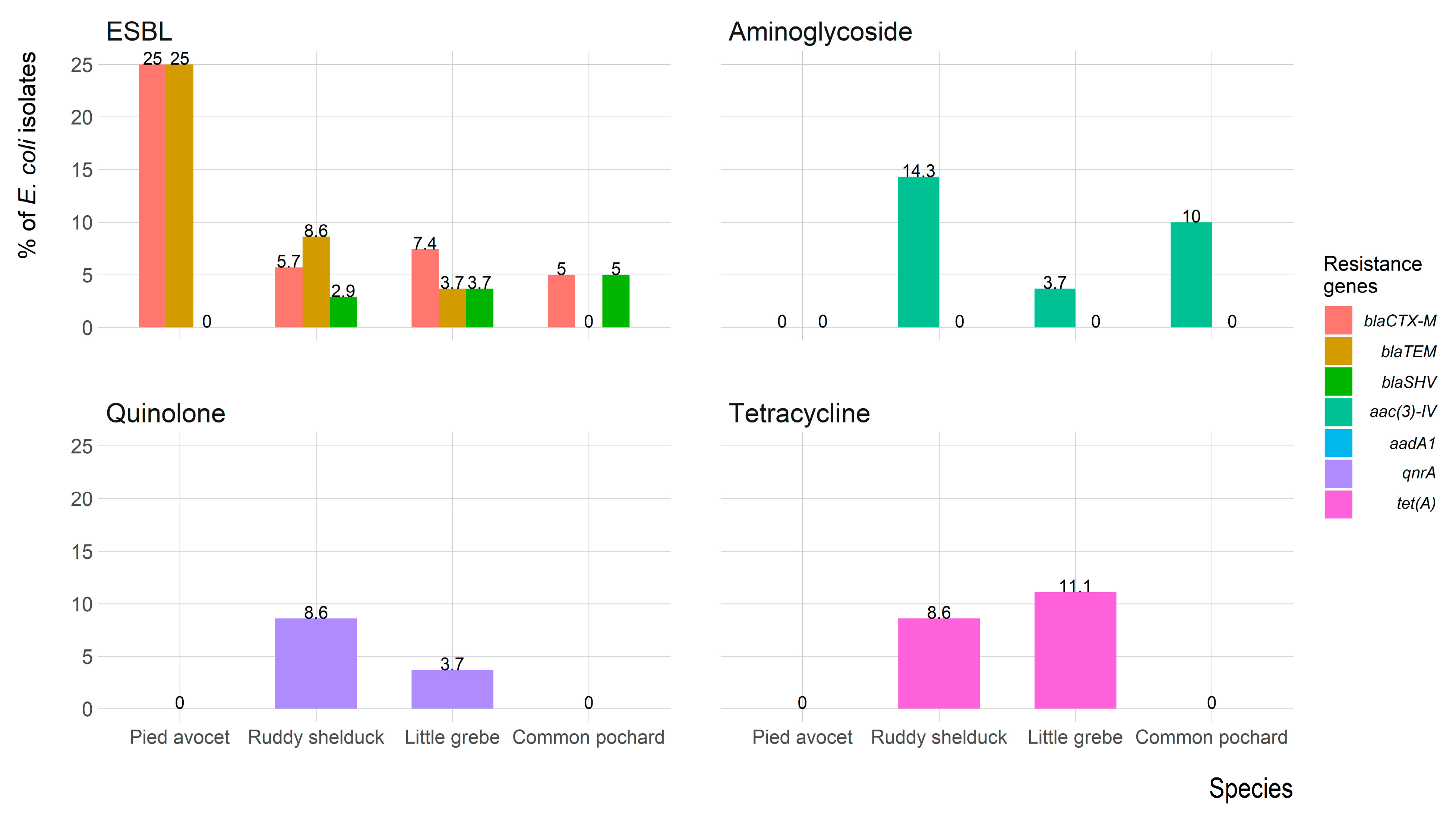
Migratory wild birds acquire antimicrobial-resistant (AMR) bacteria from contaminated habitats and then act as reservoirs and potential spreaders of resistant elements through migration. However, the role of migratory wild birds as antimicrobial disseminators in the Arabian Peninsula desert, which represents a transit point for birds migrating all over Asia, Africa, and Europe not yet clear. Therefore, the present study objective was to determine antimicrobial-resistant bacteria in samples collected from migratory wild birds around Al-Asfar Lake, located in Al-Ahsa Oasis, Eastern Saudi Arabia, with a particular focus on Escherichia coli virulence and resistance genes. Cloacal swabs were collected from 210 migratory wild birds represent four species around Al-Asfar. E. coli, Staphylococcus, and Salmonella spp. have been recovered from 90 (42.9%), 37 (17.6%), and 5 (2.4%) birds, respectively. Out of them, 19 (14.4%) were a mixed infection. All samples were subjected to AMR phenotypic characterization, and results revealed (14–41%) and (16–54%) of E. coli and Staphylococcus spp. isolates were resistant to penicillins, sulfonamides, aminoglycoside, and tetracycline antibiotics. Multidrug-resistant (MDR) E. coli and Staphylococcus spp. were identified in 13 (14.4%) and 7 (18.9%) isolates, respectively. However, none of the Salmonella isolates were MDR. Of the 90 E. coli isolates, only 9 (10%) and 5 (5.6%) isolates showed the presence of eaeA and stx2 virulence-associated genes, respectively. However, both eaeA and stx2 genes were identified in four (4.4%) isolates. None of the E. coli isolates carried the hlyA and stx1 virulence-associated genes. The E. coli AMR associated genes blaCTX-M, blaTEM, blaSHV, aac(3)-IV, qnrA, and tet(A) were identified in 7 (7.8%), 5 (5.6%), 1 (1.1%), 8 (8.9%), 4 (4.4%), and 6 (6.7%) isolates, respectively. While the mecA gene was not detected in any of the Staphylococcus spp. isolates. Regarding migratory wild bird species, bacterial recovery, mixed infection, MDR, and AMR index were relatively higher in aquatic-associated species. Overall, the results showed that migratory wild birds around Al-Asfar Lake could act as a reservoir for AMR bacteria enabling them to have a potential role in maintaining, developing, and disseminating AMR bacteria. Furthermore, results highlight the importance of considering migratory wild birds when studying the ecology of AMR.
Keywords: antimicrobial resistance; E. coli; Salmonella; Staphylococcus; migratory wild birds; multidrug antimicrobial resistance; E. coli; Salmonella; Staphylococcus; migratory wild birds; multidrug