Review

Fetal Magnetocardiography Using Optically Pumped Magnetometers: A Literature Review


1
Syreon Research Institute, 1142 Budapest, Hungary
2
Faculty of Mathematics and Physics, University of Ljubljana, 1000 Ljubljana, Slovenia
3
Institute of Mathematics, Physics and Mechanics, 1000 Ljubljana, Slovenia
4
School of Engineering and Management, University of Nova Gorica, 5000 Nova Gorica, Slovenia
5
Faculty of Natural Sciences and Mathematics, University of Maribor, 2000 Maribor, Slovenia
6
Physikalisch-Technische Bundesanstalt, 10587 Berlin, Germany
*
Author to whom correspondence should be addressed.
Biosensors 2026, 16(9), 487; https://doi.org/10.3390/bios16090487
Submission received: 30 July 2026 / Revised: 28 August 2026 / Accepted: 31 August 2026 / Published: 2 September 2026
(This article belongs to the Special Issue Biosensors for Physiological Signal Monitoring)

Abstract

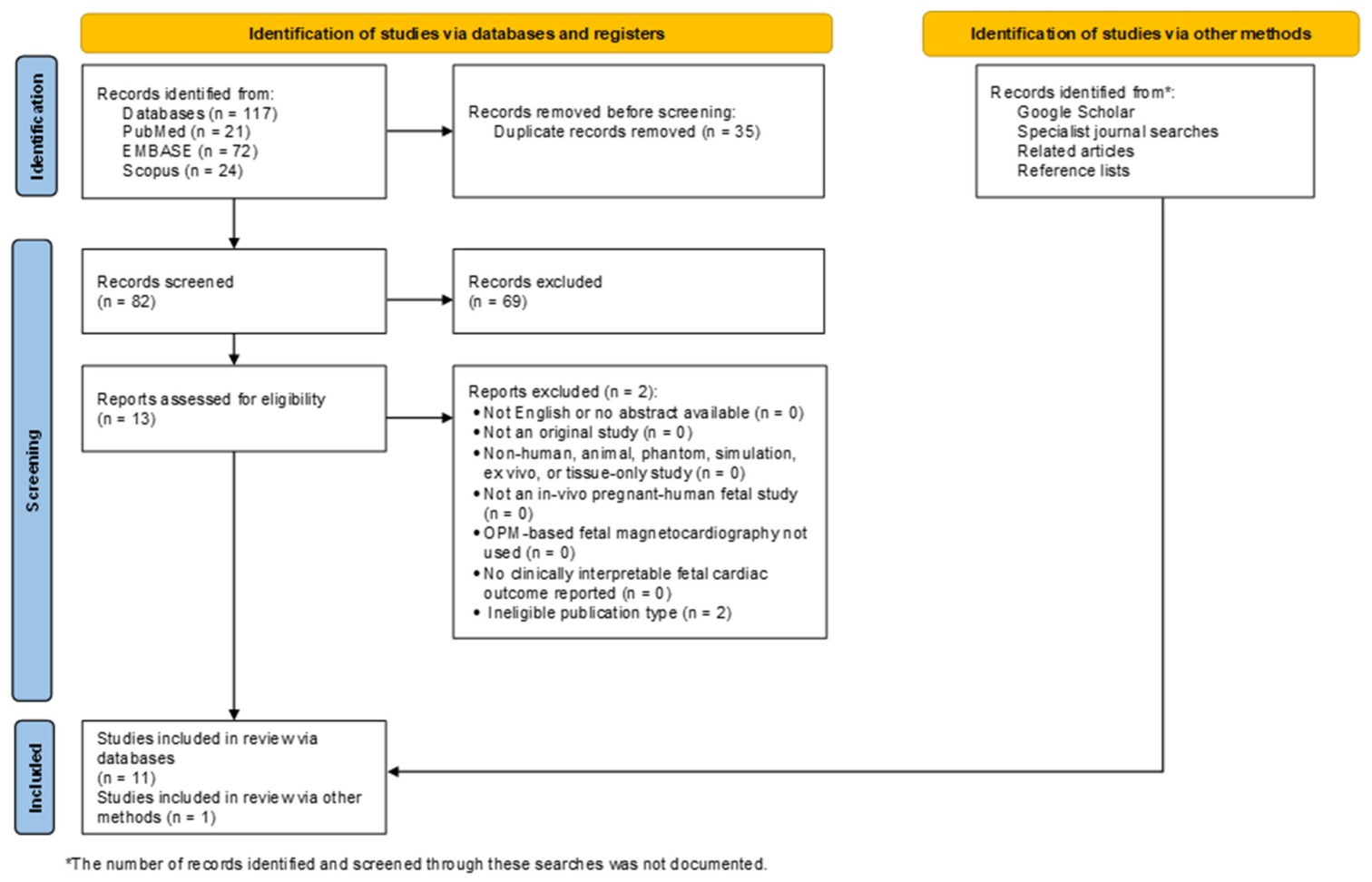
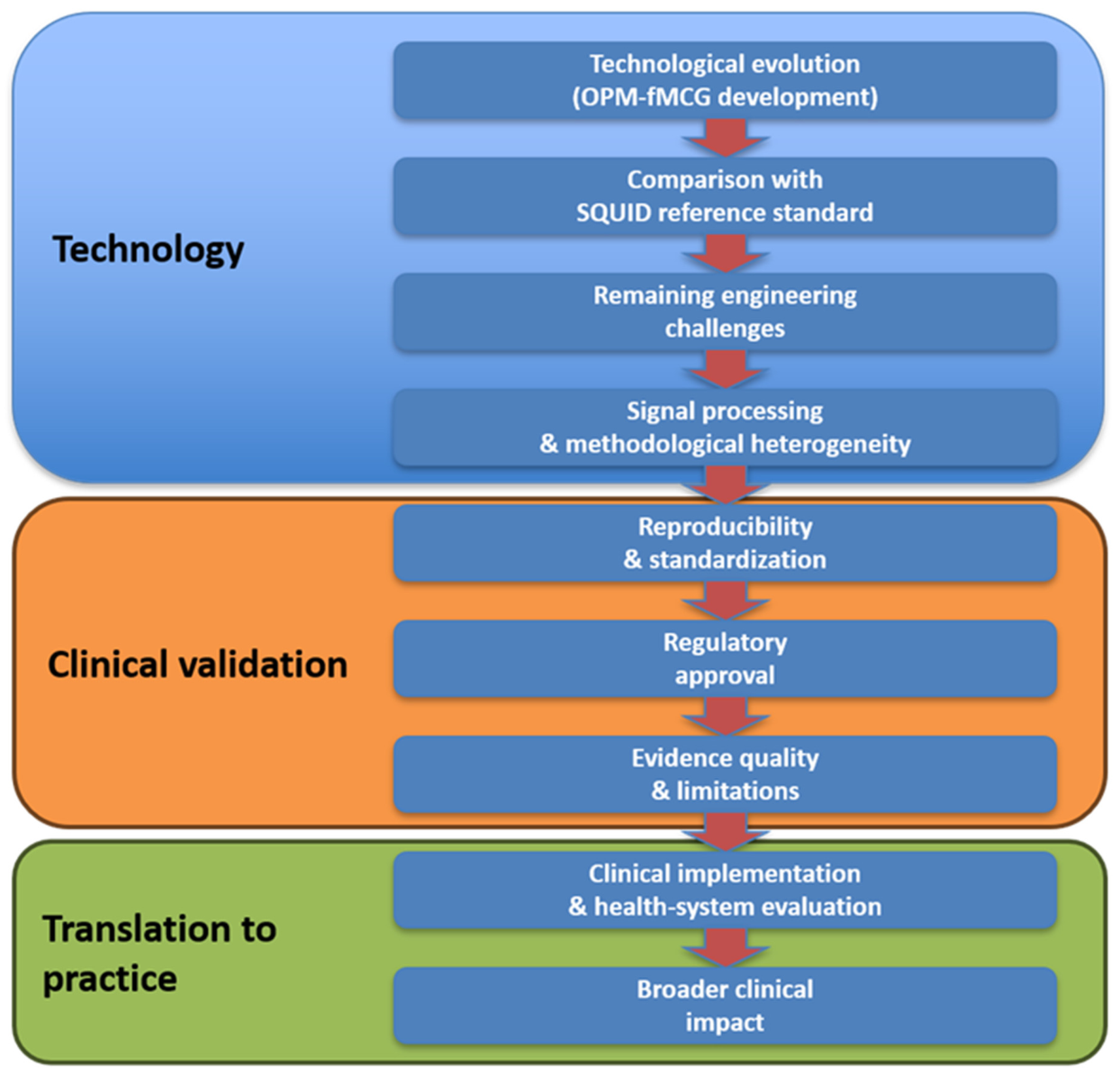
Fetal magnetocardiography (fMCG) provides direct non-invasive assessment of fetal cardiac electrophysiology, enabling detailed evaluation of cardiac rhythm, conduction, and repolarization. However, the clinical adoption of conventional fMCG has been limited by its reliance on superconducting quantum interference device (SQUID) systems, which require cryogenic cooling and specialized infrastructure. Optically pumped magnetometers (OPMs) have emerged as a promising cryogen-free alternative with the potential to broaden access to fetal electrophysiological assessment. This review summarizes the technological evolution and early clinical evaluation of OPM-based fMCG through an analysis of original in vivo human studies published up to June 2026. Twelve eligible studies were identified and synthesized narratively. Advances in sensor design, magnetic shielding, acquisition strategies, and signal-processing algorithms have enabled SQUID-comparable signal quality and cardiac interval measurements while substantially reducing cryogenic and infrastructure requirements. OPM-fMCG has demonstrated the potential to assess fetal cardiac time intervals, heart rate variability, fetal movement, and clinically important arrhythmias, including congenital long QT syndrome, atrioventricular block, and supraventricular and ventricular tachyarrhythmias. However, the available evidence remains dominated by small, single-centre studies, with relatively few fetuses affected by clinically significant arrhythmias. Prospective multicenter clinical validation, protocol standardization, independent replication, and regulatory evaluation are therefore required before OPM-fMCG can be integrated into routine diagnostic pathways for pregnancies requiring advanced fetal electrophysiological assessment.
Keywords: fetal magnetocardiography; optically pumped magnetometers; quantum sensors; fetal arrhythmia; fetal electrocardiology; prenatal diagnosis; cardiac electrophysiology; SQUID; biomagnetism; magnetic sensing fetal magnetocardiography; optically pumped magnetometers; quantum sensors; fetal arrhythmia; fetal electrocardiology; prenatal diagnosis; cardiac electrophysiology; SQUID; biomagnetism; magnetic sensing