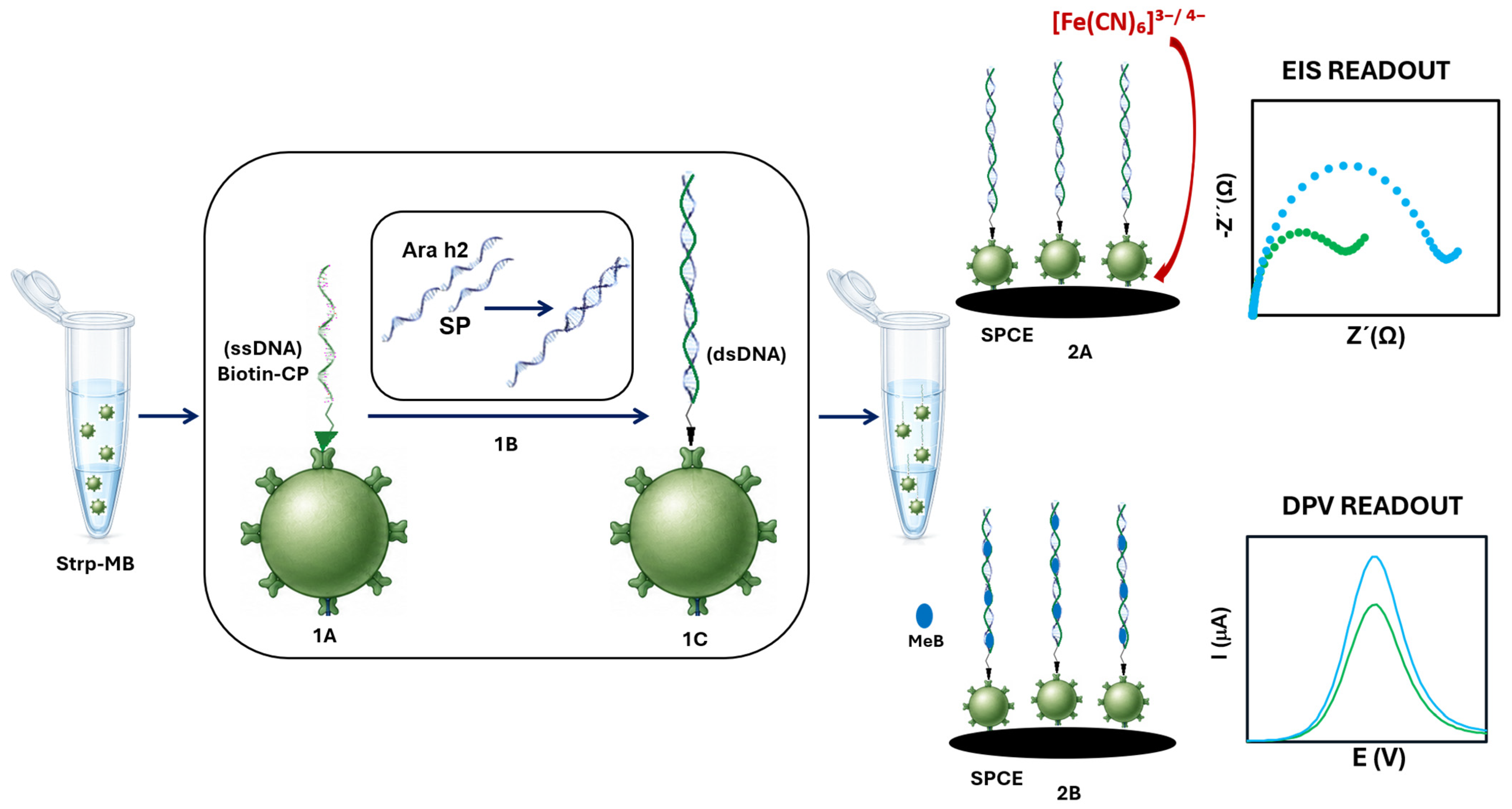
Magnetic Beads-Based Electrochemical Label-Free DNA-Bioassay for the Detection of Peanut Allergen Ara h2 in Food Matrices



Abstract
Share and Cite
Hervás-Pérez, J.P.; Izcara, S.; Sánchez-Paniagua, M. Magnetic Beads-Based Electrochemical Label-Free DNA-Bioassay for the Detection of Peanut Allergen Ara h2 in Food Matrices. Biosensors 2026, 16, 387. https://doi.org/10.3390/bios16070387
Hervás-Pérez JP, Izcara S, Sánchez-Paniagua M. Magnetic Beads-Based Electrochemical Label-Free DNA-Bioassay for the Detection of Peanut Allergen Ara h2 in Food Matrices. Biosensors. 2026; 16(7):387. https://doi.org/10.3390/bios16070387
Chicago/Turabian StyleHervás-Pérez, Juan Pablo, Sergio Izcara, and Marta Sánchez-Paniagua. 2026. "Magnetic Beads-Based Electrochemical Label-Free DNA-Bioassay for the Detection of Peanut Allergen Ara h2 in Food Matrices" Biosensors 16, no. 7: 387. https://doi.org/10.3390/bios16070387
APA StyleHervás-Pérez, J. P., Izcara, S., & Sánchez-Paniagua, M. (2026). Magnetic Beads-Based Electrochemical Label-Free DNA-Bioassay for the Detection of Peanut Allergen Ara h2 in Food Matrices. Biosensors, 16(7), 387. https://doi.org/10.3390/bios16070387