Beyond Self-Assembly: Bioorthogonal ‘Click’ Chemistry Strategies for Robust Electrochemical Interfaces in Wearable Biosensors


Abstract
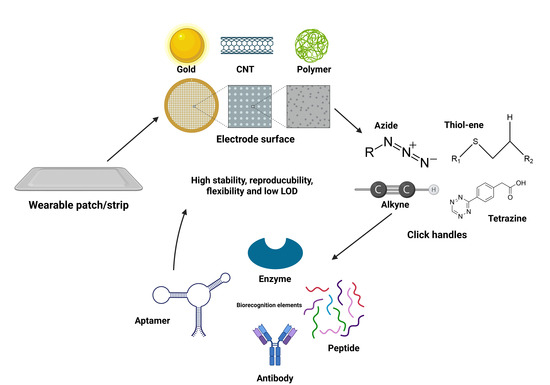
1. Introduction
2. The Chemist’s Toolkit: Tailoring “Click” Reactions for Electrodes
2.1. Cu(I)-Catalyzed Azide–Alkyne Cycloaddition (CuAAC)
2.2. Strain-Promoted Azide–Alkyne Cycloaddition (SPAAC)
2.3. Inverse Electron-Demand Diels–Alder (IEDDA) Cycloaddition
2.4. Thiol-ene/Yne Photoclick Chemistry for Soft and Patterned Interfaces
3. Building the Complete Interface: Orientation, Spacing, and Antifouling Design
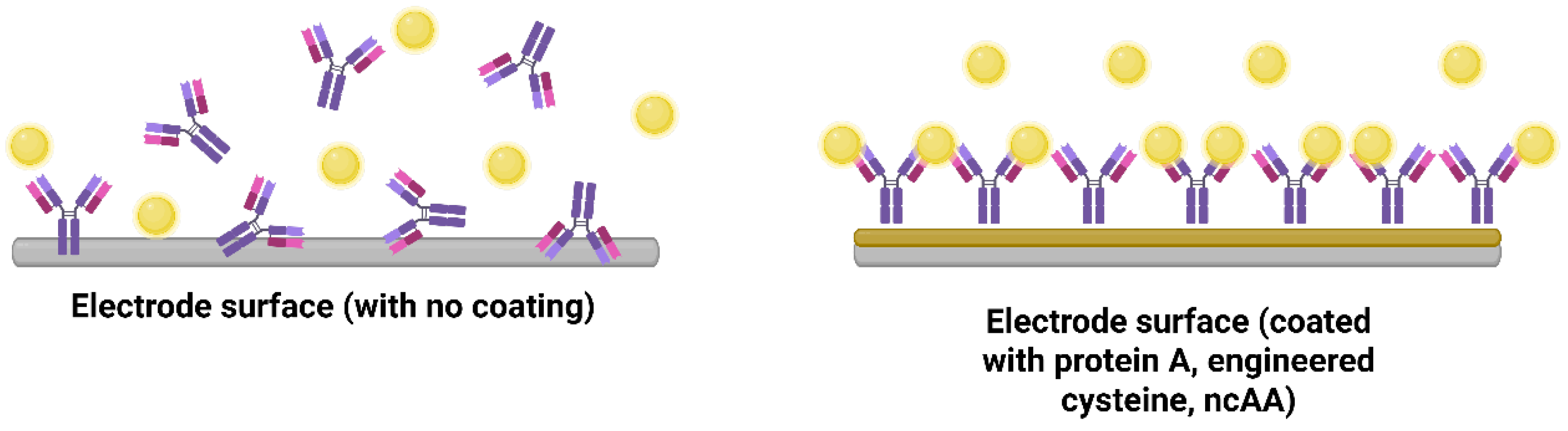
3.1. Controlling Bioreceptor Orientation
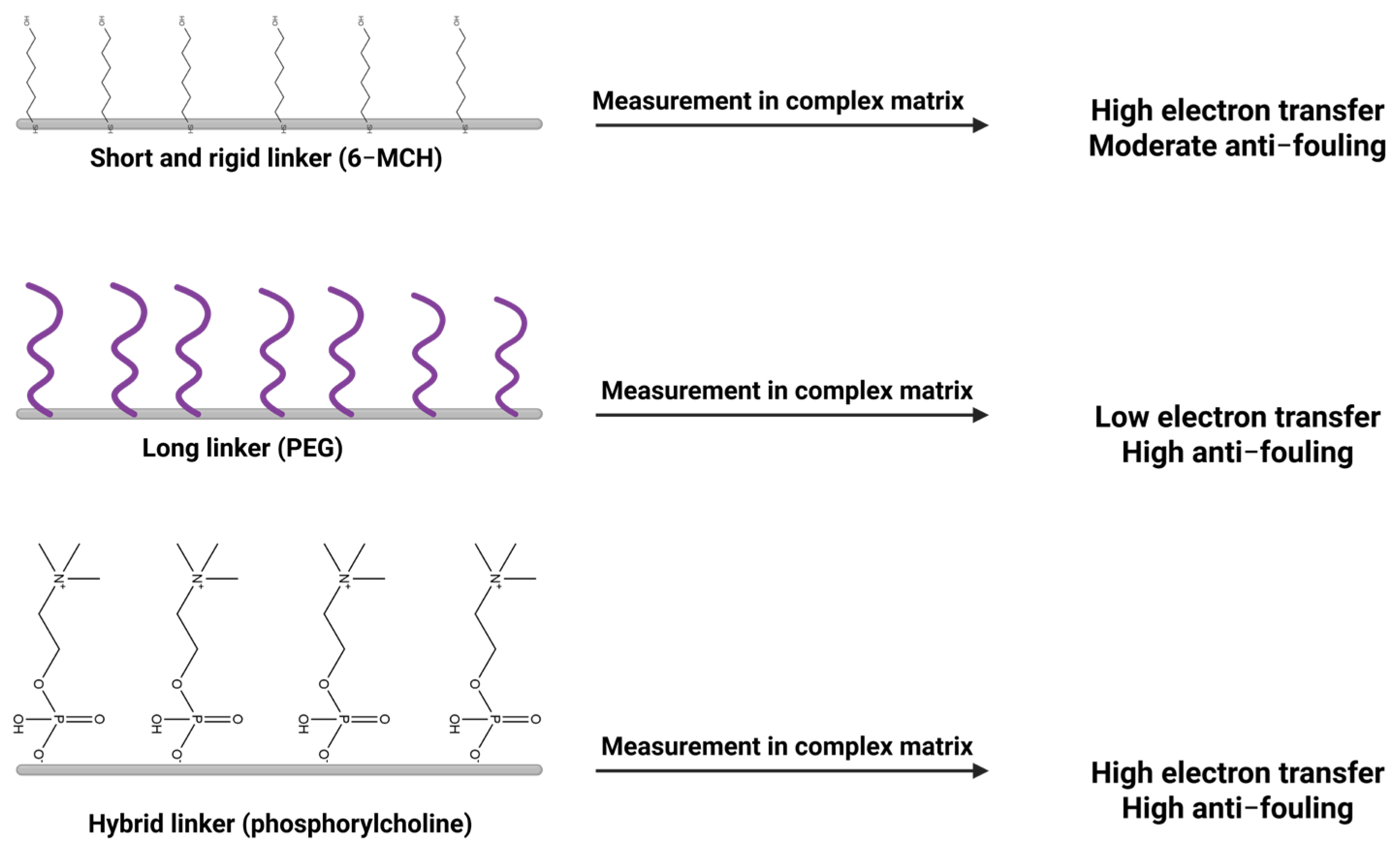
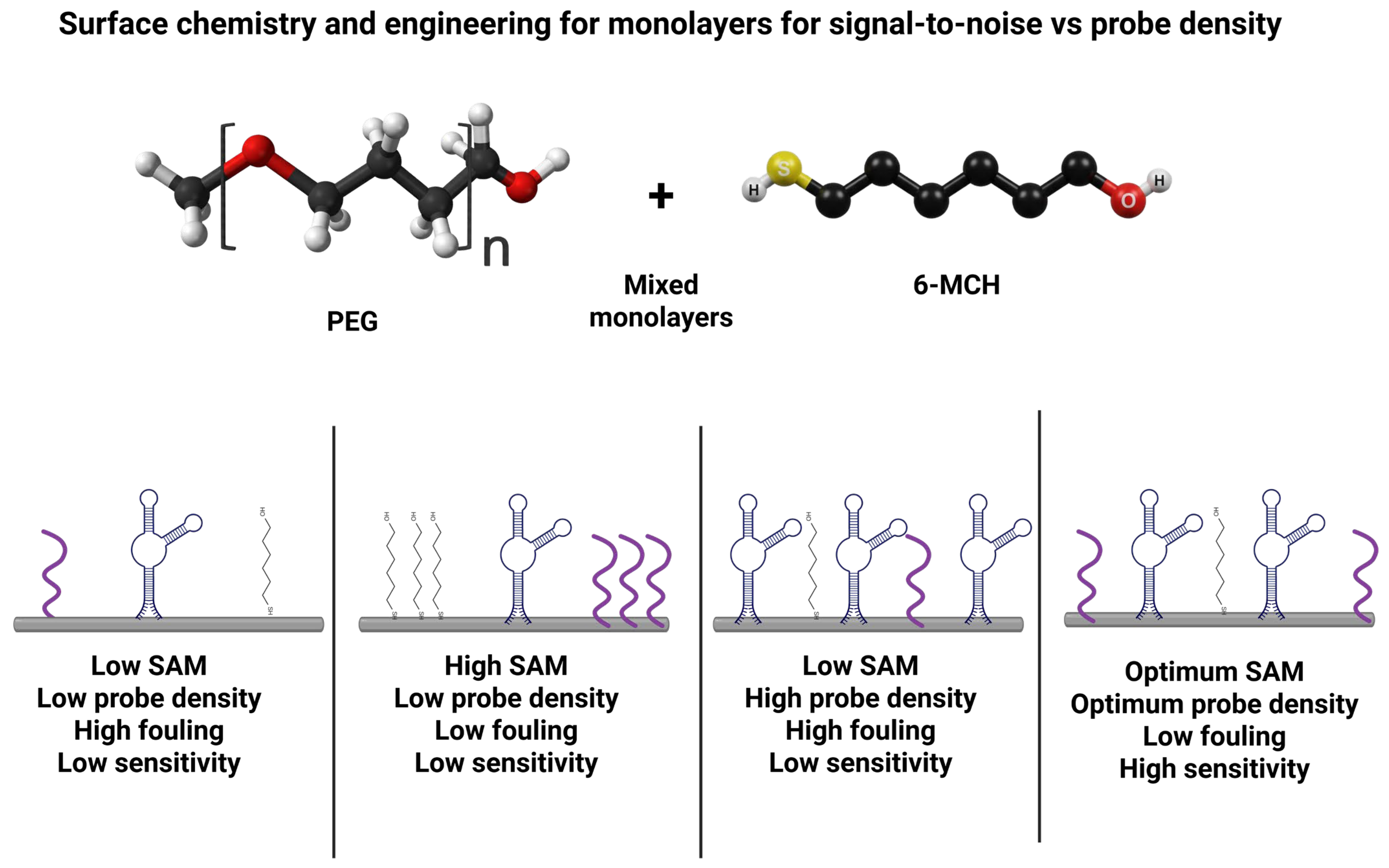
3.2. Mixed Monolayers, Spacers, and Antifouling Architecture
4. Impact on Electrochemical Performance Metrics Under Wearable Deformation and Hydration
4.1. Electron Transfer and Signal Drift at Dynamically Deforming Interfaces
4.2. Stability and Shelf-Life
4.3. Sensitivity and Limit of Detection (LOD)
4.4. Reproducibility
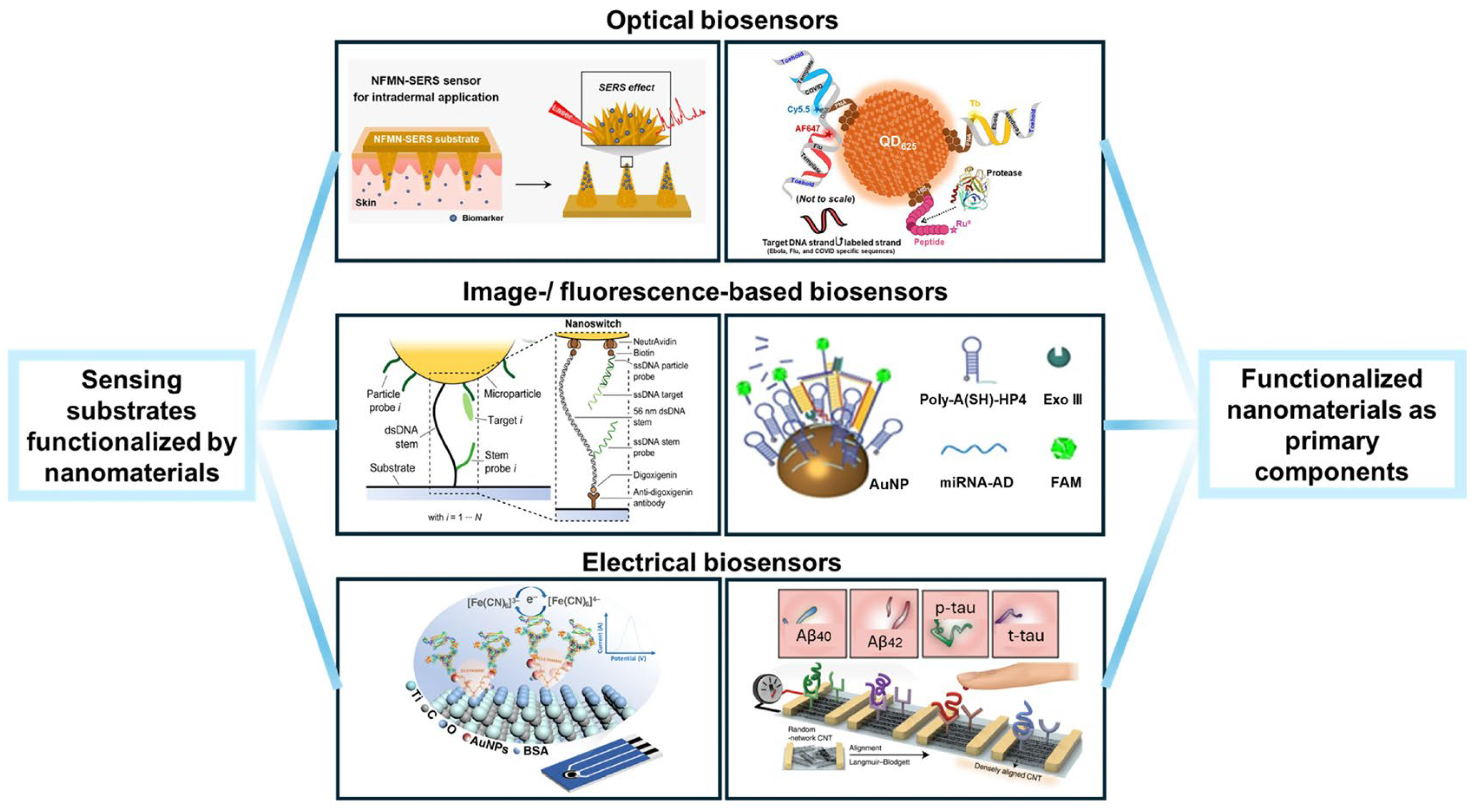
5. Strategies for Wearable and Flexible Substrates
5.1. Carbon-Based Materials
5.2. Polymeric and Textile Surfaces
5.3. Substrate-Dependent Stability of the Linker–Substrate Junction
5.4. Mechanical Stress Stability of Click-Based Interfaces
6. Critical Challenges and Future Outlook
6.1. Steric Hindrance on Crowded Surfaces
6.2. Biocompatibility Beyond Copper Toxicity in Wearable Use
6.3. Multiplexing: Orthogonal Surface Chemistry Must Be Paired with Electro-Fluidic Isolation
7. Conclusions
Author Contributions
Funding
Data Availability Statement
Conflicts of Interest
References
- Wu, K.Y.; Su, M.E.; Kim, Y.; Nguyen, L.; Marchand, M.; Tran, S.D. Wearable biosensors: A comprehensive overview. Prog. Mol. Biol. Transl. Sci. 2025, 215, 101–154. [Google Scholar] [CrossRef] [Scilit] [PubMed]
- Sletten, E.M.; Bertozzi, C.R. Bioorthogonal chemistry: Fishing for selectivity in a sea of functionality. Angew. Chem. Int. Ed. 2009, 48, 6974–6998. [Google Scholar] [CrossRef] [Scilit]
- Abdelfattah, M.A.; Jamali, S.S.; Kashaninejad, N.; Nguyen, N.T. Wearable biosensors for health monitoring: Advances in graphene-based technologies. Nanoscale Horiz. 2025, 10, 1542–1574. [Google Scholar] [CrossRef] [Scilit]
- Kalita, N.; Gogoi, S.; Minteer, S.D.; Goswami, P. Advances in Bioelectrode Design for Developing Electrochemical Biosensors. ACS Meas. Sci. Au 2023, 3, 404–433. [Google Scholar] [CrossRef] [Scilit]
- Kim, J.; Campbell, A.S.; de Ávila, B.E.F.; Wang, J. Wearable biosensors for healthcare monitoring. Nat. Biotechnol. 2019, 37, 389–406. [Google Scholar] [CrossRef] [Scilit]
- Sassolas, A.; Blum, L.J.; Leca-Bouvier, B.D. Immobilization strategies to develop enzymatic biosensors. Biotechnol. Adv. 2012, 30, 489–511. [Google Scholar] [CrossRef] [Scilit] [PubMed]
- Cernat, A.; Tertiș, M.; Cristea, C.; Săndulescu, R. Applications of Click Chemistry in the Development of Electrochemical Sensors. Int. J. Electrochem. Sci. 2015, 10, 6324–6337. [Google Scholar] [CrossRef] [Scilit]
- Putzbach, W.; Ronkainen, N.J. Immobilization Techniques in the Fabrication of Nanomaterial-Based Electrochemical Biosensors: A Review. Sensors 2013, 13, 4811. [Google Scholar] [CrossRef] [Scilit]
- Mohamad Nor, N.; Ridhuan, N.S.; Abdul Razak, K. Progress of Enzymatic and Non-Enzymatic Electrochemical Glucose Biosensor Based on Nanomaterial-Modified Electrode. Biosensors 2022, 12, 1136. [Google Scholar] [CrossRef] [Scilit]
- Yüce, M.; Kurt, H. How to make nanobiosensors: Surface modification and characterisation of nanomaterials for biosensing applications. RSC Adv. 2017, 7, 49386–49403. [Google Scholar] [CrossRef] [Scilit]
- Sionkowska, A.; Kulka-Kamińska, K.; Brudzyńska, P.; Lewandowska, K.; Piwowarski, Ł. The Influence of Various Crosslinking Conditions of EDC/NHS on the Properties of Fish Collagen Film. Mar. Drugs 2024, 22, 194. [Google Scholar] [CrossRef] [Scilit]
- Pawar, M.; Yadav, P.; H.N., G.; Sai, T.P.; Gandhi, S.; Ghosh, A. Challenges in Graphene-Based Biosensing: Exploring Critical Limitations and Strategies. ACS Sens. 2025, 11, 86–94. [Google Scholar] [CrossRef] [Scilit] [PubMed]
- Beitello, E.; Osei, K.; Kobulnicky, T.; Breausche, F.; Friesen, J.A.; Driskell, J.D. Oriented Surface Immobilization of Antibodies Using Enzyme-Mediated Site-Specific Biotinylation for Enhanced Antigen-Binding Capacity. Langmuir 2025, 41, 10576–10585. [Google Scholar] [CrossRef] [Scilit] [PubMed]
- Trilling, A.K.; Harmsen, M.M.; Ruigrok, V.J.B.; Zuilhof, H.; Beekwilder, J. The effect of uniform capture molecule orientation on biosensor sensitivity: Dependence on analyte properties. Biosens. Bioelectron. 2013, 40, 219–226. [Google Scholar] [CrossRef] [Scilit]
- Wang, F.; Xie, Y.; Zhu, W.; Wei, T. Recent Advances in Functionalization Strategies for Biosensor Interfaces, Especially the Emerging Electro-Click: A Review. Chemosensors 2023, 11, 481. [Google Scholar] [CrossRef] [Scilit]
- Luu, T.; Gristwood, K.; Knight, J.C.; Jörg, M. Click Chemistry: Reaction Rates and Their Suitability for Biomedical Applications. Bioconjugate Chem. 2024, 35, 715–731. [Google Scholar] [CrossRef] [Scilit] [PubMed]
- Yang, M.; Wang, S. Bioorthogonal Chemistry in Biomolecule Quantification: A Review of Reactions and Strategies. Chem.—A Eur. J. 2025, 32, e02315. [Google Scholar] [CrossRef] [Scilit]
- Tornøe, C.W.; Christensen, C.; Meldal, M. Peptidotriazoles on Solid Phase: [1,2,3]-Triazoles by Regiospecific Copper(I)-Catalyzed 1,3-Dipolar Cycloadditions of Terminal Alkynes to Azides. J. Org. Chem. 2002, 67, 3057–3064. [Google Scholar] [CrossRef] [Scilit]
- Kolanovic, D.; Pasupuleti, R.; Wallner, J.; Mlynek, G.; Wiltschi, B. Site-Specific Immobilization Boosts the Performance of a Galectin-1 Biosensor. Bioconjugate Chem. 2024, 35, 1944–1958. [Google Scholar] [CrossRef] [Scilit]
- Lu, Z.Y.; Chan, Y.H. The importance of antibody orientation for enhancing sensitivity and selectivity in lateral flow immunoassays. Sens. Diagn. 2024, 3, 1613–1634. [Google Scholar] [CrossRef] [Scilit]
- Hein, J.E.; Fokin, V.V. Copper-catalyzed azide–alkyne cycloaddition (CuAAC) and beyond: New reactivity of copper(I) acetylides. Chem. Soc. Rev. 2010, 39, 1302–1315. [Google Scholar] [CrossRef] [Scilit]
- Devaraj, N.K.; Decreau, R.A.; Ebina, W.; Collman, J.P.; Chidsey, C.E.D. Rate of Interfacial Electron Transfer through the 1,2,3-Triazole Linkage. J. Phys. Chem. B 2006, 110, 15955–15962. [Google Scholar] [CrossRef] [Scilit]
- Fenoy, G.E.; Hasler, R.; Lorenz, C.; Movilli, J.; Marmisollé, W.A.; Azzaroni, O.; Huskens, J.; Bäuerle, P.; Knoll, W. Interface Engineering of “Clickable” Organic Electrochemical Transistors toward Biosensing Devices. ACS Appl. Mater. Interfaces 2023, 15, 10885–10896. [Google Scholar] [CrossRef] [Scilit] [PubMed]
- Liu, N.; Song, J.; Lu, Y.; Davis, J.J.; Gao, F.; Luo, X. Electrochemical Aptasensor for Ultralow Fouling Cancer Cell Quantification in Complex Biological Media Based on Designed Branched Peptides. Anal. Chem. 2019, 91, 8334–8340. [Google Scholar] [CrossRef] [Scilit] [PubMed]
- Raza, T.; Qu, L.; Khokhar, W.A.; Andrews, B.; Ali, A.; Tian, M. Progress of Wearable and Flexible Electrochemical Biosensors with the Aid of Conductive Nanomaterials. Front. Bioeng. Biotechnol. 2021, 9, 761020. [Google Scholar] [CrossRef] [Scilit] [PubMed]
- Han, F.; Wang, T.; Liu, G.; Liu, H.; Xie, X.; Wei, Z.; Li, J.; Jiang, C.; He, Y.; Xu, F. Materials with Tunable Optical Properties for Wearable Epidermal Sensing in Health Monitoring. Adv. Mater. 2022, 34, 2109055. [Google Scholar] [CrossRef] [Scilit]
- Jin, Z.; Yim, W.; Retout, M.; Housel, E.; Zhong, W.; Zhou, J.; Strano, M.S.; Jokerst, J.V. Colorimetric sensing for translational applications: From colorants to mechanisms. Chem. Soc. Rev. 2024, 53, 7681–7741. [Google Scholar] [CrossRef] [Scilit]
- Liu, W.; Cheng, H.; Wang, X. Skin-interfaced colorimetric microfluidic devices for on-demand sweat analysis. Npj Flex. Electron. 2023, 7, 43. [Google Scholar] [CrossRef] [Scilit]
- Yue, X.; Xu, F.; Zhang, L.; Ren, G.; Sheng, H.; Wang, J.; Wang, K.; Yu, L.; Wang, J.; Li, G.; et al. Simple, Skin-Attachable, and Multifunctional Colorimetric Sweat Sensor. ACS Sens. 2022, 7, 2198–2208. [Google Scholar] [CrossRef] [Scilit]
- Xiao, J.; Liu, Y.; Su, L.; Zhao, D.; Zhao, L.; Zhang, X. Microfluidic Chip-Based Wearable Colorimetric Sensor for Simple and Facile Detection of Sweat Glucose. Anal. Chem. 2019, 91, 14803–14807. [Google Scholar] [CrossRef] [Scilit]
- Zhang, Y.; Chu, C.W.; Ma, W.; Takahara, A. Functionalization of Metal Surface via Thiol–Ene Click Chemistry: Synthesis, Adsorption Behavior, and Postfunctionalization of a Catechol- and Allyl-Containing Copolymer. ACS Omega 2020, 5, 7488–7496. [Google Scholar] [CrossRef] [Scilit] [PubMed]
- Liao, A.; Du, W.; Yang, H. The Inverse Electron Demand Diels-Alder Reaction Between Tetrazine and Trans-Cyclooctene for Pretargeted Bioimaging Applications. Anal. Sens. 2024, 4, e202300053. [Google Scholar] [CrossRef] [Scilit]
- Degirmenci, A.; Sanyal, R.; Sanyal, A. Metal-Free Click-Chemistry: A Powerful Tool for Fabricating Hydrogels for Biomedical Applications. Bioconjug. Chem. 2024, 35, 433–452. [Google Scholar] [CrossRef] [Scilit]
- Depienne, S.; Bouzelha, M.; Courtois, E.; Pavageau, K.; Lalys, P.A.; Marchand, M.; Alvarez-Dorta, D.; Nedellec, S.; Marín-Fernández, L.; Grandjean, C.; et al. Click-electrochemistry for the rapid labeling of virus, bacteria and cell surfaces. Nat. Commun. 2023, 14, 5122. [Google Scholar] [CrossRef] [Scilit] [PubMed]
- Pineda-Castañeda, H.M.; Rivera-Monroy, Z.J.; Maldonado, M. Copper(I)-Catalyzed Alkyne–Azide Cycloaddition (CuAAC) “Click” Reaction: A Powerful Tool for Functionalizing Polyhydroxylated Platforms. ACS Omega 2023, 8, 3650–3666. [Google Scholar] [CrossRef] [Scilit]
- Fenoy, G.E.; Hasler, R.; Quartinello, F.; Marmisollé, W.A.; Lorenz, C.; Azzaroni, O.; Bäuerle, P.; Knoll, W. “Clickable” Organic Electrochemical Transistors. JACS Au 2022, 2, 2778–2790. [Google Scholar] [CrossRef] [Scilit]
- Chen, M.; Li, Y.; Han, R.; Chen, Q.; Jiang, L.; Luo, X. Click reaction-assisted construction of antifouling immunosensors for electrochemical detection of cancer biomarkers in human serum. Sens. Actuators B Chem. 2022, 363, 131810. [Google Scholar] [CrossRef] [Scilit]
- Yáñez-Sedeño, P.; González-Cortés, A.; Campuzano, S.; Pingarrón, J.M. Copper(I)-Catalyzed Click Chemistry as a Tool for the Functionalization of Nanomaterials and the Preparation of Electrochemical (Bio)Sensors. Sensors 2019, 19, 2379. [Google Scholar] [CrossRef] [Scilit]
- Agouram, N.; El Hadrami, E.M.; Bentama, A. 1,2,3-Triazoles as Biomimetics in Peptide Science. Molecules 2021, 26, 2937. [Google Scholar] [CrossRef] [Scilit]
- Bonandi, E.; Christodoulou, M.S.; Fumagalli, G.; Perdicchia, D.; Rastelli, G.; Passarella, D. The 1,2,3-triazole ring as a bioisostere in medicinal chemistry. Drug Discov. Today 2017, 22, 1572–1581. [Google Scholar] [CrossRef] [Scilit] [PubMed]
- Meldal, M.; Tomøe, C.W. Cu-Catalyzed Azide−Alkyne Cycloaddition. Chem. Rev. 2008, 108, 2952–3015. [Google Scholar] [CrossRef] [Scilit]
- Huang, Y.; Zhang, P.; Wang, H.; Chen, Y.; Liu, T.; Luo, X. Genetic Code Expansion: Recent Developments and Emerging Applications. Chem. Rev. 2024, 125, 523–598. [Google Scholar] [CrossRef] [Scilit]
- Fantoni, N.Z.; El-Sagheer, A.H.; Brown, T. A Hitchhiker’s Guide to Click-Chemistry with Nucleic Acids. Chem. Rev. 2021, 121, 7122–7154. [Google Scholar] [CrossRef] [Scilit] [PubMed]
- Song, Y.; Sun, Q.; Aguila, B.; Ma, S. Opportunities of Covalent Organic Frameworks for Advanced Applications. Adv. Sci. 2019, 6, 1801410. [Google Scholar] [CrossRef] [Scilit] [PubMed]
- Bu, H.B.; Götz, G.; Reinold, E.; Vogt, A.; Schmid, S.; Blanco, R.; Segura, J.L.; Bäuerle, P. Click-functionalization of conducting poly(3,4-ethylenedioxythiophene) (PEDOT). Chem. Commun. 2008, 1320–1322. [Google Scholar] [CrossRef] [Scilit] [PubMed]
- Scavetta, E.; Mazzoni, R.; Mariani, F.; Margutta, R.G.; Bonfiglio, A.; Demelas, M.; Fiorilli, S.; Marzocchi, M.; Fraboni, B. Dopamine amperometric detection at a ferrocene clicked PEDOT:PSS coated electrode. J. Mater. Chem. B 2014, 2, 2861–2867. [Google Scholar] [CrossRef] [Scilit]
- Kennedy, D.C.; McKay, C.S.; Legault, M.C.B.; Danielson, D.C.; Blake, J.A.; Pegoraro, A.F.; Stolow, A.; Mester, Z.; Pezacki, J.P. Cellular Consequences of Copper Complexes Used To Catalyze Bioorthogonal Click Reactions. J. Am. Chem. Soc. 2011, 133, 17993–18001. [Google Scholar] [CrossRef] [Scilit]
- Besanceney-Webler, C.; Jiang, H.; Zheng, T.; Feng, L.; Soriano Del Amo, D.; Wang, W.; Klivansky, L.M.; Marlow, F.L.; Liu, Y.; Wu, P. Increasing the Efficacy of Bioorthogonal Click Reactions for Bioconjugation: A Comparative Study. Angew. Chem. Int. Ed. Engl. 2011, 50, 8051. [Google Scholar] [CrossRef] [Scilit]
- Guerrero, S.; Cadano, D.; Agüí, L.; Barderas, R.; Campuzano, S.; Yáñez-Sedeño, P.; Pingarrón, J.M. Click chemistry-assisted antibodies immobilization for immunosensing of CXCL7 chemokine in serum. J. Electroanal. Chem. 2019, 837, 246–253. [Google Scholar] [CrossRef] [Scilit]
- Uttamapinant, C.; Tangpeerachaikul, A.; Grecian, S.; Clarke, S.; Singh, U.; Slade, P.; Gee, K.R.; Ting, A.Y. Fast, Cell-compatible Click Chemistry with Copper-chelating Azides for Biomolecular Labeling. Angew. Chem. Int. Ed. Engl. 2012, 51, 5852. [Google Scholar] [CrossRef] [Scilit]
- Devaraj, N.K.; Dinolfo, P.H.; Chidsey, C.E.D.; Collman, J.P. Selective functionalization of independently addressed microelectrodes by electrochemical activation and deactivation of a coupling catalyst. J. Am. Chem. Soc. 2006, 128, 1794–1795. [Google Scholar] [CrossRef] [Scilit]
- Sweedan, A.O.; Zhang, K.; Bashouti, M.Y.; Feichtner, T. Large-Area Atomically Flat Monocrystalline Gold Flakes: Recent Advances, Applications, and Future Potential. arXiv 2025, arXiv:2511.01327. [Google Scholar] [CrossRef] [Scilit]
- Park, S.; Bisht, H.; Park, J.; Park, S.; Hong, Y.; Chu, D.; Koh, M.; Lee, H.; Hong, D. Linker-Engineered Tyrosine–Azide Coatings for Stable Strain-Promoted Azide–Alkyne Cycloaddition (SPAAC) Functionalization. Polymers 2025, 17, 2969. [Google Scholar] [CrossRef] [Scilit]
- Baskin, J.M.; Prescher, J.A.; Laughlin, S.T.; Agard, N.J.; Chang, P.V.; Miller, I.A.; Lo, A.; Codelli, J.A.; Bertozzi, C.R. Copper-free click chemistry for dynamic in vivo imaging. Proc. Natl. Acad. Sci. USA 2007, 104, 16793–16797. [Google Scholar] [CrossRef] [Scilit] [PubMed]
- Dommerholt, J.; Schmidt, S.; Temming, R.; Hendriks, L.J.A.; Rutjes, F.P.J.T.; Van Hest, J.C.M.; Lefeber, D.J.; Friedl, P.; van Delft, F.L. Readily accessible bicyclononynes for bioorthogonal labeling and three-dimensional imaging of living cells. Angew. Chem. Int. Ed. 2010, 49, 9422–9425. [Google Scholar] [CrossRef] [Scilit]
- Jewett, J.C.; Bertozzi, C.R. Cu-free click cycloaddition reactions in chemical biology. Chem. Soc. Rev. 2010, 39, 1272–1279. [Google Scholar] [CrossRef] [Scilit] [PubMed]
- Agard, N.J.; Prescher, J.A.; Bertozzi, C.R. A strain-promoted [3 + 2] azide-alkyne cycloaddition for covalent modification of biomolecules in living systems. J. Am. Chem. Soc. 2004, 126, 15046–15047. [Google Scholar] [CrossRef] [Scilit]
- Kim, E.; Koo, H. Biomedical applications of copper-free click chemistry: In vitro, in vivo, and ex vivo. Chem. Sci. 2019, 10, 7835. [Google Scholar] [CrossRef] [Scilit] [PubMed]
- Dommerholt, J.; Rutjes, F.P.J.T.; Van Delft, F.L.; Vrabel, M.; Carell, T.; Nl, F.V. Strain-Promoted 1,3-Dipolar Cycloaddition of Cycloalkynes and Organic Azides. Top. Curr. Chem. 2016, 374, 57–76. [Google Scholar] [CrossRef] [Scilit]
- Wendeln, C.; Singh, I.; Rinnen, S.; Schulz, C.; Arlinghaus, H.F.; Burley, G.A.; Ravoo, B.J. Orthogonal, metal-free surface modification by strain-promoted azide–alkyne and nitrile oxide–alkene/alkyne cycloadditions. Chem. Sci. 2012, 3, 2479–2484. [Google Scholar] [CrossRef] [Scilit]
- Huang, C.H.; Hou, S.Y.; Severance, S.; Hwang, C.C.; Fang, B.K.; Gong, M.M.; Yu, S.-L.; Weng, Y.-C.; Wang, L.-F.; Dai, C.-Y.; et al. Manipulating Diastereomeric Bicyclononynes to Sensitively Determine Enzyme Activity and Facilitate Macromolecule Conjugations. ACS Omega 2023, 8, 46073–46090. [Google Scholar] [CrossRef] [Scilit] [PubMed]
- Gautier, C.; López, I.; Breton, T. A post-functionalization toolbox for diazonium (electro)-grafted surfaces: Review of the coupling methods. Mater. Adv. 2021, 2, 2773–2810. [Google Scholar] [CrossRef] [Scilit]
- He, Z.; Wu, J.; Li, W.; Du, Y.; Lu, L. Investigation of G-Quadruplex DNA-Mediated Charge Transport for Exploring DNA Oxidative Damage in Telomeres. Langmuir 2024, 40, 18950–18960. [Google Scholar] [CrossRef] [Scilit]
- Dommerholt, J.; Van Rooijen, O.; Borrmann, A.; Guerra, C.F.; Bickelhaupt, F.M.; Van Delft, F.L. Highly accelerated inverse electron-demand cycloaddition of electron-deficient azides with aliphatic cyclooctynes. Nat. Commun. 2014, 5, 5378. [Google Scholar] [CrossRef] [Scilit]
- Mertgen, A.S.; Guex, A.G.; Tosatti, S.; Fortunato, G.; Rossi, R.M.; Rottmar, M.; Maniura-Weber, K.; Zürcher, S. A low-fouling, self-assembled, graft co-polymer and covalent surface coating for controlled immobilization of biologically active moieties. Appl. Surf. Sci. 2022, 584, 152525. [Google Scholar] [CrossRef] [Scilit]
- Pringle, T.A.; Knight, J.C. The effects of buffer, pH, and temperature upon SPAAC reaction rates. Org. Biomol. Chem. 2025, 23, 2432–2438. [Google Scholar] [CrossRef] [Scilit] [PubMed]
- Collman, J.P.; Devaraj, N.K.; Eberspacher, T.P.A.; Chidsey, C.E.D. Mixed Azide-Terminated Monolayers: A Platform for Modifying Electrode Surfaces. Langmuir 2006, 22, 2457–2464. [Google Scholar] [CrossRef] [Scilit]
- Knall, A.C.; Slugovc, C. Inverse electron demand Diels-Alder (iEDDA)-initiated conjugation: A (high) potential click chemistry scheme. Chem. Soc. Rev. 2013, 42, 5131–5142. [Google Scholar] [CrossRef] [Scilit]
- Darko, A.; Wallace, S.; Dmitrenko, O.; Machovina, M.M.; Mehl, R.A.; Chin, J.W.; Fox, J.M. Conformationally Strained trans-Cyclooctene with Improved Stability and Excellent Reactivity in Tetrazine Ligation. Chem. Sci. (R. Soc. Chem. 2010) 2014, 5, 3770–3776. [Google Scholar] [CrossRef] [Scilit]
- Handula, M.; Chen, K.T.; Seimbille, Y. IEDDA: An Attractive Bioorthogonal Reaction for Biomedical Applications. Molecules 2021, 26, 4640. [Google Scholar] [CrossRef] [Scilit] [PubMed]
- Blackman, M.L.; Royzen, M.; Fox, J.M. The Tetrazine Ligation: Fast Bioconjugation based on Inverse-electron-demand Diels-Alder Reactivity. J. Am. Chem. Soc. 2008, 130, 13518–13519. [Google Scholar] [CrossRef] [Scilit]
- Li, Z.; Cai, H.; Hassink, M.; Blackman, M.L.; Brown, R.C.D.; Conti, P.S.; Fox, J.M. Tetrazine-trans-cyclooctene ligation for the rapid construction of 18F labeled probes. Chem. Commun. 2010, 46, 8043–8045. [Google Scholar] [CrossRef] [Scilit] [PubMed]
- de Roode, K.E.; Rossin, R.; Robillard, M.S. Toward Realization of Bioorthogonal Chemistry in the Clinic. Top. Curr. Chem. 2025, 383, 12. [Google Scholar] [CrossRef] [Scilit] [PubMed]
- Yang, M.; Jalloh, A.S.; Wei, W.; Zhao, J.; Wu, P.; Chen, P.R. Biocompatible click chemistry enabled compartment-specific pH measurement inside E. coli. Nat. Commun. 2014, 5, 4981. [Google Scholar] [CrossRef] [Scilit]
- Adhikari, K.; Vanermen, M.; Da Silva, G.; Van den Wyngaert, T.; Augustyns, K.; Elvas, F. Trans-cyclooctene—A Swiss army knife for bioorthogonal chemistry: Exploring the synthesis, reactivity, and applications in biomedical breakthroughs. EJNMMI Radiopharm. Chem. 2024, 9, 47. [Google Scholar] [CrossRef] [Scilit]
- Fang, Y.; Judkins, J.C.; Boyd, S.J.; am Ende, C.W.; Rohlfing, K.; Huang, Z.; Xie, Y.; Johnson, D.S.; Fox, J.M. Studies on the Stability and Stabilization of trans-Cyclooctenes through Radical Inhibition and Silver (I) Metal Complexation. Tetrahedron 2019, 75, 4307–4317. [Google Scholar] [CrossRef] [Scilit] [PubMed]
- Liu, L.; Zhang, D.; Johnson, M.; Devaraj, N.K. Light-activated tetrazines enable precision live-cell bioorthogonal chemistry. Nat. Chem. 2022, 14, 1078–1085. [Google Scholar] [CrossRef] [Scilit]
- Eising, S.; Engwerda, A.H.J.; Riedijk, X.; Bickelhaupt, F.; Matthias; Bonger, K. Article/Letter to editor. Bioconjug. Chem. 2018, 29, 3054–3059. [Google Scholar] [CrossRef] [Scilit]
- Fang, Y.; Hillman, A.S.; Fox, J.M. Advances in the Synthesis of Bioorthogonal Reagents: S-Tetrazines, 1,2,4-Triazines, Cyclooctynes, Heterocycloheptynes, and trans-Cyclooctenes. In Bioorthogonal Reactions; Springer: Cham, Switzerland, 2025; pp. 31–93. [Google Scholar] [CrossRef] [Scilit]
- Wang, P.; Na, Z.; Fu, J.; Tan, C.Y.J.; Zhang, H.; Yao, S.Q.; Sun, H. Microarray immobilization of biomolecules using a fast trans-cyclooctene-tetrazine reaction. Chem. Commun. 2014, 50, 11818–11821. [Google Scholar] [CrossRef] [Scilit]
- Patterson, D.M.; Nazarova, L.A.; Prescher, J.A. Finding the Right (Bioorthogonal) Chemistry. ACS Chem. Biol. 2014, 9, 592–605. [Google Scholar] [CrossRef] [Scilit]
- Chen, Y.; Kushner, A.M.; Williams, G.A.; Guan, Z. Multiphase design of autonomic self-healing thermoplastic elastomers. Nat. Chem. 2012, 4, 467–472. [Google Scholar] [CrossRef] [Scilit] [PubMed]
- Selvaraj, R.; Fox, J.M. trans-Cyclooctene—A stable, voracious dienophile for bioorthogonal labeling. Curr. Opin. Chem. Biol. 2013, 17, 753–760. [Google Scholar] [CrossRef] [Scilit] [PubMed]
- Alge, D.L.; Azagarsamy, M.A.; Donohue, D.F.; Anseth, K.S. Synthetically Tractable Click Hydrogels for Three-Dimensional Cell Culture Formed Using Tetrazine–Norbornene Chemistry. Biomacromolecules 2013, 14, 949–953. [Google Scholar] [CrossRef] [Scilit]
- Yang, Q.; Hu, Z.; Rogers, J.A. Functional Hydrogel Interface Materials for Advanced Bioelectronic Devices. Acc. Mater. Res. 2021, 2, 1010–1023. [Google Scholar] [CrossRef] [Scilit]
- Oliveira, B.L.; Guo, Z.; Bernardes, G.J.L. Inverse electron demand Diels–Alder reactions in chemical biology. Chem. Soc. Rev. 2017, 46, 4895–4950. [Google Scholar] [CrossRef] [Scilit] [PubMed]
- Devaraj, N.K.; Weissleder, R.; Hilderbrand, S.A. Tetrazine-Based Cycloadditions: Application to Pretargeted Live Cell Imaging. Bioconjugate Chem. 2008, 19, 2297–2299. [Google Scholar] [CrossRef] [Scilit]
- McFarland, J.M.; Alečković, M.; Coricor, G.; Srinivasan, S.; Tso, M.; Lee, J.; Nguyen, T.-H.; Oneto, J.M.M. Click Chemistry Selectively Activates an Auristatin Protodrug with either Intratumoral or Systemic Tumor-Targeting Agents. ACS Cent. Sci. 2023, 9, 1400–1408. [Google Scholar] [CrossRef] [Scilit]
- Fischer, M.J.E. Amine Coupling Through EDC/NHS: A Practical Approach. Methods Mol. Biol. 2010, 627, 55–73. [Google Scholar] [CrossRef] [Scilit]
- Norberg, O.; Lee, I.H.; Aastrup, T.; Yan, M.; Ramström, O. Photogenerated lectin sensors produced by thiol-ene/yne photo-click chemistry in aqueous solution. Biosens. Bioelectron. 2012, 34, 51–56. [Google Scholar] [CrossRef] [Scilit]
- Krings, N.; Strehblow, H.H.; Kohnert, J.; Martin, H.D. Investigations on the monolayer structure of thiol SAMs and the influence of conjugated π-bonds on the electronic molecular conductivity. Electrochim. Acta 2003, 49, 167–174. [Google Scholar] [CrossRef] [Scilit]
- Madhiri, N. Proton Coupled Electron Transfer Kinetics of Redox Centers Proton Coupled Electron Transfer Kinetics of Redox Centers Attached to Self-Assembled Monolayers on Electrodes Attached to Self-Assembled Monolayers on Electrodes. Ph.D. Thesis, West Virginia University, Morgantown, WV, USA, 2006. [Google Scholar]
- Bollella, P.; Katz, E. Enzyme-based biosensors: Tackling electron transfer issues. Sensors 2020, 20, 3517. [Google Scholar] [CrossRef] [Scilit]
- Hu, Z.; Zhu, R.; Figueroa-Miranda, G.; Zhou, L.; Feng, L.; Offenhäusser, A.; Mayer, D. Truncated Electrochemical Aptasensor with Enhanced Antifouling Capability for Highly Sensitive Serotonin Detection. Biosensors 2023, 13, 881. [Google Scholar] [CrossRef] [Scilit] [PubMed]
- Frederix, F.; Bonroy, K.; Laureyn, W.; Reekmans, G.; Campitelli, A.; Dehaen, W.; Maes, G. Enhanced Performance of an Affinity Biosensor Interface Based on Mixed Self-Assembled Monolayers of Thiols on Gold. Langmuir 2003, 19, 4351–4357. [Google Scholar] [CrossRef] [Scilit]
- Rapakousiou, A.; Deraedt, C.; Irigoyen, J.; Wang, Y.; Pinaud, N.; Salmon, L.; Ruiz, J.; Moya, S.; Astruc, D. Synthesis and Redox Activity of “Clicked” Triazolylbiferrocenyl Polymers, Network Encapsulation of Gold and Silver Nanoparticles and Anion Sensing. Inorg. Chem. 2015, 54, 2284–2299. [Google Scholar] [CrossRef] [Scilit]
- Weber, K.; Hockett, L.; Creager, S. Long-Range Electronic Coupling between Ferrocene and Gold in Alkanethiolate-based Monolayers on Electrodes. J. Phys. Chem. B 1997, 101, 8286–8291. [Google Scholar] [CrossRef] [Scilit]
- Farjami, E.; Campos, R.; Ferapontova, E.E. Effect of the DNA End of Tethering to Electrodes on Electron Transfer in Methylene Blue-Labeled DNA Duplexes. Langmuir 2012, 28, 16218–16226. [Google Scholar] [CrossRef] [Scilit]
- Chamkina, E.S.; Chamkin, A.A.; Knyazeva, E.A.; Ustynyuk, N.A.; Shifrina, Z.B. Redox-Active Polyphenylene Dendrimers on the Way toward Efficient Electrochemical Sensors. ACS Appl. Polym. Mater. 2024, 7, 287–299. [Google Scholar] [CrossRef] [Scilit]
- Acosta, S.; Chaskovska, V.; El-Maachi, I.; Englert, J.; Puertas-Bartolomé, M.; Jockenhoevel, S.; Rodríguez-Cabello, J.C.; Rodriguez-Emmenegger, C.; Fernández-Colino, A. Bioorthogonal Mussel-Inspired Elastin-like Nanocoatings for Indwelling Devices. ACS Appl. Mater. Interfaces 2025, 17, 50279–50291. [Google Scholar] [CrossRef] [Scilit]
- Li, J.; Ye, F.; Wang, W.; Zhang, D. Controlled synthesis of triazole polymers via ATRP/click chemistry reaction and preparation of their self-assembled film against copper corrosion. J. Coat. Technol. Res. 2025, 23, 325–341. [Google Scholar] [CrossRef] [Scilit]
- Zhang, H.; Sun, Z.; Sun, K.; Liu, Q.; Chu, W.; Fu, L.; Dai, D.; Liang, Z.; Lin, C.-T. Electrochemical Impedance Spectroscopy-Based Biosensors for Label-Free Detection of Pathogens. Biosensors 2025, 15, 443. [Google Scholar] [CrossRef] [Scilit] [PubMed]
- Trilling, A.K.; Hesselink, T.; Houwelingen Avan Cordewener, J.H.G.; Jongsma, M.A.; Schoffelen, S.; van Hest, J.C.; Zuilhof, H.; Beekwilder, J. Orientation of llama antibodies strongly increases sensitivity of biosensors. Biosens. Bioelectron. 2014, 60, 130–136. [Google Scholar] [CrossRef] [Scilit]
- Seo, M.H.; Han, J.; Jin, Z.; Lee, D.W.; Park, H.S.; Kim, H.S. Controlled and Oriented Immobilization of Protein by Site-Specific Incorporation of Unnatural Amino Acid. Anal. Chem. 2011, 83, 2841–2845. [Google Scholar] [CrossRef] [Scilit]
- Shen, M.; Rusling, J.F.; Dixit, C.K. Site-Selective Orientated Immobilization of Antibodies and Conjugates for Immunodiagnostics Development. Methods 2016, 116, 95–111. [Google Scholar] [CrossRef] [Scilit]
- Prieto-Simón, B.; Saint, C.; Voelcker, N.H. Electrochemical Biosensors Featuring Oriented Antibody Immobilization via Electrografted and Self-Assembled Hydrazide Chemistry. Anal. Chem. 2014, 86, 1422–1429. [Google Scholar] [CrossRef] [Scilit] [PubMed]
- Kausaite-Minkstimiene, A.; Ramanaviciene, A.; Kirlyte, J.; Ramanavicius, A. Comparative Study of Random and Oriented Antibody Immobilization Techniques on the Binding Capacity of Immunosensor. Anal. Chem. 2010, 82, 6401–6408. [Google Scholar] [CrossRef] [Scilit]
- Yi, W.; Xiao, P.; Liu, X.; Zhao, Z.; Sun, X.; Wang, J.; Zhou, L.; Wang, G.; Cao, H.; Wang, D.; et al. Recent advances in developing active targeting and multi-functional drug delivery systems via bioorthogonal chemistry. Signal Transduct. Target. Ther. 2022, 7, 386. [Google Scholar] [CrossRef] [Scilit] [PubMed]
- Vilé, G.; Di Liberto, G.; Tosoni, S.; Sivo, A.; Ruta, V.; Nachtegaal, M.; Clark, A.H.; Agnoli, S.; Zou, Y.; Savateev, A.; et al. Azide-Alkyne Click Chemistry over a Heterogeneous Copper-Based Single-Atom Catalyst. ACS Catal. 2022, 12, 2947–2958. [Google Scholar] [CrossRef] [Scilit]
- Soler, M.; Lechuga, L.M. Biochemistry strategies for label-free optical sensor biofunctionalization: Advances towards real applicability. Anal. Bioanal. Chem. 2021, 414, 5071–5085. [Google Scholar] [CrossRef] [Scilit]
- Ricci, F.; Lai, R.Y.; Heeger, A.J.; Plaxco, K.W.; Sumner, J.J. Effect of Molecular Crowding on the Response of an Electrochemical DNA Sensor. Langmuir 2007, 23, 6827–6834. [Google Scholar] [CrossRef] [Scilit]
- Love, J.C.; Estroff, L.A.; Kriebel, J.K.; Nuzzo, R.G.; Whitesides, G.M. Self-Assembled Monolayers of Thiolates on Metals as a Form of Nanotechnology. Chem. Rev. 2005, 105, 1103–1169. [Google Scholar] [CrossRef] [Scilit]
- Homaei, A.A.; Sariri, R.; Vianello, F.; Stevanato, R. Enzyme immobilization: An update. J. Chem. Biol. 2013, 6, 185–205. [Google Scholar] [CrossRef] [Scilit] [PubMed]
- Kim, D.; Herr, A.E. Protein immobilization techniques for microfluidic assays. Biomicrofluidics 2013, 7, 041501. [Google Scholar] [CrossRef] [Scilit]
- Chen, H.; Wang, Z.; Song, Z.L.; Fan, G.C.; Luo, X. Click Conjugation of Zwitterionic Peptide with DNA Strand: An Efficient Antifouling Strategy for Versatile Photoelectrochemical Aptasensor. Anal. Chem. 2024, 96, 3233–3243. [Google Scholar] [CrossRef] [Scilit]
- Ye, H.; Wang, L.; Huang, R.; Su, R.; Liu, B.; Qi, W.; He, Z. Superior Antifouling Performance of a Zwitterionic Peptide Compared to an Amphiphilic, Non-Ionic Peptide. ACS Appl. Mater. Interfaces 2015, 7, 22448–22457. [Google Scholar] [CrossRef] [Scilit]
- Vasilescu, A.; Gáspár, S.; Gheorghiu, M.; Polonschii, C.; Banciu, R.M.; David, S.; Gheorghiu, E.; Marty, J.-L. Promising Solutions to Address the Non-Specific Adsorption in Biosensors Based on Coupled Electrochemical-Surface Plasmon Resonance Detection. Chemosensors 2025, 13, 92. [Google Scholar] [CrossRef] [Scilit]
- Brothers, M.C.; Moore, D.; Lawrence, M.S.; Harris, J.; Joseph, R.M.; Ratcliff, E.; Ruiz, O.N.; Glavin, N.; Kim, S.S. Impact of Self-Assembled Monolayer Design and Electrochemical Factors on Impedance-Based Biosensing. Sensors 2020, 20, 2246. [Google Scholar] [CrossRef] [Scilit]
- Oberhaus, F.V.; Frense, D.; Beckmann, D. Immobilization Techniques for Aptamers on Gold Electrodes for the Electrochemical Detection of Proteins: A Review. Biosensors 2020, 10, 45. [Google Scholar] [CrossRef] [Scilit]
- Blasi, D.; Sarcina, L.; Tricase, A.; Stefanachi, A.; Leonetti, F.; Alberga, D.; Mangiatordi, G.F.; Manoli, K.; Scamarcio, G.; Picca, R.A.; et al. Enhancing the Sensitivity of Biotinylated Surfaces by Tailoring the Design of the Mixed Self-Assembled Monolayer Synthesis. ACS Omega 2020, 5, 16762–16771. [Google Scholar] [CrossRef] [Scilit]
- Roy, D.; Park, J.W. Spatially nanoscale-controlled functional surfaces toward efficient bioactive platforms. J. Mater. Chem. B 2015, 3, 5135–5149. [Google Scholar] [CrossRef] [Scilit] [PubMed]
- Lee, H.; Reginald, S.S.; Sravan, J.S.; Lee, M.; Chang, I.S. Advanced strategies for enzyme–electrode interfacing in bioelectrocatalytic systems. Trends Biotechnol. 2025, 43, 1328–1355. [Google Scholar] [CrossRef] [Scilit]
- Nitzan, A. Electron transmission through molecules and molecular interfaces. Annu. Rev. Phys. Chem. 2001, 52, 681–750. [Google Scholar] [CrossRef] [Scilit]
- Codelli, J.A.; Baskin, J.M.; Agard, N.J.; Bertozzi, C.R. Second-Generation Difluorinated Cyclooctynes for Copper-Free Click Chemistry. J. Am. Chem. Soc. 2008, 130, 11486–11493. [Google Scholar] [CrossRef] [Scilit]
- Zheng, T.; Rouhanifard, S.H.; Jalloh, A.S.; Wu, P. Click Triazoles for Bioconjugation. Top. Heterocycl. Chem. 2012, 28, 163–183. [Google Scholar] [CrossRef] [Scilit]
- Wang, J.; Zhou, Q.; Howard, C.B.; Trau, M. Physicochemical Tuning of Bispecific Antibody Fragment Immobilization for Robust Digital SERS Biosensing. Anal. Chem. 2025, 97, 23994–24002. [Google Scholar] [CrossRef] [Scilit] [PubMed]
- Bednar, R.M.; Golbek, T.W.; Kean, K.M.; Brown, W.J.; Jana, S.; Baio, J.E.; Karplus, P.A.; Mehl, R.A. Immobilization of Proteins with Controlled Load and Orientation. ACS Appl. Mater. Interfaces 2019, 11, 36391–36398. [Google Scholar] [CrossRef] [Scilit] [PubMed]
- Khasbaatar, A.; Xu, Z.; Lee, J.H.; Campillo-Alvarado, G.; Hwang, C.; Onusaitis, B.N.; Diao, Y. From Solution to Thin Film: Molecular Assembly of π-Conjugated Systems and Impact on (Opto)electronic Properties. Chem. Rev. 2023, 123, 8395–8487. [Google Scholar] [CrossRef] [Scilit] [PubMed]
- Meier, M.F.T.; Thetiot, F.; Pittala, N.; Lieberwirth, I.; Kunzler, C.; Triki, S.; Jonas, U. Thermoresponsive polymers as macromolecular coordination ligands: Complexation-dependence of thermally induced aggregation in aqueous solution. Polym. Chem. 2021, 12, 5598–5612. [Google Scholar] [CrossRef] [Scilit]
- Minagawa, Y.; Nakata, S.; Date, M.; Ii, Y.; Noji, H. On-Chip Enrichment System for Digital Bioassay Based on Aqueous Two-Phase System. ACS Nano 2022, 17, 212–220. [Google Scholar] [CrossRef] [Scilit]
- Yang, B.; Wang, Y.; Vorobii, M.; Sauter, E.; Koenig, M.; Kumar, R.; Rodriguez-Emmenegger, C.; Hirtz, M. Evaluation of Dibenzocyclooctyne and Bicyclononyne Click Reaction on Azido-Functionalized Antifouling Polymer Brushes via Microspotting. Adv. Mater. Interfaces 2022, 9, 2102325. [Google Scholar] [CrossRef] [Scilit]
- Nicosia, C.; Huskens, J. Reactive self-assembled monolayers: From surface functionalization to gradient formation. Mater. Horiz. 2013, 1, 32–45. [Google Scholar] [CrossRef] [Scilit]
- Simonian, A.; Arugula, M.A.; Bollella, P. Immobilization and Surface Chemistry. In Biosensors as Analytical Tools for the 21st Century; Springer: Cham, Switzerland, 2025; pp. 63–72. [Google Scholar] [CrossRef] [Scilit]
- Xing, T.; Wang, X.; Xu, Y.; Sun, F.; Chen, M.; Yan, Q.; Ma, Z.; Jiang, H.; Chen, X.; Li, X.; et al. Click method preserves but EDC method compromises the therapeutic activities of the peptide-activated hydrogels for critical ischemic vessel regeneration. Biomed. Pharmacother. 2024, 177, 116959. [Google Scholar] [CrossRef] [Scilit] [PubMed]
- Liu, Y.; Canoura, J.; Alkhamis, O.; Xiao, Y. Immobilization strategies for enhancing sensitivity of electrochemical aptamer-based sensors. ACS Appl. Mater. Interfaces 2021, 13, 9491–9499. [Google Scholar] [CrossRef] [Scilit]
- Sánchez-Tirado, E.; González-Cortés, A.; Yáñez-Sedeño, P.; Pingarrón, J.M. Carbon nanotubes functionalized by click chemistry as scaffolds for the preparation of electrochemical immunosensors. Application to the determination of TGF-beta 1 cytokine. Analyst 2016, 141, 5730–5737. [Google Scholar] [CrossRef] [Scilit]
- Dutta, N.; Lillehoj, P.B.; Estrela, P.; Dutta, G. Electrochemical Biosensors for Cytokine Profiling: Recent Advancements and Possibilities in the Near Future. Biosensors 2021, 11, 94. [Google Scholar] [CrossRef] [Scilit] [PubMed]
- Qi, H.; Ling, C.; Huang, R.; Qiu, X.; Shangguan, L.; Gao, Q.; Zhang, C. Functionalization of single-walled carbon nanotubes with protein by click chemistry as sensing platform for sensitized electrochemical immunoassay. Electrochim. Acta 2012, 63, 76–82. [Google Scholar] [CrossRef] [Scilit]
- Song, J.; Luo, Y.; Hao, Z.; Qu, M.; Huang, C.; Wang, Z.; Yang, J.; Liang, Q.; Jia, Y.; Song, Q.; et al. Graphene-based wearable biosensors for point-of-care diagnostics: From surface functionalization to biomarker detection. Mater. Today Bio 2025, 32, 101667. [Google Scholar] [CrossRef] [Scilit]
- Jin, Z.; McNicholas, T.P.; Shih, C.J.; Wang, Q.H.; Paulus, G.L.C.; Hilmer, A.J.; Shimizu, S.; Strano, M.S. Click Chemistry on Solution-Dispersed Graphene and Monolayer CVD Graphene. Chem. Mater. 2011, 23, 3362–3370. [Google Scholar] [CrossRef] [Scilit]
- Mathew, M.; Radhakrishnan, S.; Vaidyanathan, A.; Chakraborty, B.; Rout, C.S. Flexible and wearable electrochemical biosensors based on two-dimensional materials: Recent developments. Anal. Bioanal. Chem. 2020, 413, 727–762. [Google Scholar] [CrossRef] [Scilit]
- Park, S.; Park, K.; Kim, T.Y.; Jo, Y.; Kim, J.; Son, K.; Choi, H.; Ok, M.; Shin, S.R.; Seo, J. Mechanically Robust and Anti-Biofouling Hybrid Encapsulation via Layered Organic–Liquid Interfaces for Implantable Devices. Small 2026, e10949. [Google Scholar] [CrossRef] [Scilit]
- Choi, Y.J.; Lee, S.; Kim, Y.; Park, S.; Kim, H.J. High-Performance Electrochemical Adhesives Enabled by Perfluorinated Sulfonic-Acid Ionomers with Precise Adhesion Control and Long-Term Switchability. Adv. Sci. 2025, 12, e10512. [Google Scholar] [CrossRef] [Scilit]
- Lee, S.; Akerson, A.; Pardakhtim, R.; Hajiesmaili, E.; Rhodes, K.; Li, Z.; Stanley, A.; Amini, A.; Piazza, D.; Daraio, C.; et al. Deformation Driven Suction Cups: A Mechanics-Based Approach to Wearable Electronics. Adv. Sci. 2025, e2047. [Google Scholar] [CrossRef] [Scilit] [PubMed]
- Li, W.; Li, Y.; Xu, K. Azidated Graphene: Direct Azidation from Monolayers, Click Chemistry, and Bulk Production from Graphite. Nano Lett. 2019, 20, 534–539. [Google Scholar] [CrossRef] [Scilit] [PubMed]
- Nxele, S.R.; Mashazi, P.; Nyokong, T. Electrode Modification Using Alkynyl Substituted Fe(II) Phthalocyanine via Electrografting and Click Chemistry for Electrocatalysis. Electroanalysis 2015, 27, 2468–2478. [Google Scholar] [CrossRef] [Scilit]
- Wepasnick, K.A.; Smith, B.A.; Schrote, K.E.; Wilson, H.K.; Diegelmann, S.R.; Howard Fairbrother, D. Surface and structural characterization of multi-walled carbon nanotubes following different oxidative treatments. Carbon 2011, 49, 24–36. [Google Scholar] [CrossRef] [Scilit]
- Ferrier, D.C.; Honeychurch, K.C. Carbon Nanotube (CNT)-Based Biosensors. Biosensors 2021, 11, 486. [Google Scholar] [CrossRef] [Scilit]
- CPaulus, G.L.; Hua Wang, Q.; Strano, M.S. Covalent Electron Transfer Chemistry of Graphene with Diazonium Salts. Acc. Chem. Res. 2013, 46, 160–170. [Google Scholar] [CrossRef] [Scilit]
- Xin, M.; Li, J.; Ma, Z.; Pan, L.; Shi, Y. MXenes and Their Applications in Wearable Sensors. Front. Chem. 2020, 8, 297. [Google Scholar] [CrossRef] [Scilit]
- Ali, M.; Hasan, E.; Barman, S.C.; Hedhili, M.N.; Alshareef, H.N.; Alsulaiman, D. Peptide nucleic acid-clicked Ti3C2Tx MXene for ultrasensitive enzyme-free electrochemical detection of microRNA biomarkers. Mater. Horiz. 2024, 11, 5045–5057. [Google Scholar] [CrossRef] [Scilit]
- Hadhri, M.; Colleoni, C.; D’Agostino, A.; Erhaim, M.; Rosa, R.P.; Rosace, G.; Trovato, V. Eco-Friendly Octylsilane-Modified Amino-Functional Silicone Coatings for a Durable Hybrid Organic–Inorganic Water-Repellent Textile Finish. Polymers 2025, 17, 1578. [Google Scholar] [CrossRef] [Scilit]
- Gökaltun, A.; Kang, Y.B.; Yarmush, M.L.; Usta, O.B.; Asatekin, A. Simple Surface Modification of Poly(dimethylsiloxane) via Surface Segregating Smart Polymers for Biomicrofluidics. Sci. Rep. 2019, 9, 7377. [Google Scholar] [CrossRef] [Scilit] [PubMed]
- Liu, Y.; He, T.; Gao, C. Surface modification of poly(ethylene terephthalate) via hydrolysis and layer-by-layer assembly of chitosan and chondroitin sulfate to construct cytocompatible layer for human endothelial cells. Colloids Surf. B Biointerfaces 2005, 46, 117–126. [Google Scholar] [CrossRef] [Scilit]
- Hillborg, H.; Gedde, U.W. Hydrophobicity recovery of polydimethylsiloxane after exposure to corona discharges. Polymer 1998, 39, 1991–1998. [Google Scholar] [CrossRef] [Scilit]
- Arima, Y.; Iwata, H. Effect of wettability and surface functional groups on protein adsorption and cell adhesion using well-defined mixed self-assembled monolayers. Biomaterials 2007, 28, 3074–3082. [Google Scholar] [CrossRef] [Scilit]
- Beal, J.H.L.; Bubendorfer, A.; Kemmitt, T.; Hoek, I.; Mike Arnold, W. A rapid, inexpensive surface treatment for enhanced functionality of polydimethylsiloxane microfluidic channels. Biomicrofluidics 2012, 6, 036503. [Google Scholar] [CrossRef] [Scilit]
- Nongbe, M.C.; Bretel, G.; Ekou, L.; Ekou, T.; Robitzer, M.; Le Grognec, E.; Felpin, F.-X. Cellulose paper azide as a molecular platform for versatile click ligations: Application to the preparation of hydrophobic paper surface. Cellulose 2018, 25, 1395–1411. [Google Scholar] [CrossRef] [Scilit]
- Xu, C.; Spadiut, O.; Araújo, A.C.; Nakhai, A.; Brumer, H. Chemo-enzymatic assembly of clickable cellulose surfaces via multivalent polysaccharides. ChemSusChem 2012, 5, 661–665. [Google Scholar] [CrossRef] [Scilit]
- Degirmenci, A.; Sanyal, R.; Sanyal, A. ‘Clickable’ polymeric coatings: From antibacterial surfaces to interfaces with cellular and biomolecular affinity. RSC Applied Polymers 2024, 2, 976–995. [Google Scholar] [CrossRef] [Scilit]
- Fairbanks, B.D.; Macdougall, L.J.; Mavila, S.; Sinha, J.; Kirkpatrick, B.E.; Anseth, K.S.; Bowman, C.N. Photoclick Chemistry: A Bright Idea. Chem. Rev. 2021, 121, 6915–6990. [Google Scholar] [CrossRef] [Scilit] [PubMed]
- Szymańska, A.; Przybylak, M.; Przybylska, A.; Maciejewski, H. Silanization of Cotton Fabric to Obtain Durable Hydrophobic and Oleophobic Materials. Int. J. Mol. Sci. 2025, 26, 11374. [Google Scholar] [CrossRef] [Scilit]
- Derikvand, F.; Yin, D.L.T.; Barrett, R.; Brumer, H. Cellulose-Based Biosensors for Esterase Detection. Anal. Chem. 2016, 88, 2989–2993. [Google Scholar] [CrossRef] [Scilit]
- Li, H.; Papadakis, R. Click Chemistry Enabling Covalent and Non-Covalent Modifications of Graphene with (Poly)saccharides. Polymers 2020, 13, 142. [Google Scholar] [CrossRef] [Scilit] [PubMed]
- Li, M.; Liu, M.; Qi, F.; Lin, F.R.; Jen, A.K.Y. Self-Assembled Monolayers for Interfacial Engineering in Solution-Processed Thin-Film Electronic Devices: Design, Fabrication, and Applications. Chem. Rev. 2024, 124, 2138–2204. [Google Scholar] [CrossRef] [Scilit] [PubMed]
- Awasthi, S.; De, S.; Pandey, S.K. Surface Grafting of Carbon Nanostructures. In Handbook of Functionalized Carbon Nanostructures: From Synthesis Methods to Applications; Springer: Cham, Switzerland, 2024; pp. 1015–1059. [Google Scholar] [CrossRef] [Scilit]
- Kotoulas, K.T.; Campbell, J.; Skirtach, A.G.; Volodkin, D.; Vikulina, A. Surface Modification with Particles Coated or Made of Polymer Multilayers. Pharmaceutics 2022, 14, 2483. [Google Scholar] [CrossRef] [Scilit]
- Mueller, E.; Poulin, I.; Bodnaryk, W.J.; Hoare, T. Click Chemistry Hydrogels for Extrusion Bioprinting: Progress, Challenges, and Opportunities. Biomacromolecules 2022, 23, 619–640. [Google Scholar] [CrossRef] [Scilit] [PubMed]
- Liu, L.; Ni, Y.; Mao, J.; Li, S.; Ng, K.H.; Chen, Z.; Huang, J.; Cai, W.; Lai, Y. Flexible and Highly Conductive Textiles Induced by Click Chemistry for Sensitive Motion and Humidity Monitoring. ACS Appl. Mater. Interfaces 2022, 14, 37878–37886. [Google Scholar] [CrossRef] [Scilit]
- Aleksic, M.; Meng, X. Protein Haptenation and Its Role in Allergy. Chem. Res. Toxicol. 2024, 37, 850–872. [Google Scholar] [CrossRef] [Scilit]
- Ochtrop, P.; Hackenberger, C.P.R. Recent advances of thiol-selective bioconjugation reactions. Curr. Opin. Chem. Biol. 2020, 58, 28–36. [Google Scholar] [CrossRef] [Scilit]
- Payne, M.E.; Kareem, O.O.; Williams-Pavlantos, K.; Wesdemiotis, C.; Grayson, S.M. Mass spectrometry investigation into the oxidative degradation of poly(ethylene glycol). Polym. Degrad. Stab. 2021, 183, 109388. [Google Scholar] [CrossRef] [Scilit]
- Bandodkar, A.J.; Gutruf, P.; Choi, J.; Lee, K.H.; Sekine, Y.; Reeder, J.T.; Jeang, W.J.; Aranyosi, A.J.; Lee, S.P.; Model, J.B.; et al. Battery-free, skin-interfaced microfluidic/electronic systems for simultaneous electrochemical, colorimetric, and volumetric analysis of sweat. Sci. Adv. 2019, 5, eaav3294. [Google Scholar] [CrossRef] [Scilit]
- Koh, A.; Kang, D.; Xue, Y.; Lee, S.; Pielak, R.M.; Kim, J.; Hwang, T.; Min, S.; Banks, A.; Bastien, P.; et al. A soft, wearable microfluidic device for the capture, storage, and colorimetric sensing of sweat. Sci. Transl. Med. 2016, 8, 366ra165. [Google Scholar] [CrossRef] [Scilit]
- Gao, W.; Emaminejad, S.; Nyein, H.Y.Y.; Challa, S.; Chen, K.; Peck, A.; Fahad, H.M.; Ota, H.; Shiraki, H.; Kiriya, D.; et al. Fully integrated wearable sensor arrays for multiplexed in situ perspiration analysis. Nature 2016, 529, 509–514. [Google Scholar] [CrossRef] [Scilit] [PubMed]
- Bilbao, E.; Garate, O.; Rodríguez Campos, T.; Roberti, M.; Mass, M.; Lozano, A.; Longinotti, G.; Monsalve, L.; Ybarra, G. Electrochemical Sweat Sensors. Chemosensors 2023, 11, 244. [Google Scholar] [CrossRef] [Scilit]
- Venrooij, K.R.; de Bondt, L.; Bonger, K.M. Mutually Orthogonal Bioorthogonal Reactions: Selective Chemistries for Labeling Multiple Biomolecules Simultaneously. Top Curr. Chem. 2024, 382, 24. [Google Scholar] [CrossRef] [Scilit] [PubMed]
- Zou, S.; Peng, G.; Ma, Z. Surface-Functionalizing Strategies for Multiplexed Molecular Biosensing: Developments Powered by Advancements in Nanotechnologies. Nanomaterials 2024, 14, 2014. [Google Scholar] [CrossRef] [Scilit]







| Criterion | CuAAC | SPAAC | IEDDA | Thiol-Ene/Yne Photoclick |
|---|---|---|---|---|
| Reactive handle pair | Azide + terminal alkyne | Azide + strained cycloalkyne | Tetrazine + strained alkene/alkyne | Thiol + alkene or alkyne |
| Catalyst/trigger | Cu(I) catalyst with Cu(I)-stabilizing ligands | None | None | Light (UV/visible) ± photoinitiator; radical-mediated |
| Representative kinetics (k2, M−1 s−1) | Typically 10–104 | OCT~1.2 × 10⁻³, advanced cyclooctynes~10−2 | 1–106 in water at 25 °C | Typically seconds–minutes under illumination |
| Key product/linkage | 1,2,3-Triazole | 1,2,3-Triazole | Dihydropyridazine/pyridazine-type adduct | Thioether or vinyl sulfide/thioether-type products |
| Product-level junction character | 1,4-Disubstituted 1,2,3-triazole; compact, rigid heteroaromatic junction | Triazole-containing cyclooctane adduct; chemically similar core to CuAAC but with a bulkier junction footprint | Dihydropyridazine/pyridazine-type adduct formed after N2 extrusion | Thioether (thiol-ene) or vinyl sulfide/bis-thioether-type products (thiol–yne) |
| Relative junction compactness at interface | Compact | Moderate to bulky | Moderate; handle-dependent | Variable; often flexible |
| Chemical stability of formed linkage | Very high; hydrolytically inert | Very high; triazole-class stability comparable to CuAAC | High after ligation; pre-click handle stability is the main concern | High under normal aqueous sensing conditions, but less attractive under strongly oxidative processing |
| Likely consequence for interfacial electron transfer when other spacer features are comparable | Often favorable for compact, short junctions; can support measurable interfacial electron transfer | Usually more sterically demanding than CuAAC; effective distance is often dominated by the cyclooctyne-derived linker | Often acceptable, but interfacial ET is usually governed more by tetrazine/TCO linker architecture than by the adduct itself | More spacer-dependent and often more insulating than triazole-based junctions |
| Main design implication | Best when dense, stable, well-defined loading is needed and copper can be rigorously managed | Best when copper-free processing outweighs the penalty of bulkier handles | Best when ultrafast low-dose coupling solves a real fabrication bottleneck | Best when patterning, network formation, or mechanical compliance dominates |
| Bioorthogonality in complex biofluids | High for azide/alkyne | High | Very high | Moderate |
| Biocompatibility (wearable/skin-contact context) | Potentially limited due to copper toxicity | Generally high | High | Variable; depends on light dose, photoinitiator, and radical exposure |
| Electrode/material compatibility | Excellent track record on gold SAMs, carbon nanomaterials, and electrode surfaces | Good on most surfaces | Excellent for rapid, high-yield coupling | Excellent for polymeric/flexible substrates and patterning |
| Main advantages of wearable electrochemical sensors | Robust covalent anchoring; high yields; broad functional-group tolerance | Copper-free; compatible with sensitive biomolecules and living systems | Fastest bioorthogonal class; enables gentle conditions and rapid surface construction | On-demand patterning and localized immobilization |
| Main limitations/risks | Copper-induced oxidative damage | Lower rates than CuAAC/IEDDA | Reagent stability trade-offs: tetrazine/TCO cost and handling | Radical side chemistry; oxygen inhibition |
| Practical mitigation/design notes | Use water-soluble ligands, minimal effective Cu; include scavengers/chelators and exhaustive washing | Select cyclooctyne with balanced reactivity/solubility; use linkers to reduce steric crowding | Choose stable yet reactive tetrazines; protect TCO from isomerization | Use long-wavelength photoinitiators when possible |
| Best-use scenario | High-density, robust electrode bioconjugation when copper can be controlled/removed | Bioconjugation in copper-sensitive contexts or when simpler catalyst-free assembly is desired | When rapid, low-dose, high-selectivity coupling is critical | When spatial patterning or localized attachment on flexible polymers/textiles is needed |
| Linker/Spacer Archetype | Typical Effective Length Scale | Rigidity/Hydration/Charge Profile | Expected Impact on Interfacial eT (keT) | Antifouling and Biofunction | Wearable-Specific Design Notes |
|---|---|---|---|---|---|
| Short saturated tethers, short aryl anchors + N3/alkyne | ~0.3–0.8 nm Target: redox center ≤ 1.4 nm (~14 Å) from electrode for DET | Flexible; weakly hydrated unless OH/OEG-terminated; often neutral | High electronic coupling when short, but saturated backbones exhibit steep exponential distance decay | Poor alone; higher risk of nonspecific adsorption and activity loss unless passivated | Use when the signal is eT-limited. In practice, pair with mixed SAM/backfilling to tune receptor density and suppress fouling |
| Long saturated alkyl spacers, insulating alkanethiol SAMs | ~1.0–2.2 nm | Flexible; hydrophobic; low hydration | Strongly suppresses tunneling-driven eT; increases Rct; generally unfavorable for faradaic sensing that requires fast eT | Limited antifouling; hydrophobic interfaces can promote adsorption from biofluids | Prefer as passivation/barrier layers or controls, not as primary sensing-layer tethers in sweat/serum. |
| Conjugated “molecular-wire” linkers + terminal N3/alkyne | ~0.5–2.0 nm | Rigid π-system; hydration depends on end-group | Lower β than saturated chains, enabling higher keT at comparable lengths | Intrinsic antifouling is low unless combined with hydrophilic termini or mixed monolayers | Choose when keT is the bottleneck. In wearables, adopt hybrid wire + PEG/zwitterion architectures to balance eT and fouling. |
| Triazole junctions, surface azide + biomolecule alkyne (or vice versa) | Adds a short rigid junction | Rigid, polar heteroaromatic; hydrolytically inert | Demonstrated to support measurable interfacial eT to attached redox probes; may contribute to conjugation pathways | Not inherently antifouling; performance dominated by surrounding spacer chemistry | Highly robust modular strategy. For truly biocompatible processing, consider Cu-free click or apply stringent Cu removal/chelation after CuAAC |
| OEG/PEG tethers and diluents, OEG/PEG backfillers in mixed SAMs | ~1–5 nm | Highly flexible, strongly hydrated; typically neutral | Often slows DET via distance + conformational gating | Excellent protein resistance via strong surface hydration | A default choice for sweat/serum operation. Use mixed SAMs to prevent steric crowding and preserve binding kinetics |
| Zwitterionic spacers, carboxybetaine motifs, EK/ER-type zwitterionic peptides with click handles | Peptide SAM: ~1–3 nm Polymer brush: ~5–50 nm | Strongly hydrated; net-neutral with internal charge pairs | Thin layers can preserve eT; thick brushes can impede eT unless conductive elements or redox relays are integrated | Ultralow-fouling, robust in highly complex biofluids | Prioritize long-wear sensing. Keep coatings thin for faradaic readout or engineer conductive + zwitterionic hybrids |
| Mixed-monolayer spacing and post-backfilling reactive anchor + inert diluent and post-immobilization backfill | Set by diluent | Tunable | Controls surface density and steric accessibility; improves reproducibility | Major improvement when hydroxyl/OEG/zwitterionic diluents are used | Recommended as a default SAM engineering strategy |
| Redox relays/mediator-containing spacers, ferrocene/quinone tags, Os-based redox polymers | Tag: <1 nmHydrogel: 0.1–10 µm | Tags are often rigid; hydrogels are hydrated and compliant | Converts tunneling-limited DET into hopping/mediated eT | Variable; hydrated matrices can be moderately antifouling but still require passivation in real biofluids | Best for enzymes with weak DET. Use click chemistry to covalently anchor mediators |
| Conductive polymer/carbon scaffolds with clickable side chains | Coatings typically 100 nm–10 µm | Mechanically compliant; conductivity via percolation | eT is dominated by scaffold conductivity + ion transport | Can be improved by PEG/zwitterionic grafts | Use for textile/patch electrodes and high-strain zones. |
| Orientation Strategy | Bioreceptor Class and Required Engineering | Oriented Attachment Site and Handle Installed | Compatible Click Reaction (s) | Performance Rationale | Limitations and Validation Controls |
|---|---|---|---|---|---|
| Fc-binding affinity layer | Intact IgG (native); no direct chemical modification required | Orientation via Fc (or κ chain) capture. The click handle is typically installed on the affinity layer or electrode | CuAAC/SPAAC/IEDDA/Thiol-ene/yne photoclick | High fraction of antigen-binding sites accessible | Subclass/species dependence; noncovalent capture may desorb under sweat/shear |
| Fc glycan-directed coupling | Intact IgG; chemoenzymatic Fc N-glycan remodeling | Azide/alkyne installed on Fc glycan; attachment distal to Fab regions | SPAAC; CuAAC; IEDDA | Near-uniform orientation; minimal paratope perturbation | Glycan heterogeneity across species/subclasses |
| Engineered single cysteine | Recombinant IgG/Fab/scFv; site-directed mutagenesis or thiol re-bridging | Reactive thiol used to install azide/alkyne/DBCO/TCO via thiol-selective linkers | SPAAC/CuAAC/IEDDA; Thiol-ene/yne photoclick | Single-site coupling with tunable geometry | Avoid disulfide scrambling; control the degree of labeling |
| Sortase-mediated ligation | Recombinant proteins/antibodies bearing the LPXTG motif | Enzymatically append GGG-azide/alkyne/TCO at a defined terminus | CuAAC/SPAAC/IEDDA | Highly site-specific and modular; compatible with large proteins and antibodies | Requires tag engineering and enzyme handling; remove excess sortase/byproducts |
| Noncanonical amino acid (ncAA) incorporation | Recombinant proteins; requires engineered translation | Genetically encode azide/alkyne or strained-alkene handle at a single residue | CuAAC/SPAAC; IEDDA | True single-site handle with minimal post-processing | Expression yield/cost; potential folding effects, benchmark vs. wild-type |
| AviTag/BirA biotinylation + streptavidin capture | Recombinant proteins with AviTag at N/C terminus or exposed loop | Covalent biotin installed at AviTag. Oriented immobilization via (strept)avidin layer | Click optional: CuAAC/SPAAC/IEDDA to anchor (strept)avidin or biotin to the electrode | Highly specific and homogeneous; strong interaction supports mechanical robustness | (Strept)avidin adds distance; regeneration is difficult |
| DNA-directed immobilization (DDI) | Proteins/antibodies conjugated to ssDNA | ssDNA attached at a defined site; immobilization via hybridization provides controlled spacing/orientation | CuAAC/SPAAC/IEDDA | Chemically mild; programmable spacing | Salt-dependent; nuclease sensitivity |
| Tag-catcher covalent pairs | Recombinant fusion proteins; tag position sets orientation | Isopeptide-bond formation yields irreversible coupling. A catcher can be click-anchored to the electrode | CuAAC/SPAAC/IEDDA/Thiol-ene/yne photoclick | Exceptional mechanical stability; fast assembly; | Added protein bulk may increase tunneling distance; verify tag placement does not impair binding |
| Metal–affinity capture | Recombinant proteins/enzymes | NTA chelator assembled on electrode; His-tag binds with orientation defined by tag location | Click optional: anchor NTA–PEG-azide/alkyne via CuAAC/SPAAC/IEDDA | Reversible and mild; useful for screening/regeneration without harsh elution conditions | Lower stability than covalent routes |
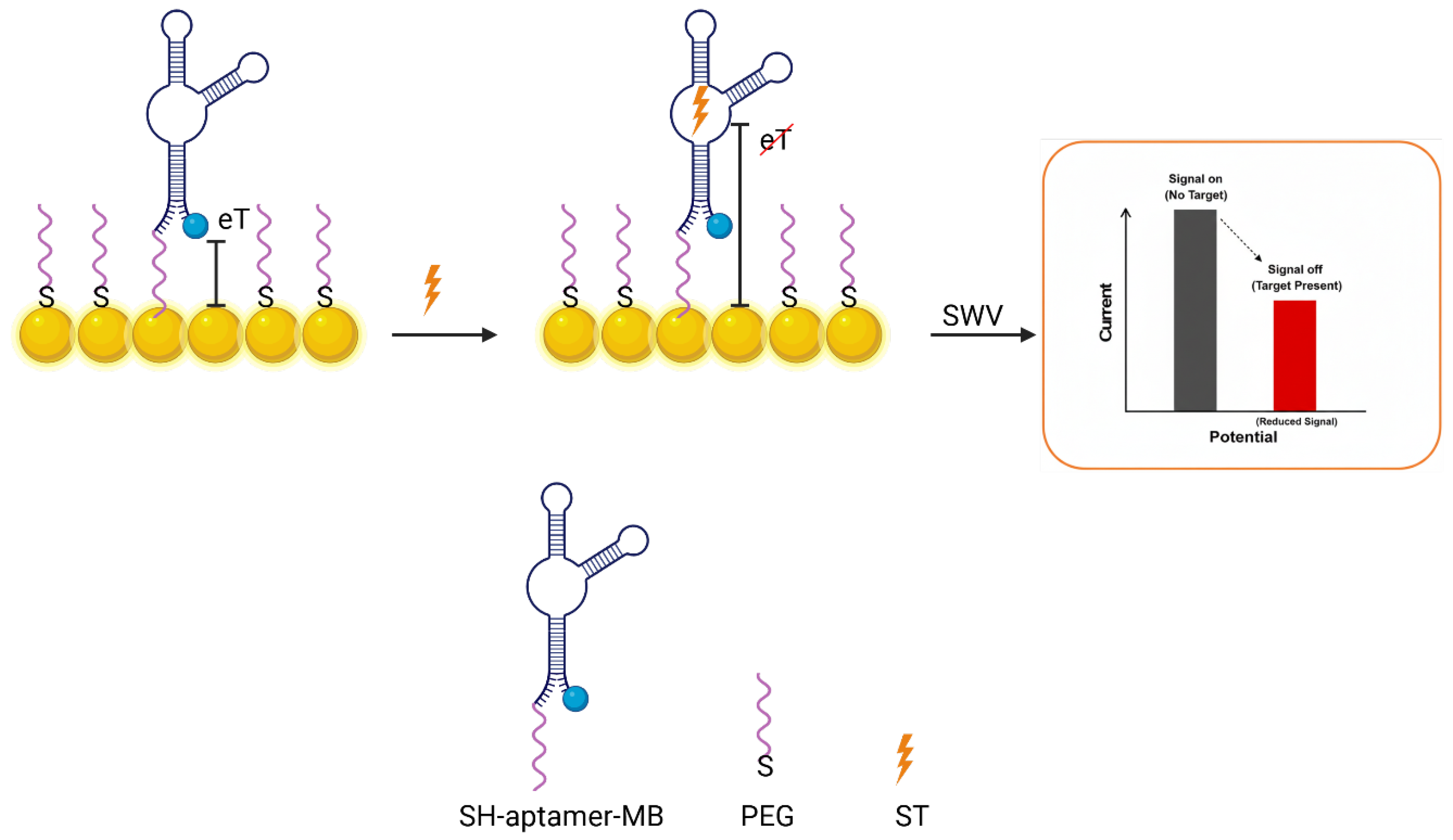
| Aptamer end-tethering + mixed monolayer backfilling | DNA/RNA aptamers; synthetic end-modification (5′ or 3′) | Single-point attachment via terminal azide/alkyne/thiol; use diluents to tune density and avoid crowding | CuAAC/SPAAC; Thiol–Au SAM; Thiol-ene photoclick for polymeric substrates/patterning | Defined orientation; tunable distance improves target access and folding | Crowding reduces binding; backfilling affects SAM stability |
| Substrate | Activation/Primer | Surface Handle (s) Installed | Click Reaction (s) | Wearable-Specific Guidance |
|---|---|---|---|---|
| Gold thin films on flexible carriers | Self-assembled monolayers (SAMs) of thiols; mixed SAMs with OEG/alkanol diluents | –N3, –C≡CH, strained alkyne, or tetrazine termini on alkanethiols | SPAAC or Tz–TCO IEDDA to CuAAC | Highest molecular-level control. Use mixed SAMs to avoid crowding; validate after bending/sweat exposure |
| Metal oxides and metal-coated foils | O2 plasma or UV/ozone hydroxylation followed by silanization | Azido-/alkynyl–silanes; Tz- or TCO–silanes for IEDDA; aminosilanes as a relay | SPAAC or IEDDA to CuAAC | Silanes are versatile but water-sensitive. Confirm monolayer formation and mechanical integrity. Prefer copper-free clicks for skin-contacting electrodes |
| Printed carbon and laser-induced graphene | Aryldiazonium electrografting; mild electro-oxidation to –COOH followed by amide coupling of propargylamine | Aryl–N3 or aryl–C≡CH motifs on carbon; alternatively, –COOH converted to alkyne-bearing amides | CuAAC to SPAAC | Control grafting density to avoid insulating multilayers. Diazonium layers can overgrow; use short electrografting times/pulse |
| Graphene/CNT films and papers | Controlled covalent functionalization or noncovalent π–π anchoring to preserve the sp2 lattice | Sparse –N3/alkyne handles on the lattice or on π–π adsorbed linkers (pyrene–alkyne, pyrene–N3) | SPAAC to CuAAC | Minimize defect density to preserve conductivity; quantify before/after functionalization. Use longer, flexible spacers to reduce strain transfer during bending |
| Conductive polymers on flexible electronics | Direct formation of a click-bearing polymer film, or deposit a clickable primer layer | Pendant –N3 (common) or alkyne groups integrated into polymer backbone/side chains | SPAAC to CuAAC | Enables conformal functionalization with minimal thickness penalty. Avoid harsh redox conditions that over-oxidize PEDOT |
| Silicone elastomers | O2 plasma to generate –Si–OH, then immediate silanization. Alternative: formulate with vinyl/norbornene groups for thiol-ene grafting | Surface –N3 or –C≡CH via silane monolayer; bulk/surface vinyl or norbornene groups for thiol-ene | SPAAC to Thiol-ene to CuAAC | Time-sensitive: PDMS hydrophobic recovery demands immediate silanization. For stretch, use compliant spacers and avoid brittle multilayers |
| Thermoplastic polymer films | O2 plasma/UV-ozone + adhesive primer | Commonly surface –N3 (via primer/polymer) or –C≡CH; for fastest wet coupling: Tz/TCO pairs in primer layer | SPAAC or IEDDA to Thiol-ene to CuAAC | Choose aqueous/solvent-minimized steps to prevent swelling/crazing. Consider antifouling co-functionalization |
| Textiles and cellulose-based substrates | Cellulose: C6-azidation or chemo-enzymatic oxidation + reductive amination to install –N3 | Cellulose: surface –N3 or –C≡CH; synthetics: –N3/alkyne on coating/primer | SPAAC to CuAAC to Thiol-ene | Design for laundering/abrasion: favor covalent grafts + flexible spacers. If CuAAC is used, apply exhaustive rinsing + Cu chelation to minimize residual Cu |
| Hydrogel/bioadhesive interfaces | Build handles into the network (NB/ene + thiol; or Tz/TCO). Photopatterning or bulk gelation can introduce gradients/compartments | Norbornene/ene + thiols; tetrazine + TCO | Thiol-ene/yne photoclick to IEDDA | Prefer visible-light initiators for skin/biomolecule compatibility; avoid excessive radical load that can inactivate enzymes |
| MXenes and other emerging 2D materials | Exploit surface terminations for covalent derivatization; install azides via coupling chemistry | Surface –N3 or Tz/TCO, where compatible | SPAAC (metal-free, bioorthogonal coupling on nanosheets) to IEDDA | Protect from oxidation. Confirm functionalization does not collapse conductivity |
Disclaimer/Publisher’s Note: The statements, opinions and data contained in all publications are solely those of the individual author(s) and contributor(s) and not of MDPI and/or the editor(s). MDPI and/or the editor(s) disclaim responsibility for any injury to people or property resulting from any ideas, methods, instructions or products referred to in the content. |
© 2026 by the authors. Licensee MDPI, Basel, Switzerland. This article is an open access article distributed under the terms and conditions of the Creative Commons Attribution (CC BY) license.
Share and Cite
Merkezoğlu, R.; Yılmaz, Ö.; Kızılkurtlu, A.A. Beyond Self-Assembly: Bioorthogonal ‘Click’ Chemistry Strategies for Robust Electrochemical Interfaces in Wearable Biosensors. Biosensors 2026, 16, 181. https://doi.org/10.3390/bios16030181
Merkezoğlu R, Yılmaz Ö, Kızılkurtlu AA. Beyond Self-Assembly: Bioorthogonal ‘Click’ Chemistry Strategies for Robust Electrochemical Interfaces in Wearable Biosensors. Biosensors. 2026; 16(3):181. https://doi.org/10.3390/bios16030181
Chicago/Turabian StyleMerkezoğlu, Roy, Özgür Yılmaz, and Ahmet Akif Kızılkurtlu. 2026. "Beyond Self-Assembly: Bioorthogonal ‘Click’ Chemistry Strategies for Robust Electrochemical Interfaces in Wearable Biosensors" Biosensors 16, no. 3: 181. https://doi.org/10.3390/bios16030181
APA StyleMerkezoğlu, R., Yılmaz, Ö., & Kızılkurtlu, A. A. (2026). Beyond Self-Assembly: Bioorthogonal ‘Click’ Chemistry Strategies for Robust Electrochemical Interfaces in Wearable Biosensors. Biosensors, 16(3), 181. https://doi.org/10.3390/bios16030181