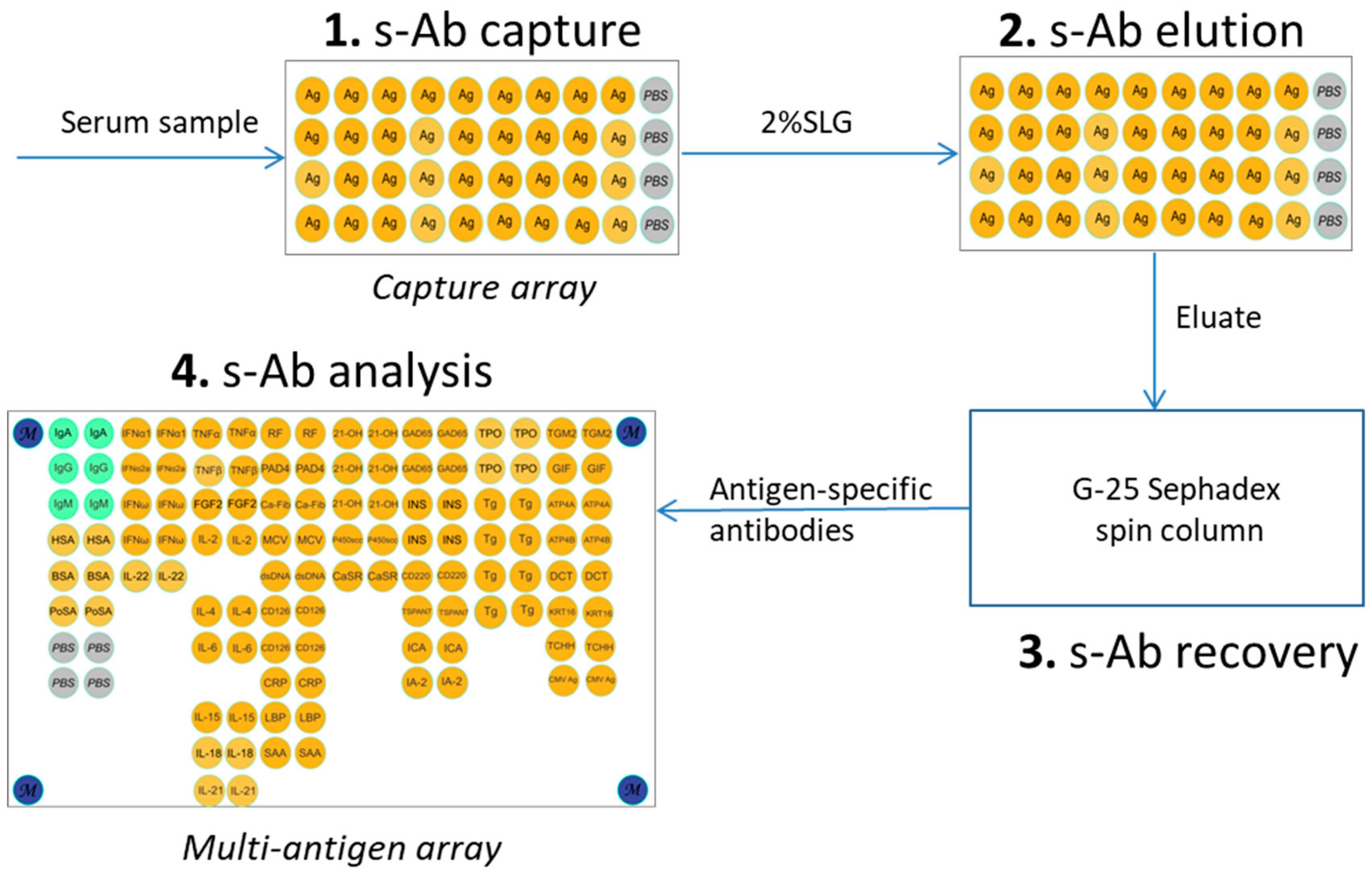
Anionic Detergents as Eluents for Microscale Isolation of Antigen-Specific Serum Immunoglobulins

 , , , ,
  and
and
Abstract
1. Introduction
2. Materials and Methods
2.1. Serum Samples
2.2. Fabrication of Micro-Immunosorbents
2.2.1. Capture Arrays
2.2.2. Magnetic Beads
2.3. Anionic Detergents
2.4. Research Methodology
2.4.1. Antigen-Specific Immunoglobulin Isolation with Protein Arrays
2.4.2. Antigen-Specific Immunoglobulin Isolation with Magnetic Beads
2.4.3. Total IgG Isolation with Magnetic Beads
2.5. Recovery of Individual Antigen-Specific Immunoglobulins
2.5.1. Gel Filtration
2.5.2. Dialysis
2.6. Analysis of Isolated Immunoglobulins
2.6.1. SDS-PAGE and Western Blot
2.6.2. Multiplex Assay on Multi-Antigen Array
2.7. Direct Analysis of Antibodies on the Microarray
3. Results
3.1. Selection of Anionic Detergents as Eluents
3.2. Microscale Isolation of Serum Antibodies Using Anionic Detergent Elution: Proof of Concept
3.3. Evaluation of the Developed Elution Method Using Magnetic Particles as an Immunosorbent
4. Discussion
5. Conclusions
Supplementary Materials
Author Contributions
Funding
Institutional Review Board Statement
Informed Consent Statement
Data Availability Statement
Acknowledgments
Conflicts of Interest
Abbreviations
| Ab | Antibody |
| Ag | Antigen |
| BSA | Bovine serum albumin |
| CMV | Cytomegalovirus |
| Ig | Immunoglobulin |
| INS | Insulin |
| Sarcosyl | Sodium lauryl sarcosinate |
| SDS | Sodium dodecyl sulfate |
| SDS-PAGE | Sodium dodecyl sulfate–polyacrylamide gel electrophoresis |
| SLG | Sodium lauroyl glutamate |
| Tg | Thyroglobulin |
References
- Krištić, J.; Lauc, G. The importance of IgG glycosylation-What did we learn after analyzing over 100,000 individuals. Immunol. Rev. 2024, 328, 143–170. [Google Scholar] [CrossRef]
- Gudelj, I.; Lauc, G.; Pezer, M. Immunoglobulin G glycosylation in aging and diseases. Cell. Immunol. 2018, 333, 65–79. [Google Scholar] [CrossRef]
- Mouquet, H.; Nussenzweig, M.C. Polyreactive antibodies in adaptive immune responses to viruses. Cell. Mol. Life Sci. 2012, 69, 1435–1445. [Google Scholar] [CrossRef]
- Rojas, M.; Restrepo-jiménez, P.; Monsalve, D.M.; Pacheco, Y.; Acosta-ampudia, Y.; Ramírez-santana, C.; Leung, P.S.C.; Ansari, A.A.; Gershwin, M.E.; Anaya, J. Molecular mimicry and autoimmunity. J. Autoimmun. 2018, 95, 100–123. [Google Scholar] [CrossRef] [PubMed]
- Kurien, B.T. Membrane Strip Affinity Purification of Autoantibodies; Methods in Molecular Biology; Springer: Berlin/Heidelberg, Germany, 2015; pp. 257–267. [Google Scholar] [CrossRef]
- Mendis, T.; Filipova, B.; Wang, J.J.; Pietropaolo, M.; Jackson, M.W. Affinity purification of serum-derived anti-IA-2 autoantibodies in type 1 diabetes using a novel MBP-IA-2 fusion protein. Biochem. Biophys. Rep. 2023, 33, 101413. [Google Scholar] [CrossRef] [PubMed]
- Safarik, I.; Safarikova, M. Magnetic techniques for the isolation and purification of proteins and peptides. Biomagn. Res. Technol. 2004, 2, 7. [Google Scholar] [CrossRef]
- Arakawa, T.; Philo, J.S.; Tsumoto, K.; Yumioka, R.; Ejima, D. Elution of antibodies from a Protein-A column by aqueous arginine solutions. Protein Expr. Purif. 2004, 36, 244–248. [Google Scholar] [CrossRef]
- McMahon, M.J.; O’Kennedy, R. Polyreactivity as an acquired artefact, rather than a physiologic property, of antibodies: Evidence that monoreactive antibodies may gain the ability to bind to multiple antigens after exposure to low pH. J. Immunol. Methods 2000, 241, 1–10. [Google Scholar] [CrossRef] [PubMed]
- Djoumerska-Alexieva, I.K.; Dimitrov, J.D.; Nacheva, J.; Kaveri, S.V.; Vassilev, T.L. Protein destabilizing agents induce polyreactivity and enhanced immunomodulatory activity in IVIg preparations. Autoimmunity 2009, 42, 365–367. [Google Scholar] [CrossRef]
- Arakawa, T.; Akuta, T. Mechanistic Insight into Poly-Reactivity of Immune Antibodies upon Acid Denaturation or Arginine Mutation in Antigen-Binding Regions. Antibodies 2023, 12, 64. [Google Scholar] [CrossRef]
- Arakawa, T.; Niikura, T.; Kita, Y.; Akuta, T. Sodium Dodecyl Sulfate Analogs as a Potential Molecular Biology Reagent. Curr. Issues Mol. Biol. 2024, 46, 621–633. [Google Scholar] [CrossRef]
- Schlager, B.; Straessle, A.; Hafen, E. Use of anionic denaturing detergents to purify insoluble proteins after overexpression. BMC Biotechnol. 2012, 12, 95. [Google Scholar] [CrossRef] [PubMed]
- Chisnall, B.; Johnson, C.; Kulaberoglu, Y.; Chen, Y.W. Insoluble Protein Purification with Sarkosyl: Facts and Precautions; Methods in Molecular Biology; Springer: Berlin/Heidelberg, Germany, 2014; pp. 179–186. [Google Scholar] [CrossRef]
- Savvateeva, E.; Yukina, M.; Nuralieva, N.; Bykova, S.; Abramov, I.; Polyakova, V.; Bodunova, N.; Donnikov, M.; Kovalenko, L.; Mazurenko, E.; et al. IgA Antibodies to Bovine Serum Albumin in Adult Patients with Celiac Disease. Int. J. Mol. Sci. 2025, 26, 4988. [Google Scholar] [CrossRef]
- Savvateeva, E.N.; Yukina, M.Y.; Nuralieva, N.F.; Filippova, M.A.; Gryadunov, D.A.; Troshina, E.A. Multiplex Autoantibody Detection in Patients with Autoimmune Polyglandular Syndromes. Int. J. Mol. Sci. 2021, 22, 5502. [Google Scholar] [CrossRef]
- Lysov, Y.; Barsky, V.; Urasov, D.; Urasov, R.; Cherepanov, A.; Mamaev, D.; Yegorov, Y.; Chudinov, A.; Surzhikov, S.; Rubina, A.; et al. Microarray analyzer based on wide field fluorescent microscopy with laser illumination and a device for speckle suppression. Biomed. Opt. Express 2017, 8, 4798. [Google Scholar] [CrossRef]
- Nimmerjahn, F.; Vidarsson, G.; Cragg, M.S. Effect of posttranslational modifications and subclass on IgG activity: From immunity to immunotherapy. Nat. Immunol. 2023, 24, 1244–1255. [Google Scholar] [CrossRef]
- Firer, M. Efficient elution of functional proteins in affinity chromatography. J. Biochem. Biophys. Methods 2001, 49, 433–442. [Google Scholar] [CrossRef]
- Madara, P.J.; Banghart, L.R.; Jack, L.J.W.; Neira, L.M.; Mather, I.H. Affinity purification of polyclonal antibodies from antigen immobilized in situ in sodium dodecyl sulfate-polyacrylamide gels. Anal. Biochem. 1990, 187, 246–250. [Google Scholar] [CrossRef] [PubMed]
- Brown, E.P.; Normandin, E.; Osei-Owusu, N.Y.; Mahan, A.E.; Chan, Y.N.; Lai, J.I.; Vaccari, M.; Rao, M.; Franchini, G.; Alter, G.; et al. Microscale purification of antigen-specific antibodies. J. Immunol. Methods 2015, 425, 27–36. [Google Scholar] [CrossRef] [PubMed]
- Shehadul Islam, M.; Aryasomayajula, A.; Selvaganapathy, P. A Review on Macroscale and Microscale Cell Lysis Methods. Micromachines 2017, 8, 83. [Google Scholar] [CrossRef]
- Buscajoni, L.; Martinetz, M.C.; Berkemeyer, M.; Brocard, C. Refolding in the modern biopharmaceutical industry. Biotechnol. Adv. 2022, 61, 108050. [Google Scholar] [CrossRef] [PubMed]
- Carratalá, J.V.; Atienza-Garriga, J.; López-Laguna, H.; Vázquez, E.; Villaverde, A.; Sánchez, J.M.; Ferrer-Miralles, N. Enhanced recombinant protein capture, purity and yield from crude bacterial cell extracts by N-Lauroylsarcosine-assisted affinity chromatography. Microb. Cell Factories 2023, 22, 81. [Google Scholar] [CrossRef] [PubMed]
- Gram, H.; Theologidis, V.; Boesen, T.; Jensen, P.H. Sarkosyl differentially solubilizes patient-derived alpha-synuclein fibril strains. Front. Mol. Biosci. 2023, 10, 1177556. [Google Scholar] [CrossRef]
- Gryadunov, D.A.; Shaskolskiy, B.L.; Nasedkina, T.V.; Rubina, A.Y.; Zasedatelev, A.S. The EIMB Hydrogel Microarray Technology: Thirty Years Later. Acta Naturae 2018, 10, 4–18. [Google Scholar] [CrossRef] [PubMed]



| SDS (Strong Denaturant) | Sarcosyl (Mild) | SLG (Mild) | |
|---|---|---|---|
| Chemical structure | CH3-(CH2)11- -O-SO3− Na+ | CH3-(CH2)10- -C(O)-N(CH3)-CH2-COO− Na+ | CH3-(CH2)10- -C(O)-NH-CH(COO−)-(CH2)2-COO− Na+ |
| Alkyl tail length | Longest | Shorter | Shorter |
| Head group polarity | Least polar | More polar | Most polar |
| Interaction with proteins | Strong, Aggressive | Weaker, Gentle | Weakest, Gentle |
| Effect on protein structure | Irreversible denaturation | Preserves native structure | Preserves native structure |
| Known use | Complete unfolding SDS-PAGE, Western blot stripping | Gentle solubilization Inclusion bodies protein extraction | Gentle solubilization Inclusion bodies protein extraction |
Disclaimer/Publisher’s Note: The statements, opinions and data contained in all publications are solely those of the individual author(s) and contributor(s) and not of MDPI and/or the editor(s). MDPI and/or the editor(s) disclaim responsibility for any injury to people or property resulting from any ideas, methods, instructions or products referred to in the content. |
© 2025 by the authors. Licensee MDPI, Basel, Switzerland. This article is an open access article distributed under the terms and conditions of the Creative Commons Attribution (CC BY) license.
Share and Cite
Trukhin, D.; Filippova, M.; Tskaeva, A.; Troshina, E.; Gryadunov, D.; Savvateeva, E. Anionic Detergents as Eluents for Microscale Isolation of Antigen-Specific Serum Immunoglobulins. Biosensors 2026, 16, 22. https://doi.org/10.3390/bios16010022
Trukhin D, Filippova M, Tskaeva A, Troshina E, Gryadunov D, Savvateeva E. Anionic Detergents as Eluents for Microscale Isolation of Antigen-Specific Serum Immunoglobulins. Biosensors. 2026; 16(1):22. https://doi.org/10.3390/bios16010022
Chicago/Turabian StyleTrukhin, Dmitry, Marina Filippova, Alla Tskaeva, Ekaterina Troshina, Dmitry Gryadunov, and Elena Savvateeva. 2026. "Anionic Detergents as Eluents for Microscale Isolation of Antigen-Specific Serum Immunoglobulins" Biosensors 16, no. 1: 22. https://doi.org/10.3390/bios16010022
APA StyleTrukhin, D., Filippova, M., Tskaeva, A., Troshina, E., Gryadunov, D., & Savvateeva, E. (2026). Anionic Detergents as Eluents for Microscale Isolation of Antigen-Specific Serum Immunoglobulins. Biosensors, 16(1), 22. https://doi.org/10.3390/bios16010022