Review

Role of Polymeric Stabilizing Agents as a Molecular Spacer in Gold Nanoparticle-Mediated FRET-Based Biosensing


by
Atul Kumar Tiwari
1,* and
Roger J. Narayan
2,*
1
Department of Chemistry, Indian Institute of Technology (BHU), Varanasi 221005, India
2
Joint Department of Biomedical Engineering, University of North Carolina, Chapel Hill, NC 27695, USA
*
Authors to whom correspondence should be addressed.
Biosensors 2025, 15(9), 593; https://doi.org/10.3390/bios15090593
Submission received: 16 June 2025 / Revised: 29 August 2025 / Accepted: 1 September 2025 / Published: 9 September 2025

Abstract

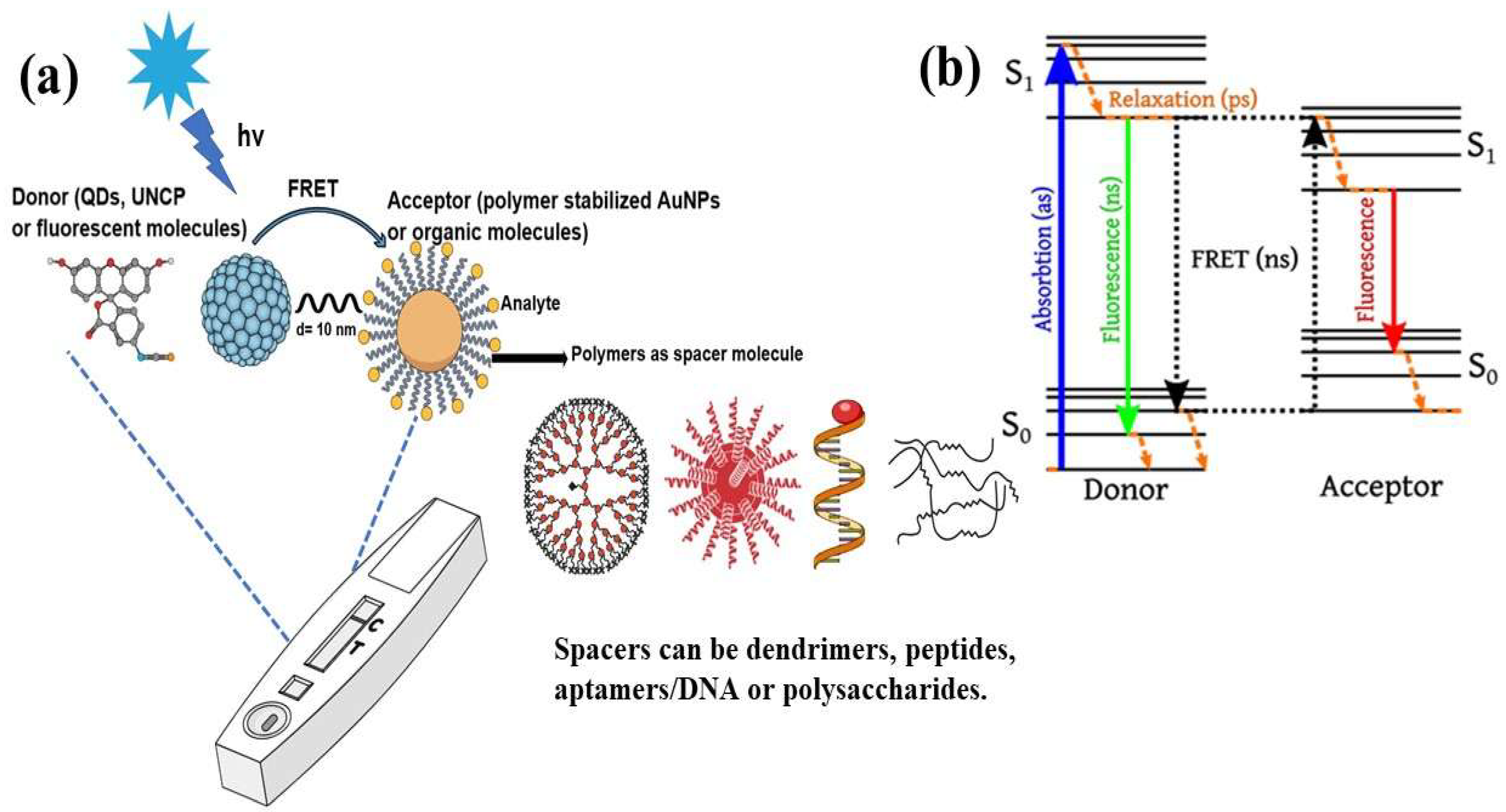
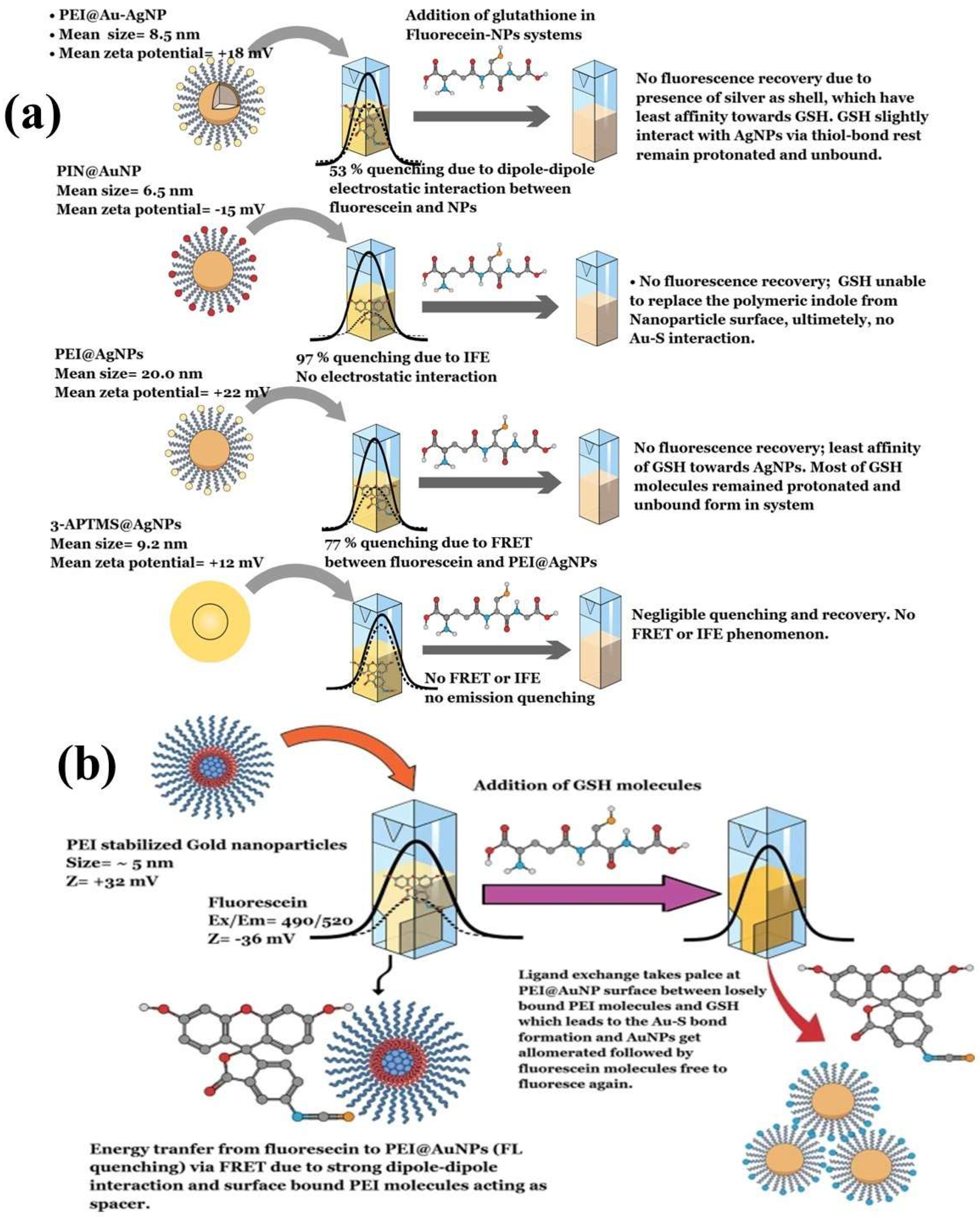
In FRET-based sensing, the interaction between the analytes and metal nanoparticles is significantly regulated by the physicochemical characteristics of the nanoparticles, such as their shape, size, zeta potential, surface-linked ligands, doping, pH of the medium, particle surface roughness, and lattice structure (atomic arrangements). During the synthesis process, to avert the aggregation of gold nanoparticles (AuNPs), synthetic polymers (including polyethylene glycol, polyethyleneimine, and poly-N-vinylpyrrolidone) and natural polymers (such as chitosan, starch, gellan, welan, and κ-carrageenan) are frequently employed for stabilization. This stabilization is accomplished through mechanisms such as steric repulsion and electrostatic stabilization, which form a protective layer around AuNPs. These stabilizing polymers act as molecular spacers in nanoparticle-based FRET sensing, enabling the precise regulation of the molecular distance between the acceptor and donor fluorophore molecules. This regulation enhances the efficiency and sensitivity of FRET assays. By modifying the length and flexibility of the spacer polymer, researchers can adjust the spacing between fluorophores, ensuring effective energy transfer and the accurate detection of target molecules. However, there is a limited understanding of the role and broad application of these molecular spacers in nanoparticle-mediated FRET-based sensing of various analytes. Consequently, this review explores different fundamental aspects of FRET, polymeric stabilization of gold nanoparticles, and various polymeric spacers in FRET-based sensing, along with the recent advancements and challenges associated with this approach.
Keywords: FRET; molecular spacer; synthetic polymers; gold nanoparticles; biosensing FRET; molecular spacer; synthetic polymers; gold nanoparticles; biosensing