Review

Advancements and Prospects of Metal-Organic Framework-Based Fluorescent Sensors


1
Department of Food & Biological Engineering, Jiangsu University, Zhenjiang 212013, China
2
Food and Drug Supervision and Inspection Center in Zhenjiang, Zhenjiang 212000, China
*
Author to whom correspondence should be addressed.
These authors contributed equally to this work.
Biosensors 2025, 15(11), 709; https://doi.org/10.3390/bios15110709
Submission received: 25 September 2025 / Revised: 21 October 2025 / Accepted: 22 October 2025 / Published: 24 October 2025
(This article belongs to the Section Biosensor Materials)

Abstract

Metal-organic frameworks (MOFs), a class of crystalline porous materials featuring a high specific surface area, tunable pore structures, and functional surfaces, exhibit remarkable potential in fluorescent sensing. This review systematically summarizes recent advances in the construction strategies, sensing mechanisms, and applications of MOF-based fluorescent sensors. It begins by highlighting the diverse degradation pathways that MOFs encounter in practical applications, including hydrolysis, acid/base attack, ligand displacement by coordinating anions, photodegradation, redox processes, and biofouling, followed by a detailed discussion of corresponding stabilization strategies. Subsequently, the review elaborates on the construction of sensors based on individual MOFs and their composites with metal nanomaterials, MOF-on-MOF heterostructures, covalent organic frameworks (COFs), quantum dots (QDs), and fluorescent dyes, emphasizing the synergistic effects of composite structures in enhancing sensor performance. Furthermore, key sensing mechanisms such as fluorescence quenching, fluorescence enhancement, Stokes shift, and multi-mechanism coupling are thoroughly examined, with examples provided of their application in detecting biological analytes, environmental pollutants, and food contaminants. Finally, future directions for MOF-based fluorescent sensors in food safety, environmental monitoring, and clinical diagnostics are outlined, pointing to the development of high-performance, low-cost MOFs; the integration of multi-technology platforms; and the construction of intelligent sensing systems as key to enabling their practical deployment and commercialization.

1. Introduction

MOFs are crystalline porous materials formed by the coordination of organic ligands with metal centers (metal ions or metal clusters) [1,2]. These materials possess a periodic network structure and combine the rigidity of inorganic materials with the flexibility of organic ones, often referred to as coordination polymers [3]. The metal ions (such as copper, zinc, iron, cobalt, aluminum, etc.) or metal clusters (such as Zn4O) act as nodes within the framework, dictating the chemical properties and structural stability of the MOF [4,5]. Organic ligands, typically organic molecules with multiple coordination sites (such as terephthalic acid, imidazole, pyridine, etc.), coordinate with metal ions to form two-dimensional or three-dimensional network structures [6,7]. The type of organic ligand and its mode of connection directly influence the pore structure, surface properties, and functional characteristics of the MOF [8,9]. This structural programmability extends to their photophysical properties, as the choice of metal centers (e.g., luminescent Ln3+ ions or transition metals involved in charge transfer) and organic ligands (e.g., conjugated molecules serving as antennas) fundamentally determines the origins of MOF fluorescence, which can stem from the ligand-centered, metal-centered, or charge-transfer states [10].
MOFs are composed of organic ligands as pillars and metal centers as nodes, allowing the classification of MOF materials into various categories, including IRMOFs [11,12], ZIFs [13,14], MILs [15,16], Porous Coordination Networks (PCNs) [17,18], and the University of Oslo (UiO) series [19,20,21,22]. Different types of MOFs can be interconverted by modifying their structure or altering one of their constituent elements [23]. Among these, IRMOFs are microporous crystalline materials formed by the self-assembly of discrete secondary structural units, such as the [Zn4O]6+ inorganic cluster, bridged by a series of aromatic carboxylate ligands in an octahedral arrangement [24]. ZIFs are MOFs with zeolite-like structures, synthesized by the reaction of Zn(II) or Co(II) with imidazole ligands [25,26,27]. MILs are obtained by combining various transition metals with dicarboxylate ligands such as fumaric acid and adipic acid. Coordination Pillared-Layer are constructed by coordinating hexacoordinate metal elements with neutral nitrogen-containing heterocyclic ligands, such as 2,2′-bipyridine, 4,4′-bipyridine, and phenols. The PCN series contains multiple cubic octahedral nanoporous cages, forming a cage-channel topological structure. UiO materials are characterized by zirconium-containing octahedral clusters [Zr6O4(OH)4], which are linked with twelve benzene-1,4-dicarboxylic acid (BDC) organic ligands, resulting in a three-dimensional microporous structure containing octahedral central cages and tetrahedral corner cages [28,29,30]. HKUST-1([Cu3(BTC)2(H2O)3]n), alternately referred to CuBTC or MOF-199. HKUST-1 is constructed from Cu2+ and 1,3,5-benzene tricarboxylic acid (H3BTC/BTC). With its paddle-wheel-like crystal lattice and many vacant metal centers, the compound has a highly porous, three-dimensional structure. This review mainly focuses on these six most common and frequently used MOF series for constructing fluorescence sensors based on MOFs. The common metal centers and ligands of these six MOF series are summarized in Table 1.
Due to the active metal sites, well-defined topological structures, high crystallinity, inherent porosity, and chemical stability of MOFs [31,32,33], these materials can mimic the catalytic centers and coordination environments of natural enzymes [34,35,36]. MOFs are often employed as nanomimetics in conjunction with biological enzymes for biosensing applications [37,38,39,40]. The tunability of MOF materials allows for the design and optimization of their performance by selecting different metal centers and organic ligands as needed [41,42]. This precise control is crucial for engineering fluorescence sensing mechanisms. By strategically designing ligands and selecting metal nodes, one can modulate electron transfer (e.g., Photoinduced Electron Transfer, PET) and energy migration (e.g., Fluorescence Resonance Energy Transfer, FRET) pathways within the MOF, which form the basis for the fluorescence response to analyses [43]. Compared to other traditional porous materials, MOFs exhibit an exceptionally high specific surface area and well-defined pore structures, enabling effective accommodation of guest molecules [2,44]. This unique feature underpins the versatility of MOFs and their broad range of potential applications.
Currently, high-performance liquid chromatography (HPLC) and gas chromatography (GC), combined with mass spectrometry (MS) or other advanced technologies, remain the preferred methods for detection across various fields. However, in underdeveloped laboratories or regions with limited resources, complex sample pretreatment, expensive laboratory equipment, and the need for highly trained personnel pose significant barriers to their implementation [45,46]. Therefore, there is an urgent need for detection strategies that are highly selective, accurate, and simple, with low costs [47,48,49]. Optical sensors based on molecular or nanostructured materials offer significant advantages, including short response times, ease of operation, low costs, and the potential for visual detection [29,50,51,52]. Notably, MOF-based fluorescent sensors have garnered increasing attention due to their high sensitivity to target analytes. Fluorescent emission from these sensors can arise from both the ligands and metal nodes, which can be finely tuned through interactions between the nanoparticles. Moreover, the incorporation of external materials into the MOF can induce changes in fluorescence intensity. Beyond intensity-based signals, the interaction with an analyte can alter fundamental photophysical parameters such as fluorescence lifetime and quantum yield. Monitoring these changes provides a robust sensing modality that can circumvent issues like probe concentration variations and background interference, offering enhanced reliability for quantitative analysis [53]. In summary, the composition of the MOF, the coordination environment of its metal nodes, its pore structure, and the interactions between the luminescent MOF and target molecules collectively contribute to a variety of fluorescence changes [54,55]. MOF-based fluorescence sensing technologies, due to their high sensitivity, rapid response, portability, and visual detection, have been widely applied in the detection of pathogenic bacteria [56,57,58], metal ions [59,60,61,62], pesticide residues [63,64,65,66,67], antibiotic residues [68,69,70,71,72], and toxins [73,74,75,76,77,78].
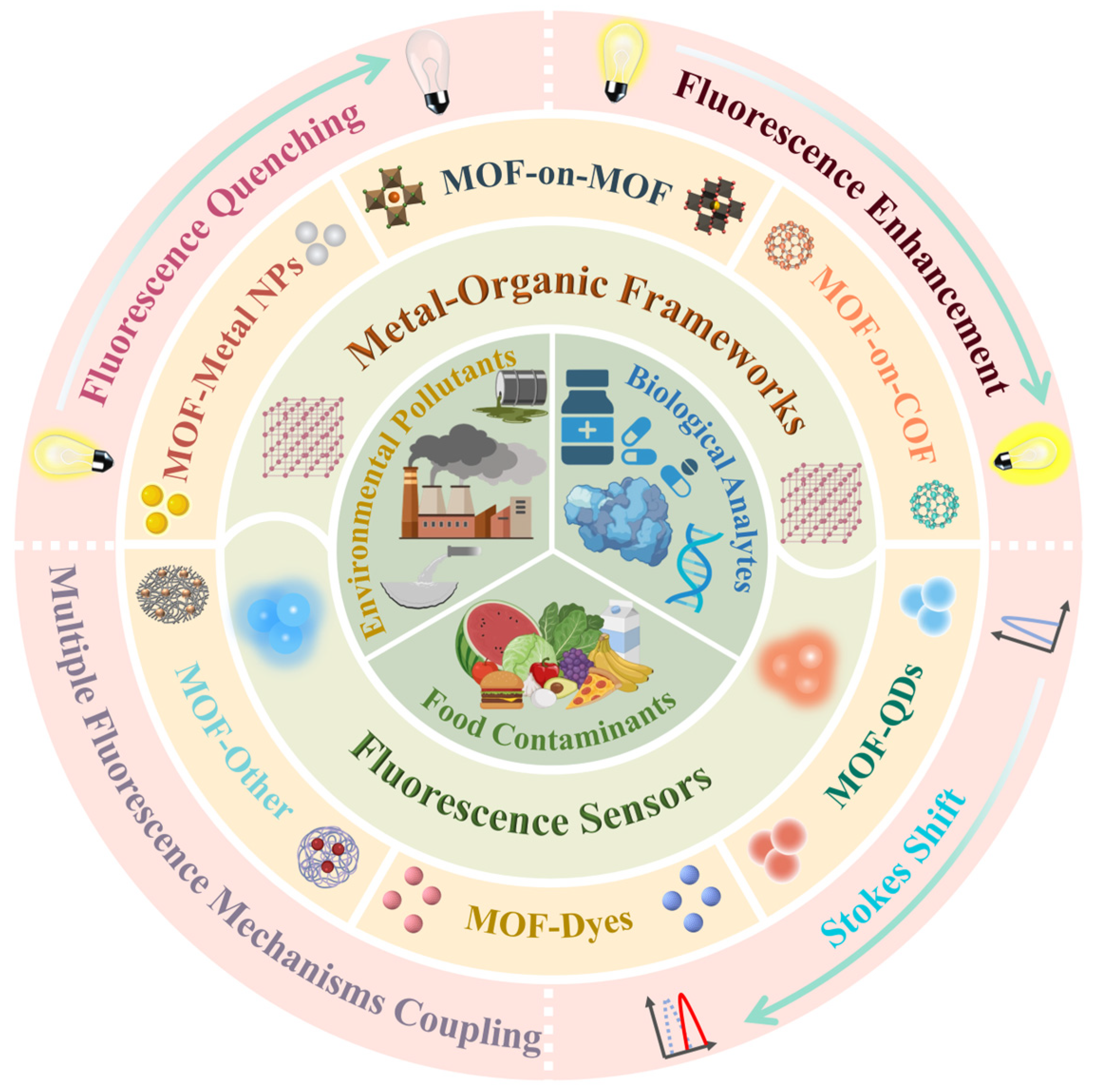
Despite their aforementioned remarkable advantages, the full exploitation of metal-organic frameworks (MOFs) in practical fluorescent sensing necessitates a systematic and in-depth understanding spanning material stability, diverse architectural design, and underlying photophysical mechanisms. This review aims to provide a comprehensive overview of the latest advancements in this rapidly evolving field. It will commence by systematically analyzing the degradation pathways that threaten MOF performance in practical applications and the corresponding stabilization strategies. Subsequently, the fluorescence sensing mechanisms of MOF-based sensors, including quenching, enhancement, Stokes shift, and multi-mechanism coupling, will be thoroughly elucidated with representative examples. Furthermore, the construction strategies of various MOF fluorescent sensor architectures—ranging from individual MOFs to sophisticated composites incorporating metal nanoparticles, other MOFs, COFs, QDs, and fluorescent dyes—will be detailed, highlighting the synergistic effects that enhance performance. The applications of these sensors in detecting biological analytes, environmental pollutants, and food contaminants will be extensively discussed to demonstrate their versatility and efficacy. Finally, the review will conclude by outlining future research directions and remaining challenges, pointing toward the development of high-performance, intelligent sensing systems for practical deployment in fields such as food safety, environmental monitoring, and clinical diagnostics (Scheme 1).
While previous reviews have, respectively, focused on specific photophysical mechanisms (e.g., Zhao et al. [79]), diverse functional roles in biosensing (e.g., Du et al. [80]), or the design of luminescent MOFs for targeted analytes (e.g., Dong et al. [81]), this review distinctively provides a systematic treatise that integratively links material stability, a broad spectrum of fluorescence mechanisms, and sophisticated multi-component sensor architectures.

2. Degradation Pathways and Stabilization Strategies for MOFs

MOF sensors face multiple severe chemical and physical challenges in practical applications, including water, acids/bases, anions, light, redox-active substances, and biofouling. These degradation pathways not only destroy their crystalline structure but also directly lead to the destabilization, drift, or quenching of fluorescence signals, severely limiting the sensors’ reliability, operational lifetime, and application scope. Therefore, an in-depth understanding of these degradation mechanisms is a prerequisite for “targeted treatment.” The following sections will first systematically elaborate on the main degradation pathways of MOFs, laying the groundwork for subsequently discussing targeted stabilization strategies.

2.1. Main Degradation Pathways of MOFs

2.1.1. Hydrolysis

Liquid water or high-humidity environments represent the most prevalent threat to MOF sensors. Water molecules attack the metal/ligand coordination bonds, displacing the organic ligands through coordination substitution and leading to framework dissociation [82]. Taking the classic HKUST-1 (Cu-BTC) as an example, its coordinatively unsaturated Cu2+ sites possess high affinity for water molecules [83]. Water molecules attack the Cu-O bonds via a “push-and-twist” mechanism, ultimately causing the framework to collapse and transform into a non-porous hydrated phase [84]. For fluorescent sensors, framework hydrolysis not only leads to the failure of the pore structure but also directly causes fluorescence quenching or signal drift, resulting in complete sensor deactivation.

2.1.2. Acid/Base Attack

MOF materials degrade under the influence of acids or bases, with mechanisms categorized as acid degradation and base degradation. Under acidic conditions, H+ competes with metal ions for coordination sites on the organic ligands, protonating the ligands (especially carboxylates) and breaking the metal/ligand bonds [82]. Under alkaline conditions, nucleophiles like OH readily attack and displace the organic linkers or bind to metal ions within the MOF clusters [85]. Studies have shown that MOFs composed of high-valent metal ions and carboxylate ligands exhibit significant stability in acidic environments but poor stability in alkaline environments, such as PCN-222 [86]. In contrast, MOFs composed of low-valent metal ions and nitrogen-containing azolate-based ligands are prone to decomposition under acidic conditions but demonstrate good stability in alkaline solutions, such as ZIF-8 [87]. In biosensing applications, pH fluctuations in bodily fluids require MOF sensors to possess a broad pH tolerance range; otherwise, their fluorescence signals will be interfered with by environmental pH [88].

2.1.3. Ligand Displacement by Coordinating Anions

Strong coordinating anions in the environment (e.g., CO32−, PO43−, F, EDTA) compete with the organic ligands in the framework for the metal nodes. These anions have a stronger binding affinity for the metal ions, thereby displacing the original ligands and destroying the framework structure. For instance, UiO-66 rapidly degrades in phosphate buffer solutions due to the high affinity between Zr and phosphate ions [89]; PCN-224(Co) decomposes in solutions containing F and CO32−. Biological samples (e.g., cell culture media, serum) are rich in anions like phosphate, posing a severe challenge to the long-term stability of MOF sensors.

2.1.4. Photodecarboxylation

Under prolonged sunlight (especially UV-Vis) irradiation, MOFs containing carboxylate ligands may undergo photocatalytic reactions, leading to ligand decarboxylation where CO2 is released. This causes framework defects and ligand loss. For example, UiO-66 and MIL-101(Fe) release CO2 after prolonged irradiation, although their crystal structures show no significant changes in XRD patterns, indicating a localized and gradual degradation process [90]. In contrast, MOFs without carboxylate ligands, such as the ZIF series, often exhibit excellent stability under prolonged sunlight exposure [91]. Photodegradation directly leads to the attenuation of sensor signals (photobleaching) and increased background noise, representing a key factor affecting their long-term photostability and service life.

2.1.5. Redox-Driven Degradation

The mechanisms of redox-driven degradation can be primarily divided into reductive degradation and oxidative degradation. In anaerobic environments or in the presence of reducing agents, metal ions within the MOF are reduced, leading to changes in the coordination environment, weakened bond energy, and, ultimately, structural collapse. In applications such as advanced oxidation processes, generated reactive oxygen species (ROS) attack and oxidatively decompose the organic ligands, particularly those with electron-donating groups. When HKUST-1 was used to inhibit Saccharomyces cerevisiae, Cu(I) formed on its surface in the yeast culture, accelerating its degradation [92]. The tetrahedral Co sites in ZIF-67 are oxidized and transformed into CoOOH during electrocatalytic processes, completely destroying the structure [93]. The presence of various redox-active substances in biological systems (e.g., ascorbic acid, ROS) may trigger MOF degradation, leading to biocompatibility issues such as metal ion leakage and interfering with fluorescence detection signals.

2.1.6. Biofouling and Biomolecule Adsorption

In complex biological media (e.g., serum, urine), biomacromolecules such as proteins and polysaccharides non-specifically adsorb onto the MOF surface or block its pores [94]. This biofouling not only hinders the diffusion of target analytes, reducing sensor response speed and sensitivity, but may also directly quench the fluorescence signal or generate non-specific background, leading to significant performance degradation or even sensor failure [95].

2.2. Stabilization Strategies for MOFs

2.2.1. Constructing Strong Coordination Bonds

The core of this strategy is to fundamentally enhance the framework’s stability by selecting thermodynamically more stable metal/ligand pairs based on the Hard-Soft Acid-Base (HSAB) theory [96]. This involves pairing high-valent hard acid metals (Zr4+, Hf4+, Cr3+, Fe3+) with carboxylate hard base ligands, or low-valent soft acid metals (Zn2+, Ni2+) with nitrogen-containing azolate soft base ligands [97]. This is the cornerstone for constructing intrinsically stable MOF fluorescent sensors. For example, the 12-connected Zr6 oxo-cluster in UiO-66(Zr) forms extremely strong Zr-O bonds with terephthalic acid, making it exceptionally stable in water and strong acids, thus serving as an ideal platform for robust sensors [98]. The Zn-N bond formed between Zn and 2-methylimidazole in ZIF-8(Zn) possesses hydrophobicity and inertness, enabling long-term stability in boiling water and alkaline environments.

2.2.2. Optimizing Framework Structure

The core of this strategy is to increase the kinetic energy barrier for framework dissociation, i.e., by optimizing the framework structure to significantly raise the activation energy for its dissociation reaction, thereby maintaining stability within the practical application timeframe [99].
First, increasing the connectivity of the nodes. The connectivity between metal nodes and organic ligands directly determines the framework’s robustness. Higher connectivity means more bonds need to be broken to remove one ligand, making the structure less prone to collapse [82]. The 12-connected Zr6 cluster in UiO-66 is the structural cornerstone of its exceptional stability [100]. Similarly, the 12-connected node composed of [Ni8(OH)4(H2O)2] units in PCN-601, together with tetratopic linkers, forms a high-density network, effectively suppressing the displacement of ligands by solvent molecules [101].
Second, employing short and rigid ligands. The rigidity of the ligand directly influences the energy of the dissociation transition state [85]. Short, rigid ligands require larger bond angle bending during dissociation, necessitating overcoming a higher energy barrier [101]. Research indicates that among porphyrin-based MOFs, PCN-601, which uses the shortest linker TPP4−, exhibits significantly higher kinetic stability than its counterparts using longer or more flexible linkers.

2.2.3. Introducing Hydrophobicity and Protective Layers

This strategy does not alter the strength of the MOF’s chemical bonds but physically blocks destructive molecules like water and anions from contacting the active sites by introducing hydrophobic layers or protective coatings.
One method involves introducing hydrophobic functional groups (e.g., methyl, ethyl, trifluoromethyl) onto the MOF via post-synthetic modification or by directly using functionalized ligands. For example, the methyl groups in ZIF-8 impart hydrophobicity to its pores, increasing the relative pressure for water vapor condensation within the pores, thereby slowing the attack of water molecules on the [ZnN4] units [87]. After hydrophobic modification, MOF-303 can maintain structural integrity after immersion in various salt solutions (e.g., KCl, NaCl, MgCl2) for 50 days.
Another more general strategy is constructing a protective layer on the MOF surface. Covalent grafting of alkyl chains, fluoroalkyl chains, or polymer coating (e.g., polydimethylsiloxane, fluorinated polymers) can form a robust “protective shell.” Studies have shown that the water stability of HKUST-1 is improved by orders of magnitude after coating with a fluorinated polymer [83]. For fluorescent sensors, the protective layer can effectively shield fluorescence quenchers like water and oxygen, significantly enhancing the sensor’s photostability and service life. However, it is important to ensure that the introduced coating does not severely block the MOF pores, to avoid affecting analyte diffusion and sensing kinetics.

2.2.4. Defect Control and Post-Synthetic Repair

Precisely controlling synthesis conditions (e.g., modulator ratio, temperature) or performing post-synthetic treatments (e.g., annealing at a certain temperature) can effectively reduce defects in the MOF, such as missing linkers or metal clusters [102]. Defects are initiation points for water molecules and chemical attacks; reducing defects can fundamentally enhance the intrinsic chemical stability of MOFs. For instance, UiO-66 subjected to post-synthetic annealing shows significantly enhanced water resistance and mechanical stability [103]. A complete, low-defect framework is an important guarantee for obtaining stable and reproducible fluorescence signals.
In summary, the stabilization strategies for MOF fluorescent sensors form a multi-dimensional, synergistic defense system against multiple degradation threats. Constructing strong coordination bonds serves as the cornerstone for enhancing the intrinsic stability of MOFs, fundamentally resisting hydrolysis, acid/base attack, and ligand displacement by coordinating anions. Optimizing the framework structure significantly increases the kinetic energy barrier for framework dissociation, effectively delaying processes such as hydrolysis, anion displacement, and redox-driven degradation. Introducing hydrophobicity and protective layers, as a physical barrier strategy, efficiently isolates the MOF from liquid water, water vapor, strong coordinating anions, and biomacromolecules, thereby avoiding issues like hydrolysis and biofouling, and indirectly improving photostability. Finally, defect control and post-synthetic repair eliminate weak points in the framework, blocking the initial attack sites for water, chemicals, and oxygen, providing a complete and solid structural foundation for all stabilization strategies. By comprehensively applying these strategies, high-performance MOF fluorescent sensors that maintain structural integrity and functional stability in complex chemical and biological environments can be systematically constructed.

3. Detection Mechanism of MOF-Based Fluorescent Sensors

MOF-based fluorescent sensors can detect target analytes by monitoring changes in the fluorescent intensity or wavelength of the luminescent MOF or other luminescent guest species. When the target molecule interacts with the active sites in the MOF sensor, it leads to alterations in the fluorescence signal. These changes can manifest as fluorescence quenching, fluorescence enhancement, or shifts in characteristic peaks, depending on the specific sensing mechanism and the nature of the target analyte [104].

3.1. Fluorescence Quenching

Fluorescence quenching occurs when certain chemicals or ions around the sensor molecules interact with the excited-state electrons, causing them to return directly to the ground state without emitting light [105,106,107]. This phenomenon is known as quenching. Quenching is commonly used to distinguish between similar substances or detect the presence of specific molecules [108,109]. For example, fluorescent quenching sensors are frequently employed for the detection of metal ions or gases [110].
Fan et al. developed a fluorescent MOF-0.02triethylamine (MOF-0.02TEA) sensor with a nanosheet microsphere morphology using coordination modulation to identify the three positional isomers of dihydroxybenzene. The fluorescence intensity of the MOF-0.02TEA sensor is quenched by the oxidation products of catechol and resorcinol, namely o-benzoquinone and p-benzoquinone, due to IFE, while remaining unaffected by hydroquinone. Furthermore, the introduction of o-phenylenediamine (OPD) further differentiates between catechol and resorcinol [111].
Yang et al. established a new method for determining Hg2+ and Cu2+ using a MOF/CdTe quantum dot sensor. The orange-red CdTe QDs gradually quench as the concentration of Hg2+ or Cu2+ increases, while the blue MOF remains unchanged, accompanied by a visual shift from pink to blue fluorescence [112].
He et al. developed a fluorescence sensor based on a Eu/Zr metal-organic framework (Eu0.5/Zr0.5-MOF) for the rapid detection of doxycycline (DOX) and L-arginine (Arg). Upon adding DOX, the fluorescence of Eu0.5/Zr0.5-MOF is quenched due to the IFE. However, the interaction between Arg and Eu0.5/Zr0.5-MOF@DOX weakens the IFE, restoring the fluorescence, thereby enabling the detection of Arg [113].

3.2. Fluorescence Enhancement

Certain substances can alter the structure of luminescent materials, thereby enhancing the emission intensity of fluorescence molecules. This phenomenon is known as fluorescence enhancement [114].
Deng et al. synthesized a dual-emission Eu metal-organic framework (Eu-MOF) using two organic ligands, 2-amino-terephthalic acid (BDC-NH2) and 1,10-phenanthroline, as a ratiometric fluorescence probe for the ultra-sensitive detection of aminoglycoside antibiotics (AGs). In this system, Eu3+ shows no sensitivity to AG concentration, and the red fluorescence produced serves as a reference signal, while the blue fluorescence of BDC-NH2 increases as the AG concentration rises. The strong hydrogen bonding between AGs, which contain abundant-NH2 and -OH groups, and the Eu-MOF facilitates the formation of intramolecular charge transfer in BDC-NH2, enhancing the blue fluorescence in the presence of AG solutions [115].
Miao et al. prepared a luminescent Tb-MOF as a signal label, which specifically binds to aptamers on the surface of Pt nanoparticles (Pt-Aptamer) to form a biosensor for non-invasive monitoring of Parkinson’s disease. The Pt-aptamer nanoparticle effectively quenches the luminescence of the Tb-MOF probe. Once the Pt-aptamer nanoparticles are removed, the probe exhibits a pronounced “on” fluorescence signal. Furthermore, as the concentration of Parkinson’s disease biomarker increases, the fluorescence of the sensor gradually enhances [116].
Yu et al. constructed a Mn-TCPP (BPDC) MOF for detecting moisture content. When the moisture content is low, water molecules exchange the BPDC ligand in the MOF, causing the 3D micron-sized biscuit-like structure to transform into 2D nanosheets and suppressing the ligand-to-metal charge transfer effect, which leads to fluorescence recovery. When the moisture content exceeds a certain threshold (based on different standards in organic solvents), the water molecules further exchange the porphyrin ligands, causing the MOF structure to dissociate and release the porphyrin, resulting in fluorescence enhancement [117].

3.3. Stokes Shift

When electrons in the excited state experience non-radiative energy loss, they return to the ground state. This process is accompanied by radiative transitions, where photons are released, resulting in fluorescence emission. Due to the energy loss, the wavelength of the fluorescence emission is always longer than that of the excitation light, typically manifested as a redshift.
Chen et al. reported a novel three-dimensional bimetallic MOF with strong fluorescence enhancement and a large redshift of 166 nm, which can serve as a rapid ratiometric fluorescence probe and a fast adsorbent for Pb2+ ions. In the presence of Pb2+, the fluorescence intensity of LMOF-1 significantly increased. The maximum emission peak of LMOF-1 shifted from 338 nm to 504 nm, resulting in a 166 nm redshift. When lanthanide metal ion solutions were added to the LMOF-1 suspension, only Tb3+ exhibited a unique emission peak, with the emission shifting from blue to green. Pb2+ exhibited a significant rapid “on” effect on LMOF-1, with the redshift in LMOF reaching a maximum of 166 nm, making it a promising candidate for use as a fast ratiometric fluorescence probe for Pb2+ detection [118].

3.4. Multiple Fluorescence Mechanisms Coupling

Target molecules can induce changes in the signals of multiple fluorophores, where the presence of the target substance causes distinct optical property variations in the responding fluorophores. For example, one fluorophore might experience enhanced fluorescence intensity due to specific interactions with the target (such as energy transfer, electron transfer, etc.), while another fluorophore could undergo fluorescence quenching due to similar reasons. This allows for the detection of a single target or the simultaneous monitoring of multiple targets, making it suitable for various complex real-world applications [119,120].
Lu et al. developed a smartphone-assisted dual-color ratiometric fluorescence smart gel tag visual sensing platform, where green-emitting CDs and blue-emitting bimetallic MOF (Fe/Zr-MOF) were coupled to form a dual-color CDs@Fe/Zr-MOF fluorescence nanoprobes as responsive signals. Experiments confirmed that Fe/Zr-MOF suppressed the fluorescence of CDs. As the concentrations of spermine and histamine increased, the internal filtering effect and electrostatic interactions of Fe/Zr-MOF caused a decrease in fluorescence intensity, with a slight redshift in the fluorescence peak of CDs due to an increase in the number of single-bond C and double-bond N groups. The suppressed fluorescence was recovered, resulting in fluorescence enhancement [121].
Kong et al. designed a novel dual-emission ratiometric fluorescence nanosystem based on green-emitting terbium MOF (Tb-MOF) and red-emitting bovine serum albumin-capped AuNCs (BSA@AuNCs) for the detection of heparin and chondroitin sulfate. With the addition of Hep and CS, the fluorescence of Tb-MOF was quenched, while the fluorescence of BSA@AuNCs continued to increase [122].
Chen et al. proposed an array-on-a-MOF fluorescence array, composed of a single MOF sensor array with different emission channels, for the sensing and identification of nitroaromatic compounds. This sensor integrates a lanthanide ion (Eu3+), a fluorescent dye (7-hydroxycoumarin-4-acetic acid, HCAA), and a luminescent UiO-66-type MOF. NACs primarily quench the fluorescence array via PET quenching of the UiO-66 (10) channel, energy competition at the Eu3+ channel, and IFE quenching at the HCAA channel [123].
Wang et al. designed a ratiometric fluorescence method for detecting dopamine and reduced glutathione. PDA-PEI can quench the fluorescence of UiO-66-NH2 MOF through FRET, while the fluorescence intensity at 530 nm gradually increases. However, when reduced glutathione is added, its reducing properties prevent dopamine and PEI from transforming PDA-PEI into oxidized glutathione, thereby restoring fluorescence at 450 nm and reducing fluorescence at 530 nm. This enables the detection of dopamine and reduced glutathione [124].
Xu et al. designed a ratiometric fluorescence biosensor based on acid phosphatase and hemin-loaded multifunctional zinc-based MOF (ACP/hemin@Zn-MOF) for high-performance arsenate (As (V)) sensing. The 2-amino-terephthalic acid ligand imparted inherent fluorescence to ACP/hemin@Zn-MOF (452 nm). During the oxidation of OPD catalyzed by ACP/hemin@Zn-MOF, a fluorescent 2,3-diaminophenazine (DAP) with an emission signal at 564 nm was produced. Due to the internal filtering effect, the inherent fluorescence of ACP/hemin@Zn-MOF (452 nm) decreased. After the addition of ascorbic acid 2-phosphate (AAP), ACP hydrolyzed AAP to generate ascorbic acid, which competitively inhibited the oxidation of OPD, leading to a decrease in DAP signal (564 nm) and a recovery of the ACP/hemin@Zn-MOF signal (452 nm). After adding As (V), ACP irreversibly inhibited the hydrolysis of AAP, resulting in the recovery of the fluorescence signal at 564 nm, while the signal at 452 nm was once again suppressed [125]. In recent years, examples of fluorescence sensors developed based on different types of MOF materials and their detection mechanisms are summarized in Table 2.

4. Strategies for Constructing MOF-Based Fluorescent Sensors

The combination of MOFs with various types of nanomaterials allows for the full exploitation of their respective advantages, thereby enhancing the performance of sensors, such as the amplification of fluorescent signals, improved selectivity, and increased stability. The choice of synthesis strategy plays a crucial role in determining the structure and properties of the MOF, which significantly impacts the overall performance of the sensor [152].

4.1. Individual MOFs

Sensing strategies based on individual MOFs rely on their intrinsic capability to integrate both recognition sites and signal units within a single framework. This approach typically utilizes the intrinsic luminescence of the MOF skeleton, which may originate from the emission of organic ligands, metal centers (particularly lanthanide ions such as Eu3+ or Tb3+), or sensitized emission mediated by the “antenna effect” between the two. Analytes diffuse into the pores or interact specifically with the framework surface (e.g., via coordination bonding, π–π stacking, or hydrogen bonding), thereby perturbing the frontier orbital energy levels, excited-state lifetime, or energy transfer pathways of the MOF. These interactions ultimately lead to either fluorescence enhancement (“turn-on”) or quenching (“turn-off”). The advantages of this strategy include structural homogeneity and straightforward synthesis. The underlying sensing mechanisms primarily involve PET, intramolecular energy transfer within the framework, and the inner filter effect, among others [72].
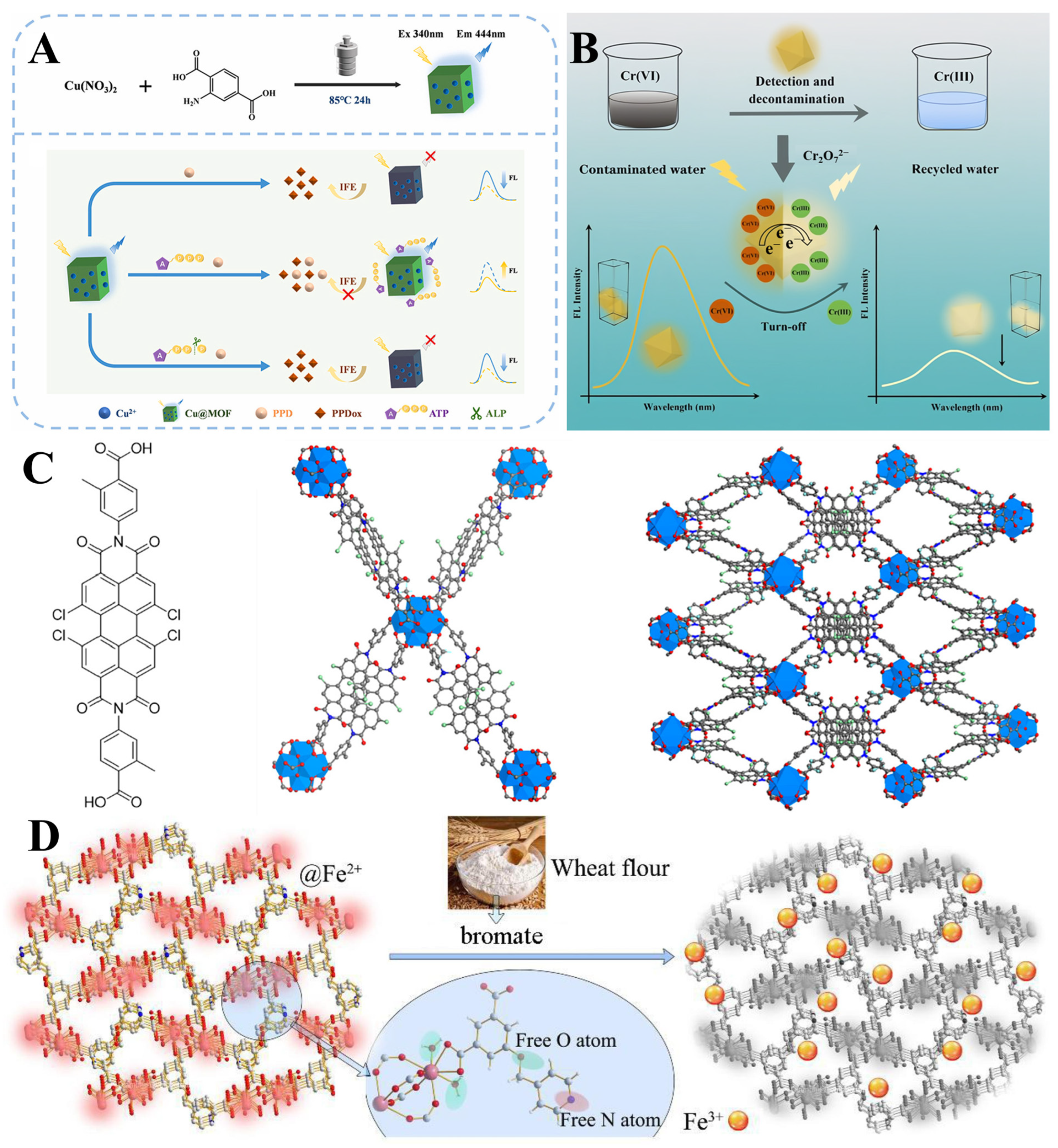
Chen et al. synthesized a bifunctional fluorescence sensor, Cu@MOF, using a hydrothermal method to detect alkaline phosphatase (ALP) with adenosine triphosphate (ATP) (Figure 1A). The sensing mechanism is rooted in the competitive coordination chemistry involving the Cu2+ sites within the MOF. Initially, the oxidase-mimetic activity of Cu@MOF catalyzes the oxidation of p-phenylenediamine (PPD) to PPDox, which quenches the intrinsic blue fluorescence of Cu@MOF via the IFE. The introduction of ATP restores the fluorescence because the phosphate groups of ATP strongly coordinate with the Cu2+ centers, thereby inhibiting the oxidase activity and preventing PPD oxidation. Conversely, when ALP is present, it hydrolyzes ATP into adenosine and inorganic phosphate, which disrupts the Cu2+-ATP complex. This liberation of Cu2+ reinstates the nanozyme’s catalytic activity, leading to the subsequent oxidation of PPD and the resultant fluorescence quenching. This reversible “on-off” fluorescence switching, governed by the presence of ATP and ALP, provides a highly sensitive and selective platform that has been successfully applied for ALP inhibitor screening and the determination of ALP activity in human serum samples [153].
Hu et al. synthesized a luminescent Zr-MOF using π-conjugated, electron-deficient, thiazole-based ligands with Zr (Figure 1B). The sensing mechanism for Cr(VI) (Cr2O72−) is primarily attributed to the IFE, where the broad absorption band of Cr(VI) significantly overlaps with the excitation spectrum of the Zr-MOF, leading to competitive absorption of the excitation light and consequent fluorescence quenching. Additionally, the interaction between Cr(VI) anions and the functional groups on the Zr-MOF induces framework aggregation, further enhancing the quenching efficiency via an aggregation-caused quenching (ACQ) mechanism. Beyond its sensing capability, the Zr-MOF also serves as an efficient photocatalyst. Upon light irradiation, the organic ligand acts as an antenna to harvest photons, generating electron-hole pairs. The photogenerated electrons are then transferred to Cr(VI), facilitating its reduction to the less toxic Cr(III). This dual-functional Zr-MOF demonstrates great potential for both the detection and remediation of Cr(VI) pollution in water [154].
Rana Dalapati et al. designed and synthesized U-1 MOF, composed of a methyl-functionalized 1,2,6,7-tetrachloroperylene-3,4,9,10-tetracarboxylic acid diimide ligand (H2L) and the Zr63-O)43-OH)4 cluster (Figure 1C). The introduction of chlorine substitutions enhanced the solubility of the pentamethylene diisocyanate (PDI) ligand during the MOF synthesis process, while the incorporation of methyl groups increased the hydrophobicity around the Zr6 secondary building units within the MOF. This modification minimized interactions with water molecules while enhancing the MOF’s stability in aqueous environments. The detection mechanism of the U-1 MOF sensor is based on a fluorescence turn-on response triggered by its specific binding with the target molecule, perfluorooctanoic acid (PFOA). The core mechanism involves a synergistic effect: on one hand, the carboxylate group of PFOA strongly coordinates with the zirconium (Zr) metal clusters in the MOF; on the other hand, the perfluoroalkyl chain of PFOA engages in strong hydrophobic interactions with the chlorine-substituted hydrophobic backbone of the PDI ligand within the MOF. This dual-binding interaction significantly enhances the fluorescence intensity of the MOF, resulting in a transition from “weak fluorescence” to “strong fluorescence”. Consequently, the PDI-based MOF exhibits a rapid fluorescence turn-on response to PFOA in aqueous solution. This MOF sensor has been successfully applied for the detection of PFOA in tap water and drinking water. As a result, the PDI-based MOF rapidly activates a fluorescent response to PFOA in aqueous solutions. This MOF sensor has been successfully employed for the detection of PFOA in tap and drinking water [155]. Zhang et al. developed a luminescent europium-based metal–organic framework (Eu-MOF) via a facile one-step hydrothermal method (Figure 1D). The Eu3+ ions within this Eu-MOF exhibit strong red emission. Notably, its fluorescence can be efficiently quenched by Fe3+ but remains largely unaffected by either Fe2+ or bromate alone. Leveraging the strong oxidizing property of bromate (BrO3), a turn-off sensor termed Eu-MOF@Fe2+ was constructed. In this system, BrO3 oxidizes Fe2+ to Fe3+ through a redox reaction. The in situ generated Fe3+ subsequently quenches the fluorescence of the Eu-MOF. This quenching mechanism is attributed to the synergistic effect of coordination interactions between Fe3+ and the N/O-donor sites on the MOF ligand, along with competitive absorption of excitation energy. The sensor demonstrates high sensitivity and selectivity, and has been successfully applied for the detection of bromate in real wheat flour samples with satisfactory recovery rates [156].

4.2. MOF Composites

The advanced properties and applications of pure monomeric MOFs are limited due to their relatively simple composition, microstructure, and morphology [157]. Therefore, to enhance their functionality, MOFs are often combined with other materials to tailor their structural properties, stability in aqueous solutions, quenching efficiency, and fluorescence intensity, thereby enabling the fluorescence detection of target molecules. This approach involves either integrating MOFs with other functional units or assembling different MOFs into hybrid materials, thereby creating well-defined heterogeneous structures.

4.2.1. MOF-Metal Nanomaterials

When metal nanomaterials (such as gold, silver, platinum, copper, etc.) are combined with MOFs [158,159,160,161], they can enhance the fluorescence signal through the local surface plasmon resonance effect, improving the sensitivity and selectivity of the sensors [162]. Metal nanoparticles not only amplify fluorescence but also enhance the sensor’s response to target molecules through interactions with the MOF surface [163,164].
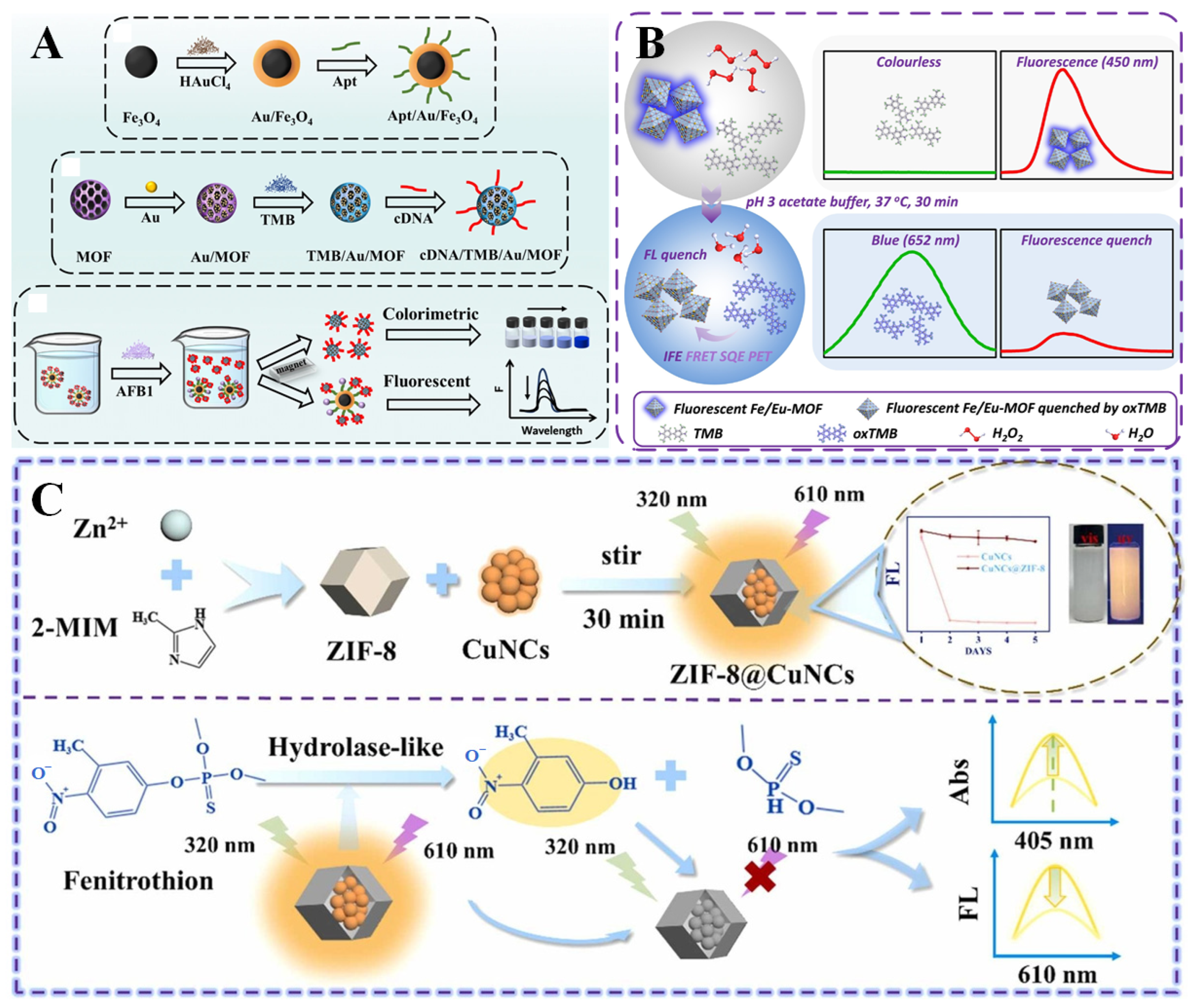
Liao et al. developed a fluorescence/visual aptamer sensor based on functionalized Au/MOF nanocomposites for the accurate and sensitive detection of Aflatoxin B1 (AFB1) (Figure 2A). The construction of this composite material aims to synergistically leverage the respective advantages of the MOF and metal nanoparticles: the MOF, with its exceptionally large specific surface area and ordered porous structure, serves as an efficient platform for loading the signal molecule TMB and the complementary DNA strand; meanwhile, the in situ reduced gold nanoparticles impart excellent peroxidase-like activity to the composite, which is crucial for catalyzing the subsequent colorimetric reaction. The detection principle is realized based on this material: initially, the recognition unit (Apt/Au/Fe3O4) and the signal probe (cDNA/TMB/Au/MOF) are assembled into a conjugate via hybridization between the aptamer and its complementary strand. Upon introduction of the target AFB1, it competes with the signal probe for binding sites on the aptamer, leading to the dissociation of some cDNA/TMB/Au/MOF probes from the conjugate into the supernatant. Following magnetic separation, the unconjugated complexes are used for fluorescence detection, where the fluorescence intensity decreases with increasing AFB1 concentration. Conversely, the released signal probes in the supernatant utilize the catalytic activity of their Au/MOF component to oxidize TMB in the presence of H2O2, producing a blue color, the intensity of which is proportional to the AFB1 concentration, thereby enabling visual quantification. Thus, the MOF/metal composite acts not only as the central hub for signal loading and amplification but also as the crucial bridge connecting the recognition event to the dual-mode fluorescence/visual signal output, thereby enabling highly sensitive, accurate, and convenient detection of AFB1 [165].
Shi et al. synthesized a dual-metal Fe/Eu-MOF with both fluorescent and peroxidase-like activity via a hydrothermal method (Figure 2B). The construction of this bimetallic MOF was designed to integrate the catalytic function of Fe and the fluorescence property of Eu within a single framework, and its sensing capability fundamentally relies on the strong affinity of pyrophosphate (PPi) for Eu3+ ions, which induces structural collapse and catalytic inhibition. Fe/Eu-MOF catalyzes the oxidation of the peroxidase substrate TMB to the blue oxTMB in the presence of H2O2. At the same time, the oxTMB produced in the solution quenches the fluorescence of Fe/Eu-MOF. Furthermore, the strong affinity between pyrophosphate (PPi) and Eu/Fe causes the dissociation of the Fe/Eu-MOF structure. Consequently, PPi significantly inhibits the peroxidase-like activity of Fe/Eu-MOF, leading to a decrease in absorbance and the restoration of fluorescence. As the effects of PPi and phosphate (Pi) on the catalytic activity of Fe/Eu-MOF differ, ALP can catalyze the hydrolysis of PPi to Pi, thus reducing the inhibition. This enables the construction of a dual-mode (colorimetric and fluorescence) ALP detection method based on MOF [166].
Li et al. constructed a composite fluorescent nanozyme, ZIF-8@CuNCs, using a zeolitic imidazolate framework-8 (ZIF-8) and copper nanoclusters (CuNCs) (Figure 2C). The construction strategy was based on the in situ encapsulation of fluorescent CuNCs within the pores of ZIF-8, which possesses organophosphorus hydrolase-like activity, achieving a stable composite via electrostatic interactions. This strategy not only significantly enhanced the fluorescence intensity and storage stability of the CuNCs but also endowed the composite with excellent hydrolase-mimetic activity. In detection applications, ZIF-8@CuNCs catalyze the hydrolysis of the target analyte, fenitrothion, producing a yellow product, 3-methyl-4-nitrophenol. This product exhibits a characteristic absorption at 405 nm, enabling colorimetric detection. Simultaneously, the hydrolysis product quenches the fluorescence emission of ZIF-8@CuNCs at 610 nm through an electron transfer mechanism, allowing for quantitative fluorescence detection. Based on this dual-signal output of absorbance and fluorescence, the sensor enabled highly selective and sensitive detection of fenitrothion, demonstrating potential for practical application in complex water environments [167].
The general design principles for MOF-metal composite sensing materials can be summarized as follows: through rational structural design, MOFs serve as ideal carriers that effectively immobilize and spatially confine metal nanoparticles, clusters, or ions by virtue of their high specific surface area, tunable pore size, and unsaturated metal sites. The metal components function as key functional units, providing catalytic activity, plasmonic effects, fluorescence emission, or acting as specific recognition sites to confer and enhance sensing capabilities. The synergistic interaction between the two components aims to efficiently convert the recognition event of the target analyte into a detectable signal output (e.g., optical or electrochemical signals). Through preconcentration effects, signal amplification, and stability enhancement, this strategy ultimately optimizes the sensor’s sensitivity, selectivity, and anti-interference ability.

4.2.2. MOF-on-MOF

The MOF-on-MOF strategy constructs core–shell or heterojunction structures by integrating functionally distinct MOFs in an ordered manner at the nanoscale [168]. A general design principle of this approach is to leverage the differential fluorescence responses of different MOF components to the same analyte, thereby enabling the construction of self-calibrating ratiometric fluorescence sensors [169]. Typically, one MOF provides a stable reference signal, while the other supplies a response signal that varies with the analyte concentration [170]. This spatially separated functionalization not only prevents signal crosstalk but also facilitates synergistic signal modulation through internal energy transfer mechanisms—such as the IFE and FRET—thereby further enhancing the advantages of multiplexed detection and significantly improving the accuracy and reliability of the sensor [171].
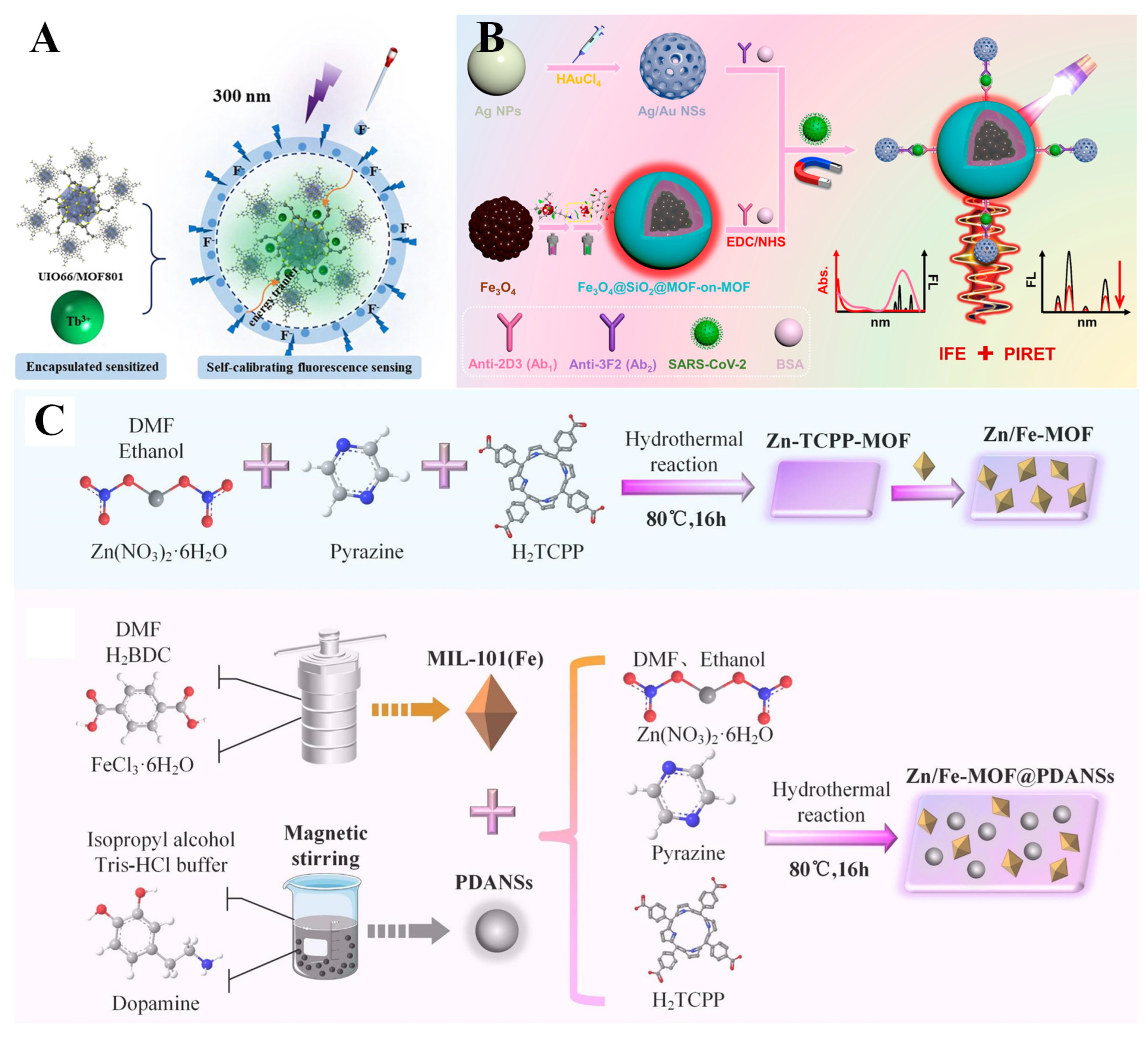
Li et al. designed a fluorescence probe, Tb3+@UIO-66/MOF-801, by encapsulating sensitized Tb ions in UIO66-/MOF-801, which combined the strong fluorescence signal and water stability of both UIO-66 and MOF-801 (Figure 3A). The recognition mechanism for F is primarily attributed to the specific coordination interactions between F and the Tb3+/Zr4+ sites within the MOF. The introduction of F alters the coordination environment of Tb3+ and enhances the energy transfer efficiency from the organic ligands to Tb3+, thereby leading to a significant increase in the characteristic emission intensity at 544 nm. The emission peak at 544 nm originates from the Tb3+ ions, while the peak at 375 nm arises from the intrinsic luminescence of the MOF. In contrast, the intrinsic MOF emission at 375 nm remains unaffected by F and serves as an internal reference, enabling self-calibrating ratiometric detection of F. The Tb3+@UIO-66/MOF-801 sensor exhibits high sensitivity towards F, with a detection limit as low as 4.029 µM, which is much lower than the drinking water standard set by WHO. It also has a good linear response range and is suitable for precise detection of environmental water samples. This study highlights the tremendous potential of lanthanide-ion-encapsulated MOF-on-MOF materials as environmental sensors [172]. Hang et al. investigated the effect of different surfactants and active functional groups on the combination of magnetic nanoparticles with Ln-MOF to construct yolk-shell nanostructures through experimental results and theoretical calculations (Figure 3B). They confirmed that the strong intermolecular interactions between boronic acid-functionalized ligands and amino functional groups provided the optimal structure-activity relationship. Based on this, they designed a magnetic functionalized Fe3O4@SiO2@MOF-on-MOF system combined with plasma Ag/Au nanocages (Ag/Au NCs). The fluorescence enhancement effect of Fe3O4@SiO2@MOF-on-MOF and the efficient fluorescence quenching of Ag/Au NCs via FRET and IFE were used to detect the SARS-CoV-2 nucleocapsid protein (N protein). In the presence of SARS-CoV-2 N protein, antigen-labeled plasma Ag/Au NCs significantly reduced the fluorescence emission intensity of Ln-MOF. This study provides a new nanomaterial synthesis approach and signal amplification strategy for fluorescent immunoassays [173].
Wang et al. pioneered the development of a ratiometric fluorescence sensor array based on a metal nanocluster (MNCs)-immobilized MOF-on-MOF heterostructure (M@ZIF-on-MIL) for the efficient detection of multi-component perfluoroalkyl substances. In this study, a ZIF-8-on-NH2-MIL-101(AI) (ZIF-on-MIL) core–shell structure was synthesized via the epitaxial growth method, and gold nanoclusters (Au NCs) and gold-silver alloy nanoclusters (AgAu NCs) were successfully confined on its surface, significantly enhancing the fluorescence quantum yield of MNCs. The detection mechanism is distinctive: different PFAS molecules undergo metal coordination, hydrogen bonding, and hydrophobic interactions with the ZIF-8 shell, inducing different degrees of dissociation of the ZIF-8 structure. On one hand, this process releases Zn2+, which coordinates with the core NH2-MIL-101(AI), leading to fluorescence enhancement (“Turn-On”); on the other hand, the destruction of the ZIF-8 structure eliminates its confinement effect on the surface MNCs, resulting in fluorescence quenching of MNCs (“Turn-Off”). These simultaneous and opposite fluorescence changes generate a unique ratiometric fluorescence signal “fingerprint”. By combining a machine learning algorithm to recognize multi-dimensional signal patterns, the sensor array achieved 100% accurate discrimination of eight types of PFASs and could precisely detect PFAS samples with different concentrations and mixing ratios, also demonstrating excellent performance in complex environmental water samples. This work provides a novel paradigm for constructing multifunctional, self-calibrating MOF-on-MOF sensing platforms [174].
Liang et al. designed and synthesized a ternary MOF composite, Zn-TCPP-MOF@PDANSs@MIL-101(Fe) (Figure 3C), using water-soluble MIL-101(Fe), the active-site-rich Zn-TCPP-MOF, and the strong spectral overlap and quenching ability of polydopamine (PDANSs). They introduced 6-carboxyfluorescein (FAM)-modified ssDNA into the sensor for selective detection of sulfamethoxazole (SMZ). The prepared sensor exhibited dual fluorescence signals from Zn-TCPP-MOF and FAM-ssDNA. The ssDNA adsorbed onto the MOF, causing fluorescence quenching of FAM. When SMZ was present, FAM-ssDNA preferentially bound to SMZ and changed its conformation, blocking the FAM fluorescence quenching process, while the fluorescence of Zn-TCPP-MOF remained unchanged. In summary, this method calculates the concentration of SMZ by detecting the fluorescence signals of FAM and Zn-TCPP-MOF [157].

4.2.3. MOF-COF

In most reported applications of MOFs, their limited fluorescence emission often fails to meet detection requirements, which hinders their use in biosensing applications. Hybrid materials combining MOFs and COFs can integrate the unique properties of both MOF and COF components [175]. COFs are materials with highly ordered structures, and by covalently linking MOFs and COFs into a core–shell configuration, new core–shell fluorescent materials (MOF@COF) can be obtained [176,177,178]. Nano-sized MOF@COF structures exhibit high porosity and large surface areas, providing more imprint sites and enhancing mass transfer rates [179].
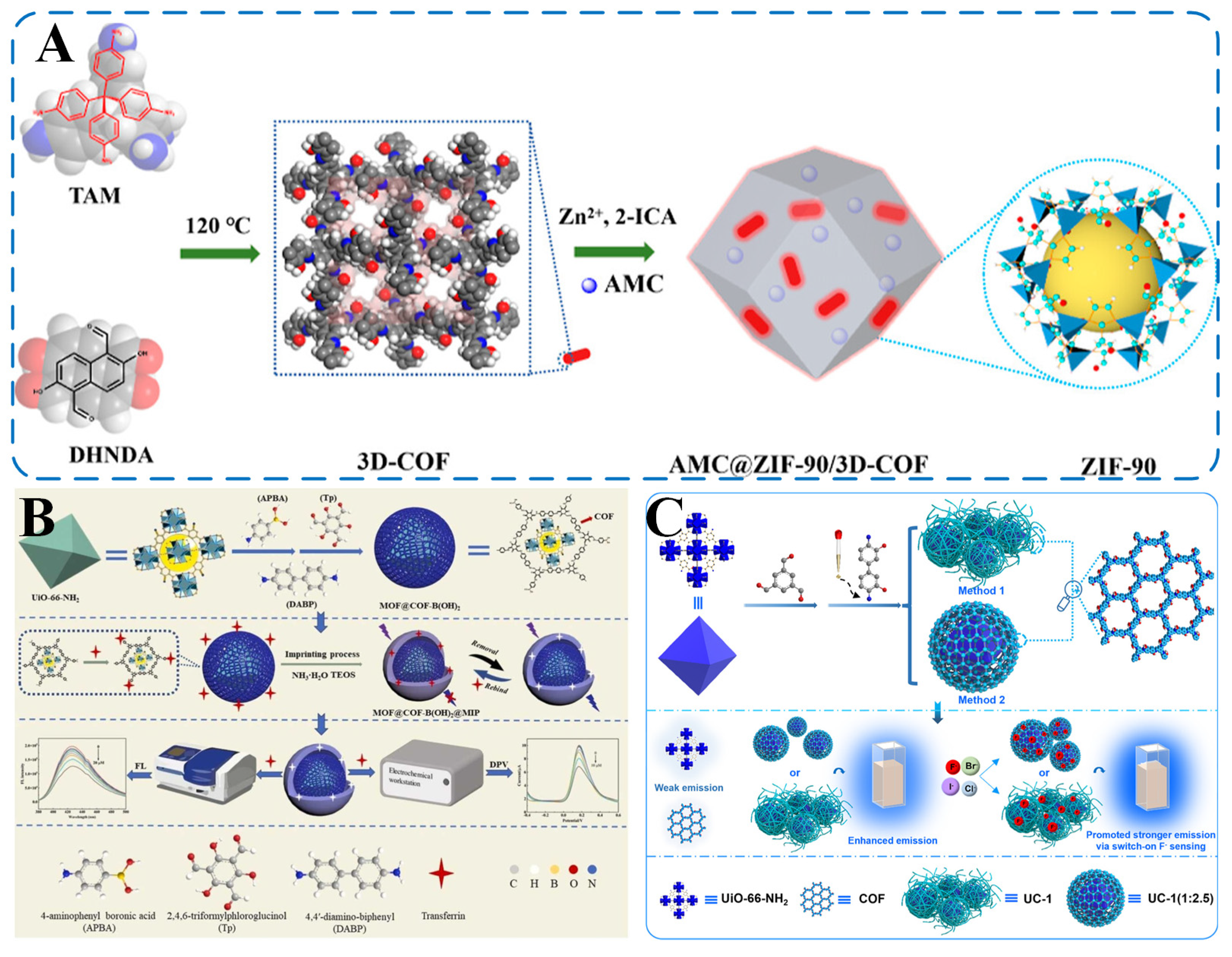
A study grew ZIF-90 in situ on a porous 3D-COF to obtain a novel luminescent sensor, with 7-amino-4-methylcoumarin (AMC) encapsulated in the ZIF-90 framework (Figure 4A). The purpose of constructing this AMC@ZIF-90/3D-COF composite was to leverage the synergistic properties of its components: the MOF (ZIF-90) serves as a porous host for encapsulating and protecting the AMC dye, while the COF provides a stable, inherently fluorescent 3D scaffold. The AMC acts as the responsive fluorescent reporter unit. The fabricated AMC@ZIF-90/3D-COF could detect Chloroquine phosphate (CQP) in the “on” mode and folic acid (FA) in the “off” mode. At an excitation wavelength of 365 nm, in the presence of CQP, the emission intensity of AMC at 430 nm increased, while the emission intensity of 3D-COF at 598 nm remained almost unchanged. For FA detection, the fluorescence signal at 598 nm (from the 3D-COF) was selectively quenched, a process attributed to the inner filter effect and hydrogen bonding interactions between FA and the composite. This fluorescence quenching response showed high resistance to interference and selectivity for FA detection. This work presents a dual-functional optical platform for luminescent sensing and anti-counterfeiting applications [180].
Hu et al. designed and synthesized a boronic acid-functionalized porous framework composite (MOF@COF-B(OH)2), the UiO-66-NH2 core provides structural stability and intrinsic fluorescence, while the COF–B(OH)2 shell introduces abundant boronic acid groups, achieving specific recognition of specific glycoproteins through borate ester affinity interactions, thus eliminating the need for complex subsequent modifications. Using a surface-based molecular imprinting strategy, a dual-mode imprinted sensor (MOF@COF–B(OH)2@MIP) was fabricated (Figure 4B). For detection, the fluorescence mode operated based on photo-induced electron transfer, where binding of the glycoprotein transferrin (TrF) to the imprinted sites resulted in significant fluorescence quenching at 430 nm. In parallel, an electrochemical mode was established by modifying a screen-printed carbon electrode with MOF@COF–B(OH)2@MIP; the specific binding of TrF hindered electron transfer of the redox probe, leading to a measurable decrease in differential pulse voltammetry current. Due to its inherent fluorescence characteristics, the fluorescence intensity of MOF@COF–B(OH)2@MIP showed a good linear relationship with different concentrations of glycoproteins [181]. Based on the study by Xia et al., a core–shell MOF@COF composite was constructed by in situ growing a COF layer, synthesized from 1,3,5-benzenetricarboxaldehyde (BT) and 3,3′-dihydroxybenzidine (DH), onto the surface of UiO-66-NH2 MOF cores (Figure 4C). In this hybrid structure, the UiO-66-NH2 core served as a structural scaffold and provided intrinsic fluorescence, while the COF shell contributed extended π-conjugation. The restricted growth of the COF layer effectively suppressed ACQ, leading to significantly enhanced luminescence, with the optimal composite (UC-1) exhibiting a 7-fold increase in quantum yield compared to the bulk COF. The composite was further applied as a turn-on fluorescent sensor for fluoride ions (F), where the detection mechanism was based on the inhibition of the excited-state intramolecular proton transfer (ESIPT) process in the COF layer upon interaction with F, resulting in a progressive enhancement of fluorescence emission [136].
In summary, the synthesis of MOF@COF composites for sensing predominantly follows a core–shell strategy, where a COF layer is grown in situ on a MOF core. A key design principle is the functional synergy between the components: the MOF often provides a structural scaffold and intrinsic porosity, while the COF shell contributes specific recognition sites and, critically, its restricted growth mitigates aggregation-caused quenching to enhance luminescence. Furthermore, a recurring and powerful approach is the integration of multiple transduction mechanisms—such as ratiometric fluorescence and electrochemistry—within a single composite. This multi-modal design significantly improves detection reliability and broadens the application scope of these hybrid sensors, effectively addressing the limitation of weak or single signals from individual components.

4.2.4. MOF-QDs

QDs are a type of nanomaterial with unique fluorescence properties, offering advantages such as high brightness, high stability, and tunable spectral features [182,183,184,185,186,187]. The combination of QDs and MOFs enhances the fluorescence signal of sensors through the optical properties of QDs [188], while the high surface area and functionalized surface of MOFs improve detection efficiency [189,190,191,192].
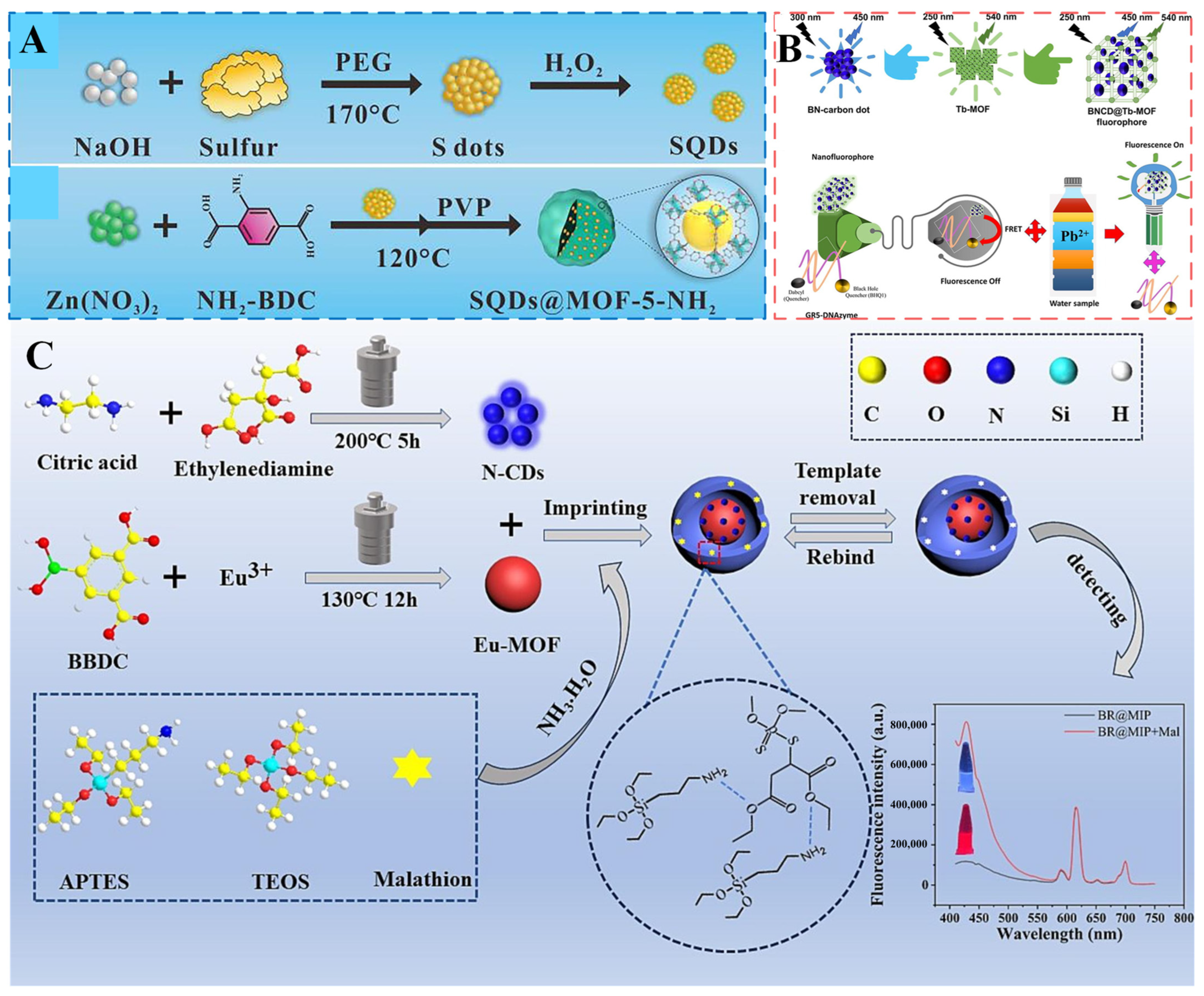
Yan et al. constructed a simple and effective self-circulating catalytic hairpin assembly (scCHA) and fluorescence aptamer sensor (SQDs@MOF-5-NH2), which encapsulated Sulfur quantum dots (SQDs) in MOF-5-NH2 (Figure 5A). SQDs were synthesized via a one-step hydrothermal method, then encapsulated in MOF-5-NH2 using a solvothermal process to form the SQDs@MOF-5-NH2 fluorescence probe. The system was further coupled with Fe3O4-NH2 and scCHA strategies to build a complete fluorescence aptamer sensing system, achieving cyclic magnetic capture of the luminescent signal in the presence of patulin (PAT). This system provides a dual-amplification strategy for the sensitive detection of PAT in apple juice. In this sensor, SQDs serve as the core fluorophore, while MOF-5-NH2 acts as their carrier, significantly enhancing the fluorescence intensity and providing sites for DNA immobilization. When the target PAT is present, it triggers the scCHA reaction, resulting in the magnetic capture of numerous SQDs@MOF-5-NH2 fluorescent probes by Fe3O4-NH2. By detecting the captured fluorescence signal, ultrasensitive detection of PAT is achieved [74]. Jain et al. combined a lanthanide-based metal-organic framework (MOF) with boron-nitrogen-doped carbon dots (BNCDs) to create a dual-emissive fluorescent signal transducer (Figure 5B). A lead-specific GR-5 DNAzyme system was employed as the recognition element. In this system, the BNCDs/Tb-MOF nanocomposite was covalently linked to the substrate strand of the DNAzyme, while the enzyme strand was labeled with a quencher (BHQ1). In the absence of the target, the close proximity between the fluorophore and the quencher, due to the hybridization of the two strands, quenched the fluorescence via the FRET process. Upon the addition of Pb2+, the DNAzyme was activated and cleaved the substrate strand. This cleavage released the fluorescent BNCDs/Tb-MOF fragment, leading to a significant recovery of fluorescence due to the spatial separation from the quencher. This mechanism enabled the ultrasensitive detection of Pb2+ in aqueous solutions [62].
Yang et al. developed a ratio-imprinted fluorescence sensor, N-CDs@Eu-MOF@MIP (BR@MIP), for the sensitive detection of malathion (Mal), using europium-based MOFs (Eu-MOF) as carriers to enhance the sensitivity of the BR@MIP sensor (Figure 5C). Nitrogen-doped carbon dots (N-CDs) were used as the fluorescence source to generate fluorescence signals. The new ratio fluorescence imprinted sensor (BR@MIP) based on Eu-MOF and N-CDs was constructed for the recognition of Mal. The red-emitting Eu-MOF and blue-emitting QDs (N-CDs) were used as reference and response signals, respectively. Eu-MOF served as the support and reference signal, improving mass transfer and sensitivity, while the MIPs on the Eu-MOF surface acted as the recognition sites for Mal. Mal. can bind to the recognition sites in the composite material, thereby specifically restoring the blue fluorescence that was quenched by the N-CDs. Due to the combination of Eu-MOF, N-CDs, and MIPs, the BR@MIP fluorescence sensor exhibited excellent visual response, sensitivity, and selectivity for Mal [193].
The construction of COF-QD composites for sensing primarily leverages a synergistic design. The robust and porous crystalline structure of COFs acts as a protective scaffold to host QDs, mitigating aggregation and enhancing stability. Simultaneously, the COF can be pre- or post-functionalized with specific recognition sites, which work in concert with the fluorescent QDs to create a highly selective and sensitive “signal-on” or “signal-off” sensing platform. This strategic integration combines the superior optical properties of QDs with the high surface area and molecular precision of COFs for effective detection.

4.2.5. MOF-Dye

Fluorescent dyes are a class of chemical substances that can absorb light of specific wavelengths and emit light at different wavelengths [194]. They are widely used in fields such as biomedicine, environmental monitoring, and chemical analysis. Common fluorescent dyes include rhodamine, fluorescein, BODIPY, and aniline-based dyes [195,196,197]. These dyes exhibit strong fluorescence signals; however, their fluorescence performance is often influenced by the solution environment (e.g., pH, ion concentration, solvent effects), leading to unstable signals [198]. By encapsulating the fluorescent dye in the pore structure of MOFs, the MOF provides a protective environment that prevents the dye from decomposing or deactivating in external conditions [199]. Additionally, the structure of MOFs helps to disperse and stabilize the dye, ensuring that the fluorescence signal is generated stably over time [200,201].
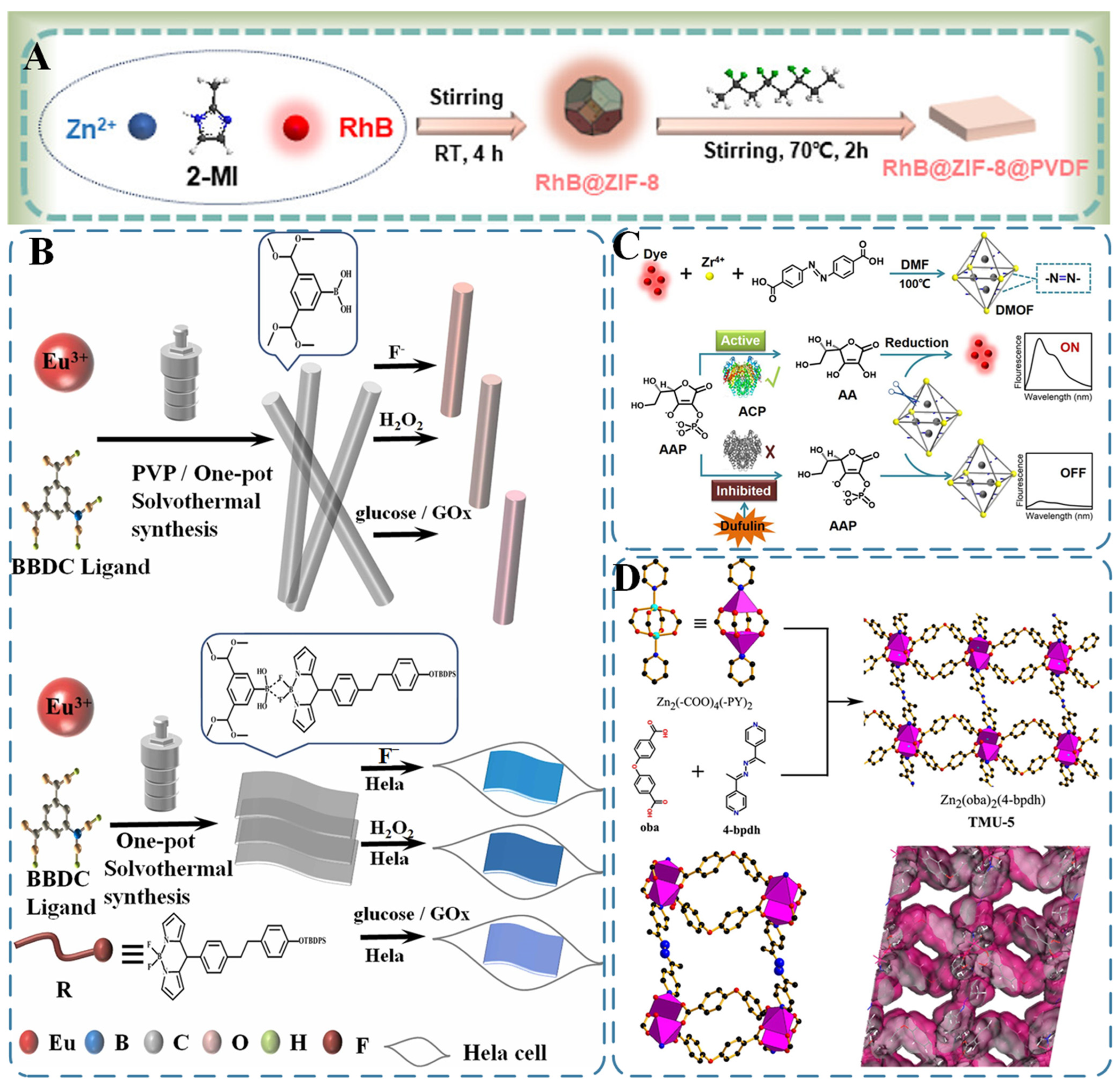
Xu et al. encapsulated the dye molecule rhodamine B (RhB) in the highly stable zeolitic imidazolate framework (ZIF-8) to obtain RhB@ZIF-8 composite luminescent materials. Polyvinylidene fluoride (PVDF) was chosen as the base polymer, and a phase conversion method was used to prepare the RhB@ZIF-8@PVDF composite membrane (Figure 6A). In the sensor, ZIF-8 prevents the aggregation of dye molecules, and the polymer limits the aggregation of the luminescent hybrid material, maintaining its emission characteristics. Therefore, RhB@ZIF-8@PVDF mixed-membrane matrix (RhB@ZIF-8@PVDF-MMM) has the luminescent properties of both the dye and the ZIF-8 ligand and can be used for ratio sensing. The sensor enables rapid detection of nitrofurantoin (NFT) and oxytetracycline (OTC). For NFT, its detection is based on a fluorescence quenching mechanism. The porous ZIF-8 adsorbs and enriches NFT molecules. Since the absorption spectrum of NFT highly overlaps with the emission spectrum of ZIF-8 at 436 nm, it selectively quenches the blue fluorescence of ZIF-8 through FRET and the inner filter effect, while the emission peak of the encapsulated RhB at 576 nm remains relatively stable. Whereas the detection of OTC is based on its coordination with Zn2+ in ZIF-8 to form a metal complex, resulting in fluorescence enhancement [202]. Li et al. develops a multifunctional ratiometric fluorescent sensor. The construction strategy involves grafting highly emissive BODIPY dyes onto a Europium-based MOF via covalent F-B bonding using a facile one-pot solvothermal reaction, forming the BODIPY@Eu-MOF composite. (Figure 6B) The detection principles for different analytes are as follows: For fluoride ions, sensing relies on the high affinity between F and the boronic acid group on BODIPY. This interaction alters the ligand-to-Eu3+ energy transfer efficiency, quenching the red emission of Eu3+ at 616 nm while enhancing the blue emission of BODIPY at 420 nm, enabling ratiometric detection. For hydrogen peroxide, its unique nucleophilic reaction with the boronic acid group cleaves the B-C bond, similarly perturbing the energy transfer pathway and causing a ratiometric fluorescence response. Glucose detection is achieved indirectly with high sensitivity by employing glucose oxidase to convert glucose into H2O2, which is then detected through the aforementioned H2O2 sensing mechanism [203].
Liu et al. developed a fluorescent nanosensor for detecting the pesticide Dufulin (Figure 6C). The construction strategy involves a one-pot synthesis to encapsulate the dye molecule (Doxorubicin, DOX) within a zirconium-based azobenzene-dicarboxylate Metal-organic Framework, forming the DMOF composite. The detection principle is based on a cascade reaction: The enzyme acid phosphatase (ACP) catalyzes the hydrolysis of its substrate AAP into ascorbic acid (AA). AA then reduces and cleaves the azobenzene units in DMOF, causing the framework to collapse and release the encapsulated DOX, thereby recovering fluorescence. In the presence of Dufulin, the activity of ACP is inhibited, blocking this reaction cascade and preventing fluorescence recovery. Consequently, the change in fluorescence signal allows for the highly sensitive detection of Dufulin [204]. Minoo Bagheri et al. introduced rhodamine B into the framework of TMU-5, synthesizing a two-dimensional fluorescent MOF sensor, TMU-5S (Figure 6D). The basic azine groups of the MOF enhance the quantum yield by interacting synergistically with the oxygen atoms of rhodamine, thereby increasing the sensitivity of the new two-dimensional sensor for detecting Ca2+. The sensing mechanism is based on a ratiometric signal readout. Upon binding with Ca2+, the emission peak of the MOF itself exhibits a blue shift and enhanced intensity, while the emission of the encapsulated Rhodamine B remains relatively stable. The ratio of these two emission intensities changes, which effectively eliminates environmental interference and enables highly accurate quantification. This specific recognition is attributed to the strong hard-hard acid-base interactions between Ca2+ and the basic azine groups within the confined pores of the MOF. In the presence of interfering cations at concentrations similar to plasma, the sensor exhibited extraordinary sensitivity and selectivity for Ca2+ detection [205].
Based on the aforementioned research, the general design strategies and core challenges of MOF-fluorescent dye composite sensors can be summarized. The core strategy involves constructing a host-guest architecture: the MOF serves as a rigid host, preventing dye molecule aggregation-caused quenching through pore confinement, and leveraging its functional sites (such as unsaturated metal sites and characteristic functional groups) for targeted recognition. Introducing dual emission centers to construct ratiometric sensors is a key strategy for enhancing anti-interference capability. The main current challenges lie in ensuring the stable immobilization of dyes within the MOF to prevent leakage, and precisely regulating the energy transfer pathways between components to achieve efficient ratiometric responses. These principles provide important guidance for developing new high-performance sensors.

4.2.6. MOF-Other Nanomaterials

MOFs can also be combined with other nanomaterials, such as carbon nanotubes, graphene, and polymer nanoparticles, to further enhance the performance of sensors [206,207,208,209,210,211,212,213].
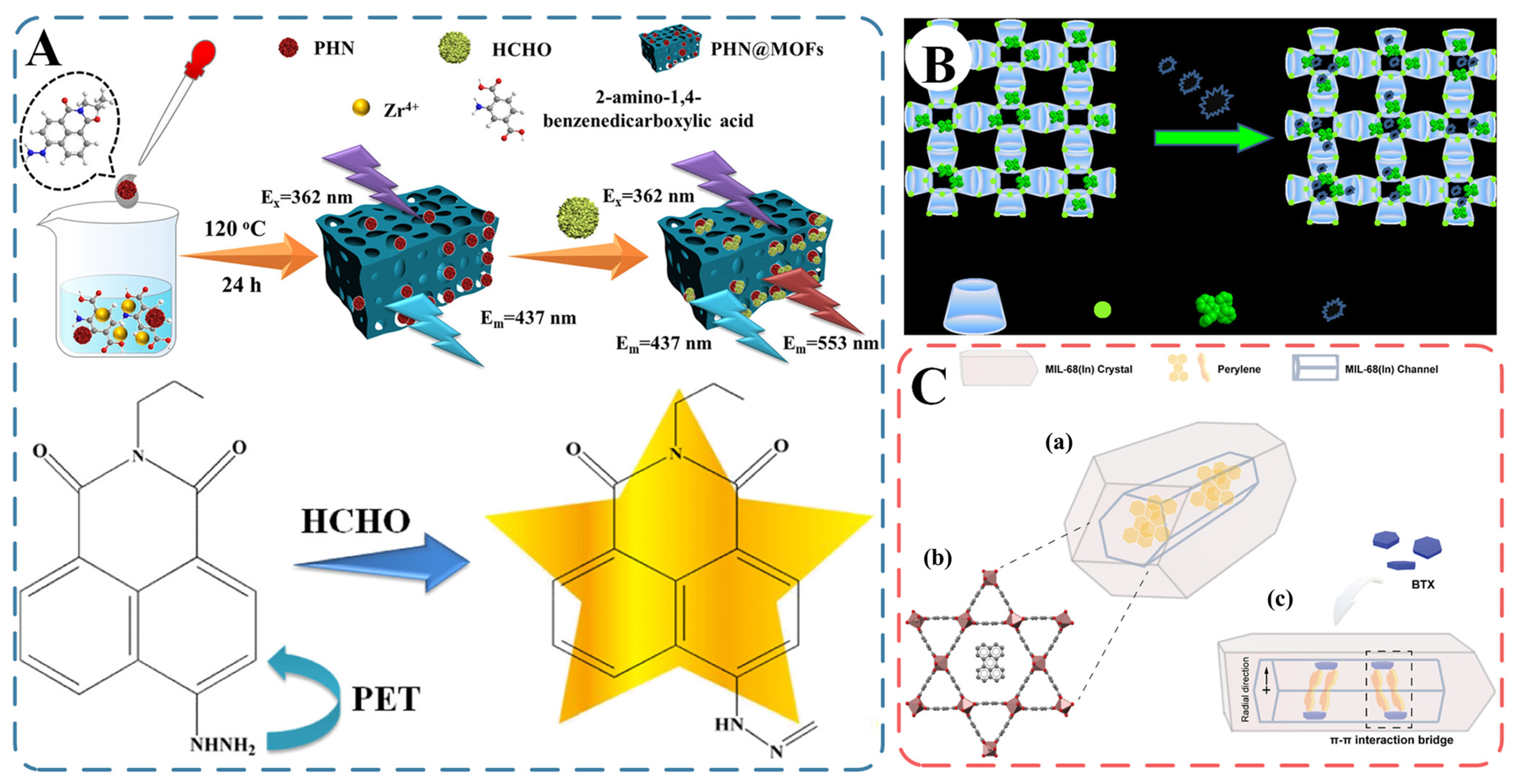
Wang et al. synthesized N-propyl-4-hydrazino-naphthalimide (PHN) as a fluorescent probe and embedded it into UiO-66-NH2 to obtain a nanocomposite material (PHN@MOF) (Figure 7A). The hydrazino groups of PHN act as reactive sites for formaldehyde, and through a condensation reaction, the reaction occurs rapidly, producing stable methylene hydrazine products. The sensor was used to construct a home device for formaldehyde monitoring. Additionally, the inherent fluorescence emission of UiO-66-NH2 provides a reference signal for formaldehyde detection. The detection operates on a fluorescence “turn-on” mechanism, where the embedded PHN probe reacts specifically with formaldehyde via a condensation reaction, inhibiting a photoinduced electron transfer process and restoring its fluorescence. This sensitivity is dramatically enhanced by the UiO-66-NH2 metal–organic framework, which employs a space confinement effect to selectively preconcentrate formaldehyde near the probe while excluding larger interfering molecules. The intrinsic blue fluorescence of the MOF itself serves as a stable reference, enabling ratiometric and visual detection through a distinct color change from blue to yellow under UV light [214].
Qiu et al. encapsulated the AIE material tetraphenylethene (TPE) in γ-cyclodextrin-MOF-K (γ-CD-MOF-K+) (Figure 7B). The γ-CD-MOF is an environmentally friendly material composed of naturally recyclable γ-CD and alkaline metal ions (such as K+). The prepared γ-CD-MOF-K+ has varying pore sizes, allowing it to simultaneously accommodate both TPE and explosives. Due to the MOF’s limiting effect on the vibrations of TPE, the photoluminescence (PL) of the TPE@γ-CD-MOF composite material is higher than that of TPE molecules alone. TPE@γ-CD-MOF-K+ exhibits sensitive fluorescence quenching activity towards nitroaromatic explosives in both liquid and solid states. The electron-rich TPE molecules inside the MOF transfer electrons to electron-deficient nitroaromatic explosives, which causes a decrease in fluorescence intensity. The unique multi-pore structure of the MOF allows both the TPE and the explosive molecules to be hosted simultaneously, enabling effective detection in both liquid and solid phases [215].
Zhang et al. synthesized a luminescent composite, perylene@MIL-68(In), by encapsulating perylene molecules into the metal-organic framework MIL-68(In) via a facile one-pot method (Figure 7C). In its solid state, the composite exhibits characteristic emission from the E-type excimer state of perylene. Upon exposure to BTX vapors (benzene, toluene, xylene), a distinct transformation from the E-excimer to the Y-excimer state occurs, induced by enhanced guest-host confinement and π-π interactions. This transformation results in a significant fluorescence enhancement (Turn-On response), enabling the use of this composite as a highly selective fluorescent sensor for BTX detection [216].
In order to better compare the performance of the fluorescence sensors based on MOF listed in Section 4, the following summary is presented in Table 3.

5. Conclusions and Future Perspectives

This review systematically summarizes recent advancements in MOF-based fluorescent sensors for rapid detection, covering their construction strategies, sensing mechanisms, and diverse applications. Owing to their high specific surface area, tunable pore structures, and readily functionalizable surfaces, MOF materials have emerged as an ideal matrix for constructing high-performance fluorescent sensing platforms. Through the rational selection of metal centers and organic ligands, or their strategic hybridization with functional units such as metal nanomaterials, COFs, and QDs, the sensitivity, selectivity, and stability of these sensors can be effectively tuned. This enables the efficient detection of various targets, including metal ions, biological molecules, pesticide residues, and environmental pollutants. Despite significant achievements, the transition from laboratory proof-of-concept to practical application and widespread commercialization faces several challenges and opportunities. Future research efforts should focus on the following interconnected strategic directions.

5.1. Material Innovation: Stability, Intelligence, and Integration

The long-term stability of MOF sensors in practical, complex environments—such as aqueous solutions, extreme pH, and biological fluids—remains a critical bottleneck. The core of future material innovation lies in moving beyond single-property optimization towards the synergistic enhancement of multiple attributes. Firstly, the intrinsic stability of MOFs under chemical, moisture, and photochemical conditions must be systematically improved, while also addressing cost concerns associated with expensive metals like lanthanides. This can be achieved by constructing robust coordination bonds based on the HSAB principle, introducing hydrophobic functional groups or protective layers, and implementing precise defect control. Secondly, a promising frontier involves transforming defects from “detrimental factors” into “design tools.” Controlled defect engineering can create more unsaturated metal sites to enhance recognition and modulate energy transfer pathways between ligands and metal centers, paving the way for a new generation of highly sensitive ratiometric fluorescent sensors [217]. Furthermore, developing MOFs with stimuli-responsive “smart pores” (triggered by pH, light, or target molecules) enables selective capture and release of analytes, offering breakthrough detection selectivity. The ultimate goal is to tailor specialized MOF materials that combine high stability, sensitivity, selectivity, and low cost for specific application scenarios, such as in vivo diagnostics and continuous environmental water monitoring.

5.2. Technology Fusion and Miniaturization: Towards Point-of-Care and High-Throughput Analysis

The capabilities of a single sensing material are ultimately limited. The deep integration of MOF sensors with cutting-edge biotechnology and micro/nano-fabrication technologies is an inevitable trend for building next-generation advanced detection systems. Microfluidic chips provide an ideal platform for integrating MOF sensors, enabling the automation and miniaturization of sample pretreatment, reaction, separation, and detection [218]. Immobilizing MOFs within microchannels allows for the construction of lab-on-a-chip systems that drastically reduce reagent consumption, enable parallel analysis of multiple targets, and significantly enhance portability. This is crucial for on-site rapid testing and applications in resource-limited settings. More frontier is the combination with CRISPR/Cas systems. MOFs can serve as efficient delivery vehicles for CRISPR components or as nanozymes for signal amplification, while the CRISPR system provides unparalleled nucleic acid recognition specificity. Pioneering research has demonstrated the feasibility of regulating MOF-based nanozyme activity via CRISPR-Cas12a for sensitive nucleic acid detection. This “MOF transduction + CRISPR recognition” strategy opens a new paradigm for detecting genetic biomarkers and pathogens [56,219,220]. Further integrating such systems with wearable devices—developing flexible MOF sensors embedded in textiles or patches—can facilitate the continuous, non-invasive monitoring of biomarkers in sweat or tears. Coupled with smartphones for data readout and analysis, this ultimately leads to intelligent sensing networks integrating materials, devices, and data clouds.

5.3. Application Expansion and Deepening: From Single-Target Detection to Complex System Analysis

With advancements in materials and platforms, the application scope of MOF sensors urgently needs to shift from relatively simple model systems to more challenging real-world scenarios. A core challenge is developing sensors capable of highly selective detection of low-abundance disease biomarkers (e.g., microRNA, specific proteins, metabolites) directly in complex biological matrices like whole blood, serum, or urine. This requires MOF surfaces with excellent anti-biofouling properties and the ability to effectively exclude interferents with similar structures through pore size sieving or tailored surface chemistry. On the other hand, single-analyte detection can no longer meet the demand for holistic assessment of complex systems, such as food spoilage, environmental pollutant classification, or disease subtyping. The future focus should be on developing MOF-based sensor arrays (“electronic tongues/noses”) [221,222]. By utilizing a series of MOFs with distinct chemical properties to generate unique fluorescent response “fingerprints,” and combining them with artificial intelligence (AI) and machine learning (ML) algorithms for pattern recognition of multi-dimensional data, the overall classification and identification of complex samples becomes possible (e.g., distinguishing different bacterial strains, assessing food safety levels) [223]. This represents a leap from mere “detection” to insightful “analysis”.

5.4. The Data-Driven Intelligent Future: AI-Powered Sensing Paradigms

The ultimate advancement of sensing technology is inseparable from the intelligence of data processing. MOF sensors, particularly ratiometric, multi-emissive, and array-based ones, generate massive and complex data streams. Traditional analytical methods struggle to fully exploit this potential. The introduction of AI and ML is poised to revolutionize this landscape. By training deep learning models, AI can accurately quantify analyte concentrations from complex fluorescence changes, effectively distinguish overlapping signals, and even predict outcomes in the presence of interferents, significantly enhancing analytical accuracy and reliability. Furthermore, AI can play a role in inverse design, assisting in predicting and designing new-generation MOF sensing materials with desired properties by analyzing the relationships between known MOF structures and sensing performance [224]. This fosters a closed-loop research paradigm: “material design → sensing application → data analysis → optimized design.”
In conclusion, as a vibrant interdisciplinary research field, MOF-based fluorescent sensors are progressively moving from proof-of-principle towards practical application. The path forward lies in the deep integration of material design, technology fusion, and intelligent analysis. Through interdisciplinary collaborative innovation aimed at systematically addressing the core challenges of stability, selectivity, and integration, it is reasonable to believe that MOF-based fluorescent sensors will play an increasingly critical role in clinical diagnostics, environmental monitoring, food safety, and national security in the near future. They offer powerful technological support for building a healthier and safer world.

Author Contributions

Conceptualization, Y.Z.; writing—original draft preparation, Y.Z.; writing—review and editing, C.L.; visualization, M.J.; supervision, Y.L.; project administration, Z.S.; funding acquisition, Z.S. All authors have read and agreed to the published version of the manuscript.

Funding

This research was funded by “Natural Science Foundation of Jiangsu Province, grant number (BK20241924)”, and “Key Research and Development Program of Zhenjiang City, grant number (SH2024112, SH2024010, NY2023002)”.

Data Availability Statement

No primary research results, software, or code have been included, and no fresh data were generated or analyzed as part of this review.

Acknowledgments

The authors have reviewed and edited the output and take full responsibility for the content of this publication.

Conflicts of Interest

The authors declare no conflicts of interest.

Abbreviations

The following abbreviations are used in this manuscript:
MOFsMetal-organic frameworks
IRMOFsIsoreticular Metal-organic Frameworks
ZIFsZeolitic Imidazolate Frameworks
MILsMaterials of Institut Lavoisier
COFsCovalent organic frameworks
QDsQuantum dots
PCNsPorous Coordination Networks
UiOUniversity of Oslo
CPLsCoordination Pillared-Layer
BDCBenzene-1,4-dicarboxylic acid
HPLCHigh-performance liquid chromatography
GCGas chromatography
MSMass spectrometry
ALPAlkaline phosphatase
ATPAdenosine triphosphate
PPDp-Phenylenediamine
IFEInner filter effect
PDIPentamethylene diisocyanate
PFASPer- and polyfluoroalkyl substances
PFOAPerfluorooctanoic acid
AFB1Aflatoxin B1
TMBTetramethylbenzidine
cDNAComplementary DNA
PPiPyrophosphate
PiPhosphate
NCsNanocages
FRETFluorescence resonance energy transfer
N proteinNucleocapsid protein
MNCsMetal nanocluster
Au NCsGold nanoclusters
AgAu NCsGold-silver alloy nanoclusters
PDANSsPolydopamine
SMZSulfamethoxazole
AMC7-amino-4-methylcoumarin
CQPChloroquine phosphate
FAFolic acid
scCHASelf-circulating catalytic hairpin assembly
SQDsSulfur quantum dots
PATPatulin
PVPPolyvinyl pyrrolidone
APTES(3-Aminopropyl)triethoxysilane
CDsCarbon dots
BNCDsBoron-nitrogen-doped carbon dots
MalMalathion
RhBRhodamine B
NFTNitrofurantoin
OTCOxytetracycline
FAFormaldehyde
ACPAcidic phosphatase
TPETetraphenylethene
OPDO-phenylenediamine
DOXDoxycycline
ArgL-arginine
PEIPolyethyleneimine
DAP2,3-diaminophenazine
AAPAscorbic acid 2-phosphate
MIPMolecularly imprinted polymer
TEATriethylamine
BTC1,3,5-Benzene tricarboxylic acid
TCPP5,10,15,20-Tetrakis(4-carboxyphenyl)porphyrin
TCPB1,2,4,5-Tetrakis(4-carboxyphenyl)benzene
MMMMixed-membrane matrix
PETPhotoinduced electron transfer
AGsAminoglycoside antibiotics
ACQAggregation-caused quenching

References

  1. Ye, Y.; Gong, L.; Xiang, S.; Zhang, Z.; Chen, B. Metal-Organic Frameworks as a Versatile Platform for Proton Conductors. Adv. Mater. 2020, 32, 1907090. [Google Scholar] [CrossRef] [PubMed]
  2. Gong, L.; Chen, L.; Lin, Q.; Wang, L.; Zhang, Z.; Ye, Y.; Chen, B. Nanoscale Metal–Organic Frameworks as a Photoluminescent Platform for Bioimaging and Biosensing Applications. Small 2024, 20, 2402641. [Google Scholar] [CrossRef]
  3. He, X.; Shao, B.; Huang, R.; Dong, M.; Tong, Y.; Luo, Y.; Meng, T.; Yang, F.; Zhang, Z.; Huang, J. A Mixed Protonic-Electronic Conductor Base on the Host-Guest Architecture of 2D Metal-Organic Layers and Inorganic Layers. Adv. Sci. 2023, 10, 2205944. [Google Scholar] [CrossRef]
  4. Zhang, Z.; Zhang, Y.; Wang, C.; Liu, X.; El-Seedi, H.; Gomez, P.; Alzamora, S.; Zou, X.; Guo, Z. Enhanced composite Co-MOF-derived sodium carboxymethyl cellulose visual films for real-time and in situ monitoring fresh-cut apple freshness. Food Hydrocoll. 2024, 157, 110475. [Google Scholar] [CrossRef]
  5. Chen, H.; Wang, J.; Zhang, W.; Li, Y.; Zhang, X.; Huang, X.; Shi, Y.; Zou, Y.; Li, Z.; Shi, J.; et al. Highly catalytic Ce-based MOF for powering electrochemical aptasensing toward evaluating dissolution rate of microelement copper from tea-leaves. J. Food Compos. Anal. 2025, 140, 107266. [Google Scholar] [CrossRef]
  6. Zhang, Z.; Zhou, R.; Ke, L.; Li, J.; Jayan, H.; El-Seedi, H.; Zou, X.; Guo, Z. Development of multifunctional metal-organic frameworks (MOFs)-based nanofiller materials in food packaging: A comprehensive review. Trends Food Sci. Technol. 2024, 154, 104771. [Google Scholar] [CrossRef]
  7. Zhang, D.; Fan, Y.; Sun, X.; Wei, X.; Lin, Z.; Zhang, X.; Shi, J.; Battino, M.; Gong, Y.; Shi, B.; et al. SERS determination of hydroxy-α-sanshool in spicy hotpot seasoning: The strategy to restrain the interference of capsaicin and its mechanism. Food Chem. 2023, 413, 135644. [Google Scholar] [CrossRef]
  8. Yu, Q.; Zhang, Q.; Wu, Z.; Yang, Y. Inhalable Metal-Organic Frameworks: A Promising Delivery Platform for Pulmonary Diseases Treatment. Acs Nano 2025, 19, 3037–3053. [Google Scholar] [CrossRef]
  9. Li, H.; Murugesan, A.; Shoaib, M.; Sheng, W.; Chen, Q. Functionalized metal-organic frameworks with biomolecules for sensing and detection applications of food contaminants. Crit. Rev. Food. Sci. Nutr. 2025, 65, 5218–5250. [Google Scholar] [CrossRef] [PubMed]
  10. Peng, Q.; Qiu, C.X.; Huang, P.C.; Wu, F.Y. An integrated ratiometric fluorescent probe based on the MOF-on-MOF heterostructure for sensitive detection of nerve agent simulant. Talanta 2025, 296, 128528. [Google Scholar] [CrossRef]
  11. Yue, L.; Tao, M.; Xu, L.; Wang, C.; Xu, Y.; Liu, Y.; Cao, X.; White, J.C.; Wang, Z. Size-dependent photocatalytic inactivation of Microcystis aeruginosa and degradation of microcystin by a copper metal organic framework. J. Hazard. Mater. 2024, 462, 132799. [Google Scholar] [CrossRef]
  12. Qin, Y.; Yu, H.; Chen, K.; Cui, R.; Cao, J.; Wang, Z.; Zhang, Z.; Soteyome, T. Effects of chitosan/eugenol-loaded IRMOF-3 nanoparticles composite films on reactive oxygen species metabolism and microbial community dynamics in postharvest strawberries. Food Biosci. 2025, 63, 105652. [Google Scholar] [CrossRef]
  13. Li, C.; Zhang, X.; Tang, Q.; Guo, Y.; Zhang, Z.; Zhang, W.; Zou, X.; Sun, Z. Molecularly imprinted electrochemical sensor for ethyl carbamate detection in Baijiu based on “on-off” nanozyme-catalyzing process. Food Chem. 2024, 453, 139626. [Google Scholar] [CrossRef]
  14. Chen, X.; Xu, J.; Li, Y.; Zhang, L.; Bi, N.; Gou, J.; Zhu, T.; Jia, L. A novel intelligently integrated MOF-based ratio fluorescence sensor for ultra-sensitive monitoring of TC in water and food samples. Food Chem. 2023, 405, 134899. [Google Scholar] [CrossRef]
  15. Cai, Y.; Wu, Y.; Tang, Y.; Xu, W.; Chen, Y.; Su, R.; Fan, Y.; Jiang, W.; Wen, Y.; Gu, W.; et al. In Situ Defect Engineering of Fe-MIL for Self-Enhanced Peroxidase-Like Activity. Small 2024, 20, 2403354. [Google Scholar] [CrossRef]
  16. Meng, X.; Sun, S.; Gong, C.; Yang, J.; Yang, Z.; Zhang, X.; Dong, H. Ag-Doped Metal–Organic Frameworks’ Heterostructure for Sonodynamic Therapy of Deep-Seated Cancer and Bacterial Infection. Acs Nano 2023, 17, 1174–1186. [Google Scholar] [CrossRef]
  17. Liu, Y.; Liu, T.; Guo, X.; Hou, M.; Yuan, Y.; Shi, S.; Wang, H.; Zhang, R.; Galiotis, C.; Wang, N. Porphyrinic Metal-Organic Framework Quantum Dots for Stable n-i-p Perovskite Solar Cells. Adv. Funct. Mater. 2023, 33, 2210028. [Google Scholar] [CrossRef]
  18. Zhang, Y.; Liu, Q.; Sun, Q.; Li, H.; Shen, J.; Liu, H.; Chen, W.; Zhang, Y.; Chen, Y. Metalloporphyrin-Based Metal–Organic Frameworks for the Ultrasensitive Chemiresistive Detection of NO2: Effect of the Central Metal on Tuning the Sensing Performance. Acs Sens. 2023, 8, 4353–4363. [Google Scholar] [CrossRef] [PubMed]
  19. Merhi, N.; Hakeem, A.; Hmadeh, M.; Karam, P. Luminescence Nanothermometry: Investigating Thermal Memory in UiO-66-NH2 Nanocrystals. Acs Appl. Mater. Interfaces 2024, 16, 38702–38710. [Google Scholar] [CrossRef]
  20. Wang, X.; Xu, Y.; Li, Y.; Li, Y.; Li, Z.; Zhang, W.; Zou, X.; Shi, J.; Huang, X.; Liu, C.; et al. Rapid detection of cadmium ions in meat by a multi-walled carbon nanotubes enhanced metal-organic framework modified electrochemical sensor. Food Chem. 2021, 357, 129762. [Google Scholar] [CrossRef] [PubMed]
  21. Xu, Y.; Ren, Y.; Zhou, G.; Feng, S.; Yang, Z.; Dai, S.; Lu, Z.; Zhou, T. Amide-Engineered Metal-Organic Porous Liquids Toward Enhanced CO2 Photoreduction Performance. Adv. Funct. Mater. 2024, 34, 2313695. [Google Scholar] [CrossRef]
  22. Liang, N.; Hu, X.; Zhang, X.; Li, W.; Guo, Z.; Huang, X.; Li, Z.; Zhang, R.; Shen, T.; Zou, X.; et al. Ratiometric Sensing for Ultratrace Tetracycline Using Electrochemically Active Metal–Organic Frameworks as Response Signals. J. Agric. Food Chem. 2023, 71, 7584–7592. [Google Scholar] [CrossRef]
  23. Marimuthu, M.; Arumugam, S.S.; Sabarinathan, D.; Li, H.; Chen, Q. Metal organic framework based fluorescence sensor for detection of antibiotics. Trends Food Sci. Technol. 2021, 116, 1002–1028. [Google Scholar] [CrossRef]
  24. Zhang, Z.; Zhang, Y.; Jayan, H.; Gao, S.; Zhou, R.; Yosri, N.; Zou, X.; Guo, Z. Recent and emerging trends of metal-organic frameworks (MOFs)-based sensors for detecting food contaminants: A critical and comprehensive review. Food Chem. 2024, 448, 139051. [Google Scholar] [CrossRef] [PubMed]
  25. Lin, H.; Chen, Z.; Solomon Adade, S.Y.; Yang, W.; Chen, Q. Detection of Maize Mold Based on a Nanocomposite Colorimetric Sensor Array under Different Substrates. J. Agric. Food Chem. 2024, 72, 11164–11173. [Google Scholar] [CrossRef]
  26. Wang, W.; Liang, J.; Wu, Y.; Li, W.; Huang, X.; Li, Z.; Zhang, X.; Zou, X.; Shi, J. Fish freshness monitoring based on bilayer cellulose acetate/polyvinylidene fluoride membranes containing ZIF-8 loaded curcumin. Food Chem. 2025, 463, 141054. [Google Scholar] [CrossRef]
  27. Wang, Y.; Shoaib, M.; Wang, J.; Lin, H.; Chen, Q.; Ouyang, Q. A novel ZIF-8 mediated nanocomposite colorimetric sensor array for rapid identification of matcha grades, validated by density functional theory. J. Food Compos. Anal. 2025, 137, 106864. [Google Scholar] [CrossRef]
  28. Wang, X.; Hu, X.; Zhai, X.; Huang, X.; Li, Z.; Zou, X.; Shi, J. A simple and sensitive electrochemical sensing based on amine-functionalized metal-organic framework and polypyrrole composite for detection of lead ions in meat samples. J. Food Meas. Charact. 2024, 18, 5813–5825. [Google Scholar] [CrossRef]
  29. Wang, W.; Jayan, H.; Majeed, U.; Zou, X.; Hu, Q.; Guo, Z. Visual detection of Auramine O using dual-signal ratiometric fluorescent nanopaper sensor combined portable smartphone. Food Biosci. 2025, 65, 106135. [Google Scholar] [CrossRef]
  30. Li, H.; Sheng, W.; Adade, S.Y.S.; Nunekpeku, X.; Chen, Q. Investigation of heat-induced pork batter quality detection and change mechanisms using Raman spectroscopy coupled with deep learning algorithms. Food Chem. 2024, 461, 140798. [Google Scholar] [CrossRef]
  31. Sapchenko, S.; Belosludov, R.; Vitoria-Irezabal, I.; Da Silva, I.; Chen, X.; Whitehead, G.; Maddock, J.; Natrajan, L.; Kippax-Jones, M.; Jayasinghe, D.; et al. Direct synthesis of a semiconductive double-helical phosphorus allotrope in a metal-organic framework. Nat. Commun. 2025, 16, 1578. [Google Scholar] [CrossRef] [PubMed]
  32. Kang, L.; Liang, Q.; Abdul, Q.; Rashid, A.; Ren, X.; Ma, H. Preparation technology and preservation mechanism of γ-CD-MOFs biaological packaging film loaded with curcumin. Food Chem. 2023, 420, 136142. [Google Scholar] [CrossRef] [PubMed]
  33. Lin, H.; Wang, F.; Lin, J.; Yang, W.; Kang, W.; Jiang, H.; Adade, S.Y.S.; Cai, J.; Xue, Z.; Chen, Q. Detection of wheat toxigenic Aspergillus flavus based on nano-composite colorimetric sensing technology. Food Chem. 2023, 405, 134803. [Google Scholar] [CrossRef]
  34. Furukawa, H.; Cordova, K.; O’Keeffe, M.; Yaghi, O. The Chemistry and Applications of Metal-Organic Frameworks. Science 2013, 341, 1230444. [Google Scholar] [CrossRef] [PubMed]
  35. Xie, G.; Li, X.; Chen, D.; Wang, Z.; Cai, X.; Chen, D.; Li, Y.; Liu, K.; Cao, Y.; Su, S. Evaporation- and Solution-Process-Feasible Highly Efficient Thianthrene-9,9′, 10,10′-Tetraoxide-Based Thermally Activated Delayed Fluorescence Emitters with Reduced Efficiency Roll-Off. Adv. Mater. 2016, 28, 181–187. [Google Scholar] [CrossRef]
  36. Shi, L.; Zhong, Y.; Cao, H.; Wang, H.; Xiong, Z.; Wang, K.; Shen, H.; Chen, Z. A hetero-supermolecular-building-block strategy for the assembly of porous (3,12,24)-connected uru metal-organic frameworks. Nat. Synth. 2024, 3, 1560–1566. [Google Scholar] [CrossRef]
  37. Ding, Y.; Chen, Y.; Zhang, X.; Chen, L.; Dong, Z.; Jiang, H.; Xu, H.; Zhou, H. Controlled Intercalation and Chemical Exfoliation of Layered Metal–Organic Frameworks Using a Chemically Labile Intercalating Agent. J. Am. Chem. Soc. 2017, 139, 9136–9139. [Google Scholar] [CrossRef]
  38. Lu, W.; Dai, X.; Yang, R.; Liu, Z.; Chen, H.; Zhang, Y.; Zhang, X. Fenton-like catalytic MOFs driving electrochemical aptasensing toward tracking lead pollution in pomegranate fruit. Food Control 2025, 169, 111006. [Google Scholar] [CrossRef]
  39. Xu, S.; Shao, D.; Wang, J.; Zheng, X.; Yang, Z.; Wang, A.; Chen, Z.; Gao, Y. Pre-ligand-induced porous MOF as a peroxidase mimic for electrochemical analysis of deoxynivalenol (DON). Food Chem. 2025, 480, 143860. [Google Scholar] [CrossRef]
  40. Zhang, X.; Zhou, Y.; Huang, X.; Hu, X.; Huang, X.; Yin, L.; Huang, Q.; Wen, Y.; Li, B.; Shi, J.; et al. Switchable aptamer-fueled colorimetric sensing toward agricultural fipronil exposure sensitized with affiliative metal-organic framework. Food Chem. 2023, 407, 135115. [Google Scholar] [CrossRef]
  41. Kong, L.; Yu, C.; Chen, Y.; Zhu, Z.; Jiang, L. Rational MOF Membrane Design for Gas Detection in Complex Environments. Small 2024, 20, 2407021. [Google Scholar] [CrossRef]
  42. Liu, Z.; Yang, R.; Chen, H.; Zhang, X. Recent Advances in Food Safety: Nanostructure-Sensitized Surface-Enhanced Raman Sensing. Foods 2025, 14, 1115. [Google Scholar] [CrossRef]
  43. Zhang, S.; Zhou, Y.D.; Tuo, A.; Chen, S.F.; Zhang, Q.F.; Zhang, X.; Xiong, K.C.; Gai, Y.L. A stable viologen-based metal-organic framework for fluorescence detection of nitroaromatics and nitrofuran antibiotics in water. Cryst. Growth Des. 2025, 25, 494–501. [Google Scholar] [CrossRef]
  44. Liu, S.; Zhang, M.; Chen, Q.; Ouyang, Q. Multifunctional Metal-Organic Frameworks Driven Three-Dimensional Folded Paper-Based Microfluidic Analysis Device for Chlorpyrifos Detection. J. Agric. Food Chem. 2024, 72, 14375–14385. [Google Scholar] [CrossRef] [PubMed]
  45. He, J.; Chen, Y.; Liu, H.; Sun, B. A Ratiometric Molecularly Imprinted Sensor for Visual Detection and Removal of α-Dicarbonyl Compounds Based on Biomass Carbon Dot-Embedded Fluorescent Covalent Organic Frameworks. Acs Sens. 2024, 9, 3338–3345. [Google Scholar] [CrossRef] [PubMed]
  46. Chen, Z.; Lin, H.; Wang, F.; Adade, S.Y.S.; Peng, T.; Chen, Q. Discrimination of toxigenic and non-toxigenic Aspergillus flavus in wheat based on nanocomposite colorimetric sensor array. Food Chem. 2024, 430, 137048. [Google Scholar] [CrossRef] [PubMed]
  47. Derichsweiler, C.; Herbertz, S.; Kruss, S. Optical Bionanosensors for Sepsis Diagnostics. Small 2025, 21, 2409042. [Google Scholar] [CrossRef]
  48. Guo, Y.; Xu, H.; Wu, Y.; Luo, S.; Hong, Q.; Zhang, X.; Zou, X.; Sun, Z. Conductive MoS2-Au nanocomposite-based electrochemical biosensor for CRISPR/Cas12a-driven Staphylococcus aureus detection. Sens. Actuators B 2025, 442, 138078. [Google Scholar] [CrossRef]
  49. Guo, Y.; Li, C.; Guo, W.; Zhang, X.; Wang, L.; Zhang, W.; Zou, X.; Sun, Z. Advanced Electrochemical Biosensing toward Staphylococcus aureus Based on the RPA-CRISPR/Cas12a System and Conductive Nanocomposite. J. Agric. Food Chem. 2024, 72, 22918–22925. [Google Scholar] [CrossRef]
  50. Guo, A.; Wu, Y.; Xie, Y.; Guo, W.; Guo, Y.; Zhang, X.; Zhang, W.; Zou, X.; Sun, Z. CRISPR-based fluorescent aptasensor combined with smartphone for on-site visual detection of DEHP in packaged foods. Spectrochim. Acta Part A 2026, 344, 126649. [Google Scholar] [CrossRef]
  51. Sun, Z.; Li, C.; Wu, Z.; Jiang, X.; Zhao, F.; Guo, W.; Guo, Y.; Yu, Q.; Zou, X.; Yang, N. High-Precision Microfluidic Impedance Sensing for Pretreatment and Detection of Multiple Mycotoxins. Anal. Chem. 2025, 97, 10646–10654. [Google Scholar] [CrossRef]
  52. Li, H.; Geng, W.; Zheng, Z.; Haruna, S.A.; Chen, Q. Flexible SERS sensor using AuNTs-assembled PDMS film coupled chemometric algorithms for rapid detection of chloramphenicol in food. Food Chem. 2023, 418, 135998. [Google Scholar] [CrossRef] [PubMed]
  53. Kumar, J.V.; Rhim, J.W. Amine-functionalized sulfur quantum dots (NH2-SQDs) for detection of tetracycline in food samples. Mater. Res. Bull. 2025, 190, 113506. [Google Scholar] [CrossRef]
  54. Zhang, J.; Zhang, J.; Huang, X.; Zhai, X.; Li, Z.; Shi, J.; Sobhy, R.; Khalifa, I.; Zou, X. Lemon-derived carbon quantum dots incorporated guar gum/sodium alginate films with enhanced the preservability for blanched asparagus active packaging. Food Res. Int. 2025, 202, 115736. [Google Scholar] [CrossRef] [PubMed]
  55. Marimuthu, M.; Xu, K.; Song, W.; Chen, Q.; Wen, H. Safeguarding food safety: Nanomaterials-based fluorescent sensors for pesticide tracing. Food Chem. 2025, 463, 141288. [Google Scholar] [CrossRef]
  56. Guo, W.; Guo, Y.; Xu, H.; Li, C.; Zhang, X.; Zou, X.; Sun, Z. Ultrasensitive “On–Off” Ratiometric Fluorescence Biosensor Based on RPA-CRISPR/Cas12a for Detection of Staphylococcus aureus. J. Agric. Food Chem. 2025, 73, 2167–2173. [Google Scholar] [CrossRef]
  57. Lu, Y.; Huang, Z.; Dong, Y.; Yu, D.; Jiang, F.; Han, Y.; Chen, Y. Magnetic Fe3O4@MOF@aptamer-mediated entropy-driven fluorescence biosensor for multiplexed and DNA extraction- and amplification-free detection of pathogenic bacteria. Chem. Eng. J. 2024, 499, 155978. [Google Scholar] [CrossRef]
  58. Li, R.; Yan, J.; Feng, B.; Sun, M.; Ding, C.; Shen, H.; Zhu, J.; Yu, S. Ultrasensitive Detection of Multidrug-Resistant Bacteria Based on Boric Acid-Functionalized Fluorescent MOF@COF. Acs Appl. Mater. Interfaces 2023, 15, 18663–18671. [Google Scholar] [CrossRef]
  59. Kabak, B.; Kendüzler, E. Europium metal-organic frameworks: Synthesis, characterization, and application as fluorescence sensors for the detection of Cu2+, Ni2+ cations and T3, T4 hormones. Talanta 2024, 266, 124944. [Google Scholar] [CrossRef]
  60. Lv, S.; Liu, J.; Li, C.; Zhao, N.; Wang, Z.; Wang, S. A novel and universal metal-organic frameworks sensing platform for selective detection and efficient removal of heavy metal ions. Chem. Eng. J. 2019, 375, 122111. [Google Scholar] [CrossRef]
  61. Yan, D.; Yuan, F.; Chen, Z.; Zhang, J.; Song, S. Eu-doped carbon dots-MOF based turn-on fluorescent probe for trace Hg2+ and Pb2+ and construction of the simultaneous detection model. Chem. Eng. J. 2024, 499, 156102. [Google Scholar] [CrossRef]
  62. Jain, S.; Dilbaghi, N.; Kumar Singhal, N.; Kaushik, A.; Kim, K.; Kumar, S. Carbon quantum dots@metal–organic framework based catalytic nucleic acid fluorescent system for highly sensitive and selective detection of Pb2+ in aqueous solutions. Chem. Eng. J. 2023, 457, 141375. [Google Scholar] [CrossRef]
  63. Yuan, L.; Gan, Z.; Fan, Y.; Ding, F.; Xu, X.; Chen, X.; Zou, X.; Zhang, W. Thermal-controlled active sensor module using enzyme-regulated UiO-66-NH2/MnO2 fluorescence probe for total organophosphorus pesticide determination. J. Hazard. Mater. 2022, 436, 129111. [Google Scholar] [CrossRef]
  64. Cai, Y.; Zhu, H.; Zhou, W.; Qiu, Z.; Chen, C.; Qileng, A.; Li, K.; Liu, Y. Capsulation of AuNCs with AIE Effect into Metal–Organic Framework for the Marriage of a Fluorescence and Colorimetric Biosensor to Detect Organophosphorus Pesticides. Anal. Chem. 2021, 93, 7275–7282. [Google Scholar] [CrossRef]
  65. Zhu, H.; Liu, B.; Pan, J.; Xu, L.; Liu, J.; Hu, P.; Du, D.; Lin, Y.; Niu, X. Redox interference-free bimodal paraoxon sensing enabled by an aggregation-induced emission nanozyme catalytically hydrolyzing phosphoesters specifically. Biosens. Bioelectron. 2025, 267, 116756. [Google Scholar] [CrossRef] [PubMed]
  66. Liu, J.; Xiong, W.H.; Ye, L.Y.; Zhang, W.S.; Yang, H. Developing a Novel Nanoscale Porphyrinic Metal–Organic Framework: A Bifunctional Platform with Sensitive Fluorescent Detection and Elimination of Nitenpyram in Agricultural Environment. J. Agric. Food Chem. 2020, 68, 5572–5578. [Google Scholar] [CrossRef] [PubMed]
  67. Jia, W.; Zhang, J.; Fan, R.; Zhu, K.; Gai, S.; Tao, H.; Ji, C.; Nai, H.; Yang, Y. A Pitaya-Inspired Modular Cylindrical MOF-Based Capsule Design for Pesticide Signal Probes. Acs Appl. Mater. Interfaces 2023, 15, 11163–11174. [Google Scholar] [CrossRef] [PubMed]
  68. Li, Q.; Wen, M.; Zhang, Y.; Guo, Z.; Bai, X.; Song, J.; Liu, P.; Wang, Y.; Li, J. Multiple fluorescence response behaviors towards antibiotics and bacteria based on a highly stable Cd-MOF. J. Hazard. Mater. 2022, 423, 127132. [Google Scholar] [CrossRef] [PubMed]
  69. Zhong, J.; Zhang, X.; Xu, J.; Zhou, L.; Zhou, Q.; Zhai, H. A highly sensitive luminescent aptasensor utilizing MOF-74-co encapsulation of luminol in a ‘turn-on’ mode for streptomycin detection. Food Chem. 2024, 458, 140306. [Google Scholar] [CrossRef]
  70. Wang, G.; Li, Y.; Shi, W.; Zhang, B.; Hou, L.; Wang, Y. A robust cluster-based Eu-MOF as multi-functional fluorescence sensor for detection of antibiotics and pesticides in water. Sens. Actuators B 2021, 331, 129377. [Google Scholar] [CrossRef]
  71. Liang, N.; Shi, B.; Hu, X.; Shi, Y.; Wang, T.; Huang, X.; Li, Z.; Zhang, X.; Zou, X.; Shi, J. Simultaneous adsorption and fluorescent sensing of ampicillin based on a trimetallic metal-organic framework. Food Chem. 2025, 472, 142891. [Google Scholar] [CrossRef]
  72. Gan, Z.; Hu, X.; Xu, X.; Zhang, W.; Zou, X.; Shi, J.; Zheng, K.; Arslan, M. A portable test strip based on fluorescent europium-based metal-organic framework for rapid and visual detection of tetracycline in food samples. Food Chem. 2021, 354, 129501. [Google Scholar] [CrossRef]
  73. Ma, T.; Zhang, Q.; Yuan, L.; Li, Z.; Zhang, L.; Zhang, J.; Yan, S.; Xu, X.; Ying, Y.; Fu, Y. Microwave-Enabled Fast Preparation of a Metal–Organic Framework Hybrid Membrane for Filtration-Enhanced Simultaneous Separation and Detection of Aflatoxin B1. Acs Appl. Mater. Interfaces 2024, 16, 25333–25342. [Google Scholar] [CrossRef]
  74. Yan, X.; Zhao, Y.; Du, G.; Guo, Q.; Chen, H.; He, Q.; Zhao, Q.; Ye, H.; Wang, J.; Yuan, Y.; et al. Magnetic capture of sulfur quantum dots encapsulated in MOF-5-NH2 via a target-driven self-cycling catalyzed hairpin assembly for the sensitive detection of patulin. Chem. Eng. J. 2022, 433, 133624. [Google Scholar] [CrossRef]
  75. Zhang, X.; Xu, J.; Zhong, J.; Zhong, L.; Mai, Z.; Sun, D.; Zhai, H. A novel fluorescence sensor for sensitive detection of zearalenone using a polyvinylpyrrolidone-modified Zr (IV)-based metal-organic framework. Sens. Actuators B 2023, 395, 134516. [Google Scholar] [CrossRef]
  76. Yan, X.; Du, G.; Chen, H.; Zhao, Q.; Guo, Q.; Wang, J.; Wang, Z.; Song, W.; Sheng, Q.; Luo, Y.; et al. Label-free fluorescence aptasensor for the detection of patulin using target-induced DNA gates and TCPP/BDC-NH2 mixed ligands functionalized Zr-MOF systems. Biosens. Bioelectron. 2022, 217, 114723. [Google Scholar] [CrossRef]
  77. Sun, B.; Panferov, V.; Guo, X.; Xiong, J.; Zhang, S.; Qin, L.; Yin, C.; Wang, X.; Liu, C.; Han, K.; et al. A novel triple-signal biosensor based on ZrFe-MOF@PtNPs for ultrasensitive aflatoxins detection. Biosens. Bioelectron. 2025, 267, 116797. [Google Scholar] [CrossRef] [PubMed]
  78. Johnson, N.A.N.; Adade, S.Y.S.; Ekumah, J.; Kwadzokpui, B.A.; Yi, X.; Chen, Q. Advances in mechanisms, designs, and applications of colorimetric sensor arrays for food quality control and authenticity verification. Trends Food Sci. Technol. 2025, 160, 104999. [Google Scholar] [CrossRef]
  79. Zhao, Y.F.; Zeng, H.; Zhu, X.W.; Lu, W.G.; Li, D. Metal-organic frameworks as photoluminescent biosensing platforms: Mechanisms and applications. Chem. Soc. Rev. 2021, 50, 4484–4513. [Google Scholar] [CrossRef] [PubMed]
  80. Du, L.P.; Chen, W.; Zhu, P.; Tian, Y.L.; Chen, Y.T.; Wu, C.S. Applications of functional metal-organic frameworks in biosensors. Biotechnol. J. 2020, 16, 1900424. [Google Scholar] [CrossRef]
  81. Dong, J.; Zhao, D.; Lu, Y.; Sun, W.Y. Photoluminescent metal–organic frameworks and their application for sensing biomolecules. J. Mater. Chem. A 2019, 7, 22744–22767. [Google Scholar] [CrossRef]
  82. Yuan, S.; Feng, L.; Wang, K.C.; Pang, J.D.; Bosch, M.; Lollar, C.; Sun, Y.J.; Qin, J.S.; Yang, X.Y.; Zhang, P.; et al. Stable metal-organic frameworks: Design, synthesis, and applications. Adv. Mater. 2018, 30, 1704303. [Google Scholar] [CrossRef]
  83. Ding, M.L.; Jiang, H.L. Improving water stability of metal-organic frameworks by a general surface hydrophobic polymerization. CCS Chem. 2022, 3, 2740–2748. [Google Scholar] [CrossRef]
  84. Song, D.; Bae, J.; Ji, H.; Kim, M.B.; Bae, Y.S.; Park, K.S.; Moon, D.; Jeong, N.C. Coordinative reduction of metal nodes enhances the hydrolytic stability of a paddlewheel metal-organic framework. J. Am. Chem. Soc. 2019, 141, 7853–7864. [Google Scholar] [CrossRef] [PubMed]
  85. DeCoste, J.B.; Peterson, G.W.; Jasuja, H.; Glover, T.G.; Huang, Y.G.; Walton, K.S. Stability and degradation mechanisms of metal–organic frameworks containing the Zr6O4(OH)4 secondary building unit. J. Mater. Chem. A 2013, 1, 5642–5650. [Google Scholar] [CrossRef]
  86. Feng, D.W.; Gu, Z.Y.; Li, J.R.; Jiang, H.L.; Wei, Z.W.; Zhou, H.C. Zirconium-metalloporphyrin PCN-222: Mesoporous metal-organic frameworks with ultrahigh stability as biomi-metic catalysts. Angew. Chem. Int. Ed. 2012, 51, 10307–10310. [Google Scholar] [CrossRef]
  87. Park, K.S.; Ni, Z.; Cote, A.P.; Choi, J.Y.; Huang, R.D.; Uribe-Romo, F.J.; Chae, H.K.; O’Keeffe, M.; Yaghi, O.M. Exceptional chemical and thermal stability of zeolitic imidazolate frameworks. Proc. Natl. Acad. Sci. USA 2006, 103, 10186–10191. [Google Scholar] [CrossRef] [PubMed]
  88. Mottillo, C.; Friscic, T. Carbon dioxide sensitivity of zeolitic imidazolate frameworks. Angew. Chem. Int. Ed. 2014, 53, 7471–7474. [Google Scholar] [CrossRef]
  89. Feng, D.W.; Chung, W.C.; Wei, Z.W.; Gu, Z.Y.; Jiang, H.L.; Chen, Y.P.; Darensbourg, D.J.; Zhou, H.C. Construction of ultrastable porphyrin Zr metal-organic frameworks through linker elimination. J. Am. Chem. Soc. 2013, 135, 17105–17110. [Google Scholar] [CrossRef]
  90. Mateo, D.; Santiago-Portillo, A.; Albero, J.; Navalón, S.; Alvaro, M.; García, H. Long-term photostability in terephthalate metal-organic frameworks. Angew. Chem. Int. Ed. 2019, 58, 17843–17848. [Google Scholar] [CrossRef]
  91. Li, L.J.; Liao, P.Q.; He, C.T.; Wei, Y.S.; Zhou, H.L.; Lin, J.M.; Li, X.Y.; Zhang, J.P. Grafting alkylamine in UiO-66 by charge-assisted coordination bonds for carbon dioxide capture from high-humidity flue gas. J. Mater. Chem. A 2015, 3, 21849–21855. [Google Scholar] [CrossRef]
  92. Chiericatti, C.; Basilico, J.C.; Basilico, M.L.Z.; Zamaro, J.M. Novel application of HKUST-1 metal-organic framework as antifungal: Biological tests and physicochemical characterizations. Microporous Mesoporous Mater. 2012, 162, 60–63. [Google Scholar] [CrossRef]
  93. Zheng, W.R.; Liu, M.J.; Lee, L.Y.S. Electrochemical instability of metal-organic frameworks: In situ spectroelectrochemical investigation of the real active sites. ACS Catal. 2020, 1, 81. [Google Scholar] [CrossRef]
  94. Wang, H.S.; Wang, J.L.; Zhao, J.; Zhang, H.; Liu, L.M.; Sun, X.Y.; Li, G.B.; Liang, H. Interaction between MIL-101(Cr) and natural organic matter in an integrated MOF-UF system. Sep. Purif. Technol. 2023, 314, 123476. [Google Scholar] [CrossRef]
  95. Kim, S.; Muñoz-Senmache, J.C.; Jun, B.M.; Park, C.M.; Jang, A.; Yu, M.; Hernández-Maldonado, A.J.; Yoon, Y. A metal organic framework-ultrafiltration hybrid system for removing selected pharmaceuticals and natural organic matter. Chem. Eng. J. 2020, 382, 122920. [Google Scholar] [CrossRef]
  96. Burtch, N.C.; Jasuja, H.; Walton, K.S. Water stability and adsorption in metalorganic frameworks. Chem. Rev. 2014, 114, 10575–10612. [Google Scholar] [CrossRef] [PubMed]
  97. Devic, T.; Serre, C. High valence 3p and transition metal based MOFs. Chem. Soc. Rev. 2014, 43, 6097–6115. [Google Scholar] [CrossRef]
  98. Kirchon, A.; Feng, L.; Drake, H.F.; Joseph, E.A.; Zhou, H.C. From fundamentals to applications: A toolbox for robust and multifunctional MOF materials. Chem. Soc. Rev. 2018, 47, 8611–8638. [Google Scholar] [CrossRef]
  99. Liu, T.F.; Feng, D.W.; Chen, Y.P.; Zou, L.F.; Bosch, M.; Yuan, S.; Wei, Z.W.; Fordham, S.; Wang, K.C.; Zhou, H.C. Topology-guided design and syntheses of highly stable mesoporous porphyrinic zirconium metal-organic frame-works with high surface area. J. Am. Chem. Soc. 2015, 137, 413–419. [Google Scholar] [CrossRef]
  100. Cavka, J.H.; Jakobsen, S.; Olsbye, U.; Guillou, N.; Lamberti, C.; Bordiga, S.; Lillerud, K.P. A new zirconium inorganic building brick forming metal organic frameworks with exceptional stability. J. Am. Chem. Soc. 2008, 130, 13850–13851. [Google Scholar] [CrossRef] [PubMed]
  101. Wang, K.C.; Lv, X.L.; Feng, D.W.; Li, J.; Chen, S.M.; Sun, J.L.; Song, L.; Xie, Y.B.; Li, J.R.; Zhou, H.C. Pyrazolate-based porphyrinic metal-organic framework with extraordinary base-resistance. J. Am. Chem. Soc. 2016, 138, 914–919. [Google Scholar] [CrossRef]
  102. Cheng, C.; Guo, X.L.; Feng, Y.; Yu, J.; Huang, S.; Zhang, L.X.; Wu, Y.; Shao, L.N.; Xu, X.H.; Feng, L.L. Enhanced activity of enzymes encapsulated in spheres metal azolate framework-7 with defects. Int. J. Biol. Macromol. 2024, 283, 137689. [Google Scholar] [CrossRef] [PubMed]
  103. Ryu, U.; Jee, S.; Rao, P.C.; Shin, J.; Ko, C.; Yoon, M.; Park, K.S.; Choi, K.M. Recent advances in process engineering and upcoming applications of metal-organic frameworks. Coord. Chem. Rev. 2020, 426, 213544. [Google Scholar] [CrossRef] [PubMed]
  104. Farzin, M.A.; Naghib, S.M.; Rabiee, N. Emerging metal-organic framework (MOF)-based biosensors with high potential for point-of-care determination of biomarkers: Mechanisms and applications. TrAC Trends Anal. Chem. 2025, 191, 118345. [Google Scholar] [CrossRef]
  105. Bi, X.; Li, L.; Liu, X.; Luo, L.; Cheng, Z.; Sun, J.; Cai, Z.; Liu, J.; You, T. Inner filter effect-modulated ratiometric fluorescence aptasensor based on competition strategy for zearalenone detection in cereal crops: Using mitoxantrone as quencher of CdTe QDs@SiO2. Food Chem. 2021, 349, 129171. [Google Scholar] [CrossRef]
  106. Wang, Y.; Li, W.; Hu, X.; Zhang, X.; Huang, X.; Li, Z.; Li, M.; Zou, X.; Shi, J. Efficient preparation of dual-emission ratiometric fluorescence sensor system based on aptamer-composite and detection of bis (2-ethylhexyl) phthalate in pork. Food Chem. 2021, 352, 129352. [Google Scholar] [CrossRef]
  107. Wu, W.; Ahmad, W.; Hassan, M.; Wu, J.; Ouyang, Q.; Chen, Q. An upconversion biosensor based on inner filter effect for dual-role recognition of sulfadimethoxine in aquatic samples. Food Chem. 2024, 437, 137832. [Google Scholar] [CrossRef]
  108. Gan, Z.; Zhang, W.; Arslan, M.; Hu, X.; Zhang, X.; Li, Z.; Shi, J.; Zou, X. Ratiometric Fluorescent Metal-Organic Framework Biosensor for Ultrasensitive Detection of Acrylamide. J. Agric. Food Chem. 2022, 70, 10065–10074. [Google Scholar] [CrossRef] [PubMed]
  109. Li, Y.; Luo, S.; Sun, L.; Kong, D.; Sheng, J.; Wang, K.; Dong, C. A Green, Simple, and Rapid Detection for Amaranth in Candy Samples Based on the Fluorescence Quenching of Nitrogen-Doped Graphene Quantum Dots. Food Anal. Methods 2019, 12, 1658–1665. [Google Scholar] [CrossRef]
  110. Li, Y.; Li, Y.; Zhang, D.; Tan, W.; Shi, J.; Li, Z.; Liu, H.; Yu, Y.; Yang, L.; Wang, X.; et al. A fluorescence resonance energy transfer probe based on functionalized graphene oxide and upconversion nanoparticles for sensitive and rapid detection of zearalenone. Lwt-Food Sci. Technol. 2021, 147, 111541. [Google Scholar] [CrossRef]
  111. Fan, J.; Li, J.; Liu, C.; Lu, M.; Jia, X.; Zhao, W.; Yu, A.; Zhang, S. Michael and Schiff-Base Reactions-Assisted Fluorescence Sensor Based on the MOF Nanosheet Microspheres for the Effective Discrimination and Detection of Hydroquinone and Catechol. Anal. Chem. 2025, 97, 1925–1932. [Google Scholar] [CrossRef]
  112. Yang, Y.; Liu, W.; Cao, J.; Wu, Y. On-site, rapid and visual determination of Hg2+ and Cu2+ in red wine by ratiometric fluorescence sensor of metal-organic frameworks and CdTe QDs. Food Chem. 2020, 328, 127119. [Google Scholar] [CrossRef]
  113. He, Y.; Zou, H.; Zhou, S.; Liu, D.; Jiang, X.; Zhang, Z.; Li, S. Smartphone-assisted fluorescent sensor for the visualization and quantitative detection of doxycycline and L-arginine. Food Chem. 2024, 459, 140365. [Google Scholar] [CrossRef]
  114. Wang, Y.; He, L.; Wei, W.; Zhang, X.; Zeng, L.; Jiang, T.; Li, J.; Chen, S.; Gao, Z. A review of fluorescent covalent organic frameworks for heavy metal ion sensors. Chem. Eng. J. 2025, 505, 159249. [Google Scholar] [CrossRef]
  115. Deng, T.; He, H.; Chen, H.; Peng, X.; Li, H.; Yan, X.; Lei, Y.; Luo, L. Dual-ligand lanthanide metal-organic framework based ratiometric fluorescent platform for visual monitoring of aminoglycoside residues in food samples. Talanta 2024, 276, 126200. [Google Scholar] [CrossRef]
  116. Miao, Y.; Ren, H.; Zhong, Q.; Song, F. Tailoring a luminescent metal−organic framework precise inclusion of Pt-Aptamer nanoparticle for noninvasive monitoring Parkinson’s disease. Chem. Eng. J. 2022, 441, 136009. [Google Scholar] [CrossRef]
  117. Yu, K.; Zhang, G.; Chai, H.; Qu, L.; Shan, D.; Zhang, X. Two-stage ligand exchange in Mn (III)-based porphyrinic metal−organic frameworks for fluorescence water sensing. Sens. Actuators B 2022, 362, 131808. [Google Scholar] [CrossRef]
  118. Chen, W.; Shao, J.; Wang, F. A ratiometric fluorescent probe quickly responding for Pb2+ with the biggest red-shift stokes based on a new bimetallic MOF. Microchem. J. 2025, 208, 112333. [Google Scholar] [CrossRef]
  119. Zhou, J.; Hu, X.; Liu, C.; Liu, Y.; Tian, N.; Wu, F.; Li, W.; Lei, J.; Dai, Z. Lanthanide-bimetallic organic frameworks: From mechanism and sensors design to ratiometric fluorescent applications. Coord. Chem. Rev. 2025, 534, 216574. [Google Scholar] [CrossRef]
  120. Zhang, W.; You, S.; Sun, J.; Lv, Y.; Wang, X.; Li, X.; Su, Z. Multi-emission fluorescent array sensors based on metal-organic frameworks: Recent research progress in synthesis strategies and applications. Coord. Chem. Rev. 2025, 542, 216894. [Google Scholar] [CrossRef]
  121. Lu, Z.; Li, M.; Chen, M.; Wang, Q.; Wu, C.; Sun, M.; Su, G.; Wang, X.; Wang, Y.; Zhou, X.; et al. Deep learning-assisted smartphone-based portable and visual ratiometric fluorescence device integrated intelligent gel label for agro-food freshness detection. Food Chem. 2023, 413, 135640. [Google Scholar] [CrossRef]
  122. Kong, X.; Tian, J.; Fang, Y.; Chen, T.; Yu, R.; He, J.; Zhang, Z.; Xiao, Q. Terbium metal-organic framework/bovine serum albumin capped gold nanoclusters-based dual-emission reverse change ratio fluorescence nanoplatform for fluorimetric and colorimetric sensing of heparin and chondroitin sulfate. Sens. Actuators B 2022, 356, 131331. [Google Scholar] [CrossRef]
  123. Chen, B.; Mo, X.; Qu, X.; Xu, Z.; Zheng, S.; Fu, H. Multiple-Emitting Luminescent Metal–Organic Framework as an Array-on-a-MOF for Rapid Screening and Discrimination of Nitroaromatics. Anal. Chem. 2024, 96, 6228–6235. [Google Scholar] [CrossRef]
  124. Wang, N.; Xie, M.; Wang, M.; Li, Z.; Su, X. UiO-66-NH2 MOF-based ratiometric fluorescent probe for the detection of dopamine and reduced glutathione. Talanta 2020, 220, 121352. [Google Scholar] [CrossRef]
  125. Xu, X.; Luo, Z.; Ye, K.; Zou, X.; Niu, X.; Pan, J. One-pot construction of acid phosphatase and hemin loaded multifunctional metal–organic framework nanosheets for ratiometric fluorescent arsenate sensing. J. Hazard. Mater. 2021, 412, 124407. [Google Scholar] [CrossRef]
  126. Li, H.; Jiang, C.; Jiang, W.; Zhang, Y.; Liang, X.; Feng, Y.; Liu, Y. Visual and rapid detection of glyphosate in tea using a MOF-driven fluorescent paper sensor. Biosens. Bioelectron. 2025, 289, 117919. [Google Scholar] [CrossRef] [PubMed]
  127. Jiang, W.; Yu, L.; Yuan, Z.; He, H.; Wu, K.; Wen, Z.; Liu, Z.; Chen, J.; Hao, X.; Sun, J.; et al. Photoinduced electron transfer-driven dual-ligand MOF fluorescence sensor for highly selective and sensitive detection of periodate in complex water samples. Sens. Actuators B 2025, 444, 138416. [Google Scholar] [CrossRef]
  128. Ma, T.; Huang, Q.; Yuan, L.; Yan, S.; Mo, Y.; Ying, Y.; Fu, Y.; Pan, J. Tailored Fluorescent Metal-Organic Frameworks Hybrid Membrane Sensor Arrays: Simultaneous and Selective Quantification of Multiple Antibiotics. Adv. Sci. 2025, 12, 2502452. [Google Scholar] [CrossRef] [PubMed]
  129. Singh, H.; Deep, A.; Puri, S.; Khatri, M.; Bhardwaj, N. UiO-66-NH2 MOF-based fluorescent aptasensor for detection of zearalenone in cereals. Food Control 2024, 163, 110497. [Google Scholar] [CrossRef]
  130. Wang, X.; Gao, D.; Liu, X.; He, X.; Ma, J.; Cheng, P. Dual-mode Ce-MOF-based sensors for the fluorescent/electrochemical detection of 4-nitrophenol. J. Mater. Chem. A 2025, 13, 17679–17688. [Google Scholar] [CrossRef]
  131. Shi, B.; Zhang, X.; Li, W.; Liang, N.; Hu, X.; Xiao, J.; Wang, D.; Zou, X.; Shi, J. An intrinsic dual-emitting fluorescence sensing toward tetracycline with self-calibration model based on luminescent lanthanide-functionalized metal-organic frameworks. Food Chem. 2023, 400, 133995. [Google Scholar] [CrossRef]
  132. Ma, J.; Lu, X.; Liu, S.; Shi, Y.; Cui, L.; Wang, Z.; Wang, H.; Wang, Z. Fabrication of fluorescence sensor array for discrimination subtypes of aminoglycosides leveraging MOF-based inhibition reactions and thiol-response metal nanoclusters. Biosens. Bioelectron. 2025, 287, 117652. [Google Scholar] [CrossRef]
  133. Li, F.; Zhou, J.; Li, K.; Wang, M.; Yang, M.; Gong, P.; Li, L. Ln-MOF based magnetic composite nanosensor for sensitive dual-mode fluorescence/colorimetric detection of fluoroquinolones. Food Chem. 2025, 495, 146313. [Google Scholar] [CrossRef]
  134. Li, Z.; Li, Z.; Li, Q.; Xiong, C.; Miao, C.; Zhu, B.; Zhang, S. Dual-centered MOF-on-MOF sensor assisted by molecularly imprinted polymer for rapid and sensitive detection of aflatoxin B1 with dual selectivity mechanism. Biosens. Bioelectron. 2025, 290, 117933. [Google Scholar] [CrossRef]
  135. Tian, Z.; Zhang, X.; Zhang, Y.; Wu, Z.; Luan, G.; Bao, L.; Ji, Y.; Cui, M.; Li, C. A MOF-on-MOF heterostructure ratiometric/colorimetric dual-mode fluorescence sensor based on support vector machine for detecting tetracyclines in animal-derived foods. Food Chem. 2024, 460, 140690. [Google Scholar] [CrossRef]
  136. Xia, Q.; Wang, X.; Yu, J.; Xue, Z.; Chai, J.; Liu, X.; Wu, M. Tale of COF-on-MOF Composites with Structural Regulation and Stepwise Luminescence Enhancement. Acs Appl. Mater. Interfaces 2022, 14, 45669–45678. [Google Scholar] [CrossRef] [PubMed]
  137. Li, C.; Xu, X.; Ji, Y.; Wang, F.; Shi, Y.; Zhao, X.; Liu, J.; Yang, Y.; Zhao, Z. Amino-functionalized Al-MOF modulated TpTt-COF with dual-emission for fluorescent and optosmart detecting tetracycline in food samples. Food Chem. 2023, 425, 136476. [Google Scholar] [CrossRef] [PubMed]
  138. Hui, Y.; Guo, H.; Wang, M.; Peng, L.; Ren, B.; Ma, Y.; Yang, W. Deep machine learning-assisted MOF@COF fluorescence/colorimetric dual-mode intelligent ratiometric sensing platform for sensitive glutathione detection. Talanta 2025, 292, 127990. [Google Scholar] [CrossRef] [PubMed]
  139. Feng, S.; Pei, F.; Wu, Y.; Lv, J.; Hao, Q.; Yang, T.; Tong, Z.; Lei, W. A ratiometric fluorescent sensor based on g-CNQDs@Zn-MOF for the sensitive detection of riboflavin via FRET. Spectrochim. Acta Part A Mol. Biomol. Spectrosc. 2021, 246, 119004. [Google Scholar] [CrossRef]
  140. Sun, Y.; Bai, X.; Luo, A.; Sun, Y.; Deng, Z.; Sun, W.; Han, W. Ratiometric fluorescent sensor CQDx@Co/Mn-MOF for rapid and sensitive detection of quinolone antibiotics. Talanta 2025, 293, 128034. [Google Scholar] [CrossRef]
  141. Peng, L.; Guo, H.; Ren, B.; Hui, Y.; Zhuang, D.; Liu, Y.; Yan, R.; Niu, W.; Yang, W. A novel dual-function fluorescence sensor Eu/CDs@MOF-808 for the sensitive detection of adenosine triphosphate and uric acid. Chem. Eng. J. 2024, 500, 156811. [Google Scholar] [CrossRef]
  142. Yang, X.; Fu, S.; Li, Q.; Jiao, Z.; Zhao, J.; Guo, Y.; Zhang, Z.; Gao, S.; Cheng, L. Superior triethylamine sensing platform based on MOF activated by carbon dots for photoelectric dual-mode in biphasic system. Chem. Eng. J. 2023, 465, 142869. [Google Scholar] [CrossRef]
  143. Akimana, S.; Xia, Y.; Dou, Z.; Wei, X.; Cui, S.; Yuan, H.; Cai, Z.; Zheng, M.; Chen, J.; Bao, G. A high-specificity, ultra-sensitivity ratiometric fluorescence sensor based on dye@MOF for smartphone-assisted quantification of tobramycin in milk and wastewater. Sens. Actuators B 2025, 444, 138502. [Google Scholar] [CrossRef]
  144. Li, W.; Wang, J.; Pang, M.; Li, Y.; Ruan, W. Fluorescent sensor array for tetracyclines discrimination using a single Dye@MOF composite sensor. Sens. Actuators B 2023, 381, 133375. [Google Scholar] [CrossRef]
  145. Kanwal, T.; Rasheed, S.; Hassan, M.; Fatima, B.; Xiao, H.; Musharraf, S.G.; Najam-Ul-Haq, M.; Hussain, D. Smartphone-Assisted EY@MOF-5-Based Dual-Emission Fluorescent Sensor for Rapid On-Site Detection of Daclatasvir and Nitenpyram. Acs Appl. Mater. Interfaces 2024, 16, 1688–1704. [Google Scholar] [CrossRef]
  146. Li, C.; Wang, Y.; Xu, J.; Li, M.; Liu, X.; Yang, L.; Wang, D. Dual-mode fluorescent/electrochemical sensors based on Eu-MOF@carbon fiber for Al3+ and pH detection. Chem. Eng. J. 2025, 522, 167676. [Google Scholar] [CrossRef]
  147. Ji, Y.; Xue, L.; Luan, G.; Li, C. One-pot synthesized multifunctional Zn-MOF/HOF heterostructure sensor array assisted by machine learning for efficient capture, target discrimination and optosmart sensing of doxycycline analogs. J. Hazard. Mater. 2025, 494, 138512. [Google Scholar] [CrossRef]
  148. Li, B.; Liao, X.; Wang, L.; Chen, Y. Molecularly imprinted polymer coated Eu-BCA MOF for highly selective detection of Zearalenone in corn oil. Food Chem. 2025, 489, 144872. [Google Scholar] [CrossRef] [PubMed]
  149. Ashrafzadeh Afshar, E.; Taher, M.A.; Karimi-Maleh, H.; Karaman, C.; Joo, S.; Vasseghian, Y. Magnetic nanoparticles based on cerium MOF supported on the MWCNT as a fluorescence quenching sensor for determination of 6-mercaptopurine. Environ. Pollut. 2022, 305, 119230. [Google Scholar] [CrossRef]
  150. Hui, Y.; Wei, Y.; Guo, H.; Wang, M.; Peng, L.; Ren, B.; Ma, Y.; Yang, W. An artificial neural network model based on CDs@MOF/COF composites for the ultra-sensitive fluorescence detection of glyphosate. Food Chem. 2025, 492, 145361. [Google Scholar] [CrossRef] [PubMed]
  151. Zhao, Y.; Li, R.; Tang, J.; Liu, M.; Zhang, B.; Chen, J.; Ren, S.; Ma, Q.; Sun, Z.; Weng, H. MOF-enabled magnetic-fluorescent sensors for on-site organophosphorus/carbamate pesticide detection in fruits and vegetables. Food Chem. 2025, 493, 145935. [Google Scholar] [CrossRef]
  152. Cao, Q.; Xiao, Y.; Liu, N.; Huang, R.; Ye, C.; Huang, C.; Liu, H.; Han, G.; Wu, L. Synthesis of Yolk/Shell heterostructures MOF@MOF as biomimetic sensing platform for catechol detection. Sens. Actuators B 2021, 329, 129133. [Google Scholar] [CrossRef]
  153. Chen, Y.; Wang, N.; Lv, Y.; Zhou, C.; Liang, Q.; Su, X. Construction of the fluorescence sensing platform with a bifunctional Cu@MOF nanozyme for determination of alkaline phosphatase and its inhibitor. Talanta 2024, 278, 126564. [Google Scholar] [CrossRef] [PubMed]
  154. Hu, X.; Zhang, Y.; Liu, H.; Zhan, M.; Chen, J.; Liu, Z.; Chen, H. Simultaneous Detection and Decontamination of Dichromate Ions: The Fluorescence Response and Photocatalysis of Thiadiazole-Modified Zr-Metal–Organic Frameworks. J. Agric. Food Chem. 2023, 71, 20575–20584. [Google Scholar] [CrossRef] [PubMed]
  155. Dalapati, R.; Hunter, M.; Sk, M.; Yang, X.; Zang, L. Fluorescence Turn-on Detection of Perfluorooctanoic Acid (PFOA) by Perylene Diimide-Based Metal–Organic Framework. Acs Appl. Mater. Interfaces 2024, 16, 32344–32356. [Google Scholar] [CrossRef] [PubMed]
  156. Zhang, X.; Ma, Q.; Liu, X.; Niu, H.; Luo, L.; Li, R.; Feng, X. A turn-off Eu-MOF@Fe2+ sensor for the selective and sensitive fluorescence detection of bromate in wheat flour. Food Chem. 2022, 382, 132379. [Google Scholar] [CrossRef]
  157. Liang, N.; Shi, B.; Hu, X.; Li, W.; Huang, X.; Li, Z.; Zhang, X.; Zou, X.; Shi, J. A ternary heterostructure aptasensor based on metal-organic framework and polydopamine nanoparticles for fluorescent detection of sulfamethazine. Food Chem. 2024, 460, 140570. [Google Scholar] [CrossRef]
  158. Li, W.; Shi, Y.; Hu, X.; Li, Z.; Huang, X.; Holmes, M.; Gong, Y.; Shi, J.; Zou, X. Visual detection of nitrite in sausage based on a ratiometric fluorescent system. Food Control 2019, 106, 106704. [Google Scholar] [CrossRef]
  159. Hu, X.; Shi, J.; Shi, Y.; Zou, X.; Arslan, M.; Zhang, W.; Huang, X.; Li, Z.; Xu, Y. Use of a smartphone for visual detection of melamine in milk based on Au@Carbon quantum dots nanocomposites. Food Chem. 2019, 272, 58–65. [Google Scholar] [CrossRef]
  160. Wu, H.; Xie, R.; Hao, Y.; Pang, J.; Gao, H.; Qu, F.; Tian, M.; Guo, C.; Mao, B.; Chai, F. Portable smartphone-integrated AuAg nanoclusters electrospun membranes for multivariate fluorescent sensing of Hg2+, Cu2+ and l-histidine in water and food samples. Food Chem. 2023, 418, 135961. [Google Scholar] [CrossRef]
  161. Zhang, C.; Zhou, Y.; Ming, L.; Chen, L.; Xue, M.; Zhang, J.; Zhang, H. Dual-mode strategy for the determination of vanillin in milk-based products based on molecular-imprinted nanozymes. Food Chem. 2025, 469, 142615. [Google Scholar] [CrossRef]
  162. Yin, M.; Wang, W.; Wei, J.; Chen, X.; Chen, Q.; Chen, X.; Oyama, M. Novel dual-emissive fluorescent immunoassay for synchronous monitoring of okadaic acid and saxitoxin in shellfish. Food Chem. 2022, 368, 130856. [Google Scholar] [CrossRef]
  163. Shi, Y.; Li, W.; Feng, X.; Lin, L.; Nie, P.; Shi, J.; Zou, X.; He, Y. Sensing of mercury ions in Porphyra by Copper @ Gold nanoclusters based ratiometric fluorescent aptasensor. Food Chem. 2021, 344, 128694. [Google Scholar] [CrossRef]
  164. Huang, X.; Sun, W.; Li, Z.; Shi, J.; Zhang, N.; Zhang, Y.; Zhai, X.; Hu, X.; Zou, X. Hydrogen sulfide gas sensing toward on-site monitoring of chilled meat spoilage based on ratio-type fluorescent probe. Food Chem. 2022, 396, 133654. [Google Scholar] [CrossRef]
  165. Liao, S.; Gui, L.; Yang, Y.; Liu, Y.; Hu, X. Fluorescence/visual aptasensor based on Au/MOF nanocomposite for accurate and convenient aflatoxin B1 detection. Mikrochim. Acta 2024, 191, 497. [Google Scholar] [CrossRef] [PubMed]
  166. Shi, W.; Li, T.; Chu, N.; Liu, X.; He, M.; Bui, B.; Chen, M.; Chen, W. Nano-octahedral bimetallic Fe/Eu-MOF preparation and dual model sensing of serum alkaline phosphatase (ALP) based on its peroxidase-like property and fluorescence. Mater. Sci. Eng. C 2021, 129, 112404. [Google Scholar] [CrossRef]
  167. Li, J.; Li, J.; Hu, J.; Li, Y.; Huang, H. A fluorescent nanozyme ZIF-8@CuNCs with hydrolase-like activity for the dual-mode sensing of fenitrothion. Sens. Actuators B Chem. 2025, 442, 138163. [Google Scholar] [CrossRef]
  168. Wei, F.; Xin, M.; Kang, Z.; Chen, X.; He, H.; Ren, K.; Song, R.; Wang, H.; Zeng, G. Highly efficient and stable Photo-Fenton-Like catalytic membrane based on Yolk-Shell MOF-on-MOF Nanostructures for Broad-Spectrum antibiotic removal. Sep. Purif. Technol. 2025, 378, 134743. [Google Scholar] [CrossRef]
  169. Tan, H.; Zhao, X.; Du, L.; Wang, B.; Huang, Y.; Gu, Y.; Lu, Z. One-Pot Synthesis of MOF@MOF: Structural Incompatibility Leads to Core–Shell Structure and Adaptability Control Makes the Sequence. Small 2024, 20, 2305881. [Google Scholar] [CrossRef] [PubMed]
  170. Guo, Y.; Li, L.; Zhang, M.; Xu, S.; Jiang, C. A Self-Assembly MOF-on-MOF Heterostructure-Driven Fluorescence Sensor for Aerogel-Based Visualization Detection of Flavomycin. Small 2025, 21, 2410911. [Google Scholar] [CrossRef] [PubMed]
  171. Zhong, W.; Wang, N.; Huang, F.; Nie, B.; Lei, Y.; Qin, W.; Tiwari, S.K.; Ola, O.; Wang, X.; Zhu, Y. Rational design of heterostructured MOF-on-MOF (NH2-MIL-125(Ti)@ZIF-8) nanocomposites with synergistic ion-exchange for efficient cesium sequestration in wastewater treatment. Chem. Eng. J. 2025, 522, 166789. [Google Scholar] [CrossRef]
  172. Li, J.; Liu, M.; Li, J.; Liu, X. A MOF-on-MOF composite encapsulating sensitized Tb (III) as a built-in self-calibrating fluorescent platform for selective sensing of F ions. Talanta 2023, 259, 124521. [Google Scholar] [CrossRef] [PubMed]
  173. Hang, T.; Zhang, C.; Pei, F.; Yang, M.; Wang, F.; Xia, M.; Hao, Q.; Lei, W. Magnetism-Functionalized Lanthanide MOF-on-MOF with Plasmonic Differential Signal Amplification for Ultrasensitive Fluorescence Immunoassays. Acs Sens. 2024, 9, 6779–6788. [Google Scholar] [CrossRef]
  174. Wang, M.; Han, Y.; Sun, G.; Chen, J.; Zhao, X.; Qiu, K.; Lu, S.; Liu, D.; Wang, S.; Wang, H. Polyfluoroalkyl Substance-Induced Nanoclusters Immobilized MOF-on-MOF Architecture Dissociation-Driven Machine Learning-Assisted Ratio Fluorescence Sensor Array. Anal. Chem. 2025, 97, 18010–18019. [Google Scholar] [CrossRef]
  175. Mohan, B.; Gupta, R.K.; Garazade, I.M.; Singh, G.; Pombeiro, A.J.L.; Najafov, B.; Sun, W. Understanding the working of magnetic COFs in the extraction and determination of target contaminants for food safety. Food Chem. 2025, 492, 145366. [Google Scholar] [CrossRef] [PubMed]
  176. Wang, S.; Liang, N.; Hu, X.; Li, W.; Guo, Z.; Zhang, X.; Huang, X.; Li, Z.; Zou, X.; Shi, J. Carbon dots and covalent organic frameworks based FRET immunosensor for sensitive detection of Escherichia coli O157:H7. Food Chem. 2024, 447, 138663. [Google Scholar] [CrossRef] [PubMed]
  177. Huang, A.; Dong, X.; Tan, S.; Chen, K.; Zhang, M.; Li, B.; Deng, H.; He, F.; Ni, H.; Wang, H.; et al. A covalent organic framework-derived pretreatment for pesticides in vegetables and fruits. Front. Sustain. Food Syst. 2024, 8, 106588. [Google Scholar] [CrossRef]
  178. Zhang, Y.; Gu, X.; Lin, Z.; Suo, H.; Xia, J.; Zou, B. In-situ aqueous phase encapsulation immobilized lipase assisted by acidic ionic liquids for the synthesis of isoamyl acetate. Food Biosci. 2025, 63, 105607. [Google Scholar] [CrossRef]
  179. Borah, P.; Roy, S.; Ahmaruzzaman, M. The fusion of metal-organic framework (MOF) and covalent organic framework (COF): A synergistic leap toward bridging boundaries in catalytic, sensing, and biomedical frontiers. Adv. Colloid Interface Sci. 2025, 344, 103613. [Google Scholar] [CrossRef]
  180. Quan, X.; Yan, B. In Situ Generated Dye@MOF/COF Heterostructure for Fluorescence Detection of Chloroquine Phosphate and Folic Acid via Different Luminescent Channels. Acs Appl. Mater. Interfaces 2023, 15, 54634–54642. [Google Scholar] [CrossRef]
  181. Hu, W.; Pei, F.; Du, B.; Wang, J.; Liang, M.; Yang, L.; Liu, B.; Mu, X.; Tong, Z. A fluorescence-electrochemistry dual-mode imprinted sensing platform constructed by boric acid-functionalized MOF@COF core-shell composite for sensitive detection of glycoprotein. Sens. Actuators B 2024, 407, 135494. [Google Scholar] [CrossRef]
  182. Feng, J.; Shi, L.; Chang, D.; Dong, C.; Shuang, S. Sub-30-Seconds ultrafast intelligent detection of glutathione using machine learning-guided handheld sensing platform based on mercury ion-mediated ratiometric fluorescence carbon dots. Chem. Eng. J. 2024, 490, 151839. [Google Scholar] [CrossRef]
  183. Hu, X.; Li, Y.; Xu, Y.; Gan, Z.; Zou, X.; Shi, J.; Huang, X.; Li, Z.; Li, Y. Green one-step synthesis of carbon quantum dots from orange peel for fluorescent detection of Escherichia coli in milk. Food Chem. 2021, 339, 127775. [Google Scholar] [CrossRef] [PubMed]
  184. Liang, N.; Hu, X.; Li, W.; Mwakosya, A.; Guo, Z.; Xu, Y.; Huang, X.; Li, Z.; Zhang, X.; Zou, X.; et al. Fluorescence and colorimetric dual-mode sensor for visual detection of malathion in cabbage based on carbon quantum dots and gold nanoparticles. Food Chem. 2021, 343, 128494. [Google Scholar] [CrossRef]
  185. Song, W.; Zhai, X.; Shi, J.; Zou, X.; Xue, Y.; Sun, Y.; Sun, W.; Zhang, J.; Huang, X.; Li, Z.; et al. A ratiometric fluorescence amine sensor based on carbon quantum dot-loaded electrospun polyvinylidene fluoride film for visual monitoring of food freshness. Food Chem. 2024, 434, 137423. [Google Scholar] [CrossRef]
  186. Yosri, N.; Gao, S.; Zhou, R.; Wang, C.; Zou, X.; El-Seedi, H.R.; Guo, Z. Innovative quantum dots-based SERS for ultrasensitive reporting of contaminants in food: Fundamental concepts and practical implementations. Food Chem. 2025, 467, 142395. [Google Scholar] [CrossRef]
  187. Bi, X.; Li, L.; Luo, L.; Liu, X.; Li, J.; You, T. A ratiometric fluorescence aptasensor based on photoinduced electron transfer from CdTe QDs to WS2 NTs for the sensitive detection of zearalenone in cereal crops. Food Chem. 2022, 385, 132657. [Google Scholar] [CrossRef]
  188. Xu, Y.; Huang, T.; Wang, S.; Yan, Y. Mesoporous silica-based molecularly imprinted fluorescence sensor for the ultrafast and sensitive recognition of oxytetracycline. J. Food Compos. Anal. 2022, 108, 104427. [Google Scholar] [CrossRef]
  189. Shi, Y.; Li, W.; Hu, X.; Zhang, X.; Huang, X.; Li, Z.; Zhai, X.; Shen, T.; Shi, J.; He, Y.; et al. A novel sustainable biomass-based fluorescent probe for sensitive detection of salicylic acid in rice. Food Chem. 2024, 434, 137260. [Google Scholar] [CrossRef]
  190. Murugesan, A.; Li, H.; Shoaib, M. Recent Advances in Functionalized Carbon Quantum Dots Integrated with Metal-Organic Frameworks: Emerging Platforms for Sensing and Food Safety Applications. Foods 2025, 14, 2060. [Google Scholar] [CrossRef]
  191. Meng, S.; Liu, D.; Li, Y.; Dong, N.; Chen, T.; You, T. Engineering the Signal Transduction between CdTe and CdSe Quantum Dots for in Situ Ratiometric Photoelectrochemical Immunoassay of Cry1Ab Protein. J. Agric. Food Chem. 2022, 70, 13583–13591. [Google Scholar] [CrossRef]
  192. Zou, Y.; Shi, Y.; Wang, T.; Ji, S.; Zhang, X.; Shen, T.; Huang, X.; Xiao, J.; Farag, M.; Shi, J.; et al. Quantum dots as advanced nanomaterials for food quality and safety applications: A comprehensive review and future perspectives. Compr. Rev. Food Sci. Food Saf. 2024, 23, e13339. [Google Scholar] [CrossRef] [PubMed]
  193. Yang, L.; Hu, W.; Pei, F.; Liu, Z.; Wang, J.; Tong, Z.; Mu, X.; Du, B.; Xia, M.; Wang, F.; et al. A ratiometric fluorescence imprinted sensor based on N-CDs and metal–organic frameworks for visual smart detection of malathion. Food Chem. 2024, 438, 138068. [Google Scholar] [CrossRef]
  194. Huang, X.; Zou, X.; Shi, J.; Li, Z.; Zhao, J. Colorimetric sensor arrays based on chemo-responsive dyes for food odor visualization. Trends Food Sci. Technol. 2018, 81, 90–107. [Google Scholar] [CrossRef]
  195. Adade, S.; Lin, H.; Haruna, S.; Barimah, A.; Jiang, H.; Agyekum, A.; Johnson, N.; Zhu, A.; Ekumah, J.; Li, H.; et al. SERS-based sensor coupled with multivariate models for rapid detection of palm oil adulteration with Sudan II and IV dyes. J. Food Compos. Anal. 2022, 114, 104834. [Google Scholar] [CrossRef]
  196. Lin, H.; Kang, W.; Han, E.; Chen, Q. Quantitative analysis of colony number in mouldy wheat based on near infrared spectroscopy combined with colorimetric sensor. Food Chem. 2021, 354, 129545. [Google Scholar] [CrossRef]
  197. Jiang, H.; Lin, H.; Lin, J.; Yao-Say Solomon Adade, S.; Chen, Q.; Xue, Z.; Chan, C. Non-destructive detection of multi-component heavy metals in corn oil using nano-modified colorimetric sensor combined with near-infrared spectroscopy. Food Control 2022, 133, 108640. [Google Scholar] [CrossRef]
  198. Zhang, J.; Zhang, J.; Zhang, R.; Huang, X.; Li, Z.; Zhai, X.; Shen, T.; Shi, J.; Zou, X. Preparation of photodynamic-controlled release packaging for pork preservation and its visualization. Food Chem. 2025, 473, 143005. [Google Scholar] [CrossRef]
  199. Okeke, E.; Ezeorba, T.; Okoye, C.; Chen, Y.; Mao, G.; Feng, W.; Wu, X. Analytical detection methods for azo dyes: A focus on comparative limitations and prospects of bio-sensing and electrochemical nano-detection. J. Food Compos. Anal. 2022, 114, 104778. [Google Scholar] [CrossRef]
  200. Zhang, J.; Zhang, J.; Zhang, X.; Huang, X.; Shi, J.; Sobhy, R.; Khalifa, I.; Zou, X. Ammonia-Responsive Colorimetric Film of Phytochemical Formulation (Alizarin) Grafted onto ZIF-8 Carrier with Poly(vinyl alcohol) and Sodium Alginate for Beef Freshness Monitoring. J. Agric. Food Chem. 2024, 72, 11706–11715. [Google Scholar] [CrossRef]
  201. Liu, X.; Huang, A.; Ni, W.; Fang, Y.; Wei, F.; Huang, S.; Xiao, Q. Efficient and accessible detection of organophosphorus pesticides in food using Pr6O11/Zr-MOF nanozyme: Advancing food safety. Nano Res. 2025, 18, 52993–53002. [Google Scholar]
  202. Xu, N.; Tang, Z.; Jiang, Y.; Fang, J.; Zhang, L.; Lai, X.; Sun, Q.; Fan, J.; Tang, X.; Liu, Q.; et al. Highly Sensitive Ratiometric Fluorescent Flexible Sensor Based on the RhB@ZIF-8@PVDF Mixed-Matrix Membrane for Broad-Spectrum Antibiotic Detection. Acs Appl. Mater. Interfaces 2023, 15, 52993–53002. [Google Scholar] [CrossRef]
  203. Li, Y.; Li, J.; Zhang, Q.; Zhang, J.; Zhang, N.; Fang, Y.; Yan, J.; Ke, Q. The multifunctional BODIPY@Eu-MOF nanosheets as bioimaging platform: A ratiometric fluorescencent sensor for highly efficient detection of F-, H2O2 and glucose. Sens. Actuators B 2022, 354, 131140. [Google Scholar] [CrossRef]
  204. Liu, J.; Ye, L.Y.; Mo, Y.Y.; Yang, H. Highly sensitive fluorescent quantification of acid phosphatase activity and its inhibitor pesticide Dufulin by a functional metal–organic framework nanosensor for environment assessment and food safety. Food Chem. 2022, 370, 131034. [Google Scholar] [CrossRef]
  205. Bagheri, M.; Masoomi, M.Y. Sensitive Ratiometric Fluorescent Metal-Organic Framework Sensor for Calcium Signaling in Human Blood Ionic Concentration Media. Acs Appl. Mater. Interfaces 2020, 12, 4625–4631. [Google Scholar] [CrossRef] [PubMed]
  206. Zhang, Z.; Wang, C.; Jayan, H.; Gao, M.; El-Seedi, H.; Zou, X.; Guo, Z. Novel pH-sensitive organic ligand-based luminescent MOFs modified CMC-Na/SA films for real-time monitoring of fruit freshness. Food Packag. Shelf Life 2025, 49, 101521. [Google Scholar] [CrossRef]
  207. Zhou, R.; Wu, X.; Xue, S.; Yin, L.; Gao, S.; Zhang, Y.; Wang, C.; Wang, Y.; El-Seedi, H.R.; Zou, X.; et al. Magnetic metal-organic frameworks-based ratiometric SERS aptasensor for sensitive detection of patulin in apples. Food Chem. 2025, 466, 142200. [Google Scholar] [CrossRef]
  208. Xia, J.; Liu, F.; Yan, L.; Suo, H.; Qian, J.; Zou, B. Simultaneous determination of tert-butylhydroquinone, butylated hydroxyanisole and phenol in plant oil by metalloporphyrin-based covalent organic framework electrochemical sensor. J. Food Compos. Anal. 2023, 122, 105486. [Google Scholar]
  209. Dai, Y.; Peng, W.; Ji, Y.; Wei, J.; Che, J.; Huang, Y.; Huang, W.; Yang, W.; Xu, W. A self-powered photoelectrochemical aptasensor using 3D-carbon nitride and carbon-based metal-organic frameworks for high-sensitivity detection of tetracycline in milk and water. J. Food Sci. 2024, 89, 8022–8035. [Google Scholar] [CrossRef]
  210. Shoaib, M.; Li, H.; Khan, I.M.; Hassan, M.M.; Zareef, M.; Niazi, S.; Chen, Q. Emerging MXenes-based aptasensors: A paradigm shift in food safety detection. Trends Food Sci. Technol. 2024, 151, 104635. [Google Scholar] [CrossRef]
  211. Guo, Y.; Guo, W.; Li, C.; Xu, H.; Zhang, X.; Zou, X.; Sun, Z. Fe3O4@Au Nanoparticle-Enabled Magnetic Separation Coupled with CRISPR/Cas12a for Ultrasensitive Detection of Foodborne Pathogens. J. Agric. Food Chem. 2025, 73, 13949–13959. [Google Scholar] [CrossRef]
  212. Rong, J.; Zhou, Z.; Wang, Y.; Han, J.; Li, C.; Zhang, W.; Ni, L. Immobilization of Horseradish Peroxidase on Multi-Armed Magnetic Graphene Oxide Composite: Improvement of Loading Amount and Catalytic Activity. Food Technol. Biotechnol. 2019, 57, 260–271. [Google Scholar] [CrossRef]
  213. Lin, Z.; Xie, Y.; Kong, F.; Xia, J.; Suo, H.; Huang, R.; Zou, B. Biomimetic enzyme ratiometric electrochemical sensor based on graphene, calcined UIO-66 and thionine for rapid and sensitive detection of zearalenone in vegetable oil. Food Biosci. 2025, 68, 106548. [Google Scholar] [CrossRef]
  214. Wang, X.; Rehman, A.; Kong, R.; Cheng, Y.; Tian, X.; Liang, M.; Zhang, L.; Xia, L.; Qu, F. Naphthalimide Derivative-Functionalized Metal–Organic Framework for Highly Sensitive and Selective Determination of Aldehyde by Space Confinement-Induced Sensitivity Enhancement Effect. Anal. Chem. 2021, 93, 8219–8227. [Google Scholar] [CrossRef] [PubMed]
  215. Qiu, Z.; Fan, S.; Xing, C.; Song, M.; Nie, Z.; Xu, L.; Zhang, S.; Wang, L.; Zhang, S.; Li, B. Facile Fabrication of an AIE-Active Metal–Organic Framework for Sensitive Detection of Explosives in Liquid and Solid Phases. Acs Appl. Mater. Interfaces 2020, 12, 55299–55307. [Google Scholar] [CrossRef] [PubMed]
  216. Zhang, Y.; Mollick, S.; Tricarico, M.; Ye, J.; Sherman, D.A.; Tan, J. Turn-On Fluorescence Chemical Sensing through Transformation of Self-Trapped Exciton States at Room Temperature. Acs Sens. 2022, 7, 2338–2344. [Google Scholar] [CrossRef]
  217. Jia, P.; Wu, Q.; Sun, B.; Wang, L. Formic Acid-Regulated Defect Engineering in Zr-Based Metal-Organic Frameworks toward Fluorescence Sensor for Sensitive Detection of Chlortetracycline. Small 2023, 19, 2304096. [Google Scholar] [CrossRef]
  218. Mi, Z.; Xia, Y.; Dong, H.; Shen, Y.; Feng, Z.; Hong, Y.; Zhu, H.; Yin, B.; Ji, Z.; Xu, Q.; et al. Microfluidic Wearable Electrochemical Sensor Based on MOF-Derived Hexagonal Rod-Shaped Porous Carbon for Sweat Metabolite and Electrolyte Analysis. Anal. Chem. 2024, 96, 16676–16685. [Google Scholar] [CrossRef]
  219. Wu, S.; Liu, Y.; Zeng, T.; Zhou, T.; Sun, Y.; Deng, Y.; Zhang, J.; Li, G.; Yin, Y. Enhanced the Trans-Cleavage Activity of CRISPR-Cas12a Using Metal-Organic Frameworks as Stimulants for Efficient Electrochemical Sensing of Circulating Tumor DNA. Adv. Sci. 2025, 12, 2417206. [Google Scholar] [CrossRef]
  220. Zhang, J.; Zhang, X.; Zheng, Q.; Yuan, J.; Hu, B.; Liu, R.; Cao, J. Electrochemical/photoelectrochemical dual-mode aptasensor with Bi2WO6/AuNPs/Ni-MOF heterostructure integrated with CRISPR/Cas12a for OTA detection. Sens. Actuators B 2025, 445, 138619. [Google Scholar] [CrossRef]
  221. Li, T.; Zhu, X.; Hai, X.; Bi, S.; Zhang, X. Recent Progress in Sensor Arrays: From Construction Principles of Sensing Elements to Applications. ACS Sens. 2023, 8, 994–1016. [Google Scholar] [CrossRef] [PubMed]
  222. Zhang, X.; Wang, L.; Xie, Y.; Fu, H. Theoretical insights into performance descriptors and their impact on activity optimization strategies for cobalt-based electrocatalysts. Coord. Chem. Rev. 2025, 533, 216560. [Google Scholar] [CrossRef]
  223. Song, Y.; Li, J.; Chi, D.; Xu, Z.; Liu, J.; Chen, M.; Wang, Z. AI-driven advances in metal–organic frameworks: From data to design and applications. Chem. Commun. 2025, 61, 15972–16001. [Google Scholar] [CrossRef] [PubMed]
  224. Sun, Q.; Guo, W.; Liu, S.; Tang, X.; Roy, V.A.; Zhao, X. Rise of Metal–Organic Frameworks: From Synthesis to E-Skin and Artificial Intelligence. Acs Appl. Mater. Interfaces 2024, 16, 45830–45860. [Google Scholar] [CrossRef]
Scheme 1. The application of fluorescent sensors based on metal-organic frameworks in rapid detection of biologically relevant analytes such as food contaminants, biological analyte, and environmental pollutants.
Biosensors 15 00709 sch001
Figure 1. Examples of Individual MOFs for fluorescence sensing: (A) The illustration of the Cu@MOF synthesis and the mechanism diagram of fluorescence detection for ALP [153]. (B) Schematic diagram of Zr-MOF cleaning Cr (VI) from contaminated water and Zr-MOF synthesis and the mechanism of Cr (VI) detection and decontamination [154]. (C) Chemical structure of the PDI based ligand, H2L, used in this study, connection mode of Zr-cluster and molecular arrangement of the ligand, and a-Axis crystal structure of U-1 [155]. (D) The “turn off” Eu-MOF@Fe2+ sensor for fluorescence detection of bromate in wheat flour [156].
Biosensors 15 00709 g001
Figure 2. Examples of MOF-metal nanoparticle composite materials for fluorescence sensing: (A) Construction of the fluorescence/visual aptasensor and detection principle of the proposed dual-mode aptasensor [165]. (B) Schematic diagram of the influences of PPi and ALP on the fluorescence and peroxidase-like activity of Fe/Eu-MOF [166]. (C) Preparation of fluorescent nanozyme ZIF-8@CuNCs with hydrolase-like activity and the dual-mode detection of fenitrothion [167].
Biosensors 15 00709 g002
Figure 3. Examples of MOF-on-MOF composite materials for fluorescence sensing: (A) Schematic diagram of the UIO-66/MOF-801 encapsulated lanthanide ions with Tb3+ as an example [172]. (B) Schematic Illustration of Plasmonic DSA-Mediated Fluorescence Immunoassays Based on Magnetism-Functionalized Lanthanide MOF-on-MOF [173]. (C) Preparation of Zn/Fe-MOF@PDANSs [157].
Biosensors 15 00709 g003
Figure 4. Examples of MOF-COF composite materials for fluorescence sensing: (A) Schematic diagram for synthesis of AMC@ZIF-90/3D-COF [180]. (B) Preparation of MOF@COF-B(OH)2@MIP and application in fluorescence-electrochemistry dual-mode analysis [181]. (C) Schematic preparation of COF-on-MOF UC materials and their luminescence performance [136].
Biosensors 15 00709 g004
Figure 5. Examples of MOF-QDs composite materials for fluorescence sensing: (A) Illustration of the SQDs synthetic process and illustration of the SQDs@MOF-5-NH2 synthetic process [74]. (B) Schematic illustration of synthetic process of BNCDs@Tb-MOF [62]. (C) Schematic illustration of synthetic process of BR@MIP [193].
Biosensors 15 00709 g005
Figure 6. Examples of MOF-dye composite materials for fluorescence sensing: (A) Process for the preparation of RhB@ZIF-8@PVDF [202]. (B) Schematic illustration of the fabrication and the corresponding color change with ions of Eu-MOF and 5R@Eu-MOF sensor [203]. (C) Structure of TMU-5 (top) and the azine functionalized pores and 3D Connolly surface representation (bottom) [204]. (D) Construction of DMOF and the fluorescent sensing applications for acid phosphatase activity and its inhibitor Dufulin [205].
Biosensors 15 00709 g006
Figure 7. Examples of MOF-other nanoparticle composites for fluorescence sensing: (A) Schematic Illustration of the PHN@MOF Probe for the Detection of formaldehyde [214]. (B) Illustration of the TPE@γ-CD-MOF-K+ synthetic process [215]. (C) (a,b) LG@MOF Crystal Structure of Perylene@MIL-68(In) and Its Initial Molecular Configuration under Confinement of One-Dimensional Channels and (c) Proposed Sensing Mechanism of Perylene@MIL-68(In) Subject to BTX Molecules [216].
Biosensors 15 00709 g007
Table 1. Common metal centers, organic ligands and representative examples of several representative MOF series.
MOF SeriesCommon Metal CentersCommon Organic LigandsRepresentative Examples
IRMOFZn2+, Cd2+BDC and derivativesIRMOF-1 (Zn4O-BDC),
IRMOF-3 (BDC-NH2),
IRMOF-16
ZIFZn2+, Co2+Imidazolate ligands (e.g., 2-methylimidazole, 2-carboxyimidazole)ZIF-8 (Zn-2-methylimidazole),
ZIF-67 (Co-2-methylimidazole),
ZIF-90
MILFe3+, Cr3+, Al3+, V3+Polycarboxylates (BDC, BTC, etc.)MIL-53 (Al-BDC),
MIL-88 (Fe-BDC),
MIL-100 (Fe-BTC),
MIL-101 (Cr-BDC)
PCNZr4+, Hf4+, Fe3+Large π-conjugated polycarboxylates (e.g., TCPP, TCPB)PCN-222 (Zr-TCPP),
PCN-224, PCN-600
UiOZr4+, Hf4+BDC and derivatives (NH2-BDC, NO2-BDC, etc.)UiO-66 (Zr-BDC),
UiO-67 (Zr-BPDC),
UiO-68
HKUSTCu2+BTCHKUST-1 (Cu-BTC)
Table 2. Examples of the fluorescence sensors based on different types of MOF composite materials and their detection mechanisms.
Types of MOFComposite MaterialsDetection ObjectDetection MechanismReference
Individual MOFsPCN-224AcrylamideFluorescence enhancement[108]
MnMOFGlyphosateFluorescence quenching[126]
MOF-0.02TEAHydroquinone,
Catechol
Fluorescence quenching[111]
In-MOFPeriodateFluorescence enhancement[127]
PCN-128OxytetracyclineMultiple fluorescence mechanisms coupling[128]
Eu-MOFTrimethoprim
Tb-MOFCiprofloxacin
UiO-66-NH2ZearalenoneFluorescence quenching[129]
Ce-MOF4-NitrophenolFluorescence quenching[130]
MOF-Metal NanomaterialsAg+/Eu3+@UiO-66(COOH)2TetracyclineFluorescence quenching[131]
MOF-808-AlAminoglycosidesMultiple fluorescence mechanisms coupling[132]
Fe3O4@EuMOFFluoroquinolonesFluorescence enhancement[133]
MOF-on-MOFAl-MOF@Eu-MOF@MIPAflatoxin B1Multiple fluorescence mechanisms coupling[134]
Zn-BTC/IRMOF-3TetracyclinesMultiple fluorescence mechanisms coupling[135]
MOF-COFUIO-66-NH2@COF-B(OH)2TransferrinFluorescence quenching[136]
NH2-MIL-53(Al)@TpTt-COFTetracyclineMultiple fluorescence mechanisms coupling[137]
UIO-66-NH2@TFPB-TAPA COFGlutathioneFluorescence quenching[138]
UiO-66-NH2@COF-BAMethicillin-Resistant Staphylococcus aureus,
Acinetobacter baumannii
Fluorescence enhancement[58]
MOF-QDsg-CNQDs@Zn-MOFRiboflavinFluorescence quenching[139]
CQDs@Co/Mn-MOFNorfloxacinFluorescence quenching[140]
Eu/CDs@MOF-808Adenosine Triphosphate,
Uric Acid
Multiple fluorescence mechanisms coupling[141]
CDs@ZIF-8(In)TriethylamineFluorescence enhancement[142]
MOF-DyeNile Blue@UIO-66-DHTATobramycinMultiple fluorescence mechanisms coupling[143]
RhB@PCN-222TetracyclinesMultiple fluorescence mechanisms coupling[144]
EY@MOF-5Daclatasvir,
Nitenpyram
Multiple fluorescence mechanisms coupling[145]
MOF-Other NanomaterialsEu-MOF/carbon fiberAl3+, H+Fluorescence enhancement[146]
Zn-MOF/HOFDoxycycline analogsMultiple fluorescence mechanisms coupling[147]
Eu-BCA@SiO2-MIPZearalenoneFluorescence quenching[148]
Ce-MOF/MWCNT6-mercaptopurineFluorescence quenching[149]
CDs@Cu-MOF/TMTA-COFGlyphosateMultiple fluorescence mechanisms coupling[150]
Fe3O4@RhB@ZIF90@AChEOrganophosphorus,
Carbamate Pesticides
Fluorescence enhancement[151]
Table 3. Example of performance comparison of fluorescence sensors based on MOF.
Types of MOFComposite MaterialsDetection ObjectLimit of DetectionLinear RangeReal SamplesRecovery RateRef.
Individual MOFsCu@MOFAlkaline Phosphatase0.14 U/L0.5–60 U/LHuman serum101.19–107.90%[153]
Zr-MOFCr(VI)1.4 µM5–100 µMTap water98.10–100.90%[154]
U-1 MOFPerfluorooctanoic acid1.68 μM (in suspension)
3.1 nM (on paper)
0–20 μM (suspension)
10–50 nM (paper)
Drinking water, Tap water>91%[155]
Eu-MOFBromate (BrO3)3.7 × 10⁻⁶ mol/L0–0.2 mMWheat flour95.30–104.38%[156]
MOF-Metal NanomaterialsAu/MOFAflatoxin B1Fluorescence mode: 0.07 ng mL−1
Visual mode: 0.08 ng mL−1
0.1–30 ng/mLRice, Corn, WheatFluorescence mode: 97.9–111.5%
Visual mode: 96.2–109%
[165]
Fe/Eu-MOFAlkaline Phosphatase Colorimetric: 0.6 U/L
Fluorescence: 0.9 U/L
1–200 U/LBovine, Chicken, Human serum96.41–107.01%[166]
ZIF-8@CuNCsFenitrothionColorimetry: 2.00 μg/mL
Fluorescence: 1.67 μg/mL
Colorimetry: 6–200 μg/mL
Fluorescence: 5–40 μg/mL
Lake water, Tap waterColorimetry: 97.90–104.17%
Fluorescence: 98.17–101.35%
[167]
MOF-on-MOFTb3+@UIO66/MOF801Fluoride ion4.029 μM0–0.6 mMTap water /[172]
Zn/Fe-MOF@PDANSs
(Zn-TCPP-MOF, MIL-101(Fe), PDANSS)
Sulfamethazine0.025 ng/mL0.5–100 ng/mLChicken, Pork92.69–108.48%[157]
Fe3O4@SiO2@MOF-on-MOFSARS-CoV-2 N protein0.13 pg/mL10−12–10−6 g/mL
(1 pg/mL–1 µg/mL)
Simulated saliva98.79–102.53%[173]
MOF-COFAMC@ZIF-90/3D-COFChloroquine Phosphate 7.4 × 10⁻⁶ M4 × 10−5–4 × 10⁻⁴ MUrine/[180]
5.2 × 10⁻⁷ M3 × 10−6–4 × 10⁻⁵ MSerum/
Folic Acid3.5 × 10−6 M1 × 10−5–1 × 10⁻³ MMilk/
MOF@COF–B(OH)2@MIPTransferrin57.6 nM (Fluorescence)
2.7 nM (Electrochemical)
0.1–40 μM (Fluorescence)
0.05–30 μM (Electrochemical)
Human serum,
Human urine
84.3–103.9%[181]
UiO-66-NH2@COFFluoride ion/1–500 μM//[136]
MOF-QDsSQDs@MOF-5-NH2Patulin0.753 pg/mL1 pg/mL–100 ng/mLApple juice89.03–107.67%[74]
BNCDs/Tb-MOF@GR5 DNAzymePb2+0.96 ppb (2.89 nM)2–1000 nMWater92.76–119%[62]
N-CDs@Eu-MOF@MIP (BR@MIP)Malathion0.05 μM1–10 μMLettuce, Tap water, Soil93.0–99.3%[193]
MOF-DyeRhB@ZIF-8Nitrofurantoin0.012 µM10−6–10−10 MRainwater, Lake water, Tap water88.45–129.25%[202]
Oxytetracycline8.9 nM
BODIPY@Eu-MOFFluoride ion0.1737 µM0–30 µM//[203]
Hydrogen peroxide 6.22 nM0–6 µM//
Glucose6.92 nM0–6 µMSerum96.5–103.2%
Zr-AzoMOFDufulin2.96 ng/mL0–5 µg/mLPaddy water, Paddy soil, Cucumber, Polished rice90.35–109.84%[204]
TMU-5SCalcium ion17 nM1 × 10−6 M–5 × 10⁻⁵ MWater/[205]
MOF-Other NanomaterialsTPE@γ-CD-MOF-KNitroaromatics~3 ppm0–30 ppm//[215]
PHN@MOFFormaldehyde0.173 µM1–4 µMIndoor Air, Liquor93.33–105.00%[214]
Perylene@MIL-68(In)Xylene1300 ppm0–8000 ppmSimulated Contaminated Air/[216]
Disclaimer/Publisher’s Note: The statements, opinions and data contained in all publications are solely those of the individual author(s) and contributor(s) and not of MDPI and/or the editor(s). MDPI and/or the editor(s) disclaim responsibility for any injury to people or property resulting from any ideas, methods, instructions or products referred to in the content.