Chitosan-Based Adsorbents: A Versatile Platform for the Removal of Arsenate and Copper Ions from Water


Abstract
1. Introduction
2. Overview of Chitosan
3. How Chitosan-Based Adsorbents Remove As(V) and Cu(II)
3.1. Mechanisms for the Removal of As(V)
- (1)
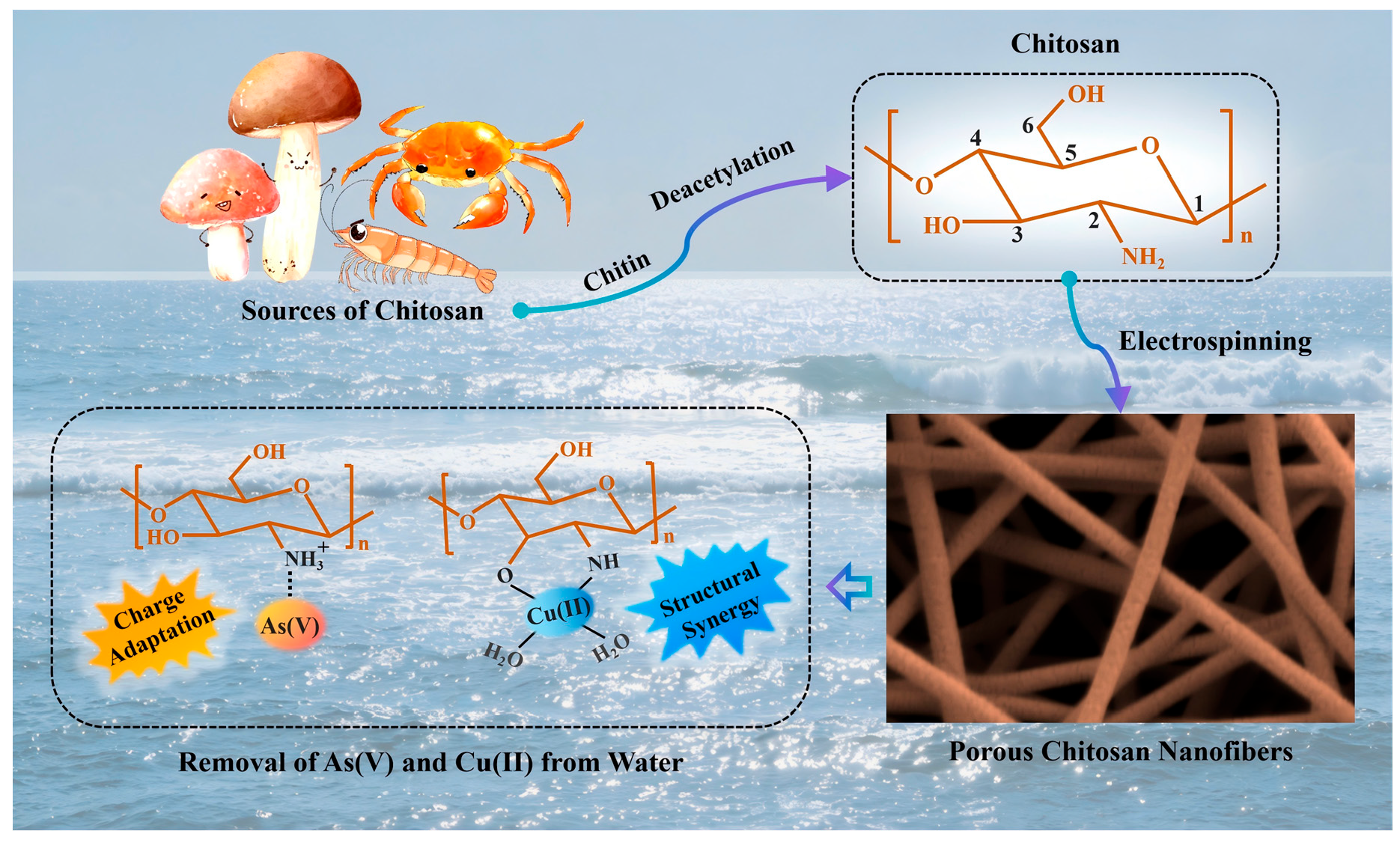
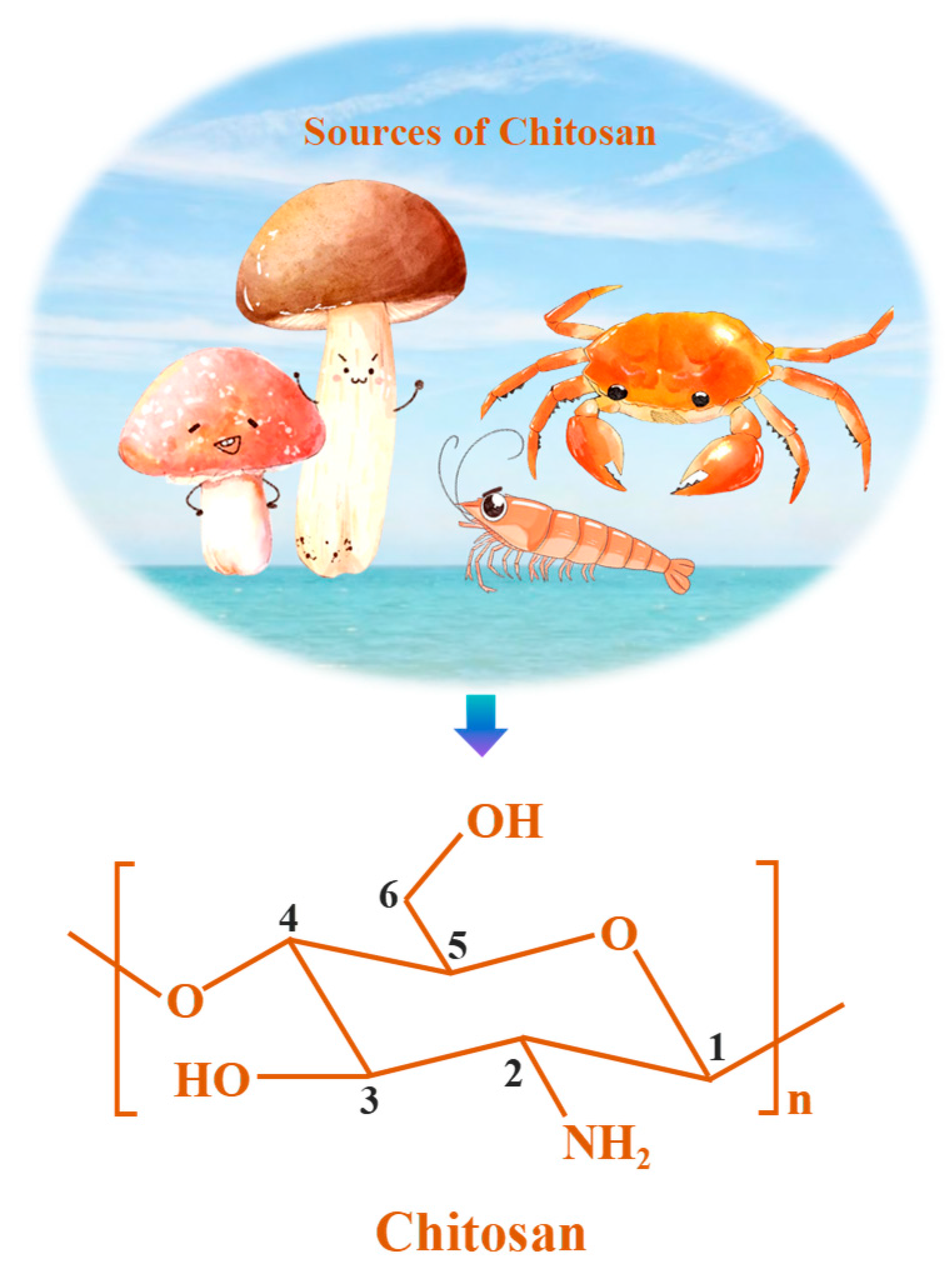
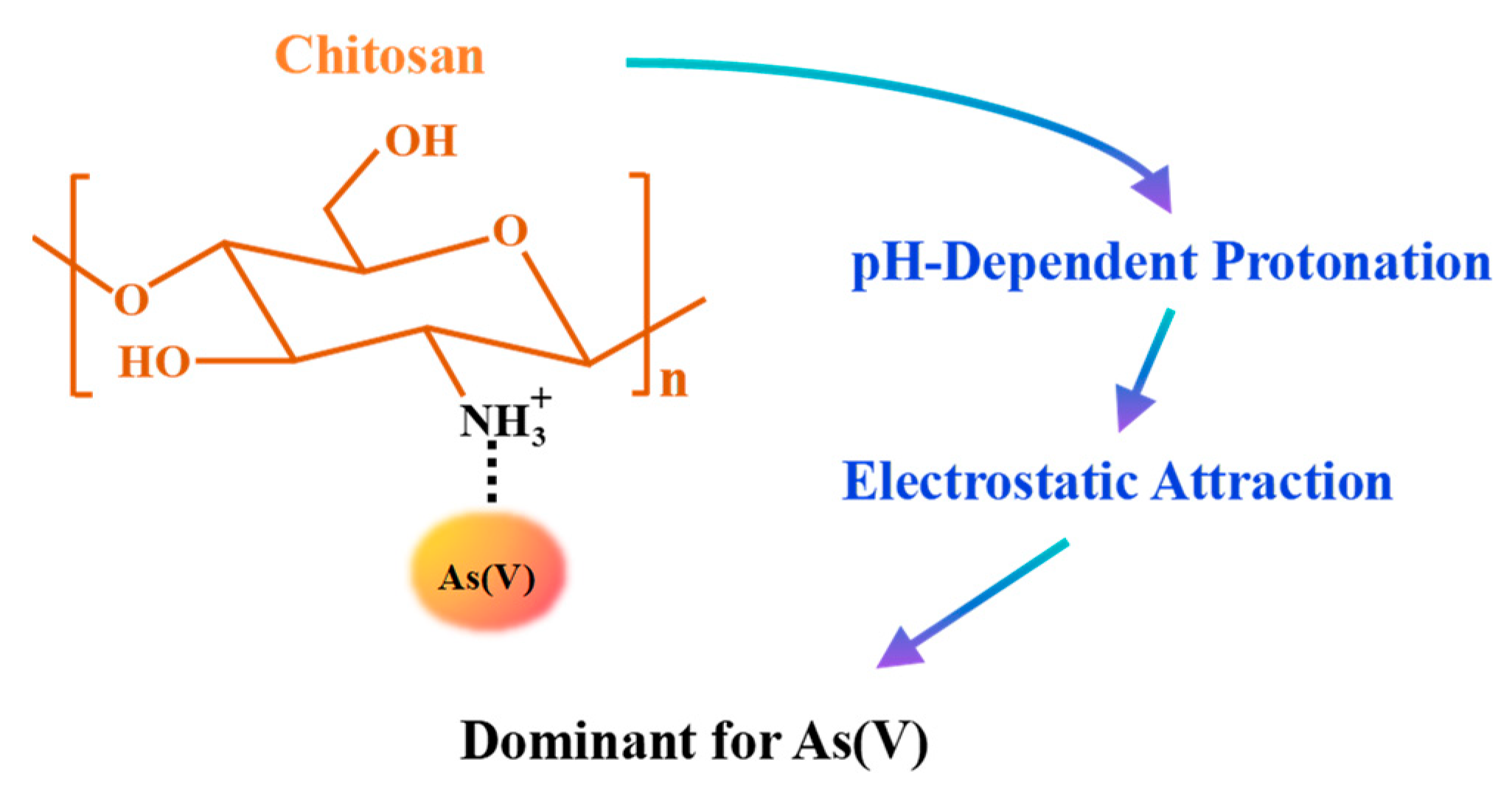
- Electrostatic attraction among protonated amino groups: As shown in Figure 1, chitosan contains numerous amino and hydroxyl groups throughout its molecular structure. When the pH is low, the amino groups gain protons, which gives the polymer positive charge. Under acidic conditions (pH 3–6), As(V) exists predominantly as negatively charged H2AsO4− due to its pKa values (pKa1 = 2.2, pKa2 = 6.9) [51]. Chitosan’s protonated amino groups are the sites where As(V) adhere. This means that the adsorption is mostly an electrostatic interaction between negatively charged As(V) and positively charged amino groups that have been protonated. This process depends a lot on the pH. When the pH is low (pH 2–5), amino groups are heavily protonated, which makes it easier for As(V) to be taken up.
- (2)
- Coordination and surface complexation: Beyond electrostatic attraction, the adsorption of As(V) onto chitosan-based adsorbents can occur through coordination interactions, a behavior governed by the coordination chemistry of the amine groups and the stability constants of the resulting complexes [52]. This effect is particularly pronounced when the adsorbent is functionalized with metal ions such as iron or molybdenum, albeit through distinct mechanisms. For iron (Fe), Fe(III) forms inner-sphere complexes with As(V) via ligand exchange, creating stable bidentate binuclear surface complexes. In chitosan–Fe composite systems, chitosan acts primarily as a supporting matrix that disperses and stabilizes Fe oxides, while the high affinity between Fe–O and As–O bonds drives the adsorption [38]. For molybdenum (Mo), under acidic conditions, molybdate ions (MoO42−) pre-adsorbed onto chitosan can form complexes with As(V) [53,54]. These metal-functionalized chitosan composites thus combine the coordination capacity of the metal centers with the structural advantages of the chitosan matrix, enhancing both adsorption capacity and selectivity for As(V).
- (3)
- Special mechanisms encompass redox reactions and competitive adsorption: In intricate composite systems, chemical transformations above simple adsorption have been noted. A 2023 investigation identified a redox mechanism in magnetic iron-based alginate-chitosan beads that absorbed As(V). In anoxic aqueous solutions, the Fe(II) in the material can transform adsorbed As(V) into As(III). Subsequently, As(III) demonstrated patterns of adsorption, desorption, and re-adsorption. In oxygen-enriched air, As(V) donated electrons to Fe(II) and O2, leading to the formation of As(III), which can subsequently be re-oxidized to As(V) [55]. This redox transformation is environmentally relevant because As(III) is more mobile and significantly more toxic than As(V) [56]. Therefore, while such redox-active composites may enhance total arsenic removal under certain conditions, careful consideration must be given to the potential release of more toxic As(III) during desorption or under anoxic conditions.
- (4)
- Perspectives from molecular dynamics: In recent years, computational chemistry has offered a detailed understanding of the mechanisms involved in adsorption at the atomic level [57]. The temporal interactions between chitosan and arsenic acid were investigated using computational approaches [58]. The study found that the adsorption process occurs in two distinct stages: first, weak hydrogen bonding takes place, followed by the formation of a double-layer adsorption. The primary layer is formed by the direct interactions between chitosan and arsenic acid molecules. In contrast, the secondary layer develops from the collective aggregation of arsenic acid molecules and their interactions with the primary layer [58]. These findings offer a theoretical basis for understanding multi-layer adsorption behavior and the stability of the adsorption system.
3.2. Mechanisms for the Removal of Cu(II)
- (1)
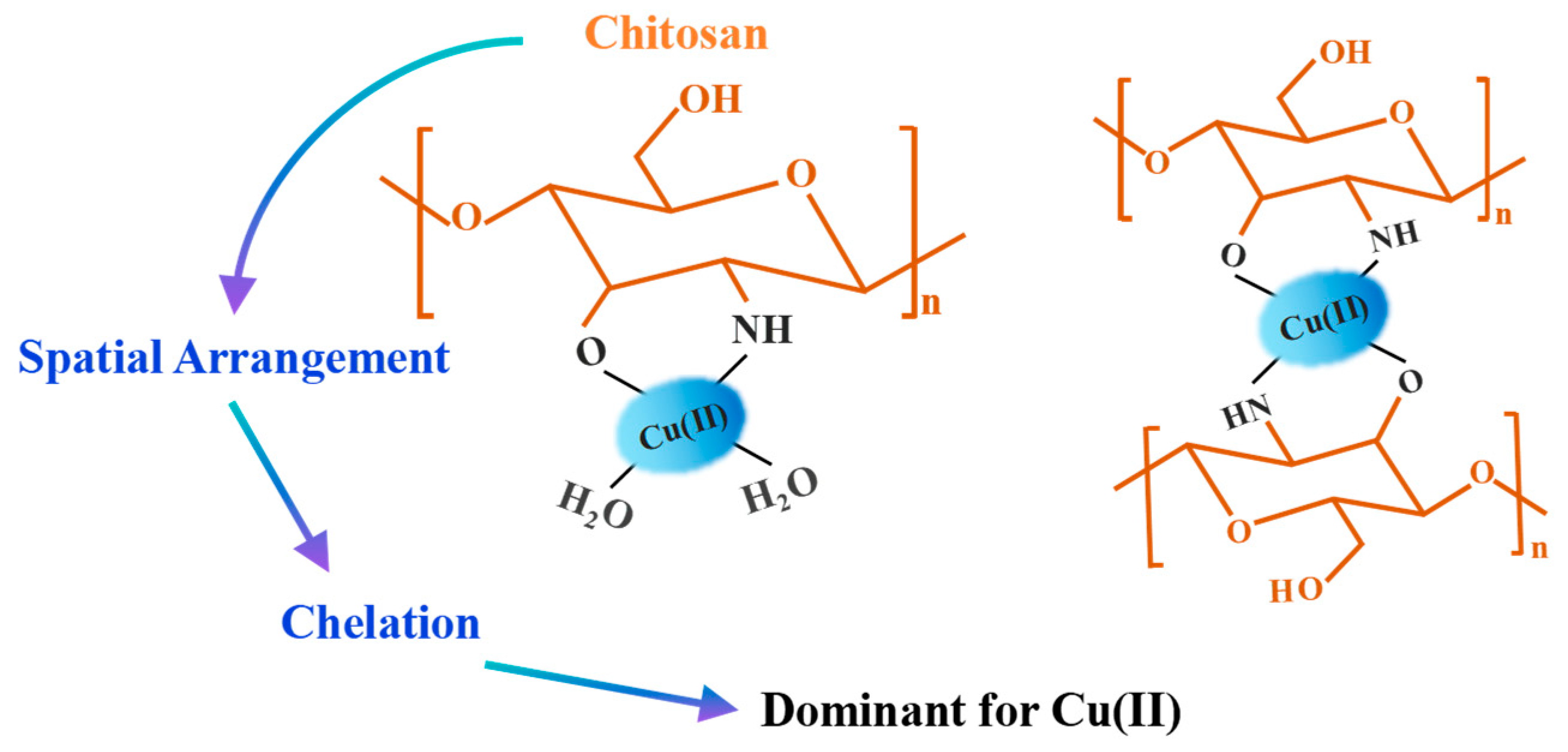
- Chelation and the development of coordination complexes: The primary process for Cu(II) adsorption on chitosan involves the formation of coordination complexes between Cu(II) and the electron-dense functional groups of chitosan, especially the amine (–NH2) groups. Yamani et al. delineated the binding mechanisms of Cu(II) to chitosan specifically [59]. Cu(II) is reported to bind to the amine moiety on the chitosan backbone as a monodentate complex (Type I) and a bidentate complex (Type II), the latter crosslinking two polymer chains [60]. The development of these complexes is contingent upon pH and copper concentration [59]. The Type I complex exists independently under threshold circumstances; however, above pH 5.5 during synthesis and with a copper loading of 0.25 mol Cu2+/mol chitosan monomer, both Type I and Type II complexes coexist. This coordination is fundamental to chitosan’s capacity to immobilize Cu(II). Fatinathan et al. examined Schiff base-modified chitosan beads (altered with benzaldehyde) and determined that chemisorption was the rate-limiting step in Cu(II) adsorption [61]. The authors suggested that the electron-dense functional groups on the modified chitosan could establish coordination complexes with Cu2+. This study further established that the electron configuration of Cu(II) promotes better interactions with the hard ligands found in chitosan.
- (2)
- Electrostatic attraction: In acidic-to-near-neutral pH settings, the amino groups of chitosan become protonated (–NH3+), facilitating electrostatic interactions with copper species, especially when copper exists as anionic complexes alongside coexisting ligands [62]. Guzman et al. conducted a comprehensive study on the sorption of Cu(II) by chitosan in the presence of citrate ions [62]. Their findings indicated that, under acidic conditions, Cu(II) uptake occurs primarily through electrostatic interactions between protonated amine groups on chitosan and anionic copper-citrate complexes, mainly Cu(OH)L2− and, to a lesser extent, CuL−. The adsorption mechanism shifts from ion exchange to electrostatic attraction depending on the pH and the prevailing copper species. Sorption becomes significant only when the proportion of anionic copper complexes exceeds that of anionic ligands not bound to copper [62]. In a related study, Li et al. investigated SiO2/chitosan hybrid aerogels for Cu(II) removal and demonstrated via FTIR and XPS spectral analysis that electrostatic attraction plays a key role in the adsorption mechanism [63].
- (3)
- Cooperation among several mechanisms in composite systems: In intricate composite materials, many mechanisms frequently function concurrently. Wu et al. examined alginate-based beads augmented with polysaccharides for Cu(II) adsorption and determined that the adsorption mechanism encompassed ion exchange, chelation, and electrostatic interaction [64]. Their spectroscopic investigation validated chemical interactions between the beads and Cu(II). A 2024 investigation on Fe-modified magnetic chitosan for the co-adsorption of tetracycline and Cu(II) demonstrated that in binary systems, the presence of Cu(II) and tetracycline significantly enhanced their mutual removal by the formation of ternary complexes (adsorbent-Cu2+-TC or adsorbent-TC-Cu2+) [65]. This illustrates that Cu(II) can function as a bridging ion between the adsorbent and other contaminants, thus enhancing the mechanistic comprehension beyond just binary adsorption.
3.3. Charge Adaptation-Structure Synergy Model
- (1)
- Charge Adaptation-Dominated Mechanism for As(V)
- (2)
- Structure Synergy-Dominated Mechanism for Cu(II)
- (3)
- Complementary Roles and Model Summary
3.4. Electrospun Chitosan Materials
3.5. Competitive and Synergistic Adsorption in Binary Systems
3.5.1. Competition Between As(V) and Phosphate
3.5.2. Competition Between Cu(II) and Coexisting Species
4. Conclusions
- (1)
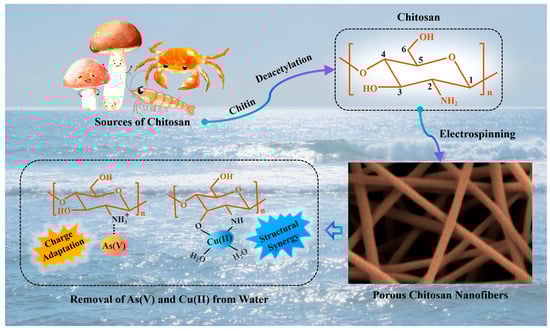
- Distinct adsorption behaviors for anions and cations: Chitosan-based adsorbents exhibit different adsorption behaviors for As(V) and Cu(II) due to the pH-sensitive nature of their functional groups. Under acidic conditions, protonated amino groups facilitate the capture of As(V) oxyanions via electrostatic attraction. Under near-neutral conditions, deprotonated amino groups coordinate with adjacent hydroxyl groups to form stable five-membered chelate rings with Cu(II) cations. This duality makes chitosan a versatile material for addressing toxic metal(loid) pollution in composite systems.
- (2)
- Introduction of the “charge adaptation–structure synergy” model: This review presents a conceptual framework that synthesizes current understanding of the distinct adsorption characteristics of chitosan. The model asserts that “charge adaptation” (the pH-dependent protonation state of functional groups) regulates the initial electrostatic attraction, whereas “structure synergy” (the spatial and electronic compatibility between the chitosan backbone and target ions) affects the binding strength and selectivity. For As(V), adsorption primarily relies on charge adaptation, whereas for Cu(II), it predominantly depends on structural synergy. This framework provides a molecular-level basis for the targeted design of chitosan-based adsorbents.
- (3)
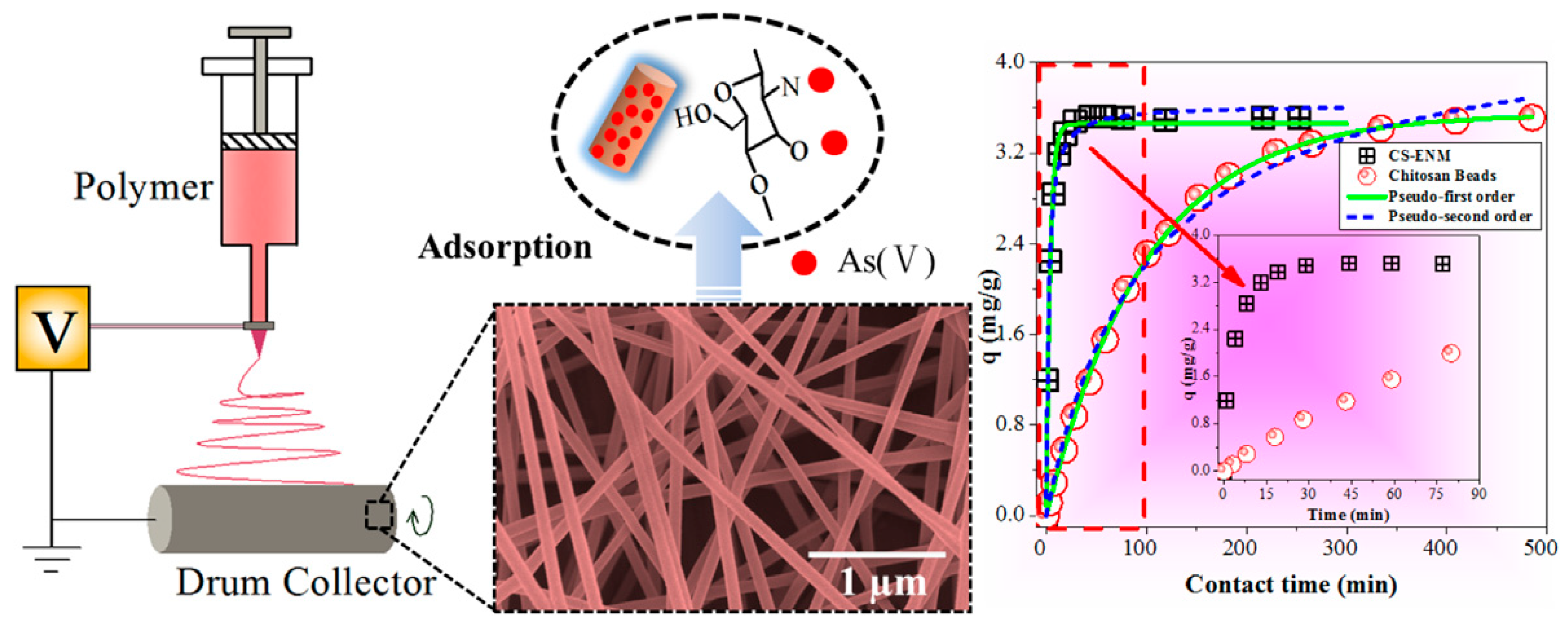
- Electrospinning enhances adsorption kinetics: In conventional chitosan adsorbents, active sites are often less accessible, contributing to slower kinetics. In contrast, electrospun chitosan nanofibers offer a high specific surface area, interconnected porosity, and reduced diffusion pathways, which help address this limitation. Recent studies have shown that electrospun chitosan membranes can reduce the time required to reach adsorption equilibrium for arsenic to 0.5–2.6 h [34,36,90], representing a noticeable improvement compared to conventional bead or granule formulations.
Author Contributions
Funding
Data Availability Statement
Acknowledgments
Conflicts of Interest
References
- Podgorski, J.; Berg, M. Global threat of arsenic in groundwater. Science 2020, 368, 845–850. [Google Scholar] [CrossRef] [PubMed]
- Yuan, F.; Yan, D.F.; Song, S.B.; Zhang, J.B.; Yang, Y.Y.; Chen, Z.; Lu, J.H.; Wang, S.M.; Sun, Y.J. Removal of heavy metals from water by adsorption on metal organic frameworks: Research progress and mechanistic analysis in the last decade. Chem. Eng. J. 2025, 506, 160063. [Google Scholar] [CrossRef]
- Sadee, B.A.; Zebari, S.M.S.; Galali, Y.; Saleem, M.F. A review on arsenic contamination in drinking water: Sources, health impacts, and remediation approaches. RSC Adv. 2025, 15, 2684–2703. [Google Scholar] [CrossRef]
- Al-Saydeh, S.A.; El-Naas, M.H.; Zaidi, S.J. Copper removal from industrial wastewater: A comprehensive review. J. Ind. Eng. Chem. 2017, 56, 35–44. [Google Scholar] [CrossRef]
- Chigome, S.; Andala, D.; Kabomo, M.; Mobegi, E. Perspectives on the development of filter media for point of use water filters: Case study of arsenate removal. Front. Chem. 2022, 10, 826440. [Google Scholar] [CrossRef]
- de Conti, A.; Madia, F.; Schubauer-Berigan, M.K.; Benbrahim-Tallaa, L. Carcinogenicity of some metals evaluated by the IARC Monographs: A synopsis of the evaluations of arsenic, cadmium, cobalt, and antimony. Toxicol. Appl. Pharmacol. 2025, 504, 117506. [Google Scholar] [CrossRef]
- Ling, W.; Li, S.; Zhu, Y.; Wang, X.; Jiang, D.; Kang, B. Inducers of autophagy and cell death: Focus on copper metabolism. Ecotoxicol. Environ. Saf. 2025, 290, 117725. [Google Scholar] [CrossRef]
- Binesh, A.; Venkatachalam, K. Copper in human health and disease: A comprehensive review. J. Biochem. Mol. Toxicol. 2024, 38, e70052. [Google Scholar] [CrossRef] [PubMed]
- Malhotra, N.; Ger, T.-R.; Uapipatanakul, B.; Huang, J.-C.; Chen, K.H.-C.; Hsiao, C.-D. Review of copper and copper nanoparticle toxicity in fish. Nanomaterials 2020, 10, 1126. [Google Scholar] [CrossRef] [PubMed]
- Taylor, A.A.; Tsuji, J.S.; Garry, M.R.; McArdle, M.E.; Goodfello, W.L., Jr.; Adams, W.J.; Menzie, C.A. Critical review of exposure and effects: Implications for setting regulatory health criteria for ingested copper. Environ. Manag. 2020, 65, 131–159. [Google Scholar] [CrossRef] [PubMed]
- Ni, S.; Liu, G.; Zhao, Y.; Zhang, C.; Wang, A. Distribution and source apportionment of heavy metals in soil around Dexing copper mine in Jiangxi Province, China. Sustainability 2023, 15, 1143. [Google Scholar] [CrossRef]
- Wei, C.; Wang, C.; Yang, L. Characterizing spatial distribution and sources of heavy metals in the soils from mining-smelting activities in Shuikoushan, Hunan Province, China. J. Environ. Sci. 2009, 21, 1230–1236. [Google Scholar] [CrossRef]
- Huang, W.; Liu, Y.; Bi, X.; Wang, Y.; Li, H.; Qin, J.; Chen, J.; Ruan, Z.; Chen, G.; Qiu, R. Source-specific soil heavy metal risk assessment in arsenic waste mine site of Yunnan: Integrating environmental and biological factors. J. Hazard. Mater. 2025, 486, 136902. [Google Scholar] [CrossRef] [PubMed]
- Gahrouei, A.E.; Rezapour, A.; Pirooz, M.; Pourebrahimi, S. From classic to cutting-edge solutions: A comprehensive review of materials and methods for heavy metal removal from water environments. Desalination Water Treat. 2024, 319, 100446. [Google Scholar] [CrossRef]
- Barakat, M.A. New trends in removing heavy metals from industrial wastewater. Arab. J. Chem. 2011, 4, 361–377. [Google Scholar] [CrossRef]
- Crini, G.; Lichtfouse, E. Advantages and disadvantages of techniques used for wastewater treatment. Environ. Chem. Lett. 2019, 17, 145–155. [Google Scholar] [CrossRef]
- Kaur, S.; Dhillon, G.S. The versatile biopolymer chitosan: Potential sources, evaluation of extraction methods and applications. Crit. Rev. Microbiol. 2014, 40, 155–175. [Google Scholar] [CrossRef]
- Hegde, S.; Selvaraj, S. Chitosan: An in-depth analysis of its extraction, applications, constraints, and future prospects. J. Microbiol. Biotechnol. Food Sci. 2024, 14, e10563. [Google Scholar] [CrossRef]
- Vakili, M.; Rafatullah, M.; Salamatinia, B.; Abdullah, A.Z.; Ibrahim, M.H.; Tan, K.B.; Gholami, Z.; Amouzgar, P. Application of chitosan and its derivatives as adsorbents for dye removal from water and wastewater: A review. Carbohydr. Polym. 2014, 113, 115–130. [Google Scholar] [CrossRef] [PubMed]
- Kaczorowska, M.A.; Bozejewicz, D. The Application of chitosan-based adsorbents for the removal of hazardous pollutants from aqueous solutions—A review. Sustainability 2024, 16, 2615. [Google Scholar] [CrossRef]
- Guibal, E. Interactions of metal ions with chitosan-based sorbents: A review. Sep. Purif. Technol. 2004, 38, 43–74. [Google Scholar] [CrossRef]
- Patel, P.K.; Uppaluri, R.V. Chitosan and its functionalized derivatives for heavy metal ion elimination: A review of synthesis, mechanisms, and characterization studies. Adv. Colloid Interface Sci. 2025, 345, 103632. [Google Scholar] [CrossRef] [PubMed]
- Periyannan, K.; Selvaraj, H.; Subbu, B.; Pallikondaperumal, M.; Karuppiah, P.; Rajabathar, J.R.; Al-Lohedan, H.; Thangarasu, S. Green fabrication of chitosan from marine crustaceans and mushroom waste: Toward sustainable resource utilization. Green Process. Synth. 2023, 12, 20230093. [Google Scholar] [CrossRef]
- Yadav, M.; Goswami, P.; Paritosh, K.; Kumar, M.; Pareek, N.; Vivekanand, V. Seafood waste: A source for preparation of commercially employable chitin/chitosan materials. Bioresour. Bioprocess. 2019, 6, 8. [Google Scholar] [CrossRef]
- Pakizeh, M.; Moradi, A.; Ghassemi, T. Chemical extraction and modification of chitin and chitosan from shrimp shells. Eur. Polym. J. 2021, 159, 110709. [Google Scholar] [CrossRef]
- Rødde, R.H.; Einbu, A.; Vårum, K.M. A seasonal study of the chemical composition and chitin quality of shrimp shells obtained from northern shrimp (Pandalus borealis). Carbohydr. Polym. 2008, 71, 388–393. [Google Scholar] [CrossRef]
- Hellmann, M.J.; Marongiu, G.L.; Gorzelanny, C.; Moerschbacher, B.M.; Cord-Landwehr, S. Hydrolysis of chitin and chitosans by the human chitinolytic enzymes: Chitotriosidase, acidic mammalian chitinase, and lysozyme. Int. J. Biol. Macromol. 2025, 297, 139789. [Google Scholar] [CrossRef] [PubMed]
- Nordtveit, R.J.; Vårum, K.M.; Smidsrød, O. Degradation of fully water-soluble, partially N-acetylated chitosans with lysozyme. Carbohydr. Polym. 1994, 23, 253–260. [Google Scholar] [CrossRef]
- Koumentakou, I.; Meretoudi, A.; Emmanouil, C.; Kyzas, G.Z. Environmental toxicity and biodegradation of chitosan derivatives: A comprehensive review. J. Ind. Eng. Chem. 2025, 146, 70–86. [Google Scholar] [CrossRef]
- Varma, A.J.; Deshpande, S.V.; Kennedy, J.F. Metal complexation by chitosan and its derivatives: A review. Carbohydr. Polym. 2004, 55, 77–93. [Google Scholar] [CrossRef]
- Roy, B.K.; Tahmid, I.; Rashid, T.U. Chitosan-based materials for supercapacitor applications: A review. J. Mater. Chem. A 2021, 9, 17592–17642. [Google Scholar] [CrossRef]
- Doobi, F.A.; Mir, F.Q. Exploring the development of natural biopolymer (chitosan)-based proton exchange membranes for fuel cells: A review. Results Surf. Interfaces 2024, 15, 100218. [Google Scholar] [CrossRef]
- Alatawi, R.A.S. Electrospun nanofiber chitosan/polyvinyl alcohol loaded with metal organic framework nanofiber for efficient adsorption and removal of industrial dyes from waste water: Adsorption isotherm, kinetic, thermodynamic, and optimization via Box-Behnken design. Int. J. Biol. Macromol. 2025, 299, 140086. [Google Scholar] [CrossRef] [PubMed]
- Min, L.; Yuan, Z.; Zhong, L.; Liu, Q.; Wu, R.; Zheng, Y. Preparation of chitosan based electrospun nanofiber membrane and its adsorptive removal of arsenate from aqueous solution. Chem. Eng. J. 2015, 267, 132–141. [Google Scholar] [CrossRef]
- Min, L.; Yang, L.; Wu, R.; Zhong, L.; Yuan, Z.; Zheng, Y. Enhanced adsorption of arsenite from aqueous solution by an iron-doped electrospun chitosan nanofiber mat: Preparation, characterization and performance. J. Colloid Interface Sci. 2019, 535, 255–264. [Google Scholar] [CrossRef]
- Min, L.; Ma, Y.; Zhang, B.; He, D.; Chen, J.; Li, X.; Wang, S.; Chi, Y. Electrospinning chitosan/Fe-Mn nanofibrous composite for efficient and rapid removal of arsenite from water. Toxics 2024, 12, 230. [Google Scholar] [CrossRef]
- Wang, Z.; Kang, S.B.; Yun, H.J.; Won, S.W. Efficient removal of arsenate from water using electrospun polyethylenimine/polyvinyl chloride nanofiber sheets. React. Funct. Polym. 2023, 184, 105514. [Google Scholar] [CrossRef]
- Zhong, L.; Yang, J.; Zhang, T.; Wu, L.; Wu, Y.; Zhang, J.; Li, M.; Wu, K.; Shang, M.; Liu, C.; et al. Synthesis and application studies of chitosan nanofibers. Int. J. Biol. Macromol. 2025, 330, 148173. [Google Scholar] [CrossRef]
- Shakiba, M.; Faraji, M.; Jouybar, S.; Foroozandeh, A.; Bigham, A.; Abdouss, M.; Saidi, M.; Vatanpour, V.; Varma, R.S. Advanced nanofibers for water treatment: Unveiling the potential of electrospun polyacrylonitrile membranes. Environ. Res. 2025, 276, 121403. [Google Scholar] [CrossRef] [PubMed]
- Majlesi, M.; Assadpour, E.; Tavassoli, M.; Jafari, S.M. Electrospun nanofibers for the adsorption and separation of pollutants from wastewater: New opportunities and recent advances. Adv. Colloid Interface Sci. 2025, 348, 103749. [Google Scholar] [CrossRef]
- Shi, S.; Bai, W.; Chen, X.; Si, Y.; Zhi, C.; Wu, H.; Su, Y.; Cai, W.; Fei, B.; Kan, C.W. Advances in nanofiber filtration membranes: From principles to intelligent applications. Adv. Funct. Mater. 2025, 35, 2423284. [Google Scholar] [CrossRef]
- Li, S.; Li, Y.; Zhang, X.; Jiang, D.; Kong, L. Electrospinning of chitosan-based nanofibers: Innovations in fabrication and applications. J. Agric. Food Res. 2025, 25, 102599. [Google Scholar] [CrossRef]
- Janjhi, F.A.; Chandio, I.; Janwery, D.; Vatanpour, V.; Castro-Muñoz, R. A review on hydrophobic electrospun nanofibers-based materials and membranes for water treatment: Challenges, outlook, and stability. Sep. Purif. Technol. 2025, 353, 128370. [Google Scholar] [CrossRef]
- Strand, S.P.; Tømmeraas, K.; Vårum, K.M.; Østgaard, K. Electrophoretic light scattering studies of chitosans with different degrees of N-acetylation. Biomacromolecules 2001, 2, 1310–1314. [Google Scholar] [CrossRef]
- Gupta, D.; Haile, A. Multifunctional properties of cotton fabric treated with chitosan and carboxymethyl chitosan. Carbohydr. Polym. 2007, 69, 164–171. [Google Scholar] [CrossRef]
- Gupta, A.; Chauhan, V.S.; Sankararamakrishnan, N. Preparation and evaluation of iron–chitosan composites for removal of As(III) and As(V) from arsenic contaminated real life groundwater. Water Res. 2009, 43, 3862–3870. [Google Scholar] [CrossRef] [PubMed]
- Wan, M.-W.; Kan, C.-C.; Rogel, B.D.; Dalida, M.L.P. Adsorption of copper (II) and lead (II) ions from aqueous solution on chitosan-coated sand. Carbohydr. Polym. 2010, 80, 891–899. [Google Scholar] [CrossRef]
- Schatz, C.; Viton, C.; Delair, T.; Pichot, C.; Domard, A. Typical physicochemical behaviors of chitosan in aqueous solution. Biomacromolecules 2003, 4, 641–648. [Google Scholar] [CrossRef]
- Lopez-Leon, T.; Carvalho, E.L.S.; Seijo, B.; Ortega-Vinuesa, J.L.; Bastos-González, D. Physicochemical characterization of chitosan nanoparticles: Electrokinetic and stability behavior. J. Colloid Interface Sci. 2005, 283, 344–351. [Google Scholar] [CrossRef]
- Franca, E.; Lins, R.; Freitas, L.; Straatsma, T. Characterization of Chitin and Chitosan Molecular Structure in Aqueous Solution. J. Chem. Theory Comput. 2008, 4, 2141–2149. [Google Scholar] [CrossRef]
- Smith, E.; Naidu, R.; Alston, A.M. Arsenic in the Soil Environment: A Review. Adv. Agron. 1998, 64, 149–195. [Google Scholar]
- Zeng, H.; Ma, G.; Zheng, X.; Lin, D.; Zhang, J.; Li, D. Preparation, application and regeneration of chitosan composite adsorbents for arsenic removal: A review from a sustainable perspective. Int. J. Biol. Macromol. 2025, 330, 148156. [Google Scholar] [CrossRef]
- Dambies, L.; Vincent, T.; Guibal, E. Treatment of arsenic-containing solutions using chitosan derivatives: Uptake mechanism and sorption performances. Water Res. 2002, 36, 3699–3710. [Google Scholar] [CrossRef]
- Dambies, L.; Guibal, E.; Roze, A. Arsenic(V) sorption on molybdate-impregnated chitosan beads. Colloids Surf. A 2000, 170, 19–31. [Google Scholar] [CrossRef]
- Sun, S.; Zeng, H.; Xu, H.; Zhao, W.; Qi, W.; Hao, R.; Zhang, J.; Li, D. Adsorption of As (V) and P (V) by magnetic iron-based alginate-chitosan beads: Competitive adsorption and reduction mechanism of As (V) induced by Fe (II). Colloids Surf. A 2023, 675, 132068. [Google Scholar] [CrossRef]
- He, W.; Mallavarapu, M.; Naidu, R. Toxicity of tri- and penta-valent arsenic, alone and in combination, to the cladoceran Daphnia carinata: The influence of microbial transformation in natural waters. Environ. Geochem. Health 2009, 31, 133–141. [Google Scholar] [CrossRef]
- Hudek, M.; Johnston, K.; Kubiak-Ossowska, K.; Ferro, V.A.; Mulheran, P.A. Molecular dynamics study of chitosan adsorption at a silica surface. J. Phys. Chem. C 2024, 128, 21531–21538. [Google Scholar] [CrossRef]
- Meza-González, B.; Jacinto, M.M.; Brito-Flores, L.; Cortes-Guzman, F.; Gómez-Espinosa, R.M. Interaction between chitosan and arsenic acid. Chem. Phys. 2024, 582, 112276. [Google Scholar] [CrossRef]
- Yamani, J.S.; Lounsbury, A.W.; Zimmerman, J.B. Towards a selective adsorbent for arsenate and selenite in the presence of phosphate: Assessment of adsorption efficiency, mechanism, and binary separation factors of the chitosan-copper complex. Water Res. 2016, 88, 889–896. [Google Scholar] [CrossRef] [PubMed]
- Rhazi, M.; Desbrières, J.; Tolaimate, A.; Rinaudo, M.; Vottero, P.; Alagui, A. Contribution to the study of the complexation of copper by chitosan and oligomers. Polymer 2002, 43, 1267–1276. [Google Scholar] [CrossRef]
- Law, S.C.; Wan Ngah, W.S.; Hanafiah, M.A.K.M.; Perumal, V.; Balan, T.; Mohideen, M.; Sandanamsamy, S.S.; Selvarajoo, P.D.; Fatinathan, S. Kinetic, isotherm, and mechanistic insights into Cu2+ and Ni2+ ions removal using benzaldehyde–modified chitosan beads in batch adsorption and fixed-bed column systems. Pure Appl. Chem. 2025. [Google Scholar] [CrossRef]
- Guzman, J.; Saucedo, I.; Revilla, J.; Navarro, R.; Guibal, E. Copper sorption by chitosan in the presence of citrate ions: Influence of metal speciation on sorption mechanism and uptake capacities. Int. J. Biol. Macromol. 2003, 33, 57–65. [Google Scholar] [CrossRef]
- Li, H.-F.; Mu, Y.-F.; Zhang, J.; Lan, D.; Guo, X.-M.; Tang, J.; Wang, Y.; Wang, Y.-Y. Chitosan tailored SiO2 aerogel for efficient removal of copper ions. Int. J. Biol. Macromol. 2025, 320, 146126. [Google Scholar] [CrossRef]
- Wu, Z.; Su, J.; Cong, X.; Zhao, D.; Wu, J.; Zhou, H.; Huang, M.; Zheng, J.; Zhao, D.; Sun, B. Preparation, characterization, and mechanism of swelling and Cu2+ adsorption by alginate-based beads enhanced with Huangshui polysaccharides. J. Clean. Prod. 2024, 475, 143622. [Google Scholar] [CrossRef]
- Chen, B.; Chen, Y.; Cao, Y.; Huang, J.; Chen, X.; Pan, X. Collaboratively scavenge tetracycline and Cu2+ from their combined system by Fe3+-modified magnetic chitosan: Performance, mechanisms, and dynamic sorption process. Chem. Eng. J. 2024, 484, 149625. [Google Scholar] [CrossRef]
- An, B. Cu(II) and As(V) adsorption kinetic characteristic of the multifunctional amino groups in chitosan. Processes 2020, 8, 1194. [Google Scholar] [CrossRef]
- Joseph, T.; Jacob, M.; Nair, V.; Varkey, J. Removal of metal ions using Chitosan based electro spun nanofibers: A review. Nanosyst. Phys. Chem. Math. 2021, 12, 728–748. [Google Scholar] [CrossRef]
- Naseri, N.; Algan, C.; Jacobs, V.; John, M.; Oksman, K.; Mathew, A.P. Electrospun chitosan-based nanocomposite mats reinforced with chitin nanocrystals for wound dressing. Carbohydr. Polym. 2014, 109, 7–15. [Google Scholar] [CrossRef] [PubMed]
- Min, L.L.; Zhong, L.B.; Zheng, Y.M.; Liu, Q.; Yuan, Z.H.; Yang, L.M. Functionalized chitosan electrospun nanofiber for effective removal of trace arsenate from water. Sci. Rep. 2016, 6, 32480. [Google Scholar] [CrossRef]
- Ramakrishna, S.; Fujihara, K.; Teo, W.-E.; Yong, T.; Ma, Z.; Ramaseshan, R. Electrospun nanofibers: Solving global issues. Mater. Today 2006, 9, 40–50. [Google Scholar] [CrossRef]
- Crini, G. Recent developments in polysaccharide-based materials used as adsorbents in wastewater treatment. Prog. Polym. Sci. 2005, 30, 38–70. [Google Scholar] [CrossRef]
- Yang, D.; Li, L.; Chen, B.; Shi, S.; Nie, J.; Ma, G. Functionalized chitosan electrospun nanofiber membranes for heavy-metal removal. Polymer 2019, 163, 74–85. [Google Scholar] [CrossRef]
- Elamin, N.Y.; Elamin, M.R.; Alhussain, H.; Alotaibi, M.T.; Alluhaybi, A.A.; El-Bindary, A.A. Electrospun nanofibers of polycaprolactone loaded with chitosan/carbon quantum dots composite for adsorptive removal of Cd(II) ions from wastewater: Adsorption, kinetics, thermodynamics, and BOX Behnken design. Int. J. Biol. Macromol. 2025, 308, 142680. [Google Scholar] [CrossRef]
- Zhang, K.; Zhu, C.; Xie, L.; Zhang, L.; Chai, X.; Wu, C.; Wang, S.; Peng, W.; Du, G.; Xu, K. Facile fabrication of electrospun hybrid nanofibers integrated cellulose, chitosan with ZIF-8 for efficient remediation of copper ions. Carbohydr. Polym. 2025, 359, 123574. [Google Scholar] [CrossRef] [PubMed]
- Chatterjee, S.; Guha, A.K.; Chatterjee, B.; Banerjee, P.; Singha, N.R. Sulphate-modified chitosan hydrogel beads a recyclable bio-adsorbent for Cu(II): Experimental and theoretical studies toward nitrogen-/oxygen-donor selective binding and 1:1 complexation. Int. J. Biol. Macromol. 2025, 323, 146997. [Google Scholar] [CrossRef] [PubMed]
- Yang, Y.; Zeng, L.; Lin, Z.; Jiang, H.; Zhang, A. Adsorption of Pb2+, Cu2+ and Cd2+ by sulfhydryl modified chitosan beads. Carbohydr. Polym. 2021, 274, 118622. [Google Scholar] [CrossRef]
- Afifah Khalil, N.; Syafiqah Abdul Rahman, A.; Mubin Abu Huraira, A.; Nur Dalillah Fattin Janurin, S.; Noor Syimir Fizal, A.; Ahmad, N.; Zulkifli, M.; Sohrab Hossain, M.; Naim Ahmad Yahaya, A. Magnetic chitosan hydrogel beads as adsorbent for copper removal from aqueous solution. Mater. Today Proc. 2023, 74, 499–503. [Google Scholar] [CrossRef]
- Zhang, H.; Yao, C.; Qin, X. A visually observable copper ion adsorption membrane by electrospinning combined with copper ion probe. Fibers Polym. 2021, 22, 1844–1852. [Google Scholar] [CrossRef]
- Li, C.; Fu, L.; Deng, S.; Wang, H.; Jia, L. Polydopamine-functionalized electrospun poly(vinyl alcohol)/chitosan nanofibers for the removal and determination of Cu(II). Int. J. Biol. Macromol. 2024, 256, 128398. [Google Scholar] [CrossRef]
- Zia, Q.; Tabassum, M.; Meng, J.; Xin, Z.; Gong, H.; Li, J. Polydopamine-assisted grafting of chitosan on porous poly (L-lactic acid) electrospun membranes for adsorption of heavy metal ions. Int. J. Biol. Macromol. 2021, 167, 1479–1490. [Google Scholar] [CrossRef]
- Chen, C.C.; Chung, Y.C. Arsenic removal using a biopolymer chitosan sorbent. J. Environ. Sci. Health Part A Toxic/Hazard. Subst. Environ. Eng. 2006, 41, 645–658. [Google Scholar] [CrossRef]
- Gérente, C.; Andrès, Y.; McKay, G.; Le Cloirec, P. Removal of arsenic(V) onto chitosan: From sorption mechanism explanation to dynamic water treatment process. Chem. Eng. J. 2010, 158, 593–598. [Google Scholar] [CrossRef]
- de Souza, J.R.; Sato, T.P.; Borges, A.L.S. Scaffold architecture for dental biomaterials: Influence of process parameters on the structural morphology of chitosan electrospun fibers. Braz. Dent. Sci. J. 2017, 20, 100–105. [Google Scholar] [CrossRef]
- Abdelhady, S.; El-Desouky, A.R.; Kassab, A.M.F.; Barakat, W.; Zoalfakar, S. Optimization of electrospun chitosan/polyethylene oxide hybrid nanofibril composite via response surface methodology. J. Thermoplast. Compos. Mater. 2023, 37, 885–909. [Google Scholar] [CrossRef]
- Rendon-Heredia, O.; Vasquez-Garcia, S.R.; Flores-Ramirez, N.; Fernandez-Quiroz, D.; Sanchez-Orozco, R. Chitosan films: Tailoring properties for sustainable applications through casting and electrospinning. MRS Adv. 2024, 9, 1772–1776. [Google Scholar] [CrossRef]
- Pincus, L.N.; Petrovic, P.V.; Gonzalez, I.S.; Stavitski, E.; Fishman, Z.S.; Rudel, H.E.; Anastas, P.T.; Zimmerman, J.B. Selective adsorption of arsenic over phosphate by transition metal cross-linked chitosan. Chem. Eng. J. 2021, 412, 128582. [Google Scholar] [CrossRef] [PubMed]
- Gylienė, O.; Nivinskienė, O.; Razmutė, I. Copper (II)–EDTA sorption onto chitosan and its regeneration applying electrolysis. J. Hazard. Mater. 2006, 137, 1430–1437. [Google Scholar] [CrossRef] [PubMed]
- Inoue, K.; Yoshizuka, K.; Ohto, K. Adsorptive separation of some metal ions by complexing agent types of chemically modified chitosan. Anal. Chim. Acta 1999, 388, 209–218. [Google Scholar] [CrossRef]
- Verbych, S.; Bryk, M.; Chornokur, G.; Fuhr, B. Removal of copper (II) from aqueous solutions by chitosan adsorption. Sep. Sci. Technol. 2005, 40, 1749–1759. [Google Scholar] [CrossRef]
- Horzum, N.; Demir, M.M.; Nairat, M.; Shahwan, T. Chitosan fiber-supported zero-valent iron nanoparticles as a novel sorbent for sequestration of inorganic arsenic. RSC Adv. 2013, 3, 7828–7837. [Google Scholar] [CrossRef]





| Key Focus | Relevance to This Review | Reference |
|---|---|---|
| Synthesis and application studies of chitosan nanofibers, including preparation processes, performance factors, and environmental applications | Focuses specifically on chitosan nanofibers, covering fabrication parameters and environmental applications including toxic metal adsorption, aligning with the core theme of this review. | [38] |
| Electrospun polyacrylonitrile membranes for water treatment | Discusses electrospun membranes for water treatment, providing general background on nanofiber technology applicable to chitosan-based systems. | [39] |
| Electrospun nanofibers for pollutant adsorption and separation | Provides comprehensive coverage of adsorption mechanisms in electrospun nanofibers, supporting the mechanistic discussion in Section 3. | [40] |
| Nanofiber filtration membranes from principles to intelligent applications | Reviews state-of-the-art nanofiber membranes, offering perspective on future directions for chitosan-based filtration systems. | [41] |
| Electrospinning of chitosan-based nanofibers | Specifically focuses on electrospinning of chitosan nanofibers, covering fabrication innovations and applications, supporting the discussion in Section 3.4. | [42] |
| Hydrophobic electrospun nanofibers for water treatment: challenges and outlook | Discusses challenges (e.g., stability, scalability) of electrospun nanofibers in water treatment, complementing the future perspective section of this review. | [43] |
| Mechanism | As(V), Anion | Cu(II), Cation |
|---|---|---|
| Primary Active Site | Protonated amine group (–NH3+) | Amine group (–NH2) |
| Type of Interaction | Electrostatic Attraction: Interaction between opposite charges. | Coordination/Complexation: Formation of a chelate complex |
| Reaction Representation | R–NH3+ + HAsO42− → R–NH3+HAsO42− | R-NH2 + Cu(II) → R-NH2Cu(II) |
| Role of pH | Optimal at pH below the pKa of chitosan. | Optimal at pH near or above the pKa of chitosan |
| Nature of Binding | Outer-sphere complexation (physisorption/ion exchange). | Inner-sphere complexation (chemisorption) |
| Adsorbent System | Qmax (mg/g) | Optimal pH | Equilibrium Time | Reference |
|---|---|---|---|---|
| Conventional chitosan-based adsorbents | ||||
| Benzaldehyde-modified chitosan beads | 81.8 | 4.0 | ~120 min | [61] |
| Sulfate-modified chitosan hydrogel beads | 80.3 | 5.0 | 120 min | [75] |
| Sulfhydryl modified chitosan beads | 163.3 | 5.0 | ~300 min | [76] |
| Magnetic chitosan hydrogel beads | - | 5.0 | 24 h | [77] |
| Electrospun chitosan-based nanofibers | ||||
| CS/PAN nanofiber membrane | 164.3 | 5.0–6.0 | 90 min | [78] |
| PVA/CS/PDA nanofibers | 326.5 | 7.0 | ~90 min | [79] |
| Polydopamine-grafted chitosan on porous PLLA nanofibers | 270.3 | 5.0 | 40 min | [80] |
Disclaimer/Publisher’s Note: The statements, opinions and data contained in all publications are solely those of the individual author(s) and contributor(s) and not of MDPI and/or the editor(s). MDPI and/or the editor(s) disclaim responsibility for any injury to people or property resulting from any ideas, methods, instructions or products referred to in the content. |
© 2026 by the authors. Licensee MDPI, Basel, Switzerland. This article is an open access article distributed under the terms and conditions of the Creative Commons Attribution (CC BY) license.
Share and Cite
Min, L.; Wang, S.; Li, Y.; Lin, Y.; Chi, Y. Chitosan-Based Adsorbents: A Versatile Platform for the Removal of Arsenate and Copper Ions from Water. Nanomaterials 2026, 16, 458. https://doi.org/10.3390/nano16080458
Min L, Wang S, Li Y, Lin Y, Chi Y. Chitosan-Based Adsorbents: A Versatile Platform for the Removal of Arsenate and Copper Ions from Water. Nanomaterials. 2026; 16(8):458. https://doi.org/10.3390/nano16080458
Chicago/Turabian StyleMin, Lingli, Shuhua Wang, Yuling Li, Yiting Lin, and Yulang Chi. 2026. "Chitosan-Based Adsorbents: A Versatile Platform for the Removal of Arsenate and Copper Ions from Water" Nanomaterials 16, no. 8: 458. https://doi.org/10.3390/nano16080458
APA StyleMin, L., Wang, S., Li, Y., Lin, Y., & Chi, Y. (2026). Chitosan-Based Adsorbents: A Versatile Platform for the Removal of Arsenate and Copper Ions from Water. Nanomaterials, 16(8), 458. https://doi.org/10.3390/nano16080458