Article

CaCO3/BiO2−x/CdS Composite with Rapid Photocatalytic Reduction of Cr(VI) Under Visible Light

1
Guangxi Key Laboratory of Information Materials, School of Materials Science and Engineering, Guilin University of Electronic Technology, Guilin 541004, China
2
Guangxi Key Laboratory of Calcium Carbonate Resources Comprehensive Utilization, Hezhou University, Hezhou 542899, China
*
Authors to whom correspondence should be addressed.
The authors contributed equally to this work.
Nanomaterials 2026, 16(6), 376; https://doi.org/10.3390/nano16060376
Submission received: 11 February 2026 / Revised: 4 March 2026 / Accepted: 19 March 2026 / Published: 21 March 2026

Abstract

CaCO3/BiO2−x/CdS (CCO/BO/CS) ternary composite photocatalyst was synthesized via a hydrothermal method combined with chemical precipitation, and its performance in the photocatalytic reduction of hexavalent chromium (Cr(VI)) under visible light was systematically investigated. Compared with pure BiO2−x, CdS, and binary BiO2−x/CdS composites, the CCO/BO/CS system exhibited significantly enhanced Cr(VI) reduction activity. Specifically, the CCO/BO/CS (0.75:1:2 wt) composite achieved a Cr(VI) reduction efficiency of 94.53% within 30 min of visible light irradiation—approximately 94.6 times and 6.1 times higher than those of BiO2−x (1.0%) and CdS (15.52%). Photoelectrochemical and trapping experiments revealed that the enhanced performance stems from improved charge separation, accelerated interfacial electron transfer, and the promotional role of CaCO3—likely through lattice distortion—rather than direct photocatalytic participation. This study highlights the innovation of incorporating low-cost, eco-friendly calcium carbonate into semiconductor-based photocatalysts to induce lattice distortion for enhanced charge separation, as an effective strategy for improving the reduction efficiency of Cr(VI).

1. Introduction

With the acceleration of industrialization, the use of chromium (Cr) has become increasingly widespread, particularly in the electroplating, leather tanning, and dye manufacturing industries. Cr is extensively employed in various industrial applications owing to its excellent corrosion resistance and high hardness [1]. However, the production processes in these industries generate a large amount of wastewater and solid residues containing Cr, which have emerged as significant sources of environmental contamination. It is well known that hexavalent Cr (Cr(VI)) is especially hazardous due to its high toxicity, solubility, and mobility, enabling it to readily migrate through water and soil and thereby posing serious risks to both ecosystems and human health [2]. The direct discharge of untreated industrial effluents containing Cr(VI) leads to severe pollution of soil and groundwater, adversely affecting agricultural productivity, animal survival, and public health. Consequently, there is an urgent need to develop efficient, sustainable, and environmentally benign technologies for Cr(VI) remediation to safeguard environmental and human health [3]. Although conventional wastewater treatment methods—such as chemical precipitation, flotation, and electrolysis—can partially remove Cr pollutants, they often suffer from drawbacks including secondary pollution, high operational costs, and limited efficiency [4]. In this context, semiconductor-based photocatalysis has emerged as a promising green technology for environmental remediation. Compared to traditional approaches, photocatalysis offers distinct advantages, including high degradation efficiency, low cost, and the absence of secondary pollutants [5]. Since its discovery in 1972, photocatalytic technology has been extensively investigated and applied in diverse fields, such as organic dye degradation, heavy metal reduction (including Cr(VI) to Cr(III)), and hydrogen production [6,7,8]. In the natural environment, Cr primarily exists in two oxidation states: trivalent Cr (Cr(III)) and Cr(VI). Cr(III) exhibits significantly lower toxicity than Cr(VI) and is an essential trace element in human nutrition at appropriate concentrations (e.g., 50–200 mg/day for adults), although excessive levels can lead to adverse health outcomes [9,10,11,12].
BiO2−x is a typical mixed-valence compound containing Bi in both +3 and +5 oxidation states. It features a three-dimensional layered structure, specifically a hierarchical architecture assembled by hexagonal nanosheets, that facilitates rapid hole transport. In particular, its valence band arises from the hybridization of Bi 6s and O 2p orbitals, which not only elevates the valence band maximum but also narrows the bandgap to approximately 1.5–2 eV, thereby extending the light absorption range into the visible and even near-infrared regions [13]. Additionally, BiO2−x demonstrates high photochemical stability, with minimal photocorrosion and low metal ion leaching (e.g., Bi ions remain stable without significant dissolution during cycles), reducing the risk of secondary pollution [14]. Compared to other bismuth oxides, BiO2−x exhibits enhanced photocatalytic efficiency under broad-spectrum irradiation, including UV, visible, and near-infrared light, due to its high number of oxygen vacancy defect sites that promote charge separation and carrier mobility [15,16,17]. Owing to these favorable electronic and structural properties, BiO2−x has attracted considerable research interest as a photocatalyst for applications such as organic pollutant decomposition, CO2 reduction, and water splitting [18]. CdS, as one of the typical metal sulfides, has been regarded as a promising photocatalyst due to the strong visible light absorption capability and relatively low charge carrier recombination rate, allowing photogenerated electrons and holes to persist for longer durations and thus enhancing photocatalytic efficiency [19,20]. However, CdS photocatalyst also suffers from several inherent limitations, including poor chemical stability, severe photocorrosion under illumination, a tendency to aggregate, and suboptimal utilization of the solar spectrum. Consequently, the photocatalytic performance of pristine CdS is significantly constrained [21,22,23].
Currently, calcium carbonate (CaCO3) is a low-cost compound with abundant natural availability, excellent chemical stability, and high thermal resistance. It has found widespread applications across various industries and has also been extensively explored in photocatalysis research [24]. CaCO3 can enhance photocatalytic activity by increasing the number of surface active sites and accelerating reaction kinetics. Moreover, it is capable of forming composite structures with other photocatalytic materials, thereby improving their structural stability and operational durability [25,26]. Consequently, the strategic incorporation of CaCO3 into photocatalytic systems not only significantly boosts photocatalytic performance but also extends the service life and overall efficiency of the materials, offering new opportunities for environmental remediation and energy conversion applications [27].
In this work, BiO2−x/CdS composite photocatalysts with varying mass ratios were synthesized via a chemical precipitation method, using BiO2−x as the matrix. The photocatalytic reduction performance toward Cr(VI) of these composites was evaluated under visible light irradiation, and the composition of the compound with the highest activity was identified. To further enhance the photocatalytic performance of the optimal BiO2−x/CdS composite, improve its stability and durability, and simultaneously reduce overall material cost, low-cost CaCO3 was incorporated to form a ternary CaCO3/BiO2−x/CdS (denoted as CCO/BO/CS) composite. The corresponding phase structure, micromorphology, and chemical composition were characterized in detail. The photocatalytic reduction of Cr(VI) over these different composite catalysts was systematically investigated. Finally, a plausible photocatalytic mechanism for Cr(VI) reduction over the CCO/BO/CS composite was proposed.

2. Experimental Details

2.1. Materials

All chemicals, including NaBiO3·2H2O (≥99.0%), NaOH (≥99.0%), Cd(NO3)2·4H2O (≥99.0%), Na2S·9H2O (≥98.0%), and CaCO3 (≥99.5%, calcite), were of analytical grade and purchased from Sinopharm Chemical Reagent Co., Ltd., Shanghai, China, and used without further purification.

2.2. Preparation of BiO2−x

BiO2−x was synthesized via a hydrothermal method. Briefly, 1.68 g of NaBiO3·2H2O was dissolved in 30 mL of deionized water under continuous stirring for 30 min. Subsequently, 20 mL of a 1.6 mol·L−1 NaOH solution was added dropwise to the mixture, which was then stirred for an additional 1 h with the final pH = 13.5. The resulting suspension was transferred into a polytetrafluoroethylene (PTFE)-lined stainless-steel autoclave. The autoclave was sealed and heated at 180 °C for 6 h. After cooling to room temperature, the precipitate was collected by filtration, washed thoroughly with deionized water and ethanol, and dried at 80 °C for 12 h to obtain the BiO2−x powder [14].

2.3. Preparation of BiO2−x/CdS

First, pure CdS was synthesized as follows: 0.77 g of Cd(NO3)2·4H2O and 0.60 g of Na2S·9H2O were each dissolved separately in 25 mL of deionized water. The Na2S·9H2O solution was then slowly added dropwise into the Cd(NO3)2·4H2O solution under continuous stirring. The mixture was stirred for 2 h and subsequently allowed to stand. The resulting suspension was vacuum-filtered, and the collected solid was dried at 60 °C to obtain the CdS sample.
For the synthesis of BiO2−x/CdS composites, a predetermined amount of pre-synthesized BiO2−x (0.36 g, 0.18 g, 0.12 g, or 0.07 g) was dispersed into the Cd(NO3)2·4H2O solution (0.77 g in 25 mL deionized water) and stirred for 1 h. After an additional 30 min of stirring, the Na2S·9H2O solution (0.60 g in 25 mL deionized water) was slowly introduced dropwise under continuous agitation. The reaction mixture was then stirred for a further 2 h. The resulting composite suspensions were processed identically to the pure CdS sample—namely, vacuum-filtered and dried at 60 °C—to yield BiO2−x/CdS composites with different mass ratios of BiO2−x to CdS. These samples were designated as BiO2−x/CdS (1:1 wt), BiO2−x/CdS (1:2 wt), BiO2−x/CdS (1:3 wt), and BiO2−x/CdS (1:4 wt), respectively.

2.4. Preparation of CCO/BO/CS

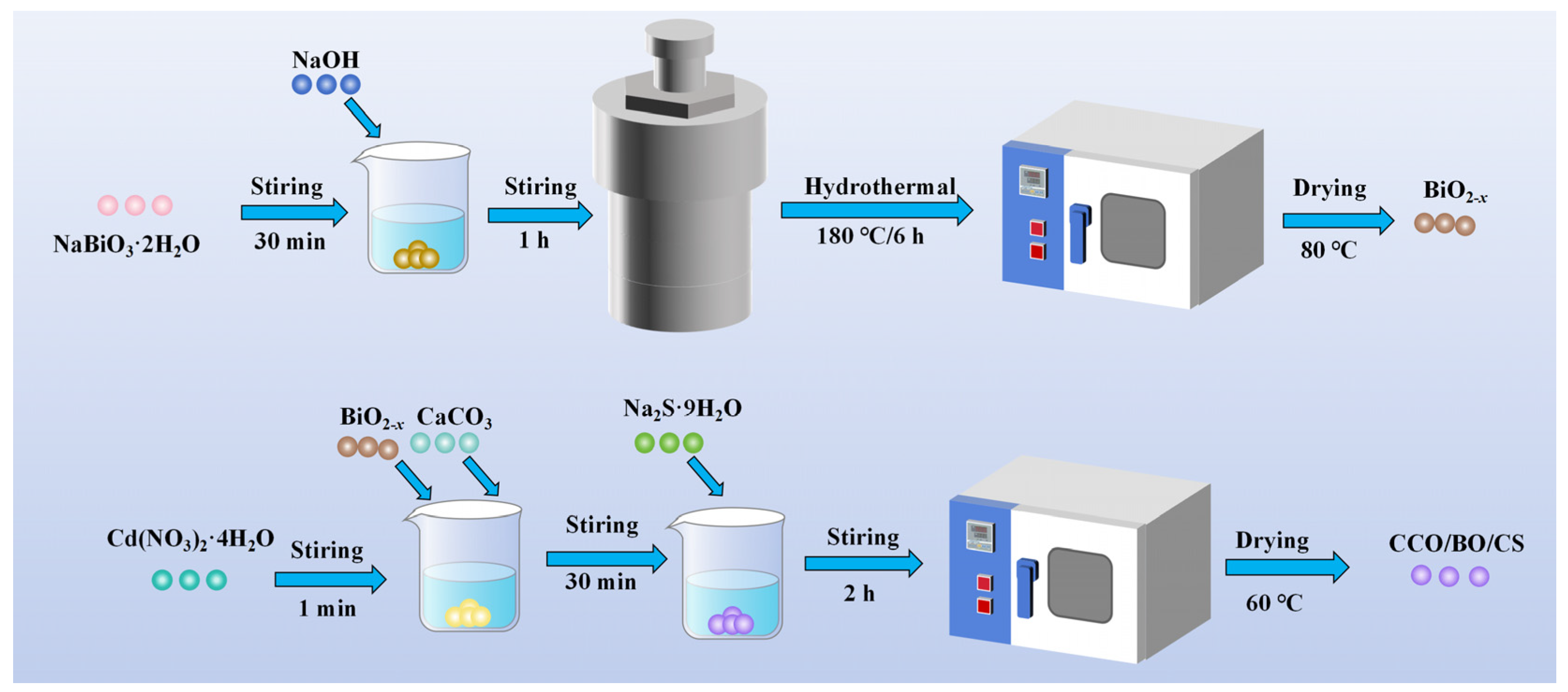
The ternary CCO/BO/CS composites were prepared using the same procedure employed for the BiO2−x/CdS (1:2 wt) sample, with the addition of CaCO3 during synthesis. Specifically, while dispersing 0.18 g of BiO2−x into the Cd(NO3)2·4H2O solution, predetermined amounts of CaCO3 (0.18 g, 0.13 g, 0.09 g, and 0.05 g) were simultaneously introduced. The subsequent steps—including dropwise addition of the Na2S·9H2O solution, stirring, filtration, and drying at 60 °C—were identical to those described in Section 2.3. The resulting composites were labeled according to their mass ratios of CaCO3:BiO2−x:CdS. The sample containing 0.18 g of CaCO3 (i.e., CaCO3:BiO2−x:CdS = 1:2:1 by weight) was denoted as CCO/BO/CS (1:2:1 wt), and the remaining samples were labeled analogously based on their respective CaCO3 loadings. The synthetic procedure for the CCO/BO/CS photocatalyst was illustrated in Figure 1.

2.5. Characterization of Photocatalysts

The crystal phase structures of the as-prepared samples were analyzed by X-ray diffraction (XRD) using a SmartLab diffractometer (Rigaku, Akishima-shi, Japan) with Cu Kα radiation (λ = 1.5406 Å). The morphology and microstructure were examined by scanning electron microscopy (SEM, Quanta 450 FEG, FEI, Hillsboro, OR, USA) and transmission electron microscopy (TEM, Tecnai G2 F30 S-TWIN, FEI, Hillsboro, OR, USA). Surface elemental composition and chemical states were investigated by X-ray photoelectron spectroscopy (XPS) using an ESCALAB 250Xi spectrometer (Thermo Scientific, Waltham, MA, USA), with Al Kα radiation as the X-ray source. UV–Vis diffuse reflectance spectra (UV–Vis DRS) of BiO2−x, CdS, BiO2−x/CdS, and CCO/BO/CS composites were recorded on a UV-2600 spectrophotometer (Shimadzu, Kyoto, Japan) equipped with an integrating sphere, using BaSO4 as the reference standard. Transient photocurrent responses were measured under visible light irradiation from a 300 W xenon lamp (with a 420 nm cutoff filter) using a standard three-electrode electrochemical setup (CHI660E workstation, Chenhua, Shanghai, China). The working electrodes were fabricated by drop-casting dispersions of BiO2−x, CdS, or CCO/BO/CS onto fluorine-doped tin oxide conductive glass substrates. The electron paramagnetic resonance (EPR) test used was the EMXplus-6/1 (Bruker, Karlsruhe, Germany). A platinum foil served as the counter electrode, and a saturated calomel electrode was used as the reference electrode. All measurements were carried out in a 0.1 M Na2SO4 aqueous electrolyte solution. The photoluminescence (PL) spectra were measured by using a fluorescence spectrometer (FS5, Edinburgh Instruments, Livingston, UK).

2.6. Method for Evaluating Photocatalytic Reduction of Cr(VI)

Preparation of Cr(VI) solution [28]: A Cr(VI) stock solution was prepared by pipetting 5 mL of the pre-prepared K2Cr2O7 solution (100 mg·L−1) into a double-walled quartz reactor, followed by dilution with 95 mL of deionized water to yield a 5 mg·L−1 Cr(VI) working solution. Separately, 0.20 g of 1,5-diphenylcarbazide (DPC) was dissolved in a 1:1 (v/v) mixture of acetone and deionized water (total volume: 100 mL) to prepare the chromogenic reagent. Once fully dissolved, this DPC solution was added to the Cr(VI) solution in the quartz reactor. The pH of the resulting mixture was carefully adjusted to 3.30 ± 0.05 using dilute nitric acid (HNO3).
Photocatalytic reduction test: 0.50 g of the photocatalyst was dispersed into the prepared Cr(VI) solution. The resulting suspension was then placed in the dark reaction chamber for 30 min to achieve the adsorption equilibrium. Subsequently, the suspension was irradiated under visible light using a 300 W xenon lamp equipped with a 420 nm cutoff filter (λ > 420 nm), with a light intensity of approximately 100 mW·cm−2. A UV–Vis spectrophotometer was baseline-corrected using deionized water, and the concentration of residual Cr(VI) was measured at predetermined irradiation intervals (0, 5, 10, 15, 20, 25, and 30 min) based on the characteristic absorbance of the Cr(VI)–DPC complex at ~540 nm. In addition, cycling stability tests and radical trapping experiments were conducted under identical conditions. For trapping experiments, 1 mmol of a specific scavenger (e.g., EDTA-2Na for h+, benzoquinone for •O2, or isopropanol for •OH) was added simultaneously with the photocatalyst to the Cr(VI) solution prior to irradiation. The photocatalytic reduction efficiency of Cr(VI) was calculated using the following equation [29]:
η = C 0 C C 0 × 100 %
where η is the Cr(VI) reduction efficiency (%), C0 is the initial concentration of Cr(VI) after adsorption equilibrium (i.e., at t = 0 min of illumination), and C is the Cr(VI) concentration at a given irradiation time.
The photocatalytic process follows the following equation [30]:
ln C 0 / C = k t
Herein, k is the apparent pseudo-first-order rate constant.

3. Results and Discussion

3.1. The Phase Structure and Morphology

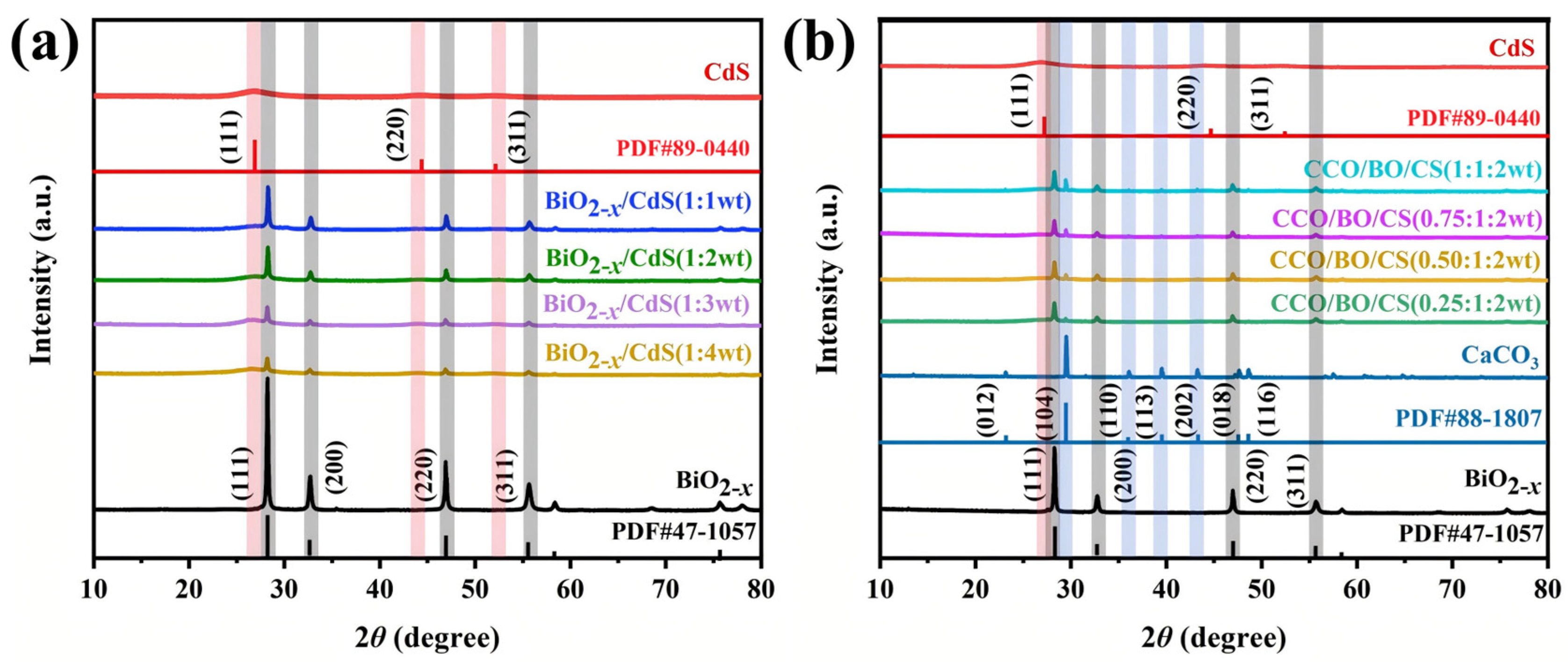
Figure 2 presents the XRD patterns of samples with different composite ratios. The synthesized BiO2−x (JCPDS No.47-1057) and CdS (JCPDS No.89-0440) correspond to the cubic crystalline phases belonging to the space groups of F-43m and Fm-3m, respectively. In the XRD patterns of BiO2−x/CdS composites with different mass ratios presented in Figure 2a, diffraction peaks attributable to both BiO2−x and CdS are clearly observed. Moreover, as the relative content of BiO2−x decreases, the intensities of its characteristic peaks—corresponding to the (111), (200), (220), and (311) crystallographic planes—gradually decrease, consistent with the reduced phase fraction [31]. Figure 2b displays the XRD patterns of pure BiO2−x, CdS, CaCO3 (JCPDS No.88-1807), and CCO/BO/CS ternary composites with varying CaCO3 loadings. All diffraction peaks in the composite patterns can be unambiguously indexed to the respective single-phase components, with no additional or unassigned peaks detected. Notably, the intensity of the CaCO3 peak at 2θ ≈ 29.40° (corresponding to the (104) plane of calcite CaCO3) progressively increases with higher CaCO3 content, reflecting the greater abundance of this crystalline phase in the composite. Importantly, we noticed that after the addition of CaCO3, the diffraction peak (111) of CdS in Figure 2b shifted slightly to the right. This indicates that the introduction of CaCO3 may cause some lattice distortion in CdS. However, the inherent crystal structures of CaCO3, BiO2−x, and CdS did not change significantly overall, and all phases maintained good crystallinity. Furthermore, no foreign diffraction peaks were observed in any of the composite samples, indicating that they have high phase purity. The consistency of peak positions between individual samples and composite samples confirms the successful preparation of cadmium sulfide, BiO2−x/CdS, and CCO/BO/CS composite materials, without the formation of secondary phases or solid solutions.
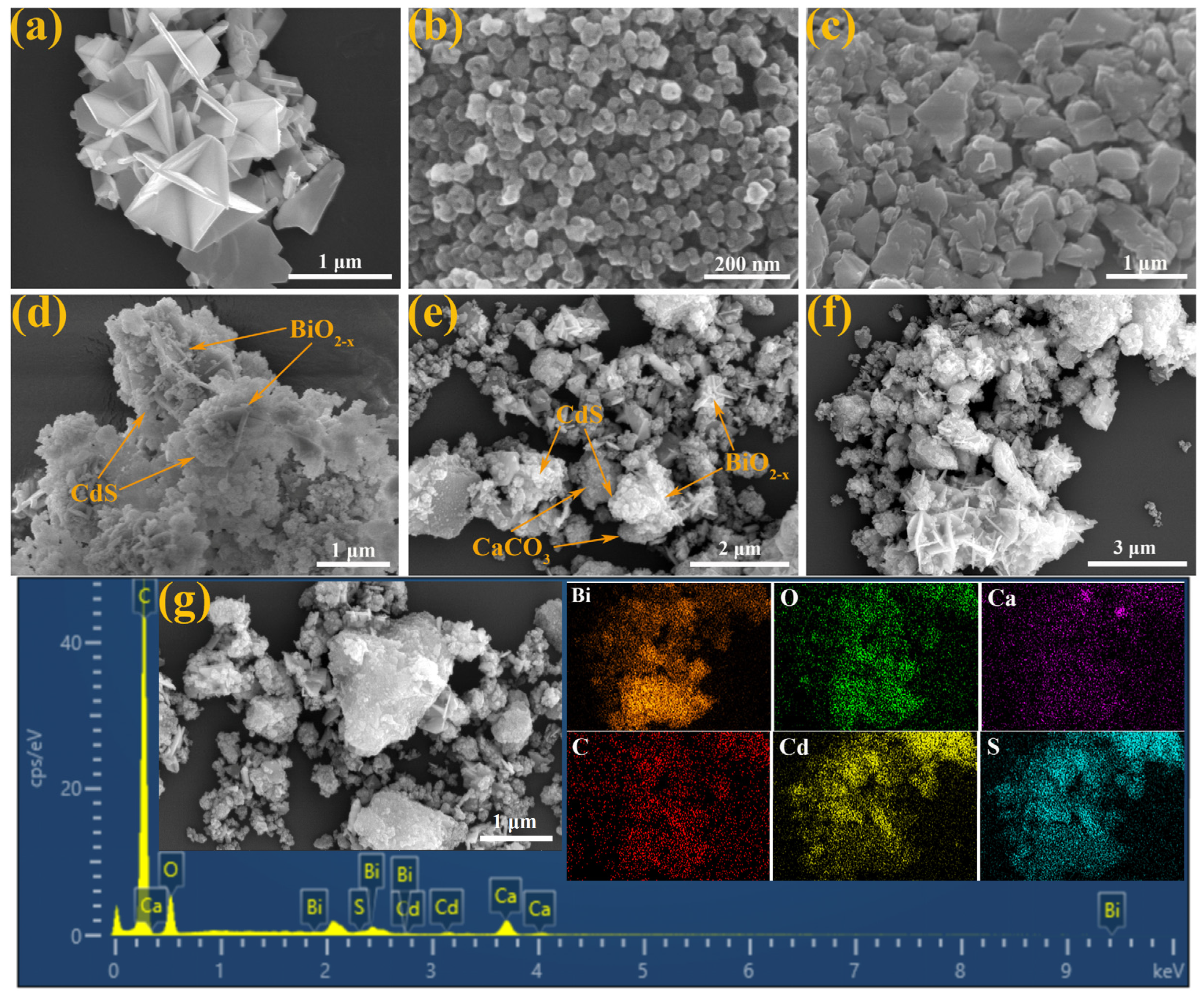
Figure 3 shows the SEM images and corresponding EDS results of BiO2−x, CdS, CaCO3, BiO2−x/CdS (1:2 wt), and CCO/BO/CS (0.75:1:2 wt). As shown in Figure 3a, BiO2−x exhibits a clear three-dimensional layered morphology, with individual flakes approximately 0.5–1.5 μm wide, highly aggregated into micron-sized clusters, with no obvious isolated particles and poor dispersibility. In contrast, CdS appears as small and irregular nanoparticles, approximately 30–80 nm in diameter, prone to aggregation (Figure 3b), with moderate dispersibility. CaCO3, on the other hand, shows an irregular blocky structure (Figure 3c), approximately 0.2–1.5 μm in diameter, with moderate dispersibility. Through chemical precipitation, cadmium sulfide nanoparticles are uniformly deposited on the surface of the BiO2−x matrix, forming a good BiO2−x/CdS (1:2 wt) heterostructure, as shown in Figure 3d, with good dispersibility. In the ternary CCO/BO/CS (0.75:1:2 wt) composite material (Figure 3e), CdS nanoparticles are simultaneously anchored on BiO2−x and CaCO3, retaining the distinct morphology of all three independent components with moderate dispersion.
Elemental mapping shown in Figure 3f confirms the homogeneous distribution of Bi, O, Ca, C, Cd, and S throughout the composite, with CdS nanoparticles evenly dispersed across the surfaces of both BiO2−x and CaCO3. The coexistence and spatial distribution of all constituent elements provide strong evidence for the successful synthesis of both BiO2−x/CdS (1:2 wt) and CCO/BO/CS (0.75:1:2 wt) composites. Moreover, this intimate interfacial contact and well-defined heterostructure are favorable for facilitating the separation and transfer of photogenerated charge carriers, thereby enhancing the overall photocatalytic performance. As shown in Figure 3g, the morphology of CCO/BO/CS (0.75:1:2 wt) after the reaction did not change significantly.
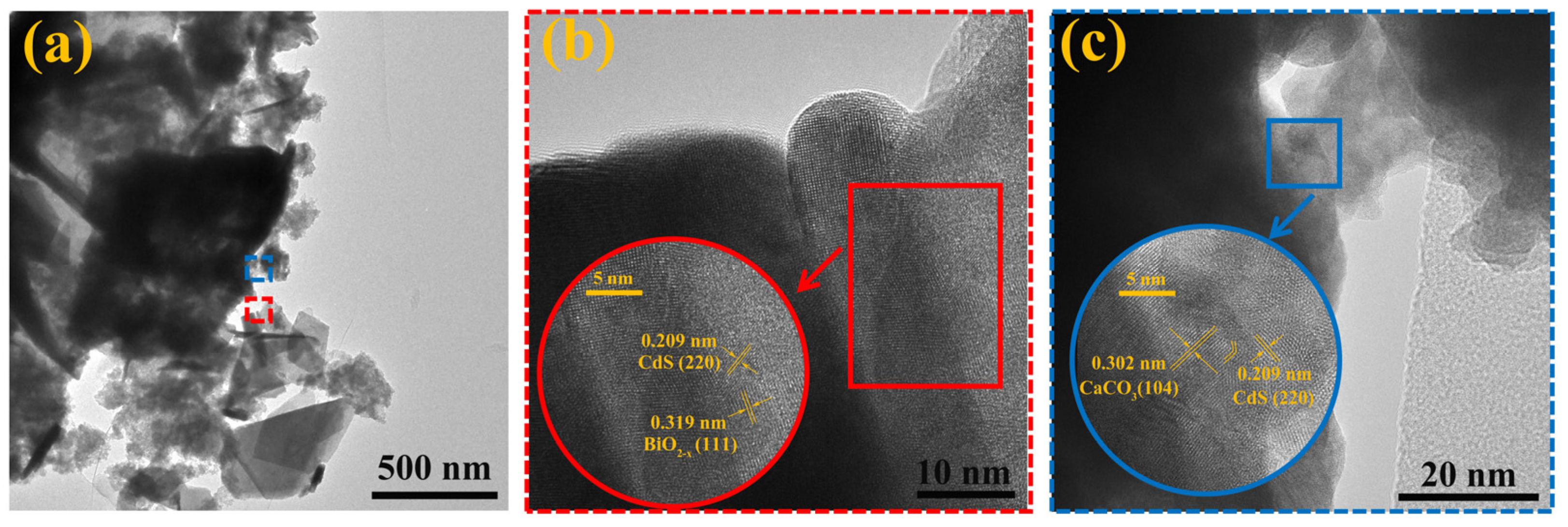
To further investigate the microstructure of the CCO/BO/CS (0.75:1:2 wt) composite, TEM and high-resolution TEM (HRTEM) analyses were performed and the measured results were shown in Figure 4. The TEM image in Figure 4a clearly reveals the coexistence of BiO2−x, CdS, and CaCO3 within the composite. Specifically, the layered structure of BiO2−x, the irregular bulk morphology of CaCO3, and the fine nanoparticles of CdS are intimately integrated, forming well-defined and tight interfacial contacts. Such close interfacial junctions are beneficial for efficient interfacial charge transfer among the components [32]. HRTEM images shown in Figure 4b,c display three distinct sets of lattice fringes, corresponding to the individual crystalline phases. The fringe spacing of 0.209 nm is assigned to the (220) plane of cubic CdS. The spacings of 0.319 nm and 0.302 nm match the (111) plane of BiO2−x and the (104) plane of calcite CaCO3, respectively. The stripes show slight curvature or discontinuity at the junctions (small window view in Figure 4c). The clear lattice continuity and coherent alignment at the phase boundaries indicate strong interfacial coupling between the components. These observations confirm the successful fabrication of the ternary CCO/BO/CS (0.75:1:2 wt) heterostructure with well-preserved crystallinity and intimate interfacial contact.

3.2. Chemical State Analysis

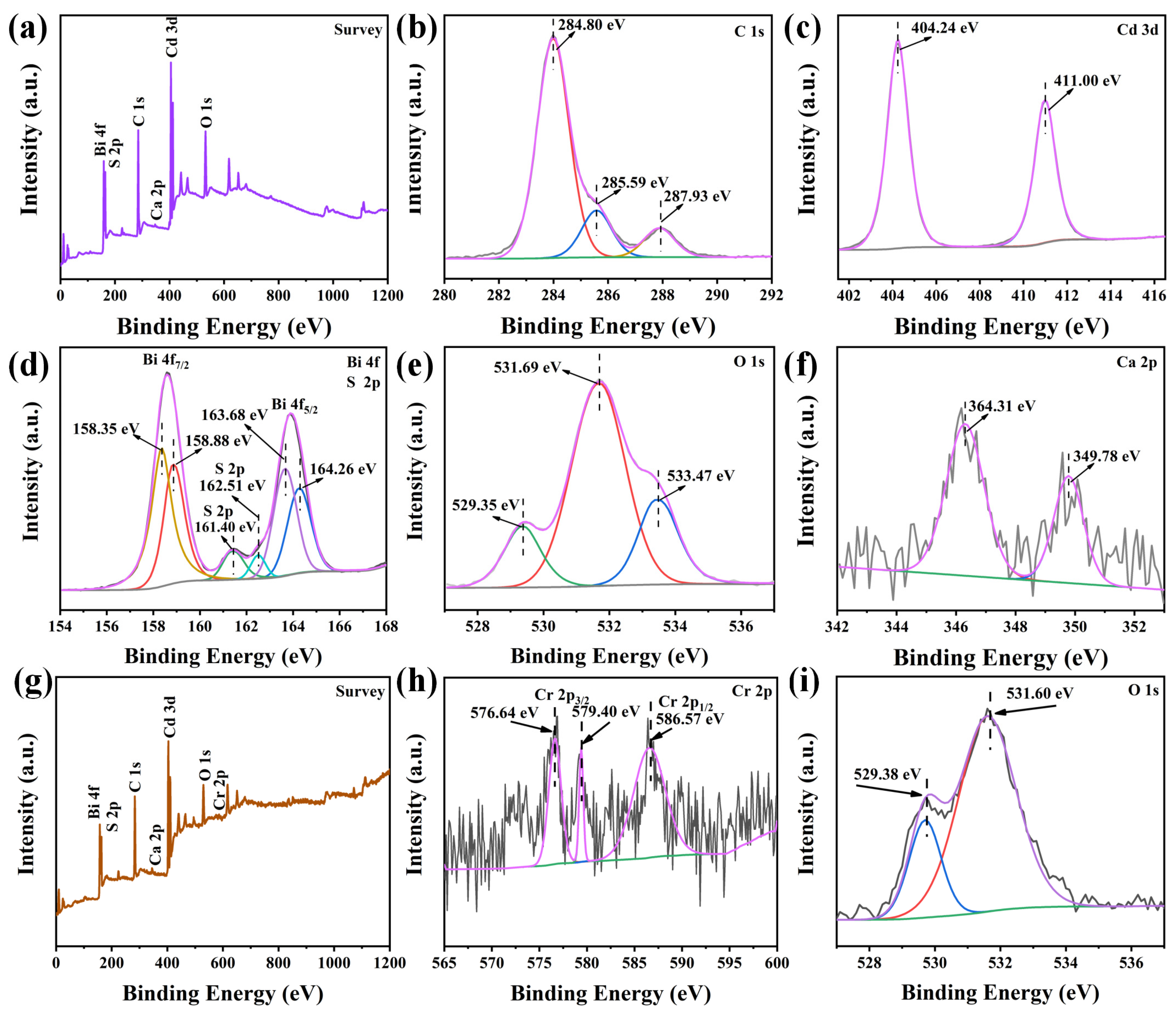
The surface chemical states and elemental composition of the CCO/BO/CS (0.75:1:2 wt) composite before the reaction were investigated by XPS, as shown in Figure 5a–f and Table 1. The survey spectrum in Figure 5a confirms the presence of Bi, S, C, Ca, Cd, and O. High-resolution narrow-scan spectra were acquired for each element. The C 1s spectrum (Figure 5b) can be deconvoluted into three peaks at 284.80 eV, 285.59 eV, and 287.93 eV, corresponding to C–C, C–O–C, and O–C=O bonding configurations, respectively, consistent with the carbonate environment in CaCO3 [27]. In the Cd 3d spectrum presented in Figure 5c, two distinct peaks appear at 404.24 eV (Cd 3d5/2) and 411.00 eV (Cd 3d3/2), with a spin–orbit splitting of ~6.76 eV, being characteristic of Cd2+ in CdS [33]. The Bi 4f region in Figure 5d was fitted with two doublets, reflecting the coexistence of Bi in mixed oxidation states. The peaks at 158.35 eV (Bi 4f7/2) and 163.68 eV (Bi 4f5/2) are assigned to Bi5+, while those at 158.88 eV (Bi 4f7/2) and 164.26 eV (Bi 4f5/2) correspond to Bi3+ [34], confirming the presence of both +3 and +5 valence states of bismuth in the composite. The S 2p spectrum (not explicitly labeled but implied in the text) exhibits signals in the binding energy range of 160–163.5 eV, attributable to the S 2p3/2 and S 2p1/2 components of S2− in CdS [33,35]. The O 1s peak shown in Figure 5e was deconvoluted into three contributions: lattice oxygen (Bi–O) at 529.35 eV, oxygen vacancies at 531.69 eV, and surface-adsorbed oxygen species (e.g., –OH or H2O) at 533.47 eV [36], providing clear evidence of oxygen vacancies in the sample. Finally, the Ca 2p spectrum (Figure 5f) shows two symmetric peaks at 349.78 eV (Ca 2p3/2) and 364.31 eV (Ca 2p1/2), consistent with Ca2+ in CaCO3. In summary, XPS analysis confirms the successful synthesis of the CCO/BO/CS (0.75:1:2 wt) composite via the chemical precipitation method, with clear evidence of mixed Bi valence states and the presence of oxygen vacancies—features that are beneficial for enhancing photocatalytic activity. Furthermore, the XPS spectra of the CCO/BO/CS (0.75:1:2 wt) composite material after 5 runs of the Cr(VI) reduction reaction were presented in Figure 5g–i for comparison. It can be seen that Cr was detected in the spectrum in Figure 5g. In the Cr 2p spectrum in Figure 5h, 576.64 eV and 579.40 eV are the 2p3/2 peaks of Cr(III) and Cr(VI), respectively, while the peak at 586.57 eV is the 2p1/2 peak of Cr [37]. This demonstrates that Cr(III) and Cr(VI) adhered to the surface of CCO/BO/CS (0.75:1:2 wt) after the Cr(VI) reduction, which probably reduced the reaction contact area, thus decreasing its efficiency. In Figure 5i, the O 1s peak at around 533.47 eV disappears when compared with the O 1s peak in Figure 5e, indicating that the surface-adsorbed oxygen on the CCO/BO/CS (0.75:1:2 wt) surface is almost completely consumed after the 5 runs of Cr(VI) reduction reaction.

3.3. Photocatalytic Activity

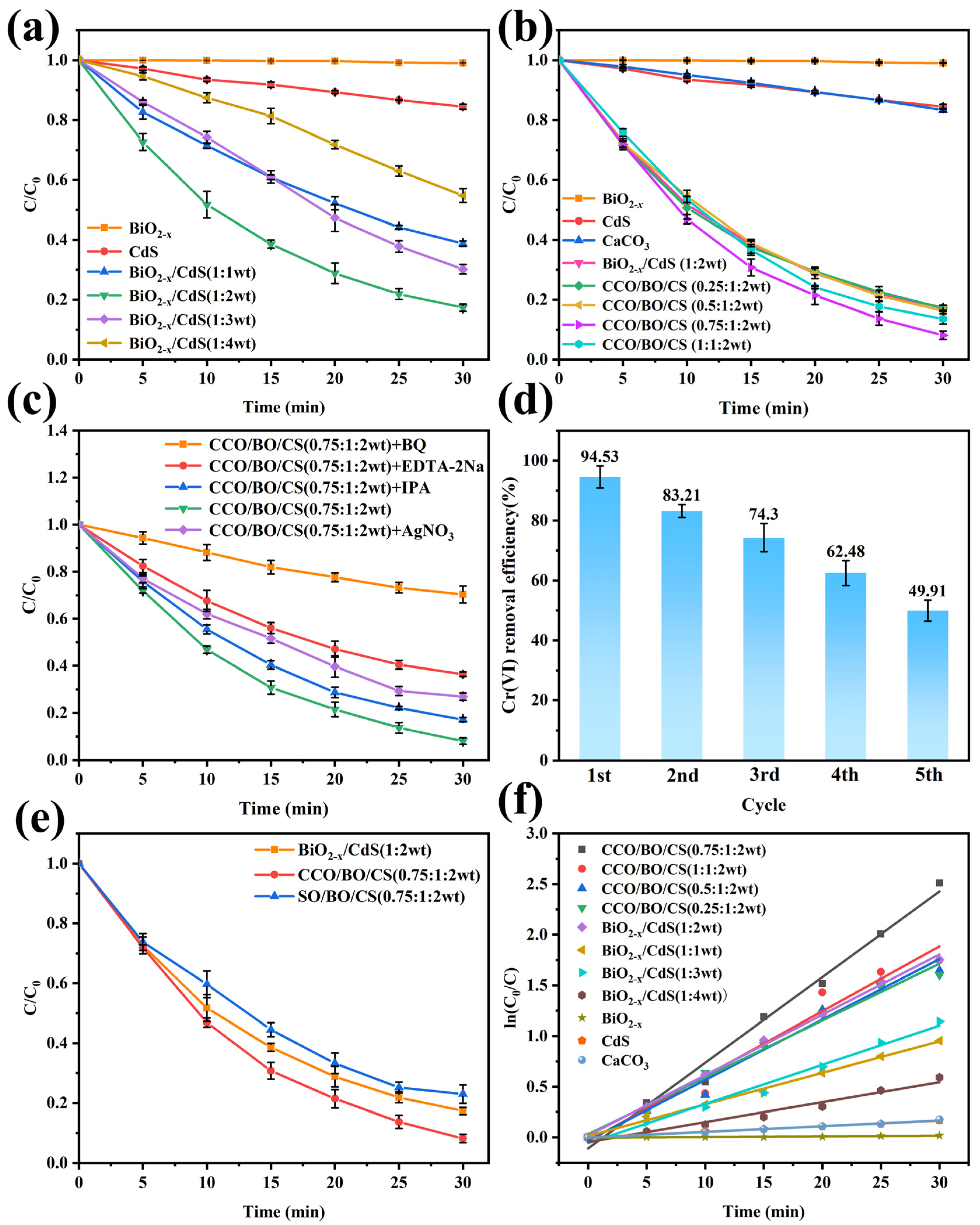
To evaluate the photocatalytic performance of BiO2−x, CdS, CaCO3, BiO2−x/CdS, and CCO/BO/CS composites with varying mass ratios, Cr(VI) reduction experiments were conducted under visible light irradiation (λ > 420 nm), and the measured results were presented in Figure 6, all experiments were performed at least three times independently. As shown in Figure 6a, pure BiO2−x and CdS exhibited limited photocatalytic activity, achieving Cr(VI) reduction efficiencies of only 1.0% and 15.52%, respectively, after 30 min of irradiation. In contrast, all BiO2−x/CdS binary composites demonstrated significantly enhanced performance compared to the individual components. Among them, the BiO2−x/CdS (1:2 wt) sample displayed the highest activity, achieving a Cr(VI) reduction efficiency of 82.68% within 30 min—approximately 5.33 times higher than that of pure CdS. Given that CaCO3 is an abundant, low-cost, non-toxic, and environmentally benign material—especially when compared to BiO2−x, CdS, and their precursors—this study further incorporated CaCO3 into the optimized BiO2−x/CdS (1:2 wt) system to reduce overall catalyst cost and explore potential synergistic effects. As shown in Figure 6b, the incorporation of CaCO3 did not suppress the photocatalytic activity of BiO2−x/CdS. Instead, at specific compositions, it further enhanced Cr(VI) reduction. Notably, the ternary CCO/BO/CS (0.75:1:2 wt) composite achieved the highest efficiency of 91.87% after 30 min of visible light irradiation, outperforming all other samples. To compare with previous work, we created Table 2 [38,39,40,41] for easy performance comparison.
To identify the dominant reactive species involved in the photocatalytic process, radical trapping experiments were performed using specific scavengers: benzoquinone (BQ) for superoxide radicals (•O2), EDTA-2Na for holes (h+), AgNO3 for photogenerated electrons (e), and isopropanol (IPA) for hydroxyl radicals (•OH) [42,43]. The results presented in Figure 6c indicate that while IPA, AgNO3 and EDTA-2Na caused moderate inhibition of Cr(VI) reduction, the addition of BQ led to a dramatic decrease in efficiency—dropping to 29.65%. This strongly suggests that •O2 is the primary active species responsible for Cr(VI) reduction in the CCO/BO/CS (0.75:1:2 wt) system. Furthermore, the reusability of the CCO/BO/CS (0.75:1:2 wt) composite was evaluated over five consecutive cycles. As shown in Figure 6d, the Cr(VI) removal efficiency decreased progressively from 94.53% to 49.91% after the fifth cycle. This significant decline of approximately 47% in the Cr(VI) removal efficiency indicates insufficient cyclic stability likely due to factors such as Cr(III) deposition on the catalyst surface, or photocorrosion.
To investigate the indirect promoting effect of CaCO3, we added a set of control experiments using SiO2/BiO2−x/CdS (SO/BO/CS) (0.75:1:2 wt), which was synthesized by the same method as CCO/BO/CS (0.75:1:2 wt). As an inert material, SiO2 does not participate in photocatalytic reactions or absorb visible light, so it can serve as a control system for CaCO3. Figure 6e shows that the degradation performance of the control sample with SiO2 is significantly lower than that of BiO2−x/CdS, which confirms the indirect promoting effect of CaCO3. In Figure 6f, the reduction rate constant of Cr(VI) can be clearly observed. According to Equation (2), the calculated reduction rate constant (pseudo-first-order reaction rate constant) k for CCO/BO/CS (0.75:1:2 wt) is approximately 0.0846 min−1, which is 15.32, 142.48, 14.78, and 1.42 times faster than those of CdS, BiO2−x, CaCO3, and BiO2−x/CdS (1:2 wt), respectively.

3.4. Possible Photocatalytic Mechanism

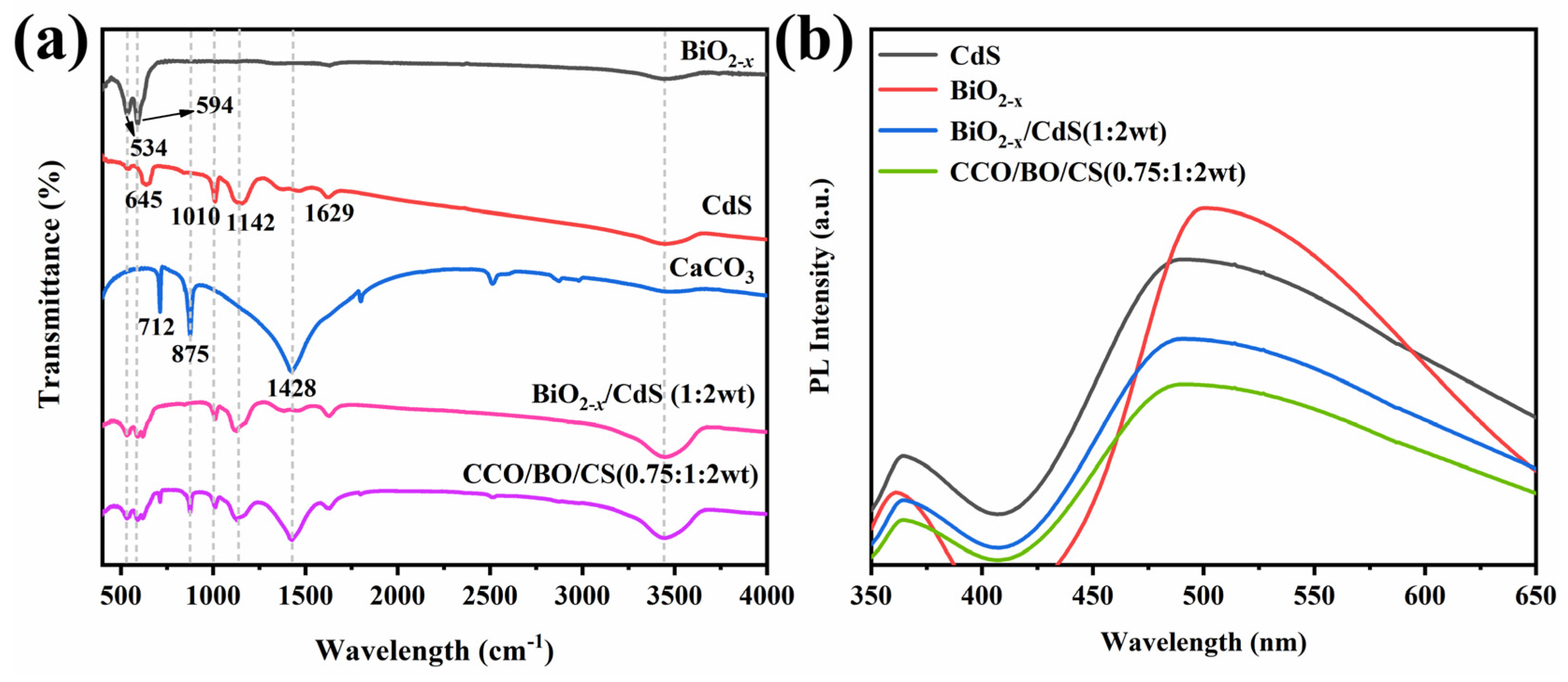
The chemical structure and surface functional groups of the as-prepared materials were analyzed by Fourier-transform infrared (FT-IR) spectroscopy. The measured results shown in Figure 7 indicate that absorption bands at 534 cm−1 and 384 cm−1 in the FT-IR spectrum of BiO2−x are respectively attributed to the stretching and bending vibrations of Bi–O bonds within the BiO6 octahedra [44,45]. For CdS, characteristic absorption bands appear at 645 cm−1, 1010 cm−1, and 1142 cm−1, which are assigned to the bending and stretching vibrations of the Cd–S bond [46,47]. The presence of CO32− groups in CaCO3 gives rise to three distinct absorption bands at 712 cm−1, 875 cm−1, and 1428 cm−1 [48]. Specifically, the peak at 712 cm−1 corresponds to the in-plane bending vibration, the band at 875 cm−1 arises from the out-of-plane bending (deformation) mode, and the strong band at 1428 cm−1 is associated with the asymmetric stretching vibration of the carbonate ion [49,50]. Additionally, a broad absorption band centered at 3437.76 cm−1 is observed in all samples, which is primarily attributed to the O–H stretching vibrations from adsorbed water molecules on the material surfaces [51]. In the spectrum of the BiO2−x/CdS (1:2 wt) composite, characteristic IR bands of both BiO2−x and CdS are clearly present, confirming their coexistence. Upon incorporation of CaCO3 to form the CCO/BO/CS (0.75:1:2 wt) ternary composite, additional peaks corresponding to CaCO3 emerge, while the original peaks of BiO2−x and CdS remain unchanged in position and shape. This indicates that the addition of CaCO3 does not disrupt the intrinsic crystal structures of BiO2−x or CdS. These results confirm the successful integration of BiO2−x, CdS, and CaCO3 into a three-phase composite without structural degradation or chemical interference. The photoluminescence (PL) spectra in Figure 7b show that BiO2−x exhibits the strongest PL intensity, indicating its highest electron–hole recombination efficiency and consequently the worst photocatalytic performance among the four samples. Compared to the single-phase BiO2−x, the formation of a heterojunction in BiO2−x/CdS reduces electron–hole recombination, leading to a decrease in its PL intensity. For the CCO/BO/CS composite material, the addition of CaCO3 further reduces the electron–hole recombination of BiO2−x/CdS, thereby achieving better photocatalytic activity.
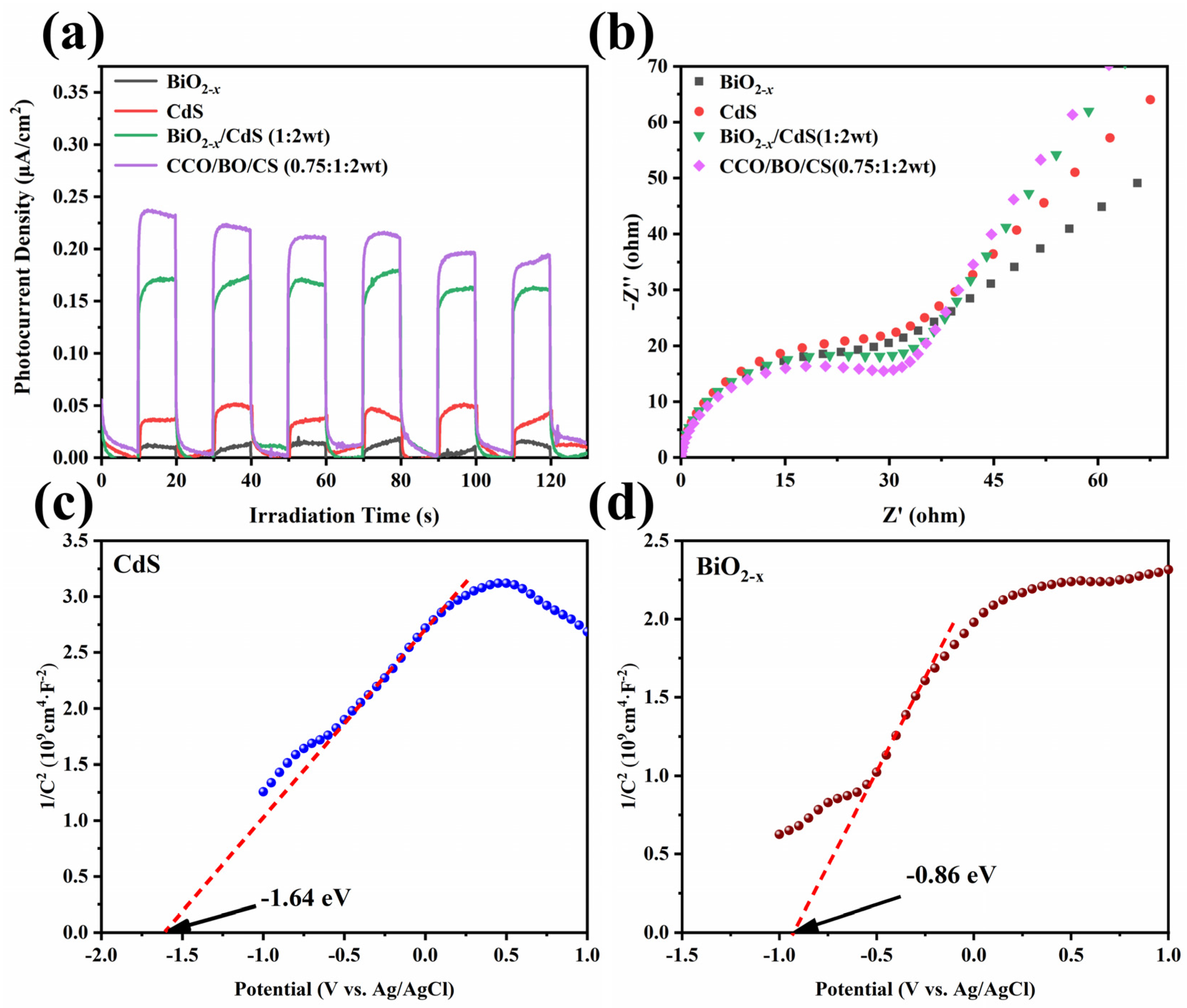
To further elucidate the behavior of photogenerated charge carriers, transient photocurrent response and electrochemical impedance spectroscopy (EIS) measurements were performed and the results were presented in Figure 8. Figure 8a shows that the BiO2−x/CdS (1:2 wt) and CCO/BO/CS (0.75:1:2 wt) composites exhibit significantly enhanced photocurrent responses compared to the individual BiO2−x, CdS, and CaCO3 components. The photocurrent densities of BiO2−x/CdS (1:2 wt) and CCO/BO/CS (0.75:1:2 wt) remain above 0.20 μA·cm−2 and 0.17 μA·cm−2, respectively, under intermittent visible light irradiation, and demonstrate good stability over multiple on/off cycles. This indicates that the heterojunction formed between BiO2−x and CdS effectively suppresses the recombination of photogenerated electron–hole pairs, thereby enhancing charge separation and ensuring reproducible photoelectrochemical performance [52,53]. Moreover, the incorporation of CaCO3 further facilitates interfacial charge transport within the ternary system. The EIS results shown in Figure 8b corroborate this trend: the Nyquist plot of CCO/BO/CS (0.75:1:2 wt) exhibits the smallest arc radius among all tested samples, signifying the lowest charge transfer resistance at the electrode–electrolyte interface. This reduced resistance is markedly lower than that of the single-phase (BiO2−x, CdS, CaCO3) and binary (BiO2−x/CdS) counterparts, indicating significantly accelerated interfacial charge transfer kinetics in the ternary composite [54]. The improved charge separation and transport efficiency directly correlate with the superior photocatalytic activity observed for CCO/BO/CS (0.75:1:2 wt). According to the Mott–Schottky test in Figure 8c,d, we can conclude that both CdS and BiO2−x are n-type semiconductors and their calculated flat-band potential are −1.64 eV and −0.86 eV, respectively.
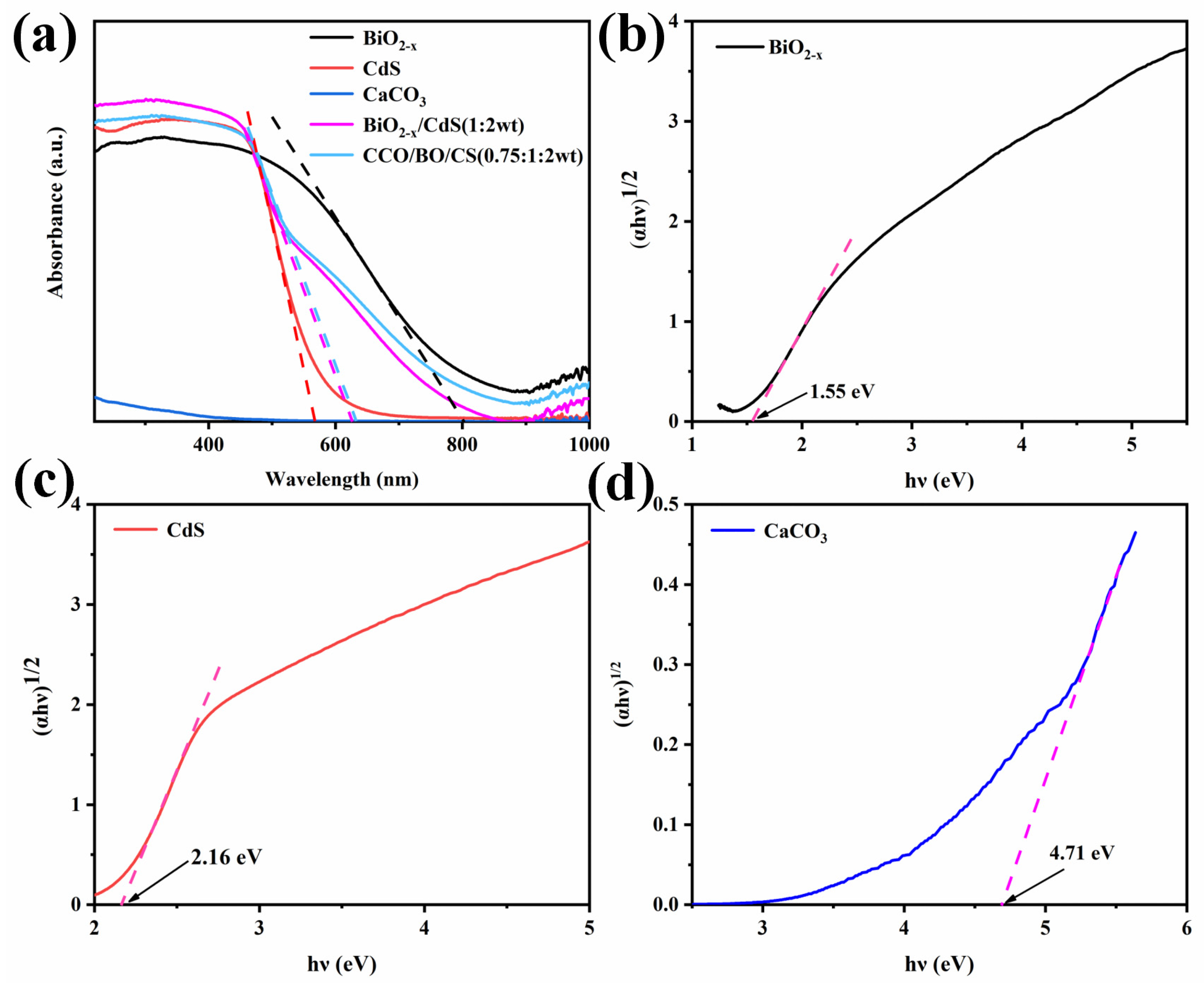
The optical absorption properties of BiO2−x, CdS, CaCO3, BiO2−x/CdS (1:2 wt), and the CCO/BO/CS (0.75:1:2 wt) composite were investigated by UV–Vis diffuse reflectance spectroscopy (UV–Vis DRS) and the measured results are shown in Figure 9a. The CCO/BO/CS (0.75:1:2 wt) sample exhibits an absorption edge situated between those of BiO2−x and CdS. Notably, compared to pure CdS, the composite displays a pronounced red shift in its absorption onset, thereby extending the light-harvesting range into the visible region. This enhanced visible light absorption improves solar energy utilization and contributes to the superior photocatalytic activity of the ternary composite [55]. The band gap energy (Eg) is calculated by Tauc’s relation [56]:
α h ν 1 / n = A h ν E g
where α represents the absorption coefficient, is the photon energy, n depends on the type of semiconductor (direct band gap takes 1/2, indirect band gap takes 2), and A is a constant.
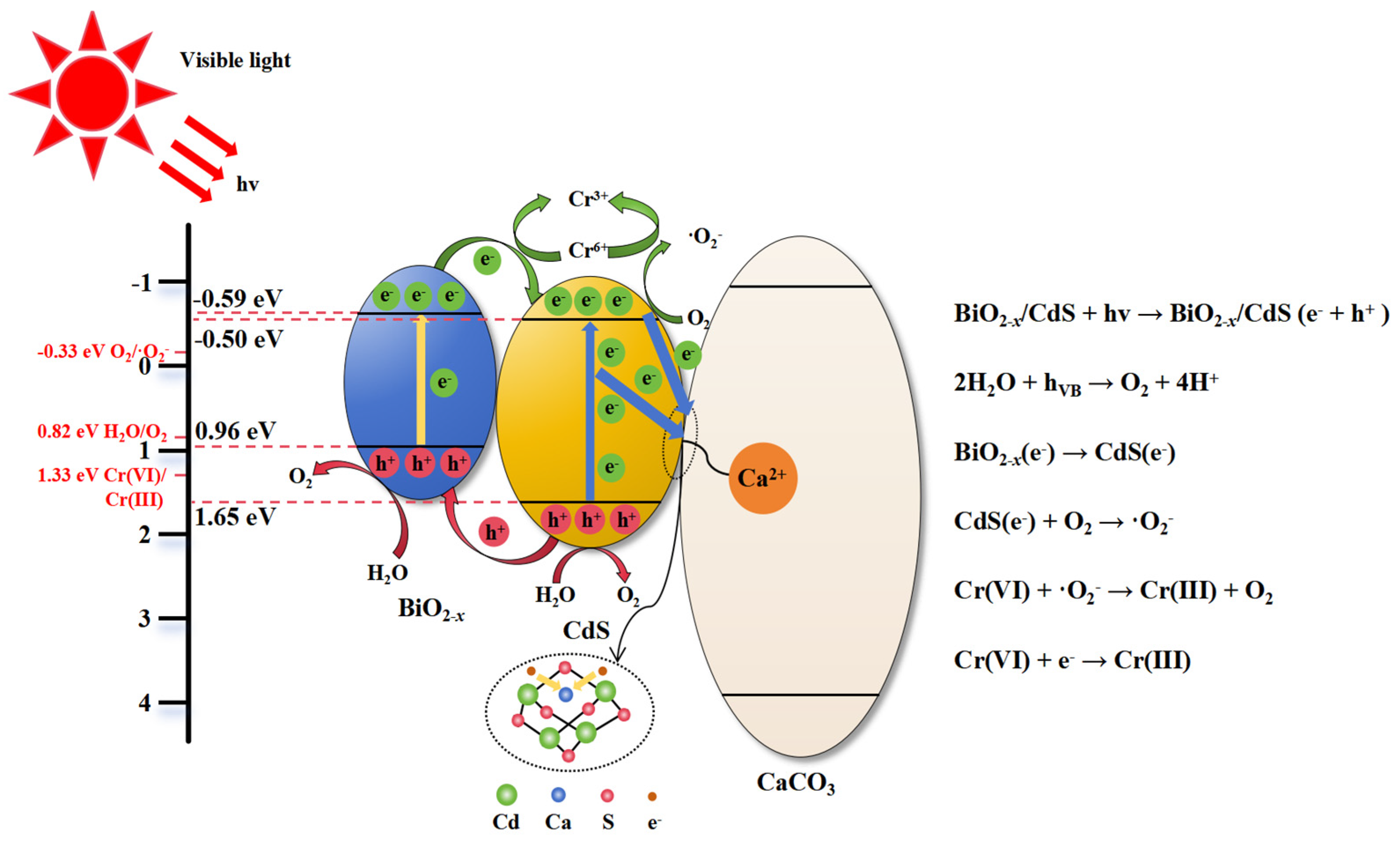
The band gap energies of BiO2−x, CdS and CaCO3 were calculated using the Tauc equation and were found to be 1.55 eV, 2.16 eV and 4.71 eV, respectively. Based on the analysis, the valence band maximum (VBM) of BiO2−x is positioned at +0.96 eV versus the reversible hydrogen electrode (RHE). Using the relationship Eg = ECBEVB, the corresponding conduction band minimum (CBM) and VBM positions were determined as follows: CdS: CBM = −0.50 eV, VBM = +1.65 eV; CaCO3: CBM = −0.79 eV, VBM = +3.92 eV; BiO2−x: CBM = −0.59 eV, VBM = +0.96 eV. Given its wide bandgap of 4.71 eV, CaCO3 cannot be photoexcited under visible light irradiation and therefore does not directly generate electron–hole pairs. However, the traditional type II heterojunction or band alignment model (e.g., those proposed by Wang et al. and Cui et al. [57,58]) still applies. This observation is consistent with recent studies on insulator-semiconductor composites. For instance, Hu et al. [59] reported that in BaCO3/g-C3N4 systems, BaCO3—an insulator—does not actively participate in photocatalysis but instead induces lattice distortion by incorporating Ba2+, thereby promoting charge separation in g-C3N4. Similarly, Sang et al. [60] proposed that in cadmium sulfide/calcium carbonate composites, small Ca2+ ions can partially substitute into the cadmium sulfide lattice, leading to local structural distortions. These distortions form hole traps, which serve as electron trapping sites, thereby improving photocatalytic efficiency. In both cases, the carbonate-based insulator (barium carbonate or calcium carbonate) acts as a structural promoter rather than a direct photocatalytic component. During the preparation of composite photocatalysts, some Ca2+ ions with an ionic radius of 1.97 Å in CaCO3 can enter the internal unit cell of CdS (diagonal atomic spacing 3.89 Å, adjacent atomic spacing 2.75 Å) [61,62]. The lattice distortions caused by ion entry form many hole traps, which promote the separation of electron–hole pairs on the CdS surface. Meanwhile, due to the potential presence of hole traps on the CdS surface caused by the infiltration of Ca2+, and the fact that the conduction band of CdS (−0.50 eV) is more negative than that of BiO2−x (−0.59 eV), some photogenerated electrons from BiO2−x flow to CdS, inhibiting the recombination of electron–hole pairs within BiO2−x and promoting their transport. This explains why the photocatalytic degradation capacity of CCO/BO/CS can be significantly improved.
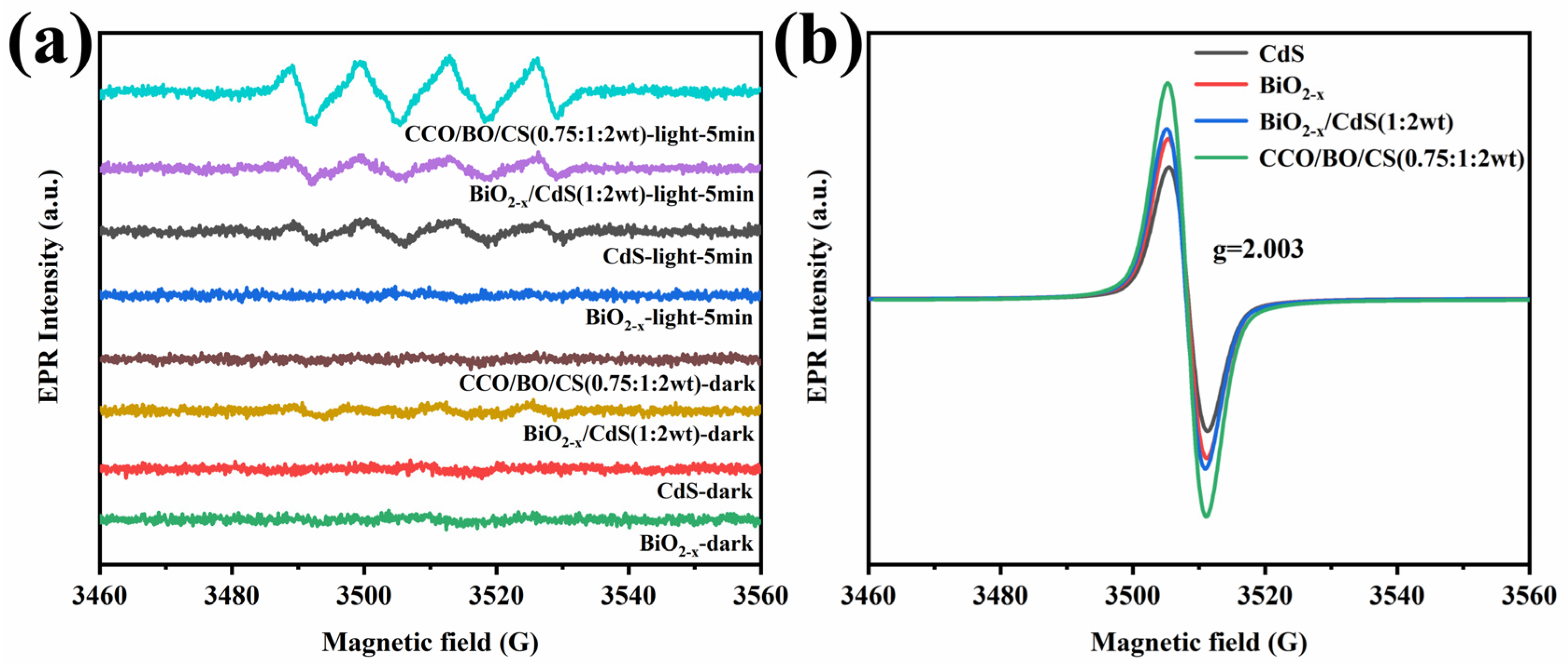
As shown in Figure 10a, the electron paramagnetic resonance (EPR) signal of •O2 could not be detected under dark conditions. However, after being exposed to visible light for 5 min, the EPR signal with the characteristics of •O2 free radicals could be clearly observed. The results indicate that the CCO/BO/CS ternary composite material can generate •O2 free radicals after absorbing visible light, demonstrating strong oxidation and reduction properties [18]. Moreover, after 5 min of illumination, the intensity of the •O2 EPR signal detected was significantly higher in CCO/BO/CS compared to BiO2−x/CdS and other single phases, indicating that the addition of CaCO3 significantly enhanced the generation of •O2 free radicals in the BiO2−x/CdS heterojunction system, thereby improving the photocatalytic degradation activity of the composite material. Figure 10b shows that there is a significant Lorentzian line-shaped signal at 3460–3560 G and g = 2.003 in the EPR spectrum, which is attributed to the paramagnetic centers formed by oxygen vacancies capturing unpaired electrons in the material [63]. The signal strength relationship of vacancies in different materials is that CCO/BO/CS is stronger than BiO2−x/CdS and other single-phase states. In metal oxides, an appropriate amount of oxygen vacancies can capture photogenerated electrons and promote the separation of electron–hole pairs [64,65]. The CCO/BO/CS composite material exhibits the strongest vacancy signal, confirming that the introduction of CaCO3 can optimize and stabilize the oxygen vacancy concentration in the composite material.
Based on the above characterization and photoelectrochemical analyses, a plausible mechanism for the visible light-driven photocatalytic reduction of Cr(VI) over the CCO/BO/CS (0.75:1:2 wt) composite is proposed and illustrated in Figure 11. Under visible light irradiation, both BiO2−x (Eg = 1.55 eV) and CdS (Eg = 2.28 eV) absorb photons, generating electron–hole pairs (e/h+). The well-matched band alignment between the two semiconductors facilitates efficient interfacial charge transfer. Specifically, the conduction band minimum (CBM) of BiO2−x (−0.59 eV) is slightly more negative than that of CdS (−0.50 eV), while the valence band maximum (VBM) of CdS (+1.65 eV) is more positive than that of BiO2−x (+0.96 eV). This configuration promotes a type-II-like charge transfer pathway: photogenerated electrons in the CB of BiO2−x recombine with holes in the VB of CdS at the interface [66]. Consequently, the most reductive electrons accumulate in the CB of CdS, while the most oxidative holes remain in the VB of BiO2−x [67]. The accumulated electrons in the CB of CdS readily reduce adsorbed O2 to generate superoxide radicals (•O2), as the CB potential of CdS (−0.50 eV) is more negative than the O2/•O2 redox potential (−0.33 eV) [29]. As confirmed by the radical trapping experiments (Figure 6c), •O2 is the dominant active species responsible for Cr(VI) reduction. The generated •O2 (or directly transferred electrons) reduces highly toxic Cr(VI) (Cr2O72−/Cr3+: +1.33 eV) to less toxic Cr(III) [68]. A minor contribution from direct reduction by CB electrons or surface-bound Cr(VI) cannot be excluded. Meanwhile, the oxidative holes retained in the VB of BiO2−x (+0.96 eV) are insufficient to oxidize H2O to O2 (H2O/O2: +0.82 eV at pH = 7, but thermodynamically feasible under acidic conditions used in this study, pH ≈ 3.3), though their primary role is to maintain charge balance rather than drive oxidation. Regarding the role of CaCO3 in this composite material, we believe that it mainly acts as a structure promoter and lattice distortion inducer and can form hole-trapping sites in cadmium sulfide. Partial incorporation of Ca2+ ions into the CdS lattice induces local lattice distortion, which acts as hole-trapping sites and promotes more efficient separation of electron–hole pairs in CdS [60]. Importantly, CaCO3 itself—being a wide-bandgap insulator (Eg = 4.71 eV)—does not participate directly in photoexcitation or redox reactions under visible light but functions as a structural and functional promoter. These interconnected structural features, along with lattice distortion detected by XRD and TEM, oxygen vacancies detected by XPS, enhanced charge separation detected by PL/EIS/photocurrent, and ROS generation detected by EPR, collectively enhance photocatalytic performance, enabling CCO/BO/CS (0.75:1:2 wt) to exhibit excellent photocatalytic degradation performance of Cr(VI).

4. Conclusions

In this work, BiO2−x/CdS binary and CCO/BO/CS (CaCO3/BiO2−x/CdS) ternary composite photocatalysts with varying mass ratios were successfully synthesized via a facile chemical precipitation method. Comprehensive characterization techniques confirmed the coexistence of distinct phases, well-defined interfacial structures, and preserved crystallinity in the composites. Under visible light irradiation (λ > 420 nm), the BiO2−x/CdS (1:2 wt) composite achieved a Cr(VI) reduction efficiency of 82.68% within 30 min—significantly outperforming the individual BiO2−x and CdS components. To further enhance cost-effectiveness without compromising performance, low-cost and environmentally benign CaCO3 was incorporated into the optimized BiO2−x/CdS system. The resulting ternary CCO/BO/CS (0.75:1:2 wt) composite exhibited superior photocatalytic activity, achieving a Cr(VI) reduction efficiency of 94.53% under identical conditions. However, the cycling stability test indicates that the reusability of CCO/BO/CS composite needs to be further improved. Photoelectrochemical analyses, including transient photocurrent and electrochemical impedance spectroscopy, revealed that the CCO/BO/CS architecture promotes efficient interfacial charge transfer and suppresses electron–hole recombination, thereby enhancing photocatalytic efficiency. The role of CaCO3 is not photocatalytic, but rather structural and promotional—improving light utilization and inducing beneficial lattice distortions that facilitate charge separation. This study demonstrates that the rational design of a low-cost, ternary CCO/BO/CS photocatalyst offers a promising and scalable strategy for efficient Cr(VI) remediation, with significant potential for practical applications in industrial wastewater treatment. Future follow-up studies should systematically investigate key reaction parameters, including solution pH, initial pollutant concentration, and catalyst quality.

Author Contributions

C.L.: Writing—original draft, investigation, methodology, analysis. C.H. (Chongxue Huang): Writing—original draft, investigation. C.H. (Chaohao Hu): Conceptualization, funding acquisition, supervision, visualization, review & editing. D.W.: Visualization, data curation. Y.Z.: Conceptualization, investigation. C.T.: Data curation, analysis. All authors have read and agreed to the published version of the manuscript.

Funding

This research was funded by the National Natural Science Foundation of China (12564008), the Key R&D Program of Guangxi (2023AB01025), the Guangxi Key Laboratory of Information Materials (231007-Z), the Opening Project of Guangxi Key Laboratory of Calcium Carbonate Resources Comprehensive Utilization (HZXYKFKT202303).

Data Availability Statement

Data are contained within the article.

Conflicts of Interest

The authors declare no conflict of interest.

References

  1. Islam, M.M.; Mohana, A.A.; Rahman, M.A.; Rahman, M.; Naidu, R.; Rahman, M.M. A comprehensive review of the current progress of chromium removal methods from aqueous solution. Toxics 2023, 11, 252. [Google Scholar] [CrossRef] [PubMed]
  2. Mezencev, R.; Gibbons, C. Interactions between chromium species and DNA in vitro and their potential role in the toxicity of hexavalent chromium. Metallomics 2023, 15, mfad045. [Google Scholar] [CrossRef]
  3. Mohan, D.; Pittman, C.U., Jr. Activated carbons and low cost adsorbents for remediation of tri-and hexavalent chromium from water. J. Hazard. Mater. 2006, 137, 762–811. [Google Scholar] [CrossRef] [PubMed]
  4. Luo, J.; Shi, Z.; Meng, J.; Li, F.; Li, T.; Zhang, M.; Greco, R.; Cao, W. Z-scheme Bi2O3/Bi/ZnIn2S4 photocatalyst for enhancing the removal performance of Cr(VI), 2,4-dinitrophenol and tetracycline. J. Ind. Eng. Chem. 2023, 124, 250–262. [Google Scholar] [CrossRef]
  5. Zhang, X.; Shi, L.; Zhang, Y. Preparation of organic-inorganic PDI/BiO2−x photocatalyst with boosted photocatalytic performance. J. Taiwan Inst. Chem. Eng. 2022, 132, 104111. [Google Scholar] [CrossRef]
  6. Koysuren, O.; Koysuren, H.N. Synthesis of B4C powder via the carbothermal reduction and photoreduction of Cr(VI) on B4C under visible light irradiation. J. Korean Ceram. Soc. 2023, 60, 798–810. [Google Scholar] [CrossRef]
  7. Yang, R.; Zhu, Z.; Hu, C.; Zhong, S.; Zhang, L.; Liu, B.; Wang, W. One-step preparation (3D/2D/2D) BiVO4/FeVO4 @rGO heterojunction composite photocatalyst for the removal of tetracycline and hexavalent chromium ions in water. Chem. Eng. J. 2020, 390, 124522. [Google Scholar] [CrossRef]
  8. Luo, T.; Gilmanova, L.; Kaskel, S. Advances of MOFs and COFs for photocatalytic CO2 reduction, H2 evolution and organic redox transformations. Coord. Chem. Rev. 2023, 490, 215210. [Google Scholar] [CrossRef]
  9. Wu, X.; Tan, H.L.; Zhang, C.; Teng, Z.; Liu, Z.; Ng, Y.H.; Zhang, Q.; Su, C. Recent advances in two-dimensional ultrathin Bi-based photocatalysts. Prog. Mater. Sci. 2023, 133, 101047. [Google Scholar] [CrossRef]
  10. Wise, S.S.; Wise, P.J. Chromium and genomic stability. Mutat. Res. Fundam. Mol. Mech. Mutagen. 2012, 733, 78–82. [Google Scholar] [CrossRef]
  11. Mortada, W.I.; El-Naggar, A.; Mosa, A.; Palansooriya, K.N.; Yousaf, B.; Tang, R.; Wang, S.; Cai, Y.; Chang, S.X. Biogeochemical behaviour and toxicology of chromium in the soil-water-human nexus: A review. Chemosphere 2023, 331, 138804. [Google Scholar] [CrossRef]
  12. Monga, A.; Fulke, A.B.; Dasgupta, D. Recent developments in essentiality of trivalent chromium and toxicity of hexavalent chromium: Implications on human health and remediation strategies. J. Hazard. Mater. Adv. 2022, 7, 100113. [Google Scholar] [CrossRef]
  13. Luo, Y.; Han, T.; Han, H.; Mushtaq, M.A.; Jia, Y.; Zhu, G. Novel layered BiO2−x: Applications, developments and challenges in photocatalysis. J. Environ. Chem. Eng. 2024, 12, 112874. [Google Scholar] [CrossRef]
  14. Mao, Y.; Wang, P.; Li, L.; Chen, Z.; Wang, H.; Li, Y.; Zhan, S. Unravelling the synergy between oxygen vacancies and oxygen substitution in BiO2−x for efficient molecular-oxygen activation. Angew. Chem. 2020, 59, 3685–3690. [Google Scholar] [CrossRef] [PubMed]
  15. Miao, Y.; Guo, R.; Gu, J.; Liu, Y.; Wu, G.; Duan, C.; Pan, W. Oxygen vacancy-rich BiO2−x: Super-active co-catalyst on g-C3N4 for efficient visible-light photocatalytic CO2 reduction. J. CO2 Util. 2021, 44, 101377. [Google Scholar] [CrossRef]
  16. Jeon, J.; Bang, H.; Ko, Y.; Huh, E.; Kang, J.; Zhang, X.; Ka, S.; Kim, Y.; Lee, W.H.; Kim, K.; et al. Tailoring oxygen vacancies on bismuth using one-dimensional BiSI for efficient CO2 electrolysis to formate. Chem. Eng. J. 2025, 523, 168350. [Google Scholar] [CrossRef]
  17. Ma, H.; Wang, L.; Wang, K.; Du, Y.X.; Zhang, J.J.; He, Z.H.; Wang, W.; Wang, H.; Liu, Z.T. In-situ engineering of metallic bismuth on S-scheme BiOBr/Bi2MoO6 heterostructures with enriched oxygen vacancies for efficient photocatalytic CO2 reduction. Chem. Eng. J. 2025, 525, 170113. [Google Scholar] [CrossRef]
  18. Song, T.; He, F.; Yan, R.; Li, Z.; Li, Z.; Qu, Y.; Jing, L. Mechanisms on oxygen activation for efficient 2-Chlorophenol mineralization on CoOx/BiO2−x nanosheets under full-spectrum irradiation. J. Phys. Chem. C 2024, 128, 9578–9585. [Google Scholar] [CrossRef]
  19. Zhu, Q.; Xu, Q.; Du, M.; Zeng, X.; Zhong, G.; Qiu, B.; Zhang, J. Recent progress of metal sulfide photocatalysts for solar energy conversion. Adv. Mater. 2022, 34, e2202929. [Google Scholar] [CrossRef]
  20. Deng, C.; Ling, X.; Peng, L.; Wang, T.; Xu, R.; Zhu, Y.; Zhang, W.; Sun, P.; Wu, Y.; Hu, H.; et al. Constructing nano CdS-decorated porous biomass-derived carbon for multi-channel synergetic photocatalytic hydrogen evolution under solar lighting. Appl. Surf. Sci. 2023, 623, 157065. [Google Scholar] [CrossRef]
  21. Heiba, Z.K.; EI-naggar, A.M.; Kamal, A.M.; Mohamed, M.B. Structural, linear/nonlinear optical, and electrical characteristics of polyvinyl chloride doped with non-stoichiometric nano cadmium sulfide. Opt. Quantum Electron. 2023, 56, 356. [Google Scholar] [CrossRef]
  22. Meissner, D.; Memming, R.; Kastening, B. Photoelectrochemistry of cadmium sulfide. 1. Reanalysis of photocorrosion and flat-band potential. J. Phys. Chem. 1988, 92, 3476–3483. [Google Scholar] [CrossRef]
  23. Nasir, J.A.; Rehman, Z.U.; Shah, S.N.A.; Khan, A.; Butler, I.S.; Catlow, C.R.A. Recent developments and perspectives in CdS-based photocatalysts for water splitting. J. Mater. Chem. A 2020, 8, 20752–20780. [Google Scholar] [CrossRef]
  24. Cui, W.; Yang, W.; Chen, P.; Chen, L.; Li, J.; Sun, Y.; Zhou, Y.; Dong, F. Earth-Abundant CaCO3-based photocatalyst for enhanced ROS production, toxic By-Product suppression, and efficient NO removal. Energy Environ. Mater. 2021, 5, 928–934. [Google Scholar] [CrossRef]
  25. Venkidasamy, R.; Elumalai, T.; Govindhasamy, S.; Tharmalingam, S.; Rajan, J.J.S.E. Synthesis of CaCO3 nanocomposite from natural carbonate source and its effect on the inclusion of Eu3+ ions for photocatalytic activity. Chem. Eng. Commun. 2024, 211, 229–250. [Google Scholar] [CrossRef]
  26. Qiu, S.; Wang, W.; Yu, J.; Tian, X.; Li, X.; Deng, Z.; Lin, F.; Zhang, Y. Enhanced photocatalytic degradation efficiency of formaldehyde by in-situ fabricated TiO2/C/CaCO3 heterojunction photocatalyst from mussel shell extract. J. Solid State Chem. 2022, 311, 123110. [Google Scholar] [CrossRef]
  27. Chen, Q.; Gao, M.; Yu, M.; Zhang, T.; Wang, J.; Bi, J.; Dong, F. Efficient photo-degradation of antibiotics by waste eggshells derived AgBr-CaCO3 heterostructure under visible light. Sep. Purif. Technol. 2023, 314, 123573. [Google Scholar] [CrossRef]
  28. Du, H.; Shen, B.; Zhang, J.; Jin, Q.; Li, Q.; Zhang, Z.; Hao, D.; Shen, L.; Wang, Q. Breaking redox compromise in real scale up wastewater with Cr(VI) and antibiotic: Interfacial charge regulation mechanism. Water Res. 2026, 298, 124804. [Google Scholar] [CrossRef]
  29. Zhao, W.; Liu, Y.; Wei, Z.; Yang, S.; He, H.; Sun, C. Fabrication of a novel p-n heterojunction photocatalyst n-BiVO4@p-MoS2 with core-shell structure and its excellent visible-light photocatalytic reduction and oxidation activities. Appl. Catal. B Environ. 2016, 185, 242–252. [Google Scholar] [CrossRef]
  30. Ren, B.; Wang, T.; Qu, G.; Deng, F.; Liang, D.; Yang, W.; Liu, M. In Situ Synthesis of g-C3N4/TiO2 heterojunction nanocomposites as a highly active photocatalyst for the degradation of Orange II under visible light Irradiation. Environ. Sci. Pollut. Res. 2018, 25, 19122–19133. [Google Scholar] [CrossRef]
  31. Zhang, Y.; Ma, F.; Ling, M.; Zheng, H.; Wu, Y.; Li, L. In-situ constructed indirect Z-type heterojunction by plasma Bi and BiO2−x-Bi2O2CO3 co-modified with BiOCl@Bi–MOF for enhanced photocatalytic efficiency toward antibiotics. Chem. Eng. J. 2023, 464, 142762. [Google Scholar] [CrossRef]
  32. Wang, X.-P.; Jin, Z.-L.; Li, X. Monoclinic β-AgVO4 coupled with CdS formed a 1D/1D p-n heterojunction for efficient photocatalytic hydrogen evolution. Rare Met. 2023, 42, 1494–1507. [Google Scholar] [CrossRef]
  33. Hao, P.; Cao, Y.; Ning, X.; Chen, R.; Xie, J.; Hu, J.; Lu, Z.; Hao, A. Rational design of CdS/BiOCl S-scheme heterojunction for effective boosting piezocatalytic H2 evolution and pollutants degradation performances. J. Colloid Interface Sci. 2023, 639, 343–354. [Google Scholar] [CrossRef]
  34. Dang, P.; Xie, H.; Gao, Y.; Li, Y.; Zhao, Y.; Yang, C. Ag/AgCl/BiO2-x activated persulfate to degrade rhodamine B under visible light. J. Mater. Sci. Mater. Electron. 2022, 33, 5776–5789. [Google Scholar] [CrossRef]
  35. Yu, C.; Wang, K.; Yang, P.; Yang, S.; Lu, C.; Song, Y.; Dong, S.; Sun, J.; Sun, J. One-pot facile synthesis of Bi2S3/SnS2/Bi2O3 ternary heterojunction as advanced double Z-scheme photocatalytic system for efficient dye removal under sunlight irradiation. Appl. Surf. Sci. 2017, 420, 233–242. [Google Scholar] [CrossRef]
  36. Wang, J.; Fan, Q.; Kou, L.; Chen, H.; Xing, X.; Duan, W.; Jiang, K. LED-driven sulfamethazine removal and bacterial disinfection by a novel photocatalytic textile impregnated with oxygen vacancy-rich BiO2-x/g-C3N4 hybrid. Chem. Eng. J. 2023, 474, 145590. [Google Scholar] [CrossRef]
  37. Han, J.; Wang, M.; Zhang, G.; Zhan, F.; Cai, D.; Wu, Z. Probing the migration of free radicals in solid and liquid media via Cr(VI) reduction by high-energy electron beam irradiation. Sci. Rep. 2018, 8, 15196. [Google Scholar] [CrossRef] [PubMed]
  38. Sohrabnejad, A.; Sohrabnezhad, S.; Foulady-Dehaghi, R. Visible-light Cr(VI) reduction on a CdS@MOF@C3N4 heterostructure via cascade S-scheme mechanism: A comprehensive study. Sci. Rep. 2026, 16, 4496. [Google Scholar] [CrossRef] [PubMed]
  39. Xu, X.; Zhang, L.; Ren, Y.; Li, Y.; Yu, H.; Shi, W. Double bismuth-based Bi2S3/Bi2MoO6 S-scheme heterojunction for ultrafast photocatalytic removal of Cr(VI). J. Environ. Chem. Eng. 2024, 12, 112122. [Google Scholar] [CrossRef]
  40. Ding, L.; Deng, Y.; Liu, X.; Liu, L.; Ding, J.; Deng, F. Photocatalytic Reduction of Cr(VI) and Degradation of Organic Pollutants by Z-Scheme g-C3N4/Bi2S3 Heterojunction. J. Chem. Eng. Res. Updates 2022, 9, 1–12. [Google Scholar] [CrossRef]
  41. Boonprakob, N.; Channei, D.; Zhao, C. High-performance photocatalytic reduction of Cr(VI) using a retrievable Fe-doped WO3/SiO2 heterostructure. Discov. Nano 2024, 19, 22. [Google Scholar] [CrossRef] [PubMed]
  42. Wang, N.; Luo, H.; Lu, L.; Wu, P.; Kang, G.; Chen, J.; Xia, T.; Zhou, H.; Zhang, S. One-step calcination decomposition synthesis of Bi5O7NO3/β-Bi2O3 for efficient degradation of norfloxacin: Performance, mechanism and toxicity insights. Chem. Eng. J. 2025, 524, 169507. [Google Scholar] [CrossRef]
  43. Liu, A.; Ma, X.; Shen, B.; Du, H.; Jiang, X.; Wu, Y.; Jin, Y.; Li, J.; Zhu, H.; Wang, Q. Sustainable dual-cathode photoelectro-Fenton system enabling oxidative and reductive removal of pollutants via visible light driving Fe sites conversion. Chem. Eng. J. 2025, 504, 158929. [Google Scholar] [CrossRef]
  44. Jin, J.; Sun, J.; Lv, K.; Guo, X.; Hou, Q.; Liu, J.; Wang, J.; Bai, Y.; Huang, X. Oxygen vacancy BiO2-x/Bi2WO6 synchronous coupling with Bi metal for phenol removal via visible and near-infrared light irradiation. J. Colloid Interface Sci. 2022, 605, 342–353. [Google Scholar] [CrossRef]
  45. Wang, J.X.; Liu, Z.L.; Liu, Z.S. BiO2-x/NaBiO3 hybrid composites: Facile synthesis, enhanced photocatalytic activity and mechanism. Solid State Sci. 2019, 95, 105935. [Google Scholar] [CrossRef]
  46. Rajendran, R.; Varadharajan, K.; Jayaraman, V.; Singaram, B.; Jeyaram, J. Photocatalytic degradation of metronidazole and methylene blue by PVA-assisted Bi2WO6-CdS nanocomposite film under visible light irradiation. Appl. Nanosci. 2018, 8, 61–78. [Google Scholar] [CrossRef]
  47. Zhou, J.; Zhu, B.; Wang, L.; Bao, Y.; Guan, G. Novel CdS/CeO2/g-C3N4 nanocomposite for efficient phenol photodegradation under visible light. Inorg. Chem. Commun. 2023, 150, 110459. [Google Scholar] [CrossRef]
  48. Lu, P.; Hu, X.; Li, Y.; Peng, Y.; Zhang, M.; Jiang, X.; He, Y.; Fu, M.; Dong, F.; Zhang, Z. Novel CaCO3/g-C3N4 composites with enhanced charge separation and photocatalytic activity. J. Saudi Chem. Soc. 2019, 23, 1109–1118. [Google Scholar] [CrossRef]
  49. Chen, H.; Liu, X.; Zhao, K.; Wang, J.; Xie, H. Preparation of PW@CaCO3 phase change microcapsules modified by ZnO nanoparticles with excellent photocatalytic and thermal properties. J. Energy Storage 2024, 77, 109942. [Google Scholar] [CrossRef]
  50. Qi, C.; Chen, H.; Chen, X.; Chu, C.; Mei, X.; Lu, W.; Li, N. In-situ-reduced synthesis of cyano group modified g-C3N4/CaCO3 composite with highly enhanced photocatalytic activity for nicotine elimination. J. Environ. Sci. 2023, 126, 517–530. [Google Scholar] [CrossRef]
  51. Hoseini, A.-A.; Farhadi, S.; Zabardasti, A.; Siadatnasab, F. A novel n-type CdS nanorods/p-type LaFeO3 heterojunction nanocomposite with enhanced visible-light photocatalytic performance. RSC Adv. 2019, 9, 24489–24504. [Google Scholar] [CrossRef]
  52. Gao, M.; Yang, G.; Shen, B.; Zhao, D.; Hao, D.; Zhu, H.; Wang, Q. Engineering zirconium metal-organic frameworks for selective photocatalytic CO2 reduction to C1/C2 fuels: A critical review. Chem. Eng. J. 2025, 526, 170896. [Google Scholar] [CrossRef]
  53. Shen, B.; Du, H.; Liu, A.; Li, N.; Chen, C.; Shen, L.; Hui, Y.; Huo, R.; Zhang, Z.; Wang, Q. Interfacial electric field steering S-scheme charge transfer in MIL-88A(Fe)/polydopamine heterojunctions: Dual-redox pathways for efficient pollutant mineralization. J. Clean. Prod. 2025, 523, 146458. [Google Scholar] [CrossRef]
  54. Chen, R.; Ding, S.; Fu, N.; Ren, X. Preparation of a g-C3N4/Ag3PO4 composite Z-type photocatalyst and photocatalytic degradation of ofloxacin: Degradation performance, reaction mechanism, degradation pathway and toxicity evaluation. J. Environ. Chem. Eng. 2023, 11, 109440. [Google Scholar] [CrossRef]
  55. Sonu; Dutta, V.; Sudhaik, A.; Khan, A.A.P.; Ahamad, T.; Raizada, P.; Thakur, S.; Asiri, A.M.; Singh, P. GCN/CuFe2O4/SiO2 photocatalyst for photo-fenton assisted degradation of organic dyes. Mater. Res. Bull. 2023, 164, 112238. [Google Scholar] [CrossRef]
  56. Sun, S.; Sun, M.; Kong, Y.; Fang, Y.; Yao, Y. MoS2 and graphene as dual, cocatalysts for enhanced visible light photocatalytic activity of Fe2O3. J. Sol-Gel Sci. Technol. 2016, 80, 719–727. [Google Scholar] [CrossRef]
  57. Wang, H.; Sun, Y.; He, W.; Zhou, Y.; Lee, S.C.; Dong, F. Visible light induced electron transfer from a semiconductor to an insulator enables efficient photocatalytic activity on insulator-based heterojunctions. Nanoscale 2018, 10, 15513–15520. [Google Scholar] [CrossRef]
  58. Cui, W.; Li, J.; Sun, Y.; Wang, H.; Jiang, G.; Lee, S.C.; Dong, F. Enhancing ROS generation and suppressing toxic intermediate production in photocatalytic NO oxidation on O/Ba co-functionalized amorphous carbon nitride. Appl. Catal. B Environ. 2018, 237, 938–946. [Google Scholar] [CrossRef]
  59. Hu, X.; Lu, P.; He, Y.; Wang, C.; Chen, J.; Fu, M. Anionic/cationic synergistic action of insulator BaCO3 enhanced the photocatalytic activities of graphitic carbon nitride. Appl. Surf. Sci. 2020, 528, 146924. [Google Scholar] [CrossRef]
  60. Sang, T.; Zhong, Y.; Wang, D.; Hu, C.H.; Ye, J.C.; Wang, W.Y.; Liu, H. Visible-light-driven reduction of hexavalent chromium ions by CdS/CaCO3 semiconductor-insulator photocatalytic heterojunction. J. Mol. Struct. 2023, 1275, 134686. [Google Scholar] [CrossRef]
  61. Ren, X.; Liu, F.; Wang, Q.; Song, H.; Luo, S.; Li, S.; Yang, G.; Deng, B.; Huang, Z.; Wang, X.S.; et al. Engineering interfacial charge transfer channel for efficient photocatalytic H2 evolution: The interplay of CoPx and Ca2+ dopant. Appl. Catal. B Environ. 2022, 303, 120887. [Google Scholar] [CrossRef]
  62. Naseri, M.; Bafekry, A.; Faraji, M.; Hoat, D.M.; Fadlallah, M.M.; Ghergherehchi, M.; Sabbaghi, N.; Gogova, D. Two-dimensional buckled tetragonal cadmium chalcogenides including CdS, CdSe, and CdTe monolayers as photo-catalysts for water splitting. Phys. Chem. Chem. Phys. 2021, 23, 12226–12232. [Google Scholar] [CrossRef]
  63. Lv, Y.; Yao, W.; Zong, R.; Zhu, Y. Fabrication of wide-range-visible photocatalyst Bi2WO6−x nanoplates via surface oxygen vacancies. Sci. Rep. 2016, 6, 19347. [Google Scholar] [CrossRef] [PubMed]
  64. Corby, S.; Francàs, L.; Kafizas, A.; Durrant, J.R. Determining the role of oxygen vacancies in the photoelectrocatalytic performance of WO3 for water oxidation. Chem. Sci. 2020, 11, 2907–2914. [Google Scholar] [CrossRef] [PubMed]
  65. Rezaei, M.; Nezamzadeh-Ejhieh, A.; Massah, A.R. A comprehensive review on the boosted effects of anion vacancy in the heterogeneous photocatalytic degradation, Part II: Focus on oxygen vacancy. ACS Omega 2024, 9, 6093–6127. [Google Scholar] [CrossRef]
  66. Ghoreishian, S.M.; Ranjith, K.S.; Park, B.; Hwang, S.K.; Hosseini, R.; Behjatmanesh-Ardakani, R.; Pourmortazavi, S.M.; Lee, H.U.; Son, B.; Mirsadeghi, S.; et al. Full-spectrum-responsive Bi2S3@CdS S-scheme heterostructure with intimated ultrathin RGO toward photocatalytic Cr(VI) reduction and H2O2 production: Experimental and DFT studies. Chem. Eng. J. 2021, 419, 129530. [Google Scholar] [CrossRef]
  67. Enayat, M.J. Fabrication of Fe3O4/CaCO3/CuWO4 heterostructures for enhanced photocatalytic activities for the degradation of organic dyes. J. Mater. Sci. Mater. Electron. 2018, 29, 19435–19442. [Google Scholar] [CrossRef]
  68. Shi, Z.; Zhang, Y.; Duoerkun, G.; Cao, W.; Liu, T.; Zhang, L.; Liu, J.; Li, M.; Chen, Z. Fabrication of MoS2/BiOBr heterojunctions on carbon fibers as a weaveable photocatalyst for tetracycline hydrochloride degradation and Cr(VI) reduction under visible light. Environ. Sci. Nano 2020, 7, 2708–2722. [Google Scholar] [CrossRef]
Figure 1. A schematic illustration for preparing CCO/BO/CS composite.
Nanomaterials 16 00376 g001
Figure 2. XRD patterns of (a) BiO2−x/CdS and (b) CCO/BO/CS composites with different mass ratios together with those of BiO2−x, CdS, and CaCO3.
Nanomaterials 16 00376 g002
Figure 3. SEM images of (a) BiO2−x, (b) CdS, (c) CaCO3, (d) BiO2−x/CdS (1:2 wt), (e) CCO/BO/CS (0.75:1:2 wt), and (f) corresponding EDS elemental distribution plots show the distribution and elemental composition of Bi, O, Ca, C, Cd, and S. (g) CCO/BO/CS (0.75:1:2 wt) after reaction.
Nanomaterials 16 00376 g003
Figure 4. (a) TEM and (b,c) HRTEM images of CCO/BO/CS (0.75:1:2 wt) composite.
Nanomaterials 16 00376 g004
Figure 5. XPS spectra of CCO/BO/CS (0.75:1:2 wt) before reaction: (a) survey scan, (b) C 1s, (c) Cd 3d, (d) Bi 4f, (e) O 1s, and (f) Ca 2p. CCO/BO/CS (0.75:1:2 wt) after reaction: (g) survey scan, (h) Cr 2p, (i) O 1s.
Nanomaterials 16 00376 g005
Figure 6. Photocatalytic Cr(VI) reduction performance of (a) BiO2−x/CdS and (b) CCO/BO/CS composites together with BiO2−x, CdS, and CaCO3 individual components, (c) CCO/BO/CS (0.75:1:2 wt) composite affected by different scavengers, and (d) cycling stability test of CCO/BO/CS (0.75:1:2 wt), (e) control experiments of SiO2/BiO2−x/CdS (SO/BO/CS) (0.75:1:2 wt), BiO2−x/CdS (1:2 wt) and CCO/BO/CS (0.75:1:2 wt), (f) the reduction rate constant of Cr(VI) for all tested photocatalysts.
Nanomaterials 16 00376 g006
Figure 7. (a) FT-IR spectra of BiO2−x, CdS, CaCO3, BiO2−x/CdS (1:2 wt) and CCO/BO/CS (0.75:1:2 wt). (b) PL spectra of BiO2−x, CdS, BiO2−x/CdS (1:2 wt) and CCO/BO/CS (0.75:1:2 wt).
Nanomaterials 16 00376 g007
Figure 8. (a) Transient photocurrent diagrams and (b) EIS Nyquist plots of BiO2−x, CdS, CaCO3, BiO2−x/CdS (1:2wt), and CCO/BO/CS(0.75:1:2 wt). Mott–Schottky test diagrams of (c) CdS (d) BiO2−x.
Nanomaterials 16 00376 g008
Figure 9. (a) UV–Vis DRS spectra and its absorption edge of BiO2−x, CdS, CaCO3, BiO2−x/CdS (1:2 wt), and CCO/BO/CS (0.75:1:2 wt) and Tauc plots for determining the bandgap of (b) BiO2−x, (c) CdS, and (d) CaCO3.
Nanomaterials 16 00376 g009
Figure 10. EPR spectra of BiO2−x, CdS, CaCO3, BiO2−x/CdS (1:2 wt), and CCO/BO/CS (0.75:1:2 wt) for (a) superoxide radical test and (b) vacancy test.
Nanomaterials 16 00376 g010
Figure 11. Schematic illustration of the proposed photocatalytic mechanism for Cr(VI) reduction over the CCO/BO/CS composite under visible light irradiation.
Nanomaterials 16 00376 g011
Table 1. XPS atom composition of CCO/BO/CS (0.75:1:2 wt): (a) before reaction, (b) after reaction.
(a) Before Reaction(b) After Reaction
Element Atomic (%)ElementAtomic (%)
Bi 4f1.77Bi 4f1.23
C 1s52.67C 1s58.97
Ca 2p0.42Ca 2p0.71
Cd 3d4.21Cd 3d3.81
O 1s17.88O 1s7.97
S 2p23.05S 2p26.96
----Cr 2p0.34
Table 2. A comparison of photocatalytic Cr(VI) reduction performance of several composite catalysts.
PhotocatalystDosage (g/L)Cr(VI) Concentration (mg/L)Irradiation Time (min)Degradation Efficiency (%)Ref.
CaCO3/BiO2−x/CdS (This work)2.52.53091.87This work
CdS@MOF@C3N40.4206086.8[38]
Bi2S3/Bi2MoO61.050698.5[39]
Bi2S3@g-C3N40.31012093.4[40]
Fe-doped WO3/SiO21.0209091.1[41]
Disclaimer/Publisher’s Note: The statements, opinions and data contained in all publications are solely those of the individual author(s) and contributor(s) and not of MDPI and/or the editor(s). MDPI and/or the editor(s) disclaim responsibility for any injury to people or property resulting from any ideas, methods, instructions or products referred to in the content.