Review

Stimuli-Responsive Hydrogels: From Swelling–Deswelling Mechanisms to Biomedical Applications
1
Department of Biochemistry and Molecular Biology, Korea University College of Medicine, Seoul 02841, Republic of Korea
2
Department of Biomedical Science, Inha University College of Medicine, Incheon 22332, Republic of Korea
*
Author to whom correspondence should be addressed.
These authors contributed equally to this work.
Nanomaterials 2026, 16(5), 329; https://doi.org/10.3390/nano16050329
Submission received: 10 February 2026 / Revised: 3 March 2026 / Accepted: 4 March 2026 / Published: 5 March 2026
(This article belongs to the Topic Advanced Nanocarriers for Targeted Drug and Gene Delivery)

Abstract

Stimuli-responsive hydrogels, also referred to as “smart” hydrogels, have emerged as versatile platforms for a wide range of biological and biomedical applications owing to their tunable physical, chemical, and biocompatible properties. Their adaptability arises from both their ability to undergo reversible swelling–deswelling and volume phase transitions in response to specific physicochemical or biological stimuli and the diversity of synthesis strategies that enable precise tailoring of material properties to meet distinct biomedical demands. Recent advances have led to the development of novel hydrogel designs with improved swelling–deswelling behavior, enhanced stimulus sensitivity, and superior biocompatibility, thereby expanding their applicability in complex biological environments. Despite this progress, challenges such as precise control over hydrogel size and relatively slow response kinetics remain critical barriers to broader biomedical and clinical translation. Addressing these limitations requires strategies, including reducing hydrogel particle dimensions to accelerate response rates and engineering heterogeneous or highly porous gel architectures to increase functional surface area. This review provides a comprehensive classification of stimuli-responsive hydrogels based on their physical properties and response mechanisms, and summarizes recent innovations in their design, synthesis, and biomedical applications. Furthermore, it discusses emerging approaches to enhance the clinical applicability of smart hydrogels in controlled drug release, targeted gene delivery, biosensor development, and tissue engineering. Overall, continued optimization of swelling–deswelling characteristics and material design will be essential to fully realize the potential of stimuli-responsive hydrogels in precision medicine and advanced therapeutic applications.
Keywords: stimuli-responsive hydrogel; drug delivery; biosensor; tissue engineering stimuli-responsive hydrogel; drug delivery; biosensor; tissue engineering
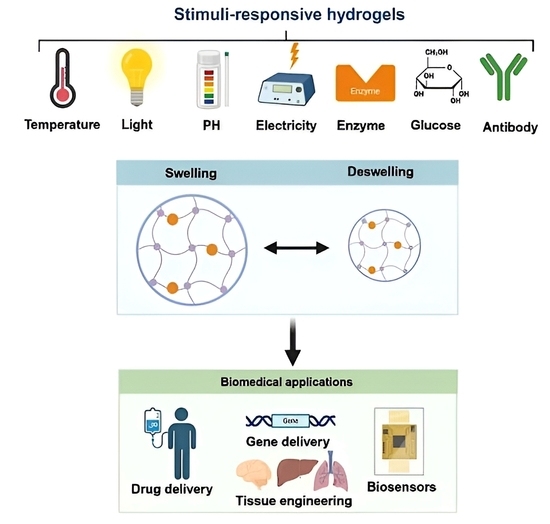
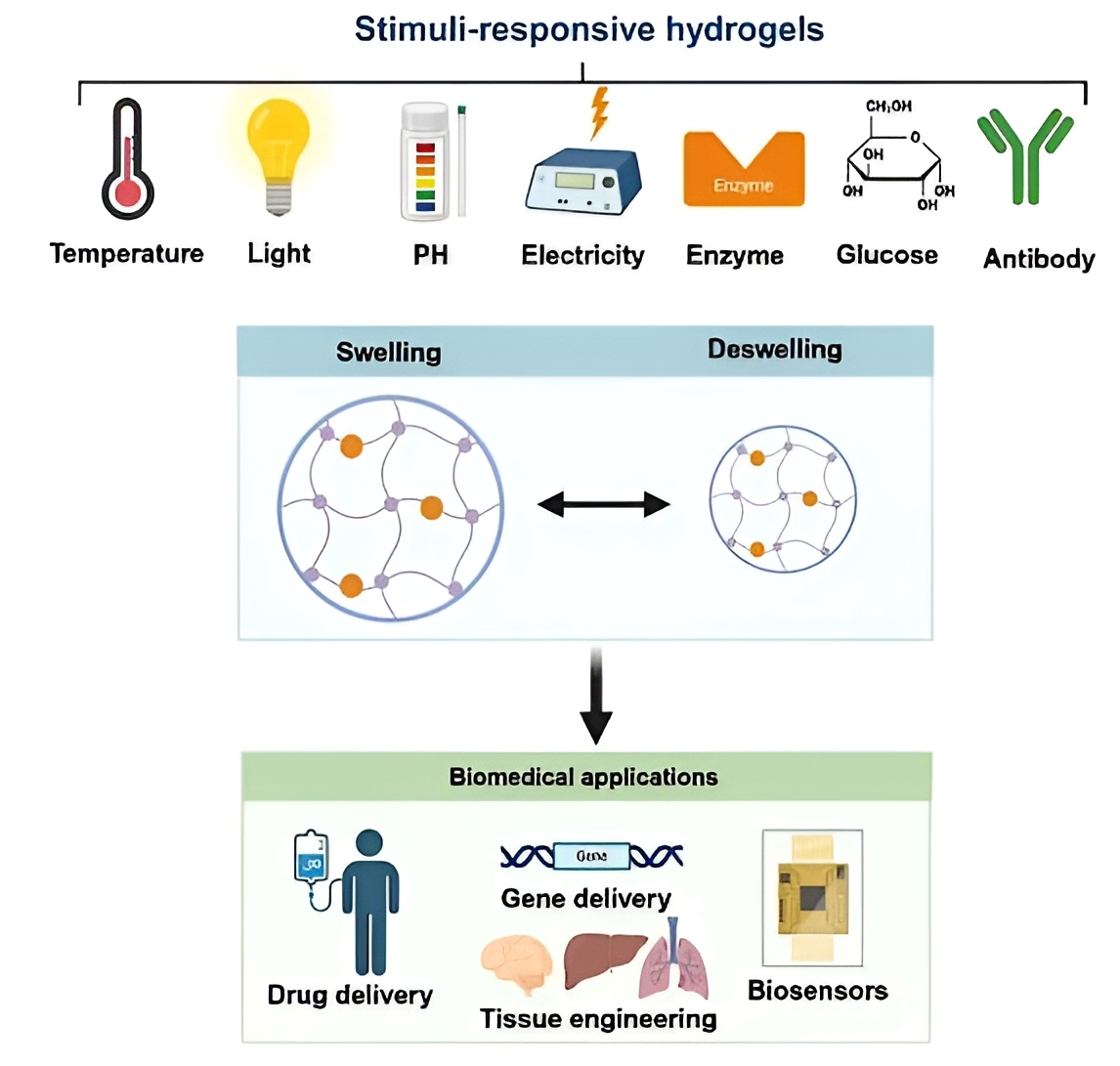
Graphical Abstract