Stimuli-Responsive Hydrogels: From Swelling–Deswelling Mechanisms to Biomedical Applications
Abstract
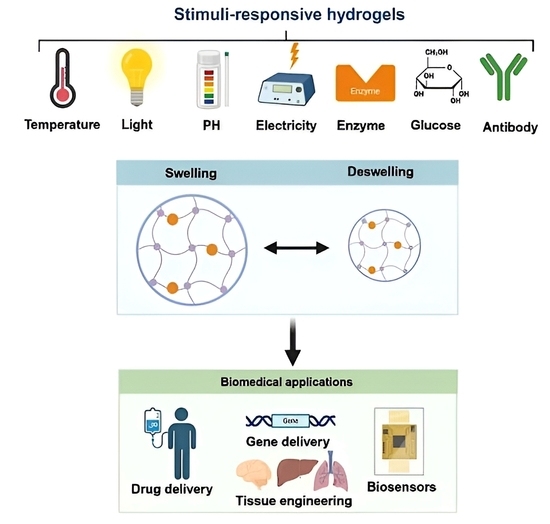
1. Introduction
2. Types of Stimuli-Responsive Hydrogels
2.1. Temperature-Sensitive Hydrogels
2.2. pH-Sensitive and Electro-Sensitive Hydrogels
2.3. Biomolecule-Sensitive Hydrogels
3. Biomedical Applications of Stimuli-Responsive Hydrogels
3.1. Drug Delivery Systems
3.2. Gene Delivery System
3.3. Biosensors
3.4. Tissue Engineering
4. Conclusions and Perspectives
Author Contributions
Funding
Data Availability Statement
Conflicts of Interest
Abbreviation
| Abbreviation | Full Form |
| CS/GP | chitosan/glycerophosphate |
| LCST | Lower Critical Solution Temperature |
| UCST | Upper Critical Solution Temperature |
| PNIPAAm | poly(N-isopropylacrylamide) |
| PAMAM | poly(amidoamine) dendrimer |
| PLLA | poly(L-lactic acid) |
| PEG | poly(ethylene glycol) |
| VEGF | Vascular Endothelial Growth Factor |
| PAAc | poly(acrylic acid) |
| PPS | poly(propylenesulfide) |
| PDMA | poly(N,N-dimethylacrylamide) |
| ROS | Reactive oxygen species |
| PCL | poly(ε-caprolactone) |
References
- Neumann, M.; di Marco, G.; Iudin, D.; Viola, M.; van Nostrum, C.F.; van Ravensteijn, B.G.; Vermonden, T. Stimuli-responsive hydrogels: The dynamic smart biomaterials of tomorrow. Macromolecules 2023, 56, 8377–8392. [Google Scholar] [CrossRef]
- Protsak, I.S.; Morozov, Y.M. Fundamentals and Advances in Stimuli-Responsive Hydrogels and Their Applications: A Review. Gels 2025, 11, 30. [Google Scholar] [CrossRef]
- Ulijn, R.V.; Bibi, N.; Jayawarna, V.; Thornton, P.D.; Todd, S.J.; Mart, R.J.; Smith, A.M.; Gough, J.E. Bioresponsive hydrogels. Mater. Today 2007, 10, 40–48. [Google Scholar] [CrossRef]
- Buwalda, S.J.; Boere, K.W.; Dijkstra, P.J.; Feijen, J.; Vermonden, T.; Hennink, W.E. Hydrogels in a historical perspective: From simple networks to smart materials. J. Control. Release 2014, 190, 254–273. [Google Scholar] [CrossRef] [PubMed]
- Liao, J.; Sun, J.; Jia, W.; He, W.; Wang, H.; Huang, W.; Wang, Y.; Yu, M.; Xie, Y.; Chen, Y. External stimuli-driven catalytic hydrogels for biomedical applications. Chem. Commun. 2025, 61, 3946–3966. [Google Scholar] [CrossRef] [PubMed]
- Kruczkowska, W.; Gałęziewska, J.; Grabowska, K.; Liese, G.; Buczek, P.; Kłosiński, K.K.; Kciuk, M.; Pasieka, Z.; Kałuzińska-Kołat, Ż.; Kołat, D. Biomedical trends in stimuli-responsive hydrogels with emphasis on chitosan-based formulations. Gels 2024, 10, 295. [Google Scholar] [CrossRef]
- Zhou, H.; Zhu, Y.; Yang, B.; Huo, Y.; Yin, Y.; Jiang, X.; Ji, W. Stimuli-responsive peptide hydrogels for biomedical applications. J. Mater. Chem. B 2024, 12, 1748–1774. [Google Scholar] [CrossRef]
- Bai, H.; Li, C.; Wang, X.; Shi, G. A pH-sensitive graphene oxide composite hydrogel. Chem. Commun. 2010, 46, 2376–2378. [Google Scholar] [CrossRef]
- Richter, A.; Paschew, G.; Klatt, S.; Lienig, J.; Arndt, K.-F.; Adler, H.-J.P. Review on hydrogel-based pH sensors and microsensors. Sensors 2008, 8, 561–581. [Google Scholar]
- Liu, J.; Du, C.; Huang, W.; Lei, Y. Injectable smart stimuli-responsive hydrogels: Pioneering advancements in biomedical applications. Biomater. Sci. 2024, 12, 8–56. [Google Scholar] [CrossRef]
- Brouns, J.E.; Dankers, P.Y. Introduction of enzyme-responsivity in biomaterials to achieve dynamic reciprocity in cell–material interactions. Biomacromolecules 2020, 22, 4–23. [Google Scholar] [PubMed]
- Lim, S.-J.; Carling, C.-J.; Warford, C.C.; Hsiao, D.; Gates, B.D.; Branda, N.R. Multifunctional photo-and thermo-responsive copolymer nanoparticles. Dyes Pigments 2011, 89, 230–235. [Google Scholar]
- Qiu, Z.; Yu, H.; Li, J.; Wang, Y.; Zhang, Y. Spiropyran-linked dipeptide forms supramolecular hydrogel with dual responses to light and to ligand–receptor interaction. Chem. Commun. 2009, 23, 3342–3344. [Google Scholar]
- Moon, S.H.; Park, S.J.; Lee, Y.W.; Yang, Y.J. LCST/UCST behavior of polysaccharides for hydrogel fabrication. RSC Adv. 2024, 14, 35754–35768. [Google Scholar] [CrossRef]
- Kawamura, A.; Takahashi, R.; Miyata, T. UCST-Type Thermoresponsive Sol–Gel Transition Triblock Copolymer Containing Zwitterionic Polymer Blocks. Gels 2024, 10, 288. [Google Scholar]
- Chew, S.Y.; Mi, R.; Hoke, A.; Leong, K.W. Aligned protein–polymer composite fibers enhance nerve regeneration: A potential tissue-engineering platform. Adv. Funct. Mater. 2007, 17, 1288–1296. [Google Scholar]
- Lv, T.; Chen, Y.; Li, N.; Liao, X.; Heng, Y.; Guo, Y.; Hu, K. A Comprehensive Review of Thermosensitive Hydrogels: Mechanism, Optimization Strategies, and Applications. Gels 2025, 11, 544. [Google Scholar] [CrossRef]
- De, S.K.; Aluru, N.R.; Johnson, B.; Crone, W.C.; Beebe, D.J.; Moore, J. Equilibrium swelling and kinetics of pH-responsive hydrogels: Models, experiments, and simulations. J. Microelectromech. Syst. 2002, 11, 544–555. [Google Scholar]
- Ansari, M.J.; Rajendran, R.R.; Mohanto, S.; Agarwal, U.; Panda, K.; Dhotre, K.; Manne, R.; Deepak, A.; Zafar, A.; Yasir, M. Poly(N-isopropylacrylamide)-based hydrogels for biomedical applications: A review of the state-of-the-art. Gels 2022, 8, 454. [Google Scholar]
- Hanyková, L.; Šťastná, J.; Krakovský, I. Responsive Acrylamide-Based Hydrogels: Advances in Interpenetrating Polymer Structures. Gels 2024, 10, 414. [Google Scholar] [CrossRef]
- Bonetti, L.; De Nardo, L.; Farè, S. Crosslinking strategies in modulating methylcellulose hydrogel properties. Soft Matter 2023, 19, 7869–7884. [Google Scholar] [CrossRef] [PubMed]
- Saiki, E.; Yoshida, M.; Kurahashi, K.; Iwase, H.; Shikata, T. Elongated rodlike particle formation of methyl cellulose in aqueous solution. ACS Omega 2022, 7, 28849–28859. [Google Scholar] [CrossRef] [PubMed]
- Ning, J.; Kubota, K.; Li, G.; Haraguchi, K. Characteristics of zwitterionic sulfobetaine acrylamide polymer and the hydrogels prepared by free-radical polymerization and effects of physical and chemical crosslinks on the UCST. React. Funct. Polym. 2013, 73, 969–978. [Google Scholar] [CrossRef]
- Shimada, N.; Kidoaki, S.; Maruyama, A. Smart hydrogels exhibiting UCST-type volume changes under physiologically relevant conditions. RSC Adv. 2014, 4, 52346–52348. [Google Scholar] [CrossRef]
- Fukumoto, H.; Ishihara, K.; Yusa, S.-I. Thermo-responsive behavior of mixed aqueous solution of hydrophilic polymer with pendant phosphorylcholine group and poly (acrylic acid). Polymers 2021, 13, 148. [Google Scholar] [CrossRef]
- Wilcox, K.G.; Kozawa, S.K.; Morozova, S. Fundamentals and mechanics of polyelectrolyte gels: Thermodynamics, swelling, scattering, and elasticity. Chem. Phys. Rev. 2021, 2, 041309. [Google Scholar] [CrossRef]
- Shi, X.; Zheng, Y.; Wang, G.; Lin, Q.; Fan, J. pH-and electro-response characteristics of bacterial cellulose nanofiber/sodium alginate hybrid hydrogels for dual controlled drug delivery. RSC Adv. 2014, 4, 47056–47065. [Google Scholar] [CrossRef]
- Ying, X.; Wang, Y.; Liang, J.; Yue, J.; Xu, C.; Lu, L.; Xu, Z.; Gao, J.; Du, Y.; Chen, Z. Angiopep-conjugated electro-responsive hydrogel nanoparticles: Therapeutic potential for epilepsy. Angew. Chem. 2014, 126, 12644–12648. [Google Scholar] [CrossRef]
- Kotanen, C.N.; Tlili, C.; Guiseppi-Elie, A. Bioactive electroconductive hydrogels: The effects of electropolymerization charge density on the storage stability of an enzyme-based biosensor. Appl. Biochem. Biotechnol. 2012, 166, 878–888. [Google Scholar] [CrossRef]
- Nonis, S.G.; Haywood, J.; Schmidberger, J.W.; Mackie, E.R.; da Costa, T.P.S.; Bond, C.S.; Mylne, J.S. Structural and biochemical analyses of concanavalin A circular permutation by jack bean asparaginyl endopeptidase. Plant Cell 2021, 33, 2794–2811. [Google Scholar] [CrossRef]
- Nakamae, K.; Miyata, T.; Jikihara, A.; Hoffman, A.S. Formation of poly(glucosyloxyethyl methacrylate)-concanavalin A complex and its glucose-sensitivity. J. Biomater. Sci. Polym. Ed. 1994, 6, 79–90. [Google Scholar] [CrossRef]
- Ahmed, B.; Reiche, C.F.; Magda, J.J.; Solzbacher, F.; Ko, J. Smart Hydrogel Swelling State Detection Based on a Power-Transfer Transduction Principle. ACS Appl. Polym. Mater. 2024, 6, 5544–5554. [Google Scholar] [CrossRef] [PubMed]
- Brooks, W.L.; Deng, C.C.; Sumerlin, B.S. Structure–reactivity relationships in boronic acid–diol complexation. ACS Omega 2018, 3, 17863–17870. [Google Scholar] [CrossRef] [PubMed]
- Yoshinaga, N.; Zhou, J.K.; Xu, C.; Quek, C.H.; Zhu, Y.; Tang, D.; Hung, L.Y.; Najjar, S.A.; Shiu, C.Y.A.; Margolis, K.G. Phenylboronic acid-functionalized polyplexes tailored to oral CRISPR delivery. Nano Lett. 2023, 23, 757–764. [Google Scholar] [CrossRef] [PubMed]
- Tiwari, G.; Tiwari, R.; Sriwastawa, B.; Bhati, L.; Pandey, S.; Pandey, P.; Bannerjee, S.K. Drug delivery systems: An updated review. Int. J. Pharm. Investig. 2012, 2, 2. [Google Scholar] [CrossRef]
- Abdullah, Z.; Ashraf, M.U.; Barkat, K.; Badshah, S.F.; Rehman, U.; Razzaq, A.; Mahmood, A.; Ulhaq, F.; Chopra, H.; Rashid, S. Formulation of pH-responsive highly swellable hydrogel scaffolds for controlled release of tramadol HCl: Characterization and biocompatibility evaluation. Front. Bioeng. Biotechnol. 2023, 11, 1190322. [Google Scholar] [CrossRef]
- Lin, C.-C.; Metters, A.T. Hydrogels in controlled release formulations: Network design and mathematical modeling. Adv. Drug Deliv. Rev. 2006, 58, 1379–1408. [Google Scholar] [CrossRef]
- Park, H.; Guo, X.; Temenoff, J.S.; Tabata, Y.; Caplan, A.I.; Kasper, F.K.; Mikos, A.G. Effect of swelling ratio of injectable hydrogel composites on chondrogenic differentiation of encapsulated rabbit marrow mesenchymal stem cells in vitro. Biomacromolecules 2009, 10, 541–546. [Google Scholar] [CrossRef]
- Yu, J.; Ha, W.; Sun, J.-n.; Shi, Y.-p. Supramolecular hybrid hydrogel based on host–guest interaction and its application in drug delivery. ACS Appl. Mater. Interfaces 2014, 6, 19544–19551. [Google Scholar] [CrossRef]
- Fu, S.; Chang, L.; Liu, S.; Gao, T.; Sang, X.; Zhang, Z.; Mu, W.; Liu, X.; Liang, S.; Yang, H. Temperature sensitive liposome based cancer nanomedicine enables tumour lymph node immune microenvironment remodelling. Nat. Commun. 2023, 14, 2248. [Google Scholar] [CrossRef]
- Guo, J.; Pan, S.; Yin, X.; He, Y.F.; Li, T.; Wang, R.M. pH-sensitive keratin-based polymer hydrogel and its controllable drug-release behavior. J. Appl. Polym. Sci. 2015, 132, 41572. [Google Scholar] [CrossRef]
- Chenite, A.; Chaput, C.; Wang, D.; Combes, C.; Buschmann, M.D.; Hoemann, C.D.; Leroux, J.C.; Atkinson, B.L.; Binette, F.; Selmani, A. Novel injectable neutral solutions of chitosan form biodegradable gels in situ. Biomaterials 2000, 21, 2155–2161. [Google Scholar] [CrossRef] [PubMed]
- Cho, J.; Heuzey, M.-C.; Bégin, A.; Carreau, P.J. Physical gelation of chitosan in the presence of β-glycerophosphate: The effect of temperature. Biomacromolecules 2005, 6, 3267–3275. [Google Scholar] [CrossRef] [PubMed]
- Iliescu, M.; Hoemann, C.D.; Shive, M.; Chenite, A.; Buschmann, M.D. Ultrastructure of hybrid chitosan–glycerol phosphate blood clots by environmental scanning electron microscopy. Microsc. Res. Tech. 2008, 71, 236–247. [Google Scholar] [CrossRef] [PubMed]
- Gheorghiță, D.; Moldovan, H.; Robu, A.; Bița, A.-I.; Grosu, E.; Antoniac, A.; Corneschi, I.; Antoniac, I.; Bodog, A.D.; Băcilă, C.I. Chitosan-based biomaterials for hemostatic applications: A review of recent advances. Int. J. Mol. Sci. 2023, 24, 10540. [Google Scholar] [CrossRef]
- Supper, S.; Anton, N.; Seidel, N.; Riemenschnitter, M.; Curdy, C.; Vandamme, T. Thermosensitive chitosan/glycerophosphate-based hydrogel and its derivatives in pharmaceutical and biomedical applications. Expert Opin. Drug Deliv. 2014, 11, 249–267. [Google Scholar] [CrossRef]
- Ko, C.-H.; Wastian, P.; Schanzenbach, D.; Mu, P.; Laschewsky, A.; Papadakis, C.M. Dynamic Behavior of Poly (N-isopropylmethacrylamide) in Neat Water and in Water/Methanol Mixtures. Langmuir 2024, 40, 15150–15160. [Google Scholar]
- Ruel-Gariepy, E.; Chenite, A.; Chaput, C.; Guirguis, S.; Leroux, J.-C. Characterization of thermosensitive chitosan gels for the sustained delivery of drugs. Int. J. Pharm. 2000, 203, 89–98. [Google Scholar] [CrossRef]
- Zhou, H.Y.; Chen, X.G.; Kong, M.; Liu, C.S.; Cha, D.S.; Kennedy, J.F. Effect of molecular weight and degree of chitosan deacetylation on the preparation and characteristics of chitosan thermosensitive hydrogel as a delivery system. Carbohydr. Polym. 2008, 73, 265–273. [Google Scholar] [CrossRef]
- Peng, Y.; Li, J.; Li, J.; Fei, Y.; Dong, J.; Pan, W. Optimization of thermosensitive chitosan hydrogels for the sustained delivery of venlafaxine hydrochloride. Int. J. Pharm. 2013, 441, 482–490. [Google Scholar] [CrossRef]
- Ruel-Gariépy, E.; Shive, M.; Bichara, A.; Berrada, M.; Le Garrec, D.; Chenite, A.; Leroux, J.-C. A thermosensitive chitosan-based hydrogel for the local delivery of paclitaxel. Eur. J. Pharm. Biopharm. 2004, 57, 53–63. [Google Scholar] [CrossRef] [PubMed]
- Berrada, M.; Serreqi, A.; Dabbarh, F.; Owusu, A.; Gupta, A.; Lehnert, S. A novel non-toxic camptothecin formulation for cancer chemotherapy. Biomaterials 2005, 26, 2115–2120. [Google Scholar] [CrossRef]
- Kim, S.; Nishimoto, S.K.; Bumgardner, J.D.; Haggard, W.O.; Gaber, M.W.; Yang, Y. A chitosan/β-glycerophosphate thermo-sensitive gel for the delivery of ellagic acid for the treatment of brain cancer. Biomaterials 2010, 31, 4157–4166. [Google Scholar] [CrossRef] [PubMed]
- Han, H.D.; Song, C.K.; Park, Y.S.; Noh, K.H.; Kim, J.H.; Hwang, T.; Kim, T.W.; Shin, B.C. A chitosan hydrogel-based cancer drug delivery system exhibits synergistic antitumor effects by combining with a vaccinia viral vaccine. Int. J. Pharm. 2008, 350, 27–34. [Google Scholar] [CrossRef] [PubMed]
- Wang, W.; Zhang, P.; Shan, W.; Gao, J.; Liang, W. A novel chitosan-based thermosensitive hydrogel containing doxorubicin liposomes for topical cancer therapy. J. Biomater. Sci. Polym. Ed. 2013, 24, 1649–1659. [Google Scholar] [CrossRef]
- Mulik, R.; Kulkarni, V.; Murthy, R.S.R. Chitosan-Based Thermosensitive Hydrogel Containing Liposomes for Sustained Delivery of Cytarabine. Drug Dev. Ind. Pharm. 2009, 35, 49–56. [Google Scholar] [CrossRef]
- Aliaghaie, M.; Mirzadeh, H.; Dashtimoghadam, E.; Taranejoo, S. Investigation of gelation mechanism of an injectable hydrogel based on chitosan by rheological measurements for a drug delivery application. Soft Matter 2012, 8, 7128–7137. [Google Scholar] [CrossRef]
- Bekhradnia, S.; Zhu, K.; Knudsen, K.D.; Sande, S.A.; Nyström, B. Structure, swelling, and drug release of thermoresponsive poly(amidoamine) dendrimer–poly(N-isopropylacrylamide) hydrogels. J. Mater. Sci. 2014, 49, 6102–6110. [Google Scholar] [CrossRef]
- Drapala, P.W.; Jiang, B.; Chiu, Y.-C.; Mieler, W.F.; Brey, E.M.; Kang-Mieler, J.J.; Pérez-Luna, V.H. The Effect of Glutathione as Chain Transfer Agent in PNIPAAm-Based Thermo-responsive Hydrogels for Controlled Release of Proteins. Pharm. Res. 2014, 31, 742–753. [Google Scholar] [CrossRef]
- Prasannan, A.; Tsai, H.-C.; Chen, Y.-S.; Hsiue, G.-H. A thermally triggered in situ hydrogel from poly(acrylic acid-co-N-isopropylacrylamide) for controlled release of anti-glaucoma drugs. J. Mater. Chem. B 2014, 2, 1988–1997. [Google Scholar] [CrossRef]
- Gupta, M.K.; Martin, J.R.; Werfel, T.A.; Shen, T.; Page, J.M.; Duvall, C.L. Cell Protective, ABC Triblock Polymer-Based Thermoresponsive Hydrogels with ROS-Triggered Degradation and Drug Release. J. Am. Chem. Soc. 2014, 136, 14896–14902. [Google Scholar] [CrossRef]
- Abandansari, H.S.; Aghaghafari, E.; Nabid, M.R.; Niknejad, H. Preparation of injectable and thermoresponsive hydrogel based on penta-block copolymer with improved sol stability and mechanical properties. Polymer 2013, 54, 1329–1340. [Google Scholar] [CrossRef]
- Piao, Y.; Chen, B. Characterization, Formation Mechanisms, and pH-Sensitive Drug Release Behavior. J. Polym. Sci. Part B-Polym. Phys. 2015, 53, 356–367. [Google Scholar] [CrossRef]
- Liu, Y.; Wang, W.; Yang, J.; Zhou, C.; Sun, J. pH-sensitive polymeric micelles triggered drug release for extracellular and intracellular drug targeting delivery. Asian J. Pharm. Sci. 2013, 8, 159–167. [Google Scholar] [CrossRef]
- Heleg-Shabtai, V.; Aizen, R.; Orbach, R.; Aleman-Garcia, M.A.; Willner, I. Gossypol-cross-linked boronic acid-modified hydrogels: A functional matrix for the controlled release of an anticancer drug. Langmuir 2015, 31, 2237–2242. [Google Scholar] [CrossRef]
- Panayiotou, M.; Freitag, R. Synthesis and characterisation of stimuli-responsive poly(N,N′-diethylacrylamide) hydrogels. Polymer 2005, 46, 615–621. [Google Scholar] [CrossRef]
- Panayiotou, M.; Pöhner, C.; Vandevyver, C.; Wandrey, C.; Hilbrig, F.; Freitag, R. Synthesis and characterisation of thermo-responsive poly N,N′-diethylacrylamide) microgels. React. Funct. Polym. 2007, 67, 807–819. [Google Scholar] [CrossRef]
- Ma, L.; Liu, M.; Liu, H.; Chen, J.; Cui, D. In vitro cytotoxicity and drug release properties of pH-and temperature-sensitive core–shell hydrogel microspheres. Int. J. Pharm. 2010, 385, 86–91. [Google Scholar] [CrossRef]
- Yun, H.; Wang, K.; Zhang, J.; Peng, G.; Zhao, H. Construction of Peptide-Lipoic Acid Cationic Polymers with Redox Responsiveness and Low Toxicity for Gene Delivery. ACS Omega 2024, 9, 3499–3506. [Google Scholar] [CrossRef]
- Kim, Y.-M.; Park, M.-R.; Song, S.-C. Injectable polyplex hydrogel for localized and long-term delivery of siRNA. ACS Nano 2012, 6, 5757–5766. [Google Scholar] [CrossRef]
- Krebs, M.D.; Jeon, O.; Alsberg, E. Localized and sustained delivery of silencing RNA from macroscopic biopolymer hydrogels. J. Am. Chem. Soc. 2009, 131, 9204–9206. [Google Scholar] [CrossRef]
- Yang, H.-Y.; van Ee, R.J.; Timmer, K.; Craenmehr, E.G.; Huang, J.H.; Öner, F.C.; Dhert, W.J.; Kragten, A.H.; Willems, N.; Grinwis, G.C. A novel injectable thermoresponsive and cytocompatible gel of poly(N-isopropylacrylamide) with layered double hydroxides facilitates siRNA delivery into chondrocytes in 3D culture. Acta Biomater. 2015, 23, 214–228. [Google Scholar] [CrossRef]
- Zhai, D.; Liu, B.; Shi, Y.; Pan, L.; Wang, Y.; Li, W.; Zhang, R.; Yu, G. Highly sensitive glucose sensor based on Pt nanoparticle/polyaniline hydrogel heterostructures. ACS Nano 2013, 7, 3540–3546. [Google Scholar] [CrossRef]
- Zhou, M.; Xie, J.; Yan, S.; Jiang, X.; Ye, T.; Wu, W. Graphene@poly(phenylboronic acid)s microgels with selectively glucose-responsive volume phase transition behavior at a physiological pH. Macromolecules 2014, 47, 6055–6066. [Google Scholar] [CrossRef]
- Zhang, C.; Cano, G.G.; Braun, P.V. Linear and fast hydrogel glucose sensor materials enabled by volume resetting agents. Adv. Mater. 2014, 26, 5678–5683. [Google Scholar] [CrossRef] [PubMed]
- Weber, T.A.; Metzler, L.; Fosso Tene, P.L.; Brandstetter, T.; Rühe, J. Single-color barcoding for multiplexed hydrogel bead-based immunoassays. ACS Appl. Mater. Interfaces 2022, 14, 25147–25154. [Google Scholar] [CrossRef] [PubMed]
- Le Goff, G.C.; Srinivas, R.L.; Hill, W.A.; Doyle, P.S. Hydrogel microparticles for biosensing. Eur. Polym. J. 2015, 72, 386–412. [Google Scholar] [CrossRef]
- Lewis, C.L.; Choi, C.-H.; Lin, Y.; Lee, C.-S.; Yi, H. Fabrication of uniform DNA-conjugated hydrogel microparticles via replica molding for facile nucleic acid hybridization assays. Anal. Chem. 2010, 82, 5851–5858. [Google Scholar] [CrossRef]
- Lee, H.; Kim, J.; Kim, H.; Kim, J.; Kwon, S. Colour-barcoded magnetic microparticles for multiplexed bioassays. Nat. Mater. 2010, 9, 745–749. [Google Scholar] [CrossRef]
- Hu, J.; Zhao, X.-W.; Zhao, Y.-J.; Li, J.; Xu, W.-Y.; Wen, Z.-Y.; Xu, M.; Gu, Z.-Z. Photonic crystal hydrogel beads used for multiplex biomolecular detection. J. Mater. Chem. 2009, 19, 5730–5736. [Google Scholar] [CrossRef]
- Cheng, Y.; Zhu, C.; Xie, Z.; Gu, H.; Tian, T.; Zhao, Y.; Gu, Z. Anisotropic colloidal crystal particles from microfluidics. J. Colloid Interface Sci. 2014, 421, 64–70. [Google Scholar] [CrossRef] [PubMed]
- Zhang, H.; DeConinck, A.J.; Slimmer, S.C.; Doyle, P.S.; Lewis, J.A.; Nuzzo, R.G. Genotyping by alkaline dehybridization using graphically encoded particles. Chem. Eur. J. 2011, 17, 2867–2873. [Google Scholar] [CrossRef] [PubMed]
- Appleyard, D.C.; Chapin, S.C.; Doyle, P.S. Multiplexed protein quantification with barcoded hydrogel microparticles. Anal. Chem. 2011, 83, 193–199. [Google Scholar] [PubMed]
- Ye, B.-F.; Zhao, Y.-J.; Li, T.-T.; Xie, Z.-Y.; Gu, Z.-Z. Aptamer-based suspension array indexed by structural color and shape. J. Mater. Chem. 2011, 21, 18659–18664. [Google Scholar] [CrossRef]
- Srinivas, R.L.; Chapin, S.C.; Doyle, P.S. Aptamer-functionalized microgel particles for protein detection. Anal. Chem. 2011, 83, 9138–9145. [Google Scholar] [CrossRef]
- Zhang, Z.; Meng, F.; Gu, Z.; Deng, Y.; Liu, T.; Jiang, H.; Chen, T.; Huang, L.; Wang, J. A multiplexed assay by self-assembled dual-target responsive DNA hydrogels for efficacy evaluation of immunotherapy. Nat. Commun. 2025, 16, 10132. [Google Scholar] [CrossRef]
- Liu, Z.; Chen, Z.; Yang, S.; Jia, H.; Wei, J. Dual-Mode Multicolor Display Based on Structural and Fluorescent Color CdS Photonic Crystal Hydrogel. Langmuir 2024, 40, 12767–12777. [Google Scholar] [CrossRef]
- Park, S.; Gerber, A.; Santa, C.; Aktug, G.; Hengerer, B.; Clark, H.A.; Jonas, U.; Dostalek, J.; Sergelen, K. Molecularly Responsive Aptamer-Functionalized Hydrogel for Continuous Plasmonic Biomonitoring. J. Am. Chem. Soc. 2025, 147, 11485–11500. [Google Scholar] [CrossRef]
- Shymborska, Y.; Tymetska, S.; Budkowski, A.; Zemła, J.; Raczkowska, J.; Awsiuk, K.; Bernasik, A.; Lekka, M.; Volinsky, A.A.; Pabijan, J.; et al. ‘Smart’ polymer sandwiches from hydrogel nanocoatings attached to stimuli-responsive grafted brush coatings: Changing the cell behavior. J. Biomed. Mater. Res. B 2025, 113, e35631. [Google Scholar] [CrossRef]
- Cieślik, A.; Shymborska, Y.; Tymetska, S.; Stetsyshyn, Y.; Bernasik, A.; Brzychczy-Włoch, M.; Drożdż, K.; Szajna, K.; Krok, F.; Budkowski, A.; et al. Cell sheet engineering platforms integrating antibacterial and thermo-responsive functionalities: Cu-nanoparticle-loaded P4VP brushes for retinal cell sheet harvesting. Chem. Eng. J. 2025, 513, 162985. [Google Scholar]
- Hu, Z.; Lin, H.; Wang, Z.; Yi, Y.; Zou, S.; Liu, H.; Han, X.; Rong, X. 3D Printing Hierarchical Porous Nanofibrous Scaffold for Bone Regeneration. Small 2025, 21, 2405406. [Google Scholar]
- Meng, R.; Liu, L.; Su, X.; Gong, W.; Luo, X.; Gao, H. Facile preparation of cellulose beads with tunable graded pores and high mechanical strength. Polymers 2024, 16, 725. [Google Scholar] [CrossRef] [PubMed]
- Dalfino, S.; Olaret, E.; Piazzoni, M.; Savadori, P.; Stancu, I.; Tartaglia, G.; Dolci, C.; Moroni, L. Polycaprolactone/β-Tricalcium phosphate composite scaffolds with advanced pore geometries promote human mesenchymal stromal cells’ osteogenic differentiation. Tissue Eng. Part A 2025, 31, 13–28. [Google Scholar] [CrossRef] [PubMed]
- Li, T.; Hu, X.; Chen, Y.; Wang, L. Harnessing out-of-plane deformation to design 3D architected lattice metamaterials with tunable Poisson’s ratio. Sci. Rep. 2017, 7, 8949. [Google Scholar] [CrossRef]
- Repić, T.; Madirazza, K.; Bektur, E.; Sapunar, D. Characterization of dorsal root ganglion neurons cultured on silicon micro-pillar substrates. Sci. Rep. 2016, 6, 39560. [Google Scholar] [CrossRef]
- Hong, Y.; Guan, J.; Fujimoto, K.L.; Hashizume, R.; Pelinescu, A.L.; Wagner, W.R. Tailoring the degradation kinetics of poly(ester carbonate urethane)urea thermoplastic elastomers for tissue engineering scaffolds. Biomaterials 2010, 31, 4249–4258. [Google Scholar] [CrossRef]
- Wang, Z.; Sun, Y.; Li, C. Advances in 3D printing technology for preparing bone tissue engineering scaffolds from biodegradable materials. Front. Bioeng. Biotechnol. 2024, 12, 1483547. [Google Scholar] [CrossRef]
- Zhou, E.; He, P.; Yang, Z.; Li, C.; Fang, G.; Wu, J.; Zhuang, W.; Sang, H. 3D-printed GelMA-Alginate microsphere scaffold with staged dual-growth factor release for enhanced bone regeneration. Mater. Today Bio 2025, 35, 102422. [Google Scholar] [CrossRef]
- Suri, S.; Schmidt, C.E. Cell-laden hydrogel constructs of hyaluronic acid, collagen, and laminin for neural tissue engineering. Tissue Eng. Part A 2010, 16, 1703–1716. [Google Scholar] [CrossRef]
- Stetsyshyn, Y.; Ohar, H.; Budkowski, A.; Lazzara, G. Molecular Design and Role of the Dynamic Hydrogen Bonds and Hydrophobic Interactions in Temperature-Switchable Polymers: From Understanding to Applications. Polymers 2025, 17, 1580. [Google Scholar] [CrossRef]
- Galis, Z.S.; Khatri, J.J. Matrix metalloproteinases in vascular remodeling and atherogenesis: The good, the bad, and the ugly. Circ. Res. 2002, 90, 251–262. [Google Scholar] [CrossRef]
- Chou, H.-D.; Chen, C.-A.; Liu, H.-Y.; Liu, S.-J.; Lai, P.-L.; Wu, W.-C.; Hwang, Y.-S.; Chen, K.-J.; Tsai, T.-T.; Lai, C.-C. Synthesis, Properties, and Biocompatibility of 4-Carboxyphenyboronic Acid-Modified Gelatin-Methacryloyl: A Hydrogel for Retinal Surgeries. ACS Omega 2024, 9, 42147–42158. [Google Scholar] [PubMed]
- Nichol, J.W.; Koshy, S.T.; Bae, H.; Hwang, C.M.; Yamanlar, S.; Khademhosseini, A. Cell-laden microengineered gelatin methacrylate hydrogels. Biomaterials 2010, 31, 5536–5544. [Google Scholar] [CrossRef] [PubMed]
- Wang, H.; Wan, J.; Zhang, Z.; Hou, R. Recent advances on 3D-bioprinted gelatin methacrylate hydrogels for tissue engineering in wound healing: A review of current applications and future prospects. Int. Wound J. 2024, 21, 1151–1165. [Google Scholar] [CrossRef] [PubMed]
- Kasi, D.G.; de Graaf, M.N.S.; Nahon, D.M.; van den Hil, F.E.; van den Maagdenberg, A.M.J.M.; Mummery, C.L.; Orlova, V.V. Engineered microvasculature using maskless photolithography and on-chip hydrogel patterning: A facile approach. bioRxiv 2024. [Google Scholar] [CrossRef]
- Hammer, J.; Han, L.-H.; Tong, X.; Yang, F. A facile method to fabricate hydrogels with microchannel-like porosity for tissue engineering. Tissue Eng. Part C Methods 2014, 20, 169–176. [Google Scholar] [CrossRef]
- Chen, S.; Nakamoto, T.; Kawazoe, N.; Chen, G. Engineering multi-layered skeletal muscle tissue by using 3D microgrooved collagen scaffolds. Biomaterials 2015, 73, 23–31. [Google Scholar] [CrossRef]
- Wang, T.; Zhang, M.; Guo, J.; Wei, H.; Li, W.; Luo, Y. Alginate/bacterial cellulose/GelMA scaffolds with aligned nanopatterns and hollow channel networks for vascularized bone repair. Int. J. Biol. Macromol. 2025, 308, 142578. [Google Scholar] [CrossRef]
- Yadav, J.; Chahal, S.; Kumar, P.; Kumar, C. Thermo-Responsive Smart Hydrogels: Molecular Engineering, Dynamic Cross-Linking Strategies, and Therapeutics Applications. Gels 2025, 12, 12. [Google Scholar] [CrossRef]


| CS | Drug | Objective of Study | Ref. | ||
|---|---|---|---|---|---|
| Mw (kDa) | Deacetylation (%) | Formulation (CS/GP) | |||
| Medium mw | n.a. | 1.8%/7.27% (w/w) | Chlorpheniramine maleate | In vitro controlled release | [48] |
| 1360 | 75.4 | 2.0%/5% (w/v) | Adriamycin or 6-mercaptopurine | In vitro release of hydrophilic and hydrophobic drugs | [49] |
| n.a. | 95 | 1.4–2.2%/8–16% (w/w) | Venlafaxine hydrochloride | Release mechanism investigation | [50] |
| 228.7 | 95 | 1.8%/3.6% (w/w) | Paclitaxel | Intratumoral administration | [51] |
| 300 | 85 | 1.53% w/w | Camptothecin | Sustained intratumoral release | [52] |
| <310 | <75 | 1.5%/0.97–14.2% (w/v) | Ellagic acid | Anti-tumor evaluation (brain cancer cells) | [53] |
| 161 | 80 | 2.0%/0.01% (w/v) | Doxorubicin | Combination with vaccinia virus vaccine | [54] |
| 200 | 86 | 1.67%/9.33% (w/v) | Doxorubicin | In vivo antitumor evaluation | [55] |
| n.a. | 90 | 1.8%/5.7% (w/v) | Cytarabine (±liposomes) | Sustained in vivo delivery (free or loaded) | [56] |
| 200–700 | 74 or 99 | 1%/23% (w/w) | Meglumine antimoniate (±microspheres) | Sustained in vivo delivery | [57] |
| Hydrogel | Component | Drug | Loading Capacity (%) | Objective of Study | Ref. |
|---|---|---|---|---|---|
| PNIPAAm–PAMAM dendrimer hydrogel | PNIPAAm (300 mg); PAMAM (0, 30, 90 mg) | Paracetamol | 39–62 | Drug-loading and release evaluation | [58] |
| PNIPAAm-co-PLLA-b-PEG-b-PLLA | PNIPAAm; PLLA; PEG (Mn 3350 Da) | Avastin; Lucentis (anti-VEGF agents) | 75–85 | Anti-tumor activity in HUVEC cells | [59] |
| PNIPAAm-g-PAAc | NIPAAm (Mw 44.25 kDa); PAAc (2.33–4.92 mmol) | Epinephrine | – | In vivo ophthalmic delivery (glaucoma therapy) | [60] |
| PNIPAAm-b-PPS-b-PDMA | PNIPAAm; PPS (150 molar ratio); PDMA (60 molar ratio) | Nile red (model hydrophobic drug) | – | ROS-responsive drug release (in vitro/in vivo) | [61] |
| (PNIPAAm-PCL)2-PEG | PNIPAAm; PCL (Mw 4398); PEG (Mw 400–2000) | Naltrexone hydrochloride | – | Controlled drug release (in vitro/in vivo) | [62] |
| Stimulus Type | Main Advantages | Key Limitations/Safety Concerns | Representative Examples |
|---|---|---|---|
| Thermosensitive (LCST) | In situ gelation after injection, minimally invasive local depot | Burst release, diffusion-limited deswelling, variable in vivo degradation and retention | CS/GP local anticancer gels; PNIPAAm-based depots |
| pH-sensitive | Tumor/inflammation microenvironment selectivity, suitable for oral/topical use | Limited physiological pH gradients, potential mucosal irritation and scarce long-term PK/toxicity data | GO–gelatin hydrogels; PBA–PAAm gossypol systems |
| Electro- sensitive | Precise, switchable on–off control of release | Requires electrodes and power supply; possible tissue damage and chronic inflammation; limited long-term data | Angiopep-conjugated electro- responsive hydrogel (antiepileptic) |
| Biomolecule- sensitive | High specificity via enzymes, sugars, antibodies, aptamers | Complex design; variable target expression; potential immune responses to bio-components | GEMA–ConA glucose-responsive gels; PBA-based glucose sensors |
Disclaimer/Publisher’s Note: The statements, opinions and data contained in all publications are solely those of the individual author(s) and contributor(s) and not of MDPI and/or the editor(s). MDPI and/or the editor(s) disclaim responsibility for any injury to people or property resulting from any ideas, methods, instructions or products referred to in the content. |
© 2026 by the authors. Licensee MDPI, Basel, Switzerland. This article is an open access article distributed under the terms and conditions of the Creative Commons Attribution (CC BY) license.
Share and Cite
Kim, M.-K.; Lee, J.; Kang, A.-R. Stimuli-Responsive Hydrogels: From Swelling–Deswelling Mechanisms to Biomedical Applications. Nanomaterials 2026, 16, 329. https://doi.org/10.3390/nano16050329
Kim M-K, Lee J, Kang A-R. Stimuli-Responsive Hydrogels: From Swelling–Deswelling Mechanisms to Biomedical Applications. Nanomaterials. 2026; 16(5):329. https://doi.org/10.3390/nano16050329
Chicago/Turabian StyleKim, Meyoung-Kon, Junghan Lee, and A-Ram Kang. 2026. "Stimuli-Responsive Hydrogels: From Swelling–Deswelling Mechanisms to Biomedical Applications" Nanomaterials 16, no. 5: 329. https://doi.org/10.3390/nano16050329
APA StyleKim, M.-K., Lee, J., & Kang, A.-R. (2026). Stimuli-Responsive Hydrogels: From Swelling–Deswelling Mechanisms to Biomedical Applications. Nanomaterials, 16(5), 329. https://doi.org/10.3390/nano16050329