Article

Sb-Doped SnO2 Hollow Spheres for Low-Resistance and Highly Selective Xylene Sensors

Division of Advanced Materials Engineering, Kongju National University, Cheonan 31080, Republic of Korea
*
Author to whom correspondence should be addressed.
These authors contributed equally to this work.
Nanomaterials 2026, 16(5), 313; https://doi.org/10.3390/nano16050313
Submission received: 27 January 2026 / Revised: 25 February 2026 / Accepted: 26 February 2026 / Published: 28 February 2026
(This article belongs to the Special Issue Advanced Nanomaterials in Gas and Humidity Sensors: Second Edition)

Abstract

It is important to be able to detect xylene with high selectivity and low sensor resistance when monitoring indoor and outdoor air quality. In this study, we report the development of Sb-doped SnO2 hollow spheres synthesized via ultrasonic spray pyrolysis for high-performance xylene detection with significantly reduced sensor resistance. The 2 mol% Sb-doped SnO2 sensor exhibited a remarkably high response (SX = 24.0) and selectivity (SX/SE = 3.4) toward 5 ppm xylene at 300 °C. Notably, the sensor resistance in air (Ra) was reduced by ~200-fold compared to that of pure SnO2, reaching a practical level of 38.5 kΩ, which enables cost-effective signal measurement. Furthermore, the 2Sb-SnO2 sensor demonstrated a low detection limit of 50 ppb and rapid response times (4–5 s). These results suggest that Sb doping is a highly effective strategy for engineering low-resistance and highly selective SnO2 gas sensors. This study could pave the way for a practical approach to designing xylene detection systems for indoor air monitoring.

1. Introduction

Xylene is a harmful and ubiquitous indoor pollutant among volatile organic compounds (VOCs), which can cause various adverse health effects on the central nervous system, respiratory, kidney, lung, and heart [1,2,3,4]. Xylene is known as a representative aromatic hydrocarbon widely used as a solvent and raw material in various industries, such as paints, printing inks, adhesives, and cigarette smoke. However, highly selective and sensitive detection of xylene is challenging due to its high molecular stability [5,6,7,8,9,10,11,12].
Generally, conventional analytical instruments such as gas chromatography-mass spectrometry (GC-MS) [13] and fourier transform infrared spectroscopy (FTIR) [14] are widely used for harmful xylene detection. However, these methods are bulky and expensive, thereby limiting real-time and on-site xylene detection. Therefore, metal oxide semiconductor-based gas sensors have attraction as a promising alternative due to low cost, simple structure, easy miniaturization, fast response, and high sensitivity [15,16,17,18,19,20,21]. However, metal oxide semiconductor-based gas sensors suffer from poor selectivity because of their simple sensing mechanism between oxide surface and gases. The sensing mechanism of n-type sensors is generally governed by surface adsorption of oxygen species (O2, O), which extract electrons from the conduction band and form a surface depletion layer. Upon exposure to reducing gases such as xylene, the adsorbed oxygen species react with the gas molecules and release trapped electrons back to the semiconductor, thereby modulating the surface potential barrier and depletion width. The resulting change in charge carrier concentration near the surface leads to a measurable variation in electrical resistance. Therefore, gas response in oxide chemiresistors is primarily determined by modulation of the surface depletion layer.
Considerable efforts have been devoted to improving xylene selectivity by developing nanostructures and doping/loading of catalysts [22,23,24]. Although these nanostructures and catalyst designs can enhance selectivity to the target gas, the sensor resistance (Ra) often increases to an immeasurable level (over MΩ range) [1,25,26,27]. For example, Kim et al. [28] reported that Nb-doped NiO hollow spheres exhibited an ultrahigh response towards methylbenzene. However, the Ra values substantially increased (1800 times) with Nb doping at 350 °C. The same group further suggested that Cr doping of the NiO hierarchical nanostructures significantly increased sensor resistance [29]. Maebana et al. [30] also reported that adding CuO to ZnO remarkably increased the xylene response, accompanied by an increase in the Ra value. High Ra values can hinder the cost-effective detection of xylene. Accordingly, highly selective and sensitive xylene detection without increased Ra values is important for practical use.
Among metal oxide semiconductors, SnO2 has been extensively investigated for chemiresistive gas sensing due to its robust chemical stability and high gas response. In particular, SnO2 nanostructures and dopant/catalyst strategies have been widely explored to tune both selectivity and electrical resistance. Motivated by the selectivity–resistance trade-off discussed above, we investigated Sb-doped SnO2 hollow spheres using ultrasonic spray pyrolysis. The Sb doping concentration was systematically varied at 2, 5, and 10 mol% to investigate its influence on both the electrical resistance and gas-sensing characteristics. Our results demonstrate that 2 mol% Sb-doped SnO2 hollow spheres successfully addressed the high-resistance issue, exhibiting an Ra value ~200 times lower than that of pure SnO2. At the optimal operating temperature of 300 °C, the 2Sb-SnO2 sensor showed a high response (SX = 24.0) and superior selectivity toward 5 ppm xylene, with a low detection limit of 50 ppb. The drastic reduction in resistance and the enhanced sensing performance are discussed in relation to the charge compensation mechanism arising from the substitution of Sb5+ into Sn4+ lattice sites and the unique hollow morphology. This study provides a practical and effective strategy for designing low-resistance SnO2 sensors capable of highly sensitive and selective xylene detection for indoor air quality monitoring.

2. Experimental

2.1. Synthesis of Sensing Materials

Pure and Sb-SnO2 hollow spheres were synthesized by ultrasonic spray pyrolysis (Figure S1a). For pure SnO2 hollow spheres, Tin (ll) chloride dihydrate (0.1 M, 2.2565 g, SnCl2·2H2O, 99.99%, Sigma-Aldrich, St. Louis, MO, USA), citric acid monohydrate (0.25 M, 5.2535 g, C6H8O7·H2O, 99.5%, Samchun, Pyeongtaek, Republic of Korea), and a diluted hydrochloric acid solution (35.0–37.0%, HCl: distilled water = 1:99 by vol%) (1 mL) were dissolved in 99 mL distilled water for preparation of a spray solution. After stirring for 1 h at room temperature for homogeneous mixing, the precursor solution was placed into an ultrasonic atomizer. Droplets were generated via an ultrasonic nebulizer (resonant frequency: 1.7 MHz) and transported into a quartz tube (inner diameter = 50 mm, length = 1200 mm) in a high-temperature furnace heated to 700 °C using a carrier gas (air, 10 L/min). For Sb-SnO2 hollow spheres, antimony (III) chloride (SbCl3, 99.00%, Sigma-Aldrich, USA) was added to the spray solution at concentrations of [Sb]/[Sn + Sb] × 100 of 2, 5 and 10 mol%. The precursor powders were collected in a Teflon bag filter and subsequently annealed at 600 °C for 3 h. The morphology of the hollow spheres was analyzed by field-emission scanning electron microscopy (FE-SEM, MIRA3-LMH, Tescan, Brno, Czech Republic). The crystal structure and phase of pure and Sb-doped SnO2 were analyzed by X-ray diffractometer (XRD, D8 Advance, Bruker AXS GmbH, Karlsruhe, Germany) and X-Ray Photoelectron Spectrometer (XPS, K-Alpha, Thermo Fisher Scientific, Waltham, MA, USA).

2.2. Fabrication of Gas Sensor

Pure and Sb-doped SnO2 hollow spheres were mixed with a terpineol-based organic ink vehicle (FCM, Lewis Center, OH, USA) as an organic binder to prepare a slurry (powder:binder = 1:4 by weight). The gas sensors were fabricated by screen-printing the slurry onto the alumina substrate (area: 1.5 × 1.5 mm2) with two patterned Au electrodes on the top and a micro heater on the bottom. Direct thickness quantification (e.g., cross-sectional imaging) was not performed in this study; all sensors were prepared using an identical printing protocol to minimize sample-to-sample variation. The sensors were heat treated at 450 °C for 2 h to remove organic impurities and water. Herein, the Sb-doped SnO2 hollow spheres are referred as xSb-SnO2 (x = 2, 5, and 10) for simplicity.

2.3. Gas Sensing Measurement

The sensors were placed in a homemade sensing chamber. Prior to measurement of the gas sensing characteristics, all sensors were heated at 450 °C for 1 h in dry air for stabilization. The gas atmosphere was controlled using mass flow controllers and an automatic four-way valve at a constant total flow rate of 200 cm3 min−1. The concentrations (5 ppm) of analyte gases (xylene, ethanol, acetone, formaldehyde, ammonia, and propane) were precisely regulated by controlling the mixing ratios between synthetic gas and dry air. Prior to each sensing measurement, the test chamber was thoroughly purged with dry air. Xylene concentration was confirmed by Proton Transfer Reaction Time-of-Flight Mass Spectrometry (PTR-TOF-MS, PTR-ToF 1000, IONICON, Innsbruck, Austria). The two-probe DC resistance of the sensors was measured using a multimeter (Model 3706A, Keithley Instruments, Cleveland, OH, USA), with data acquisition handled by a computer. A constant DC bias voltage of 1 V was applied across the Au electrodes during resistance measurements (two-probe DC configuration), and the resistance data were recorded at a sampling interval of 1 s.

3. Results and Discussion

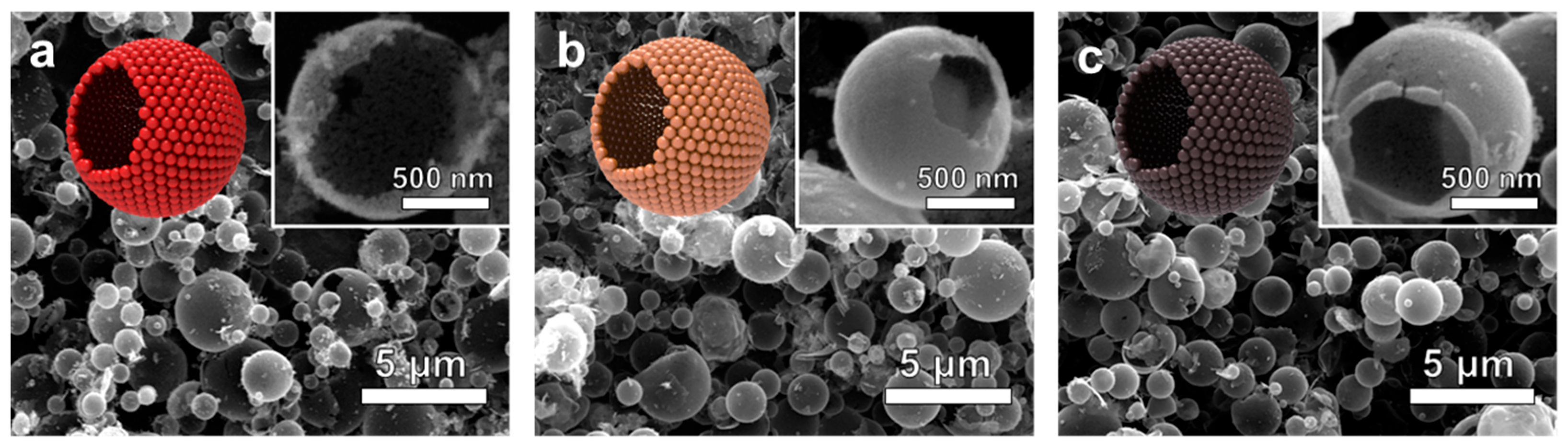
Pure SnO2 and xSb-SnO2 (x = 2, 5, and 10) spheres were prepared using ultrasonic spray pyrolysis (Figure 1a). The spherical structures of the pure SnO2 and xSb-SnO2 were confirmed through SEM analysis (Figure 1 and Figure 2). The average diameter of Pure SnO2 and 2Sb-SnO2 spheres was 1.13 ± 0.82 μm and 1.11 ± 0.52 μm, respectively (Figure S2). The hollow morphology was confirmed through the broken shell of the powders (Inset of Figure 1b). In addition, Figure 1d shows bright contrast in the central region of the SnO2 sphere, in contrast to the dark contour observed in the outer region. The shells exhibited a thickness of ~20 nm, and each sphere consisted of numerous primary particles with sizes of ~12 nm (Figure 1e).
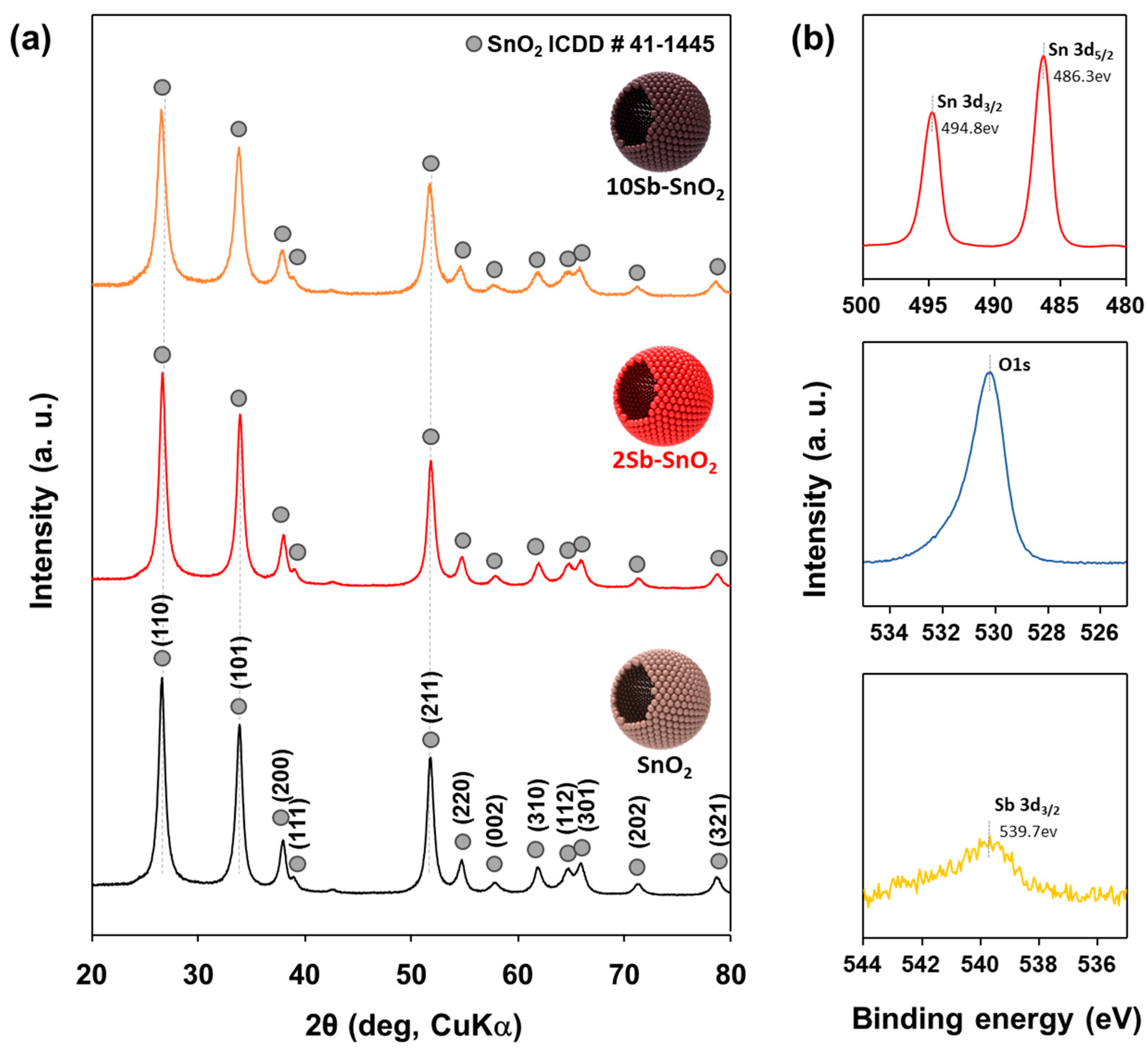
The phase and crystallinity of the resulting powders were analyzed by X-ray diffraction (XRD) using CuKα radiation (Figure 3a). The tetragonal SnO2 phase (ICDD #41-1445) was identified in the pure SnO2 and Sb-SnO2 hollow spheres through XRD analysis. The crystallite sizes of the SnO2 phase for the 2Sb-SnO2 and 10Sb-SnO2 spheres were estimated to be 11.5 ± 1.7 and 9.8 ± 1.1 nm, respectively, which are smaller than that of pure SnO2 spheres (12.1 ± 0.8 nm). This trend suggests that Sb doping tends to suppress crystallite growth during the synthesis process. In addition, the fact that only SnO2 peaks were observed, with no secondary phases even after antimony addition, indicates a successful solid solution of Sb within the SnO2 lattice. The absence of detectable secondary phases in XRD, even at higher Sb concentrations, suggests that Sb is homogeneously incorporated into the SnO2 lattice rather than forming segregated Sb-rich domains. Considering the relatively low doping levels (2–10 mol%), phase segregation is unlikely to be within the detection limit of XRD. The surface chemical states of the 2Sb-SnO2 sample were examined by X-ray photoelectron spectroscopy (XPS) (Figure 3b and Figure S3). The XPS spectra were modified by the C 1s peak at a binding energy of 284.6 eV. The Sn 3d spectrum displays two characteristic peaks at approximately 486.3 eV and 494.8 eV, corresponding to Sn 3d5/2 and Sn 3d3/2, respectively, indicating that Sn is predominantly present in the Sn4+ oxidation state. A weak but discernible Sb-related signal is observed in the Sb 3d region, suggesting the presence of Sb species at the surface of the 2Sb-SnO2 sample.
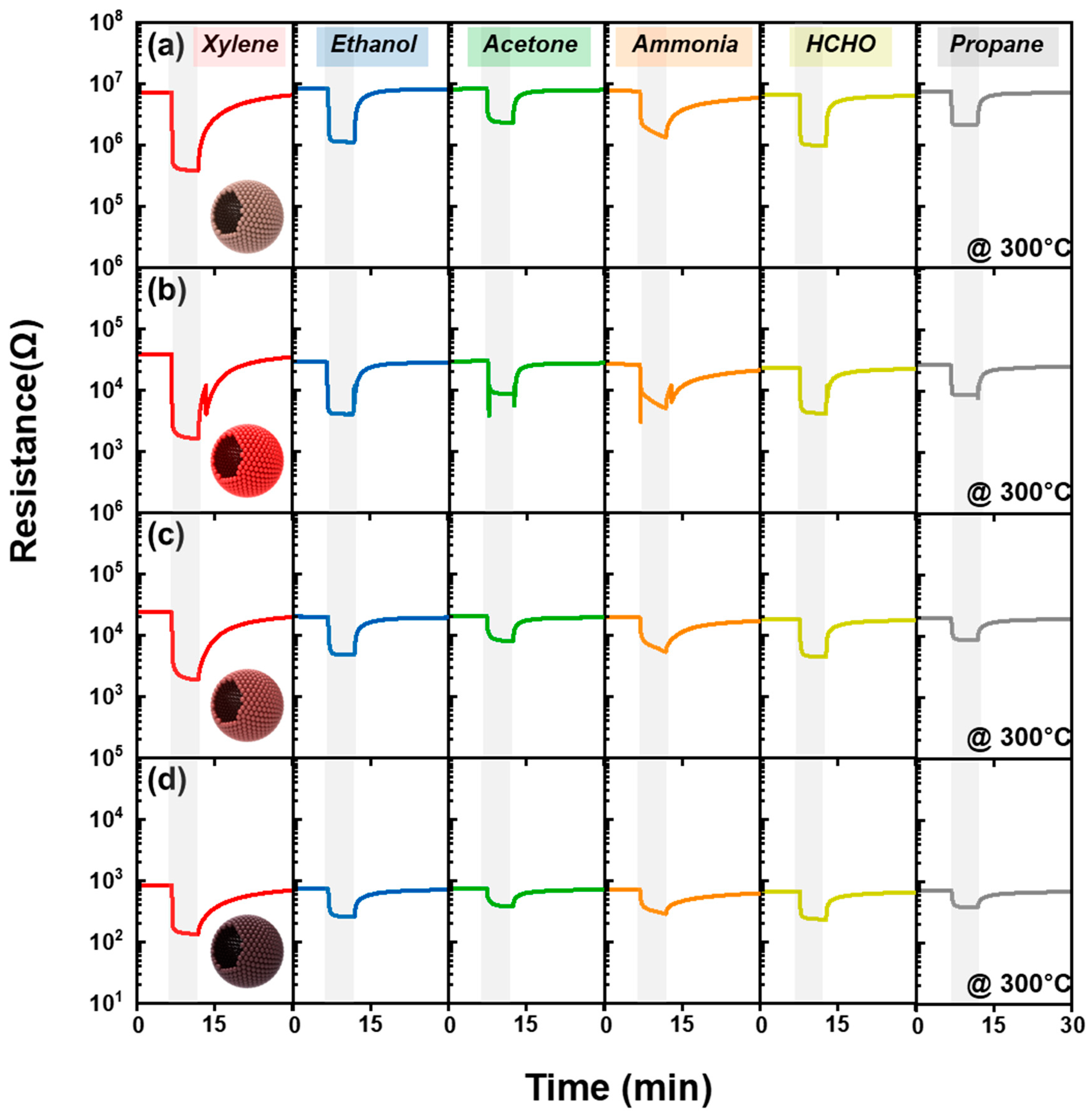
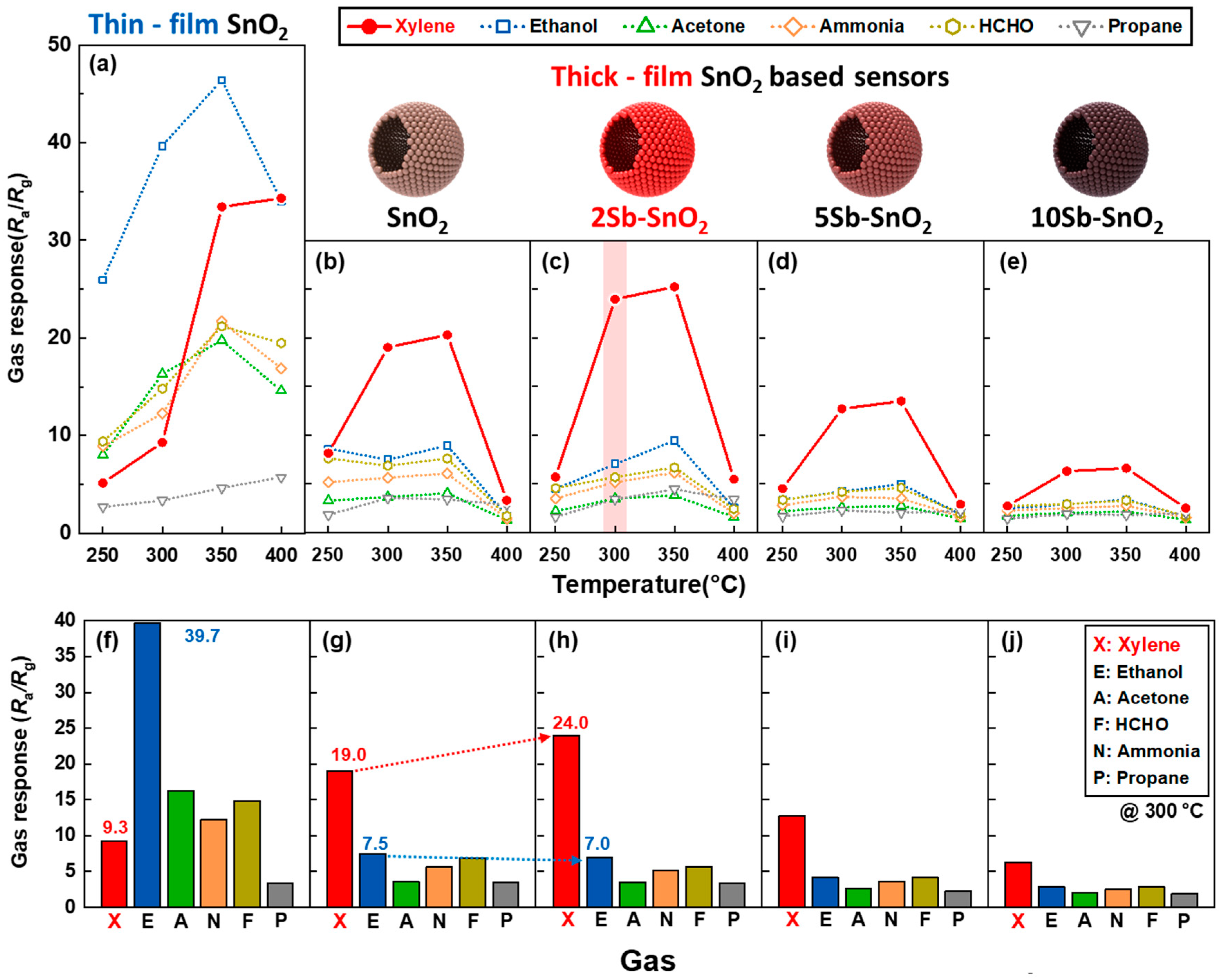
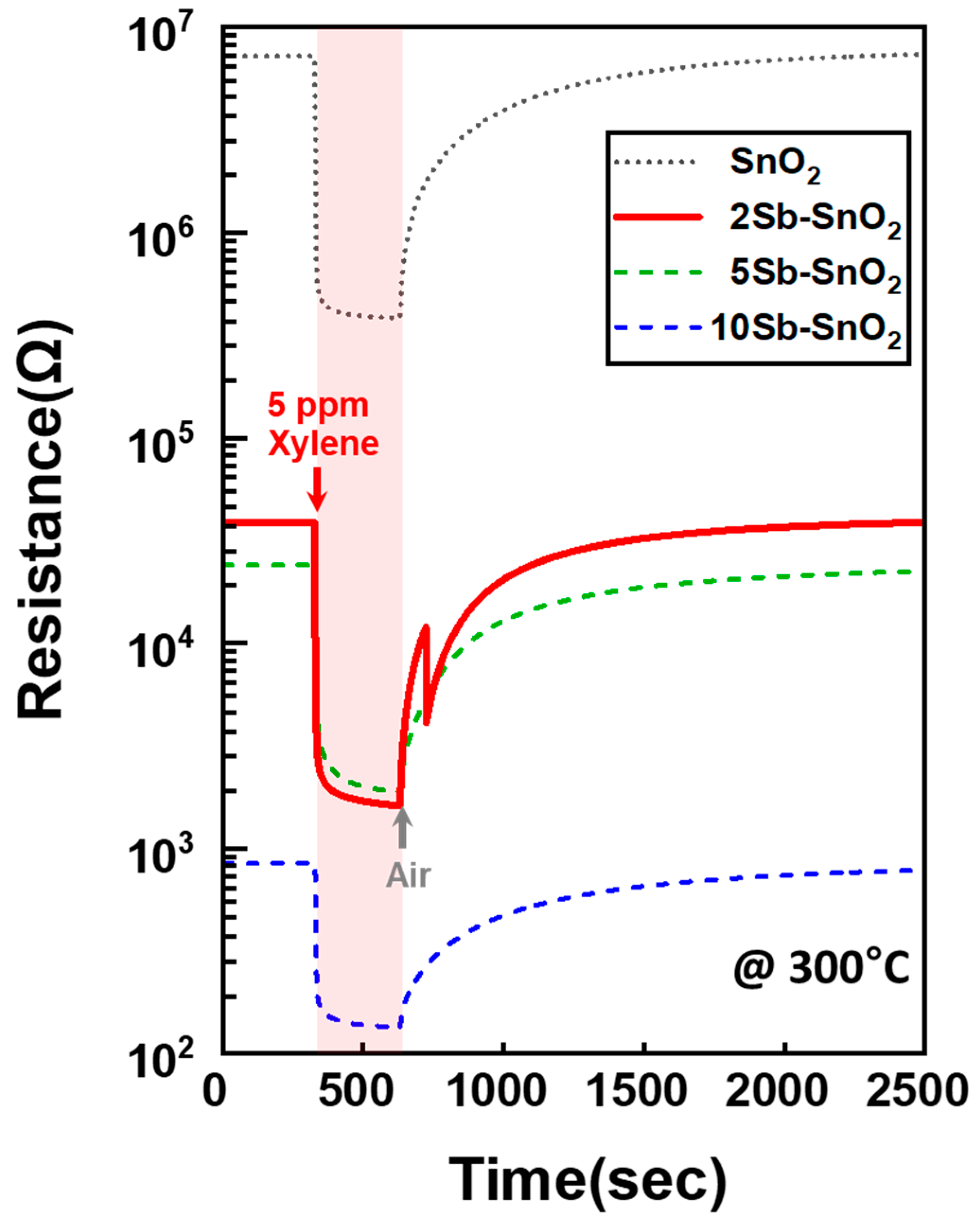
The gas sensing characteristics of pure SnO2 and Sb-SnO2 sensors were investigated toward 5 ppm of xylene (X), ethanol (E), acetone (A), formaldehyde (F), ammonia (N), and propane (P) at 250–400 °C (Figure 4 and Figure 5). All sensors exhibited typical n-type semiconductor behavior where resistance drops in reducing gases and returns to the initial state in air (Figure 4) [15,31,32,33]. Accordingly, the gas response (S) was defined as
S = Ra/Rg
Initially, the thin-film SnO2 sensor (powder:binder = 1:6 by weight) exhibited a high response to ethanol at 250–350 °C (Figure 5a,f). This is consistent with the typical sensing characteristics of pure SnO2 sensors, where selective detection of xylene is difficult due to the cross-response to ethanol [22,23,34,35,36,37].
However, the thick-film SnO2 sensor showed a significantly higher response to xylene than to other interfering gases, including ethanol (Figure 5b). The enhanced xylene selectivity can be attributed to oxidation of the highly reactive interfering gases in the gas-sensing process. Interestingly, the high gas response to xylene at 300 °C was probably obtained due to partial oxidation into highly reactive forms (i.e., reforming) (Figure 5g). Nevertheless, the resistance in air (Ra) was notably high (7223.8 kΩ at 300 °C), which could hamper cost-effective resistance measurement in practical applications (Figure 6, Table 1, and Note S1).
Similar xylene sensing characteristics were maintained after addition of Sb catalyst to SnO2. For example, the response order (xylene > interfering gases) of Sb-doped SnO2 sensors at 300 and 350 °C was consistent with that of the thick-film pure SnO2 sensor (Figure 5b–e,g–j and Figure S4). The 2Sb-SnO2 sensor showed a comparable response to xylene and interfering gases (SXylene   SInterferent) at 250 °C. It should be noted that the xylene response significantly increased from 19.0 (pure SnO2) to 24.0 (2Sb-SnO2) with a negligibly low gas response to the interfering gases at 300 °C (Figure 5c). For example, the 2Sb-SnO2 sensor exhibited a remarkably high xylene response (SX = 24.0) compared to 5ppm ethanol (SE = 7.0), acetone (SA = 3.5), ammonia (SN = 5.2), HCHO (SF = 5.7), propane (SP = 3.4) at 300 °C. Although the 1Sb-SnO2 sensor exhibited a higher response (SX = 25.7 at 300 °C) to xylene than 2Sb-SnO2 (SX = 24.0 at 300 °C), its selectivity (SX/SE = 3.2) towards xylene was lower than that of 2Sb-SnO2 (SX/SE = 3.4). Moreover, it was noted that the Ra value of the 2Sb-SnO2 sensor was remarkably reduced to 38.5 kΩ at 300 °C (Figure 6 and Table 1). Higher Sb doping further decreased the Ra value in the 5Sb- and 10Sb-SnO2 sensors. Although selective xylene sensing characteristics were maintained in the 5Sb-SnO2 and 10Sb-SnO2 sensors, the responses to all analyte gases drastically decreased across the entire sensing temperature range (250–400 °C) when increasing the Sb doping concentration to 5 and 10 mol% (Figure 5d,e). The above results indicate that Sb-doped SnO2 hollow spheres could be an excellent candidate for highly selective xylene detection with low Ra values.
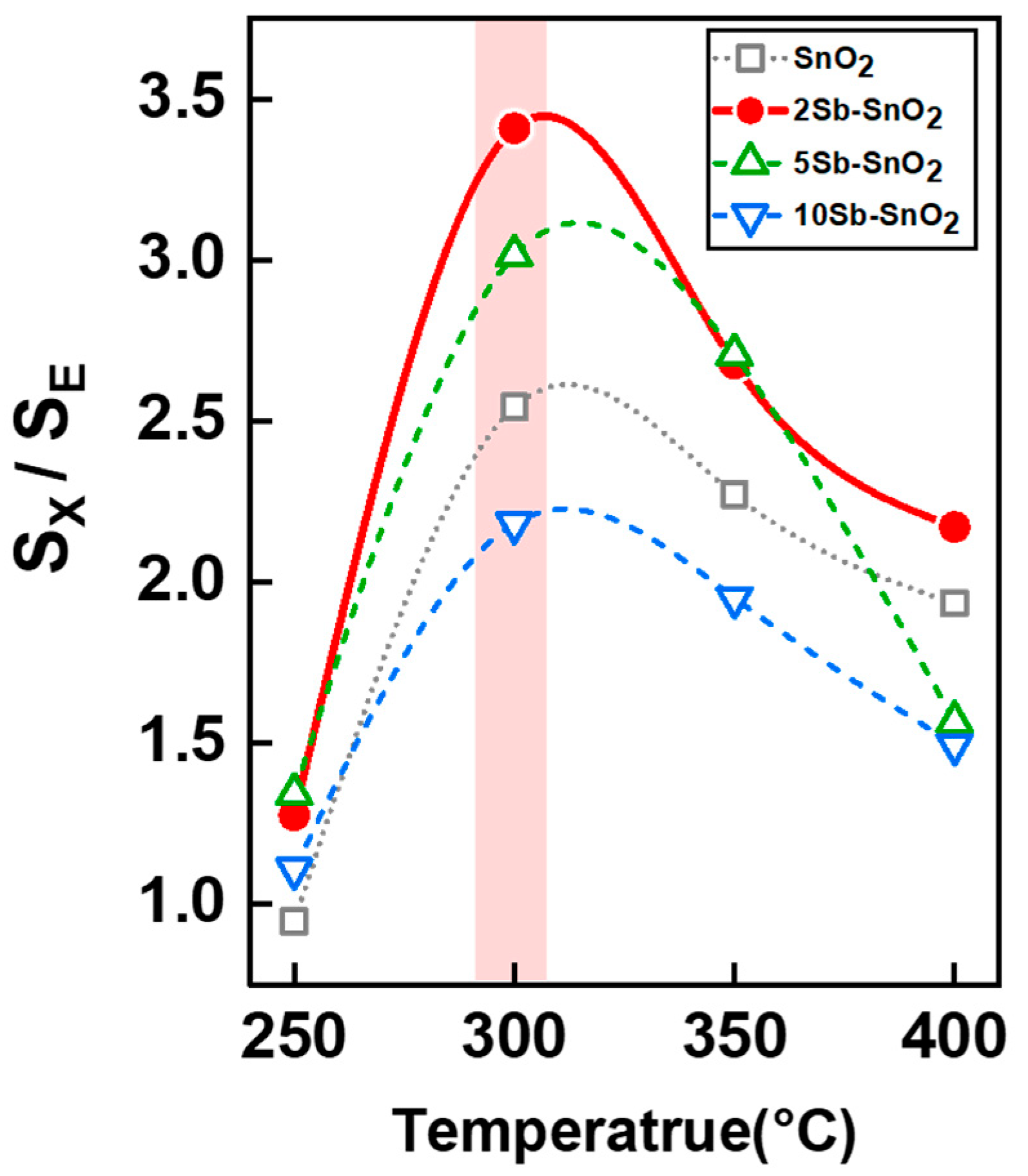
The xylene selectivity (SX/SE) was defined as the response ratio of xylene to the major interferant ethanol [38,39,40,41,42] and plotted as a function of operating temperature (250–400 °C) (Figure 7 and Note S2). The xylene selectivity (SX/SE) of the pure SnO2 sensor ranged from 0.9 to 2.5 at 250–400 °C, whic increased to 1.2–3.2 upon 2 mol% Sb doping. However, the SX/SE value gradually decreased with further Sb doping to 5 and 10 mol%. Note that all sensors exhibited the highest SX/SE values at 300 °C with corresponding values of 2.5, 3.4, 3.0, and 2.1 for pure SnO2, 2Sb-, 5Sb-, and 10Sb-SnO2 sensors, respectively. Considering both selectivity (SX/SE) and response (SX) of the sensors, 2Sb-SnO2 hollow spheres operating at 300 °C were determined to be the most suitable for highly sensitive and selective detection of xylene.
For sensor applications, low sensor resistance is also an important factor [43,44,45,46]. As described earlier, the pure SnO2 sensor exhibited a high Ra value of 7223.8 kΩ at 300 °C. This high resistance of sensing materials can hinder cost-effective resistance measurements using conventional electric circuits for actual applications. Therefore, it is important to reduce sensor resistance to below the MΩ level. In contrast, the Ra values of the xSb-SnO2 (x = 2, 5, and 10) sensors drastically decreased with increased Sb doping concentration (Figure 6 and Table 1). For example, the low Ra values for the 2Sb-, 5Sb-, and 10Sb-SnO2 sensors were achieved to 38.5 kΩ, 23.9 kΩ, and 0.8 kΩ at 300 °C, respectively. It was noted that these values were 188 (2Sb-SnO2), 302 (5Sb-SnO2), and 9028 (10Sb-SnO2) times lower than that of pure SnO2 (7223.8 kΩ).
The drastic decrease in the resistance with Sb doping is understood as a charge-compensation mechanism during the substitution of host Sn4+ with dopant Sb5+ within the lattice. Using Kröger–Vink notation, the defect chemical equation can be described as follows:
S b 2 O 5 2 S n O 2 2 S b · S n + 4 O X O + 1 2 O 2 g + 2 e
According to this equation, the substitution of Sn4+ with Sb5+ generates excess electrons to maintain electroneutrality. This donor-type substitution increases the background electron concentration in the n-type SnO2 matrix. The XPS results (Figure 3b), showing Sb species consistent with a pentavalent state while preserving the Sn4+ framework, support this substitutional donor-doping mechanism. Accordingly, the resistance systematically decreases with increasing Sb content (2, 5, and 10 mol%). Importantly, despite this substantial reduction in Ra values, the selective xylene sensing characteristics of SnO2 are maintained (Figure 5b–e and Figure 6, Table 1), indicating that carrier modulation improves electrical conductivity without fundamentally altering the surface reaction selectivity. Although Sb doping increases the baseline carrier concentration, the sensing response is not governed solely by a simple dilution effect based on absolute carrier change. In chemiresistive sensors, the gas response is primarily determined by modulation of the surface depletion layer and the associated potential barrier. At moderate Sb doping (2 mol%), the carrier concentration increases while the depletion layer remains sufficiently developed to allow effective resistance modulation upon xylene adsorption. In contrast, excessive Sb doping (5 and 10 mol%) significantly narrows the depletion region, thereby reducing the relative barrier modulation and suppressing the response (Figure 5d,e). Therefore, the enhanced response observed for 2Sb-SnO2 can be understood as arising from an optimal balance between baseline conductivity and depletion-layer modulation (Figure 5c,h).
The enhanced xylene response and selectivity observed in 2Sb-SnO2 may be attributed to the catalytic effect of Sb. However, the 5Sb- and 10Sb-SnO2 sensors showed low gas responses to all analyte gases. For instance, the reduced response of 5Sb- and 10Sb-SnO2 sensors can be attributed to the increased background charge carrier concentration and the reduced adsorption of oxygen ions caused by excessive Sb addition. Generally, when a fixed amount of charge is injected into n-type oxide chemiresistive sensors, a lower background charge carrier concentration leads to higher variation of resistance (response, Ra/Rg). Therefore, the response of 5Sb- and 10Sb-SnO2 sensors is drastically decreased by the excessive increase in background charge carrier concentration caused by elevated Sb doping levels (5 and 10 mol%). Furthermore, the response is suppressed by the reduction in oxygen adsorption sites upon Sb doping, as Sb atoms occupy SnO2 surface sites and inhibit surface reactions. Consequently, 2 mol% Sb is the most efficient doping concentration for practical SnO2-based sensors, providing low electrical resistance and high xylene response.
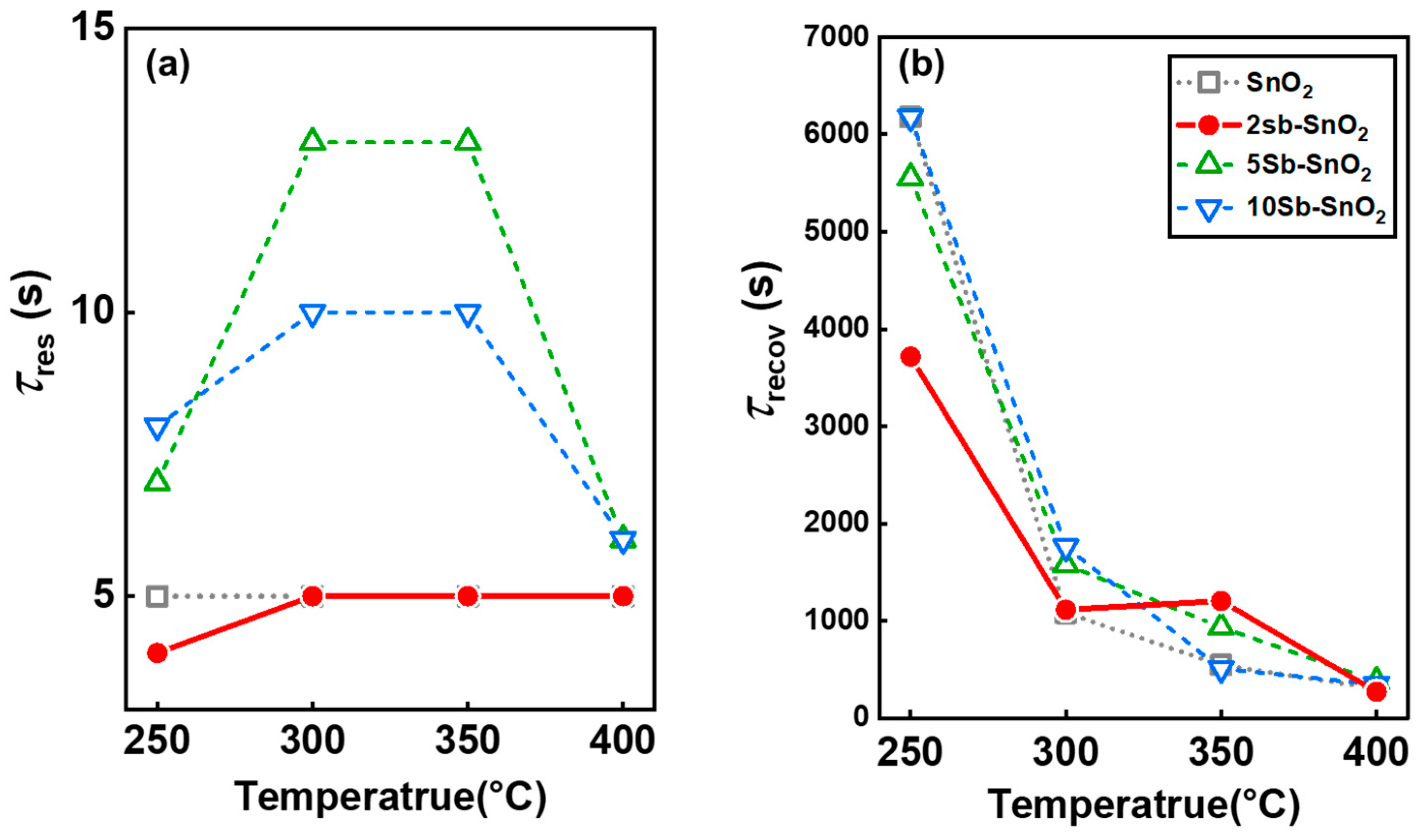
The response and recovery times were defined as the time required to reach 90% of the resistance variation upon exposure to xylene and air, respectively (Figure 8). Both pure SnO2 and 2Sb-SnO2 sensors exhibited rapid response times (τres = 4–5 s) across the entire temperature range (250–400 °C), whereas the 5Sb-SnO2 and 10Sb-SnO2 sensors showed slow response times (τres = 6–13 s and 6–10 s, respectively) (Figure 8a). In contrast, all sensors exhibited sluggish recovery times toward xylene (τrecov= 269–6179 s) at 250–400 °C (Figure 8b). The τrecov values of pure SnO2 (1081 s) and 2Sb-SnO2 (1113 s) were remarkably lower than those of 5Sb-SnO2 (1577 s) and 10Sb-SnO2 (1760 s) at the optimal sensing temperature of 300 °C.
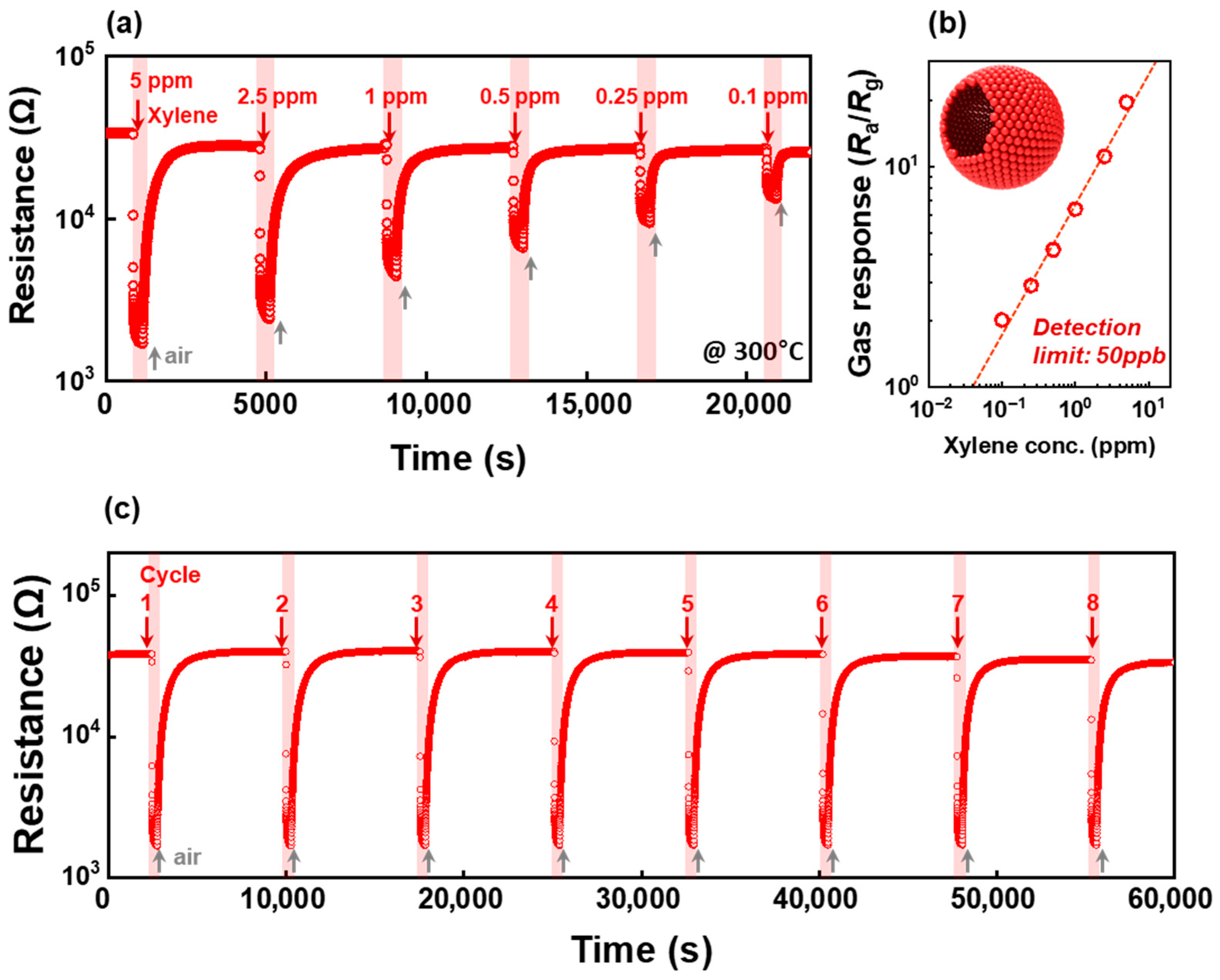
The gas-sensing characteristic of the 2Sb-SnO2 sensor was further investigated by varying the xylene concentration between 0.1 and 5 ppm at 300 °C, where a concentration-dependent sensing behavior toward xylene was observed (Figure 9a). Based on the gas responses to 0.1–5 ppm xylene of the 2Sb-SnO2 sensor, the detection limit was estimated to be 50 ppb from a linear fit of the logarithmic SX values, using Ra/Rg > 1.2 as the criterion (Figure 9b). In addition, the sensor showed reproducible responses over eight repetitive exposures to 5 ppm of xylene 300 °C (Figure 9c). Moreover, Table 2 compares the sensing performance of the 2Sb-SnO2 sensor with previously reported xylene sensors. Within comparable operating conditions, the 2Sb-SnO2 sensor demonstrates a competitive response while maintaining a significantly lower sensor resistance compared to other reported systems [24,26,27,28,47,48,49], which often exhibit an excessively high resistance value range. Notably, the present sensor achieves a balanced combination of high response and practical resistance (38.5 kΩ), which is advantageous for cost-effective signal measurement and device integration. These findings suggest that 2Sb-SnO2 is capable of detecting trace levels of xylene, as a harmful indoor air pollutant.
We further evaluated the sensor performance under a humid atmosphere of 50% relative humidity (RH). Humidity-dependent measurements were performed using 2.5 ppm xylene and ethanol as representative target and interfering gases (Figure S5). The reduced gas concentration compared to dry conditions (5 ppm) originates from unavoidable dilution effects when humid air (50% RH) is introduced into the gas-mixing system. Under humid conditions, both the baseline resistance and the gas response of the 2Sb-SnO2 sensor decreased compared to dry-air conditions, which is consistent with the behavior typically observed in metal oxide semiconductor sensors [32,50,51]. Importantly, the sensor continued to exhibit clear selectivity toward xylene over ethanol. These results indicate that, although the resistance and response magnitude are reduced under humid conditions, the proposed sensor remains operable in humid environments, supporting its potential applicability in practical applications.

4. Conclusions

In this study, we designed Sb-doped SnO2 hollow spheres for highly selective and sensitive xylene detection without increased sensor resistance. The 2Sb-SnO2 hollow spheres showed high selectivity (SX/SE = 3.4) and response (SX = 24.0) to 5 ppm of xylene at 300 °C. Moreover, Sb doping significantly reduced the sensor resistance by increasing the background charge-carrier concentration through the substitution of Sb5+ into Sn4+ lattice sites. Note that 2 mol% Sb doping provided significant advantages, including an approximately 200-fold reduction in resistance and enhanced xylene selectivity and response without changing τres and τrecov. Among the studied samples, 2 mol% Sb doping showed the most favorable trade-offs; however, finer composition screening may further refine the optimum. In addition, the 2Sb-SnO2 sensor exhibited a low detection limit of 50 ppb of xylene. These results indicate that Sb addition is an effective strategy for designing low-resistance SnO2 sensors. This approach can be widely utilized for designing highly selective and sensitive gas sensors without increasing sensor resistance.

Supplementary Materials

The following supporting information can be downloaded at: https://www.mdpi.com/article/10.3390/nano16050313/s1, Note S1. Gas selectivity comparison. Note S2. Comparison of response and recovery times. Figure S1. Schematic illustration of (a) ultrasonic spray pyrolysis and (b) sensor fabrication process. Figure S2. Average diameter comparison graph for the pure and xSb-SnO2 sensors. Figure S3. XPS survey spectrum of 2Sb-SnO2 sensor. Figure S4. (a) Gas-sensing characteristics (at 250–400 °C) and (b) gas response (at 300 °C) of the 1Sb-doped SnO2 sensors to 5 ppm of analytes. Figure S5. Gas response (at 300 °C, RH50%) of the 2Sb-doped SnO2 sensors to 2.5 ppm of analytes.

Author Contributions

Conceptualization, formal analysis, investigation, and writing—original draft, J.-H.S., S.-Y.Y., S.-M.L. and S.-Y.J.; writing—review and editing, funding acquisition, and project administration, S.-Y.J.; supervision, S.-Y.J. All authors have read and agreed to the published version of the manuscript.

Funding

This research was supported by Chungcheongnam-do and Hongseong-gun (Korea Testing and Research Institute) through the Disaster and Safety Industry Technology Commercialization Support Project (No. 20254600000000382773). This work was also supported by a research grant from Kongju National University Industry–University Cooperation Foundation in 2025. This work was also supported by a National Research Foundation of Korea (NRF) grant funded by the Korean government (MIST) (Nos. RS-2025-16903034, RS-2025-25433129, and RS-2024-00454367) and a Korea Institute for Advancement of Technology (KIAT) grant funded by the Korean government (MOTIE) (P0017012, Human Resource Development Program for Industrial Innovation). This research was supported by a Korea Institute for Advancement of Technology (KIAT) grant funded by the Korean government (MOTIE) (RS-2024-00410787, HRD Program for Industrial Innovation).

Data Availability Statement

The data presented in this study are available on request from the corresponding author.

Conflicts of Interest

The authors declare no competing interests.

References

  1. Chan, J.F.; Jeon, J.K.; Moon, Y.K.; Lee, J.-H. Highly sensitive xylene sensors using Fe2O3-ZnFe2O4 composite spheres. J. Sens. Sci. Technol. 2021, 30, 191–195. [Google Scholar] [CrossRef]
  2. Bian, Y.; Zhang, Y.; Zhou, Y.; Feng, X. BTEX in the environment: An update on sources, fate, distribution, pretreatment, analysis, and removal techniques. Chem. Eng. J. 2022, 435, 134825. [Google Scholar] [CrossRef]
  3. ATSDR. Toxicological Profile for Lead; US Department of Health and Human Services: Atlanta, GA, USA, 2007; Volume 1, p. 582.
  4. Jeong, H.-M.; Jeong, S.-Y.; Kim, J.-H.; Kim, B.-Y.; Kim, J.-S.; Abdel-Hady, F.; Wazzan, A.A.; Al-Turaif, H.A.; Jang, H.W.; Lee, J.-H. Gas Selectivity Control in Co3O4 Sensor via Concurrent Tuning of Gas Reforming and Gas Filtering using Nanoscale Hetero-Overlayer of Catalytic Oxides. ACS Appl. Mater. Interfaces 2017, 9, 41397–41404. [Google Scholar] [CrossRef] [PubMed]
  5. Yamazoe, N.; Shimanoe, K. Theory of power laws for semiconductor gas sensors. Sens. Actuators B 2008, 128, 566–573. [Google Scholar] [CrossRef]
  6. Woo, H.-S.; Kwak, C.-H.; Chung, J.-H.; Lee, J.-H. Co-doped branched ZnO nanowires for ultraselective and sensitive detection of xylene. ACS Appl. Mater. Interfaces 2014, 6, 22553–22560. [Google Scholar] [CrossRef]
  7. Xu, M.; Zhang, S.; Li, X.; Wang, H.; Wang, X.; Wang, J.; Zhao, Z.; He, G. Metal-organic frameworks for the separation of xylene isomers. Chem. Soc. Rev. 2025, 54, 1613–1633. [Google Scholar] [CrossRef]
  8. Alharby, T.N.; Alanazi, M.; Alanazi, J. Electrochemical and colorimetric sensing of P-xylene using doped C60 fullerenes: A dual approach to medical and environmental applications. Sci. Rep. 2026, 16, 612. [Google Scholar] [CrossRef]
  9. Yang, W.; Hao, J.; Zhang, Z.; Wu, Y.; Wang, Z.; Li, Z. Chemiresistive detection of xylene vapor using MOF-derived porous Co3O4 microrods activated by Mo6+ cations. Sens. Actuators B 2025, 422, 136658. [Google Scholar] [CrossRef]
  10. Hassanzadeh-Afrouzi, M.; Tajalli, H.; Shokrollah-Nezhad, S.; Maleki, A.; Tajalli, S. Strategies to detect xylene gas using chemoresistive gas sensors: An overview. J. Ind. Eng. Chem. 2024, 139, 56–73. [Google Scholar] [CrossRef]
  11. Hu, S.; Hao, J.; Zhang, Z.; Wu, Y.; Wang, Z.; Li, Z. Ultrasensitive xylene sensor based on RuO2-modified BiVO4 nanosheets. Sens. Actuators B 2025, 422, 136623. [Google Scholar] [CrossRef]
  12. Verma, M.; Bahuguna, A.; Gupta, R. Room Temperature Humidity Tolerant Xylene Sensor Using a Sn-SnO2 Nanocomposite. ACS Appl. Mater. Interfaces 2023, 15, 5512–5520. [Google Scholar] [CrossRef]
  13. Durmusoglu, E.; Taspinar, F.; Karademir, A. Health risk assessment of BTEX emissions in the landfill environment. J. Hazard. Mater. 2010, 176, 870–877. [Google Scholar] [CrossRef]
  14. Sheu, R.; Stönner, C.; Ditto, J.C.; Klüpfel, T.; Williams, J.; Gentner, D.R. Human transport of thirdhand tobacco smoke: A prominent source of hazardous air pollutants into indoor nonsmoking environments. Sci. Adv. 2020, 6, eaay4109. [Google Scholar] [CrossRef]
  15. Jeong, S.Y.; Kim, J.S.; Lee, J.H. Rational design of semiconductor-based chemiresistors and their libraries for next-generation artificial olfaction. Adv. Mater. 2020, 32, 2002075. [Google Scholar] [CrossRef]
  16. Kim, S.-J.; Choi, S.-J.; Jang, J.-S.; Kim, N.-H.; Hakim, M.; Tuller, H.L.; Kim, I.-D. Mesoporous WO3 Nanofibers with Protein-Templated Nanoscale Catalysts for Detection of Trace Biomarkers in Exhaled Breath. ACS Nano 2016, 10, 5891–5899. [Google Scholar] [CrossRef]
  17. Yamazoe, N.; Sakai, G.; Shimanoe, K. Oxide semiconductor gas sensors. Catal. Surv. Asia 2003, 7, 63–75. [Google Scholar] [CrossRef]
  18. Lee, J.-H. Linear gas sensing with dielectric excitation. Nat. Electron. 2020, 3, 239–240. [Google Scholar] [CrossRef]
  19. Kim, Y.H.; Kim, S.J.; Kim, Y.-J.; Shim, Y.-S.; Kim, S.Y.; Hong, B.H.; Jang, H.W. Self-activated transparent all-graphene gas sensor with endurance to humidity and mechanical bending. ACS Nano 2015, 9, 10453–10460. [Google Scholar] [CrossRef] [PubMed]
  20. Srivastava, S.; Sharma, T.; Deshwal, M. Parametric Optimization for Highly Sensitive ZnO Based NOX Gas Sensor. Trans. Electr. Electron. Mater. 2024, 25, 434–441. [Google Scholar] [CrossRef]
  21. Kumar, G.; Singh, V.P.; Pandey, S.K. Assessing Gas Leakage Detection Performance Using Machine Learning with Different Modalities. Trans. Electr. Electron. Mater. 2024, 25, 653–664. [Google Scholar] [CrossRef]
  22. Yoon, J.-W.; Choi, S.H.; Kim, J.-S.; Jang, H.W.; Kang, Y.C.; Lee, J.-H. Trimodally porous SnO2 nanospheres with three-dimensional interconnectivity and size tunability: A one-pot synthetic route and potential application as an extremely sensitive ethanol detector. NPG Asia Mater. 2016, 8, e244. [Google Scholar] [CrossRef]
  23. Liu, Y.; Jiao, Y.; Zhang, Z.; Qu, F.; Umar, A.; Wu, X. Hierarchical SnO2 Nanostructures Made of Intermingled Ultrathin Nanosheets for Environmental Remediation, Smart Gas Sensor, and Supercapacitor Applications. ACS Appl. Mater. Interfaces 2014, 6, 2174–2184. [Google Scholar] [CrossRef]
  24. Sui, L.; Zhang, X.; Cheng, X.; Wang, P.; Xu, Y.; Gao, S.; Zhao, H.; Huo, L. Au-Loaded Hierarchical MoO3 Hollow Spheres with Enhanced Gas-Sensing Performance for the Detection of BTX (Benzene, Toluene, And Xylene) And the Sensing Mechanism. ACS Appl. Mater. Interfaces 2017, 9, 1661–1670. [Google Scholar] [CrossRef]
  25. Zhu, L.-Y.; Ou, L.-X.; Mao, L.-W.; Wu, X.-Y.; Liu, Y.-P.; Lu, H.-L. Advances in noble metal-decorated metal oxide nanomaterials for chemiresistive gas sensors: Overview. Nano-Micro Lett. 2023, 15, 89. [Google Scholar] [CrossRef]
  26. Bulemo, P.M.; Kim, D.-H.; Shin, H.; Cho, H.-J.; Koo, W.-T.; Choi, S.-J.; Park, C.; Ahn, J.; Guntner, A.T.; Penner, R.M. Selectivity in Chemiresistive Gas Sensors: Strategies and Challenges. Chem. Rev. 2025, 125, 4111–4183. [Google Scholar] [CrossRef]
  27. Kim, B.-Y.; Yoon, J.-W.; Kim, J.K.; Kang, Y.C.; Lee, J.-H. Dual role of multiroom-structured Sn-doped NiO microspheres for ultrasensitive and highly selective detection of xylene. ACS Appl. Mater. Interfaces 2018, 10, 16605–16612. [Google Scholar] [CrossRef] [PubMed]
  28. Kim, T.-H.; Jeong, S.-Y.; Moon, Y.K.; Lee, J.-H. Dual-mode gas sensor for ultrasensitive and highly selective detection of xylene and toluene using Nb-doped NiO hollow spheres. Sens. Actuators B 2019, 301, 127140. [Google Scholar] [CrossRef]
  29. Kim, H.-J.; Yoon, J.-W.; Choi, K.-I.; Jang, H.W.; Umar, A.; Lee, J.-H. Ultraselective and sensitive detection of xylene and toluene for monitoring indoor air pollution using Cr-doped NiO hierarchical nanostructures. Nanoscale 2013, 5, 7066–7073. [Google Scholar] [CrossRef] [PubMed]
  30. Maebana, L.M.; Motsoeneng, R.G.; Tshabalala, Z.P.; Swart, H.C.; Cummings, F.R.; Jozela, M.; Nkosi, S.S.; Motaung, D.E. Low-operational temperature for selective detection of xylene gas using a p-n CuO-ZnO heterostructure-based sensor. J. Alloys Compd. 2023, 960, 170683. [Google Scholar] [CrossRef]
  31. Jeong, S.-Y.; Moon, Y.K.; Wang, J.; Lee, J.-H. Exclusive detection of volatile aromatic hydrocarbons using bilayer oxide chemiresistors with catalytic overlayers. Nat. Commun. 2023, 14, 233. [Google Scholar] [CrossRef]
  32. Jeong, S.-Y.; Moon, Y.K.; Kim, J.-K.; Park, S.-W.; Jo, Y.K.; Kang, Y.C.; Lee, J.-H. A General Solution to Mitigate Water Poisoning of Oxide Chemiresistors: Bilayer Sensors with Tb4O7 Overlayer. Adv. Funct. Mater. 2021, 31, 2007895. [Google Scholar] [CrossRef]
  33. Jeong, S.-Y.; Jang, J. CeO2-filter-based monolithic bilayer gas sensors for selective, sensitive, and fast methanol detection. Chem. Eng. J. 2025, 507, 160614. [Google Scholar] [CrossRef]
  34. Liu, J.; Dai, M.; Wang, T.; Sun, P.; Liang, X.; Lu, G.; Shimanoe, K.; Yamazoe, N. Enhanced Gas Sensing Properties of SnO2 Hollow Spheres Decorated with CeO2 Nanoparticles Heterostructure Composite Materials. ACS Appl. Mater. Interfaces 2016, 8, 6669–6677. [Google Scholar] [CrossRef]
  35. Wongchoosuk, C.; Wisitsoraat, A.; Tuantranont, A.; Kerdcharoen, T. Portable electronic nose based on carbon nanotube-SnO2 gas sensors and its application for detection of methanol contamination in whiskeys. Sens. Actuators B 2010, 147, 392–399. [Google Scholar] [CrossRef]
  36. Zhao, T.; Qiu, P.; Fan, Y.; Yang, J.; Jiang, W.; Wang, L.; Deng, Y.; Luo, W. Hierarchical branched mesoporous TiO2–SnO2 nanocomposites with well-defined n–n heterojunctions for highly efficient ethanol sensing. Adv. Sci. 2019, 6, 1902008. [Google Scholar] [CrossRef]
  37. Kim, B.-Y.; Cho, J.S.; Yoon, J.-W.; Na, C.W.; Lee, C.-S.; Ahn, J.H.; Kang, Y.C.; Lee, J.-H. Extremely sensitive ethanol sensor using Pt-doped SnO2hollownanospherespreparedbyKirkendalldiffusion. Sens. Actuators B 2016, 234, 353–360. [Google Scholar] [CrossRef]
  38. Zhang, H.; Guo, S.; Zheng, W.; Wang, H.; Li, H.-Y.; Yu, M.-H.; Chang, Z.; Bu, X.-H.; Liu, H. Facile engineering of metal–organic framework derived SnO2-ZnO composite based gas sensor toward superior acetone sensing performance. Chem. Eng. J. 2023, 469, 143927. [Google Scholar] [CrossRef]
  39. Kim, K.B.; Sohn, M.S.; Hwang, I.-S.; Yoo, D.J.; Jeong, S.-Y.; Kang, Y.C.; Moon, Y.K. Mitigating alcohol inhibition of oxide chemiresistors: Bilayer sensors with HZSM-5 zeolite overlayers. Nat. Commun. 2025, 16, 5121. [Google Scholar] [CrossRef] [PubMed]
  40. Kim, S.; Ko, T.Y.; Jena, A.K.; Nissimagoudar, A.S.; Lee, J.; Lee, S.; Oh, T.; Kang, Y.C.; In, I.; Bhattacharjee, S.; et al. Instant self-assembly of functionalized MXenes in organic solvents: General fabrication to high-performance chemical gas sensors. Adv. Funct. Mater. 2024, 34, 2310641. [Google Scholar] [CrossRef]
  41. Jeong, S.-Y.; Yoon, J.-W.; Kim, T.-H.; Jeong, H.-M.; Lee, C.-S.; Kang, Y.C.; Lee, J.-H. Ultra-selective detection of sub-ppm-level benzene using Pd–SnO2 yolk–shell micro-reactors with a catalytic Co3O4 overlayer for monitoring air quality. J. Mater. Chem. A 2017, 5, 1446–1454. [Google Scholar] [CrossRef]
  42. Moon, Y.K.; Jeong, S.-Y.; Kang, Y.C.; Lee, J.-H. Exclusive detection of ethylene using metal oxide chemiresistors with a Pd-V2O5-TiO2 yolk–shell catalytic overlayer via heterogeneous Wacker oxidation. J. Mater. Chem. A 2023, 11, 666–675. [Google Scholar] [CrossRef]
  43. Suematsu, K.; Sasaki, M.; Ma, N.; Yuasa, M.; Shimanoe, K. Antimony-doped tin dioxide gas sensors exhibiting high stability in the sensitivity to humidity changes. ACS Sens. 2016, 1, 913–920. [Google Scholar] [CrossRef]
  44. Großmann, K.; Kovács, K.E.; Pham, D.K.; Mädler, L.; Barsan, N.; Weimar, U. Enhancing performance of FSP SnO2-basedgassensorsthroughSb-dopingandPd-functionalization. Sens. Actuators B 2011, 158, 388–392. [Google Scholar] [CrossRef]
  45. Zhang, B.; Tian, Y.; Zhang, J.; Cai, W. The FTIR studies of SnO2:Sb(ATO) films deposited by spray pyrolysis. Mater. Lett. 2011, 65, 1204–1206. [Google Scholar] [CrossRef]
  46. Kwak, C.-H.; Woo, H.-S.; Lee, J.-H. Fast Responding Gas Sensors Using Sb-Doped SnO2 Nanowire Networks. J. Sens. Sci. Technol. 2013, 22, 302–307. [Google Scholar] [CrossRef]
  47. Feng, C.; Jiang, Z.; Wu, J.; Chen, B.; Lu, G.; Huang, C. Pt-Cr2O3-WO3 composite nanofibers as gas sensors for ultra-high sensitive and selective xylene detection. Sens. Actuators B 2019, 300, 127008. [Google Scholar] [CrossRef]
  48. Guo, M.; Luo, N.; Chen, Y.; Fan, Y.; Wang, X.; Xu, J. Fast-response MEMS xylene gas sensor based on CuO/WO3 hierarchical structure. Sens. Actuators B 2022, 429, 127471. [Google Scholar] [CrossRef]
  49. Gao, H.; Guo, J.; Li, Y.; Xie, C.; Li, X.; Liu, L.; Chen, Y.; Sun, P.; Liu, F.; Yan, X.; et al. Highly selective and sensitive xylene gas sensor fabricated from NIO/NICr2O4 p-p nanoparticles. Sens. Actuators B 2019, 284, 305–315. [Google Scholar] [CrossRef]
  50. Kwak, C.-H.; Kim, T.-H.; Jeong, S.-Y.; Yoon, J.-W.; Kim, J.-S.; Lee, J.-H. Humidity-independent oxide semiconductor chemiresistors using terbium-doped SnO2 yolk–shell spheres for real-time breath analysis. ACS Appl. Mater. Interfaces 2018, 10, 18886–18894. [Google Scholar] [CrossRef]
  51. Kim, J.-S.; Na, C.W.; Kwak, C.-H.; Li, H.-Y.; Yoon, J.-W.; Kim, J.-H.; Jeong, S.-Y.; Lee, J.-H. Humidity-independent gas sensors using Pr-doped In2O3 macroporous spheres: Role of cyclic Pr3+/Pr4+ redox reactions in suppression of water-poisoning effect. ACS Appl. Mater. Interfaces 2019, 11, 25322–25329. [Google Scholar] [CrossRef] [PubMed]
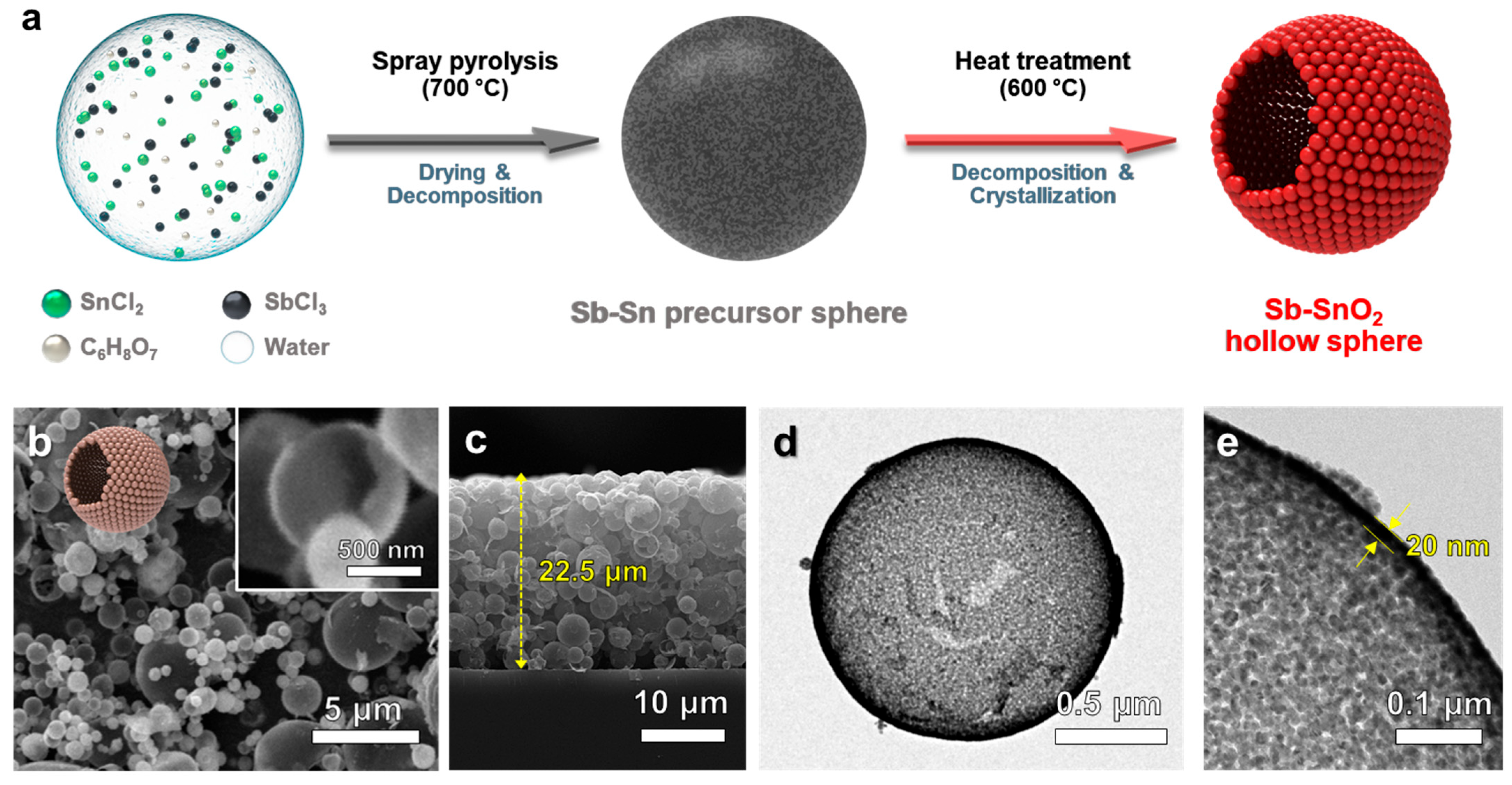
Figure 1. (a) Schematic illustration of the synthesis procedure. (b) Scanning electron microscopy (SEM), (c) cross-sectional SEM, (d) transmission electron microscopy (TEM), and (e) high-resolution TEM images of pure SnO2 spheres.
Nanomaterials 16 00313 g001
Figure 2. SEM images of the (a) 2Sb-, (b) 5Sb-, and (c) 10Sb-doped SnO2 sensors.
Nanomaterials 16 00313 g002
Figure 3. (a) XRD pattern of pure SnO2, 2Sb-SnO2, and 10Sb-SnO2 sensors. (b) X-ray photoelectron spectroscopy (XPS) spectra of the 2Sb-SnO2 sensor.
Nanomaterials 16 00313 g003
Figure 4. Dynamic sensing transients of (a) pure SnO2, (b) 2Sb-SnO2, (c) 5Sb-SnO2, and (d) 10Sb-SnO2 sensors at 300 °C.
Nanomaterials 16 00313 g004
Figure 5. (ae) Gas-sensing characteristics (at 250–400 °C) and (fj) gas response (at 300 °C) to 5 ppm of analytes of pure SnO2 and Sb-doped SnO2 sensors.
Nanomaterials 16 00313 g005
Figure 6. Sensor resistance (Ra) of pure and Sb-doped SnO2 sensors at 300 °C.
Nanomaterials 16 00313 g006
Figure 7. Selective xylene detection (SXylene/SEthanol) properties of pure SnO2 and Sb-doped SnO2 sensors.
Nanomaterials 16 00313 g007
Figure 8. 90% response (τres) and recovery (τrecov) time of (a) pure SnO2 and (b) Sb-doped SnO2 sensors at temperatures in the range of 250–400 °C.
Nanomaterials 16 00313 g008
Figure 9. (a) Dynamic sensing transient of the 2Sb-doped SnO2 sensor to 5–0.1 ppm of xylene and (b) cyclic responses (Ra/Rg) as functions of xylene concentration (5 to 0.1 ppm). (c) Eight repetitive sensing transients to 5 ppm xylene at 300 °C.
Nanomaterials 16 00313 g009
Table 1. Sensor resistance in air (Ra) of pure thick SnO2 and Sb-doped SnO2 sensors.
SampleResistance (kΩ)
SnO27223.8
2Sb-SnO238.5
5Sb-SnO223.9
10Sb-SnO20.8
Table 2. Properties of various materials used for xylene sensing reported in the literature and obtained in this study [24,26,27,28,47,48,49].
MaterialConc.
[ppm]
Response [RaRg−1 − 1, RgRa−1 − 1]Sensor Resistance
[kΩ]
Sensor Temp.
[°C]
Ref.
Nb-doped NiO hollow spheres511715400350[26]
Cr-doped NiO hierarchical nanostructures511.6~200400[27]
CuO-ZnO heterostructure-based sensor51.9~1100[28]
Pt-Cr2O3-WO3 nanofiber1074.3~150,000325[47]
CuO/WO3 hierarchical structure506.4~328260[48]
NiO/NiCr2O4 nanoparticles10066.2~2700225[49]
Au-loaded MoO3 hollow spheres10022.1~900,000250[24]
2Sb-SnO2 hollow spheres 524.038.5300This work
Disclaimer/Publisher’s Note: The statements, opinions and data contained in all publications are solely those of the individual author(s) and contributor(s) and not of MDPI and/or the editor(s). MDPI and/or the editor(s) disclaim responsibility for any injury to people or property resulting from any ideas, methods, instructions or products referred to in the content.